EP4385331A1 - Verfahren zur herstellung einer kulinarischen creme und eines cremers - Google Patents
Verfahren zur herstellung einer kulinarischen creme und eines cremers Download PDFInfo
- Publication number
- EP4385331A1 EP4385331A1 EP22213614.5A EP22213614A EP4385331A1 EP 4385331 A1 EP4385331 A1 EP 4385331A1 EP 22213614 A EP22213614 A EP 22213614A EP 4385331 A1 EP4385331 A1 EP 4385331A1
- Authority
- EP
- European Patent Office
- Prior art keywords
- volume
- milk
- cream
- caseins
- emulsifying
- Prior art date
- Legal status (The legal status is an assumption and is not a legal conclusion. Google has not performed a legal analysis and makes no representation as to the accuracy of the status listed.)
- Pending
Links
Images

Classifications
-
- A—HUMAN NECESSITIES
- A23—FOODS OR FOODSTUFFS; TREATMENT THEREOF, NOT COVERED BY OTHER CLASSES
- A23C—DAIRY PRODUCTS, e.g. MILK, BUTTER OR CHEESE; MILK OR CHEESE SUBSTITUTES; PREPARATION THEREOF
- A23C9/00—Milk preparations; Milk powder or milk powder preparations
- A23C9/14—Milk preparations; Milk powder or milk powder preparations in which the chemical composition of the milk is modified by non-chemical treatment
- A23C9/142—Milk preparations; Milk powder or milk powder preparations in which the chemical composition of the milk is modified by non-chemical treatment by dialysis, reverse osmosis or ultrafiltration
- A23C9/1422—Milk preparations; Milk powder or milk powder preparations in which the chemical composition of the milk is modified by non-chemical treatment by dialysis, reverse osmosis or ultrafiltration by ultrafiltration, microfiltration or diafiltration of milk, e.g. for separating protein and lactose; Treatment of the UF permeate
-
- A—HUMAN NECESSITIES
- A23—FOODS OR FOODSTUFFS; TREATMENT THEREOF, NOT COVERED BY OTHER CLASSES
- A23C—DAIRY PRODUCTS, e.g. MILK, BUTTER OR CHEESE; MILK OR CHEESE SUBSTITUTES; PREPARATION THEREOF
- A23C13/00—Cream; Cream preparations; Making thereof
- A23C13/12—Cream preparations
- A23C13/14—Cream preparations containing milk products or non-fat milk components
-
- A—HUMAN NECESSITIES
- A23—FOODS OR FOODSTUFFS; TREATMENT THEREOF, NOT COVERED BY OTHER CLASSES
- A23C—DAIRY PRODUCTS, e.g. MILK, BUTTER OR CHEESE; MILK OR CHEESE SUBSTITUTES; PREPARATION THEREOF
- A23C9/00—Milk preparations; Milk powder or milk powder preparations
- A23C9/14—Milk preparations; Milk powder or milk powder preparations in which the chemical composition of the milk is modified by non-chemical treatment
- A23C9/142—Milk preparations; Milk powder or milk powder preparations in which the chemical composition of the milk is modified by non-chemical treatment by dialysis, reverse osmosis or ultrafiltration
- A23C9/1425—Milk preparations; Milk powder or milk powder preparations in which the chemical composition of the milk is modified by non-chemical treatment by dialysis, reverse osmosis or ultrafiltration by ultrafiltration, microfiltration or diafiltration of whey, e.g. treatment of the UF permeate
-
- A—HUMAN NECESSITIES
- A23—FOODS OR FOODSTUFFS; TREATMENT THEREOF, NOT COVERED BY OTHER CLASSES
- A23D—EDIBLE OILS OR FATS, e.g. MARGARINES, SHORTENINGS OR COOKING OILS
- A23D7/00—Edible oil or fat compositions containing an aqueous phase, e.g. margarines
- A23D7/005—Edible oil or fat compositions containing an aqueous phase, e.g. margarines characterised by ingredients other than fatty acid triglycerides
- A23D7/0053—Compositions other than spreads
-
- A—HUMAN NECESSITIES
- A23—FOODS OR FOODSTUFFS; TREATMENT THEREOF, NOT COVERED BY OTHER CLASSES
- A23J—PROTEIN COMPOSITIONS FOR FOODSTUFFS; WORKING-UP PROTEINS FOR FOODSTUFFS; PHOSPHATIDE COMPOSITIONS FOR FOODSTUFFS
- A23J1/00—Obtaining protein compositions for foodstuffs; Bulk opening of eggs and separation of yolks from whites
- A23J1/20—Obtaining protein compositions for foodstuffs; Bulk opening of eggs and separation of yolks from whites from milk, e.g. casein; from whey
- A23J1/202—Casein or caseinates
-
- A—HUMAN NECESSITIES
- A23—FOODS OR FOODSTUFFS; TREATMENT THEREOF, NOT COVERED BY OTHER CLASSES
- A23J—PROTEIN COMPOSITIONS FOR FOODSTUFFS; WORKING-UP PROTEINS FOR FOODSTUFFS; PHOSPHATIDE COMPOSITIONS FOR FOODSTUFFS
- A23J3/00—Working-up of proteins for foodstuffs
- A23J3/04—Animal proteins
- A23J3/08—Dairy proteins
- A23J3/10—Casein
-
- A—HUMAN NECESSITIES
- A23—FOODS OR FOODSTUFFS; TREATMENT THEREOF, NOT COVERED BY OTHER CLASSES
- A23L—FOODS, FOODSTUFFS OR NON-ALCOHOLIC BEVERAGES, NOT OTHERWISE PROVIDED FOR; PREPARATION OR TREATMENT THEREOF
- A23L29/00—Foods or foodstuffs containing additives; Preparation or treatment thereof
- A23L29/20—Foods or foodstuffs containing additives; Preparation or treatment thereof containing gelling or thickening agents
- A23L29/275—Foods or foodstuffs containing additives; Preparation or treatment thereof containing gelling or thickening agents of animal origin, e.g. chitin
- A23L29/281—Proteins, e.g. gelatin or collagen
-
- A—HUMAN NECESSITIES
- A23—FOODS OR FOODSTUFFS; TREATMENT THEREOF, NOT COVERED BY OTHER CLASSES
- A23L—FOODS, FOODSTUFFS OR NON-ALCOHOLIC BEVERAGES, NOT OTHERWISE PROVIDED FOR; PREPARATION OR TREATMENT THEREOF
- A23L9/00—Puddings; Cream substitutes; Preparation or treatment thereof
- A23L9/20—Cream substitutes
- A23L9/22—Cream substitutes containing non-milk fats but no proteins other than milk proteins
Definitions
- Culinary cream means an animal or dairy cream, a vegetable cream, obtained from vegetable fats, vegetable oil, a mixture of dairy fat and vegetable fat, in particular whipped cream.
- creamer we mean a mixture of fats, proteins and exogenous agents, in the form of powder or liquid such as an emulsion of oil and water mixed with an emulsifying protein additive.
- Cream to take this example, comprises one of the major components of whole milk, fat, and is obtained by skimming it in a cream separator-centrifuge, sometimes by decantation.
- dairy creams and namely the sterilized creams, are distinguished from acid or matured creams obtained after lactic fermentation and which are viscous and thick and do not need emulsifying proteins for their stabilization. These acid creams are for specific uses.
- Dairy creams and namely the sterilized creams, require emulsifying proteins for their stabilization.
- dairy cream there are different types. In addition to raw cream, we can cite pasteurized cream, UHT cream, liquid cream, heavy cream, fresh cream, whipped cream, whipped cream, cream with a protected designation of origin (PDO), sour cream.
- UHT cream pasteurized cream
- UHT cream liquid cream
- heavy cream fresh cream
- whipped cream whipped cream
- cream with a protected designation of origin PDO
- sour cream sour cream.
- Dairy creams can have multiple and varied uses:
- caseinates have been used for this purpose, in particular sodium caseinates, the particularity of which is to have a high emulsifying power.
- Caseinates are produced in two particularly chemical steps.
- the first step is a sudden acidification of hot skimmed milk, for example with hydrochloric acid (HCL), resulting in precipitation of proteins, in particular caseins.
- HCL hydrochloric acid
- the second step is a neutralization, generally liquid, of the acid caseins, often with sodium hydroxide (NaOH).
- NaOH sodium hydroxide
- the emulsifying power is based on amphoteric molecules with a hydrophilic end, placed at the interface of the emulsion with the aqueous phase, and a hydrophobic end, placed at the interface of the emulsion with the fat.
- An imperfect emulsion is namely due to the fact that the layer covering the fat is not continuous, leaves uncovered areas, which causes creaming, that is to say a rise to the surface of fat because of its low density (0.9 kg / I).
- an almost perfect emulsion corresponds to a fat coverage of 100%, or almost, and also to an excessively reduced size of the fat globules, which, moreover, promotes long-term stability of about six months, all the more acquired as the covering layer is thin.
- the invention of the present application relates first of all to a process for the manufacture of an element of the group comprising a culinary cream and a creamer, in which
- the process of the invention which preferably uses cow's milk, therefore comprises only natural steps.
- the concentrate of membrane proteins obtained by membrane filtration it has the same emulsifying properties as caseinates.
- the chemical treatment of the second volume of milk consists in extracting the calcium from the casein micelles by acidification of the milk, with natural acids, for example by carbon dioxide (CO2) and possibly by the phosphoric acids and also other organic acids, or by calcium chelating agents.
- natural acids for example by carbon dioxide (CO2)
- CO2 carbon dioxide
- phosphoric acids and also other organic acids or by calcium chelating agents.
- the milk salts originally found in the micelles are solubilized.
- the milk demineralizes, the salts leave the proteins and a new protein concentrate is obtained from which a large part of the calcium has left in the filtration permeate.
- the chemical treatment it is possible to reduce the caseins of the second volume of milk into micelles of less than 200 nm in diameter and to alter their molecular structure and make it more flexible in order to present a greater covering power.
- Chemical treatment but only called chemical, has little to do with the chemical treatment used to manufacture caseinates, as presented above.
- the chemical treatment step of the present application may consist in only adding small amounts of acid since the structure of the proteins is greatly preserved in order to precisely be able to filter them on membranes.
- Another advantage of the invention of the present application lies here in the ability, due to the conservation of the protein structure, to be able to produce again milk from the cream obtained, which is impossible with caseinates, the structure of the proteins being then changed in an irreversible way.
- the membrane filtration is a microfiltration. It is a filtration under low pressure, with a membrane structure allowing the components dissolved in the aqueous phase of the milk, such as mineral elements and lactose and also soluble proteins, to pass through.
- the second volume of milk is subjected to ultrafiltration in order to be able to concentrate the proteins at a desired level.
- This ultrafiltration step can be implemented anywhere in the chain processing the second volume of milk, preferably, however, before microfiltration.
- the chemical treatment can be carried out using acid and/or chelating agents, or any other food chemical means such as phosphate salts, citrate salts or Glucono Delta Lactone.
- the volume of transformed milk can be subjected to a chemical treatment before, during or after the membrane filtration.
- Skimmed milk can, according to the invention, be pasteurized.
- the casein concentrate obtained after filtration can be subjected to evaporation to obtain a concentrate with a high dry matter content of milk caseins, then dried to obtain a powder of micellar caseins.
- the culinary cream obtained by the process of the invention can be pasteurized or sterilized.
- the invention of the present application also relates to the culinary cream and the creamer obtained by the manufacturing process of the invention.
- the proteins have been suitably solubilized, according to the following preparation.
- Each protein powder is weighed to have 5 g of protein.
- the mixture is kept with stirring at 50° C. for 1 hour. After the protein solubilization phase, we finish with a cooling step with stirring for 1 hour.
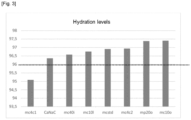
- the protein hydration rate was determined according to the following protocol:
- the tubes are placed in the centrifuge and the centrifugation parameters are introduced.
- the supernatant of each tube is recovered and weighed.
- the supernatant is collected in a single gesture to avoid biasing the results, by turning the centrifugation tube sharply in an empty tared beaker and then weighing the mass of the supernatant.
- Hydratation rate Amount of supernatant g
- the sample is well hydrated if the average hydration rate according to the standard approach is equal to 96%.
- the proteins mpstd, mc25a, wpi90 have been found to have the best foaming powers because they have equal or greater capacity than sodium caseinate CaNaC.
- the IRM is the most information-rich part of the spectrum.
- the absorption bands observed in the IRM give information about the structures of molecules, such as proteins.
- Fluorescence is a light emission caused by the excitation of electrons in a molecule, generally by absorption of a photon.
- a fluorescent molecule (fluorophore) has the property of absorbing light energy (excitation light) and quickly releasing it in the form of fluorescent light (emission light). Once the energy of the photon has been absorbed, the molecule is then in an electronically excited state, denoted S1. The return to the ground state (denoted S0) can then be done by fluorescence. The light re-emitted by the molecule excited during the fluorescence can be of the same wavelength (resonance fluorescence) or of longer wavelength, even sometimes shorter (two-photon absorption).
- Trp tryptophan
- ANS is an extrinsic fluorophore with a strong affinity with proteins and provides information on the surface hydrophobicity of the molecule. It is 8-anilino-1-naphthalene sulfonic acid.
- the 35% fat cream was obtained in the mixer, the proteins added after heating to 50°C, the carrageenans added after heating to 80°C.
- the whole was pasteurized at 80° C. for 10 min. Then the cream was homogenized at 180 bars and 30 bars, before being cooled to 10°C. After conditioning, it was aged at 4°C for 24 hours.
- this diagram comprises two branches, one 1, that of the milk 5, more detailed than the other 2 which starts from one of the compounds of group 15 comprising cream from milk, oil and water.
- Branch 1 starting from milk and comprising the characteristic steps of the process of the invention applies regardless of the starting compound of the other branch 2.
- Branch 1 of the milk makes it possible, at the end, to obtain emulsifying micellar caseins 3 which are mixed (4), as an emulsifying additive, with a first volume of the starting compound of branch 2 to obtain the culinary cream or the creamer.
- the milk from tank 5 is skimmed 6.
- the raw cream produced by skimming can be one of said starting compounds from branch 2 when one wants to make dairy cream.
- skimmed milk is then pasteurized 7 then subjected, here, to an ultrafiltration 8 which produces a milk protein concentrate.
- the two skimming and pasteurization steps could be inverted and even merged.
- This protein concentrate is subjected to a microfiltration 9 which produces a casein concentrate.
- the casein concentrate is then subjected to evaporation or concentration under vacuum 10, before undergoing a chemical treatment 11 to extract the calcium from the casein micelles.
- this chemical treatment could be undertaken before or after the filtration steps, or even during these membrane filtration steps and even at the start.
- This chemical treatment is intended to produce a concentrate with a high content of emulsifying micellar caseins which, after drying 12, will be mixed, in powder form, with the starting compound of branch 2 of the process, to finally obtain the culinary cream or the creamer with high emulsifying power and without caseinates that we wanted to manufacture 13.
- the chemical treatment can be carried out using acid, chelating agents or by both at the same time, or salts, agents such as Glucono Delta Lactose.
- the transformed milk can advantageously be subjected to a slight neutralization.
- micellar caseins When starting, in the second branch 2, with cream, it is preferable to use the emulsifying micellar caseins as a powder, as illustrated in Figure 4 ; it is however possible to use them also in a liquid state to mix them with the cream.
- the cream When starting, in the second branch 2 with liquid vegetable fat, for example vegetable oil and cream, the cream then comes from a volume of milk called second volume of milk, the volume of milk with which it is started in the first branch 1 being no longer designated “second volume” but "third volume of milk".
- second volume of milk the volume of milk with which it is started in the first branch 1 being no longer designated "second volume” but "third volume of milk”.
- the culinary cream or the creamer After having obtained the culinary cream or the creamer, they can be pasteurized or sterilized.
- the chemical treatment of milk can be carried out by Glucono Delta Lactose which is transformed into gluconic acid in an aqueous medium.
- the salts found in the casein micelles are thus solubilized.
- the chemical treatment of milk can also be carried out by salts of phosphates, citrates or their combination.
- the size and volumic mass of the casein micelles are reduced. More particularly, they are reduced from micelles of 200 nm in diameter and the molecular structure of these caseins is altered to increase their covering power. It is even possible to reduce the micelles to the state of monomers and reduce their volumic mass to a few tens of 10 7 g/mole.
- the cream obtained from the skimming machine generally comprises about 40% of fat. By standardization, it could be reduced to 30% of fat. However, those transforming these creams may also reduce them to 30, 25, 20, 15 and even 12% of fat by addition of skimmed milk or because the additions within the formulations lead to a reduction of the rate of fat (due to the dilution with the addition of the other compounds).
Landscapes
- Chemical & Material Sciences (AREA)
- Life Sciences & Earth Sciences (AREA)
- Engineering & Computer Science (AREA)
- Polymers & Plastics (AREA)
- Food Science & Technology (AREA)
- Health & Medical Sciences (AREA)
- Nutrition Science (AREA)
- Zoology (AREA)
- Biochemistry (AREA)
- Water Supply & Treatment (AREA)
- Oil, Petroleum & Natural Gas (AREA)
- Dispersion Chemistry (AREA)
- Dairy Products (AREA)
- Grain Derivatives (AREA)
- Edible Oils And Fats (AREA)
Priority Applications (8)
| Application Number | Priority Date | Filing Date | Title |
|---|---|---|---|
| EP22213614.5A EP4385331A1 (de) | 2022-12-14 | 2022-12-14 | Verfahren zur herstellung einer kulinarischen creme und eines cremers |
| JP2025532855A JP2025539502A (ja) | 2022-12-14 | 2023-12-11 | 料理用クリームおよびクリーマーの製造方法 |
| CN202380085749.8A CN120358948A (zh) | 2022-12-14 | 2023-12-11 | 用于制造烹饪奶油和奶精的方法 |
| PCT/EP2023/085092 WO2024126358A1 (en) | 2022-12-14 | 2023-12-11 | Process for manufacturing a culinary cream and a creamer |
| KR1020257019146A KR20250119556A (ko) | 2022-12-14 | 2023-12-11 | 조리용 크림 및 크리머의 제조 방법 |
| IL321200A IL321200A (en) | 2022-12-14 | 2025-05-29 | Process for producing culinary cream and cream substitute |
| MX2025006863A MX2025006863A (es) | 2022-12-14 | 2025-06-12 | Proceso de fabricacion de una crema culinaria y un sustituto de crema |
| CONC2025/0008092A CO2025008092A2 (es) | 2022-12-14 | 2025-06-17 | Proceso de fabricación de una crema culinaria y un sustituto de crema |
Applications Claiming Priority (1)
| Application Number | Priority Date | Filing Date | Title |
|---|---|---|---|
| EP22213614.5A EP4385331A1 (de) | 2022-12-14 | 2022-12-14 | Verfahren zur herstellung einer kulinarischen creme und eines cremers |
Publications (1)
| Publication Number | Publication Date |
|---|---|
| EP4385331A1 true EP4385331A1 (de) | 2024-06-19 |
Family
ID=84536061
Family Applications (1)
| Application Number | Title | Priority Date | Filing Date |
|---|---|---|---|
| EP22213614.5A Pending EP4385331A1 (de) | 2022-12-14 | 2022-12-14 | Verfahren zur herstellung einer kulinarischen creme und eines cremers |
Country Status (8)
| Country | Link |
|---|---|
| EP (1) | EP4385331A1 (de) |
| JP (1) | JP2025539502A (de) |
| KR (1) | KR20250119556A (de) |
| CN (1) | CN120358948A (de) |
| CO (1) | CO2025008092A2 (de) |
| IL (1) | IL321200A (de) |
| MX (1) | MX2025006863A (de) |
| WO (1) | WO2024126358A1 (de) |
Citations (2)
| Publication number | Priority date | Publication date | Assignee | Title |
|---|---|---|---|---|
| US20160374360A1 (en) * | 2015-06-29 | 2016-12-29 | Leprino Foods Company | Micellar casein for corree creamers and other dairy products |
| US20200345027A1 (en) * | 2018-01-15 | 2020-11-05 | Frieslandcampina Nederland B.V. | Cream compositions optimized for foaming systems |
-
2022
- 2022-12-14 EP EP22213614.5A patent/EP4385331A1/de active Pending
-
2023
- 2023-12-11 WO PCT/EP2023/085092 patent/WO2024126358A1/en not_active Ceased
- 2023-12-11 CN CN202380085749.8A patent/CN120358948A/zh active Pending
- 2023-12-11 KR KR1020257019146A patent/KR20250119556A/ko active Pending
- 2023-12-11 JP JP2025532855A patent/JP2025539502A/ja active Pending
-
2025
- 2025-05-29 IL IL321200A patent/IL321200A/en unknown
- 2025-06-12 MX MX2025006863A patent/MX2025006863A/es unknown
- 2025-06-17 CO CONC2025/0008092A patent/CO2025008092A2/es unknown
Patent Citations (2)
| Publication number | Priority date | Publication date | Assignee | Title |
|---|---|---|---|---|
| US20160374360A1 (en) * | 2015-06-29 | 2016-12-29 | Leprino Foods Company | Micellar casein for corree creamers and other dairy products |
| US20200345027A1 (en) * | 2018-01-15 | 2020-11-05 | Frieslandcampina Nederland B.V. | Cream compositions optimized for foaming systems |
Non-Patent Citations (3)
| Title |
|---|
| DATABASE GNPD [online] MINTEL; 5 October 2022 (2022-10-05), ANONYMOUS: "Organic Fresh Whipping Cream", XP093041293, retrieved from https://www.gnpd.com/sinatra/recordpage/9954114/ Database accession no. 9954114 * |
| KOMMINENI ANIL ET AL: "Calcium-Reduced Micellar Casein Concentrate-Physicochemical Properties of Powders and Functional Properties of the Dispersions", FOODS, vol. 11, no. 10, 10 May 2022 (2022-05-10), pages 1377, XP093040074, DOI: 10.3390/foods11101377 * |
| LAZZARO FANNY ET AL: "Gradual disaggregation of the casein micelle improves its emulsifying capacity and decreases the stability of dairy emulsions", FOOD HYDROCOLLOIDS, ELSEVIER BV, NL, vol. 63, 28 August 2016 (2016-08-28), pages 189 - 200, XP029811739, ISSN: 0268-005X, DOI: 10.1016/J.FOODHYD.2016.08.037 * |
Also Published As
| Publication number | Publication date |
|---|---|
| CO2025008092A2 (es) | 2025-07-07 |
| IL321200A (en) | 2025-07-01 |
| JP2025539502A (ja) | 2025-12-05 |
| MX2025006863A (es) | 2025-09-02 |
| KR20250119556A (ko) | 2025-08-07 |
| WO2024126358A1 (en) | 2024-06-20 |
| CN120358948A (zh) | 2025-07-22 |
Similar Documents
| Publication | Publication Date | Title |
|---|---|---|
| Goff et al. | Action of emulsifers in promoting fat destabilization during the manufacture of ice cream | |
| KR102712964B1 (ko) | 개선된 완두 알부민, 이를 수득하기 위한 방법 및 이의 용도 | |
| US8241692B2 (en) | Preparation of canola protein isolate involving isoelectric precipitation | |
| US20060204454A1 (en) | Method for improving the functional properties of a globular protein, protein thus prepared, use thereof and products containing the protein | |
| MX2008004865A (es) | Producto lacteo texturizado finamente y proceso para su preparacion. | |
| EP3313191A1 (de) | Mizellares kasein für kaffeeweisser und andere milchprodukte | |
| US20230270127A1 (en) | Foaming and emulsifying properties of high pressure jet processing pasteurized milk | |
| Crowley et al. | Rehydration behaviour of spray-dried micellar casein concentrates produced using microfiltration of skim milk at cold or warm temperatures | |
| Gonçalves et al. | Composition, microstructure and chemical interactions during the production stages of mozzarella cheese | |
| EP4385331A1 (de) | Verfahren zur herstellung einer kulinarischen creme und eines cremers | |
| US4259356A (en) | Method for the production of protein concentrate | |
| JP4865268B2 (ja) | 乳化安定性の評価方法及び乳化剤の評価方法 | |
| JP4397906B2 (ja) | 生クリームの製造方法 | |
| JP4148556B2 (ja) | 食品の処理方法 | |
| JP4382053B2 (ja) | 生クリームの製造方法 | |
| EP4570073A1 (de) | Verfahren zur herstellung einer kulinarischen creme und eines kaffeeweissers ohne mikrofiltration | |
| JP4212862B2 (ja) | 水中油型乳化物の安定化方法 | |
| Sreenivasaraghavan | A Study of the Effects of Supercritical CO 2 Treatment on Physicochemical Properties of Spray-Dried Buttermilk Powder to Develop a Novel Dairy Processing Operation | |
| KR101559448B1 (ko) | 커피 크리머용 우유 단백질의 제조방법 및 이를 이용한 커피 크리머 제조방법 | |
| Shea et al. | Natural Aging of Soybean Impacts Ingredient Functionality of Soy Protein Isolate | |
| JPS59169531A (ja) | W/o/w型複合エマルジヨンの製造法 | |
| DUFOUR et al. | Investigation of oil-water interfaces by spectroscopic methods. Relations with rheological properties of multiphasic systems | |
| Volkov | Investigation of Oil-Water Interfaces by Spectroscopic Methods. Relations with Rheological Properties of Multiphasic Systems | |
| Perveen et al. | TECHNOLOGICAL CHARACTERIZATION OF PHOSPHOCASEINATE POWDER OF BUFFALO MILK |
Legal Events
| Date | Code | Title | Description |
|---|---|---|---|
| PUAI | Public reference made under article 153(3) epc to a published international application that has entered the european phase |
Free format text: ORIGINAL CODE: 0009012 |
|
| STAA | Information on the status of an ep patent application or granted ep patent |
Free format text: STATUS: THE APPLICATION HAS BEEN PUBLISHED |
|
| AK | Designated contracting states |
Kind code of ref document: A1 Designated state(s): AL AT BE BG CH CY CZ DE DK EE ES FI FR GB GR HR HU IE IS IT LI LT LU LV MC ME MK MT NL NO PL PT RO RS SE SI SK SM TR |
|
| STAA | Information on the status of an ep patent application or granted ep patent |
Free format text: STATUS: REQUEST FOR EXAMINATION WAS MADE |
|
| 17P | Request for examination filed |
Effective date: 20241104 |
|
| RBV | Designated contracting states (corrected) |
Designated state(s): AL AT BE BG CH CY CZ DE DK EE ES FI FR GB GR HR HU IE IS IT LI LT LU LV MC ME MK MT NL NO PL PT RO RS SE SI SK SM TR |