EP4379903A2 - Verfahren zum testen der dichtheit von batteriezellen - Google Patents
Verfahren zum testen der dichtheit von batteriezellen Download PDFInfo
- Publication number
- EP4379903A2 EP4379903A2 EP24168978.5A EP24168978A EP4379903A2 EP 4379903 A2 EP4379903 A2 EP 4379903A2 EP 24168978 A EP24168978 A EP 24168978A EP 4379903 A2 EP4379903 A2 EP 4379903A2
- Authority
- EP
- European Patent Office
- Prior art keywords
- battery cells
- testing
- detection device
- leakage rate
- airtightness
- Prior art date
- Legal status (The legal status is an assumption and is not a legal conclusion. Google has not performed a legal analysis and makes no representation as to the accuracy of the status listed.)
- Withdrawn
Links
Images


Classifications
-
- B—PERFORMING OPERATIONS; TRANSPORTING
- B07—SEPARATING SOLIDS FROM SOLIDS; SORTING
- B07C—POSTAL SORTING; SORTING INDIVIDUAL ARTICLES, OR BULK MATERIAL FIT TO BE SORTED PIECE-MEAL, e.g. BY PICKING
- B07C5/00—Sorting according to a characteristic or feature of the articles or material being sorted, e.g. by control effected by devices which detect or measure such characteristic or feature; Sorting by manually actuated devices, e.g. switches
- B07C5/02—Measures preceding sorting, e.g. arranging articles in a stream orientating
-
- H—ELECTRICITY
- H01—ELECTRIC ELEMENTS
- H01M—PROCESSES OR MEANS, e.g. BATTERIES, FOR THE DIRECT CONVERSION OF CHEMICAL ENERGY INTO ELECTRICAL ENERGY
- H01M10/00—Secondary cells; Manufacture thereof
- H01M10/42—Methods or arrangements for servicing or maintenance of secondary cells or secondary half-cells
- H01M10/4228—Leak testing of cells or batteries
-
- B—PERFORMING OPERATIONS; TRANSPORTING
- B07—SEPARATING SOLIDS FROM SOLIDS; SORTING
- B07C—POSTAL SORTING; SORTING INDIVIDUAL ARTICLES, OR BULK MATERIAL FIT TO BE SORTED PIECE-MEAL, e.g. BY PICKING
- B07C5/00—Sorting according to a characteristic or feature of the articles or material being sorted, e.g. by control effected by devices which detect or measure such characteristic or feature; Sorting by manually actuated devices, e.g. switches
-
- B—PERFORMING OPERATIONS; TRANSPORTING
- B07—SEPARATING SOLIDS FROM SOLIDS; SORTING
- B07C—POSTAL SORTING; SORTING INDIVIDUAL ARTICLES, OR BULK MATERIAL FIT TO BE SORTED PIECE-MEAL, e.g. BY PICKING
- B07C5/00—Sorting according to a characteristic or feature of the articles or material being sorted, e.g. by control effected by devices which detect or measure such characteristic or feature; Sorting by manually actuated devices, e.g. switches
- B07C5/34—Sorting according to other particular properties
- B07C5/3404—Sorting according to other particular properties according to properties of containers or receptacles, e.g. rigidity, leaks, fill-level
-
- B—PERFORMING OPERATIONS; TRANSPORTING
- B07—SEPARATING SOLIDS FROM SOLIDS; SORTING
- B07C—POSTAL SORTING; SORTING INDIVIDUAL ARTICLES, OR BULK MATERIAL FIT TO BE SORTED PIECE-MEAL, e.g. BY PICKING
- B07C5/00—Sorting according to a characteristic or feature of the articles or material being sorted, e.g. by control effected by devices which detect or measure such characteristic or feature; Sorting by manually actuated devices, e.g. switches
- B07C5/36—Sorting apparatus characterised by the means used for distribution
-
- G—PHYSICS
- G01—MEASURING; TESTING
- G01M—TESTING STATIC OR DYNAMIC BALANCE OF MACHINES OR STRUCTURES; TESTING OF STRUCTURES OR APPARATUS, NOT OTHERWISE PROVIDED FOR
- G01M3/00—Investigating fluid-tightness of structures
- G01M3/02—Investigating fluid-tightness of structures by using fluid or vacuum
- G01M3/26—Investigating fluid-tightness of structures by using fluid or vacuum by measuring rate of loss or gain of fluid, e.g. by pressure-responsive devices, by flow detectors
- G01M3/32—Investigating fluid-tightness of structures by using fluid or vacuum by measuring rate of loss or gain of fluid, e.g. by pressure-responsive devices, by flow detectors for containers, e.g. radiators
- G01M3/3281—Investigating fluid-tightness of structures by using fluid or vacuum by measuring rate of loss or gain of fluid, e.g. by pressure-responsive devices, by flow detectors for containers, e.g. radiators removably mounted in a test cell
-
- H—ELECTRICITY
- H01—ELECTRIC ELEMENTS
- H01M—PROCESSES OR MEANS, e.g. BATTERIES, FOR THE DIRECT CONVERSION OF CHEMICAL ENERGY INTO ELECTRICAL ENERGY
- H01M10/00—Secondary cells; Manufacture thereof
- H01M10/42—Methods or arrangements for servicing or maintenance of secondary cells or secondary half-cells
- H01M10/4285—Testing apparatus
-
- Y—GENERAL TAGGING OF NEW TECHNOLOGICAL DEVELOPMENTS; GENERAL TAGGING OF CROSS-SECTIONAL TECHNOLOGIES SPANNING OVER SEVERAL SECTIONS OF THE IPC; TECHNICAL SUBJECTS COVERED BY FORMER USPC CROSS-REFERENCE ART COLLECTIONS [XRACs] AND DIGESTS
- Y02—TECHNOLOGIES OR APPLICATIONS FOR MITIGATION OR ADAPTATION AGAINST CLIMATE CHANGE
- Y02E—REDUCTION OF GREENHOUSE GAS [GHG] EMISSIONS, RELATED TO ENERGY GENERATION, TRANSMISSION OR DISTRIBUTION
- Y02E60/00—Enabling technologies; Technologies with a potential or indirect contribution to GHG emissions mitigation
- Y02E60/10—Energy storage using batteries
Definitions
- the present invention relates to the technical field of airtightness detection for battery cells, in particular to a method for testing airtightness of battery cells.
- the production speed (ppm) of cylindrical battery cell production lines is extremely fast, usually reaching 100ppm, 150ppm, or even 200ppm, which means producing 100, 150, or even 200 battery cells per minute, while the helium detection test time for a single battery cell needs more than 20 seconds. Therefore, the industry usually sets up a large number of test channels in a vacuum helium detection device to perform initial testing on multiple battery cells in groups. During this process, the more battery cells a single initial testing device can simultaneously test, the fewer initial testing devices are required for the initial testing, and the smaller the area occupied by the initial testing device.
- a multi-channel vacuum helium detection device detects a NG (i.e., not good) battery cell, it cannot determine specifically which one is the NG battery cell. Therefore, once NG battery cell is detected, the entire set of battery cells needs to be retested one by one to accurately locate the NG battery cell. During this process, the more battery cells the initial testing device can simultaneously detect, the larger the retesting device required for a single round of retesting, and the larger the area occupied by the retesting device. Thus, when designing a battery cell production line, it is necessary to find a balance point between the product NG rate and the number of test channels for the initial testing device.
- the NG rate of the product objectively exists based on the actual situation of the production line and can be calculated through production data. If the NG rate is large, and there are also many test channels provided inside the initial testing device, a large retesting device is correspondingly required, and the area occupied by the equipment cannot be controlled, which is not conducive to improving production efficiency. If the NG rate fluctuates beyond the design capacity of the equipment, overload stacking will occur, seriously affecting the operation of the production line. Therefore, under a certain NG rate, the number of test channels for the initial testing device needs to be reasonably matched according to the actual production situation, in order to reduce the overall footprint of the equipment. Nevertheless, the helium testing method of first conducting initial testing on battery cells in groups and then conducting retesting separately on the battery cells of each group requires a considerable footprint.
- the present invention provides a method for testing airtightness of battery cells, configured for testing the airtightness of the battery cells before liquid injection to screen out NG products.
- the method includes the following steps:
- step S1 using a first detection device to perform airtightness testing, based on a first leakage rate, on each battery cell of a group of battery cells to be tested;
- step S2 transporting and unloading battery cell(s) with a leakage rate greater than the first leakage rate, if any, to a NG production line, and transporting and loading remaining battery cells with a leakage rate less than or equal to the first leakage rate to a second detection device;
- step S3 using the second detection device to perform helium testing, based on a second leakage rate, on a group of battery cells that are transported and loaded on the second detection device from the first detection device;
- step S4 if a total leakage rate of all the battery cells in the group of battery cells being tested on the second detection device is greater than the second leakage rate, transporting and loading the entire group of battery cells being tested on the second detection device to a third detection device; if the total leakage rate of all the battery cells in the group of battery cells being tested on the second detection device is less than or equal to the second leakage rate, unloading the entire group of battery cells being tested on the second detection device;
- step S5 using the third detection device to perform helium testing, based on a third leakage rate, on each battery cell that is transported and loaded on the third detection device from the second detection device;
- step S6 transporting and unloading battery cell(s) with a leakage rate greater than the third leakage rate to the NG production line, and unloading remaining battery cells with a leakage rate less than or equal to the third leakage rate.
- steps S1 and S2 belong to pretesting of the battery cells
- steps S3 and S4 belong to initial testing of the battery cells
- steps S5 and S6 belong to retesting of the battery cells.
- the initial testing and the retesting are performed based on helium testing, while the pretesting is performed based on non-helium testing.
- each of the second detection device and the third detection device is a helium detection device used for performing helium testing.
- the first detection device is an airtightness detection device used for detecting change in pressure difference of each battery cell, rather than a helium detection device.
- step S2 when transporting and loading the remaining battery cells with a leakage rate less than or equal to the first leakage rate to the second detection device, if the number of the remaining battery cells is less than the number of test channels for a single round of testing in the second detection device, then testing of a next group of battery cells in the first detection device is waited to be completed in order to take a normal battery cell from this next group of battery cells to fill up the test channels in the second detection device.
- the first leakage rate is greater than the third leakage rate.
- first leakage rate, the second leakage rate and the third leakage rate are all calibration values.
- the first leakage rate and the third leakage rate are calibrated, the cell volume V and the test time t are the same.
- the second detection device includes an upper chamber, a first lower chamber, and a second lower chamber, wherein the first upper chamber is provided with a helium detection device, each of the first lower chamber and the second lower chamber is provided with test channels for accommodating the battery cells to be tested, the upper chamber is used for performing helium testing on one of the first lower chamber and the second lower chamber when loading or unloading the other one of the first lower chamber and the second lower chamber.
- the second detection device further includes a second vacuum box, a slide rail assembly, and a sliding platform, wherein the slide rail assembly is accommodated in the second vacuum box and fixedly connected to the second vacuum box, the sliding platform is slidably provided on the slide rail assembly, the first lower chamber and the second lower chamber are arranged on the sliding platform and can slide or remain stationary relative to the upper chamber.
- the number of test channels in the first lower chamber is the same as the number of test channels in the second lower chamber.
- the number of test channels in the first detection device is greater than or equal to the number of test channels in the first lower chamber.
- the first detection device is arranged in a first vacuum box
- the third detection device is arranged in a third vacuum box
- the first vacuum box, the second vacuum box and the third vacuum box are integrated inside a helium detection assembly
- a transport belt for transporting and loading and unloading the battery cells between the first vacuum box, the second vacuum box and the third vacuum box is provided inside the helium detection assembly.
- the method for testing airtightness of battery cells adds the pretesting of the battery cells before the initial testing and retesting of the battery cells, so that NG battery cells with a large leakage rate can be screened out in advance, thereby reducing the number of battery cells to be tested entering the following initial testing and retesting of the battery cells, and reducing the equipment area occupied by the retesting working station.
- the method can achieve fast-paced helium testing and loading/unloading through two chambers that can perform helium testing, loading and unloading alternately, shortening the waiting time for mechanical actions during the initial testing, effectively improving the efficiency of the helium testing, and further enhancing the overall work efficiency of the production line.
- NG battery cells can be screened out from a group of battery cells through the airtightness testing before liquid injection, and only the normal battery cells with a leakage rate being less than or equal to the preset minimal leakage rate are transported to be injected with liquid (i.e., electrolyte).
- liquid i.e., electrolyte
- an embodiment of the present invention provides a method for testing airtightness of battery cells, configured to screen out NG battery cells from the battery cells before liquid injection.
- the battery cells may be cylindrical battery cells.
- the method for testing airtightness of battery cells includes three testing stages, i.e., pretesting, initial testing, and retesting. The three testing stages are performed in a consecutive manner. During the pretesting, each battery cell in a group of battery cells to be tested is separately tested, to find out NG battery cells with a large leakage rate from the group of battery cells being tested. Therefore, the battery cells with a large leakage rate can be screened out in advance through the pretesting, to reduce the number of NG battery cells subsequently entering the initial testing and the retesting.
- the NG battery cells with a large leakage rate are screened out and removed, with the remaining battery cells being transported and loaded to enter the following initial testing.
- all battery cells in a group of battery cells to be tested are simultaneously tested as a whole (that is, the battery cells in the group of battery cells are not tested separately), to determine whether there are NG battery cells in the entire group of battery cells being tested. If no NG battery cells exist in the entire group of battery cells being tested, all battery cells in the entire group of battery cells being tested are unloaded and are not required to enter the following retesting.
- all battery cells in the entire group of battery cells being tested are required to enter the following retesting to specifically find out the NG battery cells from the entire group of battery cells. During the retesting, each battery cell in the group of battery cells is separately tested to specifically find out the NG battery cells from the group of battery cells being retested.
- the initial testing and the retesting are performed based on helium testing, while the pretesting is performed based on non-helium testing. That is, the initial testing and the retesting involve helium testing, while the pretesting does not involve helium testing.
- the pretesting is added to screen out the battery cells with a large leakage rate in advance, and therefore, the number of NG battery cells subsequently entering the helium testing during the initial testing and retesting stages are significantly reduced, thereby improving the efficiency of the helium testing and reducing the area occupied by the equipment during the helium testing.
- the method for testing airtightness of battery cells includes the following steps:
- Step S1 using a first detection device to perform airtightness testing, based on a first leakage rate, on each battery cell of a group of battery cells to be tested.
- Step S2 transporting and unloading battery cell(s) with a leakage rate greater than the first leakage rate, if any, to a NG production line, and transporting and loading remaining battery cells with a leakage rate less than or equal to the first leakage rate to a second detection device.
- steps S1 and S2 belong to the pretesting of the battery cells.
- the first detection device is an airtightness detection device with a vacuum box, rather than a helium detection device.
- the first detection device is configured for detecting the NG battery cell(s) with a large leakage rate (i.e., greater than the first leakage rate).
- the first detection device only detects change in pressure difference of each battery cell when detecting the airtightness of each battery cell being tested, without the need to perform complex detection steps that are required by helium testing. That is, the first detection device does not involve helium testing. Therefore, the instrument cost of the pretesting steps is low.
- the first detection device is arranged in a first vacuum box, and multiple test channels are provided in the first vacuum box.
- the first detection device can perform airtightness testing on all the battery cells to be tested in the test channels at once time, with each battery cell being separately tested in its test channel. Thus, when a NG battery cell is detected, the first detection device can also accurately determine the test channel where the NG battery cell is located. Therefore, the first detection device set up in this way can quickly and accurately screen out the NG battery cells from a group of battery cells to be tested, removing the NG battery cells with a large leakage rate in advance before entering the initial testing and retesting, reducing the number of NG battery cells in the battery cells during the following helium testing.
- the initial testing can only determine that there is NG battery cell among the group of 20 battery cells being tested, but cannot specifically detect which one is the NG battery cell among the 20 battery cells.
- the finding of NG battery cell in the group of 20 battery cells being tested through the initial testing means that all the 20 battery cells need to undergo the subsequent retesting.
- the pretesting is added and the NG battery cells with a leakage rate greater than the first leakage rate can be screened out and removed in advance, which can reduce the subsequent retesting process of at least 20 battery cells, thereby greatly improving the production efficiency of the production line and also greatly enhancing the overall NG rate carrying capacity of the production line.
- the first leakage rate is a calibration value, and it is also calculated using the calculation formula for calculating the leakage rate of the battery cell.
- the pressure change ⁇ P is 200Pa
- the cell volume V is 20ml
- the test time t is 30s
- the first leakage rate is 1.33E-4 Pa.m 3 /S.
- step S2 when transporting and loading the remaining battery cells with a leakage rate less than or equal to the first leakage rate to the second detection device, if the number of the remaining battery cells is less than the number of test channels for a single round of testing in the second detection device, then the testing of a next group of battery cells in the first detection device is waited to be completed in order to take a normal battery cell from this next group of battery cells to fill up the test channels in the second detection device, to ensure the efficiency of the initial testing of battery cells in the second detection device.
- Step S3 using the second detection device to perform helium testing, based on a second leakage rate, on a group of battery cells that are transported and loaded on the second detection device from the first detection device.
- Step S4 if a total leakage rate of all the battery cells in the group of battery cells being tested on the second detection device is greater than the second leakage rate, transporting and loading the entire group of battery cells being tested on the second detection device to a third detection device; if the total leakage rate of all the battery cells in the group of battery cells being tested on the second detection device is less than or equal to the second leakage rate, unloading the entire group of battery cells being tested on the second detection device.
- the second detection device is a helium detection device used for performing helium testing.
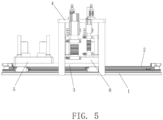
- the second detection device includes a second vacuum box 1, a sliding rail assembly 2, a sliding platform 3, an upper chamber 4, a first lower chamber 5, and a second lower chamber 6.
- the sliding rail assembly 2 is accommodated in the second vacuum box 1 and fixedly connected to the second vacuum box 1.
- the sliding platform 3 is slidably provided on the sliding rail assembly 2, and the sliding platform 3 is driven by a cylinder.
- the first lower chamber 5 and the second lower chamber 6 are arranged on the sliding platform 3, so that the first lower chamber 5 and the second lower chamber 6 can slide together with the sliding platform 3 on the slide rail assembly 2, thereby sliding relative to the upper chamber 4 or stationary relative to the upper chamber 4.
- the upper chamber 4 is provided with a helium detection device, and the helium detection device at least includes a filling mechanism, an evacuation valve group, and a vacuum breaking valve group.
- Each of the first lower chamber 5 and the second lower chamber 6 is provided with test channels for accommodating the battery cells to be tested.
- the upper chamber 4 can perform helium testing with one of the first lower chamber 5 and the second lower chamber 6 when loading or unloading the other one of the first lower chamber 5 and the second lower chamber 6.
- the number of test channels in the first lower chamber 5 is the same as the number of test channels in the second lower chamber 6.
- the number of test channels in the first detection device is equal to the number of test channels in the first lower chamber 5 and the number of test channels in the second lower chamber 6. This is because NG battery cells are inevitable during the pretesting of the battery cells.
- step S2 mentioned above if the number of the remaining battery cells after the pretesting is less than the number of test channels for a single round of the initial testing in the second detection device, that is, less than the number of test channels in the first lower chamber 5, it is needed to wait for the pretesting of a next group of battery cells to be completed and take a normal battery cell from this group of battery cells to fill up the second detection device.
- the number of test channels in the first detection device used for the pretesting cannot be set to be less than the number of test channels in the first lower chamber 5, in order to further improve the efficiency of the production line, and conveniently replenish the insufficient battery cells after NG battery cells are screened out.
- the battery cells to be tested are first loaded to the test channels in the first lower chamber 5 and the second lower chamber 6, so that the test channels of the first lower chamber 5 and the second lower chamber 6 are all loaded with the battery cells to be tested. Then, the second lower chamber 6 is controlled to slide to the corresponding position of the upper chamber 4, and the upper chamber 4 is controlled to perform helium testing on the battery cells loaded on the second lower chamber 6; after this action is completed, the first lower chamber 5 is controlled to slide to the corresponding position of the upper chamber 4, the second lower chamber 6 is correspondingly controlled to leave the helium testing position, and the upper chamber 4 is controlled to perform helium testing on the battery cells loaded on the first lower chamber 5.
- corresponding operations are performed on the battery cells in the second lower chamber 6 based on the helium testing results, that is, transport them to the third detection device or unload them, and then load battery cells from the first detection device to the second lower chamber 6; after all the battery cells to be tested in the second lower chamber 6 are replaced, the helium testing of the first lower chamber 5 is also completed, then the second lower chamber 6 is controlled to slide to the corresponding position of the upper chamber 4, and this cycle is repeated.
- the second detection device can achieve fast helium testing and loading/unloading through two chambers that can load and unload the battery cells to be tested alternately, reducing the waiting time for mechanical actions during the initial testing and effectively improving the efficiency of helium testing.
- the second leakage rate is a calibration value, which can also be calculated using the calculation formula for calculating the leakage rate of the battery cell.
- the helium testing in step S3 involves performing helium testing on all the battery cells in the group of battery cells being tested simultaneously (that is, the battery cells in the group of battery cells are not separately tested)
- some parameters of the second leakage rate namely the cell volume V and the pressure change ⁇ P, are different from the first leakage rate, so the second leakage rate cannot be directly compared with the first leakage rate.
- Step S5 using the third detection device to perform helium testing, based on a third leakage rate, on each battery cell that is transported and loaded on the third detection device from the second detection device.
- Step S6 transporting and unloading battery cell(s) with a leakage rate greater than the third leakage rate to the NG production line, and unloading remaining battery cells with a leakage rate less than or equal to the third leakage rate.
- steps S5 and S6 belong to the retesting of the battery cells.
- the third detection device is a helium detection device used for performing helium testing.
- the third detection device is arranged in a third vacuum box, and the third vacuum box is provided with multiple test channels.
- the number of test channels in the third vacuum box is the same as the number of test channels in either the first lower chamber 5 or the second lower chamber 6.
- the first vacuum box, the second vacuum box 1 and the third vacuum box are integrated inside a helium detection assembly.
- a transport belt for transporting and loading and unloading the battery cells between the first vacuum box, the second vacuum box 1 and the third vacuum box is provided inside the helium detection assembly.
- the helium detection assembly conveniently and continuously connects three working stations through the first vacuum box, the second vacuum box 1 and the third vacuum box that are integrated together, so that it is fast and convenient for loading, unloading and transporting the battery cells to be tested, improving the overall production efficiency of the production line.
- the third leakage rate is a calibration value, which can also be calculated using the calculation formula for calculating the leakage rate of the battery cell.
- the number of test channels in the third detection device is equal to the number of test channels in the first detection device, and is also equal to the number of test channels of the first lower chamber 5.
- the third leakage rate is taken as 1.0E-06 Pa.m 3 /S, which is much lower than the first leakage rate.
- step S6 during calibration calculation, some parameters of the second leakage rate, namely the cell volume V and the pressure change ⁇ P, are different from the first leakage rate.
- step S6 during calibration calculation, some parameters (namely the cell volume V and the pressure change ⁇ P) of the third leakage rate are also different from some parameters (namely the cell volume V and the pressure change ⁇ P) of the second leakage rate, so the second leakage rate cannot be directly compared with the third leakage rate.
- the cell volume V and the test time t in the first leakage rate are the same as those in the third leakage rate, so the third leakage rate can be directly compared with the first leakage rate.
- the scale of the pretesting working station, initial testing working station and retesting working station of the production line of battery cells can be adjusted by adjusting the first leakage rate, second leakage rate and third leakage rate, which can also improve the overall NG rate carrying capacity of the production line.
- the method for testing airtightness of battery cells adds the pretesting of the battery cells before the initial testing and retesting of the battery cells, so that NG battery cells with a large leakage rate can be screened out in advance, thereby reducing the number of battery cells to be tested entering the following initial testing and retesting of the battery cells, and reducing the equipment area occupied by the retesting working station.
- the method can achieve fast-paced helium testing and loading/unloading through two chambers that can perform helium testing, loading and unloading alternately, shortening the waiting time for mechanical actions during the initial testing, effectively improving the efficiency of the helium testing, and further enhancing the overall work efficiency of the production line.
Landscapes
- Engineering & Computer Science (AREA)
- Manufacturing & Machinery (AREA)
- Chemical & Material Sciences (AREA)
- Chemical Kinetics & Catalysis (AREA)
- Electrochemistry (AREA)
- General Chemical & Material Sciences (AREA)
- Physics & Mathematics (AREA)
- General Physics & Mathematics (AREA)
- Examining Or Testing Airtightness (AREA)
- Sealing Battery Cases Or Jackets (AREA)
- Secondary Cells (AREA)
Applications Claiming Priority (1)
| Application Number | Priority Date | Filing Date | Title |
|---|---|---|---|
| CN202311651790.5A CN117862043A (zh) | 2023-12-04 | 2023-12-04 | 一种圆柱电芯高速氦检设备的小型化方法 |
Publications (2)
| Publication Number | Publication Date |
|---|---|
| EP4379903A2 true EP4379903A2 (de) | 2024-06-05 |
| EP4379903A3 EP4379903A3 (de) | 2025-02-19 |
Family
ID=90585493
Family Applications (1)
| Application Number | Title | Priority Date | Filing Date |
|---|---|---|---|
| EP24168978.5A Withdrawn EP4379903A3 (de) | 2023-12-04 | 2024-04-08 | Verfahren zum testen der dichtheit von batteriezellen |
Country Status (4)
| Country | Link |
|---|---|
| US (1) | US20250183379A1 (de) |
| EP (1) | EP4379903A3 (de) |
| JP (1) | JP7755886B2 (de) |
| CN (1) | CN117862043A (de) |
Cited By (1)
| Publication number | Priority date | Publication date | Assignee | Title |
|---|---|---|---|---|
| CN118566773A (zh) * | 2024-08-01 | 2024-08-30 | 常州能动新能源科技有限公司 | 一种微型电源模块的检测装置 |
Families Citing this family (1)
| Publication number | Priority date | Publication date | Assignee | Title |
|---|---|---|---|---|
| CN120571783A (zh) * | 2025-08-01 | 2025-09-02 | 内蒙古建亨奥能科技有限公司 | 一种陶瓷管氦检设备及方法 |
Family Cites Families (9)
| Publication number | Priority date | Publication date | Assignee | Title |
|---|---|---|---|---|
| JP2002117901A (ja) * | 2000-10-05 | 2002-04-19 | Nec Mobile Energy Kk | 密閉型電池およびその製造方法 |
| CN108692888B (zh) * | 2018-06-05 | 2019-11-19 | 广舜检测技术(上海)有限公司 | 一种电池注液口封口结构的密封性检测方法 |
| CN110542515B (zh) * | 2019-09-09 | 2021-02-09 | 爱发科东方真空(成都)有限公司 | 用于电池批量成组式压氦真空箱法检漏的密封对接机构 |
| CN113210274A (zh) * | 2021-04-29 | 2021-08-06 | 广东利元亨智能装备股份有限公司 | 一种气密性检测机及其检测方法 |
| CN113514197B (zh) * | 2021-07-01 | 2023-04-07 | 广舜检测技术(上海)有限公司 | 一种基于累积测试的车用电池pack包检漏系统和检测方法 |
| KR102632232B1 (ko) * | 2021-10-29 | 2024-02-01 | (주)엠벡 | 전기차 배터리의 리크 테스트 시스템 |
| CN218035547U (zh) * | 2022-08-31 | 2022-12-13 | 苏州汇纬自动化科技有限公司 | 一种动力电池盖板氦质气密检测机 |
| CN115406594A (zh) * | 2022-09-29 | 2022-11-29 | 广东利元亨智能装备股份有限公司 | 气密性检测控制方法、控制器、检测系统以及存储介质 |
| CN220018855U (zh) * | 2023-03-16 | 2023-11-14 | 深圳市誉辰智能装备股份有限公司 | 高速氦检机 |
-
2023
- 2023-12-04 CN CN202311651790.5A patent/CN117862043A/zh active Pending
-
2024
- 2024-04-08 EP EP24168978.5A patent/EP4379903A3/de not_active Withdrawn
- 2024-04-12 JP JP2024064737A patent/JP7755886B2/ja active Active
- 2024-04-23 US US18/644,062 patent/US20250183379A1/en active Pending
Cited By (1)
| Publication number | Priority date | Publication date | Assignee | Title |
|---|---|---|---|---|
| CN118566773A (zh) * | 2024-08-01 | 2024-08-30 | 常州能动新能源科技有限公司 | 一种微型电源模块的检测装置 |
Also Published As
| Publication number | Publication date |
|---|---|
| JP7755886B2 (ja) | 2025-10-17 |
| JP2025089986A (ja) | 2025-06-16 |
| US20250183379A1 (en) | 2025-06-05 |
| CN117862043A (zh) | 2024-04-12 |
| EP4379903A3 (de) | 2025-02-19 |
Similar Documents
| Publication | Publication Date | Title |
|---|---|---|
| EP4379903A2 (de) | Verfahren zum testen der dichtheit von batteriezellen | |
| EP0561645B1 (de) | Leckdetektion einer Verpackung | |
| US20040134259A1 (en) | Method for leak testing of electrochemical elements | |
| US20230003602A1 (en) | Battery pack leakage detection system and detection method based on tracer gas cumulative test | |
| US8074491B2 (en) | Monitoring gas leakage rates from hermetically sealed devices | |
| CN110542515B (zh) | 用于电池批量成组式压氦真空箱法检漏的密封对接机构 | |
| CN115445955A (zh) | 自动氦检设备 | |
| KR102454249B1 (ko) | 이차전지 캔 리크 검사장치 | |
| CN102121963B (zh) | 一种表贴石英谐振器粗漏检查方法及设备 | |
| EP0379946B1 (de) | Verfahren und Vorrichtung zur He-Leckprüfung von Kernbrennstäben | |
| KR20040042549A (ko) | 휴대폰의 자동 검사 공정 시스템 | |
| CN113325298B (zh) | 一种芯片的质量检测装置 | |
| CN102142907A (zh) | 一种射频通道检测的方法和装置 | |
| JP3248011U (ja) | 電池セルの電解液注入口のシール性能を検出するためのシステム | |
| CN117824942B (zh) | 氦检系统及方法 | |
| KR102901627B1 (ko) | 이차전지용 리크 검사 시스템 및 방법 | |
| CN218035544U (zh) | 密封性测试装置及密封性测试系统 | |
| CN107941421B (zh) | 一种产品的气密性测试方法和装置 | |
| CN113108889B (zh) | 秤体性能评估方法 | |
| CN112504579A (zh) | 气密性检测装置 | |
| US12172132B2 (en) | Defect detection via gas transfer | |
| CN112525434A (zh) | 一种软包锂电池泄漏检测方法 | |
| CN112066255A (zh) | 一种充放气装置和方法 | |
| US11788923B2 (en) | Method for detecting gas tightness of furnace tube device | |
| CN223916007U (zh) | 多工位气密检测装置 |
Legal Events
| Date | Code | Title | Description |
|---|---|---|---|
| PUAI | Public reference made under article 153(3) epc to a published international application that has entered the european phase |
Free format text: ORIGINAL CODE: 0009012 |
|
| STAA | Information on the status of an ep patent application or granted ep patent |
Free format text: STATUS: REQUEST FOR EXAMINATION WAS MADE |
|
| 17P | Request for examination filed |
Effective date: 20240408 |
|
| AK | Designated contracting states |
Kind code of ref document: A2 Designated state(s): AL AT BE BG CH CY CZ DE DK EE ES FI FR GB GR HR HU IE IS IT LI LT LU LV MC ME MK MT NL NO PL PT RO RS SE SI SK SM TR |
|
| PUAL | Search report despatched |
Free format text: ORIGINAL CODE: 0009013 |
|
| AK | Designated contracting states |
Kind code of ref document: A3 Designated state(s): AL AT BE BG CH CY CZ DE DK EE ES FI FR GB GR HR HU IE IS IT LI LT LU LV MC ME MK MT NL NO PL PT RO RS SE SI SK SM TR |
|
| RIC1 | Information provided on ipc code assigned before grant |
Ipc: H01M 10/42 20060101AFI20250115BHEP |
|
| STAA | Information on the status of an ep patent application or granted ep patent |
Free format text: STATUS: THE APPLICATION IS DEEMED TO BE WITHDRAWN |
|
| 18D | Application deemed to be withdrawn |
Effective date: 20250820 |