EP4375487A2 - Geteilte kolbenringdichtung für eine rotierende anordnung und verfahren zur abdichtung - Google Patents
Geteilte kolbenringdichtung für eine rotierende anordnung und verfahren zur abdichtung Download PDFInfo
- Publication number
- EP4375487A2 EP4375487A2 EP23211748.1A EP23211748A EP4375487A2 EP 4375487 A2 EP4375487 A2 EP 4375487A2 EP 23211748 A EP23211748 A EP 23211748A EP 4375487 A2 EP4375487 A2 EP 4375487A2
- Authority
- EP
- European Patent Office
- Prior art keywords
- lateral
- piston ring
- seal
- ring seal
- disposed
- Prior art date
- Legal status (The legal status is an assumption and is not a legal conclusion. Google has not performed a legal analysis and makes no representation as to the accuracy of the status listed.)
- Pending
Links
- 238000000034 method Methods 0.000 title claims description 15
- 238000007789 sealing Methods 0.000 title claims description 14
- 239000003570 air Substances 0.000 description 34
- 239000007789 gas Substances 0.000 description 32
- 230000004323 axial length Effects 0.000 description 4
- 230000003247 decreasing effect Effects 0.000 description 3
- 239000000567 combustion gas Substances 0.000 description 2
- 239000000463 material Substances 0.000 description 2
- 239000012080 ambient air Substances 0.000 description 1
- 230000000712 assembly Effects 0.000 description 1
- 238000000429 assembly Methods 0.000 description 1
- 239000000919 ceramic Substances 0.000 description 1
- 238000004891 communication Methods 0.000 description 1
- 239000000446 fuel Substances 0.000 description 1
- 229910052751 metal Inorganic materials 0.000 description 1
- 239000002184 metal Substances 0.000 description 1
- 229910001092 metal group alloy Inorganic materials 0.000 description 1
- 150000002739 metals Chemical class 0.000 description 1
- 229920000642 polymer Polymers 0.000 description 1
- 238000011144 upstream manufacturing Methods 0.000 description 1
Images



Classifications
-
- F—MECHANICAL ENGINEERING; LIGHTING; HEATING; WEAPONS; BLASTING
- F01—MACHINES OR ENGINES IN GENERAL; ENGINE PLANTS IN GENERAL; STEAM ENGINES
- F01D—NON-POSITIVE DISPLACEMENT MACHINES OR ENGINES, e.g. STEAM TURBINES
- F01D11/00—Preventing or minimising internal leakage of working-fluid, e.g. between stages
- F01D11/003—Preventing or minimising internal leakage of working-fluid, e.g. between stages by packing rings; Mechanical seals
-
- F—MECHANICAL ENGINEERING; LIGHTING; HEATING; WEAPONS; BLASTING
- F01—MACHINES OR ENGINES IN GENERAL; ENGINE PLANTS IN GENERAL; STEAM ENGINES
- F01D—NON-POSITIVE DISPLACEMENT MACHINES OR ENGINES, e.g. STEAM TURBINES
- F01D11/00—Preventing or minimising internal leakage of working-fluid, e.g. between stages
- F01D11/005—Sealing means between non relatively rotating elements
- F01D11/006—Sealing the gap between rotor blades or blades and rotor
-
- F—MECHANICAL ENGINEERING; LIGHTING; HEATING; WEAPONS; BLASTING
- F01—MACHINES OR ENGINES IN GENERAL; ENGINE PLANTS IN GENERAL; STEAM ENGINES
- F01D—NON-POSITIVE DISPLACEMENT MACHINES OR ENGINES, e.g. STEAM TURBINES
- F01D5/00—Blades; Blade-carrying members; Heating, heat-insulating, cooling or antivibration means on the blades or the members
- F01D5/02—Blade-carrying members, e.g. rotors
- F01D5/025—Fixing blade carrying members on shafts
-
- F—MECHANICAL ENGINEERING; LIGHTING; HEATING; WEAPONS; BLASTING
- F01—MACHINES OR ENGINES IN GENERAL; ENGINE PLANTS IN GENERAL; STEAM ENGINES
- F01D—NON-POSITIVE DISPLACEMENT MACHINES OR ENGINES, e.g. STEAM TURBINES
- F01D5/00—Blades; Blade-carrying members; Heating, heat-insulating, cooling or antivibration means on the blades or the members
- F01D5/02—Blade-carrying members, e.g. rotors
- F01D5/06—Rotors for more than one axial stage, e.g. of drum or multiple disc type; Details thereof, e.g. shafts, shaft connections
- F01D5/066—Connecting means for joining rotor-discs or rotor-elements together, e.g. by a central bolt, by clamps
-
- F—MECHANICAL ENGINEERING; LIGHTING; HEATING; WEAPONS; BLASTING
- F01—MACHINES OR ENGINES IN GENERAL; ENGINE PLANTS IN GENERAL; STEAM ENGINES
- F01D—NON-POSITIVE DISPLACEMENT MACHINES OR ENGINES, e.g. STEAM TURBINES
- F01D5/00—Blades; Blade-carrying members; Heating, heat-insulating, cooling or antivibration means on the blades or the members
- F01D5/30—Fixing blades to rotors; Blade roots ; Blade spacers
-
- F—MECHANICAL ENGINEERING; LIGHTING; HEATING; WEAPONS; BLASTING
- F02—COMBUSTION ENGINES; HOT-GAS OR COMBUSTION-PRODUCT ENGINE PLANTS
- F02C—GAS-TURBINE PLANTS; AIR INTAKES FOR JET-PROPULSION PLANTS; CONTROLLING FUEL SUPPLY IN AIR-BREATHING JET-PROPULSION PLANTS
- F02C7/00—Features, components parts, details or accessories, not provided for in, or of interest apart form groups F02C1/00 - F02C6/00; Air intakes for jet-propulsion plants
- F02C7/28—Arrangement of seals
-
- F—MECHANICAL ENGINEERING; LIGHTING; HEATING; WEAPONS; BLASTING
- F16—ENGINEERING ELEMENTS AND UNITS; GENERAL MEASURES FOR PRODUCING AND MAINTAINING EFFECTIVE FUNCTIONING OF MACHINES OR INSTALLATIONS; THERMAL INSULATION IN GENERAL
- F16J—PISTONS; CYLINDERS; SEALINGS
- F16J15/00—Sealings
- F16J15/44—Free-space packings
- F16J15/441—Free-space packings with floating ring
-
- F—MECHANICAL ENGINEERING; LIGHTING; HEATING; WEAPONS; BLASTING
- F05—INDEXING SCHEMES RELATING TO ENGINES OR PUMPS IN VARIOUS SUBCLASSES OF CLASSES F01-F04
- F05D—INDEXING SCHEME FOR ASPECTS RELATING TO NON-POSITIVE-DISPLACEMENT MACHINES OR ENGINES, GAS-TURBINES OR JET-PROPULSION PLANTS
- F05D2220/00—Application
- F05D2220/30—Application in turbines
- F05D2220/32—Application in turbines in gas turbines
-
- F—MECHANICAL ENGINEERING; LIGHTING; HEATING; WEAPONS; BLASTING
- F05—INDEXING SCHEMES RELATING TO ENGINES OR PUMPS IN VARIOUS SUBCLASSES OF CLASSES F01-F04
- F05D—INDEXING SCHEME FOR ASPECTS RELATING TO NON-POSITIVE-DISPLACEMENT MACHINES OR ENGINES, GAS-TURBINES OR JET-PROPULSION PLANTS
- F05D2240/00—Components
- F05D2240/20—Rotors
-
- F—MECHANICAL ENGINEERING; LIGHTING; HEATING; WEAPONS; BLASTING
- F05—INDEXING SCHEMES RELATING TO ENGINES OR PUMPS IN VARIOUS SUBCLASSES OF CLASSES F01-F04
- F05D—INDEXING SCHEME FOR ASPECTS RELATING TO NON-POSITIVE-DISPLACEMENT MACHINES OR ENGINES, GAS-TURBINES OR JET-PROPULSION PLANTS
- F05D2240/00—Components
- F05D2240/55—Seals
-
- F—MECHANICAL ENGINEERING; LIGHTING; HEATING; WEAPONS; BLASTING
- F05—INDEXING SCHEMES RELATING TO ENGINES OR PUMPS IN VARIOUS SUBCLASSES OF CLASSES F01-F04
- F05D—INDEXING SCHEME FOR ASPECTS RELATING TO NON-POSITIVE-DISPLACEMENT MACHINES OR ENGINES, GAS-TURBINES OR JET-PROPULSION PLANTS
- F05D2240/00—Components
- F05D2240/55—Seals
- F05D2240/58—Piston ring seals
-
- F—MECHANICAL ENGINEERING; LIGHTING; HEATING; WEAPONS; BLASTING
- F05—INDEXING SCHEMES RELATING TO ENGINES OR PUMPS IN VARIOUS SUBCLASSES OF CLASSES F01-F04
- F05D—INDEXING SCHEME FOR ASPECTS RELATING TO NON-POSITIVE-DISPLACEMENT MACHINES OR ENGINES, GAS-TURBINES OR JET-PROPULSION PLANTS
- F05D2240/00—Components
- F05D2240/60—Shafts
-
- F—MECHANICAL ENGINEERING; LIGHTING; HEATING; WEAPONS; BLASTING
- F05—INDEXING SCHEMES RELATING TO ENGINES OR PUMPS IN VARIOUS SUBCLASSES OF CLASSES F01-F04
- F05D—INDEXING SCHEME FOR ASPECTS RELATING TO NON-POSITIVE-DISPLACEMENT MACHINES OR ENGINES, GAS-TURBINES OR JET-PROPULSION PLANTS
- F05D2250/00—Geometry
- F05D2250/70—Shape
- F05D2250/75—Shape given by its similarity to a letter, e.g. T-shaped
Definitions
- Exemplary embodiments of the present disclosure pertain to the art of gas turbine engines, and in particular to sealing or isolating adjacent cavities of a gas turbine engine.
- seals are utilized in gas turbine engines to isolate various parts of the gas turbine engine.
- One example of a sealing location is in a high speed rotor of the gas turbine engine, where a piston ring seal is utilized to seal between a tie shaft and a rotor disc, to isolate adjacent cavities.
- the tie shaft and the rotor disc experience relative motion, such as relative axial or radial motion, due to operating conditions such as pressure, temperature and centrifugal forces.
- the piston ring seal is a split ring, which cannot support its own weight under expected centrifugal loading and therefore must transfer that force to the rotor disc radially outboard of the piston ring seal. In some applications, the centrifugal force acting on the piston ring seal is large enough that axial movement of the piston ring seal is undesirably inhibited.
- a gas turbine engine rotor assembly includes a shaft, a rotor, and a seal assembly.
- the shaft is rotatable about an axis and has an outer shaft surface.
- the rotor surrounds the shaft and is rotatable with the shaft about the axis.
- the rotor has an axially extending inner rotor surface.
- the seal assembly is configured to seal between a first rotor compartment (FRC) disposed between the shaft and the rotor on a first side of the seal assembly, and a second rotor compartment (SRC) disposed between the shaft and the rotor on a second side of the seal assembly, the second side of the seal assembly being axially opposite the first side of the seal assembly.
- FRC first rotor compartment
- SRC second rotor compartment
- the seal assembly includes a seal groove and a split piston ring seal.
- the seal groove is disposed radially into the outer shaft surface.
- the seal groove has first and second lateral surfaces spaced apart from one another, and a base surface extending between the first and second lateral surfaces.
- the seal groove has a width and a depth.
- the split piston ring seal has a first lateral member configured for engagement with the inner rotor surface, and a second lateral member configured to be at least partially disposed within the seal groove.
- the split piston ring seal is configured such that air disposed in the FRC at P1 produces a first axial force (FAF) acting on the split piston ring seal, and air disposed in the SRC at P2 produces a second axial force (SAF) acting on the split piston ring seal, wherein the SAF is directed opposite to the FAF and the SAF is greater than the FAF.
- FAF first axial force
- SAF second axial force
- the split piston ring seal is configured such that air disposed in the FRC at P1 produces a first radial force (FRF) acting on the split piston ring seal, and air disposed in the SRC at P2 produces a second radial force (SRF) acting on the split piston ring seal, wherein the SRF is directed radially inward and the FRF is directed radially outward, and the SRF is greater than the FRF.
- FRF first radial force
- SRF second radial force
- the first lateral member may include a first side surface (FLMFSS), a second side surface (FLMSSS), an outer radial surface (FLMORS) that extends between the FLMFSS and the FLMSSS.
- FLMFSS first side surface
- FLMSSS second side surface
- FLMORS outer radial surface
- the second lateral member may include a first side surface (SLMFSS), a second side surface (SLMSSS), and an inner radial surface (SLMIRS) that extends axially between the SLMFSS and the SLMSSS.
- SLMFSS first side surface
- SLMSSS second side surface
- SLMIRS inner radial surface
- the split piston ring seal may further include a center member having a first lateral end and a second lateral end, and the first lateral member extends outwardly from the center member at the first lateral end, and the second lateral member extends outwardly from the center member at the second lateral end.
- the split piston ring seal may be configured such that the FLMFSS of the first lateral member, and the inner radial surface of the center member are exposed to the air disposed in the FRC at said pressure P1.
- the split piston ring seal may be configured such that the SLMSSS of the second lateral member, and the outer radial surface of the center member are exposed to the air disposed in the SRC at said pressure P2.
- the second lateral member may include a first side surface (SLMFSS), a second side surface (SLMSSS), and an inner radial surface (SLMIRS) that extends axially between the SLMFSS and the SLMSSS.
- SLMFSS first side surface
- SLMSSS second side surface
- SLMIRS inner radial surface
- the first lateral member may include a first side surface (FLMFSS), a transverse surface (FLMTS), an outer radial surface (FLMORS) that extends between the FLMFSS and the FLMTS, and the FLMTS extends between the FLMORS and the SLMSSS.
- FLMFSS first side surface
- FLMTS transverse surface
- FLMORS outer radial surface
- the FLMTS may extend between the FLMORS and the SLMSSS at an angle greater than zero degrees and less than ninety degrees relative to the FLMORS.
- the FLMTS may include a plurality of sections, each disposed at an angle greater than zero degrees and less than ninety degrees relative to the FLMORS.
- a split piston ring seal includes a first lateral end, a second lateral end opposite the first lateral end, a first lateral member having an outer radial surface disposed at the first lateral end, and a second lateral member having an inner radial surface disposed at the second lateral end, the second lateral member extending outwardly relative to the first lateral member.
- the split piston ring seal may further include a center member extending between the first lateral end and the second lateral end.
- the first lateral member may extend outwardly from the center member at the first lateral end, and the second first lateral member may extend outwardly from the center member at the first lateral end.
- a method of sealing between a first rotor compartment (FRC) disposed between a shaft and a rotor, and a second rotor compartment (SRC) disposed between the shaft and the rotor is provided.
- the method includes: a) providing a seal assembly configured to seal between the FRC and the SRC, the seal assembly including a seal groove disposed radially into an outer shaft surface of the shaft, and a split piston ring seal having a first lateral member configured for engagement with an inner rotor surface of the rotor, and a second lateral member configured to be at least partially disposed within the seal groove; and b) providing air in the FRC at a pressure P1 and air in the SRC at a pressure P2, where P2 is greater than P1.
- the split piston ring seal is configured such that for the difference in pressure between P2 and P1, the air pressure P1 in the FRC produces a first radial force (FRF) acting on the split piston ring seal, and air pressure P2 in the SRC produces a second radial force (SRF) acting on the split piston ring seal, wherein the SRF is directed radially inward and the FRF is directed radially outward, and the SRF is greater than the FRF.
- FRF first radial force
- SRF second radial force
- the split piston ring seal further may include a first lateral end, a second lateral end, and a center member extending between the first lateral end and the second lateral end.
- the first lateral member extends outwardly from the center member at the first lateral end
- the second first lateral member extends outwardly from the center member at the first lateral end.
- the split piston ring seal may be configured such that the FLMFSS of the first lateral member, and the inner radial surface of the center member are exposed to the air disposed in the FRC at said pressure P1, and the SLMSSS of the second lateral member, and the outer radial surface of the center member are exposed to the air disposed in the SRC at said pressure P2.
- FIG. 1 illustrates an exemplary gas turbine engine 20 of a type preferably provided for use in subsonic flight.
- the engine 20 includes a fan 22 through which ambient air is propelled, a compressor section 24 for pressurizing the air, a combustor 26 in which the compressed air is mixed with fuel and ignited for generating an annular stream of hot combustion gases, and a turbine section 28 for extracting energy from the combustion gases.
- a high pressure section (HPT) of the turbine section is drivingly engaged with a high pressure section (HPC) compressor section through a high pressure shaft 30.
- a low pressure section (LPT) of the turbine section is drivingly engaged with low pressure sections (LPC) of the compressor section through a low pressure shaft 32 extending within the high pressure shaft 30 and rotating independently therefrom.
- the LPT may also be drivingly engaged with the fan 22 directly, or indirectly through a geared architecture.
- the central axis 34 of the gas turbine engine 20 is typically also the central axis of the gas path through the engine 20; e.g., an annular gas path is typically symmetrical about the engine central axis 34.
- an annular gas path is typically symmetrical about the engine central axis 34.
- the present disclosure will be described in terms of a gas path central axis coincident with an engine central axis, but the present disclosure is not limited to this embodiment.
- the present disclosure may be used within conventional through-flow engines, or reverse flow engines, and gas turbine engine types such as turbofan engines, turboprop engines, turboshaft engines, and the like.
- upstream and downstream refer to the direction of an air/gas flow passing through an annular gas path of the gas turbine engine. It should also be noted that the terms “radial” and “circumferential” are used herein with respect to a central axis of the gas turbine engine 20.
- FIG. 2 illustrates a diagrammatic view of an embodiment of a spool with a compressor 24 and a turbine 28.
- the compressor 24 includes a plurality of compressor rotors 36 located between a forward compressor hub 38 and an aft compressor hub 40.
- a tie shaft 42 extends radially inboard of the compressor rotors 36 and engages the forward compressor hub 38 and the aft compressor hub 40.
- the tie shaft 42 and the compressor rotors 36 are rotationally driven about the central axis 34 of the engine 20.
- a turbine tie shaft 44 extends radially inboard of turbine rotors of the turbine 28 and engages the compressor tie shaft 42.
- the structure defines at least two compartments between the compressor tie shaft and the compressor rotors, for example, a first rotor compartment (FRC) and a second rotor compartment SRC). It may be desired to isolate the FRC from the SRC, and thus a seal assembly 46 is located at a compressor rotor 36 and extends between the compressor rotor 36 and the tie shaft 42.
- the seal assembly 46 is shown located at a particular compressor rotor 36. However, one skilled in the art will readily appreciate that the seal assembly 46 may be located at other locations along the tie shaft 42, for example other compressor rotors 36, and that in some embodiments multiple seal assemblies 46 may be utilized.
- the seal assembly 46 may include a seal groove 48 disposed within the tie shaft 42 that is configured to receive one or more piston ring seals 50.
- the seal groove 48 may be defined by a first lateral surface 52, a second lateral surface 54, and a base surface 56 that extends between the first and second lateral surfaces.
- the first lateral surface 52 extends a first distance (D1) between the base surface 56 and a first outer radial surface 58.
- the second lateral surface 54 extends a second distance (D2) between the base surface 56 and a second outer radial surface 60.
- the first distance may be greater than the second distance (D1 > D2).
- the first and second lateral surfaces 52, 54 are axially spaced apart from one another by an axial distance W.
- the seal groove 48 is integrally formed within the tie shaft 42.
- the present disclosure is not limited to this particular configuration.
- the seal groove 48 may be disposed within a shuttle that is independent of the tie shaft 42 but in communication with the tie shaft 42.
- the seal assembly 46 includes at least one piston ring seal 50 configured for sealing between a compressor component (e.g., a compressor rotor 36) and the compressor tie shaft 42.
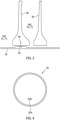
- the piston ring seal 50 extends circumferentially in a hoop-like manner and includes a split defined by two opposing circumferential ends 62A, 62B (see FIG. 4 ), thereby making the piston ring seal 50 circumferentially discontinuous.
- the piston ring seal 50 is shown in sealing engagement with the inner bore surface of the compressor rotor 36 and a surface of the tie shaft seal groove 48.
- the compressor component will be referred to as a compressor rotor (compressor rotor surface 64) but the present disclosure is not limited thereto. Furthermore, the present disclosure is not limited to engagement with any particular compressor rotor surface 64.
- the piston ring seal 50 is a circumferentially split ring, and thus configured to radially "grow" during operation of the gas turbine engine 20 into engagement with the compressor rotor surface.
- the example piston seal ring 50 shown in FIGS. 3-6 has a width (RW) and a height (RH). The width of the piston seal ring 50 is less than the width of the seal groove (i.e., W > RW) to permit axial movement of the piston axial seal within the seal groove.
- the tie shaft 42 and the compressor rotors 36 are rotationally driven about the central axis of the engine 20; e.g., driven by the turbine 28.
- the rotational speed ( ⁇ ) of the tie shaft 42 and the compressor rotors 36 will vary within a given range during operation of a gas turbine engine 20, and the extent of the rotational speed range may vary between different gas turbine engines. In all gas turbine applications, however, the rotational speed range will include rotational speeds sufficient to cause a piston ring seal 50 to experience significant centrifugal forces forcing the piston ring seal 50 radially outward; e.g., into contact with the compressor rotor surface 64.
- the specific centrifugal forces on a given piston seal ring 50 will be a function of both the rotational speed and the mass of the piston ring seal 50; i.e., a first piston seal ring with a first mass (M1) will experience greater centrifugal forces than a second piston seal ring with a second mass (M2) where M1 > M2, for the same rotational velocity.
- a seal assembly 46 is typically used to isolate / separate a first rotor compartment (FRC) from a second rotor compartment (SRC). Air within the FRC may be at a first pressure (P1) and temperature (T1) and air within the SRC may be at a second pressure (P2) and temperature (T2), where the first pressure and temperature are each lower than the respective second pressure and temperature (P2 > P1 and T2 > T1). Hence, the seal assembly 46 is operable to inhibit the passage of air from the higher pressure SRC to the lower pressure FRC.
- the piston ring seal 50 is intended to create a first seal at a surface associated with the tie shaft 42 and a second seal at a compressor rotor surface 64.
- the outer radial surface 66 of the piston ring seal 50 is intended to engage and seal with the compressor rotor surface 64 and a lateral surface 68 of the piston ring seal 50 is intended to engage and seal with the first lateral surface 52 of the seal groove 48.
- the first lateral surface 52 of the seal groove 48 is opposite the SRC and the higher pressure P2 in the SRC is intended to bias the piston ring seal 50 against the first lateral surface 52 to produce the seal.
- FIG. 5A is an enlarged view of the piston ring seal 50 shown in FIG. 5 .
- air within the FRC at P1 will act on the exposed portion of the lateral surface 50A of the piston ring seal 50 in the direction of arrow 70
- air within the SRC at P2 will act on the exposed portion of the lateral surface 50B of the piston ring seal 50 in the direction of arrow 72
- the piston ring seal 50 will also be subject to centrifugal forces (Fc) during operation that bias the piston ring seal 50 radially outwardly against the compressor rotor surface 64.
- Fc centrifugal forces
- the rotational speed of the tie shaft 42 and compressor rotors 36 is such that the centrifugally produced outward radial force (i.e., the force normal to the compressor rotor surface 64) can be substantial.
- the frictional force resisting axial movement of the piston ring seal 50 is a function of the normal force (i.e., the pressure force acting on the inner radial surface 50C of the seal plus the centrifugal force Fc) and the coefficient of friction between the seal 50 and the compressor rotor surface 64.
- the normal force i.e., the pressure force acting on the inner radial surface 50C of the seal plus the centrifugal force Fc
- the coefficient of friction between the seal 50 and the compressor rotor surface 64 e.e., the pressure force acting on the inner radial surface 50C of the seal plus the centrifugal force Fc
- FIG. 6 illustrates a piston ring seal 50 that is not engaged with a lateral surface of the seal groove and the consequent leakage path around the piston ring seal 50.
- Embodiments of the present disclosure provide a seal assembly 46 that mitigates the potential for leakage across the piston ring seal assembly 46 by leveraging the difference in pressure between adjacent compartments (e.g., FRC, SRC) to produce a force that counteracts the centrifugal force Fc acting on the piston ring seal 50 during operation.
- adjacent compartments e.g., FRC, SRC
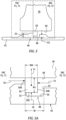
- the seal assembly embodiment shown in FIGS. 7 and 7A includes a piston ring seal 50 with a stepped configuration defined by a center member 76, a first lateral member 78, and a second lateral member 80.
- the first and second lateral members 78, 80 are both connected to the center member 76, and all three members may be integrally formed with one another.
- the center member 76 / seal 50 may be described as having a first lateral end 82, an opposite second lateral end 84, an outer radial surface 86, and an inner radial surface 88.
- the first lateral member 78 extends outwardly from the center member 76 on the outer radial surface 86 side of the center member and at the first lateral end 82.
- the second lateral member 80 extends outwardly from the center member 76 on the inner radial surface 88 side of the center member 76, at the second lateral end 84 of the center member 76.
- the first lateral member 78 has a first side surface 90, a second side surface 92, and an outer radial surface 94.
- the outer radial surface 94 extends between the first and second side surfaces 90, 92.
- the outer radial surface 86 of the center member 76 extends between the second side surface 92 of the first lateral member 78 to the second lateral end 84 of the center member 76.
- the second lateral member 80 has a first side surface 95, a second side surface 96, and an inner radial surface 98.
- the inner radial surface 98 extends between the first and second side surfaces 95, 96.
- the second lateral member 80 has a width (SLMW) that extends between the first and second side surfaces 95, 96.
- the inner radial surface 88 of the center member 76 extends between the first side surface 95 of the second lateral member 80 to the first lateral end 82 of the center member 76.
- the second lateral member 80 of the piston ring seal 50 is disposed within the seal groove 48 of the tie shaft 42 and the first lateral member 78 is disposed with its outer radial surface 94 in proximity to (e.g., in contact with) the compressor rotor surface 64.
- the second lateral member width (SLMW) is less than the width of the seal groove 48 (i.e., W > SLMW) to permit axial movement of the second lateral member 80 within the seal groove 48.
- air within the FRC at P1 will act on the first side surface 90 of the first lateral member 78 and act on the inner radial surface 88 of the center member 76 and air within the SRC at P2 will act on the second side surface 96 of the second lateral member 80, the inner radial surface 98 of the second lateral member 80, and the outer radial surface 86 of the center member 76.
- the higher gas pressure in the SRC (P2 > P1) produces axial direction forces that act on the piston seal ring 50 to bias the first side surface 95 of the second lateral member 80 against the first lateral surface 52 of the seal groove 48 to create the desired axial sealing.
- the higher pressure gas (P2) in the SRC acts on the outer radial surface 86 of the center member 76 and on the inner radial surface 98 of the second lateral member 80.
- the axial length of the outer radial surface 86 of the center member 76 is substantially longer than the axial length of the inner radial surface 98 of the second lateral member 80.
- RF INWARD a net inwardly directed radial force
- Lower pressure gas (P1) from the FRC acts on the inner radial surface 88 of the center member 76 producing an outwardly directed radial force (RF OUTWARD ).
- the net inwardly directed radial force offsets the centrifugal force (Fc) that biases the piston ring seal 50 radially outwardly (detailed above).
- Fc centrifugal force
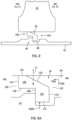
- the seal assembly embodiment shown in FIGS. 8 and 8A includes a piston ring seal 50 with a first lateral end 100, a second lateral end 102 opposite the first lateral end 100, an inner lateral member 104 and an outer lateral member 106.
- the inner and outer lateral members 104, 106 are connected to one another and may be integrally formed with one another.
- the inner lateral member 104 extends outwardly from the outer lateral member 106 and is disposed at the second lateral end 102 of the seal 50.
- the inner lateral member 104 has a first side surface 108, a second side surface 110, and an inner radial surface 112.
- the inner radial surface 112 extends between the first and second side surfaces 108, 110.
- the outer lateral member 106 has a first side surface 114, an outer radial surface 116, an inner radial surface 118, and a transverse surface 120.
- the first side surface 114 extends between the inner and outer radial surfaces 116, 118.
- the transverse surface 120 is non-parallel with the outer radial surface 116, extending at an angle greater than zero degrees (0°) and less than ninety degrees (90°) from the outer radial surface 116, extends between outer radial surface 116 and the second side surface 110 of the inner lateral member 104; i.e., skewed relative to the axis of rotation of the tie shaft / compressor rotors.
- the transverse surface 120 may extend at an angle in the range of about thirty degrees (30°) to about sixty degrees (60°).
- FIGS 8 and 8A show the transverse surface 120 extending along a linear line.
- the transverse surface 120 may include a plurality of sections; e.g., a first section disposed at a first angle (between 0-90 degrees) and a second section disposed at a second angle (between 0-90 degrees).
- the transverse surface 120 may extend along an arcuate line and therefore be disposed at a plurality of angles. As can be seen in FIG.
- the inner lateral member 104 of the piston ring seal 50 is disposed within the seal groove 48 of the tie shaft 42 and a portion of the outer radial member 106 is disposed in proximity to (e.g., in contact with) the compressor rotor surface 64.
- air within the FRC at P1 will act on the first side surface 114 of the outer lateral member 106, on a portion of the first side surface 108 of the inner lateral member 104, and on the inner radial surface 118 of the outer radial member 106.
- Air within the SRC at P2 will act on the transverse surface 120 of the outer radial member 106, on the second side surface 110 of the inner lateral member, and on the inner radial surface 112 of the inner lateral member 104.
- the force produced by the air at P2 acting on the transverse surface 120 will have an axial component (TSAF) and a radial component (TSRF).
- TSAF axial component
- TSRF radial component
- the higher air pressure in the SRC P2 > P1 produces axial direction forces that act on the piston seal ring 50 to bias the inner lateral member 104 against the seal groove 48 to create the desired axial sealing.
- the forces produced by the higher pressure air (P2) in the SRC acting on the transverse surface (TSRF) and on the inner radial surface 112 of the inner lateral member 104 (IRSRF) produce offsetting radial forces.
- the axial length of the transverse surface 120 is sufficiently long so that the inwardly radial force on the transverse surface 120 is greater than the radially outward force on the inner radial surface 112 of the inner lateral member 104 (TSRF > IRSRF).
- TSRF > IRSRF radially outward force on the inner radial surface 112 of the inner lateral member 104
- RF INWARD TSRF - IRSRF
- Lower pressure gas (P1) from the FRC acts on the inner radial surface 118 of the outer lateral member 106 producing an outwardly directed radial force (RF OUTWARD ).
- the inwardly radial force produced by the higher pressure gas in the SRC (RF INWARD ) is greater than the outwardly directed radial force (RF OUTWARD ).
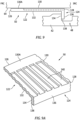
- the seal assembly embodiment shown in FIGS. 9 and 9A includes a piston ring seal 50 with an L-shaped defined by a primary member 122 and a secondary member 124 connected to one another (or integrally formed).
- the primary member 122 may be described as having a first lateral end 126, an opposite second lateral end 128, an outer radial surface 130, and an inner radial surface 132.
- the secondary member 124 extends outwardly from the primary member 122 on the inner radial surface 132 side of the primary member 122 and at the second lateral end 128.
- the secondary member 124 has a first side surface 134, a second side surface 136, and an inner radial surface 138.
- the inner radial surface 138 extends between the first and second side surfaces 134, 136.
- the secondary member 124 has a width that is less than the width of the seal groove 48.
- the primary member 122 includes a plurality of grooves 140 disposed in the outer radial surface 130 of the primary member 122.
- the grooves 140 are open on the second lateral end 128 and extend from the second lateral end 128 toward the first lateral end 126.
- the grooves 140 do not extend entirely between the first and second lateral ends 126, 128.
- the outer radial surface 130 includes a seal portion 130A extending between the first lateral end 126 and the terminus of the grooves 140.
- the secondary member 124 is disposed within the seal groove 48 of the tie shaft 42 and portions of the outer radial surface 130 (including the seal portion 130A) are in contact with the compressor rotor surface 64.
- FIGS. 7, 7A , 8, 8A , 9, and 9A are examples of piston ring seal 50 configurations that leverage the difference in pressure between the rotor compartments to produce a force that counteracts the centrifugal force Fc acting on the piston ring seal 50 during operation.
- These example embodiments illustrate how a present disclosure piston ring seal 50 may be configured. The present disclosure is not limited to these examples.
- the piston split ring seal 50 of the present disclosure may be comprised of a variety of different materials; e.g., various metals, metal alloys, ceramics, polymers, and any combination thereof.
Landscapes
- Engineering & Computer Science (AREA)
- General Engineering & Computer Science (AREA)
- Mechanical Engineering (AREA)
- Chemical & Material Sciences (AREA)
- Combustion & Propulsion (AREA)
- Sealing Devices (AREA)
- Turbine Rotor Nozzle Sealing (AREA)
Applications Claiming Priority (1)
| Application Number | Priority Date | Filing Date | Title |
|---|---|---|---|
| US17/993,517 US12123305B2 (en) | 2022-11-23 | 2022-11-23 | Split piston ring seal for a rotating assembly and method of sealing |
Publications (2)
| Publication Number | Publication Date |
|---|---|
| EP4375487A2 true EP4375487A2 (de) | 2024-05-29 |
| EP4375487A3 EP4375487A3 (de) | 2024-08-14 |
Family
ID=88965779
Family Applications (1)
| Application Number | Title | Priority Date | Filing Date |
|---|---|---|---|
| EP23211748.1A Pending EP4375487A3 (de) | 2022-11-23 | 2023-11-23 | Geteilte kolbenringdichtung für eine rotierende anordnung und verfahren zur abdichtung |
Country Status (3)
| Country | Link |
|---|---|
| US (1) | US12123305B2 (de) |
| EP (1) | EP4375487A3 (de) |
| CA (1) | CA3220755A1 (de) |
Families Citing this family (4)
| Publication number | Priority date | Publication date | Assignee | Title |
|---|---|---|---|---|
| US20250003349A1 (en) * | 2023-06-30 | 2025-01-02 | Raytheon Technologies Corporation | Annular seal with interlocked rings |
| WO2025252832A1 (en) * | 2024-06-05 | 2025-12-11 | Accelleron Switzerland Ltd. | Sealing arrangement for a turbomachine, turbomachine, and method of operating a turbomachine |
| US20250389200A1 (en) * | 2024-06-19 | 2025-12-25 | Rtx Corporation | Center Tie Rotor Annular Seal |
| US12704073B2 (en) | 2024-09-06 | 2026-08-11 | Rtx Corporation | Center tie rotor annular seal |
Family Cites Families (32)
| Publication number | Priority date | Publication date | Assignee | Title |
|---|---|---|---|---|
| US2970023A (en) | 1958-02-24 | 1961-01-31 | Perfect Circle Corp | Piston ring |
| US3743303A (en) * | 1970-12-29 | 1973-07-03 | Gen Electric | Force balanced split ring dynamic shaft seals |
| JPH02118177U (de) | 1989-03-09 | 1990-09-21 | ||
| JP3324887B2 (ja) * | 1994-11-08 | 2002-09-17 | 本田技研工業株式会社 | 油圧シール装置 |
| GB9805124D0 (en) | 1998-03-10 | 1998-05-06 | Compair Reavell Ltd | Piston sealing ring assembly |
| JPWO2004044465A1 (ja) * | 2002-11-13 | 2006-03-16 | 株式会社東芝 | 回転電機 |
| GB0228586D0 (en) | 2002-12-07 | 2003-01-15 | Cross Mfg Co 1938 Ltd | Seal assembly |
| US7992694B2 (en) | 2004-12-24 | 2011-08-09 | Schaeffler Technologies Gmbh & Co. Kg | Seal for torque converter lockup clutch |
| US7334980B2 (en) * | 2005-03-28 | 2008-02-26 | United Technologies Corporation | Split ring retainer for turbine outer air seal |
| US8205891B2 (en) * | 2008-09-15 | 2012-06-26 | Stein Seal Company | Intershaft seal assembly |
| US9004495B2 (en) * | 2008-09-15 | 2015-04-14 | Stein Seal Company | Segmented intershaft seal assembly |
| EP2166259A1 (de) | 2008-09-18 | 2010-03-24 | ABB Turbo Systems AG | Vorrichtung zum Abdichten eines Lagergehäuses eines Abgasturboladers |
| US8100403B2 (en) * | 2008-12-31 | 2012-01-24 | Eaton Corporation | Hydrodynamic intershaft seal and assembly |
| BRPI0906127C1 (pt) | 2009-11-23 | 2011-08-30 | Oliveira Jairo Antunes De | anéis compensadores para pistões de motores, compressores, exaustores e bombas |
| US9316119B2 (en) | 2011-09-15 | 2016-04-19 | United Technologies Corporation | Turbomachine secondary seal assembly |
| US10563530B2 (en) * | 2015-10-12 | 2020-02-18 | General Electric Company | Intershaft seal with dual opposing carbon seal rings |
| US10520096B2 (en) * | 2015-11-02 | 2019-12-31 | Rolls-Royce Corporation | Intershaft seal assembly |
| KR102143814B1 (ko) | 2016-03-21 | 2020-08-13 | 생-고뱅 퍼포먼스 플라스틱스 엘+에스 게엠베하 | 비-대칭 시일 링 |
| US9850770B2 (en) * | 2016-04-29 | 2017-12-26 | Stein Seal Company | Intershaft seal with asymmetric sealing ring |
| US10598035B2 (en) * | 2016-05-27 | 2020-03-24 | General Electric Company | Intershaft sealing systems for gas turbine engines and methods for assembling the same |
| US9890650B2 (en) * | 2016-06-21 | 2018-02-13 | United Technologies Corporation | Carbon seal spring assembly |
| US10619742B2 (en) * | 2017-07-14 | 2020-04-14 | United Technologies Corporation | Ring seal arrangement with installation foolproofing |
| US10822983B2 (en) * | 2018-02-06 | 2020-11-03 | Raytheon Technologies Corportation | Hydrostatic seal with abradable teeth for gas turbine engine |
| US10920617B2 (en) * | 2018-08-17 | 2021-02-16 | Raytheon Technologies Corporation | Gas turbine engine seal ring assembly |
| US10954861B2 (en) * | 2019-03-14 | 2021-03-23 | Raytheon Technologies Corporation | Seal for a gas turbine engine |
| US11338381B2 (en) | 2019-07-26 | 2022-05-24 | Pratt & Whitney Canada Corp. | Method and system for wire electro-discharge machining a component |
| US20210062669A1 (en) * | 2019-08-26 | 2021-03-04 | United Technologies Corporation | Hydrostatic seal with seal stops |
| US11208891B2 (en) | 2019-09-20 | 2021-12-28 | Pratt & Whitney Canada Corp. | Method of repairing a firtree feature with wire electrical discharge machining |
| US11542819B2 (en) * | 2021-02-17 | 2023-01-03 | Pratt & Whitney Canada Corp. | Split ring seal for gas turbine engine rotor |
| US11506071B2 (en) * | 2021-03-02 | 2022-11-22 | Raytheon Technologies Corporation | Piston ring shuttle carrier |
| US11773738B2 (en) * | 2021-12-09 | 2023-10-03 | Rtx Corporation | Radial lift seal |
| US12571472B2 (en) * | 2022-09-06 | 2026-03-10 | Rtx Corporation | Piston seal ring |
-
2022
- 2022-11-23 US US17/993,517 patent/US12123305B2/en active Active
-
2023
- 2023-11-21 CA CA3220755A patent/CA3220755A1/en active Pending
- 2023-11-23 EP EP23211748.1A patent/EP4375487A3/de active Pending
Also Published As
| Publication number | Publication date |
|---|---|
| EP4375487A3 (de) | 2024-08-14 |
| US20240167389A1 (en) | 2024-05-23 |
| US12123305B2 (en) | 2024-10-22 |
| CA3220755A1 (en) | 2024-05-23 |
Similar Documents
| Publication | Publication Date | Title |
|---|---|---|
| US12123305B2 (en) | Split piston ring seal for a rotating assembly and method of sealing | |
| US11073045B2 (en) | Turbine shroud assembly with case captured seal segment carrier | |
| US10697550B2 (en) | Non-contact seal with progressive radial stop(s) | |
| US5622475A (en) | Double rabbet rotor blade retention assembly | |
| US9033657B2 (en) | Gas turbine engine including lift-off finger seals, lift-off finger seals, and method for the manufacture thereof | |
| EP2952689B1 (de) | Segmentierter randdichtungsabstandhalter für einen gasturbinenmotor | |
| US10458268B2 (en) | Turbine shroud with sealed box segments | |
| US10724375B2 (en) | Gas turbine engine with ring damper | |
| EP3252280B1 (de) | Umlaufendes plenum für öldämpfer | |
| EP3287674B1 (de) | Schwimmende, kontaktfreie abdichtung mit versetztem konstruktionsspiel für lastungleichgewicht | |
| US10184345B2 (en) | Cover plate assembly for a gas turbine engine | |
| US20090067978A1 (en) | Variable area turbine vane arrangement | |
| US20030168117A1 (en) | Weep plug | |
| EP3428489B1 (de) | Hydrostatische berührungslose dichtung mit dichtungsträgerbeseitigung | |
| US10731761B2 (en) | Hydrostatic non-contact seal with offset outer ring | |
| EP3255251A1 (de) | Zwischenwellendichtungssysteme für gasturbinenmotoren | |
| EP3181945B1 (de) | Merkmale zur einer dämpfer- und dichtungsanordnung | |
| US20210148250A1 (en) | Turbine shroud assembly with case captured seal segment carrier | |
| US12203375B2 (en) | Seal assemblies for turbine engines having wear detection features | |
| US12398674B2 (en) | Bearing assembly for a gas turbine engine | |
| EP3851634A1 (de) | Dichtelement zum abdichten der anbindung zwischen einer rotorschaufel und der rotorscheibe einer turbinenmaschine | |
| CN107806367A (zh) | 用于防止盘超速的系统和方法 | |
| US12529322B1 (en) | Gas turbine engine stator vane stage | |
| US12480419B1 (en) | Outer air seal (OAS) assembly for a gas turbine engine | |
| US20250382893A1 (en) | Shrouded turbine assembly for gas turbine engine |
Legal Events
| Date | Code | Title | Description |
|---|---|---|---|
| PUAI | Public reference made under article 153(3) epc to a published international application that has entered the european phase |
Free format text: ORIGINAL CODE: 0009012 |
|
| STAA | Information on the status of an ep patent application or granted ep patent |
Free format text: STATUS: THE APPLICATION HAS BEEN PUBLISHED |
|
| AK | Designated contracting states |
Kind code of ref document: A2 Designated state(s): AL AT BE BG CH CY CZ DE DK EE ES FI FR GB GR HR HU IE IS IT LI LT LU LV MC ME MK MT NL NO PL PT RO RS SE SI SK SM TR |
|
| PUAL | Search report despatched |
Free format text: ORIGINAL CODE: 0009013 |
|
| AK | Designated contracting states |
Kind code of ref document: A3 Designated state(s): AL AT BE BG CH CY CZ DE DK EE ES FI FR GB GR HR HU IE IS IT LI LT LU LV MC ME MK MT NL NO PL PT RO RS SE SI SK SM TR |
|
| RIC1 | Information provided on ipc code assigned before grant |
Ipc: F01D 5/06 20060101ALI20240710BHEP Ipc: F01D 5/02 20060101ALI20240710BHEP Ipc: F16J 15/44 20060101ALI20240710BHEP Ipc: F02C 7/28 20060101ALI20240710BHEP Ipc: F01D 11/00 20060101AFI20240710BHEP |
|
| STAA | Information on the status of an ep patent application or granted ep patent |
Free format text: STATUS: REQUEST FOR EXAMINATION WAS MADE |
|
| 17P | Request for examination filed |
Effective date: 20250214 |