EP4374025B1 - Multi-purpose tile system and tile covering - Google Patents
Multi-purpose tile system and tile covering Download PDFInfo
- Publication number
- EP4374025B1 EP4374025B1 EP22743508.8A EP22743508A EP4374025B1 EP 4374025 B1 EP4374025 B1 EP 4374025B1 EP 22743508 A EP22743508 A EP 22743508A EP 4374025 B1 EP4374025 B1 EP 4374025B1
- Authority
- EP
- European Patent Office
- Prior art keywords
- coupling profile
- tile
- downward
- locking element
- coupling
- Prior art date
- Legal status (The legal status is an assumption and is not a legal conclusion. Google has not performed a legal analysis and makes no representation as to the accuracy of the status listed.)
- Active
Links
Images




Classifications
-
- E—FIXED CONSTRUCTIONS
- E04—BUILDING
- E04F—FINISHING WORK ON BUILDINGS, e.g. STAIRS, FLOORS
- E04F15/00—Flooring
- E04F15/02—Flooring or floor layers composed of a number of similar elements
- E04F15/02038—Flooring or floor layers composed of a number of similar elements characterised by tongue and groove connections between neighbouring flooring elements
-
- E—FIXED CONSTRUCTIONS
- E04—BUILDING
- E04F—FINISHING WORK ON BUILDINGS, e.g. STAIRS, FLOORS
- E04F13/00—Coverings or linings, e.g. for walls or ceilings
- E04F13/07—Coverings or linings, e.g. for walls or ceilings composed of covering or lining elements; Sub-structures therefor; Fastening means therefor
- E04F13/08—Coverings or linings, e.g. for walls or ceilings composed of covering or lining elements; Sub-structures therefor; Fastening means therefor composed of a plurality of similar covering or lining elements
- E04F13/0889—Coverings or linings, e.g. for walls or ceilings composed of covering or lining elements; Sub-structures therefor; Fastening means therefor composed of a plurality of similar covering or lining elements characterised by the joints between neighbouring elements, e.g. with joint fillings or with tongue and groove connections
- E04F13/0894—Coverings or linings, e.g. for walls or ceilings composed of covering or lining elements; Sub-structures therefor; Fastening means therefor composed of a plurality of similar covering or lining elements characterised by the joints between neighbouring elements, e.g. with joint fillings or with tongue and groove connections with tongue and groove connections
-
- E—FIXED CONSTRUCTIONS
- E04—BUILDING
- E04F—FINISHING WORK ON BUILDINGS, e.g. STAIRS, FLOORS
- E04F15/00—Flooring
- E04F15/02—Flooring or floor layers composed of a number of similar elements
- E04F15/10—Flooring or floor layers composed of a number of similar elements of other materials, e.g. fibrous or chipped materials, organic plastics, magnesite tiles, hardboard, or with a top layer of other materials
- E04F15/107—Flooring or floor layers composed of a number of similar elements of other materials, e.g. fibrous or chipped materials, organic plastics, magnesite tiles, hardboard, or with a top layer of other materials composed of several layers, e.g. sandwich panels
-
- E—FIXED CONSTRUCTIONS
- E04—BUILDING
- E04F—FINISHING WORK ON BUILDINGS, e.g. STAIRS, FLOORS
- E04F15/00—Flooring
- E04F15/02—Flooring or floor layers composed of a number of similar elements
- E04F15/10—Flooring or floor layers composed of a number of similar elements of other materials, e.g. fibrous or chipped materials, organic plastics, magnesite tiles, hardboard, or with a top layer of other materials
- E04F15/105—Flooring or floor layers composed of a number of similar elements of other materials, e.g. fibrous or chipped materials, organic plastics, magnesite tiles, hardboard, or with a top layer of other materials of organic plastics with or without reinforcements or filling materials
-
- E—FIXED CONSTRUCTIONS
- E04—BUILDING
- E04F—FINISHING WORK ON BUILDINGS, e.g. STAIRS, FLOORS
- E04F2201/00—Joining sheets or plates or panels
- E04F2201/01—Joining sheets, plates or panels with edges in abutting relationship
- E04F2201/0138—Joining sheets, plates or panels with edges in abutting relationship by moving the sheets, plates or panels perpendicular to the main plane
-
- E—FIXED CONSTRUCTIONS
- E04—BUILDING
- E04F—FINISHING WORK ON BUILDINGS, e.g. STAIRS, FLOORS
- E04F2201/00—Joining sheets or plates or panels
- E04F2201/01—Joining sheets, plates or panels with edges in abutting relationship
- E04F2201/0138—Joining sheets, plates or panels with edges in abutting relationship by moving the sheets, plates or panels perpendicular to the main plane
- E04F2201/0146—Joining sheets, plates or panels with edges in abutting relationship by moving the sheets, plates or panels perpendicular to the main plane with snap action of the edge connectors
-
- E—FIXED CONSTRUCTIONS
- E04—BUILDING
- E04F—FINISHING WORK ON BUILDINGS, e.g. STAIRS, FLOORS
- E04F2201/00—Joining sheets or plates or panels
- E04F2201/01—Joining sheets, plates or panels with edges in abutting relationship
- E04F2201/0153—Joining sheets, plates or panels with edges in abutting relationship by rotating the sheets, plates or panels around an axis which is parallel to the abutting edges, possibly combined with a sliding movement
-
- E—FIXED CONSTRUCTIONS
- E04—BUILDING
- E04F—FINISHING WORK ON BUILDINGS, e.g. STAIRS, FLOORS
- E04F2201/00—Joining sheets or plates or panels
- E04F2201/02—Non-undercut connections, e.g. tongue and groove connections
- E04F2201/023—Non-undercut connections, e.g. tongue and groove connections with a continuous tongue or groove
-
- E—FIXED CONSTRUCTIONS
- E04—BUILDING
- E04F—FINISHING WORK ON BUILDINGS, e.g. STAIRS, FLOORS
- E04F2201/00—Joining sheets or plates or panels
- E04F2201/04—Other details of tongues or grooves
- E04F2201/042—Other details of tongues or grooves with grooves positioned on the rear-side of the panel
-
- E—FIXED CONSTRUCTIONS
- E04—BUILDING
- E04F—FINISHING WORK ON BUILDINGS, e.g. STAIRS, FLOORS
- E04F2201/00—Joining sheets or plates or panels
- E04F2201/04—Other details of tongues or grooves
- E04F2201/043—Other details of tongues or grooves with tongues and grooves being formed by projecting or recessed parts of the panel layers
Definitions
- the invention relates to a multi-purpose tile system, in particular a floor tile system, comprising a plurality of multi-purpose tiles, in particular floor tiles, wall tiles, or ceiling tiles.
- the invention also relates to a tile covering, in particular floor covering, ceiling covering, or wall covering, consisting of mutually coupled tiles according to the invention.
- the floor obtained in this manner also called a floating parquet flooring, has as an advantage that it is easy to install and that the complete floor surface can move which often is convenient in order to receive possible expansion and shrinkage phenomena.
- connection elements made of metal are provided between the single floor panels in order to keep them together.
- connection elements are rather expensive to make and, furthermore, their provision or the installation thereof is a time-consuming occupation.
- Floor panels having complementarily shaped coupling parts at opposing panel edges are also known. These known panels are typically rectangular and have complementarily shaped angling-down coupling parts at opposing long panel edges and complementarily shaped fold-down coupling parts at opposing short panel edges.
- the tiles, and preferably each tile comprise: at least one first edge having a first coupling profile comprising: a sideward tongue extending in a direction substantially parallel to the upper side of the tile, at least one first downward flank lying at a distance from the sideward tongue, and a first downward recess formed between the sideward tongue and the first downward flank, at least one second edge having a second coupling profile comprising: a downward tongue extending in a direction substantially perpendicular to the upper side of the tile, at least one second downward flank lying at a distance from the downward tongue, a second downward recess formed between the downward tongue and the downward flank, and, preferably, at least one second locking element, more preferably provided at the second downward flank of the second coupling profile; at least one third edge, and preferably at least two third edges, each third edge having a third coupling profile comprising: a third recess configured for accommodating at least a part of the
- the absence of locking element at said positions in combination with the so-called open groove structure may result in an unstable locking situation between the male and the female coupling parts of adjacent panels, in particular for coupling between the second coupling profile and the third coupling profile.
- the presence of described second and third locking elements may additionally prevent that the male coupling part of the second coupling profile might (slightly) displace, and in particular (slightly) tilt, for example towards the open space of the third recess, during use. Hence, friction between adjacent panels in a coupling condition can be prevented.
- each tile of the tile system comprises at least one first coupling profile, at least one second coupling profile, and at least one third coupling profile, and preferably a plurality, e.g. two, third coupling profiles.
- at least a first tile comprises at least one first coupling profile and at least one third coupling profile, without having a second coupling profile
- a second tile comprises at least one second coupling profile and at least one third coupling profile, without having a first coupling profile.
- each tile of the tile system may have at least one first coupling profile and/or at least one second coupling profile and/or at least one third coupling profile.
- a multi-purpose tile system in particular a floor tile system, comprising a plurality of multi-purpose tiles, in particular floor tiles
- at least one first tile (type) comprises at least one first edge having a first coupling profile comprising: a sideward tongue extending in a direction substantially parallel to the upper side of the tile, at least one first downward flank lying at a distance from the sideward tongue, and a first downward recess formed between the sideward tongue and the first downward flank
- at least one second tile (type) comprises at least one second edge having a second coupling profile comprising: a downward tongue extending in a direction substantially perpendicular to the upper side of the tile, at least one second downward flank lying at a distance from the downward tongue, a second downward recess formed between the downward tongue and the downward flank, and preferably, at least one second locking element, preferably provided at the second downward flank of the second coupling profile
- at least one third tile (type) comprises at least one
- the first tile and/or the second tile and/or the third tile may be formed by the same tile.
- the first tile may comprise at least one second coupling profile and/or at least one third coupling profile.
- the second tile may comprise at least one first coupling profile and/or at least one third coupling profile.
- the third tile may comprise at least one first coupling profile and/or at least one second coupling profile.
- the tile system according to the invention has a plurality of significant advantages.
- a first main advantage is that the third coupling profile (female profile) is configured to co-act with both the first coupling profile (first male profile) and the second coupling profile (second male profile). This provides an enormous increase in how all tiles are mutually oriented in a tile covering to be realized.
- the classical row by row installation of tiles is still possible, but the compatibility of the third coupling profile with both the first coupling profile and the second coupling profile also allows the installation of various alternative installation patterns, such as for example, but not limited to, a herringbone pattern, while needing and using only a single tile type.
- each tile of the tile system can be manufactured in a relatively cost-efficient manner, since only three different coupling profiles, instead of the usual four different coupling profiles, will have to be realized during the production process, which will lead to at least a cost-saving in the machinery, and in particular the milling tools, which are used during the production process.
- a further major benefit of the tile system according to the invention is that the different male coupling profiles (i.e. the first coupling profile and the second coupling profile) are configured to co-act with different third contact portions of the third coupling profile.
- the third lower contact portion and the third upper contact portion may be at least partially overlapping portion.
- the third lower contact portion and the third upper contact portion are non-overlapping contact portion which may connect to each other or which may be positioned at a distance from each other.
- the first coupling profile is configured to co-act, preferably solely, with the third upper contact portion, which facilitates angling in and angling out of the first coupling profile with respect to the third coupling profile.
- the second coupling profile is configured to co-act, preferably solely, with the third lower contact portion, which is in favour of realizing a stable connection between the second coupling profile and the third coupling profile.
- third lower contact portion connects to the third upper contact portion, wherein the third lower contact portion extends in a first direction, and the third upper contact portion extends in a second direction, deviating from the first direction, wherein, more preferably, both the third upper contact portion and the third lower contact portion are upwardly inclined in a direction away from the upper lip.
- the third lower contact portion connects via at least one intermediate curved zone, preferably a convex zone, to the third upper contact portion, wherein the third lower contact portion extends in a first direction, and the third upper contact portion extends in a second direction, deviating from the first direction.
- An optional curved zone prevents damaging of the coupling profiles during (un)coupling.
- An optional convex curved zone facilitates the third lower contact portion to be more steep than the third upper contact portion. In other words, a first angle enclosed by the first direction in which the third lower contact portion extends and a plane defined by the tile is preferably larger than a second angle enclosed by the second direction in which the third upper contact portion extends and a plane defined by the tile.
- a less steep third upper contact portion facilitates e.g. coupling and uncoupling of the first coupling profile and the third coupling profile.
- a more steep third lower contact portion facilitates e.g. a stable connection between the second coupling profile and third coupling profile with a horizontal locking effect.
- the first direction in which the third lower contact portion extends encloses an angle with a plane define by the tile which is 50° to 85°, preferably between 60° and 75°, more preferably between 63° and 67°, in particular approximately 65°.
- the second direction in which the third upper contact portion extends encloses an angle with a plane define by the tile which is 30° to 65°, preferably between 40° and 55°, more preferably between 47° and 53°, in particular approximately 50°.
- the proximal side of the sideward tongue in coupled condition of the first coupling profile and the third coupling profile of adjacent tiles, co-acts only with the third upper contact portion of the upward locking element of the third coupling profile.
- At least a part of the proximal side of the sideward tongue configured to co-act with the third upper contact portion preferably runs substantially parallel to the third upper contact portion. This substantially parallel orientation leads to a line contact in coupled condition of two tiles, as seen from a cross-sectional view of the tiles, which is more stable than a line contact.
- the proximal side of the downward tongue in coupled condition of the second coupling profile and the third coupling profile of adjacent tiles, co-acts only with the third lower contact portion of the upward locking element of the third coupling profile.
- At least a part of the proximal side of the downward tongue configured to co-act with the third lower contact portion preferably runs substantially parallel to the third lower contact portion. This substantially parallel orientation leads to a line contact in coupled condition of two tiles, as seen from a cross-sectional view of the tiles, which is more stable than a line contact.
- a heel of the downward tongue defined by a bottom side of the downward tongue and the proximal side of the downward tongue, is provided with a cut-out portion to facilitate uncoupling of second coupling and the third coupling profile.
- the cut-out portion provides more space to uncouple the second coupling profile with respect to the third coupling profile by means of an angling out movement (turning movement).
- the maximum height of the cut-out portion is at least 0.2 mm.
- the maximum height of the cut-out portion is less than 0.4 mm to secure sufficient contact between the downward tongue and upward locking element in coupled condition,.
- the first edge and the third edge in coupled condition, define a first closing surface defined as a first vertical plane through the upper edges of the coupled tiles or at least the location where the tiles come together at the upper side of the tiles.
- the first coupling profile and the third coupling profile are configured such that in coupled condition, each of the sideward tongue and the third recess extends through said first vertical plane (joint plane). This facilitates to realize a vertical locking effect.
- extending through is meant that a part of the sideward tongue is located at one side of the first vertical plane and another part of the sideward tongue is located at an opposite side of the first vertical plane.
- the lower lip which limits the lower side of the third recess typically extends beyond the upper lip.
- the upper lip defines said vertical plane (joint plane) of two tiles in coupled condition.
- the upward locking element is positioned at a distance from said vertical plane.
- the upward locking element and the upper lip are typically positioned at opposing sides of the joint plane.
- the possible difference between the upper lip and lower lip which border the third recess, measured in the plane of the tile is preferably smaller than one time the total thickness of the tile. This will save material loss during manufacturing of the tile.
- the difference between the upper lip and the lower lip, measured in the plane of the tile is larger than 1.0 times, and is preferably at least 1.25 times, the thickness of the tile.
- the lower lip is relatively long having as advantage that the third recess and the matching sideward tongue and downward tongue can be dimensioned relatively large (compared to the situation in which a relatively short lower lip is applied), which is beneficial for the robustness, stability and durability of the couplings achieved by means of the coupling profiles of adjacent tiles.
- the second vertical plane normally coincides with the aforementioned first vertical plane.
- the second coupling profile and the third coupling profile are preferably configured such that in coupled condition, the downward tongue is positioned at one side of the second vertical plane, and the third recess extends through said second vertical plane.
- the distal side of the downward tongue, facing away from the second downward flank is provided with a fourth locking element
- the upper lip of the third coupling profile is provided with a fifth locking element configured to face, and preferably co-act with, said fourth locking element to achieve a vertical locking effect, in coupled condition of the second coupling profile and the third coupling profile of adjacent tiles, wherein, in coupled condition of the second coupling profile and the third coupling profile of adjacent tiles, the fourth locking element and the remaining part of the downward tongue are preferably situated at opposite sides of the second vertical plane, and wherein, in coupled condition of the second coupling profile and the third coupling profile of adjacent tiles, the fifth locking element and the remaining part of the upper lip are preferably situated at opposite sides of the second vertical plane.
- the fourth element comprises a bulge having an upper side which extends in a third direction, wherein said upper side is downwardly inclined in a direction away from the second downward flank, wherein, preferably, a third angle enclosed by said third direction and a plane defined by the tile is between 25° and 35°, preferably between 28° and 32°, in particular approximately 30°.
- the (protruding) fourth locking element has a maximum width with respect to the second vertical plane of 0.06 to 0.16 mm, preferably 0.08 to 0.12 mm.
- an upper side of the lower lip defines a support surface for both the downward tongue of the second coupling profile of an adjacent tile, and the sideward tongue of the first coupling profile of an adjacent tile.
- the support surface of the lower lip comprises a second support portion for supporting the downward tongue of the second coupling profile of an adjacent tile, and a first support portion for supporting the sideward tongue of the first coupling profile of an adjacent tile, wherein the second support portion and the first support portion are partially overlapping portion, or, typically more preferably, non-overlapping portions, wherein the second support portion and the first support portion connect to each other or, and this is even more preferred, are positioned at a distance from each other.
- the second support portion is located closer to the upward locking element than the first support portion.
- At least a part of the first support portion and the second support portion are preferably located at different side of the (first or second) vertical plane, as defined above.
- the support surface of the lower lip is substantially flat, which makes this support surface suitable to act as sliding surface (guiding surface) for the sideward tongue during insertion of the sideward tongue to the third recess.
- the support surface of the lower lip is downwardly inclined in a direction towards the upward locking element.
- This inclination creates more space for insertion of the sideward tongue, which facilitates the coupling process between the first coupling profile and third coupling profile, and moreover, creates more space for accommodating the downward tongue which can be design in a more voluminous manner, which increases the strength of the downward tongue, and hence the strength of the coupling connection between the second coupling profile and third coupling profile.
- the inclined support surface and a plane defined by the tile mutually enclose an angle of between 1° and 4°, in particular 2° to 3°.
- the width of the first support portion is preferably smaller than the width of the second support portion.
- the first support portion defines a point contact (or first line contact) and the second support portion defines a (second) line contact (which is larger than the first line contact).
- the sideward tongue comprises a tip, facing away from the first downward flank, and a heel, facing towards the first downward flank, wherein a bottom side of the sideward tongue situated in between said tip and said heel is upwardly inclined in a direction towards the first downward flank.
- This typically creates a substantially triangular space between the first coupling profile and third coupling profile in coupled condition.
- Said inclination of the bottom side of the sideward tongue is favourable as this creates somewhat more space to angle in and angle out the first coupling profile with respect to the third coupling profile.
- the direction in which the bottom side of the sideward tongue extends and the plane defined by the tile mutually enclose an angle of between 2° and 10°, preferably between 4° and 6°, in particular approximately 5°.
- the lowest portion of the bottom side of the sideward tongue normally defines a contact surface configured to co-act with the first support portion of the lower lip of the third coupling profile.
- the tip of the sideward tongue is preferably clamped in between the lower lip and upper lip, more in particular in between the first support portion and the lower side of the upper lip.
- each tile comprises a first pair of opposing edges consisting of the first edge and the third edge.
- Each tile preferably comprises a second pair of opposing edges consisting of the second edge and the third edge.
- the number of third coupling profiles of said tile corresponds to the sum of the number of first coupling profiles and the number second coupling profiles.
- the number of first coupling profiles of a tile corresponds to the number of second coupling profiles, although deviations are imaginable, wherein a tile may for example comprise more second coupling profiles than first coupling profiles, or vice versa.
- At least a number of tiles of the tile system according to the invention may be rigid or may be flexible (resilient), or slightly flexible (semi-rigid).
- Each tile is typically made as one of the following kinds: as a laminate floor panel; as a so-called “resilient floor panel”; a "LVT” (luxury vinyl tile) panel or “VCT panel” (vinyl composite tile) or comparable panel on the basis of another synthetic material than vinyl; a floor panel with a first synthetic material-based, preferably foamed, substrate layer (core layer), with thereon a preferably thinner second substrate layer (second core layer) of or on the basis of vinyl or another synthetic material; as a floor panel with a hard synthetic material-based substrate.
- the tile comprise one-piece coupling profiles, and in particular with one-piece vertically active coupling profiles, such by applying certain structural features and/or material characteristics and/or designs of the coupling profiles.
- the coupling profiles are preferably an integral part of each tile, and are typically made of one or more material layers which constitute the tile body.
- the first coupling profile and the third coupling profile are configured for locking together tiles both vertically and horizontally.
- the second coupling profile and the third coupling profile are configured for locking together tiles both vertically and horizontally.
- the tiles of the tile system according to the invention can still be installed by using the user-friendly fold-down installation technology.
- the advantages achieved by the couplings thus in general lie in an improved tile with improved coupling profiles, wherein the advantage of a simple manufacture, by making use of easy to manufacture coupling profiles, namely, because they do not necessarily have to make use of separate connection pieces, the advantage that the tiles preferably can be installed according to the user-friendly fold-down principle, and the advantage of offering a relatively reliable and durable coupling, are combined.
- At least one second locking element of the second coupling profile is provided at the second downward flank of the second coupling profile, and wherein at least one third locking element of the third coupling profile is provided at a distal side of the lower lip facing away from the third recess and/or a distal side of the upward locking element facing away from the third recess. It is commonly favourable to positioning at least one second locking elements and at least one third locking element at the predefined locations, since at these locations there is relatively much space, which allows the design of the locking elements to be more robust, which will be in favour of the vertical locking effect.
- At least one second locking element of the second coupling profile is provided at a distal side of the downward tongue facing away from the second downward recess, and wherein at least one the third locking element of the third coupling profile is provided at a side of the upper lip, in coupled condition facing said distal side of the downward tongue of the second coupling profile of an adjacent tile.
- the co-action between the second locking element and the third locking element for creating a vertical locking effect in coupled condition of two tiles defines a tangent T1 which encloses an angle A1 with a plane defined by the tile, which angle A1 is smaller than an angle A2 enclosed by said plane defined by the tile and a tangent T2 defined by a co-action between an inclined part of a proximal side of the upward locking element facing toward the third recess and an inclined part of a proximal side of the downward tongue facing toward the second downward flank.
- the greatest difference between angle A1 and angle A2 is situated between 5 and 20 degrees. It is preferable that said second locking element and said third locking element are positioned closer to the upper side of the tile compared to an upper side of the upward locking element. This will reduce the maximum deformation of one or more coupling profiles, whereas the connection process and deformation process can be executed in successive steps. Less deformation leads to less material stress which is in favour of the life span of the coupling profiles and hence of the tile(s).
- the first coupling profile preferably comprises at least one first locking element configured to face, and preferably co-act with, the third locking element of the third coupling profile of an adjacent tile in coupled condition.
- the presence of this at least one first locking element and the co-action of this first locking element with the third locking element in coupled condition further improves the stability of the coupling between the first coupling profile and the third coupling profile.
- at least one first locking element of the first coupling profile is provided at the first downward flank of the first coupling profile, and wherein at least one third locking element of the third coupling profile is provided at a distal side of the lower lip facing away from the third recess and/or a distal side of the upward locking element facing away from the third recess.
- At least one first locking element of the first coupling profile is provided at a distal side of the first coupling profile, being located above at least a part of the sideward tongue, and wherein at least one the third locking element of the third coupling profile is provided at a side of the upper lip, in coupled condition facing said distal side of the first coupling profile of an adjacent tile.
- the third locking element comprises a, preferably downwardly facing, third contact portion
- the second locking element comprises a, preferably upwardly facing, second contact portion, wherein, in coupled condition of adjacent tiles, the second contact portion is facing, and preferably co-acting with, the third contact portion.
- the second contact portion and third contact portion define the only contact portions of the second locking element and third locking element.
- an entire upper second section of the second locking element, located above said, preferably upwardly facing, second contact portion, and an entire upper third section of the third locking element, located above said, preferably downwardly facing, third contact portion are positioned at a distance from each other to form a cavity (or space).
- This cavity may extend to a contact zone between the proximal side of the downward tongue and the third coupling profile, which means that the upper side of the upward locking element and the upper side of the first downward recess are entirely located at a distance from each other.
- the contact zones between the second coupling profile and third coupling profile could reliably de defined which is in favour of establishing a secure locking between said coupling profiles.
- At least a part of the proximal side of the upward locking element of the third coupling profile, facing the third recess is upwardly inclined in a direction away from the upper lip, preferably in such a way that an angle is enclosed with the normal perpendicular to the plane defined by each tile wherein said angle is situated between 0 and 60 degrees, in particular between 0 and 45 degrees. This inclination results in an open third recess which facilitates insertion both of the sideward tongue and of the downward tongue.
- At least a part of the proximal side of the downward tongue of the second coupling profile, facing the second downward recess, is downwardly inclined in a direction away from the second downward flank, preferably in such a way that an angle is enclosed with the normal perpendicular to the plane defined by each tile wherein said angle is situated between 0 and 60 degrees, in particular between 0 and 45 degrees.
- At least a part of the proximal side of the sideward tongue of the first coupling profile, facing the first downward recess, is downwardly inclined in a direction away from the first downward flank, preferably in such a way that an angle is enclosed with the normal perpendicular to the plane defined by each tile wherein said angle is situated between 0 and 60 degrees, in particular between 0 and 45 degrees.
- a more complementary shape is given to the first coupling profile and/or second coupling profile, which normally results in a more stable coupling between the first and third coupling profiles and between the second and third coupling profiles.
- At least a part of the proximal side of the upward locking element of the third coupling profile, facing the third recess is upwardly inclined in a direction towards the upper lip, preferably in such a way that an angle is enclosed with the normal perpendicular to the plane defined by each tile wherein said angle is situated between 0 and 60 degrees, in particular between 0 and 45 degrees.
- This inward inclination leads to a (slightly) closed third recess, wherein the upward locking element may be used to hook around or clamp around the sideward tongue and/or the downward tongue once inserted in said third recess.
- first and/or second coupling profiles and/or the third coupling profile will typically remain (elastically) deformed, in particular squeezed and/or bent, in a coupled state, provided the desired stability of the coupling.
- the downward tongue will be (slightly) oversized with respect to the third recess
- the upward locking element will be (slightly) oversized with respect to the first and/or second downward recess.
- overlapping contours may also be realized in another manner, for example by applying overlapping (first, second, and/or third) locking elements.
- a lower side of the downward tongue of the second coupling profile, in coupled condition of two tiles, is supported by a lower surface of the (upward) third recess of the third coupling profile.
- This supporting contact preferably causes a fixation in the mutual position of the second coupling profile and the third coupling profile.
- the coupling second profile and coupling third profile preferable cooperate under tension at this supporting contact zone or supporting contact point.
- a stable support of the sideward tongue and the downward tongue by the lower lip, in coupled condition may further stabilize the coupling between the coupling profiles, and may also counteract the risk of the occurrence of creaking noises (squeaking).
- an upper side of the first downward recess and/or the second downward recess has a, preferably likewise (compared to the inclination of the upper side of the upward locking element) inclining orientation, which is more preferably upward in the direction of the sideward tongue and/or in the direction of the downward tongue.
- a first lower surface of a first bridge connecting the downward tongue to the core (main body) of the tile is defined by the upper side of the first downward recess (or vice).
- a second lower surface of a second bridge connecting the downward tongue to the core (main body) of the tile is defined by the upper side of the second downward recess (or vice).
- the upper side of the first downward recess or second downward recess could be at least partially, and preferably substantially completely, supported by the upper side of the upward locking element, which provides additionally strength to the coupling as such.
- the at least one locking element of the first, second, or third locking element may be formed by a (flat of otherwise shaped) contact surface composed of a, optionally separate, plastic material configured to generate friction with the other locking element of another tile in engaged (coupled) condition.
- plastics suitable to generate friction include:
- the upward locking element protrudes in vertical direction (i.e. a direction perpendicular to the plane defined by the panel) with respect to the lower lip.
- the effective height of the upward locking element is defined as the maximum (vertical) distance between a highest location of the upward locking element and a lowest location of the lower lip.
- the effective height of the upward locking element is at least 20%, more preferably at least 25%, and even more preferably at least 30% of the panel thickness.
- the combined thickness of the lower lip and the upward locking element is at least 50% of the panel thickness.
- Each coupling profile is preferably free from hook and loop fasteners and/or adhesive connections.
- Each tile preferably does not comprise any other coupling profile than at least one first coupling profile, at least one second coupling profile, and at least one, preferably at least two, third coupling profile(s).
- each coupling profile is provided with chamfers, such as bevels, at or near the upper side of the tiles. The presence of the chamfers, such as bevels, typically make seam gaps less visible. The presence of chamfers lead to the situation that when two tiles are brought together for attachment, a valley or V-shaped recess is formed.
- the tapered or bevelled edges are at an angle of from about 15° to about 55°, and more preferably at about a 17° angle.
- the width of the bevelled or tapered edge is about 1.0 mm to about 7.0 mm.
- the system comprises two different types of tiles (A and B respectively), and wherein the coupling profiles of one type of tile along are arranged in a mirror-inverted manner relative to the corresponding coupling profiles of the other type of tile.
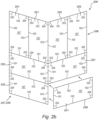
- the system comprises a plurality of tiles having a parallelogrammical shape, wherein said tiles are configured to being joined in a chevron pattern, wherein two pairs of adjacent edges enclose an acute angle, and wherein two pairs of other adjacent edges enclose a obtuse angle.
- the acute angle is typically situated between 30 and 60 degrees, and is preferably substantially 45 degrees.
- the obtuse angle is typically situated between 120 and 150 degrees, and is preferably substantially 135 degrees.
- at least one parallelogrammical tile (A) has a configuration, wherein the edges are arranged, as seen from a top view in a clockwise direction, in the order: a first edge, a third edge, another third edge, and a second edge
- at least one parallelogrammical tile (B) has a configuration, wherein the edges are arranged, as seen from a top view in a clockwise direction, in the order: a first edge, a second edge, a third edge, and another third edge.
- Distinctive visual markings for example coloured labels, symbolic labels, (pre-attached) differently coloured backing layers, and/or text labels, may be applied to different tile types to allow a user to easily recognize the different tiles types during installation.
- the visual markings are not visible in a coupled condition of the tiles (from a top view).
- a visual marking may, for example, be applied onto the upper side of the upward locking element and/or inside the third recess and/or inside the first or second downward recess. It is imaginable that the system according to the invention comprises more than two different types of tiles.
- At least one tile, and preferably each tile, preferably comprises a core layer and at least one upper substrate affixed - either directly or indirectly - to an upper side the core layer, wherein said upper substrate preferably comprises a decorative layer.
- the upper substrate is preferably at least partially made of at least one material selected from the group consisting of: metals, alloys, macromolecular materials such as vinyl monomer copolymers and/or homopolymers; condensation polymers such as polyesters, polyamides, polyimides, epoxy resins, phenol-formaldehyde resins, urea formaldehyde resins; natural macromolecular materials or modified derivatives thereof such as plant fibres, animal fibres, mineral fibres, ceramic fibres and carbon fibres.
- the upper substrate most preferably comprises polyethylene, polyurethane (PU), or polyvinyl chloride (PVC).
- the polyethylene can be low density polyethylene, medium density polyethylene, high density polyethylene or ultra-high density polyethylene.
- the upper substrate layer can also include filler materials and other additives that improve the physical properties and/or chemical properties and/or the processability of the product. These additives include known toughening agents, plasticizing agents, reinforcing agents, anti- mildew (antiseptic) agents, flame-retardant agents, and the like.
- the upper substrate typically comprises a decorative layer and an at least partially transparent or translucent wear layer covering said decorative layer, wherein a top surface of said wear layer is the top surface of said tile, such that decorative layer is visible through the transparent wear layer.
- At least one tile and preferably each tile, comprises an upper substrate affixed - either directly or indirectly - to an upper side of at least one core layer, wherein said upper substrate preferably comprises a veneer layer.
- Said veneer layer preferably has a Mohs hardness of greater than 3.
- Said veneer layer preferably has a thickness of between 2 and 8mm. Said veneer layer being dimensioned so as not to overlie the supporting core layer and/or the at least one or more coupling profiles applied.
- the veneer layer is preferably composed of a material selected from the group consisting of natural stone, marble, granite, slate, glass, and ceramics.
- the veneer layer is a ceramic of a type selected from the group consisting of Monocuttura ceramic, Monoporosa ceramic, porcelain ceramic, or multi-casted ceramic.
- the veneer layer has a breaking modulus greater than 10 N/mm2, more preferably greater than 30 N/mm2.
- the thickness of the upper substrate typically varies from about 0.1 to 3.5 mm, preferably from about 0.5 to 3.2 mm, more preferably from about 1 to 3 mm, and most preferably from about 2 to 2.5 mm.
- the thickness ratio of the core layer to the upper substrate commonly varies from about 1 to 15 : 0.1 to 3.5, preferably from about 1.5 to 10 : 0.5 to 3.2, more preferably from about 1.5 to 8 : 1 to 3, and most preferably from about 2 to 8 : 2 to 2.5, respectively.
- Each tile may comprise an adhesive layer to affix the upper substrate, directly or indirectly, onto the core layer.
- the adhesive layer can be any well-known bonding agent or binder capable of bonding together the upper substrate and the core layer, for example polyurethanes, epoxy resins, polyacrylates, ethylene-vinyl acetate copolymers, ethylene-acrylic acid copolymers, and the like.
- the adhesive layer is a hot-melt bonding agent.
- the decorative layer or design layer which may be part of the upper substrate as mentioned above, can comprise any suitable known plastic material such as a known formulation of PVC resin, stabilizer, plasticizer and other additives that are well known in the art.
- the design layer can be formed with or printed with printed patterns, such as wood grains, metal or stone design and fibrous patterns or three-dimensional figures. Thus the design layer can provide the tile with a three dimensional appearance that resembles heavier products such as granite, stone or metal.
- the thickness of the design layer typically varies from about 0.01 to 0.1 mm, preferably from about 0.015 to 0.08 mm, more preferably from about 0.2 to 0.7 mm, and most preferably from about 0.02 to 0.5 mm.
- the wear layer that typically forms the upper surface of the tile can comprise any suitable known abrasion-resistant material, such as an abrasion-resistant macromolecular material coated onto the laver beneath it, or a known ceramic bead coating. If the wear layer is furnished in layer form, it can be bonded to the layer beneath it.
- the wear layer can also comprise an organic polymer layer and/or inorganic material layer, such as an ultraviolet coating or a combination of another organic polymer layer and an ultraviolet coating.
- an ultraviolet paint capable of improving the surface scratch resistance, glossiness, antimicrobial resistance and other properties of the product.
- Other organic polymers including polyvinyl chloride resins or other polymers such as vinyl resins, and a suitable amount of plasticizing agent and other processing additives can be included, as needed.
- At least one tile comprises a plurality of strip shaped upper substrates directly or indirectly affixed to an upper side the core layer, wherein said upper substrates are arranged side by side in the same plane, preferably in a parallel configuration.
- the plurality of upper substrates preferably substantially completely cover the upper surface of the core layer, and more preferably extend from the first edge to the second edge of the tile.
- Each of the plurality of upper substrates comprises a decorative layer, wherein the decorative layers of at least two adjacently arranged upper substrates preferably have different appearances.
- the core layer comprises at least one foaming agent.
- the at least one foaming agent takes care of foaming of the core layer, which will reduce the density of the core layer. This will lead to light weight tiles, which are lighter weight in comparison with tiles which are dimensionally similar and which have a non-foamed core layer.
- the preferred foaming agent depends on the (thermo)plastic material used in the core layer, as well as on the desired foam ratio, foam structure, and preferably also the desired (or required) foam temperature to realise the desired foam ratio and/or foam structure. To this end, it may be advantageous to apply a plurality of foaming agents configured to foam the core layer at different temperatures, respectively. This will allow the foamed core layer to be realized in a more gradual, and more controller manner.
- foaming agents which may be present (simultaneously) in the core layer are azodicarbonamide and sodium bicarbonate.
- at least one modifying agent such as methyl methacrylate (MMA), in order to keep the foam structure relatively consistent throughout the core layer.
- MMA methyl methacrylate
- Polymer materials suitable for forming the core layer may include polyurethane (PUR), polyamide copolymers, polystyrene (PS), polyvinyl chloride (PVC), polypropylene (PP), polyethylene terephthalate (PET), Polyisocyanurate (PIR), and polyethylene (PE) plastics, all of which have good moulding processability.
- PUR polyurethane
- PS polystyrene
- PVC polyvinyl chloride
- PP polypropylene
- PET polyethylene terephthalate
- PIR Polyisocyanurate
- PE polyethylene plastics, all of which have good moulding processability.
- the at least one polymer included in the core layer may either may be solid or may be foamed (expanded).
- chlorinated PVC CPVC
- CPE chlorinated polyethylene
- another chlorinated thermoplastic material is/are used to further improve the hardness and rigidity of the core layers, and of the tiles as such, reducing the vulnerability of the pointed vertexes of each tile, which makes the tile even more suitable to be used as parallelogrammatic/rhombic tile for realizing chevron patterns.
- Polyvinyl chloride (PVC) and polyurethane (PU) materials are especially suitable for forming the core layer because they are chemically stable, corrosion resistant, and have excellent flame-retardant properties.
- the plastic material used as plastic material in the core layer is preferably free of any plasticizer in order to increase the desired rigidity of the core layer, which is, moreover, also favourable from an environmental point of view.
- the core layer may also at least partially be composed of a, preferably PVC-free, thermoplastic comprising composition.
- This thermoplastic composition may comprise a polymer matrix comprising (a) at least one ionomer and/or at least one acid copolymer; and (b) at least one styrenic thermoplastic polymer, and, optionally, at least one filler.
- An ionomer is understood as being a copolymer that comprises repeat units of electrically neutral and ionized units. Ionized units of ionomers may be in particular carboxylic acid groups that are partially neutralized with metal cations.
- Ionic groups usually present in low amounts (typically less than 15 mol % of constitutional units), cause micro-phase separation of ionic domains from the continuous polymer phase and act as physical crosslinks.
- the result is an ionically strengthened thermoplastic with enhanced physical properties compared to conventional plastics.
- the polymer(s) used in the upper substrate and/or the core layer may be virgin polymers, although it is often preferred that a mixture of virgin polymeric material and (the same) recycled polymeric material is used.
- a mixture of virgin polymeric material and (the same) recycled polymeric material is used.
- PU also other polymers may be used in this respect, such as PVC, PP, and/or PET.
- the core layer may be made of a composite of at least one polymer and at least one non-polymeric material.
- the composite of the core layer preferably comprises one or more fillers, wherein at least one filler is selected from the group consisting of: talc, chalk, wood, calcium carbonate, titanium dioxide, calcined clay, porcelain, a(nother) mineral filler, rice, rice hulls, rice powder, and a(nother) natural filler.
- the filler may be formed by fibres and/or may be formed by dust-like particles.
- dust is understood as small dust-like particles (powder), like wood dust, cork dust, or non-wood dust, like mineral dust, stone powder, in particular cement.
- the average particle size of the dust is preferably between 14 and 20 micron, more preferably between 16 and 18 micron.
- the primary role of this kind of filler is to provide the core layer, and the parallelogrammatic/rhombic tile(s) as such, sufficient hardness. This will allow the tiles, including their - commonly relatively vulnerable - pointed vertexes, to realize chevron patterns in a reliable and durable manner. Moreover, this kind of filler will typically also improve the impact strength of the core layer and of the tile(s) as such.
- the weight content of this kind of filler in the composite is preferably between 35 and 75%, more preferably between 40 and 48% in case the composite is a foamed composite, and more preferably between 65 and 70% in case the composite is a non-foamed (solid) composite.
- the core layer comprises a composite of at least one polymer and rice.
- the rice is formed by rice hulls, more preferably a mixture of separated rice hulls, ground rice hulls and rice hull powder.
- the different rice hull types have different average particle sizes.
- the polymer(s) act(s) as polymeric binder, wherein preferably an at least partially recycled plastic polymer, such as TPU, PP, PE, PET, and/or PVC, is used.
- the unground rice hull can for example be present in an amount of 1-98% by weight relative to the weight rice hull mixture.
- the ground rice hull and powdered rice hull can also be present in an amount of 1-98% by weight relative to the weight of the rice hull mixture.
- the rice hull mixture comprises 20-50% by weight of each of the unground rice hull, the ground rice hull and the rice hull powder.
- the rice hull mixture comprises about 33% by weight of each of the unground rice hull, the ground rice hull and the rice hull powder.
- the amount of the polymeric binder present in the rice hull mixture can vary and may e.g. be 1-30%, preferably 10-25%, more preferably 12-20% by weight of the rice hull mixture.
- the rice hull powder preferably has an average particle size of 0.175-1.20 millimetre.
- each tile comprises a substantially rigid core layer at least partially made of a non-foamed (solid) composite comprising at least one plastic material and at least one filler.
- a solid core layer may lead to an improved tile strength, and hence a reduced vulnerability of the pointed vertexes, and may further improve the suitability to use the tiles to realize a chevron pattern.
- a drawback of applying a solid composite in the core layer instead of a foamed composite in the core layer is that the tile weight will increase (in case core layers of identical thicknesses would be applied), which may lead to higher handling costs, and higher material costs.
- the composite of the core layer comprises at least one filler of the core layer is selected from the group consisting of: a salt, a stearate salt, calcium stearate, and zinc stearate.
- a salt a stearate salt
- Ca stearate a stearate salt
- zinc stearate a stearate salt
- Stearates have the function of a stabilizer, and lead to a more beneficial processing temperature, and counteract decomposition of components of the composite during processing and after processing, which therefore provide long-term stability.
- calcium zinc may also be used as stabilizer.
- the weight content of the stabilizer(s) in the composite will preferably be between 1 and 5%, and more preferably between 1.5 and 4%.
- the composite of the core layer preferably comprises at least one impact modifier comprising at least one alkyl methacrylate, wherein said alkyl methacrylate is preferably chosen from the group consisting of: methyl methacrylate, ethyl methacrylate, propyl methacrylate, isopropyl methacrylate, t-butyl methacrylate and isobutyl methacrylate.
- the impact modifier typically improves the product performance, in particular the impact resistance.
- the impact modifier typically toughens the core layer and can therefore also be seen as toughening agent, which further reduces the risk of breakage.
- the modifier also facilitates the production process, for example, as already addressed above, in order to control the formation of the foam with a relatively consistent (constant) foam structure.
- the weight content of the impact modifier in the composite will preferably be between 1 and 9%, and more preferably between 3 and 6%.
- the substantially complete core layer is formed by either a foamed composite or a non-foamed (solid) composite.
- At least one plastic material used in the core layer is preferably free of any plasticizer in order to increase the desired rigidity of the core layer, which is, moreover, also favourable from an environmental point of view.
- the core layer and/or another layer of the tile may comprise wood-based material, for example, MDF, HDF, wood dust, prefabricated wood, more particularly so-called engineered wood.
- This wood-based material may be part of a composite material of the core layer.
- the density of the core layer typically varies from about 0.1 to 1.5 grams/cm3, preferably from about 0.2 to 1.4 grams/cm3, more preferably from about 0.3 to 1.3 grams/cm3, even more preferably from about 0.4 to 1.2 grams/cm3, even more preferably from about 0.5 to 1.2 grams/cm3, and most preferably from about 0.6 to 1.2 grams/cm3.
- the polymer used in the core layer and/or the core layer as such preferably has an elastic modulus of more than 700 MPa (at a temperature of 23 degrees Celsius and a relative humidity of 50%). This will commonly provide sufficient rigidity to the core layer, and hence to the parallelogrammatic/rhombic tile as such.
- the core layer preferably layer has a thickness of at least 3 mm, preferably at least 4 mm, and still more preferably at least 5 mm. It is imaginable that each tile comprises a plurality of core layers. Different core layers may have either identical compositions or different compositions.
- the density of the core layer preferably varies along the height of the core layer. This may positively influence the acoustic (sound-dampening) properties of the tiles as such.
- a crust layer may be formed at a top section and/or a bottom section of a foamed core layer. This at least one crust layer may form integral part of the core layer. More preferably, both the top section and the bottom section of the core layer form a crust layer enclosing the foam structure.
- the crust layer is a relatively closed (reduced porosity, preferably free of bubbles (cells)) layer, and hence forms a relatively rigid (sub)layer, compared to the more porous foam structure.
- the crust layer is formed by sealing (searing) the bottom and top surface of the core layer.
- the thickness of each crust layer is between 0.01 and 1 mm, preferably between 0.1 and 0.8 mm. A too thick crust will lead to a higher average density of the core layer which increases both the costs and the rigidity of the core layer.
- the thickness of the core layer (core layer) as such is preferably between 2 and 10 mm, more preferably between 3 and 8 mm, and is typically approximately 4 or 5 mm.
- a top section and/or a bottom section of the (composite) core layer forms a crust layer having a porosity which is less than the porosity of the closed cell foam plastic material of the core layer, wherein the thickness of each crust layer is preferably between 0.01 and 1 mm, preferably between 0.1 and 0.8 mm.
- each tile comprises at least one backing layer affixed to a bottom side of the core layer, wherein said at least one backing layer at least partially made of a flexible material, preferably an elastomer.
- the thickness of the backing layer typically varies from about 0.1 to 2.5 mm.
- Non-limiting examples of materials whereof the backing layer can be made of are polyethylene, cork, polyurethane and ethylene-vinyl acetate.
- the thickness of a polyethylene backing layer is for example typically 2 mm or smaller.
- the backing layer commonly provides additional robustness and impact resistances to each tile as such, which increases the durability of the tiles.
- the (flexible) backing layer may increase the acoustic (sound-dampening) properties of the tiles.
- the core layer is composed of a plurality of separate core layer segments affixed to said at least one backing layer, preferably such that said core layer segments are mutually hingeable.
- the lightweight features of the tiles are advantageous for obtaining a secure bond when installing the tile on vertical wall surfaces. It is also especially easy to install the tile at vertical corners, such as at inside corners of intersecting walls, pieces of furniture, and at outside corners, such as at entry ways. An inside or outside corner installation is accomplished by forming a groove in the core layer of the tile to facilitate bending or folding of the tile.
- Each tile may comprises at least one reinforcing layer. At least one reinforcing layer may be situated in between the core layer and the upper substrate. At least one reinforcing layer may be situated in between two core layers.
- the application of a reinforcing layer may lead to further improvement of the rigidity of the tiles as such. This may also lead to improvement of the acoustic (sound-dampening) properties of the tiles.
- the reinforcement layer may comprise a woven or non-woven fibre material, for example a glass fibre material. They may have a thickness of 0.2 - 0.4 mm. It is also conceivable that each tile comprises a plurality of the (commonly thinner) core layer stacked on top of each other, wherein at least one reinforcing layer is situated in between two adjacent core layers.
- the density of the reinforcing layer is preferably situated between 1,000 and 2,000 kg/m3, preferably between 1,400 and 1,900 kg/m3, and more preferably between 1,400 and 1,700 kg/m3.
- At least a part of the first coupling profile and/or at least a part of second coupling profile and/or at least a part of the third coupling profile of each tile is integrally connected to the core layer.
- one-piece tiles are formed, which are relatively easy and cost-efficient to produce.
- the first coupling profile and/or the second coupling profile and/or the third coupling profile preferably allows deformation during coupling and uncoupling of tiles. At least a number of tiles is identical. It is also imaginable that at least a number of tiles have different sizes and/or different shapes. Apart from the already discussed parallelogrammical shaped tiles for realizing chevron patterns, it is also imaginable that the tile system comprises different types of tiles (A and B respectively), wherein the size of a first type of tile (A) differs from the size of second type of tile (B). These A and B panels may e.g. have a rectangular and/or square shape. Distinctive visual markings may be applied to different tile types, preferably for installation purposes. To this end, distinctive visual markings are preferably applied to an upper side of third recess and/or an upper side of the upward locking element of the third coupling profile of each tile type.
- the invention also relates to a tile covering, in particular floor covering, wall covering, ceiling covering and/or furniture covering, consisting of mutually coupled tiles according to the invention.
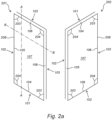
- FIG 2a shows a schematic representation of two different types of multi-purpose tiles (201, 202) for use in another embodiment of a multi-purpose tile system (200) according to the invention.
- each of these tiles (201, 202) comprises a first pair of opposing edges consisting of a first edge (101) and an opposite third edge (103) and a second pair of opposing edges consisting of a second edge (102) and an opposing third edge (103).
- the angle ( ⁇ ) may be relatively small, but significantly contributes to the inventive concept of the present invention since it allows an easier angling down movement by reducing the contact surface at the stage of placing the tile (100, 201, 202, 301).
- the upper side (406) of the first downward recess (402) is in the depicted tile (100, 201, 202, 301) inclined downwardly towards the first downward flank (401).
- the first coupling profile (104) may furthermore comprise a first bottom side contact portion (405'), which first bottom side contact portion (405') may, during a coupling movement, partially slide over a support surface (500) which is formed by an upper side of the lower lip (432) of the third coupling profile (106).
Landscapes
- Engineering & Computer Science (AREA)
- Architecture (AREA)
- Civil Engineering (AREA)
- Structural Engineering (AREA)
- Finishing Walls (AREA)
- Floor Finish (AREA)
Priority Applications (5)
| Application Number | Priority Date | Filing Date | Title |
|---|---|---|---|
| RS20250476A RS66832B1 (sr) | 2021-07-19 | 2022-07-19 | Višenamenski sistem pločica i obloga od pločica |
| SI202230125T SI4374025T1 (sl) | 2021-07-19 | 2022-07-19 | Večnamenski sistem plošč in obloga iz plošč |
| EP25166185.6A EP4567220A3 (en) | 2021-07-19 | 2022-07-19 | Multi-purpose tile system and tile covering |
| HRP20250573TT HRP20250573T1 (hr) | 2021-07-19 | 2022-07-19 | Višenamjenski sustav za opločavanje i opločavanje |
| MA65930A MA65930B1 (fr) | 2021-07-19 | 2022-07-19 | Système de carrelage polyvalent et revêtement de carrelage |
Applications Claiming Priority (2)
| Application Number | Priority Date | Filing Date | Title |
|---|---|---|---|
| NL2028776A NL2028776B1 (en) | 2021-07-19 | 2021-07-19 | Multi-purpose tile system, tile covering, and tile |
| PCT/EP2022/070234 WO2023001834A1 (en) | 2021-07-19 | 2022-07-19 | Multi-purpose tile system, tile covering, and tile |
Related Child Applications (1)
| Application Number | Title | Priority Date | Filing Date |
|---|---|---|---|
| EP25166185.6A Division EP4567220A3 (en) | 2021-07-19 | 2022-07-19 | Multi-purpose tile system and tile covering |
Publications (2)
| Publication Number | Publication Date |
|---|---|
| EP4374025A1 EP4374025A1 (en) | 2024-05-29 |
| EP4374025B1 true EP4374025B1 (en) | 2025-03-26 |
Family
ID=78771093
Family Applications (2)
| Application Number | Title | Priority Date | Filing Date |
|---|---|---|---|
| EP22743508.8A Active EP4374025B1 (en) | 2021-07-19 | 2022-07-19 | Multi-purpose tile system and tile covering |
| EP25166185.6A Pending EP4567220A3 (en) | 2021-07-19 | 2022-07-19 | Multi-purpose tile system and tile covering |
Family Applications After (1)
| Application Number | Title | Priority Date | Filing Date |
|---|---|---|---|
| EP25166185.6A Pending EP4567220A3 (en) | 2021-07-19 | 2022-07-19 | Multi-purpose tile system and tile covering |
Country Status (27)
| Country | Link |
|---|---|
| US (1) | US20240287818A1 (https=) |
| EP (2) | EP4374025B1 (https=) |
| JP (1) | JP2024525432A (https=) |
| KR (1) | KR20240035411A (https=) |
| CN (1) | CN117597494A (https=) |
| AR (1) | AR126494A1 (https=) |
| AU (1) | AU2022315518B2 (https=) |
| CA (1) | CA3222649A1 (https=) |
| CL (1) | CL2023003868A1 (https=) |
| CO (1) | CO2023018431A2 (https=) |
| DK (1) | DK4374025T3 (https=) |
| ES (1) | ES3030263T3 (https=) |
| FI (1) | FI4374025T3 (https=) |
| HR (1) | HRP20250573T1 (https=) |
| HU (1) | HUE071172T2 (https=) |
| LT (1) | LT4374025T (https=) |
| MA (1) | MA65930B1 (https=) |
| MD (1) | MD4374025T2 (https=) |
| MX (1) | MX2023015026A (https=) |
| NL (1) | NL2028776B1 (https=) |
| PL (1) | PL4374025T3 (https=) |
| PT (1) | PT4374025T (https=) |
| RS (1) | RS66832B1 (https=) |
| SI (1) | SI4374025T1 (https=) |
| TW (1) | TW202314090A (https=) |
| WO (1) | WO2023001834A1 (https=) |
| ZA (1) | ZA202311522B (https=) |
Families Citing this family (5)
| Publication number | Priority date | Publication date | Assignee | Title |
|---|---|---|---|---|
| NL2003019C2 (nl) * | 2009-06-12 | 2010-12-15 | 4Sight Innovation Bv | Vloerpaneel en vloerbedekking bestaande uit meerdere van dergelijke vloerpanelen. |
| BE1029034B1 (nl) * | 2021-01-21 | 2022-08-23 | Flooring Ind Ltd Sarl | Set van vloerpanelen en werkwijze voor het installeren van deze set van vloerpanelen |
| TWI837008B (zh) * | 2023-05-31 | 2024-03-21 | 科定企業股份有限公司 | 倒角地板結構改良 |
| WO2026053007A1 (en) * | 2024-09-05 | 2026-03-12 | Lesani Hossein | Xps covering tile for suspended grid ceilings with stone paper surface and spring mounting capability |
| KR102847645B1 (ko) * | 2025-03-24 | 2025-08-20 | 우주웰보드 주식회사 | 조립식 판넬부재 |
Citations (1)
| Publication number | Priority date | Publication date | Assignee | Title |
|---|---|---|---|---|
| US20110131916A1 (en) * | 2009-12-04 | 2011-06-09 | Mannington Mills, Inc. | Connecting System For Surface Coverings |
Family Cites Families (17)
| Publication number | Priority date | Publication date | Assignee | Title |
|---|---|---|---|---|
| US5797237A (en) * | 1997-02-28 | 1998-08-25 | Standard Plywoods, Incorporated | Flooring system |
| US7886497B2 (en) * | 2003-12-02 | 2011-02-15 | Valinge Innovation Ab | Floorboard, system and method for forming a flooring, and a flooring formed thereof |
| US7516588B2 (en) * | 2004-01-13 | 2009-04-14 | Valinge Aluminium Ab | Floor covering and locking systems |
| US20050166516A1 (en) * | 2004-01-13 | 2005-08-04 | Valinge Aluminium Ab | Floor covering and locking systems |
| DE202005014132U1 (de) * | 2005-09-07 | 2007-01-25 | Tilo Gmbh | Paneel aus Holz |
| BE1017403A5 (nl) * | 2006-12-21 | 2008-08-05 | Flooring Ind Ltd | Vloerelement, vergrendelingsysteem voor vloerelementen, vloerbekleding en werkwijze voor het samenstellen van dergelijke vloerelementen tot een vloerbekleding. |
| US8499521B2 (en) * | 2007-11-07 | 2013-08-06 | Valinge Innovation Ab | Mechanical locking of floor panels with vertical snap folding and an installation method to connect such panels |
| ES2734439T3 (es) * | 2009-12-22 | 2019-12-05 | Flooring Ind Ltd Sarl | Método para producir paneles de revestimiento |
| EP4092213B1 (en) * | 2010-01-11 | 2023-12-13 | Välinge Innovation AB | Floor covering with interlocking design |
| US9725912B2 (en) * | 2011-07-11 | 2017-08-08 | Ceraloc Innovation Ab | Mechanical locking system for floor panels |
| DE202014010455U1 (de) * | 2014-09-30 | 2015-08-03 | Akzenta Paneele + Profile Gmbh | Paneel |
| NL2018970B1 (en) * | 2017-05-23 | 2018-12-04 | Innovations 4 Flooring Holding Nv | Multi-purpose tile system |
| US10400457B2 (en) * | 2017-11-27 | 2019-09-03 | Tarkett Gdl S.A. | Synthetic multilayer floor covering |
| NL2020256B1 (en) * | 2018-01-09 | 2019-07-15 | Innovations4Flooring Holding N V | Panel |
| HRP20230520T1 (hr) * | 2018-01-09 | 2023-08-04 | Välinge Innovation AB | Skup ploča |
| US11208814B2 (en) * | 2018-01-11 | 2021-12-28 | Flooring Industries Limited, Sarl | Set of floor panels and method for installing this set of floor panels |
| NL2021885B1 (en) * | 2018-10-26 | 2020-05-13 | I4F Licensing Nv | Multi-purpose tile system, tile covering, and tile |
-
2021
- 2021-07-19 NL NL2028776A patent/NL2028776B1/en active
-
2022
- 2022-07-19 RS RS20250476A patent/RS66832B1/sr unknown
- 2022-07-19 SI SI202230125T patent/SI4374025T1/sl unknown
- 2022-07-19 MA MA65930A patent/MA65930B1/fr unknown
- 2022-07-19 PT PT227435088T patent/PT4374025T/pt unknown
- 2022-07-19 HU HUE22743508A patent/HUE071172T2/hu unknown
- 2022-07-19 AR ARP220101889A patent/AR126494A1/es active IP Right Grant
- 2022-07-19 MD MDE20240553T patent/MD4374025T2/ro unknown
- 2022-07-19 HR HRP20250573TT patent/HRP20250573T1/hr unknown
- 2022-07-19 LT LTEPPCT/EP2022/070234T patent/LT4374025T/lt unknown
- 2022-07-19 TW TW111127069A patent/TW202314090A/zh unknown
- 2022-07-19 WO PCT/EP2022/070234 patent/WO2023001834A1/en not_active Ceased
- 2022-07-19 FI FIEP22743508.8T patent/FI4374025T3/fi active
- 2022-07-19 JP JP2023579720A patent/JP2024525432A/ja active Pending
- 2022-07-19 EP EP22743508.8A patent/EP4374025B1/en active Active
- 2022-07-19 KR KR1020237045197A patent/KR20240035411A/ko active Pending
- 2022-07-19 CA CA3222649A patent/CA3222649A1/en active Pending
- 2022-07-19 AU AU2022315518A patent/AU2022315518B2/en active Active
- 2022-07-19 CN CN202280046901.7A patent/CN117597494A/zh active Pending
- 2022-07-19 PL PL22743508.8T patent/PL4374025T3/pl unknown
- 2022-07-19 DK DK22743508.8T patent/DK4374025T3/da active
- 2022-07-19 EP EP25166185.6A patent/EP4567220A3/en active Pending
- 2022-07-19 MX MX2023015026A patent/MX2023015026A/es unknown
- 2022-07-19 US US18/572,905 patent/US20240287818A1/en active Pending
- 2022-07-19 ES ES22743508T patent/ES3030263T3/es active Active
-
2023
- 2023-12-14 ZA ZA2023/11522A patent/ZA202311522B/en unknown
- 2023-12-22 CL CL2023003868A patent/CL2023003868A1/es unknown
- 2023-12-26 CO CONC2023/0018431A patent/CO2023018431A2/es unknown
Patent Citations (1)
| Publication number | Priority date | Publication date | Assignee | Title |
|---|---|---|---|---|
| US20110131916A1 (en) * | 2009-12-04 | 2011-06-09 | Mannington Mills, Inc. | Connecting System For Surface Coverings |
Also Published As
| Publication number | Publication date |
|---|---|
| CN117597494A (zh) | 2024-02-23 |
| HRP20250573T1 (hr) | 2025-07-04 |
| ZA202311522B (en) | 2024-08-28 |
| SI4374025T1 (sl) | 2025-06-30 |
| ES3030263T3 (en) | 2025-06-27 |
| WO2023001834A1 (en) | 2023-01-26 |
| AU2022315518A1 (en) | 2024-01-04 |
| AU2022315518B2 (en) | 2024-08-01 |
| MX2023015026A (es) | 2024-05-15 |
| PL4374025T3 (pl) | 2025-06-16 |
| CO2023018431A2 (es) | 2024-03-07 |
| MD4374025T2 (ro) | 2025-08-31 |
| KR20240035411A (ko) | 2024-03-15 |
| FI4374025T3 (fi) | 2025-05-21 |
| NL2028776B1 (en) | 2023-01-25 |
| JP2024525432A (ja) | 2024-07-12 |
| TW202314090A (zh) | 2023-04-01 |
| EP4567220A3 (en) | 2025-06-18 |
| CA3222649A1 (en) | 2023-01-26 |
| AR126494A1 (es) | 2023-10-18 |
| CL2023003868A1 (es) | 2024-07-19 |
| HUE071172T2 (hu) | 2025-08-28 |
| US20240287818A1 (en) | 2024-08-29 |
| MA65930B1 (fr) | 2025-06-30 |
| EP4374025A1 (en) | 2024-05-29 |
| RS66832B1 (sr) | 2025-06-30 |
| EP4567220A2 (en) | 2025-06-11 |
| DK4374025T3 (da) | 2025-05-19 |
| LT4374025T (lt) | 2025-05-26 |
| PT4374025T (pt) | 2025-05-14 |
Similar Documents
| Publication | Publication Date | Title |
|---|---|---|
| US12410618B2 (en) | Multi-purpose tile system, tile covering, and tile | |
| US12158012B2 (en) | Panel, in particular a floor panel or wall panel, and panel covering | |
| EP4374025B1 (en) | Multi-purpose tile system and tile covering | |
| HK40101207A (zh) | 多用途砖片系统、砖片覆盖物和砖片 | |
| EA040750B1 (ru) | Многоцелевая плиточная система, плиточное покрытие и плитка | |
| HK40053723A (en) | Multi-purpose tile system, tile covering, and tile | |
| HK40053723B (en) | Multi-purpose tile system, tile covering, and tile | |
| EA042993B1 (ru) | Многоцелевая плиточная система, плиточное покрытие и плитка |
Legal Events
| Date | Code | Title | Description |
|---|---|---|---|
| REG | Reference to a national code |
Ref country code: HR Ref legal event code: TUEP Ref document number: P20250573T Country of ref document: HR |
|
| STAA | Information on the status of an ep patent application or granted ep patent |
Free format text: STATUS: UNKNOWN |
|
| STAA | Information on the status of an ep patent application or granted ep patent |
Free format text: STATUS: THE INTERNATIONAL PUBLICATION HAS BEEN MADE |
|
| PUAI | Public reference made under article 153(3) epc to a published international application that has entered the european phase |
Free format text: ORIGINAL CODE: 0009012 |
|
| STAA | Information on the status of an ep patent application or granted ep patent |
Free format text: STATUS: REQUEST FOR EXAMINATION WAS MADE |
|
| 17P | Request for examination filed |
Effective date: 20240219 |
|
| AK | Designated contracting states |
Kind code of ref document: A1 Designated state(s): AL AT BE BG CH CY CZ DE DK EE ES FI FR GB GR HR HU IE IS IT LI LT LU LV MC MK MT NL NO PL PT RO RS SE SI SK SM TR |
|
| DAX | Request for extension of the european patent (deleted) | ||
| GRAP | Despatch of communication of intention to grant a patent |
Free format text: ORIGINAL CODE: EPIDOSNIGR1 |
|
| STAA | Information on the status of an ep patent application or granted ep patent |
Free format text: STATUS: GRANT OF PATENT IS INTENDED |
|
| INTG | Intention to grant announced |
Effective date: 20241112 |
|
| GRAS | Grant fee paid |
Free format text: ORIGINAL CODE: EPIDOSNIGR3 |
|
| GRAA | (expected) grant |
Free format text: ORIGINAL CODE: 0009210 |
|
| STAA | Information on the status of an ep patent application or granted ep patent |
Free format text: STATUS: THE PATENT HAS BEEN GRANTED |
|
| AK | Designated contracting states |
Kind code of ref document: B1 Designated state(s): AL AT BE BG CH CY CZ DE DK EE ES FI FR GB GR HR HU IE IS IT LI LT LU LV MC MK MT NL NO PL PT RO RS SE SI SK SM TR |
|
| REG | Reference to a national code |
Ref country code: GB Ref legal event code: FG4D Ref country code: TN Ref legal event code: VAGR Ref document number: TN/P/2025/0168 Country of ref document: TN |
|
| REG | Reference to a national code |
Ref country code: CH Ref legal event code: EP |
|
| P01 | Opt-out of the competence of the unified patent court (upc) registered |
Free format text: CASE NUMBER: APP_11593/2025 Effective date: 20250310 |
|
| REG | Reference to a national code |
Ref country code: DE Ref legal event code: R096 Ref document number: 602022012329 Country of ref document: DE |
|
| P02 | Opt-out of the competence of the unified patent court (upc) changed |
Free format text: CASE NUMBER: APP_11805/2025 Effective date: 20250311 |
|
| REG | Reference to a national code |
Ref country code: IE Ref legal event code: FG4D |
|
| REG | Reference to a national code |
Ref country code: PT Ref legal event code: SC4A Ref document number: 4374025 Country of ref document: PT Date of ref document: 20250514 Kind code of ref document: T Free format text: AVAILABILITY OF NATIONAL TRANSLATION Effective date: 20250508 |
|
| REG | Reference to a national code |
Ref country code: DK Ref legal event code: T3 Effective date: 20250515 |
|
| REG | Reference to a national code |
Ref country code: FI Ref legal event code: FGE |
|
| REG | Reference to a national code |
Ref country code: SE Ref legal event code: TRGR |
|
| REG | Reference to a national code |
Ref country code: ES Ref legal event code: FG2A Ref document number: 3030263 Country of ref document: ES Kind code of ref document: T3 Effective date: 20250627 |
|
| REG | Reference to a national code |
Ref country code: MA Ref legal event code: VAGR Ref document number: 65930 Country of ref document: MA Kind code of ref document: B1 |
|
| REG | Reference to a national code |
Ref country code: HR Ref legal event code: T1PR Ref document number: P20250573 Country of ref document: HR |
|
| REG | Reference to a national code |
Ref country code: NL Ref legal event code: FP |
|
| PGFP | Annual fee paid to national office [announced via postgrant information from national office to epo] |
Ref country code: RS Payment date: 20250630 Year of fee payment: 4 |
|
| REG | Reference to a national code |
Ref country code: SK Ref legal event code: T3 Ref document number: E 46359 Country of ref document: SK |
|
| PGFP | Annual fee paid to national office [announced via postgrant information from national office to epo] |
Ref country code: SK Payment date: 20250630 Year of fee payment: 4 |
|
| PGFP | Annual fee paid to national office [announced via postgrant information from national office to epo] |
Ref country code: SI Payment date: 20250630 Year of fee payment: 4 |
|
| PGFP | Annual fee paid to national office [announced via postgrant information from national office to epo] |
Ref country code: HU Payment date: 20250704 Year of fee payment: 4 |
|
| REG | Reference to a national code |
Ref country code: HR Ref legal event code: ODRP Ref document number: P20250573 Country of ref document: HR Payment date: 20250718 Year of fee payment: 4 |
|
| PGFP | Annual fee paid to national office [announced via postgrant information from national office to epo] |
Ref country code: NL Payment date: 20250726 Year of fee payment: 4 Ref country code: LU Payment date: 20250728 Year of fee payment: 4 |
|
| REG | Reference to a national code |
Ref country code: GR Ref legal event code: EP Ref document number: 20250400994 Country of ref document: GR Effective date: 20250613 |
|
| REG | Reference to a national code |
Ref country code: HU Ref legal event code: AG4A Ref document number: E071172 Country of ref document: HU |
|
| REG | Reference to a national code |
Ref country code: MD Ref legal event code: VAGR Ref document number: 4374025 Country of ref document: MD Date of ref document: 20250831 Kind code of ref document: T2 |
|
| REG | Reference to a national code |
Ref country code: EE Ref legal event code: FG4A Ref document number: E025098 Country of ref document: EE Effective date: 20250514 |
|
| PG25 | Lapsed in a contracting state [announced via postgrant information from national office to epo] |
Ref country code: SM Free format text: LAPSE BECAUSE OF FAILURE TO SUBMIT A TRANSLATION OF THE DESCRIPTION OR TO PAY THE FEE WITHIN THE PRESCRIBED TIME-LIMIT Effective date: 20250326 |
|
| PGFP | Annual fee paid to national office [announced via postgrant information from national office to epo] |
Ref country code: PT Payment date: 20250702 Year of fee payment: 4 Ref country code: FI Payment date: 20250725 Year of fee payment: 4 Ref country code: ES Payment date: 20250801 Year of fee payment: 4 |
|
| PGFP | Annual fee paid to national office [announced via postgrant information from national office to epo] |
Ref country code: LT Payment date: 20250701 Year of fee payment: 4 Ref country code: DE Payment date: 20250729 Year of fee payment: 4 Ref country code: DK Payment date: 20250725 Year of fee payment: 4 |
|
| PGFP | Annual fee paid to national office [announced via postgrant information from national office to epo] |
Ref country code: NO Payment date: 20250729 Year of fee payment: 4 Ref country code: GR Payment date: 20250729 Year of fee payment: 4 |
|
| PGFP | Annual fee paid to national office [announced via postgrant information from national office to epo] |
Ref country code: IT Payment date: 20250731 Year of fee payment: 4 Ref country code: PL Payment date: 20250703 Year of fee payment: 4 Ref country code: TR Payment date: 20250711 Year of fee payment: 4 |
|
| VSFP | Annual fee paid to validation state [announced via postgrant information from national office to epo] |
Ref country code: MD Payment date: 20250704 Year of fee payment: 4 |
|
| PGFP | Annual fee paid to national office [announced via postgrant information from national office to epo] |
Ref country code: BE Payment date: 20250728 Year of fee payment: 4 Ref country code: BG Payment date: 20250716 Year of fee payment: 4 |
|
| PGFP | Annual fee paid to national office [announced via postgrant information from national office to epo] |
Ref country code: HR Payment date: 20250718 Year of fee payment: 4 |
|
| PGFP | Annual fee paid to national office [announced via postgrant information from national office to epo] |
Ref country code: AL Payment date: 20250717 Year of fee payment: 4 Ref country code: FR Payment date: 20250725 Year of fee payment: 4 Ref country code: AT Payment date: 20251020 Year of fee payment: 4 |
|
| PGFP | Annual fee paid to national office [announced via postgrant information from national office to epo] |
Ref country code: SE Payment date: 20250727 Year of fee payment: 4 Ref country code: CH Payment date: 20250801 Year of fee payment: 4 |
|
| PGFP | Annual fee paid to national office [announced via postgrant information from national office to epo] |
Ref country code: EE Payment date: 20250714 Year of fee payment: 4 Ref country code: CZ Payment date: 20250704 Year of fee payment: 4 Ref country code: IE Payment date: 20250728 Year of fee payment: 4 |
|
| PGFP | Annual fee paid to national office [announced via postgrant information from national office to epo] |
Ref country code: RO Payment date: 20250707 Year of fee payment: 4 |
|
| PGFP | Annual fee paid to national office [announced via postgrant information from national office to epo] |
Ref country code: IS Payment date: 20250709 Year of fee payment: 4 |
|
| PGFP | Annual fee paid to national office [announced via postgrant information from national office to epo] |
Ref country code: LV Payment date: 20250701 Year of fee payment: 4 |
|
| PGFP | Annual fee paid to national office [announced via postgrant information from national office to epo] |
Ref country code: MK Payment date: 20250702 Year of fee payment: 4 |
|
| VSFP | Annual fee paid to validation state [announced via postgrant information from national office to epo] |
Ref country code: MA Payment date: 20250725 Year of fee payment: 4 |
|
| REG | Reference to a national code |
Ref country code: DE Ref legal event code: R097 Ref document number: 602022012329 Country of ref document: DE |
|
| PGFP | Annual fee paid to national office [announced via postgrant information from national office to epo] |
Ref country code: CY Payment date: 20250703 Year of fee payment: 4 |
|
| PLBE | No opposition filed within time limit |
Free format text: ORIGINAL CODE: 0009261 |
|
| STAA | Information on the status of an ep patent application or granted ep patent |
Free format text: STATUS: NO OPPOSITION FILED WITHIN TIME LIMIT |
|
| REG | Reference to a national code |
Ref country code: CH Ref legal event code: L10 Free format text: ST27 STATUS EVENT CODE: U-0-0-L10-L00 (AS PROVIDED BY THE NATIONAL OFFICE) Effective date: 20260211 |
|
| 26N | No opposition filed |
Effective date: 20260105 |