EP4373685B1 - Traktor - Google Patents
Traktor Download PDFInfo
- Publication number
- EP4373685B1 EP4373685B1 EP22737639.9A EP22737639A EP4373685B1 EP 4373685 B1 EP4373685 B1 EP 4373685B1 EP 22737639 A EP22737639 A EP 22737639A EP 4373685 B1 EP4373685 B1 EP 4373685B1
- Authority
- EP
- European Patent Office
- Prior art keywords
- tractor
- driver
- connecting element
- wheels
- seat
- Prior art date
- Legal status (The legal status is an assumption and is not a legal conclusion. Google has not performed a legal analysis and makes no representation as to the accuracy of the status listed.)
- Active
Links
Images


Classifications
-
- B—PERFORMING OPERATIONS; TRANSPORTING
- B62—LAND VEHICLES FOR TRAVELLING OTHERWISE THAN ON RAILS
- B62D—MOTOR VEHICLES; TRAILERS
- B62D49/00—Tractors
- B62D49/06—Tractors adapted for multi-purpose use
- B62D49/0664—Light, simple, and economical tractors
- B62D49/0671—Light, simple, and economical tractors the driver riding on the tractor
-
- B—PERFORMING OPERATIONS; TRANSPORTING
- B60—VEHICLES IN GENERAL
- B60K—ARRANGEMENT OR MOUNTING OF PROPULSION UNITS OR OF TRANSMISSIONS IN VEHICLES; ARRANGEMENT OR MOUNTING OF PLURAL DIVERSE PRIME-MOVERS IN VEHICLES; AUXILIARY DRIVES FOR VEHICLES; INSTRUMENTATION OR DASHBOARDS FOR VEHICLES; ARRANGEMENTS IN CONNECTION WITH COOLING, AIR INTAKE, GAS EXHAUST OR FUEL SUPPLY OF PROPULSION UNITS IN VEHICLES
- B60K1/00—Arrangement or mounting of electrical propulsion units
-
- B—PERFORMING OPERATIONS; TRANSPORTING
- B60—VEHICLES IN GENERAL
- B60K—ARRANGEMENT OR MOUNTING OF PROPULSION UNITS OR OF TRANSMISSIONS IN VEHICLES; ARRANGEMENT OR MOUNTING OF PLURAL DIVERSE PRIME-MOVERS IN VEHICLES; AUXILIARY DRIVES FOR VEHICLES; INSTRUMENTATION OR DASHBOARDS FOR VEHICLES; ARRANGEMENTS IN CONNECTION WITH COOLING, AIR INTAKE, GAS EXHAUST OR FUEL SUPPLY OF PROPULSION UNITS IN VEHICLES
- B60K1/00—Arrangement or mounting of electrical propulsion units
- B60K1/04—Arrangement or mounting of electrical propulsion units of the electric storage means for propulsion
-
- B—PERFORMING OPERATIONS; TRANSPORTING
- B60—VEHICLES IN GENERAL
- B60K—ARRANGEMENT OR MOUNTING OF PROPULSION UNITS OR OF TRANSMISSIONS IN VEHICLES; ARRANGEMENT OR MOUNTING OF PLURAL DIVERSE PRIME-MOVERS IN VEHICLES; AUXILIARY DRIVES FOR VEHICLES; INSTRUMENTATION OR DASHBOARDS FOR VEHICLES; ARRANGEMENTS IN CONNECTION WITH COOLING, AIR INTAKE, GAS EXHAUST OR FUEL SUPPLY OF PROPULSION UNITS IN VEHICLES
- B60K17/00—Arrangement or mounting of transmissions in vehicles
- B60K17/28—Arrangement or mounting of transmissions in vehicles characterised by arrangement, location, or type of power take-off
-
- B—PERFORMING OPERATIONS; TRANSPORTING
- B62—LAND VEHICLES FOR TRAVELLING OTHERWISE THAN ON RAILS
- B62D—MOTOR VEHICLES; TRAILERS
- B62D49/00—Tractors
- B62D49/002—Tractors characterised by being of the low ground pressure type
-
- B—PERFORMING OPERATIONS; TRANSPORTING
- B62—LAND VEHICLES FOR TRAVELLING OTHERWISE THAN ON RAILS
- B62D—MOTOR VEHICLES; TRAILERS
- B62D49/00—Tractors
- B62D49/06—Tractors adapted for multi-purpose use
-
- B—PERFORMING OPERATIONS; TRANSPORTING
- B62—LAND VEHICLES FOR TRAVELLING OTHERWISE THAN ON RAILS
- B62D—MOTOR VEHICLES; TRAILERS
- B62D49/00—Tractors
- B62D49/06—Tractors adapted for multi-purpose use
- B62D49/0607—Straddle tractors, used for instance above vine stocks, rows of bushes, or the like
-
- B—PERFORMING OPERATIONS; TRANSPORTING
- B62—LAND VEHICLES FOR TRAVELLING OTHERWISE THAN ON RAILS
- B62D—MOTOR VEHICLES; TRAILERS
- B62D49/00—Tractors
- B62D49/06—Tractors adapted for multi-purpose use
- B62D49/0621—Tractors adapted for multi-purpose use comprising traction increasing arrangements, e.g. all-wheel traction devices, multiple-axle traction arrangements, auxiliary traction increasing devices
-
- B—PERFORMING OPERATIONS; TRANSPORTING
- B62—LAND VEHICLES FOR TRAVELLING OTHERWISE THAN ON RAILS
- B62D—MOTOR VEHICLES; TRAILERS
- B62D49/00—Tractors
- B62D49/06—Tractors adapted for multi-purpose use
- B62D49/0664—Light, simple, and economical tractors
-
- B—PERFORMING OPERATIONS; TRANSPORTING
- B60—VEHICLES IN GENERAL
- B60K—ARRANGEMENT OR MOUNTING OF PROPULSION UNITS OR OF TRANSMISSIONS IN VEHICLES; ARRANGEMENT OR MOUNTING OF PLURAL DIVERSE PRIME-MOVERS IN VEHICLES; AUXILIARY DRIVES FOR VEHICLES; INSTRUMENTATION OR DASHBOARDS FOR VEHICLES; ARRANGEMENTS IN CONNECTION WITH COOLING, AIR INTAKE, GAS EXHAUST OR FUEL SUPPLY OF PROPULSION UNITS IN VEHICLES
- B60K17/00—Arrangement or mounting of transmissions in vehicles
- B60K17/34—Arrangement or mounting of transmissions in vehicles for driving both front and rear wheels, e.g. four wheel drive vehicles
- B60K17/356—Arrangement or mounting of transmissions in vehicles for driving both front and rear wheels, e.g. four wheel drive vehicles having fluid or electric motor, for driving one or more wheels
-
- B—PERFORMING OPERATIONS; TRANSPORTING
- B60—VEHICLES IN GENERAL
- B60K—ARRANGEMENT OR MOUNTING OF PROPULSION UNITS OR OF TRANSMISSIONS IN VEHICLES; ARRANGEMENT OR MOUNTING OF PLURAL DIVERSE PRIME-MOVERS IN VEHICLES; AUXILIARY DRIVES FOR VEHICLES; INSTRUMENTATION OR DASHBOARDS FOR VEHICLES; ARRANGEMENTS IN CONNECTION WITH COOLING, AIR INTAKE, GAS EXHAUST OR FUEL SUPPLY OF PROPULSION UNITS IN VEHICLES
- B60K1/00—Arrangement or mounting of electrical propulsion units
- B60K2001/001—Arrangement or mounting of electrical propulsion units one motor mounted on a propulsion axle for rotating right and left wheels of this axle
-
- B—PERFORMING OPERATIONS; TRANSPORTING
- B60—VEHICLES IN GENERAL
- B60Y—INDEXING SCHEME RELATING TO ASPECTS CROSS-CUTTING VEHICLE TECHNOLOGY
- B60Y2200/00—Type of vehicle
- B60Y2200/20—Off-Road Vehicles
- B60Y2200/22—Agricultural vehicles
Definitions
- the invention relates to a tractor for agriculture with a frame which connects a front tractor part and a rear tractor part to one another via a connecting element, a driver's seat in the region of the rear tractor part, a drive and at least four wheels, wherein the connecting element of the frame which connects the rear tractor part and the front tractor part to one another is arranged at least 60 cm above the driver's seat and extends essentially horizontally to the front tractor part.
- tractors for agriculture are mainly powered by diesel engines.
- arable farming heavy tractors weighing over 5 tons are mainly used. Their job is to pull large and heavy agricultural machinery.
- smaller tractors are used that only weigh between 1.5 and 3 tons. Since these plants are planted in rows with spaces between them, the lower weight of the tractor reduces the undesirable soil compaction between the small plant rows.
- pesticides can be sprayed on the one hand, and hoeing machines or hoeing brushes (see https://www.baertschi.com/de/fobro-schar- und-sternhackgerate/) can be used to mechanically pull out the weeds between the rows or to damage their roots so that they can no longer grow and thus cannot compete with the actual crop in terms of nutrient intake from the soil.
- This mechanical soil cultivation is mainly used in the organic cultivation of vegetables.
- a special vehicle that fulfills this task is the Fobro-Mobil (https://fobro-mobil.ch/de/fobromobil-d49/).
- This vehicle is powered by a diesel or petrol engine.
- the Fobro mobile has 3 attachments for working equipment, such as hoeing devices or hoeing brushes. These devices can be attached to the rear of the tractor, the front of the tractor and in the middle of the tractor, directly in front of the driver's seat.
- the front axle and the rear axle were connected with 2 pipes above the driver's head. This allows the driver to see the hoeing device attached in the middle attachment directly in front of him and to steer it precisely between the rows of plants without damaging the crop.
- Normal tractors do not have a middle attachment for devices, but have to attach them to the rear of the tractor. An additional employee then usually has to sit on the hoeing device and steer it between the rows so that the plants are not damaged. This is complex and expensive.
- the driver of the Fobro-Mobil sits next to the diesel or petrol engine, offset from the middle. This has the advantage that the weight on the rear axle is evenly distributed between both wheels, thus ensuring good propulsion and even pressure on the ground.
- the weight of the driver is closer to the rear left wheel and the weight of the engine is closer to the rear right wheel.
- the front and rear wheels of the Fobro-Mobil are connected using two pipes or profiles, which has the disadvantage that when driving on the road the driver sees a connecting pipe directly in front of him, which obstructs his view straight ahead.
- the second pipe or profile to the right of it in the direction of travel obstructs the view to the right to the edge of the road, which can be dangerous for pedestrians and makes it difficult to estimate the distance to the edge of the road.
- This vehicle is also powered by a diesel engine and has three attachments for working equipment. At the back, front and in the middle of the vehicle, directly in front of the driver. In this vehicle, too, the rear pair of wheels is connected to the front pair of wheels. but with a curved profile next to the driver, or more precisely between the side-mounted engine and the driver's seat. The driver's head is at about the same height as the wheel connection mentioned. The driver's view of the hoeing device mounted in the middle section is obstructed by the wheel connection mounted in the middle and at head height.
- Such special tractors for tilling rows of plants are delivered without cabins, as these would otherwise obstruct the clear view of the hoeing tools and add weight. With these special tractors for tilling low-growing rows of plants, it is important to eliminate any superfluous weight in order not to increase the ground pressure.
- Another problem is the health protection of the driver.
- the driver usually sits on the special tractor for several hours and does the soil work. He sits directly next to the diesel or petrol engine. As these vehicles do not have a cabin for functional reasons, the driver is unprotected and highly exposed to the harmful exhaust emissions. Due to the proximity to the engine, the driver is also unprotected from the loud engine noise. He is therefore usually forced to wear ear protection.
- From the DE 10 55 377 A is a tractor for agriculture with a frame that connects a front tractor part and a rear tractor part via a connecting element, has a driver's seat in the area of the rear tractor part, a drive and at least four wheels, wherein the connecting element extends horizontally to the front tractor part.
- the object of the invention is to create a tractor for agriculture which avoids the above-mentioned disadvantages.
- the front tractor part and the rear tractor part are connected with a single connecting element, preferably consisting of a profile or tube or several profiles or tubes located close to one another.
- This connecting element which connects the front tractor part and the rear tractor part to one another, is mounted in such a way that the driver has a clear view to the right under the connecting element in the direction of travel.
- the distance from the height of the driver's seat, measured vertically upwards from the front edge of the seat, to the height of the lower edge of the connecting element must be at least 60 cm.
- the connecting part extends essentially horizontally to the front tractor part (which means that it can also slope slightly towards the front tractor part) and there merges into a vertical element on which the front wheels are suspended.
- the connecting part is thus arranged above the driver's field of vision. The driver can thus look to the right under the connecting element and also at a working device arranged behind the front tractor part. This enables precise maneuvering when tilling rows of plants.
- the connecting element is mounted in the middle of the longitudinal axis of the special tractor, so that the driver has a clear view to the front and sides of a working device mounted in the middle of the tractor and can drive straight ahead as well as an unobstructed view to the side of the road.
- a further development of the invention consists in that the connecting element of the frame, which connects the rear and the front tractor part, is arranged at least 70 cm, preferably at least 80 cm, above the driver's seat.
- the connecting element is preferably mounted in the middle of the longitudinal axis of the special tractor so that the driver has a clear view to the front and also to the side of a working device mounted in the middle of the tractor and has an unobstructed view when driving straight ahead and to the side of the road.
- An advantageous embodiment of the invention is that the wheels are individually suspended and individually driven.
- pairs of rear wheels or front wheels may be connected via one axle each and to be driven together via the connecting axle.
- Two wheels or all four wheels can be driven.
- a preferred embodiment of the invention consists in that at least one electric motor is provided as the drive.
- the electric motor acts on the rear wheels.
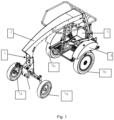
- the agricultural tractor has a frame 1 which connects a front tractor part 3 and a rear tractor part 4 to one another via a connecting element 2.
- a driver's seat 5 and a drive 6 are provided in the rear tractor part 4.
- the tractor has at least four wheels 7a, 7b, preferably a pair of front wheels 7a and a pair of rear wheels 7b which are aligned with one another.
- the wheels 7a, 7b can be suspended individually or connected in pairs via an axle.
- the connecting element 2 of the frame 1, which connects the rear tractor part 4 and the front tractor part 3, is arranged at least 60 cm, preferably at least 70 cm and particularly preferably at least 80 cm above the driver's seat 5 (height H in Fig. 4 ) and extends essentially horizontally to the front part of the tractor 3.
- the essentially horizontal connecting element is designed to slope slightly towards the front.
- the underside of the connecting element 2 at the level of the front wheels 7a can be arranged up to 20% less high than the highest point of the underside of the connecting element 2.
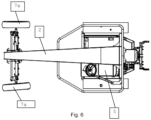
- the connecting element 2 is arranged centrally between the rear wheels 7b and preferably also centrally between the front wheels 7a.
- the driver's seat 5 is arranged to the left of the connecting element 2 so as not to obstruct the driver's view to the front.
- This type of arrangement of the connecting element 2 enables the driver to keep an eye on the implement arranged behind the front part of the tractor 3 when working in the field and also to have a clear view when driving on the road.
- Either only the rear wheels 7b can be driven or there can be all-wheel drive.
- one or more electric motors are preferably used to supply energy to the drive, the hydraulics and the attached equipment. This avoids harmful exhaust emissions for the environment or the driver and avoids noise emissions for the driver.
- an inventive tractor with an electric drive can be used in greenhouses.
- Another advantage of using an electric motor is the use of solar, wind or biogas energy, which can be produced on site by the user himself. This can significantly reduce the operating costs of the electric tractor.
- the electric motor(s) can drive the vehicle directly by acting directly on the axles or wheels 7a, 7b, or the electric motor supplies energy to a hydraulic circuit that drives the vehicle indirectly via the hydraulics.
- the attached equipment can also be driven directly via the electric motor(s), or indirectly via hydraulic motors and Hydraulic pumps are supplied with energy.
- the tractor according to the invention has one or more hydraulic motors, one or more hydraulic pumps and one or more hydraulic oil circuits.
- the electric motor(s) used have a total output of at least 25 kW, preferably at least 30 kW and most preferably at least 35 kW.
- each of the electric motors used has a voltage of at least 100 volts, preferably at least 360 volts. They are air-cooled or, preferably, water-cooled.
- the electric tractor according to the invention has one or more batteries, together with a total output of preferably at least 25 kW, preferably at least 30 kW and most preferably at least 35 kW.
- One or more batteries can either be permanently installed or provided as replacement batteries, so that the user of the tractor according to the invention can extend the operating time by exchanging pre-charged batteries.
- Commercially available batteries that are used to operate electric cars are suitable. Lithium-ion batteries are particularly suitable.
- the one or more batteries can be charged from a power grid or another power source, such as a photovoltaic system, a wind energy system, or a biogas plant directly via a power cable.
- the tractor according to the invention is electrically connected to a combination on-board charging system, which can preferably be connected bidirectionally to the electrical AC network, which can reverse the energy flow as required, so that on the one hand the battery can be charged from the grid or, for example, from a photovoltaic system or wind energy system and the stored energy can be fed back into the grid or to other consumers as required.
- the battery can thus be used bidirectionally, i.e. on the one hand it can absorb and store electricity, and on the other hand it can feed stored electricity in order to supply external electrically operated devices with three-phase current.
- the electric tractor according to the invention has one or more standardized commercially available sockets that can be used to draw power or as power outputs.
- the electric tractor can thus be used as a mobile power supplier independent of a power grid.
- the hydraulic motor or motors can have one gear or preferably two gears.
- the speed of the first gear is preferably a maximum of 13 km/h with a pulling force between 7-12 kN.
- the speed is preferably a maximum of 40 km/h with a power between 4-7 kN.
- the connecting element 2 between the rear tractor part 4 and the front tractor part 3 can be made of one or more square profiles or tubes.
- the connecting element 2 is made of steel or dimensionally stable plastic, for example Kevlar. This connecting element 2 must not significantly impair the driver's view and has a width of a maximum of 50 cm, preferably a maximum of 40 cm, most preferably a maximum of 30 cm in area a) (this is the area from the height of the wheel hub starting 2 m upwards along the connecting element 2).
- the connecting element 2 can be designed, for example, as a hollow body, as a U-profile, as a double U-profile, as a T-profile, as a double T-profile or as a triangular profile.
- lines, cables or hydraulic hoses can be routed within the connecting element 2 or attached to the connecting element 2 without any significant loss of visibility for the driver.
- the distance from the lower edge of the connecting element 2 to the ground surface is at least 150 cm, measured including the mounted wheels. This ensures that the attached implements, such as hoeing tools, can be lifted high enough out of the ground in the middle of the tractor.
- the electric tractor according to the invention is equipped with a control system that optimally controls all hydraulic and electrical drive components in the In this way, the efficiency of the electric tractor according to the invention is maximum at every operating point.
- the control and regulation of the electric motors and the hydraulic components is carried out according to the invention in such a way that at every operating point of the tractor all components work with the maximum possible efficiency.
- the capacity of the batteries can thus be used better.
- the battery can be selected to be smaller, which leads to lower costs.
- the electric tractor can be equipped with an autopilot system.
- the autopilot system processes the information from the electric tractor's instruments, sensors, cameras and GPS and automatically keeps the electric tractor in the desired crop path.
- the control of all hydraulic and electric drive components can be connected to the autopilot system. This means that the control receives additional information from the autopilot system, for example about the position, inclination, acceleration and speed, and improves the efficiency of the electric tractor using an internal algorithm.
Landscapes
- Engineering & Computer Science (AREA)
- Chemical & Material Sciences (AREA)
- Combustion & Propulsion (AREA)
- Transportation (AREA)
- Mechanical Engineering (AREA)
- Agricultural Machines (AREA)
Description
- Die Erfindung betrifft einen Traktor für die Landwirtschaft mit einem Rahmen, der über ein Verbindungselement einen vorderen Traktorteil und einen hinteren Traktorteil miteinander verbindet, einem Fahrersitz im Bereich des hinteren Traktorteils, einem Antrieb und mindestens vier Rädern, wobei das Verbindungselement des Rahmens, das den hinteren Traktorteil und den vorderen Traktorteil miteinander verbindet, mindestens 60 cm über dem Fahrersitz angeordnet ist und sich im Wesentlichen horizontal bis zum vorderen Traktorteil erstreckt.
- Traktoren für die Landwirtschaft werden in der heutigen Zeit vorwiegend mit Dieselmotoren betrieben. Im Ackerbau werden vorwiegend schwere Traktoren mit einem Gewicht von über 5 Tonnen betrieben. Sie haben die Aufgabe große und schwere Landmaschinen zu ziehen. Für den Anbau von niedrigen Pflanzen, die in Reihen angeordnet sind, wie im Gemüsebau oder in Baumschulen, werden kleinere Traktoren eingesetzt, die nur ein Gewicht zwischen 1,5 und 3 Tonnen haben. Da diese Pflanzen in Reihen mit Zwischenräumen angepflanzt werden, verringert das geringere Gewicht des Traktors die unerwünschte Bodenverdichtung zwischen den kleinwüchsigen Pflanzenreihen.
- Um zwischen den Pflanzenreihen eine Unkraut- oder Grasbildung zu vermeiden, kann einerseits mit sprühen von Pestiziden begegnet werden, andererseits kann mit Hackgeräten oder Hackbürsten (siehe https://www.baertschi.com/de/fobro-schar- und-sternhackgerate/) zwischen den Reihen mechanisch das Unkraut ausgerissen oder deren Wurzeln so beschädigt werden, dass sie nicht mehr wachsen können und somit zur eigentlichen Kulturpflanze keine Konkurrenz in der Nahrungsaufnahme aus dem Boden bilden können. Diese mechanische Bodenbearbeitung wird vorwiegend beim biologischen Anbau von Gemüsen eingesetzt.
- Ein spezielles Fahrzeug, das diese Aufgabe erfüllt ist das Fobro-Mobil (https://fobro-mobil.ch/de/fobromobil-d49/). Dieses Fahrzeug wird mit einem Diesel- oder Benzinmotor betrieben. Das Fobro-Mobil verfügt über 3 Aufnahmen von Arbeitsgeräten, wie zum Beispiel Hackgeräte oder Hackbürsten. Diese Geräte können hinten am Traktor, vorne am Traktor und in der Mitte des Traktors, unmittelbar vor dem Fahrersitz angebracht werden. Zu diesem Zweck wurden die Vorderachse und die Hinterachse über den Kopf des Fahrers mit 2 Rohren verbunden. Das erlaubt, das der Fahrer direkt vor sich das in der mittleren Aufnahme befestigte Hackgerät sieht und es präzise zwischen den Pflanzenreihen ohne Beschädigung der Kulturpflanze steuern kann. Normale Traktoren verfügen nicht über eine mittlere Aufnahme von Geräten, sondern müssen diese hinten an den Traktor anhängen. Dann muss meist ein zusätzlicher Mitarbeiter auf dem Hackgerät sitzen und es zwischen den Reihen so steuern, dass die Pflanzen nicht beschädigt werden. Das ist aufwändig und teuer.
- Der Fahrer des Fobro-Mobils sitzt neben dem Diesel- oder Benzin-Motor seitlich versetzt zur Mitte. Das hat den Vorteil, dass das Gewicht auf der Hinterachse gleichmäßig auf beide Räder verteilt wird und somit einen guten Vortrieb und gleichmäßigen Druck auf die Erde gewährleistet. In Fahrtrichtung des Forbo-Mobil ist zum Beispiel das Gewicht des Fahrers näher zum hinteren linken Rad und das Gewicht des Motors näher zum hinteren rechten Rad. Die Verbindung der Vorder- und Hinterräder werden beim Fobro-Mobil über zwei Rohre oder Profile gemacht, was den Nachteil hat, dass bei einer Straßenfahrt der Fahrer eine Verbindungsrohr direkt vor sich sieht, was ihm die Sicht geradeaus behindert. Das zweite Rohr oder Profil in Fahrrichtung rechts daneben, behindert die Sicht nach rechts zum Straßenrand, was gefährlich für Fußgänger sein kann und die Distanz zum Straßenrand sich schwierig einschätzen lässt.
- Ein weiteres Fahrzeug der diese Aufgabe erfüllen kann, ist der Mastertrac (http://www.rath-maschinen.com/de/mastertrac.html). Auch dieses Fahrzeug wird mit einem Dieselmotor betrieben und verfügt über drei Aufnahmen von Arbeitsgeräten. Hinten, vorne und in der Mitte des Fahrzeuges, direkt vor dem Fahrer. Auch bei diesem Fahrzeug ist das hintere Räderpaar mit dem vorderen Räderpaar verbunden, dies aber mit einem gebogenen Profil neben dem Fahrer oder genauer zwischen dem seitlich angebrachten Motor und dem Fahrersitz. Der Kopf des Fahrers ist in etwa auf gleicher Höhe mit der genannten Radverbindung. Die Sicht des Fahrers auf das im Mittelteil angebrachten Hackgerät, ist durch die mittig und auf Kopfhöhe angebrachten Radverbindung behindert. Auch die Sicht im Straßenverkehr ist durch die Positionierung dieser Achsenverbindung seitlich zum Straßenrand behindert. Ein weiterer Nachteil dieses Traktors ist der fehlende Abstand von der Unterkante der Achsenverbindung zum Boden. Damit können große Geräte nicht genug angehoben werden, was beim Transport in unebenem Gelände ein Nachteil ist.
- Solche Spezialtraktoren für die Bodenbearbeitung von Pflanzenreihen werden ohne Kabinen ausgeliefert, da diese sonst die freie Sicht auf die Hackwerkzeuge behindern und zusätzlich Gewicht bringen. Bei diesen Spezialtraktoren für die Bearbeitung von niederwüchsigen Pflanzenreihen, gilt es jegliches überflüssige Gewicht zu eliminieren, um den Bodendruck nicht zu erhöhen.
- Diese Spezialtraktoren mit drei Aufnahmen für Bodenbearbeitungsgeräte, werden alle mit Diesel- oder Benzinmotoren betrieben. Mit den immer strenger werdenden Umweltschutzauflagen und der Verminderung der CO2-Emissionen, wird es immer teurer geeignete Motoren zu finden, die über geeignete Abgasnachbehandlungsanlagen verfügen, um den CO2- und Feinpartikel-Ausstoß auf die gesetzlichen Anforderungen zu reduzieren.
- Ein weiteres Problem ist der gesundheitliche Schutz des Fahrers. Der Fahrer sitzt in der Regel mehrere Stunden auf dem Spezialtraktor und verrichtet seine Bodenbearbeitung. Er sitzt dazu unmittelbar neben dem Diesel- oder Benzinmotor. Da diese Fahrzeuge funktionsbedingt über keine Kabine verfügen, ist der Fahrer den schädlichen Abgasemissionen schutzlos und in hohem Masse ausgesetzt. Durch die Nähe zum Motor ist der Fahrer auch ungeschützt dem lauten Motorengeräusch ausgesetzt. So ist er meist gezwungen, einen Ohrenschutz zu tragen.
- Aus der
DE 10 55 377 A ist ein Traktor für die Landwirtschaft mit einem Rahmen, der über ein Verbindungselement einen vorderen Traktorteil und einen hinteren Traktorteil miteinander verbindet, einen Fahrersitz im Bereich des hinteren Traktorteils, einen Antrieb und mindestens vier Räder aufweist, wobei sich das Verbindungselement horizontal bis zum vorderen Traktorteil erstreckt. - Die Aufgabe der Erfindung besteht darin, einen Traktor für die Landwirtschaft zu schaffen, der die obengenannten Nachteile vermeidet.
- Diese Aufgabe wird erfindungsgemäß durch einen Traktor für die Landwirtschaft mit den Merkmalen des Anspruchs 1 gelöst.
- Beim erfindungsgemäßen Spezialtraktor wird der vordere Traktorteil und der hintere Traktorteil mit einem einzigen Verbindungselement, bestehend vorzugsweise aus einem Profil oder Rohr oder mehreren nahe beieinanderliegenden Profilen oder Rohren, verbunden. Dieses Verbindungselement, das den vorderen Traktorteil und den hinteren Traktorteil miteinander verbindet, wird so angebracht, dass der Fahrer unter dem Verbindungsteil in Fahrtrichtung nach rechts einen freien Blick hat. Zu diesem Zweck muss der Abstand von der Höhe der Sitzfläche des Fahrersitzes, gemessen ab der Vorderkante der Sitzfläche senkrecht nach oben, zur Höhe der Unterkante des Verbindungselementes, mindestens 60 cm betragen. Das Verbindungsteil erstreckt sich im Wesentlichen horizontal bis zum vorderen Traktorteil (was bedeutet, dass es auch leicht zum vorderen Traktorteil hin abfallen kann) und geht dort in ein vertikales Element über, an dem die Vorderräder aufgehängt sind. Das Verbindungsteil ist somit oberhalb des Blickfeldes des Fahrers angeordnet. Der Fahrer kann somit unter dem Verbindungselement nach rechts schauen und auch auf ein hinter dem vorderen Traktorteil angeordnete Arbeitsgerät. Dies ermöglicht ein präzises Manövrieren bei der Bodenbearbeitung von Pflanzreihen.
- Das Verbindungselement ist mittig der Längsachse des Spezialtraktors angebracht, so dass der Fahrer nach vorne und auch seitlich eine freie Sicht auf ein in der Mitte des Traktors angebrachtes Arbeitsgerät hat und bei der Straßenfahrt geradeaus sowie seitlich zum Straßenrand über eine ungehinderte Sicht verfügt.
- Eine Weiterbildung der Erfindung besteht darin, dass das Verbindungselement des Rahmens, das den hinteren und den vorderen Traktorteil miteinander verbindet, mindestens 70 cm, bevorzugt mindestens 80 cm, über dem Fahrersitz angeordnet ist.
- Somit ist das Verbindungselement bevorzugt mittig der Längsachse des Spezialtraktors angebracht, so dass der Fahrer nach vorne und auch seitlich eine freie Sicht auf ein in der Mitte des Traktors angebrachtes Arbeitsgerät hat und bei der Straßenfahrt geradeaus sowie seitlich zum Straßenrand über eine ungehinderte Sicht verfügt.
- Hierdurch wird verhindert, dass der Sichtbereich nach vorne des Fahrers durch das Verbindungselement eingeschränkt wird.
- Eine vorteilhafte Ausgestaltung der Erfindung besteht darin, dass die Räder einzeln aufgehängt und einzeln angetrieben sind.
- Alternativ ist es auch möglich, dass Paare von hinteren Rädern oder von vorderen Rädern über jeweils eine Achse verbunden sind und gemeinsam über die verbindende Achse angetrieben sind.
- Es können zwei Räder oder alle vier Räder angetrieben sein.
- Eine bevorzugte Ausgestaltung der Erfindung besteht darin, dass als Antrieb mindestens ein Elektromotor vorgesehen ist.
- In diesem Zusammenhang wird bevorzugt, dass der Elektromotor auf die Hinterräder wirkt.
- Es ist aber auch möglich, einen Allradantrieb vorzusehen.
- Nachfolgend wird ein bevorzugtes Ausführungsbeispiel anhand von Zeichnungen näher erläutert.
- Es zeigen
- Fig. 1
- eine perspektivische Ansicht eines erfindungsgemäßen Traktors,
- Fig. 2
- eine Seitenansicht des erfindungsgemäßen Traktors,
- Fig. 3
- den Schnitt A-A zu
Fig. 2 , - Fig. 4
- eine Vorderansicht des erfindungsgemäßen Traktors,
- Fig. 5
- den Schnitt B-B zu
Fig. 4 , - Fig. 6
- eine Draufsicht auf den erfindungsgemäßen Traktor.
- Der erfindungsgemäße Traktor für die Landwirtschaft weist einen Rahmen 1 auf, der über ein Verbindungselement 2 einen vorderen Traktorteil 3 und einen hinteren Traktorteil 4 miteinander verbindet. Im hinteren Traktorteil 4 sind ein Fahrersitz 5 und ein Antrieb 6 vorgesehen. Der Traktor weist mindestens vier Räder 7a, 7b auf, vorzugsweise ein Paar von vorderen Rädern 7a und ein Paar von hinteren Rädern 7b, die miteinander fluchten. Die Räder 7a, 7b können einzeln aufgehängt sein oder paarweise über eine Achse verbunden sein.
- Das Verbindungselement 2 des Rahmens 1, das den hinteren Traktorteil 4 und den vorderen Traktorteil 3 miteinander verbindet, ist mindestens 60 cm, bevorzugt mindestens 70 cm und besonders bevorzugt mindestens 80 cm über dem Fahrersitz 5 angeordnet (Höhe H in
Fig. 4 ) und erstreckt sich im Wesentlichen horizontal bis zum vorderen Traktorteil 3. Im vorliegenden Beispiel ist das im Wesentlichen horizontale Verbindungselement nach vorne hin leicht abfallend ausgebildet. Die Unterseite des Verbindungselementes 2 auf Höhe der vorderen Räder 7a kann um bis zu 20 % weniger hoch als am höchsten Punkt der Unterseite des Verbindungselementes 2 angeordnet sein. Das Verbindungselement 2 ist mittig zwischen den hinteren Rädern 7b und vorzugweise auch mittig zwischen den vorderen Rädern 7a angeordnet. - Der Fahrersitz 5 ist im gezeigten Ausführungsbeispiel links des Verbindungselementes 2 angeordnet, um den Blick nach vorne des Fahrers nicht zu behindern.
- Durch diese Art der Anordnung des Verbindungselementes 2 kann der Fahrer sowohl bei der Feldarbeit das hinter dem vorderen Traktorteil 3 angeordneten Arbeitsgerät im Auge behalten als auch bei der Straßenfahrt eine freie Sicht haben.
- Es können entweder nur die hinteren Räder 7b angetrieben sein oder ein Allradantrieb vorliegen.
- Anstelle eines Diesel- oder Benzinmotors werden für die Energieversorgung des Antriebes, der Hydraulik und der angehängten Geräte vorzugsweise ein oder mehrere Elektromotoren verwendet. Damit werden schädliche Abgasemissionen für die Umwelt oder den Fahrer vermieden und Lärmimmissionen für den Fahrer vermieden. Dazu kann ein solcher erfindungsgemäßer Traktor mit Elektroantrieb in Gewächshäusern eingesetzt werden. Ein weiterer Vorteil der Verwendung eines Elektromotors ist die Nutzung von Solar-, Wind-, oder Biogasenergie, die vor Ort durch den Benutzer selbst produziert werden kann. Damit können die Betriebskosten des Elektrotraktors erheblich gesenkt werden.
- Der oder die Elektromotoren können das Fahrzeug direkt antreiben, in dem sie direkt auf die Achsen oder Räder 7a, 7b wirken, oder es wird mit dem Elektromotor die Energie an einen Hydraulikkreislauf geliefert, der das Fahrzeug indirekt über die Hydraulik antreibt. Auch die angehängten Geräte können direkt über den oder die Elektromotoren angetrieben werden, oder indirekt über Hydraulikmotoren und Hydraulikpumpen mit Energie versorgt werden. Dazu verfügt der erfindungsgemäße Traktor über einen oder mehrere Hydraulikmotoren, über einen oder mehrere Hydraulikpumpen und über einen oder mehrere Hydraulikölkreise.
- Der oder die verwendeten Elektromotoren verfügen über eine Gesamtleistung von mindestens 25 kW, bevorzugt von mindestens 30 kW und am bevorzugtesten von mindestens 35 kW. Dazu verfügt jeder der verwendeten Elektromotoren über eine Spannung von mindestens 100 Volt, bevorzugt mindestens 360 Volt. Sie sind luft- oder bevorzugt wassergekühlt.
- Der erfindungsgemäße Elektrotraktor verfügt über eine oder mehrere Batterien, zusammen mit einer Gesamtleistung von bevorzugt mindestens 25 kW, bevorzugt von mindestens 30 kW und am bevorzugtesten von mindestens 35 kW. Eine oder mehrere Batterien können entweder fest verbaut werden, oder als Austauschbatterien vorgesehen sein, so dass der Benutzer des erfindungsgemäßen Traktors die Betriebszeit durch den Austausch von vorgeladenen Batterien verlängern kann. Geeignet sind handelsübliche Batterien, die für den Betrieb von Elektroautos verwendet werden. Insbesondere geeignet sind Lithium-Ionen-Batterien.
- Die eine oder die mehreren Batterien können von einem Stromnetz oder einer anderen Stromquelle, wie zum Beispiel einer Photovoltaik-Anlage, einer Windenergie-Anlage, oder einer Biogas-Anlage direkt über ein Stromkabel geladen werden. Der erfindungsgemäße Traktor ist mit einem Kombi-OnBoard-Ladesystem elektrisch verbunden, welches bevorzugt bidirektional mit dem elektrischen AC-Netz verbunden werden kann, welches den Energiefluss nach Bedarf umkehren kann, sodass einerseits die Batterie vom Netz oder zum Beispiel von einer Photovoltaik-Anlage oder Windenergie-Anlage geladen werden kann und die gespeicherte Energie nach Bedarf wieder ins Netz oder an andere Verbraucher abgegeben werden kann. Die Batterie kann so bidirektional verwendet werden, also einerseits Strom aufnehmen und speichern, andererseits gespeicherten Strom abgeben, um damit externe elektrisch betriebene Geräte mit Drehstrom zu versorgen. Dazu verfügt der erfindungsgemäße Elektrotraktor über einen oder mehrere normierte handelsübliche Steckdosen, die zur Stromaufnahme oder als Stromausgänge verwendet werden können. So kann der Elektrotraktor als mobiler Stromversorger unabhängig von einem Stromnetz verwendet werden. Wird der Fahrbetrieb des erfindungsgemäße Elektrotraktors indirekt über Hydraulikmotoren, die auf eine oder mehrere Antriebsachsen oder mehrere Antriebsräder wirken, ausgeführt, so kann der oder die Hydraulikmotoren über einen Gang, oder bevorzugt zwei Gänge verfügen. Bei Zweigang-Hydraulikmotoren beträgt die Geschwindigkeit des ersten Ganges bei einer Zugkraft zwischen 7-12kN vorzugsweise maximal 13 km/h. Im zweiten Gang beträgt die Geschwindigkeit bei einer Leistung zwischen 4-7kN vorzugsweise maximal 40 km/h.
- Das Verbindungselement 2 zwischen dem hinteren Traktorteil 4 und dem vorderen Traktorteil 3 kann aus einem oder mehreren eckigen Profilen oder Rohren ausgestaltet sein. Das Verbindungselement 2 besteht aus Stahl oder formstabilem Kunststoff, zum Beispiel Kevlar. Dieses Verbindungselement 2 darf die Sicht des Fahrers nicht wesentlich beeinträchtigen und hat im Bereich a) (dies ist der Bereich ab Höhe der Radnabe beginnend 2 m nach oben dem Verbindungselement 2 entlang) eine Breite von maximal 50 cm, bevorzugt maximal 40 cm, am bevorzugtesten maximal 30 cm. Das Verbindungselement 2 kann zum Beispiel als Hohlkörper, als U-Profil, als Doppel-U-Profil, als T-Profil, als Doppel-T-Profil oder Dreieckprofil ausgebildet sein. So können Leitungen, Kabel oder HydraulikSchläuche ohne erheblichen Sichtverlust für den Fahrer innerhalb des Verbindungselementes 2 geführt werden, oder am Verbindungselement 2 befestigt werden. Der Abstand von der Unterkante des Verbindungselements 2 zur Erdoberfläche beträgt mindestens 150 cm, inklusive der montierten Räder gemessen. Damit ist gewährleistet, dass die angehängten Arbeitsgeräte, beispielsweise Hackwerkzeuge, in der Mitte des Traktors hoch genug aus dem Boden angehoben werden können.
- Der erfindungsgemäße Elektrotraktor ist mit einer Steuerung ausgestattet, welches alle hydraulischen und elektrischen Antriebskomponenten optimal steuert, in der Weise, dass die Effizienz des erfindungsgemäßen Elektrotraktors in jedem Betriebspunkt maximal ist. Die Steuerung und die Regelung der Elektromotoren und der hydraulischen Komponenten erfolgt gemäß der Erfindung so, dass in jedem Betriebspunkt des Traktors alle Komponenten mit maximalmöglicher Effizienz arbeiten. Die Kapazität der Batterien kann somit besser genutzt werden. Für die gewählte Betriebsdauer kann die Batterie kleiner gewählt werden, was zu tieferen Kosten führt.
- Zusätzlich kann der Elektrotraktor mit einem Autopilot-System ausgerüstet werden. Das Autopilot-System verarbeitet die Informationen der Instrumente, Sensoren, Kameras und GPS des Elektrotraktors und hält automatisch den Elektrotraktor in der gewünschten Pflanzenspur.
- Die Steuerung aller hydraulischen und elektrischen Antriebskomponenten kann mit dem Autopilot-System verbunden werden. Damit erhält die Steuerung vom Autopilot-System zusätzliche Informationen zum Beispiel über die Lage, Neigung, Beschleunigung und Geschwindigkeit und verbessert in einem internen Algorithmus die Effizienz des Elektrotraktors.
Claims (7)
- Traktor für die Landwirtschaft mit einem Rahmen (1), der über ein Verbindungselement (2) einen vorderen Traktorteil (3) und einen hinteren Traktorteil (4) miteinander verbindet, einem Fahrersitz (5) im Bereich des hinteren Traktorteils (4), einem Antrieb (6) und mindestens vier Rädern (7a, 7b), wobei das Verbindungselement (2) des Rahmens (1), das den hinteren Traktorteil (4) und den vorderen Traktorteil (3) miteinander verbindet, mindestens 60 cm über dem Fahrersitz (5) angeordnet ist und sich im Wesentlichen horizontal bis zum vorderen Traktorteil (3) erstreckt, dadurch gekennzeichnet, dass der vordere Traktorteil (3) und der hintere Traktorteil (4) mit einem einzigen Verbindungselement (2) verbunden werden, das mittig zwischen hinteren Rädern (7b) und mittig zwischen vorderen Rädern (7a) angeordnet ist und der Fahrersitz rechts oder links des Verbindungselements angeordnet ist,so dass der Fahrer nach vorne und auch seitlich eine freie Sicht auf ein in der Mitte des Traktors angebrachtes Arbeitsgerät hat und bei der Straßenfahrt geradeaus sowie seitlich zum Straßenrand über eine ungehinderte Sicht verfügt.
- Traktor gemäß Anspruch 1, dadurch gekennzeichnet, dass das Verbindungselement (2) des Rahmens (1), das den hinteren Traktorteil (4) und den vorderen Traktorteil (3) miteinander verbindet, mindestens 70 cm, bevorzugt mindestens 80 cm, über dem Fahrersitz angeordnet ist.
- Traktor gemäß einem der vorhergehenden Ansprüche, dadurch gekennzeichnet, dass die Räder (7a, 7b) einzeln aufgehängt und einzeln angetrieben sind.
- Traktor gemäß einem der Ansprüche 1 bis 2, dadurch gekennzeichnet, dass Paare von hinteren Rädern (7b) oder Paare von vorderen Rädern (7a) über jeweils eine Achse verbunden sind und gemeinsam über die verbindende Achse angetrieben sind.
- Traktor gemäß einem der vorhergehenden Ansprüche, dadurch gekennzeichnet, dass als Antrieb (6) mindestens ein Elektromotor vorgesehen ist.
- Traktor gemäß Anspruch 5, dadurch gekennzeichnet, dass der Elektromotor auf hintere Räder (7) wirkt.
- Traktor gemäß einem der vorhergehenden Ansprüche, dadurch gekennzeichnet, dass ein Allradantrieb vorgesehen ist.
Applications Claiming Priority (2)
| Application Number | Priority Date | Filing Date | Title |
|---|---|---|---|
| DE102021119193.9A DE102021119193B4 (de) | 2021-07-23 | 2021-07-23 | Traktor |
| PCT/EP2022/068084 WO2023001519A1 (de) | 2021-07-23 | 2022-06-30 | Traktor |
Publications (3)
| Publication Number | Publication Date |
|---|---|
| EP4373685A1 EP4373685A1 (de) | 2024-05-29 |
| EP4373685C0 EP4373685C0 (de) | 2025-02-19 |
| EP4373685B1 true EP4373685B1 (de) | 2025-02-19 |
Family
ID=82399561
Family Applications (1)
| Application Number | Title | Priority Date | Filing Date |
|---|---|---|---|
| EP22737639.9A Active EP4373685B1 (de) | 2021-07-23 | 2022-06-30 | Traktor |
Country Status (5)
| Country | Link |
|---|---|
| US (1) | US20240317331A1 (de) |
| EP (1) | EP4373685B1 (de) |
| CN (1) | CN117425579A (de) |
| DE (1) | DE102021119193B4 (de) |
| WO (1) | WO2023001519A1 (de) |
Citations (1)
| Publication number | Priority date | Publication date | Assignee | Title |
|---|---|---|---|---|
| US3874469A (en) * | 1972-05-17 | 1975-04-01 | Svenska Sockerfabriks Ab | Agricultural machine |
Family Cites Families (2)
| Publication number | Priority date | Publication date | Assignee | Title |
|---|---|---|---|---|
| DE1055377B (de) | 1957-03-30 | 1959-04-16 | Allgaier Werke G M B H | Landwirtschaftlicher Schlepper |
| US10982736B2 (en) * | 2015-02-17 | 2021-04-20 | Oshkosh Corporation | Multi-mode electromechanical variable transmission |
-
2021
- 2021-07-23 DE DE102021119193.9A patent/DE102021119193B4/de active Active
-
2022
- 2022-06-30 WO PCT/EP2022/068084 patent/WO2023001519A1/de not_active Ceased
- 2022-06-30 US US18/571,799 patent/US20240317331A1/en active Pending
- 2022-06-30 CN CN202280040451.0A patent/CN117425579A/zh active Pending
- 2022-06-30 EP EP22737639.9A patent/EP4373685B1/de active Active
Patent Citations (1)
| Publication number | Priority date | Publication date | Assignee | Title |
|---|---|---|---|---|
| US3874469A (en) * | 1972-05-17 | 1975-04-01 | Svenska Sockerfabriks Ab | Agricultural machine |
Also Published As
| Publication number | Publication date |
|---|---|
| EP4373685A1 (de) | 2024-05-29 |
| US20240317331A1 (en) | 2024-09-26 |
| EP4373685C0 (de) | 2025-02-19 |
| DE102021119193B4 (de) | 2024-04-25 |
| DE102021119193A1 (de) | 2023-01-26 |
| CN117425579A (zh) | 2024-01-19 |
| WO2023001519A1 (de) | 2023-01-26 |
Similar Documents
| Publication | Publication Date | Title |
|---|---|---|
| EP4292420A2 (de) | Autonomes landwirtschaftliches trägerfahrzeug | |
| EP2145524B1 (de) | Landwirtschaftliche Erntemaschine | |
| EP0503350B1 (de) | Arbeitsfahrzeug | |
| DE102009028409A1 (de) | Anordnung zur seitlich verstellbaren Anbringung eines landwirtschaftlichen Arbeitsgeräts an einem Fahrzeug | |
| EP2589283B1 (de) | Kombiniertes Bodenbearbeitungsgerät für große Arbeitsbreiten mit einklappbaren Seitenteilen | |
| DE102017110637B4 (de) | Vollautomatischer Zinkenstriegel | |
| DE102018108025A1 (de) | Landwirtschaftliches Fahrzeug | |
| EP3661345A1 (de) | Selbstfahrende arbeitsmaschine | |
| DE102021114960A1 (de) | Erntevorsatz zur Ernte stängelartiger Pflanzen mit drehzahlveränderlich angetriebenem Mulchgerät | |
| DE102017122645A1 (de) | Landwirtschaftliche Arbeitsmaschine | |
| EP4373685B1 (de) | Traktor | |
| DE102013214473A1 (de) | Gezogene landwirtschaftliche Maschine mit verschwenkbarer Packereinheit | |
| EP3791707A1 (de) | Vorrichtung zum bodennahen bearbeiten von pflanzlichem material und verfahren zum bodennahen bearbeiten von pflanzlichem material | |
| EP2100802A1 (de) | Wechselsystem für ein Fahrzeug, insbesondere ein Landwirtschafts-, Bau- und/oder kommunal oder im Privatbereich nutzbares Fahrzeug | |
| DE1069416B (de) | Motorgeräteträger | |
| EP1391370A1 (de) | Selbstfahrende, lenkbare Arbeitsmaschine | |
| DE102017223173A1 (de) | Erntevorsatz mit einem Mulchgerät zur Bearbeitung von auf einem Feld stehenden Pflanzenstümpfen | |
| EP1477054A1 (de) | Anbaueinrichtung, insbesondere in der Art eines Behälters | |
| EP2952422A1 (de) | Seitenwagen für motorräder | |
| DE913481C (de) | Mit einer Stromerzeugeranlage und elektromotorischem Antrieb versehene Arbeitsmaschine, insbesondere fuer landwirtschaftliche Zwecke | |
| DE884881C (de) | Mit einem mittleren, zugleich angetriebenen und lenkbaren Vorderrad ausgebildeter Dreirad-Schlepper, besonders fuer die Landwirtschaft | |
| DE2065375A1 (de) | Fahrzeugrahmen, insbesondere fuer landwirtschaftlich nutzbare kraftfahrzeuge | |
| EP3151650B1 (de) | Landwirtschaftliche hackmaschine | |
| DE102012019974B4 (de) | Anbauverfahren für landwirtschaftliche Nutzpflanzen und Vorrichtung zur Durchführung eines Anbauverfahrens | |
| DE102021134103A1 (de) | Vorrichtung zur Bewirtschaftung einer landwirtschaftlichen Nutzfläche und ein entsprechendes Verfahren |
Legal Events
| Date | Code | Title | Description |
|---|---|---|---|
| STAA | Information on the status of an ep patent application or granted ep patent |
Free format text: STATUS: UNKNOWN |
|
| STAA | Information on the status of an ep patent application or granted ep patent |
Free format text: STATUS: THE INTERNATIONAL PUBLICATION HAS BEEN MADE |
|
| PUAI | Public reference made under article 153(3) epc to a published international application that has entered the european phase |
Free format text: ORIGINAL CODE: 0009012 |
|
| STAA | Information on the status of an ep patent application or granted ep patent |
Free format text: STATUS: REQUEST FOR EXAMINATION WAS MADE |
|
| 17P | Request for examination filed |
Effective date: 20240112 |
|
| AK | Designated contracting states |
Kind code of ref document: A1 Designated state(s): AL AT BE BG CH CY CZ DE DK EE ES FI FR GB GR HR HU IE IS IT LI LT LU LV MC MK MT NL NO PL PT RO RS SE SI SK SM TR |
|
| REG | Reference to a national code |
Ref country code: DE Ref legal event code: R079 Free format text: PREVIOUS MAIN CLASS: B60K0001000000 Ipc: B60K0001040000 Ref document number: 502022002965 Country of ref document: DE |
|
| GRAP | Despatch of communication of intention to grant a patent |
Free format text: ORIGINAL CODE: EPIDOSNIGR1 |
|
| STAA | Information on the status of an ep patent application or granted ep patent |
Free format text: STATUS: GRANT OF PATENT IS INTENDED |
|
| RIC1 | Information provided on ipc code assigned before grant |
Ipc: B60K 1/00 20060101ALI20240909BHEP Ipc: B62D 49/06 20060101ALI20240909BHEP Ipc: B62D 49/00 20060101ALI20240909BHEP Ipc: B60K 17/28 20060101ALI20240909BHEP Ipc: B60K 1/04 20190101AFI20240909BHEP |
|
| DAV | Request for validation of the european patent (deleted) | ||
| DAX | Request for extension of the european patent (deleted) | ||
| INTG | Intention to grant announced |
Effective date: 20240919 |
|
| GRAS | Grant fee paid |
Free format text: ORIGINAL CODE: EPIDOSNIGR3 |
|
| GRAA | (expected) grant |
Free format text: ORIGINAL CODE: 0009210 |
|
| STAA | Information on the status of an ep patent application or granted ep patent |
Free format text: STATUS: THE PATENT HAS BEEN GRANTED |
|
| AK | Designated contracting states |
Kind code of ref document: B1 Designated state(s): AL AT BE BG CH CY CZ DE DK EE ES FI FR GB GR HR HU IE IS IT LI LT LU LV MC MK MT NL NO PL PT RO RS SE SI SK SM TR |
|
| REG | Reference to a national code |
Ref country code: GB Ref legal event code: FG4D Free format text: NOT ENGLISH |
|
| REG | Reference to a national code |
Ref country code: CH Ref legal event code: EP |
|
| REG | Reference to a national code |
Ref country code: DE Ref legal event code: R096 Ref document number: 502022002965 Country of ref document: DE |
|
| REG | Reference to a national code |
Ref country code: IE Ref legal event code: FG4D Free format text: LANGUAGE OF EP DOCUMENT: GERMAN |
|
| U01 | Request for unitary effect filed |
Effective date: 20250219 |
|
| U07 | Unitary effect registered |
Designated state(s): AT BE BG DE DK EE FI FR IT LT LU LV MT NL PT RO SE SI Effective date: 20250225 |
|
| PG25 | Lapsed in a contracting state [announced via postgrant information from national office to epo] |
Ref country code: RS Free format text: LAPSE BECAUSE OF FAILURE TO SUBMIT A TRANSLATION OF THE DESCRIPTION OR TO PAY THE FEE WITHIN THE PRESCRIBED TIME-LIMIT Effective date: 20250519 |
|
| PG25 | Lapsed in a contracting state [announced via postgrant information from national office to epo] |
Ref country code: PL Free format text: LAPSE BECAUSE OF FAILURE TO SUBMIT A TRANSLATION OF THE DESCRIPTION OR TO PAY THE FEE WITHIN THE PRESCRIBED TIME-LIMIT Effective date: 20250219 |
|
| PG25 | Lapsed in a contracting state [announced via postgrant information from national office to epo] |
Ref country code: ES Free format text: LAPSE BECAUSE OF FAILURE TO SUBMIT A TRANSLATION OF THE DESCRIPTION OR TO PAY THE FEE WITHIN THE PRESCRIBED TIME-LIMIT Effective date: 20250219 |
|
| PG25 | Lapsed in a contracting state [announced via postgrant information from national office to epo] |
Ref country code: IS Free format text: LAPSE BECAUSE OF FAILURE TO SUBMIT A TRANSLATION OF THE DESCRIPTION OR TO PAY THE FEE WITHIN THE PRESCRIBED TIME-LIMIT Effective date: 20250619 Ref country code: NO Free format text: LAPSE BECAUSE OF FAILURE TO SUBMIT A TRANSLATION OF THE DESCRIPTION OR TO PAY THE FEE WITHIN THE PRESCRIBED TIME-LIMIT Effective date: 20250519 |
|
| PG25 | Lapsed in a contracting state [announced via postgrant information from national office to epo] |
Ref country code: HR Free format text: LAPSE BECAUSE OF FAILURE TO SUBMIT A TRANSLATION OF THE DESCRIPTION OR TO PAY THE FEE WITHIN THE PRESCRIBED TIME-LIMIT Effective date: 20250219 |
|
| PG25 | Lapsed in a contracting state [announced via postgrant information from national office to epo] |
Ref country code: GR Free format text: LAPSE BECAUSE OF FAILURE TO SUBMIT A TRANSLATION OF THE DESCRIPTION OR TO PAY THE FEE WITHIN THE PRESCRIBED TIME-LIMIT Effective date: 20250520 |
|
| U20 | Renewal fee for the european patent with unitary effect paid |
Year of fee payment: 4 Effective date: 20250623 |
|
| PG25 | Lapsed in a contracting state [announced via postgrant information from national office to epo] |
Ref country code: SM Free format text: LAPSE BECAUSE OF FAILURE TO SUBMIT A TRANSLATION OF THE DESCRIPTION OR TO PAY THE FEE WITHIN THE PRESCRIBED TIME-LIMIT Effective date: 20250219 |
|
| PGFP | Annual fee paid to national office [announced via postgrant information from national office to epo] |
Ref country code: CH Payment date: 20250701 Year of fee payment: 4 |
|
| PG25 | Lapsed in a contracting state [announced via postgrant information from national office to epo] |
Ref country code: CZ Free format text: LAPSE BECAUSE OF FAILURE TO SUBMIT A TRANSLATION OF THE DESCRIPTION OR TO PAY THE FEE WITHIN THE PRESCRIBED TIME-LIMIT Effective date: 20250219 |
|
| PG25 | Lapsed in a contracting state [announced via postgrant information from national office to epo] |
Ref country code: SK Free format text: LAPSE BECAUSE OF FAILURE TO SUBMIT A TRANSLATION OF THE DESCRIPTION OR TO PAY THE FEE WITHIN THE PRESCRIBED TIME-LIMIT Effective date: 20250219 |
|
| PLBE | No opposition filed within time limit |
Free format text: ORIGINAL CODE: 0009261 |
|
| STAA | Information on the status of an ep patent application or granted ep patent |
Free format text: STATUS: NO OPPOSITION FILED WITHIN TIME LIMIT |
|
| 26N | No opposition filed |
Effective date: 20251120 |
|
| PG25 | Lapsed in a contracting state [announced via postgrant information from national office to epo] |
Ref country code: MC Free format text: LAPSE BECAUSE OF FAILURE TO SUBMIT A TRANSLATION OF THE DESCRIPTION OR TO PAY THE FEE WITHIN THE PRESCRIBED TIME-LIMIT Effective date: 20250219 |
|
| PG25 | Lapsed in a contracting state [announced via postgrant information from national office to epo] |
Ref country code: IE Free format text: LAPSE BECAUSE OF NON-PAYMENT OF DUE FEES Effective date: 20250630 |