EP4373608B1 - Umweltfreundliche mikrokapseln und verfahren zur herstellung davon - Google Patents
Umweltfreundliche mikrokapseln und verfahren zur herstellung davon Download PDFInfo
- Publication number
- EP4373608B1 EP4373608B1 EP22754859.1A EP22754859A EP4373608B1 EP 4373608 B1 EP4373608 B1 EP 4373608B1 EP 22754859 A EP22754859 A EP 22754859A EP 4373608 B1 EP4373608 B1 EP 4373608B1
- Authority
- EP
- European Patent Office
- Prior art keywords
- polyelectrolyte
- composition
- microcapsules
- crosslinking
- group
- Prior art date
- Legal status (The legal status is an assumption and is not a legal conclusion. Google has not performed a legal analysis and makes no representation as to the accuracy of the status listed.)
- Active
Links
Images





Classifications
-
- B—PERFORMING OPERATIONS; TRANSPORTING
- B01—PHYSICAL OR CHEMICAL PROCESSES OR APPARATUS IN GENERAL
- B01J—CHEMICAL OR PHYSICAL PROCESSES, e.g. CATALYSIS OR COLLOID CHEMISTRY; THEIR RELEVANT APPARATUS
- B01J13/00—Colloid chemistry, e.g. the production of colloidal materials or their solutions, not otherwise provided for; Making microcapsules or microballoons
- B01J13/02—Making microcapsules or microballoons
- B01J13/06—Making microcapsules or microballoons by phase separation
- B01J13/10—Complex coacervation, i.e. interaction of oppositely charged particles
-
- A—HUMAN NECESSITIES
- A01—AGRICULTURE; FORESTRY; ANIMAL HUSBANDRY; HUNTING; TRAPPING; FISHING
- A01N—PRESERVATION OF BODIES OF HUMANS OR ANIMALS OR PLANTS OR PARTS THEREOF; BIOCIDES, e.g. AS DISINFECTANTS, AS PESTICIDES OR AS HERBICIDES; PEST REPELLANTS OR ATTRACTANTS; PLANT GROWTH REGULATORS
- A01N25/00—Biocides, pest repellants or attractants, or plant growth regulators, characterised by their forms, or by their non-active ingredients or by their methods of application, e.g. seed treatment or sequential application; Substances for reducing the noxious effect of the active ingredients to organisms other than pests
- A01N25/26—Biocides, pest repellants or attractants, or plant growth regulators, characterised by their forms, or by their non-active ingredients or by their methods of application, e.g. seed treatment or sequential application; Substances for reducing the noxious effect of the active ingredients to organisms other than pests in coated particulate form
- A01N25/28—Microcapsules or nanocapsules
-
- A—HUMAN NECESSITIES
- A61—MEDICAL OR VETERINARY SCIENCE; HYGIENE
- A61K—PREPARATIONS FOR MEDICAL, DENTAL OR TOILETRY PURPOSES
- A61K8/00—Cosmetics or similar toiletry preparations
- A61K8/02—Cosmetics or similar toiletry preparations characterised by special physical form
- A61K8/11—Encapsulated compositions
-
- A—HUMAN NECESSITIES
- A61—MEDICAL OR VETERINARY SCIENCE; HYGIENE
- A61K—PREPARATIONS FOR MEDICAL, DENTAL OR TOILETRY PURPOSES
- A61K8/00—Cosmetics or similar toiletry preparations
- A61K8/18—Cosmetics or similar toiletry preparations characterised by the composition
- A61K8/30—Cosmetics or similar toiletry preparations characterised by the composition containing organic compounds
- A61K8/33—Cosmetics or similar toiletry preparations characterised by the composition containing organic compounds containing oxygen
-
- A—HUMAN NECESSITIES
- A61—MEDICAL OR VETERINARY SCIENCE; HYGIENE
- A61K—PREPARATIONS FOR MEDICAL, DENTAL OR TOILETRY PURPOSES
- A61K8/00—Cosmetics or similar toiletry preparations
- A61K8/18—Cosmetics or similar toiletry preparations characterised by the composition
- A61K8/30—Cosmetics or similar toiletry preparations characterised by the composition containing organic compounds
- A61K8/33—Cosmetics or similar toiletry preparations characterised by the composition containing organic compounds containing oxygen
- A61K8/34—Alcohols
-
- A—HUMAN NECESSITIES
- A61—MEDICAL OR VETERINARY SCIENCE; HYGIENE
- A61K—PREPARATIONS FOR MEDICAL, DENTAL OR TOILETRY PURPOSES
- A61K8/00—Cosmetics or similar toiletry preparations
- A61K8/18—Cosmetics or similar toiletry preparations characterised by the composition
- A61K8/30—Cosmetics or similar toiletry preparations characterised by the composition containing organic compounds
- A61K8/33—Cosmetics or similar toiletry preparations characterised by the composition containing organic compounds containing oxygen
- A61K8/34—Alcohols
- A61K8/347—Phenols
-
- A—HUMAN NECESSITIES
- A61—MEDICAL OR VETERINARY SCIENCE; HYGIENE
- A61K—PREPARATIONS FOR MEDICAL, DENTAL OR TOILETRY PURPOSES
- A61K8/00—Cosmetics or similar toiletry preparations
- A61K8/18—Cosmetics or similar toiletry preparations characterised by the composition
- A61K8/92—Oils, fats or waxes; Derivatives thereof, e.g. hydrogenation products thereof
- A61K8/922—Oils, fats or waxes; Derivatives thereof, e.g. hydrogenation products thereof of vegetable origin
-
- A—HUMAN NECESSITIES
- A61—MEDICAL OR VETERINARY SCIENCE; HYGIENE
- A61Q—SPECIFIC USE OF COSMETICS OR SIMILAR TOILETRY PREPARATIONS
- A61Q13/00—Formulations or additives for perfume preparations
-
- A—HUMAN NECESSITIES
- A61—MEDICAL OR VETERINARY SCIENCE; HYGIENE
- A61Q—SPECIFIC USE OF COSMETICS OR SIMILAR TOILETRY PREPARATIONS
- A61Q19/00—Preparations for care of the skin
- A61Q19/10—Washing or bathing preparations
-
- B—PERFORMING OPERATIONS; TRANSPORTING
- B01—PHYSICAL OR CHEMICAL PROCESSES OR APPARATUS IN GENERAL
- B01J—CHEMICAL OR PHYSICAL PROCESSES, e.g. CATALYSIS OR COLLOID CHEMISTRY; THEIR RELEVANT APPARATUS
- B01J13/00—Colloid chemistry, e.g. the production of colloidal materials or their solutions, not otherwise provided for; Making microcapsules or microballoons
- B01J13/02—Making microcapsules or microballoons
-
- B—PERFORMING OPERATIONS; TRANSPORTING
- B01—PHYSICAL OR CHEMICAL PROCESSES OR APPARATUS IN GENERAL
- B01J—CHEMICAL OR PHYSICAL PROCESSES, e.g. CATALYSIS OR COLLOID CHEMISTRY; THEIR RELEVANT APPARATUS
- B01J13/00—Colloid chemistry, e.g. the production of colloidal materials or their solutions, not otherwise provided for; Making microcapsules or microballoons
- B01J13/02—Making microcapsules or microballoons
- B01J13/06—Making microcapsules or microballoons by phase separation
- B01J13/14—Polymerisation; cross-linking
-
- C—CHEMISTRY; METALLURGY
- C09—DYES; PAINTS; POLISHES; NATURAL RESINS; ADHESIVES; COMPOSITIONS NOT OTHERWISE PROVIDED FOR; APPLICATIONS OF MATERIALS NOT OTHERWISE PROVIDED FOR
- C09B—ORGANIC DYES OR CLOSELY-RELATED COMPOUNDS FOR PRODUCING DYES, e.g. PIGMENTS; MORDANTS; LAKES
- C09B67/00—Influencing the physical, e.g. the dyeing or printing properties of dyestuffs without chemical reactions, e.g. by treating with solvents grinding or grinding assistants, coating of pigments or dyes; Process features in the making of dyestuff preparations; Dyestuff preparations of a special physical nature, e.g. tablets, films
- C09B67/0097—Dye preparations of special physical nature; Tablets, films, extrusion, microcapsules, sheets, pads, bags with dyes
-
- C—CHEMISTRY; METALLURGY
- C11—ANIMAL OR VEGETABLE OILS, FATS, FATTY SUBSTANCES OR WAXES; FATTY ACIDS THEREFROM; DETERGENTS; CANDLES
- C11D—DETERGENT COMPOSITIONS; USE OF SINGLE SUBSTANCES AS DETERGENTS; SOAP OR SOAP-MAKING; RESIN SOAPS; RECOVERY OF GLYCEROL
- C11D17/00—Detergent materials or soaps characterised by their shape or physical properties
- C11D17/0039—Coated compositions or coated components in the compositions, (micro)capsules
-
- C—CHEMISTRY; METALLURGY
- C11—ANIMAL OR VEGETABLE OILS, FATS, FATTY SUBSTANCES OR WAXES; FATTY ACIDS THEREFROM; DETERGENTS; CANDLES
- C11D—DETERGENT COMPOSITIONS; USE OF SINGLE SUBSTANCES AS DETERGENTS; SOAP OR SOAP-MAKING; RESIN SOAPS; RECOVERY OF GLYCEROL
- C11D3/00—Other compounding ingredients of detergent compositions covered in group C11D1/00
- C11D3/0005—Other compounding ingredients characterised by their effect
- C11D3/001—Softening compositions
-
- C—CHEMISTRY; METALLURGY
- C11—ANIMAL OR VEGETABLE OILS, FATS, FATTY SUBSTANCES OR WAXES; FATTY ACIDS THEREFROM; DETERGENTS; CANDLES
- C11D—DETERGENT COMPOSITIONS; USE OF SINGLE SUBSTANCES AS DETERGENTS; SOAP OR SOAP-MAKING; RESIN SOAPS; RECOVERY OF GLYCEROL
- C11D3/00—Other compounding ingredients of detergent compositions covered in group C11D1/00
- C11D3/16—Organic compounds
- C11D3/20—Organic compounds containing oxygen
- C11D3/22—Carbohydrates or derivatives thereof
- C11D3/222—Natural or synthetic polysaccharides, e.g. cellulose, starch, gum, alginic acid or cyclodextrin
- C11D3/225—Natural or synthetic polysaccharides, e.g. cellulose, starch, gum, alginic acid or cyclodextrin etherified, e.g. CMC
-
- C—CHEMISTRY; METALLURGY
- C11—ANIMAL OR VEGETABLE OILS, FATS, FATTY SUBSTANCES OR WAXES; FATTY ACIDS THEREFROM; DETERGENTS; CANDLES
- C11D—DETERGENT COMPOSITIONS; USE OF SINGLE SUBSTANCES AS DETERGENTS; SOAP OR SOAP-MAKING; RESIN SOAPS; RECOVERY OF GLYCEROL
- C11D3/00—Other compounding ingredients of detergent compositions covered in group C11D1/00
- C11D3/16—Organic compounds
- C11D3/20—Organic compounds containing oxygen
- C11D3/22—Carbohydrates or derivatives thereof
- C11D3/222—Natural or synthetic polysaccharides, e.g. cellulose, starch, gum, alginic acid or cyclodextrin
- C11D3/227—Natural or synthetic polysaccharides, e.g. cellulose, starch, gum, alginic acid or cyclodextrin with nitrogen-containing groups
-
- C—CHEMISTRY; METALLURGY
- C11—ANIMAL OR VEGETABLE OILS, FATS, FATTY SUBSTANCES OR WAXES; FATTY ACIDS THEREFROM; DETERGENTS; CANDLES
- C11D—DETERGENT COMPOSITIONS; USE OF SINGLE SUBSTANCES AS DETERGENTS; SOAP OR SOAP-MAKING; RESIN SOAPS; RECOVERY OF GLYCEROL
- C11D3/00—Other compounding ingredients of detergent compositions covered in group C11D1/00
- C11D3/50—Perfumes
- C11D3/502—Protected perfumes
- C11D3/505—Protected perfumes encapsulated or adsorbed on a carrier, e.g. zeolite or clay
-
- A—HUMAN NECESSITIES
- A61—MEDICAL OR VETERINARY SCIENCE; HYGIENE
- A61K—PREPARATIONS FOR MEDICAL, DENTAL OR TOILETRY PURPOSES
- A61K9/00—Medicinal preparations characterised by special physical form
- A61K9/48—Preparations in capsules, e.g. of gelatin, of chocolate
- A61K9/50—Microcapsules having a gas, liquid or semi-solid filling; Solid microparticles or pellets surrounded by a distinct coating layer, e.g. coated microspheres, coated drug crystals
-
- A—HUMAN NECESSITIES
- A61—MEDICAL OR VETERINARY SCIENCE; HYGIENE
- A61K—PREPARATIONS FOR MEDICAL, DENTAL OR TOILETRY PURPOSES
- A61K9/00—Medicinal preparations characterised by special physical form
- A61K9/48—Preparations in capsules, e.g. of gelatin, of chocolate
- A61K9/50—Microcapsules having a gas, liquid or semi-solid filling; Solid microparticles or pellets surrounded by a distinct coating layer, e.g. coated microspheres, coated drug crystals
- A61K9/5089—Processes
-
- C—CHEMISTRY; METALLURGY
- C11—ANIMAL OR VEGETABLE OILS, FATS, FATTY SUBSTANCES OR WAXES; FATTY ACIDS THEREFROM; DETERGENTS; CANDLES
- C11D—DETERGENT COMPOSITIONS; USE OF SINGLE SUBSTANCES AS DETERGENTS; SOAP OR SOAP-MAKING; RESIN SOAPS; RECOVERY OF GLYCEROL
- C11D2111/00—Cleaning compositions characterised by the objects to be cleaned; Cleaning compositions characterised by non-standard cleaning or washing processes
- C11D2111/10—Objects to be cleaned
- C11D2111/12—Soft surfaces, e.g. textile
Definitions
- the present invention pertains to a method for producing environmentally friendly microcapsules, in particular microcapsules comprising a core material and a shell, microcapsules produced therewith as well as their uses and compositions comprising them.
- WO 2008/017962 A2 discloses a method for producing microcapsules comprising providing an aqueous mixture comprising a first polymer component, a second polymer component and a loading substance, forming microcapsules by complex coacervation between gelatin and gum arabic and then cooling said aqueous mixture.
- a cross-linker may be added at any stage of the process and is typically added after said cooling step.
- Microcapsules allow the manufacture of products and applications with added value in all parts of industries including healthcare and personal care products, agriculture, material science and construction.
- homecare products for example laundry products
- microcapsules are frequently used for achieving long lasting freshness, extending the scent of perfume oil or controlled release of the encapsulated substances (core material).
- core material Various mechanisms for a controlled release of the core material exist, for example mechanical stress, change of temperature or chemical impacts (pH shift, UV etc.).
- microcapsules in particular microcapsules with high stability, have shells containing non-biodegradable resins, such as melamine-formaldehyde resins, ureaformaldehyde resins or phenol-formaldehyde resins.
- non-biodegradable resins such as melamine-formaldehyde resins, ureaformaldehyde resins or phenol-formaldehyde resins.
- Such microcapsules contribute to the environmental burden of microplastic. Microplastic particles are critical, since they endanger the ecosystem on a long-term basis, including impacts on human health.
- microcapsules with advantageous properties in terms of mechanical and/or chemical stability.
- these microcapsules are also environmentally friendly.
- the method according to the invention leads to environmentally friendly microcapsules of high quality in particular in terms of stability and impermeability. They do not necessarily require the use of synthetic resin in order to be sufficiently impermeable and stable for various industrial uses, including in particular the use in washing and cleaning products.
- the shell of the microcapsules according to the invention is produced without the use of non-biodegradable polyelectrolytes. Most preferred all polyelectrolytes are bio-degradable.
- the microcapsules allow a long lasting and controlled release of the core material comprised therein. This makes them particularly suitable for the use in washing and cleaning products.
- a core material which is preferably a hydrophobic material
- a composition preferably an aqueous composition
- a solubilised polyelectrolyte A and at least one crosslinking agent steps a and b
- steps a and b adding a solubilised polyelectrolyte B to the composition
- step f fostering the polyelectrolytes to form a coacervate
- the polyelectrolyte A is anionic. In step a) it is preferably gum arabic.
- the composition in step a) can further comprise an agent (thickener) to increase the viscosity of the composition.
- an agent such as an anionic polyelectrolyte (polyelectrolyte A), most preferably it is a modified cellulose, in particular carboxymethyl cellulose.
- the polyelectrolyte B, added in step e) is cationic or amphoteric. Most preferred polyelectrolyte B is chitosan.
- a composition comprising gum arabic is provided in step a), gum arabic is added in step c) and in step e) chitosan as polyelectrolyte B is used.
- the composition obtained through steps a) to c) is cooled before the polyelectrolyte B is added in step e).
- Such a regime favours the formation of a complex coacervate over uncontrolled crosslinking.
- the degree of crosslinking can be increased by heating the composition obtained in step f) (step g). This further improves the resulting microcapsules in terms of stability and impermeability.
- agglomeration can be reduced by the addition of at least one agglomeration inhibiting agent in step f).
- a particularly preferred agglomeration inhibiting agent is gum arabic.
- the crosslinking agent is an aldehyde, preferably a dialdehyde; most preferred is a crosslinking agent, which is the combination or reaction product of a dialdehyde and an aromatic alcohol, in particular from the group of phenols, such as phenol or resorcinol. It was surprisingly found by the inventors that crosslinking the polyelectrolytes with such reaction products leads to particularly advantageous microcapsules in terms of chemical and/or mechanical stability.
- the reaction product of the dialdehyde and the aromatic alcohol can be formed in situ.
- the composition comprising at least one polyelectrolyte A in step a) further comprises the aromatic alcohol before the aldehyde is added.
- the dialdehyde is added.
- the permeability of the microcapsule advantageously can be controlled either by the temperature profile of the production method and/or by the weight ratio of polyelectrolytes added in step a) and step c) and/or the weight ratio of the polyelectrolytes to the crosslinking agent. Approximately equal amounts of the polyelectrolyte and the crosslinking agent in step a) are particularly preferable.
- the weight ratio between the polyelectrolyte and crosslinking agent in step a) is between 2:3 and 3:2.
- the polyelectrolyte is added in excess to the amount of polyelectrolyte in step a).
- the weight ratio between the polyelectrolyte in the composition in step a) to the polyelectrolyte added in step c) lies between 1:4 and 1:7.
- small microcapsules with a size of d(90%) ⁇ 50 ⁇ m are obtained/obtainable according to one embodiment of the invention.
- the mixing intensity, especially by stirring is adjusted in the step of emulsifying/suspending a core material (in step b). More preferred is that the mixing intensity, e.g. stirring speed is increased.
- the mixing intensity, e.g. speed of stirring can be increased to a point where the formed emulsion has a droplet size which is desired to be encapsulated by a crosslinked polyelectrolyte.
- the needed mixing intensity is also dependent on the reaction vessel/container (volume and geometry). Stirring speeds (in rpm) mentioned herein are always based on a 1-liter batch size.
- the mixing intensities e.g. stirring speeds are adjusted according to the used vessel volume and/or geometry. It is further preferred that the mixing intensity, e.g. stirring speed is reduced after the emulsification/suspending in step b) and before the addition of further polyelectrolyte in step c). This enables also capsules of a size of below 25 ⁇ m d(90%).
- microcapsules (abbreviated to capsules) according to the invention comprise a core material.
- the chemical nature and structure thereof are not specifically limited. It can be a single substance or a mixture of substances.
- a hydrophobic substance or a mixture of substances comprising at least one hydrophobic substance is preferred.
- the core material can comprise solid particle/s. According to a method of the invention it is therefore possible to encapsulate solid particle/s.
- the solid particles themselves have no core-shell structure.
- the solid particle/s can be encapsulated in addition to further core materials. They can comprise a resin, a biopolymer and/or a zeolite.
- the material of the solid particles is not limited. Preferably the solid particles are porous.
- microcapsules are advantageous in terms of their biodegradability.
- Biodegradability in the context of plastics is understood as the microbial conversion of its organic constituents to carbon dioxide, new microbial biomass and mineral salts under oxic conditions, or to carbon dioxide, methane, new microbial biomass and mineral salts, under anoxic conditions (SAPEA, Science Advice for Policy by European Academys. (2020); Biodegradability of plastics in the open environment. Berlin: SAPEA, version 1.2, p. 34).
- Biodegradability can be quantified according to method described in the OECD Guideline 301 "Ready Biodegradability" (OECD (1992), Test No. 301: Ready Biodegradability, OECD Guidelines for the Testing of Chemicals, Section 3, OECD Publishing, Paris, https://doi.org/10.1787/9789264070349-en).
- OECD test 301 B modified Sturm test is used for substances with a low solubility in water and the CO 2 evolution of the material is analysed by respirometry.
- the shell of the microcapsules is composed of essentially biodegradable materials, preferably it is produced with bio-based polymers.
- the biodegradability of the shell measured according to the method described in OECD 301 B within 60 days is at least 30%, at least 40%, preferably at least 50%, more preferably at least 60%, most preferably at least 70%.
- the biodegradability is at least 60% measured according to the method in said OECD guideline within 60 days.
- the present invention provides an improved method for producing environmentally friendly microcapsules. Moreover, the present invention provides microcapsules obtainable by the method according to the invention, in particular microcapsules which are suitable for all kinds of industrial application, in particular in personal care and home care products.
- the microcapsule preferably comprises at least one oil as core material.
- microcapsules comprising a core material and a shell comprising the following steps,
- polyelectrolyte A is anionic and polyelectrolyte B is cationic or amphoteric.
- Polyelectrolytes according to the invention are polymers whose repeating units bear an electrolyte group. Polycations and polyanions are polyelectrolytes. These groups dissociate in aqueous solutions (water), making the polymers charged. Polyelectrolyte properties are thus similar to both electrolytes (salts) and polymers (high molecular weight compounds) and are sometimes called polysalts. Like salts, their solutions are electrically conductive. Like polymers, their solutions are often viscous. They can be classified as cationic, anionic, and amphoteric according to the nature of the functional groups along the polymer chain.
- the biodegradability of the polymer within 60 days measured according to OECD 301 B is at least 30%, at least 40%, preferably at least 50%, more preferably at least 60%, even more preferably at least 70%. It is most preferred that the polymer has a biodegradability of 90% or more within 60 days measured according to OECD 301 B
- biodegradable polymers are selected from the group of bio-based polymers.
- Bio-based polymers are composed of or derived from, in whole or in part, from biomass (including plant, animal, and marine or forestry materials). Bio-based polymers can be subdivided in naturally occurring polymers, bio-derived polymers, and synthetic polymers built from renewable (non-fossil) sources.
- Preferred bio-based polymers according to the invention are selected from the group consisting of collagen, silk fibroin, gelatin, starch, cellulose (including modified forms thereof, such as carboxymethyl cellulose), alginate, gum arabic and chitosan. Most preferred are cellulose (including modified forms thereof), gum arabic and chitosan or mixtures thereof.
- Naturally occuring polymers are preferably selected from the group consisting of gum arabic, agar-agar, agarose, maltodextrins, tannins, alginic acid or its salts, e.g. sodium or calcium alginate, fats and fatty acids, cetyl alcohol, collagen, chitosan, lecithin, gelatin, albumin, shellac, polysaccharides such as starch or dextran, polypeptides, protein hydrolysates, sucrose and waxes or mixtures thereof. Most preferred are gum arabic and chitosan.
- Preferred bio-derived polymers are selected from the group consisting of chemically modified celluloses, especially cellulose esters and ethers of cellulose, e.g. cellulose acetate, ethyl cellulose, hydroxypropyl cellulose, hydroxypropyl methyl cellulose and carboxymethyl cellulose, as well as starch derivatives, especially starch ethers and esters or mixtures thereof. Most preferred is carboxymethyl cellulose.
- the method according to the invention comprises the use of polyelectrolytes A and B.
- the polyelectrolytes A are anionic polyelectrolytes, whereas the polyelectrolytes B are cationic or amphoteric.
- polyelectrolyte A is selected from the group consisting of gum arabic, sodium carboxymethyl guar gum, plant gums, pectin, glycogen, cellulose (in particular carboxymethyl cellulose), alginate, starch (e.g. amylose or amylopectin), hyaluronic acid, tannins, carrageenan, lignin sulfonate or xanthan gum or mixtures thereof, preferably gum arabic, pectin, carboxymethyl cellulose, or gum arabic and carboxymethyl cellulose.
- polyelectrolyte B is selected from the group consisting of chitosan, gelatin, casein, plant proteins (e.g. soy protein isolate), egg white protein, chitin, or silk protein or mixtures thereof, is preferably chitosan, gelatin or soy protein isolate, most preferred is chitosan.
- Chitosan is a linear polysaccharide (and polyelectrolyte) composed of randomly distributed ⁇ -(1 ⁇ 4)-linked D-glucosamine (deacetylated unit, GlcN) and N-acetyl-D-glucosamine (acetylated unit, GlcNAc).
- Chitosan is produced commercially by deacetylation of chitin. Chitosan may have different degrees of deacetylation. Due to the free amino groups formed by deacetylation, it is a polycation with a high charge density in non-alkaline solution. The ratio of both monomers (Glcn and GlcNAc) to each other is described by the degree of deacetylation D deac . If there is no explicit indication of the degree of deacetylation, "chitosan" of any degree of deacetylation is understood.
- Chitosan preferably being used in the present invention has an average molecular weight comprised from 10 to 90 kDa, more preferably from 15 to 80 kDa. It can have a degree deacetylation of greater than or equal to 70 by mol%, relative to the wet weight. In one preferred embodiment of the invention chitosan has a degree of deacetylation greater 70 mol%, preferred of greater than or equal to 95 mol%.
- the used chitosan has a degree of deacetylation of above 70 mol% and a molecular weight from 15 to 80 kDa.
- the polyelectrolyte A in step a) comprises gum arabic.
- the polyelectrolyte A in step c) is gum arabic.
- the polyelectrolyte in step e) is chitosan.
- the polyelectrolyte A in step a) is gum arabic
- the polyelectrolyte A in step c) is also gum arabic
- the polyelectrolyte B in step e) is chitosan.
- step a) preferably in steps a) through d), more preferably before step e) does not contain polyelectrolyte B.
- polyelectrolyte B is first added in step e).
- a crosslinking agent is added in step a).
- the crosslinking agent comprises at least one first crosslinking component and/or a reaction product thereof.
- the first crosslinking component can react with and thereby crosslink, preferably by forming a covalent bond with, at least polyelectrolyte A, preferably with polyelectrolytes A and B.
- the first crosslinking component is preferably selected from the group consisting of aldehydes, polyisocyanates, compounds containing strained heterocycles, or inorganic crosslinkers.
- the most preferred first crosslinking components are aldehydes.
- the first crosslinking component preferably is a compound with an aldehyde group (aldehyde), preferably with at least two aldehyde groups (dialdehyde), most preferrebly selected from the group consisting of succindialdehyde, adipaldehyde, glutaraldehyde, glyoxal, glyoxylic acid, malondialdehyde, oleocanthal or mixtures thereof, peferably glutaraldehyde.
- the aldehyde can be in monomeric, dimeric, oligomeric, polymeric form or mixtures thereof.
- glyoxylic acid that has one aldehyde group can form a hemiacetal dimer.
- Glutaraldehyde is known to convert into various hydrates, such as cyclic and/or oligomeric hydrates.
- the first crosslinking component can also be a polyisocyanate.
- Preferred diisocyanates are toluene diisocyanates (TDI), particularly 2,4-TDI, 2,6-TDI and/or mixtures thereof, methylenediphenyl diisocyanates (MDI), polymeric MDI (PMDI), 1,5-naphthylenediisocyanate (NDI), p-phenylene diisocyanate (PPDI), 3,3'-dimethylbiphenyl-4,4'-diyl diisocyanate (TODI), hexamethylene diisocyanate (HDI), 3-isocyanatomethyl-3,5,5-trimethylcyclohexyl isocyanate (IPDI), xylylene diisocyanates (XDI), particularly m-XDI, bis(isocyanatomethyl)-bicyclo[2.2.1]heptane, (NBDI), 2-heptyl-3,4-bis
- Preferred triisocyanates are triphenylmethan-4,4',4"-triisocyanate, 2,4,6-toluene triisocyanate, and 2,4,4'-diphenylether triisocyanate, and lysine ester triisoyanates, particularly L-lysine ethylester triisocyanate.
- the first crosslinking component contains at least one, preferably two to five, strained heterocyclic functional groups, such as epoxides (epoxide-containing compound) or aziridines (aziridine-containing compound).
- strained heterocyclic functional groups such as epoxides (epoxide-containing compound) or aziridines (aziridine-containing compound).
- the aziridine-containing compound is the reaction product of a polyisocyanate, preferably one of the above polyisocyanates, with ethyleneimine or 1,2-propyleneimine.
- the aziridine-containing compound is preferably selected from the group consisting of N,N'-(methylenedi-p-phenylene)bis(aziridine-1-carboxamide), pentaerythritol tris[3-(1-aziridinyl)propionate], and trimethylolpropane tris(2-methyl-1-aziridinepropionate). More preferably, the aziridine-containing compound is a multifunctional polymeric aziridine (multi-aziridine compound) as described in WO 2020/020714 A1 .
- the epoxide-containing compound is a derivative of epichlorohydrin.
- the epoxide-containing compound is selected from the group consisting of trimethylolpropane triglycidyl ether, neopentyl glycol diglycidyl ether, glycerol diglycidyl ether, glycerol triglycidyl ether, bisphenol A diglycidyl ether, bis[4-(glycidyloxy)phenyl]methane, tris(4-hydroxyphenyl)methane triglycidyl ether, 4,4'-methylenebis(N,N-diglycidylaniline), tris(2,3-epoxypropyl) isocyanurate, ethylene glycol diglycidyl ether, propyleneglycol diglycidylether, poly(ethylene glycol) diglycidylether, and poly(propylene gycol) digylcidyl ether.
- the first crosslinking component can be an inorganic crosslinker, containing a polyvalent metal ion.
- the polyvalent metal ion preferably is selected from the group consisting of Mg(II), Al(III), Ca(II), Ti(IV), Fe(III), Co(ll), Cu(II), Zn(II), Sr(II), Zr(IV), more preferably Zr(IV).
- the inorganic crosslinker is selected from the group consisting of ammonium zirconium(IV) carbonate, basic zirconium(IV) carbonate, zirconium(IV) acetate, zirconyl chloride, zirconyl nitrate, and their hydrates, most preferably ammonium zirconium(IV) carbonate.
- the crosslinking agent can further contain a second crosslinking component.
- the second crosslinking component readily reacts with the first crosslinking component and/or enhances the reaction thereof with polyelectrolyte A and/or B.
- the second crosslinking component is preferably selected from the group of aromatic alcohols, amines, urea, and guanidine.
- the crosslinking agent is a reaction product from a dialdehyde and an aromatic alcohol.
- aromatic alcohols are selected from the group phenols, such as phenol, cresol (o-, m-, p-cresol), naphthol (1-, 2-naphthol), pyrocatechol, resorcinol, hydroquinone, 1,4-naphthohydroquinone, phloroglucinol, pyrogallol, hydroxyquinol, benzene-1,2,3,5-tetrol, or mixtures thereof.
- the reaction product can be form in situ in step a).
- the crosslinking agent is formed by reacting glutaraldehyde with phloroglucinol.
- the weight ratio of aromatic alcohol to dialdehyde is 1:0.5 - 1:20, preferably 1:1 - 1:10, most preferably 1:1 - 1:6.
- the amine comprises at least one, preferably primary or secondary, amine group and can be aromatic and/or aliphatic.
- An aromatic amine is preferably selected from the group consisting of aniline, diaminobenzene, triaminobenzene, diaminotoluene, triaminotoluene, and melamine, most preferably melamine.
- the amine can also further comprise alcohol-groups, thus being an aminoalcohol.
- Aliphatic aminoalcohols are preferably secondary or tertiary alkanolamines, more preferably trialkanolamines.
- Trialkanolamines are preferably selected from the group containing triisopropanolamine, tripropanolamine, triethanolamine, and tributanolamine, more preferably triethanolamine and triisopropanolamine, most preferably triethanolamine.
- Aromatic aminoalcohols a preferably selected from the group consisting of m-aminophenol, p-aminophenol, and 4-amino-2-hydroxytoluene.
- the crosslinking agent is the combination of a first and second crosslinking agent.
- the crosslinking agent comprises a further first or second crosslinking agent.
- the crosslinking components are chosen to increase the amount of aromatic groups of the microcapsules shell, which leads to a higher impermeability, and/or to increase the degree of crosslinking, further increasing the chemical stability.
- Crosslinking components comprising and/or forming the crosslinking agent can be combined prior to being added to the composition, added to the composition at the same time or subsequently.
- the weight ratio of first crosslinking component to the second crosslinking component is 1:0.5 - 1:20, preferably 1:1 - 1:10, most preferably 1:1 - 1:6.
- the crosslinking agent is the combination at least one aldehyde, at least one aromatic alcohol, and a further first or second crosslinking component selected from the above groups, meaning the crosslinking agent contains those components and/or reaction products thereof. More preferably the crosslinking agent is the combination of a dialdehyde and an aromatic alcohol and a further first or second crosslinking component. Most preferably the crosslinking agent is the combination of glutaraldehyde, phloroglucinol and a further first or second crosslinking component. In these embodiments the weight ratio between the aromatic alcohol and the further first or second crosslinking component is preferably in the range of 1:0.1 - 1:20, more preferably 1:0.25 - 1:10, most preferably 1:0.5 - 1:4.
- the method according to the invention allows to provide microcapsules wherein the degree of crosslinking within the shell increases inwardly. This is supported by adding a smaller portion of polyelectrolyte A in step a) than in step c), and further facilitated by a gradual addition of the polyelectrolyte in step c).
- the weight ratio between polyelectrolytes respectively added in step a) and step c) is 1:1 - 1:30, preferably 1:2 - 1:15, more preferably 1:3 - 1:10, most preferably 1:4 - 1:7.
- the weight ratio between the amount of polyelectrolyte used in step a) to crosslinking agent is 1:8 - 8:1, preferably 1:5 - 5:1, more preferably 1:3 - 3:1, most preferably 2:3 - 3:2.
- the weight ratio between total amounts of polyelectrolytes to crosslinking agent is 1:1 - 50:1, preferably 2:1 - 25:1, more preferably 4:1 - 18:1, most preferably 6:1 - 13:1.
- coacervation is known to the skilled person. It is generally understood as the separation of a one phase system in two phases of a colloidal system. According to the invention a complex coacervation is preferred. It is caused in the present context by the interaction of at least two oppositely charged polyelectrolytes.
- the coacervation in step f) is fostered, in particularly preferred by a change of pH.
- a skilled person in the art knows how to determine the pH range of the desired coacervation of a system. In the context of the present invention it depends on the used polyelectrolytes, their quantities and proportions, as well as the reaction temperature. These specific pH ranges can be determined for example in turbidity studies. Conversely, therefrom it follows that, preferably, the pH of the compositions in step a) through e) each are kept in such a range that a coacervation, in particular a complex coacervation, is essentially avoided or at least substantially reduced. Complex coacervation can already occur in step e), but is fostered in step f).
- the polyelectrolytes are added step-wise.
- the forming microcapsule itself can become polycationic or polyanionic.
- the pH value of the respective composition preferably should thus be adapted in each step in order to facilitate sufficient solubility of polyelectrolytes which are about to be added. Particularly relevant is the deprotonation for polyanions, protonation for polycations, or either for amphoteric polyelectrolytes.
- the pH value of the composition should be equal to or above ( ⁇ ) pK a value of the polyelectrolyte when a polyanion is added, or equal to or below ( ⁇ ) the pK a of the polyelectrolyte when a polycation is added.
- the polyelectrolyte in step a) and c) comprises gum arabic, and chitosan is used in step e), in step f) the pH values adjusted to the range of 2.2 - 5.0, preferably 2.8 - 4.4, most preferably 3.2 - 4.0.
- Step b) of the method according to the invention are preferably performed under stirring.
- the stirring speed in step b) is adjusted between 600 and 3000 rpm, preferably between 1000 and 2500 rpm and is reduced to 300 to 500 rpm before the addition of polyelectrolyte in step c) occurs.
- the indicated stirring speeds herein refer to a 1 liter batch e.g. in a common laboratory dissolver. The person skilled in the art knows how to adjust the stirring speed according to the reaction vessel used (e.g. larger reaction vessel requires adapted stirring speeds).
- the core material of the microcapsules comprises at least one hydrophobic substance or a mixture of various substances containing one or more hydrophobic substance.
- the hydrophobic substance is preferably selected from the group comprising alcohols, natural and/or synthetic oils, silicone oils, and/or the group comprising of fragrance oils, care substances, pesticides, biocides, pigments, phase change materials (PCM), fertilisers, adhesives, insecticides, solvents, lubricants, dyes, cooling substances, or mixtures thereof.
- the core material in step b) comprises at least one hydrophobic ingredient which is selected from the group consisting of alcohols, natural and/or synthetic oils, silicone oils, and/or the group consisting of fragrance oils, care substances, pesticides, biocides, pigments, phase change materials (PCM), fertilisers, adhesives, insecticides, solvents, lubricants, dyes, cooling substances, or mixtures thereof.
- hydrophobic ingredient which is selected from the group consisting of alcohols, natural and/or synthetic oils, silicone oils, and/or the group consisting of fragrance oils, care substances, pesticides, biocides, pigments, phase change materials (PCM), fertilisers, adhesives, insecticides, solvents, lubricants, dyes, cooling substances, or mixtures thereof.
- the temperature of step a) in one embodiment of the invention is between between room temperature and 80 °C, preferably 30 - 75 °C, more preferably 35 - 70 °C, most preferably 50 - 65 °C.
- the temperature of step b) in one embodiment of the invention is between between room temperature and 80 °C, preferably 30 - 75 °C, more preferably 35 - 70 °C, most preferably 50 - 65 °C.
- the temperature of step c) in one embodiment of the invention is between between room temperature and 80 °C, preferably 30 - 75 °C, more preferably 35 - 70 °C, most preferably 50 - 65 °C.
- the temperature is kept at 50 - 65 °C in steps a) to c).
- the method can optionally feature step d) in which the composition is cooled. At low temperatures further crosslinking is suppressed, which is particularly preferred when amine-bearing polycations or amphoteric polyelectrolytes are added in the last step (step e) before coacervation. In these embodiments protonation of the amine groups is favoured over reaction with the aldehydic crosslinking agent.
- step d) is executed and the temperature of the composition is 0 - 20 °C, preferably 0 - 10 °C, most preferably 5 - 10 °C.
- the temperature of the composition in step e) is 0 - 20 °C, preferably 0 - 10 °C, most preferably 5 - 10 °C.
- the temperature of the composition in step f) is 0 - 20 °C, preferably 0 - 10 °C, most preferably 5 - 10 °C.
- step d) is held during steps e) and f) at 5 - 10 °C.
- the temperature of the composition is 20 - 80 °C from step a) to step c), and 0 - 20 °C from step d) to step f).
- step e) can also be carried out at higher temperatures without impacting the quality of the microcapsules, thereby decreasing the energy demand (i.e. reduced cooling costs) of the process.
- step d) is executed and the temperature of the composition is 20 - 45°C, preferably 25 - 40 °C, most preferably 27 - 35 °C.
- the temperature of the composition in step e) is 20 - 45°C, preferably 25 - 40 °C, most preferably 27 - 35 °C.
- the temperature of the composition in step f) is 20 - 45°C, preferably 25 - 40 °C, most preferably 27 - 35 °C.
- step d) the temperature of step d) is held during steps e) and f) at 27 - 35 °C.
- the temperature of the composition is 20 - 80 °C from step a) to step c), and 20 - 45 °C from step d) to step f).
- the method features and additional step g) after step f), in which the composition is heated to increase the crosslinking between the polyelectrolytes.
- the temperature of the composition in step g) is between 35 and 95 °C, preferably 40 - 85 °C, more preferably 45 - 75 °C, most preferably 50 - 65 °C.
- the temperature in step g) is between 40 and 100 °C, more preferably 50 - 90 C, most preferably 60 - 80 °C.
- the degree of crosslinking of the shell can be increased further by the addition of crosslinking agent in step g), which leads to a higher stability of the microcapsules.
- the crosslinking agent added in step g) can be the same or a different crosslinking agent as in step a).
- the crosslinking agent in step g) is added, once the target temperature has been reached.
- additional crosslinking agent is added to the composition in step g) once the temperature has reached between 40 and 100 °C, more preferably 50 - 90 C, most preferably 60 - 80 °C.
- the microcapsules are more stable, not only mechanically but also chemically. Hence the coacervate shell is affected less by changes in the pH value.
- the composition after step g) is adapted to a pH value of 6.0 - 7.8, preferably 6.3 - 7.5, most preferably 6.5 - 7.3.
- step a) of the invention the addition or combination of the crosslinking agent and polyelectrolyte A leads their reaction.
- reaction times and temperature of steps in which crosslinking occurs should be within ranges wherein crosslinking can occur, but not too much crosslinking agent is used up.
- the reaction time is short enough for the polyelectrolyte added before step d) not to form a discrete shell with respect to the finished microcapsule.
- reaction time in step a) is less than 90 min, preferably less than 60 min, most preferably less than 30 min.
- an emulsion is formed; this is typically within after 10 to 20 min. It was found that the chemical and/or mechanical properties of the microcapsules are improved when the composition in step b) is given a certain period of time to react before the next step is initiated. In preferred embodiments the composition in step b) is kept for 5 - 180 min, preferably 30 - 120 min, most preferably 55 - 95 min at the reaction temperature after the emulsion has formed, and before the next step is initiated.
- the polyelectrolyte in step c) can be added neat or as a solubilised polyelectrolyte. In one embodiment the polyelectrolyte in step c) is added as a solubilised polyelectrolyte. In a preferred alternative embodiment the polyelectrolyte in step c) is added neat.
- the polyelectrolyte in step c) can be added all at once or over the course of the reaction time (or gradually as stated above). "Over the course of the reaction time” can mean both continuous or step-wise. Addition of the polyelectrolyte in step c) over the course of the reaction time leads to a higher crosslink density toward the inside of the shell. In preferred embodiments the reaction time of step c) is 5 - 90 min, preferably 15 - 60 min, most preferably 20 - 40 min.
- reaction times of step g) are preferably 5 - 420 min, more preferably 60 - 240 min, most preferably 90 - 150 min.
- the microcapsules according to the invention have a hydrodynamic diameter d(90%) of between 1 ⁇ m and 5000 ⁇ m, preferably between 5 ⁇ m and 1000 ⁇ m, more preferably between 15 and 150 ⁇ m, even more preferably between 30 and 120 ⁇ m, most preferred between 10 and 50 ⁇ m, with a standard deviation of ⁇ 50% (measured via DLS in deionized water at room temperature, volume-weighted evaluation).
- the size of the microcapsules according to the invention could be adjusted by the mixing intensity of the emulsion or dispersion, especially by stirring (depending on the rounds per minute, rpm) during step b). Furthermore varying the viscosity of dispersed and/or continuous phase may be suitable to adjust the size of the microcapsules.
- the weight ratio of core material to total shell of a capsule obtained with the method according to the invention is preferably between 1:10 and 10:1, more preferred between 1:4 and 4:1, most preferred between 2:3 and 3:2.
- microcapsules according to the invention are stable in storage after drying for at least 14 days, preferably for at least 28 days, particularly preferably for at least 36 days at storage temperatures from 20 to 40 °C and at a relative air humidity of 30 to 70 %.
- microcapsules according to the invention can also be proofed by stability/storage tests.
- the microcapsules according to the invention withstand even harsh conditions like a standard softener composition and a temperature of 40 °C.
- the microcapsules according to the invention comprise a shell and a core material, wherein the shell is a coacervate of gum arabic, and chitosan, crosslinked with glutaraldehyde and phloroglucinol, and the core material comprises at least one hydrophobic ingredient.
- the present disclosure also relates to the use of microcapsules obtained or obtainable by the invention or to composition and products comprising them.
- Such compositions or products may be either solid or liquid product.
- liquid products are preferred.
- Preferred products and composition are used in the "home- or personal-care” industry, e.g. laundry or cleansing compositions.
- An agent composition for washing, cleaning, conditioning, caring for and/or dyeing, comprising the microcapsules according to the invention is also disclosed.
- an agent composition washing, cleaning, conditioning, caring and/or dyeing comprising the microcapsules obtained by a method according to the invention is disclosed.
- the invention relates to a method for producing microcapsules comprising core material and shell comprising the following steps,
- the polyelectrolyte A preferably is selected from the group consisting of gum arabic, sodium carboxymethyl guar gum, plant gums, pectin, glycogen, cellulose (in particular carboxymethyl cellulose), alginate, starch (e.g. amylose or amylopectin), hyaluronic acid, tannins, carrageenan, lignin sulfonate or xanthan gum or mixtures thereof, preferably gum arabic, pectin, carboxymethyl cellulose, or gum arabic and carboxymethyl cellulose, most preferably gum arabic.
- the polyelectrolyte B is preferably selected from the group consisting of chitosan, gelatine, casein, plant proteins (e.g. soy protein isolate), egg white protein, chitin, or silk protein or mixtures thereof, is preferably chitosan, gelatin or soy protein isolate, most preferably chitosan.
- the polyelectrolyte A in step a) is preferably gum arabic.
- the polyelectrolyte A in step c) is preferably gum arabic.
- the polyelectrolyte B in step e) is preferably chitosan.
- the polyelectrolyte A in step a) is gum arabic and carboxymethyl cellulose
- the polyelectrolyte A in step c) is gum arabic
- the polyelectrolyte B in step e) is chitosan.
- the composition contains no polyelectrolyte B in step a), preferably in steps a) through c), more preferably before step e).
- the amount of polyelectrolyte A added in step c) can be equal to or exceed the amount of polyelectrolyte A added in step a).
- the weight ratio between polyelectrolyte A added in step a) and the polyelectrolyte step c) is preferably 1:1 - 1:30, more preferably 1:2 - 1:15, even more preferably 1:3 - 1:10, most preferably 1:4 - 1:7.
- the weight ratio between the polyelectrolyte A used in step a) and the crosslinking agent is preferably 1:8 - 8:1, more preferably 1:5 - 5:1, even more preferably 1:3 - 3:1, most preferably 2:3 - 3:2.
- the weight ratio between total amounts of polyelectrolytes to crosslinking agent is preferably 1:1 - 50:1, more preferably 2:1 - 25:1, even more preferably 4:1 - 18:1, most preferably 6:1 - 13:1.
- the crosslinking agent the crosslinking agent comprises a first crosslinking component, optionally a second crosslinking component, and/or a reaction product thereof.
- the first crosslinking component is preferably selected from the group consisting of aldehydes, polyisocyanates, compounds containing strained heterocycles, or inorganic crosslinkers.
- the first crosslinking component can comprise an aldehydic compound (aldehyde), preferably a dialdehyde.
- the first crosslinking component can be a dialdehyde selected from the group consisting of succindialdehyde, adipaldehyde, glutaraldehyde, glyoxal, glyoxylic acid, malondialdehyde, oleocanthal, or mixtures thereof, preferably glutaraldehyde.
- the polyisocyanate is preferably a diisocyanate or triisocyanate.
- the diisocyanate is preferably selected from the group consisting of toluene diisocyanates (TDI), particularly 2,4-TDI, 2,6-TDI and/or mixtures thereof, methylenediphenyl diisocyanates (MDI), polymeric MDI (PMDI), 1,5-naphthylenediisocyanate (NDI), p-phenylene diisocyanate (PPDI), 3,3'-dimethylbiphenyl-4,4'-diyl diisocyanate (TODI), hexamethylene diisocyanate (HDI), 3-isocyanatomethyl-3,5,5-trimethylcyclohexyl isocyanate (IPDI), xylylene diisocyanates (XDI), particularly m-XDI, bis(isocyanatomethyl)-bicyclo[2.2.1]heptane, (NBDI), 2-heptyl-3,4-bis(9-isocyanatononyl
- the triisocyanate is preferably selected from the group consisting of triphenylmethan-4,4',4"-triisocyanate, 2,4,6-toluene triisocyanate, and 2,4,4'-diphenylether triisocyanate, and lysine ester triisoyanates, particularly L-lysine ethylester triisocyanate
- the strained heterocycles in the compound containing strained heterocycles are preferably epoxides (epoxide-containing compound) and/or aziridines (aziridine-containing compound), preferably aziridines.
- the aziridine-containing compound can be the reaction product of a polyisocyanate with ethyleneimine or 1,2-propyleneimine.
- the aziridine-containing compound is preferably selected from the group consisting of N,N'-(methylenedi-p-phenylene)bis(aziridine-1-carboxamide), pentaerythritol tris[3-(1-aziridinyl)propionate], and trimethylolpropane tris(2-methyl-1-aziridinepropionate).
- the aziridine-containing compound is a multifunctional polymeric aziridine (multi-aziridine compound).
- the epoxide-containing compound is preferably a derivative of epichlorohydrin.
- the epoxide-containing compound is preferably selected from the group consisting of trimethylolpropane triglycidyl ether, neopentyl glycol diglycidyl ether, glycerol diglycidyl ether, glycerol triglycidyl ether, bisphenol A diglycidyl ether, bis[4-(glycidyloxy)phenyl]methane, tris(4-hydroxyphenyl)methane triglycidyl ether, 4,4'-methylenebis(N,N-diglycidylaniline), tris(2,3-epoxypropyl) isocyanurate, ethylene glycol diglycidyl ether, propyleneglycol diglycidylether, poly(ethylene glycol) digylcidylether, and poly(propylene gycol) digylcidyl ether.
- the number average molecular weight of poly(ethylene glycol) digylcidylether and/or poly(propylene gycol) digylcidyl ether is preferably 500-6000 Da.
- the inorganic crosslinker contains a polyvalent metal ion, preferably selected from the group consisting of Mg(II), Al(III), Ca(II), Ti(IV), Fe(III), Co(II), Cu(II), Zn(II), Sr(II), Zr(IV), more preferably Zr(IV).
- a polyvalent metal ion preferably selected from the group consisting of Mg(II), Al(III), Ca(II), Ti(IV), Fe(III), Co(II), Cu(II), Zn(II), Sr(II), Zr(IV), more preferably Zr(IV).
- the inorganic crosslinker is preferably selected from the group containing ammonium zirconium(IV) carbonate, basic zirconium(IV) carbonate, zirconium(IV) acetate, zirconyl chloride, zirconyl nitrate, and their hydrates, most preferably ammonium zirconium(IV) carbonate.
- the second crosslinking component is preferably selected from the group consisting of aromatic alcohols, amines, urea, and guanidine.
- the aromatic alcohol can be selected from the group of phenol, cresol (o-, m-, p-cresol), naphthol (1-, 2-naphthol), pyrocatechol, resorcinol, hydroquinone, 1,4-naphthohydroquinone, phloroglucinol, pyrogallol, hydroxyquinol, benzene-1,2,3,5-tetrol, or mixtures thereof, preferably resorcinol or phloroglucinol.
- the amine comprises at least one, preferably primary or secondary, amine group and can be aromatic and/or aliphatic.
- the aromatic amine is preferably selected from the group consisting of aniline, diaminobenzene, triaminobenzene, diaminotoluene, triaminotoluene, and melamine, most preferably melamine.
- the amine can further comprise at least one alcohol-group (aminoalcohol).
- Aliphatic aminoalcohols are preferably secondary or tertiary alkanolamines, preferably tertiary alkanolamines.
- Trialkanolamines are preferably selected from the group containing triisopropanolamine, tripropanolamine, triethanolamine, and tributanolamine, more preferably triethanolamine and triisopropanolamine, most preferably triethanolamine.
- Aromatic aminoalcohols a preferably selected from the group consisting of m-aminophenol, p-aminophenol, and 4-amino-2-hydroxytoleune.
- the crosslinking agent is preferably the combination of a first and second crosslinking agent.
- the crosslinking agent is preferably the combination of a first and second crosslinking agent and an additional first or second crosslinking component.
- the weight ratio of first crosslinking component to the second crosslinking component is preferably in the range of 1:0.5 - 1:20, more preferably 1:1 - 1:10, most preferably 1:1 - 1:6.
- the first crosslinking component is preferably an aldehyde and at least one second crosslinking is preferably an aromatic alcohol.
- crosslinking components combined prior to being added to the composition in step a) or can be added to the composition in step a) together or subsequently.
- the crosslinking agent is preferably selected from the group consisting of a dialdehyde and a reaction product of a dialdehyde with an aromatic alcohol, which is preferably a diol, more preferably a triol.
- the crosslinking agent preferably can comprise a reaction product of glutaraldehyde with an aromatic alcohol, which is preferably resorcinol or phloroglucinol.
- dialdehyde is added in step a) to a composition comprising polyelectrolyte A and at least one aromatic alcohol.
- the aldehydic compound is added in excess to the aromatic alcohol.
- the weight ratio of aromatic alcohol to aldehydic compound is preferably 1:0.5 - 1:20, more preferably 1:1 - 1:10, most preferably 1:1 - 1:6.
- a thickener can be added, which is preferably a polyelectrolyte, more preferably an anionic polyelectrolyte (polyelectrolyte A), most preferably carboxymethyl cellulose.
- the temperature of the composition in step a) is preferably between 20 - 80 °C, more preferably 30 - 75 °C, more preferably 35 - 70 °C, most preferably 50 - 65 °C.
- the reaction time of step a) is preferably less than 90 min, more preferably less than 60 min, most preferably less than 30 min.
- the temperature of the composition in step b) is preferably between 20 - 80 °C, more preferably 30 - 75 °C, even more preferably 35 - 70 °C, most preferably 50 - 65 °C.
- the composition in step b) is kept at the reaction temperature for 5 - 180 min, preferably 30 - 120 min, most preferably 55 - 95 min after an emulsion has formed and before the next step is initiated.
- the temperature of the composition in step c) is preferably between 20 - 80 °C, more preferably 30 - 75 °C, even more preferably 35 - 70 °C, most preferably 50 - 65 °C.
- the reaction time in step c) is preferably 5 - 90 min, more preferably 15 - 60 min, most preferably 20 - 40 min.
- the polyelectrolyte A in step c) can be added at once or over the course of the reaction time, preferably the polyelectrolyte A is added all at once.
- the polyelectrolyte A in step c) is preferably added neat.
- the step d) is preferably carried out.
- the temperature of the composition in step d) is preferably 20 - 45°C, more preferably 25 - 40 °C, most preferably 27 - 35 °C.
- the temperature of the composition in step e) is preferably kept at the temperature from step d).
- the temperature of the composition in step f) is preferably preferably 20 - 45°C, more preferably 25 - 40 °C, most preferably 27 - 35 °C.
- the temperature of the composition is preferably 20 - 80 °C from step a) to step c), and 27 - 35 °C from step d) to step f).
- the method can comprise a further step g) of heating the composition from step f).
- the temperature of the composition in step g) is preferably between 40 and 100 °C, more preferably 50 - 90 C, most preferably 60 - 80 °C.
- Additional crosslinking agent can be added in step g), preferably once the composition is at the desired temperature for the step, more preferably once the composition is at a temperature of 60 - 80 °C.
- the reaction time of step g) is preferably 5 - 420 min, preferably 60 - 240 min, most preferably 90 - 150 min.
- An agglomeration inhibiting additive can be added to the mixture in step g).
- the agglomeration inhibiting additive can be a solubilised polyelectrolyte A.
- the polyelectrolyte in step e) is chitosan and the agglomeration inhibiting agent in step g) is gum arabic.
- composition after step g) can be adapted to a pH value of 6.0 - 7.8, preferably 6.3 - 7.5, most preferably 6.5 - 7.3.
- the core material comprises a hydrophobic ingredient.
- the core material can be selected from the group consisting of alcohols, natural and/or synthetic oils, silicone oils, or mixtures thereof.
- the core material can be selected from the group consisting of perfume oils, care substances, pesticides, biocides, pigments, phase change materials (PCM), fertilisers, adhesives, insecticides, solvents, lubricants, dyes, cooling substances, or mixtures thereof.
- PCM phase change materials
- the method can comprise a further step h) of drying the slurry obtained in the step f) or step g).
- microcapsules of the invention preferably have a hydrodynamic diameter d(90%) between 5 and 150 ⁇ m, preferred between 5 and 120 ⁇ m, more preferred between 10 and 50 ⁇ m, with a standard deviation of ⁇ 50%, measured in deionized water at room temperature by DLS.
- the microcapsules preferably have a shell obtained from crosslinking at least two bio-based polyelectrolytes with a crosslinking agent comprising a dialdehyde and an aromatic alcohol.
- the microcapsules preferably are at least 30%, at least 40%, preferably at least 50%, more preferably at least 60%, most preferably at least 70% biodegradable after 60 days measured in a test according to OECD test 301 B. They are particularly suitable as a component for washing, cleaning, conditioning, caring and/or dyeing compositions.
- microcapsules refer to the measuring method using Dynamic Light Scattering (DLS).
- DLS Dynamic Light Scattering
- the measurements were performed in deionized water (refractive index: 1.333) at room temperature (25 °C) with a RETSCH ® Partica Laser Scattering Particle Size Distribution Analyzer LA-950V2.
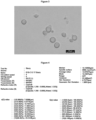
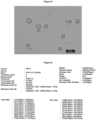
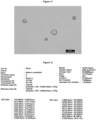
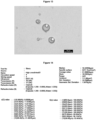
- the pictures of the micro capsules were taken with the microscope NIKON Eclipse LV100 equipped for UV-microscopy.
- TGA measurements thermo analysis
- a PerkinElmer ® Thermogravimetic Analyzer T8000 was used.
- Example 1a Microcapsules gum arabic (GA) and carboxymethyl cellulose (CMC) - GA - chitosan (Chi)
- microencapsulation of a hydrophobic substance based on an emulsion process including the coacervation of at least two oppositely charged polyelectrolytes, according to the invention can be described in five steps:
- Fig. 15 (I) shows an image of the solubilised polyelectrolyte after addition of the crosslinking agent in step a).
- Fig. 15 (II) shows that an emulsion is formed after core material was added in step b).
- Fig. 15 (III) shows the composition before step c) is initiated; even without rapid stirring the emulsion remains intact and no phase separation is observed.
- Fig. 15 (IV) shows the composition during step d), while the composition is cooled; no major changes are observed compared to the previous step.
- Fig. 15 (I) shows an image of the solubilised polyelectrolyte after addition of the crosslinking agent in step a).
- Fig. 15 (II) shows that an emulsion is formed after core material was added in step b).
- Fig. 15 (III) shows the composition before step c) is initiated; even without rapid stirring the emulsion remains intact and no phase separation is observed.
- Fig. 15 (IV) shows
- FIG. 15(V) shows the composition after the polyelectrolyte in step e) was added and coacervation in step f) was finished; the microcapsules have agglomerated.
- Fig. 15 (VI) shows the composition after an agglomeration inhibiting agent had been added and heating up is initiated at the beginning of step g); the microcapsules are less agglomerated.
- Fig. 15 (VII) shows the composition after the target temperature was reached in step f); the microcapsules are even less agglomerated.
- Fig. 15 (VIII) shows the composition after the end of step f); the microcapsules are largely discrete. From Fig. 15 (II) to (VIII) no major changes in microcapsule diameter are observed.
- Example 1b Microcapsules with different degree of crosslinking
- Microcapsules 1 to 3 were produced according to the method described above in Example 1a with varying ingredients and degrees of crosslinking. Table 1 - Relationship of microcapsule shell stability and reagent mass ratios.
- Shell stability Aromatic alcohol : Aldehyde polycation : polyanion
- Crosslinking agent polyelectrolytes Very low 0 1:5.4 1:18 Low 1:3 to 1:8 1:5.5 1:13 Medium 1:2 to 1:3 1:5.5 1:10 High 1:1 to 1:2 1:5.5 1:7
- a thermal analysis of the capsules produced was performed. The aim was to determine differences in tightness/leakage.
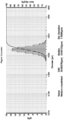
- the test temperature program was the following: 1.) Holding for 1.0 min at 30.00 °C, 2.) Heat from 30.00 °C to 90.00 °C at 5.00 °C/min, 3.) Heat from 90.00 °C to 500.00 °C at 10.00 °C/min - Purging gas was nitrogen with a purge gas rate of 20.0 mL/min.
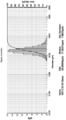
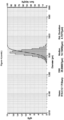
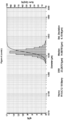
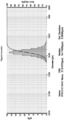
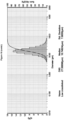
- Three probes were analyzed: microcapsules according to a method according to the invention with a low, medium, and high degree of crosslinking (see Fig. 9 to 14 ), loaded with fragrance oil 3 (D ⁇ 3).
- Figure 16 shows the curves of loss of core material for the microcapsules due to the increase of temperature. A higher degree of crosslinking is clearly benefits the stability of the microcapsule.
- the aim of this test was to determine the capsule resistance in softener. Therefore two different observation/testing methods were used.
- microcapsules according to the invention were presented to detected an odour resulting from a leakage of the core material (fragrance oils, coloured with Coumarin 1). In a range from 0 (no odour detected) to 5 (very strong odour detected) the test person rates the olfactory impression of the presented capsules.
- microcapsules were tested at day 0 of storage before and after rubbing as well as after a 14-days storage period in a standard softener (purchased from Henkel) at a pH of 3.0 and 40 °C before and after rubbing. The results are presented in Table 1 and Fig. 17 .
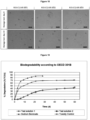
- Biodegradability was measured according to the method in OECD test 301 B ( OECD (1992), Test No. 301: Ready Biodegradability, OECD Guidelines for the Testing of Chemicals, Section 3, OECD Publishing, Paris, https://doi.org/10.1787/9789264070349 -en).
- a measured volume of inoculated mineral medium, containing a known concentration of the test substance (10-20 mg DOC or TOC/L) as the nominal sole source of organic carbon is aerated by the passage of carbon dioxide-free air at a controlled rate in the dark or in diffuse light. Degradation is followed over 60 days by determining the carbon dioxide produced.
- the CO 2 is trapped in barium or sodium hydroxide and is measured by titration of the residual hydroxide or as inorganic carbon.
- the amount of carbon dioxide produced from the test substance (corrected for that derived from the blank inoculum) is expressed as a percentage of ThCO 2 .
- the degree of biodegradation may also be calculated from supplemental DOC analysis made at the beginning and end of incubation. Where DOC, TOC, and ThCO 2 are the dissolved organic carbon, total organic carbon, and theoretical maximum CO 2 , respectively.
- Microcapsules obtained by a procedure according to Example 1 with a high degree of crosslinking were tested in duplicate (test solution 1 and 2).
- Sodium benzoate was used as a reference compound with a concentration of 20 mg/L TOC.
- the inoculum was Filtrate of homogenised activated sludge from the waste-water treatment plant at Taunusstein Bleidenstadt (Lot-No.: March 8, 2021).
- the toxicity control contains the test substance, reference compound and inoculum.
- Example 1a To assess the influence of the temperature during coacervation, the procedure of Example 1a was modified such that the reaction mixture was cooled to 30 °C prior to the addition of chitosan, i.e. in Example 5 the step 4 of the procedure of Example 1a was modified as follows
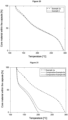
- Figure 20 shows shows the thermogravimetric analysis (temperature program according to example 2) of microcapsules obtained according to the procedure of Examples 1a and 5.
- the loss of core material is only marginally slower when the coacervation was carried out at a lower temperature.
- Microcapsules according to the invention can therefore also be coacervated at elevated temperatures and still form stable coacervates.
- Two comparative examples (6a and 6b) were carried out to compare microcapsules obtainable using a method according to the invention (wherein a crosslinking agent is reacted with polyelectrolyte A is allowed to react with a crosslinking agent before being coacervated with polyelectrolyte) with those obtained from a procedure, wherein coacervation of polyelectrolytes A and B is executed prior to crosslinking.
- the procedures of Comparative Examples 6a and 6b only differ from each other by the initial pH value.
- the initial pH value is identical to that of Example 1a to maximise comparability; however, at this pH value gum arabic and chitosan start coacervating.
- Comparative Example 6b was carried out at an initial pH value outside the window of coacervation for the system gum arabic-chitosan.
- the total amounts of polyelectrolytes and crosslinking agent used Comparative Examples 6a and 6b are identical to those used in Example 1a.
- Microcapsules according to the invention were compared to those not according to the invention (comparative examples 6a and 6b) in terms of stability and leakage.
- Figure 21 shows the thermogravimetric analysis (temperature program according to example 2) of microcapsules obtained according to the procedure of example 1a and comparative examples 6a and 6b.
- Microcapsules according to the invention lose core material at a much slower rate than those obtained from a procedure wherein polyelectrolytes A and B are coacervated prior to polyelectrolyte A reacting with a crosslinking agent.
- the temperature microcapsules not according to the invention are void of core material, microcapsules according to the invention still retain approximately 35-45 % of the core material.
- the capsules' resistance to softener was also assessed.
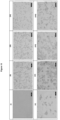
- Coumarin 1 was added to the core material and softener suspension containing 1% microcapsule slurries were prepared.
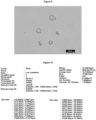
- Microcapsules were examined under a UV-Microscopy (NIKON Eclipse LV100) directly after preparation and after storage at 40 °C for 1 day. The resulting images are shown in Figure 22 . Even after only one day of storage, microcapsule obtained from Comparative Examples 6a and 6b lost their core material (as is evident from a lack of Coumarin 1), whereas microcapsules obtained according to the invention remain unchanged.
- microcapsules obtained from a method according to the invention possess a higher temperature and chemical stability in comparison to microcapsules obtained from a procedure, in which polyelectrolytes A and B are first coacervated and then crosslinked.
- Comparative Example 7 was conducted in order to highlight the importance the type of polyelectrolyte for polyelectrolytes A and B.
- the intention was to first react crosslinking agent with a polycation (instead of a polyanion), form an emulsion with a hydrophobic material and in a further step initiate coacervation with a polyanion.
- a first step 1.5 to 3 g phloroglucinol were dissolved in 233 mL of water at 60°C.
- a solution of 6 to 9 g of chitosan in 95 to 125 mL of water with a pH value 2,5 (HCl) was added to the first solution. pH v.
Landscapes
- Chemical & Material Sciences (AREA)
- Life Sciences & Earth Sciences (AREA)
- Health & Medical Sciences (AREA)
- Organic Chemistry (AREA)
- Chemical Kinetics & Catalysis (AREA)
- Wood Science & Technology (AREA)
- Oil, Petroleum & Natural Gas (AREA)
- General Health & Medical Sciences (AREA)
- Engineering & Computer Science (AREA)
- Dispersion Chemistry (AREA)
- Veterinary Medicine (AREA)
- Public Health (AREA)
- Animal Behavior & Ethology (AREA)
- Emergency Medicine (AREA)
- Epidemiology (AREA)
- Birds (AREA)
- Molecular Biology (AREA)
- Dermatology (AREA)
- Agronomy & Crop Science (AREA)
- Pest Control & Pesticides (AREA)
- Plant Pathology (AREA)
- Toxicology (AREA)
- Dentistry (AREA)
- Zoology (AREA)
- Environmental Sciences (AREA)
- Manufacturing Of Micro-Capsules (AREA)
- Medicinal Preparation (AREA)
Claims (15)
- Verfahren zum Herstellen von Mikrokapseln, die ein Kernmaterial und eine Hülle umfassen, umfassend die folgenden Schritte:a) Hinzufügen von zumindest einem Vernetzungsmittel zu einer Zusammensetzung, die zumindest einen ersten solubilisierten Polyelektrolyten (Polyelektrolyt A) umfasst,b) dann Hinzufügen des Kernmaterials,c) optional Hinzufügen von weiterem Polyelektrolyt A, optional solubilisiert,d) dann optional Abkühlen der Zusammensetzung vore) Hinzufügen von zumindest einem zweiten solubilisierten Polyelektrolyten (Polyelektrolyt B) in einem nächsten Schritt,f) dann Fördern einer Koazervation der Polyelektrolyten,wobei Polyelektrolyt A anionisch ist und Polyelektrolyt B kationisch oder amphoter ist.
- Verfahren nach Anspruch 1, dadurch gekennzeichnet, dass der Polyelektrolyt A ausgewählt ist aus der Gruppe bestehend aus Gummi arabicum, Natriumcarboxymethylguargummi, Pflanzengummis, Pektin, Glykogen, Cellulose, insbesondere Carboxymethylcellulose, Alginat, Stärke, insbesondere Amylose oder Amylopektin, Hyaluronsäure, Tanninen, Carrageen, Ligninsulfonat oder Xanthangummi oder Mischungen davon, bevorzugt Gummi arabicum, Pektin, Carboxymethylcellulose, am meisten bevorzugt Gummi arabicum.
- Verfahren nach Anspruch 1 oder 2, dadurch gekennzeichnet, dass Polyelektrolyt B ausgewählt ist aus der Gruppe bestehend aus Chitosan, Gelatine, Kasein, Pflanzenproteinen, insbesondere Sojaproteinisolat, Eiweißprotein, Chitin oder Seidenprotein oder Mischungen davon, bevorzugt Chitosan, Gelatine oder Sojaproteinisolat, am meisten bevorzugt Chitosan.
- Verfahren nach einem der vorhergehenden Ansprüche, dadurch gekennzeichnet, dass Schritt a) die Hinzufügung eines Verdickers umfasst oder die Zusammensetzung von Schritt a) einen Verdicker umfasst, der bevorzugt ein Polyelektrolyt, bevorzugter ein anionischer Polyelektrolyt (Polyelektrolyt A), am meisten bevorzugt Carboxymethylcellulose ist.
- Verfahren nach einem der vorhergehenden Ansprüche, dadurch gekennzeichnet, dass die Zusammensetzung von Schritt a) Gummi arabicum und Carboxymethylcellulose umfasst, der Polyelektrolyt, der in Schritt c) hinzugefügt wird, Gummi arabicum ist und der Polyelektrolyt, der in Schritt e) hinzugefügt wird, Chitosan ist.
- Verfahren nach einem der vorhergehenden Ansprüche, dadurch gekennzeichnet, dass das Vernetzungsmittel eine erste Vernetzungskomponente, optional eine zweite Vernetzungskomponente und/oder ein Reaktionsprodukt davon umfasst, und dass die erste Vernetzungskomponente ausgewählt ist aus der Gruppe bestehend aus Aldehyden, Polyisocyanaten, Verbindungen, die gespannte Heterocyclen enthalten, oder anorganischen Vernetzern, bevorzugt ein Aldehyd ist, wobei die Verbindungen, die gespannte Heterocyclen enthalten, Epoxide und/oder Aziridine, bevorzugt Aziridine sind, und dass die zweite Vernetzungskomponente bevorzugt ausgewählt ist aus der Gruppe bestehend aus aromatischen Alkoholen, Aminen, Harnstoff und Guanidin.
- Verfahren nach Anspruch 6, dadurch gekennzeichnet, dass der Aldehyd ein Dialdehyd ist, bevorzugt ausgewählt aus der Gruppe bestehend aus Succindialdehyd, Adipaldehyd, Glutaraldehyd, Glyoxal, Glyoxylsäure, Malondialdehyd, Oleocanthal oder Mischungen davon, bevorzugter Glutaraldehyd.
- Verfahren nach einem der vorhergehenden Ansprüche, dadurch gekennzeichnet, dass die Temperatur der Zusammensetzungen von Schritt a) bis Schritt c) zwischen 20-80 °C ist und die Temperatur der Zusammensetzungen von Schritt d) bis f) zwischen 27-25 °C ist.
- Verfahren nach einem der vorhergehenden Ansprüche, dadurch gekennzeichnet, dass es Erhitzen der Zusammensetzung aus Schritt f) auf 40-100 °C, bevorzugter 50-90 °C, am meisten bevorzugt 60-80 °C (Schritt g) umfasst.
- Verfahren nach Anspruch 9, dadurch gekennzeichnet, dass zusätzliches Vernetzungsmittel der Zusammensetzung in Schritt g) hinzugefügt wird, bevorzugt sobald die Zusammensetzung bei einer Temperatur von 40-100 °C, bevorzugter 50-90 °C, am meisten bevorzugt 60-80 °C ist.
- Verfahren nach Anspruch 9 oder 10, dadurch gekennzeichnet, dass der pH-Wert der Zusammensetzung nach Schritt g) auf 6,0-7,8, bevorzugt 6,3-7,5, am meisten bevorzugt 6,5-7,3 eingestellt wird.
- Verfahren nach einem der vorhergehenden Ansprüche, dadurch gekennzeichnet, dass das Kernmaterial einen hydrophoben Bestandteil umfasst, bevorzugt das Kernmaterial ausgewählt ist aus der Gruppe bestehend aus Alkoholen, natürlichen und/oder synthetischen Ölen, Silikonölen oder Mischungen davon.
- Mikrokapseln, die durch ein Verfahren nach einem der vorhergehenden Ansprüche erhalten werden oder erhaltbar sind.
- Mikrokapsel nach Anspruch 13, dadurch gekennzeichnet, dass der hydrodynamische Durchmesser d(90 %) zwischen 5 und 150 µm, bevorzugt zwischen 5 und 120 µm, bevorzugter zwischen 10 und 50 µm, mit einer Standardabweichung von ± 50 %, gemessen in deionisiertem Wasser bei Raumtemperatur durch dynamische Lichtstreuung (DLS) ist, dass die Hülle aus biologisch abbaubaren Polyelektrolyten besteht und/oder dass die Mikrokapsel eine biologische Abbaubarkeit nach 60 Tagen von zumindest 40 %, bevorzugter zumindest 50 %, am meisten bevorzugt zumindest 60 %, gemessen gemäß OECD 301 B, aufweist.
- Zusammensetzung, umfassend die Mikrokapseln nach Anspruch 13 oder 14, insbesondere zum Waschen, Reinigen, Konditionieren, Pflegen und/oder Färben.
Applications Claiming Priority (2)
| Application Number | Priority Date | Filing Date | Title |
|---|---|---|---|
| EP21187524.0A EP4122592A1 (de) | 2021-07-23 | 2021-07-23 | Umweltfreundliche mikrokapseln und verfahren zur herstellung davon |
| PCT/EP2022/070650 WO2023002028A1 (en) | 2021-07-23 | 2022-07-22 | Environmentally friendly microcapsules and a method for the production thereof |
Publications (3)
| Publication Number | Publication Date |
|---|---|
| EP4373608A1 EP4373608A1 (de) | 2024-05-29 |
| EP4373608B1 true EP4373608B1 (de) | 2025-05-14 |
| EP4373608C0 EP4373608C0 (de) | 2025-05-14 |
Family
ID=77050837
Family Applications (2)
| Application Number | Title | Priority Date | Filing Date |
|---|---|---|---|
| EP21187524.0A Withdrawn EP4122592A1 (de) | 2021-07-23 | 2021-07-23 | Umweltfreundliche mikrokapseln und verfahren zur herstellung davon |
| EP22754859.1A Active EP4373608B1 (de) | 2021-07-23 | 2022-07-22 | Umweltfreundliche mikrokapseln und verfahren zur herstellung davon |
Family Applications Before (1)
| Application Number | Title | Priority Date | Filing Date |
|---|---|---|---|
| EP21187524.0A Withdrawn EP4122592A1 (de) | 2021-07-23 | 2021-07-23 | Umweltfreundliche mikrokapseln und verfahren zur herstellung davon |
Country Status (3)
| Country | Link |
|---|---|
| US (2) | US20230040439A1 (de) |
| EP (2) | EP4122592A1 (de) |
| WO (1) | WO2023002028A1 (de) |
Citations (18)
| Publication number | Priority date | Publication date | Assignee | Title |
|---|---|---|---|---|
| EP0470872B1 (de) * | 1990-08-10 | 1994-10-12 | Alko Group Ltd. | Polysaccharid-enthaltendes Erzeugnis und dessen Verwendung |
| US5378413A (en) * | 1993-01-21 | 1995-01-03 | The United States Of America As Represented By The Secretary Of The Navy | Process for preparing microcapsules having gelatin walls crosslinked with quinone |
| EP1219348A2 (de) * | 2000-11-27 | 2002-07-03 | Xerox Corporation | Verfahren zum Einkapseln |
| WO2002092217A1 (fr) * | 2001-05-16 | 2002-11-21 | Mainelab | Microcapsules a base de proteines vegetales |
| EP1371410A1 (de) * | 2002-06-14 | 2003-12-17 | NIZO food research | Komplex-Koacervate, die Käsewassereiweisse enthalten |
| WO2004041251A1 (en) * | 2002-11-04 | 2004-05-21 | Ocean Nutrition Canada Limited | Microcapsules having multiple shells and method for the preparation thereof |
| WO2007113706A1 (en) * | 2006-04-04 | 2007-10-11 | Firmenich Sa | Method for preparing microcapsules by coacervation |
| CN101591859B (zh) * | 2009-06-22 | 2011-08-17 | 华南农业大学 | 一种艾叶油微胶囊织物复合整理剂及其应用 |
| US20120283376A1 (en) * | 2011-05-04 | 2012-11-08 | Boe Technology Group Co., Ltd. | Electronic ink microcapsule and a method for producing the same |
| GB2498146A (en) * | 2013-04-15 | 2013-07-03 | Rotam Agrochem Int Co Ltd | A herbicide composition comprising clomazone encapsulated within microcapsules formed by coacervation of amphoteric polymer electrolytes |
| CN103157415B (zh) * | 2011-12-14 | 2015-05-06 | 金红叶纸业集团有限公司 | 一种彩色微胶囊及其制备方法 |
| WO2015138319A1 (en) * | 2014-03-10 | 2015-09-17 | Isp Investments Inc. | Oral care compositions comprising microcapsules with effective breakage characteristics |
| CN104012528B (zh) * | 2014-06-16 | 2016-04-13 | 江西农业大学 | 一种含有机硅农药微胶囊的制备方法 |
| WO2017197453A1 (en) * | 2016-05-17 | 2017-11-23 | Deakin University | Microencapsulated omega-3 polyunsaturated fatty acid glyceride compositions and processes for preparing the same |
| WO2018002214A1 (en) * | 2016-06-30 | 2018-01-04 | Firmenich Sa | Core-composite shell microcapsules |
| CN105011343B (zh) * | 2015-05-27 | 2018-01-19 | 青岛农业大学 | 一种肠道靶向pH敏感性复凝聚微胶囊传输体系及其制备方法与应用 |
| EP2774669B1 (de) * | 2013-03-05 | 2018-08-29 | Microcapsules Technologies | Saugfähiger artikel |
| WO2021191290A1 (en) * | 2020-03-27 | 2021-09-30 | Firmenich Sa | Coacervate core-shell microcapsules |
Family Cites Families (7)
| Publication number | Priority date | Publication date | Assignee | Title |
|---|---|---|---|---|
| ES2644753T3 (es) * | 2006-06-05 | 2017-11-30 | Dsm Nutritional Products Ag | Microcápsulas con cubiertas mejoradas |
| EP2124905B1 (de) * | 2007-01-10 | 2016-09-07 | DSM Nutritional Products AG | Mikrokapseln enthaltend erbsenprotein |
| CN102847495B (zh) * | 2011-06-30 | 2014-12-03 | 广州奥熠电子科技有限公司 | 一种电泳显示微胶囊及其制备方法 |
| CN109152711B (zh) * | 2016-02-29 | 2021-10-22 | 西姆莱斯股份公司 | 生产具备改善的表面活性剂稳定性的香料胶囊的方法 |
| US20220008886A1 (en) * | 2016-05-03 | 2022-01-13 | International Flavors & Fragrances Inc. | Biodegradable microcapsules |
| CN112469755B (zh) | 2018-07-23 | 2022-12-02 | 科思创(荷兰)有限公司 | 多氮丙啶化合物 |
| GB202007795D0 (en) * | 2020-05-26 | 2020-07-08 | Givaudan Sa | Improvements in or relating to organic compounds |
-
2021
- 2021-07-23 EP EP21187524.0A patent/EP4122592A1/de not_active Withdrawn
- 2021-12-17 US US17/644,891 patent/US20230040439A1/en active Pending
-
2022
- 2022-07-22 US US18/291,039 patent/US20240327757A1/en active Pending
- 2022-07-22 WO PCT/EP2022/070650 patent/WO2023002028A1/en not_active Ceased
- 2022-07-22 EP EP22754859.1A patent/EP4373608B1/de active Active
Patent Citations (18)
| Publication number | Priority date | Publication date | Assignee | Title |
|---|---|---|---|---|
| EP0470872B1 (de) * | 1990-08-10 | 1994-10-12 | Alko Group Ltd. | Polysaccharid-enthaltendes Erzeugnis und dessen Verwendung |
| US5378413A (en) * | 1993-01-21 | 1995-01-03 | The United States Of America As Represented By The Secretary Of The Navy | Process for preparing microcapsules having gelatin walls crosslinked with quinone |
| EP1219348A2 (de) * | 2000-11-27 | 2002-07-03 | Xerox Corporation | Verfahren zum Einkapseln |
| WO2002092217A1 (fr) * | 2001-05-16 | 2002-11-21 | Mainelab | Microcapsules a base de proteines vegetales |
| EP1371410A1 (de) * | 2002-06-14 | 2003-12-17 | NIZO food research | Komplex-Koacervate, die Käsewassereiweisse enthalten |
| WO2004041251A1 (en) * | 2002-11-04 | 2004-05-21 | Ocean Nutrition Canada Limited | Microcapsules having multiple shells and method for the preparation thereof |
| WO2007113706A1 (en) * | 2006-04-04 | 2007-10-11 | Firmenich Sa | Method for preparing microcapsules by coacervation |
| CN101591859B (zh) * | 2009-06-22 | 2011-08-17 | 华南农业大学 | 一种艾叶油微胶囊织物复合整理剂及其应用 |
| US20120283376A1 (en) * | 2011-05-04 | 2012-11-08 | Boe Technology Group Co., Ltd. | Electronic ink microcapsule and a method for producing the same |
| CN103157415B (zh) * | 2011-12-14 | 2015-05-06 | 金红叶纸业集团有限公司 | 一种彩色微胶囊及其制备方法 |
| EP2774669B1 (de) * | 2013-03-05 | 2018-08-29 | Microcapsules Technologies | Saugfähiger artikel |
| GB2498146A (en) * | 2013-04-15 | 2013-07-03 | Rotam Agrochem Int Co Ltd | A herbicide composition comprising clomazone encapsulated within microcapsules formed by coacervation of amphoteric polymer electrolytes |
| WO2015138319A1 (en) * | 2014-03-10 | 2015-09-17 | Isp Investments Inc. | Oral care compositions comprising microcapsules with effective breakage characteristics |
| CN104012528B (zh) * | 2014-06-16 | 2016-04-13 | 江西农业大学 | 一种含有机硅农药微胶囊的制备方法 |
| CN105011343B (zh) * | 2015-05-27 | 2018-01-19 | 青岛农业大学 | 一种肠道靶向pH敏感性复凝聚微胶囊传输体系及其制备方法与应用 |
| WO2017197453A1 (en) * | 2016-05-17 | 2017-11-23 | Deakin University | Microencapsulated omega-3 polyunsaturated fatty acid glyceride compositions and processes for preparing the same |
| WO2018002214A1 (en) * | 2016-06-30 | 2018-01-04 | Firmenich Sa | Core-composite shell microcapsules |
| WO2021191290A1 (en) * | 2020-03-27 | 2021-09-30 | Firmenich Sa | Coacervate core-shell microcapsules |
Non-Patent Citations (3)
| Title |
|---|
| GUAN J ET AL: "Microcapsules for electrophoretic display, comprise electrophoretic particles dispersed in suspension, and capsule wall consisting of inner layer formed by coacervation method and outer wall formed by in-situ polymerization method", WPI / 2017 CLARIVATE ANALYTICS,, vol. 2013, no. 55, 2 January 2013 (2013-01-02), XP002805203 * |
| TIMILSENA YAKINDRA PRASAD ET AL: "Complex coacervation: Principles, mechanisms and applications in microencapsulation", INTERNATIONAL JOURNAL OF BIOLOGICAL MACROMOLECULES, ELSEVIER BV, NL, vol. 121, 22 October 2018 (2018-10-22), pages 1276 - 1286, XP085535434, ISSN: 0141-8130, DOI: 10.1016/J.IJBIOMAC.2018.10.144 * |
| ZUOBING XIAO ET AL: "A review of the preparation and application of flavour and essential oils microcapsules based on complex coacervation technology", JOURNAL OF THE SCIENCE OF FOOD AND AGRICULTURE, vol. 94, no. 8, 27 December 2013 (2013-12-27), GB, pages 1482 - 1494, XP055351448, ISSN: 0022-5142, DOI: 10.1002/jsfa.6491 * |
Also Published As
| Publication number | Publication date |
|---|---|
| WO2023002028A1 (en) | 2023-01-26 |
| EP4373608A1 (de) | 2024-05-29 |
| US20230040439A1 (en) | 2023-02-09 |
| EP4122592A1 (de) | 2023-01-25 |
| US20240327757A1 (en) | 2024-10-03 |
| EP4373608C0 (de) | 2025-05-14 |
Similar Documents
| Publication | Publication Date | Title |
|---|---|---|
| CN100577278C (zh) | 功能化颗粒 | |
| US20220314185A1 (en) | Method for preparing biodegradable microcapsules and microcapsules obtained in this manner | |
| WO2020195132A1 (ja) | 香料マイクロカプセル、香料マイクロカプセル組成物、柔軟剤及び洗剤 | |
| Di Credico et al. | An efficient method for the output of new self-repairing materials through a reactive isocyanate encapsulation | |
| EP4072508A1 (de) | Bioabbaubare mikrokapselsysteme | |
| US20240017234A1 (en) | Improved microcapsules and method for the production and use thereof | |
| Kardar | Preparation of polyurethane microcapsules with different polyols component for encapsulation of isophorone diisocyanate healing agent | |
| Loureiro et al. | Microencapsulation of isocyanate in biodegradable poly (ε-caprolactone) capsules and application in monocomponent green adhesives | |
| Alizadegan et al. | Polyurethane-based microcapsules containing reactive isocyanate compounds: Study on preparation procedure and solvent replacement | |
| Brochu et al. | Microencapsulation of 2‐octylcyanoacrylate tissue adhesive for self‐healing acrylic bone cement | |
| EP4373608B1 (de) | Umweltfreundliche mikrokapseln und verfahren zur herstellung davon | |
| WO2020194910A1 (ja) | マイクロカプセル、マイクロカプセル組成物、柔軟剤及び洗剤 | |
| EP4460392A1 (de) | Biologisch abbaubare chitosanmikrokapseln | |
| Zhou et al. | Preparation and systematic study of mechanical properties and suspension stability of polyurethane-polyurea double-shell perfume oil microcapsules | |
| EP4259323A1 (de) | Biologisch abbaubare mikrokapseln auf basis von verbundmaterial und syntheseverfahren | |
| WO2023064204A1 (en) | Gelatin based urethane/urea microcapsules | |
| CN109692635A (zh) | 一种异氰酸酯微囊及其制备方法 | |
| JP2021053594A (ja) | マイクロカプセル、マイクロカプセル組成物及びその製造方法、並びに、柔軟剤及び洗剤 | |
| Silva et al. | Preparation and characterization of poly (urethane–urea) microcapsules containing limonene. Kinetic analysis | |
| EP4351773A1 (de) | Farbneutrale abbaubare mikrokapseln | |
| CN113019272B (zh) | 香精胶囊及其制备方法和洗护用品 | |
| CN105862165B (zh) | 一种具有相变调温功能的蛋白改性腈纶纤维纺丝液及其制备方法 | |
| Rajasekaran et al. | Enhancing the stability of urea-formaldehyde microcapsules for self-healing polymers through additive modulation | |
| Sasaki et al. | A weight of evidence analytical approach: Understanding chemical composition of synthetic polymers to aid in the interpretation of biodegradation results | |
| Abid et al. | Synthesis and Characterization of Guar Gum-Based Polyurethane Dispersions for Textile Applications |
Legal Events
| Date | Code | Title | Description |
|---|---|---|---|
| STAA | Information on the status of an ep patent application or granted ep patent |
Free format text: STATUS: UNKNOWN |
|
| STAA | Information on the status of an ep patent application or granted ep patent |
Free format text: STATUS: THE INTERNATIONAL PUBLICATION HAS BEEN MADE |
|
| PUAI | Public reference made under article 153(3) epc to a published international application that has entered the european phase |
Free format text: ORIGINAL CODE: 0009012 |
|
| STAA | Information on the status of an ep patent application or granted ep patent |
Free format text: STATUS: REQUEST FOR EXAMINATION WAS MADE |
|
| 17P | Request for examination filed |
Effective date: 20240222 |
|
| AK | Designated contracting states |
Kind code of ref document: A1 Designated state(s): AL AT BE BG CH CY CZ DE DK EE ES FI FR GB GR HR HU IE IS IT LI LT LU LV MC MK MT NL NO PL PT RO RS SE SI SK SM TR |
|
| DAV | Request for validation of the european patent (deleted) | ||
| DAX | Request for extension of the european patent (deleted) | ||
| GRAP | Despatch of communication of intention to grant a patent |
Free format text: ORIGINAL CODE: EPIDOSNIGR1 |
|
| STAA | Information on the status of an ep patent application or granted ep patent |
Free format text: STATUS: GRANT OF PATENT IS INTENDED |
|
| INTG | Intention to grant announced |
Effective date: 20241205 |
|
| GRAS | Grant fee paid |
Free format text: ORIGINAL CODE: EPIDOSNIGR3 |
|
| GRAA | (expected) grant |
Free format text: ORIGINAL CODE: 0009210 |
|
| STAA | Information on the status of an ep patent application or granted ep patent |
Free format text: STATUS: THE PATENT HAS BEEN GRANTED |
|
| AK | Designated contracting states |
Kind code of ref document: B1 Designated state(s): AL AT BE BG CH CY CZ DE DK EE ES FI FR GB GR HR HU IE IS IT LI LT LU LV MC MK MT NL NO PL PT RO RS SE SI SK SM TR |
|
| REG | Reference to a national code |
Ref country code: GB Ref legal event code: FG4D |
|
| REG | Reference to a national code |
Ref country code: CH Ref legal event code: EP |
|
| REG | Reference to a national code |
Ref country code: IE Ref legal event code: FG4D |
|
| REG | Reference to a national code |
Ref country code: DE Ref legal event code: R096 Ref document number: 602022014723 Country of ref document: DE |
|
| U01 | Request for unitary effect filed |
Effective date: 20250613 |
|
| U07 | Unitary effect registered |
Designated state(s): AT BE BG DE DK EE FI FR IT LT LU LV MT NL PT RO SE SI Effective date: 20250624 |
|
| U20 | Renewal fee for the european patent with unitary effect paid |
Year of fee payment: 4 Effective date: 20250730 |
|
| PG25 | Lapsed in a contracting state [announced via postgrant information from national office to epo] |
Ref country code: ES Free format text: LAPSE BECAUSE OF FAILURE TO SUBMIT A TRANSLATION OF THE DESCRIPTION OR TO PAY THE FEE WITHIN THE PRESCRIBED TIME-LIMIT Effective date: 20250514 |
|
| PG25 | Lapsed in a contracting state [announced via postgrant information from national office to epo] |
Ref country code: NO Free format text: LAPSE BECAUSE OF FAILURE TO SUBMIT A TRANSLATION OF THE DESCRIPTION OR TO PAY THE FEE WITHIN THE PRESCRIBED TIME-LIMIT Effective date: 20250814 Ref country code: GR Free format text: LAPSE BECAUSE OF FAILURE TO SUBMIT A TRANSLATION OF THE DESCRIPTION OR TO PAY THE FEE WITHIN THE PRESCRIBED TIME-LIMIT Effective date: 20250815 |
|
| PG25 | Lapsed in a contracting state [announced via postgrant information from national office to epo] |
Ref country code: PL Free format text: LAPSE BECAUSE OF FAILURE TO SUBMIT A TRANSLATION OF THE DESCRIPTION OR TO PAY THE FEE WITHIN THE PRESCRIBED TIME-LIMIT Effective date: 20250514 |
|
| PG25 | Lapsed in a contracting state [announced via postgrant information from national office to epo] |
Ref country code: HR Free format text: LAPSE BECAUSE OF FAILURE TO SUBMIT A TRANSLATION OF THE DESCRIPTION OR TO PAY THE FEE WITHIN THE PRESCRIBED TIME-LIMIT Effective date: 20250514 |
|
| PG25 | Lapsed in a contracting state [announced via postgrant information from national office to epo] |
Ref country code: RS Free format text: LAPSE BECAUSE OF FAILURE TO SUBMIT A TRANSLATION OF THE DESCRIPTION OR TO PAY THE FEE WITHIN THE PRESCRIBED TIME-LIMIT Effective date: 20250814 |
|
| PG25 | Lapsed in a contracting state [announced via postgrant information from national office to epo] |
Ref country code: IS Free format text: LAPSE BECAUSE OF FAILURE TO SUBMIT A TRANSLATION OF THE DESCRIPTION OR TO PAY THE FEE WITHIN THE PRESCRIBED TIME-LIMIT Effective date: 20250914 |
|
| PG25 | Lapsed in a contracting state [announced via postgrant information from national office to epo] |
Ref country code: SM Free format text: LAPSE BECAUSE OF FAILURE TO SUBMIT A TRANSLATION OF THE DESCRIPTION OR TO PAY THE FEE WITHIN THE PRESCRIBED TIME-LIMIT Effective date: 20250514 |
|
| PG25 | Lapsed in a contracting state [announced via postgrant information from national office to epo] |
Ref country code: CZ Free format text: LAPSE BECAUSE OF FAILURE TO SUBMIT A TRANSLATION OF THE DESCRIPTION OR TO PAY THE FEE WITHIN THE PRESCRIBED TIME-LIMIT Effective date: 20250514 |
|
| PG25 | Lapsed in a contracting state [announced via postgrant information from national office to epo] |
Ref country code: SK Free format text: LAPSE BECAUSE OF FAILURE TO SUBMIT A TRANSLATION OF THE DESCRIPTION OR TO PAY THE FEE WITHIN THE PRESCRIBED TIME-LIMIT Effective date: 20250514 |