EP4370039B1 - Punktionsvorrichtung - Google Patents
Punktionsvorrichtung Download PDFInfo
- Publication number
- EP4370039B1 EP4370039B1 EP21751769.7A EP21751769A EP4370039B1 EP 4370039 B1 EP4370039 B1 EP 4370039B1 EP 21751769 A EP21751769 A EP 21751769A EP 4370039 B1 EP4370039 B1 EP 4370039B1
- Authority
- EP
- European Patent Office
- Prior art keywords
- puncture
- tissue expansion
- expansion means
- tissue
- puncture device
- Prior art date
- Legal status (The legal status is an assumption and is not a legal conclusion. Google has not performed a legal analysis and makes no representation as to the accuracy of the status listed.)
- Active
Links
Images

Classifications
-
- A—HUMAN NECESSITIES
- A61—MEDICAL OR VETERINARY SCIENCE; HYGIENE
- A61B—DIAGNOSIS; SURGERY; IDENTIFICATION
- A61B17/00—Surgical instruments, devices or methods
- A61B17/34—Trocars; Puncturing needles
- A61B17/3478—Endoscopic needles, e.g. for infusion
-
- A—HUMAN NECESSITIES
- A61—MEDICAL OR VETERINARY SCIENCE; HYGIENE
- A61B—DIAGNOSIS; SURGERY; IDENTIFICATION
- A61B17/00—Surgical instruments, devices or methods
- A61B17/34—Trocars; Puncturing needles
- A61B17/3417—Details of tips or shafts, e.g. grooves, expandable, bendable; Multiple coaxial sliding cannulas, e.g. for dilating
-
- A—HUMAN NECESSITIES
- A61—MEDICAL OR VETERINARY SCIENCE; HYGIENE
- A61B—DIAGNOSIS; SURGERY; IDENTIFICATION
- A61B17/00—Surgical instruments, devices or methods
- A61B17/02—Surgical instruments, devices or methods for holding wounds open, e.g. retractors; Tractors
- A61B17/0218—Surgical instruments, devices or methods for holding wounds open, e.g. retractors; Tractors for minimally invasive surgery
-
- A—HUMAN NECESSITIES
- A61—MEDICAL OR VETERINARY SCIENCE; HYGIENE
- A61B—DIAGNOSIS; SURGERY; IDENTIFICATION
- A61B90/00—Instruments, implements or accessories specially adapted for surgery or diagnosis and not covered by any of the groups A61B1/00 - A61B50/00, e.g. for luxation treatment or for protecting wound edges
- A61B90/39—Markers, e.g. radio-opaque or breast lesions markers
-
- A—HUMAN NECESSITIES
- A61—MEDICAL OR VETERINARY SCIENCE; HYGIENE
- A61B—DIAGNOSIS; SURGERY; IDENTIFICATION
- A61B17/00—Surgical instruments, devices or methods
- A61B2017/00831—Material properties
- A61B2017/00867—Material properties shape memory effect
-
- A—HUMAN NECESSITIES
- A61—MEDICAL OR VETERINARY SCIENCE; HYGIENE
- A61B—DIAGNOSIS; SURGERY; IDENTIFICATION
- A61B17/00—Surgical instruments, devices or methods
- A61B17/32—Surgical cutting instruments
- A61B2017/320044—Blunt dissectors
-
- A—HUMAN NECESSITIES
- A61—MEDICAL OR VETERINARY SCIENCE; HYGIENE
- A61B—DIAGNOSIS; SURGERY; IDENTIFICATION
- A61B17/00—Surgical instruments, devices or methods
- A61B17/34—Trocars; Puncturing needles
- A61B17/3417—Details of tips or shafts, e.g. grooves, expandable, bendable; Multiple coaxial sliding cannulas, e.g. for dilating
- A61B2017/3454—Details of tips
-
- A—HUMAN NECESSITIES
- A61—MEDICAL OR VETERINARY SCIENCE; HYGIENE
- A61B—DIAGNOSIS; SURGERY; IDENTIFICATION
- A61B90/00—Instruments, implements or accessories specially adapted for surgery or diagnosis and not covered by any of the groups A61B1/00 - A61B50/00, e.g. for luxation treatment or for protecting wound edges
- A61B90/39—Markers, e.g. radio-opaque or breast lesions markers
- A61B2090/3966—Radiopaque markers visible in an X-ray image
-
- A—HUMAN NECESSITIES
- A61—MEDICAL OR VETERINARY SCIENCE; HYGIENE
- A61M—DEVICES FOR INTRODUCING MEDIA INTO, OR ONTO, THE BODY; DEVICES FOR TRANSDUCING BODY MEDIA OR FOR TAKING MEDIA FROM THE BODY; DEVICES FOR PRODUCING OR ENDING SLEEP OR STUPOR
- A61M25/00—Catheters; Hollow probes
- A61M25/01—Introducing, guiding, advancing, emplacing or holding catheters
- A61M25/06—Body-piercing guide needles or the like
-
- A—HUMAN NECESSITIES
- A61—MEDICAL OR VETERINARY SCIENCE; HYGIENE
- A61M—DEVICES FOR INTRODUCING MEDIA INTO, OR ONTO, THE BODY; DEVICES FOR TRANSDUCING BODY MEDIA OR FOR TAKING MEDIA FROM THE BODY; DEVICES FOR PRODUCING OR ENDING SLEEP OR STUPOR
- A61M29/00—Dilators with or without means for introducing media, e.g. remedies
- A61M29/02—Dilators made of swellable material
Definitions
- the present invention relates to a puncture device.
- a treatment that is commonly used is the creation of a TIPS (Transjugular Intrahepatic Portosystemic Shunt) shunt.
- TIPS Transjugular Intrahepatic Portosystemic Shunt
- Such a TIPS shunt is an artificial channel that is created between the hepatic and the portal vein and that allows for blood to bypass the liver. It has been shown that such shunts improve the life expectancy of patients diagnosed with liver cirrhosis since it is a treatment for portal hypertension (which is often due to liver cirrhosis) which frequently leads to intestinal bleeding, life-threatening esophageal bleeding (esophageal varices) and the buildup of fluid within the abdomen (ascites).
- Such shunts are typically created by advancing a puncture needle through the patient's vasculature to the puncture site. A surgeon will then puncture the diseased liver tissue with the aim of the puncture reaching the portal vein. If the puncture attempt is unsuccessful, the needle is withdrawn from the patient's vasculature and will be reshaped, for example by manual bending.
- TIPS shunt Once the TIPS shunt has been created, a specialised TIPS stent graft is placed within the puncture so as to keep it open. Through that shunt, blood can bypass the liver, which ameliorates portal hypertension.
- the present inventor has realised that the creation of a TIPS shunt is often rather complicated. It is frequently the case that the surgeon does not manage to puncture the portal vein on the first attempt. Accordingly, the puncture needle needs to be withdrawn somewhat and rotated (or, in some cases, completely withdrawn and bent). Afterwards, another puncture attempt can be made. It is clear that the time consumption is significant. Furthermore, withdrawing the needle and manually bending it also comes with a risk of injuring the surgeon. Given that a patient's blood can contain pathogens such as viruses, it is thus highly desirable to reduce the number of times a TIPS puncture needle needs to be withdrawn.
- the present invention aims at alleviating or even solving at least some of those problems.
- Embodiments described herein relate to a puncture device that is arranged for being advanced to a puncture site through the human vasculature. Accordingly, it needs to be sufficiently low profile and sufficiently flexible for such an advancement.
- the puncture device is sufficiently stiff for penetrating diseased liver tissue.
- the puncture device comprises a puncture means which is that component of the puncture device that is meant for creating a puncture through tissue.
- a puncture means can take the form of a hollow needle.
- the puncture means has a pointed distal end that is arranged for creating a puncture in a patient's tissue.
- the puncture device furthermore comprises a tissue expansion means that is arranged so that it can be selectively activated, wherein when in the activated state, the tissue expansion means pushes away the patient's tissue to thereby allow a reorientation of the puncture means.
- the tissue expansion means is slidably arranged inside the sheath and is arranged so that it can be slid out of the sheath so as to extend distally relative to the distal end of the puncture means.
- the tissue expansion means can be shielded from the outside of the puncture device by means of being inserted into the sheath, which therefore allows for a certain protection of the expansion means.
- the sheath can serve as a way of avoiding premature expansion of the expansion means by restraining it.
- the sheath can in particular be made of polyethylene terephthalate (PET) or polyether ether ketone (PEEK) .
- the tissue expansion means is arranged so as to expand when heated above a threshold temperature to thereby push away tissue.
- a heating up of the tissue expansion means can be achieved, for example by having a heating coil installed as part of the puncture device. Accordingly, this is an easy to implement way of actuating the tissue expansion means of the puncture device.
- the tissue expansion means comprises a shape memory alloy, e.g. nitinol.
- a shape memory alloy e.g. nitinol.
- Such materials are well characterised and find wide application in the technical field of puncture devices and stent/stent grafts. Furthermore, they have good capabilities of creating implants that will expand when heated above a certain threshold temperature.
- a means for selectively heating up the tissue expansion means there is a means for selectively heating up the tissue expansion means.
- a means which could take the form of or include a coil, is an easy to implement way of heating up tissue expansion means and can thus be used as a simple actuation mechanism.
- the threshold temperature above which the expansion of a tissue expansion means occurs is higher than 37°C, in embodiments higher than 39°C, e.g. of about 40°C. Transition temperatures of 45°C or even 50°C can also be used in the case of severely diseased liver. Each °C change from the transition temperature could change the radial forces by approximately 4 N/mm 2 .
- a transition temperature that is higher than body temperature ensures that an active heating of the tissue expansion means is needed to keep it in the activated state. Accordingly, if it is no longer desired to use the tissue expansion means, it suffices to no longer actively heat it.
- the tissue expansion means has, in the activated configuration, a shape where the cross-sectional area of the tissue expansion means increases when moving from a proximal end to a distal end of the tissue expansion means.
- the proximal end is closer to the handle of the puncture device which will be held by the surgeon, whereas the distal end is closest to the tip of the puncture device.
- the tissue expansion means can be brought back to its non-activated state (which a correspondingly reduced cross-sectional diameter) by means of advancing the sheath relative to the puncture device and thus relative to the tissue expansion means. This makes it easier to reduce the cross-sectional diameter of the tissue expansion means when needed.
- the tissue expansion means comprises an expandable lattice structure similar to that of a stent. Since such stents have been well-characterised and are used widely in medicine, the generally well-known manufacturing techniques for such devices can also be supplied to such tissue expansion means.
- a puncture device comprises:
- FIG. 1 shows a puncture device according to a first embodiment of the present invention.
- the puncture device 100 comprises a puncture means 18 that has the form of a hollow needle having a lumen 19 extending longitudinally therethrough. This lumen 19 can be used for aspirating blood to check whether a puncture attempt has been successful.
- a tube 16 Provided so as to surround the puncture means 18 is a tube 16. This tube 16 serves to prevent the puncture means 18 from coming into contact with those components of the puncture device 100 that are further towards the outside.
- the tube 16 is surrounded by a tissue expansion means 14 that has the shape of a tubular mesh work made of nitinol.
- the whole assembly of the puncture means 18, tube 16 and tissue expansion means 14 is surrounded by a sheath 10.
- the sheath 10 has, at its distal end, a flared-out distalmost end 12 that corresponds to a widening opening.
- the sheath 10 is slidable relative to the puncture means 18 as well as relative to the tube 16 and the tissue expansion means 14.
- Figure 2a shows a longitudinal cross-section of what is shown in Figure 1 .
- the puncture means 18 extends distally from the distal most ends of the sheath 10, the tube 16, and the tissue expansion means 14.
- wires 20 are connected to a proximal end of the puncture device. Using electricity conducted through those wires 20, a heating means (not shown) can be heated up which will cause the tissue expansion means 14 to heat up and to thus expand to thereby push away patient tissue surrounding it.
- FIG 2b some of the components described previously with respect to Figure 2a) have been shown.
- a sheath 10, a tissue expansion means 14, a tube 16 and a puncture means 18 are arranged inside the puncture device 100 which can, as shown in Figure 2a) , be arranged concentrically.
- FIG. 3 shows a configuration in which the tissue expansion means 14 has been positioned distally relative to the sheath 10.
- the tissue expansion means 14 assumes a flared-out shape that is similar to a trumpet.
- the widest diameter portion is at that position of the tissue expansion means 14 that is furthest away from the sheath 10. Any tissue that would surround the tissue expansion means 14 will be pushed away in the circumferential and/or radial direction, resulting in free space for reorienting the puncture means 18. Accordingly, in that configuration, if a puncture attempt of the portal vein has been unsuccessful, the puncture means 18 can be reoriented, and another puncture attempt can be made.
- radiopaque markers 22 that are provided at the distalmost end of the tissue expansion means 14. They serve to localise the tissue expansion means 14 inside a body and aid a surgeon in knowing where in the body the puncture device is arranged. They can be visualized using, for example, radiography. Such markers can use tantalum or gold as the radiopaque material. The radiopaque markers 22 aid in indirectly localizing the puncture means 18 since they surround the puncture means 18.
- the tissue expansion means 14 can be brought into this expanded state by means of proximally withdrawing the sheath 10 whilst activating the non-illustrated heating means by means of conducting electricity through the wires 20.
- the tissue expansion means 14 When the tissue expansion means 14 is heated above the transition temperature of nitinol, it will expand to its expanded state, which is illustrated in Figures 3a), b) . Any bodily tissue that surrounds the tissue expansion means 14 will thus be pushed away in the radial and/or circumferential direction. Accordingly, the puncture means 18 can be reoriented comparatively freely. It is to be noted that a portion of the tissue expansion means 14 stays underneath the sheath 10 even when the tissue expansion means 14 is expanded so as to aid in compressing and, finally, retracting it.
- tissue expansion means 14 If the tissue expansion means 14 is to be reduced in its diameter, for example if it is to be withdrawn, it will be sufficient to advance the sheath 10 relative to the tissue expansion means 14 whilst also ensuring that heating means provided as part of the puncture device 100 is deactivated.
- the tissue expansion means 14 will quickly cool down so that it be comparatively easy retracted into the sheath 10.
- the flared-out distalmost end 12 will act so as to aid in compressing the expansion means 14 so that it can be retracted and retained inside the sheath 10. If need be, the tissue expansion means 14 can be redeployed as described in the previous paragraph.
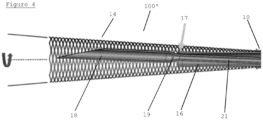
- Figure 4 shows a puncture device 100' according to a second embodiment of the invention. It is to be noted that the same reference numerals will be used that were also used when describing the first embodiment, and a detailed description of the corresponding components will be omitted.
- the puncture means 18 does not have a uniform cross-section but becomes thinner at a thinning portion 19 when moving from the distal end of the puncture means 18 to the proximal end.
- the tube 16 has a flared-out portion 17 at its distal end.
- the flared-out portion 17 makes it easier to retract the puncture means 18 into the tube 16.
- the maximum degree of freedom is defined by the angle between the expanded tissue expansion means 14 and the center line (which is indicated by a dashed line).
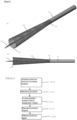
- Figure 5 shows exemplary steps in the use of the puncture device.
- the puncture device is advanced, typically through a patient's vasculature, to an intended puncture location.
- step S112 the surgeon attempts a puncture. If desired, it can be checked whether the puncture was successful by means of aspirating blood through a lumen of the puncture means of the puncture device. If successful, further procedures such as the placement of a device such as the TIPS stent graft take place.
- step S114 the tissue expansion means is expanded so as to push away tissue to thereby create a space for reorienting the puncture means.
- step S116 the puncture means is reoriented and brought into a position that is, in the surgeon's assessment, more likely to result in a successful puncture.
- step S118 another puncture attempt is made. If this step is unsuccessful, steps S116 and S118 can be performed repeatedly, until the surgeon succeeds in puncturing the blood vessel to be punctured. Subsequently (not shown in the flow chart), once the shunt has been created, the tissue expansion means 14 is retrieved, as is the rest of the puncture device, whilst typically leaving a guidewire in place to aid in placing an implant.
Landscapes
- Health & Medical Sciences (AREA)
- Surgery (AREA)
- Life Sciences & Earth Sciences (AREA)
- Heart & Thoracic Surgery (AREA)
- Molecular Biology (AREA)
- Veterinary Medicine (AREA)
- Engineering & Computer Science (AREA)
- Biomedical Technology (AREA)
- Nuclear Medicine, Radiotherapy & Molecular Imaging (AREA)
- Medical Informatics (AREA)
- Public Health (AREA)
- Animal Behavior & Ethology (AREA)
- General Health & Medical Sciences (AREA)
- Pathology (AREA)
- Oral & Maxillofacial Surgery (AREA)
- Surgical Instruments (AREA)
- Media Introduction/Drainage Providing Device (AREA)
Claims (11)
- Punktionsvorrichtung (100), die zum Vorschieben an eine Punktionsstelle durch das menschliche Gefäßsystem angeordnet ist, wobei die Punktionsvorrichtung umfasst:- ein Punktionsmittel (18), wobei das Punktionsmittel ein distales Ende umfasst, das zum Erzeugen einer Punktion in dem Gewebe eines Patienten angeordnet ist,- eine Hülle (10), wobei die Hülle (10) derart angeordnet ist, dass sie das Punktionsmittel (18) umgibt, wobei das Punktionsmittel (18) verschiebbar im Inneren der Hülle (10) angeordnet ist,- ein Gewebedehnungsmittel (14), wobei das Gewebedehnungsmittel (14) derart angeordnet ist, dass es selektiv aktiviert werden kann, wobei in dem aktivierten Zustand das Gewebedehnungsmittel (14) das Gewebe des Patienten weg schiebt, um dadurch eine Neuausrichtung des Punktionsmittels (18) zu ermöglichen, wobei das Gewebedehnungsmittel (14) derart angeordnet ist, dass es sich dehnt, wenn es über eine Schwellentemperatur erwärmt wird, um dadurch Gewebe weg zu schieben, wobei das Gewebedehnungsmittel (14) eine Legierung mit Formgedächtnis umfasst.
- Punktionsvorrichtung nach Anspruch 1, wobei das Gewebedehnungsmittel (14) verschiebbar im Inneren der Hülle (10) angeordnet ist und derart angeordnet ist, dass es aus der Hülle (10) heraus verschoben werden kann, um sich in Bezug auf das distale Ende des Punktionsmittels (18) distal zu erstrecken.
- Punktionsvorrichtung nach Anspruch 1 oder 2, weiter umfassend ein Mittel zum selektiven Erwärmen des Gewebedehnungsmittels.
- Punktionsvorrichtung nach einem der vorstehenden Ansprüche, wobei die Schwellentemperatur höher als 37 °C ist.
- Punktionsvorrichtung nach einem der vorstehenden Ansprüche, wobei das Gewebedehnungsmittel (14) derart angeordnet ist, dass es in der aktivierten Konfiguration eine Form annimmt, in der sich die Querschnittsfläche beim Bewegen von dem proximalen zu dem distalen Ende des Gewebedehnungsmittels (14) vergrößert.
- Punktionsvorrichtung nach einem der vorstehenden Ansprüche, wobei das Gewebedehnungsmittel (14) derart angeordnet ist, dass es im nicht-aktivierten Zustand durch Vorschieben der Hülle (10) in Bezug auf das Gewebedehnungsmittel (14) in den nicht-aktivierten Zustand reduziert werden kann.
- Punktionsvorrichtung nach einem der vorstehenden Ansprüche, wobei das Gewebedehnungsmittel (14) eine dehnbare Gitterstruktur umfasst.
- Punktionsvorrichtung nach einem der vorstehenden Ansprüche, wobei das Punktionsmittel (18) einen nicht einheitlichen Querschnittsdurchmesser aufweist, wobei sich der Querschnittsdurchmesser beim Bewegen von dem distalen zu dem proximalen Ende verkleinert.
- Punktionsvorrichtung nach einem der vorstehenden Ansprüche, wobei die Hülle (10) einen aufgeweiteten distalsten Abschnitt (12) aufweist.
- Punktionsvorrichtung nach einem der vorstehenden Ansprüche, weiter umfassend ein Rohr (16), das zwischen dem Punktionsmittel (18) und dem Gewebedehnungsmittel (14) angeordnet ist.
- Punktionsvorrichtung nach Anspruch 10, wobei das Rohr (16) einen aufgeweiteten Abschnitt (17) am distalsten Ende umfasst.
Applications Claiming Priority (1)
| Application Number | Priority Date | Filing Date | Title |
|---|---|---|---|
| PCT/EP2021/069969 WO2023284978A1 (en) | 2021-07-16 | 2021-07-16 | Puncture device |
Publications (3)
| Publication Number | Publication Date |
|---|---|
| EP4370039A1 EP4370039A1 (de) | 2024-05-22 |
| EP4370039C0 EP4370039C0 (de) | 2025-06-04 |
| EP4370039B1 true EP4370039B1 (de) | 2025-06-04 |
Family
ID=77249808
Family Applications (1)
| Application Number | Title | Priority Date | Filing Date |
|---|---|---|---|
| EP21751769.7A Active EP4370039B1 (de) | 2021-07-16 | 2021-07-16 | Punktionsvorrichtung |
Country Status (5)
| Country | Link |
|---|---|
| US (1) | US12558119B2 (de) |
| EP (1) | EP4370039B1 (de) |
| CN (1) | CN117642124A (de) |
| CA (1) | CA3222610A1 (de) |
| WO (1) | WO2023284978A1 (de) |
Families Citing this family (1)
| Publication number | Priority date | Publication date | Assignee | Title |
|---|---|---|---|---|
| US12558119B2 (en) | 2021-07-16 | 2026-02-24 | Angiomed Gmbh & Co. Medizintechnik Kg | Puncture device |
Family Cites Families (14)
| Publication number | Priority date | Publication date | Assignee | Title |
|---|---|---|---|---|
| US7860555B2 (en) | 2005-02-02 | 2010-12-28 | Voyage Medical, Inc. | Tissue visualization and manipulation system |
| US9050064B2 (en) | 2007-04-27 | 2015-06-09 | Cvdevices, Llc | Systems for engaging a bodily tissue and methods of using the same |
| US8267857B2 (en) | 2009-01-30 | 2012-09-18 | Cook Medical Technologies Llc | Expandable port for accessing a bodily opening |
| US8940008B2 (en) | 2010-04-23 | 2015-01-27 | Assist Medical Llc | Transseptal access device and method of use |
| CN105682726B (zh) | 2013-08-07 | 2020-01-03 | 贝利斯医疗公司 | 用于穿刺组织的方法和设备 |
| US20170265892A1 (en) | 2016-03-16 | 2017-09-21 | Coopersurgical, Inc. | Introducer Sheaths for Endoscopes and Related Methods |
| US10065018B2 (en) | 2016-03-16 | 2018-09-04 | Krishna Rocha-Singh | Apparatus and method for promoting angiogenesis in ischemic tissue |
| EP3451895B1 (de) | 2016-05-06 | 2021-09-15 | Cardioscout Solutions, Inc. | Zugangsvorrichtungen zur behandlung von medizinischen zuständen und bereitstellung von injizierbaren produkten |
| CN106725643A (zh) * | 2016-06-22 | 2017-05-31 | 苏州茵络医疗器械有限公司 | 用于血管腔内手术的破膜器 |
| CN110475577B (zh) | 2016-11-17 | 2023-04-07 | 波士顿科学国际有限公司 | 液压自动穿越球囊/导管 |
| WO2020055908A1 (en) | 2018-09-10 | 2020-03-19 | Stryker Corporation | Inverting thrombectomy apparatuses and methods of use |
| EP3852656A1 (de) | 2018-09-18 | 2021-07-28 | Boston Scientific Scimed, Inc. | Gerippte dilatatorspitze |
| CN114568015A (zh) | 2019-08-22 | 2022-05-31 | 爱德华兹生命科学公司 | 穿刺针 |
| US12558119B2 (en) | 2021-07-16 | 2026-02-24 | Angiomed Gmbh & Co. Medizintechnik Kg | Puncture device |
-
2021
- 2021-07-16 US US18/579,828 patent/US12558119B2/en active Active
- 2021-07-16 CA CA3222610A patent/CA3222610A1/en active Pending
- 2021-07-16 WO PCT/EP2021/069969 patent/WO2023284978A1/en not_active Ceased
- 2021-07-16 CN CN202180100516.1A patent/CN117642124A/zh active Pending
- 2021-07-16 EP EP21751769.7A patent/EP4370039B1/de active Active
Also Published As
| Publication number | Publication date |
|---|---|
| EP4370039C0 (de) | 2025-06-04 |
| EP4370039A1 (de) | 2024-05-22 |
| CN117642124A (zh) | 2024-03-01 |
| US20240325046A1 (en) | 2024-10-03 |
| WO2023284978A1 (en) | 2023-01-19 |
| CA3222610A1 (en) | 2023-01-19 |
| US12558119B2 (en) | 2026-02-24 |
Similar Documents
| Publication | Publication Date | Title |
|---|---|---|
| JP7812406B2 (ja) | 組織を後退させる為の装置および方法 | |
| EP3256051B1 (de) | Verschlussvorrichtung zur abdichtung einer perkutanen öffnung in einem gefäss | |
| US20190269413A1 (en) | Apparatus and method of monofilament implant delivery in a body vessel of a patient | |
| JP5527850B2 (ja) | 組織貫通装置及びその方法 | |
| US8328841B2 (en) | Embolization coil delivery systems and methods | |
| JP2004536665A (ja) | 塞栓物質を捕捉する一時的装置 | |
| JP2019523088A (ja) | 組織後退装置 | |
| WO2014102767A2 (en) | Apparatus and method of monofilament implant delivery in a body vessel of a patient | |
| EP4161626A1 (de) | Verfahren und vorrichtungen zur harnröhrenbehandlung | |
| EP4370039B1 (de) | Punktionsvorrichtung | |
| US20190099280A1 (en) | Systems and methods for the retrieval gallbladder implants | |
| US20250381022A1 (en) | Urethral treatment apparatus and method | |
| US20250032123A1 (en) | Anchors for a collapsing implant | |
| CN212755754U (zh) | 牵开器组件及牵开器 | |
| US10939898B2 (en) | Vascular closure device | |
| CN120583921A (zh) | 用于管腔内穿刺的装置、系统和方法 | |
| CN114206260A (zh) | 定位装置及方法 | |
| HK40065879A (zh) | 定位装置及方法 |
Legal Events
| Date | Code | Title | Description |
|---|---|---|---|
| STAA | Information on the status of an ep patent application or granted ep patent |
Free format text: STATUS: UNKNOWN |
|
| STAA | Information on the status of an ep patent application or granted ep patent |
Free format text: STATUS: THE INTERNATIONAL PUBLICATION HAS BEEN MADE |
|
| PUAI | Public reference made under article 153(3) epc to a published international application that has entered the european phase |
Free format text: ORIGINAL CODE: 0009012 |
|
| STAA | Information on the status of an ep patent application or granted ep patent |
Free format text: STATUS: REQUEST FOR EXAMINATION WAS MADE |
|
| 17P | Request for examination filed |
Effective date: 20231213 |
|
| AK | Designated contracting states |
Kind code of ref document: A1 Designated state(s): AL AT BE BG CH CY CZ DE DK EE ES FI FR GB GR HR HU IE IS IT LI LT LU LV MC MK MT NL NO PL PT RO RS SE SI SK SM TR |
|
| DAV | Request for validation of the european patent (deleted) | ||
| DAX | Request for extension of the european patent (deleted) | ||
| GRAP | Despatch of communication of intention to grant a patent |
Free format text: ORIGINAL CODE: EPIDOSNIGR1 |
|
| STAA | Information on the status of an ep patent application or granted ep patent |
Free format text: STATUS: GRANT OF PATENT IS INTENDED |
|
| INTG | Intention to grant announced |
Effective date: 20250123 |
|
| GRAS | Grant fee paid |
Free format text: ORIGINAL CODE: EPIDOSNIGR3 |
|
| GRAA | (expected) grant |
Free format text: ORIGINAL CODE: 0009210 |
|
| STAA | Information on the status of an ep patent application or granted ep patent |
Free format text: STATUS: THE PATENT HAS BEEN GRANTED |
|
| AK | Designated contracting states |
Kind code of ref document: B1 Designated state(s): AL AT BE BG CH CY CZ DE DK EE ES FI FR GB GR HR HU IE IS IT LI LT LU LV MC MK MT NL NO PL PT RO RS SE SI SK SM TR |
|
| RAP3 | Party data changed (applicant data changed or rights of an application transferred) |
Owner name: ANGIOMED GMBH & CO. MEDIZINTECHNIK KG |
|
| REG | Reference to a national code |
Ref country code: GB Ref legal event code: FG4D |
|
| REG | Reference to a national code |
Ref country code: CH Ref legal event code: EP |
|
| REG | Reference to a national code |
Ref country code: IE Ref legal event code: FG4D |
|
| U01 | Request for unitary effect filed |
Effective date: 20250604 |
|
| U07 | Unitary effect registered |
Designated state(s): AT BE BG DE DK EE FI FR IT LT LU LV MT NL PT RO SE SI Effective date: 20250611 |
|
| PG25 | Lapsed in a contracting state [announced via postgrant information from national office to epo] |
Ref country code: ES Free format text: LAPSE BECAUSE OF FAILURE TO SUBMIT A TRANSLATION OF THE DESCRIPTION OR TO PAY THE FEE WITHIN THE PRESCRIBED TIME-LIMIT Effective date: 20250604 |
|
| PG25 | Lapsed in a contracting state [announced via postgrant information from national office to epo] |
Ref country code: NO Free format text: LAPSE BECAUSE OF FAILURE TO SUBMIT A TRANSLATION OF THE DESCRIPTION OR TO PAY THE FEE WITHIN THE PRESCRIBED TIME-LIMIT Effective date: 20250904 Ref country code: GR Free format text: LAPSE BECAUSE OF FAILURE TO SUBMIT A TRANSLATION OF THE DESCRIPTION OR TO PAY THE FEE WITHIN THE PRESCRIBED TIME-LIMIT Effective date: 20250905 |
|
| PG25 | Lapsed in a contracting state [announced via postgrant information from national office to epo] |
Ref country code: PL Free format text: LAPSE BECAUSE OF FAILURE TO SUBMIT A TRANSLATION OF THE DESCRIPTION OR TO PAY THE FEE WITHIN THE PRESCRIBED TIME-LIMIT Effective date: 20250604 |
|
| PG25 | Lapsed in a contracting state [announced via postgrant information from national office to epo] |
Ref country code: HR Free format text: LAPSE BECAUSE OF FAILURE TO SUBMIT A TRANSLATION OF THE DESCRIPTION OR TO PAY THE FEE WITHIN THE PRESCRIBED TIME-LIMIT Effective date: 20250604 |
|
| PG25 | Lapsed in a contracting state [announced via postgrant information from national office to epo] |
Ref country code: RS Free format text: LAPSE BECAUSE OF FAILURE TO SUBMIT A TRANSLATION OF THE DESCRIPTION OR TO PAY THE FEE WITHIN THE PRESCRIBED TIME-LIMIT Effective date: 20250904 |
|
| PG25 | Lapsed in a contracting state [announced via postgrant information from national office to epo] |
Ref country code: IS Free format text: LAPSE BECAUSE OF FAILURE TO SUBMIT A TRANSLATION OF THE DESCRIPTION OR TO PAY THE FEE WITHIN THE PRESCRIBED TIME-LIMIT Effective date: 20251004 |
|
| PG25 | Lapsed in a contracting state [announced via postgrant information from national office to epo] |
Ref country code: SM Free format text: LAPSE BECAUSE OF FAILURE TO SUBMIT A TRANSLATION OF THE DESCRIPTION OR TO PAY THE FEE WITHIN THE PRESCRIBED TIME-LIMIT Effective date: 20250604 |
|
| PG25 | Lapsed in a contracting state [announced via postgrant information from national office to epo] |
Ref country code: CZ Free format text: LAPSE BECAUSE OF FAILURE TO SUBMIT A TRANSLATION OF THE DESCRIPTION OR TO PAY THE FEE WITHIN THE PRESCRIBED TIME-LIMIT Effective date: 20250604 |
|
| PG25 | Lapsed in a contracting state [announced via postgrant information from national office to epo] |
Ref country code: SK Free format text: LAPSE BECAUSE OF FAILURE TO SUBMIT A TRANSLATION OF THE DESCRIPTION OR TO PAY THE FEE WITHIN THE PRESCRIBED TIME-LIMIT Effective date: 20250604 |
|
| REG | Reference to a national code |
Ref country code: CH Ref legal event code: H13 Free format text: ST27 STATUS EVENT CODE: U-0-0-H10-H13 (AS PROVIDED BY THE NATIONAL OFFICE) Effective date: 20260224 |
|
| U21 | Renewal fee for the european patent with unitary effect paid with additional fee |
Year of fee payment: 5 Effective date: 20260130 |