EP4368317A1 - Metallpaste zum verbinden, verbindung und herstellungsverfahren dafür - Google Patents
Metallpaste zum verbinden, verbindung und herstellungsverfahren dafür Download PDFInfo
- Publication number
- EP4368317A1 EP4368317A1 EP22837650.5A EP22837650A EP4368317A1 EP 4368317 A1 EP4368317 A1 EP 4368317A1 EP 22837650 A EP22837650 A EP 22837650A EP 4368317 A1 EP4368317 A1 EP 4368317A1
- Authority
- EP
- European Patent Office
- Prior art keywords
- mass
- copper
- bonding
- microparticles
- metal paste
- Prior art date
- Legal status (The legal status is an assumption and is not a legal conclusion. Google has not performed a legal analysis and makes no representation as to the accuracy of the status listed.)
- Pending
Links
Images

Classifications
-
- B—PERFORMING OPERATIONS; TRANSPORTING
- B22—CASTING; POWDER METALLURGY
- B22F—WORKING METALLIC POWDER; MANUFACTURE OF ARTICLES FROM METALLIC POWDER; MAKING METALLIC POWDER; APPARATUS OR DEVICES SPECIALLY ADAPTED FOR METALLIC POWDER
- B22F1/00—Metallic powder; Treatment of metallic powder, e.g. to facilitate working or to improve properties
- B22F1/10—Metallic powder containing lubricating or binding agents; Metallic powder containing organic material
-
- B—PERFORMING OPERATIONS; TRANSPORTING
- B22—CASTING; POWDER METALLURGY
- B22F—WORKING METALLIC POWDER; MANUFACTURE OF ARTICLES FROM METALLIC POWDER; MAKING METALLIC POWDER; APPARATUS OR DEVICES SPECIALLY ADAPTED FOR METALLIC POWDER
- B22F1/00—Metallic powder; Treatment of metallic powder, e.g. to facilitate working or to improve properties
- B22F1/05—Metallic powder characterised by the size or surface area of the particles
- B22F1/052—Metallic powder characterised by the size or surface area of the particles characterised by a mixture of particles of different sizes or by the particle size distribution
-
- B—PERFORMING OPERATIONS; TRANSPORTING
- B22—CASTING; POWDER METALLURGY
- B22F—WORKING METALLIC POWDER; MANUFACTURE OF ARTICLES FROM METALLIC POWDER; MAKING METALLIC POWDER; APPARATUS OR DEVICES SPECIALLY ADAPTED FOR METALLIC POWDER
- B22F1/00—Metallic powder; Treatment of metallic powder, e.g. to facilitate working or to improve properties
- B22F1/05—Metallic powder characterised by the size or surface area of the particles
- B22F1/054—Nanosized particles
- B22F1/056—Submicron particles having a size above 100 nm up to 300 nm
-
- B—PERFORMING OPERATIONS; TRANSPORTING
- B22—CASTING; POWDER METALLURGY
- B22F—WORKING METALLIC POWDER; MANUFACTURE OF ARTICLES FROM METALLIC POWDER; MAKING METALLIC POWDER; APPARATUS OR DEVICES SPECIALLY ADAPTED FOR METALLIC POWDER
- B22F1/00—Metallic powder; Treatment of metallic powder, e.g. to facilitate working or to improve properties
- B22F1/06—Metallic powder characterised by the shape of the particles
- B22F1/068—Flake-like particles
-
- B—PERFORMING OPERATIONS; TRANSPORTING
- B22—CASTING; POWDER METALLURGY
- B22F—WORKING METALLIC POWDER; MANUFACTURE OF ARTICLES FROM METALLIC POWDER; MAKING METALLIC POWDER; APPARATUS OR DEVICES SPECIALLY ADAPTED FOR METALLIC POWDER
- B22F7/00—Manufacture of composite layers, workpieces, or articles, comprising metallic powder, by sintering the powder, with or without compacting wherein at least one part is obtained by sintering or compression
- B22F7/06—Manufacture of composite layers, workpieces, or articles, comprising metallic powder, by sintering the powder, with or without compacting wherein at least one part is obtained by sintering or compression of composite workpieces or articles from parts, e.g. to form tipped tools
- B22F7/062—Manufacture of composite layers, workpieces, or articles, comprising metallic powder, by sintering the powder, with or without compacting wherein at least one part is obtained by sintering or compression of composite workpieces or articles from parts, e.g. to form tipped tools involving the connection or repairing of preformed parts
- B22F7/064—Manufacture of composite layers, workpieces, or articles, comprising metallic powder, by sintering the powder, with or without compacting wherein at least one part is obtained by sintering or compression of composite workpieces or articles from parts, e.g. to form tipped tools involving the connection or repairing of preformed parts using an intermediate powder layer
-
- B—PERFORMING OPERATIONS; TRANSPORTING
- B22—CASTING; POWDER METALLURGY
- B22F—WORKING METALLIC POWDER; MANUFACTURE OF ARTICLES FROM METALLIC POWDER; MAKING METALLIC POWDER; APPARATUS OR DEVICES SPECIALLY ADAPTED FOR METALLIC POWDER
- B22F7/00—Manufacture of composite layers, workpieces, or articles, comprising metallic powder, by sintering the powder, with or without compacting wherein at least one part is obtained by sintering or compression
- B22F7/06—Manufacture of composite layers, workpieces, or articles, comprising metallic powder, by sintering the powder, with or without compacting wherein at least one part is obtained by sintering or compression of composite workpieces or articles from parts, e.g. to form tipped tools
- B22F7/08—Manufacture of composite layers, workpieces, or articles, comprising metallic powder, by sintering the powder, with or without compacting wherein at least one part is obtained by sintering or compression of composite workpieces or articles from parts, e.g. to form tipped tools with one or more parts not made from powder
-
- B—PERFORMING OPERATIONS; TRANSPORTING
- B23—MACHINE TOOLS; METAL-WORKING NOT OTHERWISE PROVIDED FOR
- B23K—SOLDERING OR UNSOLDERING; WELDING; CLADDING OR PLATING BY SOLDERING OR WELDING; CUTTING BY APPLYING HEAT LOCALLY, e.g. FLAME CUTTING; WORKING BY LASER BEAM
- B23K35/00—Rods, electrodes, materials, or media, for use in soldering, welding, or cutting
- B23K35/02—Rods, electrodes, materials, or media, for use in soldering, welding, or cutting characterised by mechanical features, e.g. shape
- B23K35/0222—Rods, electrodes, materials, or media, for use in soldering, welding, or cutting characterised by mechanical features, e.g. shape for use in soldering or brazing
- B23K35/0244—Powders, particles or spheres; Preforms made therefrom
- B23K35/025—Pastes, creams or slurries
-
- B—PERFORMING OPERATIONS; TRANSPORTING
- B23—MACHINE TOOLS; METAL-WORKING NOT OTHERWISE PROVIDED FOR
- B23K—SOLDERING OR UNSOLDERING; WELDING; CLADDING OR PLATING BY SOLDERING OR WELDING; CUTTING BY APPLYING HEAT LOCALLY, e.g. FLAME CUTTING; WORKING BY LASER BEAM
- B23K35/00—Rods, electrodes, materials, or media, for use in soldering, welding, or cutting
- B23K35/22—Rods, electrodes, materials, or media, for use in soldering, welding, or cutting characterised by the composition or nature of the material
- B23K35/24—Selection of soldering or welding materials proper
- B23K35/30—Selection of soldering or welding materials proper with the principal constituent melting at less than 1550°C
- B23K35/302—Cu as the principal constituent
-
- C—CHEMISTRY; METALLURGY
- C09—DYES; PAINTS; POLISHES; NATURAL RESINS; ADHESIVES; COMPOSITIONS NOT OTHERWISE PROVIDED FOR; APPLICATIONS OF MATERIALS NOT OTHERWISE PROVIDED FOR
- C09J—ADHESIVES; NON-MECHANICAL ASPECTS OF ADHESIVE PROCESSES IN GENERAL; ADHESIVE PROCESSES NOT PROVIDED FOR ELSEWHERE; USE OF MATERIALS AS ADHESIVES
- C09J9/00—Adhesives characterised by their physical nature or the effects produced, e.g. glue sticks
- C09J9/02—Electrically-conducting adhesives
-
- C—CHEMISTRY; METALLURGY
- C22—METALLURGY; FERROUS OR NON-FERROUS ALLOYS; TREATMENT OF ALLOYS OR NON-FERROUS METALS
- C22C—ALLOYS
- C22C1/00—Making non-ferrous alloys
- C22C1/04—Making non-ferrous alloys by powder metallurgy
- C22C1/0425—Copper-based alloys
-
- H—ELECTRICITY
- H01—ELECTRIC ELEMENTS
- H01B—CABLES; CONDUCTORS; INSULATORS; SELECTION OF MATERIALS FOR THEIR CONDUCTIVE, INSULATING OR DIELECTRIC PROPERTIES
- H01B1/00—Conductors or conductive bodies characterised by the conductive materials; Selection of materials as conductors
- H01B1/20—Conductive material dispersed in non-conductive organic material
- H01B1/22—Conductive material dispersed in non-conductive organic material the conductive material comprising metals or alloys
-
- H—ELECTRICITY
- H10—SEMICONDUCTOR DEVICES; ELECTRIC SOLID-STATE DEVICES NOT OTHERWISE PROVIDED FOR
- H10W—GENERIC PACKAGES, INTERCONNECTIONS, CONNECTORS OR OTHER CONSTRUCTIONAL DETAILS OF DEVICES COVERED BY CLASS H10
- H10W72/00—Interconnections or connectors in packages
- H10W72/071—Connecting or disconnecting
-
- B—PERFORMING OPERATIONS; TRANSPORTING
- B22—CASTING; POWDER METALLURGY
- B22F—WORKING METALLIC POWDER; MANUFACTURE OF ARTICLES FROM METALLIC POWDER; MAKING METALLIC POWDER; APPARATUS OR DEVICES SPECIALLY ADAPTED FOR METALLIC POWDER
- B22F2301/00—Metallic composition of the powder or its coating
- B22F2301/10—Copper
-
- B—PERFORMING OPERATIONS; TRANSPORTING
- B22—CASTING; POWDER METALLURGY
- B22F—WORKING METALLIC POWDER; MANUFACTURE OF ARTICLES FROM METALLIC POWDER; MAKING METALLIC POWDER; APPARATUS OR DEVICES SPECIALLY ADAPTED FOR METALLIC POWDER
- B22F2304/00—Physical aspects of the powder
- B22F2304/05—Submicron size particles
-
- B—PERFORMING OPERATIONS; TRANSPORTING
- B22—CASTING; POWDER METALLURGY
- B22F—WORKING METALLIC POWDER; MANUFACTURE OF ARTICLES FROM METALLIC POWDER; MAKING METALLIC POWDER; APPARATUS OR DEVICES SPECIALLY ADAPTED FOR METALLIC POWDER
- B22F2304/00—Physical aspects of the powder
- B22F2304/10—Micron size particles, i.e. above 1 micrometer up to 500 micrometer
-
- B—PERFORMING OPERATIONS; TRANSPORTING
- B22—CASTING; POWDER METALLURGY
- B22F—WORKING METALLIC POWDER; MANUFACTURE OF ARTICLES FROM METALLIC POWDER; MAKING METALLIC POWDER; APPARATUS OR DEVICES SPECIALLY ADAPTED FOR METALLIC POWDER
- B22F2998/00—Supplementary information concerning processes or compositions relating to powder metallurgy
- B22F2998/10—Processes characterised by the sequence of their steps
Definitions
- the present invention relates to a metal paste for bonding, a bonded body, and a method for manufacturing the bonded body.
- various bonding materials are used to form a bonding layer that bonds a semiconductor element with a lead frame or the like (supporting member).
- a bonding layer that bonds a semiconductor element with a lead frame or the like (supporting member).
- LSI high-lead solder
- the bonding layer is required to have connection reliability and high thermal conductivity characteristics.
- conventionally used high-lead solder bonding layers have a problem with connection reliability and also have insufficient thermal conductivity (30 Wm -1 K -1 ), and therefore, alternate materials are required.
- a sintered silver layer formed by a sintering phenomenon of silver particles has been proposed (see the following Patent Literature 1).
- a sintered silver layer has been reported to have high thermal conductivity (> 100 Wm -1 K -1 ) and high connection reliability over power cycles, and attention has been paid thereto (see the following Non Patent Literature 1).
- a thermocompression bonding process that involves high pressure is essential for improving the density of the sintered silver layer, and there are problems such as damage of semiconductor element chips and a decrease in the throughput of the thermocompression bonding process.
- the material cost of silver is high.
- a sintered copper layer using copper has been proposed. Copper has excellent mechanical strength compared to silver, high-temperature reliability can be easily obtained without increasing the density as much as a sintered silver layer, and the material cost can also be suppressed to a low level.
- a sintered copper layer a sintered copper layer obtained by reducing and sintering copper oxide particles has been proposed (see the following Patent Literature 2 and the following Non Patent Literature 2).
- an object of the present invention is to provide a metal paste for bonding, with which a bonded body having sufficient bonding strength can be obtained even in a case where bonding is achieved under no added pressure conditions in an atmosphere including no hydrogen or having a low hydrogen concentration, and a method for manufacturing a bonded body.
- An aspect of the present invention provides a metal paste for bonding including metal particles, a dispersion medium, a reducing agent, and a reduction aid, in which the metal particles contain copper particles, the reduction aid includes a coordinating compound having electron back-donation properties, the coordinating compound is at least one selected from the group consisting of an organic phosphorus compound and an organic sulfur compound, and the metal paste for bonding contains, as the reducing agent, 1.6 parts by mass or more and 10 parts by mass or less of a polyol-based compound with respect to 100 parts by mass of a total mass of the copper particles.
- no added pressure means a state in which the copper paste for bonding is subjected only to the weight of the members to be bonded, or only to the weight of a weight (a pressure of 0.01 MPa or less as calculated in terms of pressure) used for prevention of chip tilting or void reduction in addition to the weight of the members.
- the coordinating compound may have a lone pair of electrons and a vacant ⁇ -electron orbital.
- the coordinating compound may be at least one selected from the group consisting of an organic phosphorus compound represented by the following Formula (1) and an organic phosphorus compound represented by the following Formula (2).
- R 1 , R 2 , and R 3 each independently represent a monovalent organic group or -OR (R represents a monovalent organic group); and R 1 , R 2 , and R 3 may form a ring.
- R 4 , R 5 , and R 6 each independently represent a monovalent organic group or -OR (R represents a monovalent organic group); and one or more of R 4 , R 5 , and R 6 are -OR (R represents a monovalent organic group).
- a content of the reduction aid may be 0.5 parts by mass or more and 10 parts by mass or less with respect to 100 parts by mass of the total mass of the copper particles.
- the copper particles may include copper sub-microparticles having a volume average particle size of 0.15 ⁇ m or more and 0.8 ⁇ m or less and copper microparticles having a volume average particle size of 2 ⁇ m or more and 50 ⁇ m or less, a sum of a content of the copper sub-microparticles and a content of the copper microparticles may be 80% by mass or more based on the total mass of the metal particles, and the content of the copper sub-microparticles may be 30% by mass or more and 90% by mass or less based on a sum of a mass of the copper sub-microparticles and a mass of the copper microparticles.
- the copper microparticles may be flake-shaped.
- Another aspect of the present invention provides a method for manufacturing a bonded body, the method including a step of preparing a laminated body having a first member, the metal paste for bonding according to the above-described one aspect of the present invention, and a second member laminated in this order; and a sintering step of sintering the metal paste for bonding in the laminated body.
- a bonded body having a bonding strength that is sufficient even in a case where the metal paste for bonding is sintered in the sintering step under no added pressure conditions in an atmosphere that does not include hydrogen or has a low hydrogen concentration can be obtained.
- the sintering step may be a step of sintering the metal paste for bonding under no added pressure conditions in an oxygen-free atmosphere.
- At least one of the first member and the second member may be a semiconductor element.
- Another aspect of the present invention provides a bonded body including a first member, a second member, and a sintered body of the metal paste for bonding according to the above-described one aspect of the present invention, the sintered body bonding the first member and the second member.
- a metal paste for bonding with which a bonded body having sufficient bonding strength even in a case of bonding under no added pressure conditions in an atmosphere that does not include hydrogen or has a low hydrogen concentration can be obtained, and a method for manufacturing a bonded body can be provided.
- present embodiment An embodiment for carrying out the present invention (hereinafter, referred to as "present embodiment") will be described in detail below.
- present invention is not intended to be limited to the following embodiment.
- the metal paste for bonding of the present embodiment includes metal particles, a dispersion medium, a reducing agent, and a reduction aid, in which the metal particles contain copper particles, the reducing agent contains a polyol-based compound, and the reduction aid contains a coordinating compound having electron back-donation properties.
- the coordinating compound is at least one selected from the group consisting of an organic phosphorus compound and an organic sulfur compound
- the metal paste for bonding can contain, as the reducing agent, 1.6 parts by mass or more and 10 parts by mass or less of a polyol-based compound with respect to 100 parts by mass of the total mass of the copper particles.
- a copper complex to which a coordinating compound is bonded by back-donation bonding tends to be stabilized in a state with a low oxidation number, and this is considered as one of the factors that allow the reduction of copper in an oxidized state to copper metal even in the presence of a polyol-based compound having a low reducing power, and allow the formation of a sintered body having sufficient bonding strength.
- copper particles copper sub-microparticles and copper microparticles may be mentioned.
- the term copper particles refers to particles containing copper as a main component and refers to particles in which, for example, the content proportion of copper in the particles is 80% by mass or more.
- the content proportion of copper in the copper particles may be 85% by mass or more, 90% by mass or more, 95% by mass or more, 99% by mass or more, or 100% by mass.
- the copper sub-microparticles may be copper particles having sinterability in a temperature range of 250°C or higher and 380°C or lower.
- Examples of the copper sub-microparticles include those including copper particles having a particle size of 0.01 ⁇ m or more and 0.8 ⁇ m or less, and for example, copper particles having a volume average particle size of 0.01 ⁇ m or more and 0.8 ⁇ m or less can be used.
- the volume average particle size of the copper sub-microparticles is 0.01 ⁇ m or more, effects such as suppression of the synthesis cost of the copper sub-microparticles, satisfactory dispersibility, and suppression of the amount of an organic protective agent used, are easily obtained.
- the volume average particle size of the copper sub-microparticles When the volume average particle size of the copper sub-microparticles is 0.8 ⁇ m or less, an effect that the copper sub-microparticles have excellent sinterability is likely to be obtained. From the viewpoint of providing the above-described effects more effectively, the volume average particle size of the copper sub-microparticles may be 0.6 ⁇ m or less, may be 0.5 ⁇ m or less, or may be 0.4 ⁇ m or less. Furthermore, the volume average particle size of the copper sub-microparticles may be 0.02 ⁇ m or more, may be 0.05 ⁇ m or more, or may be 0.1 ⁇ m or more.
- the volume average particle size of the copper sub-microparticles may be, for example, 0.01 ⁇ m or more and 0.5 ⁇ m or less, may be 0.12 ⁇ m or more and 0.8 ⁇ m or less, may be 0.15 ⁇ m or more and 0.8 ⁇ m or less, may be 0.15 ⁇ m or more and 0.6 ⁇ m or less, may be 0.2 ⁇ m or more and 0.5 ⁇ m or less, or may be 0.3 ⁇ m or more and 0.45 ⁇ m or less.
- the volume average particle size means 50% volume average particle size.
- the volume average particle size can be determined by a method of measuring a dispersion in which the copper particles that serve as a raw material, or dry copper particles obtained by removing a volatile component from the metal paste for bonding are dispersed in a dispersion medium by using a dispersant, by using a light scattering particle size distribution analyzer (for example, Shimadzu Nanoparticle Size Distribution Analyzer (SALD-7500nano, manufactured by SHIMADZU CORPORATION)), or the like.
- SALD-7500nano Shimadzu Nanoparticle Size Distribution Analyzer
- hexane, toluene, ⁇ -terpineol, 4-methyl-1,3-dioxolan-2-one, water, or the like can be used as the dispersion medium.
- the content of the copper sub-microparticles may be 20% by mass or more, may be 30% by mass or more, may be 35% by mass or more, may be 40% by mass or more, may be 90% by mass or less, may be 85% by mass or less, may be 80% by mass or less, may be 20% by mass or more and 90% by mass or less, may be 30% by mass or more and 90% by mass or less, may be 35% by mass or more and 85% by mass or less, or may be 40% by mass or more and 80% by mass or less, all based on the total mass of the metal particles.
- the content of the copper sub-microparticles is within the above-described range, it is easy to secure the bonding strength of a bonded body manufactured by sintering the copper paste for bonding, and in a case where the copper paste for bonding is used for the bonding of semiconductor elements, the semiconductor device tends to exhibit satisfactory die shear strength and connection reliability.
- the content of the copper sub-microparticles is 20% by mass or more and 90% by mass or less based on the sum of all the masses of the copper particles.
- the content of the copper sub-microparticles is 20% by mass or more, in a case where the copper sub-microparticles are used in combination with copper microparticles such as flake-shaped copper microparticles, the spaces between the copper particles can be sufficiently filled, it is easy to secure the bonding strength of a bonded boy manufactured by sintering the copper paste for bonding, and in a case where the copper paste for bonding is used for the bonding of semiconductor elements, the semiconductor device tends to exhibit satisfactory die shear strength and connection reliability.
- the content of the copper sub-microparticles is 90% by mass or less, since the volume shrinkage at the time of sintering the copper paste for bonding under no added pressure conditions can be sufficiently suppressed, it is easy to secure the bonding strength of a bonded body manufactured by sintering the copper paste for bonding, and in a case where the copper paste for bonding is used for the bonding of semiconductor elements, the semiconductor device tends to exhibit satisfactory die shear strength and connection reliability.
- the content of the copper sub-microparticles may be 30% by mass or more, may be 35% by mass or more, may be 40% by mass or more, may be 85% by mass or less, may be 83% by mass or less, may be 80% by mass or less, may be 30% by mass or more and 85% by mass or less, may be 35% by mass or more and 85% by mass or less, or may be 40% by mass or more and 80% by mass or less, all based on the total mass of the copper particles.
- the shape of the copper sub-microparticles is not particularly limited.
- Examples of the shape of the copper sub-microparticles include a spherical shape, a lump-like shape, a needle-like shape, a flake shape, an approximately spherical shape, and aggregates of these.
- the shape of the copper sub-microparticles may be a spherical shape, an approximately spherical shape, or a flaky shape, and from the viewpoints of combustibility, dispersibility, mixability with flake-shaped microparticles, and the like, the shape may be a spherical shape or an approximately spherical shape.
- the term "flake shape” includes a flat plate-like shape such as a plate shape or a scale-like shape.
- the aspect ratio may be 5 or less, may be 4 or less, or may be 3 or less.
- the "aspect ratio" represents the long side (major axis) / thickness of a particle. Measurement of the long side (major axis) and thickness of a particle can be determined from, for example, a SEM image of the particle.
- the copper sub-microparticles may be treated with a surface treatment agent.
- the surface treatment agent include organic acids having 2 to 18 carbon atoms.
- the organic acids having 2 to 18 carbon atoms include saturated fatty acids such as acetic acid, propanoic acid, butanoic acid, pentanoic acid, hexanoic acid, heptanoic acid, caprylic acid, methylheptanoic acid, ethylhexanoic acid, propylpentanoic acid, pelargonic acid, methyloctanoic acid, ethylheptanoic acid, propylhexanoic acid, capric acid, methylnonanoic acid, ethyloctanoic acid, propylheptanoic acid, butylhexanoic acid, undecanoic acid, methyldecanoic acid, ethylnonanoic acid, propyloctanoic acid, butylhept
- organic acids one kind thereof may be used alone, or two or more kinds thereof may be used in combination.
- organic acid and the above-described copper sub-microparticles are combined, there is a tendency that both the dispersibility of the copper sub-microparticles and the eliminability of the organic acid during sintering can be achieved.
- the throughput rate of the surface treatment agent may be an amount that deposits one molecular layer to three molecular layers on the surface of the copper sub-microparticles. This amount can be calculated from the number of molecular layers (n) deposited on the surface of the copper sub-microparticles, the specific surface area (A p ) (unit m 2 /g) of the copper sub-microparticles, the molecular weight (M s ) (unit g/mol) of the surface treatment agent, the minimum coating area (S s ) (unit m 2 /pieces) of the surface treatment agent, and the Avogadro's number (N A ) (6.02 ⁇ 10 23 pieces).
- the specific surface area of the copper sub-microparticles can be calculated by measuring dried copper sub-microparticles by a BET specific surface area measurement method.
- the minimum coating area of the surface treatment agent is 2.05 ⁇ 10 -19 m 2 /molecule.
- the minimum coating area can be calculated from a molecular model or can be measured by the method described in " Chemistry and Education” (Katsuhiro UEDA, Sumio INAFUKU, Iwao MORI, 40(2), 1992, p.114-117 ). An example of the method for quantifying a surface treatment agent will be described.
- the surface treatment agent can be identified by using a thermal elimination gas-gas chromatography mass spectrometer with a dry powder obtained by removing the dispersion medium from the copper paste for bonding, whereby the number of carbon atoms and the molecular weight of the surface treatment agent can be determined.
- the carbon content proportion of the surface treatment agent can be analyzed by carbon content analysis. Examples of the carbon content analysis method include high-frequency induction heating furnace combustion / infrared absorption method.
- the amount of the surface treatment agent can be calculated from the number of carbon atoms, molecular weight, and carbon content proportion of the identified surface treatment agent, by the above-described formula.
- the throughput rate of the surface treatment agent may be 0.07% by mass or more, may be 0.1% by mass or more, may be 0.2% by mass or more, may be 2.1% by mass or less, may be 1.6% by mass or less, may be 1.1% by mass or less, may be 0.07% by mass or more and 2.1% by mass or less, may be 0.10% by mass or more and 1.6% by mass or less, or may be 0.2% by mass or more and 1.1% by mass or less, all based on the mass of the copper sub-microparticles having the surface treatment agent.
- copper sub-microparticles can be used.
- examples of commercially available sub-microparticles include CH-0200 (manufactured by MITSUI MINING & SMELTING CO., LTD., volume average particle size 0.36 ⁇ m), CH_0200A-L1 (manufactured by MITSUI MINING & SMELTING CO., LTD., volume average particle size 0.21 ⁇ m), HT-14 (manufactured by MITSUI MINING & SMELTING CO., LTD., volume average particle size 0.41 ⁇ m), CT-500 (manufactured by MITSUI MINING & SMELTING CO., LTD., volume average particle size 0.72 ⁇ m), and Tn-Cu100 (manufactured by TAIYO NIPPON SANSO CORPORATION, volume average particle size 0.12 ⁇ m).
- the copper sub-microparticles have satisfactory sinterability, problems that are observed in bonding materials which mainly use copper nanoparticles, such as highly expensive synthesis cost, unsatisfactory dispersibility, and a decrease in the volume shrinkage after sintering, can be reduced.
- copper particles having a particle size of 2 ⁇ m or more and 50 ⁇ m or less can be used, and for example, copper particles having a volume average particle size of 2 ⁇ m or more and 50 ⁇ m or less can be used.
- volume average particle size of the copper microparticles is within the above-described range, volume shrinkage at the time of sintering the copper paste for bonding under no added pressure conditions, generation of voids, and the like can be sufficiently reduced, it is easy to secure the bonding strength of a bonded body manufactured by sintering the copper paste for bonding under no added pressure conditions, and in a case where the copper paste for bonding is used for the bonding of semiconductor elements, the semiconductor device tends to exhibit satisfactory die shear strength and connection reliability.
- the volume average particle size of the copper microparticles may be 2 ⁇ m or more, may be 3 ⁇ m or more, may be 20 ⁇ m or less, may be 15 ⁇ m or less, may be 10 ⁇ m or less, may be 2 ⁇ m or more and 20 ⁇ m or less, may be 2 ⁇ m or more and 10 ⁇ m or less, may be 3 ⁇ m or more and 20 ⁇ m or less, or may be 3 ⁇ m or more and 10 ⁇ m or less.
- the shape of the copper microparticles is preferably a flake shape.
- the copper microparticles in the copper paste for bonding are oriented to be approximately parallel to the bonding surface, thereby the volume shrinkage at the time of sintering the copper paste for bonding can be suppressed, and it is easy to secure the bonding strength of a bonded body manufactured by sintering the copper paste for bonding.
- the copper paste for bonding is used for the bonding of a semiconductor element, the semiconductor device tends to exhibit satisfactory die shear strength and connection stability.
- the aspect ratio may be 4 or more, may be 6 or more, may be 10 or more, or may be 50 or more.
- the content of the copper microparticles may be 10% by mass or more and 90% by mass or less, may be 15% by mass or more and 65% by mass or less, or may be 20% by mass or more and 60% by mass or less, based on the total mass of the copper particles.
- the content of the copper microparticles is within the above-described range, it is easy to secure the bonding strength of a bonded body manufactured by sintering the copper paste for bonding, and in a case where the copper paste for bonding is used for the bonding of a semiconductor element, the semiconductor device tends to exhibit satisfactory die shear strength and connection reliability.
- the presence or absence of treatment with a surface treatment agent is not particularly limited; however, from the viewpoints of dispersion stability and oxidation resistance, the copper microparticles may be treated with a surface treatment agent.
- the surface treatment agent may be removed at the time of bonding.
- Such a surface treatment agent examples include aliphatic carboxylic acids such as dodecanoic acid, palmitic acid, heptadecanoic acid, stearic acid, arachidic acid, linolic acid, linoleic acid, and oleic acid; aromatic carboxylic acids such as terephthalic acid, pyromellitic acid, and o-phenoxybenzoic acid; aliphatic alcohols such as cetyl alcohol, stearyl alcohol, isobornyl cyclohexanol, and tetraethylene glycol; aromatic alcohols such as p-phenylphenol; alkylamines such as octylamine, dodecylamine, and stearylamine; aliphatic nitriles such as stearonitrile and decanenitrile; silane coupling agents such as an alkylalkoxysilane; and polymer treatment agents such as polyethylene glycol, polyvinyl alcohol, polyvinyl
- the throughput rate of the surface treatment agent may be an amount of one molecular layer or more on the particle surface.
- the throughput rate of such a surface treatment agent varies depending on the specific surface area of the copper microparticles, the molecular weight of the surface treatment agent, and the minimum coating area of the surface treatment agent.
- the throughput rate of the surface treatment agent may be 0.001% by mass or more and 2.0% by mass or less, may be 0.4% by mass or more and 2.0% by mass or less, or may be 0.5% by mass or more and 1.7% by mass or less, based on the mass of the copper microparticles having the surface treatment agent.
- the specific surface area of the copper microparticles, the molecular weight of the surface treatment agent, and the minimum coating area of the surface treatment agent can be calculated by methods similar to those in the case of the above-mentioned copper sub-microparticles.
- Examples of commercially available flake-shaped microparticles include MA-C025KFD (manufactured by MITSUI MINING & SMELTING CO., LTD., volume average particle size 7.5 ⁇ m), 3L3N (manufactured by FUKUDA METAL FOIL & POWDER CO., LTD., volume average particle size 6 ⁇ m), 2L3N (manufactured by FUKUDA METAL FOIL & POWDER CO., LTD., volume average particle size 9.9 ⁇ m), 4L3N (manufactured by FUKUDA METAL FOIL & POWDER CO., LTD., volume average particle size 3 ⁇ m), C3 (manufactured by FUKUDA METAL FOIL & POWDER CO., LTD., volume average particle size 37 ⁇ m), and 1110F (manufactured by MITSUI MINING & SMELTING CO., LTD., volume average particle size 7.5 ⁇ m), 3L3N
- the copper paste for bonding according to the present embodiment can include copper sub-microparticles and copper microparticles.
- the copper paste for bonding is prepared only from the above-described copper sub-microparticles, since volume shrinkage due to drying of the dispersion medium and sintering shrinkage occur significantly, the copper paste for bonding is easily peeled off from the adherend surface during sintering of the copper paste for bonding, and it is difficult to obtain sufficient die shear strength and connection reliability for the bonding of a semiconductor element and the like.
- the copper paste for bonding is prepared only from the above-described copper microparticles, there is a tendency that the sintering temperature is elevated, and a sintering step at 400°C or higher is required.
- a sintering step at 400°C or higher is required.
- the copper paste for bonding according to the present embodiment may include copper sub-microparticles having a volume average particle size of 0.15 ⁇ m or more and 0.8 ⁇ m or less and copper microparticles having a volume average particle size of 2 ⁇ m or more and 50 ⁇ m or less as copper particles, the sum of the content of copper sub-microparticles and the content of the copper microparticles may be 80% by mass or more based on the total mass of the metal particles, and the content of the copper sub-microparticles may be 30% by mass or more and 90% by mass or less based on the sum of the mass of the copper sub-microparticles and the mass of the copper microparticles.
- the metal paste for bonding of the present embodiment may include metal particles including a metal element other than copper (other metal particles) as the metal particles.
- the other metal particles may include, for example, particles of zinc, gold, palladium, silver, nickel, platinum, brass, manganese, tin, antimony, indium, aluminum, and vanadium.
- the volume average particle size may be 0.01 ⁇ m or more and 10 ⁇ m or less, may be 0.01 ⁇ m or more and 5 ⁇ m or less, or may be 0.05 ⁇ m or more and 3 ⁇ m or less.
- the copper paste for bonding includes other metal particles
- a sintered body in which a plurality of kinds of metals are solid-solutionized or dispersed can be obtained, mechanical characteristics such as the yield stress and fatigue strength of the sintered body are likely to be ameliorated, and the connection reliability is likely to be improved.
- the sintered body of the copper paste for bonding can have sufficient bonding strength to a specific adherend.
- the die shear strength and connection reliability of the semiconductor device are likely to be improved.
- the content of the other metal particles may be less than 5% by mass, or may be 3% by mass or less, based on the total mass of the metal particles.
- the other metal particles do not have to be included.
- the shape of the other metal particles is not particularly limited.
- the content of inorganic particles other than metal particles may be 30% by mass or less, may be 20% by mass or less, or may be 0% by mass, based on the total amount of the metal paste for bonding.
- the metal paste for bonding of the present embodiment contains a polyol-based compound as a reducing agent.
- the polyol-based compound may be a compound having a plurality of OH groups.
- polyol-based compound examples include diethylene glycol, triethylene glycol, tetraethylene glycol, pentaethylene glycol, hexaethylene glycol, dipropylene glycol, tripropylene glycol, tetrapropylene glycol, polyethylene glycol, polyethylene glycol 200, polyethylene glycol 300, polyethylene glycol 400, polypropylene glycol, polypropylene glycol 200, polypropylene glycol 300, polypropylene glycol 400, polypropylene glycol 700, polypropylene glycol 4000, polyethylene glycol monooleate, polyethylene glycol monostearate, polyethylene glycol monolaurate, polyoxyethylene sorbitan monolaurate, and polyoxyethylene polyoxypropylene glycol.
- the reducing agents can be used singly, or two or more kinds thereof can be used in combination.
- the 95% weight loss temperature when performing TG-DTA measurement in a nitrogen atmosphere may be 280°C or higher, may be 300°C or higher, or may be 320°C or higher. A sufficient amount of such a reducing agent is likely to be secured in the system during the period from reduction to sintering of the copper particles.
- the 95% weight loss temperature may be 420°C or lower, 400°C or lower, or 380°C or lower.
- the sintered body can have characteristics such as, for example, having a sufficient degree of sintering and being less likely to cause corrosion, and is likely to maintain sufficient bonding strength for a long period of time.
- the copper paste for bonding can include a polyol-based compound that satisfies the above-mentioned conditions of 95% weight loss temperature.
- Examples of the 95% weight loss temperature of the above-mentioned polyol-based compound include polyethylene glycol 200: 322°C, polyethylene glycol 300: 380°C, polyethylene glycol 400: 410°C, polypropylene glycol 300 (triol type): 337°C, polypropylene glycol 400 (diol type): 343°C, polypropylene glycol 700 (diol type): 383°C, and polypropylene glycol 4000 (triol type): 390°C.
- the content of the reducing agent in the copper paste for bonding may be 1.6 parts by mass or more, 1.8 parts by mass or more, 2.0 parts by mass or more, or 4.0 parts by mass or more, with respect to 100 parts by mass of the total mass of the copper particles, and from the viewpoint of suppressing a decrease in the bonding strength due to an excess of a reduction aid, the content of the reducing agent may be 10 parts by mass or less, 9.0 parts by mass or less, or 8.5 parts by mass or less.
- the content of the reducing agent in the copper paste for bonding may be 1.6 parts by mass or more and 10 parts by mass or less, 1.8 parts by mass or more and 9.0 parts by mass or less, 2.0 parts by mass or more and 8.5 parts by mass or less, or 4.0 parts by mass or more and 8.5 parts by mass or less, with respect to 100 parts by mass of the total mass of the copper particles.
- the content of the reducing agent may be in the above-mentioned range with respect to 100 parts by mass of the total mass of the metal particles.
- the other metal particles include particles of zinc, gold, palladium, silver, nickel, platinum, brass, manganese, tin, antimony, indium, aluminum, and vanadium.
- a coordinating compound that can form a copper complex can be used, and examples thereof include a coordinating compound having electron back-donation properties.
- the coordinating compound may be a compound having both a lone pair of electrons and a vacant ⁇ -electron orbital. Such a compound can form a bond with a copper metal atom by using a lone pair of electrons, and a vacant ⁇ -orbital and a d-orbital electron of copper can further form a back-donation bond.
- the coordinating compound at least one selected from the group consisting of an organic phosphorus compound and an organic sulfur compound can be used.
- the organic phosphorus compound may be at least one selected from the group consisting of an organic phosphorus compound represented by the following General Formula (1) and an organic phosphorus compound represented by the following General Formula (2).
- R 1 , R 2 , and R 3 each independently represent a monovalent organic group or -OR (R represents a monovalent organic group); and R 1 , R 2 , and R 3 may form a ring.
- R 4 , R 5 , and R 6 each independently represent a monovalent organic group or -OR (R represents a monovalent organic group); and one or more of R 4 , R 5 , and R 6 are -OR (R represents a monovalent organic group).
- Examples of the organic phosphorus compound represented by the above-described General Formula (1) include trimethylphosphine, tributylphosphine, triphenylphosphine, dimethylphenylphosphine, diethylphenylphosphine, diphenyl-methylphosphine, tri(1-naphthyl)phosphine (tri-1-naphthylphosphine), tris(4-trifluoromethylphenyl)phosphine, and tris[3,5-bis(trifluoromethyl)phenyl]phosphine.
- examples of the organic phosphorus compound represented by the General Formula (1) include phosphoric acid esters such as triisopropyl phosphate, diisopropyl chlorophosphate, tributyl phosphate, di-tert-butyl phosphite ester, trimethyl phosphate, triethyl phosphate, tris(2-butoxyethyl) phosphate, tris(2-ethylhexyl) phosphate, tris(2-chloroethyl) phosphate, triphenyl phosphate, and tripropyl phosphate.
- phosphoric acid esters such as triisopropyl phosphate, diisopropyl chlorophosphate, tributyl phosphate, di-tert-butyl phosphite ester, trimethyl phosphate, triethyl phosphate, tris(2-butoxyethyl) phosphate, tris(2-ethylhexyl) phosphate,
- examples of the organic phosphorus compound represented by the General Formula (1) in which R 1 , R 2 , and R 3 form a ring include 2,8,9-trimethyl-2,5,8,9-tetraaza-1-phosphabicyclo[3.3.3]undecane, 2,8,9-triisopropyl-2,5,8,9-tetraaza-1-phosphabicyclo[3.3.3]undecane, and 2,8,9-triisobutyl-2,5,8,9-tetraaza-1-phosphabicyclo[3.3.3]undecane.
- Examples of the organic phosphorus compound represented by the above-described General Formula (2) include phosphinic acid esters such as triphenyl phosphite, tris(1,1,1,3,3,3-hexafluoro-2-propyl) phosphite, trimethyl phosphite, triethyl phosphite, tripropyl phosphite, triisopropyl phosphite, tributyl phosphite, tris(2-ethylhexyl) phosphite, tris(trimethylsilyl) phosphite, tristearyl phosphite (trioctadecyl phosphite), dimethyl phenylphosphonite, 2-methoxy-2-oxo-1,3,2-dioxaphosphorane, phenyldimethoxyphosphine, ethyl diphenylphosphinite, butyl diphenylpho
- the organic phosphorus compound may be an organic phosphorus compound represented by the following General Formula (3).
- R 11 , R 12 , R 13 , and R 14 each independently represent an organic group; R 11 and R 12 may form a ring; R 13 and R 14 may form a ring; and X represents a divalent organic group.
- Examples of the organic phosphorus compound represented by the General Formula (3) include 1,2-bis(dicyclohexylphosphino)ethane, ethylene bis(diphenylphosphine), 1,2-bis(dimethylphosphino)ethane, 1,2-bis[2,5-dimethylphosphorano]ethane, 1,2-bis(2,5-diphenylphosphorano)ethane, 1,2-bis[2,5-diisopropylphosphorano] ethane, 1,2-bis(di-tert-butylphosphinomethyl)benzene, 1,2-bis(diphenylphosphino)benzene, 1,3-bis(diphenylphosphino)propane, (oxydi-2,1-phenylene)bis(diphenylphosphine), and 4,5-bis(diphenylphosphino)-9,9-dimethylxanthene.
- the organic phosphorus compound may have an organic substituent such as an aromatic group such as a phenyl group or a naphthyl group; an alkyl group such as an ethyl group, a propyl group, an isopropyl group, a butyl group, a hexyl group, a stearyl group, or a cyclohexyl group; or a polyether group such as a polyethylene oxide group.
- the organic phosphorus compound is a phosphoric acid-based compound, from the viewpoint of aggregation resistance against ionic substances, all of P-OH groups may be esterified.
- organic sulfur compound examples include thioether and 1,2-dithioketone.
- the reduction aids can be used singly, or two or more kinds thereof can be used in combination.
- the content of the reduction aid in the copper paste for bonding may be 0.5 parts by mass or more, 0.6 parts by mass or more, 0.7 parts by mass or more, or 0.8 parts by mass or more, with respect to 100 parts by mass of the total mass of the copper particles, and from the viewpoint of suppressing a decrease in the bonding strength due to an excess of a reduction aid, the content may be 10 parts by mass or less, 9.0 parts by mass or less, or 7.7 parts by mass or less.
- the content of the reduction aid may be 0.05 parts by mass or more and 1 part by mass or less, 0.1 parts by mass or more and 0.5 parts by mass or less, or 0.1 parts by mass or more and 0.4 parts by mass or less, with respect to 100 parts by mass of the total mass of the copper particles.
- the content of the reduction aid may be in the above-mentioned range with respect to 100 parts by mass of the total mass of the metal particles.
- the other metal particles include particles of zinc, gold, palladium, silver, nickel, platinum, brass, manganese, tin, antimony, indium, aluminum, and vanadium.
- dispersion medium examples include monohydric and polyhydric alcohols such as pentanol, hexanol, heptanol, octanol, decanol, dihydroterpineol, terpineol, and isobornyl cyclohexanol (MTPH); ethers such as ethylene glycol butyl ether, ethylene glycol phenyl ether, diethylene glycol methyl ether, diethylene glycol ethyl ether, diethylene glycol butyl ether, diethylene glycol isobutyl ether, diethylene glycol hexyl ether, triethylene glycol methyl ether, diethylene glycol dimethyl ether, diethylene glycol diethyl ether, diethylene glycol dibutyl ether, diethylene glycol butyl methyl ether, diethylene glycol isopropyl methyl ether, triethylene glycol dimethyl ether, triethylene glycol butyl methyl ether, propy
- Examples of the mercaptans having an alkyl group having 1 to 18 carbon atoms include ethyl mercaptan, n-propyl mercaptan, i-propyl mercaptan, n-butyl mercaptan, i-butyl mercaptan, t-butyl mercaptan, pentyl mercaptan, hexyl mercaptan, and dodecyl mercaptan.
- Examples of the mercaptans having a cycloalkyl group having 5 to 7 carbon atoms include cyclopentyl mercaptan, cyclohexyl mercaptan, and cycloheptyl mercaptan.
- the dispersion medium may be a solvent having a boiling point of 200°C or higher.
- the boiling point of the solvent may be 400°C or lower, from the viewpoint that the solvent needs to be removed after sintering.
- one kind thereof can be used alone, or two or more kinds thereof can be used in combination.
- the metal paste for bonding may further include additives such as a dispersant, a surface protective agent, a thickener, and a thixotropic agent, as necessary.
- the content of additives that are non-volatile or non-degradable at a temperature of 200°C or lower may be 20% by mass or less, may be 5% by mass or less, or may be 1% by mass or less, based on the total amount of the metal paste for bonding.
- the metal paste for bonding of the present embodiment can be prepared by mixing the above-mentioned copper particles (for example, copper sub-microparticles and copper microparticles), a reducing agent, a reduction aid, a dispersion medium, as well as other metal particles and optional additives as necessary. After mixing each component, a stirring treatment may be performed. For the metal paste for bonding, the maximum particle size of a dispersion liquid may be adjusted by a classification operation.
- the metal paste for bonding may be prepared by mixing copper sub-microparticles, an organic protective agent, and a dispersion medium in advance, performing a dispersion treatment to prepare a dispersion liquid of the copper sub-microparticles, and further mixing the remaining components.
- a dispersion treatment to prepare a dispersion liquid of the copper sub-microparticles, and further mixing the remaining components.
- the dispersibility of the copper sub-microparticles is improved, the mixability with copper microparticles (for example, flake-shaped copper microparticles) is improved, and the performance of the copper paste for bonding can be further improved.
- aggregates may be removed from the dispersion liquid of the copper sub-microparticles by a classification operation.
- the copper sub-microparticles and the organic protective agent may be the copper sub-microparticles treated with the organic protective agent.
- the stirring treatment can be performed by using a stirrer.
- the stirrer include an Ishikawa-type stirrer, a Silverson stirrer, a cavitation stirrer, a rotation-revolution type stirring apparatus, an ultrathin film high-speed rotary disperser, an ultrasonic disperser, a Raikai machine, a twin-screw kneader, a bead mill, a ball mill, and a three-roll mill, a Homomixer, a Planetary mixer, an ultra-high pressure type disperser, a thin layer shear disperser, and a Disperizer.
- Examples of the dispersion treatment include a thin layer shear disperser, a Disperizer, a bead mill, an ultrasonic homogenizer, a high-shear mixer, a narrow-gap three-roll mill, a wet type ultra-atomizer, an supersonic jet mill, and an ultra-high pressure homogenizer.
- the classification operation can be carried out by, for example, using filtration, natural sedimentation, or centrifugal separation.
- a filter for filtration include a water comb, a metal mesh, a metal filter, and a nylon mesh.
- the copper paste for bonding may have a viscosity adjusted to be appropriate for printing and coating techniques.
- the Casson viscosity at 25°C may be 0.05 Pa ⁇ s or higher and 2.0 Pa ⁇ s or lower, or may be 0.06 Pa ⁇ s or higher and 1.0 Pa ⁇ s or lower.
- a method for manufacturing a bonded body according to the present embodiment includes: a laminated body preparation step of preparing a laminated body in which a first member, the above-mentioned metal paste for bonding according to the present embodiment, and a second member are laminated in this order; and a sintering step of sintering the metal paste for bonding in the laminated body.
- Examples of the first member and the second member include semiconductor elements such as an IGBT, a diode, a Schottky barrier diode, a MOS-FET, a thyristor, a logic, a sensor, an analog integrated circuit, an LED, a semiconductor laser, and a transmitter; base materials for mounting semiconductor elements, such as a lead frame, a metal plate-attached ceramic substrate (for example, a DBC), and an LED package; power supply members such as a copper ribbon, a metal block, and a terminal; a heat sink, and a water-cooling plate.
- semiconductor elements such as an IGBT, a diode, a Schottky barrier diode, a MOS-FET, a thyristor, a logic, a sensor, an analog integrated circuit, an LED, a semiconductor laser, and a transmitter
- base materials for mounting semiconductor elements such as a lead frame, a metal plate-attached ceramic substrate (for example, a DBC), and
- the first member and the second member may have a metal layer that forms metallic bonds with a sintered body of the metal paste for bonding, on the bonding surface.
- the metal constituting the metal layer include copper, nickel, silver, gold, palladium, platinum, lead, tin, and cobalt. These metals may be used singly, or two or more kinds thereof may be used in combination.
- the metal layer may be an alloy including the above-described metals. Examples of the metals used for the alloy include zinc, manganese, aluminum, beryllium, titanium, chromium, iron, and molybdenum, in addition to the above-described metals.
- Examples of a member having a metal layer include various members having metal plating, a wire, a chip having metal plating, a heat spreader, a ceramic substrate having a metal plate attached thereto, various lead frames having metal plating or lead frames formed from various metals, a copper plate, and a copper foil.
- the laminated body can be prepared by, for example, providing the metal paste for bonding of the present embodiment on necessary portions of the above-mentioned second member, and then disposing the above-mentioned first member on the metal paste for bonding.
- a laminated body in which on the first member, the metal paste for bonding and the second member are laminated in this order on the side of a direction in which the weight of the first member acts can be prepared, and the metal paste for bonding of this laminated body can be sintered under no added pressure conditions, that is, in a state in which the metal paste for bonding is subjected only to the weight of the first member, or only to the weight of the first member and the weight of a weight used for the purpose of prevention of chip tilting, void reduction, and the like.
- the weight of the weight may be 0.01 MPa or less when calculated in terms of pressure.
- the direction in which the weight of the first member acts can also be referred to as a direction in which gravity acts.
- a metal weight having a size comparable to the size of the chip and having a thickness of 20 mm or less may be mentioned.
- a weight made of SUS having a thickness of 5 mm or less, or the like can be used.
- the method for providing the metal paste for bonding of the present embodiment on a necessary portion of the second member may be a method of allowing the copper paste for bonding to be deposited thereon.
- a method of allowing the copper paste for bonding to be deposited thereon inkjet printing, super inkjet printing, screen printing, transfer printing, offset printing, a jet printing method, a dispenser, a jet dispenser, a needle dispenser, a comma coater, a slit coater, a die coater, a gravure coater, slit coating, letterpress printing, intaglio printing, gravure printing, stencil printing, soft lithography, bar coating, an applicator, a particle deposition method, a spray coater, a spin coater, a dip coater, electrodeposition coating, and the like can be used.
- the thickness of the metal paste for bonding may be 1 ⁇ m or more, may be 5 ⁇ m or more, may be 10 ⁇ m or more, or may be 20 ⁇ m or more. Furthermore, the thickness of the metal paste for bonding may be 3000 ⁇ m or less, may be 1000 ⁇ m or less, may be 500 ⁇ m or less, may be 300 ⁇ m or less, may be 250 ⁇ m or less, may be 200 ⁇ m or less, or may be 150 ⁇ m or less.
- the applied metal paste for bonding may be dried as appropriate from the viewpoint of suppressing flow during sintering and the generation of voids.
- the gas atmosphere during drying may be an air atmosphere, may be an oxygen-free atmosphere such as nitrogen or a noble gas, or may be a reducing atmosphere such as hydrogen or formic acid.
- the metal paste for bonding may be dried by leaving to stand at normal temperature, may be dried by heating, or may be dried under reduced pressure.
- a hot plate for example, a hot plate, a hot air dryer, a hot air heating furnace, a nitrogen dryer, an infrared dryer, an infrared heating furnace, a far-infrared heating furnace, a microwave heating apparatus, a laser heating apparatus, an electromagnetic heating apparatus, a heater heating apparatus, a steam heating furnace, and a hot plate press apparatus can be used.
- the temperature and time for drying may be adjusted as appropriate in accordance with the type and amount of the dispersion medium used. Regarding the temperature and time for drying, it is desirable to perform drying at 50°C or higher and 150°C or lower in air or in an oxygen-free atmosphere.
- Examples of a method for disposing the first member on the metal paste for bonding include a chip mounter, a flip chip bonder, and a positioning tool made of carbon or ceramic.
- sintering of the copper paste for bonding can be carried out by performing a heating treatment under no added pressure conditions in an oxygen-free atmosphere.
- the oxygen-free atmosphere may be an atmosphere that does not include hydrogen or has a hydrogen concentration of 10% or less.
- the oxygen-free atmosphere refers to an atmosphere having an oxygen concentration of 1% by volume or less, and the oxygen concentration may be 0.1% by volume or less, 0.01% by volume or less, or 0.001% by volume or less.
- a heating apparatus without a pressure-bonding mechanism can be used.
- the heating apparatus include a hot plate, a hot air dryer, a hot air heating furnace, a nitrogen dryer, an infrared dryer, an infrared heating furnace, a far-infrared heating furnace, a microwave heating apparatus, a laser heating apparatus, an electromagnetic heating apparatus, a heater heating apparatus, and a steam heating furnace.
- an atmosphere in a non-oxidizing gas such as nitrogen, a noble gas, a heat-resistant organic gas, water vapor, or a mixed gas of these, or under vacuum may be mentioned.
- the gas atmosphere during sintering may be a reducing atmosphere.
- the reducing atmosphere include nitrogen including formic acid gas, a noble gas including formic acid gas, and a non-oxidizing gas including 10% or less of hydrogen.
- the gas atmosphere during sintering may be a forming gas (nitrogen including hydrogen at or below the lower explosion limit (for example, 5% or less or 3% or less)), or a low-molecular weight alcohol (for example, methanol or ethanol) vapor.
- the maximum reached temperature during the heating treatment may be 200°C or higher and 450°C or lower, may be 250°C or higher and 400°C or lower, may be 250°C or higher and 350°C or lower, or may be 250°C or higher and 300°C or lower.
- the retention time at the maximum reached temperature may be 1 minute or longer and 60 minutes or shorter, may be 1 minute or longer and shorter than 40 minutes, or may be 1 minute or longer and shorter than 30 minutes. Particularly, when the maximum reached temperature is 250°C or higher, it is easy to proceed with sintering sufficiently in a retention time of 60 minutes or shorter.
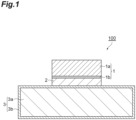
- FIG. 1 is a schematic cross-sectional view illustrating an example of a bonded body manufactured by using a metal paste for bonding.
- the bonded body 100 of the present embodiment includes: a first member 1 having a first base part 1a and a first metal layer 1b; a second member 3 having a second base part 3a and a second metal layer 3b; and a sintered body 2 bonding the first member 1 and the second member 3.
- the above-mentioned ones may be mentioned. Furthermore, with regard to the first metal layer 1b and the second metal layer 3b as well, the above-mentioned ones may be mentioned.
- the sintered body 2 may be a sintered body of the metal paste for bonding according to the present embodiment.
- the bonded body 100 can be obtained by the above-described method for manufacturing a bonded body according to the present embodiment.
- the die shear strength of the bonded body may be 10 MPa or greater, may be 15 MPa or greater, may be 20 MPa or greater, or may be 30 MPa or greater.
- the die shear strength can be measured by using a universal-type bond tester (4000 Series, manufactured by DAGE) or the like.
- the thermal conductivity of the sintered body may be 100 W/(m ⁇ K) or higher, may be 120 W/(m ⁇ K) or higher, or may be 150 W/(m ⁇ K) or higher.
- the thermal conductivity can be calculated from the thermal diffusivity, specific heat capacity, and density of a sintered body of the metal paste for bonding.
- the first member and the second member may be a semiconductor element.
- the semiconductor element include power modules including a diode, a rectifier, a thyristor, an MOS gate driver, a power switch, a power MOSFET, an IGBT, a Schottky barrier diode, a fast recovery diode, and the like; a transmitter, an amplifier, and an LED module.
- the bonded body becomes a semiconductor device.
- the obtained semiconductor device can have sufficient die shear strength and connection reliability.
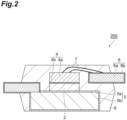
- FIG. 2 is a schematic cross-sectional view illustrating an example of a semiconductor device manufactured by using a metal paste for bonding.
- the semiconductor device 200 shown in FIG. 2 includes, on a lead frame 5 having a metal layer 5b and a base part 5a, a semiconductor element 4 having a metal layer 4b and a base part 4a, which are connected to the lead frame 5 through a sintered body 2 of the copper paste for bonding, and a mold resin 6 molding these.
- the semiconductor element 4 is connected to a lead frame 8 having a metal layer 8b and a base part 8a through wires 7.
- Examples of the semiconductor device include power modules including a diode, a rectifier, a thyristor, a MOS gate driver, a power switch, a power MOSFET, an IGBT, a Schottky barrier diode, a fast recovery diode, and the like; a transmitter, an amplifier, a high-brightness LED module, a semiconductor laser module, a logic, and a sensor.
- power modules including a diode, a rectifier, a thyristor, a MOS gate driver, a power switch, a power MOSFET, an IGBT, a Schottky barrier diode, a fast recovery diode, and the like
- a transmitter an amplifier, a high-brightness LED module, a semiconductor laser module, a logic, and a sensor.
- the method for manufacturing a semiconductor device may include a step of preparing a laminated body in which a semiconductor element is used as at least one of a first member and a second member, and a first member, a metal paste for bonding, and a second member are laminated in this order, and sintering the metal paste for bonding in the laminated body by heating the laminated body under no added pressure conditions in an oxygen-free atmosphere.
- the oxygen-free atmosphere may be an atmosphere that does not include hydrogen or has a hydrogen concentration of 10% or less.
- the metal paste for bonding may have a composition similar to that of the metal paste for bonding according to the present embodiment.
- the preparation of the laminated body and sintering of the metal paste for bonding can also be carried out in the same manner as in the above-mentioned laminated body preparation step and sintering step.
- the present disclosure can provide the following inventions according to [1] to [10].
- the bonding strength of a bonded body was evaluated by using the die shear strength between a silicon chip and a copper substrate bonded with a metal paste.
- a metal paste was applied on a copper plate (19 mm ⁇ 25 mm ⁇ 3 mm) by stencil printing using a metal mask, in which nine square-shaped openings with a size of 3 mm ⁇ 3 mm were provided in a stainless steel plate having a thickness of 200 ⁇ m, and a metal squeegee.
- a silicon chip (area 3 mm ⁇ 3 mm, thickness 400 ⁇ m, having a copper sputtered layer as an adhered surface (bonding surface) to the metal paste) was placed on the applied metal paste and lightly pressed with tweezers to obtain a laminated body.
- the laminated body was heated at 90°C for 60 minutes in air using a hot plate (manufactured by AS ONE CORPORATION, EC HOTPLATE EC-1200N).
- the laminated body was placed in a fluxless reflow apparatus (manufactured by Ayumi INDUSTRY CO., LTD.), the pressure was reduced to 1 Pa to remove air, nitrogen gas was introduced thereto to purge, the laminated body was heated at 300°C for 1 hour while causing nitrogen to flow at a rate of 15 L/min at normal pressure, and a bonded body in which the copper plate and the silicon chip were bonded with a copper sintered body was obtained. This bonded body was cooled, and when the temperature reached 50°C or lower, the bonded body was taken out into air.
- the silicon chip of the obtained bonded body was pressed in a horizontal direction at a measurement speed of 500 ⁇ m/s and a measurement height of 100 ⁇ m by using a universal type bond tester (4000 Series, manufactured by DAGE) equipped with a load cell of 1 kN, and the die shear strength was measured.
- the average value of the values obtained by measuring eight bonded bodies was designated as the die shear strength.
- the die shear strength of bonded bodies in which a silicon chip and a copper substrate were bonded by lead solder was 20 MPa.
- Each of the bonded bodies produced in the above-described section "(1) Die shear strength" was fixed in a cup with a sample clip (Samplklip I, manufactured by Buehler Ltd.), an epoxy casting resin (EPOMOUNT, manufactured by Refine Tec Ltd.) was poured into the surroundings until the entire bonded body was buried, the cup was left to stand in a vacuum desiccator, and the pressure was reduced for 1 minute to defoam. Thereafter, the cup was left to stand at room temperature for 10 hours, the epoxy casting resin was cured, and a sample was prepared. The sample was cut near the silicon chip by using a Refine Saw Excel (manufactured by Refine Tec Ltd.).
- the bonded body was shaved to the vicinity of the center to obtain a cross-section by using a polishing apparatus (Refine Polisher HV, manufactured by Refine Tec Ltd.) equipped with water-resistant abrasive paper (Carbomac Paper, manufactured by Refine Tec Ltd.).
- This cross-section was subjected to flat milling processing (Hitachi High-Tech Co., Ltd., IM4000) using Ar ions.
- the bonding cross-section of the copper sintered body was observed by using a scanning electron microscope (Schottky FE-SEM SU5000, manufactured by Hitachi High-Tech Co., Ltd.).
- Metal pastes for bonding in the feed amount (parts by mass) shown in Tables 1 to 5 were each prepared according to the procedure described below.
- the feed amount shown in the tables is the proportion (parts by mass) of each component when the total mass of the copper particles included in the metal paste for bonding was taken as 100 parts by mass (100 parts by mass of the sum total of copper sub-microparticles and copper microparticles).
- a reduction aid in a lump-like form or a pellet form was pulverized by using a planetary ball mill and was produced into a fine powder before use.
- the obtained mixture was subjected to a dispersion treatment once by using a Disperizer (manufactured by SINTOKOGIO, LTD.) under the conditions of a gap of 50 ⁇ m and a speed of rotation of 12000 rpm to obtain a 91% by mass dispersion liquid.
- a Disperizer manufactured by SINTOKOGIO, LTD.
- TEG tetraethylene glycol
- PEG300 polyethylene glycol 300
- PEG400 polyethylene glycol 400
- PEG400 polyethylene glycol 400
- a metal paste for bonding was obtained in the same manner as in Example A-1, except that the reduction aid was changed to triisopropyl phosphite (manufactured by Tokyo Chemical Industry Co., Ltd.) instead of triphenylphosphine.
- a metal paste for bonding was obtained in the same manner as in Example A-1, except that the reduction aid was changed to triphenyl phosphite (manufactured by FUJIFILM Wako Pure Chemical Corporation) instead of triphenylphosphine.
- Each of metal pastes for bonding was obtained in the same manner as in Example A-1, except that the feed amounts of the copper particles, the dispersion medium, and the reduction aid were changed to the proportions shown in Table 1 (with respect to 100 parts by mass of the total mass of the copper particles, the mass of the reduction aid was 1.23 parts by mass, 0.98 parts by mass, 0.95 parts by mass, or 0.82 parts by mass).
- Each of metal pastes for bonding was obtained in the same manner as in Example A-1, except that the feed amounts of the copper particles, the dispersion medium, and the reducing agent were changed to the proportions shown in Table 2 (with respect to 100 parts by mass of the total mass of the copper particles, the mass of the reduction aid was 4.77 parts by mass, 3.26 parts by mass, or 2.31 parts by mass).
- Each of metal pastes for bonding was obtained in the same manner as in Example A-1, except that the feed amounts of the copper particles and the reducing agent were changed to the proportions shown in Table 2.
- Each of metal pastes for bonding was obtained in the same manner as in Example A-1, except that the reducing agent was changed to polypropylene glycol 300 (hereinafter, abbreviated to PPG300) (manufactured by FUJIFILM Wako Pure Chemical Corporation, triol type) and polypropylene glycol 700 (hereinafter, abbreviated to PPG700) (manufactured by FUJIFILM Wako Pure Chemical Corporation, diol type) instead of TEG, PEG300, and PEG400, and the feed amounts of the copper particles and the reducing agent were changed to the proportions shown in Table 2.
- PPG300 polypropylene glycol 300
- PPG700 polypropylene glycol 700
- a metal paste for bonding was obtained in the same manner as in Example A-1, except that the reduction aid was changed to 2,8,9-triisobutyl-2,5,8,9-tetraaza-1-phosphabicyclo[3.3.3]undecane (manufactured by Sigma-Aldrich Chemistry) instead of triphenylphosphine, and the feed amounts of the dispersion medium, reducing agent, and reduction aid were changed to the proportions shown in Table 3 (with respect to 100 parts by mass of the total mass of the copper particles, the mass of the reduction aid was 0.12 parts by mass).
- the reduction aid was changed to 2,8,9-triisobutyl-2,5,8,9-tetraaza-1-phosphabicyclo[3.3.3]undecane (manufactured by Sigma-Aldrich Chemistry) instead of triphenylphosphine, and the feed amounts of the dispersion medium, reducing agent, and reduction aid were changed to the proportions shown in Table 3 (with respect to 100 parts by mass of the
- a metal paste for bonding was obtained in the same manner as in Example A-1, except that the reduction aid was changed to 2,8,9-triisobutyl-2,5,8,9-tetraaza-1-phosphabicyclo[3.3.3]undecane (manufactured by Sigma-Aldrich Chemistry) instead of triphenylphosphine, and the feed amounts of the dispersion medium, reducing agent, and reduction aid were changed to the proportions shown in Table 3 (with respect to 100 parts by mass of the total mass of the copper particles, the mass of the reduction aid was 0.30 parts by mass).
- the reduction aid was changed to 2,8,9-triisobutyl-2,5,8,9-tetraaza-1-phosphabicyclo[3.3.3]undecane (manufactured by Sigma-Aldrich Chemistry) instead of triphenylphosphine, and the feed amounts of the dispersion medium, reducing agent, and reduction aid were changed to the proportions shown in Table 3 (with respect to 100 parts by mass of the
- Each of metal pastes for bonding was obtained in the same manner as in Example A-1, except that the reduction aid was changed to dimethylglutaric acid, nitrilotriacetic acid, ascorbic acid, triethanolamine, diethyl tartrate, or glycine as shown in Table 4, instead of triphenylphosphine.
- a metal paste for bonding was obtained in the same manner as in Example A-1, except that a reduction aid was not blended, and the feed amount of the dispersion medium was changed to the proportion shown in Table 4.
- Each of metal pastes for bonding was obtained in the same manner as in Example A-1, except that the feed amounts of the copper particles, dispersion medium, and reducing agent were changed to the proportions shown in Table 5 (with respect to 100 parts by mass of the total mass of the copper particles, the mass of the reduction aid was 1.23 parts by mass, 0.98 parts by mass, 0.95 parts by mass, or 0.82 parts by mass).
- Bonded bodies were produced according to the method described in (1) Die shear strength, by using the metal pastes for bonding obtained in Examples and Comparative Examples, and an evaluation of the bonding strength was performed. The results are shown in the tables.
- FIG. 3 is a SEM image showing a bonding cross-section of a copper sintered body in a bonded body produced using the metal paste for bonding of Example 1
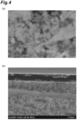
- FIG. 4 is SEM images showing a bonding cross-section of a copper sintered body in a bonded body produced using a metal paste for bonding obtained in Comparative Example 7.
- the copper particles were sintered together to form a network-like structure.
- this network structure was also integrated with the surface of an adherend (copper substrate) in the lower part of the photograph, and it was considered that bonding was formed.
- the shape of the raw material particles remained as it was, sintering between the particles did not occur, and a network structure was not formed. Therefore, as shown in FIG. 4(b) , sites where bonding was not formed were observed at the interface on the chip side.
- Example A-1 Example A-2
- Example A-3 Example A-4
- Example A-5 Example A-6
- Example A-7 Dispersion medium Dihydroterpineol 7.88 7.88 7.88 7.64 7.88 7.91 8.05
- Reducing agent TEG 1.36 1.36 1.36 1.36 1.36 1.36 PEG300 1.70 1.70 1.70 1.70 1.70 1.70 PEG400 1.70 1.70 1.70 1.70 1.70 1.70 Reduction aid
- Copper microparticles 2L3N 30 30 31 31 31 31
- the obtained mixture was subjected to a dispersion treatment once by using a Disperizer (manufactured by SINTOKOGIO, LTD.) under the conditions of a gap of 50 ⁇ m and a speed of rotation of 12000 rpm to obtain a 91% by mass dispersion liquid.
- a Disperizer manufactured by SINTOKOGIO, LTD.
- a metal paste for bonding was each obtained in the same manner as in Example B-1, except that the feed amounts of the dispersion medium and the reduction aid were changed to the proportions shown in Table 6 (with respect to 100 parts by mass of the total mass of the copper particles, the mass of the reduction aid was 0.98 parts by mass).
- a metal paste for bonding was each obtained in the same manner as in Example B-1, except that the feed amounts of the dispersion medium and the reduction aid were changed to the proportions shown in Table 6 (with respect to 100 parts by mass of the total mass of the copper particles, the mass of the reduction aid was 1.64 parts by mass).
- a metal paste for bonding was obtained in the same manner as in Example B-1, except that tris(2-butoxyethyl) phosphate (manufactured by FUJIFILM Wako Pure Chemical Corporation) was used as the reduction aid instead of triethyl phosphate, and the feed amount of the reduction aid was changed to the proportion shown in Table 6 (with respect to 100 parts by mass of the total mass of the copper particles, the mass of the reduction aid was 0.98 parts by mass).
- tris(2-butoxyethyl) phosphate manufactured by FUJIFILM Wako Pure Chemical Corporation
- Example B-1 Example B-2
- Example B-3 Example B-4 Comparative Example B-1 Dispersion medium Dihydroterpineol 8.32 7.88 7.23 7.88 8.86 Reducing agent TEG 1.36 1.37 1.38 1.39 1.40 PEG300 2.05 2.06 2.07 2.08 2.09 PEG400 1.36 1.37 1.38 1.39 1.40 Reduction aid Triethyl phosphate 0.55 0.98 1.64 - - Tris(2-butoxyethyl) phosphate - - - 0.98 - Copper sub-microparticles CH-0200 66 66 66 66 66 Copper microparticles 2L3N 31 31 31 31 31 31 31 31 C3 3 3 3 3 3 3 3 3 3 3 3 3 3 3 3 3 3 3 3 3 3 3 3 3 3 3 3 3 3 3 3 3 3 3 3 3 3 3 3 3 Total mass of copper particles (parts by mass) 100 100 100 100 100 100 100 Bonding conditions (in nitrogen atmosphere) Added pressure (MPa) 0 0 0 0 0 0
Landscapes
- Engineering & Computer Science (AREA)
- Chemical & Material Sciences (AREA)
- Mechanical Engineering (AREA)
- Materials Engineering (AREA)
- Composite Materials (AREA)
- Manufacturing & Machinery (AREA)
- Nanotechnology (AREA)
- Organic Chemistry (AREA)
- Physics & Mathematics (AREA)
- Dispersion Chemistry (AREA)
- Spectroscopy & Molecular Physics (AREA)
- Metallurgy (AREA)
- Inorganic Chemistry (AREA)
- Conductive Materials (AREA)
- Powder Metallurgy (AREA)
Applications Claiming Priority (2)
| Application Number | Priority Date | Filing Date | Title |
|---|---|---|---|
| JP2021112199 | 2021-07-06 | ||
| PCT/JP2022/026625 WO2023282235A1 (ja) | 2021-07-06 | 2022-07-04 | 接合用金属ペースト、並びに接合体及びその製造方法 |
Publications (2)
| Publication Number | Publication Date |
|---|---|
| EP4368317A1 true EP4368317A1 (de) | 2024-05-15 |
| EP4368317A4 EP4368317A4 (de) | 2025-01-08 |
Family
ID=84800624
Family Applications (1)
| Application Number | Title | Priority Date | Filing Date |
|---|---|---|---|
| EP22837650.5A Pending EP4368317A4 (de) | 2021-07-06 | 2022-07-04 | Metallpaste zum verbinden, verbindung und herstellungsverfahren dafür |
Country Status (7)
| Country | Link |
|---|---|
| US (1) | US20240300055A1 (de) |
| EP (1) | EP4368317A4 (de) |
| JP (1) | JPWO2023282235A1 (de) |
| KR (1) | KR20240032878A (de) |
| CN (1) | CN117916038A (de) |
| TW (1) | TW202320937A (de) |
| WO (1) | WO2023282235A1 (de) |
Families Citing this family (3)
| Publication number | Priority date | Publication date | Assignee | Title |
|---|---|---|---|---|
| TW202545659A (zh) * | 2024-05-15 | 2025-12-01 | 美商阿爾發金屬化工公司 美國康乃狄克州華特伯瑞市佛萊特街 245 號 | 燒結組成物 |
| DE102024113821A1 (de) | 2024-05-16 | 2025-11-20 | STANNOL GmbH & Co. KG | Paste zum Herstellen einer Fügeverbindung sowie Verwendung dieser Paste und Verfahren zur Herstellung einer Fügeverbindung |
| CN121439314A (zh) * | 2024-07-29 | 2026-01-30 | 常州聚和新材料股份有限公司 | 铜浆 |
Family Cites Families (15)
| Publication number | Priority date | Publication date | Assignee | Title |
|---|---|---|---|---|
| JPS506081B1 (de) | 1970-12-09 | 1975-03-11 | ||
| JP4247800B2 (ja) | 2006-11-29 | 2009-04-02 | ニホンハンダ株式会社 | 可塑性を有する焼結性金属粒子組成物、その製造方法、接合剤および接合方法 |
| JP5006081B2 (ja) | 2007-03-28 | 2012-08-22 | 株式会社日立製作所 | 半導体装置、その製造方法、複合金属体及びその製造方法 |
| JP2011252194A (ja) * | 2010-06-01 | 2011-12-15 | Murata Mfg Co Ltd | 金属粉末とその製造方法および金属粉末を用いた導電性ペーストとそれを用いた積層セラミック電子部品 |
| JP2013115004A (ja) * | 2011-11-30 | 2013-06-10 | Nippon Parkerizing Co Ltd | 水系銅ペースト材料及び導電層の形成方法 |
| JP6270241B2 (ja) * | 2014-01-30 | 2018-01-31 | 株式会社豊田中央研究所 | 接合材料及びそれを用いた半導体装置 |
| JP6266137B2 (ja) * | 2015-07-09 | 2018-01-24 | 古河電気工業株式会社 | 金属微粒子含有組成物 |
| US10363608B2 (en) * | 2015-09-07 | 2019-07-30 | Hitachi Chemical Company, Ltd. | Copper paste for joining, method for producing joined body, and method for producing semiconductor device |
| CN109562493B (zh) * | 2016-08-03 | 2021-10-26 | 古河电气工业株式会社 | 含金属粒子的组合物 |
| KR102508790B1 (ko) * | 2017-12-18 | 2023-03-14 | 디아이씨 가부시끼가이샤 | 구리 미립자 소결체 |
| JP7200527B2 (ja) * | 2018-08-02 | 2023-01-10 | 昭和電工マテリアルズ株式会社 | 接合用金属ペースト及び接合体の製造方法 |
| KR102501588B1 (ko) * | 2018-08-08 | 2023-02-21 | 미쓰이금속광업주식회사 | 접합용 조성물, 그리고 도전체의 접합 구조 및 그의 제조 방법 |
| KR102243472B1 (ko) * | 2018-12-17 | 2021-04-26 | 주식회사 경동원 | 전력반도체 접합용 소결 페이스트 조성물 |
| JP7419674B2 (ja) * | 2019-06-03 | 2024-01-23 | 株式会社レゾナック | 金属ペースト、焼結体、配線、物品、焼結体の製造方法及び物品の製造方法 |
| JP7731972B2 (ja) * | 2021-03-17 | 2025-09-01 | 京セラ株式会社 | ペースト組成物、半導体装置、電気部品及び電子部品 |
-
2022
- 2022-07-04 US US18/575,080 patent/US20240300055A1/en active Pending
- 2022-07-04 CN CN202280057605.7A patent/CN117916038A/zh active Pending
- 2022-07-04 JP JP2023533124A patent/JPWO2023282235A1/ja active Pending
- 2022-07-04 KR KR1020247003033A patent/KR20240032878A/ko active Pending
- 2022-07-04 WO PCT/JP2022/026625 patent/WO2023282235A1/ja not_active Ceased
- 2022-07-04 EP EP22837650.5A patent/EP4368317A4/de active Pending
- 2022-07-05 TW TW111125189A patent/TW202320937A/zh unknown
Also Published As
| Publication number | Publication date |
|---|---|
| JPWO2023282235A1 (de) | 2023-01-12 |
| WO2023282235A1 (ja) | 2023-01-12 |
| KR20240032878A (ko) | 2024-03-12 |
| US20240300055A1 (en) | 2024-09-12 |
| EP4368317A4 (de) | 2025-01-08 |
| TW202320937A (zh) | 2023-06-01 |
| CN117916038A (zh) | 2024-04-19 |
Similar Documents
| Publication | Publication Date | Title |
|---|---|---|
| US20240300055A1 (en) | Metal paste for joining, joint, and manufacturing method therefor | |
| KR102379883B1 (ko) | 접합용 구리 페이스트, 접합체의 제조 방법 및 반도체 장치의 제조 방법 | |
| EP3348338B1 (de) | Kupferpaste zur verbindung, verfahren zur herstellung eines verbundenen körpers und verfahren zur herstellung eines halbleiterbauelements | |
| JP6782416B2 (ja) | 接合用銅ペースト、接合体及びその製造方法、並びに半導体装置及びその製造方法 | |
| JP7651822B2 (ja) | 接合用金属ペースト、接合体、半導体装置、及び接合体の製造方法 | |
| JP6907540B2 (ja) | 接合用銅ペースト、焼結体、接合体、半導体装置及びそれらの製造方法 | |
| JP2024010136A (ja) | 接合体及び半導体装置の製造方法、並びに接合用銅ペースト | |
| EP4368316A1 (de) | Metallpaste zum verbinden und verbundener körper und verfahren zur herstellung davon | |
| JP7508802B2 (ja) | 接合用金属ペースト、接合体、半導体装置、及び接合体の製造方法 | |
| JP7543880B2 (ja) | 接合用金属ペースト、接合体、半導体装置、及び接合体の製造方法 | |
| JP7845349B2 (ja) | 焼結銅ピラー形成用銅ペースト及び接合体の製造方法 | |
| JP2025021643A (ja) | 接合体の製造方法、金属ペースト及びその製造方法 | |
| JP2025020999A (ja) | 接合用金属ペースト、並びに接合体及びその製造方法 | |
| JP2025020997A (ja) | 接合用金属ペースト、並びに接合体及びその製造方法 | |
| WO2026018689A1 (ja) | 接合体の製造方法、接合体、接合用金属ペースト及びその製造方法 |
Legal Events
| Date | Code | Title | Description |
|---|---|---|---|
| STAA | Information on the status of an ep patent application or granted ep patent |
Free format text: STATUS: THE INTERNATIONAL PUBLICATION HAS BEEN MADE |
|
| PUAI | Public reference made under article 153(3) epc to a published international application that has entered the european phase |
Free format text: ORIGINAL CODE: 0009012 |
|
| STAA | Information on the status of an ep patent application or granted ep patent |
Free format text: STATUS: REQUEST FOR EXAMINATION WAS MADE |
|
| 17P | Request for examination filed |
Effective date: 20240201 |
|
| AK | Designated contracting states |
Kind code of ref document: A1 Designated state(s): AL AT BE BG CH CY CZ DE DK EE ES FI FR GB GR HR HU IE IS IT LI LT LU LV MC MK MT NL NO PL PT RO RS SE SI SK SM TR |
|
| DAV | Request for validation of the european patent (deleted) | ||
| DAX | Request for extension of the european patent (deleted) | ||
| STAA | Information on the status of an ep patent application or granted ep patent |
Free format text: STATUS: EXAMINATION IS IN PROGRESS |
|
| A4 | Supplementary search report drawn up and despatched |
Effective date: 20241209 |
|
| RIC1 | Information provided on ipc code assigned before grant |
Ipc: B22F 1/10 20220101ALI20241204BHEP Ipc: C22C 1/04 20230101ALI20241204BHEP Ipc: B22F 7/06 20060101ALI20241204BHEP Ipc: B22F 1/052 20220101ALI20241204BHEP Ipc: B22F 1/054 20220101ALI20241204BHEP Ipc: B23K 35/30 20060101ALI20241204BHEP Ipc: B23K 35/02 20060101ALI20241204BHEP Ipc: H01L 21/52 20060101ALI20241204BHEP Ipc: H01B 1/22 20060101ALI20241204BHEP Ipc: C09J 9/02 20060101ALI20241204BHEP Ipc: B22F 7/08 20060101ALI20241204BHEP Ipc: B22F 1/00 20220101ALI20241204BHEP Ipc: B22F 9/00 20060101AFI20241204BHEP |
|
| 17Q | First examination report despatched |
Effective date: 20241220 |