EP4366086A2 - Vorrichtung zur bereitstellung von drahtloser energieübertragung - Google Patents
Vorrichtung zur bereitstellung von drahtloser energieübertragung Download PDFInfo
- Publication number
- EP4366086A2 EP4366086A2 EP24165666.9A EP24165666A EP4366086A2 EP 4366086 A2 EP4366086 A2 EP 4366086A2 EP 24165666 A EP24165666 A EP 24165666A EP 4366086 A2 EP4366086 A2 EP 4366086A2
- Authority
- EP
- European Patent Office
- Prior art keywords
- antenna
- primary
- lens
- primary antenna
- electromagnetic
- Prior art date
- Legal status (The legal status is an assumption and is not a legal conclusion. Google has not performed a legal analysis and makes no representation as to the accuracy of the status listed.)
- Pending
Links
Images


Classifications
-
- H—ELECTRICITY
- H02—GENERATION; CONVERSION OR DISTRIBUTION OF ELECTRIC POWER
- H02J—ELECTRIC POWER NETWORKS; CIRCUIT ARRANGEMENTS OR SYSTEMS FOR SUPPLYING OR DISTRIBUTING ELECTRIC POWER; SYSTEMS FOR STORING ELECTRIC ENERGY
- H02J50/00—Circuit arrangements or systems for wireless supply or distribution of electric power
- H02J50/20—Circuit arrangements or systems for wireless supply or distribution of electric power using microwaves or radio frequency waves
- H02J50/23—Circuit arrangements or systems for wireless supply or distribution of electric power using microwaves or radio frequency waves characterised by the type of transmitting antennas, e.g. directional array antennas or Yagi antennas
-
- H—ELECTRICITY
- H01—ELECTRIC ELEMENTS
- H01Q—ANTENNAS, i.e. RADIO AERIALS
- H01Q11/00—Electrically-long antennas having dimensions more than twice the shortest operating wavelength and consisting of conductive active radiating elements
- H01Q11/02—Non-resonant antennas, e.g. travelling-wave antenna
- H01Q11/08—Helical antennas
-
- H—ELECTRICITY
- H01—ELECTRIC ELEMENTS
- H01Q—ANTENNAS, i.e. RADIO AERIALS
- H01Q15/00—Devices for reflection, refraction, diffraction or polarisation of waves radiated from an antenna, e.g. quasi-optical devices
- H01Q15/02—Refracting or diffracting devices, e.g. lens, prism
-
- H—ELECTRICITY
- H01—ELECTRIC ELEMENTS
- H01Q—ANTENNAS, i.e. RADIO AERIALS
- H01Q19/00—Combinations of primary active antenna elements and units with secondary devices, e.g. with quasi-optical devices, for giving the antenna a desired directional characteristic
- H01Q19/06—Combinations of primary active antenna elements and units with secondary devices, e.g. with quasi-optical devices, for giving the antenna a desired directional characteristic using refracting or diffracting devices, e.g. lens
-
- H—ELECTRICITY
- H01—ELECTRIC ELEMENTS
- H01Q—ANTENNAS, i.e. RADIO AERIALS
- H01Q19/00—Combinations of primary active antenna elements and units with secondary devices, e.g. with quasi-optical devices, for giving the antenna a desired directional characteristic
- H01Q19/06—Combinations of primary active antenna elements and units with secondary devices, e.g. with quasi-optical devices, for giving the antenna a desired directional characteristic using refracting or diffracting devices, e.g. lens
- H01Q19/062—Combinations of primary active antenna elements and units with secondary devices, e.g. with quasi-optical devices, for giving the antenna a desired directional characteristic using refracting or diffracting devices, e.g. lens for focusing
-
- H—ELECTRICITY
- H01—ELECTRIC ELEMENTS
- H01Q—ANTENNAS, i.e. RADIO AERIALS
- H01Q7/00—Loop antennas with a substantially uniform current distribution around the loop and having a directional radiation pattern in a plane perpendicular to the plane of the loop
-
- H—ELECTRICITY
- H02—GENERATION; CONVERSION OR DISTRIBUTION OF ELECTRIC POWER
- H02J—ELECTRIC POWER NETWORKS; CIRCUIT ARRANGEMENTS OR SYSTEMS FOR SUPPLYING OR DISTRIBUTING ELECTRIC POWER; SYSTEMS FOR STORING ELECTRIC ENERGY
- H02J50/00—Circuit arrangements or systems for wireless supply or distribution of electric power
- H02J50/20—Circuit arrangements or systems for wireless supply or distribution of electric power using microwaves or radio frequency waves
- H02J50/27—Circuit arrangements or systems for wireless supply or distribution of electric power using microwaves or radio frequency waves characterised by the type of receiving antennas, e.g. rectennas
-
- H—ELECTRICITY
- H02—GENERATION; CONVERSION OR DISTRIBUTION OF ELECTRIC POWER
- H02J—ELECTRIC POWER NETWORKS; CIRCUIT ARRANGEMENTS OR SYSTEMS FOR SUPPLYING OR DISTRIBUTING ELECTRIC POWER; SYSTEMS FOR STORING ELECTRIC ENERGY
- H02J50/00—Circuit arrangements or systems for wireless supply or distribution of electric power
- H02J50/70—Circuit arrangements or systems for wireless supply or distribution of electric power involving the reduction of electric, magnetic or electromagnetic leakage fields
-
- H—ELECTRICITY
- H01—ELECTRIC ELEMENTS
- H01Q—ANTENNAS, i.e. RADIO AERIALS
- H01Q17/00—Devices for absorbing waves radiated from an antenna; Combinations of such devices with active antenna elements or systems
Definitions
- the present disclosure relates to wireless energy transmission and other applications.
- Mains powered base stations restricts the location of the sensor to be in close proximity to the mains power. Mains power may be installed nearly anywhere, however, installing mains power conduit, junction boxes, outlets, etc. can be expensive and further, placing a sensor and a mains powered base station in the most preferable location may create unwanted exposure of wires and junction boxes which can distract from the aesthetics of a space. Mains powered base stations may have battery backup, but battery size limits the available power and duration over which the base stations may continue to operate before all battery energy is expended.
- a system for providing wireless power transfer for a security and access control system includes a primary antenna having a primary lens surrounding the primary antenna and a secondary antenna having a secondary lens surrounding the secondary antenna.
- the secondary antenna is operatively connected to power at least one sensor.
- a mains power source e.g. wall, generator, inverter, etc.
- the primary and secondary antennas are separated a distance apart to wirelessly transfer power from the primary antenna to the secondary antenna.
- the primary antenna can be an electromagnetic emitter of near-field and/or far-field electromagnetic emissions.
- the secondary antenna can be a receiver of near-field and/or far-field electromagnetic emissions.
- the primary lens and secondary lens can be comprised of an array of resonators such that the primary and secondary lenses can force electromagnetic energy towards the opposing antenna.
- the lenses and antennas are designed to reduce or prevent self-cancellation of the electromagnetic fields.
- the secondary lens can be configured to receive an RF signal from the primary antenna.
- a device for providing wireless power transfer including a primary antenna having a first lens surrounding a first end portion thereof.
- the primary antenna can further include a second lens surrounding a second end portion of the primary antenna, e.g., without the need for the lenses surrounding a portion of the primary antenna between the first and second end portions of the lenses.
- the device can further include a secondary coil having a first lens surrounding a first portion of the secondary coil and a second lens surrounding a second end portion of the secondary coil.
- the first end portion and the second end portion of the primary antenna can be directed towards the first end portion and second end portion of the secondary antenna.
- the first and second lenses of each of the primary and secondary antennas can be comprised of an array of resonators.
- the first end portion of the primary antenna may be directed to cover a large area of multiple secondary antennas. In such an application the transmit power from the primary antenna would be directed toward the first end portion of multiple secondary antennas.
- the second end portion of the primary antenna may be directed to cover a large area of multiple secondary antennas.
- the lenses of the secondary antennas would be directed towards the primary antenna as described above.
- FIG. 1 a partial view of an exemplary embodiment of a system of wireless power transfer in accordance with the disclosure is shown in Fig. 1 and is designated generally by reference character 100.
- FIGs. 2-7 Other embodiments of the system and device for wireless power transfer in accordance with the disclosure, or aspects thereof, are provided in Figs. 2-7 , as will be described.
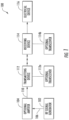
- Fig. 1 is a block diagram of a wireless energy transfer system 100 according to the present disclosure.
- the wireless energy transfer system 100 allows energy for use in providing power and/or data communications to be transferred wirelessly from a source (e.g., a mains power source) to a load (e.g., an electrical device) based on the concept of nonradiative near fields of resonators (referred to as nonradiative resonant coupling).
- a source e.g., a mains power source
- a load e.g., an electrical device
- the wireless energy transfer system 100 is implemented using primarily near-field energy.
- the system 100 includes an RF signal generator 102 operatively coupled to an optional power amplifier 104.
- the RF signal generator is the source of energy and can be a mains powered energy source or the like.
- the RF signal generator 102 generates an RF energy signal 106, which is (optionally) amplified by a power amplifier 104 to produce an amplified RF energy signal 110.
- RF Signal generator 102 may generate a full wave rectified signal, sinusoid or combination of full wave rectified and sinusoids. Further, the signal from the RF signal generator 102 may or may not be modulated for carrying data.
- the system further includes an electromagnetic transmitter device 112 for wireless transferring of the RF energy signal.
- An electromagnetic receiver device 114 is separated a distance apart from the transmitter device 112 and acts to receive the RF energy signal.
- Each of the transmitting device and receiving device 112 and 124 may be operatively connected to optional transceivers 112a and 114a for allowing the transfer of data.
- Each of the transmitting device and the receiving device 112 and 114 includes a low frequency near-field RF lens (described in greater detail below with respect to Fig. 2 ) to transmit and receive the near-field RF signal.
- the lens of the receiver device converts the near-field RF energy to either a direct or alternating electrical current which is then directed into the load 116 or more specifically an electrical device, such as a sensor.
- the system of Figure 1 could also be used to wirelessly communicate data between primary and secondary devices. The data may be used for communication, radar or other purposes.
- Fig. 2 is a top view of an exemplary transmitter and receiver device as used in system 100.
- the devices include an antenna 120 which may be a loop-type with many turns for creating high electromagnetic field versus current characteristics.
- Antenna 120 is configured in a partial toroidal helix shape to be substantially non-resonant such that far-field signals, i.e., radiated field signals, are minimized and near-field signals are maximized.
- the antenna 120 has a first and second lens 124a, 124b.
- Each of the first and second lenses 124a, 124b are positioned at first and second end portions 122a, 122b, respectively, of the antenna with no other lenses or antennas therebetween. More specifically, the lenses 124a, 124b surround the first and second end portions 122a, 122b of antenna 120.
- the lenses 124a, 124b are comprised of an array of resonators. The lenses 124a, 124b force electromagnetic energy towards the opposing antenna by reducing or preventing self-cancellation of the near-field, as shown in Fig. 7 .
- the lenses 124a, 124b reduce the amount of electromagnetic energy from the antenna 120 from closing/self-cancelling immediately at the two mouths of the antenna 120.
- the lenses 124a, 124b positioned at the end portions 122a, 122b of the antenna 120 have a tighter tolerance than a lens distributed over the entirety of the antenna 120.
- a substantial portion of the antenna 120 is not controlled by either lens 124a, 124b. Therefore, the electromagnetic fields in the uncontrolled region are directed towards one mouth of the antenna 120 on the inside of the antenna 120 and the other mouth of antenna 120 on the outside of antenna 120.
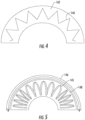
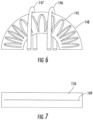
- Figs. 3-4 and 7 illustrate top views of other embodiments of antennas 130, 140, 149 for use as transmitter and receiver devices 112, 114 in system 100.
- Antenna 130 is configured as a meander line antenna
- antenna 140 is configured as a meander line antenna with triangular peaks
- antenna 149 is a linear antenna.
- meander line antenna 130, meander line antenna with triangular peaks 140, and linear antenna 149 include lenses 132, 142, 150 respectively, which cover the entirety of the antennas 130, 140, 149.
- the meander line antenna 130, the triangle antenna 140, and the linear antenna 149 allow for directing energy on the back/far side of the lens/antenna towards another lens/antenna.
- the uniform geometry of the meander line antenna 130, the triangle antenna 140, and the linear antenna 149 simplify the lens design.
- the uniform geometry results in simplified spacing between the lens elements and minimizes impediments to view of an opposing antenna which allows for less current/field cancellation, resulting in a design which has higher efficiency, is easier to design, lower cost, and easier to manufacture.
- FIGs. 5 and 6 illustrate yet another embodiment of an antenna 145 in a partial toroidal helix shape that may be used with transmitter and receiver devices 112, 114.
- antenna 145 is surrounded in its entirety by lens 148.
- Light pipe 146 is positioned on a back side of antenna 145. The energy from the back side of the antenna 145 is directed through the light pipes 146, 148, respectively, towards an opposing antenna.
- Fig. 5 illustrate yet another embodiment of an antenna 145 in a partial toroidal helix shape that may be used with transmitter and receiver devices 112, 114.
- antenna 145 is surrounded in its entirety by lens 148.
- Light pipe 146 is positioned on a back side of antenna 145. The energy from the back side of the antenna 145 is directed through the light pipes 146, 148, respectively, towards an opposing antenna.
- a plurality of light pipes 146 and 147 are positioned arching over the back side of the antenna 145.
- the light pipes 146 and 147 create a shorter and efficient path for the transfer of energy.
- the energy may be transported to a convenient position by adding layers to the lens which gradually move the energy away from and to the side or top of the lens.
- Light pipes 146, 147 direct electromagnetic energy from the back side of the antenna and lens which has an obstructed view (from an electromagnetic perspective) of the target antenna and lens.
- the light pipes are low-loss and low-cancellation subwavelength sized resonators used to direct electromagnetic energy similar to the lens material.
- Fig. 8 is an example of a wireless system 150 using the transmitter and receiver devices 112, 114 of Fig. 2, 3 , 4, 5 , 6 and/or 7 and system of Fig. 1 . It will be understood by those skilled in the art that this a security system as shown and described below is one example for the use of the devices, however, any system having electric or electronic devices requiring wireless energy power transfer is contemplated without departing from the scope of the invention. Shown in Fig. 8 is a multi-level structure having several doors, windows and a kitchen. The security system includes a plurality of sensors. Sensors can be of types commercially available and known in the art.
- sensors S1, S2, S3, S4 can be positioned at each window and door and used by the security system to notify occupants if a window or door is left open.
- Sensors S5, S6, S7 can be smoke/fire alarms positioned in the kitchen and bedrooms.
- Each of the sensors S1, S2, S3, S4, S5, S6 and S7 may be wirelessly powered or battery powered electronic devices.
- Mains power sources P1, P2, P3, P4 are locating throughout the home.
- a respective transmitter device 112 is operatively connected to each wall power source P1, P2, P3, P4 and a respective receiver device 114 is operatively connected to each sensor S1, S2, S3, S4, S5, S6 and S7.
- the respective transmitter device 112 can be separated a distance apart from the respective receiver device so as not to interfere with the design and aesthetics of the space.
- a transmitter device may transfer energy to more than one receiver device and therefore more than one sensor.
- wall power source P1 is transmitting energy to sensors S1 and S7 and power source P4 provides backup power to the entire system from a source of a bank of car batteries in the basement.
- Fig. 9 shows a detailed view of the transmitter device 112 connected to mains power source P3 and receiver device 114 connected to sensor/load S4. In operation, as shown schematically in Fig. 1 , the transmitter device 112 receives the amplified RF energy signal from the wall power source P3 and the amplifier 104.
- the transmitter device 112 causes RF energy to be wirelessly transmitted between the transmitter device 112 and the receiver device 114.
- First and second lenses 124a, 124b of the transmitter device 112 are directed towards the first and second lenses 126a, 126b of the receiver device 114 to direct the transfer of energy.
- the first and second lenses 126a, 126b of the receiver device 114 convert the electromagnetic fields to an electrical signal, which is received by the sensor S4. In this manner near-field energy is wirelessly transferred to provide power to an electrical or electronic device. Power may be transmitted continuously or in a periodic manner. Low frequency electromagnetic energy penetrates most materials well except metal.
- the system can even be used to provide power through a metal barrier/wall, but the efficiency will be reduced as the metal wall will absorb, reflect and defocus the fields as they pass through the metal, particularly good conductors of magnetic fields such as iron.
- the efficiency will be reduced as the metal wall will absorb, reflect and defocus the fields as they pass through the metal, particularly good conductors of magnetic fields such as iron.
- a wireless power transmitter on the other side of the metal barrier or mains power needs to be provided.
- the lenses may be used to relay data wirelessly between sensors, base stations and/or act as a redundant communication backup for the base station.
- the very high directivity of the lenses, non-radiative nature of the lenses (e.g. far-field cancelling), low path loss in most instances and very high bit energy of emissions make communication interference quite robust and reduces susceptibility to interference.
- the lenses may be used as part of a Multiple-Input-Multiple-Output (MIMO) or tomography radar used to detect and track objects and people in the area under protection of the security system.
- MIMO Multiple-Input-Multiple-Output
- Such a radar would characterize the surroundings by the power emissions and/or communication emissions and/or by passively sensing the electromagnetic emissions not under the control of the security or wireless power system.
- this disclosure relates to wireless energy transfer using electromagnetic resonators.
- electromagnetic resonator type
- wireless energy transfer systems described herein are more general and may be implemented using a wide variety of resonators and resonant objects.
Landscapes
- Engineering & Computer Science (AREA)
- Computer Networks & Wireless Communication (AREA)
- Power Engineering (AREA)
- Physics & Mathematics (AREA)
- Electromagnetism (AREA)
- Aerials With Secondary Devices (AREA)
- Near-Field Transmission Systems (AREA)
Applications Claiming Priority (3)
| Application Number | Priority Date | Filing Date | Title |
|---|---|---|---|
| US201462061905P | 2014-10-09 | 2014-10-09 | |
| PCT/US2015/044822 WO2016057115A1 (en) | 2014-10-09 | 2015-08-12 | Device for providing wireless energy transfer |
| EP15753835.6A EP3204986B1 (de) | 2014-10-09 | 2015-08-12 | Vorrichtung zur bereitstellung von drahtloser energieübertragung |
Related Parent Applications (1)
| Application Number | Title | Priority Date | Filing Date |
|---|---|---|---|
| EP15753835.6A Division EP3204986B1 (de) | 2014-10-09 | 2015-08-12 | Vorrichtung zur bereitstellung von drahtloser energieübertragung |
Publications (2)
| Publication Number | Publication Date |
|---|---|
| EP4366086A2 true EP4366086A2 (de) | 2024-05-08 |
| EP4366086A3 EP4366086A3 (de) | 2024-07-17 |
Family
ID=53938428
Family Applications (2)
| Application Number | Title | Priority Date | Filing Date |
|---|---|---|---|
| EP15753835.6A Active EP3204986B1 (de) | 2014-10-09 | 2015-08-12 | Vorrichtung zur bereitstellung von drahtloser energieübertragung |
| EP24165666.9A Pending EP4366086A3 (de) | 2014-10-09 | 2015-08-12 | Vorrichtung zur bereitstellung von drahtloser energieübertragung |
Family Applications Before (1)
| Application Number | Title | Priority Date | Filing Date |
|---|---|---|---|
| EP15753835.6A Active EP3204986B1 (de) | 2014-10-09 | 2015-08-12 | Vorrichtung zur bereitstellung von drahtloser energieübertragung |
Country Status (3)
| Country | Link |
|---|---|
| US (2) | US11411439B2 (de) |
| EP (2) | EP3204986B1 (de) |
| WO (1) | WO2016057115A1 (de) |
Families Citing this family (3)
| Publication number | Priority date | Publication date | Assignee | Title |
|---|---|---|---|---|
| US11916398B2 (en) * | 2021-12-29 | 2024-02-27 | Energous Corporation | Small form-factor devices with integrated and modular harvesting receivers, and shelving-mounted wireless-power transmitters for use therewith |
| US12142939B2 (en) | 2022-05-13 | 2024-11-12 | Energous Corporation | Integrated wireless-power-transmission platform designed to operate in multiple bands, and multi-band antennas for use therewith |
| US20250208442A1 (en) * | 2023-12-20 | 2025-06-26 | Meta Platforms Technologies, Llc | Apparatus, system, and method for wirelessly powering electrical components on optical elements of eyewear frames |
Citations (1)
| Publication number | Priority date | Publication date | Assignee | Title |
|---|---|---|---|---|
| US20120274147A1 (en) | 2011-04-28 | 2012-11-01 | Alliant Techsystems Inc. | Wireless energy transmission using near-field energy |
Family Cites Families (11)
| Publication number | Priority date | Publication date | Assignee | Title |
|---|---|---|---|---|
| US6275143B1 (en) | 1997-05-09 | 2001-08-14 | Anatoli Stobbe | Security device having wireless energy transmission |
| WO2001037374A1 (en) | 1999-11-18 | 2001-05-25 | Automotive Systems Laboratory, Inc. | Multi-beam antenna |
| US7443057B2 (en) | 2004-11-29 | 2008-10-28 | Patrick Nunally | Remote power charging of electronic devices |
| JP2010503368A (ja) | 2006-09-01 | 2010-01-28 | パワーキャスト コーポレイション | ハイブリッドパワー取り出しおよび方法 |
| US7928900B2 (en) * | 2006-12-15 | 2011-04-19 | Alliant Techsystems Inc. | Resolution antenna array using metamaterials |
| EP2120705A1 (de) | 2006-12-21 | 2009-11-25 | Koninklijke Philips Electronics N.V. | Drahtlose interventionelle vorrichtung und system für drahtlose energieübertragung |
| US8723722B2 (en) | 2008-08-28 | 2014-05-13 | Alliant Techsystems Inc. | Composites for antennas and other applications |
| US8890366B2 (en) | 2010-09-30 | 2014-11-18 | Mitsubishi Electric Research Laboratories, Inc. | Wireless energy transfer using array of resonant objects |
| US8594572B1 (en) | 2011-06-16 | 2013-11-26 | The United States Of America As Represented By The Secretary Of The Navy | Wireless electric power transmission through wall |
| US9118354B2 (en) * | 2011-08-30 | 2015-08-25 | Apple Inc. | Electronic device with shared near field communications element |
| JP5890191B2 (ja) * | 2012-02-06 | 2016-03-22 | トヨタ自動車株式会社 | 送電装置、受電装置、および電力伝送システム |
-
2015
- 2015-08-12 US US15/517,748 patent/US11411439B2/en active Active
- 2015-08-12 WO PCT/US2015/044822 patent/WO2016057115A1/en not_active Ceased
- 2015-08-12 EP EP15753835.6A patent/EP3204986B1/de active Active
- 2015-08-12 EP EP24165666.9A patent/EP4366086A3/de active Pending
-
2022
- 2022-08-08 US US17/882,791 patent/US12113369B2/en active Active
Patent Citations (1)
| Publication number | Priority date | Publication date | Assignee | Title |
|---|---|---|---|---|
| US20120274147A1 (en) | 2011-04-28 | 2012-11-01 | Alliant Techsystems Inc. | Wireless energy transmission using near-field energy |
Also Published As
| Publication number | Publication date |
|---|---|
| EP3204986A1 (de) | 2017-08-16 |
| US12113369B2 (en) | 2024-10-08 |
| EP3204986B1 (de) | 2024-04-17 |
| WO2016057115A1 (en) | 2016-04-14 |
| US20170310165A1 (en) | 2017-10-26 |
| EP4366086A3 (de) | 2024-07-17 |
| US11411439B2 (en) | 2022-08-09 |
| US20230187974A1 (en) | 2023-06-15 |
Similar Documents
| Publication | Publication Date | Title |
|---|---|---|
| US20230187974A1 (en) | Device for providing wireless energy transfer | |
| US9490649B2 (en) | System and method for wireless charging | |
| US8378524B2 (en) | Non-contact power transmission device | |
| EP3234639B1 (de) | Radarsystem mit mehreren sende-empfängern zur überwachung und erkennung von zielen innerhalb eines überwachungsbereichs | |
| EP2761723B1 (de) | Drahtloser stromsender, drahtloser stromempfänger und drahtloses stromübertragungsverfahren | |
| El Rayes et al. | A review on wireless power transfer | |
| KR102125722B1 (ko) | 유도 공진 통합형 무선 충전 송신기의 코일 구조 및 제어 방법 | |
| KR101350309B1 (ko) | 특정 무선 충전기기로 송신전력을 집중할 수 있는 무선 전력전송 장치 및 방법 | |
| JP2011182380A (ja) | 低高周波共用漏洩アンテナ、およびそれを用いた基地局装置並びに近距離検知システム | |
| JP6471382B2 (ja) | 磁力波アンテナおよびそれを用いる磁力波通信装置 | |
| JP2010503368A (ja) | ハイブリッドパワー取り出しおよび方法 | |
| EP3298429B1 (de) | Verfahren und vorrichtung mit td-zugriff mehrerer radarmodule bei der detektion lebender objekte für drahtlosleistungsübertragungsanwendungen | |
| Shadid et al. | A literature survey of wireless power transfer | |
| EP3852235A1 (de) | Kontaktlose stromversorgungs- und datenkommunikationsvorrichtung sowie system mit einer drehantriebseinheit damit | |
| KR20220094946A (ko) | 드론을 이용한 무선 전력 에너지 공급 장치 | |
| WO2015097806A1 (ja) | 共振型電力伝送アンテナ装置 | |
| KR101222137B1 (ko) | 자기공진유도 방식 지향성 무선 전력 전송 장치 | |
| JP6275470B2 (ja) | ワイヤレス給電システム | |
| US11942804B2 (en) | Wireless charging locking device | |
| JP5838685B2 (ja) | 無線空間給電システム | |
| Tal et al. | Design of magnetic transmitters with efficient reactive power utilization for inductive communication and wireless power transfer | |
| KR20180131998A (ko) | 무선 전력 전송 장치 | |
| CN105140624A (zh) | 一种用于金属后壳的高隔离度nfc和wpc天线 | |
| JP6760806B2 (ja) | 無線給電装置 | |
| EP4700808A1 (de) | Induktive drahtlose stromübertragungsvorrichtung und system damit |
Legal Events
| Date | Code | Title | Description |
|---|---|---|---|
| PUAI | Public reference made under article 153(3) epc to a published international application that has entered the european phase |
Free format text: ORIGINAL CODE: 0009012 |
|
| STAA | Information on the status of an ep patent application or granted ep patent |
Free format text: STATUS: THE APPLICATION HAS BEEN PUBLISHED |
|
| AC | Divisional application: reference to earlier application |
Ref document number: 3204986 Country of ref document: EP Kind code of ref document: P |
|
| AK | Designated contracting states |
Kind code of ref document: A2 Designated state(s): AL AT BE BG CH CY CZ DE DK EE ES FI FR GB GR HR HU IE IS IT LI LT LU LV MC MK MT NL NO PL PT RO RS SE SI SK SM TR |
|
| REG | Reference to a national code |
Ref country code: DE Ref legal event code: R079 Free format text: PREVIOUS MAIN CLASS: H01Q0011080000 Ipc: H01Q0007000000 |
|
| PUAL | Search report despatched |
Free format text: ORIGINAL CODE: 0009013 |
|
| AK | Designated contracting states |
Kind code of ref document: A3 Designated state(s): AL AT BE BG CH CY CZ DE DK EE ES FI FR GB GR HR HU IE IS IT LI LT LU LV MC MK MT NL NO PL PT RO RS SE SI SK SM TR |
|
| RIC1 | Information provided on ipc code assigned before grant |
Ipc: H02J 50/70 20160101ALI20240611BHEP Ipc: H02J 50/27 20160101ALI20240611BHEP Ipc: H02J 50/23 20160101ALI20240611BHEP Ipc: H01Q 11/08 20060101ALI20240611BHEP Ipc: H01Q 19/06 20060101ALI20240611BHEP Ipc: H01Q 15/02 20060101ALI20240611BHEP Ipc: H01Q 7/00 20060101AFI20240611BHEP |
|
| STAA | Information on the status of an ep patent application or granted ep patent |
Free format text: STATUS: REQUEST FOR EXAMINATION WAS MADE |
|
| 17P | Request for examination filed |
Effective date: 20250117 |
|
| STAA | Information on the status of an ep patent application or granted ep patent |
Free format text: STATUS: EXAMINATION IS IN PROGRESS |
|
| 17Q | First examination report despatched |
Effective date: 20260310 |