EP4365184A1 - Analysis method for peptide bound to carrier for liquid phase peptide synthesis - Google Patents
Analysis method for peptide bound to carrier for liquid phase peptide synthesis Download PDFInfo
- Publication number
- EP4365184A1 EP4365184A1 EP22833331.6A EP22833331A EP4365184A1 EP 4365184 A1 EP4365184 A1 EP 4365184A1 EP 22833331 A EP22833331 A EP 22833331A EP 4365184 A1 EP4365184 A1 EP 4365184A1
- Authority
- EP
- European Patent Office
- Prior art keywords
- group
- liquid phase
- carrier
- stag
- carbon atoms
- Prior art date
- Legal status (The legal status is an assumption and is not a legal conclusion. Google has not performed a legal analysis and makes no representation as to the accuracy of the status listed.)
- Pending
Links
Images
Classifications
-
- G—PHYSICS
- G01—MEASURING; TESTING
- G01N—INVESTIGATING OR ANALYSING MATERIALS BY DETERMINING THEIR CHEMICAL OR PHYSICAL PROPERTIES
- G01N30/00—Investigating or analysing materials by separation into components using adsorption, absorption or similar phenomena or using ion-exchange, e.g. chromatography or field flow fractionation
- G01N30/02—Column chromatography
- G01N30/26—Conditioning of the fluid carrier; Flow patterns
-
- C—CHEMISTRY; METALLURGY
- C07—ORGANIC CHEMISTRY
- C07K—PEPTIDES
- C07K1/00—General methods for the preparation of peptides, i.e. processes for the organic chemical preparation of peptides or proteins of any length
- C07K1/02—General methods for the preparation of peptides, i.e. processes for the organic chemical preparation of peptides or proteins of any length in solution
-
- B—PERFORMING OPERATIONS; TRANSPORTING
- B01—PHYSICAL OR CHEMICAL PROCESSES OR APPARATUS IN GENERAL
- B01D—SEPARATION
- B01D15/00—Separating processes involving the treatment of liquids with solid sorbents; Apparatus therefor
- B01D15/08—Selective adsorption, e.g. chromatography
- B01D15/26—Selective adsorption, e.g. chromatography characterised by the separation mechanism
- B01D15/32—Bonded phase chromatography
-
- B—PERFORMING OPERATIONS; TRANSPORTING
- B01—PHYSICAL OR CHEMICAL PROCESSES OR APPARATUS IN GENERAL
- B01D—SEPARATION
- B01D15/00—Separating processes involving the treatment of liquids with solid sorbents; Apparatus therefor
- B01D15/08—Selective adsorption, e.g. chromatography
- B01D15/26—Selective adsorption, e.g. chromatography characterised by the separation mechanism
- B01D15/32—Bonded phase chromatography
- B01D15/325—Reversed phase
-
- B—PERFORMING OPERATIONS; TRANSPORTING
- B01—PHYSICAL OR CHEMICAL PROCESSES OR APPARATUS IN GENERAL
- B01D—SEPARATION
- B01D15/00—Separating processes involving the treatment of liquids with solid sorbents; Apparatus therefor
- B01D15/08—Selective adsorption, e.g. chromatography
- B01D15/26—Selective adsorption, e.g. chromatography characterised by the separation mechanism
- B01D15/40—Selective adsorption, e.g. chromatography characterised by the separation mechanism using supercritical fluid as mobile phase or eluent
-
- B—PERFORMING OPERATIONS; TRANSPORTING
- B01—PHYSICAL OR CHEMICAL PROCESSES OR APPARATUS IN GENERAL
- B01D—SEPARATION
- B01D15/00—Separating processes involving the treatment of liquids with solid sorbents; Apparatus therefor
- B01D15/08—Selective adsorption, e.g. chromatography
- B01D15/42—Selective adsorption, e.g. chromatography characterised by the development mode, e.g. by displacement or by elution
-
- B—PERFORMING OPERATIONS; TRANSPORTING
- B01—PHYSICAL OR CHEMICAL PROCESSES OR APPARATUS IN GENERAL
- B01J—CHEMICAL OR PHYSICAL PROCESSES, e.g. CATALYSIS OR COLLOID CHEMISTRY; THEIR RELEVANT APPARATUS
- B01J20/00—Solid sorbent compositions or filter aid compositions; Sorbents for chromatography; Processes for preparing, regenerating or reactivating thereof
- B01J20/281—Sorbents specially adapted for preparative, analytical or investigative chromatography
- B01J20/282—Porous sorbents
- B01J20/283—Porous sorbents based on silica
-
- B—PERFORMING OPERATIONS; TRANSPORTING
- B01—PHYSICAL OR CHEMICAL PROCESSES OR APPARATUS IN GENERAL
- B01J—CHEMICAL OR PHYSICAL PROCESSES, e.g. CATALYSIS OR COLLOID CHEMISTRY; THEIR RELEVANT APPARATUS
- B01J20/00—Solid sorbent compositions or filter aid compositions; Sorbents for chromatography; Processes for preparing, regenerating or reactivating thereof
- B01J20/281—Sorbents specially adapted for preparative, analytical or investigative chromatography
- B01J20/286—Phases chemically bonded to a substrate, e.g. to silica or to polymers
- B01J20/287—Non-polar phases; Reversed phases
-
- C—CHEMISTRY; METALLURGY
- C07—ORGANIC CHEMISTRY
- C07K—PEPTIDES
- C07K1/00—General methods for the preparation of peptides, i.e. processes for the organic chemical preparation of peptides or proteins of any length
- C07K1/14—Extraction; Separation; Purification
- C07K1/16—Extraction; Separation; Purification by chromatography
- C07K1/20—Partition-, reverse-phase or hydrophobic interaction chromatography
-
- C—CHEMISTRY; METALLURGY
- C07—ORGANIC CHEMISTRY
- C07K—PEPTIDES
- C07K5/00—Peptides containing up to four amino acids in a fully defined sequence; Derivatives thereof
- C07K5/04—Peptides containing up to four amino acids in a fully defined sequence; Derivatives thereof containing only normal peptide links
- C07K5/06—Dipeptides
- C07K5/06008—Dipeptides with the first amino acid being neutral
- C07K5/06017—Dipeptides with the first amino acid being neutral and aliphatic
- C07K5/06034—Dipeptides with the first amino acid being neutral and aliphatic the side chain containing 2 to 4 carbon atoms
- C07K5/06043—Leu-amino acid
-
- C—CHEMISTRY; METALLURGY
- C07—ORGANIC CHEMISTRY
- C07K—PEPTIDES
- C07K5/00—Peptides containing up to four amino acids in a fully defined sequence; Derivatives thereof
- C07K5/04—Peptides containing up to four amino acids in a fully defined sequence; Derivatives thereof containing only normal peptide links
- C07K5/06—Dipeptides
- C07K5/06086—Dipeptides with the first amino acid being basic
- C07K5/06095—Arg-amino acid
-
- C—CHEMISTRY; METALLURGY
- C07—ORGANIC CHEMISTRY
- C07K—PEPTIDES
- C07K5/00—Peptides containing up to four amino acids in a fully defined sequence; Derivatives thereof
- C07K5/04—Peptides containing up to four amino acids in a fully defined sequence; Derivatives thereof containing only normal peptide links
- C07K5/08—Tripeptides
- C07K5/0802—Tripeptides with the first amino acid being neutral
- C07K5/0804—Tripeptides with the first amino acid being neutral and aliphatic
- C07K5/0808—Tripeptides with the first amino acid being neutral and aliphatic the side chain containing 2 to 4 carbon atoms, e.g. Val, Ile, Leu
-
- C—CHEMISTRY; METALLURGY
- C07—ORGANIC CHEMISTRY
- C07K—PEPTIDES
- C07K5/00—Peptides containing up to four amino acids in a fully defined sequence; Derivatives thereof
- C07K5/04—Peptides containing up to four amino acids in a fully defined sequence; Derivatives thereof containing only normal peptide links
- C07K5/10—Tetrapeptides
- C07K5/1002—Tetrapeptides with the first amino acid being neutral
- C07K5/1005—Tetrapeptides with the first amino acid being neutral and aliphatic
- C07K5/1013—Tetrapeptides with the first amino acid being neutral and aliphatic the side chain containing O or S as heteroatoms, e.g. Cys, Ser
-
- C—CHEMISTRY; METALLURGY
- C07—ORGANIC CHEMISTRY
- C07K—PEPTIDES
- C07K5/00—Peptides containing up to four amino acids in a fully defined sequence; Derivatives thereof
- C07K5/04—Peptides containing up to four amino acids in a fully defined sequence; Derivatives thereof containing only normal peptide links
- C07K5/10—Tetrapeptides
- C07K5/1021—Tetrapeptides with the first amino acid being acidic
-
- C—CHEMISTRY; METALLURGY
- C07—ORGANIC CHEMISTRY
- C07K—PEPTIDES
- C07K5/00—Peptides containing up to four amino acids in a fully defined sequence; Derivatives thereof
- C07K5/04—Peptides containing up to four amino acids in a fully defined sequence; Derivatives thereof containing only normal peptide links
- C07K5/10—Tetrapeptides
- C07K5/1024—Tetrapeptides with the first amino acid being heterocyclic
-
- C—CHEMISTRY; METALLURGY
- C07—ORGANIC CHEMISTRY
- C07K—PEPTIDES
- C07K7/00—Peptides having 5 to 20 amino acids in a fully defined sequence; Derivatives thereof
- C07K7/04—Linear peptides containing only normal peptide links
- C07K7/06—Linear peptides containing only normal peptide links having 5 to 11 amino acids
-
- G—PHYSICS
- G01—MEASURING; TESTING
- G01N—INVESTIGATING OR ANALYSING MATERIALS BY DETERMINING THEIR CHEMICAL OR PHYSICAL PROPERTIES
- G01N30/00—Investigating or analysing materials by separation into components using adsorption, absorption or similar phenomena or using ion-exchange, e.g. chromatography or field flow fractionation
- G01N30/02—Column chromatography
- G01N30/88—Integrated analysis systems specially adapted therefor, not covered by a single one of the groups G01N30/04 - G01N30/86
-
- G—PHYSICS
- G01—MEASURING; TESTING
- G01N—INVESTIGATING OR ANALYSING MATERIALS BY DETERMINING THEIR CHEMICAL OR PHYSICAL PROPERTIES
- G01N30/00—Investigating or analysing materials by separation into components using adsorption, absorption or similar phenomena or using ion-exchange, e.g. chromatography or field flow fractionation
- G01N30/02—Column chromatography
- G01N2030/022—Column chromatography characterised by the kind of separation mechanism
- G01N2030/027—Liquid chromatography
-
- G—PHYSICS
- G01—MEASURING; TESTING
- G01N—INVESTIGATING OR ANALYSING MATERIALS BY DETERMINING THEIR CHEMICAL OR PHYSICAL PROPERTIES
- G01N30/00—Investigating or analysing materials by separation into components using adsorption, absorption or similar phenomena or using ion-exchange, e.g. chromatography or field flow fractionation
- G01N30/02—Column chromatography
- G01N30/26—Conditioning of the fluid carrier; Flow patterns
- G01N30/28—Control of physical parameters of the fluid carrier
- G01N30/34—Control of physical parameters of the fluid carrier of fluid composition, e.g. gradient
- G01N2030/342—Control of physical parameters of the fluid carrier of fluid composition, e.g. gradient fluid composition fixed during analysis
-
- G—PHYSICS
- G01—MEASURING; TESTING
- G01N—INVESTIGATING OR ANALYSING MATERIALS BY DETERMINING THEIR CHEMICAL OR PHYSICAL PROPERTIES
- G01N30/00—Investigating or analysing materials by separation into components using adsorption, absorption or similar phenomena or using ion-exchange, e.g. chromatography or field flow fractionation
- G01N30/02—Column chromatography
- G01N30/88—Integrated analysis systems specially adapted therefor, not covered by a single one of the groups G01N30/04 - G01N30/86
- G01N2030/8809—Integrated analysis systems specially adapted therefor, not covered by a single one of the groups G01N30/04 - G01N30/86 analysis specially adapted for the sample
- G01N2030/8813—Integrated analysis systems specially adapted therefor, not covered by a single one of the groups G01N30/04 - G01N30/86 analysis specially adapted for the sample biological materials
- G01N2030/8831—Integrated analysis systems specially adapted therefor, not covered by a single one of the groups G01N30/04 - G01N30/86 analysis specially adapted for the sample biological materials involving peptides or proteins
-
- G—PHYSICS
- G01—MEASURING; TESTING
- G01N—INVESTIGATING OR ANALYSING MATERIALS BY DETERMINING THEIR CHEMICAL OR PHYSICAL PROPERTIES
- G01N30/00—Investigating or analysing materials by separation into components using adsorption, absorption or similar phenomena or using ion-exchange, e.g. chromatography or field flow fractionation
- G01N30/02—Column chromatography
- G01N30/88—Integrated analysis systems specially adapted therefor, not covered by a single one of the groups G01N30/04 - G01N30/86
- G01N2030/8886—Analysis of industrial production processes
-
- Y—GENERAL TAGGING OF NEW TECHNOLOGICAL DEVELOPMENTS; GENERAL TAGGING OF CROSS-SECTIONAL TECHNOLOGIES SPANNING OVER SEVERAL SECTIONS OF THE IPC; TECHNICAL SUBJECTS COVERED BY FORMER USPC CROSS-REFERENCE ART COLLECTIONS [XRACs] AND DIGESTS
- Y02—TECHNOLOGIES OR APPLICATIONS FOR MITIGATION OR ADAPTATION AGAINST CLIMATE CHANGE
- Y02P—CLIMATE CHANGE MITIGATION TECHNOLOGIES IN THE PRODUCTION OR PROCESSING OF GOODS
- Y02P20/00—Technologies relating to chemical industry
- Y02P20/50—Improvements relating to the production of bulk chemicals
- Y02P20/54—Improvements relating to the production of bulk chemicals using solvents, e.g. supercritical solvents or ionic liquids
Definitions
- the present invention relates to an analysis method for a peptide bound to a carrier for liquid phase peptide synthesis.
- the liquid phase peptide synthesis with the carrier for liquid phase peptide synthesis has an advantage that the reaction rate of each step can be analyzed because a condensation reaction and a deprotection reaction can be performed in an organic solvent.
- High-performance liquid chromatography (HPLC) is used for such reaction rate or quality control, side reaction control, and impurity analysis.
- Non Patent Literature 1 discloses a technique for analyzing a peptide compound synthesized with a carrier for liquid phase peptide synthesis by HPLC analysis with an acetonitrile-based eluent. The substance analyzed in this literature was a peptide obtained after cleaving the carrier for liquid phase peptide synthesis.
- Non Patent Literature 2 discloses a technique for analyzing the reaction rate of a peptide extension reaction with nanostar, which is a carrier for liquid phase peptide synthesis, in an acetonitrile-based solvent in a state where the nanostar is bound.
- the analysis in Non Patent Literature 2 is a technique for analyzing substances to which a carrier for liquid phase peptide synthesis is bound, and it is silent on a technique for simultaneously analyzing both a substance to which a carrier for liquid phase peptide synthesis is bound and a substance to which a carrier for liquid phase peptide synthesis is not bound.
- Non Patent Literature 3 discloses a technique in which after a binding reaction between Trt(OH)-K10, which is a carrier for liquid phase peptide synthesis, and a peptide is performed, the remaining amount of Trt(OH)-K10 and the peptide and production of the peptide to which Trt(OH)-K10 is bound are analyzed by HPLC with an acetonitrile-based eluent.
- Analysis of a pharmaceutical product is strictly defined for impurity control as in "IMPURITIES IN NEW DRUG SUBSTANCES among new active ingredient-containing pharmaceutical products", and for example, it is necessary to perform scientific evaluation of impurities predicted to be present or to accurately analyze the amount of impurities by setting an extremely small amount of 0.05% as a threshold value. Therefore, when multiple types of impurities are analyzed, it is common to set multiple analysis methods in accordance with characteristics of respective impurities.
- a carrier for liquid phase peptide synthesis a component derived from the carrier for liquid phase peptide synthesis that is by-produced under conditions after deprotection of the carrier for liquid phase peptide synthesis, or an amino acid or peptide compound to which the carrier for liquid phase peptide synthesis is bound can be simultaneously analyzed by HPLC with a peptide obtained after the carrier is cleaved for liquid phase peptide synthesis, the reaction rate or quality control, and side reaction control can be easy as described above.
- the carrier for liquid phase peptide synthesis the component derived from the carrier for liquid phase peptide synthesis that is by-produced under conditions after deprotection of the carrier for liquid phase peptide synthesis, or the amino acid or peptide compound to which the carrier for liquid phase peptide synthesis is bound has high lipid solubility, and may not be dissolved in an acetonitrile-based eluent generally used in HPLC analysis.
- the peptide to which the carrier for liquid phase peptide synthesis is bound is adsorbed on the HPLC column stationary phase, and it may be difficult to elute the peptide with an acetonitrile-based eluent.
- the polarity of the carrier for liquid phase peptide synthesis or the component derived therefrom is greatly different from the polarity of an intended peptide component. Therefore, since the carrier for liquid phase peptide synthesis or the component derived therefrom may not be analyzed in the analysis conditions for measuring the quality of the peptide, in order to confirm the amount of the carrier for liquid phase peptide synthesis or the component derived therefrom in a sample, it is necessary to separately examine the analysis conditions and perform HPLC analysis in individual analysis conditions for each detection component.
- the carrier for liquid phase peptide synthesis or the component derived therefrom was analyzed in one condition, the peptide component was not separated from other impurities or not eluted, and when the amount of the peptide component was analyzed in the other condition, the carrier for liquid phase peptide synthesis or the component derived therefrom was not separated from other impurities or not eluted.
- the purification is intended to isolate a required amount of a target compound at a quality equal to or higher than a target purity, and for example, contaminants other than the target compound may not be separated from each other, or may not be adsorbed and eluted on the HPLC column stationary phase. Therefore, the purification may not be used as an analysis method that requires quantitative or qualitative observation of the content or content ratio of each of the target compound and the contaminants.
- the present invention aims to provide a means capable of analyzing a carrier for liquid phase peptide synthesis, a component derived from the carrier for liquid phase peptide synthesis that is by-produced under conditions after deprotection of the carrier for liquid phase peptide synthesis, or an amino acid or peptide compound to which the carrier for liquid phase peptide synthesis is bound and simultaneously and accurately analyzing these compounds with, for example, a peptide obtained after cleaving the carrier for liquid phase peptide synthesis (sometimes referred to as "target peptide” hereinafter), a peptide obtained by deprotecting an N-terminal or C-terminal protective group from the target peptide, or a peptide obtained after further deprotecting a general protective group, which is not a carrier for liquid phase synthesis, from the peptide obtained by deprotecting an N-terminal or C-terminal protective group (sometimes referred to as "final target peptide” hereinafter).
- the present inventors have conducted various investigations to find a means capable of simultaneously analyzing components having greatly different polarities such as a carrier for liquid phase peptide synthesis, a component derived from the carrier for liquid phase peptide synthesis that is by-produced under conditions after deprotection of the carrier for liquid phase peptide synthesis, or an amino acid or peptide compound to which the carrier for liquid phase peptide synthesis is bound, with a target peptide or final target peptide.
- these components can be analyzed with an alcohol instead of acetonitrile as an eluent for liquid chromatography such as HPLC, and these compounds can be simultaneously and accurately analyzed with, for example, a target peptide, thereby completing the present invention.
- the present invention provides the following inventions [1] to [7].
- an amino acid, peptide, or amino acid amide to which the carrier for liquid phase peptide synthesis is bound (sometimes referred to as "peptide bound to a carrier for liquid phase peptide synthesis" hereinafter) is not dissolved in the eluent and the problem in that the peptide bound to a carrier for liquid phase peptide synthesis is not eluted, and it is possible to simultaneously analyze components having greatly different polarities such as a carrier for liquid phase peptide synthesis, a component derived from the carrier for liquid phase peptide synthesis that is by-produced under conditions after deprotection of the carrier for liquid phase peptide synthesis, or an amino acid or peptide compound to which the carrier for liquid phase peptide synthesis is bound, with a target peptide or final target peptide.
- the reaction rate of each step can be grasped by analysis using exactly the same eluent in a series of peptide synthesis. Since the analysis of the peptide component can be simultaneously performed, it is also possible to determine that the component derived from the carrier for liquid phase peptide synthesis is not mixed in the target peptide or final target peptide after deprotection.
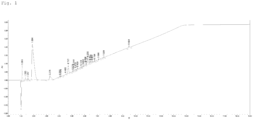
- Fig. 1 shows HPLC analysis results obtained by analyzing H-Ser-Met-Ile-Leu-Glu-OH synthesized in Example 4 in Analysis Condition 1.
- An embodiment of the present invention is a method for analyzing one or more compounds selected from the group consisting of a carrier for liquid phase peptide synthesis, a component derived from the carrier for liquid phase peptide synthesis, an amino acid to which the carrier for liquid phase peptide synthesis is bound, and a peptide compound to which the carrier for liquid phase peptide synthesis is bound, the analysis method using high-performance liquid chromatography or supercritical fluid chromatography using an alcohol as an eluent.
- a method for simultaneously analyzing one or more compounds selected from the group consisting of a carrier for liquid phase peptide synthesis, a component derived from the carrier for liquid phase peptide synthesis, an amino acid to which the carrier for liquid phase peptide synthesis is bound, and a peptide compound to which the carrier for liquid phase peptide synthesis is bound, with a target peptide or final target peptide the method using high-performance liquid chromatography or supercritical fluid chromatography using an alcohol as an eluent.
- an analysis method in which reaction tracking or post-treatment tracking of each step is performed in a liquid phase peptide production method using one or more compounds selected from the group consisting of an amino acid to which a carrier for liquid phase peptide synthesis is bound and a peptide compound to which a carrier for liquid phase peptide synthesis is bound, the analysis method using high-performance liquid chromatography or supercritical fluid chromatography using an alcohol as an eluent.
- a more preferred embodiment of the present invention is a method for analyzing a carrier for liquid phase peptide synthesis or a compound derived from the carrier for liquid phase peptide synthesis, the analysis method including subjecting a sample containing a target peptide or final target peptide obtained in an arbitrary step of a liquid phase peptide production method using a compound to which a carrier for liquid phase peptide synthesis and an amino acid, peptide, or amino acid amide are bound or obtained by the production method to high-performance liquid chromatography or supercritical fluid chromatography using an alcohol as an eluent.
- target peptide refers to a peptide obtained by a condensation reaction using an amino acid or peptide to which the carrier for liquid phase peptide synthesis is bound, and refers to a peptide obtained after cleaving the carrier for liquid phase peptide synthesis.
- the target peptide is a peptide from which the carrier for liquid phase peptide synthesis is cleaved and which has a protective group at the N-terminal or C-terminal.
- a functional group of an amino acid (amino acid residue) side chain such as a hydroxyl group, an amino group, a carboxyl group, or a thiol group may be protected by a general protective group that is not a carrier for liquid phase synthesis such as a tBu group.
- the final target peptide refers to a peptide obtained by deprotecting an N-terminal or C-terminal protective group from the target peptide or a peptide obtained after further deprotecting a general protective group, which is not a carrier for liquid phase synthesis, from the peptide obtained by deprotecting an N-terminal or C-terminal protective group.
- the analysis means that each component contained in a substance to be analyzed is separated and the content or content ratio thereof is quantitatively or qualitatively observed.
- Tracking refers to observing the degree of progress of a chemical reaction linked with the lapse of time, and means observing, for example, a decrease in starting materials related to the chemical reaction and an increase in products related to the chemical reaction. More specifically, the tracking refers to quantitatively or qualitatively observing the content of the amino acid or peptide having an amino group protected by an amino protective group (sometimes referred to as "amino group-protected amino acid” hereinafter), the content of the amino acid or peptide to which the carrier for liquid phase peptide synthesis is bound, the content of the carrier for liquid phase peptide synthesis or the component derived from the carrier for liquid phase peptide synthesis, and the content of the target peptide or final target peptide to which the carrier for liquid phase peptide synthesis is bound.
- an amino protective group sometimes referred to as "amino group-protected amino acid” hereinafter
- Simultaneously analyzing refers to observing two or more desired components by one injection of a sample into an HPLC column. More specifically, simultaneously analyzing refers to quantitatively or qualitatively observing the content of a target peptide or final target peptide and the content of a carrier for liquid phase peptide synthesis or a component derived from the carrier for liquid phase peptide synthesis by injecting a sample once into an HPLC column.
- the expression "linked to perform evaluation” refers to, for example, where the purity is calculated based on the ratio of the contents of the detected target peptide or detected final target peptide and one or more detected or undetected compounds selected from the group consisting of a carrier for liquid phase peptide synthesis, a component derived from the carrier for liquid phase peptide synthesis, an amino acid to which the carrier for liquid phase peptide synthesis is bound, and a peptide compound to which the carrier for liquid phase peptide synthesis is bound.
- a sample to be analyzed by the analysis method of the present invention is a sample containing a target peptide or final target peptide obtained in an arbitrary step of the liquid phase peptide production method using a compound in which a carrier for liquid phase peptide synthesis and an amino acid, peptide, or amino acid amide are bound or obtained by the method.
- the sample contains one or more carriers for liquid phase peptide synthesis, a component derived from the carrier for liquid phase peptide synthesis that is by-produced under conditions after deprotection of the carrier for liquid phase peptide synthesis, an amino acid or peptide to which the carrier for liquid phase peptide synthesis is bound, a target peptide, and a final target peptide.
- these samples include a reaction solution in which an object to be analyzed is not subjected to solid-liquid separation and a sample obtained after subjecting an object to be analyzed to solid-liquid separation or purification by chromatography.
- a reaction solution in which an object to be analyzed is not subjected to solid-liquid separation even when a sample obtained after subjecting an object to be analyzed to solid-liquid separation or purification by chromatography is used as a sample, it is difficult to simultaneously analyze a carrier for liquid phase peptide synthesis, a component derived from the carrier for liquid phase peptide synthesis that is by-produced under conditions after deprotection of the carrier for liquid phase peptide synthesis, an amino acid to which the carrier for liquid phase peptide synthesis is bound, a peptide compound to which the carrier for liquid phase peptide synthesis is bound, with a target peptide or final target peptide, which are embodiments of the present invention, particularly to simultaneously analyze a
- the composition containing a target peptide or final target peptide it is possible to determine whether or not a carrier for liquid phase peptide synthesis, a component derived from the carrier for liquid phase peptide synthesis that is by-produced under conditions after deprotection of the carrier for liquid phase peptide synthesis, an amino acid to which the carrier for liquid phase peptide synthesis is bound, and a peptide compound to which the carrier for liquid phase peptide synthesis is bound are mixed or the mixing ratio, simultaneously with analysis of a target peptide or final target peptide.
- liquid phase peptide production method using a compound in which a carrier for liquid phase peptide synthesis and an amino acid, peptide, or amino acid amide are bound that can suitably use the analysis method of the present invention will be described.
- the liquid phase peptide production method is preferably a liquid phase peptide production method including the following steps a to e of:
- the carrier for liquid phase peptide synthesis used in the step a is preferably a compound which is bound to an amino acid, a peptide, or an amino acid amide directly or via a linker to make the amino acid, the peptide, or the amino acid amide soluble in an organic solvent and insoluble in water.
- Examples of such a carrier for liquid phase peptide synthesis include the compounds described in Patent Literatures 1 to 14 described above.
- Preferable examples of the carrier for liquid phase peptide synthesis include a compound of Formula (I) below:
- the C6-20 aromatic hydrocarbon ring examples include a benzene ring, a naphthalene ring, an anthracene ring, a phenanthrene ring, a triphenylene ring, a tetracene ring, an indane ring, an indene ring, a fluorene ring, a biphenyl ring, and a 1,1'-binaphthalene ring.
- a benzene ring, a naphthalene ring, a phenanthrene ring, a fluorene ring are more preferable.
- a benzene ring is most preferable.
- the C4-10 aromatic heterocyclic ring is preferably a 5- to 10-membered aromatic heterocyclic ring containing one to three atoms selected from the group consisting of a nitrogen atom, an oxygen atom, and a sulfur atom as a hetero atom, and specific examples thereof include a pyrrole ring, a furan ring, a thiophene ring, an indole ring, a benzofuran ring, a benzothiophene ring, a carbazole ring, a pyrazole ring, an indazole ring, an imidazole ring, a pyridine ring, a quinoline ring, and an isoquinoline ring.
- a 5- to 8-membered aromatic heterocyclic ring containing one to three atoms selected from the group consisting of a nitrogen atom, an oxygen atom, and a sulfur atom as a hetero atom is preferable, and a pyrrole ring, a furan ring, a thiophene ring, an indole ring, a benzofuran ring, a benzothiophene ring, a carbazole ring, a pyrazole ring, and an indazole ring are more preferable.
- R 11 is a hydrogen atom, or when ring A is a benzene ring and Rb is a group of Formula (a) above, represents a single bond together with R 14 , and may form a fluorene ring together with ring A and ring B or may form a xanthene ring together with ring A and ring B via an oxygen atom.
- the ring which R 11 may form together with R 14 is preferably a fluorene ring or a xanthene ring.
- R 17 represents a hydrogen atom, an alkyl group, or an aralkyl group.
- R 17 is preferably a hydrogen atom, a C1-10 alkyl group, or a C7-20 aralkyl group.
- alkyl group include linear or branched C1-10 alkyl groups such as a methyl group, an ethyl group, a propyl group, an isopropyl group, a n-butyl group, an isobutyl group, a sec-butyl group, a tert-butyl group, a pentyl group, and a hexyl group.
- aralkyl group examples include C7-16 aralkyl groups such as a benzyl group, a 1-phenylethyl group, a 2-phenylethyl group, a 1-phenylpropyl group, a naphthylmethyl group, and a 1-naphthylethyl group.
- the organic group having an aliphatic hydrocarbon group is a monovalent organic group having an aliphatic hydrocarbon group in its molecular structure.
- the site of the aliphatic hydrocarbon group in the organic group having an aliphatic hydrocarbon group is not particularly limited, and may be present at the terminal or may be present at other sites.
- the aliphatic hydrocarbon group present in the organic group is a linear, branched, or cyclic saturated or unsaturated aliphatic hydrocarbon group, and is preferably a C5 or higher aliphatic hydrocarbon group, more preferably a C5-30 aliphatic hydrocarbon group, and further preferably a C8-30 aliphatic hydrocarbon group, from the viewpoint of organic solvent solubility.
- Specific examples of the aliphatic hydrocarbon group include an alkyl group, a cycloalkyl group, an alkenyl group, and an alkynyl group, and in particular, an alkyl group, a cycloalkyl group, and an alkenyl group are preferable, and an alkyl group is more preferable.
- a C5-30 linear or branched alkyl group, a C3-8 cycloalkyl group, and a C5-30 linear or branched alkenyl group are preferable, a C5-30 linear or branched alkyl group and a C3-8 cycloalkyl group are more preferable, a C5-30 linear or branched alkyl group is further preferable, and a C8-30 linear or branched alkyl group is still more preferable.
- alkyl group examples include alkyl groups having 1 to 30 carbon atoms, and examples thereof include monovalent groups such as a methyl group, an ethyl group, a propyl group, an isopropyl group, a butyl group, an isobutyl group, a sec-butyl group, a tert-butyl group, a pentyl group, a hexyl group, an octyl group, a decyl group, a lauryl group, a tridecyl group, a myristyl group, a cetyl group, a stearyl group, an aralkyl group, a behenyl group, a tetracosanyl group, a hexacosanyl group, and an isostearyl group, divalent groups derived therefrom, and groups obtained by excluding, for example, a hydroxyl group from various steroid groups.
- monovalent groups such as
- alkenyl group examples include monovalent groups such as a vinyl group, a 1-propenyl group, an allyl group, an isopropenyl group, a butenyl group, an isobutenyl group, and an oleyl group, and divalent groups derived therefrom.
- alkynyl group examples include an ethynyl group, a propargyl group, and a 1-propynyl group.
- an aliphatic hydrocarbon group may be substituted via an oxygen atom.
- the aliphatic hydrocarbon group that can be substituted with an aliphatic hydrocarbon group via an oxygen atom include monovalent groups such as a linear or branched alkoxy group having 1 to 20 carbon atoms, an alkenyloxy group having 2 to 20 carbon atoms, and a cycloalkyloxy group having 3 to 6 carbon atoms, and divalent groups derived therefrom.
- the aliphatic hydrocarbon group in which an aliphatic hydrocarbon group is substituted via an oxygen atom may further have a repeating structure in which an aliphatic hydrocarbon group is substituted via an oxygen atom.
- R 12 examples include a 12-docosyloxy-1-dodecyl group, a 3,4,5-tris(octadecyloxy)benzyl group, a 2,2,2-tris(octadecyloxymethyl)ethyl group, and a 3,4,5-tris(octadecyloxy)cyclohexylmethyl group. These three kinds are preferable.
- a silyl group or an aliphatic hydrocarbon group may be substituted via an oxygen atom, and examples of the substituent include a group of the following Formula (b). -R 20 -X 3 -D (b)
- R 20 represents a linear or branched alkylene group having 6 to 16 carbon atoms
- R 21 represents a hydrogen atom or an alkyl group having 1 to 4 carbon atoms
- D represents any of a silyl group or an alkyl group to which a silyloxy group is bound.
- the silyl group is preferably a silyl group in which one to three alkyl groups or one to three aryl groups are substituted, and more preferably a silyl group in which three linear or branched alkyl groups having 1 to 6 carbon atoms are substituted or a silyl group in which three alkyl groups having 6 to 10 carbon atoms which may have a substituent are substituted.
- the aryl group include a phenyl group and a naphthyl group.
- the silyl group is preferably a silyl group in which three linear or branched alkyl groups having 1 to 6 carbon atoms are substituted, and more preferably a silyl group in which three linear or branched alkyl groups having 1 to 4 carbon atoms are substituted.
- the three alkyl groups or aryl groups substituted for the silyl group may be the same or different.
- the alkyl group to which a silyloxy group is bound is preferably a linear or branched alkyl group having 1 to 13 carbon atoms to which one to three silyloxy groups are bound in which three groups selected from the group consisting of a linear or branched alkyl group having 1 to 6 carbon atoms and an aryl group which may have a substituent are substituted.
- the silyloxy group is preferably a silyloxy group in which three linear or branched alkyl groups having 1 to 6 carbon atoms are substituted, and more preferably a silyloxy group in which three linear or branched alkyl groups having 1 to 4 carbon atoms are substituted.
- the three alkyl groups or aryl groups substituted for the silyloxy group may be the same or different.
- the linear or branched alkyl group having 1 to 13 carbon atoms is preferably branched, and more preferably has a quaternary carbon atom.
- p and q each represent an integer of 0 to 4 and p + q represents 1 or more and 4 or less.
- p is preferably 1 to 4, more preferably 1 to 3, and further preferably 1 to 2.
- Ring A may further have, in addition to p XR 12 's, a substituent selected from the group consisting of a halogen atom, a C1-6 alkyl group which may be substituted with a halogen atom, and a C1-6 alkoxy group which may be substituted with a halogen atom.
- halogen atom examples include a chlorine atom, a fluorine atom, a bromine atom, and an iodine atom.
- C1-6 alkyl group which may be substituted with a halogen atom include a methyl group, an ethyl group, a propyl group, an isopropyl group, a butyl group, an isobutyl group, a sec-butyl group, a tert-butyl group, a pentyl group, a hexyl group, a dichloromethyl group, a trichloromethyl group, and a trifluoromethyl group.
- Examples of the C1-6 alkoxy group which may be substituted with a halogen atom include a methoxy group, an ethoxy group, a propyloxy group, an isopropyloxy group, a butyloxy group, an isobutyloxy group, a sec-butyloxy group, a tert-butyloxy group, a trichloromethoxy group, and a trifluoromethoxy group.
- Ra represents a hydrogen atom or an aromatic ring which may be substituted with a halogen atom.
- aromatic ring examples include a C6-18 aromatic hydrocarbon ring and a C4-10 aromatic heterocyclic ring.
- the C6-18 aromatic hydrocarbon ring examples include a benzene ring, a naphthalene ring, an anthracene ring, a phenanthrene ring, a triphenylene ring, a tetracene ring, an indane ring, an indene ring, a fluorene ring, and a biphenyl ring.
- a benzene ring, a naphthalene ring, a phenanthrene ring, a fluorene ring are more preferable.
- a benzene ring is most preferable.
- the C4-10 aromatic heterocyclic ring is preferably a 5- to 10-membered heterocyclic ring containing one to three atoms selected from the group consisting of a nitrogen atom, an oxygen atom, and a sulfur atom as a hetero atom, and specific examples thereof include a pyrrole ring, a furan ring, a thiophene ring, an indole ring, a benzofuran ring, a benzothiophene ring, a carbazole ring, a pyrazole ring, an indazole ring, an imidazole ring, a pyridine ring, a quinoline ring, and an isoquinoline ring.
- a 5- to 8-membered heterocyclic ring containing one to three atoms selected from the group consisting of a nitrogen atom, an oxygen atom, and a sulfur atom as a hetero atom is preferable, and a pyrrole ring, a furan ring, a thiophene ring, an indole ring, a benzofuran ring, a benzothiophene ring, a carbazole ring, a pyrazole ring, and an indazole ring are more preferable.
- One to three halogen atoms may be substituted in the aromatic ring of Ra.
- Rb represents a hydrogen atom, an aromatic ring which may be substituted with a halogen atom, or the group of Formula (a).
- r and s each represent an integer of 0 to 4 and r + s is 0 to 4.
- r is preferably 0 to 4, more preferably 1 to 3, and further preferably 1 to 2.
- R 18 represents a hydrogen atom, an alkyl group, or an aralkyl group.
- R 18 is preferably a hydrogen atom, a C1-10 alkyl group, or a C7-20 aralkyl group.
- alkyl group include a methyl group, an ethyl group, a propyl group, an isopropyl group, a n-butyl group, an isobutyl group, a sec-butyl group, a tert-butyl group, a pentyl group, and a hexyl group.
- aralkyl group examples include C7-16 aralkyl groups such as a benzyl group, a 1-phenylethyl group, a 2-phenylethyl group, a 1-phenylpropyl group, a naphthylmethyl group, and a 1-naphthylethyl group.
- r R 15 's independently represent an organic group of an aliphatic hydrocarbon group substituted with an aliphatic hydrocarbon group via an oxygen atom, or Formula (b) ; - R 20 -X 3 -D (b)
- Examples of the organic group having an aliphatic hydrocarbon group which may be substituted with a silyl group or an aliphatic hydrocarbon group via an oxygen atom represented as R 15 and R 16 include the same groups as those of R 12 and R 13 described above, and the same groups as those of R 12 and R 13 described above are preferable.
- R 14 represents a hydrogen atom, or represents a single bond together with R 11 , and may form a fluorene ring together with ring A and ring B, or may form a xanthene ring together with ring A and ring B via an oxygen atom.
- Ring B may further have, in addition to r ZR 15 's, a substituent selected from the group consisting of a halogen atom, a C1-6 alkyl group which may be substituted with a halogen atom, and a C1-6 alkoxy group which may be substituted with a halogen atom.
- halogen atom examples include a chlorine atom, a fluorine atom, a bromine atom, and an iodine atom.
- C1-6 alkyl group which may be substituted with a halogen atom include a methyl group, an ethyl group, a propyl group, an isopropyl group, a butyl group, an isobutyl group, a sec-butyl group, a tert-butyl group, a pentyl group, a hexyl group, a dichloromethyl group, a trichloromethyl group, and a trifluoromethyl group.
- Examples of the C1-6 alkoxy group which may be substituted with a halogen atom include a methoxy group, an ethoxy group, a propyloxy group, an isopropyloxy group, a butyloxy group, an isobutyloxy group, a sec-butyloxy group, a tert-butyloxy group, a trichloromethoxy group, and a trifluoromethoxy group.
- Y represents a hydroxy group, a thiol group, NHR 19 (R 19 represents a hydrogen atom, an alkyl group, or an aralkyl group), or a halogen atom.
- R 19 is preferably a hydrogen atom, a C1-10 alkyl group, or a C7-20 aralkyl group.
- alkyl group include a methyl group, an ethyl group, a propyl group, an isopropyl group, a n-butyl group, an isobutyl group, a sec-butyl group, a tert-butyl group, a pentyl group, and a hexyl group.
- aralkyl group examples include C7-16 aralkyl groups such as a benzyl group, a 1-phenylethyl group, a 2-phenylethyl group, a 1-phenylpropyl group, a naphthylmethyl group, and a 1-naphthylethyl group.
- a preferred carrier for liquid phase peptide synthesis examples include compounds of Formula (1), (13), or (14) below.
- a compound of Formula (1) can be used (Patent Literatures 6 and 7).
- X 2 represents -CH 2 OR 44 (R 44 represents a hydrogen atom, a halogenocarbonyl group, an active ester-type carbonyl group, or an active ester-type sulfonyl group), -CH 2 NHR 45 (R 45 represents a hydrogen atom, a linear or branched alkyl group having 1 to 6 carbon atoms, or an aralkyl group), a halogenomethyl group, a formyl group, or an oxime, and at least one of R 31 , R 32 , R 33 , R 34 , and R 35 represents a group of Formula (c), -O-R 20 -X 3 -D (c)
- Patent Literatures 8, 9, and 12 As the carrier for liquid phase peptide synthesis, a compound of Formula (13) can be used (Patent Literatures 8, 9, and 12).
- Patent Literatures 10 and 11 As the carrier for liquid phase peptide synthesis, a compound of Formula (14) can be used (Patent Literatures 10 and 11).
- X 6 represents a hydroxy group or a halogen atom
- at least one of R 71 to R 85 represents a group of Formula (c)
- the rest represents a hydrogen atom, a halogen atom, an alkyl group having 1 to 4 carbon atoms, or an alkoxy group having 1 to 4 carbon atoms
- R 80 and R 81 may be bound by a single bond to form a fluorene ring, or may be bound via an oxygen atom to form a xanthene ring.
- a preferred carrier for liquid phase peptide synthesis examples include compounds of Formula (20) or (21) below.
- a compound of Formula (20) can be used (Patent Literatures 2 and 5).
- X 2 represents a hydroxyl group or -NHR 90 (R 90 represents a hydrogen atom, a linear or branched alkyl group having 1 to 6 carbon atoms, or an aralkyl group), at least one of R 31 , R 32 , R 33 , R 34 , and R 35 represents a group of Formula (d), -O-R 20 -X 3 -E (d)
- a compound of Formula (21) As the carrier for liquid phase peptide synthesis, a compound of Formula (21) can be used (Patent Literatures 3 and 4).
- X 4 represents a hydroxyl group or -NHR 90 (R 90 represents a hydrogen atom, a linear or branched alkyl group having 1 to 6 carbon atoms, or an aralkyl group), and X 5 represents a hydrogen atom or a phenyl group which may be substituted with a halogen atom; and at least one of R 51 to R 60 represents a group of Formula (d), and the rest represents a hydrogen atom, a halogen atom, an alkyl group having 1 to 4 carbon atoms, or an alkoxy group having 1 to 4 carbon atoms.
- the amino acid to which the carrier for liquid phase peptide synthesis is bound or the peptide to which the carrier for liquid phase peptide synthesis is bound which is one of raw materials used in the production method of the present invention, refers to an amino acid or peptide in which one of reactive groups of the amino acid or peptide is bound to the carrier for liquid phase peptide synthesis and at least one amino group is in a reactive state.
- the carboxyl group of the amino acid or peptide is bound to the carrier for liquid phase peptide synthesis, while the amino group is unprotected and reactive.
- the amino acid amide bound to the carrier for liquid phase peptide synthesis refers to an amino acid amide in which at least one amide group of the amino acid amide is bound to the carrier for liquid phase peptide synthesis, and at least one amino group is unprotected and reactive.
- the amino acid, peptide, or amino acid amide to which the carrier for liquid phase peptide synthesis is bound has a highly reactive functional group such as a hydroxyl group, an amino group, a guanidyl group, a carboxyl group, a thiol group, an indole group, or an imidazole group
- a general protective group used in peptide synthesis may be introduced into these functional groups, and a target compound can be obtained by deprotecting the protective group as necessary after completion of the reaction.
- examples of the protective group of the hydroxyl group include a tBu group, a Trt group, a Bz group, an acetyl group, and a silyl group
- examples of the protective group of the amino group include a Boc group, a Fmoc group, a Cbz group, a Trt group, an Mmt group, and an ivDde group
- examples of the protective group of the guanidyl group include a Pbf group, a Pmc group, and a nitro group
- examples of the protective group of the carboxyl group include a tBu group, a methyl group, an ethyl group, and a Bz group
- examples of the protective group of the thiol group include a Trt group, an Acm group, a tBu group, and an S-tBu group
- examples of the protective group of the indole group include a Boc group
- examples of the protective group of the imidazole group include a Boc group
- the carrier for liquid phase peptide synthesis is introduced so as to be bound to the carboxyl group of the amino acid or peptide directly or via a linker.
- the linker described herein is an organic group having two reactive groups in which one of linkers is bound to the carboxyl group and the other is bound to the carrier for liquid phase peptide synthesis.
- a preferred linker is a compound which is an organic group having a molecular weight of about 2000 or less (preferably about 1500 or less, more preferably about 1000 or less), may be the same or different as the reactive group, and is a compound having at least two groups selected from the group consisting of an amino group, a carboxyl group, and a halomethyl group in the molecule. Examples thereof include the following compounds: wherein t is an integer of 1 to 6, preferably 1 to 4; wherein X 9 is a halogen atom and preferably chlorine or bromine;
- one of the linkers may be bound to the carboxyl group and then the other may be bound to the carrier for liquid phase peptide synthesis, or one of the linkers may be bound to the carrier for liquid phase peptide synthesis and then the other may be bound to the carboxyl group.
- a means for introducing these linkers into the carboxyl group can be appropriately referred to a known method. For example, amidation with diisopropylcarbodiimide (DIPCI)/HOBt can be mentioned.
- DIPCI diisopropylcarbodiimide
- the binding between one of the linkers and the carrier for liquid phase peptide synthesis can be performed by appropriately referring to a known method depending on the groups of the linkers to be bound to each other and the group of the carrier for liquid phase peptide synthesis.
- esterification with DIPCI can be mentioned.
- an N-Boc-liquid phase synthesis carrier-protected amino acid, peptide, or amino acid amide which is an intermediate in which the carrier for liquid phase peptide synthesis is bound to the carboxyl group of the amino acid, peptide, or amino acid amide, can be produced by dissolving the carrier for liquid phase peptide synthesis in an organic solvent such as THF and performing condensation by adding, for example, a Boc-protected amino acid, peptide, or amino acid amide and a condensing agent such as DIPCI.
- the amino acid or peptide having an amino group protected by an amino protective group which is the other raw material, means an amino acid or peptide in which the amino group of the amino acid or peptide is protected by an amino protective group, while the carboxyl group is not protected, and which is reactive.
- the amino acid or peptide has one or more amino groups, at least one amino group may be protected by an amino protective group.
- amino protective group examples include an Fmoc group, a Boc group, a Cbz group, and an Ac group, and among them, an Fmoc group that can be deprotected under basic conditions is more preferable.
- the amino acid or peptide having an amino group protected by an amino protective group has a highly reactive functional group such as a hydroxyl group, an amino group, a guanidyl group, a carboxyl group, a thiol group, an indole group, or an imidazole group
- a general protective group used in peptide synthesis may be introduced into these functional groups, and a target compound can be obtained by deprotecting the protective group as necessary at any time point after completion of the reaction.
- Examples of the protective group of the hydroxyl group include a tBu group, a Trt group, a Bz group, an acetyl group, and a silyl group
- examples of the protective group of the amino group include a Boc group, a Fmoc group, a Cbz group, a Trt group, an Mmt group, and an ivDde group
- examples of the protective group of the guanidyl group include a Pbf group, a Pmc group, and a nitro group
- examples of the protective group of the carboxyl group include a tBu group, a methyl group, an ethyl group, and a Bz group
- examples of the protective group of the thiol group include a Trt group, an Acm group, a tBu group, and an S-tBu group
- examples of the protective group of the indole group include a Boc group
- examples of the protective group of the imidazole group include a Boc group
- the amino acid or peptide having an amino group protected by an amino protective group can be produced, for example, by reacting chloroformic acid 9-fluorenylmethyl ester with an amino acid or peptide having an amino group to be protected by an amino protective group in a solvent such as THF in the presence of a condensing agent.
- the step b of the present invention is to condense the compound, and a reaction solvent used in the step b is a solvent containing an organic solvent.
- a reaction solvent used in the step b is a solvent containing an organic solvent.
- organic solvent examples include tetrahydrofuran (THF), dimethylformamide (DMF), cyclohexane, cyclopentyl methyl ether (CPME), methyl-tert-butyl ether (MTBE), 2-methyl THF, 4-methyl tetrahydropyran (4-methyl THP), isopropyl acetate, chloroform, dichloromethane, and N-methyl pyrrolidone, and THF, DMF, cyclohexane, CPME, MTBE, 2-methyl THF, 4-methyl THP, isopropyl acetate, and N-methyl pyrrolidone are preferable.
- a mixed solvent of two or more kinds of the above solvents may be used.
- the condensation reaction can be performed by mixing a peptide bound to a carrier for liquid phase peptide synthesis, an amino group-protected amino acid, and a condensing agent in the solvent containing an organic solvent.
- the amount of the amino group-protected amino acid used with respect to the peptide bound to a carrier for liquid phase peptide synthesis is usually 1.01 to 4 equivalents, preferably 1.03 to 3 equivalents, more preferably 1.05 to 2 equivalents, and further preferably 1.1 to 1.5 equivalents with respect to the peptide bound to a carrier for liquid phase peptide synthesis.
- an active ester of an unreacted amino acid can be captured and inactivated by a scavenger to be added later. Therefore, even when an excess amount of amino group-protected amino acid is used, the problem of remaining of the amino group-protected amino acid does not occur.
- those generally used in peptide synthesis can also be used in the present invention, and examples thereof include 4-(4,6-dimethoxy-1,3,5-triazine-2-yl)-4-methylmorphonium chloride (DMT-MM), O-(benzotriazole-1-yl)-1,1,3,3-tetramethyluronium hexafluorophosphate (HBTU), O-(7-azabenzotriazole-1-yl)-1,1,3,3-tetramethyluronium hexafluorophosphate (HATU), O-(6-chlorobenzotriazole-1-yl)-1,1,3,3-tetramethyluronium hexafluorophosphate (HBTU(6-Cl)), O-(benzotriazole-1-yl)-1,1,3,3-tetramethyluronium tetrafluoroborate (TBTU), O-(6-chlorobenzotriazole-1-yl)-1-yl)-1,1,
- DMT-MM, HBTU, HATU, or COMU is preferable.
- the amount of the condensing agent used is preferably 1 to 4 equivalents, more preferably 1 to 2 equivalents, and further preferably 1.05 to 1.3 equivalents with respect to the peptide bound to a carrier for liquid phase peptide synthesis.
- an activating agent is preferably added in order to promote the reaction and suppress side reactions such as racemization.
- the activating agent described herein is a reagent that makes it easy to guide the amino acid to, for example, a corresponding active ester or a symmetric acid anhydride to form a peptide bond (amide bond) by coexistence with a condensing agent.
- the activating agent those generally used in peptide synthesis can be used.
- Examples thereof include 1-hydroxybenzotriazole (HOBt), ethyl 1-hydroxy-1H-1,2,3-triazole carboxylate (HOCt), 1-hydroxy-7-azabenzotriazole (HOAt), 3-hydroxy-4-ketobenzotriazine (HOOBt), N-hydroxysuccinimide (HOSu), N-hydroxyphthalimide (HOPht), N-hydroxy-5-norbornene-2,3-dicarboximide (HONb), pentafluorophenol, and ethyl cyano(hydroxyimino) acetate (Oxyma).
- HOBt, HOOBt, HOCt, HOAt, HONb, HOSu, and Oxyma are preferable.
- the amount of the activating agent used is preferably 1 to 4 equivalents, more preferably 1 to 2 equivalents, and further preferably 1.05 to 1.3 equivalents with respect to the peptide bound to a carrier for liquid phase peptide synthesis.
- the amount of the solvent used is an amount at which the concentration at which, for example, the peptide bound to a carrier for liquid phase peptide synthesis is dissolved is preferably 0.1 mM to 1 M, more preferably 1 mM to 0.5 M.
- the reaction temperature is, for example, preferably -20 to 40°C, more preferably 0 to 30°C, which is a temperature generally used in peptide synthesis.
- the reaction time (time for 1 cycle) is usually 0.5 to 30 hours.
- the step c is to add an amino acid active ester scavenger to the reaction solution after the condensation reaction.
- the amino acid active ester scavenger is preferably an amino group-containing compound and particularly preferably an amino group-containing compound selected from the group consisting of divalent or higher water-soluble amines, alkylamines, aromatic amines, hydroxylamines, aminosulfonic acids, amino sulfates, aminophosphonic acids, aminophosphoric acids, and amino alcohols.
- Examples of the divalent or higher water-soluble amines include 1-methylpiperazine, 4-aminopiperidine, diethylenetriamine, triaminoethylamine, 1-ethylpiperazine, N,N-dimethylethylenediamine, ethylenediamine, and piperazine, 1-methylpiperazine, 4-aminopiperidine, diethylenetriamine, N,N-dimethylethylenediamine, and ethylenediamine are preferable, 1-methylpiperazine, 4-aminopiperidine, N,N-dimethylethylenediamine, and diethylenetriamine are more preferable, and 1-methylpiperazine is further preferable.
- alkylamine examples include an alkylamine having 1 to 14 carbon atoms, an alkylamine having 2 to 10 carbon atoms is preferable, an alkylamine having 2 to 8 carbon atoms is more preferable, and an alkylamine having 3 to 4 carbon atoms is further preferable.
- aromatic amine examples include an aromatic amine having 6 to 14 carbon atoms, and an aromatic amine having 6 to 10 carbon atoms is preferable.
- alkylamine, the aromatic amine, and the hydroxylamine include, but are not limited to, propylamine, butylamine, hexylamine, aniline, toluidine, 2,4,6-trimethylaniline, anisidine, phenetidine, and hydroxylamine, and propylamine is particularly preferable.
- aminosulfonic acids aminosulfates, aminophosphonic acids, aminophosphoric acids, and amino alcohols are preferably compounds of Formulas (15) to (17) below.
- aminosulfonic acids and amino sulfates of the following Formula (15): H 2 N-R 9 -X 7 -SO 3 H (15)
- R 91 in Formula (15) and R 92 in Formula (16) are independently a divalent organic group having 1 to 10 carbon atoms, and preferable examples thereof include a linear or branched alkylene group having 1 to 10 carbon atoms and an arylene group having 6 to 10 carbon atoms. Specific examples thereof include a methylene group, an ethylene group, a trimethylene group, a propylene group, a tetramethylene group, a tetramethylene group, a pentamethylene group, a phenylene group, and a naphthylene group.
- a linear or branched alkylene group having 1 to 6 carbon atoms and an arylene group having 6 to 8 carbon atoms are more preferable, a linear or branched alkylene group having 1 to 6 carbon atoms is further preferable, and a linear or branched alkylene group having 1 to 5 carbon atoms is still more preferable.
- n in Formula (17) represents an integer of 0 to 20.
- n is preferably 0 to 20, more preferably 0 to 6, and further preferably 0 to 4.
- R 93 and R 94 in Formula (17) are preferably a hydrogen atom or a hydroxyl methyl group.
- amino group-containing compounds it is more preferable to use a compound selected from the group consisting of aminosulfonic acids, amino sulfates, aminophosphonic acids, aminophosphoric acids, and amino alcohols, as the amino acid active ester scavenger.
- a compound selected from the group consisting of aminosulfonic acids, amino sulfates, aminophosphonic acids, aminophosphoric acids, and amino alcohols as the amino acid active ester scavenger.
- the amount of the amino group-containing compound added in the step c is preferably 1 to 10 equivalents, more preferably 1 to 6 equivalents, and further preferably 1 to 4 equivalents with respect to 1 equivalent of the active amino acid ester remaining theoretically.
- the amount of the amino group-containing compound added is too small, scavenging (capturing) of the amino acid active ester becomes insufficient, and double hit in which the remaining amino acid active ester reacts with the amino group generated in the step d occurs to reduce purity and yield.
- the amount of the amino group-containing compound added is too large, amino protective group deprotection reaction simultaneously proceeds, and double hit in which the remaining amino acid active ester reacts with the regenerated amino group occurs to reduce purity and yield.
- the step d is to deprotect the amino protective group of the compound having an amino group protected by an amino protective group in the reaction solution.
- the deprotection step of the amino protective group varies depending on the type of the amino protective group.
- the reaction solution may be set to basic conditions.
- the amino protective group is a Boc group
- the reaction solution may be set to acidic conditions.
- the amino protective group is a Cbz group
- catalytic reduction may be performed.
- the amino protective group is an Ac group
- the amino protective group may be deprotected under strong acid or strong base conditions.
- the amino protective group is more preferably an Fmoc group for one-pot liquid phase synthesis.
- the Fmoc deprotection step is only required to make the reaction solution basic, and an amine compound, for example, tertiary amines such as 1,8-diazabicyclo[5.4.0]-7-undecene (DBU), 1,5-diazabicyclo[4.3.0]-5-nonene (DBN), 1,4-diazabicyclo[2.2.2]-octane (DABCO), triethylamine, and tributylamine; divalent or higher water-soluble amines having at least one primary or secondary amino group such as 1-methylpiperazine, 4-aminopiperidine, diethylenetriamine, triaminoethylamine, 1-ethylpiperazine, N,N-dimethylethylenediamine, ethylenediamine, piperidine, and piperazine can be used.
- tertiary amines such as 1,8-diazabicyclo[5.4.0]-7-undecene (DBU), 1,5-diaza
- DBU, piperidine, 1-methylpiperazine, 4-aminopiperidine, and diethylenetriamine are preferable, DBU, piperidine, and 1-methylpiperazine are more preferable, and DBU is further preferable.
- the base used in the step c may be referred to as an amine compound.
- the equivalent of the amine compound added in the step c is 1 to 30 equivalents, preferably 4 to 20 equivalents, and more preferably 4 to 10 equivalents with respect to the amount of the Fmoc group present in the system.
- a trapping agent of DBF dibenzofulbene
- DBF dibenzofulbene
- examples of the trapping agent of DBF used herein include a mercapto compound.
- examples of the mercapto compound that can be used include an acid having a mercapto group, for example, a mercapto fatty acid or an alkali metal salt thereof, and a compound of Formula (18) or (19) below: HS-L1-SO 3 M (18) HS-L2-PO 3 M 2 (19) wherein L1 and L2 each represent a divalent organic group, and M represents a hydrogen atom or an alkali metal.
- the mercapto fatty acid or the alkali metal salt thereof is preferably mercapto C1-20 fatty acid or an alkali metal salt thereof and more preferably mercapto C1-6 fatty acid or an alkali metal salt thereof.
- L1 and L2 each represent a divalent organic group.
- the divalent organic group is preferably a divalent organic group having 1 to 10 carbon atoms, and more preferably a linear or branched alkylene group having 1 to 10 carbon atoms which may have a mercapto group, an arylene group having 6 to 10 carbon atoms which may have a mercapto group, and a heteroarylene group having 4 to 9 carbon atoms which may have a mercapto group.
- Specific examples thereof include a methylene group, an ethylene group, a trimethylene group, a propylene group, a mercaptotrimethylene group, a mercaptopropylene group, a tetramethylene group, a butylene group, a pentamethylene group, a phenylene group, a naphthylene group, an indole group, a benzimidazole group, a quinolyl group, and an isoquinoline group.
- M represents a hydrogen atom or an alkali metal. Specific examples thereof include a hydrogen atom, sodium, and potassium.
- Specific examples thereof include sodium mercaptomethane sulfonate, sodium 2-mercaptoethane sulfonate, 2-mercaptoethane sulfonic acid, sodium 3-mercaptopropane sulfonate, 1,3-dimercaptopropane sulfonic acid, sodium 2-mercaptobenzimidazole-5-sulfonate, sodium mercaptomethane phosphonate, mercaptoethane phosphonic acid, sodium 3-mercaptopropane phosphonate, and sodium 1,3-dimercaptopropane phosphonate.
- the amount of the mercapto compound added is preferably 1 to 30 equivalents, more preferably 1 to 10 equivalents, and further preferably 1 to 5 equivalents with respect to the amount of DBF by-produced theoretically.
- the amine compound and the mercapto compound may be added simultaneously, or the mercapto compound and the amine compound may be added in this order, or the amine compound may be added to deprotect the Fmoc group and then the mercapto compound may be added.
- the Fmoc deprotection step may be performed at a temperature of -20 to 40°C for 5 minutes to 5 hours.
- the step e is to add an aqueous solution to the reaction solution and perform liquid separation to obtain an organic solvent layer containing a condensate of the amino acid, peptide, or amino acid amide to which the carrier for liquid phase peptide synthesis is bound and the amino acid or peptide from which the amino protective group is deprotected.
- the aqueous layer contains a condensate of the amino acid or peptide from which the amino protective group is deprotected and an active ester scavenger, and a DBF-trapping agent adduct. That is, the DBF-trapping agent adduct by-produced in the deprotection step of the amino protective group is easily extracted into the aqueous layer only by the addition of the aqueous solution in the step e.
- the organic solvent layer contains a condensate of the amino acid, peptide, or amino acid amide to which the carrier for liquid phase peptide synthesis is bound and the amino acid or peptide from which the amino protective group is deprotected.
- aqueous solution to be used examples include water, a sodium chloride aqueous solution, a sodium carbonate aqueous solution, a potassium carbonate aqueous solution, a disodium hydrogen phosphate aqueous solution, a trisodium phosphate aqueous solution, a sodium hydrogen carbonate aqueous solution, a potassium hydrogen carbonate aqueous solution, a dipotassium hydrogen phosphate aqueous solution, and a tripotassium phosphate aqueous solution.
- step e of the present invention it is not necessary to use an acidic aqueous solution simply by adding an aqueous solution and liquid separation, so that liquid separation failure between the amino acid active ester and the peptide as a product does not occur. Since solid-liquid separation is not required, one-pot synthesis is possible without isolating the liquid phase production of the peptide.
- the obtained organic solvent layer can be further used for the condensation reaction with an arbitrary amino acid.
- Examples of a sample to be analyzed of the present invention include a reaction solution, a concentrate thereof, or an extract thereof in an arbitrary step of the liquid phase peptide production method using a compound in which a carrier for liquid phase peptide synthesis and an amino acid, peptide, or amino acid amide are bound, that is, in an arbitrary step of the above steps a to e.
- Examples of the sample containing a target peptide or final target peptide obtained by the method include the reaction solution of the step e, an extraction liquid thereof, a reaction solution obtained after all protective groups after liquid separation and the step e are deprotected, an extraction liquid thereof, and a solid or filtrate obtained by liquid separation and solid-liquid separation.
- An analysis means is HPLC or supercritical liquid chromatography, and in the present invention, an alcohol is used instead of acetonitrile as an eluent for these kinds of liquid chromatography.
- an alcohol is used, not only various peptides but also, for example, a carrier for liquid phase peptide synthesis and a peptide bound to a carrier for liquid phase peptide synthesis are dissolved, and these components can be simultaneously analyzed.
- Examples of the alcohol to be used include alcohols having 1 to 4 carbon atoms such as ethanol, isopropanol, and n-butanol, ethanol and isopropanol are more preferable, and isopropanol is further preferable.
- the eluent may be a solution containing these alcohols, and may contain, for example, various organic solvents, acids, bases, salts, and counter ion forming products, in addition to the alcohols.
- the operation itself may be performed according to an ordinary HPLC of supercritical liquid chromatography operation.
- HPLC is preferably reversed-phase HPLC
- the stationary phase can be appropriately selected from those usually used in consideration of, for example, the length of the target peptide contained in the sample to be analyzed and the physical properties of the carrier for liquid phase peptide synthesis. Suitable examples thereof include octadecyl silica (ODS), and for example, the particle shape of the packing material, the pore size, and the density of ODS can also be appropriately selected.
- ODS octadecyl silica
- Examples of a commercially available column having the ODS as a stationary phase include MonoBis Column low-pressure ODS end cap (mesopore 11 nm) 3.2 x 150 mm (Kyoto Monotech Co., Ltd.), and Kinetex EVO C18 4.6 x 150 mm particle size of 2.6 um (manufactured by Phenomenex Inc.).
- the present invention it is possible to solve the problem in that the peptide bound to a carrier for liquid phase peptide synthesis is not dissolved in the eluent and the problem in that the peptide bound to a carrier for liquid phase peptide synthesis is not eluted.
- the reaction rate of each step can be grasped by analysis using exactly the same eluent in a series of peptide synthesis.
- the analysis of the peptide component can be simultaneously performed, it is possible to determine whether or not the component derived from the carrier for liquid phase peptide synthesis is mixed in the target peptide (final target peptide) after deprotection, and the mixing ratio when the component is mixed in the target peptide.
- Fmoc-NH-(D-STag) is a compound in which an amino group of D-STag is protected with an Fmoc group.
- Fmoc-NH-(X-STag) is a compound in which an amino group of X-STag is protected with an Fmoc group.
- Fmoc-Glu(OtBu)-OH Fmoc-Glu(OtBu)-OH
- Fmoc-Glu(OtBu)-O-(B-STag) a compound in which B-STag is bound to Fmoc-protected tBu-protected glutamic acid
- a compound in which D-STag is bound to Fmoc-protected tBu-protected threonine (Fmoc-Thr(tBu)-OH)) is referred to as "Fmoc-Thr(tBu)-NH-(D-STag)", and the compound shows the following structure.
- a compound in which X-STag is bound to Fmoc-protected tBu-protected threonine (Fmoc-Thr(tBu)-OH)) is referred to as "Fmoc-Thr(tBu)-NH-(X-STag)", and the compound shows the following structure.
- Fmoc-Glu(OtBu)-O-(B-STag) was 5% or less with respect to H-Glu(OtBu)-O-(B-STag) as a product in Analysis Condition 1
- 75 mL of a 5% sodium carbonate aqueous solution was added dropwise, the temperature was raised to room temperature, and liquid separation was performed.
- 17 mL of 20% saline, 6 mL of a 5% sodium carbonate aqueous solution, and 1.2 mL of DMF were added, and liquid separation was performed.
- H-Glu(OtBu)-O-(B-STag) was 5% or less with respect to Fmoc-Cys(Trt)-Glu(OtBu)-O-(B-STag) as a product in Analysis Condition 1, 0.55 g (3.9 mmol) of taurine and 16 mL of DMSO were added, and the mixture was stirred at room temperature for 2 hours. The mixture was cooled to 0°C, 1.19 g (3.9 mmol) of sodium 2-mercapto-1-ethanesulfonate was added, 2.7 mL (18 mmol) of DBU was added, and the mixture was stirred for 20 minutes.
- H-Cys(Trt)-Glu(OtBu)-O-(B-STag) was 5% or less with respect to Fmoc-Asn(Trt)-Cys(Trt)-Glu(OtBu)-O-(B-STag) as a product in Analysis Condition 1, 0.55 g (3.9 mmol) of taurine and 16 mL of DMSO were added, and the mixture was stirred at room temperature for 40 minutes. The mixture was cooled to 0°C, 1.19 g (3.9 mmol) of sodium 2-mercapto-1-ethanesulfonate was added, 2.7 mL (18 mmol) of DBU was added, and the mixture was stirred for 1 hour.
- Fmoc-Asn(Trt)-Cys(Trt)-Glu(OtBu)-O-(B-STag) was 5% or less with respect to H-Asn(Trt)-Cys(Trt)-Glu(OtBu)-O-(B-STag) as a product in Analysis Condition 1, 60 mL of a 5% sodium carbonate aqueous solution was added dropwise, the temperature was raised to room temperature, and liquid separation was performed. To the obtained organic layer, 38 mL of 20% saline, 13 mL of a 5% sodium carbonate aqueous solution, and 2.7 mL of DMF were added, and liquid separation was performed.
- H-Asn(Trt)-Cys(Trt)-Glu(OtBu)-O-(B-STag) was 5% or less with respect to Fmoc-Ala-Asn(Trt)-Cys(Trt)-Glu(OtBu)-O-(B-STag) as a product in Analysis Condition 1, 0.55 g (3.9 mmol) of taurine and 16 mL of DMSO were added, and the mixture was stirred at room temperature for 30 minutes.
- Fmoc-Ala-Asn(Trt)-Cys(Trt)-Glu(OtBu)-O-(B-STag) was 5% or less with respect to H-Ala-Asn(Trt)-Cys(Trt)-Glu(OtBu)-O-(B-STag) as a product in Analysis Condition 1, 9.6 mL of a 1 M sulfuric acid aqueous solution was added dropwise, 60 mL of a 5% sodium carbonate aqueous solution was then added, the temperature was raised to room temperature, and liquid separation was performed.
- Retention time Fmoc-Ala-Asn(Trt)-Cys(Trt)-Glu(OtBu)-O-(B-STag): 14.5 minutes; H-Ala-Asn(Trt)-Cys(Trt)-Glu(OtBu)-O-(B-STag): 12.7 minutes
- H-Ala-Asn(Trt)-Cys(Trt)-Glu(OtBu)-O-(B-STag) was 5% or less with respect to Fmoc-Asp(OtBu)-Ala-Asn(Trt)-Cys(Trt)-Glu(OtBu)-O-(B-STag) as a product in Analysis Condition 1, 0.55 g (3.9 mmol) of taurine and 16 mL of DMSO were added, and the mixture was stirred at room temperature for 30 minutes.
- Retention time Fmoc-Asp(OtBu)-Ala-Asn(Trt)-Cys(Trt)-Glu(OtBu)-O-(B-STag): 14.5 minutes; H-Asp(OtBu)-Ala-Asn(Trt)-Cys(Trt)-Glu(OtBu)-O-(B-STag): 13.1 minutes
- the purity was calculated as the ratio of the peak area of the target peptide to the total peak area over a retention time of 0 to 19 minutes. The same applies to the following Examples.
- B-STag 0.79 g (1.0 mmol) of B-STag was dissolved in 2 mL of CPME and 3 mL of THF, 1.06 g (2.5 mmol) of Fmoc-Glu(OtBu)-OH, 0.48 g (2.5 mmol) of WSCI ⁇ HCl, and 12.2 mg (0.1 mmol) of 4-dimethylaminopyridine were added, and the mixture was stirred at room temperature for 2 hours. After it was confirmed that B-STag was 5% or less with respect to Fmoc-Glu(OtBu)-O-(B-STag) as a product in Analysis Condition 2, 150 ⁇ L (2.5 mmol) of 2-aminoethanol was added, and the mixture was stirred at room temperature for 2 hours.
- H-Glu(OtBu)-O-(B-STag) was 5% or less with respect to Fmoc-Cys(Trt)-Glu(OtBu)-O-(B-STag) as a product in Analysis Condition 2, 81 ⁇ L (1.4 mmol) of 2-aminoethanol was added, and the mixture was stirred at room temperature for 1.5 hours. The mixture was cooled to 0°C, 0.40 g (1.3 mmol) of sodium 2-mercapto-1-ethanesulfonate and 2.4 mL of DMSO were added, 0.91 mL (6.1 mmol) of DBU was added, and the mixture was stirred for 25 minutes.
- H-Cys(Trt)-Glu(OtBu)-O-(B-STag) was 5% or less with respect to Fmoc-Asn(Trt)-Cys(Trt)-Glu(OtBu)-O-(B-STag) as a product in Analysis Condition 2, 81 ⁇ L (1.4 mmol) of 2-aminoethanol was added, and the mixture was stirred at room temperature for 25 minutes.
- the mixture was cooled to 0°C, 0.40 g (2.4 mmol) of sodium 2-mercapto-1-ethanesulfonate and 2.4 mL of DMSO were added, 0.91 mL (6.1 mmol) of DBU was added, and the mixture was stirred for 75 minutes.
- Fmoc-Asn(Trt)-Cys(Trt)-Glu(OtBu)-O-(B-STag) was 5% or less with respect to H-Asn(Trt)-Cys(Trt)-Glu(OtBu)-O-(B-STag) as a product in Analysis Condition 2, 3.2 mL of a 1 M sulfuric acid aqueous solution was added dropwise, 13 mL of a 5% sodium carbonate aqueous solution was then added, the temperature was raised to room temperature, and liquid separation was performed.
- H-Asn(Trt)-Cys(Trt)-Glu(OtBu)-O-(B-STag) was 5% or less with respect to Fmoc-Ala-Asn(Trt)-Cys(Trt)-Glu(OtBu)-O-(B-STag) as a product in Analysis Condition 2, 89 ⁇ L (1.5 mmol) of 2-aminoethanol was added, and the mixture was stirred at room temperature for 2 hours.
- the mixture was cooled to 0°C, 0.40 g (2.5 mmol) of sodium 2-mercapto-1-ethanesulfonate and 2.5 mL of DMSO were added, 0.91 mL (6.1 mmol) of DBU was added, and the mixture was stirred for 1 hour.
- Fmoc-Ala-Asn(Trt)-Cys(Trt)-Glu(OtBu)-O-(B-STag) was 5% or less with respect to H-Ala-Asn(Trt)-Cys(Trt)-Glu(OtBu)-O-(B-STag) as a product in Analysis Condition 2, 3.2 mL of a 1 M sulfuric acid aqueous solution was added dropwise, 13 mL of a 5% sodium carbonate aqueous solution was then added, the temperature was raised to room temperature, and liquid separation was performed.
- Retention time (Analysis Condition 2): Fmoc-Ala-Asn(Trt)-Cys(Trt)-Glu(OtBu)-O-(B-STag): 6.1 minutes; H-Ala-Asn(Trt)-Cys(Trt)-Glu(OtBu)-O-(B-STag): 7.2 minutes
- H-Ala-Asn(Trt)-Cys(Trt)-Glu(OtBu)-O-(B-STag) was 5% or less with respect to Fmoc-Asp(OtBu)-Ala-Asn(Trt)-Cys(Trt)-Glu(OtBu)-O-(B-STag) as a product in Analysis Condition 2, 81 ⁇ L (1.4 mmol) of 2-aminoethanol was added, and the mixture was stirred at room temperature for 70 minutes.
- the mixture was cooled to 0°C, 0.40 g (2.4 mmol) of sodium 2-mercapto-1-ethanesulfonate and 2.4 mL of DMSO were added, 0.91 mL (6.1 mmol) of DBU was added, and the mixture was stirred for 75 minutes.
- Fmoc-Asp(OtBu)-Ala-Asn(Trt)-Cys(Trt)-Glu(OtBu)-O-(B-STag) was 5% or less with respect to H-Asp(OtBu)-Ala-Asn(Trt)-Cys(Trt)-Glu(OtBu)-O-(B-STag) as a product in Analysis Condition 2, 3.2 mL of water was added dropwise, 13 mL of a 5% sodium carbonate aqueous solution was then added, the temperature was raised to room temperature, and liquid separation was performed.
- Retention time (Analysis Condition 2): Fmoc-Asp(OtBu)-Ala-Asn(Trt)-Cys(Trt)-Glu(OtBu)-O-(B-STag): 6.3 minutes; H-Asp(OtBu)-Ala-Asn(Trt)-Cys(Trt)-Glu(OtBu)-O-(B-STag): 7.0 minutes
- Example 2 it was found that since the target peptide was crystallized using MTBE and separated and purified after deprotection of, for example, B-STag, only a small amount of the B-STag-derived compound was detected; however, the B-STag-derived compound in the mixed liquid before the crystallization operation can be detected with good separation performance using any of Analysis Conditions 1 and 2.
- H-Glu(O-B-STag)-OtBu was 5% or less with respect to Fmoc-Leu-Glu(O-B-STag)-OtBu as a product in Analysis Condition 1, 81 ⁇ L (1.4 mmol) of AE was added, and the mixture was stirred at room temperature for 90 minutes. The mixture was cooled to 0°C, 0.40 g (2.4 mmol) of sodium 2-mercapto-1-ethanesulfonate and 2.4 mL of DMSO were added, 0.91 mL (6.1 mmol) of DBU was added, and the mixture was stirred for 20 minutes.
- H-Leu-Glu(O-B-STag)-OtBu was 5% or less with respect to Fmoc-Ile-Leu-Glu(O-B-STag)-OtBu as a product in Analysis Condition 1, 81 ⁇ L (1.4 mmol) of AE was added, and the mixture was stirred at room temperature for 25 minutes. The mixture was cooled to 0°C, 0.40 g (2.4 mmol) of sodium 2-mercapto-1-ethanesulfonate and 2.4 mL of DMSO were added, 0.91 mL (6.1 mmol) of DBU was added, and the mixture was stirred for 75 minutes.
- Fmoc-Ile-Leu-Glu(O-B-STag)-OtBu was 5% or less with respect to H-Ile-Leu-Glu(O-B-STag)-OtBu as a product in Analysis Condition 1, 3.2 mL of a 1 M sulfuric acid aqueous solution was added dropwise, 13 mL of a 5% sodium carbonate aqueous solution was then added, the temperature was raised to room temperature, and liquid separation was performed. To the obtained organic layer, 13 mL of 20% saline, 4 mL of a 5% sodium carbonate aqueous solution, and 0.9 mL of DMF were added, and liquid separation was performed.
- H-Ile-Leu-Glu(O-B-STag)-OtBu was 5% or less with respect to Fmoc-Met-Ile-Leu-Glu(O-B-STag)-OtBu as a product in Analysis Condition 1, 89 ⁇ L (1.5 mmol) of AE was added, and the mixture was stirred at room temperature for 25 minutes. The mixture was cooled to 0°C, 0.40 g (2.4 mmol) of sodium 2-mercapto-1-ethanesulfonate and 2.4 mL of DMSO were added, 0.91 mL (6.1 mmol) of DBU was added, and the mixture was stirred for 1 hour.
- Fmoc-Met-Ile-Leu-Glu(O-B-STag)-OtBu was 5% or less with respect to H-Met-Ile-Leu-Glu(O-B-STag)-OtBu as a product in Analysis Condition 1, 3.2 mL of a 1 M sulfuric acid aqueous solution was added dropwise, 13 mL of a 5% sodium carbonate aqueous solution was then added, the temperature was raised to room temperature, and liquid separation was performed. To the obtained organic layer, 13 mL of 20% saline, 4 mL of a 5% sodium carbonate aqueous solution, and 0.9 mL of DMF were added, and liquid separation was performed.
- H-Met-Ile-Leu-Glu(O-B-STag)-OtBu was 5% or less with respect to Fmoc-Ser(tBu)-Met-Ile-Leu-Glu(O-B-STag)-OtBu as a product in Analysis Condition 1, 81 ⁇ L (1.4 mmol) of AE was added, and the mixture was stirred at room temperature for 2 hours. The mixture was cooled to 0°C, 0.40 g (2.4 mmol) of sodium 2-mercapto-1-ethanesulfonate and 2.4 mL of DMSO were added, 0.91 mL (6.1 mmol) of DBU was added, and the mixture was stirred for 75 minutes.
- Fmoc-Ser(tBu)-Met-Ile-Leu-Glu(O-B-STag)-OtBu was 5% or less with respect to H-Ser(tBu)-Met-Ile-Leu-Glu(O-B-STag)-OtBu as a product in Analysis Condition 1, 3.2 mL of a 1 M sulfuric acid aqueous solution was added dropwise, 13 mL of a 5% sodium carbonate aqueous solution was then added, the temperature was raised to room temperature, and liquid separation was performed.
- H-Ser-Met-Ile-Leu-Glu-OH The precipitate collected by filtration was washed with 14 mL of MTBE three times, and then the precipitate was dried under reduced pressure to obtain 523 mg of H-Ser-Met-Ile-Leu-Glu-OH.
- the purity was 62.3%, and B-STag and the B-STag-derived compound produced by treating B-STag with trifluoroacetic acid were not detected.
- Retention time (Analysis Condition 1): Fmoc-NH-(D-STag): 14,5 minutes; NH 2 -(D-STag): 12.0 minutes; Fmoc-Thr(tBu)-NH-(D-STag): 14.5 minutes; H-Thr(tBu)-NH-(D-STag): 12.4 minutes
- H-Arg(Pbf)-Thr(tBu)-NH-(D-STag) was 5% or less with respect to Fmoc-Glu(OtBu)-Arg(Pbf)-Thr(tBu)-NH-(D-STag) as a product in Analysis Condition 1, 62 ⁇ L (0.5 mmol) of AEEE was added, and the mixture was stirred at room temperature for 40 minutes. The mixture was cooled to 0°C, 0.40 g (2.4 mmol) of sodium 2-mercapto-1-ethanesulfonate and 2.4 mL of DMSO were added, 0.91 mL (6.1 mmol) of DBU was added, and the mixture was stirred for 65 minutes.
- H-Trp(Boc)-Glu(OtBu)-Arg(Pbf)-Thr(tBu)-NH-(D-STag) was 5% or less with respect to Fmoc-Trp(Boc)-Glu(OtBu)-Arg(Pbf)-Thr(tBu)-NH-(D-STag) as a product in Analysis Condition 1, 62 ⁇ L (0.5 mmol) of AEEE was added, and the mixture was stirred at room temperature for 40 minutes.
- the mixture was cooled to 0°C, 0.40 g (2.4 mmol) of sodium 2-mercapto-1-ethanesulfonate and 2.4 mL of DMSO were added, 0.4 mL of DMF and 0.91 mL (6.1 mmol) of DBU were added, and the mixture was stirred for 65 minutes.
- Fmoc-Trp(Boc)-Glu(OtBu)-Arg(Pbf)-Thr(tBu)-NH-(D-STag) was 5% or less with respect to H-Trp(Boc)-Glu(OtBu)-Arg(Pbf)-Thr(tBu)-NH-(D-STag) as a product in Analysis Condition 1, 3.2 mL of a 1 M sulfuric acid aqueous solution was added dropwise, 13 mL of a 5% sodium carbonate aqueous solution was added, the temperature was then raised to room temperature, and liquid separation was performed.
- Retention time Fmoc-Trp(Boc)-Glu(OtBu)-Arg(Pbf)-Thr(tBu)-NH-(D-STag): 14.0 minutes; H-Trp(Boc)-Glu(OtBu)-Arg(Pbf)-Thr(tBu)-NH-(D-STag): 12.8 minutes
- H-Gln(Trt)-Trp(Boc)-Glu(OtBu)-Arg(Pbf)-Thr(tBu)-NH-(D-STag) was 5% or less with respect to Fmoc-Gln(Trt)-Trp(Boc)-Glu(OtBu)-Arg(Pbf)-Thr(tBu)-NH-(D-STag) as a product in Analysis Condition 1, 62 ⁇ L (0.5 mmol) of AEEE was added, and the mixture was stirred at room temperature for 40 minutes.
- the mixture was cooled to 0°C, 0.40 g (2.4 mmol) of sodium 2-mercapto-1-ethanesulfonate and 3.0 mL of DMSO were added, 0.4 mL of DMF and 0.91 mL (6.1 mmol) of DBU were added, and the mixture was stirred for 65 minutes.
- Retention time Fmoc-Gln(Trt)-Trp(Boc)-Glu(OtBu)-Arg(Pbf)-Thr(tBu)-NH-(D-STag): 14.2 minutes; H-Gln(Trt)-Trp(Boc)-Glu(OtBu)-Arg(Pbf)-Thr(tBu)-NH-(D-STag): 12.8 minutes
- Example 3 it was found that also in D-STag, the D-STag-derived compound by-produced under conditions after deprotection such as D-STag can be detected with good separation performance even in any of Analysis Conditions 1 and 2.
- H-Arg(Pbf)-Thr(tBu)-NH-(X-STag) was 5% or less with respect to Fmoc-Glu(OtBu)-Arg(Pbf)-Thr(tBu)-NH-(X-STag) as a product in Analysis Condition 1 and Analysis Condition 2, 0.15 g (1.4 mmol) of aminomethanephosphonic acid and 2.4 mL of DMSO were added thereto, and the mixture was stirred at room temperature for 105 minutes.
- the mixture was cooled to 0°C, 0.40 g (2.4 mmol) of sodium 2-mercapto-1-ethanesulfonate was added, 0.91 mL (6.1 mmol) of DBU was added, and the mixture was stirred for 85 minutes.
- H-Trp(Boc)-Glu(OtBu)-Arg(Pbf)-Thr(tBu)-NH-(X-STag) was 5% or less with respect to Fmoc-Trp(Boc)-Glu(OtBu)-Arg(Pbf)-Thr(tBu)-NH-(X-STag) as a product in Analysis Condition 1 and Analysis Condition 2, 0.19 g (1.4 mmol) of 3-aminopropanesulfonic acid and 2.4 mL of DMSO were added, and the mixture was stirred at room temperature for 30 minutes.
- the mixture was cooled to 0°C, 0.40 g (2.4 mmol) of sodium 2-mercapto-1-ethanesulfonate was added, 0.91 mL (6.1 mmol) of DBU was added, and the mixture was stirred for 100 minutes.
- 0.47 g (corresponding to 0.2 mmol) of the residue was weighed from 2.36 g of the residue obtained by concentrating the CPME solution containing H-Trp(Boc)-Glu(OtBu)-Arg(Pbf)-Thr(tBu)-NH-(X-STag), 1.8 mL of 2-methyltetrahydrofuran, 0.4 mL of DMF, 0.17 g (0.3 mmol) of Fmoc-Gln(Trt)-OH, 0.11 g (0.3 mmol) of COMU, and 0.14 mL (0.8 mmol) of DIEPA were added, and the mixture was stirred at room temperature for 75 minutes.
- H-Trp(Boc)-Glu(OtBu)-Arg(Pbf)-Thr(tBu)-NH-(X-STag) was 5% or less with respect to Fmoc-Gln(Trt)-Trp(Boc)-Glu(OtBu)-Arg(Pbf)-Thr(tBu)-NH-(X-STag) as a product in Analysis Condition 1 and Analysis Condition 2, 38 mg (0.3 mmol) of 2-aminoethyl hydrogen sulfate and 0.6 mL of DMSO were added, and the mixture was stirred at room temperature for 30 minutes.
- Example 7 it was found that since the target peptide was crystallized using MTBE and separated and purified after deprotection of, for example, X-STag, only a small amount of the X-STag-derived compound was detected; however, the X-STag-derived compound in the mixed liquid before the crystallization operation can be detected with good separation performance using any of Analysis Conditions 1 and 2.
- the carrier for liquid phase peptide synthesis itself and the compound in which the carrier for liquid phase peptide synthesis and the amino acid, peptide, or amino acid amide are bound could be detected, and the target peptide or final target peptide and impurities derived from the carrier for liquid phase peptide synthesis could also be analyzed and detected.
Landscapes
- Chemical & Material Sciences (AREA)
- Organic Chemistry (AREA)
- Analytical Chemistry (AREA)
- Biochemistry (AREA)
- Life Sciences & Earth Sciences (AREA)
- General Health & Medical Sciences (AREA)
- Health & Medical Sciences (AREA)
- Medicinal Chemistry (AREA)
- Proteomics, Peptides & Aminoacids (AREA)
- Molecular Biology (AREA)
- Biophysics (AREA)
- Genetics & Genomics (AREA)
- Chemical Kinetics & Catalysis (AREA)
- Pathology (AREA)
- Immunology (AREA)
- General Physics & Mathematics (AREA)
- Physics & Mathematics (AREA)
- Peptides Or Proteins (AREA)
- Organic Low-Molecular-Weight Compounds And Preparation Thereof (AREA)
- Treatment Of Liquids With Adsorbents In General (AREA)
Abstract
Description
- The present invention relates to an analysis method for a peptide bound to a carrier for liquid phase peptide synthesis.
- As a peptide production technique, there are a solid phase peptide synthesis method and a liquid phase peptide synthesis method, but a liquid phase peptide synthesis method suitable for mass production is widely adopted in order to produce a peptide used, for example, as a pharmaceutical product. Recently, a carrier for liquid phase peptide synthesis (Tag), which is a compound greatly improving the solubility of a protected amino acid or a protected peptide in an organic solvent, has been reported (Patent Literatures 1 to 14).
- The liquid phase peptide synthesis with the carrier for liquid phase peptide synthesis has an advantage that the reaction rate of each step can be analyzed because a condensation reaction and a deprotection reaction can be performed in an organic solvent. High-performance liquid chromatography (HPLC) is used for such reaction rate or quality control, side reaction control, and impurity analysis. Non Patent Literature 1 discloses a technique for analyzing a peptide compound synthesized with a carrier for liquid phase peptide synthesis by HPLC analysis with an acetonitrile-based eluent. The substance analyzed in this literature was a peptide obtained after cleaving the carrier for liquid phase peptide synthesis. Non Patent Literature 2 discloses a technique for analyzing the reaction rate of a peptide extension reaction with nanostar, which is a carrier for liquid phase peptide synthesis, in an acetonitrile-based solvent in a state where the nanostar is bound. However, the analysis in Non Patent Literature 2 is a technique for analyzing substances to which a carrier for liquid phase peptide synthesis is bound, and it is silent on a technique for simultaneously analyzing both a substance to which a carrier for liquid phase peptide synthesis is bound and a substance to which a carrier for liquid phase peptide synthesis is not bound. Non Patent Literature 3 discloses a technique in which after a binding reaction between Trt(OH)-K10, which is a carrier for liquid phase peptide synthesis, and a peptide is performed, the remaining amount of Trt(OH)-K10 and the peptide and production of the peptide to which Trt(OH)-K10 is bound are analyzed by HPLC with an acetonitrile-based eluent.
-
- Patent Literature 1:
JP 5113118 B2 - Patent Literature 2:
JP 5929756 B2 - Patent Literature 3:
JP 6092513 B2 - Patent Literature 4:
JP 5768712 B2 - Patent Literature 5:
JP 5803674 B2 - Patent Literature 6:
JP 6116782 B2 - Patent Literature 7:
JP 6201076 B2 - Patent Literature 8:
JP 6283774 B2 - Patent Literature 9:
JP 6283775 B2 - Patent Literature 10:
JP 6322350 B2 - Patent Literature 11:
JP 6393857 B2 - Patent Literature 12:
JP 6531235 B2 - Patent Literature 13:
WO 2020/175472 A - Patent Literature 14:
WO 2020/175473 A -
- Non Patent Literature 1: Angew Chem Int Ed Engl. 2017, 56, 7803-7807
- Non Patent Literature 2: Angew Chem Int Ed Engl. 2021, 60, 7786-7795.
- Non Patent Literature 3: Angew Chem Int Ed Engl. 2018, 57, 2105-2109.
- Analysis of a pharmaceutical product is strictly defined for impurity control as in "IMPURITIES IN NEW DRUG SUBSTANCES among new active ingredient-containing pharmaceutical products", and for example, it is necessary to perform scientific evaluation of impurities predicted to be present or to accurately analyze the amount of impurities by setting an extremely small amount of 0.05% as a threshold value. Therefore, when multiple types of impurities are analyzed, it is common to set multiple analysis methods in accordance with characteristics of respective impurities.
- If a carrier for liquid phase peptide synthesis, a component derived from the carrier for liquid phase peptide synthesis that is by-produced under conditions after deprotection of the carrier for liquid phase peptide synthesis, or an amino acid or peptide compound to which the carrier for liquid phase peptide synthesis is bound can be simultaneously analyzed by HPLC with a peptide obtained after the carrier is cleaved for liquid phase peptide synthesis, the reaction rate or quality control, and side reaction control can be easy as described above. However, the carrier for liquid phase peptide synthesis, the component derived from the carrier for liquid phase peptide synthesis that is by-produced under conditions after deprotection of the carrier for liquid phase peptide synthesis, or the amino acid or peptide compound to which the carrier for liquid phase peptide synthesis is bound has high lipid solubility, and may not be dissolved in an acetonitrile-based eluent generally used in HPLC analysis. The peptide to which the carrier for liquid phase peptide synthesis is bound is adsorbed on the HPLC column stationary phase, and it may be difficult to elute the peptide with an acetonitrile-based eluent. At the time of deprotection, the polarity of the carrier for liquid phase peptide synthesis or the component derived therefrom is greatly different from the polarity of an intended peptide component. Therefore, since the carrier for liquid phase peptide synthesis or the component derived therefrom may not be analyzed in the analysis conditions for measuring the quality of the peptide, in order to confirm the amount of the carrier for liquid phase peptide synthesis or the component derived therefrom in a sample, it is necessary to separately examine the analysis conditions and perform HPLC analysis in individual analysis conditions for each detection component. That is, when the amount of the carrier for liquid phase peptide synthesis or the component derived therefrom was analyzed in one condition, the peptide component was not separated from other impurities or not eluted, and when the amount of the peptide component was analyzed in the other condition, the carrier for liquid phase peptide synthesis or the component derived therefrom was not separated from other impurities or not eluted.
- Meanwhile, although it was possible to purify the peptide obtained after cleaving the carrier for liquid phase peptide synthesis by combining solid-liquid separation and reverse phase high-performance liquid chromatography, the purification is intended to isolate a required amount of a target compound at a quality equal to or higher than a target purity, and for example, contaminants other than the target compound may not be separated from each other, or may not be adsorbed and eluted on the HPLC column stationary phase. Therefore, the purification may not be used as an analysis method that requires quantitative or qualitative observation of the content or content ratio of each of the target compound and the contaminants.
- Therefore, the present invention aims to provide a means capable of analyzing a carrier for liquid phase peptide synthesis, a component derived from the carrier for liquid phase peptide synthesis that is by-produced under conditions after deprotection of the carrier for liquid phase peptide synthesis, or an amino acid or peptide compound to which the carrier for liquid phase peptide synthesis is bound and simultaneously and accurately analyzing these compounds with, for example, a peptide obtained after cleaving the carrier for liquid phase peptide synthesis (sometimes referred to as "target peptide" hereinafter), a peptide obtained by deprotecting an N-terminal or C-terminal protective group from the target peptide, or a peptide obtained after further deprotecting a general protective group, which is not a carrier for liquid phase synthesis, from the peptide obtained by deprotecting an N-terminal or C-terminal protective group (sometimes referred to as "final target peptide" hereinafter).
- The present inventors have conducted various investigations to find a means capable of simultaneously analyzing components having greatly different polarities such as a carrier for liquid phase peptide synthesis, a component derived from the carrier for liquid phase peptide synthesis that is by-produced under conditions after deprotection of the carrier for liquid phase peptide synthesis, or an amino acid or peptide compound to which the carrier for liquid phase peptide synthesis is bound, with a target peptide or final target peptide. As a result, the inventors found that these components can be analyzed with an alcohol instead of acetonitrile as an eluent for liquid chromatography such as HPLC, and these compounds can be simultaneously and accurately analyzed with, for example, a target peptide, thereby completing the present invention.
- That is, the present invention provides the following inventions [1] to [7].
- [1] A method for simultaneously analyzing one or more compounds selected from the group consisting of a carrier for liquid phase peptide synthesis, a component derived from the carrier for liquid phase peptide synthesis that is by-produced under conditions after deprotection of the carrier for liquid phase peptide synthesis, an amino acid to which the carrier for liquid phase peptide synthesis is bound, and a peptide compound to which the carrier for liquid phase peptide synthesis is bound, with a target peptide or final target peptide, the analysis method using high-performance liquid chromatography or supercritical fluid chromatography using, as an eluent, a solution containing an alcohol having 1 to 4 carbon atoms,
- wherein the carrier for liquid phase peptide synthesis being a compound of Formula (I) below:

- wherein ring A represents a C4-20 aromatic ring which may contain a hetero atom and may be polycyclic;
- R11 is a hydrogen atom, or when ring A is a benzene ring and Rb is a group of Formula (a) below, represents a single bond together with R14, and may form a fluorene ring together with ring A and ring B or may form a xanthene ring together with ring A and ring B via an oxygen atom;
- p X's each independently represent -O-, -S-, - C(=O)O-, -C(=O)NH-, -NHC(=O)-, or -NR17- (R17 represents a hydrogen atom, an alkyl group, or an aralkyl group); and
- p R12's each independently represent an organic group of an aliphatic hydrocarbon group substituted with an aliphatic hydrocarbon group via an oxygen atom, or Formula (b) ;
-R20-X3-D (b)
- provided that R20 represents a linear or branched alkylene group having 6 to 16 carbon atoms, X3 represents an oxygen atom or -C(=O)NR21- (R21 represents a hydrogen atom or an alkyl group having 1 to 4 carbon atoms), and D represents any of a silyl group or an alkyl group to which a silyloxy group is bound;
- q R13's each independently are a hydrogen atom or represent an organic group having an aliphatic hydrocarbon group which may be substituted with a silyl group or an aliphatic hydrocarbon group via an oxygen atom;
- p and q each represent an integer of from 0 to 4 and p + q is 1 or more and 4 or less;
- ring A may further have, in addition to p XR12's, a substituent selected from the group consisting of a halogen atom, a C1-6 alkyl group which may be substituted with a halogen atom, and a C1-6 alkoxy group which may be substituted with a halogen atom;
- Ra represents a hydrogen atom or an aromatic ring which may be substituted with a halogen atom; and
- Rb represents a hydrogen atom, an aromatic ring which may be substituted with a halogen atom, or a group of Formula (a):

- wherein, * represents a bonding position;
- r and s each represent an integer of from 0 to 4 and r + s is 4 or less;
- r Z's each independently represent -O-, -S-, - C(=O)O-, -C(=O)NH-, -NHC(=O)-, or -NR18- (R18 represents a hydrogen atom, an alkyl group, or an aralkyl group); and
- r R15's independently represent an organic group of an aliphatic hydrocarbon group substituted with an aliphatic hydrocarbon group, or Formula (b);
-R20-X3-D (b)
- provided that R20 represents a linear or branched alkylene group having 6 to 16 carbon atoms, X3 represents an oxygen atom or -C(=O)NR21- (R21 represents a hydrogen atom or an alkyl group having 1 to 4 carbon atoms), and D represents any of a silyl group or an alkyl group to which a silyloxy group is bound;
- s R16's each independently represent an organic group having an aliphatic hydrocarbon group which may be substituted with a silyl group or an aliphatic hydrocarbon group via an oxygen atom;
- R14 represents a hydrogen atom, or represents a single bond together with R11, and may form a fluorene ring together with ring A and ring B, or may form a xanthene ring together with ring A and ring B via an oxygen atom; and
- ring B may further have, in addition to r ZR15's, a substituent selected from the group consisting of a halogen atom, a C1-6 alkyl group which may be substituted with a halogen atom, and a C1-6 alkoxy group which may be substituted with a halogen atom; and
- Y represents a hydroxy group, a thiol group, NHR19 (R19 represents a hydrogen atom, an alkyl group, or an aralkyl group), or a halogen atom.
- wherein the carrier for liquid phase peptide synthesis being a compound of Formula (I) below:
- [2] A method for simultaneously analyzing one or more compounds selected from the group consisting of a carrier for liquid phase peptide synthesis, a component derived from the carrier for liquid phase peptide synthesis that is by-produced under conditions after deprotection of the carrier for liquid phase peptide synthesis, an amino acid to which the carrier for liquid phase peptide synthesis is bound, and a peptide compound to which the carrier for liquid phase peptide synthesis is bound, with a target peptide or final target peptide, the analysis method using high-performance liquid chromatography or supercritical fluid chromatography using, as an eluent, a solution containing an alcohol having 1 to 4 carbon atoms,
- wherein the carrier for liquid phase peptide synthesis being a compound of Formula (1), (13), or (14) below:

- wherein X2 represents -CH2OR44 (R44 represents a hydrogen atom, a halogenocarbonyl group, an active ester-type carbonyl group, or an active ester-type sulfonyl group), -CH2NHR45 (R45 represents a hydrogen atom, a linear or branched alkyl group having 1 to 6 carbon atoms, or an aralkyl group), a halogenomethyl group, a formyl group, or an oxime, and at least one of R31, R32, R33, R34, and R35 represents a group of Formula (c),
-O-R20-X3-D (c)
- and the rest represents a hydrogen atom, a halogen atom, an alkyl group having 1 to 4 carbon atoms, or an alkoxy group having 1 to 4 carbon atoms;
- R20 represents a linear or branched alkylene group having 6 to 16 carbon atoms;
- X3 represents O or CONR21 (R21 represents a hydrogen atom or an alkyl group having 1 to 4 carbon atoms); and
- D represents a group of Formula (2), (3), (4), (5), (6), (7), (8), (9), (10), (11), or (12):


- wherein R37, R38, and R39 are the same or different and each represent a linear or branched alkyl group having 1 to 6 carbon atoms or an aryl group which may have a substituent; R40 represents a single bond or a linear or branched alkylene group having 1 to 3 carbon atoms; and R41, R42, and R43 each represent a linear or branched alkylene group having 1 to 3 carbon atoms),

- wherein X4 represents -OR61 (R61 represents a hydrogen atom, an active ester-type carbonyl group, or an active ester-type sulfonyl group), -NHR45, azide, halogen, isocyanate, or =N-OH or =O together with X5, when X4 is - OR61, -NHR45, azide, or halogen, X5 represents a hydrogen atom, a linear or branched alkyl group or alkenyl group having 1 to 4 carbon atoms, or a cycloalkyl group, and when X4 is isocyanate, X5 represents a linear or branched alkyl group or alkenyl group having 1 to 4 carbon atoms, or a cycloalkyl group;
- at least one of R51 to R60 represents a group of Formula (c), and the rest represents a hydrogen atom, a halogen atom, an alkyl group having 1 to 4 carbon atoms, or an alkoxy group having 1 to 4 carbon atoms; and
- when X4 is -OR61, -NHR45, azide, or halogen and X5 is a hydrogen atom, or when X4 is =O together with X5, R55 and R56 may be bound via an oxygen atom to form a xanthene ring;

- wherein X6 represents a hydroxy group or a halogen atom, at least one of R71 to R85 represents a group of Formula (c), the rest represents a hydrogen atom, a halogen atom, an alkyl group having 1 to 4 carbon atoms, or an alkoxy group having 1 to 4 carbon atoms, and R80 and R81 may be bound by a single bond to form a fluorene ring, or may be bound via an oxygen atom to form a xanthene ring.
- wherein the carrier for liquid phase peptide synthesis being a compound of Formula (1), (13), or (14) below:
- [3] A method for simultaneously analyzing one or more compounds selected from the group consisting of a carrier for liquid phase peptide synthesis, a component derived from the carrier for liquid phase peptide synthesis that is by-produced under conditions after deprotection of the carrier for liquid phase peptide synthesis, an amino acid to which the carrier for liquid phase peptide synthesis is bound, and a peptide compound to which the carrier for liquid phase peptide synthesis is bound, with a target peptide or final target peptide, the analysis method using high-performance liquid chromatography or supercritical fluid chromatography using, as an eluent, a solution containing an alcohol having 1 to 4 carbon atoms,
- wherein the carrier for liquid phase peptide synthesis being a compound of Formula (20) or (21) below:

- wherein X2 represents -CH2OR44 (R44 represents a hydrogen atom, a halogenocarbonyl group, an active ester-type carbonyl group, or an active ester-type sulfonyl group), -CH2NHR45 (R45 represents a hydrogen atom, a linear or branched alkyl group having 1 to 6 carbon atoms, or an aralkyl group), a halogenomethyl group, a formyl group, or an oxime, and at least one of R31, R32, R33, R34, and R35 represents a group of Formula (d),
-O-R20-X3-E (d)
- and the rest represents a hydrogen atom, a halogen atom, an alkyl group having 1 to 4 carbon atoms, or an alkoxy group having 1 to 4 carbon atoms;
- R20 represents a linear or branched alkyl group or alkylene group having 6 to 30 carbon atoms;
- X3 is absent or represents an oxygen atom; and
- E is absent or represents a linear or branched alkylene group having 6 to 30 carbon atoms:

- wherein X4 represents a hydroxyl group or -NHR90 (R90 represents a hydrogen atom, a linear or branched alkyl group having 1 to 6 carbon atoms, or an aralkyl group), and X5 represents a hydrogen atom or a phenyl group which may be substituted with a halogen atom; and
- at least one of R51 to R60 represents a group of Formula (d), and the rest represents a hydrogen atom, a halogen atom, an alkyl group having 1 to 4 carbon atoms, or an alkoxy group having 1 to 4 carbon atoms.
- wherein the carrier for liquid phase peptide synthesis being a compound of Formula (20) or (21) below:
- [4] The analysis method according to any one of [1] to [3], wherein the carrier for liquid phase peptide synthesis is a compound which is bound to an amino acid, a peptide, or an amino acid amide directly or via a linker to make the amino acid, the peptide, or the amino acid amide soluble in an organic solvent and insoluble in water.
- [5] The analysis method according to any one of [1] to [4], wherein a sample used for analysis is a reaction solution in which an object to be analyzed is not subjected to solid-liquid separation.
- [6] The analysis method according to any one of [1] to [4], wherein a sample used for analysis is a sample obtained after subjecting an object to be analyzed to solid-liquid separation or purification by chromatography.
- [7] The method according to any one of [1] to [6], wherein one or more detected or undetected compounds selected from the group consisting of a carrier for liquid phase peptide synthesis, a component derived from the carrier for liquid phase peptide synthesis that is by-produced under conditions after deprotection of the carrier for liquid phase peptide synthesis, an amino acid to which the carrier for liquid phase peptide synthesis is bound, and a peptide compound to which the carrier for liquid phase peptide synthesis is bound are linked with a detected target peptide or a detected final target peptide to perform evaluation.
- According to the present invention, it is possible to solve the problem in that an amino acid, peptide, or amino acid amide to which the carrier for liquid phase peptide synthesis is bound (sometimes referred to as "peptide bound to a carrier for liquid phase peptide synthesis" hereinafter) is not dissolved in the eluent and the problem in that the peptide bound to a carrier for liquid phase peptide synthesis is not eluted, and it is possible to simultaneously analyze components having greatly different polarities such as a carrier for liquid phase peptide synthesis, a component derived from the carrier for liquid phase peptide synthesis that is by-produced under conditions after deprotection of the carrier for liquid phase peptide synthesis, or an amino acid or peptide compound to which the carrier for liquid phase peptide synthesis is bound, with a target peptide or final target peptide. In HPLC, by adding an acidic compound to the eluent, the reaction rate of each step can be grasped by analysis using exactly the same eluent in a series of peptide synthesis. Since the analysis of the peptide component can be simultaneously performed, it is also possible to determine that the component derived from the carrier for liquid phase peptide synthesis is not mixed in the target peptide or final target peptide after deprotection.
-
Fig. 1 shows HPLC analysis results obtained by analyzing H-Ser-Met-Ile-Leu-Glu-OH synthesized in Example 4 in Analysis Condition 1. - An embodiment of the present invention is a method for analyzing one or more compounds selected from the group consisting of a carrier for liquid phase peptide synthesis, a component derived from the carrier for liquid phase peptide synthesis, an amino acid to which the carrier for liquid phase peptide synthesis is bound, and a peptide compound to which the carrier for liquid phase peptide synthesis is bound, the analysis method using high-performance liquid chromatography or supercritical fluid chromatography using an alcohol as an eluent. As a preferred embodiment of the analysis method of the present invention, there is mentioned a method for simultaneously analyzing one or more compounds selected from the group consisting of a carrier for liquid phase peptide synthesis, a component derived from the carrier for liquid phase peptide synthesis, an amino acid to which the carrier for liquid phase peptide synthesis is bound, and a peptide compound to which the carrier for liquid phase peptide synthesis is bound, with a target peptide or final target peptide, the method using high-performance liquid chromatography or supercritical fluid chromatography using an alcohol as an eluent.
- As an embodiment of the analysis method of the present invention, there is mentioned an analysis method in which reaction tracking or post-treatment tracking of each step is performed in a liquid phase peptide production method using one or more compounds selected from the group consisting of an amino acid to which a carrier for liquid phase peptide synthesis is bound and a peptide compound to which a carrier for liquid phase peptide synthesis is bound, the analysis method using high-performance liquid chromatography or supercritical fluid chromatography using an alcohol as an eluent.
- A more preferred embodiment of the present invention is a method for analyzing a carrier for liquid phase peptide synthesis or a compound derived from the carrier for liquid phase peptide synthesis, the analysis method including subjecting a sample containing a target peptide or final target peptide obtained in an arbitrary step of a liquid phase peptide production method using a compound to which a carrier for liquid phase peptide synthesis and an amino acid, peptide, or amino acid amide are bound or obtained by the production method to high-performance liquid chromatography or supercritical fluid chromatography using an alcohol as an eluent.
- In the present specification, the term "target peptide" refers to a peptide obtained by a condensation reaction using an amino acid or peptide to which the carrier for liquid phase peptide synthesis is bound, and refers to a peptide obtained after cleaving the carrier for liquid phase peptide synthesis. The target peptide is a peptide from which the carrier for liquid phase peptide synthesis is cleaved and which has a protective group at the N-terminal or C-terminal. A functional group of an amino acid (amino acid residue) side chain such as a hydroxyl group, an amino group, a carboxyl group, or a thiol group may be protected by a general protective group that is not a carrier for liquid phase synthesis such as a tBu group.
- The final target peptide refers to a peptide obtained by deprotecting an N-terminal or C-terminal protective group from the target peptide or a peptide obtained after further deprotecting a general protective group, which is not a carrier for liquid phase synthesis, from the peptide obtained by deprotecting an N-terminal or C-terminal protective group.
- The analysis means that each component contained in a substance to be analyzed is separated and the content or content ratio thereof is quantitatively or qualitatively observed.
- Tracking refers to observing the degree of progress of a chemical reaction linked with the lapse of time, and means observing, for example, a decrease in starting materials related to the chemical reaction and an increase in products related to the chemical reaction. More specifically, the tracking refers to quantitatively or qualitatively observing the content of the amino acid or peptide having an amino group protected by an amino protective group (sometimes referred to as "amino group-protected amino acid" hereinafter), the content of the amino acid or peptide to which the carrier for liquid phase peptide synthesis is bound, the content of the carrier for liquid phase peptide synthesis or the component derived from the carrier for liquid phase peptide synthesis, and the content of the target peptide or final target peptide to which the carrier for liquid phase peptide synthesis is bound.
- Simultaneously analyzing refers to observing two or more desired components by one injection of a sample into an HPLC column. More specifically, simultaneously analyzing refers to quantitatively or qualitatively observing the content of a target peptide or final target peptide and the content of a carrier for liquid phase peptide synthesis or a component derived from the carrier for liquid phase peptide synthesis by injecting a sample once into an HPLC column.
- The expression "linked to perform evaluation" refers to, for example, where the purity is calculated based on the ratio of the contents of the detected target peptide or detected final target peptide and one or more detected or undetected compounds selected from the group consisting of a carrier for liquid phase peptide synthesis, a component derived from the carrier for liquid phase peptide synthesis, an amino acid to which the carrier for liquid phase peptide synthesis is bound, and a peptide compound to which the carrier for liquid phase peptide synthesis is bound.
- A sample to be analyzed by the analysis method of the present invention is a sample containing a target peptide or final target peptide obtained in an arbitrary step of the liquid phase peptide production method using a compound in which a carrier for liquid phase peptide synthesis and an amino acid, peptide, or amino acid amide are bound or obtained by the method. The sample contains one or more carriers for liquid phase peptide synthesis, a component derived from the carrier for liquid phase peptide synthesis that is by-produced under conditions after deprotection of the carrier for liquid phase peptide synthesis, an amino acid or peptide to which the carrier for liquid phase peptide synthesis is bound, a target peptide, and a final target peptide. Specific examples of these samples include a reaction solution in which an object to be analyzed is not subjected to solid-liquid separation and a sample obtained after subjecting an object to be analyzed to solid-liquid separation or purification by chromatography. In the conventional method, as a matter of course, in the case of using a reaction solution in which an object to be analyzed is not subjected to solid-liquid separation, even when a sample obtained after subjecting an object to be analyzed to solid-liquid separation or purification by chromatography is used as a sample, it is difficult to simultaneously analyze a carrier for liquid phase peptide synthesis, a component derived from the carrier for liquid phase peptide synthesis that is by-produced under conditions after deprotection of the carrier for liquid phase peptide synthesis, an amino acid to which the carrier for liquid phase peptide synthesis is bound, a peptide compound to which the carrier for liquid phase peptide synthesis is bound, with a target peptide or final target peptide, which are embodiments of the present invention, particularly to simultaneously analyze a carrier for liquid phase peptide synthesis and a final target peptide, and simultaneous analysis using the sample is one of preferred embodiments of the present invention.
- According to the present invention, with respect to the composition containing a target peptide or final target peptide, it is possible to determine whether or not a carrier for liquid phase peptide synthesis, a component derived from the carrier for liquid phase peptide synthesis that is by-produced under conditions after deprotection of the carrier for liquid phase peptide synthesis, an amino acid to which the carrier for liquid phase peptide synthesis is bound, and a peptide compound to which the carrier for liquid phase peptide synthesis is bound are mixed or the mixing ratio, simultaneously with analysis of a target peptide or final target peptide.
- First, the liquid phase peptide production method using a compound in which a carrier for liquid phase peptide synthesis and an amino acid, peptide, or amino acid amide are bound that can suitably use the analysis method of the present invention will be described.
- The liquid phase peptide production method is preferably a liquid phase peptide production method including the following steps a to e of:
- a. binding a carrier for liquid phase peptide synthesis to an amino acid, a peptide, an amino acid amide, or an amino acid or peptide having an amino group protected by an amino protective group in a solvent containing an organic solvent;
- b. condensing the amino acid, peptide, or amino acid amide to which the carrier for liquid phase peptide synthesis is bound, and the amino acid or peptide having an amino group protected by an amino protective group in the solvent containing an organic solvent;
- c. adding an amino acid active ester scavenger to a reaction solution after the condensation reaction;
- d. deprotecting the amino protective group of the compound having an amino group protected by an amino protective group in the reaction solution; and
- e. adding an aqueous solution to the reaction solution and performing liquid separation to obtain an organic solvent layer containing a condensate of the amino acid, peptide, or amino acid amide to which the carrier for liquid phase peptide synthesis is bound and the amino acid or peptide from which the amino protective group is deprotected.
- The carrier for liquid phase peptide synthesis used in the step a is preferably a compound which is bound to an amino acid, a peptide, or an amino acid amide directly or via a linker to make the amino acid, the peptide, or the amino acid amide soluble in an organic solvent and insoluble in water.
- Examples of such a carrier for liquid phase peptide synthesis include the compounds described in Patent Literatures 1 to 14 described above. Preferable examples of the carrier for liquid phase peptide synthesis include a compound of Formula (I) below:

- wherein ring A represents a C4-20 aromatic ring which may contain a hetero atom and may be polycyclic;
- R11 is a hydrogen atom, or when ring A is a benzene ring and Rb is a group of Formula (a) below, represents a single bond together with R14, and may form a fluorene ring together with ring A and ring B or may form a xanthene ring together with ring A and ring B via an oxygen atom;
- p X's each independently represent -O-, -S-, - C(=O)O-, -C(=O)NH-, -NHC(=O)-, or -NR17- (R17 represents a hydrogen atom, an alkyl group, or an aralkyl group); and
- p R12's each independently represent an organic group of an aliphatic hydrocarbon group substituted with an aliphatic hydrocarbon group via an oxygen atom, or Formula (b) ;
-R20-X3-D (b)
- provided that R20 represents a linear or branched alkylene group having 6 to 16 carbon atoms, X3 represents an oxygen atom or -C(=O)NR21- (R21 represents a hydrogen atom or an alkyl group having 1 to 4 carbon atoms), and D represents any of a silyl group or an alkyl group to which a silyloxy group is bound;
- q R13's each independently are a hydrogen atom or represent an organic group having an aliphatic hydrocarbon group which may be substituted with a silyl group or an aliphatic hydrocarbon group via an oxygen atom;
- p and q each represent an integer of 0 to 4 and p + q is 1 or more and 4 or less;
- ring A may further have, in addition to p XR12's, a substituent selected from the group consisting of a halogen atom, a C1-6 alkyl group which may be substituted with a halogen atom, and a C1-6 alkoxy group which may be substituted with a halogen atom;
- Ra represents a hydrogen atom or an aromatic ring which may be substituted with a halogen atom; and
- Rb represents a hydrogen atom, an aromatic ring which may be substituted with a halogen atom, or a group of Formula (a):

- wherein * represents a bonding position;
- r and s each represent an integer of 0 to 4 and r + s is 4 or less;
- r Z's each independently represent -O-, -S-, - C(=O) O-, -C(=O)NH-, -NHC(=O)-, or -NR18- (R18 represents a hydrogen atom, an alkyl group, or an aralkyl group); and
- r R15's independently represent an organic group of an aliphatic hydrocarbon group substituted with an aliphatic hydrocarbon group, or Formula (b);
-R20-X3-D (b)
- provided that R20 represents a linear or branched alkylene group having 6 to 16 carbon atoms, X3 represents an oxygen atom or -C(=O)NR21- (R21 represents a hydrogen atom or an alkyl group having 1 to 4 carbon atoms), and D represents any of a silyl group or an alkyl group to which a silyloxy group is bound;
- s R16's each independently represent an organic group having an aliphatic hydrocarbon group which may be substituted with a silyl group or an aliphatic hydrocarbon group via an oxygen atom;
- R14 represents a hydrogen atom, or represents a single bond together with R11, and may form a fluorene ring together with ring A and ring B, or may form a xanthene ring together with ring A and ring B via an oxygen atom; and
- ring B may further have, in addition to r ZR15's, a substituent selected from the group consisting of a halogen atom, a C1-6 alkyl group which may be substituted with a halogen atom, and a C1-6 alkoxy group which may be substituted with a halogen atom; and
- Y represents a hydroxy group, a thiol group, NHR19 (R19 represents a hydrogen atom, an alkyl group, or an aralkyl group), or a halogen atom.
- Ring A in Formula (I) represents a C4-20 aromatic ring which may contain a hetero atom and may be monocyclic or polycyclic. Examples of the aromatic ring include a C6-20 aromatic hydrocarbon ring and a C4-10 aromatic heterocyclic ring.
- Specific examples of the C6-20 aromatic hydrocarbon ring include a benzene ring, a naphthalene ring, an anthracene ring, a phenanthrene ring, a triphenylene ring, a tetracene ring, an indane ring, an indene ring, a fluorene ring, a biphenyl ring, and a 1,1'-binaphthalene ring. Among them, a benzene ring, a naphthalene ring, a phenanthrene ring, a fluorene ring are more preferable. A benzene ring is most preferable.
- The C4-10 aromatic heterocyclic ring is preferably a 5- to 10-membered aromatic heterocyclic ring containing one to three atoms selected from the group consisting of a nitrogen atom, an oxygen atom, and a sulfur atom as a hetero atom, and specific examples thereof include a pyrrole ring, a furan ring, a thiophene ring, an indole ring, a benzofuran ring, a benzothiophene ring, a carbazole ring, a pyrazole ring, an indazole ring, an imidazole ring, a pyridine ring, a quinoline ring, and an isoquinoline ring. Among them, a 5- to 8-membered aromatic heterocyclic ring containing one to three atoms selected from the group consisting of a nitrogen atom, an oxygen atom, and a sulfur atom as a hetero atom is preferable, and a pyrrole ring, a furan ring, a thiophene ring, an indole ring, a benzofuran ring, a benzothiophene ring, a carbazole ring, a pyrazole ring, and an indazole ring are more preferable.
- R11 is a hydrogen atom, or when ring A is a benzene ring and Rb is a group of Formula (a) above, represents a single bond together with R14, and may form a fluorene ring together with ring A and ring B or may form a xanthene ring together with ring A and ring B via an oxygen atom. As the ring which R11 may form together with R14 is preferably a fluorene ring or a xanthene ring.
- p X's each independently represent -O-, -S-, - C(=O)O-, -C(=O)NH-, -NHC(=O)-, or -NR17- (R17 represents a hydrogen atom, an alkyl group, or an aralkyl group). -O-, -S-, -C(=O)O-, -C(=O)NH-, or -NR17- is preferable, -O- or - NR17- is further preferable, and -O- or -NH is most preferable.
- R17 is preferably a hydrogen atom, a C1-10 alkyl group, or a C7-20 aralkyl group. Examples of the alkyl group include linear or branched C1-10 alkyl groups such as a methyl group, an ethyl group, a propyl group, an isopropyl group, a n-butyl group, an isobutyl group, a sec-butyl group, a tert-butyl group, a pentyl group, and a hexyl group.
- Examples of the aralkyl group include C7-16 aralkyl groups such as a benzyl group, a 1-phenylethyl group, a 2-phenylethyl group, a 1-phenylpropyl group, a naphthylmethyl group, and a 1-naphthylethyl group.
- p R12's each independently represent an organic group of an aliphatic hydrocarbon group substituted with an aliphatic hydrocarbon group via an oxygen atom, or Formula (b) ;
-R20-X3-D (b)
- provided that, R20 represents a linear or branched alkylene group having 6 to 16 carbon atoms, X3 represents an oxygen atom or -C(=O)NR21- (R21 represents a hydrogen atom or an alkyl group having 1 to 4 carbon atoms), and D represents any of a silyl group or an alkyl group to which a silyloxy group is bound;
- q R13's each independently are a hydrogen atom or represent an organic group having an aliphatic hydrocarbon group which may be substituted with a silyl group or an aliphatic hydrocarbon group via an oxygen atom.
- p and q each represent an integer of 0 to 4 and p + q represents 1 or more and 4 or less.
- In the present specification, the organic group having an aliphatic hydrocarbon group is a monovalent organic group having an aliphatic hydrocarbon group in its molecular structure. The site of the aliphatic hydrocarbon group in the organic group having an aliphatic hydrocarbon group is not particularly limited, and may be present at the terminal or may be present at other sites.
- The aliphatic hydrocarbon group present in the organic group is a linear, branched, or cyclic saturated or unsaturated aliphatic hydrocarbon group, and is preferably a C5 or higher aliphatic hydrocarbon group, more preferably a C5-30 aliphatic hydrocarbon group, and further preferably a C8-30 aliphatic hydrocarbon group, from the viewpoint of organic solvent solubility. Specific examples of the aliphatic hydrocarbon group include an alkyl group, a cycloalkyl group, an alkenyl group, and an alkynyl group, and in particular, an alkyl group, a cycloalkyl group, and an alkenyl group are preferable, and an alkyl group is more preferable. A C5-30 linear or branched alkyl group, a C3-8 cycloalkyl group, and a C5-30 linear or branched alkenyl group are preferable, a C5-30 linear or branched alkyl group and a C3-8 cycloalkyl group are more preferable, a C5-30 linear or branched alkyl group is further preferable, and a C8-30 linear or branched alkyl group is still more preferable.
- Specific examples of the alkyl group include alkyl groups having 1 to 30 carbon atoms, and examples thereof include monovalent groups such as a methyl group, an ethyl group, a propyl group, an isopropyl group, a butyl group, an isobutyl group, a sec-butyl group, a tert-butyl group, a pentyl group, a hexyl group, an octyl group, a decyl group, a lauryl group, a tridecyl group, a myristyl group, a cetyl group, a stearyl group, an aralkyl group, a behenyl group, a tetracosanyl group, a hexacosanyl group, and an isostearyl group, divalent groups derived therefrom, and groups obtained by excluding, for example, a hydroxyl group from various steroid groups.
- Examples of the alkenyl group include monovalent groups such as a vinyl group, a 1-propenyl group, an allyl group, an isopropenyl group, a butenyl group, an isobutenyl group, and an oleyl group, and divalent groups derived therefrom.
- Examples of the alkynyl group include an ethynyl group, a propargyl group, and a 1-propynyl group.
- In the aliphatic hydrocarbon group, an aliphatic hydrocarbon group may be substituted via an oxygen atom. Examples of the aliphatic hydrocarbon group that can be substituted with an aliphatic hydrocarbon group via an oxygen atom include monovalent groups such as a linear or branched alkoxy group having 1 to 20 carbon atoms, an alkenyloxy group having 2 to 20 carbon atoms, and a cycloalkyloxy group having 3 to 6 carbon atoms, and divalent groups derived therefrom. The aliphatic hydrocarbon group in which an aliphatic hydrocarbon group is substituted via an oxygen atom may further have a repeating structure in which an aliphatic hydrocarbon group is substituted via an oxygen atom.
- Specific examples of R12 include a 12-docosyloxy-1-dodecyl group, a 3,4,5-tris(octadecyloxy)benzyl group, a 2,2,2-tris(octadecyloxymethyl)ethyl group, and a 3,4,5-tris(octadecyloxy)cyclohexylmethyl group. These three kinds are preferable.
- In the aliphatic hydrocarbon group, a silyl group or an aliphatic hydrocarbon group may be substituted via an oxygen atom, and examples of the substituent include a group of the following Formula (b).
-R20-X3-D (b)
- R20 represents a linear or branched alkylene group having 6 to 16 carbon atoms, X3 represents an oxygen atom or -C(=O)NR21- (R21 represents a hydrogen atom or an alkyl group having 1 to 4 carbon atoms), and D represents any of a silyl group or an alkyl group to which a silyloxy group is bound.
- The silyl group is preferably a silyl group in which one to three alkyl groups or one to three aryl groups are substituted, and more preferably a silyl group in which three linear or branched alkyl groups having 1 to 6 carbon atoms are substituted or a silyl group in which three alkyl groups having 6 to 10 carbon atoms which may have a substituent are substituted. Examples of the aryl group include a phenyl group and a naphthyl group.
- The silyl group is preferably a silyl group in which three linear or branched alkyl groups having 1 to 6 carbon atoms are substituted, and more preferably a silyl group in which three linear or branched alkyl groups having 1 to 4 carbon atoms are substituted. The three alkyl groups or aryl groups substituted for the silyl group may be the same or different.
- The alkyl group to which a silyloxy group is bound is preferably a linear or branched alkyl group having 1 to 13 carbon atoms to which one to three silyloxy groups are bound in which three groups selected from the group consisting of a linear or branched alkyl group having 1 to 6 carbon atoms and an aryl group which may have a substituent are substituted. The silyloxy group is preferably a silyloxy group in which three linear or branched alkyl groups having 1 to 6 carbon atoms are substituted, and more preferably a silyloxy group in which three linear or branched alkyl groups having 1 to 4 carbon atoms are substituted. The three alkyl groups or aryl groups substituted for the silyloxy group may be the same or different.
- The linear or branched alkyl group having 1 to 13 carbon atoms is preferably branched, and more preferably has a quaternary carbon atom.
- p and q each represent an integer of 0 to 4 and p + q represents 1 or more and 4 or less. p is preferably 1 to 4, more preferably 1 to 3, and further preferably 1 to 2.
- Ring A may further have, in addition to p XR12's, a substituent selected from the group consisting of a halogen atom, a C1-6 alkyl group which may be substituted with a halogen atom, and a C1-6 alkoxy group which may be substituted with a halogen atom.
- Examples of the halogen atom include a chlorine atom, a fluorine atom, a bromine atom, and an iodine atom. Examples of the C1-6 alkyl group which may be substituted with a halogen atom include a methyl group, an ethyl group, a propyl group, an isopropyl group, a butyl group, an isobutyl group, a sec-butyl group, a tert-butyl group, a pentyl group, a hexyl group, a dichloromethyl group, a trichloromethyl group, and a trifluoromethyl group. Examples of the C1-6 alkoxy group which may be substituted with a halogen atom include a methoxy group, an ethoxy group, a propyloxy group, an isopropyloxy group, a butyloxy group, an isobutyloxy group, a sec-butyloxy group, a tert-butyloxy group, a trichloromethoxy group, and a trifluoromethoxy group.
- Ra represents a hydrogen atom or an aromatic ring which may be substituted with a halogen atom.
- Examples of the aromatic ring include a C6-18 aromatic hydrocarbon ring and a C4-10 aromatic heterocyclic ring.
- Specific examples of the C6-18 aromatic hydrocarbon ring include a benzene ring, a naphthalene ring, an anthracene ring, a phenanthrene ring, a triphenylene ring, a tetracene ring, an indane ring, an indene ring, a fluorene ring, and a biphenyl ring. Among them, a benzene ring, a naphthalene ring, a phenanthrene ring, a fluorene ring are more preferable. A benzene ring is most preferable.
- The C4-10 aromatic heterocyclic ring is preferably a 5- to 10-membered heterocyclic ring containing one to three atoms selected from the group consisting of a nitrogen atom, an oxygen atom, and a sulfur atom as a hetero atom, and specific examples thereof include a pyrrole ring, a furan ring, a thiophene ring, an indole ring, a benzofuran ring, a benzothiophene ring, a carbazole ring, a pyrazole ring, an indazole ring, an imidazole ring, a pyridine ring, a quinoline ring, and an isoquinoline ring. Among them, a 5- to 8-membered heterocyclic ring containing one to three atoms selected from the group consisting of a nitrogen atom, an oxygen atom, and a sulfur atom as a hetero atom is preferable, and a pyrrole ring, a furan ring, a thiophene ring, an indole ring, a benzofuran ring, a benzothiophene ring, a carbazole ring, a pyrazole ring, and an indazole ring are more preferable.
- One to three halogen atoms may be substituted in the aromatic ring of Ra.
- Rb represents a hydrogen atom, an aromatic ring which may be substituted with a halogen atom, or the group of Formula (a).
- In Formula (a), r and s each represent an integer of 0 to 4 and r + s is 0 to 4.
- r is preferably 0 to 4, more preferably 1 to 3, and further preferably 1 to 2.
- r Z's each independently represent -O-, -S-, - C(=O)O-, -C(=O)NH-, -NHC(=O)-, or -NR18- (R18 represents a hydrogen atom, an alkyl group, or an aralkyl group). -O-, -S-, -C(=O)O-, -C(=O)NH-, or -NR17- is preferable, -O- or - NR17- is further preferable, and -O- or -NH is most preferable.
- R18 is preferably a hydrogen atom, a C1-10 alkyl group, or a C7-20 aralkyl group. Examples of the alkyl group include a methyl group, an ethyl group, a propyl group, an isopropyl group, a n-butyl group, an isobutyl group, a sec-butyl group, a tert-butyl group, a pentyl group, and a hexyl group.
- Examples of the aralkyl group include C7-16 aralkyl groups such as a benzyl group, a 1-phenylethyl group, a 2-phenylethyl group, a 1-phenylpropyl group, a naphthylmethyl group, and a 1-naphthylethyl group.
- r R15's independently represent an organic group of an aliphatic hydrocarbon group substituted with an aliphatic hydrocarbon group via an oxygen atom, or Formula (b) ;
-R20-X3-D (b)
- provided that R20 represents a linear or branched alkylene group having 6 to 16 carbon atoms, X3 represents an oxygen atom or -C(=O)NR21- (R21 represents a hydrogen atom or an alkyl group having 1 to 4 carbon atoms), and D represents any of a silyl group or an alkyl group to which a silyloxy group is bound.
- s R16's each independently represent an organic group having an aliphatic hydrocarbon group which may be substituted with a silyl group or an aliphatic hydrocarbon group via an oxygen atom.
- Examples of the organic group having an aliphatic hydrocarbon group which may be substituted with a silyl group or an aliphatic hydrocarbon group via an oxygen atom represented as R15 and R16 include the same groups as those of R12 and R13 described above, and the same groups as those of R12 and R13 described above are preferable.
- R14 represents a hydrogen atom, or represents a single bond together with R11, and may form a fluorene ring together with ring A and ring B, or may form a xanthene ring together with ring A and ring B via an oxygen atom.
- Ring B may further have, in addition to r ZR15's, a substituent selected from the group consisting of a halogen atom, a C1-6 alkyl group which may be substituted with a halogen atom, and a C1-6 alkoxy group which may be substituted with a halogen atom.
- Examples of the halogen atom include a chlorine atom, a fluorine atom, a bromine atom, and an iodine atom. Examples of the C1-6 alkyl group which may be substituted with a halogen atom include a methyl group, an ethyl group, a propyl group, an isopropyl group, a butyl group, an isobutyl group, a sec-butyl group, a tert-butyl group, a pentyl group, a hexyl group, a dichloromethyl group, a trichloromethyl group, and a trifluoromethyl group. Examples of the C1-6 alkoxy group which may be substituted with a halogen atom include a methoxy group, an ethoxy group, a propyloxy group, an isopropyloxy group, a butyloxy group, an isobutyloxy group, a sec-butyloxy group, a tert-butyloxy group, a trichloromethoxy group, and a trifluoromethoxy group.
- Y represents a hydroxy group, a thiol group, NHR19 (R19 represents a hydrogen atom, an alkyl group, or an aralkyl group), or a halogen atom.
- R19 is preferably a hydrogen atom, a C1-10 alkyl group, or a C7-20 aralkyl group. Examples of the alkyl group include a methyl group, an ethyl group, a propyl group, an isopropyl group, a n-butyl group, an isobutyl group, a sec-butyl group, a tert-butyl group, a pentyl group, and a hexyl group.
- Examples of the aralkyl group include C7-16 aralkyl groups such as a benzyl group, a 1-phenylethyl group, a 2-phenylethyl group, a 1-phenylpropyl group, a naphthylmethyl group, and a 1-naphthylethyl group.
- Among the compounds of Formula (I), specific examples of a preferred carrier for liquid phase peptide synthesis include compounds of Formula (1), (13), or (14) below. As one example thereof, a compound of Formula (1) can be used (Patent Literatures 6 and 7).

- Wherein X2 represents -CH2OR44 (R44 represents a hydrogen atom, a halogenocarbonyl group, an active ester-type carbonyl group, or an active ester-type sulfonyl group), -CH2NHR45 (R45 represents a hydrogen atom, a linear or branched alkyl group having 1 to 6 carbon atoms, or an aralkyl group), a halogenomethyl group, a formyl group, or an oxime, and at least one of R31, R32, R33, R34, and R35 represents a group of Formula (c),
-O-R20-X3-D (c)
- and the rest represents a hydrogen atom, a halogen atom, an alkyl group having 1 to 4 carbon atoms, or an alkoxy group having 1 to 4 carbon atoms;
- R20 represents a linear or branched alkylene group having 6 to 16 carbon atoms;
- X3 represents O or CONR21 (R21 represents a hydrogen atom or an alkyl group having 1 to 4 carbon atoms); and
- D represents a group of Formula (2), (3), (4), (5), (6), (7), (8), (9), (10), (11), or (12):


- wherein R37, R38, and R39 are the same or different and each represent a linear or branched alkyl group having 1 to 6 carbon atoms or an aryl group which may have a substituent; R40 represents a single bond or a linear or branched alkylene group having 1 to 3 carbon atoms; and R41, R42, and R43 each represent a linear or branched alkylene group having 1 to 3 carbon atoms.
- As the carrier for liquid phase peptide synthesis, a compound of Formula (13) can be used (Patent Literatures 8, 9, and 12).
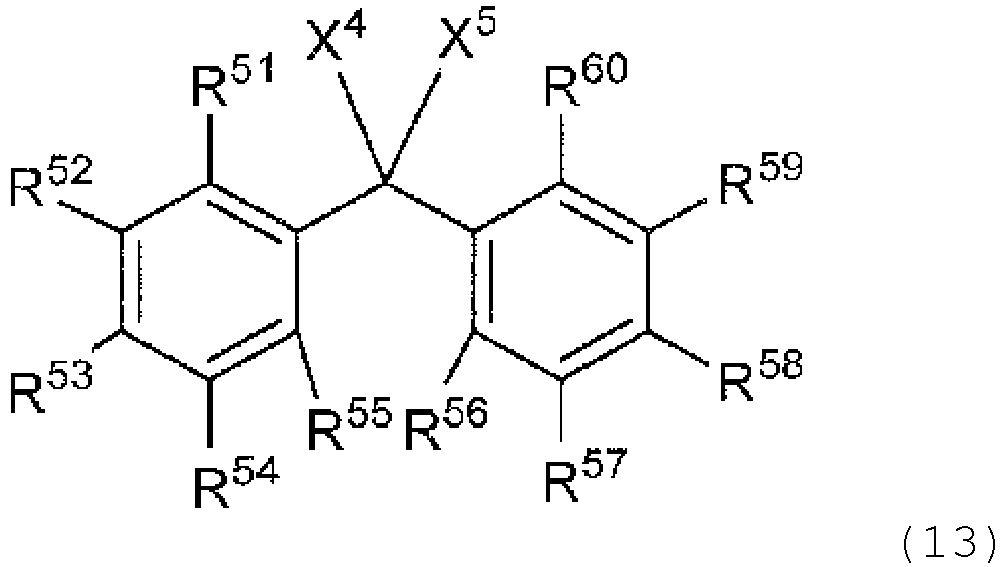
- Wherein X4 represents -OR61 (R61 represents a hydrogen atom, an active ester-type carbonyl group, or an active ester-type sulfonyl group), -NHR45, azide, halogen, isocyanate, or =N-OH or =O together with X5, when X4 is - OR61, -NHR45, azide, or halogen, X5 represents a hydrogen atom, a linear or branched alkyl group or alkenyl group having 1 to 4 carbon atoms, or a cycloalkyl group, and when X4 is isocyanate, X5 represents a linear or branched alkyl group or alkenyl group having 1 to 4 carbon atoms, or a cycloalkyl group;
- at least one of R51 to R60 represents a group of Formula (c), and the rest represents a hydrogen atom, a halogen atom, an alkyl group having 1 to 4 carbon atoms, or an alkoxy group having 1 to 4 carbon atoms; and
- when X4 is -OR61, -NHR45, azide, or halogen and X5 is a hydrogen atom, or when X4 is =O together with X5, R55 and R56 may be bound via an oxygen atom to form a xanthene ring.
- As the carrier for liquid phase peptide synthesis, a compound of Formula (14) can be used (Patent Literatures 10 and 11).

- Wherein X6 represents a hydroxy group or a halogen atom, at least one of R71 to R85 represents a group of Formula (c), the rest represents a hydrogen atom, a halogen atom, an alkyl group having 1 to 4 carbon atoms, or an alkoxy group having 1 to 4 carbon atoms, and R80 and R81 may be bound by a single bond to form a fluorene ring, or may be bound via an oxygen atom to form a xanthene ring.
- Among the compounds of Formula (I), specific examples of a preferred carrier for liquid phase peptide synthesis include compounds of Formula (20) or (21) below. As one example thereof, a compound of Formula (20) can be used (Patent Literatures 2 and 5).

- Wherein X2 represents a hydroxyl group or -NHR90 (R90 represents a hydrogen atom, a linear or branched alkyl group having 1 to 6 carbon atoms, or an aralkyl group), at least one of R31, R32, R33, R34, and R35 represents a group of Formula (d),
-O-R20-X3-E (d)
- and the rest represents a hydrogen atom, a halogen atom, an alkyl group having 1 to 4 carbon atoms, or an alkoxy group having 1 to 4 carbon atoms;
- R20 represents a linear or branched alkyl group or alkylene group having 6 to 30 carbon atoms;
- X3 is absent or represents an oxygen atom; and
- E is absent or represents a linear or branched alkylene group having 6 to 30 carbon atoms.
- As the carrier for liquid phase peptide synthesis, a compound of Formula (21) can be used (Patent Literatures 3 and 4).

- Wherein X4 represents a hydroxyl group or -NHR90 (R90 represents a hydrogen atom, a linear or branched alkyl group having 1 to 6 carbon atoms, or an aralkyl group), and X5 represents a hydrogen atom or a phenyl group which may be substituted with a halogen atom; and
at least one of R51 to R60 represents a group of Formula (d), and the rest represents a hydrogen atom, a halogen atom, an alkyl group having 1 to 4 carbon atoms, or an alkoxy group having 1 to 4 carbon atoms. - The amino acid to which the carrier for liquid phase peptide synthesis is bound or the peptide to which the carrier for liquid phase peptide synthesis is bound, which is one of raw materials used in the production method of the present invention, refers to an amino acid or peptide in which one of reactive groups of the amino acid or peptide is bound to the carrier for liquid phase peptide synthesis and at least one amino group is in a reactive state. Preferably, the carboxyl group of the amino acid or peptide is bound to the carrier for liquid phase peptide synthesis, while the amino group is unprotected and reactive. The amino acid amide bound to the carrier for liquid phase peptide synthesis refers to an amino acid amide in which at least one amide group of the amino acid amide is bound to the carrier for liquid phase peptide synthesis, and at least one amino group is unprotected and reactive.
- When the amino acid, peptide, or amino acid amide to which the carrier for liquid phase peptide synthesis is bound has a highly reactive functional group such as a hydroxyl group, an amino group, a guanidyl group, a carboxyl group, a thiol group, an indole group, or an imidazole group, a general protective group used in peptide synthesis may be introduced into these functional groups, and a target compound can be obtained by deprotecting the protective group as necessary after completion of the reaction. In this case, examples of the protective group of the hydroxyl group include a tBu group, a Trt group, a Bz group, an acetyl group, and a silyl group, examples of the protective group of the amino group include a Boc group, a Fmoc group, a Cbz group, a Trt group, an Mmt group, and an ivDde group, examples of the protective group of the guanidyl group include a Pbf group, a Pmc group, and a nitro group, examples of the protective group of the carboxyl group include a tBu group, a methyl group, an ethyl group, and a Bz group, examples of the protective group of the thiol group include a Trt group, an Acm group, a tBu group, and an S-tBu group, examples of the protective group of the indole group include a Boc group, and examples of the protective group of the imidazole group include a Boc group, a Bom group, a Bum group, and a Trt group.
- The carrier for liquid phase peptide synthesis is introduced so as to be bound to the carboxyl group of the amino acid or peptide directly or via a linker.
- The linker described herein is an organic group having two reactive groups in which one of linkers is bound to the carboxyl group and the other is bound to the carrier for liquid phase peptide synthesis. A preferred linker is a compound which is an organic group having a molecular weight of about 2000 or less (preferably about 1500 or less, more preferably about 1000 or less), may be the same or different as the reactive group, and is a compound having at least two groups selected from the group consisting of an amino group, a carboxyl group, and a halomethyl group in the molecule. Examples thereof include the following compounds:


- wherein u is an integer of 2 to 40, preferably 2 to 35, more preferably 2 to 28; and
- in the structural formula of the linker shows a state before the linker is bound to, for example, a carboxyl group and a state before the linker is bound to the carrier for liquid phase peptide synthesis.
- In the introduction of the carrier for liquid phase peptide synthesis including the linker into the carboxyl group, one of the linkers may be bound to the carboxyl group and then the other may be bound to the carrier for liquid phase peptide synthesis, or one of the linkers may be bound to the carrier for liquid phase peptide synthesis and then the other may be bound to the carboxyl group. A means for introducing these linkers into the carboxyl group can be appropriately referred to a known method. For example, amidation with diisopropylcarbodiimide (DIPCI)/HOBt can be mentioned. The binding between one of the linkers and the carrier for liquid phase peptide synthesis can be performed by appropriately referring to a known method depending on the groups of the linkers to be bound to each other and the group of the carrier for liquid phase peptide synthesis. For example, esterification with DIPCI can be mentioned.
- As for the amino acid, peptide, or amino acid amide to which the carrier for liquid phase peptide synthesis is bound, an N-Boc-liquid phase synthesis carrier-protected amino acid, peptide, or amino acid amide, which is an intermediate in which the carrier for liquid phase peptide synthesis is bound to the carboxyl group of the amino acid, peptide, or amino acid amide, can be produced by dissolving the carrier for liquid phase peptide synthesis in an organic solvent such as THF and performing condensation by adding, for example, a Boc-protected amino acid, peptide, or amino acid amide and a condensing agent such as DIPCI.
- The amino acid or peptide having an amino group protected by an amino protective group, which is the other raw material, means an amino acid or peptide in which the amino group of the amino acid or peptide is protected by an amino protective group, while the carboxyl group is not protected, and which is reactive. When the amino acid or peptide has one or more amino groups, at least one amino group may be protected by an amino protective group.
- Examples of the amino protective group include an Fmoc group, a Boc group, a Cbz group, and an Ac group, and among them, an Fmoc group that can be deprotected under basic conditions is more preferable.
- When the amino acid or peptide having an amino group protected by an amino protective group has a highly reactive functional group such as a hydroxyl group, an amino group, a guanidyl group, a carboxyl group, a thiol group, an indole group, or an imidazole group, a general protective group used in peptide synthesis may be introduced into these functional groups, and a target compound can be obtained by deprotecting the protective group as necessary at any time point after completion of the reaction.
- Examples of the protective group of the hydroxyl group include a tBu group, a Trt group, a Bz group, an acetyl group, and a silyl group, examples of the protective group of the amino group include a Boc group, a Fmoc group, a Cbz group, a Trt group, an Mmt group, and an ivDde group, examples of the protective group of the guanidyl group include a Pbf group, a Pmc group, and a nitro group, examples of the protective group of the carboxyl group include a tBu group, a methyl group, an ethyl group, and a Bz group, examples of the protective group of the thiol group include a Trt group, an Acm group, a tBu group, and an S-tBu group, examples of the protective group of the indole group include a Boc group, and examples of the protective group of the imidazole group include a Boc group, a Bom group, a Bum group, and a Trt group.
- The amino acid or peptide having an amino group protected by an amino protective group can be produced, for example, by reacting chloroformic acid 9-fluorenylmethyl ester with an amino acid or peptide having an amino group to be protected by an amino protective group in a solvent such as THF in the presence of a condensing agent.
- The step b of the present invention is to condense the compound, and a reaction solvent used in the step b is a solvent containing an organic solvent. When the amino acid, peptide, or amino acid amide is protected by the carrier for liquid phase peptide synthesis used in the present invention, the amino acid, peptide, or amino acid amide protected by the carrier for liquid phase peptide synthesis is dissolved in an organic solvent, so that liquid phase peptide synthesis can be performed.
- Examples of such an organic solvent include tetrahydrofuran (THF), dimethylformamide (DMF), cyclohexane, cyclopentyl methyl ether (CPME), methyl-tert-butyl ether (MTBE), 2-methyl THF, 4-methyl tetrahydropyran (4-methyl THP), isopropyl acetate, chloroform, dichloromethane, and N-methyl pyrrolidone, and THF, DMF, cyclohexane, CPME, MTBE, 2-methyl THF, 4-methyl THP, isopropyl acetate, and N-methyl pyrrolidone are preferable. A mixed solvent of two or more kinds of the above solvents may be used.
- The condensation reaction can be performed by mixing a peptide bound to a carrier for liquid phase peptide synthesis, an amino group-protected amino acid, and a condensing agent in the solvent containing an organic solvent.
- The amount of the amino group-protected amino acid used with respect to the peptide bound to a carrier for liquid phase peptide synthesis is usually 1.01 to 4 equivalents, preferably 1.03 to 3 equivalents, more preferably 1.05 to 2 equivalents, and further preferably 1.1 to 1.5 equivalents with respect to the peptide bound to a carrier for liquid phase peptide synthesis. In the peptide production method of the present invention, an active ester of an unreacted amino acid can be captured and inactivated by a scavenger to be added later. Therefore, even when an excess amount of amino group-protected amino acid is used, the problem of remaining of the amino group-protected amino acid does not occur.
- As the condensing agent, those generally used in peptide synthesis can also be used in the present invention, and examples thereof include 4-(4,6-dimethoxy-1,3,5-triazine-2-yl)-4-methylmorphonium chloride (DMT-MM), O-(benzotriazole-1-yl)-1,1,3,3-tetramethyluronium hexafluorophosphate (HBTU), O-(7-azabenzotriazole-1-yl)-1,1,3,3-tetramethyluronium hexafluorophosphate (HATU), O-(6-chlorobenzotriazole-1-yl)-1,1,3,3-tetramethyluronium hexafluorophosphate (HBTU(6-Cl)), O-(benzotriazole-1-yl)-1,1,3,3-tetramethyluronium tetrafluoroborate (TBTU), O-(6-chlorobenzotriazole-1-yl)-1,1,3,3-tetramethyluronium tetrafluoroborate (TCTU), (1-cyano-2-ethoxy-2-oxoethylideneaminooxy)dimethylamino-morpholino-carbenium hexafluorophosphate (COMU), diisopropylcarbodiimide (DIPCI), dicyclohexylcarbodiimide (DCC), and 1-ethyl-3-(3-dimethylaminopropyl)carbodiimide hydrochloride (WSC). DMT-MM, HBTU, HATU, or COMU is preferable. The amount of the condensing agent used is preferably 1 to 4 equivalents, more preferably 1 to 2 equivalents, and further preferably 1.05 to 1.3 equivalents with respect to the peptide bound to a carrier for liquid phase peptide synthesis.
- In the condensation step, an activating agent is preferably added in order to promote the reaction and suppress side reactions such as racemization. The activating agent described herein is a reagent that makes it easy to guide the amino acid to, for example, a corresponding active ester or a symmetric acid anhydride to form a peptide bond (amide bond) by coexistence with a condensing agent. As the activating agent, those generally used in peptide synthesis can be used. Examples thereof include 1-hydroxybenzotriazole (HOBt), ethyl 1-hydroxy-1H-1,2,3-triazole carboxylate (HOCt), 1-hydroxy-7-azabenzotriazole (HOAt), 3-hydroxy-4-ketobenzotriazine (HOOBt), N-hydroxysuccinimide (HOSu), N-hydroxyphthalimide (HOPht), N-hydroxy-5-norbornene-2,3-dicarboximide (HONb), pentafluorophenol, and ethyl cyano(hydroxyimino) acetate (Oxyma). HOBt, HOOBt, HOCt, HOAt, HONb, HOSu, and Oxyma are preferable. The amount of the activating agent used is preferably 1 to 4 equivalents, more preferably 1 to 2 equivalents, and further preferably 1.05 to 1.3 equivalents with respect to the peptide bound to a carrier for liquid phase peptide synthesis.
- The amount of the solvent used is an amount at which the concentration at which, for example, the peptide bound to a carrier for liquid phase peptide synthesis is dissolved is preferably 0.1 mM to 1 M, more preferably 1 mM to 0.5 M.
- The reaction temperature is, for example, preferably -20 to 40°C, more preferably 0 to 30°C, which is a temperature generally used in peptide synthesis. The reaction time (time for 1 cycle) is usually 0.5 to 30 hours.
- The step c is to add an amino acid active ester scavenger to the reaction solution after the condensation reaction.
- From the viewpoint of continuing the reaction in an organic solvent, the amino acid active ester scavenger is preferably an amino group-containing compound and particularly preferably an amino group-containing compound selected from the group consisting of divalent or higher water-soluble amines, alkylamines, aromatic amines, hydroxylamines, aminosulfonic acids, amino sulfates, aminophosphonic acids, aminophosphoric acids, and amino alcohols.
- Examples of the divalent or higher water-soluble amines include 1-methylpiperazine, 4-aminopiperidine, diethylenetriamine, triaminoethylamine, 1-ethylpiperazine, N,N-dimethylethylenediamine, ethylenediamine, and piperazine, 1-methylpiperazine, 4-aminopiperidine, diethylenetriamine, N,N-dimethylethylenediamine, and ethylenediamine are preferable, 1-methylpiperazine, 4-aminopiperidine, N,N-dimethylethylenediamine, and diethylenetriamine are more preferable, and 1-methylpiperazine is further preferable.
- Examples of the alkylamine that can be used include an alkylamine having 1 to 14 carbon atoms, an alkylamine having 2 to 10 carbon atoms is preferable, an alkylamine having 2 to 8 carbon atoms is more preferable, and an alkylamine having 3 to 4 carbon atoms is further preferable. Examples of the aromatic amine that can be used in the present invention include an aromatic amine having 6 to 14 carbon atoms, and an aromatic amine having 6 to 10 carbon atoms is preferable. Specific examples of the alkylamine, the aromatic amine, and the hydroxylamine include, but are not limited to, propylamine, butylamine, hexylamine, aniline, toluidine, 2,4,6-trimethylaniline, anisidine, phenetidine, and hydroxylamine, and propylamine is particularly preferable.
- The aminosulfonic acids, amino sulfates, aminophosphonic acids, aminophosphoric acids, and amino alcohols are preferably compounds of Formulas (15) to (17) below.
- That is, preferred are aminosulfonic acids and amino sulfates of the following Formula (15):
H2N-R9-X7-SO3H (15)
- wherein R91 represents a divalent organic group having 1 to 10 carbon atoms, and X7 represents a single bond or an oxygen atom;
- aminophosphonic acids and aminophosphonic acids of Formula (16):
H2N-R92-X8-(P=O)(OH)2 (16)
- wherein R92 represents a divalent organic group having 1 to 10 carbon atoms, and X8 represents a single bond or an oxygen atom;
- and amino alcohols of Formula (17):
H2N-CR93R94(CH2OCH2)n-CH2OH (17)
- wherein n represents an integer of 0 to 20, and R93 and R94 each independently represent a hydrogen atom, a methyl group, an ethyl group, or a hydroxymethyl group.
- R91 in Formula (15) and R92 in Formula (16) are independently a divalent organic group having 1 to 10 carbon atoms, and preferable examples thereof include a linear or branched alkylene group having 1 to 10 carbon atoms and an arylene group having 6 to 10 carbon atoms. Specific examples thereof include a methylene group, an ethylene group, a trimethylene group, a propylene group, a tetramethylene group, a tetramethylene group, a pentamethylene group, a phenylene group, and a naphthylene group.
- Among these, from the viewpoint of solubility of these compounds, a linear or branched alkylene group having 1 to 6 carbon atoms and an arylene group having 6 to 8 carbon atoms are more preferable, a linear or branched alkylene group having 1 to 6 carbon atoms is further preferable, and a linear or branched alkylene group having 1 to 5 carbon atoms is still more preferable.
- In Formula (15), when X7 is a single bond, the compound is an aminosulfonic acid, and when X7 is an oxygen atom, the compound is an amino sulfate.
- In Formula (16), when X8 is a single bond, the compound is an aminophosphonic acid, and when X8 is an oxygen atom, the compound is an aminophosphonic acid.
- n in Formula (17) represents an integer of 0 to 20. In particular, n is preferably 0 to 20, more preferably 0 to 6, and further preferably 0 to 4. R93 and R94 in Formula (17) are preferably a hydrogen atom or a hydroxyl methyl group.
- Among the amino group-containing compounds, it is more preferable to use a compound selected from the group consisting of aminosulfonic acids, amino sulfates, aminophosphonic acids, aminophosphoric acids, and amino alcohols, as the amino acid active ester scavenger. By using these compounds as a scavenger, not only the amino acid active ester can be eliminated, but also by-products such as dibenzofulbene (DBF) can be eliminated without acidic conditions, so that liquid phase production of the peptide can be performed in one pot without an isolation operation.
- The amount of the amino group-containing compound added in the step c is preferably 1 to 10 equivalents, more preferably 1 to 6 equivalents, and further preferably 1 to 4 equivalents with respect to 1 equivalent of the active amino acid ester remaining theoretically. When the amount of the amino group-containing compound added is too small, scavenging (capturing) of the amino acid active ester becomes insufficient, and double hit in which the remaining amino acid active ester reacts with the amino group generated in the step d occurs to reduce purity and yield. On the other hand, when the amount of the amino group-containing compound added is too large, amino protective group deprotection reaction simultaneously proceeds, and double hit in which the remaining amino acid active ester reacts with the regenerated amino group occurs to reduce purity and yield.
- The step d is to deprotect the amino protective group of the compound having an amino group protected by an amino protective group in the reaction solution.
- The deprotection step of the amino protective group varies depending on the type of the amino protective group. For example, when the amino protective group is an Fmoc group, the reaction solution may be set to basic conditions. When the amino protective group is a Boc group, the reaction solution may be set to acidic conditions. When the amino protective group is a Cbz group, catalytic reduction may be performed. When the amino protective group is an Ac group, the amino protective group may be deprotected under strong acid or strong base conditions. Among them, the amino protective group is more preferably an Fmoc group for one-pot liquid phase synthesis.
- The deproteciton step of the amino protective group when the amino protective group is an Fmoc group will be described.
- The Fmoc deprotection step is only required to make the reaction solution basic, and an amine compound, for example, tertiary amines such as 1,8-diazabicyclo[5.4.0]-7-undecene (DBU), 1,5-diazabicyclo[4.3.0]-5-nonene (DBN), 1,4-diazabicyclo[2.2.2]-octane (DABCO), triethylamine, and tributylamine; divalent or higher water-soluble amines having at least one primary or secondary amino group such as 1-methylpiperazine, 4-aminopiperidine, diethylenetriamine, triaminoethylamine, 1-ethylpiperazine, N,N-dimethylethylenediamine, ethylenediamine, piperidine, and piperazine can be used. DBU, piperidine, 1-methylpiperazine, 4-aminopiperidine, and diethylenetriamine are preferable, DBU, piperidine, and 1-methylpiperazine are more preferable, and DBU is further preferable. In the present specification, the base used in the step c may be referred to as an amine compound.
- The equivalent of the amine compound added in the step c is 1 to 30 equivalents, preferably 4 to 20 equivalents, and more preferably 4 to 10 equivalents with respect to the amount of the Fmoc group present in the system.
- In addition to the amine compound, it is preferable to add a trapping agent of DBF (dibenzofulbene) generated by Fmoc deprotection reaction. Examples of the trapping agent of DBF used herein include a mercapto compound. Examples of the mercapto compound that can be used include an acid having a mercapto group, for example, a mercapto fatty acid or an alkali metal salt thereof, and a compound of Formula (18) or (19) below:
HS-L1-SO3M (18)
HS-L2-PO3M2 (19)
wherein L1 and L2 each represent a divalent organic group, and M represents a hydrogen atom or an alkali metal. - The mercapto fatty acid or the alkali metal salt thereof is preferably mercapto C1-20 fatty acid or an alkali metal salt thereof and more preferably mercapto C1-6 fatty acid or an alkali metal salt thereof.
- In Formula (18) or (19), L1 and L2 each represent a divalent organic group. The divalent organic group is preferably a divalent organic group having 1 to 10 carbon atoms, and more preferably a linear or branched alkylene group having 1 to 10 carbon atoms which may have a mercapto group, an arylene group having 6 to 10 carbon atoms which may have a mercapto group, and a heteroarylene group having 4 to 9 carbon atoms which may have a mercapto group. Specific examples thereof include a methylene group, an ethylene group, a trimethylene group, a propylene group, a mercaptotrimethylene group, a mercaptopropylene group, a tetramethylene group, a butylene group, a pentamethylene group, a phenylene group, a naphthylene group, an indole group, a benzimidazole group, a quinolyl group, and an isoquinoline group.
- M represents a hydrogen atom or an alkali metal. Specific examples thereof include a hydrogen atom, sodium, and potassium.
- Specific examples thereof include sodium mercaptomethane sulfonate, sodium 2-mercaptoethane sulfonate, 2-mercaptoethane sulfonic acid, sodium 3-mercaptopropane sulfonate, 1,3-dimercaptopropane sulfonic acid, sodium 2-mercaptobenzimidazole-5-sulfonate, sodium mercaptomethane phosphonate, mercaptoethane phosphonic acid, sodium 3-mercaptopropane phosphonate, and sodium 1,3-dimercaptopropane phosphonate.
- The amount of the mercapto compound added is preferably 1 to 30 equivalents, more preferably 1 to 10 equivalents, and further preferably 1 to 5 equivalents with respect to the amount of DBF by-produced theoretically.
- The amine compound and the mercapto compound may be added simultaneously, or the mercapto compound and the amine compound may be added in this order, or the amine compound may be added to deprotect the Fmoc group and then the mercapto compound may be added.
- The Fmoc deprotection step may be performed at a temperature of -20 to 40°C for 5 minutes to 5 hours.
- The step e is to add an aqueous solution to the reaction solution and perform liquid separation to obtain an organic solvent layer containing a condensate of the amino acid, peptide, or amino acid amide to which the carrier for liquid phase peptide synthesis is bound and the amino acid or peptide from which the amino protective group is deprotected.
- After the step d of adding an aqueous solution to the reaction solution, the aqueous layer and the organic solvent layer are separated.
- The aqueous layer contains a condensate of the amino acid or peptide from which the amino protective group is deprotected and an active ester scavenger, and a DBF-trapping agent adduct. That is, the DBF-trapping agent adduct by-produced in the deprotection step of the amino protective group is easily extracted into the aqueous layer only by the addition of the aqueous solution in the step e.
- Meanwhile, the organic solvent layer contains a condensate of the amino acid, peptide, or amino acid amide to which the carrier for liquid phase peptide synthesis is bound and the amino acid or peptide from which the amino protective group is deprotected.
- Examples of the aqueous solution to be used include water, a sodium chloride aqueous solution, a sodium carbonate aqueous solution, a potassium carbonate aqueous solution, a disodium hydrogen phosphate aqueous solution, a trisodium phosphate aqueous solution, a sodium hydrogen carbonate aqueous solution, a potassium hydrogen carbonate aqueous solution, a dipotassium hydrogen phosphate aqueous solution, and a tripotassium phosphate aqueous solution.
- As described above, according to the step e of the present invention, it is not necessary to use an acidic aqueous solution simply by adding an aqueous solution and liquid separation, so that liquid separation failure between the amino acid active ester and the peptide as a product does not occur. Since solid-liquid separation is not required, one-pot synthesis is possible without isolating the liquid phase production of the peptide.
- The obtained organic solvent layer can be further used for the condensation reaction with an arbitrary amino acid.
- Examples of a sample to be analyzed of the present invention include a reaction solution, a concentrate thereof, or an extract thereof in an arbitrary step of the liquid phase peptide production method using a compound in which a carrier for liquid phase peptide synthesis and an amino acid, peptide, or amino acid amide are bound, that is, in an arbitrary step of the above steps a to e.
- Examples of the sample containing a target peptide or final target peptide obtained by the method include the reaction solution of the step e, an extraction liquid thereof, a reaction solution obtained after all protective groups after liquid separation and the step e are deprotected, an extraction liquid thereof, and a solid or filtrate obtained by liquid separation and solid-liquid separation.
- An analysis means is HPLC or supercritical liquid chromatography, and in the present invention, an alcohol is used instead of acetonitrile as an eluent for these kinds of liquid chromatography. When an alcohol is used, not only various peptides but also, for example, a carrier for liquid phase peptide synthesis and a peptide bound to a carrier for liquid phase peptide synthesis are dissolved, and these components can be simultaneously analyzed.
- Examples of the alcohol to be used include alcohols having 1 to 4 carbon atoms such as ethanol, isopropanol, and n-butanol, ethanol and isopropanol are more preferable, and isopropanol is further preferable. The eluent may be a solution containing these alcohols, and may contain, for example, various organic solvents, acids, bases, salts, and counter ion forming products, in addition to the alcohols.
- In the analysis method of the present invention, the operation itself may be performed according to an ordinary HPLC of supercritical liquid chromatography operation.
- HPLC is preferably reversed-phase HPLC, and the stationary phase (column packing material) can be appropriately selected from those usually used in consideration of, for example, the length of the target peptide contained in the sample to be analyzed and the physical properties of the carrier for liquid phase peptide synthesis. Suitable examples thereof include octadecyl silica (ODS), and for example, the particle shape of the packing material, the pore size, and the density of ODS can also be appropriately selected. Examples of a commercially available column having the ODS as a stationary phase include MonoBis Column low-pressure ODS end cap (mesopore 11 nm) 3.2 x 150 mm (Kyoto Monotech Co., Ltd.), and Kinetex EVO C18 4.6 x 150 mm particle size of 2.6 um (manufactured by Phenomenex Inc.).
- As a column used for supercritical fluid chromatography, a commercially available product such as BEH C18 1.7 um 2.1 x 50 mm 130 Å (Waters) can be used.
- According to the present invention, it is possible to solve the problem in that the peptide bound to a carrier for liquid phase peptide synthesis is not dissolved in the eluent and the problem in that the peptide bound to a carrier for liquid phase peptide synthesis is not eluted. By adding an acidic compound to the eluent, the reaction rate of each step can be grasped by analysis using exactly the same eluent in a series of peptide synthesis. Since the analysis of the peptide component can be simultaneously performed, it is possible to determine whether or not the component derived from the carrier for liquid phase peptide synthesis is mixed in the target peptide (final target peptide) after deprotection, and the mixing ratio when the component is mixed in the target peptide.
- The present invention will be described in more detail with reference to Examples; however, the present invention is not limited to these Examples at all.
- As the carrier for liquid phase peptide synthesis, the following compounds were used.
- · TIPS2-OH(C11) type benzyl compound (manufactured by SEKISUI MEDICAL CO., LTD.) (sometimes referred to as "B-STag" hereinafter) TIPS represents a triisopropylsilyl group.

- · TIPS2-OH(C11) type diphenylmethane compound (manufactured by SEKISUI MEDICAL CO., LTD.) (sometimes referred to as "D-STag" hereinafter) TIPS represents a triisopropylsilyl group.

- Fmoc-NH-(D-STag) is a compound in which an amino group of D-STag is protected with an Fmoc group.
- · TIPS2-OH(C11) type xanthene compound (manufactured by SEKISUI MEDICAL CO., LTD.) (sometimes referred to as "X-STag" hereinafter) TIPS represents a triisopropylsilyl group.

- Fmoc-NH-(X-STag) is a compound in which an amino group of X-STag is protected with an Fmoc group.
- In the following Examples, a compound in which B-STag is bound to Fmoc-protected tBu-protected glutamic acid (Fmoc-Glu(OtBu)-OH) is referred to as "Fmoc-Glu(OtBu)-O-(B-STag)", and the compound shows the following structure. It applies to not only when B-Stag is bound to Fmoc-Glu(OtBu)-OH, but also when B-STag is bound to another amino acid.

- A compound in which D-STag is bound to Fmoc-protected tBu-protected threonine (Fmoc-Thr(tBu)-OH)) is referred to as "Fmoc-Thr(tBu)-NH-(D-STag)", and the compound shows the following structure.

- A compound in which X-STag is bound to Fmoc-protected tBu-protected threonine (Fmoc-Thr(tBu)-OH)) is referred to as "Fmoc-Thr(tBu)-NH-(X-STag)", and the compound shows the following structure.

-
- Analysis Condition 1 (HPLC)
- Column: MonoBis Column low-pressure ODS end cap (mesopore 11 nm) 3.2 x 150 mm (Kyoto Monotech Co., Ltd.)
- Mobile phase A: 0.1% formic acid-containing 5% isopropanol aqueous solution
- Mobile phase B: 0.1% formic acid-containing 95% isopropanol aqueous solution
- Flow rate: 1.0 mL/min
- Column temperature: 60°C
- Detection wavelength: 220 nm
- Gradient conditions: 5% B (0 min) → 5% B (2 min) → 95% B (12 min) → 95% B (17.5 min) → 5% B (18 min) → 5% B (24 min)
- Analysis Condition 2 (SFC)
- Column: BEH C18 1.7 um 2.1 x 50 mm 130 Å (Waters)
- Mobile phase A: CO2
- Mobile phase B: Methanol/isopropanol/28% ammonia aqueous solution (500/500/1) solution
- Pressure (ABPR): 2000 psi
- Flow rate: 1.1 mL/min
- Column temperature: 45°C
- Detection wavelength: 220 nm
- Gradient conditions: 5% B (0 min) → 15% B (5 min) → 25% B (6 min) → 25% B (7 min) → 5% B (8 min) → 5% B (10 min)
- Analysis Condition 3 (HPLC)
- Column: Kinetex EVO C18 4.6 x 150 mm particle size 2.6 um (manufactured by Phenomenex Inc.)
- Mobile phase A: 0.025% TFA-containing aqueous solution
- Mobile phase B: 0.025% TFA-containing acetonitrile solution
- Flow rate: 1.0 mL/min
- Column temperature: 60°C
- Detection wavelength: 220 nm
- Gradient conditions: 5% B (0 min) → 5% B (2 min) → 99% B (12 min) → 99% B (65 min) → 5% B (66 min) → 5% B (80 min)
- 2.40 g (3.0 mmol) of B-STag was dissolved in 6 mL of CPME and 9 mL of THF, 3.21 g (7.5 mmol) of Fmoc-Glu(OtBu)-OH, 1.44 g (7.5 mmol) of WSCI·HCl, and 36.8 mg (0.3 mmol) of 4-dimethylaminopyridine were added, and the mixture was stirred at room temperature for 2 hours. After it was confirmed that B-STag was 5% or less with respect to Fmoc-Glu(OtBu)-O-(B-STag) as a product in Analysis Condition 1, 0.94 g (7.5 mmol) of taurine and 38 mL of DMSO were added, and the mixture was stirred at room temperature for 30 minutes. The mixture was cooled to 0°C, 1.42 g (8.6 mmol) of sodium 2-mercapto-1-ethanesulfonate was added, 5.1 mL (34 mmol) of DBU was added, and the mixture was stirred for 20 minutes. After it was confirmed that Fmoc-Glu(OtBu)-O-(B-STag) was 5% or less with respect to H-Glu(OtBu)-O-(B-STag) as a product in Analysis Condition 1, 75 mL of a 5% sodium carbonate aqueous solution was added dropwise, the temperature was raised to room temperature, and liquid separation was performed. To the obtained organic layer, 17 mL of 20% saline, 6 mL of a 5% sodium carbonate aqueous solution, and 1.2 mL of DMF were added, and liquid separation was performed. The organic layer was concentrated, and then 27 mL of CPME was added to the residue to obtain a CPME solution containing H-Glu(OtBu)-O-(B-STag).
Retention time (Analysis Condition 1): B-STag: 13.8 minutes; Fmoc-Glu(OtBu)-O-(B-STag): 14.1 minutes; H-Glu(OtBu)-O-(B-STag): 12.2 minutes - To the CPME solution containing H-Glu(OtBu)-O-(B-STag), 7 mL of DMF, 2.38 g (4.1 mmol) of Fmoc-Cys(Trt)-OH, 1.67 g (3.9 mmol) of COMU, and 2.1 mL of DIEPA were added, and the mixture was stirred at room temperature for 2 hours. After it was confirmed that H-Glu(OtBu)-O-(B-STag) was 5% or less with respect to Fmoc-Cys(Trt)-Glu(OtBu)-O-(B-STag) as a product in Analysis Condition 1, 0.55 g (3.9 mmol) of taurine and 16 mL of DMSO were added, and the mixture was stirred at room temperature for 2 hours. The mixture was cooled to 0°C, 1.19 g (3.9 mmol) of sodium 2-mercapto-1-ethanesulfonate was added, 2.7 mL (18 mmol) of DBU was added, and the mixture was stirred for 20 minutes. After it was confirmed that Fmoc-Cys(Trt)-Glu(OtBu)-O-(B-STag) was 5% or less with respect to H-Cys(Trt)-Glu(OtBu)-O-(B-STag) as a product in Analysis Condition 1, 9.6 mL of a 1 M sulfuric acid aqueous solution was added dropwise, 60 mL of a 5% sodium carbonate aqueous solution was then added, the temperature was raised to room temperature, and liquid separation was performed. To the obtained organic layer, 38 mL of 20% saline, 13 mL of a 5% sodium carbonate aqueous solution, and 2.7 mL of DMF were added, and liquid separation was performed. A CPME solution containing H-Cys(Trt)-Glu(OtBu)-O-(B-STag) was obtained.
Retention time (Analysis Condition 1): Fmoc-Cys(Trt)-Glu(OtBu)-O-(B-STag): 14.6 minutes; H-Cys(Trt)-Glu(OtBu)-O-(B-STag): 13.1 minutes - To the CPME solution containing H-Cys(Trt)-Glu(OtBu)-O-(B-STag), 2 mL of CPME, 7 mL of DMF, 2.43 g (4.1 mmol) of Fmoc-Asn(Trt)-OH, 1.67 g (3.9 mmol) of COMU, and 2.1 mL of DIEPA were added, and the mixture was stirred at room temperature for 2 hours. After it was confirmed that H-Cys(Trt)-Glu(OtBu)-O-(B-STag) was 5% or less with respect to Fmoc-Asn(Trt)-Cys(Trt)-Glu(OtBu)-O-(B-STag) as a product in Analysis Condition 1, 0.55 g (3.9 mmol) of taurine and 16 mL of DMSO were added, and the mixture was stirred at room temperature for 40 minutes. The mixture was cooled to 0°C, 1.19 g (3.9 mmol) of sodium 2-mercapto-1-ethanesulfonate was added, 2.7 mL (18 mmol) of DBU was added, and the mixture was stirred for 1 hour. After it was confirmed that Fmoc-Asn(Trt)-Cys(Trt)-Glu(OtBu)-O-(B-STag) was 5% or less with respect to H-Asn(Trt)-Cys(Trt)-Glu(OtBu)-O-(B-STag) as a product in Analysis Condition 1, 60 mL of a 5% sodium carbonate aqueous solution was added dropwise, the temperature was raised to room temperature, and liquid separation was performed. To the obtained organic layer, 38 mL of 20% saline, 13 mL of a 5% sodium carbonate aqueous solution, and 2.7 mL of DMF were added, and liquid separation was performed. A CPME solution containing H-Asn(Trt)-Cys(Trt)-Glu(OtBu)-O-(B-STag) was obtained.
Retention time (Analysis Condition 1): Fmoc-Asn(Trt)-Cys(Trt)-Glu(OtBu)-O-(B-STag): 14.7 minutes; H-Asn(Trt)-Cys(Trt)-Glu(OtBu)-O-(B-STag): 13.0 minutes - To the CPME solution containing H-Asn(Trt)-Cys(Trt)-Glu(OtBu)-O-(B-STag), 2 mL of CPME, 7 mL of DMF, 1.33 g (4.1 mmol) of Fmoc-Ala-OH monohydrate, 1.67 g (3.9 mmol) of COMU, and 2.1 mL of DIEPA were added, and the mixture was stirred at room temperature for 1.5 hours. After it was confirmed that H-Asn(Trt)-Cys(Trt)-Glu(OtBu)-O-(B-STag) was 5% or less with respect to Fmoc-Ala-Asn(Trt)-Cys(Trt)-Glu(OtBu)-O-(B-STag) as a product in Analysis Condition 1, 0.55 g (3.9 mmol) of taurine and 16 mL of DMSO were added, and the mixture was stirred at room temperature for 30 minutes. The mixture was cooled to 0°C, 1.19 g (3.9 mmol) of sodium 2-mercapto-1-ethanesulfonate and 1.3 mL of DMF were added, 2.7 mL (18 mmol) of DBU was added, and the mixture was stirred for 1 hour. After it was confirmed that Fmoc-Ala-Asn(Trt)-Cys(Trt)-Glu(OtBu)-O-(B-STag) was 5% or less with respect to H-Ala-Asn(Trt)-Cys(Trt)-Glu(OtBu)-O-(B-STag) as a product in Analysis Condition 1, 9.6 mL of a 1 M sulfuric acid aqueous solution was added dropwise, 60 mL of a 5% sodium carbonate aqueous solution was then added, the temperature was raised to room temperature, and liquid separation was performed. To the obtained organic layer, 38 mL of 20% saline, 13 mL of a 5% sodium carbonate aqueous solution, and 2.7 mL of DMF were added, and liquid separation was performed. A CPME solution containing H-Ala-Asn(Trt)-Cys(Trt)-Glu(OtBu)-O-(B-STag) was obtained.
Retention time (Analysis Condition 1): Fmoc-Ala-Asn(Trt)-Cys(Trt)-Glu(OtBu)-O-(B-STag): 14.5 minutes; H-Ala-Asn(Trt)-Cys(Trt)-Glu(OtBu)-O-(B-STag): 12.7 minutes - To the CPME solution containing H-Ala-Asn(Trt)-Cys(Trt)-Glu(OtBu)-O-(B-STag), 2 mL of CPME, 7 mL of DMF, 1.67 g (4.1 mmol) of Fmoc-Asp(OtBu)-OH, 1.67 g (3.9 mmol) of COMU, and 2.1 mL of DIEPA were added, and the mixture was stirred at room temperature for 1 hour. After it was confirmed that H-Ala-Asn(Trt)-Cys(Trt)-Glu(OtBu)-O-(B-STag) was 5% or less with respect to Fmoc-Asp(OtBu)-Ala-Asn(Trt)-Cys(Trt)-Glu(OtBu)-O-(B-STag) as a product in Analysis Condition 1, 0.55 g (3.9 mmol) of taurine and 16 mL of DMSO were added, and the mixture was stirred at room temperature for 30 minutes. The mixture was cooled to 0°C, 1.19 g (3.9 mmol) of sodium 2-mercapto-1-ethanesulfonate and 1.3 mL of DMF were added, 2.7 mL (18 mmol) of DBU was added, and the mixture was stirred for 40 minutes. After it was confirmed that Fmoc-Asp(OtBu)-Ala-Asn(Trt)-Cys(Trt)-Glu(OtBu)-O-(B-STag) was 5% or less with respect to H-Asp(OtBu)-Ala-Asn(Trt)-Cys(Trt)-Glu(OtBu)-O-(B-STag) as a product in Analysis Condition 1, 9.6 mL of a 1 M sulfuric acid aqueous solution was added dropwise, 60 mL of a 5% sodium carbonate aqueous solution was then added, the temperature was raised to room temperature, and liquid separation was performed. To the obtained organic layer, 38 mL of 20% saline, 13 mL of a 5% sodium carbonate aqueous solution, and 2.7 mL of DMF were added, and liquid separation was performed. A CPME solution containing H-Asp(OtBu)-Ala-Asn(Trt)-Cys(Trt)-Glu(OtBu)-O-(B-STag) was obtained.
- The obtained CPME solution was concentrated under reduced pressure, 40 mL of MeCN was added to the residue, the precipitated solid was collected by filtration, and the obtained solid was dried under reduced pressure at 30°C. 4.58 g of H-Asp(OtBu)-Ala-Asn(Trt)-Cys(Trt)-Glu(OtBu)-O-(B-STag) was obtained.
Retention time (Analysis Condition 1): Fmoc-Asp(OtBu)-Ala-Asn(Trt)-Cys(Trt)-Glu(OtBu)-O-(B-STag): 14.5 minutes; H-Asp(OtBu)-Ala-Asn(Trt)-Cys(Trt)-Glu(OtBu)-O-(B-STag): 13.1 minutes - To 962 mg (0.50 mmol) of H-Asp(OtBu)-Ala-Asn(Trt)-Cys(Trt)-Glu(OtBu)-O-(B-STag), 9.5 mL of trifluoroacetic acid, 0.29 mL of water, 0.29 mL of triisopropylsilane, 865 mg of dithiothreitol, and 0.58 mL of anisole were added, and the mixture was stirred at room temperature for 2 hours. The reaction solution was cooled to 0°C, 72 mL of diisopropyl ether was slowly added dropwise, and a precipitate was collected by filtration. The precipitate collected by filtration was washed with 10 mL of diisopropyl ether three times, and then the precipitate was dried under reduced pressure to obtain 275 mg of H-Asp-Ala-Asn-Cys-Glu-OH. As a result of analyzing the obtained H-Asp-Ala-Asn-Cys-Glu-OH in Analysis Condition 1, the purity was 80.1%, and B-STag and the B-STag-derived compound produced by treating B-STag with trifluoroacetic acid were not detected.
Retention time (Analysis Condition 1): H-Asp-Ala-Asn-Cys-Glu-OH: 0.9 minutes - The purity was calculated as the ratio of the peak area of the target peptide to the total peak area over a retention time of 0 to 19 minutes. The same applies to the following Examples.
- 0.79 g (1.0 mmol) of B-STag was dissolved in 2 mL of CPME and 3 mL of THF, 1.06 g (2.5 mmol) of Fmoc-Glu(OtBu)-OH, 0.48 g (2.5 mmol) of WSCI·HCl, and 12.2 mg (0.1 mmol) of 4-dimethylaminopyridine were added, and the mixture was stirred at room temperature for 2 hours. After it was confirmed that B-STag was 5% or less with respect to Fmoc-Glu(OtBu)-O-(B-STag) as a product in Analysis Condition 2, 150 µL (2.5 mmol) of 2-aminoethanol was added, and the mixture was stirred at room temperature for 2 hours. The mixture was cooled to 0°C, 0.74 g (4.5 mmol) of sodium 2-mercapto-1-ethanesulfonate and 4.5 mL of DMSO were added, 1.7 mL (11.3 mmol) of DBU was added, and the mixture was stirred for 1 hour. After it was confirmed that Fmoc-Glu(OtBu)-O-(B-STag) was 5% or less with respect to H-Glu(OtBu)-O-(B-STag) as a product in Analysis Condition 2, 6 mL of a 1 M sulfuric acid aqueous solution was added dropwise, 19 mL of a 5% sodium carbonate aqueous solution was added, the temperature was then raised to room temperature, and liquid separation was performed. To the obtained organic layer, 20 mL of 20% saline was added, and liquid separation was performed. The organic layer was concentrated, and then 9 mL of CPME was added to the residue to obtain a CPME solution containing H-Glu(OtBu)-O-(B-STag).
Retention time (Analysis Condition 2): B-STag: 2.1 minutes; Fmoc-Glu(OtBu)-O-(B-STag): 3.1 minutes; H-Glu(OtBu)-O-(B-STag): 3.8 minutes - To the CPME solution containing H-Glu(OtBu)-O-(B-STag), 2 mL of DMF, 0.79 g (1.4 mmol) of Fmoc-Cys(Trt)-OH, 0.57 g (1.3 mmol) of COMU, and 0.71 mL of DIEPA were added, and the mixture was stirred at room temperature for 1 hour. After it was confirmed that H-Glu(OtBu)-O-(B-STag) was 5% or less with respect to Fmoc-Cys(Trt)-Glu(OtBu)-O-(B-STag) as a product in Analysis Condition 2, 81 µL (1.4 mmol) of 2-aminoethanol was added, and the mixture was stirred at room temperature for 1.5 hours. The mixture was cooled to 0°C, 0.40 g (1.3 mmol) of sodium 2-mercapto-1-ethanesulfonate and 2.4 mL of DMSO were added, 0.91 mL (6.1 mmol) of DBU was added, and the mixture was stirred for 25 minutes. After it was confirmed that Fmoc-Cys(Trt)-Glu(OtBu)-O-(B-STag) was 5% or less with respect to H-Cys(Trt)-Glu(OtBu)-O-(B-STag) as a product in Analysis Condition 2, 3.2 mL of a 1 M sulfuric acid aqueous solution was added dropwise, 13 mL of a 5% sodium carbonate aqueous solution was then added, the temperature was raised to room temperature, and liquid separation was performed. To the obtained organic layer, 13 mL of 20% saline, 4 mL of a 5% sodium carbonate aqueous solution, and 0.9 mL of DMF were added, and liquid separation was performed. A CPME solution containing H-Cys(Trt)-Glu(OtBu)-O-(B-STag) was obtained.
Retention time (Analysis Condition 2): Fmoc-Cys(Trt)-Glu(OtBu)-O-(B-STag): 4.4 minutes; H-Cys(Trt)-Glu(OtBu)-O-(B-STag): 5.0 minutes - To the CPME solution containing H-Cys(Trt)-Glu(OtBu)-O-(B-STag), 0.5 mL of CPME, 2 mL of DMF, 0.81 g (1.4 mmol) of Fmoc-Asn(Trt)-OH, 0.56 g (1.3 mmol) of COMU, and 0.71 mL of DIEPA were added, and the mixture was stirred at room temperature for 55 minutes. After it was confirmed that H-Cys(Trt)-Glu(OtBu)-O-(B-STag) was 5% or less with respect to Fmoc-Asn(Trt)-Cys(Trt)-Glu(OtBu)-O-(B-STag) as a product in Analysis Condition 2, 81 µL (1.4 mmol) of 2-aminoethanol was added, and the mixture was stirred at room temperature for 25 minutes. The mixture was cooled to 0°C, 0.40 g (2.4 mmol) of sodium 2-mercapto-1-ethanesulfonate and 2.4 mL of DMSO were added, 0.91 mL (6.1 mmol) of DBU was added, and the mixture was stirred for 75 minutes. After it was confirmed that Fmoc-Asn(Trt)-Cys(Trt)-Glu(OtBu)-O-(B-STag) was 5% or less with respect to H-Asn(Trt)-Cys(Trt)-Glu(OtBu)-O-(B-STag) as a product in Analysis Condition 2, 3.2 mL of a 1 M sulfuric acid aqueous solution was added dropwise, 13 mL of a 5% sodium carbonate aqueous solution was then added, the temperature was raised to room temperature, and liquid separation was performed. To the obtained organic layer, 13 mL of 20% saline, 4 mL of a 5% sodium carbonate aqueous solution, and 0.9 mL of DMF were added, and liquid separation was performed. A CPME solution containing H-Asn(Trt)-Cys(Trt)-Glu(OtBu)-O-(B-STag) was obtained.
Retention time (Analysis Condition 2): Fmoc-Asn(Trt)-Cys(Trt)-Glu(OtBu)-O-(B-STag): 5.6 minutes; H-Asn(Trt)-Cys(Trt)-Glu(OtBu)-O-(B-STag): 6.6 minutes - To the CPME solution containing H-Asn(Trt)-Cys(Trt)-Glu(OtBu)-O-(B-STag), 0.5 mL of CPME, 2 mL of DMF, 0.47 g (1.5 mmol) of Fmoc-Ala-OH monohydrate, 0.64 g (1.5 mmol) of COMU, and 0.78 mL (4.5 mmol) of DIEPA were added, and the mixture was stirred at room temperature for 1 hour. After it was confirmed that H-Asn(Trt)-Cys(Trt)-Glu(OtBu)-O-(B-STag) was 5% or less with respect to Fmoc-Ala-Asn(Trt)-Cys(Trt)-Glu(OtBu)-O-(B-STag) as a product in Analysis Condition 2, 89 µL (1.5 mmol) of 2-aminoethanol was added, and the mixture was stirred at room temperature for 2 hours. The mixture was cooled to 0°C, 0.40 g (2.5 mmol) of sodium 2-mercapto-1-ethanesulfonate and 2.5 mL of DMSO were added, 0.91 mL (6.1 mmol) of DBU was added, and the mixture was stirred for 1 hour. After it was confirmed that Fmoc-Ala-Asn(Trt)-Cys(Trt)-Glu(OtBu)-O-(B-STag) was 5% or less with respect to H-Ala-Asn(Trt)-Cys(Trt)-Glu(OtBu)-O-(B-STag) as a product in Analysis Condition 2, 3.2 mL of a 1 M sulfuric acid aqueous solution was added dropwise, 13 mL of a 5% sodium carbonate aqueous solution was then added, the temperature was raised to room temperature, and liquid separation was performed. To the obtained organic layer, 13 mL of 20% saline, 4 mL of a 5% sodium carbonate aqueous solution, and 0.9 mL of DMF were added, and liquid separation was performed. A CPME solution containing H-Ala-Asn(Trt)-Cys(Trt)-Glu(OtBu)-O-(B-STag) was obtained.
Retention time (Analysis Condition 2): Fmoc-Ala-Asn(Trt)-Cys(Trt)-Glu(OtBu)-O-(B-STag): 6.1 minutes; H-Ala-Asn(Trt)-Cys(Trt)-Glu(OtBu)-O-(B-STag): 7.2 minutes - To the CPME solution containing H-Ala-Asn(Trt)-Cys(Trt)-Glu(OtBu)-O-(B-STag), 0.5 mL of CPME, 2 mL of DMF, 0.56 g (1.4 mmol) of Fmoc-Asp(OtBu)-OH, 0.56 g (1.3 mmol) of COMU, and 0.71 mL (4.1 mmol) of DIEPA were added, and the mixture was stirred at room temperature for 1 hour. After it was confirmed that H-Ala-Asn(Trt)-Cys(Trt)-Glu(OtBu)-O-(B-STag) was 5% or less with respect to Fmoc-Asp(OtBu)-Ala-Asn(Trt)-Cys(Trt)-Glu(OtBu)-O-(B-STag) as a product in Analysis Condition 2, 81 µL (1.4 mmol) of 2-aminoethanol was added, and the mixture was stirred at room temperature for 70 minutes. The mixture was cooled to 0°C, 0.40 g (2.4 mmol) of sodium 2-mercapto-1-ethanesulfonate and 2.4 mL of DMSO were added, 0.91 mL (6.1 mmol) of DBU was added, and the mixture was stirred for 75 minutes. After it was confirmed that Fmoc-Asp(OtBu)-Ala-Asn(Trt)-Cys(Trt)-Glu(OtBu)-O-(B-STag) was 5% or less with respect to H-Asp(OtBu)-Ala-Asn(Trt)-Cys(Trt)-Glu(OtBu)-O-(B-STag) as a product in Analysis Condition 2, 3.2 mL of water was added dropwise, 13 mL of a 5% sodium carbonate aqueous solution was then added, the temperature was raised to room temperature, and liquid separation was performed. To the obtained organic layer, 13 mL of 20% saline, 4 mL of a 5% sodium carbonate aqueous solution, and 0.9 mL of DMF were added, and liquid separation was performed. A CPME solution containing H-Asp(OtBu)-Ala-Asn(Trt)-Cys(Trt)-Glu(OtBu)-O-(B-STag) was obtained.
- The obtained CPME solution was concentrated under reduced pressure, 40 mL of MeCN was added to the residue, the precipitated solid was collected by filtration, and the obtained solid was dried under reduced pressure at 30°C. 1.56 g of H-Asp(OtBu)-Ala-Asn(Trt)-Cys(Trt)-Glu(OtBu)-O-(B-STag) was obtained.
Retention time (Analysis Condition 2): Fmoc-Asp(OtBu)-Ala-Asn(Trt)-Cys(Trt)-Glu(OtBu)-O-(B-STag): 6.3 minutes; H-Asp(OtBu)-Ala-Asn(Trt)-Cys(Trt)-Glu(OtBu)-O-(B-STag): 7.0 minutes - To 962 mg (0.50 mmol) of H-Asp(OtBu)-Ala-Asn(Trt)-Cys(Trt)-Glu(OtBu)-O-(B-STag), 7.5 mL of trifluoroacetic acid, 0.21 mL of water, 0.21 mL of triisopropylsilane, and 0.42 mL of 3,6-dioxa-1,8-octanedithiol were added, and the mixture was stirred at room temperature for 2 hours. The reaction solution was cooled to 0°C, 60 mL of MTBE was slowly added dropwise, and a precipitate was collected by filtration. The precipitate collected by filtration was washed with 10 mL of MTBE three times, and then the precipitate was dried under reduced pressure to obtain 275 mg of H-Asp-Ala-Asn-Cys-Glu-OH. As a result of analyzing the obtained H-Asp-Ala-Asn-Cys-Glu-OH in Analysis Condition 1, the purity was 74.2%, B-STag was not detected, and 0.6% of the B-STag-derived compound produced by treating B-STag with trifluoroacetic acid was detected.
- To 0.16 g (0.2 mmol) of B-STag, 3.2 mL of trifluoroacetic acid, 0.09 mL of water, 0.09 mL of triisopropylsilane, and 0.18 mL of 3,6-dioxa-1,8-octanedithiol were added, and the mixture was stirred at room temperature for 2 hours. The reaction solution was analyzed in Analysis Condition 1 and Analysis Condition 2 to detect the B-STag-derived compound.
- Retention time (Analysis Condition 1): 11.2 minutes; 11.6 minutes; 12.3 minutes; 12.4 minutes; 12.6 minutes
- Retention time (Analysis Condition 2): 0.2 minutes; 0.4 minutes; 0.6 minutes; 1.1 minutes; 2.1 minutes
- In Example 2, it was found that since the target peptide was crystallized using MTBE and separated and purified after deprotection of, for example, B-STag, only a small amount of the B-STag-derived compound was detected; however, the B-STag-derived compound in the mixed liquid before the crystallization operation can be detected with good separation performance using any of Analysis Conditions 1 and 2.
- 1.59 g (2.0 mmol) of B-STag was dissolved in 4 mL of CPME and 6 mL of THF, 2.13 g (5.0 mmol) of Fmoc-Glu-OtBu, 0.96 g (5.0 mmol) of WSCI·HCl, and 24.5 mg (0.2 mmol) of 4-dimethylaminopyridine were added, and the mixture was stirred at room temperature for 5 hours. After it was confirmed that B-STag was 5% or less with respect to Fmoc-Glu(O-B-STag)-OtBu as a product in Analysis Condition 1, 300 µL (5.0 mmol) of 2-aminoethanol (AE) was added, and the mixture was stirred at room temperature for 1 hour. The mixture was cooled to 0°C, 1.48 g (9.0 mmol) of sodium 2-mercapto-1-ethanesulfonate and 9 mL of DMSO were added, 3.4 mL (22.5 mmol) of DBU was added, and the mixture was stirred for 20 minutes. After it was confirmed that Fmoc-Glu(O-B-STag)-OtBu was 5% or less with respect to H-Glu(O-B-STag)-OtBu as a product in Analysis Condition 1, 12 mL of a 1 M sulfuric acid aqueous solution was added dropwise, 38 mL of a 5% sodium carbonate aqueous solution was then added, the temperature was raised to room temperature, and liquid separation was performed. To the obtained organic layer, 10 mL of 20% saline, 4 mL of a 5% sodium carbonate aqueous solution, and 0.8 mL of DMF were added, and liquid separation was performed. The organic layer was concentrated under reduced pressure, and 6 mL of CPME was added to the residue to obtain 15.2 g of a CPME solution containing H-Glu(O-B-STag)-OtBu.
Retention time (Analysis Condition 1): B-STag: 13.8 minutes; Fmoc-Glu(O-B-STag)-OtBu: 14.3 minutes; H-Glu(O-B-STag)-OtBu: 12.3 minutes - To 7.6 g (corresponding to 1 mmol) of the CPME solution containing H-Glu(O-B-STag)-OtBu, 1.9 mL of CMPE, 2 mL of DMF, 0.48 g (1.4 mmol) of Fmoc-Leu-OH, 0.56 g (1.3 mmol) of COMU, and 0.71 mL (4.1 mmol) of DIEPA were added, and the mixture was stirred at room temperature for 1 hour. After it was confirmed that H-Glu(O-B-STag)-OtBu was 5% or less with respect to Fmoc-Leu-Glu(O-B-STag)-OtBu as a product in Analysis Condition 1, 81 µL (1.4 mmol) of AE was added, and the mixture was stirred at room temperature for 90 minutes. The mixture was cooled to 0°C, 0.40 g (2.4 mmol) of sodium 2-mercapto-1-ethanesulfonate and 2.4 mL of DMSO were added, 0.91 mL (6.1 mmol) of DBU was added, and the mixture was stirred for 20 minutes. After it was confirmed that Fmoc-Leu-Glu(O-B-STag)-OtBu was 5% or less with respect to H-Leu-Glu(O-B-STag)-OtBu as a product in Analysis Condition 1, 3.2 mL of a 1 M sulfuric acid aqueous solution was added dropwise, 13 mL of a 5% sodium carbonate aqueous solution was then added, the temperature was raised to room temperature, and liquid separation was performed. To the obtained organic layer, 13 mL of 20% saline, 4 mL of a 5% sodium carbonate aqueous solution, and 0.9 mL of DMF were added, and liquid separation was performed. A CPME solution containing H-Leu-Glu(O-B-STag)-OtBu was obtained.
Retention time (Analysis Condition 1): Fmoc-Leu-Glu(O-B-STag)-OtBu: 14.2 minutes; H-Leu-Glu(O-B-STag)-OtBu: 12.4 minutes - To the CPME solution containing H-Leu-Glu(O-B-STag)-OtBu, 1 mL of CPME, 2 mL of DMF, 0.48 g (1.4 mmol) of Fmoc-Ile-OH, 0.56 g (1.3 mmol) of COMU, and 0.71 mL (4.1 mmol) of DIEPA were added, and the mixture was stirred at room temperature for 55 minutes. After it was confirmed that H-Leu-Glu(O-B-STag)-OtBu was 5% or less with respect to Fmoc-Ile-Leu-Glu(O-B-STag)-OtBu as a product in Analysis Condition 1, 81 µL (1.4 mmol) of AE was added, and the mixture was stirred at room temperature for 25 minutes. The mixture was cooled to 0°C, 0.40 g (2.4 mmol) of sodium 2-mercapto-1-ethanesulfonate and 2.4 mL of DMSO were added, 0.91 mL (6.1 mmol) of DBU was added, and the mixture was stirred for 75 minutes. After it was confirmed that Fmoc-Ile-Leu-Glu(O-B-STag)-OtBu was 5% or less with respect to H-Ile-Leu-Glu(O-B-STag)-OtBu as a product in Analysis Condition 1, 3.2 mL of a 1 M sulfuric acid aqueous solution was added dropwise, 13 mL of a 5% sodium carbonate aqueous solution was then added, the temperature was raised to room temperature, and liquid separation was performed. To the obtained organic layer, 13 mL of 20% saline, 4 mL of a 5% sodium carbonate aqueous solution, and 0.9 mL of DMF were added, and liquid separation was performed. A CPME solution containing H-Ile-Leu-Glu(O-B-STag)-OtBu was obtained.
Retention time (Analysis Condition 1): Fmoc-Ile-Leu-Glu(O-B-STag)-OtBu: 14.3 minutes; H-Ile-Leu-Glu(O-B-STag)-OtBu: 12.4 minutes - To the CPME solution containing H-Ile-Leu-Glu(O-B-STag)-OtBu, 1 mL of CPME, 2 mL of DMF, 0.56 g (1.5 mmol) of Fmoc-Met-OH, 0.65 g (1.5 mmol) of COMU, and 0.78 mL (4.5 mmol) of DIEPA were added, and the mixture was stirred at room temperature for 50 minutes. After it was confirmed that H-Ile-Leu-Glu(O-B-STag)-OtBu was 5% or less with respect to Fmoc-Met-Ile-Leu-Glu(O-B-STag)-OtBu as a product in Analysis Condition 1, 89 µL (1.5 mmol) of AE was added, and the mixture was stirred at room temperature for 25 minutes. The mixture was cooled to 0°C, 0.40 g (2.4 mmol) of sodium 2-mercapto-1-ethanesulfonate and 2.4 mL of DMSO were added, 0.91 mL (6.1 mmol) of DBU was added, and the mixture was stirred for 1 hour. After it was confirmed that Fmoc-Met-Ile-Leu-Glu(O-B-STag)-OtBu was 5% or less with respect to H-Met-Ile-Leu-Glu(O-B-STag)-OtBu as a product in Analysis Condition 1, 3.2 mL of a 1 M sulfuric acid aqueous solution was added dropwise, 13 mL of a 5% sodium carbonate aqueous solution was then added, the temperature was raised to room temperature, and liquid separation was performed. To the obtained organic layer, 13 mL of 20% saline, 4 mL of a 5% sodium carbonate aqueous solution, and 0.9 mL of DMF were added, and liquid separation was performed. A CPME solution containing H-Met-Ile-Leu-Glu(O-B-STag)-OtBu was obtained.
Retention time (Analysis Condition 1): Fmoc-Met-Ile-Leu-Glu(O-B-STag)-OtBu: 14.1 minutes; H-Met-Ile-Leu-Glu(O-B-STag)-OtBu: 12.5 minutes - To the CPME solution containing H-Met-Ile-Leu-Glu(O-B-STag)-OtBu, 1 mL of CPME, 2 mL of DMF, 0.52 g (1.4 mmol) of Fmoc-Ser(tBu)-OH, 0.56 g (1.4 mmol) of COMU, and 0.71 mL (4.1 mmol) of DIEPA were added, and the mixture was stirred at room temperature for 1 hour. After it was confirmed that H-Met-Ile-Leu-Glu(O-B-STag)-OtBu was 5% or less with respect to Fmoc-Ser(tBu)-Met-Ile-Leu-Glu(O-B-STag)-OtBu as a product in Analysis Condition 1, 81 µL (1.4 mmol) of AE was added, and the mixture was stirred at room temperature for 2 hours. The mixture was cooled to 0°C, 0.40 g (2.4 mmol) of sodium 2-mercapto-1-ethanesulfonate and 2.4 mL of DMSO were added, 0.91 mL (6.1 mmol) of DBU was added, and the mixture was stirred for 75 minutes. After it was confirmed that Fmoc-Ser(tBu)-Met-Ile-Leu-Glu(O-B-STag)-OtBu was 5% or less with respect to H-Ser(tBu)-Met-Ile-Leu-Glu(O-B-STag)-OtBu as a product in Analysis Condition 1, 3.2 mL of a 1 M sulfuric acid aqueous solution was added dropwise, 13 mL of a 5% sodium carbonate aqueous solution was then added, the temperature was raised to room temperature, and liquid separation was performed. To the obtained organic layer, 13 mL of 20% saline, 4 mL of a 5% sodium carbonate aqueous solution, and 0.9 mL of DMF were added, and liquid separation was performed. A CPME solution containing H-Ser(tBu)-Met-Ile-Leu-Glu(O-B-STag)-OtBu was obtained.
- The obtained CPME solution was concentrated under reduced pressure to obtain 1.64 g of H-Ser(tBu)-Met-Ile-Leu-Glu(O-B-STag)-OtBu as a residue.
Retention time (Analysis Condition 1): Fmoc-Ser(tBu)-Met-Ile-Leu-Glu(O-B-STag)-OtBu: 14.1 minutes; H-Ser(tBu)-Met-Ile-Leu-Glu(O-B-STag)-OtBu: 12.6 minutes - To 1.64 g (corresponding to 1.0 mmol) of the H-Ser(tBu)-Met-Ile-Leu-Glu(O-B-STag)-OtBu, 14.3 mL of trifluoroacetic acid, 0.36 mL of water, 0.36 mL of triisopropylsilane, and 0.71 mL of 3,6-dioxa-1,8-octanedithiol were added, and the mixture was stirred at room temperature for 2 hours. The reaction solution was cooled to 0°C, 81 mL of MTBE was slowly added dropwise, and a precipitate was collected by filtration. The precipitate collected by filtration was washed with 14 mL of MTBE three times, and then the precipitate was dried under reduced pressure to obtain 523 mg of H-Ser-Met-Ile-Leu-Glu-OH. As a result of analyzing the obtained H-Ser-Met-Ile-Leu-Glu-OH in Analysis Condition 1, the purity was 62.3%, and B-STag and the B-STag-derived compound produced by treating B-STag with trifluoroacetic acid were not detected.
- The HPLC analysis results in Analysis Condition 1 are shown in
Fig. 1 . A peak at 1.9 minutes indicates H-Ser-Met-Ile-Leu-Glu-OH as the target compound. The B-STag-derived compound detected in Example 3 (retention time: 11.2 minutes to 12.6 minutes) was not detected.
Retention time (Analysis Condition 1): H-Ser-Met-Ile-Leu-Glu-OH: 1.9 minutes - After 1.09 g (1.0 mmol) of Fmoc-NH-(D-STag) was dissolved in 9 mL of CPME and 2 mL of DMF and cooled to 0°C, 0.32 mL (1.9 mmol) of DIEPA and 0.30 g (1.8 mmol) of sodium 2-mercapto-1-ethanesulfonate were added, and 0.67 mL (4.5 mmol) of DBU was added dropwise thereto. After the mixture was stirred at 0°C for 1 hour and it was confirmed that Fmoc-NH-(D-STag) was 5% or less with respect to NH2-(D-STag) as a product in Analysis Condition 1, 2.4 mL of a 1 M sulfuric acid aqueous solution was added dropwise, 10 mL of a 5% sodium carbonate aqueous solution was added, the temperature was then raised to room temperature, and liquid separation was performed. To the obtained organic layer, 25 mL of 20% saline, 8 mL of a 5% sodium carbonate aqueous solution, and 1.8 mL of DMF were added, and liquid separation was performed to obtain a CPME solution containing NH2-(D-STag).
- To the CPME solution containing NH2-(D-STag), 0.6 mL of CPME, 2 mL of DMF, 0.55 g (1.4 mmol) of Fmoc-Thr(tBu)-OH, 0.56 g (1.3 mmol) of COMU, and 0.71 mL (4.1 mmol) of DIEPA were added, and the mixture was stirred at room temperature for 70 minutes. After it was confirmed that NH2-(D-STag) was 5% or less with respect to Fmoc-Thr(tBu)-NH-(D-STag) as a product in Analysis Condition 1, 62 µL (0.5 mmol) of 2-[2-(2-aminoethoxy)ethoxy]ethanol (AEEE) was added, and the mixture was stirred at room temperature for 30 minutes. The mixture was cooled to 0°C, 0.40 g (2.4 mmol) of sodium 2-mercapto-1-ethanesulfonate and 2.4 mL of DMSO were added, 0.91 mL (6.1 mmol) of DBU was added, and the mixture was stirred for 70 minutes. After it was confirmed that Fmoc-Thr(tBu)-NH-(D-STag) was 5% or less with respect to H-Thr(tBu)-NH-(D-STag) as a product in Analysis Condition 1, 3.2 mL of a 1 M sulfuric acid aqueous solution was added dropwise, 13 mL of a 5% sodium carbonate aqueous solution was added, the temperature was then raised to room temperature, and liquid separation was performed. To the obtained organic layer, 25 mL of 20% saline, 8 mL of a 5% sodium carbonate aqueous solution, and 1.8 mL of DMF were added, and liquid separation was performed to obtain a CPME solution containing H-Thr(tBu)-NH-(D-STag).
Retention time (Analysis Condition 1): Fmoc-NH-(D-STag): 14,5 minutes; NH2-(D-STag): 12.0 minutes; Fmoc-Thr(tBu)-NH-(D-STag): 14.5 minutes; H-Thr(tBu)-NH-(D-STag): 12.4 minutes - To the CPME solution containing H-Thr(tBu)-NH-(D-STag), 0.7 mL of CPME, 2 mL of DMF, 0.88 g (1.4 mmol) of Fmoc-Arg(Pbf)-OH, 0.56 g (1.3 mmol) of COMU, and 0.71 mL (4.1 mmol) of DIEPA were added, and the mixture was stirred at room temperature for 1 hour. After it was confirmed that H-Thr(tBu)-NH-(D-STag) was 5% or less with respect to Fmoc-Arg(Pbf)-Thr(tBu)-NH-(D-STag) as a product in Analysis Condition 1, 62 µL (0.5 mmol) of AEEE was added, and the mixture was stirred at room temperature for 30 minutes. The mixture was cooled to 0°C, 0.40 g (2.4 mmol) of sodium 2-mercapto-1-ethanesulfonate and 2.4 mL of DMSO were added, 0.91 mL (6.1 mmol) of DBU was added, and the mixture was stirred for 50 minutes. After it was confirmed that Fmoc-Arg(Pbf)-Thr(tBu)-NH-(D-STag) was 5% or less with respect to H-Arg(Pbf)-Thr(tBu)-NH-(D-STag) as a product in Analysis Condition 1, 13 mL of a 5% sodium carbonate aqueous solution was added dropwise, the temperature was then raised to room temperature, and liquid separation was performed. To the obtained organic layer, 13 mL of 20% saline, 4 mL of a 5% sodium carbonate aqueous solution, and 0.9 mL of DMF were added, and liquid separation was performed. A CPME solution containing H-Arg(Pbf)-Thr(tBu)-NH-(D-STag) was obtained.
Retention time (Analysis Condition 1): Fmoc-Arg(Pbf)-Thr(tBu)-NH-(D-STag): 14.0 minutes; H-Arg(Pbf)-Thr(tBu)-NH-(D-STag): 12.5 minutes - To the CPME solution containing H-Arg(Pbf)-Thr(tBu)-NH-(D-STag), 0.5 mL of CPME, 2 mL of DMF, 0.88 g (1.4 mmol) of Fmoc-Arg(Pbf)-OH, 0.56 g (1.3 mmol) of COMU, and 0.71 mL (4.1 mmol) of DIEPA were added, and the mixture was stirred at room temperature for 1 hour. After it was confirmed that H-Arg(Pbf)-Thr(tBu)-NH-(D-STag) was 5% or less with respect to Fmoc-Glu(OtBu)-Arg(Pbf)-Thr(tBu)-NH-(D-STag) as a product in Analysis Condition 1, 62 µL (0.5 mmol) of AEEE was added, and the mixture was stirred at room temperature for 40 minutes. The mixture was cooled to 0°C, 0.40 g (2.4 mmol) of sodium 2-mercapto-1-ethanesulfonate and 2.4 mL of DMSO were added, 0.91 mL (6.1 mmol) of DBU was added, and the mixture was stirred for 65 minutes. After it was confirmed that Fmoc-Glu(OtBu)-Arg(Pbf)-Thr(tBu)-NH-(D-STag) was 5% or less with respect to H-Glu(OtBu)-Arg(Pbf)-Thr(tBu)-NH-(D-STag) as a product in Analysis Condition 1, 13 mL of a 5% sodium carbonate aqueous solution was added dropwise, the temperature was then raised to room temperature, and liquid separation was performed. To the obtained organic layer, 13 mL of 20% saline, 4 mL of a 5% sodium carbonate aqueous solution, and 0.9 mL of DMF were added, and liquid separation was performed. A CPME solution containing H-Glu(OtBu)-Arg(Pbf)-Thr(tBu)-NH-(D-STag) was obtained.
Retention time (Analysis Condition 1): Fmoc-Glu(OtBu)-Arg(Pbf)-Thr(tBu)-NH-(D-STag): 14.0 minutes; H-Glu(OtBu)-Arg(Pbf)-Thr(tBu)-NH-(D-STag): 12.6 minutes - To the CPME solution containing H-Glu(OtBu)-Arg(Pbf)-Thr(tBu)-NH-(D-STag), 0.5 mL of CPME, 2 mL of DMF, 0.71 g (1.4 mmol) of Fmoc-Trp(Boc)-OH, 0.56 g (1.3 mmol) of COMU, and 0.71 mL (4.1 mmol) of DIEPA were added, and the mixture was stirred at room temperature for 70 minutes. After it was confirmed that H-Trp(Boc)-Glu(OtBu)-Arg(Pbf)-Thr(tBu)-NH-(D-STag) was 5% or less with respect to Fmoc-Trp(Boc)-Glu(OtBu)-Arg(Pbf)-Thr(tBu)-NH-(D-STag) as a product in Analysis Condition 1, 62 µL (0.5 mmol) of AEEE was added, and the mixture was stirred at room temperature for 40 minutes. The mixture was cooled to 0°C, 0.40 g (2.4 mmol) of sodium 2-mercapto-1-ethanesulfonate and 2.4 mL of DMSO were added, 0.4 mL of DMF and 0.91 mL (6.1 mmol) of DBU were added, and the mixture was stirred for 65 minutes. After it was confirmed that Fmoc-Trp(Boc)-Glu(OtBu)-Arg(Pbf)-Thr(tBu)-NH-(D-STag) was 5% or less with respect to H-Trp(Boc)-Glu(OtBu)-Arg(Pbf)-Thr(tBu)-NH-(D-STag) as a product in Analysis Condition 1, 3.2 mL of a 1 M sulfuric acid aqueous solution was added dropwise, 13 mL of a 5% sodium carbonate aqueous solution was added, the temperature was then raised to room temperature, and liquid separation was performed. To the obtained organic layer, 13 mL of 20% saline, 4 mL of a 5% sodium carbonate aqueous solution, and 0.9 mL of DMF were added, and liquid separation was performed. A CPME solution containing H-Trp(Boc)-Glu(OtBu)-Arg(Pbf)-Thr(tBu)-NH-(D-STag) was obtained.
Retention time (Analysis Condition 1): Fmoc-Trp(Boc)-Glu(OtBu)-Arg(Pbf)-Thr(tBu)-NH-(D-STag): 14.0 minutes; H-Trp(Boc)-Glu(OtBu)-Arg(Pbf)-Thr(tBu)-NH-(D-STag): 12.8 minutes - To the CPME solution containing H-Trp(Boc)-Glu(OtBu)-Arg(Pbf)-Thr(tBu)-NH-(D-STag), 0.5 mL of CPME, 2 mL of DMF, 0.82 g (1.4 mmol) of Fmoc-Gln(Trt)-OH, 0.56 g (1.3 mmol) of COMU, and 0.71 mL (4.1 mmol) of DIEPA were added, and the mixture was stirred at room temperature for 1 hour. After it was confirmed that H-Gln(Trt)-Trp(Boc)-Glu(OtBu)-Arg(Pbf)-Thr(tBu)-NH-(D-STag) was 5% or less with respect to Fmoc-Gln(Trt)-Trp(Boc)-Glu(OtBu)-Arg(Pbf)-Thr(tBu)-NH-(D-STag) as a product in Analysis Condition 1, 62 µL (0.5 mmol) of AEEE was added, and the mixture was stirred at room temperature for 40 minutes. The mixture was cooled to 0°C, 0.40 g (2.4 mmol) of sodium 2-mercapto-1-ethanesulfonate and 3.0 mL of DMSO were added, 0.4 mL of DMF and 0.91 mL (6.1 mmol) of DBU were added, and the mixture was stirred for 65 minutes. After it was confirmed that Fmoc-Trp(Boc)-Glu(OtBu)-Arg(Pbf)-Thr(tBu)-NH-(D-STag) was 5% or less with respect to H-Gln(Trt)-Trp(Boc)-Glu(OtBu)-Arg(Pbf)-Thr(tBu)-NH-(D-STag) as a product in Analysis Condition 1, 3.2 mL of a 1 M sulfuric acid aqueous solution was added dropwise, 13 mL of a 5% sodium carbonate aqueous solution was added, the temperature was then raised to room temperature, and liquid separation was performed. To the obtained organic layer, 13 mL of 20% saline, 4 mL of a 5% sodium carbonate aqueous solution, and 0.9 mL of DMF were added, and liquid separation was performed. A CPME solution containing H-Gln(Trt)-Trp(Boc)-Glu(OtBu)-Arg(Pbf)-Thr(tBu)-NH-(D-STag) was obtained.
- The obtained CPME solution was concentrated under reduced pressure, 24 mL of MeCN, 18 mL of IPA, 6 mL of CPME, and 12 mL of water were added to the residue, the precipitated solid was collected by filtration, and the obtained solid was dried under reduced pressure at 30°C. 1.84 g of H-Gln(Trt)-Trp(Boc)-Glu(OtBu)-Arg(Pbf)-Thr(tBu)-NH-(D-STag) was obtained.
Retention time (Analysis Condition 1): Fmoc-Gln(Trt)-Trp(Boc)-Glu(OtBu)-Arg(Pbf)-Thr(tBu)-NH-(D-STag): 14.2 minutes; H-Gln(Trt)-Trp(Boc)-Glu(OtBu)-Arg(Pbf)-Thr(tBu)-NH-(D-STag): 12.8 minutes - To 1.14 g (0.50 mmol) of H-Gln(Trt)-Trp(Boc)-Glu(OtBu)-Arg(Pbf)-Thr(tBu)-NH-(D-STag), 9.5 mL of trifluoroacetic acid, 0.25 mL of water, and 0.25 mL of triisopropylsilane were added, and the mixture was stirred at room temperature for 2 hours. The reaction solution was cooled to 0°C, 70 mL of MTBE was slowly added dropwise, and a precipitate was collected by filtration. The precipitate collected by filtration was washed with 10 mL of MTBE three times, and then the precipitate was dried under reduced pressure to obtain 227 mg of H-Gln-Trp-Glu-Arg-Thr-NH2. As a result of analyzing the obtained H-Gln-Trp-Glu-Arg-Thr-NH2 in Analysis Condition 1, the purity was 71.0%, and D-STag and the D-STag-derived compound produced by treating D-STag with trifluoroacetic acid were not detected.
Retention time (Analysis Condition 1): H-Gln-Trp-Glu-Arg-Thr-NH2: 0.9 minutes - To 0.22 g (0.2 mmol) of Fmoc-NH-(D-STag), 3.2 mL of trifluoroacetic acid, 0.09 mL of water, 0.09 mL of triisopropylsilane, and 0.18 mL of 3,6-dioxa-1,8-octanedithiol were added, and the mixture was stirred at room temperature for 2 hours. The reaction solution was analyzed in Analysis Condition 1 and Analysis Condition 2 to detect the D-STag-derived compound.
- Retention time (Analysis Condition 1): 11.8 minutes; 11.9 minutes; 12.6 minutes; 13.0 minutes
- Retention time (Analysis Condition 2): 0.5 minutes; 1.4 minutes; 2.0 minutes; 2.5 minutes
- Similarly to Example 3, it was found that also in D-STag, the D-STag-derived compound by-produced under conditions after deprotection such as D-STag can be detected with good separation performance even in any of Analysis Conditions 1 and 2.
- After 1.11 g (1.0 mmol) of Fmoc-NH-(X-STag) was dissolved in 8 mL of CPME and 2 mL of DMF and cooled to 0°C, 0.33 mL (1.9 mmol) of DIEPA and 0.30 g (1.8 mmol) of sodium 2-mercapto-1-ethanesulfonate were added, and 0.67 mL (4.5 mmol) of DBU was added dropwise thereto. After the mixture was stirred at 0°C for 1 hour and it was confirmed that Fmoc-NH-(X-STag) was 5% or less with respect to NH2-(X-STag) as a product in Analysis Condition 1 and Analysis Condition 2, 2.4 mL of a 1 M sulfuric acid aqueous solution was added dropwise, 9 mL of a 5% sodium carbonate aqueous solution was added, the temperature was then raised to room temperature, and liquid separation was performed. To the obtained organic layer, 23 mL of 20% saline, 8 mL of a 5% sodium carbonate aqueous solution, and 1.6 mL of DMF were added, and liquid separation was performed to obtain a CPME solution containing NH2-(X-STag).
- To the CPME solution containing NH2-(X-STag), 0.5 mL of CPME, 2 mL of DMF, 0.54 g (1.4 mmol) of Fmoc-Thr(tBu)-OH, 0.56 g (1.3 mmol) of COMU, and 0.71 mL (4.1 mmol) of DIEPA were added, and the mixture was stirred at room temperature for 110 minutes. After it was confirmed that NH2-(X-STag) was 5% or less with respect to Fmoc-Thr(tBu)-NH-(X-STag) as a product in Analysis Condition 1 and Analysis Condition 2, 0.15 g (1.4 mmol) of aminomethanephosphonic acid and 2.4 mL of DMSO were added, and the mixture was stirred at room temperature for 40 minutes. The mixture was cooled to 0°C, 0.40 g (2.4 mmol) of sodium 2-mercapto-1-ethanesulfonate was added, 0.91 mL (6.1 mmol) of DBU was added, and the mixture was stirred for 100 minutes. After it was confirmed that Fmoc-Thr(tBu)-NH-(X-STag) was 5% or less with respect to H-Thr(tBu)-NH-(X-STag) as a product in Analysis Condition 1 and Analysis Condition 2, 20 mL of a 5% potassium hydrogen carbonate aqueous solution was added dropwise, the temperature was then raised to room temperature, and liquid separation was performed. To the obtained organic layer, 15 mL of 20% saline and 1.6 mL of DMF were added, and liquid separation was performed. A CPME solution containing H-Thr(tBu)-NH-(X-STag) was obtained.
- Retention time (Analysis Condition 1): Fmoc-NH-(X-STag): 15.0 minutes; NH2-(X-STag): 14.6 minutes; Fmoc-Thr(tBu)-NH-(X-STag): 14.8 minutes; H-Thr(tBu)-NH-(X-STag): 12.5 minutes
- Retention time (Analysis Condition 2): Fmoc-NH-(X-STag): 3.2 minutes; NH2-(X-STag): 2.0 minutes; Fmoc-Thr(tBu)-NH-(X-STag): 3.6 minutes; H-Thr(tBu)-NH-(X-STag): 5.0 minutes
- To the CPME solution containing H-Thr(tBu)-NH-(X-STag), 0.6 mL of CPME, 2 mL of DMF, 0.88 g (1.4 mmol) of Fmoc-Arg(Pbf)-OH, 0.56 g (1.3 mmol) of COMU, and 0.47 mL (2.7 mmol) of DIEPA were added, and the mixture was stirred at room temperature for 1 hour. After it was confirmed that H-Thr(tBu)-NH-(X-STag) was 5% or less with respect to Fmoc-Arg(Pbf)-Thr(tBu)-NH-(X-STag) as a product in Analysis Condition 1 and Analysis Condition 2, 81 µL (1.4 mmol) of 2-aminoethanol (AE) was added, and the mixture was stirred at room temperature for 40 minutes. The mixture was cooled to 0°C, to which 0.40 g (2.4 mmol) of sodium 2-mercapto-1-ethanesulfonate and 2.4 mL of DMSO were added, and then thereto 0.91 mL (6.1 mmol) of DBU was added, and the mixture was stirred for 90 minutes. After it was confirmed that Fmoc-Arg(Pbf)-Thr(tBu)-NH-(X-STag) was 5% or less with respect to H-Arg(Pbf)-Thr(tBu)-NH-(X-STag) as a product in Analysis Condition 1 and Analysis Condition 2, 13 mL of a 5% potassium hydrogen carbonate aqueous solution was added thereto dropwise, the mixture was then warmed to room temperature, and liquid separation was performed. To the obtained organic layer, 13 mL of 20% saline and 0.9 mL of DMF were added, and liquid separation was performed. A CPME solution containing H-Arg(Pbf)-Thr(tBu)-NH-(X-STag) was obtained.
- Retention time (Analysis Condition 1): Fmoc-Arg(Pbf)-Thr(tBu)-NH-(X-STag): 14.1 minutes; H-Arg(Pbf)-Thr(tBu)-NH-(X-STag): 12.6 minutes
- Retention time (Analysis Condition 2): Fmoc-Arg(Pbf)-Thr(tBu)-NH-(X-STag): 7.0 minutes; H-Arg(Pbf)-Thr(tBu)-NH-(X-STag): 7.8 minutes
- To the CPME solution containing H-Arg(Pbf)-Thr(tBu)-NH-(X-STag), 0.5 mL of CPME, 2 mL of DMF, 0.57 g (1.4 mmol) of Fmoc-Glu(OtBu)-OH, 0.56 g (1.3 mmol) of COMU, and 0.71 mL (4.1 mmol) of DIEPA were added, and the mixture was stirred at room temperature for 75 minutes. After it was confirmed that H-Arg(Pbf)-Thr(tBu)-NH-(X-STag) was 5% or less with respect to Fmoc-Glu(OtBu)-Arg(Pbf)-Thr(tBu)-NH-(X-STag) as a product in Analysis Condition 1 and Analysis Condition 2, 0.15 g (1.4 mmol) of aminomethanephosphonic acid and 2.4 mL of DMSO were added thereto, and the mixture was stirred at room temperature for 105 minutes. The mixture was cooled to 0°C, 0.40 g (2.4 mmol) of sodium 2-mercapto-1-ethanesulfonate was added, 0.91 mL (6.1 mmol) of DBU was added, and the mixture was stirred for 85 minutes. After it was confirmed that Fmoc-Glu(OtBu)-Arg(Pbf)-Thr(tBu)-NH-(X-STag) was 5% or less with respect to H-Glu(OtBu)-Arg(Pbf)-Thr(tBu)-NH-(X-STag) as a product in Analysis Condition 1 and Analysis Condition 2, 16 mL of a 5% potassium hydrogen carbonate aqueous solution was added dropwise, the temperature was then raised to room temperature, and liquid separation was performed. To the obtained organic layer, 13 mL of 20% saline and 0.9 mL of DMF were added, and liquid separation was performed. A CPME solution containing H-Glu(OtBu)-Arg(Pbf)-Thr(tBu)-NH-(X-STag) was obtained.
- Retention time (Analysis Condition 1): Fmoc-Glu(OtBu)-Arg(Pbf)-Thr(tBu)-NH-(X-STag): 14.1 minutes; H-Glu(OtBu)-Arg(Pbf)-Thr(tBu)-NH-(X-STag): 12.6 minutes
- Retention time (Analysis Condition 2): Fmoc-Glu(OtBu)-Arg(Pbf)-Thr(tBu)-NH-(X-STag): 7.0 minutes; H-Glu(OtBu)-Arg(Pbf)-Thr(tBu)-NH-(X-STag): 7.6 minutes
- To the CPME solution containing H-Glu(OtBu)-Arg(Pbf)-Thr(tBu)-NH-(X-STag), 0.5 mL of CPME, 2 mL of DMF, 0.71 g (1.4 mmol) of Fmoc-Trp(Boc)-OH, 0.56 g (1.3 mmol) of COMU, and 0.71 mL (4.1 mmol) of DIEPA were added, and the mixture was stirred at room temperature for 75 minutes. After it was confirmed that H-Trp(Boc)-Glu(OtBu)-Arg(Pbf)-Thr(tBu)-NH-(X-STag) was 5% or less with respect to Fmoc-Trp(Boc)-Glu(OtBu)-Arg(Pbf)-Thr(tBu)-NH-(X-STag) as a product in Analysis Condition 1 and Analysis Condition 2, 0.19 g (1.4 mmol) of 3-aminopropanesulfonic acid and 2.4 mL of DMSO were added, and the mixture was stirred at room temperature for 30 minutes. The mixture was cooled to 0°C, 0.40 g (2.4 mmol) of sodium 2-mercapto-1-ethanesulfonate was added, 0.91 mL (6.1 mmol) of DBU was added, and the mixture was stirred for 100 minutes. After it was confirmed that Fmoc-Glu(OtBu)-Arg(Pbf)-Thr(tBu)-NH-(X-STag) was 5% or less with respect to H-Trp(Boc)-Glu(OtBu)-Arg(Pbf)-Thr(tBu)-NH-(X-STag) as a product in Analysis Condition 1 and Analysis Condition 2, 16 mL of a 5% potassium hydrogen carbonate aqueous solution was added, the temperature was then raised to room temperature, and liquid separation was performed. To the obtained organic layer, 13 mL of 20% saline and 0.9 mL of DMF were added, and liquid separation was performed. A CPME solution containing H-Trp(Boc)-Glu(OtBu)-Arg(Pbf)-Thr(tBu)-NH-(X-STag) was obtained.
- Retention time (Analysis Condition 1): Fmoc-Trp(Boc)-Glu(OtBu)-Arg(Pbf)-Thr(tBu)-NH-(X-STag): 14.2 minutes; H-Trp(Boc)-Glu(OtBu)-Arg(Pbf)-Thr(tBu)-NH-(X-STag): 12.8 minutes
- Retention time (Analysis Condition 2): Fmoc-Trp(Boc)-Glu(OtBu)-Arg(Pbf)-Thr(tBu)-NH-(X-STag): 7.1 minutes; H-Trp(Boc)-Glu(OtBu)-Arg(Pbf)-Thr(tBu)-NH-(X-STag): 7.6 minutes
- 0.47 g (corresponding to 0.2 mmol) of the residue was weighed from 2.36 g of the residue obtained by concentrating the CPME solution containing H-Trp(Boc)-Glu(OtBu)-Arg(Pbf)-Thr(tBu)-NH-(X-STag), 1.8 mL of 2-methyltetrahydrofuran, 0.4 mL of DMF, 0.17 g (0.3 mmol) of Fmoc-Gln(Trt)-OH, 0.11 g (0.3 mmol) of COMU, and 0.14 mL (0.8 mmol) of DIEPA were added, and the mixture was stirred at room temperature for 75 minutes. After it was confirmed that H-Trp(Boc)-Glu(OtBu)-Arg(Pbf)-Thr(tBu)-NH-(X-STag) was 5% or less with respect to Fmoc-Gln(Trt)-Trp(Boc)-Glu(OtBu)-Arg(Pbf)-Thr(tBu)-NH-(X-STag) as a product in Analysis Condition 1 and Analysis Condition 2, 38 mg (0.3 mmol) of 2-aminoethyl hydrogen sulfate and 0.6 mL of DMSO were added, and the mixture was stirred at room temperature for 30 minutes. The mixture was cooled to 0°C, 76 mg (0.5 mmol) of 3-mercapto-1-propanephosphonic acid (synthesized in Reference Example 1) was added, 0.18 mL (1.2 mmol) of DBU was added, and the mixture was stirred for 2 hours. After it was confirmed that Fmoc-Gln(Trt)-Trp(Boc)-Glu(OtBu)-Arg(Pbf)-Thr(tBu)-NH-(X-STag) was 5% or less with respect to H-Gln(Trt)-Trp(Boc)-Glu(OtBu)-Arg(Pbf)-Thr(tBu)-NH-(X-STag) as a product in Analysis Condition 1 and Analysis Condition 2, 5 mL of a 5% potassium hydrogen carbonate aqueous solution, 1 mL of CPME, and 1 mL of THF were added, the temperature was then raised to room temperature, and liquid separation was performed. To the obtained organic layer, 3 mL of 20% saline and 0.2 mL of DMF were added, and liquid separation was performed. A CPME solution containing H-Gln(Trt)-Trp(Boc)-Glu(OtBu)-Arg(Pbf)-Thr(tBu)-NH-(X-STag) was obtained.
- The obtained CPME solution was concentrated under reduced pressure, 4 mL of MeCN and 1 mL of IPA were added to the residue, the precipitated solid was collected by filtration, and the obtained solid was dried under reduced pressure. 0.31 g of H-Gln(Trt)-Trp(Boc)-Glu(OtBu)-Arg(Pbf)-Thr(tBu)-NH-(X-STag) was obtained.
- Retention time (Analysis Condition 1): Fmoc-Gln(Trt)-Trp(Boc)-Glu(OtBu)-Arg(Pbf)-Thr(tBu)-NH-(X-STag): 14.9 minutes; H-Gln(Trt)-Trp(Boc)-Glu(OtBu)-Arg(Pbf)-Thr(tBu)-NH-(X-STag): 12.9 minutes
- Retention time (Analysis Condition 2): Fmoc-Gln(Trt)-Trp(Boc)-Glu(OtBu)-Arg(Pbf)-Thr(tBu)-NH-(X-STag): 7.4 minutes; H-Gln(Trt)-Trp(Boc)-Glu(OtBu)-Arg(Pbf)-Thr(tBu)-NH-(X-STag): 7.8 minutes
- To 0.25 g (0.11 mmol) of H-Gln(Trt)-Trp(Boc)-Glu(OtBu)-Arg(Pbf)-Thr(tBu)-NH-(X-STag), 3.2 mL of trifluoroacetic acid, 0.09 mL of water, 0.09 mL of triisopropylsilane, and 0.18 mL of 3,6-dioxa-1,8-octanedithiol were added, and the mixture was stirred at room temperature for 2 hours. The reaction solution was cooled to 0°C, 30 mL of MTBE was slowly added dropwise, and a precipitate was collected by filtration. The precipitate collected by filtration was washed with 5 mL of MTBE three times, and then the precipitate was dried under reduced pressure to obtain 78 mg of H-Gln-Trp-Glu-Arg-Thr-NH2. As a result of analyzing the obtained H-Gln-Trp-Glu-Arg-Thr-NH2 in Analysis Condition 1, the purity was 82.0%, X-STag was not detected, and 0.2% of the X-STag-derived compound produced by treating X-STag with trifluoroacetic acid was detected.
Retention time (Analysis Condition 1): H-Gln-Trp-Glu-Arg-Thr-NH2: 0.9 minutes - To 0.22 g (0.2 mmol) of Fmoc-NH-(X-STag), 3.2 mL of trifluoroacetic acid, 0.09 mL of water, 0.09 mL of triisopropylsilane, and 0.18 mL of 3,6-dioxa-1,8-octanedithiol were added, and the mixture was stirred at room temperature for 2 hours. The reaction solution was analyzed in Analysis Condition 1 and Analysis Condition 2 to detect the X-STag-derived compound.
- Retention time (Analysis Condition 1): 11.4 minutes; 12.0 minutes; 12.3 minutes; 12.7 minutes; 13.4 minutes
- Retention time (Analysis Condition 2): 0.5 minutes; 2.4 minutes; 2.8 minutes; 4.1 minutes; 4.9 minutes
- In Example 7, it was found that since the target peptide was crystallized using MTBE and separated and purified after deprotection of, for example, X-STag, only a small amount of the X-STag-derived compound was detected; however, the X-STag-derived compound in the mixed liquid before the crystallization operation can be detected with good separation performance using any of Analysis Conditions 1 and 2.
- 777 mg (3 mmol) of diethyl 3-bromo-1-propanephosphonate was dissolved in 6 mL of acetonitrile, 1.66 g (6 mmol) of triphenylmethanethiol and 0.54 mL (3.9 mmol) of triethylamine were added, and the mixture was stirred at 50°C for 18 hours. 20 mL of MTBE and 20 mL of water were added to perform liquid separation, and the organic layer was washed with a 20% sodium chloride aqueous solution. The obtained organic layer was concentrated to obtain 2.39 g of a concentrated residue. The residue was dissolved in heptane/ethyl acetate (2/1) and purified by silica gel column chromatography to obtain 1.36 g of diethyl 3-(triphenylmethylthio)-1-propanephosphonate in quantitative yield.
- 1.36 g of the diethyl 3-(triphenylmethylthio)-1-propanephosphonate obtained above was dissolved in 10 mL of acetonitrile, 1.95 mL (15 mmol) of trimethylsilyl bromide was added, and the mixture was stirred at room temperature for 18 hours. 4 mL of methanol was added, and the mixture was reacted with excessive trimethylsilyl bromide and then concentrated under reduced pressure. 15 mL of acetonitrile was added to the concentrated residue, and a solid that was not dissolved was separated by filtration. The filtrate was concentrated to obtain 2.32 g of a concentrated residue. 22.8 mL of trifluoroacetic acid, 0.6 mL of water, and 0.6 mL of triisopropylsilane were added to the obtained residue, and the mixture was stirred at room temperature for 2 hours. 24 mL of MTBE was added to the reaction solution, the precipitated solid was separated by filtration, and then the filtrate was concentrated to obtain 3.30 g of a concentrated residue. 35 mL of MTBE, 12 mL of heptane, and 10 mL of water were added to the residue to perform liquid separation. The organic layer was reextracted twice with 5 mL of water, and then the aqueous layer was concentrated together under reduced pressure. 0.72 g of a concentrated residue was obtained. The residue was dissolved in water and purified by HPLC column chromatography (column: ODS-AQ-HG manufactured by YMC; 10 mm × 250 mm) to obtain 0.30 g of target 3-mercapto-1-propanephosphonic acid.
- 1H-NMR (DMSO-d6, 500 MHz)σ = 1.60(2H,m), 1.71(2H,m), 2.32(1H,br), 2.53(2H,m)
- LC-MS m/z 157.00[M+H+]
- 0.79 g (1.0 mmol) of B-STag was dissolved in 2 mL of CPME and 3 mL of THF, 1.06 g (2.5 mmol) of Fmoc-Glu(OtBu)-OH, 0.48 g (2.5 mmol) of WSCI·HCl, and 12.2 mg (0.1 mmol) of 4-dimethylaminopyridine were added, and the mixture was stirred at room temperature for 2 hours. As a result of analysis in Analysis Condition 3, neither B-STag nor Fmoc-Glu(OtBu)-O-(B-STag) as a product was detected.
- After 1.09 g (1.0 mmol) of Fmoc-NH-(D-STag) was dissolved in 9 mL of CPME and 2 mL of DMF and cooled to 0°C, 0.32 mL (1.9 mmol) of DIEPA and 0.30 g (1.8 mmol) of sodium 2-mercapto-1-ethanesulfonate were added, and 0.67 mL (4.5 mmol) of DBU was added dropwise thereto. The mixture was stirred at 0°C for 1 hour and analyzed in Analysis Condition 3, and as a result, neither Fmoc-NH-(D-STag) nor NH2-(D-STag) as a product was detected.
- After 1.11 g (1.0 mmol) of Fmoc-NH-(X-STag) was dissolved in 8 mL of CPME and 2 mL of DMF and cooled to 0°C, 0.33 mL (1.9 mmol) of DIEPA and 0.30 g (1.8 mmol) of sodium 2-mercapto-1-ethanesulfonate were added, and 0.67 mL (4.5 mmol) of DBU was added dropwise thereto. The mixture was stirred at 0°C for 1 hour and analyzed in Analysis Condition 3, and as a result, neither Fmoc-NH-(X-STag) nor NH2-(X-STag) as a product was detected.
- As shown in Comparative Examples 1 to 3, in Analysis Condition 3, none of B-STag, D-STag, and X-STag could be detected regardless of the presence or absence of Fmoc bond. Therefore, in the HPLC measurement system using acetonitrile, these carrier for liquid phase peptide synthesis itself and the compound in which the carrier for liquid phase peptide synthesis and the amino acid, peptide, or amino acid amide are bound cannot be detected, and the carrier for liquid phase peptide synthesis and impurities derived from the carrier for liquid phase peptide synthesis cannot also be simultaneously analyzed and detected with the target peptide or final target peptide. On the other hand, as shown in Examples 1 to 8, in Analysis Conditions 1 and 2 using isopropanol as an eluent, the carrier for liquid phase peptide synthesis itself and the compound in which the carrier for liquid phase peptide synthesis and the amino acid, peptide, or amino acid amide are bound could be detected, and the target peptide or final target peptide and impurities derived from the carrier for liquid phase peptide synthesis could also be analyzed and detected.
Claims (7)
- A method for simultaneously analyzing one or more compounds selected from the group consisting of a carrier for liquid phase peptide synthesis, a component derived from the carrier for liquid phase peptide synthesis that is by-produced under conditions after deprotection of the carrier for liquid phase peptide synthesis, an amino acid to which the carrier for liquid phase peptide synthesis is bound, and a peptide compound to which the carrier for liquid phase peptide synthesis is bound, with a target peptide or final target peptide, the analysis method using high-performance liquid chromatography or supercritical fluid chromatography using, as an eluent, a solution containing an alcohol having 1 to 4 carbon atoms,wherein the carrier for liquid phase peptide synthesis being a compound of Formula (I) below:
 wherein ring A represents a C4-20 aromatic ring which may contain a hetero atom and may be polycyclic;R11 is a hydrogen atom, or when ring A is a benzene ring and Rb is a group of Formula (a) below, represents a single bond together with R14, and may form a fluorene ring together with ring A and ring B or may form a xanthene ring together with ring A and ring B via an oxygen atom;p X's each independently represent -O-, -S-,-C(=O)O-, -C(=O)NH-, -NHC(=O)-, or -NR17- (R17 represents a hydrogen atom, an alkyl group, or an aralkyl group); andp R12's each independently represent an organic group of an aliphatic hydrocarbon group substituted with an aliphatic hydrocarbon group via an oxygen atom, or Formula (b) ;
-R20-X3-D (b)
provided that R20 represents a linear or branched alkylene group having 6 to 16 carbon atoms, X3 represents an oxygen atom or -C(=O)NR21- (R21 represents a hydrogen atom or an alkyl group having 1 to 4 carbon atoms), and D represents any of a silyl group or an alkyl group to which a silyloxy group is bound;q R13's each independently are a hydrogen atom or represent an organic group having an aliphatic hydrocarbon group which may be substituted with a silyl group or an aliphatic hydrocarbon group via an oxygen atom;p and q each represent an integer of 0 to 4 and p + q is 1 or more and 4 or less;ring A may further have, in addition to p XR12's, a substituent selected from the group consisting of a halogen atom, a C1-6 alkyl group which may be substituted with a halogen atom, and a C1-6 alkoxy group which may be substituted with a halogen atom;Ra represents a hydrogen atom or an aromatic ring which may be substituted with a halogen atom; andRb represents a hydrogen atom, an aromatic ring which may be substituted with a halogen atom, or a group of Formula (a): wherein * represents a bonding position;r and s each represent an integer of 0 to 4 and r + s is 4 or less;r Z's each independently represent -O-, -S-,-C(=O)O-, -C(=O)NH-, -NHC(=O)-, or -NR18- (R18 represents a hydrogen atom, an alkyl group, or an aralkyl group); andr R15's independently represent an organic group of an aliphatic hydrocarbon group substituted with an aliphatic hydrocarbon group, or Formula (b);
-R20-X3-D (b)
provided that R20 represents a linear or branched alkylene group having 6 to 16 carbon atoms, X3 represents an oxygen atom or -C(=O)NR21- (R21 represents a hydrogen atom or an alkyl group having 1 to 4 carbon atoms), and D represents any of a silyl group or an alkyl group to which a silyloxy group is bound;s R16's each independently represent an organic group having an aliphatic hydrocarbon group which may be substituted with a silyl group or an aliphatic hydrocarbon group via an oxygen atom;R14 represents a hydrogen atom, or represents a single bond together with R11, and may form a fluorene ring together with ring A and ring B, or may form a xanthene ring together with ring A and ring B via an oxygen atom; andring B may further have, in addition to r ZR15's, a substituent selected from the group consisting of a halogen atom, a C1-6 alkyl group which may be substituted with a halogen atom, and a C1-6 alkoxy group which may be substituted with a halogen atom; andY represents a hydroxy group, a thiol group, NHR19 (R19 represents a hydrogen atom, an alkyl group, or an aralkyl group), or a halogen atom. - A method for simultaneously analyzing one or more compounds selected from the group consisting of a carrier for liquid phase peptide synthesis, a component derived from the carrier for liquid phase peptide synthesis that is by-produced under conditions after deprotection of the carrier for liquid phase peptide synthesis, an amino acid to which the carrier for liquid phase peptide synthesis is bound, and a peptide compound to which the carrier for liquid phase peptide synthesis is bound, with a target peptide or final target peptide, the analysis method using high-performance liquid chromatography or supercritical fluid chromatography using, as an eluent, a solution containing an alcohol having 1 to 4 carbon atoms,wherein the carrier for liquid phase peptide synthesis being a compound of Formula (1), (13), or (14) below:
 wherein, X2 represents -CH2OR44 (R44 represents a hydrogen atom, a halogenocarbonyl group, an active ester-type carbonyl group, or an active ester-type sulfonyl group), -CH2NHR45 (R45 represents a hydrogen atom, a linear or branched alkyl group having 1 to 6 carbon atoms, or an aralkyl group), a halogenomethyl group, a formyl group, or an oxime, and at least one of R31, R32, R33, R34, and R35 represents a group of Formula (c),
-O-R20-X3-D (c)
and the rest represents a hydrogen atom, a halogen atom, an alkyl group having 1 to 4 carbon atoms, or an alkoxy group having 1 to 4 carbon atoms;R20 represents a linear or branched alkylene group having 6 to 16 carbon atoms;X3 represents O or CONR21 (R21 represents a hydrogen atom or an alkyl group having 1 to 4 carbon atoms); andD represents a group of Formula (2), (3), (4), (5), (6), (7), (8), (9), (10), (11), or (12):


 wherein R37, R38, and R39 are the same or different and each represent a linear or branched alkyl group having 1 to 6 carbon atoms or an aryl group which may have a substituent; R40 represents a single bond or a linear or branched alkylene group having 1 to 3 carbon atoms; and R41, R42, and R43 each represent a linear or branched alkylene group having 1 to 3 carbon atoms,
 wherein X4 represents -OR61 (R61 represents a hydrogen atom, an active ester-type carbonyl group, or an active ester-type sulfonyl group), -NHR45, azide, halogen, isocyanate, or =N-OH or =O together with X5, when X4 is-OR61, -NHR45, azide, or halogen, X5 represents a hydrogen atom, a linear or branched alkyl group or alkenyl group having 1 to 4 carbon atoms, or a cycloalkyl group, and when X4 is isocyanate, X5 represents a linear or branched alkyl group or alkenyl group having 1 to 4 carbon atoms, or a cycloalkyl group;at least one of R51 to R60 represents a group of Formula (c), and the rest represents a hydrogen atom, a halogen atom, an alkyl group having 1 to 4 carbon atoms, or an alkoxy group having 1 to 4 carbon atoms; andwhen X4 is -OR61, -NHR45, azide, or halogen and X5 is a hydrogen atom, or when X4 is =O together with X5, R55 and R56 may be bound via an oxygen atom to form a xanthene ring;
 wherein X6 represents a hydroxy group or a halogen atom, at least one of R71 to R85 represents a group of Formula (c), the rest represents a hydrogen atom, a halogen atom, an alkyl group having 1 to 4 carbon atoms, or an alkoxy group having 1 to 4 carbon atoms, and R80 and R81 may be bound by a single bond to form a fluorene ring, or may be bound via an oxygen atom to form a xanthene ring.
 - A method for simultaneously analyzing one or more compounds selected from the group consisting of a carrier for liquid phase peptide synthesis, a component derived from the carrier for liquid phase peptide synthesis that is by-produced under conditions after deprotection of the carrier for liquid phase peptide synthesis, an amino acid to which the carrier for liquid phase peptide synthesis is bound, and a peptide compound to which the carrier for liquid phase peptide synthesis is bound, with a target peptide or final target peptide, the analysis method using high-performance liquid chromatography or supercritical fluid chromatography using, as an eluent, a solution containing an alcohol having 1 to 4 carbon atoms,wherein the carrier for liquid phase peptide synthesis being a compound of Formula (20) or (21) below:
 wherein X2 represents -CH2OR44 (R44 represents a hydrogen atom, a halogenocarbonyl group, an active ester-type carbonyl group, or an active ester-type sulfonyl group), -CH2NHR45 (R45 represents a hydrogen atom, a linear or branched alkyl group having 1 to 6 carbon atoms, or an aralkyl group), a halogenomethyl group, a formyl group, or an oxime, and at least one of R31, R32, R33, R34, and R35 represents a group of Formula (d),
-O-R20-X3-E (d)
and the rest represents a hydrogen atom, a halogen atom, an alkyl group having 1 to 4 carbon atoms, or an alkoxy group having 1 to 4 carbon atoms;R20 represents a linear or branched alkyl group or alkylene group having 6 to 30 carbon atoms;X3 is absent or represents an oxygen atom; andE is absent or represents a linear or branched alkylene group having 6 to 30 carbon atoms: wherein X4 represents a hydroxyl group or -NHR90 (R90 represents a hydrogen atom, a linear or branched alkyl group having 1 to 6 carbon atoms, or an aralkyl group), and X5 represents a hydrogen atom or a phenyl group which may be substituted with a halogen atom; andat least one of R51 to R60 represents a group of Formula (d), and the rest represents a hydrogen atom, a halogen atom, an alkyl group having 1 to 4 carbon atoms, or an alkoxy group having 1 to 4 carbon atoms.
 - The analysis method according to any one of claims 1 to 3, wherein the carrier for liquid phase peptide synthesis is a compound which is bound to an amino acid, a peptide, or an amino acid amide directly or via a linker to make the amino acid, the peptide, or the amino acid amide soluble in an organic solvent and insoluble in water.
- The analysis method according to any one of claims 1 to 4, wherein a sample used for analysis is a reaction solution in which an object to be analyzed is not subjected to solid-liquid separation.
- The analysis method according to any one of claims 1 to 4, wherein a sample used for analysis is a sample obtained after subjecting an object to be analyzed to solid-liquid separation or purification by chromatography.
- The method according to any one of claims 1 to 6, wherein one or more detected or undetected compounds selected from the group consisting of a carrier for liquid phase peptide synthesis, a component derived from the carrier for liquid phase peptide synthesis that is by-produced under conditions after deprotection of the carrier for liquid phase peptide synthesis, an amino acid to which the carrier for liquid phase peptide synthesis is bound, and a peptide compound to which the carrier for liquid phase peptide synthesis is bound are linked with a detected target peptide or a detected final target peptide to perform evaluation.
Applications Claiming Priority (3)
| Application Number | Priority Date | Filing Date | Title |
|---|---|---|---|
| JP2021111127 | 2021-07-02 | ||
| JP2021203703A JP7162853B1 (en) | 2021-07-02 | 2021-12-15 | Method for analyzing carrier-bound peptides for liquid-phase peptide synthesis |
| PCT/JP2022/026477 WO2023277186A1 (en) | 2021-07-02 | 2022-07-01 | Analysis method for peptide bound to carrier for liquid phase peptide synthesis |
Publications (2)
| Publication Number | Publication Date |
|---|---|
| EP4365184A1 true EP4365184A1 (en) | 2024-05-08 |
| EP4365184A4 EP4365184A4 (en) | 2025-07-09 |
Family
ID=83845939
Family Applications (1)
| Application Number | Title | Priority Date | Filing Date |
|---|---|---|---|
| EP22833331.6A Pending EP4365184A4 (en) | 2021-07-02 | 2022-07-01 | ANALYSIS METHOD FOR SUPPORTED PEPTIDE FOR LIQUID-PHASE PEPTIDE SYNTHESIS |
Country Status (4)
| Country | Link |
|---|---|
| US (1) | US20240319146A1 (en) |
| EP (1) | EP4365184A4 (en) |
| JP (2) | JP7162853B1 (en) |
| WO (1) | WO2023277186A1 (en) |
Family Cites Families (20)
| Publication number | Priority date | Publication date | Assignee | Title |
|---|---|---|---|---|
| EP2284180B1 (en) * | 2003-03-03 | 2015-09-09 | Dyax Corp. | Uses of peptides that specifically bind HGF receptor (cMET) |
| DK2003104T3 (en) | 2006-03-24 | 2015-08-10 | Jitsubo Co Ltd | Reagents for organic synthesis and method for organic synthesis reaction with the reagent |
| WO2010104169A1 (en) * | 2009-03-12 | 2010-09-16 | 味の素株式会社 | Fluorene compound |
| JP5768712B2 (en) | 2009-03-30 | 2015-08-26 | 味の素株式会社 | Diphenylmethane compounds |
| EP2518041A4 (en) | 2009-12-25 | 2013-12-11 | Ajinomoto Kk | Benzyl compound |
| DK2612845T3 (en) * | 2010-08-30 | 2020-11-02 | Ajinomoto Kk | AROMATIC COMPOUND CONTAINING SPECIFIC BRANCH |
| CA3100941C (en) * | 2011-03-01 | 2024-03-05 | Synergy Pharmaceuticals Inc. | Process of preparing guanylate cyclase c agonists |
| JP5456144B1 (en) * | 2012-11-21 | 2014-03-26 | ヤマキ株式会社 | Angiotensin converting enzyme inhibitory dipeptide |
| US9067978B2 (en) * | 2012-10-09 | 2015-06-30 | Novartis Ag | Solution phase processes for the manufacture of macrocyclic depsipeptides and new intermediates |
| WO2015056619A1 (en) * | 2013-10-16 | 2015-04-23 | 日本水産株式会社 | Peptide or acid addition salt thereof, food and beverage, and composition for preventing diabetes and the like |
| JP6116782B1 (en) | 2015-08-28 | 2017-04-19 | 積水メディカル株式会社 | Benzyl compounds |
| JP6283774B1 (en) | 2016-06-20 | 2018-02-21 | 積水メディカル株式会社 | New diphenylmethane protective agent |
| EP3489245B1 (en) * | 2016-07-25 | 2020-10-14 | Sekisui Medical Co., Ltd. | New xanthene protective agent |
| EP3539968B1 (en) | 2016-11-11 | 2021-07-14 | Sekisui Medical Co., Ltd. | Novel trityl protecting agent |
| TW201833127A (en) * | 2017-02-27 | 2018-09-16 | 日商積水醫療股份有限公司 | Novel tetracyclic protection agent |
| JP6531235B1 (en) | 2017-12-19 | 2019-06-12 | 積水メディカル株式会社 | Novel alkyl diphenyl methane protective agent |
| EP3778621B1 (en) * | 2018-04-13 | 2023-08-23 | Jitsubo Co., Ltd. | Peptide synthesis method |
| CN113490679A (en) | 2019-02-28 | 2021-10-08 | 富士胶片株式会社 | Method for producing peptide compound, reagent for forming protecting group, and aromatic heterocyclic compound |
| EP3932899A4 (en) | 2019-02-28 | 2022-04-20 | FUJIFILM Corporation | PROCESS FOR THE PREPARATION OF A PEPTIDE COMPOUND, PROTECTING REAGENT AND CONDENSED POLYCYCLIC AROMATIC HYDROCARBON COMPOUND |
| JP2020176103A (en) * | 2019-04-22 | 2020-10-29 | サントリーホールディングス株式会社 | Composition for suppressing or recovering muscle function loss, composition for suppressing or recovering muscle mass loss, and composition for suppressing or recovering muscle loss |
-
2021
- 2021-12-15 JP JP2021203703A patent/JP7162853B1/en active Active
-
2022
- 2022-07-01 WO PCT/JP2022/026477 patent/WO2023277186A1/en not_active Ceased
- 2022-07-01 EP EP22833331.6A patent/EP4365184A4/en active Pending
- 2022-07-01 JP JP2022107347A patent/JP2023009001A/en active Pending
- 2022-07-01 US US18/574,223 patent/US20240319146A1/en active Pending
Also Published As
| Publication number | Publication date |
|---|---|
| JP2023008765A (en) | 2023-01-19 |
| WO2023277186A1 (en) | 2023-01-05 |
| US20240319146A1 (en) | 2024-09-26 |
| JP2023009001A (en) | 2023-01-19 |
| EP4365184A4 (en) | 2025-07-09 |
| JP7162853B1 (en) | 2022-10-31 |
Similar Documents
| Publication | Publication Date | Title |
|---|---|---|
| EP3266792B1 (en) | Peptide synthesis method | |
| EP3778621B1 (en) | Peptide synthesis method | |
| JP7063408B1 (en) | Liquid phase peptide production method | |
| Hansen et al. | C-Terminally modified peptides via cleavage of the HMBA linker by O-, N-or S-nucleophiles | |
| Sansone et al. | Synthesis and Structure of Chiral Cone Calix [4] arenes Functionalized at the Upper Rim with L‐Alanine Units | |
| JP2023007949A (en) | Method for removing fmoc group | |
| CN104861045A (en) | Cyclopeptide compound GG6F and preparation method thereof | |
| JP7154513B1 (en) | Liquid-phase peptide production method | |
| CN101846649B (en) | Phosphorylated and/or glycosylated protein or peptide one-step enrichment modification determination method | |
| JP5985534B2 (en) | Indolesulfonyl protecting group for protection of guanidyl and amino groups | |
| US20240319146A1 (en) | Analysis method for peptide bound to carrier for liquid phase peptide synthesis | |
| KR20180059549A (en) | A new process for preparing barusiban and its intermediates | |
| JP2017537875A (en) | Apparatus for performing peptide synthesis method and peptide solid-phase synthesis method | |
| Monfregola et al. | Synthetic strategy for side chain mono-N-alkylation of Fmoc-amino acids promoted by molecular sieves | |
| WO2023033017A1 (en) | Method for producing ganirelix or salt thereof | |
| Van der Meijden et al. | Synthesis and application of photoproline-a photoactivatable derivative of proline | |
| EP4574834A1 (en) | Method for synthesizing amide and/or polypeptide with unprotected amino acid as amine component | |
| CN115181158A (en) | FMOC group cleavage method | |
| CN111825742B (en) | Polypeptide solid phase synthesis of CTPA as special coupling agent for amino acid ionic liquid | |
| MX2012013250A (en) | IMPROVED PROCESS FOR A FOLATE OBJECTIVE AGENT. | |
| Boeglin et al. | Development of a practical solid-phase synthesis approach to 1, 3, 5-triazepan-2, 6-diones | |
| EP3851446A1 (en) | Peptide purification method using sulfonate compound | |
| CN113087765B (en) | A kind of preparation method of mustard gas peptide adduct | |
| US20250326798A1 (en) | Synthetic Process for Production of Modified GCC Receptor Agonists | |
| CN119409760A (en) | A method for conjugating p-aminobenzenesulfonic acid with polypeptide |
Legal Events
| Date | Code | Title | Description |
|---|---|---|---|
| STAA | Information on the status of an ep patent application or granted ep patent |
Free format text: STATUS: THE INTERNATIONAL PUBLICATION HAS BEEN MADE |
|
| PUAI | Public reference made under article 153(3) epc to a published international application that has entered the european phase |
Free format text: ORIGINAL CODE: 0009012 |
|
| STAA | Information on the status of an ep patent application or granted ep patent |
Free format text: STATUS: REQUEST FOR EXAMINATION WAS MADE |
|
| 17P | Request for examination filed |
Effective date: 20240201 |
|
| AK | Designated contracting states |
Kind code of ref document: A1 Designated state(s): AL AT BE BG CH CY CZ DE DK EE ES FI FR GB GR HR HU IE IS IT LI LT LU LV MC MK MT NL NO PL PT RO RS SE SI SK SM TR |
|
| DAV | Request for validation of the european patent (deleted) | ||
| DAX | Request for extension of the european patent (deleted) | ||
| A4 | Supplementary search report drawn up and despatched |
Effective date: 20250611 |
|
| RIC1 | Information provided on ipc code assigned before grant |
Ipc: B01J 20/287 20060101ALI20250604BHEP Ipc: B01J 20/283 20060101ALI20250604BHEP Ipc: G01N 30/34 20060101ALI20250604BHEP Ipc: C07K 7/06 20060101ALI20250604BHEP Ipc: C07K 5/117 20060101ALI20250604BHEP Ipc: C07K 5/113 20060101ALI20250604BHEP Ipc: C07K 5/103 20060101ALI20250604BHEP Ipc: C07K 5/083 20060101ALI20250604BHEP Ipc: C07K 5/062 20060101ALI20250604BHEP Ipc: C07K 1/20 20060101ALI20250604BHEP Ipc: C07K 1/02 20060101ALI20250604BHEP Ipc: G01N 30/88 20060101ALI20250604BHEP Ipc: G01N 30/26 20060101ALI20250604BHEP Ipc: G01N 30/02 20060101ALI20250604BHEP Ipc: B01D 15/42 20060101ALI20250604BHEP Ipc: B01D 15/40 20060101ALI20250604BHEP Ipc: B01D 15/32 20060101ALI20250604BHEP Ipc: C07K 2/00 20060101ALI20250604BHEP Ipc: C07K 1/16 20060101ALI20250604BHEP Ipc: C07K 1/04 20060101AFI20250604BHEP |