EP4359651B1 - Dispositif de détection de fuites dans un circuit d'huile de lubrification d'un moteur d'aéronef - Google Patents
Dispositif de détection de fuites dans un circuit d'huile de lubrification d'un moteur d'aéronef Download PDFInfo
- Publication number
- EP4359651B1 EP4359651B1 EP22741342.4A EP22741342A EP4359651B1 EP 4359651 B1 EP4359651 B1 EP 4359651B1 EP 22741342 A EP22741342 A EP 22741342A EP 4359651 B1 EP4359651 B1 EP 4359651B1
- Authority
- EP
- European Patent Office
- Prior art keywords
- circuit
- piston
- plates
- leak detection
- oil
- Prior art date
- Legal status (The legal status is an assumption and is not a legal conclusion. Google has not performed a legal analysis and makes no representation as to the accuracy of the status listed.)
- Active
Links
Images

Classifications
-
- F—MECHANICAL ENGINEERING; LIGHTING; HEATING; WEAPONS; BLASTING
- F01—MACHINES OR ENGINES IN GENERAL; ENGINE PLANTS IN GENERAL; STEAM ENGINES
- F01M—LUBRICATING OF MACHINES OR ENGINES IN GENERAL; LUBRICATING INTERNAL COMBUSTION ENGINES; CRANKCASE VENTILATING
- F01M11/00—Component parts, details or accessories, not provided for in, or of interest apart from, groups F01M1/00 - F01M9/00
- F01M11/10—Indicating devices; Other safety devices
-
- F—MECHANICAL ENGINEERING; LIGHTING; HEATING; WEAPONS; BLASTING
- F01—MACHINES OR ENGINES IN GENERAL; ENGINE PLANTS IN GENERAL; STEAM ENGINES
- F01D—NON-POSITIVE DISPLACEMENT MACHINES OR ENGINES, e.g. STEAM TURBINES
- F01D25/00—Component parts, details, or accessories, not provided for in, or of interest apart from, other groups
- F01D25/18—Lubricating arrangements
- F01D25/20—Lubricating arrangements using lubrication pumps
-
- F—MECHANICAL ENGINEERING; LIGHTING; HEATING; WEAPONS; BLASTING
- F02—COMBUSTION ENGINES; HOT-GAS OR COMBUSTION-PRODUCT ENGINE PLANTS
- F02C—GAS-TURBINE PLANTS; AIR INTAKES FOR JET-PROPULSION PLANTS; CONTROLLING FUEL SUPPLY IN AIR-BREATHING JET-PROPULSION PLANTS
- F02C7/00—Features, components parts, details or accessories, not provided for in, or of interest apart form groups F02C1/00 - F02C6/00; Air intakes for jet-propulsion plants
- F02C7/12—Cooling of plants
- F02C7/14—Cooling of plants of fluids in the plant, e.g. lubricant or fuel
-
- F—MECHANICAL ENGINEERING; LIGHTING; HEATING; WEAPONS; BLASTING
- F02—COMBUSTION ENGINES; HOT-GAS OR COMBUSTION-PRODUCT ENGINE PLANTS
- F02C—GAS-TURBINE PLANTS; AIR INTAKES FOR JET-PROPULSION PLANTS; CONTROLLING FUEL SUPPLY IN AIR-BREATHING JET-PROPULSION PLANTS
- F02C7/00—Features, components parts, details or accessories, not provided for in, or of interest apart form groups F02C1/00 - F02C6/00; Air intakes for jet-propulsion plants
- F02C7/12—Cooling of plants
- F02C7/16—Cooling of plants characterised by cooling medium
-
- F—MECHANICAL ENGINEERING; LIGHTING; HEATING; WEAPONS; BLASTING
- F16—ENGINEERING ELEMENTS AND UNITS; GENERAL MEASURES FOR PRODUCING AND MAINTAINING EFFECTIVE FUNCTIONING OF MACHINES OR INSTALLATIONS; THERMAL INSULATION IN GENERAL
- F16N—LUBRICATING
- F16N29/00—Special means in lubricating arrangements or systems providing for the indication or detection of undesired conditions; Use of devices responsive to conditions in lubricating arrangements or systems
-
- F—MECHANICAL ENGINEERING; LIGHTING; HEATING; WEAPONS; BLASTING
- F28—HEAT EXCHANGE IN GENERAL
- F28F—DETAILS OF HEAT-EXCHANGE AND HEAT-TRANSFER APPARATUS, OF GENERAL APPLICATION
- F28F27/00—Control arrangements or safety devices specially adapted for heat-exchange or heat-transfer apparatus
-
- F—MECHANICAL ENGINEERING; LIGHTING; HEATING; WEAPONS; BLASTING
- F05—INDEXING SCHEMES RELATING TO ENGINES OR PUMPS IN VARIOUS SUBCLASSES OF CLASSES F01-F04
- F05D—INDEXING SCHEME FOR ASPECTS RELATING TO NON-POSITIVE-DISPLACEMENT MACHINES OR ENGINES, GAS-TURBINES OR JET-PROPULSION PLANTS
- F05D2260/00—Function
- F05D2260/80—Diagnostics
-
- F—MECHANICAL ENGINEERING; LIGHTING; HEATING; WEAPONS; BLASTING
- F05—INDEXING SCHEMES RELATING TO ENGINES OR PUMPS IN VARIOUS SUBCLASSES OF CLASSES F01-F04
- F05D—INDEXING SCHEME FOR ASPECTS RELATING TO NON-POSITIVE-DISPLACEMENT MACHINES OR ENGINES, GAS-TURBINES OR JET-PROPULSION PLANTS
- F05D2260/00—Function
- F05D2260/98—Lubrication
-
- F—MECHANICAL ENGINEERING; LIGHTING; HEATING; WEAPONS; BLASTING
- F16—ENGINEERING ELEMENTS AND UNITS; GENERAL MEASURES FOR PRODUCING AND MAINTAINING EFFECTIVE FUNCTIONING OF MACHINES OR INSTALLATIONS; THERMAL INSULATION IN GENERAL
- F16N—LUBRICATING
- F16N2210/00—Applications
- F16N2210/02—Turbines
-
- F—MECHANICAL ENGINEERING; LIGHTING; HEATING; WEAPONS; BLASTING
- F16—ENGINEERING ELEMENTS AND UNITS; GENERAL MEASURES FOR PRODUCING AND MAINTAINING EFFECTIVE FUNCTIONING OF MACHINES OR INSTALLATIONS; THERMAL INSULATION IN GENERAL
- F16N—LUBRICATING
- F16N2210/00—Applications
- F16N2210/08—Aircraft
Definitions
- the subject of the present invention is a device for detecting leaks in a lubricating oil circuit of an aircraft engine.
- the lubricating oil circuits of these engines establish a permanent circulation of oil between, in particular, lubricated enclosures, containing for example shaft support bearings, and storage tanks.
- This circulation allows the heat produced by friction or the proximity of hot gases downstream of the combustion chamber to be evacuated by means of the oil flow.
- Heat exchangers are generally added to the equipment crossed by the circuits in order to obtain sufficient cooling to maintain the oil at a stable temperature.
- the coolant used in the exchanger is often the fuel used for the engine's operation, thanks to its initially cold temperature: the fuel circuit then crosses the oil circuit in the exchanger.
- An object of the invention is to propose a detection device that is active at all times, capable of signaling a leak as soon as it begins, simple in its construction and operation and therefore not very subject to breakdowns and anomalies, and not requiring human observation.
- the invention therefore relates to a device for detecting leaks in a lubricating oil circuit of an aircraft engine between at least two points of the circuit, characterized in that it comprises a piston formed of a plurality of plates stepped on a movable rod which connects said plates, a plurality of fixed chambers in which the plates slide respectively by dividing each into two separate compartments, two calibrated orifices located respectively at two distinct positions of the circuit, the two compartments of each of the chambers being respectively connected to the circuit by two respective and distinct connecting conduits terminating on the circuit on either side of a calibrated orifice, the device further comprising a position or movement sensor of the piston.
- the two points of the circuit are each present at the intersection of one of the connecting conduits with a main line of the circuit
- the circuit comprises a heat exchanger, and the calibrated orifices are placed on either side of the exchanger along the circuit.
- the position or movement sensor is connected to an anomaly diagnostic device, sensitive to a movement of the rod out of an equilibrium position.
- the plates, the chambers and the calibrated orifices are each at least three.
- the piston is connected to a fixed location of the device by a return spring to an initial position of the piston.
- Another aspect of the invention is an arrangement comprising the oil circuit and the leak detection device according to the above, characterized in that the heat exchanger is also placed on a second circuit, traversed by a fluid in heat exchange with the oil.
- the second circuit may be an aircraft engine fuel supply circuit.
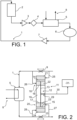
- FIG. 1 An aircraft engine lubricating oil circuit (this engine being otherwise known, and therefore not shown) is first shown diagrammatically in Figure 1 . It comprises a closed-loop conduit 1, passing successively (according to the direction of circulation of the oil) through an oil storage tank 2, a first pump 3, a filter 4, a heat exchanger 5, an enclosure 6 to be lubricated by the engine, and a second oil pump 7.
- the enclosure 6 can be closed, communicating with the outside only by seals with a very low leakage rate, or communicating with other enclosures under overpressure and in a dry atmosphere, so that the entire circuit can be considered as closed: the quantity of oil it contains should remain constant or almost constant.
- the heat exchanger 5 is intended to cool the oil, and a second circuit 8 of cold fluid passes through it, which may be pressurized fuel. Fuel may leak into the conduit 1 and accumulate in the oil circuit, up to an overflow from the tank 2 or other damage, if the wall of the heat exchanger 5 that separates the two circuits (most often, a group of parallel tubes in each of which a flow of fuel flows) is pierced.
- a first embodiment of the invention is described in Figure 2 .
- the conduit 1 is equipped, upstream and downstream of the heat exchanger 5, with two calibrated orifices 9 and 10.
- a calibrated orifice is a restriction in the section of a conduit, which produces a well-defined pressure drop as a function of the flow rate of fluid passing through it, and which can therefore be used as a flow meter.
- a cylindrical casing 11 is also present, and a piston 12 slides therein along its axis.
- the piston 12 comprises a central rod 13, and two plates 14 and 15 at the ends of the rod 13.
- Two walls 16 and 17 divide the volume internal to the casing 11 into three successive chambers 18, 19 and 20 along the axis of the cylinder.
- the rod 13 slides through the walls 16 and 17, and the plates 14 and 15 move respectively in the end chambers 18 and 20, dividing each of them into two compartments, 21 and 22 for the chamber 18, and 23 and 24 for the chamber 20. More precisely, the compartments 21 and 22 occupy the entire volume of the chamber 18 except that occupied by the piston 12, and the compartments 23 and 24 likewise occupy the entire volume of the chamber 20, except that occupied by the piston 12; and the plates 14 and 15 hermetically separate, respectively, the compartments 21 and 22 from each other, and 23 and 24 from each other.
- Each of the compartments 21 to 24 is connected to the conduit 1 by a connecting conduit, respectively, 25 to 28, in the following manner.
- Compartment 21, which is distal or adjacent to one end of the casing 11, has its connecting conduit 25 which leads to the conduit 1 of the circuit upstream of the first calibrated orifice 9, itself upstream of the heat exchanger 5.
- Compartment 22, which is adjacent to the middle chamber 19 and adjacent to the previous one, has its connecting conduit 26 which leads to the conduit 1 downstream of the first calibrated orifice 9, but still upstream of the heat exchanger 5.
- Compartment 23 which is another proximal compartment adjacent to the middle chamber 19, but belonging to the second extreme chamber 20, has its connecting conduit 27 which leads to the conduit 1 downstream of the second calibrated orifice 10; and compartment 24, which is the distal compartment of the second extreme chamber 20, located at the end of the casing 11 opposite the previous one, has its connecting conduit 28 which leads to conduit 1 also downstream of the heat exchanger 5, but upstream of the second calibrated orifice 10.
- each of the chambers 18 and 20 divided by one of the plates 14 and 15 is associated with a respective calibrated orifice 9 or 10, their compartments communicate on each side of said associated calibrated orifice 9 or 10, the distal compartments 21 and 24 all on the same side (upstream or downstream) of the associated calibrated orifice 9 or 10, and the proximal compartments 22 and 23 all on the other side.
- Each of the compartments 21 to 24 is therefore occupied by oil from the circuit, at a pressure equal to that of the point in the circuit where their connecting conduit leads, the pressure losses in the connecting conduits 25 to 28 being negligible, or in any case equal to each other.
- the device comprises a sensor 29 for the position of the rod 13, or possibly its movement, inside the middle chamber 19, which is not occupied by a liquid; an electrical line 30 connects the sensor 29 to a computer 31 on board the aircraft and sends its measurements to it.
- Figure 4 illustrates the addition of a spring 32 constrained between the casing 11 and the piston 12 in the direction of movement of the piston 12, and the purpose of which is to return the latter to the starting position, corresponding to equilibrium in the absence of leakage, that is to say to the state of the Figure 2 , when it has been displaced by a disturbance that has ceased.
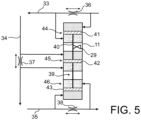
- Figure 5 illustrates a device designed for a circuit with three portions or three branches 33, 34 and 35, successive or parallel, each provided with a calibrated orifice, respectively 36, 37 and 38.
- the device then comprises, in the casing 11, a piston 39 whose rod 40 carries three successive plates 41, 42 and 43 and each of which slides in a respective chamber 44, 45 or 46 occupying a part of the length of the casing 11.
- each of the chambers is divided into two hermetic compartments by the plate which it contains, and each of the compartments communicates with the circuit, respectively upstream and downstream of one of the calibrated orifices 36, 37 and 38, with which it is respectively associated.
- a state of equilibrium can be obtained by a judicious choice of the sections of the chambers, which can be different (the casing 11 then being replaced by a superposition of cylinders) and the pressure losses through the calibrated orifices, which can be different, depending again on the flow rates, which can also be different, provided to flow in each of the branches.
- a leak in one of the branches will produce an imbalance of the forces and a displacement of the piston, which will be detected by the position sensor 29.
- Such a device can make it possible to detect certain leaks more precisely according to their position, and even to distinguish between certain leak positions, for example between the upstream and downstream of the median calibrated orifice 37 if the branches 33, 34 and 35 are successive, if the directions of displacement of the piston 39 are then opposite.
Landscapes
- Engineering & Computer Science (AREA)
- General Engineering & Computer Science (AREA)
- Mechanical Engineering (AREA)
- Chemical & Material Sciences (AREA)
- Combustion & Propulsion (AREA)
- Physics & Mathematics (AREA)
- Thermal Sciences (AREA)
- Examining Or Testing Airtightness (AREA)
Description
- Le sujet de la présente invention est un dispositif de détection de fuites dans un circuit d'huile de lubrification d'un moteur d'aéronef.
- Les circuits d'huile de lubrification de ces moteurs instaurent une circulation permanente de l'huile entre notamment des enceintes lubrifiées, contenant par exemple des paliers de support des arbres, et des réservoirs de stockage. Cette circulation permet d'évacuer la chaleur produite par les frottements ou la proximité des gaz chauds en aval de la chambre de combustion au moyen du débit d'huile. Des échangeurs de chaleur sont généralement ajoutés aux équipements traversés par les circuits afin d'obtenir un refroidissement suffisant à maintenir l'huile à une température stable. Le fluide de refroidissement utilisé dans l'échangeur est souvent le carburant utilisé pour le fonctionnement du moteur, grâce à sa température froide initialement : le circuit du carburant croise alors le circuit d'huile dans l'échangeur.
- Des fuites apparaissent si l'échangeur de chaleur est endommagé et qu'une communication s'ouvre entre les deux circuits. Dans le cas d'un refroidissement par le carburant, les fuites se produisent normalement vers le circuit d'huile, car le circuit du carburant est à une pression plus haute dans les moteurs habituels. Les inconvénients évidents sont un défaut de lubrification et un risque de débordement du circuit d'huile, et d'écoulement du liquide en excès dans le moteur, avec une pollution inévitable. Si le liquide mêlé à l'huile est du carburant, il faut encore craindre un défaut de fonctionnement du moteur par soustraction d'une partie de son combustible, et des feux du carburant quand il arrive à des endroits excessivement chauds du moteur.
- Les procédés connus de détection de fuites sont plutôt empiriques et consistent par exemple à examiner la stabilité du niveau dans les réservoirs d'huile, vérifier l'absence d'odeurs de carburant, ou l'absence de feux. De tels procédés ne sont évidemment pas très fiables, ni applicables pendant le fonctionnement du moteur et un vol de l'aéronef. Il a encore été proposé des dispositifs d'évacuation de trop-pleins dans les réservoirs d'huile, mais ils sont relativement complexes, et ils interviennent seulement après qu'une quantité notable de liquide étranger a fui dans le circuit d'huile. Ils ne sont pas nécessairement conçus pour détecter les fuites, mais plutôt pour pallier leurs conséquences. Les documents
FR 3 068 102 FR 2 691 255 FR 3 074 848 A1 - Un objet de l'invention est de proposer un dispositif de détection actif à tout moment, apte à signaler une fuite dès qu'elle commence, simple dans sa constitution et son fonctionnement et donc peu sujet aux pannes et anomalies, et ne faisant pas appel à des observations humaines.
- Sous une forme générale, l'invention est donc relative à un dispositif de détection de fuites dans un circuit d'huile de lubrification d'un moteur d'aéronef entre au moins deux points du circuit, caractérisé en ce qu'il comprend un piston formé d'une pluralité de plateaux étagés sur une tige mobile qui relie lesdits plateaux, une pluralité de chambres fixes dans lesquelles les plateaux coulissent respectivement en les divisant chacune en deux compartiments séparés, deux orifices calibrés situés respectivement à deux positions distinctes du circuit, les deux compartiments de chacune des chambres étant respectivement reliés au circuit par deux conduits de liaison respectifs et distincts aboutissant sur le circuit de part et d'autre d'un orifice calibré, le dispositif comprenant encore un capteur de position ou de mouvement du piston. Les deux points du circuit sont présents chacun à l'intersection d'un des conduits de liaison avec une ligne principale du circuit
- D'après une application principalement envisagée, le circuit comprend un échangeur de chaleur, et les orifices calibrés sont placés de part et d'autre de l'échangeur le long du circuit.
- Avantageusement, le capteur de position ou de mouvement est relié à un dispositif de diagnostic d'anomalie, sensible à un déplacement de la tige hors d'une position d'équilibre.
- D'après une généralisation possible, les plateaux, les chambres et les orifices calibrés sont chacun au moins trois.
- Avantageusement, le piston est relié à un endroit fixe du dispositif par un ressort de rappel à une position initiale du piston.
- Un autre aspect de l'invention est un agencement comprenant le circuit d'huile et le dispositif de détection de fuites selon ce qui précède, caractérisé en ce que l'échangeur de chaleur est aussi placé sur un second circuit, parcouru par un fluide en échange thermique avec l'huile.
- Le second circuit peut être un circuit d'alimentation en carburant du moteur d'aéronef.
- L'invention sera maintenant décrite en détail dans ses différents aspects, caractéristiques et avantages, au moyen des figures suivantes, qui représentent plusieurs de ses réalisations possibles, données à titre purement illustratif :
-
Figure 1 : un circuit de lubrification à l'huile ; -
Figure 2 : une réalisation de l'invention ; -
Figure 3 : cette réalisation, quand une fuite a lieu ; -
Figure 4 : une variante de réalisation ; -
Figure 5 : une autre réalisation possible. - Un circuit d'huile de lubrification de moteur d'aéronef (ce moteur étant par ailleurs connu, et donc non représenté) est d'abord schématisé à la
figure 1 . Il comprend un conduit 1 en boucle fermée, passant successivement (d'après le sens de circulation de l'huile) par un réservoir 2 de stockage d'huile, une première pompe 3, un filtre 4, un échangeur de chaleur 5, une enceinte 6 à lubrifier du moteur, et une seconde pompe à huile 7. L'enceinte 6 peut être fermée, communiquer à l'extérieur seulement par des joints d'étanchéité à débit de fuite très faible, ou communiquer à d'autres enceintes en surpression et à atmosphère sèche, si bien que le circuit entier peut être considéré comme fermé : la quantité d'huile qu'il contient devrait rester constante ou quasiment. - L'échangeur de chaleur 5 est destiné à refroidir l'huile, et un second circuit 8 de fluide froid le traverse, qui peut être de carburant sous pression. Du carburant peut fuir dans le conduit 1 et s'accumuler dans le circuit d'huile, jusqu'à un débordement hors du réservoir 2 ou d'autres dommages, si la paroi de l'échangeur de chaleur 5 qui sépare les deux circuits (le plus souvent, un groupe de tubes parallèles dans chacun desquels un débit du carburant s'écoule) est percée.
- Une première réalisation de l'invention est décrite à la
figure 2 . Le conduit 1 est équipé, en amont et en aval de l'échangeur de chaleur 5, de deux orifices calibrés 9 et 10. Un orifice calibré est une restriction de section d'un conduit, qui produit une perte de charge bien définie en fonction du débit de fluide qui le traverse, et qui est pour cela utilisable en débitmètre. Une enveloppe 11 cylindrique est aussi présente, et un piston 12 y coulisse le long de son axe. Le piston 12 comprend une tige 13 centrale, et deux plateaux 14 et 15 aux extrémités de la tige 13. Deux parois 16 et 17 divisent le volume interne à l'enveloppe 11 en trois chambres 18, 19 et 20 successives le long de l'axe du cylindre. La tige 13 coulisse à travers les parois 16 et 17, et les plateaux 14 et 15 se déplacent respectivement dans les chambres extrêmes 18 et 20, en les divisant chacune en deux compartiments, 21 et 22 pour la chambre 18, et 23 et 24 pour la chambre 20. Plus précisément, les compartiments 21 et 22 occupent tout le volume de la chambre 18 sauf ce qu'occupe le piston 12, et les compartiments 23 et 24 occupent de même tout le volume de la chambre 20, sauf ce qu'occupe le piston 12 ; et les plateaux 14 et 15 séparent hermétiquement, respectivement, les compartiments 21 et 22 l'un de l'autre, et 23 et 24 l'un de l'autre. - Chacun des compartiments 21 à 24 est relié au conduit 1 par un conduit de liaison, respectivement, 25 à 28, de la façon suivante. Le compartiment 21, qui est distal ou adjacent à une extrémité de l'enveloppe 11, a son conduit de liaison 25 qui mène au conduit 1 du circuit en amont du premier orifice calibré 9, lui-même en amont de l'échangeur de chaleur 5. Le compartiment 22, qui est adjacent à la chambre 19 médiane et adjacent au précédent, a son conduit de liaison 26 qui mène au conduit 1 en aval du premier orifice calibré 9, mais toujours en amont de l'échangeur de chaleur 5. Le compartiment 23, qui est un autre compartiment proximal adjacent à la chambre médiane 19, mais appartenant à la seconde chambre extrême 20, a son conduit de liaison 27 qui mène au conduit 1 en aval du second orifice calibré 10 ; et le compartiment 24, qui est le compartiment distal de la seconde chambre extrême 20, situé à l'extrémité de l'enveloppe 11 opposée à la précédente, a son conduit de liaison 28 qui mène au conduit 1 aussi en aval de l'échangeur de chaleur 5, mais en amont du second orifice calibré 10. De façon plus synthétique, chacune des chambres 18 et 20 divisée par un des plateaux 14 et 15 est associée à un orifice calibré 9 ou 10 respectif, leurs compartiments communiquent de chaque côté dudit orifice calibré 9 ou 10 associé, les compartiments distaux 21 et 24 tous d'un même côté (amont ou aval) de l'orifice calibré 9 ou 10 associé, et les compartiments proximaux 22 et 23 tous de l'autre côté. Chacun des compartiments 21 à 24 est donc occupé par de l'huile du circuit, à une pression égale à celle du point du circuit où mène leur conduit de liaison, les pertes de charge dans les conduits de liaison 25 à 28 étant négligeables, ou en tout cas égales entre elles.
- Enfin, le dispositif comprend un capteur 29 de position de la tige 13, ou éventuellement de son mouvement, à l'intérieur de la chambre médiane 19, qui n'est pas occupée par un liquide ; une ligne électrique 30 relie le capteur 29 à un calculateur 31 à bord de l'aéronef et lui envoie ses mesures.
- La
figure 3 aide à comprendre le fonctionnement du dispositif en comparaison à lafigure 2 . Quand le circuit d'huile est intact et ne reçoit pas de fuites originaires du second circuit 8 (ou ne subit lui-même pas de fuites vers l'extérieur), le débit qui le parcourt reste constant, et les pertes de charges à travers les orifices calibrés ΔP9 et ΔP10 sont identiques si ces orifices calibrés 9 et 10 sont eux-mêmes identiques. Les forces de pression s'exerçant sur les deux plateaux 14 et 15, respectivement proportionnelles à ces pertes de charge, sont identiques si les plateaux 14 et 15 ont la même superficie, mais elles sont opposées, et le piston 12 reste immobile. Mais en cas de fuite, l'état de lafigure 3 est obtenu, car les débits deviennent différents de part et d'autre de l'échangeur de chaleur 5 (ou plus généralement du lieu de la fuite), les pertes de charges deviennent aussi différentes à travers les orifices calibrés 9 et 10, de même que les forces antagonistes s'exerçant sur les plateaux 14 et 15 : le piston 12 se déplace. Le capteur 29 de position observe ce déplacement et émet un signal correspondant vers le calculateur 31, qui peut lancer une alarme ou ordonner une coupure du circuit ou du moteur. - Il est manifeste que le même effet pourrait être obtenu avec des réalisations différentes ou plus complexes à partir de la description qui précède, sans donc sortir des limites de l'invention. On mentionnera néanmoins deux possibilités importantes d'amélioration ci-après. La
figure 4 illustre l'addition d'un ressort 32 contraint entre l'enveloppe 11 et le piston 12 dans la direction de déplacement du piston 12, et dont le but est de ramener celui-ci à la position de départ, correspondant à l'équilibre en l'absence de fuite, c'est-à-dire à l'état de lafigure 2 , lorsqu'il a été déplacé par une perturbation qui a cessé. Et lafigure 5 illustre un dispositif conçu pour un circuit à trois portions ou trois branches 33, 34 et 35, successives ou parallèles, dotées chacune d'un orifice calibré, respectivement 36, 37 et 38. Le dispositif comprend alors, dans l'enveloppe 11, un piston 39 dont la tige 40 porte trois plateaux 41, 42 et 43 successifs et dont chacun coulisse dans une chambre respective 44, 45 ou 46 occupant une partie de la longueur de l'enveloppe 11. Comme précédemment, chacune des chambres est divisée en deux compartiments hermétiques par le plateau qu'elle contient, et chacun des compartiments communique au circuit, respectivement en amont et en aval d'un des orifices calibrés 36, 37 et 38, auquel il est respectivement associé. Un état d'équilibre peut être obtenu par un choix judicieux des sections des chambres, qui peuvent être différentes (l'enveloppe 11 étant alors remplacée par une superposition de cylindres) et des pertes de charge par les orifices calibrés, qui peuvent être différentes, selon encore les débits, pouvant aussi être différents, prévus pour s'écouler dans chacune des branches. Comme auparavant, une fuite dans une des branches produira un déséquilibre des efforts et un déplacement du piston, qui sera détecté par le capteur 29 de position. Un tel dispositif peut permettre de détecter plus finement certaines fuites selon leur position, et même de distinguer entre certaines positions de fuites, par exemple entre l'amont et l'aval de l'orifice calibré 37 médian si les branches 33, 34 et 35 sont successives, si les sens de déplacement du piston 39 sont alors opposés.
Claims (7)
- Dispositif de détection de fuites dans un circuit (1) d'huile de lubrification d'un moteur d'aéronef entre au moins deux points du circuit, caractérisé en ce qu'il comprend un piston (12) formé d'une pluralité de plateaux (14, 15) étagés sur une tige (13) mobile qui relie lesdits plateaux, une pluralité de chambres (18, 20) fixes dans lesquelles les plateaux coulissent respectivement en les divisant chacune en deux compartiments (21 à 24) séparés, deux orifices calibrés (9, 10) situés respectivement à deux positions distinctes du circuit, les deux compartiments de chacune des chambres étant respectivement reliés au circuit par deux conduits de liaison (25, 26 ; 27, 28) respectifs et distincts aboutissant sur le circuit de part et d'autre d'un orifice calibré (9, 10), le dispositif comprenant encore un capteur (29) de position ou de mouvement du piston (12).
- Dispositif de détection de fuites selon la revendication 1, caractérisé en ce que les orifices calibrés (9, 10) sont placés de part et d'autre d'un échangeur de chaleur (5), le long du circuit.
- Dispositif de détection de fuites selon la revendication 1 ou 2, caractérisé en ce que le capteur de position ou de mouvement est relié à un dispositif de diagnostic d'anomalie (31), sensible à un déplacement de la tige (13) hors d'une position d'équilibre.
- Dispositif de détection de fuites selon l'une quelconque des revendications 1 à 3, caractérisé en ce que les plateaux, les chambres et les orifices calibrés sont chacun au moins trois.
- Dispositif de détection de fuites selon l'une quelconque des revendications 1 à 4, caractérisé en ce que le piston est relié à un endroit fixe du dispositif par un ressort (32) de rappel à une position initiale du piston.
- Agencement comprenant un circuit d'huile et le dispositif de détection de fuites selon la revendication 2, caractérisé en ce que l'échangeur de chaleur est aussi placé sur un second circuit (8), parcouru par un fluide en échange thermique avec l'huile.
- Agencement selon la revendication 6, caractérisé en ce que le second circuit est un circuit d'alimentation en carburant du moteur d'aéronef.
Applications Claiming Priority (2)
| Application Number | Priority Date | Filing Date | Title |
|---|---|---|---|
| FR2106584A FR3124242B1 (fr) | 2021-06-21 | 2021-06-21 | Dispositif de détection de fuites dans un circuit d’huile de lubrification d’un moteur d’aéronef |
| PCT/FR2022/051145 WO2022269165A1 (fr) | 2021-06-21 | 2022-06-14 | Dispositif de détection de fuites dans un circuit d'huile de lubrification d'un moteur d'aéronef |
Publications (2)
| Publication Number | Publication Date |
|---|---|
| EP4359651A1 EP4359651A1 (fr) | 2024-05-01 |
| EP4359651B1 true EP4359651B1 (fr) | 2025-04-16 |
Family
ID=77411841
Family Applications (1)
| Application Number | Title | Priority Date | Filing Date |
|---|---|---|---|
| EP22741342.4A Active EP4359651B1 (fr) | 2021-06-21 | 2022-06-14 | Dispositif de détection de fuites dans un circuit d'huile de lubrification d'un moteur d'aéronef |
Country Status (5)
| Country | Link |
|---|---|
| US (1) | US12228245B2 (fr) |
| EP (1) | EP4359651B1 (fr) |
| CN (1) | CN117545911A (fr) |
| FR (1) | FR3124242B1 (fr) |
| WO (1) | WO2022269165A1 (fr) |
Families Citing this family (2)
| Publication number | Priority date | Publication date | Assignee | Title |
|---|---|---|---|---|
| FR3124242B1 (fr) * | 2021-06-21 | 2023-06-09 | Safran Aircraft Engines | Dispositif de détection de fuites dans un circuit d’huile de lubrification d’un moteur d’aéronef |
| US12486799B2 (en) * | 2021-09-30 | 2025-12-02 | Safran Aircraft Engines | Turbine engine comprising an oil supply system |
Family Cites Families (13)
| Publication number | Priority date | Publication date | Assignee | Title |
|---|---|---|---|---|
| JPS54183574U (fr) * | 1978-06-19 | 1979-12-26 | ||
| JPS54183573U (fr) * | 1978-06-19 | 1979-12-26 | ||
| US4574920A (en) * | 1984-08-02 | 1986-03-11 | Lubriquip - Houdaille, Inc. | Hydropneumatic monitoring device |
| US5038893A (en) * | 1989-09-25 | 1991-08-13 | Orsco, Inc. | Lubrication monitoring system |
| US5126722A (en) * | 1991-02-04 | 1992-06-30 | Lubriquip, Inc. | Point of lube monitor |
| FR2691255B1 (fr) * | 1992-05-13 | 1994-07-01 | Snecma | Dispositif de detection d'une fuite de carburant dans un echangeur de chaleur huile-carburant monte sur un circuit de lubrification d'un moteur. |
| EP0854314B1 (fr) * | 1993-03-18 | 2003-08-20 | B a r m a g AG | Methode pour alimenter en lubrifiant un palier antifriction |
| CN201992316U (zh) * | 2011-03-31 | 2011-09-28 | 北京中冶华润科技发展有限公司 | 润滑系统 |
| US8596417B2 (en) * | 2011-07-05 | 2013-12-03 | Honeywell International Inc. | Lubrication systems with nozzle blockage detection systems |
| FR3068102B1 (fr) | 2017-06-22 | 2020-02-14 | Safran Aircraft Engines | Clapet de pressurisation a deux soupapes |
| FR3074848B1 (fr) | 2017-12-08 | 2020-08-21 | Safran Aircraft Engines | Circuit de lubrification, notamment dans un moteur d'aeronef |
| FR3094754B1 (fr) * | 2019-04-03 | 2021-03-12 | Safran Nacelles | Nacelle d’aéronef comportant au moins un échangeur de chaleur |
| FR3124242B1 (fr) * | 2021-06-21 | 2023-06-09 | Safran Aircraft Engines | Dispositif de détection de fuites dans un circuit d’huile de lubrification d’un moteur d’aéronef |
-
2021
- 2021-06-21 FR FR2106584A patent/FR3124242B1/fr active Active
-
2022
- 2022-06-14 EP EP22741342.4A patent/EP4359651B1/fr active Active
- 2022-06-14 US US18/572,031 patent/US12228245B2/en active Active
- 2022-06-14 CN CN202280042287.7A patent/CN117545911A/zh active Pending
- 2022-06-14 WO PCT/FR2022/051145 patent/WO2022269165A1/fr not_active Ceased
Also Published As
| Publication number | Publication date |
|---|---|
| CN117545911A (zh) | 2024-02-09 |
| FR3124242B1 (fr) | 2023-06-09 |
| FR3124242A1 (fr) | 2022-12-23 |
| US12228245B2 (en) | 2025-02-18 |
| US20240288117A1 (en) | 2024-08-29 |
| WO2022269165A1 (fr) | 2022-12-29 |
| EP4359651A1 (fr) | 2024-05-01 |
Similar Documents
| Publication | Publication Date | Title |
|---|---|---|
| EP4359651B1 (fr) | Dispositif de détection de fuites dans un circuit d'huile de lubrification d'un moteur d'aéronef | |
| FR3094070A1 (fr) | Dispositif et procédé de stockage et de fourniture de carburant fluide. | |
| CA2873947C (fr) | Circuit de fluide dans une turbomachine | |
| BE1024081B1 (fr) | Refroidissement de turbomachine par evaporation | |
| FR3117528A1 (fr) | Echangeur de chaleur monte dans une cavite d’une turbomachine | |
| EP3810510A1 (fr) | Reservoir embarque de drainage d'un moteur d'aeronef | |
| FR2871527A1 (fr) | Moteur stirling | |
| FR2895512A1 (fr) | Procede et dispositif de mesure automatique de la consommation en huile d'un moteur a combustion interne et de vidange dudit moteur | |
| WO2015087006A1 (fr) | Turbomachine d'aéronef comportant un échangeur de chaleur et une boite d'engrenages en v | |
| WO2023118730A1 (fr) | Système de refroidissement d'un liquide de lubrification d'une turbomachine d'aéronef | |
| FR2466515A1 (fr) | Perfectionnements aux installations de production de gaz par electrolyse sous pression | |
| FR3031135B1 (fr) | Machine de detente axiale a pistons | |
| CN214405563U (zh) | 滑油系统及发动机试验装置 | |
| EP4423377B1 (fr) | Détection de présence de carburant dans l'huile d'un moteur d'avion | |
| CN112555667A (zh) | 滑油系统及发动机试验装置 | |
| JP6635905B2 (ja) | スターリングエンジン | |
| FR2534324A1 (fr) | Pompe a vide | |
| FR2510750A1 (fr) | Procede et dispositif de controle et d'ajustement d'une quantite de liquide contenue dans un reservoir | |
| FR2975732A1 (fr) | Systeme hydraulique pour l'alimentation d'un circuit hydraulique | |
| FR3029561A1 (fr) | Machine de detente a pistons | |
| FR3134147A1 (fr) | Dispositif de lubrification amélioré pour turbomachine d’aéronef hybridé | |
| FR3147365A1 (fr) | Mesure de perméabilité d’un système d’injection de turbomachine | |
| WO2025099391A1 (fr) | Procede de surveillance de turbomachine et turbomachine correspondante | |
| FR3162824A1 (fr) | Unité de stockage d’un fluide cryogénique et véhicule comprenant une telle unité | |
| WO2018074141A1 (fr) | Moteur stirling |
Legal Events
| Date | Code | Title | Description |
|---|---|---|---|
| STAA | Information on the status of an ep patent application or granted ep patent |
Free format text: STATUS: UNKNOWN |
|
| STAA | Information on the status of an ep patent application or granted ep patent |
Free format text: STATUS: THE INTERNATIONAL PUBLICATION HAS BEEN MADE |
|
| PUAI | Public reference made under article 153(3) epc to a published international application that has entered the european phase |
Free format text: ORIGINAL CODE: 0009012 |
|
| STAA | Information on the status of an ep patent application or granted ep patent |
Free format text: STATUS: REQUEST FOR EXAMINATION WAS MADE |
|
| 17P | Request for examination filed |
Effective date: 20231207 |
|
| AK | Designated contracting states |
Kind code of ref document: A1 Designated state(s): AL AT BE BG CH CY CZ DE DK EE ES FI FR GB GR HR HU IE IS IT LI LT LU LV MC MK MT NL NO PL PT RO RS SE SI SK SM TR |
|
| DAV | Request for validation of the european patent (deleted) | ||
| DAX | Request for extension of the european patent (deleted) | ||
| GRAP | Despatch of communication of intention to grant a patent |
Free format text: ORIGINAL CODE: EPIDOSNIGR1 |
|
| STAA | Information on the status of an ep patent application or granted ep patent |
Free format text: STATUS: GRANT OF PATENT IS INTENDED |
|
| GRAS | Grant fee paid |
Free format text: ORIGINAL CODE: EPIDOSNIGR3 |
|
| INTG | Intention to grant announced |
Effective date: 20250207 |
|
| GRAA | (expected) grant |
Free format text: ORIGINAL CODE: 0009210 |
|
| STAA | Information on the status of an ep patent application or granted ep patent |
Free format text: STATUS: THE PATENT HAS BEEN GRANTED |
|
| AK | Designated contracting states |
Kind code of ref document: B1 Designated state(s): AL AT BE BG CH CY CZ DE DK EE ES FI FR GB GR HR HU IE IS IT LI LT LU LV MC MK MT NL NO PL PT RO RS SE SI SK SM TR |
|
| REG | Reference to a national code |
Ref country code: GB Ref legal event code: FG4D Free format text: NOT ENGLISH |
|
| REG | Reference to a national code |
Ref country code: CH Ref legal event code: EP |
|
| REG | Reference to a national code |
Ref country code: IE Ref legal event code: FG4D Free format text: LANGUAGE OF EP DOCUMENT: FRENCH |
|
| REG | Reference to a national code |
Ref country code: DE Ref legal event code: R096 Ref document number: 602022013289 Country of ref document: DE |
|
| PGFP | Annual fee paid to national office [announced via postgrant information from national office to epo] |
Ref country code: DE Payment date: 20250618 Year of fee payment: 4 |
|
| PGFP | Annual fee paid to national office [announced via postgrant information from national office to epo] |
Ref country code: FR Payment date: 20250623 Year of fee payment: 4 |
|
| PGFP | Annual fee paid to national office [announced via postgrant information from national office to epo] |
Ref country code: AT Payment date: 20250721 Year of fee payment: 4 |
|
| REG | Reference to a national code |
Ref country code: NL Ref legal event code: MP Effective date: 20250416 |
|
| PG25 | Lapsed in a contracting state [announced via postgrant information from national office to epo] |
Ref country code: NL Free format text: LAPSE BECAUSE OF FAILURE TO SUBMIT A TRANSLATION OF THE DESCRIPTION OR TO PAY THE FEE WITHIN THE PRESCRIBED TIME-LIMIT Effective date: 20250416 |
|
| REG | Reference to a national code |
Ref country code: AT Ref legal event code: MK05 Ref document number: 1785831 Country of ref document: AT Kind code of ref document: T Effective date: 20250416 |
|
| PG25 | Lapsed in a contracting state [announced via postgrant information from national office to epo] |
Ref country code: FI Free format text: LAPSE BECAUSE OF FAILURE TO SUBMIT A TRANSLATION OF THE DESCRIPTION OR TO PAY THE FEE WITHIN THE PRESCRIBED TIME-LIMIT Effective date: 20250416 Ref country code: PT Free format text: LAPSE BECAUSE OF FAILURE TO SUBMIT A TRANSLATION OF THE DESCRIPTION OR TO PAY THE FEE WITHIN THE PRESCRIBED TIME-LIMIT Effective date: 20250818 Ref country code: ES Free format text: LAPSE BECAUSE OF FAILURE TO SUBMIT A TRANSLATION OF THE DESCRIPTION OR TO PAY THE FEE WITHIN THE PRESCRIBED TIME-LIMIT Effective date: 20250416 |
|
| REG | Reference to a national code |
Ref country code: LT Ref legal event code: MG9D |
|
| PG25 | Lapsed in a contracting state [announced via postgrant information from national office to epo] |
Ref country code: NO Free format text: LAPSE BECAUSE OF FAILURE TO SUBMIT A TRANSLATION OF THE DESCRIPTION OR TO PAY THE FEE WITHIN THE PRESCRIBED TIME-LIMIT Effective date: 20250716 Ref country code: GR Free format text: LAPSE BECAUSE OF FAILURE TO SUBMIT A TRANSLATION OF THE DESCRIPTION OR TO PAY THE FEE WITHIN THE PRESCRIBED TIME-LIMIT Effective date: 20250717 |
|
| PG25 | Lapsed in a contracting state [announced via postgrant information from national office to epo] |
Ref country code: PL Free format text: LAPSE BECAUSE OF FAILURE TO SUBMIT A TRANSLATION OF THE DESCRIPTION OR TO PAY THE FEE WITHIN THE PRESCRIBED TIME-LIMIT Effective date: 20250416 |
|
| PG25 | Lapsed in a contracting state [announced via postgrant information from national office to epo] |
Ref country code: BG Free format text: LAPSE BECAUSE OF FAILURE TO SUBMIT A TRANSLATION OF THE DESCRIPTION OR TO PAY THE FEE WITHIN THE PRESCRIBED TIME-LIMIT Effective date: 20250416 |
|
| PG25 | Lapsed in a contracting state [announced via postgrant information from national office to epo] |
Ref country code: HR Free format text: LAPSE BECAUSE OF FAILURE TO SUBMIT A TRANSLATION OF THE DESCRIPTION OR TO PAY THE FEE WITHIN THE PRESCRIBED TIME-LIMIT Effective date: 20250416 Ref country code: AT Free format text: LAPSE BECAUSE OF FAILURE TO SUBMIT A TRANSLATION OF THE DESCRIPTION OR TO PAY THE FEE WITHIN THE PRESCRIBED TIME-LIMIT Effective date: 20250416 |
|
| PG25 | Lapsed in a contracting state [announced via postgrant information from national office to epo] |
Ref country code: RS Free format text: LAPSE BECAUSE OF FAILURE TO SUBMIT A TRANSLATION OF THE DESCRIPTION OR TO PAY THE FEE WITHIN THE PRESCRIBED TIME-LIMIT Effective date: 20250716 |
|
| PG25 | Lapsed in a contracting state [announced via postgrant information from national office to epo] |
Ref country code: IS Free format text: LAPSE BECAUSE OF FAILURE TO SUBMIT A TRANSLATION OF THE DESCRIPTION OR TO PAY THE FEE WITHIN THE PRESCRIBED TIME-LIMIT Effective date: 20250816 |
|
| PG25 | Lapsed in a contracting state [announced via postgrant information from national office to epo] |
Ref country code: LV Free format text: LAPSE BECAUSE OF FAILURE TO SUBMIT A TRANSLATION OF THE DESCRIPTION OR TO PAY THE FEE WITHIN THE PRESCRIBED TIME-LIMIT Effective date: 20250416 |
|
| PG25 | Lapsed in a contracting state [announced via postgrant information from national office to epo] |
Ref country code: SM Free format text: LAPSE BECAUSE OF FAILURE TO SUBMIT A TRANSLATION OF THE DESCRIPTION OR TO PAY THE FEE WITHIN THE PRESCRIBED TIME-LIMIT Effective date: 20250416 Ref country code: DK Free format text: LAPSE BECAUSE OF FAILURE TO SUBMIT A TRANSLATION OF THE DESCRIPTION OR TO PAY THE FEE WITHIN THE PRESCRIBED TIME-LIMIT Effective date: 20250416 |
|
| REG | Reference to a national code |
Ref country code: DE Ref legal event code: R097 Ref document number: 602022013289 Country of ref document: DE |
|
| PG25 | Lapsed in a contracting state [announced via postgrant information from national office to epo] |
Ref country code: CZ Free format text: LAPSE BECAUSE OF FAILURE TO SUBMIT A TRANSLATION OF THE DESCRIPTION OR TO PAY THE FEE WITHIN THE PRESCRIBED TIME-LIMIT Effective date: 20250416 |
|
| PG25 | Lapsed in a contracting state [announced via postgrant information from national office to epo] |
Ref country code: EE Free format text: LAPSE BECAUSE OF FAILURE TO SUBMIT A TRANSLATION OF THE DESCRIPTION OR TO PAY THE FEE WITHIN THE PRESCRIBED TIME-LIMIT Effective date: 20250416 |
|
| PG25 | Lapsed in a contracting state [announced via postgrant information from national office to epo] |
Ref country code: SK Free format text: LAPSE BECAUSE OF FAILURE TO SUBMIT A TRANSLATION OF THE DESCRIPTION OR TO PAY THE FEE WITHIN THE PRESCRIBED TIME-LIMIT Effective date: 20250416 |
|
| REG | Reference to a national code |
Ref country code: CH Ref legal event code: H13 Free format text: ST27 STATUS EVENT CODE: U-0-0-H10-H13 (AS PROVIDED BY THE NATIONAL OFFICE) Effective date: 20260127 |
|
| PG25 | Lapsed in a contracting state [announced via postgrant information from national office to epo] |
Ref country code: IT Free format text: LAPSE BECAUSE OF FAILURE TO SUBMIT A TRANSLATION OF THE DESCRIPTION OR TO PAY THE FEE WITHIN THE PRESCRIBED TIME-LIMIT Effective date: 20250416 |
|
| PG25 | Lapsed in a contracting state [announced via postgrant information from national office to epo] |
Ref country code: MC Free format text: LAPSE BECAUSE OF FAILURE TO SUBMIT A TRANSLATION OF THE DESCRIPTION OR TO PAY THE FEE WITHIN THE PRESCRIBED TIME-LIMIT Effective date: 20250416 |
|
| PG25 | Lapsed in a contracting state [announced via postgrant information from national office to epo] |
Ref country code: LU Free format text: LAPSE BECAUSE OF NON-PAYMENT OF DUE FEES Effective date: 20250614 |
|
| PLBE | No opposition filed within time limit |
Free format text: ORIGINAL CODE: 0009261 |
|
| STAA | Information on the status of an ep patent application or granted ep patent |
Free format text: STATUS: NO OPPOSITION FILED WITHIN TIME LIMIT |
|
| REG | Reference to a national code |
Ref country code: CH Ref legal event code: L10 Free format text: ST27 STATUS EVENT CODE: U-0-0-L10-L00 (AS PROVIDED BY THE NATIONAL OFFICE) Effective date: 20260225 |
|
| REG | Reference to a national code |
Ref country code: BE Ref legal event code: MM Effective date: 20250630 |
|
| PG25 | Lapsed in a contracting state [announced via postgrant information from national office to epo] |
Ref country code: RO Free format text: LAPSE BECAUSE OF FAILURE TO SUBMIT A TRANSLATION OF THE DESCRIPTION OR TO PAY THE FEE WITHIN THE PRESCRIBED TIME-LIMIT Effective date: 20250416 |
|
| 26N | No opposition filed |
Effective date: 20260119 |
|
| PG25 | Lapsed in a contracting state [announced via postgrant information from national office to epo] |
Ref country code: IE Free format text: LAPSE BECAUSE OF NON-PAYMENT OF DUE FEES Effective date: 20250614 |
|
| PG25 | Lapsed in a contracting state [announced via postgrant information from national office to epo] |
Ref country code: BE Free format text: LAPSE BECAUSE OF NON-PAYMENT OF DUE FEES Effective date: 20250630 |
|
| PG25 | Lapsed in a contracting state [announced via postgrant information from national office to epo] |
Ref country code: CH Free format text: LAPSE BECAUSE OF NON-PAYMENT OF DUE FEES Effective date: 20250630 |