EP4354658A1 - Antennenmodul - Google Patents
Antennenmodul Download PDFInfo
- Publication number
- EP4354658A1 EP4354658A1 EP22820591.0A EP22820591A EP4354658A1 EP 4354658 A1 EP4354658 A1 EP 4354658A1 EP 22820591 A EP22820591 A EP 22820591A EP 4354658 A1 EP4354658 A1 EP 4354658A1
- Authority
- EP
- European Patent Office
- Prior art keywords
- antenna
- housing
- substrate
- patch
- disposed
- Prior art date
- Legal status (The legal status is an assumption and is not a legal conclusion. Google has not performed a legal analysis and makes no representation as to the accuracy of the status listed.)
- Pending
Links
Images




Classifications
-
- H—ELECTRICITY
- H01—ELECTRIC ELEMENTS
- H01Q—ANTENNAS, i.e. RADIO AERIALS
- H01Q9/00—Electrically-short antennas having dimensions not more than twice the operating wavelength and consisting of conductive active radiating elements
- H01Q9/04—Resonant antennas
- H01Q9/0407—Substantially flat resonant element parallel to ground plane, e.g. patch antenna
-
- H—ELECTRICITY
- H01—ELECTRIC ELEMENTS
- H01Q—ANTENNAS, i.e. RADIO AERIALS
- H01Q1/00—Details of, or arrangements associated with, antennas
- H01Q1/12—Supports; Mounting means
- H01Q1/22—Supports; Mounting means by structural association with other equipment or articles
- H01Q1/2283—Supports; Mounting means by structural association with other equipment or articles mounted in or on the surface of a semiconductor substrate as a chip-type antenna or integrated with other components into an IC package
-
- H—ELECTRICITY
- H01—ELECTRIC ELEMENTS
- H01Q—ANTENNAS, i.e. RADIO AERIALS
- H01Q1/00—Details of, or arrangements associated with, antennas
- H01Q1/12—Supports; Mounting means
- H01Q1/22—Supports; Mounting means by structural association with other equipment or articles
- H01Q1/24—Supports; Mounting means by structural association with other equipment or articles with receiving set
- H01Q1/241—Supports; Mounting means by structural association with other equipment or articles with receiving set used in mobile communications, e.g. GSM
- H01Q1/242—Supports; Mounting means by structural association with other equipment or articles with receiving set used in mobile communications, e.g. GSM specially adapted for hand-held use
- H01Q1/243—Supports; Mounting means by structural association with other equipment or articles with receiving set used in mobile communications, e.g. GSM specially adapted for hand-held use with built-in antennas
-
- H—ELECTRICITY
- H01—ELECTRIC ELEMENTS
- H01Q—ANTENNAS, i.e. RADIO AERIALS
- H01Q1/00—Details of, or arrangements associated with, antennas
- H01Q1/52—Means for reducing coupling between antennas; Means for reducing coupling between an antenna and another structure
- H01Q1/521—Means for reducing coupling between antennas; Means for reducing coupling between an antenna and another structure reducing the coupling between adjacent antennas
-
- H—ELECTRICITY
- H01—ELECTRIC ELEMENTS
- H01Q—ANTENNAS, i.e. RADIO AERIALS
- H01Q21/00—Antenna arrays or systems
- H01Q21/06—Arrays of individually energised antenna units similarly polarised and spaced apart
- H01Q21/061—Two dimensional planar arrays
- H01Q21/065—Patch antenna array
-
- H—ELECTRICITY
- H01—ELECTRIC ELEMENTS
- H01Q—ANTENNAS, i.e. RADIO AERIALS
- H01Q21/00—Antenna arrays or systems
- H01Q21/06—Arrays of individually energised antenna units similarly polarised and spaced apart
- H01Q21/061—Two dimensional planar arrays
- H01Q21/068—Two dimensional planar arrays using parallel coplanar travelling wave or leaky wave aerial units
-
- H—ELECTRICITY
- H01—ELECTRIC ELEMENTS
- H01Q—ANTENNAS, i.e. RADIO AERIALS
- H01Q21/00—Antenna arrays or systems
- H01Q21/28—Combinations of substantially independent non-interacting antenna units or systems
-
- H—ELECTRICITY
- H01—ELECTRIC ELEMENTS
- H01Q—ANTENNAS, i.e. RADIO AERIALS
- H01Q9/00—Electrically-short antennas having dimensions not more than twice the operating wavelength and consisting of conductive active radiating elements
- H01Q9/04—Resonant antennas
- H01Q9/0407—Substantially flat resonant element parallel to ground plane, e.g. patch antenna
- H01Q9/045—Substantially flat resonant element parallel to ground plane, e.g. patch antenna with particular feeding means
- H01Q9/0457—Substantially flat resonant element parallel to ground plane, e.g. patch antenna with particular feeding means electromagnetically coupled to the feed line
-
- H—ELECTRICITY
- H01—ELECTRIC ELEMENTS
- H01Q—ANTENNAS, i.e. RADIO AERIALS
- H01Q13/00—Waveguide horns or mouths; Slot antennas; Leaky-waveguide antennas; Equivalent structures causing radiation along the transmission path of a guided wave
- H01Q13/20—Non-resonant leaky-waveguide or transmission-line antennas; Equivalent structures causing radiation along the transmission path of a guided wave
- H01Q13/206—Microstrip transmission line antennas
-
- Y—GENERAL TAGGING OF NEW TECHNOLOGICAL DEVELOPMENTS; GENERAL TAGGING OF CROSS-SECTIONAL TECHNOLOGIES SPANNING OVER SEVERAL SECTIONS OF THE IPC; TECHNICAL SUBJECTS COVERED BY FORMER USPC CROSS-REFERENCE ART COLLECTIONS [XRACs] AND DIGESTS
- Y02—TECHNOLOGIES OR APPLICATIONS FOR MITIGATION OR ADAPTATION AGAINST CLIMATE CHANGE
- Y02D—CLIMATE CHANGE MITIGATION TECHNOLOGIES IN INFORMATION AND COMMUNICATION TECHNOLOGIES [ICT], I.E. INFORMATION AND COMMUNICATION TECHNOLOGIES AIMING AT THE REDUCTION OF THEIR OWN ENERGY USE
- Y02D30/00—Reducing energy consumption in communication networks
- Y02D30/70—Reducing energy consumption in communication networks in wireless communication networks
Definitions
- the present invention relates to an antenna module using a coupling feeder method.
- mmWave ultra-high frequency bands
- a band for mmWave due to its length of a wavelength.
- an antenna with an array structure with high directivity needs to be designed. Accordingly, a beam pattern of the antenna is formed in a sharp shape, but needs to cover a large area in some applications.
- many components, such as a feeder circuit and a transceiver circuit should be designed with the antenna on one substrate, there is a problem that there are many spatial limits in increasing the number of antennas or changing the design of the antenna.
- a Teflon substrate with a low dielectric constant is used for improving the performance of an antenna module.
- the Teflon substrate is expensive compared to a fire retardant (FR)-4 substrate with a relatively high dielectric constant, there is a problem of increasing manufacturing costs.
- the present invention is directed to providing an antenna module of which a manufacturing cost is reduced.
- the present invention is directed to providing an antenna module of which a degree of design freedom is improved.
- an antenna module including a housing including an accommodation space therein, in which a first antenna is disposed on at least one surface of the housing surrounding the accommodation space, and a substrate disposed in the accommodation space, in which a second antenna is disposed on an upper surface of the substrate to overlap at least a part of the first antenna, wherein the first antenna and the second antenna are spaced a predetermined distance from each other.
- the housing may include a convex portion disposed in the accommodation space, and the convex portion may be formed on one surface of the housing facing the upper surface of the substrate.
- the first antenna may be disposed on one surface of the convex portion facing the upper surface of the substrate.
- the substrate may include a first zone overlapping the first antenna and a second zone on the upper surface, and the second antenna may be disposed in the second zone.
- a dielectric constant of the substrate may be greater than four.
- the housing may include an engraved groove in at least one surface thereof surrounding the accommodation space, and the first antenna may be formed by performing plating on the engraved groove.
- the first antenna may be a patch antenna array in which a plurality of patches are connected, and the second antenna may be a patch antenna formed of a single patch.
- a first patch which is one of the plurality of patches included in the first antenna may overlap a second patch included in the second antenna.
- the first patch may be formed to be smaller than the second patch.
- a separation distance between the first antenna and the second antenna may be set on the basis of an operating frequency of the first antenna.
- a size of the plurality of patches included in the first antenna may be differently set according to a dielectric constant of the housing.
- the antenna module may include a guide part disposed on the upper surface of the substrate to surround a side surface of the second antenna.
- the guide part may be spaced a predetermined distance from an edge of the second antenna.
- manufacturing costs can be reduced.
- a degree of design freedom of an antenna can be significantly improved.
- a wide bandwidth can be used.
- first component when referred to as being "connected” or “coupled” to a second component, such a description may include both a case in which the first component is directly connected or coupled to the second component, and a case in which the first component is connected or coupled to the second component with a third component disposed therebetween.
- first component when a first component is described as being formed or disposed “on” or “under” a second component, such a description includes both a case in which the two components are formed or disposed in direct contact with each other and a case in which one or more other components are interposed between the two components.
- first component when the first component is described as being formed “on or under” the second component, such a description may include a case in which the first component is formed at an upper side or a lower side with respect to the second component.
- An antenna module according to an embodiment of the present invention may be a device mounted on an electronic apparatus to receive a signal transmitted from the outside or transmit a signal to the outside.
- Electronic apparatuses may include vehicles, smartphones, tablets, home appliances, or the like.
- the antenna module according to the embodiment of the present invention may have a structure for reducing manufacturing costs, expanding usable bandwidths, and improving a degree of design freedom, which will be described below.
- FIG. 1 is an exploded perspective view illustrating an antenna module according to an embodiment of the present invention.
- FIG. 2 is a cross-sectional view illustrating a first housing according to the embodiment of the present invention.
- FIG. 3 is a bottom view illustrating the first housing according to the embodiment of the present invention.
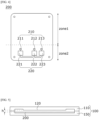
- FIG. 4 is a top view illustrating a substrate according to the embodiment of the present invention.
- FIG. 5 is a cross-sectional view illustrating the antenna module according to the embodiment of the present invention.
- FIG. 6 is a view for describing a first antenna, a second antenna, and a guide part according to the embodiment of the present invention.
- the antenna module may include a housing 100 and a substrate 200.
- the housing 100 may be formed of a material capable of transmitting an electromagnetic wave generated by an antenna.
- the housing 100 may be formed of an electrical insulator.
- the housing 100 may be formed with a sandwich structure using a nylon-based plastic material.
- the housing 100 may be a radome.
- the housing 100 may include an accommodation space therein.
- the housing 100 may accommodate the substrate 200 in the accommodation space.
- the housing may include a first housing 110 and a second housing 150.
- the first housing 110 may be an upper housing.
- the first housing 110 may be formed in a shape of which a lower surface is open.
- the first housing 110 may include four sidewalls and one upper plate.
- the first housing 110 may have a structure in which an edge of the upper plate is connected to edges of the four sidewalls. Accordingly, the first housing 110 may form a first accommodation space surrounded by the upper plate and the four sidewalls.
- the second housing 150 may be a lower housing.
- the second housing 150 may be formed in a shape of which an upper surface is open.
- the second housing 150 may include four sidewalls and one lower plate.
- the second housing 150 may have a structure in which an edge of the lower plate is connected to edges of the four sidewalls. Accordingly, the second housing 150 may form a second accommodation space surrounded by the lower plate and the four sidewalls.
- the first housing 110 and the second housing 150 may be coupled. According to one embodiment, the four sidewalls of the first housing 110 may be correspondingly coupled to the four sidewalls of the second housing 150. Since the first housing 110 and the second housing 150 are coupled, the housing 100 may form a closed accommodation space. That is, the housing 100 may form one accommodation space in which the first accommodation space of the first housing 110 and the second accommodation space of the second housing 150 are connected. When the first housing 110 and the second housing 150 are coupled, sealing may be performed to prevent foreign matter from entering the accommodation space. For example, coupling portions between the four sidewalls of the first housing 110 and the four sidewalls of the second housing 150 may be coated with an adhesive or sealant. Although not illustrated in the drawings, the first housing 110 and the second housing 150 may be fastened by a fastening member.
- the housing 100 may include a convex portion 120.
- the convex portion 120 may be disposed in the accommodation space of the housing 100.
- the convex portion 120 may be disposed in the first accommodation space of the first housing 110.
- the convex portion 120 may be formed in the first housing 110.
- the convex portion 120 may be formed on one surface of the first housing 110.
- the convex portion 120 may be formed on the upper plate of the first housing 110.
- the convex portion 120 may be formed on a lower surface of the upper plate of the first housing 110.
- the lower surface of the upper plate of the first housing 110 may be a surface disposed to face the accommodation space of the housing 100, that is, a surface disposed to face the substrate 200 and disposed to face the second housing 150, among both surfaces of the upper plate of the first housing.
- the convex portion 120 may be formed on the lower surface of the upper plate of the first housing 110 to protrude toward the accommodation space of the housing 100.
- the convex portion 120 may be formed in a hexahedral shape but is not limited thereto.
- the convex portion 120 may be integrally formed with the upper plate of the first housing 110 but is not limited thereto.
- the convex portion 120 may be formed independently of the upper plate and then coupled to the upper plate.
- the housing 100 may include a first antenna 130.
- the first antenna 130 may be disposed on at least one surface of the housing 100 surrounding the accommodation space.
- the first antenna 130 may be disposed on the upper plate of the first housing 110.
- the first antenna 130 may be disposed on the lower surface of the upper plate of the first housing 110.
- the lower surface of the upper plate of the first housing 110 may be one surface facing an upper surface of the lower plate of the second housing 150.
- the lower surface of the upper plate of the first housing 110 may be one surface facing an upper surface of the substrate 200.
- the first antenna 130 may be disposed on one surface of the convex portion 120 formed in the first housing 110.
- the first antenna 130 may be formed on a lower surface of the convex portion 120.
- the lower surface of the convex portion 120 may be one surface facing the upper surface of the lower plate of the second housing 150.
- the lower surface of the convex portion 120 may be one surface facing the upper surface of the substrate 200.
- the lower surface of the convex portion 120 may be a surface disposed to face the accommodation space of the housing 100, that is, a surface disposed to face the substrate 200 and disposed to face the second housing 150.
- the housing 100 may include an engraved groove in at least one surface surrounding the accommodation space.
- the engraved groove may be formed in the lower surface of the upper plate of the first housing 110.
- the groove may be formed through a laser etching process or the like.
- the first antenna 130 may be formed in the engraved groove of the lower surface of the upper plate.
- the first antenna 130 may be formed by plating the engraved groove with a conductor.
- the engraved groove may be formed in the convex portion 120 of the first housing 110.
- the engraved groove may be formed in the lower surface of the convex portion 120 of the first housing 110.
- the groove may be formed through the laser etching process or the like.
- the first antenna 130 may be formed in the engraved groove of the lower surface of the convex portion 120.
- the first antenna 130 may be formed by plating the engraved groove with the conductor.
- the first antenna 130 may include a plurality of patch antennas.
- the patch antenna is a general form of antenna printed on a dielectric and may be called a microstrip patch antenna.
- the plurality of patch antennas may be connected to each other.
- the first antenna 130 may be a patch antenna array in which the plurality of patch antennas are connected.
- the first antenna 130 may include a plurality of patch antenna arrays.
- at least one patch antenna array may be a transmitting (TX) antenna used for transmitting a wireless signal
- at least one patch antenna array may be a receiving (RX) antenna used for receiving a wireless signal.
- the size of the plurality of patch antennas included in the first antenna 130 may be differently set according to a dielectric constant of the housing 100. According to one embodiment, the size of the plurality of patch antennas included in the first antenna 130 may be differently set according to a dielectric constant of the first housing 110. According to one embodiment, the size of the plurality of patches included in the first antenna 130 may be differently set according to a dielectric constant of the convex portion 120 disposed in the first housing 110. For example, as the dielectric constant of the convex portion 120 in which the first antenna 130 is disposed increases, the size of the patch included in the first antenna 130 may become smaller.
- the first antenna 130 is disposed on one surface of the housing 100, an antenna for transmitting or receiving a signal to or from the outside may not be disposed on the substrate 200 disposed in the accommodation space of the housing 100. Since a circuit part for driving the antenna should be disposed on the substrate 200 disposed in the accommodation space of the housing 100, when the antenna is disposed on the substrate 200, a space in which the antenna is disposed may be limited. However, according to the embodiment of the present invention, since the first antenna 130 is disposed on one surface of the housing 100, a design space for the antenna can be increased, and thus there is an advantage of significantly improving a degree of design freedom. In addition, since more antennas can be disposed when compared to the conventional case, a coverage area of the antenna module can be significantly improved.
- the housing 100 may accommodate the substrate 200.
- the substrate 200 may be disposed in the accommodation space formed when the first housing 110 and the second housing 150 are coupled.
- the first housing 110 is coupled to the second housing 150, and thus the housing 100 may accommodate the substrate 200 in the accommodation space.
- the substrate 200 may be disposed in the accommodation space of the housing 100.
- the substrate 200 may be fixed in the second housing 150.
- the substrate 200 may include coupling holes in corner regions, and the coupling holes may be coupled to the second housing 150 using coupling members such as screws.
- the substrate 200 may have a dielectric constant greater than a predetermined value. According to one embodiment, the substrate 200 may have the dielectric constant greater than four. For example, when the substrate 200 has the dielectric constant greater than four, the substrate 200 may be a substrate 200 formed of a fire retardant (FR)-4 material.
- FR fire retardant
- the performance may be similar to that of an antenna module in which an antenna patch is disposed on a substrate 200 formed of a material with a low dielectric constant (dielectric constant of 2.0) such as polytetrafluoroethylene (PTFE). Accordingly, there is an advantage that manufacturing costs can be significantly reduced as compared to an antenna module using the substrate 200 with an expensive low dielectric constant.
- a material with a dielectric constant greater than four for example, an FR-4 material with a dielectric constant ranging from 4.2 to 4.8
- PTFE polytetrafluoroethylene
- the substrate 200 may include a second antenna 210.
- the second antenna 210 may include a patch.
- the second antenna 210 may be a patch antenna formed of a single patch.
- the second antenna 210 may be provided as a plurality of second antennas 210.
- the first antenna 130 includes three patch antenna arrays 131, 132, and 133
- the second antenna 210 may include three single patch antennas 211, 212, and 213 corresponding to the patch antenna arrays 131, 132, and 133, respectively.
- the second antenna 210 may be disposed on the substrate 200.
- the second antenna 210 may be disposed on the upper surface of the substrate 200.
- the upper surface of the substrate 200 may be a surface facing the lower surface of the upper plate of the first housing 110.
- the substrate 200 may include a first zone zone1 overlapping the first antenna 130 and a second zone zone2 on the upper surface, and the second antenna 210 may be disposed in the second zone zone2 of the substrate 200. In this case, an area of the second zone zone2 of the substrate 200 may be smaller than an area of the first zone zone1 of the substrate 200.
- the second antenna 210 may be disposed on the upper surface of the substrate 200 to overlap at least a part of the first antenna 130.
- the patch included in the second antenna 210 may overlap any one of the plurality of patches included in the first antenna 130.
- the first antenna 130 may include a first patch antenna array 131, a second patch antenna array 132, and a third patch antenna array 133, each of which includes a plurality of patches
- the second antenna 210 may include a first single patch antenna 211, a second single patch antenna 212, and a third single patch antenna 213, each of which includes one patch.
- the first patch antenna array 131 may overlap the first single patch antenna 211 in a vertical direction of the antenna module.
- a first patch P1 may overlap a fourth patch P4 included in the first single patch antenna 211.
- power feeding may be performed between the first single patch antenna 211 of the second antenna 210 and the first patch antenna array 131 of the first antenna 130 through coupling. Since the power feeding is performed through the coupling, there are advantages that the antenna module can be easily designed, and manufacturing costs can be reduced as compared to the case of a direct feeder method.
- the first patch P1 may be greater than the fourth patch P4.
- An area of the first patch P1 may be greater than an area of the fourth patch P4. That is, an entire region of the fourth patch P4 may overlap the inside of the first patch P1. Accordingly, when the second antenna 210 performs power feeding on the first antenna 130 through coupling, an efficiency of feeder can be optimized, and noise interference between adjacent antennas can be minimized. Since the second patch antenna array 132 and the second single patch antenna 212, and the third patch antenna array 133 and the third single patch antenna 213 are the same as the first patch antenna array 131 and the first single patch antenna 211 which are described above, detailed descriptions thereof will be omitted.
- the first antenna 130 and the second antenna 210 may be spaced a predetermined distance h from each other. Since the first antenna 130 and the second antenna 210 are spaced the predetermined distance h from each other, an air gap may be formed between the first antenna 130 and the second antenna. As described above, the second antenna 210 may be coupled to the first antenna 130 and indirectly perform power feeding on the first antenna 130 through the air gap.
- the separation distance h between the first antenna 130 and the second antenna 210 may be set on the basis of an operating frequency of the first antenna 130.
- the separation distance h between the first antenna 130 and the second antenna 210 may be set on the basis of an operating frequency band of the first antenna 130.
- the substrate 200 may include a communication circuit part 220.
- the communication circuit part 220 is a circuit for supplying power to the second antenna 210 or performing impedance matching.
- the communication circuit part 220 may be electrically connected to the second antenna 210 and may supply power to the second antenna 210.
- the communication circuit part 220 may include at least one of an impedance matching circuit, a power supply circuit, and a radio frequency integrated circuit (RFIC).
- the communication circuit part 220 may be disposed on at least one surface of the upper surface of the substrate 200 and a lower surface of the substrate 200.
- the impedance matching circuit may be disposed on the upper surface of the substrate 200
- the RFIC may be disposed on the lower surface of the substrate.
- the communication circuit part 220 disposed on the upper surface of the substrate 200 and the communication circuit part 220 disposed on the lower surface of the substrate may be electrically connected through a hole passing through the substrate 200.
- the communication circuit part 220 may be disposed in the second zone zone2 of the substrate 200. Accordingly, a circuit element and the like may not be disposed in the first zone zone1 of the substrate 200.
- the substrate 200 may include a guide part 230.
- the guide part 230 may be disposed on the upper surface of the substrate 200.
- the guide part 230 may be formed in a plate shape.
- the guide part 230 may be formed in the form in which a hole is formed in a plate.
- the hole formed in the guide part 230 may be formed in the same shape as that of the second antenna 210.
- the second antenna 210 may be disposed in the hole formed in the guide part 230. That is, the guide part 230 may be disposed on the upper surface of the substrate 200 to surround a side surface of the second antenna 210.
- a size of the hole formed in the guide part 230 may be greater than a size of the second antenna 210. Accordingly, a predetermined distance may be formed between an edge of the hole formed in the guide part 230 and an edge of the second antenna 210.
- the guide part 230 can improve coupling performance between the first antenna 130 and the second antenna 210. For example, referring to FIG. 6 , the guide part 230 may perform control so that an electromagnetic signal generated by the fourth patch P4 included in the first single patch antenna 211 is not distributed to the surroundings and is directed to the first patch P1 among the plurality of patches included in the first patch antenna array 131, thereby improving coupling performance and increasing an efficiency of a feeder.
- noise can be reduced by blocking electromagnetic signals being transmitted to nearby antennas such as the second patch antenna array 132 and second single patch antenna 212 and the surrounding third patch antenna array 233 and third single patch antenna 213.
- the guide part 230 is described as a hole, the guide part 230 may be formed as a protruding part.
- FIG. 7 is a graph showing a result of simulation of the antenna module according to the embodiment of the present invention.
- FIG. 7 shows a return loss in a conventional case in which an antenna is disposed on a substrate and a return loss in a case in which the antenna is disposed in the housing according to the embodiment of the present invention.
- an antenna module A in which an antenna is disposed on a substrate as in the conventional case shows a return loss of -6 [dB] in the range of 61 to 65 [GHz].
- an antenna module B according to the embodiment of the present invention shows a return loss of -6 [dB] in the range of 60.5 to 65 [GHz].
- the antenna module according to the embodiment of the present invention has a return loss similar to that of the conventional antenna module in a wide frequency band.
Landscapes
- Engineering & Computer Science (AREA)
- Physics & Mathematics (AREA)
- Electromagnetism (AREA)
- Microelectronics & Electronic Packaging (AREA)
- Computer Networks & Wireless Communication (AREA)
- Waveguide Aerials (AREA)
- Waveguide Connection Structure (AREA)
- Variable-Direction Aerials And Aerial Arrays (AREA)
- Details Of Aerials (AREA)
Applications Claiming Priority (2)
| Application Number | Priority Date | Filing Date | Title |
|---|---|---|---|
| KR1020210075854A KR102891793B1 (ko) | 2021-06-11 | 2021-06-11 | 안테나 모듈 |
| PCT/KR2022/008183 WO2022260464A1 (ko) | 2021-06-11 | 2022-06-10 | 안테나 모듈 |
Publications (2)
| Publication Number | Publication Date |
|---|---|
| EP4354658A1 true EP4354658A1 (de) | 2024-04-17 |
| EP4354658A4 EP4354658A4 (de) | 2025-05-21 |
Family
ID=84426236
Family Applications (1)
| Application Number | Title | Priority Date | Filing Date |
|---|---|---|---|
| EP22820591.0A Pending EP4354658A4 (de) | 2021-06-11 | 2022-06-10 | Antennenmodul |
Country Status (5)
| Country | Link |
|---|---|
| EP (1) | EP4354658A4 (de) |
| JP (1) | JP7820415B2 (de) |
| KR (1) | KR102891793B1 (de) |
| CN (1) | CN117795776A (de) |
| WO (1) | WO2022260464A1 (de) |
Family Cites Families (14)
| Publication number | Priority date | Publication date | Assignee | Title |
|---|---|---|---|---|
| JPS6374813U (de) * | 1986-11-06 | 1988-05-18 | ||
| KR100207600B1 (ko) * | 1997-03-31 | 1999-07-15 | 윤종용 | 공진기 부착형 마이크로스트립 다이폴 안테나 어레이 |
| KR200222277Y1 (ko) * | 2000-12-08 | 2001-05-02 | 주식회사감마누 | 다중대역 방향성 패치 안테나 |
| JP2005064596A (ja) * | 2003-08-14 | 2005-03-10 | Akira Ito | アンテナ |
| KR100991966B1 (ko) * | 2008-05-20 | 2010-11-04 | 주식회사 이엠따블유 | 전방향성 초광대역 안테나 |
| JP2010182575A (ja) * | 2009-02-06 | 2010-08-19 | Mitsubishi Electric Corp | 加速器装置 |
| JP6814293B2 (ja) * | 2016-11-25 | 2021-01-13 | ソニーモバイルコミュニケーションズ株式会社 | 空洞領域の垂直アンテナパッチ |
| JP6597659B2 (ja) * | 2017-02-01 | 2019-10-30 | 株式会社村田製作所 | アンテナ装置及びアンテナ装置の製造方法 |
| KR102085791B1 (ko) * | 2018-04-23 | 2020-03-06 | 삼성전기주식회사 | 안테나 장치 및 안테나 모듈 |
| US10797394B2 (en) * | 2018-06-05 | 2020-10-06 | Intel Corporation | Antenna modules and communication devices |
| US11362421B2 (en) * | 2018-12-27 | 2022-06-14 | Qualcomm Incorporated | Antenna and device configurations |
| WO2021033448A1 (ja) * | 2019-08-19 | 2021-02-25 | 株式会社村田製作所 | 通信装置 |
| KR102679417B1 (ko) * | 2019-09-23 | 2024-07-01 | 삼성전자 주식회사 | 안테나 모듈의 다이렉터를 이용한 그립 감지 방법 및 이를 수행하는 전자 장치 |
| CN112313836A (zh) * | 2019-11-22 | 2021-02-02 | 深圳市大疆创新科技有限公司 | 毫米波天线、天线组件、毫米波雷达系统和可移动平台 |
-
2021
- 2021-06-11 KR KR1020210075854A patent/KR102891793B1/ko active Active
-
2022
- 2022-06-10 JP JP2023576130A patent/JP7820415B2/ja active Active
- 2022-06-10 CN CN202280054690.1A patent/CN117795776A/zh active Pending
- 2022-06-10 WO PCT/KR2022/008183 patent/WO2022260464A1/ko not_active Ceased
- 2022-06-10 EP EP22820591.0A patent/EP4354658A4/de active Pending
Also Published As
| Publication number | Publication date |
|---|---|
| KR20220166943A (ko) | 2022-12-20 |
| WO2022260464A1 (ko) | 2022-12-15 |
| KR102891793B1 (ko) | 2025-11-28 |
| CN117795776A (zh) | 2024-03-29 |
| EP4354658A4 (de) | 2025-05-21 |
| JP7820415B2 (ja) | 2026-02-25 |
| JP2024521446A (ja) | 2024-05-31 |
Similar Documents
| Publication | Publication Date | Title |
|---|---|---|
| US12160031B2 (en) | Feed network of base station antenna, base station antenna, and base station | |
| EP3616259B1 (de) | Kommunikationsvorrichtung | |
| WO2021236921A1 (en) | Dual-band cross-polarized 5g mm-wave phased array antenna | |
| US10790583B2 (en) | Low-profile dual-band high-isolation antenna module | |
| US12438254B2 (en) | Electronic device | |
| US11367943B2 (en) | Patch antenna unit and antenna in package structure | |
| EP3465823B1 (de) | C-gespeiste, auf einer mehrschichtigen leiterplattenkante gebildete antenne | |
| US20200136268A1 (en) | Slot Antenna Arrays for Millimeter-Wave Communication Systems | |
| US11588243B2 (en) | Antenna module and communication apparatus equipped with the same | |
| Hwang et al. | Cavity-backed stacked patch array antenna with dual polarization for mmWave 5G base stations | |
| CN107994354B (zh) | 一种空间复用双频收发天线阵列 | |
| US12482745B2 (en) | Wireless interconnect for high-rate data transfer | |
| US11569585B2 (en) | Highly integrated pattern-variable multi-antenna array | |
| EP4354658A1 (de) | Antennenmodul | |
| CN118712716B (zh) | 一种电子设备 | |
| EP3916913B1 (de) | Kalibriervorrichtung, basisstationsantenne und kommunikationsanordnung | |
| US12308517B2 (en) | Periodic mode-selective structure for surface wave scattering mitigation in millimeter wave antenna arrays | |
| CN120073288A (zh) | 一种天线和通信设备 | |
| CN114336016A (zh) | 一种天线结构及电子设备 | |
| CN220324705U (zh) | Sub6G天线结构 | |
| US11417964B2 (en) | Single polarized array waveguide antenna | |
| Wu et al. | Highly-Integrated Dual-Polarized Multibeam MMWave Array Antenna With Ultra-High Tx-Rx Isolation for In-Band Full Duplex (IBFD) Application | |
| WO2025241932A9 (zh) | 天线单元、天线、天线系统及基站 | |
| KR20260027935A (ko) | 안테나 소자, 안테나 어레이 및 안테나 모듈 | |
| WO2024114283A1 (zh) | 一种天线结构和电子设备 |
Legal Events
| Date | Code | Title | Description |
|---|---|---|---|
| STAA | Information on the status of an ep patent application or granted ep patent |
Free format text: STATUS: THE INTERNATIONAL PUBLICATION HAS BEEN MADE |
|
| PUAI | Public reference made under article 153(3) epc to a published international application that has entered the european phase |
Free format text: ORIGINAL CODE: 0009012 |
|
| STAA | Information on the status of an ep patent application or granted ep patent |
Free format text: STATUS: REQUEST FOR EXAMINATION WAS MADE |
|
| 17P | Request for examination filed |
Effective date: 20231208 |
|
| AK | Designated contracting states |
Kind code of ref document: A1 Designated state(s): AL AT BE BG CH CY CZ DE DK EE ES FI FR GB GR HR HU IE IS IT LI LT LU LV MC MK MT NL NO PL PT RO RS SE SI SK SM TR |
|
| DAV | Request for validation of the european patent (deleted) | ||
| DAX | Request for extension of the european patent (deleted) | ||
| A4 | Supplementary search report drawn up and despatched |
Effective date: 20250417 |
|
| RIC1 | Information provided on ipc code assigned before grant |
Ipc: H01Q 13/20 20060101ALN20250411BHEP Ipc: H01Q 21/28 20060101ALI20250411BHEP Ipc: H01Q 1/22 20060101ALI20250411BHEP Ipc: H01Q 1/24 20060101ALI20250411BHEP Ipc: H01Q 1/52 20060101ALI20250411BHEP Ipc: H01Q 21/06 20060101ALI20250411BHEP Ipc: H01Q 9/04 20060101AFI20250411BHEP |