EP4353877A2 - Oberflächenbehandlungsverfahren für ein galvanisiertes stahlblechprodukt und damit behandeltes galvanisiertes stahlblechprodukt - Google Patents
Oberflächenbehandlungsverfahren für ein galvanisiertes stahlblechprodukt und damit behandeltes galvanisiertes stahlblechprodukt Download PDFInfo
- Publication number
- EP4353877A2 EP4353877A2 EP23203146.8A EP23203146A EP4353877A2 EP 4353877 A2 EP4353877 A2 EP 4353877A2 EP 23203146 A EP23203146 A EP 23203146A EP 4353877 A2 EP4353877 A2 EP 4353877A2
- Authority
- EP
- European Patent Office
- Prior art keywords
- steel sheet
- formed product
- sheet formed
- coating
- surface treatment
- Prior art date
- Legal status (The legal status is an assumption and is not a legal conclusion. Google has not performed a legal analysis and makes no representation as to the accuracy of the status listed.)
- Pending
Links
- 238000000034 method Methods 0.000 title claims abstract description 154
- 229910001335 Galvanized steel Inorganic materials 0.000 title claims abstract description 101
- 239000008397 galvanized steel Substances 0.000 title claims abstract description 101
- 238000004381 surface treatment Methods 0.000 title claims abstract description 68
- 238000000576 coating method Methods 0.000 claims abstract description 133
- 239000011248 coating agent Substances 0.000 claims abstract description 121
- 229920005989 resin Polymers 0.000 claims abstract description 117
- 239000011347 resin Substances 0.000 claims abstract description 117
- 229910000831 Steel Inorganic materials 0.000 claims abstract description 113
- 239000010959 steel Substances 0.000 claims abstract description 113
- 230000008569 process Effects 0.000 claims abstract description 85
- UIIMBOGNXHQVGW-UHFFFAOYSA-M Sodium bicarbonate Chemical compound [Na+].OC([O-])=O UIIMBOGNXHQVGW-UHFFFAOYSA-M 0.000 claims abstract description 72
- 239000011247 coating layer Substances 0.000 claims abstract description 60
- 238000004070 electrodeposition Methods 0.000 claims abstract description 53
- 238000005260 corrosion Methods 0.000 claims abstract description 45
- 230000007797 corrosion Effects 0.000 claims abstract description 45
- 239000010410 layer Substances 0.000 claims abstract description 43
- 229910000030 sodium bicarbonate Inorganic materials 0.000 claims abstract description 36
- 235000017557 sodium bicarbonate Nutrition 0.000 claims abstract description 36
- 238000012986 modification Methods 0.000 claims abstract description 26
- 230000003746 surface roughness Effects 0.000 claims abstract description 18
- XLYOFNOQVPJJNP-UHFFFAOYSA-N water Substances O XLYOFNOQVPJJNP-UHFFFAOYSA-N 0.000 claims abstract description 17
- 239000000203 mixture Substances 0.000 claims abstract description 16
- RYGMFSIKBFXOCR-UHFFFAOYSA-N Copper Chemical compound [Cu] RYGMFSIKBFXOCR-UHFFFAOYSA-N 0.000 claims abstract description 6
- 229910052802 copper Inorganic materials 0.000 claims abstract description 6
- 239000010949 copper Substances 0.000 claims abstract description 6
- 238000005530 etching Methods 0.000 claims abstract description 5
- 238000010438 heat treatment Methods 0.000 claims description 16
- 238000001816 cooling Methods 0.000 claims description 12
- 150000003755 zirconium compounds Chemical class 0.000 claims description 10
- 229920001665 Poly-4-vinylphenol Polymers 0.000 claims description 3
- DXIGZHYPWYIZLM-UHFFFAOYSA-J tetrafluorozirconium;dihydrofluoride Chemical compound F.F.F[Zr](F)(F)F DXIGZHYPWYIZLM-UHFFFAOYSA-J 0.000 claims description 3
- 125000004202 aminomethyl group Chemical group [H]N([H])C([H])([H])* 0.000 claims description 2
- LLZRNZOLAXHGLL-UHFFFAOYSA-J titanic acid Chemical compound O[Ti](O)(O)O LLZRNZOLAXHGLL-UHFFFAOYSA-J 0.000 claims description 2
- 239000000047 product Substances 0.000 description 116
- 238000005246 galvanizing Methods 0.000 description 19
- 230000004048 modification Effects 0.000 description 16
- 239000003973 paint Substances 0.000 description 16
- 230000000052 comparative effect Effects 0.000 description 12
- HCHKCACWOHOZIP-UHFFFAOYSA-N Zinc Chemical compound [Zn] HCHKCACWOHOZIP-UHFFFAOYSA-N 0.000 description 9
- 229910052725 zinc Inorganic materials 0.000 description 9
- 239000011701 zinc Substances 0.000 description 9
- 229910019142 PO4 Inorganic materials 0.000 description 8
- 229910052751 metal Inorganic materials 0.000 description 8
- 239000002184 metal Substances 0.000 description 8
- NBIIXXVUZAFLBC-UHFFFAOYSA-K phosphate Chemical compound [O-]P([O-])([O-])=O NBIIXXVUZAFLBC-UHFFFAOYSA-K 0.000 description 8
- 239000010452 phosphate Substances 0.000 description 8
- 239000000853 adhesive Substances 0.000 description 7
- 230000001070 adhesive effect Effects 0.000 description 7
- 239000003822 epoxy resin Substances 0.000 description 7
- 229920000647 polyepoxide Polymers 0.000 description 7
- 239000003086 colorant Substances 0.000 description 6
- 230000001976 improved effect Effects 0.000 description 6
- 239000002245 particle Substances 0.000 description 6
- 238000007747 plating Methods 0.000 description 6
- 238000012360 testing method Methods 0.000 description 6
- ZCDOYSPFYFSLEW-UHFFFAOYSA-N chromate(2-) Chemical compound [O-][Cr]([O-])(=O)=O ZCDOYSPFYFSLEW-UHFFFAOYSA-N 0.000 description 5
- 238000005238 degreasing Methods 0.000 description 5
- 230000000694 effects Effects 0.000 description 5
- 239000010408 film Substances 0.000 description 5
- 238000005406 washing Methods 0.000 description 5
- VYZAMTAEIAYCRO-UHFFFAOYSA-N Chromium Chemical compound [Cr] VYZAMTAEIAYCRO-UHFFFAOYSA-N 0.000 description 4
- 239000004593 Epoxy Substances 0.000 description 4
- 230000008901 benefit Effects 0.000 description 4
- 238000010276 construction Methods 0.000 description 4
- 238000001035 drying Methods 0.000 description 4
- 238000003825 pressing Methods 0.000 description 4
- 238000005096 rolling process Methods 0.000 description 4
- FYYHWMGAXLPEAU-UHFFFAOYSA-N Magnesium Chemical compound [Mg] FYYHWMGAXLPEAU-UHFFFAOYSA-N 0.000 description 3
- NIXOWILDQLNWCW-UHFFFAOYSA-N acrylic acid group Chemical group C(C=C)(=O)O NIXOWILDQLNWCW-UHFFFAOYSA-N 0.000 description 3
- 229910052782 aluminium Inorganic materials 0.000 description 3
- XAGFODPZIPBFFR-UHFFFAOYSA-N aluminium Chemical compound [Al] XAGFODPZIPBFFR-UHFFFAOYSA-N 0.000 description 3
- 239000012298 atmosphere Substances 0.000 description 3
- 238000006243 chemical reaction Methods 0.000 description 3
- 239000003795 chemical substances by application Substances 0.000 description 3
- 229910052804 chromium Inorganic materials 0.000 description 3
- 239000011651 chromium Substances 0.000 description 3
- 230000007613 environmental effect Effects 0.000 description 3
- 238000007654 immersion Methods 0.000 description 3
- 229910052749 magnesium Inorganic materials 0.000 description 3
- 239000011777 magnesium Substances 0.000 description 3
- 230000003647 oxidation Effects 0.000 description 3
- 238000007254 oxidation reaction Methods 0.000 description 3
- 238000010422 painting Methods 0.000 description 3
- 238000012545 processing Methods 0.000 description 3
- ARXJGSRGQADJSQ-UHFFFAOYSA-N 1-methoxypropan-2-ol Chemical compound COCC(C)O ARXJGSRGQADJSQ-UHFFFAOYSA-N 0.000 description 2
- POAOYUHQDCAZBD-UHFFFAOYSA-N 2-butoxyethanol Chemical compound CCCCOCCO POAOYUHQDCAZBD-UHFFFAOYSA-N 0.000 description 2
- 241001163841 Albugo ipomoeae-panduratae Species 0.000 description 2
- XEEYBQQBJWHFJM-UHFFFAOYSA-N Iron Chemical compound [Fe] XEEYBQQBJWHFJM-UHFFFAOYSA-N 0.000 description 2
- 239000004640 Melamine resin Substances 0.000 description 2
- 229920000877 Melamine resin Polymers 0.000 description 2
- NTIZESTWPVYFNL-UHFFFAOYSA-N Methyl isobutyl ketone Chemical compound CC(C)CC(C)=O NTIZESTWPVYFNL-UHFFFAOYSA-N 0.000 description 2
- GWEVSGVZZGPLCZ-UHFFFAOYSA-N Titan oxide Chemical compound O=[Ti]=O GWEVSGVZZGPLCZ-UHFFFAOYSA-N 0.000 description 2
- 125000000129 anionic group Chemical group 0.000 description 2
- QVGXLLKOCUKJST-UHFFFAOYSA-N atomic oxygen Chemical compound [O] QVGXLLKOCUKJST-UHFFFAOYSA-N 0.000 description 2
- 125000002091 cationic group Chemical group 0.000 description 2
- 238000007598 dipping method Methods 0.000 description 2
- 230000004907 flux Effects 0.000 description 2
- 230000036541 health Effects 0.000 description 2
- 229910001385 heavy metal Inorganic materials 0.000 description 2
- 150000002500 ions Chemical class 0.000 description 2
- JEIPFZHSYJVQDO-UHFFFAOYSA-N iron(III) oxide Inorganic materials O=[Fe]O[Fe]=O JEIPFZHSYJVQDO-UHFFFAOYSA-N 0.000 description 2
- 238000004519 manufacturing process Methods 0.000 description 2
- VNWKTOKETHGBQD-UHFFFAOYSA-N methane Chemical compound C VNWKTOKETHGBQD-UHFFFAOYSA-N 0.000 description 2
- 229910052760 oxygen Inorganic materials 0.000 description 2
- 239000001301 oxygen Substances 0.000 description 2
- 230000000704 physical effect Effects 0.000 description 2
- 238000005554 pickling Methods 0.000 description 2
- 238000001878 scanning electron micrograph Methods 0.000 description 2
- 239000002904 solvent Substances 0.000 description 2
- 239000002344 surface layer Substances 0.000 description 2
- 239000010409 thin film Substances 0.000 description 2
- DKWHHTWSTXZKDW-UHFFFAOYSA-N 1-[2-[2-[2-(2-butoxyethoxy)ethoxymethoxy]ethoxy]ethoxy]butane Chemical compound CCCCOCCOCCOCOCCOCCOCCCC DKWHHTWSTXZKDW-UHFFFAOYSA-N 0.000 description 1
- IBLKWZIFZMJLFL-UHFFFAOYSA-N 1-phenoxypropan-2-ol Chemical compound CC(O)COC1=CC=CC=C1 IBLKWZIFZMJLFL-UHFFFAOYSA-N 0.000 description 1
- 229920000178 Acrylic resin Polymers 0.000 description 1
- 229910000851 Alloy steel Inorganic materials 0.000 description 1
- 239000005995 Aluminium silicate Substances 0.000 description 1
- 229910000975 Carbon steel Inorganic materials 0.000 description 1
- JOYRKODLDBILNP-UHFFFAOYSA-N Ethyl urethane Chemical compound CCOC(N)=O JOYRKODLDBILNP-UHFFFAOYSA-N 0.000 description 1
- -1 Poly[oxy(methyl-1,2-ethanediyl)] Polymers 0.000 description 1
- FAPWRFPIFSIZLT-UHFFFAOYSA-M Sodium chloride Chemical compound [Na+].[Cl-] FAPWRFPIFSIZLT-UHFFFAOYSA-M 0.000 description 1
- 229910001297 Zn alloy Inorganic materials 0.000 description 1
- ISKQADXMHQSTHK-UHFFFAOYSA-N [4-(aminomethyl)phenyl]methanamine Chemical compound NCC1=CC=C(CN)C=C1 ISKQADXMHQSTHK-UHFFFAOYSA-N 0.000 description 1
- 238000005299 abrasion Methods 0.000 description 1
- 239000002253 acid Substances 0.000 description 1
- 238000003916 acid precipitation Methods 0.000 description 1
- 229910045601 alloy Inorganic materials 0.000 description 1
- 239000000956 alloy Substances 0.000 description 1
- 238000005275 alloying Methods 0.000 description 1
- PNEYBMLMFCGWSK-UHFFFAOYSA-N aluminium oxide Inorganic materials [O-2].[O-2].[O-2].[Al+3].[Al+3] PNEYBMLMFCGWSK-UHFFFAOYSA-N 0.000 description 1
- 235000012211 aluminium silicate Nutrition 0.000 description 1
- 150000001408 amides Chemical class 0.000 description 1
- 150000001412 amines Chemical class 0.000 description 1
- 230000000844 anti-bacterial effect Effects 0.000 description 1
- 229910052790 beryllium Inorganic materials 0.000 description 1
- 239000011230 binding agent Substances 0.000 description 1
- 230000015572 biosynthetic process Effects 0.000 description 1
- IISBACLAFKSPIT-UHFFFAOYSA-N bisphenol A Chemical compound C=1C=C(O)C=CC=1C(C)(C)C1=CC=C(O)C=C1 IISBACLAFKSPIT-UHFFFAOYSA-N 0.000 description 1
- 239000006229 carbon black Substances 0.000 description 1
- 239000010962 carbon steel Substances 0.000 description 1
- 239000003518 caustics Substances 0.000 description 1
- 230000008859 change Effects 0.000 description 1
- DHNRXBZYEKSXIM-UHFFFAOYSA-N chloromethylisothiazolinone Chemical compound CN1SC(Cl)=CC1=O DHNRXBZYEKSXIM-UHFFFAOYSA-N 0.000 description 1
- 229910001430 chromium ion Inorganic materials 0.000 description 1
- 238000004140 cleaning Methods 0.000 description 1
- 239000010960 cold rolled steel Substances 0.000 description 1
- 230000001010 compromised effect Effects 0.000 description 1
- 239000000498 cooling water Substances 0.000 description 1
- 238000013461 design Methods 0.000 description 1
- 238000011161 development Methods 0.000 description 1
- JGFBRKRYDCGYKD-UHFFFAOYSA-N dibutyl(oxo)tin Chemical compound CCCC[Sn](=O)CCCC JGFBRKRYDCGYKD-UHFFFAOYSA-N 0.000 description 1
- GYZLOYUZLJXAJU-UHFFFAOYSA-N diglycidyl ether Chemical compound C1OC1COCC1CO1 GYZLOYUZLJXAJU-UHFFFAOYSA-N 0.000 description 1
- 238000002845 discoloration Methods 0.000 description 1
- 239000012153 distilled water Substances 0.000 description 1
- 238000005516 engineering process Methods 0.000 description 1
- 238000003912 environmental pollution Methods 0.000 description 1
- 230000001747 exhibiting effect Effects 0.000 description 1
- 238000002474 experimental method Methods 0.000 description 1
- 238000005562 fading Methods 0.000 description 1
- 239000012467 final product Substances 0.000 description 1
- 230000006870 function Effects 0.000 description 1
- 230000004927 fusion Effects 0.000 description 1
- 238000009499 grossing Methods 0.000 description 1
- LNEPOXFFQSENCJ-UHFFFAOYSA-N haloperidol Chemical compound C1CC(O)(C=2C=CC(Cl)=CC=2)CCN1CCCC(=O)C1=CC=C(F)C=C1 LNEPOXFFQSENCJ-UHFFFAOYSA-N 0.000 description 1
- IXCSERBJSXMMFS-UHFFFAOYSA-N hcl hcl Chemical compound Cl.Cl IXCSERBJSXMMFS-UHFFFAOYSA-N 0.000 description 1
- 239000008235 industrial water Substances 0.000 description 1
- 229910052816 inorganic phosphate Inorganic materials 0.000 description 1
- 230000003993 interaction Effects 0.000 description 1
- 229910052742 iron Inorganic materials 0.000 description 1
- 230000001788 irregular Effects 0.000 description 1
- 239000012948 isocyanate Substances 0.000 description 1
- NLYAJNPCOHFWQQ-UHFFFAOYSA-N kaolin Chemical compound O.O.O=[Al]O[Si](=O)O[Si](=O)O[Al]=O NLYAJNPCOHFWQQ-UHFFFAOYSA-N 0.000 description 1
- 230000007774 longterm Effects 0.000 description 1
- 239000000463 material Substances 0.000 description 1
- 230000000813 microbial effect Effects 0.000 description 1
- 229910052759 nickel Inorganic materials 0.000 description 1
- YOYLLRBMGQRFTN-SMCOLXIQSA-N norbuprenorphine Chemical compound C([C@@H](NCC1)[C@]23CC[C@]4([C@H](C3)C(C)(O)C(C)(C)C)OC)C3=CC=C(O)C5=C3[C@@]21[C@H]4O5 YOYLLRBMGQRFTN-SMCOLXIQSA-N 0.000 description 1
- 230000003287 optical effect Effects 0.000 description 1
- 238000000879 optical micrograph Methods 0.000 description 1
- 239000000843 powder Substances 0.000 description 1
- 230000009257 reactivity Effects 0.000 description 1
- 230000008439 repair process Effects 0.000 description 1
- 238000011160 research Methods 0.000 description 1
- 239000011342 resin composition Substances 0.000 description 1
- 229910052710 silicon Inorganic materials 0.000 description 1
- 239000011780 sodium chloride Substances 0.000 description 1
- 239000010935 stainless steel Substances 0.000 description 1
- 229910001220 stainless steel Inorganic materials 0.000 description 1
- 229920002803 thermoplastic polyurethane Polymers 0.000 description 1
- 239000004408 titanium dioxide Substances 0.000 description 1
- 238000001771 vacuum deposition Methods 0.000 description 1
- 239000002351 wastewater Substances 0.000 description 1
- UGZADUVQMDAIAO-UHFFFAOYSA-L zinc hydroxide Chemical compound [OH-].[OH-].[Zn+2] UGZADUVQMDAIAO-UHFFFAOYSA-L 0.000 description 1
- 229940007718 zinc hydroxide Drugs 0.000 description 1
- 229910021511 zinc hydroxide Inorganic materials 0.000 description 1
- 229910052726 zirconium Inorganic materials 0.000 description 1
Images


Classifications
-
- C—CHEMISTRY; METALLURGY
- C25—ELECTROLYTIC OR ELECTROPHORETIC PROCESSES; APPARATUS THEREFOR
- C25F—PROCESSES FOR THE ELECTROLYTIC REMOVAL OF MATERIALS FROM OBJECTS; APPARATUS THEREFOR
- C25F3/00—Electrolytic etching or polishing
- C25F3/02—Etching
- C25F3/06—Etching of iron or steel
-
- C—CHEMISTRY; METALLURGY
- C23—COATING METALLIC MATERIAL; COATING MATERIAL WITH METALLIC MATERIAL; CHEMICAL SURFACE TREATMENT; DIFFUSION TREATMENT OF METALLIC MATERIAL; COATING BY VACUUM EVAPORATION, BY SPUTTERING, BY ION IMPLANTATION OR BY CHEMICAL VAPOUR DEPOSITION, IN GENERAL; INHIBITING CORROSION OF METALLIC MATERIAL OR INCRUSTATION IN GENERAL
- C23C—COATING METALLIC MATERIAL; COATING MATERIAL WITH METALLIC MATERIAL; SURFACE TREATMENT OF METALLIC MATERIAL BY DIFFUSION INTO THE SURFACE, BY CHEMICAL CONVERSION OR SUBSTITUTION; COATING BY VACUUM EVAPORATION, BY SPUTTERING, BY ION IMPLANTATION OR BY CHEMICAL VAPOUR DEPOSITION, IN GENERAL
- C23C22/00—Chemical surface treatment of metallic material by reaction of the surface with a reactive liquid, leaving reaction products of surface material in the coating, e.g. conversion coatings, passivation of metals
- C23C22/05—Chemical surface treatment of metallic material by reaction of the surface with a reactive liquid, leaving reaction products of surface material in the coating, e.g. conversion coatings, passivation of metals using aqueous solutions
- C23C22/06—Chemical surface treatment of metallic material by reaction of the surface with a reactive liquid, leaving reaction products of surface material in the coating, e.g. conversion coatings, passivation of metals using aqueous solutions using aqueous acidic solutions with pH less than 6
- C23C22/34—Chemical surface treatment of metallic material by reaction of the surface with a reactive liquid, leaving reaction products of surface material in the coating, e.g. conversion coatings, passivation of metals using aqueous solutions using aqueous acidic solutions with pH less than 6 containing fluorides or complex fluorides
-
- C—CHEMISTRY; METALLURGY
- C25—ELECTROLYTIC OR ELECTROPHORETIC PROCESSES; APPARATUS THEREFOR
- C25D—PROCESSES FOR THE ELECTROLYTIC OR ELECTROPHORETIC PRODUCTION OF COATINGS; ELECTROFORMING; APPARATUS THEREFOR
- C25D13/00—Electrophoretic coating characterised by the process
- C25D13/04—Electrophoretic coating characterised by the process with organic material
-
- C—CHEMISTRY; METALLURGY
- C25—ELECTROLYTIC OR ELECTROPHORETIC PROCESSES; APPARATUS THEREFOR
- C25D—PROCESSES FOR THE ELECTROLYTIC OR ELECTROPHORETIC PRODUCTION OF COATINGS; ELECTROFORMING; APPARATUS THEREFOR
- C25D13/00—Electrophoretic coating characterised by the process
- C25D13/20—Pretreatment
-
- C—CHEMISTRY; METALLURGY
- C25—ELECTROLYTIC OR ELECTROPHORETIC PROCESSES; APPARATUS THEREFOR
- C25D—PROCESSES FOR THE ELECTROLYTIC OR ELECTROPHORETIC PRODUCTION OF COATINGS; ELECTROFORMING; APPARATUS THEREFOR
- C25D13/00—Electrophoretic coating characterised by the process
- C25D13/22—Servicing or operating apparatus or multistep processes
-
- B—PERFORMING OPERATIONS; TRANSPORTING
- B05—SPRAYING OR ATOMISING IN GENERAL; APPLYING FLUENT MATERIALS TO SURFACES, IN GENERAL
- B05D—PROCESSES FOR APPLYING FLUENT MATERIALS TO SURFACES, IN GENERAL
- B05D1/00—Processes for applying liquids or other fluent materials
- B05D1/007—Processes for applying liquids or other fluent materials using an electrostatic field
-
- B—PERFORMING OPERATIONS; TRANSPORTING
- B05—SPRAYING OR ATOMISING IN GENERAL; APPLYING FLUENT MATERIALS TO SURFACES, IN GENERAL
- B05D—PROCESSES FOR APPLYING FLUENT MATERIALS TO SURFACES, IN GENERAL
- B05D1/00—Processes for applying liquids or other fluent materials
- B05D1/18—Processes for applying liquids or other fluent materials performed by dipping
-
- B—PERFORMING OPERATIONS; TRANSPORTING
- B05—SPRAYING OR ATOMISING IN GENERAL; APPLYING FLUENT MATERIALS TO SURFACES, IN GENERAL
- B05D—PROCESSES FOR APPLYING FLUENT MATERIALS TO SURFACES, IN GENERAL
- B05D2202/00—Metallic substrate
- B05D2202/10—Metallic substrate based on Fe
-
- B—PERFORMING OPERATIONS; TRANSPORTING
- B05—SPRAYING OR ATOMISING IN GENERAL; APPLYING FLUENT MATERIALS TO SURFACES, IN GENERAL
- B05D—PROCESSES FOR APPLYING FLUENT MATERIALS TO SURFACES, IN GENERAL
- B05D2350/00—Pretreatment of the substrate
- B05D2350/60—Adding a layer before coating
- B05D2350/65—Adding a layer before coating metal layer
-
- B—PERFORMING OPERATIONS; TRANSPORTING
- B05—SPRAYING OR ATOMISING IN GENERAL; APPLYING FLUENT MATERIALS TO SURFACES, IN GENERAL
- B05D—PROCESSES FOR APPLYING FLUENT MATERIALS TO SURFACES, IN GENERAL
- B05D3/00—Pretreatment of surfaces to which liquids or other fluent materials are to be applied; After-treatment of applied coatings, e.g. intermediate treating of an applied coating preparatory to subsequent applications of liquids or other fluent materials
- B05D3/02—Pretreatment of surfaces to which liquids or other fluent materials are to be applied; After-treatment of applied coatings, e.g. intermediate treating of an applied coating preparatory to subsequent applications of liquids or other fluent materials by baking
- B05D3/0254—After-treatment
-
- B—PERFORMING OPERATIONS; TRANSPORTING
- B05—SPRAYING OR ATOMISING IN GENERAL; APPLYING FLUENT MATERIALS TO SURFACES, IN GENERAL
- B05D—PROCESSES FOR APPLYING FLUENT MATERIALS TO SURFACES, IN GENERAL
- B05D7/00—Processes, other than flocking, specially adapted for applying liquids or other fluent materials to particular surfaces or for applying particular liquids or other fluent materials
- B05D7/14—Processes, other than flocking, specially adapted for applying liquids or other fluent materials to particular surfaces or for applying particular liquids or other fluent materials to metal, e.g. car bodies
- B05D7/142—Auto-deposited coatings, i.e. autophoretic coatings
Definitions
- the present disclosure relates to a surface treatment method of a galvanized steel sheet formed product and a galvanized steel sheet formed product treated by the same. More particularly, the present disclosure relates to a surface treatment method forming a resin coating layer after forming a steel sheet by rolling or pressing, galvanizing and modification a formed steel sheet product provided thereto, and a galvanized steel sheet formed product treated by the same.
- galvanized steel sheets with excellent corrosion resistance are used.
- galvanized steel sheets include hot-dip galvanized steel sheet forming products (i.e., GI steel), alloyed hot-dip galvanized steel sheet forming products (i.e., Galva-annealed (GA) steel) and electrolytic galvanized steel sheet forming products (i.e., EG steel), etc.
- a steel sheet having a galvanized layer containing magnesium or aluminum is also being manufactured. Most of the surface of this steel sheet is made of zinc or zinc alloy.
- the structures or construction structures manufactured by applying paint to galvanized products also have problems such as white rust occurring on the surface of zinc over time and peeling of the paint layer.
- chromate-based pretreatment In order to prevent rusting or blackening of the galvanized steel sheet, surface treatment using an inorganic phosphate-based or chromate-based pretreatment agent is performed after galvanizing to prevent inflow of moisture from the outside.
- the chromate-based pretreatment was performed by pretreating a metal surface with 5 to 100 mg/m 2 of chromate and then forming an organic film.
- This chromate-based pretreatment prevents oxidation of iron and zinc by the strong self-oxidizing power of 6+ chromium. Accordingly, it has an advantage of increasing the corrosion resistance of the galvanizing steel sheet and reducing the processing cost.
- this method requires additional pretreatment facilities and additional processes due to heavy metals such as chromium contained in the pretreatment agent. Also, heavy metal wastewater might be generated, which causes a safety problem.
- the chromate-treated galvanized steel sheet has a problem in that chromium ions are eluted during use or disposal. In recent years, the seriousness of health and safety issues as well as environmental pollution has been increasingly highlighted worldwide. Consequently, there has been a growing demand for stricter environmental regulations. This has led to increased restrictions on the use of chromium components that are harmful to human health.
- one objective of the present disclosure is to solve the above-mentioned disadvantages and provide a new surface treatment method of a galvanized formed product that may improve corrosion resistance of the galvanized formed product.
- Another objective of the present disclosure is to provide a surface treatment method of a galvanized formed product and a galvanized formed product treated thereby that may meet the demands of the current environmental requirements.
- a further objective of the present disclosure is to provide a surface treatment method of a galvanized formed product and coating technology that may use an environmentally friendly method, and a galvanized formed product using the same.
- a still further objective of the present disclosure is to provide a surface treatment method of a galvanized formed product and a galvanized formed product using the same that may increase the adhesive strength of a coating layer coated on a galvanized layer of steel sheet, dramatically improve durability strength, long-term stability against corrosive substances, etc., and dramatically improve watertightness characteristics.
- a surface treatment method of a steel sheet formed product and a steel sheet formed product using the same may be applied to a steel sheet formed product provided after forming by rolling or pressing, galvanizing, and modifying.
- the present disclosure may include a process of performing surface modification treatment for a galvanized layer of a galvanized steel sheet by using a baking soda solution.
- the surface modification treatment may improve adhesion between a resin coating layer to be post-treated by electrodeposition coating, for example, and a galvanized layer.
- the present disclosure may include a process of forming the resin coating layer on the surface-modification-treated galvanized layer by general coating or by electrodeposition coating.
- This may include a process of coating a non-colorant resin on the surface of the surface-modified galvanized product and coating a general paint or a resin containing a colorant on the surface of the resin coating layer.
- the present disclosure may provide the resin coating layer with various functions.
- the surface treatment method of the present disclosure including the process of performing the surface modification treatment and forming the resin coating layer may have an eco-friendly, harmless and highly reliable process.
- the surface treatment method of a steel sheet formed product according to the present disclosure may include a first step of preparing a galvanized steel sheet formed product; a second step of performing surface-modification treatment for a galvanized layer of the prepared steel sheet formed product; a third step of coating a resin on the surface-modification-treated galvanized layer; and a fourth step of bring the resin coating layer into close contact on the galvanized layer.
- the first step may include a process of galvanizing the steel sheet formed product.
- the first step may include a process of storing the galvanized steel sheet formed product.
- the second step may include a process of increasing a surface roughness by electrolytically etching the galvanized steel sheet formed product in a surface treatment composition solution.
- the surface treatment composition may be an eco-friendly solution.
- the surface treatment composition may be a baking soda solution.
- the baking soda solution may be prepared by dissolving 10wt% to 50w% of baking soda in water.
- the electrolytic corrosion may be performed by using the galvanized steel sheet formed product as an anode and lead or copper as a cathode.
- the electrolytic corrosion may be performed by a voltage of 10V to 36V DC at a temperature of 60°C to 85°C.
- a process of coating the galvanized steel sheet formed product in a solution containing zirconium compounds may be further performed.
- the zirconium compound solution may be prepared by dissolving 0.5 wt% to 3.0 wt% of titanic acid, 1.0 wt% to 5.0 wt% of hexafluorozirconic acid, and 0.1 wt% to 2.0 wt% of amino methyl substituted polyvinylphenol in water.
- the zirconium compound coating process may be performed at a temperature of 100°C or more and 200°C or less.
- the third step and the fourth step are performed once or more than once with alternating.
- the third step and fourth step of the surface treatment method may be performed once respectively.
- the third step and fourth step of the surface treatment method may be performed once respectively and may be performed once respectively again.
- the third step may include a process of coating the base steel sheet with a resin by a first electrodeposition coating.
- the first electrodeposition coating may be performed while maintaining the preheated temperature of the steel sheet formed product subjected to the surface modification treatment in the second step.
- the first electrodeposition coating may be performed at 150°C to 300°C.
- the first electrodeposition coating may be performed at 200°C to 250°C.
- the third step may further include a process of re-coating a resin on the base steel sheet coated with the resin by the first electrodeposition coating by a second general coating.
- the third step may further include a process of re-coating a resin on the base steel sheet coated with the resin by the second general coating by a third general coating.
- the third step may further include a process of re-coating a resin on the base steel sheet coated with the resin by the third general coating by a fourth general coating.
- the fourth step may include a process of heating the base steel sheet coated by the first electrodeposition coating.
- the fourth step may include a process of heating the base steel sheet coated with the resin by the general coating.
- the fourth step further may include a process of cooling the heated steel sheet coated with the resin.
- the present disclosure provides a steel sheet formed product subjected to the surface treatment by the surface treatment method.
- the steel sheet formed product subjected to the surface treatment method may include a formed base steel sheet; a galvanized layer formed on the base steel sheet and surface-modification-treated through the second step of the surface treatment method; and resin coating layers coated on the galvanized layer through the third step and the fourth step of the surface treatment method.
- the surface treatment method of the steel sheet formed product according to the present disclosure can have excellent coatability, and is eco-friendly and mass produced, thereby becoming very economical.
- the steel sheet formed product subjected to the surface treatment method according to the present disclosure can have excellent durability and coatability of the disposed resin coating layer, and excellent corrosion resistance and blackening resistance of the steel sheet.
- the steel sheet formed product subjected to the surface treatment method according to the present disclosure can be prevented from peeling of the resin coating layer, which might occur due to rainwater, polluted air, etc., even when installed on the open ground.
- the surface treatment method of the steel sheet formed product since the surface modification treatment of the galvanized steel sheet formed product may be performed by using the baking soda solution, exhaust and water treatment facilities are unnecessary and it is eco-friendly to the extent that there is no problem with microbial cultivation.
- the surface modification treatment process of the surface treatment method it is possible to control the non-uniform corrosion of the coating lower layer, which cannot be controlled in the conventional conversion treatment and coating treatment process, so that the galvanized surface can exhibit a uniform and constant size of the surface roughness.
- the process of forming the resin coating layer according to the present disclosure can freely express colors while securing durability and corrosion resistance. Accordingly, the steel sheet formed product manufactured by using the surface treatment method according to the present disclosure can be widely used for various purposes, such as products requiring color or design to ensure safety, and products beautifully decorating the aesthetic of cities.
- the steel sheet formed product applying the surface treatment method thereto can requires no separate coating after being installed on site, have excellent workability and corrosion resistance, and are easy to maintain and repair.
- the present disclosure may be applied to sheet metal formed products by rolling, pressing or the like and then galvanizing.
- the present disclosure may include a process of surface-modification the galvanized layer, coating the surface-modified galvanized layer with a resin and adhering it.
- the adhesive strength between the galvanized layer and the resin layer may be increased and durability may be improved.
- the steel sheet formed product manufactured by the present disclosure may have improved physical properties such as corrosion resistance, durability and formability.
- a steel sheet formed product, to which the surface treatment method of the present disclosure can be applied may be provided by forming a normal steel sheet using a conventional roller, die, press, etc, and galvanizing the formed steel sheet.
- Such the steel sheet formed product which has been galvanized in the above-mentioned way, may be outsourced and stored.
- the surface treatment method of the steel sheet formed product according to the present disclosure may proceed a surface modification treatment process of immersing the received galvanized steel sheet product in an eco-friendly surface treatment composition solution and performing electrolytic corrosion by using the galvanized steel sheet formed product as an anode and lead or copper as an cathode, to increase surface roughness. Accordingly, water washing treatment, surface modification treatment and degreasing treatment may be performed simultaneously.
- the steel sheet formed product manufactured by the above-described surface treatment method may include a formed base steel sheet 10; a galvanized layer 20 formed on the base steel sheet 10 and subjected to the surface modification treatment; and a resin coating layer 30 and 40 formed on the galvanized layer.
- such the steel sheet formed product can be efficiently produced by passing through an electrolytic device for immersing the galvanized steel sheet formed product in a surface treatment composition solution and electrolytically etching, a first electrodeposition resin coating device, a second general coating resin coating device, a post-heating device, and a cooling device.
- the steel sheet formed product having been through the surface treatment method may have a structure in which the first and second resin coating layers are coated in multiple layers on the surface of the steel sheet formed product.
- the surface treatment method of the embodiments to the conventional galvanized steel sheet formed product, it is possible to obtain an effect of improving the adhesive strength and mechanical properties while forming the coating layer.
- a type of a base steel plate constituting the steel sheet is not particularly limited.
- the type of the base steel sheet may be a hot-rolled steel sheet or a cold-rolled steel sheet.
- a type of metal constituting the steel sheet is not particularly limited.
- the type of metal may include a steel sheet using carbon steel, alloy steel or stainless steel and the like.
- a plating layer formed on the steel sheet formed product may include aluminum and magnesium, in addition to zinc. If necessary, the plating layer may further include one or more selected from the group consisting of Si, Be, Ni and Zr.
- the plating may be formed by using a hot-dip galvanizing method (GI) in which a steel sheet is deposited in a molten zinc, and an alloy hot-dip galvanizing method (GA) in which a steel sheet is immersed in the molten zinc and then subj ected to a heat treatment process to induce alloying, or an electrogalvanizing method (EG) using an electrolytic method.
- GI hot-dip galvanizing method
- GA alloy hot-dip galvanizing method
- EG electrogalvanizing method
- the hot-dip galvanizing method GI, the ally hot-dip galvanizing method GA and the electrogalvanizing method EG are well-known knowledge in the art to which the present disclosure pertains, and detailed description thereof will be omitted accordingly.
- the galvanized steel sheet formed product may be outsourced and supplied.
- the use of the steel sheet formed product to which the hot-dip galvanizing method is applied is exemplified.
- the prepared galvanized steel sheet formed product may undergoes the electrolytic corrosion processing step in a predetermined surface treatment composition solution, thereby a washing treatment, a surface modification treatment to increase a surface roughness, and a degreasing treatment therefor may be performed simultaneously.
- the prepared galvanized steel sheet formed product may be electrolytically corroded in a baking soda solution which is the surface treatment composition. This can be used as a method of immersing the galvanized steel sheet formed product in the prepared baking soda solution and corroding it electrolytically.
- the temperature of the baking soda solution whose main solvent is water may be 0°C to 60°C, more preferably 5°C to 40°C.
- the baking soda solution which is the surface treatment composition is prepared by dissolving baking soda in water and a solution of 10wt% to 50wt% is used. If the concentration of the baking soda solution is less than 10wt%, the reaction rate is slowed down, and the surface of the galvanized steel sheet formed product is not corroded, which is the main cause of peeling of the coated resin layer which would be coated in the subsequent process. If the concentration of the baking soda solution is 50wt% or more, the baking soda is no longer dissolved at room temperature and precipitated.
- the prepared galvanized steel sheet formed product is immersed in the baking soda solution and used as an anode. Copper or lead is used as a cathode.
- the appropriate temperature is 60 °C ⁇ 85 °C, and the appropriate voltage is 10V ⁇ 36V DC.
- the voltage may be 12V to 24V DC. In the embodiment, it is exemplified that the voltage is 24V DC.
- This electrolytic corrosion process is intended to form an optimal surface roughness to greatly improve adhesion between the galvanized layer and the first electrodepositing resin coating layer of the steel sheet formed product to be followed.
- the electrolytic corrosion process is a kind of an etching process to obtain uniform and sufficiently deep surface roughness. If the surface roughness of the galvanizing during the electrolytic corrosion process is not sufficient, the adhesion between the resin layer formed by the first electrodeposition coating which is the subsequent process and the surface of the steel sheet formed product is reduced. If the adhesion between the first electrodeposition coating resin coating layer is reduced, there is a significant effect on adhesion and close contact strength of a second general coating which is the subsequent process.
- a process of coating the galvanized steel sheet formed product in a solution containing zirconium compounds may be further performed.
- the zirconium compound solution which is the surface treatment composition, may be manufactured by containing 0.5 to 3.0 g/L of hexafluorotitanic acid, 1.0 to 5.0 g/L of hexafluorozirconic acid, 0.1 to 2.0 g/L of aminomethyl-substituted polyvinylphenol, and water as the remainder.
- a coating film may be formed by immersing the hot-dip galvanized steel sheet formed product in the zirconium compound solution. Heat treatment of the coating film may be performed at a temperature 100°C or higher.
- the galvanized steel sheet formed product coated with the zirconium compounds may exhibit sufficient color development and excellent processability, and may provide a colored painted metal surface that prevents discoloration or fading of a colored film due to light irradiation over time.
- the first electrodeposition coating resin coating and the second general coating resin coating are performed for double-coating on the galvanized layer provided in an inner or outer surface of the steel sheet formed product.
- the close contact strength and adhesion between the galvanized layer and the resin coating layer of the steel sheet formed product may be further improved.
- peeling strength is improved, durability and abrasion resistance are improved, and antibacterial properties, oxidation resistance and ductility can be exhibited by the coating layer in the multilayered structure. Accordingly, the use and utilization of the final product can be greatly expanded.
- electrodeposition coating is applied as a primer for the galvanized steel sheet formed product.
- the electrodeposition is performed to form the resin coating layer thick and improve the close contacting strength between the galvanized layer and the second general coating resin coating layer of the steel sheet formed product.
- the electrodeposition is performed by immersing a coating target in an electrodeposition paint so that the coating target may be uniformly painted on the inner surface as well as the outer surface.
- a voltage is applied between the galvanized steel sheet formed product and an electrode to form the electrodeposition coating layer on the surface of the galvanized steel sheet formed product.
- a voltage is applied between the galvanized steel sheet formed product and an electrode to form the electrodeposition coating layer on the surface of the galvanized steel sheet formed product.
- positive ion particles move to the negative electrode and negative ion particles move to the positive electrode.
- This phenomenon is used to form a coating layer, that is, the first electrodeposition coating resin coating layer on the surface of the galvanized steel sheet formed product.
- the electrodeposition paint used in the electrodeposition coating process may use both a cationic paint and an anionic paint.
- a cationic epoxy-based paint having excellent corrosion resistance may be used.
- an acrylic electrodeposition coating resin and an epoxy-based electrodeposition coating resin are used in the first electrodeposition coating.
- the components of the paint used for the acrylic electrodeposition coating are propylene glycol methyl ether: 1-5%, propylene glycol phenyl ether: 1-5%, hexone: 0.1-1%, 2-butoxyethanol: 0.1 ⁇ %, ⁇ -[3-[3-(2H-benzotriazol-2-yl)derivatives: 0.1 ⁇ %, and dibutyltin diacetate: 0.1 ⁇ 1vol%.
- the components of the paint used in the epoxy-based electrodeposition coating may be titanium dioxide: 10-20 vol%, 2-butoxyethanol: 10-20%, kaolin: 5-10%, dibutyl tin oxide: 1- 5%, Poly[oxy(methyl-1,2-ethanediyl)] ⁇ -(methylphenyl)- ⁇ -hydroxy: 1 ⁇ %, Hexon: 0.1-1%, Trimethylolfpropane: 0.1-1%, and Carbon black : 0.1 ⁇ 1%.
- Bis(2-(2-butoxyethoxy)ethoxy)methane 1-5%
- 4,4'-Isopropylidenediphenol 1-5%
- mixture of 2-methyl-3(2H)-isocyanate zolones and 5-chloro-2-methyl-3(2H)-isothiazolone not more than 0.1% may be composed as a binder.
- an epoxy resin having a number average molecular weight of 3,000 to 7,000 dispersed or emulsified in water in particular, diglycidyl ether type epoxy resin may be used. At this time, it is preferred that the resin dispersed or emulsified in water has a maximum particle diameter of 10 microns or less. If the number average molecular weight of the epoxy resin is less than 3,000, it reacts with amines or amides rather than reacting with melamine resin, which is a curing agent. If the number average molecular weight exceeds 7,000, the time required to dissolve the epoxy resin in a solvent to make it a water-soluble resin increases, making it difficult to manufacture the resin.
- the process of forming the first electrodeposition coating resin coating layer on the surface of the product coated with the galvanized layer may be performed at 150°C to 300°C. Preferably, the process may be performed at 200°C to 250°C. In order to uniformly form the first electrodeposition coating resin coating layer on the top of the galvanized steel sheet product, it is effective to maintain a preheating temperature of the galvanized steel sheet formed product.
- the formation temperature of the first electrodeposition coating resin coating layer is less than 150°C, the first electrodeposition coating resin coating layer is not sufficiently melted, so that a uniform electrodeposition coating resin coating layer cannot be formed on the surface of the steel sheet.
- the temperature exceeds 300°C, the resin coating layer is thermally decomposed and the adhesive strength may be greatly reduced.
- the thickness of the first electrodeposition coating resin coating layer is 0.1 mm to 0.4 mm, more preferably 0.1 mm to 0.2 mm.
- the first electrodeposition coating resin coating layer may play a role of preventing peeling between the resin coating layer and the galvanized steel sheet molded product caused by the difference between the components of the base portion of the steel sheet and the outermost second general coating resin coating layer.
- the second general coating resin coating process is a process of re-coating a second general resin on the base steel sheet coated with the first electrodeposition coating resin.
- the composition used in the second general resin coating process can be used with all types of resins such as acrylic, urethane, and epoxy resins, and can also be implemented in various colors depending on use.
- a process of re-coating a third general coating resin may be further performed on the base steel sheet coated with the second general coating resin. If necessary, a process of re-coating a fourth general coating resin on the base steel sheet coated with the third general coating resin. That is, the general coating process may be performed twice or more.
- the second general coating resin coating process may be omitted.
- a post-treatment heating process for smoothing an irregular fusion of the resin coating layers on the surface of the galvanized steel sheet formed product may be performed at 50°C to 100°C, preferably 70°C to 90°C.
- This process may be a process in which the first and second resin coating layers formed on the inner surface and the outer surface of the galvanized steel sheet are simultaneously fused by pressing and frictionally driving the steel sheet formed product, which has the first electrodeposition coating resin coating layer and the second general coating resin coating layer formed therein, with a roller or the like, thereby forming uniform and smoothed resin coating layers with a predetermined thickness.
- a process of may be performed in which the heated galvanized steel sheet product is water-cooled while passing through cooling water or aircooled.
- the adhesion and close contacting strength between the galvanized steel sheet formed product and the electrodeposition coating resin coating may be further secured, and then corrosion resistance and durability may be secured accordingly.
- the resin coating process and the coating layer close contacting process described above may include a process of coating the surface of the base steel sheet with a resin in the second general coating without electrodeposition coating and a process of heating and cooling the base steel sheet coated with the second general coating resin.
- the resin coating process and the coating layer close contacting process may include a process of coating a second general coating resin on the surface of the base steel sheet and re-coating a third general coating resin on the base steel sheet coated with the second general coating resin; and a process of re-heating and cooling the re-coated base steel sheet.
- the process of coating the upper and lower surfaces of the galvanized steel sheet formed product in triple, quadruple or more layers of resin coating may be easily modified and carried out by those skilled in the art.
- the resin coating galvanized steel sheet formed product uses the steel sheet formed product galvanized on the base steel sheet, it basically has an integrated coating structure in which the resin layer is coated on the surface of the galvanized layer in multiple layers.
- the first electrodeposition resin coating layer is fused to the heated metal component and has excellent adhesion, and at the same time, it has excellent adhesive performance, and is firmly bonded to another material, that is, the second general coating resin coating layer, so that the adhesion of the coating is excellent.
- the baking soda solution which is the surface treatment composition for the galvanized steel sheet of the present disclosure, contains no chrome, so it is eco-friendly and harmless to human bodies. Meanwhile, when performing the surface modification treatment for the galvanized steel sheet formed product by using the baking soda solution, excellent corrosion resistance and excellent close contacting strength of the coating layer may be exhibited compared to the conventional surface treatment method.
- the present disclosure performs degreasing ⁇ pickling ⁇ washing with water ⁇ flux ⁇ drying ⁇ plating ⁇ cooling processes.
- the degreasing process is performed as a dipping process for 3 to 5 minutes with a 99% concentration of chloric methane solution at a temperature of 2°C ⁇ 38°C,
- the hot-dip galvanized steel plate molded product is manufactured through those processes.
- This hot-dip galvanized steel sheet formed product was washed with water and pickled using distilled water and dilute acid to perform a cleaning process.
- electrolytic corrosion in which copper or lead is used as the cathode and the hot-dip galvanized steel sheet is used as the anode in a 10 wt% solution of baking soda at 60°C is performed at 10V DC for 60 seconds.
- it is washed twice with industrial water, and coated with Zr Phosphate at room temperature to increase paint adhesion.
- the drying step was performed in a drying furnace at 150 to 230°C. for 20 to 60 minutes, followed by air cooling at room temperature.
- a galvanized steel sheet formed product without the surface modification treatment of the embodiment is selected as a comparative embodiment. That is, in the Comparative Example, a galvanized steel sheet formed product is manufactured by a process of a conventional phosphate coating treatment which the process of electrolytic corrosion with the baking soda solution in the example was replaced with, and the rest of the process was performed by the same process as the above example.
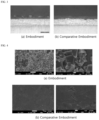
- FIG. 3 shows a 500-magnification microscopic image of a galvanized steel sheet according to embodiments of the present disclosure and comparative embodiments.
- the cross section of the galvanized steel sheet formed product surface-treated with the baking soda solution shown in (a) shows a shape corroded with the same or similar surface roughness while being homogeneous as a whole.
- the phosphate surface-treated galvanized steel sheet formed product shown in (b) shows an inhomogeneous corrosion shape deeply corroded in each part.
- the surface roughness was measured by the KTR Korea Testing & Research Institute KS B ISO 4287 method.
- the surface roughness of the galvanized steel sheet treated with the baking soda solution was average roughness (Ra): 1.55 um, 10-point average roughness (Rz): 11.05 um, whereas the surface roughness of the phosphate-coated galvanized steel sheet was average roughness (Ra): 1.25 um, 10-point average roughness (Rz): 10.36 um. That is, both Ra and Rz of hot-dip galvanized steel sheet surface treated with baking soda solution were higher than Ra and Rz of surface roughness of phosphate-coated galvanized steel sheet.
- FIG. 4 is scanning electron micrographs of Examples and Comparative Examples, and like the result of FIG. 3 , this is clearly demonstrated even at 1,000 magnification or 5,000 magnification.
- the hot-dip galvanized steel sheet formed product subjected to phosphate surface treatment shown in (b) corrosion of the galvanized layer appears unevenly in each part, as observed in the optical micrograph.
- the scanning electron micrograph of the present invention surface-treated with a baking soda solution shown in (a) shows a tendency of surface roughness showing a relatively uniform shape and depth even at 1,000 or 5,000 magnifications.
- the surface roughness is increased due to the interaction of the hot-dip galvanizing surface layer and the baking soda solution in the baking soda solution electrolytic corrosion treatment process, and it has a characteristic of being corroded at a uniform and equal depth. Accordingly, it can be expected that various physical properties such as adhesion and corrosion resistance of the electrodeposition coating resin coating layer formed by the subsequent process are improved.
- Figure 5 is a photograph showing the results of a corrosion resistance test on a hot-dip galvanized steel sheet formed product after the first electrodeposition coating resin coating according to Examples of the present invention and Comparative Examples.
- the corrosion resistance test was performed for 30 minutes under the condition of 25 V DC in 30% saline.
- FIG. 6 is a photograph showing the results of a cross-cut test after the first electrodeposition coating and the second general coating resin coating on galvanized steel sheet formed products according to Examples of the present invention and Comparative Examples.
- the adhesion strength between the hot-dip galvanized steel sheet formed product subjected to electrolytic corrosion with a baking soda solution as in the example of the present invention and the resin coating layer is superior to the adhesive strength of a hot-dip galvanized steel sheet formed product with phosphate surface treatment without electrolytic corrosion and a resin coating layer.
Landscapes
- Chemical & Material Sciences (AREA)
- Chemical Kinetics & Catalysis (AREA)
- Engineering & Computer Science (AREA)
- Materials Engineering (AREA)
- Metallurgy (AREA)
- Organic Chemistry (AREA)
- Electrochemistry (AREA)
- General Chemical & Material Sciences (AREA)
- Mechanical Engineering (AREA)
- Other Surface Treatments For Metallic Materials (AREA)
- Laminated Bodies (AREA)
- Application Of Or Painting With Fluid Materials (AREA)
Applications Claiming Priority (2)
| Application Number | Priority Date | Filing Date | Title |
|---|---|---|---|
| KR20220131777 | 2022-10-13 | ||
| KR1020220144109A KR102490195B1 (ko) | 2022-10-13 | 2022-11-02 | 강판성형제품의 표면처리 방법 및 이를 이용한 강판성형제품 |
Publications (2)
| Publication Number | Publication Date |
|---|---|
| EP4353877A2 true EP4353877A2 (de) | 2024-04-17 |
| EP4353877A3 EP4353877A3 (de) | 2024-11-27 |
Family
ID=88412109
Family Applications (1)
| Application Number | Title | Priority Date | Filing Date |
|---|---|---|---|
| EP23203146.8A Pending EP4353877A3 (de) | 2022-10-13 | 2023-10-12 | Oberflächenbehandlungsverfahren für ein galvanisiertes stahlblechprodukt und damit behandeltes galvanisiertes stahlblechprodukt |
Country Status (1)
| Country | Link |
|---|---|
| EP (1) | EP4353877A3 (de) |
Citations (2)
| Publication number | Priority date | Publication date | Assignee | Title |
|---|---|---|---|---|
| KR20220131777A (ko) | 2021-03-22 | 2022-09-29 | 윤효석 | 낚시대 지지대의 방수 방진용 클램프 레버 장치 |
| KR20220144109A (ko) | 2021-04-19 | 2022-10-26 | 강남제비스코 주식회사 | 고내식성의 드럼용 내면 도료 |
Family Cites Families (2)
| Publication number | Priority date | Publication date | Assignee | Title |
|---|---|---|---|---|
| JP5696447B2 (ja) * | 2010-11-25 | 2015-04-08 | Jfeスチール株式会社 | 表面処理金属材料の製造方法 |
| KR102485014B1 (ko) * | 2020-12-18 | 2023-01-04 | 주식회사 포스코 | 밀착성이 우수한 복합 강판 및 이의 제조방법 |
-
2023
- 2023-10-12 EP EP23203146.8A patent/EP4353877A3/de active Pending
Patent Citations (2)
| Publication number | Priority date | Publication date | Assignee | Title |
|---|---|---|---|---|
| KR20220131777A (ko) | 2021-03-22 | 2022-09-29 | 윤효석 | 낚시대 지지대의 방수 방진용 클램프 레버 장치 |
| KR20220144109A (ko) | 2021-04-19 | 2022-10-26 | 강남제비스코 주식회사 | 고내식성의 드럼용 내면 도료 |
Also Published As
| Publication number | Publication date |
|---|---|
| EP4353877A3 (de) | 2024-11-27 |
Similar Documents
| Publication | Publication Date | Title |
|---|---|---|
| CN108699665B (zh) | 由带铝基涂层的钢板或钢带制造的冲压硬化构件及方法 | |
| JP4799862B2 (ja) | プレス成形性に優れるプレコート金属板及びその製造方法 | |
| CN101558182A (zh) | 热镀Zn-Al系合金钢板及其制造方法 | |
| EP1036862B1 (de) | Zink-Magnesium-elektroplattiertes metallisches Blech und Verfahren zu seiner Herstellung | |
| JP4615807B2 (ja) | 表面処理鋼板の製造方法、表面処理鋼板、および樹脂被覆表面処理鋼板 | |
| SE508196C2 (sv) | Förfarande för att bilda och eftertäta kromateringsskikt på elektrolytiskt utfälld zink | |
| EP4353877A2 (de) | Oberflächenbehandlungsverfahren für ein galvanisiertes stahlblechprodukt und damit behandeltes galvanisiertes stahlblechprodukt | |
| KR100775109B1 (ko) | 내식성이 우수하고 환경 부하가 작은 도장 금속판 | |
| US20090004491A1 (en) | Surface Treated Metal Material | |
| KR102490195B1 (ko) | 강판성형제품의 표면처리 방법 및 이를 이용한 강판성형제품 | |
| US20080028976A1 (en) | Electroplated Coating of Zinc Alloy with Excellent Corrosion Resistance and Plated Metal Material Having Same | |
| JP6052521B2 (ja) | 耐食性金属部材被覆の製造プロセス、及び、耐食性金属部材の製造プロセス | |
| WO2016125911A1 (ja) | Snめっき鋼板及び化成処理鋼板並びにこれらの製造方法 | |
| CN1309726A (zh) | 树脂涂覆的钢板及其制造的胶卷盒卡头和盒体部件 | |
| KR102941518B1 (ko) | 베이킹소다와 붕사를 포함하는 전해액을 이용한 강판성형제품의 표면처리 방법 및 이를 이용한 강판성형제품 | |
| JPS63195296A (ja) | 着色表面処理鋼板の製造方法 | |
| JPS63153295A (ja) | 化成処理性に優れた着色被覆鋼板の製造方法 | |
| JPH0359996B2 (de) | ||
| JPS6160915B2 (de) | ||
| JP6758611B2 (ja) | 高意匠摺動部材 | |
| JP3366321B2 (ja) | 電気亜鉛系めっき鋼板およびその製法 | |
| JP7400766B2 (ja) | 亜鉛系電気めっき鋼板およびその製造方法 | |
| JPH01108396A (ja) | カチオン電着塗装用ガルバニール鋼板の製法 | |
| KR100318546B1 (ko) | 초음파세척을이용한주석도금강판의제조방법 | |
| JPS6350499A (ja) | 着色亜鉛複合メッキ鋼板の製造方法 |
Legal Events
| Date | Code | Title | Description |
|---|---|---|---|
| PUAI | Public reference made under article 153(3) epc to a published international application that has entered the european phase |
Free format text: ORIGINAL CODE: 0009012 |
|
| STAA | Information on the status of an ep patent application or granted ep patent |
Free format text: STATUS: REQUEST FOR EXAMINATION WAS MADE |
|
| 17P | Request for examination filed |
Effective date: 20231012 |
|
| AK | Designated contracting states |
Kind code of ref document: A2 Designated state(s): AL AT BE BG CH CY CZ DE DK EE ES FI FR GB GR HR HU IE IS IT LI LT LU LV MC ME MK MT NL NO PL PT RO RS SE SI SK SM TR |
|
| RIC1 | Information provided on ipc code assigned before grant |
Ipc: B05D 3/00 20060101ALI20240729BHEP Ipc: C25D 13/22 20060101ALI20240729BHEP Ipc: C25D 13/20 20060101ALI20240729BHEP Ipc: C25D 13/04 20060101ALI20240729BHEP Ipc: C25D 9/02 20060101ALI20240729BHEP Ipc: C23C 18/08 20060101ALI20240729BHEP Ipc: C25F 3/06 20060101AFI20240729BHEP |
|
| PUAL | Search report despatched |
Free format text: ORIGINAL CODE: 0009013 |
|
| AK | Designated contracting states |
Kind code of ref document: A3 Designated state(s): AL AT BE BG CH CY CZ DE DK EE ES FI FR GB GR HR HU IE IS IT LI LT LU LV MC ME MK MT NL NO PL PT RO RS SE SI SK SM TR |
|
| RIC1 | Information provided on ipc code assigned before grant |
Ipc: B05D 3/00 20060101ALI20241018BHEP Ipc: C25D 13/22 20060101ALI20241018BHEP Ipc: C25D 13/20 20060101ALI20241018BHEP Ipc: C25D 13/04 20060101ALI20241018BHEP Ipc: C25D 9/02 20060101ALI20241018BHEP Ipc: C23C 18/08 20060101ALI20241018BHEP Ipc: C25F 3/06 20060101AFI20241018BHEP |