EP4351884B1 - Doppelseitige haftunterlage für flexodruckplatten - Google Patents
Doppelseitige haftunterlage für flexodruckplatten Download PDFInfo
- Publication number
- EP4351884B1 EP4351884B1 EP22732618.8A EP22732618A EP4351884B1 EP 4351884 B1 EP4351884 B1 EP 4351884B1 EP 22732618 A EP22732618 A EP 22732618A EP 4351884 B1 EP4351884 B1 EP 4351884B1
- Authority
- EP
- European Patent Office
- Prior art keywords
- underlay
- adhesive
- carrier sheet
- stripe
- release liner
- Prior art date
- Legal status (The legal status is an assumption and is not a legal conclusion. Google has not performed a legal analysis and makes no representation as to the accuracy of the status listed.)
- Active
Links
Images
Classifications
-
- B—PERFORMING OPERATIONS; TRANSPORTING
- B41—PRINTING; LINING MACHINES; TYPEWRITERS; STAMPS
- B41F—PRINTING MACHINES OR PRESSES
- B41F27/00—Devices for attaching printing elements or formes to supports
- B41F27/12—Devices for attaching printing elements or formes to supports for attaching flexible printing formes
- B41F27/1262—Devices for attaching printing elements or formes to supports for attaching flexible printing formes without tensioning means
- B41F27/1275—Devices for attaching printing elements or formes to supports for attaching flexible printing formes without tensioning means by means of adhesives, staples
-
- B—PERFORMING OPERATIONS; TRANSPORTING
- B41—PRINTING; LINING MACHINES; TYPEWRITERS; STAMPS
- B41C—PROCESSES FOR THE MANUFACTURE OR REPRODUCTION OF PRINTING SURFACES
- B41C1/00—Forme preparation
- B41C1/18—Curved printing formes or printing cylinders
-
- B—PERFORMING OPERATIONS; TRANSPORTING
- B41—PRINTING; LINING MACHINES; TYPEWRITERS; STAMPS
- B41F—PRINTING MACHINES OR PRESSES
- B41F27/00—Devices for attaching printing elements or formes to supports
- B41F27/14—Devices for attaching printing elements or formes to supports for attaching printing formes to intermediate supports, e.g. adapter members
-
- B—PERFORMING OPERATIONS; TRANSPORTING
- B41—PRINTING; LINING MACHINES; TYPEWRITERS; STAMPS
- B41F—PRINTING MACHINES OR PRESSES
- B41F30/00—Devices for attaching coverings or make-ready devices; Guiding devices for coverings
- B41F30/04—Devices for attaching coverings or make-ready devices; Guiding devices for coverings attaching to transfer cylinders
-
- B—PERFORMING OPERATIONS; TRANSPORTING
- B41—PRINTING; LINING MACHINES; TYPEWRITERS; STAMPS
- B41N—PRINTING PLATES OR FOILS; MATERIALS FOR SURFACES USED IN PRINTING MACHINES FOR PRINTING, INKING, DAMPING, OR THE LIKE; PREPARING SUCH SURFACES FOR USE AND CONSERVING THEM
- B41N1/00—Printing plates or foils; Materials therefor
- B41N1/16—Curved printing plates, especially cylinders
-
- B—PERFORMING OPERATIONS; TRANSPORTING
- B41—PRINTING; LINING MACHINES; TYPEWRITERS; STAMPS
- B41N—PRINTING PLATES OR FOILS; MATERIALS FOR SURFACES USED IN PRINTING MACHINES FOR PRINTING, INKING, DAMPING, OR THE LIKE; PREPARING SUCH SURFACES FOR USE AND CONSERVING THEM
- B41N6/00—Mounting boards; Sleeves Make-ready devices, e.g. underlays, overlays; Attaching by chemical means, e.g. vulcanising
-
- C—CHEMISTRY; METALLURGY
- C09—DYES; PAINTS; POLISHES; NATURAL RESINS; ADHESIVES; COMPOSITIONS NOT OTHERWISE PROVIDED FOR; APPLICATIONS OF MATERIALS NOT OTHERWISE PROVIDED FOR
- C09J—ADHESIVES; NON-MECHANICAL ASPECTS OF ADHESIVE PROCESSES IN GENERAL; ADHESIVE PROCESSES NOT PROVIDED FOR ELSEWHERE; USE OF MATERIALS AS ADHESIVES
- C09J7/00—Adhesives in the form of films or foils
- C09J7/20—Adhesives in the form of films or foils characterised by their carriers
- C09J7/22—Plastics; Metallised plastics
- C09J7/25—Plastics; Metallised plastics based on macromolecular compounds obtained otherwise than by reactions involving only carbon-to-carbon unsaturated bonds
- C09J7/255—Polyesters
-
- C—CHEMISTRY; METALLURGY
- C09—DYES; PAINTS; POLISHES; NATURAL RESINS; ADHESIVES; COMPOSITIONS NOT OTHERWISE PROVIDED FOR; APPLICATIONS OF MATERIALS NOT OTHERWISE PROVIDED FOR
- C09J—ADHESIVES; NON-MECHANICAL ASPECTS OF ADHESIVE PROCESSES IN GENERAL; ADHESIVE PROCESSES NOT PROVIDED FOR ELSEWHERE; USE OF MATERIALS AS ADHESIVES
- C09J7/00—Adhesives in the form of films or foils
- C09J7/30—Adhesives in the form of films or foils characterised by the adhesive composition
- C09J7/38—Pressure-sensitive adhesives [PSA]
- C09J7/381—Pressure-sensitive adhesives [PSA] based on macromolecular compounds obtained by reactions involving only carbon-to-carbon unsaturated bonds
- C09J7/385—Acrylic polymers
-
- B—PERFORMING OPERATIONS; TRANSPORTING
- B41—PRINTING; LINING MACHINES; TYPEWRITERS; STAMPS
- B41N—PRINTING PLATES OR FOILS; MATERIALS FOR SURFACES USED IN PRINTING MACHINES FOR PRINTING, INKING, DAMPING, OR THE LIKE; PREPARING SUCH SURFACES FOR USE AND CONSERVING THEM
- B41N6/00—Mounting boards; Sleeves Make-ready devices, e.g. underlays, overlays; Attaching by chemical means, e.g. vulcanising
- B41N6/02—Chemical means for fastening printing formes on mounting boards
-
- C—CHEMISTRY; METALLURGY
- C09—DYES; PAINTS; POLISHES; NATURAL RESINS; ADHESIVES; COMPOSITIONS NOT OTHERWISE PROVIDED FOR; APPLICATIONS OF MATERIALS NOT OTHERWISE PROVIDED FOR
- C09J—ADHESIVES; NON-MECHANICAL ASPECTS OF ADHESIVE PROCESSES IN GENERAL; ADHESIVE PROCESSES NOT PROVIDED FOR ELSEWHERE; USE OF MATERIALS AS ADHESIVES
- C09J2203/00—Applications of adhesives in processes or use of adhesives in the form of films or foils
- C09J2203/366—Applications of adhesives in processes or use of adhesives in the form of films or foils for mounting tapes
-
- C—CHEMISTRY; METALLURGY
- C09—DYES; PAINTS; POLISHES; NATURAL RESINS; ADHESIVES; COMPOSITIONS NOT OTHERWISE PROVIDED FOR; APPLICATIONS OF MATERIALS NOT OTHERWISE PROVIDED FOR
- C09J—ADHESIVES; NON-MECHANICAL ASPECTS OF ADHESIVE PROCESSES IN GENERAL; ADHESIVE PROCESSES NOT PROVIDED FOR ELSEWHERE; USE OF MATERIALS AS ADHESIVES
- C09J2301/00—Additional features of adhesives in the form of films or foils
- C09J2301/10—Additional features of adhesives in the form of films or foils characterized by the structural features of the adhesive tape or sheet
- C09J2301/12—Additional features of adhesives in the form of films or foils characterized by the structural features of the adhesive tape or sheet by the arrangement of layers
- C09J2301/124—Additional features of adhesives in the form of films or foils characterized by the structural features of the adhesive tape or sheet by the arrangement of layers the adhesive layer being present on both sides of the carrier, e.g. double-sided adhesive tape
-
- C—CHEMISTRY; METALLURGY
- C09—DYES; PAINTS; POLISHES; NATURAL RESINS; ADHESIVES; COMPOSITIONS NOT OTHERWISE PROVIDED FOR; APPLICATIONS OF MATERIALS NOT OTHERWISE PROVIDED FOR
- C09J—ADHESIVES; NON-MECHANICAL ASPECTS OF ADHESIVE PROCESSES IN GENERAL; ADHESIVE PROCESSES NOT PROVIDED FOR ELSEWHERE; USE OF MATERIALS AS ADHESIVES
- C09J2301/00—Additional features of adhesives in the form of films or foils
- C09J2301/20—Additional features of adhesives in the form of films or foils characterized by the structural features of the adhesive itself
- C09J2301/204—Additional features of adhesives in the form of films or foils characterized by the structural features of the adhesive itself the adhesive coating being discontinuous
Definitions
- the present invention relates to the general field of printing plate manufacture and more specifically to double-sided adhesive underlays used in the manufacture and mounting of flexographic printing plates.
- the process of manufacturing flexographic printing plates involves providing a layer of a particular photopolymer resin on a polyester base film or backing.
- the photopolymer resin can either be provided as a liquid photopolymer or a solid photopolymer.
- the photopolymer In the case of liquid photopolymer flexographic printing plates the photopolymer is poured onto a base film before the imaging process and remains liquid until it is subjected to an ultraviolet (UV) light source. In contrast, when solid photopolymers are used, the solid photopolymer is provided already backed by a base film.
- UV ultraviolet
- the liquid or solid photopolymer is covered with a negative image template before exposing the photopolymer to an ultraviolet (UV) light source.
- UV ultraviolet
- the nature of the photopolymer resin is such that those areas that are not covered by the negative template are cured and as a result harden, whereas the protected areas remain soft.
- the next stage of the process is to remove the excess, non-hardened photopolymer resin and clean up the printing plate. This is initially done by the use of scrapers to manually remove the excess photopolymer. Following the manual treatment the plate is subjecting to a machine wash, which removes the remainder of the excess photopolymer.
- the carrier may take the form of a drum-like structure, a cylindrical sleeve, or a continuous belt for example.
- One common approach to mounting the flexographic printing plate to its carrier is to use double-sided adhesive sticky tape.
- a skilled printing technician would firstly apply a double-sided adhesive sticky tape to the polyester base film than forms the back of the finished printing plate. Once the adhesive sticky tape has been suitably applied to the flexographic printing plate it can be mounted to the printing press carrier.
- the plate mounting procedure can be difficult and time consuming due to the tendency for air bubbles to get trapped between the adhesive sticky tape and surface to which it adheres (i.e. the plate or carrier).
- the presence of trapped air bubbles is extremely undesirable due to the levels of accuracy required to obtain efficient printing results.
- US 2017/260425 A1 describes pressure-sensitive adhesive sheets that can be used as fixing sheets for printing plates of flexographic printing.
- the sheets are provided with a coating layer embedded in the pressure-sensitive adhesive that provides air channels that allow the escape of air trapped when the sheet is applied to a surface.
- the base film upon which a layer of liquid photopolymer is cured, is provided with an adhesive stipe-coating on its rear face that comprises adhesive stripes spaced apart by 3mm wide gaps where no adhesive was present.
- these gaps act as air channels that facilitate the ejection of air from between the flexographic printing plate when it is mounted on a print press carrier.
- the adhesive base film provides a number of advantages over double-sided adhesive sticky tape, the main one being the elimination of trapped air, the fact that the base film actually forms an integral part of the flexographic printing plate means that a printing technician has much greater control over the level of adhesion between the plate and the carrier when using adhesive tape rather than the base film.
- solid photopolymer has become more common in recent times because solid photopolymer is better suited to replicating the high definition images that can be achieved by modern computer controlled laser imaging technologies, such as CDI.
- WO 2018/116845 A1 and US 2009/199952 A1 relate to adhesive tapes with air release channels that as suitable for adhering flexographic printing plates to print cylinders once they have been manufactured.
- the present invention provides a double-sided adhesive flexographic printing plate underlay in accordance with claim 1.
- the present invention provides a double-sided adhesive flexographic printing plate underlay for use in the manufacture and mounting of flexographic printing plates, said underlay comprising: a glass clear polyethylene terephthalate (PET) carrier sheet coated on a front side and a back side thereof with a transparent solvent acrylic adhesive, wherein the adhesive is stripe-coated such that each adhesive stripe is separated from its neighbours by a 0.9-1.1mm gap of non-coated sheet; and a glass clear polyethylene terephthalate (PET) release liner adhered to the front side of the carrier sheet by way of the solvent acrylic adhesive stripe-coating, said release liner being siliconized on both sides thereof.
- PET polyethylene terephthalate
- the combination of the transparent solvent acrylic adhesive and the glass clear PET carrier sheet and release liner renders the underlay of the present invention transparent to UV light.
- the underlay will not only retain its structure but it will also remain adhered to the back of the solid photopolymer plate despite the harsh solvent-based washout procedures employed in the manufacture of flexographic printing plates from solid photopolymers.
- the underlay of the present invention can be applied to the back of the base film of a solid photopolymer plate before it is passed through the image setting process, and at very least before it is subjected to the cleaning stage.
- the inventor has discovered that applying the double-sided adhesive underlay to a solid photopolymer plate before an image relief is revealed provides a noticeable reduction in image distortion (i.e. 'dispro'). This was found to be due to the fact that when a double-sided adhesive tape is applied to a flexographic printing plate after the image relief has been revealed the plate offers variable resistance to the tape as is being applied depending on the thickness of the photopolymer at that point on the plate.
- the double-sided adhesive flexographic printing plate underlay of the present invention combats the issue of air becoming trapped between the flexographic printing plate and the print press carrier.
- each adhesive stripe may be between 2.5 and 3.5mm wide.
- the adhesive coating on both the front side and the back side of the carrier sheet may have a coat weight of 65-70g/m 2 .
- the adhesive coat weight on both sides of the carrier sheet will be the same, however it is envisaged that in some embodiments the adhesive coat weight on the front side of the carrier sheet may be higher than that of the adhesive coating on the back side of the carrier sheet.
- the inter-stripe gaps on the front side of the carrier sheet may be offset from the inter-stripe gaps on the back side of the carrier sheet. It has been found that by arranging the adhesive stripe coating in this way it is possible to achieve an underlay with a smoother profile, which helps minimise the impact of the adhesive underlay on the image printed by the mounted flexographic printing plate in use.
- the carrier sheet employed in the underlay of the present invention is between 0.036 and 0.250mm thick and preferably the carrier sheet is 0.125mm thick.
- the release liner employed in the underlay of the present invention is between 0.020 and 0.070mm thick and preferably the release liner is 0.036mm thick.
- the underlay may be stored in a rolled up form. It is considered particularly convenient to store the underlay as a roll. This is made possible by the fact that both sides of the PET release liner are siliconized to ensure that the adhesive stripes are less attracted to the PET release liner than they are to the PET carrier sheet.
- the level of siliconization applied to a first side of the release liner is different to the level of siliconization applied to a second side of the release liner, such that when the underlay is either rolled or unrolled the release liner adheres more strongly to the adhesive stripe-coating on the front side of the carrier sheet than it does to the adhesive stripe-coating on the back side of the carrier sheet.
- providing different adhesive coat weights on the front and back sides of the carrier can further help to differentiate the extent to which the release liner adheres to the opposite sides of the carrier sheet.
- the present invention also provides a flexographic printing plate with the double-sided adhesive underlay of the present invention applied to a rear face thereof.
- the present invention also provides a method of producing and mounting a flexographic printing plate comprising the steps of: a) applying a double-sided adhesive underlay according to the present invention to the base film of a pre-cleaned solid photopolymer flexographic plate; b) employing a UV developing bed and a suitable image template to selectively cure and harden regions of the solid photopolymer on the flexographic plate; c) cleaning the cured flexographic plate, which comprises the selectively cured solid polymer and the underlay, to remove the uncured solid photopolymer using a suitable solvent; d) subjecting the cleaned flexographic printing plate to at least one further finishing process; e) removing the release liner from the underlay and mounting the finished flexographic plate onto a printing press carrier.
- the underlay By applying the underlay to the solid photopolymer flexographic plate before it has been cleaned used using solvent to remove excess solid photopolymer it is possible to achieve a much better application of the underlay. As noted above, ensuring a consistent application of the underlay helps to reduce the occurrence of image distortion in multi-coloured print images.
- the double-sided adhesive underlay may be applied to the solid photopolymer flexographic plate prior to the curing stage.
- the double-sided adhesive underlay may be applied to the solid photopolymer flexographic plate after the curing stage but prior to the cleaning stage.
- the printing face of the flexographic printing plate will be uniformly level and, as such, will provide uniform resistance when the underlay is applied to the back of the plate.
- the underlay of the present invention can either be provided as a single piece that has the same area as the flexographic printing plate to which it is applied or alternatively it can be provided in a slimmer tape configuration that is applied to the flexographic plate as a plurality of strips.
- suitable further finishing processes include a further UV exposure and a drying stage.
- double-sided adhesive flexographic printing plate underlay of the present invention is considered particularly suitable for use in the mounting of solid photopolymer type flexographic printing plates, it is envisioned that the underlay could also be employed to mount liquid photopolymer type flexographic printing plates.
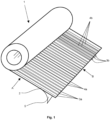
- the underlay 1 could also be provided in a thinner tape configuration, similar to the traditional double-sided adhesive tapes currently used to mount print plates, providing the underlay in a wider roll is considered advantageous because the adhesive can be applied to the base film of the flexographic printing plate in a single application.
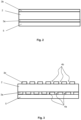
- the double-sided adhesive flexographic printing plate underlay 1 comprises a glass clear polyethylene terephthalate (PET) carrier sheet 2.
- PET polyethylene terephthalate
- glass clear PET was found to be the superior choice for the underlay of the present invention for reasons that are explained below.
- the PET carrier sheet 2 has a thickness of between 36-250 ⁇ m, with 125 ⁇ m being considered most preferable thickness. This thickness is considered most appropriate because it strikes the best balance between providing sufficient structural strength to the carrier sheet 2 and minimising the interference caused by the carrier sheet to the UV light that is used to cure the photopolymer.
- PET was found to be optimal when compared to other polymer materials typically used in existing adhesive tapes, such as polypropylene, because it is more resilient to the higher drying temperatures (typically over 60°C) used in the post-washout drying stage of solid photopolymer flexographic printing plate manufacture.
- PVC carrier sheets were found to be unsuitable because they tended to degrade when subjected the harsh solvents used in the solid photopolymer washout stage.
- the PET carrier sheet 2 is provided with an adhesive stripe-coating on both of its sides.
- the back side of the carrier sheet 2 is provided with a plurality of stripes of solvent acrylic adhesive 3a.
- a parallel interposing region of non-coated carrier sheet hereinafter referred to as a gap or air channel 4a.
- the gap between adjacent adhesive stripes 3a is between 0.9 and 1.1mm wide and most preferably is 1mm wide. This width was found to be optimum because it minimised the ingress of solvent during the washout stage whilst at the same time still providing sufficient capacity for trapped air to escape.
- each adhesive stripe coated onto the back side of the carrier sheet is between 2.5 and 3.5mm, with 3mm representing the optimum stripe width.
- the front side of the carrier sheet 2 is also provided with a plurality of stripes of solvent acrylic adhesive 3b.
- the adhesive stripes 3b are arranged with an adhesive free region or gap 4b interposed between the adhesive stripes 3b.
- the dimensions of the adhesive stripes 3b and the air gaps 4b present on the front side of the carrier sheet 2 are preferably the same as the dimensions of the adhesive stripes 3a and the air gaps 4a present on the back side of the carrier sheet 2.
- Figure 1 only shows a selected portion of the adhesive stripe coating pattern 3b, 4b for the front of the carrier sheet 2.
- the adhesive stripe coating pattern 3b, 4b covers the whole of the front side of the carrier sheet 2 in the same way that the adhesive stripe coating pattern 3a, 4a on the back side of the carrier sheet does.
- the adhesive stripe coating pattern 3a, 4a provided on the back side of the carrier sheet 2 is offset from the adhesive stripe coating pattern 3b, 4b provided on the front side of the carrier sheet 2, such that there is absolutely no overlap between the gaps 4a, 4b.
- This offset arrangement is considered beneficial because it avoids the creation of potentially weaker, more flexible regions on the underlay 1 that could result in the flexographic printing plate being unevenly supported when it is mounted on a printing press carrier, which in turn could cause distortion of the final print image (i.e. 'dispro').
- the adhesive selected to coat the PET carrier sheet 2 is an solvent acrylic adhesive because it was found that water based adhesives were unable to survive being subjected to the cleaning solvent during the washout stage of the flexographic printing plate manufacture.
- solvent acrylic adhesives that are transparent to UV light are considered suitable for the underlay of the present invention, because it is considered crucial that none of the components of the underlay (i.e. carrier sheet, release liner or adhesive coating) interfere with the transmission of UV light to the photopolymer during the image setting stage of the plate manufacture process.
- a release liner 5 is provided.
- said liner is also made from a glass clear PET.
- the release liner 5 does not need to carry the adhesive coating 3a, 3b it does not necessarily need to be as thick as the PET carrier sheet 2.
- the release liner is preferably between 20 and 70 ⁇ m thick. A thickness in the region of 36 ⁇ m is most preferable because this is thick enough to allow the release liner to be removed by hand whilst not so thick as to unnecessarily increase the overall thickness of the underlay and, in so doing, negatively impact on the levels of UV light passing through the underlay to the photopolymer during the curing process.
- the liner sheet is formed from a siliconized glass clear PET.
- the two sides of the liner sheet are provide with different levels of siliconization so as to ensure that one side of the liner sheet (i.e. that facing the front side coating 3a) adheres more strongly to the adhesive of the underlay.
- This differential between the stickability of the release liner's two sides ensures that when the underlay is stored as a roll the release liner is retained in position covering the front adhesive coating 3b and is not peeled away by the back adhesive coating 3a. This enables the underlay to protect the adhesive coating until it is time to mount the finished flexographic printing plate on the printing press carrier.
- the preferential peeling effect of the release liner could be facilitated or enhanced by adopting slightly different adhesive coat weights on the front and back sides of the carrier sheet.
- the underlay of the present invention is more resilient to the harsh solvent treatments used in the solid photopolymer washout stage, it can be applied earlier on in the plate manufacture process, that is, before the image has even been transferred onto the solid photopolymer.
- the components of the underlay are transparent to ultra violet light, applying it to the back of flexographic printing plate prior to the UV curing stage does not necessitate any changes to the existing image curing processes used in flexographic printing plate manufacture.
- the application of the underlay at the pre-curing stage also addresses the real problem of image distortion experienced in many high definition multi-colour image print runs.
Landscapes
- Chemical & Material Sciences (AREA)
- Chemical Kinetics & Catalysis (AREA)
- Engineering & Computer Science (AREA)
- Organic Chemistry (AREA)
- Mechanical Engineering (AREA)
- Manufacturing & Machinery (AREA)
- General Chemical & Material Sciences (AREA)
- Photosensitive Polymer And Photoresist Processing (AREA)
- Printing Plates And Materials Therefor (AREA)
- Manufacture Or Reproduction Of Printing Formes (AREA)
Claims (15)
- Doppelseitige Flexodruckplatten-Haftunterlage (1) zur Verwendung bei der Herstellung und Montage von Flexodruckplatten, wobei die Unterlage umfasst:eine glasklare Polyethylenterephthalat(PET)-Trägerfolie (2), die zwischen 0,036 und 0,250 mm dick und für UV-Strahlung transparent ist, wobei die Folie auf einer Vorderseite und einer Rückseite davon mit einem Solvent-Acrylhaftmittel beschichtet ist, das für UV-Strahlung transparent ist, wobei das Haftmittel streifenbeschichtet ist, so dass jeder Haftstreifen (3a, 3b) durch einen 0,9-1,1 mm großen Spalt (4a, 4b) aus nicht-beschichteter Folie von seinen Nachbarn getrennt ist; undeinen glasklaren Polyethylenterephthalat(PET)-Release-Liner (5), der zwischen 0,020 und 0,070 mm dick und für UV-Strahlung transparent ist, wobei der Release-Liner an der Vorderseite der Trägerfolie mittels der Solvent-Acrylhaftmittel-Streifenbeschichtung haftet, wobei der Release-Liner auf beiden Seiten davon silikonisiert ist.
- Unterlage (1) nach Anspruch 1, wobei jeder Haftstreifen (3a, 3b) zwischen 2,5 und 3,5 mm breit ist.
- Unterlage (1) nach Anspruch 1 oder 2, wobei die Haftbeschichtung auf der Vorderseite und der Rückseite der Trägerfolie (2) ein Beschichtungsgewicht von 65-70 g/m2 aufweist.
- Unterlage (1) nach Anspruch 1, 2 oder 3, wobei die Streifenzwischenlücken (4b) auf der Vorderseite der Trägerfolie (2) von den Streifenzwischenlücken (4a) auf der Rückseite der Trägerfolie (2) versetzt sind.
- Unterlage (1) nach Anspruch 4, wobei es keine Überlappung zwischen den Streifenzwischenlücken (4b) auf der Vorderseite der Trägerfolie (2) und den Streifenzwischenlücken (4a) auf der Rückseite der Trägerfolie (2) gibt.
- Unterlage (1) nach einem der vorhergehenden Ansprüche, wobei die Trägerfolie (2) 0,125 mm dick ist.
- Unterlage (1) nach einem der vorhergehenden Ansprüche, wobei der Release-Liner (5) 0,036 mm dick ist.
- Unterlage (1) nach einem der vorhergehenden Ansprüche, wobei die Unterlage in aufgerollter Form gelagert wird.
- Unterlage (1) nach Anspruch 8, wobei der auf einer ersten Seite des Release-Liners (5) aufgebrachte Silikonisierungsgrad sich von dem auf einer zweiten Seite des Release-Liners aufgebrachten Silikonisierungsgrad unterscheidet, so dass, wenn die Unterlage entweder aufgerollt oder abgerollt ist, der Release-Liner stärker an der Haftstreifenbeschichtung auf der Vorderseite der Trägerfolie (2) haftet als an der Haftstreifenbeschichtung auf der Rückseite der Trägerfolie.
- Flexodruckplatte mit einer Unterlage nach einem der vorhergehenden Ansprüche, die an einer hinteren Fläche davon haftet.
- Verfahren zur Herstellung und Montage einer Flexodruckplatte, umfassend:a) Aufbringen einer doppelseitigen Haftunterlage (1) nach einem der Ansprüche 1 bis 9 auf der Basisfolie einer vorvulkanisierten festen Photopolymer-Flexoplatte;b) Verwenden eines UV-Entwicklungsbetts und einer geeigneten Bildvorlage, um Bereiche des festen Photopolymers auf der Flexoplatte selektiv zu vulkanisieren und zu härten;c) Reinigen der vulkanisierten Flexodruckplatte, die das selektiv vulkanisierte feste Polymer und die Unterlage umfasst, um das unvulkanisierte feste Photopolymer unter Verwendung eines geeigneten Solvents zu entfernen;d) Aussetzen der gereinigten Flexodruckplatte an mindestens einen weiteren Finishing-Vorgang;e) Entfernen des Release-Liners von der Unterlage (1) und Montieren der fertigen Flexodruckplatte auf einen Druckerpressenträger.
- Verfahren nach Anspruch 11, wobei die doppelseitige Haftunterlage (1) vor der Vulkanisierungsphase auf der festen Photopolymer-Flexoplatte aufgebracht wird.
- Verfahren nach Anspruch 11, wobei die doppelseitige Haftunterlage (1) auf der festen Photopolymer-Flexoplatte nach der Vulkanisierungsphase, aber vor der Reinigungsphase aufgebracht wird.
- Verfahren nach einem der Ansprüche 11-13, wobei die Unterlage (1) als ein einzelnes Stück über die gesamte Flexoplatte vorgesehen ist.
- Verfahren nach einem der Ansprüche 11-13, wobei die Unterlage (1) als eine Vielzahl von auf der Flexoplatte aufgebrachten Stücken vorgesehen ist.
Applications Claiming Priority (2)
| Application Number | Priority Date | Filing Date | Title |
|---|---|---|---|
| GB2108174.0A GB2601579B8 (en) | 2021-06-08 | 2021-06-08 | A double-sided adhesive flexographic printing plate underlay |
| PCT/GB2022/051433 WO2022258964A1 (en) | 2021-06-08 | 2022-06-08 | A double-sided adhesive flexographic printing plate underlay |
Publications (3)
| Publication Number | Publication Date |
|---|---|
| EP4351884A1 EP4351884A1 (de) | 2024-04-17 |
| EP4351884C0 EP4351884C0 (de) | 2025-05-28 |
| EP4351884B1 true EP4351884B1 (de) | 2025-05-28 |
Family
ID=76838827
Family Applications (1)
| Application Number | Title | Priority Date | Filing Date |
|---|---|---|---|
| EP22732618.8A Active EP4351884B1 (de) | 2021-06-08 | 2022-06-08 | Doppelseitige haftunterlage für flexodruckplatten |
Country Status (4)
| Country | Link |
|---|---|
| US (1) | US20240286425A1 (de) |
| EP (1) | EP4351884B1 (de) |
| GB (1) | GB2601579B8 (de) |
| WO (1) | WO2022258964A1 (de) |
Family Cites Families (14)
| Publication number | Priority date | Publication date | Assignee | Title |
|---|---|---|---|---|
| JPH04331152A (ja) * | 1991-05-01 | 1992-11-19 | Nitto Denko Corp | 印刷版の固定方法及びその固定シート |
| JPH05271630A (ja) * | 1992-03-30 | 1993-10-19 | Sekisui Chem Co Ltd | 両面粘着テープ及びそれを用いたフレキソ版の固定方法 |
| US5476712A (en) * | 1994-05-31 | 1995-12-19 | Avery Dennison Corporation | Flexographic plate mounting tape |
| WO1997043129A1 (fr) * | 1996-05-14 | 1997-11-20 | Mitsubishi Paper Mills Limited | Procede et dispositif servant a coller une plaque machine et un support |
| IT1313147B1 (it) * | 1999-08-04 | 2002-06-17 | Irplastnastri Ind Nastri Adesi | Fasce adesive in film plastico con applicazione di adesivo a settoritrasversali |
| JP4521750B2 (ja) * | 2003-03-05 | 2010-08-11 | 日本発條株式会社 | フレキソ印刷版固定用シート |
| ITMI20040041A1 (it) * | 2004-01-15 | 2004-04-15 | Printgraph Waterless S P A | Sottorivestimento autolivellante per macchine da stampa |
| GB2412335B8 (en) * | 2004-03-25 | 2023-10-11 | Proshim Supplies Uk Ltd | An improved base film for use in the production and mounting of flexographic printing plates |
| JP4640669B2 (ja) * | 2004-06-11 | 2011-03-02 | 日本発條株式会社 | フレキソ印刷用クッション材 |
| FR2876110B1 (fr) * | 2004-10-05 | 2008-10-24 | Scapa France | Ruban transparent pour plaques photopolymeres |
| GB2432338A (en) * | 2005-11-21 | 2007-05-23 | 3M Innovative Properties Co | Personalised adhesive memoboard |
| JP4875475B2 (ja) * | 2006-11-30 | 2012-02-15 | 株式会社コムラテック | 樹脂凸版 |
| JP6679239B2 (ja) * | 2014-11-28 | 2020-04-15 | 日東電工株式会社 | 粘着シート |
| CN113980612A (zh) * | 2016-12-20 | 2022-01-28 | Dic株式会社 | 粘合带及其制造方法 |
-
2021
- 2021-06-08 GB GB2108174.0A patent/GB2601579B8/en active Active
-
2022
- 2022-06-08 EP EP22732618.8A patent/EP4351884B1/de active Active
- 2022-06-08 WO PCT/GB2022/051433 patent/WO2022258964A1/en not_active Ceased
- 2022-06-08 US US18/568,263 patent/US20240286425A1/en active Pending
Also Published As
| Publication number | Publication date |
|---|---|
| WO2022258964A1 (en) | 2022-12-15 |
| GB2601579B (en) | 2023-08-23 |
| EP4351884C0 (de) | 2025-05-28 |
| GB2601579A (en) | 2022-06-08 |
| GB2601579B8 (en) | 2023-10-11 |
| US20240286425A1 (en) | 2024-08-29 |
| GB2601579A8 (en) | 2023-10-11 |
| EP4351884A1 (de) | 2024-04-17 |
| GB202108174D0 (en) | 2021-07-21 |
Similar Documents
| Publication | Publication Date | Title |
|---|---|---|
| US9023591B2 (en) | Inkjet printable flexography substrate and method of using | |
| JP5187671B2 (ja) | 凹版印刷による微細パターンの印刷方法及び微細パターンの印刷装置 | |
| SE535467C2 (sv) | Förfarande för tryckning av produktkännetecken på ett substratark | |
| JP2002293049A (ja) | 薄膜形成用樹脂凸版 | |
| US20180004081A1 (en) | Printable Laminates for Flexo Plates, Methods of Making, and Methods of Using | |
| US20230147373A1 (en) | Image transfer sheet, manufacturing method for image transfer sheet, and image transfer method | |
| JPS63202752A (ja) | 印刷シリンダー乃至円筒状印刷スリーブを感光性の連続する記録層で被覆する方法 | |
| EP4351884B1 (de) | Doppelseitige haftunterlage für flexodruckplatten | |
| JP5225237B2 (ja) | 樹脂凸版印刷版およびその製造方法 | |
| JP7203489B2 (ja) | 印刷方法、及びスクリーン印刷版の製造方法 | |
| US20130251920A1 (en) | Inkjet-printable flexography substrate, method of making, and method of using | |
| US20030036004A1 (en) | Transfer sheet for transferring protective layer for photographic emulsion face and photomask with protective layer | |
| EP1955111B1 (de) | Fotopolymer-druckform mit reduzierter verarbeitungszeit | |
| JPH1052981A (ja) | 転写面およびその製造方法 | |
| JP4229414B2 (ja) | 塗布膜形成方法 | |
| JP2010532726A (ja) | 非接着性プラスチックシートを有する活版印刷ローラのコーティング(背面が金属の印刷用ブランケット(metal−backprintingblanket))を設けるための方法、及びそれによって得られた背面が金属の印刷用ブランケット | |
| DE2906902A1 (de) | Tiefdruckklischee | |
| EP2848998A1 (de) | Bedruckbare Laminate für Flexoplatten, Herstellungsverfahren, und Verwendungsverfahren | |
| JPH07314875A (ja) | 印刷物製造方法及びその装置 | |
| JP2005125664A (ja) | 印刷用ブランケット | |
| GB2412335A (en) | Base film for use in the manufacture and mounting of base plates | |
| JP2949338B2 (ja) | 光沢表面を具備するラベルの製造方法 | |
| JP4419477B2 (ja) | 印刷パターンの転写方法と液晶ディスプレイ用カラーフィルタの製造方法及び製造装置 | |
| KR101202509B1 (ko) | 파편(scrap)발생방지 전사시트 | |
| RU2638501C2 (ru) | Печатная система и печатный комплект для прикрепления к флексографическому печатному цилиндру |
Legal Events
| Date | Code | Title | Description |
|---|---|---|---|
| STAA | Information on the status of an ep patent application or granted ep patent |
Free format text: STATUS: UNKNOWN |
|
| STAA | Information on the status of an ep patent application or granted ep patent |
Free format text: STATUS: THE INTERNATIONAL PUBLICATION HAS BEEN MADE |
|
| PUAI | Public reference made under article 153(3) epc to a published international application that has entered the european phase |
Free format text: ORIGINAL CODE: 0009012 |
|
| STAA | Information on the status of an ep patent application or granted ep patent |
Free format text: STATUS: REQUEST FOR EXAMINATION WAS MADE |
|
| 17P | Request for examination filed |
Effective date: 20231211 |
|
| AK | Designated contracting states |
Kind code of ref document: A1 Designated state(s): AL AT BE BG CH CY CZ DE DK EE ES FI FR GB GR HR HU IE IS IT LI LT LU LV MC MK MT NL NO PL PT RO RS SE SI SK SM TR |
|
| DAV | Request for validation of the european patent (deleted) | ||
| DAX | Request for extension of the european patent (deleted) | ||
| GRAP | Despatch of communication of intention to grant a patent |
Free format text: ORIGINAL CODE: EPIDOSNIGR1 |
|
| STAA | Information on the status of an ep patent application or granted ep patent |
Free format text: STATUS: GRANT OF PATENT IS INTENDED |
|
| INTG | Intention to grant announced |
Effective date: 20250320 |
|
| GRAS | Grant fee paid |
Free format text: ORIGINAL CODE: EPIDOSNIGR3 |
|
| GRAA | (expected) grant |
Free format text: ORIGINAL CODE: 0009210 |
|
| STAA | Information on the status of an ep patent application or granted ep patent |
Free format text: STATUS: THE PATENT HAS BEEN GRANTED |
|
| AK | Designated contracting states |
Kind code of ref document: B1 Designated state(s): AL AT BE BG CH CY CZ DE DK EE ES FI FR GB GR HR HU IE IS IT LI LT LU LV MC MK MT NL NO PL PT RO RS SE SI SK SM TR |
|
| REG | Reference to a national code |
Ref country code: GB Ref legal event code: FG4D |
|
| REG | Reference to a national code |
Ref country code: CH Ref legal event code: EP |
|
| RBV | Designated contracting states (corrected) |
Designated state(s): AL AT BE BG CH CY CZ DE DK EE ES FI FR GR HR HU IE IS IT LI LT LU LV MC MK MT NL NO PL PT RO RS SE SI SK SM TR |
|
| REG | Reference to a national code |
Ref country code: IE Ref legal event code: FG4D Ref country code: DE Ref legal event code: R096 Ref document number: 602022015234 Country of ref document: DE |
|
| U01 | Request for unitary effect filed |
Effective date: 20250604 |
|
| U07 | Unitary effect registered |
Designated state(s): AT BE BG DE DK EE FI FR IT LT LU LV MT NL PT RO SE SI Effective date: 20250612 |
|
| PGFP | Annual fee paid to national office [announced via postgrant information from national office to epo] |
Ref country code: AT Payment date: 20250721 Year of fee payment: 4 |
|
| U20 | Renewal fee for the european patent with unitary effect paid |
Year of fee payment: 4 Effective date: 20250814 |
|
| PG25 | Lapsed in a contracting state [announced via postgrant information from national office to epo] |
Ref country code: ES Free format text: LAPSE BECAUSE OF FAILURE TO SUBMIT A TRANSLATION OF THE DESCRIPTION OR TO PAY THE FEE WITHIN THE PRESCRIBED TIME-LIMIT Effective date: 20250528 |
|
| PG25 | Lapsed in a contracting state [announced via postgrant information from national office to epo] |
Ref country code: GR Free format text: LAPSE BECAUSE OF FAILURE TO SUBMIT A TRANSLATION OF THE DESCRIPTION OR TO PAY THE FEE WITHIN THE PRESCRIBED TIME-LIMIT Effective date: 20250829 Ref country code: NO Free format text: LAPSE BECAUSE OF FAILURE TO SUBMIT A TRANSLATION OF THE DESCRIPTION OR TO PAY THE FEE WITHIN THE PRESCRIBED TIME-LIMIT Effective date: 20250828 |
|
| PG25 | Lapsed in a contracting state [announced via postgrant information from national office to epo] |
Ref country code: PL Free format text: LAPSE BECAUSE OF FAILURE TO SUBMIT A TRANSLATION OF THE DESCRIPTION OR TO PAY THE FEE WITHIN THE PRESCRIBED TIME-LIMIT Effective date: 20250528 |
|
| PG25 | Lapsed in a contracting state [announced via postgrant information from national office to epo] |
Ref country code: HR Free format text: LAPSE BECAUSE OF FAILURE TO SUBMIT A TRANSLATION OF THE DESCRIPTION OR TO PAY THE FEE WITHIN THE PRESCRIBED TIME-LIMIT Effective date: 20250528 |
|
| PG25 | Lapsed in a contracting state [announced via postgrant information from national office to epo] |
Ref country code: RS Free format text: LAPSE BECAUSE OF FAILURE TO SUBMIT A TRANSLATION OF THE DESCRIPTION OR TO PAY THE FEE WITHIN THE PRESCRIBED TIME-LIMIT Effective date: 20250828 |
|
| PG25 | Lapsed in a contracting state [announced via postgrant information from national office to epo] |
Ref country code: IS Free format text: LAPSE BECAUSE OF FAILURE TO SUBMIT A TRANSLATION OF THE DESCRIPTION OR TO PAY THE FEE WITHIN THE PRESCRIBED TIME-LIMIT Effective date: 20250928 |
|
| PG25 | Lapsed in a contracting state [announced via postgrant information from national office to epo] |
Ref country code: SM Free format text: LAPSE BECAUSE OF FAILURE TO SUBMIT A TRANSLATION OF THE DESCRIPTION OR TO PAY THE FEE WITHIN THE PRESCRIBED TIME-LIMIT Effective date: 20250528 |
|
| PG25 | Lapsed in a contracting state [announced via postgrant information from national office to epo] |
Ref country code: CZ Free format text: LAPSE BECAUSE OF FAILURE TO SUBMIT A TRANSLATION OF THE DESCRIPTION OR TO PAY THE FEE WITHIN THE PRESCRIBED TIME-LIMIT Effective date: 20250528 |
|
| PG25 | Lapsed in a contracting state [announced via postgrant information from national office to epo] |
Ref country code: SK Free format text: LAPSE BECAUSE OF FAILURE TO SUBMIT A TRANSLATION OF THE DESCRIPTION OR TO PAY THE FEE WITHIN THE PRESCRIBED TIME-LIMIT Effective date: 20250528 |
|
| REG | Reference to a national code |
Ref country code: CH Ref legal event code: H13 Free format text: ST27 STATUS EVENT CODE: U-0-0-H10-H13 (AS PROVIDED BY THE NATIONAL OFFICE) Effective date: 20260127 |
|
| PG25 | Lapsed in a contracting state [announced via postgrant information from national office to epo] |
Ref country code: MC Free format text: LAPSE BECAUSE OF FAILURE TO SUBMIT A TRANSLATION OF THE DESCRIPTION OR TO PAY THE FEE WITHIN THE PRESCRIBED TIME-LIMIT Effective date: 20250528 |
|
| PLBE | No opposition filed within time limit |
Free format text: ORIGINAL CODE: 0009261 |
|
| STAA | Information on the status of an ep patent application or granted ep patent |
Free format text: STATUS: NO OPPOSITION FILED WITHIN TIME LIMIT |
|
| REG | Reference to a national code |
Ref country code: CH Ref legal event code: L10 Free format text: ST27 STATUS EVENT CODE: U-0-0-L10-L00 (AS PROVIDED BY THE NATIONAL OFFICE) Effective date: 20260409 |
|
| PG25 | Lapsed in a contracting state [announced via postgrant information from national office to epo] |
Ref country code: IE Free format text: LAPSE BECAUSE OF NON-PAYMENT OF DUE FEES Effective date: 20250608 |
|
| PG25 | Lapsed in a contracting state [announced via postgrant information from national office to epo] |
Ref country code: CH Free format text: LAPSE BECAUSE OF NON-PAYMENT OF DUE FEES Effective date: 20250630 |