EP4347397B1 - Remote control system for a magnus-effect aircraft - Google Patents
Remote control system for a magnus-effect aircraft Download PDFInfo
- Publication number
- EP4347397B1 EP4347397B1 EP22730518.2A EP22730518A EP4347397B1 EP 4347397 B1 EP4347397 B1 EP 4347397B1 EP 22730518 A EP22730518 A EP 22730518A EP 4347397 B1 EP4347397 B1 EP 4347397B1
- Authority
- EP
- European Patent Office
- Prior art keywords
- cylinder
- aircraft
- pair
- rotatable elements
- longitudinal axis
- Prior art date
- Legal status (The legal status is an assumption and is not a legal conclusion. Google has not performed a legal analysis and makes no representation as to the accuracy of the status listed.)
- Active
Links
Images




Classifications
-
- B—PERFORMING OPERATIONS; TRANSPORTING
- B64—AIRCRAFT; AVIATION; COSMONAUTICS
- B64C—AEROPLANES; HELICOPTERS
- B64C23/00—Influencing air flow over aircraft surfaces, not otherwise provided for
- B64C23/08—Influencing air flow over aircraft surfaces, not otherwise provided for using Magnus effect
-
- B—PERFORMING OPERATIONS; TRANSPORTING
- B64—AIRCRAFT; AVIATION; COSMONAUTICS
- B64B—LIGHTER-THAN AIR AIRCRAFT
- B64B1/00—Lighter-than-air aircraft
- B64B1/40—Balloons
- B64B1/50—Captive balloons
- B64B1/52—Captive balloons attaching trailing entanglements
-
- B—PERFORMING OPERATIONS; TRANSPORTING
- B64—AIRCRAFT; AVIATION; COSMONAUTICS
- B64C—AEROPLANES; HELICOPTERS
- B64C13/00—Control systems or transmitting systems for actuating flying-control surfaces, lift-increasing flaps, air brakes, or spoilers
- B64C13/02—Initiating means
- B64C13/16—Initiating means actuated automatically, e.g. responsive to gust detectors
- B64C13/18—Initiating means actuated automatically, e.g. responsive to gust detectors using automatic pilot
-
- B—PERFORMING OPERATIONS; TRANSPORTING
- B64—AIRCRAFT; AVIATION; COSMONAUTICS
- B64C—AEROPLANES; HELICOPTERS
- B64C39/00—Aircraft not otherwise provided for
- B64C39/02—Aircraft not otherwise provided for characterised by special use
- B64C39/022—Tethered aircraft
-
- B—PERFORMING OPERATIONS; TRANSPORTING
- B64—AIRCRAFT; AVIATION; COSMONAUTICS
- B64F—GROUND OR AIRCRAFT-CARRIER-DECK INSTALLATIONS SPECIALLY ADAPTED FOR USE IN CONNECTION WITH AIRCRAFT; DESIGNING, MANUFACTURING, ASSEMBLING, CLEANING, MAINTAINING OR REPAIRING AIRCRAFT, NOT OTHERWISE PROVIDED FOR; HANDLING, TRANSPORTING, TESTING OR INSPECTING AIRCRAFT COMPONENTS, NOT OTHERWISE PROVIDED FOR
- B64F3/00—Ground installations specially adapted for captive aircraft
-
- B—PERFORMING OPERATIONS; TRANSPORTING
- B64—AIRCRAFT; AVIATION; COSMONAUTICS
- B64U—UNMANNED AERIAL VEHICLES [UAV]; EQUIPMENT THEREFOR
- B64U10/00—Type of UAV
- B64U10/60—Tethered aircraft
-
- F—MECHANICAL ENGINEERING; LIGHTING; HEATING; WEAPONS; BLASTING
- F03—MACHINES OR ENGINES FOR LIQUIDS; WIND, SPRING, OR WEIGHT MOTORS; PRODUCING MECHANICAL POWER OR A REACTIVE PROPULSIVE THRUST, NOT OTHERWISE PROVIDED FOR
- F03D—WIND MOTORS
- F03D5/00—Other wind motors
- F03D5/06—Other wind motors the wind-engaging parts swinging to-and-fro and not rotating
-
- F—MECHANICAL ENGINEERING; LIGHTING; HEATING; WEAPONS; BLASTING
- F05—INDEXING SCHEMES RELATING TO ENGINES OR PUMPS IN VARIOUS SUBCLASSES OF CLASSES F01-F04
- F05B—INDEXING SCHEME RELATING TO WIND, SPRING, WEIGHT, INERTIA OR LIKE MOTORS, TO MACHINES OR ENGINES FOR LIQUIDS COVERED BY SUBCLASSES F03B, F03D AND F03G
- F05B2240/00—Components
- F05B2240/20—Rotors
- F05B2240/201—Rotors using the Magnus-effect
-
- F—MECHANICAL ENGINEERING; LIGHTING; HEATING; WEAPONS; BLASTING
- F05—INDEXING SCHEMES RELATING TO ENGINES OR PUMPS IN VARIOUS SUBCLASSES OF CLASSES F01-F04
- F05B—INDEXING SCHEME RELATING TO WIND, SPRING, WEIGHT, INERTIA OR LIKE MOTORS, TO MACHINES OR ENGINES FOR LIQUIDS COVERED BY SUBCLASSES F03B, F03D AND F03G
- F05B2240/00—Components
- F05B2240/90—Mounting on supporting structures or systems
- F05B2240/92—Mounting on supporting structures or systems on an airbourne structure
- F05B2240/921—Mounting on supporting structures or systems on an airbourne structure kept aloft due to aerodynamic effects
-
- F—MECHANICAL ENGINEERING; LIGHTING; HEATING; WEAPONS; BLASTING
- F05—INDEXING SCHEMES RELATING TO ENGINES OR PUMPS IN VARIOUS SUBCLASSES OF CLASSES F01-F04
- F05B—INDEXING SCHEME RELATING TO WIND, SPRING, WEIGHT, INERTIA OR LIKE MOTORS, TO MACHINES OR ENGINES FOR LIQUIDS COVERED BY SUBCLASSES F03B, F03D AND F03G
- F05B2260/00—Function
- F05B2260/50—Kinematic linkage, i.e. transmission of position
- F05B2260/504—Kinematic linkage, i.e. transmission of position using flat or V-belts and pulleys
Definitions
- the invention relates to the technical field of piloting systems for an aircraft of the Magnus effect type.
- such a system makes it possible to dispense with an electric motor on board the aircraft to rotate the cylinder around the longitudinal axis (i.e. the pitch axis of the aircraft).
- the cylinder is rotated around the longitudinal axis by a mechanical transfer with the rotating element via the connecting cable, which makes it possible to reduce energy conversion losses compared to the state of the art.
- the choice of the connecting cable is not constrained, the connecting cable does not have to be electrically conductive, unlike the state of the art, which makes it possible to overcome the problem of potential degradation of the hoops.
- the rotational drive of the cylinder around the longitudinal axis is thus offset, for example within a land or sea station where the rotating element and the means for driving the rotating element can be arranged, which makes it possible to lighten the aircraft.
- an advantage provided by the pair of rotating elements is to control the two directions of rotation of the aircraft cylinder around the longitudinal axis (the pitch axis), which makes it possible to avoid crossing portions of the connecting cable. Controlling the length of the connecting cable between the aircraft and the rotating elements makes it possible to create a back-and-forth movement of the aircraft in lift.
- the pair of rotating elements comprises first and second rotating elements.
- the first and second rotating elements can be independent in the sense that the first and second rotating elements can have a different rotation speed (winding, unwinding, stopping).
- the system according to the invention may comprise one or more of the following characteristics.
- the connecting cable is wound around the cylinder of the aircraft so that the rotational movement of the rotating elements, driven by the drive means, is mechanically transmitted to the cylinder of the aircraft by friction of the connecting cable so as to rotate the cylinder around the longitudinal axis.
- an advantage provided is to allow a direct mechanical transfer between the connecting cable and the aircraft cylinder to control the aircraft along the pitch axis by controlling the rotational speed of the cylinder around the longitudinal axis.
- the system comprises a transmission device arranged to cooperate mechanically with the connecting cable and the cylinder of the aircraft so that the rotational movement of the rotating elements, driven by the drive means, is mechanically transmitted to the cylinder of the aircraft by the transmission device so as to rotate the cylinder around the longitudinal axis.
- an advantage provided is to allow an indirect mechanical transfer between the connecting cable and the aircraft cylinder (via the transmission device) to control the aircraft along the pitch axis by controlling the rotational speed of the cylinder around the longitudinal axis.
- the transmission device comprises a configuration in which a mechanical transmission to the cylinder of the rotational movement of the rotating element is interrupted, so that the cylinder is free to rotate around the longitudinal axis; the transmission device preferably comprising a freewheel or a clutch.
- an advantage provided by this configuration is to be able to rewind the connecting cable without transmitting power to the aircraft cylinder, when the mechanical transmission is interrupted.
- the aircraft in lift, is intended to be subjected to a wind; the system comprising control means, configured to control the drive means as a function of the wind.
- an advantage provided is to be able to control the torque and rotational speed of the rotating element.
- the aircraft comprises guidance means, arranged to guide the connecting cable between two positions relative to the cylinder defining a maximum roll angle.
- an advantage provided is to facilitate the piloting of the aircraft by controlling the roll angle of the aircraft.
- the guidance means are arranged relative to the cylinder to maintain a movement of the connecting cable along an axis parallel to the longitudinal axis of the cylinder between the two positions defining the maximum roll angle.
- the cylinder has first and second longitudinal ends; the system comprising first and/or second attachment cables, fixed respectively to the first and/or second longitudinal ends of the cylinder, and connected respectively to first and/or second winches.
- an advantage provided is to be able to control the aircraft along the roll axis by controlling the length of the first and/or second tether cables between the aircraft and respectively the first and/or second winches.
- the system comprises an anchoring zone, arranged at a distance from the aircraft, and the connecting cable is fixed to the anchoring zone.
- an advantage provided by the anchoring zone is to allow the control of the torque on the cylinder independently of the balance between the aerodynamic forces and the sum of the tensions in the parts of the connecting cable.
- an advantage provided is to be able to transmit the desired power to the cylinder at any time, including when rewinding the connecting cable or the additional connecting cable.
- one advantage provided is to be able to control the aircraft along the yaw axis by introducing a differential in rotational speeds between the pair of rotating elements and the additional pair of rotating elements. This results in a differential drag that generates a torque around the yaw axis of the aircraft. It is then possible to do without a tail unit to stabilize the aircraft along the yaw axis. It is also possible to envisage dynamic flights with the possibility of maneuvering the aircraft around the yaw axis by making “8” shaped trajectories at a given altitude to make round trips. "Dynamic flight” means a flight in which the aircraft is in constant motion and continuously adapts to the characteristics of the wind.
- an advantage provided is to be able to transmit the desired power to the corresponding cylinder at any time, including when rewinding one of the two connecting cables of the corresponding assembly.
- the rotating element is a drum of a winch.
- the connecting cable is arranged to connect the aircraft to the rotating element so that a movement of the aircraft in lift can be mechanically transmitted to the rotating element.
- one advantage provided is to be able to recover the mechanical energy from the movement of the aircraft in lift.
- the aircraft in lift, has a yaw axis, and is intended to be subjected to a wind; the system comprising a tail device, arranged to stabilize the aircraft along the yaw axis as a function of the wind.
- Cylinder 1 forms a wing of the aircraft. Rotating cylinder 1 about the longitudinal axis Y makes it possible to exploit the Magnus effect to increase the lift of the aircraft.
- Cylinder 1 has first and second longitudinal ends 10, 11 (illustrated in figure 8 ).
- the aircraft advantageously comprises first and second discs 100, 110, mounted respectively at the first and second longitudinal ends 10, 11 of the cylinder 1 so as to improve the aerodynamic performance of the aircraft.
- the first and second discs 100, 110 are advantageously removably mounted at the first and second longitudinal ends 10, 11 of the cylinder 1 in order to disengage from the cylinder 1 to provide a landing gear function.
- the first and second discs 100, 110 are advantageously free to rotate relative to the cylinder 1 when the aircraft is on the ground. In flight, the first and second discs 100, 110 are integral in rotation with the cylinder 1.
- the cylinder 1 advantageously has a circular cross-section, having a diameter denoted D.
- the cylinder 1 advantageously has a length, denoted L, along the longitudinal axis Y verifying an L/D ratio of between 6 and 12.
- the cylinder 1 is advantageously filled with a gas having a density lower than the density of air, so as to create Archimedean lift.
- the aircraft then has a mass lower than the mass of air so that the aircraft is an aerostat.
- the gas may be hydrogen or helium.
- the gas may be under pressure, for example between 20 mbar and 50 mbar depending on the dimensions of the cylinder 1, so that the pressure of the gas inside the cylinder 1 is higher than atmospheric pressure.
- the cylinder 1 may be in the form of a balloon.
- the cylinder 1 may have an envelope made of a gas-tight textile material. The pressurized gas makes it possible to stiffen the cylinder 1.
- the cylinder 1 is advantageously provided with reinforcing members 12, which can be produced in the form of longitudinal rods extending along an axis parallel to the longitudinal axis Y of the cylinder 1, in order to improve the mechanical resistance of the cylinder 1.
- the cylinder 1 may comprise internal elements 13, for example made in the form of discs, arranged to reinforce the mechanical strength of the cylinder 1.
- the internal elements 13 may also be arranged to form compartments inside the cylinder 1, for example for a pressurizing gas.
- the aircraft advantageously comprises a dynamoelectric machine, arranged to convert mechanical energy (rotation of the cylinder 1 around the longitudinal axis Y) into electrical energy.
- the electrical energy generated by the dynamoelectric machine can electrically power components of the aircraft, such as sensors, on-board computers, de-icing devices, devices for maintaining the pressure of the gas inside the cylinder 1, etc. It is also possible to use other types of machines for converting the mechanical energy of the rotation of the cylinder 1 around the longitudinal axis Y (e.g. conversion into heat for de-icing).
- the aircraft is advantageously equipped with means for acquiring the characteristics of the wind blowing on the cylinder 1, such as an anemometer, configured to send data representative of the characteristics of the wind V to processing/control means such as a microcontroller.
- the processing/control means may be on board the aircraft.
- the aircraft is advantageously equipped with means for acquiring parameters specific to the cylinder 1, such as an inertial unit configured to transmit to the means processing/controlling data representing the orientation of cylinder 1 relative to the wind V, the speed of cylinder 1, the acceleration of cylinder 1, etc.
- the aircraft may comprise first and second cylinders 1, 1' extending respectively along first and second longitudinal axes Y, Y', the first and second cylinders 1, 1' being movable in rotation respectively around the first and second longitudinal axes Y, Y'.
- the aircraft comprises a support structure 5, arranged to support the cylinder 1.
- the cylinder 1 is mounted so as to be able to rotate on the support structure 5 about the longitudinal axis Y.
- the support structure 5 may comprise a set of branches forming a frame for the cylinder.
- the support structure may comprise two longitudinal branches 50, each extending along a first axis parallel to the longitudinal axis Y of the cylinder 1.
- the support structure 5 may comprise two lateral branches 51, each extending along a second axis perpendicular to the first axis, and connected to the longitudinal branches 50.
- the cylinder 1 may be mounted so as to be able to rotate about the longitudinal axis Y on the lateral branches 51 of the support structure 5, for example by means of mechanical axes 510 and mechanical bearings 511 (notably illustrated in Figure 7 ).
- the aircraft in lift, has a yaw axis Z and is intended to be subjected to a wind V.
- the longitudinal axis Y along which the cylinder 1 extends is the pitch axis.
- the yaw axis Z and the roll axis X are perpendicular to each other, and extend in a plane perpendicular to the longitudinal axis Y (i.e. the pitch axis).
- the pitch axis Y is horizontal
- the yaw axis Z is vertical
- the roll axis X is horizontal.
- the pitch axis Y, the yaw axis Z and the roll axis X are perpendicular to each other, as illustrated in Figure 7 .
- the system comprises a connecting element 53 (illustrated in figures 9 And 15 ), rectilinear, arranged to connect the first and second cylinders 1, 1'.
- the aircraft may include propellers (not shown), arranged on the support structure 5 to facilitate takeoff and landing of the aircraft.
- the rotating element 2 is advantageously a drum of a winch, which makes it possible to transform a rotational movement of the drum into a linear movement of the connecting cable 4 and vice versa.
- the linear speed of the connecting cable 4 can be between 0 ms -1 and 40 ms -1 .
- the connecting cable 4 is advantageously wound around the drum of the winch.
- the system may comprise two pairs of rotating elements 2, each rotating element 2 being produced in the form of a return pulley. Each pair of rotating elements 2 is arranged to pinch the connecting cable 4.
- the cylinder 1 may be provided with a transmission shaft 30 driving the cylinder 1 in rotation by pulsations, the transmission shaft 30 being mounted on the aircraft against the action of elastic return means 31, for example a spring.
- the connecting cable 4 connects the transmission shaft 30 to the rotating element 2.
- the rotating element 2 gives pulsations to the connecting cable 4 which pulls on the transmission shaft 30 and sets the cylinder 1 in rotation around the longitudinal axis Y.
- the aircraft is advantageously provided with a horizontal stabilizer 82 (see paragraph “Empennage device”), arranged to compensate for the torque created by the elastic return means 31.
- the drive means 3 may comprise a motor, preferably electric, arranged to drive a rotational movement of the rotating element 2.
- the drive means 3 may drive the rotating element 2 directly or indirectly.
- An example of indirect drive is illustrated in Figure 3 where linear motors 3 pull the connecting cable 4 and thereby drive the rotating elements 2 in rotation.
- the drive means are arranged to drive a rotational movement of the pair of rotating elements 2.
- the drive means are arranged to drive the first and/or the second rotating element 2 of the pair.
- the first and second rotating elements may be independent in the sense that the first and second rotating elements may have a different rotational speed (winding, unwinding, stopping). In other words, it is possible to introduce a differential in rotational speeds between the first and second rotating elements 2 of the pair.
- the aircraft in lift, is intended to be subjected to a wind V.
- the system advantageously comprises control means, configured to control the drive means as a function of the wind V.
- control means configured to control the drive means as a function of the wind V.
- the connecting cable 4 may be made of a dielectric material.
- the connecting cable 4 advantageously has a high voltage resistance.
- the connecting cable 4 may be made of a polymer material, for example high-density polyethylene.
- the connecting cable 4 may comprise a gas conduit, arranged to supply the cylinder 1 with pressurized gas.
- the system may comprise an anchoring zone ZA, arranged at a distance from the aircraft, and the connecting cable 4 is fixed to the anchoring zone ZA.
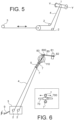
- the connecting cable 4 can be connected to a pulley 40 so as to form a continuous loop.
- the drive means 3 can thus be offset relative to the rotating elements 2.
- the connecting cable 4 can be connected to a set of rotating elements 2 so as to form a continuous loop and the drive means 3 are offset relative to the rotating elements 2.
- One of the two rotating elements 2 illustrated in the Figure 5 can be locked in rotation so as to allow a translation of the connecting cable 4 in order to rotate the cylinder 1 around the longitudinal axis Y.
- the connecting cable 4 is wound around the cylinder 1 of the aircraft so that the rotational movement of the rotating element 2, driven by the drive means 3, is mechanically transmitted to the cylinder 1 of the aircraft by friction of the connecting cable 4 so as to rotate the cylinder 1 around the longitudinal axis Y.
- the system comprises a transmission device 6 arranged to cooperate mechanically with the connecting cable 4 and the cylinder 1 of the aircraft so that the rotational movement of the rotary element 2, driven by the drive means 3, is mechanically transmitted to the cylinder 1 of the aircraft by the transmission device 6 so as to rotate the cylinder 1 about the longitudinal axis Y.
- the transmission device 6 advantageously comprises a configuration in which a mechanical transmission to the cylinder 1 of the rotational movement of the rotary element 2 is interrupted, so that the cylinder 1 is free to rotate about the longitudinal axis Y.
- the transmission device 6 preferably comprises a freewheel or a clutch.
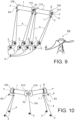
- the transmission device 6 is advantageously mounted at the first and second longitudinal ends 10, 11 of the cylinder 1, as illustrated in FIG. Figure 9 .
- the transmission device 6 is arranged to cooperate mechanically with the connecting cable 4 and the cylinder 1 of the aircraft so that the rotational movement of the pair of rotating elements 2, driven by the drive means 3, is mechanically transmitted to the cylinder 1 of the aircraft by the transmission device 6 so as to rotate the cylinder 1 about the longitudinal axis Y.
- the transmission device 6 advantageously comprises a configuration in which a mechanical transmission to the cylinder 1 of the rotational movement of the pair of rotating elements 2 is interrupted, so that the cylinder 1 is free to rotate about the longitudinal axis Y.
- the aircraft advantageously comprises guidance means, arranged to guide the connecting cable 4 between two positions relative to the cylinder 1 defining a roll angle. maximum.
- the guide means advantageously comprise rings 7, mounted on the support structure 5 of the aircraft, and adapted to receive the connecting cable 4.
- the guide means advantageously comprise a tube 70, arranged on the support structure 5 of the aircraft. Two rings 7, each adapted to receive the connecting cable 4, are advantageously slidably mounted on the tube 70, for example using a slider 700, so as to define the maximum roll angle.
- the guide means may be rolling elements (eg pulleys, rollers) to minimize friction with the connecting cable 4.
- the guide means are advantageously arranged to guide the connecting cable 4 to the surface S of the cylinder 1.
- the system is advantageously configured to control the winding angle of the connecting cable 4 to the surface S of the cylinder 1 (and therefore the transmitted power) as a function of the tensions of the connecting cable 4 on either side of the cylinder 1, for example using the capstan formula (also called the Eytelwein formula) known to those skilled in the art.
- the system may comprise first and/or second attachment cables CA, fixed respectively to the first and/or second longitudinal ends 10, 11 of the cylinder 1, and connected respectively to first and/or second winches 2'.
- the system comprises a tether cable CA fixed to a longitudinal end 10, 11 of the cylinder 1.
- the system comprises two CA attachment cables each fixed to a separate longitudinal end 10, 11 of the cylinder 1.
- the system may include a tether cable CA attached to the elbow member 52 and connected to a winch 2' to control the pitch angle of the aircraft.
- the drive means 3 are arranged to drive a rotational movement of the pair of rotating elements 2 and the additional pair of rotating elements 2.
- the connecting cable 4 is arranged to connect the pair of rotating elements 2 to the first cylinder 1 of the aircraft so that the rotational movement of the pair of rotating elements 2, driven by the drive means 3, is mechanically transmitted to the first cylinder 1 of the aircraft so as to rotate the first cylinder 1 around the first longitudinal axis Y.
- the additional connecting cable 4 is arranged to connect the additional pair of rotating elements 2 to the second cylinder 1' of the aircraft so that the rotational movement of the additional pair of rotating elements 2, driven by the drive means 3, is mechanically transmitted to the second cylinder 1' of the aircraft so as to rotate the second cylinder 1' around the second longitudinal axis Y'.
- each cylinder 1, 1' being connected to at least one pair of rotating elements 2.
- the aircraft in lift, has a yaw axis Z, and is intended to be subjected to a wind V.
- the system advantageously comprises a tail device 8, arranged to stabilize the aircraft along the yaw axis Z as a function of the wind V.
- the tail device 8 is mounted on the support structure 5 of the aircraft. More precisely, the tail device 8 can be mounted mobile in rotation on a longitudinal branch 50 of the support structure 5, around the first axis of the longitudinal branch 50.
- the empennage device 8 advantageously comprises an arm 80 extending along a longitudinal axis.
- the arm 80 has first and second opposite ends.
- the arm 80 is pivotally mounted on said longitudinal branch 50 of the support structure 5, around the first axis of the longitudinal branch 50, for example using an articulation mechanism. 800.
- the empennage device 8 advantageously comprises a first stabilizer 81, called vertical, extending in a first direction perpendicular to the longitudinal axis of the arm 80. When the longitudinal axis of the arm 80 is horizontal, the first direction is vertical.
- the first stabilizer 81 is fixed on the first end of the arm 80.
- the empennage device 8 advantageously comprises a second stabilizer 82, called horizontal, extending in a second direction, perpendicular to the first direction and to the longitudinal axis of the arm 80.
- a second stabilizer 82 extending in a second direction, perpendicular to the first direction and to the longitudinal axis of the arm 80.
- the second direction is horizontal.
- the second stabilizer 82 is fixed on the first end of the arm 80. The second stabilizer 82 allows passive alignment of the empennage device 8 with the apparent wind V to maximize the stability effect of the first stabilizer 81.
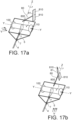
- the first stabilizer 81 advantageously comprises two independent control surfaces 810, mounted to pivot around the first direction in which the first stabilizer 81 extends. As illustrated in Figures 17a and 17b , the pivot angle of the two control surfaces 810 relative to the first direction of the first stabilizer 81 is adapted to the wind direction V so as to generate a kinetic moment around the yaw axis Z. The position of the longitudinal axis of the arm 80 is parallel to the wind direction V.
- the empennage device 8 advantageously comprises a sensor module 83, mounted at the second end of the arm 80.
- the sensor module 83 can be adapted to measure the direction and speed of the wind V, the position, altitude, speed and acceleration of the aircraft.
- the sensor module 83 can be mounted on the support structure 5 of the aircraft.
- the connecting cable 4 is advantageously arranged to connect the aircraft to the rotating element 2 so that a movement of the aircraft in lift can be mechanically transmitted to the rotating element 2.
- the system advantageously comprises a converter, arranged to convert a rotation of the rotating element 2, obtained by a mechanical transmission of the movement of the aircraft in lift, into energy.
- the converter may comprise an electrical generator, arranged to convert a rotation of the rotating element into electrical energy.
- the drive means 3 consume energy to wind the connecting cable 4 while the movements of the aircraft in lift make it possible to unwind the connecting cable 4 and to recover energy.
- the electrical generator for example located in the station, can be electrically connected to an RE electrical network (illustrated in figure 9 ) or an energy storage system via electrical interconnection means 9.
- the electrical network RE can supply the station, in particular the drive means 3, via the electrical interconnection means 9.
- the hydraulic/pneumatic G generators belong to a hydraulic/pneumatic circuit 90 comprising a low-pressure reservoir 900 and a high-pressure reservoir 901.
- the hydraulic/pneumatic G generators pump the fluid (e.g. oil or compressed air) of the hydraulic/pneumatic circuit 90 from the low-pressure reservoir 900 (e.g. atmosphere for a pneumatic circuit 90) to the high-pressure reservoir 901.
- the energy is therefore stored by the pressure of the fluid in the high-pressure reservoir 901.
- the mechanical transmission TM switches from the first position to the second position. Energy is consumed by the flow of fluid from the high-pressure reservoir 901 to the low-pressure reservoir 900.
- the hydraulic/pneumatic circuit 90 is connected to an additional hydraulic/pneumatic motor M' which turns an electric generator G'. Electricity production can therefore be smoothed via this temporary storage system (of the order of a few hours), or electricity production can be adapted according to the needs of electricity consumption demand.
Landscapes
- Engineering & Computer Science (AREA)
- Aviation & Aerospace Engineering (AREA)
- Mechanical Engineering (AREA)
- Remote Sensing (AREA)
- Automation & Control Theory (AREA)
- Sustainable Development (AREA)
- Life Sciences & Earth Sciences (AREA)
- Sustainable Energy (AREA)
- Chemical & Material Sciences (AREA)
- Combustion & Propulsion (AREA)
- General Engineering & Computer Science (AREA)
- Transmission Devices (AREA)
- Toys (AREA)
Description
L'invention se rapporte au domaine technique des systèmes de pilotage d'un aéronef du type à effet Magnus.The invention relates to the technical field of piloting systems for an aircraft of the Magnus effect type.
L'invention trouve notamment son application dans :
- la production d'énergie électrique ;
- le port d'une charge utile, par exemple pour les télécommunications ou la surveillance.
- the production of electrical energy;
- carrying a payload, for example for telecommunications or surveillance.
Le fonctionnement d'un aéronef à effet Magnus est connu de l'homme du métier, et est notamment décrit dans le livre de R. Schmehl et al. « Airborne Wind Energy: Advances in Technology Development and Research », Springer, p.280 et p.304.The operation of a Magnus effect aircraft is known to those skilled in the art, and is notably described in the book by R. Schmehl et al. “ Airborne Wind Energy: Advances in Technology Development and Research ”, Springer, p.280 and p.304.
Un système de pilotage d'un aéronef à effet Magnus, connu de l'état de la technique, comporte :
- un aéronef, du type à effet Magnus, comportant un cylindre s'étendant suivant un axe longitudinal, le cylindre étant mobile en rotation autour de l'axe longitudinal ;
- un moteur électrique, agencé sur l'aéronef pour entraîner en rotation le cylindre autour de l'axe longitudinal ;
- un treuil, comportant un tambour mobile en rotation ;
- un câble de liaison, agencé pour relier l'aéronef au treuil de sorte qu'un mouvement de l'aéronef en sustentation peut être transmis mécaniquement au treuil, le câble de liaison étant un câble d'alimentation électrique agencé pour alimenter électriquement le moteur ;
- un générateur électrique, agencé pour convertir une rotation du tambour du treuil, obtenue par une transmission mécanique du mouvement de l'aéronef en sustentation, en une énergie électrique.
- an aircraft, of the Magnus effect type, comprising a cylinder extending along a longitudinal axis, the cylinder being rotatable about the longitudinal axis;
- an electric motor, arranged on the aircraft to drive the cylinder in rotation around the longitudinal axis;
- a winch, comprising a rotating mobile drum;
- a connecting cable, arranged to connect the aircraft to the winch so that a movement of the aircraft in lift can be mechanically transmitted to the winch, the connecting cable being an electrical power cable arranged to electrically power the motor;
- an electric generator, arranged to convert a rotation of the winch drum, obtained by a mechanical transmission of the movement of the aircraft in lift, into electrical energy.
Un tel système de l'état de la technique n'est pas entièrement satisfaisant dans la mesure où le moteur d'entraînement du cylindre, embarqué sur l'aéronef, doit être alimenté électriquement par le câble de liaison afin de s'affranchir d'un problème d'autonomie. Il en résulte des contraintes sur le choix d'un câble de liaison qui doit être électriquement conducteur. Or, les frettages des câbles de liaison électriques sont très sollicités et sont donc susceptibles de se dégrader avec des risques de désintégration.Such a state-of-the-art system is not entirely satisfactory insofar as the cylinder drive motor, on board the aircraft, must be electrically powered by the connecting cable in order to overcome a problem of autonomy. This results in constraints on the choice of a connecting cable which must be electrically conductive. However, the bindings of the electrical connecting cables are highly stressed and are therefore liable to deteriorate with risks of disintegration.
Un autre exemple de l'art antérieur est fourni par le document
L'invention vise à remédier en tout ou partie aux inconvénients précités. A cet effet, l'invention a pour objet un système de pilotage à distance d'un aéronef, comportant :
- un aéronef, du type à effet Magnus, comportant un cylindre s'étendant suivant un axe longitudinal, le cylindre étant mobile en rotation autour de l'axe longitudinal ;
- une paire d'éléments rotatifs, agencée à distance de l'aéronef ;
- des moyens d'entraînement, agencés pour entraîner un mouvement de rotation de la paire d'éléments rotatifs ;
- un câble de liaison, agencé pour relier la paire d'éléments rotatifs au cylindre de l'aéronef de sorte que le mouvement de rotation de la paire d'éléments rotatifs, entraîné par les moyens d'entraînement, est transmis mécaniquement au cylindre de l'aéronef de manière à mettre en rotation le cylindre autour de l'axe longitudinal.
- an aircraft, of the Magnus effect type, comprising a cylinder extending along a longitudinal axis, the cylinder being rotatable about the longitudinal axis;
- a pair of rotating elements, arranged remotely from the aircraft;
- drive means, arranged to drive a rotational movement of the pair of rotating elements;
- a connecting cable, arranged to connect the pair of rotating elements to the cylinder of the aircraft so that the rotational movement of the pair of rotating elements, driven by the drive means, is mechanically transmitted to the cylinder of the aircraft so as to rotate the cylinder about the longitudinal axis.
Ainsi, un tel système selon l'invention permet de s'affranchir d'un moteur électrique embarqué sur l'aéronef pour entraîner en rotation le cylindre autour de l'axe longitudinal (i.e. l'axe de tangage de l'aéronef). En effet, selon l'invention, le cylindre est entraîné en rotation autour de l'axe longitudinal par un transfert mécanique avec l'élément rotatif via le câble de liaison, ce qui permet de réduire les pertes de conversion d'énergie par rapport à l'état de la technique. Le choix du câble de liaison n'est pas contraint, le câble de liaison n'a pas à être électriquement conducteur, contrairement à l'état de la technique, ce qui permet de s'affranchir du problème de la dégradation potentielle des frettages.Thus, such a system according to the invention makes it possible to dispense with an electric motor on board the aircraft to rotate the cylinder around the longitudinal axis (i.e. the pitch axis of the aircraft). Indeed, according to the invention, the cylinder is rotated around the longitudinal axis by a mechanical transfer with the rotating element via the connecting cable, which makes it possible to reduce energy conversion losses compared to the state of the art. The choice of the connecting cable is not constrained, the connecting cable does not have to be electrically conductive, unlike the state of the art, which makes it possible to overcome the problem of potential degradation of the hoops.
L'entraînement en rotation du cylindre autour de l'axe longitudinal est ainsi déporté, par exemple au sein d'une station terrestre ou maritime où l'élément rotatif et les moyens d'entraînement de l'élément rotatif peuvent être disposés, ce qui permet d'alléger l'aéronef.The rotational drive of the cylinder around the longitudinal axis is thus offset, for example within a land or sea station where the rotating element and the means for driving the rotating element can be arranged, which makes it possible to lighten the aircraft.
Par ailleurs, un avantage procuré par la paire d'éléments rotatifs est de contrôler les deux sens de rotation du cylindre de l'aéronef autour de l'axe longitudinal (l'axe de tangage), ce qui permet d'éviter de croiser des portions du câble de liaison. Le contrôle de la longueur du câble de liaison entre l'aéronef et les éléments rotatifs permet de créer un mouvement de va-et-vient de l'aéronef en sustentation. La paire d'éléments rotatifs comporte des premier et second éléments rotatifs. Les premier et second éléments rotatifs peuvent être indépendants au sens où les premier et second éléments rotatifs peuvent avoir une vitesse de rotation différente (enroulement, déroulement, arrêt).Furthermore, an advantage provided by the pair of rotating elements is to control the two directions of rotation of the aircraft cylinder around the longitudinal axis (the pitch axis), which makes it possible to avoid crossing portions of the connecting cable. Controlling the length of the connecting cable between the aircraft and the rotating elements makes it possible to create a back-and-forth movement of the aircraft in lift. The pair of rotating elements comprises first and second rotating elements. The first and second rotating elements can be independent in the sense that the first and second rotating elements can have a different rotation speed (winding, unwinding, stopping).
Le système selon l'invention peut comporter une ou plusieurs des caractéristiques suivantes.The system according to the invention may comprise one or more of the following characteristics.
Selon une caractéristique de l'invention, le câble de liaison est enroulé autour du cylindre de l'aéronef de sorte que le mouvement de rotation des éléments rotatifs, entraîné par les moyens d'entraînement, est transmis mécaniquement au cylindre de l'aéronef par une friction du câble de liaison de manière à mettre en rotation le cylindre autour de l'axe longitudinal.According to a characteristic of the invention, the connecting cable is wound around the cylinder of the aircraft so that the rotational movement of the rotating elements, driven by the drive means, is mechanically transmitted to the cylinder of the aircraft by friction of the connecting cable so as to rotate the cylinder around the longitudinal axis.
Ainsi, un avantage procuré est de permettre un transfert mécanique direct entre le câble de liaison et le cylindre de l'aéronef pour contrôler l'aéronef selon l'axe de tangage en contrôlant la vitesse de rotation du cylindre autour de l'axe longitudinal.Thus, an advantage provided is to allow a direct mechanical transfer between the connecting cable and the aircraft cylinder to control the aircraft along the pitch axis by controlling the rotational speed of the cylinder around the longitudinal axis.
Selon une caractéristique de l'invention, le système comporte un dispositif de transmission agencé pour coopérer mécaniquement avec le câble de liaison et le cylindre de l'aéronef de sorte que le mouvement de rotation des éléments rotatifs, entraîné par les moyens d'entraînement, est transmis mécaniquement au cylindre de l'aéronef par le dispositif de transmission de manière à mettre en rotation le cylindre autour de l'axe longitudinal.According to a characteristic of the invention, the system comprises a transmission device arranged to cooperate mechanically with the connecting cable and the cylinder of the aircraft so that the rotational movement of the rotating elements, driven by the drive means, is mechanically transmitted to the cylinder of the aircraft by the transmission device so as to rotate the cylinder around the longitudinal axis.
Ainsi, un avantage procuré est de permettre un transfert mécanique indirect entre le câble de liaison et le cylindre de l'aéronef (par l'intermédiaire du dispositif de transmission) pour contrôler l'aéronef selon l'axe de tangage en contrôlant la vitesse de rotation du cylindre autour de l'axe longitudinal.Thus, an advantage provided is to allow an indirect mechanical transfer between the connecting cable and the aircraft cylinder (via the transmission device) to control the aircraft along the pitch axis by controlling the rotational speed of the cylinder around the longitudinal axis.
Selon une caractéristique de l'invention, le dispositif de transmission comporte une configuration dans laquelle une transmission mécanique au cylindre du mouvement de rotation de l'élément rotatif est interrompue, de sorte que le cylindre est libre en rotation autour de l'axe longitudinal ; le dispositif de transmission comportant de préférence une roue libre ou un embrayage.According to a feature of the invention, the transmission device comprises a configuration in which a mechanical transmission to the cylinder of the rotational movement of the rotating element is interrupted, so that the cylinder is free to rotate around the longitudinal axis; the transmission device preferably comprising a freewheel or a clutch.
Ainsi, un avantage procuré par cette configuration est de pouvoir rembobiner le câble de liaison sans transmettre de puissance au cylindre de l'aéronef, lorsque la transmission mécanique est interrompue.Thus, an advantage provided by this configuration is to be able to rewind the connecting cable without transmitting power to the aircraft cylinder, when the mechanical transmission is interrupted.
Selon une caractéristique de l'invention, l'aéronef, en sustentation, est destiné à être soumis à un vent ; le système comportant des moyens de commande, configurés pour commander les moyens d'entraînement en fonction du vent.According to a characteristic of the invention, the aircraft, in lift, is intended to be subjected to a wind; the system comprising control means, configured to control the drive means as a function of the wind.
Ainsi, un avantage procuré est de pouvoir commander le couple et la vitesse de rotation de l'élément rotatif.Thus, an advantage provided is to be able to control the torque and rotational speed of the rotating element.
Selon une caractéristique de l'invention, l'aéronef comporte des moyens de guidage, agencé pour guider le câble de liaison entre deux positions par rapport au cylindre définissant un angle de roulis maximal.According to a characteristic of the invention, the aircraft comprises guidance means, arranged to guide the connecting cable between two positions relative to the cylinder defining a maximum roll angle.
Ainsi, un avantage procuré est de faciliter le pilotage de l'aéronef en contrôlant l'angle de roulis de l'aéronef. Les moyens de guidage sont agencés par rapport au cylindre pour maintenir un déplacement du câble de liaison suivant un axe parallèle à l'axe longitudinal du cylindre entre les deux positions définissant l'angle de roulis maximal.Thus, an advantage provided is to facilitate the piloting of the aircraft by controlling the roll angle of the aircraft. The guidance means are arranged relative to the cylinder to maintain a movement of the connecting cable along an axis parallel to the longitudinal axis of the cylinder between the two positions defining the maximum roll angle.
Selon une caractéristique de l'invention, le cylindre présente des première et deuxième extrémités longitudinales ; le système comportant des premier et/ou deuxième câbles d'attache, fixés respectivement aux première et/ou deuxième extrémités longitudinales du cylindre, et reliés respectivement à des premier et/ou deuxième treuils.According to a characteristic of the invention, the cylinder has first and second longitudinal ends; the system comprising first and/or second attachment cables, fixed respectively to the first and/or second longitudinal ends of the cylinder, and connected respectively to first and/or second winches.
Ainsi, un avantage procuré est de pouvoir contrôler l'aéronef selon l'axe de roulis en contrôlant la longueur des premier et/ou deuxième câbles d'attache entre l'aéronef et respectivement les premier et/ou deuxième treuils.Thus, an advantage provided is to be able to control the aircraft along the roll axis by controlling the length of the first and/or second tether cables between the aircraft and respectively the first and/or second winches.
Selon une caractéristique de l'invention qui n'est pas couverte par les revendications, le système comporte une zone d'ancrage, agencée à distance de l'aéronef, et le câble de liaison est fixé à la zone d'ancrage.According to a characteristic of the invention which is not covered by the claims, the system comprises an anchoring zone, arranged at a distance from the aircraft, and the connecting cable is fixed to the anchoring zone.
Ainsi, un avantage procuré par la zone d'ancrage est de permettre la commande du couple sur le cylindre indépendamment de l'équilibre entre les forces aérodynamiques et la somme des tensions dans les parties du câble de liaison.Thus, an advantage provided by the anchoring zone is to allow the control of the torque on the cylinder independently of the balance between the aerodynamic forces and the sum of the tensions in the parts of the connecting cable.
Selon une caractéristique de l'invention, le système comporte :
- une paire additionnelle d'éléments rotatifs, agencée à distance de l'aéronef ;
- un câble de liaison additionnel ;
- les moyens d'entraînement sont agencés pour entraîner un mouvement de rotation de la paire additionnelle d'éléments rotatifs ;
- le câble de liaison additionnel est agencé pour relier la paire additionnelle d'éléments rotatifs au cylindre de l'aéronef de sorte que le mouvement de rotation de la paire additionnelle d'éléments rotatifs, entraîné par les moyens d'entraînement, est transmis mécaniquement au cylindre de l'aéronef de manière à mettre en rotation le cylindre autour de l'axe longitudinal.
- an additional pair of rotating elements, arranged remotely from the aircraft;
- an additional connecting cable;
- the drive means are arranged to drive a rotational movement of the additional pair of rotating elements;
- the additional connecting cable is arranged to connect the additional pair of rotating elements to the cylinder of the aircraft so that the rotational movement of the additional pair of rotating elements, driven by the drive means, is mechanically transmitted to the cylinder of the aircraft so as to rotate the cylinder around the longitudinal axis.
Ainsi, un avantage procuré est de pouvoir transmettre la puissance désirée au cylindre à tout moment, y compris lors du rembobinage du câble de liaison ou du câble de liaison additionnel.Thus, an advantage provided is to be able to transmit the desired power to the cylinder at any time, including when rewinding the connecting cable or the additional connecting cable.
Selon une caractéristique de l'invention :
- l'aéronef comporte des premier et deuxième cylindres s'étendant respectivement suivant des premier et deuxième axes longitudinaux, les premier et deuxième cylindres étant mobiles en rotation respectivement autour des premier et deuxième axes longitudinaux ;
- le câble de liaison est agencé pour relier la paire d'éléments rotatifs au premier cylindre de l'aéronef de sorte que le mouvement de rotation de la paire d'éléments rotatifs, entraîné par les moyens d'entraînement, est transmis mécaniquement au premier cylindre de l'aéronef de manière à mettre en rotation le premier cylindre autour du premier axe longitudinal ;
- le câble de liaison additionnel est agencé pour relier la paire additionnelle d'éléments rotatifs au deuxième cylindre de l'aéronef de sorte que le mouvement de rotation de la paire additionnelle d'éléments rotatifs, entraîné par les moyens d'entraînement, est transmis mécaniquement au deuxième cylindre de l'aéronef de manière à mettre en rotation le deuxième cylindre autour du deuxième axe longitudinal.
- the aircraft comprises first and second cylinders extending respectively along first and second longitudinal axes, the first and second cylinders being rotatable respectively around the first and second longitudinal axes;
- the connecting cable is arranged to connect the pair of rotating elements to the first cylinder of the aircraft so that the rotational movement of the pair of rotating elements, driven by the drive means, is mechanically transmitted to the first cylinder of the aircraft so as to rotate the first cylinder around the first longitudinal axis;
- the additional connecting cable is arranged to connect the additional pair of rotating elements to the second cylinder of the aircraft so that the rotational movement of the additional pair of rotating elements, driven by the drive means, is mechanically transmitted to the second cylinder of the aircraft so as to rotate the second cylinder around the second longitudinal axis.
Ainsi, un avantage procuré est de pouvoir contrôler l'aéronef selon l'axe de lacet en introduisant un différentiel de vitesses de rotation entre la paire d'éléments rotatifs et la paire additionnelle d'éléments rotatifs. Il en résulte une traînée différentielle qui génère un couple autour de l'axe de lacet de l'aéronef. Il est alors possible de s'affranchir d'un dispositif d'empennage pour stabiliser l'aéronef selon l'axe de lacet. Il est également possible d'envisager des vols dynamiques avec la possibilité de manœuvrer l'aéronef autour de l'axe de lacet en faisant des trajectoires en forme de « 8 » à une altitude donnée pour faire des allers-retours. Par « vol dynamique », on entend un vol durant lequel l'aéronef est en mouvement de manière constante et s'adapte de manière continue aux caractéristiques du vent.Thus, one advantage provided is to be able to control the aircraft along the yaw axis by introducing a differential in rotational speeds between the pair of rotating elements and the additional pair of rotating elements. This results in a differential drag that generates a torque around the yaw axis of the aircraft. It is then possible to do without a tail unit to stabilize the aircraft along the yaw axis. It is also possible to envisage dynamic flights with the possibility of maneuvering the aircraft around the yaw axis by making “8” shaped trajectories at a given altitude to make round trips. "Dynamic flight" means a flight in which the aircraft is in constant motion and continuously adapts to the characteristics of the wind.
Selon une caractéristique de l'invention, le système comporte des premier et deuxième ensembles, comprenant chacun :
- deux paires d'éléments rotatifs agencées à distance de l'aéronef, et
- deux câbles de liaison ;
- l'aéronef comporte des premier et deuxième cylindres s'étendant respectivement suivant des premier et deuxième axes longitudinaux, les premier et deuxième cylindres étant mobiles en rotation respectivement autour des premier et deuxième axes longitudinaux ;
- les moyens d'entraînement sont agencés pour entraîner un mouvement de rotation des éléments rotatifs des premier et deuxième ensembles ;
- chaque câble de liaison du premier ensemble est agencé pour relier une paire d'éléments rotatifs du premier ensemble au premier cylindre de l'aéronef de sorte que le mouvement de rotation des éléments rotatifs du premier ensemble, entraîné par les moyens d'entraînement, est transmis mécaniquement au premier cylindre de l'aéronef de manière à mettre en rotation le premier cylindre autour du premier axe longitudinal ;
- chaque câble de liaison du deuxième ensemble est agencé pour relier une paire d'éléments rotatifs du deuxième ensemble au deuxième cylindre de l'aéronef de sorte que le mouvement de rotation des éléments rotatifs du deuxième ensemble, entraîné par les moyens d'entraînement, est transmis mécaniquement au deuxième cylindre de l'aéronef de manière à mettre en rotation le deuxième cylindre autour du deuxième axe longitudinal.
- two pairs of rotating elements arranged at a distance from the aircraft, and
- two connecting cables;
- the aircraft comprises first and second cylinders extending respectively along first and second longitudinal axes, the first and second cylinders being rotatable respectively around the first and second longitudinal axes;
- the drive means are arranged to drive a rotational movement of the rotary elements of the first and second sets;
- each connecting cable of the first set is arranged to connect a pair of rotating elements of the first set to the first cylinder of the aircraft so that the rotational movement of the rotating elements of the first set, driven by the drive means, is mechanically transmitted to the first cylinder of the aircraft so as to rotate the first cylinder around the first longitudinal axis;
- each connecting cable of the second set is arranged to connect a pair of rotating elements of the second set to the second cylinder of the aircraft so that the rotational movement of the rotating elements of the second set, driven by the drive means, is mechanically transmitted to the second cylinder of the aircraft so as to rotate the second cylinder around the second longitudinal axis.
Ainsi, un avantage procuré est de pouvoir transmettre la puissance désirée au cylindre correspondant à tout moment, y compris lors du rembobinage de l'un des deux câbles de liaison de l'ensemble correspondant.Thus, an advantage provided is to be able to transmit the desired power to the corresponding cylinder at any time, including when rewinding one of the two connecting cables of the corresponding assembly.
Selon une caractéristique de l'invention, l'aéronef, en sustentation, présente un axe de lacet et est destiné à être soumis à un vent ; le système comportant un élément coudé présentant :
- une première branche, reliée au premier cylindre ;
- une seconde branche, reliée au deuxième cylindre ;
- a first branch, connected to the first cylinder;
- a second branch, connected to the second cylinder;
Selon une caractéristique de l'invention, l'élément rotatif est un tambour d'un treuil.According to a characteristic of the invention, the rotating element is a drum of a winch.
Ainsi, un avantage procuré par un treuil est de pouvoir contrôler à la fois :
- la longueur du câble de liaison s'étendant entre le tambour et l'aéronef,
- la vitesse de rotation du tambour.
- the length of the connecting cable extending between the drum and the aircraft,
- the rotation speed of the drum.
Selon une caractéristique de l'invention, le câble de liaison est agencé pour relier l'aéronef à l'élément rotatif de sorte qu'un mouvement de l'aéronef en sustentation peut être transmis mécaniquement à l'élément rotatif.According to a feature of the invention, the connecting cable is arranged to connect the aircraft to the rotating element so that a movement of the aircraft in lift can be mechanically transmitted to the rotating element.
Selon une caractéristique de l'invention, le système comporte un convertisseur, agencé pour convertir une rotation de l'élément rotatif, obtenue par une transmission mécanique du mouvement de l'aéronef en sustentation, en une énergie.According to a characteristic of the invention, the system comprises a converter, arranged to convert a rotation of the rotating element, obtained by a mechanical transmission of the movement of the aircraft in lift, into energy.
Ainsi, un avantage procuré est de pouvoir récupérer l'énergie mécanique issue du mouvement de l'aéronef en sustentation.Thus, one advantage provided is to be able to recover the mechanical energy from the movement of the aircraft in lift.
Selon une caractéristique de l'invention, l'aéronef, en sustentation, présente un axe de lacet, et est destiné à être soumis à un vent ; le système comportant un dispositif d'empennage, agencé pour stabiliser l'aéronef selon l'axe de lacet en fonction du vent.According to a characteristic of the invention, the aircraft, in lift, has a yaw axis, and is intended to be subjected to a wind; the system comprising a tail device, arranged to stabilize the aircraft along the yaw axis as a function of the wind.
D'autres caractéristiques et avantages apparaîtront dans l'exposé détaillé de différents modes de réalisation de l'invention, l'exposé étant assorti d'exemples et de références aux dessins joints.
-
Figure 1 est une vue schématique en perspective d'un système selon l'invention, qui est pas couvert par les revendications, illustrant notamment la présence d'une zone d'ancrage à laquelle est fixé le câble de liaison. -
Figure 2 est une vue schématique en perspective d'un système selon l'invention, illustrant notamment la présence de plusieurs éléments rotatifs réalisés sous la forme de poulies de renvoi. -
Figure 3 est une vue schématique en perspective d'un système selon l'invention, illustrant notamment la présence de moteurs linéaires qui entraînent indirectement un mouvement de rotation des éléments rotatifs. -
Figure 4a est une vue schématique en perspective d'un système selon l'invention, illustrant notamment la présence d'un arbre de transmission (avec stabilisateur) entraînant en rotation un élément rotatif, l'arbre de transmission étant monté sur l'élément rotatif contre l'action de moyens de rappel élastique. -
Figure 4b est une vue schématique en perspective d'un système selon l'invention, illustrant notamment un mouflage relié aux éléments rotatifs. -
Figure 5 est une vue schématique en perspective d'un système selon l'invention, illustrant notamment un câble de liaison formant une boucle continue. -
Figure 6 est une vue schématique de côté d'un premier mode principal de réalisation d'un système selon l'invention. L'encart de lafigure 6 est une vue à l'échelle agrandie d'un mode de réalisation des moyens de guidage du câble de liaison, permettant de guider le câble de liaison entre deux positions par rapport au cylindre de manière à définir un angle de roulis maximal. -
Figure 7 est une vue schématique en perspective du premier mode principal de réalisation d'un système selon l'invention illustré à lafigure 6 . -
Figure 8 est une vue schématique en perspective et en transparence d'un mode de réalisation d'un cylindre d'un aéronef appartenant à un système selon l'invention. -
Figure 9 est une vue schématique en perspective d'un deuxième mode principal de réalisation d'un système selon l'invention, illustrant notamment la présence de deux cylindres. -
Figure 10 est une vue schématique en perspective d'un système selon l'invention, illustrant notamment un angle de flèche entre les deux cylindres. -
Figure 11 est une vue schématique partielle de dessus d'un système selon l'invention, illustrant notamment un élément coudé reliant les deux cylindres. -
Figure 12 est une vue schématique en perspective d'un troisième mode principal de réalisation d'un système selon l'invention qui n'est pas couvert par les revendications. -
Figure 13 est une vue schématique en perspective d'un quatrième mode principal de réalisation d'un système selon l'invention. -
Figure 14a est une vue schématique en perspective d'un système selon l'invention, illustrant notamment la présence d'un câble d'attache à une extrémité du cylindre. -
Figure 14b est une vue schématique en perspective d'un système selon l'invention, illustrant notamment la présence de deux câbles d'attache aux extrémités du cylindre. -
Figure 15 est une vue schématique en perspective d'un mode de réalisation d'un système selon l'invention. -
Figure 16 est une vue schématique illustrant notamment des moyens de conversion en énergie d'une rotation d'éléments rotatifs, obtenue par une transmission mécanique du mouvement de l'aéronef en sustentation. -
Figure 17a est une vue schématique partielle en perspective d'un système selon l'invention, illustrant une position du dispositif d'empennage lors d'une phase de production d'énergie. -
Figure 17b est une vue schématique partielle en perspective d'un système selon l'invention, illustrant une position du dispositif d'empennage lors d'une phase de rembobinage du câble de liaison.
-
Figure 1 is a schematic perspective view of a system according to the invention, which is not covered by the claims, illustrating in particular the presence of an anchoring zone to which the connecting cable is fixed. -
Figure 2 is a schematic perspective view of a system according to the invention, illustrating in particular the presence of several rotating elements produced in the form of return pulleys. -
Figure 3 is a schematic perspective view of a system according to the invention, illustrating in particular the presence of linear motors which indirectly drive a rotational movement of the rotating elements. -
Figure 4a is a schematic perspective view of a system according to the invention, illustrating in particular the presence of a transmission shaft (with stabilizer) driving in rotation a rotating element, the transmission shaft being mounted on the rotating element against the action of elastic return means. -
Figure 4b is a schematic perspective view of a system according to the invention, illustrating in particular a pulley connected to the rotating elements. -
Figure 5 is a schematic perspective view of a system according to the invention, illustrating in particular a connecting cable forming a continuous loop. -
Figure 6 is a schematic side view of a first main embodiment of a system according to the invention. The inset of theFigure 6 is an enlarged view of an embodiment of the connecting cable guiding means, making it possible to guide the connecting cable between two positions relative to the cylinder so as to define a maximum roll angle. -
Figure 7 is a schematic perspective view of the first main embodiment of a system according to the invention illustrated inFigure 6 . -
Figure 8 is a schematic perspective and transparency view of an embodiment of a cylinder of an aircraft belonging to a system according to the invention. -
Figure 9 is a schematic perspective view of a second main embodiment of a system according to the invention, illustrating in particular the presence of two cylinders. -
Figure 10 is a schematic perspective view of a system according to the invention, illustrating in particular an arrow angle between the two cylinders. -
Figure 11 is a partial schematic top view of a system according to the invention, illustrating in particular an angled element connecting the two cylinders. -
Figure 12 is a schematic perspective view of a third main embodiment of a system according to the invention which is not covered by the claims. -
Figure 13 is a schematic perspective view of a fourth main embodiment of a system according to the invention. -
Figure 14a is a schematic perspective view of a system according to the invention, illustrating in particular the presence of an attachment cable at one end of the cylinder. -
Figure 14b is a schematic perspective view of a system according to the invention, illustrating in particular the presence of two attachment cables at the ends of the cylinder. -
Figure 15 is a schematic perspective view of an embodiment of a system according to the invention. -
Figure 16 is a schematic view illustrating in particular means of converting into energy a rotation of rotating elements, obtained by a mechanical transmission of the movement of the aircraft in lift. -
Figure 17a is a partial schematic perspective view of a system according to the invention, illustrating a position of the tail unit during an energy production phase. -
Figure 17b is a partial schematic perspective view of a system according to the invention, illustrating a position of the tail unit during a rewinding phase of the connecting cable.
Il est à noter que les dessins décrits ci-avant sont schématiques, et ne sont pas nécessairement à l'échelle par souci de lisibilité et pour en simplifier leur compréhension.It should be noted that the drawings described above are schematic, and are not necessarily to scale for the sake of readability and to simplify their understanding.
Les éléments identiques ou assurant la même fonction porteront les mêmes références pour les différents modes de réalisation, par souci de simplification.Identical elements or those providing the same function will bear the same references for the different embodiments, for the sake of simplification.
Un objet de l'invention est un système de pilotage à distance d'un aéronef, comportant :
- un aéronef, du type à effet Magnus,
comportant un cylindre 1 s'étendant suivant un axe longitudinal Y, le cylindre 1 étant mobile en rotation autour de l'axe longitudinal Y ; un élément rotatif 2, agencé à distance de l'aéronef ;- des moyens d'entraînement 3, agencés pour entraîner un mouvement de rotation de l'élément rotatif 2 ;
- un câble de
liaison 4, agencé pour relier l'élément rotatif 2au cylindre 1 de l'aéronef de sorte que le mouvement de rotation de l'élément rotatif 2, entraîné par les moyens d'entraînement 3, est transmis mécaniquement au cylindre 1 de l'aéronef de manière à mettre en rotation le cylindre 1 autour de l'axe longitudinal Y.
- an aircraft, of the Magnus effect type, comprising a
cylinder 1 extending along a longitudinal axis Y, thecylinder 1 being rotatable around the longitudinal axis Y; - a
rotating element 2, arranged at a distance from the aircraft; - drive means 3, arranged to drive a rotational movement of the
rotary element 2; - a connecting
cable 4, arranged to connect therotating element 2 to thecylinder 1 of the aircraft so that the rotational movement of therotating element 2, driven by the drive means 3, is mechanically transmitted to thecylinder 1 of the aircraft so as to rotate thecylinder 1 around the longitudinal axis Y.
Le cylindre 1 forme une aile de l'aéronef. La mise en rotation du cylindre 1 autour de l'axe longitudinal Y permet d'exploiter l'effet Magnus pour augmenter la portance de l'aéronef. Le cylindre 1 présente des première et deuxième extrémités longitudinales 10, 11 (illustrées à la
Le cylindre 1 présente avantageusement une section transversale de forme circulaire, possédant un diamètre noté D. Le cylindre 1 présente avantageusement une longueur, notée L, suivant l'axe longitudinal Y vérifiant un ratio L/D compris entre 6 et 12.The
Le cylindre 1 est avantageusement rempli d'un gaz possédant une masse volumique inférieure à la masse volumique de l'air, de manière à créer une portance archimédienne. L'aéronef possède alors une masse inférieure à la masse de l'air de sorte que l'aéronef est un aérostat. Le gaz peut être de l'hydrogène ou de l'hélium. Le gaz peut être sous pression, par exemple entre 20 mbars et 50 mbars selon les dimensions du cylindre 1, de sorte que la pression du gaz à l'intérieur du cylindre 1 est supérieure à la pression atmosphérique. Le cylindre 1 peut être réalisé sous la forme d'un ballon. Le cylindre 1 peut comporter une enveloppe réalisée dans un matériau textile étanche au gaz. Le gaz sous pression permet de rigidifier le cylindre 1. Le cylindre 1 est avantageusement muni d'organes de renfort 12, pouvant être réalisés sous la forme de tiges longitudinales s'étendant suivant un axe parallèle à l'axe longitudinal Y du cylindre 1, afin d'améliorer la résistance mécanique du cylindre 1. Comme illustré à la
L'aéronef comporte avantageusement une machine dynamoélectrique, agencée pour convertir une énergie mécanique (rotation du cylindre 1 autour de l'axe longitudinal Y) en une énergie électrique. L'énergie électrique générée par la machine dynamoélectrique peut alimenter électriquement des composants de l'aéronef, tels que des capteurs, des ordinateurs de bord, des dispositifs de dégivrage, des dispositifs de maintien de pression du gaz à l'intérieur du cylindre 1 etc. Il est également possible d'utiliser d'autres types de machines permettant de convertir l'énergie mécanique de la rotation du cylindre 1 autour de l'axe longitudinal Y (e.g. conversion en chaleur pour le dégivrage).The aircraft advantageously comprises a dynamoelectric machine, arranged to convert mechanical energy (rotation of the
L'aéronef est avantageusement équipé de moyens d'acquisition des caractéristiques du vent soufflant sur le cylindre 1, tel qu'un anémomètre, configuré pour envoyer des données représentatives des caractéristiques du vent V à des moyens de traitement/commande tels qu'un microcontrôleur. Les moyens de traitement/commande peuvent être embarqués sur l'aéronef. L'aéronef est avantageusement équipé de moyens d'acquisition de paramètres propres au cylindre 1, tels qu'une centrale inertielle configurée pour transmettre aux moyens de traitement/commande des données représentatives de l'orientation du cylindre 1 par rapport au vent V, de la vitesse du cylindre 1, de l'accélération du cylindre 1 etc.The aircraft is advantageously equipped with means for acquiring the characteristics of the wind blowing on the
L'aéronef peut comporter des premier et deuxième cylindres 1, 1' s'étendant respectivement suivant des premier et deuxième axes longitudinaux Y, Y', les premier et deuxième cylindres 1, 1' étant mobiles en rotation respectivement autour des premier et deuxième axes longitudinaux Y, Y'.The aircraft may comprise first and
L'aéronef comporte une structure de support 5, agencée pour supporter le cylindre 1. Le cylindre 1 est monté mobile en rotation sur la structure de support 5 autour de l'axe longitudinal Y. La structure de support 5 peut comporter un ensemble de branches formant un cadre pour le cylindre. La structure de support peut comporter deux branches longitudinales 50, s'étendant chacune suivant un premier axe parallèle à l'axe longitudinal Y du cylindre 1. La structure de support 5 peut comporter deux branches latérales 51, s'étendant chacune suivant un deuxième axe perpendiculaire au premier axe, et reliées aux branches longitudinales 50. Le cylindre 1 peut être monté mobile en rotation autour de l'axe longitudinal Y sur les branches latérales 51 de la structure de support 5, par exemple grâce à des axes mécaniques 510 et des roulements mécaniques 511 (notamment illustrés à la
L'aéronef, en sustentation, présente un axe de lacet Z et est destiné à être soumis à un vent V. Par convention, l'axe longitudinal Y suivant lequel s'étend le cylindre 1 est l'axe de tangage. L'axe de lacet Z et l'axe de roulis X sont perpendiculaires entre eux, et s'étendent dans un plan perpendiculaire à l'axe longitudinal Y (i.e. l'axe de tangage). Lorsque l'axe de tangage Y est horizontal, l'axe de lacet Z est vertical et l'axe de roulis X est horizontal. L'axe de tangage Y, l'axe de lacet Z et l'axe de roulis X sont perpendiculaires entre eux, comme illustré à la
Le système comporte avantageusement un élément coudé 52 (illustré aux
- une première branche 520, reliée au
premier cylindre 1 ; - une seconde branche 521, reliée au deuxième cylindre 1' ;
- a
first branch 520, connected to thefirst cylinder 1; - a
second branch 521, connected to the second cylinder 1';
Selon une variante, le système comporte un élément de liaison 53 (illustré aux
L'aéronef peut comporter des hélices (non représentées), agencées sur la structure de support 5 pour faciliter le décollage et l'atterrissage de l'aéronef.The aircraft may include propellers (not shown), arranged on the
L'élément rotatif 2 est avantageusement un tambour d'un treuil, ce qui permet de transformer un mouvement de rotation du tambour en un mouvement linéaire du câble de liaison 4 et réciproquement. A titre d'exemple, la vitesse linéaire du câble de liaison 4 peut être comprise entre 0 m.s-1 et 40 m.s-1. Le câble de liaison 4 est avantageusement enroulé autour du tambour du treuil.The
Selon une variante illustrée à la
Selon une variante illustrée à la
Les moyens d'entraînement 3 peuvent comporter un moteur, de préférence électrique, agencé pour entraîner un mouvement de rotation de l'élément rotatif 2. Les moyens d'entraînement 3 peuvent entraîner directement ou indirectement l'élément rotatif 2. Un exemple d'entraînement indirect est illustré à la
L'aéronef, en sustentation, est destiné à être soumis à un vent V. Le système comporte avantageusement des moyens de commande, configurés pour commander les moyens d'entraînement en fonction du vent V. Ainsi, il est possible de faire varier la portance de l'aéronef, et donc l'altitude de l'aéronef, en faisant varier la vitesse de rotation de l'élément rotatif 2.The aircraft, in lift, is intended to be subjected to a wind V. The system advantageously comprises control means, configured to control the drive means as a function of the wind V. Thus, it is possible to vary the lift of the aircraft, and therefore the altitude of the aircraft, by varying the rotational speed of the
Les moyens de commande peuvent commander la vitesse de rotation du tambour du treuil de sorte que la vitesse tangentielle en un point du cylindre 1 est supérieure à la vitesse du vent V soufflant au voisinage de ce point du cylindre 1 (vent apparent).The control means can control the rotational speed of the winch drum so that the tangential speed at a point on
Le système comporte avantageusement une station, de préférence terrestre ou maritime, dans laquelle sont disposés le ou les éléments rotatifs 2 et les moyens d'entraînement 3. La station peut être fixe ou mobile par rapport au référentiel terrestre. La station mobile peut être réalisée sous la forme d'un véhicule tel qu'un sous-marin.The system advantageously comprises a station, preferably land-based or maritime, in which the rotating element(s) 2 and the drive means 3 are arranged. The station may be fixed or mobile relative to the land-based reference frame. The mobile station may be in the form of a vehicle such as a submarine.
Selon un mode de réalisation non illustré, le système peut comporter des moyens de modification de la direction (e.g. des poulies de renvoi), agencés pour modifier la direction du câble de liaison 4 entre la station et l'aéronef. Ainsi, il est par exemple possible d'éviter que le câble de liaison 4 ne soit en contact avec des obstacles présents au sol.According to an embodiment not illustrated, the system may comprise direction modification means (e.g. return pulleys), arranged to modify the direction of the connecting
La station et l'aéronef sont avantageusement munis de moyens de communication, de préférence sans fil, de sorte qu'une communication peut être établie entre la station et l'aéronef.The station and the aircraft are advantageously provided with communication means, preferably wireless, so that communication can be established between the station and the aircraft.
Le câble de liaison 4 peut être réalisé dans un matériau diélectrique. Le câble de liaison 4 présente avantageusement une résistance importante en tension. Le câble de liaison 4 peut être réalisé dans un matériau polymère, par exemple le polyéthylène haute densité. Le câble de liaison 4 peut comprendre un conduit de gaz, agencé pour alimenter le cylindre 1 en gaz sous pression.The connecting
Comme illustré aux
Comme illustrée à la
Selon une variante illustrée à la
Selon un mode de réalisation, qui n'est pas couvert par les revendications, le câble de liaison 4 est enroulé autour du cylindre 1 de l'aéronef de sorte que le mouvement de rotation de l'élément rotatif 2, entraîné par les moyens d'entraînement 3, est transmis mécaniquement au cylindre 1 de l'aéronef par une friction du câble de liaison 4 de manière à mettre en rotation le cylindre 1 autour de l'axe longitudinal Y.According to one embodiment, which is not covered by the claims, the connecting
Selon l'invention, le système comporte une paire d'éléments rotatifs 2 agencée à distance de l'aéronef, le câble de liaison 4 étant enroulé autour du cylindre 1 de l'aéronef de sorte que le mouvement de rotation de la paire d'éléments rotatifs 2, entraîné par les moyens d'entraînement 3, est transmis mécaniquement au cylindre 1 de l'aéronef par une friction du câble de liaison 4 de manière à mettre en rotation le cylindre 1 autour de l'axe longitudinal Y.According to the invention, the system comprises a pair of
Selon une variante de réalisation, le système comporte un dispositif de transmission 6 agencé pour coopérer mécaniquement avec le câble de liaison 4 et le cylindre 1 de l'aéronef de sorte que le mouvement de rotation de l'élément rotatif 2, entraîné par les moyens d'entraînement 3, est transmis mécaniquement au cylindre 1 de l'aéronef par le dispositif de transmission 6 de manière à mettre en rotation le cylindre 1 autour de l'axe longitudinal Y. Le dispositif de transmission 6 comporte avantageusement une configuration dans laquelle une transmission mécanique au cylindre 1 du mouvement de rotation de l'élément rotatif 2 est interrompue, de sorte que le cylindre 1 est libre en rotation autour de l'axe longitudinal Y. Le dispositif de transmission 6 comporte de préférence une roue libre ou un embrayage. Le dispositif de transmission 6 est avantageusement monté aux première et deuxième extrémités longitudinales 10, 11 du cylindre 1, comme illustré à la
Lorsque le système comporte une paire d'éléments rotatifs 2 agencée à distance de l'aéronef, le dispositif de transmission 6 est agencé pour coopérer mécaniquement avec le câble de liaison 4 et le cylindre 1 de l'aéronef de sorte que le mouvement de rotation de la paire d'éléments rotatifs 2, entraînée par les moyens d'entraînement 3, est transmis mécaniquement au cylindre 1 de l'aéronef par le dispositif de transmission 6 de manière à mettre en rotation le cylindre 1 autour de l'axe longitudinal Y. Le dispositif de transmission 6 comporte avantageusement une configuration dans laquelle une transmission mécanique au cylindre 1 du mouvement de rotation de la paire d'éléments rotatifs 2 est interrompue, de sorte que le cylindre 1 est libre en rotation autour de l'axe longitudinal Y.When the system comprises a pair of
L'aéronef comporte avantageusement des moyens de guidage, agencé pour guider le câble de liaison 4 entre deux positions par rapport au cylindre 1 définissant un angle de roulis maximal. Les moyens de guidage comportent avantageusement des anneaux 7, montés sur la structure de support 5 de l'aéronef, et adaptés pour recevoir le câble de liaison 4. Les moyens de guidage comportent avantageusement un tube 70, agencé sur la structure de support 5 de l'aéronef. Deux anneaux 7, adapté chacun pour recevoir le câble de liaison 4, sont avantageusement montés coulissants sur le tube 70, par exemple à l'aide d'un coulisseau 700, de manière à définir l'angle de roulis maximal. A titre de variante, les moyens de guidage peuvent être des éléments roulants (e.g. poulies, rouleaux) pour minimiser la friction avec le câble de liaison 4.The aircraft advantageously comprises guidance means, arranged to guide the connecting
Les moyens de guidage sont avantageusement agencés pour guider le câble de liaison 4 à la surface S du cylindre 1. Le système est avantageusement configuré pour contrôler l'angle d'enroulement du câble de liaison 4 à la surface S du cylindre 1 (et donc la puissance transmise) en fonction des tensions du câble de liaison 4 de part et d'autre du cylindre 1, par exemple grâce à la formule du cabestan (également dénommée formule d'Eytelwein) connue de l'homme du métier.The guide means are advantageously arranged to guide the connecting
En variante des moyens de guidage, le système peut comporter des premier et/ou deuxième câbles d'attache CA, fixés respectivement aux première et/ou deuxième extrémités longitudinales 10, 11 du cylindre 1, et reliés respectivement à des premier et/ou deuxième treuils 2'. Comme illustré à la
Comme illustré à la
Selon un premier mode de réalisation, notamment illustré aux
système dans lequel :
- les moyens d'entraînement 3 sont agencés pour entraîner un mouvement de rotation de la paire d'éléments rotatifs 2 ;
- le câble de
liaison 4 est agencé pour relier la paire d'éléments rotatifs 2au cylindre 1 de l'aéronef de sorte que le mouvement de rotation de la paire d'éléments rotatifs 2, entraîné par les moyens d'entraînement 3, est transmis mécaniquement au cylindre 1 de l'aéronef de manière à mettre en rotation le cylindre 1 autour de l'axe longitudinal Y.
system in which:
- the drive means 3 are arranged to drive a rotational movement of the pair of
rotating elements 2; - the connecting
cable 4 is arranged to connect the pair ofrotating elements 2 to thecylinder 1 of the aircraft so that the rotational movement of the pair ofrotating elements 2, driven by the drive means 3, is mechanically transmitted to thecylinder 1 of the aircraft so as to rotate thecylinder 1 around the longitudinal axis Y.
Selon un deuxième mode de réalisation non illustré, le système peut comporter :
- une paire additionnelle d'éléments rotatifs 2, agencée à distance de l'aéronef ;
- un câble de
liaison 4 additionnel ;
- les moyens d'entraînement 3 sont agencés pour entraîner un mouvement de rotation de la paire additionnelle d'éléments rotatifs 2 ;
- le câble de
liaison 4 additionnel est agencé pour relier la paire additionnelle d'éléments rotatifs 2au cylindre 1 de l'aéronef de sorte que le mouvement de rotation de la paire additionnelle d'éléments rotatifs 2, entraîné par les moyens d'entraînement 3, est transmis mécaniquement au cylindre 1 de l'aéronef de manière à mettre en rotation le cylindre 1 autour de l'axe longitudinal Y.
- an additional pair of
rotating elements 2, arranged at a distance from the aircraft; - an additional 4-way connecting cable;
- the drive means 3 are arranged to drive a rotational movement of the additional pair of
rotating elements 2; - the additional connecting
cable 4 is arranged to connect the additional pair ofrotating elements 2 to thecylinder 1 of the aircraft so that the rotational movement of the additional pair ofrotating elements 2, driven by the drive means 3, is mechanically transmitted to thecylinder 1 of the aircraft so as to rotate thecylinder 1 around the longitudinal axis Y.
L'aéronef peut comporter des premier et deuxième cylindres 1, 1' s'étendant respectivement suivant des premier et deuxième axes longitudinaux Y, Y', les premier et deuxième cylindres 1, 1' étant mobiles en rotation respectivement autour des premier et deuxième axes longitudinaux Y, Y'.The aircraft may comprise first and
Selon un premier mode de réalisation, notamment illustré aux
- une paire d'éléments rotatifs 2 et une paire additionnelle d'éléments rotatifs 2, agencées à distance de l'aéronef ;
- un câble de
liaison 4 et un câble deliaison 4 additionnel.
- a pair of
rotating elements 2 and an additional pair ofrotating elements 2, arranged at a distance from the aircraft; - a 4-way connecting cable and an additional 4-way connecting cable.
Les moyens d'entraînement 3 sont agencés pour entraîner un mouvement de rotation de la paire d'éléments rotatifs 2 et de la paire additionnelle d'éléments rotatifs 2.The drive means 3 are arranged to drive a rotational movement of the pair of
Le câble de liaison 4 est agencé pour relier la paire d'éléments rotatifs 2 au premier cylindre 1 de l'aéronef de sorte que le mouvement de rotation de la paire d'éléments rotatifs 2, entraîné par les moyens d'entraînement 3, est transmis mécaniquement au premier cylindre 1 de l'aéronef de manière à mettre en rotation le premier cylindre 1 autour du premier axe longitudinal Y.The connecting
Le câble de liaison 4 additionnel est agencé pour relier la paire additionnelle d'éléments rotatifs 2 au deuxième cylindre 1' de l'aéronef de sorte que le mouvement de rotation de la paire additionnelle d'éléments rotatifs 2, entraîné par les moyens d'entraînement 3, est transmis mécaniquement au deuxième cylindre 1' de l'aéronef de manière à mettre en rotation le deuxième cylindre 1' autour du deuxième axe longitudinal Y'.The additional connecting
Selon un deuxième mode de réalisation, notamment illustré aux
- deux paires d'éléments rotatifs 2 agencées à distance de l'aéronef, et
- deux câbles de
liaison 4 ;
- les moyens d'entraînement 3 sont agencés pour entraîner un mouvement de rotation des éléments rotatifs 2 des premier et deuxième ensembles ;
- chaque câble de
liaison 4 du premier ensemble est agencé pour relier une paire d'éléments rotatifs 2 du premier ensemble au premier cylindre 1 de l'aéronef de sorte que le mouvement de rotation des éléments rotatifs 2 du premier ensemble, entraîné par les moyens d'entraînement 3, est transmis mécaniquement aupremier cylindre 1 de l'aéronef de manière à mettre en rotation le premier cylindre 1 autour du premier axe longitudinal Y ; - chaque câble de
liaison 4 du deuxième ensemble est agencé pour relier une paire d'éléments rotatifs 2 du deuxième ensemble au deuxième cylindre 1' de l'aéronef de sorte que le mouvement de rotation des éléments rotatifs 2 du deuxième ensemble, entraîné par les moyens d'entraînement 3, est transmis mécaniquement au deuxième cylindre 1' de l'aéronef de manière à mettre en rotation le deuxième cylindre 1' autour du deuxième axe longitudinal Y'.
- two pairs of
rotating elements 2 arranged at a distance from the aircraft, and - two connecting
cables 4;
- the drive means 3 are arranged to drive a rotational movement of the
rotary elements 2 of the first and second sets; - each connecting
cable 4 of the first set is arranged to connect a pair ofrotating elements 2 of the first set to thefirst cylinder 1 of the aircraft so that the rotational movement of therotating elements 2 of the first set, driven by the drive means 3, is mechanically transmitted to thefirst cylinder 1 of the aircraft so as to rotate thefirst cylinder 1 around the first longitudinal axis Y; - each connecting
cable 4 of the second set is arranged to connect a pair ofrotating elements 2 of the second set to the second cylinder 1' of the aircraft so that the rotational movement of therotating elements 2 of the second set, driven by the drive means 3, is mechanically transmitted to the second cylinder 1' of the aircraft so as to rotate the second cylinder 1' around the second longitudinal axis Y'.
Il est possible d'envisager la présence d'un nombre de cylindres 1, 1' supérieur à 2, chaque cylindre 1, 1' étant relié à au moins une paire d'éléments rotatifs 2.It is possible to envisage the presence of a number of
L'aéronef, en sustentation, présente un axe de lacet Z, et est destiné à être soumis à un vent V. Le système comporte avantageusement un dispositif d'empennage 8, agencé pour stabiliser l'aéronef selon l'axe de lacet Z en fonction du vent V. Le dispositif d'empennage 8 est monté sur la structure de support 5 de l'aéronef. Plus précisément, le dispositif d'empennage 8 peut être monté mobile en rotation sur une branche longitudinale 50 de la structure de support 5, autour du premier axe de la branche longitudinale 50.The aircraft, in lift, has a yaw axis Z, and is intended to be subjected to a wind V. The system advantageously comprises a
Le dispositif d'empennage 8 comporte avantageusement un bras 80 s'étendant suivant un axe longitudinal. Le bras 80 présente des première et seconde extrémités opposées. Le bras 80 est monté pivotant sur ladite branche longitudinale 50 de la structure du support 5, autour du premier axe de la branche longitudinale 50, par exemple à l'aide d'un mécanisme d'articulation 800. Le dispositif d'empennage 8 comporte avantageusement un premier stabilisateur 81, dit vertical, s'étendant suivant une première direction perpendiculaire à l'axe longitudinal du bras 80. Lorsque l'axe longitudinal du bras 80 est horizontal, la première direction est verticale. Le premier stabilisateur 81 est fixé sur la première extrémité du bras 80. Le dispositif d'empennage 8 comporte avantageusement un deuxième stabilisateur 82, dit horizontal, s'étendant suivant une deuxième direction, perpendiculaire à la première direction et à l'axe longitudinal du bras 80. Lorsque l'axe longitudinal du bras 80 est horizontal, la deuxième direction est horizontale. Le deuxième stabilisateur 82 est fixé sur la première extrémité du bras 80. Le deuxième stabilisateur 82 permet un alignement passif du dispositif d'empennage 8 avec le vent V apparent pour maximiser l'effet de stabilité du premier stabilisateur 81.The
Le premier stabilisateur 81 comprend avantageusement deux gouvernes 810, indépendantes, montées pivotantes autour de la première direction suivant laquelle s'étend le premier stabilisateur 81. Comme illustré aux
Comme illustré aux
Le câble de liaison 4 est avantageusement agencé pour relier l'aéronef à l'élément rotatif 2 de sorte qu'un mouvement de l'aéronef en sustentation peut être transmis mécaniquement à l'élément rotatif 2.The connecting
Le système comporte avantageusement un convertisseur, agencé pour convertir une rotation de l'élément rotatif 2, obtenue par une transmission mécanique du mouvement de l'aéronef en sustentation, en une énergie.The system advantageously comprises a converter, arranged to convert a rotation of the
Selon un mode de réalisation, le convertisseur peut comporter un générateur électrique, agencé pour convertir une rotation de l'élément rotatif en une énergie électrique. Lorsque l'élément rotatif 2 est un tambour d'un treuil, les moyens d'entraînement 3 consomment de l'énergie pour enrouler le câble de liaison 4 tandis que les mouvements de l'aéronef en sustentation permettent de dérouler le câble de liaison 4 et de récupérer une énergie électrique. Le générateur électrique, par exemple disposé dans la station, peut être électriquement relié à un réseau électrique RE (illustré à la
Selon un mode de réalisation illustré à la
- une première position, dans laquelle la transmission mécanique TM est reliée à un générateur G hydraulique (ou pneumatique) tel qu'une pompe ; ou
- une seconde position, dans laquelle la transmission mécanique TM est reliée à un moteur M hydraulique (ou pneumatique).
- a first position, in which the mechanical transmission TM is connected to a hydraulic (or pneumatic) generator G such as a pump; or
- a second position, in which the mechanical transmission TM is connected to a hydraulic (or pneumatic) motor M.
Les générateurs G hydrauliques/pneumatiques appartiennent à un circuit 90 hydraulique/pneumatique comportant un réservoir basse pression 900 et un réservoir haute pression 901. Les générateurs G hydrauliques/pneumatiques pompent le fluide (e.g. huile ou air comprimé) du circuit 90 hydraulique/pneumatique à partir du réservoir basse pression 900 (e.g. l'atmosphère pour un circuit 90 pneumatique) vers le réservoir haute pression 901. L'énergie est donc stockée par la pression du fluide dans le réservoir haute pression 901.The hydraulic/pneumatic G generators belong to a hydraulic/
Quand le câble de liaison 4 doit être rembobiné, la transmission mécanique TM bascule de la première position vers la seconde position. L'énergie est consommée par l'écoulement du fluide à partir du réservoir haute pression 901 vers le réservoir basse pression 900.When the connecting
Pour produire de l'électricité, le circuit 90 hydraulique/pneumatique est relié à un moteur M' hydraulique/pneumatique additionnel qui fait tourner un générateur G' électrique. La production d'électricité peut donc être lissée via ce système de stockage temporaire (de l'ordre de quelques heures), ou la production d'électricité peut être adaptée selon les besoins de la demande de consommation de l'électricité.To produce electricity, the hydraulic/
Claims (15)
- A remote control system for an aircraft, comprising:- an aircraft, of the Magnus-effect type, comprising a cylinder (1) extending along a longitudinal axis (Y), the cylinder (1) being able to rotate about the longitudinal axis (Y);- a pair of rotatable elements (2), arranged at a distance from the aircraft;- drive means (3), arranged to drive a rotational movement of the pair of rotatable elements (2);- a connection cable (4), arranged to connect the pair of rotatable elements (2) to the cylinder (1) of the aircraft so that the rotational movement of the pair of rotatable elements (2), driven by the drive means (3), is mechanically transmitted to the cylinder (1) of the aircraft so as to set the cylinder (1) into rotation about the longitudinal axis (Y).
- The system as claimed in claim 1, wherein the connection cable (4) is wound around the cylinder (1) of the aircraft so that the rotational movement of the pair of rotatable elements (2), driven by the drive means (3), is mechanically transmitted to the cylinder (1) of the aircraft by friction on the connection cable (4) so as to set the cylinder (1) into rotation about the longitudinal axis (Y).
- The system as claimed in claim 1, comprising a transmission device (6) arranged to mechanically cooperate with the connection cable (4) and the cylinder (1) of the aircraft so that the rotational movement of the pair of rotatable elements (2), driven by the drive means (3), is mechanically transmitted to the cylinder (1) of the aircraft by the transmission device (6) so as to set the cylinder (1) into rotation about the longitudinal axis (Y).
- The system as claimed in claim 3, wherein the transmission device (6) comprises a configuration in which a mechanical transmission of the rotational movement of the pair of rotatable elements (2) to the cylinder (1) is interrupted, so that the cylinder (1) is free to rotate about the longitudinal axis (Y), with the transmission device (6) preferably comprising a freewheel or a clutch.
- The system as claimed in any of claims 1 to 4, wherein the aircraft, in lift, is intended to be subjected to wind (V), with the system comprising control means configured to control the drive means (3) as a function of the wind (V).
- The system as claimed in any of claims 1 to 5, wherein the aircraft comprises guide means (7), arranged to guide the connection cable (4) between two positions relative to the cylinder (1) defining a maximum roll angle.
- The system as claimed in any of claims 1 to 5, wherein the cylinder (1) has first and second longitudinal ends (10, 11), the system comprising first and/or second attachment cables (CA), respectively fixed to the first and/or second longitudinal ends (10, 11) of the cylinder (1), and respectively connected to first and/or second winches (2').
- The system as claimed in any of claims 1 to 7, comprising:- an additional pair of rotatable elements (2), arranged at a distance from the aircraft;- an additional connection cable (4);in which system:- the drive means (3) are arranged to drive a rotational movement of the additional pair of rotatable elements (2);- the additional connection cable (4) is arranged to connect the additional pair of rotatable elements (2) to the cylinder (1) of the aircraft so that the rotational movement of the additional pair of rotatable elements (2), driven by the drive means (3), is mechanically transmitted to the cylinder (1) of the aircraft so as to set the cylinder (1) into rotation about the longitudinal axis (Y).
- The system as claimed in claim 8, wherein:- the aircraft comprises first and second cylinders (1, 1') respectively extending along first and second longitudinal axes (Y, Y'), with the first and second cylinders (1, 1') being able to rotate about the first and second longitudinal axes (Y, Y'), respectively;- the connection cable (4) is arranged to connect the pair of rotatable elements (2) to the first cylinder (1) of the aircraft so that the rotational movement of the pair of rotatable elements (2), driven by the drive means (3), is mechanically transmitted to the first cylinder (1) of the aircraft so as to set the first cylinder (1) into rotation about the first longitudinal axis (Y);- the additional connection cable (4) is arranged to connect the additional pair of rotatable elements (2) to the second cylinder (1') of the aircraft so that the rotational movement of the additional pair of rotatable elements (2), driven by the drive means (3), is mechanically transmitted to the second cylinder (1') of the aircraft so as to set the second cylinder (1') into rotation about the second longitudinal axis (Y').
- The system as claimed in any of claims 1 to 7, comprising first and second assemblies, each comprising:- two pairs of rotatable elements (2) arranged at a distance from the aircraft; and- two connection cables (4);in which system:- the aircraft comprises first and second cylinders (1, 1') respectively extending along first and second longitudinal axes (Y, Y'), with the first and second cylinders (1, 1') being able to rotate about the first and second longitudinal axes (Y, Y'), respectively;- the drive means (3) are arranged to drive a rotational movement of the rotatable elements (2) of the first and second assemblies;- each connection cable (4) of the first assembly is arranged to connect a pair of rotatable elements (2) of the first assembly to the first cylinder (1) of the aircraft so that the rotational movement of the rotatable elements (2) of the first assembly, driven by the drive means (3), is mechanically transmitted to the first cylinder (1) of the aircraft so as to set the first cylinder (1) into rotation about the first longitudinal axis (Y);- each connection cable (4) of the second assembly is arranged to connect a pair of rotatable elements (2) of the second assembly to the second cylinder (1') of the aircraft so that the rotational movement of the rotatable elements (2) of the second assembly, driven by the drive means (3), is mechanically transmitted to the second cylinder (1') of the aircraft so as to set the second cylinder (1') into rotation about the second longitudinal axis (Y').
- The system as claimed in claim 9 or 10, wherein the aircraft, in lift, has a yaw axis (Z) and is intended to be subjected to wind (V), the system comprising an elbow element (52) having:- a first branch (520), connected to the first cylinder (1);- a second branch (521), connected to the second cylinder (1');with the first and second branches (520, 521) forming a sweep angle adapted to stabilize the aircraft along the yaw axis (Z) as a function of the wind (V).
- The system as claimed in any of claims 1 to 11, wherein the rotatable element (2) is a drum of a winch.
- The system as claimed in any of claims 1 to 12, wherein the connection cable (4) is arranged to connect the aircraft to the pair of rotatable elements (2) so that a lift movement of the aircraft can be mechanically transmitted to the rotatable elements (2).
- The system as claimed in claim 13, comprising a converter, arranged to convert a rotation of the pair of rotatable elements (2), obtained by a mechanical transmission (TM) of the lift movement of the aircraft, into energy.
- The system as claimed in any of claims 1 to 14, wherein the aircraft, in lift, has a yaw axis (Z), and is intended to be subjected to wind (V), with the system comprising a tail device (8), arranged to stabilize the aircraft along the yaw axis (Z) as a function of the wind (V).
Applications Claiming Priority (2)
| Application Number | Priority Date | Filing Date | Title |
|---|---|---|---|
| FR2105554A FR3123317B1 (en) | 2021-05-27 | 2021-05-27 | Remote piloting system for a Magnus effect aircraft |
| PCT/EP2022/064342 WO2022248631A1 (en) | 2021-05-27 | 2022-05-25 | Remote control system for a magnus-effect aircraft |
Publications (3)
| Publication Number | Publication Date |
|---|---|
| EP4347397A1 EP4347397A1 (en) | 2024-04-10 |
| EP4347397B1 true EP4347397B1 (en) | 2025-05-07 |
| EP4347397C0 EP4347397C0 (en) | 2025-05-07 |
Family
ID=76601445
Family Applications (1)
| Application Number | Title | Priority Date | Filing Date |
|---|---|---|---|
| EP22730518.2A Active EP4347397B1 (en) | 2021-05-27 | 2022-05-25 | Remote control system for a magnus-effect aircraft |
Country Status (6)
| Country | Link |
|---|---|
| US (1) | US12291324B2 (en) |
| EP (1) | EP4347397B1 (en) |
| JP (1) | JP2024519541A (en) |
| AU (1) | AU2022279576A1 (en) |
| FR (1) | FR3123317B1 (en) |
| WO (1) | WO2022248631A1 (en) |
Families Citing this family (1)
| Publication number | Priority date | Publication date | Assignee | Title |
|---|---|---|---|---|
| RU2762848C1 (en) * | 2021-08-25 | 2021-12-23 | Владимир Александрович Вьюрков | Aircraft based on the magnus effect and method of its work |
Family Cites Families (13)
| Publication number | Priority date | Publication date | Assignee | Title |
|---|---|---|---|---|
| US4659940A (en) * | 1982-04-27 | 1987-04-21 | Cognitronics Corporation | Power generation from high altitude winds |
| NL1004508C2 (en) * | 1996-11-12 | 1998-05-14 | Wubbo Johannes Ockels | Wind driven drive device. |
| US6523781B2 (en) * | 2000-08-30 | 2003-02-25 | Gary Dean Ragner | Axial-mode linear wind-turbine |
| US7427047B2 (en) * | 2004-05-10 | 2008-09-23 | Omid Saeed Tehrani | Powered aircraft including inflatable and rotatable bodies exhibiting a circular cross-section perpendicular to its rotation axis and in order to generate a lift force |
| US7602077B2 (en) * | 2005-05-03 | 2009-10-13 | Magenn Power, Inc. | Systems and methods for tethered wind turbines |
| US7335000B2 (en) * | 2005-05-03 | 2008-02-26 | Magenn Power, Inc. | Systems and methods for tethered wind turbines |
| US7275719B2 (en) * | 2005-11-28 | 2007-10-02 | Olson Gaylord G | Wind drive apparatus for an aerial wind power generation system |
| PT103489B (en) * | 2006-05-31 | 2008-11-28 | Omnidea Lda | MODULAR SYSTEM OF ATMOSPHERIC RESOURCE DEVELOPMENT |
| JP2008106619A (en) * | 2006-10-23 | 2008-05-08 | Kansai Electric Power Co Inc:The | Composite Magnus wing |
| PT105565A (en) * | 2011-03-15 | 2012-09-17 | Omnidea Lda | AIRCRAFT |
| KR101214277B1 (en) * | 2011-07-01 | 2012-12-20 | 우정택 | A aerial wind power generating system having an electric generator on the ground |
| DE102013205781B4 (en) * | 2013-04-02 | 2017-01-26 | Deutsches Zentrum für Luft- und Raumfahrt e.V. | Wind turbine |
| FR3043386B1 (en) * | 2015-11-09 | 2018-10-19 | Garrett Smith | AIRCRAFT IMPLEMENTED IN A SYSTEM FOR GENERATING ELECTRICAL ENERGY |
-
2021
- 2021-05-27 FR FR2105554A patent/FR3123317B1/en active Active
-
2022
- 2022-05-25 US US18/564,210 patent/US12291324B2/en active Active
- 2022-05-25 EP EP22730518.2A patent/EP4347397B1/en active Active
- 2022-05-25 WO PCT/EP2022/064342 patent/WO2022248631A1/en not_active Ceased
- 2022-05-25 AU AU2022279576A patent/AU2022279576A1/en active Pending
- 2022-05-25 JP JP2023573062A patent/JP2024519541A/en active Pending
Also Published As
| Publication number | Publication date |
|---|---|
| WO2022248631A1 (en) | 2022-12-01 |
| US12291324B2 (en) | 2025-05-06 |
| US20240262494A1 (en) | 2024-08-08 |
| AU2022279576A1 (en) | 2024-01-18 |
| FR3123317A1 (en) | 2022-12-02 |
| JP2024519541A (en) | 2024-05-15 |
| EP4347397C0 (en) | 2025-05-07 |
| FR3123317B1 (en) | 2023-08-25 |
| EP4347397A1 (en) | 2024-04-10 |
Similar Documents
| Publication | Publication Date | Title |
|---|---|---|
| CN102159458B (en) | Tether handling for airborne electricity generators | |
| CN102439298B (en) | Rotor aircraft power generation, control device and method | |
| JP5908989B2 (en) | 凧 Ground station and system using it | |
| US9650157B2 (en) | Drive mechanisms for use in controlling rotation and twist of a tether | |
| US10301143B2 (en) | Sensor equipped tether guide with open tether channel | |
| US20110266395A1 (en) | Tether sheaths and aerodynamic tether assemblies | |
| FR3050385A1 (en) | DRONE COMPRISING AT LEAST THREE ROTORS OF SUSTENTATION AND PROPULSION | |
| US10280034B2 (en) | Floating counter-balanced levelwind carrier system | |
| EP2977323A1 (en) | Deployable structure with tape-spring | |
| US7641151B2 (en) | Electric sail for producing spacecraft propulsion | |
| AU2012229599A1 (en) | Airborne platform | |
| US20170121036A1 (en) | Ground station for airborne wind turbine | |
| FR3023876A1 (en) | AIRBORNE DEVICE | |
| WO2022248631A1 (en) | Remote control system for a magnus-effect aircraft | |
| FR3112329A1 (en) | Vertical take-off flying device | |
| FR2949248A1 (en) | Device for converting e.g. wind energy into mechanical energy for e.g. producing hydrogen, has positioning unit recovering positioning of line just after half turn in order to permit optimal exploitation of tangential force given to lever | |
| WO2017081406A1 (en) | Aircraft used in a system for generating electrical energy | |
| WO2015189684A1 (en) | Convertible tilt-wing aircraft | |
| FR3051440A1 (en) | VERTICAL VERTICAL TAKE-OFF ENDURING DRONE OPTIMIZED FOR MISSIONS IN COMPLEX ENVIRONMENT | |
| WO2019070735A2 (en) | Tether guide with two-sided open tether channel | |
| EP4158183B1 (en) | Device for generating power, comprising an air-towed vessel towing at least one water current turbine | |
| KR20240096064A (en) | Kite controlled remotely | |
| FR3058188A1 (en) | AIRBORNE DEVICE | |
| FR3079208A1 (en) | AIRBORNE DEVICE | |
| IT202000009280A1 (en) | RETAINING CABLE FOR AN UNPLAYED AIRCRAFT, BASE AND ASSOCIATED SYSTEM |
Legal Events
| Date | Code | Title | Description |
|---|---|---|---|
| STAA | Information on the status of an ep patent application or granted ep patent |
Free format text: STATUS: UNKNOWN |
|
| STAA | Information on the status of an ep patent application or granted ep patent |
Free format text: STATUS: THE INTERNATIONAL PUBLICATION HAS BEEN MADE |
|
| PUAI | Public reference made under article 153(3) epc to a published international application that has entered the european phase |
Free format text: ORIGINAL CODE: 0009012 |
|
| STAA | Information on the status of an ep patent application or granted ep patent |
Free format text: STATUS: REQUEST FOR EXAMINATION WAS MADE |
|
| 17P | Request for examination filed |
Effective date: 20231115 |
|
| AK | Designated contracting states |
Kind code of ref document: A1 Designated state(s): AL AT BE BG CH CY CZ DE DK EE ES FI FR GB GR HR HU IE IS IT LI LT LU LV MC MK MT NL NO PL PT RO RS SE SI SK SM TR |
|
| DAV | Request for validation of the european patent (deleted) | ||
| DAX | Request for extension of the european patent (deleted) | ||
| REG | Reference to a national code |
Ref country code: DE Ref legal event code: R079 Free format text: PREVIOUS MAIN CLASS: B64C0039020000 Ipc: B64U0010600000 Ref country code: DE Ref legal event code: R079 Ref document number: 602022014357 Country of ref document: DE Free format text: PREVIOUS MAIN CLASS: B64C0039020000 Ipc: B64U0010600000 |
|
| GRAP | Despatch of communication of intention to grant a patent |
Free format text: ORIGINAL CODE: EPIDOSNIGR1 |
|
| STAA | Information on the status of an ep patent application or granted ep patent |
Free format text: STATUS: GRANT OF PATENT IS INTENDED |
|
| INTG | Intention to grant announced |
Effective date: 20241203 |
|
| RIC1 | Information provided on ipc code assigned before grant |
Ipc: F03D 5/06 20060101ALI20241125BHEP Ipc: F03D 3/00 20060101ALI20241125BHEP Ipc: B64F 3/00 20060101ALI20241125BHEP Ipc: B64B 1/56 20060101ALI20241125BHEP Ipc: B64B 1/52 20060101ALI20241125BHEP Ipc: B64C 23/08 20060101ALI20241125BHEP Ipc: B64C 39/02 20230101ALI20241125BHEP Ipc: B64U 10/60 20230101AFI20241125BHEP |
|
| GRAS | Grant fee paid |
Free format text: ORIGINAL CODE: EPIDOSNIGR3 |
|
| GRAA | (expected) grant |
Free format text: ORIGINAL CODE: 0009210 |
|
| STAA | Information on the status of an ep patent application or granted ep patent |
Free format text: STATUS: THE PATENT HAS BEEN GRANTED |
|
| AK | Designated contracting states |
Kind code of ref document: B1 Designated state(s): AL AT BE BG CH CY CZ DE DK EE ES FI FR GB GR HR HU IE IS IT LI LT LU LV MC MK MT NL NO PL PT RO RS SE SI SK SM TR |
|
| REG | Reference to a national code |
Ref country code: GB Ref legal event code: FG4D Free format text: NOT ENGLISH |
|
| REG | Reference to a national code |
Ref country code: CH Ref legal event code: EP |
|
| REG | Reference to a national code |
Ref country code: DE Ref legal event code: R096 Ref document number: 602022014357 Country of ref document: DE |
|
| REG | Reference to a national code |
Ref country code: IE Ref legal event code: FG4D Free format text: LANGUAGE OF EP DOCUMENT: FRENCH |
|
| U01 | Request for unitary effect filed |
Effective date: 20250527 |
|
| U07 | Unitary effect registered |
Designated state(s): AT BE BG DE DK EE FI FR IT LT LU LV MT NL PT RO SE SI Effective date: 20250605 |
|
| U20 | Renewal fee for the european patent with unitary effect paid |
Year of fee payment: 4 Effective date: 20250617 |
|
| PG25 | Lapsed in a contracting state [announced via postgrant information from national office to epo] |
Ref country code: ES Free format text: LAPSE BECAUSE OF FAILURE TO SUBMIT A TRANSLATION OF THE DESCRIPTION OR TO PAY THE FEE WITHIN THE PRESCRIBED TIME-LIMIT Effective date: 20250507 |
|
| PG25 | Lapsed in a contracting state [announced via postgrant information from national office to epo] |
Ref country code: NO Free format text: LAPSE BECAUSE OF FAILURE TO SUBMIT A TRANSLATION OF THE DESCRIPTION OR TO PAY THE FEE WITHIN THE PRESCRIBED TIME-LIMIT Effective date: 20250807 Ref country code: GR Free format text: LAPSE BECAUSE OF FAILURE TO SUBMIT A TRANSLATION OF THE DESCRIPTION OR TO PAY THE FEE WITHIN THE PRESCRIBED TIME-LIMIT Effective date: 20250808 |
|
| PG25 | Lapsed in a contracting state [announced via postgrant information from national office to epo] |
Ref country code: PL Free format text: LAPSE BECAUSE OF FAILURE TO SUBMIT A TRANSLATION OF THE DESCRIPTION OR TO PAY THE FEE WITHIN THE PRESCRIBED TIME-LIMIT Effective date: 20250507 |
|
| PG25 | Lapsed in a contracting state [announced via postgrant information from national office to epo] |
Ref country code: HR Free format text: LAPSE BECAUSE OF FAILURE TO SUBMIT A TRANSLATION OF THE DESCRIPTION OR TO PAY THE FEE WITHIN THE PRESCRIBED TIME-LIMIT Effective date: 20250507 |
|
| PG25 | Lapsed in a contracting state [announced via postgrant information from national office to epo] |
Ref country code: RS Free format text: LAPSE BECAUSE OF FAILURE TO SUBMIT A TRANSLATION OF THE DESCRIPTION OR TO PAY THE FEE WITHIN THE PRESCRIBED TIME-LIMIT Effective date: 20250807 |
|
| PG25 | Lapsed in a contracting state [announced via postgrant information from national office to epo] |
Ref country code: IS Free format text: LAPSE BECAUSE OF FAILURE TO SUBMIT A TRANSLATION OF THE DESCRIPTION OR TO PAY THE FEE WITHIN THE PRESCRIBED TIME-LIMIT Effective date: 20250907 |
|
| REG | Reference to a national code |
Ref country code: CH Ref legal event code: H13 Free format text: ST27 STATUS EVENT CODE: U-0-0-H10-H13 (AS PROVIDED BY THE NATIONAL OFFICE) Effective date: 20251223 |
|
| PG25 | Lapsed in a contracting state [announced via postgrant information from national office to epo] |
Ref country code: SM Free format text: LAPSE BECAUSE OF FAILURE TO SUBMIT A TRANSLATION OF THE DESCRIPTION OR TO PAY THE FEE WITHIN THE PRESCRIBED TIME-LIMIT Effective date: 20250507 |
|
| PG25 | Lapsed in a contracting state [announced via postgrant information from national office to epo] |
Ref country code: CH Free format text: LAPSE BECAUSE OF NON-PAYMENT OF DUE FEES Effective date: 20250531 |
|
| PG25 | Lapsed in a contracting state [announced via postgrant information from national office to epo] |
Ref country code: CZ Free format text: LAPSE BECAUSE OF FAILURE TO SUBMIT A TRANSLATION OF THE DESCRIPTION OR TO PAY THE FEE WITHIN THE PRESCRIBED TIME-LIMIT Effective date: 20250507 |
|
| PG25 | Lapsed in a contracting state [announced via postgrant information from national office to epo] |
Ref country code: SK Free format text: LAPSE BECAUSE OF FAILURE TO SUBMIT A TRANSLATION OF THE DESCRIPTION OR TO PAY THE FEE WITHIN THE PRESCRIBED TIME-LIMIT Effective date: 20250507 |
|
| PG25 | Lapsed in a contracting state [announced via postgrant information from national office to epo] |
Ref country code: MC Free format text: LAPSE BECAUSE OF FAILURE TO SUBMIT A TRANSLATION OF THE DESCRIPTION OR TO PAY THE FEE WITHIN THE PRESCRIBED TIME-LIMIT Effective date: 20250507 |
|
| PLBE | No opposition filed within time limit |
Free format text: ORIGINAL CODE: 0009261 |
|
| STAA | Information on the status of an ep patent application or granted ep patent |
Free format text: STATUS: NO OPPOSITION FILED WITHIN TIME LIMIT |
|
| REG | Reference to a national code |
Ref country code: CH Ref legal event code: L10 Free format text: ST27 STATUS EVENT CODE: U-0-0-L10-L00 (AS PROVIDED BY THE NATIONAL OFFICE) Effective date: 20260318 |
|
| PGFP | Annual fee paid to national office [announced via postgrant information from national office to epo] |
Ref country code: GB Payment date: 20260331 Year of fee payment: 5 |
|
| PG25 | Lapsed in a contracting state [announced via postgrant information from national office to epo] |
Ref country code: IE Free format text: LAPSE BECAUSE OF NON-PAYMENT OF DUE FEES Effective date: 20250525 |
|
| 26N | No opposition filed |
Effective date: 20260210 |
|
| U20 | Renewal fee for the european patent with unitary effect paid |
Year of fee payment: 5 Effective date: 20260521 |
|
| PG25 | Lapsed in a contracting state [announced via postgrant information from national office to epo] |
Ref country code: CY Free format text: LAPSE BECAUSE OF FAILURE TO SUBMIT A TRANSLATION OF THE DESCRIPTION OR TO PAY THE FEE WITHIN THE PRESCRIBED TIME-LIMIT Effective date: 20250507 |