EP4345935A2 - Negativelektrode und sekundärbatterie - Google Patents
Negativelektrode und sekundärbatterie Download PDFInfo
- Publication number
- EP4345935A2 EP4345935A2 EP23199856.8A EP23199856A EP4345935A2 EP 4345935 A2 EP4345935 A2 EP 4345935A2 EP 23199856 A EP23199856 A EP 23199856A EP 4345935 A2 EP4345935 A2 EP 4345935A2
- Authority
- EP
- European Patent Office
- Prior art keywords
- active material
- negative electrode
- weight
- electrode active
- parts
- Prior art date
- Legal status (The legal status is an assumption and is not a legal conclusion. Google has not performed a legal analysis and makes no representation as to the accuracy of the status listed.)
- Pending
Links
Images
Classifications
-
- H—ELECTRICITY
- H01—ELECTRIC ELEMENTS
- H01M—PROCESSES OR MEANS, e.g. BATTERIES, FOR THE DIRECT CONVERSION OF CHEMICAL ENERGY INTO ELECTRICAL ENERGY
- H01M4/00—Electrodes
- H01M4/02—Electrodes composed of, or comprising, active material
- H01M4/13—Electrodes for accumulators with non-aqueous electrolyte, e.g. for lithium-accumulators; Processes of manufacture thereof
- H01M4/133—Electrodes based on carbonaceous material, e.g. graphite-intercalation compounds or CFx
-
- H—ELECTRICITY
- H01—ELECTRIC ELEMENTS
- H01M—PROCESSES OR MEANS, e.g. BATTERIES, FOR THE DIRECT CONVERSION OF CHEMICAL ENERGY INTO ELECTRICAL ENERGY
- H01M4/00—Electrodes
- H01M4/02—Electrodes composed of, or comprising, active material
- H01M4/13—Electrodes for accumulators with non-aqueous electrolyte, e.g. for lithium-accumulators; Processes of manufacture thereof
-
- H—ELECTRICITY
- H01—ELECTRIC ELEMENTS
- H01M—PROCESSES OR MEANS, e.g. BATTERIES, FOR THE DIRECT CONVERSION OF CHEMICAL ENERGY INTO ELECTRICAL ENERGY
- H01M4/00—Electrodes
- H01M4/02—Electrodes composed of, or comprising, active material
- H01M4/36—Selection of substances as active materials, active masses, active liquids
- H01M4/362—Composites
- H01M4/366—Composites as layered products
-
- H—ELECTRICITY
- H01—ELECTRIC ELEMENTS
- H01M—PROCESSES OR MEANS, e.g. BATTERIES, FOR THE DIRECT CONVERSION OF CHEMICAL ENERGY INTO ELECTRICAL ENERGY
- H01M10/00—Secondary cells; Manufacture thereof
- H01M10/05—Accumulators with non-aqueous electrolyte
- H01M10/052—Li-accumulators
-
- H—ELECTRICITY
- H01—ELECTRIC ELEMENTS
- H01M—PROCESSES OR MEANS, e.g. BATTERIES, FOR THE DIRECT CONVERSION OF CHEMICAL ENERGY INTO ELECTRICAL ENERGY
- H01M10/00—Secondary cells; Manufacture thereof
- H01M10/05—Accumulators with non-aqueous electrolyte
- H01M10/052—Li-accumulators
- H01M10/0525—Rocking-chair batteries, i.e. batteries with lithium insertion or intercalation in both electrodes; Lithium-ion batteries
-
- H—ELECTRICITY
- H01—ELECTRIC ELEMENTS
- H01M—PROCESSES OR MEANS, e.g. BATTERIES, FOR THE DIRECT CONVERSION OF CHEMICAL ENERGY INTO ELECTRICAL ENERGY
- H01M4/00—Electrodes
- H01M4/02—Electrodes composed of, or comprising, active material
- H01M4/36—Selection of substances as active materials, active masses, active liquids
- H01M4/362—Composites
-
- H—ELECTRICITY
- H01—ELECTRIC ELEMENTS
- H01M—PROCESSES OR MEANS, e.g. BATTERIES, FOR THE DIRECT CONVERSION OF CHEMICAL ENERGY INTO ELECTRICAL ENERGY
- H01M4/00—Electrodes
- H01M4/02—Electrodes composed of, or comprising, active material
- H01M4/36—Selection of substances as active materials, active masses, active liquids
- H01M4/362—Composites
- H01M4/364—Composites as mixtures
-
- H—ELECTRICITY
- H01—ELECTRIC ELEMENTS
- H01M—PROCESSES OR MEANS, e.g. BATTERIES, FOR THE DIRECT CONVERSION OF CHEMICAL ENERGY INTO ELECTRICAL ENERGY
- H01M4/00—Electrodes
- H01M4/02—Electrodes composed of, or comprising, active material
- H01M4/36—Selection of substances as active materials, active masses, active liquids
- H01M4/38—Selection of substances as active materials, active masses, active liquids of elements or alloys
- H01M4/386—Silicon or alloys based on silicon
-
- H—ELECTRICITY
- H01—ELECTRIC ELEMENTS
- H01M—PROCESSES OR MEANS, e.g. BATTERIES, FOR THE DIRECT CONVERSION OF CHEMICAL ENERGY INTO ELECTRICAL ENERGY
- H01M4/00—Electrodes
- H01M4/02—Electrodes composed of, or comprising, active material
- H01M4/36—Selection of substances as active materials, active masses, active liquids
- H01M4/38—Selection of substances as active materials, active masses, active liquids of elements or alloys
- H01M4/40—Alloys based on alkali metals
- H01M4/405—Alloys based on lithium
-
- H—ELECTRICITY
- H01—ELECTRIC ELEMENTS
- H01M—PROCESSES OR MEANS, e.g. BATTERIES, FOR THE DIRECT CONVERSION OF CHEMICAL ENERGY INTO ELECTRICAL ENERGY
- H01M4/00—Electrodes
- H01M4/02—Electrodes composed of, or comprising, active material
- H01M4/36—Selection of substances as active materials, active masses, active liquids
- H01M4/48—Selection of substances as active materials, active masses, active liquids of inorganic oxides or hydroxides
- H01M4/483—Selection of substances as active materials, active masses, active liquids of inorganic oxides or hydroxides for non-aqueous cells
-
- H—ELECTRICITY
- H01—ELECTRIC ELEMENTS
- H01M—PROCESSES OR MEANS, e.g. BATTERIES, FOR THE DIRECT CONVERSION OF CHEMICAL ENERGY INTO ELECTRICAL ENERGY
- H01M4/00—Electrodes
- H01M4/02—Electrodes composed of, or comprising, active material
- H01M4/36—Selection of substances as active materials, active masses, active liquids
- H01M4/48—Selection of substances as active materials, active masses, active liquids of inorganic oxides or hydroxides
- H01M4/485—Selection of substances as active materials, active masses, active liquids of inorganic oxides or hydroxides of mixed oxides or hydroxides for inserting or intercalating light metals, e.g. LiTi2O4 or LiTi2OxFy
-
- H—ELECTRICITY
- H01—ELECTRIC ELEMENTS
- H01M—PROCESSES OR MEANS, e.g. BATTERIES, FOR THE DIRECT CONVERSION OF CHEMICAL ENERGY INTO ELECTRICAL ENERGY
- H01M4/00—Electrodes
- H01M4/02—Electrodes composed of, or comprising, active material
- H01M4/36—Selection of substances as active materials, active masses, active liquids
- H01M4/58—Selection of substances as active materials, active masses, active liquids of inorganic compounds other than oxides or hydroxides, e.g. sulfides, selenides, tellurides, halogenides or LiCoFy; of polyanionic structures, e.g. phosphates, silicates or borates
- H01M4/583—Carbonaceous material, e.g. graphite-intercalation compounds or CFx
-
- H—ELECTRICITY
- H01—ELECTRIC ELEMENTS
- H01M—PROCESSES OR MEANS, e.g. BATTERIES, FOR THE DIRECT CONVERSION OF CHEMICAL ENERGY INTO ELECTRICAL ENERGY
- H01M4/00—Electrodes
- H01M4/02—Electrodes composed of, or comprising, active material
- H01M4/36—Selection of substances as active materials, active masses, active liquids
- H01M4/58—Selection of substances as active materials, active masses, active liquids of inorganic compounds other than oxides or hydroxides, e.g. sulfides, selenides, tellurides, halogenides or LiCoFy; of polyanionic structures, e.g. phosphates, silicates or borates
- H01M4/583—Carbonaceous material, e.g. graphite-intercalation compounds or CFx
- H01M4/587—Carbonaceous material, e.g. graphite-intercalation compounds or CFx for inserting or intercalating light metals
-
- H—ELECTRICITY
- H01—ELECTRIC ELEMENTS
- H01M—PROCESSES OR MEANS, e.g. BATTERIES, FOR THE DIRECT CONVERSION OF CHEMICAL ENERGY INTO ELECTRICAL ENERGY
- H01M4/00—Electrodes
- H01M4/02—Electrodes composed of, or comprising, active material
- H01M4/62—Selection of inactive substances as ingredients for active masses, e.g. binders, fillers
-
- H—ELECTRICITY
- H01—ELECTRIC ELEMENTS
- H01M—PROCESSES OR MEANS, e.g. BATTERIES, FOR THE DIRECT CONVERSION OF CHEMICAL ENERGY INTO ELECTRICAL ENERGY
- H01M4/00—Electrodes
- H01M4/02—Electrodes composed of, or comprising, active material
- H01M4/62—Selection of inactive substances as ingredients for active masses, e.g. binders, fillers
- H01M4/621—Binders
- H01M4/622—Binders being polymers
-
- H—ELECTRICITY
- H01—ELECTRIC ELEMENTS
- H01M—PROCESSES OR MEANS, e.g. BATTERIES, FOR THE DIRECT CONVERSION OF CHEMICAL ENERGY INTO ELECTRICAL ENERGY
- H01M4/00—Electrodes
- H01M4/02—Electrodes composed of, or comprising, active material
- H01M2004/021—Physical characteristics, e.g. porosity, surface area
-
- H—ELECTRICITY
- H01—ELECTRIC ELEMENTS
- H01M—PROCESSES OR MEANS, e.g. BATTERIES, FOR THE DIRECT CONVERSION OF CHEMICAL ENERGY INTO ELECTRICAL ENERGY
- H01M4/00—Electrodes
- H01M4/02—Electrodes composed of, or comprising, active material
- H01M2004/026—Electrodes composed of, or comprising, active material characterised by the polarity
- H01M2004/027—Negative electrodes
-
- H—ELECTRICITY
- H01—ELECTRIC ELEMENTS
- H01M—PROCESSES OR MEANS, e.g. BATTERIES, FOR THE DIRECT CONVERSION OF CHEMICAL ENERGY INTO ELECTRICAL ENERGY
- H01M4/00—Electrodes
- H01M4/02—Electrodes composed of, or comprising, active material
- H01M2004/026—Electrodes composed of, or comprising, active material characterised by the polarity
- H01M2004/028—Positive electrodes
-
- Y—GENERAL TAGGING OF NEW TECHNOLOGICAL DEVELOPMENTS; GENERAL TAGGING OF CROSS-SECTIONAL TECHNOLOGIES SPANNING OVER SEVERAL SECTIONS OF THE IPC; TECHNICAL SUBJECTS COVERED BY FORMER USPC CROSS-REFERENCE ART COLLECTIONS [XRACs] AND DIGESTS
- Y02—TECHNOLOGIES OR APPLICATIONS FOR MITIGATION OR ADAPTATION AGAINST CLIMATE CHANGE
- Y02E—REDUCTION OF GREENHOUSE GAS [GHG] EMISSIONS, RELATED TO ENERGY GENERATION, TRANSMISSION OR DISTRIBUTION
- Y02E60/00—Enabling technologies; Technologies with a potential or indirect contribution to GHG emissions mitigation
- Y02E60/10—Energy storage using batteries
Definitions
- the present invention relates to a negative electrode for a secondary battery and a secondary battery including the same.
- Secondary batteries are universally applied not only to portable devices but also to electric vehicles (EVs) and hybrid electric vehicles (HEVs), which are driven by electric driving sources.
- EVs electric vehicles
- HEVs hybrid electric vehicles
- a secondary battery includes a positive electrode, a negative electrode, a separator interposed between the positive electrode and the negative electrode, an electrolyte, and the like.
- an electrode such as a positive electrode and a negative electrode may have an electrode active material layer provided on a current collector.
- the present invention refers to a negative electrode for a secondary battery, providing a secondary battery with improved charging performance, while maintaining an excellent service life, and a secondary battery including the same, providing in this manner a secondary battery comprising more sustainable product characteristics.
- An aspect of the present invention refers to a negative electrode for a secondary battery, including:
- Another embodiment of the present invention provides a secondary battery including the negative electrode for a secondary battery, a positive electrode and a separator.
- the two-layer structure of the negative electrode active material layer including the silicon-based active material only in second negative electrode active material layer and the addition of a lithium-substituted carboxymethyl cellulose in one or two of the two negative electrode active material layers can significantly improve the charging performance of the battery while maintaining an excellent battery service life performance, thereby improving the sustainability of the battery.
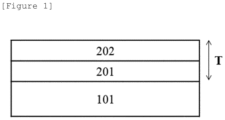
- a silicon-based active material may have low electrical conductivity (due to the intrinsic electrical conductivity properties of the material itself) compared to a carbon-based active material, the uniform distribution of the silicon-based active material in the thickness direction ( Figure 1 , T) of the negative electrode active material layer may be adverse for charging performance (quick charging) because non-uniformity of the entire electrode may be induced in terms of electrical conductivity.
- the silicon-based active material when the silicon-based active material is included only in the second negative electrode active material layer in a two-layered structure (layer 202 illustrated in Figure 1 ), being said second negative electrode active material layer disposed onto a first negative electrode active material layer (layer 201 illustrated in Figure 1 ) comprising carbon-based active material provided on the current collector (101), results in that the silicon-based material is not uniformly distributed in the thickness direction (T). Moreover, since the silicon-based material does not diffuse from the second layer (layer 202) towards the first layer (layer 201), the non-uniform distribution of this material may be maintained after manufacturing of the secondary battery. In this manner, the electrical conductivity is increased, and then the contact resistance between each layer is decreased.
- the above effect can be maximized by additionally adding a lithium-substituted carboxymethyl cellulose, which has high electrical/ion mobility of Li, in one or in two of the two negative electrode active material layers.
- a lithium-substituted carboxymethyl cellulose which has high electrical/ion mobility of Li
- the mobility of Li ions is increased, so that the service life durability, which slightly deteriorates when silicon-based active material is included can also be generally maintained, avoiding also the adverse effects in charging performance found when the silicon-based material is included uniformly in the entire negative electrode.
- the anode/separator interface experiences a larger ionic flux of lithium ions than in standard charging. If the negative electrode active material can quickly accept the larger ionic flux of lithium ions, the fast charging performance of the cell can be improved.
- the silicon-based active material accepts lithium ions through alloying and charging starts from a lower potential, the fast charging performance is improved compared to graphite-based negative electrode active materials that accept lithium ions through intercalation.
- the inventors discovered that by placing such a silicon-based active material close to the positive electrode, which is the direction in which the lithium ion flux is first received, that is, by placing it on the upper layer (the second negative electrode active material layer), the silicon-based active material reacts quickly with lithium ions to greatly improve fast charging performance.
- FIG. 1 Schematic cross-section view of a negative electrode according to the present invention comprising a current collector (101), a first negative-electrode active material layer (201) and a second negative-electrode active material layer (202).
- the thickness direction is indicated as T.
- the term “comprise”, “include”, or “have” is intended to indicate the presence of the characteristic, number, step, constituent element, or any combination thereof implemented, and should be understood to mean that the presence or addition possibility of one or more other characteristics or numbers, steps, constituent elements, or any combination thereof is not precluded.
- a case where a part such as a layer is present "above” or "on” another part includes a case where the part is present "immediately above” another part, and also a case where still another part is present therebetween. Conversely, the case where a part is present "immediately above” another part means that no other part is present therebetween.
- a case of being “above” or “on” a reference part means being located above or below the reference part, and does not necessarily mean being located “above” or "on” in the opposite direction of gravity.
- the “upper layer” is the layer disposed farther from the current collector, meaning that the upper layer is the second negative electrode active material layer which is disposed onto the first negative electrode active material layer, being said first negative electrode active material layer disposed onto the current collector.
- the “lower layer” is the layer disposed closer from the current collector, meaning that the lower layer is the first negative electrode active material layer which is disposed onto the current collector.
- the negative electrode for a secondary battery includes: a current collector; a first negative electrode active material layer provided on the current collector; and a second negative electrode active material layer provided on the first negative electrode active material layer, one or two of the first and second negative electrode active material layers comprises a lithium-substituted carboxymethyl cellulose, wherein the first negative electrode active material layer comprises a carbon-based active material, and wherein only the second negative electrode active material layer comprises a silicon-based active material.
- the negative electrode for a secondary battery comprises two layers, including a lithium-substituted carboxymethyl cellulose in one or in two of the two layers, wherein the first negative electrode active material layer, provided on the current collector, comprises a carbon-based active material, and wherein only the second negative electrode active material layer, provided on the first negative electrode active material layer, comprises a silicon-based active material. Distribution of the silicon-based active material can be confirmed through a SEM image of the cross-section of the electrode. Therefore, the region where the silicon-based active material exists can be defined as the second negative electrode active material layer.
- Figure 1 shows an example of an anode (negative electrode) according to the invention comprising a first negative electrode active material layer 201, a second negative electrode active material layer 202, and a current collector 101.
- the present inventors found that adding lithium-substituted carboxymethyl cellulose in one or in both negative electrode active material layers (201, 202) is advantageous for improving the charging performance and securing the service life performance of the battery when compared to a battery in which sodium carboxymethyl cellulose is added in the negative electrode active material layer.
- the lithium-substituted carboxymethyl cellulose may be included in both the first negative electrode active material layer (201) and the second negative electrode active material layer (202), and may be included in the first layer of the first negative electrode active material layer (201) or in the second negative electrode active material layer (202).
- the lithium-substituted carboxymethyl cellulose may be included in a greater amount in the second anode active material layer than in the first anode active material layer, or may be included only in the second anode active material layer.
- one or more layers include a lithium-substituted carboxymethyl cellulose, whereas sodium-substituted carboxymethyl cellulose is not included at all.
- a sodium-substituted carboxymethyl cellulose may also be further included.
- one of the first and second negative electrode active material layers includes a lithium-substituted carboxymethyl cellulose, and the other may include a sodium-substituted carboxymethyl cellulose.
- lithium-substituted carboxymethyl cellulose and sodium-substituted carboxymethyl cellulose are the only carboxymethyl cellulose salts included in the electrode.
- the silicon-based active material includes one or more of SiOx (0 ⁇ x ⁇ 2), SiMy (M is a metal, 1 ⁇ y ⁇ 4), and Si/C. Only one type of the silicon-based active material may be included, or two or more types may be included together.
- the silicon-based active material may be included in an amount of 1 part by weight to 40 parts by weight, such as, 2 part by weight to 20 parts by weight, 3 part by weight to 35 parts by weight, 4 part by weight to 30 parts by weight, 5 part by weight to 25 part by weight, 7 part by weight to 15 part by weight, based on total 100 parts by weight of the active materials included in the second negative electrode active material layer including the silicon-based active material.
- the first negative electrode active material layer includes a carbon-based active material, and only the second negative electrode active material layer includes a silicon-based active material.
- the first negative electrode active material layer, provided on the current collector does not include a silicon-based active material.
- the active material containing SiO x (0 ⁇ x ⁇ 2) as the silicon-based active material may be a silicon-based composite particle including SiO x (0 ⁇ x ⁇ 2) and pores.
- the term composite particle when referred to particles of a silicon-based active material, refers to particles comprising a silicon-based active material composite, optionally other elements or compounds, and pores.
- a composite refers to two or more materials which are physically aggregated but not chemically bonded.
- the silicon-based composite particles comprise a SiO x (0 ⁇ x ⁇ 2) matrix including Si and SiO 2 , wherein the Si may also form a separate phase inside the SiO x matrix. That is, the x corresponds to the number ratio of O for each Si included in the SiO x (0 ⁇ x ⁇ 2). Having a silicon-based active material containing SiO x (0 ⁇ x ⁇ 2) may improve the discharge capacity of a secondary battery.
- the silicon-based composite particles may further include one or more of a Mg compound and a Li compound.
- the Mg compound and Li compound may be included into a matrix in the silicon-based composite particle.
- the Mg compound and/or Li compound may be dispersed inside and/or on the surface of the SiO x (0 ⁇ x ⁇ 2).
- the initial efficiency of the battery may be improved by the Mg compound and/or Li compound.
- the Mg compound may include at least any one selected from the group consisting of Mg silicates, Mg silicides and Mg oxides.
- the Mg silicate may include at least any one selected from the group consisting of Mg 2 SiO 4 and MgSiO 3 .
- the Mg silicide may include Mg 2 Si.
- the Mg oxide may include MgO.
- the Mg element may be included in an amount of 0.1 wt% to 20 wt%, or 0.1 wt% to 10 wt% based on total 100 wt% of the silicon-based active material. Specifically, the Mg element may be included in an amount of 0.1 wt% to 20 wt%, 0.2 wt% to 15 wt%, 0.3 wt% to 10 wt%, 0.4 wt% to 9 wt%, 0.5 wt% to 8 wt%, 0.6 wt% to 7 wt%, 0.7 wt% to 6 wt%, 0.8 wt% to 5 wt%, or 0.8 wt% to 4 wt%.
- the Li compound may include at least any one compound selected from the group consisting of Li silicates, Li silicides and Li oxides.
- the Li silicate may include at least any one selected from the group consisting of Li 2 SiO 3 , Li 4 SiO 4 and Li 2 Si 2 O 5 .
- the Li silicide may include Li 7 Si 2 .
- the Li oxide may include Li 2 O.
- the Li compound may include the form of a lithium silicate.
- the lithium silicate is represented by the formula Li a Si b O c (2 ⁇ a ⁇ 4, 0 ⁇ b ⁇ 2, 2 ⁇ c ⁇ 5) and may be classified into crystalline lithium silicate and amorphous lithium silicate.
- the crystalline lithium silicate in the silicon-based composite particles may be present in the form of one or more of lithium silicates selected from the group consisting of Li 2 SiO 3 , Li 4 SiO 4 and Li 2 Si 2 O 5 , and the amorphous lithium silicate may be in the form of Li a Si b O c (2 ⁇ a ⁇ 4, 0 ⁇ b ⁇ 2, 2 ⁇ c ⁇ 5)
- the Li element may be included in an amount of 0.1 wt% to 20 wt%, or 0.1 wt% to 10 wt% based on total 100 wt% of the silicon-based active material. Specifically, the Li element may be included in an amount of 0.1 wt% to 20 wt%, 0.2 wt% to 15 wt%, 0.3 wt% to 10 wt%, 0.4 wt% to 9 wt%, 0.5 wt% to 8 wt%, 0.6 wt% to 7 wt%, 0.7 wt% to 6 wt%, 0.8 wt% to 5 wt%, more specifically 0.5 wt% to 4 wt%.
- the content of the Mg element or the content of the Li element may be confirmed by ICP (Inductively Coupled Plasma) analysis.
- ICP Inductively Coupled Plasma
- a sample of the negative active material is obtained by, aliquoting a predetermined amount (for example, 0.01 g) of the negative electrode active material, subsequently the negative electrode active material of the sample is decomposed on a hot plate by transferring the aliquot to a platinum crucible and adding nitric acid, hydrofluoric acid, or sulfuric acid thereto.
- a reference calibration curve is prepared by measuring the intensity of a standard liquid of a known concentration prepared using a standard solution of the Mg compound and the Li compound(5 mg/kg) at an intrinsic wavelength of the Mg element or the Li element using an inductively coupled plasma atomic emission spectrometer (ICPAES, Perkin-Elmer 7300).
- ICPAES inductively coupled plasma atomic emission spectrometer
- the previously pre-treated sample solution and a blank sample are each introduced into the apparatus, an actual intensity is calculated by measuring each intensity, the concentration of each compound relative to the prepared calibration curve is calculated, and then the contents of the Mg element or the Li element of the prepared silicon-based active material may be analyzed by converting the total sum so as to be the theoretical value.
- a carbon coating layer may be provided on the surface and/or inside pores of the silicon-based composite particles.
- the carbon coating layer imparts electrical conductivity to the silicon-based composite particles, resulting in that the initial efficiency, service life characteristics, and battery capacity characteristics of a secondary battery including the negative electrode active material comprising the silicon-based composite particles may be improved.
- the total weight of the carbon coating layer may be included in an amount of 5 wt% to 40 wt%, 10 wt% to 30 wt%, 15 wt% to 20 wt%, based on total 100 wt% of the silicon-based composite particles.
- the carbon coating layer may include at least any one of amorphous carbon and crystalline carbon.
- the silicon-based composite particles may have an average particle diameter (D 50 ) of 2 um to 15 um, specifically 3 um to 12 ⁇ m, and more specifically 4 um to 10 um.
- D 50 average particle diameter
- an average particle diameter (D 50 ) may be defined as a particle diameter corresponding to 50% of a cumulative volume in a particle diameter distribution curve of the particles.
- the average particle diameter (D 50 ) may be measured using, for example, a laser diffraction method.
- the laser diffraction method can generally measure a particle diameter of about several mm from the submicron region, and results with high reproducibility and high resolution may be obtained.
- the silicon-based active material including Si/C is a composite particle of silicon(Si) and carbon(C), and is to be distinguished from silicon carbide denoted as SiC.
- the silicon carbon composite particle may be a composite of silicon, graphite, , and may also form a structure in which a core of silicon and graphite composite is surrounded by graphene or amorphous carbon.
- the silicon may be nano-silicon, which is a nano-sized particle of silicon dispersed in the silicon carbon composite.
- the active material including Si/C may have an average particle diameter (D 50 ) of 2 um to 15 um, specifically 3 um to 12 ⁇ m, and more specifically 4 um to 10 um.
- a carbon coating layer may be provided on the surface of the active material composite particle including Si/C.
- the carbon-based active material may be graphite, and the graphite may be natural graphite, artificial graphite, or a mixture thereof.
- the first negative electrode active material layer may comprise an amount of 80 parts by weight or more and 99.8 parts by weight or less of carbon-based negative electrode active material, for example 90 to 99 parts by weight, for example 93 to 97 parts by weight.
- the second negative electrode active material layer may comprise an amount of 60 parts by weight or more and 99 parts by weight or less of carbon-based negative electrode active material, for example from 75 parts by weight or more and 98 parts by weight or less, for example from 85 parts by weight or more and 95 parts by weight or less.
- the negative electrode active material layer may comprise other ingredients or compounds, such as a binder or a conductive material, in addition to the negative active materials.
- the negative electrode active material in 100 parts by weight of the negative electrode active material layer may be included in an amount of 80 parts by weight or more and 99.8 parts by weight or less, for example from 85 parts by weight to 98 parts by weight, from 90 parts by weight to 95 parts by weight, preferably 93 parts by weight or more and 99.8 parts by weight or less, and more preferably 95 parts by weight or more and 98 parts by weight or less.
- one or both of the first and second negative electrode active material layers include a lithium-substituted carboxymethyl cellulose.
- the degree of substitution of a hydroxy (-OH) group by a lithium carboxymethyl group may be 0.1 or more, for example, 0.5 or more, specifically 0.7 to 1.3, or 0.8 to 1.2, and more particularly 0.8 to 1.0.
- the lithium-substituted carboxymethyl cellulose may have a molecular weight (Mn) of 300,000 to 1,000,000, for example, 350,000 to 900,000, from 450,000 to 800,000, from 500,000 to 700,000, and particularly from 500,000 to 900,000.
- Mn molecular weight
- the lithium-substituted carboxymethyl cellulose may also be included in a negative electrode active material layer including a silicon-based active material, and may also be included in a negative electrode active material layer including only a carbon-based active material without including a silicon-based active material.
- the lithium-substituted carboxymethyl cellulose may also be included in the second a negative electrode active material layer including a silicon-based active material and carbon-based active material.
- the lithium-substituted carboxymethyl cellulose may also be included only in the first negative electrode active material layer, only in the second negative electrode active material layer, or in both the first negative electrode active material layer and the second negative electrode active material layer.
- the lithium-substituted carboxymethyl cellulose may be included in an amount of 0.1 to 5 parts by weight, for example, 0.1 to 3 parts by weight, 0.2 to 3 parts by weight, 0.3 to 2 parts by weight, 0.5 to 1 parts by weight based on 100 parts by weight of the total weight of the first and second negative electrode active material layers.
- the lithium-substituted carboxymethyl cellulose may be included in an amount of 0.1 to 5 parts by weight, for example, 0.1 to 3 parts by weight, 0.2 to 3 parts by weight, 0.3 to 2 parts by weight, 0.5 to 1 parts by weight, based on 100 parts by weight of the weight of the first negative electrode active material layer or second negative electrode active material layer including the lithium-substituted carboxymethyl cellulose.
- the negative electrode active material layer may further include a negative electrode binder in addition to the silicon-based active material and the carbon-based active material.
- the negative electrode binder may serve to improve the bonding between negative electrode active material particles and the adhesion between the negative electrode active material particles and the negative electrode current collector.
- the negative electrode binder those known in the art may be used, and non-limiting examples thereof may include at least any one selected from the group consisting of a polyvinylidene fluoride-hexafluoropropylene copolymer (PVDF-co-HFP), polyvinylidene fluoride, polyacrylonitrile, polymethylmethacrylate, polyvinyl alcohol, carboxymethyl cellulose (CMC), starch, hydroxypropyl cellulose, regenerated cellulose, polyvinylpyrrolidone, tetrafluoroethylene, polyethylene, polypropylene, polyacrylic acid, an ethylene-propylene-diene monomer (EPDM), a sulfonated EPDM, styrene butadiene rubber (SBR), fluorine rubber, polyacrylic acid and a material in which the hydrogen thereof
- the negative electrode binder may be included in an amount of 0.1 parts by weight or more and 19.9 parts by weight or less, for example, 0.2 parts by weight or more or 18 parts by weight or less, 0.3 parts by weight or more or
- the negative electrode active material layer may not include a conductive material, but may further include a conductive material, if necessary.
- the conductive material included in the negative electrode active material layer is not particularly limited as long as the conductive material has electrical conductivity without causing a chemical change to the battery, and for example, it is possible to use graphite such as natural graphite or artificial graphite; carbon black such as acetylene black, Ketjen black, channel black, furnace black, lamp black, and thermal black; a conductive fiber such as carbon fiber or metal fiber; a conductive tube such as a carbon nanotube; a metal powder such as a fluorocarbon powder, an aluminum powder, and a nickel powder; a conductive whisker such as zinc oxide and potassium titanate; a conductive metal oxide such as titanium oxide; a conductive material such as polyphenylene derivatives, and the like.
- the content of the conductive material in the negative electrode active material layer may be 0.01 parts by weight to 19.9 parts by weight, 0.05 parts by weight to 18 parts by weight, 0.10 parts by weight to 16 parts by weight, 0.50 parts by weight to 14 parts by weight, 1.50 parts by weight to 12 parts by weight, 3 parts by weight to 10 parts by weight, 5 parts by weight to 8 parts by weight, preferably 0.03 parts by weight to 18 parts by weight, based on 100 parts by weight of the negative electrode active material layer.
- the carbon-based active material is graphite, such as natural graphite or artificial graphite
- the parts by weight of the graphite used as carbon-based active material are not to be taken into consideration when defining the total parts by weight of conductive material.
- the conductive material selected according for the negative electrode is graphite
- the parts by weight of conductive material described are not to be included when defining the total parts by weight of carbon-based negative electrode active material.
- the total parts by weight of graphite correspond to the addition of the parts by weight of graphite used as carbon-based negative electrode active material and of the parts by weight of graphite used as negative electrode conductive material.
- the conductive material included in the negative electrode active material layer is, for example, carbon black such as acetylene black, Ketjen black, channel black, furnace black, lamp black, and thermal black; a conductive fiber such as carbon fiber or metal fiber; a conductive tube such as a carbon nanotube.
- each of the first and second negative electrode active material layers may have a thickness of 30 ⁇ m or more and 100 ⁇ m or less, for example, 35 ⁇ m or more and 90 ⁇ m or less, 40 ⁇ m or more and 80 ⁇ m or less, 45 ⁇ m or more and 75 ⁇ m or less, 50 ⁇ m or more and 60 ⁇ m or less.
- the sum of the thicknesses of the first and second negative electrode active material layers may be 90 ⁇ m or more and 150 ⁇ m or less, 100 ⁇ m or more and 140 ⁇ m or less, 110 ⁇ m or more and 130 ⁇ m or less.
- the negative electrode current collector is sufficient as long as the negative electrode current collector has electrical conductivity without causing a chemical change to the battery, and is not particularly limited.
- the current collector it is possible to use copper, stainless steel, aluminum, nickel, titanium, fired carbon, or aluminum or stainless steel whose surface is treated with carbon, nickel, titanium, silver, and the like.
- a transition metal such as copper or nickel which adsorbs carbon well, may be used as a current collector.
- the current collector may have a thickness of 1 ⁇ m to 50 ⁇ m, for example 2 ⁇ m to 40 ⁇ m, 5 ⁇ m to 30 ⁇ m, 10 ⁇ m to 20 ⁇ m, the thickness of the current collector is not limited thereto.
- An additional embodiment of the present specification provides a secondary battery including the negative electrode according to the above-described embodiment, a positive electrode, and a separator.
- the positive electrode includes a positive electrode current collector and a positive electrode active material layer formed on the positive electrode current collector, the positive electrode active material layer including a positive electrode active material.
- the positive electrode active material layer may have a thickness of 20 um or more and 500 ⁇ m or less, 50 ⁇ m or more and 300 ⁇ m or less, 100 um or more and 250 ⁇ m or less.
- the positive electrode current collector is not particularly limited as long as the collector has electrical conductivity without causing a chemical change to a battery, and for example, it is possible to use stainless steel, aluminum, nickel, titanium, calcined carbon, or aluminum or stainless steel whose surface is treated with carbon, nickel, titanium, silver, and the like. Further, the positive electrode current collector may typically have a thickness of 1 to 50 ⁇ m, for example 2 ⁇ m to 40 ⁇ m, 5 ⁇ m to 30 ⁇ m, 10 ⁇ m to 20 ⁇ m, and the adhesion of the positive electrode active material may also be enhanced by forming fine irregularities on the surface of the current collector. For example, the positive electrode current collector may be used in various forms such as a film, a sheet, a foil, a net, a porous body, a foam body, and a non-woven fabric body.
- the positive electrode may include a lithium composite transition metal compound, including nickel (Ni) and cobalt (Co), as an active material.
- the lithium composite transition metal compound may further include one or both of manganese and aluminum.
- the lithium composite transition metal compound may include 80 mol% or more, for example, 80 mol% or more and less than 100 mol% of nickel among metals except for lithium.
- the positive electrode active material in 100 parts by weight of the positive electrode active material layer may be included in an amount of 80 parts by weight or more and 99.9 parts by weight or less, 90 parts by weight or more and 99 parts by weight or less, 95 parts by weight or more and 98 parts by weight or less, preferably 90 parts by weight or more and 99.9 parts by weight or less, and more preferably 95 parts by weight or more and 99.9 parts by weight or less.
- the positive electrode active material layer according to the above-described embodiment may further include a positive electrode binder and a conductive material.
- the positive electrode binder may serve to improve the bonding between positive electrode active material particles and the adhesion between the positive electrode active material particles and the positive electrode current collector.
- the positive electrode binder include polyvinylidene fluoride (PVDF), a vinylidene fluoride-hexafluoropropylene copolymer (PVDF-co-HFP), polyvinyl alcohol, polyacrylonitrile, carboxymethyl cellulose (CMC), starch, hydroxypropyl cellulose, regenerated cellulose, polyvinylpyrrolidone, tetrafluoroethylene, polyethylene, polypropylene, an ethylene-propylene-diene monomer (EPDM), a sulfonated EPDM, styrene-butadiene rubber (SBR), fluorine rubber, or various copolymers thereof, and any one thereof or a mixture of two or more thereof may be used.
- PVDF polyvinylidene fluoride
- PVDF-co-HFP vinyli
- the positive electrode binder may be included in an amount of 0.1 parts by weight or more and 20 parts by weight or less, for example, preferably 0.3 parts by weight or more and 18 parts by weight or less, and more preferably 0.5 parts by weight or more and 15 parts by weight or less, based on 100 parts by weight of the positive electrode active material layer.
- the conductive material included in the positive electrode active material layer is used to impart electrical conductivity to the electrode, and can be used without particular limitation as long as the conductive material has electrical conductivity without causing a chemical change in a battery.
- Specific examples thereof include graphite such as natural graphite or artificial graphite; a carbon-based material such as carbon black, acetylene black, Ketjen black, channel black, furnace black, lamp black, thermal black, carbon fiber, and carbon nanotubes; metal powder or metal fiber such as copper, nickel, aluminum, and silver; a conductive whisker such as zinc oxide and potassium titanate; a conductive metal oxide such as titanium oxide; or a conductive polymer such as a polyphenylene derivative, and any one thereof or a mixture of two or more thereof may be used.
- the conductive material may include one or more of a single-walled carbon nanotube (SWCNT); and a multi-walled carbon nanotube (MWCNT).
- the conductive material may be included in an amount of 0.1 parts by weight or more and 10 parts by weight or less, for example, preferably 0.2 parts by weight or more and 7 parts by weight or less, and more preferably 0.3 parts by weight or more and 5 parts by weight or less, based on 100 parts by weight of a composition for the positive electrode active material layer.
- the sum of weights of the first and second negative electrode active material layers of the negative electrode may be 170 to 280 mg/25 cm 2 .
- the weight is a value based on the weight after drying(solid content) except for the solvent. This range is advantageous for high energy density and quick charging characteristics.
- the positive electrode and the negative electrode may be manufactured by a method for manufacturing a positive electrode and a negative electrode in the related art, except that the aforementioned positive electrode and negative electrode active materials are used. Specifically, after a composition for forming an active material layer, which includes the aforementioned active material and, optionally, a binder and a conductive material is applied onto current collectors, the positive electrode and negative electrode may be manufactured by drying and rolling the current collectors. In this case, the types and contents of the positive and negative electrode active materials, binders, and conductive materials are as described above.
- the solvent may be a solvent commonly used in the art, examples thereof include dimethyl sulfoxide (DMSO), isopropyl alcohol, N-methylpyrrolidone (NMP), acetone, water, or the like, and among them, any one thereof or a mixture of two or more thereof may be used.
- the amount of solvent used is sufficient as long as the solvent in the amount dissolves or disperses the active material, conductive material and binder in consideration of the application thickness of the slurry and preparation yield, and has a viscosity capable of exhibiting excellent thickness uniformity during subsequent application for manufacturing the positive electrode and the negative electrode.
- the positive electrode and the negative electrode may be manufactured by casting the composition for forming an active material layer on a separate support and then laminating a film obtained by performing peel-off from the support on a current collector.
- the separator separates the negative electrode and the positive electrode and provides a passage for movement of lithium ions, and can be used without particular limitation as long as the separator is typically used as a separator in a secondary battery, and in particular, a separator having an excellent ability to retain moisture of an electrolytic solution as well as low resistance to ion movement in the electrolyte is preferable.
- a porous polymer film for example, a porous polymer film formed of a polyolefin-based polymer such as an ethylene homopolymer, a propylene homopolymer, an ethylene/butene copolymer, an ethylene/hexene copolymer, and an ethylene/methacrylate copolymer, or a laminated structure of two or more layers thereof.
- a typical porous non-woven fabric for example, a non-woven fabric made of a glass fiber having a high melting point, a polyethylene terephthalate fiber, and the like may also be used.
- a coated separator including a ceramic component or a polymeric material may be used to secure heat resistance or mechanical strength and may be selectively used as a single-layered or multi-layered structure.
- Examples of the electrolyte include an organic liquid electrolyte, an inorganic liquid electrolyte, a solid polymer electrolyte, a gel-type polymer electrolyte, a solid inorganic electrolyte, a molten-type inorganic electrolyte, and the like, which can be used in the preparation of a lithium secondary battery, but are not limited thereto.
- the electrolyte may include a non-aqueous organic solvent and a metal salt.
- an aprotic organic solvent such as N-methyl-2-pyrrolidinone, propylene carbonate, ethylene carbonate, butylene carbonate, dimethyl carbonate, diethyl carbonate, ⁇ -butyrolactone, 1,2-dimethoxy ethane, tetrahydrofuran, 2-methyl tetrahydrofuran, dimethyl sulfoxide, 1,3-dioxolane, formamide, dimethylformamide, dioxolane, acetonitrile, nitromethane, methyl formate, methyl acetate, phosphate triester, trimethoxy methane, a dioxolane derivative, sulfolane, methyl sulfolane, 1,3-dimethyl-2-imidazolidinone, a propylene carbonate derivative, a tetrahydrofuran derivative, ether, methyl propionate, and ethylene carbonate derivative, a tetrahydrofuran derivative, ether
- ethylene carbonate and propylene carbonate which are cyclic carbonates may be preferably used because the cyclic carbonates have high permittivity as organic solvents of a high viscosity and thus dissociate a lithium salt well, and such cyclic carbonates may be more preferably used since the cyclic carbonate may be mixed with a linear carbonate of a low viscosity and low permittivity such as dimethyl carbonate and diethyl carbonate in an appropriate ratio and used to prepare an electrolyte having a high electrical conductivity.
- a lithium salt may be used, the lithium salt is a material which is easily dissolved in the non-aqueous electrolyte solution, and for example, as an anion of the lithium salt, it is possible to use one or more selected from the group consisting of F-, Cl-, I-, NO 3 -, N(CN) 2 -, BF 4 -, ClO 4 -, PF 6 -, (CF 3 ) 2 PF 4 -, (CF 3 ) 3 PF 3 -, (CF 3 ) 4 PF 2 -, (CF 3 ) 5 PF-, (CF 3 ) 6 P-, CF 3 SO 3 -, CF 3 CF 2 SO 3 -, (CF 3 SO 2 ) 2 N-, (FSO 2 ) 2 N-, CF 3 CF 2 (CF 3 ) 2 CO-, (CF 3 SO 2 ) 2 CH-, (SF 5 ) 3 C-, (CF 3 SO 2 ) 3 C-, CF 3 (CF 2 )
- one or more additives may be further included in addition to the above electrolyte constituent components, such as, for example, a halo-alkylene carbonate-based compound such as difluoroethylene carbonate, pyridine, triethylphosphite, triethanolamine, cyclic ether, ethylenediamine, n-glyme, hexaphosphoric triamide, a nitrobenzene derivative, sulfur, a quinone imine dye, N-substituted oxazolidinone, N,N-substituted imidazolidine, ethylene glycol dialkyl ether, an ammonium salt, pyrrole, 2-methoxy ethanol, or aluminum trichloride.
- a halo-alkylene carbonate-based compound such as difluoroethylene carbonate, pyridine, triethylphosphite, triethanolamine, cyclic ether, ethylenediamine, n-glyme, hexaphosphoric
- the secondary battery according to an embodiment of the present invention includes an assembly including a positive electrode, a negative electrode, a separator and an electrolyte, and may be a lithium secondary battery.
- the secondary battery according to an embodiment of the present invention may be also defined as a unit cell.
- an additional embodiment of the present invention provides a battery module including the above-described secondary battery as a unit cell and a battery pack including the same.
- the battery module and the battery pack include the secondary battery which has high capacity, high rate properties and cycle properties, and thus, may be used as a power source of a medium-and-large sized device selected from the group consisting of an electric vehicle, a hybrid electric vehicle, a plug-in hybrid electric vehicle, and a power storage system.
- the secondary battery may be used as a power source for portable devices such as mobile phones, notebook-sized computers and digital cameras, and medium-and-large sized devices selected from the group consisting of electric vehicles, hybrid electric vehicles, plug-in hybrid electric vehicles, and power storage systems.
- the battery module or battery pack may be used as a power source for one or more medium-and-large sized devices of a power tool; an electric vehicle including an electric vehicle (EV), a hybrid electric vehicle and a plug-in hybrid electric vehicle (PHEV); and a power storage system.
- EV electric vehicle
- PHEV plug-in hybrid electric vehicle
- a lithium composite transition metal compound including nickel (Ni), cobalt (Co) and manganese (Mn) at an atomic ratio of 84:8:8 as a positive electrode active material and doped with aluminum (Al), a conductive material (CNT) and a binder (PVDF) at a weight ratio of 97 : 1 : 2 were put into a methylpyrrolidone (NMP) solvent to prepare a negative electrode slurry (a positive electrode slurry solid content was included in an amount of 70 parts by weight based on the entire positive electrode slurry).
- NMP methylpyrrolidone
- the positive electrode slurry prepared above was applied on an Al current collector, dried, and then rolled at room temperature to manufacture a positive electrode.
- a carbon-based active material artificial graphite and natural graphite are included at a weight ratio of 8:2
- a conductive material carbon black
- a binder SBR
- a thickener Li-CMC
- a negative electrode active material including a Mg-doped SiO active material and a carbon-based active material artificial graphite and natural graphite are included at a weight ratio of 8:2
- the Mg-doped SiO active material is included in an amount of 5 parts by weight based on 100 parts by weight of the entire negative electrode active material (10 parts by weight based on 100 parts by weight of the negative electrode active material in the second negative electrode active material layer)
- a conductive material carbon black
- SBR binder
- Li-CMC thickener
- the second negative electrode active material layer slurry was sequentially applied onto the first negative electrode active material layer, the first and second negative electrode active material layers were dried simultaneously, and then rolled at room temperature to manufacture a negative electrode.
- a separator was interposed between the positive electrode and the negative electrode manufactured as described above and assembled, and an electrolyte solution was injected, and then activated to manufacture a cell.
- An electrode and a cell were manufactured in the same manner as in Example 1, except that Na-CMC was used instead of Li-CMC as a slurry thickener for the first negative electrode active material layer.
- An electrode and a cell were manufactured in the same manner as in Example 1, except that Na-CMC was used instead of Li-CMC as a slurry thickener for the second negative electrode active material layer.
- Example 1 An electrode and a cell were manufactured in the same manner as in Example 1, except that the slurry of the second negative electrode active material layer in Example 1 was used as the slurry of the first negative electrode active material layer to be first applied onto the Cu current collector, and the first negative electrode active material layer slurry in Example 1 was used as the slurry of the second negative electrode active material layer to be sequentially applied onto the first negative electrode active material layer.
- An electrode and a cell were manufactured in the same manner as in Example 1, except that a negative electrode active material layer including a Mg-doped SiO active material and a carbon-based active material (including artificial graphite and natural graphite at a weight ratio of 8:2) was used instead of the carbon-based active material of the first negative electrode active material layer slurry, and the Mg-doped SiO active material included in both the first negative electrode active material layer and the second negative electrode active material layer was included in an amount of 5 parts by weight based on 100 parts by weight of all the negative electrode active materials.
- a negative electrode active material layer including a Mg-doped SiO active material and a carbon-based active material including artificial graphite and natural graphite at a weight ratio of 8:2
- An electrode and a cell were manufactured in the same manner as in Example 1, except that Na-CMC was used instead of Li-CMC as a slurry thickener for the first negative electrode active material layer and the second negative electrode active material layer.
- An electrode and a cell were manufactured in the same manner as in Comparative Example 1, except that only a carbon-based active material was used as a negative electrode active material in both the first negative electrode active material layer and second negative electrode active material layer slurries to manufacture a negative electrode.
- An electrode and a cell were manufactured in the same manner as in Comparative Example 2, except that the first negative electrode active material layer slurry in Comparative Example 2 was applied as a single layer onto the Cu current collector (the thickness of the single layer is the same as that of the first and second negative electrode active material layers of Comparative Example 2), and the second negative electrode active material layer was not formed.
- An electrode and a cell were manufactured in the same manner as in Comparative Example 2, except that Na-CMC was included instead of Li-CMC as the thickener of the first negative electrode active material layer slurry in Comparative Example 2, the slurry was applied as a single layer onto the Cu current collector, and the second negative electrode active material layer was not formed.
- the third discharge capacity was measured by constant current/constant voltage (CC/CV) charging (0.05 C-cut) and 0.33 C constant current (CC) discharging (2.5 V-cut) the manufactured cell three times to 4.2 V at 0.33 C. Thereafter, after charging as described above, the SOC was set to 50% by discharging at 0.33 C, and pulse discharging was performed at 2.5 C for 10 seconds to measure the resistance (initial resistance). The results are shown in the following Table 2.
- the charging capacity according to the C-rate was measured by constant current/constant voltage (CC/CV) charging (0.05 C-cut), 0.33 C constant current (CC) discharging (2.5 V-cut) the manufactured cell to 4.2 V at each C-rate (0.1 C/2.0 C). Based on the measured charge capacity, the cell charge C-rate performance (2.0 C charge capacity/0.1 C charge capacity x 100) was calculated and shown in Table 2.
- CC/CV constant current/constant voltage
- Cycle was performed by constant current/constant voltage (CC/CV) charging (0.05 C-cut) and 0.33 C constant current (CC) discharging (2.5 V-cut) the manufactured cell to 4.2 V at 0.33 C at high temperature (45°C).
- CC/CV constant current/constant voltage
- CC constant current
- CC constant current
Landscapes
- Chemical & Material Sciences (AREA)
- Chemical Kinetics & Catalysis (AREA)
- Electrochemistry (AREA)
- General Chemical & Material Sciences (AREA)
- Engineering & Computer Science (AREA)
- Inorganic Chemistry (AREA)
- Composite Materials (AREA)
- Materials Engineering (AREA)
- Manufacturing & Machinery (AREA)
- Battery Electrode And Active Subsutance (AREA)
Priority Applications (1)
| Application Number | Priority Date | Filing Date | Title |
|---|---|---|---|
| EP25194019.3A EP4621884A3 (de) | 2022-09-30 | 2023-09-26 | Negativelektrode und sekundärbatterie |
Applications Claiming Priority (1)
| Application Number | Priority Date | Filing Date | Title |
|---|---|---|---|
| KR20220125384 | 2022-09-30 |
Related Child Applications (1)
| Application Number | Title | Priority Date | Filing Date |
|---|---|---|---|
| EP25194019.3A Division EP4621884A3 (de) | 2022-09-30 | 2023-09-26 | Negativelektrode und sekundärbatterie |
Publications (2)
| Publication Number | Publication Date |
|---|---|
| EP4345935A2 true EP4345935A2 (de) | 2024-04-03 |
| EP4345935A3 EP4345935A3 (de) | 2024-06-26 |
Family
ID=88204151
Family Applications (2)
| Application Number | Title | Priority Date | Filing Date |
|---|---|---|---|
| EP25194019.3A Pending EP4621884A3 (de) | 2022-09-30 | 2023-09-26 | Negativelektrode und sekundärbatterie |
| EP23199856.8A Pending EP4345935A3 (de) | 2022-09-30 | 2023-09-26 | Negativelektrode und sekundärbatterie |
Family Applications Before (1)
| Application Number | Title | Priority Date | Filing Date |
|---|---|---|---|
| EP25194019.3A Pending EP4621884A3 (de) | 2022-09-30 | 2023-09-26 | Negativelektrode und sekundärbatterie |
Country Status (3)
| Country | Link |
|---|---|
| US (2) | US20240113283A1 (de) |
| EP (2) | EP4621884A3 (de) |
| KR (1) | KR102823363B1 (de) |
Family Cites Families (5)
| Publication number | Priority date | Publication date | Assignee | Title |
|---|---|---|---|---|
| JP2014022039A (ja) * | 2012-07-12 | 2014-02-03 | Dai Ichi Kogyo Seiyaku Co Ltd | リチウム二次電池用負極バインダー |
| JP6400391B2 (ja) * | 2013-09-18 | 2018-10-03 | 株式会社東芝 | 非水電解質電池 |
| CN112018328B (zh) * | 2020-09-21 | 2021-07-06 | 珠海冠宇电池股份有限公司 | 一种掺硅负极片及包括该负极片的锂离子电池 |
| JP7150797B2 (ja) * | 2020-11-05 | 2022-10-11 | プライムプラネットエナジー&ソリューションズ株式会社 | 非水電解質二次電池用負極板の製造方法 |
| CN114975860B (zh) * | 2022-06-28 | 2024-05-07 | 重庆冠宇电池有限公司 | 一种负极片和电池 |
-
2023
- 2023-09-26 EP EP25194019.3A patent/EP4621884A3/de active Pending
- 2023-09-26 KR KR1020230129257A patent/KR102823363B1/ko active Active
- 2023-09-26 EP EP23199856.8A patent/EP4345935A3/de active Pending
- 2023-09-27 US US18/373,614 patent/US20240113283A1/en active Pending
-
2025
- 2025-07-21 US US19/275,196 patent/US20250349838A1/en active Pending
Also Published As
| Publication number | Publication date |
|---|---|
| US20240113283A1 (en) | 2024-04-04 |
| US20250349838A1 (en) | 2025-11-13 |
| KR102823363B1 (ko) | 2025-06-20 |
| EP4621884A2 (de) | 2025-09-24 |
| KR20240046065A (ko) | 2024-04-08 |
| EP4621884A3 (de) | 2025-10-22 |
| EP4345935A3 (de) | 2024-06-26 |
Similar Documents
| Publication | Publication Date | Title |
|---|---|---|
| KR20250006786A (ko) | 이차 전지 | |
| CN118661281A (zh) | 负极和二次电池 | |
| EP4345941A1 (de) | Negativelektrode und sekundärbatterie | |
| EP4345935A2 (de) | Negativelektrode und sekundärbatterie | |
| US12463197B2 (en) | Negative electrode and lithium secondary battery | |
| KR102874013B1 (ko) | 리튬 이차 전지 | |
| KR102790552B1 (ko) | 리튬이차전지 및 이의 제조방법 | |
| EP4528845A1 (de) | Negativelektrode und sekundärbatterie | |
| EP4557406A1 (de) | Lithiumsekundärbatterie | |
| US20250391848A1 (en) | Positive Electrode and Secondary Battery | |
| EP4539136A1 (de) | Negativelektrode und sekundärbatterie | |
| KR102756625B1 (ko) | 이차 전지 | |
| KR102798287B1 (ko) | 음극 및 이차전지 | |
| EP4531131A1 (de) | Positivelektrode und sekundärbatterie | |
| EP4459697A1 (de) | Negativelektrode und sekundärbatterie | |
| EP4451400A1 (de) | Lithiumsekundärbatterie | |
| CN120955085A (zh) | 负极和二次电池 | |
| KR20250048670A (ko) | 리튬이차전지 및 이의 제조방법 | |
| KR20240052676A (ko) | 음극 및 이차전지 | |
| EP4521480A1 (de) | Positivelektrodenzusammensetzung, positivelektrode und sekundärbatterie | |
| KR20240046048A (ko) | 양극 조성물, 양극 및 이차전지 |
Legal Events
| Date | Code | Title | Description |
|---|---|---|---|
| PUAI | Public reference made under article 153(3) epc to a published international application that has entered the european phase |
Free format text: ORIGINAL CODE: 0009012 |
|
| STAA | Information on the status of an ep patent application or granted ep patent |
Free format text: STATUS: REQUEST FOR EXAMINATION WAS MADE |
|
| 17P | Request for examination filed |
Effective date: 20230926 |
|
| AK | Designated contracting states |
Kind code of ref document: A2 Designated state(s): AL AT BE BG CH CY CZ DE DK EE ES FI FR GB GR HR HU IE IS IT LI LT LU LV MC ME MK MT NL NO PL PT RO RS SE SI SK SM TR |
|
| PUAL | Search report despatched |
Free format text: ORIGINAL CODE: 0009013 |
|
| AK | Designated contracting states |
Kind code of ref document: A3 Designated state(s): AL AT BE BG CH CY CZ DE DK EE ES FI FR GB GR HR HU IE IS IT LI LT LU LV MC ME MK MT NL NO PL PT RO RS SE SI SK SM TR |
|
| RIC1 | Information provided on ipc code assigned before grant |
Ipc: H01M 4/62 20060101ALI20240523BHEP Ipc: H01M 4/587 20100101ALI20240523BHEP Ipc: H01M 4/485 20100101ALI20240523BHEP Ipc: H01M 4/48 20100101ALI20240523BHEP Ipc: H01M 4/38 20060101ALI20240523BHEP Ipc: H01M 4/36 20060101ALI20240523BHEP Ipc: H01M 4/133 20100101ALI20240523BHEP Ipc: H01M 4/13 20100101AFI20240523BHEP |
|
| STAA | Information on the status of an ep patent application or granted ep patent |
Free format text: STATUS: EXAMINATION IS IN PROGRESS |
|
| 17Q | First examination report despatched |
Effective date: 20250624 |