EP4345003A1 - Antriebssystem für ein luftfahrzeug - Google Patents
Antriebssystem für ein luftfahrzeug Download PDFInfo
- Publication number
- EP4345003A1 EP4345003A1 EP22198570.8A EP22198570A EP4345003A1 EP 4345003 A1 EP4345003 A1 EP 4345003A1 EP 22198570 A EP22198570 A EP 22198570A EP 4345003 A1 EP4345003 A1 EP 4345003A1
- Authority
- EP
- European Patent Office
- Prior art keywords
- rotor blades
- fuselage
- rotors
- propulsion system
- radar
- Prior art date
- Legal status (The legal status is an assumption and is not a legal conclusion. Google has not performed a legal analysis and makes no representation as to the accuracy of the status listed.)
- Granted
Links
Images


Classifications
-
- B—PERFORMING OPERATIONS; TRANSPORTING
- B64—AIRCRAFT; AVIATION; COSMONAUTICS
- B64D—EQUIPMENT FOR FITTING IN OR TO AIRCRAFT; FLIGHT SUITS; PARACHUTES; ARRANGEMENT OR MOUNTING OF POWER PLANTS OR PROPULSION TRANSMISSIONS IN AIRCRAFT
- B64D33/00—Arrangement in aircraft of power plant parts or auxiliaries not otherwise provided for
- B64D33/02—Arrangement in aircraft of power plant parts or auxiliaries not otherwise provided for of combustion air intakes
-
- B—PERFORMING OPERATIONS; TRANSPORTING
- B64—AIRCRAFT; AVIATION; COSMONAUTICS
- B64D—EQUIPMENT FOR FITTING IN OR TO AIRCRAFT; FLIGHT SUITS; PARACHUTES; ARRANGEMENT OR MOUNTING OF POWER PLANTS OR PROPULSION TRANSMISSIONS IN AIRCRAFT
- B64D7/00—Arrangement of military equipment, e.g. armaments, armament accessories or military shielding, in aircraft; Adaptations of armament mountings for aircraft
-
- B—PERFORMING OPERATIONS; TRANSPORTING
- B64—AIRCRAFT; AVIATION; COSMONAUTICS
- B64C—AEROPLANES; HELICOPTERS
- B64C1/00—Fuselages; Constructional features common to fuselages, wings, stabilising surfaces or the like
- B64C1/16—Fuselages; Constructional features common to fuselages, wings, stabilising surfaces or the like specially adapted for mounting power plant
-
- B—PERFORMING OPERATIONS; TRANSPORTING
- B64—AIRCRAFT; AVIATION; COSMONAUTICS
- B64C—AEROPLANES; HELICOPTERS
- B64C11/00—Propellers, e.g. of ducted type; Features common to propellers and rotors for rotorcraft
- B64C11/001—Shrouded propellers
-
- B—PERFORMING OPERATIONS; TRANSPORTING
- B64—AIRCRAFT; AVIATION; COSMONAUTICS
- B64D—EQUIPMENT FOR FITTING IN OR TO AIRCRAFT; FLIGHT SUITS; PARACHUTES; ARRANGEMENT OR MOUNTING OF POWER PLANTS OR PROPULSION TRANSMISSIONS IN AIRCRAFT
- B64D33/00—Arrangement in aircraft of power plant parts or auxiliaries not otherwise provided for
- B64D33/08—Arrangement in aircraft of power plant parts or auxiliaries not otherwise provided for of power plant cooling systems
-
- B—PERFORMING OPERATIONS; TRANSPORTING
- B64—AIRCRAFT; AVIATION; COSMONAUTICS
- B64D—EQUIPMENT FOR FITTING IN OR TO AIRCRAFT; FLIGHT SUITS; PARACHUTES; ARRANGEMENT OR MOUNTING OF POWER PLANTS OR PROPULSION TRANSMISSIONS IN AIRCRAFT
- B64D47/00—Equipment not otherwise provided for
-
- B—PERFORMING OPERATIONS; TRANSPORTING
- B64—AIRCRAFT; AVIATION; COSMONAUTICS
- B64U—UNMANNED AERIAL VEHICLES [UAV]; EQUIPMENT THEREFOR
- B64U20/00—Constructional aspects of UAVs
- B64U20/10—Constructional aspects of UAVs for stealth, e.g. reduction of cross-section detectable by radars
-
- B—PERFORMING OPERATIONS; TRANSPORTING
- B64—AIRCRAFT; AVIATION; COSMONAUTICS
- B64U—UNMANNED AERIAL VEHICLES [UAV]; EQUIPMENT THEREFOR
- B64U20/00—Constructional aspects of UAVs
- B64U20/90—Cooling
-
- B—PERFORMING OPERATIONS; TRANSPORTING
- B64—AIRCRAFT; AVIATION; COSMONAUTICS
- B64U—UNMANNED AERIAL VEHICLES [UAV]; EQUIPMENT THEREFOR
- B64U50/00—Propulsion; Power supply
- B64U50/10—Propulsion
- B64U50/13—Propulsion using external fans or propellers
- B64U50/14—Propulsion using external fans or propellers ducted or shrouded
Definitions
- the present invention relates to a propulsion system for an aerial vehicle and a method for manufacturing a propulsion system and, in particular, to an aerial vehicle propulsion system with low radar observability.
- Aerial vehicles are maned or unmanned flying vehicles like airplanes, helicopters or drones and may have a propeller-based propulsion system. This provides the advantages such as a low noise emission and fuel efficiency.
- propeller-based propulsion systems provide a large cross-section for radar signals and are thus easily detectable by radar systems. There are even radar systems that are able to detect the type of aerial vehicle simply by analysing the reflected radar signals from the propellers or rotor blades. For the military use this represents a major problem, because an easy detection of aerial vehicles shall be avoided.
- the present invention relates to a propulsion system for an aerial vehicle with a suppressed radar observability.
- the system comprising: one or more rotors with rotor blades, a fuselage, a tubular channel structure, and a shielding structure.
- the fuselage provides support for the one or more rotors and at least one integrated engine to drive the one or more rotors.
- the rotor blades protrude radially outwards from the fuselage.
- the tubular channel structure circumferentially extends around the fuselage and covers the protruding rotor blades.
- the tubular channel structure includes an inlet and an outlet between which the rotor blades are arranged to drive a propulsion airflow.
- the shielding structure is formed at the inlet and/or at the outlet to shield radar signals and thus to suppress radar detection of the rotor blades.
- the aerial vehicle is manned or unmanned (e.g. a drone).
- the shielding structure and tubular structure may be monolithically be formed, wherein the shielding effect is achieved by a coating or by utilizing a particular form or geometry of tubular structure.
- the fuselage may have rotational symmetric form (e.g. as cylinder or a cigar) and may be attachable to the aerial vehicle.
- the propulsion system comprises a heat sink formed at a portion of the fuselage, where it thermally couples to the shielding structure and to the one or more integrated engine or other heat generating components (e.g. electronic components) to dissipate generated heat to the propulsion airflow passing through the tubular channel structure.
- the shielding structure may thus act as a cooling grid.
- the shielding structure may also extend into the fuselage to provide a direct contact to the engine or the heat generating components.
- the tubular channel structure and/or the shielding structure include(s) one or more of the following materials: a metal, a metallized polymer, carbon or a compound thereof.
- Metal material provides the advantage that it can very efficiently dissipate heat and can absorb energy of radar signals.
- the radar signal absorbing material may be formed as a coating on a base material such as a polymer.
- the shielding structure include one or more of the following: a grating or a lattice or a grid, multiple channels, a plurality of curved airducts, a stealth structure.
- the multiple channels and/or the curved airducts are formed with a predetermined geometry to attenuate a propagation of radar signals along the airflow by adjusting at least one of the following parameters:
- the one or more rotors include at least two rotors rotating in opposite rotational directions.
- 3, 4 or more than 5 or at least 10 rotors are included, which can be driven by one or more engines.
- Embodiments relates also to a method of manufacturing a propulsion system of an aerial vehicle with a suppressed radar observability.
- the method comprises:
- the shielding structure can be formed as gratings allowing multiple channels of airflow, or as curved air guides, or as a stealth structure with edged incident surface for the radar signals (differently inclined flat surfaces).
- embodiments relate propulsion systems with an open ring fuselage rotor that does not provide a large cross-section for radar signals as the conventional propeller-based propulsion systems.
- Embodiments achieve the suppression by a particularly formed tubular channel structure covering the rotor blades and a particular designed shield structure that prevents radar signals - when following the airflow - from any reflection from the blades of the rotors.
- embodiments provide the advantage that by using a rotor-based propulsion the fuel consumption can be reduced in combination with a low noise emission of the propulsion system and an effective suppression of reflections of all radar signals at the aerial vehicle.
- the implementation of various shielding effects such as stealth shielding features in combination with an effective cooling mechanism.
- Fig. 1 depicts a propulsion system for an aerial vehicle according to an embodiment.
- the propulsion system is configured to suppress radar observability and comprises rotors 100a, 100b with respective rotor blades 110a, 110b and a fuselage 200 with a support for the rotors 100a, 100b.
- the propulsion system comprises a first rotor 100a driven by a first engine 210a and a second rotor 100b driven by a second engine 210b.
- only a single engine drives one or more rotors 100.
- the rotor(s) 100 with the rotor blades 110 and the fuselage 200 are formed so that only the rotor blades 110 protrude radially outwards from the fuselage 200.
- the engine(s) may be combustion engine(s) or electro motors and will move the aerial vehicle in the direction D by generating the airflow F.
- the propulsion system further comprises a tubular channel structure 300 which circumferentially extends around the fuselage 200 and accommodates the protruding rotor blades 110.
- the tubular channel structure 300 comprises an inlet 310 and an outlet 320 between which the rotor blades 110 are arranged to drive the airflow F from the inlet 310 to the outlet 320.
- the inlet 310 and the outlet 320 include a respective shielding structure 400 for radar signals to prevent radar detection of the rotor blades 110.
- FIG. 1 the cross-sectional view depicted in Fig. 1 is rotationally symmetric around the axis R so that the tubular structure 300 extends as an outer cylinder around the fuselage 200. It is further understood that the fuselage 200 maybe attached to an aerial vehicle to provide the propulsion force for the aerial vehicle in the direction D.
- the shielding structure 400 may be formed as a grating 410 or a grating structure which extends not only in the area perpendicular to the airflow F but also along the airflow F to form a 3-dimensional (3D) grating.
- the grating 410 may be formed by a plurality of two-dimensional (2D) gratings which are arranged along the airflow F.
- the airflow F propagates through the 3D grating 410 when flowing from the inlet 310 to the outlet 320 and may be formed by a material that includes metal to absorb radar signals inside the exemplary grating structure 410.
- a grating parameter may change within the grating 410 so that electromagnetic waves may easily enter the grating structure 410 but will be absorbed when propagating further along the airflow F.
- a grating pitch or spacing may change along the airflow F. It is also possible that the multiple 2D gratings 410 have a successively lower spacing.
- the shielding structure 400 and/or the tubular structure 300 may comprise or may be formed as a coating with radar absorbing material (RAM), which may comprise a compound of different materials such as iron, carbon, ferrite formed in geometric (micro-) structures to increase the absorption rate. Any know RAM maybe employed for this purpose.
- RAM radar absorbing material
- the shielding structure 400 and/or the tubular structure 300 may comprise as base material a polymer which may be metallized to achieve the desired radar absorption property.
- Fig. 2 depicts another embodiment for the shielding structure 400 provided upstream and downstream from the rotor blades 110 of the rotor 100.
- the inlet 310 on the left-hand side comprises a shielding structure 400 formed as curved channels 430 so that channel walls 435 guide the airflow F along a curved path.
- a shielding structure 400 formed as curved channels 430 so that channel walls 435 guide the airflow F along a curved path.
- the channels 430 may be have a rectangular cross-section perpendicular to the airflow F.
- the curved path when viewed from the front, is formed to hide the blades 110. Thus, they may be invisible. Incoming radar signals will be reflected multiple times by the channel walls 435 before they can reach the rotor blades 110. Reflected signals will be scattered in various directions so that they will unlikely be reflected back to the inlet 310. Furthermore, the channel walls 435 may comprise a material that absorbs radar signal effectively so that each reflection will attenuate the signal and any outgoing signal will have a significant lower power when compared to the original ingoing signal.
- the outlet 320 on the right-hand side comprises a shielding structure 400 formed as a duct structure 420 of multiple channels.
- Each channel of the multiple channel may provide the airflow F an area A and has a length L.
- the geometry of the area A can be chosen differently.
- the ducts 420 may be have various geometries.
- the cross-sectional area can form a rectangle 411 or a circle 412 or irregular 413 and they may be formed in the same way or differently.
- each cross-sectional area 411, 412, 413 can be associated with waveguide cutoff frequency and thus allows a propagation of radio signals only with frequencies above the cutoff frequency (they are high-pass filter). Therefore, according to embodiments, the multiple channels 420 are formed with a geometry such that they filter incoming radar signals.
- the length L can be adjusted accordingly, because the attenuation increases with the length L. Therefore, in addition cross-sectional area 411, 412, 413, the length L may be selected such that radar signals are efficiently absorbed.
- the cross-sectional area together with the length L are such that the particular frequencies of radar signals (e.g. in the C-band, X-band, K-band etc) are highly suppressed when the signals propagate along the airflow.
- embodiments relate to various possibilities for the shielding structure to suppress reflections of incoming radar signals from the blades themselves.
- a particular form of the airduct 420 that guides the airflow F through the propulsion system reduces the radar cross-section.
- the form or design of the inlet 310 could be selected such that no reflections of radar signals are possible.
- a preferred manufacturing technology for these particular forms and shapes of the tubular channel structures 430, 420 would be the additive manufacturing which allows an accurate manufacturing of the geometry and form of the tubular channel structure 300 and/or the shielding structure 400.
- the additive manufacturing can use metal materials to absorb the electromagnetic energy effectively.
- a metallized polymer could be used as a shielding material which is suitable to absorb radar signals very efficiently in air.
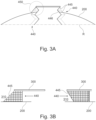
- Fig. 3A depicts another embodiment for the shielding structure 400 which is formed as a stealth structure 440 which is characterized in that the outer surfaces 445 are flat and are joined along edges 446. This provides the technical effect that radar signals are unlikely reflected back their origin, but are scattered into other directions.
- the inlet 310 and/or outlet 320 is formed by a plurality of flat outer surfaces 445 extending around the circumferential direction with respect to the rotational symmetry axis R.
- the stealth structure 440 can be formed by a triangulation using flat triangles and/or rectangles 445 which are connected with each other along edges 446.
- the flat surfaces 445 with sharp edges may act as transmitter to defuse incoming radar signals (scatter them away) into other directions so that they are barely detectable by a radar system.
- the surface normal of these flat surfaces 445 are directed into various directions to support the spreading of the scattered signals.
- Fig. 3B shows further details of the region 450 as a cross-sectional view through a flat surface 445 representing the outer limit of the shielding structure 440. It is understood that the flat surface 445 are also not curved in the direction perpendicular to the drawing plane, i.e. they extend also in the other directions as a flat surface. Furthermore, Fig. 3B illustrates the two possible tilted flat surfaces 445 which are formed along the circumferential direction. In the radial direction, the tilted flat surface 450 can either increase along the airflow F (see left-hand side in Fig. 3B ) or decreases along the flow F (see right-hand side in Fig. 3B ). Different portions along the circumferential direction can be formed by either of these tilted, flat surfaces 445.
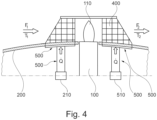
- Fig. 4 depicts another embodiment of the propulsion system, wherein a heat sink 500 is formed at a portion of the fuselage 200.
- the heat sink 500 couples on the one side to the shielding structure 400 (e.g. the grating 410) and on the other side with an engine 210 or another heat generating component 510 (e.g. an electronic equipment).
- the heat sink 500 may be formed by a material (e.g. metal) that efficiently transfers heat to the exemplary grating 410.
- the shielding structure 400 may extend through the fuselage 200 to get into a direct contact with the engine 210 or the heat generating component 510.
- the coupled heat sink 500 can be used to efficiently transfer the heat Q from the engine 210 or the other component 410 to the outgoing airflow F2 higher temperature T2 than the temperature T1 of the incoming airflow F1.
- the shielding structure 400 can in turn be used as a cooling structure (or a cooling grid) to cool the electronic equipment 210, 510 within the fuselage 200.
- the engine 210 can be coupled directly or indirectly to the heat sink 500 which in turn couples to the shielding structure 400 formed by a metallized polymer which allows a sufficient cooling of the propulsion motor 210 of the rotors 100.
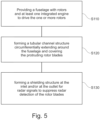
- Fig. 5 shows schematically a flow chart for a method of manufacturing the propulsion system according to embodiments. The method comprises:
- the propulsion system represents a fuselage rotor system providing the advantage of not only being very efficient, but also having a reduced noise emission. This makes them in particular suitable for flying applications such as unmanned aerial vehicles such as drones. Furthermore, the applied shielding structures 400 covers the negative stealth properties of otherwise open rotors which can barely be detected through the shielding structure 400.
Landscapes
- Engineering & Computer Science (AREA)
- Aviation & Aerospace Engineering (AREA)
- Mechanical Engineering (AREA)
- Remote Sensing (AREA)
- Chemical & Material Sciences (AREA)
- Combustion & Propulsion (AREA)
- Radar, Positioning & Navigation (AREA)
- Radar Systems Or Details Thereof (AREA)
Priority Applications (3)
| Application Number | Priority Date | Filing Date | Title |
|---|---|---|---|
| EP22198570.8A EP4345003B1 (de) | 2022-09-29 | 2022-09-29 | Antriebssystem für ein luftfahrzeug |
| KR1020230128298A KR20240045120A (ko) | 2022-09-29 | 2023-09-25 | 항공기용 추진 시스템 |
| IL307337A IL307337A (en) | 2022-09-29 | 2023-09-28 | Propulsion system for aircraft |
Applications Claiming Priority (1)
| Application Number | Priority Date | Filing Date | Title |
|---|---|---|---|
| EP22198570.8A EP4345003B1 (de) | 2022-09-29 | 2022-09-29 | Antriebssystem für ein luftfahrzeug |
Publications (2)
| Publication Number | Publication Date |
|---|---|
| EP4345003A1 true EP4345003A1 (de) | 2024-04-03 |
| EP4345003B1 EP4345003B1 (de) | 2026-02-11 |
Family
ID=83505941
Family Applications (1)
| Application Number | Title | Priority Date | Filing Date |
|---|---|---|---|
| EP22198570.8A Active EP4345003B1 (de) | 2022-09-29 | 2022-09-29 | Antriebssystem für ein luftfahrzeug |
Country Status (3)
| Country | Link |
|---|---|
| EP (1) | EP4345003B1 (de) |
| KR (1) | KR20240045120A (de) |
| IL (1) | IL307337A (de) |
Cited By (1)
| Publication number | Priority date | Publication date | Assignee | Title |
|---|---|---|---|---|
| GB2637899A (en) * | 2023-10-12 | 2025-08-13 | Leonardo UK Ltd | An EMC fluid filter |
Citations (8)
| Publication number | Priority date | Publication date | Assignee | Title |
|---|---|---|---|---|
| US4019699A (en) * | 1974-04-30 | 1977-04-26 | Teledyne Ryan Aeronautical A Division Of Teledyne Industries, Inc. | Aircraft of low observability |
| JPH07257492A (ja) * | 1994-03-22 | 1995-10-09 | Mitsubishi Heavy Ind Ltd | 航空機のインテークダクト |
| WO2002070342A1 (en) * | 2001-03-07 | 2002-09-12 | Eric Ronald Walmsley | Circular vertical take-off and landing aircraft |
| JP2003300500A (ja) * | 2002-04-10 | 2003-10-21 | Mitsubishi Heavy Ind Ltd | 電波吸収装置及び航空機用インテークダクト |
| JP2007168491A (ja) * | 2005-12-19 | 2007-07-05 | Ishikawajima Harima Heavy Ind Co Ltd | 航空機用インテークダクト |
| JP2014070548A (ja) * | 2012-09-28 | 2014-04-21 | Ihi Corp | 再熱装置 |
| EP3244054A1 (de) * | 2015-06-16 | 2017-11-15 | IHI Corporation | Struktur für den hinteren teil eines motors |
| KR102345560B1 (ko) * | 2020-07-31 | 2021-12-29 | 국방과학연구소 | 레이다 블로킹 장치 |
-
2022
- 2022-09-29 EP EP22198570.8A patent/EP4345003B1/de active Active
-
2023
- 2023-09-25 KR KR1020230128298A patent/KR20240045120A/ko active Pending
- 2023-09-28 IL IL307337A patent/IL307337A/en unknown
Patent Citations (8)
| Publication number | Priority date | Publication date | Assignee | Title |
|---|---|---|---|---|
| US4019699A (en) * | 1974-04-30 | 1977-04-26 | Teledyne Ryan Aeronautical A Division Of Teledyne Industries, Inc. | Aircraft of low observability |
| JPH07257492A (ja) * | 1994-03-22 | 1995-10-09 | Mitsubishi Heavy Ind Ltd | 航空機のインテークダクト |
| WO2002070342A1 (en) * | 2001-03-07 | 2002-09-12 | Eric Ronald Walmsley | Circular vertical take-off and landing aircraft |
| JP2003300500A (ja) * | 2002-04-10 | 2003-10-21 | Mitsubishi Heavy Ind Ltd | 電波吸収装置及び航空機用インテークダクト |
| JP2007168491A (ja) * | 2005-12-19 | 2007-07-05 | Ishikawajima Harima Heavy Ind Co Ltd | 航空機用インテークダクト |
| JP2014070548A (ja) * | 2012-09-28 | 2014-04-21 | Ihi Corp | 再熱装置 |
| EP3244054A1 (de) * | 2015-06-16 | 2017-11-15 | IHI Corporation | Struktur für den hinteren teil eines motors |
| KR102345560B1 (ko) * | 2020-07-31 | 2021-12-29 | 국방과학연구소 | 레이다 블로킹 장치 |
Cited By (1)
| Publication number | Priority date | Publication date | Assignee | Title |
|---|---|---|---|---|
| GB2637899A (en) * | 2023-10-12 | 2025-08-13 | Leonardo UK Ltd | An EMC fluid filter |
Also Published As
| Publication number | Publication date |
|---|---|
| EP4345003B1 (de) | 2026-02-11 |
| IL307337A (en) | 2024-04-01 |
| KR20240045120A (ko) | 2024-04-05 |
Similar Documents
| Publication | Publication Date | Title |
|---|---|---|
| US10458336B2 (en) | Apparatus including heat exchanger and sound attenuator for gas turbine engine | |
| CN114458453B (zh) | 连续自由度声核心 | |
| US20180231027A1 (en) | Apparatus including heat exchanger and sound attenuator for gas turbine engine | |
| EP3112269B1 (de) | Flugzeugmotorgondel | |
| EP1411225B1 (de) | Akustischer Einsatz für ein Gasturbinentriebwerk | |
| EP1115967B1 (de) | Verminderung des lärms von bläsern mittels anpassbaren herschel-quincke röhren | |
| US5947412A (en) | Jet engine noise suppressor assembly | |
| US9057329B2 (en) | Turboprop engine systems with noise reducing inlet assemblies | |
| DE69805800T2 (de) | Umlenkschaufel für eine einrichtung zur infrarotstrahlungsabschirmung | |
| CN108603442B (zh) | 表面热交换器和声学处理 | |
| US9719466B2 (en) | System and method for improved thrust reverser with increased reverse thrust and reduced noise | |
| JP2002511128A (ja) | 赤外線放射を抑制するための多段混合器/放出器 | |
| EP1582730A1 (de) | Vorrichtung zur Abführung von Abgasen aus Gasturbinentriebwerken | |
| EP4345003A1 (de) | Antriebssystem für ein luftfahrzeug | |
| JP7544398B2 (ja) | 圧力変動吸収構造体 | |
| CN113378488B (zh) | 一种航空发动机前向雷达隐身性能提升方法 | |
| CN113490787B (zh) | 包括热空气除冰流的通风口的飞行器涡轮喷射引擎短舱的进气管 | |
| JPH0319366B2 (de) | ||
| DE102007019762A1 (de) | Schallschutzvorrichtung für ein Strahltriebwerk oder eine Turbine | |
| EP4144649A1 (de) | Ummantelter gebläsemotor mit akustikauskleidung | |
| JP2015068264A (ja) | 航空機エンジンの反射電磁波減衰構造 | |
| US20240367809A1 (en) | Inlet and outlet air geometry and components to reduce noise from an aircraft component enclosure | |
| Kekus-Kumor et al. | Ducted Co-Rotating Rotors as an Alternative for UAV Propulsion: An Experimental Aeroacoustic Study | |
| RU2784639C1 (ru) | Устройство радиолокационной маскировки самолетного двигателя | |
| US20240229737A1 (en) | Fluidic propulsion system enclosure |
Legal Events
| Date | Code | Title | Description |
|---|---|---|---|
| PUAI | Public reference made under article 153(3) epc to a published international application that has entered the european phase |
Free format text: ORIGINAL CODE: 0009012 |
|
| STAA | Information on the status of an ep patent application or granted ep patent |
Free format text: STATUS: REQUEST FOR EXAMINATION WAS MADE |
|
| 17P | Request for examination filed |
Effective date: 20230515 |
|
| AK | Designated contracting states |
Kind code of ref document: A1 Designated state(s): AL AT BE BG CH CY CZ DE DK EE ES FI FR GB GR HR HU IE IS IT LI LT LU LV MC MK MT NL NO PL PT RO RS SE SI SK SM TR |
|
| STAA | Information on the status of an ep patent application or granted ep patent |
Free format text: STATUS: EXAMINATION IS IN PROGRESS |
|
| 17Q | First examination report despatched |
Effective date: 20241016 |
|
| GRAP | Despatch of communication of intention to grant a patent |
Free format text: ORIGINAL CODE: EPIDOSNIGR1 |
|
| STAA | Information on the status of an ep patent application or granted ep patent |
Free format text: STATUS: GRANT OF PATENT IS INTENDED |
|
| INTG | Intention to grant announced |
Effective date: 20251030 |
|
| GRAS | Grant fee paid |
Free format text: ORIGINAL CODE: EPIDOSNIGR3 |
|
| GRAA | (expected) grant |
Free format text: ORIGINAL CODE: 0009210 |
|
| STAA | Information on the status of an ep patent application or granted ep patent |
Free format text: STATUS: THE PATENT HAS BEEN GRANTED |
|
| AK | Designated contracting states |
Kind code of ref document: B1 Designated state(s): AL AT BE BG CH CY CZ DE DK EE ES FI FR GB GR HR HU IE IS IT LI LT LU LV MC MK MT NL NO PL PT RO RS SE SI SK SM TR |
|
| REG | Reference to a national code |
Ref country code: CH Ref legal event code: F10 Free format text: ST27 STATUS EVENT CODE: U-0-0-F10-F00 (AS PROVIDED BY THE NATIONAL OFFICE) Effective date: 20260211 Ref country code: GB Ref legal event code: FG4D |
|
| REG | Reference to a national code |
Ref country code: DE Ref legal event code: R096 Ref document number: 602022030078 Country of ref document: DE |
|
| REG | Reference to a national code |
Ref country code: IE Ref legal event code: FG4D |