EP4339913A2 - Verfahren, vorrichtungen und systeme zur infrarotbranderkennung - Google Patents
Verfahren, vorrichtungen und systeme zur infrarotbranderkennung Download PDFInfo
- Publication number
- EP4339913A2 EP4339913A2 EP23191402.9A EP23191402A EP4339913A2 EP 4339913 A2 EP4339913 A2 EP 4339913A2 EP 23191402 A EP23191402 A EP 23191402A EP 4339913 A2 EP4339913 A2 EP 4339913A2
- Authority
- EP
- European Patent Office
- Prior art keywords
- infrared radiation
- camera
- camera output
- fire
- output signal
- Prior art date
- Legal status (The legal status is an assumption and is not a legal conclusion. Google has not performed a legal analysis and makes no representation as to the accuracy of the status listed.)
- Pending
Links
Images



Classifications
-
- G—PHYSICS
- G08—SIGNALLING
- G08B—SIGNALLING OR CALLING SYSTEMS; ORDER TELEGRAPHS; ALARM SYSTEMS
- G08B17/00—Fire alarms; Alarms responsive to explosion
- G08B17/12—Actuation by presence of radiation or particles, e.g. of infrared radiation or of ions
- G08B17/125—Actuation by presence of radiation or particles, e.g. of infrared radiation or of ions by using a video camera to detect fire or smoke
-
- G—PHYSICS
- G08—SIGNALLING
- G08B—SIGNALLING OR CALLING SYSTEMS; ORDER TELEGRAPHS; ALARM SYSTEMS
- G08B29/00—Checking or monitoring of signalling or alarm systems; Prevention or correction of operating errors, e.g. preventing unauthorised operation
- G08B29/18—Prevention or correction of operating errors
- G08B29/185—Signal analysis techniques for reducing or preventing false alarms or for enhancing the reliability of the system
-
- G—PHYSICS
- G08—SIGNALLING
- G08B—SIGNALLING OR CALLING SYSTEMS; ORDER TELEGRAPHS; ALARM SYSTEMS
- G08B17/00—Fire alarms; Alarms responsive to explosion
- G08B17/12—Actuation by presence of radiation or particles, e.g. of infrared radiation or of ions
Definitions
- Fire detection apparatuses may be used to detect presence of a fire in the environment where the detection apparatus is located.
- Example fire detection apparatuses may use infrared to detect fire.
- Many fire detection apparatuses suffer from technical challenges and limitations or may be costly to manufacture. Through applied effort, ingenuity, and innovation, many of these identified problems have been solved by developing solutions that are included in embodiments of the present disclosure, many examples of which are described in detail herein.
- Various embodiments described herein relate to methods, apparatuses, and systems for fire detection.
- an apparatus may comprise a first infrared camera comprising a first filter, a second infrared camera comprising a second filter.
- the apparatus comprises a controller electronically coupled to the first and second infrared cameras, the controller having processing circuitry and a memory, the controller may be configured to generate a first indicator signal using a first camera output signal corresponding to the first bandwidth and a second camera output signal corresponding to the second bandwidth, compare the first indicator signal with a first threshold, and generate a fire alarm signal using the comparison of the first indicator signal with the first threshold.
- the first infrared camera may be configured to receive an infrared radiation from an environment, and generate the first camera output signal in response to receiving the infrared radiation.
- the second infrared camera may be configured to receive the infrared radiation from the environment and generate the second camera output signal in response to receiving the infrared radiation.
- the first filter comprises a first bandpass filter having a first center wavelength and a first bandwidth and the second filter comprises a second bandpass filter having a second center wavelength and a second bandwidth.
- the first center wavelength is between about 7 microns and about 8 microns and the second center wavelength is between about 8 microns and about 14 microns.
- the first bandwidth and the second bandwidth do not overlap.
- the first camera output signal is a first infrared radiation intensity detected by the first camera in the first bandwidth
- the second camera output signal is a second infrared radiation intensity detected by the second camera in the second bandwidth.
- the controller is further configured to determine a difference between the first camera output signal and the second camera output signal, normalize the difference with a sum of the first camera output signal and the second camera output signal, and generate the first indicator signal using the normalized difference between the first and second camera output signals.
- the first threshold is determined to distinguish between when the infrared radiation is generated by water byproduct of fire versus when the infrared radiation is generated by a first category of one or more false alarm sources comprising any of arc welding, a heater, high temperature carbon dioxide gas, and/or IR reflecting material(s) and/or surface(s).
- the controller is further configured to determine a distance of an infrared radiation source from the fire detection apparatus, determine a second indicator signal using a sum of the first and second camera output signals, normalize the second indicator signal using the distance, compare the second indicator signal with a second threshold, and generate the fire alarm using the comparison of the first indicator signal with the first threshold and the comparison of the second indicator signal with the second threshold.
- the second threshold is determined to distinguish between when the infrared radiation is generated by water byproduct of fire versus when the infrared radiation is generated by a second category of one or more false alarm sources comprising hot steam.
- a method for fire detection may comprise determining a first wavelength response, determining a second wavelength response, generating a first indicator signal using a first camera output signal corresponding to the first bandwidth and a second camera output signal corresponding to the second bandwidth, comparing the first indicator signal with a first threshold, and generating a fire alarm signal using the comparison of the first indicator signal with the first threshold.
- the method may comprise receiving an infrared radiation from an environment, generating the first camera output signal in response to receiving the infrared radiation, and generating the second camera output signal in response to receiving the infrared radiation.
- the first wavelength response comprises a first center wavelength and a first bandwidth and the second wavelength response comprises a second center wavelength and a second bandwidth.
- the first center wavelength is between about 7 microns and about 8 microns and the second center wavelength is between about 8 microns and about 14 microns.
- the first bandwidth and the second bandwidth do not overlap.
- the first camera output signal is a first infrared radiation intensity detected by a first camera in the first bandwidth
- the second camera output signal is a second infrared radiation intensity detected by a second camera in the second bandwidth
- the method may further comprise determining a difference between the first camera output signal and the second camera output signal, normalizing the difference with a sum of the first camera output signal and the second camera output signal, and generating the first indicator signal using the normalized difference between the first and second camera output signals.
- the method may further comprise determining the first threshold to distinguish between when the infrared radiation is generated by water byproduct of fire versus when the infrared radiation is generated by a first category of one or more false alarm sources comprising any of arc welding, a heater, high temperature carbon dioxide gas, and/or IR reflecting material(s) and/or surface(s).
- the method may further comprise determining a distance of an infrared radiation source, determining a second indicator signal using a sum of the first and second camera output signals, normalizing the second indicator signal using the distance, comparing the second indicator signal with a second threshold, and generating the fire alarm using the comparison of the first indicator signal with the first threshold and the comparison of the second indicator signal with the second threshold.
- the method may further comprise determining the second threshold to distinguish between when the infrared radiation is generated by water byproduct of fire versus when the infrared radiation is generated by a second category of one or more false alarm sources comprising hot steam.
- ком ⁇ онент or feature may,” “can,” “could,” “should,” “would,” “preferably,” “possibly,” “typically,” “optionally,” “for example,” “often,” or “might” (or other such language) be included or have a characteristic, that a specific component or feature is not required to be included or to have the characteristic. Such components or features may be optionally included in some embodiments, or may be excluded.
- electrostatically coupled or “in electronic communication with” in the present disclosure refer to two or more electrical elements (for example, but not limited to, a controller, infrared camera, filter, an example processing circuitry, communication module, input/output module, memory) and/or electric circuit(s) being connected through wired means (for example but not limited to, conductive wires or traces) and/or wireless means (for example but not limited to, wireless network, electromagnetic field), such that data and/or information (for example, electronic indications, signals) may be transmitted to and/or received from the electrical elements and/or electric circuit(s) that are electronically coupled.
- electrical elements for example, but not limited to, a controller, infrared camera, filter, an example processing circuitry, communication module, input/output module, memory
- electric circuit(s) being connected through wired means (for example but not limited to, conductive wires or traces) and/or wireless means (for example but not limited to, wireless network, electromagnetic field), such that data and/or information (for example, electronic indications,
- electromagnetic radiation may refer to various kinds of electromagnetic radiant energy that exhibits properties of waves and particles including visible light, radio waves, microwaves, infrared (IR), ultraviolet (UV), X-rays and gamma rays.
- Visible light may refer to electromagnetic radiation that can be detected by a human eye.
- the electromagnetic spectrum comprises a range of all known types of electromagnetic radiation, including electromagnetic radiation that cannot be detected by the human eye.
- Various portions of the electromagnetic spectrum are associated with electromagnetic radiation that has certain characteristics (e.g., certain wavelengths and frequencies). For example, visible light emits electromagnetic radiation with wavelengths ranging between 380 and 750 nanometers (nm). In contrast, IR electromagnetic radiation may comprise wavelengths ranging between 0.7 and 14 microns.
- fire may also refer to combustion, smoldering, burning, excessive heat, and/or flame associated with or related to a state, process, or instance of combustion in which fuel or other material is ignited and combined with oxygen, giving off light, heat, and/or flame.
- fire produces electromagnetic radiation with certain characteristics.
- fire may emit electromagnetic radiation with particular visible and/or infrared light characteristics/properties (e.g., wavelengths, intensity, image shape, and/or the like). These characteristics and properties may depend on characteristics of a fire source (e.g., fuel type).
- the visible light radiation produced by a fire may be detected using visible wavelength camera(s), and/or the infrared radiation may be detected using infrared camera(s).
- a fire detection apparatus may be configured to monitor a field of view and generate alerts or alarms and/or activate a fire suppression system based on detected environmental conditions.
- An example fire detection apparatus may be configured to detect radiation (e.g., electromagnetic radiation such as infrared radiation) within an environment.
- fire detection apparatuses may be required and/or installed in environments where there is a high likelihood of a fire and/or where certain types of combustible materials are used or stored.
- fire detection apparatuses may be required at power plants, chemical storage and production facilities, factories, etc.
- fire detection apparatuses may be required and/or installed in residential, commercial, recreational and/or other facilities.
- fire detection apparatuses may be used in any environment where fire may cause harm to life, health, and/or property.
- a byproduct of fire is carbon dioxide (CO 2 ).
- a fire detection apparatus may be configured to detect infrared radiation peak that may be produced by the carbon dioxide byproduct of fire at wavelengths about 2 to 6 micron, more preferably 3.5 to 5 micron, and most preferably about 4.3 micron. Detecting a peak infrared radiation at the wavelengths of about 4.3 micron requires, in some examples, an infrared camera with a broadband filter, which may be costly. It is desirable, in some examples, to reduce the cost of fire detection apparatuses that use infrared camera(s).
- a fire detection apparatus may use a single pixel infrared detector to detect fire.
- the detector may need to be trained for many or all possible sources of false alarm. This may increase cost and complexity.
- single pixel detectors detect a sum of signals related to fire and a false alarm. It may therefore be difficult to separate the signals related to fire and false alarm as detected by a single pixel detector and/or an algorithm for providing the separation may have high complexity and may be prone to error.
- a fire detection apparatus may be configured to detect an infrared radiation emitted by the water byproduct of a fire to detect the fire.
- the infrared radiation emitted by the water byproduct of fire has a unique pattern/signature in the wavelength range of about 7 microns to about 8 microns.
- a fire detection apparatus may use long wavelength infrared (LWIR) camera(s) that use bandpass filters with passband between about 7 microns to about 14 microns. According to various embodiments herein and in some examples, using LWIR camera(s) may reduce the cost of the fire detection apparatuses.
- LWIR long wavelength infrared
- a fire detection apparatus in various embodiments includes a first infrared camera and a second infrared camera.
- the first infrared camera may be configured to receive an infrared radiation from the environment where the fire detection apparatus is located.
- the first infrared camera may generate a first camera output signal.
- the second infrared camera may be configured to receive the infrared radiation from the environment and generate a second camera output signal.
- the fire detection apparatus may further include a controller electronically coupled to the first and second infrared cameras.
- the controller may be configured to generate a first indicator signal using the first and second camera output signals.
- the controller may be configured to determine a difference between the first camera output signal and the second camera output signal.
- the controller may be configured to normalize the difference with a sum of the first camera output signal and the second camera output signal and generate the first indicator signal using the normalized difference between the first and second camera output signals.
- the controller may compare the first indicator signal with a first threshold and generate a fire alarm signal using the comparison of the first indicator signal with the first threshold.
- the first threshold may be determined to distinguish between when the infrared radiation is generated by water byproduct of the fire versus when the infrared radiation is generated by a first category of false alarm sources.
- the first category of false alarm sources may include any of arc welding, a heater, high temperature carbon dioxide gas, and/or IR reflecting material(s) and/or surface(s).
- the first infrared camera may include a first bandpass filter.
- the first bandpass filter may have and/or may be characterized by a first center wavelength and a first bandwidth.
- the second infrared camera may include a second bandpass filter.
- the second bandpass filter may have and/or may be characterized by a second center wavelength and a second bandwidth.
- the first center wavelength of the first bandpass filter may be between about 7 microns and about 8 microns.
- the first bandwidth of the first bandpass filter may be selected such that the first camera receives all and/or some of the unique signature/pattern of the infrared radiation from the water byproduct of fire.
- the first bandpass filter may have a bandwidth of about 1 micron covering approximately all the wavelength range of between about 7 microns to about 8 microns.
- the first bandpass filter may have a bandwidth between about zero to bout one micron covering some of the unique signature/pattern of the infrared radiation.
- the first bandpass filter may have a bandwidth between about 0.1 micron to about 0.9 micron with a center frequency between about 7.1 micron to 7.9 micron, hence the first camera may receive some of the unique signature/pattern pf the infrared radiation.
- the first bandpass filter may have a bandwidth between about 0.1 micron to about 0.5 micron with a center frequency between about 7.2 micron to 7.6 micron.
- the first bandpass filter may have a bandwidth of about 0.148 with a center frequency of about 7.4 micron.
- the second center wavelength may be between about 8 microns and about 14 microns.
- the second bandwidth of the second bandpass camera is selected not to overlap with the first bandwidth of the first bandpass filter.
- the second center wavelength and the second bandwidth may be selected to provide for detection of the unique signature/pattern signature of water byproduct of fire, when the first camera output is compared with the second camera output.
- the first camera output signal may be a first infrared radiation intensity detected by the first camera over the first bandwidth.
- the second camera output signal may be a second infrared radiation intensity detected by the second camera over the second bandwidth.
- the controller may further be configured to determine a distance of an infrared radiation source from the fire detection apparatus.
- the controller may be configured to determine a second indicator signal by determining a sum of the first and second camera output signals and normalizing the second indicator signal using the distance.
- the controller may compare the second indicator signal with a second threshold and generate the fire alarm using the comparison of the first indicator signal with the first threshold and the comparison of the second indicator signal with the second threshold.
- the second threshold may be determined to distinguish between when the infrared radiation is generated by water byproduct of the fire versus when the infrared radiation is generated by a second category of false alarm sources including hot steam.
- the distance of the infrared radiation source from the fire detection apparatus may be determined using a phase difference of the infrared radiation when received by the first infrared camera compared to when received by the second infrared camera.
- the distance is determine using triangulation.
- a Time of Flight (ToF) distance measuring device may be used to determine the distance.
- a separation between the first infrared camera and the second infrared camera may be used to identify parallax versus distance for the infrared radiation source and to determine distance.
- the fire detection apparatus 100 may include a first infrared camera 102 and a second infrared camera 104.
- the first and second infrared cameras 102 and 104 may include one or more pixel(s) or pixel array(s) sensitive to infrared radiation.
- each pixel may create a voltage and/or current in response to incident infrared radiation.
- the first infrared camera 102 may be configured to receive or otherwise detect an infrared radiation 112 from the environment in which the fire detection apparatus 100 is located.
- the infrared radiation 112 maybe originated from an infrared radiation source 110.
- the infrared radiation source 110 may be fire source(s).
- the infrared radiation source 110 may be source(s) other than fire. For example, when the infrared radiation 112 is originated from source(s) other than fire, it may be originated from false alarm source(s).
- the first infrared camera 102 may generate a first camera output signal 103.
- the second infrared camera 104 may be configured to receive or otherwise detect the infrared radiation 112 from the environment in which the fire detection apparatus 100 is located. In response to receiving the infrared radiation 112, the second infrared camera 104 may generate a second camera output signal 105.
- the fire detection apparatus 100 may include a controller 114 electronically coupled to the first and second infrared cameras 102 and 104.
- the controller 114 may be configured to generate a first indicator signal using the first and second camera output signals 103 and 105.
- the controller 114 may generate the first indicator signal by first determining a difference between the first camera output signal 103 and the second camera output signal 105.
- the controller 114 may normalize the difference with a sum of the first camera output signal 103 and the second camera output signal 105.
- the controller 114 may generate the first indicator signal using the normalized difference between the first and second camera output signals.
- the controller 114 normalizes the difference by dividing it with the sum of the first camera output signal 103 and the second camera output signal 105.
- the controller 114 removes a compounding attenuation effect due to the distance of the infrared radiation source 110 by normalizing the difference between the first camera output signal 103 and the second camera output signal 105, for example according to Eq. 1.
- the controller 114 may compare the first indicator signal with a first threshold. In various embodiments, the controller 114 may generate a fire alarm signal 116 using the comparison of the first indicator signal with the first threshold. For example, if the first indicator signal is greater than the first threshold, the controller 114 may generate the fire alarm signal 116.
- the first infrared camera 102 may include a first filter 106 having a first wavelength response.
- the first filter 106 is a low pass filter.
- the low pass filter may have a cut off wavelength in about 7.5-8.5 micron range.
- the low pass filter may have a cut off wavelength in about 7.8-8.2 micron range.
- the low pass filter may have a cut off wavelength in about 7.9-8.1 micron range.
- the low pass filter may have a cut off wavelength of about 8 microns.
- the second infrared camera 104 may include a second filter 108.
- the second filter 108 is a high pass filter.
- the high pass filter may have a cut off wavelength in about 8.5-14 micron range.
- the high pass filter may have a cut off wavelength in about 9-12 micron range.
- the high pass filter may have a cut off wavelength in about 9-10 micron range.
- the high pass filter may have a cut off wavelength in about 9.5-9.8 micron range.
- the high pass filter may have a cut off wavelength of about 9.6 microns.
- the first infrared camera 102 generates the first camera output signal 103 corresponding to the first filter 106.
- the second infrared camera 104 generates the second camera output signal 105 corresponding to the second filter 108.
- the first filter 106 is a first bandpass filter having a first center wavelength and a first bandwidth.
- the second filter 108 is a second bandpass filter having a second center wavelength and a second bandwidth.
- the first camera output 103 corresponds to the first bandwidth.
- the first infrared camera 102 in response to filtering the infrared radiation 112 using the first bandpass filter for the filter 106 having the first bandwidth, the first infrared camera 102 generates the first camera output signal 103.
- the first camera output signal 103 corresponds to the filtered portion of the infrared radiation 112 in the first bandwidth.
- the second camera output 105 corresponds to the second bandwidth.
- the second infrared camera 104 in response to filtering the infrared radiation 112 using the second bandpass filter 108 for the second filer 108 having the second bandwidth, the second infrared camera 104 generates the second camera output signal 105.
- the second camera output signal 105 corresponds to the filtered portion of the infrared radiation 112 in the second bandwidth.
- FIG. 1 provides an example of a fire detection apparatus 100 that includes infrared cameras, it is noted that the scope of the present disclosure is not limited to the example shown in FIG. 1 .
- an example fire detection apparatus 100 may include any number of infrared cameras.
- the fire detection apparatus 100 may include one or more additional and/or alternative elements, and/or may be structured/positioned differently than that illustrated in FIG. 1 .
- the fire detection apparatus 100 may include one or more visible wavelength camera(s) that may receive and/or detect visible wavelength emitted by the source 110.
- the one or more visible wavelength camera(s) may be couples to the controller 114 and/or to the infrared cameras 102, 104.
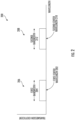
- an example diagram 200 depicts wavelength response for the example embodiments using first and second bandpass filters for the first and second filters 106 and 108 in accordance with various embodiments of the present disclosure.
- Fig. 2 depicts a transmission coefficient to illustrate the wavelength response for the example embodiments using first and second bandpass filters for the first and second filters 106 and 108.
- the transmission coefficient is a percentage and/or ratio of an output with respect to the input of a filter. It is noted that the schematic diagram 200 is for illustration purposes and is not an accurate recreation of bandpass filter wavelength response(s) and/or transmission coefficient(s).
- the first bandpass filter used for the first filter 106 may have a first wavelength response 206 including a first center wavelength 202 and a first bandwidth 204 as for example shown in the schematic diagram 200.
- the second bandpass filter used for the second filter 108 may have a second wavelength response 208 including a second center wavelength 210 and a second bandwidth 212 as for example shown in the schematic diagram 200.
- the first center wavelength 202 may be between about 7 microns and about 8 microns. In an example embodiment, the first center wavelength 202 is between about 7.2 microns and about 7.8 microns. In an example embodiment, the first center wavelength 202 is between about 7.3 microns and about 7.7 microns. In an example embodiment, the first center wavelength 202 is between about 7.35 microns and about 7.55 microns. In an example embodiment, the first center wavelength 202 is between about 7.37 microns and about 7.45 microns. In an example embodiment, the first center wavelength 202 may be about 7.4 micron.
- the second center wavelength 210 may be between about 8 microns and about 14 microns. In an example embodiment, the second center wavelength 210 may be between about 8.5 microns and about 13 microns. In an example embodiment, the second center wavelength 210 may be between about 9 microns and about 11 microns. In an example embodiment, the second center wavelength 210 may be between about 9.5 microns and about 10.5 microns. In an example embodiment, the second center wavelength 210 may be about 9.815 micron.
- the first bandwidth 204 and the second bandwidth 212 do not overlap.
- the first bandwidth 204 is between about 0.05 micron to about 0.95 micron.
- the first bandwidth 204 is between about 0.1 micron to about 0.8 micron.
- the first bandwidth 204 is between about 0.1 micron to about 0.7 micron.
- the first bandwidth 204 is between about 0.12 micron to about 0.4 micron.
- the first bandwidth 204 is between about 0.13 micron to about 0.2 micron.
- the first bandwidth 204 is about 0.148 micron.
- the second bandwidth 212 is between about 0.1 micron to about 4 micron. In an example embodiment, the second bandwidth 212 is between about 0.15 micron to about 2 micron. In an example embodiment, the second bandwidth 212 is between about 0.2 micron to about 1 micron. In an example embodiment, the second bandwidth 212 is between about 0.21 micron to about 0.5 micron. In an example embodiment, the second bandwidth 212 is about 0.220 micron.
- the first camera output signal 103 may be an infrared radiation intensity detected by the first camera 102 over the first bandwidth 204.
- the second camera output signal 105 may be an infrared radiation intensity detected by the second camera 104 over the second bandwidth 212.
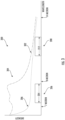
- FIG. 3 a diagram 300 depicting an example intensity spectrum of infrared radiation versus wavelength in accordance with various embodiments of the present disclosure is provided.
- intensity spectrum graph 302 is an example illustration of infrared intensity generated by a fire.
- fire generates byproducts including carbon dioxide (CO 2 ), water (H 2 O), and carbon particles (soot).
- CO 2 carbon dioxide
- H 2 O water
- carbon particles carbon particles
- due to the presence of water byproduct in fire there may be a distinguishing feature and/or signature in the intensity spectrum of fire in the wavelength range between about 7 microns to 8 microns. This unique feature and/or signature may be caused by infrared absorption and/or emission of the water byproduct in fire.
- the unique feature/signature due to the water byproduct in fire may include a steep bend 304 in the intensity spectrum at wavelengths of about 8 micron and/or a higher intensity in the wavelength range of about 7 microns to about 8 microns as compared to the rest of the intensity spectrum graph 302.
- the distinguishing feature/signature may differentiate infrared radiation generated by fire from infrared radiation generated by various sources of false alarm.
- intensity spectrum graph 306 is a generic an/or approximate depiction of the intensity spectrum of various sources of false alarm.
- the intensity spectrum of infrared radiation generated by various sources of false alarm may not have the distinguishing feature/signature of the intensity spectrum of infrared radiation generated by fire in the wavelength range between about 7 microns to 8 microns.
- graph 306 may not have the steep bend similar to that of intensity spectrum graph 304 at wavelengths of about 8 micron and/or may not have the higher intensity in the wavelength range of about 7 microns to about 8 microns as compared with the rest of the intensity spectrum graph 306.
- the infrared cameras 102 and 104 receive the infrared radiation 112 and generate the first and second camera outputs 103 and 105. In various embodiments, using the first and second camera outputs 103 and 105, the controller 112 determines whether the distinguishing feature/signature of the intensity spectrum that indicates fire as the infrared radiation source 110 is present.
- the wavelength response 206 of the first passband filter used for the filter 106 and the wavelength response 208 of the second passband filter used for the second filter 108 are depicted in Fig. 3 .
- a difference between the first and second camera output signals 103 and 105 may be determined.
- the difference between the first and second camera output signals 103 and 105 may be higher for intensity spectrum graph 302 than it would be for the intensity spectrum graph 306. This difference may be a sign of the distinguishing feature/signature of the intensity spectrum that is an indication of fire as the infrared radiation source 110.
- a distance of the infrared radiation source 110 from the fire detection apparatus 100 may have a compounding attenuation effect on the intensity of the infrared radiation 112 when received by the first and second cameras 102 and 104.
- a closer source may cause higher intensity of the infrared radiation 112 to be received by the first and second cameras 102 and 104 resulting in higher first and second camera outputs 103 and 105.
- the compounding attenuation effect of distance on the intensity of the infrared radiation 112 may impact the determination of the presence of the distinguishing feature/signature of the intensity spectrum.
- the compounding attenuation effect of distance of the source is removed by normalizing the difference between the first camera output signal 103 and the second camera output signal 105.
- the controller 114 normalizes the difference by dividing it with the sum of the first camera output signal 103 and the second camera output signal 105 and to determine the first indicator signal as shown in Eq. 1.
- a higher indicator signal indicates a larger difference in the intensity between the first bandwidth 204 and the second bandwidth 212 of the intensity spectrum of the infrared radiation 112.
- the compounding attenuation effect of distance is reduced/and or removed in the first indicator signal.
- the controller 114 determines and compares the first indicator signal with the first threshold. In various embodiments, when the first indicator signal is greater than the first threshold, the controller 114 determines that the source of the infrared radiation 112 may be fire.
- the first threshold may be determined to distinguish between when the infrared radiation is generated by water byproduct of the fire versus when the infrared radiation is generated by a first category of false alarm sources comprising any of arc welding, a heater for example an IR heater, high temperature carbon dioxide gas, and/or IR reflecting material(s) and/or surface(s), etc.
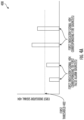
- the controller 114 may determine the first indicator signal 404 for various first false alarm source(s) and/or various fire source(s) generating the infrared radiation 112.
- the first false alarm source(s) may include arc welding, a heater for example an IR heater, high temperature carbon dioxide gas, and/or IR reflecting material(s) and/or surface(s).
- the first false alarm source(s) may exclude hot steam.
- the fire source(s) may include various fire producing fuels such as hydrogen, heptane, n-heptane, Jet Propellant 8 (JP8), methanol, ethanol, diesel, gasoline, isopropyl alcohol (IPA), etc.
- the first threshold 402 is selected so that it is greater than the first indicator signal 404 corresponding to any of the first false alarm source(s) and is less than the first indicator signal 404 corresponding to any of the fire source(s).
- the controller 114 determines the first threshold 402.
- the first indicator signal 404 corresponding to various first false alarm source(s) may be below the first indicator signal 404 corresponding to the fire source(s). In various embodiments, the first indicator signal 404 corresponding to hot steam, which may be excluded from the first false alarm source(s), may not be below the first indicator signal 404 corresponding to the fire source(s). In various embodiments herein, a second indicator signal and a second threshold may be used to distinguish a various second false alarm source(s) of including hot steam, from the fire source(s).
- the controller 114 may determine a second indicator signal 454 using a sum of the first and second camera output signals 103 and 105 (with reference to Fig. 1 ).
- a compounding attenuation effect of the distance of the source 110 from the fire detection apparatus 100 may be mitigated.
- the controller 114 determines the distance of the source 110 of the infrared radiation 112 from the fire detection apparatus 100.
- the distance may be detected using a phase difference of the infrared radiation 112 when received by the first camera 102 compared to when received by the second infrared camera 104.
- the distance may be determined using triangulation.
- a Time of Flight (ToF) distance measuring device may be used to determine the distance.
- a separation between the first infrared camera 102 and the second infrared camera 104 may be used to identify parallax versus distance for the infrared radiation source 110 and to determine distance.
- ToF Time of Flight
- the controller 114 may determine the second indicator signal 454 by normalizing the sum of the first and second camera output signals 103 and 105 using the distance to remove the compounding attenuation effect due to distance.
- a diagram 450 for determining a second threshold 452 is provided.
- the controller 114 may determine the second indicator signal 454 for various false alarm source(s) including hot steam, and/or various fire source(s) generating the infrared radiation 112.
- the fire sources may include various fire producing fuels such as hydrogen, heptane, n-heptane, Jet Propellant 8 (JP8), methanol, ethanol, diesel, gasoline, isopropyl alcohol (IPA), etc.
- the second threshold 452 is selected so that it exceeds the second indicator signal 454 corresponding to any of the false alarm source(s) including hot steam, and falls below the second indicator signal 454 corresponding to any of the fire sources.
- the controller 114 may generate the fire alarm using the comparison of the first indicator signal 404 with the first threshold 402 and the comparison of the second indicator signal 454 with the second threshold 452. In various embodiments, the controller 114 may generate the fire alarm when the first indicator signal 404 is greater than the first threshold 402 and the second indicator signal 454 greater than the second threshold 402.
- the controller 114 may further distinguish false alarm source(s) including hot steam from various fire source(s) using visible range camera(s).
- hot steam may be generated from known location(s) in the environment of the fire detection apparatus 100, for example the location of water pipes.
- the controller 114 may mark the potential location(s) of the hot steam.
- the controller 114 generates the fire alarm when the visible wavelength camera(s) do not detect steam in the known location(s), in addition to and/or any combination with other condition(s) in various embodiments herein for generating the fire alarm.
- the controller 114 comprises processing circuitry 502, a communication module 508, input/output module 506, a memory 504 and/or other components configured to perform various operations, procedures, functions or the like described herein.
- the controller 114 (such as the processing circuitry 502, communication module 508, input/output module 506 and memory 504) is electrically coupled to and/or in electronic communication with the first and second infrared cameras 102 and 104.
- each of the first and second infrared cameras 102 and 104 may exchange (e.g., transmit and receive) data with the processing circuitry 502 of the controller 114.
- the processing circuitry 502 may be implemented as, for example, various devices comprising one or a plurality of microprocessors with accompanying digital signal processors; one or a plurality of processors without accompanying digital signal processors; one or a plurality of coprocessors; one or a plurality of multi-core processors; one or a plurality of controllers; processing circuits; one or a plurality of computers; and various other processing elements (including integrated circuits, such as ASICs or FPGAs, or a certain combination thereof).
- the processing circuitry 502 may comprise one or more processors.
- the processing circuitry 502 is configured to execute instructions stored in the memory 504 or otherwise accessible by the processing circuitry 502.
- the processing circuitry 502 When executed by the processing circuitry 502, these instructions may enable the controller 114 to execute one or a plurality of the functions as described herein.
- the processing circuitry 502 may comprise entities capable of executing operations according to the embodiments of the present invention when correspondingly configured. Therefore, for example, when the processing circuitry 502 is implemented as an ASIC, an FPGA, or the like, the processing circuitry 502 may comprise specially configured hardware for implementing one or a plurality of operations described herein.
- the instructions may specifically configure the processing circuitry 502 to execute one or a plurality of algorithms and operations described herein, such as those discussed with reference to FIG. 6 and Fig. 7 .
- the memory 504 may comprise, for example, a volatile memory, a non-volatile memory, or a certain combination thereof. Although illustrated as a single memory in FIG. 5 , the memory 504 may comprise a plurality of memory components. In various embodiments, the memory 504 may comprise, for example, a hard disk drive, a random access memory, a cache memory, a flash memory, a Compact Disc Read-Only Memory (CD-ROM), a Digital Versatile Disk Read-Only Memory (DVD-ROM), an optical disk, a circuit configured to store information, or a certain combination thereof. The memory 504 may be configured to store information, data, application programs, instructions, and etc., so that the controller 114 can execute various functions according to the embodiments of the present disclosure.
- the memory 504 is configured to cache input data for processing by the processing circuitry 502. Additionally or alternatively, in at least some embodiments, the memory 504 is configured to store program instructions for execution by the processing circuitry 502.
- the memory 504 may store information in the form of static and/or dynamic information. When the functions are executed, the stored information may be stored and/or used by the controller 114.
- the communication module 508 may be implemented as any apparatus included in a circuit, hardware, a computer program product or a combination thereof, which is configured to receive and/or transmit data from/to another component or apparatus.
- the computer program product comprises computer-readable program instructions stored on a computer-readable medium (for example, the memory 504) and executed by a controller 114 (for example, the processing circuitry 502).
- the communication module 508 (as with other components discussed herein) may be at least partially implemented as the processing circuitry 502 or otherwise controlled by the processing circuitry 502.
- the communication module 508 may communicate with the processing circuitry 502, for example, through a bus.
- the communication module 508 may comprise, for example, antennas, transmitters, receivers, transceivers, network interface cards and/or supporting hardware and/or firmware/software, and is used for establishing communication with another apparatus.
- the communication module 508 may be configured to receive and/or transmit any data that may be stored by the memory 504 by using any protocol that can be used for communication between apparatuses.
- the communication module 508 may additionally or alternatively communicate with the memory 504, the input/output module 506 and/or any other component of the controller 114, for example, through a bus.
- the controller 114 may comprise an input/output module 506.
- the input/output module 506 may communicate with the processing circuitry 502 to receive instructions input by the user and/or to provide audible, visual, mechanical or other outputs to the user. Therefore, the input/output module 506 may be in electronic communication with supporting devices, such as a keyboard, a mouse, a display, a touch screen display, and/or other input/output mechanisms. Alternatively, at least some aspects of the input/output module 506 may be implemented on a device used by the user to communicate with the controller 114.
- the input/output module 506 may communicate with the memory 504, the communication module 508 and/or any other component, for example, through a bus. One or a plurality of input/output modules and/or other components may be included in the controller 114.
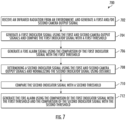
- FIG. 6 and FIG. 7 flowchart diagrams illustrating example operations 600 and 700, respectively, in accordance with various embodiments of the present disclosure are provided.
- the method 600 may be performed by a fire detection apparatus.
- the fire detection apparatus may be similar to the fire detection apparatus 100 described above with regard to FIG. 1 .
- the fire detection apparatus may include controller 114 described above in regard to FIG. 5 and may similarly comprise processing circuitry 502, a communication module 508, an input/output module 506 and a memory 504.
- the fire detection apparatus may include infrared cameras 102 and 104.
- the memory of the controller of the fire detection apparatus may store computer program instructions.
- one or more of the procedures described in FIG. 6 may be embodied by computer program instructions, which may be stored by a memory (such as a non-transitory memory) of a system employing an embodiment of the present disclosure and executed by a processing circuitry (such as a processor) of the system.
- These computer program instructions may direct the system to function in a particular manner, such that the instructions stored in the memory circuitry produce an article of manufacture, the execution of which implements the function specified in the flow diagram step/operation(s).
- the system may comprise one or more other circuitries.
- Various circuitries of the system may be electronically coupled between and/or among each other to transmit and/or receive energy, data and/or information.
- embodiments may take the form of a computer program product on a non-transitory computer-readable storage medium storing computer-readable program instruction (e.g., computer software). Any suitable computer-readable storage medium may be utilized, including non-transitory hard disks, CD-ROMs, flash memory, optical storage devices, or magnetic storage devices.
- a controller may select a set of one or more known fire source(s).
- any of known fire sources including but not limited to hydrogen, heptane, n-heptane, Jet Propellant 8 (JP8), methanol, ethanol, diesel, gasoline, isopropyl alcohol (IPA), etc. may be selected.
- a controller (such as, but not limited to, the controller of the fire detection apparatus 100 illustrated above referring to Fig. 1 ) may select a set of one or more known false alarm source(s).
- any of known false alarm sources including but not limited to arc welding, heater for example IR heater, high temperature carbon dioxide gas, and/or IR reflecting material(s) and/or surface(s), hot steam, etc. may be selected.
- the controller 114 selects a range of filter parameters for the first and second filters 106 and 108, for example for the first and second bandpass filters (referring to Fig. 1 ).
- the filter parameters may include the first bandwidth 204, first center wavelength 202, second bandwidth 212, and/or second center wavelength 210.
- a range of about 7 to about 8 microns may be selected for the first center wavelength 202.
- a range of about 8 to about 14 microns may be selected for the second center wavelength 210.
- for example a range of about 0 to about 1 micron may be used for the first bandwidth 204.
- a range of about 0 to about 6 microns may be used for the second bandwidth 212.
- the selected range for the first and the second bandwidths 204 and 212 may be subject to the condition that the first and the second bandwidths 204 and 212 do not overlap.
- the controller 114 determines the first and/or second indicator signal corresponding to both the selected set of one or more known fire source(s) and for the selected set of one or more known false alarm source(s). In various embodiments, when the selected false alarm source at step 604 does not include hot steam, the first indicator signal is calculated. In various embodiments, when the selected false alarm source at step 604 includes hot steam, the second indicator signal is calculated.
- the controller 114 determines a first average difference between the first indicator signal corresponding to the fire source(s) and false alarm source(s) when false alarm source(s) does not include hot steam. In various embodiments, the controller 114 may use a weighted averaging technique to determine the first average difference.
- the controller 114 determines a second average difference between the second indicator signal corresponding to the fire source(s) and false alarm source(s) when false alarm source(s) includes hot steam. In various embodiments, the controller 114 may use a weighted averaging technique to determine the second average difference.
- the controller 114 determines the filter parameters to maximize the first average difference when the when false alarm source(s) does not include hot steam and to maximize the second average difference when false alarm source(s) includes hot steam.
- controller 114 determine the filter parameters by iteratively selecting values for the filter parameters. Controller 114 may calculate the first average difference and/or the second average difference as described above for each selected value for the filter parameters in the iteration. The controller 114, after the iteration through multiple values for the filter parameters, may determine the filter parameters that maximize the first average difference and/or the second average difference as described above.
- the method 700 may be performed by a fire detection apparatus.
- the fire detection apparatus may be similar to the fire detection apparatus 100 described above with regard to FIG. 1 .
- the fire detection apparatus may include controller 114 described above in regard to FIG. 5 and may similarly comprise processing circuitry 502, a communication module 508, an input/output module 506 and a memory 504.
- the fire detection apparatus may include infrared cameras 102 and 104.
- the memory of the controller of the fire detection apparatus may store computer program instructions.
- one or more of the procedures described in FIG. 7 may be embodied by computer program instructions, which may be stored by a memory (such as a non-transitory memory) of a system employing an embodiment of the present disclosure and executed by a processing circuitry (such as a processor) of the system.
- These computer program instructions may direct the system to function in a particular manner, such that the instructions stored in the memory circuitry produce an article of manufacture, the execution of which implements the function specified in the flow diagram step/operation(s).
- the system may comprise one or more other circuitries.
- Various circuitries of the system may be electronically coupled between and/or among each other to transmit and/or receive energy, data and/or information.
- embodiments may take the form of a computer program product on a non-transitory computer-readable storage medium storing computer-readable program instruction (e.g., computer software). Any suitable computer-readable storage medium may be utilized, including non-transitory hard disks, CD-ROMs, flash memory, optical storage devices, or magnetic storage devices.
- a fire detection apparatus may receive an infrared radiation from an environment.
- the fire detection apparatus may generate a first camera output signal using a first infrared camera (for example infrared camera 102) and generate a second camera output signal using a second infrared camera (for example infrared camera 104).
- the fire detection apparatus using a controller may generate a first indicator signal using the first and second camera output signals, and compare the first indicator signal with a first threshold.
- the fire detection apparatus using a controller may generate a fire alarm signal using the comparison of the first indicator signal with the first threshold.
- the first camera output signal corresponds to the first bandwidth.
- the first infrared camera that may generate the first camera output signal may include a first bandpass filter (for example first bandpass filter used for the first filter 106) having a first center wavelength (for example, referring to Fig. 2 , first center wavelength 202) and a first bandwidth (for example first bandwidth 202).
- the second camera output signal corresponds to the second bandwidth.
- the second infrared camera that may generate the second camera output signal (for example, referring to Fig. 1 , second infrared camera 104) comprises a second bandpass filter (for example second bandpass filer used for the second filter 108) having a second center wavelength (for example, with reference to Fig. 2 , the second center wavelength 210) and a second bandwidth (for example the second bandwidth 212).
- the first center wavelength is between about 7 microns and about 8 microns and the second center wavelength is between about 8 microns and about 14 microns.
- the first bandwidth and the second bandwidth do not overlap.
- the first camera output signal is a first infrared radiation intensity detected by the first camera in the first bandwidth
- the second camera output signal is a second infrared radiation intensity detected by the second camera in the second bandwidth.
- the fire detection apparatus using a controller determines a difference between the first camera output signal and the second camera output signal, normalize the difference with a sum of the first camera output signal and the second camera output signal, and generates the first indicator signal using the normalized difference between the first and second camera output signals, for example as described by Eq. 1.
- the fire detection apparatus using a controller may determine the first threshold to distinguish between when the infrared radiation is generated by water byproduct of fire versus when the infrared radiation is generated by a first category of one or more false alarm sources comprising any of arc welding, a heater, and high temperature carbon dioxide gas, as for example illustrated in Fig. 4A .
- the fire detection apparatus using a controller determines a distance of an infrared radiation source, for example infrared radiation source 110 with reference to Fig. 1 , from the fire detection apparatus.
- the controller may determine the distance of the infrared radiation source from the fire detection apparatus using a phase difference of the infrared radiation when received by the first infrared camera that may generate the first camera output signal compared to when received by the second infrared camera that may generate the second camera output signal.
- the controller may determine the distance using triangulation.
- the controller may determine the distance using a Time of Flight (ToF) distance measuring device.
- the controller may use a separation between the first infrared camera 102 and the second infrared camera 104 to identify parallax versus distance for the infrared radiation source 110 and to determine distance.
- ToF Time of Flight
- the fire detection apparatus using a controller may determine a second indicator signal using a sum of the first and second camera output signals and normalize the second indicator signal using the distance.
- the fire detection apparatus using a controller may compare the second indicator signal with a second threshold.
- the fire detection apparatus using a controller may generate the fire alarm using the comparison of the first indicator signal with the first threshold and the comparison of the second indicator signal with the second threshold.
- the fire detection apparatus using a controller may determine the second threshold to distinguish between when the infrared radiation is generated by water byproduct of fire versus when the infrared radiation is generated by a second category of one or more false alarm sources comprising hot steam, as for example illustrated in Fig. 4B .
Landscapes
- Engineering & Computer Science (AREA)
- Physics & Mathematics (AREA)
- General Physics & Mathematics (AREA)
- Multimedia (AREA)
- Business, Economics & Management (AREA)
- Emergency Management (AREA)
- Computer Security & Cryptography (AREA)
- Fire-Detection Mechanisms (AREA)
- Photometry And Measurement Of Optical Pulse Characteristics (AREA)
Applications Claiming Priority (1)
| Application Number | Priority Date | Filing Date | Title |
|---|---|---|---|
| IN202211053091 | 2022-09-16 |
Publications (2)
| Publication Number | Publication Date |
|---|---|
| EP4339913A2 true EP4339913A2 (de) | 2024-03-20 |
| EP4339913A3 EP4339913A3 (de) | 2024-05-29 |
Family
ID=87571753
Family Applications (1)
| Application Number | Title | Priority Date | Filing Date |
|---|---|---|---|
| EP23191402.9A Pending EP4339913A3 (de) | 2022-09-16 | 2023-08-14 | Verfahren, vorrichtungen und systeme zur infrarotbranderkennung |
Country Status (2)
| Country | Link |
|---|---|
| US (1) | US20240096188A1 (de) |
| EP (1) | EP4339913A3 (de) |
Family Cites Families (36)
| Publication number | Priority date | Publication date | Assignee | Title |
|---|---|---|---|---|
| JPS586996B2 (ja) * | 1977-02-15 | 1983-02-07 | 国際技術開発株式会社 | 炎感知方式 |
| US4220857A (en) * | 1978-11-01 | 1980-09-02 | Systron-Donner Corporation | Optical flame and explosion detection system and method |
| US4691196A (en) * | 1984-03-23 | 1987-09-01 | Santa Barbara Research Center | Dual spectrum frequency responding fire sensor |
| US4742236A (en) * | 1985-04-27 | 1988-05-03 | Minolta Camera Kabushiki Kaisha | Flame detector for detecting phase difference in two different wavelengths of light |
| US4639598A (en) * | 1985-05-17 | 1987-01-27 | Santa Barbara Research Center | Fire sensor cross-correlator circuit and method |
| US6518574B1 (en) * | 1996-03-01 | 2003-02-11 | Fire Sentry Corporation | Fire detector with multiple sensors |
| US5850182A (en) * | 1997-01-07 | 1998-12-15 | Detector Electronics Corporation | Dual wavelength fire detection method and apparatus |
| US5995008A (en) * | 1997-05-07 | 1999-11-30 | Detector Electronics Corporation | Fire detection method and apparatus using overlapping spectral bands |
| GB9805949D0 (en) * | 1998-03-19 | 1998-05-20 | Thorn Security | A detector |
| US6150659A (en) * | 1998-04-10 | 2000-11-21 | General Monitors, Incorporated | Digital multi-frequency infrared flame detector |
| JP3897206B2 (ja) * | 1998-04-27 | 2007-03-22 | ホーチキ株式会社 | 異常監視装置 |
| US6373393B1 (en) * | 1998-06-02 | 2002-04-16 | Hochiki Kabushiki Kaisha | Flame detection device and flame detection |
| US7112796B2 (en) * | 1999-02-08 | 2006-09-26 | General Electric Company | System and method for optical monitoring of a combustion flame |
| US6853452B1 (en) * | 1999-03-17 | 2005-02-08 | University Of Virginia Patent Foundation | Passive remote sensor of chemicals |
| US7256401B2 (en) * | 2001-10-10 | 2007-08-14 | Ambient Control Systems, Inc. | System and method for fire detection |
| JP3471342B2 (ja) * | 2001-11-30 | 2003-12-02 | 国際技術開発株式会社 | 炎感知器 |
| US20040052418A1 (en) * | 2002-04-05 | 2004-03-18 | Bruno Delean | Method and apparatus for probabilistic image analysis |
| US7505604B2 (en) * | 2002-05-20 | 2009-03-17 | Simmonds Precision Prodcuts, Inc. | Method for detection and recognition of fog presence within an aircraft compartment using video images |
| US7154400B2 (en) * | 2003-06-27 | 2006-12-26 | The United States Of America As Represented By The Secretary Of The Navy | Fire detection method |
| US7541938B1 (en) * | 2006-03-29 | 2009-06-02 | Darell Eugene Engelhaupt | Optical flame detection system and method |
| US7638770B2 (en) * | 2007-03-22 | 2009-12-29 | Spectronix Ltd. | Method for detecting a fire condition in a monitored region |
| JP5109079B2 (ja) * | 2007-05-24 | 2012-12-26 | ニッタン株式会社 | 炎感知器 |
| US8227756B2 (en) * | 2009-06-24 | 2012-07-24 | Knowflame, Inc. | Apparatus for flame discrimination utilizing long wavelength pass filters and related method |
| US8547238B2 (en) * | 2010-06-30 | 2013-10-01 | Knowflame, Inc. | Optically redundant fire detector for false alarm rejection |
| US20140184793A1 (en) * | 2012-12-31 | 2014-07-03 | Honeywell International Inc. | Multispectral flame detector |
| US9201000B2 (en) * | 2013-12-27 | 2015-12-01 | Palo Alto Research Center Incorporated | Sensor apparatus and method based on wavelength centroid detection |
| DE102015206611A1 (de) * | 2015-04-14 | 2016-10-20 | Siemens Schweiz Ag | Flammenmelder zur Überwachung eines Bereichs angrenzend zu Gewässern und Berücksichtigung eines im Empfangslicht vorhandenen Polarisationsgrads bei der Brandalarmierung |
| GB2544040B (en) * | 2015-10-19 | 2018-03-14 | Ffe Ltd | Improvements in or relating to flame detectors and associated methods |
| US10002510B2 (en) * | 2015-12-09 | 2018-06-19 | Noah Lael Ryder | System and methods for detecting, confirming, classifying, and monitoring a fire |
| WO2018156795A1 (en) * | 2017-02-22 | 2018-08-30 | Rebellion Photonics, Inc. | Systems and methods for monitoring remote installations |
| US11029201B2 (en) * | 2017-04-27 | 2021-06-08 | Fukada Kogyo Co., Ltd. | Abnormality detector |
| US10809134B2 (en) * | 2017-05-24 | 2020-10-20 | Cisco Technology, Inc. | Thermal modeling for cables transmitting data and power |
| US12352620B2 (en) * | 2020-05-04 | 2025-07-08 | Rebellion Photonics, Inc. | Apparatuses, systems, and methods for thermal imaging |
| US12385786B2 (en) * | 2020-05-04 | 2025-08-12 | Rebellion Photonics, Inc. | Apparatuses, systems, and methods for thermal imaging |
| US12219947B2 (en) * | 2020-07-07 | 2025-02-11 | Global Neighbor Inc. | Fast change of state of weed seeds to having reduced germination viability using low energy unnatural indigo region and medium wavelength infrared illumination |
| US20240406523A1 (en) * | 2023-05-30 | 2024-12-05 | Lightpath Technologies, Inc. | Broadband camera for flame detection and detection of a thermal image of the scene of the flame |
-
2023
- 2023-08-14 EP EP23191402.9A patent/EP4339913A3/de active Pending
- 2023-09-01 US US18/459,972 patent/US20240096188A1/en active Pending
Also Published As
| Publication number | Publication date |
|---|---|
| US20240096188A1 (en) | 2024-03-21 |
| EP4339913A3 (de) | 2024-05-29 |
Similar Documents
| Publication | Publication Date | Title |
|---|---|---|
| AU2011280059B2 (en) | Optically redundant fire detector for false alarm rejection | |
| US9759628B2 (en) | Area monitoring for detection of leaks and/or flames | |
| US10037665B2 (en) | Chamber-less smoke sensor | |
| US20170363475A1 (en) | Multi-spectral flame detector with radiant energy estimation | |
| EP3407034A1 (de) | Intelligenter flammendetektor und verfahren unter verwendung eines infrarot-thermogramms | |
| JP2019203879A (ja) | 光学式気体撮像カメラ用の気体のマルチスペクトル定量・識別方法 | |
| JP2013530474A5 (de) | ||
| US20100050744A1 (en) | Multi-sensor Gas Detectors | |
| CA2626753C (en) | A method for detecting a fire condition in a monitored region | |
| US5594421A (en) | Method and detector for detecting a flame | |
| GB2372317A (en) | Infrared flame detection sensor | |
| US20110304728A1 (en) | Video-Enhanced Optical Detector | |
| EP4339913A2 (de) | Verfahren, vorrichtungen und systeme zur infrarotbranderkennung | |
| CN108538011B (zh) | 一种激光雷达火灾检测方法 | |
| JP3938276B2 (ja) | 炎感知器および炎検知方法 | |
| CN219737259U (zh) | 一种甲烷气体探测系统 | |
| EP1143393B1 (de) | Detektion von thermisch induzierter Wirbelbildung in Flüssigkeiten | |
| CN120126268B (zh) | 一种基于多传感器的电气火灾控制方法及系统 | |
| EP4328554A1 (de) | Wärmekamera und auf infrarotsensor basierende flammendetektion | |
| JP5279236B2 (ja) | 目標撮像探知装置 | |
| US9733129B1 (en) | Multispectral band sensor | |
| EP4400182A1 (de) | Vorrichtungen und verfahren zur messung der brandausbreitungsrate | |
| CN113552086B (zh) | 用于改进气体检测设备的方法、装置和系统 | |
| EP4621748A1 (de) | System und verfahren zur bestimmung zwischen feuer oder einer reflexion einer freundlichen flamme | |
| CN120853320A (zh) | 火灾检测方法、装置、设备及介质 |
Legal Events
| Date | Code | Title | Description |
|---|---|---|---|
| PUAI | Public reference made under article 153(3) epc to a published international application that has entered the european phase |
Free format text: ORIGINAL CODE: 0009012 |
|
| STAA | Information on the status of an ep patent application or granted ep patent |
Free format text: STATUS: REQUEST FOR EXAMINATION WAS MADE |
|
| 17P | Request for examination filed |
Effective date: 20230814 |
|
| AK | Designated contracting states |
Kind code of ref document: A2 Designated state(s): AL AT BE BG CH CY CZ DE DK EE ES FI FR GB GR HR HU IE IS IT LI LT LU LV MC ME MK MT NL NO PL PT RO RS SE SI SK SM TR |
|
| PUAL | Search report despatched |
Free format text: ORIGINAL CODE: 0009013 |
|
| AK | Designated contracting states |
Kind code of ref document: A3 Designated state(s): AL AT BE BG CH CY CZ DE DK EE ES FI FR GB GR HR HU IE IS IT LI LT LU LV MC ME MK MT NL NO PL PT RO RS SE SI SK SM TR |
|
| RIC1 | Information provided on ipc code assigned before grant |
Ipc: G08B 17/12 20060101AFI20240424BHEP |
|
| STAA | Information on the status of an ep patent application or granted ep patent |
Free format text: STATUS: EXAMINATION IS IN PROGRESS |
|
| 17Q | First examination report despatched |
Effective date: 20250425 |