EP4339259A1 - Metal-assisted multi-resonance thermally-activated delayed-fluorescence emitters for oled applications - Google Patents
Metal-assisted multi-resonance thermally-activated delayed-fluorescence emitters for oled applications Download PDFInfo
- Publication number
- EP4339259A1 EP4339259A1 EP23195511.3A EP23195511A EP4339259A1 EP 4339259 A1 EP4339259 A1 EP 4339259A1 EP 23195511 A EP23195511 A EP 23195511A EP 4339259 A1 EP4339259 A1 EP 4339259A1
- Authority
- EP
- European Patent Office
- Prior art keywords
- substituted
- unsubstituted
- alkyl
- aryl
- heteroaryl
- Prior art date
- Legal status (The legal status is an assumption and is not a legal conclusion. Google has not performed a legal analysis and makes no representation as to the accuracy of the status listed.)
- Pending
Links
Images






Classifications
-
- C—CHEMISTRY; METALLURGY
- C07—ORGANIC CHEMISTRY
- C07F—ACYCLIC, CARBOCYCLIC OR HETEROCYCLIC COMPOUNDS CONTAINING ELEMENTS OTHER THAN CARBON, HYDROGEN, HALOGEN, OXYGEN, NITROGEN, SULFUR, SELENIUM OR TELLURIUM
- C07F1/00—Compounds containing elements of Groups 1 or 11 of the Periodic Table
- C07F1/12—Gold compounds
-
- C—CHEMISTRY; METALLURGY
- C07—ORGANIC CHEMISTRY
- C07F—ACYCLIC, CARBOCYCLIC OR HETEROCYCLIC COMPOUNDS CONTAINING ELEMENTS OTHER THAN CARBON, HYDROGEN, HALOGEN, OXYGEN, NITROGEN, SULFUR, SELENIUM OR TELLURIUM
- C07F5/00—Compounds containing elements of Groups 3 or 13 of the Periodic Table
- C07F5/02—Boron compounds
- C07F5/027—Organoboranes and organoborohydrides
-
- C—CHEMISTRY; METALLURGY
- C09—DYES; PAINTS; POLISHES; NATURAL RESINS; ADHESIVES; COMPOSITIONS NOT OTHERWISE PROVIDED FOR; APPLICATIONS OF MATERIALS NOT OTHERWISE PROVIDED FOR
- C09K—MATERIALS FOR MISCELLANEOUS APPLICATIONS, NOT PROVIDED FOR ELSEWHERE
- C09K11/00—Luminescent materials, e.g. electroluminescent or chemiluminescent
- C09K11/06—Luminescent materials, e.g. electroluminescent or chemiluminescent containing organic luminescent materials
-
- H—ELECTRICITY
- H10—SEMICONDUCTOR DEVICES; ELECTRIC SOLID-STATE DEVICES NOT OTHERWISE PROVIDED FOR
- H10K—ORGANIC ELECTRIC SOLID-STATE DEVICES
- H10K50/00—Organic light-emitting devices
- H10K50/10—OLEDs or polymer light-emitting diodes [PLED]
- H10K50/11—OLEDs or polymer light-emitting diodes [PLED] characterised by the electroluminescent [EL] layers
- H10K50/12—OLEDs or polymer light-emitting diodes [PLED] characterised by the electroluminescent [EL] layers comprising dopants
-
- H—ELECTRICITY
- H10—SEMICONDUCTOR DEVICES; ELECTRIC SOLID-STATE DEVICES NOT OTHERWISE PROVIDED FOR
- H10K—ORGANIC ELECTRIC SOLID-STATE DEVICES
- H10K50/00—Organic light-emitting devices
- H10K50/10—OLEDs or polymer light-emitting diodes [PLED]
- H10K50/14—Carrier transporting layers
- H10K50/15—Hole transporting layers
-
- H—ELECTRICITY
- H10—SEMICONDUCTOR DEVICES; ELECTRIC SOLID-STATE DEVICES NOT OTHERWISE PROVIDED FOR
- H10K—ORGANIC ELECTRIC SOLID-STATE DEVICES
- H10K50/00—Organic light-emitting devices
- H10K50/10—OLEDs or polymer light-emitting diodes [PLED]
- H10K50/14—Carrier transporting layers
- H10K50/16—Electron transporting layers
-
- H—ELECTRICITY
- H10—SEMICONDUCTOR DEVICES; ELECTRIC SOLID-STATE DEVICES NOT OTHERWISE PROVIDED FOR
- H10K—ORGANIC ELECTRIC SOLID-STATE DEVICES
- H10K50/00—Organic light-emitting devices
- H10K50/10—OLEDs or polymer light-emitting diodes [PLED]
- H10K50/17—Carrier injection layers
-
- H—ELECTRICITY
- H10—SEMICONDUCTOR DEVICES; ELECTRIC SOLID-STATE DEVICES NOT OTHERWISE PROVIDED FOR
- H10K—ORGANIC ELECTRIC SOLID-STATE DEVICES
- H10K50/00—Organic light-emitting devices
- H10K50/10—OLEDs or polymer light-emitting diodes [PLED]
- H10K50/18—Carrier blocking layers
-
- H—ELECTRICITY
- H10—SEMICONDUCTOR DEVICES; ELECTRIC SOLID-STATE DEVICES NOT OTHERWISE PROVIDED FOR
- H10K—ORGANIC ELECTRIC SOLID-STATE DEVICES
- H10K59/00—Integrated devices, or assemblies of multiple devices, comprising at least one organic light-emitting element covered by group H10K50/00
- H10K59/90—Assemblies of multiple devices comprising at least one organic light-emitting element
-
- H—ELECTRICITY
- H10—SEMICONDUCTOR DEVICES; ELECTRIC SOLID-STATE DEVICES NOT OTHERWISE PROVIDED FOR
- H10K—ORGANIC ELECTRIC SOLID-STATE DEVICES
- H10K71/00—Manufacture or treatment specially adapted for the organic devices covered by this subclass
- H10K71/10—Deposition of organic active material
-
- H—ELECTRICITY
- H10—SEMICONDUCTOR DEVICES; ELECTRIC SOLID-STATE DEVICES NOT OTHERWISE PROVIDED FOR
- H10K—ORGANIC ELECTRIC SOLID-STATE DEVICES
- H10K85/00—Organic materials used in the body or electrodes of devices covered by this subclass
- H10K85/30—Coordination compounds
- H10K85/371—Metal complexes comprising a group IB metal element, e.g. comprising copper, gold or silver
-
- H—ELECTRICITY
- H10—SEMICONDUCTOR DEVICES; ELECTRIC SOLID-STATE DEVICES NOT OTHERWISE PROVIDED FOR
- H10K—ORGANIC ELECTRIC SOLID-STATE DEVICES
- H10K85/00—Organic materials used in the body or electrodes of devices covered by this subclass
- H10K85/60—Organic compounds having low molecular weight
- H10K85/631—Amine compounds having at least two aryl rest on at least one amine-nitrogen atom, e.g. triphenylamine
-
- H—ELECTRICITY
- H10—SEMICONDUCTOR DEVICES; ELECTRIC SOLID-STATE DEVICES NOT OTHERWISE PROVIDED FOR
- H10K—ORGANIC ELECTRIC SOLID-STATE DEVICES
- H10K85/00—Organic materials used in the body or electrodes of devices covered by this subclass
- H10K85/60—Organic compounds having low molecular weight
- H10K85/649—Aromatic compounds comprising a hetero atom
- H10K85/654—Aromatic compounds comprising a hetero atom comprising only nitrogen as heteroatom
-
- H—ELECTRICITY
- H10—SEMICONDUCTOR DEVICES; ELECTRIC SOLID-STATE DEVICES NOT OTHERWISE PROVIDED FOR
- H10K—ORGANIC ELECTRIC SOLID-STATE DEVICES
- H10K85/00—Organic materials used in the body or electrodes of devices covered by this subclass
- H10K85/60—Organic compounds having low molecular weight
- H10K85/649—Aromatic compounds comprising a hetero atom
- H10K85/657—Polycyclic condensed heteroaromatic hydrocarbons
- H10K85/6572—Polycyclic condensed heteroaromatic hydrocarbons comprising only nitrogen in the heteroaromatic polycondensed ring system, e.g. phenanthroline or carbazole
-
- H—ELECTRICITY
- H10—SEMICONDUCTOR DEVICES; ELECTRIC SOLID-STATE DEVICES NOT OTHERWISE PROVIDED FOR
- H10K—ORGANIC ELECTRIC SOLID-STATE DEVICES
- H10K85/00—Organic materials used in the body or electrodes of devices covered by this subclass
- H10K85/60—Organic compounds having low molecular weight
- H10K85/658—Organoboranes
-
- H—ELECTRICITY
- H10—SEMICONDUCTOR DEVICES; ELECTRIC SOLID-STATE DEVICES NOT OTHERWISE PROVIDED FOR
- H10K—ORGANIC ELECTRIC SOLID-STATE DEVICES
- H10K2101/00—Properties of the organic materials covered by group H10K85/00
- H10K2101/20—Delayed fluorescence emission
-
- H—ELECTRICITY
- H10—SEMICONDUCTOR DEVICES; ELECTRIC SOLID-STATE DEVICES NOT OTHERWISE PROVIDED FOR
- H10K—ORGANIC ELECTRIC SOLID-STATE DEVICES
- H10K2101/00—Properties of the organic materials covered by group H10K85/00
- H10K2101/90—Multiple hosts in the emissive layer
Definitions
- the disclosed invention is generally in the field of emitter complexes, particularly complexes containing (i) a polycyclic aromatic/heteroaromatic ligand in which a plurality aromatic/heteroaromatic rings are linked by boron and nitrogen atoms and (ii) an N-heterocyclic carbene ligand, with both ligands coordinated to a metal atom/ion that has a high spin-orbit coupling, such as 3d-, 4d-, or Sd-transition metal atoms/ions.
- a polycyclic aromatic/heteroaromatic ligand in which a plurality aromatic/heteroaromatic rings are linked by boron and nitrogen atoms
- an N-heterocyclic carbene ligand with both ligands coordinated to a metal atom/ion that has a high spin-orbit coupling, such as 3d-, 4d-, or Sd-transition metal atoms/ions.
- improved TADF such as improved MR-TADF luminogens/emitters for OLED applications.
- MR-TADF complexes/compounds containing (i) a polycyclic aromatic/heteroaromatic ligand in which a plurality aromatic/heteroaromatic rings are linked by boron and nitrogen atoms and (ii) an N-heterocyclic carbene ligand, with both ligands coordinated to a metal atom/ion.
- the metal atom or metal ion has a high spin-orbit coupling, including 3d-, 4d-, or Sd-transition metal atoms/ions, such as gold, silver, or copper.
- the disclosed compounds have a structure: wherein:
- the MR-TADF compounds described are photoluminescent and/or electroluminescent, and are preferably, photo-stable, thermally stable, and/or are emissive at room temperatures, low temperatures, or a combination thereof.
- the MR-TADF compounds described can emit light in response to (i) the passage of an electric current or (ii) to an electric field, and may do so independent of concentration.
- the emissive properties of the MR-TADF compounds described can be tuned by way of the selection of substituents.
- the MR-TADF compounds described may emit exclusively or predominantly in the blue to green wavelength range of the visible spectrum.
- the MR-TADF compounds can be incorporated into organic electronic components including, but not limited to, OLEDs or a light-emitting electrochemical cell (LEEC).
- OLEDs can be used in commercial applications such smart phones, televisions, monitors, digital cameras, tablet computers, lighting fixtures that usually operate at room temperatures, a fixed visual display unit, mobile visual display unit, illumination unit, keyboard, clothes, ornaments, garment accessary, wearable devices, medical monitoring devices, wall paper, tablet PC, laptop, advertisement panel, panel display unit, household appliances, and office appliances.
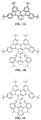
- Exemplary compounds include:
- Additional exemplary compounds include: or wherein M is gold, silver, or copper.
- M is gold. In some forms, M is silver. In some forms, M is copper.
- Substituted refers to all permissible substituents of the compounds or functional groups described herein.
- the permissible substituents include acyclic and cyclic, branched and unbranched, carbocyclic and heterocyclic, aromatic and nonaromatic substituents of organic compounds.
- Illustrative substituents include, but are not limited to, halogens, hydroxyl groups, or any other organic groupings containing any number of carbon atoms, preferably 1-14 carbon atoms, and optionally include one or more heteroatoms such as oxygen, sulfur, or nitrogen grouping in linear, branched, or cyclic structural formats.
- substituents include a substituted or unsubstituted alkyl, a substituted or unsubstituted alkenyl, a substituted or unsubstituted alkynyl, a substituted or unsubstituted heterocyclyl, a substituted or unsubstituted phenyl, a substituted or unsubstituted aryl, a substituted or unsubstituted heteroaryl, a substituted or unsubstituted polyaryl, a substituted or unsubstituted polyheteroaryl, a substituted or unsubstituted aralkyl, a halogen, a hydroxyl, an alkoxy, a phenoxy, an aroxy, a silyl, a thiol, an alkylthio, a substituted alkylthio, a phenylthio, an arylthio, a cyano, an isocyano, a nitro,
- Heteroatoms such as nitrogen may have hydrogen substituents and/or any permissible substituents of organic compounds described herein which satisfy the valences of the heteroatoms. It is understood that “substitution” or “substituted” includes the implicit proviso that such substitution is in accordance with permitted valence of the substituted atom and the substituent, and that the substitution results in a stable compound, i.e., a compound that does not spontaneously undergo transformation such as by rearrangement, cyclization, elimination, etc.
- Alkyl refers to the radical of saturated aliphatic groups, including straight-chain alkyl groups, branched-chain alkyl, and cycloalkyl (alicyclic). In some forms, a straight chain or branched chain alkyl has 30 or fewer carbon atoms in its backbone (e.g., C 1 -C 30 for straight chains, C 3 -C 30 for branched chains), 20 or fewer, 15 or fewer, or 10 or fewer.
- Alkyl includes methyl, ethyl, n -propyl, isopropyl, n -butyl, isobutyl, t -butyl, pentyl, hexyl, heptyl, octyl, decyl, tetradecyl, hexadecyl, eicosyl, tetracosyl and the like.
- a cycloalkyl is a non-aromatic carbon-based ring composed of at least three carbon atoms, such as a nonaromatic monocyclic or nonaromatic polycyclic ring containing 3-30 carbon atoms, 3-20 carbon atoms, or 3-10 carbon atoms in their ring structure, and have 5, 6 or 7 carbons in the ring structure.
- Cycloalkyls containing a polycyclic ring system can have two or more non-aromatic rings in which two or more carbons are common to two adjoining rings (i.e., "fused cycloalkyl rings").
- cycloalkyl groups include, but are not limited to, cyclopropyl, cyclobutyl, cyclopentyl, cyclohexyl, cycloheptyl, cyclooctanyl, etc.
- Substituted alkyl refers to alkyl moieties having one or more substituents replacing a hydrogen on one or more carbons of the hydrocarbon backbone.
- substituents can be any substituents described above, e.g., halogen (such as fluorine, chlorine, bromine, or iodine), hydroxyl, carbonyl (such as a carboxyl, alkoxycarbonyl, formyl, or an acyl), thiocarbonyl (such as a thioester, a thioacetate, or a thioformate), aryl, alkoxyl, aralkyl, phosphonium, phosphanyl, phosphonyl, phosphoryl, phosphate, phosphonate, a phosphinate, amino, amido, amidine, imine, cyano, nitro, azido, oxo, sulfhydryl, thiol, alkylthio, silyl,
- -NRR' wherein Rand R' are independently hydrogen, alkyl, or aryl, and wherein the nitrogen atom is optionally quaternized; -SR, wherein R is a phosphonyl, a sulfinyl, a silyl a hydrogen, an alkyl, or an aryl; -CN; -NO 2 ; -COOH; carboxylate; -COR, -COOR, or -CON(R) 2 , wherein R is hydrogen, alkyl, or aryl; imino, silyl, ether, haloalkyl (such as -CF3, -CH 2 -CF 3 , -CCl 3 ); -CN; -NCOCOCH 2 CH 2; -NCOCOCHCH; and -NCS; and combinations thereof.
- -SR wherein R is a phosphonyl, a sulfinyl, a silyl a hydrogen, an alkyl, or an
- the moieties substituted on the hydrocarbon chain can themselves be substituted, if appropriate.
- the substituents of a substituted alkyl may include halogen, hydroxy, nitro, thiols, amino, aralkyl, azido, imino, amido, phosphonium, phosphanyl, phosphoryl (including phosphonate and phosphinate), oxo, sulfonyl (including sulfate, sulfonamido, sulfamoyl and sulfonate), and silyl groups, as well as ethers, alkylthios, carbonyls (including ketones, aldehydes, carboxylates, and esters), haloalkyls, -CN and the like. Cycloalkyls can be substituted in the same manner.
- lower alkyl as used herein means an alkyl group, as defined above, but having from one to ten carbons, more preferably from one to six carbon atoms in its backbone structure. Likewise, “lower alkenyl” and “lower alkynyl” have similar chain lengths.
- Heteroalkyl refers to straight or branched chain, or cyclic carbon-containing alkyl radicals, or combinations thereof, containing at least one heteroatom on the carbon backbone. Suitable heteroatoms include, but are not limited to, O, N, Si, P and S, wherein the nitrogen, phosphorous and sulfur atoms are optionally oxidized, and the nitrogen heteroatom is optionally quaternized.
- heterocycloalkyl group is a cycloalkyl group as defined above where at least one of the carbon atoms of the ring is substituted with a heteroatom such as, but not limited to, nitrogen, oxygen, sulphur, or phosphorus.
- alkenyl as used herein is a hydrocarbon group of from 2 to 24 carbon atoms and structural formula containing at least one carbon-carbon double bond. Alkenyl groups include straight-chain alkenyl groups, branched-chain alkenyl, and cycloalkenyl.
- a cycloalkenyl is a non-aromatic carbon-based ring composed of at least three carbon atoms and at least one carbon-carbon double bond, such as a nonaromatic monocyclic or nonaromatic polycyclic ring containing 3-30 carbon atoms and at least one carbon-carbon double bond, 3-20 carbon atoms and at least one carbon-carbon double bond, or 3-10 carbon atoms and at least one carbon-carbon double bond in their ring structure, and have 5, 6 or 7 carbons and at least one carbon-carbon double bond in the ring structure.
- Cycloalkenyls containing a polycyclic ring system can have two or more non-aromatic rings in which two or more carbons are common to two adjoining rings (i.e., "fused cycloalkenyl rings") and contain at least one carbon-carbon double bond.
- alkenyl as used throughout the specification, examples, and claims is intended to include both “unsubstituted alkenyls” and “substituted alkenyls,” the latter of which refers to alkenyl moieties having one or more substituents replacing a hydrogen on one or more carbons of the hydrocarbon backbone.
- alkenyl also includes “heteroalkenyl.”
- substituted alkenyl refers to alkenyl moieties having one or more substituents replacing one or more hydrogen atoms on one or more carbons of the hydrocarbon backbone.
- substituents can be any substituents described above, e.g., halogen, azide, alkyl, aralkyl, alkenyl, alkynyl, cycloalkyl, hydroxyl, carbonyl (such as a carboxyl, alkoxycarbonyl, formyl, or an acyl), silyl, ether, ester, thiocarbonyl (such as a thioester, a thioacetate, or a thioformate), alkoxyl, phosphonium, phosphanyl, phosphoryl, phosphate, phosphonate, phosphinate, amino (e.g.
- Heteroalkenyl refers to straight or branched chain, or cyclic carbon-containing alkenyl radicals, or combinations thereof, containing at least one heteroatom. Suitable heteroatoms include, but are not limited to, O, N, Si, P and S, wherein the nitrogen, phosphorous and sulfur atoms are optionally oxidized, and the nitrogen heteroatom is optionally quaternized.
- heterocycloalkenyl group is a cycloalkenyl group where at least one of the carbon atoms of the ring is substituted with a heteroatom such as, but not limited to, nitrogen, oxygen, sulphur, or phosphorus.
- alkynyl group is a hydrocarbon group of 2 to 24 carbon atoms and a structural formula containing at least one carbon-carbon triple bond.
- Alkynyl groups include straight-chain alkynyl groups, branched-chain alkynyl, and cycloalkynyl.
- a cycloalkynyl is a non-aromatic carbon-based ring composed of at least three carbon atoms and at least one carbon-carbon triple bond, such as a nonaromatic monocyclic or nonaromatic polycyclic ring containing 3-30 carbon atoms and at least one carbon-carbon triple bond, 3-20 carbon atoms and at least one carbon-carbon triple bond, or 3-10 carbon atoms and at least one carbon-carbon triple bond in their ring structure, and have 5, 6 or 7 carbons and at least one carbon-carbon triple bond in the ring structure.
- Cycloalkynyls containing a polycyclic ring system can have two or more non-aromatic rings in which two or more carbons are common to two adjoining rings (i.e., "fused cycloalkynyl rings") and contain at least one carbon-carbon triple bond.
- Asymmetric structures such as (AB)C ⁇ C(C"D) are intended to include both the E and Z isomers. This may be presumed in structural formulae herein wherein an asymmetric alkyne is present, or it may be explicitly indicated by the bond symbol C.
- alkynyl as used throughout the specification, examples, and claims is intended to include both “unsubstituted alkynyls” and “substituted alkynyls,” the latter of which refers to alkynyl moieties having one or more substituents replacing a hydrogen on one or more carbons of the hydrocarbon backbone.
- alkynyl also includes “heteroalkynyl.”
- substituted alkynyl refers to alkynyl moieties having one or more substituents replacing one or more hydrogen atoms on one or more carbons of the hydrocarbon backbone.
- substituents can be any substituents described above, e.g., halogen, azide, alkyl, aralkyl, alkenyl, alkynyl, cycloalkyl, hydroxyl, carbonyl (such as a carboxyl, alkoxycarbonyl, formyl, or an acyl), silyl, ether, ester, thiocarbonyl (such as a thioester, a thioacetate, or a thioformate), alkoxyl, phosphonium, phosphanyl, phosphoryl, phosphate, phosphonate, phosphinate, amino (e.g.
- Heteroalkynyl refers to straight or branched chain, or cyclic carbon-containing alkynyl radicals, or combinations thereof, containing at least one heteroatom. Suitable heteroatoms include, but are not limited to, O, N, Si, P and S, wherein the nitrogen, phosphorous and sulfur atoms are optionally oxidized, and the nitrogen heteroatom is optionally quaternized.
- heterocycloalkynyl group is a cycloalkynyl group where at least one of the carbon atoms of the ring is substituted with a heteroatom such as, but not limited to, nitrogen, oxygen, sulphur, or phosphorus.
- Aryl refers to C 5 -C 26 -membered aromatic or fused aromatic ring systems. Examples of aromatic groups are benzene, naphthalene, anthracene, phenanthrene, chrysene, pyrene, corannulene, coronene, etc.
- substituted aryl refers to an aryl group, wherein one or more hydrogen atoms on one or more aromatic rings are substituted with one or more substituents including, but not limited to, halogen, azide, alkyl, aralkyl, alkenyl, alkynyl, cycloalkyl, hydroxyl, alkoxy, carbonyl (such as a ketone, aldehyde, carboxyl, alkoxycarbonyl, formyl, or an acyl), silyl, ether, ester, thiocarbonyl (such as a thioester, a thioacetate, or a thioformate), alkoxyl, phosphoryl, phosphate, phosphonate, phosphinate, amino (or quarternized amino), amido, amidine, imine, cyano, nitro, azido, sulfhydryl, imino, alkylthio, sulfate,
- Heterocycle and “heterocyclyl” are used interchangeably, and refer to a cyclic radical attached via a ring carbon or nitrogen atom of a non-aromatic monocyclic or polycyclic ring containing 3-30 ring atoms, 3-20 ring atoms, 3-10 ring atoms, or 5-6 ring atoms, where each ring contains carbon and one to four heteroatoms each selected from the group consisting of non-peroxide oxygen, sulfur, and N(Y) wherein Y is absent or is H, O, C 1 -C 10 alkyl, phenyl or benzyl, and optionally containing 1-3 double bonds and optionally substituted with one or more substituents.
- Heterocyclyl are distinguished from heteroaryl by definition.
- Heterocycles can be a heterocycloalkyl, a heterocycloalkenyl, a heterocycloalkynyl, etc, such as piperazinyl, piperidinyl, piperidonyl, 4-piperidonyl, dihydrofuro[2,3- b ]tetrahydrofuran, morpholinyl, piperazinyl, piperidinyl, piperidonyl, 4-piperidonyl, piperonyl, pyranyl, 2H-pyrrolyl, 4 H -quinolizinyl, quinuclidinyl, tetrahydrofuranyl, 6 H -1,2,5-thiadiazinyl.
- Heterocyclic groups can optionally be substituted with one or more substituents as defined above for alkyl and aryl.
- heteroaryl refers to C 5 -C 26 -membered aromatic or fused aromatic ring systems, in which one or more carbon atoms on one or more aromatic ring structures have been substituted with a heteroatom. Suitable heteroatoms include, but are not limited to, oxygen, sulfur, and nitrogen. Examples of heteroaryl groups pyrrole, furan, thiophene, imidazole, oxazole, thiazole, triazole, tetrazole, pyrazole, pyridine, pyrazine, pyridazine and pyrimidine, and the like.
- heteroaryl rings include, but are not limited to, benzimidazolyl, benzofuranyl, benzothiofuranyl, benzothiophenyl, benzoxazolyl, benzoxazolinyl, benzthiazolyl, benztriazolyl, benztetrazolyl, benzisoxazolyl, benzisothiazolyl, benzimidazolinyl, carbazolyl, 4aH-carbazolyl, carbolinyl, chromanyl, chromenyl, cinnolinyl, decahydroquinolinyl, 2H,6H-1,5,2-dithiazinyl, furanyl, furazanyl, imidazolidinyl, imidazolinyl, imidazolyl, 1H-indazolyl, indolenyl, indolinyl, indolizinyl, indolyl, 3H-indolyl, is
- substituted heteroaryl refers to a heteroaryl group in which one or more hydrogen atoms on one or more heteroaromatic rings are substituted with one or more substituents including, but not limited to, halogen, azide, alkyl, aralkyl, alkenyl, alkynyl, cycloalkyl, hydroxyl, alkoxy, carbonyl (such as a ketone, aldehyde, carboxyl, alkoxycarbonyl, formyl, or an acyl), silyl, ether, ester, thiocarbonyl (such as a thioester, a thioacetate, or a thioformate), alkoxyl, phosphoryl, phosphate, phosphonate, phosphinate, amino (or quarternized amino), amido, amidine, imine, cyano, nitro, azido, sulfhydryl, imino, alkylthio, sul
- substituents including
- polyaryl refers to a chemical moiety that includes two or more fused aryl groups. When two or more fused heteroaryl groups are involved, the chemical moiety can be referred to as a "polyheteroaryl.”
- substituted polyaryl refers to a polyaryl in which one or more of the aryls are substituted, with one or more substituents including, but not limited to, halogen, azide, alkyl, aralkyl, alkenyl, alkynyl, cycloalkyl, hydroxyl, carbonyl (such as a carboxyl, alkoxycarbonyl, formyl, or an acyl), silyl, ether, ester, thiocarbonyl (such as a thioester, a thioacetate, or a thioformate), alkoxyl, phosphoryl, phosphate, phosphonate, phosphinate, amino (or quarternized amino), amido, amidine, imine, cyano, nitro, azido, sulfhydryl, alkylthio, sulfate, sulfonate, sulfamoyl, sulfoxide,
- cyclic ring or “cyclic group” refers to a substituted or unsubstituted monocyclic ring or a substituted or unsubstituted polycyclic ring (such as those formed from single or fused ring systems), such as a substituted or unsubstituted cycloalkyl, a substituted or unsubstituted cycloalkenyl, a substituted or unsubstituted cycloalkynyl, or a substituted or unsubstituted heterocyclyl, that have from three to 30 carbon atoms, as geometric constraints permit.
- substituted cycloalkyls, cycloalkenyls, cycloalkynyls, and heterocyclyls are substituted as defined above for the alkyls, alkenyls, alkynyls, and heterocyclyls, respectively.
- aralkyl as used herein is an aryl group or a heteroaryl group having an alkyl, alkynyl, or alkenyl group as defined above attached to the aromatic group, such as an aryl, a heteroaryl, a polyaryl, or a polyheteroaryl.
- An example of an aralkyl group is a benzyl group.
- alkoxyl or “alkoxy,” “aroxy” or “aryloxy,” generally describe compounds represented by the formula -OR v , wherein R v includes, but is not limited to, a substituted or unsubstituted alkyl, a substituted or unsubstituted alkenyl, a substituted or unsubstituted alkynyl, a substituted or unsubstituted cycloalkyl, a substituted or unsubstituted heterocyclyl, a substituted or unsubstituted cycloalkenyl, a substituted or unsubstituted heterocycloalkenyl, a substituted or unsubstituted aryl, a substituted or unsubstituted heteroaryl, a substituted or unsubstituted polyaryl, a substituted or unsubstituted polyheteroaryl, a substituted or unsubstituted arylalkyl, a substituted or un
- alkoxyl groups include methoxy, ethoxy, propyloxy, tert-butoxy and the like.
- a "lower alkoxy” group is an alkoxy group containing from one to six carbon atoms.
- An “ether” is two functional groups covalently linked by an oxygen as defined below.
- the substituent of an alkyl that renders that alkyl an ether is or resembles an alkoxyl, such as can be represented by one of -O-alkyl, -O-alkenyl, -O-alkynyl, -O-arakyl, -O-aryl, -O-heteroaryl, -O-polyaryl, -O-polyheteroaryl, -O-heterocyclyl, etc.
- substituted alkoxy refers to an alkoxy group having one or more substituents replacing one or more hydrogen atoms on one or more carbons of the alkoxy backbone.
- substituents can be any substituents described above, e.g., halogen, azide, alkyl, aralkyl, alkenyl, alkynyl, cycloalkyl, hydroxyl, carbonyl (such as a carboxyl, alkoxycarbonyl, formyl, or an acyl), silyl, ether, ester, thiocarbonyl (such as a thioester, a thioacetate, or a thioformate), alkoxyl, phosphonium, phosphanyl, phosphoryl, phosphate, phosphonate, phosphinate, amino (e.g.
- ether as used herein is represented by the formula A 2 OA 1 , where A 2 and A 1 can be, independently, a substituted or unsubstituted alkyl, a substituted or unsubstituted alkenyl, a substituted or unsubstituted alkynyl, a substituted or unsubstituted heterocyclyl, a substituted or unsubstituted aryl, a substituted or unsubstituted heteroaryl, a substituted or unsubstituted aralkyl, a substituted or unsubstituted polyaryl, a substituted or unsubstituted polyheteroaryl, a phosphonium, a phosphanyl, a phosphonyl, a sulfinyl, a silyl, a thiol, a substituted or unsubstituted carbonyl, an alkoxy, an amido, or an amino, described above.
- polyether as used herein is represented by the formula: where A 3 can be, independently, a substituted or unsubstituted alkyl, a substituted or unsubstituted alkenyl, a substituted or unsubstituted alkynyl, a substituted or unsubstituted heterocyclyl, a substituted or unsubstituted aryl, a substituted or unsubstituted heteroaryl, a substituted or unsubstituted aralkyl, a substituted or unsubstituted polyaryl, a substituted or unsubstituted polyheteroaryl, a phosphonium, a phosphanyl, a substituted or unsubstituted carbonyl, an alkoxy, an amido, or an amino, described above; g can be a positive integer from 1 to 30.
- phenoxy is art recognized and refers to a compound of the formula -OR v wherein R v is C 6 H 5 ( i.e., -O-C 6 H 5 ).
- R v is C 6 H 5 ( i.e., -O-C 6 H 5 ).
- a phenoxy is a species of the aroxy genus.
- substituted phenoxy refers to a phenoxy group, as defined above, having one or more substituents replacing one or more hydrogen atoms on one or more carbons of the phenyl ring.
- substituents include, but are not limited to, halogen, azide, alkyl, aralkyl, alkenyl, alkynyl, cycloalkyl, hydroxyl, carbonyl (such as a carboxyl, alkoxycarbonyl, formyl, or an acyl), silyl, ether, ester, thiocarbonyl (such as a thioester, a thioacetate, or a thioformate), alkoxyl, phosphonium, phosphanyl, phosphanyl, phosphoryl, phosphate, phosphonate, phosphinate, amino (e.g.
- aromatic radical and aryloxy are represented by -O-aryl or -O-heteroaryl, wherein aryl and heteroaryl are as defined herein.
- substituted aroxy and "substituted aryloxy,” as used interchangeably herein, represent -O-aryl or -O-heteroaryl, having one or more substituents replacing one or more hydrogen atoms on one or more ring atoms of the aryl and heteroaryl, as defined herein.
- substituents can be any substituents described above, e.g., halogen, azide, alkyl, aralkyl, alkenyl, alkynyl, cycloalkyl, hydroxyl, carbonyl (such as a carboxyl, alkoxycarbonyl, formyl, or an acyl), silyl, ether, ester, thiocarbonyl (such as a thioester, a thioacetate, or a thioformate), alkoxyl, phosphonium, phosphanyl, phosphanyl, phosphoryl, phosphate, phosphonate, phosphinate, amino (e.g., halogen, azide, alkyl, aralkyl, alkenyl, alkynyl, cycloalkyl, hydroxyl, carbonyl (such as a carboxyl, alkoxycarbonyl, formyl, or an acyl), silyl, ether
- amino as used herein includes the group
- E is absent, or E is substituted or unsubstituted alkyl, substituted or unsubstituted alkenyl, substituted or unsubstituted alkynyl, substituted or unsubstituted aralkyl, substituted or unsubstituted aryl, substituted or unsubstituted heteroaryl, a substituted or unsubstituted polyaryl, a substituted or unsubstituted polyheteroaryl, substituted or unsubstituted heterocyclyl, wherein independently of E, R x , R xi , and R xii each independently represent a substituted or unsubstituted alkyl, a substituted or unsubstituted alkenyl, a substituted or unsubstituted alkynyl, a substituted or unsubstituted carbonyl, a substituted or unsubstituted heterocyclyl, a substituted or unsubstituted al
- R′′′ represents a hydroxyl group, a substituted or unsubstituted carbonyl group, a substituted or unsubstituted aryl, a substituted or unsubstituted cycloalkyl,
- quaternary amino also includes the groups where the nitrogen, R x , R xi , and R xii with the N + to which they are attached complete a heterocyclyl or heteroaryl having from 3 to 14 atoms in the ring structure. It is understood by those of ordinary skill in the art, that the E groups listed above are divalent (e.g., methylene, ethane-1,2-diyl, ethene-1,2-diyl, 1,4-phenylene, cyclohexane-1,2-diyl).
- amide or “amido” are used interchangeably, refer to both "unsubstituted amido” and “substituted amido” and are represented by the general formula: wherein, E is absent, or E is a substituted or unsubstituted alkyl, a substituted or unsubstituted alkenyl, a substituted or unsubstituted alkynyl, a substituted or unsubstituted aralkyl, a substituted or unsubstituted aryl, substituted or unsubstituted heteroaryl, a substituted or unsubstituted polyaryl, a substituted or unsubstituted polyheteroaryl, or a substituted or unsubstituted heterocyclyl, wherein independently of E, R and R' each independently represent a hydrogen, a substituted or unsubstituted alkyl, a substituted or unsubstituted alkenyl, a substituted or unsubstit
- R′′′ represents a hydroxyl group, a substituted or unsubstituted carbonyl
- E when E is oxygen, a carbamate is formed. It is understood by those of ordinary skill in the art, that the E groups listed above are divalent (e.g., methylene, ethane-1,2-diyl, ethene-1,2-diyl, 1,4-phenylene, cyclohexane-1,2-diyl).
- Carbonyl is art-recognized and includes such moieties as can be represented by the general formula: wherein X is a bond, or represents an oxygen or a sulfur, and R represents a hydrogen, a substituted or unsubstituted alkyl, a substituted or unsubstituted alkenyl, a substituted or unsubstituted alkynyl, a substituted or unsubstituted carbonyl, a substituted or unsubstituted heterocyclyl, a substituted or unsubstituted aralkyl (e.g.
- E is absent, or E" is a substituted or unsubstituted alkyl, a substituted or unsubstituted alkenyl, a substituted or unsubstituted alkynyl, a substituted or unsubstituted aralkyl, a substituted or unsubstituted
- R represents a hydroxyl group, a substituted orunsubstituted aryl, a substituted or unsubstituted cycloalkyl, a substituted or unsubstituted cycloalkenyl, a substituted or unsubstituted heterocyclyl, a substituted or unsubstituted aryl,
- substituents can be any substituents described above, e.g., halogen, azide, alkyl, aralkyl, alkenyl, alkynyl, cycloalkyl, hydroxyl, carbonyl (such as a carboxyl, alkoxycarbonyl, formyl, or an acyl), silyl, ether, ester, thiocarbonyl (such as a thioester, a thioacetate, or a thioformate), alkoxyl, phosphonium, phosphanyl, phosphoryl, phosphate, phosphonate, phosphinate, amino (e.g., halogen, azide, alkyl, aralkyl, alkenyl, alkynyl, cycloalkyl, hydroxyl, carbonyl (such as a carboxyl, alkoxycarbonyl, formyl, or an acyl), silyl, ether, ester, thio
- phosphanyl is represented by the formula wherein, E is absent, or E is a substituted or unsubstituted alkyl, a substituted or unsubstituted alkenyl, a substituted or unsubstituted alkynyl, a substituted or unsubstituted aralkyl, a substituted or unsubstituted cycloalkyl, a substituted or unsubstituted aryl, a substituted or unsubstituted heteroaryl, a substituted or unsubstituted polyaryl, a substituted or unsubstituted polyheteroaryl, a substituted or unsubstituted heterocyclyl, wherein independently of E, R vi and R vii each independently represent a hydrogen, a substituted or unsubstituted alkyl, a substituted or unsubstituted alkenyl, a substituted or unsubstituted alkynyl, a
- substituents can be any substituents described above, e.g., halogen, azide, alkyl, aralkyl, alkenyl, alkynyl, cycloalkyl, hydroxyl, carbonyl (such as a carboxyl, alkoxycarbonyl, formyl, or an acyl), silyl, ether, ester, thiocarbonyl (such as a thioester, a thioacetate, or a thioformate), alkoxyl, phosphoryl, phosphate, phosphonate, phosphinate, amino (e.g., halogen, azide, alkyl, aralkyl, alkenyl, alkynyl, cycloalkyl, hydroxyl, carbonyl (such as a carboxyl, alkoxycarbonyl, formyl, or an acyl), silyl, ether, ester, thiocarbonyl (such as a thioest
- E groups listed above are divalent (e.g., methylene, ethane-1,2-diyl, ethene-1,2-diyl, 1,4-phenylene, cyclohexane-1,2-diyl).
- E is absent, or E is a substituted or unsubstituted alkyl, a substituted or unsubstituted alkenyl, a substituted or unsubstituted alkynyl, a substituted or unsubstituted aralkyl, a substituted or unsubstituted cycloalkyl, a substituted or unsubstituted aryl, a substituted or unsubstituted heteroaryl, a substituted or unsubstituted polyaryl, a substituted or unsubstituted polyheteroaryl, a substituted or unsubstituted heterocyclyl, wherein independently of E, R vi , R vii , and R viii each independently represent a hydrogen, a substituted or unsubstituted alkyl, a substituted or unsubstituted alkenyl, a substituted or unsubstituted alky
- substituents can be any substituents described above, e.g., halogen, azide, alkyl, aralkyl, alkenyl, alkynyl, cycloalkyl, hydroxyl, carbonyl (such as a carboxyl, alkoxycarbonyl, formyl, or an acyl), silyl, ether, ester, thiocarbonyl (such as a thioester, a thioacetate, or a thioformate), alkoxyl, phosphoryl, phosphate, phosphonate, phosphinate, amino (e.g., halogen, azide, alkyl, aralkyl, alkenyl, alkynyl, cycloalkyl, hydroxyl, carbonyl (such as a carboxyl, alkoxycarbonyl, formyl, or an acyl), silyl, ether, ester, thiocarbonyl (such as a thioest
- E groups listed above are divalent (e.g., methylene, ethane-1,2-diyl, ethene-1,2-diyl, 1,4-phenylene, cyclohexane-1,2-diyl).
- E is absent, or E is a substituted or unsubstituted alkyl, a substituted or unsubstituted alkenyl, a substituted or unsubstituted alkynyl, a substituted or unsubstituted aralkyl (e.g., a substituted or unsubstituted alkylaryl, a substituted or unsubstituted arylalkyl, etc.), a substituted or unsubstituted aryl, a substituted or unsubstituted heteroaryl, a substituted or unsubstituted polyaryl, a substituted or unsubstituted polyheteroaryl, a substituted or unsubstituted heterocyclyl, oxygen, alkoxy, aroxy, or substituted alkoxy or substituted aroxy, wherein, independently of E, R vi and R vii are independently a hydrogen, a substituted or unsubstituted alkyl, a substituted or un
- R′′′ represents a hydroxyl group, a substituted or unsubstituted alkylaryl, a substituted or unsubstituted arylalkyl, etc.), a substituted or unsubstituted aryl, a substituted or unsubstituted heteroaryl, a substituted or unsubstituted polyaryl, a substituted or unsubstituted polyheteroaryl, a substituted or unsubstituted heterocyclyl, a hydroxyl, an alkoxy, a phosphonium, a phosphanyl, a phosphonyl, a sulfinyl, a silyl, a thiol, an amido, an amino, or -(CH 2 ) m -R′′′, or R vi and R vii taken together with the P atom to which they are attached complete a heterocycle having from 3 to 14 atoms in the ring structure; R′′′ represents a hydroxy
- substituents can be any substituents described above, e.g., halogen, azide, alkyl, aralkyl, alkenyl, alkynyl, cycloalkyl, hydroxyl, carbonyl (such as a carboxyl, alkoxycarbonyl, formyl, or an acyl), silyl, ether, ester, thiocarbonyl (such as a thioester, a thioacetate, or a thioformate), alkoxyl, phosphoryl, phosphate, phosphonate, phosphinate, amino (e.g., halogen, azide, alkyl, aralkyl, alkenyl, alkynyl, cycloalkyl, hydroxyl, carbonyl (such as a carboxyl, alkoxycarbonyl, formyl, or an acyl), silyl, ether, ester, thiocarbonyl (such as a thioest
- E groups listed above are divalent (e.g., methylene, ethane-1,2-diyl, ethene-1,2-diyl, 1,4-phenylene, cyclohexane-1,2-diyl).
- phosphoryl defines a phosphonyl in which E is absent, oxygen, alkoxy, aroxy, substituted alkoxy or substituted aroxy, as defined above, and independently of E, R vi and R vii are independently hydroxyl, alkoxy, aroxy, substituted alkoxy or substituted aroxy, as defined above.
- E oxygen
- the phosphoryl cannot be attached to another chemical species, such as to form an oxygen-oxygen bond, or other unstable bonds, as understood by one of ordinary skill in the art.
- the substituents include, but are not limited to, halogen, azide, alkyl, aralkyl, alkenyl, alkynyl, cycloalkyl, hydroxyl, carbonyl (such as a carboxyl, alkoxycarbonyl, formyl, or an acyl), silyl, ether, ester, thiocarbonyl (such as a thioester, a thioacetate, or a thioformate), alkoxyl, phosphoryl, phosphate, phosphonate, phosphinate, amino (e.g.
- E groups listed above are divalent (e.g., methylene, ethane-1,2-diyl, ethene-1,2-diyl, 1,4-phenylene, cyclohexane-1,2-diyl).
- sulfinyl is represented by the formula wherein E is absent, or E is a substituted or unsubstituted alkyl, a substituted or unsubstituted alkenyl, a substituted or unsubstituted alkynyl, a substituted or unsubstituted aralkyl (e.g., a substituted or unsubstituted alkylaryl, a substituted or unsubstituted arylalkyl, etc.), a substituted or unsubstituted aryl, a substituted or unsubstituted heteroaryl, a substituted or unsubstituted heterocyclyl, a substituted or unsubstituted polyaryl, a substituted or unsubstituted polyheteroaryl, wherein independently of E, R represents a hydrogen, a substituted or unsubstituted alkyl, a substituted or unsubstituted alkenyl, a substituted
- R′′′ represents a hydroxyl group, a substituted or unsubstituted carbonyl group, a substituted or unsubstituted
- substituents can be any substituents described above, e.g., halogen, azide, alkyl, aralkyl, alkenyl, alkynyl, cycloalkyl, hydroxyl, carbonyl (such as a carboxyl, alkoxycarbonyl, formyl, or an acyl), silyl, ether, ester, thiocarbonyl (such as a thioester, a thioacetate, or a thioformate), alkoxyl, phosphoryl, phosphate, phosphonate, phosphinate, amino (e.g., halogen, azide, alkyl, aralkyl, alkenyl, alkynyl, cycloalkyl, hydroxyl, carbonyl (such as a carboxyl, alkoxycarbonyl, formyl, or an acyl), silyl, ether, ester, thiocarbonyl (such as a thioest
- E groups listed above are divalent (e.g., methylene, ethane-1,2-diyl, ethene-1,2-diyl, 1,4-phenylene, cyclohexane-1,2-diyl).
- sulfonyl is represented by the formula wherein E is absent, or E is a substituted or unsubstituted alkyl, a substituted or unsubstituted alkenyl, a substituted or unsubstituted alkynyl, a substituted or unsubstituted aralkyl (e.g., a substituted or unsubstituted alkylaryl, a substituted or unsubstituted arylalkyl, etc.), a substituted or unsubstituted aryl, a substituted or unsubstituted heteroaryl, a substituted or unsubstituted heterocyclyl, a substituted or unsubstituted polyaryl, a substituted or unsubstituted polyheteroaryl, wherein independently of E, R represents a hydrogen, a substituted or unsubstituted alkyl, a substituted or unsubstituted alkenyl, a substituted
- R′′′ represents a hydroxyl group, a substituted or unsubstituted carbonyl group, a substituted or unsubstituted aryl, a substituted or unsubstituted cycloal
- substituents can be any substituents described above, e.g., halogen, azide, alkyl, aralkyl, alkenyl, alkynyl, cycloalkyl, hydroxyl, carbonyl (such as a carboxyl, alkoxycarbonyl, formyl, or an acyl), silyl, ether, ester, thiocarbonyl (such as a thioester, a thioacetate, or a thioformate), alkoxyl, phosphoryl, phosphate, phosphonate, phosphinate, amino (e.g., halogen, azide, alkyl, aralkyl, alkenyl, alkynyl, cycloalkyl, hydroxyl, carbonyl (such as a carboxyl, alkoxycarbonyl, formyl, or an acyl), silyl, ether, ester, thiocarbonyl (such as a thioest
- E groups listed above are divalent (e.g., methylene, ethane-1,2-diyl, ethene-1,2-diyl, 1,4-phenylene, cyclohexane-1,2-diyl).
- sulfonic acid refers to a sulfonyl, as defined above, wherein R is hydroxyl, and E is absent, or E is substituted or unsubstituted cycloalkyl, substituted or unsubstituted heterocyclyl, substituted or unsubstituted alkylaryl, substituted or unsubstituted arylalkyl, substituted or unsubstituted aryl, a substituted or unsubstituted polyaryl, a substituted or unsubstituted polyheteroaryl, or substituted or unsubstituted heteroaryl.
- substituents can be any substituents described above, e.g., halogen, azide, alkyl, aralkyl, alkenyl, alkynyl, cycloalkyl, hydroxyl, carbonyl (such as a carboxyl, alkoxycarbonyl, formyl, or an acyl), silyl, ether, ester, thiocarbonyl (such as a thioester, a thioacetate, or a thioformate), alkoxyl, phosphoryl, phosphate, phosphonate, phosphinate, amino (e.g., halogen, azide, alkyl, aralkyl, alkenyl, alkynyl, cycloalkyl, hydroxyl, carbonyl (such as a carboxyl, alkoxycarbonyl, formyl, or an acyl), silyl, ether, ester, thiocarbonyl (such as a thioest
- E groups listed above are divalent (e.g., methylene, ethane-1,2-diyl, ethene-1,2-diyl, 1,4-phenylene, cyclohexane-1,2-diyl).
- sulfate refers to a sulfonyl, as defined above, wherein E is absent, oxygen, alkoxy, aroxy, substituted alkoxy or substituted aroxy, as defined above, and R is independently hydroxyl, alkoxy, aroxy, substituted alkoxy or substituted aroxy, as defined above.
- E oxygen
- the sulfate cannot be attached to another chemical species, such as to form an oxygen-oxygen bond, or other unstable bonds, as understood by one of ordinary skill in the art.
- substituents can be any substituents described above, e.g., halogen, azide, alkyl, aralkyl, alkenyl, alkynyl, cycloalkyl, hydroxyl, carbonyl (such as a carboxyl, alkoxycarbonyl, formyl, or an acyl), silyl, ether, ester, thiocarbonyl (such as a thioester, a thioacetate, or a thioformate), alkoxyl, phosphoryl, phosphate, phosphonate, phosphinate, amino (e.g., halogen, azide, alkyl, aralkyl, alkenyl, alkynyl, cycloalkyl, hydroxyl, carbonyl (such as a carboxyl, alkoxycarbonyl, formyl, or an acyl), silyl, ether, ester, thiocarbonyl (such as a thioest
- E groups listed above are divalent (e.g., methylene, ethane-1,2-diyl, ethene-1,2-diyl, 1,4-phenylene, cyclohexane-1,2-diyl).
- sulfonate refers to a sulfonyl, as defined above, wherein E is oxygen, alkoxy, aroxy, substituted alkoxy or substituted aroxy, as defined above, and R is independently hydrogen, substituted or unsubstituted alkyl, substituted or unsubstituted alkenyl, substituted or unsubstituted alkynyl, substituted or unsubstituted amino, substituted or unsubstituted cycloalkyl, substituted or unsubstituted heterocyclyl, substituted or unsubstituted aralkyl, substituted or unsubstituted alkylaryl, substituted or unsubstituted arylalkyl, substituted or unsubstituted aryl, substituted or unsubstituted heteroaryl, a substituted or unsubstituted polyaryl, a substituted or unsubstituted polyheteroaryl, -(CH 2 )
- substituents can be any substituents described above, e.g., halogen, azide, alkyl, aralkyl, alkenyl, alkynyl, cycloalkyl, hydroxyl, carbonyl (such as a carboxyl, alkoxycarbonyl, formyl, or an acyl), silyl, ether, ester, thiocarbonyl (such as a thioester, a thioacetate, or a thioformate), alkoxyl, phosphoryl, phosphate, phosphonate, phosphinate, amino (e.g., halogen, azide, alkyl, aralkyl, alkenyl, alkynyl, cycloalkyl, hydroxyl, carbonyl (such as a carboxyl, alkoxycarbonyl, formyl, or an acyl), silyl, ether, ester, thiocarbonyl (such as a thioest
- E groups listed above are divalent (e.g., methylene, ethane-1,2-diyl, ethene-1,2-diyl, 1,4-phenylene, cyclohexane-1,2-diyl).
- sulfamoyl refers to a sulfonamide or sulfonamide represented by the formula wherein E is absent, or E is substituted or unsubstituted alkyl, a substituted or unsubstituted alkenyl, a substituted or unsubstituted alkynyl, a substituted or unsubstituted aralkyl (e.g., a substituted or unsubstituted alkylaryl, a substituted or unsubstituted cycloalkyl, etc.), a substituted or unsubstituted aryl, a substituted or unsubstituted heteroaryl, a substituted or unsubstituted polyaryl, a substituted or unsubstituted polyheteroaryl, a substituted or unsubstituted heterocyclyl, wherein independently of E, R and R' each independently represent a hydrogen, a substituted or unsubstituted alkyl
- R′′′ represents a hydroxyl group, a substituted or unsubstituted carbonyl group, a substituted or unsubstituted aryl, a substituted or unsubstituted
- substituents can be any substituents described above, e.g., halogen, azide, alkyl, aralkyl, alkenyl, alkynyl, cycloalkyl, hydroxyl, carbonyl (such as a carboxyl, alkoxycarbonyl, formyl, or an acyl), silyl, ether, ester, thiocarbonyl (such as a thioester, a thioacetate, or a thioformate), alkoxyl, phosphoryl, phosphate, phosphonate, phosphinate, amino (e.g., halogen, azide, alkyl, aralkyl, alkenyl, alkynyl, cycloalkyl, hydroxyl, carbonyl (such as a carboxyl, alkoxycarbonyl, formyl, or an acyl), silyl, ether, ester, thiocarbonyl (such as a thioest
- E groups listed above are divalent (e.g., methylene, ethane-1,2-diyl, ethene-1,2-diyl, 1,4-phenylene, cyclohexane-1,2-diyl).
- silica group as used herein is represented by the formula -SiRR'R," where R, R', and R" can be, independently, a hydrogen, a substituted or unsubstituted alkyl, a substituted or unsubstituted alkenyl, a substituted or unsubstituted alkynyl, a substituted or unsubstituted heterocyclyl, a substituted or unsubstituted aryl, a substituted or unsubstituted heteroaryl, a substituted or unsubstituted aralkyl (e.g.
- substituents can be any substituents described above, e.g., halogen, azide, alkyl, aralkyl, alkenyl, alkynyl, cycloalkyl, hydroxyl, carbonyl (such as a carboxyl, alkoxycarbonyl, formyl, or an acyl), silyl, ether, ester, thiocarbonyl (such as a thioester, a thioacetate, or a thioformate), alkoxyl, phosphoryl, phosphate, phosphonate, phosphinate, amino (e.g., halogen, azide, alkyl, aralkyl, alkenyl, alkynyl, cycloalkyl, hydroxyl, carbonyl (such as a carboxyl, alkoxycarbonyl, formyl, or an acyl), silyl, ether, ester, thiocarbonyl (such as a thioest
- thiol are used interchangeably and are represented by -SR, where R can be a hydrogen, a substituted or unsubstituted alkyl, a substituted or unsubstituted alkenyl, a substituted or unsubstituted alkynyl, a substituted or unsubstituted heterocyclyl, a substituted or unsubstituted aryl, a substituted or unsubstituted heteroaryl, a substituted or unsubstituted aralkyl (e.g.
- substituents can be any substituents described above, e.g., halogen, azide, alkyl, aralkyl, alkenyl, alkynyl, cycloalkyl, hydroxyl, carbonyl (such as a carboxyl, alkoxycarbonyl, formyl, or an acyl), silyl, ether, ester, thiocarbonyl (such as a thioester, a thioacetate, or a thioformate), alkoxyl, phosphoryl, phosphate, phosphonate, phosphinate, amino (e.g., halogen, azide, alkyl, aralkyl, alkenyl, alkynyl, cycloalkyl, hydroxyl, carbonyl (such as a carboxyl, alkoxycarbonyl, formyl, or an acyl), silyl, ether, ester, thiocarbonyl (such as a thioest
- the disclosed compounds and substituent groups can, independently, possess two or more of the groups listed above.
- the compound or substituent group is a straight chain alkyl group
- one of the hydrogen atoms of the alkyl group can be substituted with a hydroxyl group, an alkoxy group, etc.
- a first group can be incorporated within second group or, alternatively, the first group can be pendant ( i.e., attached) to the second group.
- an alkyl group comprising an ester group the ester group can be incorporated within the backbone of the alkyl group. Alternatively, the ester can be attached to the backbone of the alkyl group.
- the nature of the group(s) that is (are) selected will determine if the first group is embedded or attached to the second group.
- the numerical ranges disclose individually each possible number that such a range could reasonably encompass, as well as any sub-ranges and combinations of sub-ranges encompassed therein.
- carbon range of C 3 -C 9 the range also discloses C 3 , C 4 , C 5 , C 6 , C 7 , C 8 , and C 9 , as well as any subrange between these numbers (for example, C 4 -C 6 ), and any possible combination of ranges possible between these values.
- a given temperature range may be from about 25 °C to 30 °C, where the range also discloses temperatures that can be selected independently from about 25, 26, 27, 28, 29, and 30 °C, as well as any range between these numbers (for example, 26 to 28 °C), and any possible combination of ranges between these values.
- the disclosed compounds and substituent groups can, independently, possess two or more of the groups listed above.
- the compound or substituent group is a straight chain alkyl group
- one of the hydrogen atoms of the alkyl group can be substituted with a hydroxyl group, an alkoxy group, etc.
- a first group can be incorporated within second group or, alternatively, the first group can be pendant ( i.e., attached) to the second group.
- an alkyl group comprising an ester group the ester group can be incorporated within the backbone of the alkyl group. Alternatively, the ester can be attached to the backbone of the alkyl group.
- the nature of the group(s) that is (are) selected will determine if the first group is embedded or attached to the second group.
- MR-TADF complexes/compounds containing (i) a polycyclic aromatic/heteroaromatic ligand in which a plurality aromatic/heteroaromatic rings are linked by boron and nitrogen atoms and (ii) an N-heterocyclic carbene ligand, with both ligands coordinated to a metal atom/ion that has a high spin-orbit coupling, such as 3d-, 4d-, or 5d-transition metal atoms/ions.
- the use of the high spin-orbit coupling of metals and/or metal ions facilitates the intersystem crossing and/or reversed intersystem crossing processes of MR-TADF emitters, thereby largely accelerating the rate of TADF and substantially shortening the lifetime of deleterious triplet excitons.
- the radiative lifetime of the MR-TADF could be reduced by more than 20-folds which translates into (i) a marked delay of efficiency roll-off and/or (ii) practical device lifetimes.
- the disclosed compounds have a structure: wherein:
- the compounds are as described above, except that M is a metal or metal ion of gold, silver, or copper.
- the compounds are as described above, except that least one of A 1 , A 2 , A 3 , and A 4 is nitrogen and at least one of the other of A 1 , A 2 , A 3 , and A 4 is carbon.
- one of A 1 , A 2 , A 3 , and A 4 is nitrogen, and the other three of A 1 , A 2 , A 3 , and A 4 are carbon.
- two of A 1 , A 2 , A 3 , and A 4 are nitrogen, and the other two of A 1 , A 2 , A 3 , and A 4 are carbon.
- R 1 , R 2 , R 3 , R 3 ', R 4 , and R 4 ' are independently hydrogen, substituted aryl, unsubstituted aryl, substituted heteroaryl, unsubstituted heteroaryl, substituted C 3 -C 20 cycloalkyl (such as substituted C 3 -C 10 cycloalkyl), unsubstituted C 3 -C 20 cycloalkyl (such as unsubstituted C 3 -C 10 cycloalkyl), or fused combinations thereof; substituted alkyl, or unsubstituted alkyl (such as unsubstituted C 1 -C 5 alkyl).
- the compounds are as described above, except that, for Formula IIa, A 2 and R 2 together form a substituted C 3 -C 20 cycloalkyl (such as substituted C 3 -C 10 cycloalkyl) or unsubstituted C 3 -C 20 cycloalkyl (such as unsubstituted C 3 -C 10 cycloalkyl).
- a 2 and R 2 together form a substituted C 3 -C 20 cycloalkyl (such as substituted C 3 -C 10 cycloalkyl) or unsubstituted C 3 -C 20 cycloalkyl (such as unsubstituted C 3 -C 10 cycloalkyl).
- the compounds are as described above, except that, for Formula IIa, A 3 , R 3 , R 3 ', A 4 , R 4 , and R 4 ', together form substituted aryl, unsubstituted aryl, substituted heteroaryl, unsubstituted heteroaryl, substituted C 3 -C 20 cycloalkyl (such as substituted C 3 -C 10 cycloalkyl), unsubstituted C 3 -C 20 cycloalkyl (such as unsubstituted C 3 -C 10 cycloalkyl), substituted C 1 -C 20 heterocyclyl, unsubstituted C 1 -C 20 heterocyclyl, or fused combinations thereof.
- a 3 , R 3 , R 3 ', A 4 , R 4 , and R 4 ' together form substituted aryl, unsubstituted aryl, substituted heteroaryl, unsubstituted heteroaryl, substituted C 3 -C 20
- a 3 , R 3 , R 3 ', A 4 , R 4 , and R 4 ' together form substituted aryl, unsubstituted aryl, substituted heteroaryl, or unsubstituted heteroaryl.
- X 1 , Y, and X 2 are, respectively: nitrogen, boron, and nitrogen; oxygen, boron, and oxygen; oxygen, boron, and nitrogen; sulfur, boron, and nitrogen; selenium, boron, and nitrogen; or boron, nitrogen, and boron.
- the compounds are as described above, except that, for Formula I, A, B, and C are independently substituted aryl, unsubstituted aryl, substituted heteroaryl, unsubstituted heteroaryl, or fused combinations thereof.
- the compounds are as described above, except that, for Formula I, D, E, G, and J are independently absent, substituted aryl, or unsubstituted aryl, substituted heteroaryl, unsubstituted heteroaryl, or fused combinations thereof.
- the compounds are as described above, except that, for Formula I, X 1 ' and X 2 ' are independently absent or nitrogen. In some forms, X 1 ' and X 2 ' are both absent. In some forms, X 1 ' and X 2 ' are both nitrogen.
- the compounds are as described above, except that, for Formula I, c1, c2, c3, c4, and c5 are independently absent, single bond, -O-, -S-, -Se-, substituted C 1 -C 5 alkyl (such as -C(Me) 2 -), or unsubstituted C 1 -C 5 alkyl.
- pairs of c1 and c3 are: both single bonds; single bond and absent; single bond and substituted C 1 -C 5 alkyl (such as -C(Me) 2 -); single bond and unsubstituted C 1 -C 5 alkyl; single bond and -O-; single bond and -S-; single bond and -Se-; absent and -S-; absent and -Se-; both substituted C 1 -C 5 alkyl (such as - C(Me) 2 -); substituted C 1 -C 5 alkyl (such as -C(Me) 2 -) and -O-; substituted C 1 -C 5 alkyl (such as -C(Me) 2 -) and -S-; substituted C 1 -C 5 alkyl (such as -C(Me) 2 -) and -S-; substituted C 1 -C 5 alkyl (such as -C(Me) 2 -) and -
- the compounds are as described above, except that the compounds have a structure: wherein:
- the compounds are as described above, except that the compounds have a structure: wherein:
- the compounds are as described above, except that the compounds have a structure:
- the compounds have a structure selected from:
- the compounds are as described above, except that the compounds have a structure: wherein:
- the compounds have a structure selected from:
- the compounds are as described above, except that the compounds have a structure: wherein:
- the compounds are as described above, except that the compounds have a structure: wherein:
- the compounds have a structure selected from:
- the compounds have a structure selected from:
- the compounds are as described above, except that X 1 ' and X 2 ' are nitrogen.
- the compounds are as described above, except that:
- the compounds are as described above, except that D, E, G, and J are independently substituted aryl, unsubstituted aryl, substituted heteroaryl, unsubstituted heteroaryl, or fused combinations thereof.
- the compounds are as described above, except that the compounds have a structure:
- the compounds are as described above, except that the compounds are selected from: or
- OLEDs organic light-emitting devices
- OLEDs containing one or more MR-TADF compounds described herein.
- Methods of preparing OLEDs containing one or more MR-TADF compounds, as described above, are well-known in the art of organic electronics.
- suitable materials anode, cathode, hole transport layer, electron transport layer, etc.
- fabrication parameters such as deposition conditions or solvent selections
- preparation of the OLEDs can be via vacuum deposition or solution processing techniques such as spin-coating and ink printing (such as, ink-jet printing or roll-to-roll printing).
- An exemplary and nonlimiting method of making an OLED including MR-TADF compounds described herein is disclosed in the Examples.
- the MR-TADF compounds described herein emit in the blue to green wavelength region of the visible spectrum, with color coordinates of (0.16-0.18, 0.67-0.70).
- the MR-TADF compounds described herein are photo-stable, thermally stable, and/or are emissive at room temperatures, low temperatures, or a combination thereof.
- the MR-TADF compounds described are photoluminescent and/or electroluminescent.
- the MR-TADF compounds described may be in a solid, liquid, glassy, film, or solution state.
- the MR-TADF compounds described can emit light in response to (i) the passage of an electric current or (ii) to an electric field. In some forms, the MR-TADF compounds described may emit light independent of concentration.
- the emissive properties of the MR-TADF compounds described can be tuned by way of the selection of substituents.
- the compounds can also be extended to emit in the yellow to red regions of the visible spectrum by modifying the chemical structures of the emitters.
- the MR-TADF compounds described may emit exclusively or predominantly in the blue to green wavelength range of the visible spectrum and may contain one or two emission maxima within.
- the MR-TADF compounds described can be incorporated into organic electronic components including, but not limited to, OLEDs or a light-emitting electrochemical cell (LEEC).
- OLEDs can be used in commercial applications such smart phones, televisions, monitors, digital cameras, tablet computers, lighting fixtures that usually operate at room temperatures, a fixed visual display unit, mobile visual display unit, illumination unit, keyboard, clothes, ornaments, garment accessary, wearable devices, medical monitoring devices, wall paper, tablet PC, laptop, advertisement panel, panel display unit, household appliances, and office appliances.
- the compounds are in a light-emitting layer.
- the organic electronic component contains an anode, a cathode, a hole transport region, and an electron transport region.
- the hole transport region contains a hole injection layer and/or a hole transport layer, and optionally an electron blocking layer.
- the electron transport region contains an electron transport layer and/or an electron injection layer, and optionally a hole blocking layer.
- the light emitting layer is located in between the anode and the cathode.
- the hole transport region is located between the anode and the light-emitting layer.
- the electron transport region is located in between the cathode and the light-emitting layer.
- organic light-emitting devices can have an ordered structure containing at least an anode, a hole-transporting layer, a light-emitting layer, an electron-transporting layer, and a cathode, wherein the light-emitting layer contains an MR-TADF compound, as described above.
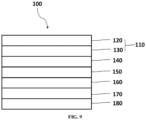
- an organic light-emitting device OLED 100 can include (i) a cathode 110 preferably including an aluminum layer 120 and a lithium layer 130; (ii) optionally, an electron transporting layer 140; (iii) optionally, a carrier confinement layer 150; (iv) a light-emitting layer 160 containing an MR-TADF compound described herein; (v) optionally, a hole-transporting layer 170; and (vi) an anode 180, such as indium tin oxide-coated glass.
- a cathode 110 preferably including an aluminum layer 120 and a lithium layer 130
- an electron transporting layer 140 optionally, a carrier confinement layer 150
- a light-emitting layer 160 containing an MR-TADF compound described herein containing an MR-TADF compound described herein
- a hole-transporting layer 170 optionally, a hole-transporting layer 170
- an anode 180 such as indium tin oxide-coated glass.
- the light-emitting layer can be formed by doping the MR-TADF compounds, as a dopant, into a host compound and the luminescent compound has a percent composition between about 0.5 wt/wt% and about 20 wt/wt%, between about 0.5 wt/wt% and about 15 wt/wt%, between about 0.5 wt/wt% and about 10 wt/wt%, or between about 0.5 wt/wt% and about 5 wt/wt%, such as about 0.5 wt/wt%, about 1 wt/wt%, about 2 wt/wt%, about 3 wt/wt%, about 4 wt/wt%, or about 5 wt/wt% of the light-emitting layer.
- the light-emitting layer has a thickness between about 5 nm and about 120 nm, between about 5 nm and about 60 nm, such as between about 10 nm and
- the light-emitting layer contains a host compound.
- the host compound has a percent composition between about 1 wt/wt% and about 30 wt/wt%, between about 1 wt/wt% and about 25 wt/wt%, between about 1 wt/wt% and about 20 wt/wt%, between about 1 wt/wt% and about 15 wt/wt%, between about 1 wt/wt% and about 10 wt/wt%, such as about 5 wt% of the light-emitting layer.
- the host compound is selected from, but is not limited to, 1,3-bis(N-carbazolyl)benzene (mCP), 4,4'-bis(carbazol-9-yl)biphenyl (CBP), 4,4',4"-tris(carbazol-9-yl)- triphenylamine (TCTA), 3-(4-biphenylyl)-4-phenyl-5- tert -butylphenyl-1,2,butylphenyl-1,2,4-triazole (TAZ), p- bis(triphenylsilyl)benzene (UGH2), 9-(4-tert-Butylphenyl)-3,6-bis(triphenylsilyl)-9H-carbazole (CzSi), Bis-4-(N-carbazolyl)phenyl)phenylphosphine oxide (BCPO), diphenyl-4-triphenylsilylphenyl-phosphine oxide (TSPO1),
- two hosts such as CzSi:TSPO1, BCPO:TSPO1, and BCPO:CzSi may be used in some forms at suitable relative ratios.
- Exemplary relative molar ratios of two respective hosts can range from between about 0.5: 1 to 2:1.
- the hole-transporting layer contains an organic compound that can be, but is not limited to, 4,4'-bis[ N -(1-naphthyl)- N- phenylamino]biphenyl (NPB), 4,4'-bis[ N -(3-methylphenyl)- N- phenylamino]biphenyl (TPD), 4,4',4"-tris[(3-methylphenyl)phenylamino] triphenylamine (MTDATA), and di-[4-( N,N -ditolyl-amino)phenyl]cyclohexane (TAPC).
- NPB 4,4'-bis[ N -(1-naphthyl)- N- phenylamino]biphenyl
- TPD 4,4'-bis[ N -(3-methylphenyl)- N- phenylamino]biphenyl
- MTDATA 4,4',4"-tris[(3
- polymeric hole-transporting materials can be used including poly(N-vinylcarbazole) (PVK), polythiophene, polypyrrole, polyaniline, and copolymers including PEDOT:PSS.
- the hole-transporting layer has a thickness between about 10 nm and 70 nm, such as 40 nm.
- the electron-transporting layer contains an organic compound that can be, but is not limited to, 1,3,5-tris(phenyl-2-benzimidazolyl)-benzene (TPBI), 1,3,5-tri[(3-pyridyl)-phen-3-yl] benzene (TmPyPB), bathocuproine (BCP), bathophenanthroline (BPhen) and bis(2-methyl-8-quinolinolate)-4-(phenylphenolate)-aluminum (BAlq), 1,3,5-tri[(3-pyridyl)-phen-3-yl]benzene (TmPyPB),1,3-bis[3,5-di(pyridin-3-yl)- phenyl]benzene (BmPyPhB) and 1,3,5-tris(6-(3-(pyridin-3-yl)phenyl)pyridin-2-yl)benzene (Tm3PyP26PyB).
- TPBI
- the light-emitting device can contain a carrier confinement layer inserted between the hole-transporting layer and the light-emitting layer, or between the light-emitting layer and the electron-transporting layer.
- the carrier confinement layer improves the performance of the light-emitting device.
- the carrier confinement layer contains an organic compound that can be, but is not limited to, CBP, TCTA, 3TPYMB, BmPyPhB, and Tm3PyP26PyB.
- the carrier confinement layer has a thickness between about 5 nm and about 50 nm, such as between about 10 nm and about 50 nm.
- the anode of the light-emitting device contains indium tin oxide-coated glass.
- the cathode of the light-emitting device can contain lithium fluoride, aluminium, or a combination thereof.
- the lithium fluoride forms a layer having a thickness between about 0.05 nm and 5 nm, such as 1 nm.
- the aluminium forms a layer having a thickness between about 50 nm and about 250 nm, between about 50 nm and about 200 nm, such as 150 nm.
- the CE can include, but is not limited to values of about 5 cd/A, 7.5 cd/A, 10 cd/A, 15 cd/A, 20 cd/A, 25 cd/A, 30 cd/A, or 35 cd/A.
- the CE values at luminances of 1000 cd/m 2 may be up to 30 cd/A.
- the CE at luminances of 1000 cd/m 2 can include, but is not limited to values of about 2 cd/A, 2.5 cd/A, 5 cd/A, 10 cd/A, 15 cd/A, 20 cd/A, 25 cd/A, or 30 cd/A.
- OLEDs fabricated with the MR-TADF emitters/compounds described herein can demonstrate maximum power efficiencies (PE) of up to 30 lumens per watt.
- the PE can include, but is not limited to values of about 5 lm/W, 10 lm/W, 15 lm/W, 20 lm/W, 25 lm/W, or 30 lm/W.
- the PE values at luminances of 1000 cd/m 2 may be up to 25 lm/W.
- the PE at luminances of 1000 cd/m 2 can include, but is not limited to values of about 5 lm/W, 5.5 lm/W, 6 lm/W, 6.5 lm/W, 10 lm/W, 15 lm/W, 20 lm/W, 25 lm/W.
- OLEDs fabricated with the MR-TADF emitters/compounds described herein can demonstrate maximum external quantum efficiencies (EQE) of up to about 30%.
- the EQE can include, but is not limited to values of about 10 to about 30%.
- the EQE values at luminances of 1000 cd/m 2 may be up to about 20%, about 25%, about 26%, about 27%, about 28%, about 29%, or about 30%.
- the EQE at luminances of 1000 cd/m 2 can include, but is not limited to, values of about 1% to about 20%, about 1% to about 15%, about 1% to about 10%, or about 1% to about 5%.
- compositions and methods can be further understood through the following numbered paragraphs.
- ISC singlet-triplet intersystem crossings
- MR-TADF multi-resonance thermally activated delayed fluorescent
- the non-limiting examples describe a gold(I) coordination strategy to enhance the spin-orbit coupling of green and blue BN(O)-based MR-TADF emitters, which results in a notable increase in rate constants of the spectroscopically observed ISC process to 3 ⁇ 10 9 s -1 with nearly unitary ISC quantum yields.
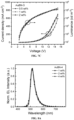
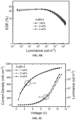
- the vapor-deposited ultrapure-green OLEDs fabricated with these Au I emitters delivered high luminance of up to 2.53 ⁇ 10 5 cd m -2 as well as external quantum efficiencies of up to 30.3% with roll-offs as low as 0.8% and long device lifetimes (LT 60 ) of 1210 h at 1000 cd m -2 .
- Multi-resonance thermally activated delayed fluorescent (MR-TADF) compounds based on rigid B- and N-(O-) doped polyaromatic hydrocarbons have rapidly ascended to an important class of organic light-emitting diode (OLED) emitters with practicality since their debut in 2015.
- MR-TADF thermally activated delayed fluorescent
- this class of emitters features exceptionally narrow emission bands with full-width-at-half-maximum (FWHM) of only 15-40 nm by virtue of the complementary resonance effects of the highest occupied molecular orbital (HOMO) and lowest unoccupied molecular orbital (LUMO) and the nonbonding character around the N-donor atoms (HOMO) and B-acceptor atoms (LUMO), which minimizes the excited state structural reorganization.
- FWHM full-width-at-half-maximum
- RISC rate-limiting endergonic reverse intersystem crossing
- a panel of highly efficient, air- and thermally stable green and blue Au I MR-TADF emitters featuring a BN(O)-based luminogen covalently linked to the Au-NHC motif via a Au-C aryl bond is provided.
- Optically transparent (>350 nm) and sterically bulky NHC ancillary ligands were selected in this work to minimize perturbation to MR-TADF emission and to enhance thermal and electrochemical stabilities of the Au emitters.
- the as-fabricated ultrapure-green Au I OLEDs attained a high CIE y coordinate of up to 0.70 and excellent electroluminescence (EL) performance with maximum EQEs reaching 30.3% and exceedingly small roll-offs down to 0.8% alongside long operational lifetimes (LT 60 ) of up to 1210 h at a practical luminance of 1000 cd m -2 .
- EL electroluminescence
- Example 1 Metal-assisted multi-resonance thermally-activated delayed fluorescence (MR-TADF) emitters
- AuBN-2 to AuBN-6 were synthesized based on the method for AuBN-1.
- HAT-CN, FSFA, FSF4A, DMIC-Cz, DMIC-TRz, ANT-BIZ, and Liq were purchased from Luminescence Technology Corp, Aluminum Pellets from Kurt J. Lesker. All of these materials were used as received.
- OLEDs were fabricated in a Kurt J. Lesker SPECTROS vacuum deposition system with a base pressure of 10 -8 mbar.
- organic materials were thermally deposited in sequence at a rate of ⁇ 0.1 nm s -1 .
- the doping process in the emitting layer was realized by co-deposition technology.
- Liq (2 nm) and A1 (100 nm) were thermally deposited at rates of 0.03 and 0.2 nm s -1 , respectively. Film thicknesses were determined in situ using calibrated oscillating quartz crystal sensors.
- EL spectra, luminance, CIE coordinates, EQE, and CE were measured using a Keithley 2400 source-meter and an absolute external quantum efficiency measurement system (C9920-12, Hamamatsu Photonics). All devices were characterized at room temperature after encapsulation in a 200-nm-thick Al 2 O 3 thin film deposited by atomic layer deposition (ALD) in a Kurt J. Lesker SPECTROS ALD system.
- ALD atomic layer deposition
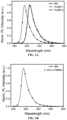
- BN ligand and Au(I) MR-TADF emitters in solutions and films are characterized. These compounds have shown a narrow emission bandwidth with full width at half maximum (FWHM) of 22 to 41 nm at room temperature. Compared to BN ligand, AuBN-1 and AuBN-2 have shown shorter emission lifetimes, attributed to the coordination of metal ion which accelerates both intersystem crossing and reverse intersystem crossing processes between the singlet and triplet excited states.
- the devices based on AuBN-1 and AuBN-2 have shown better performance with superior brightness and efficiencies, than those based on BN ligand.
- the device stability is also significantly enhanced with LT 95 extended by more than 5-fold at 100 cd m -2 .
- Table 5 Comparison of operational lifetimes of OLEDs doped with 1 wt% BN, AuBN-1, AuBN-2.
- vapor-deposited OLEDs based on AuBN-1 or AuBN-2 showed superior device performances in terms of EQE, luminance and efficiency roll-off at 1000 cd m -2 , which respectively attained values of up/down to 26.1%, 240,000 cd m -2 and 0.4%, i.e., EQE and luminance are up to 26.1% and 240,000 cd m -2 , respectively, while efficiency roll-off is down to 0.4%, such as with an OLED containing AuBN-2.
- both OLEDs based on AuBN-1 and AuBN2 showed superior device performances. More importantly, the device lifetimes of these metal-assisted MR-TADF emitters were extended by more than 5-folds compared to that of BN in the preliminary tests.
- Compound BN was reported previously [5] while BNO is newly prepared in this work.
- DIPP N-substituted 2,6-di-isopropylphenyl
- TIPP 2,4,6-triisopropylphenyl groups
- the (NHC)AuBN(O) complexes were synthesized by coupling reaction between pinacol ester-activated BN(O) precursor [12] and (NHC)AuCl complex and were obtained as pale yellow or yellow solids in high yields (81-87%). All these new Au I MR-TADF complexes were characterized by 1 H NMR, 13 C NMR, high-resolution mass spectrometry, elemental analysis, and single crystal X-ray diffraction [13] .
- PL photoluminescence
- Au(NHC) ligation significantly accelerates the delayed fluorescence of the BN(O) luminogens, which gives large TADF rate constants ( k TADF ) of 1.1-1.3 ⁇ 10 5 s -1 , while retaining the favorable emission characteristics of high color purity and PLQY for MR-TADF emitters.
- fs-TA femtosecond transient absorption
- fs-TRF time-resolved fluorescence
- k ISC ISC rate constants
- ⁇ ISC quantum yields
- k ISC of (NHC)AuBN complexes and (BzIPr)AuBNO are estimated to be 3.0-3.2 ⁇ 10 9 s -1 , which are about 70- to 80-fold higher than their organic counterparts, BN and BNO, with ⁇ ISC approaching unity (0.95-0.97).
- k ISC and ⁇ ISC values are among the highest in all reported MR-TADF emitters.
- k S1 k r(S1) + k IC(S1).
- k ISC 1/ ⁇ PF - k S1.
- ⁇ ISC k ISC ⁇ PF .
- k R ISC ⁇ DF /( k ISC ⁇ PF ⁇ DF ⁇ PF ).
- TCSPC TCSPC.
- fs-TRF Measured by fs-TRF.
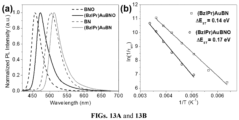
- the emissions Upon cooling to 77 K, the emissions are redshifted by 18-21 nm with lifetimes significantly elongated to 1400-3050 ⁇ s; this emission was tentatively assigned to phosphorescence from 3 SRCT state.
- the ⁇ E ST of the 1,3 SRCT states were estimated to be 0.08-0.09 eV for (NHC)AuBN emitters and 0.11 eV for (BzIPr)AuBNO, which are comparable to or smaller than the values of their respective parents, BN (0.10 eV) and BNO 0.16 eV).
- Temperature dependence of emission lifetime of the Au I emitters in PMMA thin film was measured.
- the S 1 and T 1 excited states of (BzIPr)AuBN (AuBN-2) are of the same nature as the respective excited states of BN with both excited states predominantly derived from the HOMO ⁇ LUMO transition (>97%); the HOMO and LUMO are localized on the aza-boron ligand but the gold(I) complex has very minute contributions of Au in the HOMO (1 %) and LUMO (5 %).
- T 1 ) has been computed at the respective optimized S 1 and T 1 excited states.
- multilayer OLEDs were fabricated with the following optimized structure: ITO/HAT-CN (10 nm)/FSFA (120 nm)/ FSF4A (5 nm)/(NHC)AuBN: DMIC-Cz: DMIC-TRz (30 nm)/ANT-BIZ (5 nm)/ANT-BIZ: Liq (1 : 1, 25 nm)/Liq (2 nm)/Al (100 nm).
- HAT-CN 1,4,5,8,9,11-hexaazatriphenylenehexacarbonitrile
- FSFA N-([1,1'-biphenyl]-2-yl)-N-(9,9-dimethyl-9 H fluoren-2-yl)-9,9'-spirobi[fluoren]-2-amine
- FSF4A N-([1,1'-biphenyl]-2-yl)-N-(9,9-dimethyl-9 H -fluoren-2-yl)-9,9'-spirobi[fluoren]-4-amine
- FSF4A the mixture of 7,7-dimetyl-5-phenyl-2-(9-phenyl-9 H -carbazol-3-yl)-5,7-dihydroindeno[2,1-b]carbazole
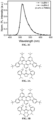
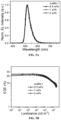
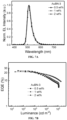
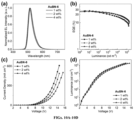
- the CIE coordinates of 1 wt% (SIPr)AuBN-doped (AuBN-1- doped) OLED are (0.21, 0.69) and 4 wt% (BzIPr)AuBN-doped ( AuBN-2 -doped) OLED are (0.18, 0.70), which are close to that of the National Television System Council (NTSC) standard green luminescence (0.21, 0.71).
- NTSC National Television System Council
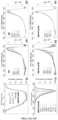
- ultrapure-green OLEDs doped with (BzIPr)AuBN exhibited maximum EQEs up to 30.3% and narrowband electroluminescence with FWHM of 34 nm as well as extremely low efficiency roll-off of 0.8% and long operational device lifetime (LT 60 ) of 1210 h at a practical luminance of 1000 cd m -2 .
- LT 60 operational device lifetime
Landscapes
- Chemical & Material Sciences (AREA)
- Engineering & Computer Science (AREA)
- Physics & Mathematics (AREA)
- Materials Engineering (AREA)
- Organic Chemistry (AREA)
- Spectroscopy & Molecular Physics (AREA)
- Optics & Photonics (AREA)
- Inorganic Chemistry (AREA)
- Manufacturing & Machinery (AREA)
- Organic Low-Molecular-Weight Compounds And Preparation Thereof (AREA)
- Electroluminescent Light Sources (AREA)
Applications Claiming Priority (1)
| Application Number | Priority Date | Filing Date | Title |
|---|---|---|---|
| US202263407263P | 2022-09-16 | 2022-09-16 |
Publications (1)
| Publication Number | Publication Date |
|---|---|
| EP4339259A1 true EP4339259A1 (en) | 2024-03-20 |
Family
ID=87933574
Family Applications (1)
| Application Number | Title | Priority Date | Filing Date |
|---|---|---|---|
| EP23195511.3A Pending EP4339259A1 (en) | 2022-09-16 | 2023-09-05 | Metal-assisted multi-resonance thermally-activated delayed-fluorescence emitters for oled applications |
Country Status (5)
| Country | Link |
|---|---|
| US (1) | US20240124494A1 (enExample) |
| EP (1) | EP4339259A1 (enExample) |
| JP (1) | JP2024043502A (enExample) |
| KR (1) | KR20240038915A (enExample) |
| CN (1) | CN117720560A (enExample) |
Families Citing this family (2)
| Publication number | Priority date | Publication date | Assignee | Title |
|---|---|---|---|---|
| US12116378B2 (en) | 2018-12-04 | 2024-10-15 | The University Of Hong Kong | Transition metal luminescent complexes and methods of use |
| EP4347611A4 (en) | 2021-05-31 | 2025-03-12 | Versitech Limited | Dinuclear platinum (ii) red emitters for oled applications |
Citations (3)
| Publication number | Priority date | Publication date | Assignee | Title |
|---|---|---|---|---|
| US20180301629A1 (en) | 2015-03-24 | 2018-10-18 | Kwansei Gakuin Educational Foundation | Organic electroluminescent element |
| US20210122765A1 (en) * | 2019-10-25 | 2021-04-29 | Universal Display Corporation | Organic electroluminescent materials and devices |
| CN113292579A (zh) * | 2020-02-24 | 2021-08-24 | 环球展览公司 | 有机电致发光材料和装置 |
-
2023
- 2023-09-05 EP EP23195511.3A patent/EP4339259A1/en active Pending
- 2023-09-07 JP JP2023145147A patent/JP2024043502A/ja active Pending
- 2023-09-13 US US18/466,622 patent/US20240124494A1/en active Pending
- 2023-09-13 CN CN202311179013.5A patent/CN117720560A/zh active Pending
- 2023-09-14 KR KR1020230122765A patent/KR20240038915A/ko active Pending
Patent Citations (3)
| Publication number | Priority date | Publication date | Assignee | Title |
|---|---|---|---|---|
| US20180301629A1 (en) | 2015-03-24 | 2018-10-18 | Kwansei Gakuin Educational Foundation | Organic electroluminescent element |
| US20210122765A1 (en) * | 2019-10-25 | 2021-04-29 | Universal Display Corporation | Organic electroluminescent materials and devices |
| CN113292579A (zh) * | 2020-02-24 | 2021-08-24 | 环球展览公司 | 有机电致发光材料和装置 |
Non-Patent Citations (25)
| Title |
|---|
| ANGEW. CHEM., vol. 127, 2015, pages 13785 - 13789 |
| ANGEW. CHEM., vol. 133, 2021, pages 18054 - 18058 |
| ANGEW. CHEM., vol. 134, 2022, pages e202203982 |
| C. MAC. T.-L. CHANW.-M. KWOKC.-M. CHE, CHEM. SCI., vol. 3, 2012, pages 1883 - 1892 |
| D. FANG, Y. SUN, Y. CHEN, T. FU, M. U. ALI, Y. HE, J. MIAO, C. YAN, H. MENG, DYES PIGM, vol. 173, 2020, pages 107990 |
| D. SONGY. YUL. YUED. ZHONGY. ZHANGX. YANGY. SUNG. ZHOUZ. WU, J. MATER. CHEM. C, vol. 7, 2019, pages 11953 - 11963 |
| H. HIRAIK. NAKAJIMAS. NAKATSUKAK. SHIRENJ. NIS. NOMURAT. IKUTAT. HATAKEYAMA, ANGEW. CHEM. INT. ED., vol. 54, 2015, pages 13581 - 13585 |
| H. TANAKAS. ODAG. RICCIH. GOTOHK. TABATAR. KAWASUMID. BELJONNEY. OLIVIERT. HATAKEYAMA, ANGEW. CHEM. INT. ED., vol. 60, 2021, pages 17910 - 17914 |
| H.-Y. CHAOW. LUY. LIM. C. W. CHANC.-M. CHEK.-K. CHEUNGN. ZHU, J. AM. CHEM. SOC., vol. 124, 2002, pages 14696 - 14706 |
| I. S. PARKM. YANGH. SHIBATAN. AMANOKURAT. YASUDA, ADV. MATER., vol. 34, 2022, pages 2107951 |
| K. SHIZUH. KAJI, COMMUN. CHEM., vol. 5, 2022, pages 53 |
| L. KUEHNA. F. EICHHORND. SCHMIDTT. B. MARDERU. RADIUS, J. ORGANOMET. CHEM., vol. 919, 2020, pages 121249 |
| M. K. ETHERINGTONJ. GIBSONH. F. HIGGINBOTHAMT. J. PENFOLDA. P. MONKMAN, NAT. COMMUN., vol. 7, 2016, pages 13680 |
| M. MONTALTIA. CREDIL. PRODIM. T. GANDOLFI: "Handbook of Photochemistry", 2006, CRC |
| M. YANGI. S. PARKT. YASUDA, J. AM. CHEM. SOC., vol. 142, 2020, pages 19468 - 19472 |
| N. AIZAWAY. HARABUCHIS. MAEDAY.-J. PU, NAT. COMMUN., vol. 11, 2022, pages 3909 |
| R. TANGS. XUT.-L. LAMG. CHENGL. DUQ. WANJ. YANGF.-F. HUNGK.-H. LOWD.-L. PHILLIPS, ANGEW. CHEM. INT. ED., vol. 61, 2022, pages e202203982 |
| S. MADAYANAD SURESHD. HALLD. BELJONNEY. OLIVIERE. ZYSMAN-COLMAN, ADV. FUNCT. MATER., vol. 30, 2020, pages 1908677 |
| T. HATAKEYAMAK. SHIRENK. NAKAJIMAS. NOMURAS. NAKATSUKAK. KINOSHITAJ. NIY. ONOT. IKUTA, ADV. MATER., vol. 28, 2016, pages 2777 - 2781 |
| W. LUW.-M. KWOKC. MAC. T.-L. CHANM.-X. ZHUC.- M. CHE, J. AM. CHEM. SOC., vol. 133, 2011, pages 14120 - 14135 |
| XU ET AL., ADV. MATER., vol. 33, 2021, pages 2100652 |
| Y. GAOY. WANGZ. GUOY. WANC. LIB. YANGW. YANGX. MA, J. PHYS. CHEM. B, vol. 126, 2022, pages 2729 - 2739 |
| Y. KONDOK. YOSHIURAS. KITERAH. NISHIS. ODAH. GOTOHY. SASADAM. YANAIT. HATAKEYAMA, NAT. PHOTONICS, vol. 13, 2019, pages 678 - 682 |
| Y. TSUCHIYAS. DIESINGF. BENCHEIKHY. WADAP. L. DOS SANTOSH. KAJIE. ZYSMAN-COLMANI. D. W. SAMUELC. ADACHI, J. PHYS. CHEM. A, vol. 125, 2021, pages 8074 - 8089 |
| Y. XUZ. CHENGZ. LIB. LIANGJ. WANGJ. WEIZ. ZHANGY. WANG, ADV. OPT. MATER., vol. 8, 2020, pages 1902142 |
Also Published As
| Publication number | Publication date |
|---|---|
| KR20240038915A (ko) | 2024-03-26 |
| CN117720560A (zh) | 2024-03-19 |
| JP2024043502A (ja) | 2024-03-29 |
| US20240124494A1 (en) | 2024-04-18 |
Similar Documents
| Publication | Publication Date | Title |
|---|---|---|
| US12180230B2 (en) | Carbene compounds and organic electroluminescent devices | |
| Yan et al. | Regioselective Syntheses of Imidazo [4, 5-b] pyrazin-2-ylidene-Based Chelates and Blue Emissive Iridium (III) Phosphors for Solution-Processed OLEDs | |
| Zhu et al. | Tetradentate Pt (II) complexes with peripheral hindrances for highly efficient solution-processed blue phosphorescent OLEDs | |
| Xu et al. | A novel deep blue-emitting znii complex based on carbazole-modified 2-(2-hydroxyphenyl) benzimidazole: Synthesis, bright electroluminescence, and substitution effect on photoluminescent, thermal, and electrochemical properties | |
| WO2015027060A1 (en) | Phosphorescent tetradentate metal complexes having modified emission spectra | |
| CN107810184A (zh) | 发光装置和化合物 | |
| Zhu et al. | High performance NIR OLEDs with low efficiency roll‐off by leveraging Os (II) phosphors and exciplex Co‐Host | |
| US20200176691A1 (en) | Transition metal luminescent complexes and methods of use | |
| Li et al. | Intramolecular hydrogen bond–enhanced electroluminescence performance of hybridized local and charge transfer (HLCT) excited-state blue-emissive materials | |
| CN110372756B (zh) | 一种二价铂络合物及其制备方法和应用 | |
| Zhang et al. | Photo-and electro-luminescence of four cuprous complexes with sterically demanding and hole transmitting diimine ligands | |
| US20240124494A1 (en) | Metal-assisted multi-resonance thermally-activated delayed-fluorescence emitters for oled applications | |
| TW201418268A (zh) | 苯并二氮雜硼咯化合物及使用其之有機電激發光元件用材料、以及有機電激發光元件 | |
| US12116378B2 (en) | Transition metal luminescent complexes and methods of use | |
| CN116438178A (zh) | 化合物、发光材料、延迟荧光材料及有机发光元件 | |
| EP4311851A1 (en) | Dinuclear platinum complexes for oled applications | |
| Sun et al. | Highly efficient and color tunable thermally activated delayed fluorescent emitters and their applications for the solution-processed OLEDs | |
| KR20220081948A (ko) | 탠덤형 카벤 인광체 | |
| WO2014138912A1 (en) | Luminescent compounds and methods of using same | |
| US20230165135A1 (en) | d10 METAL CARBENE COMPLEXES FOR OLED APPLICATIONS | |
| Zou et al. | Synthesis, characterization, and photophysical properties of a new carbazole-pyridine based host material | |
| CN108017675B (zh) | 一种双核有机金属配合物、其发光器件及应用 | |
| JP5943467B2 (ja) | ジフェニルスルホン誘導体、それよりなるホスト材料及びそれを用いた有機エレクトロルミネッセンス素子 | |
| CN115947760B (zh) | 蒎烯嘧啶类四齿铂(ii)和钯(ii)配合物及其制备方法和应用 | |
| CN115991724B (zh) | 蓝磷光二价铂配合物及其制备方法和应用以及有机光电器件 |
Legal Events
| Date | Code | Title | Description |
|---|---|---|---|
| PUAI | Public reference made under article 153(3) epc to a published international application that has entered the european phase |
Free format text: ORIGINAL CODE: 0009012 |
|
| STAA | Information on the status of an ep patent application or granted ep patent |
Free format text: STATUS: THE APPLICATION HAS BEEN PUBLISHED |
|
| AK | Designated contracting states |
Kind code of ref document: A1 Designated state(s): AL AT BE BG CH CY CZ DE DK EE ES FI FR GB GR HR HU IE IS IT LI LT LU LV MC ME MK MT NL NO PL PT RO RS SE SI SK SM TR |
|
| STAA | Information on the status of an ep patent application or granted ep patent |
Free format text: STATUS: REQUEST FOR EXAMINATION WAS MADE |
|
| 17P | Request for examination filed |
Effective date: 20240723 |
|
| RBV | Designated contracting states (corrected) |
Designated state(s): AL AT BE BG CH CY CZ DE DK EE ES FI FR GB GR HR HU IE IS IT LI LT LU LV MC ME MK MT NL NO PL PT RO RS SE SI SK SM TR |