EP4333343A1 - Kommunikationsverfahren und -vorrichtung - Google Patents
Kommunikationsverfahren und -vorrichtung Download PDFInfo
- Publication number
- EP4333343A1 EP4333343A1 EP22827393.4A EP22827393A EP4333343A1 EP 4333343 A1 EP4333343 A1 EP 4333343A1 EP 22827393 A EP22827393 A EP 22827393A EP 4333343 A1 EP4333343 A1 EP 4333343A1
- Authority
- EP
- European Patent Office
- Prior art keywords
- time
- resource
- time unit
- frequency domain
- terminal apparatus
- Prior art date
- Legal status (The legal status is an assumption and is not a legal conclusion. Google has not performed a legal analysis and makes no representation as to the accuracy of the status listed.)
- Pending
Links
- 238000004891 communication Methods 0.000 title claims abstract description 157
- 238000000034 method Methods 0.000 title claims abstract description 107
- 238000012545 processing Methods 0.000 claims description 89
- 238000004590 computer program Methods 0.000 claims description 20
- 230000015654 memory Effects 0.000 claims description 18
- 230000010076 replication Effects 0.000 claims description 8
- 238000013461 design Methods 0.000 description 67
- 230000011664 signaling Effects 0.000 description 31
- 230000009471 action Effects 0.000 description 28
- 230000006870 function Effects 0.000 description 27
- 230000008569 process Effects 0.000 description 21
- 238000010586 diagram Methods 0.000 description 17
- 238000001514 detection method Methods 0.000 description 16
- 238000005516 engineering process Methods 0.000 description 11
- 101000741965 Homo sapiens Inactive tyrosine-protein kinase PRAG1 Proteins 0.000 description 7
- 102100038659 Inactive tyrosine-protein kinase PRAG1 Human genes 0.000 description 7
- 125000004122 cyclic group Chemical group 0.000 description 7
- 102100036409 Activated CDC42 kinase 1 Human genes 0.000 description 6
- 230000003247 decreasing effect Effects 0.000 description 5
- 230000001174 ascending effect Effects 0.000 description 4
- 230000005540 biological transmission Effects 0.000 description 4
- 230000004044 response Effects 0.000 description 3
- 101150071746 Pbsn gene Proteins 0.000 description 2
- 230000009286 beneficial effect Effects 0.000 description 2
- 230000008713 feedback mechanism Effects 0.000 description 2
- 239000011159 matrix material Substances 0.000 description 2
- 230000007246 mechanism Effects 0.000 description 2
- 230000000737 periodic effect Effects 0.000 description 2
- 101100514059 Escherichia coli (strain K12) modE gene Proteins 0.000 description 1
- 238000004364 calculation method Methods 0.000 description 1
- 238000006243 chemical reaction Methods 0.000 description 1
- 238000013500 data storage Methods 0.000 description 1
- 230000004069 differentiation Effects 0.000 description 1
- 230000014509 gene expression Effects 0.000 description 1
- 239000011521 glass Substances 0.000 description 1
- 230000003993 interaction Effects 0.000 description 1
- 238000013507 mapping Methods 0.000 description 1
- 238000010295 mobile communication Methods 0.000 description 1
- 238000012544 monitoring process Methods 0.000 description 1
- 230000003287 optical effect Effects 0.000 description 1
- 238000013468 resource allocation Methods 0.000 description 1
- 239000004065 semiconductor Substances 0.000 description 1
- 239000004984 smart glass Substances 0.000 description 1
- 239000007787 solid Substances 0.000 description 1
- 238000012549 training Methods 0.000 description 1
- 230000001960 triggered effect Effects 0.000 description 1
Images





Classifications
-
- H—ELECTRICITY
- H04—ELECTRIC COMMUNICATION TECHNIQUE
- H04W—WIRELESS COMMUNICATION NETWORKS
- H04W72/00—Local resource management
- H04W72/04—Wireless resource allocation
- H04W72/044—Wireless resource allocation based on the type of the allocated resource
-
- H—ELECTRICITY
- H04—ELECTRIC COMMUNICATION TECHNIQUE
- H04W—WIRELESS COMMUNICATION NETWORKS
- H04W72/00—Local resource management
- H04W72/02—Selection of wireless resources by user or terminal
-
- H—ELECTRICITY
- H04—ELECTRIC COMMUNICATION TECHNIQUE
- H04L—TRANSMISSION OF DIGITAL INFORMATION, e.g. TELEGRAPHIC COMMUNICATION
- H04L5/00—Arrangements affording multiple use of the transmission path
- H04L5/003—Arrangements for allocating sub-channels of the transmission path
- H04L5/0053—Allocation of signalling, i.e. of overhead other than pilot signals
- H04L5/0055—Physical resource allocation for ACK/NACK
-
- H—ELECTRICITY
- H04—ELECTRIC COMMUNICATION TECHNIQUE
- H04L—TRANSMISSION OF DIGITAL INFORMATION, e.g. TELEGRAPHIC COMMUNICATION
- H04L1/00—Arrangements for detecting or preventing errors in the information received
- H04L1/12—Arrangements for detecting or preventing errors in the information received by using return channel
- H04L1/16—Arrangements for detecting or preventing errors in the information received by using return channel in which the return channel carries supervisory signals, e.g. repetition request signals
- H04L1/18—Automatic repetition systems, e.g. Van Duuren systems
-
- H—ELECTRICITY
- H04—ELECTRIC COMMUNICATION TECHNIQUE
- H04L—TRANSMISSION OF DIGITAL INFORMATION, e.g. TELEGRAPHIC COMMUNICATION
- H04L1/00—Arrangements for detecting or preventing errors in the information received
- H04L1/12—Arrangements for detecting or preventing errors in the information received by using return channel
- H04L1/16—Arrangements for detecting or preventing errors in the information received by using return channel in which the return channel carries supervisory signals, e.g. repetition request signals
- H04L1/18—Automatic repetition systems, e.g. Van Duuren systems
- H04L1/1812—Hybrid protocols; Hybrid automatic repeat request [HARQ]
-
- H—ELECTRICITY
- H04—ELECTRIC COMMUNICATION TECHNIQUE
- H04L—TRANSMISSION OF DIGITAL INFORMATION, e.g. TELEGRAPHIC COMMUNICATION
- H04L1/00—Arrangements for detecting or preventing errors in the information received
- H04L1/12—Arrangements for detecting or preventing errors in the information received by using return channel
- H04L1/16—Arrangements for detecting or preventing errors in the information received by using return channel in which the return channel carries supervisory signals, e.g. repetition request signals
- H04L1/18—Automatic repetition systems, e.g. Van Duuren systems
- H04L1/1829—Arrangements specially adapted for the receiver end
- H04L1/1854—Scheduling and prioritising arrangements
-
- H—ELECTRICITY
- H04—ELECTRIC COMMUNICATION TECHNIQUE
- H04L—TRANSMISSION OF DIGITAL INFORMATION, e.g. TELEGRAPHIC COMMUNICATION
- H04L1/00—Arrangements for detecting or preventing errors in the information received
- H04L1/12—Arrangements for detecting or preventing errors in the information received by using return channel
- H04L1/16—Arrangements for detecting or preventing errors in the information received by using return channel in which the return channel carries supervisory signals, e.g. repetition request signals
- H04L1/18—Automatic repetition systems, e.g. Van Duuren systems
- H04L1/1829—Arrangements specially adapted for the receiver end
- H04L1/1861—Physical mapping arrangements
-
- H—ELECTRICITY
- H04—ELECTRIC COMMUNICATION TECHNIQUE
- H04L—TRANSMISSION OF DIGITAL INFORMATION, e.g. TELEGRAPHIC COMMUNICATION
- H04L5/00—Arrangements affording multiple use of the transmission path
-
- H—ELECTRICITY
- H04—ELECTRIC COMMUNICATION TECHNIQUE
- H04W—WIRELESS COMMUNICATION NETWORKS
- H04W72/00—Local resource management
- H04W72/04—Wireless resource allocation
- H04W72/044—Wireless resource allocation based on the type of the allocated resource
- H04W72/0453—Resources in frequency domain, e.g. a carrier in FDMA
-
- H—ELECTRICITY
- H04—ELECTRIC COMMUNICATION TECHNIQUE
- H04W—WIRELESS COMMUNICATION NETWORKS
- H04W74/00—Wireless channel access
- H04W74/08—Non-scheduled access, e.g. ALOHA
- H04W74/0808—Non-scheduled access, e.g. ALOHA using carrier sensing, e.g. carrier sense multiple access [CSMA]
-
- H—ELECTRICITY
- H04—ELECTRIC COMMUNICATION TECHNIQUE
- H04W—WIRELESS COMMUNICATION NETWORKS
- H04W92/00—Interfaces specially adapted for wireless communication networks
- H04W92/16—Interfaces between hierarchically similar devices
- H04W92/18—Interfaces between hierarchically similar devices between terminal devices
Definitions
- This application relates to the field of communication technologies, and in particular, to a communication method and apparatus.
- different used frequency bands may be classified into a licensed frequency band and an unlicensed frequency band.
- a transmit node needs to access a signal in a contention manner.
- energy-based detection and signal type detection are usually used.
- an energy detection threshold (energy detection threshold) needs to be set. When detected energy exceeds the energy detection threshold, it is determined that a channel is busy, and the transmit node is not allowed to access the channel. When detected energy is lower than the energy detection threshold for more than a period of time, the transmit node is allowed to access the channel.
- physical sidelink feedback channel (physical sidelink feedback channel, PSFCH) information may be used to carry hybrid automatic repeat request (hybrid automatic repeat request, HARQ) feedback information.
- hybrid automatic repeat request hybrid automatic repeat request
- This application provides a communication method and apparatus, to improve communication reliability of an SL system in an unlicensed frequency band.
- a communication method may be performed by a first terminal apparatus.
- the first terminal apparatus includes a first terminal device or a member in the first terminal device.
- the first terminal device may be a data receive end in vehicle to everything (vehicle to everything, V2X) communication
- a second terminal device may be a data transmit end in V2X communication.
- the member in the first terminal device may be, for example, a processor, an in-vehicle communication module, a chip, or a chip system that is loaded in the data receive end.
- the first terminal apparatus supports direct communication (PC5) interface communication.
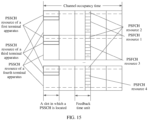
- the method provided in the first aspect includes: The first terminal apparatus may receive first data from a second terminal apparatus; and the first terminal apparatus determines a feedback time unit in a channel occupancy time, where the feedback time unit corresponds to the first data.
- the first terminal apparatus may further access a first channel, transmit first feedback information on a first frequency domain resource in the feedback time unit, and transmit second feedback information on a second frequency domain resource in the feedback time unit, where the first feedback information is an acknowledgment or a negative acknowledgment for the first data, the first frequency domain resource is determined based on a time-frequency resource carrying the first data, the first frequency domain resource and the second frequency domain resource belong to the first channel, and the first frequency domain resource and the second frequency domain resource do not overlap.
- the second terminal apparatus may be the second terminal device or a member in the second terminal device.
- the first terminal apparatus may receive the first data from the second terminal apparatus, and determine the feedback time unit in the channel occupancy time, where the feedback time unit corresponds to the first data.
- the first terminal apparatus may transmit the first feedback information on the first frequency domain resource in the feedback time unit, and transmit the second feedback information on the second frequency domain resource.
- the first feedback information is an acknowledgment or a negative acknowledgment for the first data
- the first frequency domain resource is determined based on the time-frequency resource carrying the first data
- the first frequency domain resource and the second frequency domain resource belong to the first channel
- the first frequency domain resource and the second frequency domain resource do not overlap. In this way, communication reliability of an SL system in an unlicensed frequency band can be improved.
- the channel occupancy time is a maximum channel occupancy time determined by the second terminal apparatus, or the channel occupancy time is less than a maximum channel occupancy time determined by the second terminal apparatus.
- the first terminal apparatus may further receive indication information of the channel occupancy time from the second terminal apparatus.
- the second terminal may flexibly indicate a sidelink feedback resource of the channel occupancy time based on a service feature of the second terminal, for example, a delay or a data packet size, to improve feedback resource utilization.
- the second frequency domain resource is indicated by a network device, or is preconfigured, or is predefined.
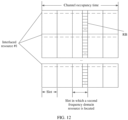
- the second frequency domain resource includes two discontinuous resource blocks, a frequency domain gap between the two discontinuous resource blocks is Offset resource blocks, and Offset satisfies: Bandwidth corresponding to (Offset + 2) resource blocks is greater than or equal to a product of bandwidth of the first channel and a first coefficient, and the first coefficient is greater than 0 and less than or equal to 1.
- the first terminal apparatus can occupy more bandwidth of the first channel to meet an occupied channel bandwidth (occupied channel bandwidth, OCB) requirement of a non-access frequency band.
- occupied channel bandwidth occupied channel bandwidth, OCB
- the second feedback information may be replication information of the first feedback information, or the second feedback information is a predefined bit stream.
- the second frequency domain resource is an m th interlaced resource in the first channel
- the interlaced resource includes at least two resource blocks interlaced in frequency domain, where m is an integer, m is greater than or equal to 1, and is less than or equal to a total quantity of interlaced resources included in the first channel, and a value of m is predefined, indicated by the network device, or preconfigured.
- the first resource block of the second frequency domain resource is an N1 th resource block in the first channel
- the last resource block of the second frequency domain resource is an N2 th resource block in the first channel
- N1 and N2 are positive integers
- values of N1 and N2 are predefined, indicated by the network device, or preconfigured.
- the first frequency domain resource may be determined based on an index and/or a quantity of interlaced resources corresponding to the time-frequency resource carrying the first data and identifier information corresponding to the first data.
- that the first terminal apparatus transmits first feedback information on a first frequency domain resource in the feedback time unit includes: The first terminal apparatus transmits the first feedback information on the first frequency domain resource in the feedback time unit based on a first code domain resource, where the first code domain resource is determined based on the index and/or the quantity of interlaced resources corresponding to the time-frequency resource carrying the first data and the identifier information corresponding to the first data.
- the first terminal apparatus determines a feedback time unit corresponding to the first data in a channel occupancy time includes: The first terminal apparatus determines the feedback time unit from a time unit set based on the time-frequency resource carrying the first data, where the time unit set includes at least one time unit, and a time unit in the at least one time unit includes a feedback resource.
- a time domain gap between a start location of the first time unit in the time unit set and a start location of the channel occupancy time may be X 1 time units
- a time domain gap between every two adjacent time units in the time unit set may be M 1 time units
- X 1 and M 1 may be predefined, indicated by the network device, indicated by the second terminal apparatus, or preconfigured
- X 1 is a positive integer greater than or equal to
- M 1 is a positive integer greater than or equal to 0.
- the first terminal apparatus may determine, based on received first indication information, the time unit set from a time unit included in the channel occupancy time, where the first indication information is from the network device or the second terminal apparatus.
- the feedback time unit may be the last time unit in the channel occupancy time.
- the PSFCH resource is at a fixed location in the channel occupancy time, thereby reducing overheads of configuration signaling and indication signaling.
- that the first terminal apparatus determines a feedback time unit corresponding to the first data in a channel occupancy time includes: When the channel occupancy time is less than a time threshold, the feedback time unit may be the last time unit in the channel occupancy time.
- a communication method may be performed by a second terminal apparatus.
- the second terminal apparatus includes a second terminal device or a member in the second terminal device.
- the second terminal device may be a data transmit end in V2X communication.
- the member in the second terminal device may be, for example, a processor, an in-vehicle communication module, a chip, or a chip system that is loaded in the data transmit end.
- the second terminal apparatus supports communication through a PC5 interface.
- the method provided in the second aspect includes: The second terminal apparatus accesses a first channel, and transmits first data to a first terminal apparatus; the second terminal apparatus determines a feedback time unit in a channel occupancy time, where the feedback time unit corresponds to the first data; and the second terminal apparatus may receive first feedback information on a first frequency domain resource in the feedback time unit, where the first feedback information is an acknowledgment or a negative acknowledgment for the first data, and the first frequency domain resource is determined based on a time-frequency resource carrying the first data.
- the second terminal apparatus may further receive and discard second feedback information, where the second feedback information is carried in a second frequency domain resource in the feedback time unit, the first frequency domain resource and the second frequency domain resource belong to the first channel, and the first frequency domain resource and the second frequency domain resource do not overlap.
- the second frequency domain resource may be indicated by a network device, or is preconfigured, or is predefined.
- the second frequency domain resource includes two discontinuous resource blocks, a frequency domain gap between the two discontinuous resource blocks is Offset resource blocks, and Offset satisfies: Bandwidth corresponding to (Offset + 2) resource blocks is greater than or equal to a product of bandwidth of the first channel and a first coefficient, and the first coefficient is greater than 0 and less than or equal to 1.
- the second feedback information may be replication information of the first feedback information, or the second feedback information is a predefined bit stream.
- the second frequency domain resource is an m th interlaced resource in the first channel
- the interlaced resource includes at least two resource blocks interlaced in frequency domain, where m is an integer, m is greater than or equal to 1, and is less than or equal to a total quantity of interlaced resources included in the first channel, and a value of m is predefined, indicated by the network device, or preconfigured.
- the first resource block of the second frequency domain resource is an N1 th resource block in the first channel
- the last resource block of the second frequency domain resource is an N2 th resource block in the first channel
- N1 and N2 are positive integers
- values of N1 and N2 are predefined, indicated by the network device, or preconfigured.
- the channel occupancy time may be a maximum channel occupancy time determined by the second terminal apparatus, or the channel occupancy time is less than a maximum channel occupancy time determined by the second terminal apparatus.
- the second terminal apparatus may further transmit indication information of the channel occupancy time to the first terminal apparatus.
- the first frequency domain resource may be determined based on an index and/or a quantity of interlaced resources corresponding to the time-frequency resource carrying the first data and identifier information corresponding to the first data.
- that the second terminal apparatus receives first feedback information on a first frequency domain resource in the feedback time unit includes: The second terminal apparatus may receive the first feedback information on the first frequency domain resource in the feedback time unit based on a first code domain resource, where the first code domain resource is determined based on the index and/or the quantity of interlaced resources corresponding to the time-frequency resource carrying the first data and the identifier information corresponding to the first data.
- a time domain gap between a start location of the first time unit in the time unit set and a start location of the channel occupancy time may be X 1 time units
- a time domain gap between every two adjacent time units in the time unit set may be M 1 time units
- X 1 and M 1 may be predefined, indicated by the network device, indicated by the second terminal apparatus, or preconfigured
- X 1 is a positive integer greater than or equal to
- M 1 is a positive integer greater than or equal to 0.
- the second terminal apparatus may further transmit first indication information to the first terminal apparatus, where the first indication information is used by the first terminal apparatus to determine the time unit set from a time unit included in the channel occupancy time.
- the second terminal apparatus may further determine, based on received second indication information, the time unit set from the time unit included in the channel occupancy time, where the second indication information is from the network device.
- the feedback time unit may be the last time unit in the channel occupancy time.
- that the first terminal apparatus determines a feedback time unit corresponding to the first data in a channel occupancy time includes: When the channel occupancy time is less than a time threshold, the feedback time unit may be the last time unit in the channel occupancy time.
- an embodiment of this application provides a communication apparatus, to implement the method implemented by the first terminal apparatus in the first aspect or any possible design of the first aspect.
- the apparatus includes a corresponding unit or member configured to perform the foregoing method.
- the unit included in the apparatus may be implemented by software and/or hardware.
- the apparatus may be, for example, a first terminal apparatus, or a member, a chip, a chip system, an in-vehicle communication module, a processor, or the like that can support the first terminal apparatus in implementing the foregoing method.
- the communication apparatus may include modular components such as a transceiver unit (or referred to as a communication module or a transceiver module) and a processing unit (or referred to as a processing module). These modules may perform corresponding functions of the first terminal apparatus in the first aspect or any possible design of the first aspect.
- the transceiver unit may be a transmitting unit when performing a transmitting step, and the transceiver unit may be a receiving unit when performing a receiving step.
- the transceiver unit may be replaced by a transceiver, the transmitting unit may be replaced by a transmitter, and the receiving unit may be replaced by a receiver.
- the transceiver unit may include an antenna, a radio frequency circuit, or the like.
- the processing unit may be a processor, for example, a baseband chip.
- the transceiver unit may be a radio frequency unit, and the processing unit may be a processor.
- the transceiver unit may be an input/output interface of the chip system, and the processing unit may be a processor of the chip system, for example, a central processing unit (central processing unit, CPU).
- the transceiver unit may be configured to perform a receiving and/or transmitting action performed by the first terminal apparatus in the first aspect or any possible design of the first aspect.
- the processing unit may be configured to perform an action other than receiving and transmitting performed by the first terminal apparatus in the first aspect or any possible design of the first aspect.
- the communication apparatus may include a transceiver module and/or a communication module.
- the communication apparatus may include a processor and/or a transceiver.
- the communication apparatus may further include a memory.
- an embodiment of this application provides a communication apparatus, to implement the method implemented by the second terminal apparatus in the first aspect or any possible design of the first aspect.
- the apparatus includes a corresponding unit or member configured to perform the foregoing method.
- the unit included in the apparatus may be implemented by software and/or hardware.
- the apparatus may be, for example, a second terminal apparatus, or a chip, a chip system, an in-vehicle communication module, a processor, or the like that can support the second terminal apparatus in implementing the foregoing method.
- the communication apparatus may include modular components such as a transceiver unit (or referred to as a communication module or a transceiver module) and a processing unit (or referred to as a processing module). These modules may perform corresponding functions of the second terminal apparatus in the first aspect or any possible design of the first aspect.
- the transceiver unit may be a transmitting unit when performing a transmitting step, and the transceiver unit may be a receiving unit when performing a receiving step.
- the transceiver unit may be replaced by a transceiver, the transmitting unit may be replaced by a transmitter, and the receiving unit may be replaced by a receiver.
- the transceiver unit may include an antenna, a radio frequency circuit, or the like.
- the processing unit may be a processor, for example, a baseband chip.
- the transceiver unit may be a radio frequency unit, and the processing unit may be a processor.
- the transceiver unit may be an input/output interface of the chip system, and the processing unit may be a processor of the chip system, for example, a CPU.
- the transceiver unit may be configured to perform a receiving and/or transmitting action performed by the second terminal apparatus in the first aspect or any possible design of the first aspect.
- the processing unit may be configured to perform an action other than receiving and transmitting performed by the second terminal apparatus in the first aspect or any possible design of the first aspect.
- the communication apparatus may include a transceiver module and/or a communication module.
- the communication apparatus may include a processor and/or a transceiver.
- the communication apparatus may further include a memory.
- a communication system includes the communication apparatus shown in the third aspect and the communication apparatus shown in the fourth aspect.
- a computer-readable storage medium configured to store computer instructions or a computer program, and when the computer instructions or the computer program is run on a computer, the computer is enabled to perform the method according to the first aspect and the second aspect or any possible implementation in the first aspect and the second aspect.
- a computer program product is provided.
- the computer program product runs on a computer, the computer is enabled to perform the method according to the first aspect and the second aspect or any one of the possible designs of the first aspect and the second aspect.
- a circuit is provided.
- the circuit is coupled to a memory, and the circuit is configured to perform the method according to the first aspect and the second aspect or any possible implementation in the first aspect and the second aspect.
- the circuit may include a chip circuit, a chip, a chip system, or the like.
- beneficial effect of the second aspect to the eighth aspect and the possible designs of the second aspect to the eighth aspect refer to beneficial effect of the first aspect and the possible designs of the first aspect.
- the terminal device may alternatively be a wearable device.
- the wearable device may also be referred to as a wearable intelligent device, an intelligent wearable device, or the like, and is a general term of wearable devices that are intelligently designed and developed for daily wear by using a wearable technology, for example, glasses, gloves, watches, clothes, shoes, and the like.
- the wearable device is a portable device that can be directly worn on the body or integrated into clothes or an accessory of a user.
- the wearable device is not only a hardware device, but also implements a powerful function through software support, data exchange, and cloud interaction.
- a wearable intelligent device includes a full-featured and large-sized device that can implement all or a part of functions without depending on a smartphone, for example, a smart watch, smart glasses, or the like, and includes a device that is dedicated to only one type of application function and needs to collaboratively work with another device such as a smartphone, for example, various smart bands, a smart helmet, smart jewelry for monitoring a physical sign, and the like.
- the terminal devices described above are located in a vehicle (for example, placed in the vehicle or mounted in the vehicle), the terminal devices may be all considered as in-vehicle terminal devices.
- the in-vehicle terminal device is also referred to as an on board unit (on board unit, OBU).
- OBU on board unit
- the terminal device may further include a relay (relay).
- relay relay
- all devices that can perform data communication with the base station may be considered as terminal devices.
- a road side unit (road side unit, RSU) may be considered as a terminal apparatus.
- a communication method provided in embodiments of this application may be described by using a terminal apparatus as an example.
- a party for example, a transmit node
- a party for example, a receive node
- receive end terminal apparatus a party that receives the sidelink data
- a receive end terminal apparatus a terminal apparatus that receives the sidelink information
- a terminal apparatus that is, a receive node of sidelink information
- a terminal apparatus that is, a transmit node of the sidelink information
- a second terminal apparatus that transmits the sidelink information
- the first communication apparatus is a transmit node of sidelink feedback information
- the second communication apparatus is a receive node of the sidelink feedback information
- the sidelink feedback information may indicate a receiving status (including correct receiving or incorrect receiving) of the sidelink information by the first terminal apparatus.
- the sidelink feedback information may be used for data information (including hybrid automatic repeat request (hybrid automatic repeat request, HARQ) response feedback information, for example, an acknowledgment (acknowledge, ACK) or a negative acknowledgment (negative acknowledge, NACK), and may further include channel state information (channel state information, CSI) feedback information), and may further indicate at least one of the following information, for example, energy saving information and resource assistance information (including a recommended resource, a resource that is not recommended, resource collision, a resource reservation conflict, half duplex collision that has occurred in the past or is to occur in the future).
- HARQ hybrid automatic repeat request
- the sidelink information may include at least one information, for example, sidelink discovery information (the sidelink discovery information may be carried on a physical sidelink discovery channel (physical sidelink discovery channel, PSDCH) and/or a physical sidelink shared channel (physical sidelink shared channel, PSSCH)), sidelink control information (sidelink control information, SCI) (the SCI is carried on a physical sidelink control channel (physical sidelink control channel, PSCCH) and/or a PSSCH), sidelink data information (or referred to as data, sidelink data, and the like) (the sidelink data information is carried in a PSSCH), sidelink feedback information (carried in a PSFCH), sidelink synchronization information (carried in a sidelink-synchronization signal block (sidelink-synchronization signal block, S-SSB)), sidelink pilot information (reference signaling) (including a demodulation reference signal (demodulation reference signal, DMRS), a channel state information reference signal (channel state information reference signal, CSI-RS), a phase-tracking reference signal
- a network device includes, for example, an access network (access network, AN) device, for example, a base station, and may be a device that communicates with a terminal apparatus over an air interface in an access network by using one or more cells.
- AN access network
- a network device in a V2X technology is a road side unit (road side unit, RSU).
- the RSU may be a fixed infrastructure entity that supports a V2X application, and may exchange a message with another entity that supports the V2X application by using a Uu air interface.
- the network device may include an evolved universal terrestrial radio access network NodeB (E-UTRAN NodeB, eNB), a next-generation NodeB (next generation NodeB, gNB) in a 5th generation mobile communication technology (the 5th generation, 5G) NR system, or may include a central unit (central unit, CU) and a distributed unit (distributed unit, DU) in a cloud radio access network (cloud radio access network, Cloud RAN) system.
- E-UTRAN NodeB evolved universal terrestrial radio access network NodeB
- gNB next-generation NodeB
- 5G 5th generation mobile communication technology
- DU distributed unit
- cloud radio access network cloud radio access network
- a base station may be used to represent a network device and/or an access network device.
- an apparatus configured to implement a function of the network device may be a network device, or may be an apparatus, for example, a chip system, that can support the network device in implementing the function.
- the apparatus may be installed in the network device.
- the technical solutions provided in embodiments of this application are described by using an example in which the apparatus for implementing a function of a network device is a network device.
- sidelink communication refers to communication between terminal apparatuses by using a sidelink.
- V2X communication uses V2X communication as an example to describe sidelink communication.
- V2X communication is intended for a high-speed device represented by a vehicle, and is a basic technology and a key technology that are applied in a scenario that has a very high requirement on a communication delay in the future.
- Application fields of V2X communication include an intelligent vehicle, an automatic driving system, an intelligent transportation system, and the like.
- a typical V2X communication scenario includes vehicle to vehicle (vehicle to vehicle, V2V) communication, vehicle to pedestrian (vehicle to pedestrian, V2P) communication, vehicle to infrastructure (vehicle to infrastructure, V2I) communication, or vehicle to network (vehicle to network, V2N) communication.
- V2V vehicle to vehicle
- V2P vehicle to pedestrian
- V2I vehicle to infrastructure
- V2N vehicle to network
- a first terminal apparatus and/or a second terminal apparatus may be a vehicle, an in-vehicle terminal apparatus located in a vehicle, or the like.
- one of the first terminal apparatus and the second terminal apparatus may be a vehicle, an in-vehicle terminal apparatus located in a vehicle, or the like, and the other may be a terminal apparatus carried by a pedestrian, for example, a mobile terminal, a wearable device, or the like.
- one of the first terminal apparatus and the second terminal apparatus may be a vehicle, an in-vehicle terminal apparatus located in a vehicle, or the like, and the other may be infrastructure such as an RSU.
- one of the first terminal apparatus and the second terminal apparatus may be a vehicle, an in-vehicle terminal apparatus located in a vehicle, or the like, and the other may be a base station.
- the second terminal apparatus is a transmit node of sidelink information.
- the second terminal apparatus may transmit, as sidelink data to a surrounding terminal apparatus, status information such as a location and a speed of the second terminal apparatus, or driving intention information such as turning, paralleling, or reversing, or information triggered by a periodic or non-periodic event.
- the second terminal apparatus may further receive sidelink data from another surrounding terminal apparatus.
- the second terminal apparatus may further forward the sidelink data of the another terminal apparatus received by the second terminal apparatus.
- the sidelink data and/or sidelink feedback information are/is carried in a PSSCH.
- V2X communication can support a communication scenario with network coverage and a communication scenario without network coverage.
- a resource allocation manner used when the first terminal apparatus performs transmitting by using V2X communication may be a network device scheduling mode.
- a resource that is sent through network device scheduling and that is used by the terminal apparatus to perform sidelink communication may be referred to as a licensed resource or a licensed frequency band.
- the first terminal apparatus may perform resource selection by itself, that is, select a resource used for sidelink communication from a resource pool.
- the resource may be referred to as an unlicensed resource or an unlicensed frequency band.
- the resource in this application may be replaced with a time-frequency resource and/or a time-frequency-code resource.
- the time-frequency resource includes a time domain resource and/or a frequency domain resource.
- the time-frequency-code resource includes at least one of a time domain resource, a frequency domain resource, and a code domain resource.
- the terminal apparatus may obtain SL resource pool (resource pool) configuration information and/or SL bandwidth part (bandwidth part, BWP) configuration information by receiving a system information block (system information block, SIB), cell-specific (cell-specific) radio resource control (radio resource control, RRC) signaling, or terminal apparatus UE-specific (UE-specific) RRC signaling of the network device.
- the terminal apparatus may use preconfigured SL resource pool configuration information or SL BWP configuration information, for example, when there is no network coverage area.
- the SL resource pool configuration information includes resource pool resource information, and the resource pool resource information indicates an SL resource pool.
- a resource pool is a set of time-frequency resources used for sidelink communication between UE.
- the resource pool may include a code domain resource.
- a resource in the resource pool is used to include a resource for transmitting and receiving at least one of the following physical channels by the terminal apparatus, for example, a PSCCH, a PSSCH, a PSDCH, a PSFCH, a PSBCH, or the like.
- a service type carried by the PSSCH may include a unicast, multicast, and/or broadcast communication type.
- the SL resource pool includes one or more time units.
- the time unit may be one or more symbols, one or more slots (slot), one or more mini-slots (mini-slot), one or more subframes, one or more frames, or the like.
- the one or more time units may be continuous in time, or may be discrete. It should be understood that time domain units are logically continuous in a resource pool.
- a slot 1 to a slot 8 are continuous slots in time, and such slots are referred to as physical slots (physical slots).
- Physical slots including the slot 1, the slot 3, the slot 5, and the slot 8, are configured to belong to a resource pool. Because the slots included in the resource pool may be discontinuous in time, from a perspective of the resource pool, the slot 1, the slot 3, the slot 5, and the slot 8 in the physical slots correspond to a slot 1', a slot 2', a slot 3', and a slot 4' in the resource pool.
- Continuous slots that is, the slot 1', the slot 2', the slot 3', and the slot 4'
- included in the resource pool are logically continuous slots in logic of the resource pool.
- the SL resource pool includes one or more frequency domain units.
- the frequency domain unit may be one resource element (resource element, RE), several REs, one resource block (resource block, RB), several RBs, one sub channel (sub channel), or several sub channels.
- a size of a sub channel indicates a quantity of one or more continuous (continuous) or interlaced (interlaced) RB included in one sub channel in frequency domain, and may be an integer, for example, 10, 12, 15, 20, 25, 50, or the like.
- the interlaced RBs are one form of discrete RBs.
- a plurality of RBs included in one channel, one BWP, one resource pool, or one sub channel in a resource pool being interlaced means that any two adjacent RBs included in the sub channel are separated by at least one RB that does not belong to the sub channel.
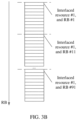
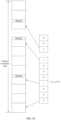
- an interlaced resource is defined as follows:
- One channel, one BWP, one resource pool, or one sub channel in a resource pool may include M interlaced resources, where a sequence number of an interlaced RB included in an m th interlaced resource ( m ⁇ ⁇ 0, 1, ..., M - 1 ⁇ ) is ⁇ m, M + m, 2M + m, 3M + m, ... ⁇ .
- one interlaced resource includes at least 10 interlaced RBs.
- a quantity of interlaced RBs included in one interlaced resource may alternatively be less than 10. This is not limited herein.
- a value of M is related to a sub carrier spacing (sub carrier spacing, SCS). For example, as shown in FIG. 3B , when a 15-kilohertz (kHz) SCS is used, a value of M may be 10, and when a 30-kHz (kHz) SCS is used, a value of M may be 5.
- the SL resource pool configuration information may further include configuration information of the PSCCH, and the configuration information of the PSCCH includes a quantity of symbols occupied by the PSCCH in one slot and a quantity of RBs occupied by the PSCCH in one sub channel.
- the SL BWP configuration information may include SL resource pool information that is used to configure a quantity of resource pools included in the BWP.
- the SL BWP configuration information may include SL bandwidth information that indicates a bandwidth size for performing SL communication, for example, indicates that SL bandwidth is 20 megahertz (MHz).
- the SL BWP configuration information may further include SL symbol information that indicates a start SL symbol location in one slot and a quantity of occupied continuous SL symbols.
- the SL BWP configuration information may further include information about a sub carrier spacing and a cyclic prefix of the SL, and the information indicates the sub carrier spacing and the cyclic prefix that are used for SL communication.
- the cyclic prefix indicates an extended cyclic prefix or a normal cyclic prefix.
- the SL BWP configuration information may further include the SL resource pool configuration information.
- a slot is used for description, but a time unit is not limited to only a slot.
- a frequency domain unit is specially specified, a sub channel is used for description, but a frequency domain unit is not limited to only a sub channel.
- a transmit end terminal apparatus accesses a signal in a contention manner, for example, in a channel access manner defined by the European Telecommunications Standards Institute (European Telecommunications Standards Institute, ETSI).
- the contention access manner includes load based equipment (load based equipment, LBE) and framework based equipment (frame based equipment, FBE).
- both the LBE and the FBE require a terminal apparatus to perform listen before talk (listen before talk, LBT).
- energy-based detection may be used when the unlicensed frequency band is accessed.
- an energy detection threshold (energy detection threshold) needs to be set. When channel energy detected by the terminal apparatus exceeds the energy detection threshold, it is determined that a channel is busy, and access to the channel is not allowed. When the detected channel energy is lower than the energy detection threshold for more than a period of time, for example, 34 microseconds ( ⁇ s), backoff is allowed.
- a backoff window size is related to a service priority. A higher priority indicates a smaller backoff window.
- the terminal apparatus randomly selects a backoff value K from the backoff window to perform backoff.
- a value of K is decreased by 1 until the backoff value K is decreased to 0.
- an LBT process is completed, and access to the channel for communication is allowed.
- a moment at which the backoff value K is decreased to 0 is a moment at which the terminal apparatus accesses the channel.
- the backoff value K is decreased to 0, if energy detected by the terminal apparatus is greater than the detection threshold, the channel is busy, and backoff is stopped. In this case, the LBT process is not completed.
- backoff is restored, and backoff is restored according to a backoff value obtained when backoff is stopped last time.
- a sidelink communication resource (or a resource for short) is a time-frequency resource in a resource pool used for sidelink communication, and a transmitting terminal apparatus may transmit sidelink information on the resource.
- One resource may carry one or more of reference signals, for example, a PSCCH, a PSSCH, a physical sidelink feedback channel (physical sidelink feedback channel, PSFCH), a demodulation reference signal (demodulation reference signal, DMRS), and the like.
- a time domain scheduling unit of the sidelink resource may be one slot, or may be one mini-slot.
- a frequency domain scheduling unit may be a channel, a sub channel (sub channel), or an interlaced resource, or may be one or more continuous (continuous) or interlaced RBs.
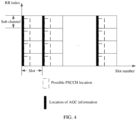
- a PSCCH may exist on each sub channel in each slot.
- a time domain start location of a PSCCH is a start moment of a second symbol used for sidelink communication in each slot.
- the symbol may be an orthogonal frequency division multiplexing (orthogonal frequency division multiplexing, OFDM) symbol (symbol).
- a quantity of continuous symbols occupied by the PSCCH may be determined based on resource pool configuration information or SL BWP configuration information, for example, the quantity of the symbols do not exceed 14 symbols, for example, may be one, two, or three symbols.
- a frequency domain start location of the PSCCH is a physical resource block (physical resource block, PRB) with a smallest index (index) in each sub channel.
- a quantity of RBs occupied by the PSCCH may be determined by using the SL resource pool configuration information or the SL BWP configuration information, for example, the quantity of the RBs do not exceed a size of one channel or one sub channel.
- each slot may further include a symbol used to carry automatic gain control (automatic gain control, AGC) information.
- AGC automatic gain control
- a PSFCH is used to carry HARQ feedback information, that is, carry ACK or NACK feedback information.
- Receive end UE of data feeds back, based on whether received data is correctly decoded, to transmit end UE of the data.
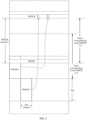
- FIG. 5 the following describes a manner of determining a time-frequency resource of a PSFCH in current NR releases (releases) 16 and 17.
- the first terminal apparatus receives data information of the second terminal, and the first terminal apparatus transmits feedback information to the second terminal in response to the received data information.
- the first terminal apparatus determines a resource for transmitting sidelink feedback information, namely, a PSFCH resource, and the resource is jointly determined by the following several parameters:
- a mapping relationship between a time-frequency resource for receiving the PSSCH and a corresponding PSFCH resource is determined in the following manner: For a PSFCH time domain period, all PSSCH time-frequency resources that satisfy a PSFCH gap and that can be mapped to a PSFCH resource (the PSFCH resource is a slot that is the first slot in which a PSFCH resource exists and that is in a PSFCH slot and a PSSCH slot whose gap is not less than k slots (the PSFCH gap)) in the PSFCH time domain period are sorted first in time domain (for example, slots are sorted in ascending order of indexes) and then in frequency domain (for example, sub channels are sorted in ascending order of indexes).
- PSFCH resources are sorted first in frequency domain and then in code domain in a slot in which a PSFCH in the PSFCH time domain period is located.
- the sorted PSSCH resources and the sorted PSFCH resources are mapped, that is, any PSSCH time-frequency resource corresponds to a unique PSFCH time-frequency-code resource.
- locations of PSFCH resources respectively corresponding to a PSSCH 1 and a PSSCH 2 are indicated by using arrows in FIG. 5 , and the PSFCH resources respectively corresponding to the PSSCH 1 and the PSSCH 2 occupy only one RB in frequency domain.
- occupied channel bandwidth (occupied channel bandwidth, OCB) has to be between 80% and 100% of nominal channel bandwidth, and this requirement is referred to as an OCB requirement.
- the nominal channel bandwidth (nominal channel bandwidth) is a widest frequency band allocated to a single channel, including a guard band.
- the occupied channel bandwidth includes 99% of signal power.
- nominal channel bandwidth of a single operating channel should be 20 MHz (MHz).
- each transmit chain of the communication system should meet the OCB requirement.
- a millimeter-wave band for example, a 60 GHz band, according to the OCB requirement, 75% or more of nominal channel bandwidth may be required.
- the occupied channel bandwidth may vary with time and/or payload.
- a receive node of data feeds back, based on whether received data is correctly decoded, to a transmit node of the data, where the data is carried in a physical sidelink shared channel (physical sidelink shared channel, PSSCH).
- a method for determining a time-frequency resource of a PSFCH in current NR releases (releases) 16 and 17 cannot meet the OCB requirement, and therefore, the unlicensed frequency band cannot be occupied for transmitting.
- Embodiments of this application provide a communication method, to provide a PSFCH transmitting manner applicable to an unlicensed frequency band.
- the communication method may be implemented by a first communication apparatus and/or a second communication apparatus.
- FIG. 6 is a possible schematic diagram of a structure of the first terminal apparatus and/or the second terminal apparatus.
- the structure may include a processing module 610 and a transceiver module 620.
- the structure shown in FIG. 6 may be a terminal device, or may be a chip used in a terminal device, or another combined device, member, or component having a function of a terminal device shown in this application.
- the transceiver module 620 may be a transceiver, and the transceiver may include an antenna, a radio frequency circuit, and the like; and the processing module 610 may be a processor, for example, a baseband processor, and the baseband processor may include one or more central processing units (central processing units, CPU).
- the transceiver module 620 may be a radio frequency unit, and the processing module 610 may be a processor, for example, a baseband processor.
- the transceiver module 620 may be an input/output interface of a chip, for example, a baseband chip, and the processing module 610 may be a processor of the chip system, and may include one or more central processing units.
- the processing module 610 in this embodiment of this application may be implemented by using a processor or a processor-related circuit component
- the transceiver module 620 may be implemented by using a transceiver or a transceiver-related circuit component.
- the processing module 610 may be configured to perform all operations other than transmitting and receiving operations performed by the first terminal apparatus and/or the second terminal apparatus in any embodiment of this application, for example, a processing operation, and/or another process configured to support the technology described in this specification, for example, generate a message, information, and/or signaling sent by the transceiver module 620, and process a message, information, and/or signaling received by the transceiver module 620.
- the transceiver module 620 may be configured to perform all receiving and transmitting operations performed by the first terminal apparatus and/or the second terminal apparatus in any embodiment of this application, and/or another process of the technology described in this specification, for example, data transmitting and/or receiving.
- the transceiver module 620 may be a functional module, and the functional module can complete both a transmitting operation and a receiving operation.
- the transceiver module 620 may be configured to perform all transmitting operations and receiving operations performed by a relay node and/or a remote node.
- the transceiver module 620 when performing a transmitting operation, the transceiver module 620 may be considered as a transmitting module, and when performing a receiving operation, the transceiver module 620 may be considered as a receiving module.
- the transceiver module 620 may be two functional modules, and the transceiver module 620 may be considered as a general term of the two functional modules.
- the two functional modules are a transmitting module and a receiving module, and the transmitting module is configured to complete a transmitting operation, for example, the transmitting module may be configured to perform all transmitting operations performed by the first terminal apparatus and/or the second terminal apparatus; and the receiving module is configured to complete a receiving operation, and the receiving module may be configured to perform all receiving operations performed by the first terminal apparatus and/or the second terminal apparatus.
- FIG. 7 is a schematic diagram of a structure of another terminal apparatus, and the terminal apparatus is configured to perform actions performed by the first terminal apparatus and/or the second terminal apparatus according to an embodiment of this application, for ease of understanding and illustration.
- the terminal apparatus may include a processor, a memory, a radio frequency circuit, an antenna, and/or an input/output apparatus.
- the processor is mainly configured to: process a communication protocol and communication data, control the terminal apparatus, execute a software program, process data of the software program, and the like.
- the memory is mainly configured to store the software program and data.
- the radio frequency circuit is mainly configured to: perform conversion between a baseband signal and a radio frequency signal, and process the radio frequency signal.
- the antenna is mainly configured to receive and transmit a radio frequency signal in a form of an electromagnetic wave.
- the input/output apparatus for example, a touchscreen, a display, a keyboard, or the like, is mainly configured to: receive data input by a user and output data to the user. It should be noted that some types of terminal apparatuses may have no input/output apparatus.
- the processor When data needs to be sent, after performing baseband processing on the to-be-sent data, the processor outputs a baseband signal to the radio frequency circuit; and the radio frequency circuit performs radio frequency processing on the baseband signal and then transmits the radio frequency signal to the outside in a form of an electromagnetic wave through the antenna.
- the radio frequency circuit receives a radio frequency signal through the antenna, converts the radio frequency signal into a baseband signal, and outputs the baseband signal to the processor.
- the processor converts the baseband signal into data, and processes the data.
- FIG. 7 shows only one memory and one processor. In an actual terminal device product, there may be one or more processors and one or more memories.
- the memory may also be referred to as a storage medium, a storage device, or the like.
- the memory may be disposed independent of the processor, or may be integrated with the processor. This is not limited in embodiments of this application.
- the antenna and the radio frequency circuit that have a receiving and transmitting function may be considered as a transceiver unit of the terminal apparatus.
- the transceiver unit may be a functional unit, and the functional unit can implement a transmitting function and a receiving function.
- the transceiver unit may include two functional units: a receiving unit that can implement a receiving function and a transmitting unit that can implement a transmitting function.
- a processor having a processing function may be considered as a processing unit of the terminal apparatus.
- the terminal apparatus includes a transceiver unit 710 and a processing unit 720.
- the transceiver unit may also be referred to as a transceiver, a transceiver device, a transceiver apparatus, or the like.
- the processing unit may also be referred to as a processor, a processing board, a processing module, a processing apparatus, or the like.
- a device that is in the transceiver unit 710 and that is configured to implement a receiving function may be considered as a receiving unit
- a device that is in the transceiver unit 710 and that is configured to implement a transmitting function may be considered as a transmitting unit. That is, the transceiver unit 710 includes the receiving unit and the transmitting unit.
- the transceiver unit sometimes may also be referred to as a transceiver machine, a transceiver, a transceiver circuit, or the like.
- the receiving unit sometimes may also be referred to as a receiver machine, a receiver, a receive circuit, or the like.
- the transmitting unit sometimes may also be referred to as a transmitter machine, a transmitter, a transmit circuit, or the like.
- the transceiver unit 710 may correspond to the transceiver module 620.
- the transceiver module 620 may be implemented by the transceiver unit 710.
- the transceiver unit 710 is configured to perform a transmitting operation and a receiving operation of the first terminal apparatus and/or the second terminal apparatus in embodiments shown in this application, and/or is configured to support another process of the technology described in this specification.
- the processing unit 720 may correspond to the processing module 610. In other words, the processing module 610 may be implemented by the processing unit 720.
- the processing unit 720 is configured to perform other operations of the first terminal apparatus and/or the second terminal apparatus in the embodiments shown in this application except receiving and transmitting operations, for example, configured to perform all operations performed by the first terminal apparatus and/or the second terminal apparatus in embodiments shown in this application except receiving and transmitting, and/or configured to support another process of the technology described in this specification.
- the structure shown in FIG. 6 and/or FIG. 7 may be further configured to implement a network device or a component of the network device.
- the network device is, for example, a base station, a CU, or a DU.
- the processing module 610 shown in FIG. 6 and/or the processing unit 720 shown in FIG. 7 may be configured to implement processing steps performed by the base station and/or operations other than receiving and transmitting performed by the base station in the communication method provided in embodiments of this application.
- the transceiver module 620 shown in FIG. 6 and/or the transceiver unit 710 shown in FIG. 7 may be configured to implement a receiving operation and/or a transmitting operation performed by the base station in the communication method provided in embodiments of this application.
- the structure shown in FIG. 7 is used to implement the network device, the structure may not include an input/output apparatus.
- the network device or a component of the network device may be referred to as a third communication apparatus.
- receiving and transmitting actions performed by the first terminal apparatus and/or the second terminal apparatus in the communication method provided in embodiments of this application may be performed by the transceiver module 620 shown in FIG. 6 and/or the transceiver unit 710 shown in FIG. 7 .
- processing actions performed by the first terminal apparatus and/or the second terminal apparatus, and actions other than receiving and transmitting actions may be performed by the processing module 610 shown in FIG. 6 and/or the processing unit 720 shown in FIG. 7 .
- the network device or the component in the network device is implemented by using the structure shown in FIG.
- receiving and transmitting actions performed by the network device in the communication method provided in embodiments of this application may be performed by the transceiver module 620 shown in FIG. 6 and/or the transceiver unit 710 shown in FIG. 7 .
- a processing action performed by the network device and actions other than receiving action and transmitting actions may be performed by the processing module 610 shown in FIG. 6 and/or the processing unit 720 shown in FIG. 7 .
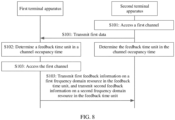
- the communication method provided in this embodiment of this application may include the following steps shown in S101 to S103.
- the second terminal apparatus accesses a first channel, and transmits first data.
- accessing a channel in this application means that the terminal apparatus completes LBT on the channel, or LBT succeeds.
- a backoff value K is decreased to 0.
- the first terminal apparatus receives the first data from the second terminal apparatus.
- the first data is carried on a PSSCH.
- the second terminal apparatus may transmit sidelink control information by using the PSSCH after accessing the first channel, and the sidelink control information may be used to schedule the first data.
- the first terminal apparatus receives the first data based on the sidelink control information.
- S101 may be performed by using the transceiver module 620.
- S101 may be performed by using the transceiver unit 710.
- the first terminal apparatus determines a feedback time unit in a channel occupancy time, where the feedback time unit corresponds to the first data.
- the feedback time unit corresponding to the first data means that the feedback time unit may include a feedback resource used to carry feedback information corresponding to the first data, or in other words, some or all resources in the feedback time unit may be used to transmit feedback information corresponding to the first data, and HARQ response feedback for the first data is implemented.
- the feedback resource is a time-frequency resource that can be used by the terminal apparatus to transmit the feedback information.
- the channel occupancy time herein may be determined by the second terminal apparatus.
- the channel occupancy time may be a maximum channel occupancy time (maximum channel occupancy time, MCOT) determined by the second terminal apparatus, and the MCOT is a maximum time in which the second terminal apparatus can occupy the first channel.
- the channel occupancy time is a time in which the second terminal apparatus actually occupies the first channel, and is referred to as a channel occupancy time (channel occupancy time, COT).
- COT channel occupancy time
- the channel occupancy time may be less than or equal to the maximum occupancy time.
- the second terminal apparatus may transmit indication information of the channel occupancy time to the first terminal apparatus, and the first terminal apparatus determines the channel occupancy time based on the indication information.
- the second terminal apparatus determines, based on the MCOT, a value less than the MCOT as the COT, and indicates the COT to the first terminal apparatus by using the sidelink control information, a media access control (media access control, MAC) control element (control element, CE), or PC5 RRC signaling, including indicating a start location (for example, a slot or a symbol in which the COT starts) of the COT and/or duration (a unit may be ms, a slot, or a symbol) of the COT, and the first terminal apparatus uses the COT as the channel occupancy time.
- the second terminal apparatus indicates the MCOT to the first terminal apparatus by using the sidelink control information, a MAC control element, or sidelink RRC information, and the first terminal apparatus uses the MCOT as the channel occupancy time.
- the first terminal apparatus determines a feedback time unit in the MCOT, or the first terminal apparatus determines a feedback time unit in the COT.
- the MCOT depends on a channel access priority class (channel access priority class), and the channel access priority class is determined by the terminal apparatus based on a service type or a quality of service class of a service of the to-be-transmitted data.
- a channel access priority class and an MCOT is shown in Table 1.
- Table 1 Channel access priority class MCOT 1 2 milliseconds (ms) 2 4 milliseconds (ms) 3 6 ms or 10 ms 4 6 ms or 10 ms
- N slot is the quantity of slots
- T is the channel occupancy time
- ⁇ is the sub carrier spacing information. That is, time in the channel occupancy time may be represented as t k COT 0 ⁇ k ⁇ N slot .
- a correspondence between the sub carrier spacing information and a sub carrier spacing ⁇ f is shown in Table 2.
- Table 2 ⁇ ⁇ f 2 ⁇ ⁇ 15 [kilohertz (kHz)] 0 15 1 30 2 60 3 120 4 240 5 480 6 960
- the first terminal apparatus may determine the feedback time unit from a time unit set in the channel occupancy time.
- the time unit set may include at least one time unit, and the time unit in the time unit set includes a feedback resource.
- the feedback time unit may belong to an SL resource pool.
- time unit may alternatively be defined as n slots, where n is greater than 0.
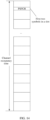
- a start slot of a time unit set in a COT or an MCOT may be defined as a PSFCH 1 th slot in a channel occupancy time, and the slot may be denoted as t PSFCH 1 COT .
- a time domain gap between the PSFCH 1 th slot and a start location of the channel occupancy time is X 1 (or denoted as X offset 1 ) slots.
- the time domain gap herein refers to a quantity of slots between the PSFCH 1 th slot and the start location of the channel occupancy time.
- a location of a PSFCH 1 in one COT or MCOT may be predefined, and that the location is predefined includes that the location is defined in a communication standard protocol or a communication specification, and does not need to be obtained by using signaling or configuration or through calculation.
- a value of X 1 is a positive integer that does not exceed a total quantity of slots corresponding to COT duration, for example, 0, 1, 2, 3, 4, 5, or 6.
- X 1 may be preconfigured, or X 1 is indicated or configured by the network device for the first terminal apparatus by using downlink control information (downlink control information, DCI), RRC signaling, SIB information, or MIB information, or X 1 is indicated or configured by the second terminal apparatus for the first terminal apparatus by using SCI or PC5 RRC signaling.
- DCI downlink control information
- RRC signaling SIB information
- MIB information MIB information
- a time domain gap between every two adjacent time units in the time unit set is M 1 slots, as shown in FIG. 9 .
- a value of M 1 may be predefined, for example, may be 1, 2, 3, or 4, or M 1 may be a preconfigured value, or M 1 may be indicated or configured by the network device for the first terminal apparatus by using the DCI, the RRC signaling, the SIB information, or the MIB information, or M 1 may be indicated or configured by the second terminal apparatus for the first terminal apparatus by using the SCI or the PC5 RRC signaling.
- the adjacent time units in the time unit set are two logically adjacent time units in the time unit set, and the two time units are not necessarily physically adjacent.
- the two adjacent time units in the time unit set include M 1 slots that do not include a feedback resource, that is, M 1 is a time domain gap between the two adjacent time units.
- the last slot included in the time unit set may further be defined as a PSFCH 2 th slot in the channel occupancy time.
- a time domain gap between the PSFCH 2 th slot and an end location of the channel occupancy time is X2 (or denoted as X offset 2 ) slots.
- a location of a PSFCH 2 may be predefined.
- a value of X 2 is N slot , N slot - 1, N slot - 2, N slot - 3, or N slot - 4, or X 2 is a preconfigured value, or X 2 is indicated or configured by the network device for the first terminal apparatus by using the DCI, the RRC signaling, the SIB information, or the MIB information, or X 2 is indicated or configured by the second terminal apparatus for the first terminal apparatus by using the SCI or the PC5 RRC signaling.
- the time unit included in the time unit set may be indicated or configured by the network device for the first terminal apparatus by using the DCI, the RRC signaling, the SIB information, or the MIB information, or may be indicated or configured by the second terminal apparatus for the first terminal apparatus by using the SCI or the PC5 RRC signaling.
- the first terminal apparatus may receive first indication information from the network device or the second terminal apparatus, and the first indication information may indicate the time unit included in the time unit set.
- the first indication information may include a bitmap (bitmap).
- bitmap For example, a time unit is a slot.
- a PSFCH resource pattern (pattern) within the channel occupancy time may be defined, and the pattern is represented by using the bitmap.
- bitmap may be represented as (b 0 , b 1 , ..., b L bitmap -1 ), where L bitmap is a length of the bitmap.
- a value of L bitmap may be predefined, or is a preconfigured value, or is indicated or configured by the network device for the first terminal apparatus by using the DCI, the RRC signaling, the SIB information, or the MIB information, or is indicated or configured by the second terminal apparatus for the first terminal apparatus by using the SCI or the PC5 RRC signaling.
- each bit value in the bitmap indicates whether a slot in the channel occupancy time is a time unit included in the time unit set.
- N slot mod L bitmap
- slots whose numbers are t 3 COT , t 7 COT , ..., and t N slot ⁇ 1 COT belong to the time unit set.
- the first terminal apparatus may determine the time unit set in a manner of predefining or preconfiguring the time unit included in the time unit set.
- the time unit in the time unit set is predefined as the last slot in the channel occupancy time or another slot. If the time unit in the time unit set is the last slot in the channel occupancy time, the feedback time unit is the slot.
- the first terminal apparatus may determine the time unit set based on a length of the channel occupancy time.
- the time unit in the time unit set is the last slot in the channel occupancy time or another slot by default. If the time unit in the time unit set is the last slot in the channel occupancy time, the feedback time unit is the slot.
- the threshold may be a time length, for example, X ms, or the threshold may be a length of X' slots.
- a value or values of X and/or X' may be predefined, or may be preconfigured values, or may be indicated or configured for the first terminal apparatus by the network device by using the DCI, the RRC signaling, the SIB information, or the MIB information, or may be indicated or configured for the first terminal apparatus by the second terminal apparatus by using the SCI or the PC5 RRC signaling.
- the time unit in the default time unit set includes the last slot in the channel occupancy time and an odd-numbered or even-numbered slot in the middle.
- Manner 1 to Manner 4 are merely examples for description, and should not be understood as all implementations of determining the time unit set.
- the foregoing Manner 1 to Manner 4 may further be implemented in combination with each other.
- the time unit in the time unit set when the channel occupancy time is less than the time threshold, the time unit in the time unit set is the last slot in the channel occupancy time by default.
- the time unit in the time unit set may be determined in any one of Manner 1 to Manner 3 or Manner 4.
- the first terminal apparatus may determine the feedback time unit based on a time-frequency resource carrying the first data. For example, after it is determined that the time unit set includes a plurality of time units, a time unit that meets a requirement of a time domain gap between the PSFCH and the PSSCH is determined as the feedback time unit. For a specific manner, refer to the description of FIG. 5 in this application. Details are not described herein again.
- a unit of the time domain gap may be a slot.
- the time domain gap is 1, 2, or 3 slots.
- a value of the time domain gap may be predefined, or may be a preconfigured value, or may be indicated or configured for the first terminal apparatus by the network device by using the DCI, the RRC signaling, the SIB information, or the MIB information, or may be indicated or configured for the first terminal apparatus by the second terminal apparatus by using the SCI or the PC5 RRC signaling.
- the feedback time unit and/or the feedback time unit set may alternatively be periodically configured by using SL BWP configuration information and/or SL resource pool configuration information.
- S102 may be performed by the processing module 610.
- S102 may be performed by the processing unit 720.
- the second terminal apparatus may determine a feedback time unit in the channel occupancy time.
- the feedback time unit corresponds to the first data.
- the second terminal apparatus determines a feedback time unit in the MCOT, or the second terminal apparatus determines a feedback time unit in the COT.
- an execution time sequence of determining the feedback time unit in the channel occupancy time by the second terminal apparatus and an execution time sequence of S102 are not limited in this application.
- the second terminal apparatus may perform a determining action of the feedback time unit after transmitting the first data, and the first terminal apparatus performs S102 after receiving the first data.
- the second terminal apparatus determines the feedback time unit corresponding to the first data, to correctly receive the feedback information.
- the channel occupancy time is a maximum channel occupancy time determined by the second terminal apparatus, or is less than a maximum channel occupancy time determined by the second terminal apparatus.
- the channel occupancy time may be determined by the second terminal apparatus.
- the second terminal apparatus may transmit the indication information of the channel occupancy time to the first terminal apparatus, to indicate the channel occupancy time determined by the second terminal apparatus.
- the first terminal apparatus may determine the feedback time unit from a time unit set in the channel occupancy time.
- a manner of determining the time unit set refer to the manner of determining the time unit set in S102.
- At least one of X 1 , X 2 , and M 1 may be preconfigured, or X 1 may be indicated or configured by the network device for the second terminal apparatus by using the DCI, the RRC signaling, the SIB information, or the MIB information, or at least one of X 1 , X 2 , and M 1 may be determined by the second terminal apparatus and indicated or configured for the first terminal apparatus by using the SCI or the PC5 RRC signaling.
- X 1 , X 2 , and M 1 refer to the description of Manner 1 in S102.
- the time unit included in the time unit set may be indicated or configured by the network device for the second terminal apparatus by using the DCI, the RRC signaling, the SIB information, or the MIB information, or may be indicated or configured by the second terminal apparatus for the first terminal apparatus by using the SCI or the PC5 RRC signaling.
- the second terminal apparatus may receive second indication information from the network device, and determine the feedback time unit from the time units included in the channel occupancy time based on the second indication information.
- the second indication information is a bitmap. For a manner of indicating the time unit set by using the bitmap, refer to the description in Manner 2.
- the second communication apparatus may determine the time unit set in a manner of predefining or preconfiguring a time unit included in the time unit set.
- the second communication apparatus may determine the time unit set based on the length of the channel occupancy time. For example, when the channel occupancy time is less than or equal to the time threshold, the second terminal apparatus considers by default that the time unit in the time unit set is the last slot in the channel occupancy time.
- the second terminal apparatus may determine the feedback time unit based on the time-frequency resource carrying the first data. For example, the second terminal apparatus may determine, as the feedback time unit, a time unit that meets a requirement of a time domain gap between the PSFCH and the PSSCH.
- the first indication information may indicate the time unit included in the time unit set.
- the second terminal apparatus may further obtain a periodically configured feedback time unit and/or time unit set based on the SL BWP configuration information and/or the SL resource pool configuration information.
- the determined feedback time unit determined by the second terminal apparatus is the same as the feedback time unit determined by the first terminal apparatus in S102.
- an action of determining the feedback time unit and/or the time unit set may be performed by the processing module 610.
- the action of determining the feedback time unit and/or the time unit set may be performed by the processing unit 720.
- the first terminal apparatus accesses the first channel, transmits the first feedback information on a first frequency domain resource in the feedback time unit, and transmits the second feedback information on a second frequency domain resource in the feedback time unit.
- the first frequency domain resource and the second frequency domain resource do not overlap, or the first frequency domain resource and the second frequency domain resource do not include a same RB.
- the first frequency domain resource and the second frequency domain resource belong to the first channel, and the first frequency domain resource is determined based on the time-frequency resource carrying the first data.
- the first feedback information is valid feedback information for the first data, includes an ACK or a NACK, and indicates whether the first data is correctly received.
- the first feedback information may further include but is not limited to CSI feedback information that indicates a channel state, and includes pre-coding matrix indicator (pre-coding matrix indicator, PMI) feedback, rank indication (rank indication, RI) feedback, channel quality indicator (channel quality indicator, CQI) feedback, and the like.
- the first feedback information may further include energy saving information, such as wake-up indication information or sleep indication information, where the wake-up indication information may be used to wake up UE to receive at least PSCCH information, and the sleep indication information may indicate that the UE may enter a sleep state and not receive the PSCCH information.
- the first feedback information may further include resource assistance information.
- the resource assistance information is, for example, information that indicates a resource recommended for use, information that indicates a resource not recommended for use, information that indicates a resource collision, information that indicates a resource reservation conflict, or information that indicates that a half-duplex collision has occurred in the past or is to occur in the future.
- the valid feedback information means that the feedback information at least indicates a status of receiving the sidelink information by a receive end of the sidelink information, and the feedback information needs to be received by a transmit end of the sidelink information.
- the second feedback information may be replication information of the first feedback information, or may carry fixed information (or the second feedback information may be a predefined bit).
- the second feedback information is "0", "1", or other information that has no practical meaning, because the second frequency domain resource is occupied to meet an OCB requirement of an unlicensed frequency band, and only transmitting at a specific power is required.
- the second feedback information may be referred to as invalid feedback information.
- the invalid feedback information means that the feedback information is used only to occupy a channel. Therefore, the transmit end of the sidelink information may not receive and/or receive and discard the feedback information.
- the first terminal apparatus even if the first terminal apparatus does not need to transmit the first feedback information on the second frequency domain resource, the first terminal apparatus still needs to transmit the second feedback information on the second frequency domain resource.
- a purpose is to occupy the first channel in the COT, to prevent the first channel from being preempted by another user.
- the first terminal apparatus accesses the first channel, and transmits the second feedback information on the second frequency domain resource in each time unit in the time unit set, where the time unit in each time unit includes a feedback resource.
- a case in which the first feedback information is not required includes at least one of the following:
- the first terminal apparatus correctly receives the first data in a HARQ feedback mechanism with only NACK feedback, the first terminal apparatus discards the first feedback information due to a priority (that is, the first terminal apparatus needs to transmit information with a higher priority and discards the first feedback information), the first terminal apparatus does not correctly decode the sidelink control information (that is, the first terminal apparatus does not know that the first feedback information needs to be sent), or the like.
- the second frequency domain resource is shared to all terminal devices that access the first channel and is used to transmit the second feedback information, and is not limited to the first terminal device.
- the first channel herein may belong to an SL BWP, an SL resource pool, or a sub channel in an SL resource pool.
- the SL BWP may be a resource determined based on the SL BWP configuration information.
- the SL resource pool may be a resource determined based on the SL resource pool configuration information.
- the following describes a manner of determining the first frequency domain resource and the second frequency domain resource with reference to the accompanying drawings. Because the first frequency domain resource may be determined based on the second frequency domain resource, a manner of determining the second frequency domain resource is first described herein, but it does not indicate that a process of determining the second frequency domain resource is performed before a process of determining the first frequency domain resource.
- the second frequency domain resource may include two discontinuous resource blocks, a frequency domain gap between the two discontinuous resource blocks is Offset resource blocks, and the two resource blocks may be respectively the first resource block and the last resource block in the second frequency domain resource.
- the frequency domain gap herein refers to a quantity of resource blocks between the two discontinuous resource blocks.
- bandwidth corresponding to (Offset + 2) resource blocks is greater than or equal to a product of bandwidth of the first channel and a first coefficient.
- bandwidth corresponding to the second frequency domain resource is greater than or equal to a product of the bandwidth of the first channel and the first coefficient, where the first coefficient is greater than 0 and less than 1.
- the first coefficient is a minimum occupying proportion that is of the first bandwidth and that meets the OCB requirement.
- An objective of this design is to enable the first terminal apparatus to transmit the second feedback information by using the second frequency domain resource, so that the OCB requirement is met.
- the second frequency domain resource may further include at least one resource block between the two discontinuous resource blocks.
- the following describes the manner of determining the second frequency domain resource.
- the second frequency domain resource may be indicated by the network device, or may be preconfigured, or may be predefined. Therefore, the second frequency domain resource may be configured independently of time-frequency resource of a PSFCH in NR releases 16 and 17.
- a same second frequency domain resource may be configured for a plurality of terminal apparatuses through indication by the network device, or in a preconfiguration or predefinition manner. Therefore, a plurality of second terminal apparatuses may transmit the second feedback information on the same second frequency domain resource, so that the plurality of terminal apparatuses occupy a same channel.
- an interlaced resource included in the SL resource pool may be determined, and the resource pool includes the first channel.
- a frequency domain resource of the resource pool is greater than or equal to a frequency domain resource of the first channel.
- one SL resource pool may include M sub channels, and one sub channel corresponds to one interlaced resource.
- a quantity of sub channels is equal to a quantity of interlaced resources, and the sub channels are in a one-to-one correspondence with the interlaced resources.
- a first sub channel corresponds to a first interlaced resource, and the rest may be deduced by analogy
- the first terminal apparatus may determine, through indication by the network device, or in a preconfiguration or predefinition manner, the interlaced resource included in the SL resource pool.
- one SL resource pool includes M interlaced resources. Indexes (or sequence numbers or numbers) of the interlaced resources in the resource pool are 0 to M-1.
- one SL resource pool includes N sub channels, and it may be determined that at least one of the N sub channels includes the first channel, that is, a frequency domain resource of the sub channel is greater than or equal to a frequency domain resource of the first channel, where each sub channel includes M interlaced resources, and indexes of the interlaced resources in each sub channel are 0 to M-1.
- the second frequency domain resource is an m th interlaced resource of the first channel
- the interlaced resource includes at least two resource blocks that are interlaced in frequency domain, where m is an integer greater than or equal to 1 and less than or equal to a total quantity of interlaced resources in the first channel, and a value of m is predefined, or is a preconfigured value, or is indicated or configured for the first terminal apparatus by the network device by using the DCI, the RRC signaling, the SIB information, or the MIB information. Therefore, the first terminal apparatus may determine the m th interlaced resource of the first channel as the second frequency domain resource through indication by the network device, or in a preconfiguration or predefinition manner.
- an interlaced resource #1 is used as the second frequency domain resource.
- all PRBs included in the interlaced resource #1 in FIG. 12 are the second frequency domain resource, or a resource block with a smallest index and a resource block with a largest index included in the interlaced resource #1 are the second frequency domain resource.
- the first resource block of the second frequency domain resource may be an N1 th (or described as N RB first ) resource block in the first channel, and the N1 th resource block may be an N1 th resource block marked starting from a largest or smallest RB index; and the last resource block of the second frequency domain resource may be an N2 th (or described as N RB last ) resource block in the first channel, and the N2 th resource block may be an N2 th resource block marked starting from the largest or smallest RB index.
- N1 and N2 are positive integers, and values of N1 and N2 may be predefined, indicated by the network device, or preconfigured.
- a difference between N1 and N2 is Offset. Therefore, the bandwidth corresponding to the second frequency domain resource may be greater than or equal to the product of the bandwidth of the first channel and the first coefficient by using the values of N 1 and N2.
- the first resource block of the second frequency domain resource herein may be a resource block with a smallest number when the resource blocks are arranged in descending order of numbers.
- the first resource block is a resource block with a lowest frequency in the second frequency domain resource.
- the last resource block of the second frequency domain resource may be a resource block with a largest number when the resource blocks are arranged in descending order of numbers.
- the last resource block is a resource block with a highest frequency in the second frequency domain resource. It may be understood that a value of a number is relative to that of the first channel.
- the first terminal apparatus may determine, through indication by the network device, or in a preconfiguration or predefinition manner, that the N1 th resource block is the first resource block of the second frequency domain resource and the N2 th resource block is the last resource block of the second frequency domain resource.
- the first resource block of the second frequency domain resource is a resource block with the smallest RB index in the first channel
- the last resource block of the first frequency domain resource is a resource block with the largest RB index in the first channel.
- the values of N1 and N2 may be equal or unequal, provided that the OCB requirement is met.
- the second frequency domain resource may include the first PRB and the last PRB in the first channel.
- the first feedback information and/or the second feedback information occupy/occupies the last two symbols of a slot in which the feedback time unit is located.
- the last symbol of the feedback time unit is a gap symbol (gap symbol)
- the first feedback information and/or the second feedback information occupy/occupies the penultimate symbol and the last third symbol of the slot in which the feedback time unit is located.
- the first feedback information and/or the second feedback information occupy/occupies the first two symbols of the slot in which the feedback time unit is located.
- the feedback time unit is the last slot of the channel occupancy time
- the first feedback information and/or the second feedback information occupies/occupies the first two symbols of the slot.
- the first feedback information and/or the second feedback information may alternatively occupy another symbol of the slot in which the feedback time unit is located.
- the first terminal apparatus may determine the first frequency domain resource based on an index and/or a quantity of interlaced resources corresponding to the time-frequency resource carrying the first data and identifier (identifier, ID) information corresponding to the first data. That a feedback resource exists in every N PSSCH P S F CH time units in the time unit set is defined, and the time unit may be a slot.
- a method for determining N PSSCH P S F CH may be the manner in S102, that is, determining the time unit set.
- the time-frequency resource carrying the first data may include, in time domain, a slot i in which the first data is located, where 0 ⁇ i ⁇ 0 ⁇ i ⁇ N PSSCH P S F CH , and may be determined in frequency domain based on an index j and/or a quantity N interlace of interlaced resources. Therefore, the index j and/or the quantity N interlace may be referred to as the index and/or the quantity of interlaced resources corresponding to the time-frequency resource carrying the first data, where 0 ⁇ j ⁇ N interlace , and N interlace represents a quantity of interlaced resources in a resource pool or a sub channel.
- the ID information corresponding to the first data may include source ID information and/or target ID information of the first data.
- the source ID information of the first data may include an identifier of the second terminal apparatus, an identifier of a terminal apparatus that initiates a service to which the first data belongs, or an identifier of a terminal apparatus that transmits the first data.
- the target ID information of the first data may include an identifier of the first terminal apparatus, an identifier of a terminal apparatus that receives the service to which the first data belongs, or an identifier of a terminal apparatus that receives the first data.
- the ID information may be layer-1 (layer-1) ID information, namely, physical layer ID information, is carried in physical control signaling such as SCI, and includes a destination ID (destination ID) denoted as Dest ID and a source ID (source ID) denoted as Src ID .
- the ID information may alternatively be layer-2 (layer-2) ID information, namely, MAC layer ID information, is carried in the MAC CE, and includes a destination ID and a source ID.
- the layer-1 ID information is at least a part of the layer-2 ID information, that is, the layer-2 ID information includes a complete destination ID and a complete source ID, and the layer-1 ID information carries a part of the layer-2 ID information.
- a length of the layer-2 destination ID is 24 bits
- the layer-1 destination ID is the first 16 bits of the layer-2 destination ID
- a length of the layer-2 source ID is 24 bits
- the layer-1 source ID is the first 8 bits of information of the layer-2 source ID.
- the foregoing 8, 16, and 24 bits are merely examples, and may be other positive integers in actual application, provided that a quantity of bits of the layer-2 ID (including the source ID and the destination ID) is greater than or equal to a quantity of bits of the layer-1 ID.
- the ID information may be used to identify the terminal device, or the ID information corresponding to the first data herein may be an identifier related to the first terminal apparatus and/or the second terminal apparatus.
- the ID information may be used to identify data or a data service.
- the ID information may be an identifier related to the first data and/or the service to which the first data belongs.
- the ID information may be allocated by an application (application, APP) layer. From a perspective of a physical layer, each PSSCH may have corresponding layer-1 ID information carried in corresponding SCI.
- the ID information further includes a UE identifier in multicast, that is, represents a unique identifier M ID of the UE in a multicast service or multicast communication.
- the first terminal apparatus may determine, based on at least one piece of information in , the time-frequency resource carrying the first data, an available code domain resource N CS P S F CH for the first feedback information, or a set M PRB , set PSFCH of RB resources available for transmitting the PSFCH, a number of an RB in which the first frequency domain resource is located.
- the available code domain resource of the first feedback information may be a quantity of available CS pairs, for example, 1, 2, 4, or 6, and the first terminal apparatus may determine, from the CS pairs, a CS pair corresponding to the first feedback information.
- the set of RB resources available for transmitting the PSFCH may be a set of possible RBs of the first frequency domain resource and/or the second frequency domain resource.
- the quantity of available CS pairs and/or the set of RB resources available for transmitting the PSFCH may be predefined, or may be preconfigured, or may be indicated by the network device for the first terminal apparatus by using the DCI, the RRC signaling, or the SIB, or may be indicated by the second terminal apparatus for the first terminal apparatus by using the SCI or the PC5 RRC signaling.
- the first terminal apparatus may further transmit, based on a first code domain resource, the first feedback information on the first frequency domain resource in the feedback time unit, where the first code domain resource is determined based on the index and/or the quantity of interlaced resources corresponding to the time-frequency resource carrying the first data and the identifier information corresponding to the first data.
- the first terminal apparatus may determine, from the CS pair corresponding to the first feedback information, the first code domain resource determined with the first frequency domain resource, to transmit the first feedback information on the first frequency domain resource in the feedback time unit by using the first code domain resource.
- the first terminal apparatus may determine the first frequency domain resource and/or the first code domain resource in the following manner.
- the first terminal apparatus may determine, from PRBs corresponding to M PRB , set PSFCH , in a principle of sorting i in an ascending order and then sorting j in an ascending order, a PRB whose number is i + j ⁇ N PSSCH PSFCH ⁇ M interlace , slot PSFCH , i + 1 + j ⁇ N PSSCH PSFCH ⁇ M interlace , slot PSFCH ⁇ 1 as a number range of an RB in which a candidate resource of the first frequency domain resource corresponding to a PSSCH received in a slot i and a sub channel j is located, where i is a slot in which the first data is located, and j is the index of the interlaced resource.
- the first terminal apparatus may determine a total quantity R PRB , CS PSFCH of PSFCH frequency domain and code domain resources used for feeding back the PSSCH.
- N type PSFCH There are two values of a PSFCH resource type N type PSFCH , and the values may be preconfigured, configured, or predefined.
- N type PSFCH 1
- M interlace slot PSFCH is associated with an interlaced resource with a smallest index assigned to the corresponding PSSCH.
- N type PSFCH N interlace PSSCH
- M interlace slot PSFCH is associated with all interlaced resources allocated for the corresponding PSSCH, where N interlace PSSCH is the total quantity of interlaced resources allocated for the corresponding PSSCH.
- R PRB , CS PSFCH is sorted and numbered according to a first resource sorting rule, to obtain total PSFCH frequency domain and code domain resources and a PSFCH resource number, where the first resource sorting rule includes frequency domain first and then code domain, or code domain first and then frequency domain, which is not limited herein.
- the first frequency domain resource and the first code domain resource are determined based on the ID information denoted as ID) and the PSFCH resource number determined based on R PRB , CS PSFCH , specifically the PSFCH resource number obtained by using ID modR PRB , CS PSFCH , where ID represents the identifier information corresponding to the first data, and the first frequency domain resource and the first code domain resource are determined based on the PSFCH resource number according to the first resource sorting rule.
- the set of RB resources in the first channel available for transmitting the PSFCH may not include the second frequency domain resource, and the PSFCH resource may be used to transmit the second frequency domain resource. Transmission of the first resource does not belong to the PSFCH.
- the PSFCH resource may be used to transmit the first feedback information, and may further be used to transmit the second feedback information.
- S101 may be performed by using the transceiver module 620.
- S101 may be performed by using the transceiver unit 710.
- an action of determining the first code domain resource, the first frequency domain resource, and the second frequency domain resource may be performed by the processing module 610.
- the action of determining the first code domain resource, the first frequency domain resource, and the second frequency domain resource may be performed by the processing unit 720.
- the second terminal apparatus may receive the first feedback information on the first frequency domain resource in the feedback time unit.
- the first frequency domain resource is determined based on the time-frequency resource carrying the first data.
- the first feedback information is valid feedback information for the first data. For descriptions of the first feedback information, refer to the foregoing descriptions.
- An implementation of receiving the first feedback information by the second terminal apparatus on the first frequency domain resource in the feedback time unit may be that the second terminal apparatus may detect the first feedback information on the first frequency domain resource.
- the second terminal apparatus determines the first frequency domain resource. Further, optionally, the second terminal apparatus may further determine the second frequency domain resource.
- the second frequency domain resource is used to receive the second feedback information, and the second feedback information may be replication information of the first feedback information or a predefined bit stream.
- the second frequency domain resource may include two discontinuous resource blocks, a frequency domain gap between the two discontinuous resource blocks is Offset resource blocks, and the two resource blocks may be respectively the first resource block and the last resource block in the second frequency domain resource.
- the frequency domain gap herein refers to a quantity of resource blocks between the two discontinuous resource blocks.
- bandwidth corresponding to (Offset + 2) resource blocks is greater than or equal to a product of bandwidth of the first channel and a first coefficient, and the first coefficient is greater than 0 and less than 1.
- the second frequency domain resource may be indicated by the network device, or may be preconfigured, or may be predefined.
- the second terminal apparatus determines an m th interlaced resource of the first channel as the second frequency domain resource through indication by the network device, or in a preconfiguration or predefinition manner.
- m refer to the description in S103.
- the second terminal apparatus determines, through indication by the network device, or in a preconfiguration or predefinition manner, that an N1 th resource block is the first resource block of the second frequency domain resource and an N2 th resource block is the last resource block of the second frequency domain resource.
- N1 and N2 refer to descriptions in S103.
- the second terminal apparatus may determine the first frequency domain resource based on the index and/or the quantity of interlaced resources corresponding to the time-frequency resource carrying the first data and the ID information corresponding to the first data.
- the index and/or the quantity of interlaced resources corresponding to the time-frequency resource carrying the first data and the ID information corresponding to the first data refer to the description in S103.
- the second terminal apparatus may further receive the first feedback information on the first frequency domain resource in the feedback time unit based on the first code domain resource, where the first code domain resource is determined based on the index and/or the quantity of interlaced resources corresponding to the time-frequency resource carrying the first data and the identifier information corresponding to the first data.
- the second terminal apparatus may determine the first frequency domain resource and/or the first code domain resource with reference to step 1 to step 3.
- the second terminal apparatus may receive the second feedback information on the second frequency domain resource in the feedback time unit. For example, the second terminal apparatus may blindly detect the second feedback information on the second frequency domain resource. After receiving the second feedback information, the second terminal apparatus may discard the second feedback information. The second terminal apparatus also does not detect the second feedback information on the second frequency domain resource.
- an execution time sequence in which the second terminal apparatus receives the first feedback information on the first frequency domain resource in the feedback time unit and an execution time sequence in which S103 is performed are not limited in this application.
- a time sequence relationship between determining the first frequency domain resource by the first terminal apparatus and determining the first frequency domain resource by the second terminal apparatus is not limited, and a time sequence relationship between determining the second frequency domain resource by the first terminal apparatus and determining the second frequency domain resource by the second terminal apparatus is not limited.
- an action of receiving the first feedback information by the second terminal apparatus on the first frequency domain resource in the feedback time unit may be performed by using the transceiver module 620.
- the action of receiving the first feedback information by the second terminal apparatus on the first frequency domain resource in the feedback time unit may be performed by using the transceiver unit 710.
- an action of determining the first code domain resource, the first frequency domain resource, and/or the second frequency domain resource may be performed by the processing module 610.
- the action of determining the first code domain resource, the first frequency domain resource, and/or the second frequency domain resource may be performed by the processing unit 720.
- the first terminal apparatus may transmit the feedback information on the first frequency domain resource and the second frequency domain resource in the feedback time unit.
- the feedback time unit is a time unit that corresponds to the first data and that is in the channel occupancy time. Therefore, frequency domain bandwidth occupied by the feedback information may be increased in a transmitting process of the feedback information, so that a sidelink information feedback process of the first terminal apparatus meets a requirement of an unlicensed frequency band for channel access, and a feedback mechanism for transmitting HARQ information by using a PSFCH can be used in the unlicensed frequency band, to improve communication reliability of an SL system in the unlicensed frequency band.
- the first terminal apparatus that accesses the first channel may transmit the first feedback information to the second terminal apparatus on the first frequency domain resource (a PSFCCH frequency domain resource 1 in FIG. 15 ) in the feedback time unit, and transmit the second feedback information to the second terminal apparatus on the second frequency domain resource (a PSFCCH frequency domain resource 2 in FIG. 15 ) in the feedback time unit.
- first frequency domain resource a PSFCCH frequency domain resource 1 in FIG. 15
- second frequency domain resource a PSFCCH frequency domain resource 2 in FIG. 15
- another terminal apparatus other than the first terminal apparatus may transmit feedback information by using the feedback time unit, and the another terminal apparatus includes but is not limited to a third terminal apparatus and a fourth terminal apparatus shown in the figure.
- all the terminal apparatuses including the first terminal apparatus may transmit feedback information on the second frequency domain resource, and these terminal apparatuses including the first terminal apparatus each transmits valid feedback information for respective sidelink information on a first frequency domain resource of each terminal apparatus.
- the third terminal apparatus may transmit third feedback information by using a PSFCH resource 3, and transmit fourth feedback information by using a PSFCH resource 2.
- the third terminal apparatus may receive sidelink information (for example, including second data) from any terminal apparatus (for example, a fifth terminal apparatus) other than the third terminal apparatus, and transmit, by using the third feedback information, an ACK or a NACK corresponding to the sidelink information.
- the fourth feedback information may be invalid feedback information. It should be understood that, for a manner in which the third terminal apparatus determines the PSFCH resource 3, refer to a manner in which the first terminal apparatus determines the first frequency domain resource.
- the third terminal apparatus determines the PSFCH resource 2
- the fourth terminal apparatus may transmit valid feedback information on the PSFCH resource 4, and transmit invalid feedback information on the PSFCH resource 2.
- valid feedback information described herein as an example, refer to the description of the first feedback information in this application, and for the invalid feedback information, refer to the description of the second feedback information in this application.
- sidelink information of each of the first terminal apparatus, the third terminal apparatus, and the fourth terminal apparatus may be sent by using interlaced resources. Therefore, the first channel may be occupied by at least one terminal apparatus that separately transmits sidelink information to the first terminal apparatus to the fourth terminal apparatus.
- an embodiment of this application further provides a communication apparatus, configured to implement the foregoing functions implemented by the first terminal apparatus and/or the second terminal apparatus.
- the apparatus may include the structure shown in FIG. 6 and/or FIG. 7 .
- the transceiver module 620 may be configured to receive first data from the second terminal apparatus.
- the processing module 610 may be configured to determine a feedback time unit in a channel occupancy time.
- the transceiver module 620 may be further configured to access a first channel, transmit first feedback information on a first frequency domain resource in the feedback time unit, and transmit second feedback information on a second frequency domain resource in the feedback time unit.
- the first frequency domain resource, and the second frequency domain resource refer to the descriptions in the foregoing method embodiment.
- the processing module 610 may be further configured to determine the first frequency domain resource.
- the transceiver module 620 may be further configured to receive indication information of the channel occupancy time from the second terminal apparatus.
- the second frequency domain resource may be indicated by a network device, preconfigured, or predefined. If the second frequency domain resource is indicated by the network device, the transceiver module 620 may be further configured to receive indication information of the second frequency domain resource.
- the second frequency domain resource is an m th interlaced resource in the first channel
- the interlaced resource includes at least two resource blocks interlaced in frequency domain, where m is an integer, and m is greater than or equal to 1, and is less than or equal to a total quantity of interlaced resources included in the first channel.
- a value of m is predefined, indicated by the network device, or preconfigured. If the value of m is indicated by the network device, the transceiver module 620 may be further configured to receive indication information of the value of m.
- the first resource block of the second frequency domain resource is an N1 th resource block in the first channel
- the last resource block of the second frequency domain resource is an N2 th resource block in the first channel
- N1 and N2 are positive integers
- values of N1 and/or N2 are predefined, indicated by the network device, or preconfigured. If the value of N1 is indicated by the network device, the transceiver module 620 may be further configured to receive indication information of the value of N1 and/or the value of N2.
- the processing module 610 may be further configured to determine the first frequency domain resource based on an index and/or a quantity of interlaced resources corresponding to a time-frequency resource carrying the first data and identifier information corresponding to the first data.
- the transceiver module 620 may be specifically configured to transmit, by the first terminal apparatus, the first feedback information on the first frequency domain resource in the feedback time unit based on a first code domain resource, where the first code domain resource is determined based on the index and/or the quantity of interlaced resources corresponding to the time-frequency resource carrying the first data and the identifier information corresponding to the first data.
- the processing module 610 may be configured to determine the first code domain resource.
- the processing module 610 may be configured to determine the feedback time unit from a time unit set based on the time-frequency resource carrying the first data, where the time unit set includes at least one time unit, and a time unit in the at least one time unit includes a feedback resource.
- a time domain gap between a start location of the first time unit in the time unit set and a start location of the channel occupancy time may be X 1 time units, and a time domain gap between every two adjacent time units in the time unit set may be M 1 time units, where X 1 and M 1 may be predefined, indicated by the network device, indicated by the second terminal apparatus, or preconfigured, X 1 is a positive integer greater than or equal to 0, and M 1 is a positive integer greater than or equal to 0. If X 1 and M 1 are indicated by the network device, the transceiver module 620 may be further configured to receive indication information of a value of X 1 and/or M 1 .
- the processing module 610 may be configured to determine, based on received first indication information, the time unit set from a time unit included in the channel occupancy time, where the first indication information is from the network device or the second terminal apparatus.
- the transceiver module 620 may be further configured to receive the first indication information.
- the processing module 610 may be configured to determine that the feedback time unit may be the last time unit in the channel occupancy time when the channel occupancy time is less than a time threshold.
- actions performed by the processing module 610 in the foregoing example may be performed by the processing unit 720 shown in FIG. 7 . Details are not described again.
- the foregoing actions of the first communication apparatus performed by the transceiver module 620 may be performed by the transceiver unit 710 shown in FIG. 7 .
- the transceiver module 620 may be configured to: access a first channel, and transmit first data to the first terminal apparatus.
- the processing module 610 may be configured to determine a feedback time unit in a channel occupancy time.
- the transceiver module 620 may be further configured to receive first feedback information on a first frequency domain resource in the feedback time unit
- the processing module 610 may be further configured to determine the first frequency domain resource.
- the transceiver module 620 may be further configured to: receive and discard the second feedback information.
- the processing module 610 may be further configured to determine a second frequency domain resource used to carry the second feedback information.
- the second frequency domain resource may be indicated by a network device, preconfigured, or predefined. If the second frequency domain resource is indicated by the network device, the transceiver module 620 may be further configured to receive indication information of the second frequency domain resource.
- the second frequency domain resource is an m th interlaced resource in the first channel
- the interlaced resource includes at least two resource blocks interlaced in frequency domain, where m is an integer, and m is greater than or equal to 1, and is less than or equal to a total quantity of interlaced resources included in the first channel.
- a value of m is predefined, indicated by the network device, or preconfigured. If the value is indicated by the network device, the transceiver module 620 may be further configured to receive indication information of the value of m.
- the first resource block of the second frequency domain resource is an N1 th resource block in the first channel
- the last resource block of the second frequency domain resource is an N2 th resource block in the first channel
- N1 and N2 are positive integers
- values of N1 and/or N2 are predefined, indicated by the network device, or preconfigured. If the value of N1 is indicated by the network device, the transceiver module 620 may be further configured to receive indication information of the value of N1 and/or the value of N2.
- the transceiver module 620 may be further configured to transmit indication information of the channel occupancy time to the first terminal apparatus.
- the processing module 610 may be further configured to determine the first frequency domain resource based on an index and/or a quantity of interlaced resources corresponding to a time-frequency resource carrying the first data and identifier information corresponding to the first data.
- the transceiver module 620 may be specifically configured to receive, by the first terminal apparatus, the first feedback information on the first frequency domain resource in the feedback time unit based on a first code domain resource, where the first code domain resource is determined based on the index and/or the quantity of interlaced resources corresponding to the time-frequency resource carrying the first data and the identifier information corresponding to the first data.
- the processing module 610 may be configured to determine the first code domain resource.
- the processing module 610 may be configured to determine the feedback time unit from a time unit set based on the time-frequency resource carrying the first data, where the time unit set includes at least one time unit, and a time unit in the at least one time unit includes a feedback resource.
- a time domain gap between a start location of the first time unit in the time unit set and a start location of the channel occupancy time may be X 1 time units, and a time domain gap between every two adjacent time units in the time unit set may be M 1 time units, where X 1 and M 1 may be predefined, indicated by the network device, indicated by the second terminal apparatus, or preconfigured, X 1 is a positive integer greater than or equal to 0, and M 1 is a positive integer greater than or equal to 0. If X 1 and M 1 are indicated by the network device, the transceiver module 620 may be further configured to receive indication information of a value of X 1 and/or M 1 .
- the transceiver module 620 may be further configured to transmit first indication information to the first terminal apparatus, where the first indication information is used by the first terminal apparatus to determine the time unit set from a time unit included in the channel occupancy time.
- the processing module 610 may be configured to determine, based on received second indication information, the time unit set from the time unit included in the channel occupancy time, where the second indication information is from the network device.
- the transceiver module 620 may be further configured to receive the second indication information.
- the processing module 610 may be configured to determine that the feedback time unit may be the last time unit in the channel occupancy time when the channel occupancy time is less than a time threshold.
- actions performed by the processing module 610 in the foregoing example may be performed by the processing unit 720 shown in FIG. 7 . Details are not described again.
- the foregoing actions of the second communication apparatus performed by the transceiver module 620 may be performed by the transceiver unit 710 shown in FIG. 7 .
- the communication system may include the first terminal apparatus and/or the second terminal apparatus in the foregoing embodiments.
- the communication system may include any structure shown in FIG. 1 to FIG. 2 .
- the communication apparatus may be configured to implement the steps implemented by the first terminal apparatus and/or the second terminal apparatus in the communication method shown in FIG. 8 .
- An embodiment of this application further provides a computer-readable storage medium.
- the computer-readable storage medium is configured to store a computer program.
- the computer program When the computer program is executed by a computer, the computer may implement a procedure related to the first terminal apparatus and/or the second terminal apparatus in the embodiment shown in FIG. 8 provided in the foregoing method embodiments.
- An embodiment of this application further provides a computer program product.
- the computer program product is configured to store a computer program.
- the computer program When the computer program is executed by a computer, the computer may implement a procedure related to the first terminal apparatus and/or the second terminal apparatus in the embodiment shown in FIG. 8 provided in the foregoing method embodiments.
- An embodiment of this application further provides a chip or a chip system (or a circuit).
- the chip may include a processor.
- the processor may be configured to invoke a program or instructions in a memory, to perform a procedure related to the first terminal apparatus and/or the second terminal apparatus in the embodiment shown in FIG. 8 provided in the foregoing method embodiments.
- the chip system may include the chip, and may further include another component such as a memory or a transceiver.
- the communication apparatus in the foregoing embodiments may be a terminal device, or may be a chip used in a terminal device, or another combined device, member, or the like that can implement a function of the foregoing terminal device.
- the transceiver unit may be a transmitter and a receiver, or an integrated transceiver, and may include an antenna, a radio frequency circuit, and the like; and the processing unit may be a processor, for example, a baseband chip.
- the transceiver unit may be a radio frequency unit, and the processing unit may be a processor.
- the transceiver unit may be an input/output interface of the chip system, and the processing unit may be a processor of the chip system, for example, a central processing unit (central processing unit, CPU).
- the processor in embodiments of this application may be the CPU, or may be another general purpose processor, a digital signal processor (digital signal processor, DSP), an application specific integrated circuit (application specific integrated circuit, ASIC), a field programmable gate array (field programmable gate array, FPGA), or another programmable logic device, a transistor logic device, a hardware component, or any combination thereof.
- the general purpose processor may be a microprocessor or any regular processor or the like.
- the method steps in embodiments of this application may be implemented in a hardware manner, or may be implemented in a manner of executing software instructions by the processor.
- the software instructions may include a corresponding software module.
- the software module may be stored in a random access memory, a flash memory, a read-only memory, a programmable read-only memory, an erasable programmable read-only memory, an electrically erasable programmable read-only memory, a register, a hard disk, a removable hard disk, a CD-ROM, or any other form of storage medium well-known in the art.
- a storage medium is coupled to a processor, so that the processor can read information from the storage medium and write information into the storage medium.
- the storage medium may be a component of the processor.
- the processor and the storage medium may be disposed in an ASIC.
- the ASIC may be located in the first terminal apparatus and/or the second terminal apparatus.
- the processor and the storage medium may alternatively exist as discrete components in a network device or a terminal device.
- All or some of the foregoing embodiments may be implemented by using software, hardware, firmware, or any combination thereof.
- software is used to implement the embodiments, all or a part of the embodiments may be implemented in a form of a computer program product.
- the computer program product includes one or more computer programs or instructions. When the computer programs or instructions are loaded and executed on a computer, all or some of the procedures or functions in embodiments of this application are executed.
- the computer may be a general-purpose computer, a dedicated computer, a computer network, a network device, user equipment, or another programmable apparatus.
- the computer programs or instructions may be stored in a computer-readable storage medium, or may be transmitted from a computer-readable storage medium to another computer-readable storage medium.
- the computer programs or instructions may be transmitted from a website, computer, server, or data center to another website, computer, server, or data center in a wired manner or in a wireless manner.
- the computer-readable storage medium may be any usable medium that can be accessed by a computer, or a data storage device, such as a server or a data center, integrating one or more usable media.
- the usable medium may be a magnetic medium, for example, a floppy disk, a hard disk, or a magnetic tape; or may be an optical medium, for example, a digital video disc; or may be a semiconductor medium, for example, a solid state disk.
- At least one means one or more, and a plurality of means two or more.
- the character “/” generally indicates an “or” relationship between the associated objects.
- the character “/” indicates a “division” relationship between the associated objects.
- the term "and/or" describes an association relationship between associated objects and may indicate three relationships.
- a and/or B may indicate the following cases: Only A exists, both A and B exist, and only B exists, where A and B may be singular or plural.
- the character "/" generally indicates an "or” relationship between the associated objects.
- "At least one of the following” or similar expressions refer to any combination of these items, including any combination of single items or a plurality of items.
- at least one of a, b, or c may indicate a, b, c, a and b, a and c, b and c, or a, b, and c, where a, b, and c may be singular or plural.
Landscapes
- Engineering & Computer Science (AREA)
- Signal Processing (AREA)
- Computer Networks & Wireless Communication (AREA)
- Mobile Radio Communication Systems (AREA)
Applications Claiming Priority (2)
| Application Number | Priority Date | Filing Date | Title |
|---|---|---|---|
| CN202110688161.4A CN115580383A (zh) | 2021-06-21 | 2021-06-21 | 通信方法及装置 |
| PCT/CN2022/097892 WO2022267897A1 (zh) | 2021-06-21 | 2022-06-09 | 通信方法及装置 |
Publications (2)
| Publication Number | Publication Date |
|---|---|
| EP4333343A1 true EP4333343A1 (de) | 2024-03-06 |
| EP4333343A4 EP4333343A4 (de) | 2025-02-05 |
Family
ID=84545242
Family Applications (1)
| Application Number | Title | Priority Date | Filing Date |
|---|---|---|---|
| EP22827393.4A Pending EP4333343A4 (de) | 2021-06-21 | 2022-06-09 | Kommunikationsverfahren und -vorrichtung |
Country Status (4)
| Country | Link |
|---|---|
| US (1) | US20240129901A1 (de) |
| EP (1) | EP4333343A4 (de) |
| CN (1) | CN115580383A (de) |
| WO (1) | WO2022267897A1 (de) |
Cited By (1)
| Publication number | Priority date | Publication date | Assignee | Title |
|---|---|---|---|---|
| WO2024161380A1 (en) * | 2023-02-15 | 2024-08-08 | Lenovo (Singapore) Pte. Ltd. | Techniques for managing sidelink feedback resources on an unlicensed carrier |
Families Citing this family (10)
| Publication number | Priority date | Publication date | Assignee | Title |
|---|---|---|---|---|
| CN113163358B (zh) * | 2020-01-22 | 2024-07-05 | 华为技术有限公司 | 配置使能方法及装置 |
| CN119586279A (zh) * | 2022-07-19 | 2025-03-07 | 上海诺基亚贝尔股份有限公司 | 与侧行链路定位参考信号相关联的控制信息的传输 |
| CN118282583A (zh) * | 2022-12-30 | 2024-07-02 | 华为技术有限公司 | 侧行链路通信的方法和装置 |
| CN118524537A (zh) * | 2023-02-17 | 2024-08-20 | 华为技术有限公司 | 通信方法及相关装置 |
| WO2024168905A1 (en) * | 2023-02-17 | 2024-08-22 | Nokia Shanghai Bell Co., Ltd. | Device, method, and computer-readable medium for communication |
| CN118524539A (zh) * | 2023-02-17 | 2024-08-20 | 华为技术有限公司 | 一种资源指示方法及装置 |
| CN118540793B (zh) * | 2023-02-17 | 2025-11-07 | 华为技术有限公司 | 资源使用方法及装置 |
| CN119012371A (zh) * | 2023-05-21 | 2024-11-22 | 华为技术有限公司 | 一种资源池配置方法、装置及系统 |
| WO2025035483A1 (zh) * | 2023-08-11 | 2025-02-20 | Oppo广东移动通信有限公司 | 用于侧行传输的方法以及终端设备 |
| CN117356160A (zh) * | 2023-08-30 | 2024-01-05 | 北京小米移动软件有限公司 | 物理侧链路反馈信道通信方法、终端及存储介质 |
Family Cites Families (18)
| Publication number | Priority date | Publication date | Assignee | Title |
|---|---|---|---|---|
| US10993283B2 (en) * | 2018-04-06 | 2021-04-27 | Apple Inc. | Enhancements on random access for NR-unlicensed |
| US20190342874A1 (en) * | 2018-05-04 | 2019-11-07 | Intel Corporation | Interlace-Based Uplink Physical Channel Design for New Radio-Unlicensed (NR-U) |
| US20200037343A1 (en) * | 2018-07-24 | 2020-01-30 | Samsung Electronics Co., Ltd. | Method and apparatus for network controlled resource allocation in nr v2x |
| US11570757B2 (en) * | 2018-11-02 | 2023-01-31 | Intel Corporation | Sidelink collision avoidance, HARQ feedback, and CSI acquisition |
| EP3713318B1 (de) * | 2019-03-21 | 2021-08-18 | ASUSTek Computer Inc. | Verfahren und vorrichtung zur handhabung einer vorrichtung-zu-vorrichtung-rückkopplungsübertragung in einem drahtlosen kommunikationssystem |
| WO2020209594A1 (ko) * | 2019-04-08 | 2020-10-15 | 엘지전자 주식회사 | 무선통신시스템에서 사이드링크 통신 및 피드백에 관련된 ue의 동작 방법 |
| CN109936114B (zh) * | 2019-04-23 | 2020-10-23 | 西安交通大学 | 半导体组件及其控制方法 |
| EP4590050A3 (de) * | 2019-06-14 | 2025-10-15 | Electronics and Telecommunications Research Institute | Verfahren und vorrichtung zur sidelink-kommunikation |
| CN112152760B (zh) * | 2019-06-27 | 2022-03-29 | 华为技术有限公司 | 一种psfch的发送方法及装置 |
| US11490417B2 (en) * | 2019-07-08 | 2022-11-01 | Apple Inc. | FBE framework for NR systems operating on unlicensed spectrum |
| KR102913459B1 (ko) * | 2019-07-19 | 2026-01-15 | 한국전자통신연구원 | 사이드링크 통신을 위한 자원 할당 및 예약 방법, 및 이를 위한 장치 |
| US11974136B2 (en) * | 2019-08-05 | 2024-04-30 | Qualcomm Incorporated | Physical uplink control channel (PUCCH) and reference signal design for new radio-unlicensed (NR-U) |
| US11425690B2 (en) * | 2019-08-14 | 2022-08-23 | Qualcomm Incorporated | Spatial resource pool techniques for multiple concurrent transmissions in sidelink wireless communications |
| CN112398592B (zh) * | 2019-08-16 | 2021-10-01 | 华为技术有限公司 | 反馈信息传输方法及通信装置 |
| US11677519B2 (en) * | 2019-09-20 | 2023-06-13 | Qualcomm Incorporated | Waveform design for sidelink in new radio-unlicensed (NR-U) |
| KR102652147B1 (ko) * | 2019-10-06 | 2024-03-29 | 엘지전자 주식회사 | Nr v2x에서 harq 피드백을 기지국에게 보고하는 방법 및 장치 |
| WO2022000479A1 (en) * | 2020-07-03 | 2022-01-06 | Lenovo (Beijing) Limited | Method and apparatus for sidelink burst transmission |
| US12267868B2 (en) * | 2020-09-30 | 2025-04-01 | Qualcomm Incorporated | SL reliability enhancement by half duplex and collision detection |
-
2021
- 2021-06-21 CN CN202110688161.4A patent/CN115580383A/zh active Pending
-
2022
- 2022-06-09 WO PCT/CN2022/097892 patent/WO2022267897A1/zh not_active Ceased
- 2022-06-09 EP EP22827393.4A patent/EP4333343A4/de active Pending
-
2023
- 2023-12-18 US US18/543,942 patent/US20240129901A1/en active Pending
Cited By (1)
| Publication number | Priority date | Publication date | Assignee | Title |
|---|---|---|---|---|
| WO2024161380A1 (en) * | 2023-02-15 | 2024-08-08 | Lenovo (Singapore) Pte. Ltd. | Techniques for managing sidelink feedback resources on an unlicensed carrier |
Also Published As
| Publication number | Publication date |
|---|---|
| CN115580383A (zh) | 2023-01-06 |
| WO2022267897A1 (zh) | 2022-12-29 |
| US20240129901A1 (en) | 2024-04-18 |
| EP4333343A4 (de) | 2025-02-05 |
Similar Documents
| Publication | Publication Date | Title |
|---|---|---|
| EP4333343A1 (de) | Kommunikationsverfahren und -vorrichtung | |
| US11722915B2 (en) | V2X communication performance method performed by V2X terminal in wireless communication system, and terminal using the method | |
| US10405266B2 (en) | Method and user equipment for receiving downlink control channel, and method and base station for transmitting downlink control channel | |
| CN102355325B (zh) | 一种pucch资源映射的方法及装置 | |
| EP3036958B1 (de) | Verfahren und vorrichtung zur übertragung von ps-poll-rahmen in einem ofdma system | |
| EP4236578A2 (de) | System und verfahren für wlan-ofdma-entwurf für uplink-übertragungen | |
| CN107534516A (zh) | 用于使用盲解码和截断子帧接收控制信令的方法和设备 | |
| KR102697818B1 (ko) | V2x에서 단말 타입에 기초한 자원 풀 결정 방법 및 장치 | |
| CN107534637A (zh) | 用于在非授权载波上操作的scell中接收控制信令的方法和设备 | |
| JP6517354B2 (ja) | サービスデータ伝送方法及び装置 | |
| US20250056612A1 (en) | Resource determining method and apparatus | |
| CN105991274B (zh) | 数据传输的方法、反馈信息传输方法及相关设备 | |
| US20240015711A1 (en) | Communication method, terminal apparatus, and system | |
| WO2021031043A1 (zh) | 一种通信方法及装置 | |
| WO2022011699A1 (zh) | 一种通信方法及侧行设备 | |
| US20240179730A1 (en) | Method and apparatus for inter-user equipment (ue) coordination in sidelink (sl) communications | |
| WO2022267929A1 (zh) | 一种通信方法以及相关装置 | |
| US20240373505A1 (en) | Alignment of DRX Cycles for Downlink Communication and D2D Communication | |
| EP3510712B1 (de) | Uplink-steuerkanalübertragung in einem unlizenzierten kommunikationsspektrum | |
| CN105635932A (zh) | 用于带宽受限设备的传输的方法和设备 | |
| CN114175693B (zh) | 用于设备到设备通信的反馈信道的资源配置 | |
| CN106162881A (zh) | 一种数据传输方法及装置 | |
| WO2023029976A1 (zh) | 一种通信方法及装置 | |
| WO2023284534A1 (zh) | 一种随机接入方法及通信装置 | |
| US20250274908A1 (en) | Method and device for transmitting or receiving data through sidelink in wireless communication system |
Legal Events
| Date | Code | Title | Description |
|---|---|---|---|
| STAA | Information on the status of an ep patent application or granted ep patent |
Free format text: STATUS: THE INTERNATIONAL PUBLICATION HAS BEEN MADE |
|
| PUAI | Public reference made under article 153(3) epc to a published international application that has entered the european phase |
Free format text: ORIGINAL CODE: 0009012 |
|
| STAA | Information on the status of an ep patent application or granted ep patent |
Free format text: STATUS: REQUEST FOR EXAMINATION WAS MADE |
|
| 17P | Request for examination filed |
Effective date: 20231129 |
|
| AK | Designated contracting states |
Kind code of ref document: A1 Designated state(s): AL AT BE BG CH CY CZ DE DK EE ES FI FR GB GR HR HU IE IS IT LI LT LU LV MC MK MT NL NO PL PT RO RS SE SI SK SM TR |
|
| DAV | Request for validation of the european patent (deleted) | ||
| DAX | Request for extension of the european patent (deleted) | ||
| RIC1 | Information provided on ipc code assigned before grant |
Ipc: H04L 5/00 20060101AFI20241004BHEP |
|
| A4 | Supplementary search report drawn up and despatched |
Effective date: 20250109 |
|
| RIC1 | Information provided on ipc code assigned before grant |
Ipc: H04L 5/00 20060101AFI20250102BHEP |