EP4333336A1 - Einkanalkommunikationscodierungsverfahren und decodierungsverfahren, codierungsschaltung und decodierungsschaltung - Google Patents
Einkanalkommunikationscodierungsverfahren und decodierungsverfahren, codierungsschaltung und decodierungsschaltung Download PDFInfo
- Publication number
- EP4333336A1 EP4333336A1 EP22879785.8A EP22879785A EP4333336A1 EP 4333336 A1 EP4333336 A1 EP 4333336A1 EP 22879785 A EP22879785 A EP 22879785A EP 4333336 A1 EP4333336 A1 EP 4333336A1
- Authority
- EP
- European Patent Office
- Prior art keywords
- signal
- delay
- code
- short
- long
- Prior art date
- Legal status (The legal status is an assumption and is not a legal conclusion. Google has not performed a legal analysis and makes no representation as to the accuracy of the status listed.)
- Pending
Links
Images



Classifications
-
- H—ELECTRICITY
- H04—ELECTRIC COMMUNICATION TECHNIQUE
- H04L—TRANSMISSION OF DIGITAL INFORMATION, e.g. TELEGRAPHIC COMMUNICATION
- H04L1/00—Arrangements for detecting or preventing errors in the information received
- H04L1/0001—Systems modifying transmission characteristics according to link quality, e.g. power backoff
-
- H—ELECTRICITY
- H04—ELECTRIC COMMUNICATION TECHNIQUE
- H04L—TRANSMISSION OF DIGITAL INFORMATION, e.g. TELEGRAPHIC COMMUNICATION
- H04L7/00—Arrangements for synchronising receiver with transmitter
- H04L7/0091—Transmitter details
-
- H—ELECTRICITY
- H03—ELECTRONIC CIRCUITRY
- H03L—AUTOMATIC CONTROL, STARTING, SYNCHRONISATION OR STABILISATION OF GENERATORS OF ELECTRONIC OSCILLATIONS OR PULSES
- H03L7/00—Automatic control of frequency or phase; Synchronisation
- H03L7/06—Automatic control of frequency or phase; Synchronisation using a reference signal applied to a frequency- or phase-locked loop
- H03L7/08—Details of the phase-locked loop
- H03L7/0807—Details of the phase-locked loop concerning mainly a recovery circuit for the reference signal
-
- H—ELECTRICITY
- H04—ELECTRIC COMMUNICATION TECHNIQUE
- H04L—TRANSMISSION OF DIGITAL INFORMATION, e.g. TELEGRAPHIC COMMUNICATION
- H04L25/00—Baseband systems
- H04L25/38—Synchronous or start-stop systems, e.g. for Baudot code
- H04L25/40—Transmitting circuits; Receiving circuits
- H04L25/49—Transmitting circuits; Receiving circuits using code conversion at the transmitter; using predistortion; using insertion of idle bits for obtaining a desired frequency spectrum; using three or more amplitude levels ; Baseband coding techniques specific to data transmission systems
- H04L25/4902—Pulse width modulation; Pulse position modulation
-
- H—ELECTRICITY
- H03—ELECTRONIC CIRCUITRY
- H03L—AUTOMATIC CONTROL, STARTING, SYNCHRONISATION OR STABILISATION OF GENERATORS OF ELECTRONIC OSCILLATIONS OR PULSES
- H03L7/00—Automatic control of frequency or phase; Synchronisation
- H03L7/06—Automatic control of frequency or phase; Synchronisation using a reference signal applied to a frequency- or phase-locked loop
- H03L7/08—Details of the phase-locked loop
- H03L7/081—Details of the phase-locked loop provided with an additional controlled phase shifter
- H03L7/0812—Details of the phase-locked loop provided with an additional controlled phase shifter and where no voltage or current controlled oscillator is used
-
- H—ELECTRICITY
- H03—ELECTRONIC CIRCUITRY
- H03M—CODING; DECODING; CODE CONVERSION IN GENERAL
- H03M5/00—Conversion of the form of the representation of individual digits
- H03M5/02—Conversion to or from representation by pulses
- H03M5/04—Conversion to or from representation by pulses the pulses having two levels
-
- H—ELECTRICITY
- H03—ELECTRONIC CIRCUITRY
- H03M—CODING; DECODING; CODE CONVERSION IN GENERAL
- H03M5/00—Conversion of the form of the representation of individual digits
- H03M5/02—Conversion to or from representation by pulses
- H03M5/04—Conversion to or from representation by pulses the pulses having two levels
- H03M5/06—Code representation, e.g. transition, for a given bit cell depending only on the information in that bit cell
- H03M5/08—Code representation by pulse width
-
- H—ELECTRICITY
- H04—ELECTRIC COMMUNICATION TECHNIQUE
- H04L—TRANSMISSION OF DIGITAL INFORMATION, e.g. TELEGRAPHIC COMMUNICATION
- H04L25/00—Baseband systems
- H04L25/38—Synchronous or start-stop systems, e.g. for Baudot code
- H04L25/40—Transmitting circuits; Receiving circuits
- H04L25/49—Transmitting circuits; Receiving circuits using code conversion at the transmitter; using predistortion; using insertion of idle bits for obtaining a desired frequency spectrum; using three or more amplitude levels ; Baseband coding techniques specific to data transmission systems
- H04L25/4917—Transmitting circuits; Receiving circuits using code conversion at the transmitter; using predistortion; using insertion of idle bits for obtaining a desired frequency spectrum; using three or more amplitude levels ; Baseband coding techniques specific to data transmission systems using multilevel codes
-
- H—ELECTRICITY
- H04—ELECTRIC COMMUNICATION TECHNIQUE
- H04L—TRANSMISSION OF DIGITAL INFORMATION, e.g. TELEGRAPHIC COMMUNICATION
- H04L7/00—Arrangements for synchronising receiver with transmitter
- H04L7/0008—Synchronisation information channels, e.g. clock distribution lines
-
- H—ELECTRICITY
- H04—ELECTRIC COMMUNICATION TECHNIQUE
- H04L—TRANSMISSION OF DIGITAL INFORMATION, e.g. TELEGRAPHIC COMMUNICATION
- H04L7/00—Arrangements for synchronising receiver with transmitter
- H04L7/0016—Arrangements for synchronising receiver with transmitter correction of synchronization errors
- H04L7/0033—Correction by delay
- H04L7/0037—Delay of clock signal
-
- H—ELECTRICITY
- H04—ELECTRIC COMMUNICATION TECHNIQUE
- H04L—TRANSMISSION OF DIGITAL INFORMATION, e.g. TELEGRAPHIC COMMUNICATION
- H04L25/00—Baseband systems
- H04L25/38—Synchronous or start-stop systems, e.g. for Baudot code
- H04L25/40—Transmitting circuits; Receiving circuits
- H04L25/49—Transmitting circuits; Receiving circuits using code conversion at the transmitter; using predistortion; using insertion of idle bits for obtaining a desired frequency spectrum; using three or more amplitude levels ; Baseband coding techniques specific to data transmission systems
Definitions
- the present invention belongs to the field of analog-digital hybrid circuits, and in particular, relates to an encoding method, a decoding method, an encoding circuit and a decoding circuit for single-channel communication.
- a digital isolator is intended for communication, and includes a primary side and a secondary side for receiving signals sent by the primary side.
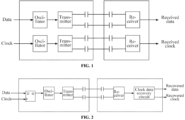
- FIG. 1 is a common mode of isolated transmission for data and clock, in which, for the data and clock on the primary side, signals are respectively transmitted to the isolated secondary side by using an isolated channel.
- this mode two isolated channels are occupied, leading to high power consumption during operation and high wafer cost; and moreover, more bonding wires are required for chip packaging, resulting in high packaging cost.
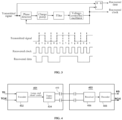
- FIG. 2 is a single-channel isolated communication based on a clock-data recovery technology, in which a data signal synchronized with a clock from the primary side is sent in a serial mode to the isolated secondary side by means of a transmitter, the secondary side extracts the clock from the received data signal by means of a clock-data recovery circuit, and then re-samples the data by using the extracted clock and finally acquires the recovered clock and data signals.
- FIG. 3 is a common clock-data recovery circuit and timing based on a phase-locked loop circuit.
- the circuits shown in FIG. 2 and FIG. 3 have the following technical disadvantages: (1) a long string of "0" or “1" signals cannot be communicated; (2) the data code rate and phase of the transmitted signal are deviated from the frequency and phase of a voltage-controlled oscillator in the clock-data recovery circuit at a receiving terminal, and it takes a longer time to complete the lock of the frequency and phase, such that it takes a longer time to establish communication; and (3) the clock-data recovery circuit needs to lock the frequency first and then lock the phase, resulting in more control loops, higher design complexity, and higher implementation cost.
- Objects of the present invention are to design a method for efficient communication, which can encode a clock signal and a data signal at the same time, thereby reducing circuit complexity and thus the wire bonding for chip packaging.
- an embodiment of the present invention provides an encoding method for single-channel communication, comprising: combining a clock signal and a data signal into a long- and short-code signal, wherein the long- and short-code signal comprises a long-code signal and a short-code signal, a pulse width of the long-code signal is consistent with that of the clock signal, and a pulse width of the short-code signal is consistent with that of the clock signal; and the long-code signal and the short-code signal have different duty cycles.
- combining the clock signal and the data signal into the long- and short-code signal comprises: generating a first delay clock signal based on the clock signal; generating a pulse signal based on the first delay clock signal; generating a high level of the long-code signal and a high level of the short-code signal based on the pulse signal; generating a second delay clock signal based on the first delay clock signal; generating a low level of the short-code signal based on the second delay clock signal; generating a low level of the long-code signal based on the clock signal; generating a data delay signal based on the first delay clock signal and the data signal; and selecting the long-code signal or the short-code signal based on the data signal and generating the long- and short-code signal.
- a delay time of the first delay clock signal relative to the clock signal is TS; a delay time of the second delay clock signal relative to the first delay clock signal is TS; and a delay time of the data delay signal relative to the data signal is TS.
- combining the clock signal and the data signal into the long- and short-code signal comprises: generating a first pulse signal based on the clock signal; generating a first delay clock signal based on the clock signal; generating a second delay clock signal based on the first delay clock signal; generating a second pulse signal based on the second delay clock signal; generating a third pulse signal based on the first delay clock signal; generating a high level of the long-code signal or a high level of the short-code signal based on the third pulse signal; generating a data delay signal based on the data signal and the first delay clock signal; selecting the first pulse signal or the second pulse signal based on the data delay signal; generating a low level of the short-code signal based on the selected second pulse signal; and generating a low level of the long-code signal based on the selected first pulse signal.
- an embodiment of the present invention provides an encoding circuit for single-channel communication, comprising: a first delay circuit configured to generate a first delay clock signal based on a clock signal; a pulse generator configured to generate a pulse signal based on the first delay clock signal; a long-code flip-flop, which has a reset terminal for receiving the pulse signal and outputting a high level of a long-code signal, and has a clock terminal for receiving the clock signal, the clock signal triggering the output of a low level of a long-code signal; a short-code flip-flop, which has a reset terminal for receiving the pulse signal and outputting a high level of a short-code signal; a second delay circuit configured to generate a second delay clock signal based on the first delay clock signal, a clock terminal of the short-code flip-flop for receiving the second delay clock signal and outputting a low level of the short-code signal; a selection flip-flop, which has a clock terminal for receiving the first delay clock signal
- an embodiment of the present invention provides an encoding circuit for single-channel communication, comprising: a first delay circuit configured to generate a first delay clock signal based on a clock signal; a second delay circuit configured to generate a second delay clock signal based on the first delay clock signal; a first pulse generator configured to generate a first pulse signal based on the first delay clock signal; a second pulse generator configured to generate a second pulse signal based on the second delay clock signal; a third pulse generator configured to generate a third pulse signal based on the first delay clock signal; a selection flip-flop, which has a clock terminal for receiving the first delay clock signal, a data terminal coupled to a data signal, and an output terminal for outputting a data delay signal; a data selector, which has a first input terminal coupled to the first pulse generator, a second input terminal coupled to the second pulse generator, and a selection terminal coupled to the data delay signal and selecting the first pulse signal or the second pulse signal based on the data delay signal; and an
- an embodiment of the present invention provides a decoding method for single-channel communication, comprising: generating a low level of a clock signal based on a high level of a long- and short-code signal; generating a delay pulse signal based on the long- and short-code signal, a delay time length of the delay pulse signal being a half of a clock period; generating a high level of the clock signal based on the delay pulse signal; and generating a digital signal based on the clock signal and the long- and short-code signal.
- generating the delay pulse signal based on the long- and short-code signal further comprises: generating a long- and short-code delay signal based on the long- and short-code signal, and controlling a delay time of the long- and short-code signal based on a phase difference between the long- and short-code delay signal and the long- and short-code signal.
- controlling the delay time of the long- and short-code signal based on the phase difference between the long- and short-code delay signal and the long- and short-code signal further comprises: converting a signal of the phase difference to a voltage signal, and controlling the delay time of the long- and short-code delay signal based on the voltage signal.
- an embodiment of the present invention provides a decoding circuit for single-channel communication, comprising: a delay pulse circuit configured to delay a long- and short-code signal by half a clock period and generate a long- and short-code delay signal; a pulse generator configured to generate a delay pulse signal based on the long- and short-code delay signal; a clock flip-flop, which has a clock terminal coupled to the long- and short-code signal and generating a low level of a clock signal based on the long- and short-code signal, and a reset terminal coupled to an output terminal of the pulse generator, the clock flip-flop generating a high level of the clock signal based on the delay pulse signal; and a digital signal flip-flop, which has a clock terminal coupled to an output terminal of the clock flip-flop, and a data terminal coupled to the long- and short-code signal, the digital signal flip-flop generating a digital high level or a digital low level based on the clock signal.
- the delay pulse circuit comprises a delay circuit and a pulse circuit, wherein the delay circuit comprises: an intermediate stage of the delay circuit for converting the long- and short-code signal to the long- and short-code delay signal; a phase-frequency detector configured to detect a phase difference between the long- and short-code delay signal and the long- and short-code signal; a charge pump configured to convert the phase difference to a current signal; and a low-pass filter configured to convert the current signal to a voltage signal, wherein the intermediate stage of the delay circuit is coupled to the low-pass filter, and configured to receive the voltage signal and control a delay time of the long- and short-code delay signal.
- the decoding circuit further comprises a flip detector, an oscillator, and a data selector, wherein when no communication occurs, the flip detector outputs a low level, and the data selector couples an output of the oscillator to a delay-locked loop, and establishes a voltage signal; and when communication occurs, the flip detector outputs a high level, and the data selector couples the long- and short-code signal to the delay pulse circuit.
- the present invention has at least the following beneficial technical effects: (1) a long- and short-code encoding scheme is used to fuse a data signal and a clock signal for communication, so that higher efficiency and lower power consumption are achieved; (2) the single-channel communication is enabled, such that wire bonding for chip packaging can be reduced, thereby reducing the chip manufacturing cost; (3) the circuits of encoding and decoding have a simple structure, which reduces the complexity of circuit design; and (4) the communication establishment time is short.
- FIG. 4 it is a schematic structural diagram of a communication circuit structure such as a digital isolation chip or an isolation amplification chip.
- the communication circuit includes a primary side 401 and a secondary side 403.
- the primary side 401 sends communication data
- the secondary side 403 receives communication data.
- the primary side 401 includes an encoder 402 and a transmitter 404, and the secondary side 403 includes a receiver 406 and a decoder 408.
- the transmitter 404 and the receiver 406 are coupled by means of an isolation capacitor 410.
- An input terminal of the encoder 402 is configured to receive a data signal TD and a clock signal TCLK, and an output terminal of the decoder 408 outputs a digital signal RD and a clock signal RCLK.
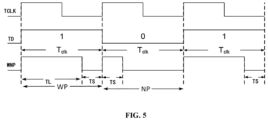
- FIG. 5 is a schematic diagram of the encoding timing for the data signal TD, the clock signal TCLK and a long- and short-code signal WNP according to the present invention, in which the clock signal TCLK and the data signal TD are combined into one long- and short-code signal WNP by means of an encoding method.
- the long- and short-code signal WNP includes a long-code signal WP and a short-code signal NP.
- the pulse width of the long-code signal WP is consistent with that of the clock signal TCLK
- the pulse width of the short-code signal NP is consistent with that of the clock signal TCLK
- the long-code signal WP and the short-code signal NP have different duty cycles.
- the duty cycle of the high and low levels of the long-code signal WP is greater than the duty cycle of the high and low levels of the short-code signal NP.
- the long-code signal WP is configured to represent that the data signal TD is " 1"
- the short-code signal NP is configured to indicate that the data signal TD is "0".
- the low level of the long-code signal WP has the same pulse width as that of the high level of the short-code signal NP.
- the data signal TD and the clock signal TCLK are fused for communication, thereby achieving higher efficiency and lower power consumption. Meanwhile, single-channel communication is enabled such that wire bonding for chip packaging can be reduced, thereby reducing the chip manufacturing cost.
- the circuits for encoding and decoding have a simple structure, which reduces the complexity of circuit design.
- the present invention essentially differs from the traditional OOK method.
- the presence of an oscillation signal (ON) is used to represent 1
- the absence of an oscillation signal (OFF) is used to represent 0.
- the long- and short-code signals WNP with different duty cycles are transmitted by the OOK method. That is, the high level in the long- and short-code signals WNP is transmitted by ON, and the low level in the long- and short-code signals WNP is transmitted by OFF. That is to say, ON or OFF is used to represent the high or low level, but the content of the data signal TD is represented by different duty cycles of the long- and short-code signals WNP.
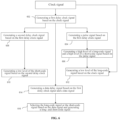
- FIG. 6 it is a schematic flowchart of an encoding method with long and short codes. After a "clock signal" is acquired, the method includes the following steps:
- steps 602 to 616 will be further explained in detail in conjunction with the circuit structure shown in FIG. 7 and the timing shown in FIG. 8 .
- Delay circuits, pulse generators, flip-flops, data selectors and other circuits included in FIG. 7 and other drawings are all standard devices, which will not be discussed any more in the present invention and can be implemented by those skilled in the art based on their mastered knowledge.
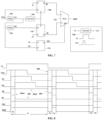
- the clock signal TCLK is coupled to a first delay circuit (Delay) 702; an output terminal of the first delay circuit 702 is coupled to a pulse generator (One-shot) 706; the pulse generator 706 acts according to the timing shown in the lower right of FIG. 7 ; and an output terminal of the pulse generator 706 is coupled to reset terminals S of a long-code flip-flop 708 and a short-code flip-flop 710.
- Data terminals D of the long-code flip-flop 708 and the short-code flip-flop 710 are grounded, and output terminals Q of the long-code flip-flop 708 and the short-code flip-flop 710 are coupled to a first input terminal (terminal 1 of a multiplexer (MUX), which is also known as data selector) and a second input terminal (terminal 0 of MUX) of a data selector 712, respectively.
- MUX multiplexer
- An input terminal of a second delay circuit (Delay) 704 is coupled to the output terminal of the first delay circuit 702, and an output terminal of the second delay circuit 704 is coupled to a clock terminal of the short-code flip-flop 710.
- the output terminal of the first delay circuit 702 is coupled to a clock terminal of a selection flip-flop 716; a data signal TD is coupled to a data terminal D of the selection flip-flop 716; and an output terminal Q of the selection flip-flop 716 is coupled to a selection terminal Sel of the data selector 712.
- the data selector 712 further includes an output terminal for outputting long- and short-code signal WNP.
- step 602 the first delay clock signal TD1 is generated based on the clock signal TCLK.
- the first delay circuit 702 generates the first delay clock signal TD1 based on the clock signal TCLK, and a delay time of the first delay clock signal TD1 relative to the clock signal TCLK is TS.
- step 604 the pulse signal is generated based on the first delay clock signal TD1.
- a rising edge of the first delay clock signal TD1 triggers the pulse generator 706; the pulse generator 706 generates the pulse signal based on the first delay clock signal TD1; and the pulse signal is sent to the reset terminals S of the long-code flip-flop 708 and the short-code flip-flop 710.
- step 606 the long-code flip-flop 708 and the short-code flip-flop 710 generate a high level 8022 of the long-code signal WP and a high level 8024 of the short-code signal NP based on the pulse signal; and after the pulse signal disappears, the long-code signal WP and short-code signal NP can maintain a high-level state.
- step 608 and step 610 the second delay clock signal TD2 is generated based on the first delay clock signal TD1.
- the second delay circuit 704 generates the second delay clock signal TD2 based on the first delay clock signal TD1, and a delay time of the second delay clock signal TD2 relative to the first delay clock signal TD1 is TS.
- the clock terminal of the short-code flip-flop 710 When a rising edge of the second delay clock signal TD2 appears, the clock terminal of the short-code flip-flop 710 is at a high level, and the short-code flip-flop 710 outputs a low level of the data terminal D which is grounded, thereby generating the low level 804 of the short-code signal NP.
- step 612 the low level 808 of the long-code signal WP is generated based on the clock signal.
- the clock terminal of the long-code flip-flop 708 receives the clock signal to trigger the output of the level of the data terminal D which is grounded. At this moment, output signals form the low level 808 of the long-code signal WP.
- step 614 the data delay signal TDD1 is generated based on the first delay clock signal TD1 and the data signal TD.
- the first delay clock signal TD1 is later than the clock signal TCLK or the data signal TD by TS, and the data signal TD is synchronized with the clock signal TCLK. Therefore, by taking the first delay clock signal TD1 as a clock source, the data delay signal TDD1 will be generated synchronously when the data signal TD is coupled to the data terminal of the selection flip-flop 716. That is, the delay time of the data delay signal TDD1 relative to the data signal TD is TS.
- step 616 the long-code signal WP or the short-code signal NP is selected based on the data signal TD and the long- and short-code signal WNP is generated.
- the data delay signal TDD1 is coupled to the selection terminal Sel of the data selector 712.
- the long-code signal WP is selected for output, which corresponds to the input signal of the first input terminal in the figure.
- the short-code signal NP is selected for output, which corresponds to the input signal of the second input terminal in the figure;
- the data delay signal TDD1 is synchronized with the long- and short-code signal WNP, and based on the data delay signal TDD1, the long-code signal WP or short-code signal NP is selected for output, thereby completing the encoding of the long- and short-code signal WNP.
- the present invention provides another encoding method for single-channel communication. After a "clock signal" is acquired, the method includes the following steps:
- Steps 902 to 920 will be further explained in detail below in conjunction with the circuit structure shown in FIG. 10 and the timing diagram shown in FIG. 11 .
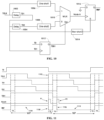
- a circuit for encoding includes a first delay circuit (Delay) 1002, a second delay circuit (Delay) 1004, a first pulse generator (One-shot1) 1006, a second pulse generator (One-shot2) 1008, a third pulse generator (One-shot3) 1014, a data selector (MUX) 1010, a selection flip-flop 1012, and an output flip-flop 1016.
- the clock signal TCLK is coupled to the first delay circuit 1002 and the first pulse generator 1006.
- An output terminal of the first delay circuit 1002 is coupled to an input terminal of the second delay circuit 1004; an output terminal of the second delay circuit 1004 is coupled to an input terminal of the second pulse generator 1008; and an output terminal of the second pulse generator 1008 is coupled to a second input terminal (terminal 0 of MUX) of the data selector 1010.
- An output terminal of the first pulse generator 1006 is coupled to a first input terminal (terminal 1 of MUX) of the data selector 1010; the data signal TD is coupled to a data input terminal D of the selection flip-flop 1012; an output terminal Q of the selection flip-flop 1012 is coupled to a selection terminal Sel of the data selector 1010 (that is, the selection terminal Sel of the data selector 1010 is coupled to the data delay signal TDD1); an output terminal of the third pulse generator 1014 is coupled to a reset terminal S of the output flip-flop 1016; and a clock terminal of the output flip-flop 1016 is coupled to an output terminal of the data selector 1010 to form a node A (Node A).
- the output flip-flop 1016 further includes a grounded data terminal D and an output terminal Q for outputting a long- and short-code signal WNP.
- the first pulse signal P1 is generated at the node A (Node A) based on the clock signal TCLK; a rising edge 1102 of the clock signal triggers the first pulse generator 1006; and based on the first delay clock signal (i.e., the rising edge 1102), the first pulse generator 1006 generates the first pulse signal P1 which is input to the first input terminal of the data selector 1010.
- step 904 the first delay clock signal TD1 is generated based on the clock signal TCLK.
- the first delay circuit 1002 generates the first delay clock signal TD1 based on the clock signal TCLK.
- the first delay clock signal TD1 serves as the basis of the second delay clock signal TD2, and a delay time of the first delay clock signal TD1 relative to the clock signal is TS.
- step 906 the second delay clock signal TD2 is generated based on the first delay clock signal TD1.
- the second delay circuit 1004 generates the second delay clock signal TD2 based on the first delay signal TD1, and a delay time of the second delay clock signal TD2 relative to the first delay clock signal TD1 is TS.
- step 908 the second pulse signal P2 is generated based on the second delay clock signal TD2.
- the second pulse generator 1008 generates the second pulse signal P2 based on the second delay clock signal TD2, and the second pulse signal P2 is configured to allow the output flip-flop 1016 to output a low level.
- step 910 the third pulse signal (not shown in the timing diagram) is generated based on the first delay clock signal TD1.
- the third pulse generator 1014 generates the third pulse signal based on the first delay clock signal TD1.
- step 912 the third pulse signal resets the output flip-flop 1016 to generate the high level 1104 of the long-code signal WP or the high level 1106 of the short-code signal NP (the long-code signal WP and the short-code signal NP are recorded in the long- and short-code signal WNP).
- step 914 the data delay signal TDD1 is generated based on the data signal TD and the first delay clock signal TD1.
- a clock terminal receives the first delay clock signal TD1
- a data terminal D is coupled to a data signal TD
- an output terminal Q outputs a data delay signal TDD1, which is synchronized with the first delay clock signal TD1.
- step 916 the first pulse signal P1 or the second pulse signal P2 are selected based on the data delay signal TDD1.
- the data selector 1012 selects the first pulse signal P1 or the second pulse signal P2 based on the data delay signal TDD1. When the data delay signal TDD1 is at a high level, the data selector 1012 outputs the first pulse signal P1; and when the data delay signal TDD1 is at a low level, the data selector 1012 outputs the second pulse signal P2.
- step 920 the low level 1108 of the long-code signal WP is generated based on the selected first pulse signal P1.
- the rising edge of the first pulse signal P1 is aligned with the rising edge of the clock signal TCLK. Therefore, the first pulse signal P1 causes the output flip-flop 1016 to generate the low level 1108 of the long-code signal WP, and then, the third pulse generator 1014 generates a pulse signal to pull up an output level of the output flip-flop 1016 again to form the high level 1104 of the long-code signal WP, thereby completing one long-code encoding.
- step 918 the low level 1110 of the short-code signal NP is generated based on the selected second pulse signal P2.
- the delay time of the rising edge of the second pulse signal P2 relative to the first delay clock signal TD1 is TS.
- the output level of the output flip-flop 1016 is pulled down by the second pulse signal P2 to form the low level 1110 of the short-code signal NP; and then after the rising edge of the first delay clock signal TD1 appears, the third pulse generator 1014 generates a pulse signal to pull up the output level of the output flip-flop 1016 again to form the high level 1106 of the short-code signal NP, thereby completing one short-code encoding.
- the decoding method for single-channel communication includes the following steps after a "long- and short-code signal" is acquired:
- steps 1202 to 1208 will be further explained in detail in conjunction with the circuit structure shown in FIG. 13 and the timing diagram shown in FIG. 14 .
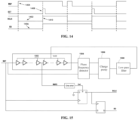
- the circuit structure includes a delay pulse circuit (Delay 0.5Tclk) 1302, a pulse generator (One-shot) 1304, a clock flip-flop 1306, and a digital signal flip-flop 1308.
- the delay pulse circuit 1302 is coupled to the long- and short-code signal WNP; an output terminal of the delay pulse circuit 1302 is coupled to the pulse generator 1304; and a data terminal D of the digital signal flip-flop 1308 is coupled to the long- and short-code signal WNP.
- a clock terminal of the clock flip-flop 1306 is coupled to the long- and short-code signal WNP; a reset terminal S of the clock flip-flop 1306 is coupled to an output terminal of the pulse generator 1304 to receive a delay pulse signal SET; and an output terminal Q of the clock flip-flop 1306 is coupled to a clock terminal of the digital signal flip-flop 1308 to output the clock signal RCLK.
- the clock flip-flop 1306 further includes a grounded data terminal D, and the digital signal flip-flop 1308 further includes an output terminal Q for outputting a digital signal RD.
- step 1202 the low level 1402 of the clock signal RCLK is generated based on the high level of the long- and short-code signal WNP.
- the output terminal Q of the clock flip-flop 1306 After a rising edge 1404 of the long- and short-code signal WNP is input to the clock flip-flop 1306, the output terminal Q of the clock flip-flop 1306 outputs a low level 1402 (included in the clock signal RCLK) of the data terminal D. That is, the clock flip-flop 1306 generates the low level of the clock signal RCLK based on the long- and short-code signal WNP.
- step 1204 the delay pulse signal SET is generated based on the long- and short-code signal WNP.
- a delay time of the delay pulse signal SET is half a clock period (0.5 Tclk).
- the delay pulse circuit 1302 delays the long- and short-code signal WNP by half a clock period and generates a long- and short-code delay signal, and the pulse generator 1304 generates the delay pulse signal SET based on the long- and short-code delay signal.
- a time length between a rising edge 1408 of the delay pulse signal SET and the rising edge 1404 of the long- and short-code signal WNP is half a clock period.
- step 1206 the delay pulse signal SET resets the output terminal Q of the clock flip-flop 1306 to allow the output terminal Q to output a high level, which constitutes the high level of the clock signal RCLK.
- Steps 1202 to 1206 are repeated to generate a plurality of clock signals RCLK.
- step 1208 the digital signal RD is generated based on the clock signal RCLK and the long- and short-code signal WNP.
- the digital signal flip-flop 1308 According to the clock signal RCLK, the digital signal flip-flop 1308 generates a digital high level or a digital low level 1406 included in the digital signal RD.
- the output signal of the digital signal flip-flop 1308 is the high level of the long-code signal WP or the low level of the short-code signal NP, such that the output decoded high-and-low-level signals exactly correspond to the encoding of the long- and short-code signal WNP.
- generating the delay pulse signal SET based on the long- and short-code signal WNP further includes: generating a long- and short-code delay signal based on the long- and short-code signal WNP, and controlling a delay time of the long- and short-code signal WNP based on a phase difference between the long- and short-code delay signal and the long- and short-code signal WNP.
- controlling the delay time of the long- and short-code signal WNP based on the phase difference between the long- and short-code delay signal and the long- and short-code signal WNP further includes: converting a phase difference signal corresponding to the phase difference to a voltage signal, and controlling the delay time of the long- and short-code delay signal based on the voltage signal.
- a decoding circuit for single-channel communication is shown to include an internal structure of a delay circuit of the delay pulse circuit 1302 in FIG. 13 , and the delay pulse circuit 1302 may further include a pulse circuit.
- the delay pulse circuit includes: an intermediate stage 1502 of a delay circuit configured to convert the long- and short-code signal WNP to a long- and short-code delay signal WNPD; a phase-frequency detector 1504 configured to detect a phase difference between the long- and short-code delay signal WNPD and the long- and short-code signal WNP; a charge pump 1506 configured to convert the phase difference to a current signal; and a low-pass filter 1508 configured to convert the current signal to a voltage signal Vctrl.
- the intermediate stage 1502 of the delay circuit is coupled to an output terminal of the low-pass filter 1508, and is configured to receive the voltage signal Vctrl and control the delay time of the long- and short-code delay signal WNPD.
- the above-mentioned feedback loop formed by the phase-frequency detector 1504 to the low-pass filter 1508 from the phase signal to the voltage signal can accurately control the time of the delay circuit, such that the delay time of the delay circuit is controlled to be more precise, and the accurate clock signal RCLK can be restored in conjunction with the rest of the decoding circuit.
- the rest includes a pulse generator One-shot, a clock flip-flop, and a digital signal flip-flop.
- An input terminal of the pulse generator One-shot is coupled to the long- and short-code delay signal WNPD, and an output terminal of the pulse generator One-shot is coupled to a reset terminal S of the clock flip-flop and outputs a delay pulse signal Set.
- a data terminal D is grounded, a clock terminal is coupled to the long- and short-code signal WNP, and the clock signal RCLK is output by means of an output terminal Q.
- a clock terminal is coupled to the output terminal Q of the clock flip-flop, a data terminal D is coupled to the long- and short-code signal WNP, and an output terminal Q outputs the digital signal RD.
- the circuit includes a flip detector 602, an oscillator 604 (with a period of Tosc), and a data selector (MUX) 608.
- the oscillator 604 is coupled to a second input terminal (terminal 0 of MUX) of the data selector 608; the long- and short-code signal WNP is accessed to the first input terminal (terminal 1 of the MUX) of the data selector 608 and an input terminal of the flip detector 602; and an output terminal of the flip detector 602 is coupled to a selection terminal Sel of the data selector 608.
- the WNP input of the circuit in FIG. 15 is replaced with an output terminal of the data selector 608.
- the flip detector 602 When no communication occurs, the flip detector 602 outputs a low level, and the data selector 608 couples an output of the oscillator 604 to a delay-locked loop (including a circuit formed by the intermediate stage 1502 of the delay circuit, the phase-frequency detector, the charge pump, and the low-pass filter, at a back side), and establishes a voltage signal Vctrl.
- a delay-locked loop including a circuit formed by the intermediate stage 1502 of the delay circuit, the phase-frequency detector, the charge pump, and the low-pass filter, at a back side
- the flip detector 602 When communication occurs, the flip detector 602 outputs a high level, and the data selector 608 couples the long- and short-code signal WNP to the delay pulse circuit.
- the rest of the circuit includes a pulse generator One-shot, a clock flip-flop, and a digital signal flip-flop.
- an input terminal is coupled to the long- and short-code delay signal WNPD, and an output terminal is coupled to a reset terminal S of the clock flip-flop and outputs a delay pulse signal Set.
- a data terminal D is grounded, a clock terminal is coupled to the long- and short-code signal WNP, and a clock signal RCLK is output by means of an output terminal Q.
- a clock terminal is coupled to the output terminal Q of the clock flip-flop, a data terminal D is coupled to the long- and short-code signal WNP, and an output terminal Q outputs the digital signal RD.
- phase-frequency detector is coupled to the charge pump by means of two output terminals to output control signals UP and DOWN.
- the delay-locked loop When no communication occurs, the delay-locked loop has established a voltage signal Vctrl of a voltage-controlled delay line (including the intermediate stage 1502 of the delay circuit), and the voltage signal Vctrl approaches a final voltage signal during communication. Therefore, once the long- and short-code signal WNP arrives, accurate communication can be implemented immediately, without the establishment time required by a general clock data recovery circuit, thereby achieving rapid establishment of communication.
Landscapes
- Engineering & Computer Science (AREA)
- Computer Networks & Wireless Communication (AREA)
- Signal Processing (AREA)
- Physics & Mathematics (AREA)
- Spectroscopy & Molecular Physics (AREA)
- Theoretical Computer Science (AREA)
- Quality & Reliability (AREA)
- Dc Digital Transmission (AREA)
- Stabilization Of Oscillater, Synchronisation, Frequency Synthesizers (AREA)
- Synchronisation In Digital Transmission Systems (AREA)
Applications Claiming Priority (2)
| Application Number | Priority Date | Filing Date | Title |
|---|---|---|---|
| CN202111200511.4A CN113645007B (zh) | 2021-10-15 | 2021-10-15 | 单通道通信编码方法、解码方法、编码电路及解码电路 |
| PCT/CN2022/080838 WO2023060834A1 (zh) | 2021-10-15 | 2022-03-15 | 单通道通信编码方法、解码方法、编码电路及解码电路 |
Publications (2)
| Publication Number | Publication Date |
|---|---|
| EP4333336A1 true EP4333336A1 (de) | 2024-03-06 |
| EP4333336A4 EP4333336A4 (de) | 2024-11-06 |
Family
ID=78426950
Family Applications (1)
| Application Number | Title | Priority Date | Filing Date |
|---|---|---|---|
| EP22879785.8A Pending EP4333336A4 (de) | 2021-10-15 | 2022-03-15 | Einkanalkommunikationscodierungsverfahren und decodierungsverfahren, codierungsschaltung und decodierungsschaltung |
Country Status (6)
| Country | Link |
|---|---|
| US (1) | US20250016033A1 (de) |
| EP (1) | EP4333336A4 (de) |
| JP (2) | JP7675301B2 (de) |
| KR (1) | KR20240052784A (de) |
| CN (3) | CN113645007B (de) |
| WO (1) | WO2023060834A1 (de) |
Families Citing this family (2)
| Publication number | Priority date | Publication date | Assignee | Title |
|---|---|---|---|---|
| CN113645007B (zh) * | 2021-10-15 | 2022-04-29 | 苏州纳芯微电子股份有限公司 | 单通道通信编码方法、解码方法、编码电路及解码电路 |
| CN119483524B (zh) * | 2024-10-12 | 2025-10-14 | 上海纳矽微电子有限公司 | 隔离放大电路 |
Family Cites Families (26)
| Publication number | Priority date | Publication date | Assignee | Title |
|---|---|---|---|---|
| JPS56164654A (en) * | 1980-05-23 | 1981-12-17 | Tech Res & Dev Inst Of Japan Def Agency | Data transmitting and receiving device |
| US4951049A (en) * | 1989-03-22 | 1990-08-21 | Eastman Kodak Company | Self clocking binary information encoder |
| US5023891A (en) * | 1989-07-25 | 1991-06-11 | Sf2 Corporation | Method and circuit for decoding a Manchester code signal |
| US5046073A (en) * | 1989-08-10 | 1991-09-03 | Ge Fanuc Automation North America, Inc. | Signal processing apparatus for recovering a clock signal and a data signal from an encoded information signal |
| US4984255A (en) * | 1989-11-15 | 1991-01-08 | National Semiconductor Corporation | Edge transition insensitive delay line system and method |
| US5412697A (en) * | 1993-01-14 | 1995-05-02 | Apple Computer, Inc. | Delay line separator for data bus |
| US5550864A (en) * | 1993-12-01 | 1996-08-27 | Broadband Communications Products | Bit rate-insensitive mechanism for transmitting integrated clock and data signals over digital communication link |
| US6518809B1 (en) * | 2001-08-01 | 2003-02-11 | Cypress Semiconductor Corp. | Clock circuit with self correcting duty cycle |
| GB0202189D0 (en) * | 2002-01-31 | 2002-03-20 | Zarlink Semiconductor Ab | Ultra low power adaptive pulse distance ratio decoder for coded data by feedback of output data |
| KR100473813B1 (ko) * | 2003-07-10 | 2005-03-14 | 학교법인 포항공과대학교 | 다중 위상 클럭을 위한 디지털 듀티 사이클 보정 회로 및그 방법 |
| JP2009541905A (ja) * | 2006-06-19 | 2009-11-26 | コーニンクレッカ フィリップス エレクトロニクス エヌ ヴィ | 光記録装置 |
| JP4900697B2 (ja) | 2006-09-15 | 2012-03-21 | 株式会社リコー | シリアルデータ通信システムおよび画像形成装置 |
| US7945840B2 (en) * | 2007-02-12 | 2011-05-17 | Micron Technology, Inc. | Memory array error correction apparatus, systems, and methods |
| CN100568738C (zh) * | 2008-03-28 | 2009-12-09 | 南京航空航天大学 | 带同步时钟的脉宽调制式光纤通信编码解码方法及电路 |
| CN101594186B (zh) * | 2008-05-28 | 2013-01-16 | 华为技术有限公司 | 双通道信号编码中生成单通道信号的方法和装置 |
| JP5633132B2 (ja) | 2009-09-30 | 2014-12-03 | 日本電気株式会社 | データ伝送システム及び方法、データ送信装置及び受信装置 |
| CN101694991B (zh) * | 2009-10-22 | 2012-07-04 | 浙江大学 | 用于实现任意脉宽的异步脉冲信号同步的电路 |
| CN102035514B (zh) * | 2010-11-11 | 2012-11-28 | 东南大学 | 一种数字脉宽调制电路的控制方法 |
| US8736309B2 (en) * | 2012-05-24 | 2014-05-27 | Freescale Semiconductor, Inc. | Non-overlapping clock generator circuit and method |
| US8929467B1 (en) * | 2014-01-13 | 2015-01-06 | Liming Xiu | Circuits and methods for one-wire communication bus of using pulse-edge for clock and pulse-duty-cycle for data |
| CN107223312B (zh) | 2015-02-04 | 2018-09-25 | 高通股份有限公司 | 用于数据链路功率降低和吞吐量提高的多调制 |
| CN107276955B (zh) * | 2016-04-08 | 2021-07-06 | 深圳光启合众科技有限公司 | 信号处理方法和系统 |
| KR102577232B1 (ko) * | 2016-11-28 | 2023-09-11 | 삼성전자주식회사 | 하이브리드 클럭 데이터 복원 회로 및 수신기 |
| CN109088623B (zh) * | 2018-08-01 | 2020-03-17 | 电子科技大学 | 一种适用于不同开关频率的高线性度混合数字脉宽调制器 |
| CN108988868A (zh) * | 2018-08-02 | 2018-12-11 | 西安安源智造机电设备有限公司 | G网转无线数字通信中继设备 |
| CN113645007B (zh) * | 2021-10-15 | 2022-04-29 | 苏州纳芯微电子股份有限公司 | 单通道通信编码方法、解码方法、编码电路及解码电路 |
-
2021
- 2021-10-15 CN CN202111200511.4A patent/CN113645007B/zh active Active
- 2021-10-15 CN CN202210375917.4A patent/CN114760011B/zh active Active
- 2021-10-15 CN CN202311152692.7A patent/CN117176313B/zh active Active
-
2022
- 2022-03-15 EP EP22879785.8A patent/EP4333336A4/de active Pending
- 2022-03-15 JP JP2024517070A patent/JP7675301B2/ja active Active
- 2022-03-15 US US18/700,519 patent/US20250016033A1/en active Pending
- 2022-03-15 KR KR1020247009352A patent/KR20240052784A/ko active Pending
- 2022-03-15 WO PCT/CN2022/080838 patent/WO2023060834A1/zh not_active Ceased
-
2025
- 2025-03-04 JP JP2025034119A patent/JP2025074291A/ja active Pending
Also Published As
| Publication number | Publication date |
|---|---|
| CN113645007A (zh) | 2021-11-12 |
| CN117176313A (zh) | 2023-12-05 |
| WO2023060834A1 (zh) | 2023-04-20 |
| CN114760011A (zh) | 2022-07-15 |
| JP2025074291A (ja) | 2025-05-13 |
| CN114760011B (zh) | 2023-10-20 |
| CN117176313B (zh) | 2024-05-03 |
| CN113645007B (zh) | 2022-04-29 |
| US20250016033A1 (en) | 2025-01-09 |
| KR20240052784A (ko) | 2024-04-23 |
| JP2024531789A (ja) | 2024-08-29 |
| JP7675301B2 (ja) | 2025-05-13 |
| EP4333336A4 (de) | 2024-11-06 |
Similar Documents
| Publication | Publication Date | Title |
|---|---|---|
| EP2183674B1 (de) | Durch ein serielles kanal verbundene sender und empfanger | |
| EP4333336A1 (de) | Einkanalkommunikationscodierungsverfahren und decodierungsverfahren, codierungsschaltung und decodierungsschaltung | |
| CN102377426B (zh) | 时钟数据恢复电路、接收装置和通信系统 | |
| CN108063661B (zh) | 基于曼彻斯特编码的采样电路和接收电路 | |
| Lin et al. | A 2.5-Gb/s DLL-Based Burst-Mode Clock and Data Recovery Circuit With $4\times $ Oversampling | |
| KR101470599B1 (ko) | 복원된 클럭을 이용하여 송신한 데이터를 수신하는 장치 | |
| US20050207520A1 (en) | High-speed serial link clock and data recovery | |
| US11646862B2 (en) | Reception device and transmission and reception system | |
| EP1336270B1 (de) | Anordnung zur erfassung von daten | |
| TW202230989A (zh) | 無參考時脈之時脈資料回復裝置及其方法 | |
| KR100975083B1 (ko) | 직렬 송수신 장치 및 그 통신 방법 | |
| JP2008193405A (ja) | 伝送システム、送信側装置、受信側装置、これらの動作方法、及びデジタル放送システム | |
| KR20160014840A (ko) | 레퍼런스 클럭으로 동작하는 클럭 데이터 복원 회로, 데이터 수신 장치 및 그 방법 | |
| KR101206146B1 (ko) | 직렬 변환기 및 직렬 변환 방법 | |
| Walker et al. | A chipset for gigabit rate data communication (using optical fibres) | |
| RU2745886C1 (ru) | Регенератор сигналов данных | |
| EP1168706A2 (de) | Verfahren und Schaltung zur Einphasung von Datenströmen in Zeitmultiplex-Rahmen | |
| JP3575231B2 (ja) | デジタル通信装置及び通信方法 | |
| KR101478191B1 (ko) | 복원된 클럭을 이용하여 송신한 데이터를 수신하는 장치 | |
| JP2010288257A (ja) | クロックデータ再生回路 | |
| JPH06291753A (ja) | データ伝送装置 | |
| KR20060095413A (ko) | 동기식 시스템에서의 프레임 싱크 생성 장치 및 방법 | |
| Goldman | Low power AES clock recovery circuit for wireless applications |
Legal Events
| Date | Code | Title | Description |
|---|---|---|---|
| STAA | Information on the status of an ep patent application or granted ep patent |
Free format text: STATUS: THE INTERNATIONAL PUBLICATION HAS BEEN MADE |
|
| PUAI | Public reference made under article 153(3) epc to a published international application that has entered the european phase |
Free format text: ORIGINAL CODE: 0009012 |
|
| STAA | Information on the status of an ep patent application or granted ep patent |
Free format text: STATUS: REQUEST FOR EXAMINATION WAS MADE |
|
| 17P | Request for examination filed |
Effective date: 20231201 |
|
| AK | Designated contracting states |
Kind code of ref document: A1 Designated state(s): AL AT BE BG CH CY CZ DE DK EE ES FI FR GB GR HR HU IE IS IT LI LT LU LV MC MK MT NL NO PL PT RO RS SE SI SK SM TR |
|
| A4 | Supplementary search report drawn up and despatched |
Effective date: 20241007 |
|
| RIC1 | Information provided on ipc code assigned before grant |
Ipc: H04L 25/49 20060101ALI20240930BHEP Ipc: H03M 5/04 20060101ALI20240930BHEP Ipc: H04L 1/00 20060101AFI20240930BHEP |
|
| DAV | Request for validation of the european patent (deleted) | ||
| DAX | Request for extension of the european patent (deleted) |