EP4333124B1 - Neue organische elektroden und deren verwendung in elektrochemischen systemen - Google Patents
Neue organische elektroden und deren verwendung in elektrochemischen systemen Download PDFInfo
- Publication number
- EP4333124B1 EP4333124B1 EP23194424.0A EP23194424A EP4333124B1 EP 4333124 B1 EP4333124 B1 EP 4333124B1 EP 23194424 A EP23194424 A EP 23194424A EP 4333124 B1 EP4333124 B1 EP 4333124B1
- Authority
- EP
- European Patent Office
- Prior art keywords
- positive electrode
- weight
- linear
- electrode
- organic
- Prior art date
- Legal status (The legal status is an assumption and is not a legal conclusion. Google has not performed a legal analysis and makes no representation as to the accuracy of the status listed.)
- Active
Links
Images



Classifications
-
- H—ELECTRICITY
- H01—ELECTRIC ELEMENTS
- H01M—PROCESSES OR MEANS, e.g. BATTERIES, FOR THE DIRECT CONVERSION OF CHEMICAL ENERGY INTO ELECTRICAL ENERGY
- H01M4/00—Electrodes
- H01M4/02—Electrodes composed of, or comprising, active material
- H01M4/13—Electrodes for accumulators with non-aqueous electrolyte, e.g. for lithium-accumulators; Processes of manufacture thereof
-
- H—ELECTRICITY
- H01—ELECTRIC ELEMENTS
- H01M—PROCESSES OR MEANS, e.g. BATTERIES, FOR THE DIRECT CONVERSION OF CHEMICAL ENERGY INTO ELECTRICAL ENERGY
- H01M10/00—Secondary cells; Manufacture thereof
- H01M10/05—Accumulators with non-aqueous electrolyte
- H01M10/052—Li-accumulators
-
- H—ELECTRICITY
- H01—ELECTRIC ELEMENTS
- H01M—PROCESSES OR MEANS, e.g. BATTERIES, FOR THE DIRECT CONVERSION OF CHEMICAL ENERGY INTO ELECTRICAL ENERGY
- H01M10/00—Secondary cells; Manufacture thereof
- H01M10/05—Accumulators with non-aqueous electrolyte
- H01M10/052—Li-accumulators
- H01M10/0525—Rocking-chair batteries, i.e. batteries with lithium insertion or intercalation in both electrodes; Lithium-ion batteries
-
- H—ELECTRICITY
- H01—ELECTRIC ELEMENTS
- H01M—PROCESSES OR MEANS, e.g. BATTERIES, FOR THE DIRECT CONVERSION OF CHEMICAL ENERGY INTO ELECTRICAL ENERGY
- H01M10/00—Secondary cells; Manufacture thereof
- H01M10/05—Accumulators with non-aqueous electrolyte
- H01M10/056—Accumulators with non-aqueous electrolyte characterised by the materials used as electrolytes, e.g. mixed inorganic/organic electrolytes
- H01M10/0564—Accumulators with non-aqueous electrolyte characterised by the materials used as electrolytes, e.g. mixed inorganic/organic electrolytes the electrolyte being constituted of organic materials only
- H01M10/0566—Liquid materials
- H01M10/0568—Liquid materials characterised by the solutes
-
- H—ELECTRICITY
- H01—ELECTRIC ELEMENTS
- H01M—PROCESSES OR MEANS, e.g. BATTERIES, FOR THE DIRECT CONVERSION OF CHEMICAL ENERGY INTO ELECTRICAL ENERGY
- H01M10/00—Secondary cells; Manufacture thereof
- H01M10/05—Accumulators with non-aqueous electrolyte
- H01M10/056—Accumulators with non-aqueous electrolyte characterised by the materials used as electrolytes, e.g. mixed inorganic/organic electrolytes
- H01M10/0564—Accumulators with non-aqueous electrolyte characterised by the materials used as electrolytes, e.g. mixed inorganic/organic electrolytes the electrolyte being constituted of organic materials only
- H01M10/0566—Liquid materials
- H01M10/0569—Liquid materials characterised by the solvents
-
- H—ELECTRICITY
- H01—ELECTRIC ELEMENTS
- H01M—PROCESSES OR MEANS, e.g. BATTERIES, FOR THE DIRECT CONVERSION OF CHEMICAL ENERGY INTO ELECTRICAL ENERGY
- H01M4/00—Electrodes
- H01M4/02—Electrodes composed of, or comprising, active material
- H01M4/04—Processes of manufacture in general
- H01M4/0402—Methods of deposition of the material
- H01M4/0404—Methods of deposition of the material by coating on electrode collectors
-
- H—ELECTRICITY
- H01—ELECTRIC ELEMENTS
- H01M—PROCESSES OR MEANS, e.g. BATTERIES, FOR THE DIRECT CONVERSION OF CHEMICAL ENERGY INTO ELECTRICAL ENERGY
- H01M4/00—Electrodes
- H01M4/02—Electrodes composed of, or comprising, active material
- H01M4/04—Processes of manufacture in general
- H01M4/0402—Methods of deposition of the material
- H01M4/0409—Methods of deposition of the material by a doctor blade method, slip-casting or roller coating
-
- H—ELECTRICITY
- H01—ELECTRIC ELEMENTS
- H01M—PROCESSES OR MEANS, e.g. BATTERIES, FOR THE DIRECT CONVERSION OF CHEMICAL ENERGY INTO ELECTRICAL ENERGY
- H01M4/00—Electrodes
- H01M4/02—Electrodes composed of, or comprising, active material
- H01M4/13—Electrodes for accumulators with non-aqueous electrolyte, e.g. for lithium-accumulators; Processes of manufacture thereof
- H01M4/139—Processes of manufacture
-
- H—ELECTRICITY
- H01—ELECTRIC ELEMENTS
- H01M—PROCESSES OR MEANS, e.g. BATTERIES, FOR THE DIRECT CONVERSION OF CHEMICAL ENERGY INTO ELECTRICAL ENERGY
- H01M4/00—Electrodes
- H01M4/02—Electrodes composed of, or comprising, active material
- H01M4/36—Selection of substances as active materials, active masses, active liquids
- H01M4/60—Selection of substances as active materials, active masses, active liquids of organic compounds
-
- H—ELECTRICITY
- H01—ELECTRIC ELEMENTS
- H01M—PROCESSES OR MEANS, e.g. BATTERIES, FOR THE DIRECT CONVERSION OF CHEMICAL ENERGY INTO ELECTRICAL ENERGY
- H01M4/00—Electrodes
- H01M4/02—Electrodes composed of, or comprising, active material
- H01M2004/026—Electrodes composed of, or comprising, active material characterised by the polarity
- H01M2004/028—Positive electrodes
-
- H—ELECTRICITY
- H01—ELECTRIC ELEMENTS
- H01M—PROCESSES OR MEANS, e.g. BATTERIES, FOR THE DIRECT CONVERSION OF CHEMICAL ENERGY INTO ELECTRICAL ENERGY
- H01M2300/00—Electrolytes
- H01M2300/0017—Non-aqueous electrolytes
- H01M2300/0025—Organic electrolyte
-
- H—ELECTRICITY
- H01—ELECTRIC ELEMENTS
- H01M—PROCESSES OR MEANS, e.g. BATTERIES, FOR THE DIRECT CONVERSION OF CHEMICAL ENERGY INTO ELECTRICAL ENERGY
- H01M2300/00—Electrolytes
- H01M2300/0017—Non-aqueous electrolytes
- H01M2300/0025—Organic electrolyte
- H01M2300/0028—Organic electrolyte characterised by the solvent
- H01M2300/0037—Mixture of solvents
-
- H—ELECTRICITY
- H01—ELECTRIC ELEMENTS
- H01M—PROCESSES OR MEANS, e.g. BATTERIES, FOR THE DIRECT CONVERSION OF CHEMICAL ENERGY INTO ELECTRICAL ENERGY
- H01M4/00—Electrodes
- H01M4/02—Electrodes composed of, or comprising, active material
- H01M4/62—Selection of inactive substances as ingredients for active masses, e.g. binders, fillers
- H01M4/621—Binders
- H01M4/622—Binders being polymers
-
- H—ELECTRICITY
- H01—ELECTRIC ELEMENTS
- H01M—PROCESSES OR MEANS, e.g. BATTERIES, FOR THE DIRECT CONVERSION OF CHEMICAL ENERGY INTO ELECTRICAL ENERGY
- H01M4/00—Electrodes
- H01M4/02—Electrodes composed of, or comprising, active material
- H01M4/62—Selection of inactive substances as ingredients for active masses, e.g. binders, fillers
- H01M4/624—Electric conductive fillers
- H01M4/625—Carbon or graphite
-
- Y—GENERAL TAGGING OF NEW TECHNOLOGICAL DEVELOPMENTS; GENERAL TAGGING OF CROSS-SECTIONAL TECHNOLOGIES SPANNING OVER SEVERAL SECTIONS OF THE IPC; TECHNICAL SUBJECTS COVERED BY FORMER USPC CROSS-REFERENCE ART COLLECTIONS [XRACs] AND DIGESTS
- Y02—TECHNOLOGIES OR APPLICATIONS FOR MITIGATION OR ADAPTATION AGAINST CLIMATE CHANGE
- Y02E—REDUCTION OF GREENHOUSE GAS [GHG] EMISSIONS, RELATED TO ENERGY GENERATION, TRANSMISSION OR DISTRIBUTION
- Y02E60/00—Enabling technologies; Technologies with a potential or indirect contribution to GHG emissions mitigation
- Y02E60/10—Energy storage using batteries
Definitions
- the present invention relates to the field of electrochemical energy storage.
- it aims to provide new organic electrodes and their use in electrochemical systems, in particular in a rechargeable battery.
- Rechargeable batteries are essential components in many devices, such as mobile phones, computers and vehicles.
- the vast majority of rechargeable batteries are made up of electrodes containing mineral materials as the active material.
- the positive electrodes contained in rechargeable batteries are so-called "inorganic" electrodes.
- These electrodes include, as reversible redox active material, inorganic compounds, in particular transition metal compounds such as LiCoO 2 , LiNiO 2 , LiMn 2 O 4 , mixed compounds such as Li(Ni 1/3 Co 1/3 Mn 1/3 )O 2 , or iron phosphate-based compounds.
- inorganic active material electrodes have major drawbacks. Aside from the high toxicity and fire risk issues of these inorganic batteries, there are ecological and economic issues. Indeed, these inorganic compounds are difficult to recycle and come from non-renewable resources, which poses a potential supply problem, given the growing demand for this type of battery. In addition, the production of the inorganic active material used in a positive electrode of batteries is energy-intensive and a concomitant source of greenhouse gas production.
- organic positive electrodes include, as active materials, organic elements available in more abundant quantities such as carbon, hydrogen, oxygen, sulfur, phosphorus, etc.
- These organic redox compounds can even be bio-sourced from plants. These batteries have the advantage of having a very low carbon footprint, being produced from abundant resources, and using low-energy processes operating at low temperatures. The organic nature of the active material also makes these batteries easier to recycle and even partially biodegradable.
- Electrodes based on small non-polymeric organic molecules have also been developed.
- the patent JPS6315703 B2 describes an organic lithium battery comprising a positive electrode comprising a phenanthrene derivative, for example 9,10-phenanthrenequinone, as active material.
- a battery comprising this electrode has a good discharge capacity, but the reversibility of the redox reactions is insufficient and the average discharge voltage is relatively low (i.e. of the order of 2 - 2.5 volts).
- the low electronic and ionic conductivity of organic active materials known from the state of the art generally requires the addition of a significant amount of electronic conductor that does not contribute to the redox reaction of electricity storage/release.
- This electronic conductor can represent up to 70% of the mass of the electrode, excluding the weight of the collector.
- the porosity of the electrode must also be adjusted to allow enough electrolyte to penetrate to ensure ionic percolation in the electrode, which has an impact on the maximum amount of active material per unit area of the electrode collector.
- the document CN 105 702 950 A relates to the use of thianthrene and its derivatives as an additive for an electrolyte within a lithium-ion battery.
- C 1 to C 50 linear alkyl is meant: a linear alkyl chain of 1 to 50 carbon atoms.
- C 1 to C 50 is meant in particular the following ranges: C 1 to C 20 , C 1 to C 20 , C 1 to C 10 and C 1 to C 5 .
- the linear alkyl group is in particular a methyl, ethyl, propyl, butyl, pentyl group, in particular a methyl group.
- branched alkyl is meant an alkyl group as defined above comprising substituents chosen from the list of linear alkyl groups defined above, said linear alkyl groups also being capable of being branched.
- branched alkyl groups mention may in particular be made of a tert-butyl, sec-butyl and isopropyl group.
- C 1 to C 50 fluoroalkyl is meant a C 1 to C 50 alkyl group as defined above comprising one or more fluorine atoms in place of the hydrogen atoms.
- the fluoroalkyl group is in particular a CF 3 group.
- the -CO 2 H, or carboxylic acid, group may optionally be in the form of a carboxylate group, particularly in the form of a metal salt such as a sodium salt, a potassium salt or a lithium salt.
- a metal salt such as a sodium salt, a potassium salt or a lithium salt.
- An organic salt is also possible, such as an ammonium salt, for example.
- the -SO 2 OH, or sulfonic acid, group may optionally be in the form of a sulfonate group, particularly in the form of a metal salt such as a sodium salt, a potassium salt or a lithium salt.
- a metal salt such as a sodium salt, a potassium salt or a lithium salt.
- An organic salt is also possible, such as an ammonium salt, for example.
- the -PO(OH) 2 group, or phosphonic acid may optionally be in the form of a phosphonate group, in particular in the form of a metal salt such as a sodium salt, a potassium salt or a lithium salt.
- a metal salt such as a sodium salt, a potassium salt or a lithium salt.
- An organic salt is also possible, such as an ammonium salt, for example.
- amine we mean a primary amine (-NH 2 ), a secondary amine of formula -NH(R d ), a tertiary amine of formula -N(R d )(R e ), or a quaternary amine of formula - N + (R d )(R e )(R f )X - .
- R d , R e and R f being independently of one another chosen from a linear or branched C 1 to C 50 alkyl group, in particular CH 3 , or an aryl group, in particular phenyl.
- X - in said group -N + (R d )(R e )(R f )X - is in particular a counterion chosen from hydroxyl, bromide, chloride or iodide, or an organic counterion, such as for example acetate.
- Said primary amine, secondary amine or tertiary amine being optionally in the form of an ammonium salt, the counterion of which is notably chosen from hydroxyl, bromide, chloride or iodide, or an organic counterion, such as for example acetate.
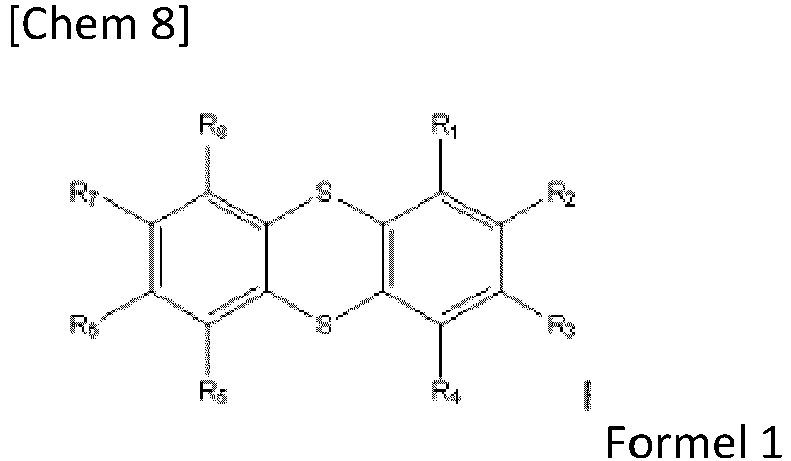
- the positive electrode according to the invention comprises, as organic active material, a redox (oxido-reducer) compound of Formula 1.
- the redox compound of Formula 1 corresponds to a thianthrene molecule, substituted on specific positions.
- thianthrene-based compounds are capable of reversibly exchanging an electron during a redox reaction with the insertion of a counter-anion A - .
- the anion A - comes from the electrolyte, in which a salt comprising said anion A - is present (Scheme 1).
- the [ Fig 1 ] shows a comparison of the diffractogram, measured by powder X-ray diffractometry (XRD), of unsubstituted thianthrene versus 2,7-difluorothianthrene (DFTNT) according to the invention.
- XRD powder X-ray diffractometry
- DFTNT 2,7-difluorothianthrene
- the presence, within the positive electrode according to the invention, of an active material, an electronically conductive material and possibly a binder gives the electrode a porous structure which allows the electrolyte to penetrate the electrode, thus allowing the electrolyte to be in contact with the active material.
- the present invention relates to a positive electrode as defined above, in which the compound of Formula 1 corresponds to the following Formula 2: in which R 1 , R 2 , R 3 , R 4 , R 5 , R 6 , R 7 and R 8 are as defined above for Formula 1, but are all different from H.
- the thianthrene is substituted in all positions by a group other than H.
- the groups R 1 , R 2 , R 3 , R 4 , R 5 , R 6 , R 7 and R 8 are in particular identical and are in particular -CH 3 or F.
- the present invention relates to a positive electrode as defined above, in which the compound of Formula 1 corresponds to the following Formula 3: in which R 2 , R 3 , R 6 and R 7 are as defined above for Formula 1, but are all different from H.
- the thianthrene is substituted on positions 2, 3, 7 and 8 (IUPAC nomenclature) by a group other than H.
- the groups R 2 , R 3 , R 6 and R 7 are in particular identical and are in particular -CH 3 or F.
- the present invention relates to a positive electrode as defined above, in which the compound of Formula 1 corresponds to the following Formula 4: in which R 2 and R 6 are as defined above for Formula 1, but are all different from H.
- the thianthrene is substituted on positions 2 and 7 (IUPAC nomenclature) by a group other than H.
- the groups R 2 and R 6 are in particular identical and are in particular -CH 3 or F.
- the invention relates to a positive electrode as defined above, in which the compound of Formula 1 is chosen from:
- the invention relates to a positive electrode as defined above, in which the redox compound of Formula 1 is present in the positive electrode in a content ranging from 20 to 80% by weight, preferably from 50 to 75% by weight, more preferably from 60 to 70% by weight, relative to the total weight of the positive electrode, excluding the current collector.
- total weight of the positive electrode, excluding current collector we mean the total weight of the active material, the electronically conductive material and any binder.
- the electrode does not contain enough redox compound to be able to store enough electricity, especially for use in a battery.
- the positive electrode may not include sufficient electronically conductive material and possibly binder.
- a Formula 1 redox compound content of "20 to 80%” also means the following ranges: “20 to 60%”, “20 to 40%”, “40 to 80%”, “50 to 80%”, “60 to 80%”, “70 to 80%”, “40 to 75%”, “50 to 75%”, “60 to 70%” and "40 to 60%”.
- the organic positive electrode according to the invention further comprises an electronically conductive material.
- any conductive material usually used in a positive electrode can be used.
- the electronically conductive material is chosen from carbon black, acetylene black, graphite, carbon nanotubes, carbon fibers, conductive organic polymers, the electronically conductive material being in particular carbon black.
- carbon black examples include carbon blacks marketed under the following references: Ketjenblack 600JD ® , Ketjenblack 7003D ® and Timcal Ensaco 350G ® .
- conductive organic polymers we can cite, for example, poly(3,4-ethylenedioxythiophene) (PEDOT), poly(phosphoester-urethanes) (PPU) or polyaniline (PANI).
- PEDOT poly(3,4-ethylenedioxythiophene)
- PPU poly(phosphoester-urethanes)
- PANI polyaniline
- Nanoparticles include metallic nanoparticles such as copper or silver nanoparticles.
- the electronically conductive material is present in the positive electrode in a content ranging from 10 to 60% by weight, in particular from 20 to 40% by weight, preferably from 25 to 30% by weight, relative to the total weight of the positive electrode, excluding the current collector.
- An electronically conductive material content of “10 to 60%” also means the following ranges: “10 to 50%”, “10 to 40%”, “10 to 30%”, “10 to 20%”, “25 to 30%”, “30 to 60%”, “40 to 60%”, “50 to 60%” and "30 to 50%”, in particular "25 to 30%”.
- the organic active material electrode according to the invention also comprises a current collector, for example in the form of a metal foil, in particular an aluminum or copper foil.
- the positive electrode may comprise a binder.
- the binder serves to ensure good cohesion of the electrode.
- any binder usually used in a positive electrode can be included.
- the invention relates to a positive electrode as defined above, in which the electrode comprises a binder, in particular a binder chosen from polyvinylidenes, polyethylenes, polyacrylates, alkyd binders, glycerophthalic binders, polysiloxanes, polysiloxane-epoxides, polyurethanes, polysaccharides, latexes, carboxymethylcellulose and its derivatives, polyvinylidene fluoride and polytetrafluoroethylene.
- a binder chosen from polyvinylidenes, polyethylenes, polyacrylates, alkyd binders, glycerophthalic binders, polysiloxanes, polysiloxane-epoxides, polyurethanes, polysaccharides, latexes, carboxymethylcellulose and its derivatives, polyvinylidene fluoride and polytetrafluoroethylene.
- carboxymethylcellulose derivatives is meant carboxyalkylcelluloses which comprise, in place of methyl, an alkyl group, other than methyl, such as for example an ethyl, propyl or butyl group.
- the binder is notably chosen from carboxymethylcellulose and polyvinylidene fluoride.
- the binder is present in the positive electrode in a content ranging from 5 to 25% by weight, preferably in a content ranging from 10 to 15% by weight, relative to the total weight of the positive electrode, excluding the current collector.
- the electrode may crumble/disintegrate.
- the binder could have insulating effects, reducing electronic conductivity.
- the binder since the binder is not electroactive, the presence of too much binder reduces the amount of energy that can be stored.
- a binder content of "5 to 25%” also means the following ranges: “5 to 20%”, “5 to 10%”, “10 to 25%” and “15 to 25%”, in particular "10 to 15%”.
- Step 1 of bringing the active material, the electronically conductive material, and possibly the binder into contact is typically implemented by preparing a physical mixture of the two, or three, constituents and a liquid, followed by homogenization of the mixture, for example using a grinder or a mixer to obtain an ink.
- the liquid is in particular an organic solvent such as for example N-methyl-2-pyrrolidone (NMP).
- NMP N-methyl-2-pyrrolidone
- ink means an electrode paste intended to be spread on a current collector.
- Step 2 of casting can be done using a doctor-blade system, which is usually used for this purpose and consists of spreading the ink on the surface of a current collector.
- step 3 evaporates the solvent used in step 1.
- the electrode can then be punched.
- punching can be done using an electrode punching machine.
- the punching step is used to achieve the desired physical shape and size of the electrode.
- the electrodes have good recyclability, and can be used for more than 100 cycles, including more than 500 cycles without loss of electrochemical activity.
- the positive electrode according to the invention makes it possible to achieve a redox potential greater than 3.7 V versus Li + /Li 0 , with the LP30 electrolyte, in particular greater than 4 V.
- the LP30 electrolyte is a commercially available electrolyte (Merck), consisting of LiPF 6 1M in a 1/1 ethylene carbonate / dimethyl carbonate mixture.
- a positive electrode comprising 2,7-difluorothianthrene makes it possible to achieve an average redox potential of 4.15 V vs Li + /Li 0 (within a Swagelok-type half-cell with LP30 electrolyte).
- a positive electrode based on unsubstituted thianthrene shows an average redox potential of 3.95 V vs Li + /Li 0 , under the same conditions.
- the present invention therefore relates to a positive electrode as defined above, having an average redox potential of between 3.7 V and 4.2 V, versus Li + /Li 0 with the LP30 electrolyte.
- the redox potential designates, in the context of the compounds according to the invention, the propensity of the compounds to lose an electron.
- the redox potential E 0 is expressed in Volts (V) and is measured relative to a reference electrode, Li + /Li 0 in the invention.
- the measurement of the redox potential can be carried out in a reference cell, of the Swagelok type for example.
- the positive electrode according to the invention makes it possible to achieve a specific capacity greater than 90 mAh g -1 of active material, after an initial charge at the C/5 regime, versus Li + /Li 0 with the LP30 electrolyte.
- the organic positive electrodes according to the invention show excellent redox kinetics.
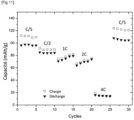
- the use of a positive electrode comprising 2,7-difluorothianthrene makes it possible to achieve a specific capacity of 96 mAh g -1 , 84 mAh g -1 , 79 mAh g -1 , 70 mAh g -1 and 14 mAh g -1 for a C/5, C/2, 1C, 2C and 4C regime, respectively; while unsubstituted thianthrene offers capacities of 69 mAh g -1 , 51 mAh g -1 , 39 mAh g -1 , 20 mAh g -1 and 0 mAh g -1 for the same rates in C regime.
- C regime we mean the time in hours to fully charge or discharge the electrode.
- a C/5 regime corresponds to a complete charge/discharge in 5 hours.
- the present invention therefore relates to a positive electrode as defined above, having a specific capacity of from 90 mAh g -1 to 130 mAh g -1 , versus Li + /Li 0 with the LP30 electrolyte, at the first charge-discharge cycle and at a C/5 regime.
- the specific capacity represents the electrical charge that the battery can provide from a fully charged state to its complete discharge, per unit of mass.
- the measurement of the specific capacity can be carried out in a reference cell, such as a Swagelok cell. In the context of the invention, these values are measured versus Li + /Li 0 with the LP30 electrolyte.
- a third object of the present invention is a battery, in particular a rechargeable battery, comprising a positive electrode as defined above, a negative electrode and a non-aqueous electrolyte.
- an electrode with an inorganic active material e.g. a metal electrode (lithium or sodium), graphite, carbon, silicon (or a silicon/graphite mixture), lithium titanium (La 2 TiO 3 or Li 4 TiO 12 , for example), or an electrode with an organic active material, e.g. based on carboxylate groups such as dilithium terephthalate, dilithium 2,6-naphthalene dicarboxylate, dilithium anthracene dicarboxylate, or based on a diazo group, or based on nitrile groups, such as tetracyanobenzoquinone.
- an inorganic active material e.g. a metal electrode (lithium or sodium), graphite, carbon, silicon (or a silicon/graphite mixture), lithium titanium (La 2 TiO 3 or Li 4 TiO 12 , for example)
- an electrode with an organic active material e.g. based on carboxylate groups such as dilithium terephthalate, dilithium 2,
- An inorganic negative electrode is notably an electrode based on metallic lithium.
- An organic negative electrode is notably an electrode based on dilithium 2,6-naphthalene dicarboxylate.
- negative electrode organic or inorganic
- type of battery desired depends on the type of battery desired.
- non-aqueous electrolyte means an electrolyte consisting of a non-aqueous liquid.
- Using a non-aqueous liquid helps avoid possible unwanted reactions with compounds present in the negative electrode, such as metallic lithium.
- the non-aqueous liquid is an aprotic solvent, in particular a solvent chosen from an organic carbonate, an ether, an ester, a nitrile or a mixture of these solvents.
- the non-aqueous liquid is selected from: ethylene carbonate (EC), propylene carbonate (PC), vinylene carbonate (VC), butylene carbonate (BC), dimethyl carbonate (DMC), diethyl carbonate (DEC), ethylmethyl carbonate (CEM), ethylene vinyl carbonate (VEC), dimethyl ether, diglyme, triglyme, or combinations thereof.
- the non-aqueous liquid is notably a mixture of ethylene carbonate and dimethyl carbonate.
- the metal cation is in particular a cation M n+ , in which n is 1 or 2 and M is a metal.
- the metal cation is in particular chosen from Li + , Na + , K + , Ca2 + and Mg2+ , preferably Li + .
- the anion is in particular an anion A m- in which m is 1 or 2.
- the anion is in particular chosen from PF 6 - , BF 4 - , ClO 4 - , (CF 3 SO 2 ) 2 N - and (FSO 2 ) 2 N - , preferably PF 6 - .
- the salt is in particular chosen from: LiBr, Lil, LiSCN, LiBF 4 , LiAlF 4 , LiPF 6 , LiAsF 6 , LiClO 4 , Li 2 SO 4 , LiB(Ph) 4 , LiAlO 2 , Li[N(FSO 2 ) 2 ], Li[SO 3 CH 3 ], Li[BF 3 (C 2 F 5 )], Li[PF 3 (CF 2 CF 3 ) 3 ], Li[B(C 2 O 4 ) 2 ], Li[B(C 2 O 4 )F 2 ], Li[PF 4 (C 2 O 4 )], Li[PF 2 (C 2 O 4 )], Li[PF 2 (C 2 O 4 )], Li[PF 2 (C 2 O 4 ) 2 ], Li[CF 3 CO 2 ], Li[C 2 F 5 CO 2 ], Li[N(CF 3 SO 2 ) 2 ], Li[C(SO 2 CF 3 ) 3 ], Li[N(C 2 F 5 SO 2 ) 2
- the salt is LiPF 6 , which gives the best yields.
- the concentration of said salt contained in the electrolyte is from 1M to 5M, in particular from 1M to 2M.
- the battery according to the invention can be equipped with other components which may be necessary for the operation of a battery.
- the battery can optionally be equipped with a separator, positioned between the positive electrode and the anode.
- the separator can, for example, take the form of a membrane, a matrix gel, or a sheet.
- the separator is a fiberglass separator.
- the battery according to the invention is in particular a rechargeable battery (also called an “accumulator”), and in particular a lithium-type battery, in which the negative electrode is a lithium-based metal electrode.
- the present invention relates in particular to a battery as defined above, having a coulombic efficiency greater than 80%, in particular greater than 90%, in particular greater than 95%.
- the coulombic efficiency corresponds to the ratio of the quantity of electricity produced (in the discharge phase) and the quantity of electricity stored (in the charge phase), in the first cycle.
- the present invention relates in particular to a battery as defined above, having a recycling stability such that the coulombic efficiency after 500 cycles is greater than 60%, in particular greater than 70 or greater than 80%, compared to the first cycle.
- 2,7-Difluorothianthrene was synthesized according to the procedure described by Edson et al (J. Polym. Sci. Part A: Polym. Chem., 2004, 42, 6353-6363 ).
- the positive electrode was prepared by mixing 1 g of active material with 0.41 g of conductive carbon (Ketjenblack ® 600) and 0.21 g of binder (carboxymethylcellulose). The mixture was mixed in a mortar and then using an Ultra-Turrax ® homogenizer (IKA, Germany) for 30 minutes at 6000 rpm. Then, 6 mL of n-methyl pyrrolidone (NMP) was added and the mixture was mixed for 90 minutes. After the mixing step, the paste was poured onto an aluminum foil (thickness 20 ⁇ m) using a scraper system (350 ⁇ m gap) and the solvent was then evaporated on a hot plate for 2 hours at 60°C.
- the round electrodes were punched to 13 mm diameter and dried for 18 hours at 70 °C under vacuum.
- the mass load was quantified to be approximately 2.5 mg cm -2 .
- the glass fiber separator (Whatman ® ) was soaked with a 1M LiPF 6 solution in a 50:50 wt% ethylene carbonate (EC): dimethyl carbonate (DMC) mixture (LP30 electrolyte, Merck) as electrolyte.
- EC ethylene carbonate
- DMC dimethyl carbonate
- the cell was tested in galvanostatic mode using a Biologic VMP-3 instrument (Biologic SAS, France) with a voltage window of 2.5 to 4.5 V at a 2C regime.
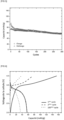
- the half-cell showed an average redox potential of 4.15 V vs Li + /Li 0 , with LP30 electrolyte, and a specific capacity of 94 mAh g -1 after the charging phase. A reversible capacity of 90 mAh g -1 was observed, with an overall coulombic efficiency of 96% ( Figure 2 ).
- the glass fiber separator (Whatman ® ) was soaked with a 1M LiPF 6 solution in a 50:50 wt% ethylene carbonate (EC):dimethyl carbonate (DMC) mixture (LP30 electrolyte, Merck) as electrolyte.
- EC ethylene carbonate
- DMC dimethyl carbonate
- the cell was tested in galvanostatic mode using a Biologic VMP-3 instrument (Biologic SAS, France) with a voltage window of 2.5 to 4.5 V at a 2C regime.
- the half-cell showed an average redox potential of 3.80 V vs. Li + /Li 0 , with the LP30 electrolyte, with a specific capacity of 92 mAh g -1 after the charging phase.
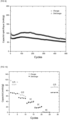
- a reversible capacity of 73 mAh g -1 was observed, for an overall coulombic efficiency of 96% ( Figure 4 ).
- a specific reversible capacity of 56 mAh g -1 was observed (charge of 58 mAh g -1 ), for a capacity retention of 77% compared to the first cycle and a coulombic efficiency of 97% ( Figure 5 ).
- the electrochemical performances of the unsubstituted thianthrene electrode composite were determined using a Swagelok ® type cell, assembled in a glove box filled with argon (H 2 O ⁇ 0.1 ppm, O 2 ⁇ 0.1 ppm).
- the glass fiber separator (Whatman ® ) was soaked with a 1M LiPF 6 solution in a 50:50 wt% ethylene carbonate (EC):dimethyl carbonate (DMC) mixture (LP30 electrolyte, Merck) as electrolyte.
- EC ethylene carbonate
- DMC dimethyl carbonate
- the cell was tested in galvanostatic mode using a Biologic VMP-3 instrument (Biologic SAS, France) with a voltage window of 2.5 to 4.5 V at a C/5 regime.
- the half-cell showed an average redox potential of 3.95 V versus Li + /Li 0 , with the LP30 electrolyte, with a specific capacity of 221 mAh g -1 after the charging phase. A reversible capacity of 96 mAh g -1 was observed, for an overall coulombic efficiency of 43% ( Figure 8 ).
- Example 7 Electrochemical test of a complete organic cell composed of compound 1 and Li 2 NDC
- the 2,7-difluorothianthrene-based electrode was prepared as described in Example 3.
- the negative electrode was prepared using 2,6-naphthalene dilithium dicarboxylate (Li 2 NDC) as the active material.
- Dilithium 2,6-naphthalene dicarboxylate was synthesized according to the method described by Ogihara (Angew. Chem. Int. Ed. Engl., 2014, 53(43), p. 11467-11472 ).
- the electrode was punched to 13 mm diameter and dried overnight at 100 °C under vacuum.
- the mass charge was quantified to be approximately 4.0 mg cm -2 .
- Electrochemical tests were performed using a coin cell assembled in an argon-filled glove box (H 2 O ⁇ 0.1 ppm, O 2 ⁇ 0.1 ppm). The two organic electrodes were separated by a glass fiber separator (Whatman ® ) which was soaked with a 1M LiPF 6 solution in a 50:50 wt% ethylene carbonate (EC): dimethyl carbonate (DMC) mixture (LP30 electrolyte, Merck) as the electrolyte.
- EC ethylene carbonate
- DMC dimethyl carbonate
- the cell was tested in galvanostatic mode using a Biologic VMP-3 instrument (Biologic SAS, France) with a voltage window of 4.0 - 2.0 V in a 1C regime.
- Biologic VMP-3 instrument Biologic SAS, France
- the performance qualities of this bi-ion battery i.e. the battery in which the anions participate in the positive oxidation of the electrodes, while the cations take part in the negative reduction of the electrodes to counterbalance the charge during the charge/discharge cycles, are effectively confirmed.
- the complete organic cell showed an average redox potential of 3.40 V vs Li + /Li 0 , with a specific capacity of 154 mAh g -1 after the charging phase, with a reversible capacity of 56 mAh g -1 , for an overall coulombic efficiency of 36% ( Figure 6 ).
- 2,7-difluorothianthrene also showed better redox kinetics, which can be seen from the different rate performances obtained with the two materials.
- the Figure 10 and the Figure 11 represent the specific capacities as a function of the applied current density for the thianthrene and 2,7-difluorothianthrene electrodes, respectively.
- the 2,7-difluorothianthrene derivative exhibits a specific capacity of 96 mAh g -1 , 84 mAh g -1 , 79 mAh g -1 , 70 mAh g -1 and 14 mAh g -1 at C/5, C/2, 1C, 2C and 4C regime, respectively; while the unsubstituted thianthrene offers capacities of 69 mAh g -1 , 51 mAh g -1 , 39 mAh g -1 , 20 mAh g -1 and 0 mAh g -1 for the same regimes respectively.
- the 2,7-difluorothianthrene-based electrode is characterized by superior redox kinetics compared to an unsubstituted thianthrene-based electrode. This result can be explained by a better ionic/electronic conductivity of the crystalline structure of substituted thianthrene compared to that of unsubstituted thianthrene. The structural differences were highlighted by comparing the diffraction patterns of the two materials, shown in Fig. Figure 1 .
Landscapes
- Chemical & Material Sciences (AREA)
- Chemical Kinetics & Catalysis (AREA)
- Electrochemistry (AREA)
- General Chemical & Material Sciences (AREA)
- Engineering & Computer Science (AREA)
- Manufacturing & Machinery (AREA)
- Materials Engineering (AREA)
- Physics & Mathematics (AREA)
- Condensed Matter Physics & Semiconductors (AREA)
- General Physics & Mathematics (AREA)
- Inorganic Chemistry (AREA)
- Battery Electrode And Active Subsutance (AREA)
- Secondary Cells (AREA)
Claims (11)
- Positive Elektrode mit organischem aktiven Material, die bevorzugt besteht aus:• einem organischen aktiven Material,• einem elektronisch leitenden Material, und• einem Stromabnehmer,wobei das aktive Material eine Redoxverbindung der Formel 1 ist:
 wobei:R1, R2, R3, R4, R5, R6, R7 und R8 unabhängig voneinander gewählt sind aus:• einem Wasserstoffatom,• einem Halogen, insbesondere gewählt aus Fluor, Chlor und Brom, insbesondere Fluor,oder einer Gruppe, gewählt aus:• linearem oder verzweigtem C1- bis C50-Alkyl,• linearem oder verzweigtem C1- bis C50-Fluoralkyl, insbesondere -CF3,• -CO2H, gegebenenfalls in Salzform,• -SO2H, gegebenenfalls in Salzform,• -PO(OH)2, gegebenenfalls in Salzform,• -PO(ORa)2, wobei Ra eine lineare oder verzweigte C1- bis C10-Alkylgruppe, insbesondere CH3, ist,• -CN,• Amin,• -OH,• -ORb, wobei Rb eine lineare oder verzweigte C1- bis C50-Alkylgruppe ist,• -CHO,• -CO-Rc, wobei Rc eine lineare oder verzweigte C1- bis C50-Alkylgruppe ist,und wobei:• entweder R1, R2, R3, R4, R5, R6, R7 und R8 von H verschieden sind, oder• entweder R1, R4, R8 und R8 H sind und R2, R3, R6 und R7 von H verschieden sind, oder• entweder R1, R3, R4, R5, R7 und R8 H sind und R2 und R6 von H verschieden sind.
 - Positive Elektrode nach Anspruch 1, wobei die Verbindung der Formel 1 so ist, dass R1, R2, R3, R4, R5, R6, R7 und R8 unabhängig gewählt sind aus:• einem Wasserstoffatom,• einem Halogenoder einer Gruppe, gewählt aus:• linearem oder verzweigtem C1 bis C10-Alkyl• linearem oder verzweigtem C1 bis C10-Fluoralkyl, insbesondere -CF3.
- Positive Elektrode nach einem der Ansprüche 1 oder 2, wobei die Verbindung der Formel 1 gewählt ist aus:

- Positive Elektrode nach einem der Ansprüche 1 bis 3, wobei die Redoxverbindung der Formel 1 in der positiven Elektrode mit einem Gehalt von 20 bis 80 Gew.-%, bevorzugt von 50 bis 75 Gew.-%, stärker bevorzugt von 60 bis 70 Gew.-%, bezogen auf das Gesamtgewicht der positiven Elektrode ohne Stromabnehmer, vorliegt.
- Positive Elektrode nach einem der Ansprüche 1 bis 4, wobei das elektronisch leitfähige Material gewählt ist aus Ruß, Acetylenruß, Graphit, Kohlenstoffnanoröhren, Kohlenstofffasern, leitfähigen organischen Polymeren, wobei das elektronisch leitfähige Material insbesondere Ruß ist.
- Positive Elektrode nach einem der Ansprüche 1 bis 5, wobei das elektronisch leitfähige Material in der positiven Elektrode mit einem Gehalt von 10 bis 60 %, insbesondere 20 bis 40 Gew.-%, bevorzugt 25 bis 30 Gew.-%, bezogen auf das Gesamtgewicht der positiven Elektrode, ohne Stromabnehmer, vorliegt.
- Positive Elektrode nach einem der Ansprüche 1 bis 6, wobei die Elektrode ein Bindemittel umfasst, insbesondere ein Bindemittel, das gewählt ist aus Polyvinyliden, Polyethylenen, Polyacrylaten, Alkydbindemitteln, Glycerophthalbindemitteln, Polysiloxanen, Polysiloxanepoxiden, Polyurethanen, Polysacchariden, Latex, Carboxymethylcellulose und deren Derivate, Polyvinylidenfluorid und Polytetrafluorethylen.
- Positive Elektrode nach Anspruch 7, wobei das Bindemittel in der positiven Elektrode mit einem Gehalt von 5 bis 25 Gew.-%, bevorzugt mit einem Gehalt von 10 bis 15 Gew.-%, bezogen auf das Gesamtgewicht der positiven Elektrode ohne Stromabnehmer, vorhanden ist.
- Verfahren zur Herstellung einer positiven Elektrode nach einem der Ansprüche 1 bis 8, wobei das Verfahren umfasst:1. Inkontaktbringen des aktiven Materials, des elektronisch leitenden Materials und gegebenenfalls des Bindemittels, um eine Elektrodentinte zu erhalten,2. Gießen der Elektrodentinte auf einen Stromabnehmer,3. Trocknen der Elektrodentinte auf dem Stromabnehmer.
- Batterie, insbesondere wiederaufladbare Batterie, mit einer positiven Elektrode nach einem der Ansprüche 1 bis 8, einer negativen Elektrode und einem nichtwässrigen Elektrolyten.
- Batterie nach Anspruch 10, wobei der nichtwässrige Elektrolyt eine Lösung eines Salzes in einem organischen Lösungsmittel ist,• wobei das Salz aus LiPF6, LiClO4 und Li[N(SO2)2] gewählt ist, wobei das Salz insbesondere LiPF6 ist,• wobei das organische Lösungsmittel ein Lösungsmittel auf Carbonatbasis ist, insbesondere Diethylcarbonat, Ethylencarbonat, Propylencarbonat, Dimethylcarbonat oder ein Gemisch dieser Lösungsmittel.
Applications Claiming Priority (1)
| Application Number | Priority Date | Filing Date | Title |
|---|---|---|---|
| FR2208778A FR3139416B1 (fr) | 2022-09-01 | 2022-09-01 | Nouvelles électrodes organiques et leur utilisation dans des systèmes électrochimiques |
Publications (3)
| Publication Number | Publication Date |
|---|---|
| EP4333124A1 EP4333124A1 (de) | 2024-03-06 |
| EP4333124C0 EP4333124C0 (de) | 2025-06-04 |
| EP4333124B1 true EP4333124B1 (de) | 2025-06-04 |
Family
ID=84362681
Family Applications (1)
| Application Number | Title | Priority Date | Filing Date |
|---|---|---|---|
| EP23194424.0A Active EP4333124B1 (de) | 2022-09-01 | 2023-08-31 | Neue organische elektroden und deren verwendung in elektrochemischen systemen |
Country Status (4)
| Country | Link |
|---|---|
| US (1) | US20240105945A1 (de) |
| EP (1) | EP4333124B1 (de) |
| CN (1) | CN117637983A (de) |
| FR (1) | FR3139416B1 (de) |
Family Cites Families (3)
| Publication number | Priority date | Publication date | Assignee | Title |
|---|---|---|---|---|
| JPS61203565A (ja) * | 1985-03-06 | 1986-09-09 | Maruzen Sekiyu Kagaku Kk | 二次電池およびその電極 |
| CN105702950A (zh) * | 2016-02-03 | 2016-06-22 | 山东康洋电源有限公司 | 一种新能源汽车专用安全型锂离子电池 |
| JP6879537B2 (ja) * | 2016-11-24 | 2021-06-02 | 国立研究開発法人産業技術総合研究所 | 非水二次電池用電極活物質及びそれを用いた非水二次電池 |
-
2022
- 2022-09-01 FR FR2208778A patent/FR3139416B1/fr active Active
-
2023
- 2023-08-31 EP EP23194424.0A patent/EP4333124B1/de active Active
- 2023-09-01 CN CN202311125782.7A patent/CN117637983A/zh active Pending
- 2023-09-01 US US18/459,681 patent/US20240105945A1/en active Pending
Also Published As
| Publication number | Publication date |
|---|---|
| EP4333124C0 (de) | 2025-06-04 |
| US20240105945A1 (en) | 2024-03-28 |
| FR3139416B1 (fr) | 2024-08-30 |
| FR3139416A1 (fr) | 2024-03-08 |
| CN117637983A (zh) | 2024-03-01 |
| EP4333124A1 (de) | 2024-03-06 |
Similar Documents
| Publication | Publication Date | Title |
|---|---|---|
| EP3216071B1 (de) | Batteriezelle umfassend eine halbfeste elektrode | |
| US6919145B1 (en) | Nonaqueous electrolytic solution type secondary battery | |
| FR2935546A1 (fr) | Materiau composite d'electrode, electrode de batterie constituee dudit materiau et batterie au lithium comprenant une telle electrode. | |
| CA2320661A1 (fr) | Nouveau procede de synthese de materiaux limpo4 a structure olivine | |
| JP5455975B2 (ja) | 正極活物質、並びにこれを用いたリチウムイオン二次電池用正極及びリチウムイオン二次電池 | |
| FR2941817A1 (fr) | Procede pour la preparation d'une composition d'electrode | |
| EP3011622B1 (de) | Verwendung neuartiger verbindungen als ein aktives negativelektrodenmaterial in einer natrium-ionen-batterie | |
| FR2961634A1 (fr) | Procede pour l'elaboration d'une batterie au lithium ou au sodium | |
| EP3042410B1 (de) | Additive zur verbesserung der ionenleitfähigkeit von lithium-ionen-batterie-elektroden | |
| Xu et al. | Employing cationic kraft lignin as electrolyte additive to enhance the electrochemical performance of rechargeable aqueous zinc-ion battery | |
| EP2757068B1 (de) | Syntheseverfahren einer LiM1-x-y-zNyQzFexPO4-Verbindung, und ihre Verwendung als Elektrodenmaterial für einen Lithium-Akkumulator | |
| CN102593455A (zh) | 负极活性物质组合物、制备负极板的方法和锂二次电池 | |
| KR20200033198A (ko) | 리튬 전지 | |
| EP2731910A2 (de) | Lithiumhaltiges manganphosphat und verbundmaterial damit | |
| EP3331064B1 (de) | Anwendung von 4,5-imidazoldicarboxylsäure als aktives material einer elektrode | |
| Senthilkumar et al. | Rechargeable Na-MnO2 battery with modified cell chemistry | |
| EP4333124B1 (de) | Neue organische elektroden und deren verwendung in elektrochemischen systemen | |
| US10199638B2 (en) | Composite anode active material, method of preparing the same, and anode and lithium secondary battery including the composite anode active material | |
| DE112020006581T5 (de) | Wiederaufladbare nicht-wässrige lithium-luft-batteriezelle mit einem festen organischen katalysator | |
| DE112020006564T5 (de) | Lithiumverbindungen auf naphthalin-basis, verfahren für deren herstellung, verwendung davon als fester organischer katalysator, und verwendung davon in wiederaufladbaren nichtwässrigen lithium-luft- batteriezellen | |
| EP3255712B1 (de) | Herstellungsverfahren einer elektrode für einen akku, das auf dem prinzip der inklusion und exklusion von ionen oder der legierungsbildung beruht | |
| WO2019097189A1 (fr) | Utilisation d'un melange de sels a titre d'additif dans une batterie au lithium gelifiee | |
| EP3898522B1 (de) | Negativelektroden-aktivmaterial auf der basis von eisen und lithiumhydroxysulfid | |
| KR20230123021A (ko) | 풀러렌 나노로드를 포함하는 금속 2차 전지용 음극 활물질 및 이를 이용한 금속 2차 전지 | |
| WO2025196318A1 (fr) | Procédé d'insertion chimique de cations d'un métal alcalin dans un composé solide |
Legal Events
| Date | Code | Title | Description |
|---|---|---|---|
| PUAI | Public reference made under article 153(3) epc to a published international application that has entered the european phase |
Free format text: ORIGINAL CODE: 0009012 |
|
| STAA | Information on the status of an ep patent application or granted ep patent |
Free format text: STATUS: THE APPLICATION HAS BEEN PUBLISHED |
|
| AK | Designated contracting states |
Kind code of ref document: A1 Designated state(s): AL AT BE BG CH CY CZ DE DK EE ES FI FR GB GR HR HU IE IS IT LI LT LU LV MC ME MK MT NL NO PL PT RO RS SE SI SK SM TR |
|
| STAA | Information on the status of an ep patent application or granted ep patent |
Free format text: STATUS: REQUEST FOR EXAMINATION WAS MADE |
|
| 17P | Request for examination filed |
Effective date: 20240905 |
|
| RBV | Designated contracting states (corrected) |
Designated state(s): AL AT BE BG CH CY CZ DE DK EE ES FI FR GB GR HR HU IE IS IT LI LT LU LV MC ME MK MT NL NO PL PT RO RS SE SI SK SM TR |
|
| GRAP | Despatch of communication of intention to grant a patent |
Free format text: ORIGINAL CODE: EPIDOSNIGR1 |
|
| STAA | Information on the status of an ep patent application or granted ep patent |
Free format text: STATUS: GRANT OF PATENT IS INTENDED |
|
| RIC1 | Information provided on ipc code assigned before grant |
Ipc: H01M 10/0569 20100101ALN20241220BHEP Ipc: H01M 10/0568 20100101ALN20241220BHEP Ipc: H01M 4/62 20060101ALN20241220BHEP Ipc: H01M 4/02 20060101ALN20241220BHEP Ipc: H01M 10/0525 20100101ALI20241220BHEP Ipc: H01M 4/139 20100101ALI20241220BHEP Ipc: H01M 4/13 20100101ALI20241220BHEP Ipc: H01M 4/04 20060101ALI20241220BHEP Ipc: H01M 4/60 20060101AFI20241220BHEP |
|
| INTG | Intention to grant announced |
Effective date: 20250109 |
|
| GRAS | Grant fee paid |
Free format text: ORIGINAL CODE: EPIDOSNIGR3 |
|
| GRAA | (expected) grant |
Free format text: ORIGINAL CODE: 0009210 |
|
| STAA | Information on the status of an ep patent application or granted ep patent |
Free format text: STATUS: THE PATENT HAS BEEN GRANTED |
|
| AK | Designated contracting states |
Kind code of ref document: B1 Designated state(s): AL AT BE BG CH CY CZ DE DK EE ES FI FR GB GR HR HU IE IS IT LI LT LU LV MC ME MK MT NL NO PL PT RO RS SE SI SK SM TR |
|
| REG | Reference to a national code |
Ref country code: GB Ref legal event code: FG4D Free format text: NOT ENGLISH |
|
| REG | Reference to a national code |
Ref country code: CH Ref legal event code: EP |
|
| REG | Reference to a national code |
Ref country code: DE Ref legal event code: R096 Ref document number: 602023003814 Country of ref document: DE |
|
| REG | Reference to a national code |
Ref country code: IE Ref legal event code: FG4D Free format text: LANGUAGE OF EP DOCUMENT: FRENCH |
|
| U01 | Request for unitary effect filed |
Effective date: 20250611 |
|
| U07 | Unitary effect registered |
Designated state(s): AT BE BG DE DK EE FI FR IT LT LU LV MT NL PT RO SE SI Effective date: 20250624 |
|
| U20 | Renewal fee for the european patent with unitary effect paid |
Year of fee payment: 3 Effective date: 20250721 |
|
| PG25 | Lapsed in a contracting state [announced via postgrant information from national office to epo] |
Ref country code: ES Free format text: LAPSE BECAUSE OF FAILURE TO SUBMIT A TRANSLATION OF THE DESCRIPTION OR TO PAY THE FEE WITHIN THE PRESCRIBED TIME-LIMIT Effective date: 20250604 |
|
| PG25 | Lapsed in a contracting state [announced via postgrant information from national office to epo] |
Ref country code: GR Free format text: LAPSE BECAUSE OF FAILURE TO SUBMIT A TRANSLATION OF THE DESCRIPTION OR TO PAY THE FEE WITHIN THE PRESCRIBED TIME-LIMIT Effective date: 20250905 Ref country code: NO Free format text: LAPSE BECAUSE OF FAILURE TO SUBMIT A TRANSLATION OF THE DESCRIPTION OR TO PAY THE FEE WITHIN THE PRESCRIBED TIME-LIMIT Effective date: 20250904 |
|
| PG25 | Lapsed in a contracting state [announced via postgrant information from national office to epo] |
Ref country code: PL Free format text: LAPSE BECAUSE OF FAILURE TO SUBMIT A TRANSLATION OF THE DESCRIPTION OR TO PAY THE FEE WITHIN THE PRESCRIBED TIME-LIMIT Effective date: 20250604 |
|
| PG25 | Lapsed in a contracting state [announced via postgrant information from national office to epo] |
Ref country code: HR Free format text: LAPSE BECAUSE OF FAILURE TO SUBMIT A TRANSLATION OF THE DESCRIPTION OR TO PAY THE FEE WITHIN THE PRESCRIBED TIME-LIMIT Effective date: 20250604 |
|
| PG25 | Lapsed in a contracting state [announced via postgrant information from national office to epo] |
Ref country code: RS Free format text: LAPSE BECAUSE OF FAILURE TO SUBMIT A TRANSLATION OF THE DESCRIPTION OR TO PAY THE FEE WITHIN THE PRESCRIBED TIME-LIMIT Effective date: 20250904 |