EP4324949B1 - Method for recovering valuable metals from spent lithium-ion batteries - Google Patents
Method for recovering valuable metals from spent lithium-ion batteries Download PDFInfo
- Publication number
- EP4324949B1 EP4324949B1 EP22863039.8A EP22863039A EP4324949B1 EP 4324949 B1 EP4324949 B1 EP 4324949B1 EP 22863039 A EP22863039 A EP 22863039A EP 4324949 B1 EP4324949 B1 EP 4324949B1
- Authority
- EP
- European Patent Office
- Prior art keywords
- lithium ion
- controlled
- ion batteries
- waste lithium
- valuable metals
- Prior art date
- Legal status (The legal status is an assumption and is not a legal conclusion. Google has not performed a legal analysis and makes no representation as to the accuracy of the status listed.)
- Active
Links
Images
Classifications
-
- C—CHEMISTRY; METALLURGY
- C22—METALLURGY; FERROUS OR NON-FERROUS ALLOYS; TREATMENT OF ALLOYS OR NON-FERROUS METALS
- C22B—PRODUCTION AND REFINING OF METALS; PRETREATMENT OF RAW MATERIALS
- C22B3/00—Extraction of metal compounds from ores or concentrates by wet processes
- C22B3/04—Extraction of metal compounds from ores or concentrates by wet processes by leaching
- C22B3/16—Extraction of metal compounds from ores or concentrates by wet processes by leaching in organic solutions
-
- B—PERFORMING OPERATIONS; TRANSPORTING
- B09—DISPOSAL OF SOLID WASTE; RECLAMATION OF CONTAMINATED SOIL
- B09B—DISPOSAL OF SOLID WASTE NOT OTHERWISE PROVIDED FOR
- B09B3/00—Destroying solid waste or transforming solid waste into something useful or harmless
- B09B3/70—Chemical treatment, e.g. pH adjustment or oxidation
-
- C—CHEMISTRY; METALLURGY
- C01—INORGANIC CHEMISTRY
- C01F—COMPOUNDS OF THE METALS BERYLLIUM, MAGNESIUM, ALUMINIUM, CALCIUM, STRONTIUM, BARIUM, RADIUM, THORIUM, OR OF THE RARE-EARTH METALS
- C01F11/00—Compounds of calcium, strontium, or barium
- C01F11/20—Halides
- C01F11/22—Fluorides
-
- C—CHEMISTRY; METALLURGY
- C22—METALLURGY; FERROUS OR NON-FERROUS ALLOYS; TREATMENT OF ALLOYS OR NON-FERROUS METALS
- C22B—PRODUCTION AND REFINING OF METALS; PRETREATMENT OF RAW MATERIALS
- C22B1/00—Preliminary treatment of ores or scrap
- C22B1/005—Preliminary treatment of scrap
-
- C—CHEMISTRY; METALLURGY
- C22—METALLURGY; FERROUS OR NON-FERROUS ALLOYS; TREATMENT OF ALLOYS OR NON-FERROUS METALS
- C22B—PRODUCTION AND REFINING OF METALS; PRETREATMENT OF RAW MATERIALS
- C22B1/00—Preliminary treatment of ores or scrap
- C22B1/02—Roasting processes
-
- C—CHEMISTRY; METALLURGY
- C22—METALLURGY; FERROUS OR NON-FERROUS ALLOYS; TREATMENT OF ALLOYS OR NON-FERROUS METALS
- C22B—PRODUCTION AND REFINING OF METALS; PRETREATMENT OF RAW MATERIALS
- C22B1/00—Preliminary treatment of ores or scrap
- C22B1/02—Roasting processes
- C22B1/06—Sulfating roasting
-
- C—CHEMISTRY; METALLURGY
- C22—METALLURGY; FERROUS OR NON-FERROUS ALLOYS; TREATMENT OF ALLOYS OR NON-FERROUS METALS
- C22B—PRODUCTION AND REFINING OF METALS; PRETREATMENT OF RAW MATERIALS
- C22B1/00—Preliminary treatment of ores or scrap
- C22B1/14—Agglomerating; Briquetting; Binding; Granulating
- C22B1/24—Binding; Briquetting ; Granulating
- C22B1/248—Binding; Briquetting ; Granulating of metal scrap or alloys
-
- C—CHEMISTRY; METALLURGY
- C22—METALLURGY; FERROUS OR NON-FERROUS ALLOYS; TREATMENT OF ALLOYS OR NON-FERROUS METALS
- C22B—PRODUCTION AND REFINING OF METALS; PRETREATMENT OF RAW MATERIALS
- C22B15/00—Obtaining copper
- C22B15/0002—Preliminary treatment
- C22B15/0004—Preliminary treatment without modification of the copper constituent
-
- C—CHEMISTRY; METALLURGY
- C22—METALLURGY; FERROUS OR NON-FERROUS ALLOYS; TREATMENT OF ALLOYS OR NON-FERROUS METALS
- C22B—PRODUCTION AND REFINING OF METALS; PRETREATMENT OF RAW MATERIALS
- C22B21/00—Obtaining aluminium
- C22B21/0038—Obtaining aluminium by other processes
- C22B21/0069—Obtaining aluminium by other processes from scrap, skimmings or any secondary source aluminium, e.g. recovery of alloy constituents
-
- C—CHEMISTRY; METALLURGY
- C22—METALLURGY; FERROUS OR NON-FERROUS ALLOYS; TREATMENT OF ALLOYS OR NON-FERROUS METALS
- C22B—PRODUCTION AND REFINING OF METALS; PRETREATMENT OF RAW MATERIALS
- C22B23/00—Obtaining nickel or cobalt
- C22B23/04—Obtaining nickel or cobalt by wet processes
- C22B23/0407—Leaching processes
-
- C—CHEMISTRY; METALLURGY
- C22—METALLURGY; FERROUS OR NON-FERROUS ALLOYS; TREATMENT OF ALLOYS OR NON-FERROUS METALS
- C22B—PRODUCTION AND REFINING OF METALS; PRETREATMENT OF RAW MATERIALS
- C22B26/00—Obtaining alkali, alkaline earth metals or magnesium
- C22B26/10—Obtaining alkali metals
- C22B26/12—Obtaining lithium
-
- C—CHEMISTRY; METALLURGY
- C22—METALLURGY; FERROUS OR NON-FERROUS ALLOYS; TREATMENT OF ALLOYS OR NON-FERROUS METALS
- C22B—PRODUCTION AND REFINING OF METALS; PRETREATMENT OF RAW MATERIALS
- C22B3/00—Extraction of metal compounds from ores or concentrates by wet processes
- C22B3/20—Treatment or purification of solutions, e.g. obtained by leaching
- C22B3/22—Treatment or purification of solutions, e.g. obtained by leaching by physical processes, e.g. by filtration, by magnetic means, or by thermal decomposition
-
- C—CHEMISTRY; METALLURGY
- C22—METALLURGY; FERROUS OR NON-FERROUS ALLOYS; TREATMENT OF ALLOYS OR NON-FERROUS METALS
- C22B—PRODUCTION AND REFINING OF METALS; PRETREATMENT OF RAW MATERIALS
- C22B3/00—Extraction of metal compounds from ores or concentrates by wet processes
- C22B3/20—Treatment or purification of solutions, e.g. obtained by leaching
- C22B3/42—Treatment or purification of solutions, e.g. obtained by leaching by ion-exchange extraction
-
- C—CHEMISTRY; METALLURGY
- C22—METALLURGY; FERROUS OR NON-FERROUS ALLOYS; TREATMENT OF ALLOYS OR NON-FERROUS METALS
- C22B—PRODUCTION AND REFINING OF METALS; PRETREATMENT OF RAW MATERIALS
- C22B47/00—Obtaining manganese
-
- C—CHEMISTRY; METALLURGY
- C22—METALLURGY; FERROUS OR NON-FERROUS ALLOYS; TREATMENT OF ALLOYS OR NON-FERROUS METALS
- C22B—PRODUCTION AND REFINING OF METALS; PRETREATMENT OF RAW MATERIALS
- C22B7/00—Working up raw materials other than ores, e.g. scrap, to produce non-ferrous metals and compounds thereof; Methods of a general interest or applied to the winning of more than two metals
- C22B7/001—Dry processes
-
- C—CHEMISTRY; METALLURGY
- C22—METALLURGY; FERROUS OR NON-FERROUS ALLOYS; TREATMENT OF ALLOYS OR NON-FERROUS METALS
- C22B—PRODUCTION AND REFINING OF METALS; PRETREATMENT OF RAW MATERIALS
- C22B7/00—Working up raw materials other than ores, e.g. scrap, to produce non-ferrous metals and compounds thereof; Methods of a general interest or applied to the winning of more than two metals
- C22B7/005—Separation by a physical processing technique only, e.g. by mechanical breaking
-
- C—CHEMISTRY; METALLURGY
- C22—METALLURGY; FERROUS OR NON-FERROUS ALLOYS; TREATMENT OF ALLOYS OR NON-FERROUS METALS
- C22B—PRODUCTION AND REFINING OF METALS; PRETREATMENT OF RAW MATERIALS
- C22B7/00—Working up raw materials other than ores, e.g. scrap, to produce non-ferrous metals and compounds thereof; Methods of a general interest or applied to the winning of more than two metals
- C22B7/006—Wet processes
-
- C—CHEMISTRY; METALLURGY
- C22—METALLURGY; FERROUS OR NON-FERROUS ALLOYS; TREATMENT OF ALLOYS OR NON-FERROUS METALS
- C22B—PRODUCTION AND REFINING OF METALS; PRETREATMENT OF RAW MATERIALS
- C22B7/00—Working up raw materials other than ores, e.g. scrap, to produce non-ferrous metals and compounds thereof; Methods of a general interest or applied to the winning of more than two metals
- C22B7/006—Wet processes
- C22B7/007—Wet processes by acid leaching
-
- C—CHEMISTRY; METALLURGY
- C22—METALLURGY; FERROUS OR NON-FERROUS ALLOYS; TREATMENT OF ALLOYS OR NON-FERROUS METALS
- C22B—PRODUCTION AND REFINING OF METALS; PRETREATMENT OF RAW MATERIALS
- C22B7/00—Working up raw materials other than ores, e.g. scrap, to produce non-ferrous metals and compounds thereof; Methods of a general interest or applied to the winning of more than two metals
- C22B7/006—Wet processes
- C22B7/008—Wet processes by an alkaline or ammoniacal leaching
-
- H—ELECTRICITY
- H01—ELECTRIC ELEMENTS
- H01M—PROCESSES OR MEANS, e.g. BATTERIES, FOR THE DIRECT CONVERSION OF CHEMICAL ENERGY INTO ELECTRICAL ENERGY
- H01M10/00—Secondary cells; Manufacture thereof
- H01M10/05—Accumulators with non-aqueous electrolyte
- H01M10/052—Li-accumulators
- H01M10/0525—Rocking-chair batteries, i.e. batteries with lithium insertion or intercalation in both electrodes; Lithium-ion batteries
-
- H—ELECTRICITY
- H01—ELECTRIC ELEMENTS
- H01M—PROCESSES OR MEANS, e.g. BATTERIES, FOR THE DIRECT CONVERSION OF CHEMICAL ENERGY INTO ELECTRICAL ENERGY
- H01M10/00—Secondary cells; Manufacture thereof
- H01M10/54—Reclaiming serviceable parts of waste accumulators
-
- H—ELECTRICITY
- H01—ELECTRIC ELEMENTS
- H01M—PROCESSES OR MEANS, e.g. BATTERIES, FOR THE DIRECT CONVERSION OF CHEMICAL ENERGY INTO ELECTRICAL ENERGY
- H01M6/00—Primary cells; Manufacture thereof
- H01M6/52—Reclaiming serviceable parts of waste cells or batteries, e.g. recycling
-
- B—PERFORMING OPERATIONS; TRANSPORTING
- B09—DISPOSAL OF SOLID WASTE; RECLAMATION OF CONTAMINATED SOIL
- B09B—DISPOSAL OF SOLID WASTE NOT OTHERWISE PROVIDED FOR
- B09B2101/00—Type of solid waste
- B09B2101/15—Electronic waste
- B09B2101/16—Batteries
-
- Y—GENERAL TAGGING OF NEW TECHNOLOGICAL DEVELOPMENTS; GENERAL TAGGING OF CROSS-SECTIONAL TECHNOLOGIES SPANNING OVER SEVERAL SECTIONS OF THE IPC; TECHNICAL SUBJECTS COVERED BY FORMER USPC CROSS-REFERENCE ART COLLECTIONS [XRACs] AND DIGESTS
- Y02—TECHNOLOGIES OR APPLICATIONS FOR MITIGATION OR ADAPTATION AGAINST CLIMATE CHANGE
- Y02E—REDUCTION OF GREENHOUSE GAS [GHG] EMISSIONS, RELATED TO ENERGY GENERATION, TRANSMISSION OR DISTRIBUTION
- Y02E60/00—Enabling technologies; Technologies with a potential or indirect contribution to GHG emissions mitigation
- Y02E60/10—Energy storage using batteries
-
- Y—GENERAL TAGGING OF NEW TECHNOLOGICAL DEVELOPMENTS; GENERAL TAGGING OF CROSS-SECTIONAL TECHNOLOGIES SPANNING OVER SEVERAL SECTIONS OF THE IPC; TECHNICAL SUBJECTS COVERED BY FORMER USPC CROSS-REFERENCE ART COLLECTIONS [XRACs] AND DIGESTS
- Y02—TECHNOLOGIES OR APPLICATIONS FOR MITIGATION OR ADAPTATION AGAINST CLIMATE CHANGE
- Y02P—CLIMATE CHANGE MITIGATION TECHNOLOGIES IN THE PRODUCTION OR PROCESSING OF GOODS
- Y02P10/00—Technologies related to metal processing
- Y02P10/20—Recycling
-
- Y—GENERAL TAGGING OF NEW TECHNOLOGICAL DEVELOPMENTS; GENERAL TAGGING OF CROSS-SECTIONAL TECHNOLOGIES SPANNING OVER SEVERAL SECTIONS OF THE IPC; TECHNICAL SUBJECTS COVERED BY FORMER USPC CROSS-REFERENCE ART COLLECTIONS [XRACs] AND DIGESTS
- Y02—TECHNOLOGIES OR APPLICATIONS FOR MITIGATION OR ADAPTATION AGAINST CLIMATE CHANGE
- Y02W—CLIMATE CHANGE MITIGATION TECHNOLOGIES RELATED TO WASTEWATER TREATMENT OR WASTE MANAGEMENT
- Y02W30/00—Technologies for solid waste management
- Y02W30/50—Reuse, recycling or recovery technologies
- Y02W30/84—Recycling of batteries or fuel cells
Definitions
- the disclosure relates to the technical field of recycling waste lithium ion batteries, in particular to a method for recovering valuable metals from waste lithium ion batteries.
- Lithium ion batteries are widely used in the field of power batteries and energy storage batteries due to their high capacity, stable cycle performance, and high working platform voltage.
- power and energy storage batteries generally are usually larger than conventional small batteries. Therefore, in the next 3 - 5 years, a large number of lithium ion batteries will be scrapped, and their recycling has high social value.
- the main way to deal with the electrode active materials of waste lithium ion batteries is as follows: 1) Acid reduction leaching to obtain a plasma leachate containing Li + , Ni 2+ , Co 2+ , Mn 2+ , Al 3+ , and Fe 3+ , depositing to remove iron and aluminum, and then adjusting the pH value to obtain a single metal deposition. 2) Depositing to remove iron and aluminum, extracting nickel, cobalt, manganese, and then acid stripping to obtain a salt solution with only nickel, cobalt or manganese.
- Chinese patent application CN 106921000 A discloses a recycling process for lithium ion batteries which allows good recovery rates and can be used with different types of batteries.
- the method involves ball milling a colloidal solution of electrode powder starch and acid liquid. The method allows a single leaching step at room temperature and normal pressure.
- Chinese patent application CN 111321297 A also relates to a method for recovering valuable methods from lithium batteries. In order to increase the purity of the recovered valuable metals in presence of Al, it is suggested to implement an alkali treatment of the electrode powders. However, there is still a need for new recycling methods for large scale implementation.
- the present invention discloses a method for recovering valuable metals from waste lithium ion batteries. This method can reduce the concentration of impurity ions in the leachate, improve the purity and comprehensive recovery rate of valuable metals, and reduce the recovery cost.
- the present invention provides a method for recovering valuable metals from waste lithium ion batteries.
- the method includes the following steps:
- the specific step 1 is as follows: the waste lithium ion batteries are short-circuit discharging the waste lithium ion batteries in a sodium sulfite solution until the termination voltage is below 1 V, wherein the solute concentration of the sodium sulfite solution is 5 - 20 %; disassembling the waste lithium ion batteries after short-circuit discharging to obtain battery cells; crushing the battery cells to obtain crushed materials; raising the temperature of the crushed materials to 400 - 600 °C at a rate of 2 - 10 °C/min in an air atmosphere, maintaining insulation and calcining to strip the adhesive; lime water with a concentration of not less than 50 mg/L is used to absorb the waste gas released during the adhesive stripping process to obtain calcium fluoride; separating the stripped product to obtain Al foil, Cu foil, and active electrode powders.
- the alkaline solution is one or more of NaOH, NH4OH and KOH, with a pH value of 10 - 14, an alkaline cleaning time of 10 - 60 min, and a temperature of 20 - 50 °C.
- the pH value of the alkaline solution is 10 - 12
- the alkaline cleaning time is controlled within 10 - 30 min
- the temperature is controlled between 25 - 35 °C.
- the amount of starch is controlled at 5 - 10 wt.%, the solid-liquid ratio is controlled between 100 - 150 g/L.
- step 4 controlling the calcination temperature at 500 - 800 °C, calcination time at 60 - 120 min, and the volume fraction of O 2 between 10 - 20 %.
- the solid-liquid ratio is controlled between 50 - 100 g/L, the temperature is between 50 - 90 °C, and the leaching time is between 30 - 180 min.
- the solid-liquid ratio is controlled between 50 - 80 g/L, the temperature is between 60 - 80 °C, and the leaching time is between 60 - 90 min.
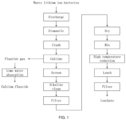
- FIG. 1 is a process diagram of the method for recovering valuable metals from waste lithium ion batteries.
- the method for recovering valuable metals from waste lithium ion batteries of the present invention includes the following steps:
- short-circuit discharging of waste lithium ion batteries dismantling of discharged waste lithium ion batteries, crushing of the battery cells obtained after dismantling, stripping of adhesives, and separation to obtain active electrode powders.
- the above operations can all use well-known operations in this field.
- the waste lithium ion batteries are short-circuit discharging the waste lithium ion batteries in a sodium sulfite solution until the termination voltage is below 1 V, wherein the solute concentration of the sodium sulfite solution is 5 - 20 %; disassembling the waste lithium ion batteries after short-circuit discharging to obtain battery cells; crushing the battery cells to obtain crushed materials; raising the temperature of the crushed materials to 400 - 600 °C at a rate of 2 - 10 °C/min in an air atmosphere, maintaining insulation and calcining to strip the adhesive; lime water with a concentration of not less than 50 mg/L is used to absorb the waste gas released during the adhesive stripping process to obtain calcium fluoride; separating the stripped product to obtain Al foil, Cu foil, and active electrode powders.
- the waste lithium ion battery is one or more of the waste lithium nickel oxide lithium ion battery, lithium cobalt oxide lithium ion battery, lithium manganese oxide lithium ion battery, and lithium nickel cobalt manganese oxide lithium ion battery.
- the present invention can simultaneously process multiple types of waste lithium ion batteries without separate recycling, and is suitable for forming a closed circuit process without generating secondary pollution. This method combines environmental protection and economic benefits, with a wide range of variable operating conditions, simple operation, and good repeatability. Unlike most existing methods that are only applicable to laboratories, the present invention is particularly suitable for industrial large-scale production.
- Step 2 alkaline cleaning and filtering
- the alkaline solution is one or more of NaOH, NH 4 OH and KOH, with a pH value of 10 - 14, an alkaline cleaning time of 10 - 60 min, and a temperature of 20 - 50 °C.
- the pH value of the alkaline solution is 10 - 12
- the alkaline cleaning time is controlled within 10 - 30 min
- the temperature is controlled between 25 - 35 °C.
- the present invention pre cleans the active electrode powders with alkali, greatly reducing the concentration of impurity ions in the leachate. It can obtain a leachate with low impurity ion concentration and rich in valuable metal ions such as lithium, nickel, cobalt, and manganese. Further, it can solve the problem of low product purity in existing waste lithium ion battery recovery technology, avoid the loss of valuable metals during the traditional recovery process, and effectively improve the comprehensive recovery rate of valuable metals.
- Step 3 drying and mixing
- the dried active electrode powders are mixed with starch, and then concentrated sulfuric acid is added at a solid-liquid ratio of 50 - 300 g/L and stirred evenly; wherein the amount of starch added is controlled at 5 - 20 wt.%.
- the amount of starch is controlled at 5 - 10 wt.%
- the solid-liquid ratio is controlled between 100 - 150 g/L.
- Step 5 water leaching and filtration
- the solid-liquid ratio is controlled between 50 - 100 g/L, the temperature is between 50 - 90 °C, and the leaching time is between 30 - 180 min.
- the solid-liquid ratio is controlled between 50 - 80 g/L, the temperature is between 60 - 80 °C, and the leaching time is between 60 - 90 min.
- the present invention adopts a comprehensive method of high temperature reduction and deposition for the recovery of valuable metals, solving the problems of low product quality, small processing scale, and complex process recovery by using a single deposition method. It avoids the use of expensive extractants for the separate recovery of valuable metals such as Cu, Ni, Co, and significantly reduces the recovery cost.
- the parameters of the high temperature reduction are as follows: the atmosphere is a mixture of 5 % oxygen and 95 % nitrogen gas, the calcination temperature is 300 °C, and the calcination time is 30 min. Finally, the product of high temperature reduction is leached and filtered with deionized water to obtain the leachate and leaching residue.
- the deionized water leaching parameters are as follows: solid-liquid ratio is 50 g/L, temperature is 50 °C, leaching time is 30 min.
- the concentration of impurity ions such as copper, iron, and aluminum ions is all below 0.5 g/L, while the concentration of valuable metal ions such as lithium, nickel, cobalt, and manganese ions is all above 5 g/L.
- the leaching rate is above 85 %.
- the parameters of the high temperature reduction are as follows: the atmosphere is a mixture of 10 % oxygen and 90 % nitrogen gas, the calcination temperature is 500 °C, and the calcination time is 60 min. Finally, the product of high temperature reduction is leached and filtered with deionized water to obtain the leachate and leaching residue.
- the deionized water leaching parameters are as follows: solid-liquid ratio is 75 g/L, temperature is 60 °C, leaching time is 60 min.
- the concentration of impurity ions such as copper, iron, and aluminum ions is all below 0.4 g/L, while the concentration of valuable metal ions such as lithium, nickel, cobalt, and manganese ions is all above 8 g/L.
- the leaching rate is above 90 %.
- the parameters of the high temperature reduction are as follows: the atmosphere is a mixture of 20 % oxygen and 80 % nitrogen gas, the calcination temperature is 700 °C, and the calcination time is 120 min. Finally, the product of high temperature reduction is leached and filtered with deionized water to obtain the leachate and leaching residue.
- the deionized water leaching parameters are as follows: solid-liquid ratio is 80 g/L, temperature is 80 °C, leaching time is 90 min.
- the concentration of impurity ions such as copper, iron, and aluminum ions is all below 0.3 g/L, while the concentration of valuable metal ions such as lithium, nickel, cobalt, and manganese ions is all above 10 g/L.
- the leaching rate is above 93 %.
- the parameters of the high temperature reduction are as follows: the atmosphere is a mixture of 50 % oxygen and 50 % nitrogen gas, the calcination temperature is 800 °C, and the calcination time is 180 min. Finally, the product of high temperature reduction is leached and filtered with deionized water to obtain the leachate and leaching residue.
- the deionized water leaching parameters are as follows: solid-liquid ratio is 100 g/L, temperature is 90 °C, leaching time is 180 min.
- the concentration of impurity ions such as copper, iron, and aluminum ions is all below 0.3 g/L, while the concentration of valuable metal ions such as lithium, nickel, cobalt, and manganese ions is all above 15 g/L.
- the leaching rate is above 95 %.
Landscapes
- Chemical & Material Sciences (AREA)
- Engineering & Computer Science (AREA)
- Organic Chemistry (AREA)
- Manufacturing & Machinery (AREA)
- Materials Engineering (AREA)
- Mechanical Engineering (AREA)
- Metallurgy (AREA)
- Life Sciences & Earth Sciences (AREA)
- Geology (AREA)
- Environmental & Geological Engineering (AREA)
- General Life Sciences & Earth Sciences (AREA)
- Geochemistry & Mineralogy (AREA)
- General Chemical & Material Sciences (AREA)
- Chemical Kinetics & Catalysis (AREA)
- Electrochemistry (AREA)
- Inorganic Chemistry (AREA)
- Health & Medical Sciences (AREA)
- General Health & Medical Sciences (AREA)
- Toxicology (AREA)
- Sustainable Development (AREA)
- Manufacture And Refinement Of Metals (AREA)
- Secondary Cells (AREA)
Description
- The disclosure relates to the technical field of recycling waste lithium ion batteries, in particular to a method for recovering valuable metals from waste lithium ion batteries.
- With the rapid development of modern science and technology, the problem of social energy and environmental ecological pollution has become increasingly prominent, especially the environmental and ecological pollution of various waste batteries has become the focus of social attention. Lithium ion batteries are widely used in the field of power batteries and energy storage batteries due to their high capacity, stable cycle performance, and high working platform voltage. However, in terms of the demand for battery materials, power and energy storage batteries generally are usually larger than conventional small batteries. Therefore, in the next 3 - 5 years, a large number of lithium ion batteries will be scrapped, and their recycling has high social value.
- At present, in the recycling technology of waste lithium ion batteries at home and abroad, the main way to deal with the electrode active materials of waste lithium ion batteries is as follows: 1) Acid reduction leaching to obtain a plasma leachate containing Li+, Ni2+, Co2+, Mn2+, Al3+, and Fe3+, depositing to remove iron and aluminum, and then adjusting the pH value to obtain a single metal deposition. 2) Depositing to remove iron and aluminum, extracting nickel, cobalt, manganese, and then acid stripping to obtain a salt solution with only nickel, cobalt or manganese. There are still certain defects in the existing recycling technology of waste lithium ion batteries, such as "a method for recovering valuable metals in LiMn1-x-yNixCoyO2 batteries and preparing LiMn1-x-yNixCoyO2 batteries" published by Chinese patent
CN104538695A . This patent utilizes acid leaching to recover valuable metals from waste nickel cobalt lithium manganese batteries. Firstly, the electrode active material is leached with inorganic acid to obtain a leachate, which deposits iron and aluminum. Then alkali is added to control different pH values to obtain the deposit for a single metal. Finally, lithium is recovered. This method achieves the recovery of waste ternary lithium ion batteries, but there are problems with low product purity and secondary pollution caused by the production of non-degradable inorganic acid wastewater during acid leaching. Another example is "a process for recovering valuable metals from waste lithium batteries" published by Chinese patentCN102162034A . In this patent, valuable metals such as cobalt, copper, nickel, and aluminum are recovered by a series of processes such as pre-treatment, leaching, chemical removal of impurities, and extraction. However, expensive extractants need to be used in the extraction process, and the operation is complex. Although this process is close to the recycling process used in industrial production, it still has the disadvantage of high recycling costs. The above processes all involve acid leaching followed by impurity removal to recover metals such as nickel, cobalt, and manganese, and finally to recover lithium. They only deal with a single type of waste lithium ion battery. - Chinese patent application
CN 106921000 A discloses a recycling process for lithium ion batteries which allows good recovery rates and can be used with different types of batteries. The method involves ball milling a colloidal solution of electrode powder starch and acid liquid. The method allows a single leaching step at room temperature and normal pressure. Chinese patent applicationCN 111321297 A also relates to a method for recovering valuable methods from lithium batteries. In order to increase the purity of the recovered valuable metals in presence of Al, it is suggested to implement an alkali treatment of the electrode powders. However, there is still a need for new recycling methods for large scale implementation. - The present invention discloses a method for recovering valuable metals from waste lithium ion batteries. This method can reduce the concentration of impurity ions in the leachate, improve the purity and comprehensive recovery rate of valuable metals, and reduce the recovery cost.
- The present invention is defined in the appended claim set.
- The present invention provides a method for recovering valuable metals from waste lithium ion batteries. The method includes the following steps:
- Step 1: pre-treatment
Short-circuit discharging, dismantling, crushing, roasting, and screening on waste lithium ion batteries to obtain active electrode powders; the waste lithium ion battery is one or more of the waste lithium nickel oxide lithium ion battery, lithium cobalt oxide lithium ion battery, lithium manganese oxide lithium ion battery, and lithium nickel cobalt manganese oxide lithium ion battery; - Step 2: alkaline cleaning and filtering
Using alkaline solution to wash the active electrode powders, then filtering to remove copper and aluminum; - Step 3: drying and mixing
drying the activated electrode powder after alkaline washing treatment, mixing the dried activated electrode powder with starch with an amount of starch controlled at 5 - 20 wt.%, and then adding concentrated sulfuric acid at a solid-liquid ratio of 50 - 300 g/L and stir evenly to obtain the mixed material; - Step 4: high temperature reduction
putting the mixed material into a corundum crucible, and then moving the corundum crucible into a tube furnace to calcine under controlled atmosphere; and wherein a calcination temperature is set at 300 - 800 °C, a heating rate at 10 °C/min, and a calcination time at 30 - 180 min; and wherein the controlled atmosphere is a mixture of O2 and N2, and the volume fraction of O2 is controlled between 0 - 50 %Step 5: water leaching and filtration - Taking out the product obtained from calcination in the step 4 and using deionized water to extract the leachate and leaching residue with valence metal ions, and then obtaining the leachate after filtering.
- In one embodiment given for illustrative purposes, the specific step 1 is as follows: the waste lithium ion batteries are short-circuit discharging the waste lithium ion batteries in a sodium sulfite solution until the termination voltage is below 1 V, wherein the solute concentration of the sodium sulfite solution is 5 - 20 %; disassembling the waste lithium ion batteries after short-circuit discharging to obtain battery cells; crushing the battery cells to obtain crushed materials; raising the temperature of the crushed materials to 400 - 600 °C at a rate of 2 - 10 °C/min in an air atmosphere, maintaining insulation and calcining to strip the adhesive; lime water with a concentration of not less than 50 mg/L is used to absorb the waste gas released during the adhesive stripping process to obtain calcium fluoride; separating the stripped product to obtain Al foil, Cu foil, and active electrode powders.
- Furtherly in the invention, preferably, in the step 2, the alkaline solution is one or more of NaOH, NH4OH and KOH, with a pH value of 10 - 14, an alkaline cleaning time of 10 - 60 min, and a temperature of 20 - 50 °C.
- Preferably, in the step 2, the pH value of the alkaline solution is 10 - 12, the alkaline cleaning time is controlled within 10 - 30 min, and the temperature is controlled between 25 - 35 °C.
- Preferably, in the step 3, the amount of starch is controlled at 5 - 10 wt.%, the solid-liquid ratio is controlled between 100 - 150 g/L.
- Preferably, in the step 4, controlling the calcination temperature at 500 - 800 °C, calcination time at 60 - 120 min, and the volume fraction of O2 between 10 - 20 %.
- Furtherly, in the deionized water leaching process of the step 5, the solid-liquid ratio is controlled between 50 - 100 g/L, the temperature is between 50 - 90 °C, and the leaching time is between 30 - 180 min.
- Preferably, in the deionized water leaching process of the step 5, the solid-liquid ratio is controlled between 50 - 80 g/L, the temperature is between 60 - 80 °C, and the leaching time is between 60 - 90 min.
- The advantages of the present invention are as follows:
- (1) In the present invention, the active electrode powders are subjected to alkaline cleaning pre-treatment, and then recovered through a combination of high temperature reduction and water leaching after removing copper and aluminum. This method breaks the traditional method of recycling valuable metals from waste lithium ion batteries. On the one hand, the present invention pre cleans the active electrode powders with alkali, greatly reducing the concentration of impurity ions in the leachate, solving the problem of low product purity in existing waste lithium ion battery recovery technology, avoiding the loss of valuable metals during the traditional recovery process, and effectively improving the comprehensive recovery rate of valuable metals. On the other hand, the present invention adopts a comprehensive method of high temperature reduction and deposition for the recovery of valuable metals, solving the problems of low product quality, small processing scale, and complex process recovery by using a single deposition method. It avoids the use of expensive extractants for the separate recovery of valuable metals such as Cu, Ni, Co, and significantly reduces the recovery cost.
- (2) The present invention can simultaneously process multiple types of waste lithium ion batteries without separate recycling, and is suitable for forming a closed circuit process without generating secondary pollution. This method combines environmental protection and economic benefits, with a wide range of variable operating conditions, simple operation, and good repeatability. Unlike most existing methods that are only applicable to laboratories, the present invention is particularly suitable for industrial large-scale production.
- Accompanying drawings are for providing further understanding of embodiments of the disclosure. The drawings form a part of the disclosure and illustrate the principle of the embodiments of the disclosure along with the literal description. The drawings in the description below are merely some embodiments of the disclosure; a person skilled in the art can obtain other drawings according to these drawings without creative efforts. In the figures:
FIG. 1 is a process diagram of the method for recovering valuable metals from waste lithium ion batteries. - The present invention will be further described in conjunction with the accompanying drawings and specific examples.
- As shown in
FIG. 1 , the method for recovering valuable metals from waste lithium ion batteries of the present invention includes the following steps: - Short-circuit discharging, dismantling, crushing, roasting, and screening on waste lithium ion batteries to obtain active electrode powders.
- In an embodiment short-circuit discharging of waste lithium ion batteries, dismantling of discharged waste lithium ion batteries, crushing of the battery cells obtained after dismantling, stripping of adhesives, and separation to obtain active electrode powders. The above operations can all use well-known operations in this field. Preferably, the waste lithium ion batteries are short-circuit discharging the waste lithium ion batteries in a sodium sulfite solution until the termination voltage is below 1 V, wherein the solute concentration of the sodium sulfite solution is 5 - 20 %; disassembling the waste lithium ion batteries after short-circuit discharging to obtain battery cells; crushing the battery cells to obtain crushed materials; raising the temperature of the crushed materials to 400 - 600 °C at a rate of 2 - 10 °C/min in an air atmosphere, maintaining insulation and calcining to strip the adhesive; lime water with a concentration of not less than 50 mg/L is used to absorb the waste gas released during the adhesive stripping process to obtain calcium fluoride; separating the stripped product to obtain Al foil, Cu foil, and active electrode powders.
- The waste lithium ion battery is one or more of the waste lithium nickel oxide lithium ion battery, lithium cobalt oxide lithium ion battery, lithium manganese oxide lithium ion battery, and lithium nickel cobalt manganese oxide lithium ion battery. The present invention can simultaneously process multiple types of waste lithium ion batteries without separate recycling, and is suitable for forming a closed circuit process without generating secondary pollution. This method combines environmental protection and economic benefits, with a wide range of variable operating conditions, simple operation, and good repeatability. Unlike most existing methods that are only applicable to laboratories, the present invention is particularly suitable for industrial large-scale production.
- Using alkaline solution to wash the active electrode powders, then filtering to remove copper and aluminum.
- The alkaline solution is one or more of NaOH, NH4OH and KOH, with a pH value of 10 - 14, an alkaline cleaning time of 10 - 60 min, and a temperature of 20 - 50 °C. Preferably, the pH value of the alkaline solution is 10 - 12, the alkaline cleaning time is controlled within 10 - 30 min, and the temperature is controlled between 25 - 35 °C.
- The present invention pre cleans the active electrode powders with alkali, greatly reducing the concentration of impurity ions in the leachate. It can obtain a leachate with low impurity ion concentration and rich in valuable metal ions such as lithium, nickel, cobalt, and manganese. Further, it can solve the problem of low product purity in existing waste lithium ion battery recovery technology, avoid the loss of valuable metals during the traditional recovery process, and effectively improve the comprehensive recovery rate of valuable metals.
- Drying the activated electrode powder after alkaline washing treatment, mix the dried activated electrode powder with starch and concentrated sulfuric acid in a predetermined proportion and stir evenly to obtain the mixed material.
- In the mixing process, the dried active electrode powders are mixed with starch, and then concentrated sulfuric acid is added at a solid-liquid ratio of 50 - 300 g/L and stirred evenly; wherein the amount of starch added is controlled at 5 - 20 wt.%. Preferably, the amount of starch is controlled at 5 - 10 wt.%, the solid-liquid ratio is controlled between 100 - 150 g/L.
- Putting the mixed material into a corundum crucible, and then moving the corundum crucible into a tube furnace to calcine with controlling the atmosphere.
- In the process of high temperature reduction, controlling the calcination temperature at 300 - 800 °C, heating rate at 10 °C/min, and calcination time at 30 - 180 min; wherein the atmosphere is a mixture of O2 and N2, and the volume fraction of O2 is controlled between 0 - 50 %. Preferably, controlling the calcination temperature at 500 - 800 °C, calcination time at 60 - 120 min, and the volume fraction of O2 between 10 - 20 %.
- Taking out the product obtained from calcination in the step 4 and using deionized water to extract the leachate and leaching residue with valence metal ions, and then obtaining the leachate after filtering.
- In the deionized water leaching process, the solid-liquid ratio is controlled between 50 - 100 g/L, the temperature is between 50 - 90 °C, and the leaching time is between 30 - 180 min. Preferably, in the deionized water leaching process of the step 5, the solid-liquid ratio is controlled between 50 - 80 g/L, the temperature is between 60 - 80 °C, and the leaching time is between 60 - 90 min.
- The present invention adopts a comprehensive method of high temperature reduction and deposition for the recovery of valuable metals, solving the problems of low product quality, small processing scale, and complex process recovery by using a single deposition method. It avoids the use of expensive extractants for the separate recovery of valuable metals such as Cu, Ni, Co, and significantly reduces the recovery cost.
- Soaking the waste lithium ion battery mixed with LiNiO2, LiCoO2, LiMnO2, LiNixCoyMn1-x-yO2 in a 5 % sodium sulfite solution and discharging it to a termination voltage of 1 V; disassembling the discharged waste lithium ion battery to obtain battery cells; mechanical force is applied to the overall crushing of the battery cells to obtain crushed materials, and the particle size of the crushed materials is sieved out to be less than 0.1 mm for the following calcination; raising the temperature of the crushed materials in an air atmosphere at a rate of 2 °C/min to 400 °C, heat preservation and calcining for 1 hour, stripping the adhesive, and absorbing the calcining waste gas with 50 mg/L lime water; separating the stripped product to obtain Al foil, Cu foil, and active electrode powders. Alkaline cleaning of the calcined active electrode powders, with the following alkaline cleaning parameters: NH4OH solution with pH = 10, alkaline cleaning time of 10 min, alkaline cleaning temperature of 20 °C, filtration, separation, and drying to obtain the purified active electrode powders. Then mixing the dried active electrode powders with starch and concentrated sulfuric acid. The parameters of mixing are as follows: starch mass ratio of 5 %, concentrated sulfuric acid solid-liquid ratio of 50 g/L, and obtain the mixed materials after mixing. Next, the mixed materials are sent to the high temperature reduction process. The parameters of the high temperature reduction are as follows: the atmosphere is a mixture of 5 % oxygen and 95 % nitrogen gas, the calcination temperature is 300 °C, and the calcination time is 30 min. Finally, the product of high temperature reduction is leached and filtered with deionized water to obtain the leachate and leaching residue. The deionized water leaching parameters are as follows: solid-liquid ratio is 50 g/L, temperature is 50 °C, leaching time is 30 min.
- In the leachate, the concentration of impurity ions such as copper, iron, and aluminum ions is all below 0.5 g/L, while the concentration of valuable metal ions such as lithium, nickel, cobalt, and manganese ions is all above 5 g/L. The leaching rate is above 85 %.
- Soaking the waste lithium ion battery in a 10 % sodium sulfite solution and discharging it to a termination voltage of 0.8 V; disassembling the discharged waste lithium ion battery to obtain battery cells; mechanical force is applied to the overall crushing of the battery cells to obtain crushed materials, and the particle size of the crushed materials is sieved out to be less than 0.1 mm for the following calcination; raising the temperature of the crushed materials in an air atmosphere at a rate of 5 °C/min to 450 °C, heat preservation and calcining for 1 hour, stripping the adhesive, and absorbing the calcining waste gas with 50 mg/L lime water; separating the stripped product to obtain Al foil, Cu foil, and active electrode powders. Alkaline cleaning of the calcined active electrode powders, with the following alkaline cleaning parameters: NH4OH solution with pH = 10.5, alkaline cleaning time of 20 min, alkaline cleaning temperature of 25 °C, filtration, separation, and drying to obtain the purified active electrode powders. Then mixing the dried active electrode powders with starch and concentrated sulfuric acid. The parameters of mixing are as follows: starch mass ratio of 8 %, concentrated sulfuric acid solid-liquid ratio of 100 g/L, and obtain the mixed materials after mixing. Next, the mixed materials are sent to the high temperature reduction process. The parameters of the high temperature reduction are as follows: the atmosphere is a mixture of 10 % oxygen and 90 % nitrogen gas, the calcination temperature is 500 °C, and the calcination time is 60 min. Finally, the product of high temperature reduction is leached and filtered with deionized water to obtain the leachate and leaching residue. The deionized water leaching parameters are as follows: solid-liquid ratio is 75 g/L, temperature is 60 °C, leaching time is 60 min.
- In the leachate, the concentration of impurity ions such as copper, iron, and aluminum ions is all below 0.4 g/L, while the concentration of valuable metal ions such as lithium, nickel, cobalt, and manganese ions is all above 8 g/L. The leaching rate is above 90 %.
- Soaking the waste lithium ion battery in a 15 % sodium sulfite solution and discharging it to a termination voltage of 0.7 V; disassembling the discharged waste lithium ion battery to obtain battery cells; mechanical force is applied to the overall crushing of the battery cells to obtain crushed materials, and the particle size of the crushed materials is sieved out to be less than 0.1 mm for the following calcination; raising the temperature of the crushed materials in an air atmosphere at a rate of 10 °C/min to 450 °C, heat preservation and calcining for 1 hour, stripping the adhesive, and absorbing the calcining waste gas with 50 mg/L lime water; separating the stripped product to obtain Al foil, Cu foil, and active electrode powders. Alkaline cleaning of the calcined active electrode powders, with the following alkaline cleaning parameters: NH4OH solution with pH = 12, alkaline cleaning time of 30 min, alkaline cleaning temperature of 35 °C, filtration, separation, and drying to obtain the purified active electrode powders. Then mixing the dried active electrode powders with starch and concentrated sulfuric acid. The parameters of mixing are as follows: starch mass ratio of 10 %, concentrated sulfuric acid solid-liquid ratio of 150 g/L, and obtain the mixed materials after mixing. Next, the mixed materials are sent to the high temperature reduction process. The parameters of the high temperature reduction are as follows: the atmosphere is a mixture of 20 % oxygen and 80 % nitrogen gas, the calcination temperature is 700 °C, and the calcination time is 120 min. Finally, the product of high temperature reduction is leached and filtered with deionized water to obtain the leachate and leaching residue. The deionized water leaching parameters are as follows: solid-liquid ratio is 80 g/L, temperature is 80 °C, leaching time is 90 min.
- In the leachate, the concentration of impurity ions such as copper, iron, and aluminum ions is all below 0.3 g/L, while the concentration of valuable metal ions such as lithium, nickel, cobalt, and manganese ions is all above 10 g/L. The leaching rate is above 93 %.
- Soaking the waste lithium ion battery in a 20 % sodium sulfite solution and discharging it to a termination voltage of 0.5 V; disassembling the discharged waste lithium ion battery to obtain battery cells; mechanical force is applied to the overall crushing of the battery cells to obtain crushed materials, and the particle size of the crushed materials is sieved out to be less than 0.1 mm for the following calcination; raising the temperature of the crushed materials in an air atmosphere at a rate of 10 °C/min to 600 °C, heat preservation and calcining for 1 hour, stripping the adhesive, and absorbing the calcining waste gas with 50 mg/L lime water; separating the stripped product to obtain Al foil, Cu foil, and active electrode powders. Alkaline cleaning of the calcined active electrode powders, with the following alkaline cleaning parameters: NH4OH solution with pH = 14, alkaline cleaning time of 60 min, alkaline cleaning temperature of 50 °C, filtration, separation, and drying to obtain the purified active electrode powders. Then mixing the dried active electrode powders with starch and concentrated sulfuric acid. The parameters of mixing are as follows: starch mass ratio of 20 %, concentrated sulfuric acid solid-liquid ratio of 300 g/L, and obtain the mixed materials after mixing. Next, the mixed materials are sent to the high temperature reduction process. The parameters of the high temperature reduction are as follows: the atmosphere is a mixture of 50 % oxygen and 50 % nitrogen gas, the calcination temperature is 800 °C, and the calcination time is 180 min. Finally, the product of high temperature reduction is leached and filtered with deionized water to obtain the leachate and leaching residue. The deionized water leaching parameters are as follows: solid-liquid ratio is 100 g/L, temperature is 90 °C, leaching time is 180 min.
- In the leachate, the concentration of impurity ions such as copper, iron, and aluminum ions is all below 0.3 g/L, while the concentration of valuable metal ions such as lithium, nickel, cobalt, and manganese ions is all above 15 g/L. The leaching rate is above 95 %.
Claims (7)
- A method for recovering valuable metals from waste lithium ion batteries, including the following steps:step 1: pre-treatmentshort-circuit discharging, dismantling, crushing, roasting, and screening on waste lithium ion batteries to obtain active electrode powders; the waste lithium ion battery is one or more of the waste lithium nickel oxide lithium ion battery, lithium cobalt oxide lithium ion battery, lithium manganese oxide lithium ion battery, and lithium nickel cobalt manganese oxide lithium ion battery;step 2: alkaline cleaning and filteringusing alkaline solution to wash the active electrode powders, then filtering to remove copper and aluminum;step 3: drying and mixingdrying the activated electrode powder after alkaline washing treatment, mixing the dried activated electrode powder with starch with an amount of starch controlled at 5 - 20 wt.%, and then adding concentrated sulfuric acid at a solid-liquid ratio of 50 - 300 g/L and stir evenly to obtain the mixed material;step 4: high temperature reductionputting the mixed material into a corundum crucible, and then moving the corundum crucible into a tube furnace to calcine under controlled atmosphere; and wherein a calcination temperature is set at 300 - 800 °C, a heating rate at 10 °C/min, and a calcination time at 30 - 180 min; and wherein the controlled atmosphere is a mixture of O2 and N2, and the volume fraction of O2 is controlled between 0 - 50 %;step 5: water leaching and filtrationtaking out the product obtained from calcination in the step 4 and using deionized water to extract the leachate and leaching residue with valence metal ions, and then obtaining the leachate after filtering.
- The method for recovering valuable metals from waste lithium ion batteries according to claim 1, in the step 2, the alkaline solution is one or more of NaOH, NH4OH and KOH, with a pH value of 10 - 14, an alkaline cleaning time of 10 - 60 min, and a temperature of 20 - 50 °C.
- The method for recovering valuable metals from waste lithium ion batteries according to claim 2, in the step 2, the pH value of the alkaline solution is 10 - 12, the alkaline cleaning time is controlled within 10 - 30 min, and the temperature is controlled between 25 - 35 °C.
- The method for recovering valuable metals from waste lithium ion batteries according to claim 1, in the step 3, the amount of starch is controlled at 5 - 10 wt.%, the solid-liquid ratio is controlled between 100 - 150 g/L.
- The method for recovering valuable metals from waste lithium ion batteries according to claim 1, in the step 4, controlling the calcination temperature at 500 - 800 °C, calcination time at 60 - 120 min, and the volume fraction of O2 between 10 - 20 %.
- The method for recovering valuable metals from waste lithium ion batteries according to claim 1, in the deionized water leaching process of the step 5, the solid-liquid ratio is controlled between 50 - 100 g/L, the temperature is between 50 - 90 °C, and the leaching time is between 30 - 180 min.
- The method for recovering valuable metals from waste lithium ion batteries according to claim 6, in the deionized water leaching process of the step 5, the solid-liquid ratio is controlled between 50 - 80 g/L, the temperature is between 60 - 80 °C, and the leaching time is between 60 - 90 min.
Applications Claiming Priority (2)
| Application Number | Priority Date | Filing Date | Title |
|---|---|---|---|
| CN202111020944.1A CN113897488A (en) | 2021-09-01 | 2021-09-01 | Method for recovering valuable metals from waste lithium ion batteries |
| PCT/CN2022/110995 WO2023029898A1 (en) | 2021-09-01 | 2022-08-09 | Method for recovering valuable metals from spent lithium-ion batteries |
Publications (4)
| Publication Number | Publication Date |
|---|---|
| EP4324949A1 EP4324949A1 (en) | 2024-02-21 |
| EP4324949A4 EP4324949A4 (en) | 2024-06-26 |
| EP4324949C0 EP4324949C0 (en) | 2025-06-11 |
| EP4324949B1 true EP4324949B1 (en) | 2025-06-11 |
Family
ID=79188307
Family Applications (1)
| Application Number | Title | Priority Date | Filing Date |
|---|---|---|---|
| EP22863039.8A Active EP4324949B1 (en) | 2021-09-01 | 2022-08-09 | Method for recovering valuable metals from spent lithium-ion batteries |
Country Status (9)
| Country | Link |
|---|---|
| US (1) | US12113187B2 (en) |
| EP (1) | EP4324949B1 (en) |
| JP (1) | JP7546789B2 (en) |
| KR (1) | KR102724564B1 (en) |
| CN (1) | CN113897488A (en) |
| ES (1) | ES3036200T3 (en) |
| HU (1) | HUE072628T2 (en) |
| PL (1) | PL4324949T3 (en) |
| WO (1) | WO2023029898A1 (en) |
Families Citing this family (16)
| Publication number | Priority date | Publication date | Assignee | Title |
|---|---|---|---|---|
| CN113897488A (en) * | 2021-09-01 | 2022-01-07 | 格林美股份有限公司 | Method for recovering valuable metals from waste lithium ion batteries |
| CA3254354A1 (en) * | 2022-09-29 | 2024-04-04 | Jx Metals Circular Solutions Co., Ltd. | Method for removing metal and method for recovering metal |
| WO2024207141A1 (en) * | 2023-04-03 | 2024-10-10 | 广东邦普循环科技有限公司 | Full-chain integrated treatment method for waste residues produced in directional circulation process of waste batteries |
| CN119790524A (en) * | 2023-05-31 | 2025-04-08 | 高丽亚铅株式会社 | Waste battery treatment methods |
| CN116790885A (en) * | 2023-05-31 | 2023-09-22 | 赣南师范大学 | Method for synchronously recycling valuable metals from anode and cathode of waste ternary lithium battery |
| CN116722253B (en) * | 2023-08-09 | 2023-12-01 | 深圳市杰成镍钴新能源科技有限公司 | Polar material leaching method and device for retired ternary lithium battery |
| CN117019818B (en) * | 2023-08-17 | 2026-02-10 | 湖北来思通循环科技有限公司 | A combined pyrometallurgical and hydrometallurgical treatment method and system for waste lithium-ion battery black powder |
| CN117025977B (en) * | 2023-10-10 | 2023-12-29 | 矿冶科技集团有限公司 | Method for extracting lithium from phosphorus-containing clay-type lithium ore |
| CN117230312B (en) * | 2023-11-13 | 2024-03-19 | 帕瓦(长沙)新能源科技有限公司 | Alkaline leaching process of waste lithium ion battery anode material |
| CN117550628B (en) * | 2023-11-14 | 2024-10-29 | 深圳汇能储能材料工程研究中心有限公司 | A method for recovering valuable metals from waste lithium iron phosphate positive electrodes |
| KR102679541B1 (en) * | 2024-01-17 | 2024-07-02 | 주식회사 후영 | Lithium battery disassembly and recycling process method |
| KR20250129951A (en) * | 2024-02-23 | 2025-09-01 | 주식회사 에이비알 | Method for recovering cathode material from black power |
| WO2026071770A1 (en) * | 2024-09-27 | 2026-04-02 | 주식회사 엘지에너지솔루션 | Lithium recovery method |
| CN119372481B (en) * | 2024-10-28 | 2025-10-03 | 中国化学品安全协会 | Device and method for recovering metal ions from waste lithium-ion batteries |
| CN119750651B (en) * | 2025-01-03 | 2025-08-19 | 西南石油大学 | Manganese-based lithium ion sieve based on electrolytic manganese anode slime and preparation method thereof |
| CN120438377B (en) * | 2025-07-07 | 2025-09-12 | 江西天奇金泰阁钴业有限公司 | A waste ternary lithium battery recycling and sorting device and its use method |
Family Cites Families (23)
| Publication number | Priority date | Publication date | Assignee | Title |
|---|---|---|---|---|
| EP1142834A4 (en) * | 1999-11-15 | 2009-06-17 | Mitsubishi Chem Corp | LITHIUM MANGANIC OXIDE, POSITIVE ELECTRODE MATERIAL FOR SECONDARY LITHIUM CELLS, POSITIVE ELECTRODE AND SECONDARY LITHIUM CELL AND METHOD FOR PRODUCING LITHIUM MANGANIC OXIDE |
| JP4892925B2 (en) * | 2005-10-25 | 2012-03-07 | 住友金属鉱山株式会社 | Method for recovering valuable metals from lithium-ion batteries |
| CN101519726B (en) * | 2009-04-16 | 2011-01-05 | 北京矿冶研究总院 | A method for direct roasting treatment of waste lithium-ion batteries and recovery of valuable metals |
| KR20120128125A (en) * | 2009-11-03 | 2012-11-26 | 엔비아 시스템즈 인코포레이티드 | High capacity anode materials for lithium ion batteries |
| CN102162034A (en) | 2011-04-07 | 2011-08-24 | 常州今创博凡能源新材料有限公司 | Process for recovering valuable metals from waste lithium batteries |
| CN103449400B (en) * | 2013-08-02 | 2015-05-27 | 杭州师范大学 | Industrial production method for ordered mesoporous carbon material with high bulk density |
| CN104538695B (en) | 2015-01-08 | 2017-04-05 | 兰州理工大学 | Metal the method for preparing nickle cobalt lithium manganate are reclaimed in useless nickle cobalt lithium manganate battery |
| CN106921000B (en) * | 2017-04-14 | 2019-01-25 | 中南大学 | A ball mill acid leaching method for positive electrode active material of waste lithium ion battery |
| CN106848471B (en) * | 2017-04-18 | 2021-11-09 | 中科过程(北京)科技有限公司 | Mixed acid leaching and recovery method of waste lithium ion battery anode material |
| CN107978814A (en) * | 2017-07-04 | 2018-05-01 | 中国科学院过程工程研究所 | A kind of method of Selective Separation lithium in material from waste lithium ion cell anode |
| CN108649291A (en) * | 2018-05-24 | 2018-10-12 | 北京化工大学 | It is a kind of using waste and old lithium ion battery as the technique of raw materials recovery nickel-cobalt lithium manganate cathode material |
| CN108878866B (en) * | 2018-06-28 | 2020-11-17 | 山东理工大学 | Method for preparing ternary material precursor and recovering lithium by using ternary cathode material of waste lithium ion battery |
| CN109088115B (en) * | 2018-07-24 | 2020-07-17 | 广东光华科技股份有限公司 | Method for preparing ternary cathode material by recycling waste lithium ion battery cathode material |
| CN111321297B (en) * | 2018-12-17 | 2021-06-11 | 中南大学 | Method for recovering valuable metals from waste lithium ion batteries |
| CN109913637A (en) * | 2019-03-25 | 2019-06-21 | 江西理工大学 | A method for comprehensive recovery of valuable metals from waste lithium-ion batteries |
| CN110767954B (en) * | 2019-09-16 | 2021-01-22 | 天齐锂业(江苏)有限公司 | Method for carrying out distillation defluorination on lithium ion battery powder by mixed acid and synergistic valuable metal leaching |
| CN111129632B (en) * | 2019-11-22 | 2021-07-23 | 深圳清华大学研究院 | Method for recycling positive and negative electrode mixed materials of waste ternary lithium ion battery |
| KR20210075502A (en) * | 2019-12-13 | 2021-06-23 | 주식회사 포스코 | Method for recovering valuable metals from cathodic active material of used lithium battery |
| CN111254294B (en) * | 2020-03-11 | 2021-07-23 | 中南大学 | Method for selectively extracting lithium from waste lithium-ion battery powder and electrolytically separating and recovering manganese dioxide |
| CN111392750B (en) * | 2020-04-02 | 2022-09-16 | 天齐锂业股份有限公司 | Method for removing impurities and recovering lithium from waste lithium ion batteries |
| CN111733326A (en) * | 2020-07-03 | 2020-10-02 | 昆明理工大学 | A method for efficiently recycling waste lithium-ion battery ternary positive electrode material |
| CN111987381A (en) * | 2020-08-25 | 2020-11-24 | 长沙矿冶研究院有限责任公司 | Method for synchronously defluorinating valuable metals leached from waste lithium ion batteries |
| CN113897488A (en) * | 2021-09-01 | 2022-01-07 | 格林美股份有限公司 | Method for recovering valuable metals from waste lithium ion batteries |
-
2021
- 2021-09-01 CN CN202111020944.1A patent/CN113897488A/en active Pending
-
2022
- 2022-08-09 WO PCT/CN2022/110995 patent/WO2023029898A1/en not_active Ceased
- 2022-08-09 HU HUE22863039A patent/HUE072628T2/en unknown
- 2022-08-09 PL PL22863039.8T patent/PL4324949T3/en unknown
- 2022-08-09 KR KR1020237037436A patent/KR102724564B1/en active Active
- 2022-08-09 EP EP22863039.8A patent/EP4324949B1/en active Active
- 2022-08-09 JP JP2023565337A patent/JP7546789B2/en active Active
- 2022-08-09 ES ES22863039T patent/ES3036200T3/en active Active
-
2023
- 2023-10-31 US US18/498,037 patent/US12113187B2/en active Active
Also Published As
| Publication number | Publication date |
|---|---|
| KR102724564B1 (en) | 2024-10-31 |
| EP4324949C0 (en) | 2025-06-11 |
| US12113187B2 (en) | 2024-10-08 |
| CN113897488A (en) | 2022-01-07 |
| HUE072628T2 (en) | 2025-11-28 |
| PL4324949T3 (en) | 2025-10-20 |
| JP2024514966A (en) | 2024-04-03 |
| EP4324949A1 (en) | 2024-02-21 |
| US20240063455A1 (en) | 2024-02-22 |
| WO2023029898A1 (en) | 2023-03-09 |
| ES3036200T3 (en) | 2025-09-16 |
| KR20230156432A (en) | 2023-11-14 |
| EP4324949A4 (en) | 2024-06-26 |
| JP7546789B2 (en) | 2024-09-06 |
Similar Documents
| Publication | Publication Date | Title |
|---|---|---|
| EP4324949B1 (en) | Method for recovering valuable metals from spent lithium-ion batteries | |
| CN111129632B (en) | Method for recycling positive and negative electrode mixed materials of waste ternary lithium ion battery | |
| CN112375913B (en) | Waste lithium ion battery recovery method | |
| CN113444885B (en) | Method for preferentially extracting metal lithium from waste ternary lithium ion battery and simultaneously obtaining battery-grade metal salt | |
| CN111825110A (en) | Recycling method of cathode material of waste lithium ion battery | |
| GB2622169A (en) | Method for selectively recovering valuable metal in waste lithium battery | |
| CN111180819B (en) | A kind of preparation method of battery grade Ni-Co-Mn mixed solution and battery grade Mn solution | |
| CN108486376A (en) | A method of leaching metal in waste lithium ion cell anode material | |
| CN111254276A (en) | Method for selective extraction of valuable metals from waste lithium-ion battery powder based on phase inversion of reductive sodium roasting | |
| CN110862110A (en) | Method for preparing ternary positive electrode material precursor by using waste lithium ion battery | |
| CN112877548B (en) | Method for recovering valuable metals from waste lithium ion battery anode powder | |
| CN111517340B (en) | Method for recycling lithium carbonate from NCM111 positive electrode material of waste ternary lithium ion battery | |
| CN114085997A (en) | Waste lithium ion battery recovery method | |
| CN113862476B (en) | Method for pre-extracting lithium from waste lithium ion battery | |
| CN116676493B (en) | Cooperative recovery method of waste lithium ion battery material and high nickel matte | |
| CN114085996A (en) | Method for recycling nickel and cobalt by co-processing nickel and cobalt-containing material | |
| CN111321297B (en) | Method for recovering valuable metals from waste lithium ion batteries | |
| CN115537551A (en) | A method for preferentially extracting lithium and manganese from waste lithium battery cathode materials | |
| CN117187572B (en) | Methods for recovering lithium from spent lithium-ion batteries and preparing ternary precursors | |
| CN116102080B (en) | A method for preparing positive electrode material by regenerating waste sodium ion batteries | |
| CN114574705B (en) | Method for leaching and separating lithium and valuable metals from waste lithium ion battery | |
| CN111675228A (en) | A method for extracting lithium in positive electrode material of waste power battery | |
| CN110527846B (en) | A kind of treatment method of waste NCM ternary cathode material leachate | |
| CN116855741A (en) | Method for extracting valuable metals from waste lithium ion batteries in grading manner | |
| CN120914375A (en) | Method for preparing positive electrode precursor by recycling battery reclaimed materials |
Legal Events
| Date | Code | Title | Description |
|---|---|---|---|
| STAA | Information on the status of an ep patent application or granted ep patent |
Free format text: STATUS: THE INTERNATIONAL PUBLICATION HAS BEEN MADE |
|
| PUAI | Public reference made under article 153(3) epc to a published international application that has entered the european phase |
Free format text: ORIGINAL CODE: 0009012 |
|
| STAA | Information on the status of an ep patent application or granted ep patent |
Free format text: STATUS: REQUEST FOR EXAMINATION WAS MADE |
|
| 17P | Request for examination filed |
Effective date: 20231110 |
|
| AK | Designated contracting states |
Kind code of ref document: A1 Designated state(s): AL AT BE BG CH CY CZ DE DK EE ES FI FR GB GR HR HU IE IS IT LI LT LU LV MC MK MT NL NO PL PT RO RS SE SI SK SM TR |
|
| STAA | Information on the status of an ep patent application or granted ep patent |
Free format text: STATUS: EXAMINATION IS IN PROGRESS |
|
| A4 | Supplementary search report drawn up and despatched |
Effective date: 20240529 |
|
| 17Q | First examination report despatched |
Effective date: 20240610 |
|
| DAV | Request for validation of the european patent (deleted) | ||
| DAX | Request for extension of the european patent (deleted) | ||
| REG | Reference to a national code |
Ref country code: DE Ref legal event code: R079 Free format text: PREVIOUS MAIN CLASS: C22B0026120000 Ipc: B09B0003700000 Ref document number: 602022015931 Country of ref document: DE |
|
| GRAP | Despatch of communication of intention to grant a patent |
Free format text: ORIGINAL CODE: EPIDOSNIGR1 |
|
| STAA | Information on the status of an ep patent application or granted ep patent |
Free format text: STATUS: GRANT OF PATENT IS INTENDED |
|
| RIC1 | Information provided on ipc code assigned before grant |
Ipc: H01M 10/54 20060101ALI20250319BHEP Ipc: H01M 10/0525 20100101ALI20250319BHEP Ipc: H01M 6/52 20060101ALI20250319BHEP Ipc: C22B 47/00 20060101ALI20250319BHEP Ipc: C22B 26/12 20060101ALI20250319BHEP Ipc: C22B 23/00 20060101ALI20250319BHEP Ipc: C22B 21/00 20060101ALI20250319BHEP Ipc: C22B 15/00 20060101ALI20250319BHEP Ipc: C22B 7/00 20060101ALI20250319BHEP Ipc: C22B 1/06 20060101ALI20250319BHEP Ipc: C22B 1/00 20060101ALI20250319BHEP Ipc: C01F 11/22 20060101ALI20250319BHEP Ipc: B09B 101/16 20220101ALI20250319BHEP Ipc: B09B 3/70 20220101AFI20250319BHEP |
|
| GRAS | Grant fee paid |
Free format text: ORIGINAL CODE: EPIDOSNIGR3 |
|
| INTG | Intention to grant announced |
Effective date: 20250403 |
|
| GRAA | (expected) grant |
Free format text: ORIGINAL CODE: 0009210 |
|
| STAA | Information on the status of an ep patent application or granted ep patent |
Free format text: STATUS: THE PATENT HAS BEEN GRANTED |
|
| AK | Designated contracting states |
Kind code of ref document: B1 Designated state(s): AL AT BE BG CH CY CZ DE DK EE ES FI FR GB GR HR HU IE IS IT LI LT LU LV MC MK MT NL NO PL PT RO RS SE SI SK SM TR |
|
| REG | Reference to a national code |
Ref country code: GB Ref legal event code: FG4D |
|
| REG | Reference to a national code |
Ref country code: CH Ref legal event code: EP |
|
| REG | Reference to a national code |
Ref country code: IE Ref legal event code: FG4D |
|
| REG | Reference to a national code |
Ref country code: DE Ref legal event code: R096 Ref document number: 602022015931 Country of ref document: DE |
|
| U01 | Request for unitary effect filed |
Effective date: 20250702 |
|
| U07 | Unitary effect registered |
Designated state(s): AT BE BG DE DK EE FI FR IT LT LU LV MT NL PT RO SE SI Effective date: 20250708 |
|
| REG | Reference to a national code |
Ref country code: ES Ref legal event code: FG2A Ref document number: 3036200 Country of ref document: ES Kind code of ref document: T3 Effective date: 20250916 |
|
| U20 | Renewal fee for the european patent with unitary effect paid |
Year of fee payment: 4 Effective date: 20250828 |
|
| PGFP | Annual fee paid to national office [announced via postgrant information from national office to epo] |
Ref country code: ES Payment date: 20250903 Year of fee payment: 4 |
|
| PG25 | Lapsed in a contracting state [announced via postgrant information from national office to epo] |
Ref country code: GR Free format text: LAPSE BECAUSE OF FAILURE TO SUBMIT A TRANSLATION OF THE DESCRIPTION OR TO PAY THE FEE WITHIN THE PRESCRIBED TIME-LIMIT Effective date: 20250912 Ref country code: NO Free format text: LAPSE BECAUSE OF FAILURE TO SUBMIT A TRANSLATION OF THE DESCRIPTION OR TO PAY THE FEE WITHIN THE PRESCRIBED TIME-LIMIT Effective date: 20250911 |
|
| REG | Reference to a national code |
Ref country code: SK Ref legal event code: T3 Ref document number: E 46856 Country of ref document: SK |
|
| PGFP | Annual fee paid to national office [announced via postgrant information from national office to epo] |
Ref country code: HU Payment date: 20250808 Year of fee payment: 4 |
|
| PG25 | Lapsed in a contracting state [announced via postgrant information from national office to epo] |
Ref country code: HR Free format text: LAPSE BECAUSE OF FAILURE TO SUBMIT A TRANSLATION OF THE DESCRIPTION OR TO PAY THE FEE WITHIN THE PRESCRIBED TIME-LIMIT Effective date: 20250611 |
|
| PG25 | Lapsed in a contracting state [announced via postgrant information from national office to epo] |
Ref country code: RS Free format text: LAPSE BECAUSE OF FAILURE TO SUBMIT A TRANSLATION OF THE DESCRIPTION OR TO PAY THE FEE WITHIN THE PRESCRIBED TIME-LIMIT Effective date: 20250911 |
|
| PGFP | Annual fee paid to national office [announced via postgrant information from national office to epo] |
Ref country code: SK Payment date: 20250806 Year of fee payment: 4 |
|
| U1N | Appointed representative for the unitary patent procedure changed after the registration of the unitary effect |
Representative=s name: SANTARELLI; FR |
|
| REG | Reference to a national code |
Ref country code: HU Ref legal event code: AG4A Ref document number: E072628 Country of ref document: HU |
|
| PG25 | Lapsed in a contracting state [announced via postgrant information from national office to epo] |
Ref country code: IS Free format text: LAPSE BECAUSE OF FAILURE TO SUBMIT A TRANSLATION OF THE DESCRIPTION OR TO PAY THE FEE WITHIN THE PRESCRIBED TIME-LIMIT Effective date: 20251011 |
|
| PG25 | Lapsed in a contracting state [announced via postgrant information from national office to epo] |
Ref country code: SM Free format text: LAPSE BECAUSE OF FAILURE TO SUBMIT A TRANSLATION OF THE DESCRIPTION OR TO PAY THE FEE WITHIN THE PRESCRIBED TIME-LIMIT Effective date: 20250611 |
|
| PG25 | Lapsed in a contracting state [announced via postgrant information from national office to epo] |
Ref country code: CZ Free format text: LAPSE BECAUSE OF FAILURE TO SUBMIT A TRANSLATION OF THE DESCRIPTION OR TO PAY THE FEE WITHIN THE PRESCRIBED TIME-LIMIT Effective date: 20250611 |
|
| PGFP | Annual fee paid to national office [announced via postgrant information from national office to epo] |
Ref country code: PL Payment date: 20250807 Year of fee payment: 4 |
|
| REG | Reference to a national code |
Ref country code: CH Ref legal event code: H13 Free format text: ST27 STATUS EVENT CODE: U-0-0-H10-H13 (AS PROVIDED BY THE NATIONAL OFFICE) Effective date: 20260324 |
|
| PG25 | Lapsed in a contracting state [announced via postgrant information from national office to epo] |
Ref country code: MC Free format text: LAPSE BECAUSE OF FAILURE TO SUBMIT A TRANSLATION OF THE DESCRIPTION OR TO PAY THE FEE WITHIN THE PRESCRIBED TIME-LIMIT Effective date: 20250611 |
|
| PLBE | No opposition filed within time limit |
Free format text: ORIGINAL CODE: 0009261 |
|
| STAA | Information on the status of an ep patent application or granted ep patent |
Free format text: STATUS: NO OPPOSITION FILED WITHIN TIME LIMIT |
|
| PG25 | Lapsed in a contracting state [announced via postgrant information from national office to epo] |
Ref country code: CH Free format text: LAPSE BECAUSE OF NON-PAYMENT OF DUE FEES Effective date: 20250831 |
|
| REG | Reference to a national code |
Ref country code: CH Ref legal event code: L10 Free format text: ST27 STATUS EVENT CODE: U-0-0-L10-L00 (AS PROVIDED BY THE NATIONAL OFFICE) Effective date: 20260423 |