EP4316601A1 - Haarbehandlungszusammensetzung und haarbehandlungsverfahren - Google Patents
Haarbehandlungszusammensetzung und haarbehandlungsverfahren Download PDFInfo
- Publication number
- EP4316601A1 EP4316601A1 EP22781207.0A EP22781207A EP4316601A1 EP 4316601 A1 EP4316601 A1 EP 4316601A1 EP 22781207 A EP22781207 A EP 22781207A EP 4316601 A1 EP4316601 A1 EP 4316601A1
- Authority
- EP
- European Patent Office
- Prior art keywords
- hair
- acid
- treatment composition
- thiol
- hair treatment
- Prior art date
- Legal status (The legal status is an assumption and is not a legal conclusion. Google has not performed a legal analysis and makes no representation as to the accuracy of the status listed.)
- Pending
Links
Images


Classifications
-
- A—HUMAN NECESSITIES
- A61—MEDICAL OR VETERINARY SCIENCE; HYGIENE
- A61K—PREPARATIONS FOR MEDICAL, DENTAL OR TOILETRY PURPOSES
- A61K8/00—Cosmetics or similar toiletry preparations
- A61K8/18—Cosmetics or similar toiletry preparations characterised by the composition
- A61K8/30—Cosmetics or similar toiletry preparations characterised by the composition containing organic compounds
- A61K8/33—Cosmetics or similar toiletry preparations characterised by the composition containing organic compounds containing oxygen
- A61K8/36—Carboxylic acids; Salts or anhydrides thereof
- A61K8/362—Polycarboxylic acids
-
- A—HUMAN NECESSITIES
- A45—HAND OR TRAVELLING ARTICLES
- A45D—HAIRDRESSING OR SHAVING EQUIPMENT; EQUIPMENT FOR COSMETICS OR COSMETIC TREATMENTS, e.g. FOR MANICURING OR PEDICURING
- A45D7/00—Processes of waving, straightening or curling hair
- A45D7/06—Processes of waving, straightening or curling hair combined chemical and thermal
-
- A—HUMAN NECESSITIES
- A61—MEDICAL OR VETERINARY SCIENCE; HYGIENE
- A61K—PREPARATIONS FOR MEDICAL, DENTAL OR TOILETRY PURPOSES
- A61K8/00—Cosmetics or similar toiletry preparations
- A61K8/18—Cosmetics or similar toiletry preparations characterised by the composition
- A61K8/30—Cosmetics or similar toiletry preparations characterised by the composition containing organic compounds
- A61K8/46—Cosmetics or similar toiletry preparations characterised by the composition containing organic compounds containing sulfur
-
- A—HUMAN NECESSITIES
- A61—MEDICAL OR VETERINARY SCIENCE; HYGIENE
- A61Q—SPECIFIC USE OF COSMETICS OR SIMILAR TOILETRY PREPARATIONS
- A61Q5/00—Preparations for care of the hair
-
- A—HUMAN NECESSITIES
- A61—MEDICAL OR VETERINARY SCIENCE; HYGIENE
- A61Q—SPECIFIC USE OF COSMETICS OR SIMILAR TOILETRY PREPARATIONS
- A61Q5/00—Preparations for care of the hair
- A61Q5/002—Preparations for repairing the hair, e.g. hair cure
-
- A—HUMAN NECESSITIES
- A61—MEDICAL OR VETERINARY SCIENCE; HYGIENE
- A61Q—SPECIFIC USE OF COSMETICS OR SIMILAR TOILETRY PREPARATIONS
- A61Q5/00—Preparations for care of the hair
- A61Q5/04—Preparations for permanent waving or straightening the hair
-
- A—HUMAN NECESSITIES
- A61—MEDICAL OR VETERINARY SCIENCE; HYGIENE
- A61Q—SPECIFIC USE OF COSMETICS OR SIMILAR TOILETRY PREPARATIONS
- A61Q5/00—Preparations for care of the hair
- A61Q5/06—Preparations for styling the hair, e.g. by temporary shaping or colouring
-
- A—HUMAN NECESSITIES
- A61—MEDICAL OR VETERINARY SCIENCE; HYGIENE
- A61Q—SPECIFIC USE OF COSMETICS OR SIMILAR TOILETRY PREPARATIONS
- A61Q5/00—Preparations for care of the hair
- A61Q5/08—Preparations for bleaching the hair
-
- A—HUMAN NECESSITIES
- A61—MEDICAL OR VETERINARY SCIENCE; HYGIENE
- A61Q—SPECIFIC USE OF COSMETICS OR SIMILAR TOILETRY PREPARATIONS
- A61Q5/00—Preparations for care of the hair
- A61Q5/10—Preparations for permanently dyeing the hair
-
- A—HUMAN NECESSITIES
- A61—MEDICAL OR VETERINARY SCIENCE; HYGIENE
- A61Q—SPECIFIC USE OF COSMETICS OR SIMILAR TOILETRY PREPARATIONS
- A61Q5/00—Preparations for care of the hair
- A61Q5/12—Preparations containing hair conditioners
-
- A—HUMAN NECESSITIES
- A61—MEDICAL OR VETERINARY SCIENCE; HYGIENE
- A61K—PREPARATIONS FOR MEDICAL, DENTAL OR TOILETRY PURPOSES
- A61K2800/00—Properties of cosmetic compositions or active ingredients thereof or formulation aids used therein and process related aspects
- A61K2800/80—Process related aspects concerning the preparation of the cosmetic composition or the storage or application thereof
- A61K2800/805—Corresponding aspects not provided for by any of codes A61K2800/81 - A61K2800/95
-
- A—HUMAN NECESSITIES
- A61—MEDICAL OR VETERINARY SCIENCE; HYGIENE
- A61Q—SPECIFIC USE OF COSMETICS OR SIMILAR TOILETRY PREPARATIONS
- A61Q5/00—Preparations for care of the hair
- A61Q5/02—Preparations for cleaning the hair
Definitions
- the present invention relates to a hair treatment composition that contains, as an active ingredient, a complex composed of a difunctional compound, preferably a difunctional compound having 6 or more carbon atoms (C6), and a thiol, and also relates to a method for treating hair using the hair treatment composition.
- a hair treatment composition that contains, as an active ingredient, a complex composed of a difunctional compound, preferably a difunctional compound having 6 or more carbon atoms (C6), and a thiol, and also relates to a method for treating hair using the hair treatment composition.
- compositions containing organic acids have been developed in order to improve the condition of hair.
- Disclosed examples thereof include a perming agent containing thioglycolic acid, adipic acid, and so forth (see Patent Literature 1); a primary hair shape-controlling agent composition containing a hair-reducing substance having a thiol group and a difunctional compound, preferably adipic acid, (see Patent Literature 2); and a hair treatment method in which a first composition containing a difunctional compound, such as adipic acid or muconic acid, and a second composition having a different pH are applied to hair, and in which in an embodiment, the composition does not contain a reducing agent (see Patent Literature 3).
- Patent Literatures 1 and 2 disclose a primary perming agent containing a dicarboxylic acid. The object thereof is to suppress damage due to excessive shrinkage of hair during the reduction reaction of the hair by the primary perming agent, and the problem to be solved by the present invention is different from the problem to be solved by those inventions.
- Patent Literature 3 discloses a composition that does not contain a reducing agent in an embodiment, and the dicarboxylic acid acts on hair alone.
- a hair treatment composition contains, as an active ingredient, a complex composed of a dicarboxylic acid and a thiol, in which the dicarboxylic acid is one or more selected from the group consisting of dicarboxylic acids each having 6 to 10 carbon atoms and cosmetically acceptable salts thereof, and the thiol is one or more selected from the group consisting of aminothiols and cosmetically acceptable salts thereof.
- a hair treatment composition contains a dicarboxylic acid and a thiol, in which the dicarboxylic acid is one or more selected from the group consisting of dicarboxylic acids each having 6 to 10 carbon atoms and cosmetically acceptable salts thereof, and the thiol is one or more selected from the group consisting of aminothiols and cosmetically acceptable salts thereof.
- the hair treatment composition contains substantially no active ingredient other than the dicarboxylic acid, the thiol, and the complex composed of the dicarboxylic acid and the thiol.
- Another aspect of the present invention provides one or more selected from the group consisting of a hair straightening agent, a hair quality improver for use in dyeing or bleaching, a hair quality improver for use in a wave perm or a straight perm, a shampoo agent, a hair treatment agent, and a hair styling agent (hair dressing).
- a hair styling agent does not provide a primary agent or a secondary agent for a wave perm or a straight perm.
- the thiol in the present invention is an aminothiol and specifically, may be one or more selected from the group consisting of cysteamine, cysteine, amidinocysteine, aminothiophenol, mercaptopyridine, homocysteine, aminoundecanethiol, and cosmetically acceptable salts thereof.
- the dicarboxylic acid in the present invention may be one or more selected from the group consisting of adipic acid, pimelic acid, suberic acid, azelaic acid, hexenedioic acid, heptenedioic acid, octenedioic acid, muconic acid, and cosmetically acceptable salts thereof.
- the hair treatment composition of the present invention is obtained by a production method including at least a mixing step of mixing the dicarboxylic acid and the thiol at a high temperature.
- the complex formed of the dicarboxylic acid and the thiol is obtained by the mixing step.
- the mixing step may be a mixing step of mixing the dicarboxylic acid with the thiol at 60°C to 100°C.
- the mixing step may be a mixing step of performing mixing in an environment where an active ingredient other than the dicarboxylic acid, the thiol, a solvent therefor, and a pH adjuster is substantially absent.
- a method for treating hair includes at least an application step of applying the above-described hair treatment composition or a hair treatment composition produced by the above-described production method to hair, and after the application step, a heating step of heating the hair.
- the heating step may be a step of heating the hair in such a manner that the surface temperature of the hair is 40°C to 60°C, 80°C, 100°C, 120°C, 140°C, 160°C, or 180°C.
- Another method for treating hair of the present invention excludes a method for applying the hair treatment composition to hair as a primary agent or a secondary agent for a wave perm or a straight perm, and is intended for one or more selected from the group consisting of hair straightening, improvements in hair quality during dyeing and bleaching, improvements in hair quality during a wave perm and a straight perm, shampooing, and hair treatment.
- the method for treating hair of the present invention may be a non-therapeutic method.
- the present invention can provide the hair treatment composition, which is composed of a dicarboxylic acid and a thiol that have been conventionally used as cosmetic materials, and thus ensures safety for users.
- hair straightening, improvements in hair quality during dyeing and bleaching, improvements in hair quality during a wave perm and a straight perm, shampooing, and hair treatment can be performed, and the effects are maintained even after multiple shampoo washes.
- the hair treatment composition of the present invention When the hair treatment composition of the present invention is used in hair straightening, the finished hair is soft and free of twisting. Even after the hair straightening treatment, the hair straightening effect on the hair and the strong and soft state of the hair are maintained.
- the hair treatment composition of the present invention When the hair treatment composition of the present invention is used in dyeing and bleaching, the finished hair can be soft with high elasticity. Damage to the hair during bleaching is reduced, and twisting of the hair is reduced.
- the hair treatment composition of the present invention When the hair treatment composition of the present invention is used in a wave perm and a straight perm, the finished hair can be soft, and the effect of the perm on the hair and the strong and soft state are maintained.
- the hair treatment composition of the present invention When the hair treatment composition of the present invention is used in shampooing and hair treatment, unintended waviness of the finished hair can be relieved, the elasticity of the finished hair can be increased, and the finished hair can be soft. These effects can persist even after multiple washes of the hair with a shampoo.
- the effect is obtained by heating the hair after applying the hair treatment composition to the hair, and it is advantageous in that the effect is obtained even if the heating step is a step of setting the surface temperature of the hair to 40°C to 60°C.
- This temperature range is a temperature range for daily hairdressing at home, and the risk of damaging the hair is low.
- the composition and method of the present invention can provide hair treatment effects without using specialized equipment.
- a hair treatment composition according to the present invention contains, as an active ingredient, a complex composed of a difunctional compound, preferably a difunctional compound having 6 or more carbon atoms (C6), and a thiol.
- the difunctional compound is a general term for compounds containing two functional groups, and specific examples thereof include dicarboxylic acids, which are dicarbonyl compounds.
- the complex composed of a dicarboxylic acid and a thiol contained in the composition acts on hair as an active ingredient.
- the complex refers to a state in which multiple molecules are associated or bound by an intermolecular force or a covalent bond, and includes a compound or an associate composed of multiple molecules.
- a complex formed by the reaction of a thiol and a dicarboxylic acid acts as an active ingredient.
- a hair treatment composition contains a dicarboxylic acid and a thiol.
- the complex formed of the dicarboxylic acid and the thiol acts on hair as an active ingredient, but the dicarboxylic acid and/or the thiol may act on hair alone.
- the hair treatment composition of the present invention may contain a dicarboxylic acid and a thiol, in which the dicarboxylic acid may be one or more selected from the group consisting of muconic acid, adipic acid, octenedioic acid, and cosmetically acceptable salts thereof.
- the thiol may be one or more selected from the group consisting of aminothiols and cosmetically acceptable salts thereof, and may be cysteamine or a cosmetically acceptable salt thereof.
- the complex which is an active ingredient of the present invention, is a complex that can be formed by reacting a dicarboxylic acid and a thiol in a solvent, such as water or ethanol, preferably in an aqueous solution.
- a solvent such as water or ethanol
- Specific examples thereof include a complex induced by a thiol-ene reaction in which a thiol group contained in a thiol interacts with a double bond of an alkene contained in a dicarboxylic acid or an alkene formed by reduction of a dicarboxylic acid; and a complex induced by an intermolecular hydrogen bond formed between a dicarboxylic acid and a thiol.
- the complex can be obtained by a mixing step in which a dicarboxylic acid and a thiol are mixed at a high temperature.
- a dicarboxylic acid refers to a compound having two carboxy groups.
- ⁇ , ⁇ -dicarboxylic acid is preferably used among dicarboxylic acids.
- a linear or branched alkane or alkene having 6 to 10 carbon atoms with carboxy groups added to both ends is used. More preferably, a linear or branched alkane or alkene having 6 to 8 carbon atoms with carboxy groups added to both ends is used.
- a linear saturated dicarboxylic acid and/or unsaturated dicarboxylic acid is preferably used.
- saturated dicarboxylic acid include hexanedioic acid, heptanedioic acid, octanedioic acid, nonanedioic acid, and decanedioic acid.
- Examples of the unsaturated dicarboxylic acid include hexenedioic acid, heptenedioic acid, octenedioic acid, nonenedioic acid, decenedioic acid, hexadienedioic acid, heptadienoic acid, octadienedioic acid, nonadienedioic acid, and decadienedioic acid.
- the dicarboxylic acid used in the hair treatment composition of the present invention may be one or more selected from adipic acid, pimelic acid, suberic acid, azelaic acid, hexenedioic acid, heptenedioic acid, octenedioic acid, muconic acid, and cosmetically acceptable salts thereof, more preferably one or more selected from the group consisting of adipic acid, octenedioic acid, muconic acid, and cosmetically acceptable salts thereof.
- a high hair-treating effect has been provided in the hair treatment compositions containing the complex of the dicarboxylic acid and the thiol.
- any isomer can be used as long as the effects of the present invention is provided.
- muconic acid is used as the dicarboxylic acid
- any isomer can be used in the present invention.
- trans-trans muconic acid can advantageously form a complex with a thiol in a short time, compared with other isomers.
- a thiol refers to a compound having at least one thiol group.
- the thiol used in the hair treatment composition together with the dicarboxylic acid in the present invention is not limited as long as the effects of the present invention are provided.
- the thiol is an aminothiol.
- the aminothiol, also referred to as mercaptoamine, is a thiol having one or more amino groups.
- the aminothiol used in the hair treatment composition of the present invention may be one or more selected from the group consisting of cysteamine, cysteine, amidinocysteine, aminothiophenol, mercaptopyridine, homocysteine, aminoundecanethiol, and cosmetically acceptable salts thereof.
- cysteamine a compound having a primary amine, such as cysteamine or cysteine, is preferably used, and cysteamine is more preferably used.
- the pH of the hair treatment composition of the present invention is preferably slightly acidic to slightly alkaline, more preferably in the neutral range. Specifically, the pH is 5 to 8, more preferably 5.5 to 7.5, still more preferably 6 to 7. After the mixing step described below, the pH of the composition can be adjusted to a desired pH.
- the hair composition of the present invention can also be incorporated into a hair dye, a bleaching agent, and a perming agent.
- the pH of the hair treatment composition of the present invention is preferably neutral to alkaline, more preferably neutral to slightly alkaline. Specifically, the pH is 7 to 12, preferably 8 to 11.
- the hair treatment composition of the present invention contains the complex formed of the dicarboxylic acid and the thiol as an active ingredient, and may or need not contain an active ingredient other than the dicarboxylic acid, the thiol, and the complex thereof. This is because even if the composition does not contain an active ingredient other than the dicarboxylic acid, the thiols, and the complex thereof, the composition containing at least the complex can provide an effect on hair.
- the active ingredient other than the dicarboxylic acid, the thiol, and the complex thereof refers to an ingredient that imparts some effect to hair when applied to the hair.
- reducing agents other than thiols e.g., disulfide compounds and sodium sulfite
- oxidizing agents such as sodium bromate and an aqueous hydrogen peroxide solution
- humectants such as hyaluronic acid, chondroitin sulfate, collagen, glycerol, xylitol, glucose, sucrose, amino acids, derivatives thereof, and salts thereof
- thickeners such as xanthan gum, guar gum, and pectin
- surfactants such as anionic surfactants, cationic surfactants, amphoteric surfactants, and nonionic surfactants.
- the active ingredient other than the dicarboxylic acid, the thiol, and the complex thereof do not include an ingredient that is not intended to directly provide an effect on hair, such as an antioxidant, an antiseptic, a preservative, a fragrance, a colorant, and a pH adjuster.
- a hair treatment composition is obtained by a method including at least a mixing step of mixing a dicarboxylic acid and a thiol at a high temperature. This is because the mixing at a high temperature promotes the formation of a complex, serving as an active ingredient, of the dicarboxylic acid and the thiol.
- the mixing step in addition to the dicarboxylic acid and the thiol, the presence of a solvent (such as water or ethanol) and a pH adjuster that do not inhibit the formation of a complex of the dicarboxylic acid and the thiol is allowed.
- a solvent such as water or ethanol
- a pH adjuster that do not inhibit the formation of a complex of the dicarboxylic acid and the thiol.
- the mixing step is a step of mixing the dicarboxylic acid and the thiol dissolved in a solvent (such as water or ethanol) in a high-temperature environment.
- a solvent such as water or ethanol
- an ingredient that inhibits the formation of the complex of the dicarboxylic acid and the thiol is substantially absent in the solvent (such as water or ethanol), except for an acid or an alkali for pH adjustment.
- substantially absent means that an ingredient is not intentionally contained in view of the production process of the hair treatment composition, and the presence of a substance originally dissolved in the solvent (such as water or ethanol) or a substance dissolved in a solvent from the ambient atmosphere during the production process is allowed.
- the mixing step is a production method in which mixing is performed in an environment where an active ingredient other than the dicarboxylic acid, the thiol, a solvent therefor (such as water or ethanol), and the pH adjuster is substantially absent.
- the active ingredient that is not allowed to be present may inhibit the formation of the complex of the dicarboxylic acid and the thiol.
- the presence of an ingredient that does not inhibit the formation of the complex of the dicarboxylic acid and the thiol is allowed.
- the temperature at which the dicarboxylic acid and the thiol are mixed is 40°C to 120°C, preferably 60°C to 100°C.
- the temperature is more preferably 80°C to 100°C.
- the solvent may be heated to a boiling state at normal atmospheric pressure.
- the time for holding the mixture at a high temperature is not limited, but is specifically 1 minute to 24 hours, preferably 1 hour to 6 hours.
- the mixing step may be performed under high pressure. In such a case, the complex can be obtained even at a lower temperature or for a shorter time as compared with the mixing step under normal pressure.
- the pH adjustment of the solvent for mixing the dicarboxylic acid with the thiol is not essential.
- the pH adjustment promotes the dissolution.
- the dicarboxylic acid is acidic; hence, the mixing may be performed in the presence of an alkaline pH adjuster.
- the pH of the solvent at the time of mixing is not limited, but is preferably from an acidic region to a slightly alkaline region, more preferably in an acidic region. Specifically, the pH may be 4 to 9, 4 to 7, or 4 to 6.
- the ratio of thiol/dicarboxylic acid may be 1 to 100, 1 to 10, 1 to 5, or 1 to 3. This is because when the amount-of-substance of thiol is less than the amount-of-substance of dicarboxylic acid, the formation of the complex may be insufficient to fail to sufficiently provide the effect of improving hair quality.
- the present invention provides a method for treating hair including at least an application step of applying a hair treatment composition to hair, and after the application step, a heating step of heating the hair.
- the method for treating hair according to another embodiment of the present invention is a method for treating hair including, subsequent to the application step, a washing step of washing off the hair treatment composition from the hair, and a heating step of heating the hair from which the hair treatment composition has been washed off.
- the heating temperature in the heating step is not limited as long as the effects of the hair treatment composition of the present invention can be provided.
- the heating step is preferably a step of heating the hair in such a manner that the surface temperature of the hair is 40°C to 60°C, 70°C, 80°C, 90°C, 100°C, 110°C, 120°C, 130°C, 140°C, 150°C, 160°C, 170°C, or 180°C, more preferably a step of heating the hair in such a manner that the surface temperature of the hair is 40°C to 60°C.
- the method for treating hair of the present invention is advantageous in that the effects can be provided even if the surface temperature of the hair is 40°C to 60°C.
- This temperature range is a heating temperature range for daily hairdressing at home, and the risk of damaging the hair is low.
- the hair treatment effects of the present invention can be obtained without using a specialized apparatus.
- the method for treating hair according to another embodiment of the present invention is intended for one or more selected from the group consisting of hair straightening, improvements in hair quality during dyeing and bleaching, improvements in hair quality during a wave perm and a straight perm, shampooing, and hair treatment.
- a hair quality improver contains the hair treatment composition and is used for the purpose of improving hair quality during perming.
- the hair quality improver is used not as a primary agent or a secondary agent for a wave perm or a straight perm but as an intermediate agent.
- the primary agent is applied to hair, and after a sufficient reducing action is obtained on the hair, the hair treatment composition of the present invention is applied.
- the hair treatment composition of the present invention may be applied alone, or the hair treatment composition of the present invention and the primary agent may be mixed and applied. The applied hair is allowed to stand.
- the primary agent and the hair treatment composition of the present invention are washed away.
- the hair is dried by heating, and if necessary, further heated with, for example, a hair iron. Then the secondary agent is applied. As a result, the finished hair is soft. Even if the hair is repeatedly washed with shampoo after the perming treatment, the state of the strong and soft hair is maintained.
- the present invention provides a hair straightening agent containing the hair treatment composition.
- the hair straightening agent is applied to hair singly or as a mixture with a primary agent for hair straightening, allowed to stand, and washed away.
- the hair dried by heating, and if necessary, further heated with, for example, a hair iron.
- a secondary agent is applied.
- the finished hair is soft and free of twisting. Even if the hair is repeatedly washed with shampoo after the hair straightening treatment, the state of the strong and soft hair is maintained.
- the present invention provides a hair quality improver for use in dyeing or bleaching, the hair quality improver containing the hair treatment composition.
- the hair quality improver is mixed with a primary agent and a secondary agent containing an oxidation dye, or mixed with a liquid mixture of the primary agent and the secondary agent, applied to the hair, allowed to stand, and washed away.
- the hair is dried by heating, and if necessary, further heated with, for example, a hair iron.
- the present invention may provide a hair dye or a bleaching agent containing the hair treatment composition.
- the present invention provides a shampoo agent and a hair treatment agent containing the hair treatment composition.
- Each of the shampoo agent and the hair treatment agent is applied to hair singly or as a mixture with an existing shampoo agent or hair treatment agent, allowed to stand, and washed away.
- the hair is dried by heating, and if necessary, further heated with, for example, a hair iron.
- the finished hair can be highly elastic and soft. Thereafter, even if the hair is washed with shampoo, the elasticity and softness of the hair are maintained.
- the present invention provides a hair styling agent (hair dressing) containing the hair treatment composition.
- the hair styling agent of the present invention can highly maintain the elasticity and softness of hair in a styled state, and can impart a high hair styling effect.
- the present invention provides a hair tonic and/or a hair restorer containing the hair treatment composition.
- the hair tonic and/or hair restorer of the present invention can impart a high hair growing effect and/or hair restoring effect by keeping the elasticity and softness of the hair high.
- a hair treatment composition containing a complex of muconic acid and cysteamine was prepared.
- trans-trans muconic acid was used.
- 1.42 g of muconic acid was added to 10 g of purified water, and then 3 g of aqueous ammonia was added thereto for pH adjustment.
- the mixture was heated to 80°C.
- 0.77 g of cysteamine was added.
- the mixture was heated to boiling (up to 100°C) while mixing.
- the boiling state (100°C) was maintained for 3 minutes to prepare a complex composed of muconic acid and cysteamine. Heating was stopped, and then the mixture was allowed to stand to normal temperature.
- the pH of the mixture was adjusted to about 7.0 with aqueous ammonia.
- Purified water was added to adjust the final concentration of muconic acid and cysteamine to 10% by mass.
- a hair treatment composition containing a complex of adipic acid and cysteamine was prepared.
- 1.46 g of adipic acid was added to 10 g of purified water, and 3 g of aqueous ammonia was added for pH adjustment.
- the mixture was heated to 80°C.
- 0.77 g of cysteamine was added.
- the mixture was heated to boiling (up to 100°C) while mixing.
- the boiling state (100°C) was maintained for 3 minutes to prepare a complex composed of adipic acid and cysteamine. Heating was stopped, and then the mixture was allowed to stand to normal temperature. After ensuring that there was no undissolved residue, the solution was adjusted to a pH of about 7.0 with aqueous ammonia.
- Purified water was added to adjust the final concentration of adipic acid and cysteamine to 10% by mass.
- a hair treatment composition was prepared using muconic acid and thioglycerol. Preparation was performed under the same conditions as in Experimental example 1, except that 1.08 g of thioglycerol was added instead of cysteamine.
- a hair treatment composition was prepared using adipic acid and thioglycerol. Preparation was performed under the same conditions as in Experimental example 2, except that 1.08 g of thioglycerol was added instead of cysteamine.
- a hair treatment composition was prepared using muconic acid and glyceryl thioglycolate. Preparation was performed under the same conditions as in Experimental example 1, except that 1.66 g of glyceryl thioglycolate was added instead of cysteamine.
- a hair treatment composition was prepared using adipic acid and glyceryl thioglycolate. Preparation was performed under the same conditions as in Experimental example 2, except that 1.66 g of glyceryl thioglycolate was added instead of cysteamine.
- a hair treatment composition was prepared using adipic acid and ammonium thioglycolate. Preparation was performed under the same conditions as in Experimental example 2, except that 2.18 g of a 50% by weight of aqueous solution of ammonium thioglycolate was added instead of cysteamine.
- a hair treatment composition was prepared using fumaric acid and cysteamine. Preparation was performed under the same conditions as in Experimental example 2, except that 1.16 g of fumaric acid was added instead of adipic acid.
- a hair treatment composition was prepared using succinic acid and cysteamine. Preparation was performed under the same conditions as in Experimental example 2, except that 1.18 g of succinic acid was added instead of adipic acid.
- the hair treatment composition of the present invention was evaluated.
- a bundle of 30 to 40 human healthy hairs (average length: 25 cm) was made, and the bundle of hairs was fixed to a plastic measurement comb by winding the hairs in a zigzag fashion.
- the Kirby method reference: Donald H. Kirby, Drug and Cosmetic Industry, 80 (3), 314-315, 397-400 (1957 )
- the hair was immersed in a primary perming agent (pH: 9.2), which was a 10% by mass aqueous solution of ammonium thioglycolate, for 10 minutes, and then rinsed with running water at 40°C for 30 seconds. Thereafter, the hair was immersed for 2 minutes in the hair treatment composition of Experimental example 1, Experimental example 2, or Comparative example 1, taken out, and wiped with a towel to remove water on the hair.
- the hair fixed to the measurement comb was subjected to a heat treatment at 40°C, 60°C, or 80°C. Hot air was applied to the hair with a hair dryer for 3 minutes in such a manner that the surface temperature of the hair fixed to the measurement comb was 40°C, 60°C, or 80°C, and then the hair was allowed to stand at a normal temperature of 15°C to 20°C for 7 minutes.
- the hair was immersed in a secondary agent composed of a 6% by mass aqueous solution of sodium bromate for 10 minutes. The hair was taken out and removed from the measurement comb and left to dry at 15°C to 20°C.
- the wave-forming power on hair under each condition was measured. With respect to the hair waves formed by the treatment at each temperature, the wave-forming power is expressed as the distance between the peak of one wave and the peak of a wave next to the wave. A shorter distance indicates a stronger wave-forming power on the hair.
- the feel of the hair immediately after the treatment was evaluated and scored.
- the case where the feel was worse than before the treatment was scored as 0.
- the case where the feel was not changed from before the treatment was scored as 1.
- the case where the feel was slightly improved compared with before the treatment was scored as 2.
- the case where the feel was clearly good compared with before the treatment was scored as 3.
- the case where the feel was markedly good compared with before the treatment was scored as 4.
- aqueous shampoo solution a shampoo mainly containing sodium laureth sulfate
- the hair was rinsed with running water at 40°C for 30 seconds, then wiped with a towel to remove water on the hair, and dried by blowing with hot air at 80°C using a hair dryer from a distance of 30 cm or more.
- This treatment was repeated to examine whether the feel obtained immediately after wave formation changed.
- the number of shampoo washes at which the wave-forming power is lost was determined.
- the wave-forming power was determined to be lost when the peak-to-peak distance of the wave was two or more times the distance immediately after formation.
- hair was treated under accelerated deterioration conditions. That is, the hair was immersed in the aqueous shampoo solution at 40°C for 2 hours, rinsed with running water at 40°C for 30 seconds, then wiped with a towel to remove water on the hair, and dried by blowing with hot air at 80°C using a hair dryer from a distance of 30 cm or more.
- This treatment was determined to have the same effect on the hair as the 28 shampoo washes described above.
- This accelerated deterioration treatment was combined with the above-described ordinary shampoo washing treatment, and the number of shampoo washes at which the wave-forming power was lost was determined.
- Table 1 presents the evaluation results.
- Experimental example 1 Experimental example 2, and Comparative example 1, a good wave-forming power of 20 mm or less was provided under any conditions.
- Comparative example 1 in the case of the heat treatment in which the surface temperature of the hair was set to 60°C, the effect was maintained for 29 shampoo washes, and in the case of the heat treatment in which the surface temperature of the hair was set to 80°C, the effect was maintained for 57 shampoo washes.
- the persistence was maintained for 38 or more shampoo washes.
- Experimental example 2 in the case of the heat treatment in which the surface temperature of the hair was set to 40°C, the persistence was maintained for 38 or more shampoo washes.
- the persistence obtained in the heat treatment in which the surface temperature of the hair was set to 40°C to 60°C was higher than the persistence obtained in the heat treatment at 40°C to 60°C in Comparative example 1, and was comparable to the persistence obtained in the heat treatment at 80°C in the comparative example.
- the feel immediately after wave formation was studied.
- the feel of the hair was improved under any of the conditions, compared with before the treatment.
- Comparative example 1 in the treatment in which the surface temperature of the hair was 60°C or lower, the feel of the hair was not permanent and was semi-permanent in that the feel was lost by shampoo washes, and the feel was not permanent unless the treatment in which the surface temperature was 80°C was performed.
- Experimental example 1 in the heat treatment in which the surface temperature of the hair was set to 60°C, the feel was permanently obtained when the hair was washed with the shampoo.
- the wave-forming power and its persistence were evaluated when hair was treated at normal temperature.
- hair fixed to the measurement comb was immersed for 2 minutes in each of the hair treatment compositions of Experimental examples 1 to 7 and Comparative examples 1 and 2.
- the hair was immersed in purified water for 2 minutes.
- the hair was taken out and wiped with a towel to remove water on the hair.
- the hair fixed to the measurement comb was allowed to stand at 15°C to 20°C for 10 minutes and immersed in a secondary agent composed of a 6% by mass aqueous solution of sodium bromate for 10 minutes.
- the hair was taken out, and the measurement comb was removed therefrom.
- the hair was dried at 15°C to 20°C.
- Tables 2 and 3 present the evaluation results.
- a good wave-forming power of 20 mm or less was obtained on the hair under any condition, and the wave was maintained even after 5 to 10 shampoo washes.
- the feel of the hair was unchanged from before the treatment.
- Experimental examples 1 and 2 and Experimental examples 5 and 6 the feel of the hair was improved, compared with before the treatment.
- the feel of the hair obtained in each example was semi-permanent.
- the hair wound three times around a cylindrical hair iron having a diameter of 25 mm was heated with the hair iron for 2 minutes after the surface temperature of the hair reached 180°C to form a curl, and then removed from the hair iron and allowed to stand at room temperature for 7 minutes. Thereafter, the hair was immersed in a secondary perming agent composed of a 6% by mass aqueous solution of sodium bromate for 10 minutes, taken out, and then dried at normal temperature.
- a secondary perming agent composed of a 6% by mass aqueous solution of sodium bromate for 10 minutes
- the diameter or circumference of the curl of the hair was measured and this was evaluated as the curl-forming power. A smaller measured value indicates a stronger curl-forming power on the hair.
- the persistence of curl formation against shampoo washes was studied, and the feel of the hair immediately after the hair treatment was evaluated and scored in the same manner as described above.
- Tables 4 and 5 present the evaluation results.
- the curl-forming power was not provided on the hair.
- the curl-forming power was provided.
- the curl-forming power in each of Experimental examples 1 and 2 was maintained even after 85 or more shampoo washes and thus had high persistence. The feel immediately after the formation of the curl was improved under any of the conditions, but the feel was particularly markedly improved in Experimental examples 1 and 2.
- Fig. 1A is a photograph of the hair immediately after treatment with each of the compositions of Experimental example 1, Experimental example 2, Comparative example 1, and Comparative example 2 and, as a blank test, further with purified water in place of the experimental examples and comparative examples, under the same conditions as described above.
- Fig. 1B is a photograph of the hair after shampoo treatment corresponding to 87 times, in other words, 3 times of accelerated deterioration treatment and 3 times of ordinary shampooing.
- a hot rod having a diameter of 15 mm was used instead of the hair iron having a diameter of 25 mm.
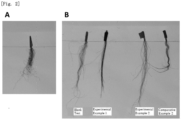
- Fig. 2 presents the results of another hair straightening test.
- the hair of Ethiopian women having a strong frizz tendency was immersed in a primary perming agent (pH: 9.2) of a 10% by mass aqueous solution of ammonium thioglycolate for 30 minutes, and rinsed with running water at 40°C for 30 seconds. Thereafter, the hair was immersed in each of the hair treatment compositions of Experimental example 1, Experimental example 2, and Comparative example 2 for 3 minutes.
- the hair was treated under the same conditions using purified water in place of the experimental examples and the comparative examples.
- the hair was rinsed with running water at 40°C for 30 seconds and wiped with a towel to remove excess water. The water was further removed with a low-temperature dryer, and the hair was slowly stretched with an iron at 180°C.
- Fig. 2A is a photograph illustrating the state of curly hair (20 to 30 hairs, average length: 15 cm) of Ethiopian women before treatment.
- Fig. 2B is a photograph illustrating the state of hair after the treatment.
- Comparative example 2 indicated as "Comp. 2” in the figure
- the state was the same as the hair used in the blank test (indicated as "Blank” in the figure).
- Experimental example 1 indicated as "Ex. 1" in the figure
- Experimental example 2 indicated as “Ex. 2” in the figure
- the frizzy hair was straightened.
- the hair tips were well gathered, and an ideal hair straightening effect was provided.
- the hair treatment effects of the compositions of Experimental examples 1 and 2 on human healthy hair or bleached hair were examined.
- a bundle of 30 to 40 human healthy hairs or bleached hairs (average length: 25 cm) was immersed for 3 minutes in a liquid (pH: 7) prepared by diluting the composition of Experimental example 1, Experimental example 2, or Comparative example 2 in such a manner that the concentration of the dicarboxylic acid and the thiol was 0.5% by mass. Excess water was wiped off.
- the hair was subjected to treatment such that the surface temperature of the hair was 20°C, 60°C, 80°C, or 120°C.
- the hair was wrapped around a 15-mm hot rod with no gaps and allowed to stand at 20°C (room temperature) for 10 minutes. Any excess water was wiped off with a towel. The hair was allowed to stand for another minute before the hair was removed from the hot rod.
- the hair was wound around a 15-mm hot rod with no gaps and heated for 10 minutes in such a manner that the hair surface was brought to 60°C or 80°C. The hair was allowed to stand for another minute to cool the hot rod and removed from the hot rod.
- the hair was wound three times around a cylindrical hair iron having a diameter of 25 mm and heated in such a manner that the hair was held at about 180°C for 10 minutes, thereby forming a curl. Then the hair was removed from the hair iron and allowed to stand at normal temperature for 1 minute.
- the curl formation rate was calculated as follows: The distance (curl diameter) from the bending start position, serving as a starting point, on the root side of the hair bundle in a curled state to the tip of the hair having the second longest hair in the hair bundle was measured. Furthermore, the distance (hair length) from the starting point to the tip of the relevant hair in a stretched state of the hair bundle was measured. The curl formation rate was calculated from (hair length - curl diameter)/hair length ⁇ 100.
- the hair bundle was immersed in the aqueous shampoo solution, rinsed with water, wiped with a towel to remove excess water, and was left to dry at room temperature. This operation was defined as one treatment cycle. The number of treatment cycles at which the formed curl was no longer maintained (less than one turn of the hair bundle) was measured. Under the condition that the bleached hair was set at 80°C, the hair was evaluated according to the feel score described above.
- Table 6 presents the evaluation results when the healthy hair was used.
- Table 7 presents the evaluation results when the bleached hair was used.
- Experimental example 1 and Experimental example 2 in the treatment in which the surface temperature of the hair was set to 40°C to 180°C, a higher curl formation rate was measured than that in the comparative example.
- Experimental example 1 and Experimental example 2 in the treatment in which the surface temperature of the hair was set to 20°C to 80°C, the persistence of the curl formation against at least two or more shampoo actions was provided.
- Comparative example 2 the curl formation was lost by one shampoo wash under any temperature condition.
- Experimental example 1 and Experimental example 2 the feel of the bleached hair was improved. As described above, the effect of the hair treatment agent containing the composition of the present invention was clarified.
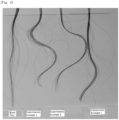
- Fig. 3A presents a photograph of the bleached hair immediately after the treatment at 60°C.
- Fig. 3B presents a photograph of the bleached hair shampooed after treatment.
- Experimental example 1 indicated as “Ex. 1” in the figure
- Experimental example 2 indicated as “Ex. 2” in the figure
- Comparative example 2 indicated as “Comp. 2” in the figure
- Comparative example 1 indicated as "Comp. 1” in the figure
- Comparative example 1 was used for the treatment.
- Comparative example 1 was used for a blank test.
- purified water in place of the experimental examples and comparative examples was used (indicated as "Blank” in the figure).
- the bleached hair in the blank test was damaged from bleaching.
- the bleached hair treated with each of Experimental example 1 and Experimental example 2 was soft and strong, and the curl was maintained even after shampooing.
- Comparative example 1 and Comparative example 2 the curl of the bleached hair disappeared by shampooing.
- compositions prepared in the mixing step of mixing the dicarboxylic acid and the thiol at 20°C (normal temperature), 60°C, or 80°C (Experimental examples 8 to 14) and the compositions prepared in the step of mixing them at 100°C (Experimental examples 1 and 2) were examined.
- the hair treatment composition was prepared using muconic acid and cysteamine.
- 1.42 g of muconic acid was added to 10 g of purified water, followed by the addition of 0.77 g of cysteamine.
- mixing was performed at 20°C (normal temperature).
- the mixture was heated to 60°C, and mixing was performed.
- the mixture was heated to 80°C, and mixing was performed.
- muconic acid and cysteamine were completely dissolved in water, heating was stopped in Experimental examples 10 and 11, and the mixture was left to normal temperature.
- Purified water and, if necessary, aqueous ammonia were added to adjust the pH to about 7.
- hair treatment compositions were prepared using adipic acid and cysteamine.
- adipic acid was added to 10 g of purified water, followed by the addition of 0.77 g of cysteamine.
- mixing was performed at 20°C (normal temperature).
- the mixture was heated to 60°C, and mixing was performed.
- the mixture was heated to 80°C, and mixing was performed.
- heating was stopped in Experimental examples 13 and 14, and the mixture was left to normal temperature.
- the solution was adjusted to a pH of about 7.0 with aqueous ammonia. Purified water was added to adjust the final concentration of adipic acid and cysteamine to 10% by mass.
- Table 9 presents the evaluation results when the bleached hair was used.
- the feel of the hair was superior in the experimental examples in which the compositions were prepared by mixing at 60°C or higher.
- the compositions using adipic acid Example 12 to 14 and 2
- the persistence of the curl and the feel of the hair were superior in Experimental examples in which the compositions were prepared by mixing at 60°C or higher.
- the persistence of the curl and the feel score tended to be superior. This suggested that a higher temperature in the mixing step would promote the formation of the complex.
- Table 10 presents the results.
- the feel was good when wave formation and curl formation were performed, and the persistence thereof was provided even after multiple shampoo washes.
- Experimental example 12 the feel was inferior when wave formation and curl formation were performed, and the persistence thereof after shampoo washes was low, compared with Experimental example 2.
- a composition for hair was prepared by mixing adipic acid and cysteamine at 40°C.
- 1.46 g of adipic acid was added to 10 g of purified water, followed by the addition of 0.77 g of cysteamine. They were mixed at 40°C. When they were completely dissolved, the resulting solution was left to normal temperature. The solution was adjusted to a pH of about 6.5 with aqueous ammonia. Purified water was added to adjust the final concentration of adipic acid and cysteamine to 10% by mass.
- composition of each Experimental example was diluted with an aqueous solution containing 10% by mass of ammonium thioglycolate in such a manner that the concentration of adipic acid and cysteamine was 0.5% by mass, and the pH was adjusted to 9.
- primary perming agents were prepared.
- Thirty to forty human healthy hairs (average length: 25 cm) were immersed in each of the primary agents for 10 minutes, rinsed with running water at 40°C for 20 seconds, wound four times around a hot rod heated to 60°C, and allowed to stand for 10 minutes with the hairs wound with felt to prevent drying. Thereafter, the hair was immersed in a secondary perming agent composed of a 6% by mass aqueous solution of sodium bromate for 10 minutes. The hair was taken out, removed from the hot rod, and dried at normal temperature.
- Table 11 presents the evaluation results.
- small damage was observed in the cuticle on the hair surface.
- Experimental examples 13, 14, and 2 there was no damage, the feel was good, and shine was also seen on the hair treated with each of Experimental example 15 and Experimental example 2.
- the curl-forming power was less than 30 mm in diameter, and the persistence against 33 or more shampoo washes was provided.
- the hair treatment compositions of Experimental examples 13, 14, and 2 in which the complexes prepared by mixing adipic acid and cysteamine at 60°C to 100°C were contained were determined to have a marked hair quality improvement effect on hair when used as the primary perming agent, compared with Experimental examples 12 and 15 in which mixing was performed at 20°C to 40°C.
- shampoo agent stock solutions were prepared, each shampoo agent stock solution containing 6% by weight of TEA-lauroyl methylaminopropionate, 3% by weight of lauryl betaine, 1% by weight of cocamide methyl MEA, 1% by weight of cocamide DEA, 0.3% by weight of polyquaternium-10, and 4% by weight of Experimental example 1 or 2.
- a shampoo agent stock solution containing purified water in place of the experimental example was used.
- Each shampoo agent stock solution was added to hot water at about 40°C in such a manner that the concentration was 10% by weight. The mixture was stirred until foaming occurred, thereby providing a shampoo agent.
- a bundle of 30 to 40 human bleached hairs (average length: 25 cm) was immersed in the shampoo liquid and taken out after 10 seconds. The hair bundle was rubbed by hand for about 10 seconds and rinsed with running water at about 40°C for about 10 seconds. The hair was wiped with a towel to remove water and dried with cold air using a hair dryer.
- the hair was wound three times around a cylindrical hair iron having a diameter of 25 mm and heated for 2 minutes after the surface temperature of the hair reached 180°C to form a curl.
- the curled hair was rinsed with running water at about 40°C for about 10 seconds and wiped with a towel to remove water.
- the curl formation rate was measured by the same method as described above. This was defined as the curl formation rate of the first shampooing.
- each hair was additionally subjected to the same shampoo treatment twice using the same shampoo agent, and the curl formation rates after the second and third shampooing were measured.
- Table 12 presents the results.
- the hair for which the shampoo agent containing Experimental example 1 or Experimental example 2 was used noticeable curls were formed.
- the curls of the hair became stronger as the number of times of shampooing increased.
- the shampoo agent in which purified water was used in place of the experimental example almost no curls were formed.
- a shampoo agent stock solution containing Comparative example 1 was prepared in the same manner as described above.
- a shampoo agent stock solution containing purified water in place of the experimental examples and the comparative example was used.
- Each shampoo agent stock solution was added to hot water at about 40°C in such a manner that the concentration was 10% by weight. The mixture was stirred until foaming occurred, thereby providing a shampoo agent for hair.
- a bundle of 30 to 40 human bleached hairs (average length: 25 cm) was immersed in the shampoo liquid, and taken out after 10 seconds. The hair bundle was rinsed with running water at about 40°C for about 10 seconds.
- the hair was wound around a hair curler having a diameter of 25 mm, and heated with a hair dryer for 3 minutes in such a manner that the hair surface was brought to about 60°C.
- the hair was carefully removed from the hair curler, gently showered with hot water at about 40°C, wiped with a towel to remove water, and allowed to stand.
- Table 13 presents the curl formation rate of the hair.
- Fig. 4 is a photograph illustrating the state of the hair.
- Blank Test Shampoo Agent Containing Experimental Example 1 Shampoo Agent Containing Experimental Example 2
- Comparative Example 1 Curl Formation Rate(%) 0.5 % 14.1 % 11.4% 5.9 %
- Experimental example 11 in which the complex of muconic acid and cysteamine was contained and Experimental example 14 in which the complex of adipic acid and cysteamine was contained were used.
- Experimental example 16 in which a complex of (E)-oct-4-ene-1,8-dioic acid, which is a type of octenedioic acid, and cysteamine was contained was prepared. The preparation was performed under the same conditions as in Experimental example 11, except that 1.73 g of (E)-oct-4-ene-1,8-dioic acid was added instead of muconic acid.
- Experimental example 17 was prepared using muconic acid and thiolactic acid.
- Experimental example 18 was prepared using muconic acid and thiomalic acid.
- Experimental example 17 was prepared under the same conditions as in Experimental example 11, except that 1.06 g of thiolactic acid was added instead of cysteamine.
- Experimental example 18 was prepared under the same conditions as in Experimental example 11, except that 1.50 g of thiomalic acid was added instead of cysteamine.
- compositions of Experimental examples 11, 14, and 16 were used to verify the hair treatment effects on human healthy hair or bleached hair.
- a bundle of 30 to 40 human healthy hairs or bleached hairs (average length: 25 cm) was immersed for 3 minutes in a liquid (pH: 7) prepared by diluting the composition of each of the experimental examples in such a manner that the concentration of dicarboxylic acid and thiol was 0.5% by mass, and excess water was wiped off.
- the hair was wound around a 15-mm hot rod with no gaps and heated for 10 minutes in such a manner that the hair surface was brought to 80°C.
- the hair was allowed to stand for another minute to cool the hot rod and removed from the hot rod.
- the curl formation rate was calculated as follows: The distance (curl diameter) from the bending start position, serving as a starting point, on the root side of the hair bundle in a curled state to the tip of the hair having the second longest hair in the hair bundle was measured. Furthermore, the distance (hair length) from the starting point to the tip of the relevant hair in a stretched state of the hair bundle was measured. The curl formation rate was calculated from (hair length - curl diameter)/hair length ⁇ 100.
- the hair bundle was immersed in the aqueous shampoo solution, rinsed with water, wiped with a towel to remove excess water, and was left to dry at room temperature. This operation was defined as one treatment cycle. The number of treatment cycles at which the formed curl was no longer maintained (less than one turn of the hair bundle) was measured.
- Table 14 presents the evaluation results when the healthy hair was used.
- Table 15 presents the evaluation results when the bleached hair was used.
- the state of the hair was good, and highly persistent curls of the hair were formed.
- Experimental Example 11 Experimental Example 14
- Table 15 Experimental Example 11 Experimental Example 14 Experimental Example 16 Curl Formation Rate (%) 42.1 14.0 43.6 Persistence (Number of Times) 4 2 3 Finding Strong, Soft and Shiny of Hair Surface Strong and Shiny of Hair Surface Strong, Soft and Shiny of Hair Surface
- the mixture was stirred until foaming occurred, thereby providing a shampoo agent for hair.
- a bundle of 30 to 40 human bleached hairs (average length: 25 cm) was immersed in the shampoo liquid, and taken out after 10 seconds.
- the hair bundle was rinsed with running water at about 40°C for about 10 seconds.
- a hair treatment composition was prepared using muconic acid and cysteamine.
- trans-trans muconic acid was used.
- 1.42 g of muconic acid was added to 10 g of purified water, followed by the addition of aqueous ammonia to adjust the pH to 4.2.
- the mixture was heated to 80°C.
- 0.77 g of cysteamine was added.
- the mixture was heated to boiling (up to 100°C) while mixing.
- the boiling state (100°C) was maintained for 3 minutes to prepare a complex. Heating was stopped, and then the mixture was allowed to stand to normal temperature. After ensuring that there was no undissolved residue, the pH of the mixture was adjusted to about 7.0 with aqueous ammonia.
- Purified water was added to adjust the final concentration of muconic acid and cysteamine to 10% by mass.
- a hair treatment composition was prepared using muconic acid and cysteamine.
- trans-trans muconic acid was used.
- 1.42 g of muconic acid was added to 10 g of purified water, followed by the addition of aqueous ammonia to adjust the pH to 9.0.
- the mixture was heated to 80°C.
- 0.77 g of cysteamine was added.
- the mixture was heated to boiling (up to 100°C) while mixing.
- the boiling state (100°C) was maintained for 3 minutes. Heating was stopped, and then the mixture was allowed to stand to normal temperature.
- the pH of the mixture was adjusted to about 7.0 with aqueous ammonia.
- Purified water was added to adjust the final concentration of muconic acid and cysteamine to 10% by mass.
- compositions of Experimental examples 19 and 20 were used to verify the hair treatment effects on human healthy hair.
- a bundle of 30 to 40 human healthy hairs or bleached hairs (average length: 25 cm) was immersed for 3 minutes in a liquid (pH: 7) prepared by diluting the composition of each of the experimental examples and the comparative example in such a manner that the concentration of dicarboxylic acid and thiol was 0.5% by mass, and excess water was wiped off.
- the hair was wound around a 15-mm hot rod with no gaps and heated for 10 minutes in such a manner that the hair surface was brought to 60°C.
- the hair was allowed to stand for another minute to cool the hot rod and removed from the hot rod.
- a hair treatment composition was prepared by mixing cysteamine and muconic acid in a mole ratio of 2:1.
- trans-trans muconic acid was used.
- 1.42 g of muconic acid was added to 10 g of purified water and dissolved by the addition of aqueous ammonia.
- the mixture was heated to 80°C.
- 2.27 g of cysteamine hydrochloride was added.
- the mixture was heated to boiling (up to 100°C) while mixing.
- the boiling state (100°C) was maintained for 1 hour to allow muconic acid and cysteamine to react with each other. Heating was stopped, and then the mixture was allowed to stand to normal temperature.
- the pH of the mixture was adjusted to about 7.0 with aqueous ammonia.
- Purified water was added to adjust the final concentration of muconic acid and cysteamine to 10% by mass.
- a hair treatment composition was prepared by mixing cysteamine and muconic acid in a mole ratio of 3:1 and was prepared under the same conditions as in Experimental example 24, except that 3.40 g of cysteamine hydrochloride was added to 1.42 g of cis-cis muconic acid.
- a hair treatment composition was prepared by mixing cysteamine and muconic acid in a mole ratio of 1:1 and was prepared under the same conditions as in Experimental example 24, except that 1.13 g of cysteamine hydrochloride was added to 1.42 g of cis-cis muconic acid.
- a hair treatment composition was prepared by mixing cysteamine and muconic acid in a mole ratio of 1:2 and was prepared under the same conditions as in Experimental example 24, except that 0.57 g of cysteamine hydrochloride was added to 1.42 g of cis-cis muconic acid.
- compositions of Experimental examples 21 to 27 were used to verify the hair treatment effects on human healthy hair by the same method as in "12.".
- Table 19 presents the preparation conditions and the curl formation rate of each experimental example.
- Good hair treatment effects were obtained in all experimental examples using any isomer of muconic acid.
- the use of trans-trans muconic acid indicated that highly effective complexes were prepared even with short reaction times.
- the highly effective complexes were prepared when cysteamine and muconic acid were mixed in a mole ratio of 1:1 to 3:1.
- Experimental example 25 in which mixing was performed in a mole ratio of 3:1, a bad odor derived from thiol remained on the hair.
- the feel of the hair treated with Experimental example 25 was slightly inferior to Experimental example 24 or Experimental example 26.
Landscapes
- Health & Medical Sciences (AREA)
- Life Sciences & Earth Sciences (AREA)
- Animal Behavior & Ethology (AREA)
- General Health & Medical Sciences (AREA)
- Public Health (AREA)
- Veterinary Medicine (AREA)
- Birds (AREA)
- Epidemiology (AREA)
- Emergency Medicine (AREA)
- Dermatology (AREA)
- Physics & Mathematics (AREA)
- Thermal Sciences (AREA)
- Cosmetics (AREA)
Applications Claiming Priority (2)
| Application Number | Priority Date | Filing Date | Title |
|---|---|---|---|
| JP2021059023 | 2021-03-31 | ||
| PCT/JP2022/016376 WO2022210997A1 (ja) | 2021-03-31 | 2022-03-31 | 毛髪処理用組成物、及び毛髪処理方法 |
Publications (2)
| Publication Number | Publication Date |
|---|---|
| EP4316601A1 true EP4316601A1 (de) | 2024-02-07 |
| EP4316601A4 EP4316601A4 (de) | 2025-04-09 |
Family
ID=83459593
Family Applications (1)
| Application Number | Title | Priority Date | Filing Date |
|---|---|---|---|
| EP22781207.0A Pending EP4316601A4 (de) | 2021-03-31 | 2022-03-31 | Haarbehandlungszusammensetzung und haarbehandlungsverfahren |
Country Status (6)
| Country | Link |
|---|---|
| US (1) | US20240156701A1 (de) |
| EP (1) | EP4316601A4 (de) |
| JP (2) | JP7232484B2 (de) |
| KR (1) | KR20230165240A (de) |
| CN (1) | CN117120023A (de) |
| WO (1) | WO2022210997A1 (de) |
Family Cites Families (13)
| Publication number | Priority date | Publication date | Assignee | Title |
|---|---|---|---|---|
| FR2868305B1 (fr) * | 2004-04-02 | 2006-06-30 | Oreal | Procede de traitement capillaire et utilisation dudit procede |
| KR100684985B1 (ko) | 2004-07-30 | 2007-02-20 | 한국화학연구원 | 자가조형성 퍼머제 |
| WO2006011771A1 (en) | 2004-07-30 | 2006-02-02 | Korea Research Institute Of Chemical Technology | Self-molding permanent agent and method for proceeding free-rod and free-band type permanent |
| JP5033488B2 (ja) | 2006-06-07 | 2012-09-26 | 花王株式会社 | 毛髪形状制御剤第1剤 |
| JP5112836B2 (ja) | 2007-12-06 | 2013-01-09 | 花王株式会社 | 毛髪形状制御剤第1剤 |
| JP2009256289A (ja) | 2008-04-21 | 2009-11-05 | Hoyu Co Ltd | パーマネントウェーブ用又は縮毛矯正用後処理剤組成物 |
| GB2495341B (en) * | 2011-11-11 | 2013-09-18 | Novartis Ag | Fermentation methods and their products |
| FR3009785A1 (fr) * | 2013-08-22 | 2015-02-27 | Marcel Georges Cohen | Composition cosmetique de lissage, ensemble et utilisation associes. |
| WO2017041905A1 (en) | 2015-09-08 | 2017-03-16 | Kao Germany Gmbh | Process for permanent shaping hair |
| US11679070B2 (en) * | 2016-05-12 | 2023-06-20 | L'oreal | Methods for treating hair |
| CN109789071B (zh) * | 2016-09-27 | 2022-03-15 | 株式会社爱茉莉太平洋 | 毛发护理组合物 |
| JOP20180033A1 (ar) | 2017-04-12 | 2019-01-30 | Coty Inc | طريقة لعلاج الشعر، طقم، واستخدام الطقم |
| WO2020190837A1 (en) * | 2019-03-15 | 2020-09-24 | Isp Investments Llc | A hair straightening or hair styling composition and method of use thereof |
-
2021
- 2021-03-31 US US18/552,770 patent/US20240156701A1/en active Pending
-
2022
- 2022-03-31 CN CN202280026209.8A patent/CN117120023A/zh active Pending
- 2022-03-31 WO PCT/JP2022/016376 patent/WO2022210997A1/ja not_active Ceased
- 2022-03-31 KR KR1020237033664A patent/KR20230165240A/ko active Pending
- 2022-03-31 JP JP2022057769A patent/JP7232484B2/ja active Active
- 2022-03-31 EP EP22781207.0A patent/EP4316601A4/de active Pending
- 2022-10-07 JP JP2022162154A patent/JP2022176370A/ja active Pending
Also Published As
| Publication number | Publication date |
|---|---|
| JP2022176370A (ja) | 2022-11-25 |
| JP2022159183A (ja) | 2022-10-17 |
| JP7232484B2 (ja) | 2023-03-03 |
| EP4316601A4 (de) | 2025-04-09 |
| CN117120023A (zh) | 2023-11-24 |
| US20240156701A1 (en) | 2024-05-16 |
| KR20230165240A (ko) | 2023-12-05 |
| WO2022210997A1 (ja) | 2022-10-06 |
Similar Documents
| Publication | Publication Date | Title |
|---|---|---|
| CN104159567B (zh) | 使用阴离子氧化多糖用于保护和修复角蛋白纤维的方法 | |
| US9283157B2 (en) | Hair treatment and revitalizing composition and methods | |
| US20120230935A1 (en) | Solvent composition for one-step permanent wave and hair straightener | |
| RU2294681C2 (ru) | Способ обработки волос и применение способа для придания волосам гладкости | |
| TWI800561B (zh) | 毛髮處理方法 | |
| CN119234061A (zh) | 纤维处理剂 | |
| JPH0840850A (ja) | ケラチン物質のパーマネント形成の処理方法 | |
| CN105555254B (zh) | 使用氧化多糖和鞘氨醇化合物处理角蛋白纤维的方法 | |
| JP2015508387A (ja) | ケラチン繊維を処置する方法 | |
| EP4238547A1 (de) | Haarkosmetikum und verfahren zur herstellung davon sowie verfahren zur verbesserung der haarqualität und verfahren zur formung der haarform mit diesem haarkosmetikum | |
| JP5875303B2 (ja) | 毛髪用化粧料 | |
| EP0257256B1 (de) | Verfahren und Mittel zum Dauerwellen und -strecken der Haare | |
| EP0356508A4 (en) | Permanent wave process and compositions | |
| EP4316601A1 (de) | Haarbehandlungszusammensetzung und haarbehandlungsverfahren | |
| TWI705829B (zh) | 捲髮矯正處理或燙髮處理之毛髮成形處理方法、及毛髮成形處理用毛髮處理液 | |
| HK40108245A (en) | Hair treatment composition and hair treatment method | |
| GB2090303A (en) | Method for Relaxing and then imparting Controlled Curvature to Curly or Kinky Hair | |
| JP2017014175A (ja) | 毛髪前処理方法及び毛髪前処理剤 | |
| JP7843021B2 (ja) | 毛髪処理剤、毛髪変形剤セット、および毛髪変形処理方法 | |
| US4885160A (en) | Wrapping lotion and method for permanent waving | |
| US4996997A (en) | Permanent waving process and compositions | |
| US4883657A (en) | Rearranger process and composition for permanent waving process | |
| JP2024108092A (ja) | 酸性縮毛矯正、酸性パーマネントウェーブ及び酸性加熱式パーマネントウェーブ用第2剤 | |
| JP2023133043A (ja) | 炭酸アルキレン・チオグリコール酸グリセリル混合液ならびに、酸性縮毛矯正用第1剤、酸性パーマネントウェーブ用第1剤、又は酸性加熱式パーマネントウェーブ用第1剤 | |
| HK1174563A1 (en) | Hair styling composition |
Legal Events
| Date | Code | Title | Description |
|---|---|---|---|
| STAA | Information on the status of an ep patent application or granted ep patent |
Free format text: STATUS: THE INTERNATIONAL PUBLICATION HAS BEEN MADE |
|
| PUAI | Public reference made under article 153(3) epc to a published international application that has entered the european phase |
Free format text: ORIGINAL CODE: 0009012 |
|
| STAA | Information on the status of an ep patent application or granted ep patent |
Free format text: STATUS: REQUEST FOR EXAMINATION WAS MADE |
|
| 17P | Request for examination filed |
Effective date: 20231005 |
|
| AK | Designated contracting states |
Kind code of ref document: A1 Designated state(s): AL AT BE BG CH CY CZ DE DK EE ES FI FR GB GR HR HU IE IS IT LI LT LU LV MC MK MT NL NO PL PT RO RS SE SI SK SM TR |
|
| DAV | Request for validation of the european patent (deleted) | ||
| DAX | Request for extension of the european patent (deleted) | ||
| REG | Reference to a national code |
Ref country code: HK Ref legal event code: DE Ref document number: 40108245 Country of ref document: HK |
|
| RAP1 | Party data changed (applicant data changed or rights of an application transferred) |
Owner name: DSTYLE HOLDINGS CO., LTD. Owner name: DIANA CO., LTD. Owner name: BIOTOP MAYA CO., LTD. Owner name: B. PRO CO., LTD. |
|
| REG | Reference to a national code |
Ref country code: DE Ref legal event code: R079 Free format text: PREVIOUS MAIN CLASS: A61Q0005000000 Ipc: A61K0008460000 |
|
| A4 | Supplementary search report drawn up and despatched |
Effective date: 20250307 |
|
| RIC1 | Information provided on ipc code assigned before grant |
Ipc: A61K 8/37 20060101ALI20250303BHEP Ipc: A61Q 5/12 20060101ALI20250303BHEP Ipc: A61Q 5/10 20060101ALI20250303BHEP Ipc: A61Q 5/08 20060101ALI20250303BHEP Ipc: A61Q 5/06 20060101ALI20250303BHEP Ipc: A61Q 5/04 20060101ALI20250303BHEP Ipc: A61Q 5/02 20060101ALI20250303BHEP Ipc: A61Q 5/00 20060101ALI20250303BHEP Ipc: A61K 8/362 20060101ALI20250303BHEP Ipc: A61K 8/46 20060101AFI20250303BHEP |
|
| RAP1 | Party data changed (applicant data changed or rights of an application transferred) |
Owner name: DSTYLE HOLDINGS CO., LTD. Owner name: BIOTOP MAYA CO., LTD. Owner name: B. PRO CO., LTD. |