EP4308802B1 - Kartusche für eine wärmekraftmaschine mit thermodynamischem zyklus und zugehörige wärmekraftmaschine - Google Patents
Kartusche für eine wärmekraftmaschine mit thermodynamischem zyklus und zugehörige wärmekraftmaschine Download PDFInfo
- Publication number
- EP4308802B1 EP4308802B1 EP22715581.9A EP22715581A EP4308802B1 EP 4308802 B1 EP4308802 B1 EP 4308802B1 EP 22715581 A EP22715581 A EP 22715581A EP 4308802 B1 EP4308802 B1 EP 4308802B1
- Authority
- EP
- European Patent Office
- Prior art keywords
- profile
- cartridge
- filling space
- wall
- piston
- Prior art date
- Legal status (The legal status is an assumption and is not a legal conclusion. Google has not performed a legal analysis and makes no representation as to the accuracy of the status listed.)
- Active
Links
Images







Classifications
-
- F—MECHANICAL ENGINEERING; LIGHTING; HEATING; WEAPONS; BLASTING
- F01—MACHINES OR ENGINES IN GENERAL; ENGINE PLANTS IN GENERAL; STEAM ENGINES
- F01K—STEAM ENGINE PLANTS; STEAM ACCUMULATORS; ENGINE PLANTS NOT OTHERWISE PROVIDED FOR; ENGINES USING SPECIAL WORKING FLUIDS OR CYCLES
- F01K7/00—Steam engine plants characterised by the use of specific types of engine; Plants or engines characterised by their use of special steam systems, cycles or processes; Control means specially adapted for such systems, cycles or processes; Use of withdrawn or exhaust steam for feed-water heating
- F01K7/32—Steam engine plants characterised by the use of specific types of engine; Plants or engines characterised by their use of special steam systems, cycles or processes; Control means specially adapted for such systems, cycles or processes; Use of withdrawn or exhaust steam for feed-water heating the engines using steam of critical or overcritical pressure
-
- F—MECHANICAL ENGINEERING; LIGHTING; HEATING; WEAPONS; BLASTING
- F01—MACHINES OR ENGINES IN GENERAL; ENGINE PLANTS IN GENERAL; STEAM ENGINES
- F01K—STEAM ENGINE PLANTS; STEAM ACCUMULATORS; ENGINE PLANTS NOT OTHERWISE PROVIDED FOR; ENGINES USING SPECIAL WORKING FLUIDS OR CYCLES
- F01K25/00—Plants or engines characterised by use of special working fluids, not otherwise provided for; Plants operating in closed cycles and not otherwise provided for
- F01K25/08—Plants or engines characterised by use of special working fluids, not otherwise provided for; Plants operating in closed cycles and not otherwise provided for using special vapours
-
- F—MECHANICAL ENGINEERING; LIGHTING; HEATING; WEAPONS; BLASTING
- F01—MACHINES OR ENGINES IN GENERAL; ENGINE PLANTS IN GENERAL; STEAM ENGINES
- F01K—STEAM ENGINE PLANTS; STEAM ACCUMULATORS; ENGINE PLANTS NOT OTHERWISE PROVIDED FOR; ENGINES USING SPECIAL WORKING FLUIDS OR CYCLES
- F01K25/00—Plants or engines characterised by use of special working fluids, not otherwise provided for; Plants operating in closed cycles and not otherwise provided for
- F01K25/08—Plants or engines characterised by use of special working fluids, not otherwise provided for; Plants operating in closed cycles and not otherwise provided for using special vapours
- F01K25/10—Plants or engines characterised by use of special working fluids, not otherwise provided for; Plants operating in closed cycles and not otherwise provided for using special vapours the vapours being cold, e.g. ammonia, carbon dioxide, ether
-
- F—MECHANICAL ENGINEERING; LIGHTING; HEATING; WEAPONS; BLASTING
- F01—MACHINES OR ENGINES IN GENERAL; ENGINE PLANTS IN GENERAL; STEAM ENGINES
- F01K—STEAM ENGINE PLANTS; STEAM ACCUMULATORS; ENGINE PLANTS NOT OTHERWISE PROVIDED FOR; ENGINES USING SPECIAL WORKING FLUIDS OR CYCLES
- F01K25/00—Plants or engines characterised by use of special working fluids, not otherwise provided for; Plants operating in closed cycles and not otherwise provided for
- F01K25/08—Plants or engines characterised by use of special working fluids, not otherwise provided for; Plants operating in closed cycles and not otherwise provided for using special vapours
- F01K25/10—Plants or engines characterised by use of special working fluids, not otherwise provided for; Plants operating in closed cycles and not otherwise provided for using special vapours the vapours being cold, e.g. ammonia, carbon dioxide, ether
- F01K25/103—Carbon dioxide
-
- F—MECHANICAL ENGINEERING; LIGHTING; HEATING; WEAPONS; BLASTING
- F02—COMBUSTION ENGINES; HOT-GAS OR COMBUSTION-PRODUCT ENGINE PLANTS
- F02G—HOT GAS OR COMBUSTION-PRODUCT POSITIVE-DISPLACEMENT ENGINE PLANTS; USE OF WASTE HEAT OF COMBUSTION ENGINES; NOT OTHERWISE PROVIDED FOR
- F02G1/00—Hot gas positive-displacement engine plants
- F02G1/04—Hot gas positive-displacement engine plants of closed-cycle type
- F02G1/043—Hot gas positive-displacement engine plants of closed-cycle type the engine being operated by expansion and contraction of a mass of working gas which is heated and cooled in one of a plurality of constantly communicating expansible chambers, e.g. Stirling cycle type engines
- F02G1/044—Hot gas positive-displacement engine plants of closed-cycle type the engine being operated by expansion and contraction of a mass of working gas which is heated and cooled in one of a plurality of constantly communicating expansible chambers, e.g. Stirling cycle type engines having at least two working members, e.g. pistons, delivering power output
Definitions
- the present invention relates to the field of cartridges for thermodynamic cycle heat machines and associated thermodynamic cycle heat machine modules.
- the current energy transition is bringing challenges in many areas and involves in particular reducing primary energy consumption.
- the industrial sector produces large quantities of thermal energy, most of which is still rejected today in the form of residual heat, known as fatal heat.
- This lost heat constitutes an enormous source of energy, directly available and already paid for, the recovery of which constitutes a strategic issue for industry.
- the recovery of fatal heat can be done either by directly supplying heat networks or by being temporarily stored, or by being converted into electricity for internal or external use.
- it poses many implementation constraints, in particular on the mandatory proximity of the end use.
- Stirling engines Machines with external heat input and using a working fluid in a closed cycle without phase change are generally called Stirling engines. More specifically, the so-called beta or gamma type Stirling engines have a working piston and a displacer used to transfer the working fluid alternately from the hot side to the cold side. In this type of engine, the working piston and the displacer are mechanically linked. These engines are characterized by a very low power density and difficult power control because the rotation speed depends mainly from the temperature difference of the sources. The few commercially available machines therefore require a large temperature difference between the heat sources, often of the order of several hundred degrees Celsius, to compensate for the low thermal conductivities of the working gases used, the small heat exchange surfaces and the dead volumes of the regenerator.
- thermodynamic cycle A multi-cylinder external heat input engine architecture is proposed in the publication WO02088536
- the technique of "liquid" displacers implemented and the series connection of the pistons for the transfer of the thermodynamic fluid from one piston chamber to the other does not allow management of the position of the thermodynamic fluid independent of the working fluid, and therefore does not allow optimization of the thermodynamic cycle carried out.
- the present invention aims to propose a scalable and modular solution allowing the exploitation of a heat source whose temperature is lower than 150 degrees Celsius.
- the configuration in the form of a cartridge 1, 1' makes it possible to provide a modular and scalable solution.
- the first profile 2 and the second profile 8 provide large internal and external exchange surfaces which contribute to the efficiency of heat transfer between the heat transfer fluid and the thermodynamic fluid.
- the first profile 2 and the second profile 8 can be produced at very low cost.
- the chamber 24 which is under pressure, for pressures preferably between 50 bars and 300 bars, preferably between 80 bars and 250 bars and which contains the displacer 25 is closed with respect to the low pressure environment.
- the low pressure environment corresponds to pressures preferably between 0 bar and 50 bars and preferably between 0 bar and 10 bars.
- the control of the displacer 25 is thus done from the outside of the chamber 24, by means of the movement of the piston 26.
- the displacer 25 can perform, in addition to its function of moving the thermodynamic fluid, a regenerator function since the thermodynamic fluid flows around the displacer 25 during the movement between the first position P1 and the second position P2.
- the displacer 25 can be heated or cooled by means of the heat transfer fluid alone, when it is static in the first position P1 or in the second position P2.
- the first heat transfer fluid supply circuit A, B and the second heat transfer fluid supply circuit C, D make it possible to supply the external heat necessary for the operation of the heat engine preferably by ensuring a temperature difference between the so-called cold part and the so-called hot part.
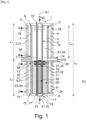
- figure 1 represents cartridge 1 with displacer 25 and piston 26 in the first position P1. In this configuration, the thermodynamic fluid is confined between the first profile 2 and the third profile 15 and is then in the first filling space 21, in contact with the temperature of the first heat transfer fluid supply circuit A, B.
- the dotted line shows the second position P2 of the displacer 25 and the piston 26, in which the thermodynamic fluid is confined between the second profile 8 and the third profile 15 and is then in the second filling space 23, in contact with the temperature of the second heat transfer fluid supply circuit C, D.
- the change from the first position P1 to the second position P2 or vice versa is controlled by the piston 26, preferably by means of a relative pressure between the points H and J, which thus makes it possible to move the thermodynamic fluid between the first filling space 21 and the second filling space 23.
- a thermodynamic fluid supply outlet G connected to the chamber 24 of said at least one cartridge 1 makes it possible to exploit the strong pressure differences generated inside the cartridge 1 to exploit the energy.
- the chamber 24 can accommodate a thermodynamic fluid that is under pressure, for example greater than 10 bars, but ideally above or equal to its critical pressure, so as to have a greatly improved convective heat transfer compared to a gas close to atmospheric pressure.
- the improvement is typically one to two orders of magnitude, namely 100 to 1000 [W/m 2 .K] instead of 10 [W/m 2 .K]
- the second filling space 23 which allows the thermodynamic fluid to be contained under high pressure is located between the third profile 15 and the second profile 8.
- the thermodynamic fluid is preferably maintained in a supercritical state.
- the thermodynamic fluid may be carbon dioxide, this example is not limiting.
- the first filling space 21 which makes it possible to contain the thermodynamic fluid under high pressure, that is to say for pressures preferably between 50 bars and 300 bars, preferably between 80 bars and 250 bars, is located between the third profile 15 and the first profile 2.
- the thermodynamic fluid is preferably maintained in a supercritical state.
- the first profile 2 and/or the second profile 8 is made of a material with high thermal conductivity, preferably between 100 Watts per meter-Kelvin and 400 Watts per meter-Kelvin, for example an aluminum or copper alloy.
- this property of the first profile 2 and/or the second profile 8 contributes to the efficiency of heat transfers between the heat transfer fluid and the thermodynamic fluid.
- the third profile 15 is preferably made of non-magnetic material and the displacer 25 and the piston 26 are magnetically coupled to each other through the third profile 15 by magnetic connection means 27.
- this configuration allows control of the displacer 25 from outside the chamber 24 by means of a magnetic coupling between the piston 26 and the displacer 25.
- This magnetic coupling allows axial forces to be transmitted to the displacer 25 without mechanical contact and therefore without friction. thus avoiding causing losses and prohibitive wear through friction. This arrangement thus helps to limit losses.
- Amagnetic means a material that does not have magnetic properties or whose magnetic permeability is low, i.e. for example close to 1 and generally less than 50.
- the third profile 15 is made of stainless steel.
- the piston 26 comprises one or more permanent magnets 32 and the displacer 25 comprises one or more permanent magnets 33, said permanent magnets 32, 33 forming said magnetic connection means 27.
- said first profile 2 extends longitudinally over a first length L1 along an axis A1 and said second profile 8 extends longitudinally along the axis A1 over a second length L2.
- said second profile 8 is in the extension of the first profile 2 in the direction of the axis A1.
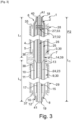
- the first length L1 is equal to the second length L2, so as to allow symmetry of the cartridge according to the joining means 14 described below, as illustrated by the figures 1 , 3 And 4 .
- said first profile 2 comprises a first end 6 and a second joining end 7
- said second profile 8 comprises a first end 12 and a second joining end 13
- the first profile 2 and the second profile 8 are joined to each other by joining means 14 at their respective second joining ends 7, 13.
- first profile 2 and the second profile 8 are distinct from each other to avoid heat transfers, while being connected to each other by the joining means 14.
- the first exchanger and the second exchanger are mounted opposite each other on the joining means 14.
- the second junction ends 7, 13 on the one hand are configured to allow the junction with the junction means 14 and on the other hand comprise at least one opening leading to the first/second circulation means 3, 9.
- the joining means 14 have a thermal conductivity lower than the thermal conductivity of said first profile 2 and/or of the second profile 8.
- the joining means 14 make it possible to thermally separate the first profile 2 and the second profile 8.
- the joining means 14 comprise at least one thermal insulating material arranged at least to thermally insulate said first profile 2 from said second profile 8 or vice versa.
- this configuration allows better insulation between the so-called cold part and the so-called hot part of the cartridge 1, 1'.
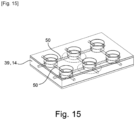
- the junction means 14 may consist of a junction plate 39 which may be covered on each face with a layer of insulating material.
- said third profile 15, said first profile 2 and said second profile 8, the displacer 25 and the piston 26 are coaxial along said axis A1.
- this configuration makes it possible to define a chamber 24 of annular shape.
- the third profile 15 is thus arranged concentrically on a diameter smaller than the first profile 2 and the second profile 8.
- the third profile 15 extends longitudinally along said axis A1 over a third length L3, said third length L3 being greater than the first length L1 or the second length L2 and preferably greater than or equal to the sum of the first length L1 and the second length L2.
- the third profile 15 passes through the so-called cold part and the so-called hot part of the cartridge 1, 1' over a length L3 as defined above.
- the displacer 25 can be moved alternately between the so-called cold part and the so-called hot part by sliding at least over a portion of the third length L3 of the third profile 15.
- the third profile 15 is a hollow tube of cylindrical shape.
- the third profile 15 comprises a first end 18 and a second end 19, the first end 6 of the first profile 2 and the first end 18 of the third profile 15 are joined by connecting means, and the first end 12 of the second profile 8 and the second end 19 of the third profile 15 are joined by connecting means.
- the first end 6 of the first profile 2 and the first end 18 of the third profile 15 are fixed to each other for example, by crimping, brazing, joining or by one or more additional elements.
- the first end 6 of the first profile 2 has a conical shape, this example is not limiting.
- the first end 12 of the second profile 8 and the second end 19 of the third profile 15 are fixed to each other for example, by crimping, brazing, joining or by one or more additional elements.
- the first end 12 of the second profile 8 has a conical shape, this example is not limiting.
- the cartridge 1, 1' comprises a first reinforcing piece 28 of radial and/or axial constraints in which the first profile 2 is gripped and a second reinforcing piece 29 of radial and/or axial constraints in which the second profile 8 is gripped.
- the first reinforcing piece 28 and the second reinforcing piece 29 make it possible to take up the radial and/or axial pressure forces, which makes it possible to minimize the first thickness E1 of the first profile 2 and the second thickness E2 of the second profile 8 in order to bring the heat transfer fluid as close as possible to the thermodynamic fluid.
- These pressure forces are due to the pressure of the thermodynamic fluid contained in the chamber 24 which are exerted on the first and second profiles 2, 8.
- the assembly of the first reinforcement part 28 to the first profile 2 and the assembly of the second reinforcement part 29 to the second profile 8 can be done by an assembly method which ensures zero radial clearance between the two parts: pressing/shrinking/gluing/forming of the tube by rolling or shrinking.
- FIG. 2 illustrates the absorption of radial forces by the second reinforcement piece 29 in order to minimize the second thickness E2 of the second profile 8.
- Figures 7, 8 and 9 illustrate the absorption of radial forces by the first reinforcement piece 28 in order to minimize the first thickness E1 of the first profile 2.
- the first reinforcing piece 28 or the second reinforcing piece 29 may comprise a strapping.
- the first reinforcing piece 28 and the second reinforcing piece 29 have a hollow cylindrical shape.
- the first profile 2 and the second profile 8 are each assembled without play in the strapping.
- the radial forces are taken up by the strapping.
- the strapping can itself be fixed on one side to the first end 6, 12 of the first/second profile 2, 8 and on the other side be fixed to the joining means 14.
- the first reinforcing piece 28 or the second reinforcing piece 29 may, in addition to the strapping, comprise a flange 51 held by fixing means 52 to the first/second profile 2, 8.
- the axial forces are taken up by the flange, which is particularly important for a 1,1' cartridge whose diameter is preferably between 20 millimeters and 120 millimeters.
- the flange 51 can further form a first/second dividing wall 48, 49 described below.
- the first reinforcing piece 28 or the second reinforcing piece 29 comprises only the strapping and the axial forces are taken up by the first/second profile 2, 8 and the third profile 15.
- the first reinforcement piece 28 and/or the second reinforcement piece 29 and/or the first profile 2 and/or the second profile 8 and/or the third profile 15 is arranged to absorb axial forces.
- the first thickness E1 of the first profile 2 and/or the second thickness E2 of the second profile 8 is between 1 millimeter and 15 millimeters, preferably between 2 millimeters and 6 millimeters.
- the internal wall 4 of the first profile 2 and/or the internal wall 10 of the second profile 8 has a crenellated surface ( figures 7 , 8 And 9 ) and/or a smooth surface ( figure 2 ).
- the smooth contact surface between the second profile 8 and the thermodynamic fluid is at its simplest with a tubular geometry.
- the internal wall 4 and/or the internal wall 10 has a crenellated surface ( figure 7 , 8 And 9 ) then the surface area is increased compared to a smooth surface ( figure 2 ) and the heat exchanges are improved.
- the exchange surface is extended.
- said first profile 2 has a first thickness E1 between the internal wall 4 and the external wall 5 and the first profile 2 comprises in its first thickness E1 at least one channel 30 and/or at least one groove 31 forming said first circulation means 3, said at least one channel 30 and/or at least one groove 31 extending in a longitudinal direction parallel to the axis A1 and over a length L4.
- said at least one channel 30 and/or said at least one groove 31 allows the circulation of the heat transfer fluid in the first exchanger.
- the channel 30 has a substantial exchange surface between the heat transfer fluid and the first profile 2. This configuration contributes to maximizing heat transfers.
- said second profile 8 has a second thickness E2 between the internal wall 10 and the external wall 11 and the second profile 8 comprises in its second thickness E2 at least one channel 30 and/or at least one groove 31 forming said second circulation means 9, said at least one channel 30 and/or at least one groove 31 extending in a longitudinal direction parallel to the axis A and over a length L5.
- said at least one channel 30 and/or said at least one groove 31 allows the circulation of the heat transfer fluid in the second exchanger.
- the channel 30 has a substantial exchange surface between the heat transfer fluid and the second profile 8. This configuration contributes to maximizing heat transfers.
- said at least one channel 30 has a square or rectangular or trapezoidal section ( figure 8 ) or circular ( figure 7 ).
- Said at least one groove 31 can be opened ( figures 2 And 3 ).
- Said at least one channel 30 and/or at least one groove 31 may be rectilinear or helical.
- the section of the displacer 25 is smaller than the section of the chamber 24 so as to respectively provide a clearance J1 between the displacer 25 and the internal wall 4 of the first profile 2 or a clearance J2 between the displacer 25 and the internal wall 10 of the second profile 8 ( figures 2 , 7 , 8 And 9 ).
- This game J1, J2 advantageously allows the passage of the thermodynamic fluid during the movement of the displacer 25. Each time the thermodynamic fluid passes, part of the heat of the latter is transferred to the displacer 25 to perform the regeneration function.
- said clearance J1, J2 is between 0.05 millimeters and 5 millimeters, preferably between 0.1 millimeters and 1 millimeter.
- the section of the displacer 25 is equal to the section of the chamber 24 and the displacer 25 is at least partly in a porous material.
- the porosity of the displacer 25 advantageously allows the passage of the thermodynamic fluid during the movement of the displacer 25. Each time the thermodynamic fluid passes, part of the heat of the latter is transferred to the displacer to perform the regeneration function.
- the section of the chamber 24 is annular in shape and the section of the displacer 25 is annular in shape ( figure 2 ).
- the displacer 25 matches the shape of the internal wall 4 of the first profile 2 and/or the internal wall 10 of the second profile 8 ( figures 7 And 8 ).
- the piston 26 is a low pressure piston.
- the low pressure environment corresponds to pressures preferably between 0 bar and 50 bar and preferably between 0 bar and 10 bar.
- said cartridge 1' is called hybrid and further comprises a hydraulic piston 34 arranged inside the first filling space 21 or the second filling space 23 of said chamber 24, the first filling space 21 or the second filling space 23 being capable and intended to contain at least one hydraulic fluid and being capable and intended to be connected to a supply outlet of a hydraulic fluid E and said hydraulic piston 34 is slidably mounted in the direction of the axis A1 relative to the external wall 17 of said third profile 15 and movable inside the first filling space 21 or the second filling space 23 between a first position P3 and a second position P4 and configured to on the one hand be moved by said at least one thermodynamic fluid and to alternately move said at least one hydraulic fluid in the first filling space 21 or the second filling space 23.
- the particularity of this configuration is that the displacer 25 then follows the position of the hydraulic piston 34 while being held in abutment against the latter during the cooling phases.
- the hydraulic piston 34 only moves in one of the two thermal parts, either in the so-called hot part or in the so-called cold part.
- the hydraulic piston 34 represents the physical interface between the thermodynamic fluid and the hydraulic fluid and does not have to be completely sealed if, for example, the fluids are immiscible and insoluble with each other.
- the chamber 24 of the cartridge 1 is suitable and intended to be connected to a hydraulic piston 34 suitable and intended to be connected to a hydraulic fluid supply circuit E.
- a thermodynamic fluid supply outlet G connected to the chamber 24 of said at least one cartridge 1 can be connected to the hydraulic piston 34 which ensures the transmission of pressure from the thermodynamic fluid to a hydraulic fluid, for example oil or water or equivalent.
- the hydraulic piston 34 is preferably contained in a tube or cylinder. This hydraulic piston 34 is ideally maintained at temperature by being supplied by the first/second heat source, for example via the first/second supply circuit A, B/C, D.
- thermodynamic fluid leaving the cartridge 1 continues to be cooled or heated, depending on whether the hydraulic piston 34 is supplied with a first/second heat source.
- the working fluid for the energy recovery system may be different from the thermodynamic fluid, avoiding the use of a turbine operating with a thermodynamic fluid in the supercritical phase.
- one or more cartridges 1 may be connected to one or more hydraulic pistons 34.
- the hydraulic piston(s) 34 may be outside the module described below or inside the module described below in order to centralize the heat supply.
- the module can comprise one or more cartridges 1, 1' depending on the power of the desired thermal machine.
- the size of the module can be adapted to the number of cartridges 1, 1' to be integrated for a targeted power of the thermal machine.
- the module includes a single cartridge 1.
- the module includes six 1 cartridges.
- the module comprises at least one cartridge 1' described above, called hybrid comprising a hydraulic piston 34 arranged inside the first filling space 21 or the second filling space 23 of said chamber 24.
- the module includes a single cartridge called hybrid 1'.
- the exchange surface is no longer symmetrical between the hot part and the cold part.
- the module comprises a cartridge 1 and a cartridge 1' called hybrid.
- the exchange surface is however no longer symmetrical between the hot part and the cold part. This lack of symmetry can be partly compensated in the module with multiple cartridges 1, 1' by using a ratio of a so-called hybrid cartridge 1' combined with several basic cartridges 1 without hydraulic piston 34. The hydraulic piston 34 of the so-called hybrid cartridge 1' then taking over the expansion of several cartridges 1 without hydraulic piston 34.
- the module integrates six 1, 1' cartridges with a ratio of two 1 cartridges without hydraulic piston 34 for one 1' cartridge called hybrid.
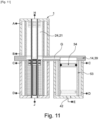
- the module comprises two insulating enclosures separated by the junction plate 39 and receiving at least in part said at least one cartridge 1, 1' or a plurality of cartridges 1, 1'.
- the two insulating enclosures can be delimited by one or more casings.
- each insulating enclosure is directly supplied by the first or second heat source, which makes it possible to centrally supply said at least one cartridge 1, 1' or a plurality of cartridges 1, 1' with heat transfer fluid instead of having to supply each cartridge 1, 1' individually.
- the size of the two insulating enclosures can be adapted to the number of cartridges 1, 1' to be integrated for a targeted power of the thermal machine.
- the working fluid supply circuit H, J is formed of said first heat transfer fluid supply circuit A, B and said second heat transfer fluid supply circuit C, D.
- the working fluid supply source H, J at the fifth supply port 40 is the same as that of the first heat transfer fluid supply circuit A, B, and the working fluid supply source at the sixth supply port 41 is the same as that of the second heat transfer fluid supply circuit C, D.
- the relative pressure difference between the first fluid supply circuit A, B and the working fluid supply circuit C, D is 100. heat transfer fluid A, B and the second heat transfer fluid supply circuit C, D enable the piston 26 to be actuated.
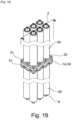
- the working fluid supply circuit H, J is distinct from said first heat transfer fluid supply circuit A, B and from said second heat transfer fluid supply circuit C, D ( figures 18 And 19 ).
- the junction plate 39 has a thermal conductivity lower than the thermal conductivity of said first profile 2 and/or of the second profile 8.
- the junction plate 39 has a thermal separation function.
- the junction plate 39 is made of steel-type metal.
- the first reinforcing piece 28 and the second reinforcing piece 29 are fixed respectively to the junction plate 39.
- the module comprises a first insulating enclosure 43 which comprises at least one first compartment 44 into which said at least one first supply orifice 35 of the first circulation means 3 opens and at least one second compartment 45 into which said at least one second supply orifice 36 of the first circulation means 3 opens.
- the module comprises a second insulating enclosure 43' which comprises at least one third compartment 46 into which said at least one third supply orifice 37 of the second circulation means 9 opens and at least one fourth compartment 47 into which said at least one fourth supply orifice 38 of the second circulation means 9 opens.
- the second reinforcing piece 29 comprises said third supply orifice 37 and said fourth supply orifice 38 of the second circulation means 9.
- the first insulating enclosure 43 comprises a so-called cold part of the cartridge 1, 1' and is designed to receive the heat transfer fluid coming from the first heat source to supply the first circuit. heat transfer fluid supply circuit A, B.
- the second insulating enclosure 43' comprises a so-called hot part of the cartridge 1, 1' and is designed to receive the heat transfer fluid coming from the second heat source to supply the second heat transfer fluid supply circuit C, D.
- the junction plate 39 separates the first enclosure 43 from the second enclosure 43'.
- the first reinforcing piece 28 comprises said first supply orifice 35 and said second supply orifice 36 of the first circulation means 3.
- This configuration makes it possible to bathe the first/second reinforcement piece 28, 29 and the first/second profile 2, 8 in the heat transfer fluid.
- the first compartment 44 and the second compartment 45 are preferably delimited by at least one first dividing wall 48.
- the third compartment 46 and the fourth compartment 47 are preferably delimited by at least one second dividing wall 49.
- the first dividing wall 48 and/or the second dividing wall 49 act as hydraulic shutters and preferably do not withstand high mechanical stresses.
- the first separating wall 48 and/or the second separating wall 49 are preferably made of plastic or elastomer materials, these examples are not limiting.
- the first supply port 35 and the second supply port 36 are arranged on either side of the first dividing wall 48, which ensures that the flow of the heat transfer fluid between A and B takes place inside the first reinforcement piece 28 between the latter and the first profile 2, and not outside the first reinforcement piece 28.
- the third feed port 37 and the fourth feed port 38 are arranged on either side of the first dividing wall 48, which ensures that the flow of the heat transfer fluid between C and D takes place inside the second reinforcing piece 29 between the latter and the second profile 8, and not outside the second reinforcing piece 29.
- said at least one fifth supply port 40 of the working fluid supply circuit H, J opens into the first compartment 44 and said at least one sixth supply port 41 of the working fluid supply circuit H, J opens into the third compartment 46.
- the working fluid supply source H, J at the fifth supply port 40 is identical to that of the first heat transfer fluid supply circuit A, B, just as the working fluid supply source at the sixth supply port 41 is identical to that of the second heat transfer fluid supply circuit C, D.
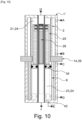
- the module may comprise at least two cartridges 1, 1' and the chambers 24 of each cartridge 1 are connected to each other by at least one interconnection pipe 50, preferably arranged in said at least one junction plate 39 and the thermodynamic fluid supply outlet G of the module or the hydraulic fluid supply outlet E of the module is preferably arranged in said junction plate 39.
- said at least one interconnection pipe 50 allows interconnection of each chamber 24 of each cartridge 1, 1'.
- the invention also relates to a thermal machine capable and intended to carry out at least one conversion of thermal energy into mechanical energy comprising at least one thermodynamic fluid preferably in the supercritical state and capable and intended to implement a thermodynamic cycle comprising at least one isochoric heating phase, optionally an isobaric heating phase, an expansion phase and an isobaric cooling phase, the thermal machine comprising at least one module according to the invention described above.
Landscapes
- Engineering & Computer Science (AREA)
- Chemical & Material Sciences (AREA)
- Combustion & Propulsion (AREA)
- Mechanical Engineering (AREA)
- General Engineering & Computer Science (AREA)
- Chemical Kinetics & Catalysis (AREA)
- Heat-Exchange Devices With Radiators And Conduit Assemblies (AREA)
- Applications Or Details Of Rotary Compressors (AREA)
Claims (15)
- Kartusche (1, 1') für die Bewegung eines thermodynamischen Fluids zwischen einem kalten Teil, der mit einer ersten Wärmequelle verbunden ist, und einem warmen Teil, der mit einer zweiten Wärmequelle verbunden ist, für eine Wärmekraftmaschine mit thermodynamischem Zyklus, dadurch gekennzeichnet, dass sie mindestens umfasst:- einen ersten Austauscher, der einen sogenannten kalten Teil bildet, mit einem ersten Hohlprofil (2), das erste Zirkulationsmittel (3) für mindestens ein Wärmeträgerfluid umfasst, die geeignet und dazu bestimmt sind, an einen ersten, mit einer ersten Wärmequelle verbundenen Wärmeträgerfluid-Versorgungskreislauf (A, B) angeschlossen zu werden, wobei das erste Profil (2) eine Innenwand (4) und eine Außenwand (5) umfasst,- einen zweiten Austauscher, der einen sogenannten heißen Teil bildet, mit einem zweiten Hohlprofil (8), das zweite Zirkulationsmittel (9) für mindestens ein Wärmeträgerfluid umfasst, die geeignet und dazu bestimmt sind, an einen zweiten Wärmeträgerfluid-Versorgungskreislauf (C, D) angeschlossen zu werden, der mit einer zweiten Wärmequelle verbunden ist, wobei das zweite Profil (8) eine Innenwand (10) und eine Außenwand (11) umfasst,- ein hohles drittes Profil (15), das geeignet und bestimmt ist, mit mindestens einem Versorgungskreislauf für mindestens ein Arbeitsfluid (J, H) verbunden zu werden, wobei das dritte Profil (15) im Inneren des ersten Profils (2) und des zweiten Profils (8) angeordnet ist, wobei das dritte Profil (15) eine Innenwand (16) und eine Außenwand (17) umfasst, mindestens ein Teil der Innenwand (4) des ersten Profils (2) und ein erster Teil (20) der Außenwand (17) des dritten Profils (15) voneinander beabstandet und einander gegenüberliegend angeordnet sind, um einen ersten Füllraum (21) zu bilden, wobei mindestens ein Teil der Innenwand (10) des zweiten Profils (8) und ein zweiter Teil (22) der Außenwand (17) des dritten Profils (15) voneinander beabstandet und einander gegenüberliegend angeordnet sind, so dass sie einen zweiten Füllraum (23) bilden,- mindestens eine Kammer (24), die geeignet und dazu bestimmt ist, mindestens ein thermodynamisches Fluid zu enthalten, das vorzugsweise unter hohem Druck und im überkritischen Zustand steht, wobei die Kammer (24) mindestens den ersten Füllraum (21) und den zweiten Füllraum (23) umfasst, die miteinander verbunden sind,- mindestens einen Verschieber (25), der innerhalb der Kammer (24) angeordnet und relativ zur Außenwand (17) des dritten Profils (15) gleitend montiert und zwischen einer ersten Position (P1) und einer zweiten Position (P2) beweglich ist und so konfiguriert ist, dass er das mindestens eine thermodynamische Fluid abwechselnd zwischen dem ersten Füllraum (21) und dem zweiten Füllraum (23) verschiebt,- einen Kolben (26), der im Inneren des dritten Profils (15) angeordnet und relativ zur Innenwand (16) des dritten Profils (15) gleitend montiert und zwischen der ersten Position (P1 ) und der zweiten Position (P2) beweglich ist, wobei der Kolben (26) geeignet und dazu bestimmt ist, durch das mindestens eine Arbeitsfluid (J, H) zwischen der ersten Position (P1) und der zweiten Position (P2) verschiebt zu werden, wobei der Verschieber (25) und der Kolben (26) miteinander gekoppelt sind.
- Kartusche nach Anspruch 1, dadurch gekennzeichnet, dass das dritte Profil (15) vorzugsweise aus nichtmagnetischem Material besteht und dass der Verschieber (25) und der Kolben (26) durch das dritte Profil (15) hindurch durch magnetische Verbindungsmittel (27) magnetisch miteinander gekoppelt sind.
- Kartusche nach einem der Ansprüche 1 bis 2, dadurch gekennzeichnet, dass das erste Profil (2) sich in Längsrichtung über eine erste Länge L1 entlang einer Achse A1 erstreckt und dass das zweite Profil (8) sich in Längsrichtung entlang der Achse A1 über eine zweite Länge L2 erstreckt, und das zweite Profil (8) in der Verlängerung des ersten Profils (2) in Richtung der Achse A1 liegt.
- Kartusche nach Anspruch 3, dadurch gekennzeichnet, dass sich das dritte Profil (15) in Längsrichtung entlang der Achse A1 über eine dritte Länge L3 erstreckt, wobei die dritte Länge L3 größer ist als die erste Länge L1 oder die zweite Länge L2 und vorzugsweise größer oder gleich der Summe aus der ersten Länge L1 und der zweiten Länge L2.
- Kartusche nach einem der Ansprüche 1 bis 4, dadurch gekennzeichnet, dass das erste Profil (2) ein erstes Ende (6) und ein zweites Verbindungsende (7) aufweist, dass das zweite Profil (8) ein erstes Ende (12) und ein zweites Verbindungsende (13) aufweist, und dass das erste Profil (2) und das zweite Profil (8) durch Verbindungsmittel (14) an ihrem jeweiligen zweiten Verbindungsende (7, 13) miteinander verbunden sind.
- Kartusche nach dem vorhergehenden Anspruch, dadurch gekennzeichnet, dass das dritte Profil (15) ein erstes Ende (18) und ein zweites Ende (19) aufweist, dass das erste Ende (6) des ersten Profils (2) und das erste Ende (18) des dritten Profils (15) durch Verbindungsmittel verbunden sind, und dass das erste Ende (12) des zweiten Profils (8) und das zweite Ende (19) des dritten Profils (15) durch Verbindungsmittel verbunden sind.
- Kartusche nach einem der Ansprüche 1 bis 6, dadurch gekennzeichnet, dass das dritte Profil (15), das erste Profil (2) und das zweite Profil (8), der Verschieber (25) und der Kolben (26) entlang der Achse A1 koaxial sind.
- Kartusche nach einem der Ansprüche 1 bis 7, dadurch gekennzeichnet, dass sie ein erstes radiales und/oder axiales Spannungsverstärkungsteil (28), in dem das erste Profil (2) eingespannt ist, und ein zweites radiales und/oder axiales Spannungsverstärkungsteil (29), in dem das zweite Profil (8) eingespannt ist, umfasst.
- Kartusche nach einem der Ansprüche 5 bis 8, dadurch gekennzeichnet, dass die Verbindungsmittel (14) eine Wärmeleitfähigkeit aufweisen, die geringer ist als die Wärmeleitfähigkeit des ersten Profils (2) und/oder des zweiten Profils (8).
- Kartusche nach einem der Ansprüche 1 bis 9, dadurch gekennzeichnet, dass die Kartusche (1') als Hybrid bezeichnet wird und einen Hydraulikkolben (34) umfasst, der innerhalb des ersten Füllraums (21) oder des zweiten Füllraums (23) der Kammer (24) angeordnet ist, wobei der erste Füllraum (21) oder der zweite Füllraum (23) geeignet und dazu bestimmt ist, mindestens ein Hydraulikfluid zu enthalten, und geeignet und dazu bestimmt ist, mit einem Versorgungsauslass für ein Hydraulikfluid (E) verbunden zu werden, und dass der Hydraulikkolben (34) in Richtung der Achse A1 relativ zur Außenwand (17) des dritten Profils (15) verschiebbar angebracht ist und innerhalb des ersten Füllraums (21) oder des zweiten Füllraums (23) zwischen einer ersten Position (P3) und einer zweiten Position (P4) beweglich und so konfiguriert ist, dass er einerseits durch das mindestens eine thermodynamische Fluid bewegt wird und andererseits das mindestens eine Hydraulikfluid in dem ersten Füllraum (21) oder dem zweiten Füllraum (23) abwechselnd Verschiebt.
- Kartusche nach einem der Ansprüche 1 bis 10, dadurch gekennzeichnet, dass das erste Profil (2) und/oder das zweite Profil (8) aus einem Material mit hoher Wärmeleitfähigkeit, vorzugsweise zwischen 100 Watt pro Meter Kelvin und 400 Watt pro Meter Kelvin, besteht, z. B. aus einer Aluminium- oder Kupferlegierung.
- Modul für die Bewegung eines thermodynamischen Fluids abwechselnd zwischen einem kalten Teil, der mit einer ersten Wärmequelle verbunden ist, und einem heißen Teil, der mit einer zweiten Wärmequelle verbunden ist, für eine Wärmekraftmaschine mit thermodynamischem Zyklus, dadurch gekennzeichnet, dass es mindestens eine Kartusche (1 , 1') oder eine Vielzahl von Kartuschen (1 , 1') nach einem der Ansprüche 1 bis 11 umfasst, und dass es umfasst:- einen ersten Kreislauf zur Versorgung mit einem Wärmeträgerfluid (A, B), der mit den ersten Zirkulationsmitteln (3) der mindestens einen Kartusche (1 , 1') über mindestens eine erste Versorgungsöffnung (35) und mindestens eine zweite Versorgungsöffnung (36) der ersten Zirkulationsmittel (3) verbunden ist,- einen zweiten Kreislauf zur Versorgung mit einem Wärmeträgerfluid (C, D), der mit den zweiten Zirkulationsmitteln (9) der mindestens einen Kartusche (1) über mindestens eine dritte Versorgungsöffnung (37) und mindestens eine vierte Versorgungsöffnung (38) der zweiten Zirkulationsmittel (9) verbunden ist,- eine Verbindungsplatine (39), die mindestens die Verbindungsmittel (14) der Kartusche (1) umfasst,- einen Arbeitsfluid-Zuführungskreislauf (H, J), der mit dem dritten Profil (15) der mindestens einen Kartusche (1) über mindestens eine fünfte Zuführöffnung (40), die das dritte Profil (15) umfasst, und mindestens eine sechste Zuführöffnung (41), die das dritte Profil (15) umfasst, verbunden ist, der so angeordnet ist, dass er die Bewegung des Kolbens (26) steuert,- einen mit der Kammer (24) der mindestens einen Kartusche (1) verbundenen Zufuhrauslass für ein thermodynamisches Fluid (G) oder einen mit dem ersten Füllraum (21) oder dem zweiten Füllraum (23) der Kammer (24) verbundenen Zufuhrauslass für ein Hydraulikfluid (E).
- Modul nach dem vorhergehenden Anspruch, dadurch gekennzeichnet, dass eine erste isolierende Einfassung (43) mindestens ein erstes Abteil (44), in das die mindestens eine erste Versorgungsöffnung (35) der ersten Zirkulationsmittel (3) mündet, und mindestens ein zweites Abteil (45), in das die mindestens eine zweite Versorgungsöffnung (36) der ersten Zirkulationsmittel (3) mündet, umfasst und/oder dass ein zweites isolierendes Gehäuse (43') mindestens ein drittes Abteil (46), in das die mindestens eine dritte Versorgungsöffnung (37) der zweiten Zirkulationsmittel (9) mündet, und mindestens ein viertes Abteil (47), in das die mindestens eine vierte Versorgungsöffnung (38) der zweiten Zirkulationsmittel (9) mündet, umfasst, und dass die mindestens eine fünfte Zuführöffnung (40) des Arbeitsfluid-Zuführungskreislaufs (H, J) in das erste Abteil (44) mündet und dass die mindestens eine sechste Zuführöffnung (41) des Arbeitsfluid-Zuführungskreislaufs (H, J) in das dritte Abteil (46) mündet.
- Modul nach einem der Ansprüche 12 bis 13, dadurch gekennzeichnet, dass die Verbindungsplatine (39) eine Wärmeleitfähigkeit aufweist, die geringer ist als die Wärmeleitfähigkeit des ersten Profils (2) und/oder des zweiten Profils (8).
- Modul nach einem der Ansprüche 12 bis 14, dadurch gekennzeichnet, dass das Modul mindestens zwei Kartuschen (1, 1') umfasst und dass die Kammern (24) jeder Kartusche (1) durch mindestens eine Verbindungsleitung (50) miteinander verbunden sind.
Applications Claiming Priority (2)
| Application Number | Priority Date | Filing Date | Title |
|---|---|---|---|
| FR2102658A FR3120916B1 (fr) | 2021-03-17 | 2021-03-17 | Cartouche pour machine thermique à cycle thermodynamique et module pour machine thermique associé |
| PCT/EP2022/056723 WO2022194877A1 (fr) | 2021-03-17 | 2022-03-15 | Cartouche pour machine thermique à cycle thermodynamique et module pour machine thermique associé |
Publications (3)
| Publication Number | Publication Date |
|---|---|
| EP4308802A1 EP4308802A1 (de) | 2024-01-24 |
| EP4308802C0 EP4308802C0 (de) | 2024-12-18 |
| EP4308802B1 true EP4308802B1 (de) | 2024-12-18 |
Family
ID=75690540
Family Applications (1)
| Application Number | Title | Priority Date | Filing Date |
|---|---|---|---|
| EP22715581.9A Active EP4308802B1 (de) | 2021-03-17 | 2022-03-15 | Kartusche für eine wärmekraftmaschine mit thermodynamischem zyklus und zugehörige wärmekraftmaschine |
Country Status (6)
| Country | Link |
|---|---|
| US (1) | US12305541B2 (de) |
| EP (1) | EP4308802B1 (de) |
| JP (1) | JP7849378B2 (de) |
| CN (1) | CN117043450A (de) |
| FR (1) | FR3120916B1 (de) |
| WO (1) | WO2022194877A1 (de) |
Families Citing this family (1)
| Publication number | Priority date | Publication date | Assignee | Title |
|---|---|---|---|---|
| CN118776380B (zh) * | 2024-08-30 | 2025-01-10 | 豫新汽车热管理科技有限公司 | 一种二氧化碳冷却加热一体式热交换器 |
Family Cites Families (13)
| Publication number | Priority date | Publication date | Assignee | Title |
|---|---|---|---|---|
| DE19938023C2 (de) * | 1999-08-11 | 2000-08-24 | Enerlyt Potsdam Gmbh En Umwelt | Heißgasmotor mit einem Arbeitskolben, der sich innerhalb eines Verdrängerkolbens bewegt |
| FR2811017A1 (fr) | 2000-06-30 | 2002-01-04 | Leonello Acquaviva | Moteur thermique a combustion externe et a basse temperature |
| US6568169B2 (en) | 2001-05-02 | 2003-05-27 | Ricardo Conde | Fluidic-piston engine |
| DE10329977B4 (de) * | 2002-10-15 | 2013-10-24 | Andreas Gimsa | 2-Zyklen-Heißgasmotor mit erhöhtem Verdichtungsverhältnis |
| JP3796498B2 (ja) | 2003-10-30 | 2006-07-12 | 独立行政法人 宇宙航空研究開発機構 | スターリングエンジン |
| DE102009020417A1 (de) * | 2009-05-08 | 2010-11-11 | Bayerische Motoren Werke Aktiengesellschaft | Thermoelektrischer Wandler sowie Verfahren zum Betreiben desselben |
| JP2012177300A (ja) | 2011-02-25 | 2012-09-13 | Yuji Ikedo | スターリングサイクル機器 |
| DE102013114159A1 (de) * | 2013-04-12 | 2014-10-16 | Arvid Rauchschwalbe | Verfahren und Vorrichtungen zur Nutzung von thermischer Energie und zur Erzeugung von Temperaturniveaudifferenzen |
| JP2016527425A (ja) * | 2013-05-21 | 2016-09-08 | リヒター, ベルタRICHTER, Berta | 廃熱と地熱の利用のための方法および熱機関 |
| JP6106102B2 (ja) | 2014-01-15 | 2017-03-29 | 本田技研工業株式会社 | スターリングエンジン |
| DE102015105878B3 (de) | 2015-04-17 | 2016-06-23 | Nexus Gmbh | Überkritischer Kreisprozess mit isothermer Expansion und Freikolben-Wärmekraftmaschine mit hydraulischer Energieauskopplung für diesen Kreisprozess |
| KR101899466B1 (ko) | 2016-09-29 | 2018-09-18 | 한국과학기술원 | 초임계 유체를 이용한 스털링 엔진 |
| CN111868368A (zh) * | 2018-01-18 | 2020-10-30 | 热电技术控股公司 | 浮动头活塞组件 |
-
2021
- 2021-03-17 FR FR2102658A patent/FR3120916B1/fr active Active
-
2022
- 2022-03-15 WO PCT/EP2022/056723 patent/WO2022194877A1/fr not_active Ceased
- 2022-03-15 US US18/550,366 patent/US12305541B2/en active Active
- 2022-03-15 EP EP22715581.9A patent/EP4308802B1/de active Active
- 2022-03-15 JP JP2023555710A patent/JP7849378B2/ja active Active
- 2022-03-15 CN CN202280020747.6A patent/CN117043450A/zh active Pending
Also Published As
| Publication number | Publication date |
|---|---|
| FR3120916A1 (fr) | 2022-09-23 |
| JP7849378B2 (ja) | 2026-04-21 |
| US12305541B2 (en) | 2025-05-20 |
| EP4308802C0 (de) | 2024-12-18 |
| JP2024511582A (ja) | 2024-03-14 |
| FR3120916B1 (fr) | 2023-03-17 |
| CN117043450A (zh) | 2023-11-10 |
| US20250116212A1 (en) | 2025-04-10 |
| WO2022194877A1 (fr) | 2022-09-22 |
| EP4308802A1 (de) | 2024-01-24 |
Similar Documents
| Publication | Publication Date | Title |
|---|---|---|
| EP1366280A1 (de) | Antriebseinheit mit linearer hubbewegung auf grundlage eines stirlingmotors und bei dem antriebssystem verwendetes verfahren | |
| FR2956200A1 (fr) | Machine thermoacoustique a boucle de retroaction electrique | |
| FR2936841A1 (fr) | Structure d'echangeur thermique et chambre de compression ou de detente isotherme. | |
| EP4308802B1 (de) | Kartusche für eine wärmekraftmaschine mit thermodynamischem zyklus und zugehörige wärmekraftmaschine | |
| FR3041040A1 (fr) | Cylindre detendeur a double effet a support adaptatif | |
| LU100895B1 (fr) | Appareils et procédés d'accumulation et de récupération d'énergie | |
| EP2052200B1 (de) | Wärmetauscher | |
| WO2005108768A1 (fr) | Unite de transmission de puissance acoustique pour systemes thermoacoustiques | |
| EP0803687A1 (de) | Kryostat für Tiefsttemperatur-Kälteanlage und Kälteanlagen mit einem solchen Kryostat | |
| EP4222365B1 (de) | Stirling-kreislaufmaschine | |
| FR3090749A1 (fr) | Machine Stirling de type béta | |
| FR2913458A1 (fr) | Architecture innovante pour moteurs stirling,moteur stirling ainsi dispose. | |
| EP3099919A1 (de) | Externer verbrennungsmotor | |
| EP3899236A1 (de) | Stirlingmaschine vom beta-typ | |
| EP3189224B1 (de) | Motor mit differentiellen verdampfungsdrücken | |
| FR2935155A1 (fr) | Machines a piston rotatif annulaire trilobique avec cycles thermodynamiques de stirling | |
| FR2913459A1 (fr) | Dispositifs pour moteurs stirling,notamment pour diminuer les pertes thermiques,et moteur comprenant de tels dispositifs | |
| EP4453483A1 (de) | Akustische leistungsmodulation in einer thermoakustischen maschine | |
| FR2913461A1 (fr) | Regenerateur,notamment pour moteurs stirling,moteur stirling comprenant un tel regenerateur. | |
| FR3053401A1 (fr) | Systeme comprenant des moyens de refroidissement de machine thermique | |
| FR2913460A1 (fr) | Culasse pour moteurs stirling,moteur equipe d'une telle culasse. | |
| FR2966203A1 (fr) | Dispositif thermodynamique de type stirling | |
| WO2023099185A1 (fr) | Machine thermoacoustique à modulation de déphasage | |
| FR2883367A1 (fr) | Echangeur thermique | |
| FR2835570A1 (fr) | Plaque motrice multicellulaire parallelepipedique, entierement hermetique |
Legal Events
| Date | Code | Title | Description |
|---|---|---|---|
| STAA | Information on the status of an ep patent application or granted ep patent |
Free format text: STATUS: UNKNOWN |
|
| STAA | Information on the status of an ep patent application or granted ep patent |
Free format text: STATUS: THE INTERNATIONAL PUBLICATION HAS BEEN MADE |
|
| PUAI | Public reference made under article 153(3) epc to a published international application that has entered the european phase |
Free format text: ORIGINAL CODE: 0009012 |
|
| STAA | Information on the status of an ep patent application or granted ep patent |
Free format text: STATUS: REQUEST FOR EXAMINATION WAS MADE |
|
| 17P | Request for examination filed |
Effective date: 20230913 |
|
| AK | Designated contracting states |
Kind code of ref document: A1 Designated state(s): AL AT BE BG CH CY CZ DE DK EE ES FI FR GB GR HR HU IE IS IT LI LT LU LV MC MK MT NL NO PL PT RO RS SE SI SK SM TR |
|
| DAX | Request for extension of the european patent (deleted) | ||
| RAV | Requested validation state of the european patent: fee paid |
Extension state: TN Effective date: 20230927 Extension state: MA Effective date: 20230927 |
|
| GRAP | Despatch of communication of intention to grant a patent |
Free format text: ORIGINAL CODE: EPIDOSNIGR1 |
|
| STAA | Information on the status of an ep patent application or granted ep patent |
Free format text: STATUS: GRANT OF PATENT IS INTENDED |
|
| INTG | Intention to grant announced |
Effective date: 20240724 |
|
| GRAS | Grant fee paid |
Free format text: ORIGINAL CODE: EPIDOSNIGR3 |
|
| GRAA | (expected) grant |
Free format text: ORIGINAL CODE: 0009210 |
|
| STAA | Information on the status of an ep patent application or granted ep patent |
Free format text: STATUS: THE PATENT HAS BEEN GRANTED |
|
| AK | Designated contracting states |
Kind code of ref document: B1 Designated state(s): AL AT BE BG CH CY CZ DE DK EE ES FI FR GB GR HR HU IE IS IT LI LT LU LV MC MK MT NL NO PL PT RO RS SE SI SK SM TR |
|
| REG | Reference to a national code |
Ref country code: CH Ref legal event code: EP |
|
| REG | Reference to a national code |
Ref country code: DE Ref legal event code: R096 Ref document number: 602022008877 Country of ref document: DE |
|
| REG | Reference to a national code |
Ref country code: IE Ref legal event code: FG4D Free format text: LANGUAGE OF EP DOCUMENT: FRENCH |
|
| U01 | Request for unitary effect filed |
Effective date: 20241218 |
|
| U07 | Unitary effect registered |
Designated state(s): AT BE BG DE DK EE FI FR IT LT LU LV MT NL PT RO SE SI Effective date: 20250117 |
|
| U20 | Renewal fee for the european patent with unitary effect paid |
Year of fee payment: 4 Effective date: 20250127 |
|
| PG25 | Lapsed in a contracting state [announced via postgrant information from national office to epo] |
Ref country code: HR Free format text: LAPSE BECAUSE OF FAILURE TO SUBMIT A TRANSLATION OF THE DESCRIPTION OR TO PAY THE FEE WITHIN THE PRESCRIBED TIME-LIMIT Effective date: 20241218 |
|
| PG25 | Lapsed in a contracting state [announced via postgrant information from national office to epo] |
Ref country code: NO Free format text: LAPSE BECAUSE OF FAILURE TO SUBMIT A TRANSLATION OF THE DESCRIPTION OR TO PAY THE FEE WITHIN THE PRESCRIBED TIME-LIMIT Effective date: 20250318 |
|
| PG25 | Lapsed in a contracting state [announced via postgrant information from national office to epo] |
Ref country code: GR Free format text: LAPSE BECAUSE OF FAILURE TO SUBMIT A TRANSLATION OF THE DESCRIPTION OR TO PAY THE FEE WITHIN THE PRESCRIBED TIME-LIMIT Effective date: 20250319 |
|
| PG25 | Lapsed in a contracting state [announced via postgrant information from national office to epo] |
Ref country code: RS Free format text: LAPSE BECAUSE OF FAILURE TO SUBMIT A TRANSLATION OF THE DESCRIPTION OR TO PAY THE FEE WITHIN THE PRESCRIBED TIME-LIMIT Effective date: 20250318 |
|
| PG25 | Lapsed in a contracting state [announced via postgrant information from national office to epo] |
Ref country code: SM Free format text: LAPSE BECAUSE OF FAILURE TO SUBMIT A TRANSLATION OF THE DESCRIPTION OR TO PAY THE FEE WITHIN THE PRESCRIBED TIME-LIMIT Effective date: 20241218 |
|
| PG25 | Lapsed in a contracting state [announced via postgrant information from national office to epo] |
Ref country code: PL Free format text: LAPSE BECAUSE OF FAILURE TO SUBMIT A TRANSLATION OF THE DESCRIPTION OR TO PAY THE FEE WITHIN THE PRESCRIBED TIME-LIMIT Effective date: 20241218 |
|
| PG25 | Lapsed in a contracting state [announced via postgrant information from national office to epo] |
Ref country code: ES Free format text: LAPSE BECAUSE OF FAILURE TO SUBMIT A TRANSLATION OF THE DESCRIPTION OR TO PAY THE FEE WITHIN THE PRESCRIBED TIME-LIMIT Effective date: 20241218 |
|
| PG25 | Lapsed in a contracting state [announced via postgrant information from national office to epo] |
Ref country code: IS Free format text: LAPSE BECAUSE OF FAILURE TO SUBMIT A TRANSLATION OF THE DESCRIPTION OR TO PAY THE FEE WITHIN THE PRESCRIBED TIME-LIMIT Effective date: 20250418 |
|
| PG25 | Lapsed in a contracting state [announced via postgrant information from national office to epo] |
Ref country code: SK Free format text: LAPSE BECAUSE OF FAILURE TO SUBMIT A TRANSLATION OF THE DESCRIPTION OR TO PAY THE FEE WITHIN THE PRESCRIBED TIME-LIMIT Effective date: 20241218 |
|
| PG25 | Lapsed in a contracting state [announced via postgrant information from national office to epo] |
Ref country code: CZ Free format text: LAPSE BECAUSE OF FAILURE TO SUBMIT A TRANSLATION OF THE DESCRIPTION OR TO PAY THE FEE WITHIN THE PRESCRIBED TIME-LIMIT Effective date: 20241218 |
|
| PG25 | Lapsed in a contracting state [announced via postgrant information from national office to epo] |
Ref country code: MC Free format text: LAPSE BECAUSE OF FAILURE TO SUBMIT A TRANSLATION OF THE DESCRIPTION OR TO PAY THE FEE WITHIN THE PRESCRIBED TIME-LIMIT Effective date: 20241218 |
|
| PLBE | No opposition filed within time limit |
Free format text: ORIGINAL CODE: 0009261 |
|
| REG | Reference to a national code |
Ref country code: CH Ref legal event code: H13 Free format text: ST27 STATUS EVENT CODE: U-0-0-H10-H13 (AS PROVIDED BY THE NATIONAL OFFICE) Effective date: 20251024 |
|
| STAA | Information on the status of an ep patent application or granted ep patent |
Free format text: STATUS: NO OPPOSITION FILED WITHIN TIME LIMIT |
|
| 26N | No opposition filed |
Effective date: 20250919 |
|
| PG25 | Lapsed in a contracting state [announced via postgrant information from national office to epo] |
Ref country code: CH Free format text: LAPSE BECAUSE OF NON-PAYMENT OF DUE FEES Effective date: 20250331 |
|
| PG25 | Lapsed in a contracting state [announced via postgrant information from national office to epo] |
Ref country code: IE Free format text: LAPSE BECAUSE OF NON-PAYMENT OF DUE FEES Effective date: 20250315 |
|
| VS25 | Lapsed in a validation state [announced via postgrant information from nat. office to epo] |
Ref country code: MA Free format text: FAILURE TO ELECT DOMICILE IN THE NATIONAL COUNTRY Effective date: 20250319 |
|
| U20 | Renewal fee for the european patent with unitary effect paid |
Year of fee payment: 5 Effective date: 20260216 |
|
| VS25 | Lapsed in a validation state [announced via postgrant information from nat. office to epo] |
Ref country code: MA Free format text: LAPSE BECAUSE OF FAILURE TO SUBMIT A TRANSLATION OF THE DESCRIPTION OR TO PAY THE FEE WITHIN THE PRESCRIBED TIME-LIMIT Effective date: 20241218 |