EP4307679A2 - Luts mit intraprädiktionsmodi und intramodusprädiktion aus nicht benachbarten blöcken - Google Patents
Luts mit intraprädiktionsmodi und intramodusprädiktion aus nicht benachbarten blöcken Download PDFInfo
- Publication number
- EP4307679A2 EP4307679A2 EP23213700.0A EP23213700A EP4307679A2 EP 4307679 A2 EP4307679 A2 EP 4307679A2 EP 23213700 A EP23213700 A EP 23213700A EP 4307679 A2 EP4307679 A2 EP 4307679A2
- Authority
- EP
- European Patent Office
- Prior art keywords
- motion
- candidates
- mode
- block
- video
- Prior art date
- Legal status (The legal status is an assumption and is not a legal conclusion. Google has not performed a legal analysis and makes no representation as to the accuracy of the status listed.)
- Pending
Links
Images


















Classifications
-
- H—ELECTRICITY
- H04—ELECTRIC COMMUNICATION TECHNIQUE
- H04N—PICTORIAL COMMUNICATION, e.g. TELEVISION
- H04N19/00—Methods or arrangements for coding, decoding, compressing or decompressing digital video signals
- H04N19/10—Methods or arrangements for coding, decoding, compressing or decompressing digital video signals using adaptive coding
- H04N19/102—Methods or arrangements for coding, decoding, compressing or decompressing digital video signals using adaptive coding characterised by the element, parameter or selection affected or controlled by the adaptive coding
- H04N19/103—Selection of coding mode or of prediction mode
- H04N19/105—Selection of the reference unit for prediction within a chosen coding or prediction mode, e.g. adaptive choice of position and number of pixels used for prediction
-
- H—ELECTRICITY
- H04—ELECTRIC COMMUNICATION TECHNIQUE
- H04N—PICTORIAL COMMUNICATION, e.g. TELEVISION
- H04N19/00—Methods or arrangements for coding, decoding, compressing or decompressing digital video signals
- H04N19/10—Methods or arrangements for coding, decoding, compressing or decompressing digital video signals using adaptive coding
- H04N19/102—Methods or arrangements for coding, decoding, compressing or decompressing digital video signals using adaptive coding characterised by the element, parameter or selection affected or controlled by the adaptive coding
- H04N19/103—Selection of coding mode or of prediction mode
- H04N19/11—Selection of coding mode or of prediction mode among a plurality of spatial predictive coding modes
-
- H—ELECTRICITY
- H04—ELECTRIC COMMUNICATION TECHNIQUE
- H04N—PICTORIAL COMMUNICATION, e.g. TELEVISION
- H04N19/00—Methods or arrangements for coding, decoding, compressing or decompressing digital video signals
- H04N19/50—Methods or arrangements for coding, decoding, compressing or decompressing digital video signals using predictive coding
- H04N19/503—Methods or arrangements for coding, decoding, compressing or decompressing digital video signals using predictive coding involving temporal prediction
- H04N19/51—Motion estimation or motion compensation
- H04N19/513—Processing of motion vectors
- H04N19/517—Processing of motion vectors by encoding
- H04N19/52—Processing of motion vectors by encoding by predictive encoding
-
- H—ELECTRICITY
- H04—ELECTRIC COMMUNICATION TECHNIQUE
- H04N—PICTORIAL COMMUNICATION, e.g. TELEVISION
- H04N19/00—Methods or arrangements for coding, decoding, compressing or decompressing digital video signals
- H04N19/70—Methods or arrangements for coding, decoding, compressing or decompressing digital video signals characterised by syntax aspects related to video coding, e.g. related to compression standards
-
- H—ELECTRICITY
- H04—ELECTRIC COMMUNICATION TECHNIQUE
- H04N—PICTORIAL COMMUNICATION, e.g. TELEVISION
- H04N19/00—Methods or arrangements for coding, decoding, compressing or decompressing digital video signals
- H04N19/10—Methods or arrangements for coding, decoding, compressing or decompressing digital video signals using adaptive coding
- H04N19/169—Methods or arrangements for coding, decoding, compressing or decompressing digital video signals using adaptive coding characterised by the coding unit, i.e. the structural portion or semantic portion of the video signal being the object or the subject of the adaptive coding
- H04N19/184—Methods or arrangements for coding, decoding, compressing or decompressing digital video signals using adaptive coding characterised by the coding unit, i.e. the structural portion or semantic portion of the video signal being the object or the subject of the adaptive coding the unit being bits, e.g. of the compressed video stream
-
- G—PHYSICS
- G06—COMPUTING OR CALCULATING; COUNTING
- G06F—ELECTRIC DIGITAL DATA PROCESSING
- G06F1/00—Details not covered by groups G06F3/00 - G06F13/00 and G06F21/00
- G06F1/02—Digital function generators
- G06F1/03—Digital function generators working, at least partly, by table look-up
-
- H—ELECTRICITY
- H04—ELECTRIC COMMUNICATION TECHNIQUE
- H04N—PICTORIAL COMMUNICATION, e.g. TELEVISION
- H04N19/00—Methods or arrangements for coding, decoding, compressing or decompressing digital video signals
- H04N19/10—Methods or arrangements for coding, decoding, compressing or decompressing digital video signals using adaptive coding
- H04N19/102—Methods or arrangements for coding, decoding, compressing or decompressing digital video signals using adaptive coding characterised by the element, parameter or selection affected or controlled by the adaptive coding
- H04N19/117—Filters, e.g. for pre-processing or post-processing
-
- H—ELECTRICITY
- H04—ELECTRIC COMMUNICATION TECHNIQUE
- H04N—PICTORIAL COMMUNICATION, e.g. TELEVISION
- H04N19/00—Methods or arrangements for coding, decoding, compressing or decompressing digital video signals
- H04N19/10—Methods or arrangements for coding, decoding, compressing or decompressing digital video signals using adaptive coding
- H04N19/134—Methods or arrangements for coding, decoding, compressing or decompressing digital video signals using adaptive coding characterised by the element, parameter or criterion affecting or controlling the adaptive coding
- H04N19/136—Incoming video signal characteristics or properties
- H04N19/137—Motion inside a coding unit, e.g. average field, frame or block difference
-
- H—ELECTRICITY
- H04—ELECTRIC COMMUNICATION TECHNIQUE
- H04N—PICTORIAL COMMUNICATION, e.g. TELEVISION
- H04N19/00—Methods or arrangements for coding, decoding, compressing or decompressing digital video signals
- H04N19/10—Methods or arrangements for coding, decoding, compressing or decompressing digital video signals using adaptive coding
- H04N19/134—Methods or arrangements for coding, decoding, compressing or decompressing digital video signals using adaptive coding characterised by the element, parameter or criterion affecting or controlling the adaptive coding
- H04N19/136—Incoming video signal characteristics or properties
- H04N19/137—Motion inside a coding unit, e.g. average field, frame or block difference
- H04N19/139—Analysis of motion vectors, e.g. their magnitude, direction, variance or reliability
-
- H—ELECTRICITY
- H04—ELECTRIC COMMUNICATION TECHNIQUE
- H04N—PICTORIAL COMMUNICATION, e.g. TELEVISION
- H04N19/00—Methods or arrangements for coding, decoding, compressing or decompressing digital video signals
- H04N19/10—Methods or arrangements for coding, decoding, compressing or decompressing digital video signals using adaptive coding
- H04N19/134—Methods or arrangements for coding, decoding, compressing or decompressing digital video signals using adaptive coding characterised by the element, parameter or criterion affecting or controlling the adaptive coding
- H04N19/157—Assigned coding mode, i.e. the coding mode being predefined or preselected to be further used for selection of another element or parameter
- H04N19/159—Prediction type, e.g. intra-frame, inter-frame or bidirectional frame prediction
-
- H—ELECTRICITY
- H04—ELECTRIC COMMUNICATION TECHNIQUE
- H04N—PICTORIAL COMMUNICATION, e.g. TELEVISION
- H04N19/00—Methods or arrangements for coding, decoding, compressing or decompressing digital video signals
- H04N19/10—Methods or arrangements for coding, decoding, compressing or decompressing digital video signals using adaptive coding
- H04N19/169—Methods or arrangements for coding, decoding, compressing or decompressing digital video signals using adaptive coding characterised by the coding unit, i.e. the structural portion or semantic portion of the video signal being the object or the subject of the adaptive coding
- H04N19/17—Methods or arrangements for coding, decoding, compressing or decompressing digital video signals using adaptive coding characterised by the coding unit, i.e. the structural portion or semantic portion of the video signal being the object or the subject of the adaptive coding the unit being an image region, e.g. an object
- H04N19/176—Methods or arrangements for coding, decoding, compressing or decompressing digital video signals using adaptive coding characterised by the coding unit, i.e. the structural portion or semantic portion of the video signal being the object or the subject of the adaptive coding the unit being an image region, e.g. an object the region being a block, e.g. a macroblock
-
- H—ELECTRICITY
- H04—ELECTRIC COMMUNICATION TECHNIQUE
- H04N—PICTORIAL COMMUNICATION, e.g. TELEVISION
- H04N19/00—Methods or arrangements for coding, decoding, compressing or decompressing digital video signals
- H04N19/10—Methods or arrangements for coding, decoding, compressing or decompressing digital video signals using adaptive coding
- H04N19/169—Methods or arrangements for coding, decoding, compressing or decompressing digital video signals using adaptive coding characterised by the coding unit, i.e. the structural portion or semantic portion of the video signal being the object or the subject of the adaptive coding
- H04N19/186—Methods or arrangements for coding, decoding, compressing or decompressing digital video signals using adaptive coding characterised by the coding unit, i.e. the structural portion or semantic portion of the video signal being the object or the subject of the adaptive coding the unit being a colour or a chrominance component
-
- H—ELECTRICITY
- H04—ELECTRIC COMMUNICATION TECHNIQUE
- H04N—PICTORIAL COMMUNICATION, e.g. TELEVISION
- H04N19/00—Methods or arrangements for coding, decoding, compressing or decompressing digital video signals
- H04N19/42—Methods or arrangements for coding, decoding, compressing or decompressing digital video signals characterised by implementation details or hardware specially adapted for video compression or decompression, e.g. dedicated software implementation
- H04N19/436—Methods or arrangements for coding, decoding, compressing or decompressing digital video signals characterised by implementation details or hardware specially adapted for video compression or decompression, e.g. dedicated software implementation using parallelised computational arrangements
-
- H—ELECTRICITY
- H04—ELECTRIC COMMUNICATION TECHNIQUE
- H04N—PICTORIAL COMMUNICATION, e.g. TELEVISION
- H04N19/00—Methods or arrangements for coding, decoding, compressing or decompressing digital video signals
- H04N19/50—Methods or arrangements for coding, decoding, compressing or decompressing digital video signals using predictive coding
- H04N19/503—Methods or arrangements for coding, decoding, compressing or decompressing digital video signals using predictive coding involving temporal prediction
- H04N19/51—Motion estimation or motion compensation
- H04N19/513—Processing of motion vectors
-
- H—ELECTRICITY
- H04—ELECTRIC COMMUNICATION TECHNIQUE
- H04N—PICTORIAL COMMUNICATION, e.g. TELEVISION
- H04N19/00—Methods or arrangements for coding, decoding, compressing or decompressing digital video signals
- H04N19/50—Methods or arrangements for coding, decoding, compressing or decompressing digital video signals using predictive coding
- H04N19/503—Methods or arrangements for coding, decoding, compressing or decompressing digital video signals using predictive coding involving temporal prediction
- H04N19/51—Motion estimation or motion compensation
- H04N19/523—Motion estimation or motion compensation with sub-pixel accuracy
-
- H—ELECTRICITY
- H04—ELECTRIC COMMUNICATION TECHNIQUE
- H04N—PICTORIAL COMMUNICATION, e.g. TELEVISION
- H04N19/00—Methods or arrangements for coding, decoding, compressing or decompressing digital video signals
- H04N19/50—Methods or arrangements for coding, decoding, compressing or decompressing digital video signals using predictive coding
- H04N19/503—Methods or arrangements for coding, decoding, compressing or decompressing digital video signals using predictive coding involving temporal prediction
- H04N19/51—Motion estimation or motion compensation
- H04N19/577—Motion compensation with bidirectional frame interpolation, i.e. using B-pictures
-
- H—ELECTRICITY
- H04—ELECTRIC COMMUNICATION TECHNIQUE
- H04N—PICTORIAL COMMUNICATION, e.g. TELEVISION
- H04N19/00—Methods or arrangements for coding, decoding, compressing or decompressing digital video signals
- H04N19/50—Methods or arrangements for coding, decoding, compressing or decompressing digital video signals using predictive coding
- H04N19/593—Methods or arrangements for coding, decoding, compressing or decompressing digital video signals using predictive coding involving spatial prediction techniques
-
- H—ELECTRICITY
- H04—ELECTRIC COMMUNICATION TECHNIQUE
- H04N—PICTORIAL COMMUNICATION, e.g. TELEVISION
- H04N19/00—Methods or arrangements for coding, decoding, compressing or decompressing digital video signals
- H04N19/60—Methods or arrangements for coding, decoding, compressing or decompressing digital video signals using transform coding
-
- H—ELECTRICITY
- H04—ELECTRIC COMMUNICATION TECHNIQUE
- H04N—PICTORIAL COMMUNICATION, e.g. TELEVISION
- H04N19/00—Methods or arrangements for coding, decoding, compressing or decompressing digital video signals
- H04N19/90—Methods or arrangements for coding, decoding, compressing or decompressing digital video signals using coding techniques not provided for in groups H04N19/10-H04N19/85, e.g. fractals
- H04N19/96—Tree coding, e.g. quad-tree coding
Definitions
- This patent document relates to video coding techniques, devices and systems.
- LUTs look-up tables
- the described methods may be applied to both the existing video coding standards (e.g., High Efficiency Video Coding (HEVC)) and future video coding standards or video codecs.
- HEVC High Efficiency Video Coding
- the disclosed technology can be used to provide a method for video processing.
- This method includes performing a conversion between a first block of video data of a video and a bitstream representation of the video and updating, based on a coding characteristic of the first block of video data, a table of motion candidates using motion information associated with the first block.
- the disclosed technology can be used to provide a method for processing a video.
- This method includes maintaining one or more tables of motion candidates during a conversion between a current video block and a bitstream representation of the video, comparing a motion candidate associated with the current video block with a number of entries in the one or more tables, and updating the one or more tables based on the comparing.
- the disclosed technology can be used to provide a method for video processing.
- This method includes performing a conversion between video blocks of a video and a bitstream representation of the video while maintaining one or more tables of motion candidates in the conversion, determining, based on a coding characteristic of a current video block in the video blocks, a suitability of using the one or more tables of motion candidates for performing a conversion between the current video block and the bitstream representation of the video, performing the conversion between the current video block and the bitstream representation of the video according to the suitability, and selectively updating the one or more tables of motion candidates using a motion candidate associated with the current video block.
- the disclosed technology can be used to provide a method for video processing.
- This method includes maintaining one or more tables of motion candidates during a conversion between a current video block and a bitstream representation of a video including the current video block, determining that the current video block is coded using a merge mode or an Advanced Motion Vector Prediction (AMVP) mode, and performing, based on the determining, the conversion between the current video block of and the bitstream representation of the video using one or more tables of motion candidates.
- AMVP Advanced Motion Vector Prediction
- the disclosed technology can be used to provide a method for video processing.
- This method includes determining a list of motion candidates for a block of video data of a video by combining one or more tables of motion candidates and a set of non-adjacent candidates from one or more non-adjacent blocks.
- the method also includes performing a conversion between the block of video data and a bitstream representation of the video using the list of motion candidates.
- the disclosed technology can be used to provide a method for video processing.
- This method includes maintaining an Advanced Motion Vector Prediction (AMVP) candidate list for a conversion between a video block of a video and a bitstream representation of the video with a motion vector precision of M-Pel or sub-pel selected from multiple available motion vector precisions. M is a positive integer.
- the method includes performing, for each available Advanced Motion Vector Prediction (AMVP) candidate associated with the video block: rounding the AMVP candidate, comparing the rounded AMVP candidate against existing candidates in the AMVP candidate list, and adding the AMVP candidate to the AMVP candidate list upon determining that the rounded AMVP candidate is different than the existing candidates.
- the method also includes combining the AMVP candidate list with one or more motion candidates from one or more tables of motion candidates to obtain a combined list and performing the conversion based on the combined list.
- the disclosed technology can be used to provide a method for video processing.
- This method includes maintaining an Advanced Motion Vector Prediction (AMVP) candidate list for a conversion between a video block of a video and a bitstream representation of the video with a motion vector precision of M-Pel or sub-pel selected from multiple available motion vector precisions, M being a positive integer.
- the method also includes comparing an AMVP candidate associated with the video block with existing AMVP candidates in the AMVP candidate list, adding the AMVP candidate to the AMVP candidate list upon determining that the AMVP candidate is different than the existing candidates, and performing the conversion based on the AMVP candidate list.
- AMVP Advanced Motion Vector Prediction
- the disclosed technology can be used to provide a method for video processing.
- This method includes performing, using a merge index, a conversion between a block of video data of a video and a bitstream representation of the video.
- the bitstream representation comprises a merge index indicative of a merge candidate for the conversion.
- the merge index is split into a first part and a second part.
- the first part is coded using a first binarization method
- the second part is coded using a second binarization method that is different from the first binarization method.
- the disclosed technology can be used to provide a method for video processing.
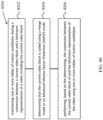
- This method includes maintaining one or more tables of intra prediction mode candidates based on one or more previous video blocks of a video and performing a conversion between a current video block of the video and a bitstream representation of the video using the one or more tables of intra prediction mode candidates.
- the disclosed technology can be used to provide a method for video processing.
- This method includes determining a set of intra prediction mode predictors based on an intra prediction mode of a non-adjacent block of a video block of a video and performing a conversion between the video block and the bitstream representation of the video using the set of intra prediction mode predictors.
- the disclosed technology can be used to provide a method for video processing.
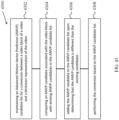
- This method includes maintaining one or more tables of illumination compensation (IC) parameters based on one or more previous video blocks of a video and performing a conversion between a current video block of the video and a bitstream representation of the video using the one or more tables of IC parameters.
- IC illumination compensation
- the disclosed technology can be used to provide a method for video processing.
- This method includes deriving illumination compensation (IC) parameters of a current video block of a video based on IC parameters of a non-adjacent block of the current video block and performing a conversion between the current video block and a bitstream representation of the video using the derived IC parameters.
- IC illumination compensation
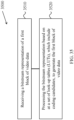
- the disclosed technology may be used to provide a method for video coding.
- This method includes receiving a bitstream representation of a first block of video data, and processing the bitstream representation based on at a set of look-up tables (LUTs) to generate the first block of video data, where the set of LUTs comprises coding candidates.
- LUTs look-up tables
- the disclosed technology may be used to provide another method for video coding.
- This method includes receiving a bitstream representation of a block of video data, and processing the bitstream representation based on coding candidates from non-adjacent blocks, where the coding candidates are non-motion candidates.
- the disclosed technology may be used to provide another method for video coding.
- This method includes receiving a bitstream representation of a block of video data, and processing, using multiple motion vector (MV) precisions and based on an Advanced Motion Vector Prediction (AMVP) candidate list, the bitstream representation to generate the block of video data, where the block of video data comprises low MV precision, and where each AMVP candidate is rounded and pruned with available AMVP candidates prior to insertion into the AMVP candidate list.
- MV motion vector
- AMVP Advanced Motion Vector Prediction
- the disclosed technology may be used to provide another method for video coding.
- This method includes receiving a bitstream representation of a block of video data, and processing, using merge index coding, the bitstream representation to generate the block of video data, where the bitstream representation comprises a merge index that is split into a first part and a second part, wherein the first part is processed by a first binarization method, and wherein the second part is processed by a second binarization method that is different from the first binarization method.
- the above-described method is embodied in the form of processor-executable code and stored in a computer-readable program medium.
- a device that is configured or operable to perform the above-described method.
- the device may include a processor that is programmed to implement this method.
- a video decoder apparatus may implement a method as described herein.
- Video codecs typically include an electronic circuit or software that compresses or decompresses digital video, and are continually being improved to provide higher coding efficiency.
- a video codec converts uncompressed video to a compressed format or vice versa.
- the compressed format usually conforms to a standard video compression specification, e.g., the High Efficiency Video Coding (HEVC) standard (also known as H.265 or MPEG-H Part 2), the Versatile Video Coding standard to be finalized, or other current and/or future video coding standards.
- HEVC High Efficiency Video Coding
- MPEG-H Part 2 the Versatile Video Coding standard to be finalized, or other current and/or future video coding standards.
- Embodiments of the disclosed technology may be applied to existing video coding standards (e.g., HEVC, H.265) and future standards to improve compression performance. Section headings are used in the present document to improve readability of the description and do not in any way limit the discussion or the embodiments (and/or implementations) to the respective sections only.
- FIG. 1 shows an example block diagram of a typical HEVC video encoder and decoder.
- An encoding algorithm producing an HEVC compliant bitstream would typically proceed as follows. Each picture is split into block-shaped regions, with the exact block partitioning being conveyed to the decoder. The first picture of a video sequence (and the first picture at each clean random access point into a video sequence) is coded using only intra-picture prediction (that uses some prediction of data spatially from region-to-region within the same picture, but has no dependence on other pictures). For all remaining pictures of a sequence or between random access points, inter-picture temporally predictive coding modes are typically used for most blocks.
- the encoding process for inter-picture prediction consists of choosing motion data comprising the selected reference picture and motion vector (MV) to be applied for predicting the samples of each block.
- the encoder and decoder generate identical inter-picture prediction signals by applying motion compensation (MC) using the MV and mode decision data, which are transmitted as side information.
- MC motion compensation
- the residual signal of the intra- or inter-picture prediction which is the difference between the original block and its prediction, is transformed by a linear spatial transform.
- the transform coefficients are then scaled, quantized, entropy coded, and transmitted together with the prediction information.
- the encoder duplicates the decoder processing loop (see gray-shaded boxes in FIG. 1 ) such that both will generate identical predictions for subsequent data. Therefore, the quantized transform coefficients are constructed by inverse scaling and are then inverse transformed to duplicate the decoded approximation of the residual signal. The residual is then added to the prediction, and the result of that addition may then be fed into one or two loop filters to smooth out artifacts induced by block-wise processing and quantization.
- the final picture representation (that is a duplicate of the output of the decoder) is stored in a decoded picture buffer to be used for the prediction of subsequent pictures.
- the order of encoding or decoding processing of pictures often differs from the order in which they arrive from the source; necessitating a distinction between the decoding order (e.g., bitstream order) and the output order (e.g., display order) for a decoder.
- the decoding order e.g., bitstream order
- the output order e.g., display order
- Video material to be encoded by HEVC is generally expected to be input as progressive scan imagery (either due to the source video originating in that format or resulting from deinterlacing prior to encoding).
- No explicit coding features are present in the HEVC design to support the use of interlaced scanning, as interlaced scanning is no longer used for displays and is becoming substantially less common for distribution.
- a metadata syntax has been provided in HEVC to allow an encoder to indicate that interlace-scanned video has been sent by coding each field (i.e., the even or odd numbered lines of each video frame) of interlaced video as a separate picture or that it has been sent by coding each interlaced frame as an HEVC coded picture. This provides an efficient method of coding interlaced video without burdening decoders with a need to support a special decoding process for it.
- the core of the coding layer in previous standards was the macroblock, containing a 16 ⁇ 16 block of luma samples and, in the usual case of 4:2:0 color sampling, two corresponding 8 ⁇ 8 blocks of chroma samples.
- An intra-coded block uses spatial prediction to exploit spatial correlation among pixels.
- Two partitions are defined: 16x16 and 4x4.
- An inter-coded block uses temporal prediction, instead of spatial prediction, by estimating motion among pictures.
- Motion can be estimated independently for either 16x16 macroblock or any of its sub-macroblock partitions: 16x8, 8x16, 8x8, 8x4, 4x8, 4x4, as shown in FIG. 2 . Only one motion vector (MV) per sub-macroblock partition is allowed.
- a coding tree unit In HEVC, a coding tree unit (CTU) is split into coding units (CUs) by using a quadtree structure denoted as coding tree to adapt to various local characteristics. The decision whether to code a picture area using inter-picture (temporal) or intra-picture (spatial) prediction is made at the CU level.
- Each CU can be further split into one, two or four prediction units (PUs) according to the PU splitting type. Inside one PU, the same prediction process is applied and the relevant information is transmitted to the decoder on a PU basis.
- a CU After obtaining the residual block by applying the prediction process based on the PU splitting type, a CU can be partitioned into transform units (TUs) according to another quadtree structure similar to the coding tree for the CU.
- transform units transform units
- One of key feature of the HEVC structure is that it has the multiple partition conceptions including CU, PU, and TU.
- Certain features involved in hybrid video coding using HEVC include:
- a CB can be recursively partitioned into transform blocks (TBs).
- the partitioning is signaled by a residual quadtree. Only square CB and TB partitioning is specified, where a block can be recursively split into quadrants, as illustrated in FIG. 4 .
- a flag signals whether it is split into four blocks of size M/2 ⁇ M/2. If further splitting is possible, as signaled by a maximum depth of the residual quadtree indicated in the sequence parameter set (SPS), each quadrant is assigned a flag that indicates whether it is split into four quadrants.
- the leaf node blocks resulting from the residual quadtree are the transform blocks that are further processed by transform coding.
- the encoder indicates the maximum and minimum luma TB sizes that it will use. Splitting is implicit when the CB size is larger than the maximum TB size. Not splitting is implicit when splitting would result in a luma TB size smaller than the indicated minimum.
- the chroma TB size is half the luma TB size in each dimension, except when the luma TB size is 4 ⁇ 4, in which case a single 4 ⁇ 4 chroma TB is used for the region covered by four 4 ⁇ 4 luma TBs.
- intra-picture-predicted CUs the decoded samples of the nearest-neighboring TBs (within or outside the CB) are used as reference data for intra picture prediction.
- the HEVC design allows a TB to span across multiple PBs for inter-picture predicted CUs to maximize the potential coding efficiency benefits of the quadtree-structured TB partitioning.
- a CTB is divided according to a quad-tree structure, the nodes of which are coding units.
- the plurality of nodes in a quad-tree structure includes leaf nodes and non-leaf nodes.
- the leaf nodes have no child nodes in the tree structure (i.e., the leaf nodes are not further split).
- The, non-leaf nodes include a root node of the tree structure.
- the root node corresponds to an initial video block of the video data (e.g., a CTB).
- the respective non-root node corresponds to a video block that is a sub-block of a video block corresponding to a parent node in the tree structure of the respective non-root node.
- Each respective non-leaf node of the plurality of non-leaf nodes has one or more child nodes in the tree structure.
- JEM Joint Exploration Model
- QTBT quadtree plus binary tree
- TT ternary tree
- the QTBT structure removes the concepts of multiple partition types, i.e. it removes the separation of the CU, PU and TU concepts, and supports more flexibility for CU partition shapes.
- a CU can have either a square or rectangular shape.
- a coding tree unit (CTU) is first partitioned by a quadtree structure.
- the quadtree leaf nodes are further partitioned by a binary tree structure.
- the binary tree leaf nodes are called coding units (CUs), and that segmentation is used for prediction and transform processing without any further partitioning.
- a CU sometimes consists of coding blocks (CBs) of different colour components, e.g. one CU contains one luma CB and two chroma CBs in the case of P and B slices of the 4:2:0 chroma format and sometimes consists of a CB of a single component, e.g., one CU contains only one luma CB or just two chroma CBs in the case of I slices.
- CBs coding blocks
- the CTU size is set as 128 ⁇ 128 luma samples with two corresponding 64 ⁇ 64 blocks of chroma samples
- the MinQTSize is set as 16 ⁇ 16
- the MaxBTSize is set as 64 ⁇ 64
- the MinBTSize (for both width and height) is set as 4 ⁇ 4
- the MaxBTDepth is set as 4.
- the quadtree partitioning is applied to the CTU first to generate quadtree leaf nodes.
- the quadtree leaf nodes may have a size from 16 ⁇ 16 (i.e., the MinQTSize ) to 128 ⁇ 128 (i.e., the CTU size).
- the quadtree leaf node is also the root node for the binary tree and it has the binary tree depth as 0.
- MaxBTDepth i.e., 4
- no further splitting is considered.
- MinBTSize i.e. 4
- no further horizontal splitting is considered.
- the binary tree node has height equal to MinBTSize
- no further vertical splitting is considered.
- the leaf nodes of the binary tree are further processed by prediction and transform processing without any further partitioning. In the JEM, the maximum CTU size is 256 ⁇ 256 luma samples.
- FIG. 5A shows an example of block partitioning by using QTBT
- FIG. 5B shows the corresponding tree representation.
- the solid lines indicate quadtree splitting and dotted lines indicate binary tree splitting.
- each splitting (i.e., non-leaf) node of the binary tree one flag is signalled to indicate which splitting type (i.e., horizontal or vertical) is used, where 0 indicates horizontal splitting and 1 indicates vertical splitting.
- the quadtree splitting there is no need to indicate the splitting type since quadtree splitting always splits a block both horizontally and vertically to produce 4 sub-blocks with an equal size.
- the QTBT scheme supports the ability for the luma and chroma to have a separate QTBT structure.
- the luma and chroma CTBs in one CTU share the same QTBT structure.
- the luma CTB is partitioned into CUs by a QTBT structure
- the chroma CTBs are partitioned into chroma CUs by another QTBT structure. This means that a CU in an I slice consists of a coding block of the luma component or coding blocks of two chroma components, and a CU in a P or B slice consists of coding blocks of all three colour components.
- inter prediction for small blocks is restricted to reduce the memory access of motion compensation, such that bi-prediction is not supported for 4 ⁇ 8 and 8 ⁇ 4 blocks, and inter prediction is not supported for 4 ⁇ 4 blocks.
- these restrictions are removed.
- FIG. 6A shows an example of quad-tree (QT) partitioning
- FIGS. 6B and 6C show examples of the vertical and horizontal binary-tree (BT) partitioning, respectively.
- BT binary-tree
- ternary tree (TT) partitions e.g., horizontal and vertical center-side ternary-trees (as shown in FIGS. 6D and 6E ) are supported.
- region tree quad-tree
- prediction tree binary-tree or ternary-tree
- a CTU is firstly partitioned by region tree (RT).
- a RT leaf may be further split with prediction tree (PT).
- PT leaf may also be further split with PT until max PT depth is reached.
- a PT leaf is the basic coding unit. It is still called CU for convenience.
- a CU cannot be further split.
- Prediction and transform are both applied on CU in the same way as JEM.
- the whole partition structure is named 'multiple-type-tree'.
- a tree structure called a Multi-Tree Type which is a generalization of the QTBT, is supported.
- MTT Multi-Tree Type
- FIG. 7 a Coding Tree Unit (CTU) is firstly partitioned by a quad-tree structure.
- the quad-tree leaf nodes are further partitioned by a binary-tree structure.
- the structure of the MTT constitutes of two types of tree nodes: Region Tree (RT) and Prediction Tree (PT), supporting nine types of partitions, as shown in FIG. 8 .
- a region tree can recursively split a CTU into square blocks down to a 4x4 size region tree leaf node.
- a prediction tree can be formed from one of three tree types: Binary Tree, Ternary Tree, and Asymmetric Binary Tree.
- a PT split it is prohibited to have a quadtree partition in branches of the prediction tree.
- the luma tree and the chroma tree are separated in I slices.
- Video coding standards have significantly improved over the years, and now provide, in part, high coding efficiency and support for higher resolutions.
- Recent standards such as HEVC and H.265 are based on the hybrid video coding structure wherein temporal prediction plus transform coding are utilized.
- Each inter-predicted prediction unit has motion parameters for one or two reference picture lists.
- motion parameters include a motion vector and a reference picture index.
- the usage of one of the two reference picture lists may also be signaled using inter_pred_idc.
- motion vectors may be explicitly coded as deltas relative to predictors.
- a merge mode is specified whereby the motion parameters for the current PU are obtained from neighboring PUs, including spatial and temporal candidates.
- the merge mode can be applied to any inter-predicted PU, not only for skip mode.
- the alternative to merge mode is the explicit transmission of motion parameters, where motion vector, corresponding reference picture index for each reference picture list and reference picture list usage are signaled explicitly per each PU.
- a slice is a spatially distinct region of a frame that is encoded separately from any other region in the same frame.
- the PU is produced from one motion vector and reference index. This is referred to as 'uni-prediction'. Uni-prediction is available both for P-slices and B-slices.
- the PU is produced from two motion vectors and reference indices. This is referred to as 'bi-prediction'. Bi-prediction is available for B-slices only.
- FIG. 9 shows an example of constructing a merge candidate list based on the sequence of steps summarized above.
- For spatial merge candidate derivation a maximum of four merge candidates are selected among candidates that are located in five different positions.
- temporal merge candidate derivation a maximum of one merge candidate is selected among two candidates. Since constant number of candidates for each PU is assumed at decoder, additional candidates are generated when the number of candidates does not reach to maximum number of merge candidate (MaxNumMergeCand) which is signalled in slice header. Since the number of candidates is constant, index of best merge candidate is encoded using truncated unary binarization (TU). If the size of CU is equal to 8, all the PUs of the current CU share a single merge candidate list, which is identical to the merge candidate list of the 2N ⁇ 2N prediction unit.
- TU truncated unary binarization
- a maximum of four merge candidates are selected among candidates located in the positions depicted in FIG. 10 .
- the order of derivation is A 1 , B 1 , B 0 , A 0 and B 2 .
- Position B 2 is considered only when any PU of position A 1 , B 1 , B 0 , A 0 is not available (e.g. because it belongs to another slice or tile) or is intra coded.
- candidate at position A 1 is added, the addition of the remaining candidates is subject to a redundancy check which ensures that candidates with same motion information are excluded from the list so that coding efficiency is improved.
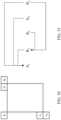
- FIG. 12A and 12B depict the second PU for the case of N ⁇ 2N and 2N ⁇ N, respectively.
- candidate at position A 1 is not considered for list construction.
- adding this candidate may lead to two prediction units having the same motion information, which is redundant to just have one PU in a coding unit.
- position B 1 is not considered when the current PU is partitioned as 2N ⁇ N.
- a scaled motion vector is derived based on co-located PU belonging to the picture which has the smallest Picture Order Count (POC) difference with current picture within the given reference picture list.
- POC Picture Order Count
- the reference picture list to be used for derivation of the co-located PU is explicitly signaled in the slice header.
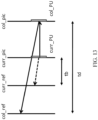
- FIG. 13 shows an example of the derivation of the scaled motion vector for a temporal merge candidate (as the dotted line), which is scaled from the motion vector of the co-located PU using the POC distances, tb and td, where tb is defined to be the POC difference between the reference picture of the current picture and the current picture and td is defined to be the POC difference between the reference picture of the co-located picture and the co-located picture.
- the reference picture index of temporal merge candidate is set equal to zero. For a B-slice, two motion vectors, one is for reference picture list 0 and the other is for reference picture list 1, are obtained and combined to make the bi-predictive merge candidate.
- the position for the temporal candidate is selected between candidates C 0 and C 1 , as depicted in FIG. 14 . If PU at position C 0 is not available, is intra coded, or is outside of the current CTU, position C 1 is used. Otherwise, position C 0 is used in the derivation of the temporal merge candidate.
- merge candidates there are two additional types of merge candidates: combined bi-predictive merge candidate and zero merge candidate.
- Combined bi-predictive merge candidates are generated by utilizing spatio-temporal merge candidates.
- Combined bi-predictive merge candidate is used for B-Slice only.
- the combined bi-predictive candidates are generated by combining the first reference picture list motion parameters of an initial candidate with the second reference picture list motion parameters of another. If these two tuples provide different motion hypotheses, they will form a new bi-predictive candidate.
- FIG. 15 shows an example of this process, wherein two candidates in the original list (710, on the left), which have mvL0 and refldxL0 or mvL1 and refldxL1, are used to create a combined bi-predictive merge candidate added to the final list (720, on the right).
- Zero motion candidates are inserted to fill the remaining entries in the merge candidates list and therefore hit the MaxNumMergeCand capacity. These candidates have zero spatial displacement and a reference picture index which starts from zero and increases every time a new zero motion candidate is added to the list. The number of reference frames used by these candidates is one and two for uni- and bi-directional prediction, respectively. In some embodiments, no redundancy check is performed on these candidates.
- motion estimation can be performed in parallel whereby the motion vectors for all prediction units inside a given region are derived simultaneously.
- the derivation of merge candidates from spatial neighborhood may interfere with parallel processing as one prediction unit cannot derive the motion parameters from an adjacent PU until its associated motion estimation is completed.
- a motion estimation region may be defined.
- the size of the MER may be signaled in the picture parameter set (PPS) using the "log2_parallel_merge_level_minus2" syntax element.
- the picture parameter set (PPS) raw byte sequence payload (RBSP) syntax is shown in Table 1, where log2_parallel_merge_level_minus2 plus 2 specifies the value of the variable Log2ParMrgLevel, which is used in the derivation process for luma motion vectors for merge mode and the derivation process for spatial merging candidates as specified in an existing video coding standard.
- the value of log2_parallel_merge_level_minus2 shall be in the range of 0 to CtbLog2SizeY - 2, inclusive.
- Log2ParMrgLevel log2_parallel_merge_level_minus2 + 2
- Log2ParMrgLevel indicates the built-in capability of parallel derivation of the merging candidate lists. For example, when Log2ParMrgLevel is equal to 6, the merging candidate lists for all the prediction units (PUs) and coding units (CUs) contained in a 64x64 block can be derived in parallel.
- Table 1 General picture parameter set RBSP syntax pic_parameter_set_rbsp( ) ⁇ Descriptor pps_pic_parameter_set_id ue(v) pps_seq_parameter_set_id ue(v) dependent_slice_segments_enabled_flag u(1) ...
- Motion vector prediction exploits spatio-temporal correlation of motion vector with neighboring PUs, which is used for explicit transmission of motion parameters. It constructs a motion vector candidate list by firstly checking availability of left, above temporally neighboring PU positions, removing redundant candidates and adding zero vector to make the candidate list to be constant length. Then, the encoder can select the best predictor from the candidate list and transmit the corresponding index indicating the chosen candidate. Similarly with merge index signaling, the index of the best motion vector candidate is encoded using truncated unary.
- FIG. 16 summarizes derivation process for motion vector prediction candidate, and may be implemented for each reference picture list with refidx as an input.
- motion vector candidate two types are considered: spatial motion vector candidate and temporal motion vector candidate.
- spatial motion vector candidate derivation two motion vector candidates are eventually derived based on motion vectors of each PU located in five different positions as previously shown in FIG. 10 .
- one motion vector candidate is selected from two candidates, which are derived based on two different co-located positions. After the first list of spatio-temporal candidates is made, duplicated motion vector candidates in the list are removed. If the number of potential candidates is larger than two, motion vector candidates whose reference picture index within the associated reference picture list is larger than 1 are removed from the list. If the number of spatio-temporal motion vector candidates is smaller than two, additional zero motion vector candidates is added to the list.
- a maximum of two candidates are considered among five potential candidates, which are derived from PUs located in positions as previously shown in FIG. 10 , those positions being the same as those of motion merge.
- the order of derivation for the left side of the current PU is defined as A 0 , A 1 , scaled A 0 , and scaled A 1 .
- the order of derivation for the above side of the current PU is defined as B 0 , B 1 , B 2 , scaled B 0 , scaled B 1 , scaled B 2 .
- the no-spatial-scaling cases are checked first followed by the cases that allow spatial scaling. Spatial scaling is considered when the POC is different between the reference picture of the neighbouring PU and that of the current PU regardless of reference picture list. If all PUs of left candidates are not available or are intra coded, scaling for the above motion vector is allowed to help parallel derivation of left and above MV candidates. Otherwise, spatial scaling is not allowed for the above motion vector.
- the motion vector of the neighbouring PU is scaled in a similar manner as for temporal scaling.
- One difference is that the reference picture list and index of current PU is given as input; the actual scaling process is the same as that of temporal scaling.
- the reference picture index is signaled to the decoder.
- the corresponding semantics include: five_minus_max_num_merge_cand specifies the maximum number of merging MVP candidates supported in the slice subtracted from 5.
- MaxNumMergeCand shall be in the range of 1 to 5, inclusive.
- merge_flag[ x0 ][ y0 ] specifies whether the inter prediction parameters for the current prediction unit are inferred from a neighboring inter-predicted partition.
- the array indices x0, y0 specify the location ( x0, y0 ) of the top-left luma sample of the considered prediction block relative to the top-left luma sample of the picture.
- merge_flag[ x0 ][ y0 ] When merge_flag[ x0 ][ y0 ] is not present, it is inferred as follows:
- JEM Joint Exploration Model
- affine prediction alternative temporal motion vector prediction
- STMVP spatial-temporal motion vector prediction
- BIO bi-directional optical flow
- FRUC Frame-Rate Up Conversion
- LAMVR Locally Adaptive Motion Vector Resolution
- OBMC Overlapped Block Motion Compensation
- LIC Local Illumination Compensation
- DMVR Decoder-side Motion Vector Refinement
- each CU can have at most one set of motion parameters for each prediction direction.
- two sub-CU level motion vector prediction methods are considered in the encoder by splitting a large CU into sub-CUs and deriving motion information for all the sub-CUs of the large CU.
- Alternative temporal motion vector prediction (ATMVP) method allows each CU to fetch multiple sets of motion information from multiple blocks smaller than the current CU in the collocated reference picture.
- STMVP spatial-temporal motion vector prediction
- motion vectors of the sub-CUs are derived recursively by using the temporal motion vector predictor and spatial neighbouring motion vector.
- the motion compression for the reference frames may be disabled.
- the temporal motion vector prediction (TMVP) method is modified by fetching multiple sets of motion information (including motion vectors and reference indices) from blocks smaller than the current CU.
- FIG. 18 shows an example of ATMVP motion prediction process for a CU 1800.
- the ATMVP method predicts the motion vectors of the sub-CUs 1801 within a CU 1800 in two steps.
- the first step is to identify the corresponding block 1851 in a reference picture 1850 with a temporal vector.
- the reference picture 1850 is also referred to as the motion source picture.
- the second step is to split the current CU 1800 into sub-CUs 1801 and obtain the motion vectors as well as the reference indices of each sub-CU from the block corresponding to each sub-CU.
- a reference picture 1850 and the corresponding block is determined by the motion information of the spatial neighboring blocks of the current CU 1800.
- the first merge candidate in the merge candidate list of the current CU 1800 is used.
- the first available motion vector as well as its associated reference index are set to be the temporal vector and the index to the motion source picture. This way, the corresponding block may be more accurately identified, compared with TMVP, wherein the corresponding block (sometimes called collocated block) is always in a bottom-right or center position relative to the current CU.
- the associated MV and reference picture are utilized to identify the source block and source picture.
- a corresponding block of the sub-CU 1851 is identified by the temporal vector in the motion source picture 1850, by adding to the coordinate of the current CU the temporal vector.
- the motion information of its corresponding block e.g., the smallest motion grid that covers the center sample
- the motion information of a corresponding N ⁇ N block is identified, it is converted to the motion vectors and reference indices of the current sub-CU, in the same way as TMVP of HEVC, wherein motion scaling and other procedures apply.
- the decoder checks whether the low-delay condition (e.g.
- motion vector MVx e.g., the motion vector corresponding to reference picture list X
- motion vector MVy e.g., with X being equal to 0 or 1 and Y being equal to 1-X
- FIG. 20 shows an example of one CU with four sub-blocks and neighboring blocks.
- an 8 ⁇ 8 CU 2000 that includes four 4 ⁇ 4 sub-CUs A (2001), B (2002), C (2003), and D (2004).
- the neighboring 4 ⁇ 4 blocks in the current frame are labelled as a (2011), b (2012), c (2013), and d (2014).
- the motion derivation for sub-CU A starts by identifying its two spatial neighbors.
- the first neighbor is the N ⁇ N block above sub-CU A 1101 (block c 2013). If this block c (2013) is not available or is intra coded the other N ⁇ N blocks above sub-CU A (2001) are checked (from left to right, starting at block c 2013).
- the second neighbor is a block to the left of the sub-CU A 2001 (block b 2012). If block b (2012) is not available or is intra coded other blocks to the left of sub-CU A 2001 are checked (from top to bottom, staring at block b 2012).
- the motion information obtained from the neighboring blocks for each list is scaled to the first reference frame for a given list.
- temporal motion vector predictor (TMVP) of sub-block A 2001 is derived by following the same procedure of TMVP derivation as specified in HEVC.
- the motion information of the collocated block at block D 2004 is fetched and scaled accordingly.
- all available motion vectors are averaged separately for each reference list. The averaged motion vector is assigned as the motion vector of the current sub-CU.
- the sub-CU modes are enabled as additional merge candidates and there is no additional syntax element required to signal the modes.
- Two additional merge candidates are added to merge candidates list of each CU to represent the ATMVP mode and STMVP mode. In other embodiments, up to seven merge candidates may be used, if the sequence parameter set indicates that ATMVP and STMVP are enabled.
- the encoding logic of the additional merge candidates is the same as for the merge candidates in the HM, which means, for each CU in P or B slice, two more RD checks may be needed for the two additional merge candidates.
- all bins of the merge index are context coded by CABAC (Context-based Adaptive Binary Arithmetic Coding). In other embodiments, e.g., HEVC, only the first bin is context coded and the remaining bins are context by-pass coded.
- CABAC Context-based Adaptive Binary Arithmetic Coding
- motion vector differences (between the motion vector and predicted motion vector of a PU) are signalled in units of quarter luma samples when use_integer_mv_flag is equal to 0 in the slice header.
- LAMVR locally adaptive motion vector resolution
- MVD can be coded in units of quarter luma samples, integer luma samples or four luma samples.
- the MVD resolution is controlled at the coding unit (CU) level, and MVD resolution flags are conditionally signalled for each CU that has at least one non-zero MVD components.
- a first flag is signalled to indicate whether quarter luma sample MV precision is used in the CU.
- the first flag (equal to 1) indicates that quarter luma sample MV precision is not used, another flag is signalled to indicate whether integer luma sample MV precision or four luma sample MV precision is used.
- the quarter luma sample MV resolution is used for the CU.
- the MVPs in the AMVP candidate list for the CU are rounded to the corresponding precision.
- CU-level RD checks are used to determine which MVD resolution is to be used for a CU. That is, the CU-level RD check is performed three times for each MVD resolution.
- the following encoding schemes are applied in the JEM:
- the procedure is similar to the HEVC design.
- MVs e.g., integer-precision
- rounding operations may be applied. For example, rounding a motion vector can be performed by right or left shifting the motion vector to the motion vector precision of the current block.
- the PMMVD mode is a special merge mode based on the Frame-Rate Up Conversion (FRUC) method. With this mode, motion information of a block is not signaled but derived at decoder side.
- FRUC Frame-Rate Up Conversion
- a FRUC flag can be signaled for a CU when its merge flag is true.
- a merge index can be signaled and the regular merge mode is used.
- an additional FRUC mode flag can be signaled to indicate which method (e.g., bilateral matching or template matching) is to be used to derive motion information for the block.
- the decision on whether using FRUC merge mode for a CU is based on RD cost selection as done for normal merge candidate. For example, multiple matching modes (e.g., bilateral matching and template matching) are checked for a CU by using RD cost selection. The one leading to the minimal cost is further compared to other CU modes. If a FRUC matching mode is the most efficient one, FRUC flag is set to true for the CU and the related matching mode is used.
- multiple matching modes e.g., bilateral matching and template matching
- motion derivation process in FRUC merge mode has two steps: a CU-level motion search is first performed, then followed by a Sub-CU level motion refinement.
- CU level an initial motion vector is derived for the whole CU based on bilateral matching or template matching.
- a list of MV candidates is generated and the candidate that leads to the minimum matching cost is selected as the starting point for further CU level refinement.
- a local search based on bilateral matching or template matching around the starting point is performed.
- the MV results in the minimum matching cost is taken as the MV for the whole CU.
- the motion information is further refined at sub-CU level with the derived CU motion vectors as the starting points.
- the following derivation process is performed for a W ⁇ H CU motion information derivation.
- MV for the whole W ⁇ H CU is derived.
- the CU is further split into M ⁇ M sub-CUs.
- the value of M is calculated as in Eq. (3), D is a predefined splitting depth which is set to 3 by default in the JEM.
- the MV for each sub-CU is derived.
- M max 4 , min M 2 D N 2 D
- FIG. 21 shows an example of bilateral matching used in the Frame-Rate Up Conversion (FRUC) method.
- the bilateral matching is used to derive motion information of the current CU by finding the closest match between two blocks along the motion trajectory of the current CU (2100) in two different reference pictures (2110, 2111).
- the motion vectors MV0 (2101) and MV1 (2102) pointing to the two reference blocks are proportional to the temporal distances, e.g., TD0 (2103) and TD1 (2104), between the current picture and the two reference pictures.
- the bilateral matching becomes mirror based bi-directional MV.
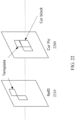
- FIG. 22 shows an example of template matching used in the Frame-Rate Up Conversion (FRUC) method.
- Template matching can be used to derive motion information of the current CU 2200 by finding the closest match between a template (e.g., top and/or left neighboring blocks of the current CU) in the current picture and a block (e.g., same size to the template) in a reference picture 2210. Except the aforementioned FRUC merge mode, the template matching can also be applied to AMVP mode. In both JEM and HEVC, AMVP has two candidates. With the template matching method, a new candidate can be derived.
- a template e.g., top and/or left neighboring blocks of the current CU
- a block e.g., same size to the template
- the newly derived candidate by template matching is different to the first existing AMVP candidate, it is inserted at the very beginning of the AMVP candidate list and then the list size is set to two (e.g., by removing the second existing AMVP candidate).
- the list size is set to two (e.g., by removing the second existing AMVP candidate).
- the MV candidate set at CU level can include the following: (1) original AMVP candidates if the current CU is in AMVP mode, (2) all merge candidates, (3) several MVs in the interpolated MV field (described later), and top and left neighboring motion vectors.
- each valid MV of a merge candidate can be used as an input to generate a MV pair with the assumption of bilateral matching.
- one valid MV of a merge candidate is (MVa, ref a ) at reference list A.
- the reference picture ref b of its paired bilateral MV is found in the other reference list B so that ref a and ref b are temporally at different sides of the current picture. If such a ref b is not available in reference list B, ref b is determined as a reference which is different from ref a and its temporal distance to the current picture is the minimal one in list B.
- MVb is derived by scaling MVa based on the temporal distance between the current picture and ref a , ref b .
- four MVs from the interpolated MV field can also be added to the CU level candidate list. More specifically, the interpolated MVs at the position (0, 0), (W/2, 0), (0, H/2) and (W/2, H/2) of the current CU are added.
- the original AMVP candidates are also added to CU level MV candidate set.
- 15 MVs for AMVP CUs and 13 MVs for merge CUs can be added to the candidate list.
- the MV candidate set at sub-CU level includes an MV determined from a CU-level search, (2) top, left, top-left and top-right neighboring MVs, (3) scaled versions of collocated MVs from reference pictures, (4) one or more ATMVP candidates (e.g., up to four), and (5) one or more STMVP candidates (e.g., up to four).
- the scaled MVs from reference pictures are derived as follows. The reference pictures in both lists are traversed. The MVs at a collocated position of the sub-CU in a reference picture are scaled to the reference of the starting CU-level MV.
- ATMVP and STMVP candidates can be the four first ones.
- one or more MVs are added to the candidate list.
- interpolated motion field Before coding a frame, interpolated motion field is generated for the whole picture based on unilateral ME. Then the motion field may be used later as CU level or sub-CU level MV candidates.
- FIG. 23 shows an example of unilateral Motion Estimation (ME) 2300 in the FRUC method.
- ME unilateral Motion Estimation
- the motion of the reference block is scaled to the current picture according to the temporal distance TD0 and TD1 (the same way as that of MV scaling of TMVP in HEVC) and the scaled motion is assigned to the block in the current frame. If no scaled MV is assigned to a 4 ⁇ 4 block, the block's motion is marked as unavailable in the interpolated motion field.
- the matching cost is a bit different at different steps.
- the matching cost can be the absolute sum difference (SAD) of bilateral matching or template matching.
- SAD absolute sum difference
- w is a weighting factor.
- w can be empirically set to 4.
- MV and MV s indicate the current MV and the starting MV, respectively.
- SAD may still be used as the matching cost of template matching at sub-CU level search.
- MV is derived by using luma samples only. The derived motion will be used for both luma and chroma for MC inter prediction. After MV is decided, final MC is performed using 8-taps interpolation filter for luma and 4-taps interpolation filter for chroma.
- MV refinement is a pattern based MV search with the criterion of bilateral matching cost or template matching cost.
- two search patterns are supported - an unrestricted center-biased diamond search (UCBDS) and an adaptive cross search for MV refinement at the CU level and sub-CU level, respectively.
- UMBDS center-biased diamond search
- the MV is directly searched at quarter luma sample MV accuracy, and this is followed by one-eighth luma sample MV refinement.
- the search range of MV refinement for the CU and sub-CU step are set equal to 8 luma samples.
- bi-prediction is applied because the motion information of a CU is derived based on the closest match between two blocks along the motion trajectory of the current CU in two different reference pictures.
- the encoder can choose among uni-prediction from list0, uni-prediction from list1, or bi-prediction for a CU. The selection ca be based on a template matching cost as follows:
- cost0 is the SAD of list0 template matching
- cost1 is the SAD of list1 template matching
- costBi is the SAD of bi-prediction template matching.
- the value of factor is equal to 1.25, it means that the selection process is biased toward bi-prediction.
- the inter prediction direction selection can be applied to the CU-level template matching process.
- a bi-prediction operation for the prediction of one block region, two prediction blocks, formed using a motion vector (MV) of list0 and a MV of list1, respectively, are combined to form a single prediction signal.
- the two motion vectors of the bi-prediction are further refined by a bilateral template matching process.
- the bilateral template matching applied in the decoder to perform a distortion-based search between a bilateral template and the reconstruction samples in the reference pictures in order to obtain a refined MV without transmission of additional motion information.
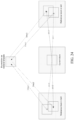
- a bilateral template is generated as the weighted combination (i.e. average) of the two prediction blocks, from the initial MV0 of list0 and MV1 of list1, respectively, as shown in FIG. 24 .
- the template matching operation consists of calculating cost measures between the generated template and the sample region (around the initial prediction block) in the reference picture. For each of the two reference pictures, the MV that yields the minimum template cost is considered as the updated MV of that list to replace the original one.
- nine MV candidates are searched for each list. The nine MV candidates include the original MV and 8 surrounding MVs with one luma sample offset to the original MV in either the horizontal or vertical direction, or both.
- the two new MVs i.e., MV0' and MV1' as shown in FIG. 24 , are used for generating the final bi-prediction results.
- a sum of absolute differences (SAD) is used as the cost measure.
- DMVR is applied for the merge mode of bi-prediction with one MV from a reference picture in the past and another from a reference picture in the future, without the transmission of additional syntax elements.
- JEM when LIC, affine motion, FRUC, or sub-CU merge candidate is enabled for a CU, DMVR is not applied.
- IC Local Illumination Compensation
- CU inter-mode coded coding unit
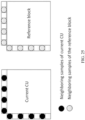
- a least square error method is employed to derive the parameters a and b by using the neighbouring samples of the current CU and their corresponding reference samples. More specifically, as illustrated in FIG. 25 , the subsampled (2:1 subsampling) neighbouring samples of the CU and the corresponding samples (identified by motion information of the current CU or sub-CU) in the reference picture are used. The IC parameters are derived and applied for each prediction direction separately.
- the IC flag is copied from neighbouring blocks, in a way similar to motion information copy in merge mode; otherwise, an IC flag is signalled for the CU to indicate whether LIC applies or not.
- MR-SAD mean-removed sum of absolute diffefference
- MR-SATD mean-removed sum of absolute Hadamard-transformed difference
- IC is disabled for the entire picture when there is no obvious illumination change between a current picture and its reference pictures.
- histograms of a current picture and every reference picture of the current picture are calculated at the encoder. If the histogram difference between the current picture and every reference picture of the current picture is smaller than a given threshold, IC is disabled for the current picture; otherwise, IC is enabled for the current picture.
- a merge candidate list is first constructed by inserting the motion vectors and reference indices of the spatial neighboring and temporal neighboring blocks into the candidate list with redundancy checking until the number of the available candidates reaches the maximum candidate size of 19.
- the merge candidate list for the merge/skip mode is constructed by inserting spatial candidates, temporal candidates, affine candidates, advanced temporal MVP (ATMVP) candidate, spatial temporal MVP (STMVP) candidate and the additional candidates as used in HEVC (Combined candidates and Zero candidates) according to a pre-defined insertion order, and in the context of the numbered blocks shown in FIG. 25 :
- IC flags are also inherited from merge candidates except for STMVP and affine. Moreover, for the first four spatial candidates, the bi-prediction ones are inserted before the ones with uni-prediction.
- the related value should be firstly binarized to a bin string based on the distribution. For each bin, it may be coded with context or bypass coding methods.
- the unary code word in CABAC consists of x "1" bits plus a terminating "0" bit.
- Table 5 Bin string of the unary binarization prefixVal Bin string 0 0 1 1 0 2 1 1 0 3 1 1 1 0 4 1 1 1 1 1 0 5 1 1 1 1 1 1 0 ...
- Bin string of the EG0 binarization K 0 prefixVal Bin string 0 0 1 1 0 0 2 1 0 1 3 1 1 0 0 0 4 1 1 0 0 1 5 1 1 0 1 0 6 1 1 0 1 1 7 1 1 1 0 0 0 0 ... binIdx 0 1 2 3 4 5 6
- Input to this process is a request for a TR binarization, cMax, and cRiceParam.
- Output of this process is the TR binarization associating each value symbolVal with a corresponding bin string.
- TR bin string is a concatenation of a prefix bin string and, when present, a suffix bin string.
- prefix bin string is a bit string of length prefixVal + 1 indexed by binIdx.
- the bins for binIdx less than prefixVal are equal to 1.
- the bin with binIdx equal to prefixVal is equal to 0.
- Inputs to this process are a request for a FL binarization and cMax.
- Output of this process is the FL binarization associating each value symbolVal with a corresponding bin string.
- the merge index is firstly binarized to a bin string if the total number of allowed merge candidate is larger than 1.
- TR with cRiceParam equal to 0, i.e., TU is used.
- the first bin of merge_idx is coded with one context and the remaining bins, if exist, are coded with bypass.
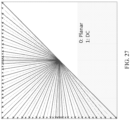
- the number of directional intra modes is extended from 33, as used in HEVC, to 65.
- the additional directional modes are depicted as light grey dotted arrows in FIG. 27 , and the planar and DC modes remain the same.
- These denser directional intra prediction modes apply for all block sizes and for both luma and chroma intra predictions.
- FIG. 27 depicts the examples of the 67 intra prediction modes.
- an intra mode coding method with 6 Most Probable Modes is used. Two major technical aspects are involved: 1) the derivation of 6 MPMs, and 2) entropy coding of 6 MPMs and non-MPM modes.
- An initial MPM list is formed by inserting 5 neighbour intra modes and the planar and DC modes into the MPM list.
- a pruning process is used to remove duplicated modes so that only unique modes can be included into the MPM list. The order in which the initial modes are included is: left, above, planar, DC, below-left, above-right, and then above-left.
- pruning may includes operations of (a) comparing with existing entries for uniqueness, then (b) if unique, then adding to the list, and (c) if not unique, then either (c1) not adding or (c2) adding and deleting existing entry that matched such that, after addition, number of entries does not increase.
- derived modes are added; these intra modes are obtained by adding -1 or +1 to the angular modes that are already included in the MPM list. Such additional derived modes are not generated from the non-angular modes (DC or planar).
- a truncated unary binarization is used for entropy coding of the selected mode using the 6 MPMs.
- the first three bins are coded with contexts that depend on the MPM mode related to the bin currently being signalled.
- the MPM mode is classified into one of three categories: (a) modes that are predominantly horizontal (i.e., the MPM mode number is less than or equal to the mode number for the diagonal direction), (b) modes that are predominantly vertical (i.e., the MPM mode is greater than the mode number for the diagonal direction), and (c) the non-angular (DC and planar) class. Accordingly, three contexts are used to signal the MPM index based on this classification.
- the coding for selection of the remaining 61 non-MPMs is done as follows.
- the 61 non-MPMs are first divided into two sets: a selected mode set and a non-selected mode set.
- the selected modes set contains 16 modes and the rest (45 modes) are assigned to the non-selected modes set.
- the mode set that the current mode belongs to is indicated in the bitstream with a flag. If the mode to be indicated is within the selected modes set, the selected mode is signalled with a 4-bit fixed-length code, and if the mode to be indicated is from the non-selected set, the selected mode is signalled with a truncated binary code.
- the selected modes set is generated by sub-sampling the 61 non-MPM modes as follows:
- the similar two-stage intra mode decision process of HM is used.
- the intra mode pre-selection stage a lower complexity Sum of Absolute Transform Difference (SATD) cost is used to pre-select N intra prediction modes from all the available intra modes.
- SATD Absolute Transform Difference
- R-D cost selection is further applied to select one intra prediction mode from the N candidates.
- 67 intra prediction modes since the total number of available modes is roughly doubled, the complexity of the intra mode pre-selection stage will also be increased if the same encoder mode decision process of HM is directly used.
- a two-step intra mode pre-selection process is performed.
- N N depends on intra prediction block size
- STD Sum of Absolute Transform Difference
- chroma mode candidates includes the following three parts:
- a pruning process is applied whenever a new chroma intra mode is added to the candidate list.
- the non-CCLM chroma intra mode candidates list size is then trimmed to 5.
- a flag is first signalled to indicate whether one of the CCLM modes or one of the traditional chroma intra prediction mode is used. Then a few more flags may follow to specify the exact chroma prediction mode used for the current chroma CBs.
- the current HEVC design could take the correlation of current block its neighbouring blocks (next to the current block) to better code the motion information. However, it is possible that that the neighbouring blocks correspond to different objects with different motion trajectories. In this case, prediction from its neighbouring blocks is not efficient.
- Prediction from motion information of non-adj acent blocks could bring additional coding gain with the cost of storing all the motion information (typically on 4x4 level) into cache which significantly increase the complexity for hardware implementation.
- Unary binarization method works fine for smaller number of allowed merge candidates. However, when the total number of allowed candidate becomes larger, the unary binarization may be sub-optimal.
- the HEVC design of AMVP candidate list construction process only invokes pruning among two spatial AMVP candidates. Full pruning (each of the available candidate compared to all others) is not utilized since there is negligible coding loss due to limited pruning. However, if there are more AMVP candidates available, pruning becomes important. Also, when LAMVR is enabled, how to construct the AMVP candidate list should be studied.
- LUT-based motion vector prediction techniques using one or more look up tables with at least one motion candidate stored to predict motion information of a block can be implemented in various embodiments to provide video coding with higher coding efficiencies.
- Each LUT can include one or more motion candidates, each associated with corresponding motion information.
- Motion information of a motion candidate can include partial or all of the prediction direction, reference indices/pictures, motion vectors, LIC flags, affine flags, Motion Vector Derivation (MVD) precisions, and/or MVD values.
- Motion information may further include the block position information to indicate where the motion information is coming from.
- the LUT-based motion vector prediction based on the disclosed technology which may enhance both existing and future video coding standards, is elucidated in the following examples described for various implementations. Because the LUTs allow the encoding/decoding process to be performed based on historical data (e.g., the blocks that have been processed), the LUT-based motion vector prediction can also be referred to as History-based Motion Vector Prediction (HMVP) method.
- HMVP History-based Motion Vector Prediction
- one or multiple tables with motion information from previously coded blocks are maintained during the encoding/decoding process.
- the associated motion information in LUTs may be used (e.g., by being added to the motion candidate lists) depending on the coding characteristics of the block.
- LUTs may be updated based on the coding characteristics of the block. That is, the updating of LUTs is based on the encoding/decoding order.
- an entry of a LUT is a motion candidate.
- the term motion candidate is used to indicate a set of motion information stored in a look up table.
- AMVP or merge candidates are used for storing the motion information.
- motion information can be derived by adding motion vector differences to an AMVP candidate.
- LUTs with motion candidates for motion vector prediction is extended to LUTs with intra prediction modes for intra mode coding, or extended to LUTs with illumination compensation parameters for IC parameter coding or extended to LUTs with filter parameters.
- the LUT based methods for motion candidates may be extended to other types of coding information, as described in this patent document, existing and future video coding standards.
- Examples 1 and 2 advantageously define LUTs as used in the disclosed technology.
- Example 1 the table size (e.g., the number of maximally allowed entries of motion candidates) and/or number of tables may depend on sequence resolution, largest coding unit size, size of merge candidate lists.
- Example 2 Multiple LUTs may be constructed with different roles.
- Examples 3-5 advantageously describe update procedures as used in embodiments of the disclosed technology.
- a LUT can be updated with motion information associated with the block based on a coding characteristic of the block.
- the block can be coded with merge or AMVP mode.
- Example 4 Before updating a LUT by adding a motion candidate obtained from a coded block, pruning may be applied.
- Example 5 A LUT may be updated periodically.
- Examples 6-11 advantageously describe using the LUTs in embodiments of the disclosed technology.
- a LUT may be used when a block is coded with merge or AMVP mode.
- Example 7 When a block with certain information, e.g., block mode, is not allowed to use the information from LUTs (such as sub-block coded blocks), the coded motion information associated with the block is not allowed to update LUTs. That is, after coding or decoding such a block, the process of updating LUTs is skipped.
- LUTs such as sub-block coded blocks
- Example 8 When there are multiple look up tables, different checking orders of motion candidates in multiple tables may be applied.
- Example 9 The LUT-based motion vector coding method may be combined with the non-adjacent candidates (e.g., merge candidates or AMVP candidates).
- the non-adjacent candidates e.g., merge candidates or AMVP candidates.
- Example 10 Default motion candidates may be included in LUTs.
- Example 11 Reordering of motion candidates in LUT may be applied.
- Example 12 advantageously describes locally adaptive motion vector resolution (LAMVR) improvements.
- LAMVR locally adaptive motion vector resolution
- Example 12 When multiple motion vector precision is enabled (e.g., when the Integer Motion Vector (IMV) precision tool is used to support 1-pel, 2-pel, 4-pel or sub-pel MV precisions), and for a block with lower MV precision (e.g., integer-precision or lower), the following may apply:
- IMV Integer Motion Vector
- Example 13 advantageously provides merge index coding embodiments.
- Example 13 Instead of using the TR with cRiceParam equal to 0 (or TU), a merge index may be split into two parts and each part may invoke a different binarization method.
- Examples 14-16 advantageously provides embodiments for LUTs with intra prediction modes and intra mode prediction from non-adjacent blocks.
- Example 14 Similar to the usage of LUTs with motion candidates for motion vector prediction, it is proposed that one or multiple LUTs may be constructed, and/or updated to store intra prediction modes from previously coded blocks and LUTs may be used for coding/decoding an intra-coded block.
- Intra prediction modes of non-adjacent blocks may be used as intra prediction mode predictors for coding an intra-coded block.
- Example 16 LUTs and non-adjacent based methods may be jointly utilized.
- Examples 17-19 advantageously provides embodiments for LUTs with IC parameters and IC parameter derivation from non-adjacent blocks.
- Example 17 Similar to the usage of LUTs with motion candidates for motion vector prediction, it is proposed that one or multiple LUTs may be constructed, and/or updated to store illumination parameters from previously coded blocks and LUTs may be used for coding/decoding an IC-coded block.
- Non-adjacent based methods may be applied wherein when deriving IC parameters for the current block, instead of using the spatial neighbors as a template as depicted in FIG. 25 , the spatial neighbors of a non-adjacent block may be utilized to avoid degrading parallelism of the codec.
- the IC parameters are stored for each IC-coded block.
- Example 19 LUTs and non-adjacent based methods may be jointly utilized.
- FIG. 33 An example of the coding flow for the LUT-based prediction methods is depicted in FIG. 33 .
- the updating process is done after decoding a region.
- FIG. 34 An example is depicted in FIG. 34 to avoid frequently updating LUTs.
- method 3500 may be implemented at a video decoder and/or video encoder.
- FIG. 35 shows a flowchart of an exemplary method for video coding, which may be implemented in a video encoder.
- the method 3500 includes, at step 3510, receiving a bitstream representation of a first block of video data.
- the method 3500 includes, at step 3520, processing the bitstream representation based on at a set of look-up tables (LUTs), which includes coding candidates, to generate the first block of video data.
- LUTs look-up tables
- the coding candidates include motion candidates.
- a number of LUTs in the set of LUTs or a size of a LUT in the set of LUTs is based on a sequence resolution, a largest coding unit (LCU) size or a size of a merge or Advanced Motion Vector Prediction (AMVP) candidate list.
- the size of the LUT is not signaled.
- the size of the LUT is equal to a maximum number of merge candidates.
- the size of the LUT is less than a maximum number of merge candidates by a fixed value, where the fixed value is based on a number of temporal or spatial neighboring blocks that can be accessed in the merge or AMVP candidate list.
- a first LUT of the set of LUTs includes motion candidates with motion information only from Advanced Motion Vector Prediction (AMVP) coded blocks
- a second LUT of the set of LUTs includes motion candidates with motion information from AMVP and merge coded blocks.
- a first LUT of the set of LUTs includes motion candidates with only uni-prediction
- a second LUT of the set of LUTs includes motion candidates with only bi-prediction.
- the motion candidates in the second LUT are checked before the motion candidates in the first LUT are checked.
- the motion candidates in the second LUT are checked after the motion candidates in the first LUT are checked.
- the method 3500 further includes updating, based on a coding characteristic of the first block of video data, a subset of the set of LUTs, wherein the subset excludes at least one LUT in the set of LUTs.
- the method 3500 further includes refraining from using, based on a coding characteristic of the first block of video data, at least one LUT of the set of LUTs.
- the coding characteristic indicates that the first block of video data is intra-coded. In another example, the coding characteristic indicates that the first block of video data is intra block copy (IBC) coded. In yet another example, the coding characteristic indicates that the first block of video data is affine merge coded or affine Advanced Motion Vector Prediction (AMVP) coded.
- IBC intra block copy
- AMVP affine Advanced Motion Vector Prediction
- the method 3500 further includes obtaining a new motion candidate from a coded block, and pruning the set of LUTs prior to adding the new motion candidate to the at set of LUTs.
- pruning may be implemented.
- the new motion candidate is pruned to each of the motion candidates in a subset of the set of LUTs.
- the new motion candidate is pruned to each of the motion candidates in the single LUT.
- the new motion candidate is pruned to a subset of the motion candidates in the set of LUTs.
- the method 3500 further includes periodically updating at least one LUT in the set of LUTs.
- the method 3500 further includes receiving a bitstream representation of a second block of video data, and refraining from using or updating, based on a coding characteristic of the second block of video data, the set of LUTs.
- the coding characteristic indicates that the second block of video data has a predetermined size or is affine coded.
- the coding candidates comprise intra prediction mode candidates. In other embodiments, the coding candidates comprise candidate illumination compensation (IC) parameters. In yet other embodiments, the coding candidates comprise candidate filtering parameters.
- IC illumination compensation
- the disclosed technology may be used to provide another method for video coding.
- This method includes receiving a bitstream representation of a block of video data, and processing the bitstream representation based on coding candidates from non-adjacent blocks, where the coding candidates are non-motion candidates.
- the disclosed technology may be used to provide another method for video coding.
- This method includes receiving a bitstream representation of a block of video data, and processing, using multiple motion vector (MV) precisions and based on an Advanced Motion Vector Prediction (AMVP) candidate list, the bitstream representation to generate the block of video data, where the block of video data comprises low MV precision, and where each AMVP candidate is rounded and pruned with available AMVP candidates prior to insertion into the AMVP candidate list.
- MV motion vector
- AMVP Advanced Motion Vector Prediction
- the disclosed technology may be used to provide another method for video coding.
- This method includes receiving a bitstream representation of a block of video data, and processing, using merge index coding, the bitstream representation to generate the block of video data, where the bitstream representation comprises a merge index that is split into a first part and a second part, wherein the first part is processed by a first binarization method, and wherein the second part is processed by a second binarization method that is different from the first binarization method.
- the first binarization method is a unary binarization method.
- the second binarization method is a fixed-length (FL) binarization method.
- the second binarization method is a k th order Exp-Golomb (EG k ) binarization method.
- FIG. 36 is a block diagram of a video processing apparatus 3600.
- the apparatus 3600 may be used to implement one or more of the methods described herein.
- the apparatus 3600 may be embodied in a smartphone, tablet, computer, Internet of Things (IoT) receiver, and so on.
- the apparatus 3600 may include one or more processors 3602, one or more memories 3604 and video processing hardware 3606.
- the processor(s) 3602 may be configured to implement one or more methods (including, but not limited to, method 3500) described in the present document.
- the memory (memories) 3604 may be used for storing data and code used for implementing the methods and techniques described herein.
- the video processing hardware 3606 may be used to implement, in hardware circuitry, some techniques described in the present document.
- the video coding methods may be implemented using an apparatus that is implemented on a hardware platform as described with respect to FIG. 36 .
- FIG. 37 is a flowchart of an example method 3700 for video processing in accordance with the presently disclosed technology.
- the method 3700 includes performing a conversion between a first block of video data of a video and a bitstream representation of the video including the first block (3702) and updating, based on a coding characteristic of the first block of video data, a table of motion candidates using motion information associated with the first block (3704).
- the coding characteristic indicates that the first block of video data is coded using a merge mode. In some embodiments, the coding characteristic indicates that the first block of video data is coded using Advanced Motion Vector Prediction (AMVP) mode. In some embodiments, the coding characteristic indicates that the first block of video data is not intra-coded. In some embodiments, the coding characteristic indicates that the first block of video data is not intra block copy (IBC) coded. In some embodiments, the coding characteristic indicates that the first block of video data is inter-coded. In some embodiments, the coding characteristic indicates that the first block of video data is not affine coded.
- AMVP Advanced Motion Vector Prediction
- the method includes performing a second conversion between a second block of video data of the video and a bitstream representation of the video based on the table of motion candidates. In some embodiments, the method further includes refraining from updating, based on a second coding characteristic of the second block of video data, the table of motion candidates using motion information associated with the second block.
- the second coding characteristic indicates that the second block of video data is affine AMVP coded. In some embodiments, the second coding characteristic indicates that the second block of video data is affine merge coded. In some embodiments, the second coding characteristic indicates that the second block of video data is intra coded.
- the method includes performing a third conversion between a third block of video data of the video and a bitstream representation of the video without using the table of motion candidates.
- the method includes updating, based on a third coding characteristic of the third block of video data, the table of motion candidates using motion information associated with the third block.
- the third coding characteristic may indicate that the third block of video data is coded using a merge mode or an Advanced Motion Vector Prediction (AMVP) mode.
- AMVP Advanced Motion Vector Prediction
- the updating comprises updating the table of motion candidates periodically. In some embodiments, the updating comprises updating the table of motion candidates each time after a given region of a video frame is processed. In some embodiments, the given region includes a slice. In some embodiments, the given region includes N largest coding units (LCUs), N being an integer. N can be 1 or 2. In some embodiments, the given region includes N coding units (CUs) or N inter-coded coding units (CUs), N being an integer. N can be 4 or 8.
- LCUs largest coding units
- N N being an integer. N can be 1 or 2.
- the given region includes N coding units (CUs) or N inter-coded coding units (CUs), N being an integer. N can be 4 or 8.
- the first block is a last block in a plurality of blocks in a given region associated with motion information for updating the table.
- the method further includes refraining from updating the table using motion information of other blocks in the plurality of blocks.
- the method includes updating the table of motion candidates using motion information associated with a plurality of blocks in a given region.
- the motion information associated with a block includes one or more intra prediction modes for intra mode coding. In some embodiments, the motion information associated with a block includes one or more illumination compensation (IC) parameters for IC parameter coding. In some embodiments, the motion information associated with a block includes one or more filter parameters.
- IC illumination compensation
- FIG. 38 is a flowchart of an example method 3800 for video processing in accordance with the presently disclosed technology.
- the method 3800 includes, at operation 3802, maintaining one or more tables of motion candidates during a conversion between a current video block and a bitstream representation of a video.
- the method 3800 includes, at operation 3804, comparing a motion candidate associated with the current video block with a number of entries in the one or more tables.
- the method 3800 includes, at operation 3806, updating the one or more tables based on the comparing.
- the number of entries corresponds to all entries in the one or more tables. In some embodiments, the number of entries is m, m being an integer. In some embodiments, the m entries are last m entries in one of the one or more tables.
- the updating comprises adding the motion candidate to one of the one or more tables. In some embodiments, the updating comprises adding the motion candidates as a last entry of one of the one or more tables.
- the one or more tables include no duplicated entries.
- the method further includes performing a conversion of a second video block that is subsequent to the current video block and the bitstream representation of the video using the updated one or more tables.
- FIG. 39 is a flowchart of an example method 3900 for video processing in accordance with the presently disclosed technology.
- the method 3900 includes, at operation 3902, performing a conversion between video blocks of a video and a bitstream representation of the video while maintaining one or more tables of motion candidates in the conversion.
- the method 3900 includes, at operation 3904, determining, based on a coding characteristic of a current video block in the video blocks, a suitability of using the one or more tables of motion candidates for performing a conversion between the current video block and the bitstream representation of the video.
- the method 3900 includes, at operation 3906, performing the conversion between the current video block and the bitstream representation of the video according to the suitability.
- the method also includes, at operation 3908, selectively updating the one or more tables of motion candidates using a motion candidate associated with the current video block.
- the suitability indicates that the one or more tables of motion candidates are not suitable to be used for performing the conversion between the current video block and the bitstream representation of the video.
- the coding characteristic can indicate that the current video block is sub-block coded, affine coded, or has a predefined block size.
- the updating is skipped according to the coding characteristic.
- the updating is performed according to the coding characteristic.
- the updating can include updating the one or more tables of motion candidates using motion information of a set of sub-blocks within the current video block.
- the suitability indicates that the one or more tables of motion candidates are suitable to be used for performing the conversion between the current video block and the bitstream representation of the video.
- the updating is skipped according to the coding characteristic.
- the coding characteristic can indicate that the current video block is triangular prediction mode coded.
- the updating is performed according to the coding characteristic.
- the coding characteristic can indicate that the current video block is affine coded.
- the updating can include storing a position of the current video block in the one or more tables for deriving affine parameters.
- the motion candidate includes motion information of the current video block. In some embodiments, the motion candidate includes information derived from motion information of the current video block. In some embodiments, a motion candidate is associated with motion information including at least one of: a prediction direction, a reference picture index, motion vector values, an intensity compensation flag, an affine flag, a motion vector difference precision, or motion vector difference value. In some embodiments, the motion candidates comprise multiple merge candidates used for merge-coded blocks. In some embodiments, the motion candidates comprise intra prediction modes used for intra-coded blocks. In some embodiments, the motion candidates comprise multiple illumination compensation (IC) parameters used for IC-coded blocks. In some embodiments, the motion candidates comprise filter parameters used in the filtering process.
- IC illumination compensation
- FIG. 40 is a flowchart of an example method 4000 for video processing in accordance with the presently disclosed technology.
- the method 4000 includes, at operation 4002, maintaining one or more tables of motion candidates during a conversion between a current video block and a bitstream representation of a video including the current video block.
- the method 4000 includes, at operation 4004, determining that the current video block is coded using a merge mode or an Advanced Motion Vector Prediction (AMVP) mode.
- AMVP Advanced Motion Vector Prediction
- the method 4000 includes, at operation 4006, performing, based on the determining, the conversion between the current video block of and the bitstream representation of the video using one or more tables of motion candidates.
- AMVP Advanced Motion Vector Prediction
- the method includes refraining from using the one or more tables of motion candidates upon determining that the current video block is intra-coded. In some embodiments, the method includes refraining from using the one or more tables of motion candidates upon determining that the current video block is intra block copy (IBC) coded. In some embodiments, the method includes refraining from using the one or more tables of motion candidates upon determining that the current video block is affine merge coded or affine Advanced Motion Vector Prediction (AMVP) coded.
- IBC intra block copy
- AMVP affine Advanced Motion Vector Prediction
- the using of the one or more tables of motion candidates comprises checking the motion candidates in the one or more tables in an order.
- the checking comprises checking a set of first m motion candidates in a first table of the one or more tables checking a set of last n motion candidates in a second table of the one or more tables. Both m and n are positive integers.
- the set of the last n motion candidates are a set of motion candidates most recently added to the second table.
- the checking comprises checking a set of last m motion candidates in a first table of the one or more tables and checking a set of first n motion candidates in a second table of the one or more tables. Both m and n are positive integers.
- the set of the first n motion candidates are a set of motion candidates most recently added to the second table.
- the one or more tables of motion candidates comprise one or more default motion candidates.
- the one or more default motion candidates comprise one or more zero motion vector candidates that correspond to one or more reference pictures.
- the one or more default motion candidates are derived from previously coded motion information.
- the one or more default motion candidates are signaled in a Sequence Parameter Set (SPS), a Picture Parameter Set (PPS), or a slice header in the bitstream representation.
- SPS Sequence Parameter Set
- PPS Picture Parameter Set
- a motion candidate is associated with motion information including at least one of: a prediction direction, a reference picture index, motion vector values, an intensity compensation flag, an affine flag, a motion vector difference precision, or motion vector difference value.
- the motion candidates comprise multiple merge candidates used for merge-coded blocks. In some embodiments, the motion candidates comprise intra prediction modes used for intra-coded blocks. In some embodiments, the motion candidates comprise multiple illumination compensation (IC) parameters used for IC-coded blocks. In some embodiments, the motion candidates comprise filter parameters used in the filtering process.
- IC illumination compensation
- the method includes updating one or more tables based on the motion information of the current video block after performing the conversion. In some embodiments, the method further includes performing a conversion between a subsequent video block of the video and the bitstream representation of the video based on the updated tables.
- FIG. 41 is a flowchart of an example method 4100 for video processing in accordance with the presently disclosed technology.
- the method 4100 includes, at operation 4102, determining a list of motion candidates for a block of video data of a video by combining one or more tables of motion candidates and a set of non-adjacent candidates from one or more non-adjacent blocks.
- the method 4100 includes, at operation 4104, performing a conversion between the block of video data and a bitstream representation of the video using the list of motion candidates.
- the combining comprises checking m candidates from the set of non-adjacent candidates and checking n motion candidates from the one or more tables of motion candidates. In some embodiments, the combining comprises adding at least one of the m candidates from the set of non-adjacent candidates to the list of motion candidates. In some embodiments, the combining comprises adding at least one of the n motion candidates from the one or more tables of motion candidates to the list of motion candidates.
- the combining comprises checking candidates from the set of non-adjacent candidates and the one or more tables of motion candidates in an interleaved manner.
- the checking comprises checking a non-adjacent candidate from the set of non-adjacent candidates prior to checking a motion candidate from the one or more tables.
- the checking comprises checking bi-predictive motion candidates from the set of non-adjacent candidates, checking motion candidates from the one or more tables of motion candidates, and checking uni-predictive motion candidates from the set of non-adjacent candidates.
- the checking comprises checking a non-adjacent candidate from the set of non-adjacent candidates and replacing, based on a coding characteristic of a non-adjacent block associated with the non-adjacent candidate, the non-adjacent candidate with a motion candidate from the one or more tables of motion candidates.
- the coding characteristic of the non-adjacent block indicates that the non-adjacent block is located outside a predefined range. The predefined range can include a current row of a largest coding unit.
- the coding characteristic of the non-adjacent block indicates that the non-adjacent block is intra coded or intra block copy coded.
- the set of non-adjacent candidate has a higher priority than the one or more tables of motion candidates.
- the combining can comprise checking all candidates from the set of non-adjacent candidates before checking the set of tables of motion candidates.
- the one or more tables of motion candidates has a higher priority than the set of non-adjacent candidates.
- the combining can comprise checking all candidates from the set of tables of motion candidates before checking the set of non-adjacent candidates.
- the list of motion candidates is obtained by further combining candidates generated from a specified motion prediction method.
- the specified motion prediction method can include a Temporal Motion Vector Predictor (TMVP) method.
- TMVP Temporal Motion Vector Predictor
- a motion candidate is associated with motion information including at least one of: a prediction direction, a reference picture index, motion vector values, an intensity compensation flag, an affine flag, a motion vector difference precision, or motion vector difference value.
- the list of motion candidates comprises multiple merge candidates used for merge-coded blocks.
- the list of motion candidates comprises intra prediction modes used for intra-coded blocks.
- the list of motion candidates comprises multiple illumination compensation (IC) parameters used for IC-coded blocks.
- the list of motion candidates comprises filter parameters used in the filtering process.
- the block of video data is coded using a merge mode and the set of non-adjacent candidates includes multiple merge candidates.
- the block of video data is coded using an Advanced Motion Vector Prediction (AMVP) mode and the set of non-adjacent candidates includes multiple AMVP candidates.
- AMVP Advanced Motion Vector Prediction
- FIG. 42 is a flowchart of an example method 4200 for video processing in accordance with the presently disclosed technology.
- the method 4200 includes, at operation 4202, maintaining an Advanced Motion Vector Prediction (AMVP) candidate list for a conversion between a video block of a video and a bitstream representation of the video with a motion vector precision of M-Pel or sub-pel selected from multiple available motion vector precisions. M is a positive integer.
- the method 4200 includes, at operation 4204, performing, for each available Advanced Motion Vector Prediction (AMVP) candidate associated with the video block: rounding the AMVP candidate, comparing the rounded AMVP candidate against existing candidates in the AMVP candidate list, and adding the AMVP candidate to the AMVP candidate list upon determining that the rounded AMVP candidate is different than the existing candidates.
- the method 4200 includes, at operation 4206, combining the AMVP candidate list with one or more motion candidates from one or more tables of motion candidates to obtain a combined list.
- the method 4200 also includes, at operation 4208, performing the conversion
- each available AMVP candidate is derived from spatial or temporal neighboring blocks of the video block.
- the combining is performed in case a number of candidates in the list of AMVP candidates being smaller than a predefined threshold.
- the method includes rounding each of the one or more motion candidates before the combining.
- the combining includes, for each of the one or more motion candidates, comparing the motion candidate with existing AMVP candidates in the AMVP candidate list and adding the motion candidate to the combined list upon determining that the motion candidate is different than the existing AMVP candidates.
- a motion candidate is associated with motion information including at least one of: a prediction direction, a reference picture index, motion vector values, an intensity compensation flag, an affine flag, a motion vector difference precision, or motion vector difference value.
- the motion candidates comprise multiple merge candidates used for merge-coded blocks.
- the motion candidates comprise intra prediction modes used for intra-coded blocks.
- the motion candidates comprise multiple illumination compensation (IC) parameters used for IC-coded blocks.
- the motion candidates comprise filter parameters used in the filtering process.
- the method includes updating one or more tables based on the motion information of the video block after performing the conversion.
- the method further includes performing a conversion between a subsequent video block of the video and the bitstream representation of the video based on the updated tables.
- FIG. 43 is a flowchart of an example method 4300 for video processing in accordance with the presently disclosed technology.
- the method 4300 includes, at operation 4302, maintaining an Advanced Motion Vector Prediction (AMVP) candidate list for a conversion between a video block of a video and a bitstream representation of the video with a motion vector precision of M-Pel or sub-pel selected from multiple available motion vector precisions. M is a positive integer.
- the method 4300 includes, at operation 4304, comparing an AMVP candidate associated with the video block with existing AMVP candidates in the AMVP candidate list.
- the method 4300 includes, at operation 4306, adding the AMVP candidate to the AMVP candidate list upon determining that the AMVP candidate is different than the existing candidates.
- the method 4300 also includes, at operation 4308, performing the conversion based on the AMVP candidate list.
- AMVP Advanced Motion Vector Prediction
- the method includes rounding the AMVP candidate prior to comparing the AMVP candidate with the existing AMVP candidates. In some embodiments, the method includes rounding all candidates in the AMVP candidate list after adding the AMVP candidate to the list. In some embodiments, the method includes pruning all candidates in the AMVP candidate list to remove any duplicated entry.
- FIG. 44 is a flowchart of an example method 4400 for video processing in accordance with the presently disclosed technology.
- the method 4400 includes, at operation 4402, performing, using a merge index, a conversion between a block of video data of a video and a bitstream representation of the video.
- the bitstream representation comprises the merge index indicative of a merge candidate for the conversion.
- the merge index is split into a first part and a second part.
- the first part is coded using a first binarization method
- the second part is coded using a second binarization method that is different from the first binarization method.
- the first binarization method is a unary binarization method.
- the second binarization method is a fixed-length (FL) binarization method.
- the second binarization method can be a kth order Exp-Golomb (EGk) binarization method.
- due to the merge index is greater than a pre-defined or signaled threshold, the merge index is split into the first part and the second part.
- FIG. 45 is a flowchart of an example method 4500 for video processing in accordance with the presently disclosed technology.
- the method 4500 includes, at operation 4502, maintaining one or more tables of intra prediction mode candidates based on one or more previous video blocks of a video.
- the method 4500 includes, at operation 4504, performing a conversion between a current video block of the video and a bitstream representation of the video using the one or more tables of intra prediction mode candidates.
- a size of each table in the one or more tables of intra prediction mode candidates is identical. In some embodiments, the size of each table is equal to a total number of supported types of the intra prediction mode candidates.
- the method includes assigning a counter to each type of the intra prediction mode candidates.
- the counter indicates the number of times the corresponding type is used in previously coded blocks.
- the method includes modifying the counter in case one of the one or more tables is updated with an intra prediction mode candidate of the corresponding type.
- the method includes updating the one or more tables of intra prediction mode candidates based on the current video block. In some embodiments, the method further includes performing a second conversion between a subsequent video block of the video and the bitstream representation of the video using the updated one or more tables of intra prediction mode candidates.
- FIG. 46 is a flowchart of an example method 4600 for video processing in accordance with the presently disclosed technology.
- the method 4600 includes, at operation 4602, determining a set of intra prediction mode predictors based on an intra prediction mode of a non-adjacent block of a video block of a video.
- the method 4600 includes, at operation 4604, performing a conversion between the video block and the bitstream representation of the video using the set of intra prediction mode predictors.
- the above methods 4500 and 4600 include constructing a Most Probable Mode (MPM) list based on at least one of: the one or more tables of prediction mode candidates or the intra prediction mode of the non-adj acent block.
- the method includes re-ordering non Most Probable Mode (MPM) intra prediction modes based on at least one of: the one or more tables of prediction mode candidates or the intra prediction mode of the non-adjacent block.
- FIG. 47 is a flowchart of an example method 4700 for video processing in accordance with the presently disclosed technology.
- the method 4700 includes, at operation 4702, maintaining one or more tables of illumination compensation (IC) parameters based on one or more previous video blocks of a video.
- the method 4700 includes, at operation 4702, performing a conversion between a current video block of the video and a bitstream representation of the video using the one or more tables of IC parameters.
- IC illumination compensation
- the current video block is IC-coded.
- the method includes initializing the one or more tables of IC parameters before performing a conversion of a coded region of video data.
- the coded region can include a picture, a slice, or a largest coding unit row.
- the method includes updating the one or more tables of IC parameters based on IC parameters of the current video block. In some embodiments, the method includes performing a second conversion between a subsequent video block of the video and the bitstream representation of the video using the updated one or more tables of IC parameters.
- the subsequent block of video data can be illumination compensation IC coded.
- FIG. 48 is a flowchart of an example method 4800 for video processing in accordance with the presently disclosed technology.
- the method 4800 includes, at operation 4802, deriving illumination compensation (IC) parameters of a current video block of a video based on IC parameters of a non-adjacent block of the current video block.
- the method 4800 includes, at operation 4804, performing a conversion between the current video block and a bitstream representation of the video using the derived IC parameters.
- IC illumination compensation
- the above methods 4700 and 4800 include constructing a list of IC candidates wherein each IC candidate is associated with corresponding IC parameters.
- the IC candidate can be assigned an index.
- the index of an IC candidate can be signaled for a video block in the bitstream representation.
- Implementations of the subject matter and the functional operations described in this patent document can be implemented in various systems, digital electronic circuitry, or in computer software, firmware, or hardware, including the structures disclosed in this specification and their structural equivalents, or in combinations of one or more of them. Implementations of the subject matter described in this specification can be implemented as one or more computer program products, i.e., one or more modules of computer program instructions encoded on a tangible and non-transitory computer readable medium for execution by, or to control the operation of, data processing apparatus.
- the computer readable medium can be a machine-readable storage device, a machine-readable storage substrate, a memory device, a composition of matter effecting a machine-readable propagated signal, or a combination of one or more of them.
- data processing unit or “data processing apparatus” encompasses all apparatus, devices, and machines for processing data, including by way of example a programmable processor, a computer, or multiple processors or computers.
- the apparatus can include, in addition to hardware, code that creates an execution environment for the computer program in question, e.g., code that constitutes processor firmware, a protocol stack, a database management system, an operating system, or a combination of one or more of them.
- a computer program (also known as a program, software, software application, script, or code) can be written in any form of programming language, including compiled or interpreted languages, and it can be deployed in any form, including as a stand-alone program or as a module, component, subroutine, or other unit suitable for use in a computing environment.
- a computer program does not necessarily correspond to a file in a file system.
- a program can be stored in a portion of a file that holds other programs or data (e.g., one or more scripts stored in a markup language document), in a single file dedicated to the program in question, or in multiple coordinated files (e.g., files that store one or more modules, sub programs, or portions of code).
- a computer program can be deployed to be executed on one computer or on multiple computers that are located at one site or distributed across multiple sites and interconnected by a communication network.
- the processes and logic flows described in this specification can be performed by one or more programmable processors executing one or more computer programs to perform functions by operating on input data and generating output.
- the processes and logic flows can also be performed by, and apparatus can also be implemented as, special purpose logic circuitry, e.g., an FPGA (field programmable gate array) or an ASIC (application specific integrated circuit).
- processors suitable for the execution of a computer program include, by way of example, both general and special purpose microprocessors, and any one or more processors of any kind of digital computer.
- a processor will receive instructions and data from a read only memory or a random access memory or both.
- the essential elements of a computer are a processor for performing instructions and one or more memory devices for storing instructions and data.
- a computer will also include, or be operatively coupled to receive data from or transfer data to, or both, one or more mass storage devices for storing data, e.g., magnetic, magneto optical disks, or optical disks.
- mass storage devices for storing data, e.g., magnetic, magneto optical disks, or optical disks.
- a computer need not have such devices.
- Computer readable media suitable for storing computer program instructions and data include all forms of nonvolatile memory, media and memory devices, including by way of example semiconductor memory devices, e.g., EPROM, EEPROM, and flash memory devices.
- semiconductor memory devices e.g., EPROM, EEPROM, and flash memory devices.
- the processor and the memory can be supplemented by, or incorporated in, special purpose logic circuitry.
Landscapes
- Engineering & Computer Science (AREA)
- Multimedia (AREA)
- Signal Processing (AREA)
- Theoretical Computer Science (AREA)
- Physics & Mathematics (AREA)
- General Engineering & Computer Science (AREA)
- General Physics & Mathematics (AREA)
- Computing Systems (AREA)
- Compression Or Coding Systems Of Tv Signals (AREA)
Applications Claiming Priority (3)
| Application Number | Priority Date | Filing Date | Title |
|---|---|---|---|
| CN2018093987 | 2018-07-02 | ||
| PCT/IB2019/055623 WO2020008350A1 (en) | 2018-07-02 | 2019-07-02 | Luts with intra prediction modes and intra mode prediction from non-adjacent blocks |
| EP19744859.0A EP3815376A1 (de) | 2018-07-02 | 2019-07-02 | Luts mit intraprädiktionsmodi und intramodusprädiktion aus nicht benachbarten blöcken |
Related Parent Applications (1)
| Application Number | Title | Priority Date | Filing Date |
|---|---|---|---|
| EP19744859.0A Division EP3815376A1 (de) | 2018-07-02 | 2019-07-02 | Luts mit intraprädiktionsmodi und intramodusprädiktion aus nicht benachbarten blöcken |
Publications (2)
| Publication Number | Publication Date |
|---|---|
| EP4307679A2 true EP4307679A2 (de) | 2024-01-17 |
| EP4307679A3 EP4307679A3 (de) | 2024-06-19 |
Family
ID=67297221
Family Applications (2)
| Application Number | Title | Priority Date | Filing Date |
|---|---|---|---|
| EP23213700.0A Pending EP4307679A3 (de) | 2018-07-02 | 2019-07-02 | Luts mit intraprädiktionsmodi und intramodusprädiktion aus nicht benachbarten blöcken |
| EP19744859.0A Pending EP3815376A1 (de) | 2018-07-02 | 2019-07-02 | Luts mit intraprädiktionsmodi und intramodusprädiktion aus nicht benachbarten blöcken |
Family Applications After (1)
| Application Number | Title | Priority Date | Filing Date |
|---|---|---|---|
| EP19744859.0A Pending EP3815376A1 (de) | 2018-07-02 | 2019-07-02 | Luts mit intraprädiktionsmodi und intramodusprädiktion aus nicht benachbarten blöcken |
Country Status (8)
| Country | Link |
|---|---|
| US (5) | US11463685B2 (de) |
| EP (2) | EP4307679A3 (de) |
| JP (2) | JP7181395B2 (de) |
| KR (2) | KR20240008952A (de) |
| CN (8) | CN110677669B (de) |
| GB (1) | GB2589241B (de) |
| TW (8) | TWI748202B (de) |
| WO (8) | WO2020008347A1 (de) |
Families Citing this family (77)
| Publication number | Priority date | Publication date | Assignee | Title |
|---|---|---|---|---|
| US11533471B2 (en) * | 2018-06-22 | 2022-12-20 | Sony Corporation | Image processing apparatus and image processing method |
| CN110662052B (zh) | 2018-06-29 | 2022-07-08 | 北京字节跳动网络技术有限公司 | 更新查找表(lut)的条件 |
| WO2020003282A1 (en) | 2018-06-29 | 2020-01-02 | Beijing Bytedance Network Technology Co., Ltd. | Managing motion vector predictors for video coding |
| EP4322533A3 (de) | 2018-06-29 | 2024-03-06 | Beijing Bytedance Network Technology Co., Ltd. | Überprüfung der reihenfolge von bewegungskandidaten in lut |
| WO2020003265A1 (en) | 2018-06-29 | 2020-01-02 | Beijing Bytedance Network Technology Co., Ltd. | Conditions of usage of luts |
| KR102840294B1 (ko) | 2018-06-29 | 2025-07-30 | 두인 비전 컴퍼니 리미티드 | 하나 또는 다수의 룩업 테이블들을 사용하여 이전에 코딩된 모션 정보를 순서대로 저장하고 이를 사용하여 후속 블록들을 코딩하는 개념 |
| KR102680903B1 (ko) | 2018-06-29 | 2024-07-04 | 베이징 바이트댄스 네트워크 테크놀로지 컴퍼니, 리미티드 | Hmvp 후보를 병합/amvp에 추가할 때의 부분/풀 프루닝 |
| SG11202013028PA (en) | 2018-06-29 | 2021-01-28 | Beijing Bytedance Network Technology Co Ltd | Interaction between lut and amvp |
| KR102627814B1 (ko) | 2018-06-29 | 2024-01-23 | 베이징 바이트댄스 네트워크 테크놀로지 컴퍼니, 리미티드 | 룩업 테이블의 업데이트: fifo, 제약된 fifo |
| CN110677669B (zh) | 2018-07-02 | 2021-12-07 | 北京字节跳动网络技术有限公司 | 具有lic的lut |
| WO2020007362A1 (en) * | 2018-07-06 | 2020-01-09 | Mediatek Inc. | Inherited motion information for decoding a current coding unit in a video coding system |
| US11509890B2 (en) * | 2018-07-24 | 2022-11-22 | Hfi Innovation Inc. | Methods and apparatus for entropy coding and decoding aspects of video data |
| GB2590228B (en) | 2018-08-04 | 2023-04-05 | Beijing Bytedance Network Tech Co Ltd | Clipping of updated MV or derived MV |
| US11838514B2 (en) * | 2018-08-06 | 2023-12-05 | Electronics And Telecommunications Research Institute | Image encoding/decoding method and device, and recording medium storing bitstream |
| WO2020053798A1 (en) | 2018-09-12 | 2020-03-19 | Beijing Bytedance Network Technology Co., Ltd. | Conditions for starting checking hmvp candidates depend on total number minus k |
| WO2020075053A1 (en) | 2018-10-08 | 2020-04-16 | Beijing Bytedance Network Technology Co., Ltd. | Generation and usage of combined affine merge candidate |
| KR102608615B1 (ko) | 2018-11-02 | 2023-12-05 | 베이징 바이트댄스 네트워크 테크놀로지 컴퍼니, 리미티드 | Hmvp 후보 저장을 위한 표 유지 |
| WO2020114404A1 (en) | 2018-12-03 | 2020-06-11 | Beijing Bytedance Network Technology Co., Ltd. | Pruning method in different prediction mode |
| WO2020137882A1 (ja) * | 2018-12-28 | 2020-07-02 | 株式会社Jvcケンウッド | 画像復号装置、画像復号方法及び画像復号プログラム |
| KR102648159B1 (ko) | 2019-01-10 | 2024-03-18 | 베이징 바이트댄스 네트워크 테크놀로지 컴퍼니, 리미티드 | Lut 업데이트의 호출 |
| WO2020143824A1 (en) | 2019-01-13 | 2020-07-16 | Beijing Bytedance Network Technology Co., Ltd. | Interaction between lut and shared merge list |
| CN113330739B (zh) | 2019-01-16 | 2025-01-10 | 北京字节跳动网络技术有限公司 | Lut中的运动候选的插入顺序 |
| WO2020175913A1 (ko) | 2019-02-26 | 2020-09-03 | 주식회사 엑스리스 | 영상 신호 부호화/복호화 방법 및 이를 위한 장치 |
| WO2020182093A1 (en) | 2019-03-08 | 2020-09-17 | Beijing Bytedance Network Technology Co., Ltd. | Signaling of reshaping information in video processing |
| CN113615193B (zh) | 2019-03-22 | 2024-06-25 | 北京字节跳动网络技术有限公司 | Merge列表构建和其他工具之间的交互 |
| CN113728640B (zh) | 2019-04-23 | 2024-08-02 | 北京字节跳动网络技术有限公司 | 帧内预测和残差编解码 |
| BR112021019675A2 (pt) | 2019-04-23 | 2021-12-07 | Beijing Bytedance Network Tech Co Ltd | Método para processamento de mídia visual, aparelho codificador de vídeo, aparelho decodificador de vídeo, e, mídia legível por computador |
| SG11202111530YA (en) | 2019-04-24 | 2021-11-29 | Bytedance Inc | Constraints on quantized residual differential pulse code modulation representation of coded video |
| KR102707777B1 (ko) * | 2019-05-01 | 2024-09-20 | 바이트댄스 아이엔씨 | 양자화된 잔차 차동 펄스 코드 변조 코딩을 사용하는 인트라 코딩된 비디오 |
| CN113785568B (zh) | 2019-05-02 | 2024-03-08 | 字节跳动有限公司 | 变换跳过模式下的信令通知 |
| WO2020223615A1 (en) | 2019-05-02 | 2020-11-05 | Bytedance Inc. | Coding mode based on a coding tree structure type |
| CN113812165B (zh) | 2019-05-09 | 2023-05-23 | 北京字节跳动网络技术有限公司 | 对hmvp表的改进 |
| WO2020233660A1 (en) | 2019-05-21 | 2020-11-26 | Beijing Bytedance Network Technology Co., Ltd. | Syntax-based motion candidate derivation in sub-block merge mode |
| CN117395397A (zh) | 2019-06-04 | 2024-01-12 | 北京字节跳动网络技术有限公司 | 使用临近块信息的运动候选列表构建 |
| KR20220016839A (ko) | 2019-06-04 | 2022-02-10 | 베이징 바이트댄스 네트워크 테크놀로지 컴퍼니, 리미티드 | 기하학적 분할 모드 코딩을 갖는 모션 후보 리스트 |
| KR102662603B1 (ko) | 2019-06-06 | 2024-04-30 | 베이징 바이트댄스 네트워크 테크놀로지 컴퍼니, 리미티드 | 비디오 코딩을 위한 움직임 후보 리스트 구성 |
| CN113950838B (zh) | 2019-06-06 | 2026-03-17 | 北京字节跳动网络技术有限公司 | 基于子块的帧内块复制 |
| CN114128258B (zh) | 2019-07-14 | 2023-12-22 | 北京字节跳动网络技术有限公司 | 视频编解码中的变换块尺寸的限制 |
| EP3997869A4 (de) | 2019-08-10 | 2022-10-26 | Beijing Bytedance Network Technology Co., Ltd. | Subbildabhängige signalisierung in videobitströmen |
| CN114287131B (zh) | 2019-08-19 | 2025-05-23 | 北京字节跳动网络技术有限公司 | 基于计数器的帧内预测模式的更新 |
| WO2021047540A1 (en) | 2019-09-09 | 2021-03-18 | Beijing Bytedance Network Technology Co., Ltd. | Coefficient scaling for high precision image and video coding |
| CN114731392B (zh) | 2019-09-21 | 2025-01-03 | 北京字节跳动网络技术有限公司 | 用于图像和视频编解码的高精度变换和量化 |
| WO2021057996A1 (en) | 2019-09-28 | 2021-04-01 | Beijing Bytedance Network Technology Co., Ltd. | Geometric partitioning mode in video coding |
| CN114631321B (zh) | 2019-10-18 | 2024-04-12 | 北京字节跳动网络技术有限公司 | 子图片与环路滤波之间的相互影响 |
| CN115280774B (zh) | 2019-12-02 | 2025-08-19 | 抖音视界有限公司 | 视觉媒体处理的方法、装置及非暂时性计算机可读存储介质 |
| WO2021127118A1 (en) | 2019-12-17 | 2021-06-24 | Alibaba Group Holding Limited | Methods for performing wrap-around motion compensation |
| KR102849627B1 (ko) * | 2020-01-12 | 2025-08-21 | 엘지전자 주식회사 | 머지 후보들의 최대 개수 정보를 포함하는 시퀀스 파라미터 세트를 이용한 영상 부호화/복호화 방법, 장치 및 비트스트림을 전송하는 방법 |
| CN113141507B (zh) * | 2020-01-17 | 2022-07-15 | 腾讯科技(深圳)有限公司 | 视频编解码中的运动信息列表构建方法、装置及设备 |
| WO2021180022A1 (en) | 2020-03-07 | 2021-09-16 | Beijing Bytedance Network Technology Co., Ltd. | Handling of transform skip mode in video coding |
| KR20220157950A (ko) | 2020-03-23 | 2022-11-29 | 베이징 바이트댄스 네트워크 테크놀로지 컴퍼니, 리미티드 | 어파인 머지 및 어파인 모션 벡터 예측 모드에 대한 예측 리파인먼트 |
| CN120568071A (zh) * | 2020-03-26 | 2025-08-29 | 阿里巴巴(中国)有限公司 | 用信号通知视频编码数据的方法 |
| CN113840148A (zh) * | 2020-06-24 | 2021-12-24 | Oppo广东移动通信有限公司 | 帧间预测方法、编码器、解码器以及计算机存储介质 |
| CN112004099B (zh) * | 2020-07-30 | 2021-08-03 | 浙江大华技术股份有限公司 | 一种帧内块复制预测方法、装置及计算机可读存储介质 |
| WO2022037700A1 (en) | 2020-08-21 | 2022-02-24 | Beijing Bytedance Network Technology Co., Ltd. | Coding mode dependent selection of transform skip mode |
| EP3972278A1 (de) | 2020-09-17 | 2022-03-23 | Lemon Inc. | Unterbildspuren in codiertem video |
| US10963438B1 (en) * | 2020-11-17 | 2021-03-30 | Coupang Corp. | Systems and methods for database query efficiency improvement |
| CN116601953A (zh) | 2020-11-24 | 2023-08-15 | 抖音视界有限公司 | 编解码视频中的位置相关系数重新排序 |
| US12113987B2 (en) * | 2020-12-22 | 2024-10-08 | Qualcomm Incorporated | Multi-pass decoder-side motion vector refinement |
| CN112580804B (zh) * | 2020-12-23 | 2024-04-05 | 中国科学院上海微系统与信息技术研究所 | 一种目标图像处理模型的确定方法、装置及存储介质 |
| US11895321B2 (en) | 2021-03-29 | 2024-02-06 | Qualcomm Incorporated | Template matching based advanced motion vector predictor (AMVP) candidate list construction with non-adjacent candidates and AMVP index signaling |
| JP2024512926A (ja) | 2021-03-29 | 2024-03-21 | クゥアルコム・インコーポレイテッド | 隣接しない候補とamvpインデックスのシグナリングとを用いたテンプレートマッチングベースの高度動きベクトル予測子(amvp)候補リストの構築 |
| WO2022237870A1 (en) * | 2021-05-13 | 2022-11-17 | Beijing Bytedance Network Technology Co., Ltd. | Method, device, and medium for video processing |
| CN117678220A (zh) | 2021-06-29 | 2024-03-08 | 抖音视界有限公司 | 用于视频处理的方法、装置和介质 |
| US12108076B2 (en) * | 2021-11-01 | 2024-10-01 | Tencent America LLC | Index reordering of bi-prediction with CU-level weight (BCW) by using template-matching |
| CN118202656A (zh) * | 2021-11-30 | 2024-06-14 | 北京达佳互联信息技术有限公司 | 视频编解码中考虑边界外条件的运动补偿 |
| WO2023132508A1 (ko) * | 2022-01-04 | 2023-07-13 | 현대자동차주식회사 | 크로마 성분을 위한 템플릿 기반 인트라 모드 유도를 위한 방법 |
| US12166998B2 (en) * | 2022-01-12 | 2024-12-10 | Tencent America LLC | Adjustment based local illumination compensation |
| CN119137939A (zh) * | 2022-05-03 | 2024-12-13 | 现代自动车株式会社 | 基于块位置的帧内模式的自适应编码方法及设备 |
| US12341988B2 (en) | 2022-06-07 | 2025-06-24 | Tencent America LLC | Systems and methods for motion vector predictor list improvements |
| CN119234421A (zh) * | 2022-06-23 | 2024-12-31 | 联发科技股份有限公司 | 使用多个基于历史的运动向量预测表进行视频编解码的方法和装置 |
| JP2025522759A (ja) * | 2022-07-06 | 2025-07-17 | エルジー エレクトロニクス インコーポレイティド | 映像エンコーディング/デコーディング方法及び装置、並びにビットストリームを保存した記録媒体 |
| WO2024125152A1 (en) * | 2022-12-12 | 2024-06-20 | Mediatek Inc. | Methods of apparatus of intra mode coding |
| CN120419169A (zh) * | 2022-12-23 | 2025-08-01 | 交互数字Ce专利控股有限公司 | 基于历史的帧内预测模式 |
| WO2024169966A1 (en) * | 2023-02-17 | 2024-08-22 | Douyin Vision Co., Ltd. | Method, apparatus, and medium for video processing |
| WO2025007972A1 (en) * | 2023-07-05 | 2025-01-09 | Mediatek Inc. | Methods and apparatus for inheriting cross-component models from temporal and history-based neighbours for chroma inter coding |
| TWI865181B (zh) * | 2023-11-16 | 2024-12-01 | 瑞昱半導體股份有限公司 | 影像處理裝置及方法 |
| WO2025258920A1 (ko) * | 2024-06-12 | 2025-12-18 | 삼성전자 주식회사 | 인트라 예측을 이용하여 영상을 부호화하는 장치 및 방법, 인트라 예측을 이용하여 영상을 복호화하는 장치 및 방법 |
Family Cites Families (293)
| Publication number | Priority date | Publication date | Assignee | Title |
|---|---|---|---|---|
| US7023922B1 (en) | 2000-06-21 | 2006-04-04 | Microsoft Corporation | Video coding system and method using 3-D discrete wavelet transform and entropy coding with motion information |
| US7623719B2 (en) | 2003-09-26 | 2009-11-24 | The Regents Of The University Of California | Video encoding methods and devices |
| CN100545892C (zh) | 2003-12-18 | 2009-09-30 | 汤姆森特许公司 | 生成视频图像场中的查找表的方法和装置 |
| US7801220B2 (en) | 2005-01-07 | 2010-09-21 | Microsoft Corporation | In-band wavelet video coding with spatial scalability |
| CA2604951A1 (en) | 2005-04-13 | 2006-10-19 | Nokia Corporation | Fgs identification in scalable video coding |
| US20070025444A1 (en) | 2005-07-28 | 2007-02-01 | Shigeyuki Okada | Coding Method |
| CN100539693C (zh) * | 2005-08-30 | 2009-09-09 | 深圳清华大学研究院 | 快速运动估计方法 |
| US9807431B2 (en) | 2006-10-20 | 2017-10-31 | Nokia Technologies Oy | Generic indication of adaptation paths for scalable multimedia |
| KR100856411B1 (ko) * | 2006-12-01 | 2008-09-04 | 삼성전자주식회사 | 조도 보상 방법 및 그 장치와 그 방법을 기록한 컴퓨터로 읽을 수 있는 기록매체 |
| US8228990B2 (en) * | 2008-01-16 | 2012-07-24 | Sony Corporation | Template matching scheme using multiple predictors as candidates for intra-prediction |
| EP2245857B1 (de) * | 2008-01-22 | 2015-06-03 | Dolby Laboratories Licensing Corporation | Adaptive bewegungsinformationskostenschätzung mit dynamischer verweistabellenaktualisierung |
| US8724697B2 (en) | 2008-09-26 | 2014-05-13 | Qualcomm Incorporated | Locating motion vectors for video data units |
| MX2011013707A (es) | 2009-06-18 | 2012-02-28 | Toshiba Kk | Dispositivo de codificacion de imagenes dinamicas y dispositivo de decodificacion de imagenes dinamicas. |
| WO2011003326A1 (en) | 2009-07-06 | 2011-01-13 | Mediatek Singapore Pte. Ltd. | Single pass adaptive interpolation filter |
| KR20110008653A (ko) | 2009-07-20 | 2011-01-27 | 삼성전자주식회사 | 움직임 벡터 예측 방법과 이를 이용한 영상 부호화/복호화 장치 및 방법 |
| CN105007492B (zh) * | 2009-10-01 | 2018-02-06 | Sk电信有限公司 | 由视频解码装置执行的视频解码方法 |
| KR101600818B1 (ko) | 2009-11-06 | 2016-03-09 | 삼성디스플레이 주식회사 | 3차원 광학 모듈 및 이를 포함하는 디스플레이 장치 |
| JP5338684B2 (ja) | 2010-01-08 | 2013-11-13 | ソニー株式会社 | 画像処理装置、画像処理方法、およびプログラム |
| WO2011095259A1 (en) * | 2010-02-05 | 2011-08-11 | Telefonaktiebolaget L M Ericsson (Publ) | Selecting predicted motion vector candidates |
| US8837592B2 (en) * | 2010-04-14 | 2014-09-16 | Mediatek Inc. | Method for performing local motion vector derivation during video coding of a coding unit, and associated apparatus |
| WO2011146451A1 (en) | 2010-05-20 | 2011-11-24 | Thomson Licensing | Methods and apparatus for adaptive motion vector candidate ordering for video encoding and decoding |
| US10104391B2 (en) | 2010-10-01 | 2018-10-16 | Dolby International Ab | System for nested entropy encoding |
| US8711940B2 (en) | 2010-11-29 | 2014-04-29 | Mediatek Inc. | Method and apparatus of motion vector prediction with extended motion vector predictor |
| WO2012074344A2 (ko) * | 2010-12-03 | 2012-06-07 | 엘지전자 주식회사 | 움직임 정보 리스트 인덱싱 방법 및 이러한 방법을 사용하는 장치 |
| CN107071460B (zh) * | 2010-12-14 | 2020-03-06 | M&K控股株式会社 | 用于编码运动画面的设备 |
| JP2014501091A (ja) | 2010-12-17 | 2014-01-16 | エレクトロニクス アンド テレコミュニケーションズ リサーチ インスチチュート | インター予測方法及びその装置 |
| KR20120070479A (ko) | 2010-12-21 | 2012-06-29 | 한국전자통신연구원 | 화면 내 예측 방향 정보 부호화/복호화 방법 및 그 장치 |
| US9049455B2 (en) | 2010-12-28 | 2015-06-02 | Panasonic Intellectual Property Corporation Of America | Image coding method of coding a current picture with prediction using one or both of a first reference picture list including a first current reference picture for a current block and a second reference picture list including a second current reference picture for the current block |
| WO2012095467A1 (en) | 2011-01-12 | 2012-07-19 | Canon Kabushiki Kaisha | Video encoding and decoding with low complexity |
| GB2492778A (en) * | 2011-07-11 | 2013-01-16 | Canon Kk | Motion compensated image coding by combining motion information predictors |
| US9319716B2 (en) | 2011-01-27 | 2016-04-19 | Qualcomm Incorporated | Performing motion vector prediction for video coding |
| US20120195366A1 (en) | 2011-02-01 | 2012-08-02 | Mediatek Singapore Pte. Ltd. | Method and Apparatus of Adaptive Inter Mode Coding Using Variable Length Codes |
| KR20230165392A (ko) * | 2011-02-09 | 2023-12-05 | 엘지전자 주식회사 | 움직임 정보 저장 방법 및 이를 이용한 시간적 움직임 벡터 예측자 유도 방법 |
| EP2490448A1 (de) * | 2011-02-18 | 2012-08-22 | Siemens Aktiengesellschaft | Kodierverfahren und Bildkodiervorrichtung zur Kompression einer Bildsequenz |
| US10171813B2 (en) | 2011-02-24 | 2019-01-01 | Qualcomm Incorporated | Hierarchy of motion prediction video blocks |
| US9066110B2 (en) | 2011-03-08 | 2015-06-23 | Texas Instruments Incorporated | Parsing friendly and error resilient merge flag coding in video coding |
| GB2501836B (en) | 2011-03-09 | 2014-08-06 | Canon Kk | Video encoding |
| US9866859B2 (en) * | 2011-06-14 | 2018-01-09 | Texas Instruments Incorporated | Inter-prediction candidate index coding independent of inter-prediction candidate list construction in video coding |
| US9143795B2 (en) | 2011-04-11 | 2015-09-22 | Texas Instruments Incorporated | Parallel motion estimation in video coding |
| US9247266B2 (en) | 2011-04-18 | 2016-01-26 | Texas Instruments Incorporated | Temporal motion data candidate derivation in video coding |
| US20120287999A1 (en) | 2011-05-11 | 2012-11-15 | Microsoft Corporation | Syntax element prediction in error correction |
| HUE037619T2 (hu) | 2011-05-24 | 2018-09-28 | Velos Media Int Ltd | Képkódoló eljárás, képkódoló berendezés, képdekódoló eljárás, képdekódoló berendezés és képkódoló/dekódoló berendezés |
| PL3879834T3 (pl) | 2011-05-31 | 2024-07-29 | Jvckenwood Corporation | Urządzenie do kodowania ruchomego obrazu wizyjnego, sposób kodowania ruchomego obrazu wizyjnego i program do kodowania ruchomego obrazu wizyjnego, a także urządzenie do dekodowania ruchomego obrazu wizyjnego, sposób dekodowania ruchomego obrazu wizyjnego i program do dekodowania ruchomego obrazu wizyjnego |
| ES2971526T3 (es) | 2011-05-31 | 2024-06-05 | Sun Patent Trust | Procedimiento de descodificación de vídeo, dispositivo de descodificación de vídeo |
| WO2012172668A1 (ja) | 2011-06-15 | 2012-12-20 | 株式会社 東芝 | 動画像符号化方法及び装置並びに動画復号化方法及び装置 |
| JP5786478B2 (ja) | 2011-06-15 | 2015-09-30 | 富士通株式会社 | 動画像復号装置、動画像復号方法、及び動画像復号プログラム |
| WO2012173315A1 (ko) | 2011-06-17 | 2012-12-20 | 엘지전자 주식회사 | 인트라 예측 모드 부호화/복호화 방법 및 장치 |
| US9131239B2 (en) | 2011-06-20 | 2015-09-08 | Qualcomm Incorporated | Unified merge mode and adaptive motion vector prediction mode candidates selection |
| RU2660640C1 (ru) * | 2011-06-28 | 2018-07-06 | Самсунг Электроникс Ко., Лтд. | Способ и устройство для кодирования видео, а также способ и устройство для декодирования видео, сопровождаемого внутренним прогнозированием |
| EP2728878B1 (de) | 2011-06-30 | 2020-02-19 | Sun Patent Trust | Bilddekodierungsverfahren, bildkodierungsverfahren, bilddekodierungsvorrichtung, bildkodierungsvorrichtung und bildkodierungs-/dekodierungsvorrichtung |
| KR102004113B1 (ko) | 2011-06-30 | 2019-07-25 | 가부시키가이샤 제이브이씨 켄우드 | 화상 부호화 장치, 화상 부호화 방법, 화상 부호화 프로그램, 화상 복호 장치, 화상 복호 방법 및 화상 복호 프로그램 |
| PL3422714T3 (pl) | 2011-06-30 | 2021-05-31 | JVC Kenwood Corporation | Urządzenie do kodowania obrazu, sposób kodowania obrazu, program do kodowania obrazu, urządzenie do dekodowania obrazu, sposób dekodowania obrazu i program do dekodowania obrazu |
| US20130188013A1 (en) | 2011-07-22 | 2013-07-25 | Qualcomm Incorporated | Mvc based 3dvc codec supporting inside view motion prediction (ivmp) mode |
| EP3487178A1 (de) | 2011-08-03 | 2019-05-22 | Sun Patent Trust | Videokodierungsverfahren, videodekodierungsverfahren, videokodierungsvorrichtung, videodekodierungsvorrichtung und videokodierungs-/dekodierungsvorrichtung |
| GB2493755B (en) | 2011-08-17 | 2016-10-19 | Canon Kk | Method and device for encoding a sequence of images and method and device for decoding a sequence of images |
| MX365013B (es) | 2011-08-29 | 2019-05-20 | Ibex Pt Holdings Co Ltd | Metodo para generar un bloque de prediccion en modo de prediccion de vector de movimiento avanzada (amvp). |
| US8804816B2 (en) | 2011-08-30 | 2014-08-12 | Microsoft Corporation | Video encoding enhancements |
| CN107483928B (zh) | 2011-09-09 | 2020-05-12 | 株式会社Kt | 用于解码视频信号的方法 |
| RS67751B1 (sr) * | 2011-09-09 | 2026-03-31 | Lg Electronics Inc | Uređaj za dekodiranje slike, uređaj za kodiranje slike, i uređaj za prenos podataka za sliku |
| US20130070855A1 (en) | 2011-09-17 | 2013-03-21 | Qualcomm Incorporated | Hybrid motion vector coding modes for video coding |
| JP5884697B2 (ja) | 2011-09-28 | 2016-03-15 | 株式会社Jvcケンウッド | 動画像符号化装置、動画像符号化方法、動画像符号化プログラム、送信装置、送信方法及び送信プログラム |
| US10075733B2 (en) | 2011-09-29 | 2018-09-11 | Sharp Kabushiki Kaisha | Image decoding device, image decoding method, and image encoding device |
| US20140241434A1 (en) | 2011-10-11 | 2014-08-28 | Mediatek Inc | Method and apparatus of motion and disparity vector derivation for 3d video coding and hevc |
| KR101762294B1 (ko) | 2011-10-18 | 2017-07-28 | 주식회사 케이티 | 영상 부호화 방법, 영상 복호화 방법, 영상 부호화기 및 영상 복호화기 |
| US9838692B2 (en) | 2011-10-18 | 2017-12-05 | Qualcomm Incorporated | Detecting availabilities of neighboring video units for video coding |
| MX2014003991A (es) * | 2011-10-19 | 2014-05-07 | Panasonic Corp | Metodo de codificacion de imagenes, aparato de codificacion de imagenes, metodo de decodificacion de imagenes y aparato de decodificacion de imagenes. |
| WO2013056656A1 (en) | 2011-10-19 | 2013-04-25 | Mediatek Inc. | Method and apparatus for derivation of motion vector predictor candidate set |
| US20140286433A1 (en) | 2011-10-21 | 2014-09-25 | Dolby Laboratories Licensing Corporation | Hierarchical motion estimation for video compression and motion analysis |
| US9462298B2 (en) | 2011-10-21 | 2016-10-04 | Qualcomm Incorporated | Loop filtering around slice boundaries or tile boundaries in video coding |
| PL2782341T3 (pl) | 2011-10-28 | 2020-06-29 | Sun Patent Trust | Sposób kodowania obrazów, sposób dekodowania obrazów, urządzenie do kodowania obrazów i urządzenie do dekodowania obrazów |
| US9571833B2 (en) | 2011-11-04 | 2017-02-14 | Nokia Technologies Oy | Method for coding and an apparatus |
| US20130114717A1 (en) | 2011-11-07 | 2013-05-09 | Qualcomm Incorporated | Generating additional merge candidates |
| KR20130050407A (ko) * | 2011-11-07 | 2013-05-16 | 오수미 | 인터 모드에서의 움직임 정보 생성 방법 |
| KR20130050406A (ko) * | 2011-11-07 | 2013-05-16 | 오수미 | 머지 모드에서의 움직임 정보 생성 방법 |
| SG10201502731VA (en) | 2011-11-08 | 2015-05-28 | Samsung Electronics Co Ltd | Method and apparatus for motion vector determination in video encoding or decoding |
| CN104185988B (zh) | 2011-11-08 | 2019-05-10 | 韩国电子通信研究院 | 用于共享候选者列表的方法和装置 |
| BR112014011425B1 (pt) | 2011-11-11 | 2022-08-23 | GE Video Compression, LLC. | Codificação de multi-visualização eficiente utilizando estimativa e atualização de mapa por profundidade |
| US9485503B2 (en) | 2011-11-18 | 2016-11-01 | Qualcomm Incorporated | Inside view motion prediction among texture and depth view components |
| WO2013081365A1 (ko) | 2011-11-28 | 2013-06-06 | 에스케이텔레콤 주식회사 | 개선된 머지를 이용한 영상 부호화/복호화 방법 및 장치 |
| US9762904B2 (en) | 2011-12-22 | 2017-09-12 | Qualcomm Incorporated | Performing motion vector prediction for video coding |
| US9900615B2 (en) | 2011-12-28 | 2018-02-20 | Microsoft Technology Licensing, Llc | Representative motion information for temporal motion prediction in video encoding and decoding |
| BR112014013969B1 (pt) | 2011-12-28 | 2022-05-10 | JVC Kenwood Corporation | Dispositivo de codificação de vídeo, método de codificação de vídeo, programa de codificação de vídeo, dispositivo de decodificação de vídeo, método de decodificação de vídeo, programa de decodificação de vídeo |
| US20130188715A1 (en) | 2012-01-09 | 2013-07-25 | Qualcomm Incorporated | Device and methods for merge list reordering in video coding |
| BR112014016922B1 (pt) | 2012-01-18 | 2023-01-31 | JVC Kenwood Corporation | Dispositivo e método de codificação de representação em movimento e dispositivo e método de decodificação de representação em movimento |
| PL2806637T3 (pl) | 2012-01-19 | 2021-05-04 | Electronics And Telecommunications Research Institute | Sposób kodowania/dekodowania obrazu |
| RS66348B1 (sr) * | 2012-01-20 | 2025-01-31 | Dolby Laboratories Licensing Corp | Uređaj za mapiranje režima intra predikcije |
| CN104081781B (zh) | 2012-01-20 | 2018-11-02 | Ge视频压缩有限责任公司 | 一种编码器、解码器、编解码方法及用于传送解多工的方法 |
| EP2810443B1 (de) | 2012-02-01 | 2021-03-31 | Nokia Technologies Oy | Verfahren und vorrichtung zur videokodierung |
| US9544592B2 (en) | 2012-02-10 | 2017-01-10 | Texas Instruments Incorporated | Methods and systems for encoding pictures associated with video data |
| US9445076B2 (en) | 2012-03-14 | 2016-09-13 | Qualcomm Incorporated | Disparity vector construction method for 3D-HEVC |
| US10200709B2 (en) | 2012-03-16 | 2019-02-05 | Qualcomm Incorporated | High-level syntax extensions for high efficiency video coding |
| US9503720B2 (en) | 2012-03-16 | 2016-11-22 | Qualcomm Incorporated | Motion vector coding and bi-prediction in HEVC and its extensions |
| WO2013140807A1 (ja) | 2012-03-23 | 2013-09-26 | 株式会社Jvcケンウッド | 動画像符号化装置、動画像符号化方法、動画像符号化プログラム、送信装置、送信方法及び送信プログラム、並びに動画像復号装置、動画像復号方法、動画像復号プログラム、受信装置、受信方法及び受信プログラム |
| US9264706B2 (en) * | 2012-04-11 | 2016-02-16 | Qualcomm Incorporated | Bypass bins for reference index coding in video coding |
| US9325991B2 (en) * | 2012-04-11 | 2016-04-26 | Qualcomm Incorporated | Motion vector rounding |
| US20130272412A1 (en) | 2012-04-12 | 2013-10-17 | Qualcomm Incorporated | Common motion information candidate list construction process |
| TWI578759B (zh) | 2012-04-12 | 2017-04-11 | Jvc Kenwood Corp | Dynamic image decoding device, dynamic image decoding method and dynamic image decoding program |
| US9338451B2 (en) | 2012-04-12 | 2016-05-10 | Qualcomm Incorporated | Common spatial candidate blocks for parallel motion estimation |
| US9503702B2 (en) | 2012-04-13 | 2016-11-22 | Qualcomm Incorporated | View synthesis mode for three-dimensional video coding |
| WO2013157251A1 (ja) | 2012-04-16 | 2013-10-24 | 株式会社Jvcケンウッド | 動画像符号化装置、動画像符号化方法、動画像符号化プログラム、送信装置、送信方法及び送信プログラム、並びに動画像復号装置、動画像復号方法、動画像復号プログラム、受信装置、受信方法及び受信プログラム |
| JP6039793B2 (ja) | 2012-05-10 | 2016-12-07 | エルジー エレクトロニクス インコーポレイティド | ビデオ信号処理方法及び装置 |
| US11317101B2 (en) | 2012-06-12 | 2022-04-26 | Google Inc. | Inter frame candidate selection for a video encoder |
| US9258562B2 (en) * | 2012-06-13 | 2016-02-09 | Qualcomm Incorporated | Derivation of depth map estimate |
| US20130336406A1 (en) | 2012-06-14 | 2013-12-19 | Qualcomm Incorporated | Redundancy removal for merge/skip mode motion information candidate list construction |
| US20130343459A1 (en) | 2012-06-22 | 2013-12-26 | Nokia Corporation | Method and apparatus for video coding |
| AU2013285749B2 (en) | 2012-07-02 | 2016-06-16 | Samsung Electronics Co., Ltd. | Method and apparatus for predicting motion vector for coding video or decoding video |
| US20140071235A1 (en) | 2012-09-13 | 2014-03-13 | Qualcomm Incorporated | Inter-view motion prediction for 3d video |
| US9998727B2 (en) | 2012-09-19 | 2018-06-12 | Qualcomm Incorporated | Advanced inter-view residual prediction in multiview or 3-dimensional video coding |
| KR102238567B1 (ko) | 2012-09-19 | 2021-04-08 | 퀄컴 인코포레이티드 | 디스패리티 벡터 유도를 위한 화상들의 선택 |
| WO2014049196A1 (en) | 2012-09-27 | 2014-04-03 | Nokia Corporation | Method and techniqal equipment for scalable video coding |
| JPWO2014054267A1 (ja) | 2012-10-01 | 2016-08-25 | パナソニックIpマネジメント株式会社 | 画像符号化装置及び画像符号化方法 |
| US10178410B2 (en) | 2012-10-03 | 2019-01-08 | Mediatek Inc. | Method and apparatus of motion information management in video coding |
| US9699450B2 (en) | 2012-10-04 | 2017-07-04 | Qualcomm Incorporated | Inter-view predicted motion vector for 3D video |
| CN102883163B (zh) | 2012-10-08 | 2014-05-28 | 华为技术有限公司 | 用于运动矢量预测的运动矢量列表建立的方法、装置 |
| CN110545421B (zh) | 2012-10-12 | 2022-11-22 | 韩国电子通信研究院 | 图像编码/解码方法和使用其的装置 |
| US9854234B2 (en) * | 2012-10-25 | 2017-12-26 | Qualcomm Incorporated | Reference picture status for video coding |
| US9357214B2 (en) | 2012-12-07 | 2016-05-31 | Qualcomm Incorporated | Advanced merge/skip mode and advanced motion vector prediction (AMVP) mode for 3D video |
| US20150326880A1 (en) | 2012-12-14 | 2015-11-12 | Liu He | Inside view motion prediction among texture and depth view components with asymmetric spatial resolution |
| US9350970B2 (en) | 2012-12-14 | 2016-05-24 | Qualcomm Incorporated | Disparity vector derivation |
| US9584792B2 (en) | 2013-01-04 | 2017-02-28 | Qualcomm Incorporated | Indication of current view dependency on reference view in multiview coding file format |
| US10021414B2 (en) | 2013-01-04 | 2018-07-10 | Qualcomm Incorporated | Bitstream constraints and motion vector restriction for inter-view or inter-layer reference pictures |
| CN104904214A (zh) | 2013-01-07 | 2015-09-09 | Vid拓展公司 | 用于可扩展视频编码的运动信息信令 |
| WO2014108088A1 (en) | 2013-01-11 | 2014-07-17 | Mediatek Singapore Pte. Ltd. | Method and apparatus for efficient coding of depth lookup table |
| JP5692262B2 (ja) | 2013-03-06 | 2015-04-01 | 株式会社Jvcケンウッド | 動画像復号装置、動画像復号方法、動画像復号プログラム、受信装置、受信方法、及び受信プログラム |
| JP6149151B2 (ja) | 2013-04-02 | 2017-06-14 | ヴィド スケール インコーポレイテッド | スケーラブルビデオコーディングのための拡張時間的動きベクトル予測 |
| EP2932716A4 (de) | 2013-04-10 | 2016-07-06 | Mediatek Inc | Verfahren und vorrichtung zur auswahl von zwischenansichtskandidaten für dreidimensionale videocodierung |
| US10158876B2 (en) | 2013-04-10 | 2018-12-18 | Qualcomm Incorporated | Backward view synthesis prediction |
| CN104125463A (zh) | 2013-04-26 | 2014-10-29 | 华为技术有限公司 | 一种图像预测编码方法及图像编码器 |
| TW201507443A (zh) | 2013-05-15 | 2015-02-16 | Vid Scale Inc | 基於單迴路解碼之多層視訊編碼 |
| US9667990B2 (en) | 2013-05-31 | 2017-05-30 | Qualcomm Incorporated | Parallel derived disparity vector for 3D video coding with neighbor-based disparity vector derivation |
| WO2015000108A1 (en) | 2013-07-01 | 2015-01-08 | Mediatek Singapore Pte. Ltd. | An improved texture merging candidate in 3dvc |
| WO2015006920A1 (en) | 2013-07-16 | 2015-01-22 | Mediatek Singapore Pte. Ltd. | An adaptive disparity vector derivation method |
| JP6115396B2 (ja) * | 2013-08-15 | 2017-04-19 | 富士通株式会社 | 情報処理システム,情報処理装置,情報処理装置の制御プログラム,及び情報処理システムの制御方法 |
| CN110033494A (zh) | 2013-09-20 | 2019-07-19 | Vid拓展公司 | 视频解码器设备和方法 |
| US9667996B2 (en) | 2013-09-26 | 2017-05-30 | Qualcomm Incorporated | Sub-prediction unit (PU) based temporal motion vector prediction in HEVC and sub-PU design in 3D-HEVC |
| GB2519514A (en) * | 2013-10-11 | 2015-04-29 | Canon Kk | Method and apparatus for displacement vector component prediction in video coding and decoding |
| JP6545672B2 (ja) | 2013-10-18 | 2019-07-17 | エルジー エレクトロニクス インコーポレイティド | マルチビュービデオコーディングにおいて、ビュー合成予測方法及びこれを利用したマージ候補リスト構成方法 |
| CN104717510B (zh) | 2013-12-13 | 2018-08-17 | 华为技术有限公司 | 用于图像处理的方法和装置 |
| CN105917650B (zh) | 2014-01-03 | 2019-12-24 | 微软技术许可有限责任公司 | 视频和图像编/解码的方法、计算设备及计算机可读介质 |
| US9967592B2 (en) | 2014-01-11 | 2018-05-08 | Qualcomm Incorporated | Block-based advanced residual prediction for 3D video coding |
| KR101847899B1 (ko) * | 2014-02-12 | 2018-04-12 | 주식회사 칩스앤미디어 | 동영상 처리 방법 및 장치 |
| US10368092B2 (en) | 2014-03-04 | 2019-07-30 | Microsoft Technology Licensing, Llc | Encoder-side decisions for block flipping and skip mode in intra block copy prediction |
| EP3114839A4 (de) | 2014-03-07 | 2018-02-14 | Qualcomm Incorporated | Vereinfachte bewegungsparametervererbung (mpi) für subprädiktioneinheit (sub-pu) |
| US10187657B2 (en) | 2014-03-14 | 2019-01-22 | Samsung Electronics Co., Ltd. | Method and device for configuring merge candidate list for decoding and encoding of interlayer video |
| WO2015139187A1 (en) | 2014-03-17 | 2015-09-24 | Mediatek Inc. | Low latency encoder decision making for illumination compensation and depth look-up table transmission in video coding |
| WO2015139203A1 (en) | 2014-03-18 | 2015-09-24 | Mediatek Singapore Pte. Ltd. | Dlt signaling in 3d video coding |
| CN108632629B9 (zh) | 2014-03-19 | 2021-06-15 | 株式会社Kt | 针对多视图视频信号生成合并候选列表的方法及解码装置 |
| US10554967B2 (en) * | 2014-03-21 | 2020-02-04 | Futurewei Technologies, Inc. | Illumination compensation (IC) refinement based on positional pairings among pixels |
| US10666968B2 (en) | 2014-05-06 | 2020-05-26 | Hfi Innovation Inc. | Method of block vector prediction for intra block copy mode coding |
| US10382749B2 (en) | 2014-05-23 | 2019-08-13 | Qualcomm Incorporated | Coding run values based on palette index in palette-based video coding |
| WO2015180014A1 (en) | 2014-05-26 | 2015-12-03 | Mediatek Singapore Pte. Ltd. | An improved merge candidate list construction method for intra block copy |
| EP3155812B1 (de) | 2014-06-16 | 2023-04-05 | QUALCOMM Incorporated | Vereinfachter verschiebungszusammenführungskandidat und zusammenführungslistenableitung in 3d-hevc |
| KR102284995B1 (ko) | 2014-06-19 | 2021-08-04 | 브이아이디 스케일, 인크. | 3차원 기반 컬러 매핑에서의 모델 파라미터 최적화를 위한 시스템 및 방법 |
| US10021418B2 (en) | 2014-06-19 | 2018-07-10 | Hfi Innovation Inc. | Method and apparatus of candidate generation for single sample mode in video coding |
| CN105706450B (zh) | 2014-06-23 | 2019-07-16 | 微软技术许可有限责任公司 | 根据基于散列的块匹配的结果的编码器决定 |
| CN104079944B (zh) * | 2014-06-30 | 2017-12-01 | 华为技术有限公司 | 视频编码的运动矢量列表构建方法和系统 |
| WO2016008157A1 (en) | 2014-07-18 | 2016-01-21 | Mediatek Singapore Pte. Ltd. | Methods for motion compensation using high order motion model |
| WO2016008161A1 (en) | 2014-07-18 | 2016-01-21 | Mediatek Singapore Pte. Ltd. | Temporal derived bi-directional motion vector predictor |
| KR102276854B1 (ko) | 2014-07-31 | 2021-07-13 | 삼성전자주식회사 | 인루프 필터 파라미터 예측을 사용하는 비디오 부호화 방법 및 그 장치, 비디오 복호화 방법 및 그 장치 |
| EP3180917B1 (de) | 2014-09-01 | 2022-04-20 | HFI Innovation Inc. | Verfahren zur intrabildblockkopie zur bildschirminhalt- und videocodierung |
| CN111988606B (zh) * | 2014-09-15 | 2022-09-20 | 寰发股份有限公司 | 去区块滤波方法、相应地编码装置和存储介质 |
| JP6472877B2 (ja) | 2014-10-09 | 2019-02-20 | 寰發股▲ふん▼有限公司HFI Innovation Inc. | 視点合成予測を含む3dまたは多視点映像符号化の方法 |
| ES3063951T3 (en) | 2014-10-31 | 2026-04-21 | Samsung Electronics Co Ltd | Device for decoding motion vector |
| ES3009551T3 (en) | 2014-10-31 | 2025-03-27 | Samsung Electronics Co Ltd | Video decoding method using high-precision motion vector encoding |
| BR112017010468B1 (pt) * | 2014-11-18 | 2024-01-02 | Hfi Innovation Inc | Método de decodificação de vídeo para blocos codificados no modo de interpredição e método de codificação de vídeo para blocos codificados no modo de interpredição |
| SG11201703551VA (en) | 2014-12-09 | 2017-05-30 | Mediatek Inc | Method of motion vector predictor or merge candidate derivation in video coding |
| WO2016090568A1 (en) | 2014-12-10 | 2016-06-16 | Mediatek Singapore Pte. Ltd. | Binary tree block partitioning structure |
| US10230980B2 (en) | 2015-01-26 | 2019-03-12 | Qualcomm Incorporated | Overlapped motion compensation for video coding |
| US11477477B2 (en) | 2015-01-26 | 2022-10-18 | Qualcomm Incorporated | Sub-prediction unit based advanced temporal motion vector prediction |
| US10070130B2 (en) * | 2015-01-30 | 2018-09-04 | Qualcomm Incorporated | Flexible partitioning of prediction units |
| CN106416254B (zh) | 2015-02-06 | 2019-08-02 | 微软技术许可有限责任公司 | 在媒体编码期间跳过评估阶段 |
| US10057574B2 (en) | 2015-02-11 | 2018-08-21 | Qualcomm Incorporated | Coding tree unit (CTU) level adaptive loop filter (ALF) |
| US10200711B2 (en) | 2015-03-27 | 2019-02-05 | Qualcomm Incorporated | Motion vector derivation in video coding |
| CN107431824B (zh) | 2015-04-08 | 2020-10-02 | 寰发股份有限公司 | 视频编解码中调色板模式上下文编解码和二值化的方法 |
| CN104915966B (zh) | 2015-05-08 | 2018-02-09 | 上海交通大学 | 基于卡尔曼滤波的帧率上变换运动估计方法及系统 |
| US10200713B2 (en) | 2015-05-11 | 2019-02-05 | Qualcomm Incorporated | Search region determination for inter coding within a particular picture of video data |
| US10368072B2 (en) | 2015-05-29 | 2019-07-30 | Qualcomm Incorporated | Advanced arithmetic coder |
| US10356416B2 (en) * | 2015-06-09 | 2019-07-16 | Qualcomm Incorporated | Systems and methods of determining illumination compensation status for video coding |
| US10887597B2 (en) * | 2015-06-09 | 2021-01-05 | Qualcomm Incorporated | Systems and methods of determining illumination compensation parameters for video coding |
| US10271064B2 (en) | 2015-06-11 | 2019-04-23 | Qualcomm Incorporated | Sub-prediction unit motion vector prediction using spatial and/or temporal motion information |
| US9918102B1 (en) | 2015-06-22 | 2018-03-13 | Ambarella, Inc. | Inter-prediction candidate selection in a mode decision |
| WO2017043734A1 (ko) | 2015-09-07 | 2017-03-16 | 엘지전자(주) | 인터 예측 모드 기반 영상 처리 방법 및 이를 위한 장치 |
| WO2017045101A1 (en) | 2015-09-14 | 2017-03-23 | Mediatek Singapore Pte. Ltd. | Advanced deblocking filter in video coding |
| US20170094288A1 (en) | 2015-09-25 | 2017-03-30 | Nokia Technologies Oy | Apparatus, a method and a computer program for video coding and decoding |
| WO2017059415A1 (en) | 2015-10-02 | 2017-04-06 | Vid Scale, Inc. | Color correction with a lookup table |
| US10812822B2 (en) | 2015-10-02 | 2020-10-20 | Qualcomm Incorporated | Intra block copy merge mode and padding of unavailable IBC reference region |
| EP4192009A1 (de) * | 2015-11-19 | 2023-06-07 | LX Semicon Co., Ltd. | Verfahren und vorrichtung zur codierung/decodierung eines intra-prädiktionsmodus |
| CN105681807B (zh) * | 2016-01-06 | 2018-11-02 | 福州瑞芯微电子股份有限公司 | 一种基于h264协议的分像素运动矢量计算方法和装置 |
| US10368083B2 (en) | 2016-02-15 | 2019-07-30 | Qualcomm Incorporated | Picture order count based motion vector pruning |
| WO2017142448A1 (en) | 2016-02-17 | 2017-08-24 | Telefonaktiebolaget Lm Ericsson (Publ) | Methods and devices for encoding and decoding video pictures |
| CN108886617B (zh) * | 2016-04-06 | 2021-08-27 | 株式会社Kt | 用于处理视频信号的方法和设备 |
| CN116546207A (zh) | 2016-04-08 | 2023-08-04 | 韩国电子通信研究院 | 用于导出运动预测信息的方法和装置 |
| EP3968634A1 (de) | 2016-04-26 | 2022-03-16 | Intellectual Discovery Co., Ltd. | Verfahren und vorrichtung zur codierung/decodierung eines bildes |
| US10142652B2 (en) | 2016-05-05 | 2018-11-27 | Google Llc | Entropy coding motion vector residuals obtained using reference motion vectors |
| EP3453178A1 (de) | 2016-05-06 | 2019-03-13 | VID SCALE, Inc. | Systeme und verfahren zur vorhersage von bewegungskompensierter differenzprädiktion |
| US10547854B2 (en) * | 2016-05-13 | 2020-01-28 | Qualcomm Incorporated | Neighbor based signaling of intra prediction modes |
| US10560718B2 (en) | 2016-05-13 | 2020-02-11 | Qualcomm Incorporated | Merge candidates for motion vector prediction for video coding |
| US10419755B2 (en) | 2016-05-16 | 2019-09-17 | Qualcomm Incorporated | Confusion of multiple filters in adaptive loop filtering in video coding |
| US10560712B2 (en) * | 2016-05-16 | 2020-02-11 | Qualcomm Incorporated | Affine motion prediction for video coding |
| JP6921870B2 (ja) | 2016-05-24 | 2021-08-18 | エレクトロニクス アンド テレコミュニケーションズ リサーチ インスチチュートElectronics And Telecommunications Research Institute | 画像復号方法、画像符号化方法及び記録媒体 |
| CN109479141B (zh) | 2016-07-12 | 2023-07-14 | 韩国电子通信研究院 | 图像编码/解码方法和用于所述方法的记录介质 |
| CN116708783A (zh) | 2016-07-12 | 2023-09-05 | 韩国电子通信研究院 | 图像编码/解码方法以及用于该方法的记录介质 |
| US11638027B2 (en) | 2016-08-08 | 2023-04-25 | Hfi Innovation, Inc. | Pattern-based motion vector derivation for video coding |
| CN109644271B (zh) | 2016-09-06 | 2021-04-13 | 联发科技股份有限公司 | 用于二叉树分割块的确定候选集的方法及装置 |
| US10721489B2 (en) | 2016-09-06 | 2020-07-21 | Qualcomm Incorporated | Geometry-based priority for the construction of candidate lists |
| US10812791B2 (en) | 2016-09-16 | 2020-10-20 | Qualcomm Incorporated | Offset vector identification of temporal motion vector predictor |
| JP7048503B2 (ja) | 2016-09-27 | 2022-04-05 | シャープ株式会社 | 復号装置、符号化装置、復号方法、および、符号化方法 |
| KR102228298B1 (ko) | 2016-09-30 | 2021-03-15 | 후아웨이 테크놀러지 컴퍼니 리미티드 | 비디오 인코딩 방법, 비디오 디코딩 방법, 및 단말 |
| JP6700489B2 (ja) | 2016-09-30 | 2020-05-27 | 華為技術有限公司Huawei Technologies Co.,Ltd. | インター予測を介する画像符号化および復号のための方法および装置 |
| US10631002B2 (en) | 2016-09-30 | 2020-04-21 | Qualcomm Incorporated | Frame rate up-conversion coding mode |
| EP3301919A1 (de) | 2016-10-03 | 2018-04-04 | Thomson Licensing | Verfahren und vorrichtung zur codierung und decodierung von bewegungsinformationen |
| US10448010B2 (en) | 2016-10-05 | 2019-10-15 | Qualcomm Incorporated | Motion vector prediction for affine motion models in video coding |
| JP2019216294A (ja) | 2016-10-14 | 2019-12-19 | シャープ株式会社 | エントロピー復号装置、エントロピー符号化装置、画像復号装置および画像符号化装置 |
| CN109997363B (zh) | 2016-11-28 | 2023-12-05 | 英迪股份有限公司 | 图像编码/解码方法和装置以及存储有比特流的记录介质 |
| EP3541073B1 (de) | 2016-12-05 | 2021-06-16 | LG Electronics Inc. | Verfahren und speichermedium zur decodierung von bildern in einem bildcodierungssystem |
| US20200128238A1 (en) | 2016-12-22 | 2020-04-23 | Kt Corporation | Video signal processing method and device |
| KR20180074000A (ko) * | 2016-12-23 | 2018-07-03 | 삼성전자주식회사 | 비디오 디코딩 방법, 이를 수행하는 비디오 디코더, 비디오 인코딩 방법, 및 이를 수행하는 비디오 인코더 |
| CN106851046A (zh) | 2016-12-28 | 2017-06-13 | 中国科学院自动化研究所 | 视频动态超分辨率处理方法及系统 |
| US10681370B2 (en) | 2016-12-29 | 2020-06-09 | Qualcomm Incorporated | Motion vector generation for affine motion model for video coding |
| US12063387B2 (en) | 2017-01-05 | 2024-08-13 | Hfi Innovation Inc. | Decoder-side motion vector restoration for video coding |
| US10701366B2 (en) | 2017-02-21 | 2020-06-30 | Qualcomm Incorporated | Deriving motion vector information at a video decoder |
| US10491917B2 (en) | 2017-03-22 | 2019-11-26 | Qualcomm Incorporated | Decoder-side motion vector derivation |
| US10595035B2 (en) | 2017-03-22 | 2020-03-17 | Qualcomm Incorporated | Constraining motion vector information derived by decoder-side motion vector derivation |
| US10805650B2 (en) | 2017-03-27 | 2020-10-13 | Qualcomm Incorporated | Signaling important video information in network video streaming using mime type parameters |
| CN117395399A (zh) * | 2017-04-28 | 2024-01-12 | 英迪股份有限公司 | 图像解码方法、图像编码方法和用于发送比特流的方法 |
| US20180332312A1 (en) | 2017-05-09 | 2018-11-15 | Futurewei Technologies, Inc. | Devices And Methods For Video Processing |
| US10742975B2 (en) * | 2017-05-09 | 2020-08-11 | Futurewei Technologies, Inc. | Intra-prediction with multiple reference lines |
| US10523934B2 (en) | 2017-05-31 | 2019-12-31 | Mediatek Inc. | Split based motion vector operation reduction |
| EP3410717A1 (de) | 2017-05-31 | 2018-12-05 | Thomson Licensing | Verfahren und vorrichtung zur kandidatenlistenbeschneidung |
| WO2018226015A1 (ko) | 2017-06-09 | 2018-12-13 | 한국전자통신연구원 | 영상 부호화/복호화 방법, 장치 및 비트스트림을 저장한 기록 매체 |
| CN109089119B (zh) | 2017-06-13 | 2021-08-13 | 浙江大学 | 一种运动矢量预测的方法及设备 |
| US10602180B2 (en) * | 2017-06-13 | 2020-03-24 | Qualcomm Incorporated | Motion vector prediction |
| US20180376148A1 (en) | 2017-06-23 | 2018-12-27 | Qualcomm Incorporated | Combination of inter-prediction and intra-prediction in video coding |
| US10911769B2 (en) | 2017-06-23 | 2021-02-02 | Qualcomm Incorporated | Motion-based priority for the construction of candidate lists in video coding |
| US10687077B2 (en) | 2017-06-26 | 2020-06-16 | Qualcomm Incorporated | Motion information propagation in video coding |
| EP3422716A1 (de) * | 2017-06-26 | 2019-01-02 | Thomson Licensing | Verfahren und vorrichtung zur sortierung und signalisierung im most-probable-mode (mpm) in der videocodierung und -decodierung |
| CN107295348A (zh) | 2017-07-31 | 2017-10-24 | 南通海鑫信息科技有限公司 | 一种图像编码方法 |
| US10284869B2 (en) | 2017-09-28 | 2019-05-07 | Google Llc | Constrained motion field estimation for hardware efficiency |
| EP3688992A1 (de) | 2017-09-28 | 2020-08-05 | Vid Scale, Inc. | Komplexitätsreduzierung der kompensation überlappender blockbewegungen |
| US11082716B2 (en) | 2017-10-10 | 2021-08-03 | Electronics And Telecommunications Research Institute | Method and device using inter prediction information |
| US20190116374A1 (en) | 2017-10-17 | 2019-04-18 | Qualcomm Incorporated | Coding motion information of video data using coding structure-based candidate list construction |
| CN118214857A (zh) | 2017-10-26 | 2024-06-18 | 英迪股份有限公司 | 用于基于非对称子块的图像编码/解码的方法及装置 |
| WO2019107916A1 (ko) | 2017-11-30 | 2019-06-06 | 엘지전자 주식회사 | 영상 코딩 시스템에서 인터 예측에 따른 영상 디코딩 방법 및 장치 |
| CN109963155B (zh) | 2017-12-23 | 2023-06-06 | 华为技术有限公司 | 图像块的运动信息的预测方法、装置及编解码器 |
| US11172229B2 (en) | 2018-01-12 | 2021-11-09 | Qualcomm Incorporated | Affine motion compensation with low bandwidth |
| US11265551B2 (en) | 2018-01-18 | 2022-03-01 | Qualcomm Incorporated | Decoder-side motion vector derivation |
| US10652571B2 (en) | 2018-01-25 | 2020-05-12 | Qualcomm Incorporated | Advanced motion vector prediction speedups for video coding |
| US11303929B2 (en) * | 2018-04-02 | 2022-04-12 | Lg Electronics Inc. | Image coding method using lookup table for intra prediction mode and apparatus therefor |
| US10986343B2 (en) | 2018-04-15 | 2021-04-20 | Arris Enterprises Llc | Reducing overhead for multiple-hypothesis temporal prediction |
| WO2019223746A1 (en) | 2018-05-23 | 2019-11-28 | Mediatek Inc. | Method and apparatus of video coding using bi-directional cu weight |
| WO2019234676A1 (en) | 2018-06-07 | 2019-12-12 | Beijing Bytedance Network Technology Co., Ltd. | Mv precision refine |
| CN110662052B (zh) | 2018-06-29 | 2022-07-08 | 北京字节跳动网络技术有限公司 | 更新查找表(lut)的条件 |
| CN110662037B (zh) | 2018-06-29 | 2022-06-28 | 北京字节跳动网络技术有限公司 | 运动信息共享的限制 |
| KR102680903B1 (ko) | 2018-06-29 | 2024-07-04 | 베이징 바이트댄스 네트워크 테크놀로지 컴퍼니, 리미티드 | Hmvp 후보를 병합/amvp에 추가할 때의 부분/풀 프루닝 |
| KR102840294B1 (ko) | 2018-06-29 | 2025-07-30 | 두인 비전 컴퍼니 리미티드 | 하나 또는 다수의 룩업 테이블들을 사용하여 이전에 코딩된 모션 정보를 순서대로 저장하고 이를 사용하여 후속 블록들을 코딩하는 개념 |
| KR102627814B1 (ko) | 2018-06-29 | 2024-01-23 | 베이징 바이트댄스 네트워크 테크놀로지 컴퍼니, 리미티드 | 룩업 테이블의 업데이트: fifo, 제약된 fifo |
| EP4322533A3 (de) | 2018-06-29 | 2024-03-06 | Beijing Bytedance Network Technology Co., Ltd. | Überprüfung der reihenfolge von bewegungskandidaten in lut |
| SG11202013028PA (en) | 2018-06-29 | 2021-01-28 | Beijing Bytedance Network Technology Co Ltd | Interaction between lut and amvp |
| WO2020003282A1 (en) * | 2018-06-29 | 2020-01-02 | Beijing Bytedance Network Technology Co., Ltd. | Managing motion vector predictors for video coding |
| WO2020003265A1 (en) | 2018-06-29 | 2020-01-02 | Beijing Bytedance Network Technology Co., Ltd. | Conditions of usage of luts |
| JP7295230B2 (ja) | 2018-06-29 | 2023-06-20 | 北京字節跳動網絡技術有限公司 | スライス/タイル/lcuの行ごとのルックアップテーブルのリセット |
| CN110677669B (zh) | 2018-07-02 | 2021-12-07 | 北京字节跳动网络技术有限公司 | 具有lic的lut |
| WO2020007362A1 (en) | 2018-07-06 | 2020-01-09 | Mediatek Inc. | Inherited motion information for decoding a current coding unit in a video coding system |
| US10491902B1 (en) | 2018-07-16 | 2019-11-26 | Tencent America LLC | Method and apparatus for history-based motion vector prediction |
| US10440378B1 (en) | 2018-07-17 | 2019-10-08 | Tencent America LLC | Method and apparatus for history-based motion vector prediction with parallel processing |
| US11381833B2 (en) | 2018-07-19 | 2022-07-05 | Tencent America LLC | Method and apparatus for video coding |
| US10958934B2 (en) | 2018-07-27 | 2021-03-23 | Tencent America LLC | History-based affine merge and motion vector prediction |
| US10362330B1 (en) | 2018-07-30 | 2019-07-23 | Tencent America LLC | Combining history-based motion vector prediction and non-adjacent merge prediction |
| GB2590228B (en) | 2018-08-04 | 2023-04-05 | Beijing Bytedance Network Tech Co Ltd | Clipping of updated MV or derived MV |
| EP3821626A4 (de) * | 2018-08-09 | 2021-08-04 | Huawei Technologies Co., Ltd. | Verfahren und vorrichtung für verlaufsbasierte intramoduscodierung |
| CN116800982A (zh) | 2018-08-13 | 2023-09-22 | Lg电子株式会社 | 图像编码/解码设备和图像数据发送设备 |
| CN118055232A (zh) * | 2018-09-06 | 2024-05-17 | Lg 电子株式会社 | 使用mpm列表的基于帧内预测的图像编码方法及其装置 |
| WO2020053798A1 (en) | 2018-09-12 | 2020-03-19 | Beijing Bytedance Network Technology Co., Ltd. | Conditions for starting checking hmvp candidates depend on total number minus k |
| US11212550B2 (en) | 2018-09-21 | 2021-12-28 | Qualcomm Incorporated | History-based motion vector prediction for affine mode |
| US20200112715A1 (en) | 2018-10-05 | 2020-04-09 | Qualcomm Incorporated | History-based motion vector prediction for inter prediction coding |
| US11051034B2 (en) | 2018-10-08 | 2021-06-29 | Qualcomm Incorporated | History-based motion vector predictor |
| CN112840658B (zh) | 2018-10-10 | 2023-04-28 | 华为技术有限公司 | 帧间预测方法及装置 |
| US11284066B2 (en) | 2018-10-10 | 2022-03-22 | Tencent America LLC | Method and apparatus for intra block copy in intra-inter blending mode and triangle prediction unit mode |
| CN112913241B (zh) | 2018-10-22 | 2024-03-26 | 北京字节跳动网络技术有限公司 | 解码器侧运动矢量推导的限制 |
| WO2020084461A1 (en) | 2018-10-22 | 2020-04-30 | Beijing Bytedance Network Technology Co., Ltd. | Restrictions on decoder side motion vector derivation based on coding information |
| WO2020084553A1 (en) | 2018-10-24 | 2020-04-30 | Beijing Bytedance Network Technology Co., Ltd. | Motion candidate derivation based on multiple information in sub-block motion vector prediction |
| KR102608615B1 (ko) | 2018-11-02 | 2023-12-05 | 베이징 바이트댄스 네트워크 테크놀로지 컴퍼니, 리미티드 | Hmvp 후보 저장을 위한 표 유지 |
| KR102711166B1 (ko) | 2018-11-06 | 2024-09-30 | 베이징 바이트댄스 네트워크 테크놀로지 컴퍼니, 리미티드 | 모션 정보의 위치 의존적 저장 |
| CN112997489B (zh) | 2018-11-06 | 2024-02-06 | 北京字节跳动网络技术有限公司 | 具有几何分割的帧间预测的边信息信令 |
| CN117528076A (zh) | 2018-11-22 | 2024-02-06 | 北京字节跳动网络技术有限公司 | 用于具有几何分割的帧间预测的构建方法 |
| JP7182098B2 (ja) | 2018-11-22 | 2022-12-02 | 北京字節跳動網絡技術有限公司 | 映像処理におけるパルス符号変調技術 |
| US11146810B2 (en) | 2018-11-27 | 2021-10-12 | Qualcomm Incorporated | Decoder-side motion vector refinement |
| US11184633B2 (en) | 2018-11-27 | 2021-11-23 | Qualcomm Incorporated | Simplification of history-based motion vector prediction |
| BR112020014544A2 (pt) | 2018-12-12 | 2021-08-03 | Lg Electronics Inc. | método e aparelho para processamento de sinal de vídeo baseado em predição de vetor de movimento baseado em histórico |
| BR112021012484A8 (pt) | 2018-12-28 | 2022-08-02 | Jvckenwood Corp | Dispositivo de codificação de imagem, método de codificação de imagem, e programa de codificação de imagem, dispositivo de decodificação de imagem, método de decodificação de imagem e programa de decodificação de imagem |
| CN112042191B (zh) | 2019-01-01 | 2024-03-19 | Lg电子株式会社 | 以基于历史的运动矢量为基础预测处理视频信号的方法和设备 |
| KR102648159B1 (ko) | 2019-01-10 | 2024-03-18 | 베이징 바이트댄스 네트워크 테크놀로지 컴퍼니, 리미티드 | Lut 업데이트의 호출 |
| WO2020143824A1 (en) | 2019-01-13 | 2020-07-16 | Beijing Bytedance Network Technology Co., Ltd. | Interaction between lut and shared merge list |
-
2019
- 2019-07-02 CN CN201910591543.8A patent/CN110677669B/zh active Active
- 2019-07-02 TW TW108123328A patent/TWI748202B/zh active
- 2019-07-02 WO PCT/IB2019/055620 patent/WO2020008347A1/en not_active Ceased
- 2019-07-02 CN CN201910591536.8A patent/CN110677661B/zh active Active
- 2019-07-02 TW TW108123338A patent/TWI719526B/zh active
- 2019-07-02 CN CN201910599577.1A patent/CN110677662B/zh active Active
- 2019-07-02 TW TW108123343A patent/TWI735902B/zh active
- 2019-07-02 KR KR1020237045415A patent/KR20240008952A/ko active Pending
- 2019-07-02 TW TW108123324A patent/TWI734133B/zh active
- 2019-07-02 EP EP23213700.0A patent/EP4307679A3/de active Pending
- 2019-07-02 JP JP2021523116A patent/JP7181395B2/ja active Active
- 2019-07-02 GB GB2019557.4A patent/GB2589241B/en active Active
- 2019-07-02 CN CN201910596886.3A patent/CN110677648B/zh active Active
- 2019-07-02 TW TW108123340A patent/TWI731365B/zh active
- 2019-07-02 WO PCT/IB2019/055623 patent/WO2020008350A1/en not_active Ceased
- 2019-07-02 CN CN201910591488.2A patent/CN110677660B/zh active Active
- 2019-07-02 WO PCT/IB2019/055619 patent/WO2020008346A1/en not_active Ceased
- 2019-07-02 TW TW108123342A patent/TWI723446B/zh active
- 2019-07-02 WO PCT/IB2019/055626 patent/WO2020008353A1/en not_active Ceased
- 2019-07-02 WO PCT/IB2019/055624 patent/WO2020008351A1/en not_active Ceased
- 2019-07-02 TW TW108123341A patent/TWI731366B/zh active
- 2019-07-02 TW TW108123325A patent/TWI731364B/zh active
- 2019-07-02 EP EP19744859.0A patent/EP3815376A1/de active Pending
- 2019-07-02 KR KR1020207038027A patent/KR102648576B1/ko active Active
- 2019-07-02 CN CN201910591160.0A patent/CN110677666B/zh active Active
- 2019-07-02 WO PCT/IB2019/055625 patent/WO2020008352A1/en not_active Ceased
- 2019-07-02 WO PCT/IB2019/055621 patent/WO2020008348A1/en not_active Ceased
- 2019-07-02 CN CN201910591527.9A patent/CN110677667B/zh active Active
- 2019-07-02 WO PCT/IB2019/055622 patent/WO2020008349A1/en not_active Ceased
- 2019-07-02 CN CN201910590783.6A patent/CN110677665B/zh active Active
-
2020
- 2020-09-14 US US17/019,753 patent/US11463685B2/en active Active
- 2020-09-24 US US17/031,404 patent/US11153558B2/en active Active
- 2020-09-24 US US17/031,322 patent/US11134243B2/en active Active
- 2020-10-15 US US17/071,139 patent/US11134244B2/en active Active
- 2020-10-15 US US17/071,084 patent/US11153559B2/en active Active
-
2022
- 2022-11-16 JP JP2022183488A patent/JP7469437B2/ja active Active
Also Published As
Similar Documents
| Publication | Publication Date | Title |
|---|---|---|
| US11134243B2 (en) | Rules on updating luts | |
| US11909989B2 (en) | Number of motion candidates in a look up table to be checked according to mode | |
| US11973971B2 (en) | Conditions for updating LUTs | |
| US12058364B2 (en) | Concept of using one or multiple look up tables to store motion information of previously coded in order and use them to code following blocks | |
| US20230217039A1 (en) | Priority-based non-adjacent merge design | |
| WO2020008322A1 (en) | Complexity reduction of non-adjacent merge design |
Legal Events
| Date | Code | Title | Description |
|---|---|---|---|
| PUAI | Public reference made under article 153(3) epc to a published international application that has entered the european phase |
Free format text: ORIGINAL CODE: 0009012 |
|
| STAA | Information on the status of an ep patent application or granted ep patent |
Free format text: STATUS: REQUEST FOR EXAMINATION WAS MADE |
|
| 17P | Request for examination filed |
Effective date: 20231201 |
|
| AC | Divisional application: reference to earlier application |
Ref document number: 3815376 Country of ref document: EP Kind code of ref document: P |
|
| AK | Designated contracting states |
Kind code of ref document: A2 Designated state(s): AL AT BE BG CH CY CZ DE DK EE ES FI FR GB GR HR HU IE IS IT LI LT LU LV MC MK MT NL NO PL PT RO RS SE SI SK SM TR |
|
| RIC1 | Information provided on ipc code assigned before grant |
Ipc: H04N 19/52 20140101ALI20240108BHEP Ipc: H04N 19/593 20140101ALI20240108BHEP Ipc: H04N 19/523 20140101ALI20240108BHEP Ipc: H04N 19/70 20140101AFI20240108BHEP |
|
| PUAL | Search report despatched |
Free format text: ORIGINAL CODE: 0009013 |
|
| AK | Designated contracting states |
Kind code of ref document: A3 Designated state(s): AL AT BE BG CH CY CZ DE DK EE ES FI FR GB GR HR HU IE IS IT LI LT LU LV MC MK MT NL NO PL PT RO RS SE SI SK SM TR |
|
| RIC1 | Information provided on ipc code assigned before grant |
Ipc: H04N 19/52 20140101ALI20240511BHEP Ipc: H04N 19/593 20140101ALI20240511BHEP Ipc: H04N 19/523 20140101ALI20240511BHEP Ipc: H04N 19/70 20140101AFI20240511BHEP |