EP4307402B1 - Organische lichtemittierende vorrichtung - Google Patents
Organische lichtemittierende vorrichtung Download PDFInfo
- Publication number
- EP4307402B1 EP4307402B1 EP22792047.7A EP22792047A EP4307402B1 EP 4307402 B1 EP4307402 B1 EP 4307402B1 EP 22792047 A EP22792047 A EP 22792047A EP 4307402 B1 EP4307402 B1 EP 4307402B1
- Authority
- EP
- European Patent Office
- Prior art keywords
- chemical formula
- integer
- compound
- substituted
- deuterium
- Prior art date
- Legal status (The legal status is an assumption and is not a legal conclusion. Google has not performed a legal analysis and makes no representation as to the accuracy of the status listed.)
- Active
Links
Images

Classifications
-
- C—CHEMISTRY; METALLURGY
- C09—DYES; PAINTS; POLISHES; NATURAL RESINS; ADHESIVES; COMPOSITIONS NOT OTHERWISE PROVIDED FOR; APPLICATIONS OF MATERIALS NOT OTHERWISE PROVIDED FOR
- C09K—MATERIALS FOR MISCELLANEOUS APPLICATIONS, NOT PROVIDED FOR ELSEWHERE
- C09K11/00—Luminescent, e.g. electroluminescent, chemiluminescent materials
- C09K11/06—Luminescent, e.g. electroluminescent, chemiluminescent materials containing organic luminescent materials
-
- H—ELECTRICITY
- H10—SEMICONDUCTOR DEVICES; ELECTRIC SOLID-STATE DEVICES NOT OTHERWISE PROVIDED FOR
- H10K—ORGANIC ELECTRIC SOLID-STATE DEVICES
- H10K50/00—Organic light-emitting devices
- H10K50/10—OLEDs or polymer light-emitting diodes [PLED]
- H10K50/11—OLEDs or polymer light-emitting diodes [PLED] characterised by the electroluminescent [EL] layers
-
- H—ELECTRICITY
- H10—SEMICONDUCTOR DEVICES; ELECTRIC SOLID-STATE DEVICES NOT OTHERWISE PROVIDED FOR
- H10K—ORGANIC ELECTRIC SOLID-STATE DEVICES
- H10K50/00—Organic light-emitting devices
- H10K50/10—OLEDs or polymer light-emitting diodes [PLED]
- H10K50/11—OLEDs or polymer light-emitting diodes [PLED] characterised by the electroluminescent [EL] layers
- H10K50/12—OLEDs or polymer light-emitting diodes [PLED] characterised by the electroluminescent [EL] layers comprising dopants
-
- H—ELECTRICITY
- H10—SEMICONDUCTOR DEVICES; ELECTRIC SOLID-STATE DEVICES NOT OTHERWISE PROVIDED FOR
- H10K—ORGANIC ELECTRIC SOLID-STATE DEVICES
- H10K85/00—Organic materials used in the body or electrodes of devices covered by this subclass
- H10K85/60—Organic compounds having low molecular weight
- H10K85/615—Polycyclic condensed aromatic hydrocarbons, e.g. anthracene
-
- H—ELECTRICITY
- H10—SEMICONDUCTOR DEVICES; ELECTRIC SOLID-STATE DEVICES NOT OTHERWISE PROVIDED FOR
- H10K—ORGANIC ELECTRIC SOLID-STATE DEVICES
- H10K85/00—Organic materials used in the body or electrodes of devices covered by this subclass
- H10K85/60—Organic compounds having low molecular weight
- H10K85/649—Aromatic compounds comprising a hetero atom
- H10K85/654—Aromatic compounds comprising a hetero atom comprising only nitrogen as heteroatom
-
- H—ELECTRICITY
- H10—SEMICONDUCTOR DEVICES; ELECTRIC SOLID-STATE DEVICES NOT OTHERWISE PROVIDED FOR
- H10K—ORGANIC ELECTRIC SOLID-STATE DEVICES
- H10K85/00—Organic materials used in the body or electrodes of devices covered by this subclass
- H10K85/60—Organic compounds having low molecular weight
- H10K85/649—Aromatic compounds comprising a hetero atom
- H10K85/657—Polycyclic condensed heteroaromatic hydrocarbons
-
- H—ELECTRICITY
- H10—SEMICONDUCTOR DEVICES; ELECTRIC SOLID-STATE DEVICES NOT OTHERWISE PROVIDED FOR
- H10K—ORGANIC ELECTRIC SOLID-STATE DEVICES
- H10K85/00—Organic materials used in the body or electrodes of devices covered by this subclass
- H10K85/60—Organic compounds having low molecular weight
- H10K85/649—Aromatic compounds comprising a hetero atom
- H10K85/657—Polycyclic condensed heteroaromatic hydrocarbons
- H10K85/6572—Polycyclic condensed heteroaromatic hydrocarbons comprising only nitrogen in the heteroaromatic polycondensed ring system, e.g. phenanthroline or carbazole
-
- H—ELECTRICITY
- H10—SEMICONDUCTOR DEVICES; ELECTRIC SOLID-STATE DEVICES NOT OTHERWISE PROVIDED FOR
- H10K—ORGANIC ELECTRIC SOLID-STATE DEVICES
- H10K85/00—Organic materials used in the body or electrodes of devices covered by this subclass
- H10K85/60—Organic compounds having low molecular weight
- H10K85/649—Aromatic compounds comprising a hetero atom
- H10K85/657—Polycyclic condensed heteroaromatic hydrocarbons
- H10K85/6574—Polycyclic condensed heteroaromatic hydrocarbons comprising only oxygen in the heteroaromatic polycondensed ring system, e.g. cumarine dyes
-
- H—ELECTRICITY
- H10—SEMICONDUCTOR DEVICES; ELECTRIC SOLID-STATE DEVICES NOT OTHERWISE PROVIDED FOR
- H10K—ORGANIC ELECTRIC SOLID-STATE DEVICES
- H10K85/00—Organic materials used in the body or electrodes of devices covered by this subclass
- H10K85/60—Organic compounds having low molecular weight
- H10K85/649—Aromatic compounds comprising a hetero atom
- H10K85/657—Polycyclic condensed heteroaromatic hydrocarbons
- H10K85/6576—Polycyclic condensed heteroaromatic hydrocarbons comprising only sulfur in the heteroaromatic polycondensed ring system, e.g. benzothiophene
-
- H—ELECTRICITY
- H10—SEMICONDUCTOR DEVICES; ELECTRIC SOLID-STATE DEVICES NOT OTHERWISE PROVIDED FOR
- H10K—ORGANIC ELECTRIC SOLID-STATE DEVICES
- H10K2101/00—Properties of the organic materials covered by group H10K85/00
- H10K2101/10—Triplet emission
-
- H—ELECTRICITY
- H10—SEMICONDUCTOR DEVICES; ELECTRIC SOLID-STATE DEVICES NOT OTHERWISE PROVIDED FOR
- H10K—ORGANIC ELECTRIC SOLID-STATE DEVICES
- H10K2101/00—Properties of the organic materials covered by group H10K85/00
- H10K2101/90—Multiple hosts in the emissive layer
-
- H—ELECTRICITY
- H10—SEMICONDUCTOR DEVICES; ELECTRIC SOLID-STATE DEVICES NOT OTHERWISE PROVIDED FOR
- H10K—ORGANIC ELECTRIC SOLID-STATE DEVICES
- H10K85/00—Organic materials used in the body or electrodes of devices covered by this subclass
- H10K85/30—Coordination compounds
- H10K85/341—Transition metal complexes, e.g. Ru(II)polypyridine complexes
- H10K85/342—Transition metal complexes, e.g. Ru(II)polypyridine complexes comprising iridium
Definitions
- the present disclosure relates to an organic light emitting device having improved driving voltage, efficiency, and lifespan.
- an organic light emitting phenomenon refers to a phenomenon where electric energy is converted into light energy by using an organic material.
- the organic light emitting device using the organic light emitting phenomenon has characteristics such as a wide viewing angle, an excellent contrast, a fast response time, an excellent luminance, driving voltage and response speed, and thus many studies have proceeded.
- the organic light emitting device generally has a structure which comprises an anode, a cathode, and an organic material layer interposed between the anode and the cathode.
- the organic material layer frequently has a multilayered structure that comprises different materials in order to enhance efficiency and stability of the organic light emitting device, and for example, the organic material layer may be formed of a hole injection layer, a hole transport layer, a light emitting layer, an electron transport layer, an electron injection layer, and the like.
- the holes are injected from an anode into the organic material layer and the electrons are injected from the cathode into the organic material layer, and when the injected holes and electrons meet each other, an exciton is formed, and light is emitted when the exciton falls to a ground state again.
- Patent Literature 0001 Korean Unexamined Patent Publication No. 10-2000-0051826
- WO 2021/029616 A1 and KR 2021 0018127 A disclose organic light emitting devices comprising a light emitting layer including two hosts.
- the present disclosure relates to an organic light emitting device having improved driving voltage, efficiency, and lifespan.
- an organic light emitting device including
- the above-described organic light emitting device includes the compound represented by Chemical Formula 1 and the compound represented by Chemical Formula 2 in the light emitting layer, and thus can have improved efficiency, low driving voltage, and/or lifespan.
- substituted or unsubstituted means being unsubstituted or substituted with one or more substituents selected from the group consisting of deuterium, a halogen group, a nitrile group, a nitro group, a hydroxyl group, a carbonyl group, an ester group, an imide group, an amino group, a phosphine oxide group, an alkoxy group, an aryloxy group, an alkylthioxy group, an arylthioxy group, an alkylsulfoxy group, an arylsulfoxy group, a silyl group, a boron group, an alkyl group, a cycloalkyl group, an alkenyl group, an aryl group, an aralkyl group, an aralkenyl group, an alkylaryl group, an alkylamine group, an aralkylamine group, a heteroarylamine group, an arylamine group
- a substituent in which two or more substituents are connected may be a biphenyl group.
- a biphenyl group may be an aryl group, or it may also be interpreted as a substituent in which two phenyl groups are connected.
- the carbon number of a carbonyl group is not particularly limited, but is preferably 1 to 40.
- the carbonyl group may be a substituent having the following structural formulae, but is not limited thereto.
- an ester group may have a structure in which oxygen of the ester group is substituted by a straight-chain, branched-chain, or cyclic alkyl group having 1 to 25 carbon atoms, or an aryl group having 6 to 25 carbon atoms.
- the ester group may be a substituent having the following structural formulae, but is not limited thereto.
- the carbon number of an imide group is not particularly limited, but is preferably 1 to 25.
- the imide group may be a substituent having the following structural formulae, but is not limited thereto.
- a silyl group specifically includes a trimethylsilyl group, a triethylsilyl group, a t-butyldimethylsilyl group, a vinyldimethylsilyl group, a propyldimethylsilyl group, a triphenylsilyl group, a diphenylsilyl group, a phenylsilyl group and the like, but is not limited thereto.
- a boron group specifically includes a trimethylboron group, a triethylboron group, a t-butyldimethylboron group, a triphenylboron group, a phenylboron group and the like, but is not limited thereto.
- examples of a halogen group include fluorine, chlorine, bromine, or iodine.
- the alkyl group may be straight-chain, or branched-chain, and the carbon number thereof is not particularly limited, but is preferably 1 to 40. According to one embodiment, the carbon number of the alkyl group is 1 to 20. According to another embodiment, the carbon number of the alkyl group is 1 to 10. According to another embodiment, the carbon number of the alkyl group is 1 to 6.
- alkyl group examples include methyl, ethyl, propyl, n-propyl, isopropyl, butyl, n-butyl, isobutyl, tert-butyl, sec-butyl, 1-methyl-butyl, 1-ethyl-butyl, pentyl, n-pentyl, isopentyl, neopentyl, tert-pentyl, hexyl, n-hexyl, 1-methylpentyl, 2-methylpentyl, 4-methyl-2-pentyl, 3,3-dimethylbutyl, 2-ethylbutyl, heptyl, n-heptyl, 1-methylhexyl, cyclopentylmethyl, cyclohexylmethyl, octyl, n-octyl, tert-octyl, 1-methylheptyl, 2-ethylhexyl, 2-
- the alkenyl group may be straight-chain or branched-chain, and the carbon number thereof is not particularly limited, but is preferably 2 to 40. According to one embodiment, the carbon number of the alkenyl group is 2 to 20. According to another embodiment, the carbon number of the alkenyl group is 2 to 10. According to another embodiment, the carbon number of the alkenyl group is 2 to 6.
- Specific examples thereof include vinyl, 1-propenyl, isopropenyl, 1-butenyl, 2-butenyl, 3-butenyl, 1-pentenyl, 2-pentenyl, 3-pentenyl, 3-methyl-1-butenyl, 1,3-butadienyl, allyl, 1-phenylvinyl-1-yl, 2-phenylvinyl-1-yl, 2,2-diphenylvinyl-1-yl, 2-phenyl-2-(naphthyl-1-yl)vinyl-1-yl, 2,2-bis(diphenyl-1-yl)vinyl-1-yl, a stilbenyl group, a styrenyl group, and the like, but are not limited thereto.
- a cycloalkyl group is not particularly limited, but the carbon number thereof is preferably 3 to 60. According to one embodiment, the carbon number of the cycloalkyl group is 3 to 30. According to another embodiment, the carbon number of the cycloalkyl group is 3 to 20. According to another embodiment, the carbon number of the cycloalkyl group is 3 to 6.
- cyclopropyl examples thereof include cyclopropyl, cyclobutyl, cyclopentyl, 3-methylcyclopentyl, 2,3-dimethylcyclopentyl, cyclohexyl, 3-methylcyclohexyl, 4-methylcyclohexyl, 2,3-dimethylcyclohexyl, 3,4,5-trimethylcyclohexyl, 4-tert-butylcyclohexyl, cycloheptyl, cyclooctyl, and the like, but are not limited thereto.
- an aryl group is not particularly limited, but the carbon number thereof is preferably 6 to 60, and it may be a monocyclic aryl group or a polycyclic aryl group. According to one embodiment, the carbon number of the aryl group is 6 to 30. According to one embodiment, the carbon number of the aryl group is 6 to 20.
- the monocyclic aryl group includes a phenyl group, a biphenyl group, a terphenyl group and the like, but is not limited thereto.
- the polycyclic aryl group includes a naphthyl group, an anthracenyl group, a phenanthryl group, a pyrenyl group, a perylenyl group, a chrysenyl group, a fluorenyl group or the like, but is not limited thereto.
- a fluorenyl group may be substituted, and two substituents may be bonded to each other to form a spiro structure.
- the fluorenyl group is substituted, and the like can be formed.
- the structure is not limited thereto.
- a heterocyclic group is a heterocyclic group containing at least one heteroatom of O, N, Si and S as a heterogeneous element, and the carbon number thereof is not particularly limited, but is preferably 2 to 60.
- the heterocyclic group include a thiophene group, a furan group, a pyrrole group, an imidazole group, a thiazole group, an oxazol group, an oxadiazol group, a triazol group, a pyridyl group, a bipyridyl group, a pyrimidyl group, a triazine group, an acridyl group, a pyridazine group, a pyrazinyl group, a quinolinyl group, a quinazoline group, a quinoxalinyl group, a phthalazinyl group, a pyridopyrimidinyl group, a pyrido
- the aryl group in the aralkyl group, the aralkenyl group, the alkylaryl group, and the arylamine group is the same as the aforementioned examples of the aryl group.
- the alkyl group in the aralkyl group, the alkylaryl group and the alkylamine group is the same as the aforementioned examples of the alkyl group.
- the heteroaryl in the heteroarylamine can apply the aforementioned description of the heterocyclic group.
- the alkenyl group in the aralkenyl group is the same as the aforementioned examples of the alkenyl group.
- the aforementioned description of the aryl group may be applied except that the arylene is a divalent group.
- the aforementioned description of the heterocyclic group can be applied except that the heteroarylene is a divalent group.
- the aforementioned description of the aryl group or cycloalkyl group can be applied except that the hydrocarbon ring is not a monovalent group but formed by combining two substituent groups.
- the aforementioned description of the heterocyclic group can be applied, except that the heterocycle is not a monovalent group but formed by combining two substituent groups.
- the anode and cathode used in the present disclosure refer to electrodes used in an organic light emitting device.
- anode material generally, a material having a large work function is preferably used so that holes can be smoothly injected into the organic material layer.
- the anode material include metals such as vanadium, chrome, copper, zinc, and gold, or an alloy thereof; metal oxides such as zinc oxides, indium oxides, indium tin oxides (ITO), and indium zinc oxides (IZO); a combination of metals and oxides such as ZnO:Al or SnO 2 :Sb; conductive polymers such as poly(3-methylthiophene), poly[3,4-(ethylene-1,2-dioxy)thiophene](PEDOT), polypyrrole, and polyaniline, and the like, but are not limited thereto.
- the cathode material generally, a material having a small work function is preferably used so that electrons can be easily injected into the organic material layer.
- the cathode material include metals such as magnesium, calcium, sodium, potassium, titanium, indium, yttrium, lithium, gadolinium, aluminum, silver, tin, and lead, or an alloy thereof; a multilayered structure material such as LiF/Al or LiO 2 /Al, and the like, but are not limited thereto.
- the organic light emitting device may further include a hole injection layer on the anode, if necessary.
- the hole injection material examples include metal porphyrine, oligothiophene, an arylamine-based organic material, a hexanitrilehexaazatriphenylene-based organic material, a quinacridone-based organic material, a perylene-based organic material, anthraquinone, polyaniline and polythiophene-based conductive polymer, and the like, but are not limited thereto.
- the hole transport layer is a layer that receives holes from an anode or a hole injection layer and transports the holes to the light emitting layer.
- the hole transport material is suitably a material having large mobility to the holes, which may receive holes from the anode or the hole injection layer and transfer the holes to the light emitting layer.
- the organic light emitting device may include an electron blocking layer between a hole transport layer and a light emitting layer, if necessary.
- the electron blocking layer is a layer which is formed on the hole transport layer, is preferably provided in contact with the light emitting layer, and thus serves to control hole mobility, to prevent excessive movement of electrons, and to increase the probability of hole-electron bonding, thereby improving the efficiency of the organic light emitting device.
- the electron blocking layer includes an electron blocking material, and an arylamine-based organic material may be used as the electron blocking material, but is not limited thereto.
- the organic light emitting device includes a light emitting layer between an anode and a cathode, and the light emitting layer includes the first compound and the second compound as host materials.
- the first compound functions as an N-type host material having an electron transport ability superior to a hole transport ability
- the second compound functions as a P-type host material having a hole transport ability superior to an electron transport ability, thereby maintaining the ratio of holes to electrons in the light emitting layer. Accordingly, the excitons emit lights evenly throughout the light emitting layer, so that the luminous efficiency and lifespan of the organic light emitting device can be simultaneously improved.
- the first compound is represented by the following Chemical Formula 1. Specifically, it has a structure in which carbazole and triazine are bonded together around benzofuran, so that electrons can be efficiently transferred to a dopant material. Accordingly, the first compound has an indolocarbazole-based structure and deuterium is substituted in each of the indolocarbazole core and its substituents to increase the probability of recombination of holes and electrons in the light emitting layer together with the second compound having an excellent hole transport ability.
- Chemical Formula 1 wherein in Chemical Formula 1:
- n2 and n3 may each be an integer of 0 to 4, and n2+n3 is an integer selected within the range of 0 to 6.
- the compound represented by Chemical Formula 1 is represented by the following Chemical Formula 1-1 or Chemical Formula 1-2: wherein in Chemical Formulae 1-1 and 1-2, Y, X 1 , X 2 , X 3 , Ar 1 , Ar 2 , R 1 , R 2 , R 3 , n1, n2, and n3 are as defined in Chemical Formula 1.
- n2 and n3 are each an integer of 0 to 3.
- n2 is an integer of 0 to 2
- n3 is an integer of 0 to 4.
- the first compound may be represented by any one of the following Chemical Formulae 1A to 1E:
- n2 and n3 are each an integer of 0 to 3.
- n2 is an integer of 0 to 2
- n3 is an integer of 0 to 4.
- Chemical Formula 1C may be represented by the following Chemical Formula 1C-1 (position 6 of the core), Chemical Formula 1C-2 (position 7 of the core), Chemical Formula 1C-3 (position 8 of the core), or Chemical Formula 1C-4 (position 9 of the core) depending on the substitution position of the N-containing 6-membered heterocyclic group:
- X 1 , X 2 and X 3 are each independently CH or N, provided that at least one of X 1 , X 2 and X 3 is N.
- X 1 to X 3 are all N;
- Ar 1 and Ar 2 are each independently substituted or unsubstituted C 6-60 aryl or substituted or unsubstituted C 2-60 heteroaryl containing at least one heteroatom selected from the group consisting of N, O and S.
- Ar 1 is substituted or unsubstituted C 6-60 aryl
- Ar 2 is substituted or unsubstituted C 6-60 aryl or substituted or unsubstituted C 2-60 heteroaryl containing at least one heteroatom selected from the group consisting of N, O and S.
- Ar 1 and Ar 2 are each independently substituted or unsubstituted C 6-20 aryl or substituted or unsubstituted C 2-20 heteroaryl containing at least one heteroatom selected from the group consisting of N, O and S, wherein Ar 1 and Ar 2 are unsubstituted or substituted with at least one substituent selected from the group consisting of deuterium, C 1-10 alkyl, and C 6-20 aryl.
- Ar 1 and Ar 2 are each independently substituted or unsubstituted C 6-20 aryl or substituted or unsubstituted C 2-20 heteroaryl containing at least one heteroatom selected from the group consisting of N, O and S, wherein Ar 1 and Ar 2 are unsubstituted or substituted with at least one substituent selected from the group consisting of deuterium, C 1-10 alkyl, and C 6-20 aryl.
- Ar 1 and Ar 2 are each independently phenyl, biphenylyl, terphenylyl, naphthyl, phenanthryl, carbazolyl, dibenzofuranyl, dibenzothiophenyl, benzoxazolyl, or benzothiazolyl, wherein Ar 1 and Ar 2 may be unsubstituted or substituted with at least one substituent selected from the group consisting of deuterium, C 1-10 alkyl, and C 6-20 aryl.
- Ar 1 and Ar 2 may each independently be any one selected from the group consisting of:
- Ar 1 and Ar 2 may each independently be phenyl, biphenylyl, terphenylyl, naphthyl, phenanthrenyl, dibenzofuranyl, dibenzothiophenyl, carbazolyl, carbazolyl substituted with phenyl, benzoxazolyl, benzoxazolyl substituted with phenyl, benzthiazolyl, benzthiazolyl substituted with phenyl, phenyl substituted with 5 deuterium, biphenylyl substituted with 9 deuterium, terphenylyl substituted with 5 deuterium, dibenzofuranyl substituted with 7 deuterium, dibenzothiophenyl substituted with 7 deuterium, carbazolyl substituted with 8 deuterium, or carbazolyl substituted with phenyl substituted with 5 deuterium.
- Ar 1 may be phenyl, biphenylyl, phenyl substituted with 5 deuterium, or biphenylyl substituted with 9 deuterium
- Ar 2 may be phenyl, biphenylyl, terphenylyl, naphthyl, phenanthrenyl, dibenzofuranyl, dibenzothiophenyl, carbazolyl, carbazolyl substituted with phenyl, benzoxazolyl, benzoxazolyl substituted with phenyl, benzthiazolyl, benzthiazolyl substituted with phenyl, phenyl substituted with 5 deuterium, biphenylyl substituted with 9 deuterium, terphenylyl substituted with 5 deuterium, dibenzofuranyl substituted with 7 deuterium, dibenzothiophenyl substituted with 7 deuterium, carbazolyl substituted with 8 deuterium, or carbazolyl substituted with phenyl substituted with 5 deuterium
- At least one of Ar 1 and Ar 2 may be phenyl or phenyl substituted with 5 deuterium.
- Ar 1 and Ar 2 may be the same. Alternatively, Ar 1 and Ar 2 may be different.
- R 1 , R 2 , and R 3 are each independently hydrogen; deuterium; substituted or unsubstituted C 6-60 aryl; or substituted or unsubstituted C 2-60 heteroaryl containing at least one selected from the group consisting of N, O and S.
- each R 1 may independently be hydrogen, deuterium, substituted or unsubstituted C 6-20 aryl, or substituted or unsubstituted C 2-20 heteroaryl containing at least one selected from the group consisting of N, O and S. More preferably, each R 1 may independently be hydrogen, deuterium, phenyl, dibenzofuranyl, dibenzothiophenyl, carbazolyl, phenyl substituted with 5 deuterium, dibenzofuranyl substituted with 7 deuterium, dibenzothiophenyl substituted with 7 deuterium, or carbazolyl substituted with 8 deuterium. Most preferably, each R 1 may independently be hydrogen, deuterium, or any one selected from the group consisting of:
- R 2 , and R 3 may each independently be hydrogen, deuterium, substituted or unsubstituted C 6-20 aryl, or substituted or unsubstituted C 2-20 heteroaryl containing at least one selected from the group consisting of N, O and S. More preferably, R 2 , and R 3 may each independently be hydrogen, deuterium, phenyl, dibenzothiophenyl, carbazolyl, or phenyl substituted with 5 deuterium. Most preferably, R 2 , and R 3 may each independently be hydrogen, deuterium, or any one selected from the group consisting of:
- the substituent may be any one of the substituents represented by the following Chemical Formulae 3a to 3i:
- n1 may be 0, 1, 2, or 8 and n2+n3 may be 0, 1, 2, or 6.
- R 1 may be deuterium
- R 2 and R 3 may be deuterium.
- the compound represented by Chemical Formula 1 may not be substituted with deuterium or may be substituted with at least one deuterium, and may be substituted with deuterium up to the total number of hydrogens in each compound.
- the compound represented by Chemical Formula 1 may be unsubstituted or substituted with 1 to 51, 1 to 31, or 1 to 13 deuterium.
- a deuterium substitution rate of Chemical Formula 1 may be 0 to 100%.
- the 'deuterium substitution rate' refers to the number of deuterium contained in Chemical Formula 1 compared to the total number of hydrogens that may be present in Chemical Formula 1.
- the deuterium substitution rate of Chemical Formula 1 may be 1% or more, 2% or more, 5% or more, 10% or more, 12% or more, or 15% or more, and 99% or less, 95% or less, 90% or less, 80% or less, 60% or less, 55% or less, 50% or less, or 48% or less.
- the compound represented by Chemical Formula 1 may be prepared by, for example, a preparation method as shown in Reaction Scheme 1 below, and other compounds may be prepared similarly.
- the preparation method may be more specifically described in Synthesis Examples described below.
- Xa and X' are each independently halogen.
- Xa is fluoro or chloro.
- X' is bromo, or chloro, more preferably chloro.
- the definitions of other substituents are the same as described above.
- the compound represented by Chemical Formula 1 may be prepared through steps 1-1 and 1-2.
- the step 1-1 is to prepare an intermediate compound A3 by the Suzuki-coupling reaction of starting materials A1 and A2.
- the Suzuki-coupling reaction is preferably performed in the presence of a palladium catalyst and a base, respectively, and the reactive group for the Suzuki-coupling reaction may be appropriately changed.
- the step 1-2 is to prepare a compound represented by Chemical Formula 1 in which a carbazole group is introduced into the intermediate compound A3 by an amine substitution reaction of the intermediate compound A3 and the compound A4.
- the amine substitution reaction is preferably performed in the presence of a base or in the presence of a palladium catalyst and a base.
- the reactive group for the amine substitution reaction may also be appropriately changed as known in the art.
- sodium tert-butoxide (NaOtBu), potassium carbonate (K 2 CO 3 ), sodium bicarbonate (NaHCO 3 ), cesium carbonate (Cs 2 CO 3 ), sodium acetate (NaOAc), potassium acetate (KOAc), sodium ethoxide (NaOEt), triethylamine (Et 3 N), N,N-diisopropylethylamine (EtN(iPr) 2 ), or the like may be used as the base component.
- the base component may be sodium tert-butoxide (NaOtBu), potassium carbonate (K 2 CO 3 ), cesium carbonate (Cs 2 CO 3 ), potassium acetate (KOAc), or N,N-diisopropylethylamine (EtN(iPr) 2 ).
- potassium carbonate (K 2 CO 3 ), sodium tert-butoxide (NaOtBu), or cesium carbonate (Cs 2 CO 3 ) may be used as the base component.
- the palladium catalyst may be bis(tri-(tert-butyl)phosphine)palladium(0) (Pd(P-tBu 3 ) 2 ), tetrakis(triphenylphosphine)palladium(0) (Pd(PPh 3 ) 4 ), or bis(dibenzylideneacetone)palladium(0) (Pd(dba) 2 ).
- tetrakis(triphenylphosphine)palladium(0) Pd(PPh 3 ) 4
- bis(tri-(tert-butyl)phosphine)palladium(0) Pd(P-tBu 3 ) 2
- the second compound is represented by Chemical Formula 2. Specifically, it has a structure in which two N atoms of an indolocarbazole core are substituted with an aryl group or a heteroaryl group, respectively, and deuterium is substituted in each of the indolocarbazole core and the aryl group or heteroaryl group.
- the second compound is characterized in that it contains at least two or more deuterium (D). wherein in Chemical Formula 2:
- the compound represented by Chemical Formula 2 may be represented by any one of the following Chemical Formulae 2-1 to 2-5:
- Ar 3 and Ar 4 are each independently substituted or unsubstituted C 6-60 aryl or substituted or unsubstituted C 2-60 heteroaryl containing at least one heteroatom selected from the group consisting of O and S, provided that at least one of Ar 3 and Ar 4 is substituted with at least one deuterium.
- Ar 3 may be substituted or unsubstituted C 6-60 aryl
- Ar 4 may be substituted or unsubstituted C 6-60 aryl or substituted or unsubstituted C 2-60 heteroaryl containing at least one heteroatom selected from the group consisting of N, O and S, provided that at least one of Ar 3 and Ar 4 is substituted with at least one deuterium.
- Ar 3 and Ar 4 may each independently be substituted or unsubstituted C 6-20 aryl or substituted or unsubstituted C 2-20 heteroaryl containing at least one heteroatom selected from the group consisting of O and S.
- Ar 3 and Ar 4 may each independently be phenyl, biphenylyl, terphenylyl, dibenzofuranyl, dibenzothiophenyl, dimethylfluorenyl, dibenzofuranyl phenyl, dibenzothiophenyl phenyl, or dimethylfluorenyl phenyl, and the phenyl, biphenylyl, terphenylyl, dibenzofuranyl, dibenzothiophenyl, dimethylfluorenyl, dibenzofuranyl phenyl, dibenzothiophenyl phenyl, or dimethylfluorenyl phenyl may be unsubstituted or substituted with deuterium. However, at least one of Ar 3 and Ar 4 is substituted with at least one deuterium.
- one of Ar 3 and Ar 4 may be phenyl, biphenylyl, or terphenylyl, and the other may be phenyl, biphenylyl, terphenylyl, dibenzofuranyl, dibenzothiophenyl, dimethylfluorenyl, dibenzofuranyl phenyl, dibenzothiophenyl phenyl, or dimethylfluorenyl phenyl, and the phenyl, biphenylyl, terphenylyl, dibenzofuranyl, dibenzothiophenyl, dimethylfluorenyl, dibenzofuranyl phenyl, dibenzothiophenyl phenyl, or dimethylfluorenyl phenyl may be unsubstituted or substituted with deuterium. However, at least one of Ar 3 and Ar 4 is substituted with at least one deuterium.
- Ar 3 and Ar 4 may be biphenylyl, or deuterium-substituted biphenylyl, and the other may be biphenylyl, deuterium-substituted biphenylyl, terphenylyl, deuterium-substituted terphenylyl, dibenzofuranyl, deuterium-substituted dibenzofuranyl, dibenzothiophenyl, deuterium-substituted dibenzothiophenyl, dimethylfluorenyl, deuterium-substituted dimethylfluorenyl, dibenzofuranyl phenyl, deuterium-substituted dibenzofuranyl phenyl, dibenzothiophenyl phenyl, deuterium-substituted dibenzothiophenyl phenyl, dimethylfluorenyl phenyl, or deuterium-substituted dimethylfluorenyl phen
- Ar 3 and Ar 4 are each independently any one selected from the group consisting of the following structural formulae, provided that at least one of Ar 3 and Ar 4 is substituted with at least one deuterium:
- Ar 3 may be substituted with at least one deuterium
- Ar 4 may be substituted with at least one deuterium
- Ar 3 and Ar 4 may each independently be any one selected from the group consisting of:
- Ar 3 may be biphenylyl, biphenylyl substituted with 1 deuterium, biphenylyl substituted with 3 to 6 deuterium, biphenylyl substituted with 8 deuterium, or biphenylyl substituted with 9 deuterium
- Ar 4 may be biphenylyl, terphenylyl, dibenzofuranyl, dibenzothiophenyl, fluorenyl, dibenzofuranyl-substituted phenyl, dibenzothiophenyl-substituted phenyl, fluorenyl-substituted phenyl, biphenylyl substituted with 1 deuterium, biphenylyl substituted with 3 to 6 deuterium, biphenylyl substituted with 8 deuterium, biphenylyl substituted with 9 deuterium, terphenylyl substituted with 5 to 7 deuterium, dibenzofuranyl substituted with 6 to 7 deuterium, dibenzothiophenyl substitute
- Ar 3 and Ar 4 are each independently substituted with at least one deuterium.
- each R 4 is independently hydrogen, deuterium, substituted or unsubstituted C 6-60 aryl, or substituted or unsubstituted C 2-60 heteroaryl containing at least one heteroatom selected from the group consisting of N, O and S, provided that at least one of R 4 is deuterium.
- each R 4 may independently be hydrogen, deuterium, substituted or unsubstituted C 6-20 aryl, or substituted or unsubstituted C 2-20 heteroaryl containing at least one heteroatom selected from the group consisting of N, O and S. More preferably, each R 4 may independently be hydrogen or deuterium. However, at least one of R 4 is deuterium. Preferably, at least two of R 4 are deuterium, and more preferably, at least six of R 4 are deuterium.
- Ar 3 is substituted with at least one deuterium
- Ar 4 is substituted with at least one deuterium.
- At least one of R 4 may be deuterium.
- at least two of R 4 may be deuterium, and more preferably, at least six of R 4 may be deuterium.
- the compound represented by Chemical Formula 2 may be represented by any one of Chemical Formula 2A-1 to Chemical Formula 2A-9, Chemical Formula 2B-1 to Chemical Formula 2B-8, Chemical Formula 2C-1 to Chemical Formula 2C-7, Chemical Formula 2D-1 to Chemical Formula 2D-6, Chemical Formula 2E-1 to Chemical Formula 2E-5, and Chemical Formula 2F-1 to Chemical Formula 2F-3:
- the compound represented by Chemical Formula 2 has an indolocarbazole-based structure, and deuterium is substituted in each of the indolocarbazole core and its substituents. It is substituted with at least two or more, preferably at least three or more deuterium, and may be substituted with deuterium up to the total number of hydrogens in each compound.
- the compound represented by Chemical Formula 2 may be substituted with 2 to 50, 2 to 46, or 2 to 44 deuterium.
- it may be substituted with 3 or more, 4 or more, 6 or more, 8 or more, 10 or more, or 14 or more deuterium.
- a deuterium substitution rate of Chemical Formula 2 may be 50 % or more to 100% or less.
- the 'deuterium substitution rate' refers to the number of deuterium contained in Chemical Formula 2 compared to the total number of hydrogens that may be present in Chemical Formula 2.
- the deuterium substitution rate of Chemical Formula 2 may be 52% or more, 55% or more, 58% or more, 60% or more, 65% or more, 70% or more, 75% or more, 80% or more, 85% or more, or 90% or more, and 99% or less, 98% or less, 97% or less, 96% or less, 95% or less, 94% or less, 93% or less, or 92% or less.
- the compound represented by Chemical Formula 2 may be prepared by, for example, a preparation method as shown in Reaction Scheme 2 below.
- the preparation method may be more specifically described in Synthesis Examples described below.
- X are the same as or different from each other, and each independently represents halogen.
- each X" is bromo or chloro, and more preferably, both are bromo.
- the definitions of the other substituents are the same as described above.
- the compound represented by Chemical Formula 2 may be prepared through steps 2-1 and 2-2.
- the step 2-1 is to prepare an intermediate compound B3 by an amine substitution reaction of a starting material B1 and the compound B2.
- the step 2-2 is to prepare the compound represented by Chemical Formula 2 by an amine substitution reaction of the intermediate compound B3 and the compound B4.
- the amine substitution reaction is preferably performed in the presence of a base or in the presence of a palladium catalyst and a base.
- the reactive group for the amine substitution reaction may also be appropriately changed as known in the art.
- sodium tert-butoxide (NaOtBu), potassium carbonate (K 2 CO 3 ), sodium bicarbonate (NaHCO 3 ), cesium carbonate (Cs 2 CO 3 ), sodium acetate (NaOAc), potassium acetate (KOAc), sodium ethoxide (NaOEt), triethylamine (Et 3 N), N,N-diisopropylethylamine (EtN(iPr) 2 ), or the like may be used as the base component.
- the base component may be sodium tert-butoxide (NaOtBu), potassium carbonate (K 2 CO 3 ), cesium carbonate (Cs 2 CO 3 ), potassium acetate (KOAc), or N,N-diisopropylethylamine (EtN(iPr) 2 ).
- NaOtBu sodium tert-butoxide
- K 2 CO 3 potassium carbonate
- Cs 2 CO 3 cesium carbonate
- KAc potassium acetate
- EtN(iPr) 2 N,N-diisopropylethylamine
- NaOtBu sodium tert-butoxide
- the first compound and the second compound may be included in the light emitting layer at a weight ratio of 1:9 to 9:1.
- a weight ratio of the first compound and the second compound in the light emitting layer may be 2:8 to 8:2, 3:7 to 7:3, 4:6 to 6:4, or 4:6 to 5:5.
- the light emitting layer may further include a dopant material other than the two kinds of host materials.
- the dopant material include an aromatic amine derivative, a styrylamine compound, a boron complex, a fluoranthene compound, a metal complex, and the like.
- the aromatic amine derivative is a substituted or unsubstituted fused aromatic ring derivative having an arylamino group, and examples thereof include pyrene, anthracene, chrysene, periflanthene and the like, which have an arylamino group.
- the styrylamine compound is a compound where at least one arylvinyl group is substituted in substituted or unsubstituted arylamine, in which one or two or more substituent groups selected from the group consisting of an aryl group, a silyl group, an alkyl group, a cycloalkyl group, and an arylamino group are substituted or unsubstituted. Specific examples thereof include styrylamine, styryldiamine, styryltriamine, styryltetramine, and the like, but are not limited thereto.
- the metal complex includes an iridium complex, a platinum complex, and the like, but is not limited thereto.
- the dopant material is an iridium-based metal complex.
- the light emitting layer may include a green dopant material.
- the combination of the compound of Chemical Formula 1 as a first host and the compound of Chemical Formula 2 as a second host may facilitate energy transfer to the green dopant in the green light emitting layer, and thus may reduce the driving voltage and increase efficiency and lifespan in the organic light emitting device.
- the dopant material may be included in the light emitting layer in an amount of 1 to 25 wt% based on a total weight of the host material (the sum of the weight of the compound represented by Chemical Formula 1 and the weight of the compound represented by Chemical Formula 2) and the dopant material.
- the dopant material may be included in an amount of 2 to 22 wt%, 5 to 20 wt%, 8 to 20 wt%, or 10 to 18 wt%.
- the organic light emitting device may include a hole blocking layer between a light emitting layer and an electron transport layer (or an electron transport and injection layer) to be described later, if necessary.
- the hole blocking layer means a layer which is formed on the light emitting layer, is preferably provided in contact with the light emitting layer, and thus serves to control electron mobility, to prevent excessive movement of holes, and to increase the probability of hole-electron bonding, thereby improving the efficiency of the organic light emitting device.
- the hole blocking layer includes a hole blocking material, and as an example of such a hole blocking material, compounds having an electron attracting group such as azine-based derivatives including triazine; triazole derivatives; oxadiazole derivatives; phenanthroline derivatives; phosphine oxide derivatives may be used, but is not limited thereto.
- azine-based derivatives including triazine; triazole derivatives; oxadiazole derivatives; phenanthroline derivatives; phosphine oxide derivatives may be used, but is not limited thereto.
- the organic light emitting device may include an electron transport layer on the light emitting layer (or on the hole blocking layer if there is a hole blocking layer), if necessary.
- the electron transport layer receives electrons from a cathode or an electron injection layer formed on the cathode and transports the electrons to a light emitting layer.
- the electron transport layer includes an electron transport material, and the electron transport material is suitably a material which can receive electrons well from a cathode and transfer the electrons to a light emitting layer and has large mobility for electrons.
- the electron transport material include: an Al complex of 8-hydroxyquinoline; a complex including Alq 3 ; an organic radical compound; a hydroxyflavone-metal complex; and the like, but are not limited thereto.
- the electron transport layer may be used with any desired cathode material, as used in the related art.
- appropriate examples of the cathode material are typical materials having a low work function, followed by an aluminum layer or a silver layer.
- Specific examples thereof include cesium, barium, calcium, ytterbium, and samarium, in each case followed by an aluminum layer or a silver layer.
- the organic light emitting device may include an electron injection layer on the light emitting layer (or on the hole blocking layer if there is a hole blocking layer, or on the electron transport layer if there is an electron transport layer), if necessary.
- the organic light emitting device according to the present disclosure may include an electron transport and injection layer between a light emitting layer (or on the hole blocking layer if there is a hole blocking layer) and a cathode, if necessary.
- the electron transport and injection layer is a layer that simultaneously serves as an electron transport layer and an electron injection layer by injecting electrons from an electrode and transferring the received electrons to a light emitting layer, and is formed on the light emitting layer or the electron blocking layer.
- An electron injection and transport material is suitably a material which can receive electrons well from a cathode and transfer the electrons to a light emitting layer and has large mobility for electrons.
- Specific examples of the electron injection and transport material include: an Al complex of 8-hydroxyquinoline; a complex including Alq 3 ; an organic radical compound; a hydroxyflavone-metal complex; a triazine derivative, and the like, but are not limited thereto.
- fluorenone anthraquinodimethane, diphenoquinone, thiopyran dioxide, oxazole, oxadiazole, triazole, imidazole, perylenetetracarboxylic acid, fluorenylidene methane, anthrone, or derivatives thereof, a metal complex compound, a nitrogen-containing 5-membered ring derivative, or the like, but are not limited thereto.
- the electron transport and injection layer may also be formed separately such as an electron injection layer and an electron transport layer.
- the electron transport layer is formed on the light emitting layer or the hole blocking layer, and the electron injection and transport material described above may be used as the electron transport material included in the electron transport layer.
- the electron injection layer is formed on the electron transport layer, and the electron injection material included in the electron injection layer may include LiF, NaCl, CsF, Li2O, BaO, fluorenone, anthraquinodimethane, diphenoquinone, thiopyran dioxide, oxazole, oxadiazole, triazole, imidazole, perylenetetracarboxylic acid, fluorenylidene methane, anthrone, and derivatives thereof, a metal complex compound, a nitrogen-containing 5-membered ring derivative, and the like.
- the electron injection material included in the electron injection layer may include LiF, NaCl, CsF, Li2O, BaO, fluorenone, anthraquinodimethane, diphenoquinone, thiopyran dioxide, oxazole, oxadiazole, triazole, imidazole, perylenetetracarboxylic acid, fluorenylidene methan
- Examples of the metal complex compound include 8-hydroxyquinolinato lithium, bis(8-hydroxyquinolinato)zinc, bis(8-hydroxyquinolinato)copper, bis(8-hydroxyquinolinato)manganese, tris(8-hydroxyquinolinato)aluminum, tris(2-methyl-8-hydroxyquinolinato)aluminum, tris(8-hydroxyquinolinato)gallium, bis(10-hydroxybenzo[h]quinolinato)beryllium, bis(10-hydroxybenzo[h]quinolinato)zinc, bis(2-methyl-8-quinolinato)chlorogallium, bis(2-methyl-8-quinolinato)(o-cresolato)gallium, bis(2-methyl-8-quinolinato)(1-naphtholato)aluminum, bis(2-methyl-8-quinolinato)(2-naphtholato)gallium, and the like, but are not limited thereto.
- FIG. 1 shows an example of an organic light emitting device including a substrate 1, an anode 2, a light emitting layer 3, and a cathode 4.
- the first compound and the second compound may be included in the light emitting layer.
- the organic light emitting device may be manufactured by sequentially laminating the above-described components.
- the organic light emitting device may be manufactured by depositing a metal, metal oxides having conductivity, or an alloy thereof on the substrate using a PVD (physical vapor deposition) method such as a sputtering method or an e-beam evaporation method to form an anode, forming the above-mentioned respective layers thereon, and then depositing a material that can be used as the cathode thereon.
- PVD physical vapor deposition
- the organic light emitting device may be manufactured by sequentially depositing the above-described components from a cathode material to an anode material in the reverse order on a substrate ( WO 2003/012890 ). Further, the light emitting layer may be formed using the host and the dopant by a solution coating method as well as a vacuum deposition method.
- the solution coating method means a spin coating, a dip coating, a doctor blading, an inkjet printing, a screen printing, a spray method, a roll coating, or the like, but is not limited thereto.
- the organic light emitting device may be manufactured by sequentially depositing a cathode material, an organic material layer and an anode material on a substrate (International Publication WO2003/012890 ).
- the manufacturing method is not limited thereto.
- the organic light emitting device may be a bottom emission device, a top emission device, or a double-sided light emitting device, and in particular, may be a bottom emission device requiring relatively high luminous efficiency.
- 2-bromo-5-chlorophenol (20 g, 96.4 mmol) and (2,5-difluorophenyl)boronic acid (15.2 g, 96.4 mmol) were added to 400 ml of tetrahydrofuran under a nitrogen atmosphere, and the mixture was stirred and refluxed. Then, potassium carbonate (40 g, 289.2 mmol) was dissolved in 40 ml of water, and then added thereto. Thereafter, it was stirred sufficiently, followed by adding tetrakis(triphenylphosphine)palladium (3.3 g, 2.9 mmol). After 1 hour of reaction, cooling was performed to room temperature.
- the Compound 1-1-b (20 g, 90.6 mmol) and bis(pinacolato)diboron (23 g, 90.6 mmol) were added to 400 mL of 1,4-dioxane under a nitrogen atmosphere, and the mixture was stirred and refluxed. Thereafter, potassium acetate (57.7 g, 271.9 mmol) was added thereto, and sufficiently stirred, followed by adding bis(dibenzylideneacetone)palladium (1.6 g, 2.7 mmol) and tricyclohexylphosphine (1.5 g, 5.4 mmol).
- the following Compound HT-A and the following Compound PD were thermally vacuum-deposited to a thickness of 100 ⁇ at a weight ratio of 95:5 to form a hole injection layer. Then, only the following Compound HT-A was deposited to a thickness of 1150 ⁇ to form a hole transport layer. On the hole transport layer, the following Compound HT-B was thermally vacuum-deposited to a thickness of 450 ⁇ to form an electron blocking layer.
- the deposition rate of the organic material was maintained at 0.4 ⁇ /sec to 0.7 ⁇ /sec, the deposition rate of lithium fluoride of the cathode was maintained at 0.3 ⁇ /sec, and the deposition rate of silver and aluminum was maintained at 2 ⁇ /sec.
- the degree of vacuum during the deposition was maintained at 2 ⁇ 10 -7 torr to 5 ⁇ 10 -6 torr, thereby manufacturing an organic light emitting device.
- An organic light emitting device was manufactured in the same manner as in Example 1, except that the Compound 1-2, the Compound 1-12, or the following Compound C1 as a first host and the following Compound H1 to H4 as a second host were used by co-deposition at a weight ratio of 1:1 as shown in Table 1 below in the organic light emitting device of Example 1.
- the voltage, efficiency, and lifespan (T95) were measured by applying a current, and the results are shown in Table 1 below. At this time, the voltage and efficiency were measured by applying a current density of 10 mA/cm 2 . In addition, T95 means the time (hr) taken until the initial luminance decreases to 95% at a current density of 20 mA/cm 2 .
- the organic light emitting devices of the Examples using both the first compound and the second compound of the present disclosure as a host exhibited superior characteristics in terms of efficiency and lifespan compared to the organic light emitting devices of Comparative Examples 1 to 3 using the first compound or the second compound as a single host, and the organic light emitting devices of Comparative Examples 4 and 11 employing a combination of other hosts instead of the combination of the first compound and the second compound.
- the organic light emitting devices of Examples 1 to 18 according to the present disclosure had the efficiency improved by about 50% or more, or by about 230% or more in some cases, and the lifespan improved by about 200% or more, compared to the organic light emitting devices of Comparative Examples 1 to 3 using the first compound or the second compound alone. Further, the organic light emitting devices of Examples 1 to 18 according to the present disclosure were greatly improved in both efficiency and lifespan, compared to the organic light emitting device of Comparative Example 4 using the second compound and a compound having a structure different from that of the first compound and the organic light emitting device of Comparative Example 5 using compounds having a structure different from that of the first compound and the second compound.
- the organic light emitting devices of Examples 1 to 18 according to the present disclosure had the lifespan improved by about 20% to about 30%, compared to the organic light emitting devices of Comparative Examples 6 to 11 using the first compound and a compound having a structure different from that of the second compound.
- the organic light emitting devices of Examples 3 and 14 using Compound 2-2 and Compound 2-4 containing deuterium-substituted indolocarbazole having improved hole transport properties as the second compound, respectively were very advantageous in balancing charges according to the change of common layers, compared to Comparative Examples 8 and 11 using the conventionally known Compound H4 having a biscarbazole structure as the second host.
- the increase in efficiency and lifespan while maintaining the low driving voltage of the organic light emitting device is because the combination of the compound of Chemical Formula 1 as a first host and the compound of Chemical Formula 2 as a second host facilitates energy transfer to the green dopant in the green light emitting layer. It can be also confirmed that the combination of the compounds of the Examples according to the present disclosure, that is, the combination of the compound of Chemical Formula 1 and the compound of Chemical Formula 2, facilitates electron-hole bonding in a more stable balance to form excitons in the light emitting layer, thereby greatly increasing the efficiency and lifespan.
- Substrate 2 Anode 3: Light emitting layer 4: Cathode 5: Hole injection layer 6: Hole transport layer 7: Electron blocking layer 8: Hole blocking layer 9: Electron injection and transport layer.
Landscapes
- Physics & Mathematics (AREA)
- Chemical & Material Sciences (AREA)
- Engineering & Computer Science (AREA)
- Materials Engineering (AREA)
- Spectroscopy & Molecular Physics (AREA)
- Optics & Photonics (AREA)
- Organic Chemistry (AREA)
- Electroluminescent Light Sources (AREA)
Claims (15)
- Organische lichtemittierende Vorrichtung, umfassend:eine Anode (2);eine Kathode (4); undeine lichtemittierende Schicht (3), die zwischen der Anode und der Kathode angeordnet ist,wobei die lichtemittierende Schicht eine durch die folgende chemische Formel 1 dargestellte Verbindung und eine durch die folgende chemische Formel 2 dargestellte Verbindung umfasst:
 worin, in der chemischen Formel 1:Y O oder S ist;X1, X2 und X3 jeweils unabhängig CH oder N sind, mit der Maßgabe, dass mindestens eines von X1, X2 und X3 N ist; undAr1 und Ar2 jeweils unabhängig ein substituiertes oder unsubstituiertes C6-60-Aryl oder ein substituiertes oder unsubstituiertes C2-60-Heteroaryl mit mindestens einem Heteroatom ausgewählt aus der Gruppe bestehend aus N, O und S, sind;R1, R2 und R3 jeweils unabhängig Wasserstoff, Deuterium, substituiertes oder unsubstituiertes C6-60-Aryl oder substituiertes oder unsubstituiertes C2-60-Heteroaryl mit mindestens einem Heteroatom, ausgewählt aus der Gruppe, bestehend aus N, O und S, sind;n1 eine ganze Zahl von 0 bis 8 ist; undn2+n3 eine ganze Zahl von 0 bis 6 ist;
 worin, in der chemischen Formel 2:A ein Benzolring ist, der mit zwei benachbarten Ringen kondensiert ist;Ar3 und Ar4 jeweils unabhängig ein substituiertes oder unsubstituiertes C6-60-Aryl oder ein substituiertes oder unsubstituiertes C2-60-Heteroaryl mit mindestens einem Heteroatom, ausgewählt aus der Gruppe, bestehend aus O und S, sind, mit der Maßgabe, dass mindestens eines aus Ar3 und Ar4 mit mindestens einem Deuterium substituiert ist;jedes R4 unabhängig Wasserstoff, Deuterium, substituiertes oder unsubstituiertes C6-60-Aryl oder ein substituiertes oder unsubstituiertes C2-60-Heteroaryl mit mindestens einem Heteroatom, ausgewählt aus der Gruppe, bestehend aus N, O und S, ist, mit der Maßgabe, dass mindestens ein R4 Deuterium ist; undn4 eine ganze Zahl von 1 bis 10 ist.
 - Organische lichtemittierende Vorrichtung nach Anspruch 1,wobei alle X1 bis X3 N sind;X1 und X2 N sind, und X3 CH ist;X1 und X3 N sind, und X2 CH ist;X1 N ist, und X2 und X3 CH sind; oderX2 N ist, und X1 und X3 CH sind.
- Organische lichtemittierende Vorrichtung nach Anspruch 1,wobei mindestens einer aus Ar1 und Ar2 ein Deuterium-substituiertes C6-60-Aryl oder ein Deuterium-substituiertes C2-60-Heteroaryl mit mindestens einem Heteroatom, ausgewählt aus der Gruppe, bestehend aus N, O und S, ist; odermindestens einer aus R1 bis R3 Deuterium, Deuterium-substituiertes C6-60-Aryl oder Deuterium-substituiertes C2-60-Heteroaryl mit mindestens einem Heteroatom, ausgewählt aus der Gruppe, bestehend aus N, O und S, ist, und n1+n2+n3 1 oder mehr ist.
- Organische lichtemittierende Vorrichtung nach Anspruch 1, wobei Ar1 und Ar2 jeweils unabhängig ausgewählt sind aus der Gruppe bestehend aus:





- Organische lichtemittierende Vorrichtung nach Anspruch 1, wobei mindestens eines aus Ar1 und Ar2 Phenyl oder mit 5 Deuterium substituiertes Phenyl ist.
- Organische lichtemittierende Vorrichtung nach Anspruch 1, wobei jedes R1 unabhängig Wasserstoff, Deuterium, Phenyl, Dibenzofuranyl, Dibenzothiophenyl, Carbazolyl, mit 5 Deuterium substituiertes Phenyl, mit 7 Deuterium substituiertes Dibenzofuranyl, mit 7 Deuterium substituiertes Dibenzothiophenyl oder mit 8 Deuterium substituiertes Carbazolyl ist.
- Organische lichtemittierende Vorrichtung nach Anspruch 1, wobei R2 und R3 jeweils unabhängig Wasserstoff, Deuterium, Phenyl, Dibenzothiophenyl, Carbazolyl oder mit 5 Deuterium substituiertes Phenyl sind.
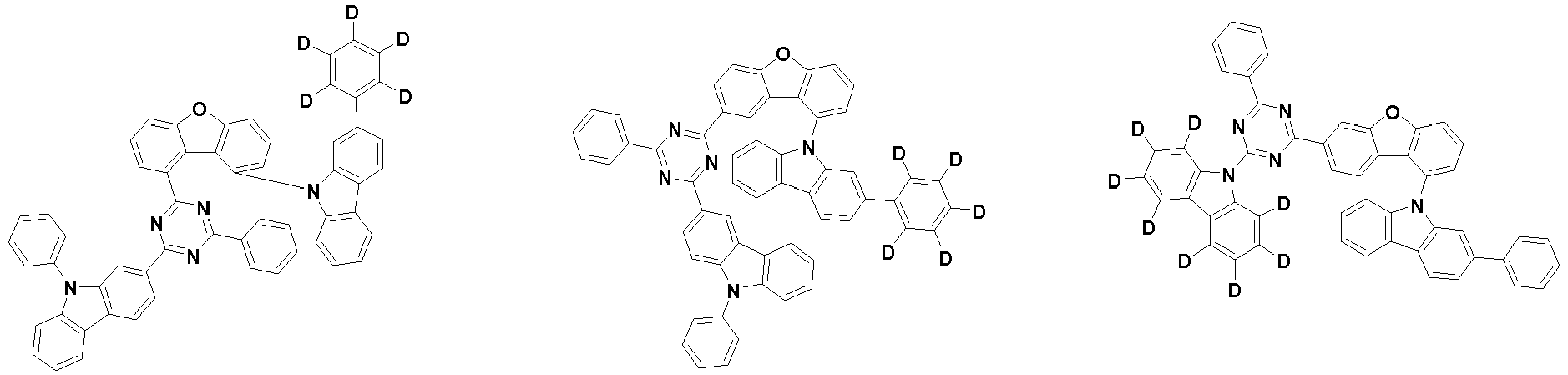
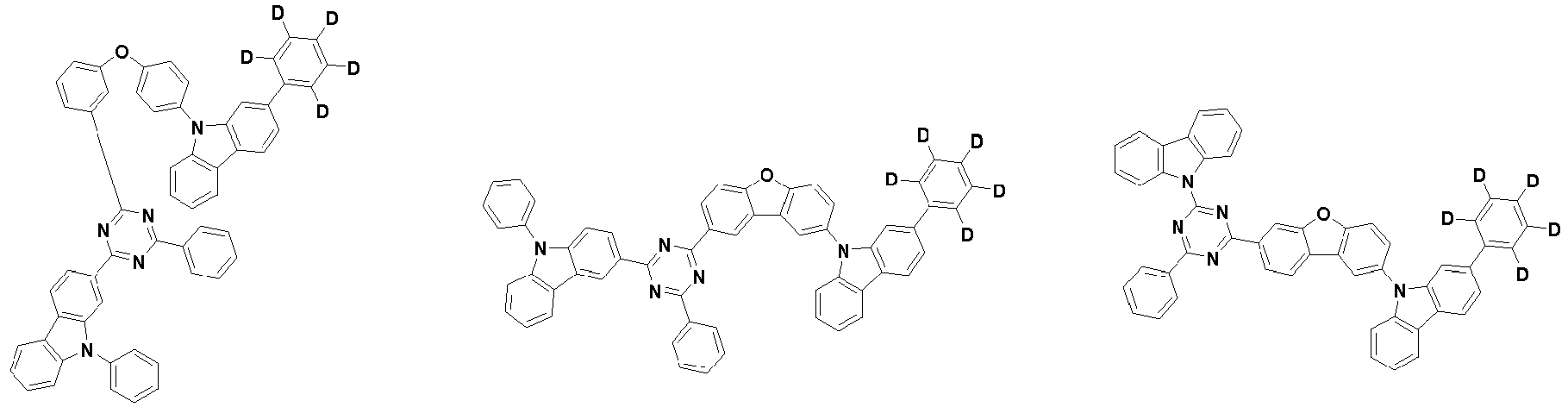
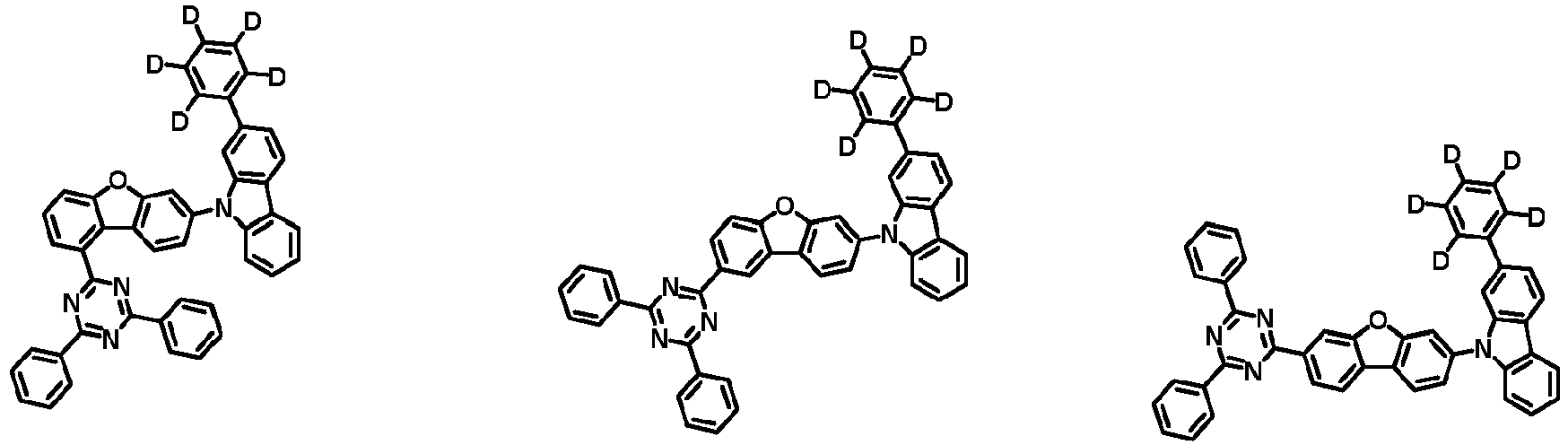
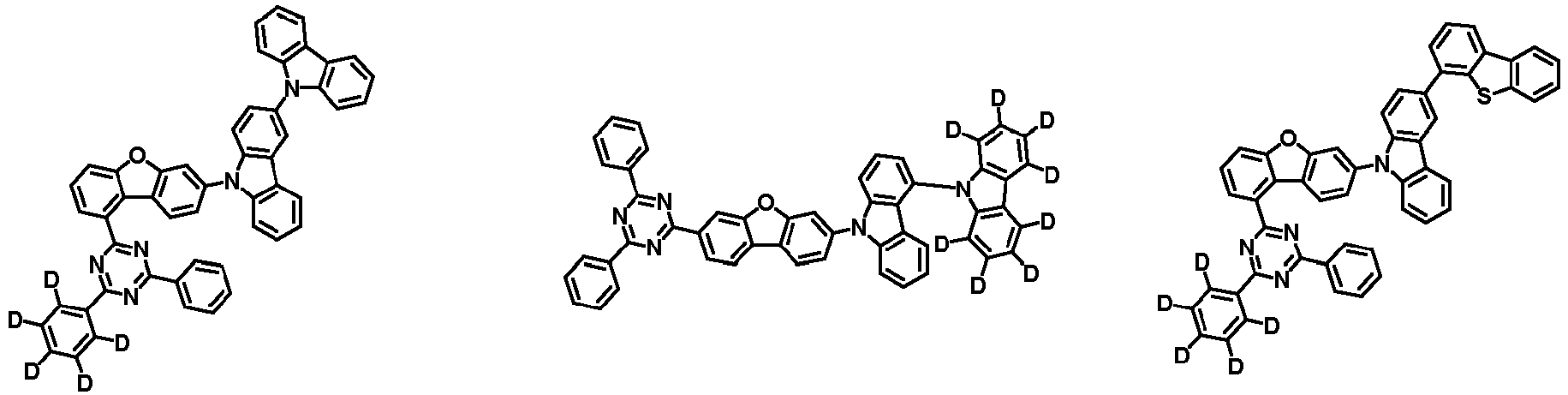
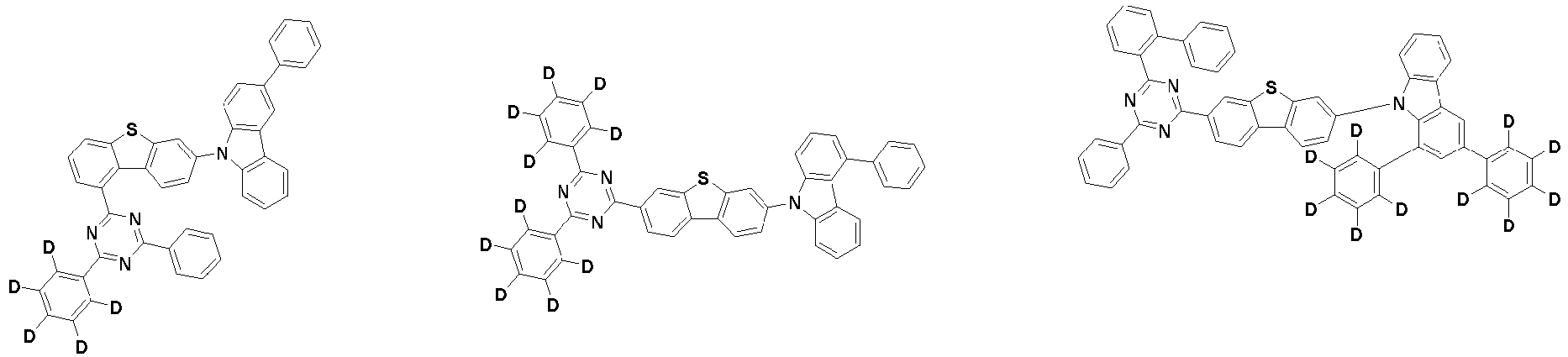
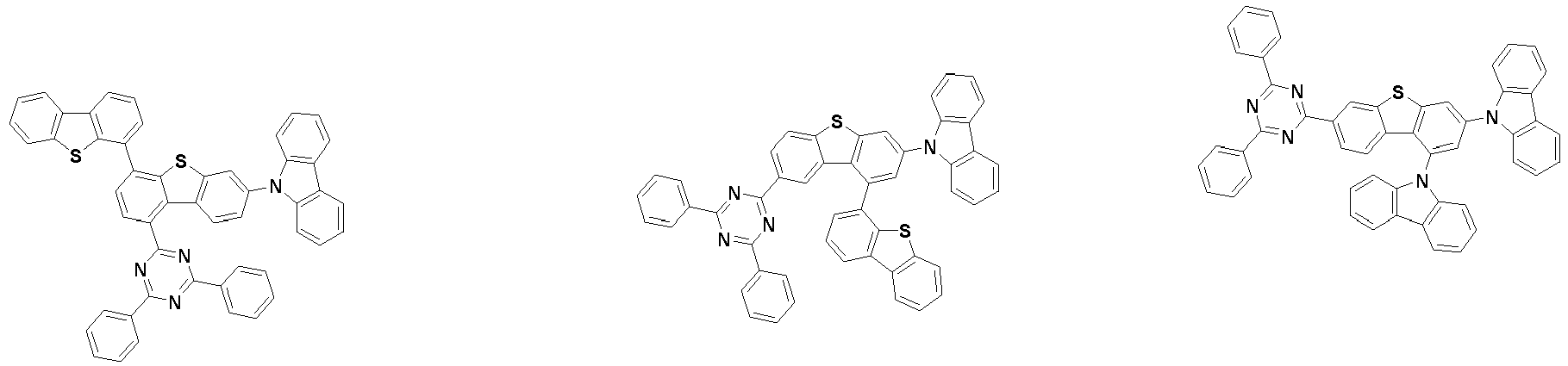
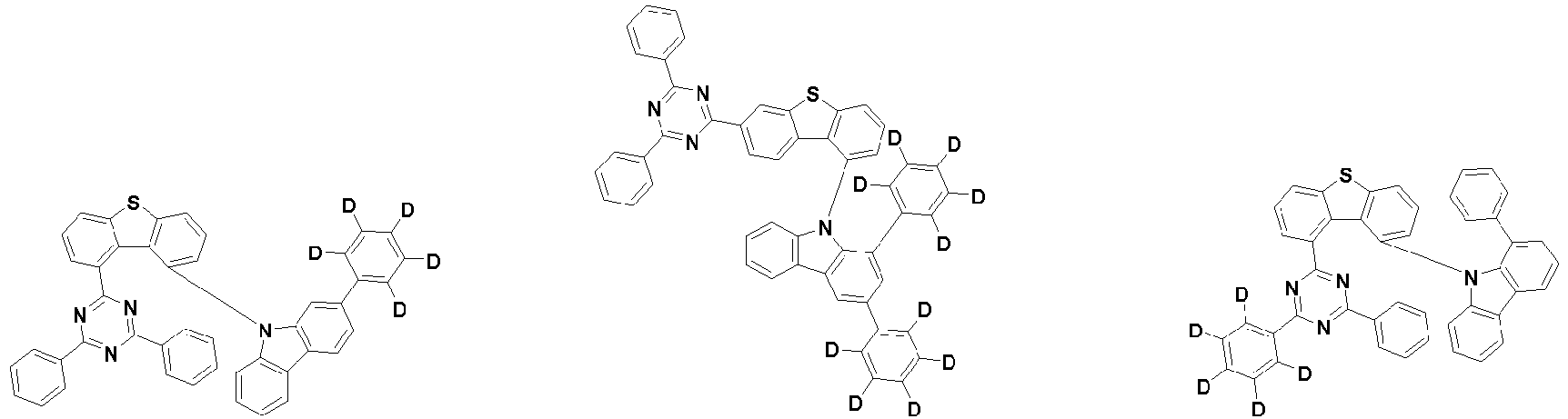
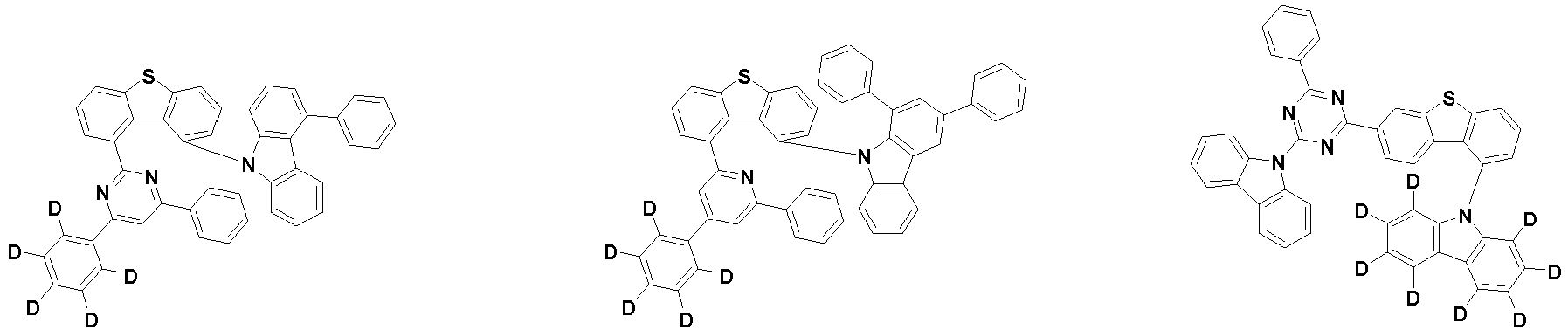
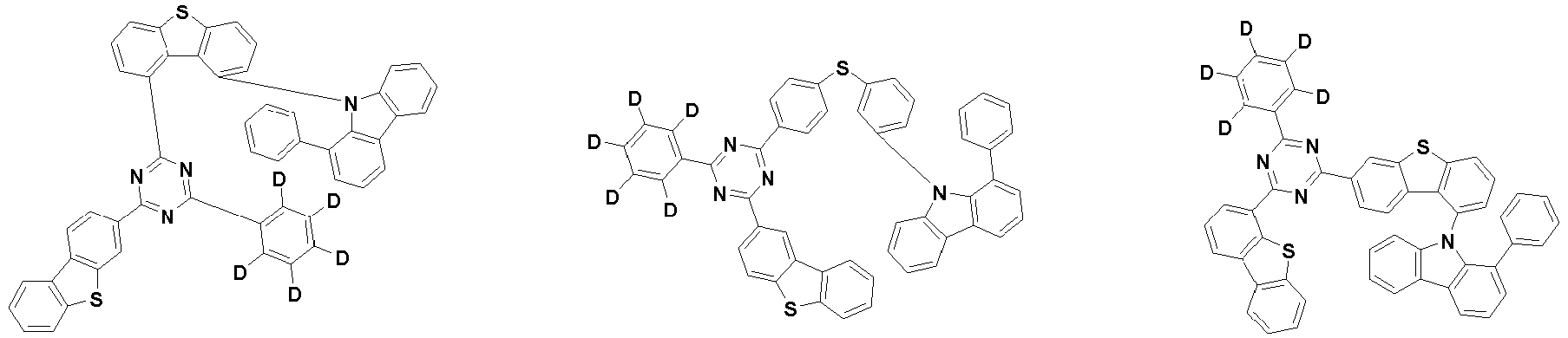
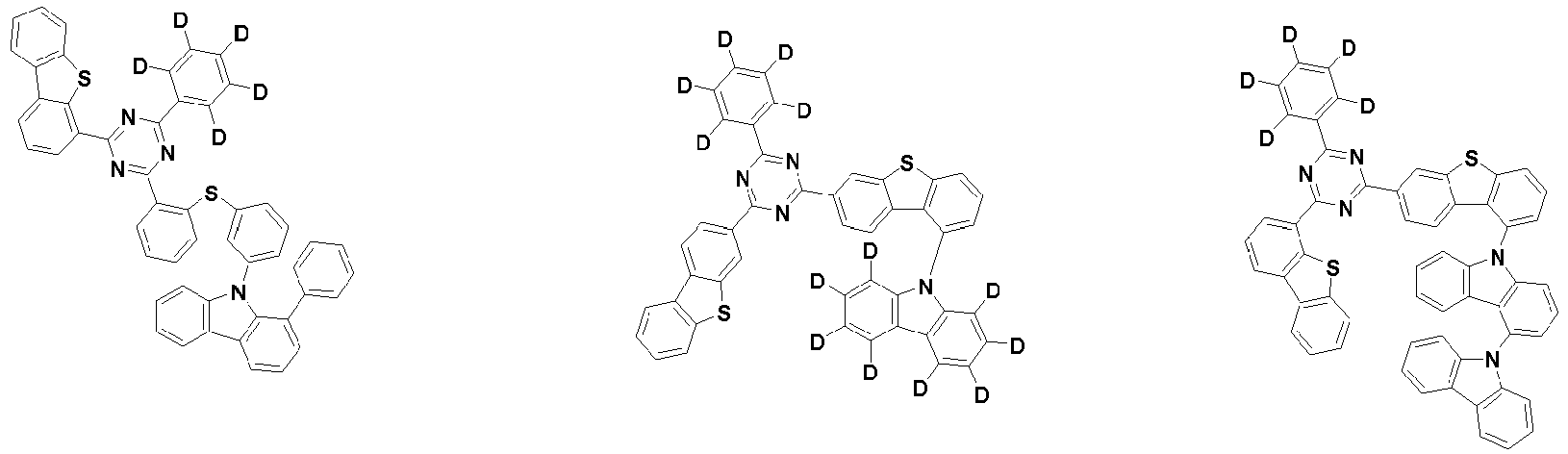
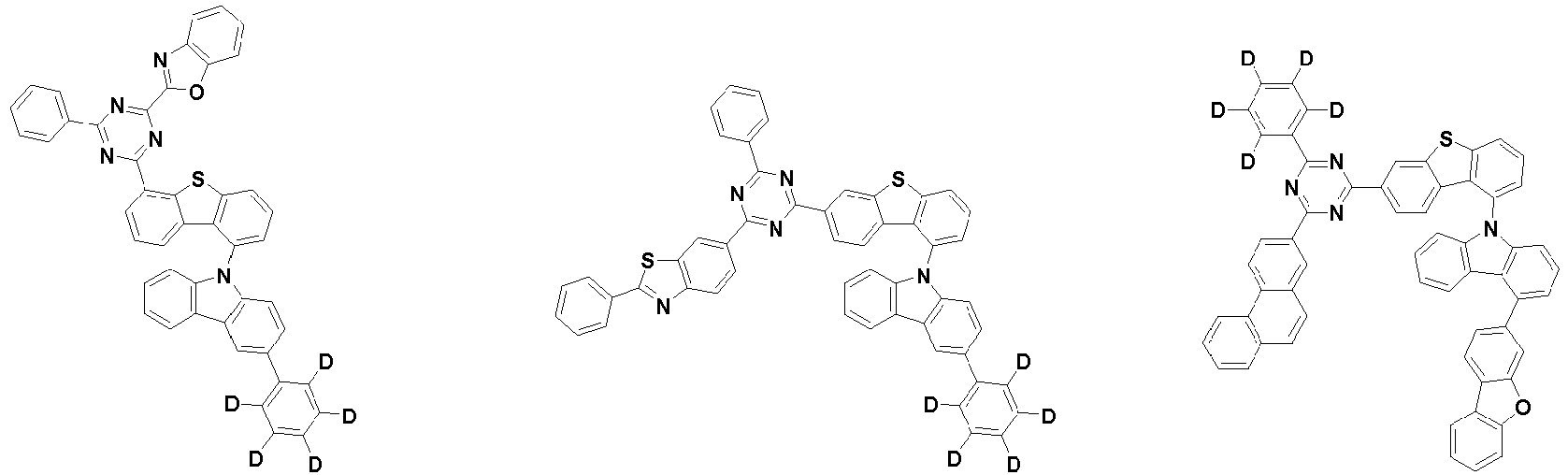
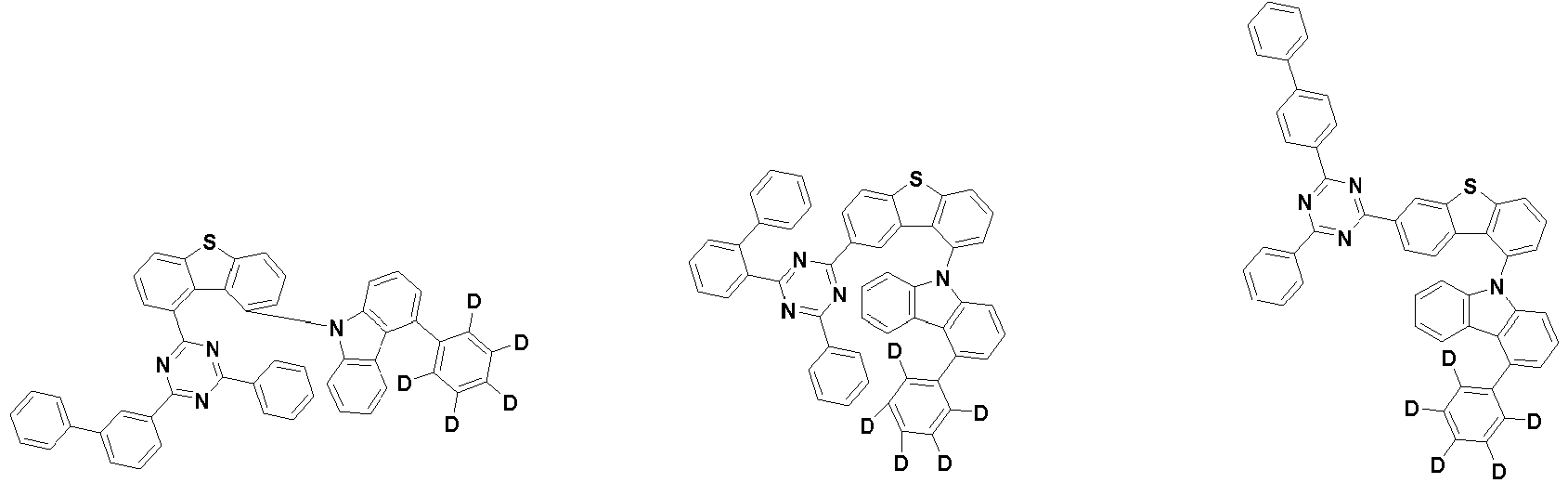
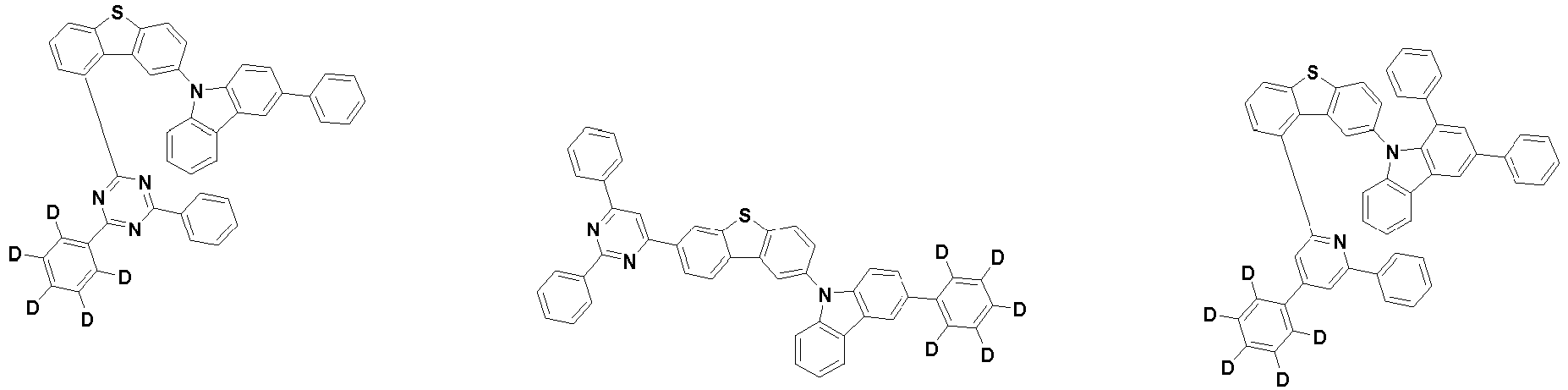
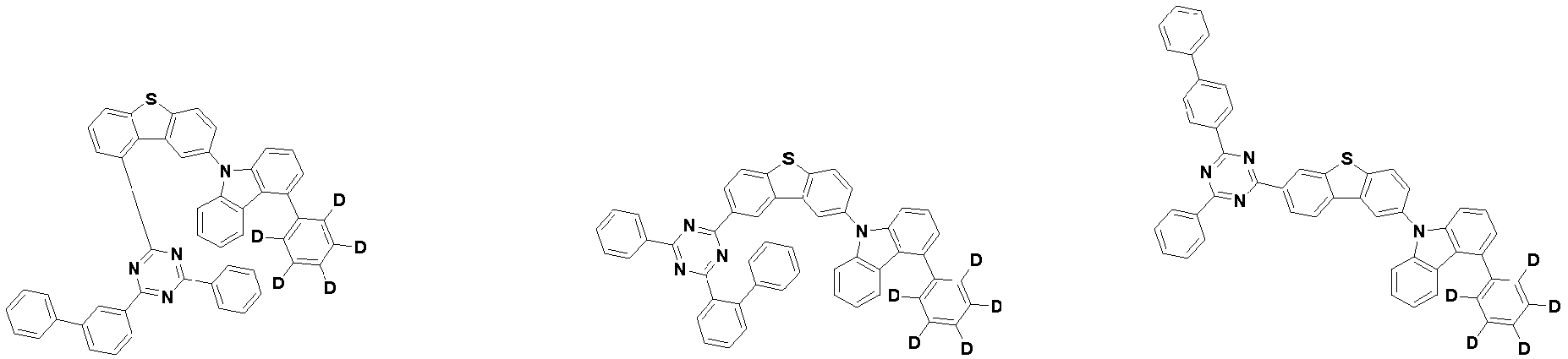
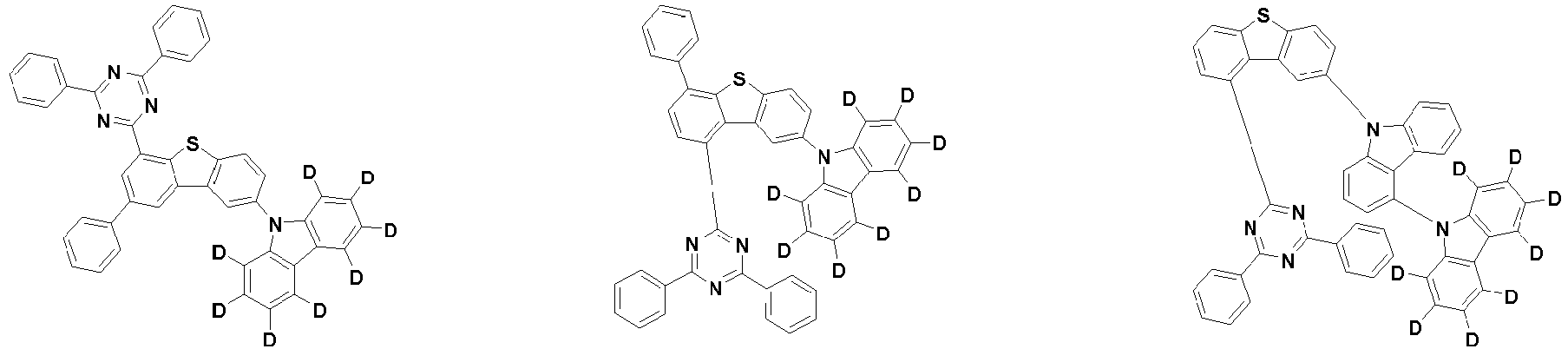
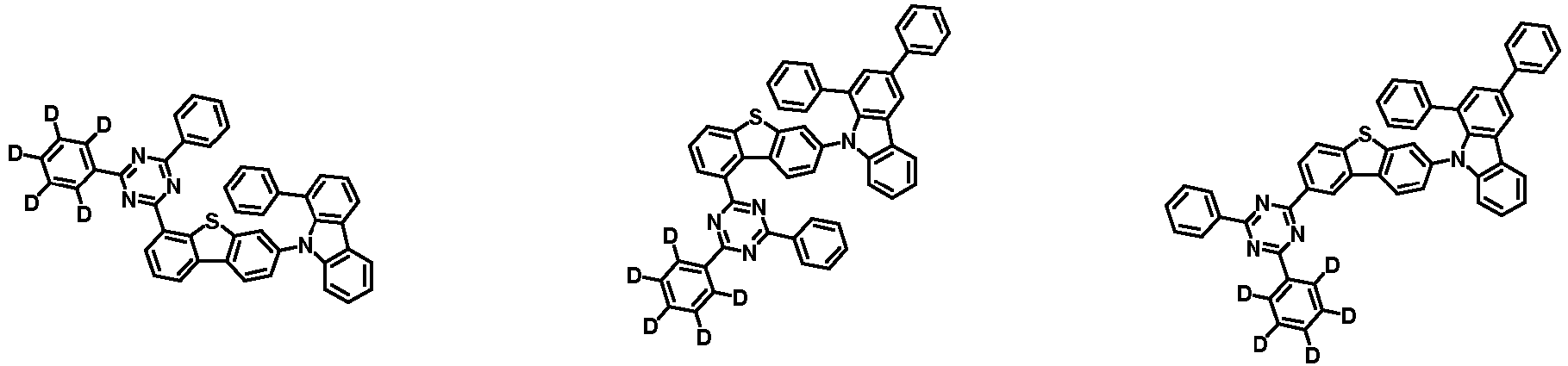
- Organische lichtemittierende Vorrichtung nach Anspruch 1, wobei die durch die chemische Formel 1 dargestellte Verbindung eine beliebige Verbindung ist, ausgewählt aus der Gruppe bestehend aus:





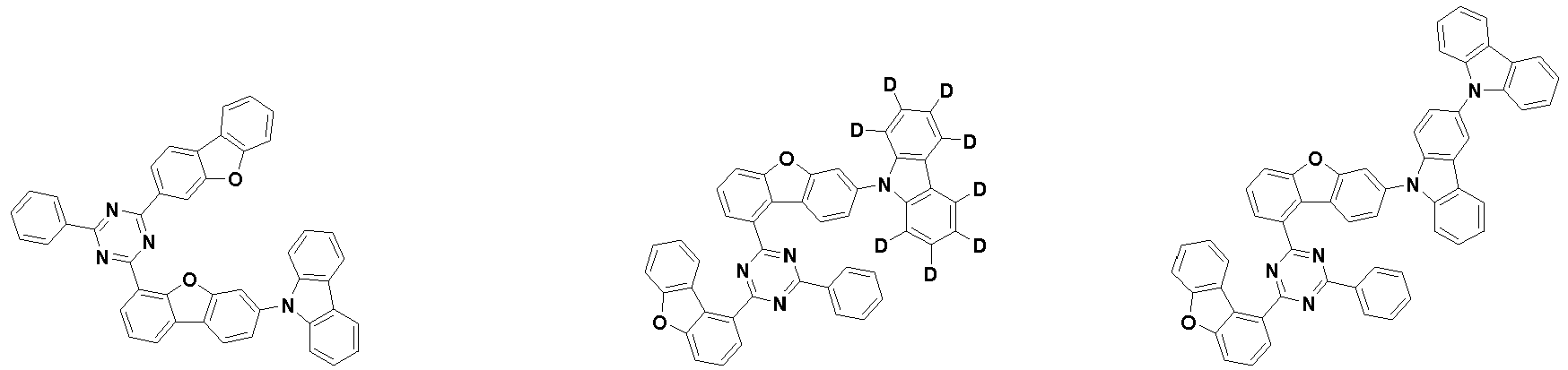


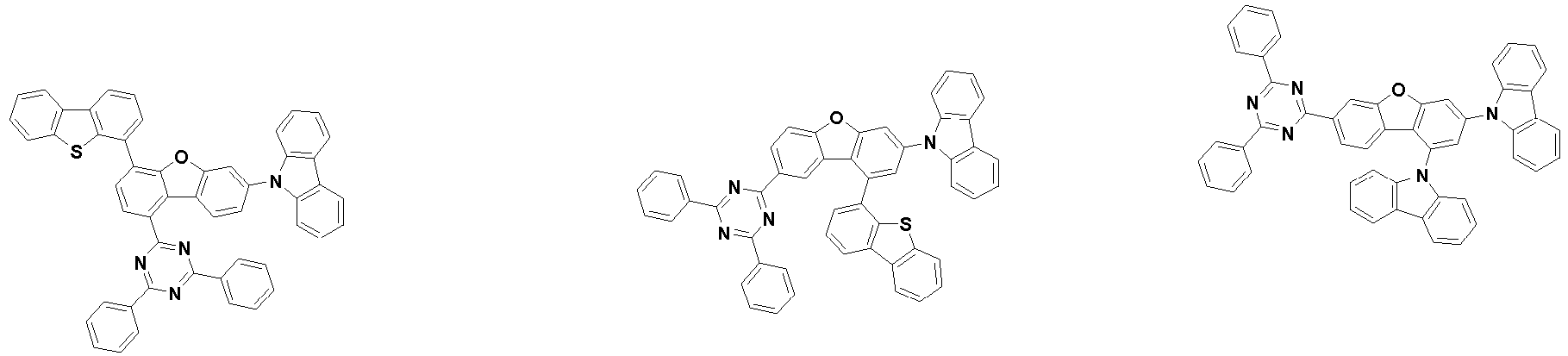


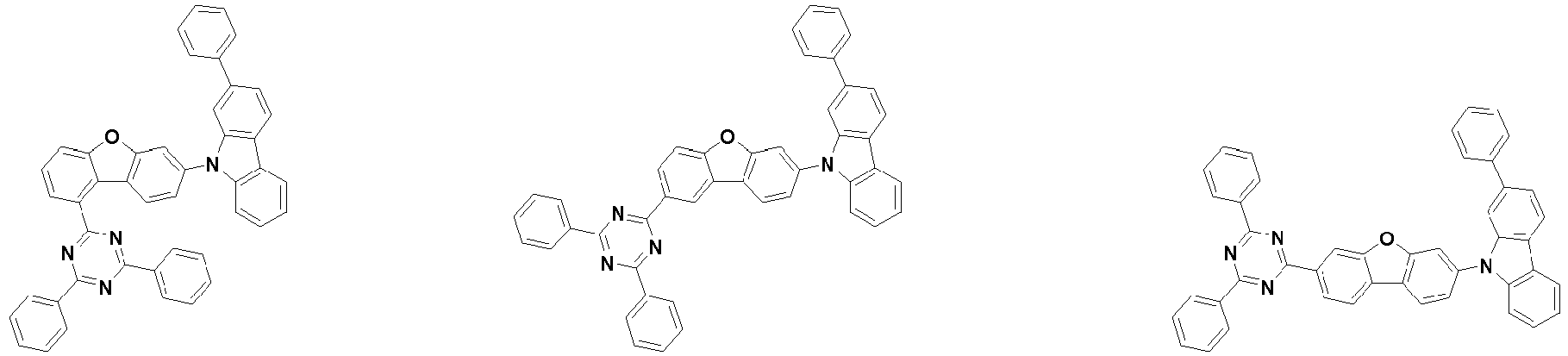


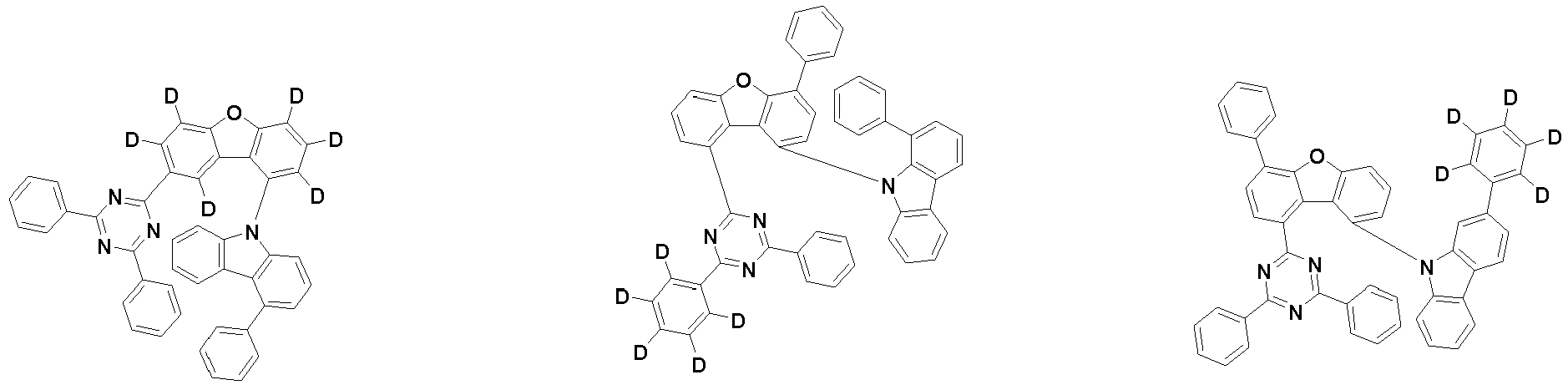










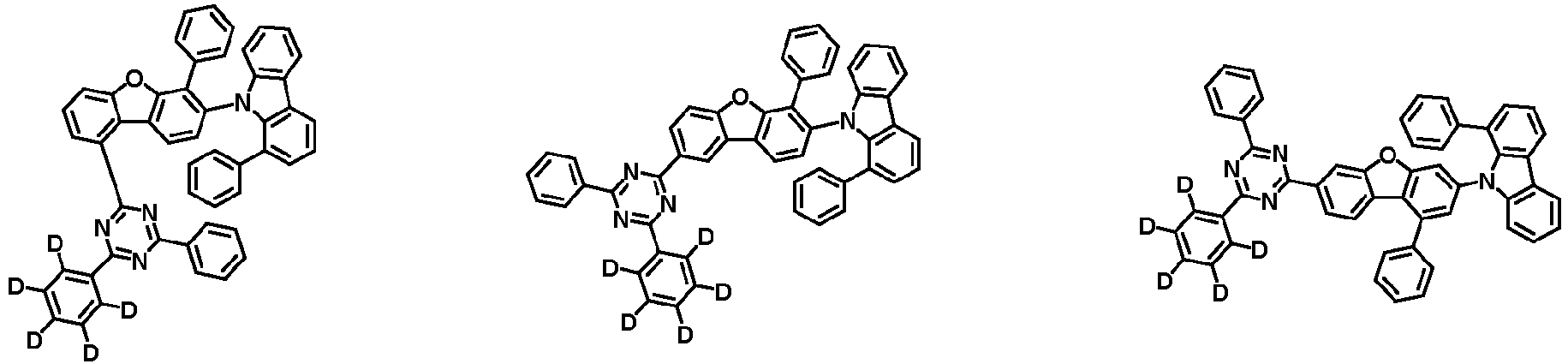


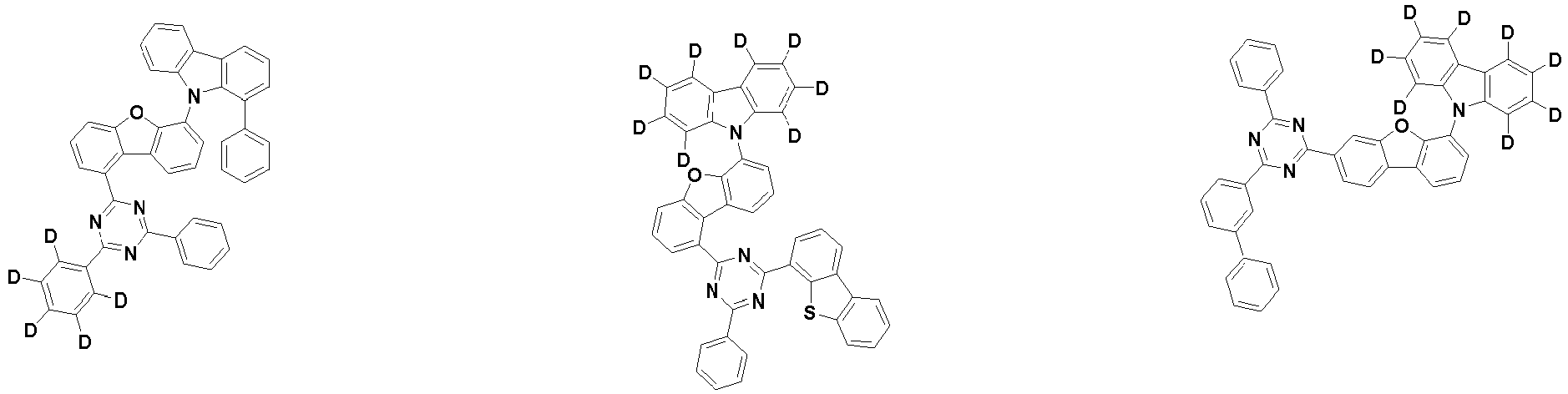

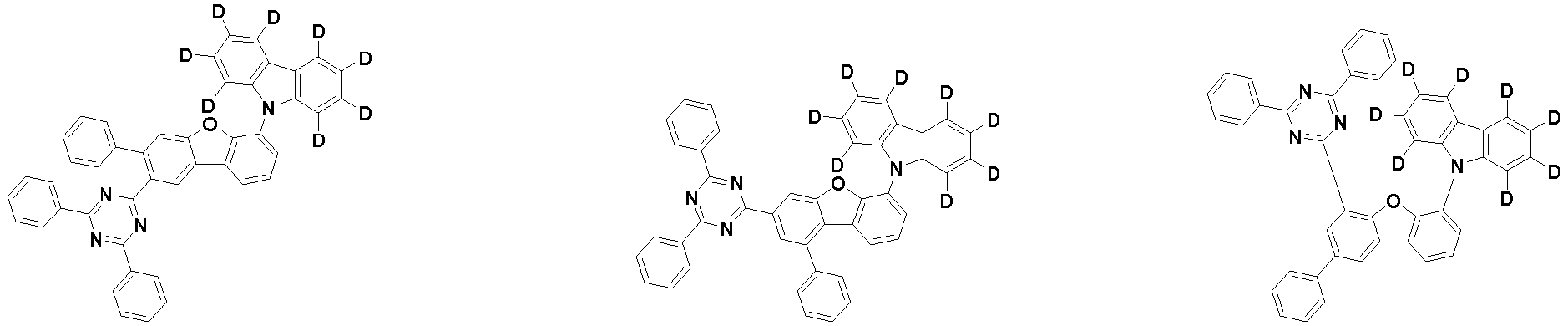


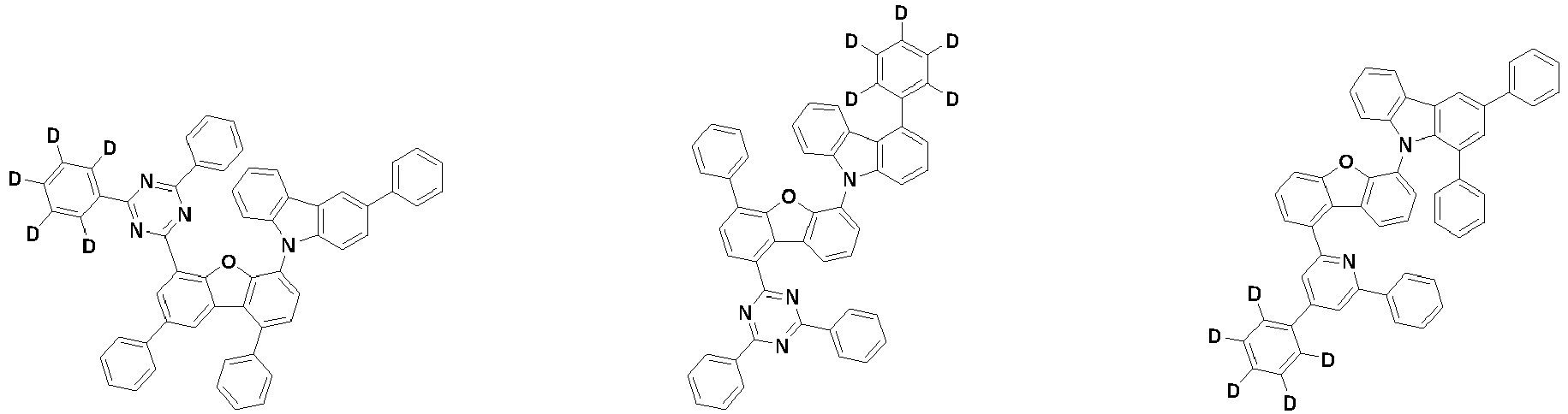
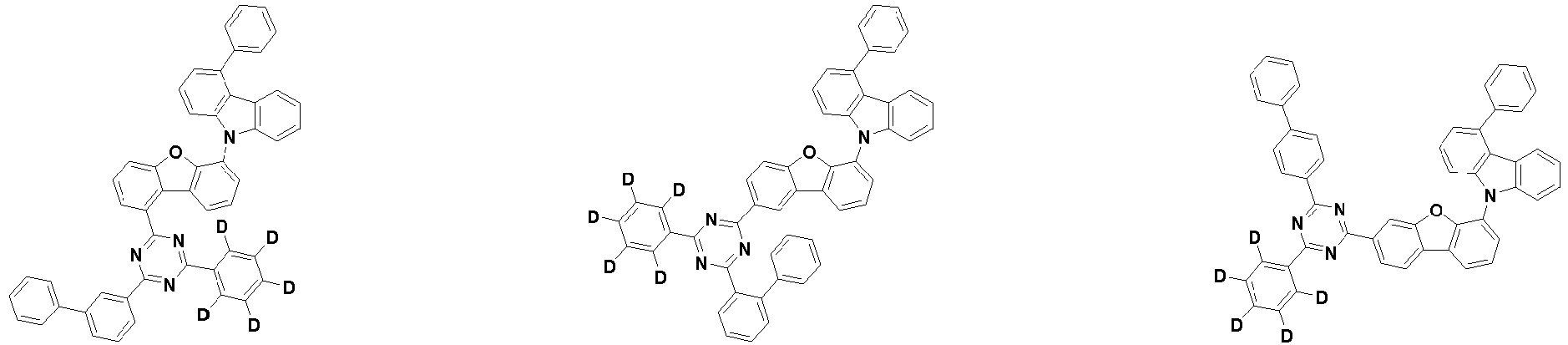
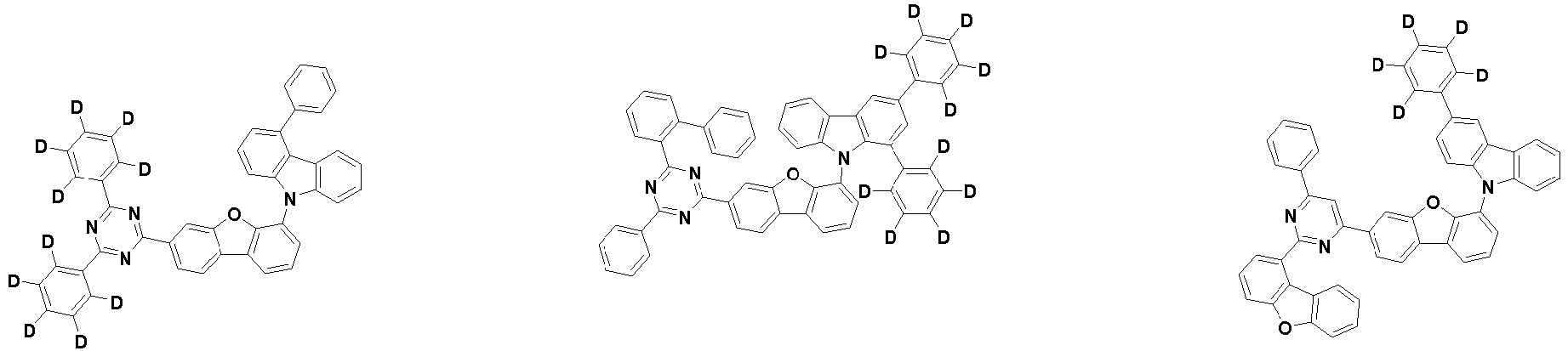


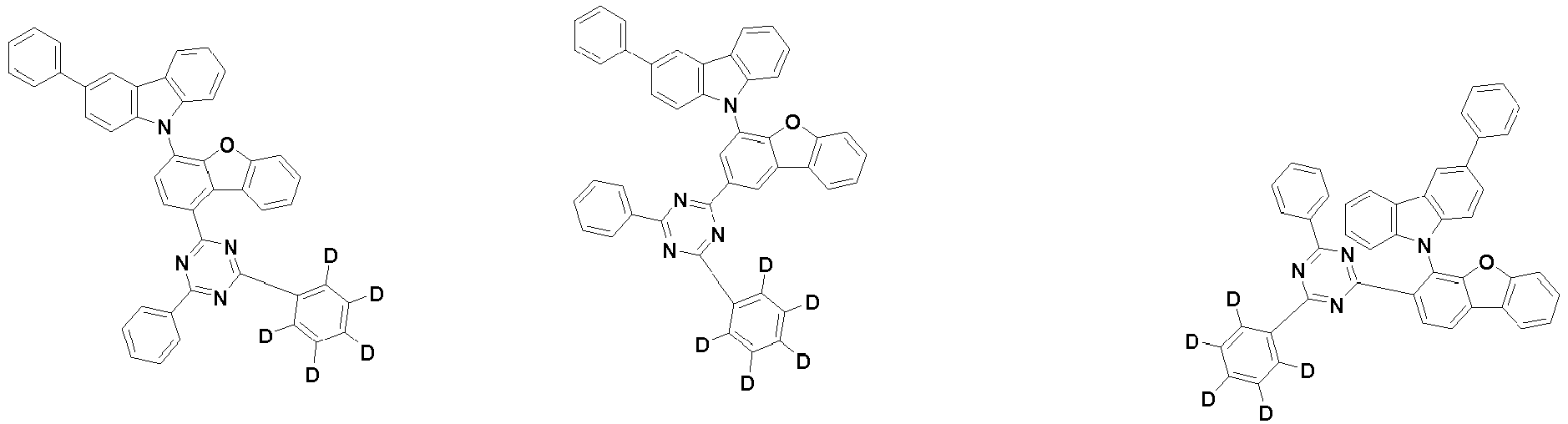





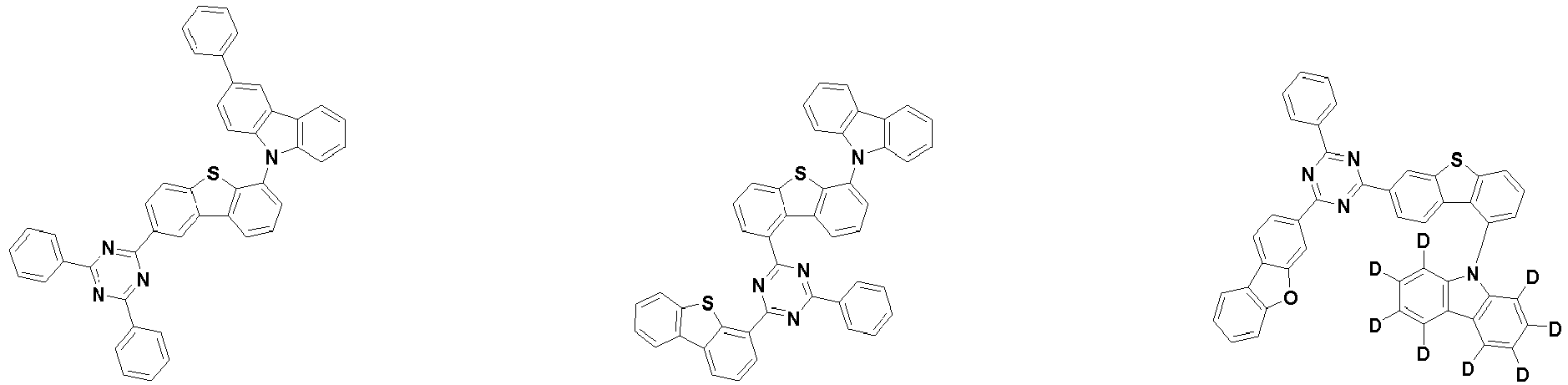











































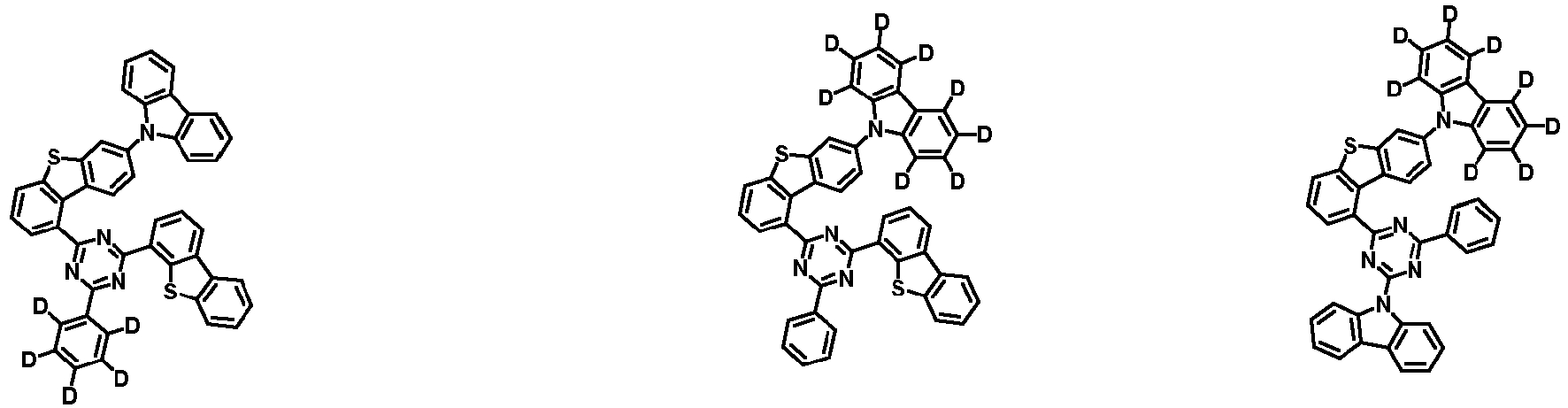


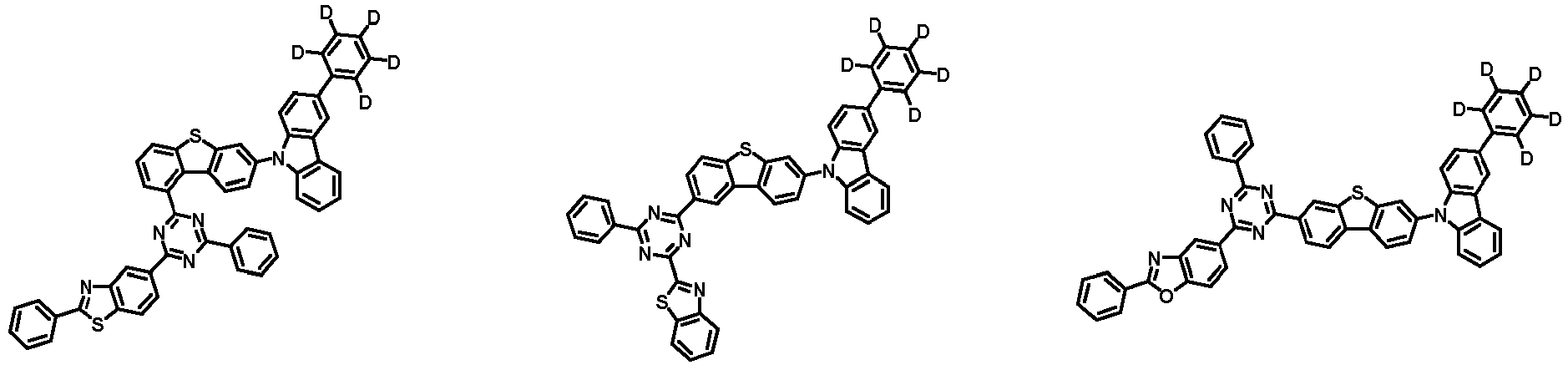


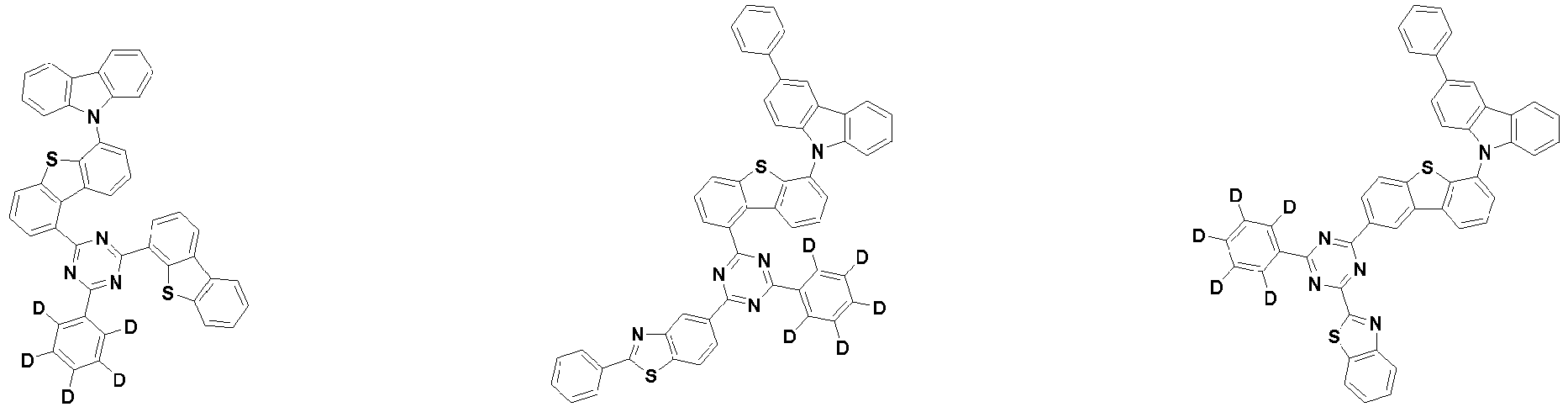

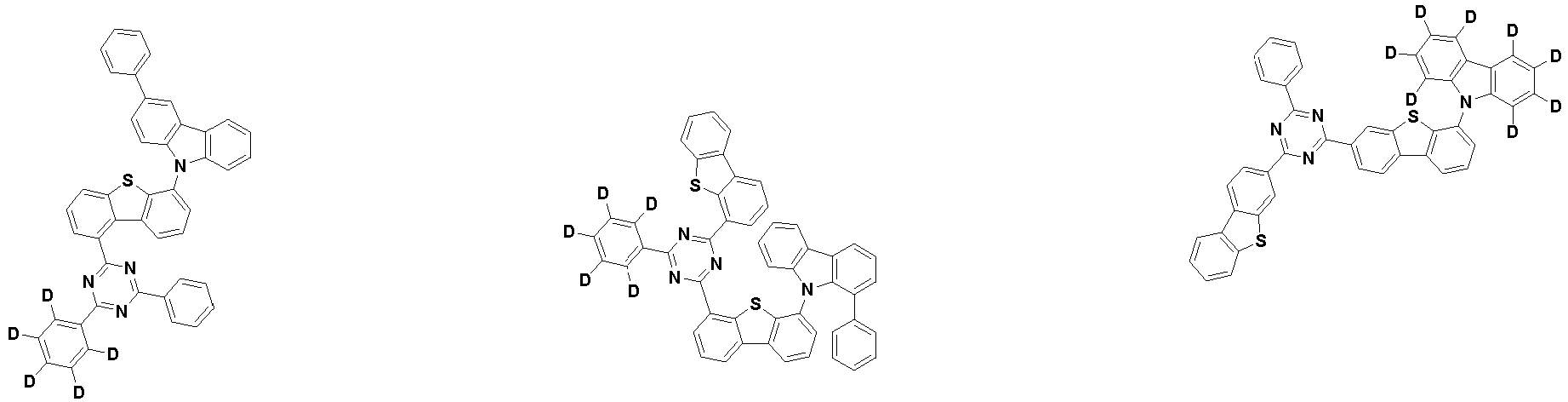

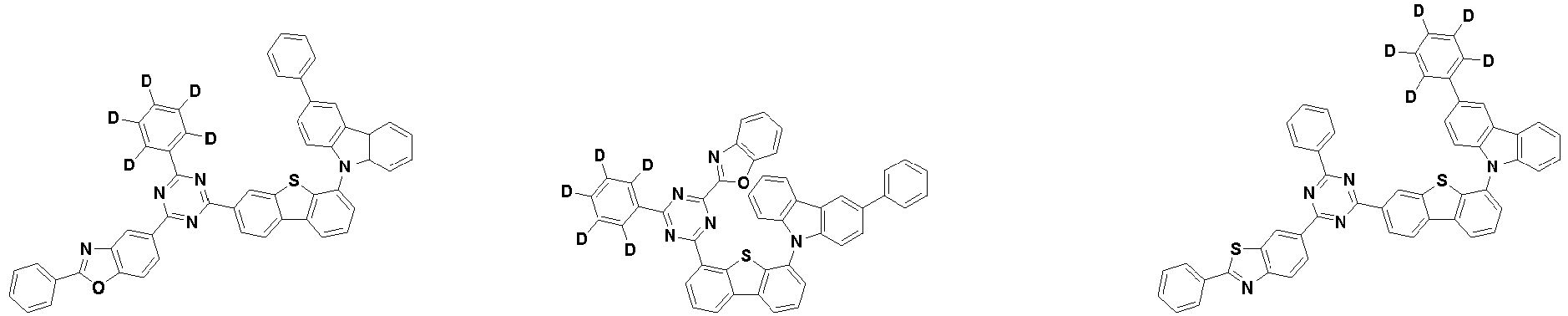

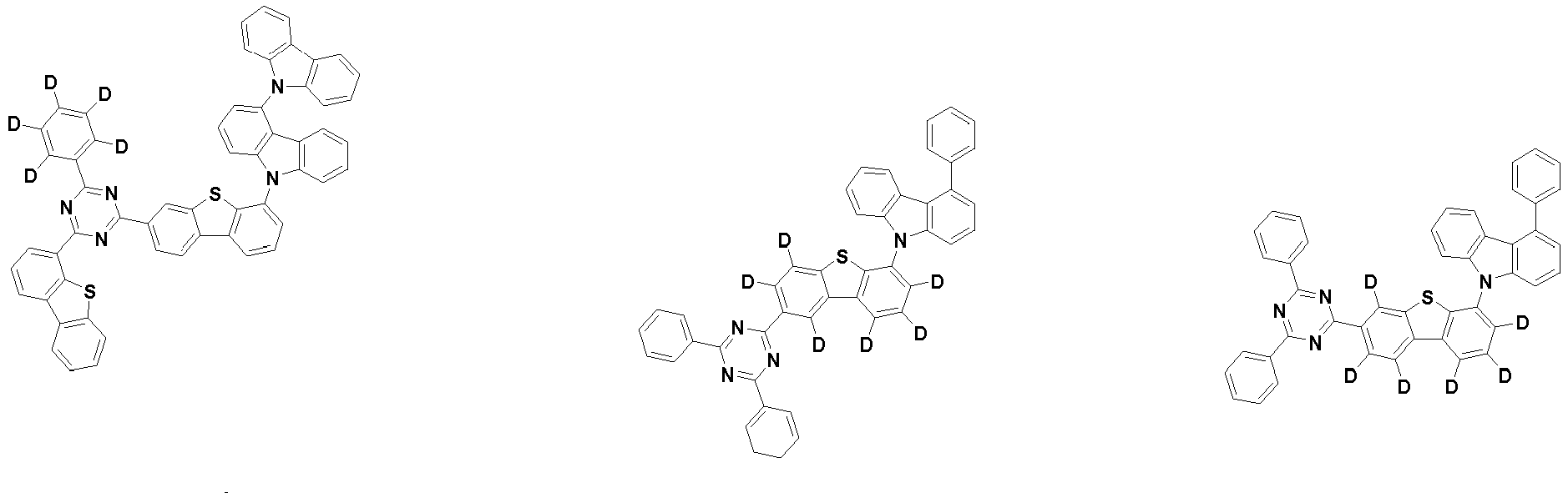


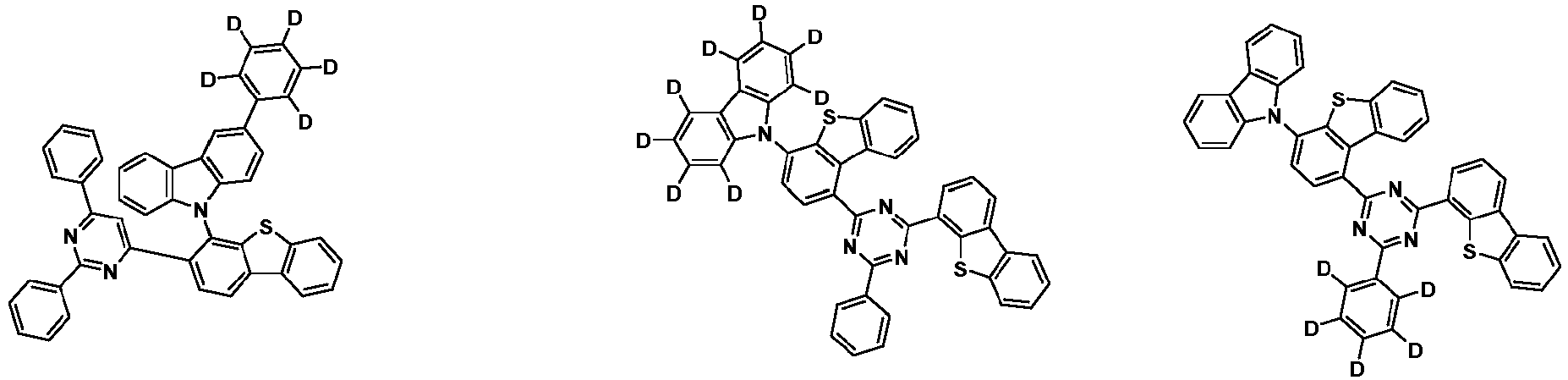


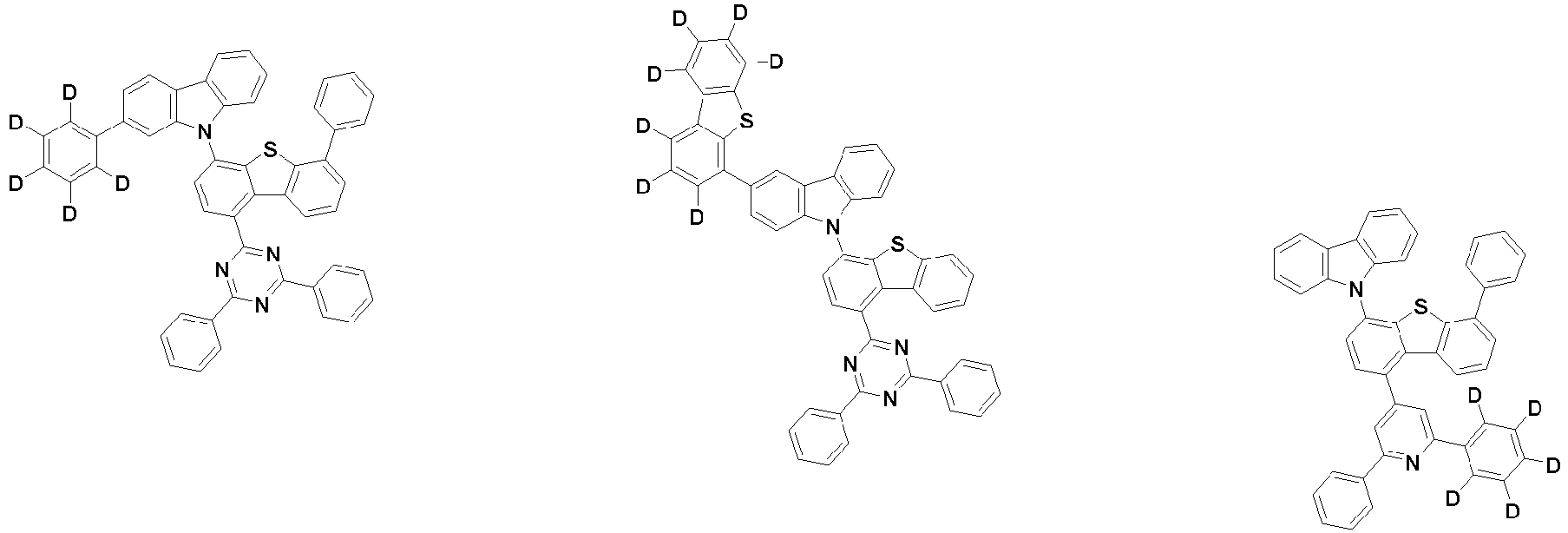





- Organische lichtemittierende Vorrichtung nach Anspruch 1, wobei die durch die chemische Formel 2 dargestellte Verbindung durch eine beliebige der folgenden chemischen Formeln 2-1 bis 2-5 dargestellt wird:


- Organische lichtemittierende Vorrichtung nach Anspruch 1,wobei Ar3 und Ar4 jeweils unabhängig Phenyl, Biphenylyl, Terphenylyl, Dibenzofuranyl, Dibenzothiophenyl, Dimethylfluorenyl, Dibenzofuranylphenyl, Dibenzothiophenylphenyl oder Dimethylfluorenylphenyl sind, unddas Phenyl, Biphenylyl, Terphenylyl, Dibenzofuranyl, Dibenzothiophenyl, Dimethylfluorenyl, Dibenzofuranylphenyl, Dibenzothiophenylphenyl oder Dimethylfluorenylphenyl unsubstituiert oder mit Deuterium substituiert ist,mit der Maßgabe, dass mindestens eines aus Ar3 und Ar4 mit mindestens einem Deuterium substituiert ist.
- Organische lichtemittierende Vorrichtung nach Anspruch 1, wobei Ar3 und Ar4 jeweils unabhängig ausgewählt sind aus der Gruppe bestehend aus den folgenden Strukturformeln, mit der Maßgabe, dass mindestens eines aus Ar3 und Ar4 mit mindestens einem Deuterium substituiert ist:


 m1 eine ganze Zahl von 0 bis 5 ist,m2 eine ganze Zahl von 0 bis 4 ist,m3 eine ganze Zahl von 0 bis 5 ist,m4 eine ganze Zahl von 0 bis 4 ist,m5 eine ganze Zahl von 0 bis 4 ist,m6 eine ganze Zahl von 0 bis 5 ist,m7 eine ganze Zahl von 0 bis 5 ist,m8 eine ganze Zahl von 0 bis 3 ist,m9 eine ganze Zahl von 0 bis 5 ist,m10 eine ganze Zahl von 0 bis 13 ist,m11 eine ganze Zahl von 0 bis 7 ist,m12 eine ganze Zahl von 0 bis 7 ist,m13 eine ganze Zahl von 0 bis 4 ist,m14 eine ganze Zahl von 0 bis 13 ist,m15 eine ganze Zahl von 0 bis 4 ist,m16 eine ganze Zahl von 0 bis 7 ist,m17 eine ganze Zahl von 0 bis 4 ist, undm18 eine ganze Zahl von 0 bis 7 ist,mit der Maßgabe, dass mindestens eines aus m1 bis m18 1 oder mehr ist.
 - Organische lichtemittierende Vorrichtung nach Anspruch 1, wobei jedes R4 unabhängig Wasserstoff oder Deuterium ist, mit der Maßgabe, dass mindestens ein R4 Deuterium ist.
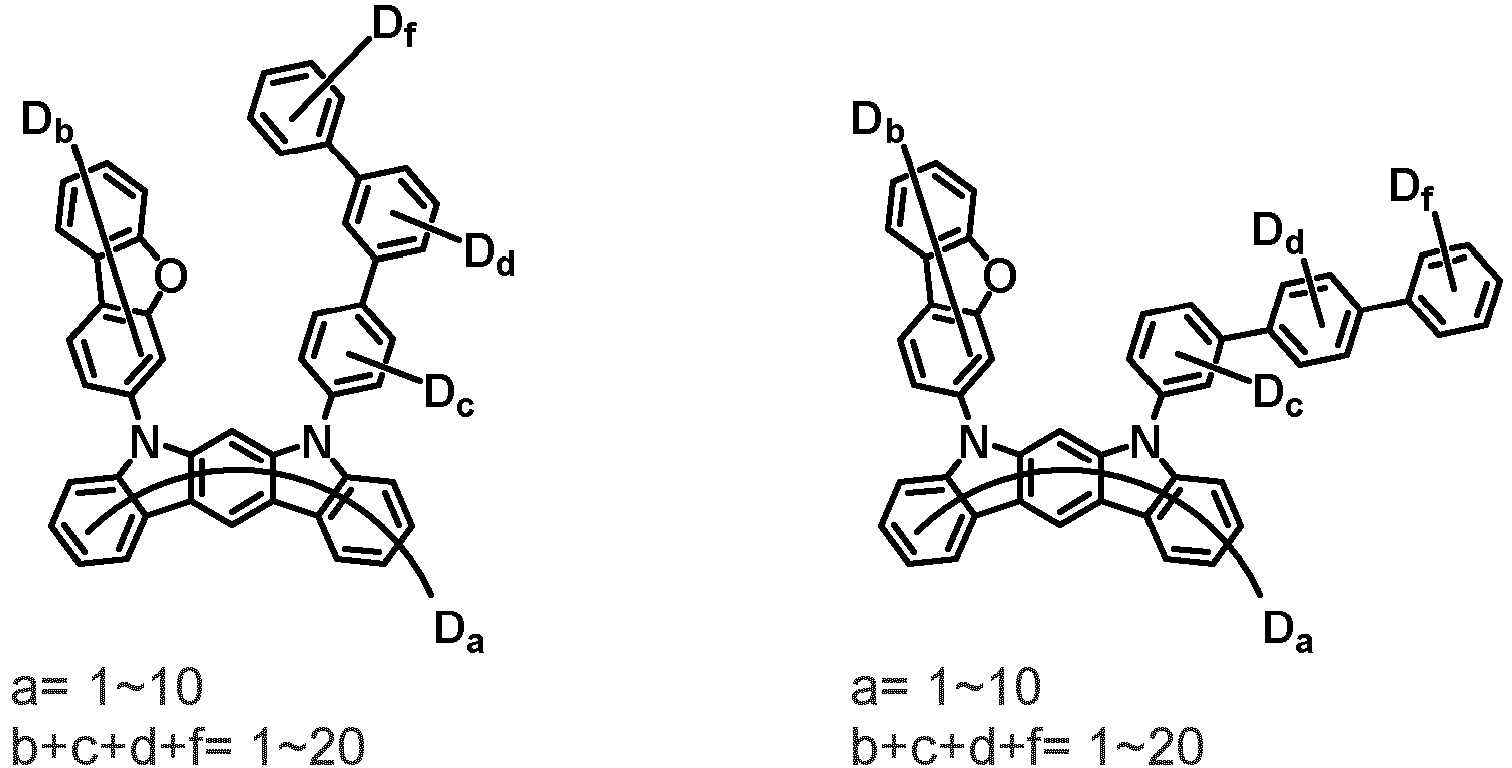
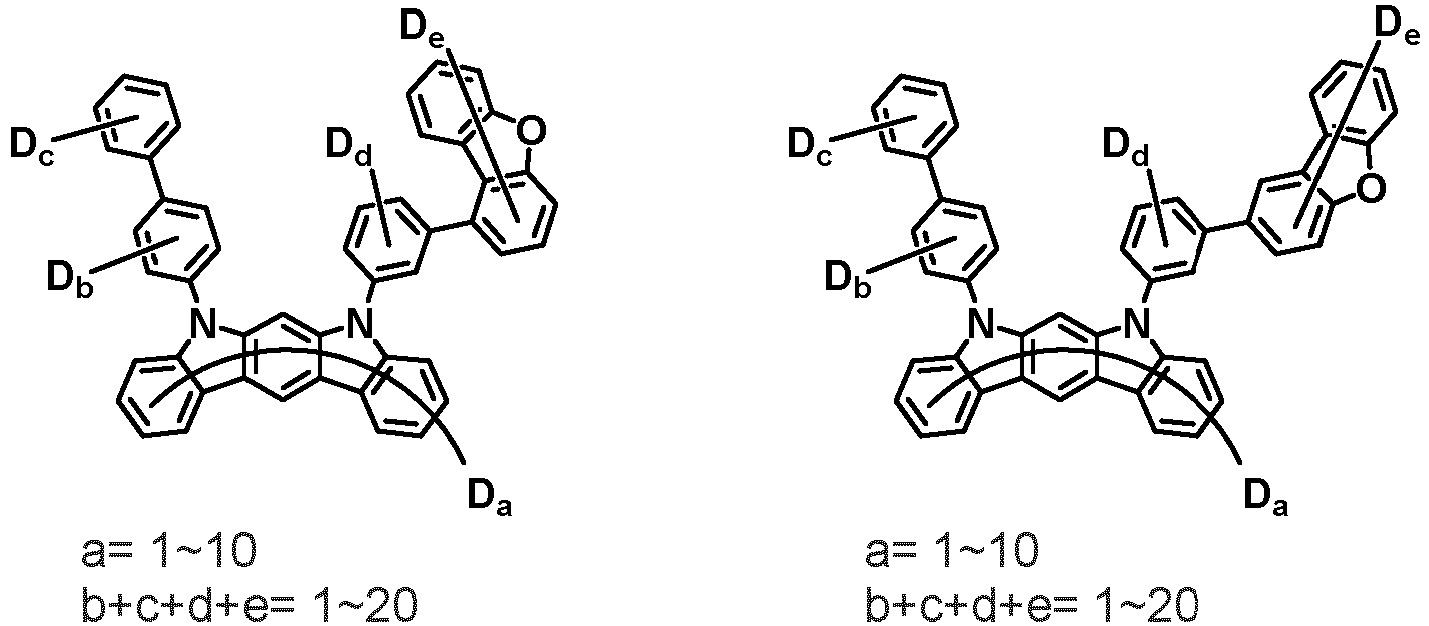
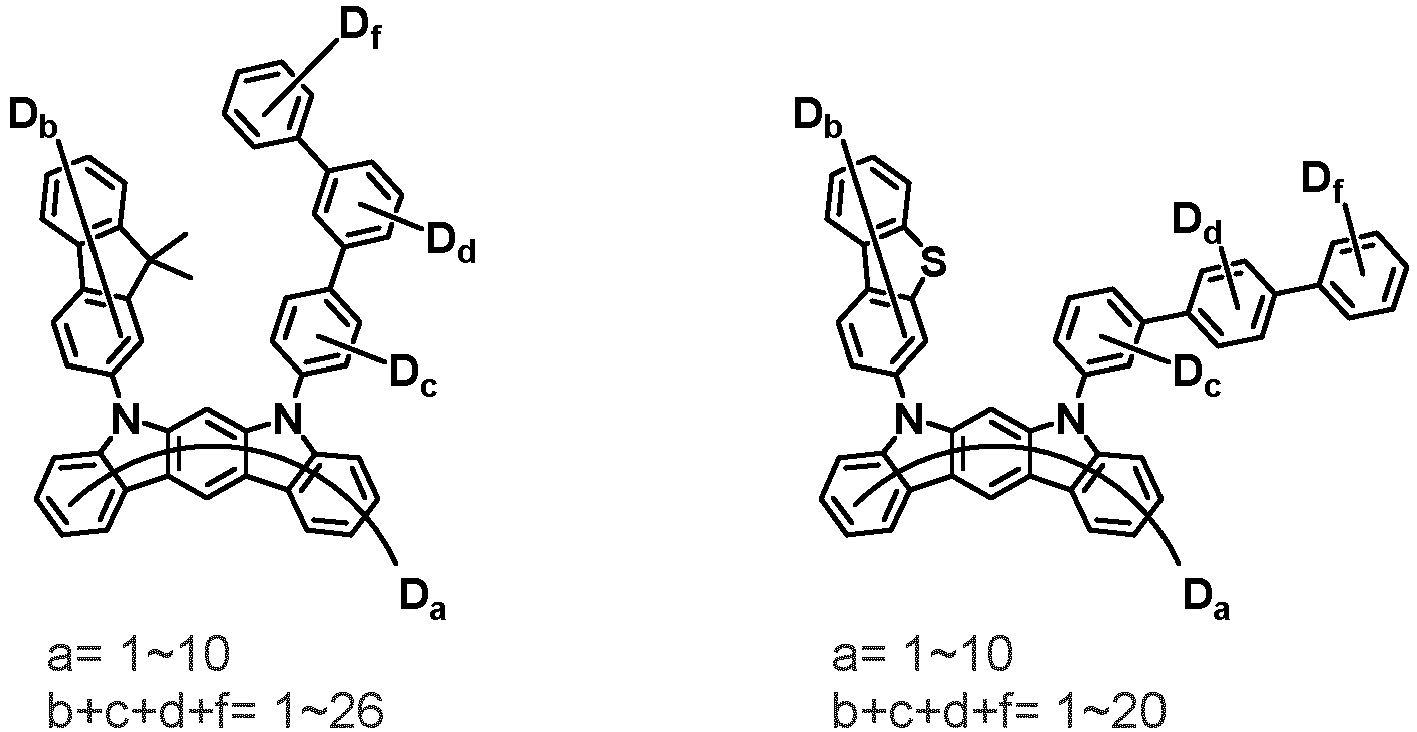
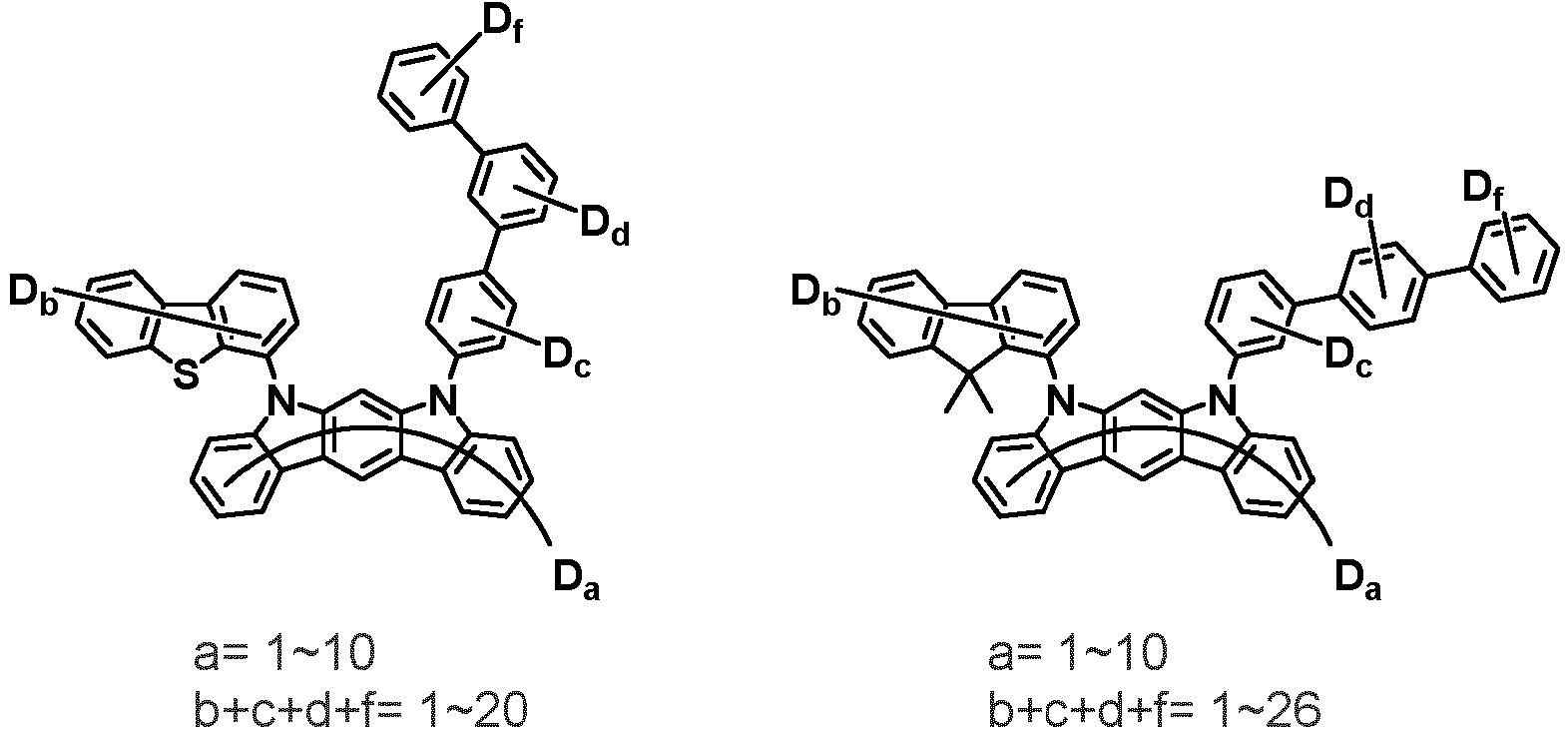
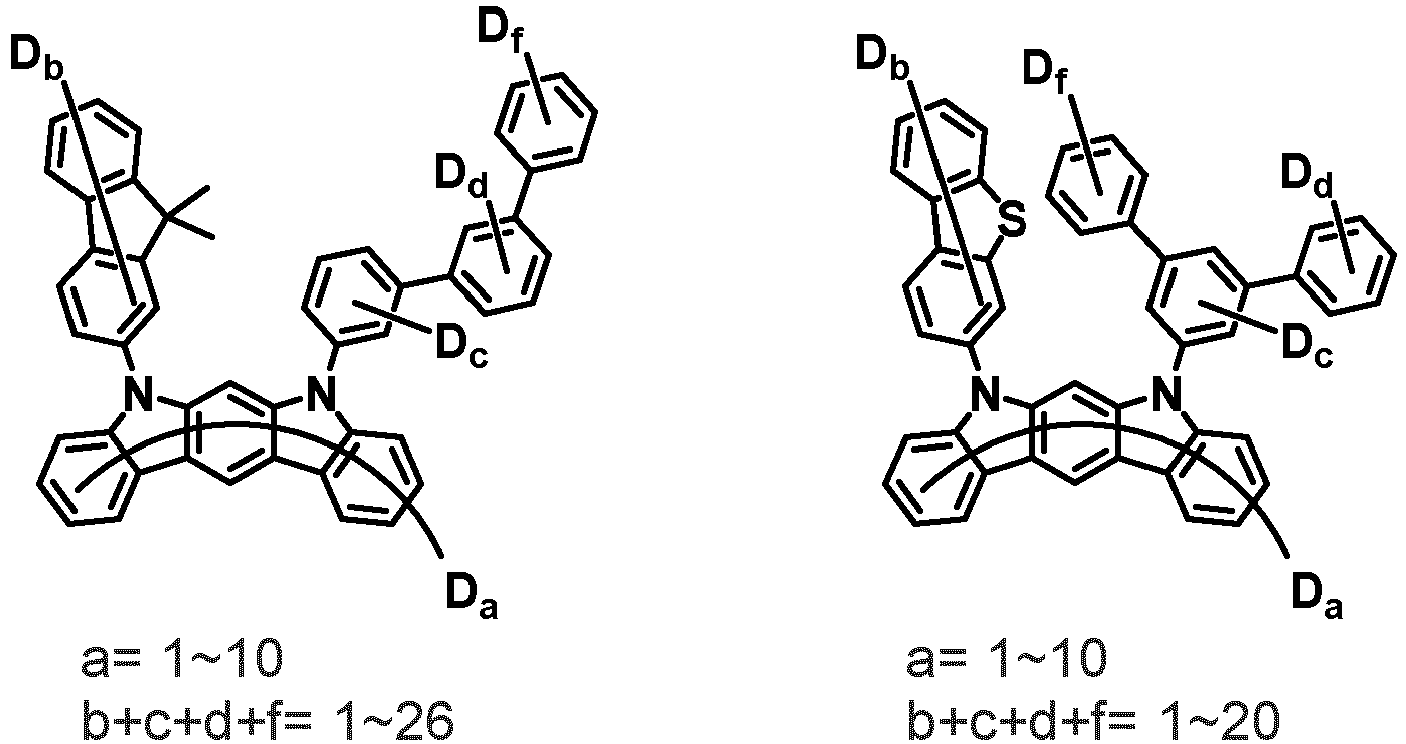
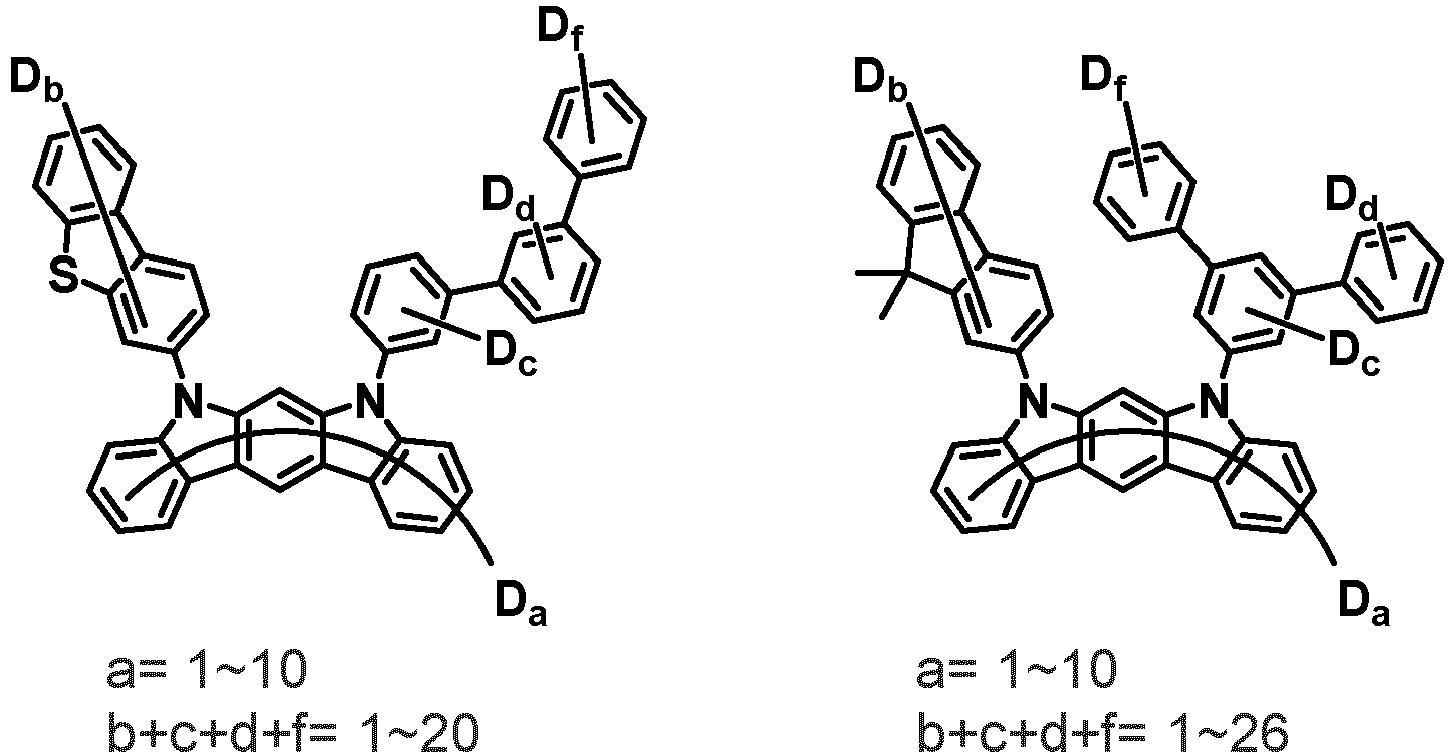
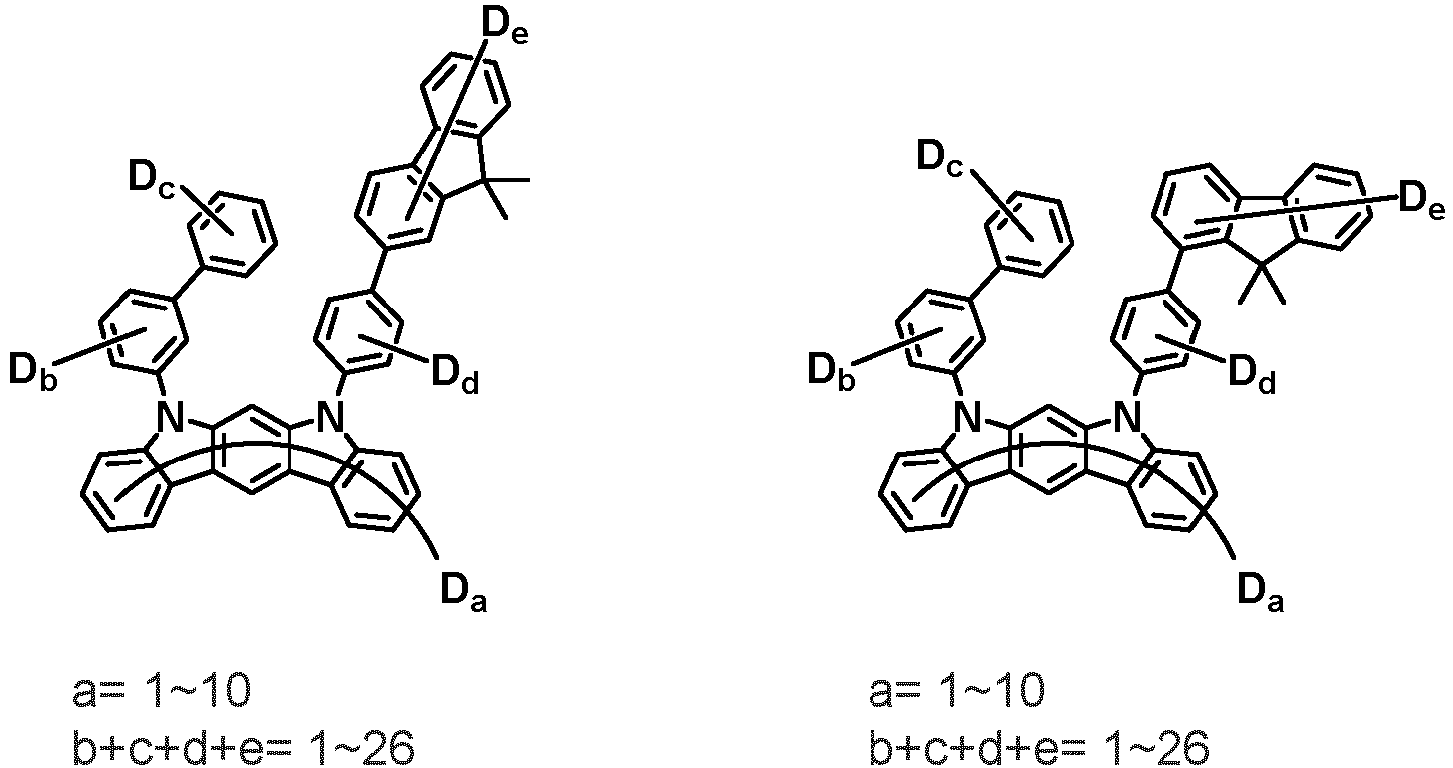
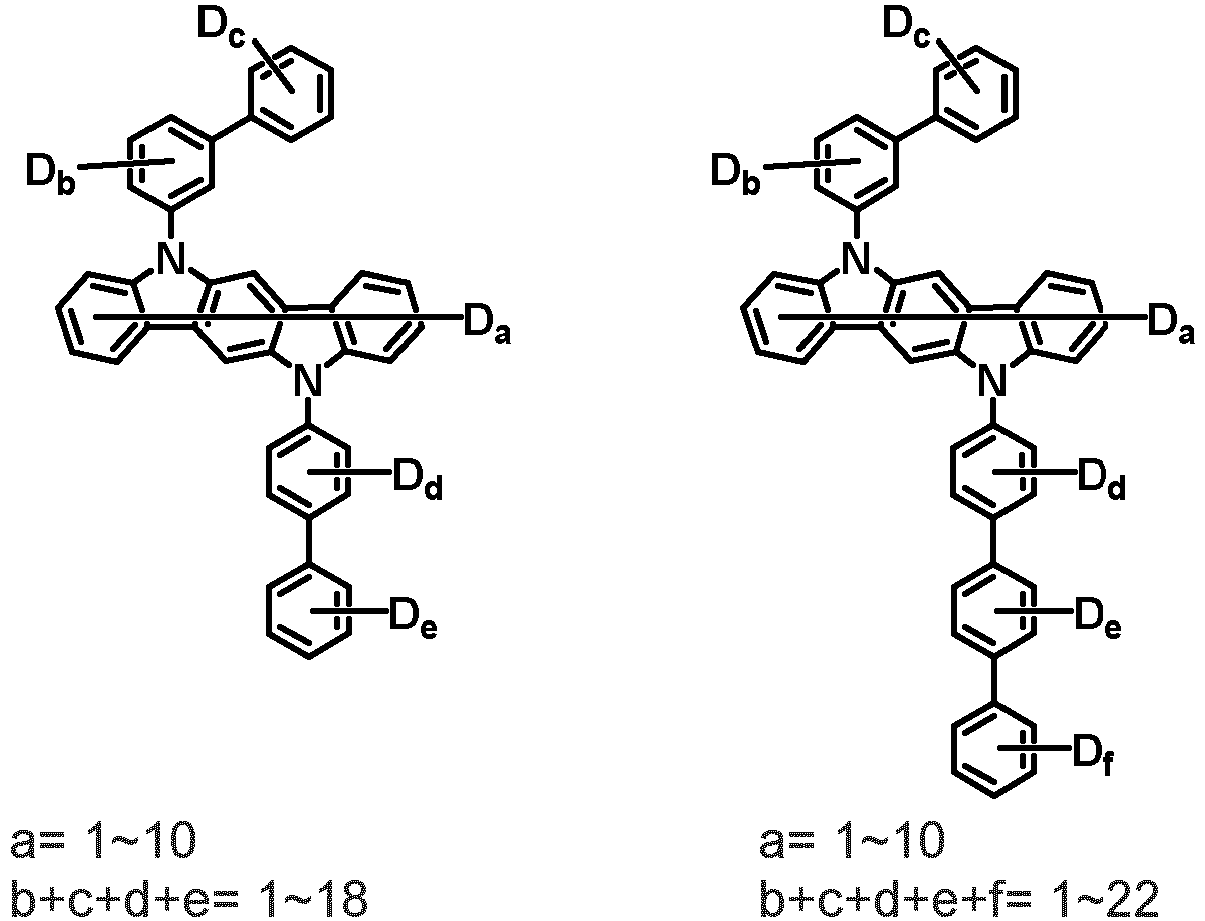
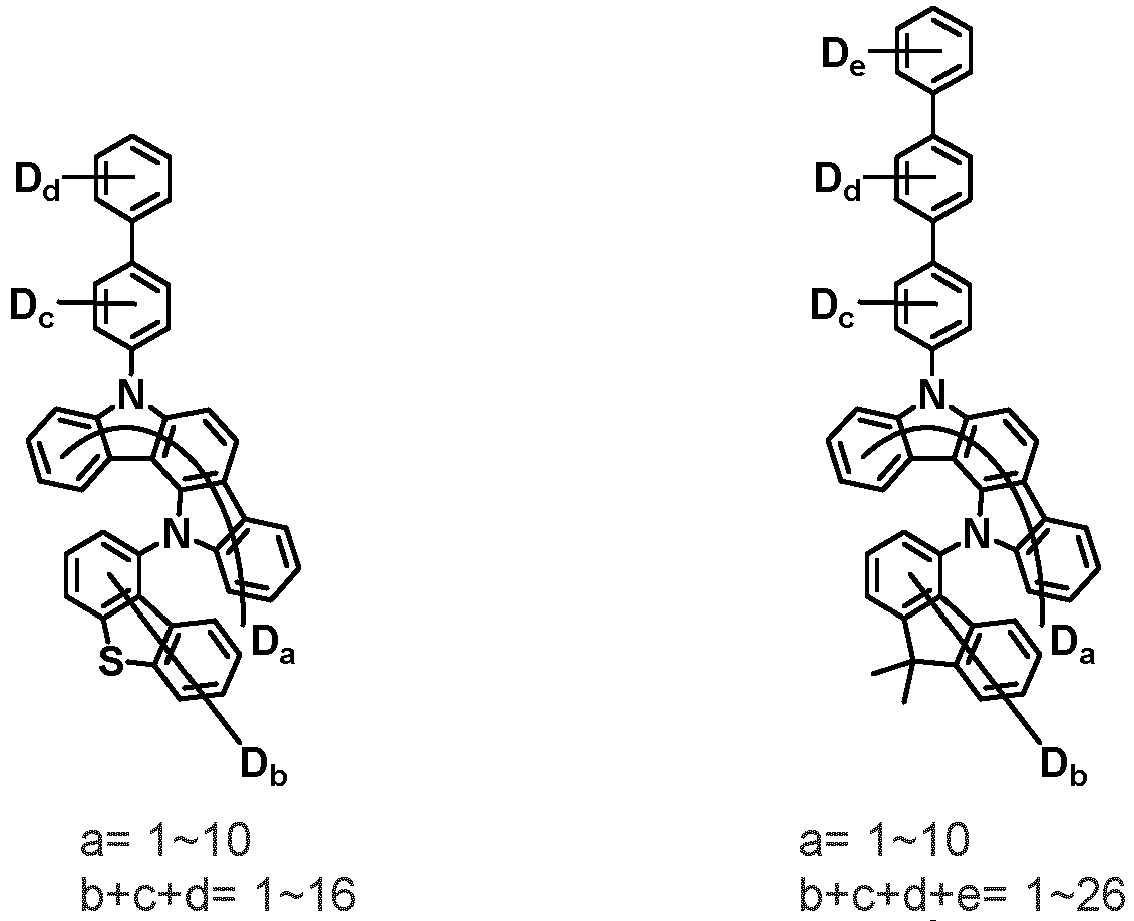
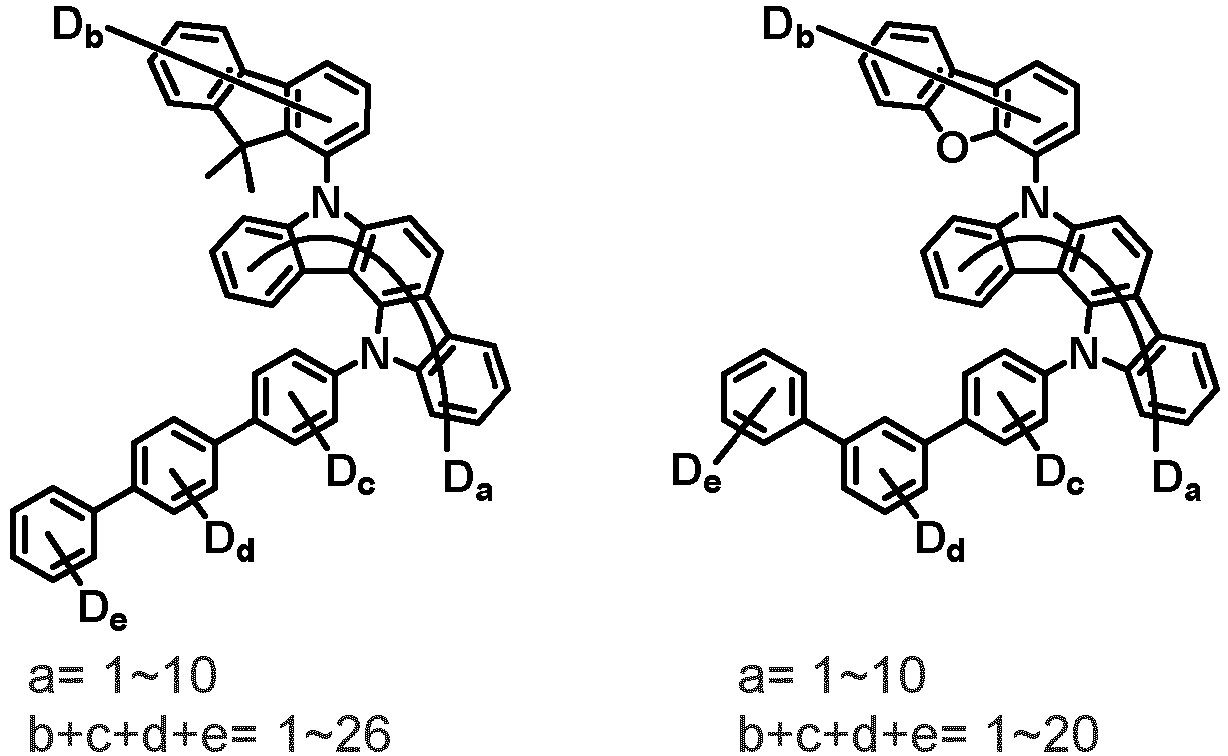
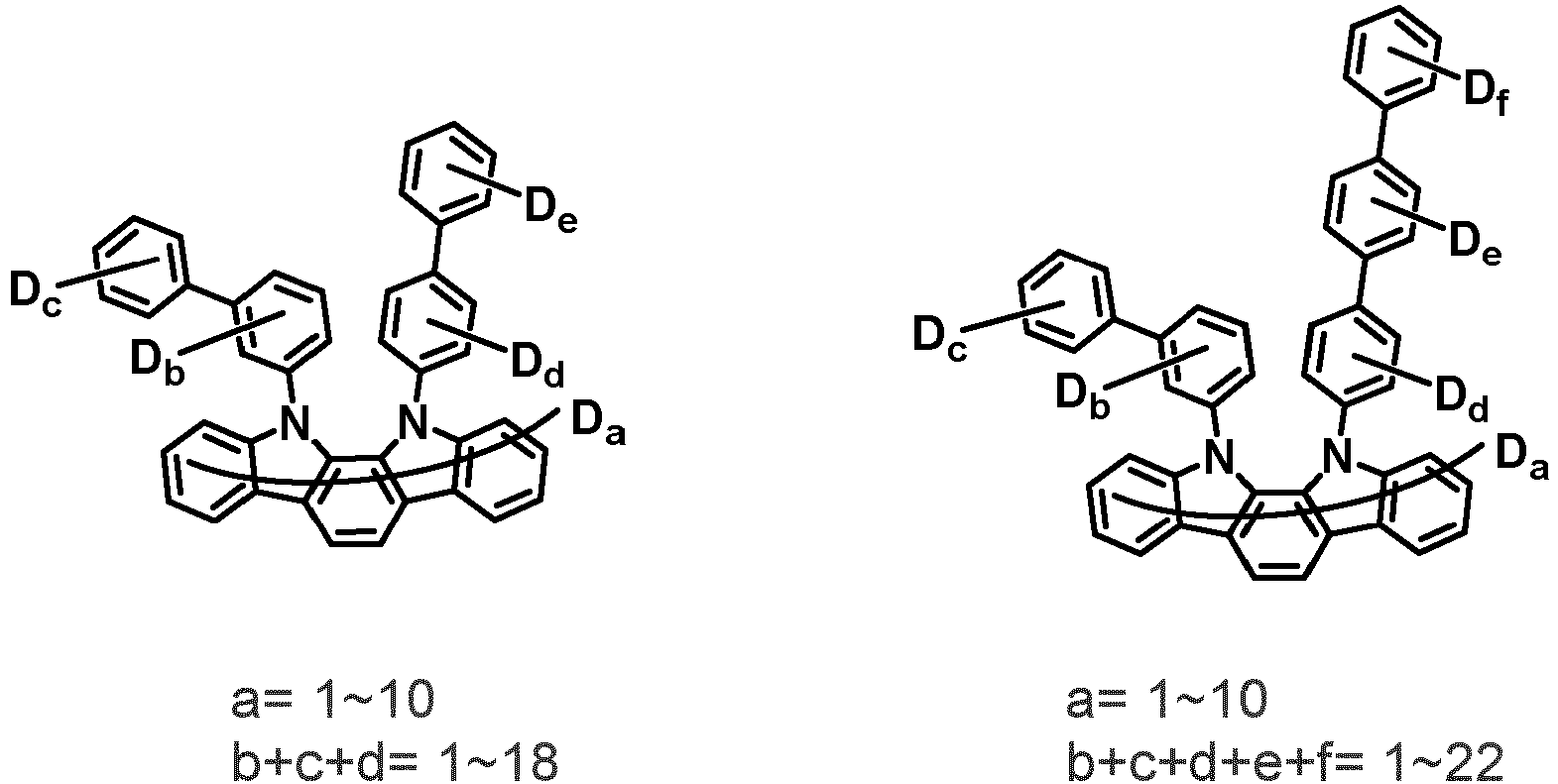
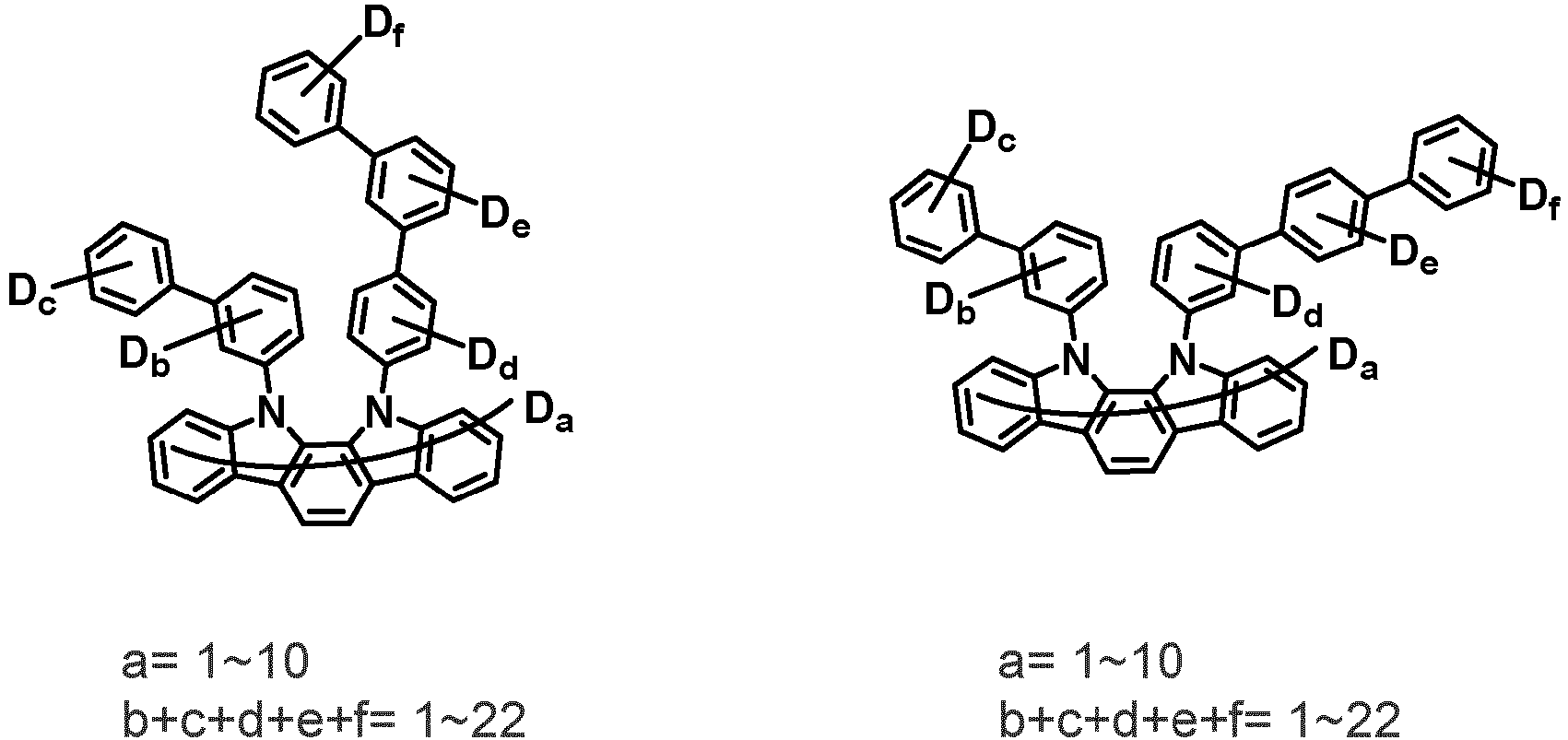
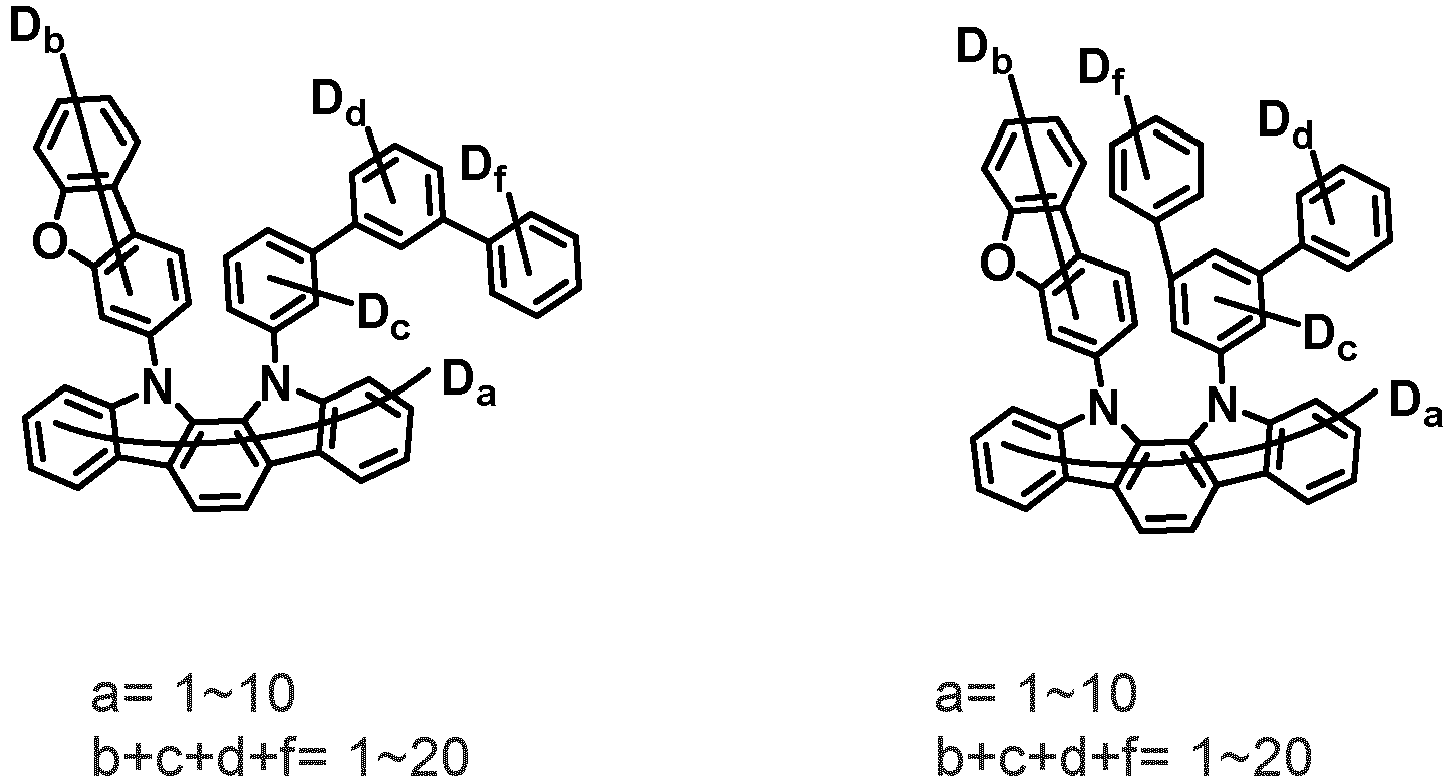
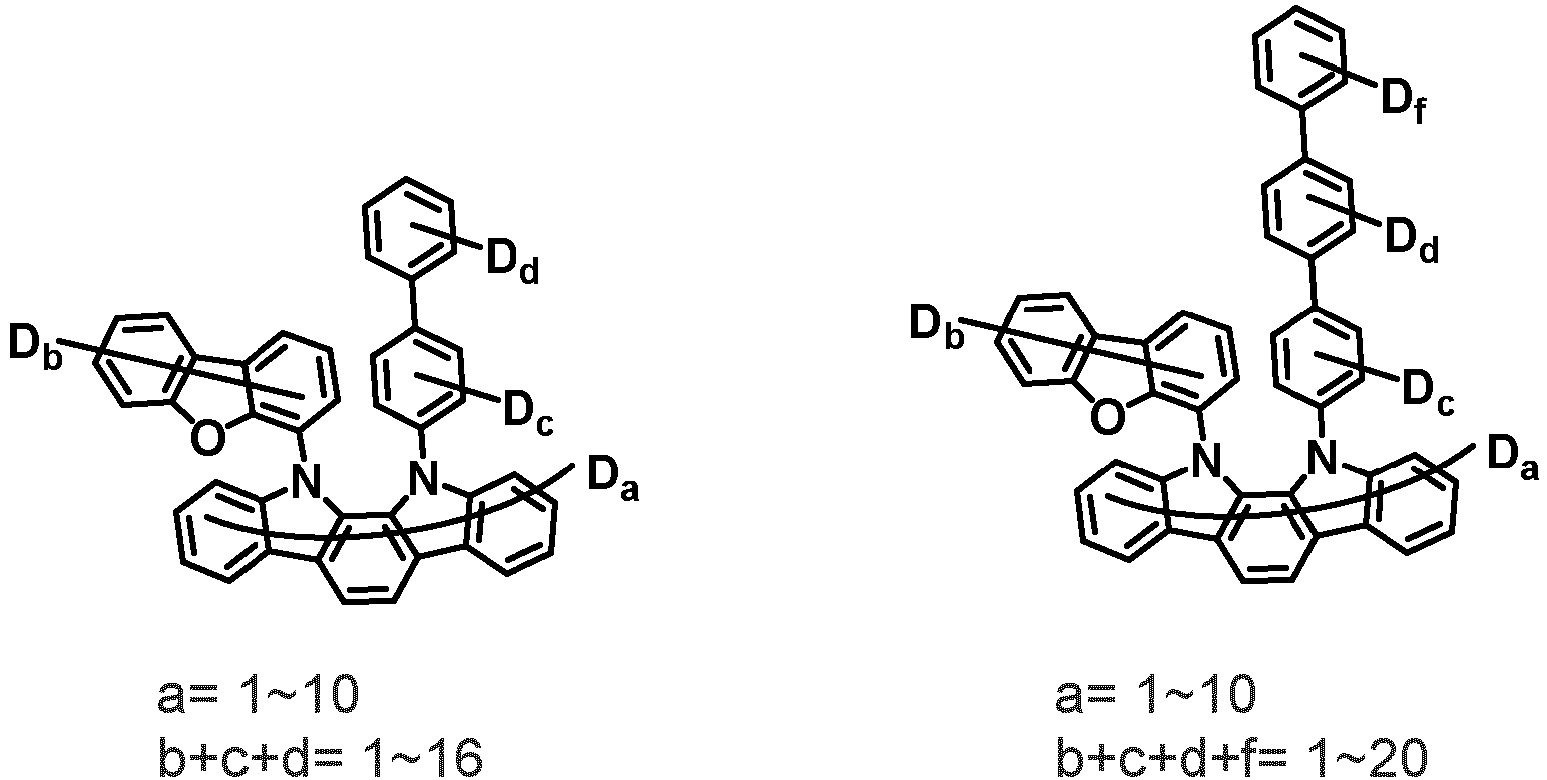
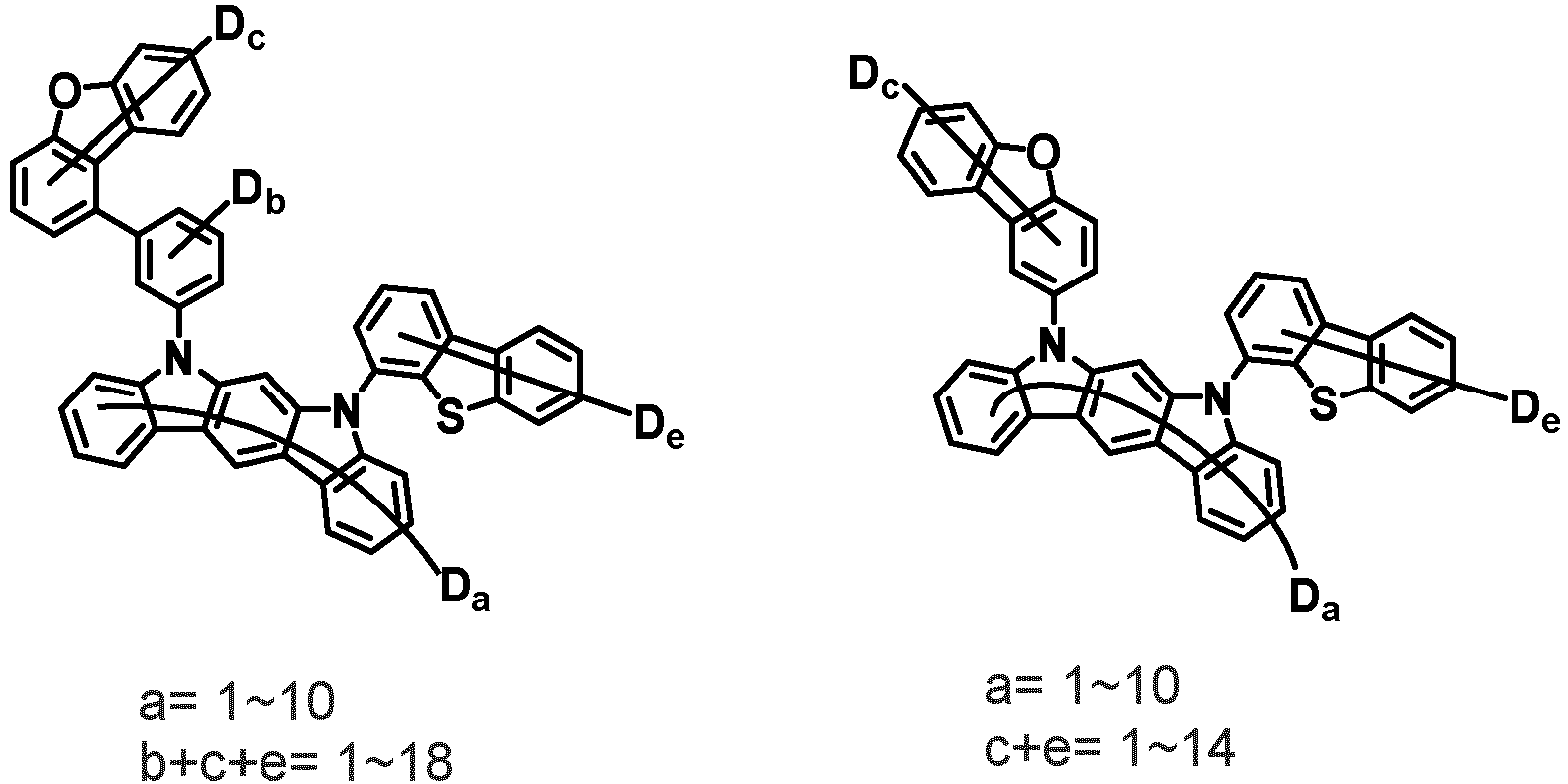
- Organische lichtemittierende Vorrichtung nach Anspruch 1, wobei die durch die chemische Formel 2 dargestellte Verbindung durch eine beliebeige der chemischen Formeln 2A-1 bis 2A-9, der chemischen Formel 2B-1 bis 2B-8, der chemischen Formel 2C-1 bis 2C-7, der chemischen Formel 2D-1 bis 2D-6, der chemischen Formel 2E-1 bis 2E-5 und der chemischen Formel 2F-1 bis 2F-3 dargestellt ist:


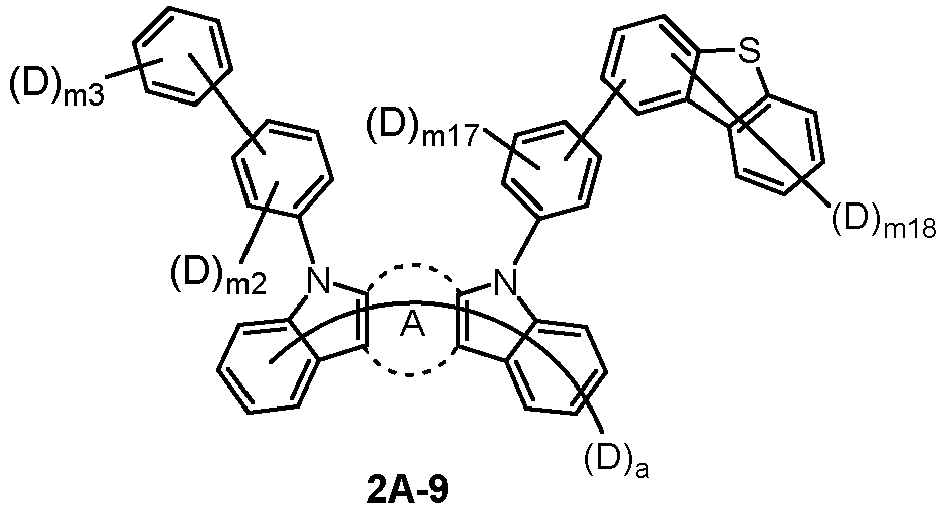 A wie in Anspruch 1 definiert ist;a eine ganze Zahl von 1 bis 10 ist;m2, m4, m5, m13, m15 und m17 jeweils unabhängig eine ganze Zahl von 0 bis 4 sind;m3, m6, m7 und m9 jeweils unabhängig eine ganze Zahl von 0 bis 5 sind;m8 eine ganze Zahl von 0 bis 3 ist;m10 und m14 jeweils unabhängig eine ganze Zahl von 0 bis 13 sind; undm11, m12, m16 und m18 jeweils unabhängig eine ganze Zahl von 0 bis 7 sind,mit der Maßgabe, dass:m2+m3 in der chemischen Formel 2A-1 1 bis 18 ist,m2+m3+m4+m5+m6 in der chemischen Formel 2A-2 1 bis 22 ist,m2+m3+m7+m8+m9 in der chemischen Formel 2A-3 1 bis 22 ist,m2+m3+m10 in der chemischen Formel 2A-4 1 bis 22 ist,m2+m3+m11 in der chemischen Formel 2A-5 1 bis 16 ist,m2+m3+m12 in der chemischen Formel 2A-6 1 bis 16 ist,m2+m3+m13+m14 in der chemischen Formel 2A-7 1 bis 26 ist,m2+m3+m15+m16 in der chemischen Formel 2A-8 1 bis 20 ist, oderm2+m3+m17+m18 in der chemischen Formel 2A-9 1 bis 20 ist;


 worin, in der chemischen Formel 2B-1 bis zur chemischen Formel 2B-8:A wie in Anspruch 1 definiert ist;a eine ganze Zahl von 1 bis 10 ist;m4, m5, m13, m15 und m17 jeweils unabhängig eine ganze Zahl von 0 bis 4 sind;m6, m7 und m9 jeweils unabhängig eine ganze Zahl von 0 bis 5 sind;m8 eine ganze Zahl von 0 bis 3 ist;m10 und m14 jeweils unabhängig eine ganze Zahl von 0 bis 13 sind, undm11, m12, m16 und m18 jeweils unabhängig eine ganze Zahl von 0 bis 7 sind,mit der Maßgabe, dass:m4+m5+m6 in der chemischen Formel 2B-1 1 bis 26 ist,m4+m5+m6+m7+m8+m9 in der chemischen Formel 2B-2 1 bis 26 ist,m4+m5+m6+m10 in der chemischen Formel 2B-3 1 bis 26 ist,m4+m5+m6+m11 in der chemischen Formel 2B-4 1 bis 20 ist,m4+m5+m6+m12 in der chemischen Formel 2B-5 1 bis 20 ist,m4+m5+m6+m13+m14 in der chemischen Formel 2B-6 1 bis 30 ist,m4+m5+m6+m15+m16 in der chemischen Formel 2B-7 1 bis 24 ist, oderm4+m5+m6+m17+m18 in der chemischen Formel 2B-8 1 bis 24 ist;


 worin, in der chemischen Formel 2C-1 bis zur chemischen Formel 2C-7:A wie in Anspruch 1 definiert ist;a eine ganze Zahl von 1 bis 10 ist;m7 und m9 jeweils unabhängig eine ganze Zahl von 0 bis 5 sind;m8 eine ganze Zahl von 0 bis 3 ist;m10 und m14 jeweils unabhängig eine ganze Zahl von 0 bis 13 sind;m11, m12, m16 und m18 jeweils unabhängig eine ganze Zahl von 0 bis 7 sind; undm13, m15 und m17 jeweils unabhängig eine ganze Zahl von 0 bis 4 sind,mit der Maßgabe, dass:m7+m8+m9 in der chemischen Formel 2C-1 1 bis 26 ist,m7+m8+m9+m10 in der chemischen Formel 2C-2 1 bis 26 ist,m7+m8+m9+m11 in der chemischen Formel 2C-3 1 bis 20 ist,m7+m8+m9+m12 in der chemischen Formel 2C-4 1 bis 20 ist,m7+m8+m9+m13+m14 in der chemischen Formel 2C-5 1 bis 30 ist,m7+m8+m9+m15+m16 in der chemischen Formel 2C-6 1 bis 24 ist, oderm7+m8+m9+m17+m18 in der chemischen Formel 2C-7 1 bis 24 ist;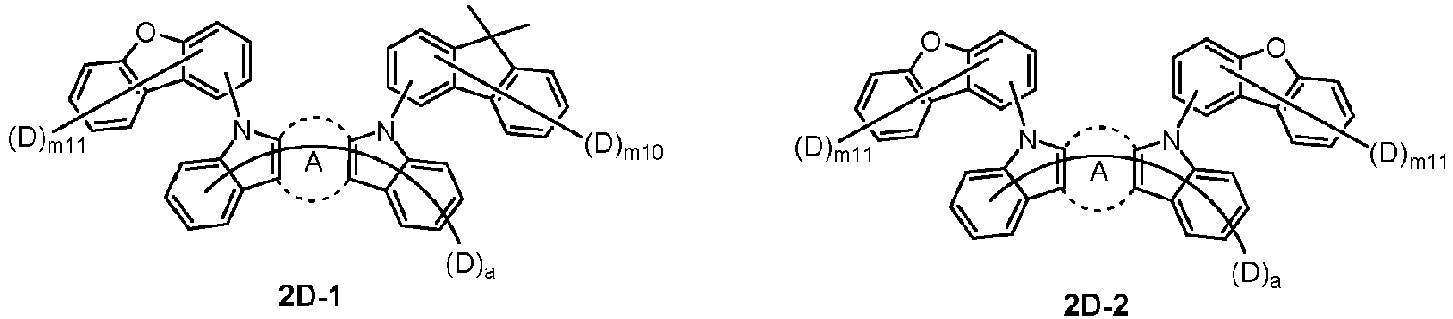

 worin, in der chemischen Formel 2D-1 bis zur chemischen Formel 2D-6:A wie in Anspruch 1 definiert ist;a eine ganze Zahl von 1 bis 10 ist;m10 und m14 jeweils unabhängig eine ganze Zahl von 0 bis 13 sind;m11, m12, m16 und m18 jeweils unabhängig eine ganze Zahl von 0 bis 7 sind; undm13, m15 und m17 jeweils unabhängig eine ganze Zahl von 0 bis 4 sind,mit der Maßgabe, dass:m10+m11 in der chemischen Formel 2D-1 1 bis 20 ist,m11+m11 in der chemischen Formel 2D-2 1 bis 14 ist,m11+m12 in der chemischen Formel 2D-3 1 bis 14 ist,m11+m13+m14 in der chemischen Formel 2D-4 1 bis 24 ist,m11+m15+m16 in der chemischen Formel 2D-5 1 bis 18 ist, oderm11+m17+m18 in der chemischen Formel 2D-6 1 bis 18 ist;

 worin, in der chemischen Formel 2E-1 bis zur chemischen Formel 2E-5:A wie in Anspruch 1 definiert ist;a eine ganze Zahl von 1 bis 10 ist;m10 und m14 jeweils unabhängig eine ganze Zahl von 0 bis 13 sind;m12, m16 und m18 jeweils unabhängig eine ganze Zahl von 0 bis 7 sind; undm13, m15 und m17 jeweils unabhängig eine ganze Zahl von 0 bis 4 sind,mit der Maßgabe, dass:m10+m12 in der chemischen Formel 2E-1 1 bis 20 ist,m12+m12 in der chemischen Formel 2E-2 1 bis 14 ist,m12+m13+m14 in der chemischen Formel 2E-3 1 bis 24 ist,m12+m15+m16 in der chemischen Formel 2E-4 1 bis 18 ist, oderm12+m17+m18 in der chemischen Formel 2E-5 1 bis 18 ist;
 worin, in der chemischen Formel 2F-1 bis zur chemischen Formel 2F-3:A wie in Anspruch 1 definiert ist;a eine ganze Zahl von 1 bis 10 ist,m15 und m17 jeweils unabhängig eine ganze Zahl von 0 bis 4 sind; undm16 und m18 jeweils unabhängig eine ganze Zahl von 0 bis 7 sind,mit der Maßgabe, dass:m15+m16 in der chemischen Formel 2F-1 1 bis 22 ist,m15+m16+m17+m18 in der chemischen Formel 2F-2 1 bis 22 ist, oderm17+m18 in der chemischen Formel 2F-3 1 bis 22 ist.
 - Organische lichtemittierende Vorrichtung nach Anspruch 1, wobei ein Deuterium-Substitutionsverhältnis der chemischen Formel 2 50% bis 100% beträgt.
- Organische lichtemittierende Vorrichtung nach Anspruch 1, wobei die durch die chemische Formel 2 dargestellte Verbindung eine beliebige Verbindung ist, ausgewählt aus der Gruppe bestehend aus:


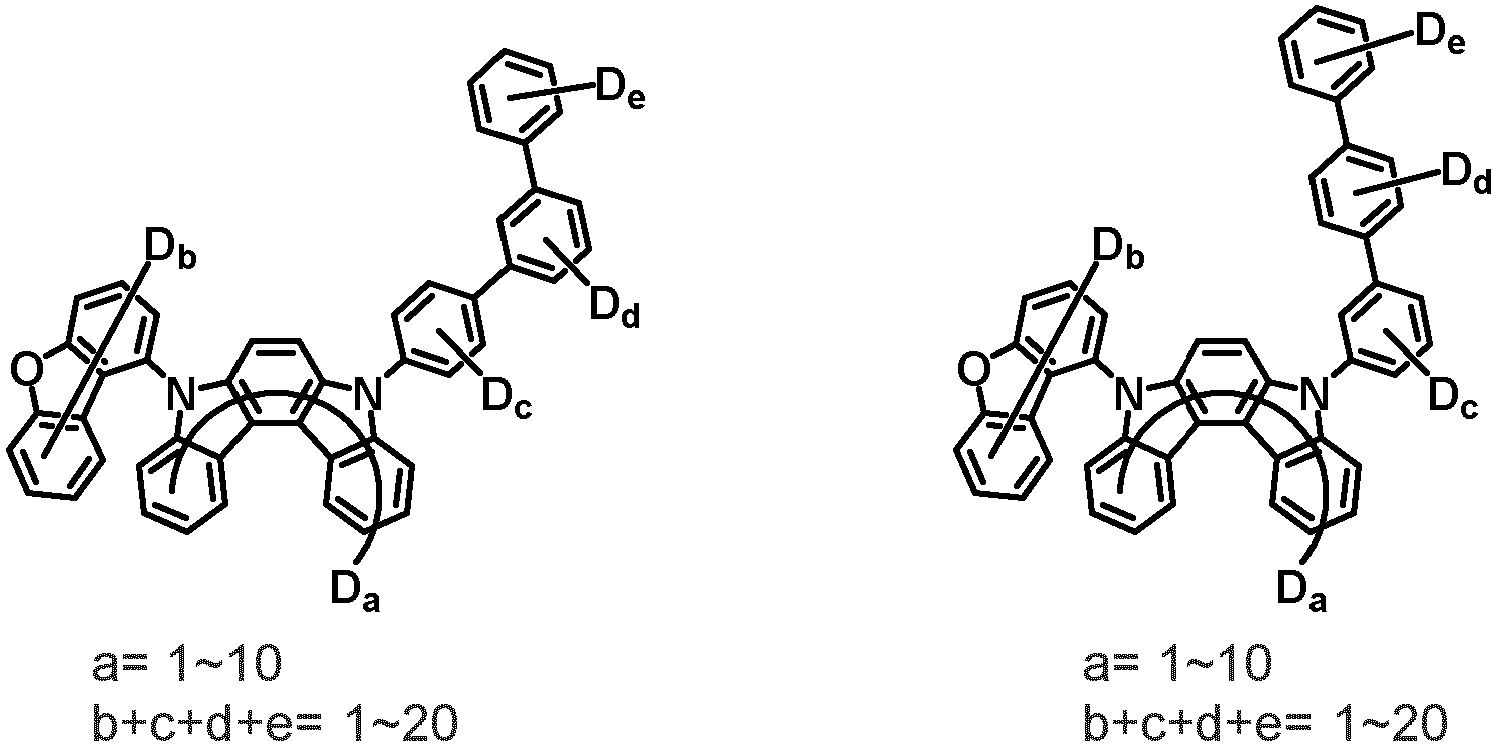


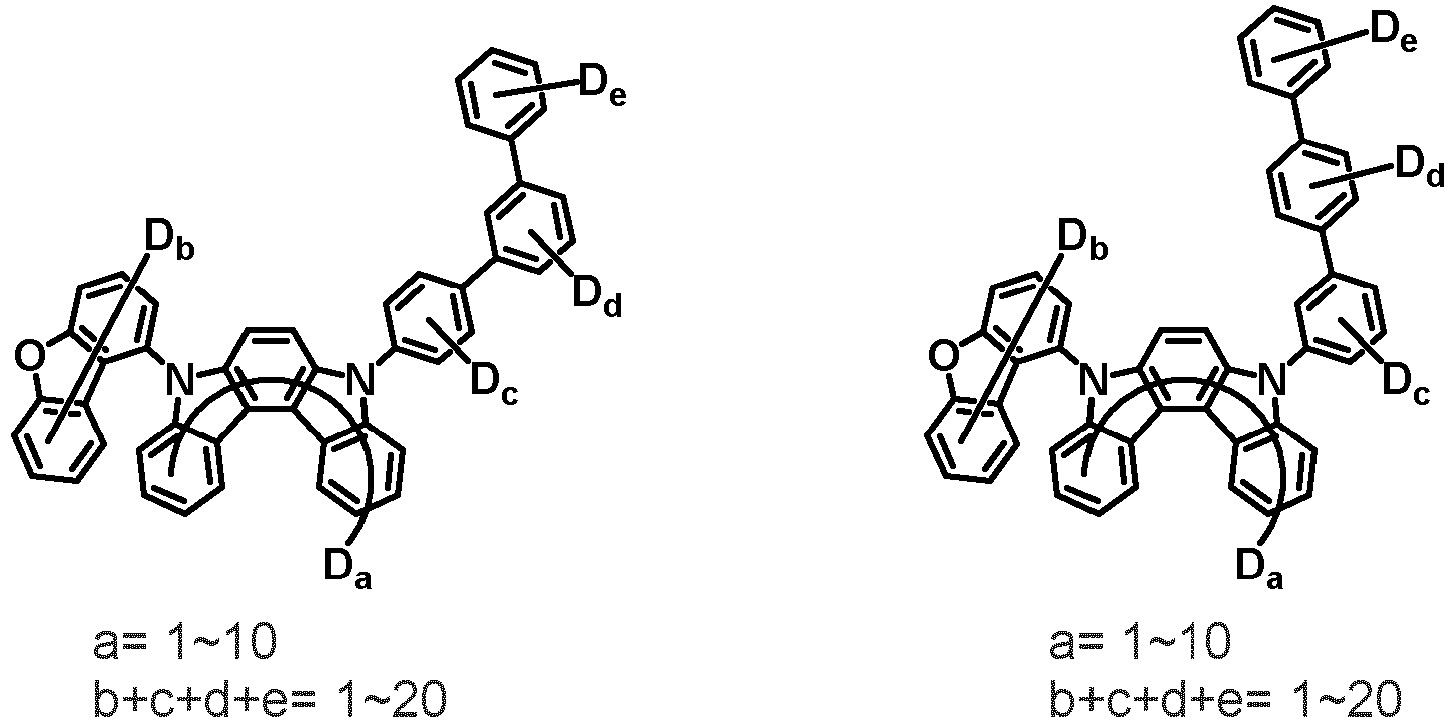

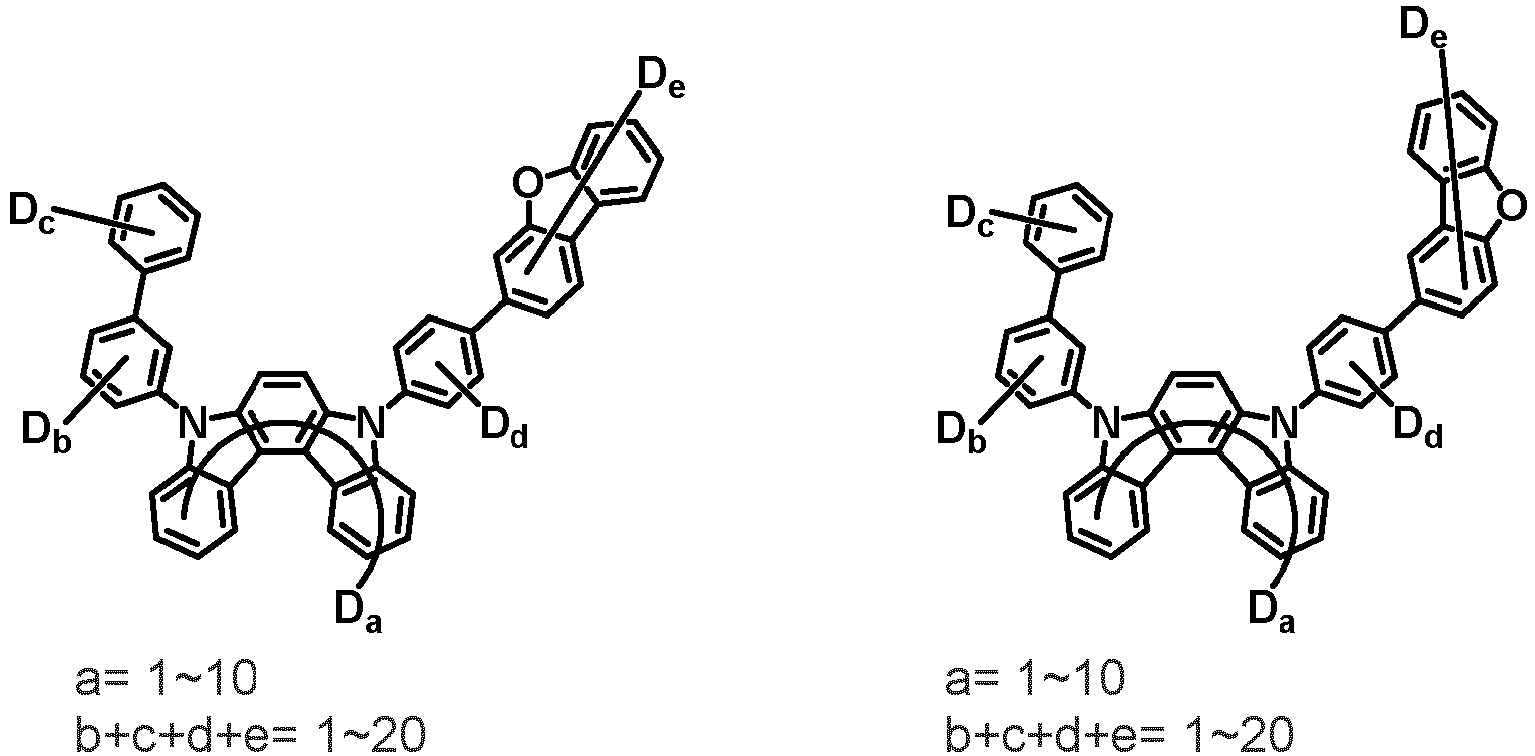


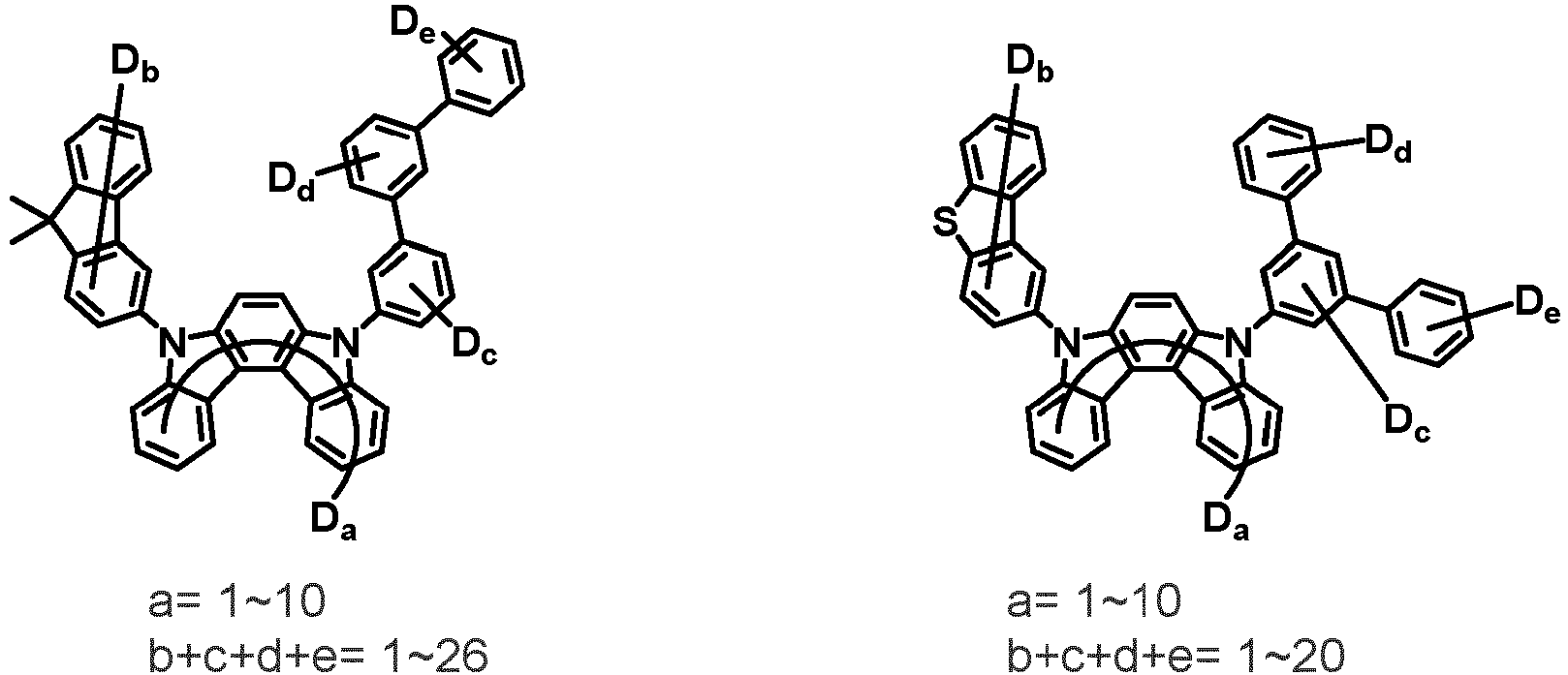
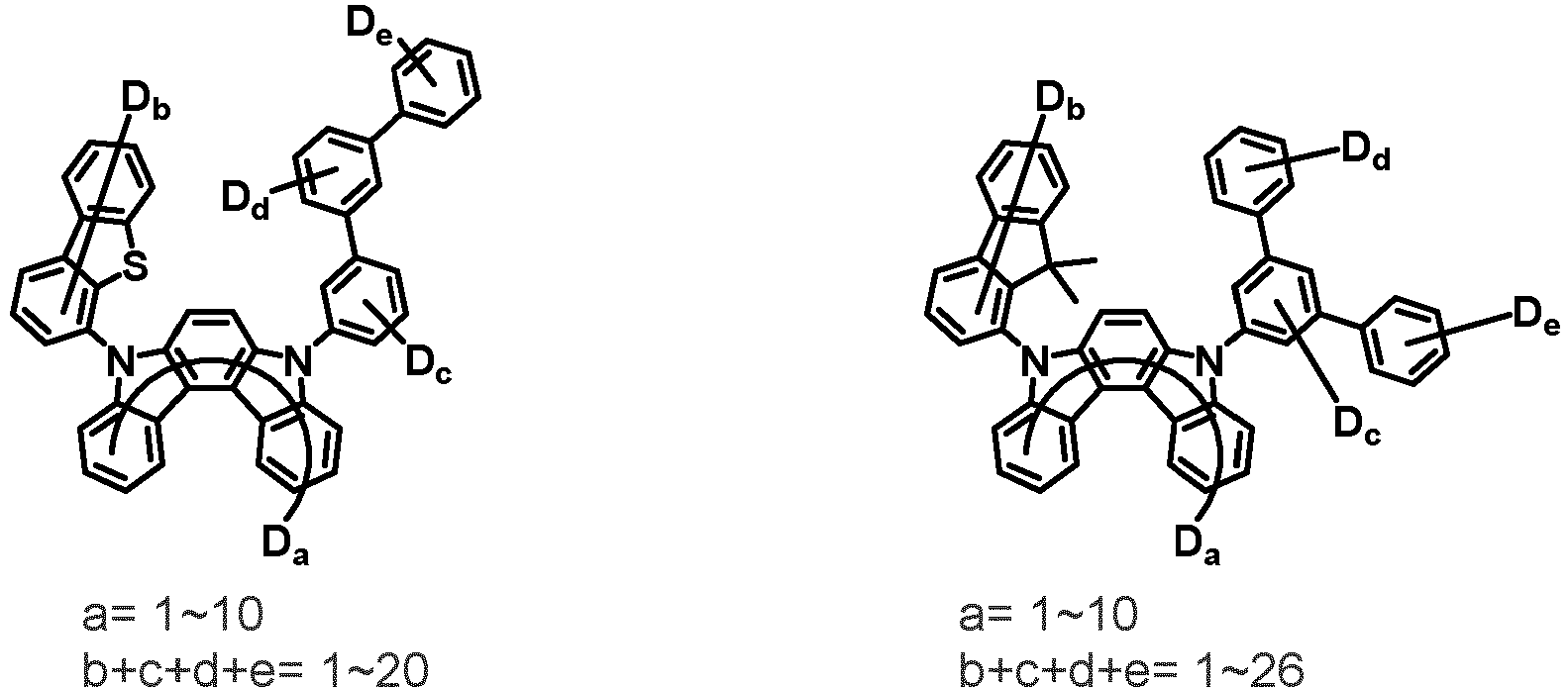

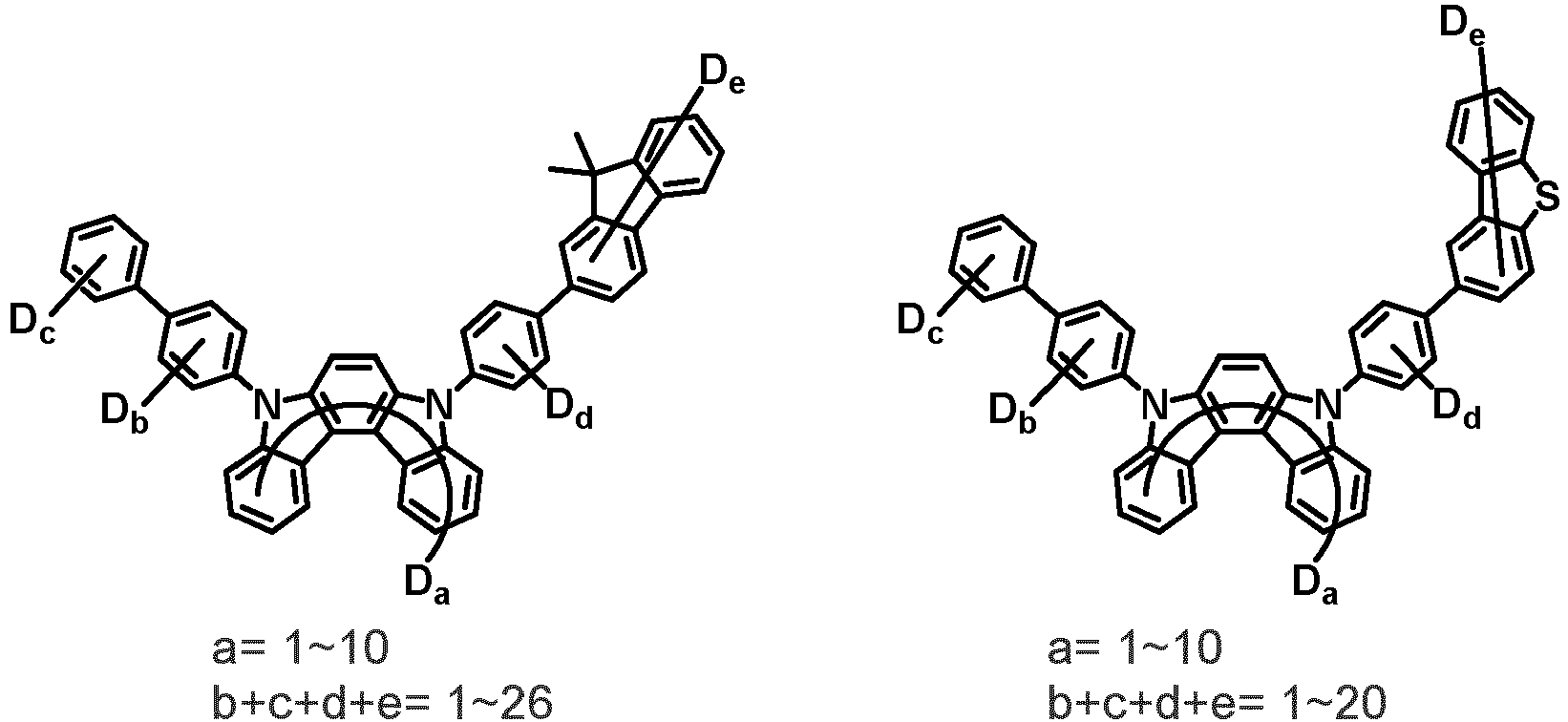











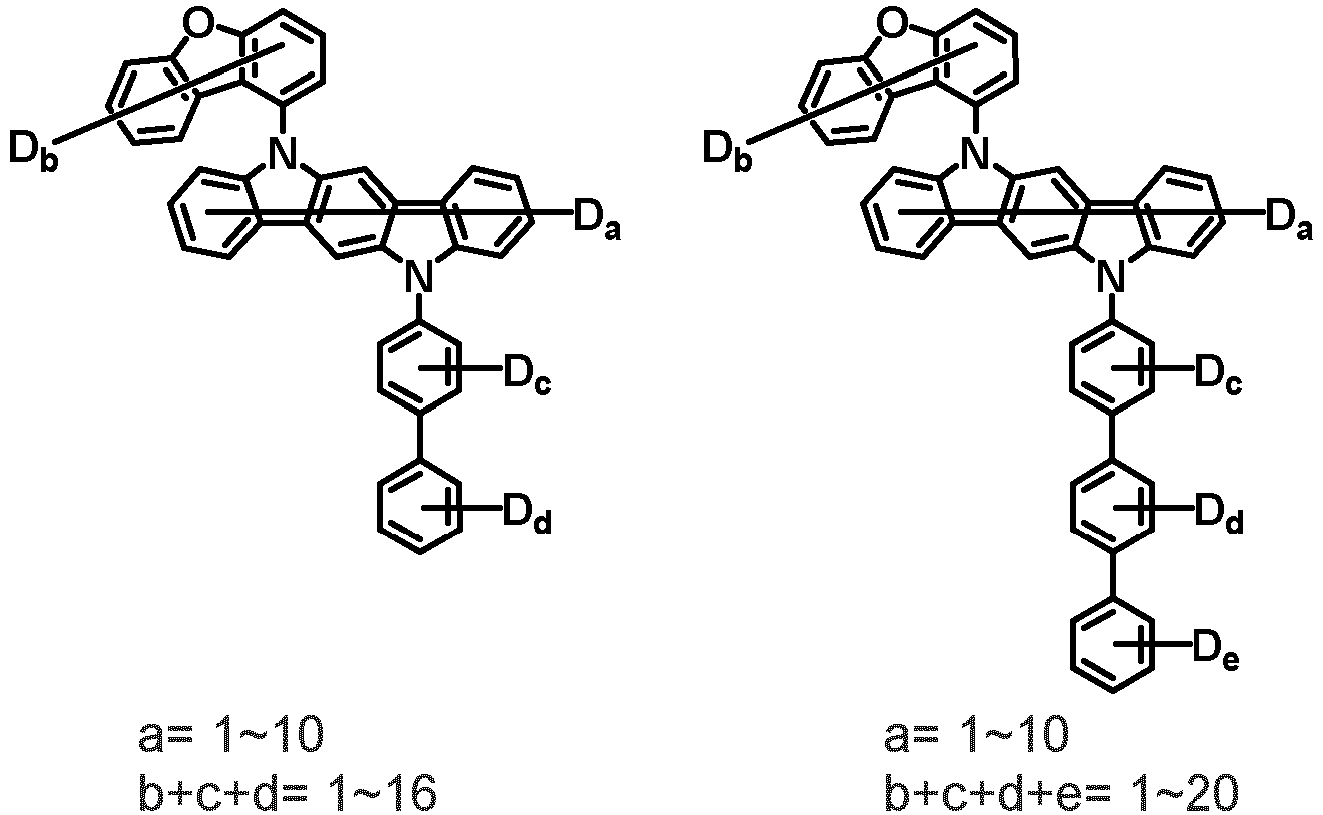


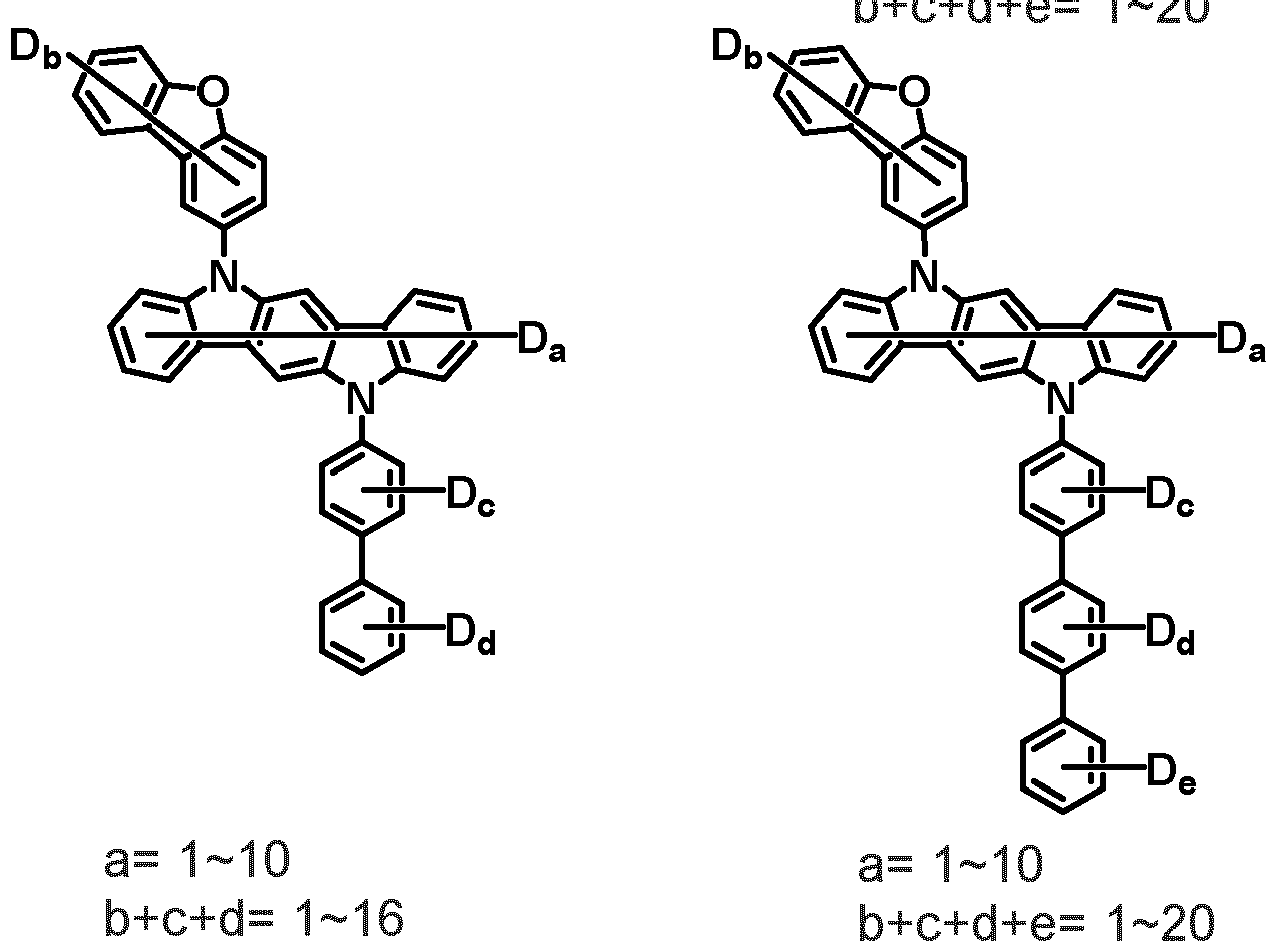


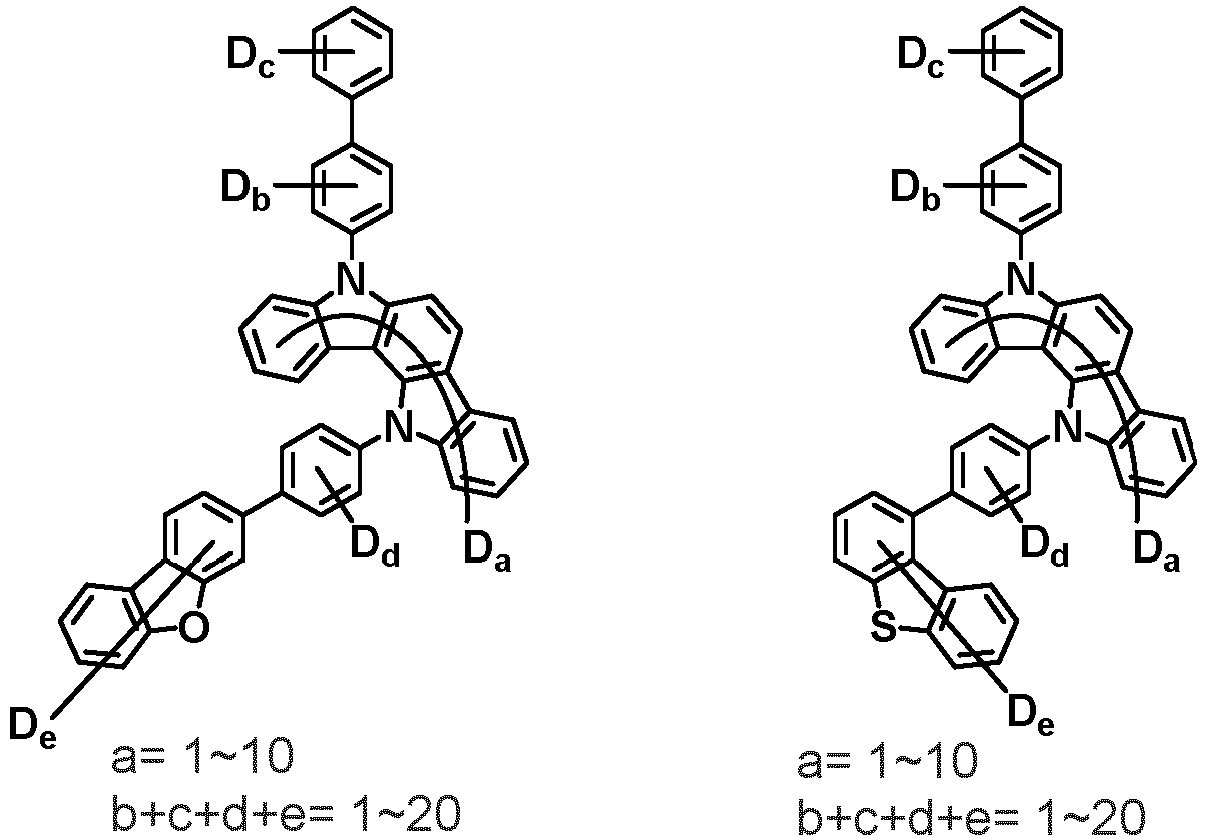


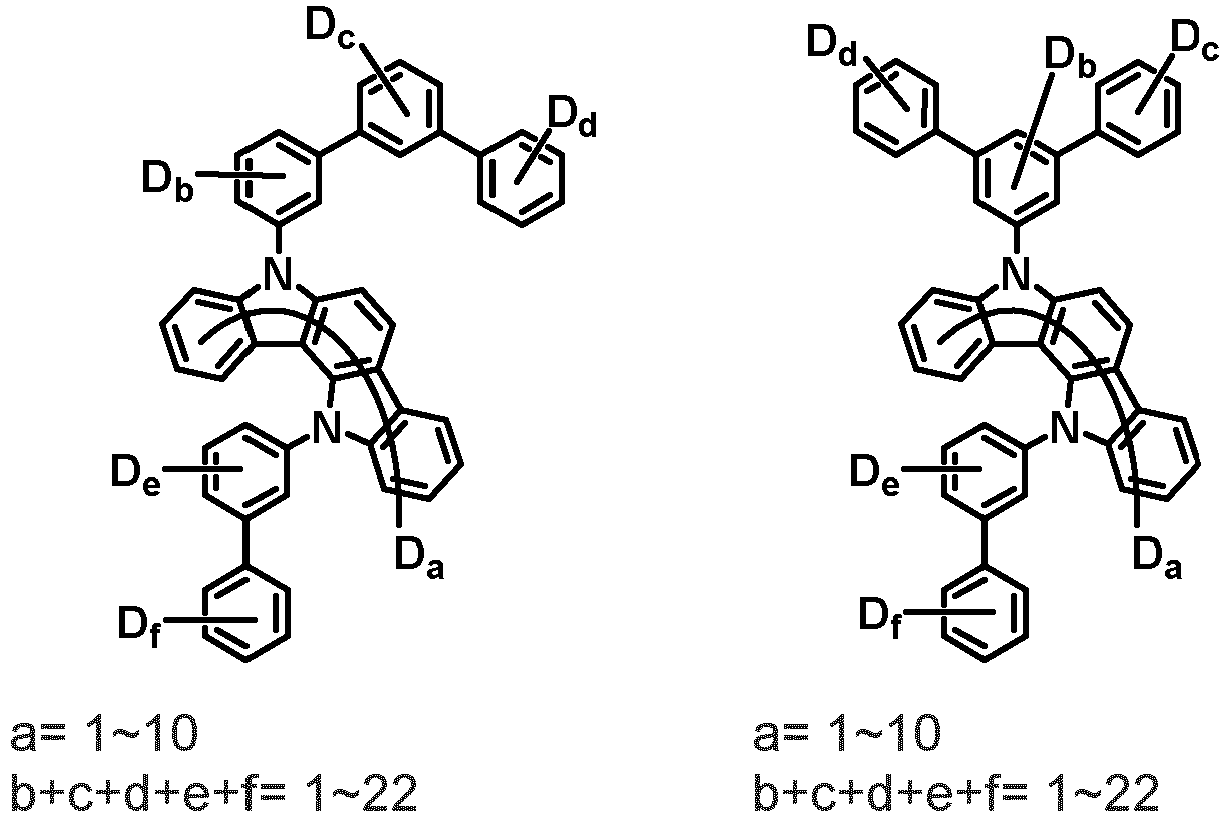














Applications Claiming Priority (2)
| Application Number | Priority Date | Filing Date | Title |
|---|---|---|---|
| KR20210051874 | 2021-04-21 | ||
| PCT/KR2022/005724 WO2022225349A1 (ko) | 2021-04-21 | 2022-04-21 | 유기 발광 소자 |
Publications (3)
| Publication Number | Publication Date |
|---|---|
| EP4307402A1 EP4307402A1 (de) | 2024-01-17 |
| EP4307402A4 EP4307402A4 (de) | 2024-10-16 |
| EP4307402B1 true EP4307402B1 (de) | 2025-06-25 |
Family
ID=83723038
Family Applications (1)
| Application Number | Title | Priority Date | Filing Date |
|---|---|---|---|
| EP22792047.7A Active EP4307402B1 (de) | 2021-04-21 | 2022-04-21 | Organische lichtemittierende vorrichtung |
Country Status (6)
| Country | Link |
|---|---|
| US (1) | US20240206332A1 (de) |
| EP (1) | EP4307402B1 (de) |
| JP (1) | JP7740789B2 (de) |
| KR (1) | KR20220145292A (de) |
| CN (1) | CN117044425A (de) |
| WO (1) | WO2022225349A1 (de) |
Families Citing this family (3)
| Publication number | Priority date | Publication date | Assignee | Title |
|---|---|---|---|---|
| KR20240099940A (ko) * | 2022-12-22 | 2024-07-01 | 엘지디스플레이 주식회사 | 유기 화합물, 이를 포함하는 유기발광다이오드 및 유기발광장치 |
| KR102668363B1 (ko) * | 2023-02-03 | 2024-05-21 | 이남희 | 변기 악취 제거장치 |
| CN117897030B (zh) * | 2023-12-01 | 2025-08-01 | 陕西莱特光电材料股份有限公司 | 有机电致发光器件和电子装置 |
Family Cites Families (9)
| Publication number | Priority date | Publication date | Assignee | Title |
|---|---|---|---|---|
| KR100430549B1 (ko) | 1999-01-27 | 2004-05-10 | 주식회사 엘지화학 | 신규한 착물 및 그의 제조 방법과 이를 이용한 유기 발광 소자 및 그의 제조 방법 |
| DE10135513B4 (de) | 2001-07-20 | 2005-02-24 | Novaled Gmbh | Lichtemittierendes Bauelement mit organischen Schichten |
| KR102211337B1 (ko) * | 2016-05-19 | 2021-02-03 | 덕산네오룩스 주식회사 | 유기전기소자용 화합물, 이를 이용한 유기전기소자 및 그 전자 장치 |
| KR20190079341A (ko) * | 2017-12-27 | 2019-07-05 | 삼성에스디아이 주식회사 | 유기 화합물, 조성물, 유기 광전자 소자 및 표시 장치 |
| JP7299020B2 (ja) * | 2018-12-28 | 2023-06-27 | 三星電子株式会社 | 有機エレクトロルミネッセンス素子およびその製造方法 |
| KR102261984B1 (ko) * | 2018-12-28 | 2021-06-09 | 엘티소재주식회사 | 유기 발광 소자, 이의 제조 방법 및 유기물층용 조성물 |
| KR102447008B1 (ko) * | 2019-08-09 | 2022-09-22 | 주식회사 엘지화학 | 유기 발광 소자 |
| WO2021029616A1 (ko) * | 2019-08-09 | 2021-02-18 | 주식회사 엘지화학 | 유기 발광 소자 |
| WO2022015107A1 (ko) * | 2020-07-17 | 2022-01-20 | 주식회사 엘지화학 | 유기 발광 소자 |
-
2022
- 2022-04-21 EP EP22792047.7A patent/EP4307402B1/de active Active
- 2022-04-21 WO PCT/KR2022/005724 patent/WO2022225349A1/ko not_active Ceased
- 2022-04-21 JP JP2023559100A patent/JP7740789B2/ja active Active
- 2022-04-21 CN CN202280022516.9A patent/CN117044425A/zh active Pending
- 2022-04-21 US US18/280,630 patent/US20240206332A1/en active Pending
- 2022-04-21 KR KR1020220049343A patent/KR20220145292A/ko not_active Ceased
Also Published As
| Publication number | Publication date |
|---|---|
| JP7740789B2 (ja) | 2025-09-17 |
| EP4307402A1 (de) | 2024-01-17 |
| JP2024511503A (ja) | 2024-03-13 |
| WO2022225349A1 (ko) | 2022-10-27 |
| KR20220145292A (ko) | 2022-10-28 |
| US20240206332A1 (en) | 2024-06-20 |
| EP4307402A4 (de) | 2024-10-16 |
| CN117044425A (zh) | 2023-11-10 |
Similar Documents
| Publication | Publication Date | Title |
|---|---|---|
| KR102675795B1 (ko) | 유기 발광 소자 | |
| EP3982434B1 (de) | Organische lichtemittierende vorrichtung | |
| KR102447008B1 (ko) | 유기 발광 소자 | |
| KR102446400B1 (ko) | 유기 발광 소자 | |
| JP2023534166A (ja) | 有機発光素子 | |
| KR102676316B1 (ko) | 유기 발광 소자 | |
| EP3862350B1 (de) | Neuartige verbindung und organische lichtemittierende vorrichtung mit verwendung davon | |
| KR20200063049A (ko) | 신규한 화합물 및 이를 이용한 유기 발광 소자 | |
| KR102677175B1 (ko) | 유기 발광 소자 | |
| KR102907314B1 (ko) | 유기 발광 소자 | |
| EP4266390B1 (de) | Organische lichtemittierende vorrichtung | |
| KR102225488B1 (ko) | 신규한 화합물 및 이를 이용한 유기발광 소자 | |
| EP4307402B1 (de) | Organische lichtemittierende vorrichtung | |
| EP3770157B1 (de) | Neue heterocyclische verbindung und diese enthaltende organische lichtemittierende vorrichtung | |
| EP3730488B1 (de) | Neuartige heterocyclische verbindung und organische lichtemittierende vorrichtung mit verwendung davon | |
| EP4357341A1 (de) | Neuartige verbindung und organische lichtemittierende vorrichtung damit | |
| EP4335845A1 (de) | Neuartige verbindung und organische lichtemittierende vorrichtung damit | |
| EP4253378B1 (de) | Neuartige verbindung und organische lichtemittierende vorrichtung damit | |
| EP4261906A1 (de) | Organische lichtemittierende vorrichtung | |
| EP4299574B1 (de) | Neuartige verbindung und organische lichtemittierende vorrichtung damit | |
| KR102909960B1 (ko) | 유기 발광 소자 | |
| EP4495112A1 (de) | Neuartige verbindung und organische lichtemittierende vorrichtung damit | |
| EP4242205A1 (de) | Neuartige verbindung und organische lichtemittierende vorrichtung damit | |
| KR20240094757A (ko) | 신규한 화합물 및 이를 이용한 유기 발광 소자 | |
| KR20220036225A (ko) | 신규한 화합물 및 이를 포함하는 유기발광 소자 |
Legal Events
| Date | Code | Title | Description |
|---|---|---|---|
| STAA | Information on the status of an ep patent application or granted ep patent |
Free format text: STATUS: THE INTERNATIONAL PUBLICATION HAS BEEN MADE |
|
| PUAI | Public reference made under article 153(3) epc to a published international application that has entered the european phase |
Free format text: ORIGINAL CODE: 0009012 |
|
| STAA | Information on the status of an ep patent application or granted ep patent |
Free format text: STATUS: REQUEST FOR EXAMINATION WAS MADE |
|
| 17P | Request for examination filed |
Effective date: 20231011 |
|
| AK | Designated contracting states |
Kind code of ref document: A1 Designated state(s): AL AT BE BG CH CY CZ DE DK EE ES FI FR GB GR HR HU IE IS IT LI LT LU LV MC MK MT NL NO PL PT RO RS SE SI SK SM TR |
|
| DAV | Request for validation of the european patent (deleted) | ||
| DAX | Request for extension of the european patent (deleted) | ||
| REG | Reference to a national code |
Ref legal event code: R079 Free format text: PREVIOUS MAIN CLASS: H01L0051000000 Ref country code: DE Ref document number: 602022016579 Country of ref document: DE Ipc: C09K0011060000 |
|
| A4 | Supplementary search report drawn up and despatched |
Effective date: 20240913 |
|
| RIC1 | Information provided on ipc code assigned before grant |
Ipc: H10K 101/00 20230101ALN20240909BHEP Ipc: H10K 101/10 20230101ALN20240909BHEP Ipc: H10K 50/11 20230101ALN20240909BHEP Ipc: H10K 85/60 20230101ALI20240909BHEP Ipc: C09K 11/06 20060101AFI20240909BHEP |
|
| GRAP | Despatch of communication of intention to grant a patent |
Free format text: ORIGINAL CODE: EPIDOSNIGR1 |
|
| STAA | Information on the status of an ep patent application or granted ep patent |
Free format text: STATUS: GRANT OF PATENT IS INTENDED |
|
| RIC1 | Information provided on ipc code assigned before grant |
Ipc: H10K 101/00 20230101ALN20250306BHEP Ipc: H10K 101/10 20230101ALN20250306BHEP Ipc: H10K 50/11 20230101ALN20250306BHEP Ipc: H10K 85/60 20230101ALI20250306BHEP Ipc: C09K 11/06 20060101AFI20250306BHEP |
|
| INTG | Intention to grant announced |
Effective date: 20250327 |
|
| GRAS | Grant fee paid |
Free format text: ORIGINAL CODE: EPIDOSNIGR3 |
|
| GRAA | (expected) grant |
Free format text: ORIGINAL CODE: 0009210 |
|
| STAA | Information on the status of an ep patent application or granted ep patent |
Free format text: STATUS: THE PATENT HAS BEEN GRANTED |
|
| AK | Designated contracting states |
Kind code of ref document: B1 Designated state(s): AL AT BE BG CH CY CZ DE DK EE ES FI FR GB GR HR HU IE IS IT LI LT LU LV MC MK MT NL NO PL PT RO RS SE SI SK SM TR |
|
| REG | Reference to a national code |
Ref country code: GB Ref legal event code: FG4D |
|
| REG | Reference to a national code |
Ref country code: CH Ref legal event code: EP |
|
| REG | Reference to a national code |
Ref country code: CH Ref legal event code: EP |
|
| REG | Reference to a national code |
Ref country code: IE Ref legal event code: FG4D |
|
| REG | Reference to a national code |
Ref country code: DE Ref legal event code: R096 Ref document number: 602022016579 Country of ref document: DE |
|
| PG25 | Lapsed in a contracting state [announced via postgrant information from national office to epo] |
Ref country code: FI Free format text: LAPSE BECAUSE OF FAILURE TO SUBMIT A TRANSLATION OF THE DESCRIPTION OR TO PAY THE FEE WITHIN THE PRESCRIBED TIME-LIMIT Effective date: 20250625 |
|
| REG | Reference to a national code |
Ref country code: LT Ref legal event code: MG9D |
|
| PG25 | Lapsed in a contracting state [announced via postgrant information from national office to epo] |
Ref country code: NO Free format text: LAPSE BECAUSE OF FAILURE TO SUBMIT A TRANSLATION OF THE DESCRIPTION OR TO PAY THE FEE WITHIN THE PRESCRIBED TIME-LIMIT Effective date: 20250925 Ref country code: GR Free format text: LAPSE BECAUSE OF FAILURE TO SUBMIT A TRANSLATION OF THE DESCRIPTION OR TO PAY THE FEE WITHIN THE PRESCRIBED TIME-LIMIT Effective date: 20250926 |
|
| PG25 | Lapsed in a contracting state [announced via postgrant information from national office to epo] |
Ref country code: BG Free format text: LAPSE BECAUSE OF FAILURE TO SUBMIT A TRANSLATION OF THE DESCRIPTION OR TO PAY THE FEE WITHIN THE PRESCRIBED TIME-LIMIT Effective date: 20250625 |
|
| PG25 | Lapsed in a contracting state [announced via postgrant information from national office to epo] |
Ref country code: HR Free format text: LAPSE BECAUSE OF FAILURE TO SUBMIT A TRANSLATION OF THE DESCRIPTION OR TO PAY THE FEE WITHIN THE PRESCRIBED TIME-LIMIT Effective date: 20250625 |
|
| PG25 | Lapsed in a contracting state [announced via postgrant information from national office to epo] |
Ref country code: RS Free format text: LAPSE BECAUSE OF FAILURE TO SUBMIT A TRANSLATION OF THE DESCRIPTION OR TO PAY THE FEE WITHIN THE PRESCRIBED TIME-LIMIT Effective date: 20250925 |
|
| PG25 | Lapsed in a contracting state [announced via postgrant information from national office to epo] |
Ref country code: LV Free format text: LAPSE BECAUSE OF FAILURE TO SUBMIT A TRANSLATION OF THE DESCRIPTION OR TO PAY THE FEE WITHIN THE PRESCRIBED TIME-LIMIT Effective date: 20250625 |
|
| REG | Reference to a national code |
Ref country code: NL Ref legal event code: MP Effective date: 20250625 |
|
| PG25 | Lapsed in a contracting state [announced via postgrant information from national office to epo] |
Ref country code: NL Free format text: LAPSE BECAUSE OF FAILURE TO SUBMIT A TRANSLATION OF THE DESCRIPTION OR TO PAY THE FEE WITHIN THE PRESCRIBED TIME-LIMIT Effective date: 20250625 |
|
| PG25 | Lapsed in a contracting state [announced via postgrant information from national office to epo] |
Ref country code: PT Free format text: LAPSE BECAUSE OF FAILURE TO SUBMIT A TRANSLATION OF THE DESCRIPTION OR TO PAY THE FEE WITHIN THE PRESCRIBED TIME-LIMIT Effective date: 20251027 |
|
| REG | Reference to a national code |
Ref country code: AT Ref legal event code: MK05 Ref document number: 1806448 Country of ref document: AT Kind code of ref document: T Effective date: 20250625 |
|
| PG25 | Lapsed in a contracting state [announced via postgrant information from national office to epo] |
Ref country code: IS Free format text: LAPSE BECAUSE OF FAILURE TO SUBMIT A TRANSLATION OF THE DESCRIPTION OR TO PAY THE FEE WITHIN THE PRESCRIBED TIME-LIMIT Effective date: 20251025 |
|
| PG25 | Lapsed in a contracting state [announced via postgrant information from national office to epo] |
Ref country code: AT Free format text: LAPSE BECAUSE OF FAILURE TO SUBMIT A TRANSLATION OF THE DESCRIPTION OR TO PAY THE FEE WITHIN THE PRESCRIBED TIME-LIMIT Effective date: 20250625 Ref country code: SM Free format text: LAPSE BECAUSE OF FAILURE TO SUBMIT A TRANSLATION OF THE DESCRIPTION OR TO PAY THE FEE WITHIN THE PRESCRIBED TIME-LIMIT Effective date: 20250625 |
|
| PG25 | Lapsed in a contracting state [announced via postgrant information from national office to epo] |
Ref country code: CZ Free format text: LAPSE BECAUSE OF FAILURE TO SUBMIT A TRANSLATION OF THE DESCRIPTION OR TO PAY THE FEE WITHIN THE PRESCRIBED TIME-LIMIT Effective date: 20250625 |
|
| PG25 | Lapsed in a contracting state [announced via postgrant information from national office to epo] |
Ref country code: PL Free format text: LAPSE BECAUSE OF FAILURE TO SUBMIT A TRANSLATION OF THE DESCRIPTION OR TO PAY THE FEE WITHIN THE PRESCRIBED TIME-LIMIT Effective date: 20250625 |
|
| PG25 | Lapsed in a contracting state [announced via postgrant information from national office to epo] |
Ref country code: EE Free format text: LAPSE BECAUSE OF FAILURE TO SUBMIT A TRANSLATION OF THE DESCRIPTION OR TO PAY THE FEE WITHIN THE PRESCRIBED TIME-LIMIT Effective date: 20250625 |
|
| PG25 | Lapsed in a contracting state [announced via postgrant information from national office to epo] |
Ref country code: SK Free format text: LAPSE BECAUSE OF FAILURE TO SUBMIT A TRANSLATION OF THE DESCRIPTION OR TO PAY THE FEE WITHIN THE PRESCRIBED TIME-LIMIT Effective date: 20250625 |
|
| PG25 | Lapsed in a contracting state [announced via postgrant information from national office to epo] |
Ref country code: ES Free format text: LAPSE BECAUSE OF FAILURE TO SUBMIT A TRANSLATION OF THE DESCRIPTION OR TO PAY THE FEE WITHIN THE PRESCRIBED TIME-LIMIT Effective date: 20250625 |