EP4289470A1 - Lichtbestrahlungs-enthaarungsvorrichtung - Google Patents
Lichtbestrahlungs-enthaarungsvorrichtung Download PDFInfo
- Publication number
- EP4289470A1 EP4289470A1 EP21924874.7A EP21924874A EP4289470A1 EP 4289470 A1 EP4289470 A1 EP 4289470A1 EP 21924874 A EP21924874 A EP 21924874A EP 4289470 A1 EP4289470 A1 EP 4289470A1
- Authority
- EP
- European Patent Office
- Prior art keywords
- light
- skin
- cooling unit
- light source
- emitting
- Prior art date
- Legal status (The legal status is an assumption and is not a legal conclusion. Google has not performed a legal analysis and makes no representation as to the accuracy of the status listed.)
- Granted
Links
Images


Classifications
-
- A—HUMAN NECESSITIES
- A61—MEDICAL OR VETERINARY SCIENCE; HYGIENE
- A61B—DIAGNOSIS; SURGERY; IDENTIFICATION
- A61B18/00—Surgical instruments, devices or methods for transferring non-mechanical forms of energy to or from the body
- A61B18/18—Surgical instruments, devices or methods for transferring non-mechanical forms of energy to or from the body by applying electromagnetic radiation, e.g. microwaves
- A61B18/20—Surgical instruments, devices or methods for transferring non-mechanical forms of energy to or from the body by applying electromagnetic radiation, e.g. microwaves using laser
- A61B18/203—Surgical instruments, devices or methods for transferring non-mechanical forms of energy to or from the body by applying electromagnetic radiation, e.g. microwaves using laser applying laser energy to the outside of the body
-
- A—HUMAN NECESSITIES
- A61—MEDICAL OR VETERINARY SCIENCE; HYGIENE
- A61B—DIAGNOSIS; SURGERY; IDENTIFICATION
- A61B18/00—Surgical instruments, devices or methods for transferring non-mechanical forms of energy to or from the body
- A61B18/18—Surgical instruments, devices or methods for transferring non-mechanical forms of energy to or from the body by applying electromagnetic radiation, e.g. microwaves
-
- A—HUMAN NECESSITIES
- A61—MEDICAL OR VETERINARY SCIENCE; HYGIENE
- A61B—DIAGNOSIS; SURGERY; IDENTIFICATION
- A61B18/00—Surgical instruments, devices or methods for transferring non-mechanical forms of energy to or from the body
- A61B2018/00005—Cooling or heating of the probe or tissue immediately surrounding the probe
-
- A—HUMAN NECESSITIES
- A61—MEDICAL OR VETERINARY SCIENCE; HYGIENE
- A61B—DIAGNOSIS; SURGERY; IDENTIFICATION
- A61B18/00—Surgical instruments, devices or methods for transferring non-mechanical forms of energy to or from the body
- A61B2018/00315—Surgical instruments, devices or methods for transferring non-mechanical forms of energy to or from the body for treatment of particular body parts
- A61B2018/00452—Skin
- A61B2018/00476—Hair follicles
-
- A—HUMAN NECESSITIES
- A61—MEDICAL OR VETERINARY SCIENCE; HYGIENE
- A61B—DIAGNOSIS; SURGERY; IDENTIFICATION
- A61B18/00—Surgical instruments, devices or methods for transferring non-mechanical forms of energy to or from the body
- A61B18/18—Surgical instruments, devices or methods for transferring non-mechanical forms of energy to or from the body by applying electromagnetic radiation, e.g. microwaves
- A61B2018/1807—Surgical instruments, devices or methods for transferring non-mechanical forms of energy to or from the body by applying electromagnetic radiation, e.g. microwaves using light other than laser radiation
-
- A—HUMAN NECESSITIES
- A61—MEDICAL OR VETERINARY SCIENCE; HYGIENE
- A61N—ELECTROTHERAPY; MAGNETOTHERAPY; RADIATION THERAPY; ULTRASOUND THERAPY
- A61N5/00—Radiation therapy
- A61N2005/002—Cooling systems
- A61N2005/007—Cooling systems for cooling the patient
-
- A—HUMAN NECESSITIES
- A61—MEDICAL OR VETERINARY SCIENCE; HYGIENE
- A61N—ELECTROTHERAPY; MAGNETOTHERAPY; RADIATION THERAPY; ULTRASOUND THERAPY
- A61N5/00—Radiation therapy
- A61N5/06—Radiation therapy using light
- A61N2005/0635—Radiation therapy using light characterised by the body area to be irradiated
- A61N2005/0643—Applicators, probes irradiating specific body areas in close proximity
- A61N2005/0644—Handheld applicators
-
- A—HUMAN NECESSITIES
- A61—MEDICAL OR VETERINARY SCIENCE; HYGIENE
- A61N—ELECTROTHERAPY; MAGNETOTHERAPY; RADIATION THERAPY; ULTRASOUND THERAPY
- A61N5/00—Radiation therapy
- A61N5/06—Radiation therapy using light
- A61N2005/065—Light sources therefor
- A61N2005/0651—Diodes
- A61N2005/0652—Arrays of diodes
Definitions
- the present disclosure relates to a light-emitting depilation device.
- a light-emitting depilation device that removes hair by irradiating the hair with light has been known.
- the light-emitting depilation device irradiates the skin surface of a user with light at a specific wavelength to promote hair removal by causing the light to act on melanin in hair follicles.
- an apparatus such as that disclosed in Patent Literature 1 has been known.
- Patent Literature 1 discloses a light-emitting depilation device including a light source that emits treatment light and detection light that are to be incident on an object, a photodetector that detects the detection light for detecting the object, and a control unit for controlling the light source.
- the control unit determines an absorption of the detection light from the detected detection light, and controls the light source so as to generate the treatment light based on the determined absorption.
- the treatment light has a wavelength within the range of 570 nm to 1200 nm, an energy density within the range of 2 J/cm 2 to 30 J/cm 2 , and a pulse duration within 1 ms to 600 ms.
- the conventional light-emitting depilation device controls the application of light based on the characteristics of the object to be irradiated with the light.
- the conventional light-emitting depilation device might emit light even when the light-emitting depilation device is not fully in contact with the object.
- the light may be emitted even when depilation device is in partial contact with the object, the partial contact being a condition in which a portion provided with the light detector is in contact with the object but another portion provided with the light source and on the opposite side of the light detector is separated from the object.
- the conventional light-emitting depilation device which controls the application of light based on the characteristics of the object, may cause inflammation on the skin if the object is irradiated with treatment light having high irradiation energy.
- the present disclosure provides a light-emitting depilation device capable of suppressing leakage of light or inflammation of the skin.
- a light-emitting depilation device includes a light source, a skin cooling unit, and a push switch.
- the light source emits light having a wavelength of 400 nm or longer and 1200 nm or shorter.
- the skin cooling unit faces the light source, transmits the light emitted from the light source, and cools skin upon coming into contact with the skin.
- the push switch includes a pressing unit surrounding an outer periphery of the light source and the skin cooling unit. When the pressing unit is not being pressed, the pressing unit is protruding from a surface of the skin cooling unit, the surface being a surface that is to be brought into contact with the skin, toward an opposite side of the light source with respect to the skin cooling unit.
- the push switch is configured to switch the light source to emit light and not to emit light to cause the light source to keep emitting the light at least for a part of time while the pressing unit is pressed, and not to emit the light while the pressing unit is not pressed.
- up-down direction Z is defined for light-emitting depilation device 1 by establishing a light outlet as upside, and the side facing the opposite side of the outlet as downside. Furthermore, in the explanation hereunder, one of horizontal directions extending along light-emitting depilation device 1 is defined as a width direction Y, and the direction orthogonal to up-down direction Z and width direction Y is defined as front-back direction X.
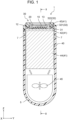
- Light-emitting depilation device 1 according to the present exemplary embodiment will now be explained with reference to Figs. 1 to 8 .
- Fig. 1 is a cross-sectional view illustrating a configuration of light-emitting depilation device 1 according to the present exemplary embodiment
- Fig. 2 is a cross-sectional view taken along line II-II of Fig. 1 .
- light-emitting depilation device 1 includes housing 5, light source 10, temperature sensor 13, skin cooling unit 20, push switch 30, cooler 40, and controller 50.
- Light source 10 emits light having a wavelength of 400 nm or longer and 1200 nm or shorter.
- melanin in hair follicles absorbs the light, and becomes heated. This heat damages the hair matrix in the hair follicle, and promotes removal of the hair.
- the wavelength of the light may be 500 nm or longer, 600 nm or longer, 700 nm or longer, or 800 nm or longer.
- the wavelength of the light may be 1000 nm or shorter or 900 nm or shorter.
- the light emitted from light source 10 may be light having a peak wavelength within a range between 400 nm or longer and 1200 nm or shorter.
- emitted light may include a wavelength component outside this range.
- all of the LEDs do not need to have the same wavelength spectrum, and LEDs emitting light at different wavelength spectra may be used in combination.
- the wavelength is a wavelength of light emitted from light source 10 at a temperature of 25°C.
- Light source 10 preferably emits the light with an irradiance condition of 15 W/cm 2 or higher and 50 W/cm 2 or lower.
- an irradiance condition of 15 W/cm 2 or higher and 50 W/cm 2 or lower.
- a high depilatory effect can be given to the hair during an initial growth period to a growth period.
- By emitting the light at an irradiance of 50 W/cm 2 or lower it is possible to suppress an increase in the skin temperature due to the exposure to the light. Therefore, skin S is cooled more reliably, and irritations of the skin can be reduced.
- the irradiance may be 20 W/cm 2 or higher, 25 W/cm 2 or higher, or 30 W/cm 2 or higher.
- the irradiance may be 45 W/cm 2 or lower or 40 W/cm 2 or lower.
- the thermal conductivity of skin cooling unit 20 is more preferably 2 W/mK or higher, still more preferably 10 W/mK or higher, particularly preferably 30 W/mK or higher, and most preferably 100 W/mK or higher.
- the upper bound of the thermal conductivity is not particularly limited, but may be 100,000 W/mK.
- the thermal conductivity can be measured by a laser flash method according to JIS R1611:2010.
- Skin cooling unit 20 may contain an inorganic substance.
- skin cooling unit 20 preferably includes at least one selected from the group consisting of Al 2 O 3 , ZnO, ZrO 2 , MgO, GaN, AlN, and diamond. Because these materials have a high refractive index and a high thermal conductivity, translucency and thermal conductivity of skin cooling unit 20 can be improved.
- Al 2 O 3 (sapphire) has a refractive index of 1.79 and a thermal conductivity of 42 W/mK.
- ZnO has a refractive index of 2.01 and a thermal conductivity of 20 W/mK.
- ZrO 2 has a refractive index of 2.13 and a thermal conductivity of 3 W/mK.
- MgO has a refractive index of 1.74 and a thermal conductivity of 47 W/mK.
- GaN has a refractive index of 2.346 and a thermal conductivity of 200 W/mK.
- AlN has a refractive index of 2.175 and a thermal conductivity of 150 W/mK.
- Diamond has a refractive index of 2.417 and a thermal conductivity of 1000 W/mK.
- Skin cooling unit 20 may contain resin such as a silicone resin, from the viewpoint of heat resistance and translucency. Skin cooling unit 20 may also include resin such as silicone resin, and highly thermal conductive filler that is dispersed in the resin. By including such highly thermal conductive filler in skin cooling unit 20, the heat of skin cooling unit 20 is dissipated more quickly, so that skin S can be cooled effectively.
- the highly thermally conductive filler may contain an inorganic substance such as those listed above.
- the proportion of the inorganic substance in skin cooling unit 20 is preferably 10 mass% or higher. By setting the proportion of the inorganic substance in skin cooling unit 20 to 10 mass% or higher, the thermal conductivity of skin cooling unit 20 can be improved.
- the proportion of the inorganic substance in skin cooling unit 20 is more preferably 30 mass% or higher, still more preferably 50 mass% or higher, particularly preferably 70 mass% or higher, and most preferably 90 mass% or higher.
- Temperature sensor 13 detects the temperature of skin cooling unit 20. By detecting the temperature of skin cooling unit 20, the temperature of skin cooling unit 20 can be controlled precisely. Temperature sensor 13 is provided in a manner facing skin cooling unit 20. Specifically, temperature sensor 13 is provided on substrate 12. In the present exemplary embodiment, temperature sensor 13 includes a contact temperature sensor. Examples of the contact type temperature sensor include a thermistor, a thermocouple, and a resistance thermometer bulb.
- Pressing unit 32 is engaged with base portions 31, and moves in the up-down directions Z by being pressed by skin S. Pressing unit 32 covers the outer periphery of light source 10 and skin cooling unit 20. Pressing unit 32 includes two first components 321 and one second component 322.
- Each first component 321 has a columnar shape extending upward in up-down direction Z from corresponding base portion 31, and is provided at substantially center in front-back direction X and width direction Y of corresponding base portion 31.
- Each second component 322 is disposed so as to be in contact with a surface of first component 321, the surface facing opposite side of base portion 31.
- Second component 322 has a through-hole at the center in front-back direction X and width direction Y, and has a donut-like shape extending in up-down direction Z.
- Light source 10 and skin cooling unit 20 are disposed inside the through-hole of second component 322. A part of a surface of second component 322 protrudes upward in up-down direction Z from the surface of skin cooling unit 20, the surface facing on the opposite side of light source 10.
- first component 321 and second component 322 are different components that are separated from each other, but pressing unit 32 may be one component that is integrally and continuously formed.
- the numbers of base portions 31, first components 321, and second components 322 are not particularly limited, and may be changed as appropriate.
- An elastic body is provided between base portions 31 and pressing unit 32.
- pressing unit 32 When pressing unit 32 is pressed, the elastic body becomes elastically deformed, and pushes back pressing unit 32 by the elastic force generated by the elastic deformation. Therefore, when the force pressing pressing unit 32 is removed, the elastic body acts on pressing unit 32 and brings pressing unit 32 back to the original position, and the surface of pressing unit 32 that is in contact with skin S moves in a direction separating from base portion 31 (upward in up-down direction Z).
- Push switch 30 switches to cause light source 10 to emit light and not to emit light in such a manner that light source 10 emits light during at least some of the time while pressing unit 32 is pressed, and light source 10 does not to emit light while pressing unit 32 is not pressed.
- This configuration therefore, enables skin S to be irradiated with light during at least some of the time while light-emitting depilation device 1 is pressed against skin S, and stops the light emission when light-emitting depilation device 1 is separated from skin S.
- the light emission may be started immediately after push switch 30 is pressed, or may be started a predetermined time elapses from when push switch 30 is pressed.
- the timing at which light source 10 starts the light emission may be controlled by controller 50.
- Light-emitting depilation device 1 may also cause light source 10 to emit light after skin S comes into contact with the surface of skin cooling unit 20. In this manner, skin surface having been cooled is irradiated with light. In this manner, heating of skin S is suppressed, so that it is possible to suppress irritation of skin S.
- skin S is irradiated with light while held in contact with skin cooling unit 20, unevenness in the irradiation can be reduced, so that stable depilatory effect can be achieved.
- Cooler 40 cools skin cooling unit 20. Because light-emitting depilation device 1 includes cooler 40, the temperature of skin cooling unit 20 can be further reduced. Therefore, the skin cooling effect by skin cooling unit 20 can be further improved. Cooler 40 includes heat sink 41 and air blower 45.
- Heat sink 41 is connected to skin cooling unit 20, and dissipates the heat skin cooling unit 20 is deprived of.
- Heat sink 41 includes connecting part 42, holder 43, and heat sink fins 44.
- Connecting part 42 is a plate-like member. On a first surface that is one surface of the connecting part 42, substrate 12 is provided. Substrate 12 is smaller than connecting part 42, and is provided to fit inside connecting part 42. Holder 43 and push switch 30 are connected to the outer side of substrate 12, on the first surface of connecting part 42. Heat sink fins 44 are provided on a second surface, that is the surface on the opposite side of the first surface of connecting part 42.
- Holder 43 protrudes upward in up-down direction Z from the first surface of connecting part 42, and holds the entire periphery of skin cooling unit 20. Therefore, light source 10 is covered by skin cooling unit 20, holder 43, and connecting part 42. The heat generated by light source 10 is dissipated via skin cooling unit 20 and heat sink 41 of cooler 40. While holder 43 holds the entire periphery of skin cooling unit 20, holder 43 may be connected to at least a part of skin cooling unit 20.
- Heat sink fins 44 are provided on the second surface of connecting part 42 (surface facing opposite side of light source 10). Therefore, holder 43 and connecting part 42 transfers the heat from skin cooling unit 20 to heat sink fins 44. Heat sink fins 44 include a plurality of fins, and has a large contact area with air, so that heat is dissipated quickly.
- Heat sink 41 preferably contains material having excellent thermal conductivity.
- the thermal conductivity of heat sink 41 may be higher than that of skin cooling unit 20.
- heat sink 41 may contain metal such as aluminum, iron, or copper.
- Holder 43, connecting part 42, and heat sink fins 44 may be made of the same material or may be made of different materials.
- Air blower 45 cools heat sink 41 by sending the air to heat sink 41.
- Air blower 45 includes, for example, a fan, and when the fan is rotated, an air flow is generated.
- Housing 5 has a plurality of first openings 6 at positions facing air blower 45.
- Housing 5 has a plurality of second openings 7 at positions facing heat sink fins 44. Therefore, when air blower 45 is driven, the air collected from the outside of housing 5 through the plurality of first openings 6 is sent to heat sink fins 44.
- the heat of the air having been brought into contact with heat sink fins 44 is exchanged with the heat of the heat sink fins 44, and heat sink fins 44 are cooled thereby.
- the air heated by coming into contact with heat sink fins 44 is released outside of housing 5 via the plurality of second openings 7.
- the program executed by the CPU is recorded on the ROM included in the computer system in advance, but may also be provided by being recorded in a non-transitory recording medium such as a memory card, or be provided over a telecommunication line such as the Internet.
- Controller 50 may also be configured to cause cooler 40 to cool skin cooling unit 20 so as to bring the temperature of skin cooling unit 20 to -5°C or higher and 35°C or lower. Controller 50 may also be configured to receive a signal related to the temperature of skin cooling unit 20 from temperature sensor 13, and to drive cooler 40 to cool skin cooling unit 20 based on the signal. Controller 50 may also be configured to cool skin cooling unit 20 by controlling the output of air blower 45, for example. Furthermore, controller 50 may also be configured to cool skin cooling unit 20 by controlling the output of the Peltier element, for example. Specifically, controller 50 may drive the Peltier element when the temperature of skin cooling unit 20 becomes 35°C or higher, and may stop driving the Peltier element when the temperature of skin cooling unit 20 drops to a level lower than -5°C.
- Fig. 5 is a cross-sectional view illustrating a configuration before light-emitting depilation device 1 is used.
- Fig. 6 is a cross-sectional view illustrating a configuration before push switch 30 of light-emitting depilation device 1 is pressed.
- Fig. 7 is a cross-sectional view illustrating a configuration after push switch 30 of light-emitting depilation device 1 is pressed.
- Fig. 8 is a cross-sectional view illustrating a configuration while skin S is exposed to the light of light-emitting depilation device 1.
- push switch 30 is pressed by coming into contact with skin S. Specifically, when pressing unit 32 of push switch 30 is pressed, the surface being pressed by skin S moves closer to light source 10, with respect to skin cooling unit 20. Skin cooling unit 20 therefore then comes into contact with skin S, with light source 10 covered by skin S and push switch 30. Skin cooling unit 20 then becomes sealed by skin S. By being brought into contact with skin cooling unit 20, skin S is cooled.
- light-emitting depilation device 1 can irradiate skin S with the light, with light source 10 covered by push switch 30 and skin S. Therefore, light-emitting depilation device 1 can suppress leakage of light. Light-emitting depilation device 1 can also cause skin cooling unit 20 to cool skin S by coming into contact with skin S at the time of light emission. Therefore, light-emitting depilation device 1 can suppress inflammation of skin S.
- light-emitting depilation device 1 irradiates the skin S with the light while the surface of skin S is being cooled.
- the temperature rise of skin S is thus suppressed more reliably, so that light-emitting depilation device 1 can alleviate irritation of skin S.
- light-emitting depilation device 1 can suppress uneven irradiation of light, and achieve the depilatory effect stably.
- light source 10 may include an LED.
- the height of light-emitting depilation device 1 can be reduced, so that light-emitting depilation device 1 can be downsized.
- the space between the LED and skin cooling unit 20 in light-emitting depilation device 1 can be reduced. Therefore, light-emitting depilation device 1 can dissipate the heat generated by the LED not only via connecting part 42 of skin cooling unit 20 but also via skin cooling unit 20. Therefore, because light-emitting depilation device 1 can deplete the heat generated by the LED from around the LED, the LED can be cooled effectively.
- skin cooling unit 20 may be cooled to -5°C or higher and 35°C or lower.
- the total light transmittance of skin cooling unit 20 may be 80% or higher.
- light source 10 may emit light intermittently with a conditions of irradiance of 15 W/cm 2 or higher and 50 W/cm 2 and irradiation time of 500 ms or longer and 1000 ms or shorter.
- light-emitting depilation device 1 can achieve high depilatory effect on hair during an initial growth period to a growth period.
- light-emitting depilation device 1 can cool skin S more reliably, and can reduce irritation of the skin.
- Light-emitting depilation device 1 has been described to include light source 10 that includes an LED, as an example. However, light source 10 only needs to be able to emit light having a wavelength of 400 nm or longer and 1200 nm or shorter. Light source 10 is not limited to an LED, and may include, for example, a xenon lamp, a laser diode, and a combination thereof. With the use of an LED as light source 10, however, the size of light-emitting depilation device 1 can be reduced, as mentioned above.
- Light-emitting depilation device 1 is explained to include cooler 40 that is connected to skin cooling unit 20 to cool skin cooling unit 20, as an example. However, cooler 40 does not need to be connected to skin cooling unit 20.
- the light-emitting depilation device according to the present disclosure can be applied to a light-emitting depilation devices for business use and home use, for example.
Landscapes
- Health & Medical Sciences (AREA)
- Physics & Mathematics (AREA)
- Surgery (AREA)
- Life Sciences & Earth Sciences (AREA)
- Optics & Photonics (AREA)
- Engineering & Computer Science (AREA)
- Otolaryngology (AREA)
- Nuclear Medicine, Radiotherapy & Molecular Imaging (AREA)
- Electromagnetism (AREA)
- Biomedical Technology (AREA)
- Heart & Thoracic Surgery (AREA)
- Medical Informatics (AREA)
- Molecular Biology (AREA)
- Animal Behavior & Ethology (AREA)
- General Health & Medical Sciences (AREA)
- Public Health (AREA)
- Veterinary Medicine (AREA)
- Radiation-Therapy Devices (AREA)
Applications Claiming Priority (2)
| Application Number | Priority Date | Filing Date | Title |
|---|---|---|---|
| JP2021017225A JP7557740B2 (ja) | 2021-02-05 | 2021-02-05 | 光照射式脱毛装置 |
| PCT/JP2021/048146 WO2022168489A1 (ja) | 2021-02-05 | 2021-12-24 | 光照射式脱毛装置 |
Publications (3)
| Publication Number | Publication Date |
|---|---|
| EP4289470A1 true EP4289470A1 (de) | 2023-12-13 |
| EP4289470A4 EP4289470A4 (de) | 2024-05-22 |
| EP4289470B1 EP4289470B1 (de) | 2025-03-19 |
Family
ID=82742133
Family Applications (1)
| Application Number | Title | Priority Date | Filing Date |
|---|---|---|---|
| EP21924874.7A Active EP4289470B1 (de) | 2021-02-05 | 2021-12-24 | Lichtbestrahlungs-enthaarungsvorrichtung |
Country Status (5)
| Country | Link |
|---|---|
| US (1) | US20240008921A1 (de) |
| EP (1) | EP4289470B1 (de) |
| JP (1) | JP7557740B2 (de) |
| CN (1) | CN116782982A (de) |
| WO (1) | WO2022168489A1 (de) |
Families Citing this family (2)
| Publication number | Priority date | Publication date | Assignee | Title |
|---|---|---|---|---|
| US20230157752A1 (en) * | 2021-11-24 | 2023-05-25 | Filip Sedic | Stimulation Device |
| CN119454221B (zh) * | 2024-11-05 | 2025-07-08 | 深圳丽德生物医药发展有限公司 | 一种手持式智能光脱毛设备及其使用方法 |
Family Cites Families (14)
| Publication number | Priority date | Publication date | Assignee | Title |
|---|---|---|---|---|
| US5735844A (en) * | 1995-02-01 | 1998-04-07 | The General Hospital Corporation | Hair removal using optical pulses |
| US7041094B2 (en) * | 1999-03-15 | 2006-05-09 | Cutera, Inc. | Tissue treatment device and method |
| JPWO2001087109A1 (ja) * | 2000-05-19 | 2004-03-18 | ヤーマン株式会社 | レーザ脱毛装置 |
| JP2003126276A (ja) | 2001-10-23 | 2003-05-07 | Japan Pierced Earring System Inc Co | 医療・美容用レーザー照射装置 |
| US20040176754A1 (en) * | 2003-03-06 | 2004-09-09 | Island Tobin C. | Method and device for sensing skin contact |
| EP1596747B1 (de) * | 2003-02-25 | 2016-02-17 | Tria Beauty, Inc. | Augensicheres dermatologisches behandlungsgerät |
| JP4816571B2 (ja) * | 2007-05-28 | 2011-11-16 | パナソニック電工株式会社 | 光脱毛機器 |
| EP2240105B1 (de) * | 2008-01-17 | 2012-09-26 | Syneron Medical Ltd. | Haarentfernungsvorrichtung für den persönlichen einsatz und einsatzverfahren dafür |
| JP5715128B2 (ja) | 2009-07-20 | 2015-05-07 | コーニンクレッカ フィリップス エヌ ヴェ | 対象物に光を付与するための光付与装置 |
| JP2011067454A (ja) * | 2009-09-25 | 2011-04-07 | Panasonic Electric Works Co Ltd | 光照射型美容装置 |
| JP5672611B2 (ja) * | 2011-06-21 | 2015-02-18 | パナソニックIpマネジメント株式会社 | 光照射型美容装置 |
| JP2013111391A (ja) | 2011-11-30 | 2013-06-10 | Panasonic Corp | 光照射型美容装置 |
| GB2526764B (en) * | 2013-12-04 | 2020-10-07 | Ipulse Ltd | Skin treatment apparatus utilising intense pulsed light (IPL) |
| JP3246181U (ja) * | 2020-10-21 | 2024-03-28 | 深▲せん▼由莱智能電子有限公司 | 脱毛器 |
-
2021
- 2021-02-05 JP JP2021017225A patent/JP7557740B2/ja active Active
- 2021-12-24 WO PCT/JP2021/048146 patent/WO2022168489A1/ja not_active Ceased
- 2021-12-24 EP EP21924874.7A patent/EP4289470B1/de active Active
- 2021-12-24 CN CN202180091383.6A patent/CN116782982A/zh active Pending
- 2021-12-24 US US18/253,547 patent/US20240008921A1/en active Pending
Also Published As
| Publication number | Publication date |
|---|---|
| JP7557740B2 (ja) | 2024-09-30 |
| US20240008921A1 (en) | 2024-01-11 |
| JP2022120373A (ja) | 2022-08-18 |
| EP4289470A4 (de) | 2024-05-22 |
| CN116782982A (zh) | 2023-09-19 |
| EP4289470B1 (de) | 2025-03-19 |
| WO2022168489A1 (ja) | 2022-08-11 |
Similar Documents
| Publication | Publication Date | Title |
|---|---|---|
| EP4289470B1 (de) | Lichtbestrahlungs-enthaarungsvorrichtung | |
| US20050243539A1 (en) | Cooled light emitting apparatus | |
| CN113907874A (zh) | 一种手持家用激光脱毛仪及其系统 | |
| EP4289471B1 (de) | Lichtbestrahlungsvorrichtung zur haarentfernung | |
| US12127788B1 (en) | Beauty instrument | |
| JP2023543839A (ja) | シェービングユニット、並びに本体とシェービングユニットとを含む電気シェーバ | |
| CN213789643U (zh) | 脱毛仪 | |
| KR20240004565A (ko) | 제모기 | |
| WO2023162978A1 (ja) | 光美容器 | |
| CN113509261A (zh) | 带制冷的手持式半导体激光脱毛仪 | |
| EP4289473A1 (de) | Lichtbestrahlungsvorrichtung zur haarentfernung | |
| CN220530111U (zh) | 脱毛仪及皮肤处理设备 | |
| CN216724725U (zh) | 一种手持家用激光脱毛仪及其系统 | |
| JP2024527674A (ja) | 脱毛器 | |
| EP4289472B1 (de) | Lichtbestrahlungsvorrichtung zur haarentfernung | |
| WO2019202818A1 (ja) | 光照射型美容装置 | |
| JP2002177405A (ja) | レーザ光照射プローブ | |
| JP2020162792A (ja) | 光照射型美容装置 | |
| CN214017806U (zh) | 冰敷脱毛仪 | |
| RU2750838C1 (ru) | Диодный лазерный излучатель с принудительным охлаждением для проведения лечебных и косметологических мероприятий | |
| CN213588473U (zh) | 散热组件及脱毛仪 | |
| CN223787689U (zh) | 半导体激光脱毛仪 | |
| CN222341818U (zh) | 皮肤处理装置 | |
| RU2852590C2 (ru) | Устройство для удаления волос | |
| CN222641096U (zh) | 脱毛仪及皮肤处理设备 |
Legal Events
| Date | Code | Title | Description |
|---|---|---|---|
| STAA | Information on the status of an ep patent application or granted ep patent |
Free format text: STATUS: THE INTERNATIONAL PUBLICATION HAS BEEN MADE |
|
| PUAI | Public reference made under article 153(3) epc to a published international application that has entered the european phase |
Free format text: ORIGINAL CODE: 0009012 |
|
| STAA | Information on the status of an ep patent application or granted ep patent |
Free format text: STATUS: REQUEST FOR EXAMINATION WAS MADE |
|
| 17P | Request for examination filed |
Effective date: 20230607 |
|
| AK | Designated contracting states |
Kind code of ref document: A1 Designated state(s): AL AT BE BG CH CY CZ DE DK EE ES FI FR GB GR HR HU IE IS IT LI LT LU LV MC MK MT NL NO PL PT RO RS SE SI SK SM TR |
|
| DAV | Request for validation of the european patent (deleted) | ||
| DAX | Request for extension of the european patent (deleted) | ||
| A4 | Supplementary search report drawn up and despatched |
Effective date: 20240419 |
|
| RIC1 | Information provided on ipc code assigned before grant |
Ipc: A61N 5/06 20060101AFI20240415BHEP |
|
| GRAP | Despatch of communication of intention to grant a patent |
Free format text: ORIGINAL CODE: EPIDOSNIGR1 |
|
| STAA | Information on the status of an ep patent application or granted ep patent |
Free format text: STATUS: GRANT OF PATENT IS INTENDED |
|
| INTG | Intention to grant announced |
Effective date: 20241008 |
|
| GRAS | Grant fee paid |
Free format text: ORIGINAL CODE: EPIDOSNIGR3 |
|
| GRAA | (expected) grant |
Free format text: ORIGINAL CODE: 0009210 |
|
| STAA | Information on the status of an ep patent application or granted ep patent |
Free format text: STATUS: THE PATENT HAS BEEN GRANTED |
|
| AK | Designated contracting states |
Kind code of ref document: B1 Designated state(s): AL AT BE BG CH CY CZ DE DK EE ES FI FR GB GR HR HU IE IS IT LI LT LU LV MC MK MT NL NO PL PT RO RS SE SI SK SM TR |
|
| REG | Reference to a national code |
Ref country code: GB Ref legal event code: FG4D |
|
| REG | Reference to a national code |
Ref country code: CH Ref legal event code: EP |
|
| REG | Reference to a national code |
Ref country code: DE Ref legal event code: R096 Ref document number: 602021027965 Country of ref document: DE |
|
| REG | Reference to a national code |
Ref country code: IE Ref legal event code: FG4D |
|
| PG25 | Lapsed in a contracting state [announced via postgrant information from national office to epo] |
Ref country code: RS Free format text: LAPSE BECAUSE OF FAILURE TO SUBMIT A TRANSLATION OF THE DESCRIPTION OR TO PAY THE FEE WITHIN THE PRESCRIBED TIME-LIMIT Effective date: 20250619 |
|
| PG25 | Lapsed in a contracting state [announced via postgrant information from national office to epo] |
Ref country code: FI Free format text: LAPSE BECAUSE OF FAILURE TO SUBMIT A TRANSLATION OF THE DESCRIPTION OR TO PAY THE FEE WITHIN THE PRESCRIBED TIME-LIMIT Effective date: 20250319 |
|
| REG | Reference to a national code |
Ref country code: LT Ref legal event code: MG9D |
|
| PG25 | Lapsed in a contracting state [announced via postgrant information from national office to epo] |
Ref country code: NO Free format text: LAPSE BECAUSE OF FAILURE TO SUBMIT A TRANSLATION OF THE DESCRIPTION OR TO PAY THE FEE WITHIN THE PRESCRIBED TIME-LIMIT Effective date: 20250619 |
|
| PG25 | Lapsed in a contracting state [announced via postgrant information from national office to epo] |
Ref country code: HR Free format text: LAPSE BECAUSE OF FAILURE TO SUBMIT A TRANSLATION OF THE DESCRIPTION OR TO PAY THE FEE WITHIN THE PRESCRIBED TIME-LIMIT Effective date: 20250319 |
|
| PG25 | Lapsed in a contracting state [announced via postgrant information from national office to epo] |
Ref country code: LV Free format text: LAPSE BECAUSE OF FAILURE TO SUBMIT A TRANSLATION OF THE DESCRIPTION OR TO PAY THE FEE WITHIN THE PRESCRIBED TIME-LIMIT Effective date: 20250319 |
|
| PG25 | Lapsed in a contracting state [announced via postgrant information from national office to epo] |
Ref country code: BG Free format text: LAPSE BECAUSE OF FAILURE TO SUBMIT A TRANSLATION OF THE DESCRIPTION OR TO PAY THE FEE WITHIN THE PRESCRIBED TIME-LIMIT Effective date: 20250319 Ref country code: GR Free format text: LAPSE BECAUSE OF FAILURE TO SUBMIT A TRANSLATION OF THE DESCRIPTION OR TO PAY THE FEE WITHIN THE PRESCRIBED TIME-LIMIT Effective date: 20250620 |
|
| REG | Reference to a national code |
Ref country code: NL Ref legal event code: MP Effective date: 20250319 |
|
| REG | Reference to a national code |
Ref country code: AT Ref legal event code: MK05 Ref document number: 1776476 Country of ref document: AT Kind code of ref document: T Effective date: 20250319 |
|
| PG25 | Lapsed in a contracting state [announced via postgrant information from national office to epo] |
Ref country code: NL Free format text: LAPSE BECAUSE OF FAILURE TO SUBMIT A TRANSLATION OF THE DESCRIPTION OR TO PAY THE FEE WITHIN THE PRESCRIBED TIME-LIMIT Effective date: 20250319 |
|
| PG25 | Lapsed in a contracting state [announced via postgrant information from national office to epo] |
Ref country code: SE Free format text: LAPSE BECAUSE OF FAILURE TO SUBMIT A TRANSLATION OF THE DESCRIPTION OR TO PAY THE FEE WITHIN THE PRESCRIBED TIME-LIMIT Effective date: 20250319 |
|
| PG25 | Lapsed in a contracting state [announced via postgrant information from national office to epo] |
Ref country code: SM Free format text: LAPSE BECAUSE OF FAILURE TO SUBMIT A TRANSLATION OF THE DESCRIPTION OR TO PAY THE FEE WITHIN THE PRESCRIBED TIME-LIMIT Effective date: 20250319 |
|
| PG25 | Lapsed in a contracting state [announced via postgrant information from national office to epo] |
Ref country code: ES Free format text: LAPSE BECAUSE OF FAILURE TO SUBMIT A TRANSLATION OF THE DESCRIPTION OR TO PAY THE FEE WITHIN THE PRESCRIBED TIME-LIMIT Effective date: 20250319 Ref country code: PT Free format text: LAPSE BECAUSE OF FAILURE TO SUBMIT A TRANSLATION OF THE DESCRIPTION OR TO PAY THE FEE WITHIN THE PRESCRIBED TIME-LIMIT Effective date: 20250721 |
|
| PG25 | Lapsed in a contracting state [announced via postgrant information from national office to epo] |
Ref country code: PL Free format text: LAPSE BECAUSE OF FAILURE TO SUBMIT A TRANSLATION OF THE DESCRIPTION OR TO PAY THE FEE WITHIN THE PRESCRIBED TIME-LIMIT Effective date: 20250319 Ref country code: IT Free format text: LAPSE BECAUSE OF FAILURE TO SUBMIT A TRANSLATION OF THE DESCRIPTION OR TO PAY THE FEE WITHIN THE PRESCRIBED TIME-LIMIT Effective date: 20250319 |
|
| PG25 | Lapsed in a contracting state [announced via postgrant information from national office to epo] |
Ref country code: AT Free format text: LAPSE BECAUSE OF FAILURE TO SUBMIT A TRANSLATION OF THE DESCRIPTION OR TO PAY THE FEE WITHIN THE PRESCRIBED TIME-LIMIT Effective date: 20250319 |
|
| PG25 | Lapsed in a contracting state [announced via postgrant information from national office to epo] |
Ref country code: EE Free format text: LAPSE BECAUSE OF FAILURE TO SUBMIT A TRANSLATION OF THE DESCRIPTION OR TO PAY THE FEE WITHIN THE PRESCRIBED TIME-LIMIT Effective date: 20250319 Ref country code: CZ Free format text: LAPSE BECAUSE OF FAILURE TO SUBMIT A TRANSLATION OF THE DESCRIPTION OR TO PAY THE FEE WITHIN THE PRESCRIBED TIME-LIMIT Effective date: 20250319 |
|
| PG25 | Lapsed in a contracting state [announced via postgrant information from national office to epo] |
Ref country code: RO Free format text: LAPSE BECAUSE OF FAILURE TO SUBMIT A TRANSLATION OF THE DESCRIPTION OR TO PAY THE FEE WITHIN THE PRESCRIBED TIME-LIMIT Effective date: 20250319 |
|
| PG25 | Lapsed in a contracting state [announced via postgrant information from national office to epo] |
Ref country code: SK Free format text: LAPSE BECAUSE OF FAILURE TO SUBMIT A TRANSLATION OF THE DESCRIPTION OR TO PAY THE FEE WITHIN THE PRESCRIBED TIME-LIMIT Effective date: 20250319 |
|
| PG25 | Lapsed in a contracting state [announced via postgrant information from national office to epo] |
Ref country code: IS Free format text: LAPSE BECAUSE OF FAILURE TO SUBMIT A TRANSLATION OF THE DESCRIPTION OR TO PAY THE FEE WITHIN THE PRESCRIBED TIME-LIMIT Effective date: 20250719 |
|
| REG | Reference to a national code |
Ref country code: DE Ref legal event code: R097 Ref document number: 602021027965 Country of ref document: DE |
|
| PGFP | Annual fee paid to national office [announced via postgrant information from national office to epo] |
Ref country code: DE Payment date: 20251211 Year of fee payment: 5 |
|
| PG25 | Lapsed in a contracting state [announced via postgrant information from national office to epo] |
Ref country code: DK Free format text: LAPSE BECAUSE OF FAILURE TO SUBMIT A TRANSLATION OF THE DESCRIPTION OR TO PAY THE FEE WITHIN THE PRESCRIBED TIME-LIMIT Effective date: 20250319 |
|
| PLBE | No opposition filed within time limit |
Free format text: ORIGINAL CODE: 0009261 |
|
| STAA | Information on the status of an ep patent application or granted ep patent |
Free format text: STATUS: NO OPPOSITION FILED WITHIN TIME LIMIT |
|
| REG | Reference to a national code |
Ref country code: CH Ref legal event code: L10 Free format text: ST27 STATUS EVENT CODE: U-0-0-L10-L00 (AS PROVIDED BY THE NATIONAL OFFICE) Effective date: 20260128 |
|
| 26N | No opposition filed |
Effective date: 20251222 |