EP4288764B1 - Hochempfindliche chemilumineszenzdetektionssysteme und -verfahren - Google Patents
Hochempfindliche chemilumineszenzdetektionssysteme und -verfahren Download PDFInfo
- Publication number
- EP4288764B1 EP4288764B1 EP22750613.6A EP22750613A EP4288764B1 EP 4288764 B1 EP4288764 B1 EP 4288764B1 EP 22750613 A EP22750613 A EP 22750613A EP 4288764 B1 EP4288764 B1 EP 4288764B1
- Authority
- EP
- European Patent Office
- Prior art keywords
- wavelength range
- detection system
- emissions
- luminescent
- range
- Prior art date
- Legal status (The legal status is an assumption and is not a legal conclusion. Google has not performed a legal analysis and makes no representation as to the accuracy of the status listed.)
- Active
Links
Images


Classifications
-
- G—PHYSICS
- G01—MEASURING; TESTING
- G01N—INVESTIGATING OR ANALYSING MATERIALS BY DETERMINING THEIR CHEMICAL OR PHYSICAL PROPERTIES
- G01N21/00—Investigating or analysing materials by the use of optical means, i.e. using sub-millimetre waves, infrared, visible or ultraviolet light
- G01N21/75—Systems in which material is subjected to a chemical reaction, the progress or the result of the reaction being investigated
- G01N21/76—Chemiluminescence; Bioluminescence
-
- G—PHYSICS
- G01—MEASURING; TESTING
- G01N—INVESTIGATING OR ANALYSING MATERIALS BY DETERMINING THEIR CHEMICAL OR PHYSICAL PROPERTIES
- G01N21/00—Investigating or analysing materials by the use of optical means, i.e. using sub-millimetre waves, infrared, visible or ultraviolet light
- G01N21/75—Systems in which material is subjected to a chemical reaction, the progress or the result of the reaction being investigated
- G01N21/76—Chemiluminescence; Bioluminescence
- G01N21/763—Bioluminescence
-
- G—PHYSICS
- G01—MEASURING; TESTING
- G01N—INVESTIGATING OR ANALYSING MATERIALS BY DETERMINING THEIR CHEMICAL OR PHYSICAL PROPERTIES
- G01N33/00—Investigating or analysing materials by specific methods not covered by groups G01N1/00 - G01N31/00
- G01N33/48—Biological material, e.g. blood, urine; Haemocytometers
- G01N33/50—Chemical analysis of biological material, e.g. blood, urine; Testing involving biospecific ligand binding methods; Immunological testing
- G01N33/53—Immunoassay; Biospecific binding assay; Materials therefor
- G01N33/5308—Immunoassay; Biospecific binding assay; Materials therefor for analytes not provided for elsewhere, e.g. nucleic acids, uric acid, worms, mites
-
- G—PHYSICS
- G01—MEASURING; TESTING
- G01N—INVESTIGATING OR ANALYSING MATERIALS BY DETERMINING THEIR CHEMICAL OR PHYSICAL PROPERTIES
- G01N33/00—Investigating or analysing materials by specific methods not covered by groups G01N1/00 - G01N31/00
- G01N33/48—Biological material, e.g. blood, urine; Haemocytometers
- G01N33/50—Chemical analysis of biological material, e.g. blood, urine; Testing involving biospecific ligand binding methods; Immunological testing
- G01N33/58—Chemical analysis of biological material, e.g. blood, urine; Testing involving biospecific ligand binding methods; Immunological testing involving labelled substances
- G01N33/581—Chemical analysis of biological material, e.g. blood, urine; Testing involving biospecific ligand binding methods; Immunological testing involving labelled substances with enzyme label (including co-enzymes, co-factors, enzyme inhibitors or substrates)
Definitions
- Chemiluminescence is defined as the emission of electromagnetic radiation caused by a chemical reaction to produce light.
- a chemiluminescence immunoassay (CLIA) is an assay that combines a chemiluminescence technique with an immunochemical reaction.
- CLIA chemiluminescence immunoassay
- ATELLICA ® IM 1300, IMMULITE ® 1000, and ADVIA ® Centaur available from the present assignee are instruments based on chemiluminescence immunoassays.
- CLIA systems utilize chemical probes that can generate luminescent light emission through a chemical reaction to quantify the analyte (component of interest).
- a sample container e.g., a cuvette
- extracted components e.g., DNA probes
- a specimen e.g., a biological specimen such as blood serum or plasma or urine
- luminescent intensity readings can be obtained of the luminescent light emissions that emanate from the labeled components.
- acridinium ester labels are used to label components, such as antibodies, proteins, and some peptides, for example.
- Exposure of an acridinium ester label to an alkaline solution cleaves the ester linkage to release an unstable compound that decomposes to trigger a flash of luminescent light emitted at a well-defined wavelength peak (hereinafter emission peak).
- Luminescence as defined herein, is light emission from a substance when it returns from an excited state to its ground state.
- US 9,255,885 B2 discloses a luminescence detection system comprising capillary channels of a micro-sampler for transferring a body fluid onto the test field of a test element, which produces diffusely scattered light when irradiated with light from a light source.
- the scattered light is registered by an image detector such as a standard CCD/CMOS image sensor chip which typically exhibits a maximum efficiency in the range of 600 to 900 nm.
- a wavelength-converting material such as a fluorescent material is provided which e.g. converts photons having a wavelength of 360 nm into photons of 600 nm, whereby the wavelength conversion increases the detection efficiency due to a better sensitivity of the image sensor chip at longer wavelengths.
- the present invention relates to luminescence detection systems as well as methods of luminescence detection as set out in the appended set of claims.
- Chemiluminescence technology in immunoassays relies on chemiluminescent tags at chemiluminescent labels that have high quantum yields at tag- and conjugate-specific emission wavelengths.
- Current photo multiplier tube (PMT) detectors used to read the chemiluminescence emissions have a maximum sensitivity at a specific wavelength (a maximum quantum efficiency %).
- PMT photo multiplier tube
- this maximum quantum efficiency may not be at the same wavelength as the highest quantum yield of chemiluminescence emissions.
- the sensitivity of detection of existing chemiluminescence detection systems may be lacking.
- photon flux from using a blue dye label can be improved, for example by using a dye label having a higher luminescent emission wavelength range, such as a red dye label.
- a dye label having a higher luminescent emission wavelength range such as a red dye label.
- the quantum efficiency of the conventional sensor is reduced, as the luminescent emission wavelength moves away from the maximum quantum efficiency.
- the quantum sensitivity can be reduced more than a hundred fold by switching to a red dye label.
- the chemiluminescent emissions should be matched with the detector's maximum sensitivity wavelength.
- this is a challenge with existing systems as blue label detectors are as stated above have relatively low photon flux.
- in existing luminescent detection systems there are losses of sensitivity due to the mismatch between the incident luminescent spectrum and the spectral absorption properties of the detector. Intensities for various assays are read out using the single detector, irrespective of their maximum quantum yield, thus losing intensity and impacting sensitivity for at least some wavelengths. The resulting lower sensitivity is simply tolerated in existing systems.
- a luminescence detection system that can sensitively measure luminescent assay emissions.
- the luminescence detection system can be implemented on existing analyzers as a hardware retrofit upgrade.
- the luminescence detection system can replace the existing luminescence detection system utilized in the analyzer.
- the improved luminescence detector system allows photons to pass through that are already in the maximum detection efficiency wavelength range (maximum detection window). However, photons that lie outside the maximum detection efficiency wavelength range (max detection window) are converted to fall into the maximum detection efficiency wavelength range (max detection window). Thus, minimum intensity loss can be incurred when using the conversion.
- aspects of the present disclosure allow the option to use higher quantum yield labels (e.g., red dye labels) that are currently out of range for conventional instrumentation. Additionally, aspects of the present disclosure allow for the conversion of "waste photons" into detected photons by use of a photoconversion layer (conversion layer) added to, or used in conjunction with, the photodetector. Thus, a greater range of immunoassays, with potentially a higher sensitivity, can be used with the luminescence detection systems of the present disclosure.
- luminescence detection systems are provided that can be implemented within immunoassay instruments to provide improved intensity of luminescent emission as well as improved luminescent emission detection sensitivity. Further, luminescence detection methods adapted to provide improved detection of luminescence emitted from a chemiluminescent reaction are provided.
- FIGs. 1A-4 Further details and examples of apparatus, systems, and methods of the disclosure are provided with reference to FIGs. 1A-4 herein.
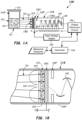
- FIGs. 1A-1B depicts an example embodiment of a luminescence detection system 100 that is configured and operable to carry out the method to measure intensity of luminescent light (e.g., luminescent light emissions) emanating from a chemiluminescent reaction of labeled components 114 provided in a solution 112 of a test sample contained in a sample holder 110 located at a sample location 111 within the luminescence detection system 100.
- the solution 112 of test sample comprises a solution containing the labeled component 114 plus a solution that has been added to cause the chemiluminescent reaction with the labeled component.
- the sample holder 110 is configured to hold, in solution 112, a test sample containing the labeled components 114, wherein the component has been obtained from a processed biological specimen.
- the biological specimen can be any bio-fluid, such as blood serum, blood plasma, urine, cerebrospinal fluid, or the like.
- the sample holder 110 can be a cuvette or other vessel that is optically transparent or translucent, such as a plastic or glass.
- the walls of the sample holder 110 may be planar or can be curved or combinations thereof.
- the sample holder 110 may be provided at the sample location 111, by entry through a door or lid 113 or other suitable introduction methods.
- the dye label can be any suitable dye label that undergoes a chemiluminescent reaction and thus emits luminescent emissions 116 over a first wavelength range.
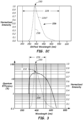
- the dye label can emit luminescent emissions 116 over a wavelength range 222 from 550 nm to 800 nm, as is shown in FIG. 2A , for example.
- the luminescent emissions 116 can have a spectral response having a luminescent peak 236 and a spectral distribution of luminescent intensity 237 about the luminescent peak 236, as shown.
- This particular dye label has a luminescent peak 236 at between about 605 nm and about 650 nm.
- the spectral distribution of luminescent intensity 237 can be a non-normal distribution as shown, where greater that 50% of the normalized intensity lies above the luminescent peak 236.
- the labeled component 114 undergoes a chemiluminescent reaction upon addition of a suitable agent and emits luminescent emissions 116 over the first wavelength range 222.
- the labeled component can be any labeled analyte of interest, such as a labeled antibody, a labeled autoantibody, a labeled antigen, a labeled protein, a labeled DNA probe, a labeled marker, and the like. Nucleic acid probes and haptens may also be labeled. Labeling can be accomplished indirectly by binding conjugates or directly by direct enzyme conjugation. For example, acridinium esters are direct chemiluminescent labels for antibodies and DNA probes.
- substantially coincide it is meant that the two peaks 230, 232 differ in location by no more than 50 nm, so that maximum or near maximum detection sensitivity is achieved.
- the detection using the photodetector 118 can take place at one or more suitable time increments after introduction of the agent to cause the chemiluminescent reaction.
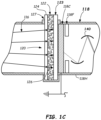
- the photodetector 118 comprising a photomultiplier tube (PMT) can be constructed with an evacuated glass housing surrounding the series of dynode stages 140.
- the conversion coating 122 may be designed so that the luminescent peak 236 is shifted via the luminescent emissions 116 passing through the conversion coating 122 to become incident emissions 126 colliding with the photocathode 118C.
- the wavelength shift may be sufficient to bring the shifted incident peak 230 within the maximum detection efficiency wavelength range 224.
- the shift may be 100 nm or more, 120 nm or more, or even 150 nm or more, for example.
Landscapes
- Health & Medical Sciences (AREA)
- Life Sciences & Earth Sciences (AREA)
- Engineering & Computer Science (AREA)
- Chemical & Material Sciences (AREA)
- Immunology (AREA)
- Physics & Mathematics (AREA)
- Molecular Biology (AREA)
- Urology & Nephrology (AREA)
- Biomedical Technology (AREA)
- Hematology (AREA)
- General Physics & Mathematics (AREA)
- Analytical Chemistry (AREA)
- Pathology (AREA)
- General Health & Medical Sciences (AREA)
- Biochemistry (AREA)
- Cell Biology (AREA)
- Microbiology (AREA)
- Medicinal Chemistry (AREA)
- Biotechnology (AREA)
- Food Science & Technology (AREA)
- Chemical Kinetics & Catalysis (AREA)
- Plasma & Fusion (AREA)
- Tropical Medicine & Parasitology (AREA)
- Investigating Or Analysing Materials By The Use Of Chemical Reactions (AREA)
- Investigating, Analyzing Materials By Fluorescence Or Luminescence (AREA)
- Optical Measuring Cells (AREA)
Claims (10)
- Lumineszenzdetektionssystem, umfassend:einen Probenhalter (110), der dazu ausgelegt ist, eine Testprobe (112), die markierte Komponenten (114) einschließt, in Lösung zu halten,wobei die markierten Komponenten in der Testprobe eine Chemilumineszenzreaktion eingehen und Lumineszenzemissionen über einen ersten Wellenlängenbereich emittieren, der von 550 nm bis 800 nm beträgt;einen Photodetektor (118) mit einem Lichteintrittsfenster (120), das dazu ausgelegt ist, Lichtemissionen zu empfangen, wobei der Photodetektor einen Wellenlängenbereich mit maximaler Detektionseffizienz aufweist, der von 300 nm bis 530 nm reicht; undein Konvertierungselement (122), das angrenzend an das Lichteintrittsfenster des Photodetektors bereitgestellt ist, wobei das Konvertierungselement arbeitet, um eine Konvertierung der lumineszierenden Emissionen über den ersten Wellenlängenbereich in einfallende Emissionen eines zweiten Wellenlängenbereichs zu bewirken, dessen Bereich von 300 nm bis 550 nm beträgt, wobei ein einfallender Peak der einfallenden Emissionen in den Wellenlängenbereich mit maximaler Detektionseffizienz fällt, wobei der Wellenlängenbereich mit maximaler Detektionseffizienz ein Bereich von Wellenlängen ist, wo eine Quanteneffizienz des Photodetektors 10 % oder mehr beträgt.
- Lumineszenzdetektionssystem nach Anspruch 1, wobei das Konvertierungselement eine Konvertierungsbeschichtung umfasst, die direkt auf das Lichteintrittsfenster aufgebracht ist, oder wobei das Konvertierungselement eine Konvertierungsbeschichtung umfasst, die auf ein transparentes Substrat aufgebracht ist, das sich vor dem Lichteintrittsfenster befindet.
- Lumineszenzdetektionssystem nach Anspruch 1, wobei die Konvertierung eine Aufwärtskonvertierung ist.
- Lumineszenzdetektionssystem nach Anspruch 1, wobei die Quanteneffizienz 15 % oder mehr, vorzugsweise 20 % oder mehr, bevorzugter 22 % oder mehr beträgt.
- Lumineszenzdetektionssystem nach Anspruch 1, wobei der erste Wellenlängenbereich einen Lumineszenzpeak bei von 605 nm bis 650 nm aufweist.
- Lumineszenzdetektionssystem nach Anspruch 1, wobei der zweite Wellenlängenbereich von 325 nm bis 525 nm beträgt.
- Lumineszenzdetektionssystem nach Anspruch 1, wobei der Photodetektor eine Photovervielfacherröhre umfasst.
- Lumineszenzdetektionssystem nach Anspruch 1, umfassend ein reflektierendes Element, das vor dem Konvertierungselement bereitgestellt ist.
- Lumineszenzdetektionssystem nach Anspruch 9, wobei das reflektierende Element einen dichroitischen Langpass-Spiegel umfasst, der die Lumineszenzemissionen über einen ersten Wellenlängenbereich hindurch lässt und mindestens etwas Licht außerhalb des ersten Wellenlängenbereichs abweist, oder wobei das reflektierende Element einen universellen Detektor umfasst, der alle Lumineszenzemissionen durchlässt, aber einfallende Emissionen eines zweiten Wellenlängenbereichs in Richtung des Photodetektors zurückreflektiert.
- Verfahren zur Lumineszenzdetektion, umfassend:Bereitstellen eines Lumineszenzdetektionssystems, umfassend einen Probenhalter (110), der markierte Komponenten (114) in Lösung (112) hält, und einen Photodetektor (118) mit einer Lichtempfangsregion (120) und einem Wellenlängenbereich mit maximaler Detektionseffizienz, der im Bereich von 300 nm bis 530 nm liegt, wobei eine Konvertierungsbeschichtung (122) angrenzend an die Lichtempfangsregion aufgebracht wird;Bewirken einer Chemilumineszenzreaktion mit den markierten Komponenten, die Lumineszenzemissionen über einen ersten Wellenlängenbereich produzieren, der von 550 nm bis 800 nm reicht; undEmpfangen und Konvertieren der Lumineszenzemissionen in einen zweiten Wellenlängenbereich, der von 300 nm bis 550 nm reicht, mit der Konvertierungsbeschichtung, und wobei ein einfallender Peak innerhalb des Wellenlängenbereichs mit maximaler Detektionseffizienz liegt, wobei eine Quanteneffizienz innerhalb des Wellenlängenbereichs mit maximaler Detektionseffizienz mindestens 10 % beträgt.
Applications Claiming Priority (2)
| Application Number | Priority Date | Filing Date | Title |
|---|---|---|---|
| US202163145396P | 2021-02-03 | 2021-02-03 | |
| PCT/US2022/070461 WO2022170313A1 (en) | 2021-02-03 | 2022-02-01 | High-sensitivity chemiluminescence detection systems and methods |
Publications (3)
| Publication Number | Publication Date |
|---|---|
| EP4288764A1 EP4288764A1 (de) | 2023-12-13 |
| EP4288764A4 EP4288764A4 (de) | 2024-07-17 |
| EP4288764B1 true EP4288764B1 (de) | 2025-07-09 |
Family
ID=82741688
Family Applications (1)
| Application Number | Title | Priority Date | Filing Date |
|---|---|---|---|
| EP22750613.6A Active EP4288764B1 (de) | 2021-02-03 | 2022-02-01 | Hochempfindliche chemilumineszenzdetektionssysteme und -verfahren |
Country Status (5)
| Country | Link |
|---|---|
| US (1) | US20240035980A1 (de) |
| EP (1) | EP4288764B1 (de) |
| JP (1) | JP7634699B2 (de) |
| CN (1) | CN116802480A (de) |
| WO (1) | WO2022170313A1 (de) |
Family Cites Families (15)
| Publication number | Priority date | Publication date | Assignee | Title |
|---|---|---|---|---|
| JP3039700B2 (ja) * | 1991-04-25 | 2000-05-08 | 日立化成工業株式会社 | 化学発光測定方法および測定装置 |
| US6660529B2 (en) * | 1998-07-28 | 2003-12-09 | Pe Corporation | Heteroaryl substituted benzothiazole dioxetanes |
| US6580507B2 (en) * | 2000-03-02 | 2003-06-17 | Sd Acquisition Inc. | Single source, single detector chip, multiple-longitudinal channel electromagnetic radiation absorbance and fluorescence monitoring system |
| JP2003083809A (ja) | 2001-09-10 | 2003-03-19 | Hamamatsu Photonics Kk | 赤外可視変換部材及び赤外線検出装置。 |
| JP2004157169A (ja) | 2002-11-01 | 2004-06-03 | Inst Of Physical & Chemical Res | 波長変換素材およびその製造方法ならびに光検出装置 |
| US7226752B1 (en) * | 2006-01-19 | 2007-06-05 | Avago Technologies General Ip (Singapore) Pte. Ltd. | Methods for detecting an analyte in a sample |
| US20080293086A1 (en) * | 2006-09-18 | 2008-11-27 | Cobalt Technologies, Inc. A Delaware Corporation | Real time monitoring of microbial enzymatic pathways |
| BR112014026197B1 (pt) * | 2012-04-23 | 2020-10-13 | Siemens Healthcare Diagnostics Inc. | analisador de amostra e método para analisar uma amostra de ensaio |
| RU2604166C2 (ru) * | 2012-06-22 | 2016-12-10 | Ф.Хоффманн-Ля Рош Аг | Способ и устройство для определения аналита в физиологической жидкости |
| EP3003131B1 (de) * | 2013-06-06 | 2020-05-27 | Profusa, Inc. | Vorrichtung zur detektion optischer signale aus implantierten sensoren |
| JP2015210954A (ja) * | 2014-04-25 | 2015-11-24 | オリンパス株式会社 | 光源装置およびその光源装置を備えた内視鏡装置 |
| CZ2014383A3 (cs) * | 2014-06-03 | 2015-07-01 | Fyzikální ústav AV ČR, v.v.i. | Zařízení pro jednokrokové měření parametru kvality M² laserového svazku |
| US9749044B1 (en) * | 2016-04-05 | 2017-08-29 | Facebook, Inc. | Luminescent detector for free-space optical communication |
| US10429303B2 (en) * | 2017-03-24 | 2019-10-01 | International Business Machines Corporation | Portable and autonomous, IoT enabled, optical measurement system |
| GB201909514D0 (en) * | 2018-11-20 | 2019-08-14 | Lightcast Discovery Ltd | Device and method for microdroplet detection of cells |
-
2022
- 2022-02-01 EP EP22750613.6A patent/EP4288764B1/de active Active
- 2022-02-01 WO PCT/US2022/070461 patent/WO2022170313A1/en not_active Ceased
- 2022-02-01 JP JP2023547059A patent/JP7634699B2/ja active Active
- 2022-02-01 CN CN202280013295.9A patent/CN116802480A/zh active Pending
- 2022-02-01 US US18/264,100 patent/US20240035980A1/en active Pending
Also Published As
| Publication number | Publication date |
|---|---|
| EP4288764A4 (de) | 2024-07-17 |
| WO2022170313A1 (en) | 2022-08-11 |
| EP4288764A1 (de) | 2023-12-13 |
| CN116802480A (zh) | 2023-09-22 |
| US20240035980A1 (en) | 2024-02-01 |
| JP2024506285A (ja) | 2024-02-13 |
| JP7634699B2 (ja) | 2025-02-21 |
Similar Documents
| Publication | Publication Date | Title |
|---|---|---|
| US20090317917A1 (en) | Biosensor and Method for Detecting Analytes | |
| US20060019265A1 (en) | Transmission-based luminescent detection systems | |
| US20100196914A1 (en) | Rare cell detection using flat-panel imager and chemiluminescent or radioisotopic tags | |
| CN204439552U (zh) | 一种免疫荧光定量分析仪 | |
| US7826052B2 (en) | Correction method and measurement device for anti-stokes photoluminescence measurement | |
| CA2144527A1 (en) | Up-converting reporters for biological and other assays using laser excitation techniques | |
| JP2005515429A (ja) | 蛍光検出用のシステムおよび方法 | |
| US20130171624A1 (en) | Magnetic Binding Assays Utilizing Time-Resolved Up-Converting Luminescence Detection | |
| CN104568864A (zh) | 被检物质检测方法及装置、荧光检测方法及装置 | |
| CN109556837A (zh) | 一种测量像增强器光电阴极灵敏度的方法 | |
| EP2990781A1 (de) | Fluoreszenznachweisvorrichtung und fluoreszenznachweisverfahren | |
| CN103278481A (zh) | 利用时间分辨上转换发光检测技术进行非均相结合测定的方法 | |
| EP4288764B1 (de) | Hochempfindliche chemilumineszenzdetektionssysteme und -verfahren | |
| CA2459666A1 (en) | Detection of the energy of photons from biological assays_______ | |
| JP4695025B2 (ja) | 生体及び化学反応分析キット | |
| Sandeau et al. | Large area CMOS bio-pixel array for compact high sensitive multiplex biosensing | |
| JP2011203085A (ja) | 高感度発光測定装置 | |
| CN112986206B (zh) | 一种检测基因芯片杂交结果的方法 | |
| CN112798570A (zh) | 一种用于脉冲电流激发的荧光寿命探测装置 | |
| KR101213703B1 (ko) | 시분해 자외선 근접장 주사 광학현미경 및 이를 이용한 측정방법 | |
| CN208654032U (zh) | 一种光谱检测装置 | |
| US20060281190A1 (en) | Analyte detection using luminescence concentration | |
| US20250208128A1 (en) | Immunochromatographic cartridge | |
| Aksoy et al. | Emerging Technologies for Fluorescence-Based Optical Test Strip Readers | |
| CN215726620U (zh) | 一种利用反射的气密性多重快速检测系统 |
Legal Events
| Date | Code | Title | Description |
|---|---|---|---|
| STAA | Information on the status of an ep patent application or granted ep patent |
Free format text: STATUS: THE INTERNATIONAL PUBLICATION HAS BEEN MADE |
|
| PUAI | Public reference made under article 153(3) epc to a published international application that has entered the european phase |
Free format text: ORIGINAL CODE: 0009012 |
|
| STAA | Information on the status of an ep patent application or granted ep patent |
Free format text: STATUS: REQUEST FOR EXAMINATION WAS MADE |
|
| 17P | Request for examination filed |
Effective date: 20230901 |
|
| AK | Designated contracting states |
Kind code of ref document: A1 Designated state(s): AL AT BE BG CH CY CZ DE DK EE ES FI FR GB GR HR HU IE IS IT LI LT LU LV MC MK MT NL NO PL PT RO RS SE SI SK SM TR |
|
| DAV | Request for validation of the european patent (deleted) | ||
| DAX | Request for extension of the european patent (deleted) | ||
| A4 | Supplementary search report drawn up and despatched |
Effective date: 20240617 |
|
| RIC1 | Information provided on ipc code assigned before grant |
Ipc: G01N 33/58 20060101ALI20240611BHEP Ipc: C09K 11/00 20060101ALI20240611BHEP Ipc: G01J 1/58 20060101ALI20240611BHEP Ipc: G01N 21/64 20060101ALI20240611BHEP Ipc: G01N 21/76 20060101AFI20240611BHEP |
|
| GRAJ | Information related to disapproval of communication of intention to grant by the applicant or resumption of examination proceedings by the epo deleted |
Free format text: ORIGINAL CODE: EPIDOSDIGR1 |
|
| GRAP | Despatch of communication of intention to grant a patent |
Free format text: ORIGINAL CODE: EPIDOSNIGR1 |
|
| GRAP | Despatch of communication of intention to grant a patent |
Free format text: ORIGINAL CODE: EPIDOSNIGR1 |
|
| STAA | Information on the status of an ep patent application or granted ep patent |
Free format text: STATUS: GRANT OF PATENT IS INTENDED |
|
| INTG | Intention to grant announced |
Effective date: 20250207 |
|
| GRAS | Grant fee paid |
Free format text: ORIGINAL CODE: EPIDOSNIGR3 |
|
| GRAA | (expected) grant |
Free format text: ORIGINAL CODE: 0009210 |
|
| STAA | Information on the status of an ep patent application or granted ep patent |
Free format text: STATUS: THE PATENT HAS BEEN GRANTED |
|
| AK | Designated contracting states |
Kind code of ref document: B1 Designated state(s): AL AT BE BG CH CY CZ DE DK EE ES FI FR GB GR HR HU IE IS IT LI LT LU LV MC MK MT NL NO PL PT RO RS SE SI SK SM TR |
|
| REG | Reference to a national code |
Ref country code: GB Ref legal event code: FG4D |
|
| REG | Reference to a national code |
Ref country code: CH Ref legal event code: EP |
|
| REG | Reference to a national code |
Ref country code: IE Ref legal event code: FG4D |
|
| REG | Reference to a national code |
Ref country code: DE Ref legal event code: R096 Ref document number: 602022017384 Country of ref document: DE |
|
| REG | Reference to a national code |
Ref country code: NL Ref legal event code: MP Effective date: 20250709 |