EP4285574B1 - Fahrzeugdatenextraktionsdienst - Google Patents
Fahrzeugdatenextraktionsdienst Download PDFInfo
- Publication number
- EP4285574B1 EP4285574B1 EP22707535.5A EP22707535A EP4285574B1 EP 4285574 B1 EP4285574 B1 EP 4285574B1 EP 22707535 A EP22707535 A EP 22707535A EP 4285574 B1 EP4285574 B1 EP 4285574B1
- Authority
- EP
- European Patent Office
- Prior art keywords
- vehicle
- vehicle information
- supplier
- information
- extracted
- Prior art date
- Legal status (The legal status is an assumption and is not a legal conclusion. Google has not performed a legal analysis and makes no representation as to the accuracy of the status listed.)
- Active
Links
Images



Classifications
-
- H—ELECTRICITY
- H04—ELECTRIC COMMUNICATION TECHNIQUE
- H04L—TRANSMISSION OF DIGITAL INFORMATION, e.g. TELEGRAPHIC COMMUNICATION
- H04L67/00—Network arrangements or protocols for supporting network services or applications
- H04L67/01—Protocols
- H04L67/12—Protocols specially adapted for proprietary or special-purpose networking environments, e.g. medical networks, sensor networks, networks in vehicles or remote metering networks
-
- G—PHYSICS
- G07—CHECKING-DEVICES
- G07C—TIME OR ATTENDANCE REGISTERS; REGISTERING OR INDICATING THE WORKING OF MACHINES; GENERATING RANDOM NUMBERS; VOTING OR LOTTERY APPARATUS; ARRANGEMENTS, SYSTEMS OR APPARATUS FOR CHECKING NOT PROVIDED FOR ELSEWHERE
- G07C5/00—Registering or indicating the working of vehicles
- G07C5/08—Registering or indicating performance data other than driving, working, idle, or waiting time, with or without registering driving, working, idle or waiting time
-
- H—ELECTRICITY
- H04—ELECTRIC COMMUNICATION TECHNIQUE
- H04L—TRANSMISSION OF DIGITAL INFORMATION, e.g. TELEGRAPHIC COMMUNICATION
- H04L12/00—Data switching networks
- H04L12/28—Data switching networks characterised by path configuration, e.g. LAN [Local Area Networks] or WAN [Wide Area Networks]
- H04L12/40—Bus networks
-
- H—ELECTRICITY
- H04—ELECTRIC COMMUNICATION TECHNIQUE
- H04L—TRANSMISSION OF DIGITAL INFORMATION, e.g. TELEGRAPHIC COMMUNICATION
- H04L67/00—Network arrangements or protocols for supporting network services or applications
- H04L67/50—Network services
- H04L67/56—Provisioning of proxy services
- H04L67/565—Conversion or adaptation of application format or content
-
- H—ELECTRICITY
- H04—ELECTRIC COMMUNICATION TECHNIQUE
- H04L—TRANSMISSION OF DIGITAL INFORMATION, e.g. TELEGRAPHIC COMMUNICATION
- H04L12/00—Data switching networks
- H04L12/28—Data switching networks characterised by path configuration, e.g. LAN [Local Area Networks] or WAN [Wide Area Networks]
- H04L12/40—Bus networks
- H04L2012/40208—Bus networks characterized by the use of a particular bus standard
- H04L2012/40215—Controller Area Network CAN
-
- H—ELECTRICITY
- H04—ELECTRIC COMMUNICATION TECHNIQUE
- H04L—TRANSMISSION OF DIGITAL INFORMATION, e.g. TELEGRAPHIC COMMUNICATION
- H04L12/00—Data switching networks
- H04L12/28—Data switching networks characterised by path configuration, e.g. LAN [Local Area Networks] or WAN [Wide Area Networks]
- H04L12/40—Bus networks
- H04L2012/40267—Bus for use in transportation systems
- H04L2012/40273—Bus for use in transportation systems the transportation system being a vehicle
Definitions
- Modern vehicles such as cars, trucks, motorcycles, etc. are often manufactured with electronic sensors and include computer systems programmed with control algorithms that take inputs from such electronic sensors to determine various control actions to be taken for the vehicle or systems implemented in the vehicle.
- Some vehicles may include as many as 70 such electronic control units (ECUs) and 20-30 sensor modalities or more. These components communicate with one another over one or more buses of the vehicle and format the data being communicated using proprietary encoding formats and protocols. Also, access credentials may be required to access data flows on such buses.
- autonomous, semi-autonomous, or self-driving vehicles may include multiple cameras, radars, LIDAR sensors, audio microphones, etc.
- sensors may generate significant amounts of data, e.g. 5-10 terabytes of data per hour or more.
- vehicles only have a limited capacity to store data such that most, if not all, data generated by such sensors and/or data communicated over buses of the vehicle is not stored in a way that the data is later accessible for analysis or troubleshooting.
- data is often stored in a format that is not discernable without access to a specialized tool provided by the vehicle manufacturer to interpret proprietary encoding formats and protocols, such as a fault code reader/diagnostic tool that connects to an on-board diagnostics connector of the vehicle.
- specialized tools may only enable limited viewing of a subset of the vehicle information communicated over buses of the vehicle.
- US 2019/0258727 Al describes a method and system for deconstructing and searching binary based vehicular data.
- the method includes extracting a vehicle filename metadata for one or more vehicular files; parsing data of the vehicular files to generate categorized objects based on a vehicular data dictionary for the vehicular files; associating each of the categorized objects with a respective vehicle filename metadata; storing vehicular documents indicative of the categorized objects with associated vehicle filename metadata in a database system; building a query based on a search input acquired by way of a search interface being displayed; and transmitting search results in response to the search input.
- the vehicular data dictionary defines multiple terms indicative of decoding logic provided in the vehicular files.
- the systems and methods described herein include techniques for implementing a vehicle information extraction service and implementing in-vehicle data monitoring and extraction using a software package generated by a vehicle information extraction service.
- a vehicle information extraction service is implemented in a service provider network, such as a service provider that offers cloud-based services to customers of the service provider network.
- customers of a vehicle information extraction service may be vehicle suppliers (such as original equipment manufacturers (OEMs) and/or vehicle components suppliers (such as tier 1, tier 2, or tier 3 parts suppliers).
- the vehicle supplier or vehicle component supplier may offer vehicle health monitoring services to vehicle owners or other third parties using data extracted from vehicles.
- the vehicle supplier or the vehicle component supplier may provide the vehicle information extraction service at least partial access to the proprietary dictionary and proprietary access credentials in order to generate the one or more binary files.
- the proprietary access credentials may be included in the dictionary provided by the vehicle supplier or vehicle component supplier, or may be separately provided.
- both the proprietary dictionary and the proprietary access credentials may be stored in a restricted access logical or physical container of the provider network that prevents the provider network operator and other third parties from viewing the contents of the restricted access logical or physical container.
- a software package generated by a vehicle information extraction service for deployment in a vehicle may include source code for a software agent that executes in a gateway (or other deployment destination) of the vehicle as well as a binary file used by the software agent to parse encoded bus communications. Additionally, the software package may include a configuration file that indicates what types of vehicle information are to be monitored and what triggering criteria are to be applied in order to trigger extraction of the monitored vehicle information.
- a vehicle information extraction service may enable a customer to change vehicle information configuration parameters, such as what types of vehicle information are to be monitored and what trigger criteria are to be applied for data extraction. This may be done remotely using an API or console of the vehicle information extraction service.
- the vehicle information extraction serve may generate an updated (or new) configuration file to be deployed to a vehicle to change types of vehicle information monitored and/or triggering conditions for extraction.
- a vehicle information extraction service may generate an updated (or new) binary file to be deployed to the vehicle to provide additional dictionaries and/or access credentials.
- a binary file may be configured to enable a software application, deployed to a vehicle to be monitored, to access and interpret bus traffic on a bus of the vehicle, wherein the bus traffic is formatted and/or encoded using proprietary encoding formats and/or structures of the vehicle supplier or vehicle component supplier that are formatted in accordance with definitions defined in the proprietary dictionary.
- the proprietary dictionary may include definitions for interpreting such encoding structures and formats.
- the proprietary dictionary or related proprietary files stored in the restricted access container may include proprietary access credentials associated with the proprietary dictionary that may be required to gain access to the encoded vehicle information.
- the binary file does not contain the full contents of the dictionary or proprietary access credential files in an easily readable format and cannot be used to easily reverse engineer the proprietary dictionary and proprietary access credential files.
- more than one proprietary dictionary and associated proprietary access credential file may be made available for at least partial access by the vehicle extraction service, wherein different proprietary dictionaries and associated proprietary access credential files include different credentials and protocol definitions used for traffic on different buses, from different vehicle components, etc.
- the proprietary dictionary and associated proprietary access credential files may also be referred to as a "dictionary" "bus database file”, “protocol database file”, “CAN DBC file”, etc.
- a proprietary access credential file may include credentials for receiving communications from transmitters and transceivers that communicate over a bus of a vehicle.
- a proprietary dictionary file may define data structures and encoding formats used by transmitters and transceivers to communicate vehicle information over a bus of a vehicle.
- the proprietary dictionary may define structures used to send messages over the bus, such as a bit signature used to signal a beginning of a message and/or a bit signature used to signal an end of a message.
- the proprietary dictionary may also include bit signatures used to encode "words" or "symbols" in a message.
- the proprietary dictionary may include scales used to signal values in the message.
- the proprietary dictionary may include information for interpreting the abstraction layers.
- the proprietary access credentials may be required to gain access to such bit signatures and encoded vehicle information that is then decoded using the proprietary dictionary.
- some or all of the information exchanged over a vehicle communication bus may be encrypted.
- the automaker may provide the necessary decryption software and keys to understand the encrypted vehicle communication messages.
- decryption software and keys may be provided with the proprietary dictionary and stored in the restricted physical or logical access storage of the provider network.
- decryption software and keys may be included in a software package to be deployed to a vehicle for use in vehicle information extraction.
- a controller area network (CAN) bus protocol may be used to connect in-vehicle electronic control units (ECUs) with one another and exchange real-time, critical information with speeds up to 1Mbps over a CAN bus.
- the CAN specification describes the physical and data link layers for high speed in-vehicle communication.
- Vehicle suppliers and vehicle component suppliers use the CAN bus protocol to enable time critical, low bandwidth operations.
- One of the key principles behind the CAN bus protocol is that each vehicle supplier/vehicle component supplier can define a proprietary CAN bus encoding that identifies every car ECU (control bits) and data to be communicated (payload of 64 bits with custom offsets and scales per parameter) in a unique manner.
- CAN bus communication protocol is based on multicasting, which means that any compute device can monitor all traffic with the right decoding database (e.g. proprietary dictionary and proprietary access credentials) if attached to the same physical interface.
- the right decoding database e.g. proprietary dictionary and proprietary access credentials
- CAN-FD CAN with Flexible Data Rate
- a dictionary file provided by a vehicle supplier or vehicle component supplier to be securely stored by a vehicle information extraction service and made accessible for generating a binary file may include a CAN DBC file.
- a vehicle may include other buses, such as an Ethernet or IP bus, a local interconnect (LIN) bus, a Flex Ray bus, a time-triggered protocol (TTP) bus, etc.
- buses such as an Ethernet or IP bus, a local interconnect (LIN) bus, a Flex Ray bus, a time-triggered protocol (TTP) bus, etc.
- LIN local interconnect
- Flex Ray Flex Ray
- TTP time-triggered protocol
- different respective proprietary dictionaries may define protocols used by the different types of buses and may be made accessible to a vehicle information extraction service to generate binary files for monitoring and extracting vehicle information encoded using the respective bus protocols.
- a proprietary dictionary and associated proprietary access credential files received by one or more computing devices of a service provider network from a vehicle supplier or vehicle component supplier may be stored in a restricted access physical or logical container that prevents parties other than the vehicle supplier or vehicle component supplier from viewing the contents of the proprietary dictionary and proprietary access credential files.
- a proprietary dictionary and proprietary access credential files may be stored in a storage account of a vehicle supplier or a vehicle component supplier with a storage service offered by the service provider network.
- a proprietary dictionary and proprietary access credential file may only be accessible via a virtual private cloud or other limited access networking configuration that limits other parties from viewing the contents of the proprietary dictionary and proprietary access credential file.
- the customer e.g. vehicle supplier or vehicle component supplier
- the customer may provide an indication of one or more types of vehicle information that are to be monitored by the vehicle extraction service and/or one or more triggering criteria for extraction of the monitored vehicle information.
- the one or more computing devices of the data extraction service may receive such an indication from the customer and use the indication to generate a configuration file to be supplied to the software application of the vehicle that is to be monitored.
- the configuration file and the binary file may be included in a software package that is to be deployed to a vehicle to be monitored.
- Such configurations of what types of vehicle information are to be extracted and what triggering criteria are to be used to extract such vehicle information may be remotely configurable "on-the fly" subsequent to the vehicle being put in use by a vehicle owner and without requiring physical access to the vehicle.
- vehicles typically include components, such as ECUs, that are hard programmed with access rights that cannot be changed without physically changing out the component or otherwise re-programming the component, which requires the vehicle to be brought in to a dealership or other facility of the vehicle supplier in order for the configuration to be changed.
- typically vehicles do not include any mechanism to provide required access credentials and proprietary encoding definitions to the hard programmed components without physically accessing the vehicle.
- a vehicle information extraction service allows a vehicle supplier or vehicle component supplier to remotely reconfigure what types of vehicle information are monitored in a vehicle and what triggering criteria are to be applied to extract the monitored vehicle information from the vehicle.
- a vehicle supplier may log into a console or designer canvas of a vehicle information extraction service, change a vehicle monitoring configuration, and select to deploy the new configuration.
- the vehicle information extraction service may automatically generate and deploy an updated configuration file to one or more vehicles to be monitored in order to implement the new configuration. This may be done using a wireless connection to a gateway of the one or more vehicles without requiring the one or more vehicles to be physically accessed or brought in to a dealership.
- a vehicle information extraction service may allow a customer, such as a vehicle supplier or vehicle component supplier, to define roles and associated access privileges for employees of the vehicle supplier or vehicle component supplier, or other third parties.
- a customer support technician may be provided limited access to view vehicle information extracted according to a pre-configured extraction configuration.
- a customer support engineer may be provided privileges that enable the customer support engineer to define new vehicle extraction configurations that allow greater access to more detailed vehicle information not originally configured to be extracted from the vehicle.
- certain systems of a vehicle may appear as a black box in the way extracted vehicle information is provided to a customer support technician.
- the customer support engineer may be able to use a vehicle information extraction service to define new vehicle information extraction configurations (and deploy corresponding updated configuration files) that provide the customer support engineer with the ability to view vehicle information about components within the black box that were not types of vehicle information originally configured to be extracted or collected from the vehicle. This may allow the customer support engineer to view vehicle information for sub-components within components of the vehicle, and further dig into sub-components of the sub-components, etc. in order to troubleshoot a vehicle issue, as an example.
- data may only be extracted and sent to a vehicle information extraction service over an intermediate network, such as a wireless network, when the triggering conditions specified by the customer (e.g. vehicle supplier or vehicle component supplier) are met.
- a triggering condition may be an acceleration or deceleration greater than X G's.
- the customer e.g. vehicle supplier or vehicle component supplier
- types of vehicle information such as engine RPMs, brake pedal position, brake caliper percent engagement, steering wheel rotation, front tire position, etc.
- a software application deployed to the vehicle from the vehicle information extraction service, may extract data for the indicated vehicle information types.
- an in-vehicle storage device may be used as a storage buffer to temporarily store data for some or all monitored vehicle information types.
- the software application may extract both past and current data for the vehicle information types corresponding with the triggering criteria.
- a vehicle extraction service may provide a customer with access to highly detailed vehicle information that is relevant to an occurrence of interest to the customer, but at the same time may refrain from using resources, such as network bandwidth, storage, etc., to stream vehicle information that is not of interest to the customer or that is not related to an occurrence of interest to the customer.
- an RPM sensor may output readings at a rate of 100 readings per second, but a storage buffer may sample the sensor at a lower frequency such as 10 samples per second.
- a storage buffer may average the RPM readings such that an average that averages 10 samples sampled at 100 Hz is generated every 1/10 of a second and the averaged samples are saved at a rate of 10 averaged samples for second.
- a storage buffer may implement a time stamp process that associates a time stamp with each piece of vehicle information stored in the storage buffer. Additionally, time stamp information generated by other components of the vehicle may be stored with vehicle information generated by the other components. In some embodiments, vehicle components may issue vehicle information according to a hard-wired or otherwise known sequence. Such timing information may be included with the proprietary dictionary and may be used by a software application to apply a component specific time stamp to vehicle information stored in a storage buffer. In some embodiments, a storage buffer may re-order stored vehicle data based on time stamps such that the vehicle data is synchronized and stored in an order in which events occurred.
- a storage buffer may store sufficient time stamp information for stored vehicle information such that a sequence of events for the stored vehicle information can be accurately recreated, for example by an analytics engine of a vehicle information extraction service.
- vehicle information may additionally, or alternatively, be synchronized in the storage buffer according to a time stamp applied to the vehicle information when it was received at the storage buffer.
- the storage buffer may drop stored vehicle information from the storage buffer that has timed out in order to make room for new vehicle information.
- a storage buffer may be formatted such that data is dropped using a first in first out (FIFO) technique.
- FIFO first in first out
- different types of vehicle information may be treated differently. For example, a first type of vehicle information may be buffered for a longer period of time than another type of vehicle information, such that across different types of vehicle information FIFO may not be applied, but within a given type of vehicle information FIFO is applied.
- the or more computing devices of the vehicle information extraction service are configured to, based on the proprietary dictionary, associated propriety access files, and customer indicated types of vehicle information to be monitored, generate a binary file to be provided to the vehicle.
- the binary file includes information for accessing and interpreting binary bits being communicated over a bus of the vehicle, such as a bit signature used to signal a beginning of a message and/or a bit signature used to signal an end of a message.
- the binary file may also include bit signatures used to encode "words" or "symbols" in a message for the types of vehicle information that are to be monitored, as well as scales used to signal values in a message.
- the one or more computing devices of the vehicle information extraction service are configured to receive, from the vehicle, via one or more networking devices, vehicle information packets comprising vehicle information extracted from the vehicle in accordance with the triggering criteria received from the vehicle supplier or the vehicle component supplier.
- the instructions of the software package further cause the one or more processors to store the encoded or decoded bus traffic in a storage buffer.
- a storage buffer As explained above, different types of vehicle information may be buffered for different amounts of time. Also, it is worth noting that the instructions of the software package may also instruct other complementary types of vehicle information to be buffered, such as image data and/or audio data.
- only a portion of the vehicle information may be decoded prior to being stored in the storage buffer. For example, a packet header for a packet communicated over a bus of the vehicle may be decoded to determine whether or not a triggering condition has been met.
- the payload of the packet may be stored in the storage buffer in an encoded format wherein associated decoded header is analyzed to determine whether or not a triggering criteria has been met. Also in some embodiments or for other types of vehicle information in the same embodiment, both the header and payload may be decoded as part of determining whether or not a triggering criteria has been met and the decoded header and decoded payload may be stored in the storage buffer.
- a first type of vehicle information communicated over a bus may be artificial intelligence (AI) inferences generated by an AI module of the vehicle and corresponding types of vehicle information may be images from a camera of the vehicle or audio from a microphone of the vehicle.
- the program instructions of the software package may instruct the software application executing in the gateway to buffer both decoded AI inferences communicated over a monitored bus and also to store corresponding images and audio.
- the decoded AI inferences may be stored as text data and the images and audio may be stored as digital files (e.g. comprising binary values for each pixel, etc.).
- the software application may store the text data, the images, and the audio in a synchronized manner such that an image file and an audio file stored for a given moment in time correspond with a text-based AI inference generated for the same moment in time.
- a trigger for extracting AI inference data and corresponding image and audio data may be that a braking event with a deceleration greater than X G's occurred, wherein the AI inference did not signal braking was required.
- a situation may represent a human operator of a vehicle braking to avoid an obstacle not recognized by the AI system of the vehicle.
- a data analytics pipeline of the cloud-based vehicle information extraction service may analyze the images and audio to determine if there was an object in the scene that was missed by the AI system of the vehicle. Such data may further be used to train the AI model to identify such obstacles in the future.
- the synchronization may take into account a delay between the images/audio and a time when an AI component of the vehicle issues an AI inference. For example, the AI inference may lag the audio/video.
- the software application and/or storage buffer may account for this lag when synchronizing images, audio, and an AI inference all corresponding to a same event or occurrence.
- the instructions included with the software package provided to the vehicle from the vehicle information extraction service when executed by one or more processors, causes one or more packets of extracted vehicle information to be generated for sending to the vehicle information service when the triggering criteria are met.
- a vehicle information extraction service implemented in a cloud-service provider network may include pre-configured analytics capabilities to process extracted vehicle information and gain insights about vehicle health.
- the vehicle information extraction service may also include a visual interface to help diagnose and troubleshoot potential issues with the vehicle.
- customers e.g. vehicle supplier and/or vehicle components suppliers
- a vehicle information extraction service may provide a fully managed service to remotely collect, store, organize, and monitor data from millions of vehicles, with no custom development needed from customers such as vehicle suppliers and/or vehicle component suppliers.
- customers may modify types of vehicle information to be monitored and/or triggering criteria for extracting vehicle information.
- modifications may be made using an application programmatic interface (API) to the vehicle information extraction service, wherein the vehicle information extraction service automatically generates updated configuration files to accommodate the requested modifications and automatically deploys the updated configuration files to the vehicle(s) being monitored in order to implement the requested modifications.
- API application programmatic interface
- customers may further define alarms, via an API to the vehicle information extraction service, wherein the alarms specify conditions under which the customer is to be notified.
- the alarm conditions and the triggering conditions for data extraction may be similar or different. For example, data may be extracted according to lower thresholds, whereas the customer may set alarm notifications at higher thresholds.
- triggering conditions may be set for different data sets.
- trigger conditions may be linked or layered, such that one trigger condition being met is a condition precedent for a subsequent triggering condition. For example triggering conditions may be logically joined using an "AND”, “OR”, or “ANY" logical operator in a trigger condition definition.
- triggers may be ordered in time, such that a first triggering condition is evaluated prior to a subsequent triggering condition.
- customers may view aggregated data extracted from a vehicle fleet. For example, such information may be used to detect widespread quality issues, such as faulty airbag sensors, and then provide information to a customer's manufacturing group for corrective action.
- the vehicle information communicated over a bus of a vehicle may be formatted in binary form.
- the binary files used to decode the binary information may be used to convert the binary data into standardized formats, such as JSON/XML formats that can be used with downstream applications.
- a software application that performs vehicle information monitoring and extraction may send the generated packets using HTTP/1.1 (or MQTT and IoT Core or ISO TC204) to upload data to the cloud service provider network with a certain retransmission threshold.
- HTTP/1.1 or MQTT and IoT Core or ISO TC204
- the software application may use webRTC that allows a customer's engineer to interact with the in-vehicle binary streaming sensors (e.g. turn on camera live view) connecting to a cloud streaming service, etc.
- the packets may be sent over a wireless network such as a cellular network, Wi-Fi network, a long range wide area network (LoRaWAN), or network offered by the service provider.
- the automaker may use the console to remotely configure what type of packets can be uploaded from the vehicle to the cloud service provider over each communication protocol and for how long such packets are stored at the vehicle and/or the cloud service provider before they are overwritten.
- a wireless network such as a cellular network, Wi-Fi network, a long range wide area network (LoRaWAN), or network offered by the service provider.
- the automaker may use the console to remotely configure what type of packets can be uploaded from the vehicle to the cloud service provider over each communication protocol and for how long such packets are stored at the vehicle and/or the cloud service provider before they are overwritten.
- an automaker can choose to store vehicle camera data for the past day and upload only over Wi-Fi.
- an automaker can choose to receive vehicle troubleshooting codes as soon as they occur, over a LoRaWAN network
- a vehicle information extraction service may support various vehicle diagnostic standards, such as the Unified Diagnostic Service (UDS) ISO 14229 standard, the Diagnostics over IP (DoIP) ISO 13400 standard, the Open Diagnostics eXchange (ODX) ISO 22901 standard, the Open Test sequence eXchange format (OTX) ISO 13209, the Modular Vehicle Communication Interface (MVCI) ISO 22900.
- UDS Unified Diagnostic Service
- DoIP Diagnostics over IP
- ODX Open Diagnostics eXchange
- OTX Open Test sequence eXchange format
- MVCI Modular Vehicle Communication Interface
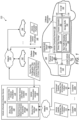
- FIG. 1 illustrates a vehicle information extraction service that receives dictionaries with proprietary encoding formats used by a vehicle supplier or component part suppliers to format vehicle information communicated over a vehicle bus, wherein the vehicle information extraction service maintains confidentiality of the proprietary encoding formats while deploying software packages to vehicles to monitor vehicle information encoded using the proprietary encoding formats for extraction if one or more triggering conditions are met, according to some embodiments.
- System 100 includes vehicle information service 102 and network 124 that is connected to vehicles 126, 142, and 144.
- network 124 may be connected to any number of vehicles.
- customers 122a through 122n are connected to vehicle information service via network 116.
- customers 122a through 122n may be vehicle suppliers or vehicle component suppliers (e.g. vehicle original equipment manufacturers (OEMs) and/or tier-1, tier-2, or tier-3 parts suppliers).
- Network 116 may be a private or public network such as a direct connect connection to a service provider network hosting the vehicle information extraction service 102, or an Internet connection.
- Network 124 may be a wireless network, such as a cellular network, Wi-Fi network or other wireless network.
- Vehicle information extraction service 102 includes service user interface 104, restricted access vehicle dictionary and credential storage 106, binary file generation module 108, vehicle communication interface 110, extracted vehicle information collection module 112, and extracted data analysis and/or visualization module 114.
- service user interface 104 may include a designer canvas and a management console as further discussed in FIG. 2 .
- customers may provide a dictionary file describing proprietary protocols and encoding formats used to communicate vehicle information over a bus from components designed by the customer (e.g. vehicle supplier and/or vehicle component supplier) and/or an associated proprietary access credential file.
- customer 122a provides submission 118 comprising a vehicle supplier dictionary file of customer 122a and also indicating extraction criteria for vehicle information formatted according to the vehicle supplier dictionary.
- customer 122n provides submission 120 comprising a component supplier dictionary file and also indicating extraction criteria for vehicle information formatted according to the component supplier dictionary.
- the dictionary file and extraction criteria are shown in FIG. 1 as being part of a same submission. However, in some embodiments, the extraction criteria and the dictionary file may be submitted separately.
- the dictionary files and associated access credential files received from the customers 122a and 122n may be stored in restricted access dictionary and credential storage 106.
- the dictionary file and associated access credential file of customer 122a and the dictionary file and associated access credential file of customer 122n may each be stored in a separate physical or logical container that has restricted access. For example, customer 122n is not able to view customer 122a's dictionary file and access credential file and vice-versa.
- Binary file generation module 108 may identify dictionary definitions and associated access credentials for particular types of vehicle information that are to be extracted based on the extraction criteria indicated in submissions 118 and 120. Furthermore, the binary file generation module may generate binary files instructing a software application of a vehicle how to access and decode binary information communicated over a vehicle bus that corresponds with the type of vehicle information indicated in the extraction criteria of submissions 118 and 120. Furthermore, the binary file generation module 108 may include extraction criteria in the binary files indicating when the relevant types of vehicle information are to be extracted and included in packets sent back to the vehicle information service 102 or to the customers 122a and 122n. In some embodiments, the types of vehicle information to be monitored and/or the triggering criteria may be included in a configuration file that is sent along with the binary file in a software package, such as software package 146.
- the binary file, source code, and/or configuration file may be included in software package 146 that is sent to in-vehicle computing device 150.
- in-vehicle computing device 150 may implement a gateway for vehicle 126 or may otherwise be a component of vehicle 126 that has access to data transmitted over one or more buses of the vehicle, such as encoded vehicle communications bus 138.
- a bus of a vehicle such as encoded vehicle communications bus 138, may transmit multicast vehicle information sent from multiple components of a vehicle, such as electronic control unit 128 (ECU #1) and electronic control unit 130 (ECU #2). Additionally, other components, such as physical sensor 136 and audio/visual sensors 132, may communicate vehicle information over encoded vehicle communications bus 138.
- Software package 146 may be used to implement software application 152 executing on the in-vehicle computing device 150.
- software application 152 may access binary files storage 154 to access and decode vehicle information transmitted over encoded vehicle communications bus 138.
- bus traffic decoding and triggering module 156 may use binary files/ and or configuration files in binary file storage 154 to access and decode bus traffic.
- the bus traffic decoding and trigger monitoring module 156 may further cause vehicle information, such as the decoded bus traffic and/or other vehicle information such as visual or audio data to be stored in the storage buffer 158.
- the storage buffer may store encoded and/or decoded vehicle information and other associated vehicle data for a plurality of preceding moments in time in the past.
- bus traffic decoding and trigger monitoring module 152 may compare the decoded bus traffic to one or more triggering criteria for data extraction to determine whether or not the triggering criteria has been met. If the triggering criteria are met, packet generation module 180 may generate one or more packets to be sent back to vehicle information extraction service 102 as extracted vehicle information 148.
- vehicle information extraction service 102 includes vehicle communication interface 110 configured to establish a secure connection with respective vehicles, such as vehicle 126 to send software package 146 and to receive extracted vehicle information 148.
- extracted vehicle information collection module 112 may cause the extracted vehicle information 148 to be stored in a storage account of the customer, such as a storage account of a storage service provided by a provider network that also implements the vehicle information extraction service 102.
- the vehicle information extraction service may further orchestrate analysis and/or visualization to be performed on the extracted vehicle information 148.
- the extracted vehicle information may be compared to alarm triggers for alarms that cause the customer to be notified.
- the extracted vehicle information may be organized into visual graphics, such as charts, graphs, or other user interface tools for presentment to the customer.
- the extracted vehicle information may be used to train an artificial intelligence (AI) model or may be provided to a machine learning tool to optimize settings of the vehicle.
- AI artificial intelligence
- FIG. 2 illustrates a more detailed view of a designer canvas and management console of a service user interface for the vehicle information extraction service, according to some embodiments.
- a service user interface of a vehicle information extraction service may include a designer canvas, such as designer canvas 202, and a management console, such as management console 210.
- a designer canvas may enable a customer engineer, such as an engineer of a vehicle supplier or vehicle component supplier to view digital twins comprising data extracted from real-world vehicles.
- the designer canvas may also enable the engineers to modify types of data monitored/extracted and/or triggering criteria for extracting data.
- the designer canvas may enable customer engineers to log into a web application using their own corporation credentials (e.g. the credentials issued to the engineers from the corporate customer) without requiring each engineer to have an account or credential with the vehicle information extraction service.
- the customer's engineers may be able to access, visualize, and monitor vehicle data.
- the designer canvas may also enable the customer to build custom reporting or analytics, or to incorporate vehicle data into their existing software environments.
- the web applications offered by the vehicle information extraction service may be pre-configured or easily configurable without requiring the customer to generate code for the web-applications.
- a management console for a vehicle information extraction service may provide additional features and may further enable the customer to manage the customer's account with the vehicle information extraction service, such as providing access to proprietary dictionaries, creating additional digital twins, etc.
- a designer canvas such as designer canvas 202, includes a digital twin user interface 204, a fleet user interface 206, and a configuration user interface 208.
- the digital twin user interface 204 may enable an engineer of the customer to view and interact with a digital twin for a given real-world vehicle, wherein the digital twin comprises near-real time vehicle information extracted from the real-world vehicle.
- the fleet user interface 206 may enable an engineer of the customer to view and interact with a digital twin representing a class (or fleet) of vehicles.
- the fleet digital twin may include aggregated data representing near real-time states of a class of vehicles matching a fleet definition for the fleet.
- digital twin user interface 204 and fleet user interface 206 may enable an engineer of the customer to view and interact with historical data extracted from the real-world vehicle or the fleet of real-world vehicles.
- a digital twin may be created for a vehicle using designer canvas 202 prior to the real-world vehicle being built.
- designer canvas 202 may include a configuration user interface, such as configuration user interface 208.
- Configuration user interface 208 may enable an engineer of the customer to provide/modify types of vehicle information that are to be extracted from a vehicle or fleet of vehicles as well as triggering criteria for extracting the vehicle information. For example, if troubleshooting a given system, the engineer may modify data extraction to include additional types of vehicle information to be extracted such as from sub-components of the system being troubleshot.
- Management console 210 includes data extraction service account administration 212, which may be used to manage the customer's account, such as billing, contact information, etc. Additionally, management console 210 includes digital twin for vehicle interface 214 and fleet digital twin interface 216. These interfaces may be used by the customer to authorize additional digital twins be created for either an individual vehicle or a fleet of vehicles. In some embodiments, a prompt in the designer canvas 202 may cause a request to be queued for approval by the customer, wherein the approval causes digital twin interface 214 or fleet digital twin interface 216 to create additional digital twins.
- Management console 210 includes configuration management interface 218 that enables the customer to link or upload a proprietary dictionary.
- a request to link or upload a proprietary dictionary may be submitted from the designer canvas 202 and when approved by the customer may cause configuration management console 218 to perform the uploading or linking of the proprietary dictionary.
- Deployment interface 220 of management console 210 may then cause generated binary files to be deployed to vehicles that are to be monitored.
- a management console such as management console 210, may further include a monitoring interface 222 for receiving and viewing extracted vehicle information.
- the monitoring interface may also enable specification of monitoring parameters such as alarms to be triggered if certain thresholds are met in the extracted vehicle information.
- the binary files may be generated by the vehicle information extraction service 102 and provided to the customer for deployment into the customer's vehicles.
- Management console 210 also includes analytics interface 224 for defining analysis to be performed on extracted vehicle information and includes customer API interface 226 that enables customers to specify analysis, alarms, notification parameters, etc. Additionally, management console 210 includes customer communications interface 228 configured to issue notifications to the customer if certain alarm thresholds are met in the extracted vehicle information.
- service user interface 108 further includes vehicle information cross-licensing interface 230 which may be used by a customer to select other components of the vehicle with which the decoded vehicle information is to be shared.
- vehicle information cross-licensing interface 230 may be used by a customer to select other components of the vehicle with which the decoded vehicle information is to be shared.
- a vehicle OEM may license a tier-1 supplier to have access to decoded vehicle information from a sensor that communicates using a proprietary protocol of the OEM.
- the OEM may enable the tier-1 supplier component to use the decoded vehicle information, but may not be required to share the proprietary dictionary with the tier-1 supplier.
- the proprietary dictionary is stored in the restricted access vehicle dictionary storage 106 of the vehicle data extraction service 102 and is not accessible by the tier-1 supplier. However, even though the proprietary dictionary remains restricted from viewing by the tier-1 supplier, this does not prevent interoperability of components of the OEM and the tier-1 supplier.
- management console 210 further includes permissions and roles interface 232, which may enable a customer to define access roles for different types or classes of users (which may be employees of the vehicle supplier or vehicle component supplier that are the customer of the vehicle information extraction service). For example, some users may be assigned roles that only permit the use of pre-configured vehicle information extraction configurations, while other users may be provided roles that enable development of new vehicle information extraction configurations, such as to more deeply delve into operations of particular components of a vehicle.
- permissions and roles interface 232 may enable a customer to define access roles for different types or classes of users (which may be employees of the vehicle supplier or vehicle component supplier that are the customer of the vehicle information extraction service). For example, some users may be assigned roles that only permit the use of pre-configured vehicle information extraction configurations, while other users may be provided roles that enable development of new vehicle information extraction configurations, such as to more deeply delve into operations of particular components of a vehicle.
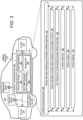
- FIG. 3 illustrates a more detailed view of a network stack of protocols used at different levels to communicate vehicle information over a bus of a vehicle, according to some embodiments.
- the binary files stored in binary files storage 154 may include propriety access credentials and protocol definitions for multiple layers of a network stack of the vehicle that enable access to, and decoding of, the communications transmitted over the communication bus of the vehicle.
- binary files included in binary file storage 154 may indicate access credentials, protocols, and/or addresses used at vehicle hardware layer 310.
- the binary files may indicate access credentials, protocols, or ports used at a vehicle firmware layer 308 and/or at an in-vehicle hypervisor layer 306.
- the binary files may indicate bus protocols used at a bus layer 304 and proprietary protocols and access credentials of the customer used at layer 302.
- Vehicle information monitoring and extraction software application 152 may use these definitions and access credentials included in the binary files to access and decode messages sent over encoded vehicle communications bus 138, as an example.
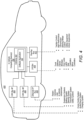
- FIG. 4 illustrates an example vehicle comprising multiple different buses that may be monitored for data extraction by a software application deployed by a vehicle information extraction service, according to some embodiments.
- a vehicle such as vehicle 426
- vehicle 426 may include multiple buses connected to a gateway.
- vehicle 426 includes gateway 402 that is connected to CAN bus #1 (404), CAN bus # 2 (406), Ethernet/IP bus 408, local interconnect (LIN) bus 410, and FlexRay bus 412.
- CAN bus #1 404
- CAN bus # 2 406
- Ethernet/IP bus 408 408
- LIN local interconnect
- a customer may supply access to a proprietary dictionary for only some or all buses of a vehicles.
- the customer may specify only some or all of the buses of the vehicle are to be monitored.
- the customer may specify only certain components connected to a given bus are to be monitored.
- FIG. 5 illustrates a more detailed view of a storage buffer that may be used by an application deployed by a vehicle information extraction service, wherein the storage buffer stores data from one or more preceding moments in time that is eligible for extraction if one or more triggering criteria are met, according to some embodiments.
- a storage buffer 158 may store more than one type of data in more than one buffer.
- storage buffer 158 includes time-synchronized decoded text buffer 502, other data buffer 1 (504) and other data buffer N (506). Current data may be stored at time N. Data for a next moment in time will be stored at time N-1, which when the next moment in time arrives will then become time N and the data previously stored at time N, will become time N+1.
- a storage buffer 158 may store data for any number of moments of time (e.g. N+X, where X is a number of moments in time that are buffered). Also in some embodiments, X may be different for different types of vehicle information, such that some types of vehicle information are buffered for longer periods of times than other types of vehicle information.
- a global time stamp may be applied to the vehicle information when stored in the storage buffer 502.
- the payload of data stored in storage buffer 502 may include time stamps associated with the stored data that were generated by other components of the vehicle, such as a time stamp of when a message comprising the data was submitted to the encoded vehicle communications bus 138, or a time when the data was sensed, such as by physical sensor 136.
- a piece of data may have more than one time stamp associated with it, such as a payload time stamp for when the data was sensed, for example at physical sensor 136, another payload time stamp for when the data was submitted to encoded vehicle communications bus 138, and another time stamp for when the data was received at storage buffer 158.
- a piece of data stored in storage buffer 158 may be stored with more or fewer time stamps. Such time stamps may enable an accurate representation of a sequence of events in the vehicle to be recreated, for example by the software application 152, or by an extracted data analysis and visualization module 114 of a vehicle information extraction service 102.
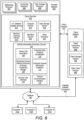
- FIG. 6 illustrates an example provider network that includes a vehicle information extraction service as well as other cloud services offered by the provider network, according to some embodiments.
- a provider network such as provider network 602, includes networking devices 604, computing devices 606, and data storage devices 608 that implement cloud services 610.
- a provider network may implement a plurality of cloud services in addition to a vehicle information extraction service.
- provider network 602 implements cloud services 610 that include IoT software update service 612, compute service 614, data storage service 616, machine learning service 618, workflow service 620, and other services 622.
- Cloud services 610 also includes vehicle information extraction service 102.
- an IoT software update service may facilitate software updates on devices connected to the IoT software update service, such as vehicles 126, 142, and 144 as illustrated in FIG. 1 .
- an IoT software update service may additionally update firmware on a connected device and may utilize encrypted communications to perform the update.
- the IoT software update service may also include identity authentication protocols to prevent unauthorized entities from altering software on a connected device, such as a vehicle, and encrypt communications to the connected device to prevent alterations to the software updates.
- a compute service such as compute service 614, may include computing devices that implement virtual compute machines that may be used to analyze collected vehicle information and/or may be used to implement a vehicle information extraction service.
- a data storage service may include data storage devices that implement a virtualized data storage, such as virtual data storage volume or virtual storage containers for an object-based storage.
- a data storage service such as data storage service 616
- a data storage service, such as data storage service 616 may be used to implement components of a vehicle information extraction service, such as a restricted access storage for a proprietary dictionary.
- a machine learning service may execute one or more machine learning algorithms to determine relationships in vehicle information extracted via a vehicle information extraction service, for example to optimize a workflow service, or to optimize another service.
- a machine learning service such as machine learning service 618, may be used to optimize parts distribution management based on vehicle information collected by a vehicle information extraction service.
- a machine learning service of a provider network that also provides a vehicle information extraction service may further analyze extracted vehicle information and/or other information related to a given vehicle or class of vehicles to generate recommendations regarding types of vehicle information to be monitored and/or triggering criteria for extraction of vehicle information.
- a workflow service may execute a workflow based on input data and a stored or developed workflow.
- a workflow service such as workflow service 620
- a workflow service may determine a filter, hose, or fluid needs to be changed or replaced based on applying collected vehicle information to one or more stored or developed work flows.
- a machine learning service such as machine learning service 618
- workflow service 620 may use extracted vehicle information to initiate shipping of vehicle parts that are likely to be needed at a particular location in the future based on extracted vehicle information.
- cloud services 610 may include various other cloud services, such as other services 622.
- a vehicle information extraction service may be configured to establish a secure connection to a customer network for delivering data from extracted from a vehicle or fleet of vehicles.
- a customer e.g. vehicle supplier or vehicle component supplier
- a customer network such an OEM network may establish a secure connection to a vehicle information extraction service via a direct connection, such as direct connect 652, or via a logically isolated network connection, such as logically isolated network connection 654.
- a direct connection may include a dedicated physical network link that links the customer network 650 to the provider network 610 and/or one or more logically isolated network connections within provider network 610 that route traffic from a router physically connected to the customer network 650 via direct connect 652 to computing devices and/or storage devices that implement the vehicle information extraction service 102.
- a data lake may be implemented using cloud services, such as compute service 614 and data storage service 616, or may be implemented directly by a customer using customer resources, such as customer computing devices 656, customer storage devices 658, or other customer devices 660.
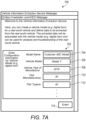
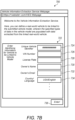
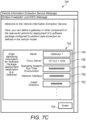
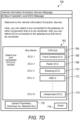
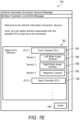
- FIGs. 7A-7F illustrate example user interface pages that are used to define and enable data extraction from a vehicle or fleet of vehicles, according to some embodiments.
- a customer may utilize designer canvas 700 to enter configuration information for a vehicle model that is to be created (e.g. a digital twin).
- the customer may specify a model name (704), a vehicle model of the real-world vehicle (706), a model year of the real-world vehicle (708), a part manufacturer (710) if only parts of a certain manufacturer are to be monitored.
- the customer may further specify part types that are to be monitored.
- the customer may select enter to create the vehicle model.
- the customer may provide identifying information for the real-world vehicle that is to be paired with the digital twin vehicle model created in FIG. 7A .
- the customer may specify a unique vehicle identifier (724), VIN number (726), a license plate number (728), an owner's name (730), an owner's email (732), a country or language of the owner (734), and at 736 the customer may select enter to complete the definition of the real-world vehicle to be paired with the digital twin vehicle model.
- the customer may only be required to provide a unique vehicle identifier and other fields may be auto populated. For example, a manufacturing inventory management system may automatically populate the VIN number (726).
- a dealer or delivery management system may automatically populate the license plate (728), owner's name (730), owner's email (732), country/language (734), etc.
- more or fewer fields may be used to provide identifying information for a real-world vehicle.
- the customer may specify a gateway (or other component) of the real-world vehicle where the in-vehicle monitoring and data extraction software is to be deployed.
- a gateway or other component of the real-world vehicle where the in-vehicle monitoring and data extraction software is to be deployed.
- the customer may specify a name for the deployment component (744), a proxy server for communicating with the deployment component (746), an operating system or runt-time environment configuration for the deployment component (748), a network interface for the software package to communicate with the deployment component (750), and an install directory of the deployment component at which the software packaged is to be installed (752).
- the customer may select enter to submit the deployment component definition and configuration.
- the customer may select a bus and components connected to the bus that are to be monitored. For example in box 762, the customer may specify a bus name at 764 and may select components connected to the selected bus at 766-774. Button 776 may be used to upload or otherwise provide access to a proprietary dictionary for the selected bus. In some embodiments, the components connected to the bus may be pre-populated for selection based on information included in the proprietary dictionary uploaded via button 776. Note that in some embodiments, more than one bus may be selected for monitoring. Thus, a similar page as shown in FIG. 7D may be used for the additional busses. At 778, the customer may submit the selected bus monitoring configuration.
- additional user interface pages may be provided between those shown in FIG. 7B and 7C to allow the customer to define the components of the vehicle, such as what buses are included in the vehicle, what ECUs are connected to those buses, what sensors are connected to the ECUs, etc.
- this information may be prepopulated based on the contents of the uploaded proprietary dictionary and/or other information about a particular make and/or model of vehicle that is stored by the vehicle information extraction service.
- a customer may be enabled to add to, or modify, a pre-populated inventory available buses, ECUs, sensors, etc.
- the customer may further select particular sensors connected to the components of the bus that are to be monitored. For example at box 782, the customer has made selections 786-790 for components connected to the front camera ECU (784) and at 792 the customer has selected the seat controller ECU (792). In some embodiments, a customer may select either a sensor or ECU to be monitored, or both. For example, whereas the front camera ECU (784) has multiple attached sensors that may be selected, the seat controller ECU (792) may be a simple ECU without additional sensors connected to it, or with few sensors connected to it. Thus a customer may request to monitor all communications from a given ECU and/or may select to monitor communications for a particular sensor.
- a binary file for a vehicle may be generated based on the inventory of available buses, ECUs, sensors, etc. that are available for monitoring and a configuration file may be generated based on the particular ECUs and sensors that are selected for monitoring, such as via the pages shown in FIGs. 7D and 7E .
- the customer may further pair the configured buses that are to be monitored (703 and 705) with the deployment component (707) defined in FIG. 7C and may select button 709 to cause binary files and configuration files to be generated for deployment to the deployment component selected at 707 to enable monitoring of the selected buses 703 and 705, using the monitoring configurations defined in FIGs. 7D and 7E .
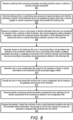
- FIG. 8 illustrates a flowchart of operations performed by a vehicle information service to deploy a software package to a vehicle for data monitoring and extraction and also illustrates operations performed by the vehicle information service in response to the requested vehicle information being extracted from the vehicle, according to some embodiments.
- a vehicle information extraction service receives a dictionary file comprising proprietary encoding protocols used in a vehicle or used by a vehicle component.
- the vehicle information extraction service stores the dictionary file in a restricted access physical or logical container such that the proprietary contents of the dictionary file are not viewable by parties other than a vehicle supplier or vehicle component supplier that provided the dictionary file.
- the vehicle information extraction service receives an indication of one or more types of vehicle information that are to be monitored for extraction from a vehicle or fleet of vehicles.
- the vehicle information extraction service also receives triggering criteria indicating conditions under which the monitored vehicle information is to be extracted from the vehicle and sent to a vehicle information extraction service or the customer.
- the vehicle information extraction service generates, based on the dictionary file, one or more binary files to be provided to the vehicle(s) to be monitored, wherein the one or more binary files enable a software application executing in a gateway environment of the vehicle to decode communications structured according to proprietary structures/protocols defined in the dictionary file.
- the vehicle information extraction service generates one or more configuration files based on the indicated types of vehicle information to be monitored and the triggering criteria indicated for these types of vehicle information that are to be monitored.
- the vehicle information extraction service receives packets comprising vehicle information extracted from the vehicle(s) for the vehicle components to be monitored as defined in the binary files.
- the vehicle information service coordinates with one or more other services of a provider network to analyze the packets, and contact the customer if one or more threshold conditions are met in the extracted vehicle information.
- the vehicle information extraction service also provides an API for the customer to access the decoded or analyzed data extracted from the vehicle.
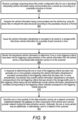
- FIG. 9 illustrates a flowchart for operations performed by a software application deployed to a vehicle from a vehicle information extraction service, wherein the software application monitors vehicle bus traffic and extracts vehicle information to be sent to the vehicle information extraction service if one or more triggering criteria are met, according to some embodiments.
- a vehicle information monitoring software application deployed in a vehicle receives a package comprising binary files and/or configuration files for use in decoding/interpreting vehicle information being communicated over a vehicle bus according to a proprietary structure or format
- the vehicle information monitoring software application deployed in a vehicle deciphers the vehicle information being communicated over the vehicle bus using the binary files to interpret the data structured according to the proprietary structure or format.
- vehicle information monitoring software application deployed in a vehicle causes the deciphered vehicle information and/or encoded vehicle information to be stored in a storage buffer that stores vehicle information for a plurality of past moments in time.
- the vehicle information monitoring software application deployed in a vehicle monitors the deciphered vehicle information to determine if one or more triggering criteria have been met for triggering a data extraction of the vehicle information from the vehicle and to a cloud-based data extraction service or to the customer.
- the vehicle information monitoring software application deployed in a vehicle in response to determining that one or more of the triggering criteria has been met, generates one or more packets comprising the deciphered (or encoded) vehicle information corresponding to the triggering criteria that has been met.
- the packets may include deciphered (or encoded) vehicle information corresponding to the met triggering criteria that was stored in the storage buffer prior to the triggering criteria being met and additionally include deciphered vehicle information corresponding to the triggering criteria collected subsequent to the triggering criteria being met.
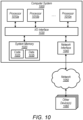
- computer system 1000 includes one or more processors 1010 coupled to a system memory 1020 via an input/output (I/O) interface 1030.
- Computer system 1000 further includes a network interface 1040 coupled to I/O interface 1030.
- computer system 1000 may be illustrative of servers implementing enterprise logic or downloadable application, while in other embodiments servers may include more, fewer, or different elements than computer system 1000.
- computing device 1000 may be a uniprocessor system including one processor or a multiprocessor system including several processors 1010A-1010N (e.g., two, four, eight, or another suitable number).
- Processors 1010A-1010N may include any suitable processors capable of executing instructions.
- processors 1010A-1010N may be processors implementing any of a variety of instruction set architectures (ISAs), such as the x86, PowerPC, SPARC, or MIPS ISAs, or any other suitable ISA.
- ISAs instruction set architectures
- processors 1010A-1010N may include specialized processors such as graphics processing units (GPUs), application specific integrated circuits (ASICs), etc.
- GPUs graphics processing units
- ASICs application specific integrated circuits
- each of processors 1010A-1010N may commonly, but not necessarily, implement the same ISA.
- I/O interface 1030 may be configured to coordinate I/O traffic between processors 1010A-1010N, system memory 1020, and any peripheral devices in the device, including network interface 1040 or other peripheral interfaces.
- I/O interface 1030 may perform any necessary protocol, timing or other data transformations to convert data signals from one component (e.g., system memory 1020) into a format suitable for use by another component (e.g., processor 1010).
- I/O interface 1030 may include support for devices attached through various types of peripheral buses, such as a variant of the Peripheral Component Interconnect (PCI) bus standard or the Universal Serial Bus (USB) standard, for example.
- PCI Peripheral Component Interconnect
- USB Universal Serial Bus
- a computer-readable medium may include transmission media or signals such as electrical, electromagnetic, or digital signals, conveyed via a communication medium such as a network and/or a wireless link, such as may be implemented via network interface 1040.
- a communication medium such as a network and/or a wireless link, such as may be implemented via network interface 1040.
- Portions or all of multiple computing devices such as that illustrated in FIG. 10 may be used to implement the described functionality in various embodiments; for example, software components running on a variety of different devices and servers may collaborate to provide the functionality.
- portions of the described functionality may be implemented using storage devices, network devices, or various types of computer systems.
Landscapes
- Engineering & Computer Science (AREA)
- Computer Networks & Wireless Communication (AREA)
- Signal Processing (AREA)
- Physics & Mathematics (AREA)
- General Physics & Mathematics (AREA)
- Health & Medical Sciences (AREA)
- Computing Systems (AREA)
- General Health & Medical Sciences (AREA)
- Medical Informatics (AREA)
- Small-Scale Networks (AREA)
- Traffic Control Systems (AREA)
Claims (15)
- System (1000) zum Implementieren eines Fahrzeuginformationsextraktionsdienstes (102), wobei das System (1000) Folgendes umfasst:
eine oder mehrere Rechenvorrichtungen, die zu Folgendem konfiguriert sind:Empfangen einer Wörterbuchdatei (118, 120) von einem Fahrzeuglieferanten oder von einem Fahrzeugkomponentenlieferanten, wobei die Wörterbuchdatei (118, 120) Definitionen zur Verwendung beim Decodieren von Kommunikationen umfasst, die gemäß einem Codierungsformat des Fahrzeuglieferanten oder einem Codierungsformat des Fahrzeugkomponentenlieferanten codiert sind;Speichern der Wörterbuchdatei (118, 120) in einem physischen oder logischen Container (106) mit beschränktem Zugriff derart, dass Inhalte der Wörterbuchdatei (118, 120) nicht durch andere Parteien als dem Fahrzeuglieferanten oder dem Fahrzeugkomponentenlieferanten anzeigbar sind;Erzeugen, basierend auf der Wörterbuchdatei (118, 120), einer oder mehrerer dem Fahrzeug (126) bereitzustellender Decodierungsdateien, wobei die eine oder die mehreren Decodierungsdateien Informationen zum Decodieren von Kommunikationen umfassen, die unter Verwendung des Codierungsformats des Fahrzeuglieferanten oder des Codierungsformats des Fahrzeugkomponentenlieferanten codiert sind, und wobei die eine oder die mehreren Decodierungsdateien die Inhalte der Wörterbuchdatei (118, 120) nicht offenbaren;Bereitstellen der einen oder der mehreren Decodierungsdateien zum Laden in ein Gateway (402) oder eine andere Komponente des Fahrzeugs (126), wobei eine Softwareanwendung (152), die in dem Gateway (402) implementiert oder in der anderen Komponente implementiert ist, dazu konfiguriert ist, die eine oder die mehreren Decodierungsdateien zum Decodieren von Fahrzeuginformationen zu verwenden, die über einen oder mehrere Kommunikationsbusse (138) des Fahrzeugs (126) kommuniziert werden, wobei die Fahrzeuginformationen, die über den einen oder die mehreren Kommunikationsbusse (138) kommuniziert werden, gemäß dem Codierungsformat des Fahrzeuglieferanten oder dem Codierungsformat des Fahrzeugkomponentenlieferanten formatiert sind; undEmpfangen, von dem Fahrzeug (126), über eine oder mehrere Netzwerkvorrichtungen, von Fahrzeuginformationspaketen, die Fahrzeuginformationen umfassen, die aus dem Fahrzeug (126) extrahiert wurden. - System (1000) nach Anspruch 1, wobei die eine oder die mehreren Rechenvorrichtungen ferner zu Folgendem konfiguriert sind:Empfangen einer Angabe von Fahrzeuginformationen, die aus einem von dem Fahrzeuglieferanten hergestellten Fahrzeug oder aus einem Fahrzeug, das eine von dem Fahrzeugkomponentenlieferanten gelieferte Komponente umfasst, zu extrahieren sind;Erzeugen, basierend auf der Angabe, einer oder mehrerer Konfigurationsdateien; undBereitstellen der einen oder der mehreren Konfigurationsdateien mit der einen oder den mehreren Decodierungsdateien in einem in das Gateway (402) oder die andere Komponente des Fahrzeugs (126) zu ladenden Softwarepaket.
- System (1000) nach Anspruch 2, wobei die Angabe der aus dem Fahrzeug (126) zu extrahierenden Fahrzeuginformationen ferner Folgendes umfasst:eine Angabe einer oder mehrerer Arten von zu extrahierenden Fahrzeuginformationen; undeine oder mehrere Auslösebedingungen zum Auslösen einer Extraktion der einen oder mehreren Arten von Fahrzeuginformationen,wobei die Softwareanwendung (152), die in das Gateway (402) oder die andere Komponente des Fahrzeugs (126) implementiert ist, zu Folgendem konfiguriert ist:Überwachen eines Verkehrs auf dem einen oder den mehreren Kommunikationsbussen (138) des Fahrzeugs (126) auf Fahrzeuginformationen, die der einen oder den mehreren angegebenen Arten entsprechen;Speichern der Fahrzeuginformationen, die der einen oder den mehreren angegebenen Arten entsprechen, in einem Speicherpuffer (158); undals Reaktion darauf, dass die eine oder die mehreren Auslösebedingungen erfüllt sind:
Erzeugen eines oder mehrerer Pakete, die zumindest einen Teil der Fahrzeuginformationen umfassen, die der einen oder den mehreren angegebenen Arten entsprechen, die in dem Speicherpuffer (158) gespeichert sind. - System (1000) nach Anspruch 3, wobei das eine oder die mehreren Pakete, die als Reaktion darauf erzeugt werden, dass die eine oder die mehreren Auslösebedingungen erfüllt sind, Folgendes umfassen:Fahrzeuginformationen, die der einen oder den mehreren angegebenen Arten von Fahrzeuginformationen entsprechen, die für einen Zeitraum in dem Speicherpuffer (158) gespeichert wurden, bevor die eine oder die mehreren Auslösebedingungen erfüllt wurden; undFahrzeuginformationen, die der einen oder den mehreren angegebenen Arten von Fahrzeuginformationen entsprechen, für einen anderen Zeitraum, nachdem die eine oder die mehreren Auslösebedingungen erfüllt wurden.
- System (1000) nach einem der Ansprüche 1 bis 4, wobei die eine oder die mehreren Rechenvorrichtungen des Systems (1000) ferner zu Folgendem konfiguriert sind:Empfangen, von dem Fahrzeuglieferanten oder dem Fahrzeugkomponentenlieferanten, einer aktualisierten Angabe von aus dem Fahrzeug (126) zu extrahierenden Fahrzeuginformationen, wobei die aktualisierte Angabe eine oder mehrere zusätzliche oder alternative Arten von Fahrzeuginformationen angibt, die aus dem Fahrzeug (126) zu extrahieren sind;Erzeugen, basierend auf der aktualisierten Angabe von zu extrahierenden Fahrzeuginformationen, einer oder mehrerer zusätzlicher dem Fahrzeug (126) bereitzustellender Konfigurationsdateien;Bereitstellen der einen oder der mehreren zusätzlichen Konfigurationsdateien zum Laden in das Gateway (402) oder die andere Komponente des Fahrzeugs (126), wobei die Softwareanwendung (152) dazu konfiguriert ist, die eine oder die mehreren zusätzlichen Konfigurationsdateien zu verwenden, um die Fahrzeuginformationen zu identifizieren, die über einen oder mehrere Kommunikationsbusse (138) des Fahrzeugs (126) kommuniziert werden, die der aktualisierten Angabe entsprechen; undEmpfangen, von dem Fahrzeug (126), über eine oder mehrere Netzwerkvorrichtungen, von Fahrzeuginformationspaketen, die Fahrzeuginformationen umfassen, die aus dem Fahrzeug (126) gemäß der von dem Fahrzeuglieferanten oder dem Fahrzeugkomponentenlieferanten empfangenen aktualisierten Angabe extrahiert werden.
- System (1000) nach einem der Ansprüche 1 bis 5, wobei die eine oder die mehreren Rechenvorrichtungen des Systems (1000) ferner zu Folgendem konfiguriert sind:Empfangen, von dem Fahrzeuglieferanten oder dem Fahrzeugkomponentenlieferanten, einer aktualisierten Angabe von aus dem Fahrzeug (126) zu extrahierenden Fahrzeuginformationen, wobei die aktualisierte Angabe eine oder mehrere zusätzliche oder alternative Arten von Fahrzeuginformationen angibt, die aus dem Fahrzeug (126) zu extrahieren sind;Erzeugen, basierend auf der Wörterbuchdatei (118, 120) und der aktualisierten Angabe von zu extrahierenden Fahrzeuginformationen, einer oder mehrerer zusätzlicher dem Fahrzeug (126) bereitzustellender Decodierungsdateien;Bereitstellen der einen oder der mehreren zusätzlichen Decodierungsdateien zum Laden in das Gateway (402) oder die andere Komponente des Fahrzeugs (126), wobei die Softwareanwendung (152) dazu konfiguriert ist, die eine oder die mehreren zusätzlichen Decodierungsdateien zu verwenden, um die Fahrzeuginformationen, die über einen oder mehrere Kommunikationsbusse (138) des Fahrzeugs (126) kommuniziert werden, zu decodieren, um Fahrzeuginformationen zu identifizieren, die der aktualisierten Angabe entsprechen; undEmpfangen, von dem Fahrzeug (126), über eine oder mehrere Netzwerkvorrichtungen, von Fahrzeuginformationspaketen, die Fahrzeuginformationen umfassen, die aus dem Fahrzeug (126) gemäß der von dem Fahrzeuglieferanten oder dem Fahrzeugkomponentenlieferanten empfangenen aktualisierten Angabe extrahiert werden.
- System (1000) nach einem der Ansprüche 1 bis 6, wobei die Angabe von Fahrzeuginformationen, die aus dem von dem Fahrzeuglieferanten hergestellten Fahrzeug (126) oder aus dem Fahrzeug, das eine von dem Fahrzeugkomponentenlieferanten gelieferte Komponente umfasst, zu extrahieren sind, Folgendes spezifiziert:ein einzelnes Fahrzeug, aus dem die Fahrzeuginformationen zu extrahieren sind; odereine Klasse von Fahrzeugen mit einer oder mehreren Charakteristiken, aus denen die Fahrzeuginformationen zu extrahieren sind.
- Ein oder mehrere nichtflüchtige computerlesbare Speichermedien, die Anweisungen speichern, die, wenn sie auf oder über einen oder mehrere Prozessoren ausgeführt werden, den einen oder die mehreren Prozessoren zu Folgendem veranlassen:Empfangen eines Pakets, das eine oder mehrere Decodierungsdateien umfasst, die basierend auf dem Codierungsformat von einem Fahrzeuglieferanten oder von einem Fahrzeugkomponentenlieferanten erzeugt werden, zur Verwendung beim Decodieren von Fahrzeuginformationen, die über einen oder mehrere Kommunikationsbusse (138) eines Fahrzeugs (126) kommuniziert werden, wobei die Fahrzeuginformationen, die über den einen oder die mehreren Kommunikationsbusse (138) kommuniziert werden, gemäß dem Codierungsformat des Fahrzeuglieferanten oder dem Codierungsformat des Fahrzeugkomponentenlieferanten formatiert sind;Verwenden der einen oder der mehreren binären Decodierungsdateien zum Decodieren zumindest eines Teils der Fahrzeuginformationen, die über den einen oder die mehreren Kommunikationsbusse (138) des Fahrzeugs (126) kommuniziert werden;Bewirken, dass zumindest ein Teil der Fahrzeuginformationen in einem Speicherpuffer (158) gespeichert wird; undErzeugen, als Reaktion darauf, dass eine oder mehrere Auslösebedingungen erfüllt sind, eines oder mehrerer an einen entfernten Fahrzeugdatendienst zu sendender Pakete, wobei das eine oder die mehreren Pakete die Fahrzeuginformationen umfassen, die in dem Speicherpuffer (158) gespeichert sind.
- Ein oder mehrere nichtflüchtige computerlesbare Speichermedien nach Anspruch 8,wobei das Paket ferner Informationen umfasst, die Auslösebedingungen zum Extrahieren einer ersten Art von Fahrzeuginformationen und eine oder mehrere zusätzliche Auslösebedingungen zum Extrahieren einer oder mehrerer zusätzlicher Arten von Fahrzeuginformationen angeben, wobei zumindest einige der jeweiligen Auslösebedingungen unterschiedlich sind, undwobei die Anweisungen, wenn sie auf oder über den einen oder die mehreren Prozessoren ausgeführt werden, den einen oder die mehreren Prozessoren zu Folgendem veranlassen:Einschließen, in das eine oder die mehreren erzeugten Pakete, einer oder mehrerer Arten von Fahrzeuginformationen, für die eine oder mehrere entsprechende Auslösebedingungen erfüllt sind,wobei andere Arten von Fahrzeuginformationen, die in dem Speicherpuffer (158) gespeichert sind, die anderen Auslösebedingungen entsprechen, die nicht erfüllt wurden, nicht in das eine oder die mehreren erzeugten Pakete eingeschlossen werden.
- Ein oder mehrere nichtflüchtige computerlesbare Speichermedien nach Anspruch 8 oder Anspruch 9, wobei die Anweisungen, wenn sie auf oder über den einen oder die mehreren Prozessoren ausgeführt werden, ferner den einen oder die mehreren Prozessoren zu Folgendem veranlassen:Bewirken, dass andere Fahrzeuginformationen, die Audio- oder visuelle Daten von einem oder mehreren Sensoren (136) des Fahrzeugs (126) umfassen, in dem Speicherpuffer (158) gespeichert werden; undals Reaktion darauf, dass die eine oder die mehreren Auslösebedingungen erfüllt sind, Einschließen zumindest einiger der anderen Fahrzeuginformationen, die Audio- oder visuelle Daten von dem einen oder den mehreren Sensoren (136) umfassen, in das eine oder die mehreren erzeugten Pakete, die an den entfernten Fahrzeugdatendienst zu senden sind.
- Ein oder mehrere nichtflüchtige computerlesbare Speichermedien nach Anspruch 10, wobei die decodierten Fahrzeuginformationen Textdaten umfassen,
wobei die eine oder die mehreren Auslösebedingungen Bedingungen umfassen, die auf den Textdaten basieren; und wobei die eine oder die mehreren Auslösebedingungen ferner eine Angabe einer oder mehrerer anderer Arten von Fahrzeuginformationen umfassen, die Audio- oder visuelle Daten umfassen, die zu extrahieren sind, wenn die textbasierten Auslösebedingungen erfüllt sind. - Ein oder mehrere nichtflüchtige computerlesbare Speichermedien nach einem der Ansprüche 8 bis 11, wobei das Paket ferner Folgendes umfasst:eine Angabe einer oder mehrerer Komponenten des Fahrzeugs (126), die dazu autorisiert sind, die decodierten Fahrzeuginformationen zu empfangen oder auf die decodierten Fahrzeuginformationen, die in dem Speicherpuffer (158) gespeichert sind, zuzugreifen,wobei die Anweisungen, wenn sie auf oder über den einen oder die mehreren Prozessoren ausgeführt werden, ferner den einen oder die mehreren Prozessoren zu Folgendem veranlassen:
Bereitstellen eines Zugriffs auf die decodierten Informationen zu der einen oder den mehreren Komponenten des Fahrzeugs (126), die dazu autorisiert sind, die decodierten Fahrzeuginformationen zu empfangen oder darauf zuzugreifen. - Ein oder mehrere nichtflüchtige computerlesbare Speichermedien nach einem der Ansprüche 8 bis 12, wobei die Anweisungen, wenn sie auf oder über den einen oder die mehreren Prozessoren ausgeführt werden, ferner den einen oder die mehreren Prozessoren zu Folgendem veranlassen:
Überwachen der decodierten Informationen auf Bedingungen, die die eine oder die mehreren Auslösebedingungen erfüllen, wobei die decodierten Informationen von dem einen oder den mehreren Bussen (138) des Fahrzeugs (126) decodierte Informationen von Folgendem umfassen:
einem oder mehreren Controller-Area-Network-, CAN-, Bussen (404, 406) des Fahrzeugs (126). - Ein oder mehrere nichtflüchtige computerlesbare Speichermedien nach Anspruch 13, wobei die decodierten Informationen von dem einen oder den mehreren Bussen des Fahrzeugs (126) ferner decodierte Informationen von Folgendem umfassen:einem zusätzlichen CAN(406)-Bus des Fahrzeugs (126); odereinem Ethernet- oder IP-Bus (408) des Fahrzeugs (126).
- Ein oder mehrere nichtflüchtige computerlesbare Speichermedien nach einem der Ansprüche 8 bis 14, wobei die Programmanweisungen dazu konfiguriert sind, auf Prozessoren in einer Gateway(402)-Umgebung des Fahrzeugs (126) ausgeführt zu werden.
Applications Claiming Priority (2)
| Application Number | Priority Date | Filing Date | Title |
|---|---|---|---|
| US17/160,184 US11887411B2 (en) | 2021-01-27 | 2021-01-27 | Vehicle data extraction service |
| PCT/US2022/013862 WO2022164874A1 (en) | 2021-01-27 | 2022-01-26 | Vehicle data extraction service |
Publications (3)
| Publication Number | Publication Date |
|---|---|
| EP4285574A1 EP4285574A1 (de) | 2023-12-06 |
| EP4285574B1 true EP4285574B1 (de) | 2025-04-09 |
| EP4285574B8 EP4285574B8 (de) | 2025-05-21 |
Family
ID=80625360
Family Applications (1)
| Application Number | Title | Priority Date | Filing Date |
|---|---|---|---|
| EP22707535.5A Active EP4285574B8 (de) | 2021-01-27 | 2022-01-26 | Fahrzeugdatenextraktionsdienst |
Country Status (5)
| Country | Link |
|---|---|
| US (3) | US11887411B2 (de) |
| EP (1) | EP4285574B8 (de) |
| JP (1) | JP7610717B2 (de) |
| CN (1) | CN117044184A (de) |
| WO (1) | WO2022164874A1 (de) |
Families Citing this family (19)
| Publication number | Priority date | Publication date | Assignee | Title |
|---|---|---|---|---|
| US11887411B2 (en) | 2021-01-27 | 2024-01-30 | Amazon Technologies, Inc. | Vehicle data extraction service |
| US12075073B2 (en) * | 2021-05-19 | 2024-08-27 | Pony Ai Inc. | Efficient retrieval of sensor data |
| US12097777B2 (en) | 2021-06-04 | 2024-09-24 | Geotab Inc. | Methods and systems for predicting a potential alternator failure |
| KR20220170296A (ko) * | 2021-06-22 | 2022-12-29 | 현대자동차주식회사 | 자율 주행 차량의 주행 데이터 추출 장치, 및 그를 포함한 시스템 및 그 방법 |
| US12175816B2 (en) | 2021-11-29 | 2024-12-24 | Amazon Technologies, Inc. | Fleet data collection using a unified model to collect data from heterogenous vehicles |
| US11902374B2 (en) | 2021-11-29 | 2024-02-13 | Amazon Technologies, Inc. | Dynamic vehicle data extraction service |
| US11565696B1 (en) | 2022-01-11 | 2023-01-31 | Geotab Inc. | Systems and methods for vehicle reversing detection using machine learning |
| US11552825B1 (en) | 2022-02-01 | 2023-01-10 | Geotab Inc. | Systems and methods for controlling a non-interfering mode in a telematics device |
| EP4231586B1 (de) * | 2022-02-16 | 2025-03-26 | Volvo Truck Corporation | Computerimplementiertes verfahren zum verbinden eines fahrzeugs mit einem drahtlosen lokalen netzwerk einer werkstatt |
| US12094268B2 (en) | 2022-04-25 | 2024-09-17 | Geotab Inc. | Systems and methods for configuring a non-interfering mode in a telematics device |
| US12033440B2 (en) | 2022-04-25 | 2024-07-09 | Geotab Inc. | Systems and methods for diagnostic tool detection in a telematics device |
| US11589160B1 (en) | 2022-05-16 | 2023-02-21 | Geotab Inc. | Systems and methods for controlling audio output in a telematics system |
| KR102760677B1 (ko) | 2022-09-30 | 2025-02-03 | (주)비에네스소프트 | 차량 제어기에서 사용되는 신호를 추출하는 코드를 제공하기 위한 방법 및 장치 |
| US12254310B2 (en) | 2023-03-31 | 2025-03-18 | Amazon Technologies, Inc. | Vehicle application deployment system with pre-determined fallback deployments |
| US12481490B2 (en) | 2023-03-31 | 2025-11-25 | Amazon Technologies, Inc. | Vehicle application deployment system with optimized placement |
| US11811417B1 (en) | 2023-06-09 | 2023-11-07 | Geotab Inc. | Coupling harness with orientation detection and logic correction |
| WO2025144408A1 (en) * | 2023-12-28 | 2025-07-03 | Google Llc | A cohesive framework for software defined vehicle and infotainment unit integration and communication |
| CN117707467B (zh) * | 2024-02-04 | 2024-05-03 | 湖北芯擎科技有限公司 | 音频通路多主机控制方法、系统、装置及存储介质 |
| US12106671B1 (en) | 2024-03-20 | 2024-10-01 | Geotab Inc. | Device and method for asset platform determination for an asset with a multi-interface port |
Family Cites Families (138)
| Publication number | Priority date | Publication date | Assignee | Title |
|---|---|---|---|---|
| US6738697B2 (en) | 1995-06-07 | 2004-05-18 | Automotive Technologies International Inc. | Telematics system for vehicle diagnostics |
| US5400018A (en) | 1992-12-22 | 1995-03-21 | Caterpillar Inc. | Method of relaying information relating to the status of a vehicle |
| US7103460B1 (en) | 1994-05-09 | 2006-09-05 | Automotive Technologies International, Inc. | System and method for vehicle diagnostics |
| US20110208567A9 (en) | 1999-08-23 | 2011-08-25 | Roddy Nicholas E | System and method for managing a fleet of remote assets |
| US20160078695A1 (en) | 2000-05-01 | 2016-03-17 | General Electric Company | Method and system for managing a fleet of remote assets and/or ascertaining a repair for an asset |
| US20020007237A1 (en) | 2000-06-14 | 2002-01-17 | Phung Tam A. | Method and system for the diagnosis of vehicles |
| JP2002202895A (ja) | 2000-12-28 | 2002-07-19 | Toyota Central Res & Dev Lab Inc | 車両基本機能制御プログラム更新装置 |
| US20030093199A1 (en) | 2001-11-15 | 2003-05-15 | Michael Mavreas | Remote monitoring and control of a motorized vehicle |
| US7715961B1 (en) | 2004-04-28 | 2010-05-11 | Agnik, Llc | Onboard driver, vehicle and fleet data mining |
| US7400876B2 (en) * | 2005-08-01 | 2008-07-15 | General Motors Corporation | Method and system for providing telematics unit information |
| US8930402B1 (en) | 2005-10-31 | 2015-01-06 | Verizon Patent And Licensing Inc. | Systems and methods for automatic collection of data over a network |
| US7660652B2 (en) | 2006-02-02 | 2010-02-09 | Signature Control Systems, Inc. | Method, system and device for monitoring vehicle usage |
| JP4597060B2 (ja) | 2006-02-07 | 2010-12-15 | 日立オートモティブシステムズ株式会社 | 車両制御装置間ネットワーク |
| US8023457B2 (en) | 2006-10-02 | 2011-09-20 | Freescale Semiconductor, Inc. | Feedback reduction for MIMO precoded system by exploiting channel correlation |
| US8335635B2 (en) | 2007-12-31 | 2012-12-18 | The Invention Science Fund I, Llc | System and method for operating a vehicle |
| JP2010061512A (ja) | 2008-09-05 | 2010-03-18 | Sumitomo Electric Ind Ltd | 車両感知器設置地点決定支援システム、車両感知器設置支援情報生成装置 |
| US20100228404A1 (en) * | 2009-03-06 | 2010-09-09 | Link Ii Charles M | Method and system for configuring and provisioning a vehicle |
| US20110224865A1 (en) | 2010-03-11 | 2011-09-15 | Honeywell International Inc. | Health monitoring systems and methods with vehicle velocity |
| US9043078B2 (en) * | 2010-08-13 | 2015-05-26 | Deere & Company | Method and system for performing diagnostics or software maintenance for a vehicle |
| US8863256B1 (en) | 2011-01-14 | 2014-10-14 | Cisco Technology, Inc. | System and method for enabling secure transactions using flexible identity management in a vehicular environment |
| US9104537B1 (en) | 2011-04-22 | 2015-08-11 | Angel A. Penilla | Methods and systems for generating setting recommendation to user accounts for registered vehicles via cloud systems and remotely applying settings |
| EP2716502A4 (de) | 2011-05-25 | 2015-09-16 | Toyota Motor Co Ltd | Fahrzeugkommunikationsvorrichtung |
| CN103688519B (zh) | 2011-07-22 | 2015-11-25 | 歌乐株式会社 | 利用车载机的远程操作系统 |
| US9280653B2 (en) | 2011-10-28 | 2016-03-08 | GM Global Technology Operations LLC | Security access method for automotive electronic control units |
| WO2013094001A1 (ja) | 2011-12-19 | 2013-06-27 | 富士通株式会社 | 送信制御方法およびノード |
| US9209977B2 (en) * | 2012-04-11 | 2015-12-08 | General Motors Llc | Processing messages received at a vehicle |
| US11150885B2 (en) * | 2012-08-22 | 2021-10-19 | Transportation Ip Holdings, Llc | Method and system for vehicle software management |
| US20140059534A1 (en) * | 2012-08-22 | 2014-02-27 | General Electric Company | Method and system for software management |
| US8972736B2 (en) * | 2012-09-12 | 2015-03-03 | General Motors Llc | Fully authenticated content transmission from a provider to a recipient device via an intermediary device |
| US8831224B2 (en) * | 2012-09-14 | 2014-09-09 | GM Global Technology Operations LLC | Method and apparatus for secure pairing of mobile devices with vehicles using telematics system |
| EP2915292A4 (de) * | 2012-11-01 | 2016-08-31 | Cooper Technologies Co | Verteilung von softwareaktualisierungen in drahtlosen multihop-netzwerken |
| KR20140077435A (ko) * | 2012-12-14 | 2014-06-24 | 삼성전자주식회사 | 모바일 단말의 소프트웨어 업데이트 서비스 방법 및 장치 |
| US9342935B2 (en) * | 2013-01-04 | 2016-05-17 | Diamond 18 Ltd. | Smartphone based system for vehicle monitoring security |
| US9100804B2 (en) | 2013-02-08 | 2015-08-04 | Verizon Patent And Licensing Inc. | Proactive diagnostics |
| FR3003382A1 (fr) | 2013-03-12 | 2014-09-19 | Mycar Innovations | Systeme de diagnostic de fonctionnement de vehicule |
| CN103241239B (zh) | 2013-04-27 | 2015-10-14 | 重庆邮电大学 | 一种自动泊车系统车位识别方法 |
| US9175966B2 (en) | 2013-10-15 | 2015-11-03 | Ford Global Technologies, Llc | Remote vehicle monitoring |
| KR20150074414A (ko) * | 2013-12-24 | 2015-07-02 | 현대자동차주식회사 | 펌웨어 업그레이드 방법 및 그 시스템 |
| US9766874B2 (en) * | 2014-01-09 | 2017-09-19 | Ford Global Technologies, Llc | Autonomous global software update |
| CN103793787B (zh) | 2014-01-23 | 2017-06-20 | 南京邮电大学 | 车联网的处理系统及方法 |
| US9325650B2 (en) * | 2014-04-02 | 2016-04-26 | Ford Global Technologies, Llc | Vehicle telematics data exchange |
| US10140110B2 (en) * | 2014-04-02 | 2018-11-27 | Ford Global Technologies, Llc | Multiple chunk software updates |
| US9436456B2 (en) * | 2014-04-17 | 2016-09-06 | Myine Electronics, Inc. | System and method for management of software updates at a vehicle computing system |
| GB2525654B (en) | 2014-05-01 | 2018-12-26 | Jaguar Land Rover Ltd | Driver incident assistance system and method |
| US20160196131A1 (en) * | 2014-07-07 | 2016-07-07 | Symphony Teleca Corporation | Remote Embedded Device Update Platform Apparatuses, Methods and Systems |
| US10211990B2 (en) | 2014-07-25 | 2019-02-19 | GM Global Technology Operations LLC | Authenticating messages sent over a vehicle bus that include message authentication codes |
| US20190279440A1 (en) | 2014-09-23 | 2019-09-12 | Autoconnect Holdings Llc | Fleetwide vehicle telematics systems and methods |
| GB201420496D0 (en) * | 2014-10-01 | 2014-12-31 | Continental Intelligent Transporation Systems Llc | Package delivery to and pick-up from a vehicle |
| US9984420B1 (en) | 2014-10-06 | 2018-05-29 | Allstate Insurance Company | System and method for determining an insurance premium based on analysis of human telematic data and vehicle telematic data |
| US20160099806A1 (en) | 2014-10-07 | 2016-04-07 | GM Global Technology Operations LLC | Distributing secret keys for managing access to ecus |
| US9940759B2 (en) | 2014-11-14 | 2018-04-10 | Denso Corporation | Drive data collection system |
| US9854442B2 (en) | 2014-11-17 | 2017-12-26 | GM Global Technology Operations LLC | Electronic control unit network security |
| JP6197000B2 (ja) * | 2015-07-03 | 2017-09-13 | Kddi株式会社 | システム、車両及びソフトウェア配布処理方法 |
| MX357454B (es) * | 2015-07-16 | 2018-06-26 | Inst Tecnologico Y De Estudios Superiores De Occidente A C | Sistema y método para la reprogramación de dispositivos ecu (unidades electrónicas de control) en vehiculos, vía radio digital. |
| KR20170025955A (ko) | 2015-08-31 | 2017-03-08 | 주식회사 하누리티엔 | 통합 플랫폼을 사용한 차량 관제 시스템 및 방법 |
| US10194264B2 (en) | 2015-09-22 | 2019-01-29 | Veniam, Inc. | Systems and methods for collecting sensor data in a network of moving things |
| CN113411769B (zh) * | 2015-09-30 | 2023-11-24 | 康明斯有限公司 | 用于安全远程信息处理通信的系统、方法和装置 |
| US9940122B2 (en) * | 2015-12-22 | 2018-04-10 | Intel Corporation | Dynamic data difference generation and distribution |
| US10447773B2 (en) * | 2015-12-29 | 2019-10-15 | General Motors Llc | Aggregating vehicle-related big data |
| US9946744B2 (en) * | 2016-01-06 | 2018-04-17 | General Motors Llc | Customer vehicle data security method |
| US20170200324A1 (en) * | 2016-01-11 | 2017-07-13 | Blackberry Limited | Device, method and system for collecting user-based insurance data in vehicles |
| US12001825B2 (en) * | 2016-02-19 | 2024-06-04 | Ford Global Technologies, Llc | Method and apparatus for vehicle software update installation |
| WO2017144713A1 (en) | 2016-02-25 | 2017-08-31 | Roche Diabetes Care Gmbh | Method and system for quality evaluation of a handheld analytical device |
| US10235154B2 (en) * | 2016-03-09 | 2019-03-19 | Ford Global Technologies, Llc | Over-the-air trigger to vehicle interrogator updates |
| US20170315797A1 (en) * | 2016-05-02 | 2017-11-02 | Ford Global Technologies, Llc | Vehicle connection location regional software delivery |
| US20170331795A1 (en) * | 2016-05-13 | 2017-11-16 | Ford Global Technologies, Llc | Vehicle data encryption |
| US11721205B2 (en) | 2016-06-13 | 2023-08-08 | Here Global B.V. | Method, apparatus, and computer program product for processing sensor data |
| US20200177398A1 (en) * | 2016-06-17 | 2020-06-04 | Kddi Corporation | System, certification authority, vehicle-mounted computer, vehicle, public key certificate issuance method, and program |
| US10171478B2 (en) * | 2016-06-30 | 2019-01-01 | Faraday & Future Inc. | Efficient and secure method and apparatus for firmware update |
| US20180024826A1 (en) * | 2016-07-19 | 2018-01-25 | Ford Global Technologies, Llc | Vehicle region-specific software updates distribution |
| US11146401B2 (en) * | 2016-08-10 | 2021-10-12 | Ford Global Technologies, Llc | Software authentication before software update |
| US20180081670A1 (en) * | 2016-09-21 | 2018-03-22 | Ford Global Technologies, Llc | Prioritization of updates for over-the-air distribution |
| MX2019003356A (es) * | 2016-09-23 | 2019-08-12 | Apple Inc | Comunicacion segura del trafico de red. |
| US10284654B2 (en) * | 2016-09-27 | 2019-05-07 | Intel Corporation | Trusted vehicle telematics using blockchain data analytics |
| US10539966B2 (en) * | 2016-09-28 | 2020-01-21 | Denso Corporation | Service cooperation system for vehicle |
| US10832261B1 (en) | 2016-10-28 | 2020-11-10 | State Farm Mutual Automobile Insurance Company | Driver profiles based upon driving behavior with passengers |
| JP7316609B2 (ja) * | 2017-01-05 | 2023-07-28 | ガードノックス・サイバー・テクノロジーズ・リミテッド | サービス指向アーキテクチャに基づく集中化サービスecuおよびその使用方法 |
| US11036484B2 (en) * | 2017-01-06 | 2021-06-15 | Ford Global Technologies, Llc | Software update management |
| US11295017B2 (en) * | 2017-01-31 | 2022-04-05 | Ford Global Technologies, Llc | Over-the-air updates security |
| US10705820B2 (en) * | 2017-02-02 | 2020-07-07 | Ford Global Technologies, Llc | Method and apparatus for secure multi-cycle vehicle software updates |
| US10810806B2 (en) | 2017-03-13 | 2020-10-20 | Renovo Motors, Inc. | Systems and methods for processing vehicle sensor data |
| EP3616175A4 (de) | 2017-04-24 | 2021-01-06 | Rapidsos, Inc. | Modulares notkommunikationsflussverwaltungssystem |
| US11487988B2 (en) | 2017-08-31 | 2022-11-01 | Ford Global Technologies, Llc | Augmenting real sensor recordings with simulated sensor data |
| US11120650B2 (en) | 2017-09-14 | 2021-09-14 | Ford Global Technologies, Llc | Method and system for sending vehicle health report |
| US20190088104A1 (en) | 2017-09-21 | 2019-03-21 | Terri Crewe | Temperature and Motion Detection System for a Vehicle |
| EP3901764B1 (de) | 2017-10-03 | 2025-05-21 | Google LLC | Aktualisierungskurier für rechenvorrichtungen eines fahrzeugs |
| US10540892B1 (en) | 2017-10-26 | 2020-01-21 | State Farm Mutual Automobile Insurance Company | Technology for real-time detection and mitigation of remote vehicle anomalous behavior |
| US11206171B2 (en) | 2017-11-07 | 2021-12-21 | Calamp Corp. | Systems and methods for dynamic device programming |
| TW201923566A (zh) * | 2017-11-15 | 2019-06-16 | 財團法人工業技術研究院 | 車用電控設備之更新系統及方法 |
| WO2019126707A1 (en) | 2017-12-21 | 2019-06-27 | Climacell Inc. | Improved real-time weather forecasting system |
| US10762727B2 (en) | 2017-12-29 | 2020-09-01 | Loon Llc | Estimation of aerial vehicle state |
| EP3724800A1 (de) | 2018-01-22 | 2020-10-21 | Viasat, Inc. | Selektive übertragung von systemprotokolldaten für mobile plattformen |
| US11349669B1 (en) * | 2018-01-30 | 2022-05-31 | State Farm Mutual Automobile Insurance Company | Cryptographic hash chain for vehicle configuration verification |
| US11017616B2 (en) * | 2018-02-22 | 2021-05-25 | Ford Global Technologies, Llc | Smart over-the-air updates using learned vehicle usage |
| US11269807B2 (en) | 2018-02-22 | 2022-03-08 | Ford Motor Company | Method and system for deconstructing and searching binary based vehicular data |
| JP7085374B2 (ja) | 2018-03-16 | 2022-06-16 | 株式会社デンソーテン | サービス提供システムおよび車両用装置 |
| JP7067190B2 (ja) | 2018-03-28 | 2022-05-16 | 住友電気工業株式会社 | センサ提供システム、車載装置、センサ共有サーバ、及びコンピュータプログラム |
| KR102471498B1 (ko) | 2018-04-02 | 2022-11-28 | 삼성전자주식회사 | 차량을 진단하는 전자 장치 및 방법 |
| US11158141B2 (en) | 2018-04-02 | 2021-10-26 | Innova Electronics Corporation | System and method for proactive vehicle diagnosis and operational alert |
| CN110351314B (zh) | 2018-04-03 | 2023-11-21 | 厦门雅迅网络股份有限公司 | 汽车控制器的远程升级方法及计算机可读存储介质 |
| US10553046B2 (en) | 2018-04-05 | 2020-02-04 | GM Global Technology Operations LLC | Vehicle prognostics and remedial response |
| WO2019213177A1 (en) | 2018-04-30 | 2019-11-07 | Ramaci Jonathan E | Vehicle telematic assistive apparatus and system |
| DK201870700A1 (en) | 2018-06-20 | 2020-01-14 | Aptiv Technologies Limited | OVER-THE-AIR (OTA) MOBILITY SERVICES PLATFORM |
| US11159658B2 (en) * | 2018-07-23 | 2021-10-26 | Moj.Io, Inc. | Homogenization of telematics data through unified messaging protocol |
| US20200029209A1 (en) * | 2018-07-23 | 2020-01-23 | Henrik Ferdinand Nölscher | Systems and methods for managing wireless communications by a vehicle |
| US20200043063A1 (en) | 2018-08-06 | 2020-02-06 | General Motors Llc | System and method for the notification of vehicle services |
| JP7188938B2 (ja) | 2018-08-27 | 2022-12-13 | 株式会社デンソー | ドライブレコーダ |
| US20200074864A1 (en) | 2018-09-04 | 2020-03-05 | GM Global Technology Operations LLC | System to reduce the rate of redundant vehicle data |
| US11120648B2 (en) | 2018-10-09 | 2021-09-14 | Lear Corporation | Health self learning system and method for electrical distribution systems for automated driving vehicles |
| KR102699140B1 (ko) | 2018-10-10 | 2024-08-27 | 현대자동차주식회사 | 동시 차로 변경 차량 예측 장치 및 그의 예측 방법과 그를 이용하는 차량 |
| JP7540728B2 (ja) | 2018-11-08 | 2024-08-27 | シナプス・パートナーズ・エルエルシー | 乗り物データを管理するためのシステムおよび方法 |
| DE102018219719A1 (de) * | 2018-11-16 | 2020-05-20 | Volkswagen Aktiengesellschaft | Fahrzeug, Netzwerkkomponente, Verfahren, Computerprogramm und Vorrichtung zum Generieren einer Kennung für einen Ausrüstungszustand eines Fahrzeugs |
| US11587366B1 (en) | 2018-11-20 | 2023-02-21 | State Farm Mutual Automobile Insurance Company | Systems and methods for selecting locations to validate automated vehicle data transmission |
| US11840244B2 (en) | 2018-12-21 | 2023-12-12 | Upstream Security, Ltd. | System and method for detecting behavioral anomalies among fleets of connected vehicles |
| KR102721297B1 (ko) * | 2018-12-26 | 2024-10-25 | 현대자동차주식회사 | 메시지 라우팅 시스템 및 그 방법 |
| US11978021B2 (en) | 2019-01-21 | 2024-05-07 | Ford Global Technologies, Llc | Vehicle schedule assistant |
| EP3914879B1 (de) | 2019-01-23 | 2024-12-18 | Assurant, Inc. | Verfahren, vorrichtungen und systeme zur überwachung und aufrechterhaltung des fahrzeugzustands |
| GB201902470D0 (en) * | 2019-02-22 | 2019-04-10 | Secure Thingz Ltd | Security data processing device |
| JP7211487B2 (ja) | 2019-03-13 | 2023-01-24 | 日本電気株式会社 | 車両制御システム、車両の制御方法及び車両の制御プログラム |
| WO2020191225A1 (en) | 2019-03-19 | 2020-09-24 | Service Concierge | Securitized and encrypted data for vehicle service concierge (sc) devices and systems that provide and predict improved operations and outcomes |
| US11240006B2 (en) * | 2019-03-25 | 2022-02-01 | Micron Technology, Inc. | Secure communication for a key exchange |
| US11037378B2 (en) * | 2019-04-18 | 2021-06-15 | IGEN Networks Corp. | Method and system for creating driver telematic signatures |
| JPWO2020235641A1 (de) | 2019-05-21 | 2020-11-26 | ||
| WO2021012079A1 (en) | 2019-07-19 | 2021-01-28 | Nokia Solutions And Networks Oy | Mechanism for reducing logging entries based on content |
| US20210058814A1 (en) | 2019-08-22 | 2021-02-25 | Toyota Motor Engineering & Manufacturing North America, Inc. | Methods and systems for processing traffic data from vehicles |
| US11904875B2 (en) | 2019-10-08 | 2024-02-20 | GM Global Technology Operations LLC | Adaptive prognostics systems and methods for vehicles |
| US12278865B2 (en) * | 2019-10-28 | 2025-04-15 | Sumitomo Electric Industries, Ltd. | Relay device, in-vehicle communication system, vehicle, and in-vehicle communication method |
| US10802481B1 (en) | 2019-12-20 | 2020-10-13 | Kitty Hawk Corporation | Site local servers for vehicle management |
| WO2021159052A1 (en) * | 2020-02-08 | 2021-08-12 | Cameron Laghaeian | Method and apparatus for managing encryption keys and encrypted electronic information on a network server |
| US11790458B1 (en) | 2020-04-23 | 2023-10-17 | State Farm Mutual Automobile Insurance Company | Systems and methods for modeling telematics, positioning, and environmental data |
| WO2022010792A1 (en) | 2020-07-07 | 2022-01-13 | BlueOwl, LLC | Managing vehicle operator profiles based on telematics inferences via an auction telematics marketplace with award protocols |
| EP4222935A1 (de) | 2020-09-30 | 2023-08-09 | Telefonaktiebolaget LM Ericsson (publ) | Technik zur steuerung von netzwerkereignisberichten |
| US11887411B2 (en) | 2021-01-27 | 2024-01-30 | Amazon Technologies, Inc. | Vehicle data extraction service |
| CN113590359B (zh) | 2021-08-02 | 2025-08-29 | 腾讯科技(深圳)有限公司 | 应用于车辆编队的数据分享方法、装置、介质及电子设备 |
| US11902374B2 (en) | 2021-11-29 | 2024-02-13 | Amazon Technologies, Inc. | Dynamic vehicle data extraction service |
| US12175816B2 (en) | 2021-11-29 | 2024-12-24 | Amazon Technologies, Inc. | Fleet data collection using a unified model to collect data from heterogenous vehicles |
| CN114338542A (zh) | 2021-12-24 | 2022-04-12 | 国网天津市电力公司营销服务中心 | 一种电力系统中降低网络流量采集方法及装置 |
| JP7740049B2 (ja) | 2022-02-15 | 2025-09-17 | 株式会社デンソー | 車両データ収集装置、車両データ収集システム、及び車両データ収集方法 |
-
2021
- 2021-01-27 US US17/160,184 patent/US11887411B2/en active Active
-
2022
- 2022-01-26 WO PCT/US2022/013862 patent/WO2022164874A1/en not_active Ceased
- 2022-01-26 EP EP22707535.5A patent/EP4285574B8/de active Active
- 2022-01-26 JP JP2023544278A patent/JP7610717B2/ja active Active
- 2022-01-26 CN CN202280011946.0A patent/CN117044184A/zh active Pending
-
2023
- 2023-12-18 US US18/544,222 patent/US12340636B2/en active Active
-
2025
- 2025-05-19 US US19/212,363 patent/US20250278962A1/en active Pending
Also Published As
| Publication number | Publication date |
|---|---|
| US12340636B2 (en) | 2025-06-24 |
| EP4285574B8 (de) | 2025-05-21 |
| US11887411B2 (en) | 2024-01-30 |
| WO2022164874A1 (en) | 2022-08-04 |
| US20250278962A1 (en) | 2025-09-04 |
| CN117044184A (zh) | 2023-11-10 |
| US20240185648A1 (en) | 2024-06-06 |
| EP4285574A1 (de) | 2023-12-06 |
| JP2024506500A (ja) | 2024-02-14 |
| JP7610717B2 (ja) | 2025-01-08 |
| US20220237958A1 (en) | 2022-07-28 |
Similar Documents
| Publication | Publication Date | Title |
|---|---|---|
| EP4285574B1 (de) | Fahrzeugdatenextraktionsdienst | |
| US12230071B2 (en) | System, method, and apparatus for managing vehicle data collection | |
| US20220300273A1 (en) | Over-the-air (ota) mobility services platform | |
| CN115443637A (zh) | 用于管理车辆数据收集的系统、方法和装置 | |
| Stachowski et al. | An assessment method for automotive intrusion detection system performance | |
| CN120898412A (zh) | 运载工具信号中继服务 | |
| Kartha | OpenVehicle2Cloud (OpenV2C): A Lightweight Secure MQTT-Based Vehicle-to-Cloud Communication Standard | |
| WO2025151377A1 (en) | System, method, and apparatus for configurable vehicle data collection | |
| Strandberg et al. | Advances in Automotive Digital Forensics: Recent Trends and Future Directions | |
| WO2024016251A1 (zh) | 一种日志上报方法及装置 | |
| Aravind et al. | AI-Enabled Unified Diagnostic Services: Ensuring Secure and Efficient OTA Updates Over Ethernet/IP | |
| HK40078504A (en) | System, method, and apparatus for managing vehicle data collection |
Legal Events
| Date | Code | Title | Description |
|---|---|---|---|
| STAA | Information on the status of an ep patent application or granted ep patent |
Free format text: STATUS: UNKNOWN |
|
| STAA | Information on the status of an ep patent application or granted ep patent |
Free format text: STATUS: THE INTERNATIONAL PUBLICATION HAS BEEN MADE |
|
| PUAI | Public reference made under article 153(3) epc to a published international application that has entered the european phase |
Free format text: ORIGINAL CODE: 0009012 |
|
| STAA | Information on the status of an ep patent application or granted ep patent |
Free format text: STATUS: REQUEST FOR EXAMINATION WAS MADE |
|
| 17P | Request for examination filed |
Effective date: 20230824 |
|
| AK | Designated contracting states |
Kind code of ref document: A1 Designated state(s): AL AT BE BG CH CY CZ DE DK EE ES FI FR GB GR HR HU IE IS IT LI LT LU LV MC MK MT NL NO PL PT RO RS SE SI SK SM TR |
|
| DAV | Request for validation of the european patent (deleted) | ||
| DAX | Request for extension of the european patent (deleted) | ||
| GRAP | Despatch of communication of intention to grant a patent |
Free format text: ORIGINAL CODE: EPIDOSNIGR1 |
|
| STAA | Information on the status of an ep patent application or granted ep patent |
Free format text: STATUS: GRANT OF PATENT IS INTENDED |
|
| INTG | Intention to grant announced |
Effective date: 20241118 |
|
| GRAS | Grant fee paid |
Free format text: ORIGINAL CODE: EPIDOSNIGR3 |
|
| GRAA | (expected) grant |
Free format text: ORIGINAL CODE: 0009210 |
|
| STAA | Information on the status of an ep patent application or granted ep patent |
Free format text: STATUS: THE PATENT HAS BEEN GRANTED |
|
| AK | Designated contracting states |
Kind code of ref document: B1 Designated state(s): AL AT BE BG CH CY CZ DE DK EE ES FI FR GB GR HR HU IE IS IT LI LT LU LV MC MK MT NL NO PL PT RO RS SE SI SK SM TR |
|
| REG | Reference to a national code |
Ref country code: GB Ref legal event code: FG4D |
|
| REG | Reference to a national code |
Ref country code: CH Ref legal event code: EP |
|
| RAP4 | Party data changed (patent owner data changed or rights of a patent transferred) |
Owner name: AMAZON TECHNOLOGIES, INC. |
|
| REG | Reference to a national code |
Ref country code: CH Ref legal event code: PK Free format text: BERICHTIGUNG B8 Ref country code: DE Ref legal event code: R096 Ref document number: 602022012911 Country of ref document: DE |
|
| P01 | Opt-out of the competence of the unified patent court (upc) registered |
Free format text: CASE NUMBER: APP_14906/2025 Effective date: 20250327 |
|
| REG | Reference to a national code |
Ref country code: IE Ref legal event code: FG4D |
|
| REG | Reference to a national code |
Ref country code: DE Ref legal event code: R081 Ref document number: 602022012911 Country of ref document: DE Owner name: AMAZON TECHNOLOGIES, INC., SEATTLE, US Free format text: FORMER OWNER: AMAZON TECHNOLOGIES INC., SEATTLE, WA, US |
|
| REG | Reference to a national code |
Ref country code: NL Ref legal event code: MP Effective date: 20250409 |
|
| PG25 | Lapsed in a contracting state [announced via postgrant information from national office to epo] |
Ref country code: NL Free format text: LAPSE BECAUSE OF FAILURE TO SUBMIT A TRANSLATION OF THE DESCRIPTION OR TO PAY THE FEE WITHIN THE PRESCRIBED TIME-LIMIT Effective date: 20250409 |
|
| REG | Reference to a national code |
Ref country code: AT Ref legal event code: MK05 Ref document number: 1784607 Country of ref document: AT Kind code of ref document: T Effective date: 20250409 |
|
| PG25 | Lapsed in a contracting state [announced via postgrant information from national office to epo] |
Ref country code: FI Free format text: LAPSE BECAUSE OF FAILURE TO SUBMIT A TRANSLATION OF THE DESCRIPTION OR TO PAY THE FEE WITHIN THE PRESCRIBED TIME-LIMIT Effective date: 20250409 Ref country code: ES Free format text: LAPSE BECAUSE OF FAILURE TO SUBMIT A TRANSLATION OF THE DESCRIPTION OR TO PAY THE FEE WITHIN THE PRESCRIBED TIME-LIMIT Effective date: 20250409 Ref country code: PT Free format text: LAPSE BECAUSE OF FAILURE TO SUBMIT A TRANSLATION OF THE DESCRIPTION OR TO PAY THE FEE WITHIN THE PRESCRIBED TIME-LIMIT Effective date: 20250811 |
|
| REG | Reference to a national code |
Ref country code: LT Ref legal event code: MG9D |
|
| PG25 | Lapsed in a contracting state [announced via postgrant information from national office to epo] |
Ref country code: GR Free format text: LAPSE BECAUSE OF FAILURE TO SUBMIT A TRANSLATION OF THE DESCRIPTION OR TO PAY THE FEE WITHIN THE PRESCRIBED TIME-LIMIT Effective date: 20250710 Ref country code: NO Free format text: LAPSE BECAUSE OF FAILURE TO SUBMIT A TRANSLATION OF THE DESCRIPTION OR TO PAY THE FEE WITHIN THE PRESCRIBED TIME-LIMIT Effective date: 20250709 |
|
| PG25 | Lapsed in a contracting state [announced via postgrant information from national office to epo] |
Ref country code: PL Free format text: LAPSE BECAUSE OF FAILURE TO SUBMIT A TRANSLATION OF THE DESCRIPTION OR TO PAY THE FEE WITHIN THE PRESCRIBED TIME-LIMIT Effective date: 20250409 |
|
| PG25 | Lapsed in a contracting state [announced via postgrant information from national office to epo] |
Ref country code: BG Free format text: LAPSE BECAUSE OF FAILURE TO SUBMIT A TRANSLATION OF THE DESCRIPTION OR TO PAY THE FEE WITHIN THE PRESCRIBED TIME-LIMIT Effective date: 20250409 |
|
| PG25 | Lapsed in a contracting state [announced via postgrant information from national office to epo] |
Ref country code: HR Free format text: LAPSE BECAUSE OF FAILURE TO SUBMIT A TRANSLATION OF THE DESCRIPTION OR TO PAY THE FEE WITHIN THE PRESCRIBED TIME-LIMIT Effective date: 20250409 |
|
| PG25 | Lapsed in a contracting state [announced via postgrant information from national office to epo] |
Ref country code: AT Free format text: LAPSE BECAUSE OF FAILURE TO SUBMIT A TRANSLATION OF THE DESCRIPTION OR TO PAY THE FEE WITHIN THE PRESCRIBED TIME-LIMIT Effective date: 20250409 |
|
| PG25 | Lapsed in a contracting state [announced via postgrant information from national office to epo] |
Ref country code: RS Free format text: LAPSE BECAUSE OF FAILURE TO SUBMIT A TRANSLATION OF THE DESCRIPTION OR TO PAY THE FEE WITHIN THE PRESCRIBED TIME-LIMIT Effective date: 20250709 |
|
| PG25 | Lapsed in a contracting state [announced via postgrant information from national office to epo] |
Ref country code: IS Free format text: LAPSE BECAUSE OF FAILURE TO SUBMIT A TRANSLATION OF THE DESCRIPTION OR TO PAY THE FEE WITHIN THE PRESCRIBED TIME-LIMIT Effective date: 20250809 |
|
| PG25 | Lapsed in a contracting state [announced via postgrant information from national office to epo] |
Ref country code: LV Free format text: LAPSE BECAUSE OF FAILURE TO SUBMIT A TRANSLATION OF THE DESCRIPTION OR TO PAY THE FEE WITHIN THE PRESCRIBED TIME-LIMIT Effective date: 20250409 |