EP4273109A2 - Expandable silica particle - Google Patents
Expandable silica particle Download PDFInfo
- Publication number
- EP4273109A2 EP4273109A2 EP23190126.5A EP23190126A EP4273109A2 EP 4273109 A2 EP4273109 A2 EP 4273109A2 EP 23190126 A EP23190126 A EP 23190126A EP 4273109 A2 EP4273109 A2 EP 4273109A2
- Authority
- EP
- European Patent Office
- Prior art keywords
- silica
- particles
- powder
- expandable
- expanding agent
- Prior art date
- Legal status (The legal status is an assumption and is not a legal conclusion. Google has not performed a legal analysis and makes no representation as to the accuracy of the status listed.)
- Pending
Links
Images
Classifications
-
- C—CHEMISTRY; METALLURGY
- C08—ORGANIC MACROMOLECULAR COMPOUNDS; THEIR PREPARATION OR CHEMICAL WORKING-UP; COMPOSITIONS BASED THEREON
- C08K—Use of inorganic or non-macromolecular organic substances as compounding ingredients
- C08K7/00—Use of ingredients characterised by shape
- C08K7/22—Expanded, porous or hollow particles
- C08K7/24—Expanded, porous or hollow particles inorganic
- C08K7/26—Silicon- containing compounds
-
- C—CHEMISTRY; METALLURGY
- C01—INORGANIC CHEMISTRY
- C01B—NON-METALLIC ELEMENTS; COMPOUNDS THEREOF; METALLOIDS OR COMPOUNDS THEREOF NOT COVERED BY SUBCLASS C01C
- C01B33/00—Silicon; Compounds thereof
- C01B33/113—Silicon oxides; Hydrates thereof
- C01B33/12—Silica; Hydrates thereof, e.g. lepidoic silicic acid
- C01B33/126—Preparation of silica of undetermined type
-
- C—CHEMISTRY; METALLURGY
- C03—GLASS; MINERAL OR SLAG WOOL
- C03C—CHEMICAL COMPOSITION OF GLASSES, GLAZES OR VITREOUS ENAMELS; SURFACE TREATMENT OF GLASS; SURFACE TREATMENT OF FIBRES OR FILAMENTS MADE FROM GLASS, MINERALS OR SLAGS; JOINING GLASS TO GLASS OR OTHER MATERIALS
- C03C11/00—Multi-cellular glass ; Porous or hollow glass or glass particles
- C03C11/002—Hollow glass particles
-
- B—PERFORMING OPERATIONS; TRANSPORTING
- B01—PHYSICAL OR CHEMICAL PROCESSES OR APPARATUS IN GENERAL
- B01J—CHEMICAL OR PHYSICAL PROCESSES, e.g. CATALYSIS OR COLLOID CHEMISTRY; THEIR RELEVANT APPARATUS
- B01J2/00—Processes or devices for granulating materials, e.g. fertilisers in general; Rendering particulate materials free flowing in general, e.g. making them hydrophobic
-
- B—PERFORMING OPERATIONS; TRANSPORTING
- B01—PHYSICAL OR CHEMICAL PROCESSES OR APPARATUS IN GENERAL
- B01J—CHEMICAL OR PHYSICAL PROCESSES, e.g. CATALYSIS OR COLLOID CHEMISTRY; THEIR RELEVANT APPARATUS
- B01J2/00—Processes or devices for granulating materials, e.g. fertilisers in general; Rendering particulate materials free flowing in general, e.g. making them hydrophobic
- B01J2/003—Processes or devices for granulating materials, e.g. fertilisers in general; Rendering particulate materials free flowing in general, e.g. making them hydrophobic followed by coating of the granules
-
- B—PERFORMING OPERATIONS; TRANSPORTING
- B01—PHYSICAL OR CHEMICAL PROCESSES OR APPARATUS IN GENERAL
- B01J—CHEMICAL OR PHYSICAL PROCESSES, e.g. CATALYSIS OR COLLOID CHEMISTRY; THEIR RELEVANT APPARATUS
- B01J2/00—Processes or devices for granulating materials, e.g. fertilisers in general; Rendering particulate materials free flowing in general, e.g. making them hydrophobic
- B01J2/28—Processes or devices for granulating materials, e.g. fertilisers in general; Rendering particulate materials free flowing in general, e.g. making them hydrophobic using special binding agents
-
- C—CHEMISTRY; METALLURGY
- C01—INORGANIC CHEMISTRY
- C01B—NON-METALLIC ELEMENTS; COMPOUNDS THEREOF; METALLOIDS OR COMPOUNDS THEREOF NOT COVERED BY SUBCLASS C01C
- C01B33/00—Silicon; Compounds thereof
- C01B33/113—Silicon oxides; Hydrates thereof
- C01B33/12—Silica; Hydrates thereof, e.g. lepidoic silicic acid
-
- C—CHEMISTRY; METALLURGY
- C03—GLASS; MINERAL OR SLAG WOOL
- C03B—MANUFACTURE, SHAPING, OR SUPPLEMENTARY PROCESSES
- C03B19/00—Other methods of shaping glass
- C03B19/10—Forming beads
- C03B19/108—Forming porous, sintered or foamed beads
-
- C—CHEMISTRY; METALLURGY
- C03—GLASS; MINERAL OR SLAG WOOL
- C03B—MANUFACTURE, SHAPING, OR SUPPLEMENTARY PROCESSES
- C03B19/00—Other methods of shaping glass
- C03B19/10—Forming beads
- C03B19/109—Glass-melting furnaces specially adapted for making beads
-
- C—CHEMISTRY; METALLURGY
- C03—GLASS; MINERAL OR SLAG WOOL
- C03C—CHEMICAL COMPOSITION OF GLASSES, GLAZES OR VITREOUS ENAMELS; SURFACE TREATMENT OF GLASS; SURFACE TREATMENT OF FIBRES OR FILAMENTS MADE FROM GLASS, MINERALS OR SLAGS; JOINING GLASS TO GLASS OR OTHER MATERIALS
- C03C1/00—Ingredients generally applicable to manufacture of glasses, glazes, or vitreous enamels
- C03C1/002—Use of waste materials, e.g. slags
-
- C—CHEMISTRY; METALLURGY
- C03—GLASS; MINERAL OR SLAG WOOL
- C03C—CHEMICAL COMPOSITION OF GLASSES, GLAZES OR VITREOUS ENAMELS; SURFACE TREATMENT OF GLASS; SURFACE TREATMENT OF FIBRES OR FILAMENTS MADE FROM GLASS, MINERALS OR SLAGS; JOINING GLASS TO GLASS OR OTHER MATERIALS
- C03C1/00—Ingredients generally applicable to manufacture of glasses, glazes, or vitreous enamels
- C03C1/02—Pretreated ingredients
- C03C1/026—Pelletisation or prereacting of powdered raw materials
-
- C—CHEMISTRY; METALLURGY
- C03—GLASS; MINERAL OR SLAG WOOL
- C03C—CHEMICAL COMPOSITION OF GLASSES, GLAZES OR VITREOUS ENAMELS; SURFACE TREATMENT OF GLASS; SURFACE TREATMENT OF FIBRES OR FILAMENTS MADE FROM GLASS, MINERALS OR SLAGS; JOINING GLASS TO GLASS OR OTHER MATERIALS
- C03C11/00—Multi-cellular glass ; Porous or hollow glass or glass particles
-
- C—CHEMISTRY; METALLURGY
- C03—GLASS; MINERAL OR SLAG WOOL
- C03C—CHEMICAL COMPOSITION OF GLASSES, GLAZES OR VITREOUS ENAMELS; SURFACE TREATMENT OF GLASS; SURFACE TREATMENT OF FIBRES OR FILAMENTS MADE FROM GLASS, MINERALS OR SLAGS; JOINING GLASS TO GLASS OR OTHER MATERIALS
- C03C11/00—Multi-cellular glass ; Porous or hollow glass or glass particles
- C03C11/007—Foam glass, e.g. obtained by incorporating a blowing agent and heating
-
- C—CHEMISTRY; METALLURGY
- C04—CEMENTS; CONCRETE; ARTIFICIAL STONE; CERAMICS; REFRACTORIES
- C04B—LIME, MAGNESIA; SLAG; CEMENTS; COMPOSITIONS THEREOF, e.g. MORTARS, CONCRETE OR LIKE BUILDING MATERIALS; ARTIFICIAL STONE; CERAMICS; REFRACTORIES; TREATMENT OF NATURAL STONE
- C04B14/00—Use of inorganic materials as fillers, e.g. pigments, for mortars, concrete or artificial stone; Treatment of inorganic materials specially adapted to enhance their filling properties in mortars, concrete or artificial stone
- C04B14/02—Granular materials, e.g. microballoons
- C04B14/04—Silica-rich materials; Silicates
- C04B14/22—Glass ; Devitrified glass
- C04B14/24—Glass ; Devitrified glass porous, e.g. foamed glass
-
- C—CHEMISTRY; METALLURGY
- C04—CEMENTS; CONCRETE; ARTIFICIAL STONE; CERAMICS; REFRACTORIES
- C04B—LIME, MAGNESIA; SLAG; CEMENTS; COMPOSITIONS THEREOF, e.g. MORTARS, CONCRETE OR LIKE BUILDING MATERIALS; ARTIFICIAL STONE; CERAMICS; REFRACTORIES; TREATMENT OF NATURAL STONE
- C04B18/00—Use of agglomerated or waste materials or refuse as fillers for mortars, concrete or artificial stone; Treatment of agglomerated or waste materials or refuse, specially adapted to enhance their filling properties in mortars, concrete or artificial stone
- C04B18/02—Agglomerated materials, e.g. artificial aggregates
- C04B18/027—Lightweight materials
-
- C—CHEMISTRY; METALLURGY
- C04—CEMENTS; CONCRETE; ARTIFICIAL STONE; CERAMICS; REFRACTORIES
- C04B—LIME, MAGNESIA; SLAG; CEMENTS; COMPOSITIONS THEREOF, e.g. MORTARS, CONCRETE OR LIKE BUILDING MATERIALS; ARTIFICIAL STONE; CERAMICS; REFRACTORIES; TREATMENT OF NATURAL STONE
- C04B20/00—Use of materials as fillers for mortars, concrete or artificial stone according to more than one of groups C04B14/00 - C04B18/00 and characterised by shape or grain distribution; Treatment of materials according to more than one of the groups C04B14/00 - C04B18/00 specially adapted to enhance their filling properties in mortars, concrete or artificial stone; Expanding or defibrillating materials
- C04B20/0016—Granular materials, e.g. microballoons
- C04B20/002—Hollow or porous granular materials
-
- C—CHEMISTRY; METALLURGY
- C04—CEMENTS; CONCRETE; ARTIFICIAL STONE; CERAMICS; REFRACTORIES
- C04B—LIME, MAGNESIA; SLAG; CEMENTS; COMPOSITIONS THEREOF, e.g. MORTARS, CONCRETE OR LIKE BUILDING MATERIALS; ARTIFICIAL STONE; CERAMICS; REFRACTORIES; TREATMENT OF NATURAL STONE
- C04B20/00—Use of materials as fillers for mortars, concrete or artificial stone according to more than one of groups C04B14/00 - C04B18/00 and characterised by shape or grain distribution; Treatment of materials according to more than one of the groups C04B14/00 - C04B18/00 specially adapted to enhance their filling properties in mortars, concrete or artificial stone; Expanding or defibrillating materials
- C04B20/02—Treatment
- C04B20/04—Heat treatment
-
- C—CHEMISTRY; METALLURGY
- C04—CEMENTS; CONCRETE; ARTIFICIAL STONE; CERAMICS; REFRACTORIES
- C04B—LIME, MAGNESIA; SLAG; CEMENTS; COMPOSITIONS THEREOF, e.g. MORTARS, CONCRETE OR LIKE BUILDING MATERIALS; ARTIFICIAL STONE; CERAMICS; REFRACTORIES; TREATMENT OF NATURAL STONE
- C04B20/00—Use of materials as fillers for mortars, concrete or artificial stone according to more than one of groups C04B14/00 - C04B18/00 and characterised by shape or grain distribution; Treatment of materials according to more than one of the groups C04B14/00 - C04B18/00 specially adapted to enhance their filling properties in mortars, concrete or artificial stone; Expanding or defibrillating materials
- C04B20/02—Treatment
- C04B20/04—Heat treatment
- C04B20/06—Expanding clay, perlite, vermiculite or like granular materials
-
- C—CHEMISTRY; METALLURGY
- C04—CEMENTS; CONCRETE; ARTIFICIAL STONE; CERAMICS; REFRACTORIES
- C04B—LIME, MAGNESIA; SLAG; CEMENTS; COMPOSITIONS THEREOF, e.g. MORTARS, CONCRETE OR LIKE BUILDING MATERIALS; ARTIFICIAL STONE; CERAMICS; REFRACTORIES; TREATMENT OF NATURAL STONE
- C04B20/00—Use of materials as fillers for mortars, concrete or artificial stone according to more than one of groups C04B14/00 - C04B18/00 and characterised by shape or grain distribution; Treatment of materials according to more than one of the groups C04B14/00 - C04B18/00 specially adapted to enhance their filling properties in mortars, concrete or artificial stone; Expanding or defibrillating materials
- C04B20/02—Treatment
- C04B20/04—Heat treatment
- C04B20/06—Expanding clay, perlite, vermiculite or like granular materials
- C04B20/066—Expanding clay, perlite, vermiculite or like granular materials in shaft or vertical furnaces
-
- C—CHEMISTRY; METALLURGY
- C04—CEMENTS; CONCRETE; ARTIFICIAL STONE; CERAMICS; REFRACTORIES
- C04B—LIME, MAGNESIA; SLAG; CEMENTS; COMPOSITIONS THEREOF, e.g. MORTARS, CONCRETE OR LIKE BUILDING MATERIALS; ARTIFICIAL STONE; CERAMICS; REFRACTORIES; TREATMENT OF NATURAL STONE
- C04B20/00—Use of materials as fillers for mortars, concrete or artificial stone according to more than one of groups C04B14/00 - C04B18/00 and characterised by shape or grain distribution; Treatment of materials according to more than one of the groups C04B14/00 - C04B18/00 specially adapted to enhance their filling properties in mortars, concrete or artificial stone; Expanding or defibrillating materials
- C04B20/02—Treatment
- C04B20/04—Heat treatment
- C04B20/06—Expanding clay, perlite, vermiculite or like granular materials
- C04B20/068—Selection of ingredients added before or during the thermal treatment, e.g. expansion promoting agents or particle-coating materials
-
- C—CHEMISTRY; METALLURGY
- C04—CEMENTS; CONCRETE; ARTIFICIAL STONE; CERAMICS; REFRACTORIES
- C04B—LIME, MAGNESIA; SLAG; CEMENTS; COMPOSITIONS THEREOF, e.g. MORTARS, CONCRETE OR LIKE BUILDING MATERIALS; ARTIFICIAL STONE; CERAMICS; REFRACTORIES; TREATMENT OF NATURAL STONE
- C04B20/00—Use of materials as fillers for mortars, concrete or artificial stone according to more than one of groups C04B14/00 - C04B18/00 and characterised by shape or grain distribution; Treatment of materials according to more than one of the groups C04B14/00 - C04B18/00 specially adapted to enhance their filling properties in mortars, concrete or artificial stone; Expanding or defibrillating materials
- C04B20/10—Coating or impregnating
- C04B20/1055—Coating or impregnating with inorganic materials
-
- C—CHEMISTRY; METALLURGY
- C04—CEMENTS; CONCRETE; ARTIFICIAL STONE; CERAMICS; REFRACTORIES
- C04B—LIME, MAGNESIA; SLAG; CEMENTS; COMPOSITIONS THEREOF, e.g. MORTARS, CONCRETE OR LIKE BUILDING MATERIALS; ARTIFICIAL STONE; CERAMICS; REFRACTORIES; TREATMENT OF NATURAL STONE
- C04B20/00—Use of materials as fillers for mortars, concrete or artificial stone according to more than one of groups C04B14/00 - C04B18/00 and characterised by shape or grain distribution; Treatment of materials according to more than one of the groups C04B14/00 - C04B18/00 specially adapted to enhance their filling properties in mortars, concrete or artificial stone; Expanding or defibrillating materials
- C04B20/10—Coating or impregnating
- C04B20/1055—Coating or impregnating with inorganic materials
- C04B20/1077—Cements, e.g. waterglass
- C04B20/1085—Waterglass
-
- F—MECHANICAL ENGINEERING; LIGHTING; HEATING; WEAPONS; BLASTING
- F27—FURNACES; KILNS; OVENS; RETORTS
- F27B—FURNACES, KILNS, OVENS OR RETORTS IN GENERAL; OPEN SINTERING OR LIKE APPARATUS
- F27B3/00—Hearth-type furnaces, e.g. of reverberatory type; Electric arc furnaces ; Tank furnaces
- F27B3/06—Hearth-type furnaces, e.g. of reverberatory type; Electric arc furnaces ; Tank furnaces with movable working chambers or hearths, e.g. tiltable, oscillating or describing a composed movement
-
- F—MECHANICAL ENGINEERING; LIGHTING; HEATING; WEAPONS; BLASTING
- F27—FURNACES; KILNS; OVENS; RETORTS
- F27M—INDEXING SCHEME RELATING TO ASPECTS OF THE CHARGES OR FURNACES, KILNS, OVENS OR RETORTS
- F27M2003/00—Type of treatment of the charge
- F27M2003/09—Expanding the charge, e.g. clay
-
- Y—GENERAL TAGGING OF NEW TECHNOLOGICAL DEVELOPMENTS; GENERAL TAGGING OF CROSS-SECTIONAL TECHNOLOGIES SPANNING OVER SEVERAL SECTIONS OF THE IPC; TECHNICAL SUBJECTS COVERED BY FORMER USPC CROSS-REFERENCE ART COLLECTIONS [XRACs] AND DIGESTS
- Y02—TECHNOLOGIES OR APPLICATIONS FOR MITIGATION OR ADAPTATION AGAINST CLIMATE CHANGE
- Y02W—CLIMATE CHANGE MITIGATION TECHNOLOGIES RELATED TO WASTEWATER TREATMENT OR WASTE MANAGEMENT
- Y02W30/00—Technologies for solid waste management
- Y02W30/50—Reuse, recycling or recovery technologies
- Y02W30/91—Use of waste materials as fillers for mortars or concrete
Definitions
- the present disclosure concerns an expandable silica particle, a method for expanding silica particles, expanded silica particles produced by the method, use of expanded silica particles and a method for producing an expandable silica particle.
- Expanded silica particles are utilized in various areas, for example as a filler in matrix materials, like concrete or epoxy, as insulation material with various binder materials, or as water filtration medium.
- matrix materials like concrete or epoxy
- expansion material with various binder materials, or as water filtration medium.
- advantageous physical properties are associated with expanded silica particles, such as low density, high dimensional stability, excellent compression strength, and high insulation capacity.
- Expanded silica particles added to a matrix material may also improve the processability of the matrix material before hardening, for instance by improving flowability at very low water adsorption. Additionally, expanded silica particles may reduce overall material costs, in particular for expensive matrix materials.
- expanded silica materials contribute to environmental sustainability.
- kaolin transfers into metakaolin at temperatures close to the plastic-molten transition and may thereby lose most of its properties as a release agent.
- the metakaolin may also melt into the surface of the softened expanding silica particles, thereby further reducing its effectiveness as a release agent.
- the interior cell walls may rupture, leading to an open-pored internal structure, whereas cells at the outer surface of the expanding silica particles may collapse.
- the surface of the expanding silica particles may additionally become more brittle, leading to a further risk of collapse of cells at the outer surface and consequently a deterioration in physical properties.
- a high adsorption capacity may cause the expanded silica particles to adsorb large quantities of the matrix material.
- Such an adsorption of matrix material negatively affects the properties of the expanded silica particles as a filler material.
- adsorbing concrete additives such as a water reducer, air entrainment agent, will have significant impact on flow behavior and mechanical properties in the cured state. This counteracts the desired effect of lowering the overall material density of matrix and filler.
- the present disclosure concerns a method for producing one or more expandable silica particles according to claim 1 and a method for producing expanded silica particles according to claim 6.
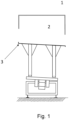
- Figure 1 schematically shows a furnace for the heating of expandable silica particles according to the disclosure.
- An expandable silica particle according to the disclosure comprises silica powder, silica fume, and at least one expanding agent.
- the expandable silica particle further comprises a coating provided on the outer surface of the expandable silica particle, wherein the coating comprises kaolin powder and talc powder.
- kaolin acts as a release agent, whereas talc offsets the negative effects of kaolin at high temperatures by rendering the outer surface of the expanding silica particle more elastic and with closed cells.
- the expandable silica particle may comprise further additives, such as a coloring agent.
- the expandable silica particle may have a bulk density of 0.3 - 1.7 kg/l, preferably 0.5 -1.5 kg/l.
- the expandable silica particle may have a diameter of 0.1 - 40 mm, preferably 0.25 - 5.6 mm, most preferably 0.8 - 1.6 mm.
- the expandable silica particle comprises 50 - 98 wt% of silica powder.
- the particles of the silica powder may have a diameter of 0.01 - 700 ⁇ m.
- the silica powder comprises a recycled glass powder. Recycled glass powder may, for instance, be sourced from post-consumer recycled glass, soda lime glass, float glass, windscreens, solar panels.
- the expandable silica particles thereby form an environmentally friendly material.
- the expandable silica particle may comprise 0.85 - 10 wt% of at least one expanding agent.
- the expanding agent may comprise a powder.
- the particles of the expanding agent powder have a diameter of 0.01 - 40.0 ⁇ m.
- the at least one expanding agent may comprise aluminum nitride (AIN), silicon carbide (SiC), manganese dioxide (MnO 2 ), sodium carbonate (NasCOs), calcium sodium carbonate (CaNasCOs) or combinations thereof.
- the at least one expanding agent comprises silicon carbide powder.
- the expandable silica particle may comprise 0.01 - 10 wt% of silica fume.
- Silica fume comprises ultrafine silica particles with a particle diameter below 1 ⁇ m.
- the diameter of the silica fume particles is around 150 nm.
- the silica fume strengthens the walls of the cells that are formed in the expandable silica particle during expansion. Thereby, rupturing of the cell walls during expansion is reduced. Due to the strengthened cell walls and due to the reduced occurrence of rupturing of cell walls, the resulting expanded silica particle has a higher strength and a higher crush resistance with significantly reduced water adsorption.
- the coating may comprise 0.5 - 10 wt% of kaolin powder (Al 2 SiO 5 (HO) 4 ).
- the kaolin acts as a release agent.
- the coating further comprises talc powder (Mg 3 Si 4 O 10 (OH) 2 ).
- the coating may comprise 0.5 - 5 wt% of talc powder.
- the talc powder melts into the surface of the expanding silica particle and renders the surface more elastic or flexible, thereby reducing the collapse of cells at the outer surface of the expanding silica particle. Consequently, the talc powder counteracts the adverse effect of kaolin, occurring at high temperatures, and acts to maintain the surface integrity of the expanding silica particle. Thereby, the resistance against fluid adsorption in the expanded silica particle is improved.
- the method comprises providing expandable silica pre-particles comprising silica powder, silica fume and at least one expanding agent.
- Providing expandable silica pre-particles may comprise the sintering or heat-pressing of a mixture of silica powder, silica fume and at least one expanding agent into a block at a temperature below the activation temperature of the at least one expanding agent.
- the block may then be divided into expandable silica pre-particles, for instance by cutting or by crushing the sintered block into granules.
- the granules may be filtered according to size and large granules may be subjected to further dividing.
- the mixture of silica powder, silica fume and at least one expanding agent may be heat-pressed directly into expandable silica pre-particles.
- the mixture of silica powder, silica fume and at least one expanding agent may be provided with a binder and processed in an industrial pelletizer.
- the method for preparing one or more expandable silica particles further comprises the step of coating the outer surface of the expandable silica pre-particle with a coating comprising kaolin and talc, to thereby form an expandable silica particle.
- a method for producing expanded silica particles comprises providing a plurality of expandable silica particles according to the disclosure and heating the expandable silica particles in a chamber 2 of a furnace 1 to above the activation temperature of the expanding agent to form expanded silica particles.
- the expandable silica particles may be fed into the chamber 2 (schematically shown in fig. 1 ) by a feeding system.
- the expandable silica particles may be fed onto an angled, vibrating plate body.
- a directional, high frequent motion may thereby be induced in the expandable silica particles, wherein the motion may be chaotic or turbulent.
- the expandable silica particles may first be fed into a preheating chamber, before being fed or conveyed into the chamber 2.
- the temperature difference between the core and the surface of the expandable silica particles are minimized during preheating.
- the expandable silica particles are heated to above the activation temperature of the expanding agent, to a temperature of 560 - 950°C, preferably 850 - 900°C.
- the expandable silica particles are softened.
- an exotherm reaction occurs, driving expansion of the softened particles.
- the coating on the outer surface of the expandable silica particles isolates the outer surface during exotherm-driven expansion. Thereby, the expansion process is counteracted at the surface of the expanding silica particles, resulting in a denser outer surface of the expanded silica particles, with less open cells as compared to particles without coating.
- the temperature and the residence time may be controlled, thereby controlling the expansion rate of the expandable silica particles.
- the residence time may be controlled by controlling the conveying speed of the particles in the chamber 2.
- the furnace 1 may further comprise a vibration plate 3, forming the bottom of the chamber 2.
- the vibration plate 3 is preferably inclined by an inclination angle with respect to the horizontal direction, from the entry downward to the exit of the furnace.
- the vibration plate 3 is vibrated during the heating and expansion of the expandable silica particles, thereby inducing motion in the expandable silica particles.
- the contact time between silica particles in the furnace 1 is thereby limited, such that the risk for adhesion of particles to one another and to the furnace is minimized.
- the expanded silica particles may enter a cooling zone, comprising one or more stages kept at progressively lower temperatures.
- the expanded silica particles are preferably cooled to ambient temperature in the cooling zone, allowing further handling of the expanded silica particles.
- the temperature and the residence time for each stage may be controlled, thereby controlling the cooling rate of the expanded silica particles.
- internal tension within the expanded silica particles due to differential cooling rates at the particle surface and in the particle-interior may thereby be minimized.
- the expanded silica particles may be coated with a sodium silicate solution, also known as water glass, preferably at a temperature of 0.1 - 200°C.
- the sodium silicate solution further reduces surface porosity of the expandable silica particle, thereby improving resistance against fluid adsorption in the expanded silica particle.
- An expanded silica particle according to the disclosure preferably has a bulk density of 150 - 900 g/l.
- the expanded silica particle has a spherical or close to spherical shape.
- the expanded silica particle may be used as a filler in concrete, plaster, gypsum, mortar, epoxy, polyurethane, acrylate or a suitable organic binder, or artificial turf or as a filler in water filtration cartridges.
- the expanded silica particle has a significantly reduced fluid adsorption capacity and may, for instance, adsorb a negligible amount of concrete additives when used as a filler in a concrete matrix material.
- Expandable silica pre-particles were provided by sintering 95 wt% of silica powder, 3 wt% of SiC powder expanding agent and 2 wt % of silica fume at 710°C into a block.
- the silica powder comprises recycled flat glass.
- the SiC powder had a particle diameter of 0.01 - 2 ⁇ m.
- the sintered block was then crushed into expandable pre-particles, which were filtered according to particle diameter.
- the expandable pre-particles were dry-coated with a coating comprising kaolin powder and talc powder, to form expandable silica particles.
- the expandable silica particles comprised 91.2 wt% of silica powder, 2.88 wt% of SiC powder, 1.92 wt % of silica fume, 2 wt% kaolin powder and 2 wt% talc powder.
- the expandable silica particles were preheated at 680°C for a period of 300 s, before being heated to 870°C for 36 s. Heating was then continued at 865°C for 45 s and at 860°C for 45 s, before cooling commenced, at 200°C for 18 s.
- the resulting expanded silica particles had a bulk density (determined according to UNI EN 1097-6:2013, appendix C) of 275 g/l and a diameter (determined according to sieving method of UNI EN 933-1: 2012) of 2 - 8 mm.
- Crushing resistance of the expanded silica particles determined according to UNI EN 13055-1:2003, appendix A, par. 4.10, was measured to be 6.19 N/mm 2 .
- Expandable silica pre-particles were provided by sintering 97 wt% of silica powder and 3 wt% of SiC powder expanding agent at 710°C into a block.
- the silica powder comprised recycled flat glass.
- the SiC powder had a particle diameter of 0.01 - 2 ⁇ m.
- the sintered block was then crushed into expandable pre-particles, which were filtered according to particle diameter.
- the expandable pre-particles were then dry-coated with a coating comprising kaolin powder, to form expandable silica particles.
- the expandable silica particles comprised 93.12 wt% of silica powder, 2.88 wt% of SiC expanding agent and 4 wt% of kaolin coating.
- the expandable silica particles were heated and cooled according to the same regime as in Example 1. Bulk density, particle diameter, water adsorption and crushing resistance were determined according to the same standards as cited for Example 1.
- the resulting expanded silica particles had a particle diameter of 2 - 8 mm, a bulk density of 300 g/l for the segment with particle diameters of 2 - 4 mm and a bulk density of 275 g/l for the segment with particle diameters of 4 - 8 mm.
- the expanded silica particles had a water adsorption of 24.2 % for the segment with particle diameters of 2 - 4 mm and of 21,9% for the segment with particle diameters of 4 - 8 mm.
- the expanded silica particles in the comparative example had a crushing resistance of 3.5 N/mm 2 for the segment with particle diameters of 2 - 4 mm and of 2.7 N/mm 2 for the segment with particle diameters of 4 - 8 mm.
Landscapes
- Chemical & Material Sciences (AREA)
- Engineering & Computer Science (AREA)
- Organic Chemistry (AREA)
- Materials Engineering (AREA)
- Ceramic Engineering (AREA)
- Chemical Kinetics & Catalysis (AREA)
- Structural Engineering (AREA)
- Geochemistry & Mineralogy (AREA)
- General Chemical & Material Sciences (AREA)
- Life Sciences & Earth Sciences (AREA)
- Manufacturing & Machinery (AREA)
- Thermal Sciences (AREA)
- Inorganic Chemistry (AREA)
- Physics & Mathematics (AREA)
- Civil Engineering (AREA)
- Mechanical Engineering (AREA)
- General Engineering & Computer Science (AREA)
- Health & Medical Sciences (AREA)
- Medicinal Chemistry (AREA)
- Polymers & Plastics (AREA)
- Silicon Compounds (AREA)
- Pigments, Carbon Blacks, Or Wood Stains (AREA)
- Glanulating (AREA)
Abstract
Description
- The present disclosure concerns an expandable silica particle, a method for expanding silica particles, expanded silica particles produced by the method, use of expanded silica particles and a method for producing an expandable silica particle.
- Expanded silica particles are utilized in various areas, for example as a filler in matrix materials, like concrete or epoxy, as insulation material with various binder materials, or as water filtration medium. Several advantageous physical properties are associated with expanded silica particles, such as low density, high dimensional stability, excellent compression strength, and high insulation capacity. Expanded silica particles added to a matrix material may also improve the processability of the matrix material before hardening, for instance by improving flowability at very low water adsorption. Additionally, expanded silica particles may reduce overall material costs, in particular for expensive matrix materials. Finally, by utilizing post-consumer recycled glass, expanded silica materials contribute to environmental sustainability.
- During the production of expanded silica particles, it is desirable to utilize temperatures at which the expanding silica particles are close to the transition from a plastic state to a molten state. At these temperatures the material of the expanding silica particles provides least resistance to the ongoing expansion. Thereby a more optimal expansion and a more uniform spherical shape of the expanded silica particles is achieved. Problems in commonly used processes may, however, arise due to the expanding silica particles being close to the transition from the plastic state to the molten state. Close to this transition, the expanding silica particles are more prone to adhere to one another, and to the surrounding furnace in which the particles are expanded. Although a kaolin coating may be used as a release agent, kaolin transfers into metakaolin at temperatures close to the plastic-molten transition and may thereby lose most of its properties as a release agent. The metakaolin may also melt into the surface of the softened expanding silica particles, thereby further reducing its effectiveness as a release agent.
- Furthermore, due to the low viscosity at temperatures close to the transition from the plastic state to the molten state, the interior cell walls may rupture, leading to an open-pored internal structure, whereas cells at the outer surface of the expanding silica particles may collapse. When using kaolin coating as a release agent, the surface of the expanding silica particles may additionally become more brittle, leading to a further risk of collapse of cells at the outer surface and consequently a deterioration in physical properties. These effects may lead to both weakened expanded silica particles and to an increased capacity of the expanded silica particles to adsorb fluids, such as water. Especially when used as a filler in a matrix material, like an organic or inorganic binder, a high adsorption capacity may cause the expanded silica particles to adsorb large quantities of the matrix material. Such an adsorption of matrix material negatively affects the properties of the expanded silica particles as a filler material. For instance, adsorbing concrete additives such as a water reducer, air entrainment agent, will have significant impact on flow behavior and mechanical properties in the cured state. This counteracts the desired effect of lowering the overall material density of matrix and filler.
- Consequently, there is a clear need for an improved expandable silica particle, which can be expanded at a temperature close to the plastic-molten transition, while reducing the risk of adhesion of softened expandable silica particles to one another and / or to the furnace and reducing the risk of rupturing of internal cell walls and the risk of collapse of cells at the outer surface.
- The present disclosure concerns a method for producing one or more expandable silica particles according to
claim 1 and a method for producing expanded silica particles according to claim 6. -
Figure 1 schematically shows a furnace for the heating of expandable silica particles according to the disclosure. - An expandable silica particle according to the disclosure comprises silica powder, silica fume, and at least one expanding agent. The expandable silica particle further comprises a coating provided on the outer surface of the expandable silica particle, wherein the coating comprises kaolin powder and talc powder. Advantageously, kaolin acts as a release agent, whereas talc offsets the negative effects of kaolin at high temperatures by rendering the outer surface of the expanding silica particle more elastic and with closed cells. Optionally, the expandable silica particle may comprise further additives, such as a coloring agent. The expandable silica particle may have a bulk density of 0.3 - 1.7 kg/l, preferably 0.5 -1.5 kg/l. The expandable silica particle may have a diameter of 0.1 - 40 mm, preferably 0.25 - 5.6 mm, most preferably 0.8 - 1.6 mm.
- The expandable silica particle comprises 50 - 98 wt% of silica powder. The particles of the silica powder may have a diameter of 0.01 - 700 µm. Preferably, the silica powder comprises a recycled glass powder. Recycled glass powder may, for instance, be sourced from post-consumer recycled glass, soda lime glass, float glass, windscreens, solar panels. Advantageously, the expandable silica particles thereby form an environmentally friendly material.
- The expandable silica particle may comprise 0.85 - 10 wt% of at least one expanding agent. The expanding agent may comprise a powder. Preferably, the particles of the expanding agent powder have a diameter of 0.01 - 40.0 µm. The at least one expanding agent may comprise aluminum nitride (AIN), silicon carbide (SiC), manganese dioxide (MnO2), sodium carbonate (NasCOs), calcium sodium carbonate (CaNasCOs) or combinations thereof. Preferably, the at least one expanding agent comprises silicon carbide powder.
- The expandable silica particle may comprise 0.01 - 10 wt% of silica fume. Silica fume comprises ultrafine silica particles with a particle diameter below 1 µm. Preferably, the diameter of the silica fume particles is around 150 nm. Advantageously, the silica fume strengthens the walls of the cells that are formed in the expandable silica particle during expansion. Thereby, rupturing of the cell walls during expansion is reduced. Due to the strengthened cell walls and due to the reduced occurrence of rupturing of cell walls, the resulting expanded silica particle has a higher strength and a higher crush resistance with significantly reduced water adsorption.
- The coating may comprise 0.5 - 10 wt% of kaolin powder (Al2SiO5(HO)4). Advantageously, the kaolin acts as a release agent. Thereby the risk of adhesion of expandable silica particles to one another and / or to the furnace is reduced. This is especially important for large production volumes, where numerous particles are expanded simultaneously. Nevertheless, endothermic dehydration of kaolin takes place in the temperature interval 560 - 950°C, producing metakaolin that will gradually reduce the effect of kaolin as a release agent. Therefore, the coating further comprises talc powder (Mg3Si4O10(OH)2). The coating may comprise 0.5 - 5 wt% of talc powder. Advantageously, during expansion the talc powder melts into the surface of the expanding silica particle and renders the surface more elastic or flexible, thereby reducing the collapse of cells at the outer surface of the expanding silica particle. Consequently, the talc powder counteracts the adverse effect of kaolin, occurring at high temperatures, and acts to maintain the surface integrity of the expanding silica particle. Thereby, the resistance against fluid adsorption in the expanded silica particle is improved.
- A method for preparing one or more expandable silica particles according to the disclosure is next described. The method comprises providing expandable silica pre-particles comprising silica powder, silica fume and at least one expanding agent. Providing expandable silica pre-particles may comprise the sintering or heat-pressing of a mixture of silica powder, silica fume and at least one expanding agent into a block at a temperature below the activation temperature of the at least one expanding agent. The block may then be divided into expandable silica pre-particles, for instance by cutting or by crushing the sintered block into granules. The granules may be filtered according to size and large granules may be subjected to further dividing. Alternatively, the mixture of silica powder, silica fume and at least one expanding agent may be heat-pressed directly into expandable silica pre-particles. Further alternatively, the mixture of silica powder, silica fume and at least one expanding agent may be provided with a binder and processed in an industrial pelletizer. The method for preparing one or more expandable silica particles further comprises the step of coating the outer surface of the expandable silica pre-particle with a coating comprising kaolin and talc, to thereby form an expandable silica particle.
- A method for producing expanded silica particles comprises providing a plurality of expandable silica particles according to the disclosure and heating the expandable silica particles in a
chamber 2 of afurnace 1 to above the activation temperature of the expanding agent to form expanded silica particles. The expandable silica particles may be fed into the chamber 2 (schematically shown infig. 1 ) by a feeding system. In thechamber 2, the expandable silica particles may be fed onto an angled, vibrating plate body. A directional, high frequent motion may thereby be induced in the expandable silica particles, wherein the motion may be chaotic or turbulent. Preferably, the expandable silica particles may first be fed into a preheating chamber, before being fed or conveyed into thechamber 2. Advantageously, the temperature difference between the core and the surface of the expandable silica particles are minimized during preheating. In thechamber 2, the expandable silica particles are heated to above the activation temperature of the expanding agent, to a temperature of 560 - 950°C, preferably 850 - 900°C. During heating the expandable silica particles are softened. Above the activation temperature of the expanding agent, an exotherm reaction occurs, driving expansion of the softened particles. Advantageously, the coating on the outer surface of the expandable silica particles isolates the outer surface during exotherm-driven expansion. Thereby, the expansion process is counteracted at the surface of the expanding silica particles, resulting in a denser outer surface of the expanded silica particles, with less open cells as compared to particles without coating. - Within the
chamber 2 the temperature and the residence time may be controlled, thereby controlling the expansion rate of the expandable silica particles. The residence time may be controlled by controlling the conveying speed of the particles in thechamber 2. Thefurnace 1 may further comprise avibration plate 3, forming the bottom of thechamber 2. Thevibration plate 3 is preferably inclined by an inclination angle with respect to the horizontal direction, from the entry downward to the exit of the furnace. Thevibration plate 3 is vibrated during the heating and expansion of the expandable silica particles, thereby inducing motion in the expandable silica particles. Advantageously, the contact time between silica particles in thefurnace 1 is thereby limited, such that the risk for adhesion of particles to one another and to the furnace is minimized. - Upon exiting the
furnace 1, the expanded silica particles may enter a cooling zone, comprising one or more stages kept at progressively lower temperatures. The expanded silica particles are preferably cooled to ambient temperature in the cooling zone, allowing further handling of the expanded silica particles. Within the cooling zone the temperature and the residence time for each stage may be controlled, thereby controlling the cooling rate of the expanded silica particles. Advantageously, internal tension within the expanded silica particles due to differential cooling rates at the particle surface and in the particle-interior may thereby be minimized. Following cooling, the expanded silica particles may be coated with a sodium silicate solution, also known as water glass, preferably at a temperature of 0.1 - 200°C. Advantageously, the sodium silicate solution further reduces surface porosity of the expandable silica particle, thereby improving resistance against fluid adsorption in the expanded silica particle. - An expanded silica particle according to the disclosure preferably has a bulk density of 150 - 900 g/l. Preferably, the expanded silica particle has a spherical or close to spherical shape. The expanded silica particle may be used as a filler in concrete, plaster, gypsum, mortar, epoxy, polyurethane, acrylate or a suitable organic binder, or artificial turf or as a filler in water filtration cartridges. Advantageously, the expanded silica particle has a significantly reduced fluid adsorption capacity and may, for instance, adsorb a negligible amount of concrete additives when used as a filler in a concrete matrix material.
- Expandable silica pre-particles were provided by sintering 95 wt% of silica powder, 3 wt% of SiC powder expanding agent and 2 wt % of silica fume at 710°C into a block. The silica powder comprises recycled flat glass. The SiC powder had a particle diameter of 0.01 - 2 µm. The sintered block was then crushed into expandable pre-particles, which were filtered according to particle diameter. The expandable pre-particles were dry-coated with a coating comprising kaolin powder and talc powder, to form expandable silica particles. The expandable silica particles comprised 91.2 wt% of silica powder, 2.88 wt% of SiC powder, 1.92 wt % of silica fume, 2 wt% kaolin powder and 2 wt% talc powder. The expandable silica particles were preheated at 680°C for a period of 300 s, before being heated to 870°C for 36 s. Heating was then continued at 865°C for 45 s and at 860°C for 45 s, before cooling commenced, at 200°C for 18 s. The resulting expanded silica particles had a bulk density (determined according to UNI EN 1097-6:2013, appendix C) of 275 g/l and a diameter (determined according to sieving method of UNI EN 933-1: 2012) of 2 - 8 mm. Crushing resistance of the expanded silica particles, determined according to UNI EN 13055-1:2003, appendix A, par. 4.10, was measured to be 6.19 N/mm2. Water adsorption determined according to UNI EN 1097-6:2013 (appendix C - adsorption after 5 minutes) was measured to be 4.4%.
- Expandable silica pre-particles were provided by sintering 97 wt% of silica powder and 3 wt% of SiC powder expanding agent at 710°C into a block. The silica powder comprised recycled flat glass. The SiC powder had a particle diameter of 0.01 - 2 µm. The sintered block was then crushed into expandable pre-particles, which were filtered according to particle diameter. The expandable pre-particles were then dry-coated with a coating comprising kaolin powder, to form expandable silica particles. The expandable silica particles comprised 93.12 wt% of silica powder, 2.88 wt% of SiC expanding agent and 4 wt% of kaolin coating. The expandable silica particles were heated and cooled according to the same regime as in Example 1. Bulk density, particle diameter, water adsorption and crushing resistance were determined according to the same standards as cited for Example 1. The resulting expanded silica particles had a particle diameter of 2 - 8 mm, a bulk density of 300 g/l for the segment with particle diameters of 2 - 4 mm and a bulk density of 275 g/l for the segment with particle diameters of 4 - 8 mm. The expanded silica particles had a water adsorption of 24.2 % for the segment with particle diameters of 2 - 4 mm and of 21,9% for the segment with particle diameters of 4 - 8 mm. Finally, the expanded silica particles in the comparative example had a crushing resistance of 3.5 N/mm2 for the segment with particle diameters of 2 - 4 mm and of 2.7 N/mm2 for the segment with particle diameters of 4 - 8 mm.
Claims (14)
- A method for producing one or more expandable silica pre-particles comprising:(a) sintering or heat-pressing a mixture of silica powder, silica fume and at least one expanding agent into a block at a temperature below the activation temperature of the at least one expanding agent and dividing the block into expandable silica pre-particles or(b) heat-pressing a mixture of silica powder, silica fume and at least one expanding agent directly into expandable silica pre-particles or(c) providing a mixture of silica powder, silica fume and at least one expanding agent with a binder and processing in a pelletizer.
- The method according to claim 1, wherein the silica powder comprises recycled glass powder.
- The method according to claim 1 or 2, wherein the at least one expanding agent comprises a powder comprising aluminum nitride, silicon carbide, manganese dioxide, sodium carbonate, calcium sodium carbonate, or combinations thereof.
- The method according to any one of the preceding claims, wherein the particles of the expanding agent powder have a diameter of 0.01 - 40 µm.
- The method according to any one of the preceding claims, wherein the at least one expanding agent comprises a silicon carbide powder.
- A method for producing expanded silica particles comprising:(a) Providing expandable silica pre-particles obtainable according to the method of any one of claims 1 to 5;(b) Providing the expandable silica pre-particles with a coating on the outer surface thereof, wherein the coating comprises kaolin powder and talc powder, to form expandable silica particles; and(c) heating the expandable silica particles in a chamber of a furnace to above the activation temperature of the expanding agent to form expanded silica particles.
- The method according to claim 6, wherein the expandable silica particles in the chamber are heated to a temperature of 560 - 950°C.
- The method according to claim 6, wherein the expandable silica particles in the chamber are heated to a temperature of 850 - 950°C.
- The method according to any one of claims 6 to 9, wherein the silica powder comprises recycled glass powder.
- The method according to any one of claims 6 to 10, wherein the at least one expanding agent comprises a powder comprising aluminum nitride, silicon carbide, manganese dioxide, sodium carbonate, calcium sodium carbonate, or combinations thereof.
- The method according to any one of claims 6 to 11, wherein the particles of the expanding agent powder have a diameter of 0.01 - 40 µm.
- The method according to any one of claims 6 to 12, wherein the at least one expanding agent comprises a silicon carbide powder.
- The method according to any one of claims 6 to 13, wherein the expandable silica particle has a diameter of 0.1 - 40 mm
- The method according to any one of claims 6 to 13, wherein the expandable silica particle has a diameter of 0.25 -5.6 mm.
Applications Claiming Priority (4)
| Application Number | Priority Date | Filing Date | Title |
|---|---|---|---|
| NO20200545 | 2020-05-10 | ||
| NO20200660A NO346349B1 (en) | 2020-05-10 | 2020-06-04 | Method to create a turbulent and directional movement of expanded glass particles after entering a plastic state |
| PCT/IB2021/053938 WO2021229400A1 (en) | 2020-05-10 | 2021-05-10 | Expandable silica particle |
| EP21725833.4A EP4149884B1 (en) | 2020-05-10 | 2021-05-10 | Expandable silica particle |
Related Parent Applications (1)
| Application Number | Title | Priority Date | Filing Date |
|---|---|---|---|
| EP21725833.4A Division EP4149884B1 (en) | 2020-05-10 | 2021-05-10 | Expandable silica particle |
Publications (2)
| Publication Number | Publication Date |
|---|---|
| EP4273109A2 true EP4273109A2 (en) | 2023-11-08 |
| EP4273109A3 EP4273109A3 (en) | 2024-03-13 |
Family
ID=75919357
Family Applications (3)
| Application Number | Title | Priority Date | Filing Date |
|---|---|---|---|
| EP21725833.4A Active EP4149884B1 (en) | 2020-05-10 | 2021-05-10 | Expandable silica particle |
| EP21725832.6A Pending EP4149883A1 (en) | 2020-05-10 | 2021-05-10 | Method and furnace for producing expanded silica particles |
| EP23190126.5A Pending EP4273109A3 (en) | 2020-05-10 | 2021-05-10 | Expandable silica particle |
Family Applications Before (2)
| Application Number | Title | Priority Date | Filing Date |
|---|---|---|---|
| EP21725833.4A Active EP4149884B1 (en) | 2020-05-10 | 2021-05-10 | Expandable silica particle |
| EP21725832.6A Pending EP4149883A1 (en) | 2020-05-10 | 2021-05-10 | Method and furnace for producing expanded silica particles |
Country Status (10)
| Country | Link |
|---|---|
| US (3) | US11976000B2 (en) |
| EP (3) | EP4149884B1 (en) |
| CN (3) | CN115515896B (en) |
| AU (3) | AU2021271289B2 (en) |
| ES (1) | ES2953398T3 (en) |
| HR (1) | HRP20230953T1 (en) |
| HU (1) | HUE063569T2 (en) |
| MX (2) | MX2022014187A (en) |
| PL (1) | PL4149884T3 (en) |
| WO (2) | WO2021229400A1 (en) |
Families Citing this family (2)
| Publication number | Priority date | Publication date | Assignee | Title |
|---|---|---|---|---|
| CN115515896B (en) | 2020-05-10 | 2025-04-15 | 瓦卢诺股份公司 | Expandable silica particles |
| CN118324144A (en) * | 2024-03-26 | 2024-07-12 | 云南永昌硅业股份有限公司 | A method for surface modification of microsilica powder organic coating |
Family Cites Families (53)
| Publication number | Priority date | Publication date | Assignee | Title |
|---|---|---|---|---|
| US2255237A (en) | 1938-06-07 | 1941-09-09 | Corning Glass Works | Apparatus for making multicellular glass |
| US2582852A (en) | 1948-06-16 | 1952-01-15 | Pittsburgh Corning Corp | Method of making cellular glass of light color |
| FR1012485A (en) | 1949-10-10 | 1952-07-10 | Saint Gobain | Improvements in the manufacture of multicellular glass objects |
| US2691248A (en) | 1950-12-19 | 1954-10-12 | Pittsburgh Corning Corp | Nodulated cellular glass and method of forming |
| US2883347A (en) * | 1955-09-13 | 1959-04-21 | Bell Telephone Labor Inc | Formation of expanded silica spheres |
| FR1564254A (en) * | 1968-04-26 | 1969-04-18 | ||
| DE2537508C3 (en) | 1975-08-22 | 1980-06-26 | Joachim Dr.-Ing. 7251 Warmbronn Wuenning | Process and device for the production of strand-like moldings with a cell-like structure from sinterable granules |
| US4075025A (en) | 1976-05-10 | 1978-02-21 | Pittsburgh Corning Corporation | Method of forming a potassium aluminoborosilicate frit |
| SE405246B (en) | 1976-06-10 | 1978-11-27 | Euroc Development Ab | WAY TO PRODUCE FOAM CERAMICS |
| GB1597154A (en) * | 1977-05-19 | 1981-09-03 | Bfg Glassgroup | Glass beads |
| US4198224A (en) | 1978-08-16 | 1980-04-15 | Pittsburgh Corning Corporation | Process for making a cellulated vitreous material |
| US4347326A (en) | 1980-03-17 | 1982-08-31 | Asahi-Dow Limited | Foamable glass composition and glass foam |
| US4552577A (en) | 1983-04-05 | 1985-11-12 | Pedro B. Macedo | Method of producing shaped foamed-glass articles |
| SU1139701A1 (en) | 1983-05-24 | 1985-02-15 | Специальное Конструкторско-Технологическое Бюро С Экспериментальным Производством Института Физической Химии Им.Л.В.Писаржевского | Method of obtaining hollow microspherical particles of silicon dioxide |
| JPS61236621A (en) * | 1985-04-10 | 1986-10-21 | Sekisui Plastics Co Ltd | Production of foamed fine glass grain |
| US4769057A (en) | 1987-05-12 | 1988-09-06 | Pittsburgh Corning Corporation | Fluidized bed cellulation process |
| DE4038637A1 (en) | 1990-11-05 | 1992-05-07 | Dennert Poraver Gmbh | USE OF CERTAIN OLD GLASS VARIETIES FOR THE MANUFACTURE OF FOAM GLASS MOLDED BODIES |
| JPH07138045A (en) | 1993-11-09 | 1995-05-30 | Nippon Electric Glass Co Ltd | Hollow glass sphere manufacturing method |
| DE19522460C2 (en) | 1995-06-21 | 2000-06-21 | Dennert Poraver Gmbh | Process for the production of foam glass granules |
| DE19534600A1 (en) | 1995-09-18 | 1997-03-20 | Dennert Poraver Gmbh | Process for the production of lightweight moldings and lightweight moldings produced therewith, in particular lightweight insulation panels |
| JP3303972B2 (en) | 1999-01-05 | 2002-07-22 | クリスタルクレイ株式会社 | Aggregate |
| NO312758B1 (en) | 2000-02-08 | 2002-07-01 | Norsk Glassgjenvinning As | Concrete with aggregate comprising broken glass |
| DE10042071C1 (en) | 2000-08-16 | 2002-03-21 | Mattig & Lindner Gmbh | Porous silicate granulate used as additive for the production of building materials such as light concrete, mortar or heat insulating plaster contains glass and a glassy crystalline component |
| US6562245B2 (en) | 2001-02-05 | 2003-05-13 | Integrated Environmental Technologies, Llc | Crushed foam glass filter aid and method of use |
| US20030084683A1 (en) | 2001-11-05 | 2003-05-08 | Robert Dejaiffe | Foam glass and method of making |
| US6746623B2 (en) | 2002-02-01 | 2004-06-08 | Air Products And Chemicals, Inc. | Alkyl glycidyl ether-capped diamine foam controlling agent |
| JP2004256368A (en) | 2003-02-27 | 2004-09-16 | J Fec:Kk | Aggregate and cementitious composition |
| JP2004307226A (en) * | 2003-04-02 | 2004-11-04 | J Fec:Kk | Flowability-improving method for mortar |
| US20090146108A1 (en) * | 2003-08-25 | 2009-06-11 | Amlan Datta | Methods and Formulations for Producing Low Density Products |
| DE102004012598A1 (en) | 2004-03-12 | 2005-09-29 | Dennert Poraver Gmbh | Process for producing foam glass granules |
| CA2598824A1 (en) | 2005-03-01 | 2006-09-08 | Dennert Poraver Gmbh | Process for preparing foamed glass granulate |
| EP1955986A1 (en) | 2007-01-18 | 2008-08-13 | Sika Technology AG | Light weight aggregate |
| CN101045832A (en) * | 2007-03-22 | 2007-10-03 | 袁景华 | Polymer coating composite and preparation method thereof |
| US20090226646A1 (en) | 2008-03-06 | 2009-09-10 | Viceroy Ceramics | Glass particles with smoothed surfaces for use as artificial turf fill |
| DE102010000049C5 (en) * | 2010-01-12 | 2022-03-31 | Liaver Gmbh & Co. Kg | Process for the production of expanded glass granules and expanded glass granules and their use |
| NO20100058A1 (en) | 2010-01-13 | 2011-07-15 | Glassolite Ltd | Process and apparatus for producing foamed glass under pressure |
| CN101880128A (en) | 2010-07-02 | 2010-11-10 | 陕西科技大学 | A kind of preparation method of lightweight high-strength foam glass |
| US20130219963A1 (en) * | 2010-10-28 | 2013-08-29 | Heraeus Quarzglas Gmbh & Co. Kg | Method for producing synthetic quartz glass granules |
| CA2947461A1 (en) | 2014-05-05 | 2015-11-12 | Glassolite Ltd. | Apparatus and method for production of foamed glass and a foamed glass material |
| EP3194344A1 (en) | 2014-09-15 | 2017-07-26 | Pcfg As | Molding of a foamed glass product with an outer protective crust |
| WO2016120374A1 (en) | 2015-01-29 | 2016-08-04 | Glassolite Ltd. | Apparatus and method for the production of foamed glass by extrusion |
| DE102015201842B4 (en) | 2015-02-03 | 2018-08-16 | Dennert Poraver Gmbh | Expanded glass granules and method of manufacture |
| DE102015209516B4 (en) | 2015-05-22 | 2018-11-22 | Dennert Poraver Gmbh | Method and plant for the production of mono- or multicellular expanded microparticles of glass or a ceramic material |
| DE102015215800A1 (en) | 2015-08-19 | 2017-02-23 | Dennert Poraver Gmbh | Process and plant for the production of mono- or multicellular expanded particles from a vitreous or ceramic material |
| DE102015223372A1 (en) | 2015-11-26 | 2017-06-01 | Dennert Poraver Gmbh | Process and plant for the production of mono- or multicellular expanded particles from a vitreous or ceramic material |
| CA3018811C (en) * | 2016-04-18 | 2024-01-09 | Basf Se | Silica-coated expanding agents and their use in cementitious systems |
| EP3532441A1 (en) | 2016-10-31 | 2019-09-04 | Glassolite Group Ltd. | Manufacturing of an artificial igneous rock material by a sintering process |
| WO2019002561A1 (en) * | 2017-06-30 | 2019-01-03 | Glassolite As | Preparation of sintered granulate for the manufacturing of a foamed glass pellets |
| EP3694640B1 (en) * | 2017-10-13 | 2022-05-04 | Basf Se | Core-shell expanding agents and their use in cementitious systems |
| CN109020302A (en) | 2018-10-10 | 2018-12-18 | 广东中旗新材料股份有限公司 | It is a kind of using glass as artificial stone of major ingredient and preparation method thereof |
| EP3771702A1 (en) | 2019-07-31 | 2021-02-03 | Cosentino Research & Development, S.L. | Artificial agglomerate stone article comprising synthetic silicate granules |
| CN115515896B (en) | 2020-05-10 | 2025-04-15 | 瓦卢诺股份公司 | Expandable silica particles |
| NO346841B1 (en) | 2021-06-18 | 2023-01-30 | Ophiolite As | Heat refractive insulation material |
-
2021
- 2021-05-10 CN CN202180034048.2A patent/CN115515896B/en active Active
- 2021-05-10 EP EP21725833.4A patent/EP4149884B1/en active Active
- 2021-05-10 AU AU2021271289A patent/AU2021271289B2/en active Active
- 2021-05-10 CN CN202510361264.8A patent/CN120208246A/en active Pending
- 2021-05-10 WO PCT/IB2021/053938 patent/WO2021229400A1/en not_active Ceased
- 2021-05-10 HR HRP20230953TT patent/HRP20230953T1/en unknown
- 2021-05-10 CN CN202180034051.4A patent/CN115515897A/en active Pending
- 2021-05-10 AU AU2021272735A patent/AU2021272735A1/en active Pending
- 2021-05-10 MX MX2022014187A patent/MX2022014187A/en unknown
- 2021-05-10 MX MX2022014183A patent/MX2022014183A/en unknown
- 2021-05-10 PL PL21725833.4T patent/PL4149884T3/en unknown
- 2021-05-10 EP EP21725832.6A patent/EP4149883A1/en active Pending
- 2021-05-10 WO PCT/IB2021/053936 patent/WO2021229399A1/en not_active Ceased
- 2021-05-10 EP EP23190126.5A patent/EP4273109A3/en active Pending
- 2021-05-10 HU HUE21725833A patent/HUE063569T2/en unknown
- 2021-05-10 ES ES21725833T patent/ES2953398T3/en active Active
-
2022
- 2022-08-26 US US17/896,412 patent/US11976000B2/en active Active
-
2024
- 2024-05-02 US US18/652,871 patent/US12577150B2/en active Active
- 2024-06-19 AU AU2024204197A patent/AU2024204197B2/en active Active
-
2026
- 2026-02-18 US US19/542,731 patent/US20260184620A1/en active Pending
Also Published As
| Publication number | Publication date |
|---|---|
| MX2022014187A (en) | 2023-01-24 |
| CN115515896A (en) | 2022-12-23 |
| AU2024204197B2 (en) | 2025-12-11 |
| US20260184620A1 (en) | 2026-07-02 |
| EP4149884C0 (en) | 2023-08-09 |
| ES2953398T3 (en) | 2023-11-10 |
| EP4149884B1 (en) | 2023-08-09 |
| CN120208246A (en) | 2025-06-27 |
| MX2022014183A (en) | 2023-01-24 |
| AU2021271289A1 (en) | 2023-02-02 |
| US11976000B2 (en) | 2024-05-07 |
| US12577150B2 (en) | 2026-03-17 |
| AU2021271289B2 (en) | 2024-03-21 |
| US20230023633A1 (en) | 2023-01-26 |
| EP4273109A3 (en) | 2024-03-13 |
| AU2024204197A1 (en) | 2024-07-11 |
| HUE063569T2 (en) | 2024-01-28 |
| WO2021229399A1 (en) | 2021-11-18 |
| WO2021229400A1 (en) | 2021-11-18 |
| EP4149883A1 (en) | 2023-03-22 |
| AU2021272735A1 (en) | 2023-02-02 |
| US20240317638A1 (en) | 2024-09-26 |
| EP4149884A1 (en) | 2023-03-22 |
| PL4149884T3 (en) | 2023-10-02 |
| CN115515897A (en) | 2022-12-23 |
| HRP20230953T1 (en) | 2023-11-24 |
| CN115515896B (en) | 2025-04-15 |
Similar Documents
| Publication | Publication Date | Title |
|---|---|---|
| AU2019343956B2 (en) | Sintered geopolymer compositions and articles | |
| AU695077B2 (en) | Hollow borosilicate microspheres and method of making | |
| US8609244B2 (en) | Engineered low-density heterogeneous microparticles and methods and formulations for producing the microparticles | |
| US4143202A (en) | Ash coated cellular glass pellet | |
| AU2024204197A1 (en) | Expandable silica particle | |
| CN115385645A (en) | High-performance autoclaved aerated concrete plate, preparation method thereof and building | |
| CN114671677A (en) | Energy-saving high-hardness ceramic tile and production process thereof | |
| CN1151992C (en) | Method for preparing spheric closed pore expanded perlite, and products thereby | |
| KR20020023194A (en) | Method for manufacturing of foamed glass from a used glass and composition for same | |
| CN114956777B (en) | Mineral melting direct casting crystallization micropore stone forming process | |
| CN111072370A (en) | Process for producing high-strength sintered hollow brick by using tailings | |
| RU2827814C1 (en) | Intumescent silica particle | |
| CN115010467A (en) | Preparation method and application of sound-absorbing porous ceramic | |
| Safaryan et al. | Monolithic blocks of expanded obsidian as thermal insulating and acoustic building materials | |
| JPH04240168A (en) | Production of sound-absorbing lightweight ceramic plate | |
| CN115180921A (en) | Preparation method and application of sound-absorbing foamed ceramic | |
| JP2000264754A (en) | Production of fine particulate balloon-containing lightweight high strength concrete | |
| JP2023148871A (en) | Method for producing cured product | |
| JP2023014063A (en) | Method for producing lightweight porous material particles | |
| JPS6150914B2 (en) | ||
| JPH10193320A (en) | Method for producing inorganic cured product | |
| JPH0516395B2 (en) |
Legal Events
| Date | Code | Title | Description |
|---|---|---|---|
| PUAI | Public reference made under article 153(3) epc to a published international application that has entered the european phase |
Free format text: ORIGINAL CODE: 0009012 |
|
| STAA | Information on the status of an ep patent application or granted ep patent |
Free format text: STATUS: THE APPLICATION HAS BEEN PUBLISHED |
|
| AC | Divisional application: reference to earlier application |
Ref document number: 4149884 Country of ref document: EP Kind code of ref document: P |
|
| AK | Designated contracting states |
Kind code of ref document: A2 Designated state(s): AL AT BE BG CH CY CZ DE DK EE ES FI FR GB GR HR HU IE IS IT LI LT LU LV MC MK MT NL NO PL PT RO RS SE SI SK SM TR |
|
| REG | Reference to a national code |
Ref country code: DE Ref legal event code: R079 Free format text: PREVIOUS MAIN CLASS: C04B0020100000 Ipc: C01B0033120000 |
|
| PUAL | Search report despatched |
Free format text: ORIGINAL CODE: 0009013 |
|
| AK | Designated contracting states |
Kind code of ref document: A3 Designated state(s): AL AT BE BG CH CY CZ DE DK EE ES FI FR GB GR HR HU IE IS IT LI LT LU LV MC MK MT NL NO PL PT RO RS SE SI SK SM TR |
|
| RIC1 | Information provided on ipc code assigned before grant |
Ipc: C04B 20/10 20060101ALI20240208BHEP Ipc: C04B 20/06 20060101ALI20240208BHEP Ipc: C04B 20/04 20060101ALI20240208BHEP Ipc: C04B 20/00 20060101ALI20240208BHEP Ipc: C04B 14/24 20060101ALI20240208BHEP Ipc: C03C 1/00 20060101ALI20240208BHEP Ipc: C03C 11/00 20060101ALI20240208BHEP Ipc: C03C 1/02 20060101ALI20240208BHEP Ipc: C03B 19/10 20060101ALI20240208BHEP Ipc: C01B 33/12 20060101AFI20240208BHEP |
|
| STAA | Information on the status of an ep patent application or granted ep patent |
Free format text: STATUS: REQUEST FOR EXAMINATION WAS MADE |
|
| 17P | Request for examination filed |
Effective date: 20240913 |
|
| RBV | Designated contracting states (corrected) |
Designated state(s): AL AT BE BG CH CY CZ DE DK EE ES FI FR GB GR HR HU IE IS IT LI LT LU LV MC MK MT NL NO PL PT RO RS SE SI SK SM TR |
|
| STAA | Information on the status of an ep patent application or granted ep patent |
Free format text: STATUS: EXAMINATION IS IN PROGRESS |
|
| 17Q | First examination report despatched |
Effective date: 20250221 |