EP4272240B1 - Hybrid semiconductor device - Google Patents
Hybrid semiconductor device Download PDFInfo
- Publication number
- EP4272240B1 EP4272240B1 EP21916331.8A EP21916331A EP4272240B1 EP 4272240 B1 EP4272240 B1 EP 4272240B1 EP 21916331 A EP21916331 A EP 21916331A EP 4272240 B1 EP4272240 B1 EP 4272240B1
- Authority
- EP
- European Patent Office
- Prior art keywords
- region
- field
- contact
- effect transistor
- support structure
- Prior art date
- Legal status (The legal status is an assumption and is not a legal conclusion. Google has not performed a legal analysis and makes no representation as to the accuracy of the status listed.)
- Active
Links
Images




Classifications
-
- H—ELECTRICITY
- H10—SEMICONDUCTOR DEVICES; ELECTRIC SOLID-STATE DEVICES NOT OTHERWISE PROVIDED FOR
- H10D—INORGANIC ELECTRIC SEMICONDUCTOR DEVICES
- H10D30/00—Field-effect transistors [FET]
- H10D30/60—Insulated-gate field-effect transistors [IGFET]
- H10D30/64—Double-diffused metal-oxide semiconductor [DMOS] FETs
- H10D30/65—Lateral DMOS [LDMOS] FETs
-
- H—ELECTRICITY
- H10—SEMICONDUCTOR DEVICES; ELECTRIC SOLID-STATE DEVICES NOT OTHERWISE PROVIDED FOR
- H10D—INORGANIC ELECTRIC SEMICONDUCTOR DEVICES
- H10D64/00—Electrodes of devices having potential barriers
- H10D64/20—Electrodes characterised by their shapes, relative sizes or dispositions
- H10D64/23—Electrodes carrying the current to be rectified, amplified, oscillated or switched, e.g. sources, drains, anodes or cathodes
- H10D64/251—Source or drain electrodes for field-effect devices
- H10D64/256—Source or drain electrodes for field-effect devices for lateral devices wherein the source or drain electrodes are recessed in semiconductor bodies
-
- H—ELECTRICITY
- H10—SEMICONDUCTOR DEVICES; ELECTRIC SOLID-STATE DEVICES NOT OTHERWISE PROVIDED FOR
- H10D—INORGANIC ELECTRIC SEMICONDUCTOR DEVICES
- H10D30/00—Field-effect transistors [FET]
- H10D30/01—Manufacture or treatment
- H10D30/021—Manufacture or treatment of FETs having insulated gates [IGFET]
- H10D30/0221—Manufacture or treatment of FETs having insulated gates [IGFET] having asymmetry in the channel direction, e.g. lateral high-voltage MISFETs having drain offset region or extended-drain MOSFETs [EDMOS]
-
- H—ELECTRICITY
- H10—SEMICONDUCTOR DEVICES; ELECTRIC SOLID-STATE DEVICES NOT OTHERWISE PROVIDED FOR
- H10D—INORGANIC ELECTRIC SEMICONDUCTOR DEVICES
- H10D30/00—Field-effect transistors [FET]
- H10D30/01—Manufacture or treatment
- H10D30/021—Manufacture or treatment of FETs having insulated gates [IGFET]
- H10D30/028—Manufacture or treatment of FETs having insulated gates [IGFET] of double-diffused metal oxide semiconductor [DMOS] FETs
- H10D30/0281—Manufacture or treatment of FETs having insulated gates [IGFET] of double-diffused metal oxide semiconductor [DMOS] FETs of lateral DMOS [LDMOS] FETs
- H10D30/0287—Manufacture or treatment of FETs having insulated gates [IGFET] of double-diffused metal oxide semiconductor [DMOS] FETs of lateral DMOS [LDMOS] FETs using recessing of the source electrodes
-
- H—ELECTRICITY
- H10—SEMICONDUCTOR DEVICES; ELECTRIC SOLID-STATE DEVICES NOT OTHERWISE PROVIDED FOR
- H10D—INORGANIC ELECTRIC SEMICONDUCTOR DEVICES
- H10D30/00—Field-effect transistors [FET]
- H10D30/01—Manufacture or treatment
- H10D30/021—Manufacture or treatment of FETs having insulated gates [IGFET]
- H10D30/028—Manufacture or treatment of FETs having insulated gates [IGFET] of double-diffused metal oxide semiconductor [DMOS] FETs
- H10D30/0291—Manufacture or treatment of FETs having insulated gates [IGFET] of double-diffused metal oxide semiconductor [DMOS] FETs of vertical DMOS [VDMOS] FETs
- H10D30/0295—Manufacture or treatment of FETs having insulated gates [IGFET] of double-diffused metal oxide semiconductor [DMOS] FETs of vertical DMOS [VDMOS] FETs using recessing of the source electrodes
-
- H—ELECTRICITY
- H10—SEMICONDUCTOR DEVICES; ELECTRIC SOLID-STATE DEVICES NOT OTHERWISE PROVIDED FOR
- H10D—INORGANIC ELECTRIC SEMICONDUCTOR DEVICES
- H10D30/00—Field-effect transistors [FET]
- H10D30/60—Insulated-gate field-effect transistors [IGFET]
- H10D30/601—Insulated-gate field-effect transistors [IGFET] having lightly-doped drain or source extensions, e.g. LDD IGFETs or DDD IGFETs
- H10D30/603—Insulated-gate field-effect transistors [IGFET] having lightly-doped drain or source extensions, e.g. LDD IGFETs or DDD IGFETs having asymmetry in the channel direction, e.g. lateral high-voltage MISFETs having drain offset region or extended drain IGFETs [EDMOS]
-
- H—ELECTRICITY
- H10—SEMICONDUCTOR DEVICES; ELECTRIC SOLID-STATE DEVICES NOT OTHERWISE PROVIDED FOR
- H10D—INORGANIC ELECTRIC SEMICONDUCTOR DEVICES
- H10D30/00—Field-effect transistors [FET]
- H10D30/60—Insulated-gate field-effect transistors [IGFET]
- H10D30/64—Double-diffused metal-oxide semiconductor [DMOS] FETs
- H10D30/66—Vertical DMOS [VDMOS] FETs
- H10D30/663—Vertical DMOS [VDMOS] FETs having both source contacts and drain contacts on the same surface, i.e. up-drain VDMOS
-
- H—ELECTRICITY
- H10—SEMICONDUCTOR DEVICES; ELECTRIC SOLID-STATE DEVICES NOT OTHERWISE PROVIDED FOR
- H10D—INORGANIC ELECTRIC SEMICONDUCTOR DEVICES
- H10D30/00—Field-effect transistors [FET]
- H10D30/60—Insulated-gate field-effect transistors [IGFET]
- H10D30/64—Double-diffused metal-oxide semiconductor [DMOS] FETs
- H10D30/66—Vertical DMOS [VDMOS] FETs
- H10D30/668—Vertical DMOS [VDMOS] FETs having trench gate electrodes, e.g. UMOS transistors
-
- H—ELECTRICITY
- H10—SEMICONDUCTOR DEVICES; ELECTRIC SOLID-STATE DEVICES NOT OTHERWISE PROVIDED FOR
- H10D—INORGANIC ELECTRIC SEMICONDUCTOR DEVICES
- H10D62/00—Semiconductor bodies, or regions thereof, of devices having potential barriers
- H10D62/10—Shapes, relative sizes or dispositions of the regions of the semiconductor bodies; Shapes of the semiconductor bodies
- H10D62/113—Isolations within a component, i.e. internal isolations
- H10D62/115—Dielectric isolations, e.g. air gaps
- H10D62/116—Dielectric isolations, e.g. air gaps adjoining the input or output regions of field-effect devices, e.g. adjoining source or drain regions
-
- H—ELECTRICITY
- H10—SEMICONDUCTOR DEVICES; ELECTRIC SOLID-STATE DEVICES NOT OTHERWISE PROVIDED FOR
- H10D—INORGANIC ELECTRIC SEMICONDUCTOR DEVICES
- H10D62/00—Semiconductor bodies, or regions thereof, of devices having potential barriers
- H10D62/10—Shapes, relative sizes or dispositions of the regions of the semiconductor bodies; Shapes of the semiconductor bodies
- H10D62/117—Shapes of semiconductor bodies
- H10D62/118—Nanostructure semiconductor bodies
- H10D62/119—Nanowire, nanosheet or nanotube semiconductor bodies
- H10D62/121—Nanowire, nanosheet or nanotube semiconductor bodies oriented parallel to substrates
-
- H—ELECTRICITY
- H10—SEMICONDUCTOR DEVICES; ELECTRIC SOLID-STATE DEVICES NOT OTHERWISE PROVIDED FOR
- H10D—INORGANIC ELECTRIC SEMICONDUCTOR DEVICES
- H10D62/00—Semiconductor bodies, or regions thereof, of devices having potential barriers
- H10D62/80—Semiconductor bodies, or regions thereof, of devices having potential barriers characterised by the materials
- H10D62/82—Heterojunctions
-
- H—ELECTRICITY
- H10—SEMICONDUCTOR DEVICES; ELECTRIC SOLID-STATE DEVICES NOT OTHERWISE PROVIDED FOR
- H10D—INORGANIC ELECTRIC SEMICONDUCTOR DEVICES
- H10D62/00—Semiconductor bodies, or regions thereof, of devices having potential barriers
- H10D62/80—Semiconductor bodies, or regions thereof, of devices having potential barriers characterised by the materials
- H10D62/83—Semiconductor bodies, or regions thereof, of devices having potential barriers characterised by the materials being Group IV materials, e.g. B-doped Si or undoped Ge
- H10D62/832—Semiconductor bodies, or regions thereof, of devices having potential barriers characterised by the materials being Group IV materials, e.g. B-doped Si or undoped Ge being Group IV materials comprising two or more elements, e.g. SiGe
- H10D62/8325—Silicon carbide
-
- H—ELECTRICITY
- H10—SEMICONDUCTOR DEVICES; ELECTRIC SOLID-STATE DEVICES NOT OTHERWISE PROVIDED FOR
- H10D—INORGANIC ELECTRIC SEMICONDUCTOR DEVICES
- H10D62/00—Semiconductor bodies, or regions thereof, of devices having potential barriers
- H10D62/80—Semiconductor bodies, or regions thereof, of devices having potential barriers characterised by the materials
- H10D62/85—Semiconductor bodies, or regions thereof, of devices having potential barriers characterised by the materials being Group III-V materials, e.g. GaAs
- H10D62/8503—Nitride Group III-V materials, e.g. AlN or GaN
-
- H—ELECTRICITY
- H10—SEMICONDUCTOR DEVICES; ELECTRIC SOLID-STATE DEVICES NOT OTHERWISE PROVIDED FOR
- H10D—INORGANIC ELECTRIC SEMICONDUCTOR DEVICES
- H10D64/00—Electrodes of devices having potential barriers
- H10D64/111—Field plates
-
- H—ELECTRICITY
- H10—SEMICONDUCTOR DEVICES; ELECTRIC SOLID-STATE DEVICES NOT OTHERWISE PROVIDED FOR
- H10D—INORGANIC ELECTRIC SEMICONDUCTOR DEVICES
- H10D64/00—Electrodes of devices having potential barriers
- H10D64/111—Field plates
- H10D64/117—Recessed field plates, e.g. trench field plates or buried field plates
-
- H—ELECTRICITY
- H10—SEMICONDUCTOR DEVICES; ELECTRIC SOLID-STATE DEVICES NOT OTHERWISE PROVIDED FOR
- H10D—INORGANIC ELECTRIC SEMICONDUCTOR DEVICES
- H10D64/00—Electrodes of devices having potential barriers
- H10D64/20—Electrodes characterised by their shapes, relative sizes or dispositions
- H10D64/23—Electrodes carrying the current to be rectified, amplified, oscillated or switched, e.g. sources, drains, anodes or cathodes
- H10D64/251—Source or drain electrodes for field-effect devices
- H10D64/252—Source or drain electrodes for field-effect devices for vertical or pseudo-vertical devices
-
- H—ELECTRICITY
- H10—SEMICONDUCTOR DEVICES; ELECTRIC SOLID-STATE DEVICES NOT OTHERWISE PROVIDED FOR
- H10D—INORGANIC ELECTRIC SEMICONDUCTOR DEVICES
- H10D64/00—Electrodes of devices having potential barriers
- H10D64/20—Electrodes characterised by their shapes, relative sizes or dispositions
- H10D64/23—Electrodes carrying the current to be rectified, amplified, oscillated or switched, e.g. sources, drains, anodes or cathodes
- H10D64/251—Source or drain electrodes for field-effect devices
- H10D64/258—Source or drain electrodes for field-effect devices characterised by the relative positions of the source or drain electrodes with respect to the gate electrode
-
- H—ELECTRICITY
- H10—SEMICONDUCTOR DEVICES; ELECTRIC SOLID-STATE DEVICES NOT OTHERWISE PROVIDED FOR
- H10D—INORGANIC ELECTRIC SEMICONDUCTOR DEVICES
- H10D64/00—Electrodes of devices having potential barriers
- H10D64/60—Electrodes characterised by their materials
- H10D64/62—Electrodes ohmically coupled to a semiconductor
Definitions
- Semiconductor switching devices such as silicon switching devices, have a wide range of applications.
- Semiconductor switching devices include diodes, bipolar transistors, field-effect transistors (FET), etc.
- FET field-effect transistor
- LDMOS laterally-diffused metal oxide semiconductor
- FET field-effect transistor
- LDMOS laterally-diffused metal oxide semiconductor
- FET field-effect transistor
- the described examples include a hybrid semiconductor device and a formation method for forming the hybrid semiconductor device.
- the illustrative hybrid semiconductor device includes a source contact, a field effect transistor having a first semiconductor material with a band-gap, a voltage-support structure including a second semiconductor material with a band-gap that is larger than the band-gap of the first semiconductor material, an electrode between the field effect transistor and the voltage-support structure and coupling the field effect transistor to the voltage-support structure, a drain contact coupled to the voltage-support structure, and one or more field control elements.
- the hybrid semiconductor device combines a reliable field effect transistor such as silicon field effect transistor with wide band-gap (WBG) semiconductor.
- WBG wide band-gap
- the WBG semiconductor in the hybrid semiconductor device provides a voltage support region to take a portion or a large portion of the applied voltage on the hybrid semiconductor device, such that the voltage applied to other portions of the hybrid semiconductor device, such as the silicon field effect transistor/portion may be reduced. Accordingly, the critical voltage of the hybrid semiconductor device may be increased.
- FIG. 1 illustrates a block diagram of an example hybrid semiconductor device according to described examples.
- the hybrid semiconductor device 100 includes a source contact 110, a switch element 120 being a field effect transistor and having a first semiconductor material with a band-gap (i.e., energy band-gap), a voltage-support structure 140 including a wide band-gap (WBG) semiconductor material with a band-gap that is larger than the band-gap of the first semiconductor material of the switch element 120, a electrode 130 between the switch element 120 and the voltage-support structure 140 and coupling the switch element 120 to the voltage-support structure 140, a drain contact 150 coupled to the voltage-support structure 140, and a field control element 160.
- WBG wide band-gap
- the electrode 120 has a first end 131 and a second end 132; the first end 131 of the electrode 130 is coupled to and in ohmic contact with the switch element 120; and the second end 132 of the electrode 130 is coupled to and in ohmic contact with the voltage support structure 140.
- An electrode electrically couples a first component to a second component, without being in contact with additional voltage or current terminals other than the components being coupled.
- the first semiconductor material of the switch element 120 includes at least one of silicon, germanium, or gallium arsenide.
- the first end 131 of the electrode 131 is in ohmic contact with a second region 122 of the field effect transistor 120; the second end 132 of the electrode 130 is in ohmic contact with the voltage-support structure 140; and a first region 121 of the field effect transistor 120 is in ohmic contact with the source contact 110.
- the field-control element 160 extends from the field effect transistor 120 towards the drain contact 150.
- the structures/components 110, 120, 130, 140, 150, and 160 may be arranged in various directions with respect to one another, e.g., in-plane direction, out-of-plane direction, and/or any other suitable direction, according to application scenarios.
- the voltage-support structure 140 is on the electrode 130 and the field effect transistor 120 along an out-of-plane direction.
- the voltage-support structure 140 is adjacent to the electrode 130 and the switch element 120 along an in-plane direction.
- a doped semiconductor may be a p-type semiconductor which is doped with electron-acceptor dopants or an n-type semiconductor which is doped with electron-donor dopants. Any of the following doping levels may be chosen for components of the hybrid semiconductor device according to various application scenarios.
- a doping level of a p-type semiconductor may be a P-doping level that is less than 3 ⁇ 10 16 cm -3 , a P doping level in a range of 3 ⁇ 10 16 cm -3 to 1 ⁇ 10 19 cm -3 , or a P+ doping level that is higher than 1 ⁇ 10 19 cm -3 .
- a doping level of an n-type semiconductor may be an N- doping level that is less than 3 ⁇ 10 16 cm -3 , an N doping level in a range of 3 ⁇ 10 16 cm -3 to 1 ⁇ 10 19 cm -3 , or an N+ doping level that is higher than 1 ⁇ 10 19 cm -3 .
- a doping-polarity may refer to a p-type doping or an n-type doping.
- FIG. 2 illustrates a flow chart of an example method for forming a hybrid semiconductor device, which is described below with reference to FIG. 1 .
- a switch element that includes a first semiconductor material having a band-gap is formed.
- the switch element e.g., 120
- the switch element is formed by, e.g., vapor deposition, ion implantation, and/or etching.
- the switch element is a field effect transistor (FET).
- the switch element 120 includes at least one of a diode, a bipolar transistor, or an insulated-gate bipolar transistor (IGBT); and a material of the switch element 120 includes silicon having a band-gap.
- the field-effect transistor is a p-type field-effect transistor or an n-type field-effect transistor that includes a gate.
- an electrode having first and second ends is formed.
- the floating electrode 120 having first and second ends (131, 132) is formed by, e.g., deposition; the first end 131 of the electrode 130 is coupled to and in ohmic contact with the switch element 120; and the second end 132 of the electrode 130 is coupled to and in ohmic contact with the voltage support structure 140.
- FIGS. 3 to 11 illustrate cross-sectional views of structures of various stages of the formation of an example hybrid semiconductor device 300
- FIG. 12 illustrates a corresponding flow chart of an example method for forming the hybrid semiconductor device 300.
- FIGS. 3-11 will now be described along with references to the flow chart of FIG. 12 .
- regions (e.g., 371, 372) of the voltage-support structure 370 in contact with the electrode 360 and the drain contact 380 are doped with an increased doping level as compared to other regions of the voltage-support structure 370, and form ohmic contacts with the electrode 360 and the drain contact 380; region 331 of the drift region 330 that is in contact with the electrode 360 is doped with an increased doping level as compared to other regions of the drift region 330, and forms ohmic contact with the electrode 360.
- the electrode 460 has a first end 461 and a second end 462; and the first end 461 is on and in ohmic contact with the drift region 430; and the voltage support structure 470 is on the electrode 460 and is in ohmic contact with the second end 462 of the electrode 460.
- the drain contact 480 is on the voltage support structure 470.
- the source contact 490 is in ohmic contact with the source region 420 and the body-contact region 440; and the field plate 495 extends from the source contact 490 towards the drain contact 480 and the voltage support structure 470.
- the voltage support structure 470 includes a WBG semiconductor that has a larger band-gap than the semiconductor of the semiconductor layer 410.
- the WBG semiconductor of voltage support structure 470 includes silicon carbide, gallium nitride, and/or any other suitable WBG semiconductor.
- the WBG semiconductor of voltage support structure 470 includes nano-materials having a WBG, such as SiC nano-tube materials, or any other suitable nano-materials.
- FIGS. 16 to 22 illustrate cross-sectional views of structures of various stages of the formation of another example hybrid semiconductor device 500
- FIG. 23 illustrates a corresponding flow chart of an example method for forming the hybrid semiconductor device 500.
- FIGS. 16 to 22 will now be described along with references to the flow chart of FIG. 23 .
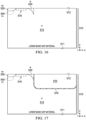
- FIG. 16 illustrates a semiconductor layer 510 including a source region 520, a drift region 530, a body region 515 including a channel region 516, and a body-contact region 540; and FIG. 23 illustrates this step as forming a source region, a drift region, a body region, and a body-contact region in a semiconductor layer in step S901 of FIG. 12 .
- the semiconductor layer 510 has a first surface 511 and an opposing second surface 512.
- a material of the semiconductor layer 510 may include at least one of silicon, germanium, or gallium arsenide.
- FIG. 16 also illustrates a coordinate system having X, Y, and Z axes.
- the X-axis and the Y-axis are orthogonal to each other and are parallel to a plane of the semiconductor layer 510, e.g., the first surface 511, or the second surface 512.
- the X and Y-axes are thus referred to as "in-plane direction.”
- the Z-axis is perpendicular to the X and Y-axes and thus perpendicular to the plane of semiconductor layer 510. As such, the Z-axis is referred to as an "out-of-plane direction.”
- the channel region 516 of the body region 515 is between the source region 520 and the drift region 530.
- the semiconductor layer 510 is formed by epitaxial growth and/or ion implantation to form, e.g., a p-type layer at a P doping level; and the semiconductor layer 510 includes the body region 515.
- the source region 520, the drift region 530, and the body-contact region 540 may be formed by ion implantation of dopants into the semiconductor layer 510. In the examples of FIG.
- the source region 520 is an n-type semiconductor region with an N+ doping level
- the drift region 530 is an n-type semiconductor region with an N doping level
- the body region 515 is a p-type semiconductor region with a P doping level
- the body-contact region 540 is a p-type semiconductor region with a P+ doping level.
- Other suitable doping-polarities and doping level may be chosen for the structures (e.g., 515, 520, 530, 540) of hybrid semiconductor device 500 according to various application scenarios.
- the body-contact region 540 is a recessed body-contact region. In other examples, the body-contact region is a planar body-contact region.
- FIG. 17 illustrates a voltage support structure 570 and a dielectric layer 575 in the semiconductor layer 510; and FIG. 23 illustrates this step as forming a dielectric layer and a voltage support structure in the semiconductor layer in step S902 of FIG. 12 .
- the dielectric layer 575 and the voltage support structure 570 may be formed by etching away a portion of the semiconductor layer 510 to form a trench, forming the dielectric layer 575 by vapor deposition or oxidation at inner walls of the trench, and depositing materials of the voltage support structure 570 into the trench and on the dielectric layer 575.
- the voltage support structure 570 is adjacent to the drift region 530 along the in-plane direction (X axis), e.g., laterally.
- the dielectric layer 575 is between the voltage support structure 570 and the body region 515, and separates the voltage support structure 570 from the body region 515.
- the voltage support structure 570 includes a WBG semiconductor that has a larger band-gap than the semiconductor of the body region 515 of the semiconductor layer 510.
- the WBG semiconductor of voltage support structure 570 includes silicon carbide, gallium nitride, and/or any other suitable WBG semiconductor.
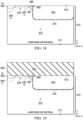
- FIG. 18 illustrates a floating electrode 560 between the drift region 530 and the voltage support structure 570; and FIG. 12 illustrates this step as forming an electrode between the drift region and the voltage support structure in step S903 of FIG. 23 .
- the electrode 560 may be formed by etching away portions of the drift region 530, the dielectric layer 575, and the voltage support structure 570 to form a trench, and depositing materials of the electrode 560 in the trench via vapor deposition, such as chemical vapor deposition (CVD).
- a material of an electrode may include at least one of metal or silicide.
- the electrode 560 has a first end 561 and a second end 562; the first end 561 is coupled to and in ohmic contact with the drift region 530; and the second end 562 is coupled to and in ohmic contact with the voltage support structure 570.
- the voltage support structure 570, the drift region 530, and the electrode 560 are arranged with respect to one another along the in-plane direction (X axis), e.g., laterally.
- FIG. 19 illustrates a dielectric layer 550 on the second surface 512 of the semiconductor layer 510; and FIG. 23 illustrates this step as adding a dielectric layer on the semiconductor layer in step S904 of FIG. 23 .
- a material of the dielectric layer 550 may include nitride material such as silicon nitride, aluminum nitride, and/or oxide materials such as silicon oxide, aluminum oxide.
- the dielectric layer 550 may be added on the semiconductor layer 510 by vapor deposition or bonding.
- FIG. 20 illustrates a gate (e.g., a gate terminal) 555 on the second surface 512 of the semiconductor layer 510; and FIG. 23 illustrates this step as forming a gate on the semiconductor layer 510 in step S905 of FIG. 23 .
- the gate 555 corresponds to the channel region 516 of the body region 515; and a dielectric portion 551 of the dielectric layer 550 is between the gate 555 and the second surface 512 of the semiconductor layer 510, and, accordingly, separates the gate 555 from the second surface 512 of the semiconductor layer 510.
- the gate 555 may be formed by etching a trench in the dielectric layer 550 and depositing gate materials in the trench.
- a material of the gate 555 may include polysilicon and/or metal.
- a dielectric material such as nitride or oxide is further deposited in the trench and on the gate 555.
- FIG. 21 illustrates trenches 556 and 557 in the dielectric layer 550; and FIG. 23 illustrates this step as forming trenches in the dielectric layer in step S906 of FIG. 23 .
- the trenches 556 and 557 may be formed by etching the dielectric layer 550 with a mask.
- FIG. 22 illustrates a source contact 590, a field plate 595, and a drain contact 580; and FIG. 23 illustrates this step as forming a source contact, a field plate, and a drain contact in the trenches in step S907 of FIG. 23 .
- the source contact 590 is in ohmic contact with the source region 520 and the body-contact region 540.
- the source contact 590 includes a silicide portion and an aluminum portion on the silicide portion; and the field plate 595 includes a silicide portion and an aluminum portion on the silicide portion.
- the drain contact 580 is on the voltage support structure 570.
- the drain contact 580 includes a silicide portion in contact with the voltage support structure 570, and an aluminum portion on the silicide portion.
- the source contact 590, the field plate 595, and the drain contact 580 may be formed using vapor deposition.
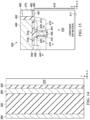
- FIG. 22 illustrates an example hybrid semiconductor device 500 according to described examples.
- the hybrid semiconductor device 500 includes the semiconductor layer 510.
- the semiconductor layer 510 includes the source region 520, the drift region 530, the body region 515 including the channel region 516, and the body-contact region 540.
- the semiconductor layer 510 has the first surface 511 and the opposing second surface 512.
- the hybrid semiconductor device 500 further includes the voltage support structure 570 and the dielectric layer 575, the electrode 560 between the drift region 530 and the voltage support structure 570, the dielectric layer 550 and the gate 555 on second surface 512 of the semiconductor layer 510, the source contact 590, the field plate 595, and the drain contact 580 in trenches formed in the dielectric layer 550.
- the voltage support structure 570 is adjacent to the drift region 530 along the in-plane direction (X axis), e.g., laterally.
- the dielectric layer 575 is between the voltage support structure 570 and the body region 515, and separates the voltage support structure 570 from the body region 515.
- the voltage support structure 570 includes a WBG semiconductor that has a larger band-gap than the semiconductor of the source region 520, the drift region 530, the body region 515 including the channel region 516, and the body-contact region 540.
- the WBG semiconductor of voltage support structure 570 includes silicon carbide, gallium nitride, and/or any other suitable WBG semiconductor.
- the electrode 560 has a first end 561 and a second end 562; the first end 561 is coupled to and in ohmic contact with the drift region 530; and the second end 562 is coupled to and in ohmic contact with the voltage support structure 570.
- the voltage support structure 570, the drift region 530, and the electrode 560 are arranged with respect to one another along the in-plane direction (X axis), e.g., laterally.
- the gate 555 corresponds to the channel region 516 of the body region 515; and the dielectric portion 551 of the dielectric layer 550 is between the gate 555 and the second surface 512 of the semiconductor layer 510, and, accordingly, separates the gate 555 from the second surface 512 of the semiconductor layer 510.
- the source contact 590 is in ohmic contact with the source region 520 and the body-contact region 540.
- the source contact 590 includes a silicide portion and an aluminum portion on the silicide portion; and the field plate 595 includes a silicide portion and an aluminum portion on the silicide portion.
- the field plate 595 extends from the source contact 590 towards the drain contact 580.
- the drain contact 580 is on the voltage support structure 570.
- the drain contact 580 includes a silicide portion in contact with the voltage support structure 570, and an aluminum portion on the silicide portion.
- the field plate 595 and the source contact 590 are structurally integrated as a single piece. In other examples, the field plate and the source contact are structurally separate pieces; and the field plate is electrically coupled to the source contact or another voltage contact.
- certain components (such as 590, 520, 516, 515, 530, 550, 595, 570) of the hybrid semiconductor device 500 extend along the in-plane direction (Y-axis) in a stripe configuration.
- certain components (such as 590, 520, 516, 515, 530, 550, 595, 570) of the hybrid semiconductor device 500 extend in-plane (e.g., parallel to X-Y plane) in a circular or annular shape.
- certain components (such as 590, 520, 516, 515, 530, 550, 595, 570) of the hybrid semiconductor device 500 extend around axis O3-O4 in FIG. 22 in, e.g., a circular or annular configuration.
- the hybrid semiconductor device 500 includes a switch element 519; and the switch element 519 includes the source region 520, the drift region 530, the body region 515 or a portion of the body region 515 that includes the channel region 516, a body-contact region 540, the gate 555, and the dielectric portion 551 of the dielectric layer 550.
- the hybrid semiconductor device 500 further includes the electrode 560, the voltage-support structure 570, the drain contact 580, the source contact 590, and field control elements including the field plate 595 and the body region 515 extending from the regions of or near the source contact 590 towards the drain contact 580, e.g., along approximately the in-plane direction (X-axis).
- the voltage-support structure 570 is adjacent to the switch element 519 along the in-plane direction (X-axis), and extends, e.g., laterally, in a direction parallel to a surface of the switch element 519 (e.g., a portion of the second surface 512 of the semiconductor layer 510). In some examples the voltage-support structure 570 is at least partially surrounded by the switch element 519.
- the first end 561 of the electrode 560 is in ohmic contact with the drift region 530 of the switch element 519; the second end 562 of the electrode 560 is in ohmic contact with the voltage-support structure 570; and the body-contact region 540 of the switch element 519 is in ohmic contact with the source contact 590.
- regions (e.g., 571, 572) of the voltage-support structure 570 that are in contact with the electrode 560 and the drain contact 580 are doped with an increased doping level as compared to other regions of the voltage-support structure 570, and form ohmic contacts with the electrode 560 and the drain contact 580; and region 531 of the drift region 530 that is in contact with the electrode 560 is doped with an increased doping level as compared to other regions of the drift region 530, and forms ohmic contact with the electrode 560.
- FIG. 24 illustrates another example hybrid semiconductor device 600 according to described examples.
- the hybrid semiconductor device 600 includes a semiconductor layer 610.
- the semiconductor layer 610 includes a source region 620, a drift region 630, a body region 615 including a channel region 616, and a body-contact region 640.
- the semiconductor layer 610 has a first surface 611 and an opposing second surface 612.
- the hybrid semiconductor device 600 further includes a voltage support structure 670, an electrode 660 between the drift region 630 and the voltage support structure 670, a dielectric layer 650 and a gate 655 on the second surface 612 of the semiconductor layer 610, a source contact 690, a field plate 695, and a drain contact 680.
- the voltage support structure 670 is adjacent to the drift region 630 along the in-plane direction (X axis), e.g., laterally.
- the voltage support structure 670 is in contact with the body region 615.
- the voltage support structure 670 may be formed by ion implanting dopants into the semiconductor layer 610 or by etching away a portion of the semiconductor layer 610 to form a trench and depositing materials of the voltage support structure 670 into the trench.
- the semiconductor layer 610 is a silicon layer
- the voltage support structure 670 is formed by ion implanting carbon into the semiconductor layer 610 and activating the implanted region to form silicon carbide as the voltage support structure 670.
- the voltage support structure 670 may include a WBG semiconductor that has a larger band-gap than the semiconductor of the semiconductor layer 610.
- the WBG semiconductor of the voltage support structure 670 includes silicon carbide, gallium nitride, and/or any other suitable WBG semiconductor.
- hybrid semiconductor device 600 Certain components of the hybrid semiconductor device 600 are the same as or similar to above-described components of hybrid semiconductor devices, and refences can be made to above descriptions of components of the hybrid semiconductor devices, such as components of the hybrid semiconductor device 500.
- Couple is used throughout the specification. The term may cover connections, communications, or signal paths that enable a functional relationship consistent with the description of this description. For example, if device A generates a signal to control device B to perform an action, in a first example device A is coupled to device B, or in a second example device A is coupled to device B through intervening component C if intervening component C does not substantially alter the functional relationship between device A and device B such that device B is controlled by device A via the control signal generated by device A.
Landscapes
- Electrodes Of Semiconductors (AREA)
- Insulated Gate Type Field-Effect Transistor (AREA)
- Metal-Oxide And Bipolar Metal-Oxide Semiconductor Integrated Circuits (AREA)
Applications Claiming Priority (2)
| Application Number | Priority Date | Filing Date | Title |
|---|---|---|---|
| US17/136,816 US11557673B2 (en) | 2020-12-29 | 2020-12-29 | Hybrid semiconductor device |
| PCT/US2021/065280 WO2022146964A1 (en) | 2020-12-29 | 2021-12-28 | Hybrid semiconductor device |
Publications (3)
| Publication Number | Publication Date |
|---|---|
| EP4272240A1 EP4272240A1 (en) | 2023-11-08 |
| EP4272240A4 EP4272240A4 (en) | 2024-02-21 |
| EP4272240B1 true EP4272240B1 (en) | 2025-07-09 |
Family
ID=82117828
Family Applications (1)
| Application Number | Title | Priority Date | Filing Date |
|---|---|---|---|
| EP21916331.8A Active EP4272240B1 (en) | 2020-12-29 | 2021-12-28 | Hybrid semiconductor device |
Country Status (5)
| Country | Link |
|---|---|
| US (2) | US11557673B2 (https=) |
| EP (1) | EP4272240B1 (https=) |
| JP (1) | JP2024502029A (https=) |
| CN (1) | CN116762175A (https=) |
| WO (1) | WO2022146964A1 (https=) |
Families Citing this family (2)
| Publication number | Priority date | Publication date | Assignee | Title |
|---|---|---|---|---|
| US11557673B2 (en) * | 2020-12-29 | 2023-01-17 | Texas Instruments Incorporated | Hybrid semiconductor device |
| US11978753B2 (en) * | 2021-05-04 | 2024-05-07 | Omnivision Technologies, Inc. | Process to release silicon stress in forming CMOS image sensor |
Family Cites Families (20)
| Publication number | Priority date | Publication date | Assignee | Title |
|---|---|---|---|---|
| JPH07254706A (ja) * | 1993-11-29 | 1995-10-03 | Texas Instr Inc <Ti> | 高電圧デバイス構造およびその製造方法 |
| US5736766A (en) | 1994-12-12 | 1998-04-07 | Texas Instruments Incorporated | Medium voltage LDMOS device and method of fabrication |
| US5734180A (en) * | 1995-06-02 | 1998-03-31 | Texas Instruments Incorporated | High-performance high-voltage device structures |
| US6424005B1 (en) | 1998-12-03 | 2002-07-23 | Texas Instruments Incorporated | LDMOS power device with oversized dwell |
| US7045845B2 (en) | 2002-08-16 | 2006-05-16 | Semiconductor Components Industries, L.L.C. | Self-aligned vertical gate semiconductor device |
| JP2008042166A (ja) | 2006-07-12 | 2008-02-21 | Matsushita Electric Ind Co Ltd | 縦型ゲート半導体装置及びその製造方法 |
| KR101002336B1 (ko) * | 2008-02-04 | 2010-12-20 | 엘지디스플레이 주식회사 | 나노 디바이스, 이를 포함하는 트랜지스터, 나노 디바이스및 이를 포함하는 트랜지스터의 제조 방법 |
| CN103094337B (zh) | 2011-10-27 | 2015-08-19 | 中芯国际集成电路制造(上海)有限公司 | Ldnmos结构及其制造方法 |
| KR20150020930A (ko) | 2013-08-19 | 2015-02-27 | 삼성전자주식회사 | 고전압 반도체 장치 및 이의 제조 방법 |
| CN105789298B (zh) | 2014-12-19 | 2019-06-07 | 无锡华润上华科技有限公司 | 横向绝缘栅双极型晶体管及其制造方法 |
| EP3062349B1 (en) | 2015-02-25 | 2019-10-09 | Nxp B.V. | Semiconductor device comprising a switch |
| DE102015106688B4 (de) | 2015-04-29 | 2020-03-12 | Infineon Technologies Ag | Schalter mit einem feldeffekttransistor, insbesondere in einer integrierten schaltung zur verwendung in systemen mit lasten |
| US9911817B2 (en) | 2015-07-17 | 2018-03-06 | Cambridge Electronics, Inc. | Field-plate structures for semiconductor devices |
| WO2017111914A1 (en) * | 2015-12-21 | 2017-06-29 | Intel Corporation | Low band gap semiconductor devices having reduced gate induced drain leakage (gidl) and their methods of fabrication |
| JP6706330B2 (ja) * | 2016-01-18 | 2020-06-03 | 日本テキサス・インスツルメンツ合同会社 | 金属充填ディープソースコンタクトを備えたパワーmosfet |
| EP3261120B1 (en) | 2016-06-24 | 2019-05-01 | Nxp B.V. | Semiconductor switch device |
| US10680100B2 (en) * | 2018-07-03 | 2020-06-09 | Taiwan Semiconductor Manufacturing Co., Ltd. | Field structure and methodology |
| US10971615B2 (en) * | 2018-08-08 | 2021-04-06 | Qualcomm Incorporated | High power performance gallium nitride high electron mobility transistor with ledges and field plates |
| US10790389B2 (en) * | 2018-08-14 | 2020-09-29 | Silanna Asia Pte Ltd | Source contact formation of MOSFET with gate shield buffer for pitch reduction |
| US11557673B2 (en) * | 2020-12-29 | 2023-01-17 | Texas Instruments Incorporated | Hybrid semiconductor device |
-
2020
- 2020-12-29 US US17/136,816 patent/US11557673B2/en active Active
-
2021
- 2021-12-28 CN CN202180087763.2A patent/CN116762175A/zh active Pending
- 2021-12-28 WO PCT/US2021/065280 patent/WO2022146964A1/en not_active Ceased
- 2021-12-28 JP JP2023539960A patent/JP2024502029A/ja active Pending
- 2021-12-28 EP EP21916331.8A patent/EP4272240B1/en active Active
-
2022
- 2022-12-15 US US18/066,511 patent/US20230115019A1/en active Pending
Also Published As
| Publication number | Publication date |
|---|---|
| WO2022146964A1 (en) | 2022-07-07 |
| JP2024502029A (ja) | 2024-01-17 |
| TW202232761A (zh) | 2022-08-16 |
| US20230115019A1 (en) | 2023-04-13 |
| CN116762175A (zh) | 2023-09-15 |
| US20220209007A1 (en) | 2022-06-30 |
| EP4272240A4 (en) | 2024-02-21 |
| US11557673B2 (en) | 2023-01-17 |
| EP4272240A1 (en) | 2023-11-08 |
Similar Documents
| Publication | Publication Date | Title |
|---|---|---|
| US8598660B2 (en) | Stress enhanced LDMOS transistor to minimize on-resistance and maintain high breakdown voltage | |
| US20120012929A1 (en) | Semiconductor device | |
| CN104752492B (zh) | 用于制造半导体器件的方法和半导体器件 | |
| JP2018022851A (ja) | 半導体装置およびその製造方法 | |
| US9082746B2 (en) | Method for forming self-aligned trench contacts of semiconductor components and a semiconductor component | |
| US11031466B2 (en) | Method of forming oxygen inserted Si-layers in power semiconductor devices | |
| EP4272240B1 (en) | Hybrid semiconductor device | |
| US20230253458A1 (en) | Silicon carbide semiconductor device and method of manufacturing silicon carbide semiconductor device | |
| GB2607292A (en) | Semiconductor device | |
| US6445036B1 (en) | Semiconductor device having trench-structured rectangular unit cells | |
| CN116895682A (zh) | 垂直屏蔽栅极累积场效应晶体管 | |
| CN113921595B (zh) | 半导体结构及其形成方法 | |
| US20200098912A1 (en) | Transistor devices with control-terminal field plate structures in trenches | |
| CN114667609B (zh) | 垂直场效应晶体管和用于构造其的方法 | |
| US11489067B2 (en) | Electron gas transistor, one-piece device comprising at least two transistors in cascode and associated manufacturing methods | |
| US20230178649A1 (en) | Semiconductor on insulator on wide band-gap semiconductor | |
| CN114335149A (zh) | 基于电荷补偿的屏蔽栅沟槽型场效应晶体管及其制备方法 | |
| US20250062253A1 (en) | Rf switch device and manufacturing method thereof | |
| TWI920209B (zh) | 混合半導體裝置 | |
| US9299828B2 (en) | Nitride-based transistors having structures for suppressing leakage current | |
| WO2020051285A1 (en) | Lateral semiconductor device and method of manufacture | |
| CN114335181B (zh) | 屏蔽栅沟槽型场效应晶体管、晶体管模块及其制备方法 | |
| US11322608B2 (en) | Semiconductor device | |
| CN117613075A (zh) | 半导体装置及其制造方法 | |
| WO2025192705A1 (ja) | 半導体装置およびその製造方法 |
Legal Events
| Date | Code | Title | Description |
|---|---|---|---|
| STAA | Information on the status of an ep patent application or granted ep patent |
Free format text: STATUS: THE INTERNATIONAL PUBLICATION HAS BEEN MADE |
|
| PUAI | Public reference made under article 153(3) epc to a published international application that has entered the european phase |
Free format text: ORIGINAL CODE: 0009012 |
|
| STAA | Information on the status of an ep patent application or granted ep patent |
Free format text: STATUS: REQUEST FOR EXAMINATION WAS MADE |
|
| 17P | Request for examination filed |
Effective date: 20230731 |
|
| AK | Designated contracting states |
Kind code of ref document: A1 Designated state(s): AL AT BE BG CH CY CZ DE DK EE ES FI FR GB GR HR HU IE IS IT LI LT LU LV MC MK MT NL NO PL PT RO RS SE SI SK SM TR |
|
| REG | Reference to a national code |
Ref legal event code: R079 Ipc: H01L0029780000 Ref country code: DE Ref legal event code: R079 Ref document number: 602021033997 Country of ref document: DE Free format text: PREVIOUS MAIN CLASS: H01L0021020000 Ipc: H01L0029780000 |
|
| A4 | Supplementary search report drawn up and despatched |
Effective date: 20240124 |
|
| RIC1 | Information provided on ipc code assigned before grant |
Ipc: H01L 21/336 20060101ALI20240118BHEP Ipc: H01L 29/78 20060101AFI20240118BHEP |
|
| DAV | Request for validation of the european patent (deleted) | ||
| DAX | Request for extension of the european patent (deleted) | ||
| STAA | Information on the status of an ep patent application or granted ep patent |
Free format text: STATUS: EXAMINATION IS IN PROGRESS |
|
| 17Q | First examination report despatched |
Effective date: 20241016 |
|
| REG | Reference to a national code |
Ref country code: DE Ref legal event code: R079 Free format text: PREVIOUS MAIN CLASS: H01L0029780000 Ipc: H10D0030600000 Ref country code: DE Ref legal event code: R079 Ref document number: 602021033997 Country of ref document: DE Free format text: PREVIOUS MAIN CLASS: H01L0029780000 Ipc: H10D0030600000 |
|
| GRAP | Despatch of communication of intention to grant a patent |
Free format text: ORIGINAL CODE: EPIDOSNIGR1 |
|
| STAA | Information on the status of an ep patent application or granted ep patent |
Free format text: STATUS: GRANT OF PATENT IS INTENDED |
|
| RIC1 | Information provided on ipc code assigned before grant |
Ipc: H10D 30/01 20250101ALI20250204BHEP Ipc: H10D 30/60 20250101AFI20250204BHEP |
|
| INTG | Intention to grant announced |
Effective date: 20250219 |
|
| GRAS | Grant fee paid |
Free format text: ORIGINAL CODE: EPIDOSNIGR3 |
|
| P01 | Opt-out of the competence of the unified patent court (upc) registered |
Free format text: CASE NUMBER: APP_20664/2025 Effective date: 20250430 |
|
| GRAA | (expected) grant |
Free format text: ORIGINAL CODE: 0009210 |
|
| STAA | Information on the status of an ep patent application or granted ep patent |
Free format text: STATUS: THE PATENT HAS BEEN GRANTED |
|
| AK | Designated contracting states |
Kind code of ref document: B1 Designated state(s): AL AT BE BG CH CY CZ DE DK EE ES FI FR GB GR HR HU IE IS IT LI LT LU LV MC MK MT NL NO PL PT RO RS SE SI SK SM TR |
|
| REG | Reference to a national code |
Ref country code: GB Ref legal event code: FG4D |
|
| REG | Reference to a national code |
Ref country code: CH Ref legal event code: EP |
|
| REG | Reference to a national code |
Ref country code: IE Ref legal event code: FG4D |
|
| REG | Reference to a national code |
Ref country code: DE Ref legal event code: R096 Ref document number: 602021033997 Country of ref document: DE |
|
| REG | Reference to a national code |
Ref country code: NL Ref legal event code: MP Effective date: 20250709 |
|
| PG25 | Lapsed in a contracting state [announced via postgrant information from national office to epo] |
Ref country code: PT Free format text: LAPSE BECAUSE OF FAILURE TO SUBMIT A TRANSLATION OF THE DESCRIPTION OR TO PAY THE FEE WITHIN THE PRESCRIBED TIME-LIMIT Effective date: 20251110 |
|
| PG25 | Lapsed in a contracting state [announced via postgrant information from national office to epo] |
Ref country code: NL Free format text: LAPSE BECAUSE OF FAILURE TO SUBMIT A TRANSLATION OF THE DESCRIPTION OR TO PAY THE FEE WITHIN THE PRESCRIBED TIME-LIMIT Effective date: 20250709 |
|
| REG | Reference to a national code |
Ref country code: AT Ref legal event code: MK05 Ref document number: 1813114 Country of ref document: AT Kind code of ref document: T Effective date: 20250709 |
|
| PG25 | Lapsed in a contracting state [announced via postgrant information from national office to epo] |
Ref country code: IS Free format text: LAPSE BECAUSE OF FAILURE TO SUBMIT A TRANSLATION OF THE DESCRIPTION OR TO PAY THE FEE WITHIN THE PRESCRIBED TIME-LIMIT Effective date: 20251109 |
|
| PGFP | Annual fee paid to national office [announced via postgrant information from national office to epo] |
Ref country code: DE Payment date: 20251126 Year of fee payment: 5 |
|
| PGFP | Annual fee paid to national office [announced via postgrant information from national office to epo] |
Ref country code: GB Payment date: 20251120 Year of fee payment: 5 |
|
| PG25 | Lapsed in a contracting state [announced via postgrant information from national office to epo] |
Ref country code: NO Free format text: LAPSE BECAUSE OF FAILURE TO SUBMIT A TRANSLATION OF THE DESCRIPTION OR TO PAY THE FEE WITHIN THE PRESCRIBED TIME-LIMIT Effective date: 20251009 |
|
| REG | Reference to a national code |
Ref country code: LT Ref legal event code: MG9D |
|
| PG25 | Lapsed in a contracting state [announced via postgrant information from national office to epo] |
Ref country code: AT Free format text: LAPSE BECAUSE OF FAILURE TO SUBMIT A TRANSLATION OF THE DESCRIPTION OR TO PAY THE FEE WITHIN THE PRESCRIBED TIME-LIMIT Effective date: 20250709 |
|
| PG25 | Lapsed in a contracting state [announced via postgrant information from national office to epo] |
Ref country code: FI Free format text: LAPSE BECAUSE OF FAILURE TO SUBMIT A TRANSLATION OF THE DESCRIPTION OR TO PAY THE FEE WITHIN THE PRESCRIBED TIME-LIMIT Effective date: 20250709 |
|
| PG25 | Lapsed in a contracting state [announced via postgrant information from national office to epo] |
Ref country code: HR Free format text: LAPSE BECAUSE OF FAILURE TO SUBMIT A TRANSLATION OF THE DESCRIPTION OR TO PAY THE FEE WITHIN THE PRESCRIBED TIME-LIMIT Effective date: 20250709 |
|
| PGFP | Annual fee paid to national office [announced via postgrant information from national office to epo] |
Ref country code: FR Payment date: 20251119 Year of fee payment: 5 |
|
| PG25 | Lapsed in a contracting state [announced via postgrant information from national office to epo] |
Ref country code: GR Free format text: LAPSE BECAUSE OF FAILURE TO SUBMIT A TRANSLATION OF THE DESCRIPTION OR TO PAY THE FEE WITHIN THE PRESCRIBED TIME-LIMIT Effective date: 20251010 |
|
| PG25 | Lapsed in a contracting state [announced via postgrant information from national office to epo] |
Ref country code: SE Free format text: LAPSE BECAUSE OF FAILURE TO SUBMIT A TRANSLATION OF THE DESCRIPTION OR TO PAY THE FEE WITHIN THE PRESCRIBED TIME-LIMIT Effective date: 20250709 |
|
| PG25 | Lapsed in a contracting state [announced via postgrant information from national office to epo] |
Ref country code: LV Free format text: LAPSE BECAUSE OF FAILURE TO SUBMIT A TRANSLATION OF THE DESCRIPTION OR TO PAY THE FEE WITHIN THE PRESCRIBED TIME-LIMIT Effective date: 20250709 |
|
| PG25 | Lapsed in a contracting state [announced via postgrant information from national office to epo] |
Ref country code: PL Free format text: LAPSE BECAUSE OF FAILURE TO SUBMIT A TRANSLATION OF THE DESCRIPTION OR TO PAY THE FEE WITHIN THE PRESCRIBED TIME-LIMIT Effective date: 20250709 Ref country code: BG Free format text: LAPSE BECAUSE OF FAILURE TO SUBMIT A TRANSLATION OF THE DESCRIPTION OR TO PAY THE FEE WITHIN THE PRESCRIBED TIME-LIMIT Effective date: 20250709 |
|
| PG25 | Lapsed in a contracting state [announced via postgrant information from national office to epo] |
Ref country code: RS Free format text: LAPSE BECAUSE OF FAILURE TO SUBMIT A TRANSLATION OF THE DESCRIPTION OR TO PAY THE FEE WITHIN THE PRESCRIBED TIME-LIMIT Effective date: 20251009 |
|
| PG25 | Lapsed in a contracting state [announced via postgrant information from national office to epo] |
Ref country code: ES Free format text: LAPSE BECAUSE OF FAILURE TO SUBMIT A TRANSLATION OF THE DESCRIPTION OR TO PAY THE FEE WITHIN THE PRESCRIBED TIME-LIMIT Effective date: 20250709 |
|
| PG25 | Lapsed in a contracting state [announced via postgrant information from national office to epo] |
Ref country code: RO Free format text: LAPSE BECAUSE OF FAILURE TO SUBMIT A TRANSLATION OF THE DESCRIPTION OR TO PAY THE FEE WITHIN THE PRESCRIBED TIME-LIMIT Effective date: 20250709 |
|
| PG25 | Lapsed in a contracting state [announced via postgrant information from national office to epo] |
Ref country code: SM Free format text: LAPSE BECAUSE OF FAILURE TO SUBMIT A TRANSLATION OF THE DESCRIPTION OR TO PAY THE FEE WITHIN THE PRESCRIBED TIME-LIMIT Effective date: 20250709 |
|
| PG25 | Lapsed in a contracting state [announced via postgrant information from national office to epo] |
Ref country code: DK Free format text: LAPSE BECAUSE OF FAILURE TO SUBMIT A TRANSLATION OF THE DESCRIPTION OR TO PAY THE FEE WITHIN THE PRESCRIBED TIME-LIMIT Effective date: 20250709 |
|
| PG25 | Lapsed in a contracting state [announced via postgrant information from national office to epo] |
Ref country code: IT Free format text: LAPSE BECAUSE OF FAILURE TO SUBMIT A TRANSLATION OF THE DESCRIPTION OR TO PAY THE FEE WITHIN THE PRESCRIBED TIME-LIMIT Effective date: 20250709 |
|
| PG25 | Lapsed in a contracting state [announced via postgrant information from national office to epo] |
Ref country code: CZ Free format text: LAPSE BECAUSE OF FAILURE TO SUBMIT A TRANSLATION OF THE DESCRIPTION OR TO PAY THE FEE WITHIN THE PRESCRIBED TIME-LIMIT Effective date: 20250709 |
|
| PG25 | Lapsed in a contracting state [announced via postgrant information from national office to epo] |
Ref country code: EE Free format text: LAPSE BECAUSE OF FAILURE TO SUBMIT A TRANSLATION OF THE DESCRIPTION OR TO PAY THE FEE WITHIN THE PRESCRIBED TIME-LIMIT Effective date: 20250709 Ref country code: SK Free format text: LAPSE BECAUSE OF FAILURE TO SUBMIT A TRANSLATION OF THE DESCRIPTION OR TO PAY THE FEE WITHIN THE PRESCRIBED TIME-LIMIT Effective date: 20250709 |