EP4270331A1 - Computerimplementiertes verfahren, computersystem und nichtflüchtiges computerlesbares medium zum detektieren der belegung eines sitzes in einer fahrzeugkabine - Google Patents
Computerimplementiertes verfahren, computersystem und nichtflüchtiges computerlesbares medium zum detektieren der belegung eines sitzes in einer fahrzeugkabine Download PDFInfo
- Publication number
- EP4270331A1 EP4270331A1 EP22169964.8A EP22169964A EP4270331A1 EP 4270331 A1 EP4270331 A1 EP 4270331A1 EP 22169964 A EP22169964 A EP 22169964A EP 4270331 A1 EP4270331 A1 EP 4270331A1
- Authority
- EP
- European Patent Office
- Prior art keywords
- seat
- region
- rectangle
- characteristic
- sub
- Prior art date
- Legal status (The legal status is an assumption and is not a legal conclusion. Google has not performed a legal analysis and makes no representation as to the accuracy of the status listed.)
- Granted
Links
Images



Classifications
-
- G—PHYSICS
- G06—COMPUTING OR CALCULATING; COUNTING
- G06V—IMAGE OR VIDEO RECOGNITION OR UNDERSTANDING
- G06V20/00—Scenes; Scene-specific elements
- G06V20/50—Context or environment of the image
- G06V20/59—Context or environment of the image inside of a vehicle, e.g. relating to seat occupancy, driver state or inner lighting conditions
- G06V20/593—Recognising seat occupancy
-
- G—PHYSICS
- G06—COMPUTING OR CALCULATING; COUNTING
- G06V—IMAGE OR VIDEO RECOGNITION OR UNDERSTANDING
- G06V10/00—Arrangements for image or video recognition or understanding
- G06V10/20—Image preprocessing
- G06V10/25—Determination of region of interest [ROI] or a volume of interest [VOI]
-
- G—PHYSICS
- G06—COMPUTING OR CALCULATING; COUNTING
- G06V—IMAGE OR VIDEO RECOGNITION OR UNDERSTANDING
- G06V10/00—Arrangements for image or video recognition or understanding
- G06V10/40—Extraction of image or video features
- G06V10/44—Local feature extraction by analysis of parts of the pattern, e.g. by detecting edges, contours, loops, corners, strokes or intersections; Connectivity analysis, e.g. of connected components
-
- G—PHYSICS
- G06—COMPUTING OR CALCULATING; COUNTING
- G06V—IMAGE OR VIDEO RECOGNITION OR UNDERSTANDING
- G06V40/00—Recognition of biometric, human-related or animal-related patterns in image or video data
- G06V40/10—Human or animal bodies, e.g. vehicle occupants or pedestrians; Body parts, e.g. hands
Definitions
- the present disclosure relates to a computer implemented method, a computer system and a non-transitory computer readable medium for detecting an occupancy of a seat in a vehicle cabin.
- Imaging devices such as digital cameras, are used in automotive applications to detect seat occupancies in a cabin of a vehicle. However, they tend to consume much computing power and to be unreliable.
- the present disclosure provides a computer implemented method, a computer system and a non-transitory computer readable medium according to the independent claims. Embodiments are given in the subclaims, the description and the drawings.
- the present disclosure is directed at a computer implemented method for detecting an occupancy of a seat within a vehicle cabin.
- the method comprises to capture an image of the vehicle cabin, to identify a set of characteristics associated with a seat in the captured image, to determine a region associated with the identified seat based on the set of characteristics, wherein the region is configured to cover at least a portion of the seat, and to determine a seat occupancy status of identified seat by processing information obtained from the corresponding region.
- an image is captured, by using an imaging device.
- the imaging device may, for example, be a camera that may be mounted in or on the roof lining, in or on the rear-view mirror or in or on the dashboard of a vehicle, capturing at least a part of the inside of a vehicle cabin.
- the vehicle cabin which may also be identified as a passenger compartment or a passenger cabin, comprises at least one seat, which may be identified as the first seat or in particular the driver's seat, and typically comprises a second, a third, a fourth and a fifth seat.
- the vehicle cabin comprises a driver's seat, a front-row passenger's seat and two or three back-row passenger's seats. In particular, all five seats are covered in the captured image.
- a set of characteristics associated with a seat is identified in the captured image by using a processing device, such as a microprocessor.
- a processing device such as a microprocessor.
- the set of characteristics relate to parts or components of a seat in the cabin, which will be described in more detail below.
- a region associated with the identified seat is determined by the processing device based on the set of characteristics. Therein, the region is configured to cover at least a portion of the seat.
- a seat is identified.
- a seat occupancy status of the identified seat is determined by using the processing device, in particular by processing information obtained from the corresponding region.
- An occupancy status is for example occupied or not occupied.
- the identification of the set of characteristic may be used to train a machine-learning model. Therefore, the machine-learning model may be trained with several images of different vehicle cabins of different cars and/or of different camera types, in which the characteristics are identified. The machine-learning model may then be used in live application for other, in particular new type of vehicle cabins to identify the first and second characteristic.
- a method for detecting a seat occupancy is provided, which is adaptable to other vehicles having different vehicle cabins.
- the detection rate is highly accurate.
- the seat occupancy status is determined by comparing the information obtained from the corresponding region with reference information obtained from the corresponding region.
- the reference information is obtained from at least one previously captured image.
- the reference information may be obtained from multiple previously captured images.
- the set of characteristics comprise a first characteristic and a second characteristic defining the region associated with the seat.
- the location of the first characteristic and the location of the second characteristic together define the region and the region covers a portion of the seat.
- the region is spanned from the location of the first characteristic to the location of the second characteristic.
- the region covers at least a part or the whole of the back rest area of the seat.
- the first characteristic and the second characteristic are related to the first seat, which may be, as explained above, the driver's seat.
- the set of characteristics further comprise a third characteristic and a fourth characteristic defining the region associated with the seat in the cabin.
- the third and fourth characteristic may relate to the same, i.e. the first seat, or to a second seat. Further in particular, the four characteristics together may define one region associated with one seat.
- the third and fourth characteristic may relate to another, i.e. a second seat.
- the first and second characteristic may define a first region associated with the first seat
- the third and fourth characteristic may define a second region, different from the first region, associated with the second seat.
- the second seat is, for example, the center seat of the back row.
- a third characteristic and a fourth characteristic related to the second seat may be identified in the image, by using the processing device.
- the location of the third characteristic and the location of the fourth characteristic together define the second region and the second region covers a portion of the second seat.
- the second region is spanned from the location of the third characteristic to the location of the fourth characteristic.
- the second region covers at least a part or the whole of the back rest area of the second seat.
- the second region is identified additionally by considering the location of the first and/or second characteristic location.
- a third region in the image is identified based on the second region, wherein the third region covers a portion of a third seat in the cabin.
- the third region is identified using the size and/or location of the second region. Further, the third region may be identified in relation to the second region.
- the third region relates to a third seat which may be in particular a left or right seat in the back row of the cabin.
- the third region covers at least a part or the whole of the back rest area of the third seat.
- the third region can be found without the need to identify further characteristics and in particular their locations.
- a fourth, fifth, sixth and seventh region may be identified.
- the fourth region may relate to the other of the left or right set in the back row of the vehicle cabin, covering at least a part or the whole of the back rest region of the fourth seat and a fifth region may relate to the other passenger set in the front row of the vehicle cabin, covering at least a part or the whole of the back rest region of the fifth seat.
- the sixth and seventh region may relate to the space from the first seat and the fifth seat, respectively, to the edge of the captured image.
- first, second, third, fourth, fifth, sixth and seventh region may be identified as a first, second, third, fourth, fifth, sixth and seventh region of interest or a first, second, third, fourth, fifth, sixth and seventh crop in the captured image.
- the first characteristic defines a first corner of the region, either the first region or the second region, and the second characteristic defines a second corner of the region, which is diagonally opposite to the first corner.
- the first region may be a rectangle and the first characteristic defines a first corner of the first rectangle and the second characteristic defines a second corner of the first rectangle.
- the first corner of the first rectangle is diagonally opposite to the second corner of the first rectangle.
- the first characteristic indicates the top right corner of the first rectangle and the second characteristic indicates the bottom left corner of the first rectangle.
- the first characteristic indicates the top left corner of the first rectangle and the second characteristic indicates the bottom right corner of the first rectangle.
- the first region is a circle, wherein the first characteristic defines a center point of the circle and the second characteristic defines a radius of the circle.
- the first characteristic and the second characteristic define opposite points on the circumference of the circle, diagonally connected by the diameter.
- the first region is well-defined by using only two locations.
- the four edges of the first rectangle resulting from the diagonally opposite first and second corners may be parallel to the edges of the outline of the image.
- the third characteristic defines a first edge of the region and the fourth characteristic defines a second edge of the region, which is parallel to the first edge.
- the second region may also be a rectangle and the third characteristic defines a first edge of the second rectangle and the fourth characteristic defines a second edge of the second rectangle. Therein, the first edge of the second rectangle is parallel to the second edge of the second rectangle.
- the third characteristic indicates the top edge of the second rectangle and the fourth characteristic indicates the bottom edge of the second rectangle.
- the third characteristic indicates the left edge of the third rectangle and the fourth characteristic indicates the right edge of the first rectangle.
- the second region is a circle, wherein the third characteristic defines a center point of the circle and the fourth characteristic defines a radius of the circle.
- the third characteristic and the fourth characteristic define opposite points on the circumference of the circle, diagonally connected by the diameter.
- the second region is well-defined by using only two locations.
- the four edges of the second rectangle resulting from the first and parallel second edge may be parallel to the edges of the outline of the image.
- the third region has the same size as the second region.
- the third region has the same height and width as the second region. Further in particular, the third region is directly adjacent to the second region.
- the third region By defining the third region with the same size as the second region, and in particular by defining the third region as directly adjacent to the second region, the third region can be identified very easily and without consuming much computing power.
- first region, the second region and/or the third region may have different geometrical shapes, in particular shapes being different from each other. Further in particular, the first, second and third region may have the shape of a polygon or a star or the like.
- the first characteristic is a seat belt mount of the seat, in particular of the first seat.
- the seat belt mount is a mount, typically located on the inside of the B pillar of the vehicle. It is shaped like a bracket, through which the seat belt is guided to be placed on the shoulder of the person sitting in the first seat, in particular the driver's seat.
- This first characteristic is found in many, if not all cars, and in particular in roughly the same location, and thus can be identified easily in the image.
- the second characteristic is a seat belt buckle of the seat, in particular of the same first seat.
- the seat belt buckle is a fixation means into which the seat belt is inserted and secured on.
- the seat belt buckle is typically located on the seat side facing the center of the vehicle, usually near the handbrake and thus on the opposite side of the seat as the seat belt mount, and usually at the height of the seat bottom rest. This second characteristic is found in many, if not all cars, and in particular in roughly the same location, and thus can be identified easily in the image.
- the third characteristic is a top edge of the back rest of the seat. This may be the same first seat or the second seat.
- the third characteristic is the upper horizontal line where the back rest ends. This third characteristic is found in many, if not all cars, and in particular in roughly the same location, and thus can be identified easily in the image.
- the fourth characteristic is a front edge of the bottom rest of the seat. This may be the same first seat or the second seat.
- the fourth characteristic is the lower horizontal line where the back rest begins from the bottom rest. This fourth characteristic is found in many, if not all cars, and in particular in roughly the same location, and thus can be identified easily in the image.
- the method further comprises to identify, by means of the processing device, a first sub-region based on the region, in particular the first region, and to identify, by means of the processing device, a type of occupancy of the seat, in particular the first seat, based on the first sub-region.
- the first sub-region has a different size, in particular a different height and/or width, and/or is offset from the center point of the first region by a predetermined and/or predefined amount.
- the first sub-region is particularly adapted to the particular type of occupation of the first seat, for example, a person, a small object or a child's seat.
- the type of occupancy can in particular be identified by using a classification algorithm on the particular first sub-region.
- the method further comprises to identify, by means of the processing device, a second sub-region based on the region, in particular the first region, and to identify, by means of the processing device, a type of occupancy of the seat, in particular the first seat, based on the second sub-region.
- the second sub-region has a different size, in particular a different height and/or width, and/or is offset from the center point of the first region and/or the first sub-region by a predetermined and/or predefined amount.
- the second sub-region is particularly adapted to the particular type of occupation of the first seat, for example, a person, a small object or a child's seat.
- the type of occupancy can in particular be identified by using a classification algorithm on the particular second sub-region.
- the further sub-region may be identified with respect to the first region, in particular, a third, fourth and fifth sub-region. Additionally, a first, second, third, fourth and/or fifth sub-region may be identified with respect to the second, third, fourth, fifth, sixth and/or seventh region.
- the method further comprises to identify, by means of the processing device, a first reference body point in the first sub-region and to identify, by means of the processing device, a type of occupancy of the first seat based on the first reference body point.
- the present disclosure is directed at a computer system, said computer system being configured to carry out several or all steps of the computer implemented method described herein.
- the computer system may comprise a processing device, at least one memory device and at least one non-transitory data storage.
- the non-transitory data storage and/or the memory device may comprise a computer program for instructing the computer to perform several or all steps or aspects of the computer implemented method described herein.
- the present disclosure is directed at a non-transitory computer readable medium comprising instructions for carrying out several or all steps or aspects of the computer implemented method described herein.
- the computer readable medium may be configured as: an optical medium, such as a compact disc (CD) or a digital versatile disk (DVD); a magnetic medium, such as a hard disk drive (HDD); a solid state drive (SSD); a read only memory (ROM), such as a flash memory; or the like.
- the computer readable medium may be configured as a data storage that is accessible via a data connection, such as an internet connection.
- the computer readable medium may, for example, be an online data repository or a cloud storage.
- the present disclosure is also directed at a computer program for instructing a computer to perform several or all steps or aspects of the computer implemented method described herein.
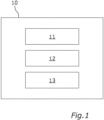
- Fig. 1 depicts a view of a computer system 10 for detecting an occupancy of a seat within a vehicle cabin.
- the computer system 10 comprises a processing device 11, an imaging device 12 and a memory device 13.
- the computer system 10 is adapted to perform a method for detecting an occupancy of a seat in the vehicle cabin. Therefore, the imaging device 12 is adapted to capture an image of the vehicle cabin.
- the processing device 11 is adapted to determine one or more seats in the vehicle cabin by processing the captured image, to identify a set of characteristics associated with each seat in the vehicle cabin in the image, to determine a region associated with each of the detected seats based on the set of characteristics, wherein each region is configured to cover a portion of the seat and to determine a seat occupancy status by processing information obtained from the corresponding region.
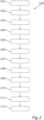
- Fig. 2 shows a flow chart of a computer implemented method 100 for detecting an occupancy of a seat. The results of the steps 101 to 111 are shown in Fig. 3 .
- step 101 in which capturing, by means of an imaging device, an image 200 of a vehicle cabin.
- a first characteristic and a second characteristic related to a first seat in the vehicle cabin in the image are identified.
- the first characteristic is a seat belt mount of the first seat and the second characteristic is a seat belt buckle of the first seat.
- a first region being a first rectangle 210 in the image is identified, wherein the location of the first characteristic defines a first corner 211 of the first rectangle 210 and the location of the second characteristic defines a second corner 212 of the first rectangle 210, diagonally opposite of the first characteristic.
- the first rectangle 210 covers a portion of the first seat, which is the driver's seat of the front row of the vehicle cabin.
- the four edges of the first rectangle 210 are parallel to the frame or outline of the captured image 200.
- a third characteristic and a fourth characteristic related to a first seat in the vehicle cabin in the image are identified.
- the third characteristic is a top edge of the back rest of the second seat and the fourth characteristic is a front edge of the bottom rest of the second seat.
- a second region being a second rectangle 220 in the image is identified, wherein the location of the third characteristic defines a first edge 221 of the second rectangle 220 and the location of the fourth characteristic defines a second edge 222 of the second rectangle 220 parallel to the first edge 221.
- the second rectangle 220 covers a portion of the second seat, which is the center seat in the back row of the vehicle cabin.
- the four edges of the second rectangle 220 are parallel to the frame or outline of the captured image.
- the first edge 221 of the second rectangle 220 is parallel to the top edge of the image 200 and the second edge 222 is parallel to the bottom edge of the image 200.
- a third region being a third rectangle 230 is identified in the image based on the second rectangle 220, wherein the third rectangle 230 covers a portion of a third seat in the vehicle cabin, which is the right seat in the back row of the vehicle cabin.
- the third rectangle 230 has the same size as the second rectangle 220 and shares the same side edge with the second rectangle 220.
- the third rectangle 230 is a mirrored form of the second rectangle 220 around the right side edge of the second rectangle 220.
- the four edges of the third rectangle 230 are parallel to the frame or outline of the captured image.
- a fourth region being a fourth rectangle 240 is identified based on the second rectangle, wherein the fourth rectangle 240 covers a portion of a fourth seat in the vehicle cabin, which is the left seat in the back row of the vehicle cabin.
- the fourth rectangle 240 has the same size as the second rectangle 220 and the third rectangle 230 and shares the same side edge with the second rectangle 220.
- the fourth rectangle 240 is a mirrored form of the second rectangle 220 around the left side edge of the second rectangle 220.
- the four edges of the fourth rectangle 240 are parallel to the frame or outline of the captured image 200.
- a fifth characteristic and a sixth characteristic related to a fifth seat in the vehicle cabin in the image are identified.
- the fifth characteristic is a seat belt mount of the fifth seat and the sixth characteristic is a seat belt buckle of the fifth seat.
- a fifth region being a fifth rectangle 250 in the image is identified, wherein the location of the fifth characteristic defines a first corner 251 of the fifth rectangle and the location of the sixth characteristic defines a second corner 252 of the fifth rectangle, diagonally opposite of the fifth characteristic.
- the fifth rectangle covers a portion of the fifth seat, which is the passenger's seat of the front row of the vehicle cabin.
- the four edges of the fifth rectangle 250 are parallel to the frame or outline of the captured image 200.
- a sixth region being a third rectangle 260 is identified based on the first rectangle 210, wherein the sixth rectangle 260 covers a portion to the right of the first seat in the vehicle cabin.
- the sixth 260 rectangle shares the same side edge with the first rectangle 210, in particular the right side edge of the first rectangle 210 and extends until the right edge of the image, covering the entrance region around the driver's door and the B pillar.
- a seventh region being a third rectangle 270 is identified based on the fifth rectangle 250, wherein the seventh rectangle 270 covers a portion to the left of the fifth seat in the vehicle cabin.
- the seventh rectangle 270 shares the same side edge with the fifth rectangle 250, in particular the left side edge of the fifth rectangle 250 and extends until the left edge of the image, covering the entrance region around the passenger's door and the B pillar.
- the step 102, 104 and/or 108 may be done in particular by using a trained machine-learning model.
- the order of the steps 102 and 103, 104 and 105, 106, 107, 108 and 109, 110 as well as 111 may be performed in a different order and/or simultaneously.
- the steps 102 and 108 are performed at the same time in a first instance and the steps 103 and 109 at the same time in a second instance, then step 104 followed by 105, then 106 and 107 at the same time followed by 110 and 111 at the same time.
- an occupancy of the first, second, third, fourth and/or fifth seat is identified based on the first, second, third, fourth and fifth rectangle 210, 220, 230, 240, 250. Further, by identifying an occupancy of the sixth or seventh rectangle 260, 270, it is possible to detect whether a person enters or exits the vehicle cabin. Detecting the occupancy of a rectangle may be done by comparing the rectangles with empty rectangles of a previously captured image.
- the method 100 can proceed the steps shown in Fig. 4 .
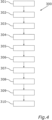
- Fig. 4 shows a flow chart of a computer implemented method for detecting a type of occupancy of a seat, as shown in conjunction with Fig. 5 , 6 , 7 and 8 , in particular after previously identifying the rectangles of the seats as shown in Fig. 2 and 3 .
- the image 400 shows a different type of vehicle cabin, which is why the rectangles 210, 220, 230, 240 and 250 are at different positions and have different sizes as shown in comparison to Fig. 3 .
- first sub-regions being sub-rectangles 410' 420', 430', 440', indicated with a dashed line are identified based on the rectangles 210, 220, 230, 240 and 250, indicated with a solid line, as previously identified.
- a first sub-rectangle 410' is identified based on the location and size of the first rectangle 210
- a first sub-rectangle 420' is identified based on the location and size of the second rectangle 220
- a first sub-rectangle 430' is identified based on the location and size of the third rectangle 230
- a first sub-rectangle 440' is identified based on the location and size of the fourth rectangle 240
- a first sub-rectangle 450' is identified based on the location and size of the fifth rectangle 250.
- the first sub-rectangles 410' 420', 430', 440' and 450' relate to the identification of a person 415. Therefore, the first sub-rectangles 410' 420', 430', 440' and 450' are larger in size, in particular in height than the respective rectangles 210, 220, 230, 240 and 250 and/or offset from the center thereof.
- the type of occupation in the first sub-rectangles, if any, is then identified in a further step 302, in particular by using a classifier algorithm for persons.
- second sub-rectangles 410" 420", 430", 440" and 450 are identified based on the rectangles 210, 220, 230, 240 and 250, indicated with a solid line, as previously identified.
- a second sub-rectangle 410" is identified based on the location and size of the first rectangle 210
- a second sub-rectangle 420" is identified based on the location and size of the second rectangle 220
- a second sub-rectangle 430" is identified based on the location and size of the third rectangle 230
- a second sub-rectangle 440" is identified based on the location and size of the fourth rectangle 240
- a second sub-rectangle 450" is identified based on the location and size of the fifth rectangle 250.
- the second sub-rectangles 410" 420", 430", 440" and 450" relate to identification of a child's seat 455. Therefore, the second sub-rectangles 410" 420", 430", 440" and 450" are smaller in height and larger in width than the respective rectangles 210, 220, 230, 240 and 250 and/or offset from the center thereof.
- the type of occupation in the second sub-rectangles, if any, is then identified in a further step 304, in particular by using a classifier algorithm for child's seats.
- third sub-rectangles 410′′′, 420′′′, 430′′′, 440′′′ and 450′′′ are identified based on the rectangles 210, 220, 230, 240 and 250, indicated with a solid line, as previously identified.
- a third sub-rectangle 410′′′ is identified based on the location and size of the first rectangle 210
- a third sub-rectangle 420′′′ is identified based on the location and size of the second rectangle 220
- a third sub-rectangle 430′′′ is identified based on the location and size of the third rectangle 230
- a third sub-rectangle 440′′′′ is identified based on the location and size of the fourth rectangle 240
- a third sub-rectangle 450′′′ is identified based on the location and size of the fifth rectangle 250.
- the third sub-rectangles 410′′′ 420′′′, 430′′′, 440′′′ and 450′′′ relate to identification of a small objects 425, such as a teddy bear. Therefore, the third sub-rectangles 410′′′ 420′′′, 430′′′, 440′′′ and 450" are smaller in height and/ or in width than the respective rectangles 210, 220, 230, 240 and 250 and/or offset from the center thereof.
- the type of occupation in the third sub-rectangles, if any, is then identified in a further step 306, in particular by using a classifier algorithm for small objects.
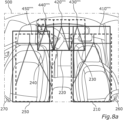
- FIG. 8a the image 500 shows yet again a different type of vehicle cabin, which is why the rectangles 210, 220, 230, 240 and 250 are at different positions and have different sizes as shown in comparison to Fig. 3 and Fig. 5 , 6 and 7 , respectively.
- fourth sub-rectangles 410 ⁇ , 420 ⁇ , 430 ⁇ , 440 ⁇ and 450 ⁇ are identified based on the rectangles 210, 220, 230, 240 and 250, indicated with a solid line, as previously identified.
- a fourth sub-rectangle 410 ⁇ is identified based on the location and size of the first rectangle 210
- a fourth sub-rectangle 420 ⁇ is identified based on the location and size of the second rectangle 220
- a fourth sub-rectangle 430"" is identified based on the location and size of the third rectangle 230
- a fourth sub-rectangle 440 ⁇ is identified based on the location and size of the fourth rectangle 240
- a fourth sub-rectangle 450"" is identified based on the location and size of the fifth rectangle 250.
- the fourth sub-rectangles 410 ⁇ 420 ⁇ , 430 ⁇ , 440 ⁇ and 450′′′ relate to identification of a body points of a person. Therefore, the fourth sub-rectangles 410 ⁇ 420"", 430"", 440 ⁇ and 450′′′ are different in height and/ or in width than the respective rectangles 210, 220, 230, 240 and 250 and/or offset from the center thereof.
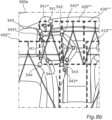
- reference body points are identified in the respective fourth sub-rectangles 410 ⁇ 420 ⁇ , 430 ⁇ , 440 ⁇ and 450′′′. These are not identified with a reference numeral for visibility reasons in Fig. 8a and will be described with further detail in relation to Fig. 8b , which shows a detail 500a of the image 500 as shown in Fig. 8a .
- a total of five reference body points are identified in the fourth sub-rectangle 440 ⁇ of the fourth rectangle, the latter of which is not shown due to visibility reasons.
- the reference body points are all located on the rectangle outline and are connected by dotted lines.
- the reference body points correspond to the positions where actual body points of a person sitting in the respective seat would be located.
- body points of the person sitting in the fourth seat are identified.
- a first body point 541*, relating to the nose of a person, a second reference body point 542*, relating to a left shoulder of a person, a third reference body point 543*, relating to a left knee of a person, a fourth reference body point 544*, relating to a right knee of a person and a fifth reference body point 545*, relating to a right shoulder of the person are identified in the image.
- Other body points are also identified, in particular relating to the left arm of the person. However, in this embodiment they are not considered relevant.
- a type of occupancy of the first seat based on the reference body points and the body points is identified. In particular, it is identified, if there is a person sitting in the respective seat based on the reference body points, for example by the respective distance of the body points to the reference body points.
Landscapes
- Engineering & Computer Science (AREA)
- Physics & Mathematics (AREA)
- General Physics & Mathematics (AREA)
- Multimedia (AREA)
- Theoretical Computer Science (AREA)
- Human Computer Interaction (AREA)
- Computer Vision & Pattern Recognition (AREA)
- Image Analysis (AREA)
Priority Applications (3)
| Application Number | Priority Date | Filing Date | Title |
|---|---|---|---|
| EP22169964.8A EP4270331B1 (de) | 2022-04-26 | 2022-04-26 | Computerimplementiertes verfahren, computersystem und nichtflüchtiges computerlesbares medium zum detektieren der belegung eines sitzes in einer fahrzeugkabine |
| CN202310109182.5A CN116958940A (zh) | 2022-04-26 | 2023-02-13 | 检测车辆座舱中的座椅占用的计算机实现方法、系统和介质 |
| US18/133,055 US20230343111A1 (en) | 2022-04-26 | 2023-04-11 | Computer implemented method, computer system and non-transitory computer readable medium for detecting an occupancy of a seat in a vehicle cabin |
Applications Claiming Priority (1)
| Application Number | Priority Date | Filing Date | Title |
|---|---|---|---|
| EP22169964.8A EP4270331B1 (de) | 2022-04-26 | 2022-04-26 | Computerimplementiertes verfahren, computersystem und nichtflüchtiges computerlesbares medium zum detektieren der belegung eines sitzes in einer fahrzeugkabine |
Publications (2)
| Publication Number | Publication Date |
|---|---|
| EP4270331A1 true EP4270331A1 (de) | 2023-11-01 |
| EP4270331B1 EP4270331B1 (de) | 2025-08-20 |
Family
ID=81387034
Family Applications (1)
| Application Number | Title | Priority Date | Filing Date |
|---|---|---|---|
| EP22169964.8A Active EP4270331B1 (de) | 2022-04-26 | 2022-04-26 | Computerimplementiertes verfahren, computersystem und nichtflüchtiges computerlesbares medium zum detektieren der belegung eines sitzes in einer fahrzeugkabine |
Country Status (3)
| Country | Link |
|---|---|
| US (1) | US20230343111A1 (de) |
| EP (1) | EP4270331B1 (de) |
| CN (1) | CN116958940A (de) |
Citations (2)
| Publication number | Priority date | Publication date | Assignee | Title |
|---|---|---|---|---|
| US20130051625A1 (en) * | 2011-08-23 | 2013-02-28 | Xerox Corporation | Front seat vehicle occupancy detection via seat pattern recognition |
| US20190325603A1 (en) * | 2016-06-14 | 2019-10-24 | Aisin Seiki Kabushiki Kaisha | Seated state detection device |
Family Cites Families (13)
| Publication number | Priority date | Publication date | Assignee | Title |
|---|---|---|---|---|
| DE102006040244B3 (de) * | 2006-08-28 | 2007-08-30 | Robert Bosch Gmbh | Vorrichtung und Verfahren zur Sitzbelegungserkennung |
| JP2008261749A (ja) * | 2007-04-12 | 2008-10-30 | Takata Corp | 乗員検出装置、作動装置制御システム、シートベルトシステム、車両 |
| DE102010044174B4 (de) * | 2010-08-12 | 2013-05-16 | Johnson Controls Gmbh | Verfahren und Vorrichtung zur Sitzbelegungserkennung in einem Fahrzeuginnenraum |
| DE102016003315A1 (de) * | 2016-03-17 | 2016-10-06 | Daimler Ag | Verfahren zur Erfassung einer Sitzbelegung |
| EP3451651B1 (de) * | 2016-04-27 | 2022-06-08 | Sony Group Corporation | Bildgebungssteuerungsvorrichtung, bildgebungssteuerungsverfahren und bildgebungsvorrichtung |
| US11391810B2 (en) * | 2016-08-31 | 2022-07-19 | Ford Global Technologies, Llc | Method and apparatus for vehicle occupant location detection |
| US20190184853A1 (en) * | 2017-12-19 | 2019-06-20 | GM Global Technology Operations LLC | Occupant sensing system for a vehicle |
| US10953850B1 (en) * | 2018-04-05 | 2021-03-23 | Ambarella International Lp | Seatbelt detection using computer vision |
| US10647222B2 (en) * | 2018-04-11 | 2020-05-12 | GM Global Technology Operations LLC | System and method to restrict vehicle seat movement |
| DE102018128987A1 (de) * | 2018-11-19 | 2020-05-20 | Dalphi Metal Espana, S.A. | Seitengassack für ein fahrzeugsicherheitssystem eines kraftfahrzeugs und fahrzeugsicherheitssystem |
| US11565653B2 (en) * | 2020-01-03 | 2023-01-31 | Aptiv Technologies Limited | Vehicle occupancy-monitoring system |
| EP3848256A1 (de) * | 2020-01-07 | 2021-07-14 | Aptiv Technologies Limited | Verfahren und systeme zur erkennung, ob ein sicherheitsgurt in einem fahrzeug verwendet wird |
| CN112172736B (zh) * | 2020-10-20 | 2022-05-13 | 广州小鹏汽车科技有限公司 | 车载安全系统预警方法、车载安全系统、车辆及存储介质 |
-
2022
- 2022-04-26 EP EP22169964.8A patent/EP4270331B1/de active Active
-
2023
- 2023-02-13 CN CN202310109182.5A patent/CN116958940A/zh active Pending
- 2023-04-11 US US18/133,055 patent/US20230343111A1/en active Pending
Patent Citations (2)
| Publication number | Priority date | Publication date | Assignee | Title |
|---|---|---|---|---|
| US20130051625A1 (en) * | 2011-08-23 | 2013-02-28 | Xerox Corporation | Front seat vehicle occupancy detection via seat pattern recognition |
| US20190325603A1 (en) * | 2016-06-14 | 2019-10-24 | Aisin Seiki Kabushiki Kaisha | Seated state detection device |
Also Published As
| Publication number | Publication date |
|---|---|
| CN116958940A (zh) | 2023-10-27 |
| US20230343111A1 (en) | 2023-10-26 |
| EP4270331B1 (de) | 2025-08-20 |
Similar Documents
| Publication | Publication Date | Title |
|---|---|---|
| EP3848257B1 (de) | Verfahren und systeme zur erkennung, ob ein sicherheitsgurt in einem fahrzeug verwendet wird | |
| JP4810052B2 (ja) | 乗員センサ | |
| US8581983B2 (en) | Vehicle interior classification system and method | |
| US20030169906A1 (en) | Method and apparatus for recognizing objects | |
| CN110826370A (zh) | 车内人员的身份识别方法、装置、车辆及存储介质 | |
| US20230316783A1 (en) | Computer-implemented method for analysing the interior of a vehicle | |
| CN111867466A (zh) | 体格估计装置及体格估计方法 | |
| EP3633558B1 (de) | Lernverfahren und prüfverfahren zum überwachen des toten winkels eines fahrzeugs und lernvorrichtung und prüfvorrichtung damit | |
| WO2021240777A1 (ja) | 乗員検出装置および乗員検出方法 | |
| KR20210042579A (ko) | 주행 중인 차량 내 승차인원 검지를 위한 승차위치 확인 및 합산 방법 | |
| WO2021240769A1 (ja) | 乗員検出装置および乗員検出方法 | |
| US20240331328A1 (en) | Interactive Vision-Based Child Seat Mounting Assistance | |
| US12277775B2 (en) | Vision system and method for a motor vehicle | |
| EP4270331A1 (de) | Computerimplementiertes verfahren, computersystem und nichtflüchtiges computerlesbares medium zum detektieren der belegung eines sitzes in einer fahrzeugkabine | |
| EP3637309B1 (de) | Lernverfahren und prüfverfahren zur überwachung des toten winkels eines fahrzeugs sowie lernvorrichtung und prüfvorrichtung damit | |
| CN115841586A (zh) | 用于车辆的座椅占用分类系统 | |
| JP2022033426A (ja) | 車載装置及び乗降車判定方法 | |
| US20240013556A1 (en) | Child Seat Detection for a Seat Occupancy Classification System | |
| US20240217477A1 (en) | Seatbelt verification | |
| US20200184674A1 (en) | Analysis apparatus, analysis method, and non transitory storage medium | |
| CN116512995B (zh) | 检测座椅占用的方法和系统 | |
| CN117121061A (zh) | 用于生成注意区域的计算机实现的方法 | |
| US20240386594A1 (en) | Vehicle Passenger Safety by Height Estimation | |
| CN111860092A (zh) | 司机身份验证方法、装置、控制设备及存储介质 | |
| US20250058784A1 (en) | Physical Driver Condition Determination for Vehicle Safety |
Legal Events
| Date | Code | Title | Description |
|---|---|---|---|
| PUAI | Public reference made under article 153(3) epc to a published international application that has entered the european phase |
Free format text: ORIGINAL CODE: 0009012 |
|
| STAA | Information on the status of an ep patent application or granted ep patent |
Free format text: STATUS: THE APPLICATION HAS BEEN PUBLISHED |
|
| AK | Designated contracting states |
Kind code of ref document: A1 Designated state(s): AL AT BE BG CH CY CZ DE DK EE ES FI FR GB GR HR HU IE IS IT LI LT LU LV MC MK MT NL NO PL PT RO RS SE SI SK SM TR |
|
| STAA | Information on the status of an ep patent application or granted ep patent |
Free format text: STATUS: REQUEST FOR EXAMINATION WAS MADE |
|
| 17P | Request for examination filed |
Effective date: 20231116 |
|
| RBV | Designated contracting states (corrected) |
Designated state(s): AL AT BE BG CH CY CZ DE DK EE ES FI FR GB GR HR HU IE IS IT LI LT LU LV MC MK MT NL NO PL PT RO RS SE SI SK SM TR |
|
| RAP1 | Party data changed (applicant data changed or rights of an application transferred) |
Owner name: APTIV TECHNOLOGIES AG |
|
| RAP3 | Party data changed (applicant data changed or rights of an application transferred) |
Owner name: APTIV TECHNOLOGIES AG |
|
| GRAP | Despatch of communication of intention to grant a patent |
Free format text: ORIGINAL CODE: EPIDOSNIGR1 |
|
| GRAJ | Information related to disapproval of communication of intention to grant by the applicant or resumption of examination proceedings by the epo deleted |
Free format text: ORIGINAL CODE: EPIDOSDIGR1 |
|
| GRAP | Despatch of communication of intention to grant a patent |
Free format text: ORIGINAL CODE: EPIDOSNIGR1 |
|
| STAA | Information on the status of an ep patent application or granted ep patent |
Free format text: STATUS: GRANT OF PATENT IS INTENDED |
|
| INTG | Intention to grant announced |
Effective date: 20250317 |
|
| GRAS | Grant fee paid |
Free format text: ORIGINAL CODE: EPIDOSNIGR3 |
|
| GRAA | (expected) grant |
Free format text: ORIGINAL CODE: 0009210 |
|
| STAA | Information on the status of an ep patent application or granted ep patent |
Free format text: STATUS: THE PATENT HAS BEEN GRANTED |
|
| P01 | Opt-out of the competence of the unified patent court (upc) registered |
Free format text: CASE NUMBER: APP_32066/2025 Effective date: 20250702 |
|
| AK | Designated contracting states |
Kind code of ref document: B1 Designated state(s): AL AT BE BG CH CY CZ DE DK EE ES FI FR GB GR HR HU IE IS IT LI LT LU LV MC MK MT NL NO PL PT RO RS SE SI SK SM TR |
|
| REG | Reference to a national code |
Ref country code: GB Ref legal event code: FG4D |
|
| REG | Reference to a national code |
Ref country code: CH Ref legal event code: EP |
|
| REG | Reference to a national code |
Ref country code: IE Ref legal event code: FG4D |
|
| REG | Reference to a national code |
Ref country code: DE Ref legal event code: R096 Ref document number: 602022019662 Country of ref document: DE |
|
| REG | Reference to a national code |
Ref country code: NL Ref legal event code: MP Effective date: 20250820 |
|
| PG25 | Lapsed in a contracting state [announced via postgrant information from national office to epo] |
Ref country code: IS Free format text: LAPSE BECAUSE OF FAILURE TO SUBMIT A TRANSLATION OF THE DESCRIPTION OR TO PAY THE FEE WITHIN THE PRESCRIBED TIME-LIMIT Effective date: 20251220 |
|
| PG25 | Lapsed in a contracting state [announced via postgrant information from national office to epo] |
Ref country code: NO Free format text: LAPSE BECAUSE OF FAILURE TO SUBMIT A TRANSLATION OF THE DESCRIPTION OR TO PAY THE FEE WITHIN THE PRESCRIBED TIME-LIMIT Effective date: 20251120 |
|
| REG | Reference to a national code |
Ref country code: LT Ref legal event code: MG9D |
|
| PG25 | Lapsed in a contracting state [announced via postgrant information from national office to epo] |
Ref country code: PT Free format text: LAPSE BECAUSE OF FAILURE TO SUBMIT A TRANSLATION OF THE DESCRIPTION OR TO PAY THE FEE WITHIN THE PRESCRIBED TIME-LIMIT Effective date: 20251222 |
|
| PG25 | Lapsed in a contracting state [announced via postgrant information from national office to epo] |
Ref country code: FI Free format text: LAPSE BECAUSE OF FAILURE TO SUBMIT A TRANSLATION OF THE DESCRIPTION OR TO PAY THE FEE WITHIN THE PRESCRIBED TIME-LIMIT Effective date: 20250820 |
|
| PG25 | Lapsed in a contracting state [announced via postgrant information from national office to epo] |
Ref country code: NL Free format text: LAPSE BECAUSE OF FAILURE TO SUBMIT A TRANSLATION OF THE DESCRIPTION OR TO PAY THE FEE WITHIN THE PRESCRIBED TIME-LIMIT Effective date: 20250820 Ref country code: HR Free format text: LAPSE BECAUSE OF FAILURE TO SUBMIT A TRANSLATION OF THE DESCRIPTION OR TO PAY THE FEE WITHIN THE PRESCRIBED TIME-LIMIT Effective date: 20250820 |
|
| PG25 | Lapsed in a contracting state [announced via postgrant information from national office to epo] |
Ref country code: GR Free format text: LAPSE BECAUSE OF FAILURE TO SUBMIT A TRANSLATION OF THE DESCRIPTION OR TO PAY THE FEE WITHIN THE PRESCRIBED TIME-LIMIT Effective date: 20251121 |
|
| PG25 | Lapsed in a contracting state [announced via postgrant information from national office to epo] |
Ref country code: SE Free format text: LAPSE BECAUSE OF FAILURE TO SUBMIT A TRANSLATION OF THE DESCRIPTION OR TO PAY THE FEE WITHIN THE PRESCRIBED TIME-LIMIT Effective date: 20250820 |
|
| PG25 | Lapsed in a contracting state [announced via postgrant information from national office to epo] |
Ref country code: LV Free format text: LAPSE BECAUSE OF FAILURE TO SUBMIT A TRANSLATION OF THE DESCRIPTION OR TO PAY THE FEE WITHIN THE PRESCRIBED TIME-LIMIT Effective date: 20250820 |
|
| PG25 | Lapsed in a contracting state [announced via postgrant information from national office to epo] |
Ref country code: BG Free format text: LAPSE BECAUSE OF FAILURE TO SUBMIT A TRANSLATION OF THE DESCRIPTION OR TO PAY THE FEE WITHIN THE PRESCRIBED TIME-LIMIT Effective date: 20250820 Ref country code: PL Free format text: LAPSE BECAUSE OF FAILURE TO SUBMIT A TRANSLATION OF THE DESCRIPTION OR TO PAY THE FEE WITHIN THE PRESCRIBED TIME-LIMIT Effective date: 20250820 |
|
| PG25 | Lapsed in a contracting state [announced via postgrant information from national office to epo] |
Ref country code: RS Free format text: LAPSE BECAUSE OF FAILURE TO SUBMIT A TRANSLATION OF THE DESCRIPTION OR TO PAY THE FEE WITHIN THE PRESCRIBED TIME-LIMIT Effective date: 20251120 |
|
| PG25 | Lapsed in a contracting state [announced via postgrant information from national office to epo] |
Ref country code: ES Free format text: LAPSE BECAUSE OF FAILURE TO SUBMIT A TRANSLATION OF THE DESCRIPTION OR TO PAY THE FEE WITHIN THE PRESCRIBED TIME-LIMIT Effective date: 20250820 |