EP4269634A1 - Method for recovering lead from copper smelting dust - Google Patents
Method for recovering lead from copper smelting dust Download PDFInfo
- Publication number
- EP4269634A1 EP4269634A1 EP21909747.4A EP21909747A EP4269634A1 EP 4269634 A1 EP4269634 A1 EP 4269634A1 EP 21909747 A EP21909747 A EP 21909747A EP 4269634 A1 EP4269634 A1 EP 4269634A1
- Authority
- EP
- European Patent Office
- Prior art keywords
- lead
- leaching
- copper
- alkali
- dust
- Prior art date
- Legal status (The legal status is an assumption and is not a legal conclusion. Google has not performed a legal analysis and makes no representation as to the accuracy of the status listed.)
- Pending
Links
Images

Classifications
-
- B—PERFORMING OPERATIONS; TRANSPORTING
- B01—PHYSICAL OR CHEMICAL PROCESSES OR APPARATUS IN GENERAL
- B01D—SEPARATION
- B01D11/00—Solvent extraction
- B01D11/02—Solvent extraction of solids
- B01D11/028—Flow sheets
- B01D11/0284—Multistage extraction
-
- B—PERFORMING OPERATIONS; TRANSPORTING
- B01—PHYSICAL OR CHEMICAL PROCESSES OR APPARATUS IN GENERAL
- B01D—SEPARATION
- B01D11/00—Solvent extraction
- B01D11/02—Solvent extraction of solids
- B01D11/0288—Applications, solvents
-
- B—PERFORMING OPERATIONS; TRANSPORTING
- B01—PHYSICAL OR CHEMICAL PROCESSES OR APPARATUS IN GENERAL
- B01D—SEPARATION
- B01D9/00—Crystallisation
- B01D9/005—Selection of auxiliary, e.g. for control of crystallisation nuclei, of crystal growth, of adherence to walls; Arrangements for introduction thereof
- B01D9/0054—Use of anti-solvent
-
- C—CHEMISTRY; METALLURGY
- C01—INORGANIC CHEMISTRY
- C01G—COMPOUNDS CONTAINING METALS NOT COVERED BY SUBCLASSES C01D OR C01F
- C01G21/00—Compounds of lead
- C01G21/02—Oxides
-
- C—CHEMISTRY; METALLURGY
- C01—INORGANIC CHEMISTRY
- C01G—COMPOUNDS CONTAINING METALS NOT COVERED BY SUBCLASSES C01D OR C01F
- C01G21/00—Compounds of lead
- C01G21/02—Oxides
- C01G21/06—Lead monoxide [PbO]
-
- C—CHEMISTRY; METALLURGY
- C22—METALLURGY; FERROUS OR NON-FERROUS ALLOYS; TREATMENT OF ALLOYS OR NON-FERROUS METALS
- C22B—PRODUCTION AND REFINING OF METALS; PRETREATMENT OF RAW MATERIALS
- C22B1/00—Preliminary treatment of ores or scrap
-
- C—CHEMISTRY; METALLURGY
- C22—METALLURGY; FERROUS OR NON-FERROUS ALLOYS; TREATMENT OF ALLOYS OR NON-FERROUS METALS
- C22B—PRODUCTION AND REFINING OF METALS; PRETREATMENT OF RAW MATERIALS
- C22B1/00—Preliminary treatment of ores or scrap
- C22B1/005—Preliminary treatment of scrap
-
- C—CHEMISTRY; METALLURGY
- C22—METALLURGY; FERROUS OR NON-FERROUS ALLOYS; TREATMENT OF ALLOYS OR NON-FERROUS METALS
- C22B—PRODUCTION AND REFINING OF METALS; PRETREATMENT OF RAW MATERIALS
- C22B13/00—Obtaining lead
-
- C—CHEMISTRY; METALLURGY
- C22—METALLURGY; FERROUS OR NON-FERROUS ALLOYS; TREATMENT OF ALLOYS OR NON-FERROUS METALS
- C22B—PRODUCTION AND REFINING OF METALS; PRETREATMENT OF RAW MATERIALS
- C22B13/00—Obtaining lead
- C22B13/04—Obtaining lead by wet processes
- C22B13/045—Recovery from waste materials
-
- C—CHEMISTRY; METALLURGY
- C22—METALLURGY; FERROUS OR NON-FERROUS ALLOYS; TREATMENT OF ALLOYS OR NON-FERROUS METALS
- C22B—PRODUCTION AND REFINING OF METALS; PRETREATMENT OF RAW MATERIALS
- C22B3/00—Extraction of metal compounds from ores or concentrates by wet processes
- C22B3/04—Extraction of metal compounds from ores or concentrates by wet processes by leaching
- C22B3/12—Extraction of metal compounds from ores or concentrates by wet processes by leaching in inorganic alkaline solutions
-
- C—CHEMISTRY; METALLURGY
- C22—METALLURGY; FERROUS OR NON-FERROUS ALLOYS; TREATMENT OF ALLOYS OR NON-FERROUS METALS
- C22B—PRODUCTION AND REFINING OF METALS; PRETREATMENT OF RAW MATERIALS
- C22B3/00—Extraction of metal compounds from ores or concentrates by wet processes
- C22B3/20—Treatment or purification of solutions, e.g. obtained by leaching
- C22B3/44—Treatment or purification of solutions, e.g. obtained by leaching by chemical processes
-
- C—CHEMISTRY; METALLURGY
- C22—METALLURGY; FERROUS OR NON-FERROUS ALLOYS; TREATMENT OF ALLOYS OR NON-FERROUS METALS
- C22B—PRODUCTION AND REFINING OF METALS; PRETREATMENT OF RAW MATERIALS
- C22B7/00—Working up raw materials other than ores, e.g. scrap, to produce non-ferrous metals and compounds thereof; Methods of a general interest or applied to the winning of more than two metals
- C22B7/006—Wet processes
- C22B7/008—Wet processes by an alkaline or ammoniacal leaching
-
- C—CHEMISTRY; METALLURGY
- C22—METALLURGY; FERROUS OR NON-FERROUS ALLOYS; TREATMENT OF ALLOYS OR NON-FERROUS METALS
- C22B—PRODUCTION AND REFINING OF METALS; PRETREATMENT OF RAW MATERIALS
- C22B7/00—Working up raw materials other than ores, e.g. scrap, to produce non-ferrous metals and compounds thereof; Methods of a general interest or applied to the winning of more than two metals
- C22B7/02—Working-up flue dust
-
- C—CHEMISTRY; METALLURGY
- C01—INORGANIC CHEMISTRY
- C01P—INDEXING SCHEME RELATING TO STRUCTURAL AND PHYSICAL ASPECTS OF SOLID INORGANIC COMPOUNDS
- C01P2006/00—Physical properties of inorganic compounds
- C01P2006/80—Compositional purity
-
- Y—GENERAL TAGGING OF NEW TECHNOLOGICAL DEVELOPMENTS; GENERAL TAGGING OF CROSS-SECTIONAL TECHNOLOGIES SPANNING OVER SEVERAL SECTIONS OF THE IPC; TECHNICAL SUBJECTS COVERED BY FORMER USPC CROSS-REFERENCE ART COLLECTIONS [XRACs] AND DIGESTS
- Y02—TECHNOLOGIES OR APPLICATIONS FOR MITIGATION OR ADAPTATION AGAINST CLIMATE CHANGE
- Y02P—CLIMATE CHANGE MITIGATION TECHNOLOGIES IN THE PRODUCTION OR PROCESSING OF GOODS
- Y02P10/00—Technologies related to metal processing
- Y02P10/20—Recycling
Definitions
- the present invention relates to a method for recovering lead from dust (flue cinder) that is generated in a copper smelting step, which is a method for efficiently recovering lead contained in the dust by separating it from precious metals such as copper, tin, and zinc, as well as gold and silver.
- a raw material such as copper concentrate is melted and separated into copper matte and slag by using the difference in the specific gravity of the solution, and then the slag is discharged, and the air is blown into the copper matte to produce blister copper.
- the blister copper is oxidized and then reduced in a refining furnace and subjected to anode casting, whereby electrolytic copper is produced by electrorefining or the like.
- electrolytic copper is produced by electrorefining or the like.
- the lead concentration in the copper anode increases, which adversely affects the copper electrorefining step. To avoid this adverse effect, it is required to remove lead in the copper smelting step.
- the dust Flue cinder
- the dust contains volatile metals (tin, zinc, and the like) other than lead and further contains copper and precious metals
- the dust generated in the smelting step is captured and returned to the copper smelting furnace in order to recover this copper content and precious metal content. If lead is separated from the dust, the lead separated is excluded from the feed to the copper smelting furnace.
- Patent Document 1 describes a treatment method in which copper smelting dust is immersed in dilute sulfuric acid to leach out copper, zinc, and arsenic, while forming a residue mainly containing lead and bismuth.
- Patent Document 2 describes a method for separating lead and copper in a leaching residue by adding copper smelting dust to an acidic solution of sulfuric acid having a pH of 1.0 or higher and leaching copper in the dust, while adding a trivalent iron compound to carry out oxidation, thereby increasing the leaching rate.
- the method according to the present invention solves the above-described problems in the related art in the sulfuric acid leaching of the copper smelting dust known, and it provides a method for efficiently recovering lead contained in the copper smelting dust by separating it from precious metals such as copper, tin, and zinc, as well as gold and silver.
- the present invention employs the following means.
- a recovered lead material obtained by the method according to the present invention has a high concentration of lead as compared with lead sludge obtained by sulfuric acid leaching.
- the lead concentration of a recovered lead material of Example 1 according to the present invention is 62.0%
- the lead concentration of a lead sludge obtained by sulfuric acid leaching of Comparative Example 1 is 9.4%, and thus the lead quality of the lead recovered material according to the method according to the present invention is remarkably high.
- a large amount of the copper content contained in the dust is removed in the washing step, and thus the burden of alkali leaching is reduced, and a recovered lead material having a low copper concentration but having a high lead concentration is obtained as compared with a case where the washing step is not included.
- the lead concentration of the recovered lead material is 38.5% (lead distribution ratio: 34.7%), and the copper concentration is 25.5% (copper distribution ratio: 9.0%)
- the lead concentration of the recovered lead material is 62.0% (lead distribution ratio: 49.5%)
- the copper concentration is 4.7% (copper distribution ratio: 1.5%). That is, the lead concentration is increased significantly, while the copper concentration is decreased significantly.
- a recovered lead material containing almost no tin, gold, and silver can be obtained, and thus loss of valuable materials such as gold and silver is remarkably small.
- the method for recovering lead from copper smelting dust according to the present embodiment will be specifically described. It is noted that the unit % for representing the concentration means % by mass.
- the treatment method according to the present embodiment is a method of separating and recovering lead from dust generated in the copper smelting step (referred to as copper smelting dust).
- the copper smelting dust contains lead, copper, zinc, tin, and small amounts of precious metals.
- the treatment method according to the present embodiment is a method for efficiently separating and recovering lead contained in the copper smelting dust from copper, tin, zinc, gold, silver, and the like.
- the method for recovering lead according to the present embodiment is specifically a method for recovering lead from copper smelting dust, including an alkali leaching step of leaching lead contained in copper smelting dust with an alkali solution; a step of performing a solid liquid separation on a post-leaching solution and a leaching residue after the alkali leaching step; a neutralization step of adding an acid to the separated post-leaching solution to precipitate a lead; and a step of recovering a precipitate containing the lead by performing a solid liquid separation.
- a washing step of washing the copper smelting dust with water or an acid may be provided prior to the alkali leaching step, and it is more preferable to subject the copper smelting dust (referred to as the washed dust) obtained by the washing to alkali leaching.
- FIG. 1 An example of the processing flow of the method for recovering lead according to the present embodiment is shown in FIG. 1 .
- the copper smelting dust is washed with water or an acid. This washing washes away soluble copper compounds contained in the copper smelting dust. For example, a large amount of the copper contained in copper smelting dust is copper sulfate, and this copper sulfate is eluted into the water to remove the copper content. It is noted that since the slurry of the copper smelting dust becomes weakly acidic due to the elution of copper sulfate or the like, an acid may be used instead of water for washing.
- the slurry After washing, the slurry is subjected to solid-liquid separation to recover the washed dust, and the post-washing liquid is sent out of the system. Since the post-washing liquid contains a large amount of the copper content of the copper smelting dust, it can be used as a raw material for copper recovery.
- the recovered washed dust is sent to the alkali leaching step.
- the washed dust is added to an alkali solution to form a slurry, and the lead contained in the washed dust is subjected to alkali leaching.
- an alkali solution a general alkali solution such as a sodium hydroxide solution or a potassium hydroxide solution can be used.
- the lead contained in the washed dust is mainly lead sulfate (PbSO 4 ) and lead oxide (PbO).
- Lead sulfate reacts with, for example, sodium hydroxide as shown in Expression [1] to generate a plumbite ion, thereby being eluted.
- Lead oxide is also eluted in the same manner; however, since lead oxide is more stable than lead sulfate, the lead present in excess over the solubility thereof precipitates as lead oxide.
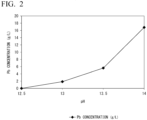
- FIG. 2 shows the change in lead concentration in the liquid with respect to pH.
- the lead concentration is 2 g/L at the pH is 13.0, and the lead concentration in the liquid increases in proportion to the increase in pH.
- the lead concentration at pH 13.5 is close to 6 g/L, which is about three times the lead concentration at pH 13.0.
- the pH of the alkali solution is preferably 13.0 or more and more preferably 13.5 or more.
- the post-leaching solution and the leaching residue are subjected to solid-liquid separation. Since the recovered post-leaching solution contains lead, it is sent to the neutralization step of recovering lead.
- the leaching residue contains tin oxide, which is difficult to be subjected to alkali leaching, a small amount of copper content, and a trace amount of precious metals, this leaching residue can be reused by repeatedly being added as a raw material to, for example, the copper smelting step.
- the lead concentration in the liquid decreases as the pH decreases, and the lead concentration is substantially zero in a case where the pH is 12.5.
- the lead (Pb 2+ ) subjected to the alkali leaching is dissolved, for example, in a state of HPbO 2- in a pH range of 13 or more, as shown in Expression [1], the precipitation of lead oxide (PbO) occurs in a pH range of 12.5 or less. Therefore, in order to recover the lead contained in the post-leaching solution, an acid is added to the post-leaching solution to neutralize it so that the pH is in an alkali range of 12.5 or less.
- the arsenic may migrate to the alkali leaching liquid.
- the pH is decreased too much, arsenic oxide (As 2 O 3 ) precipitates, which is not preferable since the quality of the recovered lead material may deteriorate. Therefore, the pH of the liquid after the neutralization is preferably in the alkali range. Specifically, the pH is preferably 10.0 or more and 12.5 or less and more preferably 11.5 or more and 12.5 or less.
- the acid to be used for neutralization may be a general acid such as sulfuric acid, hydrochloric acid, or nitric acid.
- the recovered lead material After the neutralization treatment, solid-liquid separation is carried out to recover a precipitate containing lead.
- this recovered lead-containing material (referred to as the recovered lead material), lead is selectively leached out in the alkali leaching of the washed dust, and thus the amount of impurities other than lead, contained in the post-leaching solution is small, whereby a recovered lead material having a high lead quality can be obtained.
- Table 2 shows the distribution ratios of metals and the like contained in the post-washing liquid after the water washing, the leaching residue after the alkali leaching, and the post-neutralization liquid after the neutralization treatment.
- Table 3 shows the concentrations and distribution ratios of metals and the like in the recovered lead material.
- the lead concentration of the recovered lead material was 60% or more, where it was a recovered lead material having a high lead quality, containing almost no tin, gold, silver, and the like.
- the entire amount of gold and silver migrated to the leaching residue of the alkali leaching and was substantially not contained in the recovered lead material, and thus it was possible to minimally suppress the loss of gold, silver, and the like due to the recovered lead material.
- 80% or more of the copper contained in the dust was washed away by washing with water, whereby it was possible to obtain a recovered lead material having a low copper concentration.
- Example 2 300 g of the same copper smelting dust as in Example 1 was dissolved in 1 L of an NaOH solution of 3 N to form an alkali slurry, the pH was adjusted to 14, and alkali leaching was carried out for 30 minutes. After the leaching, the alkali slurry was subjected to solid-liquid separation by the suction filtration device to obtain a post-leaching solution and a leaching residue. Sulfuric acid was added to the separated post-leaching solution for neutralization, and the pH was adjusted to 12.5 to precipitate lead oxide. Thereafter, the lead oxide precipitate and the post-neutralization liquid were subjected to solid-liquid separation by the suction filtration device, and the recovered lead oxide precipitate was dried at 105°C for 12 hours to obtain a recovered lead material.
- Table 4 shows the distribution ratios of metals and the like contained in the leaching residue of the alkali leaching and the post-solution after the neutralization treatment.
- Table 5 shows the concentrations and distribution ratios of metals and the like in the recovered lead material. As shown in Table 5, a recovered lead material having a lead concentration of 38.5%, having a low tin concentration, and having almost no gold and silver was obtained. The lead quality of this example is low as compared with Example 1, and this is conceived to be because copper is eluted together with lead by alkali leaching to form a tetrahydroxycuprate ion [Cu(OH) 4 2- ], whereby hydroxyl groups are consumed, the pH is decreased, and the leaching rate of lead is decreased.
- the copper concentration of the recovered lead material in this example is high as compared with Example 1, and this is conceived to be because water washing is not carried out in this example, and thus the copper remains without being washed out and removed, and this copper is leached out by alkali leaching and mixed with the lead precipitate. From the comparison between Example 1 and this example (Example 2), it was confirmed that water washing prior to alkali leaching is effective in removing copper content.
- Example 2 300 g of the same copper smelting dust as in Example 1 was dissolved in 1 L of sulfuric acid having a concentration of 200 g/L to form a sulfuric acid slurry, which was subsequently subjected to sulfuric acid leaching for 30 minutes. After the leaching, the sulfuric acid slurry was subjected to solid-liquid separation by the suction filtration device to obtain a leaching residue (lead sludge) and a post-leaching solution. This leaching residue was dried at 105°C for 12 hours to obtain a recovered lead material. Table 6 shows the concentrations and distribution ratios of metals and the like in this recovered lead material. In addition, Table 6 shows the distribution ratios of metals and the like to the post-leaching solution.
- the lead concentration of the recovered lead material is 9.4%, which is significantly low as compared with Examples 1 and 2.
- the recovered lead material of this comparative example has a low copper concentration.
- the copper/lead ratio (Cu/Pb) of Example 1 is about 0.076
- the copper/lead ratio (Cu/Pb) of this comparative example is about 0.276, which is significantly high as compared with Example 1.
- the tin concentration in this comparative example is about 10%, which is not preferable as a lead raw material.
Landscapes
- Chemical & Material Sciences (AREA)
- Engineering & Computer Science (AREA)
- Organic Chemistry (AREA)
- Metallurgy (AREA)
- Mechanical Engineering (AREA)
- Materials Engineering (AREA)
- Manufacturing & Machinery (AREA)
- Life Sciences & Earth Sciences (AREA)
- Geology (AREA)
- General Life Sciences & Earth Sciences (AREA)
- Environmental & Geological Engineering (AREA)
- Geochemistry & Mineralogy (AREA)
- Chemical Kinetics & Catalysis (AREA)
- Inorganic Chemistry (AREA)
- General Chemical & Material Sciences (AREA)
- Crystallography & Structural Chemistry (AREA)
- Manufacture And Refinement Of Metals (AREA)
Abstract
Description
- The present invention relates to a method for recovering lead from dust (flue cinder) that is generated in a copper smelting step, which is a method for efficiently recovering lead contained in the dust by separating it from precious metals such as copper, tin, and zinc, as well as gold and silver.
- Priority is claimed on
Japanese Patent Application No. 2020-213603, filed December 23, 2020 - In a copper smelting step, a raw material such as copper concentrate is melted and separated into copper matte and slag by using the difference in the specific gravity of the solution, and then the slag is discharged, and the air is blown into the copper matte to produce blister copper. The blister copper is oxidized and then reduced in a refining furnace and subjected to anode casting, whereby electrolytic copper is produced by electrorefining or the like. In such copper refining, in a case where the amount of lead contained in the raw material increases, the lead concentration in the copper anode increases, which adversely affects the copper electrorefining step. To avoid this adverse effect, it is required to remove lead in the copper smelting step.
- Since lead is easily volatile, it is concentrated in the dust (flue cinder) in the copper smelting step. Since the dust contains volatile metals (tin, zinc, and the like) other than lead and further contains copper and precious metals, the dust generated in the smelting step is captured and returned to the copper smelting furnace in order to recover this copper content and precious metal content. If lead is separated from the dust, the lead separated is excluded from the feed to the copper smelting furnace.
- As a treatment method for treating copper smelting dust in the related art, there is known a method separating copper and lead utilizing the fact that copper smelting dust is concentrated to become the leaching residue (lead sludge) containing lead as a main component in a case of being immersed in sulfuric acid to leach out the copper. For example, Patent Document 1 describes a treatment method in which copper smelting dust is immersed in dilute sulfuric acid to leach out copper, zinc, and arsenic, while forming a residue mainly containing lead and bismuth.
- In addition, it is also known that an oxidizing agent is added to carry out the sulfuric acid leaching. For example,
Japanese Unexamined Patent Application, First Publication No. 2009-242850 Patent Document 2 describes a method for separating lead and copper in a leaching residue by adding copper smelting dust to an acidic solution of sulfuric acid having a pH of 1.0 or higher and leaching copper in the dust, while adding a trivalent iron compound to carry out oxidation, thereby increasing the leaching rate. - However, in the sulfuric acid leaching of the copper smelting dust, a small amount of copper is mixed in the lead sludge of the leaching residue, and most of the tin, gold, silver, and the like in the dust is contained in the lead sludge, and thus there is a problem that it is difficult to obtain a recovered lead material having a high lead quality. In addition, in addition to copper, various impurities in lead refining remain in lead sludge without being leached out, and thus there is also a problem that the lead sludge is not always preferable as a raw material for lead refining.
-
- [Patent Document 1]
Japanese Unexamined Patent Application, First Publication No. S59-162233 - [Patent Document 2]
Japanese Unexamined Patent Application, First Publication No. 2009-242850 - [Patent Document 3]
Japanese Unexamined Patent Application, First Publication No. 2013-237920 - The method according to the present invention solves the above-described problems in the related art in the sulfuric acid leaching of the copper smelting dust known, and it provides a method for efficiently recovering lead contained in the copper smelting dust by separating it from precious metals such as copper, tin, and zinc, as well as gold and silver.
- In order to solve the above problems, the present invention employs the following means.
- [1] A method for recovering lead from copper smelting dust according to one aspect of the present invention includes an alkali leaching step of leaching lead contained in copper smelting dust with an alkali solution, a step of performing a solid liquid separation on a post-leaching solution and a leaching residue after the alkali leaching step, a neutralization step of adding an acid to the separated post-leaching solution to precipitate a lead, and a step of recovering a precipitate containing the lead by performing a solid liquid separation.
- [2] In the alkali leaching step of the method for recovering lead from copper smelting dust according to [1] above, it is preferable that the lead is leached out under a liquid condition of a pH of 13.0 or more, and the lead is precipitated under a liquid condition in an alkali range of a pH of 12.5 or less in the neutralization step.
- [3] In the method for recovering lead from copper smelting dust according to [1] or [2] above, it is preferable that the copper smelting dust is washed with water or an acid, and the washed copper smelting dust is subjected to the alkali leaching.
- A recovered lead material obtained by the method according to the present invention has a high concentration of lead as compared with lead sludge obtained by sulfuric acid leaching. Specifically, for example, the lead concentration of a recovered lead material of Example 1 according to the present invention is 62.0%, whereas the lead concentration of a lead sludge obtained by sulfuric acid leaching of Comparative Example 1 is 9.4%, and thus the lead quality of the lead recovered material according to the method according to the present invention is remarkably high.
- In a method including the washing step according to the present invention, a large amount of the copper content contained in the dust is removed in the washing step, and thus the burden of alkali leaching is reduced, and a recovered lead material having a low copper concentration but having a high lead concentration is obtained as compared with a case where the washing step is not included. Specifically, for example, in Example 2 which does not include the washing step, the lead concentration of the recovered lead material is 38.5% (lead distribution ratio: 34.7%), and the copper concentration is 25.5% (copper distribution ratio: 9.0%), whereas in Example 1 which includes the washing step, the lead concentration of the recovered lead material is 62.0% (lead distribution ratio: 49.5%), and the copper concentration is 4.7% (copper distribution ratio: 1.5%). That is, the lead concentration is increased significantly, while the copper concentration is decreased significantly.
- Further, according to the method for recovering lead according to the present invention, a recovered lead material containing almost no tin, gold, and silver can be obtained, and thus loss of valuable materials such as gold and silver is remarkably small.
-
-
FIG. 1 is a processing flow showing an example of the method for recovering lead according to the present invention. -
FIG. 2 is a graph showing changes in lead concentration with respect to the pH of an alkali solution. - Hereinafter, a method for recovering lead from copper smelting dust according to an embodiment to which the present invention is applied will be described in detail with reference to the drawings. It is noted that in the drawings to be used in the following description, for convenience, a characteristic portion may be enlarged in some cases in order to make the features easily understood, and a dimensional ratio or the like of each component is not always the same as an actual one. In addition, the materials, dimensions, and the like in the following description are exemplary examples, which do not limit the present invention, and thus the present invention can be implemented with appropriate modifications within the scope in which the gist of the present invention does not change.
- Hereinafter, the method for recovering lead from copper smelting dust according to the present embodiment will be specifically described. It is noted that the unit % for representing the concentration means % by mass.
- The treatment method according to the present embodiment is a method of separating and recovering lead from dust generated in the copper smelting step (referred to as copper smelting dust). The copper smelting dust contains lead, copper, zinc, tin, and small amounts of precious metals. The treatment method according to the present embodiment is a method for efficiently separating and recovering lead contained in the copper smelting dust from copper, tin, zinc, gold, silver, and the like.
- The method for recovering lead according to the present embodiment is specifically a method for recovering lead from copper smelting dust, including an alkali leaching step of leaching lead contained in copper smelting dust with an alkali solution; a step of performing a solid liquid separation on a post-leaching solution and a leaching residue after the alkali leaching step; a neutralization step of adding an acid to the separated post-leaching solution to precipitate a lead; and a step of recovering a precipitate containing the lead by performing a solid liquid separation.
- In addition, in the method for recovering lead according to the present embodiment, a washing step of washing the copper smelting dust with water or an acid may be provided prior to the alkali leaching step, and it is more preferable to subject the copper smelting dust (referred to as the washed dust) obtained by the washing to alkali leaching. An example of the processing flow of the method for recovering lead according to the present embodiment is shown in
FIG. 1 . - The copper smelting dust is washed with water or an acid. This washing washes away soluble copper compounds contained in the copper smelting dust. For example, a large amount of the copper contained in copper smelting dust is copper sulfate, and this copper sulfate is eluted into the water to remove the copper content. It is noted that since the slurry of the copper smelting dust becomes weakly acidic due to the elution of copper sulfate or the like, an acid may be used instead of water for washing.
- Most of the copper content contained in the dust is removed from the system by the washing step prior to alkali leaching, and most of the zinc contained in the copper smelting dust is washed out and removed, and thus a chemical cost for alkali leaching can be reduced. It is noted that lead, tin, and the like other than copper, contained in the copper smelting dust, are oxides or sulfates, and these are hardly washed out and remain in the washed dust.
- After washing, the slurry is subjected to solid-liquid separation to recover the washed dust, and the post-washing liquid is sent out of the system. Since the post-washing liquid contains a large amount of the copper content of the copper smelting dust, it can be used as a raw material for copper recovery. The recovered washed dust is sent to the alkali leaching step.
- The washed dust is added to an alkali solution to form a slurry, and the lead contained in the washed dust is subjected to alkali leaching. As the alkali solution, a general alkali solution such as a sodium hydroxide solution or a potassium hydroxide solution can be used.
- The lead contained in the washed dust is mainly lead sulfate (PbSO4) and lead oxide (PbO). Lead sulfate reacts with, for example, sodium hydroxide as shown in Expression [1] to generate a plumbite ion, thereby being eluted. Lead oxide is also eluted in the same manner; however, since lead oxide is more stable than lead sulfate, the lead present in excess over the solubility thereof precipitates as lead oxide.
PbSO4 + 2NaOH → HPbO2 - + Na2SO4 + H+ . . . [1]
- The solubility of lead in an alkali solution varies depending on pH.
FIG. 2 shows the change in lead concentration in the liquid with respect to pH. As shown in the graph ofFIG. 2 , the lead concentration is 2 g/L at the pH is 13.0, and the lead concentration in the liquid increases in proportion to the increase in pH. For example, the lead concentration at pH 13.5 is close to 6 g/L, which is about three times the lead concentration at pH 13.0. As a result, for subjecting lead to alkali leaching, the pH of the alkali solution is preferably 13.0 or more and more preferably 13.5 or more. - On the other hand, most of the tin contained in the washed dust is tin oxide (SnO2), and a small amount of copper sulfide (CuS) or the like remains in the washed dust; however, these tin oxide and copper sulfide hardly dissolve in an alkali solution. In addition, since precious metals such as gold and silver contained in the washed dust are not dissolved either, lead is selectively leached out in this alkali leaching.
- After the alkali leaching, the post-leaching solution and the leaching residue are subjected to solid-liquid separation. Since the recovered post-leaching solution contains lead, it is sent to the neutralization step of recovering lead. On the other hand, since the leaching residue contains tin oxide, which is difficult to be subjected to alkali leaching, a small amount of copper content, and a trace amount of precious metals, this leaching residue can be reused by repeatedly being added as a raw material to, for example, the copper smelting step.
- As shown in
FIG. 2 , the lead concentration in the liquid decreases as the pH decreases, and the lead concentration is substantially zero in a case where the pH is 12.5. Although the lead (Pb2+) subjected to the alkali leaching is dissolved, for example, in a state of HPbO2- in a pH range of 13 or more, as shown in Expression [1], the precipitation of lead oxide (PbO) occurs in a pH range of 12.5 or less. Therefore, in order to recover the lead contained in the post-leaching solution, an acid is added to the post-leaching solution to neutralize it so that the pH is in an alkali range of 12.5 or less. Here, in a case where the copper smelting dust as a raw material contains arsenic, the arsenic may migrate to the alkali leaching liquid. In this case, in a case where the pH is decreased too much, arsenic oxide (As2O3) precipitates, which is not preferable since the quality of the recovered lead material may deteriorate. Therefore, the pH of the liquid after the neutralization is preferably in the alkali range. Specifically, the pH is preferably 10.0 or more and 12.5 or less and more preferably 11.5 or more and 12.5 or less. The acid to be used for neutralization may be a general acid such as sulfuric acid, hydrochloric acid, or nitric acid. - After the neutralization treatment, solid-liquid separation is carried out to recover a precipitate containing lead. In this recovered lead-containing material (referred to as the recovered lead material), lead is selectively leached out in the alkali leaching of the washed dust, and thus the amount of impurities other than lead, contained in the post-leaching solution is small, whereby a recovered lead material having a high lead quality can be obtained.
- Hereinafter, the effect of the present invention will be revealed clearer with reference to Examples. It is noted that the present invention is not limited by Examples below and thus can be implemented with appropriate modifications within the scope in which the gist of the present invention does not change.
- Examples according to the present invention are shown below together with Comparative Examples. Metal concentrations in the liquid and the sludge (the precipitate) were measured according to ICP-AES. Table 1 shows the concentrations of metals and the like contained in the copper smelting dust used. The distribution ratio of these metals and the like were determined according to Expression [2].

[Table 1] Metals and the like contained in copper smelting dust Cu Pb Sn S Ag Au Copper smelting dust 16.8% 6.6% 7.5% 26.7% 68.6 ppm 7.4 ppm (Note) % means % by mass. - 300 g of copper smelting dust was dissolved in 1 L of water, followed by stirring for 30 minutes to form a water slurry. This was subjected to solid-liquid separation by a suction filtration device to obtain a post-washing residue (washed dust) and a post-washing liquid. This washed dust was dissolved in 1 L of an NaOH solution of 3 N (3 mol/L) to form an alkali slurry, the pH was adjusted to 14 or more, and alkali leaching was carried out for 30 minutes. After the leaching, the alkali slurry was subjected to solid-liquid separation by the suction filtration device to obtain a post-leaching solution and a leaching residue. Sulfuric acid was added to the separated post-leaching solution for neutralization, and the pH was adjusted to 12.5 to precipitate lead oxide. Thereafter, the lead oxide precipitate and the post-neutralization liquid were subjected to solid-liquid separation by the suction filtration device, and the recovered lead oxide precipitate was dried at 105°C for 12 hours to obtain a recovered lead material.
- Table 2 shows the distribution ratios of metals and the like contained in the post-washing liquid after the water washing, the leaching residue after the alkali leaching, and the post-neutralization liquid after the neutralization treatment. In addition, Table 3 shows the concentrations and distribution ratios of metals and the like in the recovered lead material.
- As shown in Table 3, the lead concentration of the recovered lead material was 60% or more, where it was a recovered lead material having a high lead quality, containing almost no tin, gold, silver, and the like. In addition, as shown in Table 2, the entire amount of gold and silver migrated to the leaching residue of the alkali leaching and was substantially not contained in the recovered lead material, and thus it was possible to minimally suppress the loss of gold, silver, and the like due to the recovered lead material. Further, as shown in Table 2, 80% or more of the copper contained in the dust was washed away by washing with water, whereby it was possible to obtain a recovered lead material having a low copper concentration.
[Table 2] Distribution ratio at treatment stage Cu (%) Pb (%) Sn (%) S (%) Ag (%) Au (%) Post-washing liquid 83.6 < 0.1 1.6 91.8 < 0.1 < 0.1 Leaching residue 16.0 50 98.4 4.9 100 100 Post-neutralization liquid < 0.1 0.5 < 0.1 3.1 < 0.1 < 0.1 [Table 3] Component concentration and distribution ratio of recovered lead material Cu Pb Sn S Ag Au [Recovered lead material] Concentration 4.7 62.0 < 0.1 < 0.1 < 0.1 < 0.1 Distribution ratio 1.5 49.5 < 0.1 0.2 < 0.1 < 0.1 (Note) The concentrations of Cu, Pb, Sn, and S are in terms of % by mass, the concentrations of Ag and Au are in terms of ppm, and the distribution ratio is in terms of %. - 300 g of the same copper smelting dust as in Example 1 was dissolved in 1 L of an NaOH solution of 3 N to form an alkali slurry, the pH was adjusted to 14, and alkali leaching was carried out for 30 minutes. After the leaching, the alkali slurry was subjected to solid-liquid separation by the suction filtration device to obtain a post-leaching solution and a leaching residue. Sulfuric acid was added to the separated post-leaching solution for neutralization, and the pH was adjusted to 12.5 to precipitate lead oxide. Thereafter, the lead oxide precipitate and the post-neutralization liquid were subjected to solid-liquid separation by the suction filtration device, and the recovered lead oxide precipitate was dried at 105°C for 12 hours to obtain a recovered lead material.
- Table 4 shows the distribution ratios of metals and the like contained in the leaching residue of the alkali leaching and the post-solution after the neutralization treatment. Table 5 shows the concentrations and distribution ratios of metals and the like in the recovered lead material. As shown in Table 5, a recovered lead material having a lead concentration of 38.5%, having a low tin concentration, and having almost no gold and silver was obtained. The lead quality of this example is low as compared with Example 1, and this is conceived to be because copper is eluted together with lead by alkali leaching to form a tetrahydroxycuprate ion [Cu(OH)4 2-], whereby hydroxyl groups are consumed, the pH is decreased, and the leaching rate of lead is decreased.
- In addition, the copper concentration of the recovered lead material in this example is high as compared with Example 1, and this is conceived to be because water washing is not carried out in this example, and thus the copper remains without being washed out and removed, and this copper is leached out by alkali leaching and mixed with the lead precipitate. From the comparison between Example 1 and this example (Example 2), it was confirmed that water washing prior to alkali leaching is effective in removing copper content.
[Table 4] Distribution ratio at treatment stage Cu (%) Pb (%) Sn (%) S (%) Ag (%) Au (%) Leaching residue 91.0 65.0 98.2 5.0 100 100 Post-neutralization liquid < 0.1 0.4 < 0.1 94.9 < 0.1 < 0.1 [Table 5] Component concentration and distribution ratio of recovered lead material Cu Pb Sn S Ag Au [Recovered lead material] Concentration 25.5 38.5 2.3 0.4 < 0.1 < 0.1 Distribution ratio 9.0 34.6 1.8 0.1 < 0.1 < 0.1 (Note) The concentrations of Cu, Pb, Sn, and S are in terms of % by mass, the concentrations of Ag and Au are in terms of ppm, and the distribution ratio is in terms of %. - 300 g of the same copper smelting dust as in Example 1 was dissolved in 1 L of sulfuric acid having a concentration of 200 g/L to form a sulfuric acid slurry, which was subsequently subjected to sulfuric acid leaching for 30 minutes. After the leaching, the sulfuric acid slurry was subjected to solid-liquid separation by the suction filtration device to obtain a leaching residue (lead sludge) and a post-leaching solution. This leaching residue was dried at 105°C for 12 hours to obtain a recovered lead material. Table 6 shows the concentrations and distribution ratios of metals and the like in this recovered lead material. In addition, Table 6 shows the distribution ratios of metals and the like to the post-leaching solution.
- As shown in Table 6, the lead concentration of the recovered lead material is 9.4%, which is significantly low as compared with Examples 1 and 2. In addition, the recovered lead material of this comparative example has a low copper concentration. However, regarding the ratio (Cu/Pb) of the copper concentration to the lead concentration, the copper/lead ratio (Cu/Pb) of Example 1 is about 0.076, whereas the copper/lead ratio (Cu/Pb) of this comparative example is about 0.276, which is significantly high as compared with Example 1. In addition, the tin concentration in this comparative example is about 10%, which is not preferable as a lead raw material. Further, in this comparative example, although the entire amount of the lead contained in the dust migrated to the recovered lead material, 11% of the copper and almost all of the gold and silver also migrated to the recovered lead material, which shows that a significant loss of valuable materials has occurred.
[Table 6] Distribution ratio of post-leaching solution, and component concentration and distribution ratio of recovered lead material Cu Pb Sn S Ag Au [Post-leaching solution] Distribution ratio 89.0 < 0.1 0.5 19.0 1.0 < 0.1 [Recovered lead material] Concentration 2.6 9.4 10.7 30.9 97.1 10.1 Distribution ratio 11.0 100.0 99.5 81.0 99 100 (Note) The concentrations of Cu, Pb, Sn, and S are in terms of % by mass, the concentrations of Ag and Au are in terms of ppm, and the distribution ratio is in terms of %.
Claims (3)
- A method for recovering lead from copper smelting dust, comprising:an alkali leaching step of leaching lead contained in copper smelting dust with an alkali solution;a step of performing a solid liquid separation on a post-leaching solution and a leaching residue after the alkali leaching step;a neutralization step of adding an acid to the separated post-leaching solution to precipitate a lead; anda step of recovering a precipitate containing the lead by performing a solid liquid separation.
- The method for recovering lead from copper smelting dust according to Claim 1,
wherein the lead is leached out under a liquid condition of a pH of 13.0 or more in the alkali leaching step, and the lead is precipitated under a liquid condition in an alkali range of a pH of 12.5 or less in the neutralization step. - The method for recovering lead from copper smelting dust according to Claim 1 or 2,
wherein the copper smelting dust is washed with water or an acid, and the washed copper smelting dust is subjected to the alkali leaching.
Applications Claiming Priority (2)
| Application Number | Priority Date | Filing Date | Title |
|---|---|---|---|
| JP2020213603A JP7612140B2 (en) | 2020-12-23 | 2020-12-23 | Method for recovering lead from copper smelting dust |
| PCT/JP2021/014981 WO2022137585A1 (en) | 2020-12-23 | 2021-04-09 | Method for recovering lead from copper smelting dust |
Publications (2)
| Publication Number | Publication Date |
|---|---|
| EP4269634A1 true EP4269634A1 (en) | 2023-11-01 |
| EP4269634A4 EP4269634A4 (en) | 2025-08-27 |
Family
ID=82159328
Family Applications (1)
| Application Number | Title | Priority Date | Filing Date |
|---|---|---|---|
| EP21909747.4A Pending EP4269634A4 (en) | 2020-12-23 | 2021-04-09 | METHOD FOR RECOVERING LEAD FROM COPPER SMELTING DUST |
Country Status (7)
| Country | Link |
|---|---|
| US (1) | US20240076759A1 (en) |
| EP (1) | EP4269634A4 (en) |
| JP (1) | JP7612140B2 (en) |
| KR (1) | KR102902785B1 (en) |
| CN (1) | CN116648518A (en) |
| CA (1) | CA3205590A1 (en) |
| WO (1) | WO2022137585A1 (en) |
Cited By (1)
| Publication number | Priority date | Publication date | Assignee | Title |
|---|---|---|---|---|
| GR1010897B (en) * | 2024-01-22 | 2025-03-05 | Σωκρατης Ιωαννη Αργυροπουλος | Method for the hydrometallurgical production of iron, lead and silver from residues of pyrometallurgical and hydrometallurgical metal production processes with use of inorganic and organic standard, composite and aqueous solutions |
Families Citing this family (1)
| Publication number | Priority date | Publication date | Assignee | Title |
|---|---|---|---|---|
| CN116904759B (en) * | 2023-06-25 | 2025-11-25 | 山东恒邦冶炼股份有限公司 | A method for preparing lead oxide from copper smelting electrostatic ash |
Family Cites Families (13)
| Publication number | Priority date | Publication date | Assignee | Title |
|---|---|---|---|---|
| JPS5161425A (en) * | 1974-11-26 | 1976-05-28 | Oote Kinzoku Kk | Do namarisonotao ganjusuru doseirenshonadono enbaino shoriho |
| JPS59162233A (en) * | 1983-03-08 | 1984-09-13 | Nippon Mining Co Ltd | Wet treatment of copper refining smoke ash |
| JP3911538B2 (en) * | 2000-06-07 | 2007-05-09 | Dowaエコシステム株式会社 | Heavy metal recovery from fly ash |
| JP2002018394A (en) * | 2000-07-06 | 2002-01-22 | Taiheiyo Cement Corp | Waste treatment method |
| JP2003181413A (en) * | 2001-12-21 | 2003-07-02 | Dowa Mining Co Ltd | Fly ash treatment method |
| JP2009074115A (en) * | 2007-09-19 | 2009-04-09 | Dowa Metals & Mining Co Ltd | Method for producing lead sulfate |
| JP2009127102A (en) * | 2007-11-26 | 2009-06-11 | Nikko Kinzoku Kk | Method for leaching lead |
| JP2009242850A (en) | 2008-03-31 | 2009-10-22 | Nippon Mining & Metals Co Ltd | Method for leaching lead slag by sulfuric acid |
| JP5507310B2 (en) * | 2010-03-31 | 2014-05-28 | 三井金属鉱業株式会社 | Method for producing valuable metals |
| JP5821775B2 (en) | 2012-05-17 | 2015-11-24 | 住友金属鉱山株式会社 | Processing method of copper smelting ash |
| CN105567983B (en) * | 2015-12-29 | 2018-10-16 | 阳谷祥光铜业有限公司 | A kind of cigarette ash treatment process during Copper making |
| CN105695764A (en) * | 2016-03-02 | 2016-06-22 | 中南大学 | Method for separating lead from lead-containing alkaline leaching liquor by oxidizing and precipitating |
| CN115652100A (en) * | 2022-10-25 | 2023-01-31 | 昆明理工大学 | Method for efficiently and comprehensively treating reclaimed copper smelting fly ash |
-
2020
- 2020-12-23 JP JP2020213603A patent/JP7612140B2/en active Active
-
2021
- 2021-04-09 EP EP21909747.4A patent/EP4269634A4/en active Pending
- 2021-04-09 KR KR1020237010404A patent/KR102902785B1/en active Active
- 2021-04-09 WO PCT/JP2021/014981 patent/WO2022137585A1/en not_active Ceased
- 2021-04-09 US US18/268,451 patent/US20240076759A1/en active Pending
- 2021-04-09 CA CA3205590A patent/CA3205590A1/en active Pending
- 2021-04-09 CN CN202180086262.2A patent/CN116648518A/en active Pending
Cited By (1)
| Publication number | Priority date | Publication date | Assignee | Title |
|---|---|---|---|---|
| GR1010897B (en) * | 2024-01-22 | 2025-03-05 | Σωκρατης Ιωαννη Αργυροπουλος | Method for the hydrometallurgical production of iron, lead and silver from residues of pyrometallurgical and hydrometallurgical metal production processes with use of inorganic and organic standard, composite and aqueous solutions |
Also Published As
| Publication number | Publication date |
|---|---|
| CA3205590A1 (en) | 2022-06-30 |
| EP4269634A4 (en) | 2025-08-27 |
| US20240076759A1 (en) | 2024-03-07 |
| JP2022099671A (en) | 2022-07-05 |
| CN116648518A (en) | 2023-08-25 |
| JP7612140B2 (en) | 2025-01-14 |
| KR20230057443A (en) | 2023-04-28 |
| KR102902785B1 (en) | 2025-12-19 |
| WO2022137585A1 (en) | 2022-06-30 |
Similar Documents
| Publication | Publication Date | Title |
|---|---|---|
| EP0049169B1 (en) | Hydrometallurgical processing of precious metal-containing materials | |
| US4026797A (en) | Precipitation of selenium from copper electrowinning solutions | |
| US3652264A (en) | Recovery of zinc values from zinc plant residue | |
| CA2949916C (en) | Hydrometallurgical treatment of anode sludge | |
| EP4269634A1 (en) | Method for recovering lead from copper smelting dust | |
| JP7016463B2 (en) | How to collect tellurium | |
| EP2630266B1 (en) | Method for treating arsenic containing materials | |
| JP3411320B2 (en) | Zinc smelting method | |
| JP6377460B2 (en) | Method for treating sulfate starch | |
| US7645372B2 (en) | Method for removing thallium from a zinc-containing solution | |
| JP7198172B2 (en) | Method for treating solution containing selenosulfuric acid | |
| JP7589586B2 (en) | How to recover tin | |
| JP7247050B2 (en) | Method for treating selenosulfuric acid solution | |
| JP6882110B2 (en) | Method for recovering precipitates containing platinum group elements | |
| JP2008013388A (en) | Purification method of nickel chloride aqueous solution | |
| EP4692384A1 (en) | Tin recovery method | |
| JP7808625B2 (en) | How to collect iridium | |
| JP7721064B2 (en) | Method for separating tin and antimony | |
| JP2007092124A (en) | Copper converter dust treatment method | |
| JP4982662B2 (en) | Treatment method of leachate in wet zinc smelting process | |
| RU2439176C1 (en) | Method for extracting gold from concentrates | |
| JP2019189891A (en) | Method for separating selenium and tellurium from mixture containing selenium and tellurium | |
| JP4806820B2 (en) | Method for indium sulfide from indium-containing material and method for recovering indium | |
| JPH01230733A (en) | Manufacture of high purity thallium | |
| JP2024145680A (en) | Method for removing silver from nickel chloride solution |
Legal Events
| Date | Code | Title | Description |
|---|---|---|---|
| STAA | Information on the status of an ep patent application or granted ep patent |
Free format text: STATUS: THE INTERNATIONAL PUBLICATION HAS BEEN MADE |
|
| PUAI | Public reference made under article 153(3) epc to a published international application that has entered the european phase |
Free format text: ORIGINAL CODE: 0009012 |
|
| STAA | Information on the status of an ep patent application or granted ep patent |
Free format text: STATUS: REQUEST FOR EXAMINATION WAS MADE |
|
| 17P | Request for examination filed |
Effective date: 20230623 |
|
| AK | Designated contracting states |
Kind code of ref document: A1 Designated state(s): AL AT BE BG CH CY CZ DE DK EE ES FI FR GB GR HR HU IE IS IT LI LT LU LV MC MK MT NL NO PL PT RO RS SE SI SK SM TR |
|
| DAV | Request for validation of the european patent (deleted) | ||
| DAX | Request for extension of the european patent (deleted) | ||
| A4 | Supplementary search report drawn up and despatched |
Effective date: 20250730 |
|
| RIC1 | Information provided on ipc code assigned before grant |
Ipc: C22B 1/00 20060101AFI20250724BHEP Ipc: C22B 3/00 20060101ALI20250724BHEP Ipc: C22B 3/12 20060101ALI20250724BHEP Ipc: C22B 3/22 20060101ALI20250724BHEP Ipc: C22B 3/44 20060101ALI20250724BHEP Ipc: C22B 7/02 20060101ALI20250724BHEP Ipc: C22B 13/00 20060101ALI20250724BHEP Ipc: B01D 11/02 20060101ALI20250724BHEP Ipc: C01G 21/02 20060101ALI20250724BHEP Ipc: C01G 21/06 20060101ALI20250724BHEP Ipc: C22B 3/06 20060101ALN20250724BHEP Ipc: C22B 7/00 20060101ALN20250724BHEP |