EP4265781A1 - Ultrahochfestes kaltgewalztes stahlblech mit hervorragender streckgrenze und biegeeigenschaften sowie verfahren zur herstellung davon - Google Patents
Ultrahochfestes kaltgewalztes stahlblech mit hervorragender streckgrenze und biegeeigenschaften sowie verfahren zur herstellung davon Download PDFInfo
- Publication number
- EP4265781A1 EP4265781A1 EP21906924.2A EP21906924A EP4265781A1 EP 4265781 A1 EP4265781 A1 EP 4265781A1 EP 21906924 A EP21906924 A EP 21906924A EP 4265781 A1 EP4265781 A1 EP 4265781A1
- Authority
- EP
- European Patent Office
- Prior art keywords
- steel sheet
- rolled steel
- cold
- strength
- ultra
- Prior art date
- Legal status (The legal status is an assumption and is not a legal conclusion. Google has not performed a legal analysis and makes no representation as to the accuracy of the status listed.)
- Pending
Links
Images
Classifications
-
- C—CHEMISTRY; METALLURGY
- C22—METALLURGY; FERROUS OR NON-FERROUS ALLOYS; TREATMENT OF ALLOYS OR NON-FERROUS METALS
- C22C—ALLOYS
- C22C38/00—Ferrous alloys, e.g. steel alloys
- C22C38/18—Ferrous alloys, e.g. steel alloys containing chromium
- C22C38/38—Ferrous alloys, e.g. steel alloys containing chromium with more than 1.5% by weight of manganese
-
- C—CHEMISTRY; METALLURGY
- C21—METALLURGY OF IRON
- C21D—MODIFYING THE PHYSICAL STRUCTURE OF FERROUS METALS; GENERAL DEVICES FOR HEAT TREATMENT OF FERROUS OR NON-FERROUS METALS OR ALLOYS; MAKING METAL MALLEABLE, e.g. BY DECARBURISATION OR TEMPERING
- C21D1/00—General methods or devices for heat treatment, e.g. annealing, hardening, quenching or tempering
- C21D1/18—Hardening; Quenching with or without subsequent tempering
- C21D1/19—Hardening; Quenching with or without subsequent tempering by interrupted quenching
-
- C—CHEMISTRY; METALLURGY
- C21—METALLURGY OF IRON
- C21D—MODIFYING THE PHYSICAL STRUCTURE OF FERROUS METALS; GENERAL DEVICES FOR HEAT TREATMENT OF FERROUS OR NON-FERROUS METALS OR ALLOYS; MAKING METAL MALLEABLE, e.g. BY DECARBURISATION OR TEMPERING
- C21D1/00—General methods or devices for heat treatment, e.g. annealing, hardening, quenching or tempering
- C21D1/84—Controlled slow cooling
-
- C—CHEMISTRY; METALLURGY
- C21—METALLURGY OF IRON
- C21D—MODIFYING THE PHYSICAL STRUCTURE OF FERROUS METALS; GENERAL DEVICES FOR HEAT TREATMENT OF FERROUS OR NON-FERROUS METALS OR ALLOYS; MAKING METAL MALLEABLE, e.g. BY DECARBURISATION OR TEMPERING
- C21D6/00—Heat treatment of ferrous alloys
- C21D6/002—Heat treatment of ferrous alloys containing Cr
-
- C—CHEMISTRY; METALLURGY
- C21—METALLURGY OF IRON
- C21D—MODIFYING THE PHYSICAL STRUCTURE OF FERROUS METALS; GENERAL DEVICES FOR HEAT TREATMENT OF FERROUS OR NON-FERROUS METALS OR ALLOYS; MAKING METAL MALLEABLE, e.g. BY DECARBURISATION OR TEMPERING
- C21D8/00—Modifying the physical properties of ferrous metals or ferrous alloys by deformation combined with, or followed by, heat treatment
- C21D8/02—Modifying the physical properties of ferrous metals or ferrous alloys by deformation combined with, or followed by, heat treatment during manufacturing of plates or strips
-
- C—CHEMISTRY; METALLURGY
- C21—METALLURGY OF IRON
- C21D—MODIFYING THE PHYSICAL STRUCTURE OF FERROUS METALS; GENERAL DEVICES FOR HEAT TREATMENT OF FERROUS OR NON-FERROUS METALS OR ALLOYS; MAKING METAL MALLEABLE, e.g. BY DECARBURISATION OR TEMPERING
- C21D8/00—Modifying the physical properties of ferrous metals or ferrous alloys by deformation combined with, or followed by, heat treatment
- C21D8/02—Modifying the physical properties of ferrous metals or ferrous alloys by deformation combined with, or followed by, heat treatment during manufacturing of plates or strips
- C21D8/0221—Modifying the physical properties of ferrous metals or ferrous alloys by deformation combined with, or followed by, heat treatment during manufacturing of plates or strips characterised by the working steps
- C21D8/0226—Hot rolling
-
- C—CHEMISTRY; METALLURGY
- C21—METALLURGY OF IRON
- C21D—MODIFYING THE PHYSICAL STRUCTURE OF FERROUS METALS; GENERAL DEVICES FOR HEAT TREATMENT OF FERROUS OR NON-FERROUS METALS OR ALLOYS; MAKING METAL MALLEABLE, e.g. BY DECARBURISATION OR TEMPERING
- C21D8/00—Modifying the physical properties of ferrous metals or ferrous alloys by deformation combined with, or followed by, heat treatment
- C21D8/02—Modifying the physical properties of ferrous metals or ferrous alloys by deformation combined with, or followed by, heat treatment during manufacturing of plates or strips
- C21D8/0221—Modifying the physical properties of ferrous metals or ferrous alloys by deformation combined with, or followed by, heat treatment during manufacturing of plates or strips characterised by the working steps
- C21D8/0236—Cold rolling
-
- C—CHEMISTRY; METALLURGY
- C21—METALLURGY OF IRON
- C21D—MODIFYING THE PHYSICAL STRUCTURE OF FERROUS METALS; GENERAL DEVICES FOR HEAT TREATMENT OF FERROUS OR NON-FERROUS METALS OR ALLOYS; MAKING METAL MALLEABLE, e.g. BY DECARBURISATION OR TEMPERING
- C21D8/00—Modifying the physical properties of ferrous metals or ferrous alloys by deformation combined with, or followed by, heat treatment
- C21D8/02—Modifying the physical properties of ferrous metals or ferrous alloys by deformation combined with, or followed by, heat treatment during manufacturing of plates or strips
- C21D8/0247—Modifying the physical properties of ferrous metals or ferrous alloys by deformation combined with, or followed by, heat treatment during manufacturing of plates or strips characterised by the heat treatment
- C21D8/0273—Final recrystallisation annealing
-
- C—CHEMISTRY; METALLURGY
- C21—METALLURGY OF IRON
- C21D—MODIFYING THE PHYSICAL STRUCTURE OF FERROUS METALS; GENERAL DEVICES FOR HEAT TREATMENT OF FERROUS OR NON-FERROUS METALS OR ALLOYS; MAKING METAL MALLEABLE, e.g. BY DECARBURISATION OR TEMPERING
- C21D9/00—Heat treatment, e.g. annealing, hardening, quenching or tempering, adapted for particular articles; Furnaces therefor
- C21D9/46—Heat treatment, e.g. annealing, hardening, quenching or tempering, adapted for particular articles; Furnaces therefor for sheet metals
-
- C—CHEMISTRY; METALLURGY
- C22—METALLURGY; FERROUS OR NON-FERROUS ALLOYS; TREATMENT OF ALLOYS OR NON-FERROUS METALS
- C22C—ALLOYS
- C22C38/00—Ferrous alloys, e.g. steel alloys
- C22C38/001—Ferrous alloys, e.g. steel alloys containing N
-
- C—CHEMISTRY; METALLURGY
- C22—METALLURGY; FERROUS OR NON-FERROUS ALLOYS; TREATMENT OF ALLOYS OR NON-FERROUS METALS
- C22C—ALLOYS
- C22C38/00—Ferrous alloys, e.g. steel alloys
- C22C38/02—Ferrous alloys, e.g. steel alloys containing silicon
-
- C—CHEMISTRY; METALLURGY
- C22—METALLURGY; FERROUS OR NON-FERROUS ALLOYS; TREATMENT OF ALLOYS OR NON-FERROUS METALS
- C22C—ALLOYS
- C22C38/00—Ferrous alloys, e.g. steel alloys
- C22C38/04—Ferrous alloys, e.g. steel alloys containing manganese
-
- C—CHEMISTRY; METALLURGY
- C22—METALLURGY; FERROUS OR NON-FERROUS ALLOYS; TREATMENT OF ALLOYS OR NON-FERROUS METALS
- C22C—ALLOYS
- C22C38/00—Ferrous alloys, e.g. steel alloys
- C22C38/06—Ferrous alloys, e.g. steel alloys containing aluminium
-
- C—CHEMISTRY; METALLURGY
- C22—METALLURGY; FERROUS OR NON-FERROUS ALLOYS; TREATMENT OF ALLOYS OR NON-FERROUS METALS
- C22C—ALLOYS
- C22C38/00—Ferrous alloys, e.g. steel alloys
- C22C38/18—Ferrous alloys, e.g. steel alloys containing chromium
- C22C38/22—Ferrous alloys, e.g. steel alloys containing chromium with molybdenum or tungsten
-
- C—CHEMISTRY; METALLURGY
- C22—METALLURGY; FERROUS OR NON-FERROUS ALLOYS; TREATMENT OF ALLOYS OR NON-FERROUS METALS
- C22C—ALLOYS
- C22C38/00—Ferrous alloys, e.g. steel alloys
- C22C38/18—Ferrous alloys, e.g. steel alloys containing chromium
- C22C38/26—Ferrous alloys, e.g. steel alloys containing chromium with niobium or tantalum
-
- C—CHEMISTRY; METALLURGY
- C22—METALLURGY; FERROUS OR NON-FERROUS ALLOYS; TREATMENT OF ALLOYS OR NON-FERROUS METALS
- C22C—ALLOYS
- C22C38/00—Ferrous alloys, e.g. steel alloys
- C22C38/18—Ferrous alloys, e.g. steel alloys containing chromium
- C22C38/28—Ferrous alloys, e.g. steel alloys containing chromium with titanium or zirconium
-
- C—CHEMISTRY; METALLURGY
- C22—METALLURGY; FERROUS OR NON-FERROUS ALLOYS; TREATMENT OF ALLOYS OR NON-FERROUS METALS
- C22C—ALLOYS
- C22C38/00—Ferrous alloys, e.g. steel alloys
- C22C38/18—Ferrous alloys, e.g. steel alloys containing chromium
- C22C38/32—Ferrous alloys, e.g. steel alloys containing chromium with boron
-
- C—CHEMISTRY; METALLURGY
- C21—METALLURGY OF IRON
- C21D—MODIFYING THE PHYSICAL STRUCTURE OF FERROUS METALS; GENERAL DEVICES FOR HEAT TREATMENT OF FERROUS OR NON-FERROUS METALS OR ALLOYS; MAKING METAL MALLEABLE, e.g. BY DECARBURISATION OR TEMPERING
- C21D2211/00—Microstructure comprising significant phases
- C21D2211/001—Austenite
-
- C—CHEMISTRY; METALLURGY
- C21—METALLURGY OF IRON
- C21D—MODIFYING THE PHYSICAL STRUCTURE OF FERROUS METALS; GENERAL DEVICES FOR HEAT TREATMENT OF FERROUS OR NON-FERROUS METALS OR ALLOYS; MAKING METAL MALLEABLE, e.g. BY DECARBURISATION OR TEMPERING
- C21D2211/00—Microstructure comprising significant phases
- C21D2211/002—Bainite
-
- C—CHEMISTRY; METALLURGY
- C21—METALLURGY OF IRON
- C21D—MODIFYING THE PHYSICAL STRUCTURE OF FERROUS METALS; GENERAL DEVICES FOR HEAT TREATMENT OF FERROUS OR NON-FERROUS METALS OR ALLOYS; MAKING METAL MALLEABLE, e.g. BY DECARBURISATION OR TEMPERING
- C21D2211/00—Microstructure comprising significant phases
- C21D2211/005—Ferrite
-
- C—CHEMISTRY; METALLURGY
- C21—METALLURGY OF IRON
- C21D—MODIFYING THE PHYSICAL STRUCTURE OF FERROUS METALS; GENERAL DEVICES FOR HEAT TREATMENT OF FERROUS OR NON-FERROUS METALS OR ALLOYS; MAKING METAL MALLEABLE, e.g. BY DECARBURISATION OR TEMPERING
- C21D2211/00—Microstructure comprising significant phases
- C21D2211/008—Martensite
Definitions
- the present disclosure relates to an ultra-high-strength cold-rolled steel sheet having excellent yield strength and bending properties, and a method for manufacturing the same, and more particularly, to an ultra-high-strength cold-rolled steel sheet having excellent yield strength and bending properties, which can be used as a structural member for automobiles such as a member, a seat rail, a pillar, and the like, and a method for manufacturing the same.
- a high-strength steel having excellent yield strength is being employed as a material of structural members such as a member, a seat rail, a pillar, and the like, for improving impact resistance of a vehicle body.
- the structural member has a characteristic that is advantageous in absorbing impact energy as a yield strength compared to a tensile strength, that is, a yield ratio (yield strength/tensile strength) becomes higher.
- a yield ratio yield strength/tensile strength
- Patent Document 1 discloses a technology of manufacturing a steel material, and in Patent Document 1, a steel material having 0.18 to 0.3 of carbon is continuously annealed and then water cooled to room temperature, followed by an overaging treatment at a temperature of 120 to 300°C for 1 to 15 minutes, and the steel material has a martensite volume fraction of 80 to 97% and a balance of ferrite.
- Patent Document 2 as a prior art for improving the processibility of the high tensile strength steel sheet.
- Patent Document 2 discloses a steel sheet formed of a composite structure mainly composed of tempered martensite, and in Patent Document 2, in order to improve processability, fine precipitated Cu particles having a particle size of 1 to 100 mm are dispersed in the structure.
- Patent Document 1 in order to precipitate good fine Cu particles, red heat brittleness due to Cu may occur due to excessive addition of Cu content of 2 to 5%, and there is also a problem in that manufacturing costs are excessively increased.
- Patent Document 3 mainly discloses a steel sheet having ferrite as a base structure and 2 to 10% by area of pearlite as a microstructure, and having improved strength through precipitation strengthening and crystal grain refinement through the addition of carbon nitride forming elements such as Ti, or the like.
- Patent Document 3 has an advantage of easily obtaining high strength compared to low manufacturing costs, but has a disadvantage in that high-temperature annealing should be performed in order to secure ductility by causing sufficient recrystallization by rapidly increasing a recrystallization temperature due to fine precipitates.
- an existing precipitation strengthening steel which is strengthened by precipitating carbonitrides on a ferrite base, has a problem in that it is difficult to obtain a high-strength steel of 600 MPa grade or higher.
- An aspect of the present disclosure is to provide an ultra-high-strength cold-rolled steel sheet having excellent yield strength and bending properties and a method for manufacturing the same.
- an ultra-high-strength cold-rolled steel sheet having excellent yield strength and bending properties
- the ultra-high-strength cold-rolled steel sheet including, by weight: C: 0.03 to 0.12%, Si: 0.03 to 0.30%, Mn: 2.1 to 2.9%, Al: 0.005 to 0.07%, Nb: 0.01 to 0.08%, Ti: 0.005 to 0.08%, B: 0.0005 to 0.005%, Cr: 0.7 to 1.4%, Mo: 0.005 to 0.10%, N: 0.008% or less (excluding 0%), with a balance of Fe and inevitable impurities, satisfying the following Relational Expressions 1 to 3, wherein a microstructure thereof includes by area, fresh martensite: 4 to 19%, a sum of tempered martensite and bainite: 78 to 95%, and retained austenite: 0.2 to 2.0%, wherein an average grain size of the microstructure is 0.5 to 6 um, 0.18 ⁇ C + Si / 30 + Mn
- a method for manufacturing an ultra-high-strength cold-rolled steel sheet having excellent yield strength and bending properties including operations of: heating a slab including, by weight: C: 0.03 to 0.12%, Si: 0.03 to 0.30%, Mn: 2.1 to 2.9%, Al: 0.005 to 0.07%, Nb: 0.01 to 0.08%, Ti: 0.005 to 0.08%, B: 0.0005 to 0.005%, Cr: 0.7 to1.4%, Mo: 0.005-0.10%, N: 0.008% or less (excluding 0%), with a balance of Fe and inevitable impurities, satisfying the following Relational Expressions 1 to 3; finish hot rolling the heated slab so that a finish rolling exit temperature is Ar3+50°C to Ar3+150°C; cooling the hot-rolled steel sheet to a temperature within a range of Ms+50°C to Ms+300°C and winding the same; cold rolling the wound hot-rolled steel sheet to obtain a cold-rolled steel sheet;
- an ultra-high-cold-rolled steel sheet having excellent yield strength and bending properties and a method for manufacturing the same may be provided.
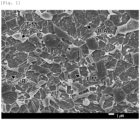
- FIG. 1 is a photograph of a microstructure of Inventive Example 6 observed by SEM according to an embodiment of the present disclosure.
- Carbon (C) is a very important element added for solid solution strengthening.
- C is bonded to a precipitation element to form fine precipitates, thereby contributing strength improvement.
- the content of C is less than 0.03%, it is very difficult to secure a desired strength.
- the content of C exceeds 0.12%, as martensite is excessively formed during cooling an increase in hardenability, the strength may rapidly increase, and bending properties may deteriorate, so that it may be difficult to obtain an HER, R/t, and a 3-point bending maximum angle, which are intended to be obtained in the present disclosure.
- weldability is deteriorated, thereby increasing a possibility of occurrence of welding defects during parts processing by customers.
- the content of C is preferably in a range of 0.03 to 0.12%.
- a lower limit of the content of C is more preferably 0.04%, and even more preferably 0.05%.
- An upper limit of the content of C is more preferably 0.10%, and even more preferably 0.09%.
- Si is one of the five major elements of steel, and a small amount of Si is naturally added during a manufacturing process of steel. Si contributes to an increase in strength, and suppresses formation of carbides, so that carbon is not formed as carbides during an annealing soaking heat treatment and cooling. In addition, this carbon is distributed and accumulated in retained austenite, so that an austenite phase remains at room temperature and is advantageous in securing elongation. When the Si content is less than 0.03%, it may be difficult to sufficiently secure the above-mentioned effects.
- the content of Si is preferably in a range of 0.03 to 0.30%.
- a lower limit of the content of Si is more preferably 0.04%, and even more preferably 0.05%.
- An upper limit of the content of Si is more preferably 0.25%, and even more preferably 0.20%.
- Manganese (Mn) is an element which completely precipitates sulfur in steel as MnS to prevent hot brittleness due to formation of FeS and solid solution strengthening of steel.
- MnS Manganese
- the content of Mn is less than 2.1%, it is difficult to secure a target level of strength in the present disclosure.
- Mn exceeds 2.9%, problems such as weldability, hot rolling, and the like, are likely to occur, and at the same time, hardenability may be increased to excessively form martensite, which may result in a decrease in elongation.
- the content of Mn is preferably in a range of 2.1 to 2.9%.
- a lower limit of the content of Mn is more preferably 2.2%, and even more preferably 2.3%.
- An upper limit of the content of Mn is more preferably 2.8%, and even more preferably 2.7%.
- Aluminum (Al) is an element added for deoxidation during steelmaking.
- the content of Al is less than 0.005%, it is difficult to obtain a sufficient deoxidation effect, and when the content of Al exceeds 0.07%, Al reacts with oxygen (O) in molten steel to form oxides (inclusions) having a high melting point, which may cause nozzle clogging.
- O oxygen
- the content of Al is preferably 0.005 to 0.07%.
- a lower limit of the content of Al is more preferably 0.010%, and even more preferably 0.020%.
- An upper limit of the content of Al is more preferably 0.06%, and even more preferably 0.05%.
- Niobium (Nb) is an element which is segregated at austenite grain boundaries to suppress coarsening of austenite crystal grains during an annealing heat treatment, and to contribute to increase strength by forming fine carbides.
- the content of Nb is less than 0.01%, the above-described effect is insufficient.
- the content of Nb exceeds 0.08%, coarse carbides are precipitated, strength and elongation may be reduced by reducing an amount of carbon dissolved in steel, and manufacturing costs may increase. Therefore, the content of Nb is preferably in a range of 0.01 to 0.08%.
- a lower limit of the content of Nb is more preferably 0.02%, and even more preferably 0.03%.
- An upper limit of the content of Nb is more preferably 0.07%, and even more preferably 0.06%.
- Titanium (Ti) is an element for forming fine carbides, thereby contributing to securing yield strength and tensile strength.
- Ti is an element for forming nitrides, and having an effect of suppressing AlN precipitation by precipitating N in steel as TiN, thereby reducing a risk of occurrence of cracks during continuous casting.
- the content of Ti is less than 0.005%, it may be difficult to obtain the above-described effect.
- the content of Ti exceeds 0.08%, coarse carbides are precipitated, strength and elongation may be reduced by reducing an amount of dissolved carbon in steel, and nozzle clogging may be caused during casting. Therefore, the content of Ti is preferably in a range of 0.005 to 0.08%.
- a lower limit of the content of Ti is more preferably 0.007%, and even more preferably 0.01%.
- An upper limit of the content of Ti is more preferably 0.07%, and even more preferably 0.06%.
- Boron (B) is an element greatly contributing to securing hardenability of a steel material, and is preferably added in an amount of 0.0005% or more to obtain such an effect.
- the content of B exceeds 0.005%, boron carbides are formed at a grain boundary to provide ferrite nucleation sites, which may rather deteriorate the hardenability. Therefore, the content of B is preferably in a range of 0.0005 to 0.005%.
- a lower limit of the B content is more preferably 0.0010%, and even more preferably 0.0015%.
- An upper limit of the B content is more preferably 0.0045%, and even more preferably 0.004%.
- Chromium (Cr) is an element improving hardenability and increasing strength of steel.
- the content of Cr is less than 0.7%, it may be difficult to secure a target level of strength.
- the content of Cr exceeds 1.4%, ductility of a steel sheet may decrease. Therefore, the content of Cr is preferably in a range of 0.7 to 1.4%.
- a lower limit of the content of Cr is more preferably 0.75%, and even more preferably 0.8%.
- An upper limit of the content of Cr is more preferably 1.3%, and even more preferably 1.2%.
- Molybdenum (Mo) is an element forming carbides, and perform a role of improving yield strength and tensile strength by finely maintaining a size of precipitates when combined with carbon nitride forming elements such as Ti, Nb, V, and the like.
- Mo has an advantage of capable of controlling a yield ratio by forming the hardenability of steel to finely form martensite at a grain boundary.
- Mo is preferably added in an amount of 0.0005% or more.
- molybdenum (Mo) is an expensive element, and as the content of Mo increases, there is a disadvantage in manufacturing, so that it is preferable to properly control the content of Mo.
- the content of Mo is preferably in a range of 0.005 to 0.10%.
- a lower limit of the content of Mo is more preferably 0.007%, and even more preferably 0.01%.
- An upper limit of the content of Mo is more preferably 0.08%, and even more preferably 0.06%.
- N Nitrogen
- N is an element that is inevitably contained in the manufacturing process, but is an element that contributes to improving the strength of steel through the formation of carbon nitrides.
- the content of N exceeds 0.008%, a risk of occurrence of brittleness is greatly increased, and an excess amount of N remaining after forming TiN can consume B, which should contribute to hardenability, in a form of BN. Therefore, the content of N is preferably 0.008% or less.
- the content of N is more preferably 0.007% or less, and even more preferably 0.006% or less.
- the cold-rolled steel sheet of the present disclosure preferably satisfies the above-described alloy components and the following Relational Expressions 1 to 3. Thereby, it is possible to manufacture an ultra-high-strength steel sheet having a tensile strength of 980 MPa or more, which has very excellent bending processability, targeted by the present disclosure. 0.18 ⁇ C + Si / 30 + Mn / 20 + 2 P + 4 S ⁇ 0.30
- the Relational Expression 1 is a component Relational Expression for securing strength and weldability.
- the value of Relational Expression 1 preferably has a range of 0.18 to 0.30.
- a lower limit of the value of the Relational Expression 1 is more preferably 0.19, and even more preferably 0.20.
- An upper limit of the value of Relational Expression 1 is more preferably 0.28, and even more preferably 0.26. 180 ⁇ 48.8 + 49 logC + 35.1 Mn + 25.9 Si + 76.5 Cr + 105.9 Mo + 1325 Nb ⁇ 270
- the Relational Expression 2 is a Relational Expression related to a hardenability index for securing hardenability.
- a value of the Relational Expression 2 is less than 180, it is difficult to secure a strength targeted by the present disclosure due to insufficient hardenability, and when a value of the Relational Expression 2 exceeds 270, the hardenability may be excessively increased, resulting in poor bending properties and formability. Therefore, the value of the Relational Expression 2 is preferably in a range of 180 to 270.
- a lower limit of the value of the Relational Expression 2 is more preferably 190, and even more preferably 200.
- An upper limit of the value of the Relational Expression 2 is more preferably 260, and even more preferably 250. 700 ⁇ 48.8 + 49 logC + 35.1 Mn + 25.9 Si + 76.5 Cr + 105.9 Mo + 1325 Nb / C + Si / 30 + Mn / 20 + 2 P + 4 S ⁇ 1200
- the Relational Expression 3 is a component Relational Expression for simultaneously securing strength, hardenability and weldability, which are the targets of the present disclosure.
- a value of the Relational Expression 3 is less than 700, not only weldability may be inferior, but also it is difficult to secure a strength targeted by the present disclosure due to insufficient hardenability, and when a value of the Relational Expression 3 exceeds 1200, hardenability may be excessively increased, resulting in inferior bending properties and formability. Therefore, the value of the Relational Expression 3 is preferably in a range of 700 to 1200.
- a lower limit of the value of the Relational Expression 3 is more preferably 700, and even more preferably 800.
- An upper limit of the value of the Relational Expression 3 is more preferably 1150, and even more preferably 1100.
- the remaining component of the present disclosure is iron (Fe).
- Fe iron
- the component since in the common manufacturing process, unintended impurities may be inevitably incorporated from raw materials or the surrounding environment, the component may not be excluded. Since these impurities are known to any person skilled in the common manufacturing process, the entire contents thereof are not particularly mentioned in the present specification.
- Phosphorus (P) is an element which may be segregated at a grain boundary and/or an interphase grain boundary to cause brittleness. Therefore, the content of P should be controlled to be as low as possible, and it is preferable to limit the content of P to be 0.04% or less.
- the content of P is more preferably limited to be 0.03% or less, and more preferably limited to be 0.02% or less.
- S Sulfur
- S Sulfur
- the content of S should be controlled to be as low as possible, and it is preferable to limit the content of S to be 0.005% or less.
- the content of S is more preferably limited to be 0.004% or less, and more preferably limited to be 0.003% or less.
- the impurities may include at least one of Sb, Mg, Sn, Sb, Zn, and Pb as tramp elements, and a total amount thereof may be 0.1% or less by weight.
- the tramp element is an impurity element derived from scrap, or the like used as a raw material in a steelmaking process, and when the total amount thereof exceeds 0.1%, it may cause surface cracks of the slab, and deteriorate surface quality of the steel sheet.
- the microstructure of the cold-rolled steel sheet according to the present disclosure preferably includes, by area, fresh martensite: 4 to 19%, a sum of tempered martensite and bainite: 78 to 95%, and retained austenite: 0.2 to 2.0%.
- the microstructure of the cold-rolled steel sheet of the present disclosure includes tempered martensite (hereinafter, also referred to as 'TM') and bainite (hereinafter, referred to as 'B') as a main structure. Since the tempered martensite and bainite are not easy to be distinguished in terms of a microstructure, in the present disclosure, a fraction of the sum of the tempered martensite and bainite is controlled.
- the fresh martensite (hereinafter, also referred to as 'FM') is a structure, advantageous for securing strength.
- a fraction of the fresh martensite is less than 4%, it is difficult to secure the target strength, and when the fraction of the fresh martensite exceeds 19%, bending properties and elongation may be inferior.
- the retained austenite (hereinafter, also referred to as 'RA') is a structure, advantageous for securing elongation.
- the microstructure may further include 10% or less of ferrite.
- the ferrite structure is a structure that can be formed inevitably in the manufacturing process, but also has a positive function.
- the ferrite may contribute to securing elongation.
- the fraction of the ferrite is more preferably 7% or less, and even more preferably 5% or less.
- the microstructure has an average grain size of 0.5 to 6 um. The finer the average grain size is, the more favorable it is to secure physical properties such as strength, HER, and the like.
- the average grain size preferably has a range of 0.5 to 6.0 ⁇ m.
- a lower limit of the average grain size is more preferably 1.0 um, and even more preferably 1.5 um.
- An upper limit of the average grain size is more preferably 5.5 ⁇ m, and even more preferably 5.0 ⁇ m.
- the cold-rolled steel sheet of the present disclosure provided as described above may have a yield strength (YS): 800 to 980 MPa, a tensile strength (TS): 980 to 1180 MPa, an elongation (EL): 4 to 12%, a yield ratio (YS / TS): 0.70 to 0.95, a hole expansion ratio (HER): 35 to 80%, a R/t: 0.8 or less, and a 3-point bending maximum angle: 90 to 140°.
- the yield strength is more preferably 820 to 960MPa, more preferably 850 to 950MPa.
- the tensile strength is more preferably 1000 to 1170MPa, more preferably 1020 to 1160MPa.
- the elongation is more preferably 5 to 11%, and even more preferably 6 to 10%.
- the yield ratio is more preferably 0.72 to 0.92, and even more preferably 0.75 to 0.90.
- the hole expansion ratio is more preferably 40 to 75%, and even more preferably 45 to 70%.
- the R/t is more preferably 0.15 to 0.70, and even more preferably 0.20 to 0.60.
- the 3-point bending maximum angle is more preferably 95 to 135 °, and more preferably 100 to 130 °.
- the cold-rolled steel sheet of the present disclosure may have a hardness (HvBM) of 300 to 400 Hv.
- the hardness of the base material is more preferably 310 to 390 Hv, and even more preferably 320 to 380 Hv.
- hardness of a fusion zone (HvFZ) of a weld zone formed after welding may be 350 to 450 Hv. When the hardness of the fusion zone (HvFZ) of the weld zone is less than 350 Hv, sufficient hardness of the fusion zone may not be secured, and thus a strength of the weld zone may be low.
- the hardness of the fusion zone (HvFZ) of the weld zone exceeds 450 Hv, the hardness of the fusion zone is too high, and crack generation susceptibility is increased, so the strength of the weld zone and impact absorption energy may be lowered.
- the hardness of the cold-rolled steel sheet that is, the hardness corresponding to the base material after welding (HvBM) is better as it is similar to the hardness of the fusion zone (HvFZ), and therefore, the ratio thereof (HvFZ/HvBM) is preferably 1.30 or less.
- the slab heating temperature is not particularly limited, but for example, the slab may be heated at a temperature within a range of 1100 to 1300°C.
- the slab heating temperature is lower than 1100°C, the slab temperature is low, which may cause a rolling load during rough rolling, and when the slab heating temperature is higher than 1300°C, the structure may be coarsened, and there may be a disadvantage such as increased power costs.
- a lower limit of the slab heating temperature is more preferably 1125°C, and even more preferably 1150°C.
- An upper limit of the slab heating temperature is more preferably 1275°C, and even more preferably 1250°C.
- the slab may have a thickness of 230 to 270 mm.
- the heated slab is finish-rolled so that a finish-rolling exit temperature is Ar3+50°C to Ar3+150°C to obtain a hot-rolled steel sheet.
- a finish-rolling exit temperature is lower than Ar3+50°C, there is a high possibility in that hot deformation resistance is rapidly increased.
- the finish-rolling exit temperature is higher than Ar3+150°C, there is a high possibility in that too thick oxide scales may be generated and the microstructure of the steel sheet may be coarsened. Therefore, the finish-rolling exit temperature preferably has a range of Ar3+50°C to Ar3+150°C.
- a lower limit of the finish-rolling exit temperature is more preferably Ar3+60°C, and even more preferably Ar3+70°C.
- An upper limit of the finish-rolling exit temperature is more preferably Ar3+140°C, and even more preferably Ar3+140°C.
- the Ar3 means a temperature at which austenite is transformed into austenite during heating, and a value thereof can be obtained by, for example, a formula such as 910-203C 1/2 +44.7Si+31.5Mo-30Mn-11Cr+700P+400Al+400Ti.
- the hot-rolled steel sheet is cooled to Ms+50°C to Ms+300°C and then wound.
- the winding temperature is lower than Ms+50°C, excessive martensite or bainite may be generated, resulting in an excessive increase in strength of the hot-rolled steel sheet, and a problem such as shape defects, or the like due to load during cold rolling may occur.
- the winding temperature is higher than Ms+300°C, pickling properties may be deteriorated due to an increase in surface scales. Therefore, the winding temperature preferably has a range of Ms+50°C to Ms+300°C. A lower limit of the winding temperatureis more preferably Ms+60°C, and even more preferably Ms+70°C.
- An upper limit of the winding temperature is more preferably Ms+290°C, and even more preferably Ms+270°C. Meanwhile, after the winding, the wound hot-rolled steel sheet may be cooled to room temperature at a cooling rate of 0.1°C/s or less.
- the Ms means a temperature at which martensite starts to be transformed during cooling, and a value thereof may be obtained by, for example, a formula such as 539-423C-30.4Mn-7.5Si+30Al.
- the cold-rolled steel sheet is obtained by cold-rolling the wound and cooled hot-rolled steel sheet.
- the cold rolling may be performed at a reduction ratio of 40 to 70%.
- the cold reduction ratio is less than 40%, a driving force for recrystallization may be weakened, and problems are likely to occur in obtaining good recrystallized grains, and there is a disadvantage in that shape correction is very difficult.
- the cold reduction ratio exceeds 70%, there is a high possibility in that cracks may occur at an edge portion of the steel sheet, and a rolling load may rapidly be increased. Therefore, the cold rolling is preferably performed at a reduction ratio of 40 to 70%. Meanwhile, prior to the cold rolling, pickling may be performed to remove scales or impurities attached to the surface thereof.
- the cold-rolled steel sheet is continuously annealed in a temperature range of Ar3+10°C to Ar3+70°C.
- the continuous annealing temperature is lower than Ar3+10°C, it may not be sufficiently transformed into austenite, so it is difficult to obtain a fraction of martensite or bainite desired by the present disclosure in a subsequent process, and it may be difficult to secure strength.
- the continuous annealing temperature is higher than Ar3+70°C, an austenite grain size may be coarsened, so that it may be difficult to secure the target bending properties. Therefore, the continuous annealing temperature preferably has a range of Ar3+10°C to Ar3+70°C.
- a lower limit of the continuous annealing temperature is more preferably Ar3+20°C, and even more preferably Ar3+30°C.
- An upper limit of the continuous annealing temperature is more preferably Ar3+60°C, and even more preferably Ar3+50°C.
- the continuously annealed cold-rolled steel sheet is subjected to a soaking treatment for 50 to 200 seconds.
- a soaking treatment for 50 to 200 seconds.
- This is to secure a sufficient fraction of austenite at an annealing temperature suggested by the present disclosure along with recrystallization and grain growth of the cold-rolled structure.
- the soaking treatment time is less than 50 seconds, reverse transformation into austenite does not sufficiently occur, so that a fraction of ferrite in a final structure increases, making it difficult to secure the target strength.
- the soaking treatment time exceeds 200 seconds, the austenite grain size may be coarsened, so that bending properties of the final product may be inferior.
- a lower limit of the soaking treatment time is more preferably 55 seconds, and even more preferably 60 seconds.
- An upper limit of the soaking treatment time is more preferably 190 seconds, and even more preferably 180 seconds.
- the soaking-treated cold-rolled steel sheet is primarily cooled to 620 to 700°C at a cooling rate of 1 to 10°C/s.
- the primary cooling operation is to increase ductility and strength of the steel sheet by securing an equilibrium carbon concentration of ferrite and austenite.
- the primary cooling end temperature is lower than 630°C or is higher than 700°C it is difficult to secure the ductility and strength targeted by the present disclosure.
- the primarily-cooled cold-rolled steel sheet is secondarily cooled to 360 to 420°C at a cooling rate of 5 to 50°C/ sec.
- the secondary cooling is one of control factors that are considered to be important in the present disclosure, and the secondary cooling end temperature is a very important condition to simultaneously secure strength, ductility and bending properties.
- the secondary cooling end temperature is lower than 360°C, it is difficult to secure ductility due to an excessive increase in a fraction of martensite, and when the secondary cooling end temperature is higher than 420°C, it is difficult to secure sufficient martensite, so that it is difficult to secure the target strength.
- the secondary cooling end temperature which is one of the important control factors for securing the target physical properties in the present disclosure, preferably has a range of 360 to 420°C.
- a lower limit of the secondary cooling end temperature is more preferably 365°C, and even more preferably 370°C.
- An upper limit of the secondary cooling end temperature is more preferably 410°C, and even more preferably 405°C.
- a lower limit of the secondary cooling rate is more preferably 7.5°C/s, and more preferably 10°C/s.
- An upper limit of the secondary cooling rate is more preferably 47.5°C/s, and more preferably 45°C/s.
- the difference between the Ms and the secondary cooling end temperature that is, the value of A is preferably 10 to 70°C.
- a lower limit of the value of A is more preferably 15°C, and even more preferably 20°C.
- An upper limit of the value of A is more preferably 65°C, and even more preferably 60°C.
- Ms means a temperature at which martensitic transformation starts, and a value thereof can be obtained by the following Expression 1. 10 ⁇ A ⁇ 70 where, A is an Ms-secondary cooling end temperature (°C)
- the secondarily-cooled cold-rolled steel sheet is subjected to an overaging treatment for 250 to 650 seconds, and then ends at a temperature within a range of 320 to 400°C.
- the overaging treatment is preferably performed at a temperature, equal to or higher than the temperature at the time of the secondary cooling.
- the overaging treatment is a process for promoting transformation of fresh martensite generated at the end of secondary cooling into tempered martensite, through which high yield strength and bending properties can be stably secured. Therefore, the overaging treatment is a very important factor in order to secure high bending processability to be obtained in the present disclosure, and in the present invention, the overaging treatment time is precisely controlled to be in a range of 250 to 650 seconds.
- overaging treatment time When the overaging treatment time is less than 250 seconds, transformation from fresh martensite into tempered martensite may occur in a small amount, resulting in poor bending processability. On the other hand, when the overaging treatment time exceeds 650 seconds, it may be difficult to secure the tensile strength desired by the present disclosure due to reduced productivity and excessive tempered martensitic transformation.
- a lower limit of the overaging treatment time is more preferably 260 seconds, and even more preferably 270 seconds.
- An upper limit of the overaging treatment time is more preferably 600 seconds, and even more preferably 550 seconds.
- the overaging treatment end temperature is lower than 320°C, it may be difficult to secure an elongation due to excessive fresh martensitic transformation, and bending properties may be inferior.
- overaging treatment end temperature When the overaging treatment end temperature is higher than 400°C, transformation from fresh martensite into tempered martensite may occur in a small amount, resulting in inferior bending properties.
- a lower limit of the overaging treatment end temperature is more preferably 325°C, and even more preferably 330°C.
- An upper limit of the overaging treatment end temperature is more preferably 395°C, and even more preferably 380°C.
- an overaging treatment may be additionally performed by reheating after cooling is performed to the secondary cooling end temperature after the overaging treatment.
- the difference between the Ms temperature and the overaging treatment end temperature that is, the value of B is in a 30 to 100°C.
- a lower limit of the value of B is more preferably 35°C, and even more preferably 40°C.
- An upper limit of the value of B is more preferably 95°C, and even more preferably 90°C.
- An upper limit of the value of B is more preferably 95°C, and even more preferably 90°C.
- the relational expression 6 is to precisely control the microstructure targeted by the present disclosure to secure the target physical properties.
- a value of Relational Expression 6 is less than 2.5, an overaging holding time may be short or an overaging treatment end temperature may be low, so that it may be difficult to secure the target elongation or bending properties due to excessive fresh martensitic transformation.
- the value of Relational Expression exceeds 14, it may be difficult to secure the target physical properties due to the long overaging holding time or the high overaging treatment end temperature, making it difficult to secure the target fraction of microstructure. Therefore, the value of Relational Expression 6 is preferably in a range of 2.5 to 14.
- a lower limit of the value of the Relational Expression 6 is more preferably 3.0, and even more preferably 3.5.
- An upper limit of the value of the Relational Expression 6 is more preferably 12, and even more preferably 10.
- an operation of temper rolling the overaged cold-rolled steel sheet at an elongation of 0.1 to 2.0° may be further included.
- temper rolling an increase in yield strength of at least 50 MPa or more occurs with little increase in tensile strength.
- the elongation is less than 0.1%, it may be difficult to control the shape, and when the elongation exceeds 2.0%, workability may be greatly unstable due to a high elongation work.
- the molten steel was prepared into a slab having a thickness of 250 mm, heated at a temperature of 1200°C for 12 hours and then was subjected to finish hot rolling under the conditions illustrated in Table 2 below, and then wound to prepare a hot-rolled steel sheet.
- pickling was performed on the hot-rolled steel sheet prepared as described above, cold rolling was performed at a cold rolling reduction ratio of 50% to manufacture a cold-rolled steel sheet.
- the cold-rolled steel sheet was subjected to continuous annealing, soaking treatment, primary and secondary cooling, and overaging treatment under the conditions illustrated in Table 3 below to manufacture a final cold-rolled steel sheet.
- microstructure and average grain size were measured using an Electron BackScatter Diffraction (EBSD) instrument.
- EBSD Electron BackScatter Diffraction
- a tensile strength (TS), yield strength (YS), and elongation (EL) were obtained by taking tensile specimens in a rolling horizontal direction, which were measured by a tensile test.
- a gauge length was 80 mm
- a width of the tensile specimen was 20mm.
- BOP Bead On Plate
- the molten steel was prepared into a slab having a thickness of 250 mm, heated at a temperature of 1200°C for 12 hours and then was subjected to finish hot rolling under the conditions illustrated in Table 5 below, and then wound to prepare a hot-rolled steel sheet.
- pickling was performed on the hot-rolled steel sheet prepared as described above, cold rolling was performed at a cold rolling reduction ratio of 50% to manufacture a cold-rolled steel sheet.
- Such a cold-rolled steel sheet was subjected to continuous annealing, soaking treatment, primary and secondary cooling, and overaging treatment under the conditions illustrated in Table 6 below to manufacture a final cold-rolled steel sheet.
- microstructure and average grain size were measured using an Electron BackScatter Diffraction (EBSD) instrument.
- EBSD Electron BackScatter Diffraction
- a tensile strength (TS), yield strength (YS), and elongation (EL) were obtained by taking tensile specimens in a rolling horizontal direction, which were measured by a tensile test.
- a gauge length was 80 mm
- a width of the tensile specimen was 20 mm.
- HER was measured according to the ISO 16330 standard, and holes were sheared with a clearance of 12% using a punch having a diameter of 10 mm.
- R/t is a value obtained by dividing R (a limit bending radius)by a thickness of the steel sheet.
- the R was obtained by taking a test piece having a width of 30 mm ⁇ length of 35 mm in a horizontal direction (long axis) to a rolling direction, grinding one surface thereof by 0.2 mm, performing a bending test by a V block method in accordance with JIS Z 2248 so that the ground surface is not in contact with a punch, and variously changing a bending radius at that time from 0 to 5 mm, and obtaining a minimum bending radius at which bending may be performed without breaking the material.
- Comparative Examples 9 to 16 satisfying the alloy composition proposed by the present disclosure, but not satisfying the manufacturing conditions it can be seen that the microstructure or average grain size targeted by the present disclosure may not be secured, so that mechanical properties are inferior.
- a finish rolling temperature and winding temperature did not satisfy the conditions of the present disclosure, respectively, and thus sheet breakage occurred.
- FIG. 1 is a photograph of a microstructure of Inventive Example 6 observed by SEM. As can be seen from FIG. 1 , it can be confirmed that the microstructure targeted by the present disclosure is properly formed in Inventive Example 6.
- the molten steel was prepared into a slab having a thickness of 250 mm, heated at a temperature of 1200°C for 12 hours and then was subjected to finish hot rolling under the conditions illustrated in Table 8 below, and then wound to prepare a hot-rolled steel sheet.
- pickling was performed on the hot-rolled steel sheet prepared as described above, cold rolling was performed at a cold rolling reduction ratio of 50% to manufacture a cold-rolled steel sheet.
- Such a cold-rolled steel sheet was subjected to continuous annealing, soaking treatment, primary and secondary cooling, and overaging treatment under the conditions illustrated in Table 9 below to manufacture a final cold-rolled steel sheet.
- microstructure and average grain size were measured using an Electron BackScatter Diffraction (EBSD) instrument.
- EBSD Electron BackScatter Diffraction
Landscapes
- Chemical & Material Sciences (AREA)
- Engineering & Computer Science (AREA)
- Mechanical Engineering (AREA)
- Materials Engineering (AREA)
- Metallurgy (AREA)
- Organic Chemistry (AREA)
- Physics & Mathematics (AREA)
- Thermal Sciences (AREA)
- Crystallography & Structural Chemistry (AREA)
- Heat Treatment Of Sheet Steel (AREA)
Applications Claiming Priority (2)
| Application Number | Priority Date | Filing Date | Title |
|---|---|---|---|
| KR1020200176410A KR102461164B1 (ko) | 2020-12-16 | 2020-12-16 | 항복강도 및 굽힘특성이 우수한 초고강도 냉연강판 및 그 제조방법 |
| PCT/KR2021/017889 WO2022131619A1 (ko) | 2020-12-16 | 2021-11-30 | 항복강도 및 굽힘특성이 우수한 초고강도 냉연강판 및 그 제조방법 |
Publications (2)
| Publication Number | Publication Date |
|---|---|
| EP4265781A1 true EP4265781A1 (de) | 2023-10-25 |
| EP4265781A4 EP4265781A4 (de) | 2024-05-01 |
Family
ID=82059682
Family Applications (1)
| Application Number | Title | Priority Date | Filing Date |
|---|---|---|---|
| EP21906924.2A Pending EP4265781A4 (de) | 2020-12-16 | 2021-11-30 | Ultrahochfestes kaltgewalztes stahlblech mit hervorragender streckgrenze und biegeeigenschaften sowie verfahren zur herstellung davon |
Country Status (6)
| Country | Link |
|---|---|
| US (1) | US20240052468A1 (de) |
| EP (1) | EP4265781A4 (de) |
| JP (1) | JP7730903B2 (de) |
| KR (1) | KR102461164B1 (de) |
| CN (2) | CN121737566A (de) |
| WO (1) | WO2022131619A1 (de) |
Cited By (2)
| Publication number | Priority date | Publication date | Assignee | Title |
|---|---|---|---|---|
| EP4640899A4 (de) * | 2022-12-20 | 2026-04-22 | Posco Co Ltd | Kaltgewalztes stahlblech und verfahren zur herstellung davon |
| EP4636116A4 (de) * | 2022-12-13 | 2026-04-22 | Posco Co Ltd | Kaltgewalztes stahlblech mit hervorragender festigkeit und verformbarkeit und verfahren zur herstellung davon |
Families Citing this family (4)
| Publication number | Priority date | Publication date | Assignee | Title |
|---|---|---|---|---|
| KR102440757B1 (ko) * | 2020-12-03 | 2022-09-08 | 주식회사 포스코 | 굽힘가공성이 우수한 초고강도 냉연강판 및 그 제조방법 |
| KR20240098899A (ko) * | 2022-12-21 | 2024-06-28 | 주식회사 포스코 | 용융아연도금강판 및 그 제조방법 |
| CN122422562A (zh) * | 2023-12-15 | 2026-07-17 | 浦项股份有限公司 | 冷轧钢板及其制造方法 |
| KR20260097032A (ko) * | 2024-12-17 | 2026-06-25 | 주식회사 포스코 | 냉연강판 및 이의 제조방법 |
Family Cites Families (18)
| Publication number | Priority date | Publication date | Assignee | Title |
|---|---|---|---|---|
| JP2528387B2 (ja) | 1990-12-29 | 1996-08-28 | 日本鋼管株式会社 | 成形性及びストリップ形状の良好な超高強度冷延鋼板の製造法 |
| CZ284195B6 (cs) * | 1991-10-22 | 1998-09-16 | Pohang Iron And Steel Co., Ltd. | Neorientované elektrické ocelové plechy a způsoby jejich výroby |
| JP4308689B2 (ja) | 2004-03-16 | 2009-08-05 | Jfeスチール株式会社 | 加工性の良好な高強度鋼およびその製造方法 |
| JP5234876B2 (ja) * | 2005-09-30 | 2013-07-10 | Jfeスチール株式会社 | 高張力冷延鋼板の製造方法 |
| JP5194878B2 (ja) * | 2007-04-13 | 2013-05-08 | Jfeスチール株式会社 | 加工性および溶接性に優れる高強度溶融亜鉛めっき鋼板およびその製造方法 |
| KR101344537B1 (ko) * | 2011-10-28 | 2013-12-26 | 현대제철 주식회사 | 고강도 강판 및 그 제조 방법 |
| KR101382854B1 (ko) * | 2012-03-20 | 2014-04-08 | 주식회사 포스코 | 용접성 및 굽힘가공성이 우수한 고항복비형 초고강도 냉연강판 및 그 제조방법 |
| KR101449134B1 (ko) * | 2012-10-15 | 2014-10-08 | 주식회사 포스코 | 용접성 및 굽힘가공성이 우수한 초고강도 냉연강판 및 그 제조방법 |
| JP6291289B2 (ja) * | 2013-03-06 | 2018-03-14 | 株式会社神戸製鋼所 | 鋼板形状および形状凍結性に優れた高強度冷延鋼板およびその製造方法 |
| KR101546134B1 (ko) * | 2013-07-30 | 2015-08-21 | 현대제철 주식회사 | 고강도 열연강판 및 그 제조 방법 |
| JP5862651B2 (ja) * | 2013-12-18 | 2016-02-16 | Jfeスチール株式会社 | 耐衝撃性および曲げ加工性に優れた高強度溶融亜鉛めっき鋼板およびその製造方法 |
| KR101674751B1 (ko) | 2013-12-20 | 2016-11-10 | 주식회사 포스코 | 구멍확장성이 우수한 석출강화형 강판 및 그 제조방법 |
| KR101767780B1 (ko) * | 2015-12-23 | 2017-08-24 | 주식회사 포스코 | 고항복비형 고강도 냉연강판 및 그 제조방법 |
| KR102020407B1 (ko) * | 2017-12-21 | 2019-09-10 | 주식회사 포스코 | 고항복비형 고강도 강판 및 이의 제조방법 |
| KR102075216B1 (ko) * | 2017-12-24 | 2020-02-07 | 주식회사 포스코 | 고 항복비형 고 강도 강판 및 그 제조방법 |
| KR102468051B1 (ko) * | 2020-10-23 | 2022-11-18 | 주식회사 포스코 | 연성이 우수한 초고강도 강판 및 그 제조방법 |
| KR102490312B1 (ko) * | 2020-12-09 | 2023-01-19 | 주식회사 포스코 | 연성 및 성형성이 우수한 고강도 용융아연도금강판 |
| KR20230073569A (ko) * | 2021-11-19 | 2023-05-26 | 주식회사 포스코 | 우수한 강도 및 성형성을 갖는 냉연강판 및 그 제조방법 |
-
2020
- 2020-12-16 KR KR1020200176410A patent/KR102461164B1/ko active Active
-
2021
- 2021-11-30 JP JP2023536467A patent/JP7730903B2/ja active Active
- 2021-11-30 WO PCT/KR2021/017889 patent/WO2022131619A1/ko not_active Ceased
- 2021-11-30 CN CN202511774399.3A patent/CN121737566A/zh active Pending
- 2021-11-30 CN CN202180081861.5A patent/CN116547401B/zh active Active
- 2021-11-30 EP EP21906924.2A patent/EP4265781A4/de active Pending
- 2021-11-30 US US18/266,765 patent/US20240052468A1/en not_active Abandoned
Cited By (2)
| Publication number | Priority date | Publication date | Assignee | Title |
|---|---|---|---|---|
| EP4636116A4 (de) * | 2022-12-13 | 2026-04-22 | Posco Co Ltd | Kaltgewalztes stahlblech mit hervorragender festigkeit und verformbarkeit und verfahren zur herstellung davon |
| EP4640899A4 (de) * | 2022-12-20 | 2026-04-22 | Posco Co Ltd | Kaltgewalztes stahlblech und verfahren zur herstellung davon |
Also Published As
| Publication number | Publication date |
|---|---|
| CN116547401B (zh) | 2026-04-17 |
| US20240052468A1 (en) | 2024-02-15 |
| WO2022131619A1 (ko) | 2022-06-23 |
| KR102461164B1 (ko) | 2022-11-02 |
| CN116547401A (zh) | 2023-08-04 |
| JP7730903B2 (ja) | 2025-08-28 |
| KR20220086193A (ko) | 2022-06-23 |
| CN121737566A (zh) | 2026-03-27 |
| JP2024500722A (ja) | 2024-01-10 |
| EP4265781A4 (de) | 2024-05-01 |
Similar Documents
| Publication | Publication Date | Title |
|---|---|---|
| KR102020412B1 (ko) | 충돌특성 및 성형성이 고강도 강판 및 이의 제조방법 | |
| CN116547400B (zh) | 弯曲加工性优异的超高强度冷轧钢板及其制造方法 | |
| KR102461164B1 (ko) | 항복강도 및 굽힘특성이 우수한 초고강도 냉연강판 및 그 제조방법 | |
| KR102020407B1 (ko) | 고항복비형 고강도 강판 및 이의 제조방법 | |
| EP3395993A1 (de) | Hochfestes kaltgewalztes stahlblech mit hohem streckgrenzenverhältnis und herstellungsverfahren dafür | |
| EP4261314A1 (de) | Hochfestes feuerverzinktes stahlblech mit hoher duktilität und hervorragender verformbarkeit sowie herstellungsverfahren dafür | |
| KR102726115B1 (ko) | 강판 및 도금 강판 | |
| KR102468051B1 (ko) | 연성이 우수한 초고강도 강판 및 그 제조방법 | |
| EP4428262A1 (de) | Hochfestes stahlblech mit hervorragender kollisionssicherheit und formbarkeit sowie verfahren zur herstellung davon | |
| KR102470747B1 (ko) | 항복비 및 성형성이 우수한 고강도 냉연강판의 제조방법 및 이를 이용하여 제조된 고강도 냉연강판 | |
| KR102440772B1 (ko) | 성형성이 우수한 고강도강판 및 그 제조방법 | |
| EP4636116A1 (de) | Kaltgewalztes stahlblech mit hervorragender festigkeit und verformbarkeit und verfahren zur herstellung davon | |
| EP3730651A1 (de) | Hochfestes stahlblech mit hoher ausbeute und verfahren zur herstellung davon | |
| CN118284716A (zh) | 冷轧钢板及其制造方法 | |
| CN120303434A (zh) | 钢板及其制造方法 | |
| KR100957967B1 (ko) | 항복강도 이방성 특성이 우수한 고강도 냉연강판,용융아연도금강판 및 그 제조방법 | |
| CN120390822A (zh) | 钢板及其制造方法 | |
| CN116194606B (zh) | 成型性和加工硬化率优异的钢板 | |
| KR20230056822A (ko) | 연성이 우수한 초고강도 강판 및 그 제조방법 | |
| EP4033001A1 (de) | Stahlblech mit einer ausgezeichneten gleichmässigen ausdehnungs- und dehnungshärtungsrate und verfahren zu seiner herstellung | |
| EP4640894A1 (de) | Kaltgewalztes stahlblech und verfahren zur herstellung davon | |
| EP4538407A1 (de) | Ultrahochfestes stahlblech mit hervorragendem dehnungs- und lochausdehnungsverhältnis und verfahren zur herstellung davon | |
| KR102398271B1 (ko) | 굽힘가공성과 구멍확장성이 우수한 냉연강판 및 그 제조방법 | |
| KR20250093761A (ko) | 냉연강판 및 그 제조방법 | |
| KR20250041451A (ko) | 열간 성형 부재 및 이의 제조방법 |
Legal Events
| Date | Code | Title | Description |
|---|---|---|---|
| STAA | Information on the status of an ep patent application or granted ep patent |
Free format text: STATUS: THE INTERNATIONAL PUBLICATION HAS BEEN MADE |
|
| PUAI | Public reference made under article 153(3) epc to a published international application that has entered the european phase |
Free format text: ORIGINAL CODE: 0009012 |
|
| STAA | Information on the status of an ep patent application or granted ep patent |
Free format text: STATUS: REQUEST FOR EXAMINATION WAS MADE |
|
| 17P | Request for examination filed |
Effective date: 20230622 |
|
| AK | Designated contracting states |
Kind code of ref document: A1 Designated state(s): AL AT BE BG CH CY CZ DE DK EE ES FI FR GB GR HR HU IE IS IT LI LT LU LV MC MK MT NL NO PL PT RO RS SE SI SK SM TR |
|
| REG | Reference to a national code |
Ref country code: DE Ref legal event code: R079 Free format text: PREVIOUS MAIN CLASS: C22C0038380000 Ipc: C22C0038000000 |
|
| DAV | Request for validation of the european patent (deleted) | ||
| DAX | Request for extension of the european patent (deleted) | ||
| A4 | Supplementary search report drawn up and despatched |
Effective date: 20240403 |
|
| RIC1 | Information provided on ipc code assigned before grant |
Ipc: C21D 6/00 20060101ALI20240326BHEP Ipc: C21D 1/84 20060101ALI20240326BHEP Ipc: C21D 1/19 20060101ALI20240326BHEP Ipc: C21D 8/02 20060101ALI20240326BHEP Ipc: C21D 9/46 20060101ALI20240326BHEP Ipc: C22C 38/38 20060101ALI20240326BHEP Ipc: C22C 38/32 20060101ALI20240326BHEP Ipc: C22C 38/28 20060101ALI20240326BHEP Ipc: C22C 38/26 20060101ALI20240326BHEP Ipc: C22C 38/22 20060101ALI20240326BHEP Ipc: C22C 38/06 20060101ALI20240326BHEP Ipc: C22C 38/04 20060101ALI20240326BHEP Ipc: C22C 38/02 20060101ALI20240326BHEP Ipc: C22C 38/00 20060101AFI20240326BHEP |