EP4264679B1 - Herstellungsverfahren von mindestens einer photovoltaïschen zelle mit einem von mindestens einem draht unterstützten wafer - Google Patents
Herstellungsverfahren von mindestens einer photovoltaïschen zelle mit einem von mindestens einem draht unterstützten wafer Download PDFInfo
- Publication number
- EP4264679B1 EP4264679B1 EP21847997.0A EP21847997A EP4264679B1 EP 4264679 B1 EP4264679 B1 EP 4264679B1 EP 21847997 A EP21847997 A EP 21847997A EP 4264679 B1 EP4264679 B1 EP 4264679B1
- Authority
- EP
- European Patent Office
- Prior art keywords
- plate
- face
- wires
- conductive material
- support device
- Prior art date
- Legal status (The legal status is an assumption and is not a legal conclusion. Google has not performed a legal analysis and makes no representation as to the accuracy of the status listed.)
- Active
Links
Images





Classifications
-
- C—CHEMISTRY; METALLURGY
- C23—COATING METALLIC MATERIAL; COATING MATERIAL WITH METALLIC MATERIAL; CHEMICAL SURFACE TREATMENT; DIFFUSION TREATMENT OF METALLIC MATERIAL; COATING BY VACUUM EVAPORATION, BY SPUTTERING, BY ION IMPLANTATION OR BY CHEMICAL VAPOUR DEPOSITION, IN GENERAL; INHIBITING CORROSION OF METALLIC MATERIAL OR INCRUSTATION IN GENERAL
- C23C—COATING METALLIC MATERIAL; COATING MATERIAL WITH METALLIC MATERIAL; SURFACE TREATMENT OF METALLIC MATERIAL BY DIFFUSION INTO THE SURFACE, BY CHEMICAL CONVERSION OR SUBSTITUTION; COATING BY VACUUM EVAPORATION, BY SPUTTERING, BY ION IMPLANTATION OR BY CHEMICAL VAPOUR DEPOSITION, IN GENERAL
- C23C14/00—Coating by vacuum evaporation, by sputtering or by ion implantation of the coating forming material
- C23C14/22—Coating by vacuum evaporation, by sputtering or by ion implantation of the coating forming material characterised by the process of coating
- C23C14/50—Substrate holders
-
- C—CHEMISTRY; METALLURGY
- C23—COATING METALLIC MATERIAL; COATING MATERIAL WITH METALLIC MATERIAL; CHEMICAL SURFACE TREATMENT; DIFFUSION TREATMENT OF METALLIC MATERIAL; COATING BY VACUUM EVAPORATION, BY SPUTTERING, BY ION IMPLANTATION OR BY CHEMICAL VAPOUR DEPOSITION, IN GENERAL; INHIBITING CORROSION OF METALLIC MATERIAL OR INCRUSTATION IN GENERAL
- C23C—COATING METALLIC MATERIAL; COATING MATERIAL WITH METALLIC MATERIAL; SURFACE TREATMENT OF METALLIC MATERIAL BY DIFFUSION INTO THE SURFACE, BY CHEMICAL CONVERSION OR SUBSTITUTION; COATING BY VACUUM EVAPORATION, BY SPUTTERING, BY ION IMPLANTATION OR BY CHEMICAL VAPOUR DEPOSITION, IN GENERAL
- C23C14/00—Coating by vacuum evaporation, by sputtering or by ion implantation of the coating forming material
- C23C14/04—Coating on selected surface areas, e.g. using masks
-
- C—CHEMISTRY; METALLURGY
- C23—COATING METALLIC MATERIAL; COATING MATERIAL WITH METALLIC MATERIAL; CHEMICAL SURFACE TREATMENT; DIFFUSION TREATMENT OF METALLIC MATERIAL; COATING BY VACUUM EVAPORATION, BY SPUTTERING, BY ION IMPLANTATION OR BY CHEMICAL VAPOUR DEPOSITION, IN GENERAL; INHIBITING CORROSION OF METALLIC MATERIAL OR INCRUSTATION IN GENERAL
- C23C—COATING METALLIC MATERIAL; COATING MATERIAL WITH METALLIC MATERIAL; SURFACE TREATMENT OF METALLIC MATERIAL BY DIFFUSION INTO THE SURFACE, BY CHEMICAL CONVERSION OR SUBSTITUTION; COATING BY VACUUM EVAPORATION, BY SPUTTERING, BY ION IMPLANTATION OR BY CHEMICAL VAPOUR DEPOSITION, IN GENERAL
- C23C14/00—Coating by vacuum evaporation, by sputtering or by ion implantation of the coating forming material
- C23C14/06—Coating by vacuum evaporation, by sputtering or by ion implantation of the coating forming material characterised by the coating material
- C23C14/08—Oxides
- C23C14/086—Oxides of zinc, germanium, cadmium, indium, tin, thallium or bismuth
-
- C—CHEMISTRY; METALLURGY
- C23—COATING METALLIC MATERIAL; COATING MATERIAL WITH METALLIC MATERIAL; CHEMICAL SURFACE TREATMENT; DIFFUSION TREATMENT OF METALLIC MATERIAL; COATING BY VACUUM EVAPORATION, BY SPUTTERING, BY ION IMPLANTATION OR BY CHEMICAL VAPOUR DEPOSITION, IN GENERAL; INHIBITING CORROSION OF METALLIC MATERIAL OR INCRUSTATION IN GENERAL
- C23C—COATING METALLIC MATERIAL; COATING MATERIAL WITH METALLIC MATERIAL; SURFACE TREATMENT OF METALLIC MATERIAL BY DIFFUSION INTO THE SURFACE, BY CHEMICAL CONVERSION OR SUBSTITUTION; COATING BY VACUUM EVAPORATION, BY SPUTTERING, BY ION IMPLANTATION OR BY CHEMICAL VAPOUR DEPOSITION, IN GENERAL
- C23C14/00—Coating by vacuum evaporation, by sputtering or by ion implantation of the coating forming material
- C23C14/58—After-treatment
- C23C14/5873—Removal of material
-
- H—ELECTRICITY
- H10—SEMICONDUCTOR DEVICES; ELECTRIC SOLID-STATE DEVICES NOT OTHERWISE PROVIDED FOR
- H10F—INORGANIC SEMICONDUCTOR DEVICES SENSITIVE TO INFRARED RADIATION, LIGHT, ELECTROMAGNETIC RADIATION OF SHORTER WAVELENGTH OR CORPUSCULAR RADIATION
- H10F71/00—Manufacture or treatment of devices covered by this subclass
-
- C—CHEMISTRY; METALLURGY
- C23—COATING METALLIC MATERIAL; COATING MATERIAL WITH METALLIC MATERIAL; CHEMICAL SURFACE TREATMENT; DIFFUSION TREATMENT OF METALLIC MATERIAL; COATING BY VACUUM EVAPORATION, BY SPUTTERING, BY ION IMPLANTATION OR BY CHEMICAL VAPOUR DEPOSITION, IN GENERAL; INHIBITING CORROSION OF METALLIC MATERIAL OR INCRUSTATION IN GENERAL
- C23C—COATING METALLIC MATERIAL; COATING MATERIAL WITH METALLIC MATERIAL; SURFACE TREATMENT OF METALLIC MATERIAL BY DIFFUSION INTO THE SURFACE, BY CHEMICAL CONVERSION OR SUBSTITUTION; COATING BY VACUUM EVAPORATION, BY SPUTTERING, BY ION IMPLANTATION OR BY CHEMICAL VAPOUR DEPOSITION, IN GENERAL
- C23C14/00—Coating by vacuum evaporation, by sputtering or by ion implantation of the coating forming material
- C23C14/22—Coating by vacuum evaporation, by sputtering or by ion implantation of the coating forming material characterised by the process of coating
- C23C14/34—Sputtering
-
- H—ELECTRICITY
- H10—SEMICONDUCTOR DEVICES; ELECTRIC SOLID-STATE DEVICES NOT OTHERWISE PROVIDED FOR
- H10P—GENERIC PROCESSES OR APPARATUS FOR THE MANUFACTURE OR TREATMENT OF DEVICES COVERED BY CLASS H10
- H10P72/00—Handling or holding of wafers, substrates or devices during manufacture or treatment thereof
- H10P72/70—Handling or holding of wafers, substrates or devices during manufacture or treatment thereof for supporting or gripping
- H10P72/76—Handling or holding of wafers, substrates or devices during manufacture or treatment thereof for supporting or gripping using mechanical means, e.g. clamps or pinches
- H10P72/7604—Handling or holding of wafers, substrates or devices during manufacture or treatment thereof for supporting or gripping using mechanical means, e.g. clamps or pinches the wafers being placed on a susceptor, stage or support
- H10P72/7611—Handling or holding of wafers, substrates or devices during manufacture or treatment thereof for supporting or gripping using mechanical means, e.g. clamps or pinches the wafers being placed on a susceptor, stage or support characterised by edge profile or support profile
-
- H—ELECTRICITY
- H10—SEMICONDUCTOR DEVICES; ELECTRIC SOLID-STATE DEVICES NOT OTHERWISE PROVIDED FOR
- H10P—GENERIC PROCESSES OR APPARATUS FOR THE MANUFACTURE OR TREATMENT OF DEVICES COVERED BY CLASS H10
- H10P72/00—Handling or holding of wafers, substrates or devices during manufacture or treatment thereof
- H10P72/70—Handling or holding of wafers, substrates or devices during manufacture or treatment thereof for supporting or gripping
- H10P72/76—Handling or holding of wafers, substrates or devices during manufacture or treatment thereof for supporting or gripping using mechanical means, e.g. clamps or pinches
- H10P72/7604—Handling or holding of wafers, substrates or devices during manufacture or treatment thereof for supporting or gripping using mechanical means, e.g. clamps or pinches the wafers being placed on a susceptor, stage or support
- H10P72/7614—Handling or holding of wafers, substrates or devices during manufacture or treatment thereof for supporting or gripping using mechanical means, e.g. clamps or pinches the wafers being placed on a susceptor, stage or support characterised by a plurality of individual support members, e.g. support posts or protrusions
-
- H—ELECTRICITY
- H10—SEMICONDUCTOR DEVICES; ELECTRIC SOLID-STATE DEVICES NOT OTHERWISE PROVIDED FOR
- H10P—GENERIC PROCESSES OR APPARATUS FOR THE MANUFACTURE OR TREATMENT OF DEVICES COVERED BY CLASS H10
- H10P72/00—Handling or holding of wafers, substrates or devices during manufacture or treatment thereof
- H10P72/70—Handling or holding of wafers, substrates or devices during manufacture or treatment thereof for supporting or gripping
- H10P72/76—Handling or holding of wafers, substrates or devices during manufacture or treatment thereof for supporting or gripping using mechanical means, e.g. clamps or pinches
- H10P72/7604—Handling or holding of wafers, substrates or devices during manufacture or treatment thereof for supporting or gripping using mechanical means, e.g. clamps or pinches the wafers being placed on a susceptor, stage or support
- H10P72/7621—Handling or holding of wafers, substrates or devices during manufacture or treatment thereof for supporting or gripping using mechanical means, e.g. clamps or pinches the wafers being placed on a susceptor, stage or support characterised by supporting two or more semiconductor substrates
-
- Y—GENERAL TAGGING OF NEW TECHNOLOGICAL DEVELOPMENTS; GENERAL TAGGING OF CROSS-SECTIONAL TECHNOLOGIES SPANNING OVER SEVERAL SECTIONS OF THE IPC; TECHNICAL SUBJECTS COVERED BY FORMER USPC CROSS-REFERENCE ART COLLECTIONS [XRACs] AND DIGESTS
- Y02—TECHNOLOGIES OR APPLICATIONS FOR MITIGATION OR ADAPTATION AGAINST CLIMATE CHANGE
- Y02E—REDUCTION OF GREENHOUSE GAS [GHG] EMISSIONS, RELATED TO ENERGY GENERATION, TRANSMISSION OR DISTRIBUTION
- Y02E10/00—Energy generation through renewable energy sources
- Y02E10/50—Photovoltaic [PV] energy
Definitions
- the technical field of the invention relates to a method for manufacturing at least one photovoltaic cell.
- it is sought to form a first conductive material on a first face of a plate and a second conductive material on a second face of the plate opposite the first face of the plate.
- the photovoltaic cell may be based on crystalline silicon and for example of the heterojunction type.
- the photovoltaic cell may comprise an amorphous silicon (a-Si) - crystalline silicon (c-Si) heterojunction.
- the transport plate can pass through the deposition equipment so as to allow the deposition of the material using two targets, respectively placed at the top and bottom of the deposition equipment.
- the targets may comprise the transparent conductive oxide such as for example an indium-tin oxide.
- the shoulder will, on the one hand, provide support for the corresponding plate and, on the other hand, serve as a mask to ensure an electrical discontinuity between the material deposited on the first face of the corresponding plate and the material deposited on the second face of the corresponding plate, this allowing for example the formation on the corresponding plate of two distinct and opposite electrodes of a corresponding photovoltaic cell.
- the transport plate taking a width of the support surface of 1.2 mm, it is possible for the transport plate to support plates of variable dimensions by taking into account, for example, a variability in size of plus or minus 0.25 mm between the plates.
- a width of the support surface makes it possible to guarantee suitable support for the corresponding plate and to obtain good electrical insulation between the material deposited on the first face of the corresponding plate and the material deposited on the second face of the corresponding plate.
- the invention aims to improve the way in which at least one plate is supported during a method of manufacturing at least one photovoltaic cell using the plate. This makes it possible, for example, to improve the formation of at least one conductive material on the plate.
- this improvement of the support makes it possible, for example, to avoid or limit the curvature of the plate using the wire(s) and for example while limiting the masking of the first face of the plate; this making it possible to improve the homogeneity of the first and second conductive materials formed on the plate.
- this improvement of the support can make it possible, for example using several wires, to ensure a support of the plate adapted to tend to maximize the surface area of the first face of the plate on which the first conductive material is formed in order to improve the efficiency of the photovoltaic cell.
- the invention also relates to a support device intended to support at least one plate during the formation of a first conductive material and a second conductive material on the plate.
- the support device comprises at least one wire, the wire being arranged so as to participate in the support of the plate.
- the present invention falls within the context of the manufacture of at least one photovoltaic cell 10 using at least one plate 11.
- everything that applies to the plate 11 can apply to the plates 11 when there are several of them.
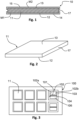
- An example of the photovoltaic cell 10 of which a part is formed by the plate 11 is illustrated in figure 1 .
- the photovoltaic cell 10 may comprise the plate 11.
- the plate 11, as illustrated in the example in Figures 1 and 2 comprises a first face 12 and a second face 13 opposite the first face 12.
- the photovoltaic cell 10 is such that there is arranged on the first and second faces 12, 13 respectively a first conductive material M1 and a second conductive material M2, for example each obtained by deposition on the plate 11.
- the first conductive material M1 is arranged so that a first layer 14 made of this first conductive material M1 is in contact with the first face 12.
- the second conductive material M2 is arranged so that a second layer 15 made of this second conductive material M2 is in contact with the second face 13.
- the second face 13 is covered by the second layer 15.
- the first face 12 is covered by the first layer 14 or is partially covered by the first layer 14.
- the plate 11 may be cut, after having undergone technological steps, for example microelectronics and including in particular the formation of the first conductive material M1 and the second conductive material M2, to form several 10 photovoltaic cells.
- conductor in this description is meant electrically conductive.
- photovoltaic cell 10 By “manufacturing at least one photovoltaic cell 10", it is understood that the manufacturing method can be implemented so as to manufacture several photovoltaic cells 10 at a time. Anything that applies to a plate 11 to form one or more photovoltaic cells 10 can apply to plates 11 each forming a part of one of the photovoltaic cells 10, or to plates 11 each to be cut to form several photovoltaic cells 10.
- the plate 11 may be a wafer which has been functionalized, for example, so as to form a heterojunction for photovoltaic cell(s).
- the plate 11 may be based on crystalline silicon and in particular be of the heterojunction type, for example an amorphous silicon (a-Si) - crystalline silicon (c-Si) heterojunction.
- plate 11 may have been obtained by conventional microelectronics methods starting from a doped crystalline silicon substrate having opposite faces. On one of these opposite faces of the crystalline silicon substrate, a p-n junction is formed; and, on the other of these opposite faces of the crystalline silicon substrate, an n-n or p-p junction is formed depending on the doping of the crystalline silicon.
- steps d 1 ) and d 2 ) are performed after step c) and for example one after the other or simultaneously.
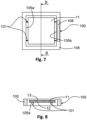
- the support device 100 comprises at least one wire 101 (for example visible in figures 3 , 6 , 7, 8 , 9, 10 , 11 , 12 , 13 , 17 , 18 , 19, 20 ).
- the first face 12 of the plate 11 is supported on the wire 101.
- the first face 12 of the plate 11 may be in support on the wire 101.
- the manufacturing method makes it possible to implement a support using the wire 101, which has the advantage of improving the support of the plate 11, resulting in an improvement during the formation of the first and second conductive materials M1, M2 respectively on the first and second faces 12, 13.
- first element such as the first face 12 of the plate 11
- second element such as the wire(s) 101 on which the first element is supported.
- the support force exerted by the first element on the second element may be the result of gravity.
- the wire 101 may be smooth and, for example, it comprises nothing other than the wire 101 which may then be made up of one or more strands.
- the smooth wire 101 is free of the grains mentioned below and in particular does not exhibit any deformation along its length.
- the wire 101 may in this case have a diameter of between 10 ⁇ m and 350 ⁇ m and preferably of between 20 ⁇ m and 100 ⁇ m.
- the wire 101 may be metallic, for example made of steel.
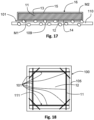
- the wire 101 may comprise a core 110, also called a support wire, and grains 109 linked to this core 110 (see for example figure 17 ).
- the core 110 may in this case have a diameter of between 10 ⁇ m and 350 ⁇ m and preferably between 20 ⁇ m and 100 ⁇ m.
- the grains 109 may have a size of up to 100 ⁇ m and in particular the size of each grain 109 may be between 10 ⁇ m and 20 ⁇ m.
- the core 110 may be made of one or more strands.
- the core 110 may be metallic, for example made of steel.
- Such a wire 101 may be a diamond wire.
- Step d 1 ) and/or step d 2 ) may be such that the formations of the first conductive material M1 and the second conductive material M2 are carried out by deposition.
- step d 1 ) may consist in depositing the first conductive material M1 for example by physical vapor deposition, also known by the acronym PVD corresponding to “physical vapor deposition” in English; the same applies to the second material M2 which may be deposited by PVD (step d 2 )).
- the photovoltaic cell 10 comprises a front face and a rear face opposite the front face.
- the front face of the photovoltaic cell 10 is by definition the face intended to be oriented in particular to receive the incident radiation to be captured by the photovoltaic cell 10.
- the rear face is a face not directly illuminated by the light radiation that the photovoltaic cell 10 must capture.
- At least one of the first and second conductive materials M1, M2 is transparent.
- This transparency is notably defined with respect to the radiation, notably incident, to be captured by the photovoltaic cell 10 to generate electrical energy.
- This radiation is solar radiation.
- transparency is defined as the capacity to let the spectral range of solar radiation pass through. useful for the operation of the photovoltaic cell 10.
- This transparency of said at least one of the first and second conductive materials M1, M2 is dictated by the fact that one of the first and second faces 12, 13 of the plate 11 will be considered to be on the side (i.e. the closest in comparison to the other of the first and second faces 12, 13) of the front face of the photovoltaic cell 10.
- the front face of the photovoltaic cell 10 being intended to be oriented to receive the incident radiation, it is therefore necessary to ensure that the material (M1 or M2) formed on the side of this front face is transparent to allow the radiation to pass through.
- the first face 12 of the plate 11 is preferably the one that will be on the side of the rear face of the photovoltaic cell 10 (the second face 13 is then further from the rear face of the photovoltaic cell 10 than the first face 12) and in this case the first conductive material M1 may be transparent or not.
- the preferred support of the plate 11 via the first face 12 which will be on the side of the rear face of the photovoltaic cell 10 is dictated by the fact that possibly uncovered locations of the first face 12 due to the support of the plate 11 will be reflective to the radiation to be captured by the photovoltaic cell 10, in particular if these locations are made of silicon or include silicon: it is better if the front face of the photovoltaic cell 10 does not have portions reflective to the radiation to be captured by the photovoltaic cell 10.
- the first and second materials M1, M2 are conductive because they are each intended in particular to form all or part of a corresponding electrode of the photovoltaic cell 10.
- the first and second conductive materials M1, M2 may be identical or different, when they are identical they may be formed, for example at the same time or not, by a step d) forming a material (constituting the first and second materials M1, M2) on the surface of the plate 11.
- the manufacturing method may comprise the step d) of forming the material on the surface of the plate 11, this step d) being executed by implementing, for example simultaneously or not, steps d 1 ) and d 2 ), the first conductive material M1 and the second conductive material M2 corresponding to the same conductive transparent oxide. This makes it possible for example to deposit the first and second conductive materials M1, M2 using the same support device 100, and where appropriate at the same time if steps d 1 ) and d 2 ) are simultaneous.
- each of the first and second conductive materials M1, M2 can be chosen from: a transparent conductive oxide also known by the acronym TCO for "transparent conductive oxide" in English and a metallic material, one of the properties of the metallic material is that it is not transparent.
- TCO can be an indium-tin oxide, also called tin-doped indium oxide, and known by the acronym ITO corresponding to "indium-tin oxide” in English language.
- the metallic material may be silver or aluminum. Such materials are particularly suitable for forming the first and second conductive materials M1, M2.
- the TCO can be used in the context of producing a transparent electrode to make the connection with amorphous silicon of the plate 11 and a metallization grid of the transparent electrode arranged on the side of the front face of the photovoltaic cell 10.
- step d 1 is implemented by depositing the first conductive material M1 and may include a step of passing the support device 100, supporting the plate 11 or several plates 11, for example as shown in figures 3 , 5 has 12 , 14 to 16 Or 18 , in a 1000 deposition equipment, also called a deposition enclosure and of which a particular example is represented in figure 4 .
- a 1000 deposition equipment also called a deposition enclosure and of which a particular example is represented in figure 4 .
- passage of the support device 100 through the deposition equipment 1000 it is understood that the support device 100 passes through the deposition equipment 1000. It follows that at the end of the passage step, the first conductive material M1 has been deposited on the plate(s) 11.
- step d 2 is implemented by depositing the second conductive material M2 and may include a step of passing the support device 100, supporting the plate 11 or several plates 11 , into a deposition equipment 1000 (which may be identical to or distinct from that used for depositing the first conductive material M1 ). It results that at the end of the passing step, the second conductive material M2 has been deposited on the plate(s) 11.
- steps d 1 ) and d 2 ) may correspond to the same step d), in particular deposition, implemented by the same step of passing the support device 100, supporting the plate 11 or several plates 11 in the deposition equipment 1000.
- the first material M1 and the second material M2 are identical.
- the deposition equipment 1000 is preferably equipment for performing physical vapor deposition by sputtering of at least one target.
- the target(s) 1001, 1002 may each be, where appropriate, made of TCO such as ITO or a metal compound such as silver or aluminum depending on the first conductive material M1 to be deposited and/or the second conductive material M2 to be deposited.
- targets 1001, 1002 are respectively placed at the top and bottom of the equipment 1000 but not opposite each other in the reference frame of the figure 4 , in order to carry out a deposit of material in all directions to cover the unprotected surfaces of the plate(s) 11 supported by the support device 100.
- steps d 1 ) and d 2 ) can also be implemented using one or more equipment allowing a so-called “stationary” deposition, i.e. without requiring the support device 100 to pass through the equipment 1000. concerned.
- the invention also relates to the support device 100 intended to support said at least one plate 11 during the formation of the first conductive material M1 and the second conductive material M2 on the plate 11.
- the support device 100 is configured to support the plate 11 in particular while making the second face 13 and the first face 12 accessible in order to form the first and second conductive materials M1, M2 there.
- the support device 100 is configured to allow the first and second conductive materials M1, M2 to be formed respectively on the first face 12 of the plate 11 and on the second face 13 of the plate 11 when it is supported, in particular via its first face 12, using the wire 101.
- the support device 100 comprises said at least one wire 101, the wire 101 being arranged so as to participate in the support of the plate 11, in particular when the first face 12 of the plate 11 is supported on the wire 101.
- a support has the advantage of limiting the contact area between the wire 101 and the plate 11, resulting for example in masking caused by the wire 101 limited to the dimensions of the wire 101 on the second face 12 of the plate 11 when this second face 12 is supported on the wire 101.
- the support device 100 may comprise several locations 102 as described, as for example visible in figure 3 , in order to allow the first and second conductive materials M1, M2 to be formed on several plates 11 at a time.
- the support device 100 may comprise several wires 101.
- the first face 12 of the plate 11 is supported on wires 101 of the support device 100, this results in particular in that the first face 12 of the plate 11 is supported on wires 101 during all or part of step d 1 ) and in particular during all or part of step d 2 ).
- This has the advantage of ensuring good support of the plate 11 while generally limiting the surface masked by these wires 101, resulting in an optimization of the surface of the first face 12 of the plate 11 covered by the first conductive material M1 at the end of step d 1 ).
- the plate 11 can be supported only by these wires 101, from which it follows that the support device 100 can receive different plate formats: the same support device 100 can be used to allow the formation of the first and second conductive materials M1, M2 on plates 11 of different dimensions, whether during the same manufacturing process or during different implementations of the manufacturing process (during a first implementation the support device 100 can be used with a first plate format, then during a subsequent implementation the support device 100 can be used with a second plate format different from the first format).
- the support device 100 is configured to keep these wires 101 taut, for example using clamping means and possibly springs, to allow suitable support of the plate 11.
- the support device 100 may have two wires 101 arranged to support the same plate 11.
- the plate 11 is preferably in contact only with the wires 101 at the end of step c) and in particular throughout the entire step d 1 ), this having the advantage of limiting the masking of the first face 12 during the execution of step d 1 ).
- the support device 100 may comprise a frame 105, the frame 105 comprising two opposite edges 105a, 105b connected by the wires 101 which are then stretched between these two edges 105a, 105b.
- the wires 101 may be mechanically attached to the frame 105 for example by tightening screws and be stretched for example using springs.
- the support device 100 can support several plates 11 as shown as examples in figures 11 And 12 .
- the support device 100 comprises the frame 105, two edges 105a, 105b of which are connected by two wires 101 stretched to support several plates 11 simultaneously.
- figure 11 there are shown as an example two rows of plates 11 (each row comprising four plates 11 in the illustrated example), the plates 11 of each row of plates 11 being supported only by wires 11 (for example two in number) connecting, while being taut, the two edges 105a, 105b.
- the plates 11 are supported only by wires 101 in particular at the end of the execution of steps c) each allowing one of the plates 11 to be positioned via its first face 12 in contact with the support device 100.
- the support device 100 comprises locations 102 each allowing a plate 11 to be received, each location 102 being formed by an opening passing through the support device 100, the openings are therefore open-ended.
- steps c) each allow positioning one of the plates 11 via its first face 12 in contact with the support device 100.
- Each location 102 may be of the type of housing described above.
- Each location 102 comprises tensioned wires 101, for example two in number.
- the tensioned wires are between two opposite edges of the corresponding opening so that each plate 11 can be positioned, by the corresponding step c), at the location 102 which corresponds to it so as to be in contact only with wires 101 at the end of its positioning.
- FIG 13 allows to illustrate by way of example a result of steps d 1 ) and d 2 ) when several wires 101 are used to support the plate 11 during the whole of step d 1 ) and during the whole of step d 2 ): these wires 101 then form masks which prevent the formation of the first conductive material M1 in zones Z1, Z2 of contact between the wires 101 and the plate 11.
- these wires 101 By choosing suitable wires 101, when the plate 11 is supported only by these wires 101, this makes it possible to limit the masking of the first face 12 of the plate 11, in particular compared to the solution where the plate 11 is in contact with the support surface 103 during step d 1 ).
- very fine wires 101 for example with a diameter between 10 ⁇ m and 350 ⁇ m and preferably with a diameter between 20 ⁇ m and 100 ⁇ m, can allow the deposition of the first conductive material M1 over almost the entire surface of the first face 12 of the plate 11 outside the zones Z1 and Z2.
- step d 1 Even with the use of wires 101 to support the plate 11, there is a need to further improve the result of step d 1 ) by seeking to optimize the formation of the first conductive material M1, for example by allowing the first conductive material M1 to cover the entire first face 12 of the plate 11.
- the wires 101 used are smooth, it is possible that upon contact of each wire 101 and the plate 11 the deposition of the first conductive material M1 is incomplete and/or discontinuous.
- a wire 101 of 40 ⁇ m in diameter it is possible that a masked/shaded area of a few microns on the first face is not covered by the first conductive material M1 over the entire length of the contact between the wire 101 and the plate 11.
- the support device 100 comprises a first set of wires and a second set of wires.
- Step d 1 comprises a first period and a second period during which the first conductive material M1 is formed on the first face 12 of the plate 11.
- the first face 12 of the plate 11 bears on the wires 101a, 101b of the first set of wires while the wires 101c, 101d of the second set of wires are at a distance from the plate 11 ( figure 15 ).
- the plate 11 rests, by means of the first conductive material M1 formed on its first face 12 during the first period, on the wires 101c, 101d of the second set of wires while the wires 101a, 101b of the first set of wires are at a distance from the plate 11 ( figure 16 ).
- This has the advantage of allowing the formation of the first conductive material M1 in the zones Z1 and Z2 not covered by the first conductive material M1 at the end of the first period, resulting in the production of a plate 11 whose first face 12 is covered by the first conductive material M1 as shown for example in figure 22 .
- the support device 100 may comprise a positioning mechanism 107 (visible in figure 14 ) of the wires 101 configured to vary between a first configuration and a second configuration.
- the wires 101a, 101b of the first set of wires are positioned in a support zone Z3 ( figure 15 ).
- the wires 101c, 101d of the second set of wires are at a distance from the support zone Z3 ( figure 15 ).
- wires 101c, 101d of the second set of wires are positioned in the Z3 support zone ( figure 16 ).
- the wires 101a, 101b of the first set of wires are at a distance from the support zone Z3 ( figure 16 ).
- the Z3 support zone is shown in dotted lines at Figures 15 and 16 .
- the mechanism 107 may comprise eccentric parts mounted to rotate and each configured to move two wires 101 arranged at different locations on the eccentric part, this would then make it possible, by rotation of the eccentric parts, to maintain the plate 11 at different locations.
- step d 1 comprises, while the wires 101 support the plate 11, a relative movement between the plate 11 and the wires 101.
- the relative movement can for example correspond to moving the plate by acting on the plate 11 or to moving the wires 101.
- This relative movement can be carried out effectively by transmitting, where appropriate, mechanical vibrations to the plate 11 or to the wires 101, or by subjecting the plate 11 or the wires 101 to an acoustic wave such as ultrasound to generate the desired relative movement.
- the relative movement can be carried out by using mechanical or acoustic vibrations for example applied to the plate 11 or to the wires 101 supporting the plate 11.
- the acoustic vibrations are ultrasonic.
- a vibration generator 108 (visible for example in figure 7 ), for example mechanical or acoustic, can be used to provide the relative movement.
- a vibration generator 108 can be integrated into, or be separate from, the support device 100.
- the vibration generator 108 can comprise a vibration source coupled to a sonotrode on which the support device 100 rests to allow movement of the plate(s) during step d 1 ).
- the first and second solutions although ideal in the sense that they allow the first face 12 of the plate 11 to be completely covered, involve implementing movements of wires or plates, which can be expensive to implement. In this sense, it may be advantageous to simply limit the shading of the wires 101 caused by the contact of these wires 101 with the first face 12 of the plate 11.
- One solution is that the plate(s) 11 may rest on wires 101 allowing the formation of the first conductive material M1 without continuous shading.
- the plate(s) 11 may, for example, rest on wires 101 with grains 109 such as diamond wires throughout step d 1 ).
- the diamond wires may comprise of the order of one hundred diamonds per millimeter.
- the wires 101 may have a core 110 with a diameter of between 20 ⁇ m and 100 ⁇ m and supporting grains 109 whose size may be between 10 ⁇ m and 20 ⁇ m; this makes it possible to limit the shading during the implementation of step d 1 ).
- Contact points between the wires 101 and the plates 11 are then only present at the locations where there are grains 109.
- Step d 1 ) may then be carried out by forming the first conductive material M1 on the surface of the first face 12 of the plate 11 or of each of the plates 11 except at the contact points.
- This solution with wires 101 and grains 109 may also apply when the wire 101, for example when it is single, is in contact with the plate 11 as for example in the context of the production of Figures 5 and 6 .
- the solution with wires 101 comprising grains 109 can be implemented by the fact that the or each wire 101 of the support device 100, in contact with the plate 11 at the end of step c), comprises a core 110 and a plurality of grains 109 fixed on the core 110 (see for example figure 17 ) for example as described above.
- the plate 11 rests only on grains 109, for example of the wire 101 or of several wires 101. This allows that for the or each plate 11, during the execution of step d 1 ), the first conductive material M1 will be able to form on the second face 12 of the plate 11 to the exclusion of the point contacts of the grains 109 with the second face 12 of the plate 11.
- the first conductive material M1 is deposited/formed between the core 110 of the or each wire 101 and the second face 12 of the plate 11 supported by the wire(s) 101.
- steps d 1 ) and d 2 ) can be executed so as to form a single layer 16 of the same material covering the majority of the plate 11 so as to locally delimit the first layer 14 of first conductive material M1 and the second layer 15 of second conductive material M2 (with the first and second materials M1, M2 which are identical and constituted by the material).
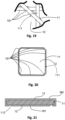
- the first conductive material M1 deposited on the first face 12 it is also sought to isolate, in particular electrically, the first conductive material M1 deposited on the first face 12 relative to the second conductive material M2 deposited on the second face 13, for example to form two separate electrodes. Therefore, to make it possible to obtain the desired insulation directly at the end of steps d 1 ) and d 2 ), it is possible to use a mask 111, examples of which are illustrated in figures 18 to 20 , opposing the formation of the first conductive material M1 on a portion 112 ( figure 21 ) of the first face 12 of the plate 11.
- the wires 101 used to form the mask 111 can here be chosen so that their section, or diameter, is adapted to ensure the presence of the portion 112 not covered by the first conductive material M1 at the end of step d 1 ).
- the diameter of the wires 101 can in this case be between 180 ⁇ m and 350 ⁇ m. In this case, the use of smooth wires is recommended so as to ensure that the plate 11 is in contact with the wires 101 to allow the presence of the portion 112.
- the wires 101 forming the mask 111 are kept taut, in particular by the frame 105.
- these wires 101 are taut one above the other and are for example simply in contact (i.e. without mechanical connection other than contacts) so as to form the mask 111.
- the wires 101 are eight in number because the plate 11 has chamfered corners but this number can be adapted according to the shape of the plate 11.
- the figure 19 illustrates in particular a corner of the plate 11 to show an example of the arrangement of the wires 11 at this corner.
- the wires 101 forming the mask 111 are welded as shown in particular in figure 20 comprising eight welded wires 101.
- This has the advantage of delimiting the mask 111 so that the latter forms a flat frame on which the plate 11 can rest, the masking of the portion 112 of the second face 12 is then better than in the frame of the figure 18 where first conductive material M1 could for example be deposited on the plate 11 at locations where the wires overlap.
- the nature of the wires 101 i.e. their composition
- the rigidity of the wires 101 the rigidity of the wires 101
- the capacity of the wires 101 to be welded will be adapted.
- the position of the wires 101 in particular before step c), can be adjusted according to the dimensions of the plate 11, this allowing the support device 100 to adapt and not to be limited to a particular plate 11 format. This can apply as long as the plate 11 is supported by several wires 101 and for example in the case of the presence of the mask 111 when the wires 101 are not welded.
- the manufacturing method may be such that steps d 1 ) and d 2 ) result in the formation of a material on the surface of the plate 11.
- This material also called a covering material, may be formed from a single material such that the first and second conductive materials M1, M2 may, for example, be TCO.
- the manufacturing method may include a step e) consisting of delimiting, in the material, the first layer 14 in contact with the first face 12 of the plate 11 and the second layer 15 in contact with the second face 13 of the plate 11 such that the first layer 14 is separate from the second layer 15 ( Figures 23 and 24 ).
- This step e) includes a step of removing a portion of the material.
- Step e) is preferably implemented when steps d 1 ) and d 2 ) consist of a step d) of forming the same transparent conductive material (i.e. the material mentioned above) over the entirety or the majority of the surface of the plate 11 ( figure 22 ).
- the removal step can be performed by a grinding wheel 113 or a laser 114 as shown for example respectively in Figures 23 and 24
- the grinding wheel 113 and the laser 114 are each particularly suitable for removing the portion of the material in order to delimit the first and second layers 14, 15.
- the removal of the portion of the material is preferably carried out on a lateral edge 17 of the plate 11, the lateral edge 17 (for example visible in figures 2 , 23, 24 ) connecting the first and second faces 12, 13 of the plate 11.
- the lateral edge 17 may have several sides connected to each other in the sense that it forms a lateral contour of the plate 11. This makes it possible to maintain the covering of the first and second faces 12, 13 of the plate 11 by the material so as not to limit the effective yield of the photovoltaic cell 10.
- step c) can position a masking element, such as the wire 101 or one of the wires 101 ( figure 10 ), on a cutting zone Z4 formed by a portion of the surface of the first face 12.
- the masking element belonging to the support device 100, prevents the formation of the first conductive material M1 on the cutting zone Z4 throughout step d 1 ).
- the manufacturing method may then comprise, for example as illustrated in figure 25 , a step of separating the plate 11 into at least two parts, the separation step being carried out, after step d 1 ) and in particular after step d 2 ), by cutting through the cutting zone Z4 (in figure 25 the first and second conductive materials M1, M2 are represented in particular after step d 1 ) and step d 2 ) having used the device 100 for supporting the Figures 9 and 10 ).
- This is preferred because it makes it possible, for example, to avoid the diffusion of species, for example from the first conductive material M1 in the plate 11, in particular it makes it possible to avoid the diffusion of metallic species in the silicon of the plate 11, and in particular if the cutting is done by thermal means such as laser cutting or other.
- the cutting can also be done, for example, using a saw 115.
- a wire 101 or structured wires 101 may be used as an alternative, as is for example illustrated in figure 26 which shows in section the support of the plate 11 by a device 100 for supporting structured wire(s) 101, i.e. having a zigzag shape to form local support points for the plate 11 in the manner of grains 109 so as to allow the formation of the first conductive material M1 during step d 1 ) on as much as possible of the surface of the first face 12 of the plate 11 excluding the contact points between the wire(s) 101 and the plate 11.
- the zigzag shape is such that the or each wire 101 comprises a succession of segments, and that any pair of consecutive segments is such that the segments of this pair are formed respectively in intersecting and in particular orthogonal planes, these planes also intersecting the plane of the plate 11 so as to form local support points between the wire 101 and the plate 11 throughout step d 1 ).
- the present invention finds an industrial application in the manufacture of silicon-based photovoltaic cells; and in particular silicon-based and heterojunction photovoltaic cells.
- the support device 100 and/or the wire(s) 101 may have, at least on the surface, a suitable material, also called a neutral material, to avoid problems of contamination of the plate 11 during the formation of the first and second conductive materials M1, M2.
- a suitable material also called a neutral material
- the surface of the support device 100 may also be formed from a first conductive material M1, such as for example ITO.
Landscapes
- Chemical & Material Sciences (AREA)
- Chemical Kinetics & Catalysis (AREA)
- Engineering & Computer Science (AREA)
- Materials Engineering (AREA)
- Mechanical Engineering (AREA)
- Metallurgy (AREA)
- Organic Chemistry (AREA)
- Photovoltaic Devices (AREA)
Claims (15)
- Verfahren zur Herstellung mindestens einer Photovoltaikzelle (10), wobei das Herstellungsverfahren die folgenden Schritte umfasst:a) Vorsehen mindestens einer Platte (11), wobei die Platte (11) eine erste Seite (12) und eine der ersten Seite (12) gegenüberliegende zweite Seite (13) umfasst,b) Vorsehen einer Haltevorrichtung (100),c) Positionieren der Platte (11) durch Inkontaktbringen der ersten Seite (12) der Platte (11) mit der Haltevorrichtung (100),d1) Bilden eines ersten leitfähigen Materials (M1) auf der ersten Seite (12) der Platte (11), während die Platte (11) von der Haltevorrichtung (100) gehalten wird,d2) Bilden eines zweiten leitfähigen Materials (M2) auf der zweiten Seite (13) der Platte (11), während die Platte (11) von der Haltevorrichtung (100) gehalten wird,dadurch gekennzeichnet, dass:- mindestens eines des ersten und des zweiten leitfähigen Materials (M1, M2) transparent ist,- die Haltevorrichtung (100) mindestens einen Draht (101) umfasst, und- während des gesamten oder eines Teils des Schritts d1) die erste Seite (12) der Platte (11) auf dem Draht (101) aufliegt.
- Herstellungsverfahren nach Anspruch 1, dadurch gekennzeichnet, dass die Haltevorrichtung (100) einen Platz (102) für die Platte (11) umfasst, wobei der Platz (102) eine Auflagefläche (103) umfasst, und dadurch, dass am Ende des Schritts c) und während des gesamten Schritts d1) die erste Seite (12) der Platte (11) auf der Auflagefläche (103) und auf dem Draht (101) aufliegt.
- Herstellungsverfahren nach Anspruch 1, dadurch gekennzeichnet, dass am Ende von Schritt c) die erste Seite (12) der Platte (11) auf Drähten (101) der Haltevorrichtung (100) aufliegt.
- Herstellungsverfahren nach Anspruch 3, dadurch gekennzeichnet, dass:- die Haltevorrichtung (100) einen ersten Satz Drähte und einen zweiten Satz Drähte umfasst,- Schritt d1) einen ersten Zeitraum und einen zweiten Zeitraum umfasst, während denen das erste leitfähige Material (M1) auf der ersten Seite (12) der Platte (11) gebildet wird,- während des ersten Zeitraums die erste Seite (12) der Platte (11) auf den Drähten (101a, 101b) des ersten Satzes Drähte aufliegt, wohingegen sich die Drähte (101c, 101d) des zweiten Satzes Drähte in Abstand von der Platte (11) befinden,- während des zweiten Zeitraums die Platte (11) mittels des ersten leitfähigen Materials (M1), das beim ersten Zeitraum auf der ersten Seite (12) der Platte (11) gebildet wurde, auf den Drähten (101c, 101d) des zweiten Satzes Drähte ruht, wohingegen sich die Drähte (101a, 101b) des ersten Satzes Drähte in Abstand von der Platte (11) befinden.
- Herstellungsverfahren nach Anspruch 3, dadurch gekennzeichnet, dass Schritt d1), während die Drähte (101) die Platte (11) halten, eine relative Verlagerung zwischen der Platte (11) und den Drähten (101) umfasst, die zum Beispiel durch Verwendung von mechanischen oder akustischen Schwingungen ausgeführt wird.
- Herstellungsverfahren nach einem der Ansprüche 1 bis 5, dadurch gekennzeichnet, dass:- der Draht (101) der Haltevorrichtung (100) oder jeder Draht (101) der Haltevorrichtung (100) einen Kern (110) und eine Vielzahl von Körnern (109) umfasst, wobei die Körner (109) der Vielzahl von Körnern auf dem Kern (110) befestigt sind, und- am Ende von Schritt c) und während des gesamten Schritts d1) die erste Seite (12) der Platte (11) nur auf Körnern (109) aufliegt.
- Herstellungsverfahren nach Anspruch 3, dadurch gekennzeichnet, dass:- am Ende von Schritt c) die Drähte (101) eine Maske (111) bilden, die an der ersten Seite (12) der Platte (11) angeordnet ist,- die Maske (111), wenn Schritt d1) ausgeführt wird, die Bildung des ersten leitfähigen Materials (M1) auf einem Abschnitt (112) der ersten Seite (12) der Platte (11) verhindert, wobei sich der Abschnitt (112) am Rand der ersten Seite (12) der Platte (11) erstreckt, und- sich aus der Ausführung von Schritt d1) und von Schritt d2) das Vorhandensein einer ersten Schicht (14), die aus dem ersten leitfähigen Material (M1) hergestellt und auf der ersten Seite (12) der Platte (11) angeordnet ist, und das Vorhandensein einer zweiten Schicht (15) ergibt, die aus dem zweiten leitfähigen Material (M2) hergestellt ist und mit der zweiten Seite (13) der Platte (11) in Kontakt steht, wobei die erste und die zweite Schicht (14, 15) getrennt sind.
- Herstellungsverfahren nach einem der Ansprüche 3 bis 7, dadurch gekennzeichnet, dass vor Schritt c) die Position der Drähte (101) in Abhängigkeit von den Abmessungen der Platte (11) angepasst wird.
- Herstellungsverfahren nach einem der Ansprüche 1 bis 8, dadurch gekennzeichnet, dass das erste leitfähige Material (M1) und das zweite leitfähige Material (M2) jeweils ausgewählt sind aus: einem transparenten leitfähigen Oxid und einem metallischen Material.
- Herstellungsverfahren nach einem der Ansprüche 1 bis 8, dadurch gekennzeichnet, dass es einen Schritt d) des Bildens eines Materials an der Oberfläche der Platte (11) umfasst, wobei dieser Schritt d) durch, zum Beispiel gleichzeitiges, Umsetzen der Schritte d1) und d2) ausgeführt wird, wobei das erste leitfähige Material (M1) und das zweite leitfähige Material (M2) demselben transparenten leitfähigen Oxid entsprechen.
- Herstellungsverfahren nach einem der Ansprüche 1 bis 6, dadurch gekennzeichnet, dass sich aus den Schritten d1) und d2) die Bildung eines Materials an der Oberfläche der Platte (11) ergibt, und dadurch, dass es einen Schritt e) umfasst, der darin besteht, in dem Material eine erste Schicht (14) in Kontakt mit der ersten Seite (12) der Platte (11) und eine zweite Schicht (15) in Kontakt mit der zweiten Seite (13) der Platte (11) derart zu begrenzen, dass die erste Schicht (14) von der zweiten Schicht (15) getrennt ist, wobei Schritt e) einen Schritt des Entfernens eines Abschnitts des Materials umfasst.
- Herstellungsverfahren nach Anspruch 11, dadurch gekennzeichnet, dass der Schritt des Entfernens mit einer Schleifscheibe (113) oder einem Laser (114) ausgeführt wird.
- Herstellungsverfahren nach einem der Ansprüche 11 bis 12, dadurch gekennzeichnet, dass das Entfernen des Abschnitts des Materials an einer Seitenkante (17) der Platte (11) ausgeführt wird, wobei die Seitenkante (17) die erste und die zweite Seite (12, 13) der Platte (11) verbindet.
- Herstellungsverfahren nach einem der vorstehenden Ansprüche, dadurch gekennzeichnet, dass:- Schritt c) ein Maskenelement, das zur Haltevorrichtung (100) gehört, auf einer Schneidzone (Z4) positioniert, die von einem Teil der Oberfläche der ersten Seite (12) gebildet wird, wobei das Maskenelement während des gesamten Schritts d1) die Bildung des ersten leitfähigen Materials (M1) auf der Schneidzone (Z4) verhindert, und- es einen Schritt des Trennens der Platte (11) in mindestens zwei Teile umfasst, wobei der Schritt des Trennens nach Schritt d1) durch Schneiden durch die Schneidzone (Z4) ausgeführt wird.
- Herstellungsverfahren nach einem der vorstehenden Ansprüche, dadurch gekennzeichnet, dass Schritt a) darin besteht, mehrere Platten (11) vorzusehen, und dadurch, dass bei jeder Platte (11):- Schritt c) ausgeführt wird, um die Platte (11) zu positionieren,- Schritt d1) ausgeführt wird, sodass das erste leitfähige Material (M1) auf der ersten Seite (12) der Platte (11) abgeschieden wird,- Schritt d2) ausgeführt wird, sodass das zweite leitfähige Material (M2) auf der zweiten Seite (13) der Platte (11) abgeschieden wird.
Applications Claiming Priority (2)
| Application Number | Priority Date | Filing Date | Title |
|---|---|---|---|
| FR2013368A FR3117675B1 (fr) | 2020-12-16 | 2020-12-16 | Procédé de fabrication d’au moins une cellule photovoltaïque en utilisant une plaque en appui sur au moins un fil |
| PCT/FR2021/052255 WO2022129739A1 (fr) | 2020-12-16 | 2021-12-09 | Procédé de fabrication d'au moins une cellule photovoltaïque en utilisant une plaque en appui sur au moins un fil |
Publications (2)
| Publication Number | Publication Date |
|---|---|
| EP4264679A1 EP4264679A1 (de) | 2023-10-25 |
| EP4264679B1 true EP4264679B1 (de) | 2025-02-05 |
Family
ID=75339853
Family Applications (1)
| Application Number | Title | Priority Date | Filing Date |
|---|---|---|---|
| EP21847997.0A Active EP4264679B1 (de) | 2020-12-16 | 2021-12-09 | Herstellungsverfahren von mindestens einer photovoltaïschen zelle mit einem von mindestens einem draht unterstützten wafer |
Country Status (4)
| Country | Link |
|---|---|
| US (1) | US20240072188A1 (de) |
| EP (1) | EP4264679B1 (de) |
| FR (1) | FR3117675B1 (de) |
| WO (1) | WO2022129739A1 (de) |
Citations (1)
| Publication number | Priority date | Publication date | Assignee | Title |
|---|---|---|---|---|
| CN213583724U (zh) * | 2020-12-22 | 2021-06-29 | 上海理想万里晖薄膜设备有限公司 | 太阳能电池成膜用托盘 |
Family Cites Families (14)
| Publication number | Priority date | Publication date | Assignee | Title |
|---|---|---|---|---|
| KR20040078795A (ko) * | 2003-03-05 | 2004-09-13 | 삼성전자주식회사 | 기판 이송 카세트 |
| DE102006004869B4 (de) * | 2006-01-27 | 2007-12-20 | Universität Stuttgart | Verfahren zum Herstellen von seriell verschalteten Solarzellen sowie Vorrichtung zur Durchführung des Verfahrens |
| KR100898979B1 (ko) * | 2007-08-08 | 2009-05-25 | 주식회사 에이디피엔지니어링 | 기판 리프트 장치 |
| EP2450964A4 (de) * | 2009-06-30 | 2013-11-06 | Lg Innotek Co Ltd | Photovoltaische stromerzeugungsvorrichtung und verfahren zu ihrer herstellung |
| KR101199210B1 (ko) * | 2010-10-28 | 2012-11-07 | 한국에너지기술연구원 | 태양전지 박막 증착장치, 방법, 시스템 |
| JP2013184717A (ja) * | 2012-03-07 | 2013-09-19 | Toppan Printing Co Ltd | 基板輸送トレイ及び基板の輸送方法及び基板の取り出し方法及び基板の収納方法 |
| KR101403324B1 (ko) * | 2012-08-01 | 2014-06-05 | 엘아이지에이디피 주식회사 | 박막증착용 기판 트레이 및 이를 포함하는 박막증착장비 |
| KR101451065B1 (ko) * | 2014-02-28 | 2014-10-14 | 주식회사 유아이디 | 캐리어 및 이를 이용한 스퍼터링 방법 |
| US9761744B2 (en) * | 2015-10-22 | 2017-09-12 | Tesla, Inc. | System and method for manufacturing photovoltaic structures with a metal seed layer |
| CN106811738A (zh) * | 2015-12-02 | 2017-06-09 | 钧石(中国)能源有限公司 | 一种太阳能电池的镀膜方法及载板 |
| JP6445735B2 (ja) * | 2016-03-03 | 2018-12-26 | コアテクノロジー株式会社 | 薄膜形成装置に用いる基盤トレイ |
| CN108350567B (zh) * | 2016-08-25 | 2019-06-14 | 株式会社爱发科 | 成膜装置及成膜方法以及太阳能电池的制造方法 |
| CN111270222B (zh) * | 2020-02-10 | 2021-01-15 | 拉普拉斯(无锡)半导体科技有限公司 | 一种TOPCon电池双面镀膜设备 |
| CN111979522A (zh) * | 2020-08-14 | 2020-11-24 | 苏州迈为科技股份有限公司 | 支撑装置 |
-
2020
- 2020-12-16 FR FR2013368A patent/FR3117675B1/fr active Active
-
2021
- 2021-12-09 US US18/267,901 patent/US20240072188A1/en active Pending
- 2021-12-09 WO PCT/FR2021/052255 patent/WO2022129739A1/fr not_active Ceased
- 2021-12-09 EP EP21847997.0A patent/EP4264679B1/de active Active
Patent Citations (1)
| Publication number | Priority date | Publication date | Assignee | Title |
|---|---|---|---|---|
| CN213583724U (zh) * | 2020-12-22 | 2021-06-29 | 上海理想万里晖薄膜设备有限公司 | 太阳能电池成膜用托盘 |
Also Published As
| Publication number | Publication date |
|---|---|
| FR3117675A1 (fr) | 2022-06-17 |
| WO2022129739A1 (fr) | 2022-06-23 |
| EP4264679A1 (de) | 2023-10-25 |
| FR3117675B1 (fr) | 2023-10-27 |
| US20240072188A1 (en) | 2024-02-29 |
Similar Documents
| Publication | Publication Date | Title |
|---|---|---|
| EP3900052B1 (de) | Verfahren zur passivierung von fotovoltaischen zellen und verfahren zur herstellung passivierter fotovoltaischer unterzellen | |
| FR2914501A1 (fr) | Dispositif photovoltaique a structure a heterojonctions interdigitee discontinue | |
| EP2339640A1 (de) | Photodetektor mit Plasmonstruktur | |
| EP0140917A1 (de) | Grossflächige photovoltaische zelle und verfahren zu ihrer herstellung | |
| FR3039005A1 (fr) | Batterie en couches minces autosupportee et procede de fabrication d'une telle batterie | |
| WO2017207893A1 (fr) | Element de blindage electromagnetique optiquement transparent et a plusieurs zones | |
| WO2013105024A1 (fr) | Procede pour realiser un module photovoltaïque avec deux etapes de gravure p1 et p3 et module photovoltaïque correspondant | |
| EP4264679B1 (de) | Herstellungsverfahren von mindestens einer photovoltaïschen zelle mit einem von mindestens einem draht unterstützten wafer | |
| EP1846956B1 (de) | Verfahren zur herstellung von metall-/halbleiterkontakten über ein dielektrikum | |
| EP1618611B1 (de) | Verfahren zum herstellen einer halbleiter-vorrichtung mit selbstausrichtenden metallischen kontakten | |
| EP3227925B1 (de) | Photovoltaischer textilfaden | |
| EP1735843B1 (de) | Verfahren zur herstellung von polysiliziumfilmen | |
| EP4540867A1 (de) | Einstellung des spaltwinkels von siliziumwafern für solarzellen | |
| EP2351095B1 (de) | Photovoltaikzellen mit in einem Substrat verteiltem Sender und Verfahren zur Herstellung einer solchen Zelle | |
| FR3060852A1 (fr) | Dispositif photovoltaique et procede de fabrication associe | |
| EP4521887A1 (de) | Verfahren zur passivierung von solarzellen | |
| EP1854148A1 (de) | Verfahren zur metallisierung eines halbleiterbauelements | |
| WO1999049524A1 (fr) | Procede de fabrication et d'assemblage de cellules photovoltaïques | |
| EP4521886A1 (de) | Verfahren zur passivierung von solarzellen | |
| EP4386875A1 (de) | Verfahren zur herstellung einer photovoltaischen zelle | |
| FR2878374A1 (fr) | Cellule solaire a heterojonction et a metallisation enterree | |
| FR3058075A1 (fr) | Plateau de detourage comportant une piece amovible | |
| FR3142290A1 (fr) | Correction de la metallisation pour le clivage de cellules pv | |
| FR3023062A1 (fr) | Cellule photovoltaique a heterojonction de silicium et procede de fabrication d'une telle cellule | |
| FR3015112A1 (fr) | Cellule photovoltaique |
Legal Events
| Date | Code | Title | Description |
|---|---|---|---|
| STAA | Information on the status of an ep patent application or granted ep patent |
Free format text: STATUS: UNKNOWN |
|
| STAA | Information on the status of an ep patent application or granted ep patent |
Free format text: STATUS: THE INTERNATIONAL PUBLICATION HAS BEEN MADE |
|
| PUAI | Public reference made under article 153(3) epc to a published international application that has entered the european phase |
Free format text: ORIGINAL CODE: 0009012 |
|
| STAA | Information on the status of an ep patent application or granted ep patent |
Free format text: STATUS: REQUEST FOR EXAMINATION WAS MADE |
|
| 17P | Request for examination filed |
Effective date: 20230703 |
|
| AK | Designated contracting states |
Kind code of ref document: A1 Designated state(s): AL AT BE BG CH CY CZ DE DK EE ES FI FR GB GR HR HU IE IS IT LI LT LU LV MC MK MT NL NO PL PT RO RS SE SI SK SM TR |
|
| DAV | Request for validation of the european patent (deleted) | ||
| DAX | Request for extension of the european patent (deleted) | ||
| GRAP | Despatch of communication of intention to grant a patent |
Free format text: ORIGINAL CODE: EPIDOSNIGR1 |
|
| STAA | Information on the status of an ep patent application or granted ep patent |
Free format text: STATUS: GRANT OF PATENT IS INTENDED |
|
| INTG | Intention to grant announced |
Effective date: 20240709 |
|
| GRAS | Grant fee paid |
Free format text: ORIGINAL CODE: EPIDOSNIGR3 |
|
| RAP3 | Party data changed (applicant data changed or rights of an application transferred) |
Owner name: COMMISSARIAT A L'ENERGIE ATOMIQUE ET AUX ENERGIESALTERNATIVES |
|
| GRAA | (expected) grant |
Free format text: ORIGINAL CODE: 0009210 |
|
| STAA | Information on the status of an ep patent application or granted ep patent |
Free format text: STATUS: THE PATENT HAS BEEN GRANTED |
|
| AK | Designated contracting states |
Kind code of ref document: B1 Designated state(s): AL AT BE BG CH CY CZ DE DK EE ES FI FR GB GR HR HU IE IS IT LI LT LU LV MC MK MT NL NO PL PT RO RS SE SI SK SM TR |
|
| REG | Reference to a national code |
Ref country code: GB Ref legal event code: FG4D Free format text: NOT ENGLISH |
|
| REG | Reference to a national code |
Ref country code: CH Ref legal event code: EP |
|
| REG | Reference to a national code |
Ref country code: DE Ref legal event code: R096 Ref document number: 602021025826 Country of ref document: DE |
|
| REG | Reference to a national code |
Ref country code: IE Ref legal event code: FG4D Free format text: LANGUAGE OF EP DOCUMENT: FRENCH |
|
| REG | Reference to a national code |
Ref country code: NL Ref legal event code: MP Effective date: 20250205 |
|
| PG25 | Lapsed in a contracting state [announced via postgrant information from national office to epo] |
Ref country code: RS Free format text: LAPSE BECAUSE OF FAILURE TO SUBMIT A TRANSLATION OF THE DESCRIPTION OR TO PAY THE FEE WITHIN THE PRESCRIBED TIME-LIMIT Effective date: 20250505 |
|
| PG25 | Lapsed in a contracting state [announced via postgrant information from national office to epo] |
Ref country code: FI Free format text: LAPSE BECAUSE OF FAILURE TO SUBMIT A TRANSLATION OF THE DESCRIPTION OR TO PAY THE FEE WITHIN THE PRESCRIBED TIME-LIMIT Effective date: 20250205 |
|
| PG25 | Lapsed in a contracting state [announced via postgrant information from national office to epo] |
Ref country code: PL Free format text: LAPSE BECAUSE OF FAILURE TO SUBMIT A TRANSLATION OF THE DESCRIPTION OR TO PAY THE FEE WITHIN THE PRESCRIBED TIME-LIMIT Effective date: 20250205 |
|
| PG25 | Lapsed in a contracting state [announced via postgrant information from national office to epo] |
Ref country code: ES Free format text: LAPSE BECAUSE OF FAILURE TO SUBMIT A TRANSLATION OF THE DESCRIPTION OR TO PAY THE FEE WITHIN THE PRESCRIBED TIME-LIMIT Effective date: 20250205 |
|
| REG | Reference to a national code |
Ref country code: LT Ref legal event code: MG9D |
|
| PG25 | Lapsed in a contracting state [announced via postgrant information from national office to epo] |
Ref country code: IS Free format text: LAPSE BECAUSE OF FAILURE TO SUBMIT A TRANSLATION OF THE DESCRIPTION OR TO PAY THE FEE WITHIN THE PRESCRIBED TIME-LIMIT Effective date: 20250605 Ref country code: NO Free format text: LAPSE BECAUSE OF FAILURE TO SUBMIT A TRANSLATION OF THE DESCRIPTION OR TO PAY THE FEE WITHIN THE PRESCRIBED TIME-LIMIT Effective date: 20250505 |
|
| PG25 | Lapsed in a contracting state [announced via postgrant information from national office to epo] |
Ref country code: NL Free format text: LAPSE BECAUSE OF FAILURE TO SUBMIT A TRANSLATION OF THE DESCRIPTION OR TO PAY THE FEE WITHIN THE PRESCRIBED TIME-LIMIT Effective date: 20250205 |
|
| PG25 | Lapsed in a contracting state [announced via postgrant information from national office to epo] |
Ref country code: HR Free format text: LAPSE BECAUSE OF FAILURE TO SUBMIT A TRANSLATION OF THE DESCRIPTION OR TO PAY THE FEE WITHIN THE PRESCRIBED TIME-LIMIT Effective date: 20250205 |
|
| PG25 | Lapsed in a contracting state [announced via postgrant information from national office to epo] |
Ref country code: LV Free format text: LAPSE BECAUSE OF FAILURE TO SUBMIT A TRANSLATION OF THE DESCRIPTION OR TO PAY THE FEE WITHIN THE PRESCRIBED TIME-LIMIT Effective date: 20250205 Ref country code: PT Free format text: LAPSE BECAUSE OF FAILURE TO SUBMIT A TRANSLATION OF THE DESCRIPTION OR TO PAY THE FEE WITHIN THE PRESCRIBED TIME-LIMIT Effective date: 20250605 |
|
| PG25 | Lapsed in a contracting state [announced via postgrant information from national office to epo] |
Ref country code: GR Free format text: LAPSE BECAUSE OF FAILURE TO SUBMIT A TRANSLATION OF THE DESCRIPTION OR TO PAY THE FEE WITHIN THE PRESCRIBED TIME-LIMIT Effective date: 20250506 Ref country code: BG Free format text: LAPSE BECAUSE OF FAILURE TO SUBMIT A TRANSLATION OF THE DESCRIPTION OR TO PAY THE FEE WITHIN THE PRESCRIBED TIME-LIMIT Effective date: 20250205 |
|
| REG | Reference to a national code |
Ref country code: AT Ref legal event code: MK05 Ref document number: 1765047 Country of ref document: AT Kind code of ref document: T Effective date: 20250205 |
|
| PG25 | Lapsed in a contracting state [announced via postgrant information from national office to epo] |
Ref country code: SE Free format text: LAPSE BECAUSE OF FAILURE TO SUBMIT A TRANSLATION OF THE DESCRIPTION OR TO PAY THE FEE WITHIN THE PRESCRIBED TIME-LIMIT Effective date: 20250205 |
|
| PG25 | Lapsed in a contracting state [announced via postgrant information from national office to epo] |
Ref country code: SM Free format text: LAPSE BECAUSE OF FAILURE TO SUBMIT A TRANSLATION OF THE DESCRIPTION OR TO PAY THE FEE WITHIN THE PRESCRIBED TIME-LIMIT Effective date: 20250205 |
|
| PG25 | Lapsed in a contracting state [announced via postgrant information from national office to epo] |
Ref country code: DK Free format text: LAPSE BECAUSE OF FAILURE TO SUBMIT A TRANSLATION OF THE DESCRIPTION OR TO PAY THE FEE WITHIN THE PRESCRIBED TIME-LIMIT Effective date: 20250205 |
|
| PG25 | Lapsed in a contracting state [announced via postgrant information from national office to epo] |
Ref country code: AT Free format text: LAPSE BECAUSE OF FAILURE TO SUBMIT A TRANSLATION OF THE DESCRIPTION OR TO PAY THE FEE WITHIN THE PRESCRIBED TIME-LIMIT Effective date: 20250205 |
|
| PG25 | Lapsed in a contracting state [announced via postgrant information from national office to epo] |
Ref country code: EE Free format text: LAPSE BECAUSE OF FAILURE TO SUBMIT A TRANSLATION OF THE DESCRIPTION OR TO PAY THE FEE WITHIN THE PRESCRIBED TIME-LIMIT Effective date: 20250205 Ref country code: CZ Free format text: LAPSE BECAUSE OF FAILURE TO SUBMIT A TRANSLATION OF THE DESCRIPTION OR TO PAY THE FEE WITHIN THE PRESCRIBED TIME-LIMIT Effective date: 20250205 |
|
| PG25 | Lapsed in a contracting state [announced via postgrant information from national office to epo] |
Ref country code: RO Free format text: LAPSE BECAUSE OF FAILURE TO SUBMIT A TRANSLATION OF THE DESCRIPTION OR TO PAY THE FEE WITHIN THE PRESCRIBED TIME-LIMIT Effective date: 20250205 |
|
| PG25 | Lapsed in a contracting state [announced via postgrant information from national office to epo] |
Ref country code: SK Free format text: LAPSE BECAUSE OF FAILURE TO SUBMIT A TRANSLATION OF THE DESCRIPTION OR TO PAY THE FEE WITHIN THE PRESCRIBED TIME-LIMIT Effective date: 20250205 |
|
| REG | Reference to a national code |
Ref country code: DE Ref legal event code: R097 Ref document number: 602021025826 Country of ref document: DE |
|
| PLBE | No opposition filed within time limit |
Free format text: ORIGINAL CODE: 0009261 |
|
| STAA | Information on the status of an ep patent application or granted ep patent |
Free format text: STATUS: NO OPPOSITION FILED WITHIN TIME LIMIT |
|
| 26N | No opposition filed |
Effective date: 20251106 |
|
| PGFP | Annual fee paid to national office [announced via postgrant information from national office to epo] |
Ref country code: FR Payment date: 20251222 Year of fee payment: 5 |
|
| PGFP | Annual fee paid to national office [announced via postgrant information from national office to epo] |
Ref country code: DE Payment date: 20251222 Year of fee payment: 5 |
|
| PGFP | Annual fee paid to national office [announced via postgrant information from national office to epo] |
Ref country code: IT Payment date: 20251231 Year of fee payment: 5 |