EP4263305B1 - Bremseinrichtung - Google Patents
Bremseinrichtung Download PDFInfo
- Publication number
- EP4263305B1 EP4263305B1 EP21820109.3A EP21820109A EP4263305B1 EP 4263305 B1 EP4263305 B1 EP 4263305B1 EP 21820109 A EP21820109 A EP 21820109A EP 4263305 B1 EP4263305 B1 EP 4263305B1
- Authority
- EP
- European Patent Office
- Prior art keywords
- actuator
- adjusting
- drum brake
- brake device
- drive
- Prior art date
- Legal status (The legal status is an assumption and is not a legal conclusion. Google has not performed a legal analysis and makes no representation as to the accuracy of the status listed.)
- Active
Links
Images




Classifications
-
- B—PERFORMING OPERATIONS; TRANSPORTING
- B60—VEHICLES IN GENERAL
- B60T—VEHICLE BRAKE CONTROL SYSTEMS OR PARTS THEREOF; BRAKE CONTROL SYSTEMS OR PARTS THEREOF, IN GENERAL; ARRANGEMENT OF BRAKING ELEMENTS ON VEHICLES IN GENERAL; PORTABLE DEVICES FOR PREVENTING UNWANTED MOVEMENT OF VEHICLES; VEHICLE MODIFICATIONS TO FACILITATE COOLING OF BRAKES
- B60T13/00—Transmitting braking action from initiating means to ultimate brake actuator with power assistance or drive; Brake systems incorporating such transmitting means, e.g. air-pressure brake systems
- B60T13/74—Transmitting braking action from initiating means to ultimate brake actuator with power assistance or drive; Brake systems incorporating such transmitting means, e.g. air-pressure brake systems with electrical assistance or drive
- B60T13/741—Transmitting braking action from initiating means to ultimate brake actuator with power assistance or drive; Brake systems incorporating such transmitting means, e.g. air-pressure brake systems with electrical assistance or drive acting on an ultimate actuator
-
- B—PERFORMING OPERATIONS; TRANSPORTING
- B60—VEHICLES IN GENERAL
- B60T—VEHICLE BRAKE CONTROL SYSTEMS OR PARTS THEREOF; BRAKE CONTROL SYSTEMS OR PARTS THEREOF, IN GENERAL; ARRANGEMENT OF BRAKING ELEMENTS ON VEHICLES IN GENERAL; PORTABLE DEVICES FOR PREVENTING UNWANTED MOVEMENT OF VEHICLES; VEHICLE MODIFICATIONS TO FACILITATE COOLING OF BRAKES
- B60T13/00—Transmitting braking action from initiating means to ultimate brake actuator with power assistance or drive; Brake systems incorporating such transmitting means, e.g. air-pressure brake systems
- B60T13/74—Transmitting braking action from initiating means to ultimate brake actuator with power assistance or drive; Brake systems incorporating such transmitting means, e.g. air-pressure brake systems with electrical assistance or drive
- B60T13/746—Transmitting braking action from initiating means to ultimate brake actuator with power assistance or drive; Brake systems incorporating such transmitting means, e.g. air-pressure brake systems with electrical assistance or drive and mechanical transmission of the braking action
-
- F—MECHANICAL ENGINEERING; LIGHTING; HEATING; WEAPONS; BLASTING
- F16—ENGINEERING ELEMENTS AND UNITS; GENERAL MEASURES FOR PRODUCING AND MAINTAINING EFFECTIVE FUNCTIONING OF MACHINES OR INSTALLATIONS; THERMAL INSULATION IN GENERAL
- F16D—COUPLINGS FOR TRANSMITTING ROTATION; CLUTCHES; BRAKES
- F16D65/00—Parts or details
- F16D65/38—Slack adjusters
- F16D65/40—Slack adjusters mechanical
- F16D65/52—Slack adjusters mechanical self-acting in one direction for adjusting excessive play
-
- F—MECHANICAL ENGINEERING; LIGHTING; HEATING; WEAPONS; BLASTING
- F16—ENGINEERING ELEMENTS AND UNITS; GENERAL MEASURES FOR PRODUCING AND MAINTAINING EFFECTIVE FUNCTIONING OF MACHINES OR INSTALLATIONS; THERMAL INSULATION IN GENERAL
- F16D—COUPLINGS FOR TRANSMITTING ROTATION; CLUTCHES; BRAKES
- F16D65/00—Parts or details
- F16D65/38—Slack adjusters
- F16D65/40—Slack adjusters mechanical
- F16D65/52—Slack adjusters mechanical self-acting in one direction for adjusting excessive play
- F16D65/56—Slack adjusters mechanical self-acting in one direction for adjusting excessive play with screw-thread and nut
- F16D65/561—Slack adjusters mechanical self-acting in one direction for adjusting excessive play with screw-thread and nut for mounting within the confines of a drum brake
- F16D65/565—Slack adjusters mechanical self-acting in one direction for adjusting excessive play with screw-thread and nut for mounting within the confines of a drum brake arranged diametrically opposite to service brake actuator, and subjected to service brake force
-
- F—MECHANICAL ENGINEERING; LIGHTING; HEATING; WEAPONS; BLASTING
- F16—ENGINEERING ELEMENTS AND UNITS; GENERAL MEASURES FOR PRODUCING AND MAINTAINING EFFECTIVE FUNCTIONING OF MACHINES OR INSTALLATIONS; THERMAL INSULATION IN GENERAL
- F16D—COUPLINGS FOR TRANSMITTING ROTATION; CLUTCHES; BRAKES
- F16D65/00—Parts or details
- F16D65/38—Slack adjusters
- F16D2065/386—Slack adjusters driven electrically
-
- F—MECHANICAL ENGINEERING; LIGHTING; HEATING; WEAPONS; BLASTING
- F16—ENGINEERING ELEMENTS AND UNITS; GENERAL MEASURES FOR PRODUCING AND MAINTAINING EFFECTIVE FUNCTIONING OF MACHINES OR INSTALLATIONS; THERMAL INSULATION IN GENERAL
- F16D—COUPLINGS FOR TRANSMITTING ROTATION; CLUTCHES; BRAKES
- F16D2121/00—Type of actuator operation force
- F16D2121/18—Electric or magnetic
- F16D2121/24—Electric or magnetic using motors
-
- F—MECHANICAL ENGINEERING; LIGHTING; HEATING; WEAPONS; BLASTING
- F16—ENGINEERING ELEMENTS AND UNITS; GENERAL MEASURES FOR PRODUCING AND MAINTAINING EFFECTIVE FUNCTIONING OF MACHINES OR INSTALLATIONS; THERMAL INSULATION IN GENERAL
- F16D—COUPLINGS FOR TRANSMITTING ROTATION; CLUTCHES; BRAKES
- F16D2125/00—Components of actuators
- F16D2125/18—Mechanical mechanisms
- F16D2125/20—Mechanical mechanisms converting rotation to linear movement or vice versa
- F16D2125/34—Mechanical mechanisms converting rotation to linear movement or vice versa acting in the direction of the axis of rotation
- F16D2125/36—Helical cams, Ball-rotating ramps
-
- F—MECHANICAL ENGINEERING; LIGHTING; HEATING; WEAPONS; BLASTING
- F16—ENGINEERING ELEMENTS AND UNITS; GENERAL MEASURES FOR PRODUCING AND MAINTAINING EFFECTIVE FUNCTIONING OF MACHINES OR INSTALLATIONS; THERMAL INSULATION IN GENERAL
- F16D—COUPLINGS FOR TRANSMITTING ROTATION; CLUTCHES; BRAKES
- F16D51/00—Brakes with outwardly-movable braking members co-operating with the inner surface of a drum or the like
- F16D51/16—Brakes with outwardly-movable braking members co-operating with the inner surface of a drum or the like shaped as brake-shoes pivoted on a fixed or nearly-fixed axis
- F16D51/18—Brakes with outwardly-movable braking members co-operating with the inner surface of a drum or the like shaped as brake-shoes pivoted on a fixed or nearly-fixed axis with two brake-shoes
- F16D51/20—Brakes with outwardly-movable braking members co-operating with the inner surface of a drum or the like shaped as brake-shoes pivoted on a fixed or nearly-fixed axis with two brake-shoes extending in opposite directions from their pivots
Definitions
- the invention relates to a braking device for a motor vehicle, with a braking element for generating a frictional connection with a rotating component and with an actuator that can be driven in two directions of movement and moves the braking element towards and away from the rotating component, and with an adjusting device for compensating wear of the components generating the frictional connection.
- the unpublished EN 20 2021 103 308 U1 refers to a combined drum brake having a plurality of actuator systems which are hybridized and functionally separated, comprising a hydraulic service brake actuator unit with pistons for the purpose of hydraulic service brake function and having an electric parking brake actuator unit with bevel gear for an electromechanical parking brake function. Furthermore, a constant gap calibration based on the electric parking brake actuator unit is desirable for the purpose of frictional wear compensation.
- Braking devices are, for example, from the WO 2015 101 486 A2
- the adjustment device is integrated as a separate component next to the actuator in the spreading device of the brake device and prevents the brake pedal travel or the actuator travel from being increased due to the increased air gap as the brake pads wear.
- the adjustment device can be adjusted if necessary.
- the invention is based on the problem of developing a braking device of the type mentioned at the outset in such a way that it is particularly simply constructed and avoids complex adjustment of the brake pads.
- the adjustment device is arranged in the component of the actuator and that the actuator, starting from a central basic position in one drive direction to drive a spreading actuator and, starting from the basic position in the opposite drive direction, to drive the adjustment device.
- This design avoids the need to install an additional component of the adjustment device because the adjustment device is installed together with the other components of the actuator. Either the adjustment device or the spreading actuator can be controlled by controlling the actuator accordingly.
- the drive directions of the actuator described can be determined by an angle or an axial path.
- the braking device can be designed in almost any way, for example as a Simplex or Duo Servo brake.
- the braking device has a particularly short delay in the generation of the frictional connection after the activation of the actuator when the basic position is the position of the actuator in which no energy is applied.
- the basic position and the drive in both directions of movement can be easily determined if the actuator has an electric motor.
- the braking device can be manufactured particularly easily if the actuator has a housing with pressure pieces arranged therein to support the braking elements and the adjusting device. This allows the actuator with the pressure pieces to be easily mounted between the braking elements.
- the adjusting device is mounted at the same time.
- the drive of the adjusting device and the pressure pieces is designed particularly simple if the electric motor is designed to drive a drive sleeve and if the drive sleeve is designed to control the spreading actuator in one direction of rotation and to control the adjustment device in the other direction of rotation.
- the expansion actuator is particularly simple in terms of construction if the expansion actuator has two ramp disks that can be rotated relative to one another, if the ramp disks are indirectly supported on the pressure pieces and if the shape of the ramp disks is designed to increase their axial size when rotated relative to one another.
- the ramp disks can, for example, have inclined grooves on their front sides to accommodate rolling elements, so that the rolling elements roll in them and increase the distance between the ramp disks.
- the structure of the spreading actuator is further simplified if the actuator has a drive sleeve which is connected to an axle via a thread and is axially displaceable within the housing and if at least one of the components of the axle or the drive sleeve supports the pressure pieces directly or indirectly.
- the adjusting device is structurally particularly simple if the adjusting device has an adjusting nut screwed onto the axle via an adjusting thread and if the adjusting nut is secured against twisting in a form-fitting or force-fitting manner in the basic position.
- the thread could, for example, be designed as a trapezoidal thread.
- the control of the expansion actuator and the adjustment device is particularly low-friction if the thread of the drive sleeve on the axle is designed as a ball screw.
- the actuator is particularly compact if the adjusting nut is arranged in the force flow between the axle and the one pressure piece. This allows the entire adjusting device to be moved when the spreading actuator is activated without the adjusting device being adjusted.
- the holder of the adjusting nut which is secured against rotation, is structurally particularly simple if the adjusting nut has a ratchet with a locking disk or with an adjusting spring.
- the support of the adjusting spring is particularly simple if an adjusting cage surrounds the adjusting nut with one end and supports the adjusting spring with the other end.
- Figure 1 shows the components of a brake device of a motor vehicle designed as a drum brake.
- the brake device has a rotatably mounted brake drum 1.
- the brake drum 1 encloses two brake elements 2, 3 designed as brake shoes with friction linings 4, 5.
- the brake shoes 2, 3 can be moved against the brake drum 1 by a spreading device 7 driven by an actuator 6 in order to generate a friction torque.
- tension springs 8, 9 tension the brake shoes 2, 3 against the actuator 6 and thus enable them to move back from the brake drum 1.
- the actuator 6 has an electric motor 10 that can be driven in both directions of rotation and a housing 11 for guiding two pressure pieces 12, 13 that are supported on the brake shoes 2, 3.
- a spreading actuator 14 for driving the spreading device 7 and an adjustment device 15 are arranged within the housing 11.
- the adjustment device 15 adjusts the position of the pressure pieces 12, 13 and thus enables the wear of the friction linings 4, 5 to be compensated.
- a gear 16 driven by the electric motor 10 penetrates into the housing 11 with the pressure pieces 12, 13.
- the housing 11 is mounted floating on a support plate 17.
- Figure 2 shows a force/displacement diagram of the actuator from Figure 1 .
- the actuator 6 consists of Figure 1 in the uncontrolled basic state, it assumes a zero position marked "0" in which neither the pressure pieces 12, 13 are subjected to force by means of the spreading actuator 14, nor is the adjustment device 15 controlled. If the electric motor 10 is driven in one direction of rotation starting from the zero position, the adjustment device 15 is controlled. If the electric motor is driven in the other direction of rotation starting from the zero position, the pressure pieces 12, 13 are moved apart by the spreading actuator 14 and introduce a force F into the spreading device.
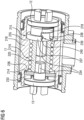
- FIG 3 shows a schematic sectional view through the housing 11 of the actuator 6 with the pressure pieces 12, 13 arranged therein in a non-rotatable and axially displaceable manner.
- the Figure 1 The driven gear 16 is shown in partial section.
- the actuator 6 has the pressure pieces 12, 13 at its ends to support the Figure 1 illustrated braking elements 2, 3 and within the housing 11 a drive sleeve 18 driven by the gear 16.
- the drive sleeve 18 is mounted on an axle 20 and is supported via first drivers 21 on a locking disk 23 and via second drivers 22 on a first ramp disk 24.
- the drive sleeve 18 can be mounted on the axle 20 via a radial bearing or a sliding bush. In the exemplary embodiment shown, the drive sleeve 18 is displaceable.
- the drive sleeve 18 can be axially fixed on the axle 20 on both sides with a locking ring (not shown).
- the drivers 21, 22 protrude from the drive sleeve 18 as pairs of wings arranged on both sides of the axle 20. This avoids transverse forces.
- the first ramp disk 24 is rotatably mounted and is supported on a fixed ramp disk 25.
- Rolling bodies 26 are arranged between the ramp disks 24, 25. The rolling bodies 26 roll on grooves 27 inclined relative to the front sides of the ramp disks 24, 25, so that the ramp disks 24, 25 are moved axially apart with increasing angle of rotation.
- One of the ramp disks 25 is supported on one of the pressure pieces 12 and the other of the ramp disks is supported via an axial bearing 33 on the axis 20 and thus indirectly on the other pressure piece 13.
- the pressure pieces 12, 13 are connected to the housing 11 via axial guides 34 in an axially displaceable and non-rotatable manner.
- One pressure piece 12 can be manufactured in one piece with the next ramp disk 25.
- the axis 20 has an anti-rotation device 42 in one pressure piece 13.
- the drivers 21, 22 are designed in such a way that they rotate the locking disk 23 in one direction of rotation of the drive sleeve 18 and rotate the rotatably mounted ramp disk 24 in the other direction of rotation of the drive sleeve 18.
- the drivers 21, 22 therefore fulfill a drive function in one direction of rotation of the drive sleeve 18 and a freewheel function with the component of the locking disk 23 or the rotatable ramp disk 24 in the other direction of rotation.
- the locking disk 23 is part of the adjustment device 15, which grips an adjusting nut 28.
- This adjusting nut 28 is supported on one of the pressure pieces 13 via a disk spring 29 and is screwed onto an adjustment thread 30 of the axis 20.
- the locking disk 23 and the adjusting nut 28 have opposing notches 31, so that the adjusting nut 28 is driven in one direction of rotation of the locking disk 23 and is rotated on the adjustment thread 30 of the axis 20 and thus moved.
- the adjusting nut 28 presses against one of the pressure pieces 13 via the disk spring 29.
- the adjusting nut 28 remains on the axis 20 due to friction and the locking disk 23 moves one notch further. This increases the distances between the pressure pieces 12, 13 and thus adjusts the actuator 6.
- FIG 4 clarifies the design of the first driver 21 using the example of the locking disk 23.
- the locking disk 23 is preloaded against a stop 43 by a return spring 32.
- the first driver rests loosely on the locking disk 23 and can move away from the drive sleeve 18 when it is rotated clockwise or can rotate the locking disk 23 against the force of the return spring 32 when it is rotated anti-clockwise.
- the second drivers 22 for driving the rotatable ramp disk 24 are constructed in the same way with the functions in the opposite direction of rotation. This means that when the drive sleeve 18 is driven in one direction of rotation, only the adjustment device is used. 15 is adjusted and in the other direction of rotation only the pressure pieces 12, 13 are moved away from each other and thus the spreading device 7 is driven via the spreading actuator 14.
- the locking disk 23 rotates and takes the adjusting nut 28 with it.
- the adjusting nut 28 is screwed onto the axle 20 and pressed against the plate spring 29.
- the plate spring 29 presses against the pressure piece 13.
- the pressure piece 13 thus moves in the same direction as the adjusting nut 28.
- the pressure piece 13 takes the locking disk 23 with it via a locking disk 44.
- the assembly of the adjusting device 15 therefore moves. Since the locking disk 23 is also moved during the adjustment, the contact between the adjusting nut 28 and the locking disk 23 is maintained. If the adjusting device 15 moves, the distance between the drive sleeve 18 and the locking disk 23 also increases.
- FIG. 5 shows a further embodiment of the actuator 6 with two axially displaceable pressure pieces 12, 13 held non-rotatably in the housing 11 via axial guides 134 in a schematic sectional view.
- An adjusting device 115 has two ramp disks 124, 125 facing each other. One of the ramp disks 125 is connected to one of the pressure pieces 13 in a rotationally fixed and axially displaceable manner, while the other of the ramp disks 124 is connected to an adjusting nut 128 via friction or positive locking.
- the gear 16 of the electric motor 10 meshes as in the embodiment according to Figure 3 a drive sleeve 118.
- the drive sleeve 118 is connected to an axle 120 via a thread 119 designed as a ball screw.
- the adjusting nut 128 with an adjusting thread 130 is screwed onto the axle 120.
- a powerful adjusting spring 139 inside the adjusting screw 128 generates an axial force on the ramp disk 124 in order to hold the rolling elements 126 arranged between them, designed as balls, between the ramp disks 124, 125.
- the ramp disk which is connected in a rotationally fixed manner to the one pressure piece 13, 125 supports the force of the adjusting spring 139 via a disc spring 129 on the pressure piece 13.
- the ramp disks 124, 125 are rotated against each other and preloaded into their position.
- the adjusting spring 139 inside the adjusting nut 128 preloads the ramp disks 124, 125 against the roller bodies 126.
- the ramp disk 124 connected to the adjusting nut 128 is held in its rotational position by friction.
- a return spring 132 holds the ramp disks 124, 125 in their rotated and preloaded position.
- the return spring 132 is in an unloaded rest position. An axial displacement of the ramp disks 124, 125 leads to a tension in the torsion spring.
- the drive sleeve 118 If the drive sleeve 118 is driven in one direction of rotation, it moves and presses on one pressure piece 12 via an axial bearing 133. The other pressure piece 13 is moved in the other direction via the axis 120 without rotating. The axis 120 has an anti-twist device 142 in the pressure pieces 12, 13. The adjustment device 115 is not moved during this movement. This will affect the Figure 1 shown spreading device 7. To reduce the spreading force, the drive sleeve 118 is driven in the opposite direction into the basic position.
- the adjustment takes place when the drive sleeve 118 is driven from the basic position in the other direction of rotation in the direction of the ramp disks 124, 125.
- the return spring 132 is tensioned in the process.
- the rotation of the adjusting nut 128 leads to an axial displacement of the anti-twisting axis 120 and thus to an increase in the distance between the pressure pieces 12, 13.
- the ramp disks 124, 125 are relieved of the axial preload of the drive sleeve 118.
- the tensioned return spring 132 can therefore return to the rest position. In doing so, the return spring 132 takes the rotatable ramp disk 124 with it, so that both ramp disks 124, 125 are again rotated against each other.
- Figure 6 shows a further embodiment of the actuator 6 of the braking device from Figure 1 , in which a rotatable in the housing 11 and from the electric motor 10 via the gear 16 from Figure 1 drivable drive sleeve 218 is mounted on a tubular axis 220 via a thread 219 designed as a ball screw drive.
- Two pressure pieces 12, 13 arranged within the drive sleeve 218 and rotatable relative to it are driven by the braking elements 2, 3 from Figure 1 secured against rotation and by the also in Figure 1 shown tension springs 8, 9 into the drive sleeve 218.
- the tubular axis 220 has axial guides 234 for the rotationally fixed and axially displaceable guidance of the pressure pieces 12, 13.
- an axial bearing 233 of a spreading actuator 214 is arranged, while an adjusting device 215 is arranged between the other pressure piece 12 and the axis 220.
- the drive sleeve 218 with radially inwardly pointing shoulders 235, 236 is opposite the axial bearing 233 and the adjusting device 215.
- the adjusting device 215 has an adjusting nut 228, a sliding ring 237 and an adjusting cage 238.
- the adjusting nut 228 is mounted on a Figure 11 shown adjustment thread 230 of one pressure piece 12.
- An adjustment spring 239 is deflected on a sliding ring bolt 240.
- the sliding ring 237 is guided axially by the sliding ring bolt 240.
- the drive sleeve 218 is moved by the Figure 1 shown electric motor 10 is rotated as shown in Figure 7
- the axis 220 is pressed against the adjusting nut 228 via the thread 219, which is designed as a ball screw, whereby one pressure piece 12 is subjected to force.
- the drive sleeve 218 is supported on the axial bearing 233, whereby the other pressure piece 13 is subjected to force.
- the pressure pieces 12, 13 thus drive the spreading device 7 out of Figure 1
- the adjusting device 215 is in the position shown in Figure 9 is shown enlarged for clarity.
- One leg 241 of the adjusting spring 239 is supported in a notch 231 of the adjusting nut 228, while the other end of the adjusting spring 239 is supported on the adjusting cage 238.
- the drive sleeve 218 is rotated in the opposite direction, as shown in Figure 8 is shown.
- the drive sleeve 218 presses the sliding ring 237 axially in the direction of the next pressure piece 12. Due to the axially displaceable coupling of the sliding ring 237 with the sliding ring bolt 240, the leg 241 of the adjusting spring 239 is pivoted about the sliding ring bolt 240, as shown in Figure 10 is shown enlarged for clarity. Since the free end of the leg 241 rests in the catch 231 of the adjusting nut 228, the latter is rotated.
- Figure 11 shows the part of the adjustment device 215 having the adjusting nut 228 in an enlarged partial section.
- the adjusting cage 238 is guided in the pressure piece 12 so that it can be moved axially and is secured against rotation.
- This guide also allows the sliding ring 237 to be guided axially via the sliding ring bolt 240 in the adjusting cage 238 so that it can be moved axially and is secured against rotation.
Landscapes
- Engineering & Computer Science (AREA)
- General Engineering & Computer Science (AREA)
- Mechanical Engineering (AREA)
- Transportation (AREA)
- Braking Arrangements (AREA)
Description
- Die Erfindung betrifft eine Bremseinrichtung für ein Kraftfahrzeug, mit einem Bremsorgan zur Erzeugung eines Reibschlusses mit einem rotierenden Bauteil und mit einem in zwei Bewegungsrichtungen antreibbaren, das Bremsorgan auf das rotierende Bauteil zu und von dem rotierenden Bauteil weg bewegenden Aktuator, und mit einer Nachstelleinrichtung zum Ausgleich eines Verschleißes der den Reibschluss erzeugenden Bauteile.
- Die nicht vorveröffentlichte
DE 20 2021 103 308 U1 bezieht sich auf eine kombinierte Trommelbremse aufweisend mehrere Aktuatorsysteme die hybridisiert vorliegen und funktional separiert sind, umfassend eine hydraulische Betriebsbremsaktuatoreinheit mit Kolben zwecks hydraulischer Betriebsbremsfunktion und aufweisend eine elektrische Feststellbremsaktuatoreinheit mit Kegelradgetriebe für eine elektromechanische Feststellbremsfunktion. Weiterhin ist zwecks Reibverschleißkompensation eine konstant bemessene Spaltkalibrierung anhand der elektrischen Feststellbremsaktuatoreinheit erstrebenswert angegeben. - Bremseinrichtungen sind beispielsweise aus der
WO 2015 101 486 A2 bekannt. Die Nachstelleinrichtung ist als separates Bauteil neben dem Aktuator in die Spreizeinrichtung der Bremseinrichtung integriert und verhindert, dass ein Bremspedalweg oder ein Weg des Aktuators mit beim Verschleiß der Bremsbeläge zunehmendem Luftspiel vergrößert wird. Bei Bedarf kann die Nachstelleinrichtung nachgestellt werden. - Der Erfindung liegt das Problem zugrunde, eine Bremseinrichtung der eingangs genannten Art so weiter zu bilden, dass sie besonders einfach aufgebaut ist und eine aufwändige Nachstellung der Bremsbeläge vermeidet.
- Dieses Problem wird erfindungsgemäß dadurch gelöst, dass die Nachstelleinrichtung in dem Bauteil des Aktuators angeordnet ist und dass der Aktuator ausgehend von einer mittleren Grundstellung in der einen Antriebrichtung zum Antrieb eines Spreizaktors und ausgehend von der Grundstellung in der entgegengesetzten Antriebsrichtung zum Antrieb der Nachstelleinrichtung ausgebildet ist.
- Durch diese Gestaltung wird die Montage eines zusätzlichen Bauteils der Nachstelleinrichtung vermieden, weil die Nachstelleinrichtung zusammen mit den übrigen Bauteilen des Aktuators montiert wird. Dabei lassen sich wahlweise die Nachstelleinrichtung oder der Spreizaktor durch eine entsprechende Ansteuerung des Aktuators ansteuern. Damit ist die Bremseinrichtung besonders einfach aufgebaut und ermöglicht eine besonders einfache Nachstellung der Bremsbelege bei Verschleiß. Die beschriebenen Antriebsrichtungen des Aktuators können dabei von einem Winkel oder einem axialen Weg festgelegt werden. Die Bremseinrichtung kann nahezu beliebig, beispielsweise als Simplex oder Duo Servo Bremse ausgebildet sein.
- Die Bremseinrichtung hat gemäß einer anderen vorteilhaften Weiterbildung der Erfindung eine besonders geringe Verzögerung der Erzeugung des Reibschlusses nach der Ansteuerung des Aktuators, wenn die Grundstellung die mit Energie unbeaufschlagte Stellung des Aktuators ist.
- Die Grundstellung und der Antrieb in beide Bewegungsrichtungen lassen sich gemäß einer anderen vorteilhaften Weiterbildung der Erfindung einfach festlegen, wenn der Aktuator einen Elektromotor hat.
- Die Bremseinrichtung lässt sich gemäß einer anderen vorteilhaften Weiterbildung der Erfindung besonders einfach fertigen, wenn der Aktuator ein Gehäuse mit darin angeordneten Druckstücken zur Abstützung der Bremsorgane und der Nachstelleinrichtung hat. Hierdurch lässt sich der Aktuator mit den Druckstücken einfach zwischen den Bremsorganen montieren. Hierbei ist gleichzeitig die Nachstelleinrichtung montiert.
- Der Antrieb der Nachstelleinrichtung und der Druckstücke gestaltet sich gemäß einer anderen vorteilhaften Weiterbildung der Erfindung konstruktiv besonders einfach, wenn der Elektromotor zum Antrieb einer Antriebshülse ausgebildet ist und wenn die Antriebshülse in der einen Drehrichtung zur Ansteuerung des Spreizaktors und in der anderen Drehrichtung zur Ansteuerung der Nachstelleinrichtung ausgebildet ist.
- Der Spreizaktor gestaltet sich gemäß einer anderen vorteilhaften Weiterbildung der Erfindung konstruktiv besonders einfach, wenn der Spreizaktor zwei gegeneinander verdrehbare Rampenscheiben hat, wenn die Rampenscheiben mittelbar an den Druckstücken abgestützt sind und wenn die Form der Rampenscheiben bei einer Verdrehung gegeneinander zu ihrer axialen Vergrößerung ausgebildet ist. Die Rampenscheiben können beispielsweise an ihren Stirnseiten geneigte Nuten zur Aufnahme von Rollkörpern aufweisen, so dass die Rollkörper darin abrollen und den Abstand der Rampenscheiben zueinander vergrößern.
- Zur weiteren Vereinfachung des Aufbaus des Spreizaktors trägt es gemäß einer anderen vorteilhaften Weiterbildung der Erfindung bei, wenn der Aktuator eine über ein Gewinde mit einer Achse verbundene und innerhalb des Gehäuses axial verschiebbare Antriebshülse hat und wenn zumindest eines der Bauteile der Achse oder der Antriebshülse die Druckstücke mittelbar oder unmittelbar abstützt.
- Die Nachstelleinrichtung gestaltet sich gemäß einer anderen vorteilhaften Weiterbildung der Erfindung konstruktiv besonders einfach, wenn die Nachstelleinrichtung eine über ein Nachstellgewinde auf der Achse aufgedrehte Nachstellmutter hat und wenn die Nachstellmutter in der Grundstellung formschlüssig oder kraftschlüssig gegen Verdrehen gesichert ist.
- Das Gewinde könnte beispielsweise als Trapezgewinde ausgebildet sein. Die Ansteuerungen des Spreizaktors und der Nachstelleinrichtung gestalten sich gemäß einer anderen vorteilhaften Weiterbildung der Erfindung besonders reibungsarm, wenn das Gewinde der Antriebshülse auf der Achse als Kugelgewindetrieb ausgebildet ist.
- Der Aktuator gestaltet sich gemäß einer anderen vorteilhaften Weiterbildung der Erfindung besonders kompakt, wenn die Nachstellmutter im Kraftfluss zwischen der Achse und dem einen Druckstück angeordnet ist. Hierdurch kann die gesamte Nachstelleinrichtung bei der Ansteuerung des Spreizaktors verschoben werden, ohne dass die Nachstelleinrichtung verstellt wird.
- Die gegen Verdrehung gesicherte Halterung der Nachstellmutter gestaltet sich gemäß einer anderen vorteilhaften Weiterbildung der Erfindung konstruktiv besonders einfach, wenn die Nachstellmutter eine Rasterung mit einer Rastscheibe oder mit einer Nachstellfeder hat.
- Die Abstützung der Nachstellfeder gestaltet sich gemäß einer anderen vorteilhaften Weiterbildung der Erfindung besonders einfach, wenn ein Nachstellkäfig die Nachstellmutter mit einem Ende umgreift und mit dem anderen Ende die Nachstellfeder abstützt.
- Die Erfindung lässt zahlreiche Ausführungsformen zu. Zur weiteren Verdeutlichung ihres Grundprinzips sind mehrere davon in der Zeichnung dargestellt und werden nachfolgend beschrieben. Diese zeigt in
- Fig.1
- schematisch eine als Trommelbremse ausgebildete Bremseinrichtung,
- Fig.2
- ein Kraft-Weg-Diagramm eines Aktuators der Bremseinrichtung aus
Figur 1 , - Fig.3
- eine Schnittdarstellung durch eine erste Ausführungsform des Aktuators,
- Fig.4
- eine Schnittdarstellung durch den Aktuator aus
Figur 3 entlang der Linie IV - IV. - Fig.5
- eine Schnittdarstellung durch eine weitere Ausführungsform des Aktuators,
- Fig.6
- eine Schnittdarstellung durch eine weitere Ausführungsform des Aktuators,
- Fig.7
- den Aktuator aus
Figur 6 bei der Ansteuerung eines Spreizaktors, - Fig.8
- den Aktuator aus
Figur 6 bei der Ansteuerung einer Nachstelleinrichtung, - Fig.9
- perspektivisch eine Nachstellmutter einer Nachstelleinrichtung des Aktuators aus
Figur 6 - Fig. 10
- die Nachstellmutter aus
Figur 7 in einer weiteren Darstellung, - Fig.11
- einen Teilbereich der Nachstelleinrichtung aus
Figur 6 in einer vergrößerten Schnittdarstellung. -
Figur 1 zeigt die Bauteile einer als Trommelbremse ausgebildeten Bremseinrichtung eines Kraftfahrzeuges. Die Bremseinrichtung hat eine drehbar gelagerte Bremstrommel 1. Die Bremstrommel 1 umschließt zwei als Bremsbacken ausgebildete Bremsorgane 2, 3 mit Reibbelägen 4, 5. Die Bremsbacken 2, 3 lassen sich von einer von einem Aktuator 6 antreibbaren Spreizeinrichtung 7 gegen die Bremstrommel 1 bewegen, um ein Reibmoment zu erzeugen. In dem dargestellten Ausführungsbeispiel spannen Zugfedern 8, 9 die Bremsbacken 2, 3 gegen den Aktuator 6 und ermöglichen damit deren Rückbewegung von der Bremstrommel 1. Der Aktuator 6 hat einen in beide Drehrichtungen antreibbaren Elektromotor 10 und ein Gehäuse 11 zur Führung zweier sich an den Bremsbacken 2, 3 abstützenden Druckstücke 12, 13. Innerhalb des Gehäuses 11 sind ein Spreizaktor 14 zum Antrieb der Spreizeinrichtung 7 und eine Nachstelleinrichtung 15 angeordnet. Die Nachstelleinrichtung 15 stellt die Position der Druckstücke 12, 13 ein und ermöglicht damit den Ausgleich des Verschleißes der Reibbeläge 4, 5. Ein von dem Elektromotor 10 angetriebenes Zahnrad 16 dringt in das Gehäuse 11 mit den Druckstücken 12, 13 ein. Das Gehäuse 11 ist schwimmend auf einer Tragplatte 17 gelagert. -
Figur 2 zeigt ein Kraft/Weg Diagramm des Aktuators ausFigur 1 . Hierbei ist zu erkennen, dass der Aktuator 6 ausFigur 1 im ungesteuerten Grundzustand eine mit "0" gekennzeichnete Nullstellung einnimmt, in der weder die Druckstücke 12, 13 mittels des Spreizaktors 14 mit Kraft beaufschlagt werden, noch die Nachstelleinrichtung 15 angesteuert wird. Treibt man ausgehend von der Nullstellung den Elektromotor 10 in die eine Drehrichtung an, wird die Nachstelleinrichtung 15 angesteuert. Treibt man ausgehend von der Nullstellung den Elektromotor in die andere Drehrichtung an, werden die Druckstücke 12, 13 von dem Spreizaktor 14 auseinander bewegt und leiten eine Kraft F in die Spreizeinrichtung ein. -
Figur 3 zeigt schematisch eine Schnittdarstellung durch das Gehäuse 11 des Aktuators 6 mit den darin unverdrehbar und axial verschieblich angeordneten Druckstücken 12, 13. Das von dem Elektromotor 10 ausFigur 1 angetriebene Zahnrad 16 ist im Teilschnitt dargestellt. Der Aktuator 6 hat an seinen Enden die Druckstücke 12, 13 zur Abstützung der inFigur 1 dargestellten Bremsorgane 2, 3 und innerhalb des Gehäuses 11 eine von dem Zahnrad 16 angetriebene Antriebshülse 18. Die Antriebshülse 18 ist auf einer Achse 20 gelagert und stützt sich über erste Mitnehmer 21 an einer Rastscheibe 23 und über zweite Mitnehmer 22 an einer ersten Rampenscheibe 24 ab. Die Lagerung der Antriebshülse 18 auf der Achse 20 kann über ein Radiallager oder eine Gleitbuchse erfolgen. In dem dargestellten Ausführungsbeispiel ist die Antriebshülse 18 verschiebbar. Alternativ kann die Antriebshülse 18 beidseitig mit einem nicht dargestellten Sicherungsring axial auf der Achse 20 fixiert werden. Die Mitnehmer 21, 22 stehen als auf beiden Seiten der Achse 20 angeordnete Flügelpaare von der Antriebshülse 18 ab. Hierdurch werden Querkräfte vermieden. Die erste Rampenscheibe 24 ist drehbar gelagert und stützt sich an einer feststehenden Rampenscheibe 25 ab. Zwischen den Rampenscheiben 24, 25 sind Rollkörper 26 angeordnet. Die Rollkörper 26 rollen sich auf gegenüber den Stirnseiten der Rampenscheiben 24, 25 geneigten Nuten 27 ab, so dass die Rampenscheiben 24, 25 mit zunehmendem Verdrehwinkel axial auseinander bewegt werden. Dabei stützt sich eine der Rampenscheiben 25 an dem einen Druckstück 12 und die andere der Rampenscheiben über ein Axiallager 33 an der Achse 20 und damit mittelbar an dem anderen Druckstück 13 ab. Die Druckstücke 12, 13 sind über Axialführungen 34 axial verschieblich und unverdrehbar mit dem Gehäuse 11 verbunden. Das eine Druckstück 12 kann einstückig mit der nächsten Rampenscheibe 25 gefertigt sein. Die Achse 20 hat eine Verdrehsicherung 42 in dem einen Druckstück 13. Die Mitnehmer 21, 22 sind derart gestaltet, dass sie in der einen Drehrichtung der Antriebshülse 18 die Rastscheibe 23 verdrehen und in der anderen Drehrichtung der Antriebshülse 18 die drehbar gelagerte Rampenscheibe 24 verdrehen. Damit erfüllen die Mitnehmer 21, 22 in der einen Drehrichtung der Antriebshülse 18 eine Antriebsfunktion und in der anderen Drehrichtung eine Freilauffunktion mit dem Bauteil der Rastscheibe 23 oder der drehbaren Rampenscheibe 24. - Die Rastscheibe 23 ist Teil der Nachstelleinrichtung 15, welche eine Nachstellmutter 28 erfasst. Diese Nachstellmutter 28 stützt sich über eine Tellerfeder 29 an dem einen Druckstück 13 ab und ist auf einem Nachstellgewinde 30 der Achse 20 aufgedreht. Die Rastscheibe 23 und die Nachstellmutter 28 haben einander gegenüberstehende Rasterungen 31, so dass die Nachstellmutter 28 in der einen Drehrichtung der Rastscheibe 23 mitgenommen und auf dem Nachstellgewinde 30 der Achse 20 verdreht und damit verschoben wird. Dabei drückt die Nachstellmutter 28 über die Tellerfeder 29 gegen das eine Druckstück 13. Bei einer Rückbewegung der Rastscheibe 23 verbleibt die Nachstellmutter 28 durch Reibschluss auf der Achse 20 und die Rastscheibe 23 bewegt sich eine Rasterung weiter. Hierdurch werden die Abstände der Druckstücke 12, 13 zueinander vergrößert und damit der Aktuator 6 nachgestellt.
-
Figur 4 verdeutlicht die Ausgestaltung des ersten Mitnehmers 21 am Beispiel der Rastscheibe 23. Die Rastscheibe 23 wird von einer Rückstellfeder 32 gegen einen Anschlag 43 vorgespannt. Der erste Mitnehmer liegt lose an der Rastscheibe 23 an und kann sich bei einer Drehung der Antriebshülse 18 im Urzeigersinn dieser entfernen oder bei einer Drehung gegen den Urzeigersinn diese Rastscheibe 23 gegen die Kraft der Rückstellfeder 32 verdrehen. Die zweiten Mitnehmer 22 zur Mitnahme der drehbaren Rampenscheibe 24 sind analog mit den Funktionen in entgegengesetzter Drehrichtung aufgebaut. Damit wird bei dem Antrieb der Antriebshülse 18 in die eine Drehrichtung ausschließlich die Nachstelleinrichtung 15 verstellt und in der anderen Drehrichtung ausschließlich die Druckstücke 12, 13 voneinander weg bewegt und damit über den Spreizaktor 14 die Spreizeinrichtung 7 angetrieben. - Wird die Nachstellung aktiviert, dreht sich die Rastscheibe 23 und nimmt die Nachstellmutter 28 mit. Die Nachstellmutter 28 wird auf der Achse 20 verschraubt und gegen die Tellerfeder 29 gedrückt. Die Tellerfeder 29 Druckt gegen das Druckstück 13. Das Druckstück 13 bewegt sich damit in die gleiche Richtung wie die Nachstellmutter 28. Dabei nimmt das Druckstück 13 die Rastscheibe 23 über eine Sicherungsscheibe 44 mit. Mit jeder Nachstellung verschiebt sich somit die Baugruppe der Nachstelleinrichtung 15. Da die Rastscheibe 23 bei der Nachstellung mit verschoben wird bleibt der Kontakt zwischen der Nachstellmutter 28 und der Rastscheibe 23 erhalten. Verschiebt sich die Nachstelleinrichtung 15, dann vergrößert sich auch der Abstand zwischen Antriebshülse 18 und der Rastscheibe 23.
-
Figur 5 zeigt eine weitere Ausführungsform des Aktuators 6 mit zwei axial verschieblichen und über Axialführungen 134 in dem Gehäuse 11 unverdrehbar gehaltenen Druckstücken 12, 13 in einer schematischen Schnittdarstellung. Eine Nachstelleinrichtung 115 hat zwei einander gegenüberstehende Rampenscheiben 124, 125. Eine der Rampenscheiben 125 ist drehfest und axial verschieblich mit einem der Druckstücke 13 verbunden, während die andere der Rampenscheiben 124 über Reibung oder Formschluss mit einer Nachstellmutter 128 verbunden ist. Das Zahnrad 16 des Elektromotors 10 kämmt wie bei der Ausführungsform nachFigur 3 eine Antriebshülse 118. Die Antriebshülse 118 ist über ein als Kugelgewindetrieb ausgebildetes Gewinde 119 mit einer Achse 120 verbunden. Auf der Achse 120 ist die Nachstellmutter 128 mit einem Nachstellgewinde 130 aufgedreht. - Eine kräftige Nachstellfeder 139 im Inneren der Nachstellschraube 128 erzeugt eine axiale Kraft auf die Rampenscheibe 124, um dazwischen angeordnete, als Kugeln ausgebildete Rollkörper 126 zwischen den Rampenscheiben 124, 125 zu halten. Die drehfest mit dem einen Druckstück 13 verbundene Rampenscheibe 125 stützt die Kraft der Nachstellfeder 139 über eine Tellerfeder 129 am Druckstück 13 ab.
- In der ungesteuerten Grundstellung sind die Rampenscheiben 124, 125 gegeneinander verdreht und in ihre Position vorgespannt. Die Nachstellfeder 139 im Inneren der Nachstellmutter 128 spannt die Rampenscheiben 124, 125 gegen die Rollkörper 126 vor. Die mit der Nachstellmutter 128 verbundene Rampenscheibe 124 ist durch Reibung in ihrer Drehstellung gehalten. Zusätzlich hält eine Rückstellfeder 132 die Rampenscheiben 124, 125 in ihrer verdrehten und vorgespannten Lage. Dabei ist die Rückstellfeder 132 in einer ungespannten Ruheposition. Eine axiale Verschiebung der Rampenscheiben 124, 125 führt zu einer Spannung der Drehfeder. Drückt nun die angetriebene Antriebshülse 118 des als Kugelgewindetrieb ausgebildeten Gewindes 119 gegen die Rampenscheibe 125, werden die Rampenscheiben 124, 125 verdreht und dabei axial zusammengedrückt und die Rückstellfeder 132 vorgespannt. Die axiale Kraft erzeugt so viel Reibkraft zwischen der einen Rampenscheibe 124 und der Nachstellmutter 128, dass die Nachstellmutter 128 verdreht wird, Nachstellhub erzeugt und so den Abstand zwischen den Druckstücken 12, 13 vergrößert.
- Entfernt sich nun die angetriebene Antriebshülse 118 des als Kugelgewindetrieb ausgebildeten Gewindes 119 zurück in die dargestellte Grundstellung, nimmt die Reibung zwischen der Rampenscheibe 124 und der Nachstellmutter 128 wieder ab. Die vorgespannte Rückstellfeder 132 bewegt die drehbare Rampenscheibe 124 dabei wieder zurück. Eine gegebenenfalls künstlich erzeugte ausreichend hohe Reibung im Nachstellgewinde 130 sorgt dafür, dass während der Entspannung der Rückstellfeder 132 die Nachstellmutter 128 nicht zurückgestellt wird.
- Wird die Antriebshülse 118 in der einen Drehrichtung angetrieben, verschiebt sich diese und drückt über ein Axiallager 133 auf das eine Druckstück 12. Das andere Druckstück 13 wird über die Achse 120 in die andere Richtung bewegt, ohne sich dabei zu drehen. Die Achse 120 hat eine Verdrehsicherung 142 in den Druckstücken 12, 13. Die Nachstelleinrichtung 115 wird bei dieser Bewegung nicht beeinflusst. Damit wird die in
Figur 1 dargestellte Spreizeinrichtung 7 angetrieben. Zum Abbau der Spreizkraft wird die Antriebshülse 118 in die entgegengesetzte Richtung in die Grundstellung angetrieben. - Die Nachstellung erfolgt, wenn aus der Grundstellung die Antriebshülse 118 in die andere Drehrichtung in Richtung der Rampenscheiben 124, 125 angetrieben wird. Die angetriebene Antriebshülse 118 des als Kugelgewindetrieb ausgebildeten Gewindes 119 drückt axial. Wirkt eine axiale Kraft auf die verdrehgesicherte Rampenscheibe 125, wird die drehbare Rampenscheibe 124 über geneigte Nuten 127 und darin angeordnete Rollkörper 126 verdreht und nimmt über Reibung oder Formschluss die Nachstellmutter 128 mit. Dabei wird die Rückstellfeder 132 gespannt. Die Drehung der Nachstellmutter 128 führt zu einer axialen Verschiebung der verdrehgesicherten Achse 120 und damit zu einer Vergrößerung des Abstandes der Druckstücke 12, 13. Wird anschließend die Antriebshülse 118 in die Grundstellung zurückbewegt, werden die Rampenscheiben 124, 125 von der axialen Vorspannung der Antriebshülse 118 entlastet. Die aufgespannte Rückstellfeder 132 kann sich daher in die Ruhelage zurückstellen. Dabei nimmt die Rückstellfeder 132 die drehbare Rampenscheibe 124 mit, so dass beide Rampenscheiben 124, 125 erneut gegeneinander verdreht sind.
-
Figur 6 zeigt eine weitere Ausführungsform des Aktuators 6 der Bremseinrichtung ausFigur 1 , bei der eine in dem Gehäuse 11 verdrehbare und von dem Elektromotor 10 über das Zahnrad 16 ausFigur 1 antreibbare Antriebshülse 218 über ein als Kugelgewindetrieb ausgebildetes Gewinde 219 auf einer rohrförmigen Achse 220 gelagert ist. Zwei innerhalb der Antriebshülse 218 angeordnete und gegenüber dieser verdrehbare Druckstücke 12, 13 werden von den Bremsorganen 2, 3 ausFigur 1 verdrehgesichert und von den ebenfalls inFigur 1 dargestellten Zugfedern 8, 9 in die Antriebshülse 218 hinein vorgespannt. Die rohrförmige Achse 220 hat Axialführungen 234 zur drehfesten und axial verschieblichen Führung der Druckstücke 12, 13. Zwischen dem einen Druckstück 13 und dem Ende der Achse 220 ist ein Axiallager 233 eines Spreizaktors 214 angeordnet, während eine Nachstelleinrichtung 215 zwischen dem anderem Druckstück 12 und der Achse 220 angeordnet ist. Zudem steht die Antriebshülse 218 mit radial nach innen weisenden Absätzen 235, 236 dem Axiallager 233 und der Nachstelleinrichtung 215 gegenüber. Die Nachstelleinrichtung 215 hat eine Nachstellmutter 228, einen Schiebering 237 und einen Nachstellkäfig 238. Die Nachstellmutter 228 ist auf einem inFigur 11 dargestellten Nachstellgewinde 230 des einen Druckstücks 12 aufgedreht. Eine Nachstellfeder 239 ist an einem Schieberingbolzen 240 umgelenkt. Der Schiebering 237 ist axial von dem Schieberingbolzen 240 geführt. - Zum Ansteuern des Spreizaktors 214 wird die Antriebshülse 218 durch den in
Figur 1 dargestellten Elektromotor 10 verdreht, wie es inFigur 7 dargestellt ist. Durch die Drehbewegung wird die Achse 220 über das als Kugelgewindetrieb ausgebildete Gewinde 219 gegen die Nachstellmutter 228 gedrückt, wodurch das eine Druckstück 12 mit Kraft beaufschlagt wird. Auf der anderen Seite stützt sich die Antriebshülse 218 an dem Axiallager 233 ab, wodurch das andere Druckstück 13 mit Kraft beaufschlagt wird. Die Druckstücke 12, 13 treiben damit die Spreizeinrichtung 7 ausFigur 1 an. Die Nachstelleinrichtung 215 befindet sich in der dargestellten Position, die inFigur 9 zur Verdeutlichung vergrößert dargestellt ist. Ein Schenkel 241 der Nachstellfeder 239 stützt sich in einer Rasterung 231 der Nachstellmutter 228 ab, während das andere Ende der Nachstellfeder 239 an dem Nachstellkäfig 238 abgestützt wird. - Zum Ansteuern der Nachstelleinrichtung 215 wird die Antriebshülse 218 in die entgegengesetzte Richtung verdreht, wie es in
Figur 8 dargestellt ist. Hierbei drückt die Antriebshülse 218 den Schiebering 237 axial in Richtung des nächsten Druckstücks 12. Durch die axial verschiebliche Koppelung des Schieberings 237 mit dem Schieberingbolzen 240 wird der Schenkel 241 der Nachstellfeder 239 um den Schieberingbolzen 240 verschwenkt, wie es inFigur 10 zur Verdeutlichung vergrößert dargestellt ist. Da sich das freie Ende des Schenkels 241 in der Rasterung 231 der Nachstellmutter 228 abstützt, wird diese verdreht. Wird die Antriebshülse 218 wieder in den Grundzustand zurückgedreht, verbleibt die Nachstellmutter 228 in ihrer Position, da sie durch Kraftschluss an der Achse 220 und an dem Nachstellgewinde 230 des Druckstücks 12 gehalten ist. Dieser Kraftschluss wird durch die inFigur 1 dargestellten Zugfedern 8, 9 unterstützt. Die Nachstellfeder 239 kann sich wieder entspannen und der freie Schenkel 241 kann durch den freigegebenen Weg wieder eine Rasterung in der Nachstellmutter 228 weiter bewegt werden. -
Figur 11 zeigt den die Nachstellmutter 228 aufweisenden Teilbereich der Nachstelleinrichtung 215 in einem vergrößerten Teilschnitt. Der Nachstellkäfig 238 ist axial verschieblich und gegen eine Verdrehung gesichert in dem Druckstück 12 geführt. Durch diese Führung ist zudem der Schiebering 237 über den Schieberingbolzen 240 in dem Nachstellkäfig 238 axial verschieblich und gegen Verdrehung gesichert geführt.
Claims (12)
- Trommelbremseinrichtung für ein Kraftfahrzeug, mit einem Bremsorgan (2, 3) zur Erzeugung eines Reibschlusses mit einem rotierenden Bauteil und mit einem in zwei Bewegungsrichtungen antreibbaren, das Bremsorgan (2, 3) auf das rotierende Bauteil zu und von dem rotierenden Bauteil weg bewegenden Aktuator (6), und mit einer Nachstelleinrichtung (15, 115, 215) zum Ausgleich eines Verschleißes der den Reibschluss erzeugenden Bauteile, dadurch gekennzeichnet, dass die Nachstelleinrichtung (15, 115, 215) in dem Bauteil des Aktuators (6) angeordnet ist und dass der Aktuator (6) ausgehend von einer mittleren Grundstellung in der einen Antriebsrichtung zum Antrieb eines Spreizaktors (14, 114, 214) und ausgehend von der Grundstellung in der entgegengesetzten Antriebsrichtung zum Antrieb der Nachstelleinrichtung (15, 115, 215) ausgebildet ist.
- Trommelbremseinrichtung nach Anspruch 1, dadurch gekennzeichnet, dass die Grundstellung die mit Energie unbeaufschlagte Stellung des Aktuators (6) ist.
- Trommelbremseinrichtung nach Anspruch 1 oder 2, dadurch gekennzeichnet, dass der Aktuator (6) einen Elektromotor (10) hat.
- Trommelbremseinrichtung nach zumindest einem der Ansprüche 1 bis 3,
dadurch gekennzeichnet, dass der Aktuator (6) ein Gehäuse (11) mit darin angeordneten Druckstücken (12, 13) zur Abstützung der Bremsorgane (2, 3) und der Nachstelleinrichtung (15, 115, 215) hat. - Trommelbremseinrichtung nach zumindest einem der Ansprüche 3 oder 4,
dadurch gekennzeichnet, dass der Elektromotor (10) zum Antrieb einer Antriebshülse (18, 118, 218) ausgebildet ist, und dass die Antriebshülse (18, 118, 218) in der einen Drehrichtung zur Ansteuerung des Spreizaktors (14, 114, 214) und in der anderen Drehrichtung zur Ansteuerung der Nachstelleinrichtung (15, 115, 215) ausgebildet ist. - Trommelbremseinrichtung nach zumindest einem der Ansprüche 1 bis 5,
dadurch gekennzeichnet, dass der Spreizaktor (14, 114, 214) zwei gegeneinander verdrehbare Rampenscheiben (24, 25, 124, 125) hat, dass die Rampenscheiben (24, 25, 124, 125) mittelbar an den Druckstücken (12, 13) abgestützt sind, und dass die Form der Rampenscheiben (24, 25, 124, 125) bei einer Verdrehung gegeneinander zur ihrer axialen Vergrößerung ausgebildet sind. - Trommelbremseinrichtung nach zumindest einem der Ansprüche 5 oder 6,
dadurch gekennzeichnet, dass der Aktuator (6) eine, über ein Gewinde (119, 219) mit einer Achse (120, 220) verbundene und innerhalb des Gehäuses (11) axial verschiebbare Antriebshülse (118, 218) hat, und dass zumindest eines der Bauteile der Achse (120, 220) oder der Antriebshülse (118, 218) die Druckstücke (12, 13) mittelbar oder unmittelbar abstützt. - Trommelbremseinrichtung nach zumindest einem der Ansprüche 1 bis 7,
dadurch gekennzeichnet, dass die Nachstelleinrichtung (15, 115, 215) eine, über ein Nachstellgewinde (30, 130, 230) auf der Achse (20, 120, 220) aufgedrehte, Nachstellmutter (28, 128, 228) hat, und dass die Nachstellmutter (28, 128, 228) in der Grundstellung formschlüssig oder kraftschlüssig gegen Verdrehen gesichert ist. - Trommelbremseinrichtung nach zumindest einem der Ansprüche 7 bis 8,
dadurch gekennzeichnet, dass das Gewinde (119, 219) der Antriebshülse (118, 218) auf der Achse (120, 220) als Kugelgewindetrieb ausgebildet ist. - Trommelbremseinrichtung nach Anspruch 8,
dadurch gekennzeichnet, dass die Nachstellmutter (28, 128 228) im Kraftfluss zwischen der Achse (20, 120, 220) und dem einen Druckstück (12, 13) angeordnet ist. - Trommelbremseinrichtung nach zumindest einem der Ansprüche 8 und 10,
dadurch gekennzeichnet, dass die Nachstellmutter (28, 128, 228) eine Rasterung (31, 131, 231) mit einer Rastscheibe (23, 123) oder mit einer Nachstellfeder (239) hat. - Trommelbremseinrichtung nach zumindest einem der Ansprüche 8, 10 und 11,
dadurchgekennzeichnet, dass ein Nachstellkäfig (238) die Nachstellmutter (228) mit einem Ende umgreift, und mit dem anderen Ende die Nachstellfeder (239) abstützt.
Applications Claiming Priority (2)
| Application Number | Priority Date | Filing Date | Title |
|---|---|---|---|
| DE102020216023.6A DE102020216023B3 (de) | 2020-12-16 | 2020-12-16 | Trommelbremseinrichtung |
| PCT/DE2021/200204 WO2022128010A1 (de) | 2020-12-16 | 2021-11-25 | Bremseinrichtung |
Publications (2)
| Publication Number | Publication Date |
|---|---|
| EP4263305A1 EP4263305A1 (de) | 2023-10-25 |
| EP4263305B1 true EP4263305B1 (de) | 2024-09-25 |
Family
ID=78822304
Family Applications (1)
| Application Number | Title | Priority Date | Filing Date |
|---|---|---|---|
| EP21820109.3A Active EP4263305B1 (de) | 2020-12-16 | 2021-11-25 | Bremseinrichtung |
Country Status (5)
| Country | Link |
|---|---|
| US (1) | US20240052901A1 (de) |
| EP (1) | EP4263305B1 (de) |
| CN (1) | CN116529499B (de) |
| DE (1) | DE102020216023B3 (de) |
| WO (1) | WO2022128010A1 (de) |
Families Citing this family (3)
| Publication number | Priority date | Publication date | Assignee | Title |
|---|---|---|---|---|
| DE102022202445B3 (de) | 2022-03-11 | 2023-09-07 | Continental Automotive Technologies GmbH | Bremseinrichtung für ein Kraftfahrzeug |
| DE102022213613A1 (de) * | 2022-12-14 | 2024-06-20 | Continental Automotive Technologies GmbH | Bremseinrichtung |
| DE102022213616B4 (de) * | 2022-12-14 | 2024-07-11 | Continental Automotive Technologies GmbH | Radbremseinrichtung |
Family Cites Families (27)
| Publication number | Priority date | Publication date | Assignee | Title |
|---|---|---|---|---|
| JPS56167932A (en) * | 1980-05-02 | 1981-12-23 | Akebono Brake Ind Co Ltd | Automatic adjuster for shoe gap of lt-type drum brake |
| AU545708B2 (en) * | 1980-12-09 | 1985-07-25 | Automotive Products Ltd. | Hydraulic wheel cylinder assemblies |
| US5435419A (en) * | 1993-08-11 | 1995-07-25 | Muzzy; Robert G. | Drum brake wear adjustor with eccentric roller and pawl assembly |
| NL1006542C2 (nl) * | 1997-07-10 | 1999-01-12 | Skf Ind Trading & Dev | Remklauw met slijtagecompensatie. |
| US5913390A (en) * | 1997-12-01 | 1999-06-22 | Robert Bosch Technology Corp. | Electro-mechanical actuator for a drum brake |
| JP2002206574A (ja) * | 2001-01-04 | 2002-07-26 | Akebono Brake Ind Co Ltd | ドラムブレーキ装置 |
| AUPR453701A0 (en) | 2001-04-23 | 2001-05-24 | Pbr Australia Pty Ltd | Actuator |
| DE10152248B4 (de) * | 2001-10-23 | 2006-03-16 | Knorr-Bremse Systeme für Nutzfahrzeuge GmbH | Scheibenbremse mit elektromotorisch betätigtem Nachstellsystem |
| DE10214669B4 (de) * | 2002-04-03 | 2014-01-23 | Knorr-Bremse Systeme für Schienenfahrzeuge GmbH | Verfahren und Vorrichtung zur Ansteuerung einer elektrisch betätigten Verschleißnachstelleinrichtung |
| DE10328244A1 (de) | 2003-06-24 | 2005-01-13 | Robert Bosch Gmbh | Scheibenbremse mit Selbstverstärkung |
| DE102007055637A1 (de) | 2007-11-21 | 2009-05-28 | Robert Bosch Gmbh | Elektromechanische Reibungsbremse |
| KR20110060245A (ko) * | 2009-11-30 | 2011-06-08 | 주식회사 만도 | 기계식 드럼 브레이크 |
| JP5136592B2 (ja) * | 2010-05-20 | 2013-02-06 | 株式会社アドヴィックス | ブレーキ装置 |
| US8887878B2 (en) * | 2010-08-04 | 2014-11-18 | Bendix Spicer Foundation Brake Llc | Variable position anchor assembly for adjusting brake shoes in a drum brake |
| DE102011086152B4 (de) | 2011-08-30 | 2021-09-16 | Continental Teves Ag & Co. Ohg | Bremseinrichtung |
| EP2837533B2 (de) * | 2013-08-15 | 2026-03-18 | Meritor Heavy Vehicle Braking Systems (UK) Limited | Verfahren zum Einstellen einer Bremse |
| CN105848975A (zh) * | 2013-11-27 | 2016-08-10 | 凯尔西-海耶斯公司 | 用于制动组件的可机电致动驻车制动组件的滚珠螺母组件 |
| FR3016010B1 (fr) | 2013-12-30 | 2016-02-12 | Chassis Brakes Int Bv | Dispositif de frein a tambour incluant un frein de stationnement fonctionnant en mode duo servo, vehicule et procedes d'assemblage associes |
| US9476469B2 (en) * | 2014-01-22 | 2016-10-25 | Akebono Brake Industry Co., Ltd | Electric drum or drum-in-hat park brake |
| DE112014006308T5 (de) * | 2014-01-31 | 2016-11-17 | Hitachi Automotive Systems, Ltd. | Bremssystem |
| DE102015202744B4 (de) * | 2015-02-16 | 2017-08-24 | Saf-Holland Gmbh | Nachstelleinheit |
| US11060572B2 (en) * | 2017-02-07 | 2021-07-13 | ZF Active Safety US Inc. | Electric actuator assembly for a drum brake assembly |
| KR20190128346A (ko) * | 2018-05-08 | 2019-11-18 | 주식회사 만도 | 드럼 일체형 파킹 브레이크 |
| CN109854639A (zh) * | 2019-01-22 | 2019-06-07 | 清华大学 | 一种电动轮鼓式制动器 |
| US11512750B2 (en) * | 2020-03-31 | 2022-11-29 | ZF Active Safety US Inc. | Electromechanical brake apparatus and system with gearless input from motor |
| KR102822451B1 (ko) * | 2020-06-23 | 2025-06-20 | 현대모비스 주식회사 | 드럼 브레이크 장치 |
| WO2022040712A1 (de) * | 2020-08-24 | 2022-03-03 | Stop-In-Time Gmbh | Elektromechanische bremse, verschleissnachstellvorrichtung und verfahren zum betrieb einer elektromechanischen bremse |
-
2020
- 2020-12-16 DE DE102020216023.6A patent/DE102020216023B3/de active Active
-
2021
- 2021-11-25 US US18/257,989 patent/US20240052901A1/en active Pending
- 2021-11-25 EP EP21820109.3A patent/EP4263305B1/de active Active
- 2021-11-25 CN CN202180078462.3A patent/CN116529499B/zh active Active
- 2021-11-25 WO PCT/DE2021/200204 patent/WO2022128010A1/de not_active Ceased
Also Published As
| Publication number | Publication date |
|---|---|
| CN116529499B (zh) | 2026-04-17 |
| WO2022128010A1 (de) | 2022-06-23 |
| DE102020216023B3 (de) | 2022-03-03 |
| EP4263305A1 (de) | 2023-10-25 |
| US20240052901A1 (en) | 2024-02-15 |
| CN116529499A (zh) | 2023-08-01 |
Similar Documents
| Publication | Publication Date | Title |
|---|---|---|
| EP4263305B1 (de) | Bremseinrichtung | |
| DE102013022058B4 (de) | Elektromechanisch und hydraulisch betätigbare Kraftfahrzeugbremse mit wahlweiser Selbsthemmung | |
| EP2377736B1 (de) | Kugelgewindetrieb für eine Kraftfahrzeugbremse und Kraftfahrzeugbremse | |
| EP3444156B1 (de) | Kraftfahrzeugbremse mit selbsthemmungsvorrichtung | |
| EP2207982B1 (de) | Kombinierte fahrzeugbremse mit elektromechanisch betätigbarer feststellbremse | |
| EP1056960B1 (de) | Elektromechanisch betätigbare scheibenbremse | |
| DE10112570B4 (de) | Elektrisch betätigbare Scheibenbremse | |
| EP1483515B1 (de) | Bremse, insbesondere für windkraftanlagen | |
| DE102017123266A1 (de) | Mechanische Bremsvorrichtung | |
| EP1945966A1 (de) | Hydraulische fahrzeugbremse mit integrierter elektromechanisch betätigbarer feststellbremse | |
| DE19543098C2 (de) | Bremsaktor für elektrisch betätigbare Fahrzeugbremse | |
| EP4003798B1 (de) | Stellvorrichtung für ein mechanisches bremssystem | |
| DE4311625A1 (de) | Pneumatische, hydraulische oder hydropneumatische Verstelleinrichtung | |
| DE102016008769A1 (de) | Scheibenbremse und Bremsbetätigungsmechanismus | |
| DE102011086152A1 (de) | Bremseinrichtung | |
| DE102017008196A1 (de) | Trommelbremse mit einem elektromechanisch-hydraulischen Bremsaktuator | |
| DE2057322A1 (de) | Mechanische Betaetigungs- und Rueckstellvorrichtung fuer Bremsen | |
| DE102006020550B4 (de) | Bremsmechanismus für eine Scheibenbremse | |
| DE10037055A1 (de) | Scheibenbremse | |
| EP1957334B1 (de) | Scheibenbremse in selbstverstärkender bauart mit belagstabilisierung | |
| DE202017002779U1 (de) | Scheibenbremse und Bremsbetätigungsmechanismus | |
| DE102022109506A1 (de) | Elektromechanische Bremse | |
| DE102013015257B3 (de) | Rotations-Translations-Getriebe mit zuschaltbarer Übersetzung | |
| DE102022213616B4 (de) | Radbremseinrichtung | |
| DE10004058A1 (de) | Bremsvorrichtung |
Legal Events
| Date | Code | Title | Description |
|---|---|---|---|
| STAA | Information on the status of an ep patent application or granted ep patent |
Free format text: STATUS: UNKNOWN |
|
| STAA | Information on the status of an ep patent application or granted ep patent |
Free format text: STATUS: THE INTERNATIONAL PUBLICATION HAS BEEN MADE |
|
| PUAI | Public reference made under article 153(3) epc to a published international application that has entered the european phase |
Free format text: ORIGINAL CODE: 0009012 |
|
| STAA | Information on the status of an ep patent application or granted ep patent |
Free format text: STATUS: REQUEST FOR EXAMINATION WAS MADE |
|
| 17P | Request for examination filed |
Effective date: 20230717 |
|
| AK | Designated contracting states |
Kind code of ref document: A1 Designated state(s): AL AT BE BG CH CY CZ DE DK EE ES FI FR GB GR HR HU IE IS IT LI LT LU LV MC MK MT NL NO PL PT RO RS SE SI SK SM TR |
|
| DAV | Request for validation of the european patent (deleted) | ||
| DAX | Request for extension of the european patent (deleted) | ||
| RAP3 | Party data changed (applicant data changed or rights of an application transferred) |
Owner name: CONTINENTAL AUTOMOTIVE TECHNOLOGIES GMBH |
|
| GRAP | Despatch of communication of intention to grant a patent |
Free format text: ORIGINAL CODE: EPIDOSNIGR1 |
|
| STAA | Information on the status of an ep patent application or granted ep patent |
Free format text: STATUS: GRANT OF PATENT IS INTENDED |
|
| INTG | Intention to grant announced |
Effective date: 20240517 |
|
| GRAS | Grant fee paid |
Free format text: ORIGINAL CODE: EPIDOSNIGR3 |
|
| GRAA | (expected) grant |
Free format text: ORIGINAL CODE: 0009210 |
|
| STAA | Information on the status of an ep patent application or granted ep patent |
Free format text: STATUS: THE PATENT HAS BEEN GRANTED |
|
| AK | Designated contracting states |
Kind code of ref document: B1 Designated state(s): AL AT BE BG CH CY CZ DE DK EE ES FI FR GB GR HR HU IE IS IT LI LT LU LV MC MK MT NL NO PL PT RO RS SE SI SK SM TR |
|
| REG | Reference to a national code |
Ref country code: GB Ref legal event code: FG4D Free format text: NOT ENGLISH |
|
| REG | Reference to a national code |
Ref country code: CH Ref legal event code: EP |
|
| REG | Reference to a national code |
Ref country code: DE Ref legal event code: R096 Ref document number: 502021005278 Country of ref document: DE |
|
| REG | Reference to a national code |
Ref country code: IE Ref legal event code: FG4D Free format text: LANGUAGE OF EP DOCUMENT: GERMAN |
|
| REG | Reference to a national code |
Ref country code: LT Ref legal event code: MG9D |
|
| PG25 | Lapsed in a contracting state [announced via postgrant information from national office to epo] |
Ref country code: NO Free format text: LAPSE BECAUSE OF FAILURE TO SUBMIT A TRANSLATION OF THE DESCRIPTION OR TO PAY THE FEE WITHIN THE PRESCRIBED TIME-LIMIT Effective date: 20241225 |
|
| PG25 | Lapsed in a contracting state [announced via postgrant information from national office to epo] |
Ref country code: GR Free format text: LAPSE BECAUSE OF FAILURE TO SUBMIT A TRANSLATION OF THE DESCRIPTION OR TO PAY THE FEE WITHIN THE PRESCRIBED TIME-LIMIT Effective date: 20241226 Ref country code: FI Free format text: LAPSE BECAUSE OF FAILURE TO SUBMIT A TRANSLATION OF THE DESCRIPTION OR TO PAY THE FEE WITHIN THE PRESCRIBED TIME-LIMIT Effective date: 20240925 |
|
| PG25 | Lapsed in a contracting state [announced via postgrant information from national office to epo] |
Ref country code: BG Free format text: LAPSE BECAUSE OF FAILURE TO SUBMIT A TRANSLATION OF THE DESCRIPTION OR TO PAY THE FEE WITHIN THE PRESCRIBED TIME-LIMIT Effective date: 20240925 |
|
| PG25 | Lapsed in a contracting state [announced via postgrant information from national office to epo] |
Ref country code: LV Free format text: LAPSE BECAUSE OF FAILURE TO SUBMIT A TRANSLATION OF THE DESCRIPTION OR TO PAY THE FEE WITHIN THE PRESCRIBED TIME-LIMIT Effective date: 20240925 |
|
| PG25 | Lapsed in a contracting state [announced via postgrant information from national office to epo] |
Ref country code: RS Free format text: LAPSE BECAUSE OF FAILURE TO SUBMIT A TRANSLATION OF THE DESCRIPTION OR TO PAY THE FEE WITHIN THE PRESCRIBED TIME-LIMIT Effective date: 20241225 |
|
| REG | Reference to a national code |
Ref country code: NL Ref legal event code: MP Effective date: 20240925 |
|
| PG25 | Lapsed in a contracting state [announced via postgrant information from national office to epo] |
Ref country code: RS Free format text: LAPSE BECAUSE OF FAILURE TO SUBMIT A TRANSLATION OF THE DESCRIPTION OR TO PAY THE FEE WITHIN THE PRESCRIBED TIME-LIMIT Effective date: 20241225 Ref country code: NO Free format text: LAPSE BECAUSE OF FAILURE TO SUBMIT A TRANSLATION OF THE DESCRIPTION OR TO PAY THE FEE WITHIN THE PRESCRIBED TIME-LIMIT Effective date: 20241225 Ref country code: LV Free format text: LAPSE BECAUSE OF FAILURE TO SUBMIT A TRANSLATION OF THE DESCRIPTION OR TO PAY THE FEE WITHIN THE PRESCRIBED TIME-LIMIT Effective date: 20240925 Ref country code: GR Free format text: LAPSE BECAUSE OF FAILURE TO SUBMIT A TRANSLATION OF THE DESCRIPTION OR TO PAY THE FEE WITHIN THE PRESCRIBED TIME-LIMIT Effective date: 20241226 Ref country code: FI Free format text: LAPSE BECAUSE OF FAILURE TO SUBMIT A TRANSLATION OF THE DESCRIPTION OR TO PAY THE FEE WITHIN THE PRESCRIBED TIME-LIMIT Effective date: 20240925 Ref country code: BG Free format text: LAPSE BECAUSE OF FAILURE TO SUBMIT A TRANSLATION OF THE DESCRIPTION OR TO PAY THE FEE WITHIN THE PRESCRIBED TIME-LIMIT Effective date: 20240925 |
|
| PG25 | Lapsed in a contracting state [announced via postgrant information from national office to epo] |
Ref country code: NL Free format text: LAPSE BECAUSE OF FAILURE TO SUBMIT A TRANSLATION OF THE DESCRIPTION OR TO PAY THE FEE WITHIN THE PRESCRIBED TIME-LIMIT Effective date: 20240925 |
|
| PG25 | Lapsed in a contracting state [announced via postgrant information from national office to epo] |
Ref country code: PT Free format text: LAPSE BECAUSE OF FAILURE TO SUBMIT A TRANSLATION OF THE DESCRIPTION OR TO PAY THE FEE WITHIN THE PRESCRIBED TIME-LIMIT Effective date: 20250127 Ref country code: IS Free format text: LAPSE BECAUSE OF FAILURE TO SUBMIT A TRANSLATION OF THE DESCRIPTION OR TO PAY THE FEE WITHIN THE PRESCRIBED TIME-LIMIT Effective date: 20250125 |
|
| PG25 | Lapsed in a contracting state [announced via postgrant information from national office to epo] |
Ref country code: RO Free format text: LAPSE BECAUSE OF FAILURE TO SUBMIT A TRANSLATION OF THE DESCRIPTION OR TO PAY THE FEE WITHIN THE PRESCRIBED TIME-LIMIT Effective date: 20240925 Ref country code: SM Free format text: LAPSE BECAUSE OF FAILURE TO SUBMIT A TRANSLATION OF THE DESCRIPTION OR TO PAY THE FEE WITHIN THE PRESCRIBED TIME-LIMIT Effective date: 20240925 |
|
| PG25 | Lapsed in a contracting state [announced via postgrant information from national office to epo] |
Ref country code: ES Free format text: LAPSE BECAUSE OF FAILURE TO SUBMIT A TRANSLATION OF THE DESCRIPTION OR TO PAY THE FEE WITHIN THE PRESCRIBED TIME-LIMIT Effective date: 20240925 |
|
| PG25 | Lapsed in a contracting state [announced via postgrant information from national office to epo] |
Ref country code: EE Free format text: LAPSE BECAUSE OF FAILURE TO SUBMIT A TRANSLATION OF THE DESCRIPTION OR TO PAY THE FEE WITHIN THE PRESCRIBED TIME-LIMIT Effective date: 20240925 |
|
| PG25 | Lapsed in a contracting state [announced via postgrant information from national office to epo] |
Ref country code: CZ Free format text: LAPSE BECAUSE OF FAILURE TO SUBMIT A TRANSLATION OF THE DESCRIPTION OR TO PAY THE FEE WITHIN THE PRESCRIBED TIME-LIMIT Effective date: 20240925 Ref country code: PL Free format text: LAPSE BECAUSE OF FAILURE TO SUBMIT A TRANSLATION OF THE DESCRIPTION OR TO PAY THE FEE WITHIN THE PRESCRIBED TIME-LIMIT Effective date: 20240925 |
|
| PG25 | Lapsed in a contracting state [announced via postgrant information from national office to epo] |
Ref country code: IT Free format text: LAPSE BECAUSE OF FAILURE TO SUBMIT A TRANSLATION OF THE DESCRIPTION OR TO PAY THE FEE WITHIN THE PRESCRIBED TIME-LIMIT Effective date: 20240925 Ref country code: SK Free format text: LAPSE BECAUSE OF FAILURE TO SUBMIT A TRANSLATION OF THE DESCRIPTION OR TO PAY THE FEE WITHIN THE PRESCRIBED TIME-LIMIT Effective date: 20240925 |
|
| REG | Reference to a national code |
Ref country code: DE Ref legal event code: R097 Ref document number: 502021005278 Country of ref document: DE |
|
| REG | Reference to a national code |
Ref country code: CH Ref legal event code: PL |
|
| PG25 | Lapsed in a contracting state [announced via postgrant information from national office to epo] |
Ref country code: MC Free format text: LAPSE BECAUSE OF FAILURE TO SUBMIT A TRANSLATION OF THE DESCRIPTION OR TO PAY THE FEE WITHIN THE PRESCRIBED TIME-LIMIT Effective date: 20240925 |
|
| PG25 | Lapsed in a contracting state [announced via postgrant information from national office to epo] |
Ref country code: DK Free format text: LAPSE BECAUSE OF FAILURE TO SUBMIT A TRANSLATION OF THE DESCRIPTION OR TO PAY THE FEE WITHIN THE PRESCRIBED TIME-LIMIT Effective date: 20240925 |
|
| PG25 | Lapsed in a contracting state [announced via postgrant information from national office to epo] |
Ref country code: LU Free format text: LAPSE BECAUSE OF NON-PAYMENT OF DUE FEES Effective date: 20241125 |
|
| REG | Reference to a national code |
Ref country code: CH Ref legal event code: PL |
|
| PG25 | Lapsed in a contracting state [announced via postgrant information from national office to epo] |
Ref country code: CH Free format text: LAPSE BECAUSE OF NON-PAYMENT OF DUE FEES Effective date: 20241130 |
|
| PLBE | No opposition filed within time limit |
Free format text: ORIGINAL CODE: 0009261 |
|
| STAA | Information on the status of an ep patent application or granted ep patent |
Free format text: STATUS: NO OPPOSITION FILED WITHIN TIME LIMIT |
|
| REG | Reference to a national code |
Ref country code: BE Ref legal event code: MM Effective date: 20241130 |
|
| 26N | No opposition filed |
Effective date: 20250626 |
|
| PG25 | Lapsed in a contracting state [announced via postgrant information from national office to epo] |
Ref country code: SE Free format text: LAPSE BECAUSE OF FAILURE TO SUBMIT A TRANSLATION OF THE DESCRIPTION OR TO PAY THE FEE WITHIN THE PRESCRIBED TIME-LIMIT Effective date: 20240925 |
|
| PG25 | Lapsed in a contracting state [announced via postgrant information from national office to epo] |
Ref country code: BE Free format text: LAPSE BECAUSE OF NON-PAYMENT OF DUE FEES Effective date: 20241130 |
|
| PG25 | Lapsed in a contracting state [announced via postgrant information from national office to epo] |
Ref country code: FR Free format text: LAPSE BECAUSE OF NON-PAYMENT OF DUE FEES Effective date: 20241125 |
|
| PG25 | Lapsed in a contracting state [announced via postgrant information from national office to epo] |
Ref country code: IE Free format text: LAPSE BECAUSE OF NON-PAYMENT OF DUE FEES Effective date: 20241125 |
|
| PGFP | Annual fee paid to national office [announced via postgrant information from national office to epo] |
Ref country code: DE Payment date: 20251130 Year of fee payment: 5 |
|
| PGFP | Annual fee paid to national office [announced via postgrant information from national office to epo] |
Ref country code: AT Payment date: 20260113 Year of fee payment: 5 |
|
| PG25 | Lapsed in a contracting state [announced via postgrant information from national office to epo] |
Ref country code: HR Free format text: LAPSE BECAUSE OF FAILURE TO SUBMIT A TRANSLATION OF THE DESCRIPTION OR TO PAY THE FEE WITHIN THE PRESCRIBED TIME-LIMIT Effective date: 20240925 |
|
| REG | Reference to a national code |
Ref country code: DE Ref legal event code: R081 Ref document number: 502021005278 Country of ref document: DE Owner name: AUMOVIO GERMANY GMBH, DE Free format text: FORMER OWNER: CONTINENTAL AUTOMOTIVE TECHNOLOGIES GMBH, 30175 HANNOVER, DE |
|
| PG25 | Lapsed in a contracting state [announced via postgrant information from national office to epo] |
Ref country code: HU Free format text: LAPSE BECAUSE OF FAILURE TO SUBMIT A TRANSLATION OF THE DESCRIPTION OR TO PAY THE FEE WITHIN THE PRESCRIBED TIME-LIMIT; INVALID AB INITIO Effective date: 20211125 |
|
| PG25 | Lapsed in a contracting state [announced via postgrant information from national office to epo] |
Ref country code: CY Free format text: LAPSE BECAUSE OF FAILURE TO SUBMIT A TRANSLATION OF THE DESCRIPTION OR TO PAY THE FEE WITHIN THE PRESCRIBED TIME-LIMIT; INVALID AB INITIO Effective date: 20211125 |