EP4263167B1 - Procédé de fabrication d'un matériau fibreux en fibres continues imprégné de polymère thermoplastique - Google Patents
Procédé de fabrication d'un matériau fibreux en fibres continues imprégné de polymère thermoplastique Download PDFInfo
- Publication number
- EP4263167B1 EP4263167B1 EP21851828.0A EP21851828A EP4263167B1 EP 4263167 B1 EP4263167 B1 EP 4263167B1 EP 21851828 A EP21851828 A EP 21851828A EP 4263167 B1 EP4263167 B1 EP 4263167B1
- Authority
- EP
- European Patent Office
- Prior art keywords
- fibrous material
- impregnation
- tension devices
- heating
- thermoplastic polymer
- Prior art date
- Legal status (The legal status is an assumption and is not a legal conclusion. Google has not performed a legal analysis and makes no representation as to the accuracy of the status listed.)
- Active
Links
Images




Classifications
-
- B—PERFORMING OPERATIONS; TRANSPORTING
- B29—WORKING OF PLASTICS; WORKING OF SUBSTANCES IN A PLASTIC STATE IN GENERAL
- B29B—PREPARATION OR PRETREATMENT OF THE MATERIAL TO BE SHAPED; MAKING GRANULES OR PREFORMS; RECOVERY OF PLASTICS OR OTHER CONSTITUENTS OF WASTE MATERIAL CONTAINING PLASTICS
- B29B15/00—Pretreatment of the material to be shaped, not covered by groups B29B7/00 - B29B13/00
- B29B15/08—Pretreatment of the material to be shaped, not covered by groups B29B7/00 - B29B13/00 of reinforcements or fillers
- B29B15/10—Coating or impregnating independently of the moulding or shaping step
- B29B15/12—Coating or impregnating independently of the moulding or shaping step of reinforcements of indefinite length
-
- B—PERFORMING OPERATIONS; TRANSPORTING
- B29—WORKING OF PLASTICS; WORKING OF SUBSTANCES IN A PLASTIC STATE IN GENERAL
- B29B—PREPARATION OR PRETREATMENT OF THE MATERIAL TO BE SHAPED; MAKING GRANULES OR PREFORMS; RECOVERY OF PLASTICS OR OTHER CONSTITUENTS OF WASTE MATERIAL CONTAINING PLASTICS
- B29B13/00—Conditioning or physical treatment of the material to be shaped
- B29B13/02—Conditioning or physical treatment of the material to be shaped by heating
-
- B—PERFORMING OPERATIONS; TRANSPORTING
- B29—WORKING OF PLASTICS; WORKING OF SUBSTANCES IN A PLASTIC STATE IN GENERAL
- B29C—SHAPING OR JOINING OF PLASTICS; SHAPING OF MATERIAL IN A PLASTIC STATE, NOT OTHERWISE PROVIDED FOR; AFTER-TREATMENT OF THE SHAPED PRODUCTS, e.g. REPAIRING
- B29C35/00—Heating, cooling or curing, e.g. crosslinking or vulcanising; Apparatus therefor
- B29C35/02—Heating or curing, e.g. crosslinking or vulcanizing during moulding, e.g. in a mould
- B29C35/0244—Heating or curing, e.g. crosslinking or vulcanizing during moulding, e.g. in a mould using fluidised bed
-
- B—PERFORMING OPERATIONS; TRANSPORTING
- B29—WORKING OF PLASTICS; WORKING OF SUBSTANCES IN A PLASTIC STATE IN GENERAL
- B29C—SHAPING OR JOINING OF PLASTICS; SHAPING OF MATERIAL IN A PLASTIC STATE, NOT OTHERWISE PROVIDED FOR; AFTER-TREATMENT OF THE SHAPED PRODUCTS, e.g. REPAIRING
- B29C70/00—Shaping composites, i.e. plastics material comprising reinforcements, fillers or preformed parts, e.g. inserts
- B29C70/04—Shaping composites, i.e. plastics material comprising reinforcements, fillers or preformed parts, e.g. inserts comprising reinforcements only, e.g. self-reinforcing plastics
- B29C70/06—Fibrous reinforcements only
- B29C70/10—Fibrous reinforcements only characterised by the structure of fibrous reinforcements, e.g. hollow fibres
- B29C70/16—Fibrous reinforcements only characterised by the structure of fibrous reinforcements, e.g. hollow fibres using fibres of substantial or continuous length
-
- B—PERFORMING OPERATIONS; TRANSPORTING
- B29—WORKING OF PLASTICS; WORKING OF SUBSTANCES IN A PLASTIC STATE IN GENERAL
- B29C—SHAPING OR JOINING OF PLASTICS; SHAPING OF MATERIAL IN A PLASTIC STATE, NOT OTHERWISE PROVIDED FOR; AFTER-TREATMENT OF THE SHAPED PRODUCTS, e.g. REPAIRING
- B29C70/00—Shaping composites, i.e. plastics material comprising reinforcements, fillers or preformed parts, e.g. inserts
- B29C70/04—Shaping composites, i.e. plastics material comprising reinforcements, fillers or preformed parts, e.g. inserts comprising reinforcements only, e.g. self-reinforcing plastics
- B29C70/28—Shaping operations therefor
- B29C70/30—Shaping by lay-up, i.e. applying fibres, tape or broadsheet on a mould, former or core; Shaping by spray-up, i.e. spraying of fibres on a mould, former or core
- B29C70/38—Automated lay-up, e.g. using robots, laying filaments according to predetermined patterns
- B29C70/386—Automated tape laying [ATL]
- B29C70/388—Tape placement heads, e.g. component parts, details or accessories
-
- B—PERFORMING OPERATIONS; TRANSPORTING
- B29—WORKING OF PLASTICS; WORKING OF SUBSTANCES IN A PLASTIC STATE IN GENERAL
- B29C—SHAPING OR JOINING OF PLASTICS; SHAPING OF MATERIAL IN A PLASTIC STATE, NOT OTHERWISE PROVIDED FOR; AFTER-TREATMENT OF THE SHAPED PRODUCTS, e.g. REPAIRING
- B29C70/00—Shaping composites, i.e. plastics material comprising reinforcements, fillers or preformed parts, e.g. inserts
- B29C70/04—Shaping composites, i.e. plastics material comprising reinforcements, fillers or preformed parts, e.g. inserts comprising reinforcements only, e.g. self-reinforcing plastics
- B29C70/28—Shaping operations therefor
- B29C70/40—Shaping or impregnating by compression not applied
- B29C70/50—Shaping or impregnating by compression not applied for producing articles of indefinite length, e.g. prepregs, sheet moulding compounds [SMC] or cross moulding compounds [XMC]
- B29C70/52—Pultrusion, i.e. forming and compressing by continuously pulling through a die
- B29C70/525—Component parts, details or accessories; Auxiliary operations
- B29C70/527—Pulling means
-
- B—PERFORMING OPERATIONS; TRANSPORTING
- B29—WORKING OF PLASTICS; WORKING OF SUBSTANCES IN A PLASTIC STATE IN GENERAL
- B29C—SHAPING OR JOINING OF PLASTICS; SHAPING OF MATERIAL IN A PLASTIC STATE, NOT OTHERWISE PROVIDED FOR; AFTER-TREATMENT OF THE SHAPED PRODUCTS, e.g. REPAIRING
- B29C70/00—Shaping composites, i.e. plastics material comprising reinforcements, fillers or preformed parts, e.g. inserts
- B29C70/04—Shaping composites, i.e. plastics material comprising reinforcements, fillers or preformed parts, e.g. inserts comprising reinforcements only, e.g. self-reinforcing plastics
- B29C70/28—Shaping operations therefor
- B29C70/40—Shaping or impregnating by compression not applied
- B29C70/50—Shaping or impregnating by compression not applied for producing articles of indefinite length, e.g. prepregs, sheet moulding compounds [SMC] or cross moulding compounds [XMC]
- B29C70/52—Pultrusion, i.e. forming and compressing by continuously pulling through a die
- B29C70/525—Component parts, details or accessories; Auxiliary operations
- B29C70/528—Heating or cooling
-
- B—PERFORMING OPERATIONS; TRANSPORTING
- B29—WORKING OF PLASTICS; WORKING OF SUBSTANCES IN A PLASTIC STATE IN GENERAL
- B29C—SHAPING OR JOINING OF PLASTICS; SHAPING OF MATERIAL IN A PLASTIC STATE, NOT OTHERWISE PROVIDED FOR; AFTER-TREATMENT OF THE SHAPED PRODUCTS, e.g. REPAIRING
- B29C70/00—Shaping composites, i.e. plastics material comprising reinforcements, fillers or preformed parts, e.g. inserts
- B29C70/04—Shaping composites, i.e. plastics material comprising reinforcements, fillers or preformed parts, e.g. inserts comprising reinforcements only, e.g. self-reinforcing plastics
- B29C70/28—Shaping operations therefor
- B29C70/54—Component parts, details or accessories; Auxiliary operations, e.g. feeding or storage of prepregs or SMC after impregnation or during ageing
- B29C70/56—Tensioning reinforcements before or during shaping
-
- B—PERFORMING OPERATIONS; TRANSPORTING
- B29—WORKING OF PLASTICS; WORKING OF SUBSTANCES IN A PLASTIC STATE IN GENERAL
- B29C—SHAPING OR JOINING OF PLASTICS; SHAPING OF MATERIAL IN A PLASTIC STATE, NOT OTHERWISE PROVIDED FOR; AFTER-TREATMENT OF THE SHAPED PRODUCTS, e.g. REPAIRING
- B29C35/00—Heating, cooling or curing, e.g. crosslinking or vulcanising; Apparatus therefor
- B29C35/02—Heating or curing, e.g. crosslinking or vulcanizing during moulding, e.g. in a mould
- B29C35/08—Heating or curing, e.g. crosslinking or vulcanizing during moulding, e.g. in a mould by wave energy or particle radiation
- B29C35/0805—Heating or curing, e.g. crosslinking or vulcanizing during moulding, e.g. in a mould by wave energy or particle radiation using electromagnetic radiation
- B29C2035/0822—Heating or curing, e.g. crosslinking or vulcanizing during moulding, e.g. in a mould by wave energy or particle radiation using electromagnetic radiation using IR radiation
-
- B—PERFORMING OPERATIONS; TRANSPORTING
- B29—WORKING OF PLASTICS; WORKING OF SUBSTANCES IN A PLASTIC STATE IN GENERAL
- B29K—INDEXING SCHEME ASSOCIATED WITH SUBCLASSES B29B, B29C OR B29D, RELATING TO MOULDING MATERIALS OR TO MATERIALS FOR MOULDS, REINFORCEMENTS, FILLERS OR PREFORMED PARTS, e.g. INSERTS
- B29K2105/00—Condition, form or state of moulded material or of the material to be shaped
- B29K2105/06—Condition, form or state of moulded material or of the material to be shaped containing reinforcements, fillers or inserts
- B29K2105/08—Condition, form or state of moulded material or of the material to be shaped containing reinforcements, fillers or inserts of continuous length, e.g. cords, rovings, mats, fabrics, strands or yarns
- B29K2105/10—Cords, strands or rovings, e.g. oriented cords, strands or rovings
-
- B—PERFORMING OPERATIONS; TRANSPORTING
- B29—WORKING OF PLASTICS; WORKING OF SUBSTANCES IN A PLASTIC STATE IN GENERAL
- B29K—INDEXING SCHEME ASSOCIATED WITH SUBCLASSES B29B, B29C OR B29D, RELATING TO MOULDING MATERIALS OR TO MATERIALS FOR MOULDS, REINFORCEMENTS, FILLERS OR PREFORMED PARTS, e.g. INSERTS
- B29K2233/00—Use of polymers of unsaturated acids or derivatives thereof, as reinforcement
- B29K2233/04—Polymers of esters
- B29K2233/12—Polymers of methacrylic acid esters, e.g. PMMA, i.e. polymethylmethacrylate
-
- B—PERFORMING OPERATIONS; TRANSPORTING
- B29—WORKING OF PLASTICS; WORKING OF SUBSTANCES IN A PLASTIC STATE IN GENERAL
- B29K—INDEXING SCHEME ASSOCIATED WITH SUBCLASSES B29B, B29C OR B29D, RELATING TO MOULDING MATERIALS OR TO MATERIALS FOR MOULDS, REINFORCEMENTS, FILLERS OR PREFORMED PARTS, e.g. INSERTS
- B29K2271/00—Use of polyethers, e.g. PEEK, i.e. polyether-etherketone or PEK, i.e. polyetherketone or derivatives thereof, as reinforcement
-
- B—PERFORMING OPERATIONS; TRANSPORTING
- B29—WORKING OF PLASTICS; WORKING OF SUBSTANCES IN A PLASTIC STATE IN GENERAL
- B29K—INDEXING SCHEME ASSOCIATED WITH SUBCLASSES B29B, B29C OR B29D, RELATING TO MOULDING MATERIALS OR TO MATERIALS FOR MOULDS, REINFORCEMENTS, FILLERS OR PREFORMED PARTS, e.g. INSERTS
- B29K2277/00—Use of PA, i.e. polyamides, e.g. polyesteramides or derivatives thereof, as reinforcement
-
- B—PERFORMING OPERATIONS; TRANSPORTING
- B29—WORKING OF PLASTICS; WORKING OF SUBSTANCES IN A PLASTIC STATE IN GENERAL
- B29K—INDEXING SCHEME ASSOCIATED WITH SUBCLASSES B29B, B29C OR B29D, RELATING TO MOULDING MATERIALS OR TO MATERIALS FOR MOULDS, REINFORCEMENTS, FILLERS OR PREFORMED PARTS, e.g. INSERTS
- B29K2279/00—Use of polymers having nitrogen, with or without oxygen or carbon only, in the main chain not provided for in groups B29K2261/00 - B29K2277/00, as reinforcement
- B29K2279/08—PI, i.e. polyimides or derivatives thereof
- B29K2279/085—Thermoplastic polyimides, e.g. polyesterimides, PEI, i.e. polyetherimides, or polyamideimides; Derivatives thereof
-
- B—PERFORMING OPERATIONS; TRANSPORTING
- B29—WORKING OF PLASTICS; WORKING OF SUBSTANCES IN A PLASTIC STATE IN GENERAL
- B29K—INDEXING SCHEME ASSOCIATED WITH SUBCLASSES B29B, B29C OR B29D, RELATING TO MOULDING MATERIALS OR TO MATERIALS FOR MOULDS, REINFORCEMENTS, FILLERS OR PREFORMED PARTS, e.g. INSERTS
- B29K2281/00—Use of polymers having sulfur, with or without nitrogen, oxygen or carbon only, in the main chain, as reinforcement
- B29K2281/04—Polysulfides, e.g. PPS, i.e. polyphenylene sulfide, or derivatives thereof
-
- B—PERFORMING OPERATIONS; TRANSPORTING
- B29—WORKING OF PLASTICS; WORKING OF SUBSTANCES IN A PLASTIC STATE IN GENERAL
- B29K—INDEXING SCHEME ASSOCIATED WITH SUBCLASSES B29B, B29C OR B29D, RELATING TO MOULDING MATERIALS OR TO MATERIALS FOR MOULDS, REINFORCEMENTS, FILLERS OR PREFORMED PARTS, e.g. INSERTS
- B29K2301/00—Use of unspecified macromolecular compounds as reinforcement
- B29K2301/12—Thermoplastic materials
-
- B—PERFORMING OPERATIONS; TRANSPORTING
- B29—WORKING OF PLASTICS; WORKING OF SUBSTANCES IN A PLASTIC STATE IN GENERAL
- B29K—INDEXING SCHEME ASSOCIATED WITH SUBCLASSES B29B, B29C OR B29D, RELATING TO MOULDING MATERIALS OR TO MATERIALS FOR MOULDS, REINFORCEMENTS, FILLERS OR PREFORMED PARTS, e.g. INSERTS
- B29K2307/00—Use of elements other than metals as reinforcement
- B29K2307/04—Carbon
-
- B—PERFORMING OPERATIONS; TRANSPORTING
- B29—WORKING OF PLASTICS; WORKING OF SUBSTANCES IN A PLASTIC STATE IN GENERAL
- B29K—INDEXING SCHEME ASSOCIATED WITH SUBCLASSES B29B, B29C OR B29D, RELATING TO MOULDING MATERIALS OR TO MATERIALS FOR MOULDS, REINFORCEMENTS, FILLERS OR PREFORMED PARTS, e.g. INSERTS
- B29K2507/00—Use of elements other than metals as filler
- B29K2507/04—Carbon
Definitions
- the present invention relates to a method of manufacturing a continuous fiber fibrous material impregnated with thermoplastic polymer.
- the invention relates to a method for manufacturing an impregnated fibrous material comprising a fibrous material in continuous fibers and at least one thermoplastic polymer matrix, said fibrous material being sized with at least one thermoplastic sizing polymer and having, before its pre-impregnation with said thermoplastic polymer, an initial width I, and comprising a step of spreading said fibrous material before a pre-impregnation step. It also relates to the use of the above method for manufacturing calibrated ribbons suitable for the manufacture of three-dimensional composite parts and to composite parts as such.
- fibrous material means an assembly of reinforcing fibers. Before being shaped, it is in the form of strands. After being shaped, it is in the form of ribbons (or tapes), bands, or sheets. Their assembly constitutes a unidirectional reinforcement or a fabric or a non-woven fabric (NCF).
- strip is used to designate strips of fibrous material whose width is greater than or equal to 400 mm.
- ribbon is used to designate ribbons of calibrated width less than or equal to 400 mm.
- thermoplastic polymers in particular those of high viscosity
- thermoplastic pre-impregnated tapes or ribbons require perfect control of the quantity of impregnated polymer and the quality of distribution of this polymer within the strand of continuous reinforcing fibres during the impregnation process.
- EP1172191 describes a composite part comprising a size and a thermoplastic matrix and a method of manufacturing said part.
- the document US5895622 also describes a composite part comprising a size and a thermoplastic matrix and a method of manufacturing said part.
- the document EP3170638 also describes a composite part comprising a size and a thermoplastic matrix and a method of manufacturing said part.
- reinforcing fibers such as carbon fibers
- the main disadvantage of these methods is that they generate fiber misalignment within a strand (blowing or suction expansion) and/or mechanical degradation of the fibers by applying too high a transverse stress.
- thermoplastic sizing is often dense and elastic and therefore accepts little deformation under external stress.
- this sizing acts as a binder at room temperature between the filaments of the fiber strand, it is very complicated to strongly expand a strand with this type of sizing.
- the expansion generated by this type of conventional system on thermoplastic sized fiber strands is therefore weak, inhomogeneous across the width of the fiber strand and is only ephemeral and difficult to preserve. It is therefore not constant over time.
- This blooming must be generated as close as possible to the pre-impregnation tank to be profitable and must also be maintained at a certain level during this pre-impregnation stage without mechanically degrading the fiber or misaligning the fibers within the wick.
- the systems currently used are generally bulky and/or unsuitable for the working conditions and environments (powder, solvent, water, temperature, etc.). They cannot therefore be as close as possible or even inside the pre-impregnation system.
- the present invention relates to a method for manufacturing an impregnated fibrous material comprising a fibrous material made of continuous fibers and at least one thermoplastic polymer matrix, characterized in that said fibrous material is sized with a thermoplastic sizing polymer and has, before its pre-impregnation with said thermoplastic polymer, an initial width l, said method comprising a step of spreading said fibrous material before a pre-impregnation step, said spreading step being carried out by means of at least two shoring pieces (E) and at least one heating system SC allowing the heating of said shoring pieces and/or said fibrous material, said spreading after running of said fibrous material in contact with said shoring pieces being comprised from 1.5 to 5 times the initial width l, said spread fibrous material being cooled below the Tg of the thermoplastic sizing polymer by means of a heating system cooling before bringing it into contact with said thermoplastic polymer matrix in the pre-impregnation system to carry out the pre-impregnation step, the expansion
- sizing refers to the surface treatments applied to fibrous materials during their manufacture of an organic nature (thermosetting resin or thermoplastic resin type)
- said fibrous material is therefore coated with a thermoplastic resin which may be semi-crystalline (PEEK, PEKK, polyamide-based coatings for example) or amorphous (PEI or polyamide-based coatings for example).
- a thermoplastic resin which may be semi-crystalline (PEEK, PEKK, polyamide-based coatings for example) or amorphous (PEI or polyamide-based coatings for example).
- thermoplastic resin is in particular a polyamide PA6 or PA66, generally of low molar mass.
- the sizing can also be of the polypropylene (PP) type, in particular for glass fibers.
- Said fibrous material comprises up to 3% by weight of said thermoplastic sizing resin.
- broadening refers to the factor by which the width of the fibrous material (or wick) increases compared to the initial width l of said wick, i.e. when said wick enters the system ensuring the broadening step. It is obvious that this is an average width (whether the initial width or the width after broadening) of the wick, flat, determined by averaging measurements obtained without contact (LASER, LED, etc.) on several reels.
- the initial width does not necessarily correspond to the width of the wick at the outlet of the reels 11.
- the blooming step is carried out before the pre-impregnation step, which means that the blooming step is carried out either upstream of the pre-impregnation system, and therefore outside said system, or in the pre-impregnation system and therefore inside but before bringing the fibrous material into contact with the thermoplastic polymer in a solid, liquid (molten or dissolved) or suspended form.
- the development is carried out at the level of the various pieces of tying E present which are located, as indicated above, outside or inside the pre-impregnation system by means of a heating system SC which makes it possible to heat either the fibrous material, or said tying E, or both.
- the development depends on the fibrous material used and the different linear weights or titles or counts or “tex” and/or the number in the strands.
- said fibrous material passes in contact with said ties E, it is heated by said heating system either directly by said heating system SC which is then placed above the ties, or by said ties part which is then itself equipped with a heating system SC or by both.
- Heating said fibrous material allows the sizing to soften and thus leads to a wider expansion of said fibrous material, expansion which is then maintained throughout said expansion step.
- the expansion obtained after passing over the last tying piece depends on the material used but the expansion factor after passing over the last tying piece is between 1.5 and 5 times the width of the fibrous material which came into contact with said first tying piece.
- Tf is determined by differential scanning calorimetry (DSC) according to ISO 11357-3:2013 and Tg is determined by differential scanning calorimetry (DSC) according to ISO 11357-2:2013.
- said sized, heated and expanded fibrous material Before bringing said expanded fibrous material into contact with the pre-impregnation system, i.e. before bringing the sized, heated and expanded fibrous material into contact with the thermoplastic polymer matrix in a solid, liquid (molten or dissolved) or suspended form, in particular in a solid powder form, said sized, heated and expanded fibrous material is cooled by a cooling system which may be ambient air or pulsed air.
- a cooling system which may be ambient air or pulsed air.
- Cooling is carried out until the temperature of said fibrous material is lower than the Tg of said thermoplastic sizing polymer.
- the cooling temperature is measured via a pyrometer or a thermal camera.
- the expansion of said fibrous material after cooling when said fibrous material is brought into contact with said thermoplastic polymer in the pre-impregnation system is then always between 1.5 and 5 times the initial width l of said fibrous material.
- the expansion of said fibrous material is therefore constant between the end of the movement of said fibrous material in contact with said skewers and the contact of said fibrous material with said thermoplastic polymer matrix in the pre-impregnation system.
- Constant means that the expansion does not vary by more than 10% between the end of the movement of said fibrous material in contact with said snares and the contacting of said fibrous material with said thermoplastic polymer matrix in the pre-impregnation system.
- This expansion is also homogeneous in the width of the fiber wick and constant over time in the pre-impregnation tank to ensure good quality and good consistency of impregnation of the final impregnated fibrous material.
- the inventors therefore unexpectedly found that heating a fibrous material coated with a thermoplastic polymer and/or heating the packing parts with which said coated fibrous material is in contact made it possible, on the one hand, to expand said fibrous material more significantly than without heating, and on the other hand to keep said expansion constant and homogeneous during the expansion stage but also to maintain this expansion after cooling and when bringing said sized fibrous material into contact with said thermoplastic polymer matrix.
- clamping parts (E) means any system on which the bit can move.
- the at least two clamping parts (E) can have any shape as long as the bit can move on them. They can be fixed or rotating (or rotary), preferably in co-rotation and/or alternatively in controlled counter-rotation.
- said anchoring part is in controlled rotation, in particular in such a way that the linear speed (in other words the tangential speed) at the surface of the anchoring is less than 2 times the speed of the bit or greater than 2 times the speed of the bit.
- the tangential speed at the surface of the shim (E) is either equal to, greater than, or less than the speed of the bit.
- the linear speed (in other words the tangential speed) at the surface of the shim is less than 2 times the speed of the bit or greater than 2 times the speed of the bit.
- the linear speed (in other words the tangential speed) at the surface of the anchor is less than 2 times the speed of the bit.
- the tangential speed of the snags is between 0.5 and 1.5 m/min, the speed of the bit being between 5 and 15 m/min.
- the heating system is any system that releases heat or emits radiation capable of heating the fibrous material and/or the bundling part (E).
- the bundling parts (E) are therefore conductive or absorb the radiation emitted by the heat when they are heated at the same time as the fibrous material.
- heat-conducting enclosing parts (E) means that the enclosing part (E) is made of a material capable of absorbing and conducting heat and thus of heating up.
- non-heat-conducting rigging parts (E) means that the rigging part (E) is made of a material incapable of absorbing and conducting heat, thus preventing any heating of said rigging parts (E).
- Said at least two enclosing parts (E) are located or included in the environment of the heating system, that is to say they are not outside the heating system.
- Said at least two enclosing parts (E) are therefore entirely inside the heating system but they are not necessarily surmounted by the heating system.
- said heating system overcomes said at least two enclosing parts (E).
- the shoring piece (E) were positioned in an oven comprising a heating system, for example by IR, but said shoring piece were not positioned exactly under the heating elements, for example by IR. It would not be outside the scope of the invention if the oven comprised a convection heating mode and an IR heating system.
- said shoring part (E) placed in this furnace or in the environment of this furnace were equipped with an autonomous heating means such as a resistor making it possible to heat said shoring part (E), independently for example of the radiation from the IR lamps and the natural convection of the furnace and that, taking into account the speed of the line, the polymer present in the ribbons or wicks was still in the molten state when it came into contact with said shoring part.
- an autonomous heating means such as a resistor making it possible to heat said shoring part (E), independently for example of the radiation from the IR lamps and the natural convection of the furnace and that, taking into account the speed of the line, the polymer present in the ribbons or wicks was still in the molten state when it came into contact with said shoring part.
- the SC heating system and the at least two shoring pieces can be located outside or inside the pre-impregnation system.
- the SC heating system and the at least two damming pieces are inside the pre-impregnation system, they are not in contact with the thermoplastic polymer in any form whatsoever (in powder, in aqueous or solvent-based dispersion or in melt).
- the SC heating system and the at least two damming pieces are therefore above the fluidized bed or the aqueous or solvent-based dispersion or the pultrusion system (melt process).
- the SC heating system and the at least two bundling parts are located outside the pre-impregnation system and said pre-impregnation step is carried out with a system chosen from a fluidized bed, gun spraying, aqueous dispersion and the molten route, in particular at high speed, in particular the pre-impregnation is carried out in a fluidized bed.
- a single shoring part is present under the heating system SC which then corresponds to the first shoring part, the second shoring part being the roller (40) at the entrance to the tank.
- a single shoring part is present under the heating system SC which then corresponds to the second shoring part, the first shoring part being the roller (40) at the entrance to the tank.
- said at least two rigging parts (E) are heat conductive and a heating means SC is present and integrated into said at least two rigging parts (E).
- the integrated heating means may be a resistor which is placed inside the docking parts or the docking parts may be equipped with a double jacket in which a heated fluid circulates making it possible to regulate or thermostat the temperature of said docking parts (E).
- said at least two enclosing parts (E) are heat conductive and a heating means SC is present above said at least two parts of shoring (E) for heating the fibrous material and said at least two shoring pieces (E).
- the heating system is chosen from an infrared lamp, a UV lamp and convection heating.
- said at least two shoring pieces (E) are heat conductive and a heating means SC is present and integrated into said at least two shoring pieces (E) and a heating means SC is present above said at least two shoring pieces (E) for heating the fibrous material and said at least two shoring pieces (E).
- At least one of the sizing parts (E) can be cooled to control the temperature of the fibrous material and in particular not to exceed 200°C so as not to degrade the sizing of said fibrous material.
- Cooling can be carried out by projection of cooled air or by circulation of a fluid cooled to the required temperature in at least one housing part provided with a double jacket.
- the at least two clamping parts (E) are compression rollers of convex, concave or cylindrical shape, preferably cylindrical.
- the last roller of the spreading system when said rollers are outside or when only one roller is outside, the second being the edge of said tank, is at a distance from the fluidization tank and therefore from the roller of the edge of the tank less than or equal to 30 cm. Beyond 30 cm, the spreading is no longer constant and decreases when the fibrous material enters said tank.
- said fibrous material due to the presence of the shoring parts as close as possible to the pre-impregnation system, and in particular as close as possible to the contact of said fibrous material with said thermoplastic polymer of the matrix, is not misaligned and the number of shoring parts prevents the fiber from breaking.
- said compression rollers are co-rotating and/or counter-rotating.
- said compression rollers are vibrating.
- Said compression rollers may have a surface treatment and/or an apparent surface roughness minimizing friction with the reinforcing fibers.
- the surface treatment can be topocrom ® , an aluminum and titanium oxide deposited on the rollers. These treatments can affect the apparent roughness of the compression roller and/or the “physicochemical” nature of the contacts (natural lubrication).
- the distance between the last roller and a point of contact between the reinforcing fiber and an element of the following method is less than 30 cm.
- the height between the heating system and the jambs is between 1 and 100 cm, preferably between 2 and 30 cm, in particular between 2 and 10 cm.
- thermoplastic or thermosetting polymer such as semi-aromatic polyamide fibers, aramid fibers or polyolefin fibers for example.
- thermoplastic polymers are based on amorphous thermoplastic polymer and have a glass transition temperature Tg greater than the Tg of the thermoplastic polymer or polymer mixture constituting the pre-impregnation matrix when the latter is amorphous, or greater than the Tf of the thermoplastic polymer or polymer mixture constituting the pre-impregnation matrix when the latter is semi-crystalline.
- Tg glass transition temperature
- thermoplastic polymer or polymer mixture constituting the pre-impregnation matrix when the latter is amorphous
- Tf melting temperature
- plant-based fibers we can cite natural fibers based on flax, hemp, lignin, bamboo, silk, especially spider silk, sisal, and other cellulosic fibers, especially viscose. These plant-based fibers can be used pure, treated or coated with a coating layer, in order to facilitate the adhesion and impregnation of the thermoplastic polymer matrix.
- the fibrous material can also be a fabric, braided or woven with fibers.
- organic fibers can be mixed with mineral fibers to be pre-impregnated with thermoplastic polymer and form the pre-impregnated fibrous material.
- the fibrous material consists of continuous carbon, glass or silicon carbide fibers or their mixture, in particular carbon fibers. It is used in the form of a strand or several strands.
- the measurement of the impregnation rate can be carried out by image analysis (using a microscope or a camera or digital camera, in particular), of a cross-section of the ribbon, by dividing the surface of the ribbon impregnated by the polymer by the total surface of the product (impregnated surface plus surface of the porosity).
- image analysis using a microscope or a camera or digital camera, in particular
- the porosity rate of said impregnated fibrous material is less than 10%, in particular less than 5%, in particular less than 2%.
- the porosity rate corresponds to the closed porosity rate and can be determined either by electron microscopy or as the relative difference between the theoretical density and the experimental density of said impregnated fibrous material as described in the examples section of the present invention.
- the fibers that can be used in the composition of fibrous materials can have different linear weights or titles or counts or "tex" and/or be in different numbers in the strands.
- the most commonly used strands are composed of 600 to 4800 tex for glass fibers and 3000 (3K), 6000 (6K), 12000 (12K), 24000 (24K), 48000 (48K), 50,000 (50K) or 400,000 (400K) fibers for carbon fibers.
- Carbon fibers generally have a diameter close to 7-8 ⁇ m and glass fibers a diameter of approximately 13, 15, 17 or 20 ⁇ m for example.
- the expansion represents 2 to 3 times the initial width l.
- the expansion represents 2 to 4 times the initial width l and for a 50K wick the expansion represents 1.5 to 2.5 times the initial width l.
- Tg and Tf are determined by differential scanning calorimetry (DSC) according to standard 11357-2:2013 and 11357-3:2013 respectively.
- thermoplastic polymer or a mixture of thermoplastic polymers.
- This polymer or mixture of thermoplastic polymers can be ground into powder form, in order to be able to use it in a device such as a tank, in particular in a fluidized bed or in aqueous dispersion.
- thermoplastic polymer or mixture of thermoplastic polymers further comprises carbon fillers, in particular carbon black or carbon nanofillers, preferably chosen from carbon nanofillers, in particular graphenes and/or carbon nanotubes and/or carbon nanofibrils or mixtures thereof.
- carbon fillers make it possible to conduct electricity and heat, and therefore make it possible to facilitate the melting of the polymer matrix when it is heated.
- said additive is chosen from a flame retardant agent, an electrically conductive agent and a thermally conductive agent.
- the proportion by weight of polymer P1 and P2 is from 1-99% to 99-1%.
- this mixture is composed of a powder obtained by “dry blend”, before introduction into the tank or directly into the tank, and this mixture of two polymers P1 and P2 is a mixture of PEKK and PEI.
- the PEKK/PEI blend is comprised from 90-10% to 60-40% by weight, in particular from 90-10% to 70-30% by weight.
- the thermoplastic polymer may correspond to the final non-reactive polymer which will impregnate the fibrous material or to a reactive prepolymer, which will also impregnate the fibrous material, but is likely to react on itself or with another prepolymer, depending on the chain ends carried by said prepolymer, after pre-impregnation, or even with a chain extender and in particular during heating at the level of the skewers in the oven and/or during the implementation of the tape in the final process of manufacturing the composite part.
- non-reactive polymer means that the molecular weight is no longer likely to change significantly, that is to say that its number-average molecular mass (Mn) changes by less than 50% during its processing and therefore corresponds to the final polyamide polymer of the thermoplastic matrix.
- reactive polymer means that the molecular weight of said reactive polymer will change during processing by reaction of reactive prepolymers with each other by condensation, substitution or with a chain extender by polyaddition and without elimination of volatile by-products to lead to the final (non-reactive) polyamide polymer of the thermoplastic matrix.
- said prepolymer may comprise or consist of at least one reactive prepolymer (polyamide) carrying on the same chain (i.e. on the same prepolymer), two terminal functions X' and Y', functions respectively coreactive with each other by condensation, more particularly with X' and Y' being amine and carboxy or carboxy and amine respectively.
- said prepolymer may comprise or consist of at least one prepolymer of said thermoplastic polyamide polymer, bearing n terminal reactive functions X, chosen from: -NH2, -CO2H and -OH, of preferably NH2 and -CO2H with n being 1 to 3, preferably from 1 to 2, more preferably 1 or 2, more particularly 2 and at least one chain extender Y-A'-Y, with A' being a hydrocarbon biradical, carrying 2 identical terminal reactive functions Y, reactive by polyaddition with at least one function X of said prepolymer a1), preferably of molecular mass less than 500, more preferably less than 400.
- n terminal reactive functions X chosen from: -NH2, -CO2H and -OH, of preferably NH2 and -CO2H with n being 1 to 3, preferably from 1 to 2, more preferably 1 or 2, more particularly 2 and at least one chain extender Y-A'-Y, with A' being a hydrocarbon biradical, carrying 2 identical terminal
- the number average molecular mass Mn of said final polymer of the thermoplastic matrix is preferably in a range from 10000 to 40000, preferably from 12000 to 30000. These Mn values may correspond to inherent viscosities greater than or equal to 0.8 as determined in m-cresol according to ISO 307:2007 but by changing the solvent (use of m-cresol instead of sulfuric acid and the temperature being 20°C).
- Said reactive prepolymers according to the two options cited above have a number-average molecular mass Mn ranging from 500 to 10,000, preferably from 1,000 to 6,800, in particular from 2,500 to 6,800.
- the Mn are determined in particular by calculation from the rate of terminal functions determined by potentiometric titration in solution and the functionality of said prepolymers.
- the Mn masses can also be determined by size exclusion chromatography or by NMR.
- the polyamide may be a homopolyamide or a copolyamide or a mixture thereof.
- VDF content must be greater than 80% by mass, or even better 90% by mass, to ensure good mechanical and chemical resistance to the structural part, especially when it is subjected to thermal and chemical stresses.
- the comonomer can be a fluorinated monomer such as, for example, vinyl fluoride.
- PAEK PolyArylEtherKetone
- PAEK PolyArylEtherKetone
- PAEK PolyArylEtherKetone
- PEK poly(ether ketones) PEK
- poly(ether ether ketone) PEEK poly(ether ketone ketone) PEKK
- PEKEKK Poly(ether ketone ether ketone ketone) PEKEKK
- PA with a high glass transition temperature Tg PA with a high glass transition temperature Tg
- thermoplastic polymer is a polymer whose glass transition temperature is such that Tg ⁇ 80°C, in particular ⁇ 100°C, in particular ⁇ 120°C, in particular ⁇ 140°C, or a semi-crystalline polymer whose melting temperature Tf ⁇ 150°C.
- thermoplastic polymer of the matrix is a non-reactive thermoplastic polymer.
- said at least one thermoplastic prepolymer is selected from polyamides, PEKK, PEI and a mixture of PEKK and PEI.
- said polyamide is chosen from aliphatic polyamides, cycloaliphatic polyamides and semi-aromatic polyamides (polyphthalamides).
- T stands for terephthalic acid
- MXD stands for m-xylylenediamine
- MPMD stands for methylpentamethylenediamine
- BAC stands for bis(aminomethyl)cyclohexane.
- the pre-impregnation step as already indicated above can be carried out according to techniques well known to those skilled in the art and in particular chosen from those described above.
- the pre-impregnation step is carried out with a system chosen from a fluidized bed, spray gun and the melt route, in particular at high speed, in particular the impregnation is carried out in a fluidized bed.
- the pre-impregnation is carried out with a system chosen from a fluidized bed, spray gun and the melt route, in particular at high speed, in particular the impregnation is carried out in a fluidized bed and one or more shoring part(s) (E") is (are) present upstream of said system.
- rigging parts (E) and (E") may be identical or different whether in terms of material or shape and its characteristics (diameter, length, width, height, etc. depending on the shape).
- the fluidized bed pre-impregnation process is described in WO 2018/115736 .
- the pre-impregnation step is carried out in a fluidized bed.
- This system describes the use of a tank comprising a fluidized bed to carry out the pre-impregnation step and can be used within the scope of the invention.
- the tank comprising the fluidized bed is provided with at least one locking part (E') which may be a compression roller).
- anchoring parts (E) and (E') may be identical or different whether in terms of material or shape and its characteristics (diameter, length, width, height, etc. depending on the shape).
- the shoring part (E') is neither heated nor heated.
- the step of pre-impregnating the fibrous material is carried out by passing one or more strands through a continuous pre-impregnation device, comprising a tank (10) provided with at least one tying part (E') and comprising a fluidized bed (12) of powder of said polymer matrix.
- the powder of said polymer or polymer matrix is suspended in a gas G (air for example) introduced into the tank and circulating in the tank (10) through a hopper (11).
- the wick(s) are circulated in this fluidized bed (12).
- the tank may have any shape, in particular cylindrical or parallelepiped, in particular a rectangular parallelepiped or a cube, advantageously a rectangular parallelepiped.
- the tank (10) may be an open or closed tank. Advantageously, it is open.
- the tank is closed, it is then equipped with a sealing system so that the powder of said polymer matrix cannot escape from said tank.
- thermoplastic polymer matrix is in powder form, in particular suspended in a gas, in particular air, but cannot be dispersed in a solvent or in water.
- Each wick to be pre-impregnated after passing over the shims (E) enters the fluidized bed.
- the fiber strand or the parallel fiber strands then pass into a tank (10), comprising in particular a fluidized bed (12), provided with at least one snubbing part (E') which is a compression roller or is already present in the tank and then enters the fluidized bed (12), provided with at least one snubbing part (E').
- the fiber strand or the parallel fiber strands then exit(s) the tank after pre-impregnation after possible control of the residence time in the powder.
- the pre-impregnation method by spray gun is described in WO 2018/115739 .
- melt pre-impregnation process is described in WO 2018/234439 .
- the pre-impregnation step is carried out by melting, in particular by pultrusion.
- the pre-impregnation step is carried out in particular by extrusion of the polymer matrix at the square head and passage of said wick or wicks into this square head and then passage into a heated die, the square head possibly being provided with fixed or rotating clamps on which the wick passes, thus causing a spreading of said wick allowing pre-impregnation of said wick.
- Pre-impregnation can also be carried out as described in US 2014/0005331 A1 except that the resin feed is carried out on both sides of said wick and there is no contact surface eliminating part of the resin on one of the two surfaces.
- the pre-impregnation step is carried out by high-speed melting, i.e. with a running speed of said wick or wicks greater than or equal to 5 m/min, in particular greater than 9 m/min.
- said first heating step immediately follows the pre-impregnation step.
- the expression “immediately “consecutive” means that there is no intermediate step between the pre-impregnation step and said heating step.
- said at least one heating system is chosen from an infrared lamp.
- the convex shape is favorable to blossoming while the concave shape is unfavorable to blossoming although it nevertheless occurs.
- compression roller means that the rolling wick rests partially or totally on the surface of said compression roller, which causes said wick to expand.
- the diameter of said at least one compression roller is between 3 mm and 100 mm, preferably between 3 mm and 20 mm, in particular between 5 mm and 10 mm.
- said composite parts relate to the fields of transport, in particular automotive, oil and gas, in particular offshore, hydrogen, gas storage, in particular hydrogen, aeronautics, nautical, railway; renewable energies, in particular wind, hydro turbine, energy storage devices, solar panels; thermal protection panels; sports and leisure, health and medical and electronics.
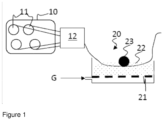
- FIG. 1 presents a partial diagram of a unit for implementing the method for manufacturing a pre-impregnated fibrous material according to WO 2018/115736 .
- Each strand to be impregnated is unwound from a device 10 with reels 11 under the traction generated by cylinders (not shown).
- the device 10 comprises a plurality of reels 11, each reel making it possible to unwound a strand to be impregnated.
- Each reel 11 is provided with a brake (not shown) so as to apply tension to each strand of fibers.
- an alignment module 12 makes it possible to arrange the strands of fibers parallel to each other. In this way, the strands of fibers cannot be in contact with each other, which makes it possible to avoid mechanical degradation of the fibers in particular.
- the fiber strand or parallel fiber strands then pass into a tank 20 of a fluidized bed 22 provided with at least one snare (E') (23), in particular a compression roller.
- the polymer powder(s) is suspended in a gas G (air for example) introduced into the tank and circulating in the tank through a hopper 21.
- the strand(s) are circulated in this fluidized bed 22.
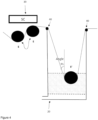
- Fig. 2 has a tank comprising a fluidized bed provided with at least one locking part (E') which may be a compression roller
- FIG. 3 has a fluidized bed tank comprising a shim (E') on which the expanded and heated fibrous material circulates to carry out the pre-impregnation, the expansion step being carried out outside the impregnation system and the heating system SC (30) is integrated with the compression rollers (E).
- a shim E'
- the expansion step being carried out outside the impregnation system and the heating system SC (30) is integrated with the compression rollers (E).
- the figure shows two rollers but the invention is not limited to this configuration.
- the fibrous material enters the interior of the tank and exits by passing over the edge of the tank (40) which can be a fixed or movable roller.
- the figure shows two rollers but the invention is not limited to this configuration.
- FIG. 5 has a fluidized bed tank comprising a shim (E') on which the expanded and heated fibrous material circulates to carry out the pre-impregnation, the expansion step being carried out inside the impregnation system and the heating system SC (30) is integrated with the compression rollers (E) which are located above the fluidized bed.
- a shim E'
- the expansion step being carried out inside the impregnation system and the heating system SC (30) is integrated with the compression rollers (E) which are located above the fluidized bed.
- the fibrous material enters the interior of the tank and exits by passing over the edge of the tank (40) which can be a fixed or movable roller.
- the figure shows two rollers but the invention is not limited to this configuration.
- [ Fig. 6 ] has a fluidized bed tank comprising a shim (E') on which the expanded and heated fibrous material circulates to carry out the pre-impregnation, the expansion step being carried out inside the impregnation system and the heating system SC (30) which can be an infrared system located above the compression rollers (E) which are located above the fluidized bed.
- a shim E'
- the heating system SC SC (30) which can be an infrared system located above the compression rollers (E) which are located above the fluidized bed.
- the fibrous material enters the interior of the tank and exits by passing over the edge of the tank (40) which can be a fixed or movable roller.
- the figure shows two rollers but the invention is not limited to this configuration.
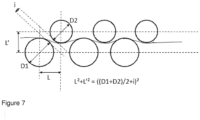
- FIG. 7 has a system of six compression rollers (E) on two levels.
- Comparative example 1 Development stage using six swages (E) without heating system and located outside the pre-impregnation system
- the rollers have a Topocrom ® coating.
- the roller system is located outside the tank.
- the first roller immersed in the fluidization tank is located 24cm from the fixed roller at the tank inlet.
- the wick width is measured before and after the fanning system using a Keyence LED measuring system.
- An equivalent system is placed to measure the wick width at the fluidization bath inlet.
- Comparative example 2 Development stage using an infrared heating system located outside the pre-impregnation system and without the presence of obstructions (E)
- a short linear infrared heating system (single-radiant with a maximum power of 3kW with power variator) placed horizontally outside the tank.
- the fiber wick passes under the module at a distance of 5cm from the transmitter.
- Tank edge equipped with a fixed roller with a diameter of 20mm.
- the first roller immersed in the fluidization tank is located 24cm from the fixed roller at the tank inlet.
- the wick width is measured before and after the IR heating system using a Keyence LED measuring system.
- An equivalent system is placed to measure the wick width at the fluidization bath inlet.
- Example 3 invention Blooming step using six embarragements (E) with an IR heating system outside the pre-impregnation system
- the rollers have a Topocrom ® coating.
- a short linear infrared heating system (single-radiant with a maximum power of 3 kW with a power variator) placed horizontally is placed above the slab system outside the pre-impregnation system.
- the fiber strand passes through the latching system and thus under the module at a distance of 5cm from the IR transmitter.
- Tank edge equipped with a fixed roller with a diameter of 20mm.
- Wick tension after contact with the 20mm diameter tank inlet roller and before meeting the expansion system located in the tank 500g
- the wick width is measured before and after the fanning system using a Keyence LED measuring system.
- An equivalent system is placed to measure the wick width at the fluidization bath inlet.
- Wicks used SIGRAFIL ® T24-5.0/270-T140 from SGL Technologies GmbH, with thermoplastic sizing.
- Example 4 invention Blooming step using six embarragements (E) with an IR heating system inside the impregnation system above the fluidized bed
- the rollers have a Topocrom ® coating.
- a short linear infrared heating system (single-radiant with a maximum power of 3 kW with a power variator) placed horizontally is placed above the shackling system.
- the fiber strand passes through the skewer system and thus under the module at a distance of 5cm from the IR emitter.
- the associated roller and heating system is located in the tank.
- Tank edge equipped with a fixed roller with a diameter of 20mm.
- the wick width is measured before and after the fanning system using a Keyence LED measuring system.
- An equivalent system is placed to measure the wick width at the fluidization bath inlet.
- Wicks used SIGRAFIL ® T24-5.0/270-T140 from SGL Technologies GmbH, with thermoplastic sizing.
Landscapes
- Engineering & Computer Science (AREA)
- Mechanical Engineering (AREA)
- Chemical & Material Sciences (AREA)
- Composite Materials (AREA)
- Textile Engineering (AREA)
- Physics & Mathematics (AREA)
- Thermal Sciences (AREA)
- Robotics (AREA)
- Health & Medical Sciences (AREA)
- Oral & Maxillofacial Surgery (AREA)
- Reinforced Plastic Materials (AREA)
Applications Claiming Priority (2)
| Application Number | Priority Date | Filing Date | Title |
|---|---|---|---|
| FR2013435A FR3117913B1 (fr) | 2020-12-17 | 2020-12-17 | Procédé de fabrication d’un matériau fibreux en fibres continues imprégné de polymère thermoplastique |
| PCT/FR2021/052332 WO2022129781A1 (fr) | 2020-12-17 | 2021-12-15 | Procédé de fabrication d'un matériau fibreux en fibres continues imprégné de polymère thermoplastique |
Publications (2)
| Publication Number | Publication Date |
|---|---|
| EP4263167A1 EP4263167A1 (fr) | 2023-10-25 |
| EP4263167B1 true EP4263167B1 (fr) | 2025-03-19 |
Family
ID=74592230
Family Applications (1)
| Application Number | Title | Priority Date | Filing Date |
|---|---|---|---|
| EP21851828.0A Active EP4263167B1 (fr) | 2020-12-17 | 2021-12-15 | Procédé de fabrication d'un matériau fibreux en fibres continues imprégné de polymère thermoplastique |
Country Status (7)
| Country | Link |
|---|---|
| US (1) | US20240051240A1 (enExample) |
| EP (1) | EP4263167B1 (enExample) |
| JP (1) | JP2023554435A (enExample) |
| KR (1) | KR20230121848A (enExample) |
| CN (1) | CN116600963A (enExample) |
| FR (1) | FR3117913B1 (enExample) |
| WO (1) | WO2022129781A1 (enExample) |
Family Cites Families (18)
| Publication number | Priority date | Publication date | Assignee | Title |
|---|---|---|---|---|
| US5895622A (en) * | 1997-04-07 | 1999-04-20 | Purdue Research Foundation | Method and apparatus for composite manufacture |
| EP1172191B1 (en) * | 2000-01-12 | 2004-08-04 | Toray Industries, Inc. | Production device and method for opened fiber bundle and prepreg production method |
| JP2001262443A (ja) * | 2000-01-12 | 2001-09-26 | Toray Ind Inc | 繊維束の開繊装置及び開繊方法並びにプリプレグの製造方法 |
| JP2002187127A (ja) * | 2000-12-19 | 2002-07-02 | Toray Ind Inc | 長繊維ペレットの製造方法および製造装置 |
| JP4174293B2 (ja) * | 2002-10-28 | 2008-10-29 | 松下電工株式会社 | 基材への含浸方法 |
| FR2858626B1 (fr) | 2003-08-05 | 2005-10-07 | Atofina | Polyamides semi aromatiques souple a faible reprise en humidite |
| JP5326170B2 (ja) * | 2009-05-25 | 2013-10-30 | 福井県 | 繊維束の開繊方法及び開繊糸シート並びに繊維補強シートの製造方法 |
| US9624350B2 (en) | 2011-12-09 | 2017-04-18 | Ticona Llc | Asymmetric fiber reinforced polymer tape |
| FR3017329B1 (fr) | 2014-02-13 | 2016-07-29 | Arkema France | Procede de fabrication d'un materiau fibreux pre-impregne de polymere thermoplastique en lit fluidise |
| JP2015166417A (ja) * | 2014-03-03 | 2015-09-24 | 三菱レイヨン株式会社 | 熱可塑性プリプレグの製造方法 |
| JP6423303B2 (ja) * | 2014-07-16 | 2018-11-14 | 株式会社神戸製鋼所 | 繊維強化熱可塑性樹脂テープの製造装置及び製造方法 |
| FR3061068B1 (fr) * | 2016-12-22 | 2020-02-14 | Arkema France | Procede de fabrication d'un materiau fibreux pre-impregne de polymere thermoplastique sous forme de poudre |
| FR3061066B1 (fr) * | 2016-12-22 | 2020-02-14 | Arkema France | Procede de fabrication d'un materiau fibreux pre-impregne de polymere thermoplastique en lit fluidise |
| FR3061067B1 (fr) | 2016-12-22 | 2020-02-14 | Arkema France | Procede de fabrication d'un materiau fibreux pre-impregne de polymere thermoplastique par projection |
| WO2018229114A1 (fr) | 2017-06-14 | 2018-12-20 | Arkema France | Procédé de fabrication d'une pièce en matériau composite a partir de prépolymères |
| FR3067968B1 (fr) | 2017-06-22 | 2020-11-06 | Arkema France | Materiau fibreux impregne de polymere thermoplastique |
| FR3067961B1 (fr) | 2017-06-22 | 2020-11-06 | Arkema France | Procede de fabrication d'un materiau fibreux impregne de polymere thermoplastique |
| JP7259739B2 (ja) * | 2018-01-26 | 2023-04-18 | 東レ株式会社 | 強化繊維マットならびに繊維強化樹脂成形材料およびその製造方法 |
-
2020
- 2020-12-17 FR FR2013435A patent/FR3117913B1/fr active Active
-
2021
- 2021-12-15 CN CN202180085182.5A patent/CN116600963A/zh active Pending
- 2021-12-15 EP EP21851828.0A patent/EP4263167B1/fr active Active
- 2021-12-15 KR KR1020237024160A patent/KR20230121848A/ko active Pending
- 2021-12-15 WO PCT/FR2021/052332 patent/WO2022129781A1/fr not_active Ceased
- 2021-12-15 US US18/258,093 patent/US20240051240A1/en active Pending
- 2021-12-15 JP JP2023536968A patent/JP2023554435A/ja active Pending
Also Published As
| Publication number | Publication date |
|---|---|
| WO2022129781A1 (fr) | 2022-06-23 |
| US20240051240A1 (en) | 2024-02-15 |
| FR3117913B1 (fr) | 2023-07-14 |
| EP4263167A1 (fr) | 2023-10-25 |
| JP2023554435A (ja) | 2023-12-27 |
| FR3117913A1 (fr) | 2022-06-24 |
| CN116600963A (zh) | 2023-08-15 |
| KR20230121848A (ko) | 2023-08-21 |
Similar Documents
| Publication | Publication Date | Title |
|---|---|---|
| EP3418019B1 (fr) | Procede de fabrication d'un materiau fibreux impregne de polymere thermoplastique | |
| EP3393738B1 (fr) | Procédé de fabrication d'un matériau fibreux pré-imprégné de polymère thermoplastique en lit fluidise | |
| EP3617254B1 (fr) | Materiau fibreux impregne de polymere thermoplastique | |
| EP3418016B1 (fr) | Procede de fabrication d'un materiau fibreux impregne de polymere thermoplastique | |
| EP3768768B1 (fr) | Materiau fibreux impregne de polymere thermoplastique et d'epaisseur inferieure ou egale a 100 micrometre et son procede de preparation | |
| FR3061068A1 (fr) | Procede de fabrication d'un materiau fibreux pre-impregne de polymere thermoplastique sous forme de poudre | |
| FR3061069A1 (fr) | Procede de fabrication d'un materiau fibreux pre-impregne de polymere thermoplastique sous forme de poudre seche | |
| FR3061067A1 (fr) | Procede de fabrication d'un materiau fibreux pre-impregne de polymere thermoplastique par projection | |
| EP3898786B1 (fr) | Materiau fibreux impregne de polymere thermoplastique de masse moleculaire et de viscosite optimum et son procede de preparation | |
| EP3887115B1 (fr) | Procede d'impregnation d'un materiau fibreux en lit fluidise interpenetre | |
| EP4054817B1 (fr) | Procédé d'imprégnation d'un matériau fibreux avec un système optimisé de réalimentation et de nettoyage des particules fines | |
| EP3670130B1 (fr) | Procede de fabrication d'un materiau fibreux impregne de polymere thermoplastique | |
| EP4263167B1 (fr) | Procédé de fabrication d'un matériau fibreux en fibres continues imprégné de polymère thermoplastique | |
| EP3670128B1 (fr) | Procede de fabrication d'un materiau fibreux pre-impregne de polymere thermoplastique en lit fluidise | |
| WO2020126997A1 (fr) | Procede de fabrication d'un materiau fibreux pre-impregne de polymere thermoplastique en lit fluidise | |
| WO2019243747A1 (fr) | Procede de fabrication d'un materiau fibreux pre-impregne de polymere thermoplastique en lit fluidise |
Legal Events
| Date | Code | Title | Description |
|---|---|---|---|
| STAA | Information on the status of an ep patent application or granted ep patent |
Free format text: STATUS: UNKNOWN |
|
| STAA | Information on the status of an ep patent application or granted ep patent |
Free format text: STATUS: THE INTERNATIONAL PUBLICATION HAS BEEN MADE |
|
| PUAI | Public reference made under article 153(3) epc to a published international application that has entered the european phase |
Free format text: ORIGINAL CODE: 0009012 |
|
| STAA | Information on the status of an ep patent application or granted ep patent |
Free format text: STATUS: REQUEST FOR EXAMINATION WAS MADE |
|
| 17P | Request for examination filed |
Effective date: 20230707 |
|
| AK | Designated contracting states |
Kind code of ref document: A1 Designated state(s): AL AT BE BG CH CY CZ DE DK EE ES FI FR GB GR HR HU IE IS IT LI LT LU LV MC MK MT NL NO PL PT RO RS SE SI SK SM TR |
|
| DAV | Request for validation of the european patent (deleted) | ||
| DAX | Request for extension of the european patent (deleted) | ||
| GRAP | Despatch of communication of intention to grant a patent |
Free format text: ORIGINAL CODE: EPIDOSNIGR1 |
|
| STAA | Information on the status of an ep patent application or granted ep patent |
Free format text: STATUS: GRANT OF PATENT IS INTENDED |
|
| INTG | Intention to grant announced |
Effective date: 20241008 |
|
| GRAS | Grant fee paid |
Free format text: ORIGINAL CODE: EPIDOSNIGR3 |
|
| GRAA | (expected) grant |
Free format text: ORIGINAL CODE: 0009210 |
|
| STAA | Information on the status of an ep patent application or granted ep patent |
Free format text: STATUS: THE PATENT HAS BEEN GRANTED |
|
| AK | Designated contracting states |
Kind code of ref document: B1 Designated state(s): AL AT BE BG CH CY CZ DE DK EE ES FI FR GB GR HR HU IE IS IT LI LT LU LV MC MK MT NL NO PL PT RO RS SE SI SK SM TR |
|
| REG | Reference to a national code |
Ref country code: GB Ref legal event code: FG4D Free format text: NOT ENGLISH |
|
| REG | Reference to a national code |
Ref country code: CH Ref legal event code: EP |
|
| REG | Reference to a national code |
Ref country code: IE Ref legal event code: FG4D Free format text: LANGUAGE OF EP DOCUMENT: FRENCH |
|
| REG | Reference to a national code |
Ref country code: DE Ref legal event code: R096 Ref document number: 602021027922 Country of ref document: DE |
|
| RAP4 | Party data changed (patent owner data changed or rights of a patent transferred) |
Owner name: ARKEMA FRANCE |
|
| REG | Reference to a national code |
Ref country code: DE Ref legal event code: R081 Ref document number: 602021027922 Country of ref document: DE Owner name: ARKEMA FRANCE, FR Free format text: FORMER OWNER: ARKEMA FRANCE, COLOMBES, FR |
|
| PG25 | Lapsed in a contracting state [announced via postgrant information from national office to epo] |
Ref country code: RS Free format text: LAPSE BECAUSE OF FAILURE TO SUBMIT A TRANSLATION OF THE DESCRIPTION OR TO PAY THE FEE WITHIN THE PRESCRIBED TIME-LIMIT Effective date: 20250619 |
|
| PG25 | Lapsed in a contracting state [announced via postgrant information from national office to epo] |
Ref country code: FI Free format text: LAPSE BECAUSE OF FAILURE TO SUBMIT A TRANSLATION OF THE DESCRIPTION OR TO PAY THE FEE WITHIN THE PRESCRIBED TIME-LIMIT Effective date: 20250319 |
|
| REG | Reference to a national code |
Ref country code: LT Ref legal event code: MG9D |
|
| PG25 | Lapsed in a contracting state [announced via postgrant information from national office to epo] |
Ref country code: NO Free format text: LAPSE BECAUSE OF FAILURE TO SUBMIT A TRANSLATION OF THE DESCRIPTION OR TO PAY THE FEE WITHIN THE PRESCRIBED TIME-LIMIT Effective date: 20250619 |
|
| PG25 | Lapsed in a contracting state [announced via postgrant information from national office to epo] |
Ref country code: HR Free format text: LAPSE BECAUSE OF FAILURE TO SUBMIT A TRANSLATION OF THE DESCRIPTION OR TO PAY THE FEE WITHIN THE PRESCRIBED TIME-LIMIT Effective date: 20250319 |
|
| PG25 | Lapsed in a contracting state [announced via postgrant information from national office to epo] |
Ref country code: LV Free format text: LAPSE BECAUSE OF FAILURE TO SUBMIT A TRANSLATION OF THE DESCRIPTION OR TO PAY THE FEE WITHIN THE PRESCRIBED TIME-LIMIT Effective date: 20250319 |
|
| PG25 | Lapsed in a contracting state [announced via postgrant information from national office to epo] |
Ref country code: BG Free format text: LAPSE BECAUSE OF FAILURE TO SUBMIT A TRANSLATION OF THE DESCRIPTION OR TO PAY THE FEE WITHIN THE PRESCRIBED TIME-LIMIT Effective date: 20250319 Ref country code: GR Free format text: LAPSE BECAUSE OF FAILURE TO SUBMIT A TRANSLATION OF THE DESCRIPTION OR TO PAY THE FEE WITHIN THE PRESCRIBED TIME-LIMIT Effective date: 20250620 |
|
| REG | Reference to a national code |
Ref country code: NL Ref legal event code: MP Effective date: 20250319 |
|
| REG | Reference to a national code |
Ref country code: AT Ref legal event code: MK05 Ref document number: 1776617 Country of ref document: AT Kind code of ref document: T Effective date: 20250319 |
|
| PG25 | Lapsed in a contracting state [announced via postgrant information from national office to epo] |
Ref country code: NL Free format text: LAPSE BECAUSE OF FAILURE TO SUBMIT A TRANSLATION OF THE DESCRIPTION OR TO PAY THE FEE WITHIN THE PRESCRIBED TIME-LIMIT Effective date: 20250319 |
|
| PG25 | Lapsed in a contracting state [announced via postgrant information from national office to epo] |
Ref country code: SE Free format text: LAPSE BECAUSE OF FAILURE TO SUBMIT A TRANSLATION OF THE DESCRIPTION OR TO PAY THE FEE WITHIN THE PRESCRIBED TIME-LIMIT Effective date: 20250319 |
|
| PG25 | Lapsed in a contracting state [announced via postgrant information from national office to epo] |
Ref country code: SM Free format text: LAPSE BECAUSE OF FAILURE TO SUBMIT A TRANSLATION OF THE DESCRIPTION OR TO PAY THE FEE WITHIN THE PRESCRIBED TIME-LIMIT Effective date: 20250319 |
|
| PG25 | Lapsed in a contracting state [announced via postgrant information from national office to epo] |
Ref country code: PT Free format text: LAPSE BECAUSE OF FAILURE TO SUBMIT A TRANSLATION OF THE DESCRIPTION OR TO PAY THE FEE WITHIN THE PRESCRIBED TIME-LIMIT Effective date: 20250721 Ref country code: ES Free format text: LAPSE BECAUSE OF FAILURE TO SUBMIT A TRANSLATION OF THE DESCRIPTION OR TO PAY THE FEE WITHIN THE PRESCRIBED TIME-LIMIT Effective date: 20250319 |
|
| PG25 | Lapsed in a contracting state [announced via postgrant information from national office to epo] |
Ref country code: IT Free format text: LAPSE BECAUSE OF FAILURE TO SUBMIT A TRANSLATION OF THE DESCRIPTION OR TO PAY THE FEE WITHIN THE PRESCRIBED TIME-LIMIT Effective date: 20250319 Ref country code: PL Free format text: LAPSE BECAUSE OF FAILURE TO SUBMIT A TRANSLATION OF THE DESCRIPTION OR TO PAY THE FEE WITHIN THE PRESCRIBED TIME-LIMIT Effective date: 20250319 |
|
| PG25 | Lapsed in a contracting state [announced via postgrant information from national office to epo] |
Ref country code: AT Free format text: LAPSE BECAUSE OF FAILURE TO SUBMIT A TRANSLATION OF THE DESCRIPTION OR TO PAY THE FEE WITHIN THE PRESCRIBED TIME-LIMIT Effective date: 20250319 |
|
| PG25 | Lapsed in a contracting state [announced via postgrant information from national office to epo] |
Ref country code: EE Free format text: LAPSE BECAUSE OF FAILURE TO SUBMIT A TRANSLATION OF THE DESCRIPTION OR TO PAY THE FEE WITHIN THE PRESCRIBED TIME-LIMIT Effective date: 20250319 Ref country code: CZ Free format text: LAPSE BECAUSE OF FAILURE TO SUBMIT A TRANSLATION OF THE DESCRIPTION OR TO PAY THE FEE WITHIN THE PRESCRIBED TIME-LIMIT Effective date: 20250319 |
|
| PG25 | Lapsed in a contracting state [announced via postgrant information from national office to epo] |
Ref country code: RO Free format text: LAPSE BECAUSE OF FAILURE TO SUBMIT A TRANSLATION OF THE DESCRIPTION OR TO PAY THE FEE WITHIN THE PRESCRIBED TIME-LIMIT Effective date: 20250319 |
|
| PG25 | Lapsed in a contracting state [announced via postgrant information from national office to epo] |
Ref country code: SK Free format text: LAPSE BECAUSE OF FAILURE TO SUBMIT A TRANSLATION OF THE DESCRIPTION OR TO PAY THE FEE WITHIN THE PRESCRIBED TIME-LIMIT Effective date: 20250319 |
|
| PG25 | Lapsed in a contracting state [announced via postgrant information from national office to epo] |
Ref country code: IS Free format text: LAPSE BECAUSE OF FAILURE TO SUBMIT A TRANSLATION OF THE DESCRIPTION OR TO PAY THE FEE WITHIN THE PRESCRIBED TIME-LIMIT Effective date: 20250719 |