EP4261484A1 - Behältersystem mit einem drahtlosen türsensor mit niedriger leistung und einer telematikvorrichtung - Google Patents
Behältersystem mit einem drahtlosen türsensor mit niedriger leistung und einer telematikvorrichtung Download PDFInfo
- Publication number
- EP4261484A1 EP4261484A1 EP23166853.4A EP23166853A EP4261484A1 EP 4261484 A1 EP4261484 A1 EP 4261484A1 EP 23166853 A EP23166853 A EP 23166853A EP 4261484 A1 EP4261484 A1 EP 4261484A1
- Authority
- EP
- European Patent Office
- Prior art keywords
- door sensor
- telematics device
- door
- low
- container
- Prior art date
- Legal status (The legal status is an assumption and is not a legal conclusion. Google has not performed a legal analysis and makes no representation as to the accuracy of the status listed.)
- Pending
Links
Images



Classifications
-
- G—PHYSICS
- G01—MEASURING; TESTING
- G01V—GEOPHYSICS; GRAVITATIONAL MEASUREMENTS; DETECTING MASSES OR OBJECTS; TAGS
- G01V3/00—Electric or magnetic prospecting or detecting; Measuring magnetic field characteristics of the earth, e.g. declination, deviation
- G01V3/12—Electric or magnetic prospecting or detecting; Measuring magnetic field characteristics of the earth, e.g. declination, deviation operating with electromagnetic waves
-
- B—PERFORMING OPERATIONS; TRANSPORTING
- B65—CONVEYING; PACKING; STORING; HANDLING THIN OR FILAMENTARY MATERIAL
- B65D—CONTAINERS FOR STORAGE OR TRANSPORT OF ARTICLES OR MATERIALS, e.g. BAGS, BARRELS, BOTTLES, BOXES, CANS, CARTONS, CRATES, DRUMS, JARS, TANKS, HOPPERS, FORWARDING CONTAINERS; ACCESSORIES, CLOSURES, OR FITTINGS THEREFOR; PACKAGING ELEMENTS; PACKAGES
- B65D90/00—Component parts, details or accessories for large containers
- B65D90/008—Doors for containers, e.g. ISO-containers
-
- F—MECHANICAL ENGINEERING; LIGHTING; HEATING; WEAPONS; BLASTING
- F25—REFRIGERATION OR COOLING; COMBINED HEATING AND REFRIGERATION SYSTEMS; HEAT PUMP SYSTEMS; MANUFACTURE OR STORAGE OF ICE; LIQUEFACTION SOLIDIFICATION OF GASES
- F25D—REFRIGERATORS; COLD ROOMS; ICE-BOXES; COOLING OR FREEZING APPARATUS NOT OTHERWISE PROVIDED FOR
- F25D29/00—Arrangement or mounting of control or safety devices
- F25D29/003—Arrangement or mounting of control or safety devices for movable devices
-
- B—PERFORMING OPERATIONS; TRANSPORTING
- B62—LAND VEHICLES FOR TRAVELLING OTHERWISE THAN ON RAILS
- B62D—MOTOR VEHICLES; TRAILERS
- B62D33/00—Superstructures for load-carrying vehicles
- B62D33/04—Enclosed load compartments ; Frameworks for movable panels, tarpaulins or side curtains
- B62D33/048—Enclosed load compartments ; Frameworks for movable panels, tarpaulins or side curtains for refrigerated goods vehicles
-
- B—PERFORMING OPERATIONS; TRANSPORTING
- B65—CONVEYING; PACKING; STORING; HANDLING THIN OR FILAMENTARY MATERIAL
- B65D—CONTAINERS FOR STORAGE OR TRANSPORT OF ARTICLES OR MATERIALS, e.g. BAGS, BARRELS, BOTTLES, BOXES, CANS, CARTONS, CRATES, DRUMS, JARS, TANKS, HOPPERS, FORWARDING CONTAINERS; ACCESSORIES, CLOSURES, OR FITTINGS THEREFOR; PACKAGING ELEMENTS; PACKAGES
- B65D88/00—Large containers
- B65D88/74—Large containers having means for heating, cooling, aerating or other conditioning of contents
-
- B—PERFORMING OPERATIONS; TRANSPORTING
- B65—CONVEYING; PACKING; STORING; HANDLING THIN OR FILAMENTARY MATERIAL
- B65D—CONTAINERS FOR STORAGE OR TRANSPORT OF ARTICLES OR MATERIALS, e.g. BAGS, BARRELS, BOTTLES, BOXES, CANS, CARTONS, CRATES, DRUMS, JARS, TANKS, HOPPERS, FORWARDING CONTAINERS; ACCESSORIES, CLOSURES, OR FITTINGS THEREFOR; PACKAGING ELEMENTS; PACKAGES
- B65D90/00—Component parts, details or accessories for large containers
- B65D90/48—Arrangements of indicating or measuring devices
-
- E—FIXED CONSTRUCTIONS
- E05—LOCKS; KEYS; WINDOW OR DOOR FITTINGS; SAFES
- E05B—LOCKS; ACCESSORIES THEREFOR; HANDCUFFS
- E05B39/00—Locks giving indication of authorised or unauthorised unlocking
- E05B39/04—Locks giving indication of authorised or unauthorised unlocking with counting or registering devices
-
- F—MECHANICAL ENGINEERING; LIGHTING; HEATING; WEAPONS; BLASTING
- F25—REFRIGERATION OR COOLING; COMBINED HEATING AND REFRIGERATION SYSTEMS; HEAT PUMP SYSTEMS; MANUFACTURE OR STORAGE OF ICE; LIQUEFACTION SOLIDIFICATION OF GASES
- F25D—REFRIGERATORS; COLD ROOMS; ICE-BOXES; COOLING OR FREEZING APPARATUS NOT OTHERWISE PROVIDED FOR
- F25D11/00—Self-contained movable devices, e.g. domestic refrigerators
- F25D11/003—Transport containers
-
- G—PHYSICS
- G06—COMPUTING OR CALCULATING; COUNTING
- G06K—GRAPHICAL DATA READING; PRESENTATION OF DATA; RECORD CARRIERS; HANDLING RECORD CARRIERS
- G06K19/00—Record carriers for use with machines and with at least a part designed to carry digital markings
- G06K19/06—Record carriers for use with machines and with at least a part designed to carry digital markings characterised by the kind of the digital marking, e.g. shape, nature, code
- G06K19/067—Record carriers with conductive marks, printed circuits or semiconductor circuit elements, e.g. credit or identity cards also with resonating or responding marks without active components
- G06K19/07—Record carriers with conductive marks, printed circuits or semiconductor circuit elements, e.g. credit or identity cards also with resonating or responding marks without active components with integrated circuit chips
- G06K19/0723—Record carriers with conductive marks, printed circuits or semiconductor circuit elements, e.g. credit or identity cards also with resonating or responding marks without active components with integrated circuit chips the record carrier comprising an arrangement for non-contact communication, e.g. wireless communication circuits on transponder cards, non-contact smart cards or RFIDs
-
- G—PHYSICS
- G06—COMPUTING OR CALCULATING; COUNTING
- G06K—GRAPHICAL DATA READING; PRESENTATION OF DATA; RECORD CARRIERS; HANDLING RECORD CARRIERS
- G06K7/00—Methods or arrangements for sensing record carriers, e.g. for reading patterns
- G06K7/10—Methods or arrangements for sensing record carriers, e.g. for reading patterns by electromagnetic radiation, e.g. optical sensing; by corpuscular radiation
- G06K7/10009—Methods or arrangements for sensing record carriers, e.g. for reading patterns by electromagnetic radiation, e.g. optical sensing; by corpuscular radiation sensing by radiation using wavelengths larger than 0.1 mm, e.g. radio-waves or microwaves
- G06K7/10366—Methods or arrangements for sensing record carriers, e.g. for reading patterns by electromagnetic radiation, e.g. optical sensing; by corpuscular radiation sensing by radiation using wavelengths larger than 0.1 mm, e.g. radio-waves or microwaves the interrogation device being adapted for miscellaneous applications
- G06K7/10376—Methods or arrangements for sensing record carriers, e.g. for reading patterns by electromagnetic radiation, e.g. optical sensing; by corpuscular radiation sensing by radiation using wavelengths larger than 0.1 mm, e.g. radio-waves or microwaves the interrogation device being adapted for miscellaneous applications the interrogation device being adapted for being moveable
- G06K7/10386—Methods or arrangements for sensing record carriers, e.g. for reading patterns by electromagnetic radiation, e.g. optical sensing; by corpuscular radiation sensing by radiation using wavelengths larger than 0.1 mm, e.g. radio-waves or microwaves the interrogation device being adapted for miscellaneous applications the interrogation device being adapted for being moveable the interrogation device being of the portable or hand-handheld type, e.g. incorporated in ubiquitous hand-held devices such as PDA or mobile phone, or in the form of a portable dedicated RFID reader
-
- G—PHYSICS
- G07—CHECKING-DEVICES
- G07C—TIME OR ATTENDANCE REGISTERS; REGISTERING OR INDICATING THE WORKING OF MACHINES; GENERATING RANDOM NUMBERS; VOTING OR LOTTERY APPARATUS; ARRANGEMENTS, SYSTEMS OR APPARATUS FOR CHECKING NOT PROVIDED FOR ELSEWHERE
- G07C9/00—Individual registration on entry or exit
- G07C9/30—Individual registration on entry or exit not involving the use of a pass
- G07C9/38—Individual registration on entry or exit not involving the use of a pass with central registration
-
- B—PERFORMING OPERATIONS; TRANSPORTING
- B60—VEHICLES IN GENERAL
- B60H—ARRANGEMENTS OF HEATING, COOLING, VENTILATING OR OTHER AIR-TREATING DEVICES SPECIALLY ADAPTED FOR PASSENGER OR GOODS SPACES OF VEHICLES
- B60H1/00—Heating, cooling or ventilating devices
- B60H1/00357—Air-conditioning arrangements specially adapted for particular vehicles
- B60H1/00364—Air-conditioning arrangements specially adapted for particular vehicles for caravans or trailers
-
- B—PERFORMING OPERATIONS; TRANSPORTING
- B60—VEHICLES IN GENERAL
- B60P—VEHICLES ADAPTED FOR LOAD TRANSPORTATION OR TO TRANSPORT, TO CARRY, OR TO COMPRISE SPECIAL LOADS OR OBJECTS
- B60P3/00—Vehicles adapted to transport, to carry or to comprise special loads or objects
- B60P3/20—Refrigerated goods vehicles
-
- H—ELECTRICITY
- H04—ELECTRIC COMMUNICATION TECHNIQUE
- H04L—TRANSMISSION OF DIGITAL INFORMATION, e.g. TELEGRAPHIC COMMUNICATION
- H04L67/00—Network arrangements or protocols for supporting network services or applications
- H04L67/01—Protocols
- H04L67/12—Protocols specially adapted for proprietary or special-purpose networking environments, e.g. medical networks, sensor networks, networks in vehicles or remote metering networks
-
- H—ELECTRICITY
- H04—ELECTRIC COMMUNICATION TECHNIQUE
- H04W—WIRELESS COMMUNICATION NETWORKS
- H04W52/00—Power management, e.g. Transmission Power Control [TPC] or power classes
- H04W52/02—Power saving arrangements
- H04W52/0209—Power saving arrangements in terminal devices
- H04W52/0261—Power saving arrangements in terminal devices managing power supply demand, e.g. depending on battery level
Definitions
- the following description generally relates to container systems of trailers and, more specifically, to a low-power door sensor for a container system of a trailer.
- Trailers are used to transport goods. Trailers typically have a rectangular shape and an empty interior that can be filled with various types of perishable and non-perishable goods. In some cases, those goods need to be maintained at a certain controlled temperature, and in these cases, trailers can include refrigeration units, which may be referred to as transport refrigeration units (TRUs).
- TRUs transport refrigeration units
- a TRU for a trailer can cool or condition the air inside of the trailer so that the goods being transported can be refrigerated.
- a container system includes a body having a first end, a second end opposite the first end, and a door disposed at the second end.
- the container system further includes a telematics device disposed at the first end and a door sensor disposed at the door and capable of low-power wireless communications with the telematics device.
- the body is elongate and the first and second ends are at opposed long ends of the container.
- the opposed long ends of the container are about forty (40) or more feet (10 m or more) apart and there is an absence of a gateway between the door sensor and the telematics device.
- a transport refrigeration unit may be configured to condition an interior of the container.
- the door sensor has a radio frequency (RF) identifier (ID) by which the door sensor is communicative with a mobile device and the mobile device has an application installed thereon, which, when executed on the mobile device, enables the door sensor to be paired with the telematics device, allows for a verification that the door sensor is communicating with the telematics device and allows the door sensor to report a battery status thereof.
- RF radio frequency
- the door sensor may be non-communicative with the telematics device until the door sensor is paired with the telematics device via the application.
- the door sensor may be adhered to an interior surface of the door.
- the door sensor may be configured to monitor openings and closings of the door.
- the door sensor may be configured to communicate with the telematics device via cargo stored in an interior of the container.
- the low-power wireless communications between the door sensor and the telematics device may be less than about 14 dB of power level and at a frequency of up to about 433 MHz or higher.
- the low-power wireless communications between the door sensor and the telematics device may be at 3 dB of power level and at a frequency of 433 MHz.
- a power level and a frequency of the low-power communications may be adjustable for compliance with local regulations.
- a container system includes an elongate body having a first long end, a second long end opposite the first long end, and a door disposed at the second end.
- the container system further includes a telematics device disposed at the first long end and a door sensor disposed at the door and capable of low-power wireless communications at less than 143 dB of power level and at a frequency of up to 433 MHz or higher with the telematics device.
- a method of operating a container system includes disposing a telematics device at a first end of a container and a door sensor at a door, the door disposed at a second end of the container opposite the first end, pairing the door sensor with the telematics device using an application installed on a mobile device with which the door sensor is communicative, the door sensor being capable of low-power wireless communications with the telematics device following the pairing and verifying that the door sensor is communicating with the telematics device using the application.
- the method described above may be implemented on one or more of the container systems described above.
- the door sensor may have a radio frequency (RF) identifier (ID) by which the door sensor is communicative with the mobile device.
- RF radio frequency
- the verifying may include acknowledging messages received by the door sensor from the telematics device.
- the method may further include ascertaining a battery status of the door sensor using the application.
- the low-power wireless communications between the door sensor and the telematics device may be less than about 14 dB of power level and at a frequency of up to about 433 MHz or higher.
- the low-power wireless communications between the door sensor and the telematics device may be at 3 dB of power level and at a frequency of 433 MHz.
- the method may further include adjusting a power level and a frequency of the low-power communications for compliance with local regulations.
- a low-power and wireless door sensor which will use a Lora module to communicate to the telematics device in a container of a trailer using low-power messages.
- the messages can be sent in a very specific way to be able to communicate in a low-power mode.
- This low-power communication makes it possible for the door sensor to meet the various countries' radio frequency (RF) requirements.
- RF radio frequency
- the tractor trailer system 100 includes a tractor 102 including an operator's compartment or cab 104 and an engine, which acts as the drive system of the tractor trailer system 100.
- a trailer 106 is coupled to the tractor 102.
- the trailer 106 is a refrigerated trailer 106 and includes a top wall 108, a directly opposed bottom wall 110, opposed side walls 112 and a front wall 114, with the front wall 114 being closest to the tractor 102.
- the trailer 106 further includes a door or doors (not shown) at a rear wall 116, opposite the front wall 114.
- the walls of the trailer 106 define a cargo compartment 1060.
- the trailer 106 is configured to maintain a cargo 118 located inside the cargo compartment at a selected temperature through the use of a transport refrigeration unit 120 located on the trailer 106.
- the transport refrigeration unit 120 as shown in FIG. 1 , can be located at or attached to the front wall 114.
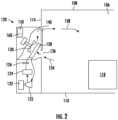
- the transport refrigeration unit 120 includes a compressor 122, a condenser 124, an expansion valve 126, an evaporator 128 and an evaporator fan 130.
- the compressor 122 is operably connected to a power source 132, which drives the compressor 122. Airflow is circulated into and through the cargo compartment of the trailer 106 by means of the transport refrigeration unit 120.
- a return airflow 134 flows into the transport refrigeration unit 120 from the cargo compartment of the trailer 106 through a refrigeration unit inlet 136 and across the evaporator 128 via the evaporator fan 130, thus cooling the return airflow 134.
- the cooled return airflow 134 is supplied into the cargo compartment of the trailer 106 through a refrigeration unit outlet 140, which in some embodiments is located near the top wall 108 of the trailer 106.
- the supply airflow 138 cools the cargo 118 in the cargo compartment of the trailer 106.
- a refrigerant leak sensor 150 for detecting a leak of a particular type of refrigerant or substance. It is to be understood that the refrigerant leak sensor 150 can be located in different locations in the system and is not limited by the example shown in FIG. 2 .
- the refrigerant leak sensor 150 can be located in the evaporator section of the transport refrigeration unit 120, a different portion of the cargo compartment of the trailer 106 or another location in the system. Upon detection by the refrigerant leak sensor 150, a signal can be transmitted to controller 160.
- the controller 160 controls various aspects of the transport refrigeration unit 120 and the transport refrigeration unit power system.
- the controller 160 can control the compressor 122, the condenser 124, the expansion valve 126, the evaporator 128 and the evaporator fan 130 in addition to other equipment or sensors.
- the controller 160 can be connected to the equipment over a wired or wireless connection (connections not shown).
- the controller 160 can be configured to perform a low charge diagnostics calculation which is used to perform various calculations of the refrigeration system of the transport refrigeration unit 120 to determine a state of operation.
- the low charge diagnostics calculation can be performed in a cloud network (not shown in FIG. 2 ).
- a naval transport ship 301 is provided to transport multiple containers 310 over waterways, such as oceans, seas, lakes and rivers.
- the multiple containers 310 can be stacked in multiple stacks on the deck of the naval transport ship 301.
- Each of the multiple containers 310 can include a dedicated transport refrigeration unit, which is similar to the transport refrigeration unit 120 of FIG. 2 and can have a dedicated power source or power provided to it from the naval transport ship 301.
- a container system 401 of a transport refrigeration unit (TRU) system is provided and may be configured as the trailer 106 of FIG. 1 and/or any of the multiple containers 310 of FIG. 3 .
- TRU transport refrigeration unit
- the container system 401 is elongate and includes an elongate body 402 having a first long end 403 (i.e., the front wall 114 of FIG. 1 ), a second long end 404 (i.e., the rear wall 116 of FIG. 1 ), which is opposite the first long end 403 and a door 405 at the second end 404.
- the first long end 403 and the second long end 404 can be about forty (40) feet (10 m) apart or more.
- a TRU such as the transport refrigeration unit 120 of FIGS. 1 and 2 can be disposed to condition an interior of the container system 401 (i.e., the cargo compartment 1060 of FIG. 1 ).
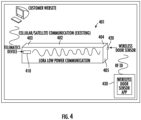
- the container system 401 further includes a telematics device 410, which is disposed at the first long end 403 and which is disposed in signal communication with a customer website via wireless communications (e.g., cellular, satellite, etc.), and a wireless door sensor (hereinafter referred to as a "door sensor") 420.
- the door sensor 420 is disposed at the door 405 and is configured to monitor openings or closings of the door.
- the door sensor 420 is also capable of low-power wireless communications with the telematics device 410 via cargo stored in the interior of the container system 401. In some cases, the door sensor 420 can be adhered to an interior surface of the door 405 by tape or another type of adhesive with epoxy or silicone surrounding the door sensor 420 for protection.
- the low-power wireless communications may reduce the need for a gateway device, and in certain instances there is an absence of a gateway device between the door sensor 420 and the telematics device 410 in the container system 401.
- the low-power wireless communications between the door sensor 420 and the telematics device 410 can be less than about 14 dB of power level and at a frequency of up to 433 MHz or higher or, more specifically, at 3 dB of power level and at a frequency of 433 MHz.
- a power level and a frequency of the low-power communications between the door sensor 420 and the telematics device 410 can be adjustable (i.e., increased or decreased) for compliance with local regulations.
- the door sensor 420 has a radio frequency (RF) identifier (ID) by which the door sensor 420 is communicative with a mobile device 430, such as a smartphone or a portable computing unit.
- the mobile device 430 has an application installed thereon, which, when executed on the mobile device 430, enables the door sensor 420 to be paired with the telematics device 410, allows for a verification that the door sensor 420 is communicating with the telematics device 410 by way of acknowledgments of messages received by the door sensor 420 from the telematics device 410 and allows the door sensor 420 to report a battery status thereof.
- the door sensor 420 can be non-communicative with the telematics device 410 until the door sensor 420 is paired with the telematics device 410 via the application.
- a method of operating a container system of a TRU system such as the container system 401 of FIG. 4 .
- the method includes disposing a telematics device at a first end of a container and a door sensor at a door located at a second end of the container opposite the first end (i.e., the telematics device 410 and the door sensor 420 of FIG. 4 ) (block 501).
- the method further includes pairing the door sensor with the telematics device using an application installed on a mobile device with which the door sensor is communicative, the door sensor being capable of low-power wireless communications with the telematics device following the pairing (block 502).
- the method further includes verifying that the door sensor is communicating with the telematics device using the application (block 503).
- the verifying of block 403 can include acknowledging messages received by the door sensor from the telematics device (block 5031).
- the method can further include ascertaining a battery status of the door sensor using the application (block 504).
- the low-power wireless communications between the door sensor and the telematics device are less than about 14 dB of power level and at a frequency of up to about 433 MHz or higher or, more specifically, at 3 dB of power level and at a frequency of 433 MHz.
- the method can also include optionally adjusting a power level and a frequency of the low-power communications for compliance with local regulations (block 505) if doing so would improve communications or enable local regulations to be met.
Landscapes
- Engineering & Computer Science (AREA)
- Physics & Mathematics (AREA)
- Mechanical Engineering (AREA)
- General Physics & Mathematics (AREA)
- Combustion & Propulsion (AREA)
- Thermal Sciences (AREA)
- Chemical & Material Sciences (AREA)
- Health & Medical Sciences (AREA)
- Theoretical Computer Science (AREA)
- Toxicology (AREA)
- Electromagnetism (AREA)
- General Engineering & Computer Science (AREA)
- Life Sciences & Earth Sciences (AREA)
- Remote Sensing (AREA)
- General Health & Medical Sciences (AREA)
- Computer Vision & Pattern Recognition (AREA)
- Computer Networks & Wireless Communication (AREA)
- Computer Hardware Design (AREA)
- Microelectronics & Electronic Packaging (AREA)
- Artificial Intelligence (AREA)
- Transportation (AREA)
- Environmental & Geological Engineering (AREA)
- Geology (AREA)
- General Life Sciences & Earth Sciences (AREA)
- Geophysics (AREA)
- Arrangements For Transmission Of Measured Signals (AREA)
- Devices That Are Associated With Refrigeration Equipment (AREA)
Applications Claiming Priority (1)
| Application Number | Priority Date | Filing Date | Title |
|---|---|---|---|
| US202263329694P | 2022-04-11 | 2022-04-11 |
Publications (1)
| Publication Number | Publication Date |
|---|---|
| EP4261484A1 true EP4261484A1 (de) | 2023-10-18 |
Family
ID=85979480
Family Applications (1)
| Application Number | Title | Priority Date | Filing Date |
|---|---|---|---|
| EP23166853.4A Pending EP4261484A1 (de) | 2022-04-11 | 2023-04-05 | Behältersystem mit einem drahtlosen türsensor mit niedriger leistung und einer telematikvorrichtung |
Country Status (3)
| Country | Link |
|---|---|
| US (1) | US20230322476A1 (de) |
| EP (1) | EP4261484A1 (de) |
| CN (1) | CN116891071A (de) |
Citations (6)
| Publication number | Priority date | Publication date | Assignee | Title |
|---|---|---|---|---|
| US20080088441A1 (en) * | 2002-06-11 | 2008-04-17 | Intelligent Technologies International, Inc. | Asset Monitoring Using the Internet |
| US20110291828A1 (en) * | 2010-06-01 | 2011-12-01 | Walker Timothy A | Embedded communication system for refrigerated transportation containers |
| US20150217727A1 (en) * | 2011-06-01 | 2015-08-06 | Thermo King Corporation | Embedded security system for environment-controlled transportation containers and method for detecting a security risk for environment-controlled transportation containers |
| US20170368910A1 (en) * | 2016-06-24 | 2017-12-28 | Thermo King Corporation | Method of pairing a sensor node for a transport refrigeration system using an assisting device, an assisting device for pairing a sensor node and a pairing system for a transport refrigeration system |
| US20190236536A1 (en) * | 2016-06-20 | 2019-08-01 | Carrier Corporation | Cold chain quality ratings feedback manager |
| US20220092962A1 (en) * | 2019-01-23 | 2022-03-24 | Arrowspot Systems Ltd. | Refrigerated cargo monitoring |
Family Cites Families (6)
| Publication number | Priority date | Publication date | Assignee | Title |
|---|---|---|---|---|
| EP1623526A4 (de) * | 2003-05-15 | 2010-07-21 | Commerceguard Ab | Verfahren und system zur benutzung mehrerer sensoren zur überwachung von behältersicherheit, -inhalten und zustand |
| US7978065B2 (en) * | 2006-09-13 | 2011-07-12 | Trackpoint Systems, Llc | Device, system and method for tracking mobile assets |
| CN101229869A (zh) * | 2008-01-22 | 2008-07-30 | 沈军 | 一种智能集装箱或其相类似物及应用 |
| FI125787B (fi) * | 2009-03-18 | 2016-02-15 | Oy Langh Ship Ab | Kuljetusteline |
| US9766175B1 (en) * | 2012-03-05 | 2017-09-19 | Vista Precision Solutions, Inc. | Method and apparatus for in-service measurement of the bottom thickness and corrosion rate of a tank bottom |
| US10906571B2 (en) * | 2016-01-22 | 2021-02-02 | International Electronic Machines Corp. | Railway vehicle operations monitoring |
-
2023
- 2023-04-05 EP EP23166853.4A patent/EP4261484A1/de active Pending
- 2023-04-10 US US18/298,159 patent/US20230322476A1/en active Pending
- 2023-04-11 CN CN202310380673.3A patent/CN116891071A/zh active Pending
Patent Citations (6)
| Publication number | Priority date | Publication date | Assignee | Title |
|---|---|---|---|---|
| US20080088441A1 (en) * | 2002-06-11 | 2008-04-17 | Intelligent Technologies International, Inc. | Asset Monitoring Using the Internet |
| US20110291828A1 (en) * | 2010-06-01 | 2011-12-01 | Walker Timothy A | Embedded communication system for refrigerated transportation containers |
| US20150217727A1 (en) * | 2011-06-01 | 2015-08-06 | Thermo King Corporation | Embedded security system for environment-controlled transportation containers and method for detecting a security risk for environment-controlled transportation containers |
| US20190236536A1 (en) * | 2016-06-20 | 2019-08-01 | Carrier Corporation | Cold chain quality ratings feedback manager |
| US20170368910A1 (en) * | 2016-06-24 | 2017-12-28 | Thermo King Corporation | Method of pairing a sensor node for a transport refrigeration system using an assisting device, an assisting device for pairing a sensor node and a pairing system for a transport refrigeration system |
| US20220092962A1 (en) * | 2019-01-23 | 2022-03-24 | Arrowspot Systems Ltd. | Refrigerated cargo monitoring |
Also Published As
| Publication number | Publication date |
|---|---|
| CN116891071A (zh) | 2023-10-17 |
| US20230322476A1 (en) | 2023-10-12 |
Similar Documents
| Publication | Publication Date | Title |
|---|---|---|
| EP3472542B1 (de) | Transportkühlsystem mit einem batteriesystem und passendes verfahren | |
| US20190331408A1 (en) | Battery for temporary cooling of a transport refrigeration system | |
| CN101578491B (zh) | 制冷运输系统 | |
| US11260728B2 (en) | Distributed hazard detection system for a transport refrigeration system | |
| US20160144764A1 (en) | Control method for a hybrid refrigeration system | |
| US12358340B2 (en) | Proactive adjustment of transport refrigeration units | |
| EP3819140B1 (de) | Transportkühlsystem | |
| EP3463961B1 (de) | Befüllung einer unabhängigen, von einem separaten motor angetriebenen kühleinheit an einer einzigen stelle | |
| US10907879B2 (en) | Methods and systems for energy efficient defrost of a transport climate control system evaporator | |
| EP4261484A1 (de) | Behältersystem mit einem drahtlosen türsensor mit niedriger leistung und einer telematikvorrichtung | |
| EP3371527B1 (de) | Transportkühlungssystem und verfahren zum betrieb des systems | |
| EP3819142A1 (de) | Leistungs- und fehlerverwaltung von elektrischen komponenten eines von einem elektrofahrzeug gespeisten transportklimatisierungssystems | |
| EP3115719B1 (de) | Transportkühleinheit und anhänger | |
| US11667229B2 (en) | Natural gas tank pressure control for transport refrigeration unit | |
| US12591710B2 (en) | Obfuscating data in controller area network messages for transport refrigeration units | |
| US20230278390A1 (en) | Transport refrigeration units for primary and auxiliary applications | |
| US12442671B2 (en) | Environmental sensor for transport refrigeration | |
| US20240035727A1 (en) | Transport refrigeration system | |
| EP4624835A1 (de) | Behältersystem | |
| CN113415123B (zh) | 调温站、车载控制装置、运输系统 | |
| CN115195409A (zh) | 制冷系统重量分析 | |
| HK1138357B (en) | Refrigerated transport system | |
| JPS6365275A (ja) | 可変容量冷蔵装置 |
Legal Events
| Date | Code | Title | Description |
|---|---|---|---|
| PUAI | Public reference made under article 153(3) epc to a published international application that has entered the european phase |
Free format text: ORIGINAL CODE: 0009012 |
|
| STAA | Information on the status of an ep patent application or granted ep patent |
Free format text: STATUS: THE APPLICATION HAS BEEN PUBLISHED |
|
| AK | Designated contracting states |
Kind code of ref document: A1 Designated state(s): AL AT BE BG CH CY CZ DE DK EE ES FI FR GB GR HR HU IE IS IT LI LT LU LV MC ME MK MT NL NO PL PT RO RS SE SI SK SM TR |
|
| STAA | Information on the status of an ep patent application or granted ep patent |
Free format text: STATUS: REQUEST FOR EXAMINATION WAS MADE |
|
| 17P | Request for examination filed |
Effective date: 20240418 |
|
| RBV | Designated contracting states (corrected) |
Designated state(s): AL AT BE BG CH CY CZ DE DK EE ES FI FR GB GR HR HU IE IS IT LI LT LU LV MC ME MK MT NL NO PL PT RO RS SE SI SK SM TR |
|
| STAA | Information on the status of an ep patent application or granted ep patent |
Free format text: STATUS: EXAMINATION IS IN PROGRESS |
|
| 17Q | First examination report despatched |
Effective date: 20250603 |