EP4257736A1 - Highly stretchable woven fabric - Google Patents
Highly stretchable woven fabric Download PDFInfo
- Publication number
- EP4257736A1 EP4257736A1 EP21900698.8A EP21900698A EP4257736A1 EP 4257736 A1 EP4257736 A1 EP 4257736A1 EP 21900698 A EP21900698 A EP 21900698A EP 4257736 A1 EP4257736 A1 EP 4257736A1
- Authority
- EP
- European Patent Office
- Prior art keywords
- woven fabric
- weave
- wefts
- stretchable woven
- warp
- Prior art date
- Legal status (The legal status is an assumption and is not a legal conclusion. Google has not performed a legal analysis and makes no representation as to the accuracy of the status listed.)
- Pending
Links
Images


Classifications
-
- D—TEXTILES; PAPER
- D03—WEAVING
- D03D—WOVEN FABRICS; METHODS OF WEAVING; LOOMS
- D03D11/00—Double or multi-ply fabrics not otherwise provided for
-
- D—TEXTILES; PAPER
- D03—WEAVING
- D03D—WOVEN FABRICS; METHODS OF WEAVING; LOOMS
- D03D13/00—Woven fabrics characterised by the special disposition of the warp or weft threads, e.g. with curved weft threads, with discontinuous warp threads, with diagonal warp or weft
- D03D13/004—Woven fabrics characterised by the special disposition of the warp or weft threads, e.g. with curved weft threads, with discontinuous warp threads, with diagonal warp or weft with weave pattern being non-standard or providing special effects
-
- A—HUMAN NECESSITIES
- A41—WEARING APPAREL
- A41D—OUTERWEAR; PROTECTIVE GARMENTS; ACCESSORIES
- A41D31/00—Materials specially adapted for outerwear
-
- A—HUMAN NECESSITIES
- A41—WEARING APPAREL
- A41D—OUTERWEAR; PROTECTIVE GARMENTS; ACCESSORIES
- A41D31/00—Materials specially adapted for outerwear
- A41D31/04—Materials specially adapted for outerwear characterised by special function or use
- A41D31/18—Elastic
-
- A—HUMAN NECESSITIES
- A41—WEARING APPAREL
- A41D—OUTERWEAR; PROTECTIVE GARMENTS; ACCESSORIES
- A41D31/00—Materials specially adapted for outerwear
- A41D31/04—Materials specially adapted for outerwear characterised by special function or use
- A41D31/18—Elastic
- A41D31/185—Elastic using layered materials
-
- D—TEXTILES; PAPER
- D03—WEAVING
- D03D—WOVEN FABRICS; METHODS OF WEAVING; LOOMS
- D03D13/00—Woven fabrics characterised by the special disposition of the warp or weft threads, e.g. with curved weft threads, with discontinuous warp threads, with diagonal warp or weft
- D03D13/008—Woven fabrics characterised by the special disposition of the warp or weft threads, e.g. with curved weft threads, with discontinuous warp threads, with diagonal warp or weft characterised by weave density or surface weight
-
- D—TEXTILES; PAPER
- D03—WEAVING
- D03D—WOVEN FABRICS; METHODS OF WEAVING; LOOMS
- D03D15/00—Woven fabrics characterised by the material, structure or properties of the fibres, filaments, yarns, threads or other warp or weft elements used
- D03D15/20—Woven fabrics characterised by the material, structure or properties of the fibres, filaments, yarns, threads or other warp or weft elements used characterised by the material of the fibres or filaments constituting the yarns or threads
- D03D15/208—Woven fabrics characterised by the material, structure or properties of the fibres, filaments, yarns, threads or other warp or weft elements used characterised by the material of the fibres or filaments constituting the yarns or threads cellulose-based
- D03D15/217—Woven fabrics characterised by the material, structure or properties of the fibres, filaments, yarns, threads or other warp or weft elements used characterised by the material of the fibres or filaments constituting the yarns or threads cellulose-based natural from plants, e.g. cotton
-
- D—TEXTILES; PAPER
- D03—WEAVING
- D03D—WOVEN FABRICS; METHODS OF WEAVING; LOOMS
- D03D15/00—Woven fabrics characterised by the material, structure or properties of the fibres, filaments, yarns, threads or other warp or weft elements used
- D03D15/20—Woven fabrics characterised by the material, structure or properties of the fibres, filaments, yarns, threads or other warp or weft elements used characterised by the material of the fibres or filaments constituting the yarns or threads
- D03D15/283—Woven fabrics characterised by the material, structure or properties of the fibres, filaments, yarns, threads or other warp or weft elements used characterised by the material of the fibres or filaments constituting the yarns or threads synthetic polymer-based, e.g. polyamide or polyester fibres
-
- D—TEXTILES; PAPER
- D03—WEAVING
- D03D—WOVEN FABRICS; METHODS OF WEAVING; LOOMS
- D03D15/00—Woven fabrics characterised by the material, structure or properties of the fibres, filaments, yarns, threads or other warp or weft elements used
- D03D15/50—Woven fabrics characterised by the material, structure or properties of the fibres, filaments, yarns, threads or other warp or weft elements used characterised by the properties of the yarns or threads
- D03D15/56—Woven fabrics characterised by the material, structure or properties of the fibres, filaments, yarns, threads or other warp or weft elements used characterised by the properties of the yarns or threads elastic
-
- D—TEXTILES; PAPER
- D03—WEAVING
- D03D—WOVEN FABRICS; METHODS OF WEAVING; LOOMS
- D03D17/00—Woven fabrics having elastic or stretch properties due to manner of weaving
-
- D—TEXTILES; PAPER
- D10—INDEXING SCHEME ASSOCIATED WITH SUBLASSES OF SECTION D, RELATING TO TEXTILES
- D10B—INDEXING SCHEME ASSOCIATED WITH SUBLASSES OF SECTION D, RELATING TO TEXTILES
- D10B2201/00—Cellulose-based fibres, e.g. vegetable fibres
- D10B2201/01—Natural vegetable fibres
- D10B2201/02—Cotton
-
- D—TEXTILES; PAPER
- D10—INDEXING SCHEME ASSOCIATED WITH SUBLASSES OF SECTION D, RELATING TO TEXTILES
- D10B—INDEXING SCHEME ASSOCIATED WITH SUBLASSES OF SECTION D, RELATING TO TEXTILES
- D10B2331/00—Fibres made from polymers obtained otherwise than by reactions only involving carbon-to-carbon unsaturated bonds, e.g. polycondensation products
- D10B2331/10—Fibres made from polymers obtained otherwise than by reactions only involving carbon-to-carbon unsaturated bonds, e.g. polycondensation products polyurethanes
-
- D—TEXTILES; PAPER
- D10—INDEXING SCHEME ASSOCIATED WITH SUBLASSES OF SECTION D, RELATING TO TEXTILES
- D10B—INDEXING SCHEME ASSOCIATED WITH SUBLASSES OF SECTION D, RELATING TO TEXTILES
- D10B2401/00—Physical properties
- D10B2401/06—Load-responsive characteristics
- D10B2401/061—Load-responsive characteristics elastic
-
- D—TEXTILES; PAPER
- D10—INDEXING SCHEME ASSOCIATED WITH SUBLASSES OF SECTION D, RELATING TO TEXTILES
- D10B—INDEXING SCHEME ASSOCIATED WITH SUBLASSES OF SECTION D, RELATING TO TEXTILES
- D10B2501/00—Wearing apparel
-
- D—TEXTILES; PAPER
- D10—INDEXING SCHEME ASSOCIATED WITH SUBLASSES OF SECTION D, RELATING TO TEXTILES
- D10B—INDEXING SCHEME ASSOCIATED WITH SUBLASSES OF SECTION D, RELATING TO TEXTILES
- D10B2505/00—Industrial
-
- D—TEXTILES; PAPER
- D10—INDEXING SCHEME ASSOCIATED WITH SUBLASSES OF SECTION D, RELATING TO TEXTILES
- D10B—INDEXING SCHEME ASSOCIATED WITH SUBLASSES OF SECTION D, RELATING TO TEXTILES
- D10B2509/00—Medical; Hygiene
Definitions
- the present invention relates to a stretchable woven fabric possessing a bulky feel (puffy feel) and flexibility, and having a high stretch ratio and a stretch recovery ratio in a weft direction and a bias direction.
- Patent Document 1 discloses a stretchable woven fabric having an appearance like a woven fabric in which stiff yarns are used as the warps, stiff yarns and elastic yarns are alternately arranged as the wefts, and the stiff yarns of the wefts are woven over 6 to 24 warps in a state where tension is applied to the elastic yarns, whereby the stiff yarns are caused to bend and form a loop pursuant to the shrinkage of the elastic yarns upon subsequently returning to the normal tension. Nevertheless, since the fabric thickness was thin and the stretchability was also limited to the length of the yarns of the formed loop part, the stretchability was insufficient.
- Patent Document 2 discloses stretchable double warp weave denim in which warps are woven in double layers on the front and back, wefts are woven in a single layer, and elastic fiber filaments are used. Nevertheless, while a bulky feel can be obtained with a double warp weave, the front and back structures are either a twill weave structure or a satin weave structure, and the stretch ratio was insufficient.
- Patent Document 3 discloses a woven fabric for competition swimwear in which elastic yarns are used as the warps and wefts, and a plain weave portion and a double weave portion are alternately repeated.
- the plain weave portion is concave and the double weave portion is convex, and, by arranging this concavo-convex part in stripes in parallel to the advancing direction of the body in the water, it is possible to alleviate the friction coefficient with the water flow, and high stretchability can also be obtained.
- a woven fabric in which the plain weave portion is thin and the double weave portion is thick it is difficult to obtain a bulky feel of the fabric as a whole, and it cannot be said that this is a general-purpose woven fabric suitable for general clothing items.
- An object of the present invention is to provide a woven fabric possessing flexibility, and having a high stretch ratio and a high stretch recovery ratio in a weft direction and a bias direction.
- a double warp weave structure in which the front-side warps and the back-side warps are alternately disposed in a certain arrangement and the floats and depressions of the warps are arranged to be in reverse at the boundary position of the front and back structure; that is, by realizing a woven fabric having a structure backed with wefts so that a tricot weave structure having a ridge pattern in a warp direction will additionally have three or more floats and depressions in a weft direction in a certain warp arrangement, it is possible to obtain a woven fabric possessing flexibility when stretched and having a high stretch ratio and a stretch recovery ratio in a weft direction and a bias direction, and thereby completed the present invention.
- the present invention may include the following.
- the woven fabric of the present invention possesses flexibility, and has a high stretch ratio and a high stretch recovery ratio in a weft direction and a bias direction, it is possible to provide a woven fabric having a knit texture. Moreover, in a preferred embodiment, it is possible to provide the woven fabric with a bulky feel (puffy feel).
- One aspect of the present invention is a stretchable woven fabric having a multiple weave structure, wherein the multiple weave structure is a weave structure in which a tricot weave structure, which is a double warp weave having a ridge pattern in a warp direction, and a weft-backed structure, are combined with common warp so that wefts of both structures are disposed alternately in a certain arrangement, and a number of floats of wefts configuring the weft-backed structure is 3 or more relative to the warp.
- natural fibers or chemical fibers can be used.
- natural fibers vegetable fibers such as cotton, hemp and kapok
- animal fibers such as silk, wool, goat hair, llama hair, camel hair, rabbit hair, horse hair and cow hair can be used.
- regenerated fibers such as rayon, cupra and polynosic, semisynthetic fibers such as acetate, triacetate and promix
- synthetic fibers such as polyester, polyamide, polyvinyl alcohol, polyacrylonitrile, polyethylene, polypropylene, polystyrene and polyurethane, metal fibers, carbon fibers, glass fibers, Japanese paper and other types of fibers can be used.
- natural rubber or synthetic rubber can also be used as the materials. From the perspective of texture when used for clothing items, natural fibers are preferably used, and vegetable fibers such as cotton and hemp are particularly preferable.
- the thickness of the warps While yarns having the desired thickness may be suitably used, as the warp diameter, yarns having a 1 to 300 cotton count based on cotton count conversion can be used, and yarns having a 10 to 120 cotton count are preferably used, and yarns having a 20 to 80 cotton count are more preferably used.
- natural fibers or chemical fibers can be used.
- natural fibers vegetable fibers such as cotton, hemp and kapok, and animal fibers such as silk, wool, goat hair, llama hair, camel hair, rabbit hair, horse hair and cow hair
- chemical fibers regenerated fibers such as rayon, cupra and polynosic, semisynthetic fibers such as acetate, triacetate and promix
- synthetic fibers such as polyester, polyamide, polyvinyl alcohol, polyacrylonitrile, polyethylene, polypropylene, polystyrene and polyurethane can be used.
- natural rubber or synthetic rubber can also be used as the materials.
- the thickness of the wefts While yarns having the desired thickness may be suitably used, as the weft diameter, yarns having a 1 to 300 cotton count based on cotton count conversion can be used, and yarns having a 10 to 120 cotton count are preferably used, and yarns having a 20 to 80 cotton count are more preferably used.
- the weft and/or warp used in this embodiment are preferably elastic yarns containing elastic fibers having stretchability or crimped yarns to provide high stretchability.
- elastic fibers used may be polyurethane fibers, polytrimethylene terephthalate (PTT) fibers, polytributylene terephthalate (PBT) fibers, natural rubber, synthetic rubber and the like. These elastic fibers may be directly used as filaments or spun yarns, or as textured yarns by being combined with non-elastic fiber materials.
- textured yarns used may be core spun yarns (CSY) having elastic fiber filaments as their core and in which short fibers are arranged around the core, air covered yarns (ACY) or filament twisted yarns (FTY) in which elastic fiber filaments and synthetic fibers are interlaced or twisted, single covered yarns (SCY), double covered yarns (DCY) and the like, and all of these can be preferably used.
- CSY core spun yarns
- ACY air covered yarns
- FTY filament twisted yarns
- SCY single covered yarns
- DCY double covered yarns
- crimped yarns used may be those in which woolly finish, buleria finish, Italian finish, knit de knit finish, indentation, composite false twist finish, Taslan finish, or interlacing is performed to materials such as nylon filaments, polytrimethylene terephthalate (PTT) filaments, polytributylene terephthalate (PBT) filaments, and polyethylene terephthalate (PET) filaments, or composite fibers in which types of polymers are combined side-by-side, and all of these can be preferably used.
- PTT polytrimethylene terephthalate
- PBT polytributylene terephthalate
- PET polyethylene terephthalate
- the woven fabric of this embodiment has a multiple weave structure.
- a multiple weave fabric is a woven fabric in which two or more woven fabrics are layered, and the woven fabric of this embodiment has a weave structure in which a tricot weave structure, which is a double warp weave having a ridge pattern in a warp direction, and a weft-backed structure, are combined with common warp so that wefts of both structures are disposed alternately in a certain arrangement.
- this embodiment is a double warp weave structure in which the front-side warps and the back-side warps are alternately disposed in a certain arrangement and the floats and depressions of the warps are arranged to be in reverse at the boundary position of the front and back structure.
- the warps of the front structure and the warps of the back structure may be alternately disposed for every 1 to 3 warps, and preferably adopted is a structure in which one back warp is alternately disposed with one front warp, or a structure in which two back warps are alternately disposed with two front warps.
- a weft-backed structure is a structure of backing up the foregoing tricot weave structure with wefts, and the structure is backed up with wefts so that the structure will have three or more floats and depressions in a weft direction in a certain warp arrangement.
- the number of floats of wefts configuring the backed structure being 3 or more relative to the warp configuring the tricot weave structure
- the number of floats of wefts relative to the warp arrangement it is normally 15 or less, and may be 11 or less, 7 or less, and even 5 or less.
- weft-backed structure So as long as the number of floats of wefts configuring the backed structure is 3 or more relative to the warp arrangement configuring the tricot weave structure, there is no particular limitation to the weft-backed structure, but from the perspective of favorable stretchability, a broken twill weave or a satin weave is preferred.
- the broken twill weave includes a four-yarn broken twill weave, and a 3/1-yarn broken twill weave is preferably used.
- the satin weave includes a five-yarn satin weave to sixteen-yarn satin weave or a broken structure thereof, and a five-yarn satin weave to twelve-yarn satin weave or a broken structure is preferably used.
- the number of warps of the wefted structure and the number of warps of the tricot weave structure upon combination are preferably the same.
- the stretchable woven fabric of the present invention has a structure in which wefts configuring the tricot weave structure and the wefts configuring the weft-backed structure are combined with common warp so that wefts of both structures are disposed alternately in a certain arrangement
- a weave structure in which the wefts configuring the tricot weave structure and the wefts configuring the weft-backed structure are combined alternately in an arrangement of 1:1, 1:2, 2: 1, or 2:2.
- the stretchable woven fabric structure of this embodiment can be manufactured according to conventional methods by using a dobby machine or a jacquard machine with 16 frames such as a rapier loom, air jet loom, water jet loom, or Sulzer loom.
- the stretchable woven fabric structure of this embodiment may also be subject to various types finishing as needed.
- finishing process performed may be dyeing, raising, shearing, mercerization, buffing, bleaching, heat setting, pleating and the like.
- the stretchable woven fabric of this embodiment has a high stretch ratio and a high stretch recovery ratio in a weft direction and a bias direction.
- the stretchable woven fabric preferably has, in the weft direction and/or bias direction, a stretch ratio of 35% or more, more preferably 40% or more, and most preferably 50% or more.
- the stretchable woven fabric preferably has, in the weft direction and/or bias direction, a stretch recovery ratio of 70% or more, more preferably 75% or more, and most preferably 80% or more.
- a stretch recovery ratio of 70% or more, more preferably 75% or more, and most preferably 80% or more.
- the upper limit of the stretch recovery ratio is normally 100% or less, and may also be 95% or less.
- the stretch ratio can be measured according to the JIS-L1096B method (constant load method), and the stretch recovery ratio can be measured according to the JIS-L1096B-1 method (constant load method).
- the basis weight of the stretchable woven fabric of this embodiment is preferably 50 g/m 2 or more, and more preferably 200 g/m 2 or more.
- the upper limit of the basis weight is normally 1000 g/m 2 or less, and may also be 600 g/m 2 or less.
- the thickness of the stretchable woven fabric of this embodiment can be suitably set according to the situation of using the woven fabric.
- the thickness is normally 0.5 mm or more and preferably 0.6 mm or more, and is normally 3 mm or less and preferably 2 mm or less. While the thickness of the stretchable woven fabric is measured using a thickness gauge (dial thickness gauge), the thickness is measured according to the JIS-L1096A method (JIS method).
- the stretchable woven fabric of this embodiment possesses flexibility, and has a high stretch ratio and a stretch recovery ratio in a weft direction and a bias direction, it can be suitably used for various clothing items, hygiene materials, daily life materials or industrial materials.
- clothing items to which the stretchable woven fabric of this embodiment can be applied there are pants and bottoms such as jeans, slacks and skirts, outerwear such as jackets, blousons, coveralls and coats, innerwear such as T-shirts, shirts and blouses, dresses, overalls, salopettes and the like.
- suitable examples of hygiene materials to which the stretchable woven fabric of this embodiment can be applied there are taping tapes, poultices, bandages, masks, supporters and the like.
- suitable examples of daily life materials to which the stretchable woven fabric of this embodiment can be applied there are interior products such as sofa covers and cushion covers, and bedding items such as bed sheets, duvay covers and pillow covers, and as suitable examples of industrial material to which the stretchable woven fabric of this embodiment can be applied, there are car seats.
- the obtained gray fabric was subject to a regular finish with continuous dyeing using reactive dyes, and a highly stretchable woven fabric 1 was obtained.
- the obtained gray fabric was subject to a regular finish with continuous dyeing using reactive dyes, and a highly stretchable woven fabric 2 was obtained.
- the obtained gray fabric was subject to a regular finish with continuous dyeing using reactive dyes, and a highly stretchable woven fabric 3 was obtained.
- the obtained gray fabric was subject to a regular finish with continuous dyeing using reactive dyes, and a highly stretchable woven fabric 4 was obtained.
- Cotton yarns having a 30 cotton count were used as the warps
- core spun yarns having a 16 cotton count using cored yarn 117-denier polyurethane filaments were used as the wefts
- the warps and wefts were woven with an air jet loom so that there will be 124 warps per inch and 74 wefts per inch, and the overall width of the woven fabric will be 68 inches in a weave structure 3/2// irregular dobby weave
- Examples 1 to 3 were all able to obtain a woven fabric structure having a stretch ratio exceeding 40% and a stretch recovery ratio also exceeding 80%, and exhibited stretchability superior to the so-called high-power stretch structures of Comparative Examples 1 and 2, and also yielded flexibility in which the woven fabric can be stretched easily with little effort. Furthermore, the woven fabrics of Examples 1 to 4 are double weave fabrics, and were suitable for use as fabrics for clothing items with a knit texture while offering a bulky and luxurious feel.
Landscapes
- Engineering & Computer Science (AREA)
- Textile Engineering (AREA)
- Life Sciences & Earth Sciences (AREA)
- Botany (AREA)
- Woven Fabrics (AREA)
Abstract
Description
- The present invention relates to a stretchable woven fabric possessing a bulky feel (puffy feel) and flexibility, and having a high stretch ratio and a stretch recovery ratio in a weft direction and a bias direction.
- Conventionally, while the stretchable woven fabrics for clothing have been used for thin and/or thick woven fabrics, their stretchability solely relied on elastic fibers. When attempting to give the fabric a bulky feel, the stretchability of the fabric was sacrificed, and when attempting to give the fabric a high stretch ratio (high stretchability), the puffy feel of the fabric was sacrificed, and further improvement is demanded in clothing fabrics capable of achieving both a bulky feel and stretchability.
-
Patent Document 1 discloses a stretchable woven fabric having an appearance like a woven fabric in which stiff yarns are used as the warps, stiff yarns and elastic yarns are alternately arranged as the wefts, and the stiff yarns of the wefts are woven over 6 to 24 warps in a state where tension is applied to the elastic yarns, whereby the stiff yarns are caused to bend and form a loop pursuant to the shrinkage of the elastic yarns upon subsequently returning to the normal tension. Nevertheless, since the fabric thickness was thin and the stretchability was also limited to the length of the yarns of the formed loop part, the stretchability was insufficient. - Patent Document 2 discloses stretchable double warp weave denim in which warps are woven in double layers on the front and back, wefts are woven in a single layer, and elastic fiber filaments are used. Nevertheless, while a bulky feel can be obtained with a double warp weave, the front and back structures are either a twill weave structure or a satin weave structure, and the stretch ratio was insufficient.
- Patent Document 3 discloses a woven fabric for competition swimwear in which elastic yarns are used as the warps and wefts, and a plain weave portion and a double weave portion are alternately repeated. With this woven fabric, the plain weave portion is concave and the double weave portion is convex, and, by arranging this concavo-convex part in stripes in parallel to the advancing direction of the body in the water, it is possible to alleviate the friction coefficient with the water flow, and high stretchability can also be obtained. Nevertheless, with a woven fabric in which the plain weave portion is thin and the double weave portion is thick, it is difficult to obtain a bulky feel of the fabric as a whole, and it cannot be said that this is a general-purpose woven fabric suitable for general clothing items.
-
- [Patent Document 1]
Japanese Patent No. 6033087 - [Patent Document 2]
Japanese Patent No. 3863749 - [Patent Document 3]
Japanese Patent No. 6018337 - An object of the present invention is to provide a woven fabric possessing flexibility, and having a high stretch ratio and a high stretch recovery ratio in a weft direction and a bias direction.
- As a result of intense study, the present inventors discovered that a double warp weave structure in which the front-side warps and the back-side warps are alternately disposed in a certain arrangement and the floats and depressions of the warps are arranged to be in reverse at the boundary position of the front and back structure; that is, by realizing a woven fabric having a structure backed with wefts so that a tricot weave structure having a ridge pattern in a warp direction will additionally have three or more floats and depressions in a weft direction in a certain warp arrangement, it is possible to obtain a woven fabric possessing flexibility when stretched and having a high stretch ratio and a stretch recovery ratio in a weft direction and a bias direction, and thereby completed the present invention.
- The present invention may include the following.
- [1] A stretchable woven fabric having a multiple weave structure, wherein the multiple weave structure is a weave structure in which a tricot weave structure, which is a double warp weave having a ridge pattern in a warp direction, and a weft-backed structure, are combined with common warp so that wefts of both structures are disposed alternately in a certain arrangement; and a number of floats of wefts configuring the weft-backed structure is 3 or more relative to the warp.
- [2] The stretchable woven fabric according to [1] above, wherein the weft-backed structure is a broken twill weave or a satin weave.
- [3] The stretchable woven fabric according to [1] or [2] above, wherein the number of floats of wefts configuring the weft-backed structure is 15 or less.
- [4] The stretchable woven fabric according to any one of [1] to [3] above, wherein the weft is elastic yarn.
- [5] The stretchable woven fabric according to any one of [1] to [4] above, wherein the stretchable woven fabric has a stretch ratio of 35% or more.
- [6] A clothing item comprising the stretchable woven fabric according to any one of [1] to [5] above.
- [7] A hygiene material comprising the stretchable woven fabric according to any one of [1] to [5] above.
- [8] A daily life material comprising the stretchable woven fabric according to any one of [1] to [5] above.
- [9] An industrial material comprising the stretchable woven fabric according to any one of [1] to [5] above.
- Since the woven fabric of the present invention possesses flexibility, and has a high stretch ratio and a high stretch recovery ratio in a weft direction and a bias direction, it is possible to provide a woven fabric having a knit texture. Moreover, in a preferred embodiment, it is possible to provide the woven fabric with a bulky feel (puffy feel).
-
- [
Fig. 1 ] The figure is a structural diagram of the fabric woven in Example 1. - [
Fig. 2 ] The figure is a structural diagram of the fabric woven in Example 2. - [
Fig. 3 ] The figure is a structural diagram of the fabric woven in Example 3. - [
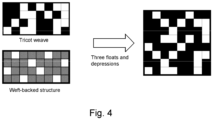
Fig. 4 ] The figure is a structural diagram of the fabric woven in Example 4. - The present invention is now explained in detail. Nevertheless, the present invention is not limited to the following embodiments, and may be freely modified within the scope of the present invention.
- One aspect of the present invention is a stretchable woven fabric having a multiple weave structure, wherein the multiple weave structure is a weave structure in which a tricot weave structure, which is a double warp weave having a ridge pattern in a warp direction, and a weft-backed structure, are combined with common warp so that wefts of both structures are disposed alternately in a certain arrangement, and a number of floats of wefts configuring the weft-backed structure is 3 or more relative to the warp.
- There is no particular limitation to the materials of the warps that can be used in this embodiment, and natural fibers or chemical fibers can be used. As natural fibers, vegetable fibers such as cotton, hemp and kapok, and animal fibers such as silk, wool, goat hair, llama hair, camel hair, rabbit hair, horse hair and cow hair can be used. As chemical fibers, regenerated fibers such as rayon, cupra and polynosic, semisynthetic fibers such as acetate, triacetate and promix, synthetic fibers such as polyester, polyamide, polyvinyl alcohol, polyacrylonitrile, polyethylene, polypropylene, polystyrene and polyurethane, metal fibers, carbon fibers, glass fibers, Japanese paper and other types of fibers can be used. Furthermore, natural rubber or synthetic rubber can also be used as the materials. From the perspective of texture when used for clothing items, natural fibers are preferably used, and vegetable fibers such as cotton and hemp are particularly preferable.
- As the thickness of the warps, while yarns having the desired thickness may be suitably used, as the warp diameter, yarns having a 1 to 300 cotton count based on cotton count conversion can be used, and yarns having a 10 to 120 cotton count are preferably used, and yarns having a 20 to 80 cotton count are more preferably used.
- There is no particular limitation to the materials of the wefts that can be used in this embodiment, and natural fibers or chemical fibers can be used. As natural fibers, vegetable fibers such as cotton, hemp and kapok, and animal fibers such as silk, wool, goat hair, llama hair, camel hair, rabbit hair, horse hair and cow hair can be used. As chemical fibers, regenerated fibers such as rayon, cupra and polynosic, semisynthetic fibers such as acetate, triacetate and promix, synthetic fibers such as polyester, polyamide, polyvinyl alcohol, polyacrylonitrile, polyethylene, polypropylene, polystyrene and polyurethane can be used. Furthermore, natural rubber or synthetic rubber can also be used as the materials.
- As the thickness of the wefts, while yarns having the desired thickness may be suitably used, as the weft diameter, yarns having a 1 to 300 cotton count based on cotton count conversion can be used, and yarns having a 10 to 120 cotton count are preferably used, and yarns having a 20 to 80 cotton count are more preferably used.
- The weft and/or warp used in this embodiment are preferably elastic yarns containing elastic fibers having stretchability or crimped yarns to provide high stretchability. As specific elastic fibers, used may be polyurethane fibers, polytrimethylene terephthalate (PTT) fibers, polytributylene terephthalate (PBT) fibers, natural rubber, synthetic rubber and the like. These elastic fibers may be directly used as filaments or spun yarns, or as textured yarns by being combined with non-elastic fiber materials. As textured yarns, used may be core spun yarns (CSY) having elastic fiber filaments as their core and in which short fibers are arranged around the core, air covered yarns (ACY) or filament twisted yarns (FTY) in which elastic fiber filaments and synthetic fibers are interlaced or twisted, single covered yarns (SCY), double covered yarns (DCY) and the like, and all of these can be preferably used. Moreover, as specific crimped yarns, used may be those in which woolly finish, buleria finish, Italian finish, knit de knit finish, indentation, composite false twist finish, Taslan finish, or interlacing is performed to materials such as nylon filaments, polytrimethylene terephthalate (PTT) filaments, polytributylene terephthalate (PBT) filaments, and polyethylene terephthalate (PET) filaments, or composite fibers in which types of polymers are combined side-by-side, and all of these can be preferably used.
- The woven fabric of this embodiment has a multiple weave structure. A multiple weave fabric is a woven fabric in which two or more woven fabrics are layered, and the woven fabric of this embodiment has a weave structure in which a tricot weave structure, which is a double warp weave having a ridge pattern in a warp direction, and a weft-backed structure, are combined with common warp so that wefts of both structures are disposed alternately in a certain arrangement.
- As a tricot weave, there are a double warp weave and a double weft weave, and this embodiment is a double warp weave structure in which the front-side warps and the back-side warps are alternately disposed in a certain arrangement and the floats and depressions of the warps are arranged to be in reverse at the boundary position of the front and back structure. The warps of the front structure and the warps of the back structure may be alternately disposed for every 1 to 3 warps, and preferably adopted is a structure in which one back warp is alternately disposed with one front warp, or a structure in which two back warps are alternately disposed with two front warps.
- A weft-backed structure is a structure of backing up the foregoing tricot weave structure with wefts, and the structure is backed up with wefts so that the structure will have three or more floats and depressions in a weft direction in a certain warp arrangement. In this embodiment, as a result of the number of floats of wefts configuring the backed structure being 3 or more relative to the warp configuring the tricot weave structure, it is possible to realize a woven fabric having high stretchability and flexibility based on the combination of the stretchability derived from the configuration of the tricot weave structure as a double warp weave structure, and the stretchability resulting from the number of floats of wefts configuring the backed structure being 3 or more relative to the warp arrangement configuring the tricot weave structure. While there is no particular limitation to the number of floats of wefts relative to the warp arrangement, it is normally 15 or less, and may be 11 or less, 7 or less, and even 5 or less.
- So as long as the number of floats of wefts configuring the backed structure is 3 or more relative to the warp arrangement configuring the tricot weave structure, there is no particular limitation to the weft-backed structure, but from the perspective of favorable stretchability, a broken twill weave or a satin weave is preferred.
- The broken twill weave includes a four-yarn broken twill weave, and a 3/1-yarn broken twill weave is preferably used.
- The satin weave includes a five-yarn satin weave to sixteen-yarn satin weave or a broken structure thereof, and a five-yarn satin weave to twelve-yarn satin weave or a broken structure is preferably used.
- With the stretchable woven fabric of the present invention, since the wefted structure and the tricot weave structure use common warp, the number of warps of the wefted structure and the number of warps of the tricot weave structure upon combination are preferably the same.
- Furthermore, while the stretchable woven fabric of the present invention has a structure in which wefts configuring the tricot weave structure and the wefts configuring the weft-backed structure are combined with common warp so that wefts of both structures are disposed alternately in a certain arrangement, preferably adopted is a weave structure in which the wefts configuring the tricot weave structure and the wefts configuring the weft-backed structure are combined alternately in an arrangement of 1:1, 1:2, 2: 1, or 2:2.
- While there is no particular limitation to the loom so as long as it can weave the stretchable woven fabric structure of this embodiment, the stretchable woven fabric structure of this embodiment can be manufactured according to conventional methods by using a dobby machine or a jacquard machine with 16 frames such as a rapier loom, air jet loom, water jet loom, or Sulzer loom.
- The stretchable woven fabric structure of this embodiment may also be subject to various types finishing as needed. As the finishing process, performed may be dyeing, raising, shearing, mercerization, buffing, bleaching, heat setting, pleating and the like.
- The stretchable woven fabric of this embodiment has a high stretch ratio and a high stretch recovery ratio in a weft direction and a bias direction. Specifically, the stretchable woven fabric preferably has, in the weft direction and/or bias direction, a stretch ratio of 35% or more, more preferably 40% or more, and most preferably 50% or more. There is no particular limitation to the upper limit of the stretch ratio, and it is normally 100% or less, and may also be 90% or less.
- Furthermore, the stretchable woven fabric preferably has, in the weft direction and/or bias direction, a stretch recovery ratio of 70% or more, more preferably 75% or more, and most preferably 80% or more. There is no particular limitation to the upper limit of the stretch recovery ratio, and it is normally 100% or less, and may also be 95% or less.
- The stretch ratio can be measured according to the JIS-L1096B method (constant load method), and the stretch recovery ratio can be measured according to the JIS-L1096B-1 method (constant load method).
- While there is no particular limitation to the basis weight of the stretchable woven fabric of this embodiment, from the perspective of providing a bulky feel, the basis weight is preferably 50 g/m2 or more, and more preferably 200 g/m2 or more. There is no particular limitation to the upper limit of the basis weight, but it is normally 1000 g/m2 or less, and may also be 600 g/m2 or less.
- The thickness of the stretchable woven fabric of this embodiment can be suitably set according to the situation of using the woven fabric. The thickness is normally 0.5 mm or more and preferably 0.6 mm or more, and is normally 3 mm or less and preferably 2 mm or less. While the thickness of the stretchable woven fabric is measured using a thickness gauge (dial thickness gauge), the thickness is measured according to the JIS-L1096A method (JIS method).
- Since the stretchable woven fabric of this embodiment possesses flexibility, and has a high stretch ratio and a stretch recovery ratio in a weft direction and a bias direction, it can be suitably used for various clothing items, hygiene materials, daily life materials or industrial materials. As suitable examples of clothing items to which the stretchable woven fabric of this embodiment can be applied, there are pants and bottoms such as jeans, slacks and skirts, outerwear such as jackets, blousons, coveralls and coats, innerwear such as T-shirts, shirts and blouses, dresses, overalls, salopettes and the like. As suitable examples of hygiene materials to which the stretchable woven fabric of this embodiment can be applied, there are taping tapes, poultices, bandages, masks, supporters and the like. As suitable examples of daily life materials to which the stretchable woven fabric of this embodiment can be applied, there are interior products such as sofa covers and cushion covers, and bedding items such as bed sheets, duvay covers and pillow covers, and as suitable examples of industrial material to which the stretchable woven fabric of this embodiment can be applied, there are car seats.
- The present invention is now explained in further detail based on the following Examples, but the scope of the present invention is not limited to these Examples.
- Cotton yarns (combed yarns) having a 20 cotton count were used as the warps, core spun yarns having a 30 cotton count using cored yarn 40-denier polyurethane filaments and core spun yarns having a 40 cotton count using cored yarn 40-denier polyurethane filaments were alternately arranged at a ratio of 1:1 and used as the wefts, the warps and wefts were woven with an air jet loom so that there will be 82 warps per inch and 50 + 50 wefts per inch in the weave structure shown in
Fig. 1 , and a gray fabric of a 71-inch-wide highly stretchable woven fabric (mixture ratio C:PU=95:5) was obtained. - The obtained gray fabric was subject to a regular finish with continuous dyeing using reactive dyes, and a highly stretchable
woven fabric 1 was obtained. - Cotton yarns (combed yarns) having a 20 cotton count were used as the warps, core spun yarns having a 30 cotton count using cored yarn 40-denier polyurethane filaments and core spun yarns having a 40 cotton count using cored yarn 40-denier polyurethane filaments were alternately arranged at a ratio of 1:1 and used as the wefts, the warps and wefts were woven with an air jet loom so that there will be 82 warps per inch and 50 + 50 wefts per inch in the weave structure shown in
Fig. 2 , and a gray fabric of a 71-inch-wide highly stretchable woven fabric (mixture ratio C:PU=95:5) was obtained. - The obtained gray fabric was subject to a regular finish with continuous dyeing using reactive dyes, and a highly stretchable woven fabric 2 was obtained.
- Cotton yarns (combed yarns) having a 20 cotton count were used as the warps, core spun yarns having a 40 cotton count using cored yarn 40-denier polyurethane filaments were used as the wefts, the warps and wefts were woven with an air jet loom so that there will be 82 warps per inch and 100 wefts per inch in the weave structure shown in
Fig. 3 , and a gray fabric of a 71-inch-wide highly stretchable woven fabric (mixture ratio C:PU=95:5) was obtained. - The obtained gray fabric was subject to a regular finish with continuous dyeing using reactive dyes, and a highly stretchable woven fabric 3 was obtained.
- Cotton yarns (compact yarns) having a 60 cotton count were used as the warps, core spun yarns having a 40 cotton count using cored yarn 40-denier polyurethane filaments were used as the wefts, the warps and wefts were woven with an air jet loom so that there will be 160 warps per inch and 100 wefts per inch in the weave structure shown in
Fig. 4 , and a gray fabric of a 71-inch-wide highly stretchable woven fabric (mixture ratio C:PU=95:5) was obtained. - The obtained gray fabric was subject to a regular finish with continuous dyeing using reactive dyes, and a highly stretchable woven fabric 4 was obtained.
- Cotton yarns (carded yarns) having a 20 cotton count were used as the warps, core spun yarns having a 20 cotton count using cored yarn 117-denier polyurethane filaments were used as the wefts, the warps and wefts were woven with an air jet loom so that there will be 100 warps per inch and 65 wefts per inch, and the overall width of the woven fabric will be 71 inches in an upward-left 3/1 twill weave (3/1L), and a stretchable fabric 5 (mixture ratio C:PU=96:4) subject to a regular finish with continuous dyeing using reactive dyes and mercerization using liquid ammonia was obtained.
- Cotton yarns (compact yarns) having a 30 cotton count were used as the warps, core spun yarns having a 16 cotton count using cored yarn 117-denier polyurethane filaments were used as the wefts, the warps and wefts were woven with an air jet loom so that there will be 124 warps per inch and 74 wefts per inch, and the overall width of the woven fabric will be 68 inches in a weave structure 3/2// irregular dobby weave, and a stretchable fabric 6 (mixture ratio C:PU=97:3) subject to a regular finish with continuous dyeing using reactive dyes was obtained.
- The stretch ratio (%), stretch recovery ratio (%), flexibility and fabric thickness (mm) of the highly stretchable
woven fabrics 1 to 3 obtained in Examples 1 to 3 and the stretchable fabrics 5 and 6 obtained in Comparative Examples 1 and 2 were respectively measured, and the results are summarized in Table 1. - The flexibility criteria is as follows.
- ∘: Stretches easily even with little effort.
- Δ: Slightly stiff when stretched.
- ×: Stiff when stretched.
-
Table 1 Stretch ratio (%) Stretch recovery ratio (%) Flexibility Fabric thickness (mm) Basis weight (g/m2) Example 1 83.0 84.0/88.6 ○ 0.73 400 Example 2 49.0 82.7/87.5 ○ 0.69 365 Example 3 73.0 82.1/88.3 ○ 0.53 315 Comparative Example 1 31.5 75.8/83.3 Δ 0.50 270 Comparative Example 2 29.5 74.2/87.1 Δ 0.50 280 - According to Table 1, Examples 1 to 3 were all able to obtain a woven fabric structure having a stretch ratio exceeding 40% and a stretch recovery ratio also exceeding 80%, and exhibited stretchability superior to the so-called high-power stretch structures of Comparative Examples 1 and 2, and also yielded flexibility in which the woven fabric can be stretched easily with little effort. Furthermore, the woven fabrics of Examples 1 to 4 are double weave fabrics, and were suitable for use as fabrics for clothing items with a knit texture while offering a bulky and luxurious feel.
Claims (9)
- A stretchable woven fabric having a multiple weave structure,wherein the multiple weave structure is a weave structure in which a tricot weave structure, which is a double warp weave having a ridge pattern in a warp direction, and a weft-backed structure, are combined with common warp so that wefts of both structures are disposed alternately in a certain arrangement; anda number of floats of wefts configuring the weft-backed structure is 3 or more relative to the warp.
- The stretchable woven fabric according to claim 1,
wherein the weft-backed structure is a broken twill weave or a satin weave. - The stretchable woven fabric according to claim 1 or 2,
wherein the number of floats of wefts configuring the weft-backed structure is 15 or less. - The stretchable woven fabric according to any one of claims 1 to 3,
wherein the weft is elastic yarn. - The stretchable woven fabric according to any one of claims 1 to 4,
wherein the stretchable woven fabric has a stretch ratio of 35% or more. - A clothing item comprising the stretchable woven fabric according to any one of claims 1 to 5.
- A hygiene material comprising the stretchable woven fabric according to any one of claims 1 to 5.
- A daily life material comprising the stretchable woven fabric according to any one of claims 1 to 5.
- An industrial material comprising the stretchable woven fabric according to any one of claims 1 to 5.
Applications Claiming Priority (2)
| Application Number | Priority Date | Filing Date | Title |
|---|---|---|---|
| JP2020201810A JP7467322B2 (en) | 2020-12-04 | 2020-12-04 | High stretch woven fabric |
| PCT/JP2021/044444 WO2022118949A1 (en) | 2020-12-04 | 2021-12-03 | Highly stretchable woven fabric |
Publications (2)
| Publication Number | Publication Date |
|---|---|
| EP4257736A1 true EP4257736A1 (en) | 2023-10-11 |
| EP4257736A4 EP4257736A4 (en) | 2025-01-01 |
Family
ID=81853404
Family Applications (1)
| Application Number | Title | Priority Date | Filing Date |
|---|---|---|---|
| EP21900698.8A Pending EP4257736A4 (en) | 2020-12-04 | 2021-12-03 | HIGH STRETCH WOVEN FABRIC |
Country Status (5)
| Country | Link |
|---|---|
| US (1) | US20250361655A1 (en) |
| EP (1) | EP4257736A4 (en) |
| JP (2) | JP7467322B2 (en) |
| CN (2) | CN115244236B (en) |
| WO (1) | WO2022118949A1 (en) |
Family Cites Families (23)
| Publication number | Priority date | Publication date | Assignee | Title |
|---|---|---|---|---|
| JPS43217Y1 (en) * | 1965-06-24 | 1968-01-08 | ||
| JPS4741996Y1 (en) * | 1969-02-24 | 1972-12-19 | ||
| DE1954668A1 (en) * | 1969-10-30 | 1971-05-06 | Girmes Werke Ag | Elastic material, in particular outer clothing material with plush lining |
| FR2687172A1 (en) * | 1992-02-07 | 1993-08-13 | Noveltis | Fabric having a high elasticity in its length direction and method of obtaining it |
| JP3863749B2 (en) * | 2001-10-02 | 2006-12-27 | 日清紡績株式会社 | Warp double woven denim |
| CN1871384A (en) * | 2003-10-22 | 2006-11-29 | 帝人纤维株式会社 | Stretchable composite fabric and clothing product therefrom |
| JP2005139570A (en) * | 2003-11-05 | 2005-06-02 | Teijin Fibers Ltd | Woven fabric for lining fabric, lining fabric and clothes |
| JP5134348B2 (en) * | 2007-12-04 | 2013-01-30 | 帝人ファイバー株式会社 | Stretch fabric and sports clothing with a flat surface |
| WO2009072642A1 (en) * | 2007-12-07 | 2009-06-11 | Teijin Fibers Limited | Process for production of fabrics, fabrics and textile goods |
| CN102575414B (en) * | 2009-10-20 | 2015-08-19 | 帝人富瑞特株式会社 | Polyester fiber and manufacture method, cloth and silk, fibre, polyester molded article |
| US10221506B2 (en) * | 2010-02-26 | 2019-03-05 | Sanko Tekstil Isletmeleri San. Ve Tic. A.S. | Method of making woven fabric that performs like a knitted fabric |
| WO2011152059A1 (en) * | 2010-06-02 | 2011-12-08 | セーレン株式会社 | Woven fabric and clothing |
| CN102534948A (en) * | 2010-12-13 | 2012-07-04 | 东丽纤维研究所(中国)有限公司 | Wrinkle-resistant elastic polyester-cotton fabric and production method thereof |
| CN102304802A (en) * | 2011-03-17 | 2012-01-04 | 苏州金科达纺织科技股份有限公司 | Anti-wrinkle fabric |
| ES2886586T3 (en) * | 2014-03-03 | 2021-12-20 | Kowa Co | knee support |
| KR101886769B1 (en) | 2014-03-31 | 2018-08-08 | 미즈노 가부시키가이샤 | Stretch woven fabric, and sportswear and swimwear employing same |
| CN106263169A (en) * | 2015-05-15 | 2017-01-04 | 东丽纤维研究所(中国)有限公司 | A kind of broadwise elastic fabric and application thereof |
| CN206359705U (en) * | 2016-12-31 | 2017-07-28 | 浙江蓝之梦纺织有限公司 | A kind of novel hosiery elastic force jean |
| JP2018127743A (en) * | 2017-02-10 | 2018-08-16 | 株式会社クラボウインターナショナル | Bulky fabric and method for producing the same |
| CN208545545U (en) * | 2018-07-11 | 2019-02-26 | 湖州永昌丝绸有限公司 | A kind of pure mulberry silk high-strength wearable Machine Washable pant fabric structure |
| US11708650B2 (en) * | 2019-09-11 | 2023-07-25 | Advance Denim Co., Ltd. | Fabric woven by imitating warp knitting |
| EP4063547A4 (en) * | 2019-11-18 | 2023-01-11 | Teijin Limited | FABRIC AND PROTECTIVE PRODUCT |
| EP4202092A4 (en) * | 2020-08-19 | 2025-04-16 | Hyosung Tnc Corporation | POLYESTER YARN AND ITS MANUFACTURING PROCESS |
-
2020
- 2020-12-04 JP JP2020201810A patent/JP7467322B2/en active Active
-
2021
- 2021-12-03 CN CN202180018705.4A patent/CN115244236B/en active Active
- 2021-12-03 EP EP21900698.8A patent/EP4257736A4/en active Pending
- 2021-12-03 WO PCT/JP2021/044444 patent/WO2022118949A1/en not_active Ceased
- 2021-12-03 US US18/255,500 patent/US20250361655A1/en active Pending
- 2021-12-03 CN CN202410491653.8A patent/CN118147801A/en active Pending
-
2024
- 2024-04-03 JP JP2024059915A patent/JP7702015B2/en active Active
Also Published As
| Publication number | Publication date |
|---|---|
| EP4257736A4 (en) | 2025-01-01 |
| JP2024083435A (en) | 2024-06-21 |
| CN115244236A (en) | 2022-10-25 |
| WO2022118949A1 (en) | 2022-06-09 |
| CN118147801A (en) | 2024-06-07 |
| JP7467322B2 (en) | 2024-04-15 |
| US20250361655A1 (en) | 2025-11-27 |
| JP2022089426A (en) | 2022-06-16 |
| JP7702015B2 (en) | 2025-07-02 |
| CN115244236B (en) | 2024-05-10 |
Similar Documents
| Publication | Publication Date | Title |
|---|---|---|
| US20090260707A1 (en) | Woven Textile Fabric with Cotton/Microdenier Filament Bundle Blend | |
| JP7189575B2 (en) | fabric | |
| JP2003041462A (en) | Breathable self-regulating woven / knitted fabric | |
| MXPA02007495A (en) | Woven stretch fabric. | |
| WO2017104338A1 (en) | Hook and loop fastener and textile products | |
| WO2020162624A1 (en) | Woven fabric, method for producing same, and fiber product containing said woven fabric | |
| CN111020855A (en) | Production process of warp-knitted spandex ultra-soft polar fleece fabric | |
| US11739449B2 (en) | Three-dimensional elastic circular knitted fabric | |
| JPWO2011152059A1 (en) | Textiles and clothing | |
| US11851788B2 (en) | Cover fabric and a method of manufacturing a vehicle seat cover fabric | |
| WO2019230482A1 (en) | Garment | |
| CN110644117A (en) | Double-layer double-elastic corduroy and process flow thereof | |
| US20250361655A1 (en) | Highly stretchable woven fabric | |
| CN221988789U (en) | Fabric with seven-surface treatment structure | |
| CN210684061U (en) | Multilayer composite yarn and fabric thereof | |
| JP6578650B2 (en) | Composite yarn and fabric using the same | |
| JP2004107800A (en) | Three-dimensional flat knit fabric | |
| EP4350060B1 (en) | Double raschel knitted fabric and upholstery material containing same | |
| JP2541661B2 (en) | Adhesive interlining | |
| JP2006328567A (en) | Thin fabric round knitted fabric and textile products with excellent stretch recovery | |
| USRE32594E (en) | Bi-elastic textile fabric | |
| JPH08144152A (en) | Tangled fabric and Western clothing | |
| KR101772435B1 (en) | Warf Knitted Fabric and Manufacturing Method thereof | |
| JP2021087562A (en) | bedding | |
| CN221272191U (en) | Ammonia-free elastic fabric with four-side rebound effect |
Legal Events
| Date | Code | Title | Description |
|---|---|---|---|
| STAA | Information on the status of an ep patent application or granted ep patent |
Free format text: STATUS: THE INTERNATIONAL PUBLICATION HAS BEEN MADE |
|
| PUAI | Public reference made under article 153(3) epc to a published international application that has entered the european phase |
Free format text: ORIGINAL CODE: 0009012 |
|
| STAA | Information on the status of an ep patent application or granted ep patent |
Free format text: STATUS: REQUEST FOR EXAMINATION WAS MADE |
|
| 17P | Request for examination filed |
Effective date: 20230703 |
|
| AK | Designated contracting states |
Kind code of ref document: A1 Designated state(s): AL AT BE BG CH CY CZ DE DK EE ES FI FR GB GR HR HU IE IS IT LI LT LU LV MC MK MT NL NO PL PT RO RS SE SI SK SM TR |
|
| DAV | Request for validation of the european patent (deleted) | ||
| DAX | Request for extension of the european patent (deleted) | ||
| A4 | Supplementary search report drawn up and despatched |
Effective date: 20241127 |
|
| RIC1 | Information provided on ipc code assigned before grant |
Ipc: D03D 15/56 20210101ALI20241122BHEP Ipc: D03D 15/283 20210101ALI20241122BHEP Ipc: D03D 15/217 20210101ALI20241122BHEP Ipc: D03D 13/00 20060101ALI20241122BHEP Ipc: D03D 17/00 20060101ALI20241122BHEP Ipc: A41D 31/18 20190101ALI20241122BHEP Ipc: D03D 11/00 20060101AFI20241122BHEP |
|
| STAA | Information on the status of an ep patent application or granted ep patent |
Free format text: STATUS: EXAMINATION IS IN PROGRESS |
|
| 17Q | First examination report despatched |
Effective date: 20250527 |
|
| GRAP | Despatch of communication of intention to grant a patent |
Free format text: ORIGINAL CODE: EPIDOSNIGR1 |
|
| STAA | Information on the status of an ep patent application or granted ep patent |
Free format text: STATUS: GRANT OF PATENT IS INTENDED |
|
| INTG | Intention to grant announced |
Effective date: 20260401 |