EP4257578B1 - Verfahren zur extraktion von hochreinen cannabinoiden - Google Patents
Verfahren zur extraktion von hochreinen cannabinoiden Download PDFInfo
- Publication number
- EP4257578B1 EP4257578B1 EP23166812.0A EP23166812A EP4257578B1 EP 4257578 B1 EP4257578 B1 EP 4257578B1 EP 23166812 A EP23166812 A EP 23166812A EP 4257578 B1 EP4257578 B1 EP 4257578B1
- Authority
- EP
- European Patent Office
- Prior art keywords
- water
- cbd
- process according
- solvent
- heptane
- Prior art date
- Legal status (The legal status is an assumption and is not a legal conclusion. Google has not performed a legal analysis and makes no representation as to the accuracy of the status listed.)
- Active
Links
Images







Classifications
-
- C—CHEMISTRY; METALLURGY
- C07—ORGANIC CHEMISTRY
- C07C—ACYCLIC OR CARBOCYCLIC COMPOUNDS
- C07C37/00—Preparation of compounds having hydroxy or O-metal groups bound to a carbon atom of a six-membered aromatic ring
- C07C37/68—Purification; separation; Use of additives, e.g. for stabilisation
- C07C37/70—Purification; separation; Use of additives, e.g. for stabilisation by physical treatment
- C07C37/82—Purification; separation; Use of additives, e.g. for stabilisation by physical treatment by solid-liquid treatment; by chemisorption
-
- A—HUMAN NECESSITIES
- A61—MEDICAL OR VETERINARY SCIENCE; HYGIENE
- A61K—PREPARATIONS FOR MEDICAL, DENTAL OR TOILETRY PURPOSES
- A61K36/00—Medicinal preparations of undetermined constitution containing material from algae, lichens, fungi or plants, or derivatives thereof, e.g. traditional herbal medicines
- A61K36/18—Magnoliophyta (angiosperms)
- A61K36/185—Magnoliopsida (dicotyledons)
- A61K36/348—Cannabaceae
- A61K36/3482—Cannabis
-
- C—CHEMISTRY; METALLURGY
- C07—ORGANIC CHEMISTRY
- C07C—ACYCLIC OR CARBOCYCLIC COMPOUNDS
- C07C37/00—Preparation of compounds having hydroxy or O-metal groups bound to a carbon atom of a six-membered aromatic ring
- C07C37/001—Preparation of compounds having hydroxy or O-metal groups bound to a carbon atom of a six-membered aromatic ring by modification in a side chain
- C07C37/002—Preparation of compounds having hydroxy or O-metal groups bound to a carbon atom of a six-membered aromatic ring by modification in a side chain by transformation of a functional group, e.g. oxo, carboxyl
-
- C—CHEMISTRY; METALLURGY
- C07—ORGANIC CHEMISTRY
- C07C—ACYCLIC OR CARBOCYCLIC COMPOUNDS
- C07C37/00—Preparation of compounds having hydroxy or O-metal groups bound to a carbon atom of a six-membered aromatic ring
- C07C37/68—Purification; separation; Use of additives, e.g. for stabilisation
- C07C37/70—Purification; separation; Use of additives, e.g. for stabilisation by physical treatment
- C07C37/84—Purification; separation; Use of additives, e.g. for stabilisation by physical treatment by crystallisation
-
- C—CHEMISTRY; METALLURGY
- C07—ORGANIC CHEMISTRY
- C07C—ACYCLIC OR CARBOCYCLIC COMPOUNDS
- C07C51/00—Preparation of carboxylic acids or their salts, halides or anhydrides
- C07C51/42—Separation; Purification; Stabilisation; Use of additives
- C07C51/47—Separation; Purification; Stabilisation; Use of additives by solid-liquid treatment; by chemisorption
-
- A—HUMAN NECESSITIES
- A61—MEDICAL OR VETERINARY SCIENCE; HYGIENE
- A61K—PREPARATIONS FOR MEDICAL, DENTAL OR TOILETRY PURPOSES
- A61K2236/00—Isolation or extraction methods of medicinal preparations of undetermined constitution containing material from algae, lichens, fungi or plants, or derivatives thereof, e.g. traditional herbal medicine
-
- C—CHEMISTRY; METALLURGY
- C07—ORGANIC CHEMISTRY
- C07C—ACYCLIC OR CARBOCYCLIC COMPOUNDS
- C07C2601/00—Systems containing only non-condensed rings
- C07C2601/12—Systems containing only non-condensed rings with a six-membered ring
- C07C2601/16—Systems containing only non-condensed rings with a six-membered ring the ring being unsaturated
Definitions
- the present invention relates to the field of extraction of active ingredients from plants or plant-derived material and, in particular, the invention relates to a process for extracting wax-free (-)-cannabidiol (CBD) from hemp or cannabis, particularly Cannabis sativa L., which can be used either as an oil or as a starting material to obtain substantially pure CBD for pharmaceutical and medical uses.
- CBD wax-free (-)-cannabidiol
- cannabis extracts were used as a prescription medicine, Queen Victoria herself used it against menstrual pain, and more generally it was used as a sedative to treat "hysteria, delirium, epilepsy, nervous insomnia, migraine, pain and dysmenorrhea.”
- cannabis was also considered by many physicians to be the only treatment capable of combating pain resistant to opioid analgesics, useful in treating conditions such as spinal cord injury and other forms of neuropathic pain, including pain and spasm in multiple sclerosis.
- the usefulness of cannabis as a prescription medicine has been reevaluated today, and the discovery of specific cannabinoid receptors and new methods of administration have enabled the expanded use of cannabis-based medicines with more targeted and novel indications.
- cannabinoids generally identifies a family of chemical compounds found in Cannabis sativa.
- Cannabinoids or cannabidiols are chemical substances of natural origin and biochemically classified as terpenophenols. They are compounds that share the ability to interact with cannabinoid receptors.
- THCA tetrahydrocannabidiolic acid
- CBD cannabidiolic acid
- CBD cannabidiol
- Cannabinoids are found in the hemp plant, or Cannabis sativa, in the form of their carboxylic derivatives, the cannabinoid carboxylic acids THCA and CBDA, from which the so-called “neutral cannabinoids” are derived by decarboxylation, that is, by CO 2 removal.
- cannabidiol CBD
- CBDA cannabidiolic acid
- purification of the extracted products can also be done by extraction with oils (such as olive oil, hemp oil, sesame oil, etc.), which normally do not extract the waxes, however, and remain as oils in the extracted products.
- oils such as olive oil, hemp oil, sesame oil, etc.
- the present invention solves the above problems by a process for producing wax-free extracts directly during the extraction step of fresh, dried or frozen cannabis plant biomass to obtain purified extracts used as such or to obtain CBD or other neutral cannabinoid, leaving the waxes in the organic waste material.
- the present process also solves the industrial problem related to the use of solvents with high flammability or used at high pressures, during the extraction step in known processes, with safety-related risks.
- CBD cannabidiolic acid
- CBD cannabidiol
- the main objective of the present invention is to provide a process for the preparation of cannabis extracts that is easily implementable on an industrial scale, reproducible regardless of the initial cannabinoid content, and above all that allows obtaining an extract already free of waxes, or more generally free from process by-products (e.g., extraction solvents), without necessarily having to resort to expensive purification procedures such as, for example, chromatography purification.
- process by-products e.g., extraction solvents
- the process of this invention comprises an initial step of contacting a cannabis plant biomass containing CBDA if fresh, or CBD and/or CBDA if dried, or other cannabinoid either neutral or in carboxylic acid form, with a mixture of water and water-miscible solvent, preferably a hydroalcoholic mixture, to give a suspension, in which the suspension is kept under agitation for a time of at least 10 minutes, preferably at least 30 minutes, without adjusting the pH.
- a cannabis plant biomass with a mixture of water and a water-miscible solvent, wherein water and water-miscible solvent are present in a weight ratio of between 3:1 and 1:1, more preferably 1:1, yields a wax-free cannabis extract.
- the present invention relates to a process for producing a wax-free cannabis extract, said process comprising the step of:
- the process of the invention can be conducted over a wide range of temperatures, however, as specified above, the process is preferably conducted at temperatures not exceeding 50°C to minimize the risk of obtaining an extract that contains an amount, albeit minimal, of waxes.
- Advantageous results especially in terms of yield, occur when the suspension is maintained at a temperature between 0°C and 50°C, preferably between 5°C and 45°C, more preferably between 10°C and 25°C or 15°C and 25°C.
- By increasing the amount of water and decreasing the amount of solvent from the indicated 3:1 weight ratio it is possible to conduct the process and obtain a wax-free extract even at temperatures higher than 50°C.
- high process temperatures are disadvantageous from an industrial point of view.
- by decreasing the amount of water and increasing the amount of solvent from the indicated 3:1 weight ratio it is possible to conduct the process and obtain a wax-free extract even at temperatures below 0°C.
- step i) of extraction in hydroalcoholic mixture is carried out in the presence of alkalizing agents, or otherwise at a pH greater than 10.5, an extract of lower purity is obtained (Comparative Example 11b). Filtering the suspension obtained from step i) yields a wax-free cannabis extract (see Example 1). Therefore, the process according to any of the embodiments described here can further include step ii) of filtering away the biomass.
- the inventors observed that when the pH of the suspension obtained from step i) is between 6.5 and 10.5, extremes included, the wax-free cannabis extract is obtained in greater quantities and therefore with higher yields. Moreover, the pH correction allows the process of the invention to be employed regardless of the cannabinoid content of the starting plant biomass, particularly regardless of its CBD / CBDA content, as will be evident from the examples that follow. For these reasons, if the pH value of the suspension obtained from step i) is not between 6.5 to 10.5, it is preferable to correct/adjust the pH before filtration.
- step ii) of pH correction may be accomplished by the addition, under agitation, of an alkaline solution, preferably a 30 percent sodium hydroxide (NaOH) solution, bringing the pH between 6.5 and 10.5, more preferably between 7.0 and 8.0, or a basic buffer. Adjusting the pH to these values is also particularly advantageous because it allows the elimination of fatty acids such as omega-3 or omega-6 that may sometimes be present in the starting biomass.
- an alkaline solution preferably a 30 percent sodium hydroxide (NaOH) solution
- NaOH sodium hydroxide
- Adjusting the pH to these values is also particularly advantageous because it allows the elimination of fatty acids such as omega-3 or omega-6 that may sometimes be present in the starting biomass.
- the filtered solution of water and water-miscible solvent (or more simply the filtrate), specifically including acidic or salified CBDA and/or CBD, is recovered according to any of the known methods of the art.
- the filtrate obtained i.e., the wax-free cannabis extract
- the filtrate obtained from step ii) can either be directly subjected to decarboxylation by heating the suspension to a temperature between the boiling temperature of the solvent and 180°C (Example 10) or the filtrate can be added with an organic solvent immiscible with water, such as heptane or a mixture of its isomers, hexane or a mixture of its isomers, and acidified to a pH between 4.0 and 6.0, preferably between 4.5 and 5.5 (Examples 2, 3, 5, 6, 7, 8 and 9).
- the organic phase is then recovered and, if desired, then subjected to decarboxylation as mentioned above.
- the process according to any of the embodiments of the invention comprises an extraction step iii) on the filtrate by addition of an organic solvent immiscible with the extraction mixture employed in step i), acidification to a pH between 5.5 and 4.0, and recovery of the organic phase.
- the organic phase obtained from step iii) once concentrated will be solvent-free and can be used as such or decarboxylated as better described below (Example 4).
- the present invention relates to a process for producing a wax-free cannabis extract, said process comprising the following steps:
- Crystallization of cannabinoids preferably occurs in heptane or hexane, more preferably heptane mixture of isomers.
- the process according to any of the described embodiments may further comprise a step v) of crystallization of cannabinoids (CBD and/or CBG) from heptane or hexane that may succeed step iv) of decarboxylation, optionally also downstream of the filtration step on silica.
- CBD and/or CBG cannabinoids
- crystallization of the ammonium salt of CBDA can be carried out by passing through a salification using dimethylcyclohexylamine in ethanol to obtain the corresponding CBDA salt pure crystal (Example 14).
- the ammonium salt of CBDA pure crystal can be decarboxylated to obtain CBD pure crystal (Example 15).
- decarboxylation step iv) is optional and/or can be carried out directly after counter-extraction step iii) with organic solvent or after crystallization of the acid cannabidiols contained in the organic phase obtained from step iii) or again after salification and crystallization of the acid cannabinoids contained in the organic phase obtained from step iii).
- salified forms allow significantly lower temperatures and decarboxylation times, are more stable than the oily forms, and are more easily stored; important factors from the perspective of industrializing the process.
- the raw material used is industrial hemp ( Cannabis Sativa L species; Sativa subspecies), but this invention can be applied to any species of the genus Cannabis.
- the cannabis plant biomass may be fresh, dried or frozen and is preferably shredded before being subjected to extraction according to the process of the present invention.
- the cannabinoids are separated from the waxes, chlorophylls, and any fatty acids that remain in the biomass, and thus the solution can be directly usable for subsequent processing steps.
- the process of the invention is equally applicable to cannabis biomass having a different CBD / CBDA content (Example 2, Example 3, Example 5 and Example 9). Without wishing to be bound by any particular theory, the inventors believe that this is possible because of the step of controlling, and correcting where necessary, the pH by step ii) of the present process.
- the oil is taken up with 79 g ethanol, 100 g water and 124 g heptane, heated to homogenize, the pH is corrected to 5.2 and the phases are separated. The hydroalcoholic phase is removed, the organic phase is concentrated to oil, resulting in 26 g, which is taken up with 52 ml of methanol to check for the absence of waxes. The solution kept at both room temperature and -20°C overnight is clear.
- EXAMPLE 4 Hydroalcoholic extraction (ethanol and water) from dried hemp.
- Table 1 Hemp to be extracted CBDA HPLC Area CBD HPLC Area Dried hemp 1 used in Examples 14 and 15 6706811 1427168 Hemp 2 frozen at 34% moisture content used in Examples 9 and 14 3781431 289332 Exhausted hemp CBDA HPLC Area CBD HPLC Area Hemp 1 spent used in Examples 14 and 15 299103 114295 Hemp 2 used in Examples 9 and 14 143243 33077
- Table 2 Hemp to be extracted CBGA HPLC area CBG HPLC area Dried hemp 3 with high CBG content used in Examples 12 and 13 3017977 68556 Exhausted hemp CBG HPLC Area CBGA HPLC Area Hemp 3 spent used in Examples 12 and 13 ND ND Table 3: Percentage of main cannabinoids extracted versus starting. Hemp 1 95% Hemp 2 96% Hemp 3 100%
- step ii) of pH correction to values between 6.5 and 10.5 results in a higher extraction of the major cannabinoids present in the starting plant material compared to procedures in which the extraction does not include a pH correction step, such as the procedure reported in US 2018/280459 A1 , which instead result in a partial extraction of the cannabinoid content (48% for total CBD).
- 850 g of ethanol and 850 g of water are added to a 3-liter beaker under stirring, then 210 g of hemp is added under stirring, allowed to stir for 10 minutes without pH correction (pH 5.7).
- the pH is corrected to 8.5 with a 30 percent NaOH solution, after 180 minutes the biomass is filtered and washed with a solution containing 425 g ethanol and 425 g water.
- the solution and washes are combined, resulting in 2696 g of extract in hydroalcoholic solution that is divided into two equal portions of 1348 g.
- the oil is taken up with 20 ml of methanol and brought to -20°C, showing the absence of the waxes through no precipitate formation.
- Test C in a one-liter beaker under stirring, 30 g of hemp and 200 ml of saturated aqueous solution of K2CO3, whose pH at 22°C turns out to be 14, are added, 200 ml of ethanol is added and left stirring for one hour, the pH of the resulting hydroalcoholic solution at 22°C turns out to be 14. Then, the hydroalcoholic solution is filtered to separate the plant biomass, the aqueous and alcoholic phases turn out to be immiscible and are separated.
- the oil-concentrated extract is extracted with ethyl ether through pH correction to 6 with a 5 percent citric acid solution, following phase separation in the resulting concentrated oil, the presence of waxes is revealed after keeping the oil in methanolic solution at -20°C.
- EXAMPLE 15 Decarboxylation of CBDA dimethylcyclohexylammonium salt (DMCEA) pure crystal to prepare CBD pure crystal.
- DCEA dimethylcyclohexylammonium salt
- Example 15 10g of the crystalline solid of Example 15 was taken to which 50g of ethanol was added, the suspension was put under stirring at the solvent reflux temperature (about 80°C), after 4 hours, a red-colored solution is obtained which is analyzed by HPLC confirming total decarboxylation.
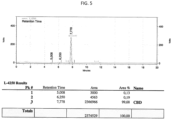
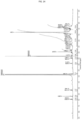
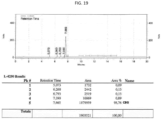
- the solvent is concentrated and 25 g of water, 12.5 g of ethanol and 50 ml of heptane are added by acidifying with acetic acid, stirring and separating the phases, the hydroalcoholic phase is removed while the heptane phase is concentrated to a weight of 8.1g to which 6 ml of heptane is added, resulting in crystallization of CBD, which is filtered and washed with cold heptane obtaining 5.7 g of pure crystal CBD. ( Fig. 18 ).
Landscapes
- Chemical & Material Sciences (AREA)
- Organic Chemistry (AREA)
- Health & Medical Sciences (AREA)
- Natural Medicines & Medicinal Plants (AREA)
- Life Sciences & Earth Sciences (AREA)
- Engineering & Computer Science (AREA)
- Microbiology (AREA)
- Epidemiology (AREA)
- Medical Informatics (AREA)
- Medicinal Chemistry (AREA)
- Biotechnology (AREA)
- Mycology (AREA)
- Pharmacology & Pharmacy (AREA)
- Botany (AREA)
- Animal Behavior & Ethology (AREA)
- General Health & Medical Sciences (AREA)
- Public Health (AREA)
- Veterinary Medicine (AREA)
- Alternative & Traditional Medicine (AREA)
- Crystallography & Structural Chemistry (AREA)
- Oil, Petroleum & Natural Gas (AREA)
- Organic Low-Molecular-Weight Compounds And Preparation Thereof (AREA)
Claims (13)
- Verfahren zum Herstellen eines wachsfreien Cannabisextraktes, wobei das Verfahren die folgenden Schritte umfasst:i) Suspendieren der Biomasse einer Cannabispflanze mit einer Mischung aus Wasser und einem wassermischbaren Lösungsmittel, sodass in der Suspension das Gewichtsverhältnis von Gesamtwasser zu wassermischbarem Lösungsmittel zwischen 3:1 und 1:1 liegt, und Halten der Suspension unter Rühren für mindestens 10 Minuten bei einer Temperatur von nicht mehr als 50 °C, ohne den pH-Wert zu korrigieren;ii) Korrigieren des pH-Werts der aus Schritt i) erhaltenen Suspension bei Bedarf auf einen pH-Wert zwischen 6,5 und 10,5 und Filtern der Biomasse;iii) Extrahieren des Filtrats durch Zugabe eines mit der Mischung nicht mischbaren organischen Lösungsmittels, Ansäuern auf einen pH-Wert zwischen 5,5 und 4,0 und Gewinnen der organischen Phase.
- Verfahren nach Anspruch 1, wobei das mit Wasser mischbare Lösungsmittel aus Alkoholen, Aceton, Acetonitril oder Mischungen davon ausgewählt wird, wobei die Alkohole vorzugsweise aus der Gruppe ausgewählt werden, die aus C1-C4-Alkoholen besteht, bevorzugter Ethanol oder Methanol.
- Verfahren nach Anspruch 1 oder 2, wobei die Temperatur zwischen 0 °C und 50 °C, vorzugsweise zwischen 5 °C und 45 °C, besonders bevorzugt zwischen 10 °C und 25 °C liegt.
- Verfahren nach einem der Ansprüche 1 bis 3, wobei die Suspension mindestens 30 Minuten lang unter Rühren gehalten wird.
- Verfahren nach einem der Ansprüche 1 bis 4, wobei das organische Lösungsmittel ein C5-C8-Kohlenwasserstoff, vorzugsweise n-Heptan oder eine Mischung seiner Isomere und/oder Hexan oder eine Mischung seiner Isomere ist.
- Verfahren nach einem der Ansprüche 1 bis 5, ferner umfassend einen Schritt iv) des Decarboxylierens des aus Schritt ii) gewonnenen Filtrats oder der aus Schritt iii) gewonnenen organischen Phase durch Erhitzen des Materials auf eine Temperatur zwischen der Siedetemperatur des Lösungsmittels und 180 °C.
- Verfahren nach Anspruch 6, ferner umfassend einen Schritt v) des Kristallisierens von Cannabinoiden, insbesondere Cannabidiol (CBD) und/oder Cannabigerol (CBG), vorzugsweise durch Hinzufügen von Heptan oder Hexan zu dem aus dem Decarboxylierungsschritt iv) erhaltenen Produkt.
- Verfahren nach einem der Ansprüche 1 bis 5, ferner umfassend einen Kristallisationsschritt von Cannabidiolsäure (CBDA) und/oder Cannabigerolsäure (CBGA), vorzugsweise durch Konzentrieren der aus Schritt iii) erhaltenen organischen Phase zu einem Öl und Hinzufügen von Heptan oder Hexan zu diesem Öl.
- Verfahren nach einem der Ansprüche 1 bis 5, ferner umfassend einen Schritt der Salzbildung und Kristallisation von Cannabidiolsäure (CBDA) und/oder Cannabigerolsäure (CBGA) durch Hinzufügen einer organischen Base, vorzugsweise Dimethylcyclohexylamin, in einem geeigneten Lösungsmittel zu der aus Schritt iii), wahlweise konzentriert, erhaltenen organischen Phase.
- Verfahren nach Anspruch 9, wobei das Lösungsmittel aus Alkoholen, Estern, Ethern, Ketonen, Kohlenwasserstoffen, halogenierten Kohlenwasserstoffen und Nitrilen mit bis zu 20 Kohlenstoffatomen ausgewählt wird und vorzugsweise Ethanol ist.
- Verfahren nach Anspruch 9 oder 10, ferner umfassend einen Schritt der Decarboxylierung des Salzes durch Erhitzen des Materials auf eine Temperatur zwischen der Siedetemperatur des Lösungsmittels und 180 °C, um Cannabidiol (CBD) und/oder Cannabigerol (CBG) zu erhalten, und wahlweise einen Schritt der Kristallisation des so aus Heptan oder Hexan erhaltenen CBD und/oder CBG.
- Verfahren nach einem der vorstehenden Ansprüche, wobei Schritt i) an frischer, getrockneter oder gefrorener, wahlweise zerkleinerter Biomasse der Cannabispflanze durchgeführt wird.
- Verfahren nach einem der vorstehenden Ansprüche, wobei die Biomasse der Cannabispflanze Biomasse von Cannabis sativa L. ist.
Applications Claiming Priority (1)
| Application Number | Priority Date | Filing Date | Title |
|---|---|---|---|
| IT102022000006770A IT202200006770A1 (it) | 2022-04-06 | 2022-04-06 | Processo per l’estrazione di cannabinoidi di elevata purezza |
Publications (3)
| Publication Number | Publication Date |
|---|---|
| EP4257578A1 EP4257578A1 (de) | 2023-10-11 |
| EP4257578C0 EP4257578C0 (de) | 2024-07-03 |
| EP4257578B1 true EP4257578B1 (de) | 2024-07-03 |
Family
ID=82196689
Family Applications (1)
| Application Number | Title | Priority Date | Filing Date |
|---|---|---|---|
| EP23166812.0A Active EP4257578B1 (de) | 2022-04-06 | 2023-04-05 | Verfahren zur extraktion von hochreinen cannabinoiden |
Country Status (2)
| Country | Link |
|---|---|
| EP (1) | EP4257578B1 (de) |
| IT (1) | IT202200006770A1 (de) |
Families Citing this family (1)
| Publication number | Priority date | Publication date | Assignee | Title |
|---|---|---|---|---|
| GB202413750D0 (en) * | 2024-09-18 | 2024-10-30 | Univ Stellenbosch | Extraction of cannabinoids from plant waxes |
Family Cites Families (3)
| Publication number | Priority date | Publication date | Assignee | Title |
|---|---|---|---|---|
| WO2017051398A1 (en) * | 2015-09-27 | 2017-03-30 | Buzzelet Development And Technologies Ltd. | Methods for the production of different cannabis product compositions |
| CN106278828A (zh) * | 2016-08-16 | 2017-01-04 | 云南汉素生物科技有限公司 | 一种从工业大麻花叶中提取大麻二酚的方法 |
| EP3459536A1 (de) * | 2017-09-25 | 2019-03-27 | Krotov, Vadym | Cannabinoid-enthaltende zusammensetzung und verfahren zur herstellung davon |
-
2022
- 2022-04-06 IT IT102022000006770A patent/IT202200006770A1/it unknown
-
2023
- 2023-04-05 EP EP23166812.0A patent/EP4257578B1/de active Active
Also Published As
| Publication number | Publication date |
|---|---|
| EP4257578C0 (de) | 2024-07-03 |
| EP4257578A1 (de) | 2023-10-11 |
| IT202200006770A1 (it) | 2023-10-06 |
Similar Documents
| Publication | Publication Date | Title |
|---|---|---|
| EP3658524B1 (de) | Verfahren zur herstellung von cannabinoiden aus industriehanftypen | |
| EP1542984B1 (de) | Methoden zur reinigung von cannabinoiden aus pflanzenmaterial | |
| KR102431704B1 (ko) | 칸나비스로부터 표적 화합물의 선택된 패밀리를 추출, 가공, 및 정제하는 방법 | |
| CA2499210A1 (en) | Method of preparing cannabidiol from plant material | |
| EP2613792B1 (de) | Verfahren für die zubereitung eines raffinierten extrakts aus centella asiatica | |
| EP4257578B1 (de) | Verfahren zur extraktion von hochreinen cannabinoiden | |
| WO2005075474A1 (ja) | コハク酸ソリフェナシン含有組成物 | |
| US20110046213A1 (en) | Production of Delta 9 Tetrahydrocannabinol | |
| CN101143887B (zh) | 从枇杷叶中分离制备科罗索酸的方法 | |
| US5756782A (en) | Method for purifying diacetylrhein | |
| CZ293949B6 (cs) | Způsob přípravy aloinu | |
| DK1682497T3 (en) | PROCEDURE FOR PURIFYING MESOTRION | |
| WO2022115973A1 (en) | Solvent-switching methods for precipitation, processing, and purification of selected cannabinoids from concentrated complex mixtures | |
| US20260115212A1 (en) | Process for the purification of cannabidiol from herbal material | |
| CN115650942B (zh) | 从啤酒花中提取分离纯化8-异戊烯基柚皮素的方法 | |
| RU2218345C2 (ru) | Способ получения алоина экстракцией | |
| CN116396349B (zh) | 一种异熊去氧胆酸的纯化方法 | |
| WO2026088052A1 (en) | Process for the purification of cannabidiol from herbal material | |
| US20090275754A1 (en) | Narcotine Purification Process | |
| US6569891B1 (en) | Antihypertensive compound from Caesalpinia brasiliensis | |
| CA2925077C (en) | Process for preparing gabapentin | |
| CN120717882A (zh) | 倍半萜类化合物及其制备方法与应用 | |
| CN120887937A (zh) | 一种红枸杞中新结构胰脂肪酶抑制剂Lyciruthephenylpropanoid H的分离工艺及其应用 | |
| CN114957227A (zh) | 一种从葛根中提取分离多种异黄酮类化合物的方法 |
Legal Events
| Date | Code | Title | Description |
|---|---|---|---|
| PUAI | Public reference made under article 153(3) epc to a published international application that has entered the european phase |
Free format text: ORIGINAL CODE: 0009012 |
|
| STAA | Information on the status of an ep patent application or granted ep patent |
Free format text: STATUS: THE APPLICATION HAS BEEN PUBLISHED |
|
| AK | Designated contracting states |
Kind code of ref document: A1 Designated state(s): AL AT BE BG CH CY CZ DE DK EE ES FI FR GB GR HR HU IE IS IT LI LT LU LV MC ME MK MT NL NO PL PT RO RS SE SI SK SM TR |
|
| STAA | Information on the status of an ep patent application or granted ep patent |
Free format text: STATUS: REQUEST FOR EXAMINATION WAS MADE |
|
| 17P | Request for examination filed |
Effective date: 20231124 |
|
| RBV | Designated contracting states (corrected) |
Designated state(s): AL AT BE BG CH CY CZ DE DK EE ES FI FR GB GR HR HU IE IS IT LI LT LU LV MC ME MK MT NL NO PL PT RO RS SE SI SK SM TR |
|
| RIC1 | Information provided on ipc code assigned before grant |
Ipc: A61K 36/185 20060101ALI20240119BHEP Ipc: C07C 37/00 20060101ALI20240119BHEP Ipc: A61K 31/352 20060101ALI20240119BHEP Ipc: A61K 36/00 20060101ALI20240119BHEP Ipc: C07C 65/19 20060101ALI20240119BHEP Ipc: C07C 51/47 20060101ALI20240119BHEP Ipc: C07C 39/23 20060101ALI20240119BHEP Ipc: C07C 37/84 20060101ALI20240119BHEP Ipc: C07C 37/82 20060101AFI20240119BHEP |
|
| GRAP | Despatch of communication of intention to grant a patent |
Free format text: ORIGINAL CODE: EPIDOSNIGR1 |
|
| STAA | Information on the status of an ep patent application or granted ep patent |
Free format text: STATUS: GRANT OF PATENT IS INTENDED |
|
| INTG | Intention to grant announced |
Effective date: 20240307 |
|
| GRAS | Grant fee paid |
Free format text: ORIGINAL CODE: EPIDOSNIGR3 |
|
| GRAA | (expected) grant |
Free format text: ORIGINAL CODE: 0009210 |
|
| STAA | Information on the status of an ep patent application or granted ep patent |
Free format text: STATUS: THE PATENT HAS BEEN GRANTED |
|
| AK | Designated contracting states |
Kind code of ref document: B1 Designated state(s): AL AT BE BG CH CY CZ DE DK EE ES FI FR GB GR HR HU IE IS IT LI LT LU LV MC ME MK MT NL NO PL PT RO RS SE SI SK SM TR |
|
| REG | Reference to a national code |
Ref country code: CH Ref legal event code: EP |
|
| REG | Reference to a national code |
Ref country code: DE Ref legal event code: R096 Ref document number: 602023000199 Country of ref document: DE |
|
| U01 | Request for unitary effect filed |
Effective date: 20240729 |
|
| U07 | Unitary effect registered |
Designated state(s): AT BE BG DE DK EE FI FR IT LT LU LV MT NL PT RO SE SI Effective date: 20240911 |
|
| PG25 | Lapsed in a contracting state [announced via postgrant information from national office to epo] |
Ref country code: NO Free format text: LAPSE BECAUSE OF FAILURE TO SUBMIT A TRANSLATION OF THE DESCRIPTION OR TO PAY THE FEE WITHIN THE PRESCRIBED TIME-LIMIT Effective date: 20241003 |
|
| PG25 | Lapsed in a contracting state [announced via postgrant information from national office to epo] |
Ref country code: PL Free format text: LAPSE BECAUSE OF FAILURE TO SUBMIT A TRANSLATION OF THE DESCRIPTION OR TO PAY THE FEE WITHIN THE PRESCRIBED TIME-LIMIT Effective date: 20240703 Ref country code: GR Free format text: LAPSE BECAUSE OF FAILURE TO SUBMIT A TRANSLATION OF THE DESCRIPTION OR TO PAY THE FEE WITHIN THE PRESCRIBED TIME-LIMIT Effective date: 20241004 |
|
| PG25 | Lapsed in a contracting state [announced via postgrant information from national office to epo] |
Ref country code: IS Free format text: LAPSE BECAUSE OF FAILURE TO SUBMIT A TRANSLATION OF THE DESCRIPTION OR TO PAY THE FEE WITHIN THE PRESCRIBED TIME-LIMIT Effective date: 20241103 |
|
| PG25 | Lapsed in a contracting state [announced via postgrant information from national office to epo] |
Ref country code: CZ Free format text: LAPSE BECAUSE OF FAILURE TO SUBMIT A TRANSLATION OF THE DESCRIPTION OR TO PAY THE FEE WITHIN THE PRESCRIBED TIME-LIMIT Effective date: 20240703 Ref country code: HR Free format text: LAPSE BECAUSE OF FAILURE TO SUBMIT A TRANSLATION OF THE DESCRIPTION OR TO PAY THE FEE WITHIN THE PRESCRIBED TIME-LIMIT Effective date: 20240703 |
|
| PG25 | Lapsed in a contracting state [announced via postgrant information from national office to epo] |
Ref country code: ES Free format text: LAPSE BECAUSE OF FAILURE TO SUBMIT A TRANSLATION OF THE DESCRIPTION OR TO PAY THE FEE WITHIN THE PRESCRIBED TIME-LIMIT Effective date: 20240703 Ref country code: RS Free format text: LAPSE BECAUSE OF FAILURE TO SUBMIT A TRANSLATION OF THE DESCRIPTION OR TO PAY THE FEE WITHIN THE PRESCRIBED TIME-LIMIT Effective date: 20241003 |
|
| PG25 | Lapsed in a contracting state [announced via postgrant information from national office to epo] |
Ref country code: RS Free format text: LAPSE BECAUSE OF FAILURE TO SUBMIT A TRANSLATION OF THE DESCRIPTION OR TO PAY THE FEE WITHIN THE PRESCRIBED TIME-LIMIT Effective date: 20241003 Ref country code: PL Free format text: LAPSE BECAUSE OF FAILURE TO SUBMIT A TRANSLATION OF THE DESCRIPTION OR TO PAY THE FEE WITHIN THE PRESCRIBED TIME-LIMIT Effective date: 20240703 Ref country code: NO Free format text: LAPSE BECAUSE OF FAILURE TO SUBMIT A TRANSLATION OF THE DESCRIPTION OR TO PAY THE FEE WITHIN THE PRESCRIBED TIME-LIMIT Effective date: 20241003 Ref country code: IS Free format text: LAPSE BECAUSE OF FAILURE TO SUBMIT A TRANSLATION OF THE DESCRIPTION OR TO PAY THE FEE WITHIN THE PRESCRIBED TIME-LIMIT Effective date: 20241103 Ref country code: HR Free format text: LAPSE BECAUSE OF FAILURE TO SUBMIT A TRANSLATION OF THE DESCRIPTION OR TO PAY THE FEE WITHIN THE PRESCRIBED TIME-LIMIT Effective date: 20240703 Ref country code: GR Free format text: LAPSE BECAUSE OF FAILURE TO SUBMIT A TRANSLATION OF THE DESCRIPTION OR TO PAY THE FEE WITHIN THE PRESCRIBED TIME-LIMIT Effective date: 20241004 Ref country code: ES Free format text: LAPSE BECAUSE OF FAILURE TO SUBMIT A TRANSLATION OF THE DESCRIPTION OR TO PAY THE FEE WITHIN THE PRESCRIBED TIME-LIMIT Effective date: 20240703 Ref country code: CZ Free format text: LAPSE BECAUSE OF FAILURE TO SUBMIT A TRANSLATION OF THE DESCRIPTION OR TO PAY THE FEE WITHIN THE PRESCRIBED TIME-LIMIT Effective date: 20240703 |
|
| PG25 | Lapsed in a contracting state [announced via postgrant information from national office to epo] |
Ref country code: SM Free format text: LAPSE BECAUSE OF FAILURE TO SUBMIT A TRANSLATION OF THE DESCRIPTION OR TO PAY THE FEE WITHIN THE PRESCRIBED TIME-LIMIT Effective date: 20240703 |
|
| PG25 | Lapsed in a contracting state [announced via postgrant information from national office to epo] |
Ref country code: SK Free format text: LAPSE BECAUSE OF FAILURE TO SUBMIT A TRANSLATION OF THE DESCRIPTION OR TO PAY THE FEE WITHIN THE PRESCRIBED TIME-LIMIT Effective date: 20240703 |
|
| U20 | Renewal fee for the european patent with unitary effect paid |
Year of fee payment: 3 Effective date: 20250403 |
|
| PLBE | No opposition filed within time limit |
Free format text: ORIGINAL CODE: 0009261 |
|
| STAA | Information on the status of an ep patent application or granted ep patent |
Free format text: STATUS: NO OPPOSITION FILED WITHIN TIME LIMIT |
|
| 26N | No opposition filed |
Effective date: 20250404 |
|
| PG25 | Lapsed in a contracting state [announced via postgrant information from national office to epo] |
Ref country code: MC Free format text: LAPSE BECAUSE OF FAILURE TO SUBMIT A TRANSLATION OF THE DESCRIPTION OR TO PAY THE FEE WITHIN THE PRESCRIBED TIME-LIMIT Effective date: 20240703 |
|
| PGFP | Annual fee paid to national office [announced via postgrant information from national office to epo] |
Ref country code: IE Payment date: 20251013 Year of fee payment: 3 |