EP4256901B1 - Verfahren und vorrichtung zur herstellung einer luftheizungsanlage sowie die luftheizungsanlage - Google Patents
Verfahren und vorrichtung zur herstellung einer luftheizungsanlage sowie die luftheizungsanlage Download PDFInfo
- Publication number
- EP4256901B1 EP4256901B1 EP21810437.0A EP21810437A EP4256901B1 EP 4256901 B1 EP4256901 B1 EP 4256901B1 EP 21810437 A EP21810437 A EP 21810437A EP 4256901 B1 EP4256901 B1 EP 4256901B1
- Authority
- EP
- European Patent Office
- Prior art keywords
- winding
- pitch
- resistance wire
- wire
- support
- Prior art date
- Legal status (The legal status is an assumption and is not a legal conclusion. Google has not performed a legal analysis and makes no representation as to the accuracy of the status listed.)
- Active
Links
Images

Classifications
-
- H—ELECTRICITY
- H05—ELECTRIC TECHNIQUES NOT OTHERWISE PROVIDED FOR
- H05B—ELECTRIC HEATING; ELECTRIC LIGHT SOURCES NOT OTHERWISE PROVIDED FOR; CIRCUIT ARRANGEMENTS FOR ELECTRIC LIGHT SOURCES, IN GENERAL
- H05B3/00—Ohmic-resistance heating
- H05B3/10—Heating elements characterised by the composition or nature of the materials or by the arrangement of the conductor
- H05B3/16—Heating elements characterised by the composition or nature of the materials or by the arrangement of the conductor the conductor being mounted on an insulating base
-
- H—ELECTRICITY
- H05—ELECTRIC TECHNIQUES NOT OTHERWISE PROVIDED FOR
- H05B—ELECTRIC HEATING; ELECTRIC LIGHT SOURCES NOT OTHERWISE PROVIDED FOR; CIRCUIT ARRANGEMENTS FOR ELECTRIC LIGHT SOURCES, IN GENERAL
- H05B2203/00—Aspects relating to Ohmic resistive heating covered by group H05B3/00
- H05B2203/022—Heaters specially adapted for heating gaseous material
Definitions
- This invention concerns a method and a piece of equipment for manufacturing an air heating device, as well as the air heating device to be used, preferably, in a blow dryer, a hand dryer, an electric heater, a paint remover, or any device operating by the Joule effect.
- This invention finds application in the small appliances sector and, more precisely, in the production and manufacture of heating components to be inserted inside ventilation ducts, preferably inside one of the devices listed above.
- the insulating support is wound using different resistance windings with different tasks and functions.
- WO 2020/225652 A1 (GAMMA SPA [IT]) 12 November 2020 (2020-11-12) describes an air heating device for a hair dryer, hand dryer, electric heater, paint stripper, and other similar devices for heating air, comprising at least one metal bridge on which an electrical connector is applied, the electrical connector defining a gripping point suitable for retaining the electric wire by interlocking it.
- the device comprises two windings, one defining the real resistance that is responsible for heating the flow of air leaving the device (power branch) and the other supplying power to the fan actuation motor using the resistance thereof as a resistance divider (voltage divider branch).
- each winding may be made from a single resistance wire or from several resistance wires connected to each other (in series or in parallel) in order to remodulate the workability and mechanical assembly needs of the structure, achieving the electrical/thermal performance required.
- some technical solutions involve using a support that, for the most part, is wound with a first resistance winding, defining the air heating resistance, and which has a second winding made of thin wire arranged electrically in parallel but physically in series to the first winding.
- the heating device has the first resistance winding wound around a "point" portion of the support, which, in use, extends from the air blowing mouth towards the inside of the heating duct, and a second winding defined by a small number of coils composed of an insulating core around which a thin wire is wound and arranged as a "tail" to the support.
- the two windings therefore, while being electrically in parallel between them are arranged physically in series, entailing problems of positioning protection devices (thermistor and fusible resistor to begin with).
- any positioning of the protective members will be a compromise between a quick detection of excessive temperatures between the two windings, with consequent safety risks.
- the applicant has, in the past, devised a process for arranging the wires, which involves winding them in conjunction around the support in parallel both electrically and physically/structurally, i.e., producing, in the same step and machine, two coils or helixes at a constant pitch that extend together along the support, so that each coil of the first winding is placed between two successive coils of the second winding (and vice versa).
- this configuration is much stiffer from the parametric point of view, in fact obliging the producer to change the length of both the resistance wires (together) in case it is wished to change the resistance value of one or the other winding.
- the purpose of this invention is, therefore, to provide a method and a piece of equipment for manufacturing an air heating device, as well as an air heating device that are able to avoid the drawbacks of the prior art cited above.
- the purpose of this invention is to provide a method and a piece of equipment for manufacturing an air heating device, as well as an air heating device for a blow dryer (or other device operating by Joule effect) that is, at the same time, versatile and safe.
- an air heating device comprising the steps for arranging a support made of insulating material and extending along a main axis, at least one resistance wire and at least one second resistance wire.
- the at least one first resistance wire is, preferably, helically wound around said support so as to create at least part of a first winding extending along said main axis with a first pitch.
- the first winding will, thus, be able to be defined by a single first wire or by several first wires that are electrically in parallel, suitably wound around the support.
- the at least one second wire is preferably wound around said support so as to create at least part of a second winding extending along said main axis.
- the second winding will, thus, be able to be defined by a single second wire or by several second wires that are electrically in parallel, suitably wound around the support.
- the at least one second wire (or, in case there are more, the second wires) is wound around the support so that the second winding comprises at least one first portion and a second portion that can be distinguished from each other.
- the first portion is preferably arranged in parallel, both electrically and physically, to the first winding and has a pitch corresponding to said first pitch, so that there is a coil of the second winding placed between two subsequent coils of the first winding.
- two subsequent coils means, in this text, two coils separated by the winding pitch of the same wound wire; for this reason, the configuration of the first portion of the second winding involves a coil of the second winding being placed between two subsequent coils defined by a single first wire.
- the second portion is, in contrast, arranged electrically in series to the first portion and physically in series to the first winding and has a second pitch that is shorter than the first pitch.
- the subject of this invention is also a piece of equipment for manufacturing an air heating device.
- This piece of equipment comprises a retaining device for an insulating support, said retaining device being provided with at least one rotation component configured to rotate the insulating support around a main axis thereof.
- the piece of equipment preferably comprises a first winding device configured to receive at least one first resistance wire and to release said at least one first resistance wire around said insulating support exploiting the rotation of said rotation component of the retaining device.
- a second winding device is preferably included, which is configured to receive at least one second resistance wire and to release said at least one second resistance wire around said insulating support exploiting the rotation of said rotation component of the retaining device.
- the piece of equipment preferably comprises, in addition, movement means configured to generate a relative movement along said main axis between the retaining device and the winding devices in order to create a first winding, with a first pitch, and a second winding on said insulating support.
- the second winding device, the movement means and said rotation component are configured to manufacture said second winding so that it has:
- this piece of equipment manages to produce a resistance in which the two windings, though also physically parallel (with alternating development) at least in the section shared by the first winding and by the first portion of the second, may have resistance values that can vary without excessively impacting the overall dimensions of the device and without reducing the safety level thereof.
- the subject of this invention is, therefore, also an air heating device, preferably for a blow dryer or clothes dryer, comprising a support, a first and second resistance winding.
- the support is made of insulating material and extends (longitudinally) along a main axis thereof.
- the first winding is created by means of at least one first resistance wire helically extending around said support along said main axis with a first pitch.
- the second winding is created by means of at least one second resistance wire extending along said main axis.
- the second winding preferably comprises a first portion and a second portion that can be distinguished from each other.
- the first portion is arranged in parallel, both electrically and physically, to the first winding and has a pitch corresponding to said first pitch, so that there is a coil of the second winding between two subsequent coils of the first winding.
- the second portion is arranged electrically in series to the first portion and physically in series to the first winding (and to the first portion), wherein said second portion has a second pitch that is shorter than the first pitch.
- the first portion wound in conjunction (in parallel) with the first winding makes it possible to position the protective members near both resistance wires and, at the same time, the presence of a second portion unbound from the presence of the first winding enables the modulation of the resistance value of the second winding as desired and without significantly impacting the overall length of the support, including in light of the possibility of notably reducing the second pitch compared to the value of the first pitch.
- the number 1 indicates a device for heating air according to this invention, of the type preferably used inside a blow dryer, a clothes dryer, a hand dryer, an electric heater, a paint dryer, or any device operating by Joule effect.
- the device 1 is of the type commonly defined “resistance” in that it comprises, in addition to an insulating support (better described below), one or more resistance windings that, if traversed by an electric current, are heated so as to raise the temperature of an air flow hitting it.
- the device 1 for heating air comprises an insulating support 2 around which at least one resistance wire 3 is wound, which, in use, is hit by an air flow generated by ventilation/blowing means (not illustrated), placed operationally upstream, in order to raise the temperature thereof.
- the insulating support 2 is, thus, a body (monolithic or assembled) made of electrically insulating material, such as mica, plastic, or ceramic.
- This insulating support 2 preferably extends longitudinally along a main axis "A" thereof, or a central axis.
- the length i.e., the extension of the support 2 along the main axis "A" depends on the housing wherein the device 1 will be positioned in the finished product, i.e., in use.
- the support preferably has multiple radial partitions 2a angularly spaced apart from each other in order to define multiple angular sectors.
- the radial partitions 2a extend parallel to the main axis "A" and each have a radially outer edge 2b on which the resistance wires of the windings are placed.
- This radially outer edge 2b is preferably indented in order to enable its correct fixing and to encourage the maintenance of the correct position by the resistance wire (or resistance wires).
- the support 2 may have various shapes, preferably at least in part truncated cone or flared in order to adapt to the nozzle of the device housing it.
- the support has a tubular shape with a ring or central tube from which the radial partitions 2a extend, moving away from the main axis "A".
- the support 2 may be defined by multiple thin sheets or plates of insulating material fitted together or attached so as to define a star-shaped structure.
- this invention preferably refers to a device 1 wherein at least two windings W1, W2 are wound around the insulating support 2, nominally at least a first W1 and at least a second W2 winding.
- the two windings W1, W2, which, in principle, could also be equal in terms of physical features, have different functions within the electrical circuit.
- One of the windings W1, W2, in fact, has the function of heating the air flow and, therefore, has higher resistance in order to maximise the heating effect.
- the other winding has the function of supplying power to the motor that rotates the blowing fan (not illustrated), the reason for which the dissipated power for heating is to be considered a factor collateral - although, in part, welcome - to its role within the circuit.
- the first winding W1 will be considered the heating one, while the second winding W2 will be considered the motor power supply one.
- the first winding W1 is, preferably, defined by at least one resistance wire 3 helically wound around the support, in particular around the main axis "A".
- This first winding has, therefore, a first winding pitch "p1" defined by the distance, measured along the main axis "A", between two successive coils defined by the first resistance wire 3.
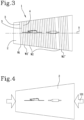
- the first winding W1 comprises more than one first wire 3, for example two first wires 3, as schematically illustrated in Figure 3 .
- first wires 3 In this embodiment with two first wires 3, they are electrically and physically arranged in parallel, thus defining two helicoids extending parallel along the insulating support 2 and defining, together, the first winding W1.
- both the first wires 3 are wound around the support 2 with the first winding pitch "p1" (i.e., with an equal pitch) and, preferably, are offset from each other by an axial distance to a fraction of said pitch (in this case 1/3), so as to maintain the heating of the air inside the duct uniform.
- the first wire 3 (or first wires) is made of iron alloys or nickel and has a diameter that varies depending on the electrical configuration of the circuit. With equal power, a circuit that includes a single first wire 3 will have a wire with a larger cross-section compared to an equivalent circuit provided with two or three first wires, which will have a smaller diameter.
- the first wire 3 preferably has a wavy shape; in other words, the first wire 3 (or first wires) do not extend circumferentially around the support in a linear way, but extend according to a wavy shape in accordance with what is described in the patent IT1289406 belonging to the applicant.
- the first winding W1 preferably has multiple coils (or revolutions), each of which contains a prefixed number of waves.
- the number of waves per coil (or waves/revolution) varies along the winding.
- the first winding W1 comprises a first section T1 wherein each coil of said first winding W1 comprises a first number of waves and a second section T2 of the first winding W1 in which each coil of said first winding W1 comprises a second number of waves per revolution.
- a transition coil is used as described and illustrated in the document EP1884962 , again in the name of the applicant.
- the second winding W2 is also, preferably, defined by at least one second resistance wire 4 helically wound around the support, in particular around the main axis "A".
- the second resistance wire 4 is preferably made of iron alloys or nickel and has a diameter ranging between 0.20 and 0.60 mm, more preferably between 0.22 and 0.42 mm.
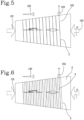
- the second winding W2 comprises a first portion W2' and a second portion W2" that can be distinguished from each other.
- the first portion W2' is arranged in parallel both electrically and physically to the first winding W1 and has a winding pitch corresponding to said first pitch "p1".
- two subsequent coils means, in this text, two coils separated by the winding pitch of the same wound wire; for this reason, the configuration of the first portion of the second winding W2 involves a coil of the second winding W2 being placed between two subsequent coils defined by a single first wire 3.
- the coil immediately adjacent to a coil defined by a first wire or by a second wire is again a wire (first or second) belonging to the same winding.
- this coil defined by the first wire of by the second wire is axially placed between two subsequent coils of a single helicoid (i.e., the winding portion defined by a single wire).
- the second portion W2" is, in contrast, arranged electrically in series to the first portion W2' and physically in series to the first winding W1.
- the second portion W2" has a second pitch "p2" that is smaller than the first pitch "p1".
- the device 1 preferably comprises:
- the second pitch "p2" is, preferably, shorter than the distance between two adjacent coils of the first W1 and second windings W2.
- the second pitch "p2" is less than 1/3 of the first pitch "p1".
- the second winding W2 is also, preferably, a wavy wire.
- the second wire 4 (or second wires) also have a wavy shape along the circumferential extension thereof.
- the first portion W2' of the second winding W2 comprises a first section t1 in which each coil comprises a first number of waves and at least one second section t2 in which each coil comprises a third number of waves.
- each coil of the second portion W2" of the second winding W2 comprises a third number of waves.
- this configuration makes it possible to have a second winding with a high variability relative to the number of waves/revolution or waves/coil, making it possible to optimally adapt the planning of the device 1 to the performance needs of the equipment on which it is assembled.
- the second number of waves per revolution is preferably greater than said first number of waves per revolution, while the third number of waves per revolution (if included) is equal or greater than said second number of waves per revolution.
- first and second number of waves per revolution (or coil) of the first winding could be different from the first and second number of waves per revolution (or coil) of the second winding.
- the subject of this invention is also a piece of equipment for manufacturing an air heating device, preferably, but not necessarily, the heating device 1 described up to this point.
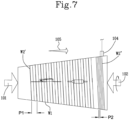
- the piece of equipment 1 comprises a retaining device 101 for the insulating support 2.
- This retaining device 101 is provided with at least one rotation component 102 configured to rotate said insulating support 2 about its own main axis "A".
- clamp or expander wedge configured to retain the support 2 and rotate it.
- first 103 and second winding device 104 configured to make the first W1 and the second winding W2.
- the first winding device 103 is configured to receive at least one first resistance wire 3 and to release it around the insulating support 2 by means of the rotation of the rotation component 102.
- the second winding device 104 is configured to receive the at least one second resistance wire 4 and to release it around the insulating support 2 by means of the rotation of the rotation component 102.
- the winding devices 103, 104 have two release portions that each apply a corresponding resistance wire.
- Each winding device 103, 104 preferably comprises a folding component configured to receive the corresponding first 3 or second wire 4 and to deform it so as to give it a wavy shape along a corresponding extension direction, in accordance with what was already described above in relation to the device 1 and in patents IT1289406 and EP1884962 .
- Movement means 105 configured to generate a relative movement along said main axis "A" between the retaining device 101 (or each retaining device 101) and the winding devices 103, 104 are described.
- the movement means may be defined by a linear actuator (hydraulic or electro-mechanic) connected to the winding devices 103, 104 or to the retaining device 101 or to both.
- a linear actuator hydraulic or electro-mechanic
- the second winding device 104, the movement means 105, and said rotation component 102 are configured to create said second winding W2 with:
- the piece of equipment preferably comprises a control unit (not illustrated) configured to drive the second winding device 104, the movement means 105, and said rotation component 102 according to a first depositing program that has a first release speed of the second winding device 104, a first rotation speed of the rotation component 102, and a first feeding speed along the main axis, wherein the first portion W2' of the second winding W2 is made.
- a control unit not illustrated
- the piece of equipment preferably comprises a control unit (not illustrated) configured to drive the second winding device 104, the movement means 105, and said rotation component 102 according to a first depositing program that has a first release speed of the second winding device 104, a first rotation speed of the rotation component 102, and a first feeding speed along the main axis, wherein the first portion W2' of the second winding W2 is made.
- This control unit is, in addition, configured to drive the second winding device 104, the movement means 105, and said rotation component 102 according to a second depositing program that has a second release speed of the second winding device 104, a second rotation speed of the rotation component 102, and a second feeding speed along the main axis, wherein the second portion W2" of the second winding W2 is made.
- This first release speed of the second winding device 104, first rotation speed of the rotation component 102, and first feeding speed may be, in part, equivalent to the corresponding second release speed of the second winding device 104, second rotation speed of the rotation component 102, and second feeding speed, depending on the pitch difference and the number of waves/revolution between the first and the second portion of the second winding.
- the second linear feeding speed is less than the first, so as to allow a reduction in the pitch between the first pitch "p1" and the second pitch "p2".
- this enables great production flexibility, entirely to the advantage of the heating device 1 manufacturer.
- the subject of this invention is also a method of manufacturing an air heating device 1, preferably, but not necessarily, actuated by the piece of equipment described up to this point and of manufacturing the heating device 1 described above.
- the method preferably comprises the steps of arranging the support 2 made of insulating material and extending along a main axis "A", at least one first resistance wire 3 and at least one second resistance wire 3.
- the first resistance wire 3 is, preferably, helically wound around the support 2 so as to create at least part of the first winding W1 extending along said main axis (A) with a first winding pitch "p1".
- the second resistance wire 4 is, thus, helically wound around said support 2 so as to create at least part of a second winding W2 extending along said main axis "A".
- the reference to "at least part" of the first W1 and second winding W2 refers to the possibility, already mentioned several times in this text, to make the winding with more than one first or second resistance wire so that the first W1 or second winding W2 is at least defined by several helicoids in parallel both electrically and physically.
- the winding step of the at least one first wire 3, or the step for making the first winding W1 is carried out upstream of the winding step for the second resistance wire 4, or upstream of the step for making the second winding W2.
- the second winding W2 comprises a first portion W2' and a second portion W2", in accordance with what has already been described.
- the method therefore, involves making the first portion W2' of the second winding W2, by arranging the second wire 4 in parallel both electrically and physically to the first winding W1 and winding it with a pitch corresponding to said first pitch "p1".
- the method also involves creating the second portion W2" of the second winding W2 arranging the second wire 4 electrically in series to the first portion W2' and physically in series to the first winding W1.
- a second additional part of the second wire 4 is prepared, the first part of which was already, previously, wound parallel to the first winding W1.
- the second portion W2" of the second winding preferably has a second pitch "p2" that is smaller than the first pitch "p1".
- the method preferably involves performing a step for deforming the first 3 and second 4 resistance wire (or each first 3 or second wire 4) so as to give said first 3 and second 4 wire a wavy shape along a respective extension direction.
- This deforming step is carried out upstream of the corresponding step for winding the first 3 and second 4 resistance wire around the support.
- the winding step for the first resistance wire 3 involves a first sub-step and second sub-step.
- the first sub-step involves creating the first section T1 of the first winding W1 wherein each coil of said first winding W1 comprises a first number of waves (i.e., first number of waves/revolution).
- the second sub-step involves, in contrast, creating a second section T2 of the first winding W1 wherein each coil of said first winding W1 comprises a second number of waves (i.e., second number of waves/revolution).
- the first number is, preferably, less than the second number of waves per revolution of the first winding W1.
- the winding step for the second resistance wire 4 also, preferably, involves several sub-steps and, in particular:
- each coil of said second winding W2 comprises a third number of waves (i.e., third number of waves/revolution).
- the first number of waves per revolution is preferably less than the second number of waves per revolution, which are not necessarily equal (but could be) to the first and second number of waves per revolution of the first winding W1.
- the third number of waves per revolution is equal or greater to the second number of waves per revolution.
- the invention achieves the purposes proposed and entails significant advantages.
Landscapes
- Manufacture Of Motors, Generators (AREA)
Claims (12)
- Verfahren zur Herstellung einer Luftheizungsanlage (1), das die folgenden Schritte umfasst:- Vorbereitung eines Trägers (2), der aus Isoliermaterial hergestellt ist und entlang einer Hauptachse (A) verläuft;- Vorbereitung mindestens eines ersten Widerstandsdrahts (3);- Vorbereitung mindestens eines zweiten Widerstandsdrahts (4);- spiralförmiges Wickeln des genannten mindestens einen ersten Widerstandsdrahts (3) um den genannten Träger (2), um mindestens einen Teil einer ersten Wicklung (W1) zu bilden, die entlang der genannten Hauptachse (A) mit einer ersten Steigung (p1) verläuft;- spiralförmiges Wickeln des genannten mindestens einen zweiten Widerstandsdrahts (4) um den genannten Träger (2), um mindestens einen Teil einer zweiten Wicklung (W2) zu bilden, die entlang der genannten Hauptachse verläuft;dadurch gekennzeichnet, dass die zweite Wicklung (W2) Folgendes umfasst:einen ersten Teil (W2'), der, sowohl elektrisch als auch physisch, parallel zu der ersten Wicklung (W1) angeordnet ist und eine der genannten ersten Steigung (p1) entsprechende Steigung aufweist, so dass sich eine Spule der zweiten Wicklung (W2) zwischen zwei aufeinanderfolgenden Spulen der ersten Wicklung (W1) befindet;einen zweiten Teil (W2"), der elektrisch in Reihe mit dem ersten Teil (W2') und physisch in Reihe mit der ersten Wicklung (W1) angeordnet ist, wobei der genannte zweite Teil (W2") eine zweite Steigung (p2) aufweist, die kürzer als die erste Steigung (p1) ist.
- Verfahren nach Anspruch 1, wobei die genannte zweite Steigung (p2) kürzer ist als der Abstand zwischen zwei angrenzenden Spulen der ersten (W1) und zweiten Wicklungen (W2).
- Verfahren nach Anspruch 1 oder 2, wobei die genannte zweite Steigung (p2) 1/3 kürzer als die erste Steigung ist.
- Verfahren nach einem beliebigen der Ansprüche 1 bis 3, wobei die genannten Schritte zum Wickeln des ersten Drahts (3) dem Schritt des Wickelns des zweiten Widerstandsdrahts (3) vorgelagert erfolgen.
- Verfahren nach einem beliebigen der vorangegangenen Ansprüche, umfassend einen Schritt zur Verformung des ersten (3) und des zweiten Widerstandsdrahts (4), um dem genannten ersten (3) und zweiten Draht (4) entlang einer entsprechenden Verlaufsrichtung eine Wellenform zu verleihen; wobei der genannte Verformungsschritt dem entsprechenden Schritt zum Wickeln des ersten (3) und des zweiten Widerstandsdrahts (4) um den Träger vorgelagert erfolgt.
- Verfahren nach Anspruch 5, wobei der genannte Schritt zum Wickeln des ersten Widerstandsdrahts (3) Folgendes einschließt:- einen ersten Unterschritt zur Schaffung eines ersten Abschnitts (T1) der ersten Wicklung (W1), wobei jede Spule der genannten ersten Wicklung (W1) eine erste Anzahl Wellen umfasst;- einen zweiten Unterschritt zur Schaffung eines zweiten Abschnitts (T2) der ersten Wicklung (W1), wobei jede Spule der genannten ersten Wicklung (W1) eine zweite Anzahl Wellen umfasst.
- Verfahren nach Anspruch 5 oder 6, wobei der genannte Schritt zum Wickeln des zweiten Widerstandsdrahts (4) Folgendes einschließt:- einen ersten Unterschritt zur Schaffung eines ersten Abschnitts (t1) des ersten Teils (W2') der zweiten Wicklung (W2), wobei jede Spule der genannten zweiten Wicklung (W2) eine erste Anzahl Wellen umfasst;- einen zweiten Unterschritt zur Schaffung eines zweiten Abschnitts (t2) des ersten Teils (W2') der zweiten Wicklung (W2), wobei jede Spule der genannten zweiten Wicklung (W2) eine zweite Anzahl Wellen umfasst;- einen dritten Unterschritt zur Schaffung eines zweiten Teils (W2") der zweiten Wicklung (W2), wobei jede Spule der genannten zweiten Wicklung (W2) eine dritte Anzahl Wellen umfasst.
- Verfahren nach Anspruch 6 oder 7, wobei die genannte zweite Anzahl Wellen pro Umdrehung größer als die genannte erste Anzahl Wellen pro Umdrehung ist.
- Verfahren nach Anspruch 7 oder 8, wobei die genannte dritte Anzahl Wellen pro Umdrehung gleich oder größer als die genannte zweite Anzahl Wellen pro Umdrehung ist.
- Ausrüstungsgegenstand zur Herstellung einer Luftheizungsanlage, umfassend:- eine Rückhaltevorrichtung (101) für einen Isolierträger (2), die mit mindestens einer Drehkomponente (102) ausgestattet ist, die darauf ausgelegt ist, den genannten Isolierträger (2) um seine Hauptachse (A) zu drehen;- eine erste Wicklungsvorrichtung (103), die darauf ausgelegt ist, mindestens einen ersten Widerstandsdraht (3) aufzunehmen und den genannten mindestens einen ersten Widerstandsdraht (3) um den genannten Isolierträger (2) mittels Drehung der genannten Drehkomponente (102) der genannten Rückhaltevorrichtung (101) auszugeben;- eine zweite Wicklungsvorrichtung (104), die darauf ausgelegt ist, mindestens einen zweiten Widerstandsdraht (4) aufzunehmen und den genannten mindestens einen zweiten Widerstandsdraht (4) um den genannten Isolierträger (2) mittels Drehung der genannten Drehkomponente (102) der Rückhaltevorrichtung (101) auszugeben;- Bewegungselemente (105), die darauf ausgelegt sind, eine relative Bewegung entlang der genannten Hauptachse (A) zwischen der Rückhaltevorrichtung (101) und den Wicklungsvorrichtungen (103, 104) zu erzeugen, um eine erste Wicklung (W1), mit einer ersten Steigung (p1), und eine zweite Wicklung (W2) auf dem genannten Isolierträger (2) zu bilden;wobei die genannte zweite Wicklungsvorrichtung (104), die genannten Bewegungselemente (105) und die genannte Drehkomponente (102) darauf ausgelegt sind, die genannte zweite Wicklung (W2) zu bilden, und zwar umfassend:einen ersten Teil (W2'), der, sowohl elektrisch als auch physisch, parallel zu der ersten Wicklung (W1) angeordnet ist und eine der genannten ersten Steigung (p1) entsprechende Steigung aufweist, so dass sich eine Spule der zweiten Wicklung (W2) zwischen zwei aufeinanderfolgenden Spulen der ersten Wicklung (W1) befindet;einen zweiten Teil (W2"), der elektrisch in Reihe mit dem ersten Teil (W2') und physisch in Reihe mit der ersten Wicklung (W1) angeordnet ist, wobei der genannte zweite Teil (W2") eine zweite Steigung (p2) aufweist, die kürzer als die erste Steigung (p1) ist.
- Ausrüstungsgegenstand nach Anspruch 10, wobei die genannte erste (103) und zweite Wicklungsvorrichtung (104) jeweils eine Biegekomponente umfassen, die auf Folgendes ausgelegt ist:- jeweils das Aufnehmen des genannten mindestens einen ersten (3) oder zweiten Drahts (4);- Verformung des genannten mindestens einen ersten (3) oder des genannten mindestens einen zweiten Drahts (4), um ihm entlang einer entsprechenden Verlaufsrichtung eine Wellenform zu verleihen.
- Eine Luftheizungsanlage, vorzugsweise für eine nach dem Stromwärmegesetz arbeitende Vorrichtung, umfassend:- einen Träger (2), der aus Isoliermaterial hergestellt ist und entlang einer Hauptachse (A) verläuft;- eine erste Wicklung (W1), die mittels des mindestens einen ersten Widerstandsdrahts (3) gebildet wird, die schraubenförmig um den genannten Träger (2) entlang der genannten Hauptachse (A) verläuft und eine erste Wicklungssteigung (p1) aufweist;- eine zweite Wicklung (W2), die mittels eines zweiten Widerstandsdrahts (4) gebildet wird und entlang der genannten Hauptachse (A) verläuft;dadurch gekennzeichnet, dass die zweite Wicklung (W2) Folgendes umfasst:einen ersten Teil (W2'), der, sowohl elektrisch als auch physisch, parallel zu der ersten Wicklung (W1) angeordnet ist und eine der genannten ersten Steigung (p1) entsprechende Steigung aufweist, so dass sich eine Spule der zweiten Wicklung (W2) zwischen zwei aufeinanderfolgenden Spulen der ersten Wicklung (W1) befindet;einen zweiten Teil (W2"), der elektrisch in Reihe mit dem ersten Teil (W2') und physisch in Reihe mit der ersten Wicklung (W1) angeordnet ist, wobei der genannte zweite Teil (W2") eine zweite Steigung (p2) aufweist, die kürzer als die erste Steigung (p1) ist.
Applications Claiming Priority (2)
| Application Number | Priority Date | Filing Date | Title |
|---|---|---|---|
| IT202000030059 | 2020-12-04 | ||
| PCT/IB2021/060581 WO2022118122A1 (en) | 2020-12-04 | 2021-11-16 | A method and piece of equipment for manufacturing an air heating device, as well as the air heating device |
Publications (3)
| Publication Number | Publication Date |
|---|---|
| EP4256901A1 EP4256901A1 (de) | 2023-10-11 |
| EP4256901B1 true EP4256901B1 (de) | 2024-09-11 |
| EP4256901C0 EP4256901C0 (de) | 2024-09-11 |
Family
ID=74858532
Family Applications (1)
| Application Number | Title | Priority Date | Filing Date |
|---|---|---|---|
| EP21810437.0A Active EP4256901B1 (de) | 2020-12-04 | 2021-11-16 | Verfahren und vorrichtung zur herstellung einer luftheizungsanlage sowie die luftheizungsanlage |
Country Status (2)
| Country | Link |
|---|---|
| EP (1) | EP4256901B1 (de) |
| WO (1) | WO2022118122A1 (de) |
Families Citing this family (2)
| Publication number | Priority date | Publication date | Assignee | Title |
|---|---|---|---|---|
| GB2633038A (en) * | 2023-08-30 | 2025-03-05 | Dyson Technology Ltd | Heater assembly |
| GB2633036A (en) * | 2023-08-30 | 2025-03-05 | Dyson Technology Ltd | Heater assembly |
Family Cites Families (4)
| Publication number | Priority date | Publication date | Assignee | Title |
|---|---|---|---|---|
| DE19634420C2 (de) * | 1996-08-26 | 2000-10-26 | Braun Gmbh | Elektrische Heizeinrichtung und elektrischer Haartrockner |
| US6732450B1 (en) * | 2003-07-11 | 2004-05-11 | Shu-Lien Chen | Electrothermal rack of hair dryer |
| EP3424363A1 (de) * | 2017-07-06 | 2019-01-09 | Action Technology Indústria E Comércio De Eletroeletrônicos Ltda | Widerstandselement für heizvorrichtungen |
| IT201900006645A1 (it) * | 2019-05-08 | 2020-11-08 | Gamma Spa | Dispositivo di riscaldamento, dispositivo di ventilazione ed asciugacapelli |
-
2021
- 2021-11-16 EP EP21810437.0A patent/EP4256901B1/de active Active
- 2021-11-16 WO PCT/IB2021/060581 patent/WO2022118122A1/en not_active Ceased
Also Published As
| Publication number | Publication date |
|---|---|
| WO2022118122A1 (en) | 2022-06-09 |
| EP4256901A1 (de) | 2023-10-11 |
| EP4256901C0 (de) | 2024-09-11 |
Similar Documents
| Publication | Publication Date | Title |
|---|---|---|
| EP4256901B1 (de) | Verfahren und vorrichtung zur herstellung einer luftheizungsanlage sowie die luftheizungsanlage | |
| CN106655577B (zh) | 旋转电机定子 | |
| RU2714702C1 (ru) | Обмотка и устройство обмотки, а также статор генератора ветроэнергетической установки и способ изготовления статора | |
| EP2983271B1 (de) | Isolierter stator für drehende elektromaschine | |
| EP3577747B1 (de) | Statorwicklung für eine elektrische maschine | |
| US9527124B2 (en) | Methods for stator bar shape tooling | |
| Semochkin | A device for producing artificial muscles from nylon fishing line with a heater wire | |
| US20190229572A1 (en) | Synchronous generator of a gearless wind turbine and method for producing a synchronous generator, and use of form coils | |
| JP6588109B2 (ja) | 風力発電装置の発電機の成形コイル、巻線構造体並びに固定子、および固定子の作製方法 | |
| CA2643882A1 (en) | Stator winding method and apparatus | |
| JP6443303B2 (ja) | 回転電機ステータ | |
| WO2020225652A1 (en) | Heating device, fan device, and hair dryer | |
| JP5831433B2 (ja) | シース熱電対又はシース型ヒータの製造方法、 | |
| JP5379024B2 (ja) | 電気炉用インサート | |
| US20170135158A1 (en) | Heat-conducting body for a nozzle heater and nozzle heater | |
| CA2988467A1 (en) | Method for producing a stator of a generator of a wind turbine, and form-wound coil, winding structure and stator | |
| CN107304753A (zh) | 使用形状记忆合金制成的旋转促动器 | |
| CN103109448B (zh) | 用于形成电动式机械绝缘线圈的方法 | |
| EP1884962A1 (de) | Elektrischer Widerstand für ein Heizgerät | |
| KR101684904B1 (ko) | 저항재료가 코팅된 형상기억합금 스프링 및 그 제작방법 | |
| CN104575862B (zh) | 使绝缘导体成形和退火的方法 | |
| CN113678354A (zh) | 用于电机定子的滴浸的浸渍装置 | |
| BR102023000933A2 (pt) | Método de fabricação de um estator para um motor elétrico sem ranhuras | |
| US20120024465A1 (en) | Systems and methods for stator bar press tooling | |
| JP2019121636A (ja) | 中空芯コイル及びその製造方法 |
Legal Events
| Date | Code | Title | Description |
|---|---|---|---|
| STAA | Information on the status of an ep patent application or granted ep patent |
Free format text: STATUS: UNKNOWN |
|
| STAA | Information on the status of an ep patent application or granted ep patent |
Free format text: STATUS: THE INTERNATIONAL PUBLICATION HAS BEEN MADE |
|
| PUAI | Public reference made under article 153(3) epc to a published international application that has entered the european phase |
Free format text: ORIGINAL CODE: 0009012 |
|
| STAA | Information on the status of an ep patent application or granted ep patent |
Free format text: STATUS: REQUEST FOR EXAMINATION WAS MADE |
|
| 17P | Request for examination filed |
Effective date: 20230308 |
|
| AK | Designated contracting states |
Kind code of ref document: A1 Designated state(s): AL AT BE BG CH CY CZ DE DK EE ES FI FR GB GR HR HU IE IS IT LI LT LU LV MC MK MT NL NO PL PT RO RS SE SI SK SM TR |
|
| P01 | Opt-out of the competence of the unified patent court (upc) registered |
Effective date: 20231031 |
|
| DAV | Request for validation of the european patent (deleted) | ||
| DAX | Request for extension of the european patent (deleted) | ||
| GRAP | Despatch of communication of intention to grant a patent |
Free format text: ORIGINAL CODE: EPIDOSNIGR1 |
|
| STAA | Information on the status of an ep patent application or granted ep patent |
Free format text: STATUS: GRANT OF PATENT IS INTENDED |
|
| INTG | Intention to grant announced |
Effective date: 20240430 |
|
| RIN1 | Information on inventor provided before grant (corrected) |
Inventor name: RE, RENZO Inventor name: FERRI, DANIELE Inventor name: CASTELLI, GIOVANNI Inventor name: LAVENI, PIERPAOLO |
|
| GRAS | Grant fee paid |
Free format text: ORIGINAL CODE: EPIDOSNIGR3 |
|
| GRAA | (expected) grant |
Free format text: ORIGINAL CODE: 0009210 |
|
| STAA | Information on the status of an ep patent application or granted ep patent |
Free format text: STATUS: THE PATENT HAS BEEN GRANTED |
|
| AK | Designated contracting states |
Kind code of ref document: B1 Designated state(s): AL AT BE BG CH CY CZ DE DK EE ES FI FR GB GR HR HU IE IS IT LI LT LU LV MC MK MT NL NO PL PT RO RS SE SI SK SM TR |
|
| REG | Reference to a national code |
Ref country code: GB Ref legal event code: FG4D |
|
| REG | Reference to a national code |
Ref country code: CH Ref legal event code: EP |
|
| REG | Reference to a national code |
Ref country code: DE Ref legal event code: R096 Ref document number: 602021018761 Country of ref document: DE |
|
| REG | Reference to a national code |
Ref country code: IE Ref legal event code: FG4D |
|
| U01 | Request for unitary effect filed |
Effective date: 20241008 |
|
| U07 | Unitary effect registered |
Designated state(s): AT BE BG DE DK EE FI FR IT LT LU LV MT NL PT RO SE SI Effective date: 20241028 |
|
| P04 | Withdrawal of opt-out of the competence of the unified patent court (upc) registered |
Free format text: CASE NUMBER: APP_58004/2024 Effective date: 20241023 |
|
| U20 | Renewal fee for the european patent with unitary effect paid |
Year of fee payment: 4 Effective date: 20241127 |
|
| PG25 | Lapsed in a contracting state [announced via postgrant information from national office to epo] |
Ref country code: NO Free format text: LAPSE BECAUSE OF FAILURE TO SUBMIT A TRANSLATION OF THE DESCRIPTION OR TO PAY THE FEE WITHIN THE PRESCRIBED TIME-LIMIT Effective date: 20241211 |
|
| PG25 | Lapsed in a contracting state [announced via postgrant information from national office to epo] |
Ref country code: GR Free format text: LAPSE BECAUSE OF FAILURE TO SUBMIT A TRANSLATION OF THE DESCRIPTION OR TO PAY THE FEE WITHIN THE PRESCRIBED TIME-LIMIT Effective date: 20241212 |
|
| PG25 | Lapsed in a contracting state [announced via postgrant information from national office to epo] |
Ref country code: HR Free format text: LAPSE BECAUSE OF FAILURE TO SUBMIT A TRANSLATION OF THE DESCRIPTION OR TO PAY THE FEE WITHIN THE PRESCRIBED TIME-LIMIT Effective date: 20240911 |
|
| PG25 | Lapsed in a contracting state [announced via postgrant information from national office to epo] |
Ref country code: ES Free format text: LAPSE BECAUSE OF FAILURE TO SUBMIT A TRANSLATION OF THE DESCRIPTION OR TO PAY THE FEE WITHIN THE PRESCRIBED TIME-LIMIT Effective date: 20240911 Ref country code: RS Free format text: LAPSE BECAUSE OF FAILURE TO SUBMIT A TRANSLATION OF THE DESCRIPTION OR TO PAY THE FEE WITHIN THE PRESCRIBED TIME-LIMIT Effective date: 20241211 |
|
| PG25 | Lapsed in a contracting state [announced via postgrant information from national office to epo] |
Ref country code: RS Free format text: LAPSE BECAUSE OF FAILURE TO SUBMIT A TRANSLATION OF THE DESCRIPTION OR TO PAY THE FEE WITHIN THE PRESCRIBED TIME-LIMIT Effective date: 20241211 Ref country code: NO Free format text: LAPSE BECAUSE OF FAILURE TO SUBMIT A TRANSLATION OF THE DESCRIPTION OR TO PAY THE FEE WITHIN THE PRESCRIBED TIME-LIMIT Effective date: 20241211 Ref country code: HR Free format text: LAPSE BECAUSE OF FAILURE TO SUBMIT A TRANSLATION OF THE DESCRIPTION OR TO PAY THE FEE WITHIN THE PRESCRIBED TIME-LIMIT Effective date: 20240911 Ref country code: GR Free format text: LAPSE BECAUSE OF FAILURE TO SUBMIT A TRANSLATION OF THE DESCRIPTION OR TO PAY THE FEE WITHIN THE PRESCRIBED TIME-LIMIT Effective date: 20241212 Ref country code: ES Free format text: LAPSE BECAUSE OF FAILURE TO SUBMIT A TRANSLATION OF THE DESCRIPTION OR TO PAY THE FEE WITHIN THE PRESCRIBED TIME-LIMIT Effective date: 20240911 |
|
| PGFP | Annual fee paid to national office [announced via postgrant information from national office to epo] |
Ref country code: CH Payment date: 20241201 Year of fee payment: 4 |
|
| PG25 | Lapsed in a contracting state [announced via postgrant information from national office to epo] |
Ref country code: IS Free format text: LAPSE BECAUSE OF FAILURE TO SUBMIT A TRANSLATION OF THE DESCRIPTION OR TO PAY THE FEE WITHIN THE PRESCRIBED TIME-LIMIT Effective date: 20250111 |
|
| PG25 | Lapsed in a contracting state [announced via postgrant information from national office to epo] |
Ref country code: SM Free format text: LAPSE BECAUSE OF FAILURE TO SUBMIT A TRANSLATION OF THE DESCRIPTION OR TO PAY THE FEE WITHIN THE PRESCRIBED TIME-LIMIT Effective date: 20240911 |
|
| PG25 | Lapsed in a contracting state [announced via postgrant information from national office to epo] |
Ref country code: CZ Free format text: LAPSE BECAUSE OF FAILURE TO SUBMIT A TRANSLATION OF THE DESCRIPTION OR TO PAY THE FEE WITHIN THE PRESCRIBED TIME-LIMIT Effective date: 20240911 Ref country code: PL Free format text: LAPSE BECAUSE OF FAILURE TO SUBMIT A TRANSLATION OF THE DESCRIPTION OR TO PAY THE FEE WITHIN THE PRESCRIBED TIME-LIMIT Effective date: 20240911 |
|
| PG25 | Lapsed in a contracting state [announced via postgrant information from national office to epo] |
Ref country code: SK Free format text: LAPSE BECAUSE OF FAILURE TO SUBMIT A TRANSLATION OF THE DESCRIPTION OR TO PAY THE FEE WITHIN THE PRESCRIBED TIME-LIMIT Effective date: 20240911 |
|
| PG25 | Lapsed in a contracting state [announced via postgrant information from national office to epo] |
Ref country code: MC Free format text: LAPSE BECAUSE OF FAILURE TO SUBMIT A TRANSLATION OF THE DESCRIPTION OR TO PAY THE FEE WITHIN THE PRESCRIBED TIME-LIMIT Effective date: 20240911 |
|
| PLBE | No opposition filed within time limit |
Free format text: ORIGINAL CODE: 0009261 |
|
| STAA | Information on the status of an ep patent application or granted ep patent |
Free format text: STATUS: NO OPPOSITION FILED WITHIN TIME LIMIT |
|
| 26N | No opposition filed |
Effective date: 20250612 |
|
| PG25 | Lapsed in a contracting state [announced via postgrant information from national office to epo] |
Ref country code: IE Free format text: LAPSE BECAUSE OF NON-PAYMENT OF DUE FEES Effective date: 20241116 |