EP4255986B1 - Schnell härtende zweikomponentige siliconzusammensetzung mit langer mischeroffenzeit - Google Patents
Schnell härtende zweikomponentige siliconzusammensetzung mit langer mischeroffenzeit Download PDFInfo
- Publication number
- EP4255986B1 EP4255986B1 EP21816080.2A EP21816080A EP4255986B1 EP 4255986 B1 EP4255986 B1 EP 4255986B1 EP 21816080 A EP21816080 A EP 21816080A EP 4255986 B1 EP4255986 B1 EP 4255986B1
- Authority
- EP
- European Patent Office
- Prior art keywords
- component
- weight
- organosilane
- polydiorganosiloxane
- silicone composition
- Prior art date
- Legal status (The legal status is an assumption and is not a legal conclusion. Google has not performed a legal analysis and makes no representation as to the accuracy of the status listed.)
- Active
Links
Classifications
-
- C—CHEMISTRY; METALLURGY
- C08—ORGANIC MACROMOLECULAR COMPOUNDS; THEIR PREPARATION OR CHEMICAL WORKING-UP; COMPOSITIONS BASED THEREON
- C08L—COMPOSITIONS OF MACROMOLECULAR COMPOUNDS
- C08L83/00—Compositions of macromolecular compounds obtained by reactions forming in the main chain of the macromolecule a linkage containing silicon with or without sulfur, nitrogen, oxygen or carbon only; Compositions of derivatives of such polymers
- C08L83/04—Polysiloxanes
-
- C—CHEMISTRY; METALLURGY
- C08—ORGANIC MACROMOLECULAR COMPOUNDS; THEIR PREPARATION OR CHEMICAL WORKING-UP; COMPOSITIONS BASED THEREON
- C08G—MACROMOLECULAR COMPOUNDS OBTAINED OTHERWISE THAN BY REACTIONS ONLY INVOLVING UNSATURATED CARBON-TO-CARBON BONDS
- C08G77/00—Macromolecular compounds obtained by reactions forming a linkage containing silicon with or without sulfur, nitrogen, oxygen or carbon in the main chain of the macromolecule
- C08G77/04—Polysiloxanes
- C08G77/06—Preparatory processes
- C08G77/08—Preparatory processes characterised by the catalysts used
-
- C—CHEMISTRY; METALLURGY
- C08—ORGANIC MACROMOLECULAR COMPOUNDS; THEIR PREPARATION OR CHEMICAL WORKING-UP; COMPOSITIONS BASED THEREON
- C08G—MACROMOLECULAR COMPOUNDS OBTAINED OTHERWISE THAN BY REACTIONS ONLY INVOLVING UNSATURATED CARBON-TO-CARBON BONDS
- C08G77/00—Macromolecular compounds obtained by reactions forming a linkage containing silicon with or without sulfur, nitrogen, oxygen or carbon in the main chain of the macromolecule
- C08G77/04—Polysiloxanes
- C08G77/14—Polysiloxanes containing silicon bound to oxygen-containing groups
- C08G77/16—Polysiloxanes containing silicon bound to oxygen-containing groups to hydroxyl groups
-
- C—CHEMISTRY; METALLURGY
- C08—ORGANIC MACROMOLECULAR COMPOUNDS; THEIR PREPARATION OR CHEMICAL WORKING-UP; COMPOSITIONS BASED THEREON
- C08G—MACROMOLECULAR COMPOUNDS OBTAINED OTHERWISE THAN BY REACTIONS ONLY INVOLVING UNSATURATED CARBON-TO-CARBON BONDS
- C08G77/00—Macromolecular compounds obtained by reactions forming a linkage containing silicon with or without sulfur, nitrogen, oxygen or carbon in the main chain of the macromolecule
- C08G77/04—Polysiloxanes
- C08G77/14—Polysiloxanes containing silicon bound to oxygen-containing groups
- C08G77/18—Polysiloxanes containing silicon bound to oxygen-containing groups to alkoxy or aryloxy groups
-
- C—CHEMISTRY; METALLURGY
- C08—ORGANIC MACROMOLECULAR COMPOUNDS; THEIR PREPARATION OR CHEMICAL WORKING-UP; COMPOSITIONS BASED THEREON
- C08K—Use of inorganic or non-macromolecular organic substances as compounding ingredients
- C08K5/00—Use of organic ingredients
- C08K5/54—Silicon-containing compounds
- C08K5/541—Silicon-containing compounds containing oxygen
- C08K5/5435—Silicon-containing compounds containing oxygen containing oxygen in a ring
-
- C—CHEMISTRY; METALLURGY
- C08—ORGANIC MACROMOLECULAR COMPOUNDS; THEIR PREPARATION OR CHEMICAL WORKING-UP; COMPOSITIONS BASED THEREON
- C08K—Use of inorganic or non-macromolecular organic substances as compounding ingredients
- C08K5/00—Use of organic ingredients
- C08K5/54—Silicon-containing compounds
- C08K5/544—Silicon-containing compounds containing nitrogen
-
- C—CHEMISTRY; METALLURGY
- C08—ORGANIC MACROMOLECULAR COMPOUNDS; THEIR PREPARATION OR CHEMICAL WORKING-UP; COMPOSITIONS BASED THEREON
- C08K—Use of inorganic or non-macromolecular organic substances as compounding ingredients
- C08K5/00—Use of organic ingredients
- C08K5/56—Organo-metallic compounds, i.e. organic compounds containing a metal-to-carbon bond
- C08K5/57—Organo-tin compounds
- C08K5/58—Organo-tin compounds containing sulfur
-
- C—CHEMISTRY; METALLURGY
- C08—ORGANIC MACROMOLECULAR COMPOUNDS; THEIR PREPARATION OR CHEMICAL WORKING-UP; COMPOSITIONS BASED THEREON
- C08G—MACROMOLECULAR COMPOUNDS OBTAINED OTHERWISE THAN BY REACTIONS ONLY INVOLVING UNSATURATED CARBON-TO-CARBON BONDS
- C08G2150/00—Compositions for coatings
-
- C—CHEMISTRY; METALLURGY
- C08—ORGANIC MACROMOLECULAR COMPOUNDS; THEIR PREPARATION OR CHEMICAL WORKING-UP; COMPOSITIONS BASED THEREON
- C08G—MACROMOLECULAR COMPOUNDS OBTAINED OTHERWISE THAN BY REACTIONS ONLY INVOLVING UNSATURATED CARBON-TO-CARBON BONDS
- C08G2170/00—Compositions for adhesives
-
- C—CHEMISTRY; METALLURGY
- C08—ORGANIC MACROMOLECULAR COMPOUNDS; THEIR PREPARATION OR CHEMICAL WORKING-UP; COMPOSITIONS BASED THEREON
- C08G—MACROMOLECULAR COMPOUNDS OBTAINED OTHERWISE THAN BY REACTIONS ONLY INVOLVING UNSATURATED CARBON-TO-CARBON BONDS
- C08G2190/00—Compositions for sealing or packing joints
Definitions
- the present invention relates to the field of two-component silicone compositions.
- Two-component silicone compositions have been known for a long time and are used in particular as adhesives and sealants in various applications.
- Two-component silicone compositions that cure at room temperature also known as RTV-2 silicones (RTV-2: " room temperature vulcanizing , 2 -part silicones"), are particularly widespread.
- Such a two-component silicone composition is described, for example, in EP 0 787 766 A1
- the main components namely an ⁇ , ⁇ -dihydroxypolydiorganosiloxane and a catalyst and crosslinker for the crosslinking of polydiorganosiloxanes
- the two components are then mixed together in a specified weight or volume ratio, after which the composition crosslinks or hardens.
- the time during which the mixture can still be processed and applied before the curing has progressed too far is referred to as the pot life or open time.
- a significant disadvantage of such two-component silicone compositions is the mutual dependence of pot life and curing speed. These properties are determined by the formulation of the two-component silicone composition, but above all by the type and amount of reactive substances contained, such as crosslinkers, and by the amount of Catalyst. Two-component silicone compositions with a short pot life and fast curing, or a long pot life and slow curing can usually be achieved. All of these compositions also have a typical curing behavior that is accompanied by slow or fast, but constant crosslinking from the beginning and thus an increase in viscosity after mixing the components. This is a problem especially in industrial production.
- Options for eliminating this disadvantage include, for example, reducing the catalyst concentration in the catalyst-containing Component, either by actually reducing the catalyst content or by increasing the dilution of the catalyst.
- reducing the catalyst content inevitably leads to an increase in the curing time, and therefore also in the pot life, which is usually undesirable.
- increasing the dilution of the catalyst means that additional diluents have to be used or non-reactive components have to be moved from the polydiorganosiloxane-containing component to the catalyst-containing component, which can impair the processability and/or mechanics of the cured composition and also limits the options for designing the composition.
- US5346940 A discloses a 2K composition with a first component containing hydroxyl group-terminated polydiorganosiloxane, filler and water and a second component containing a non-condensable polydiorganosiloxane, crosslinker and tin catalyst.
- the object of the present invention is therefore to provide a two-component silicone composition which overcomes the disadvantages of the prior art and has a long mixer open time independent of the mixing ratio and a long pot life and cures very quickly after the end of the pot life. Furthermore, the composition should be able to be formulated with low crosslinker concentrations and thus have low VOC loads due to splitting alcohols, be exceptionally stable in storage and have good mechanical properties after curing. Surprisingly, it was found that two-component silicone compositions according to claim 1 solve this problem.
- two-component silicone compositions can be made available which have a long pot life and, above all, a long mixer open time and which can be used in broadly definable mixing ratios of the two components.
- the two-component silicone compositions according to the invention have a robust mixing profile, i.e. can be used with a wide range of selectable mixing ratios of polymer component to hardener component.
- the two-component silicone compositions according to the invention have an exceptionally good storage stability, in particular with regard to the hardener component which contains the catalyst.
- the two-component silicone compositions according to the invention can be adjusted so that pot lives of, for example, 25 minutes and, at the same time, mixer open times of, for example, 7-8 minutes can be achieved. At the same time, the two-component silicone compositions according to the invention cure so quickly that in preferred embodiments the mixtures are 80% cured 4 hours after the end of the application with a pot life of up to 30 minutes. In addition, the two-component silicone compositions according to the invention have very good adhesion properties on various substrates.
- silane group refers to a silyl group bonded to an organic radical or to a polyorganosiloxane radical with one to three, in particular two or three, hydrolyzable substituents on the silicon atom. Particularly common hydrolyzable substituents are alkoxy radicals. These silane groups are also referred to as “alkoxysilane groups”. Silane groups can also be present in partially or fully hydrolyzed form.
- aminosilane or “glycidoxysilane” refer to organoalkoxysilanes which have one or more amino or glycidoxy groups on the organic residue in addition to the silane group.
- primary amino group or “primary amine nitrogen” refers to an NH 2 group or its nitrogen atom that is bonded to an organic residue
- secondary amino group or “secondary amine nitrogen” refers to an NH group or its nitrogen atom that is bonded to two organic residues, which may also be part of a ring
- tertiary amino group or “tertiary amine nitrogen” refers to an N group or its nitrogen atom that is bonded to three organic residues, which may also be part of one or more rings in twos or threes.
- organic polymer includes a collective of chemically uniform macromolecules that differ in terms of degree of polymerization, molecular weight and chain length, which was produced by a polyreaction (polymerization, polyaddition, polycondensation) and has a majority of carbon atoms in the polymer backbone, as well as reaction products of such a collective of macromolecules.
- Polymers with a polyorganosiloxane backbone commonly referred to as "silicones" do not constitute organic polymers within the meaning of this document.
- molecular weight means the molar mass (in grams per mole) of a molecule or part of a molecule, also called a “residue”.
- Mean molecular weight means the number average M n of an oligomeric or polymeric mixture of molecules or residues, which is usually determined by gel permeation chromatography (GPC) against polystyrene as a standard.
- a substance or composition is described as “storage-stable” or “storable” if it can be stored at room temperature in a suitable container for a long period of time, typically at least 6 months up to 9 months or more, without its application or use properties, in particular viscosity and crosslinking rate, changing as a result of storage to an extent relevant to its use.
- substance names beginning with "poly”, such as polyol, refer to substances that formally contain two or more of the functional groups mentioned in their name per molecule.
- polymer includes, on the one hand, a collective of chemically uniform macromolecules that differ in terms of degree of polymerization, molecular weight and chain length, which were produced by a polyreaction (polymerization, polyaddition, polycondensation).
- the term also includes derivatives of such a collective of macromolecules from polyreactions, i.e. compounds that were obtained by reactions, such as additions or substitutions, of functional groups on given macromolecules and which can be chemically uniform or chemically non-uniform.
- prepolymers i.e. reactive oligomeric pre-adducts whose functional groups are involved in the construction of macromolecules.
- pot life or synonymously "open time” refers to the processing time of reactive compositions after their application. In most cases, the end of the pot life is associated with such an increase in the viscosity of the composition that it is no longer possible to process the composition properly.
- mixer open time refers to the open time, i.e. the processing time, of a reactive composition within a static mixer. During this time, the material can remain in the mixer without its processing properties changing significantly and without rinsing or product extrusion being necessary to continue the process.
- Root temperature is defined as a temperature of approximately 23°C.
- weight percent refers to a percentage by mass which, unless otherwise stated, refers to the mass (weight) of the entire composition or, depending on the context, the entire molecule.
- the first component A of the two-component silicone composition contains at least one hydroxyl group-terminated polydiorganosiloxane P and between 0.05 and 5.0 wt.% of emulsified water, based on component A, and preferably at least one filler.
- Component A of the two-component silicone composition comprises the hydroxyl group-terminated polydiorganosiloxane P, which is in particular a polydiorganosiloxane P' of the formula (IV).
- radicals R 1 and R 2 independently of one another represent linear or branched, monovalent hydrocarbon radicals having 1 to 12 C atoms, which optionally have one or more heteroatoms, and optionally one or more CC multiple bonds and/or optionally cycloaliphatic and/or aromatic moieties.
- radicals R 1 and R 2 are alkyl radicals having 1 to 5, in particular 1 to 3, C atoms, preferably methyl groups.
- Hydroxyl group-terminated polydiorganosiloxanes as shown in particular in formula (I), are known and commercially available.
- the preparation of such polydiorganosiloxanes also takes place in a known manner. For example, it is described in US4962152 .
- the hydroxyl group-terminated polydiorganosiloxanes P described above preferably have a viscosity at 23°C of between 1 and 500,000 mPa s, in particular between 10 and 250,000 mPa s.
- the polydiorganosiloxane P1 also preferably has a viscosity at 23°C of between 5,000 and 100,000 mPa s, in particular between 7,500 and 50,000 mPa s.
- the polydiorganosiloxane P' is a mixture of at least one hydroxyl group-terminated polydiorganosiloxane P2 and at least one hydroxyl group-terminated polydiorganosiloxane P3, the polydiorganosiloxane P2 preferably has a viscosity at 23°C of between 100,000 and 500,000 mPa s, in particular between 150,000 and 250,000 mPa s, and the polydiorganosiloxane P3 preferably has a viscosity at 23°C of between 1 and 5,000 mPa s, in particular between 10 and 2,500 mPa s, preferably between 20 and 1,000 mPa s.
- the stated viscosities are measured according to DIN 53018.
- the polydiorganosiloxane P' is a mixture of at least one hydroxyl group-terminated polydiorganosiloxane P1 and at least one hydroxyl group-terminated polydiorganosiloxane P3, the polydiorganosiloxane P1 preferably has a viscosity at 23°C of between 100,000 and 500,000 mPa s, in particular between 7,500 and 50,000 mPa s, and the polydiorganosiloxane P3 preferably has a viscosity at 23°C of between 1 and 5,000 mPa s, in particular between 10 and 2,500 mPa s, preferably between 20 and 1,000 mPa s.
- the stated viscosities are measured according to DIN 53018.
- the weight proportion of polydiorganosiloxane P2 is generally higher than the weight proportion of polydiorganosiloxane P3 .
- the respective proportions depend on the molecular weight of the respective polydiorganosiloxanes.
- the weight proportion of polydiorganosiloxane P1 is generally higher than the weight proportion of polydiorganosiloxane P3 .
- the respective proportions depend on the molecular weight of the respective polydiorganosiloxanes.
- Component A contains the hydroxyl group-terminated polydiorganosiloxane P or the hydroxyl group-terminated polydiorganosiloxane P' preferably in an amount of between 30 wt.% and 70 wt.%, preferably between 30 wt.% and 50 wt.%, based on component A.
- component A preferably contains between 20% by weight and 60% by weight, preferably between 30% by weight and 50% by weight, based on component A, of hydroxyl-terminated polydiorganosiloxane P2, and between 1% by weight and 15% by weight, preferably between 2% by weight and 10% by weight, based on component A, of hydroxyl-terminated polydiorganosiloxane P3 .
- component A preferably contains between 20% by weight and 60% by weight, preferably between 30 wt.% and 50 wt.%, based on component A, of hydroxyl-terminated polydiorganosiloxane P1 , and between 0.5 wt.% and 15 wt.%, preferably between 0.75 wt.% and 10 wt.%, based on component A, of hydroxyl-terminated polydiorganosiloxane P3 .
- the polydiorganosiloxanes P described can in each embodiment also have proportions of branches (so-called T units) which carry Si-OH groups on side chains. However, it is preferred that the polyidorganosiloxanes are predominantly linear and without SI-OH-reactive side chains.
- T units proportions of branches
- the polydiorganosiloxanes P2 described in particular it can be advantageous with regard to the mechanical properties of the cured composition if a small proportion of the polydorganosiloxane units of the polydiorganosiloxane P2 consists of T units, preferably 0-10%, in particular 0.01 to 5%, most preferably 0.02 to 1% of the siloxane units of the polydiorganosiloxane P2 .
- the remaining siloxane units are in all cases D units, i.e. strictly linear siloxane units without Si-OH groups.
- Component A of the two-component silicone composition further comprises between 0.05% by weight and 5.0% by weight of emulsified water, based on component A.
- Water in component A leads to rapid, uniform curing of the mixed two-component composition and is essential to enable rapid and uniform curing according to the invention.
- Water is preferably present in an amount of between 0.1% by weight and 2.5% by weight, in particular between 0.1% by weight and 1.5% by weight, based on component A.
- the water is not contained in free form or as adsorbed water (e.g. on fillers), but mixed in as an emulsion (e.g. in silicone oil).
- an emulsion e.g. in silicone oil.
- This enables a more homogeneous mixing with low Concentration gradients and more uniform curing of the mixed composition after application.
- water/oil emulsions with 40 to 60 wt.% water have proven to be advantageous.
- Component A of the two-component silicone composition can also contain additional additives, such as fillers, plasticizers, pigments, and formulation additives such as dispersion additives or thixotropic agents.
- additional additives such as fillers, plasticizers, pigments, and formulation additives such as dispersion additives or thixotropic agents.
- Such additives are known to those skilled in the art of silicone formulation. These additives can improve the processability and miscibility of component A and/or the mixed two-component silicone composition. However, they are not essential to the effect of the invention.
- Component B and preferably also component A, contain at least one non-condensable polydiorganosiloxane as plasticizer W.
- This is usually a polydiorganosiloxane whose end groups are closed with alkyl or vinyl groups and the polydiorganosiloxane can therefore not undergo condensation or crosslinking reactions.
- Trialkylsilyl-terminated polydialkylsiloxanes are particularly suitable as plasticizers W , in particular trimethylsilyl-terminated polydimethylsiloxanes, as already described above.
- trimethylsilyl-terminated polydimethylsiloxanes can also be used in which some of the methyl groups are replaced by other organic groups such as phenyl, vinyl or trifluoropropyl.
- linear trimethylsilyl-terminated polydimethylsiloxanes are particularly preferably used as plasticizers W
- compounds that are branched can also be used. Such branched compounds are formed by using small amounts of tri- or tetrafunctional silanes in the starting materials used to produce them.
- plasticizers W instead of polysiloxane plasticizers.
- hydrocarbons can be aromatic or aliphatic. When selecting them, particular attention must be paid to ensuring that these hydrocarbons have low volatility and sufficient compatibility with the other components of the silicone composition.
- Polydimethylsiloxanes with viscosities between 1 and 200,000 mPa ⁇ s are preferred as plasticizers. Viscosities between 10 and 150,000 mPa ⁇ s are particularly preferred.
- trialkylsilyl - terminated polydimethylsiloxanes with viscosities between 10,000 and 200,000 mPa s, preferably between 20,000 and 150,000 mPa s, are used as plasticizers in component B. This makes it possible to achieve particularly good storage stability and a particularly low tendency toward phase separation in component B.
- plasticizers W are well known to those skilled in the art of silicone formulation and are sold, for example, under the trade name series Wacker ® AK by Wacker Chemie, Germany and are described in more detail below.
- These non-reactive polydiorganosiloxanes are also known as silicone oils. They are available in various chain lengths and thus viscosities and are primarily intended to make solid components such as fillers easy to mix and homogenize with the other components, as well as to improve the mechanical properties and flow properties of the composition.
- Component B preferably contains between 30 wt.% and 50 wt.% of plasticizer W.
- Component A preferably contains between 1 wt.% and 15 wt.% of plasticizer W.
- Component A requires less or no plasticizer W because component A already contains liquid hydroxyl-terminated polydiorganosiloxanes.
- plasticizers W may be advantageous to combine different such plasticizers W , for example with different viscosities or different end groups.
- Component B preferably contains at least one plasticizer W with vinylsilane end groups or methylsilane end groups.
- Component B of the two-component silicone composition further comprises at least one catalyst K for the crosslinking of polydiorganosiloxanes.
- Catalyst K is a tin complex with two mercaptide ligands according to formula (V), where ligands L 1 independently of one another represent alkyl mercaptides coordinated via sulfur, in particular C 6 to C 16 alkyl mercaptides, preferably C 8 to C 14 alkyl mercaptides, most preferably C 10 to C 12 alkyl mercaptides, where ligands L 1 optionally have methyldialkoxysilane groups, preferably methyldimethoxysilane groups, and ligands L 2 independently of one another represent C 3 to C 18 alkyl ligands, in particular C 6 to C 14 alkyl ligands, preferably C 6 to C 12 alkyl ligands.
- V mercaptide ligands according to formula (V), where ligands L 1 independently of one another represent alkyl mercaptides coordinated via sulfur, in particular C 6 to C 16 alkyl mercaptides, preferably C 8 to
- Catalyst K is therefore a Sn(IV) complex with two C 3 to C 18 alkyl ligands L 2 , in particular two C 6 to C 14 alkyl ligands L 2 .
- Preferred ligands L 2 are C 6 to C 14 alkyl ligands, in particular phenyl, hexyl, octyl or dodecyl ligands, most preferably octyl ligands. These form particularly storage-stable complexes and a particularly good activity according to the invention in the composition.
- catalyst K has two mercaptide ligands L 1 coordinated via the sulfur atoms, in particular C 6 to C 16 alkyl mercaptides, where ligands L 1 optionally have methyldialkoxysilane groups, preferably methyldimethoxysilane groups.
- mercaptide is used synonymously with the term thiolate and describes deprotonated RS ligands, where R is an organic radical.
- ligands L 1 cannot represent a single bidentate ligand with two thiolate groups, since the chelate effect may impair the effect according to the invention. Therefore, ligands L 1 must be two individually coordinated alkyl mercaptide ligands. It is preferred that these ligands do not have any other heteroatoms that can be coordinated to tin, such as amino or carboxylate groups. Ligands L 1 preferably do not comprise any functional groups with heteroatoms, except for methyldialkoxysilane groups.
- Methyldialkoxysilane groups in particular methyldimethoxysilane groups, can, however, be advantageous since they can be incorporated into the polymer framework and thereby limit the mobility of the sulfur ligands. This has the advantage that undesirable migration effects and/or possible yellowing are prevented. However, it is preferred if the methylalkoxysilane groups, if present, have the same alkoxysilane groups as the crosslinkers V.
- ligands L 1 with trialkoxysilane groups are not suitable because they impair the effectiveness of the catalyst and the storage stability of the composition.
- Preferred ligands L 1 are dodecylthiolate ligands, octadecylthiolate ligands, or 3-mercaptopropyl-methyldimethoxysilane ligands, which are coordinated via the sulfur atom.
- Dodecylthiolate ligands are particularly preferred. These lead to a particularly effective, particularly storage-stable catalyst K. Dodecylthio ligands have the additional advantage that, compared to ligands with shorter alkyl chains, they have a barely perceptible odor, but are nevertheless liquid at room temperature and thus easy to handle compared to ligands with longer alkyl chains.
- 3-mercaptopropyl-methyldimethoxysilane ligands which are coordinated via the sulfur atom.
- both ligands L 1 are dodecyl mercaptide and both ligands L 2 are octyl.
- both ligands L 1 are 3-mercaptopropylmethyldimethoxysilane and both ligands L 2 are octyl.
- Catalysts K can be prepared simply by, for example, stirring dialkyltin diacetates with the corresponding mercaptan ligands in a molar ratio of approximately 2:1 (ligand:tin complex) under exclusion of air for 24 hours at 23 °C.
- By-products formed by ligand exchange, such as acetic acid, can advantageously be removed, for example by distillation at reduced pressure.
- the proportion of catalyst K for the crosslinking of polydiorganosiloxanes is preferably 0.05 to 10 wt.%, in particular 0.1 to 5 wt.%, preferably 0.25 to 4 wt.%, based on component B of the two-component silicone composition.
- the amount of catalyst K influences the pot life and the adjustable range of the pot life of the mixed two-component composition.
- these effects are also influenced to a large extent by the choice of crosslinkers. This will be discussed further below.
- Component B of the two-component silicone composition further contains at least one, preferably several, different crosslinkers for silicone compositions.
- Crosslinkers are organic silicon compounds with hydrolyzable alkoxysilane groups. The present invention distinguishes between three different crosslinker types V1, V2 and V3, which are explained in more detail below.
- all crosslinkers in the composition carry the same alkoxysilane groups.
- all crosslinkers can have methoxysilane groups or all crosslinkers can have ethoxysilane groups. Mixtures of different alkoxysilane groups are usually not advantageous and can hinder or even prevent the effect of the invention.
- crosslinkers with methoxy and ethoxysilane groups can certainly be used, for example if the slowest hydrolyzing crosslinker V has ethoxysilane groups instead of methoxysilane groups and all other, faster crosslinkers V have methoxysilane groups. Even if a mixture of crosslinkers V is used, crosslinkers with a very small proportion of the mixture can have different alkoxysilane groups than the rest of the crosslinkers, which should then be similar with regard to alkoxysilane groups. In such mixtures, the effect of the invention is not impaired.
- R a is a hydrogen atom or a methyl or ethyl radical. Most preferably R a is a hydrogen atom or a methyl radical. Silanes V1 with ethyl radicals as R a , which are converted into hydrogen atoms after hydrolysis, are particularly advantageous because they allow a particularly well-controlled pot life setting, nevertheless cure very quickly, and furthermore do not cause any toxic methanol emissions.
- Silanes V1 with methyl radicals as R a which are converted into hydrogen atoms after hydrolysis, are particularly advantageous because they cure particularly quickly after the end of the pot life, and still allow long pot lives and long mixer open times.
- R b preferably represents a linear alkyl radical or alkenyl radical having 2 to 12 carbon atoms, preferably having 2 to 6 carbon atoms, most preferably an ethyl radical, a propyl radical, an ethylene radical or a propenyl radical.
- Organosilane V1 is not absolutely necessary for the effect of the invention, but in combination with organosilane V2 it has the advantage that its presence in the formulation makes the pot life easier to adjust. By using an organosilane V1 , the maximum possible pot life of the composition can be increased without, however, significantly slowing down the curing rate after the end of the pot life.
- compositions according to the invention contain between 10% by weight and 30% by weight, preferably between 12% by weight and 20% by weight, of organosilane V1, based on component B.
- compositions according to the invention contain between 5% by weight and 50% by weight, preferably between 10% by weight and 45% by weight, of organosilane V2 , based on component B.
- the organosilane V2 is an organosilane V2a in which the radicals R d and R e in formula (IIa) both represent a divalent, linear or branched alkyl radical having 2 to 10 carbon atoms, in particular a propyl radical.
- the organosilane V2 is an organosilane V2b in which the radical R e in formula (IIa) is a divalent, linear or branched alkyl radical having 2 to 10 carbon atoms, which optionally contains a secondary amino group, in particular a propyl radical or a Cs-alkyl radical which has a secondary amino group in the carbon chain, and the radical R d contains a divalent, linear or branched alkyl radical having 2 to 10 carbon atoms, in particular a propyl radical, and additionally contains one of the two structural elements shown in formula (IIb).
- the radical R e in formula (IIa) is a divalent, linear or branched alkyl radical having 2 to 10 carbon atoms, which optionally contains a secondary amino group, in particular a propyl radical or a Cs-alkyl radical which has a secondary amino group in the carbon chain
- the radical R d contains a divalent, linear or branched alkyl radical having 2 to
- the NH group in formula (IIb) stands for the NH group in formula (IIa) and the dashed line on the oxygen atom is bonded to the divalent, linear or branched alkyl radical having 2 to 10 carbon atoms, in particular the propyl radical.
- Organosilanes V2a are commercially available, for example under the trade names Dynasylan ® 1122 and Dynasylan ® 1124 (Evonik).
- Dynasylan ® 1124 is bis(trimethoxysilylpropyl)amine and Dynasylan ® 1122 is bis(trimethoxysilylpropyl)amine.
- Organosilanes V2b can be easily prepared from commercially available organosilanes, for example from the reaction of an equimolar amount of 3-aminopropyltriethoxysilane with 3-glyxidoxypropyltriethoxysilane in the absence of water until the epoxy groups are completely converted.
- a particularly preferred embodiment of organosilane V2b in formula (IIa) has a divalent C 5 alkyl radical for the residue R e which has a secondary amino group in the carbon chain and a linear, divalent C 6 alkyl radical for the residue R d which has an ether oxygen in the carbon chain and a hydroxyl group.
- This preferably has exclusively methoxysilane groups as alkoxysilane groups.
- Such an organosilane can be prepared, for example, from the reaction of an equimolar amount of N-(2-aminoethyl)-3-aminopropyltrimethoxysilane (eg Geniosil ® GF 91, Wacker) with 3-glyxidoxypropyltrimethoxysilane (eg Geniosil ® GF 80, Wacker) in the absence of water until the epoxy groups have reacted completely.
- N-(2-aminoethyl)-3-aminopropyltrimethoxysilane eg Geniosil ® GF 91, Wacker
- 3-glyxidoxypropyltrimethoxysilane eg Geniosil ® GF 80, Wacker
- organosilane V2 comprises an organosilane V2a as described above, wherein organosilane V2a is present in an amount of between 5% by weight and 20% by weight based on component B , and organosilane V2 further comprises an organosilane V2b as described above, wherein organosilane V2b is present in an amount of between 5% by weight and 20% by weight based on component B , and the composition further comprises at least one organosilane V3 in an amount of between 2.5% by weight and 20% by weight based on component B, and the catalyst K is present in component B in an amount of between 0.1% by weight and 1.5% by weight, based on component B.
- This embodiment enables a particularly suitable, sufficiently long pot life and mixer open time and a particularly rapid curing after the end of the pot life and a particularly good storage stability, in particular of component B.
- a mixture of organosilane V2a and organosilane V2b is used as organosilane V2 .
- the content of catalyst K is preferably between 0.1% by weight and 2% by weight, in particular between 0.2 wt.% and 1 wt.%, based on component B.
- the organosilanes V2a and V2b are preferably used in the formulation in a weight ratio of between 1:2 and 2:1.
- Preferred embodiments of this embodiment of the composition according to the invention contain between 5% by weight and 25% by weight, preferably between 7.5% by weight and 22.5% by weight, of organosilane V2a, based on component B, and between 0% by weight and 25% by weight, preferably between 5% by weight and 22.5% by weight, of organosilane V2b, based on component B.
- Component B of the two-component silicone composition preferably further comprises between 0 and 25% by weight, based on component B, of further organosilanes V3 with hydrolyzable alkoxysilane groups Si-OR a , which do not fall under formulas (I) and (II). These also serve as crosslinkers, but are optional.
- the additional organosilane V3 is in particular a silane of the formula (III).
- the radical R 3 independently represents a linear or branched, monovalent hydrocarbon radical having 1 to 12 C atoms, which optionally contains one or more heteroatoms, and optionally one or more CC multiple bonds and/or optionally cycloaliphatic and/or aromatic moieties.
- the residue R 4 stands for a residue R a as described above.
- the index p stands for a value from 0 to 4, with the proviso that if p stands for a value of 3 or 4, at least p-2 radicals R 3 each have at least one group that is reactive, in particular condensable, with the hydroxyl groups of the polydiorganosiloxane P , for example a hydroxyl group.
- p stands for a value of 0, 1 or 2, preferably for a value of 0.
- silane of formula (III) as a crosslinker for polydiorganosiloxanes can be determined by different requirements for the two-component silicone composition.
- the reactivity of the silane plays an important role, on the other hand, toxicological reasons can also be decisive for the choice of crosslinker.
- silanes of the formula (III) are methyltrimethoxysilane, chloromethyltrimethoxysilane, ethyltrimethoxysilane, propyltrimethoxysilane, octyltrimethoxysilane, methyltriethoxysilane, phenyltriethoxysilane, methyltripropoxysilane, phenyltripropoxysilane, octyltriethoxysilane, tetramethoxysilane, tetraethoxysilane, tetra-n-propoxysilane or tetra-n-butoxysilane.
- the silane of the formula (III) is particularly preferably methyltrimethoxysilane, dimethyltrimethoxysilane or tetramethoxysilane or a mixture thereof, very particularly preferably methyltrimethoxysilane, octyltrimethoxysilane or mixtures thereof.
- the pot life and mixer open time of a silicone composition according to the invention can be adjusted, whereby a higher amount of octyltrimethoxysilane leads to a longer pot and mixer open time.
- the person skilled in the art knows that the use of partially or completely hydrolyzed silanes can lead to the formation of oligomeric siloxanes, in particular dimers and/or trimers, which are formed by condensation of hydrolyzed silanes. Accordingly, oligomeric siloxanes can also be used as crosslinking agents for the two-component silicone composition.
- suitable oligomeric siloxanes are hexamethoxydisiloxane, hexaethoxydisiloxane, hexa-n-propoxydisiloxane, hexa-n-butoxydisiloxane, octamethoxytrisiloxane, octaethoxytrisiloxane, octa-n-butoxytrisiloxane, decamethoxytetrasiloxane and decaethoxytetrasiloxane.
- any mixture of the previously mentioned silanes can also be used as a crosslinker for the two-component silicone composition.
- the proportion of the organosilane V3 is preferably 0.1 to 25 wt.%, in particular 0.5 to 20 wt.%, preferably 1 to 15 wt.%, based on component B of the two-component silicone composition.
- the two-component silicone composition may optionally contain further components in one or both of components A and B.
- additional components are in particular plasticizers W as described above, which are mandatory in component B, inorganic and/or organic fillers, curing accelerators, pigments, adhesion promoters, processing aids, rheology modifiers, stabilizers, dyes, inhibitors, heat stabilizers, antistatic agents, flame retardants, Biocides, waxes, flow agents, thixotropic agents and other common raw materials and additives known to the expert.
- the storage stability of the two components of the two-component silicone composition is not negatively affected by the presence of such a component, i.e. that the properties of the composition, in particular the application and curing properties, do not change or only change slightly during storage.
- the components mentioned contain no or at most traces of water or release it during storage. It can therefore be useful to dry certain components chemically or physically before mixing them into the composition.
- the composition further comprises at least one filler in one or both of components A and B , particularly in component A.
- the filler influences both the rheological properties of the uncured composition and the mechanical properties and surface properties of the cured composition.
- Both active and passive fillers can be used in the two-component silicone composition. With active fillers, chemical or physical interactions with the polymer occur, with passive fillers these do not occur or only occur to a minor extent.
- Suitable fillers are inorganic and organic fillers, for example natural, ground or precipitated calcium carbonates, which may coated with fatty acids, in particular stearic acid, or with preferably hydrophobic silanes or siloxanes, calcined kaolins, aluminum oxides, aluminum hydroxides, silicas, in particular highly dispersed silicas from pyrolysis processes, soot, in particular industrially produced soot ("carbon black”), which, however, can only be used to a limited extent in component B , aluminum silicates, magnesium aluminum silicates, zirconium silicates, quartz powder, cristobalite powder, diatomaceous earth, mica, iron oxides, titanium oxides, zirconium oxides, gypsum, annalin, barium sulfate (BaSO 4 , also called baryte or barite), boron carbide, boron nitride, graphite, carbon fibers, glass fibers or hollow glass spheres, the surface
- Preferred fillers are calcium carbonates, calcined kaolins, carbon black, highly dispersed silicas and flame-retardant fillers such as hydroxides or hydrates, in particular hydroxides or hydrates of aluminum, preferably aluminum hydroxide.
- the silicone composition contains highly dispersed silicas from pyrolysis processes or precipitated and/or ground calcium carbonates, in particular hydrophobically coated ones, as fillers.
- Component A preferably contains at least one filler, in particular precipitated and/or ground, preferably hydrophobically coated, calcium carbonates.
- Component B preferably contains highly dispersed silicas from pyrolysis processes. Component B must contain less than 5% by weight of carbon black, based on component B. Component B preferably contains no carbon black. Carbon black hinders the effect of catalyst K according to the invention.
- a suitable amount of filler is, for example, in the range of 10 to 70 wt.%, in particular 15 to 60 wt.%, preferably 30 to 60 wt.%, based on the total two-component silicone composition.
- Alkoxysilanes which are preferably substituted with functional groups, are particularly suitable as adhesion promoters.
- the functional group is, for example, an aminopropyl, glycidoxypropyl or mercaptopropyl group. Amino-functional groups are preferred. Certain of these adhesion promoters already fall under the definition of crosslinker V3 and must therefore be taken into account in this regard.
- the alkoxy groups of such silanes are usually a methoxy or ethoxy group.
- Aminopropyltrimethoxysilane, 3-aminopropyltriethoxysilane, 3-(2-aminoethyl)-aminopropyltriethoxysilane and 3-mercaptopropyltriethoxysilane are particularly preferred. It is also possible to use a mixture of adhesion promoters.
- amino-functional alkylsilsesquioxanes such as amino-functional methylsilsesquioxane or amino-functional propylsilsesquioxane, alkoxylated alkyleneamines, in particular ethoxylated and/or propoxylated alkylenediamines, and other, in particular substituted, oligomers, polymers or copolymers based on polyalkylene glycols are also suitable as adhesion promoters.
- the proviso applies that the composition contains less than 10 mol%, based on the amount of organosilane V2, of organosilanes with epoxy groups or glycidoxy groups.
- the composition preferably contains less than 5 mol%, in particular less than 1 mol%, based on the amount of organosilane V2, of organosilanes with epoxy groups.
- the presence of organosilanes with epoxy groups in amounts above these ranges can lead to the effect according to the invention being significantly hindered and the composition no longer curing properly.
- silanes as adhesion promoters, there is a possibility that these may be partially or completely hydrolyzed depending on the conditions, for example humidity. Furthermore, it is known to the person skilled in the art that in the presence of such partially or completely hydrolyzed silanes, condensation reactions the formation of oligomeric siloxanes, in particular dimers and/or trimers.
- the proportion of adhesion promoter which preferably does not fall under the definition of crosslinker V3 or V2b , is preferably 0.1 to 15% by weight, in particular 1 to 10% by weight, preferably 1 to 5% by weight, of the total two-component silicone composition.
- the composition preferably contains no further adhesion promoters.
- adhesion promoters are also crosslinkers or fillers are simultaneously rheology modifiers or the like.
- the organosilanes V2, and in particular V2b, as well as certain crosslinkers V3 have a good adhesion promoter effect.
- the two-component silicone composition according to the invention is typically stored in a package which has two separate chambers.
- Component A is in one chamber and component B is in the other chamber of the package.
- Suitable packaging includes double cartridges, such as twin or coaxial cartridges, or multi-chamber tubular bags with adapters.
- the two components A and B are preferably mixed using a static mixer, which can be placed on the packaging with two chambers.
- Such suitable packaging is described, for example, in US 2006/0155045 A1 , WO 2007/096355 A1 and in US 2003/0051610 A1 .
- the two components A and B are typically kept separately in drums or hobbocks and are pressed out and mixed during application, for example using gear pumps.
- the composition can be applied to a substrate by hand or in an automated process using robots.
- the two-component silicone composition according to the invention is used such that the weight ratio of component A to component B is ⁇ 1:1, in particular from 3:1 to 15:1, preferably from 10:1 to 14:1.
- An advantage of using components A and B in the described, preferred weight ratio is that existing systems for conveying and applying two-component silicone compositions in this way are very widespread and converting the systems to apply components A and B in a weight ratio of, for example, 1:1 would involve high expenditure on the consumer side.
- the mixing ratio is controlled or determined via the volume of components A and B.
- the volume mixing ratio of component A to component B is preferably ⁇ 1:1, in particular from 1.5:1 to 15:1, preferably from 2:1 to 10:1.
- the volume proportions of components A and B do not differ excessively in order to ensure a mixture that is as homogeneous as possible.
- the volume mixing ratio of component A to component B is preferably from 1.1:1 to 5:1, in particular from 1.5:1 to 3:1, most preferably from 1.8:1 to 2.5:1.
- component B preferably does not contain any crosslinkable polydiorganosiloxanes.
- the advantage of this is better storage stability of component B.
- component B of the two-component silicone composition described above is manufactured and stored in the absence of moisture.
- the two components are stable in storage, i.e. they can be stored in the absence of moisture in suitable packaging or arrangement as described above for a period of several months to a year or longer without their application properties or their properties after curing changing to an extent relevant to their use. Storage stability is usually determined by measuring the viscosity or reactivity over time.
- components A and B are mixed with one another, for example by stirring, kneading, rolling or the like, but in particular using a static mixer.
- the hydroxyl groups of the hydroxyl-terminated polydiorganosiloxane P come into contact with the hydrolyzable or possibly already hydrolyzed groups of the crosslinker, which leads to the curing of the composition by condensation reactions.
- the contact of the silicone composition with water in particular the contact of water contained in component A with the Crosslinking agents V can also promote crosslinking during application, since the reaction of water with the hydrolyzable groups of the crosslinker forms silanol groups whose reactivity towards the hydroxyl groups of the polydiorganosiloxane P is increased.
- the curing of the two-component silicone composition takes place in particular at room temperature.
- the reaction products of the condensation reaction are in particular compounds of the formula HO-R a , where R a has already been described above.
- These by-products of the condensation reaction are preferably compounds which impair neither the composition nor the substrate to which the composition is applied.
- the reaction product of the formula HO-R a is a compound which evaporates easily from the crosslinking or already crosslinked composition.
- the invention relates to a cured silicone composition as obtainable from a previously described two-component silicone composition by mixing component A with component B.
- the invention further relates to the use of two-component silicone compositions as described above as adhesives, sealants, coatings or casting compounds.
- the composition according to the invention is preferably used as an adhesive.
- the two-component silicone composition according to the invention preferably has a pasty consistency with pseudoplastic properties.
- a composition is applied to the substrate using a suitable device, preferably in the form of a bead, which advantageously has a substantially round or triangular cross-sectional area.
- a composition according to the invention with good application properties has a high level of stability and a short thread pull. This means that it remains in the applied form after application, does not flow apart, and does not pull any or only a very short thread after the application device is put down, so that the substrate is not soiled.
- substrates S1 and/or S2 are substrates which are selected from the group consisting of concrete, mortar, brick, ceramic, gypsum, natural stone such as granite or marble, glass, glass ceramic, metal or metal alloy such as aluminum, steel, non-ferrous metal, galvanized metal, wood, plastic such as PVC, polyethylene, polyamide, polymethyl (meth)acrylate, polyester, epoxy resin, paint and varnish.
- the two-component silicone composition is used in particular in industrial production, especially of vehicles and everyday objects, as well as in construction, especially in civil and structural engineering.
- the two-component silicone composition is preferably used in window construction and facade construction, especially in facade construction.
- the invention relates to an article which has an at least partially cured silicone composition according to the preceding description, wherein this article is in particular a structure, an industrial item or a means of transport, in particular a building, or a part thereof.
- the present invention relates to a method for adjusting the pot life with constant mechanical properties after curing of a two-component silicone composition as described above, characterized in that the mixing ratio of component A to component B in terms of weight is selected as desired in the range of component A to component B from 1:1 to 25:1, in particular from 5:1 to 20:1, preferably from 7:1 to 16:1.
- the composition according to the invention hardens exceptionally quickly after the end of the pot life.
- the ratio of pot life to tack-free time (time until the surface of the applied silicone composition has become tack-free due to advanced curing) is ⁇ 2.5, in particular between 1.1 and 2.3, preferably between 1.2 and 2.1. This enables very efficient process control, since the composition hardens extremely quickly after application and the substrate to which the composition has been applied can be immediately further processed or transported.
- two-component silicone compositions of the prior art usually have either a very long pot life and at the same time a very long curing time, or very rapid curing and an extremely short, user-unfriendly pot life.
- the present invention allows long or short pot lives to be set as required; however, they always allow very rapid curing after application.
- compositions were prepared: As components A and B, the ingredients listed in Tables 2 to 5 were mixed together in the stated weight percentages in a dissolver at room temperature under an inert atmosphere and stirred until a macroscopically homogeneous paste was obtained.
- the manufactured components A and B were sealed hermetically in separate containers. During application, components A and B were mixed in the required weight ratio using a Speedmixer (Hauschild & Co. KG, Germany).
- N-(2-aminoethyl)-3-aminopropyltrimethoxysilane (Geniosil ® GF 91, Wacker) was mixed with an equimolar amount of 3-glycidoxypropyltrimethoxysilane (Geniosil ® GF 80, Wacker) in a glass vessel under a nitrogen atmosphere. The vessel was sealed and left at 23 °C for 7 days. The resulting mixture, which was free of detectable epoxy groups, was used as organosilane V2b without further processing.
Landscapes
- Chemical & Material Sciences (AREA)
- Health & Medical Sciences (AREA)
- Chemical Kinetics & Catalysis (AREA)
- Medicinal Chemistry (AREA)
- Polymers & Plastics (AREA)
- Organic Chemistry (AREA)
- Compositions Of Macromolecular Compounds (AREA)
- Sealing Material Composition (AREA)
- Paints Or Removers (AREA)
- Adhesives Or Adhesive Processes (AREA)
Description
- Die vorliegende Erfindung betrifft das Gebiet der zweikomponentigen Siliconzusammensetzungen.
- Zweikomponentige Siliconzusammensetzungen sind schon seit längerem bekannt und werden insbesondere als Kleb- und Dichtstoffe in unterschiedlichen Anwendungen eingesetzt. Weit verbreitet sind insbesondere bei Raumtemperatur vernetzende, zweikomponentige Siliconzusammensetzungen, auch bekannt als RTV-2 Silicone (RTV-2: "room temperature vulcanizing, 2-part silicones").
- Eine derartige zweikomponentige Siliconzusammensetzung ist beispielsweise beschrieben in
EP 0 787 766 A1 . Um die Lagerstabilität der dort beschriebenen Zusammensetzung nicht zu beeinträchtigen bzw. um eine zu frühe, ungewollte Aushärtung zu verhindern, werden die Hauptbestandteile, nämlich ein α,ω-Dihydroxypolydiorganosiloxan und ein Katalysator sowie Vernetzer für die Vernetzung von Polydiorganosiloxanen, in zwei separaten Komponenten aufbewahrt. Bei der Applikation einer derartigen Zusammensetzung werden dann die beiden Komponenten in einem vorgesehenen Gewichts- oder Volumenverhältnis miteinander vermischt, worauf es zur Vernetzung bzw. zur Aushärtung der Zusammensetzung kommt. Die Zeit, während der die Mischung noch verarbeitbar und applizierbar ist bevor die Aushärtung zu weit fortgeschritten ist, wird als Topfzeit oder Offenzeit bezeichnet. - Ein bedeutender Nachteil derartiger zweikomponentiger Siliconzusammensetzungen, wie sie in
EP 0 787 766 A1 beschrieben sind, ist die gegenseitige Abhängigkeit der Topfzeit und der Aushärtegeschwindigkeit. Diese Eigenschaften werden durch die Formulierung der zweikomponentigen SIliconzusammensetzung bestimmt, vor allem jedoch über die Art und Menge an enthaltenen Reaktivsubstanzen wie Vernetzer und über die Menge des Katalysators. Dabei können üblicherweise zweikomponentige SIliconzusammensetzungen mit kurzer Topfzeit und schneller Aushärtung, oder aber langer Topfzeit und langsamer Aushärtung erreicht werden. Alle diese Zusammensetzungen weisen zudem ein typisches Aushärteverhalten auf, das mit einer langsamen oder schnellen, aber von Anfang an stetigen Vernetzung und damit Viskositätszunahme nach Mischen der Komponenten einhergeht. Dies ist vor allem in der industriellen Fertigung ein Problem. Dort wäre eine auf den Prozess zugeschnittene Topfzeit ohne Wartephasen gewünscht, wobei die Zusammensetzung aber dann nach Applikation eine sehr rasche Aushärtung aufweist, damit die gefertigten Teile rasch weiterbewegt werden können. Bei sehr kurzen Topfzeiten ergibt sich auch das Problem, dass die Mischung zu früh auszuhärten beginnt und damit Ausschüsse und unerwünschte Reinigungsarbeiten erzeugt. Bei zu langen Topfzeiten und anschliessend langsamer Aushärtung werden die Taktzeiten der Fertigung durch Wartezeiten erhöht, was ebenfalls unerwünscht ist. Eine ideale zweikomponentige Siliconzusammensetzung hätte also eine lange Topfzeit, aber danach eine sehr rasche Aushärtung. Dies ist aber nur schwierig zu erreichen. - Ein weiterer bedeutender Nachteil schnell aushärtender zweikomponentiger Siliconzusammensetzungen ist die so genannte Mischeroffenzeitproblematik. Diese ergibt sich vor allem, wenn die beiden Komponenten über einen Statikmischer oder dergleichen miteinander vermischt werden. Dabei kann es nämlich beim Aufeinandertreffen der beiden Komponenten beim Eintritt in den Statikmischer zu einer kurzzeitigen, lokalen Überkonzentration der Katalysator enthaltenden Komponente gegenüber der Polydiorganosiloxan enthaltenden Komponente kommen, was zur schnellen Aushärtung der Zusammensetzung im Inneren der Statikmischers führen und diesen verstopfen kann oder die Topfzeit während und nach der Applikation erheblich verkürzen kann. Dies kommt insbesondere dann vor, wenn die Polydiorganosiloxan enthaltende Komponente gegenüber der Katalysator-enthaltenden Komponente in einem Gewichtsverhältnis von ≥ 1:1 eingesetzt wird, was in der Praxis oft der Fall ist. Möglichkeiten zur Behebung dieses Nachteils sind beispielsweise die Verringerung der Katalysatorkonzentration in der Katalysator-enthaltenden Komponente, entweder durch tatsächliche Verringerung des Katalysatorgehalts oder aber durch höhere Verdünnung des Katalysators. Die Verringerung des Katalysatorgehalts führt jedoch zwangsweise zu einer Erhöhung der Aushärtungsdauer, also auch der Topfzeit, was meistens unerwünscht ist. Hingegen bringt es die höhere Verdünnung des Katalysators mit sich, dass zusätzliche Verdünnungsmittel eingesetzt werden müssen oder nicht reaktive Bestandteile aus der Polydiorganosiloxan-enthaltenden Komponente in die Katalysator-enthaltenden Komponente verschoben werden müssen, was Beeinträchtigungen in der Verarbeitbarkeit und/oder in der Mechanik der ausgehärteten Zusammensetzung mit sich bringen kann und zudem die Möglichkeiten der Ausgestaltung der Zusammensetzung einschränkt.
- Es besteht daher das Bedürfnis nach einer zweikomponentigen Siliconzusammensetzung, die eine lange Topfzeit und gleichzeitig eine lange Mischeroffenzeit aufweist, also wenig anfällig für oben beschriebene ungünstige Mischphänomene ist, aber nach Ende der Topfzeit sehr rasch aushärtet, damit die Fertigungsteile mit der applizierten Zusammensetzung so rasch wie möglich weiterbewegt werden können.
-
US5346940 A offenbart eine 2K-Zusammensetzung mit einer ersten Komponente enthaltend Hydroxylgruppen terminierten Polydiorganosiloxan, Füllstoff und Wasser und einer zweiten Komponente enthaltend ein nicht kondensierbares Polydiorganosiloxan, Vernetzer und Zinn-Katalysator. - Aufgabe der vorliegenden Erfindung ist es daher, eine zweikomponentige Siliconzusammensetzung bereitzustellen, welche die Nachteile des Stands der Technik überwindet und über eine lange Mischeroffenzeit unabhängig vom Mischverhältnis und eine lange Topfzeit verfügt und nach Ende der Topfzeit sehr rasch aushärtet. Weiterhin soll die Zusammensetzung mit niedrigen Vernetzerkonzentrationen formulierbar sein und damit niedrige VOC-Belastungen durch Spaltalkohole aufweisen, aussergewöhnlich lagerstabil sein und nach Aushärtung gute mechanische Eigenschaften aufweisen. Überraschenderweise wurde gefunden, dass zweikomponentige Siliconzusammensetzungen gemäss Anspruch 1 diese Aufgabe lösen.
- Durch den für den Fachmann in keiner Weise naheliegenden Einsatz eines spezifischen Katalysators mit zwei Thiolat Liganden, bevorzugt in Kombination mit spezifischen Organosilanen als Vernetzer, können zweikomponentige Siliconzusammensetzungen zur Verfügung gestellt werden, welche eine lange Topfzeit und vor allem eine lange Mischeroffenzeit aufweisen und welche in breit definierbaren Mischverhältnissen der beiden Komponenten eingesetzt werden können. Die erfindungsgemässen zweikomponentigen Siliconzusammensetzungen weisen ein robustes Mischprofil auf, können also mit breit auswählbaren Mischverhältnissen von Polymerkomponente zu Härterkomponente eingesetzt werden. Weiterhin weisen die erfindungsgemässen zweikomponentigen Siliconzusammensetzungen eine aussergewöhnlich gute Lagerstabilität auf, insbesondere bezüglich der Härterkomponente, welche den Katalysator enthält. Diese zeigt eine aussergewöhnlich niedrige Tendenz zur Phasenseparation und kann daher auch nach langer Lagerzeit ohne Einschränkungen verwendet werden. Die erfindungsgemässen zweikomponentigen Siliconzusammensetzungen können so eingestellt werden, dass Topfzeiten von beispielsweise 25 min und gleichzeitg Mischeroffenzeiten von beispielsweise 7-8 Minuten erreicht werden können. Gleichzeitig härten die erfindungsgemässen zweikomponentigen Siliconzusammensetzungen so rasch aus, dass in bevorzugten Ausführungsformen die Mischungen zu 80% ausgehärtet sind 4h nach Ende der Applikation mit einer Topfzeit von bis zu 30 Minuten. Ausserdem weisen die erfindungsgemässen zweikomponentigen Siliconzusammensetzungen ein sehr gutes Adhäsionsvermögen auf verschiedenen Substraten auf.
- Weitere Aspekte der Erfindung sind Gegenstand weiterer unabhängiger Ansprüche. Besonders bevorzugte Ausführungsformen der Erfindung sind Gegenstand der abhängigen Ansprüche.
- Gegenstand der vorliegenden Erfindung ist eine zweikomponentige Siliconzusammensetzung, bestehend aus einer Komponente A umfassend
- i) mindestens ein Hydroxylgruppen-terminiertes Polydiorganosiloxan P;
- ii) bevorzugt mindestens einen Füllstoff;
- iii) zwischen 0.05 und 5.0 Gew.-% emulgiertes Wasser, bezogen auf Komponente A;
- und einer Komponente B umfassend
- i) mindestens ein nicht kondensierbares Polyidiorganosiloxan W als Weichmacher;
- ii) mindestens ein Organosilan V als Vernetzer;
- iii) mindestens einen Katalysator K für die Vernetzung von Polydiorganosiloxanen;
- dadurch gekennzeichnet, dass
- alle Organosilane V vorzugsweise dieselben hydrolysierbaren Alkoxysilangruppen aufweisen, bevorzugt Methoxysilangruppen; und
- Katalysator K ein Zinnkomplex mit zwei Mercaptidliganden nach Formel (V) ist,

- wobei Liganden L1 unabhängig voneinander für über Schwefel koordinierte Alkylmercaptipde stehen, insbesondere C6 bis C16 Alkylmercaptide, wobei Liganden L1 optional Methyldialkoxysilagruppen, bevorzugt Methyldimethoxysilangruppen aufweisen, und Liganden L2 unabhängig voneinander für Alkylliganden stehen, insbesondere für C6 bis C14 Alkylliganden; und
- Komponente B weniger als 5 Gew.-% Russ, bezogen auf Komponente B, enthält.
- Im vorliegenden Dokument bezeichnet der Begriff "Silangruppe" eine an einen organischen Rest oder an einen Polyorganosiloxan-Rest gebundene Silylgruppe mit einer bis drei, insbesondere zwei oder drei, hydrolysierbaren Substituenten am Silicium-Atom. Besonders gebräuchliche hydrolysierbare Substituenten sind Alkoxy-Reste. Diese Silangruppen werden auch als "Alkoxysilangruppen" bezeichnet. Silangruppen können auch in partiell oder vollständig hydrolysierter Form vorhanden sein.
- Als "Aminosilan" bzw. "Glycidoxysilan" werden Organoalkoxysilane bezeichnet, die am organischen Rest zusätzlich zur Silangruppe eine oder mehrere Amino- bzw. Glycidoxygruppen aufweisen.
- Als "primäre Aminogruppe" bzw. "primärer Amin-Stickstoff" wird eine NH2-Gruppe bzw. deren Stickstoffatom bezeichnet, die bzw. das an einen organischen Rest gebunden ist, und als "sekundäre Aminogruppe" bzw. "sekundärer Amin-Stickstoff" wird eine NH-Gruppe bzw. deren Stickstoffatom bezeichnet, die bzw. das an zwei organische Reste, welche auch gemeinsam Teil eines Rings sein können, gebunden ist, und als "tertiäre Aminogruppe" bzw. "tertiärer Amin-Stickstoff" wird eine N-Gruppe bzw. deren Stickstoffatom bezeichnet, die bzw. das an drei organische Reste, welche auch zu zweit oder zu dritt Teil eines oder mehrerer Ringe sein können, gebunden ist.
- Der Begriff "organisches Polymer" umfasst ein Kollektiv von chemisch einheitlichen, sich aber in Bezug auf Polymerisationsgrad, Molmasse und Kettenlänge unterscheidenden Makromolekülen, das durch eine Polyreaktion (Polymerisation, Polyaddition, Polykondensation) hergestellt wurde und im PolymerRückgrat mehrheitlich Kohlenstoffatome aufweist, sowie Umsetzungsprodukte eines solchen Kollektivs von Makromolekülen. Polymere mit einem Polyorganosiloxan-Rückgrat (gemeinhin als "Silicone" bezeichnet) stellen keine organischen Polymere im Sinne des vorliegenden Dokuments dar.
- Unter "Molekulargewicht" versteht man im vorliegenden Dokument die molare Masse (in Gramm pro Mol) eines Moleküls oder eines Teils eines Moleküls, auch als "Rest" bezeichnet. Als "mittleres Molekulargewicht" wird das Zahlenmittel Mn einer oligomeren oder polymeren Mischung von Molekülen oder Resten bezeichnet, welches üblicherweise mittels Gelpermeationschromatographie (GPC) gegen Polystyrol als Standard bestimmt wird.
- Als "lagerstabil" oder "lagerfähig" wird eine Substanz oder eine Zusammensetzung bezeichnet, wenn sie bei Raumtemperatur in einem geeigneten Gebinde während längerer Zeit, typischerweise mindestens 6 Monaten bis zu 9 Monaten und mehr, aufbewahrt werden kann, ohne dass sie sich in ihren Anwendungs- oder Gebrauchseigenschaften, insbesondere der Viskosität und der Vernetzungsgeschwindigkeit, durch die Lagerung in einem für ihren Gebrauch relevanten Ausmass verändert.
- Mit "Poly" beginnende Substanznamen wie beispielsweise Polyol bezeichnen im vorliegenden Dokument Substanzen, die formal zwei oder mehr der in ihrem Namen vorkommenden funktionellen Gruppen pro Molekül enthalten.
- Der Begriff "Polymer" umfasst im vorliegenden Dokument einerseits ein Kollektiv von chemisch einheitlichen, sich aber in Bezug auf Polymerisationsgrad, Molmasse und Kettenlänge unterscheidenden Makromolekülen, das durch eine Polyreaktion (Polymerisation, Polyaddition, Polykondensation) hergestellt wurde. Der Begriff umfasst andererseits auch Derivate eines solchen Kollektivs von Makromolekülen aus Polyreaktionen, Verbindungen also, die durch Umsetzungen, wie beispielsweise Additionen oder Substitutionen, von funktionellen Gruppen an vorgegebenen Makromolekülen erhalten wurden und die chemisch einheitlich oder chemisch uneinheitlich sein können. Der Begriff umfasst weiterhin auch so genannte Prepolymere, das heisst reaktive oligomere Voraddukte, deren funktionelle Gruppen am Aufbau von Makromolekülen beteiligt sind.
- Unter dem Begriff "Topfzeit" oder synonym "Offenzeit" wird die Verarbeitbarkeitsdauer von reaktiven Zusammensetzungen nach deren Applikation verstanden. Das Ende der Topfzeit ist in den meisten Fällen mit einem derartigen Viskositätsanstieg der Zusammensetzung verbunden, dass keine zweckmässige Verarbeitung der Zusammensetzung mehr möglich ist. Unter dem Begriff "Mischeroffenzeit" wird die Offenzeit, also die Verarbeitbarkeitsdauer, einer reaktiven Zusammensetzung innerhalb eines statischen Mischers verstanden. Während dieser Zeit kann das Material im Mischer verbleiben, ohne dass es sich in seinen Verarbeitungseigenschaften wesentlich verändert und ohne dass zur Fortsetzung des Arbeitsvorgangs Spülen oder Produkt-Extrusion erforderlich werden.
- Eine gestrichelte Linie in den Formeln in diesem Dokument stellt jeweils die Bindung zwischen einem Substituenten und dem zugehörigen Molekülrest dar. Als "Raumtemperatur" wird eine Temperatur von ca. 23°C bezeichnet.
- Alle im Dokument erwähnten Industrienormen oder Standards beziehen sich, sofern nichts anderes angegeben, auf die zum Zeitpunkt der Einreichung der Patentanmeldung gültige Fassung der Industrienorm oder des Standards.
- Die Begriffe "Masse" und "Gewicht" werden in diesem Dokument synonym verwendet. So bezeichnet ein "Gewichtsprozent" (Gew.-%) einen prozentualen Massenanteil, der sich, falls nichts anderes erwähnt wird, auf die Masse (das Gewicht) der gesamten Zusammensetzung, bzw. je nach Zusammenhang des gesamten Moleküls, bezieht.
- Die erste Komponente A der zweikomponentigen Siliconzusammensetzung enthält mindestens ein Hydroxylgruppen terminiertes Polydiorganosiloxan P und zwischen 0.05 und 5.0 Gew.-% emulgiertes Wasser, bezogen auf Komponente A, sowie bevorzugt mindestens einen Füllstoff.
- Die Komponente A der zweikomponentigen Siliconzusammensetzung umfasst das Hydroxylgruppen terminierte Polydiorganosiloxan P, welches insbesondere ein Polydiorganosiloxan P' der Formel (IV) ist.
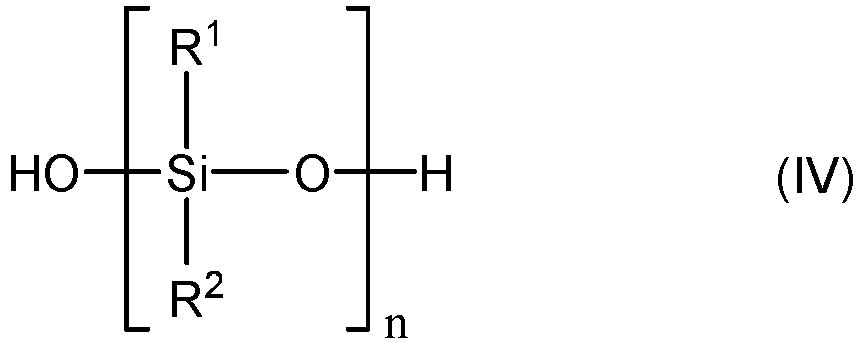
- Dabei stehen die Reste R1 und R2 unabhängig voneinander für lineare oder verzweigte, einwertige Kohlenwasserstoffreste mit 1 bis 12 C-Atomen, welche gegebenenfalls ein oder mehrere Heteroatome, und gegebenenfalls eine oder mehrere C-C-Mehrfachbindungen und/oder gegebenenfalls cycloaliphatische und/oder aromatische Anteile aufweisen.
- Insbesondere stehen die Reste R1 und R2 für Alkylreste mit 1 bis 5, insbesondere mit 1 bis 3, C-Atomen, bevorzugt für Methylgruppen.
- Der Index n ist so gewählt, dass das Gewichtsmittel des Molekulargewichts Mw des Polydiorganosiloxans P relativ zu Polystyrol 500 bis 250'000 g/mol beträgt. Insbesondere ist das Hydroxylgruppen terminierte Polydiorganosiloxan P' ein Polydiorganosiloxan P1 der Formel (I), wobei n so gewählt ist, dass das Gewichtsmittel des Molekulargewichts Mw des Polydiorganosiloxans P1 relativ zu Polystyrol 30'000 bis 80'000 g/mol, insbesondere 35'000 bis 60'000 g/mol, beträgt; oder dass als Polydiorganosiloxan P' eine Mischung eingesetzt wird von
- i') mindestens einem Hydroxylgruppen terminierten Polydiorganosiloxan P2 der Formel (I), wobei n so gewählt ist, dass das Gewichtsmittel des Molekulargewichts Mw des Polydiorganosiloxans P2 relativ zu Polystyrol > 80'000 bis 250'000 g/mol, insbesondere 90'000 bis 150'000 g/mol, beträgt; sowie
- ii') mindestens einem Hydroxylgruppen terminierten Polydiorganosiloxan P3 der Formel (I), wobei n so gewählt ist, dass das Gewichtsmittel des Molekulargewichts Mw des Polydiorganosiloxans P3 relativ zu Polystyrol 500 bis ≤ 30'000 g/mol, insbesondere 500 bis 25'000 g/mol, bevorzugt 1'000 bis 20'000 g/mol beträgt;
- i") mindestens einem Hydroxylgruppen terminierten Polydiorganosiloxan P1 der Formel (I), wobei n so gewählt ist, dass das Gewichtsmittel des Molekulargewichts Mw des Polydiorganosiloxans P1 relativ zu Polystyrol 30'000 bis 80'000 g/mol, insbesondere 35'000 bis 60'000 g/mol, beträgt; sow i e
- ii") mindestens einem Hydroxylgruppen terminierten Polydiorganosiloxan P3 der Formel (I), wobei n so gewählt ist, dass das Gewichtsmittel des Molekulargewichts Mw des Polydiorganosiloxans P3 relativ zu Polystyrol 500 bis ≤ 30'000 g/mol, insbesondere 500 bis 25'000 g/mol, bevorzugt 1'000 bis 20'000 g/mol beträgt.
- Hydroxylgruppen terminierte Polydiorganosiloxane, wie sie insbesondere in Formel (I) dargestellt sind, sind bekannt und kommerziell erhältlich. Auch die Herstellung derartiger Polydiorganosiloxane erfolgt in bekannter Art und Weise. Beispielsweise ist sie beschrieben in
US4962152 . - Die vorhergehend beschriebenen Hydroxylgruppen terminierten Polydiorganosiloxane P weisen bei 23°C vorzugsweise eine Viskosität zwischen 1 und 500'000 mPa s, insbesondere zwischen 10 und 250'000 mPa s, auf. Weiterhin bevorzugt weist das Polydiorganosiloxan P1 bei 23°C eine Viskosität zwischen 5'000 und 100'000 mPa·s, insbesondere zwischen 7'500 und 50'000 mPa·s, auf.
- Handelt es sich beim Polydiorganosiloxan P' um eine Mischung ist von mindestens einem Hydroxylgruppen terminierten Polydiorganosiloxan P2 und mindestens einem Hydroxylgruppen terminierten Polydiorganosiloxan P3, so weist das Polydiorganosiloxan P2 bei 23°C vorzugsweise eine Viskosität zwischen 100'000 und 500'000 mPa s, insbesondere zwischen 150'000 und 250'000 mPa s, auf und das Polydiorganosiloxan P3 weist bei 23°C vorzugsweise eine Viskosität zwischen 1 und 5'000 mPa·s, insbesondere zwischen 10 und 2'500 mPa·s, bevorzugt zwischen 20 und 1'000 mPas auf. Die angegebenen Viskositäten werden gemessen nach DIN 53018.
- Es kann vorteilhaft sein, mehrere verschiedene Polydiorganosiloxane P2 und/oder P3 als Mischung zu verwenden.
- Handelt es sich beim Polydiorganosiloxan P' um eine Mischung ist von mindestens einem Hydroxylgruppen terminierten Polydiorganosiloxan P1 und mindestens einem Hydroxylgruppen terminierten Polydiorganosiloxan P3, so weist das Polydiorganosiloxan P1 bei 23°C vorzugsweise eine Viskosität zwischen 100'000 und 500'000 mPa s, insbesondere zwischen 7'500 und 50'000 mPa s, auf und das Polydiorganosiloxan P3 weist bei 23°C vorzugsweise eine Viskosität zwischen 1 und 5'000 mPa·s, insbesondere zwischen 10 und 2'500 mPa·s, bevorzugt zwischen 20 und 1'000 mPas auf. Die angegebenen Viskositäten werden gemessen nach DIN 53018.
- Es kann vorteilhaft sein, mehrere verschiedene Polydiorganosiloxane P1 und/oder P3 als Mischung zu verwenden.
- Wird als Polydiorganosiloxan P' eine Mischung von mindestens einem Polydiorganosiloxan P2 und mindestens einem Polydiorganosiloxan P3 eingesetzt, liegt der Gewichtsanteil an Polydiorganosiloxan P2 in der Regel über dem Gewichtsanteil an Polydiorganosiloxan P3. Es ist jedoch zu berücksichtigen, dass die jeweiligen Anteile abhängig sind vom Molekulargewicht der jeweiligen Polydiorganosiloxane.
- Wird als Polydiorganosiloxan P' eine Mischung von mindestens einem Polydiorganosiloxan P1 und mindestens einem Polydiorganosiloxan P3 eingesetzt, liegt der Gewichtsanteil an Polydiorganosiloxan P1 in der Regel über dem Gewichtsanteil an Polydiorganosiloxan P3. Es ist jedoch zu berücksichtigen, dass die jeweiligen Anteile abhängig sind vom Molekulargewicht der jeweiligen Polydiorganosiloxane.
- Die Komponente A enthält das das Hydroxylgruppen terminierte Polydiorganosiloxan P oder das Hydroxylgruppen terminierte Polydiorganosiloxan P' bevorzugt in einer Menge von zwischen 30 Gew.-% und 70 Gew.-%, bevorzugt zwischen 30 Gew.-% und 50 Gew.-%, bezogen auf die Komponente A.
- Handelt es sich beim Polydiorganosiloxan P' um eine Mischung ist von mindestens einem Hydroxylgruppen terminierten Polydiorganosiloxan P2 und mindestens einem Hydroxylgruppen terminierten Polydiorganosiloxan P3, so enthält Komponente A bevorzugt zwischen 20 Gew.-% und 60 Gew.-%, bevorzugt zwischen 30 Gew.-% und 50 Gew.-%, bezogen auf die Komponente A, an Hydroxylgruppen terminierten Polydiorganosiloxan P2, sowie zwischen 1 Gew.-% und 15 Gew.-%, bevorzugt zwischen 2 Gew.-% und 10 Gew.-%, bezogen auf die Komponente A, an Hydroxylgruppen terminierten Polydiorganosiloxan P3.
- Handelt es sich beim Polydiorganosiloxan P' um eine Mischung ist von mindestens einem Hydroxylgruppen terminierten Polydiorganosiloxan P1 und mindestens einem Hydroxylgruppen terminierten Polydiorganosiloxan P3, so enthält Komponente A bevorzugt zwischen 20 Gew.-% und 60 Gew.-%, bevorzugt zwischen 30 Gew.-% und 50 Gew.-%, bezogen auf die Komponente A, an Hydroxylgruppen terminierten Polydiorganosiloxan P1, sowie zwischen 0.5 Gew.-% und 15 Gew.-%, bevorzugt zwischen 0.75 Gew.-% und 10 Gew.-%, bezogen auf die Komponente A, an Hydroxylgruppen terminierten Polydiorganosiloxan P3.
- Die beschriebenen Polydiorganosiloxane P können in jeder Ausführungsform auch Anteile an Verzweigungen aufweisen (sogenannte T-Einheiten), welche Si-OH Gruppen an Seitenketten tragen. Es ist allerdings bevorzugt, dass die Polyidorganosiloxane vorwiegend linear und ohne SI-OH-reaktive Seitenketten ausgebildet sind. Für die beschriebenen Polydiorganosiloxane P2 insbesondere kann es jedoch hinsichtlich der mechanischen Eigenschaften der ausgehärteten Zusammensetzung vorteilhaft sein, wenn ein geringer Anteil der Polydorganosiloxaneinheiten des Polydiorganosiloxans P2 aus T-Einheiten besteht, bevorzugt 0-10%, inbesondere 0.01 bis 5%, meist bevorzugt 0.02 bis 1% der Siloxaneinheiten des Polydiorganosiloxans P2. Die restlichen Siloxaneinheiten sind in allen Fällen D-Einheiten, also streng lineare Siloxaneinheiten ohne Si-OH-Gruppen.
- Die Komponente A der zweikomponentigen Siliconzusammensetzung umfasst weiterhin zwischen 0.05 Gew.-% und 5.0 Gew.-% emulgiertes Wasser, bezogen auf Komponente A. Wasser in der Komponente A führt zu einer raschen, gleichmässigen Aushärtung der gemischten zweikomponentigen Zusammensetzung und ist wesentlich, um eine erfindungsgemäss rasche und gleichmäsige Aushärtung ermöglichen. Bevorzugt ist Wasser mit einer Menge von zwischen 0.1 Gew.-% und 2.5 Gew.-%, insbesondere zwischen 0.1 Gew.-% und 1.5 Gew.-%, bezogen auf Komponente A, enthalten.
- Das Wasser ist dabei nicht in freier Form oder als adsorbiertes Wasser (etwa auf Füllstoffen) enthalten, sondern als Emulsion (beispielsweise in Siliconöl) eingemischt. Dies ermöglicht eine homogenere Einmischung mit geringen Konzentrationsgradienten und nach Applikation gleichmässigerer Aushärtung der gemischten Zusammensetzung. Als vorteilhaft haben sich beispielsweise Wasser/Öl Emulsionen mit 40 bis 60 Gew.-% Wasser erwiesen.
- Die Komponente A der zweikomponentigen Siliconzusammensetzung kann weiterhin zusätzliche Additive, wie beispielsweise Füllstoffe, Weichmacher, Pigmente, sowie Formulierungsadditive wie Dispersionsadditive oder Thixotropiermittel enthalten. Solche Zusatzstoffe sind dem Fachmann der Siliconformulierung bekannt. Diese Zusatzstoffe können die Verarbeitbarkeit und Mischbarkeit der Komponente A und/oder der gemischten zweikomponentigen Siliconzusammensetzung verbessern. Sie sind aber nicht wesentlich für die Wirkung der Erfindung.
- Die zweite Komponente B der zweikomponentigen Siliconzusammensetzung enthält:
- i) mindestens ein nicht kondensierbares Polyidiorganosiloxan als Weichmacher W;
- ii) mindestens ein Organosilan V als Vernetzer;
- iii) mindestens einen Katalysator K für die Vernetzung von Polydiorganosiloxanen;
- alle Organosilane V vorzugsweise dieselben hydrolysierbaren Alkoxysilangruppen aufweisen, bevorzugt Methoxysilangruppen; und Katalysator K ein Zinnkomplex mit zwei Mercaptidliganden nach Formel (V) ist,

- wobei Liganden L1 unabhängig voneinander für über Schwefel koordinierte Alkylmercaptipde stehen, insbesondere C6 bis C16 Alkylmercaptide, wobei Liganden L1 optional Methyldialkoxysilagruppen, bevorzugt Methyldimethoxysilangruppen aufweisen, und Liganden L2 unabhängig voneinander für Alkylliganden stehen, insbesondere für C6 bis C14 Alkylliganden; und
- Komponente B weniger als 5 Gew.-% Russ, bezogen auf Komponente B, enthält.
- Komponente B, und bevorzugt auch Komponente A, enthalten mindestens ein nicht kondensierbares Polyidiorganosiloxan als Weichmacher W. Dabei handelt es sich üblicherweise um ein Polydiorganosiloxan, dessen Endgruppen mit Alkyl- oder Vinylgruppen verschlossen sind und das Polydiorganosiloxan demzufolge keine Kondensations- oder Vernetzungsreaktionen eingehen kann.
- Als Weichmacher W sind besonders trialkylsilylterminierte Polydialkylsiloxane geeignet, insbesondere trimethylsilylterminierte Polydimethylsiloxane, wie weiter oben bereits beschreiben. Es können jedoch auch trimethylsilylterminierte Polydimethylsiloxane eingesetzt werden, bei denen einige der Methylgruppen durch andere organische Gruppen wie zum Beispiel Phenyl, Vinyl oder Trifluorpropyl ersetzt sind. Obwohl besonders bevorzugt lineare trimethylsilylterminierte Polydimethylsiloxane als Weichmacher W eingesetzt werden, können auch solche Verbindungen verwendet werden, die verzweigt sind. Derartige verzweigte Verbindungen entstehen dadurch, dass in den zu ihrer Herstellung dienenden Ausgangsstoffen kleine Mengen tri- oder tetrafunktioneller Silane verwendet werden. Es ist auch möglich anstatt der Polysiloxan-Weichmacher, andere organische Verbindungen, wie zum Beispiel bestimmte Kohlenwasserstoffe, Hydroxyl-freie Polyether oder deren Gemische, als Weichmacher W einzusetzen. Derartige Kohlenwasserstoffe können aromatisch oder aliphatisch sein. Bei der Auswahl ist insbesondere darauf zu achten, dass diese Kohlenwasserstoffe eine geringe Flüchtigkeit und eine hinreichende Verträglichkeit mit den übrigen Bestandteilen der Siliconzusammensetzung aufweisen.
- Bevorzugt werden als Weichmacher W Polydimethylsiloxane mit Viskositäten zwischen 1 und 200'000 mPa·s. Besonders bevorzugt sind Viskositäten zwischen 10 und 150'000 mPa·s.
- Dabei ist es besonders vorteilhaft und bevorzugt, wenn in der Komponente A als Weichmacher W trialkylsilylterminierte Polydimethylsiloxane mit Viskositäten zwischen 1 und 10'000 mPa s, bevorzugt zwischen 10 und 1'000 mPa·s eingesetzt werden. Damit können besonders vorteilhafte Viskositäten für die Komponente A eingestellt werden, was die Mischung erleichtert.
- Es ist weiterhin besonders vorteilhaft und bevorzugt, wenn in der Komponente B als Weichmacher W trialkylsilylterminierte Polydimethylsiloxane mit Viskositäten zwischen 10'000 und 200'000 mPa s, bevorzugt zwischen 20'000 und 150'000 mPa·s eingesetzt werden. Damit kann eine besonders gute Lagerstabilität und besonders niedrige Tendenz zur Phasenseparation in der Komponente B erreicht werden.
- Solche Weichmacher W sind dem Fachmann der Siliconformulierung bestens bekannt und diese werden beispielsweise unter der Handelsnamenserie Wacker® AK von Wacker Chemie, Deutschland vertrieben und weiter unten detaillierter beschrieben. Diese nicht reaktiven Polydiorganosiloxane werden auch als Siliconöle bezeichnet. Sie sind in verschiedenen Kettenlängen und damit Viskositäten erhältlich und haben vor allem den Zweck, Festkörperbestandteile wie Füllstoffe gut einmischbar und mit den anderen Bestandteilen homogenisierbar zu machen sowie die mechanischen Eigenschaften und Fliesseigenschaften der Zusammensetzung zu verbessern.
- Komponente B enthält bevorzugt zwischen 30 Gew.-% und 50 Gew.-% an Weichmacher W.
- Komponente A enthält bevorzugt zwischen 1 Gew.-% und 15 Gew.-% an Weichmacher W. Komponente A benötigt weniger oder gar keinen Weichmacher W, da Komponente A bereits flüssige Hydroxylgruppen terminierte Polydiorganosiloxane enthält.
- Es kann von Vorteil sein, verschiedene solche Weichmacher W zu kombinieren, beispielsweise mit unterschiedlichen Viskositäten oder unterschiedlichen Endgruppen.
- Bevorzugt enthält Komponente B mindestens einen Weichmacher W mit Vinylsilan-Endgruppen oder Methylsilan-Endgruppen.
- Die Komponente B der zweikomponentigen Siliconzusammensetzung umfasst weiterhin mindestens einen Katalysator K für die Vernetzung von Polydiorganosiloxanen.
- Katalysator K ist ein Zinnkomplex mit zwei Mercaptidliganden nach Formel (V) ist,

- Katalysator K ist also ein Sn(IV)-Komplex mit zwei C3 bis C18 Alkylliganden L2, insbesondere zwei C6 bis C14 Alkylliganden L2.
- Es hat sich herausgestellt, dass sehr kurze Alkylliganden, wie beispielsweise Methylliganden, zu einer schlechten Lagerstabilität der Komponente B führen und daher als Ligand L2 nicht geeignet sind.
- Bevorzugt sind Liganden L2 C6 bis C14 Alkylliganden, insbesondere Phenyl-, Hexyl-, Octyl-, oder Dodecylliganden, meist bevorzugt Octylliganden. Diese bilden besonders lagerstabile Komplexe und eine besonders gute erfindungsgemässe Aktivität in der Zusammensetzung.
- Weiterhin weist Katalysator K zwei über die Schwefelatome koordinierte Mercaptidlinganden L1, insbesondere C6 bis C16 Alkylmercaptide, wobei Liganden L1 optional Methyldialkoxysilagruppen, bevorzugt Methyldimethoxysilangruppen aufweisen, auf. Der Begriff Mercaptid wird synonym mit dem Begriff Thiolat verwendet und beschreibt deprotonierte R-S- Liganden, wobei R ein organischer Rest ist.
- Es hat sich herausgestellt, dass die beiden Liganden L1 nicht einen einzigen bidentaten Liganden mit zwei Thiolatgruppen darstellen können, da der Chelateffekt die erfindungsgemässe Wirkung möglicherweise beeinträchtigt. Daher müssen Liganden L1 zwei einzeln koordinierte Alkylmercaptidliganden sein. Es ist bevorzugt, dass diese Liganden keine weiteren an Zinn koordinierbare Heteroatome aufweisen, wie beispielsweise Amino- oder Carboxylatgruppen. Bevorzugt umfassen Liganden L1 keine funktionellen Gruppen mit Heteroatomen, ausser Methyldialkoxysilangruppen. Methyldialkoxysilangruppen, insbesondere Methyldimethoxysilangruppen, können hingegen vorteilhaft sein, da sie sich ins Polymergerüst einbauen können und dadurch die Mobilität der Schwefelliganden einschränken. Dies hat den Vorteil, dass unerwünschte Migrationseffekte und/oder allfällige Vergilbungen verhindert werden. Es ist allerdings bevorzugt, wenn die Methylalkoxysilangruppen, falls vorhanden, dieselben Alkoxysilangruppen aufweisen wie die Vernetzer V.
- Weiterhin hat sich herausgestellt, dass Liganden L1 mit Trialkoxysilangruppen nicht geeignet sind, da sie die Wirksamkeit des Katalysators und die Lagerstabilität der Zusammensetzung beeinträchtigen.
- Bevorzugt sind Liganden L1 Dodecylthiolatliganden, Octadecylthiolatliganden, oder 3-Mercaptopropyl-methyldimethoxysilan-Liganden, welche über das Schwefelatom koordiniert sind.
- Besonders bevorzugt sind Dodecylthiolatliganden. Diese führen zu einem besonders wirksamen, besonders lagerstabilen Katalysator K. Dodecylthioliganden haben den weiteren Vorteil, dass sie, im Vergleich zu Liganden mit kürzeren Alkylketten, einen kaum wahrnehmbaren Geruch haben, aber trotzdem, im Vergleich zu Liganden mit längeren Alkylketten, bei Raumtemperatur flüssig und somit gut handhabbar sind.
- Weiterhin besonders bevorzugt sind 3-Mercaptopropyl-methyldimethoxysilan-Liganden, welche über das Schwefelatom koordiniert sind.
- Diese führen zu einem besonders wirksamen Katalysator K und zu besonders niedriger Vergilbungsneigung der ausgehärteten Zusammensetzung.
- In einer besonders bevorzugten Ausführungsform von Katalysator K stehen in der Formel (V) beide Liganden L1 für Dodecylmercaptid und beide Liganden L2 für Octyl.
- In einer weiteren besonders bevorzugten Ausführungsform von Katalysator K stehen in der Formel (V) beide Liganden L1 für 3-Mercaptopropyl-methyldimethoxysilan und beide Liganden L2 für Octyl.
- Katalysatoren K können einfach hergestellt werden, indem beispielsweise Dialkylzinndiacetate mit den entsprechenden Mercaptanliganden in einem molaren Verhältnis von ungefähr 2:1 (Ligand : Zinnkomplex) unter Luftausschluss miteinander während 24h bei 23 °C verrührt werden. Dabei durch Ligandenaustausch entstehende Nebenprodukte, wie beispielsweise Essigsäure, können vorteilhafterweise, zum Beispiel destillativ bei erniedrigtem Druck, entfernt werden.
- Selbstverständlich ist es möglich oder in gewissen Fällen sogar bevorzugt, Mischungen verschiedener Katalysatoren einzusetzen.
- Der Anteil des Katalysators K für die Vernetzung von Polydiorganosiloxanen beträgt vorzugsweise 0.05 bis 10 Gew.-%, insbesondere 0.1 bis 5 Gew.-%, bevorzugt 0.25 bis 4 Gew.-%, bezogen auf Komponente B der zweikomponentigen Siliconzusammensetzung.
- Die Menge an Katalysator K beeinflusst die Topfzeit und den einstellbaren Bereich der Topfzeit der gemischten zweikomponentigen Zusammensetzung. Je höher der Gehalt an Katalysator, desto kürzer wird tendenziell die einstellbare Topfzeit sowie desto schneller wird die anschliessende Aushärtung. Diese Effekte werden jedoch in hohem Masse auch von der Wahl der Vernetzer beeinflusst. Darauf wird weiter unten eingegangen.
- Die Komponente B der zweikomponentigen Siliconzusammensetzung enthält weiterhin mindestens einen, bevorzugt mehrere verschiedene Vernetzer für Siliconzusammensetzungen. Als Vernetzer werden dabei organische Siliciumverbindungen mit hydrolysierbaren Alkoxysilangruppen bezeichnet. Die vorliegende Erfindung unterscheidet drei verschiedene Vernetzertypen V1, V2 und V3, welche im Folgenden näher erläutert werden.
- Es ist vorteilhaft und bevorzugt für die Wirkung der vorliegenden Erfindung, wenn alle Vernetzer in der Zusammensetzung dieselben Alkoxysilangruppen tragen. Beispielsweise können alle Vernetzer Methoxysilangruppen oder alle Vernetzer Ethoxysilangruppen aufweisen. Mischungen verschiedener Alkoxysilangruppen sind meist nicht vorteilhaft und können den Effekt der Erfindung behindern oder gar verhindern.
- Es können jedoch durchaus Mischungen von Vernetzern mit Methoxy- und Ethoxysilangruppen eingesetzt werden, beispielsweise wenn der am langsamsten hydrolysierende Vernetzer V anstatt Methoxysilangruppen Ethoxysilangruppen aufweist und alle anderen, schnelleren Vernetzer V Methoxysilangruppen. Auch wenn ein Gemisch von Vernetzern V eingesetzt wird, können Vernetzer mit einem sehr kleinen Anteil an der Mischung andere Alkoxysilangruppen aufweisen als der Rest der Vernetzer, die jedoch bezüglich Alkoxysilangruppen dann gleichartig sein sollten. In solchen Mischungen wird der Effekt der Erfindung nicht beeinträchtigt.
- Komponente B der erfindungsgemässen Zusammensetzung enthält zwischen 0 und 50 Gew.-%, bezogen auf Komponente B, mindestens eines ersten Organosilans V1 nach Formel (I),

- wobei Ra für ein Wasserstoffatom oder einen monovalenten, linearen oder verzweigten Alkylrest mit 1 bis 6 Kohlenstoffatomen steht,
- Rb für einen divalenten, linearen oder verzweigten Alkylrest oder Alkenylrest mit 2 bis 20 Kohlenstoffatomen steht.
- Bevorzugt steht Ra für ein Wasserstoffatom oder einen Methyl- oder Ethylrest. Am meisten bevorzugt steht Ra für ein Wasserstoffatom oder einen Methylrest. Silane V1 mit Ethylresten als Ra, welche nach Hydrolyse in Wasserstoffatome überführt werden, sind besonders vorteilhaft, weil sie einerseits eine besonders gut kontrollierbare Topfzeiteinstellung ermöglichen, trotzdem sehr rasch aushärten, und darüber hinaus keine giftigen Methanolemissionen verursachen.
- Silane V1 mit Methylresten als Ra, welche nach Hydrolyse in Wasserstoffatome überführt werden, sind besonders vorteilhaft, weil sie nach Ende der Topfzeit besonders rasch aushärten, und trotzdem lange Topfzeiten und lange Mischeroffenzeiten ermöglichen.
- Bevorzugt steht Rb für einen linearen Alkylrest oder Alkenylrest mit 2 bis 12 Kohlenstoffatomen, bevorzugt mit 2 bis 6 Kohlenstoffatomen, meist bevorzugt einen Ethylrest, einen Propylrest, einen Ethylenrest oder einen Propenylrest.
- Organosilan V1 ist nicht unbedingt nötig für den Effekt der Erfindung, weist aber in Kombination mit Organosilan V2 den Vorteil auf, dass es bei Anwesenheit in der Formulierung die Topfzeit besser einstellbar macht. Unter Verwendung eines Organosilans V1 kann die maximal mögliche Topfzeit der Zusammensetzung erhöht werden, ohne jedoch die Aushärtegeschwindigkeit nach Ende der Topfzeit wesentlich zu verlangsamen.
- Bevorzugte Ausführungsformen der erfindungsgemässen Zusammensetzung enthalten zwischen 10 Gew.-% und 30 Gew.-%, bevorzugt zwischen 12 Gew.-% und 20 Gew.-%, an Organosilan V1, bezogen auf Komponente B.
- Komponente B der erfindungsgemässen Zusammensetzung enthält zwischen 2 und 60 Gew.-%, bezogen auf Komponente B, mindestens eines zweiten Organosilans V2 nach Formel (II),

- wobei Ra dieselbe Bedeutung wie für das Organosilan V1 beschrieben aufweist, und
- Rc für einen divalenten, linearen oder verzweigten Alkylrest mit 2 bis 20 Kohlenstoffatomen steht, der mindestens eine sekundäre Aminogruppe sowie optional eine Hydroxylgruppe sowie einen Ethersauerstoff enthält.
- Bevorzugt besitzt Organosilan V2 eine Struktur wie in Formel (IIa) beschrieben,

- wobei Rd für einen divalenten, linearen oder verzweigten Alkylrest mit 2 bis 10 Kohlenstoffatomen steht, der optional eine Hydroxylgruppe sowie einen Ethersauerstoff enthält, und
- Re für einen divalenten, linearen oder verzweigten Alkylrest mit 2 bis 10 Kohlenstoffatomen steht, der optional eine sekundäre Aminogruppe enthält.
- Bevorzugte Ausführungsformen der erfindungsgemässen Zusammensetzung enthalten zwischen 5 Gew.-% und 50 Gew.-%, bevorzugt zwischen 10 Gew.-% und 45 Gew.-%, an Organosilan V2, bezogen auf Komponente B.
- In einer bevorzugten Ausführungsform handelt es sich beim Organosilan V2 um ein Organosilan V2a, bei dem die Reste Rd und Re in Formel (IIa) beide für einen divalenten, linearen oder verzweigten Alkylrest mit 2 bis 10 Kohlenstoffatomen stehen, insbesondere einen Propylrest.
- In einer anderen besonders bevorzugten Ausführungsform handelt es sich beim Organosilan V2 um ein Organosilan V2b, bei dem Rest Re in Formel (IIa) für einen divalenten, linearen oder verzweigten Alkylrest mit 2 bis 10 Kohlenstoffatomen steht, der optional eine sekundäre Aminogruppe enthält, insbesondere einen Propylrest oder einen Cs-Alkylrest, der eine sekundäre Aminogruppe in der Kohlenstoffkette aufweist, und Rest Rd einen divalenten, linearen oder verzweigten Alkylrest mit 2 bis 10 Kohlenstoffatomen, insbesondere einen Propylrest, enthält sowie zusätzlich eines der beiden Strukturelemente enthält, die in Formel (IIb) dargestellt sind. Dabei steht die NH Gruppe in Formel (IIb) für die NH Gruppe in Formel (IIa) und die gestrichelte Linie am Sauerstoffatom ist an den divalenten, linearen oder verzweigten Alkylrest mit 2 bis 10 Kohlenstoffatomen, insbesondere den Propylrest, gebunden.

- Organosilane V2a sind kommerziell erhältlich, beispielsweise unter den Handelsnamen Dynasylan® 1122 und Dynasylan® 1124 (Evonik). Dynasylan® 1124 ist Bis(trimethoxysilylpropyl)amin und Dynasylan® 1122 ist Bis(trimethoxysilylpropyl)amin.
- Organosilane V2b sind leicht aus kommerziell verfügbaren Organosilanen herstellbar, beispielsweise aus der Reaktion einer äquimolaren Menge an 3-Aminopropyltriethoxysilan mit 3-Glyxidoxypropyltriethoxysilan unter Wasserausschluss bis zur vollständigen Umsetzung der Epoxygruppen.
- Eine besonders bevorzugte Ausführungsform von Organosilan V2b weist in Formel (IIa) für Rest Re einen divalenten C5 Alkylrest auf, welcher eine sekundäre Aminogruppe in der Kohlenstoffkette aufweist und für Rest Rd einen linearen, divalenten C6 Alkylrest, welcher einen Ethersauerstoff in der Kohlenstoffkette aufweist sowie eine Hydroxylgruppe aufweist. Dieses besitzt bevorzugt ausschliesslich Methoxysilangruppen als Alkoxysilangruppen. Ein solches Organosilan ist beispielsweise herstellbar aus der Reaktion einer äquimolaren Menge von N-(2-Aminoethyl)-3-aminopropyltrimethoxysilan (z.B. Geniosil® GF 91, Wacker) mit 3-Glyxidoxypropyltrimethoxysilan (z.B. Geniosil® GF 80, Wacker) unter Wasserausschluss bis zur vollständigen Umsetzung der Epoxygruppen.
- In bevorzugten Ausführungsformen der erfindungsgemässen Zusammensetzung umfasst Organosilan V2 ein Organosilan V2a wie vorgängig beschrieben, wobei Organosilan V2a in einer Menge von zwischen 5 Gew.-% und 20 Gew.-% bezogen auf Komponente B enthalten ist, und weiterhin umfasst Organosilan V2 ein Organosilan V2b wie vorgängig beschreiben, wobei Organosilan V2b in einer Menge von zwischen 5 Gew.-% und 20 Gew.-% bezogen auf Komponente B enthalten ist, und die Zusammensetzung umfasst weiterhin mindestens ein Organosilan V3 mit einer Menge von zwischen 2.5 Gew.-% und 20 Gew.-% bezogen auf Komponente B, und der Katalysator K ist in einer Menge von zwischen 0.1 Gew.-% und 1.5 Gew.-%, bezogen auf Komponente B, in der Komponente B enthalten. Diese Ausführungsform ermöglicht eine besonders geeignete, ausreichend lange Topfzeit und Mischeroffenzeit und eine besonders rasche Aushärtung nach Ende der Topfzeit und eine besonders gute Lagerstabilität insbesondere der Komponente B.
- In bevorzugten Ausführungsformen der erfindungsgemässen Zusammensetzung wird eine Mischung aus Organosilan V2a und Organosilan V2b als Organosilan V2 eingesetzt. In diesen Ausführungsformen beträgt der Gehalt an Katalysator K bevorzugt zwischen 0.1 Gew.-% und 2 Gew.-%, insbesondere zwischen 0.2 Gew.-% und 1 Gew.-%, bezogen auf Komponente B. Dies ermöglicht eine sehr genau einstellbare, anwenderfreundliche aber doch kurze bis mittlere Topfzeit und eine sehr rasche Aushärtung und ist besonders für maschinelle, automatisierte Applikation mit kurzen Taktzeiten geeignet, sowie besonders gut für eine frei wählbare Topfzeit mittels verschiedenen Mischungsverhältnissen der Komponente A und B. Dies ist besonders vorteilhaft für eine flexible Applikation oder bei komplexen Anwendungen, wo eine wechselnde Topfzeit aber stets identische Endeigenschaften der gehärteten Zusammensetzung erwünscht ist.
- In dieser Ausführungsform werden die Organosilane V2a und V2b bevorzugt im Gewichtsverhältnis zwischen 1:2 und 2:1 in der Formulierung eingesetzt. Bevorzugte Ausführungsformen dieser Ausführungsform der erfindungsgemässen Zusammensetzung enthalten zwischen 5 Gew.-% und 25 Gew.-%, bevorzugt zwischen 7.5 Gew.-% und 22.5 Gew.-%, an Organosilan V2a, bezogen auf Komponente B, sowie zwischen 0 Gew.-% und 25 Gew.-%, bevorzugt zwischen 5 Gew.-% und 22.5 Gew.-%, an Organosilan V2b, bezogen auf Komponente B.
- Die Komponente B der zweikomponentigen Siliconzusammensetzung umfasst weiterhin bevorzugt zwischen 0 und 25 Gew.-%, bezogen auf Komponente B, weitere Organosilane V3 mit hydrolysierbaren Alkxoysilangruppen Si-ORa, welche nicht unter die Formeln (I) und (II) fallen. Diese dienen ebenfalls als Vernetzer, sind jedoch optional.
- Das zusätzliche Organosilan V3 ist insbesondere ein Silan der Formel (III).

- Der Rest R3 steht dabei unabhängig voneinander für einen linearen oder verzweigten, einwertigen Kohlenwasserstoffrest mit 1 bis 12 C-Atomen, welcher gegebenenfalls ein oder mehrere Heteroatome, und gegebenenfalls eine oder mehrere C-C-Mehrfachbindungen und/oder gegebenenfalls cycloaliphatische und/oder aromatische Anteile aufweist.
- Der Rest R4 steht für einen Rest Ra wie weiter oben beschrieben.
- Der Index p steht für einen Wert von 0 bis 4, mit der Massgabe, dass falls p für einen Wert von 3 oder 4 steht, mindestens p-2 Reste R3 jeweils mindestens eine mit den Hydroxylgruppen des Polydiorganosiloxans P reaktive, insbesondere kondensierbare, Gruppe, also beispielsweise eine Hydroxylgruppe aufweisen. Insbesondere steht p für einen Wert von 0, 1 oder 2, bevorzugt für einen Wert von 0.
- Für die Wahl des Silans der Formel (III) als Vernetzer für Polydiorganosiloxane können unterschiedliche Anforderungen an die zweikomponentige Siliconzusammensetzung ausschlaggebend sein. Einerseits spielt die Reaktivität des Silans eine wichtige Rolle, andererseits können auch toxikologische Gründe für die Wahl des Vernetzers ausschlaggebend sein.
- Beispiele geeigneter Silane der Formel (III) sind Methyltrimethoxysilan, Chlormethyltrimethoxysilan, Ethyltrimethoxysilan, Propyltrimethoxysilan, Octyltrimetoxysilan, Methyltriethoxysilan, Phenyltriethoxysilan, Methyltripropoxysilan, Phenyltripropoxysilan, Octyltriethoxysilan, Tetramethoxysilan, Tetraethoxysilan, Tetra-n-propoxysilan oder Tetra-n-butoxysilan. Besonders bevorzugt handelt es sich beim Silan der Formel (III) um Methyltrimethoxysilan, Dimethyltrimethoxysilan oder Tetramethoxysilan oder deren Mischung, ganz besonders bevorzugt Methyltrimethoxysilan, Octyltrimethoxysilan, oder Mischungen davon.
- Es hat sich herausgestellt, dass Vinyltrimethoxysilan oder Vinyltriethoxysilan nicht als Vernetzer geeignet sind, da die Vinylgruppe die Lagerstabilität stark beeinträchtigt.
- Mit einer Mischung aus Methyltrimethoxysilan und Octyltrimethoxysilan als Vernetzer V3 kann die Topfzeit und die Mischeroffenzeit einer erfindungsgemässen Siliconzusammensetzung eingestellt werden, wobei eine höhere Menge an Octyltrimethoxysilan zu einer längeren Topf- und Mischeroffenzeit führt.
- Weiterhin können die Silane, die in Komponente B enthalten sind, auch bereits teilweise (ein Teil aller R4 = H) oder vollständig hydrolysiert (alle R4 = H) vorliegen. Aufgrund der stark erhöhten Reaktivität von teilweise oder vollständig hydrolysierten Silanen kann ihr Einsatz als Vernetzer vorteilhaft sein. Dem Fachmann ist dabei bekannt, dass es beim Einsatz von teilweise oder vollständig hydrolysierten Silanen zur Bildung von oligomeren Siloxanen, insbesondere zu Dimeren und/oder Trimeren kommen kann, welche durch Kondensation von hydrolysierten Silanen gebildet werden. Demnach können als Vernetzer für die zweikomponentige Siliconzusammensetzung auch oligomere Siloxane eingesetzt werden.
- Beispielsweise sind geeignete oligomere Siloxane Hexamethoxydisiloxan, Hexaethoxydisiloxan, Hexa-n-propoxydisiloxan, Hexa-n-butoxydisiloxan, Octamethoxytrisiloxan, Octaethoxytrisiloxan, Octa-n-butoxytrisiloxan, Decamethoxytetrasiloxan und Decaethoxytetrasiloxan.
- Selbstverständlich kann als Vernetzer für die zweikomponentige Siliconzusammensetzung auch eine beliebige Mischung der vorhergehend genannten Silane eingesetzt werden.
- Der Anteil des Organosilans V3 beträgt vorzugsweise 0.1 bis 25 Gew.-%, insbesondere 0.5 bis 20 Gew.-%, bevorzugt 1 bis 15 Gew.-%, bezogen auf Komponente B der zweikomponentigen Siliconzusammensetzung.
- Die zweikomponentige Siliconzusammensetzung kann in einer oder beiden der Komponenten A und B gegebenenfalls noch weitere Bestandteile enthalten. Derartige zusätzliche Bestandteile sind insbesondere Weichmacher W wie weiter oben beschrieben, welche zwingend sind in Komponente B, anorganische und/oder organische Füllstoffe, Härtungsbeschleuniger, Pigmente, Haftvermittler, Verarbeitungshilfsmittel, Rheologiemodifikatoren, Stabilisatoren, Farbstoffe, Inhibitoren, Hitzestabilisatoren, Antistatika, Flammschutzmittel, Biozide, Wachse, Verlaufsmittel, Thixotropierungsmittel und weitere dem Fachmann bekannte gängige Rohstoffe und Additive.
- Beim Einsatz von derartigen optionalen Bestandteilen ist es wichtig darauf zu achten, dass Bestandteile, welche durch Reaktion untereinander oder mit anderen Inhaltsstoffen die Lagerstabilität der Zusammensetzung beeinträchtigen könnten, getrennt voneinander, aufbewahrt werden.
- Weiterhin ist es vorteilhaft, alle genannten, in der zweikomponentigen Siliconzusammensetzung gegebenenfalls vorhandenen, Bestandteile so auszuwählen, dass die Lagerstabilität der beiden Komponenten der zweikomponentigen Siliconzusammensetzung durch die Anwesenheit eines solchen Bestandteils nicht negativ beeinflusst wird, das heisst, dass sich die Zusammensetzung in ihren Eigenschaften, insbesondere den Applikations- und Aushärtungseigenschaften, bei der Lagerung nicht oder nur wenig verändert. Dies bedingt, dass zur chemischen Aushärtung der beschriebenen zweikomponentigen Siliconzusammensetzung führende Reaktionen während der Lagerung nicht in signifikantem Ausmass auftreten. Es ist deshalb insbesondere von Vorteil, dass die genannten Bestandteile kein oder höchstens Spuren von Wasser enthalten oder beim Lagern freisetzen. Deshalb kann es sinnvoll sein, gewisse Bestandteile vor dem Einmischen in die Zusammensetzung chemisch oder physikalisch zu trocknen.
- Vorzugsweise weist die Zusammensetzung in einer oder beiden der Komponenten A und B weiterhin mindestens einen Füllstoff auf, insbesondere in Komponente A. Der Füllstoff beeinflusst sowohl die rheologischen Eigenschaften der nicht ausgehärteten Zusammensetzung als auch die mechanischen Eigenschaften und die Oberflächenbeschaffenheit der ausgehärteten Zusammensetzung. Es können sowohl aktive, als auch passive Füllstoffe in der zweikomponentigen Siliconzusammensetzung eingesetzt werden. Bei aktiven Füllstoffen treten chemische oder physikalische Wechselwirkungen mit dem Polymer auf, bei passiven Füllstoffen treten diese nicht oder nur in untergeordnetem Umfang auf.
- Geeignete Füllstoffe sind anorganische und organische Füllstoffe, zum Beispiel natürliche, gemahlene oder gefällte Calciumcarbonate, welche gegebenenfalls mit Fettsäuren, insbesondere Stearinsäure, oder mit vorzugsweise hydrophoben Silanen, bzw. Siloxanen beschichtet sind, calcinierte Kaoline, Aluminiumoxide, Aluminiumhydroxide, Kieselsäuren, insbesondere hochdisperse Kieselsäuren aus Pyrolyseprozessen, Russ, insbesondere industriell hergestellter Russ ("carbon black"), der jedoch in Komponente B nur eingeschränkt eingesetzt werden kann, Aluminiumsilicate, Magnesium-Aluminiumsilicate, Zirkoniumsilicate, Quarzmehl, Christobalitmehl, Diatomeenerde, Glimmer, Eisenoxide, Titanoxide, Zirconiumoxide, Gips, Annalin, Bariumsulfat (BaSO4, auch Baryt oder Schwerspat genannt), Borcarbid, Bornitrid, Graphit, Kohlefasern, Glasfasern oder Glashohlkugeln, deren Oberfläche gegebenenfalls mit einem Hydrophobierungsmittel behandelt ist. Bevorzugte Füllstoffe sind Calciumcarbonate, calcinierte Kaoline, Russ, hochdisperse Kieselsäuren sowie flammhemmende Füllstoffe, wie Hydroxide oder Hydrate, insbesondere Hydroxide oder Hydrate von Aluminium, bevorzugt Aluminiumhydroxid.
- In einer bevorzugten Ausführungsform enthält die Siliconzusammensetzung hochdisperse Kieselsäuren aus Pyrolyseprozessen oder gefällte und/oder gemahlene Calciumcarbonate, insbesondere hydrophob beschichtete, als Füllstoff.
- Komponente A enthält bevorzugt mindestens einen Füllstoff, insbesondere gefällte und/oder gemahlene, bevorzugt hydrophob beschichtete, Calciumcarbonate.
- Komponente B enthält bevorzugt hochdisperse Kieselsäuren aus Pyrolyseprozessen. Komponente B muss weniger als 5 Gew.-% Russ, bezogen auf Komponente B, enthalten. Bevorzugt enthält Komponente B keinen Russ. Russ behindert die erfindungsgmässe Wirkung des Katalysators K.
- Es ist durchaus möglich und kann sogar von Vorteil sein, eine Mischung verschiedener Füllstoffe einzusetzen.
- Eine geeignete Menge Füllstoff liegt beispielsweise im Bereich von 10 bis 70 Gew.-%, insbesondere 15 bis 60 Gew.-%, bevorzugt 30 bis 60 Gew.-%, bezogen auf die gesamte zweikomponentige Siliconzusammensetzung.
- Besonders geeignet als Haftvermittler sind Alkoxysilane, welche vorzugsweise mit funktionellen Gruppen substituiert sind. Die funktionelle Gruppe ist beispielsweise eine Aminopropyl-, Glycidoxypropyl- oder Mercaptopropylgruppe. Bevorzugt sind aminofunktionelle Gruppen. Gewisse dieser Haftvermittler fallen bereits unter die Definition des Vernetzers V3, müssen also diesbezüglich berücksichtigt werden. Bei den Alkoxygruppen derartiger Silane handelt es sich meist um eine Methoxy- oder Ethoxygruppe. Besonders bevorzugt sind Aminopropyltrimethoxysilan, 3-Aminopropyltriethoxysilan, 3-(2-Aminoethyl)-aminopropyltriethoxysilan und 3-Mercaptopropyltriethoxysilan. Es ist auch möglich, ein Gemisch von Haftvermittlern einzusetzen. Weiterhin eignen sich als Haftvermittler beispielsweise auch aminofunktionelle Alkylsilsesquioxane wie aminofunktionelles Methylsilsesquioxan oder aminofunktionelles Propylsilsesquioxan, alkoxylierte Alkylenamine, insbesondere ethoxylierte und/oder propoxylierte Alkylendiamine, sowie weitere, insbesondere substituierte, Oligomere, Polymere oder Copolymere auf Basis von Polyalkylenglykolen.
- Es gilt jedoch die Massgabe, dass die Zusammensetzung weniger als 10 mol-%, bezogen auf die Menge an Organosilan V2, an Organosilanen mit Epoxidgruppen, bzw. Glycidoxygruppen, enthält. Bevorzugt enthält die Zusammensetzung weniger als 5 mol-%, insbesondere weniger als 1 mol-%, bezogen auf die Menge an Organosilan V2, an Organosilanen mit Epoxidgruppen. Die Anwesenheit von Organosilanen mit Epoxygruppen in Mengen über diesen Bereichen kann dazu führen, dass der erfindungsgemässe Effekt signifikant behindert wird und die Zusammensetzung nicht mehr richtig aushärtet.
- Es ist dem Fachmann klar, dass bei der Verwendung von Silanen als Haftvermittler die Möglichkeit besteht, dass diese je nach Bedingungen, beispielsweise Feuchtigkeit, teilweise oder vollständig hydrolysiert vorliegen können. Weiterhin ist dem Fachmann bekannt, dass es bei der Anwesenheit solcher teilweise oder vollständig hydrolysierten Silane durch Kondensationsreaktionen zur Bildung von oligomeren Siloxanen, insbesondere zu Dimeren und/oder Trimeren kommen kann.
- Der Anteil des Haftvermittlers, welcher bevorzugt nicht unter die Definition von Vernetzer V3 oder V2b fällt, beträgt vorzugsweise 0.1 bis 15 Gew.-%, insbesondere 1 bis 10 Gew.-%, bevorzugt 1 bis 5 Gew.-%, der gesamten zweikomponentigen Siliconzusammensetzung. In bevorzugten Ausführungsformen, insbesondere unter Verwendung von Organosilanen V2 und/oder Vernetzern V3, welche Haftvermittlerwirkung aufweisen können, enthält die Zusammensetzung jedoch vorzugsweise keine weiteren Haftvermittler.
- Dem Fachmann ist bestens bekannt, dass Bestandteile wie sie insbesondere vorhergehend aufgeführt sind nicht nur eine einzige, ihnen zugeschriebene Funktion oder Wirkung aufweisen können. Vielmehr ist es üblich, dass ein einzelner Bestandteil oder eine einzelne Verbindung mehrere Funktionen aufweist. So sind beispielsweise manche Haftvermittler auch Vernetzer oder Füllstoffe gleichzeitig auch Rheologiemodifikatoren oder dergleichen. Beispielsweise weisen die Organosilane V2, und in besonderem Masse V2b, sowie gewisse Vernetzer V3 eine gute Haftvermittlerwirkung auf.
- Eine besonders bevorzugte Ausführungsform der Komponente A der erfindungsgemässen Siliconzusammensetzung umfasst:
- zwischen 25 Gew.-% und 60 Gew.-%, bevorzugt zwischen 30 Gew.-% und 50 Gew.-%, bezogen auf Komponente A, des mindestens einen Hydroxylgruppen terminierten Polydiorganosiloxans P wie vorgängig beschrieben;
- zwischen 0.05 Gew.-% und 5.0 Gew.-%, bevorzugt zwischen 0.1 Gew.-% und 2 Gew.-% emulgiertes Wasser, bezogen auf Komponente A; sowie gegebenenfalls Weichmacher W, Füllstoffe, Formulierungsadditive, Pigmente, und weitere Additive wie vorgängig beschrieben.
- Besonders bevorzugte Ausführungsformen dieser Ausführungsform enthalten als Polymer P eine Mischung aus zwischen 25 Gew.-% und 50 Gew.-%, bevorzugt zwischen 30 Gew.-% und 45 Gew.-%, bezogen auf Komponente A, Polymer P1 wie vorgängig beschrieben; und
- zwischen 0 Gew.-% und 10 Gew.-%, bevorzugt zwischen 0.5 Gew.-% und 5 Gew.-%, bezogen auf Komponente A, Polymer P3 wie vorgängig beschrieben.
- Eine besonders bevorzugte Ausführungsform der Komponente B der erfindungsgemässen Siliconzusammensetzung umfasst:
- zwischen 0.1 Gew.-% und 4 Gew.-%, bevorzugt zwischen 0.25 Gew.-% und 3 Gew.-%, bezogen auf Komponente B, Katalysator K wie vorgängig beschrieben; sowie
- zwischen 25 Gew.-% und 80 Gew.-%, bevorzugt zwischen 50 Gew.-% und 70 Gew.-%, bezogen auf Komponente B, Weichmacher W wie vorgängig beschrieben; sowie
- zwischen 0 Gew.-% und 25 Gew.-%, bevorzugt zwischen 0 Gew.-% und 15 Gew.-%, bezogen auf Komponente B, Organosilan V1 wie vorgängig beschrieben; sowie
- zwischen 5 Gew.-% und 25 Gew.-%, bevorzugt zwischen 5 Gew.-% und 20 Gew.-%, bezogen auf Komponente B, Organosilan V2a wie vorgängig beschrieben; sowie
- zwischen 0 Gew.-% und 25 Gew.-%, bevorzugt zwischen 1 Gew.-% und 20 Gew.-%, bezogen auf Komponente B, Organosilan V2b wie vorgängig beschrieben; sowie
- zwischen 0.5 Gew.-% und 25 Gew.-%, bevorzugt zwischen 1 Gew.-% und 20 Gew.-%, bezogen auf Komponente B, Organosilan V3 wie vorgängig beschrieben; sowie
- gegebenenfalls Füllstoffe, Formulierungsadditive, Pigmente, und weitere Additive wie vorgängig beschrieben.
- Die erfindungsgemässe zweikomponentige Siliconzusammensetzung wird typischerweise in einer Verpackung aufbewahrt, welche zwei voneinander getrennte Kammern aufweist. Die Komponente A ist hierbei in der einen Kammer und die Komponente B ist in der anderen Kammer der Verpackung vorhanden. Geeignete Verpackungen sind beispielsweise Doppelkartuschen, wie Zwillings- oder Koaxialkartuschen, oder Mehrkammerschlauchbeutel mit Adapter. Bevorzugt erfolgt das Mischen der beiden Komponenten A und B mit Hilfe eines Statikmischers, welcher auf die Verpackung mit zwei Kammern aufgesetzt werden kann.
- Solche geeigneten Verpackungen sind beispielsweise beschrieben in
US 2006/0155045 A1 ,WO 2007/096355 A1 und inUS 2003/0051610 A1 . - In einer grosstechnischen Anlage werden die beiden Komponenten A und B typischerweise in Fässern oder Hobbocks voneinander getrennt aufbewahrt und bei der Applikation, beispielsweise mittels Zahnradpumpen, ausgepresst und vermischt. Die Zusammensetzung kann dabei von Hand oder in einem automatisierten Prozess mittels Roboter auf ein Substrat aufgetragen werden.
- Insbesondere wird die erfindungsgemässe zweikomponentige Siliconzusammensetzung so eingesetzt, dass das Gewichtsverhältnis der Komponente A zu Komponente B ≥ 1:1, insbesondere von 3:1 bis 15:1, bevorzugt von 10:1 bis 14:1, beträgt.
- Ein Vorteil des Einsatzes der Komponenten A und B im beschriebenen, bevorzugten Gewichtsverhältnis ist, dass bestehende Anlagen zur Förderung und Applikation von zweikomponentigen Siliconzusammensetzungen in dieser Art und Weise sehr weit verbreitet sind und eine Umrüstung der Anlagen auf die Applikation der Komponenten A und B im Gewichtsverhältnis von beispielsweise 1:1 auf Verbraucherseite mit hohem Aufwand verbunden wäre.
- In denselben oder anderen bevorzugten Ausführungsformen wird das Mischverhältnis über das Volumen der Komponenten A und B gesteuert oder festgelegt. Dies ist insbesondere bei automatisierter Applikation mit individuellem Pumpen der beiden Komponenten und Zuführen zu einem statischen oder dynamischen Mischer praktikabel und vorteilhaft. In solchen Fällen beträgt das Volumenmischverhältnis der Komponente A zu Komponente B bevorzugt ≥ 1:1, insbesondere von 1.5:1 bis 15:1, bevorzugt von 2:1 bis 10:1.
- Bei automatisiertem Pumpen und Mischen ist es in einigen Ausführungsformen vorteilhaft, wenn sich die Volumenanteile der Komponenten A und B nicht übermässig unterscheiden, um eine möglichst homogene Mischung zu gewährleisten. In einigen solchen Ausführungsformen ist das Volumenmischverhältnis der Komponente A zu Komponente B bevorzugt von 1.1:1 bis 5:1, insbesondere von 1.5:1 bis 3:1, am meisten bevorzugt von 1.8:1 bis 2.5:1.
- Weiterhin bevorzugt umfasst die Komponente B keine vernetzbaren Polydiorganosiloxane. Der Vorteil davon ist eine bessere Lagerstabilität der Komponente B.
- Insbesondere Komponente B der vorhergehend beschriebenen zweikomponentigen Siliconzusammensetzung wird unter Ausschluss von Feuchtigkeit hergestellt und aufbewahrt. Getrennt voneinander sind die beiden Komponenten lagerstabil, das heisst, sie können unter Ausschluss von Feuchtigkeit in einer geeigneten Verpackung oder Anordnung, wie sie vorhergehend beschreiben wurde, über einen Zeitraum von mehreren Monaten bis zu einem Jahr und länger aufbewahrt werden, ohne dass sie sich in ihren Anwendungseigenschaften oder in ihren Eigenschaften nach der Aushärtung in einem für ihren Gebrauch relevanten Ausmass verändern. Üblicherweise wird die Lagerstabilität über die Messung der Viskosität oder der Reaktivität über die Zeit ermittelt.
- Bei der Applikation der zweikomponentigen Siliconzusammensetzung werden die Komponenten A und B, beispielsweise durch Rühren, Kneten Walzen oder dergleichen, insbesondere jedoch über einen Statikmischer, miteinander vermischt. Dabei kommen die Hydroxylgruppen des Hydroxylgruppen terminierten Polydiorganosiloxans P in Kontakt mit den hydrolysierbaren oder gegebenenfalls mit bereits hydrolysierten Gruppen des Vernetzers, wodurch es zur Aushärtung der Zusammensetzung durch Kondensationsreaktionen kommt. Der Kontakt der Siliconzusammensetzung mit Wasser, insbesondere der Kontakt von Wasser das in der Komponente A enthalten ist mit den Vernetzern V, bei der Applikation kann die Vernetzung ebenfalls begünstigen, da durch Reaktion des Wassers mit den hydrolysierbaren Gruppen des Vernetzers Silanolgruppen gebildet werden, deren Reaktivität gegenüber den Hydroxylgruppen des Polydiorganosiloxans P erhöht ist. Die Aushärtung der zweikomponentigen Siliconzusammensetzung erfolgt insbesondere bei Raumtemperatur.
- Bei der Vernetzung der zweikomponentigen Siliconzusammensetzung entstehen als Reaktionsprodukte der Kondensationsreaktion insbesondere auch Verbindungen der Formel HO-Ra, wobei Ra bereits vorhergehend beschrieben wurde. Bevorzugt handelt es sich bei diesen Nebenprodukten der Kondensationsreaktion um Verbindungen, welche weder die Zusammensetzung noch das Substrat, auf dem die Zusammensetzung appliziert wird, beeinträchtigen. Meist bevorzugt handelt es sich beim Reaktionsprodukt der Formel HO-Ra um eine Verbindung, welche sich leicht aus der vernetzenden oder der bereits vernetzten Zusammensetzung verflüchtigt.
- Weiterhin betrifft die Erfindung eine gehärtete Siliconzusammensetzung wie sie erhältlich ist aus einer vorhergehend beschriebenen zweikomponentigen Siliconzusammensetzung durch Mischen der Komponente A mit der Komponente B.
- Weiterhin betrifft die Erfindung die Verwendung von zweikomponentigen Siliconzusammensetzungen, wie sie vorhergehend beschrieben sind, als Klebstoff, Dichtstoff, als Beschichtung oder als Gussmasse. Bevorzugt wird die erfindungsgemässe Zusammensetzung als Klebstoff verwendet.
- Die erfindungsgemässe zweikomponentige Siliconzusammensetzung wird insbesondere verwendet in einem Verfahren des Verklebens zweier Substrate S1 und S2 umfassend die Schritte
- a) Applikation einer zweikomponentigen Siliconzusammensetzung gemäss vorhergehender Beschreibung auf ein Substrat S1 und/oder ein Substrat S2;
- b) Kontaktieren der Substrate S1 und S2 über die applizierte Zusammensetzung innerhalb der Offenzeit der Zusammensetzung;
- c) Aushärtung der Zusammensetzung durch Reaktion der Komponenten A und B;
- Bevorzugt wird die erfindungsgemässe Zusammensetzung auch verwendet in einem Verfahren der Abdichtung oder des Beschichtens umfassend die Schritte
- a') Applikation einer zweikomponentigen Siliconzusammensetzung gemäss vorhergehender Beschreibung auf ein Substrat S1 und/oder zwischen zwei Substrate S1 und S2;
- b') Aushärtung der Zusammensetzung durch Reaktion der Komponenten A und B;
- Es ist dem Fachmann selbstverständlich klar, dass unmittelbar vor oder während der Applikation der zweikomponentigen Zusammensetzung die beiden Komponenten A und B miteinander vermischt werden müssen.
- Die erfindungsgemässe zweikomponentige Siliconzusammensetzung weist bevorzugt eine pastöse Konsistenz mit strukturviskosen Eigenschaften auf. Eine solche Zusammensetzung wird mit einer geeigneten Vorrichtung auf das Substrat aufgetragen, bevorzugt in Form einer Raupe, wobei diese vorteilhaft eine im Wesentlichen runde oder dreieckige Querschnittsfläche aufweist. Eine erfindungsgemässe Zusammensetzung mit guten Applikationseigenschaften weist eine hohe Standfestigkeit und einen kurzen Fadenzug auf. Das heisst, sie bleibt nach der Applikation in der applizierten Form stehen, fliesst also nicht auseinander, und zieht nach dem Absetzen des Applikationsgerätes keinen oder nur einen sehr kurzen Faden, so dass das Substrat nicht verschmutzt wird.
- Als Substrate S1 und/oder S2 eignen sich insbesondere Substrate, welche ausgewählt sind aus der Gruppe bestehend aus Beton, Mörtel, Backstein, Ziegel, Keramik, Gips, Naturstein wie Granit oder Marmor, Glas, Glaskeramik, Metall oder Metalllegierung wie Aluminium, Stahl, Buntmetall, verzinktes Metall, Holz, Kunststoff wie PVC, Polyethylen, Polyamid, Polymethyl-(meth)acrylat, Polyester, Epoxidharz, Farbe und Lack.
- Die zweikomponentige Siliconzusammensetzung findet insbesondere in der industriellen Fertigung, insbesondere von Fahrzeugen und Gebrauchsgegenständen des täglichen Gebrauchs, sowie im Bauwesen, insbesondere im Tief- und Hochbau, Anwendung.
- Bevorzugt wird die zweikomponentige Siliconzusammensetzung im Fensterbau und im Fassadenbau verwendet, insbesondere im Fassadenbau.
- Weiterhin betrifft die Erfindung einen Artikel, welcher eine zumindest teilweise gehärtete Siliconzusammensetzung gemäss vorhergehender Beschreibung aufweist, wobei es sich bei diesem Artikel insbesondere um ein Bauwerk, ein Industriegut oder ein Transportmittel, insbesondere ein Gebäude, oder ein Teil davon handelt.
- Eine beispielhafte Aufzählung derartiger Artikel sind Häuser, Glasfassaden, Fenster, Bäder, Badezimmer, Küchen, Dächer, Brücken, Tunnels, Strassen, Automobile, Lastkraftwagen, Schienenfahrzeuge, Busse, Schiffe, Spiegel, Scheiben, Wannen, Weisswaren, Haushaltsapparate, Geschirrspüler, Waschmaschinen, Backofen, Schienwerfer, Nebelleuchter oder Solarpanels. Weiterhin betrifft die vorliegende Erfindung ein Verfahren zur Einstellung der Topfzeit bei gleichbleibenden mechanischen Eigenschaften nach Aushärtung von einer zweikomponentigen Siliconzusammensetzung wie vorgängig beschreiben, dadurch gekennzeichnet, dass das Mischverhältnis von Komponente A zu Komponente B bezüglich Gewicht im Bereich von Komponente A zu Komponente B von 1:1 bis 25:1, insbesondere von 5:1 bis 20:1, bevorzugt von 7:1 bis 16:1 beliebig ausgewählt wird.
- Mit Hilfe dieses Verfahrens ist es möglich, die Topfzeit einer erfindungsgemässen zweikomponentigen Siliconzusammensetzung innerhalb breiter Grenzen allein durch das Mischverhältnis der beiden Komponenten A und B einzustellen. Nach Ende der eingestellten Topfzeit härtet die Zusammensetzung aussergewöhnlich rasch und sehr gleichmässig aus. Unabhängig vom gewählten Mischverhältnis sind die Endeigenschaften, insbesondere Mechanik, der ausgehärteten Zusammensetzung weitgehend gleich. Dies ist äusserst vorteilhaft und erlaubt es einem Anwender, eine flexible, aber sehr genau kontrollierbare Topfzeit einzustellen und zu variieren, ohne die Komponenten A und B der Zusammensetzung auswechseln zu müssen und allein durch das Einstellen des Mischverhältnisses, z.B. durch veränderte Förderleistung in einer Pumpe.
- Somit kann eine Optimierung der Taktzeiten auch bei variierenden Prozessbedingungen eingehalten werden, ohne das Siliconmaterial wechseln zu müssen.
- Die erfindungsgemässe Zusammensetzung härtet nach Ende der Topfzeit aussergewöhnlich rasch aus. Dabei ist in bevorzugten Ausführungsformen der erfindungsgmässen Siliconzusammensetzung das Verhältnis von Topfzeit zu Klebefreiheit (Zeit, bis die Oberfläche der applizierten Siliconzusammensetzung durch weit fortgeschrittene Aushärtung klebefrei geworden ist) < 2.5, insbesondere zwischen 1.1 und 2.3, bevorzugt zwischen 1.2 und 2.1. Dies ermöglicht eine sehr effiziente Prozessführung, da die Zusammensetzung nach Applikation extrem rasch aushärtet und das Substrat, auf dem die Zusammensetzung appliziert worden ist, sofort weiterverarbeitet oder transportiert werden kann.
- Zweikomponentige Siliconzusammensetzungen des Standes der Technik weisen dagegen üblicherweise entweder eine sehr lange Topfzeit und gleichzeitig eine sehr lange Aushärtezeit auf, oder aber eine sehr rasche Aushärtung und dafür eine extrem kurze, anwenderunfreundliche Topfzeit. Die vorliegende Erfindung erlaubt es, je nach Bedürfnis lange oder kurze Topfzeiten einzustellen; sie erlauben aber in jedem Fall eine sehr rasche Aushärtung nach der Applikation.
- Im Folgenden sind Ausführungsbeispiele aufgeführt, welche die beschriebene Erfindung näher erläutern sollen. Selbstverständlich ist die Erfindung nicht auf diese beschriebenen Ausführungsbeispiele beschränkt.
- Es wurden die folgenden Zusammensetzungen hergestellt:
Als Komponenten A und B wurden die in den Tabellen 2 bis 5 aufgeführten Bestandteile in den angegebenen Gewichtsprozenten in einem Dissolver bei Raumtemperatur unter Inertatmosphäre miteinander vermischt und eingerührt, bis eine makroskopisch homogene Paste erhalten wurde. - Die hergestellten Komponenten A und B wurden in getrennten Behältern luftdicht verschlossen. Bei der Applikation wurden die Komponenten A und B im benötigten Gewichtsverhältnis mittels Speedmixer (Fa. Hauschild & Co. KG, Deutschland) vermischt.
- Die Topfzeit (auch Offenzeit) der Zusammensetzung wurde dadurch gemessen, dass die zuvor in verschlossenen Kartusche während 24 Stunden bei 23°C konditionierten Komponenten A und B in einem Gewichtsverhältnis von wie in den Tabellen 6 bis 9 angegeben (A : B = 13 : 1 oder A : B = 3 : 1) über einen Taumelmischer miteinander vermischt wurden. Es wurde anschliessend ein Holzspatel in die Masse eingebracht. Im Minutentakt wurde mit Hilfe des Spatels bestimmt, ob die gemischte Masse weiterhin pastösen Charakter aufweist. Sobald die Masse teilweise elastisches Verhalten zeigt, gilt die Topfzeit als erreicht. Es wurden auch Messungen mit künstlich gealterten Zusammensetzungen gemacht. Diese wurden vor dem oben genannten Prüfprogramm erst während 7 Tagen in verschlossenen Behältern bei 70 °C temperiert, wobei die jeweiligen Komponenten A und Komponenten B getrennt voneinander verschlossen temperiert wurden.
- Die Methode zur Bestimmung der Bruchdehnung sowie der Zugfestigkeit sowie die Herstellung der dazu benötigten Probekörper ist beschrieben in ISO 527. Gemessen wurde bei 23°C und 50% relativer Luftfeuchtigkeit an einem Prüfkörper Typ 1B (ISO 527-2) und mit einer Zuggeschwindigkeit von 200 mm/min.
- N-(2-Aminoethyl)-3-aminopropyltrimethoxysilan (Geniosil® GF 91, Wacker) wurde mit einer äquimolaren Menge 3-Glycidoxypropyltrimethoxysilan (Geniosil® GF 80, Wacker) in einem Glasgefäss unter Stickstoffatmosphäre vermischt. Das Gefäss wurde verschlossen und während 7 Tagen bei 23 °C belassen. Die resultierende Mischung, die frei von detektierbaren Epoxygruppen war, wurde ohne Aufbereitung als Organosilan V2b eingesetzt.
-
- K1: Fomrez® UL-32 (Galata Chemicals)
- K2: TIB KAT® 318 (TIB Chemicals)
- K3: Fomrez® UL-22 (Galata Chemicals)
- K4: Fomrez® UL-21 (Galata Chemicals)
- K5: 0.012 mol Dioctylzinndiacetat (TIB KAT® 229, TIB Chemicals) wurden unter Stickstoffatmosphäre während 24 h bei 23°C mit 0.025 mol 3-Mercaptopropylmethyldimethoxysilan (Gelest) in einem verschlossenen Glasgefäss gerührt.
- K6: 0.012 mol Dioctylzinndiacetat (TIB KAT® 229, TIB Chemicals) wurden unter Stickstoffatmosphäre während 24 h bei 23°C mit 0.025 mol 3-Mercaptopropyltrimethoxysilan (Gelest) in einem verschlossenen Glasgefäss gerührt.
- K7: 0.012 mol Dioctylzinndiacetat (TIB KAT® 229, TIB Chemicals) wurden unter Stickstoffatmosphäre während 24 h bei 23°C mit 0.025 mol Octadecylmercaptan (Aldrich) in einem verschlossenen Glasgefäss gerührt.
- K8: 0.012 mol Butylzinntriacetat (TIB KAT® 220, TIB Chemicals) wurden unter Stickstoffatmosphäre während 24 h bei 23°C mit 0.037 mol Dodecylmercaptan (Aldrich) in einem verschlossenen Glasgefäss gerührt.
| Katalysator | L1 | L1 | L2 | L2 |
| K1 | 1-Dodecanthiolat | 1-Dodecanthiolat | Octyl | Octyl |
| K2 | Neodecanoat | Neodecanoat | Octyl | Octyl |
| K3 | 1-Dodecanthiolat | 1-Dodecanthiolat | Methyl | Methyl |
| K4 a |
 |
Octyl | Octyl | |
| K5 | 3-Mercaptopropyl-methyldimethoxysilan | 3-Mercaptopropyl-methyldimethoxysilan | Octyl | Octyl |
| K6 | 3-Mercaptopropyltrimethoxysilan | 3-Mercaptopropyltrimethoxysilan | Octyl | Octyl |
| K7 | 1-Octadecanthiolat | 1-Octadecanthiolat | Octyl | Octyl |
| K8 b | 1-Dodecanthiolat | 1-Dodecanthiolat | 1-Dodecanthiolat | Butyl |
| a Ligand L1 und L2 liegen in Form eines bidentaten Dimercaptans vor. b Einer der Liganden L2 ist identisch mit beiden Liganden L1. |
| Zusammensetzung | 1 | 2 Ref | 3 | 4 | 5 | 6 | 7 | 8 Ref | |
| A | OH-term. PDMS a (Viskosität (23°C) 20'000 mPa s) (Polymer P1) | 36.7 | 36.7 | 36.7 | 36.7 | 36.7 | 36.7 | 36.7 | 36.7 |
| OH-term. PDMS a (Viskosität (25°C) 34.5 mPa·s) (Polymer P3) | 0.92 | 0.92 | 0.92 | 0.92 | 0.92 | 0.92 | 0.92 | 0.92 | |
| Weichmacher W (Wacker® AK 100) b | 11.0 | 11.0 | 11.0 | 11.0 | 11.0 | 11.0 | 11.0 | 11.0 | |
| Polypropylenglykol Dispersionsadditiv | 1.38 | 1.38 | 1.38 | 1.38 | 1.38 | 1.38 | 1.38 | 1.38 | |
| Siliconöl in Wasser Emulsion 60% H2O) | 0.46 | 0.46 | 0.46 | 0.46 | 0.46 | 0.46 | 0.46 | 0.46 | |
| Hakuenka® CCR-S (hydrophobisierte Fällungskreide) | 40.4 | 40.4 | 40.4 | 40.4 | 40.4 | 40.4 | 40.4 | 40.4 | |
| Calciplast® 4M (hydrophobisierte gemahlene Kreide) | 9.14 | 9.14 | 9.14 | 9.14 | 9.14 | 9.14 | 9.14 | 9.14 | |
| B | Weichmacher W (Wacker® AK 20'000) c | 67.5 | 67.5 | 67.5 | 67.5 | 67.5 | 67.5 | 67.5 | 67.5 |
| Dynasylan® 1124 (Vernetzer V2a) | 5.26 | 5.26 | 5.26 | 5.26 | 5.26 | 5.26 | 5.26 | 5.26 | |
| Vernetzer V2b (s. Herstellvorschrift) | 19.53 | 19.53 | 19.53 | 19.53 | 19.53 | 19.53 | 19.53 | 19.53 | |
| Wacker® Silane M1 Trimethoxy (Methyltrimethoxysilan) (Vernetzer V3) | 2.63 | 2.63 | 2.63 | 2.63 | 2.63 | 2.63 | 2.63 | 2.63 | |
| Aerosil® R972 (hydrophobe pyrogene Kieselsäure) | 4.25 | 4.25 | 4.25 | 4.25 | 4.25 | 4.25 | 4.25 | 4.25 | |
| Katalysator K d | K1 | K2 | K3 | K4 | K5 | K6 | K7 | K8 | |
| a OH-term. PDMS: OH-Gruppen terminiertes Polydimethylsiloxan; b Wacker Polymer AK 100: Trialkylsilan-terminiertes Polydimethylsiloxan mit einer Viskosität nach DIN 53018 von 100 mPa s; c Wacker Siliconöl AK 20'000: Trialkylsilan-terminiertes Polydimethylsiloxan mit einer Viskosität nach DIN 53018 von 20'000 mPa·s; d Es wurden jeweils 0.82 Gew.-% Katalysator K, bezogen auf die Komponente B, eingesetzt. |
| Zusammensetzung | 9 | 10 | 11 | 12 | 13 | 14 | 15 | 16 | |
| A | OH-term. PDMS a (Viskosität (23°C) 20'000 mPa s) (Polymer P1) | 36.7 | 36.7 | 36.7 | 36.7 | 36.7 | 36.7 | 36.7 | 36.7 |
| OH-term. PDMS a (Viskosität (25°C) 34.5 mPa·s) (Polymer P3) | 0.92 | 0.92 | 0.92 | 0.92 | 0.92 | 0.92 | 0.92 | 0.92 | |
| Weichmacher W (Wacker® AK 100) b | 11.0 | 11.0 | 11.0 | 11.0 | 11.0 | 11.0 | 11.0 | 11.0 | |
| Polypropylenglykol Dispersionsadditiv | 1.38 | 1.38 | 1.38 | 1.38 | 1.38 | 1.38 | 1.38 | 1.38 | |
| Siliconöl in Wasser Emulsion 60% H2O) | 0.46 | 0.46 | 0.46 | 0.46 | 0.46 | 0.46 | 0.46 | 0.46 | |
| Hakuenka® CCR-S (hydrophobisierte Fällungskreide) | 40.4 | 40.4 | 40.4 | 40.4 | 40.4 | 40.4 | 40.4 | 40.4 | |
| Calciplast® 4M (hydrophobisierte gemahlene Kreide) | 9.14 | 9.14 | 9.14 | 9.14 | 9.14 | 9.14 | 9.14 | 9.14 | |
| B | Weichmacher W (Wacker® AK 20'000) c | 67.5 | 67.5 | 67.5 | 67.5 | 67.5 | 67.5 | 67.5 | 67.5 |
| Dynasylan® 1124 (Vernetzer V2a) | 16.9 | 12.4 | 7.9 | 5.3 | 5.26 | 5.26 | 5.26 | 5.26 | |
| Vernetzer V2b (s. Herstellvorschrift) | 7.9 | 12.4 | 16.9 | 19.5 | 16.9 | 14.3 | 6.37 | 0 | |
| Wacker® Silane M1 Trimethoxy (Methyltrimethoxysilan) (Vernetzer V3) | 2.63 | 2.63 | 2.63 | 2.63 | 5.27 | 7.87 | 15.8 | 22.17 | |
| Aerosil® R972 (hydrophobe pyrogene Kieselsäure) | 4.25 | 4.25 | 4.25 | 4.25 | 4.25 | 4.25 | 4.25 | 4.25 | |
| Katalysator K1 d | 0.82 | 0.82 | 0.82 | 0.82 | 0.82 | 0.82 | 0.82 | 0.82 | |
| a OH-term. PDMS: OH-Gruppen terminiertes Polydimethylsiloxan; b Wacker Polymer AK 100: Trialkylsilan-terminiertes Polydimethylsiloxan mit einer Viskosität nach DIN 53018 von 100'000 mPa s; c Wacker Siliconöl AK 20'000: Trialkylsilan-terminiertes Polydimethylsiloxan mit einer Viskosität nach DIN 53018 von 20'000 mPa s; d Bis(dodecylthio)dioctylstannan. |
| Zusammensetzung | 17 | 18 | 19 | 20 | 21 | 22 | 23 | 24 | |
| A | OH-term. PDMS a (Viskosität (23°C) 20'000 mPa s) (Polymer P1) | 36.7 | 36.7 | 36.7 | 36.7 | 36.7 | 36.7 | 36.7 | 36.7 |
| OH-term. PDMS a (Viskosität (25°C) 34.5 mPa s) (Polymer P3) | 0.92 | 0.92 | 0.92 | 0.92 | 0.92 | 0.92 | 0.92 | 0.92 | |
| Weichmacher W (Wacker® AK 100) b | 11.0 | 11.0 | 11.0 | 11.0 | 11.0 | 11.0 | 11.0 | 11.28 | |
| Polypropylenglykol Dispersionsadditiv | 1.38 | 1.38 | 1.38 | 1.38 | 1.38 | 1.38 | 1.38 | 1.38 | |
| Siliconöl in Wasser Emulsion 60% H2O) | 0.46 | 0.46 | 0.46 | 0.46 | 0.46 | 0.46 | 0.46 | 0.18 | |
| Hakuenka® CCR-S (hydrophobisierte Fällungskreide) | 40.4 | 40.4 | 40.4 | 40.4 | 40.4 | 40.4 | 40.4 | 40.4 | |
| Calciplast® 4M (hydrophobisierte gemahlene Kreide) | 9.14 | 9.14 | 9.14 | 9.14 | 9.14 | 9.14 | 9.14 | 9.14 | |
| B | Weichmacher W (Wacker® AK 20'000) c | 67.5 | 67.5 | 67.5 | 67.5 | 67.5 | 67.5 | 67.5 | 67.5 |
| Dynasylan® 1124 (Vernetzer V2a) | 5.3 | 5.26 | 5.26 | 5.26 | 5.15 | 5.27 | 5.26 | 5.26 | |
| Vernetzer V2b (s. Herstellvorschrift) | 19.5 | 16.9 | 16.9 | 16.9 | 16.3 | 17.3 | 16.9 | 16.9 | |
| Methyl-trimethoxysilan (Vernetzer V3) | 0 | 4.9 | 1.74 | 0.87 | 5.16 | 5.27 | 0 | 5.26 | |
| Octyl-trimethoxysilan (Vernetzer V3) | 2.62 | 0.36 | 3.52 | 4.39 | 0 | 0 | 0 | 0 | |
| Phenyl-trimethoxysilan (Vernetzer V3) | 0 | 0 | 0 | 0 | 0 | 0 | 5.26 | 0 | |
| Aerosil® R972 (hydrophob pyrogene Kieselsäure) | 4.26 | 4.26 | 4.26 | 4.26 | 4.26 | 4.26 | 4.26 | 4.26 | |
| Katalysator K1 d | 0.82 | 0.82 | 0.82 | 0.82 | 1.63 | 0.40 | 0.82 | 0.82 | |
| a OH-term. PDMS: OH-Gruppen terminiertes Polydimethylsiloxan; b Wacker Polymer AK 100: Trialkylsilan-terminiertes Polydimethylsiloxan mit einer Viskosität nach DIN 53018 von 100 mPa s; c Wacker Siliconöl AK 20'000: Trialkylsilan-terminiertes Polydimethylsiloxan mit einer Viskosität nach DIN 53018 von 20'000 mPa s; d Bis(dodecylthio)dioctylstannan. |
| Zusammensetzung | 25 | 26 | |
| A | OH-term. PDMS a (Viskosität (23°C) 20'000 mPa·s) (Polymer P1) | 34.2 | 34.2 |
| Weichmacher W (Wacker® AK 100) b | 8.5 | 8.5 | |
| Polypropylenglykol Dispersionsadditiv | 1.1 | 1.1 | |
| Siliconöl in Wasser Emulsion 60% H2O) | 0.40 | 0.40 | |
| Hakuenka® CCR-S (hydrophobisierte Fällungskreide) | 19.7 | 19.7 | |
| Calciplast® 4M (hydrophobisierte gemahlene Kreide) | 35.5 | 35.5 | |
| B | Weichmacher W (Wacker® AK 20'000) c | 64.19 | 64.01 |
| Methyl-trimethoxysilan (Vernetzer V3) | 11.7 | 11.64 | |
| Vernetzer V2b (s. Herstellvorschrift) | 15.12 | 15.08 | |
| Dynasylan® 1189 (N-(n-Butyl)-3-aminopropyltrimethoxysilan) (Vernetzer V3) | 0 | 3.33 | |
| Silauest® A-Link 15 (N-Ethyl-3-trimethoxysilyl-2-methylpropanamin) (Vernetzer V3) | 3.33 | 0 | |
| Aerosil® R972 (hydrophob pyrogene Kieselsäure) | 5.3 | 5.3 | |
| Katalysator K1 d | 0.82 | 0.82 | |
| a OH-term. PDMS: OH-Gruppen terminiertes Polydimethylsiloxan; b Wacker Polymer AK 100: Trialkylsilan-terminiertes Polydimethylsiloxan mit einer Viskosität nach DIN 53018 von 100 mPa·s; c Wacker Siliconöl AK 20'000: Trialkylsilan-terminiertes Polydimethylsiloxan mit einer Viskosität nach DIN 53018 von 20'000 mPa·s; d Bis(dodecylthio)dioctylstannan |
| Zusammensetzung | 1 | 2 Ref. | 3 | 4 | 5 | 6 | 25 | 26 |
| Topfzeit 13:1 (w/w) [min] | 26 | 3 | 6 | >180 | 31 | 17 | 25 | 30 |
| Topfzeit 3:1 (w/w) [min] | 11 | <1 | 7 | n/a | 16 | 13 | 22 | 21 |
| Topfzeit (a)* 13:1 (w/w) [min] | 28 | n/m | 5 | n/m | 40 | 30 | n/m | n/m |
| Topfzeit (a)* 3:1 (w/w) [min] | 11.3 | n/m | 2.5 | n/m | 19 | 5.8 | n/m | n/m |
| (a)* : Die Komponenten A und B dieser Proben wurden vorhergehend während 7d bei 70°C im Ofen gealtert. n/m : Daten wurden nicht gemessen. n/a : Nicht ausgehärtet. |
| Zusammensetzung | 7 | 8 Ref. | 9 | 10 | 11 | 12 |
| Topfzeit 13:1 (w/w) [min] | 22 | > 270 | 7 | 11 | 35 | 36 |
| Topfzeit 3:1 (w/w) [min] | 7.6 | > 270 | 4.25 | 7 | 17.5 | 11 |
| Topfzeit (a)* 13:1 (w/w) [min] | 19 | n/m | 7 | 12 | n/m | n/m |
| Topfzeit (a)* 3:1 (w/w) [min] | 4.3 | n/m | 4.25 | 7.3 | n/m | n/m |
| Zugfestigkeit 5h [MPa] | n/m | n/m | 1.66 | 1.59 | 1.12 | 1.2 |
| Zugfestigkeit 24h [MPa] | n/m | n/m | 1.65 | 1.68 | 1.47 | 1.43 |
| Zugfestigkeit 7d [MPa] | n/m | n/m | 1.59 | 1.7 | 1.67 | 1.29 |
| Zugfestigkeit (a)* 7d [MPa] | n/m | n/m | 1.52 | 1.58 | n/m | n/m |
| (a)* : Die Komponenten A und B dieser Proben wurden vorhergehend während 7d bei 70°C im Ofen gealtert. n/m : Daten wurden nicht gemessen. |
| Zusammensetzung | 13 | 14 | 15 | 16 | 17 | 18 |
| Topfzeit 13:1 (w/w) [min] | 31 | 30 | 20 | 15.5 | 50 | 30 |
| Topfzeit 3:1 (w/w) [min] | 10 | 9.9 | 6 | 4 | 13.5 | 10 |
| Topfzeit (a)* 13:1 (w/w) [min] | 38 | n/m | n/m | n/m | n/m | 34 |
| Topfzeit (a)* 3:1 (w/w) [min] | 12 | n/m | n/m | n/m | n/m | 12 |
| Zugfestigkeit 5h [MPa] | 1.61 | 1.76 | 1.38 | 1.45 | 0.6 | n/m |
| Zugfestigkeit 24h [MPa] | 1.69 | 1.66 | 1.55 | 1.51 | 1.53 | n/m |
| Zugfestigkeit 7d [MPa] | 1.69 | 1.77 | 1.72 | 1.48 | 1.69 | 1.81 |
| Zugfestigkeit (a)* 7d [MPa] | 1.7 | 1.64 | n/m | n/m | 1.64 | 1.78 |
| (a)* : Die Komponenten A und B dieser Proben wurden vorhergehend während 7d bei 70°C im Ofen gealtert. n/m : Daten wurden nicht gemessen. |
| Zusammensetzung | 19 | 20 | 21 | 22 | 23 | 24 |
| Topfzeit 13:1 (w/w) [min] | 52 | 50 | 16 | 40 | 12.5 | 31 |
| Topfzeit 3:1 (w/w) [min] | 9.5 | 10 | 10.3 | 9 | 6 | 9.75 |
| Topfzeit (a)* 13:1 (w/w) [min] | 51 | 51 | 21 | n/m | 15 | n/m |
| Topfzeit (a)* 3:1 (w/w) [min] | 10 | 10.5 | 8.75 | n/m | 6.3 | n/m |
| Zugfestigkeit 5h [MPa] | 0.76 | 0.5 | 1.73 | 0.85 | 1.64 | 1.64 |
| Zugfestigkeit 24h [MPa] | 1.54 | 1.69 | 1.84 | 1.56 | 1.58 | 1.65 |
| Zugfestigkeit 7d [MPa] | 1.68 | 1.87 | 1.73 | 1.65 | 1.51 | 1.68 |
| Zugfestigkeit (a)* 7d [MPa] | 1.57 | 1.68 | 1.79 | n/m | 1.5 | n/m |
| (a)* : Die Komponenten A und B dieser Proben wurden vorhergehend während 7d bei 70°C im Ofen gealtert. n/m : Daten wurden nicht gemessen. |
Claims (15)
- Zweikomponentige Siliconzusammensetzung, bestehend aus einer Komponente A umfassendi) mindestens ein Hydroxylgruppen-terminiertes Polydiorganosiloxan P;ii) bevorzugt mindestens einen Füllstoff;iii) zwischen 0.05 und 5.0 Gew.-% emulgiertes Wasser, bezogen auf Komponente A;und einer Komponente B umfassendi) mindestens ein nicht kondensierbares Polyidiorganosiloxan W als Weichmacher;ii) mindestens ein Organosilan V als Vernetzer;iii) mindestens einen Katalysator K für die Vernetzung von Polydiorganosiloxanen;dadurch gekennzeichnet, dassalle Organosilane V vorzugsweise dieselben hydrolysierbaren Alkoxysilangruppen aufweisen, bevorzugt Methoxysilangruppen; und Katalysator K ein Zinnkomplex mit zwei Mercaptidliganden nach Formel (V) ist,
 wobei Liganden L1 unabhängig voneinander für über Schwefel koordinierte Alkylmercaptipde stehen, insbesondere C6 bis C16 Alkylmercaptide, wobei Liganden L1 optional Methyldialkoxysilagruppen, bevorzugt Methyldimethoxysilangruppen aufweisen, und Liganden L2 unabhängig voneinander für Alkylliganden stehen, insbesondere für C6 bis C14 Alkylliganden; undKomponente B weniger als 5 Gew.-% Russ, bezogen auf Komponente B, enthält.
 - Zweikomponentige Siliconzusammensetzung gemäss Anspruch 1, dadurch gekennzeichnet, dass das Hydroxylgruppen-terminierte Polydiorganosiloxan P ein Polydiorganosiloxan P' der Formel (I) ist
 die Reste R1 und R2 unabhängig voneinander für lineare oder verzweigte, einwertige Kohlenwasserstoffreste mit 1 bis 12 C-Atomen stehen, welche gegebenenfalls ein oder mehrere Heteroatome, und gegebenenfalls eine oder mehrere C-C-Mehrfachbindungen und/oder gegebenenfalls cycloaliphatische und/oder aromatische Anteile aufweisen; undn so gewählt ist, dass das Gewichtsmittel des Molekulargewichts Mw des Polydiorganosiloxans P' relativ zu Polystyrol 500 bis 250'000 g/mol beträgt.
 - Zweikomponentige Siliconzusammensetzung gemäss Anspruch 2, dadurch gekennzeichnet, dass das Hydroxylgruppen terminierte Polydiorganosiloxan P'ein Polydiorganosiloxan P1 der Formel (I) ist, wobei n so gewählt ist, dass das Gewichtsmittel des Molekulargewichts Mw des Polydiorganosiloxans P1 relativ zu Polystyrol 30'000 bis 80'000 g/mol beträgt; oderdass als Polydiorganosiloxan P' eine Mischung eingesetzt wird voni') mindestens einem Hydroxylgruppen-terminierten Polydiorganosiloxan P2 der Formel (I), wobei n so gewählt ist, dass das Gewichtsmittel des Molekulargewichts Mw des Polydiorganosiloxans P2 relativ zu Polystyrol > 80'000 bis 250'000 g/mol beträgt; sowieii') mindestens einem Hydroxylgruppen-terminierten Polydiorganosiloxan P3 der Formel (I), wobei n so gewählt ist, dass das Gewichtsmittel des Molekulargewichts Mw des Polydiorganosiloxans P3 relativ zu Polystyrol 500 bis ≤ 30'000 g/mol, beträgt;oder dass als Polydiorganosiloxan P' eine Mischung eingesetzt wird voni") mindestens einem Hydroxylgruppen terminierten Polydiorganosiloxan P1 der Formel (I), wobei n so gewählt ist, dass das Gewichtsmittel des Molekulargewichts Mw des Polydiorganosiloxans P1 relativ zu Polystyrol 30'000 bis 80'000 g/mol, beträgt; sowieii") mindestens einem Hydroxylgruppen terminierten Polydiorganosiloxan P3 der Formel (I), wobei n so gewählt ist, dass das Gewichtsmittel des Molekulargewichts Mw des Polydiorganosiloxans P3 relativ zu Polystyrol 500 bis ≤ 30'000 g/mol beträgt.
- Zweikomponentige Siliconzusammensetzung gemäss einem der Ansprüche 2 und 3, dadurch gekennzeichnet, dass die Reste R1 und R2 für Alkylreste mit 1 bis 5, insbesondere mit 1 bis 3, C-Atomen, bevorzugt für Methylgruppen, stehen.
- Zweikomponentige Siliconzusammensetzung gemäss einem der vorhergehenen Ansprüche, dadurch gekennzeichnet, dass Organosilan V zwischen 0 und 50 Gew.-%, bezogen auf die Komponente B, mindestens eines ersten Organosilans V1 nach Formel (I) umfasst; und
 zwischen 2 und 60 Gew.-%, bezogen auf die Komponente B, mindestens eines zweiten Organosilans V2 nach Formel (II) umfasst;
 und bis zu 25 Gew.-%, bezogen auf die Komponente B, weitere Organosilane V3 mit hydrolysierbaren Alkxoysilangruppen Si-ORa, welche nicht unter die Formeln (I) und (II) fallen, umfasst;wobei Ra für ein Wasserstoffatom oder eine Ethylgruppe oder eine Methylgruppe steht, insbesondere eine Methylgruppe;Rb für einen divalenten, linearen oder verzweigten Alkylrest oder Alkenylrest mit 2 bis 20 Kohlenstoffatomen steht, undRc für einen divalenten, linearen oder verzweigten Alkylrest mit 2 bis 20 Kohlenstoffatomen steht, der mindestens eine sekundäre Aminogruppe enthält;mit der Massgabe, dass die Zusammensetzung weniger als 10 mol-%, bezogen auf die Menge an Organosilan V2, an Organosilanen mit Epoxygruppen enthält.
 - Zweikomponentige Siliconzusammensetzung gemäss Anspruch 5, dadurch gekennzeichnet, dass Organosilan V3 mindestens ein Silan der Formel (III) umfasst,
 wobei der Rest R3 unabhängig voneinander für einen linearen oder verzweigten, einwertigen Kohlenwasserstoffrest mit 1 bis 12 C-Atomen steht, welcher gegebenenfalls ein oder mehrere Heteroatome, und gegebenenfalls eine oder mehrere C-C-Mehrfachbindungen und/oder gegebenenfalls cycloaliphatische und/oder aromatische Anteile aufweist; der Rest R4 für einen Rest Ra steht; undp für einen Wert von 0 bis 4 steht, mit der Massgabe, dass falls p für einen Wert von 3 oder 4 steht, mindestens p-2 Reste R3 jeweils mindestens eine mit den Hydroxylgruppen des Polydiorganosiloxans P reaktive, insbesondere kondensierbare, Gruppe aufweisen.
 - Zweikomponentige Siliconzusammensetzung gemäss einem der Ansprüche 5 oder 6, dadurch gekennzeichnet, dass das Organosilan V2 mindestens ein Organosilan nach Formel (IIa) umfasst,
 wobei Rd für einen divalenten, linearen oder verzweigten Alkylrest mit 2 bis 10 Kohlenstoffatomen steht, der optional eine Hydroxylgruppe sowie einen Ethersauerstoff enthält, undRe für einen divalenten, linearen oder verzweigten Alkylrest mit 2 bis 10 Kohlenstoffatomen steht, der optional eine sekundäre Aminogruppe enthält.
 - Zweikomponentige Siliconzusammensetzung gemäss Anspruch 7, dadurch gekennzeichnet, dass das Organosilan V2 entweder- ein Organosilan V2a darstellt, bei dem die Reste Rd und Re in Formel (IIa) beide für einen divalenten, linearen oder verzweigten Alkylrest mit 2 bis 10 Kohlenstoffatomen stehen, insbesondere einen Propylrest; oder- ein Organosilan V2b darstellt, bei dem Rest Re in Formel (IIa) für einen divalenten, linearen oder verzweigten Alkylrest mit 2 bis 10 Kohlenstoffatomen steht, der optional eine sekundäre Aminogruppe enthält, und Rest Rd einen divalenten, linearen oder verzweigten Alkylrest mit 2 bis 10 Kohlenstoffatomen, insbesondere einen Propylrest, enthält sowie zusätzlich eines der beiden Strukturelemente enthält, die in Formel (IIb) dargestellt sind;
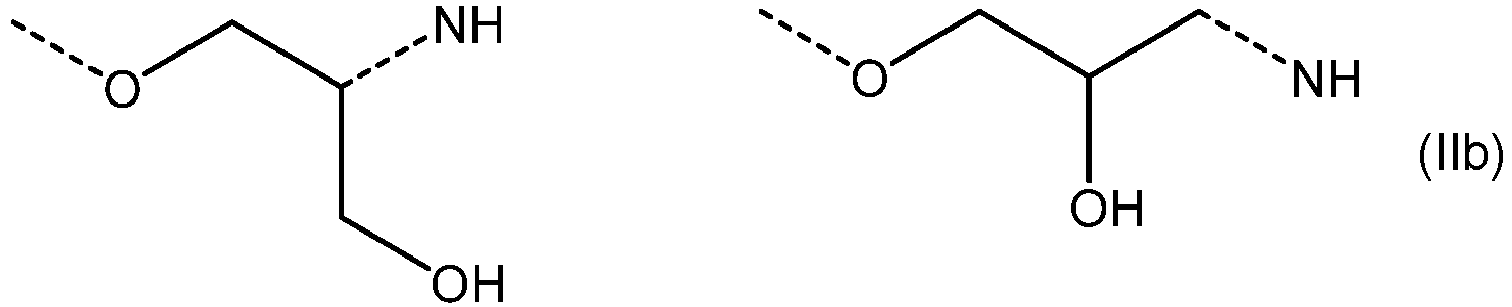 - oder eine Mischung aus einem Organosilan V2a und einem Organosilan V2b darstellen, wobei die genannten Organosilane V2a und V2b bevorzugt in einem Gewichtsverhältnis von zwischen 1:2 und 2:1 in der Komponente B enthalten sind.
 - Zweikomponentige Siliconzusammensetzung gemäss Anspruch 8, dadurch gekennzeichnet, dass Organosilan V2 ein Organosilan V2a umfasst, wobei Organosilan V2a in einer Menge von zwischen 5 Gew.-% und 20 Gew.-% bezogen auf Komponente B enthalten ist, und Organosilan V2 ein Organosilan V2b umfasst, wobei Organosilan V2b in einer Menge von zwischen 5 Gew.-% und 20 Gew.-% bezogen auf Komponente B enthalten ist, und dass mindestens ein Organosilan V3 mit einer Menge von zwischen 2.5 Gew.-% und 20 Gew.-% bezogen auf Komponente B enthalten ist, und dass der Katalysator K in einer Menge von zwischen 0.1 Gew.-% und 1.5 Gew.-%, bezogen auf Komponente B, in der Komponente B enthalten ist.
- Zweikomponentige Siliconzusammensetzung gemäss einem der Ansprüche 7 bis 9, dadurch gekennzeichnet, dass Organosilan V2b einen Rest Re einen divalenten C5 Alkylrest darstellt, welcher eine sekundäre Aminogruppe in der Kohlenstoffkette aufweist und Rest Rd einen linearen, divalenten C6 Alkylrest darstellt, welcher einen Ethersauerstoff in der Kohlenstoffkette aufweist sowie eine Hydroxylgruppe aufweist.
- Zweikomponentige Siliconzusammensetzung gemäss einem der vorhergehenden Ansprüche, dadurch gekennzeichnet, dass im Katalysator K der Formel (V) beide Liganden L1 für Dodecylmercaptid stehen und beide Liganden L2 für Octyl stehen.
- Zweikomponentige Siliconzusammensetzung gemäss einem der vorhergehenden Ansprüche, dadurch gekennzeichnet, dass das Gewichtsverhältnis von Komponente A zu Komponente B ≥ 1:1, insbesondere von 5:1 bis 20:1, bevorzugt von 7:1 bis 16:1, beträgt.
- Verwendung einer zweikomponentigen Siliconzusammensetzung gemäss einem der Ansprüche 1 bis 12 als Klebstoff, Dichtstoff, Beschichtung oder als Gussmasse.
- Verwendung gemäss Anspruch 13, dadurch gekennzeichnet, dass die zweikomponentige Siliconzusammensetzung im Fensterbau oder Fassadenbau verwendet wird.
- Gehärtete Siliconzusammensetzung, dadurch gekennzeichnet, dass sie erhältlich ist aus einer zweikomponentigen Siliconzusammensetzung gemäss einem der Ansprüche 1 bis 12 durch Mischen der Komponente A mit der Komponente B.
Applications Claiming Priority (2)
| Application Number | Priority Date | Filing Date | Title |
|---|---|---|---|
| EP20211309 | 2020-12-02 | ||
| PCT/EP2021/083406 WO2022117513A1 (de) | 2020-12-02 | 2021-11-29 | Schnell härtende zweikomponentige siliconzusammensetzung mit langer mischeroffenzeit |
Publications (3)
| Publication Number | Publication Date |
|---|---|
| EP4255986A1 EP4255986A1 (de) | 2023-10-11 |
| EP4255986C0 EP4255986C0 (de) | 2024-11-20 |
| EP4255986B1 true EP4255986B1 (de) | 2024-11-20 |
Family
ID=73694890
Family Applications (1)
| Application Number | Title | Priority Date | Filing Date |
|---|---|---|---|
| EP21816080.2A Active EP4255986B1 (de) | 2020-12-02 | 2021-11-29 | Schnell härtende zweikomponentige siliconzusammensetzung mit langer mischeroffenzeit |
Country Status (8)
| Country | Link |
|---|---|
| US (1) | US20230357510A1 (de) |
| EP (1) | EP4255986B1 (de) |
| JP (1) | JP2023551402A (de) |
| KR (1) | KR20230112610A (de) |
| CN (1) | CN116438259A (de) |
| MX (1) | MX2023003729A (de) |
| PL (1) | PL4255986T3 (de) |
| WO (1) | WO2022117513A1 (de) |
Family Cites Families (20)
| Publication number | Priority date | Publication date | Assignee | Title |
|---|---|---|---|---|
| CA1134986A (en) * | 1978-11-08 | 1982-11-02 | Peter M. Burrill | Organosilicon polymers |
| DE3041231A1 (de) * | 1980-11-03 | 1982-06-09 | Bayer Ag, 5090 Leverkusen | Polyvinylchlorid-formmasse |
| GB8428401D0 (en) * | 1984-11-09 | 1984-12-19 | Dow Corning Ltd | Organosiloxane-oxy-alkylene copolymers |
| JPS61254654A (ja) * | 1985-05-08 | 1986-11-12 | Toyota Central Res & Dev Lab Inc | エポキシ樹脂組成物 |
| GB8904082D0 (en) | 1989-02-22 | 1989-04-05 | Dow Corning Sa | Curable filled polysiloxane compositions |
| US5275645A (en) * | 1992-11-24 | 1994-01-04 | Ameron, Inc. | Polysiloxane coating |
| US5346940A (en) * | 1993-03-24 | 1994-09-13 | Loctite Corporation | Two-part fast curing RTV silicone for formed-on-part automotive gasket |
| DE19603628A1 (de) | 1996-02-01 | 1997-08-07 | Wacker Chemie Gmbh | Bei Raumtemperatur vulkanisierende, kondensationsvernetzende Siliconkautschuke |
| US6013752A (en) * | 1997-06-04 | 2000-01-11 | Ameron International Corporation | Halogenated resin compositions |
| EP1246765B1 (de) | 1999-12-17 | 2004-11-10 | Sika Schweiz AG | Adapter, anordnung und verfahren zur stoffentnahme aus mehrkammerschlauchbeuteln, verwendung des adapters sowie schlauchbeutelverpackung |
| EP1609831B1 (de) | 2004-06-23 | 2006-08-16 | Sika Technology AG | Geruchsarme (Meth)acrylat klebstoffe mit hoer Schlagfertigkeit |
| JP4836423B2 (ja) * | 2004-06-28 | 2011-12-14 | 株式会社カネカ | 耐汚染性付与組成物、塗料組成物および該組成物から得られる塗膜 |
| JP2006160880A (ja) * | 2004-12-07 | 2006-06-22 | Jsr Corp | 水系分散体及びその製造方法、並びにその水系分散体を用いた水系防汚塗料 |
| EP1820819A1 (de) | 2006-02-20 | 2007-08-22 | Sika Technology AG | (Meth)Acrylatzusammensetzung mit erhöhter Lagerstabilität |
| EP1995281A4 (de) * | 2006-03-16 | 2010-03-24 | Jsr Corp | Oxidteilchen enthaltende polysiloxanzusammensetzung und herstellungsverfahren dafür |
| PL3268411T3 (pl) * | 2015-03-10 | 2020-06-01 | Henkel IP & Holding GmbH | Poliorganosiloksan i zawierająca go kompozycja klejowa utwardzalna wilgocią i promieniowaniem |
| WO2016141546A1 (en) * | 2015-03-10 | 2016-09-15 | Henkel IP & Holding GmbH | A moisture and radiation curable adhesive composition and the use thereof |
| EP3392313A1 (de) * | 2017-04-21 | 2018-10-24 | Nitrochemie Aschau GmbH | Härtbare silikonkautschukmassen |
| TWI782066B (zh) * | 2017-08-03 | 2022-11-01 | 德商漢高股份有限及兩合公司 | 可固化的聚矽氧光學透明黏著劑及其用途 |
| US11711135B1 (en) * | 2019-12-10 | 2023-07-25 | Nehal Gajjar | Nautical ground station |
-
2021
- 2021-11-29 EP EP21816080.2A patent/EP4255986B1/de active Active
- 2021-11-29 PL PL21816080.2T patent/PL4255986T3/pl unknown
- 2021-11-29 JP JP2023528610A patent/JP2023551402A/ja active Pending
- 2021-11-29 WO PCT/EP2021/083406 patent/WO2022117513A1/de not_active Ceased
- 2021-11-29 MX MX2023003729A patent/MX2023003729A/es unknown
- 2021-11-29 KR KR1020237013223A patent/KR20230112610A/ko active Pending
- 2021-11-29 CN CN202180077621.8A patent/CN116438259A/zh active Pending
- 2021-11-29 US US18/026,158 patent/US20230357510A1/en active Pending
Also Published As
| Publication number | Publication date |
|---|---|
| US20230357510A1 (en) | 2023-11-09 |
| WO2022117513A1 (de) | 2022-06-09 |
| PL4255986T3 (pl) | 2025-04-14 |
| MX2023003729A (es) | 2023-04-24 |
| CN116438259A (zh) | 2023-07-14 |
| JP2023551402A (ja) | 2023-12-08 |
| EP4255986C0 (de) | 2024-11-20 |
| KR20230112610A (ko) | 2023-07-27 |
| EP4255986A1 (de) | 2023-10-11 |
Similar Documents
| Publication | Publication Date | Title |
|---|---|---|
| EP2358819B1 (de) | Lagerstabile zweikomponentige siliconkleb- und dichtstoffe mit verlängerter mischeroffenzeit | |
| EP2061841B1 (de) | Siliconzusammensetzung | |
| EP2202276B1 (de) | Siliconzusammensetzung mit beschleunigter Vernetzung | |
| EP2622022B1 (de) | Zweikomponentige siliconzusammensetzung | |
| EP3500638B1 (de) | Siliconmischungen mit verbesserter weiterreissfestigkeit | |
| EP2882802B1 (de) | Witterungsstabile siliconmischung mit verbesserter grünstandfestigkeit | |
| EP2641934B1 (de) | Siliconzusammensetzung mit verbesserten mechanischen Eigenschaften | |
| EP4219641B1 (de) | Wässrige vorbehandlung für verklebungen mit erhöhter hitzestabilität | |
| EP3538620A1 (de) | Vernetzbare silikonmischungen enthaltend einen guanidinkatalysator und einen haftvermittler | |
| EP4255986B1 (de) | Schnell härtende zweikomponentige siliconzusammensetzung mit langer mischeroffenzeit | |
| WO2021156055A1 (de) | Schnell härtende zweikomponentige siliconzusammensetzung mit einstellbarer topfzeit | |
| EP3172279B1 (de) | Durch kondensationsreaktion vernetzbare organopolysiloxanmassen | |
| EP3242906B1 (de) | Raumtemperaturvernetzende silikonmasse mit verbesserten fliesseigenschaften | |
| EP1803777A2 (de) | Vernetzbare Massen auf der Basis von Organosiliciumverbindungen | |
| EP4326794A1 (de) | Schnell härtende zweikomponentige zusammensetzung silylierter polymere mit langer offenzeit |
Legal Events
| Date | Code | Title | Description |
|---|---|---|---|
| STAA | Information on the status of an ep patent application or granted ep patent |
Free format text: STATUS: UNKNOWN |
|
| STAA | Information on the status of an ep patent application or granted ep patent |
Free format text: STATUS: THE INTERNATIONAL PUBLICATION HAS BEEN MADE |
|
| PUAI | Public reference made under article 153(3) epc to a published international application that has entered the european phase |
Free format text: ORIGINAL CODE: 0009012 |
|
| STAA | Information on the status of an ep patent application or granted ep patent |
Free format text: STATUS: REQUEST FOR EXAMINATION WAS MADE |
|
| 17P | Request for examination filed |
Effective date: 20230703 |
|
| AK | Designated contracting states |
Kind code of ref document: A1 Designated state(s): AL AT BE BG CH CY CZ DE DK EE ES FI FR GB GR HR HU IE IS IT LI LT LU LV MC MK MT NL NO PL PT RO RS SE SI SK SM TR |
|
| DAV | Request for validation of the european patent (deleted) | ||
| DAX | Request for extension of the european patent (deleted) | ||
| GRAP | Despatch of communication of intention to grant a patent |
Free format text: ORIGINAL CODE: EPIDOSNIGR1 |
|
| STAA | Information on the status of an ep patent application or granted ep patent |
Free format text: STATUS: GRANT OF PATENT IS INTENDED |
|
| INTG | Intention to grant announced |
Effective date: 20240729 |
|
| GRAS | Grant fee paid |
Free format text: ORIGINAL CODE: EPIDOSNIGR3 |
|
| GRAA | (expected) grant |
Free format text: ORIGINAL CODE: 0009210 |
|
| STAA | Information on the status of an ep patent application or granted ep patent |
Free format text: STATUS: THE PATENT HAS BEEN GRANTED |
|
| AK | Designated contracting states |
Kind code of ref document: B1 Designated state(s): AL AT BE BG CH CY CZ DE DK EE ES FI FR GB GR HR HU IE IS IT LI LT LU LV MC MK MT NL NO PL PT RO RS SE SI SK SM TR |
|
| REG | Reference to a national code |
Ref country code: GB Ref legal event code: FG4D Free format text: NOT ENGLISH |
|
| REG | Reference to a national code |
Ref country code: CH Ref legal event code: EP |
|
| REG | Reference to a national code |
Ref country code: DE Ref legal event code: R096 Ref document number: 502021005894 Country of ref document: DE |
|
| REG | Reference to a national code |
Ref country code: IE Ref legal event code: FG4D Free format text: LANGUAGE OF EP DOCUMENT: GERMAN |
|
| U01 | Request for unitary effect filed |
Effective date: 20241209 |
|
| U07 | Unitary effect registered |
Designated state(s): AT BE BG DE DK EE FI FR IT LT LU LV MT NL PT RO SE SI Effective date: 20250103 |
|
| PG25 | Lapsed in a contracting state [announced via postgrant information from national office to epo] |
Ref country code: IS Free format text: LAPSE BECAUSE OF FAILURE TO SUBMIT A TRANSLATION OF THE DESCRIPTION OR TO PAY THE FEE WITHIN THE PRESCRIBED TIME-LIMIT Effective date: 20250320 Ref country code: HR Free format text: LAPSE BECAUSE OF FAILURE TO SUBMIT A TRANSLATION OF THE DESCRIPTION OR TO PAY THE FEE WITHIN THE PRESCRIBED TIME-LIMIT Effective date: 20241120 |
|
| PG25 | Lapsed in a contracting state [announced via postgrant information from national office to epo] |
Ref country code: ES Free format text: LAPSE BECAUSE OF FAILURE TO SUBMIT A TRANSLATION OF THE DESCRIPTION OR TO PAY THE FEE WITHIN THE PRESCRIBED TIME-LIMIT Effective date: 20241120 |
|
| PG25 | Lapsed in a contracting state [announced via postgrant information from national office to epo] |
Ref country code: NO Free format text: LAPSE BECAUSE OF FAILURE TO SUBMIT A TRANSLATION OF THE DESCRIPTION OR TO PAY THE FEE WITHIN THE PRESCRIBED TIME-LIMIT Effective date: 20250220 |
|
| PG25 | Lapsed in a contracting state [announced via postgrant information from national office to epo] |
Ref country code: GR Free format text: LAPSE BECAUSE OF FAILURE TO SUBMIT A TRANSLATION OF THE DESCRIPTION OR TO PAY THE FEE WITHIN THE PRESCRIBED TIME-LIMIT Effective date: 20250221 |
|
| PGFP | Annual fee paid to national office [announced via postgrant information from national office to epo] |
Ref country code: CZ Payment date: 20250122 Year of fee payment: 4 Ref country code: PL Payment date: 20250122 Year of fee payment: 4 |
|
| PG25 | Lapsed in a contracting state [announced via postgrant information from national office to epo] |
Ref country code: RS Free format text: LAPSE BECAUSE OF FAILURE TO SUBMIT A TRANSLATION OF THE DESCRIPTION OR TO PAY THE FEE WITHIN THE PRESCRIBED TIME-LIMIT Effective date: 20250220 |
|
| U21 | Renewal fee for the european patent with unitary effect paid with additional fee |
Year of fee payment: 4 Effective date: 20250410 |
|
| REG | Reference to a national code |
Ref country code: CH Ref legal event code: PL |
|
| PG25 | Lapsed in a contracting state [announced via postgrant information from national office to epo] |
Ref country code: SM Free format text: LAPSE BECAUSE OF FAILURE TO SUBMIT A TRANSLATION OF THE DESCRIPTION OR TO PAY THE FEE WITHIN THE PRESCRIBED TIME-LIMIT Effective date: 20241120 |
|
| REG | Reference to a national code |
Ref country code: CH Ref legal event code: PL |
|
| PG25 | Lapsed in a contracting state [announced via postgrant information from national office to epo] |
Ref country code: CH Free format text: LAPSE BECAUSE OF NON-PAYMENT OF DUE FEES Effective date: 20241130 |
|
| PG25 | Lapsed in a contracting state [announced via postgrant information from national office to epo] |
Ref country code: SK Free format text: LAPSE BECAUSE OF FAILURE TO SUBMIT A TRANSLATION OF THE DESCRIPTION OR TO PAY THE FEE WITHIN THE PRESCRIBED TIME-LIMIT Effective date: 20241120 |
|
| PG25 | Lapsed in a contracting state [announced via postgrant information from national office to epo] |
Ref country code: MC Free format text: LAPSE BECAUSE OF FAILURE TO SUBMIT A TRANSLATION OF THE DESCRIPTION OR TO PAY THE FEE WITHIN THE PRESCRIBED TIME-LIMIT Effective date: 20241120 |
|
| PLBE | No opposition filed within time limit |
Free format text: ORIGINAL CODE: 0009261 |
|
| STAA | Information on the status of an ep patent application or granted ep patent |
Free format text: STATUS: NO OPPOSITION FILED WITHIN TIME LIMIT |
|
| 26N | No opposition filed |
Effective date: 20250821 |
|
| PG25 | Lapsed in a contracting state [announced via postgrant information from national office to epo] |
Ref country code: IE Free format text: LAPSE BECAUSE OF NON-PAYMENT OF DUE FEES Effective date: 20241129 |