EP4249142A2 - Al-mg-si energieabsorbierendes strangpressbauteil und verfahren zu seiner herstellung - Google Patents
Al-mg-si energieabsorbierendes strangpressbauteil und verfahren zu seiner herstellung Download PDFInfo
- Publication number
- EP4249142A2 EP4249142A2 EP23173415.3A EP23173415A EP4249142A2 EP 4249142 A2 EP4249142 A2 EP 4249142A2 EP 23173415 A EP23173415 A EP 23173415A EP 4249142 A2 EP4249142 A2 EP 4249142A2
- Authority
- EP
- European Patent Office
- Prior art keywords
- component
- energy absorption
- extrusion
- billet
- mpa
- Prior art date
- Legal status (The legal status is an assumption and is not a legal conclusion. Google has not performed a legal analysis and makes no representation as to the accuracy of the status listed.)
- Withdrawn
Links
Images



Classifications
-
- C—CHEMISTRY; METALLURGY
- C22—METALLURGY; FERROUS OR NON-FERROUS ALLOYS; TREATMENT OF ALLOYS OR NON-FERROUS METALS
- C22C—ALLOYS
- C22C21/00—Alloys based on aluminium
- C22C21/06—Alloys based on aluminium with magnesium as the next major constituent
- C22C21/08—Alloys based on aluminium with magnesium as the next major constituent with silicon
-
- B—PERFORMING OPERATIONS; TRANSPORTING
- B21—MECHANICAL METAL-WORKING WITHOUT ESSENTIALLY REMOVING MATERIAL; PUNCHING METAL
- B21C—MANUFACTURE OF METAL SHEETS, WIRE, RODS, TUBES, PROFILES OR LIKE SEMI-MANUFACTURED PRODUCTS OTHERWISE THAN BY ROLLING; AUXILIARY OPERATIONS USED IN CONNECTION WITH METAL-WORKING WITHOUT ESSENTIALLY REMOVING MATERIAL
- B21C23/00—Extruding metal; Impact extrusion
- B21C23/002—Extruding materials of special alloys so far as the composition of the alloy requires or permits special extruding methods of sequences
-
- B—PERFORMING OPERATIONS; TRANSPORTING
- B21—MECHANICAL METAL-WORKING WITHOUT ESSENTIALLY REMOVING MATERIAL; PUNCHING METAL
- B21C—MANUFACTURE OF METAL SHEETS, WIRE, RODS, TUBES, PROFILES OR LIKE SEMI-MANUFACTURED PRODUCTS OTHERWISE THAN BY ROLLING; AUXILIARY OPERATIONS USED IN CONNECTION WITH METAL-WORKING WITHOUT ESSENTIALLY REMOVING MATERIAL
- B21C23/00—Extruding metal; Impact extrusion
- B21C23/02—Making uncoated products
- B21C23/04—Making uncoated products by direct extrusion
- B21C23/14—Making other products
- B21C23/142—Making profiles
-
- B—PERFORMING OPERATIONS; TRANSPORTING
- B21—MECHANICAL METAL-WORKING WITHOUT ESSENTIALLY REMOVING MATERIAL; PUNCHING METAL
- B21C—MANUFACTURE OF METAL SHEETS, WIRE, RODS, TUBES, PROFILES OR LIKE SEMI-MANUFACTURED PRODUCTS OTHERWISE THAN BY ROLLING; AUXILIARY OPERATIONS USED IN CONNECTION WITH METAL-WORKING WITHOUT ESSENTIALLY REMOVING MATERIAL
- B21C29/00—Cooling or heating extruded work or parts of the extrusion press
- B21C29/003—Cooling or heating of work
-
- B—PERFORMING OPERATIONS; TRANSPORTING
- B21—MECHANICAL METAL-WORKING WITHOUT ESSENTIALLY REMOVING MATERIAL; PUNCHING METAL
- B21C—MANUFACTURE OF METAL SHEETS, WIRE, RODS, TUBES, PROFILES OR LIKE SEMI-MANUFACTURED PRODUCTS OTHERWISE THAN BY ROLLING; AUXILIARY OPERATIONS USED IN CONNECTION WITH METAL-WORKING WITHOUT ESSENTIALLY REMOVING MATERIAL
- B21C31/00—Control devices for metal extruding, e.g. for regulating the pressing speed or temperature of metal; Measuring devices, e.g. for temperature of metal, combined with or specially adapted for use in connection with extrusion presses
-
- C—CHEMISTRY; METALLURGY
- C22—METALLURGY; FERROUS OR NON-FERROUS ALLOYS; TREATMENT OF ALLOYS OR NON-FERROUS METALS
- C22C—ALLOYS
- C22C21/00—Alloys based on aluminium
- C22C21/02—Alloys based on aluminium with silicon as the next major constituent
-
- C—CHEMISTRY; METALLURGY
- C22—METALLURGY; FERROUS OR NON-FERROUS ALLOYS; TREATMENT OF ALLOYS OR NON-FERROUS METALS
- C22C—ALLOYS
- C22C21/00—Alloys based on aluminium
- C22C21/02—Alloys based on aluminium with silicon as the next major constituent
- C22C21/04—Modified aluminium-silicon alloys
-
- C—CHEMISTRY; METALLURGY
- C22—METALLURGY; FERROUS OR NON-FERROUS ALLOYS; TREATMENT OF ALLOYS OR NON-FERROUS METALS
- C22F—CHANGING THE PHYSICAL STRUCTURE OF NON-FERROUS METALS AND NON-FERROUS ALLOYS
- C22F1/00—Changing the physical structure of non-ferrous metals or alloys by heat treatment or by hot or cold working
- C22F1/002—Changing the physical structure of non-ferrous metals or alloys by heat treatment or by hot or cold working by rapid cooling or quenching; cooling agents used therefor
-
- C—CHEMISTRY; METALLURGY
- C22—METALLURGY; FERROUS OR NON-FERROUS ALLOYS; TREATMENT OF ALLOYS OR NON-FERROUS METALS
- C22F—CHANGING THE PHYSICAL STRUCTURE OF NON-FERROUS METALS AND NON-FERROUS ALLOYS
- C22F1/00—Changing the physical structure of non-ferrous metals or alloys by heat treatment or by hot or cold working
- C22F1/04—Changing the physical structure of non-ferrous metals or alloys by heat treatment or by hot or cold working of aluminium or alloys based thereon
- C22F1/043—Changing the physical structure of non-ferrous metals or alloys by heat treatment or by hot or cold working of aluminium or alloys based thereon of alloys with silicon as the next major constituent
-
- C—CHEMISTRY; METALLURGY
- C22—METALLURGY; FERROUS OR NON-FERROUS ALLOYS; TREATMENT OF ALLOYS OR NON-FERROUS METALS
- C22F—CHANGING THE PHYSICAL STRUCTURE OF NON-FERROUS METALS AND NON-FERROUS ALLOYS
- C22F1/00—Changing the physical structure of non-ferrous metals or alloys by heat treatment or by hot or cold working
- C22F1/04—Changing the physical structure of non-ferrous metals or alloys by heat treatment or by hot or cold working of aluminium or alloys based thereon
- C22F1/047—Changing the physical structure of non-ferrous metals or alloys by heat treatment or by hot or cold working of aluminium or alloys based thereon of alloys with magnesium as the next major constituent
-
- C—CHEMISTRY; METALLURGY
- C22—METALLURGY; FERROUS OR NON-FERROUS ALLOYS; TREATMENT OF ALLOYS OR NON-FERROUS METALS
- C22F—CHANGING THE PHYSICAL STRUCTURE OF NON-FERROUS METALS AND NON-FERROUS ALLOYS
- C22F1/00—Changing the physical structure of non-ferrous metals or alloys by heat treatment or by hot or cold working
- C22F1/04—Changing the physical structure of non-ferrous metals or alloys by heat treatment or by hot or cold working of aluminium or alloys based thereon
- C22F1/05—Changing the physical structure of non-ferrous metals or alloys by heat treatment or by hot or cold working of aluminium or alloys based thereon of alloys of the Al-Si-Mg type, i.e. containing silicon and magnesium in approximately equal proportions
Definitions
- the present invention generally related to an improved aluminum 6XXX alloy extrusion component with high strengths and energy absorption.
- the present invention is an improved aluminum 6XXX alloy extrusion component with high strengths and energy absorption produced from an alloy composition including, in weight percent, Si: 0.50-0.80; Fe: ⁇ 0.40; Cu: 0.15-0.35; Mn: 0.20-0.50; Mg: 0.50-0.80; Cr: 0.10-0.25; Zn: ⁇ 0.20; with other elements being considered incidental impurities and consisting of less than 0.05 individually and 0.15 in total with the balance being aluminum.
- the alloy composition does not require any additions of vanadium, thus reducing cost and also preventing contamination of the recycling scrap stream.
- the present invention is an aluminum 6XXX alloy extrusion component produced from an alloy composition comprising, optionally consisting essentially of, or optionally consisting of, in weight percent (wt.%): Si: 0.50-0.80; Fe: ⁇ 0.40; Cu: 0.15-0.35; Mn: 0.20-0.50; Mg: 0.50-0.80; Cr: 0.10-0.25; Zn: ⁇ 0.20; with other incidental elements being considered impurities and consisting of less than 0.05 individually and 0.15 in total with the balance being aluminum.
- the alloy composition does not include any intentional additions of vanadium.
- the alloy composition includes ⁇ 0.04 wt.% vanadium. It should be understood that the recitation of a range of values includes all of the specific values in between the highest and lowest value.
- Silicon is included in the alloy composition of the present invention in the range of 0.50 to 0.80 wt.%. It is understood that within the range of 0.50 to 0.80 wt.% Si, the upper or lower limit for the amount of Si may be selected from 0.50, 0.51, 0.52, 0.53, 0.54, 0.55, 0.56, 0.57, 0.58, 0.59, 0.60, 0.61, 0.62, 0.63, 0.64, 0.65, 0.66, 0.67, 0.68, 0.69, 0.70, 0.71, 0.72, 0.73, 0.74, 0.75, 0.76, 0.77, 0.78, 0.79, and 0.80 wt.% Si.
- iron may be included in the alloy composition of the present invention in an amount that is ⁇ 0.40 wt.%. It is understood that within the range of ⁇ 0.40 wt.%, the upper or lower limit for the amount of Fe may be selected from 0.40, 0.39, 0.38, 0.37, 0.36, 0.35, 0.34, 0.33, 0.32, 0.31, 0.30, 0.29, 0.28, 0.27, 0.26, 0.25, 0.24, 0.23, 0.22, 0.21, 0.20, 0.19, 0.18, 0.17, 0.16, 0.15, 0.14, 0.13, 0.12, 0.11, 0.10, 0.09, 0.08, 0.07, 0.06, 0.05, 0.04, 0.03, 0.02, and 0.01 wt.%.
- copper may be included in the alloy composition of the present invention in the range of 0.15-0.35 wt.%. It is understood that within the range of 0.15-0.35 wt.%, the upper or lower limit for the amount of Cu may be selected from 0.35, 0.34, 0.33, 0.32, 0.31, 0.30, 0.29, 0.28, 0.27, 0.26, 0.25, 0.24, 0.23, 0.22, 0.21, 0.20, 0.19, 0.18, 0.17, 0.16, and 0.15 wt.%.
- manganese may be included in the alloy composition of the present invention in the range of 0.20-0.50 wt.%. It is understood that within the range of 0.20-0.50 wt.%, the upper or lower limit for the amount of Mn may be selected from 0.50, 0.49, 0.48, 0.47, 0.46, 0.45, 0.44, 0.43, 0.42, 0.41, 0.40, 0.39, 0.38, 0.37, 0.36, 0.35, 0.34, 0.33, 0.32, 0.31, 0.30, 0.29, 0.28, 0.27, 0.26, 0.25, 0.24, 0.23, 0.22, 0.21, and 0.20 wt.%.
- magnesium may be included in the alloy composition of the present invention in the range of 0.50 to 0.80 wt.%. It is understood that within the range of 0.50 to 0.80 wt.% Mg, the upper or lower limit for the amount of Mg may be selected from 0.50, 0.51, 0.52, 0.53, 0.54, 0.55, 0.56, 0.57, 0.58, 0.59, 0.60, 0.61, 0.62, 0.63, 0.64, 0.65, 0.66, 0.67, 0.68, 0.69, 0.70, 0.71, 0.72, 0.73, 0.74, 0.75, 0.76, 0.77, 0.78, 0.79, and 0.80 wt.%.
- chromium may be included in the alloy composition of the present invention in the range of 0.10-0.25 wt.%. It is understood that within the range of 0.10-0.25 wt.%, the upper or lower limit for the amount of Cr may be selected from 0.25, 0.24, 0.23, 0.22, 0.21, 0.20, 0.19, 0.18, 0.17, 0.16, 0.15, 0.14, 0.13, 0.12, 0.11, and 0.10 wt.%.
- zinc may be included in the alloy composition of the present invention in an amount that is ⁇ 0.20 wt.%. It is understood that within the range of ⁇ 0.20 wt.%, the upper or lower limit for the amount of Zn may be selected from 0.20, 0.19, 0.18, 0.17, 0.16, 0.15, 0.14, 0.13, 0.12, 0.11, 0.10, 0.09, 0.08, 0.07, 0.06, 0.05, 0.04, 0.03, 0.02, and 0.01 wt.%.
- vanadium is not intentionally added to the alloy composition of the present invention. Vanadium may exist in the alloy composition of the present invention as a result of a non-intentionally added element.
- the alloy composition of the present invention includes ⁇ 0.04 wt.% vanadium. It is understood that within the range of ⁇ 0.04 wt.%, the upper or lower limit for the amount of V may be selected from 0.04, 0.03, 0.02, 0.01, and 0.005 wt.%
- Sn may be intentionally added within the range of 0.02-0.10% by weight to improve adhesive bond durability performance. It is understood that within the range of 0.02-0.10 wt.%, the upper or lower limit for the amount of Sn may be selected from 0.10, 0.09, 0.08, 0.07, 0.06, 0.05, 0.04, 0.03, and 0.02 wt.%.
- Sr may be intentionally added within the range of up to 0.30 % by weight. It is understood that within the range of up to 0.30 wt.%, the upper or lower limit for the amount of Sr may be selected from 0.30, 0.29, 0.28, 0.27, 0.26, 0.25, 0.24, 0.23, 0.22, 0.21, 0.20, 0.19, 0.18, 0.17, 0.16, 0.15, 0.14, 0.13, 0.12, 0.11, 0.10, 0.09, 0.08, 0.07, 0.06, 0.05, 0.04, 0.03, 0.02, and 0.01 wt.%.
- the alloy composition of the present invention may also include low level of "incidental elements” that are not included intentionally.
- the "incidental elements” means any other elements except the above described Al, Si, Fe, Cu, Mn, Mg, Cr, Zn, Sn, Sr and V.
- the alloy composition may be used to produce an automotive crush can, front rail, rear rail, upper rail, rocker, header, A-pillar, or roof rail.
- the extrusion component may be produced by i) homogenizing a billet including the present alloy composition at a billet temperature between 527 - 566°C, ii) followed by fan cooling, iii) followed by either a) extruding at a billet temperature of 455°C to 510°C or b) heating to a billet temperature of 491°C - 535°C, then water quenching to a billet temperature of 388°C - 496°C, and then extruding, and iv) followed by cold water quenching, stretching and artificial aging with the extrusion component having a specific energy absorption of greater than 22 kJ/mm 2 and a yield strength of greater than 260 MPa, or 280 MPa, while providing no fragmentation or surface cracks greater than 10 mm during defined crush testing (as defined herein).
- the end product has a specific energy absorption of greater than 22 kJ/mm 2 and a yield strength of greater than 280 MPa, while providing no fragmentation or surface cracks greater than 20 mm during defined crush testing (as defined herein). In another alternate embodiment, the end product has a specific energy absorption of greater than 22 kJ/mm 2 and a yield strength of greater than 300 MPa, while providing no fragmentation or surface cracks greater than 30 mm during defined crush testing (as defined herein).
- the superior combination of strength and energy absorption for crash management applications is a basic and novel characteristic of the present invention.
- crush testing as used herein is conducted by taking a 300mm long sample and crushing in the longitudinal direction to 100mm at a rate of 100mm / minute. The force required through the stroke of the crush testing is recorded and the area under the force displacement curve is the energy absorption. Once the crush testing is complete, the sample is visually examined for fractures and surface cracking. Fractures resulting in fragmentation are not acceptable and surface cracks are not desirable, but may be acceptable for certain applications provided they are not too severe. Surface cracks are typically limited to a maximum observable length, perhaps 10 mm, or 20 mm, or 30 mm.
- Energy absorption is not exclusively a material property.
- the greater the cross sectional area the greater the energy required to crush a component with a given strength level.
- This can be overcome by providing a specific energy absorption, determined by dividing the energy absorbed by the extruded component's cross sectional area. This still does not define an absolute material property, as there are mechanical advantages of some shape designs that predispose their ability to absorb more energy than other designs for a given material.
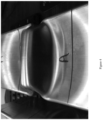
- the energy absorption is expressed as specific energy absorption (energy absorbed / cross sectional area) and is limited to a common crash management component design, which for the purposes of this study, is a three void hollow extrusion with wall thicknesses from 1.5mm to 4mm and a rectangular or trapezoidal perimeter being 75mm to 175mm in the long direction and 40mm to 100mm in the shorter direction as shown in Figure 1 . Using these boundaries, materials can be compared even with slightly different shape configurations.
- Aluminum extrusions have been utilized in the construction of crash management systems for many years. Successfully attaining a component that absorbs energy without fracture, that could threaten injury to passengers, involves complex management of the composition, grain structure, precipitate structure and mechanical properties.
- the composition of the extrusions helps to determine the potential strength.
- precipitation hardening occurs with Mg-Si phases (Mg 2 Si).
- Mg-Si phases Mg 2 Si.
- the proportion of the Mg and Si in terms of being balanced, excess Si or excess Mg relative to the stoichiometry) can significantly influence the strength and crush performance as well.
- the Mg and Si are often assessed in these terms:
- Extrusion of the product can be accomplished by either a) heating the billet directly to the extrusion temperature or b) using a process referred to as super-heating, where the billet is heated beyond the desired extrusion temperature to facilitate the solutionizing of hardening phases, and is then rapidly quenched to desired extrusion temperature. Both billet heating strategies have been employed successfully in this work. Post extrusion, the material is artificially aged to increase its strength.
- the artificial age time and temperature can strongly influence the size, distribution of the precipitate particles, and even precipitation type in the matrix, which not only affects the potential strength, but can also significantly impact the energy absorption and crash worthiness of the component.
- Artificial aging can be delayed to provide an extrusion that has better formability, with the artificial aging cycle being conducted after the component is formed. In one embodiment, the artificial aging is conducted at billet temperatures between 174 - 191°C for 5-10 hours.
- the artificial aging can also include multi-step aging to improve corrosion resistance.
- the artificial aging may be a two-step age cycle with the second aging step being hotter than the first aging step and either aging step ranging between 100-204 °C.
- the two-step age cycles involve a lower temperature step 1 from 100 - 177°C and a second step from 172 - 204°C.
- the artificial aging can also intentionally be under-aged (less than peak strength), with the intention of subsequent thermal operations, such as paint baking, completing the remainder of the artificial aging cycle.
- the component is unaged (T4) to provide better formability of the component with artificial aging being conducted post forming.
- the present invention for example, that is an automotive crash management component with high yield strength and excellent energy absorption without exhibiting a tendency for fragmentation. This is achieved with a predominantly unrecrystallized extruded grain structure in a 6XXX (Al-Mg-Si alloy) hollow extruded material.
- the coarse surface grain depth is controlled to less than 0.5 mm in depth from the surface.
- Alloy 6063 has a typical yield strength of 214 MPa and when tested using the crush test procedures outlined above, only has an energy absorption of 19.468 kJ / mm 2 .
- compositions in Table 1 were cast, homogenized between 980°F and 1060°F (527°C - 566°C) and then forced air cooled. Billets from the logs were preheated to 880°F to 940°F (471 °C - 504 °C), extruded into the three void hollow shape of Figure land cold water quenched.
- Table 1 Composition of Production Cast Billet (weight percent) Cast Si Fe Cu Mn Mg Cr Zn Ti 77 0.75 0.26 0.30 0.40 0.74 0.00 0.09 0.03 78 0.73 0.28 0.29 0.39 0.74 0.19 0.10 0.01
- the grain structure of the materials is shown in Figure 2 .
- the coarse grain structure resulting from the cast 77 composition resulted in fragmentation and excessive cracking and rough deformed surfaces (often referred to as orange peel), while the higher dispersoid content and subsequent reduced coarse recrystallized grain of cast 78 prevented fragmentation and excessive cracking while also providing a smooth deformed surface.
- the differences in deformed surfaces are demonstrated in Figures 3 and 4 . These results demonstrate the importance of controlling the coarse recrystallized grains with dispersoids in order to prevent fragmentation, surface cracking and rough deformed surfaces that precede these unacceptable conditions.
- Table 2 The composition shown in Table 2 was cast into 10" (254 mm) diameter log using development scale equipment.
- Table 2 Composition of Production Cast Billet (weight percent) Si Fe Cu Mn Mg Cr Zn Ti 0.66% 0.24% 0.29% 0.40% 0.68% 0.19% 0.04% 0.02%
- the logs were homogenized between 980°F and 1060°F (527°C - 566°C) and then forced air cooled.
- the billets were then extruded into the three void hollow shape of Figure 1 , described previously, by heating the billets between 915°F and 995°F (491°C - 535°C) then quenching the billets to between 730°F and 925°F (388°C - 496°C) prior to extruding and water quenching the resulting extrusions.
- the extrusions were stretch straightened / stress relieved and artificially aged between 345 - 375°F (174 - 191°C) for 5-10 hours.
- Extrusion billet was produced using conventional direct chill casting methods in 10" (254 mm) diameter log using production scale equipment to validate reproducibility.
- the composition of this material is shown in Table 5.
- Table 5 Composition of Production Cast Billet (weight percent) Si Fe Cu Mn Mg Cr Zn Ti 0.65% 0.29% 0.29% 0.37% 0.60% 0.18% 0.09% 0.03%
- Table 8 Composition of Production Cast Billet (weight percent) Cast ID Si Fe Cu Mn Mg Cr Zn Ti 1476 CP2 0.57 0.25 0.27 0.40 0.72 0.20 0.05 0.02 1495 Min 0.57 0.23 0.22 0.40 0.56 0.20 0.05 0.02 1496 Cen 0.65 0.24 0.27 0.36 0.65 0.16 0.05 0.03 1497 CP1 0.56 0.23 0.27 0.40 0.56 0.20 0.05 0.03 1498 CP3 0.73 0.23 0.27 0.40 0.55 0.20 0.05 0.03 1499 CP4 0.75 0.23 0.27 0.40 0.72 0.20 0.05 0.02 1500 Max 0.72 0.24 0.31 0.40 0.73 0.20 0.05 0.03
- the logs were homogenized between 980°F and 1060°F (527°C - 566°C) and then forced air cooled.
- the billets were then extruded into the three void hollow shape of Figure 1 , described previously, by heating the billets between 915°F and 995°F (491°C - 535°C) then quenching the billets to between 730°F and 925°F (388°C - 496°C) prior to extruding and water quenching the resulting extrusions.
- the extrusions were stretch straightened / stress relieved and artificially aged at 345 - 375°F (174 - 191°C) for 5-10 hours.
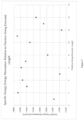
- Table 9 Specific Energy Absorption Results for Example 4 Cast Average Specific Energy Absorbed (kJ / mm 2 ) Minimum Specific Energy Absorbed (kJ / mm 2 ) Maximum Specific Energy Absorbed (kJ / mm 2 ) 1476 23.7 23.3 23.9 1495 22.2 22.0 22.5 1496 23.8 22.4 24.7 1497 23.4 23.2 23.5 1498 25.0 24.7 25.3 1499 25.3 23.6 26.2 1500 25.9 25.5 26.3
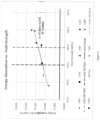
- Table 10 Mechanical Properties of Samples Examined in Example 4 Cast Yield Strength (MPa) Ultimate Strength (MPa) % Elongation Avg Min Max Avg Min Max Avg Min Max 1476 262 261 263 294 291 297 9.9 9.3 10.5 1495 236 233 240 268 264 275 10.6 9.7 11.6 1496 283 279
- Extrusion billet was produced using conventional direct chill casting methods in 10" (254 mm) diameter log using production scale equipment to validate reproducibility.
- the composition of this material is shown in Table 11. The logs were homogenized between 980°F and 1050°F (527°C - 566°C) and then forced air cooled.
- Table 11 Composition of Production Cast Billet (weight percent) Si Fe Cu Mn Mg Cr Zn Ti 0.66% 0.27% 0.30% 0.39% 0.63% 0.19% 0.09% 0.02%
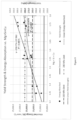
- Table 12 Strengths and Energy Absorption at Various Quench Rates Parameter Quench Rate 15 GPM / Zone 21 GPM / Zone 33 GPM / Zone Average UTS (MPa) 323.4 330.1 330.1 Average YTS (MPa) 292.2 299.2 298.3 Average %Elongation 10.7 10.7 10.8 Average Energy Absorption (kJ/mm 2 ) 27.6 26.6 26.8
- Complex extruded shapes may be restricted in terms of extrusion speed, with more complex shapes being restricted to slower extrusion speeds than other shapes. More complex shapes also may require greater extrusion force. In some cases, the extrusion force may exceed the capability of the extrusion press and thus higher billet temperatures are required to enable extrusion of the more complex shapes.
- billet produced in the same batch of material as in example 5 was extruded into the three void hollow shape depicted in Figure 1 at various billet temperatures and extrusion rates.
- Table 13 Strengths and Energy Absorption at Various Extrusion Rates Trial 1 2 3 4 Furnace Billet Temperature (°C) 499 499 527 527 Extruded Product Speed (mm / min) 3399 7929 3399 7929 Average UTS (MPa) 334.9 337.7 331.3 336.1 Average YTS (MPa) 302.0 303.5 301.5 303.8 Average %Elongation 11.7 11.6 10.6 11.0 Average Energy Absorption (kJ/mm 2 ) 26.7 25.6 25.9 26.1
Landscapes
- Chemical & Material Sciences (AREA)
- Engineering & Computer Science (AREA)
- Mechanical Engineering (AREA)
- Materials Engineering (AREA)
- Metallurgy (AREA)
- Organic Chemistry (AREA)
- Physics & Mathematics (AREA)
- Thermal Sciences (AREA)
- Crystallography & Structural Chemistry (AREA)
- Extrusion Of Metal (AREA)
- Vibration Dampers (AREA)
Applications Claiming Priority (3)
| Application Number | Priority Date | Filing Date | Title |
|---|---|---|---|
| US201962872384P | 2019-07-10 | 2019-07-10 | |
| US16/860,797 US20210010109A1 (en) | 2019-07-10 | 2020-04-28 | Al-Mg-Si Alloy Exhibiting Superior Combination of Strength and Energy Absorption |
| EP20183958.6A EP3763844B1 (de) | 2019-07-10 | 2020-07-03 | Al-mg-si energieabsorbierendes strangpressbauteil und verfahren zu seiner herstellung |
Related Parent Applications (1)
| Application Number | Title | Priority Date | Filing Date |
|---|---|---|---|
| EP20183958.6A Division EP3763844B1 (de) | 2019-07-10 | 2020-07-03 | Al-mg-si energieabsorbierendes strangpressbauteil und verfahren zu seiner herstellung |
Publications (2)
| Publication Number | Publication Date |
|---|---|
| EP4249142A2 true EP4249142A2 (de) | 2023-09-27 |
| EP4249142A3 EP4249142A3 (de) | 2023-11-08 |
Family
ID=71465209
Family Applications (2)
| Application Number | Title | Priority Date | Filing Date |
|---|---|---|---|
| EP23173415.3A Withdrawn EP4249142A3 (de) | 2019-07-10 | 2020-07-03 | Al-mg-si energieabsorbierendes strangpressbauteil und verfahren zu seiner herstellung |
| EP20183958.6A Revoked EP3763844B1 (de) | 2019-07-10 | 2020-07-03 | Al-mg-si energieabsorbierendes strangpressbauteil und verfahren zu seiner herstellung |
Family Applications After (1)
| Application Number | Title | Priority Date | Filing Date |
|---|---|---|---|
| EP20183958.6A Revoked EP3763844B1 (de) | 2019-07-10 | 2020-07-03 | Al-mg-si energieabsorbierendes strangpressbauteil und verfahren zu seiner herstellung |
Country Status (3)
| Country | Link |
|---|---|
| US (1) | US20210010109A1 (de) |
| EP (2) | EP4249142A3 (de) |
| CN (1) | CN112210699A (de) |
Families Citing this family (2)
| Publication number | Priority date | Publication date | Assignee | Title |
|---|---|---|---|---|
| CN113564433B (zh) * | 2021-08-10 | 2022-06-03 | 江苏亚太航空科技有限公司 | 一种耐腐蚀的6082铝合金材料及其熔铸工艺 |
| CN120077153A (zh) * | 2022-10-20 | 2025-05-30 | 奥科宁克技术有限责任公司 | 新型6xxx铝合金 |
Family Cites Families (17)
| Publication number | Priority date | Publication date | Assignee | Title |
|---|---|---|---|---|
| US3717512A (en) * | 1971-10-28 | 1973-02-20 | Olin Corp | Aluminum base alloys |
| JPH06212336A (ja) | 1993-01-13 | 1994-08-02 | Mitsubishi Alum Co Ltd | 強度および曲げ加工性のすぐれたAl合金押出加工材 |
| US5503690A (en) * | 1994-03-30 | 1996-04-02 | Reynolds Metals Company | Method of extruding a 6000-series aluminum alloy and an extruded product therefrom |
| US5776269A (en) * | 1995-08-24 | 1998-07-07 | Kaiser Aluminum & Chemical Corporation | Lead-free 6000 series aluminum alloy |
| JPH108172A (ja) | 1996-06-17 | 1998-01-13 | Nippon Light Metal Co Ltd | 押出し性に優れた構造材料用高強度Al−Mg−Si系合金及び押出し形材の製造方法 |
| JP5160930B2 (ja) | 2008-03-25 | 2013-03-13 | 株式会社神戸製鋼所 | 曲げ圧壊性と耐食性に優れたアルミニウム合金押出材およびその製造方法 |
| CN102505102B (zh) * | 2011-12-31 | 2013-04-24 | 辽宁忠旺集团有限公司 | 轨道交通车体底架用铝合金型材的制造方法 |
| ES2695698T3 (es) * | 2012-04-25 | 2019-01-10 | Norsk Hydro As | Perfil extruido de aleación de aluminio Al-Mg-Si con propiedades mejoradas |
| CN103184373A (zh) | 2012-11-26 | 2013-07-03 | 姚芸 | 一种防止铝合金型材出现大晶粒的材料及制备方法 |
| EP2993244B1 (de) | 2014-09-05 | 2020-05-27 | Constellium Valais SA (AG, Ltd) | Herstellungsverfahren eines Strangpressprofils aus 6xxx Aluminiumlegierung mit ausgezeichneter Crashverhalten |
| CN106191556A (zh) * | 2016-08-17 | 2016-12-07 | 椤惧缓 | 一种防止铝合金出现大晶粒的材料及制备方法 |
| EP3312301A1 (de) | 2016-10-20 | 2018-04-25 | Constellium Singen GmbH | Thermomechanische auslagerung für 6xxx extrusionen |
| CN106929716A (zh) * | 2017-03-10 | 2017-07-07 | 湖南博捷特智能科技有限公司 | 一种铝合金及其制备方法 |
| CN120536781A (zh) * | 2017-05-26 | 2025-08-26 | 诺维尔里斯公司 | 高强度耐腐蚀6xxx系列铝合金和其制造方法 |
| CN107326227A (zh) * | 2017-08-14 | 2017-11-07 | 山东南山铝业股份有限公司 | 轨道交通车体裙板用铝合金型材及其制造方法 |
| CN108165841A (zh) * | 2018-01-29 | 2018-06-15 | 辽宁忠旺集团有限公司 | 一种汽车用6008铝合金吸能盒加工工艺 |
| US11359269B2 (en) * | 2019-02-08 | 2022-06-14 | GM Global Technology Operations LLC | High strength ductile 6000 series aluminum alloy extrusions |
-
2020
- 2020-04-28 US US16/860,797 patent/US20210010109A1/en not_active Abandoned
- 2020-07-03 EP EP23173415.3A patent/EP4249142A3/de not_active Withdrawn
- 2020-07-03 EP EP20183958.6A patent/EP3763844B1/de not_active Revoked
- 2020-07-09 CN CN202010659712.XA patent/CN112210699A/zh active Pending
Also Published As
| Publication number | Publication date |
|---|---|
| EP3763844A1 (de) | 2021-01-13 |
| EP3763844C0 (de) | 2023-06-07 |
| EP3763844B1 (de) | 2023-06-07 |
| US20210010109A1 (en) | 2021-01-14 |
| CN112210699A (zh) | 2021-01-12 |
| EP4249142A3 (de) | 2023-11-08 |
Similar Documents
| Publication | Publication Date | Title |
|---|---|---|
| EP0247181B1 (de) | Aluminium-lithium-legierungen und herstellungsverfahren | |
| US10301710B2 (en) | Aluminum alloy that is not sensitive to quenching, as well as method for the production of a semi-finished product | |
| EP0157600B1 (de) | Aluminium-Lithium-Legierungen | |
| EP0584271B1 (de) | Hochfeste al-ci-legierung mit niedriger dichte | |
| EP2563944B1 (de) | Schadenstolerantes material aus aluminium mit einer mehrlagiger mikrostruktur | |
| EP0912772B1 (de) | 6xxx aluminiumlegierung | |
| EP0642598B1 (de) | Hochfeste-al-li-legierung mit niedriger dichte und hoher zähigkeit bei hohen temperaturen | |
| US9970090B2 (en) | Aluminum alloy combining high strength, elongation and extrudability | |
| EP1144703B1 (de) | Verfahren zur herstellung einer automaten-aluminium legierung | |
| US20230357902A1 (en) | Method For Manufacturing Aluminum Alloy Extruded Material With High Strength And Excellent In SCC Resistance And Hardenability | |
| EP0030070A1 (de) | Verfahren zum Herstellen von Material für Stringer im Flugzeugbau | |
| EP3763844B1 (de) | Al-mg-si energieabsorbierendes strangpressbauteil und verfahren zu seiner herstellung | |
| US6440359B1 (en) | Al-Mg-Si alloy with good extrusion properties | |
| US20230357889A1 (en) | Method For Manufacturing Aluminum Alloy Extruded Material | |
| US20250019802A1 (en) | A 6xxx alloy for extrusion with improved properties and a process for manufacturing extruded products | |
| EP1041165A1 (de) | Stossabsorbierendes Material | |
| US20170002448A1 (en) | Aluminum alloy combining high strength and extrudability, and low quench sensitivity | |
| JPH08232035A (ja) | 曲げ加工性に優れたバンパー用高強度アルミニウム合金材およびその製造方法 | |
| EP4299780A1 (de) | 6xxx-legierung mit hohem recyclingmaterialgehalt | |
| JPH09249953A (ja) | アルミ押出し材鍛造製品の製造方法 | |
| EP0968315B1 (de) | Al-mg-si legierung mit guten strangpresseigenschaften | |
| KR20250041514A (ko) | 고강도 알루미늄 합금 | |
| JP2025517767A (ja) | 強度及び延性が改善されたアルミニウム合金 | |
| JPH05311305A (ja) | 焼入れ性が優れた高比強度Al−Li系合金押出材 |
Legal Events
| Date | Code | Title | Description |
|---|---|---|---|
| PUAI | Public reference made under article 153(3) epc to a published international application that has entered the european phase |
Free format text: ORIGINAL CODE: 0009012 |
|
| STAA | Information on the status of an ep patent application or granted ep patent |
Free format text: STATUS: THE APPLICATION HAS BEEN PUBLISHED |
|
| AC | Divisional application: reference to earlier application |
Ref document number: 3763844 Country of ref document: EP Kind code of ref document: P |
|
| AK | Designated contracting states |
Kind code of ref document: A2 Designated state(s): AL AT BE BG CH CY CZ DE DK EE ES FI FR GB GR HR HU IE IS IT LI LT LU LV MC MK MT NL NO PL PT RO RS SE SI SK SM TR |
|
| REG | Reference to a national code |
Ref country code: DE Ref legal event code: R079 Free format text: PREVIOUS MAIN CLASS: B21C0029000000 Ipc: C22C0021020000 |
|
| PUAL | Search report despatched |
Free format text: ORIGINAL CODE: 0009013 |
|
| AK | Designated contracting states |
Kind code of ref document: A3 Designated state(s): AL AT BE BG CH CY CZ DE DK EE ES FI FR GB GR HR HU IE IS IT LI LT LU LV MC MK MT NL NO PL PT RO RS SE SI SK SM TR |
|
| RIC1 | Information provided on ipc code assigned before grant |
Ipc: B21C 23/00 20060101ALI20230929BHEP Ipc: B21C 29/00 20060101ALI20230929BHEP Ipc: B21C 23/14 20060101ALI20230929BHEP Ipc: C22F 1/05 20060101ALI20230929BHEP Ipc: C22C 21/08 20060101ALI20230929BHEP Ipc: C22C 21/04 20060101ALI20230929BHEP Ipc: C22C 21/02 20060101AFI20230929BHEP |
|
| STAA | Information on the status of an ep patent application or granted ep patent |
Free format text: STATUS: REQUEST FOR EXAMINATION WAS MADE |
|
| 17P | Request for examination filed |
Effective date: 20240508 |
|
| RBV | Designated contracting states (corrected) |
Designated state(s): AL AT BE BG CH CY CZ DE DK EE ES FI FR GB GR HR HU IE IS IT LI LT LU LV MC MK MT NL NO PL PT RO RS SE SI SK SM TR |
|
| STAA | Information on the status of an ep patent application or granted ep patent |
Free format text: STATUS: THE APPLICATION IS DEEMED TO BE WITHDRAWN |
|
| 18D | Application deemed to be withdrawn |
Effective date: 20240509 |