EP4248128B1 - Beleuchtungsvorrichtung für einen kraftfahrzeugscheinwerfer eines einspurigen kraftfahrzeuges - Google Patents
Beleuchtungsvorrichtung für einen kraftfahrzeugscheinwerfer eines einspurigen kraftfahrzeuges Download PDFInfo
- Publication number
- EP4248128B1 EP4248128B1 EP21801918.0A EP21801918A EP4248128B1 EP 4248128 B1 EP4248128 B1 EP 4248128B1 EP 21801918 A EP21801918 A EP 21801918A EP 4248128 B1 EP4248128 B1 EP 4248128B1
- Authority
- EP
- European Patent Office
- Prior art keywords
- light
- light guide
- lighting device
- row
- roll angle
- Prior art date
- Legal status (The legal status is an assumption and is not a legal conclusion. Google has not performed a legal analysis and makes no representation as to the accuracy of the status listed.)
- Active
Links
Images

Classifications
-
- B—PERFORMING OPERATIONS; TRANSPORTING
- B60—VEHICLES IN GENERAL
- B60Q—ARRANGEMENT OF SIGNALLING OR LIGHTING DEVICES, THE MOUNTING OR SUPPORTING THEREOF OR CIRCUITS THEREFOR, FOR VEHICLES IN GENERAL
- B60Q1/00—Arrangement of optical signalling or lighting devices, the mounting or supporting thereof or circuits therefor
- B60Q1/02—Arrangement of optical signalling or lighting devices, the mounting or supporting thereof or circuits therefor the devices being primarily intended to illuminate the way ahead or to illuminate other areas of way or environments
- B60Q1/04—Arrangement of optical signalling or lighting devices, the mounting or supporting thereof or circuits therefor the devices being primarily intended to illuminate the way ahead or to illuminate other areas of way or environments the devices being headlights
- B60Q1/06—Arrangement of optical signalling or lighting devices, the mounting or supporting thereof or circuits therefor the devices being primarily intended to illuminate the way ahead or to illuminate other areas of way or environments the devices being headlights adjustable, e.g. remotely-controlled from inside vehicle
- B60Q1/08—Arrangement of optical signalling or lighting devices, the mounting or supporting thereof or circuits therefor the devices being primarily intended to illuminate the way ahead or to illuminate other areas of way or environments the devices being headlights adjustable, e.g. remotely-controlled from inside vehicle automatically
- B60Q1/10—Arrangement of optical signalling or lighting devices, the mounting or supporting thereof or circuits therefor the devices being primarily intended to illuminate the way ahead or to illuminate other areas of way or environments the devices being headlights adjustable, e.g. remotely-controlled from inside vehicle automatically due to vehicle inclination, e.g. due to load distribution
-
- B—PERFORMING OPERATIONS; TRANSPORTING
- B60—VEHICLES IN GENERAL
- B60Q—ARRANGEMENT OF SIGNALLING OR LIGHTING DEVICES, THE MOUNTING OR SUPPORTING THEREOF OR CIRCUITS THEREFOR, FOR VEHICLES IN GENERAL
- B60Q1/00—Arrangement of optical signalling or lighting devices, the mounting or supporting thereof or circuits therefor
- B60Q1/02—Arrangement of optical signalling or lighting devices, the mounting or supporting thereof or circuits therefor the devices being primarily intended to illuminate the way ahead or to illuminate other areas of way or environments
- B60Q1/04—Arrangement of optical signalling or lighting devices, the mounting or supporting thereof or circuits therefor the devices being primarily intended to illuminate the way ahead or to illuminate other areas of way or environments the devices being headlights
- B60Q1/06—Arrangement of optical signalling or lighting devices, the mounting or supporting thereof or circuits therefor the devices being primarily intended to illuminate the way ahead or to illuminate other areas of way or environments the devices being headlights adjustable, e.g. remotely-controlled from inside vehicle
- B60Q1/08—Arrangement of optical signalling or lighting devices, the mounting or supporting thereof or circuits therefor the devices being primarily intended to illuminate the way ahead or to illuminate other areas of way or environments the devices being headlights adjustable, e.g. remotely-controlled from inside vehicle automatically
- B60Q1/10—Arrangement of optical signalling or lighting devices, the mounting or supporting thereof or circuits therefor the devices being primarily intended to illuminate the way ahead or to illuminate other areas of way or environments the devices being headlights adjustable, e.g. remotely-controlled from inside vehicle automatically due to vehicle inclination, e.g. due to load distribution
- B60Q1/115—Arrangement of optical signalling or lighting devices, the mounting or supporting thereof or circuits therefor the devices being primarily intended to illuminate the way ahead or to illuminate other areas of way or environments the devices being headlights adjustable, e.g. remotely-controlled from inside vehicle automatically due to vehicle inclination, e.g. due to load distribution by electric means
-
- F—MECHANICAL ENGINEERING; LIGHTING; HEATING; WEAPONS; BLASTING
- F21—LIGHTING
- F21S—NON-PORTABLE LIGHTING DEVICES; SYSTEMS THEREOF; VEHICLE LIGHTING DEVICES SPECIALLY ADAPTED FOR VEHICLE EXTERIORS
- F21S41/00—Illuminating devices specially adapted for vehicle exteriors, e.g. headlamps
- F21S41/10—Illuminating devices specially adapted for vehicle exteriors, e.g. headlamps characterised by the light source
- F21S41/14—Illuminating devices specially adapted for vehicle exteriors, e.g. headlamps characterised by the light source characterised by the type of light source
- F21S41/141—Light emitting diodes [LED]
- F21S41/143—Light emitting diodes [LED] the main emission direction of the LED being parallel to the optical axis of the illuminating device
-
- F—MECHANICAL ENGINEERING; LIGHTING; HEATING; WEAPONS; BLASTING
- F21—LIGHTING
- F21S—NON-PORTABLE LIGHTING DEVICES; SYSTEMS THEREOF; VEHICLE LIGHTING DEVICES SPECIALLY ADAPTED FOR VEHICLE EXTERIORS
- F21S41/00—Illuminating devices specially adapted for vehicle exteriors, e.g. headlamps
- F21S41/10—Illuminating devices specially adapted for vehicle exteriors, e.g. headlamps characterised by the light source
- F21S41/14—Illuminating devices specially adapted for vehicle exteriors, e.g. headlamps characterised by the light source characterised by the type of light source
- F21S41/141—Light emitting diodes [LED]
- F21S41/151—Light emitting diodes [LED] arranged in one or more lines
- F21S41/153—Light emitting diodes [LED] arranged in one or more lines arranged in a matrix
-
- F—MECHANICAL ENGINEERING; LIGHTING; HEATING; WEAPONS; BLASTING
- F21—LIGHTING
- F21S—NON-PORTABLE LIGHTING DEVICES; SYSTEMS THEREOF; VEHICLE LIGHTING DEVICES SPECIALLY ADAPTED FOR VEHICLE EXTERIORS
- F21S41/00—Illuminating devices specially adapted for vehicle exteriors, e.g. headlamps
- F21S41/20—Illuminating devices specially adapted for vehicle exteriors, e.g. headlamps characterised by refractors, transparent cover plates, light guides or filters
- F21S41/24—Light guides
-
- F—MECHANICAL ENGINEERING; LIGHTING; HEATING; WEAPONS; BLASTING
- F21—LIGHTING
- F21S—NON-PORTABLE LIGHTING DEVICES; SYSTEMS THEREOF; VEHICLE LIGHTING DEVICES SPECIALLY ADAPTED FOR VEHICLE EXTERIORS
- F21S41/00—Illuminating devices specially adapted for vehicle exteriors, e.g. headlamps
- F21S41/20—Illuminating devices specially adapted for vehicle exteriors, e.g. headlamps characterised by refractors, transparent cover plates, light guides or filters
- F21S41/25—Projection lenses
-
- F—MECHANICAL ENGINEERING; LIGHTING; HEATING; WEAPONS; BLASTING
- F21—LIGHTING
- F21S—NON-PORTABLE LIGHTING DEVICES; SYSTEMS THEREOF; VEHICLE LIGHTING DEVICES SPECIALLY ADAPTED FOR VEHICLE EXTERIORS
- F21S41/00—Illuminating devices specially adapted for vehicle exteriors, e.g. headlamps
- F21S41/60—Illuminating devices specially adapted for vehicle exteriors, e.g. headlamps characterised by a variable light distribution
- F21S41/65—Illuminating devices specially adapted for vehicle exteriors, e.g. headlamps characterised by a variable light distribution by acting on light sources
- F21S41/663—Illuminating devices specially adapted for vehicle exteriors, e.g. headlamps characterised by a variable light distribution by acting on light sources by switching light sources
-
- B—PERFORMING OPERATIONS; TRANSPORTING
- B60—VEHICLES IN GENERAL
- B60Q—ARRANGEMENT OF SIGNALLING OR LIGHTING DEVICES, THE MOUNTING OR SUPPORTING THEREOF OR CIRCUITS THEREFOR, FOR VEHICLES IN GENERAL
- B60Q2300/00—Indexing codes for automatically adjustable headlamps or automatically dimmable headlamps
- B60Q2300/10—Indexing codes relating to particular vehicle conditions
- B60Q2300/13—Attitude of the vehicle body
- B60Q2300/136—Roll
-
- F—MECHANICAL ENGINEERING; LIGHTING; HEATING; WEAPONS; BLASTING
- F21—LIGHTING
- F21W—INDEXING SCHEME ASSOCIATED WITH SUBCLASSES F21K, F21L, F21S and F21V, RELATING TO USES OR APPLICATIONS OF LIGHTING DEVICES OR SYSTEMS
- F21W2107/00—Use or application of lighting devices on or in particular types of vehicles
- F21W2107/10—Use or application of lighting devices on or in particular types of vehicles for land vehicles
- F21W2107/13—Use or application of lighting devices on or in particular types of vehicles for land vehicles for cycles
- F21W2107/17—Use or application of lighting devices on or in particular types of vehicles for land vehicles for cycles for motorcycles
Definitions
- the invention relates to a motor vehicle headlight with at least one lighting device according to the invention.
- the WO2020/043443 A1 , the DE 10 2018 104261 A1 , the DE 10 2009 053581 B3 , the DE 10 2018 209061 A1 , the EP 3 369 618 A1 and the DE 10 2008 044676 A1 show lighting devices from the state of the art.
- Each row comprises at least two light guides, which are arranged along the corresponding straight line. Furthermore, the straight lines extend from the vertical axis of symmetry transversely to the main radiation direction.
- each row contributes to generating a light segment in the segmented light distribution, wherein the light segment generated by the corresponding row can be switched on and off.
- each light guide body contributes to generating a light segment in the segmented light distribution, wherein the light segment that can be generated by the corresponding light guide body can be switched on and off.
- exit surfaces of adjacent light guide bodies in a row are directly adjacent to one another so that there is no gap between the exit surfaces.
- exit surfaces of adjacent light guide bodies of different rows are directly adjacent to one another so that there is no gap between the exit surfaces.
- exit surfaces of the light guide bodies of a row become larger starting from the vertical axis of symmetry in the direction transverse to the main radiation direction.
- the entrance surfaces of the light guide bodies are arranged in a common vertical plane, which vertical plane is arranged orthogonal to the optical axis of the projection optics.
- the light sources are designed as light-emitting diodes.
- the light-emitting diodes can be controlled independently of one another. It can be provided that the common exit surface of the optical body is curved.
- the projection optics have a curved focal surface, wherein the common exit surface of the optical body is arranged in the focal surface of the projection optics, wherein the common exit surface at least partially follows the curvature of the focal surface of the projection optics.
- the exit surface follows the curvature primarily in the central angular region of the focal surface, i.e. in a region close to the optical axis of the projection optics.
- each light guide body has side surfaces extending from the entry surface to the exit surface, wherein the exit surface is delimited by two narrow sides and two long sides, wherein the side surfaces of at least one light guide body, which side surfaces are orthogonal to a direction transverse to the main emission direction, are curved, wherein that side surface of the light guide body which is directed towards the vertical axis of symmetry is convex, and that side surface of the light guide body which is directed opposite to the vertical axis of symmetry is concave.
- each row has an outermost light guide body arranged away from the vertical axis of symmetry and at least one inner light guide body, wherein the at least one inner light guide body of each row has the curved side surfaces.
- the optical body in the region in which the two light emission halves converge at the vertical axis of symmetry comprises at least one row, having at least two light guide bodies, wherein this row is arranged along a straight line which is arranged orthogonal to the vertical axis of symmetry, wherein preferably the optical body comprises two rows.
- each light guide body has a parallel offset to the corresponding exit surface, so that the center points of the exit surface and the associated entry surface have an offset when viewed in the main radiation direction.
- This feature also serves to shift the light focus towards the center of the light distribution in order to create a homogeneous (steady) light distribution with a maximum in the center.
- the lighting device comprises a control unit and at least one roll angle sensor, which is configured to determine a roll angle of the deviation of the actual position from a defined standard position of the lighting device about the main radiation direction, wherein the control unit is configured to receive a roll angle from the at least one roll angle sensor and to switch individual rows of the light guide bodies on and/or off depending on the roll angle.
- control unit when a first roll angle is detected, the control unit is set up to control or switch on the first row of the first or the second light emission half of the optical body, and wherein when a second roll angle, the control unit is configured to control or switch on the first and second rows of the first or second light emission half of the optical body.
- the optical body comprises a third row of light guide bodies, which has a second angular offset from the first row and is arranged symmetrically about the vertical axis of symmetry, and wherein the optical body comprises a fourth row of light guide bodies, which has a third angular offset from the first row and is arranged symmetrically about the vertical axis of symmetry.
- control unit when a third roll angle is detected, the control unit is set up to control or switch on the first, second and third row of the first or second light emission half of the optical body, and wherein when a fourth roll angle is detected, the control unit is set up to control or switch on the first, second, third and fourth row of the first or second light emission half of the optical body.
- the first roll angle is in a range of 5° to 7°
- the second roll angle is in a range of 7° to 17°
- the third roll angle is in a range of 17° to 27°
- the fourth roll angle is in a range above 27°.
- angle specifications above are to be understood as absolute values and also include negative angles, i.e. that the range of the specified roll angles is to be understood equally in a curve length in a right-hand direction as well as in a left-hand direction.
- the segmented light distribution is a segmented high beam distribution.
- the object is also achieved by a motor vehicle headlight with at least one lighting device according to the invention.
- Fig. 1 shows an exemplary lighting device 10 for a motor vehicle headlight of a single-track motor vehicle, for example a motorcycle, for generating a segmented light distribution, wherein the lighting device 10 has an optical body 100 comprising a base body 110 and a plurality of light guide bodies 200 protruding from the base body 110 for forming a definable segmented light distribution from the light of light sources 50 .
- the light guide bodies 200 each have a light entry surface 210 into which light from the light sources 50 can be fed, and an exit surface 220 from which light that can be fed into the respective light guide body 200 emerges, wherein the exit surfaces 220 of adjacent light guide bodies 200 form a common exit surface 220a, which is curved, of the optical body 100 .
- the lighting device 10 comprises a plurality of light sources 50 , wherein at least one light source is assigned to an entrance surface 210 of a light guide body 200 , wherein the lighting device 10 further comprises a projection optics 300 with an optical axis A , which projection optics 300 is configured to image the light emerging from the common exit surface 220a in front of the lighting device 10 in the direction of a main emission direction X.
- the projection optics 300 has a curved focal surface, wherein the common exit surface 220a of the optical body 100 is arranged in the focal surface of the projection optics 300 , wherein the common exit surface 220a follows the curvature of the focal surface of the projection optics 300 .
- the base body 110 has a first and a second light emission half 110a , 110b , wherein the first light emission half 110a has light guide bodies 200 which are arranged in a first row R1 along a straight line G1, in a second row R2 along a straight line G2 , in a third row R3 along a straight line G3 and in a fourth row R4 along a straight line G4 , wherein the straight lines of the first and second rows R1, R2 are arranged relative to one another by a first angular offset W1 , wherein the straight lines of the first and third rows R1, R3 have a second angular offset W2 relative to one another, wherein the straight lines of the first and fourth rows R1, R4 have a third angular offset W3 relative to one another, and wherein the first and second light emission halves 110a, 110b are arranged mirror-symmetrically to one another about a vertical axis of symmetry V on the base body 110 .
- the second light emission half 110b also has four rows R
- Fig. 2 and Fig. 3 It can be seen that the exit surfaces 220 of the light guide bodies 200 of a row R1 , R1' , R2, R2' , R3 , R3' , R4 , R4' become larger starting from the vertical axis of symmetry V in the direction transverse to the main emission direction (X).
- the entrance surfaces 210 of the light guide bodies 200 are arranged in a common vertical plane, which vertical plane is arranged orthogonal to the optical axis A of the projection optics 300 .
- each light guide body 200 has side surfaces extending from the entrance surface 210 to the exit surface 220 , wherein the exit surface 220 is delimited by two narrow sides and two long sides, wherein the side surfaces of at least one light guide body 200, which side surfaces are orthogonal to a direction transverse to the main emission direction X , are curved, wherein that side surface 230a of the light guide body 200 which is directed towards the vertical axis of symmetry V is convex, and that side surface 230b of the light guide body 200 which is directed opposite to the vertical axis of symmetry V is concave.
- each row R1 , R1' , R2 , R2' , R3 , R3' , R4 , R4' has an outermost light guide body arranged away from the vertical axis of symmetry V and at least one inner light guide body, wherein the at least one inner light guide body of each row R1 , R1' , R2, R2' , R3 , R3' , R4, R4' has the curved side surfaces.
- each light guide body 200 has a parallel offset to the corresponding exit surface 220 , so that the center of the exit surface 220 and the center of the associated entrance surface 210 have an offset when viewed in the main emission direction X , as shown in Fig. 2 and Fig. 3 can be seen.
- the lighting device 10 comprises a control unit and at least one roll angle sensor, which is configured to determine a roll angle of the deviation of the actual position from a defined standard position of the lighting device 10 about the main emission direction X , wherein the control unit is configured to receive a roll angle from the at least one roll angle sensor and, depending on the roll angle, to switch individual rows R1 , R1' , R2 , R2' , R3 , R3' , R4 , R4' of the light guide bodies 200 on and/or off.
- Fig. 3 shows a further example of an optical body 100 , wherein the optical body 100 comprises two rows 400 in the region in which the two light emission halves converge at the vertical axis of symmetry V , comprising at least two light guide bodies, wherein this row 400 is arranged along a straight line which is orthogonal to the vertical axis of symmetry f.
- the optical body 100 comprises two rows 400 in the region in which the two light emission halves converge at the vertical axis of symmetry V , comprising at least two light guide bodies, wherein this row 400 is arranged along a straight line which is orthogonal to the vertical axis of symmetry f.
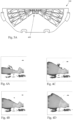
- Figures 4A , 4B , 4C and 4D each show exemplary light distributions in which a single-track motor vehicle, for example a motorcycle, is in a left-hand position or left-hand bend, with individual rows of the first light emission half 110a being switched on depending on the roll angle. It should be noted that what has been said also applies to a corresponding right-hand position or right-hand bend.
- the control unit When a first roll angle is detected, the control unit is configured to control or switch on the first row R1 of the first or second light emission half 110a, 110b of the optical body 100 , which is Fig. 4A can be seen, and wherein upon detection of a second roll angle, the control unit is configured to control or switch on the first and second rows R1 , R2 of the first or second light emission half 110a , 110b of the optical body 100 , which in Fig. 4B can be seen.
- the control unit when a third roll angle is detected, the control unit is configured to control or switch on the first, second and third rows R1 , R2 , R3 of the first or second light emission half 110a , 110b of the optical body 100 , which is Fig. 4C is shown, and wherein upon detection of a fourth roll angle, the control unit is configured to control or switch on the first, second, third and fourth rows R1 , R2 , R3 , R4 of the first or second light emission half 110a , 110b of the optical body 100 , which in Fig. 4D can be seen.
- the first roll angle is in a range of 5° to 7°
- the second roll angle in a range of 7° to 17°
- the third roll angle in a range of 17° to 27°
- the fourth roll angle in a range above 27°.
- lighting device 10 light sources... 50 optical body... 100 base body... 110 First half of light emission... 110a Second half of light emission... 110b light guide body... 200 entrance area... 210 exit surface... 220 Common exit surface... 220a projection optics... 300 Optical axis... A main radiation direction... X Vertical axis of symmetry... V angular offset... W1, W2, W3 rows... R1, R2, R3, R4, 400 straight lines... G1, G2, G3, G4
Landscapes
- Engineering & Computer Science (AREA)
- General Engineering & Computer Science (AREA)
- Physics & Mathematics (AREA)
- Microelectronics & Electronic Packaging (AREA)
- Optics & Photonics (AREA)
- Mechanical Engineering (AREA)
- Mathematical Physics (AREA)
- Non-Portable Lighting Devices Or Systems Thereof (AREA)
- Lighting Device Outwards From Vehicle And Optical Signal (AREA)
Description
- Die Erfindung betrifft eine Beleuchtungsvorrichtung für einen Kraftfahrzeugscheinwerfer eines einspurigen Kraftfahrzeugs zur Erzeugung einer segmentierten Lichtverteilung, wobei die Beleuchtungsvorrichtung Folgendes umfasst:
- ein Optikkörper, umfassend einen Grundkörper und mehrere von dem Grundkörper vorragende Lichtleitkörper zum Formen einer festlegbaren segmentierten Lichtverteilung aus dem Licht von Lichtquellen, welche Lichtleitkörper jeweils eine Lichteintrittsfläche aufweisen, in welche Licht von den Lichtquellen einspeisbar ist, und eine Austrittsfläche aufweisen, aus welcher in den jeweiligen Lichtleitkörper einspeisbares Licht austritt, wobei die Austrittsflächen benachbarter Lichtleitkörper eine gemeinsame Austrittsfläche des Optikkörpers bilden,
- mehrere Lichtquellen, wobei zumindest eine Lichtquelle jeweils einer Eintrittsfläche eines Lichtleitkörpers zugeordnet ist,
- eine Projektionsoptik mit einer optischen Achse, welche Projektionsoptik eingerichtet ist, dass von der gemeinsamen Austrittsfläche austretende Licht vor der Beleuchtungsvorrichtung in Richtung einer Hauptabstrahlrichtung abzubilden,
- wobei der Grundkörper eine erste und eine zweite Lichtemissionshälfte aufweist, wobei jede Lichtemissionshälfte Lichtleitkörper aufweist, die zumindest in einer ersten Reihe entlang einer Geraden und in einer zweiten Reihe entlang einer Geraden angeordnet sind, wobei die Geraden der ersten und der zweiten Reihe zueinander um einen ersten Winkelversatz angeordnet sind, und wobei die erste und die zweite Lichtemissionshälfte zueinander spiegelsymmetrisch um eine vertikale Symmetrieachse an dem Grundkörper angeordnet sind.
- Weiters betrifft die Erfindung einen Kraftfahrzeugscheinwerfer mit zumindest einer erfindungsgemäßen Beleuchtungsvorrichtung.
- Um in Kurvenlage eines einspurigen Kraftfahrzeuges, beispielsweise eines Motorrades, die Ausleuchtung des Sichtbereiches des Fahrers zu verbessern, indem je nach Kurvenlage zusätzliche Lichtsegmente zugeschaltet werden.
- Stand der Technik wurde dies bisher mittels zusätzlicher Reflektoren und/oder Lichtmodulen realisiert.
- Diese zusätzlichen Module benötigen allerdings viel Bauraum, wobei ferner diese zusätzlichen Module zuvor zueinander eingestellt werden müssen, was zusätzlichen Aufwand bedeutet.
- Die
WO2020/043443 A1 , dieDE 10 2018 104261 A1 , dieDE 10 2009 053581 B3 , dieDE 10 2018 209061 A1 , dieEP 3 369 618 A1 und dieDE 10 2008 044676 A1 zeigen Beleuchtungsvorrichtungen aus dem Stand der Technik. - Es ist eine Aufgabe der Erfindung eine verbesserte Beleuchtungsvorrichtung bereitzustellen.
- Diese Aufgabe wird mit dem Kennzeichen des Anspruchs 1 gelöst.
- Jede Reihe umfasst hierbei zumindest zwei Lichtleitkörper, welche entlang der entsprechenden Gerade angeordnet sind. Ferner erstrecken sich die Geraden ausgehend von der vertikalen Symmetrieachse quer zur Hauptabstrahlrichtung.
- Ferner kann vorgesehen sein, dass jede Reihe zur Erzeugung eines Lichtsegments in der segmentierten Lichtverteilung mitwirkt, wobei das durch die entsprechende Reihe erzeugbare Lichtsegment ab- und anschaltbar ist.
- Ferner kann vorgesehen sein, dass jeder Lichtleitkörper zur Erzeugung eines Lichtsegments in der segmentierten Lichtverteilung mitwirkt, wobei das durch den entsprechenden Lichtleitkörper erzeugbare Lichtsegment ab- und anschaltbar ist.
- Es kann vorgesehen sein, dass die Austrittsflächen benachbarter Lichtleitkörper in einer Reihe unmittelbar aneinander angrenzen, sodass kein Spalt zwischen den Austrittsflächen vorhanden ist.
- Es kann vorgesehen sein, dass die Austrittsfläche benachbarter Lichtleitkörper unterschiedlicher Reihen unmittelbar aneinander angrenzen, sodass kein Spalt zwischen den Austrittsflächen vorhanden ist.
- Es kann vorgesehen sein, dass die Austrittsflächen der Lichtleitkörper einer Reihe ausgehend von der vertikalen Symmetrieachse in Richtung quer zur Hauptabstrahlrichtung größer werden.
- Es kann vorgesehen sein, dass die Eintrittsflächen der Lichtleitkörper in einer gemeinsamen Vertikalebene angeordnet sind, welche Vertikalebene orthogonal zur optischen Achse der Projektionsoptik angeordnet ist.
- Es kann vorgesehen sein, dass die Lichtquellen als Leuchtdioden ausgebildet sind.
- Es kann vorgesehen sein, dass die Leuchtdioden unabhängig voneinander ansteuerbar sind. Es kann vorgesehen sein, dass die gemeinsame Austrittsfläche des Optikkörpers gekrümmt ausgebildet ist.
- Es kann vorgesehen sein, dass die Projektionsoptik eine gekrümmte Brennfläche aufweist, wobei die gemeinsame Austrittsfläche des Optikkörpers in der Brennfläche der Projektionsoptik angeordnet ist, wobei die gemeinsame Austrittsfläche zumindest abschnittweise der Krümmung der Brennfläche der Projektionsoptik folgt. Hierbei folgt die Austrittsfläche der Krümmung vor allem im zentralen Winkelbereich der Brennfläche, also in einem Bereich nahe der optischen Achse der Projektionsoptik.
- Erfindungsgemäß ist vorgesehen, dass jeder Lichtleitkörper sich von der Eintrittsfläche bis zur Austrittsfläche erstreckende Seitenflächen aufweist, wobei die Austrittsfläche jeweils von zwei Schmalseiten und zwei Längsseiten begrenzt wird, wobei die Seitenflächen zumindest eines Lichtleitkörpers, welche Seitenflächen orthogonal zu einer Richtung quer zur Hauptabstrahlrichtung stehen, gekrümmt ausgebildet sind, wobei jene Seitenfläche des Lichtleitkörpers, welche zur vertikalen Symmetrieachse gerichtet ist, konvex ausgebildet ist, und jene Seitenfläche des Lichtleitkörpers, welche entgegengesetzt zur vertikalen Symmetrieachse gerichtet ist, konkav ausgebildet ist.
- Dabei ist erfindungsgemäß vorgesehen, dass jede Reihe einen von der vertikalen Symmetrieachse weg angeordneten äußersten Lichtleitkörper und zumindest einen innenliegenden Lichtleitkörper aufweist, wobei der zumindest eine innenliegende Lichtleitkörper jeder Reihe die gekrümmten Seitenflächen aufweist.
- Hierdurch wird der Geometrie der Petzvalfläche der Projektionslinse entgegengewirkt und entlang einer schiefen Hell-Dunkel-Grenzen der Segmente sowie entlang einer in Kurvenlage schiefen Hell-Dunkel-Grenze ein wünschenswerter Intensitätsverlauf vom Zentrum der Lichtverteilung radial nach außen erreicht.
- Es kann vorgesehen sein, dass der Optikkörper im Bereich, in welchem die zwei Lichtemissionshälften bei der vertikalen Symmetrieachse zusammenlaufen, zumindest eine Reihe umfasst, aufweisend zumindest zwei Lichtleitkörper, wobei diese Reihe entlang einer Geraden angeordnet ist, welche orthogonal zur vertikalen Symmetrieachse angeordnet ist, wobei vorzugsweise der Optikkörper zwei Reihen umfasst.
- Hierdurch ist es möglich, dass falls die segmentierte Lichtverteilung als Fernlichtverteilung vorgesehen ist, auch im Fernlichtbetrieb Licht ins Vorfeld gelangt, und ein Helligkeitsminimum vermieden werden kann.
- Es kann vorgesehen sein, dass die Eintrittsflächen jedes Lichtleitkörpers einen Parallelversatz zur entsprechenden Austrittsfläche aufweisen, sodass die Flächenmittelpunkte der Austrittsfläche und der zugehörigen Eintrittsfläche gesehen in Hauptabstrahlrichtung einen Versatz aufweisen.
- Diese Vorkehrung dient ebenfalls dazu, den Lichtschwerpunkt Richtung Zentrum der Lichtverteilung zu verschieben, um eine homogene (stetige) Lichtverteilung zu erzeugen, welche ein Maximum in der Mitte aufweist.
- Es kann vorgesehen sein, dass die Beleuchtungsvorrichtung eine Steuereinheit und zumindest einen Rollwinkelsensor umfasst, welcher eingerichtet ist, einen Rollwinkel der Abweichung der Ist-Position von einer definierten Standardposition der Beleuchtungsvorrichtung um die Hauptabstrahlrichtung zu bestimmen, wobei die Steuereinheit eingerichtet ist, einen Rollwinkel von dem zumindest einen Rollwinkelsensor zu empfangen und abhängig von dem Rollwinkel einzelne Reihen der Lichtleitkörper ein- und/oder auszuschalten.
- Es kann vorgesehen sein, dass bei einem Erfassen eines ersten Rollwinkels die Steuereinheit eingerichtet ist, die erste Reihe der ersten oder der zweiten Lichtemissionshälfte des Optikkörpers anzusteuern bzw. einzuschalten, und wobei bei einem Erfassen eines zweiten Rollwinkels die Steuereinheit eingerichtet ist, die erste und die zweite Reihe der ersten oder der zweiten Lichtemissionshälfte des Optikkörpers anzusteuern bzw. einzuschalten.
- Es kann vorgesehen sein, dass der Optikkörper eine dritte Reihe an Lichtleitkörpern umfasst, welche einen zweiten Winkelversatz zur ersten Reihe aufweist und symmetrisch um die vertikale Symmetrieachse angeordnet ist, und wobei der Optikkörper eine vierte Reihe an Lichtleitkörpern umfasst, welche einen dritten Winkelversatz zur ersten Reihe aufweist und symmetrisch um die vertikale Symmetrieachse angeordnet ist.
- Es kann vorgesehen sein, dass bei einem Erfassen eines dritten Rollwinkels die Steuereinheit eingerichtet ist, die erste, zweite und dritte Reihe der ersten oder zweiten Lichtemissionshälfte des Optikkörpers anzusteuern bzw. einzuschalten, und wobei bei einem Erfassen eines vierten Rollwinkels die Steuereinheit eingerichtet ist, die erste, zweite, dritte und vierte Reihe der ersten oder zweiten Lichtemissionshälfte des Optikkörpers anzusteuern bzw. einzuschalten.
- Es kann vorgesehen sein, dass der erste Rollwinkel in einem Bereich von 5° bis 7°, der zweiter Rollwinkel in einem Bereich von 7° bis 17°, der dritte Rollwinkel in einem Bereich von 17° bis 27° und der vierte Rollwinkel in einem Bereich über 27° liegt.
- Es sei angemerkt, dass die obigen Winkelangaben als Absolutbeträge zu verstehen sind und auch die Negativwinkel inbegriffen sind, d.h. dass der Bereich der angegebenen Rollwinkel sowohl in einer Kurvenlange in Richtung rechts als auch in Richtung links gleichermaßen zu verstehen ist.
- Es kann vorgesehen sein, dass die segmentierte Lichtverteilung eine segmentierte Fernlichtverteilung ist.
- Die Aufgabe wird ebenso gelöst durch einen Kraftfahrzeugscheinwerfer mit zumindest einer erfindungsgemäßen Beleuchtungsvorrichtung.
- Nachfolgend wird die Erfindung anhand von beispielhaften Zeichnungen näher erläutert. Hierbei zeigt
-
Fig. 1 eine beispielhafte Beleuchtungsvorrichtung mit einem Optikkörper und einer nachgeschalteten Projektionsoptik, -
Fig. 2 eine Ansicht von oben des Optikkörpers der Beleuchtungsvorrichtung ausFig. 1 , -
Fig. 3 eine Ansicht von hinten des Optikkörpers ausFig. 2 mit Lichtleikörpern, welche in Reihen, die zueinander einen Winkelversatz aufweisen, angeordnet sind, -
Fig. 3A eine Ansicht von hinten eines weiteren beispielhaften Optikkörpers, -
Fig. 4A eine beispielhafte Lichtverteilung mit einer eingeschalteten ersten Reihe von Lichtleitkörpern, -
Fig. 4B eine beispielhafte Lichtverteilung mit einer eingeschalteten ersten und zweiten Reihe von Lichtleitkörpern, -
Fig. 4C eine beispielhafte Lichtverteilung mit einer eingeschalteten ersten, zweiten und dritten Reihe von Lichtleitkörpern, und -
Fig. 4D eine beispielhafte Lichtverteilung mit einer eingeschalteten ersten, zweiten, dritten und vierten Reihe von Lichtleitkörpern. -
Fig. 1 zeigt eine beispielhafte Beleuchtungsvorrichtung 10 für einen Kraftfahrzeugscheinwerfer eines einspurigen Kraftfahrzeugs, beispielsweise eines Motorrades, zur Erzeugung einer segmentierten Lichtverteilung, wobei die Beleuchtungsvorrichtung 10 einen Optikkörper 100 aufweist, umfassend einen Grundkörper 110 und mehrere von dem Grundkörper 110 vorragende Lichtleitkörper 200 zum Formen einer festlegbaren segmentierten Lichtverteilung aus dem Licht von Lichtquellen 50. - Die Lichtleitkörper 200 weisen jeweils eine Lichteintrittsfläche 210 auf, in welche Licht von den Lichtquellen 50 einspeisbar ist, und eine Austrittsfläche 220 auf, aus welcher in den jeweiligen Lichtleitkörper 200 einspeisbares Licht austritt, wobei die Austrittsflächen 220 benachbarter Lichtleitkörper 200 eine gemeinsame Austrittsfläche 220a, welche gekrümmt ausgebildet ist, des Optikkörpers 100 bilden.
- Ferner umfasst die Beleuchtungsvorrichtung 10 mehrere Lichtquellen 50, wobei zumindest eine Lichtquelle jeweils einer Eintrittsfläche 210 eines Lichtleitkörpers 200 zugeordnet ist, wobei die Beleuchtungsvorrichtung 10 weiters eine Projektionsoptik 300 mit einer optischen Achse A aufweist, welche Projektionsoptik 300 eingerichtet ist, dass von der gemeinsamen Austrittsfläche 220a austretende Licht vor der Beleuchtungsvorrichtung 10 in Richtung einer Hauptabstrahlrichtung X abzubilden.
- Ferner weist die Projektionsoptik 300 eine gekrümmte Brennfläche auf, wobei die gemeinsame Austrittsfläche 220a des Optikkörpers 100 in der Brennfläche der Projektionsoptik 300 angeordnet ist, wobei die gemeinsame Austrittsfläche 220a der Krümmung der Brennfläche der Projektionsoptik 300 folgt.
- Der Grundkörper 110 weist eine erste und eine zweite Lichtemissionshälfte 110a, 110b auf, wobei die erste Lichtemissionshälfte 110a Lichtleitkörper 200 aufweist, die in einer ersten Reihe R1 entlang einer Geraden G1, in einer zweiten Reihe R2 entlang einer Geraden G2, in einer dritten Reihe R3 entlang einer Geraden G3 und in einer vierten Reihe R4 entlang einer Geraden G4 angeordnet sind, wobei die Geraden der ersten und der zweiten Reihe R1, R2 zueinander um einen ersten Winkelversatz W1 angeordnet sind, wobei die Geraden der ersten und der dritten Reihe R1, R3 zueinander einen zweiten Winkelversatz W2 aufweisen, wobei die Geraden der ersten und der vierten Reihe R1, R4 einen dritten Winkelversatz W3 zueinander aufweisen, und wobei die erste und die zweite Lichtemissionshälfte 110a, 110b zueinander spiegelsymmetrisch um eine vertikale Symmetrieachse V an dem Grundkörper 110 angeordnet sind. Hierbei weist die zweite Lichtemissionshälfte 110b ebenfalls vier Reihen R1', R2', R3', R4', welche ebenfalls den entsprechenden Winkelversatz zueinander aufweisen, wie die Reihen der ersten Lichtemissionshälfte 110a.
- Dabei ist in
Fig. 2 und Fig. 3 ersichtlich, dass die Austrittsflächen 220 der Lichtleitkörper 200 einer Reihe R1, R1', R2, R2', R3, R3', R4, R4' ausgehend von der vertikalen Symmetrieachse V in Richtung quer zur Hauptabstrahlrichtung (X) größer werden. - Ferner sind die Eintrittsflächen 210 der Lichtleitkörper 200 in einer gemeinsamen Vertikalebene angeordnet, welche Vertikalebene orthogonal zur optischen Achse A der Projektionsoptik 300 angeordnet ist.
- Wie in
Fig. 2 und Fig. 3 ebenfalls zu sehen ist, weist jeder Lichtleitkörper 200 sich von der Eintrittsfläche 210 bis zur Austrittsfläche 220 erstreckende Seitenflächen auf, wobei die Austrittsfläche 220 jeweils von zwei Schmalseiten und zwei Längsseiten begrenzt wird, wobei die Seitenflächen zumindest eines Lichtleitkörpers 200, welche Seitenflächen orthogonal zu einer Richtung quer zur Hauptabstrahlrichtung X stehen, gekrümmt ausgebildet sind, wobei jene Seitenfläche 230a des Lichtleitkörpers 200, welche zur vertikalen Symmetrieachse V gerichtet ist, konvex ausgebildet ist, und jene Seitenfläche 230b des Lichtleitkörpers 200, welche entgegengesetzt zur vertikalen Symmetrieachse V gerichtet ist, konkav ausgebildet ist. - Ferner weist jede Reihe R1, R1', R2, R2', R3, R3', R4, R4' einen von der vertikalen Symmetrieachse V weg angeordneten äußersten Lichtleitkörper und zumindest einen innenliegenden Lichtleitkörper auf, wobei der zumindest eine innenliegende Lichtleitkörper jeder Reihe R1, R1', R2, R2', R3, R3', R4, R4' die gekrümmten Seitenflächen aufweist.
- Darüber hinaus weisen die Eintrittsflächen 210 jedes Lichtleitkörpers 200 einen Parallelversatz zur entsprechenden Austrittsfläche 220 auf, sodass der Flächenmittelpunkt der Austrittsfläche 220 und der Flächenmittelpunkt der zugehörigen Eintrittsfläche 210 gesehen in Hauptabstrahlrichtung X einen Versatz aufweisen, wie in
Fig. 2 und Fig. 3 zu sehen ist. - Weiters umfasst die Beleuchtungsvorrichtung 10 eine Steuereinheit und zumindest einen Rollwinkelsensor, welcher eingerichtet ist, einen Rollwinkel der Abweichung der Ist-Position von einer definierten Standardposition der Beleuchtungsvorrichtung 10 um die Hauptabstrahlrichtung X zu bestimmen, wobei die Steuereinheit eingerichtet ist, einen Rollwinkel von dem zumindest einen Rollwinkelsensor zu empfangen und abhängig von dem Rollwinkel einzelne Reihen R1, R1', R2, R2', R3, R3', R4, R4' der Lichtleitkörper 200 ein- und/oder auszuschalten.
-
Fig. 3 zeigt ein weiteres Beispiel eines Optikkörpers 100, wobei der Optikkörper 100 im Bereich, in welchem die zwei Lichtemissionshälften bei der vertikalen Symmetrieachse V zusammenlaufen, zwei Reihen 400 umfasst, aufweisend zumindest zwei Lichtleitkörper, wobei diese Reihe 400 entlang einer Geraden angeordnet ist, welche orthogonal zur vertikalen Symmetrieachse f angeordnet ist. Das zuvor Gesagte trifft auch auf die Ausführungsform derFig. 3A zu. -
Figuren 4A, 4B, 4C und 4D zeigen jeweils beispielhafte Lichtverteilungen, bei welcher ein einspuriges Kraftfahrzeug, beispielsweise ein Motorrad, in einer Linkslage bzw. Linkskurve befindet, wobei je nach Rollwinkel einzelne Reihen der ersten Lichtemissionshälfte 110a hinzugeschalten werden. Es sei angemerkt, dass das Gesagte auch für eine entsprechende Rechtslage bzw. Rechtskurve zu übernehmen ist. - Bei einem Erfassen eines ersten Rollwinkels ist die Steuereinheit eingerichtet, die erste Reihe R1 der ersten oder zweiten Lichtemissionshälfte 110a, 110b des Optikkörpers 100 anzusteuern bzw. einzuschalten, was in
Fig. 4A zu sehen ist, und wobei bei einem Erfassen eines zweiten Rollwinkels die Steuereinheit eingerichtet ist, die erste und die zweite Reihe R1, R2 der ersten oder der zweiten Lichtemissionshälfte 110a, 110b des Optikkörpers 100 anzusteuern bzw. einzuschalten, was inFig. 4B zu sehen ist. - Ferner ist bei einem Erfassen eines dritten Rollwinkels die Steuereinheit eingerichtet, die erste, zweite und dritte Reihe R1, R2, R3 der ersten oder zweiten Lichtemissionshälfte 110a, 110b des Optikkörpers 100 anzusteuern bzw. einzuschalten, was in
Fig. 4C dargestellt ist, und wobei bei einem Erfassen eines vierten Rollwinkels die Steuereinheit eingerichtet ist, die erste, zweite, dritte und vierte Reihe R1, R2, R3, R4 der ersten oder zweiten Lichtemissionshälfte 110a, 110b des Optikkörpers 100 anzusteuern bzw. einzuschalten, was inFig. 4D zu sehen ist. - Der erste Rollwinkel ist dabei in einem Bereich von 5° bis 7°, der zweiter Rollwinkel in einem Bereich von 7° bis 17°, der dritte Rollwinkel in einem Bereich von 17° bis 27° und der vierte Rollwinkel in einem Bereich über 27°.
-
Beleuchtungsvorrichtung... 10 Lichtquellen... 50 Optikkörper... 100 Grundkörper... 110 Erste Lichtemissionshälfte... 110a Zweite Lichtemissionshälfte... 110b Lichtleitkörper... 200 Eintrittsfläche... 210 Austrittsfläche... 220 Gemeinsame Austrittsfläche... 220a Projektionsoptik... 300 Optische Achse... A Hauptabstrahlrichtung... X Vertikale Symmetrieachse... V Winkelversatz... W1, W2, W3 Reihen... R1, R2, R3, R4, 400 Geraden... G1, G2, G3, G4
Claims (12)
- Beleuchtungsvorrichtung (10) für einen Kraftfahrzeugscheinwerfer eines einspurigen Kraftfahrzeugs zur Erzeugung einer segmentierten Lichtverteilung, wobei die Beleuchtungsvorrichtung (10) Folgendes umfasst:- ein Optikkörper (100), umfassend einen Grundkörper (110) und mehrere von dem Grundkörper (110) vorragende Lichtleitkörper (200) zum Formen einer festlegbaren segmentierten Lichtverteilung aus dem Licht von Lichtquellen (50), welche Lichtleitkörper (200) jeweils eine Lichteintrittsfläche (210) aufweisen, in welche Licht von Lichtquellen (50) einspeisbar ist, und eine Austrittsfläche (220) aufweisen, aus welcher in den jeweiligen Lichtleitkörper (200) einspeisbares Licht austritt, wobei die Austrittsflächen (220) benachbarter Lichtleitkörper (200) eine gemeinsame Austrittsfläche (220a) des Optikkörpers (100) bilden,- mehrere Lichtquellen (50), wobei zumindest eine Lichtquelle jeweils einer Eintrittsfläche (210) eines Lichtleitkörpers (200) zugeordnet ist,- eine Projektionsoptik (300) mit einer optischen Achse (A), welche Projektionsoptik (300) eingerichtet ist, dass von der gemeinsamen Austrittsfläche (220a) austretende Licht vor der Beleuchtungsvorrichtung (10) in Richtung einer Hauptabstrahlrichtung (X) abzubilden,der Grundkörper (110) eine erste und eine zweite Lichtemissionshälfte (110a, 110b) aufweist, wobei jede Lichtemissionshälfte (110a, 110b) Lichtleitkörper (200) aufweist, die zumindest in einer ersten Reihe (R1) entlang einer Geraden und in einer zweiten Reihe (R2) entlang einer Geraden angeordnet sind, wobei die Geraden der ersten und der zweiten Reihe (R1, R2) zueinander um einen ersten Winkelversatz (W1) angeordnet sind, und wobei die erste und die zweite Lichtemissionshälfte (110a, 110b) zueinander spiegelsymmetrisch um eine vertikale Symmetrieachse (V) an dem Grundkörper (110) angeordnet sind,dadurch gekennzeichnet, dassjeder Lichtleitkörper (200) sich von der Eintrittsfläche (210) bis zur Austrittsfläche (220) erstreckende Seitenflächen aufweist, wobei die Austrittsfläche (220) jeweils von zwei Schmalseiten und zwei Längsseiten begrenzt wird, wobei die Seitenflächen zumindest eines Lichtleitkörpers (200) gekrümmt ausgebildet sind, wobei jene Seitenfläche des Lichtleitkörpers (200), welche zur vertikalen Symmetrieachse (V) gerichtet ist, konvex ausgebildet ist, und jene Seitenfläche des Lichtleitkörpers (200), welche entgegengesetzt zur vertikalen Symmetrieachse (V) gerichtet ist, konkav ausgebildet ist, und wobeijede Reihe (R1, R2) einen von der vertikalen Symmetrieachse (V) weg angeordneten äußersten Lichtleitkörper und zumindest einen innenliegenden Lichtleitkörper aufweist, wobei der zumindest eine innenliegende Lichtleitkörper jeder Reihe (R1, R2) die gekrümmten Seitenflächen aufweist.
- Beleuchtungsvorrichtung nach Anspruch, dadurch gekennzeichnet, dass die Eintrittsflächen (210) der Lichtleitkörper (200) in einer gemeinsamen Vertikalebene angeordnet sind, welche Vertikalebene orthogonal zur optischen Achse (A) der Projektionsoptik (300) angeordnet ist.
- Beleuchtungsvorrichtung nach Anspruch 1 oder 2, dadurch gekennzeichnet, dass die gemeinsame Austrittsfläche (220a) des Optikkörpers (100) gekrümmt ausgebildet ist.
- Beleuchtungsvorrichtung nach einem der Ansprüche 1 bis 3, dadurch gekennzeichnet, dass die Projektionsoptik (300) eine gekrümmte Brennfläche aufweist, wobei die gemeinsame Austrittsfläche (220a) des Optikkörpers (100) in der Brennfläche der Projektionsoptik (300) angeordnet ist, wobei die gemeinsame Austrittsfläche (220a) zumindest abschnittweise der Krümmung der Brennfläche der Projektionsoptik (300) folgt.
- Beleuchtungsvorrichtung nach einem der Ansprüche 1 bis 4, dadurch gekennzeichnet, dass der Optikkörper im Bereich, in welchem die zwei Lichtemissionshälften bei der vertikalen Symmetrieachse (V) zusammenlaufen, zumindest eine Reihe (400) umfasst, aufweisend zumindest zwei Lichtleitkörper, wobei diese Reihe (400) entlang einer Geraden angeordnet ist, welche orthogonal zur vertikalen Symmetrieachse (V) angeordnet ist, wobei vorzugsweise der Optikkörper zwei Reihen (400) umfasst.
- Beleuchtungsvorrichtung nach einem der Ansprüche 1 bis 5, dadurch gekennzeichnet, dass die Eintrittsflächen (210) jedes Lichtleitkörpers (200) einen Parallelversatz zur entsprechenden Austrittsfläche (220) aufweisen, sodass die Flächenmittelpunkte der Austrittsfläche (220) und der zugehörigen Eintrittsfläche (210) gesehen in Hauptabstrahlrichtung (X) einen Versatz aufweisen.
- Beleuchtungsvorrichtung nach einem der Ansprüche 1 bis 6, dadurch gekennzeichnet, dass die Beleuchtungsvorrichtung (10) eine Steuereinheit und zumindest einen Rollwinkelsensor umfasst, welcher eingerichtet ist, einen Rollwinkel der Abweichung der Ist-Position von einer definierten Standardposition der Beleuchtungsvorrichtung (10) um die Hauptabstrahlrichtung (X) zu bestimmen, wobei die Steuereinheit eingerichtet ist, einen Rollwinkel von dem zumindest einen Rollwinkelsensor zu empfangen und abhängig von dem Rollwinkel einzelne Reihen (R1, R2) der Lichtleitkörper (200) ein- und/oder auszuschalten.
- Beleuchtungsvorrichtung nach Anspruch 7, dadurch gekennzeichnet, dass bei einem Erfassen eines ersten Rollwinkels die Steuereinheit eingerichtet ist, die erste Reihe (R1) der ersten oder der zweiten Lichtemissionshälfte (110a, 110b) des Optikkörpers (100) anzusteuern bzw. einzuschalten, und wobei bei einem Erfassen eines zweiten Rollwinkels die Steuereinheit eingerichtet ist, die erste und die zweite Reihe (R1, R2) der ersten oder der zweiten Lichtemissionshälfte (110a, 110b) des Optikkörpers (100) anzusteuern bzw. einzuschalten.
- Beleuchtungsvorrichtung nach einem der Ansprüche 1 bis 8, dadurch gekennzeichnet, dass der Optikkörper (100) eine dritte Reihe (R3) an Lichtleitkörpern (200) umfasst, welche einen zweiten Winkelversatz zur ersten Reihe (R1) aufweist und symmetrisch um die vertikale Symmetrieachse (V) angeordnet ist, und wobei der Optikkörper (100) eine vierte Reihe (R4) an Lichtleitkörpern umfasst, welche einen dritten Winkelversatz zur ersten Reihe (R1) aufweist und symmetrisch um die vertikale Symmetrieachse (V) angeordnet ist.
- Beleuchtungsvorrichtung nach Anspruch 9, dadurch gekennzeichnet, dass bei einem Erfassen eines dritten Rollwinkels die Steuereinheit eingerichtet ist, die erste, zweite und dritte Reihe (R1, R2, R3) der ersten oder zweiten Lichtemissionshälfte (110a, 110b) des Optikkörpers (100) anzusteuern bzw. einzuschalten, und wobei bei einem Erfassen eines vierten Rollwinkels die Steuereinheit eingerichtet ist, die erste, zweite, dritte und vierte Reihe (R1, R2, R3, R4) der ersten oder zweiten Lichtemissionshälfte (110a, 110b) des Optikkörpers (100) anzusteuern bzw. einzuschalten.
- Beleuchtungsvorrichtung nach einem der Ansprüche 1 bis 10, dadurch gekennzeichnet, dass die segmentierte Lichtverteilung eine segmentierte Fernlichtverteilung oder Abblendlichtverteilung ist.
- Kraftfahrzeugscheinwerfer mit zumindest einer Beleuchtungsvorrichtung (10) gemäß einem der Ansprüche 1 bis 11.
Applications Claiming Priority (2)
| Application Number | Priority Date | Filing Date | Title |
|---|---|---|---|
| EP20208068.5A EP4001741A1 (de) | 2020-11-17 | 2020-11-17 | Beleuchtungsvorrichtung für einen kraftfahrzeugscheinwerfer |
| PCT/EP2021/080132 WO2022106178A1 (de) | 2020-11-17 | 2021-10-29 | Beleuchtungsvorrichtung für einen kraftfahrzeugscheinwerfer eines einspurigen kraftfahrzeuges |
Publications (2)
| Publication Number | Publication Date |
|---|---|
| EP4248128A1 EP4248128A1 (de) | 2023-09-27 |
| EP4248128B1 true EP4248128B1 (de) | 2024-10-16 |
Family
ID=73455606
Family Applications (2)
| Application Number | Title | Priority Date | Filing Date |
|---|---|---|---|
| EP20208068.5A Withdrawn EP4001741A1 (de) | 2020-11-17 | 2020-11-17 | Beleuchtungsvorrichtung für einen kraftfahrzeugscheinwerfer |
| EP21801918.0A Active EP4248128B1 (de) | 2020-11-17 | 2021-10-29 | Beleuchtungsvorrichtung für einen kraftfahrzeugscheinwerfer eines einspurigen kraftfahrzeuges |
Family Applications Before (1)
| Application Number | Title | Priority Date | Filing Date |
|---|---|---|---|
| EP20208068.5A Withdrawn EP4001741A1 (de) | 2020-11-17 | 2020-11-17 | Beleuchtungsvorrichtung für einen kraftfahrzeugscheinwerfer |
Country Status (6)
| Country | Link |
|---|---|
| US (1) | US20240011615A1 (de) |
| EP (2) | EP4001741A1 (de) |
| JP (1) | JP7564360B2 (de) |
| KR (1) | KR102838086B1 (de) |
| CN (1) | CN116457606A (de) |
| WO (1) | WO2022106178A1 (de) |
Families Citing this family (1)
| Publication number | Priority date | Publication date | Assignee | Title |
|---|---|---|---|---|
| GB2641287A (en) * | 2024-05-24 | 2025-11-26 | Bee Lighting Ltd | Vehicle lean lamp |
Citations (2)
| Publication number | Priority date | Publication date | Assignee | Title |
|---|---|---|---|---|
| EP2306077B1 (de) * | 2009-10-05 | 2014-11-05 | Automotive Lighting Reutlingen GmbH | Kraftfahrzeugscheinwerfer mit einer Temperaturausdehnungen kompensierenden Optik-Halterung |
| EP3369618B1 (de) * | 2017-03-02 | 2020-01-22 | Honda Motor Co., Ltd. | Beleuchtungsvorrichtungsanordnungsstruktur für ein sattelfahrzeug |
Family Cites Families (16)
| Publication number | Priority date | Publication date | Assignee | Title |
|---|---|---|---|---|
| JP2005505796A (ja) * | 2001-10-10 | 2005-02-24 | シーメンス アクチエンゲゼルシヤフト | ディスプレイ装置 |
| DE102008044676A1 (de) * | 2008-08-28 | 2010-03-04 | Delvis Gmbh | Neigungskompensiertes Licht, insbesondere für ein Motorrad, und Motorrad mit einem neigungskompensierten Licht |
| DE102009053581B3 (de) * | 2009-10-05 | 2011-03-03 | Automotive Lighting Reutlingen Gmbh | Lichtmodul für eine Beleuchtungseinrichtung eines Kraftfahrzeugs |
| AT514333B1 (de) * | 2013-06-25 | 2014-12-15 | Zizala Lichtsysteme Gmbh | Scheinwerfer für Fahrzeuge |
| US10023103B2 (en) * | 2013-09-13 | 2018-07-17 | J.W. Speaker, Corporation | Systems and methods for illumination control and distribution during a vehicle bank |
| FR3012203B1 (fr) * | 2013-10-23 | 2015-10-30 | Valeo Vision | Dispositif d'eclairage comportant un guide de rayons lumineux |
| AT518090B1 (de) * | 2015-12-21 | 2017-10-15 | Zkw Group Gmbh | Scheinwerfer für ein Fahrzeug |
| AT518551B1 (de) * | 2016-08-04 | 2017-11-15 | Zkw Group Gmbh | Kraftfahrzeugbeleuchtungsvorrichtung |
| JP2018142595A (ja) * | 2017-02-27 | 2018-09-13 | パナソニックIpマネジメント株式会社 | 光源モジュール、照明装置、及び移動体 |
| JP6865396B2 (ja) * | 2017-02-27 | 2021-04-28 | パナソニックIpマネジメント株式会社 | 照明装置、照明システム、及び移動体 |
| WO2018168249A1 (ja) * | 2017-03-14 | 2018-09-20 | ヤマハ発動機株式会社 | 傾斜車両用ヘッドライト装置及び傾斜車両 |
| DE102017206194A1 (de) * | 2017-04-11 | 2018-10-11 | Osram Gmbh | Lichtleiter, Optik, Beleuchtungssytem und Scheinwerfer |
| US11027790B2 (en) * | 2018-06-05 | 2021-06-08 | Indian Motorcycle International, LLC | Adaptive lighting system |
| DE102018209061A1 (de) * | 2018-06-07 | 2019-12-12 | Osram Gmbh | Optische anordnung für ein fahrzeug, scheinwerfer, fahrzeug und verfahren für die optische anordnung |
| FR3085463B1 (fr) * | 2018-08-31 | 2022-03-25 | Valeo Vision | Module lumineux de vehicule automobile comprenant une pluralite de guides de lumiere |
| EP3650744B1 (de) * | 2018-11-07 | 2024-06-19 | ZKW Group GmbH | Kraftfahrzeugscheinwerferlichtmodul |
-
2020
- 2020-11-17 EP EP20208068.5A patent/EP4001741A1/de not_active Withdrawn
-
2021
- 2021-10-29 KR KR1020237009962A patent/KR102838086B1/ko active Active
- 2021-10-29 WO PCT/EP2021/080132 patent/WO2022106178A1/de not_active Ceased
- 2021-10-29 US US18/034,992 patent/US20240011615A1/en not_active Abandoned
- 2021-10-29 JP JP2023527420A patent/JP7564360B2/ja active Active
- 2021-10-29 CN CN202180077228.9A patent/CN116457606A/zh active Pending
- 2021-10-29 EP EP21801918.0A patent/EP4248128B1/de active Active
Patent Citations (2)
| Publication number | Priority date | Publication date | Assignee | Title |
|---|---|---|---|---|
| EP2306077B1 (de) * | 2009-10-05 | 2014-11-05 | Automotive Lighting Reutlingen GmbH | Kraftfahrzeugscheinwerfer mit einer Temperaturausdehnungen kompensierenden Optik-Halterung |
| EP3369618B1 (de) * | 2017-03-02 | 2020-01-22 | Honda Motor Co., Ltd. | Beleuchtungsvorrichtungsanordnungsstruktur für ein sattelfahrzeug |
Also Published As
| Publication number | Publication date |
|---|---|
| US20240011615A1 (en) | 2024-01-11 |
| KR20230056739A (ko) | 2023-04-27 |
| KR102838086B1 (ko) | 2025-07-24 |
| EP4001741A1 (de) | 2022-05-25 |
| CN116457606A (zh) | 2023-07-18 |
| WO2022106178A1 (de) | 2022-05-27 |
| JP7564360B2 (ja) | 2024-10-08 |
| JP2023548704A (ja) | 2023-11-20 |
| EP4248128A1 (de) | 2023-09-27 |
Similar Documents
| Publication | Publication Date | Title |
|---|---|---|
| EP3864342B1 (de) | Fernlichtscheinwerfer | |
| EP2799761B1 (de) | Lichtmodul für einen kraftfahrzeugscheinwerfer | |
| EP3390899B1 (de) | Zusatzscheinwerfer für fahrzeuge | |
| DE102012008833A1 (de) | Beleuchtungsanordnung und Fahrzeugscheinwerfer | |
| EP3699486B1 (de) | Scheinwerfer mit einer mehrzahl von halbleiterlichtquellen und einem einstückigen primäroptikfeld | |
| DE102016204342A1 (de) | Scheinwerfer für ein Kraftfahrzeug | |
| DE102017112971A1 (de) | Kraftfahrzeugscheinwerfer mit wenigstens zwei Ausgangsteillinsen aufweisenden Mikroprojektionsmodulen | |
| DE102021117552A1 (de) | Lampensteuervorrichtung für ein Fahrzeug | |
| DE102018110793A1 (de) | Projektionsscheinwerfer | |
| EP4217650B1 (de) | Beleuchtungsvorrichtung für einen kraftfahrzeugscheinwerfer | |
| EP3649013A1 (de) | Verfahren zur erzeugung einer variablen fernlicht-lichtverteilung und vorrichtung | |
| EP4248128B1 (de) | Beleuchtungsvorrichtung für einen kraftfahrzeugscheinwerfer eines einspurigen kraftfahrzeuges | |
| WO2022171488A1 (de) | Projektions- und beleuchtungsvorrichtung für einen kraftfahrzeugscheinwerfer | |
| EP4527691A1 (de) | Beleuchtungsmodul für ein fahrzeug | |
| DE102020119939A1 (de) | Scheinwerfer für ein Fahrzeug und Fahrzeug mit einem solchen Scheinwerfer | |
| DE102018206709A1 (de) | Beleuchtungssystem und scheinwerfer | |
| DE102017214399A1 (de) | Beleuchtungssystem und scheinwerfer | |
| DE102014102871B4 (de) | Beleuchtungsvorrichtung für Fahrzeuge | |
| EP4217647B1 (de) | Beleuchtungsvorrichtung für einen kraftfahrzeugscheinwerfer | |
| DE102017205723A1 (de) | Scannender Scheinwerfer für ein Kraftfahrzeug | |
| EP4015896A1 (de) | Projektionsvorrichtung für einen kraftfahrzeugscheinwerfer | |
| EP4374107B1 (de) | Beleuchtungsvorrichtung für kfz-scheinwerfer | |
| DE102016007368A1 (de) | Zum Aussenden eines segmentierten Lichtbündels konfigurierte Beleuchtungsvorrichtung, insbesondere für Kraftfahrzeuge, und mit einer solchen Vorrichtung ausgestatteter Scheinwerfer | |
| DE102023132432A1 (de) | Scheinwerfer für ein Kraftfahrzeug | |
| DE102018215016B4 (de) | Scheinwerfersystem für ein Kraftfahrzeug |
Legal Events
| Date | Code | Title | Description |
|---|---|---|---|
| STAA | Information on the status of an ep patent application or granted ep patent |
Free format text: STATUS: UNKNOWN |
|
| STAA | Information on the status of an ep patent application or granted ep patent |
Free format text: STATUS: THE INTERNATIONAL PUBLICATION HAS BEEN MADE |
|
| PUAI | Public reference made under article 153(3) epc to a published international application that has entered the european phase |
Free format text: ORIGINAL CODE: 0009012 |
|
| STAA | Information on the status of an ep patent application or granted ep patent |
Free format text: STATUS: REQUEST FOR EXAMINATION WAS MADE |
|
| 17P | Request for examination filed |
Effective date: 20230309 |
|
| AK | Designated contracting states |
Kind code of ref document: A1 Designated state(s): AL AT BE BG CH CY CZ DE DK EE ES FI FR GB GR HR HU IE IS IT LI LT LU LV MC MK MT NL NO PL PT RO RS SE SI SK SM TR |
|
| DAV | Request for validation of the european patent (deleted) | ||
| DAX | Request for extension of the european patent (deleted) | ||
| GRAP | Despatch of communication of intention to grant a patent |
Free format text: ORIGINAL CODE: EPIDOSNIGR1 |
|
| STAA | Information on the status of an ep patent application or granted ep patent |
Free format text: STATUS: GRANT OF PATENT IS INTENDED |
|
| GRAS | Grant fee paid |
Free format text: ORIGINAL CODE: EPIDOSNIGR3 |
|
| GRAA | (expected) grant |
Free format text: ORIGINAL CODE: 0009210 |
|
| STAA | Information on the status of an ep patent application or granted ep patent |
Free format text: STATUS: THE PATENT HAS BEEN GRANTED |
|
| INTG | Intention to grant announced |
Effective date: 20240903 |
|
| AK | Designated contracting states |
Kind code of ref document: B1 Designated state(s): AL AT BE BG CH CY CZ DE DK EE ES FI FR GB GR HR HU IE IS IT LI LT LU LV MC MK MT NL NO PL PT RO RS SE SI SK SM TR |
|
| REG | Reference to a national code |
Ref country code: GB Ref legal event code: FG4D Free format text: NOT ENGLISH |
|
| REG | Reference to a national code |
Ref country code: CH Ref legal event code: EP |
|
| REG | Reference to a national code |
Ref country code: IE Ref legal event code: FG4D Free format text: LANGUAGE OF EP DOCUMENT: GERMAN |
|
| REG | Reference to a national code |
Ref country code: DE Ref legal event code: R096 Ref document number: 502021005531 Country of ref document: DE |
|
| P01 | Opt-out of the competence of the unified patent court (upc) registered |
Free format text: CASE NUMBER: APP_62753/2024 Effective date: 20241126 |
|
| REG | Reference to a national code |
Ref country code: LT Ref legal event code: MG9D |
|
| REG | Reference to a national code |
Ref country code: NL Ref legal event code: MP Effective date: 20241016 |
|
| PG25 | Lapsed in a contracting state [announced via postgrant information from national office to epo] |
Ref country code: NL Free format text: LAPSE BECAUSE OF FAILURE TO SUBMIT A TRANSLATION OF THE DESCRIPTION OR TO PAY THE FEE WITHIN THE PRESCRIBED TIME-LIMIT Effective date: 20241016 |
|
| PG25 | Lapsed in a contracting state [announced via postgrant information from national office to epo] |
Ref country code: NL Free format text: LAPSE BECAUSE OF FAILURE TO SUBMIT A TRANSLATION OF THE DESCRIPTION OR TO PAY THE FEE WITHIN THE PRESCRIBED TIME-LIMIT Effective date: 20241016 |
|
| PG25 | Lapsed in a contracting state [announced via postgrant information from national office to epo] |
Ref country code: IS Free format text: LAPSE BECAUSE OF FAILURE TO SUBMIT A TRANSLATION OF THE DESCRIPTION OR TO PAY THE FEE WITHIN THE PRESCRIBED TIME-LIMIT Effective date: 20250216 Ref country code: HR Free format text: LAPSE BECAUSE OF FAILURE TO SUBMIT A TRANSLATION OF THE DESCRIPTION OR TO PAY THE FEE WITHIN THE PRESCRIBED TIME-LIMIT Effective date: 20241016 Ref country code: PT Free format text: LAPSE BECAUSE OF FAILURE TO SUBMIT A TRANSLATION OF THE DESCRIPTION OR TO PAY THE FEE WITHIN THE PRESCRIBED TIME-LIMIT Effective date: 20250217 |
|
| PG25 | Lapsed in a contracting state [announced via postgrant information from national office to epo] |
Ref country code: FI Free format text: LAPSE BECAUSE OF FAILURE TO SUBMIT A TRANSLATION OF THE DESCRIPTION OR TO PAY THE FEE WITHIN THE PRESCRIBED TIME-LIMIT Effective date: 20241016 |
|
| PG25 | Lapsed in a contracting state [announced via postgrant information from national office to epo] |
Ref country code: BG Free format text: LAPSE BECAUSE OF FAILURE TO SUBMIT A TRANSLATION OF THE DESCRIPTION OR TO PAY THE FEE WITHIN THE PRESCRIBED TIME-LIMIT Effective date: 20241016 |
|
| PG25 | Lapsed in a contracting state [announced via postgrant information from national office to epo] |
Ref country code: ES Free format text: LAPSE BECAUSE OF FAILURE TO SUBMIT A TRANSLATION OF THE DESCRIPTION OR TO PAY THE FEE WITHIN THE PRESCRIBED TIME-LIMIT Effective date: 20241016 |
|
| PG25 | Lapsed in a contracting state [announced via postgrant information from national office to epo] |
Ref country code: NO Free format text: LAPSE BECAUSE OF FAILURE TO SUBMIT A TRANSLATION OF THE DESCRIPTION OR TO PAY THE FEE WITHIN THE PRESCRIBED TIME-LIMIT Effective date: 20250116 |
|
| PG25 | Lapsed in a contracting state [announced via postgrant information from national office to epo] |
Ref country code: GR Free format text: LAPSE BECAUSE OF FAILURE TO SUBMIT A TRANSLATION OF THE DESCRIPTION OR TO PAY THE FEE WITHIN THE PRESCRIBED TIME-LIMIT Effective date: 20250117 Ref country code: LV Free format text: LAPSE BECAUSE OF FAILURE TO SUBMIT A TRANSLATION OF THE DESCRIPTION OR TO PAY THE FEE WITHIN THE PRESCRIBED TIME-LIMIT Effective date: 20241016 |
|
| PG25 | Lapsed in a contracting state [announced via postgrant information from national office to epo] |
Ref country code: PL Free format text: LAPSE BECAUSE OF FAILURE TO SUBMIT A TRANSLATION OF THE DESCRIPTION OR TO PAY THE FEE WITHIN THE PRESCRIBED TIME-LIMIT Effective date: 20241016 |
|
| PG25 | Lapsed in a contracting state [announced via postgrant information from national office to epo] |
Ref country code: RS Free format text: LAPSE BECAUSE OF FAILURE TO SUBMIT A TRANSLATION OF THE DESCRIPTION OR TO PAY THE FEE WITHIN THE PRESCRIBED TIME-LIMIT Effective date: 20250116 |
|
| REG | Reference to a national code |
Ref country code: CH Ref legal event code: PL |
|
| PG25 | Lapsed in a contracting state [announced via postgrant information from national office to epo] |
Ref country code: SM Free format text: LAPSE BECAUSE OF FAILURE TO SUBMIT A TRANSLATION OF THE DESCRIPTION OR TO PAY THE FEE WITHIN THE PRESCRIBED TIME-LIMIT Effective date: 20241016 |
|
| PG25 | Lapsed in a contracting state [announced via postgrant information from national office to epo] |
Ref country code: MC Free format text: LAPSE BECAUSE OF FAILURE TO SUBMIT A TRANSLATION OF THE DESCRIPTION OR TO PAY THE FEE WITHIN THE PRESCRIBED TIME-LIMIT Effective date: 20241016 |
|
| PG25 | Lapsed in a contracting state [announced via postgrant information from national office to epo] |
Ref country code: DK Free format text: LAPSE BECAUSE OF FAILURE TO SUBMIT A TRANSLATION OF THE DESCRIPTION OR TO PAY THE FEE WITHIN THE PRESCRIBED TIME-LIMIT Effective date: 20241016 |
|
| PG25 | Lapsed in a contracting state [announced via postgrant information from national office to epo] |
Ref country code: BE Free format text: LAPSE BECAUSE OF NON-PAYMENT OF DUE FEES Effective date: 20241031 Ref country code: LU Free format text: LAPSE BECAUSE OF NON-PAYMENT OF DUE FEES Effective date: 20241029 |
|
| REG | Reference to a national code |
Ref country code: DE Ref legal event code: R097 Ref document number: 502021005531 Country of ref document: DE |
|
| PG25 | Lapsed in a contracting state [announced via postgrant information from national office to epo] |
Ref country code: EE Free format text: LAPSE BECAUSE OF FAILURE TO SUBMIT A TRANSLATION OF THE DESCRIPTION OR TO PAY THE FEE WITHIN THE PRESCRIBED TIME-LIMIT Effective date: 20241016 |
|
| PG25 | Lapsed in a contracting state [announced via postgrant information from national office to epo] |
Ref country code: CH Free format text: LAPSE BECAUSE OF NON-PAYMENT OF DUE FEES Effective date: 20241031 |
|
| PG25 | Lapsed in a contracting state [announced via postgrant information from national office to epo] |
Ref country code: RO Free format text: LAPSE BECAUSE OF FAILURE TO SUBMIT A TRANSLATION OF THE DESCRIPTION OR TO PAY THE FEE WITHIN THE PRESCRIBED TIME-LIMIT Effective date: 20241016 |
|
| PG25 | Lapsed in a contracting state [announced via postgrant information from national office to epo] |
Ref country code: SK Free format text: LAPSE BECAUSE OF FAILURE TO SUBMIT A TRANSLATION OF THE DESCRIPTION OR TO PAY THE FEE WITHIN THE PRESCRIBED TIME-LIMIT Effective date: 20241016 |
|
| PG25 | Lapsed in a contracting state [announced via postgrant information from national office to epo] |
Ref country code: CZ Free format text: LAPSE BECAUSE OF FAILURE TO SUBMIT A TRANSLATION OF THE DESCRIPTION OR TO PAY THE FEE WITHIN THE PRESCRIBED TIME-LIMIT Effective date: 20241016 |
|
| PG25 | Lapsed in a contracting state [announced via postgrant information from national office to epo] |
Ref country code: IT Free format text: LAPSE BECAUSE OF FAILURE TO SUBMIT A TRANSLATION OF THE DESCRIPTION OR TO PAY THE FEE WITHIN THE PRESCRIBED TIME-LIMIT Effective date: 20241016 |
|
| REG | Reference to a national code |
Ref country code: BE Ref legal event code: MM Effective date: 20241031 |
|
| PLBE | No opposition filed within time limit |
Free format text: ORIGINAL CODE: 0009261 |
|
| STAA | Information on the status of an ep patent application or granted ep patent |
Free format text: STATUS: NO OPPOSITION FILED WITHIN TIME LIMIT |
|
| PG25 | Lapsed in a contracting state [announced via postgrant information from national office to epo] |
Ref country code: SE Free format text: LAPSE BECAUSE OF FAILURE TO SUBMIT A TRANSLATION OF THE DESCRIPTION OR TO PAY THE FEE WITHIN THE PRESCRIBED TIME-LIMIT Effective date: 20241016 |
|
| 26N | No opposition filed |
Effective date: 20250717 |
|
| PG25 | Lapsed in a contracting state [announced via postgrant information from national office to epo] |
Ref country code: IE Free format text: LAPSE BECAUSE OF NON-PAYMENT OF DUE FEES Effective date: 20241029 |
|
| PGFP | Annual fee paid to national office [announced via postgrant information from national office to epo] |
Ref country code: DE Payment date: 20251020 Year of fee payment: 5 |
|
| PGFP | Annual fee paid to national office [announced via postgrant information from national office to epo] |
Ref country code: AT Payment date: 20260113 Year of fee payment: 5 |
|
| PGFP | Annual fee paid to national office [announced via postgrant information from national office to epo] |
Ref country code: FR Payment date: 20251027 Year of fee payment: 5 |
|
| PG25 | Lapsed in a contracting state [announced via postgrant information from national office to epo] |
Ref country code: HU Free format text: LAPSE BECAUSE OF FAILURE TO SUBMIT A TRANSLATION OF THE DESCRIPTION OR TO PAY THE FEE WITHIN THE PRESCRIBED TIME-LIMIT; INVALID AB INITIO Effective date: 20211029 |
|
| PG25 | Lapsed in a contracting state [announced via postgrant information from national office to epo] |
Ref country code: CY Free format text: LAPSE BECAUSE OF FAILURE TO SUBMIT A TRANSLATION OF THE DESCRIPTION OR TO PAY THE FEE WITHIN THE PRESCRIBED TIME-LIMIT; INVALID AB INITIO Effective date: 20211029 |