EP4242575A2 - Munitionskartusche - Google Patents
Munitionskartusche Download PDFInfo
- Publication number
- EP4242575A2 EP4242575A2 EP23182367.5A EP23182367A EP4242575A2 EP 4242575 A2 EP4242575 A2 EP 4242575A2 EP 23182367 A EP23182367 A EP 23182367A EP 4242575 A2 EP4242575 A2 EP 4242575A2
- Authority
- EP
- European Patent Office
- Prior art keywords
- ignition
- charge
- base
- propellant charge
- projectile
- Prior art date
- Legal status (The legal status is an assumption and is not a legal conclusion. Google has not performed a legal analysis and makes no representation as to the accuracy of the status listed.)
- Granted
Links
Images






Classifications
-
- F—MECHANICAL ENGINEERING; LIGHTING; HEATING; WEAPONS; BLASTING
- F42—AMMUNITION; BLASTING
- F42B—EXPLOSIVE CHARGES, e.g. FOR BLASTING, FIREWORKS, AMMUNITION
- F42B5/00—Cartridge ammunition, e.g. separately-loaded propellant charges
- F42B5/02—Cartridges, i.e. cases with charge and missile
- F42B5/16—Cartridges, i.e. cases with charge and missile characterised by composition or physical dimensions or form of propellant charge, with or without projectile, or powder
-
- F—MECHANICAL ENGINEERING; LIGHTING; HEATING; WEAPONS; BLASTING
- F42—AMMUNITION; BLASTING
- F42C—AMMUNITION FUZES; ARMING OR SAFETY MEANS THEREFOR
- F42C19/00—Details of fuzes
- F42C19/08—Primers; Detonators
- F42C19/0823—Primers or igniters for the initiation or the propellant charge in a cartridged ammunition
- F42C19/083—Primers or igniters for the initiation or the propellant charge in a cartridged ammunition characterised by the shape and configuration of the base element embedded in the cartridge bottom, e.g. the housing for the squib or percussion cap
-
- F—MECHANICAL ENGINEERING; LIGHTING; HEATING; WEAPONS; BLASTING
- F42—AMMUNITION; BLASTING
- F42B—EXPLOSIVE CHARGES, e.g. FOR BLASTING, FIREWORKS, AMMUNITION
- F42B5/00—Cartridge ammunition, e.g. separately-loaded propellant charges
- F42B5/02—Cartridges, i.e. cases with charge and missile
- F42B5/10—Cartridges, i.e. cases with charge and missile with self-propelled bullet
-
- F—MECHANICAL ENGINEERING; LIGHTING; HEATING; WEAPONS; BLASTING
- F42—AMMUNITION; BLASTING
- F42C—AMMUNITION FUZES; ARMING OR SAFETY MEANS THEREFOR
- F42C19/00—Details of fuzes
- F42C19/08—Primers; Detonators
- F42C19/0823—Primers or igniters for the initiation or the propellant charge in a cartridged ammunition
- F42C19/0826—Primers or igniters for the initiation or the propellant charge in a cartridged ammunition comprising an elongated perforated tube, i.e. flame tube, for the transmission of the initial energy to the propellant charge, e.g. used for artillery shells and kinetic energy penetrators
-
- F—MECHANICAL ENGINEERING; LIGHTING; HEATING; WEAPONS; BLASTING
- F42—AMMUNITION; BLASTING
- F42B—EXPLOSIVE CHARGES, e.g. FOR BLASTING, FIREWORKS, AMMUNITION
- F42B10/00—Means for influencing, e.g. improving, the aerodynamic properties of projectiles or missiles; Arrangements on projectiles or missiles for stabilising, steering, range-reducing, range-increasing or fall-retarding
- F42B10/02—Stabilising arrangements
- F42B10/04—Stabilising arrangements using fixed fins
-
- F—MECHANICAL ENGINEERING; LIGHTING; HEATING; WEAPONS; BLASTING
- F42—AMMUNITION; BLASTING
- F42B—EXPLOSIVE CHARGES, e.g. FOR BLASTING, FIREWORKS, AMMUNITION
- F42B5/00—Cartridge ammunition, e.g. separately-loaded propellant charges
- F42B5/26—Cartridge cases
- F42B5/28—Cartridge cases of metal, i.e. the cartridge-case tube is of metal
- F42B5/285—Cartridge cases of metal, i.e. the cartridge-case tube is of metal formed by assembling several elements
-
- F—MECHANICAL ENGINEERING; LIGHTING; HEATING; WEAPONS; BLASTING
- F42—AMMUNITION; BLASTING
- F42C—AMMUNITION FUZES; ARMING OR SAFETY MEANS THEREFOR
- F42C19/00—Details of fuzes
- F42C19/08—Primers; Detonators
- F42C19/0823—Primers or igniters for the initiation or the propellant charge in a cartridged ammunition
Definitions
- This invention relates to an ammunition cartridge, in particular for rifles and firearms.
- Conventional ammunition cartridges for firearms and guns of various sizes and purposes typically comprise a brass casing containing a propellant charge in the form of powder or granules of an explosive substance, and a projectile assembled in a gripping fit at an open tubular sleeve end of the casing.
- a propellant charge in the form of powder or granules of an explosive substance
- a projectile assembled in a gripping fit at an open tubular sleeve end of the casing.
- various ignition systems have been developed, the most common ignition systems for ammunition cartridges comprise an ignition charge mounted in a primer cap located on the casing base wall that ignites upon impact by a firing pin of the weapon. The ignition charge ignites the propellant charge whereby during the explosion the projectile is accelerated in the barrel of the weapon. Since the ignition of the propellant starts from the base wall of the cartridge, propellant powder is ejected from the casing during combustion, a portion of the propellant substance finishing its combustion in the barrel chamber of the weapon.
- the pressure generated by combustion of the propellant substance must not exceed a certain level in order to prevent damage to the weapon.
- the pressure generated by the combusting propellant should not exceed around 4000 bars. This limits the propulsion force that the propellant charge can impart.
- the propellant is often not optimally consumed. Due to the projection of propellant substance out of the casing the combustion of the substance occurs at lower temperatures. It also may depend to a certain extent on the characteristics of the weapon, in particular manufacturing tolerances and wear that influences the fit between the projectile and the barrel chamber and the fit between the casing and the combustion chamber.
- an object of the invention to provide an ammunition cartridge with improved performance, in particular that allows to generate a high and well controlled acceleration of the projectile without exceeding the chamber pressure tolerance.
- an ammunition cartridge comprising a rigid casing including a tubular sleeve and a base closing an end of the casing, a projectile mounted at another end of the casing, a propellant charge contained inside the casing, and an ignition device, wherein the ignition device comprises an ignition charge arranged to ignite the propellant charge at a point of ignition distal from the base and proximal the projectile.
- the ignition device comprises a movable transmission pin extending from the base to the ignition charge positioned proximal the projectile, the transmission pin being actuable by means of a firing pin or hammer, which may be of a conventional weapon, impacting an ignition cap on the base wall.
- the ignition charge is positioned in an ignition cap located at the base of the cartridge and the ignition device comprises a guide channel configured to channel the deflagration effect of an ignition charge under combustion to one or more nozzles at an ignition end of the guide channel proximal the projectile, the ignition charge located in the cap being actuable by means of a firing pin or hammer, which may be of a conventional weapon, impacting the ignition cap on the base wall.
- the propellant charge comprises a plurality of portions of different composition or properties with different combustion characteristics.
- At least two of said portions of propellant charge have different densities.
- At least two of said portions of propellant charge have different chemical compositions.
- any one or more of the propellant charge portions comprise components that retard and/or accelerate the combustion process.
- At least two charge portions are separated by at least one combustion speed regulation material selected to either retard or to accelerate combustion.
- the propellant charge is in a solid self-supporting preform.
- the propellant charge comprises a concave face facing towards the point of ignition.
- the propellant charge solid self-supporting preform comprises a combustion powder held together with a binding material.
- the binding material is selected from a group consisting of a starch-based material, a polymer based material, a curable polymer, a thermosetting polymer, a thermoplastic polymer, or a gelatin material.
- the propellant charge solid self-supporting preform comprises an outer supporting layer.
- the ammunition cartridge further comprises a projectile booster charge positioned adjacent a trailing end of the projectile, the point of ignition of the projectile booster charge positioned adjacent the ignition device such that the projectile booster charge is ignited simultaneously or before the propellant charge is ignited.
- the projectile comprises a booster charge located in the base of the projectile positioned adjacent the ignition device such that it is ignited simultaneously or before the cartridge propellant charge is ignited.
- the ignition charge and the booster charge are located adjacent to each other at the base of the projectile such that the booster charge located in the projectile is ignited simultaneously or before the propellant charge is ignited.
- the projectile booster charge is positioned in a cavity in the trailing end of the projectile.
- the point of ignition is separated by a thin protective film from the propellant charge.
- the casing is made of at least two parts including the base and the tubular sleeve that are assembled together.
- said base and tubular sleeve are welded.
- the ammunition cartridge further comprises a thermal insulator positioned between the base and the propellant charge.
- the projectile comprises aerodynamic tail fins at a trailing end of the projectile.
- an ammunition cartridge comprising a rigid casing a projectile, a propellant charge and an ignition device, comprising:
- the ignition device comprises a transmission pin and an ignition cap assembled to said base prior to assembly of the base to the tubular sleeve.
- the propellant charge is assembled to the ignition device prior to assembly in the tubular sleeve.
- the ignition device comprise an ignition pin embedded in the propellant charge prior to assembly in the tubular sleeve, the transmission pin extending from the base of the casing to the ignition charge positioned proximal or at the base of the projectile, the transmission pin being actuable by means of a firing pin or hammer, which may be of a conventional weapon, impacting an empty ignition cap located on the base of the casing.
- the forming of the propellant charge comprises adding a binder material to a combustible propellant substance in powder form and binding the powder in a mold die comprising a shape of the preform.
- assembling the base to the tubular sleeve comprises welding the base to the tubular sleeve.
- forming the tubular sleeve includes the operations of:
- a tool mechanism for forming a casing of an ammunition cartridge comprising a tool insert assembly having a portion with a shape corresponding to an internal shape of the cartridge casing, the tool insert assembly formed of at least two parts including a shaping insert and a support pin that slidably inserts into a central passage of the shaping insert, the shaping insert comprising a radially compressible body portion that allows the shaping insert to move elastically radially inwardly when the support pin is removed.
- the support pin comprises a bore finishing tool portion having cutting edges to machine an inside diameter of a neck portion of the casing upon withdrawal of the support pin.
- a tool mechanism for forming a rigid casing of an ammunition cartridge comprising a base and a tubular sleeve, the tool mechanism configured to form longitudinal grooves in the tubular sleeve to increasing buckling resistance, comprising a swaging operation that generates longitudinal grooves in a flat metal band and a folding operation to fold the metal band into a tube, a longitudinal seam of the tube, formed by longitudinal edges of the metal band coming together, being subsequently welded.
- the metal band may advantageously be made of steel, instead of brass conventionally used in ammunition cartridges, to reduce costs and weight of the ammunition cartridge.
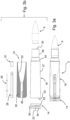
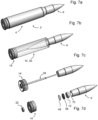
- an ammunition cartridge 2 comprises a casing 4, a projectile 6, an ignition device 8, and a propellant charge 10.
- the projectile 6 may have various materials and geometric properties that are per se known in the field of ammunition cartridges and has a diameter configured for a barrel chamber of a weapon.
- the ammunition cartridge outer shape and dimensions may be configured to conform to a standard size for use with existing weapons, in replacement of existing ammunitions cartridges.
- the enclosed illustrations and following description are not intended to be limited to any particular caliber of ammunition, it being understood that the principles underlying the invention may be implemented in ammunition cartridges of various dimensional specifications.
- the casing 4 generally has a cylindrically shaped tubular sleeve 16 closed at one end by a base 14 at the opposed open end receiving the projectile 6.
- the projectile receiving end as is well-known in the art, comprises a neck portion 38 connected via a tapered portion to a major portion 37 of the tubular sleeve portion containing the propellant charge 10, the neck portion 38 having a smaller diameter than the major portion 37.
- the outer shape of the base may have various configurations depending on the weapon with which it is intended to be used, and may for instance typically comprise a rim 34 and annular groove 36 that serve to eject the casing from the firing chamber of the weapon as is per se well-known in the art.
- the casing 4 may be made of a single piece part, for instance a single piece metal part, according to conventional manufacturing processes.
- the casing may be made of two or more parts, with at least a cylindrical body or sleeve and a base, that are assembled together, by welding, soldering, crimping or other per se known assembling techniques.
- the multi-part casing allows assembly of the propellant charge 10 into the casing tubular sleeve from the base end 33 before assembly of the base 14 to the tubular sleeve 16, or in a conventional manner from the open neck end 35 once the multi-part casing is assembled.
- the base 14 is provided with a tubular connection portion 52 that inserts in the open base end 33 of the tubular sleeve 16 and may be welded by various welding techniques such as Laser welding, Electron-beam welding, friction welding, induction welding and other known welding techniques. The two parts may also be crimped together.
- the propellant charge 10 may be in the form of powder or granules as per se known in the art.
- the propellant charge is bound in a preform that forms a solid body insertable into the tubular sleeve 16 of the casing 4.
- the preform may comprise a combustible substance bound together with a binding material.
- Various substances with binding properties may be used such as resins, plastics, or asphaltics that hold together a charge of finely divided particles and increase the mechanical strength of the resulting propellant block.
- the propellant that has exclusively been used for a long time in conventional military weapons is the so-called smokeless powder or "Gun Powder”.
- smokeless powder e.g. nitrocellulose
- double-base powder e.g. nitrocellulose plus nitroglycerine
- triple-base powder e.g. nitrocellulose plus nitroglycerine plus nitroguanidine
- LOVA low-vulnerability ammunition
- plastic propellants They are embedded in curable plastics, thermoset materials, thermoplasts or gelatinizers to form a mixture that can be given various shapes by means of hydraulic mold presses and cutting machines for example.
- LOVA powders correspond to the traditional Gun Powders and can be adapted according to the desired ballistic characteristics.
- Propellants can also be mixed with or embedded in various curable or poly-additive plastics such as polysulfides, polyurethane, acrylic acid and the like, or mixed with Silicon, petroleum jelly or gelatinized compounds of plastiline like consistency and given a variety of desired forms. Preforming may not be limited to the external dimensions and shapes, it can also include embedded details such as cylindrical or conical apertures that increase the combustion surface and contribute in the steady production of gas.
- the propellant charge preform may be formed as an individual component that is inserted and assembled to the other components of the ammunition cartridge.
- the propellant charge preform may be formed directly within the cylinder portion of the casing.
- the propellant charge preform may be formed around the ignition device before assembly into the casing.
- propellant charges can be filled in the casing between pre-inserted thin discs or cylindrical walls that have been forced in the casing shell and act as separators.
- the preform may also be surrounded partially or fully by a coating, film or thin layer of material that keeps or helps to keep the preform in its intended shape for assembly.
- the layer of material may for instance be polymer based, paper based, starch based, or gelatinized.
- the propellant charge within the center of the preform may be generally loose or held together with a binder material.
- the principle purpose of the preform is to allow assembly within the casing, however depending on the embodiment, the binding properties of the preform do not necessarily need to withstand transport and shock once the ammunition cartridge has been fully assembled.
- the projectile 6 may adopt an essentially conventional shape and use conventional materials as per se well-known in the art, according to an advantageous embodiment of the invention allowing a larger free space inside the cartridge, the projectile may comprise tail fins 64 on the trailing side of the projectile.
- the fins are configured aerodynamically to provide stable flight to the projectile for use with a weapon with a smooth barrel chamber.
- the fins may be configured to impart a rotational spin to the projectile for use with a smooth barrel chamber of a weapon.
- the ignition device comprises a point of ignition 23 that is at a position distal from the base 14 and proximate the projectile 6.
- the ignition device 8 extends from an actuation end 54 positioned on the base 14 of the casing 4, to an ignition end 24 forming the point of ignition that is positioned distal from the base and proximate the projectile 6, configured to ignite the propellant 10 at a position distal from the base 14 and proximate the projectile 6.
- the propellant thus combusts starting from a position proximate the projectile 6 and thus proximate the neck portion 38 of the casing to generate gas, the direction of combustion moving like in a rocket engine from the projectile end 35 towards the base such that combustion of the propellant occurs within the casing 16 because the pressure generated will oppose the un-combusted propellants from moving into the barrel as this is the case when ignition occurs in the base part of the cartridge.
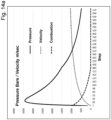
- Figure 14a shows the pressure, velocity and combustion profiles derived from a numerical simulation model of the interior ballistic process in the case of a traditional ignition at the base of the cartridge.
- the combustion profile shows that the propellant ends burning when the projectile has progressed about a third of the barrel length, which means that gun powder propelled with the projectile burns to a large extent in the lower part of the barrel.
- preventing un-combusted propellants to move into the barrel very advantageously ensures a better control of the combustion and the projectile acceleration process. Since un-combusted propellant is not projected into the barrel chamber of the weapon its combustion does not occur at a lower temperature and it does not absorb part of the kinetic energy transferred to the projectile within the barrel chamber. As the combustion of the propellant occurs essentially within the casing, the projectile is displaced in the barrel with a greater rate of progression than with a conventional ignition starting from the base wall.
- the projectile receives an additional propulsion of corresponding kinetic energy. This can either be useful to increase the speed of the projectile, or for a projectile to be propelled at a given speed, to reduce the volume of the propellant charge required and thus if wanted, the size of the ammunition cartridge.
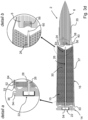
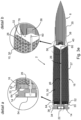
- the ignition device comprises a transmission pin 26 slidably mounted in a guide channel 28 extending from the base 14 to an ignition charge 56 proximal the projectile 6 that forms the point of ignition.
- the transmission pin 26 may be actuated by means of a firing pin or hammer of a conventional weapon that hits an ignition cap 22 on the base wall 14. The transmission pin 26 is displaced when the ignition cap is deformed by the weapon's firing hammer or pin.
- the ignition tip 60 of the transmission pin 26 hits the ignition charge 56 and generates a spark or heat due to the rapid movement of the transmission pin tip and its impact with the ignition charge or other element in proximity of the ignition charge.
- the guide channel may either be formed in a tubular sleeve of material, such as a hollow polymer or metal tube, or the guide channel may be formed directly in the propellant charge without a separate tubular sleeve.
- the ignition charge 56 is positioned at the base 14 of the cartridge and ignited by a firing pin or hammer of the weapon deforming the ignition cap 22, similar to a conventional ammunition cartridge ignition process, whereby in this variant the guide channel 28 does not contain a transmission pin but instead channels the ignition charge under combustion to one or more nozzles 58 at the ignition end 24 of the guide channel 28 that ignite the propellant charge 10 proximal the projectile 6, the nozzles thus forming the point of ignition in this embodiment.
- the nozzles may for instance comprise a plurality of radially directed nozzles.
- the ignition device may further comprise a cap 61 as illustrated in figure 3a , for instance made of a plastic or paper-based material that separates the transmission pin 26 and/or ignition end 24 of the guide channel 28 from the ignition charge 56, for increased protection against inadvertent ignition.
- the cap 61 may be pierced or ruptured by the pin or by the expanding ignition charge.
- the cap 61 may also serve to prevent propellant charge substance from entering the guide channel 28.
- the firing pin can be simply embedded in the pre-formed charge 10 which can act as guide and as a blocking agent preventing any motion of the pin unless it is displaced by the weapon's hammer acting on the percussion cap.
- the ignition cap can be positioned in the trailing end 75 of the projectile.
- This arrangement offers a simple way of holding the ignition cap in the front part of the cartridge and provides an important safety measure.
- the cartridge can be filled with propellant and can be assembled without the presence of sensitive ignition materials that may detonate if un-advertently mishandled. With an ignition cap located in the base of the projectile the sensitive ignition charge can be inserted at the last elaboration step.
- the ignition device may be activated by other means than by a firing pin.
- electrical or electromagnetic trigger mechanisms have been developed and are known in the art, such means also being implementable in the present invention for igniting the ignition charge 56.
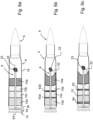
- the propellant charge may comprise a plurality of portions 10a, 10b, 10c, 10d of different composition or densities or structural properties, configured to provide different combustion characteristics.
- Figures 4b and 4c illustrate various embodiments of pre-formed propellant charges presenting different ways of imbricating them in one another in order to monitor combustion transfer between them. Extruded fingers inserted in the previous charge will advance combustion transfer before the latter charge is fully burned. Concave/Convex forms increase the interface between charges and with flat interfaces combustion will transfer at the end of the combustion of the previous charge. If flammable discs, not represented here, are placed between charges, combustion transfer will be monitored by the combustion characteristics of the disc material.
- the different combustion characteristics of the different charge portions may be determined empirically or via electronic modelling, or both, to optimize the combustion process.
- gas production and therefore gas expansion is configured to maintain a pressure close to peak pressure over a large portion of the full travel of the projectile in the barrel of the weapon for which it is intended to be used, as illustrated in figure 14c .
- the peak pressure can be set at or close to the maximum allowable pressure.
- a mathematical simulation of the interior ballistic presented in figure 14c compares the pressure and velocity profiles produced by a single traditional charge ignited in the base of the cartridge and the pressure and velocity profiles produced by the successive action of three propellant charges ignited in the afore part of the cartridge.
- This mathematical model illustrates a good qualitative demonstration of the benefits that can be derived from embodiments of the invention.
- the different charge portions 10a, 10b, 10c, 10d may either be made of different materials or be made of the same material but with different properties such as density of packing constituted to influence the rate of combustion and production of gas from the combusting propellant substance.
- the propellant charge portions may also have components that retard or accelerate the combustion process.
- the charge portions 10a, 10b, 10c, 10d may be separated by combustion speed regulation materials 62, 62a, 62b selected to either retard or to accelerate combustion and thus increase or decrease the rate of gas production.
- the regulation material may include an inert material such as a thin plastic film or a small paper disc that simply retards the combustion process passing from one charge portion to the adjacent charge portion.
- the regulation material may include a combustible material, such as plastic propellants containing high-brisance crystalline explosives, with a higher combustion rate than the propellant charge substance, to accelerate combustion.
- the regulation material can be embedded in part in the preceding charge in order to transfer combustion to the next charge before the former one finishes burning.
- the regulation of ignition transfer among successive charges can also be realized by special coatings and/or treatments of their interfacing ends. Starches, gelatinizers, colloidal sprays and other binders can be advantageously used.
- the first charge portion 10a immediately adjacent the ignition end 24 of the ignition device 8 may be advantageously provided with a curved or concave face 32 directed towards the ignition end in order to promote a more evenly distributed spatiotemporal ignition of the propellant charge.
- the curvature of the front face of the propellant charge is essentially designed to receive the thermal energy of the ignition process at a substantially even time. Such a configuration is possible with a propellant charge that is in a solid preform as previously discussed.
- propellant charge portions discussed here are illustrated as distinct separate portions, it will be appreciated that in variants it is possible to have a continuous transition of material properties or composition configured to change the rate of combustion and gas production.
- the base 14 may be separated from the propellant charge 10 by a thermal insulator 64.
- the thermal insulator may serve to reduce heat transmission from the base to the propellant charge during assembly of the base 14 to the tubular sleeve, in particular if a thermal bonding process such as welding, soldering or brazing is employed.
- the projectile may be further provided with a projectile booster charge 12 positioned adjacent a trailing end 76 of the projectile inside or behind the ignition charge.
- the trailing end of the projectile 6 may comprise a cavity 70 within which the projectile booster charge 12 is lodged.
- the projectile booster charge may be positioned behind the projectile but not with a cavity of the projectile.
- the ignition charge 56 is positioned adjacent the projectile booster charge 12 such that it is ignited before the main propellant charge 10 is ignited.
- the booster charge 12 serves to propel the projectile in its initial displacement out of the cartridge casing 4, and optionally into the barrel (not represented here), subsequently followed by the ignition of the main propellant charge 10 generating the combustion gas that accelerates the projectile during its travel in the barrel of the weapon.
- the ignition charge 56 may be separated by a thin film 48 from the propellant charge 10 in order to ensure that the booster charge 12 is ignited simultaneously or prior to the ignition of the propellant charge 10.
- the projectile booster charge 12 may be positioned within a tubular holder 66.
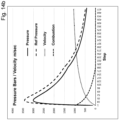
- the use of the ignition charge 56, with or without a projectile booster charge 12, to eject the projectile from the cartridge casing 4 and to force it in the barrel plays an advantageous role in the interior ballistic process. It provides the main propellant charge 10, or the first block of hybrid charges 10a, a much larger initial volume that helps reducing significantly the peak pressure generated by the combustion. As illustrated by the simulation presented in figure 14b , a small pre-displacement of the order of a caliber length increases the free volume by several digits and reduces inversely the pressure generated by the combustion.
- the projectile booster charge may be included in or incorporated with the ignition charge 56 that may thus function as both a projectile booster charge and an ignition charge to ignite the propellant charge 10.
- the cartridge casing 4 is made of at least two parts as previously described.
- the tubular sleeve 16 is provided in the form of a tube that is for instance either extruded or formed from a flat sheet that is rolled into a tubular sleeve and welded or otherwise closed.
- the tubular sleeve initially has a constant diameter cylindrical shape whereby in order to form the neck portion 38 with the taper 40 it is necessary to have a forming step.
- this forming step can lead to dimensional inaccuracies that reduce the performance of the ammunition cartridge due to the projectile 6 fitting within the neck portion 38 with more or less tightness.
- a casing forming tool mechanism 3 comprises a tool die 5 having a cavity portion with a shape corresponding to the outer shape of the ammunition cartridge casing 16, and a tool insert assembly 7 having a portion with a shape corresponding to an internal shape of the cartridge casing 16.
- the tool insert assembly 7 is advantageously formed of at least two parts, a shaping insert 9 and a support pin 11 that slidably inserts into a central passage of the shaping insert 9.
- the shaping insert 9 comprises a radially compressible body portion 13 that allows the shaping insert 9 and in particular the tapered end portion thereof to compress radially inwardly to facilitate retraction of the insert from the tool die 5 after the casing tubular sleeve has been formed. Without the radially compressible shaping insert, extraction of the tool insert assembly from the tool die 5 may be very variable and difficult due to the inherent elasticity of the casing material.
- the radially compressible shaping insert 9 becomes rigid and dimensionally accurate and the tool insert assembly 7 can be used for insertion within the tool die 5 to provide an accurate forming of the casing taper 40 and neck portions 38 as shown in figure 10d .
- the support pin 11 may be retracted from the shaping insert and subsequently the shaping insert 9 may be retracted whereby the radially elastic body portion 13 will allow easy removal of the shaping insert 9.
- the support pin 11 may be advantageously provided with a tapered entry portion 19 that allows easy insertion into the central passage of the shaping insert 9.
- the shaping insert may have a free-standing shape that is inwardly biased such that the diameter is slightly smaller than the diameter when the support pin and shaping insert are assembled together. The shaping insert thus radially inwardly contracts once the support pin is removed to allow easy removal of the shaping insert from the inside of the tubular sleeve casing.
- the support pin 11 may be provided with a bore finishing tool portion 17 provided with hardened cutting edges that machine the inside of the neck portion as the support pin 11 is withdrawn at the end of the forming operation as illustrated in figure 10d . Any excess in the material thicknesses are thus removed by the retraction of this bore finishing tool portion that ensures accurate internal dimensions of the neck portion 38 for an exact desired fit with the projectile 6.
- the tool die 5 may be replaced by various mechanical pressure means such as a rolling die or a multi component pressing die having jaws clamping around the cartridge casing, or by various nonmechanical pressure means based on pressure generated by hydrostatic, hydroelectric, or electromagnetic means.
- the tool insert assembly 7 comprising the shaping insert 9 and support pin 11 may be inserted within the cylindrical casing 16 before the forming thereof, whereby the pressure applied on the casing deforms the casing on the tool insert assembly to form the taper 40 and neck portions 38.
- a plurality of tool insert assemblies may be inserted in a length of tube corresponding to a plurality of cartridge casings whereby after the forming step the individual casings can be separated by various cutting operations such as by a cutting tool, a laser or by other per se known cutting techniques.
- the support may also comprise a bore finishing cutting tool to ensure high dimensional accuracy of the inner surface of the neck portion as previously described.
- two or more shaping inserts may be supported by a single support pin of corresponding length.
- the metal band may advantageously be a steel band that allows to reduce costs and weight of the casing compared to conventional bras casings.
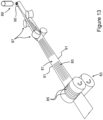
- the band is folded by a tube forming tool 87, that is per se well known in the art of tube forming from flat sheets, and welded by a welding station 89 along a longitudinal seam 90 formed by the coming together of the lateral edges 19 of the band 81 to form the tubular sleeve of the casing.
- Embossing the grooves can be achieved by means of two counter rotating forming drums 83 with annular ribs 85 or they can be achieved by a standard press with appropriate stamping dies.
- Adding the stiffening grooves 80 to the band 81 increases the axial buckling resistance of steel band cartridge cylinders (tubular sleeves) and allows shaping them with an axial press as this is currently done with pressed cartridge bodies.
- stiffening grooves Without stiffening grooves, thin walled cylinders tend to buckle under axial pressures and require using supporting inserts as described previously. Axial buckling resistance is important because conventional ammunition presses offer, as to date, the highest production rates. In addition, stiffening grooves improve also the mechanical resistance to lateral shocks. Under the high pressures generated by the combustion of the propellant charge these groves also improve the radial elasticity of the cartridge casing, allowing it to press against the weapons combustion chamber. Since the plastic deformation of the cartridge can be reduced, if not avoided, a certain radial elasticity is recoverable as the pressure drops and the empty cartridge detaches itself from the combustion chamber, allowing its easier extraction form the weapon.
Landscapes
- Engineering & Computer Science (AREA)
- General Engineering & Computer Science (AREA)
- Physics & Mathematics (AREA)
- Fluid Mechanics (AREA)
- Portable Nailing Machines And Staplers (AREA)
- Toys (AREA)
- Ignition Installations For Internal Combustion Engines (AREA)
- Lighters Containing Fuel (AREA)
- Aiming, Guidance, Guns With A Light Source, Armor, Camouflage, And Targets (AREA)
- Thermotherapy And Cooling Therapy Devices (AREA)
Applications Claiming Priority (6)
| Application Number | Priority Date | Filing Date | Title |
|---|---|---|---|
| CH14932017 | 2017-12-08 | ||
| CH1002018 | 2018-01-29 | ||
| CH5212018 | 2018-04-23 | ||
| IB2018054608 | 2018-06-22 | ||
| PCT/EP2018/083545 WO2019110614A1 (en) | 2017-12-08 | 2018-12-04 | Ammunition cartridge |
| EP18814878.7A EP3721163B1 (de) | 2017-12-08 | 2018-12-04 | Munitionskartusche |
Related Parent Applications (2)
| Application Number | Title | Priority Date | Filing Date |
|---|---|---|---|
| EP18814878.7A Division EP3721163B1 (de) | 2017-12-08 | 2018-12-04 | Munitionskartusche |
| EP18814878.7A Division-Into EP3721163B1 (de) | 2017-12-08 | 2018-12-04 | Munitionskartusche |
Publications (4)
| Publication Number | Publication Date |
|---|---|
| EP4242575A2 true EP4242575A2 (de) | 2023-09-13 |
| EP4242575A3 EP4242575A3 (de) | 2023-10-18 |
| EP4242575B1 EP4242575B1 (de) | 2026-01-28 |
| EP4242575C0 EP4242575C0 (de) | 2026-01-28 |
Family
ID=64607007
Family Applications (2)
| Application Number | Title | Priority Date | Filing Date |
|---|---|---|---|
| EP18814878.7A Active EP3721163B1 (de) | 2017-12-08 | 2018-12-04 | Munitionskartusche |
| EP23182367.5A Active EP4242575B1 (de) | 2017-12-08 | 2018-12-04 | Munitionskartusche |
Family Applications Before (1)
| Application Number | Title | Priority Date | Filing Date |
|---|---|---|---|
| EP18814878.7A Active EP3721163B1 (de) | 2017-12-08 | 2018-12-04 | Munitionskartusche |
Country Status (4)
| Country | Link |
|---|---|
| US (2) | US11143493B2 (de) |
| EP (2) | EP3721163B1 (de) |
| CA (1) | CA3083853C (de) |
| WO (1) | WO2019110614A1 (de) |
Families Citing this family (5)
| Publication number | Priority date | Publication date | Assignee | Title |
|---|---|---|---|---|
| US12264903B2 (en) | 2017-12-08 | 2025-04-01 | Rabuffo Sa | Ammunition cartridge |
| US12135197B2 (en) * | 2019-06-07 | 2024-11-05 | Rabuffo Sa | Ammunition cartridge |
| IT201900020288A1 (it) * | 2019-11-04 | 2021-05-04 | Sullivan Costi | Dispositivo per l'assorbimento della retrospinta di sparo in un'arma da fuoco |
| EP3872438B1 (de) * | 2020-02-27 | 2023-06-07 | Rabuffo SA | Munitionskartusche |
| CA3212922A1 (en) * | 2021-03-24 | 2022-09-29 | David Cohen | Propellant charge and cannon shell therewith |
Family Cites Families (52)
| Publication number | Priority date | Publication date | Assignee | Title |
|---|---|---|---|---|
| US517719A (en) * | 1894-04-03 | Practice-cartridge | ||
| US180840A (en) * | 1876-08-08 | Improvement in cartridges | ||
| BE377334A (de) * | 1930-09-20 | |||
| US1920075A (en) * | 1931-08-15 | 1933-07-25 | Haenichen Wilhelm | Cartridge for guns and ordnances |
| US2294822A (en) * | 1939-03-01 | 1942-09-01 | Albree George Norman | Cartridge |
| US2613604A (en) | 1950-06-02 | 1952-10-14 | Robert A Pyle | Projectile booster |
| US2759419A (en) * | 1952-08-20 | 1956-08-21 | Olin Mathieson | Igniter cartridge |
| US3166612A (en) * | 1955-06-20 | 1965-01-19 | Charles W Sauer | Propellants and method for making them |
| DE1262854B (de) * | 1963-09-07 | 1968-03-07 | Dynamit Nobel Ag | Zuendpatrone zum grossflaechigen Zuenden von Brennsaetzen |
| US3618521A (en) * | 1969-07-07 | 1971-11-09 | Us Navy | Propellant gas generator |
| US3935816A (en) * | 1974-01-09 | 1976-02-03 | Howard S. Klotz | Construction for cartridge |
| DE2537636C3 (de) * | 1975-08-23 | 1984-09-13 | Dynamit Nobel Ag, 5210 Troisdorf | Übungsmunition für Mörser |
| DE3009342A1 (de) * | 1980-03-12 | 1986-06-26 | Rheinmetall GmbH, 4000 Düsseldorf | Patronierte munition mit einer wenigstens teilverbrennbaren treibladungshuelse |
| US4335657A (en) * | 1980-08-13 | 1982-06-22 | Ford Aerospace & Communications Corp. | Ammunition round with retained piston |
| US4572078A (en) * | 1982-04-14 | 1986-02-25 | Morton Thiokol, Inc. | Cased cartridge ammunition ignition booster |
| DE3335821A1 (de) * | 1983-10-01 | 1985-04-11 | Rheinmetall GmbH, 4000 Düsseldorf | Treibladung und verfahren zu ihrer herstellung |
| US4823699A (en) * | 1987-04-14 | 1989-04-25 | Aai Corporation | Back-actuated forward ignition ammunition and method |
| US4887534A (en) * | 1988-06-10 | 1989-12-19 | Honeywell Inc. | Ignition system for high intrusion projectile |
| DE3923461A1 (de) * | 1989-07-15 | 1991-01-17 | Lubig Josef Gmbh | Treibladungshuelse und verfahren zur herstellung einer treibladungshuelse |
| DE3939295A1 (de) * | 1989-11-28 | 1991-05-29 | Rheinmetall Gmbh | Verfahren und vorrichtung zur herstellung von grosskalibriger munition |
| DE4020691A1 (de) * | 1990-06-29 | 1992-01-02 | Dynamit Nobel Ag | Fluegelstabilisiertes geschoss |
| DE4138269C2 (de) * | 1991-11-21 | 1998-01-15 | Rheinmetall Ind Ag | Munition |
| US5272828A (en) * | 1992-08-03 | 1993-12-28 | Colt's Manufacturing Company Inc. | Combined cartridge magazine and power supply for a firearm |
| DE4445989C2 (de) * | 1994-12-22 | 1997-12-18 | Rheinmetall Ind Ag | Patrone mit einer Patronenhülse und einem Pfeilgeschoß |
| DE4445990C2 (de) * | 1994-12-22 | 1997-08-21 | Rheinmetall Ind Ag | Patrone mit einer Patronenhülse und einem Pfeilgeschoß |
| DE19501122A1 (de) * | 1995-01-17 | 1996-07-18 | Rheinmetall Ind Gmbh | Patrone mit einer Patronenhülse und einem Geschoß |
| US6158348A (en) * | 1998-10-21 | 2000-12-12 | Primex Technologies, Inc. | Propellant configuration |
| US6752084B1 (en) * | 1999-01-15 | 2004-06-22 | Amtech, Inc. | Ammunition articles with plastic components and method of making ammunition articles with plastic components |
| US7441504B2 (en) * | 1999-01-15 | 2008-10-28 | Development Capital Management Company | Base for a cartridge casing body for an ammunition article, a cartridge casing body and an ammunition article having such base, wherein the base is made from plastic, ceramic, or a composite material |
| FR2807610B1 (fr) * | 2000-04-11 | 2002-10-11 | Giat Ind Sa | Torche a plasma incorporant un fusible d'amorcage reactif et tube allumeur integrant une telle torche |
| US20020195017A1 (en) * | 2001-06-11 | 2002-12-26 | Danko Priimak | Reverse ignition cartridge |
| WO2003036222A1 (en) * | 2001-10-22 | 2003-05-01 | Armtec Defense Products Co. | Ammunition round assembly with combustible cartridge case |
| SE522937C2 (sv) * | 2002-08-08 | 2004-03-16 | Bofors Defence Ab | Hylslöst, komplett skott samt ett sätt att framställa ett dylikt hylslöst, komplett skott |
| US9470485B1 (en) * | 2004-03-29 | 2016-10-18 | Victor B. Kley | Molded plastic cartridge with extended flash tube, sub-sonic cartridges, and user identification for firearms and site sensing fire control |
| US8240252B2 (en) * | 2005-03-07 | 2012-08-14 | Nikica Maljkovic | Ammunition casing |
| US7610858B2 (en) * | 2005-12-27 | 2009-11-03 | Chung Sengshiu | Lightweight polymer cased ammunition |
| US7287475B2 (en) * | 2006-01-03 | 2007-10-30 | Combined Systems, Inc. | Reloadable non-lethal training cartridge |
| US7913625B2 (en) * | 2006-04-07 | 2011-03-29 | Armtec Defense Products Co. | Ammunition assembly with alternate load path |
| US12247819B2 (en) * | 2010-07-30 | 2025-03-11 | Pcp Tactical, Llc | Two-piece insert and/or flash tube for polymer ammunition cartridges |
| US8763535B2 (en) * | 2011-01-14 | 2014-07-01 | Pcp Tactical, Llc | Narrowing high strength polymer-based cartridge casing for blank and subsonic ammunition |
| US20180292186A1 (en) * | 2017-04-07 | 2018-10-11 | Pcp Tactical, Llc | Two-piece insert and/or flash tube for polymer ammunition cartridges |
| US10190857B2 (en) * | 2010-11-10 | 2019-01-29 | True Velocity Ip Holdings, Llc | Method of making polymeric subsonic ammunition |
| US10048052B2 (en) * | 2010-11-10 | 2018-08-14 | True Velocity, Inc. | Method of making a polymeric subsonic ammunition cartridge |
| US10480915B2 (en) * | 2010-11-10 | 2019-11-19 | True Velocity Ip Holdings, Llc | Method of making a polymeric subsonic ammunition cartridge |
| US9885551B2 (en) * | 2010-11-10 | 2018-02-06 | True Velocity, Inc. | Subsonic polymeric ammunition |
| US10429156B2 (en) * | 2010-11-10 | 2019-10-01 | True Velocity Ip Holdings, Llc | Subsonic polymeric ammunition cartridge |
| US9249759B1 (en) * | 2012-08-30 | 2016-02-02 | The United States Of America As Represented By The Secretary Of The Army | Nozzled mortar ignition system for improved performance |
| WO2014144104A2 (en) * | 2013-03-15 | 2014-09-18 | Alliant Techsystems Inc. | Combination gas operated rifle and subsonic cartridge |
| US10132601B2 (en) * | 2013-03-15 | 2018-11-20 | William Joseph Nemec | Advanced modular ammunition cartridges and systems |
| US10126104B2 (en) * | 2015-08-26 | 2018-11-13 | Atlantis Specialist Technologies Proprietary Limited | Cartridge ammunition |
| IL273019B2 (en) * | 2016-03-25 | 2023-09-01 | Vista Outdoor Operations Llc | energy reduced msr kit |
| US10415938B2 (en) * | 2017-01-16 | 2019-09-17 | Spectre Enterprises, Inc. | Propellant |
-
2018
- 2018-12-04 CA CA3083853A patent/CA3083853C/en active Active
- 2018-12-04 US US16/769,470 patent/US11143493B2/en active Active
- 2018-12-04 WO PCT/EP2018/083545 patent/WO2019110614A1/en not_active Ceased
- 2018-12-04 EP EP18814878.7A patent/EP3721163B1/de active Active
- 2018-12-04 EP EP23182367.5A patent/EP4242575B1/de active Active
-
2021
- 2021-09-14 US US17/474,877 patent/US11867491B2/en active Active
Also Published As
| Publication number | Publication date |
|---|---|
| EP3721163C0 (de) | 2023-08-02 |
| EP4242575A3 (de) | 2023-10-18 |
| WO2019110614A1 (en) | 2019-06-13 |
| US20200386526A1 (en) | 2020-12-10 |
| US11143493B2 (en) | 2021-10-12 |
| CA3083853A1 (en) | 2019-06-13 |
| EP3721163A1 (de) | 2020-10-14 |
| EP4242575B1 (de) | 2026-01-28 |
| CA3083853C (en) | 2025-06-17 |
| EP4242575C0 (de) | 2026-01-28 |
| EP3721163B1 (de) | 2023-08-02 |
| US20220107163A1 (en) | 2022-04-07 |
| US11867491B2 (en) | 2024-01-09 |
Similar Documents
| Publication | Publication Date | Title |
|---|---|---|
| US11867491B2 (en) | Ammunition cartridge | |
| US7204191B2 (en) | Lead free, composite polymer based bullet and method of manufacturing | |
| US7213519B2 (en) | Composite polymer based cartridge case having an overmolded metal cup, polymer plug base assembly | |
| US8443731B1 (en) | Reactive material enhanced projectiles, devices for generating reactive material enhanced projectiles and related methods | |
| EP1338860B1 (de) | Verfahren zur Herstellung eines grosskalibrigen Sprenggeschosses und Sprenggeschoss, hergestellt nach diesem Verfahren | |
| US20070017409A1 (en) | Non-expanding modular bullet | |
| US4823699A (en) | Back-actuated forward ignition ammunition and method | |
| CZ302555B6 (cs) | Munice pro zbrane | |
| US3398684A (en) | Caseless cartridges | |
| US20080127850A1 (en) | Bullet with aerodynamic fins and ammunition using same | |
| CA2878589A1 (en) | Wad with ignition chamber | |
| EP3601939B1 (de) | Verbessertes geschoss | |
| US20050188879A1 (en) | Lead free, composite polymer based bullet and cartridge case, and method of manufacturing | |
| CA1298736C (en) | Tubular projectiles | |
| US12264903B2 (en) | Ammunition cartridge | |
| US12135197B2 (en) | Ammunition cartridge | |
| US12326327B2 (en) | Ammunition cartridge | |
| EP0475279B1 (de) | Anzündeinlage für die Haupttreibladung einer teleskopischen Munition | |
| US3848530A (en) | Shot obturation system for fully telescoped caseless ammunition | |
| RU2782423C1 (ru) | Выстрел для подствольного гранатомета | |
| EP0398390A2 (de) | Rohrförmiges Geschoss | |
| CZ1821U1 (cs) | Náboj do brokovnice s pyrotechnickými efekty |
Legal Events
| Date | Code | Title | Description |
|---|---|---|---|
| PUAI | Public reference made under article 153(3) epc to a published international application that has entered the european phase |
Free format text: ORIGINAL CODE: 0009012 |
|
| STAA | Information on the status of an ep patent application or granted ep patent |
Free format text: STATUS: THE APPLICATION HAS BEEN PUBLISHED |
|
| REG | Reference to a national code |
Ref country code: DE Ref legal event code: R079 Free format text: PREVIOUS MAIN CLASS: F42B0005285000 Ref document number: 602018088978 Country of ref document: DE Ipc: F42B0005100000 |
|
| AC | Divisional application: reference to earlier application |
Ref document number: 3721163 Country of ref document: EP Kind code of ref document: P |
|
| AK | Designated contracting states |
Kind code of ref document: A2 Designated state(s): AL AT BE BG CH CY CZ DE DK EE ES FI FR GB GR HR HU IE IS IT LI LT LU LV MC MK MT NL NO PL PT RO RS SE SI SK SM TR |
|
| PUAL | Search report despatched |
Free format text: ORIGINAL CODE: 0009013 |
|
| AK | Designated contracting states |
Kind code of ref document: A3 Designated state(s): AL AT BE BG CH CY CZ DE DK EE ES FI FR GB GR HR HU IE IS IT LI LT LU LV MC MK MT NL NO PL PT RO RS SE SI SK SM TR |
|
| RIC1 | Information provided on ipc code assigned before grant |
Ipc: F42B 5/285 20060101ALN20230911BHEP Ipc: F42B 10/04 20060101ALN20230911BHEP Ipc: F42C 19/08 20060101ALI20230911BHEP Ipc: F42B 5/16 20060101ALI20230911BHEP Ipc: F42B 5/10 20060101AFI20230911BHEP |
|
| STAA | Information on the status of an ep patent application or granted ep patent |
Free format text: STATUS: REQUEST FOR EXAMINATION WAS MADE |
|
| 17P | Request for examination filed |
Effective date: 20240206 |
|
| RBV | Designated contracting states (corrected) |
Designated state(s): AL AT BE BG CH CY CZ DE DK EE ES FI FR GB GR HR HU IE IS IT LI LT LU LV MC MK MT NL NO PL PT RO RS SE SI SK SM TR |
|
| STAA | Information on the status of an ep patent application or granted ep patent |
Free format text: STATUS: EXAMINATION IS IN PROGRESS |
|
| 17Q | First examination report despatched |
Effective date: 20250307 |
|
| GRAP | Despatch of communication of intention to grant a patent |
Free format text: ORIGINAL CODE: EPIDOSNIGR1 |
|
| STAA | Information on the status of an ep patent application or granted ep patent |
Free format text: STATUS: GRANT OF PATENT IS INTENDED |
|
| INTG | Intention to grant announced |
Effective date: 20250924 |
|
| GRAS | Grant fee paid |
Free format text: ORIGINAL CODE: EPIDOSNIGR3 |
|
| GRAA | (expected) grant |
Free format text: ORIGINAL CODE: 0009210 |
|
| STAA | Information on the status of an ep patent application or granted ep patent |
Free format text: STATUS: THE PATENT HAS BEEN GRANTED |
|
| AC | Divisional application: reference to earlier application |
Ref document number: 3721163 Country of ref document: EP Kind code of ref document: P |
|
| AK | Designated contracting states |
Kind code of ref document: B1 Designated state(s): AL AT BE BG CH CY CZ DE DK EE ES FI FR GB GR HR HU IE IS IT LI LT LU LV MC MK MT NL NO PL PT RO RS SE SI SK SM TR |
|
| REG | Reference to a national code |
Ref country code: CH Ref legal event code: F10 Free format text: ST27 STATUS EVENT CODE: U-0-0-F10-F00 (AS PROVIDED BY THE NATIONAL OFFICE) Effective date: 20260128 Ref country code: GB Ref legal event code: FG4D |
|
| REG | Reference to a national code |
Ref country code: DE Ref legal event code: R096 Ref document number: 602018088978 Country of ref document: DE |
|
| REG | Reference to a national code |
Ref country code: IE Ref legal event code: FG4D |
|
| U01 | Request for unitary effect filed |
Effective date: 20260128 |
|
| U07 | Unitary effect registered |
Designated state(s): AT BE BG DE DK EE FI FR IT LT LU LV MT NL PT RO SE SI Effective date: 20260204 |
|
| REG | Reference to a national code |
Ref country code: CH Ref legal event code: R17 Free format text: ST27 STATUS EVENT CODE: U-0-0-R10-R17 (AS PROVIDED BY THE NATIONAL OFFICE) Effective date: 20260401 |
|
| PG25 | Lapsed in a contracting state [announced via postgrant information from national office to epo] |
Ref country code: RS Free format text: LAPSE BECAUSE OF FAILURE TO SUBMIT A TRANSLATION OF THE DESCRIPTION OR TO PAY THE FEE WITHIN THE PRESCRIBED TIME-LIMIT Effective date: 20260428 |
|
| PG25 | Lapsed in a contracting state [announced via postgrant information from national office to epo] |
Ref country code: ES Free format text: LAPSE BECAUSE OF FAILURE TO SUBMIT A TRANSLATION OF THE DESCRIPTION OR TO PAY THE FEE WITHIN THE PRESCRIBED TIME-LIMIT Effective date: 20260128 |
|
| PG25 | Lapsed in a contracting state [announced via postgrant information from national office to epo] |
Ref country code: PL Free format text: LAPSE BECAUSE OF FAILURE TO SUBMIT A TRANSLATION OF THE DESCRIPTION OR TO PAY THE FEE WITHIN THE PRESCRIBED TIME-LIMIT Effective date: 20260128 |
|
| PG25 | Lapsed in a contracting state [announced via postgrant information from national office to epo] |
Ref country code: GR Free format text: LAPSE BECAUSE OF FAILURE TO SUBMIT A TRANSLATION OF THE DESCRIPTION OR TO PAY THE FEE WITHIN THE PRESCRIBED TIME-LIMIT Effective date: 20260429 |
|
| PG25 | Lapsed in a contracting state [announced via postgrant information from national office to epo] |
Ref country code: NO Free format text: LAPSE BECAUSE OF FAILURE TO SUBMIT A TRANSLATION OF THE DESCRIPTION OR TO PAY THE FEE WITHIN THE PRESCRIBED TIME-LIMIT Effective date: 20260428 |
|
| PG25 | Lapsed in a contracting state [announced via postgrant information from national office to epo] |
Ref country code: HR Free format text: LAPSE BECAUSE OF FAILURE TO SUBMIT A TRANSLATION OF THE DESCRIPTION OR TO PAY THE FEE WITHIN THE PRESCRIBED TIME-LIMIT Effective date: 20260128 |
|
| PG25 | Lapsed in a contracting state [announced via postgrant information from national office to epo] |
Ref country code: IS Free format text: LAPSE BECAUSE OF FAILURE TO SUBMIT A TRANSLATION OF THE DESCRIPTION OR TO PAY THE FEE WITHIN THE PRESCRIBED TIME-LIMIT Effective date: 20260528 |