EP4240637B1 - Structure avant de véhicule automobile - Google Patents
Structure avant de véhicule automobile Download PDFInfo
- Publication number
- EP4240637B1 EP4240637B1 EP21794362.0A EP21794362A EP4240637B1 EP 4240637 B1 EP4240637 B1 EP 4240637B1 EP 21794362 A EP21794362 A EP 21794362A EP 4240637 B1 EP4240637 B1 EP 4240637B1
- Authority
- EP
- European Patent Office
- Prior art keywords
- edge
- oblong
- side members
- rack
- structure according
- Prior art date
- Legal status (The legal status is an assumption and is not a legal conclusion. Google has not performed a legal analysis and makes no representation as to the accuracy of the status listed.)
- Active
Links
Images


Classifications
-
- B—PERFORMING OPERATIONS; TRANSPORTING
- B62—LAND VEHICLES FOR TRAVELLING OTHERWISE THAN ON RAILS
- B62D—MOTOR VEHICLES; TRAILERS
- B62D25/00—Superstructure or monocoque structure sub-units; Parts or details thereof not otherwise provided for
- B62D25/08—Front or rear portions
- B62D25/082—Engine compartments
-
- B—PERFORMING OPERATIONS; TRANSPORTING
- B62—LAND VEHICLES FOR TRAVELLING OTHERWISE THAN ON RAILS
- B62D—MOTOR VEHICLES; TRAILERS
- B62D1/00—Steering controls, i.e. means for initiating a change of direction of the vehicle
- B62D1/02—Steering controls, i.e. means for initiating a change of direction of the vehicle vehicle-mounted
- B62D1/16—Steering columns
- B62D1/20—Connecting steering column to steering gear
-
- B—PERFORMING OPERATIONS; TRANSPORTING
- B62—LAND VEHICLES FOR TRAVELLING OTHERWISE THAN ON RAILS
- B62D—MOTOR VEHICLES; TRAILERS
- B62D1/00—Steering controls, i.e. means for initiating a change of direction of the vehicle
- B62D1/02—Steering controls, i.e. means for initiating a change of direction of the vehicle vehicle-mounted
- B62D1/16—Steering columns
-
- B—PERFORMING OPERATIONS; TRANSPORTING
- B62—LAND VEHICLES FOR TRAVELLING OTHERWISE THAN ON RAILS
- B62D—MOTOR VEHICLES; TRAILERS
- B62D25/00—Superstructure or monocoque structure sub-units; Parts or details thereof not otherwise provided for
- B62D25/08—Front or rear portions
- B62D25/081—Cowls
-
- B—PERFORMING OPERATIONS; TRANSPORTING
- B62—LAND VEHICLES FOR TRAVELLING OTHERWISE THAN ON RAILS
- B62D—MOTOR VEHICLES; TRAILERS
- B62D25/00—Superstructure or monocoque structure sub-units; Parts or details thereof not otherwise provided for
- B62D25/08—Front or rear portions
- B62D25/082—Engine compartments
- B62D25/085—Front-end modules
-
- B—PERFORMING OPERATIONS; TRANSPORTING
- B62—LAND VEHICLES FOR TRAVELLING OTHERWISE THAN ON RAILS
- B62D—MOTOR VEHICLES; TRAILERS
- B62D25/00—Superstructure or monocoque structure sub-units; Parts or details thereof not otherwise provided for
- B62D25/08—Front or rear portions
- B62D25/14—Dashboards as superstructure sub-units
-
- B—PERFORMING OPERATIONS; TRANSPORTING
- B62—LAND VEHICLES FOR TRAVELLING OTHERWISE THAN ON RAILS
- B62D—MOTOR VEHICLES; TRAILERS
- B62D27/00—Connections between superstructure or understructure sub-units
- B62D27/02—Connections between superstructure or understructure sub-units rigid
- B62D27/023—Assembly of structural joints
-
- B—PERFORMING OPERATIONS; TRANSPORTING
- B62—LAND VEHICLES FOR TRAVELLING OTHERWISE THAN ON RAILS
- B62D—MOTOR VEHICLES; TRAILERS
- B62D65/00—Designing, manufacturing, e.g. assembling, facilitating disassembly, or structurally modifying motor vehicles or trailers, not otherwise provided for
- B62D65/02—Joining sub-units or components to, or positioning sub-units or components with respect to, body shell or other sub-units or components
- B62D65/024—Positioning of sub-units or components with respect to body shell or other sub-units or components
-
- B—PERFORMING OPERATIONS; TRANSPORTING
- B60—VEHICLES IN GENERAL
- B60Y—INDEXING SCHEME RELATING TO ASPECTS CROSS-CUTTING VEHICLE TECHNOLOGY
- B60Y2410/00—Constructional features of vehicle sub-units
- B60Y2410/102—Shaft arrangements; Shaft supports, e.g. bearings
-
- B—PERFORMING OPERATIONS; TRANSPORTING
- B62—LAND VEHICLES FOR TRAVELLING OTHERWISE THAN ON RAILS
- B62D—MOTOR VEHICLES; TRAILERS
- B62D25/00—Superstructure or monocoque structure sub-units; Parts or details thereof not otherwise provided for
- B62D25/08—Front or rear portions
- B62D25/14—Dashboards as superstructure sub-units
- B62D25/145—Dashboards as superstructure sub-units having a crossbeam incorporated therein
Definitions
- the invention relates to a front structure of a motor vehicle which has a passenger compartment and an engine compartment situated in the extension of one another.
- An exemplary front structure comprising the features of the preamble of claim 1 is known from document US 2012/001453 A1 .
- Known motor vehicle front structures comprise an apron that extends transversely between the engine compartment and the passenger compartment of the vehicles. They also comprise two front side members that extend parallel to each other, from the apron, into the engine compartment and in a longitudinal direction of the vehicle. Also, these structures comprise a steering column and a rack connected together at a steering bowl formed in the apron. The steering column extends into the passenger compartment to a steering wheel, while the rack extends to the front wheels in order to be able to steer them.
- the steering bowl is provided in the bulkhead to the right of the steering column and it extends projecting into the engine compartment between the side members, but in the vicinity of the connection between the bulkhead and one of said side members, the left side member in particular for left-hand drive motor vehicles.
- the steering bowl has a flat bottom in which an oblong hole is provided so as to be able to ensure the connection between the steering column and the rack.
- the steering bowl On the engine compartment side, the steering bowl has a rim which extends around the oblong hole and against which the rack is applied. Between the two, a seal is inserted which, taking into account the particularities of assembly, is adapted to be driven in translation against the rim by the rack while being compressed.
- Such an assembly requires a relatively wide rim around the oblong hole in order to ensure its implementation and to obtain perfect sealing.
- the steering column supported by the apron is adjusted laterally as far to the left as possible, in a left-hand drive vehicle for example, so as to free up space for the front passenger.
- a problem which arises and which the present invention aims to solve is to provide a front structure of a motor vehicle which allows both the acceptance of the approach of the front side members while allowing a usual mounting of the rack and the steering column through the steering bowl.
- a front structure of a motor vehicle having a passenger compartment and an engine compartment extending in the extension of said passenger compartment, said structure comprising: an apron extending transversely between said engine compartment and said passenger compartment and adapted to support a steering column; two substantially parallel front side members connected to said apron and extending longitudinally in said engine compartment; a steering bowl formed in said apron substantially in line with said steering column and extending projecting into said engine compartment between said two side members near the connection between said apron and one of said side members, said steering bowl having a bottom and an oblong orifice formed in said bottom and defining a border extending around said oblong orifice opposite said engine compartment and; a rack installed in said engine compartment and a rack joint adapted to engage between the rack and said steering bowl when said steering column is connected to said rack through said oblong orifice.
- Said structure further comprises an annular flat part installed as an applique on said edge and extending around said oblong orifice in
- a feature of the invention lies in the implementation of an annular flat part against the edge of the bowl, opposite the bottom, and which can extend around the oblong orifice over a width large enough to allow the mounting of the rack and the column according to the usual protocol.
- the edge of the bowl, opposite the bottom and which extends around the oblong orifice is no longer large enough to be able to precisely allow this usual mounting. Thanks to the annular flat part, the receiving range of the rack seal is thus widened and thus allow this mounting.
- said two side members defining a mean plane
- said annular flat part is inclined relative to said mean plane.
- the mean plane defined by the two side members is substantially parallel to the horizontal mean plane of the motor vehicle, and the annular flat part is inclined relative to this horizontal mean plane, by a value between 40° and 50° for example. It will be explained in more detail in the remainder of the description how this inclination makes it possible to facilitate assembly.
- said one of said side members and said apron defining a bisector plane
- said oblong orifice advantageously extends along a component included in said bisector plane.
- the bisector plane extends substantially vertically and it is inclined substantially by 45° relative to the longitudinal axis of the motor vehicle. Consequently, the oblong orifice extends substantially diagonally in the engine compartment, which in particular makes it easier to mount the rack and the steering column.
- said oblong orifice preferably has a lower end located towards said one of said side members and a higher end opposite said lower end and spaced from said one of said side members.
- said annular flat part is connected to said edge by welding points.
- the width of the edge of the steering bowl makes it possible to connect the annular flat part to it by welding points, regularly spaced from each other all around the oblong orifice, for example by means of a conventional welding clamp with two opposing electrodes.
- the structure according to the invention comprises an annular mastic joint between said annular flat part and said edge.
- the mastic is applied for example before welding the annular flat part and the edge of the steering bowl. The mastic then ensures total sealing between the annular flat part and the steering bowl.
- said annular flat part has an inner edge and an opposite outer edge, and the minimum distance between said two opposite edges is advantageously between 15 mm and 25 mm. For example, this distance is 20 mm. As will be explained below, such a width allows the mounting of the rack and pinion and steering column according to the usual protocol where the joint is then compressed.
- said internal edge delimits a section identical to the section of said oblong orifice.
- the annular flat part is adjusted in application on the edge of the steering bowl so that its internal edge coincides perfectly with the oblong orifice. And the annular flat part is welded with the steering bowl in this position.
- said annular flat part has a peripheral rim.
- the peripheral rim extends opposite the steering bowl and thus makes it possible to contain the edge of the seal when they compress during assembly of the rack and the steering column.
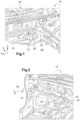
- the [ Fig. 1 ] shows a front structure 10 of a motor vehicle.
- the front structure 10 has an apron 12 which extends transversely and which delimits a engine compartment 14 located in front of the apron 12, of a passenger compartment 16 located behind the apron 12.
- the apron has an apron crossmember 15.
- the front structure 10 of the motor vehicle illustrated in the [ Fig. 1 ] is oriented in an orthogonal reference frame X, Y, Z, such that the X axis corresponds to the longitudinal direction of the vehicle and is oriented from the front to the rear of the vehicle, the Y axis corresponds to the transverse direction and is oriented from the left to the right of the vehicle when looking towards the front of the vehicle and the Z axis designates the vertical direction oriented opposite the surface on which the vehicle rests in its usual operating state.
- a left front side member 18 which extends into the engine compartment 14 from the bulkhead cross member 15, substantially in the direction of the X axis, as defined above. It will be observed that the bulkhead cross member 15 extends substantially in the direction of the Y axis. Furthermore, is also shown in the [ Fig. 1 ], a steering bowl 20 which projects into the engine compartment 14 in the vicinity of the connection between the bulkhead crossmember 15 and the left front side member 18.
- Fig. 2 shows the apron 12 seen, no longer from the engine compartment 14, but from the passenger compartment 16.
- the steering bowl 20 is hollow and has a bottom 22 in which an oblong orifice 24 is made.
- the steering bowl 20 defines a housing large enough to accommodate the hand of an operator as will be explained below.
- the oblong orifice 24 opens into the engine compartment 14 located behind the apron 12.
- the steering bowl 20 from the engine compartment 14.
- the viewing angle is along the X axis at the level of the left front side member 18.
- the oblong orifice 24 there and through it, the bottom 22.
- the border 26 defines a border 26 which extends around the oblong orifice 24 in the engine compartment 14. Therefore, the border 26 is of oblong annular shape.
- the mean plane defined by the edge 26 is inclined relative to another mean plane defined by the left front side member 18 and the apron cross member 15 which it joins.
- This other mean plane is substantially horizontal and it is also defined by the two front side members.
- said mean plane is inclined towards the center of the engine compartment 14. It is for example inclined at an angle close to 45° relative to the Z axis. Therefore, the oblong orifice 24 extends substantially in a direction D belonging to a bisector plane, which is defined by the left front side member 18 and the bulkhead cross member 15 extending along the Z axis.
- the oblong orifice 24 extends along a component included in the aforementioned bisector plane and at an angle close to 45° relative to the Z axis for example. Consequently, the oblong orifice 24 has a lower end 28, located near the left front side member 18 and an opposite upper end 30.
- the rack 34 comprises an oblong torque transformation housing 36.
- the oblong housing 36 is adapted to transform the torque imparted by the steering column.
- the oblong housing 36 has an oblong opening 38 defining an oblong edge 40 on which a compressible oblong seal 42 is applied. This seal 42 is annular.
- the rack 34 has a rack shaft 44 which extends through the oblong opening 38 and projects into an eccentric position of the oblong opening 38.
- the rack shaft 44 is adapted to be engaged through the oblong orifice 24 of the steering bowl 20, while the oblong edge 40 provided with the compressible oblong seal 42 comes to be applied against the steering bowl 20.
- the steering column 32 On the passenger compartment side 16, the steering column 32 has a last segment 46 equipped with a last universal joint 48.
- This last universal joint 48 is adapted to be connected to the rack shaft 44 inside the steering bowl 20, by means of a coupling screw 49, as will be explained below.
- the steering bowl 20' located at the junction of the bulkhead crossmember 15' and the left front side member 18'.
- the steering bowl 20' is significantly more compact than that illustrated in the previous figures so that the left front side member 18' could have been designed in a position close to its counterpart, the right front side member.
- the left front side member 18' is then brought closer to the steering bowl 20' which had to be designed in a more compact manner, in the transverse direction of the Y axis.
- the annular flat part 50 has by definition an oblong central light 52 defined by an internal edge 54 and whose dimensions are identical to those of the oblong orifice 24' of the steering bowl 20'.
- the internal edge 54 delimits a section or surface, identical to that delimited by the oblong orifice 24'.
- the annular flat part 50 has an external edge 56 spaced from the internal edge 54 by a substantially constant distance d.
- the distance d is preferably between 15 mm and 25 mm. It is for example equal to 20 mm.
- annular flat part 50 has a peripheral rim 58 which runs continuously along the external edge 56.
- the annular flat part 50 defines an oblong and flat annular receiving surface 60, larger than the annular edge 26' of the steering bowl 20'. Also, the annular flat part 50 extends beyond the annular edge 26' and the steering bowl 20' to be able to offer the annular receiving surface 60, of a dimension greater than that of the annular edge 26'.
- annular flat part 50 be connected to the steering bowl 20' in a sealed manner.
- annular sealant joint not shown is first formed around the oblong hole 24' on the annular edge 26' and near the edge of the oblong hole 24'. Then, the annular flat part 50 is applied flat against the annular edge 26', so that the oblong orifice 24' coincides perfectly with the oblong central light 52 of the annular flat part 50 and by flattening the mastic seal. Then, the annular flat part 50 is connected to the annular edge 26' by forming weld points using a welding clamp, around the flattened annular mastic seal.
- the seal is ensured thanks to the mastic, and the annular flat part 50 is secured to the steering bowl 20' thanks to the weld points.
- the annular mastic seal is ensured thanks to the mastic, and the annular flat part 50 is secured to the steering bowl 20' thanks to the weld points.
- between 6 and 10 weld points are made around the annular mastic seal.
- eight weld points are made.
- the oblong housing 36 is adjusted in an inclined manner opposite the oblong orifice 24', and more precisely the rack shaft 44 vertically above its lower end 28'.
- the oblong housing 36 is driven in translation, along the vertical axis Z, against the annular flat part 50 so that the rack shaft 44 penetrates through the lower end 28' of the oblong orifice 24', while the compressible oblong sealing gasket 42 comes into flat contact with the annular receiving surface 60 of the annular flat part 50.
- the compressible oblong sealing gasket 42 is compressed between the oblong edge 40 of the oblong housing 36 and the annular receiving surface 60, while the oblong edge 40 is driven in sliding movement against the annular receiving surface 60.
- the rack shaft 44 is driven in translation towards the upper end 30' of the oblong orifice 24' by moving away of the left front spar 18', while the compressed oblong sealing gasket 42, fits around the oblong hole 24'.
- the annular receiving surface 60 is sufficiently wide to be able to receive the compressible oblong sealing gasket 42 in friction until it fits perfectly around the oblong orifice 24'.
- the compressible oblong seal 42 is perfectly compressed between the oblong edge 40 of the oblong housing 36 and the annular receiving surface 60, and it thus ensures perfect sealing between the oblong housing 36 of the rack 34 and the steering bowl 20'.
- the oblong housing 36 is held in this position where it is compressed against the annular flat part 50, while on the opposite side, the last universal joint 48 is connected to the rack shaft 44 by means of the coupling screw 49.
- the connection between the last universal joint 48 and the rack shaft 44 makes it possible to hold the oblong housing 36 in forceful abutment against the annular flat part 50, while the compressible oblong sealing gasket 42 is compressed. In this way, the seal is perfectly ensured between the oblong housing 36 and the steering bowl 20'.
Landscapes
- Engineering & Computer Science (AREA)
- Chemical & Material Sciences (AREA)
- Combustion & Propulsion (AREA)
- Transportation (AREA)
- Mechanical Engineering (AREA)
- Manufacturing & Machinery (AREA)
- Body Structure For Vehicles (AREA)
- Steering Controls (AREA)
Description
- L'invention se rapporte à une structure avant d'un véhicule automobile lequel présente un habitacle et un compartiment moteur situés dans le prolongement l'un de l'autre.
- Une structure avant exemplaire comprenant les caractéristiques du préambule de la revendication 1 est connue par le document
US 2012/001453 A1 . - Les structures avant de véhicule automobile connues comprennent un tablier qui vient s'étendre transversalement entre le compartiment moteur et l'habitacle des véhicules. Elles comprennent également deux longerons avant qui viennent s'étendre parallèlement l'un à l'autre, depuis le tablier, dans le compartiment moteur et selon une direction longitudinale du véhicule. Aussi, ces structures comportent une colonne de direction et une crémaillère reliées ensemble au niveau d'un bol de direction ménagé dans le tablier. La colonne de direction se prolonge dans l'habitacle jusqu'à un volant de conduite, tandis que la crémaillère s'étend jusqu'aux roues avant afin de pouvoir les orienter.
- Le bol de direction est ménagé dans le tablier au droit de la colonne de direction et il vient s'étendre en saillie dans le compartiment moteur entre les longerons, mais au voisinage de la liaison entre le tablier et l'un desdits longerons, le longeron gauche en particulier pour les véhicules automobiles à conduite à gauche.
- Le bol de direction présente un fond plat dans lequel est ménagé un orifice oblong de manière à pouvoir assurer la liaison entre la colonne de direction et la crémaillère. Du côté du compartiment moteur, le bol de direction présente une bordure qui s'étend autour de l'orifice oblong et contre laquelle vient s'appliquer la crémaillère. Entre les deux, on insère un joint qui, compte tenu des particularités de montage, est adapté à être entraîné en translation contre la bordure par la crémaillère tout en étant comprimé. Un tel montage nécessite une bordure relativement large autour de l'orifice oblong afin d'en assurer la mise en oeuvre et pour obtenir une parfaite étanchéité.
- Pour des raisons de confort dans l'habitacle, la colonne de direction supportée par le tablier est ajustée latéralement le plus à gauche possible, dans un véhicule à conduite à gauche par exemple, de manière à libérer de l'espace pour le passager avant.
- En revanche, de nouvelles exigences en termes de largeur de roue et/ou de rayon de braquage obligent à rapprocher l'un de l'autre les longerons avant.
- Partant, si l'on souhaite conserver le confort précité, des contraintes viennent alors peser sur le bol de direction qui se retrouve alors coincé dans l'angle entre le tablier et le longeron, et dont les dimensions ne peuvent plus être maintenues. Il en va en particulier de la largeur de la bordure qui entoure l'orifice oblong.
- En conséquence, le montage précité de la colonne de direction et de la crémaillère est moins aisé.
- Aussi, un problème qui se pose et que vise à résoudre la présente invention, est de fournir une structure avant de véhicule automobile qui permette à la fois d'accepter le rapprochement des longerons avant tout en permettant un montage usuel de la crémaillère et de la colonne de direction à travers le bol de direction.
- Dans ce but, il est proposé une structure avant d'un véhicule automobile présentant un habitacle et un compartiment moteur s'étendant dans le prolongement dudit habitacle, ladite structure comprenant : un tablier s'étendant transversalement entre ledit compartiment moteur et ledit habitacle et adapté à supporter une colonne de direction ; deux longerons avant sensiblement parallèles reliés audit tablier et s'étendant longitudinalement dans ledit compartiment moteur ; un bol de direction ménagé dans ledit tablier sensiblement au droit de ladite colonne de direction et venant s'étendre en saillie dans ledit compartiment moteur entre lesdits deux longerons près de la liaison entre ledit tablier et l'un desdits longerons, ledit bol de direction présentant un fond et un orifice oblong ménagé dans ledit fond et définissant une bordure s'étendant autour dudit orifice oblong en regard dudit compartiment moteur et ; une crémaillère installée dans ledit compartiment moteur et un joint de crémaillère adapté à venir en prise entre la crémaillère et ledit bol de direction lorsque ladite colonne de direction est reliée à ladite crémaillère à travers ledit orifice oblong. Ladite structure comprend en outre une pièce plate annulaire installée en applique sur ladite bordure et s'étendant autour dudit orifice oblong pour pouvoir élargir la portée de réception dudit joint de crémaillère.
- Ainsi, une caractéristique de l'invention réside dans la mise en oeuvre d'une pièce plate annulaire contre la bordure du bol, opposée au fond, et qui puisse s'étendre autour de l'orifice oblong sur une largeur suffisamment grande pour autoriser le montage de la crémaillère et de la colonne selon le protocole usuel. En effet, compte tenu des contraintes dimensionnelles exercées sur le bol de direction, la bordure du bol, opposée au fond et qui s'étend autour de l'orifice oblong, n'est plus suffisamment importante pour pouvoir précisément permettre ce montage usuel. Grâce à la pièce plate annulaire, on vient de la sorte élargir la portée de réception du joint de crémaillère et ainsi permettre ce montage.
- Selon un mode de mise en oeuvre de l'invention particulièrement avantageux, lesdits deux longerons définissant un plan moyen, ladite pièce plate annulaire est inclinée par rapport audit plan moyen. Le plan moyen défini par les deux longerons est sensiblement parallèle au plan moyen horizontal du véhicule automobile, et la pièce plate annulaire est inclinée par rapport à ce plan moyen horizontal, d'une valeur comprise entre 40°et 50°par exemple. On expliquer a plus en détail dans la suite de la description comment cette inclinaison permet de faciliter le montage.
- Aussi, ledit un desdits longerons et ledit tablier définissant un plan bissecteur, ledit orifice oblong s'étend avantageusement selon une composante comprise dans ledit plan bissecteur. Le plan bissecteur s'étend sensiblement verticalement et il est incliné sensiblement de 45° par rapport à l'axe lon gitudinal du véhicule automobile. Partant, l'orifice oblong s'étend sensiblement en diagonale dans le compartiment moteur, ce qui permet notamment, de faciliter le montage de la crémaillère et de la colonne de direction.
- En outre, ledit orifice oblong présente, préférentiellement, une extrémité basse située vers ledit un desdits longerons et une extrémité haute opposée à ladite extrémité basse et écartée dudit un desdits longerons. Un tel agencement permet là encore de faciliter le montage.
- En outre, et selon une caractéristique de l'invention particulièrement avantageuse, ladite pièce plate annulaire est reliée à ladite bordure par des points de soudure. La largeur de la bordure du bol de direction permet d'y relier la pièce plate annulaire par des points de soudure, régulièrement espacés les uns des autres tout autour de l'orifice oblong, par exemple au moyen d'une pince de soudage classique à deux électrodes opposées.
- Préférentiellement, la structure selon invention comprend un joint de mastic annulaire entre ladite pièce plate annulaire et ladite bordure. Ainsi, le mastic est appliqué par exemple avant la soudure de la pièce plate annulaire et de la bordure du bol de direction. Le mastic assure alors l'étanchéité totale entre la pièce plate annulaire et le bol de direction.
- Aussi, ladite pièce plate annulaire présente un bord interne et un bord externe opposé, et la distance minimale entre lesdits deux bords opposés est avantageusement comprise entre 15 mm et 25 mm. Par exemple, cette distance est de 20 mm. Comme on l'expliquera ci-après, une telle largeur permet le montage de la crémaillère et de la colonne de direction selon le protocole usuel où le joint est alors comprimé.
- Selon une caractéristique particulièrement avantageuse, ledit bord interne délimite une section identique à la section dudit orifice oblong. Aussi, on vient ajuster la pièce plate annulaire en applique sur la bordure du bol de direction de manière à ce que son bord interne coïncide parfaitement avec l'orifice oblong. Et on soude la pièce plate annulaire avec le bol de direction dans cette position.
- Préférentiellement, ladite pièce plate annulaire présente un rebord périphérique. Le rebord périphérique vient s'étendre à l'opposé du bol de direction et permet ainsi de contenir le bord du joint lorsqu'ils se compriment durant le montage de la crémaillère et de la colonne de direction.
- D'autres particularités et avantages de l'invention ressortiront à la lecture de la description faite ci-après d'un mode de réalisation particulier de l'invention, donné à titre indicatif mais non limitatif, en référence aux dessins annexés sur lesquels :
- [
Fig. 1 ] est une vue schématique en perspective de dessus d'une partie d'une structure avant de véhicule automobile selon un angle de vue ; - [
Fig. 2 ] est une vue schématique en perspective de dessus d'une autre partie de la structure avant représentée sur la [Fig. 1 ] ; - [
Fig. 3 ] est une vue schématique en perspective de dessus de ladite une partie de structure avant représentée sur la [Fig. 1 ] selon un autre angle de vue ; - [
Fig. 4 ] est une vue schématique en perspective d'éléments destinés à être installés sur lesdites parties représentées sur les [Fig. 1] et [Fig. 2 ] ; - [
Fig. 5 ] est une vue schématique de détail de la [Fig. 3 ] montrant les éléments de l'invention ; - [
Fig. 6 ] est une vue schématique partielle de côté montrant le mode de montage de l'objet de la [Fig. 4 ] sur les éléments de l'objet de la [Fig. 5 ] ; et, - [
Fig. 7 ] est une vue schématique en coupe de l'objet de la [Fig. 4 ] et des éléments de l'objet de la [Fig. 5 ] montés. - On décrira tout d'abord, en référence aux [
Fig. 1], [Fig. 2 ], [Fig. 3 ] et [Fig. 4 ] l'environnement structurel dans lequel se pose le problème que résout l'invention. La [Fig. 1 ] montre une structure avant 10 de véhicule automobile. La structure avant 10 présente un tablier 12 qui s'étend transversalement et qui vient délimiter un compartiment moteur 14 situé en avant du tablier 12, d'un habitacle 16 situé en arrière du tablier 12. Le tablier présente une traverse de tablier 15. - Aussi, la structure avant 10 de véhicule automobile illustrée sur la [
Fig. 1 ], est orientée dans un repère orthogonal X, Y, Z, de telle sorte que, l'axe X correspond à la direction longitudinale du véhicule et est orienté de l'avant vers l'arrière du véhicule, l'axe Y correspond à la direction transversale et est orienté de la gauche vers la droite du véhicule lorsque l'on regarde vers l'avant du véhicule et, l'axe Z désigne la direction verticale orientée à l'opposé de la surface sur laquelle repose le véhicule dans son état usuel de fonctionnement. - Sur la [
Fig. 1 ] est représenté un longeron avant gauche 18 qui vient s'étendre dans le compartiment moteur 14 depuis la traverse de tablier 15, sensiblement selon la direction de l'axe X, telle que définie ci-dessus. On observera que la traverse de tablier 15 s'étend elle, sensiblement selon la direction de l'axe Y. En outre, est également représenté sur la [Fig. 1 ], un bol de direction 20 qui s'étend en saillie dans le compartiment moteur 14 au voisinage de la liaison entre la traverse de tablier 15 et le longeron avant gauche 18. - On se référera maintenant à la [
Fig. 2 ], laquelle montre le tablier 12 vu, non plus depuis le compartiment moteur 14, mais depuis l'habitacle 16. On retrouve alors le bol de direction 20 ménagé dans le tablier 12. Le bol de direction 20 est en creux et il présente un fond 22 dans lequel est pratiqué un orifice oblong 24. Le bol de direction 20 définit un logement suffisamment grand pour pouvoir recevoir la main d'un opérateur comme on l'expliquera ci-après. L'orifice oblong 24 débouche lui, dans le compartiment moteur 14 situé en arrière du tablier 12. - On retrouve sur la [
Fig. 3 ] à laquelle on se référera à présent, le bol de direction 20 depuis le compartiment moteur 14. L'angle de vue est selon l'axe X au niveau du longeron avant gauche 18. Aussi, on y retrouve l'orifice oblong 24 et à travers, le fond 22. Et ce dernier, définit une bordure 26 qui vient s'étendre autour de l'orifice oblong 24 dans le compartiment moteur 14. Partant, la bordure 26 est de forme annulaire oblongue. - En outre, il apparaît sur la [
Fig. 3 ] que le plan moyen défini par la bordure 26 est incliné par rapport à un autre plan moyen défini par le longeron avant gauche 18 et la traverse de tablier 15 qu'il rejoint. Cet autre plan moyen est sensiblement horizontal et il est également défini par les deux longerons avant. Autrement dit, ledit plan moyen est incliné vers le centre du compartiment moteur 14. Il est par exemple incliné d'un angle voisin de 45° par rapport à l'axe Z. Partant, l'ori fice oblong 24 s'étend sensiblement selon une direction D appartement à un plan bissecteur, lequel est défini par le longeron avant gauche 18 et la traverse de tablier 15 en s'étendant selon l'axe Z. Ainsi, l'orifice oblong 24 s'étend selon une composante comprise dans le plan bissecteur précité et d'un angle voisin de 45°par rapport à l'axe Z par exemple. Conséquemment, l'orifice oblong 24 présente une extrémité basse 28, située près du longeron avant gauche 18 et une extrémité haute opposée 30. - Avant de décrire plus en détail l'objet de l'invention, en référence à la [
Fig. 5 ], on se référera tout d'abord à la [Fig. 4 ] montrant une colonne de direction 32 adaptée à être installée sur le tablier 12 dans l'habitacle 16, et une crémaillère 34 adaptée à être installé dans le compartiment moteur 14. - La crémaillère 34 comporte un boîtier oblong 36 de transformation de couple. Le boîtier oblong 36 est adapté à transformer le couple imprimé par la colonne de direction.
- Le boîtier oblong 36 présente une ouverture oblongue 38 définissant un bord oblong 40 sur lequel est appliqué un joint d'étanchéité oblong compressible 42. Ce joint d'étanchéité 42 est annulaire.
- Aussi, la crémaillère 34 présente un arbre de crémaillère 44 qui vient s'étendre à travers l'ouverture oblongue 38 et en saillie dans une position excentrée de l'ouverture oblongue 38. Ainsi qu'on l'expliquera ci-après, l'arbre de crémaillère 44 est adapté à être engagé à travers l'orifice oblong 24 du bol de direction 20, tandis que le bord oblong 40 muni du joint d'étanchéité oblong compressible 42 vient s'appliquer contre le bol de direction 20.
- Du côté de l'habitacle 16, la colonne de direction 32 présente un dernier segment 46 équipé d'un dernier joint de cardan 48. Ce dernier joint de cardan 48 est adapté à être relié à l'arbre de crémaillère 44 à l'intérieur du bol de direction 20, au moyen d'une vis d'accouplement 49, comme on va l'expliquer ci-après.
- On se référera à présent à la [
Fig. 5 ], montrant un environnement structurel plus contraignant que celui montré sur les [Fig. 1], [Fig. 2 ], [Fig. 3 ] et [Fig. 4 ], et qui justifie la mise en oeuvre de l'invention. Aussi, les éléments présentés sur la [Fig. 5 ] et équivalents à ceux des figures précitées, aura les mêmes références affectées d'un signe prime : « ' ». - Aussi, on retrouve sur cette [
Fig. 5 ] plus en détail et vu du compartiment moteur, le tablier 12', le bol de direction 20' situé à la jointure de la traverse de tablier 15' et du longeron avant gauche 18'. Ainsi, le bol de direction 20' est sensiblement plus compacte que celui illustré sur les figures précédentes de manière à ce que le longeron avant gauche 18' ait pu être conçu, dans une position rapprochée de son homologue, le longeron avant droit. Autrement dit, si la position relative du bol de direction 20' et de la colonne de direction, est conservée, le longeron avant gauche 18' est alors rapproché du bol de direction 20' lequel a dû être conçu de manière plus compacte, selon la direction transversale de l'axe Y. - En effet, le rapprochement l'un de l'autre des longerons avant est rendu nécessaire par la mise en oeuvre d'enveloppes d'architecture de roue avant de plus grandes tailles. On retrouve sur cette [
Fig. 5 ] également l'orifice oblong 24' qui s'étend de l'extrémité haute 30' à l'extrémité basse 28' et sa bordure annulaire 26' laquelle est recouverte d'une pièce plate annulaire 50. Cette pièce plate annulaire 50 est également oblongue et elle est installée en applique sur la bordure annulaire 26'. - Aussi, la pièce plate annulaire 50 présente par définition une lumière centrale oblongue 52 définie par un bord interne 54 et dont les dimensions sont identiques à celles de l'orifice oblong 24' du bol de direction 20'. Autrement dit, le bord interne 54 délimite une section ou surface, identique à celle que délimite l'orifice oblong 24'.
- De surcroît, la pièce plate annulaire 50 présente un bord externe 56 espacé du bord interne 54 d'une distance sensiblement constante d. La distance d est de préférence comprise entre 15 mm et 25 mm. Elle est par exemple égale à 20 mm.
- De plus, la pièce plate annulaire 50 présente un rebord périphérique 58 lequel longe continûment le bord externe 56.
- Ainsi, la pièce plate annulaire 50 définit une portée de réception 60 annulaire oblongue et plane, plus étendue que ne l'est la bordure annulaire 26' du bol de direction 20'. Aussi, la pièce plate annulaire 50 s'étend au-delà de la bordure annulaire 26' et du bol de direction 20' pour pouvoir offrir la portée de réception 60 annulaire, d'une dimension supérieure à celle de la bordure annulaire 26'.
- Par ailleurs, il est nécessaire que la pièce plate annulaire 50 soit reliée au bol de direction 20' de manière étanche. Aussi, un joint de mastic annulaire non représenté est tout d'abord formé autour de l'orifice oblong 24' sur la bordure annulaire 26' et près du bord de l'orifice oblong 24'. Ensuite, la pièce plate annulaire 50 est appliquée à plat contre la bordure annulaire 26', de façon que l'orifice oblong 24' coïncide parfaitement avec la lumière centrale oblongue 52 de la pièce plate annulaire 50 et en aplatissant le joint de mastic. Puis, la pièce plate annulaire 50 est reliée à la bordure annulaire 26' en formant des points de soudure au moyen d'une pince à souder, autour du joint de mastic annulaire aplati. De la sorte, l'étanchéité est assurée grâce au mastic, et la pièce plate annulaire 50 est solidarisée au bol de direction 20' grâce aux points de soudure. Avantageusement, entre 6 et 10 points de soudure sont réalisés autour du joint de mastic annulaire. Par exemple, huit points de soudure sont réalisés.
- De la sorte, grâce à la portée de réception 60 annulaire oblongue et plane, le montage étanche du boîtier oblong 36 de la crémaillère 34 est grandement facilité, comme on va l'expliquer ci-après en référence aux [
Fig. 6] et [Fig. 7 ] et à l'appui des [Fig. 4] et [Fig. 5 ]. - Ainsi, on retrouve sur la [
Fig. 6 ] de manière schématique, la crémaillère 34 et son boîtier oblong 36 surmonté du joint d'étanchéité oblong compressible 42. On retrouve également l'arbre de crémaillère 44 qui vient s'étendre en saillie de l'ouverture oblongue 38 du boîtier oblong 36. - En outre, on retrouve partiellement sur la [
Fig. 6 ], le bol de direction 20' équipé de la pièce plate annulaire 50 en applique contre la bordure annulaire 26' du bol de direction 20'. - Ainsi, on vient ajuster dans une première phase, le boîtier oblong 36 de manière inclinée en regard de l'orifice oblong 24', et plus précisément l'arbre de crémaillère 44 à l'aplomb de son extrémité basse 28'.
- Ensuite, dans une deuxième phase de mouvement on entraîne en translation le boîtier oblong 36, selon l'axe vertical Z, contre la pièce plate annulaire 50 de manière à ce que, l'arbre de crémaillère 44 pénètre à travers l'extrémité basse 28' de l'orifice oblong 24', tandis que le joint d'étanchéité oblong compressible 42 vient en contact à plat avec la portée de réception annulaire 60 de la pièce plate annulaire 50.
- Puis, dans une troisième phase de mouvement on vient comprimer le joint d'étanchéité oblong compressible 42 entre le bord oblong 40 du boîtier oblong 36 et la portée de réception annulaire 60, tandis qu'on entraîne en mouvement glissant le bord oblong 40 contre la portée de réception annulaire 60. De la sorte, l'arbre de crémaillère 44 est entraîné en translation vers l'extrémité haute 30' de l'orifice oblong 24' en s'écartant du longeron avant gauche 18', tandis que le joint d'étanchéité oblong compressible 42 comprimé, vient s'ajuster autour de l'orifice oblong 24'.
- Autrement dit, la portée de réception annulaire 60 est suffisamment large pour pouvoir recevoir en frottement le joint d'étanchéité oblong compressible 42 jusqu'à son parfait ajustement autour de l'orifice oblong 24'.
- De la sorte, comme illustré vue de dessous en coupe sur la [
Fig. 7 ], entre le bord oblong 40 et son joint l'étanchéité oblong 42, et, sur laquelle on retrouve l'arbre de crémaillère 44 s'étendant dans l'extrémité haute 30' de l'orifice oblong 24', le joint d'étanchéité oblong compressible 42 est parfaitement comprimé entre le bord oblong 40 du boîtier oblong 36 et la portée de réception annulaire 60, et il assure ainsi l'étanchéité parfaite entre le boîtier oblong 36 de la crémaillère 34 et le bol de direction 20'. - Aussi, on maintient le boîtier oblong 36 dans cette position où il est comprimé contre la pièce plate annulaire 50, tandis qu'à l'opposé, on vient relier le dernier cardan 48 à l'arbre de crémaillère 44 au moyen de la vis d'accouplement 49. De la sorte, la liaison entre le dernier cardan 48 et l'arbre de crémaillère 44 permet de retenir le boîtier oblong 36 en appui à force contre la pièce plate annulaire 50, tandis que le joint d'étanchéité oblong compressible 42 est comprimé. De la sorte, l'étanchéité est parfaitement assurée entre le boîtier oblong 36 et le bol de direction 20'.
Claims (9)
- Structure avant d'un véhicule automobile présentant un habitacle et un compartiment moteur s'étendant dans le prolongement dudit habitacle, ladite structure avant comprenant :- un tablier (12') s'étendant transversalement entre ledit compartiment moteur et ledit habitacle et adapté à supporter une colonne de direction ;- deux longerons avant (18') sensiblement parallèles reliés audit tablier (12') et s'étendant longitudinalement dans ledit compartiment moteur ;- un bol de direction (20') ménagé dans ledit tablier (12') sensiblement au droit de ladite colonne de direction et venant s'étendre en saillie dans ledit compartiment moteur entre lesdits deux longerons près de la liaison entre ledit tablier (12') et l'un desdits longerons (18'), ledit bol de direction (20') présentant un fond et un orifice oblong (24') ménagé dans ledit fond et définissant une bordure (26') s'étendant autour dudit orifice oblong (24') en regard dudit compartiment moteur et ;- une crémaillère (34) installée dans ledit compartiment moteur et un joint de crémaillère (42) adapté à venir en prise entre la crémaillère (34) et ledit bol de direction (20') lorsque ladite colonne de direction est reliée à ladite crémaillère à travers ledit orifice oblong (24');caractérisée en ce qu'elle comprend en outre une pièce plate annulaire (50) installée en applique sur ladite bordure (26') et s'étendant autour dudit orifice oblong (24') pour pouvoir élargir la portée de réception dudit joint de crémaillère (42).
- Structure selon la revendication 1, caractérisée en ce que, lesdits deux longerons définissant un plan moyen, ladite pièce plate annulaire (50) est inclinée par rapport audit plan moyen.
- Structure selon la revendication 1 ou 2, caractérisée en ce que, ledit un desdits longerons (18') et ledit tablier (12') définissant un plan bissecteur, ledit orifice oblong (24') s'étend selon une composante comprise dans ledit plan bissecteur.
- Structure selon l'une quelconque des revendications 1 à 3, caractérisée en ce que ledit orifice oblong (24') présente une extrémité basse (28') située vers ledit un desdits longerons (18') et une extrémité haute (30') opposée à ladite extrémité basse et écartée dudit un desdits longerons.
- Structure selon l'une quelconque des revendications 1 à 4, caractérisée en ce que ladite pièce plate annulaire (50) est reliée à ladite bordure (26') par des points de soudure.
- Structure selon l'une quelconque des revendications 1 à 5, caractérisée en ce qu'elle comprend un joint de mastic annulaire entre ladite pièce plate annulaire (50) et ladite bordure (26').
- Structure selon l'une quelconque des revendications 1 à 6, caractérisée en ce que ladite pièce plate annulaire (50) présente un bord interne (54) et un bord externe opposé (56), et en ce que la distance minimale entre lesdits deux bords opposés est comprise entre 15 mm et 25 mm.
- Structure selon la revendication 7, caractérisée en ce ledit bord interne (54) délimite une section identique à la section dudit orifice oblong (24').
- Structure selon l'une quelconque des revendications 1 à 8, caractérisée en ce que ladite pièce plate annulaire (50) présente un rebord périphérique (58).
Applications Claiming Priority (2)
| Application Number | Priority Date | Filing Date | Title |
|---|---|---|---|
| FR2011415A FR3116041B1 (fr) | 2020-11-06 | 2020-11-06 | Structure avant de véhicule automobile |
| PCT/EP2021/078698 WO2022096253A1 (fr) | 2020-11-06 | 2021-10-15 | Structure avant de véhicule automobile |
Publications (2)
| Publication Number | Publication Date |
|---|---|
| EP4240637A1 EP4240637A1 (fr) | 2023-09-13 |
| EP4240637B1 true EP4240637B1 (fr) | 2024-12-04 |
Family
ID=74045867
Family Applications (1)
| Application Number | Title | Priority Date | Filing Date |
|---|---|---|---|
| EP21794362.0A Active EP4240637B1 (fr) | 2020-11-06 | 2021-10-15 | Structure avant de véhicule automobile |
Country Status (7)
| Country | Link |
|---|---|
| US (1) | US12534122B2 (fr) |
| EP (1) | EP4240637B1 (fr) |
| JP (1) | JP7833462B2 (fr) |
| KR (1) | KR20230104167A (fr) |
| CN (1) | CN116419880B (fr) |
| FR (1) | FR3116041B1 (fr) |
| WO (1) | WO2022096253A1 (fr) |
Family Cites Families (15)
| Publication number | Priority date | Publication date | Assignee | Title |
|---|---|---|---|---|
| DE3672228D1 (de) * | 1985-04-27 | 1990-08-02 | Mazda Motor | Vorderwagenaufbau fuer ein kraftfahrzeug. |
| DE3637162C2 (de) * | 1985-11-16 | 1994-09-29 | Volkswagen Ag | Vorderwagen eines Kraftfahrzeuges, insbesondere eines Personenkraftwagens |
| FR2605965B1 (fr) * | 1986-10-30 | 1991-01-11 | Peugeot | Colonne de direction de vehicule pre-assemblee |
| JPH0536788Y2 (fr) * | 1987-09-28 | 1993-09-17 | ||
| GB2252596A (en) * | 1991-02-05 | 1992-08-12 | Ford Motor Co | Closing a hole in a wall |
| DE19630303B4 (de) * | 1996-07-26 | 2008-06-19 | Adam Opel Ag | Dichtungsanordnung für eine Öffnung in der Querwand eines Kraftfahrzeuges |
| DE19712847B4 (de) * | 1997-03-27 | 2006-01-19 | Adam Opel Ag | Vorrichtung zum Abdichten einer von einer Lenkspindel durchsetzten Öffnung |
| US6431602B1 (en) * | 2000-10-23 | 2002-08-13 | Daimlerchrysler Corporation | Method and apparatus for securing an engine mount to a motor vehicle body |
| FR2945783B1 (fr) * | 2009-05-19 | 2011-05-13 | Peugeot Citroen Automobiles Sa | Installation et procede d'assemblage de cotes d'habitacle de vehicules |
| JP4918153B2 (ja) * | 2010-07-02 | 2012-04-18 | 本田技研工業株式会社 | 車体前部構造 |
| JP5853732B2 (ja) * | 2012-02-02 | 2016-02-09 | 日産自動車株式会社 | 車体前部構造 |
| FR2995863B1 (fr) * | 2012-09-24 | 2014-09-19 | Peugeot Citroen Automobiles Sa | Planche de bord pour vehicule automobile comportant un raidisseur en forme de tubulure |
| JP6413149B2 (ja) * | 2015-06-25 | 2018-10-31 | 本田技研工業株式会社 | 車体前部構造 |
| JP6418204B2 (ja) * | 2016-07-25 | 2018-11-07 | マツダ株式会社 | 車両の前部車体構造 |
| KR102346287B1 (ko) * | 2017-05-22 | 2022-01-04 | 주식회사 만도 | 자동차의 조향장치 |
-
2020
- 2020-11-06 FR FR2011415A patent/FR3116041B1/fr active Active
-
2021
- 2021-10-15 WO PCT/EP2021/078698 patent/WO2022096253A1/fr not_active Ceased
- 2021-10-15 JP JP2023526622A patent/JP7833462B2/ja active Active
- 2021-10-15 KR KR1020237015755A patent/KR20230104167A/ko active Pending
- 2021-10-15 US US18/251,674 patent/US12534122B2/en active Active
- 2021-10-15 CN CN202180074851.9A patent/CN116419880B/zh active Active
- 2021-10-15 EP EP21794362.0A patent/EP4240637B1/fr active Active
Also Published As
| Publication number | Publication date |
|---|---|
| JP7833462B2 (ja) | 2026-03-19 |
| WO2022096253A1 (fr) | 2022-05-12 |
| KR20230104167A (ko) | 2023-07-07 |
| US12534122B2 (en) | 2026-01-27 |
| JP2023550592A (ja) | 2023-12-04 |
| EP4240637A1 (fr) | 2023-09-13 |
| US20240010264A1 (en) | 2024-01-11 |
| CN116419880B (zh) | 2026-04-10 |
| CN116419880A (zh) | 2023-07-11 |
| FR3116041A1 (fr) | 2022-05-13 |
| FR3116041B1 (fr) | 2022-11-18 |
Similar Documents
| Publication | Publication Date | Title |
|---|---|---|
| EP2751437B1 (fr) | Dispositif de liaison d'une colonne de direction avec un boitier de direction. | |
| FR3069514A1 (fr) | Structure interne de compartiment de moteur electrique de vehicule electrique | |
| EP0625440A1 (fr) | Dispositif de fixation d'un essieu sur un bras de suspension et procédé de fixation d'un essieu sur un bras de suspension | |
| EP4240637B1 (fr) | Structure avant de véhicule automobile | |
| FR2933949A1 (fr) | Dispositif de positionnement pour le montage du volet arriere sur la caisse d'un vehicule | |
| FR3070328A1 (fr) | Structure avant de vehicule | |
| EP1101691B1 (fr) | Fixation quart avant sur traverse | |
| FR3136441A1 (fr) | Procédé de fixation d’un couvercle sur un orifice d’un système de direction assistée et un tel couvercle | |
| FR3141665A1 (fr) | Structure de véhicule automobile avec points de levage | |
| EP4011714A1 (fr) | Dispositif d'accrochage de boucle de ceinture de sécurité | |
| EP4527690B1 (fr) | Carrosserie pour véhicule routier de transport de marchandises équipée de système de bridage | |
| EP1759122A1 (fr) | Agencement de fixation d'un element de vehicule automobile | |
| EP3868611B1 (fr) | Ensemble de structure arrière renforcée de véhicule automobile | |
| FR2962969A1 (fr) | Pion assurant le maintien en position d'un element rapporte destine a etre fixe sur une caisse de vehicule automobile. | |
| FR3145335A1 (fr) | Déflecteur aéraulique pour véhicule automobile | |
| FR3161192A1 (fr) | Déflecteur pour véhicule automobile et véhicule comprenant un tel déflecteur | |
| FR3148984A1 (fr) | Déflecteur aéraulique pour véhicule automobile | |
| WO2024256241A1 (fr) | Structure avant de véhicule automobile équipée d'un bocal de liquide lave-glace | |
| FR3161190A1 (fr) | Soubassement de caisse en tôle de véhicule automobile à propulsion électrique | |
| FR3153065A1 (fr) | Ensemble de bas de caisse pour véhicule automobile doté d’un bloc-batterie fixé sous son plancher avant | |
| EP3678894B1 (fr) | Dispositif d'arrimage d'un siege amovible a un plancher de vehicule automobile | |
| FR2986758A1 (fr) | Support de fixation d'une barre de toit, ensemble de fixation et vehicule correspondants | |
| WO2025146493A1 (fr) | Adaptateur pour l'assemblage d'un balai à un bras d'essuie-glace | |
| WO2023208726A1 (fr) | Ensemble de connexion d'un système d'essuyage | |
| FR3158491A1 (fr) | Ensemble de direction pour véhicule automobile |
Legal Events
| Date | Code | Title | Description |
|---|---|---|---|
| STAA | Information on the status of an ep patent application or granted ep patent |
Free format text: STATUS: UNKNOWN |
|
| STAA | Information on the status of an ep patent application or granted ep patent |
Free format text: STATUS: THE INTERNATIONAL PUBLICATION HAS BEEN MADE |
|
| PUAI | Public reference made under article 153(3) epc to a published international application that has entered the european phase |
Free format text: ORIGINAL CODE: 0009012 |
|
| STAA | Information on the status of an ep patent application or granted ep patent |
Free format text: STATUS: REQUEST FOR EXAMINATION WAS MADE |
|
| 17P | Request for examination filed |
Effective date: 20230515 |
|
| AK | Designated contracting states |
Kind code of ref document: A1 Designated state(s): AL AT BE BG CH CY CZ DE DK EE ES FI FR GB GR HR HU IE IS IT LI LT LU LV MC MK MT NL NO PL PT RO RS SE SI SK SM TR |
|
| DAV | Request for validation of the european patent (deleted) | ||
| DAX | Request for extension of the european patent (deleted) | ||
| GRAP | Despatch of communication of intention to grant a patent |
Free format text: ORIGINAL CODE: EPIDOSNIGR1 |
|
| GRAP | Despatch of communication of intention to grant a patent |
Free format text: ORIGINAL CODE: EPIDOSNIGR1 |
|
| STAA | Information on the status of an ep patent application or granted ep patent |
Free format text: STATUS: GRANT OF PATENT IS INTENDED |
|
| INTG | Intention to grant announced |
Effective date: 20240614 |
|
| GRAS | Grant fee paid |
Free format text: ORIGINAL CODE: EPIDOSNIGR3 |
|
| GRAA | (expected) grant |
Free format text: ORIGINAL CODE: 0009210 |
|
| STAA | Information on the status of an ep patent application or granted ep patent |
Free format text: STATUS: THE PATENT HAS BEEN GRANTED |
|
| AK | Designated contracting states |
Kind code of ref document: B1 Designated state(s): AL AT BE BG CH CY CZ DE DK EE ES FI FR GB GR HR HU IE IS IT LI LT LU LV MC MK MT NL NO PL PT RO RS SE SI SK SM TR |
|
| REG | Reference to a national code |
Ref country code: CH Ref legal event code: EP |
|
| REG | Reference to a national code |
Ref country code: DE Ref legal event code: R096 Ref document number: 602021022971 Country of ref document: DE |
|
| REG | Reference to a national code |
Ref country code: IE Ref legal event code: FG4D Free format text: LANGUAGE OF EP DOCUMENT: FRENCH |
|
| REG | Reference to a national code |
Ref country code: LT Ref legal event code: MG9D |
|
| REG | Reference to a national code |
Ref country code: NL Ref legal event code: MP Effective date: 20241204 |
|
| PG25 | Lapsed in a contracting state [announced via postgrant information from national office to epo] |
Ref country code: HR Free format text: LAPSE BECAUSE OF FAILURE TO SUBMIT A TRANSLATION OF THE DESCRIPTION OR TO PAY THE FEE WITHIN THE PRESCRIBED TIME-LIMIT Effective date: 20241204 |
|
| PG25 | Lapsed in a contracting state [announced via postgrant information from national office to epo] |
Ref country code: FI Free format text: LAPSE BECAUSE OF FAILURE TO SUBMIT A TRANSLATION OF THE DESCRIPTION OR TO PAY THE FEE WITHIN THE PRESCRIBED TIME-LIMIT Effective date: 20241204 |
|
| PG25 | Lapsed in a contracting state [announced via postgrant information from national office to epo] |
Ref country code: BG Free format text: LAPSE BECAUSE OF FAILURE TO SUBMIT A TRANSLATION OF THE DESCRIPTION OR TO PAY THE FEE WITHIN THE PRESCRIBED TIME-LIMIT Effective date: 20241204 |
|
| PG25 | Lapsed in a contracting state [announced via postgrant information from national office to epo] |
Ref country code: ES Free format text: LAPSE BECAUSE OF FAILURE TO SUBMIT A TRANSLATION OF THE DESCRIPTION OR TO PAY THE FEE WITHIN THE PRESCRIBED TIME-LIMIT Effective date: 20241204 |
|
| PG25 | Lapsed in a contracting state [announced via postgrant information from national office to epo] |
Ref country code: NO Free format text: LAPSE BECAUSE OF FAILURE TO SUBMIT A TRANSLATION OF THE DESCRIPTION OR TO PAY THE FEE WITHIN THE PRESCRIBED TIME-LIMIT Effective date: 20250304 |
|
| PG25 | Lapsed in a contracting state [announced via postgrant information from national office to epo] |
Ref country code: LV Free format text: LAPSE BECAUSE OF FAILURE TO SUBMIT A TRANSLATION OF THE DESCRIPTION OR TO PAY THE FEE WITHIN THE PRESCRIBED TIME-LIMIT Effective date: 20241204 Ref country code: GR Free format text: LAPSE BECAUSE OF FAILURE TO SUBMIT A TRANSLATION OF THE DESCRIPTION OR TO PAY THE FEE WITHIN THE PRESCRIBED TIME-LIMIT Effective date: 20250305 |
|
| PG25 | Lapsed in a contracting state [announced via postgrant information from national office to epo] |
Ref country code: RS Free format text: LAPSE BECAUSE OF FAILURE TO SUBMIT A TRANSLATION OF THE DESCRIPTION OR TO PAY THE FEE WITHIN THE PRESCRIBED TIME-LIMIT Effective date: 20250304 |
|
| PG25 | Lapsed in a contracting state [announced via postgrant information from national office to epo] |
Ref country code: NL Free format text: LAPSE BECAUSE OF FAILURE TO SUBMIT A TRANSLATION OF THE DESCRIPTION OR TO PAY THE FEE WITHIN THE PRESCRIBED TIME-LIMIT Effective date: 20241204 |
|
| REG | Reference to a national code |
Ref country code: AT Ref legal event code: MK05 Ref document number: 1747909 Country of ref document: AT Kind code of ref document: T Effective date: 20241204 |
|
| PG25 | Lapsed in a contracting state [announced via postgrant information from national office to epo] |
Ref country code: SM Free format text: LAPSE BECAUSE OF FAILURE TO SUBMIT A TRANSLATION OF THE DESCRIPTION OR TO PAY THE FEE WITHIN THE PRESCRIBED TIME-LIMIT Effective date: 20241204 |
|
| PG25 | Lapsed in a contracting state [announced via postgrant information from national office to epo] |
Ref country code: PL Free format text: LAPSE BECAUSE OF FAILURE TO SUBMIT A TRANSLATION OF THE DESCRIPTION OR TO PAY THE FEE WITHIN THE PRESCRIBED TIME-LIMIT Effective date: 20241204 |
|
| PG25 | Lapsed in a contracting state [announced via postgrant information from national office to epo] |
Ref country code: IS Free format text: LAPSE BECAUSE OF FAILURE TO SUBMIT A TRANSLATION OF THE DESCRIPTION OR TO PAY THE FEE WITHIN THE PRESCRIBED TIME-LIMIT Effective date: 20250404 |
|
| PG25 | Lapsed in a contracting state [announced via postgrant information from national office to epo] |
Ref country code: PT Free format text: LAPSE BECAUSE OF FAILURE TO SUBMIT A TRANSLATION OF THE DESCRIPTION OR TO PAY THE FEE WITHIN THE PRESCRIBED TIME-LIMIT Effective date: 20250404 |
|
| PG25 | Lapsed in a contracting state [announced via postgrant information from national office to epo] |
Ref country code: EE Free format text: LAPSE BECAUSE OF FAILURE TO SUBMIT A TRANSLATION OF THE DESCRIPTION OR TO PAY THE FEE WITHIN THE PRESCRIBED TIME-LIMIT Effective date: 20241204 |
|
| PG25 | Lapsed in a contracting state [announced via postgrant information from national office to epo] |
Ref country code: AT Free format text: LAPSE BECAUSE OF FAILURE TO SUBMIT A TRANSLATION OF THE DESCRIPTION OR TO PAY THE FEE WITHIN THE PRESCRIBED TIME-LIMIT Effective date: 20241204 Ref country code: RO Free format text: LAPSE BECAUSE OF FAILURE TO SUBMIT A TRANSLATION OF THE DESCRIPTION OR TO PAY THE FEE WITHIN THE PRESCRIBED TIME-LIMIT Effective date: 20241204 |
|
| PG25 | Lapsed in a contracting state [announced via postgrant information from national office to epo] |
Ref country code: SK Free format text: LAPSE BECAUSE OF FAILURE TO SUBMIT A TRANSLATION OF THE DESCRIPTION OR TO PAY THE FEE WITHIN THE PRESCRIBED TIME-LIMIT Effective date: 20241204 |
|
| PG25 | Lapsed in a contracting state [announced via postgrant information from national office to epo] |
Ref country code: CZ Free format text: LAPSE BECAUSE OF FAILURE TO SUBMIT A TRANSLATION OF THE DESCRIPTION OR TO PAY THE FEE WITHIN THE PRESCRIBED TIME-LIMIT Effective date: 20241204 |
|
| PG25 | Lapsed in a contracting state [announced via postgrant information from national office to epo] |
Ref country code: IT Free format text: LAPSE BECAUSE OF FAILURE TO SUBMIT A TRANSLATION OF THE DESCRIPTION OR TO PAY THE FEE WITHIN THE PRESCRIBED TIME-LIMIT Effective date: 20241204 |
|
| REG | Reference to a national code |
Ref country code: DE Ref legal event code: R097 Ref document number: 602021022971 Country of ref document: DE |
|
| PG25 | Lapsed in a contracting state [announced via postgrant information from national office to epo] |
Ref country code: SE Free format text: LAPSE BECAUSE OF FAILURE TO SUBMIT A TRANSLATION OF THE DESCRIPTION OR TO PAY THE FEE WITHIN THE PRESCRIBED TIME-LIMIT Effective date: 20241204 |
|
| PG25 | Lapsed in a contracting state [announced via postgrant information from national office to epo] |
Ref country code: DK Free format text: LAPSE BECAUSE OF FAILURE TO SUBMIT A TRANSLATION OF THE DESCRIPTION OR TO PAY THE FEE WITHIN THE PRESCRIBED TIME-LIMIT Effective date: 20241204 |
|
| PLBE | No opposition filed within time limit |
Free format text: ORIGINAL CODE: 0009261 |
|
| STAA | Information on the status of an ep patent application or granted ep patent |
Free format text: STATUS: NO OPPOSITION FILED WITHIN TIME LIMIT |
|
| 26N | No opposition filed |
Effective date: 20250905 |
|
| PGFP | Annual fee paid to national office [announced via postgrant information from national office to epo] |
Ref country code: DE Payment date: 20251021 Year of fee payment: 5 |
|
| PGFP | Annual fee paid to national office [announced via postgrant information from national office to epo] |
Ref country code: GB Payment date: 20251022 Year of fee payment: 5 |
|
| PGFP | Annual fee paid to national office [announced via postgrant information from national office to epo] |
Ref country code: FR Payment date: 20251030 Year of fee payment: 5 |