EP4240435B1 - Mehrschichtige kollagenstruktur - Google Patents
Mehrschichtige kollagenstruktur Download PDFInfo
- Publication number
- EP4240435B1 EP4240435B1 EP21888837.8A EP21888837A EP4240435B1 EP 4240435 B1 EP4240435 B1 EP 4240435B1 EP 21888837 A EP21888837 A EP 21888837A EP 4240435 B1 EP4240435 B1 EP 4240435B1
- Authority
- EP
- European Patent Office
- Prior art keywords
- collagen
- layer
- layers
- layered structure
- density
- Prior art date
- Legal status (The legal status is an assumption and is not a legal conclusion. Google has not performed a legal analysis and makes no representation as to the accuracy of the status listed.)
- Active
Links
Images




Classifications
-
- A—HUMAN NECESSITIES
- A61—MEDICAL OR VETERINARY SCIENCE; HYGIENE
- A61L—METHODS OR APPARATUS FOR STERILISING MATERIALS OR OBJECTS IN GENERAL; DISINFECTION, STERILISATION OR DEODORISATION OF AIR; CHEMICAL ASPECTS OF BANDAGES, DRESSINGS, ABSORBENT PADS OR SURGICAL ARTICLES; MATERIALS FOR BANDAGES, DRESSINGS, ABSORBENT PADS OR SURGICAL ARTICLES
- A61L27/00—Materials for grafts or prostheses or for coating grafts or prostheses
- A61L27/14—Macromolecular materials
- A61L27/22—Polypeptides or derivatives thereof, e.g. degradation products
- A61L27/24—Collagen
-
- A—HUMAN NECESSITIES
- A61—MEDICAL OR VETERINARY SCIENCE; HYGIENE
- A61L—METHODS OR APPARATUS FOR STERILISING MATERIALS OR OBJECTS IN GENERAL; DISINFECTION, STERILISATION OR DEODORISATION OF AIR; CHEMICAL ASPECTS OF BANDAGES, DRESSINGS, ABSORBENT PADS OR SURGICAL ARTICLES; MATERIALS FOR BANDAGES, DRESSINGS, ABSORBENT PADS OR SURGICAL ARTICLES
- A61L27/00—Materials for grafts or prostheses or for coating grafts or prostheses
- A61L27/50—Materials characterised by their function or physical properties, e.g. injectable or lubricating compositions, shape-memory materials, surface modified materials
-
- A—HUMAN NECESSITIES
- A61—MEDICAL OR VETERINARY SCIENCE; HYGIENE
- A61L—METHODS OR APPARATUS FOR STERILISING MATERIALS OR OBJECTS IN GENERAL; DISINFECTION, STERILISATION OR DEODORISATION OF AIR; CHEMICAL ASPECTS OF BANDAGES, DRESSINGS, ABSORBENT PADS OR SURGICAL ARTICLES; MATERIALS FOR BANDAGES, DRESSINGS, ABSORBENT PADS OR SURGICAL ARTICLES
- A61L27/00—Materials for grafts or prostheses or for coating grafts or prostheses
- A61L27/50—Materials characterised by their function or physical properties, e.g. injectable or lubricating compositions, shape-memory materials, surface modified materials
- A61L27/56—Porous materials, e.g. foams or sponges
-
- A—HUMAN NECESSITIES
- A61—MEDICAL OR VETERINARY SCIENCE; HYGIENE
- A61L—METHODS OR APPARATUS FOR STERILISING MATERIALS OR OBJECTS IN GENERAL; DISINFECTION, STERILISATION OR DEODORISATION OF AIR; CHEMICAL ASPECTS OF BANDAGES, DRESSINGS, ABSORBENT PADS OR SURGICAL ARTICLES; MATERIALS FOR BANDAGES, DRESSINGS, ABSORBENT PADS OR SURGICAL ARTICLES
- A61L2400/00—Materials characterised by their function or physical properties
- A61L2400/06—Flowable or injectable implant compositions
-
- A—HUMAN NECESSITIES
- A61—MEDICAL OR VETERINARY SCIENCE; HYGIENE
- A61L—METHODS OR APPARATUS FOR STERILISING MATERIALS OR OBJECTS IN GENERAL; DISINFECTION, STERILISATION OR DEODORISATION OF AIR; CHEMICAL ASPECTS OF BANDAGES, DRESSINGS, ABSORBENT PADS OR SURGICAL ARTICLES; MATERIALS FOR BANDAGES, DRESSINGS, ABSORBENT PADS OR SURGICAL ARTICLES
- A61L2430/00—Materials or treatment for tissue regeneration
- A61L2430/02—Materials or treatment for tissue regeneration for reconstruction of bones; weight-bearing implants
-
- A—HUMAN NECESSITIES
- A61—MEDICAL OR VETERINARY SCIENCE; HYGIENE
- A61L—METHODS OR APPARATUS FOR STERILISING MATERIALS OR OBJECTS IN GENERAL; DISINFECTION, STERILISATION OR DEODORISATION OF AIR; CHEMICAL ASPECTS OF BANDAGES, DRESSINGS, ABSORBENT PADS OR SURGICAL ARTICLES; MATERIALS FOR BANDAGES, DRESSINGS, ABSORBENT PADS OR SURGICAL ARTICLES
- A61L2430/00—Materials or treatment for tissue regeneration
- A61L2430/12—Materials or treatment for tissue regeneration for dental implants or prostheses
-
- A—HUMAN NECESSITIES
- A61—MEDICAL OR VETERINARY SCIENCE; HYGIENE
- A61L—METHODS OR APPARATUS FOR STERILISING MATERIALS OR OBJECTS IN GENERAL; DISINFECTION, STERILISATION OR DEODORISATION OF AIR; CHEMICAL ASPECTS OF BANDAGES, DRESSINGS, ABSORBENT PADS OR SURGICAL ARTICLES; MATERIALS FOR BANDAGES, DRESSINGS, ABSORBENT PADS OR SURGICAL ARTICLES
- A61L2430/00—Materials or treatment for tissue regeneration
- A61L2430/34—Materials or treatment for tissue regeneration for soft tissue reconstruction
Definitions
- the invention is directed to a multilayered collagen structure having at least two layers having different densities.
- the invention is further directed to a method for preparing such multilayered structure, wherein the method comprises compressing fibrillated collagen in the presence of at least one distancing element.
- GBR Dental guided bone regeneration
- GTR guided tissue regeneration
- the bone envelop around dental implants is not ideal and does not support long term protection. Many times, peri-implant infections, which resemble periodontal disease around natural teeth, may develop. In other instances, the aesthetic outcome of the implant procedure will be compromised due to the reflection of the implant through the bone and/or soft tissue or due to recession of the soft tissue that exposes the metal components of the implant.
- collagen constitutes approximately 30% of the proteins in a living body and functions as a support for bone and cell adherence. Accordingly, collagen is known to be a useful biomaterial, used for example in cell culture substrates, as well as a scaffold material for regenerative medicine, including tissue engineering of cartilage, bone, ligaments, corneal stroma and skin. Collagen is used also as an implantation material, for example as a wound dressing material, bone grafting material, hemostatic material, or anti-adhesive material.
- US 2014/105954 A1 discloses a multi-layer collagen scaffold, ideally crosslinked. It is further disclosed that a three-layer collagen scaffold is prepared, wherein: - the first outer layer comprises collagen, typically Type I collagen, and hydroxyapatite (HA); - the inner layer comprises a type I collagen, non-Type I Collagen (ideally Type II collagen), HA and, optionally, one or more GAG (glycosaminoglycan); and - the second outer layer comprises a composite of Type I collagen, non-Type I collagen (ideally Type II collagen) and optionally one or more GAGs and/or a biologic.
- the first outer layer comprises collagen, typically Type I collagen, and hydroxyapatite (HA)
- - the inner layer comprises a type I collagen, non-Type I Collagen (ideally Type II collagen), HA and, optionally, one or more GAG (glycosaminoglycan)
- GAG glycosaminoglycan
- US 2009/232875 A1 discloses a multilayer structure including a first upper layer consisting of an organic matrix comprising collagen and at least a lower layer consisting of a composite matrix including hydroxyapatite (HA) and collagen.
- the multi-layer structure is characterised by the presence of a collagen gradient: starting from an upper layer comprising 100% of collagen, the collagen content in each subsequent layers decreases until the lowest layer, in which the relative collagen content is less than 10%; and wherein the amount of hydroxyapatite is complementary to the amount of collagen (the combination of collagen and hydroxyapatite content results in 100% of the mass of a layer).
- the present invention provides a layered structure comprising at least two collagen layers according to claim 1.
- the present invention provides a layered structure comprising at least two collagen layers each having a different density, wherein said at least two collagen layers comprise at least two first collagen layers and at least one second collagen layer; wherein said at least one second collagen layer (inner layer) is positioned between each of said at least two first collagen layers (external layers).
- the present invention provides a layered structure comprising at least two collagen layers each having a different density, wherein said at least two collagen layers comprise at least two first collagen layers and at least one second collagen layer; wherein said at least one second collagen layer (inner layer) is positioned between each of said at least two first collagen layers (external layers), and wherein said at least one second collagen layer (low density layer) has a density of up to about 90% of the at least two first collagen layers each independently (high density layers).
- the present invention provides a layered structure comprising at least two collagen layers each having a different density, wherein said at least two collagen layers comprise at least two first collagen layers and at least one second collagen layer; wherein said at least one second collagen layer (inner layer) is positioned between each of said at least two first collagen layers (external layers), and wherein said at least two first collagen layers (low density layer) have each independently a density of up to about 90% of the at least one second collagen layer (high density layers).
- the invention provides a layered structure comprising at least two collagen layers each having a different density
- the term "layered structure” should be understood to encompass an assembly of at least two layers of collagen being placed one on top of the other.
- the layered structure of the invention comprises at least two collagen layers, wherein each of these two layers has different density than the other. This term is interchangeably used with the term “collagen layered structure” and "collagen layered membrane”.
- the layered structure can be part of a device, matrix or a scaffold.
- Collagen is the main structural protein in the extracellular matrix in the various connective tissues in the body, consisting of amino acids bound together to form a triple helix of elongated fibril known as a collagen helix. It is mostly found in connective tissue and membranes such as cartilage, bones, tendons, ligaments, and skin.
- collagen layers may have different densities.
- collagen layers may be rigid (such as in bone), compliant (such as in tendon), or have a gradient from rigid to compliant (such as in cartilage).
- said layered structure is a membrane. In other embodiments, said layered structure is an implantable membrane.
- Soft and/or hard tissue may be augmented differently by each of the collagen layers of the layered structure of the invention, due to the difference in density of each collagen layer.
- the regenerated tissue may be maintained for more than 6 months.
- the layered structure of the invention may be used as a surgical scaffold for soft tissue growth/augmentation, e.g., dorsal augmentation.
- the layered structure of the invention may be used for reinforcing soft tissues when necessary, e.g., during hernia repair.
- the layered structure of the invention may be used for treatments including bone growth/augmentation, e.g., guided bone regeneration (GBR) and guided tissue regeneration (GTR), such as in the treatment of periodontal defects.
- GBR guided bone regeneration
- GTR guided tissue regeneration
- the layered structure of the invention may further be used for soft tissue growth/augmentation, such as gingival augmentation, face lifting/repairs, lifting/augmentation of soft tissue and cartilage, e.g., of the nose or ear.
- the layered structure of the invention may be used for the combined growth/augmentation of any soft and hard tissues, depending on the area in which the membrane is placed.
- the layered structure of the invention may be used to prevent adhesions in tissues and organs.
- the prevention of adhesions may occur by the use of a layered structure of the invention comprising a relatively low-density internal collagen layer that may degrade at a higher rate than the external denser collagen layers, such that when the internal layer degrades the layered structure of the invention essentially separates into two separate membranes, thereby preventing adhesions between the tissue above the layered structure of the invention and below it.
- the layered structure of the invention provides long term protection and aesthetics for teeth and dental implants and other augmented sites.
- the implanted layered structure of the invention may be partially or fully populated, degraded and replaced by the surrounding tissue.
- one or more of the layers of the layered structure of the invention provides promotion for the growth of various cell types.
- the promotion for various cell types is dependent on the density of the layer.
- specific areas of the layered structure of the invention promotes the growth of specific types of tissue, including gum tissue and bone tissue.
- the growth of bone tissue is promoted in relatively dense collagen layers, while the growth of soft tissue is promoted in relatively less dense collagen layers.
- the layered structure of the invention comprises relatively less dense collagen layers sandwiched between relatively highly dense collagen layers, such that the high-density collagen layers are exposed to the surrounding tissue.
- the high-density collagen layers promote the growth of bone tissue, while the low-density collagen layers promote the growth of soft tissue.
- fibroblasts may penetrate into internal collagen layer, e.g., through at least one high density collagen layer and/or under/over/around the layered structure of the invention, enabling the growth of soft tissue in the internal, low density, collagen layers.
- the terms “highly dense collagen layer”, “relatively highly dense collagen layer”, and the like define layers having an average density of about 1.41g/cm 3 .
- the terms “less dense collagen layer”, “low density collagen layer”, “relatively low-density collagen layer” and the like define layers having an average density of about 1.17 g/cm 3 .
- the term “about” includes a range that is ⁇ 10% of the disclosed value.
- the density of the relatively highly dense collagen layer is in the range of about 1.0-1.7 g/cm 3 .
- the density of the relatively highly dense collagen layer is in the range of about 1.0-2 g/cm 3 .
- the density of the relatively low-density collagen layer is in the range of about 0.4-1.0 g/cm 3 .
- the density is determined by Hg porosimetry.
- the layered structure of the invention comprises at least two collagen layers, wherein at least one collagen layer has a relatively low density and at least one collagen layer having a relatively higher density, and wherein the relatively low-density collagen layer has a density of up to about 90% of the high density layer.
- the relatively low-density collagen layer has a density of up to about 85% of the high-density layer.
- the relatively low-density collagen layer has a density of up to about 80% of the high-density collagen layer.
- the relatively low-density collagen layer has a density of up to about 75% of the high-density collagen layer.
- the relatively low-density collagen layer has a density of up to about 70% of the high-density layer.
- the relatively low-density collagen layer has a density of between 10% to 90% of the high-density collagen layer. According to some embodiments, the relatively low-density collagen layer has a density of between 20% to 90% of the high-density collagen layer. According to some embodiments, the relatively low-density collagen layer has a density of between 30% to 90% of the high-density collagen layer. According to some embodiments, the relatively low-density collagen layer has a density of between 40% to 90% of the high-density collagen layer. According to some embodiments, the relatively low-density collagen layer has a density of between 50% to 90% of the high-density collagen layer.
- the relatively low-density collagen layer has a density of between 60% to 90% of the high-density collagen layer. According to some embodiments, the relatively low-density collagen layer has a density of between 70% to 90% of the high-density collagen layer. According to some embodiments, the relatively low-density collagen layer has a density of between 80% to 90% of the high-density collagen layer.
- the present invention provides a layered structure comprising at least two collagen layers each having a different density, wherein said at least two collagen layers comprise at least one first collagen layer and at least one second collagen layer; wherein said at least one second collagen layer (low density layer) has a density of up to about 90% of the first collagen layer (high density layer).
- the present invention provides a layered structure comprising at least two collagen layers each having a different density, wherein said at least two collagen layers comprise at least two first collagen layers and at least one second collagen layer; wherein said at least one second collagen layer (inner layer) is positioned between each of said at least two first collagen layers (external layers).
- the present invention provides a layered structure comprising at least two collagen layers each having a different density, wherein said at least two collagen layers comprise at least two first collagen layers and at least one second collagen layer; wherein said at least one second collagen layer (inner layer) is positioned between each of said at least two first collagen layers (external layers), and wherein said at least one second collagen layer (low density layer) has a density of up to about 90% of the at least two first collagen layers each independently (high density layers).
- the present invention provides a layered structure comprising at least two collagen layers each having a different density, wherein said at least two collagen layers comprise at least two first collagen layers and at least one second collagen layer; wherein said at least one second collagen layer (inner layer) is positioned between each of said at least two first collagen layers (external layers), and wherein said at least two first collagen layers (low density layer) have each independently a density of up to about 90% of the at least one second collagen layer (high density layers).
- said at least two collagen layers comprise at least one first collagen layer and at least one second collagen layer; wherein said at least one first collagen layer has a density of at least 90% higher than the density of said at least one second collagen layer.
- said at least two first collagen layers have independently a density of at least 90% higher than the density of said at least one second collagen layer.
- said at least one second collagen layer has a density of at least 90% higher than the density of each of said at least two first collagen layers.
- the layered structure of the invention comprises two, three, four or five collagen layers. According to some embodiments, the layered structure of the invention may include multiple layers each with different densities.
- the layered structure of the invention does not include defined separate layers; rather, it includes a gradient of densities, such that at least one section of the device has a different, and possibly varying, density than another section of the device.
- the density of the various sections ranges from 0.4-2 g/cm 3 .
- the density of the relatively highly dense collagen layer is in the range of about 1.0-1.7 g/cm 3
- the layered structure of the invention comprises three collagen layers, wherein the outer layers are highly dense, while the internal layer has a relatively low density.
- the internal layer may be a gel-like layer.
- the denser external layers have a different thickness than the internal layer. In some embodiments the thickness of the internal layer is higher than the thickness of the external layers.
- the internal layer has a thickness of between about 0.5-5.0 mm. According to some embodiments, the internal layer has a thickness of between about 0.5-1.0 mm. According to some embodiments, the internal layer has a thickness of between about 1.0-2.0 mm. According to some embodiments, the internal layer has a thickness of between about 2.0-3.0mm. According to some embodiments, the internal layer has a thickness of between about 3.0-4.0 mm. According to some embodiments, the internal layer has a thickness of between about 4.0-5.0 mm.
- the external layer has a thickness of between about 0.05-0.4 mm. According to some embodiments, the external layer has a thickness of between about 0.05-0.1 mm. According to some embodiments, the external layer has a thickness of between about 0.1-0.2 mm. According to some embodiments, the external layer has a thickness of between about 0.2-0.3 mm. According to some embodiments, the external layer has a thickness of between about 0.3-0.4 mm.
- the average density of the external layers is about 1.41g/cm 3 .
- the average density of the internal layer is about 1.17g/cm 3 .
- the density of the external layer is in the range of about 1.0-1.7 g/cm 3 .
- the density of the internal layer is in the range of about 0.4-1.0 g/cm 3 .
- Embodiments of the invention are directed to a method for preparing a layered structure of the invention, the method comprising: introducing collagen into a vessel; fibrillating the collagen to provide a collagen gel comprising collagen fibrils; compressing the collagen gel in the presence of distancing elements, so as to provide at least two layers having different densities; crosslinking the collagen gel; an drying the crosslinked collagen.
- the collagen is fibrillated using a fibrillation agent.
- the collagen may be fibrillated by any method known in the art.
- the collagen is fibrillated by neutralizing its pH, e.g., by means of mixing it with a buffer solution having a neutral or basic pH.
- the fibrillation agents may include one or more bases and/or salts, such as sodium phosphate, Tris HCl, potassium hydroxide or sodium hydroxide.
- the collagen may be at least partially compressed in the presence of distancing elements, so as to provide at least two layers having different densities.
- the compression of the collagen is conducted such that layers are formed. For example, when the collagen is compressed, the outer layers thereof are compressed more than the internal layers, wherein the collagen and particularly the internal layer/s are not fully compressed due to the presence of the distancing elements.
- the compression may be ceased at any appropriate state, for example, when relatively dense layers are formed on the outside of the device, while a relatively less dense layer is formed on the inside.
- At least one of the external layers is compressed more than the internal layer.
- the two external layers are compressed more than one internal layer, thereby providing a three-layered collagen entity, having two relatively high density external layers and one relatively low density internal layer.
- the two external layers are compressed more than one internal layer, thereby providing a three-layered collagen entity, having one first external layer that is has relatively high density, a second external layer which has a lower density than the first external layer and one relatively low density internal layer.
- the compression provides a gradient of densities, ranging from high densities in the outer layers to lower densities in the more internal layers of the layered structure of the invention.
- the two external layers may be with similar density (about 10% difference) or with different densities, although both have higher densities than the internal layer.
- the collagen is compressed in the presence of at least one distancing element that prevents the compressing element, e.g., a weight, from fully compressing the fibrillated collagen.
- a distancing element that prevents the compressing element, e.g., a weight, from fully compressing the fibrillated collagen.
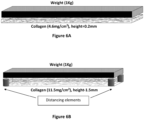
- FIGs 6A and 6B presenting the compression of fibrillated collagen without the presence of distancing elements ( Fig. 6A ) and in the presence of distancing elements ( Fig. 6B ).
- the distancing elements prevent the compressing element from fully compressing the fibrillated collagen, since they create a distance between the compressing element and the bottom of the reaction vessel.
- the prepared multilayered layered structure of the invention when compressing in the presence of distancing elements, is thicker than a layered structure of the inventionprepared without the use of distancing elements. It is noted that the final thickness of the multilayered layered structure of the invention is at least partially dependent on the height of the distancing elements.
- the height of the distancing elements is about 0.1-10 mm. According to some embodiments, the height of the distancing elements is about 0.1-1.0mm. According to some embodiments, the height of the distancing elements is about 1.0-2.0mm. According to some embodiments, the height of the distancing elements is about 2.0-3.0mm. According to some embodiments, the height of the distancing elements is about 3.0-4.0mm. According to some embodiments, the height of the distancing elements is about 4.0-5.0mm. According to some embodiments, the height of the distancing elements is about 5.0-6.0mm. According to some embodiments, the height of the distancing elements is about 6.0-7.0mm.
- the height of the distancing elements is about 7.0-8.0mm. According to some embodiments, the height of the distancing elements is about 8.0-9.0mm. According to some embodiments, the height of the distancing elements is about 9.0-10mm.
- the distancing elements are prepared from any appropriate material that is able to provide the desired distance, without interfering with the process for preparing the collagen, such as Teflon TM , stainless steel, silicone, polypropylene, polyethylene, or any combination thereof.
- the distancing elements are anchored into the reaction vessel.
- the distancing elements are vertically positioned in the reaction vessel.
- distancing elements may be added to the reaction vessel at any stage before compression.
- distancing elements may be added to the reaction vessel at any stage during compression, provided that the fibrillated collagen is not overly compressed before the distancing elements are added.
- the fibrillated collagen may be transferred to a reaction vessel containing distancing elements before the compression.
- the distancing elements may be separated from the prepared multilayered layered structure of the invention either by removing the distancing elements from the reaction vessel or by removing the multilayered layered structure of the invention from the reaction vessel.
- the collagen may be crosslinked according to any known method in the art.
- the compressed collagen gel is contacted with a crosslinking agent.
- the collagen is crosslinked by an enzymatic mediated process, by physical treatment (e.g., heat, UV radiation), or by means of a chemical cross-linking agent, wherein the crosslinking agent may comprise a reducing agent, such as, a reducing sugar or a reducing sugar derivative, or any combination thereof.
- a reducing agent such as, a reducing sugar or a reducing sugar derivative, or any combination thereof.
- the crosslinking agent comprises an aldehyde or ketone mono sugar or mono sugar derivative, wherein the ⁇ -carbon is in an aldehyde or ketone state in an aqueous solution.
- the crosslinking agent includes compounds and reagents, as detailed in US 6, 346, 515 .
- the reducing sugars may form Schiff bases with the ⁇ or ⁇ amino groups of the amino acids of the collagen molecule.
- the Schiff base may then undergo an Amadori Rearrangement to form a ketoamine product.
- Two adjacent ketoamine groups may then condense to form a stable intermolecular or intramolecular crosslink.
- the reducing agents may include, for example, glycerose, threose, erythrose, lyxose, xylose, arabinose, ribose, allose, altrose, glucose, mannose, gulose, idose, galactose, talose, or any other diose, triose, tetrose, pentose, hexose, septose, octose, nanose or decose, or any combination thereof.
- the crosslinking agent comprises a ribose
- a stable crosslink via a pentosidine group may be formed.
- the degradation rate of the layered structure of the invention may be controlled by the extent of the crosslinking between the collagen fibrils.
- the extent of the cross linking may be controlled, e.g., by the concentration of the crosslinking agent, the temperature and the time during which the collagen fibrils are exposed to the crosslinking agent.
- the cross-linking may be performed at a cross-linker concentration range of about 0.01%-5%.
- the cross-linking may be performed at a temperature range of about 20-40°C.
- the cross-linking may be performed for a duration range of about 6-360 hours.
- the tissue surrounding the layered structure of the invention is regenerated, at least partially, over time, such that it replaces the layered structure of the invention.
- the layered structure of the invention may provide space for the surrounding tissue to grow into.
- the distancing elements used in the process for preparing the layered structure of the invention provide a layered structure of the invention with voids between the collagen molecules, since the collagen was not fully compressed during the preparation of the device. The formed voids allow the surrounding tissue to penetrate into the formed spaces, to grow therein and over time, to replace the degrading collagen.
- the layered structure of the invention calcifies and subsequently ossifies, providing a base for bone cell population.
- the layered structure of the invention is biodegradable. According to some embodiments, the layered structure of the invention is biodegraded within about 3-24 months. According to some embodiments, the layered structure of the invention is biodegraded within about 4-8 months. According to some embodiments, the layered structure of the invention is biodegraded within about 5-7 months. According to some embodiments, the layered structure of the invention is biodegraded within about 3-10 months. According to some embodiments, the layered structure of the invention is biodegraded within about 10-17 months. According to some embodiments, the layered structure of the invention is biodegraded within about 17-24 months. According to some embodiments, the layered structure of the invention is biodegraded within about six months. It is noted that the layered structure of the invention is considered biodegraded when more than about 70, 80, 90 or 95% is degraded.
- the different layers of the layered structure of the invention may degrade at different rates, depending on their density. According to some embodiments, denser layers degrade at a slower rate than less dense layers.
- the prepared layered structure of the invention is washed to remove residues of reactants, such as fibrillation agents, crosslinkers, non-cross-linked-collagen and the like.
- the collagen membrane is then at least partially dehydrated by any appropriate means, such as air drying, freeze-drying, critical point drying, or any combination thereof. The drying procedure may further sterilize the multilayered layered structure of the inventions and render them dry, effectively prolonging their shelf life.
- the layers in the dehydrated multilayered layered structure of the invention may be less apparent; however, according to some embodiments, rehydration with any appropriate hydrant, such as water, saline solution, blood, phosphate-buffered saline (PBS) solution, and the like, may restore the three dimensional structure of the multilayered layered structure of the invention.
- the multilayered layered structure of the invention is rehydrated in vitro.
- the multilayered layered structure of the invention is rehydrated in vivo.
- the layered structure of the invention may comprise active agents having various therapeutic effects.
- the active agents are immobilized within the layered structure of the invention by the crosslinking agent, e.g., the reducing sugars, or by its natural tendency for binding to collagen. During the gradual biodegradation of the layered structure of the invention, such active agents may be gradually released into the body, thereby providing a controlled release system.
- active agents may include antimicrobial agents, anti-inflammatory agents, growth factors having tissue regeneration induction properties and the like, as well as any combination thereof.
- Antimicrobial agents may include penicillin, cefalosporins, tetracyclines, streptomycin, gentamicin, sulfonamides, and miconazole.
- the anti-inflammatory agents may include cortisone, synthetic derivatives thereof, and the like.
- Tissue regeneration induction factors may include differentiation factors, bone morphogenetic proteins, attachment factor and growth factors, such as, fibroblast growth factors, platelet derived growth factors, transforming growth factors, cementum growth factors, insulin-like growth factors, and the like.
- additional biodegradable materials may be added, such as polylactic acid (PLA), polyglycolide (PGA), chitosan, hyaluronic acid and mixtures thereof.
- PLA polylactic acid
- PGA polyglycolide
- chitosan hyaluronic acid
- any type of minerals such as tri calcium phosphate, silicon oxide, hydroxyapatite may be added.
- cells such as human cells, bone cells, cell cultures, fibroblasts, chondrocytes, (mesenchymal) stem cells, osteocytes, adipocytes, endothelial cells may be seeded onto or into at least one of the layers, e.g., the external dense layer that is to be placed in the direction of the bone.
- a layer could act as a protective, semi-permeable layer, to provide the possibility of nutrition, e.g., fluid containing minerals and the like, supply to the inner layers of the device and/or to tissue found under the device, while protecting internal layers of the device and/or tissue under the device from direct interactions with other cell types.
- interaction of the internal layers and/or the tissue under the device is prevented due to the pore size of at least one layer in the multilayered layered structure of the invention, wherein the pore size is smaller than necessary for certain cell types to penetrate through.
- the multilayered layered structure of the invention may be used in conjunction with a space-maintaining material ("space maintainer” or “spacer”).
- space maintainer or "spacer”
- the term “in conjunction” is intended to cover uses in which the space maintainer is adjacent to the multilayered layered structure of the invention, is attached to the layered structure of the invention by any appropriate means, or is incorporated into the layered structure of the invention.
- a space maintainer may be used in some procedures in order to maintain a space in which the regenerating cells can migrate and repopulate.
- a space occurs naturally, for example, when a tumor is excised from a bone.
- such a space is not available, for example, in various types of periodontal or bone lesions. In such instances it may be necessary to insert filling material between the collagen membrane and the regenerating tissues.
- space maintainers are (i) hyaluronan (hyaluronic acid), (ii) mineralized freeze dried bone, (iii) deproteinazed bone, (iv) synthetic hydroxyapatite, (v) crystalline materials other than those mentioned under (ii)-(iv), enriched with osteocalcin or vitronectin, and (vi) heat-treated demineralized bone, wherein the bone-derived substances may be of human origin. Also possible are combinations of any of the above space maintainers, such as the combination of hyaluronan and with one or more of the other space maintainers.
- the space maintainers may be enriched with one or more of the antibacterial, anti-inflammatory and tissue-inductive factors mentioned above; and/or enriched with a substance intended to aid in maintaining the shape of the space maintainer matrix, e.g. one or more matrix proteins selected from the group comprising collagen, fibrin, fibronectin, osteonectin, osteopontin, tenascin, thrombospondin; and/or glycoseaminoglycans including heparin sulfate, dermatan sulfates, chondrointin sulfates, keratan sulfates, and the like.
- matrix proteins selected from the group comprising collagen, fibrin, fibronectin, osteonectin, osteopontin, tenascin, thrombospondin
- glycoseaminoglycans including heparin sulfate, dermatan sulfates, chondrointin sulfates, keratan sulf
- the layered structure of the invention is designed such that it fills the space in which the tissue is to be regenerated. Accordingly, the use of space maintainer may not be necessary, since the tissue may be regenerated and replace the biodegrading layered structure of the invention. According to some embodiments, as detailed herein, the layered structure of the inventions may be prepared to have any size or shape.
- Figures 3-5 presenting a photomicrograph of 4 weeks implantation in a dog L-shape bony defect. Note the initial ossification advancing in the middle layer of the device (arrows). The original collagen matrix of the device is marked (M) ( Figure 3 ).
- Figure 4 is a photomicrograph of 24 weeks implantation in a dog L-shape bony defect. Note the advanced ossification of the middle layer of the device (arrows).
- Figure 5 is a photomicrograph of 4 weeks implantation in a dog L-shape bony defect.
- the multilayered layered structure of the invention comprises an internal scaffold, as presented in detail in US 62/317,569.
- the collagen sheet was cross-linked in a 0.2 micron filtered medium of 10g ribose, 158g ethanol and 790g PBS for 11 days at 37°C.
- the resulting membrane was then washed with water, dehydrated with ethanol and dried by lyophilization.
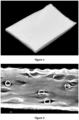
- Figure 1 presents a low magnification of the prepared wet collagen membrane and
- Figure 2 presents a high magnification of a cross-section of the prepared wet collagen membrane.
Landscapes
- Health & Medical Sciences (AREA)
- Life Sciences & Earth Sciences (AREA)
- Chemical & Material Sciences (AREA)
- Animal Behavior & Ethology (AREA)
- Public Health (AREA)
- Transplantation (AREA)
- Epidemiology (AREA)
- Medicinal Chemistry (AREA)
- Dermatology (AREA)
- General Health & Medical Sciences (AREA)
- Oral & Maxillofacial Surgery (AREA)
- Veterinary Medicine (AREA)
- Biophysics (AREA)
- Dispersion Chemistry (AREA)
- Materials For Medical Uses (AREA)
- Peptides Or Proteins (AREA)
- Laminated Bodies (AREA)
- Prostheses (AREA)
Claims (8)
- Schichtstruktur, umfassend mindestens zwei Kollagenschichten, wobei die Schichtstruktur einen Dichtegradienten beinhaltet und die Schichtstruktur hergestellt ist durch ein Verfahren, umfassend:Einführen von Kollagen in ein Gefäß;Fibrillieren des Kollagens, um ein Kollagengel bereitzustellen, das Kollagenfibrillen umfasst;Komprimieren des Kollagengels bei Anwesenheit von mindestens einem Abstandselement, sodass mehrere Kollagenschichten mit einem Dichtegradienten bereitgestellt werden;Vernetzen des Kollagengels; undTrocknen des vernetzten Kollagengels.
- Schichtstruktur gemäß Anspruch 1, wobei die mindestens zwei Kollagenschichten mindestens eine erste Kollagenschicht und mindestens eine zweite Kollagenschicht umfassen, wobei die mindestens eine zweite Kollagenschicht (Schicht von geringer Dichte) eine Dichte von bis zu etwa 90 % der ersten Kollagenschicht (Schicht von hoher Dichte) aufweist.
- Schichtstruktur gemäß Anspruch 1, wobei die mindestens zwei Kollagenschichten mindestens zwei erste Kollagenschichten und mindestens eine zweite Kollagenschicht umfassen, wobei die mindestens eine zweite Kollagenschicht jeweils zwischen den mindestens zwei Kollagenschichten positioniert ist.
- Schichtstruktur gemäß Anspruch 3, wobei die mindestens eine zweite Kollagenschicht (Schicht von geringer Dichte) eine Dichte von bis zu etwa 90 % der mindestens zwei ersten Kollagenschichten jeweils unabhängig voneinander aufweist.
- Verfahren zum Herstellen einer Schichtstruktur, umfassend mindestens zwei Kollagenschichten, das Verfahren umfassend:Einführen von Kollagen in ein Gefäß;Fibrillieren des Kollagens, um ein Kollagengel bereitzustellen, das Kollagenfibrillen umfasst;Komprimieren des Kollagengels bei Anwesenheit von mindestens einem Abstandselement, sodass mehrere Kollagenschichten mit einem Dichtegradienten bereitgestellt werden;Vernetzen des Kollagengels; undTrocknen des vernetzten Kollagengels.
- Chirurgisches Gerüst zur Verwendung zum/zur Weichgewebewachstum/- vermehrung, umfassend die Schichtstruktur nach einem der Ansprüche 1-4.
- Schichtstruktur nach einem der Ansprüche 1-4 zur Verwendung zum Verstärken von Weichgewebe.
- Schichtstruktur nach einem der Ansprüche 1-4 zur Verwendung zur Behandlung von Knochenwachstum/-vermehrung, umfassend geführte Knochenregeneration (GBR) und geführte Geweberegeneration (GTR).
Applications Claiming Priority (2)
| Application Number | Priority Date | Filing Date | Title |
|---|---|---|---|
| US202063109888P | 2020-11-05 | 2020-11-05 | |
| PCT/IL2021/051315 WO2022097149A1 (en) | 2020-11-05 | 2021-11-04 | Multi-layered collagen structure |
Publications (4)
| Publication Number | Publication Date |
|---|---|
| EP4240435A1 EP4240435A1 (de) | 2023-09-13 |
| EP4240435A4 EP4240435A4 (de) | 2024-05-08 |
| EP4240435C0 EP4240435C0 (de) | 2024-09-25 |
| EP4240435B1 true EP4240435B1 (de) | 2024-09-25 |
Family
ID=81457732
Family Applications (1)
| Application Number | Title | Priority Date | Filing Date |
|---|---|---|---|
| EP21888837.8A Active EP4240435B1 (de) | 2020-11-05 | 2021-11-04 | Mehrschichtige kollagenstruktur |
Country Status (10)
| Country | Link |
|---|---|
| US (1) | US20240016977A1 (de) |
| EP (1) | EP4240435B1 (de) |
| JP (2) | JP2023549057A (de) |
| KR (1) | KR20230104224A (de) |
| CN (1) | CN116963787A (de) |
| AU (1) | AU2021375535B2 (de) |
| CA (1) | CA3194691A1 (de) |
| IL (1) | IL302143A (de) |
| TW (1) | TWI811836B (de) |
| WO (1) | WO2022097149A1 (de) |
Families Citing this family (3)
| Publication number | Priority date | Publication date | Assignee | Title |
|---|---|---|---|---|
| KR102930346B1 (ko) * | 2022-12-30 | 2026-02-25 | 오스템임플란트 주식회사 | 다중층 치과용 이식재 및 그 제조방법 |
| WO2024254184A2 (en) * | 2023-06-05 | 2024-12-12 | Novabone Products, Llc | Methods and compositions for wound care |
| WO2024254185A2 (en) * | 2023-06-05 | 2024-12-12 | Novabone Products, Llc | Methods and compositions for dental care |
Family Cites Families (17)
| Publication number | Priority date | Publication date | Assignee | Title |
|---|---|---|---|---|
| US4600533A (en) * | 1984-12-24 | 1986-07-15 | Collagen Corporation | Collagen membranes for medical use |
| JP3652750B2 (ja) * | 1995-10-18 | 2005-05-25 | 富士ゼロックス株式会社 | プリンタ装置 |
| ITMI20050343A1 (it) * | 2005-03-04 | 2006-09-05 | Fin Ceramica Faenza S R L | Sostituto cartilagineo e osteocindrale comprendente una struttura multistrato e relativo impiego |
| US20080026032A1 (en) * | 2006-07-27 | 2008-01-31 | Zubery Yuval | Composite implants for promoting bone regeneration and augmentation and methods for their preparation and use |
| GB0713079D0 (en) * | 2007-07-05 | 2007-08-15 | Ucl Business Plc | biomaterial scaffolds with defined stiffness |
| CA2750605C (en) * | 2009-01-23 | 2019-01-22 | Royal College Of Surgeons In Ireland | Layered scaffold suitable for osteochondral repair |
| GB201003656D0 (en) * | 2010-03-05 | 2010-04-21 | Tigenix Ltd | Fabrication process |
| GB201011476D0 (en) * | 2010-07-07 | 2010-08-25 | Ucl Business Plc | Controlled production of biomaterial |
| EP2508212A1 (de) * | 2011-04-05 | 2012-10-10 | Universitätsklinikum Freiburg | Biokompatibles und biologisch abbaubares Gradientenschichtsystem für die regenerative Medizin und zur Gewebeunterstützung |
| HUE032689T4 (en) * | 2011-05-24 | 2017-11-28 | Takeda As | Collagen carrier that has grown up |
| CN104225689A (zh) * | 2013-06-08 | 2014-12-24 | 北京航空航天大学 | 一种鱼胶原骨诱导再生膜的制备方法 |
| AU2015308795B2 (en) * | 2014-08-28 | 2019-05-23 | Mimedx Group, Inc. | Collagen reinforced tissue grafts |
| JP6566290B2 (ja) * | 2014-12-04 | 2019-08-28 | 学校法人北里研究所 | 軟骨再生用移植材料、軟骨再生用移植材料の製造方法 |
| CN105381504B (zh) * | 2015-11-17 | 2018-08-21 | 浙江星月生物科技股份有限公司 | 一种胶原基软骨支架 |
| JP6873731B2 (ja) * | 2016-02-23 | 2021-05-19 | 多木化学株式会社 | 縫合可能な線維化コラーゲン架橋膜 |
| GB201808106D0 (en) * | 2018-05-18 | 2018-07-04 | Cambridge Entpr Ltd | Collagen biomaterials and methods for manufacturing collagen biomaterials |
| CN212308516U (zh) * | 2019-11-21 | 2021-01-08 | 郑州湃生医疗器械有限公司 | 一种口腔用胶原基质盖 |
-
2021
- 2021-11-04 EP EP21888837.8A patent/EP4240435B1/de active Active
- 2021-11-04 CA CA3194691A patent/CA3194691A1/en active Pending
- 2021-11-04 KR KR1020237018768A patent/KR20230104224A/ko not_active Ceased
- 2021-11-04 WO PCT/IL2021/051315 patent/WO2022097149A1/en not_active Ceased
- 2021-11-04 AU AU2021375535A patent/AU2021375535B2/en active Active
- 2021-11-04 IL IL302143A patent/IL302143A/en unknown
- 2021-11-04 US US18/249,383 patent/US20240016977A1/en active Pending
- 2021-11-04 JP JP2023524919A patent/JP2023549057A/ja active Pending
- 2021-11-04 CN CN202180074838.3A patent/CN116963787A/zh active Pending
- 2021-11-05 TW TW110141302A patent/TWI811836B/zh active
-
2025
- 2025-12-05 JP JP2025235923A patent/JP2026035864A/ja active Pending
Also Published As
| Publication number | Publication date |
|---|---|
| JP2026035864A (ja) | 2026-03-04 |
| TW202233260A (zh) | 2022-09-01 |
| EP4240435A4 (de) | 2024-05-08 |
| IL302143A (en) | 2023-06-01 |
| EP4240435C0 (de) | 2024-09-25 |
| JP2023549057A (ja) | 2023-11-22 |
| AU2021375535A1 (en) | 2023-06-08 |
| KR20230104224A (ko) | 2023-07-07 |
| TWI811836B (zh) | 2023-08-11 |
| WO2022097149A1 (en) | 2022-05-12 |
| US20240016977A1 (en) | 2024-01-18 |
| CN116963787A (zh) | 2023-10-27 |
| AU2021375535B2 (en) | 2026-02-05 |
| EP4240435A1 (de) | 2023-09-13 |
| CA3194691A1 (en) | 2022-05-12 |
| AU2021375535A9 (en) | 2024-10-24 |
Similar Documents
| Publication | Publication Date | Title |
|---|---|---|
| Elgali et al. | Guided bone regeneration: materials and biological mechanisms revisited | |
| RU2532370C2 (ru) | Способ и мембрана для регенерации ткани | |
| EP4240435B1 (de) | Mehrschichtige kollagenstruktur | |
| DE69918717T2 (de) | Knochentransplantat aus knochenpartikel | |
| Dougherty et al. | The natural history of alloplastic implants in orbital floor reconstruction: an animal model | |
| Jazayeri et al. | Dental applications of natural‐origin polymers in hard and soft tissue engineering | |
| Durmuş et al. | Evaluation of the potential beneficial effects of ostrich eggshell combined with eggshell membranes in healing of cranial defects in rabbits | |
| Correa-Araujo et al. | Tissue Engineering Scaffolds: The Importance of Collagen | |
| Warren et al. | Biomaterials for skin and bone replacement and repair in plastic surgery | |
| RU2800928C2 (ru) | Имплантат, содержащий коллагеновую мембрану | |
| AU2020297034B2 (en) | An implant comprising a collagen membrane | |
| Mahmood et al. | In Vivo evaluation of the novel nanocomposite porous 3d scaffold in a rabbit model | |
| Maçarico | Advances in periodontal regeneration using resorbable membranes | |
| PL248102B1 (pl) | Sposób otrzymywania kompozytu o osnowie polimerowej zawierającej hydroksyapatyt i kompozyt o osnowie polimerowej zawierającej hydroksyapatyt | |
| WO2026062621A1 (en) | A bio-composite scaffold comprising padina pavonica polysaccharides and eggshell membrane for bone tissue engineering applications | |
| Yu | Surgical treatment of inflammatory periodontal diseases using chitosan matrices | |
| NORITAKE et al. | Guided bone regeneration: membrane characteristics and future perspectives | |
| Silver | Facial Implants | |
| Thomas et al. | Novel calcium sulfate space-making devices for bone regeneration: a pilot study | |
| Hutmacher et al. | Clinical evaluation of a bioresorbable membrane for hard tissue regeneration |
Legal Events
| Date | Code | Title | Description |
|---|---|---|---|
| STAA | Information on the status of an ep patent application or granted ep patent |
Free format text: STATUS: THE INTERNATIONAL PUBLICATION HAS BEEN MADE |
|
| PUAI | Public reference made under article 153(3) epc to a published international application that has entered the european phase |
Free format text: ORIGINAL CODE: 0009012 |
|
| STAA | Information on the status of an ep patent application or granted ep patent |
Free format text: STATUS: REQUEST FOR EXAMINATION WAS MADE |
|
| 17P | Request for examination filed |
Effective date: 20230424 |
|
| AK | Designated contracting states |
Kind code of ref document: A1 Designated state(s): AL AT BE BG CH CY CZ DE DK EE ES FI FR GB GR HR HU IE IS IT LI LT LU LV MC MK MT NL NO PL PT RO RS SE SI SK SM TR |
|
| P01 | Opt-out of the competence of the unified patent court (upc) registered |
Effective date: 20230913 |
|
| REG | Reference to a national code |
Ref country code: HK Ref legal event code: DE Ref document number: 40092882 Country of ref document: HK |
|
| DAV | Request for validation of the european patent (deleted) | ||
| DAX | Request for extension of the european patent (deleted) | ||
| A4 | Supplementary search report drawn up and despatched |
Effective date: 20240410 |
|
| RIC1 | Information provided on ipc code assigned before grant |
Ipc: A61L 27/54 20060101ALI20240404BHEP Ipc: A61L 27/02 20060101ALI20240404BHEP Ipc: A61L 27/14 20060101ALI20240404BHEP Ipc: A61L 27/50 20060101ALI20240404BHEP Ipc: A61L 27/42 20060101ALI20240404BHEP Ipc: A61L 27/20 20060101ALI20240404BHEP Ipc: A61L 27/12 20060101ALI20240404BHEP Ipc: A61L 15/32 20060101ALI20240404BHEP Ipc: A61L 27/26 20060101ALI20240404BHEP Ipc: A61L 27/24 20060101AFI20240404BHEP |
|
| GRAP | Despatch of communication of intention to grant a patent |
Free format text: ORIGINAL CODE: EPIDOSNIGR1 |
|
| STAA | Information on the status of an ep patent application or granted ep patent |
Free format text: STATUS: GRANT OF PATENT IS INTENDED |
|
| INTG | Intention to grant announced |
Effective date: 20240705 |
|
| GRAS | Grant fee paid |
Free format text: ORIGINAL CODE: EPIDOSNIGR3 |
|
| GRAA | (expected) grant |
Free format text: ORIGINAL CODE: 0009210 |
|
| STAA | Information on the status of an ep patent application or granted ep patent |
Free format text: STATUS: THE PATENT HAS BEEN GRANTED |
|
| AK | Designated contracting states |
Kind code of ref document: B1 Designated state(s): AL AT BE BG CH CY CZ DE DK EE ES FI FR GB GR HR HU IE IS IT LI LT LU LV MC MK MT NL NO PL PT RO RS SE SI SK SM TR |
|
| REG | Reference to a national code |
Ref country code: GB Ref legal event code: FG4D |
|
| REG | Reference to a national code |
Ref country code: CH Ref legal event code: EP |
|
| REG | Reference to a national code |
Ref country code: DE Ref legal event code: R096 Ref document number: 602021019460 Country of ref document: DE |
|
| REG | Reference to a national code |
Ref country code: IE Ref legal event code: FG4D |
|
| U01 | Request for unitary effect filed |
Effective date: 20241016 |
|
| P04 | Withdrawal of opt-out of the competence of the unified patent court (upc) registered |
Free format text: CASE NUMBER: APP_58875/2024 Effective date: 20241028 |
|
| U07 | Unitary effect registered |
Designated state(s): AT BE BG DE DK EE FI FR IT LT LU LV MT NL PT RO SE SI Effective date: 20241031 |
|
| U20 | Renewal fee for the european patent with unitary effect paid |
Year of fee payment: 4 Effective date: 20241101 |
|
| PG25 | Lapsed in a contracting state [announced via postgrant information from national office to epo] |
Ref country code: NO Free format text: LAPSE BECAUSE OF FAILURE TO SUBMIT A TRANSLATION OF THE DESCRIPTION OR TO PAY THE FEE WITHIN THE PRESCRIBED TIME-LIMIT Effective date: 20241225 |
|
| PG25 | Lapsed in a contracting state [announced via postgrant information from national office to epo] |
Ref country code: GR Free format text: LAPSE BECAUSE OF FAILURE TO SUBMIT A TRANSLATION OF THE DESCRIPTION OR TO PAY THE FEE WITHIN THE PRESCRIBED TIME-LIMIT Effective date: 20241226 |
|
| PGFP | Annual fee paid to national office [announced via postgrant information from national office to epo] |
Ref country code: IE Payment date: 20241001 Year of fee payment: 4 |
|
| PG25 | Lapsed in a contracting state [announced via postgrant information from national office to epo] |
Ref country code: RS Free format text: LAPSE BECAUSE OF FAILURE TO SUBMIT A TRANSLATION OF THE DESCRIPTION OR TO PAY THE FEE WITHIN THE PRESCRIBED TIME-LIMIT Effective date: 20241225 |
|
| PG25 | Lapsed in a contracting state [announced via postgrant information from national office to epo] |
Ref country code: RS Free format text: LAPSE BECAUSE OF FAILURE TO SUBMIT A TRANSLATION OF THE DESCRIPTION OR TO PAY THE FEE WITHIN THE PRESCRIBED TIME-LIMIT Effective date: 20241225 Ref country code: NO Free format text: LAPSE BECAUSE OF FAILURE TO SUBMIT A TRANSLATION OF THE DESCRIPTION OR TO PAY THE FEE WITHIN THE PRESCRIBED TIME-LIMIT Effective date: 20241225 Ref country code: GR Free format text: LAPSE BECAUSE OF FAILURE TO SUBMIT A TRANSLATION OF THE DESCRIPTION OR TO PAY THE FEE WITHIN THE PRESCRIBED TIME-LIMIT Effective date: 20241226 |
|
| PGFP | Annual fee paid to national office [announced via postgrant information from national office to epo] |
Ref country code: CH Payment date: 20241201 Year of fee payment: 4 |
|
| PG25 | Lapsed in a contracting state [announced via postgrant information from national office to epo] |
Ref country code: IS Free format text: LAPSE BECAUSE OF FAILURE TO SUBMIT A TRANSLATION OF THE DESCRIPTION OR TO PAY THE FEE WITHIN THE PRESCRIBED TIME-LIMIT Effective date: 20250125 |
|
| PG25 | Lapsed in a contracting state [announced via postgrant information from national office to epo] |
Ref country code: SM Free format text: LAPSE BECAUSE OF FAILURE TO SUBMIT A TRANSLATION OF THE DESCRIPTION OR TO PAY THE FEE WITHIN THE PRESCRIBED TIME-LIMIT Effective date: 20240925 |
|
| PG25 | Lapsed in a contracting state [announced via postgrant information from national office to epo] |
Ref country code: ES Free format text: LAPSE BECAUSE OF FAILURE TO SUBMIT A TRANSLATION OF THE DESCRIPTION OR TO PAY THE FEE WITHIN THE PRESCRIBED TIME-LIMIT Effective date: 20240925 |
|
| PG25 | Lapsed in a contracting state [announced via postgrant information from national office to epo] |
Ref country code: PL Free format text: LAPSE BECAUSE OF FAILURE TO SUBMIT A TRANSLATION OF THE DESCRIPTION OR TO PAY THE FEE WITHIN THE PRESCRIBED TIME-LIMIT Effective date: 20240925 Ref country code: CZ Free format text: LAPSE BECAUSE OF FAILURE TO SUBMIT A TRANSLATION OF THE DESCRIPTION OR TO PAY THE FEE WITHIN THE PRESCRIBED TIME-LIMIT Effective date: 20240925 |
|
| PG25 | Lapsed in a contracting state [announced via postgrant information from national office to epo] |
Ref country code: SK Free format text: LAPSE BECAUSE OF FAILURE TO SUBMIT A TRANSLATION OF THE DESCRIPTION OR TO PAY THE FEE WITHIN THE PRESCRIBED TIME-LIMIT Effective date: 20240925 |
|
| PGFP | Annual fee paid to national office [announced via postgrant information from national office to epo] |
Ref country code: TR Payment date: 20241216 Year of fee payment: 4 |
|
| PG25 | Lapsed in a contracting state [announced via postgrant information from national office to epo] |
Ref country code: MC Free format text: LAPSE BECAUSE OF FAILURE TO SUBMIT A TRANSLATION OF THE DESCRIPTION OR TO PAY THE FEE WITHIN THE PRESCRIBED TIME-LIMIT Effective date: 20240925 |
|
| PLBE | No opposition filed within time limit |
Free format text: ORIGINAL CODE: 0009261 |
|
| STAA | Information on the status of an ep patent application or granted ep patent |
Free format text: STATUS: NO OPPOSITION FILED WITHIN TIME LIMIT |
|
| 26N | No opposition filed |
Effective date: 20250626 |
|
| U20 | Renewal fee for the european patent with unitary effect paid |
Year of fee payment: 5 Effective date: 20251022 |
|
| PGFP | Annual fee paid to national office [announced via postgrant information from national office to epo] |
Ref country code: GB Payment date: 20251023 Year of fee payment: 5 |
|
| PG25 | Lapsed in a contracting state [announced via postgrant information from national office to epo] |
Ref country code: HR Free format text: LAPSE BECAUSE OF FAILURE TO SUBMIT A TRANSLATION OF THE DESCRIPTION OR TO PAY THE FEE WITHIN THE PRESCRIBED TIME-LIMIT Effective date: 20240925 |
|
| PG25 | Lapsed in a contracting state [announced via postgrant information from national office to epo] |
Ref country code: HU Free format text: LAPSE BECAUSE OF FAILURE TO SUBMIT A TRANSLATION OF THE DESCRIPTION OR TO PAY THE FEE WITHIN THE PRESCRIBED TIME-LIMIT; INVALID AB INITIO Effective date: 20211104 |