EP4239990A1 - Verfahren und vorrichtung zur anzeige von aufforderungsinformationen und elektronische vorrichtung - Google Patents
Verfahren und vorrichtung zur anzeige von aufforderungsinformationen und elektronische vorrichtung Download PDFInfo
- Publication number
- EP4239990A1 EP4239990A1 EP21885002.2A EP21885002A EP4239990A1 EP 4239990 A1 EP4239990 A1 EP 4239990A1 EP 21885002 A EP21885002 A EP 21885002A EP 4239990 A1 EP4239990 A1 EP 4239990A1
- Authority
- EP
- European Patent Office
- Prior art keywords
- wireless headset
- signal strength
- wireless
- headset
- prompt information
- Prior art date
- Legal status (The legal status is an assumption and is not a legal conclusion. Google has not performed a legal analysis and makes no representation as to the accuracy of the status listed.)
- Pending
Links
Images

Classifications
-
- H—ELECTRICITY
- H04—ELECTRIC COMMUNICATION TECHNIQUE
- H04B—TRANSMISSION
- H04B17/00—Monitoring; Testing
- H04B17/30—Monitoring; Testing of propagation channels
- H04B17/309—Measuring or estimating channel quality parameters
- H04B17/318—Received signal strength
-
- H—ELECTRICITY
- H04—ELECTRIC COMMUNICATION TECHNIQUE
- H04B—TRANSMISSION
- H04B17/00—Monitoring; Testing
- H04B17/20—Monitoring; Testing of receivers
- H04B17/27—Monitoring; Testing of receivers for locating or positioning the transmitter
-
- H—ELECTRICITY
- H04—ELECTRIC COMMUNICATION TECHNIQUE
- H04L—TRANSMISSION OF DIGITAL INFORMATION, e.g. TELEGRAPHIC COMMUNICATION
- H04L41/00—Arrangements for maintenance, administration or management of data switching networks, e.g. of packet switching networks
- H04L41/08—Configuration management of networks or network elements
- H04L41/0803—Configuration setting
- H04L41/0813—Configuration setting characterised by the conditions triggering a change of settings
- H04L41/0816—Configuration setting characterised by the conditions triggering a change of settings the condition being an adaptation, e.g. in response to network events
-
- H—ELECTRICITY
- H04—ELECTRIC COMMUNICATION TECHNIQUE
- H04M—TELEPHONIC COMMUNICATION
- H04M1/00—Substation equipment, e.g. for use by subscribers
- H04M1/60—Substation equipment, e.g. for use by subscribers including speech amplifiers
- H04M1/6033—Substation equipment, e.g. for use by subscribers including speech amplifiers for providing handsfree use or a loudspeaker mode in telephone sets
- H04M1/6041—Portable telephones adapted for handsfree use
- H04M1/6058—Portable telephones adapted for handsfree use involving the use of a headset accessory device connected to the portable telephone
- H04M1/6066—Portable telephones adapted for handsfree use involving the use of a headset accessory device connected to the portable telephone including a wireless connection
-
- H—ELECTRICITY
- H04—ELECTRIC COMMUNICATION TECHNIQUE
- H04M—TELEPHONIC COMMUNICATION
- H04M1/00—Substation equipment, e.g. for use by subscribers
- H04M1/72—Mobile telephones; Cordless telephones, i.e. devices for establishing wireless links to base stations without route selection
- H04M1/724—User interfaces specially adapted for cordless or mobile telephones
- H04M1/72403—User interfaces specially adapted for cordless or mobile telephones with means for local support of applications that increase the functionality
- H04M1/72409—User interfaces specially adapted for cordless or mobile telephones with means for local support of applications that increase the functionality by interfacing with external accessories
- H04M1/72412—User interfaces specially adapted for cordless or mobile telephones with means for local support of applications that increase the functionality by interfacing with external accessories using two-way short-range wireless interfaces
-
- H—ELECTRICITY
- H04—ELECTRIC COMMUNICATION TECHNIQUE
- H04W—WIRELESS COMMUNICATION NETWORKS
- H04W72/00—Local resource management
- H04W72/50—Allocation or scheduling criteria for wireless resources
- H04W72/54—Allocation or scheduling criteria for wireless resources based on quality criteria
-
- H—ELECTRICITY
- H04—ELECTRIC COMMUNICATION TECHNIQUE
- H04W—WIRELESS COMMUNICATION NETWORKS
- H04W76/00—Connection management
- H04W76/10—Connection setup
- H04W76/14—Direct-mode setup
-
- H—ELECTRICITY
- H04—ELECTRIC COMMUNICATION TECHNIQUE
- H04W—WIRELESS COMMUNICATION NETWORKS
- H04W84/00—Network topologies
- H04W84/18—Self-organising networks, e.g. ad-hoc networks or sensor networks
-
- H—ELECTRICITY
- H04—ELECTRIC COMMUNICATION TECHNIQUE
- H04M—TELEPHONIC COMMUNICATION
- H04M2250/00—Details of telephonic subscriber devices
- H04M2250/02—Details of telephonic subscriber devices including a Bluetooth® interface
-
- H—ELECTRICITY
- H04—ELECTRIC COMMUNICATION TECHNIQUE
- H04W—WIRELESS COMMUNICATION NETWORKS
- H04W4/00—Services specially adapted for wireless communication networks; Facilities therefor
- H04W4/80—Services using short range communication, e.g. near-field communication [NFC], radio-frequency identification [RFID] or low energy communication
-
- Y—GENERAL TAGGING OF NEW TECHNOLOGICAL DEVELOPMENTS; GENERAL TAGGING OF CROSS-SECTIONAL TECHNOLOGIES SPANNING OVER SEVERAL SECTIONS OF THE IPC; TECHNICAL SUBJECTS COVERED BY FORMER USPC CROSS-REFERENCE ART COLLECTIONS [XRACs] AND DIGESTS
- Y02—TECHNOLOGIES OR APPLICATIONS FOR MITIGATION OR ADAPTATION AGAINST CLIMATE CHANGE
- Y02D—CLIMATE CHANGE MITIGATION TECHNOLOGIES IN INFORMATION AND COMMUNICATION TECHNOLOGIES [ICT], I.E. INFORMATION AND COMMUNICATION TECHNOLOGIES AIMING AT THE REDUCTION OF THEIR OWN ENERGY USE
- Y02D30/00—Reducing energy consumption in communication networks
- Y02D30/70—Reducing energy consumption in communication networks in wireless communication networks
Definitions
- This application pertains to the field of communication technologies, and specifically relates to a prompt information display method and apparatus and an electronic device.
- an electronic device such as a mobile phone or a tablet computer
- a mobile phone or a tablet computer has gradually become an indispensable tool in people's life.
- wireless Bluetooth headsets of all manufacturers in the market customizes a quick pairing function for deep adaptation of electronic devices produced by the manufacturers, to search for a Bluetooth device in a nearby searching range and actively display a connection pop-up window on the electronic device to prompt the user to perform the connection.
- Embodiments of this application are to provide a prompt information display method and apparatus and an electronic device, to resolve a problem that a headset connection pairing manner in a related technology easily interferes with a non-user around the headset and reduces use experience of a user.
- an embodiment of this application provides a prompt information display method, and the method includes:
- an embodiment of this application provides a prompt information display apparatus, and the apparatus includes:
- an embodiment of this application provides an electronic device.
- the electronic device includes a processor, a memory, and a program or an instruction stored in the memory and executable on the processor, and when the program or the instruction is executed by the processor, steps in the prompt information display method described in the first aspect are implemented.
- an embodiment of this application provides a readable storage medium, where the readable storage medium stores a program or an instruction, and the program or the instruction is executed by a processor to implement steps in the prompt information display method described in the first aspect.
- an embodiment of this application provides a chip, where the chip includes a processor and a communication interface, the communication interface is coupled to the processor, and the processor is configured to run a program or an instruction to implement the prompt information display method described in the first aspect.
- a mode of the wireless headset is adjusted to a pairing mode; transmitted signal strength of a wireless signal sent by the wireless headset, a target occlusion gradient of the wireless signal detected by the wireless headset, and received signal strength of the received wireless signal are obtained; a target signal threshold corresponding to the target occlusion gradient is determined according to an association relationship between an occlusion gradient and a signal threshold; and headset connection prompt information corresponding to the wireless headset is displayed in a case that a difference between the signal strength and the received signal strength is greater than or equal to a target signal threshold.
- a distance between an electronic device and the wireless headset is determined with reference to the transmitted signal strength, the received signal strength, and the target signal threshold, and whether the electronic device and the wireless headset are target devices of each other is determined with reference to the distance. Therefore, display of a headset connection pop-up window on an electronic device of a non-user can be avoided, a problem of disturbing the non-user is resolved, and use experience of a user is improved.
- first and second in the specification and claims of this application are used to distinguish between similar objects, and do not need to be used to describe a specific order or sequence. It should be understood that data used in this way may be interchangeable in an appropriate case, so that the embodiments of this application can be implemented in a sequence other than those shown or described herein, and objects distinguished by “first” and “second” are generally of a same type, and a quantity of objects is not limited. For example, there may be one or more first targets.
- “and/or” represents at least one of connected objects, and the character “/” generally represents an "or” relationship between associated objects.
- FIG. 1 is a step flowchart of a prompt information display method according to an embodiment of this application.
- the prompt information display method may specifically include the following steps: Step 101: in a case that a found wireless headset is in an unpaired state and a non-pairing mode, adjust a mode of the wireless headset to a pairing mode.
- This embodiment of this application may be applied to a scenario in which whether to display a headset connection pop-up window on a side of the electronic device is determined according to strength of a signal sent by the wireless headset and strength of a signal received by an electronic device.
- the wireless headset refers to a headset that is found by the electronic device and that needs to be paired by using Bluetooth.
- Bluetooth pairing refers to a process of mutual identity authentication between two devices (that is, the electronic device and the wireless headset).
- the pairing mode means that a Bluetooth device is in a specific state in which identity authentication can be performed (similar to that a password can be entered only on a specific interface). Being capable of being paired with a new device only after entering the pairing mode does not indicate that entering the pairing mode means being successfully paired with the new device (similar to that entering a password entering interface does not indicate that the password has been entered and does not indicate that the password is entered successfully). Opposite to the pairing mode, any state in which identity authentication cannot be performed with a new device is collectively referred to as the non-pairing mode.
- the paired state refers to a state in which identity authentication between two devices succeeds.
- An authentication failure/unverified state is always the unpaired state.
- a device in the unpaired state can be connected only after pairing succeeds, and a device in the paired state can be directly connected without repeated authentication.
- the wireless headset In a case that the electronic device is currently in the unpaired state with the found wireless headset and the wireless headset is in the non-pairing mode, if a user needs to use the wireless headset, the user first needs to adjust the mode of the wireless headset, that is, the user manually adjusts the mode of the wireless headset to the pairing mode, and keeps the wireless headset in the mode.
- the wireless headset needs to be continuously uncapped. Because a shape of a headset box is a pebble shape, the wireless headset must be in a hand-held state to be uncapped in a case that an external tool is not used. Once being put down, the wireless headset is automatically capped.
- step 102 is performed.
- Step 102 Obtain transmitted signal strength of a wireless signal sent by the wireless headset, a target occlusion gradient of the wireless signal detected by the wireless headset, and received signal strength of the received wireless signal.
- the transmitted signal strength refers to signal strength of the wireless signal sent by the wireless headset.
- RSSI Received Signal Strength Indication
- the target occlusion gradient may be used to indicate a degree of occlusion of the wireless signal between the electronic device and the wireless headset.
- an infrared component is added to a signal transceiver component of the headset box, to determine whether an RSSI signal transceiver of the headset box is obstructed by a headset box in a hand-held uncapping mode, and determine, according to a degree of severity of obstruction by infrared, a degree of the signal to be obstructed.
- step 103 is performed.
- Step 103 determine, according to an association relationship between an occlusion gradient and a signal threshold, a target signal threshold corresponding to the target occlusion gradient.
- the target signal threshold is a signal strength threshold corresponding to the target occlusion gradient.
- association relationship between the occlusion gradient and the signal threshold may be established in advance.
- a process of establishing the association relationship may be described in detail with reference to the following specific implementations.
- the method may further include: Sub-step S 1: set a distance between the wireless headset and the electronic device to a preset distance.
- the preset distance is a distance that is preset by service personnel and that is used to determine whether the wireless headset and the electronic device are mutually target devices.
- a mobile phone and the headset may be mutual devices only when a distance between the mobile phone and the headset is relatively small, that is, the mobile phone pops up a quick pairing floating window only when finding that an unpaired headset is within a specific distance (a server is configurable).
- a distance in a tentacle range in a normal case may be limited within 40 cm by analyzing ergonomic data. Therefore, a range of the distance may be initially within a range of 40 cm.
- the distance between the wireless headset and the electronic device may be set to the preset distance. Further, sub-step S2 is performed.
- Sub-step S2 add obstructions with multiple occlusion gradients between the electronic device and the wireless headset.
- the occlusion gradient may be used to indicate an occlusion degree of the wireless signal between the electronic device and the wireless headset.
- complete unocclusion may be pre-defined as 0
- complete occlusion is defined as 100, and there are 10 gradients in an interval of 1 to 100.
- obstacles of multiple obstruction gradients may be added between the electronic device and the wireless headset, to perform a subsequent test process.
- sub-step S3 is performed.
- Sub-step S3 obtain, for each occlusion gradient, initial signal strength of a wireless signal sent by the wireless headset at the occlusion gradient and target signal strength of a received wireless signal at the occlusion gradient.
- the initial signal strength of the wireless signal sent by the wireless headset and the target signal strength of the wireless signal sent by the wireless headset and received by the electronic device at each occlusion gradient may be obtained. Further, sub-step S4 is performed.
- Sub-step S4 determine, according to a difference between the initial signal strength and the target signal strength, a signal threshold corresponding to the occlusion gradient.
- the signal threshold of the occlusion gradient may be determined according to the difference.
- the difference may be used as the signal threshold.
- multiple tests may be performed on each occlusion gradient, and further, multiple initial signal strength and multiple target signal strength may be obtained. Further, with reference to differences between the multiple initial signal strength and the multiple target signal strength, an average difference is calculated, and the average difference is used as a signal threshold corresponding to the occlusion gradient.
- signal thresholds corresponding to multiple occlusion gradients are obtained in advance. Further, in a subsequent process, a process of determining whether the electronic device and the wireless headset are mutually target devices may be performed according to different occlusion gradients, so that accuracy of determining whether the electronic device and the wireless headset are mutually target devices can be improved.
- step 104 After the target signal threshold corresponding to the target occlusion gradient is determined according to the association relationship between the occlusion gradient and the signal threshold, step 104 is performed.
- Step 104 display headset connection prompt information corresponding to the wireless headset in a case that a difference between the transmitted signal strength and the received signal strength is greater than or equal to the target signal threshold.
- the difference between the transmitted signal strength and the received signal strength may be calculated, and a magnitude relationship between the difference and the target signal threshold is determined.
- the headset connection prompt information is prompt information used to prompt the user to connect to the wireless headset.
- the headset connection prompt information may be prompt information displayed in a headset connection pop-up window.
- the headset connection prompt information of the wireless headset may be displayed on a specified interface of the electronic device, to prompt the user to connect the wireless headset.
- the headset connection prompt information of the wireless headset may be intercepted, to avoid displaying the headset connection prompt information on the specified interface of the electronic device, and avoid causing interference to a user of an electronic device that is not the target device.
- the headset connection prompt information corresponding to the wireless headset may be displayed.
- the wireless headset found by the electronic device is in the pairing mode, it may be clearly determined that a current objective of a headset user is to be paired with a surrounding electronic device, and a new device has no specific range limit (any electronic device that can be found nearby may be a to-be-paired target device). Therefore, in this scenario, no additional limit is added, provided that all electronic devices that can be found around the headset display quick pairing prompt information (for example, a headset connection pop-up window).
- a headset connection prompt corresponding to the wireless headset may be displayed.
- the electronic device and the found wireless headset are paired, it is possibly determined that the electronic headset and the wireless headset belong to a same user. In this case, regardless of whether to be paired or connected, it is of the largest possibility that the headset and the electronic device are mutual target devices. Therefore, in this scenario, no additional limit is added, and quick pairing prompt information (such as a headset connection pop-up window) is displayed provided that the found headset has been paired with the current electronic device.
- a mode of the wireless headset is adjusted to a pairing mode; transmitted signal strength of a wireless signal sent by the wireless headset, a target occlusion gradient of the wireless signal detected by the wireless headset, and received signal strength of the received wireless signal are obtained; a target signal threshold corresponding to the target occlusion gradient is determined according to an association relationship between an occlusion gradient and a signal threshold; and headset connection prompt information corresponding to the wireless headset is displayed in a case that a difference between the signal strength and the received signal strength is greater than or equal to a target signal threshold.
- a distance between an electronic device and the wireless headset is determined with reference to the transmitted signal strength, the received signal strength, and the target signal threshold, and whether the electronic device and the wireless headset are target devices of each other is determined with reference to the distance. Therefore, display of a headset connection pop-up window on an electronic device of a non-user can be avoided, a problem of disturbing the non-user is resolved, and use experience of a user is improved.
- the prompt information display method provided in this embodiment of this application may be performed by a prompt information display apparatus, or a control module that is in the prompt information display apparatus and that is configured to perform the prompt information display method.
- a prompt information display apparatus or a control module that is in the prompt information display apparatus and that is configured to perform the prompt information display method.
- an example in which the prompt information display apparatus performs the prompt information display method is used to describe the prompt information display apparatus provided in this embodiment of this application.
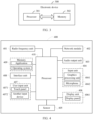
- FIG. 2 is a schematic diagram of a structure of a prompt information display apparatus according to an embodiment of this application.
- the prompt information display apparatus 200 may specifically include the following modules:
- the prompt information display apparatus 200 further includes:
- the prompt information display apparatus 200 further includes: a prompt information interception module, configured to intercept the headset connection prompt information in a case that the difference between the transmitted signal strength and the received signal strength is less than the target signal threshold.
- a prompt information interception module configured to intercept the headset connection prompt information in a case that the difference between the transmitted signal strength and the received signal strength is less than the target signal threshold.
- the prompt information display apparatus 200 further includes: a first information display module, configured to: in a case that the found wireless headset is in the pairing mode, display the headset connection prompt information corresponding to the wireless headset.
- a first information display module configured to: in a case that the found wireless headset is in the pairing mode, display the headset connection prompt information corresponding to the wireless headset.
- the prompt information display apparatus 200 further includes: a second information display module, configured to: in a case that the found wireless headset is in the paired state, display the headset connection prompt information corresponding to the wireless headset.
- a second information display module configured to: in a case that the found wireless headset is in the paired state, display the headset connection prompt information corresponding to the wireless headset.
- a mode of the wireless headset is adjusted to a pairing mode; transmitted signal strength of a wireless signal sent by the wireless headset, a target occlusion gradient of the wireless signal detected by the wireless headset, and received signal strength of the received wireless signal are obtained; a target signal threshold corresponding to the target occlusion gradient is determined according to an association relationship between an occlusion gradient and a signal threshold; and a headset connection pop-up window corresponding to the wireless headset is displayed in a case that a difference between the signal strength and the received signal strength is greater than or equal to a target signal threshold.
- a distance between an electronic device and the wireless headset is determined with reference to the transmitted signal strength, the received signal strength, and the target signal threshold, and whether the electronic device and the wireless headset are target devices of each other is determined with reference to the distance. Therefore, display of headset connection prompt information on an electronic device of a non-user can be avoided, a problem of disturbing the non-user is resolved, and use experience of a user is improved.
- the prompt information display apparatus in this embodiment of this application may be an apparatus, or may be a component, an integrated circuit, or a chip in a terminal.
- the apparatus may be a mobile electronic device, or may be a non-mobile electronic device.
- the mobile electronic device may be a mobile phone, a tablet computer, a notebook computer, a palmtop computer, an in-vehicle terminal device, a wearable device, an ultra-mobile personal computer (ultra-mobile personal computer, UMPC), a netbook, or a personal digital assistant (personal digital assistant, PDA), and the non-mobile electronic device may be a server, a network attached storage (Network Attached Storage, NAS), a personal computer (personal computer, PC), a television (television, TV), a counter, or a self-service machine. This is not specifically limited in this embodiment of this application.
- the prompt information display apparatus in this embodiment of this application may be an apparatus with an operating system.
- the operating system may be an Android (Android) operating system, may be an iOS operating system, or may be another possible operating system. This is not specifically limited in this embodiment of this application.
- the prompt information display apparatus provided in this embodiment of this application can implement processes implemented in the method embodiment of FIG. 1 . To avoid repetition, details are not described herein again.
- an embodiment of this application further provides an electronic device 300, including a processor 301, a memory 302, and a program or an instruction stored in the memory 302 and executable on the processor 301.
- an electronic device 300 including a processor 301, a memory 302, and a program or an instruction stored in the memory 302 and executable on the processor 301.
- the program or the instruction is executed by the processor 301, processes of the embodiments of the prompt information display method can be implemented, and a same technical effect can be achieved. To avoid repetition, details are not described herein.
- the electronic device in this embodiment of this application includes the foregoing mobile electronic device and the foregoing non-mobile electronic device.
- FIG. 4 is a schematic diagram of a hardware structure of an electronic device according to an embodiment of this application.
- the electronic device 400 includes but is not limited to components such as a radio frequency unit 401, a network module 402, an audio output unit 403, an input unit 404, a sensor 405, a display unit 406, a user input unit 407, an interface unit 408, a memory 409, and a processor 410.
- components such as a radio frequency unit 401, a network module 402, an audio output unit 403, an input unit 404, a sensor 405, a display unit 406, a user input unit 407, an interface unit 408, a memory 409, and a processor 410.
- the electronic device 400 may further include a power supply (such as a battery) that supplies power to each component.
- the power supply may be logically connected to the processor 410 by using a power management system, to implement functions such as charging, discharging, and power consumption management by using the power management system.
- a structure of the electronic device shown in FIG. 4 does not constitute a limitation on the electronic device, and may include more or fewer parts than those shown in the figure, or combine some components, or have different part arrangements. Details are not described herein again.
- the processor 410 is configured to: in a case that a found wireless headset is in an unpaired state and a non-pairing mode, adjust a mode of the wireless headset to a pairing mode; obtain transmitted signal strength of a wireless signal sent by the wireless headset, a target occlusion gradient of the wireless signal detected by the wireless headset, and received signal strength of the received wireless signal; determine, according to an association relationship between an occlusion gradient and a signal threshold, a target signal threshold corresponding to the target occlusion gradient; and display headset connection prompt information corresponding to the wireless headset in a case that a difference between the transmitted signal strength and the received signal strength is greater than or equal to the target signal threshold.
- This embodiment of this application can avoid displaying a headset connection pop-up window on an electronic device of a non-user, resolve a problem of disturbing a non-user, and improve use experience of the user.
- the processor 410 is further configured to: set a distance between the wireless headset and an electronic device to a preset distance; add obstructions with multiple occlusion gradients between the electronic device and the wireless headset; obtain, for each occlusion gradient, initial signal strength of a wireless signal sent by the wireless headset at the occlusion gradient and target signal strength of a received wireless signal at the occlusion gradient; and determine, according to a difference between the initial signal strength and the target signal strength, a signal threshold corresponding to the occlusion gradient.
- the processor 410 is further configured to intercept the headset connection prompt information in a case that the difference between the transmitted signal strength and the received signal strength is less than the target signal threshold.
- the processor 410 is further configured to: in a case that the found wireless headset is in the pairing mode, display the headset connection prompt information corresponding to the wireless headset.
- the processor 410 is further configured to: in a case that the found wireless headset is in the paired state, display the headset connection prompt information corresponding to the wireless headset.
- corresponding thresholds are set for different occlusion gradients, so that accuracy of distance measurement can be improved. Therefore, whether the electronic device and the wireless headset are mutual target devices can be determined more accurately, and accuracy of displaying a headset connection pop-up window can be further improved.
- the input unit 404 may include a graphics processing unit (Graphics Processing Unit, GPU) 4041 and a microphone 4042.
- the graphics processing unit 4041 processes image data of a static picture or a video obtained by an image capture apparatus (such as a camera) in a video capture mode or an image capture mode.
- the display unit 406 may include a display panel 4061, and the display panel 4061 may be configured in a form of a liquid crystal display, an organic light emitting diode, or the like.
- the user input unit 407 includes a touch panel 4071 and another input device 4072.
- the touch panel 4071 is also referred to as a touchscreen.
- the touch panel 4071 may include two parts: a touch detection apparatus and a touch controller.
- the another input device 4072 may include but is not limited to one or more of a physical keyboard, a function key (such as a volume control key or an on/off key), a trackball, a mouse, a joystick, and the like. Details are not described herein.
- the memory 409 may be configured to store a software program and various data, including but not limited to an application program and an operating system.
- the processor 410 may be integrated with an application processor and a modem processor.
- the application processor mainly processes an operating system, a user interface, an application program, and the like, and the modem processor mainly processes wireless communication. It may be understood that the modem processor may also not be integrated into the processor 410.
- An embodiment of this application further provides an electronic device, configured to perform processes of the embodiments of the foregoing prompt information display method, and a same technical effect can be achieved. To avoid repetition, details are not described herein again.
- An embodiment of this application further provides a readable storage medium.
- a program or an instruction is stored in the readable storage medium.
- processes of the embodiments of the foregoing prompt information display method can be implemented, and a same technical effect can be achieved. To avoid repetition, details are not described herein.
- the processor is a processor in the electronic device in the foregoing embodiment.
- the readable storage medium includes a computer-readable storage medium, and examples of the computer readable storage medium include a non-transient computer-readable storage medium, such as a read-only memory (Read-Only Memory, ROM), a random access memory (Random Access Memory, RAM), a magnetic disk, or an optical disc.
- ROM read-only memory
- RAM random access memory
- magnetic disk or an optical disc.
- An embodiment of this application further provides a chip.
- the chip includes a processor and a communication interface, the communication interface is coupled to the processor, and the processor is configured to run a program or an instruction to implement the processes of the embodiments of the prompt information display method, and a same technical effect can be achieved. To avoid repetition, details are not described herein again.
- the chip mentioned in this embodiment of this application may also be referred to as a system-level chip, a system chip, a chip system, or a system on a chip.
- An embodiment of the present invention further provides a computer program product.
- the computer program product may be executed by a processor to implement processes of the embodiment of the foregoing prompt information display method, and a same technical effect can be achieved. To avoid repetition, details are not described herein again.
- the foregoing method embodiments may be implemented by using software and a required universal hardware platform, or certainly may be implemented by using hardware. However, in many cases, the former is a better implementation.
- the technical solutions of this application essentially or the part contributing to existing technologies may be implemented in a form of a software product.
- the computer software product is stored in a storage medium (such as a ROM/RAM, a magnetic disk, or an optical disc) and includes several instructions for instructing a terminal (which may be a mobile phone, a computer, a server, an air conditioner, or a network device) to perform the methods described in the embodiments of this application.
Landscapes
- Engineering & Computer Science (AREA)
- Computer Networks & Wireless Communication (AREA)
- Signal Processing (AREA)
- Quality & Reliability (AREA)
- Physics & Mathematics (AREA)
- Electromagnetism (AREA)
- Human Computer Interaction (AREA)
- Telephone Function (AREA)
Applications Claiming Priority (2)
| Application Number | Priority Date | Filing Date | Title |
|---|---|---|---|
| CN202011165263.XA CN112333332B (zh) | 2020-10-27 | 2020-10-27 | 提示信息显示方法、装置及电子设备 |
| PCT/CN2021/124964 WO2022089274A1 (zh) | 2020-10-27 | 2021-10-20 | 提示信息显示方法、装置及电子设备 |
Publications (2)
| Publication Number | Publication Date |
|---|---|
| EP4239990A1 true EP4239990A1 (de) | 2023-09-06 |
| EP4239990A4 EP4239990A4 (de) | 2024-05-08 |
Family
ID=74296520
Family Applications (1)
| Application Number | Title | Priority Date | Filing Date |
|---|---|---|---|
| EP21885002.2A Pending EP4239990A4 (de) | 2020-10-27 | 2021-10-20 | Verfahren und vorrichtung zur anzeige von aufforderungsinformationen und elektronische vorrichtung |
Country Status (4)
| Country | Link |
|---|---|
| US (1) | US12369207B2 (de) |
| EP (1) | EP4239990A4 (de) |
| CN (1) | CN112333332B (de) |
| WO (1) | WO2022089274A1 (de) |
Families Citing this family (18)
| Publication number | Priority date | Publication date | Assignee | Title |
|---|---|---|---|---|
| CN112104940A (zh) * | 2020-09-11 | 2020-12-18 | 出门问问(苏州)信息科技有限公司 | 一种无线耳机的控制方法、装置及系统 |
| CN112333332B (zh) | 2020-10-27 | 2021-05-28 | 维沃移动通信有限公司 | 提示信息显示方法、装置及电子设备 |
| CN113286282B (zh) * | 2021-05-18 | 2023-06-09 | Oppo广东移动通信有限公司 | 提示方法、装置、电子设备、目标设备、连接系统及介质 |
| CN113329391B (zh) * | 2021-05-26 | 2023-02-24 | Oppo广东移动通信有限公司 | 提示信息的显示方法、装置、电子设备以及存储介质 |
| CN113329072B (zh) * | 2021-05-26 | 2022-08-30 | Oppo广东移动通信有限公司 | 数据处理方法、装置、电子设备及计算机可读介质 |
| CN113316222B (zh) * | 2021-05-26 | 2023-05-30 | Oppo广东移动通信有限公司 | 数据处理方法、装置、电子设备及存储介质 |
| CN115604801B (zh) * | 2021-07-07 | 2026-04-28 | Oppo广东移动通信有限公司 | 提示方法、装置、目标设备、电子设备、连接系统及介质 |
| CN115665705A (zh) * | 2021-07-07 | 2023-01-31 | Oppo广东移动通信有限公司 | 提示方法、装置、电子设备、目标设备、连接系统及介质 |
| CN113453381B (zh) * | 2021-07-08 | 2023-01-10 | Oppo广东移动通信有限公司 | 设备配对方法及相关产品 |
| CN113518336B (zh) * | 2021-07-16 | 2024-06-21 | Oppo广东移动通信有限公司 | 蓝牙连接的提示方法、装置、终端及存储介质 |
| CN115776644B (zh) * | 2021-09-06 | 2024-07-12 | Oppo广东移动通信有限公司 | 广播消息的发射方法、装置、电子设备以及存储介质 |
| CN115767443B (zh) * | 2021-09-06 | 2025-01-07 | Oppo广东移动通信有限公司 | 提示信息的显示方法、装置、电子设备以及存储介质 |
| CN113783994B (zh) * | 2021-09-06 | 2023-06-23 | Oppo广东移动通信有限公司 | 提示信息的显示方法、装置、电子设备以及存储介质 |
| CN114143660B (zh) * | 2022-01-06 | 2024-06-25 | 维沃移动通信有限公司 | 无线耳机控制方法、装置和电子设备 |
| CN114500730B (zh) * | 2022-02-28 | 2023-08-29 | 歌尔股份有限公司 | 弹窗功能控制方法、设备及计算机可读存储介质 |
| CN116132565B (zh) * | 2022-10-24 | 2025-01-07 | 维沃移动通信有限公司 | 显示方法、装置、电子设备和可读存储介质 |
| CN115941835B (zh) * | 2022-11-15 | 2024-10-29 | 深圳市锐尔觅移动通信有限公司 | 弹窗显示方法、装置、终端及存储介质 |
| CN115914924B (zh) * | 2022-11-25 | 2026-04-14 | 歌尔科技有限公司 | 无线耳机配对的方法、装置、充电盒及存储介质 |
Family Cites Families (21)
| Publication number | Priority date | Publication date | Assignee | Title |
|---|---|---|---|---|
| GB0500174D0 (en) * | 2005-01-06 | 2005-02-16 | Kokaram Anil | Method for estimating motion and occlusion |
| US9468026B2 (en) * | 2013-10-11 | 2016-10-11 | Logitech Europe S.A. | Method and system for shortening wireless pairing connection time by detecting an object or body |
| CN103840857A (zh) * | 2014-03-12 | 2014-06-04 | 上海天奕达电子科技有限公司 | 一种快速搜寻蓝牙设备的方法及其设备 |
| CN104780429B (zh) * | 2015-01-06 | 2018-06-26 | 康佳集团股份有限公司 | 排干扰的蓝牙配对方法、主设备、系统及其配对方法 |
| US11016302B2 (en) * | 2015-03-17 | 2021-05-25 | Raytrx, Llc | Wearable image manipulation and control system with high resolution micro-displays and dynamic opacity augmentation in augmented reality glasses |
| US9602956B1 (en) * | 2015-08-25 | 2017-03-21 | Yahoo! Inc. | System and method for device positioning with bluetooth low energy distributions |
| JP2017069903A (ja) * | 2015-10-02 | 2017-04-06 | キヤノン株式会社 | ログイン処理実行方法、プログラム、及び携帯端末 |
| CN105516896A (zh) * | 2015-12-02 | 2016-04-20 | 惠州Tcl移动通信有限公司 | 一种可穿戴设备与移动终端的蓝牙互连方法及系统 |
| US10154367B2 (en) * | 2016-05-16 | 2018-12-11 | Google Llc | Adaptive threshold for proximity based wireless communications features |
| US9913230B1 (en) * | 2017-04-11 | 2018-03-06 | Motorola Mobility Llc | Reduced power device discovery and corresponding devices and methods |
| CN109068302B (zh) * | 2018-07-04 | 2020-11-17 | 清华大学 | 利用无线信号进行配对的配对方法和无线设备 |
| CN109041031A (zh) * | 2018-08-30 | 2018-12-18 | 北京轩辕联科技有限公司 | 蓝牙自动配对方法、装置、车载设备及车辆 |
| CN109347581B (zh) * | 2018-09-30 | 2020-11-27 | Oppo广东移动通信有限公司 | 蓝牙耳机连接方法、装置、电子设备及存储介质 |
| CN109257732B (zh) * | 2018-09-30 | 2022-04-19 | Oppo广东移动通信有限公司 | 设备控制方法、装置以及电子设备 |
| KR102693979B1 (ko) * | 2018-10-19 | 2024-08-12 | 삼성전자주식회사 | 링크 공유를 지원하는 전자 장치 및 이를 위한 방법 |
| CN109286870A (zh) * | 2018-11-23 | 2019-01-29 | 歌尔科技有限公司 | 一种无线耳机的配对控制方法、装置及无线耳机 |
| CN109862549A (zh) * | 2019-03-28 | 2019-06-07 | 南昌黑鲨科技有限公司 | 蓝牙连接方法、装置、可读存储介质及移动设备 |
| CN110267231B (zh) * | 2019-05-27 | 2022-07-12 | 广州亚美智造科技有限公司 | 一种基于蓝牙rssi的车位识别方法、装置及系统 |
| CN111107667B (zh) * | 2019-12-31 | 2022-11-22 | 歌尔股份有限公司 | 蓝牙耳机的配对方法、装置及可读存储介质 |
| US12456046B2 (en) * | 2020-04-20 | 2025-10-28 | Nvidia Corporation | Distance determinations using one or more neural networks |
| CN112333332B (zh) * | 2020-10-27 | 2021-05-28 | 维沃移动通信有限公司 | 提示信息显示方法、装置及电子设备 |
-
2020
- 2020-10-27 CN CN202011165263.XA patent/CN112333332B/zh active Active
-
2021
- 2021-10-20 WO PCT/CN2021/124964 patent/WO2022089274A1/zh not_active Ceased
- 2021-10-20 EP EP21885002.2A patent/EP4239990A4/de active Pending
-
2023
- 2023-04-13 US US18/134,251 patent/US12369207B2/en active Active
Also Published As
| Publication number | Publication date |
|---|---|
| EP4239990A4 (de) | 2024-05-08 |
| WO2022089274A1 (zh) | 2022-05-05 |
| US12369207B2 (en) | 2025-07-22 |
| CN112333332A (zh) | 2021-02-05 |
| CN112333332B (zh) | 2021-05-28 |
| US20230254915A1 (en) | 2023-08-10 |
Similar Documents
| Publication | Publication Date | Title |
|---|---|---|
| US12369207B2 (en) | Prompt information display method and apparatus and electronic device | |
| EP3640787B1 (de) | Eingabeverfahren und elektronische vorrichtung | |
| CN108491123B (zh) | 一种调节应用程序图标的方法及移动终端 | |
| EP3964935A1 (de) | Screenshotverfahren und endgerät | |
| US20220317862A1 (en) | Icon moving method and electronic device | |
| US9948856B2 (en) | Method and apparatus for adjusting a photo-taking direction, mobile terminal | |
| US11543935B2 (en) | Information processing method and terminal device | |
| US10607066B2 (en) | Living body identification method, information generation method, and terminal | |
| US12470807B2 (en) | Camera start method and electronic device | |
| US11250046B2 (en) | Image viewing method and mobile terminal | |
| CN110769155B (zh) | 一种摄像头控制方法及电子设备 | |
| CN109542279B (zh) | 一种终端设备控制方法及终端设备 | |
| US12483552B2 (en) | Authentication window display method and apparatus | |
| CN109992941B (zh) | 一种权限管理方法及终端设备 | |
| CN106406530A (zh) | 一种屏幕显示方法及其移动终端 | |
| CN110058686B (zh) | 一种控制方法及终端设备 | |
| CN110167006B (zh) | 一种控制应用程序使用sim卡的方法及终端设备 | |
| CN110888494B (zh) | 一种角度检测方法、装置及移动终端 | |
| CN109104573B (zh) | 一种确定对焦点的方法及终端设备 | |
| CN110908586B (zh) | 一种键盘的显示方法、装置及终端设备 | |
| US11523442B2 (en) | Random access resource selection method and terminal device | |
| CN109144860B (zh) | 一种对控件对象的操作方法及终端设备 | |
| CN108304709B (zh) | 人脸解锁方法及相关产品 | |
| CN111427496B (zh) | 参数调整的方法及电子设备 | |
| CN111915550B (zh) | 图像质量检测方法、检测设备和存储介质 |
Legal Events
| Date | Code | Title | Description |
|---|---|---|---|
| STAA | Information on the status of an ep patent application or granted ep patent |
Free format text: STATUS: THE INTERNATIONAL PUBLICATION HAS BEEN MADE |
|
| PUAI | Public reference made under article 153(3) epc to a published international application that has entered the european phase |
Free format text: ORIGINAL CODE: 0009012 |
|
| STAA | Information on the status of an ep patent application or granted ep patent |
Free format text: STATUS: REQUEST FOR EXAMINATION WAS MADE |
|
| 17P | Request for examination filed |
Effective date: 20230517 |
|
| AK | Designated contracting states |
Kind code of ref document: A1 Designated state(s): AL AT BE BG CH CY CZ DE DK EE ES FI FR GB GR HR HU IE IS IT LI LT LU LV MC MK MT NL NO PL PT RO RS SE SI SK SM TR |
|
| DAV | Request for validation of the european patent (deleted) | ||
| DAX | Request for extension of the european patent (deleted) | ||
| A4 | Supplementary search report drawn up and despatched |
Effective date: 20240408 |
|
| RIC1 | Information provided on ipc code assigned before grant |
Ipc: H04M 1/60 20060101ALI20240402BHEP Ipc: H04M 1/72448 20210101AFI20240402BHEP |