EP4234664A1 - Composition comprising glucolipids and enzymes - Google Patents
Composition comprising glucolipids and enzymes Download PDFInfo
- Publication number
- EP4234664A1 EP4234664A1 EP22158412.1A EP22158412A EP4234664A1 EP 4234664 A1 EP4234664 A1 EP 4234664A1 EP 22158412 A EP22158412 A EP 22158412A EP 4234664 A1 EP4234664 A1 EP 4234664A1
- Authority
- EP
- European Patent Office
- Prior art keywords
- weight
- composition according
- lipase
- glucolipids
- composition
- Prior art date
- Legal status (The legal status is an assumption and is not a legal conclusion. Google has not performed a legal analysis and makes no representation as to the accuracy of the status listed.)
- Withdrawn
Links
- 239000000203 mixture Substances 0.000 title claims abstract description 132
- 102000004190 Enzymes Human genes 0.000 title claims abstract description 38
- 108090000790 Enzymes Proteins 0.000 title claims abstract description 38
- 108090001060 Lipase Proteins 0.000 claims description 46
- 102000004882 Lipase Human genes 0.000 claims description 46
- 239000004367 Lipase Substances 0.000 claims description 45
- 235000019421 lipase Nutrition 0.000 claims description 45
- 102000013142 Amylases Human genes 0.000 claims description 39
- 108010065511 Amylases Proteins 0.000 claims description 39
- 235000019418 amylase Nutrition 0.000 claims description 39
- -1 heptenyl Chemical group 0.000 claims description 37
- 229940088598 enzyme Drugs 0.000 claims description 36
- 108091005804 Peptidases Proteins 0.000 claims description 29
- 239000004365 Protease Substances 0.000 claims description 27
- 239000004094 surface-active agent Substances 0.000 claims description 27
- 239000003599 detergent Substances 0.000 claims description 25
- 239000004382 Amylase Substances 0.000 claims description 20
- 102100032487 Beta-mannosidase Human genes 0.000 claims description 20
- 108010055059 beta-Mannosidase Proteins 0.000 claims description 20
- 235000019419 proteases Nutrition 0.000 claims description 18
- 238000004140 cleaning Methods 0.000 claims description 14
- 150000003839 salts Chemical class 0.000 claims description 13
- 239000003876 biosurfactant Substances 0.000 claims description 10
- 102000003992 Peroxidases Human genes 0.000 claims description 9
- 108010005400 cutinase Proteins 0.000 claims description 8
- 125000002496 methyl group Chemical group [H]C([H])([H])* 0.000 claims description 8
- 102000004316 Oxidoreductases Human genes 0.000 claims description 7
- 108090000854 Oxidoreductases Proteins 0.000 claims description 7
- 108010059892 Cellulase Proteins 0.000 claims description 6
- 229940106157 cellulase Drugs 0.000 claims description 6
- 125000004432 carbon atom Chemical group C* 0.000 claims description 5
- 108010029541 Laccase Proteins 0.000 claims description 4
- 230000002255 enzymatic effect Effects 0.000 claims description 4
- 239000004744 fabric Substances 0.000 claims description 4
- 108010087558 pectate lyase Proteins 0.000 claims description 4
- 108040007629 peroxidase activity proteins Proteins 0.000 claims description 4
- 239000004753 textile Substances 0.000 claims description 4
- 125000005187 nonenyl group Chemical group C(=CCCCCCCC)* 0.000 claims description 3
- 125000002255 pentenyl group Chemical group C(=CCCC)* 0.000 claims description 3
- 230000006641 stabilisation Effects 0.000 claims description 3
- 238000011105 stabilization Methods 0.000 claims description 3
- 125000005040 tridecenyl group Chemical group C(=CCCCCCCCCCCC)* 0.000 claims description 3
- 125000005065 undecenyl group Chemical group C(=CCCCCCCCCC)* 0.000 claims description 3
- 239000002888 zwitterionic surfactant Substances 0.000 claims description 3
- 125000000129 anionic group Chemical group 0.000 claims description 2
- 125000002091 cationic group Chemical group 0.000 claims description 2
- 102100037486 Reverse transcriptase/ribonuclease H Human genes 0.000 claims 3
- XLYOFNOQVPJJNP-UHFFFAOYSA-N water Substances O XLYOFNOQVPJJNP-UHFFFAOYSA-N 0.000 description 52
- 239000000344 soap Substances 0.000 description 29
- HEMHJVSKTPXQMS-UHFFFAOYSA-M Sodium hydroxide Chemical compound [OH-].[Na+] HEMHJVSKTPXQMS-UHFFFAOYSA-M 0.000 description 27
- 102000035195 Peptidases Human genes 0.000 description 26
- 238000009472 formulation Methods 0.000 description 25
- 239000004615 ingredient Substances 0.000 description 23
- FCBUKWWQSZQDDI-UHFFFAOYSA-N rhamnolipid Chemical compound CCCCCCCC(CC(O)=O)OC(=O)CC(CCCCCCC)OC1OC(C)C(O)C(O)C1OC1C(O)C(O)C(O)C(C)O1 FCBUKWWQSZQDDI-UHFFFAOYSA-N 0.000 description 23
- 239000011734 sodium Substances 0.000 description 22
- 239000001509 sodium citrate Substances 0.000 description 21
- NLJMYIDDQXHKNR-UHFFFAOYSA-K sodium citrate Chemical compound O.O.[Na+].[Na+].[Na+].[O-]C(=O)CC(O)(CC([O-])=O)C([O-])=O NLJMYIDDQXHKNR-UHFFFAOYSA-K 0.000 description 21
- 239000003346 palm kernel oil Substances 0.000 description 20
- 235000019865 palm kernel oil Nutrition 0.000 description 20
- 229940025131 amylases Drugs 0.000 description 19
- 230000008901 benefit Effects 0.000 description 18
- 239000000243 solution Substances 0.000 description 18
- 238000006467 substitution reaction Methods 0.000 description 18
- 229960005323 phenoxyethanol Drugs 0.000 description 17
- QCDWFXQBSFUVSP-UHFFFAOYSA-N 2-phenoxyethanol Chemical compound OCCOC1=CC=CC=C1 QCDWFXQBSFUVSP-UHFFFAOYSA-N 0.000 description 16
- 235000014113 dietary fatty acids Nutrition 0.000 description 16
- 239000000194 fatty acid Substances 0.000 description 16
- 229930195729 fatty acid Natural products 0.000 description 16
- 239000007788 liquid Substances 0.000 description 15
- 238000012217 deletion Methods 0.000 description 14
- 230000037430 deletion Effects 0.000 description 14
- 108010084185 Cellulases Proteins 0.000 description 13
- 102000005575 Cellulases Human genes 0.000 description 13
- 150000004665 fatty acids Chemical class 0.000 description 12
- FWMNVWWHGCHHJJ-SKKKGAJSSA-N 4-amino-1-[(2r)-6-amino-2-[[(2r)-2-[[(2r)-2-[[(2r)-2-amino-3-phenylpropanoyl]amino]-3-phenylpropanoyl]amino]-4-methylpentanoyl]amino]hexanoyl]piperidine-4-carboxylic acid Chemical compound C([C@H](C(=O)N[C@H](CC(C)C)C(=O)N[C@H](CCCCN)C(=O)N1CCC(N)(CC1)C(O)=O)NC(=O)[C@H](N)CC=1C=CC=CC=1)C1=CC=CC=C1 FWMNVWWHGCHHJJ-SKKKGAJSSA-N 0.000 description 11
- 239000002253 acid Chemical group 0.000 description 10
- 102000004169 proteins and genes Human genes 0.000 description 10
- 108090000623 proteins and genes Proteins 0.000 description 10
- 108010059820 Polygalacturonase Proteins 0.000 description 9
- 102000004139 alpha-Amylases Human genes 0.000 description 9
- 108090000637 alpha-Amylases Proteins 0.000 description 9
- 230000000694 effects Effects 0.000 description 9
- 108010093305 exopolygalacturonase Proteins 0.000 description 9
- 235000018102 proteins Nutrition 0.000 description 9
- 239000007787 solid Substances 0.000 description 9
- 229940024171 alpha-amylase Drugs 0.000 description 8
- 230000001580 bacterial effect Effects 0.000 description 8
- 239000011550 stock solution Substances 0.000 description 8
- 229920001202 Inulin Polymers 0.000 description 7
- 239000000654 additive Substances 0.000 description 7
- 238000003780 insertion Methods 0.000 description 7
- 230000037431 insertion Effects 0.000 description 7
- 229940029339 inulin Drugs 0.000 description 7
- 229930186217 Glycolipid Natural products 0.000 description 6
- DNIAPMSPPWPWGF-UHFFFAOYSA-N Propylene glycol Chemical compound CC(O)CO DNIAPMSPPWPWGF-UHFFFAOYSA-N 0.000 description 6
- 108090000787 Subtilisin Proteins 0.000 description 6
- GSEJCLTVZPLZKY-UHFFFAOYSA-N Triethanolamine Chemical compound OCCN(CCO)CCO GSEJCLTVZPLZKY-UHFFFAOYSA-N 0.000 description 6
- 230000002538 fungal effect Effects 0.000 description 6
- 238000000034 method Methods 0.000 description 6
- 229920002643 polyglutamic acid Polymers 0.000 description 6
- 238000005406 washing Methods 0.000 description 6
- HZAXFHJVJLSVMW-UHFFFAOYSA-N 2-Aminoethan-1-ol Chemical compound NCCO HZAXFHJVJLSVMW-UHFFFAOYSA-N 0.000 description 5
- 101100345345 Arabidopsis thaliana MGD1 gene Proteins 0.000 description 5
- LFQSCWFLJHTTHZ-UHFFFAOYSA-N Ethanol Chemical compound CCO LFQSCWFLJHTTHZ-UHFFFAOYSA-N 0.000 description 5
- 108010006035 Metalloproteases Proteins 0.000 description 5
- 102000005741 Metalloproteases Human genes 0.000 description 5
- 108700020962 Peroxidase Proteins 0.000 description 5
- 241000557470 Stachybotrys chlorohalonata Species 0.000 description 5
- 108010056079 Subtilisins Proteins 0.000 description 5
- 102000005158 Subtilisins Human genes 0.000 description 5
- 230000000996 additive effect Effects 0.000 description 5
- 150000001768 cations Chemical class 0.000 description 5
- ZBCBWPMODOFKDW-UHFFFAOYSA-N diethanolamine Chemical compound OCCNCCO ZBCBWPMODOFKDW-UHFFFAOYSA-N 0.000 description 5
- 150000002191 fatty alcohols Chemical class 0.000 description 5
- 239000008187 granular material Substances 0.000 description 5
- 239000012071 phase Substances 0.000 description 5
- 150000003254 radicals Chemical class 0.000 description 5
- 239000000523 sample Substances 0.000 description 5
- 235000000346 sugar Nutrition 0.000 description 5
- OHOTVSOGTVKXEL-UHFFFAOYSA-K trisodium;2-[bis(carboxylatomethyl)amino]propanoate Chemical compound [Na+].[Na+].[Na+].[O-]C(=O)C(C)N(CC([O-])=O)CC([O-])=O OHOTVSOGTVKXEL-UHFFFAOYSA-K 0.000 description 5
- PQHYOGIRXOKOEJ-UHFFFAOYSA-N 2-(1,2-dicarboxyethylamino)butanedioic acid Chemical compound OC(=O)CC(C(O)=O)NC(C(O)=O)CC(O)=O PQHYOGIRXOKOEJ-UHFFFAOYSA-N 0.000 description 4
- HVCOBJNICQPDBP-UHFFFAOYSA-N 3-[3-[3,5-dihydroxy-6-methyl-4-(3,4,5-trihydroxy-6-methyloxan-2-yl)oxyoxan-2-yl]oxydecanoyloxy]decanoic acid;hydrate Chemical compound O.OC1C(OC(CC(=O)OC(CCCCCCC)CC(O)=O)CCCCCCC)OC(C)C(O)C1OC1C(O)C(O)C(O)C(C)O1 HVCOBJNICQPDBP-UHFFFAOYSA-N 0.000 description 4
- 241000193830 Bacillus <bacterium> Species 0.000 description 4
- 241000193744 Bacillus amyloliquefaciens Species 0.000 description 4
- 102000012479 Serine Proteases Human genes 0.000 description 4
- 108010022999 Serine Proteases Proteins 0.000 description 4
- 101710135785 Subtilisin-like protease Proteins 0.000 description 4
- 241000223258 Thermomyces lanuginosus Species 0.000 description 4
- 229920001577 copolymer Polymers 0.000 description 4
- SMVRDGHCVNAOIN-UHFFFAOYSA-L disodium;1-dodecoxydodecane;sulfate Chemical compound [Na+].[Na+].[O-]S([O-])(=O)=O.CCCCCCCCCCCCOCCCCCCCCCCCC SMVRDGHCVNAOIN-UHFFFAOYSA-L 0.000 description 4
- 238000000855 fermentation Methods 0.000 description 4
- 230000004151 fermentation Effects 0.000 description 4
- 239000000463 material Substances 0.000 description 4
- 229920000642 polymer Polymers 0.000 description 4
- 238000002360 preparation method Methods 0.000 description 4
- XEFAJZOBODPHBG-UHFFFAOYSA-N 1-phenoxyethanol Chemical compound CC(O)OC1=CC=CC=C1 XEFAJZOBODPHBG-UHFFFAOYSA-N 0.000 description 3
- 102000057234 Acyl transferases Human genes 0.000 description 3
- 108700016155 Acyl transferases Proteins 0.000 description 3
- 241000194108 Bacillus licheniformis Species 0.000 description 3
- 229920002134 Carboxymethyl cellulose Polymers 0.000 description 3
- PEDCQBHIVMGVHV-UHFFFAOYSA-N Glycerine Chemical compound OCC(O)CO PEDCQBHIVMGVHV-UHFFFAOYSA-N 0.000 description 3
- GLUUGHFHXGJENI-UHFFFAOYSA-N Piperazine Chemical compound C1CNCCN1 GLUUGHFHXGJENI-UHFFFAOYSA-N 0.000 description 3
- 239000004372 Polyvinyl alcohol Substances 0.000 description 3
- 229920002125 Sokalan® Polymers 0.000 description 3
- 239000007983 Tris buffer Substances 0.000 description 3
- 150000001412 amines Chemical class 0.000 description 3
- 239000003945 anionic surfactant Substances 0.000 description 3
- 239000001768 carboxy methyl cellulose Substances 0.000 description 3
- 235000010948 carboxy methyl cellulose Nutrition 0.000 description 3
- 239000008112 carboxymethyl-cellulose Substances 0.000 description 3
- 229940105329 carboxymethylcellulose Drugs 0.000 description 3
- 239000003795 chemical substances by application Substances 0.000 description 3
- 238000004090 dissolution Methods 0.000 description 3
- 230000000813 microbial effect Effects 0.000 description 3
- 108010020132 microbial serine proteinases Proteins 0.000 description 3
- 229920000847 nonoxynol Polymers 0.000 description 3
- 229920002451 polyvinyl alcohol Polymers 0.000 description 3
- 239000000047 product Substances 0.000 description 3
- 235000019832 sodium triphosphate Nutrition 0.000 description 3
- 150000008163 sugars Chemical class 0.000 description 3
- LENZDBCJOHFCAS-UHFFFAOYSA-N tris Chemical compound OCC(N)(CO)CO LENZDBCJOHFCAS-UHFFFAOYSA-N 0.000 description 3
- VCVKIIDXVWEWSZ-YFKPBYRVSA-N (2s)-2-[bis(carboxymethyl)amino]pentanedioic acid Chemical compound OC(=O)CC[C@@H](C(O)=O)N(CC(O)=O)CC(O)=O VCVKIIDXVWEWSZ-YFKPBYRVSA-N 0.000 description 2
- GGIDEJQGAZSTES-UHFFFAOYSA-N (4-nitrophenyl) octanoate Chemical compound CCCCCCCC(=O)OC1=CC=C([N+]([O-])=O)C=C1 GGIDEJQGAZSTES-UHFFFAOYSA-N 0.000 description 2
- HXKKHQJGJAFBHI-UHFFFAOYSA-N 1-aminopropan-2-ol Chemical compound CC(O)CN HXKKHQJGJAFBHI-UHFFFAOYSA-N 0.000 description 2
- VKZRWSNIWNFCIQ-UHFFFAOYSA-N 2-[2-(1,2-dicarboxyethylamino)ethylamino]butanedioic acid Chemical compound OC(=O)CC(C(O)=O)NCCNC(C(O)=O)CC(O)=O VKZRWSNIWNFCIQ-UHFFFAOYSA-N 0.000 description 2
- GTXVUMKMNLRHKO-UHFFFAOYSA-N 2-[carboxymethyl(2-sulfoethyl)amino]acetic acid Chemical compound OC(=O)CN(CC(O)=O)CCS(O)(=O)=O GTXVUMKMNLRHKO-UHFFFAOYSA-N 0.000 description 2
- XWSGEVNYFYKXCP-UHFFFAOYSA-N 2-[carboxymethyl(methyl)amino]acetic acid Chemical compound OC(=O)CN(C)CC(O)=O XWSGEVNYFYKXCP-UHFFFAOYSA-N 0.000 description 2
- UHPMCKVQTMMPCG-UHFFFAOYSA-N 5,8-dihydroxy-2-methoxy-6-methyl-7-(2-oxopropyl)naphthalene-1,4-dione Chemical compound CC1=C(CC(C)=O)C(O)=C2C(=O)C(OC)=CC(=O)C2=C1O UHPMCKVQTMMPCG-UHFFFAOYSA-N 0.000 description 2
- QGZKDVFQNNGYKY-UHFFFAOYSA-N Ammonia Chemical compound N QGZKDVFQNNGYKY-UHFFFAOYSA-N 0.000 description 2
- CIWBSHSKHKDKBQ-JLAZNSOCSA-N Ascorbic acid Chemical compound OC[C@H](O)[C@H]1OC(=O)C(O)=C1O CIWBSHSKHKDKBQ-JLAZNSOCSA-N 0.000 description 2
- 241000193422 Bacillus lentus Species 0.000 description 2
- 235000014469 Bacillus subtilis Nutrition 0.000 description 2
- 108091005658 Basic proteases Proteins 0.000 description 2
- LZZYPRNAOMGNLH-UHFFFAOYSA-M Cetrimonium bromide Chemical compound [Br-].CCCCCCCCCCCCCCCC[N+](C)(C)C LZZYPRNAOMGNLH-UHFFFAOYSA-M 0.000 description 2
- KCXVZYZYPLLWCC-UHFFFAOYSA-N EDTA Chemical compound OC(=O)CN(CC(O)=O)CCN(CC(O)=O)CC(O)=O KCXVZYZYPLLWCC-UHFFFAOYSA-N 0.000 description 2
- 241000196324 Embryophyta Species 0.000 description 2
- IAYPIBMASNFSPL-UHFFFAOYSA-N Ethylene oxide Chemical group C1CO1 IAYPIBMASNFSPL-UHFFFAOYSA-N 0.000 description 2
- DBVJJBKOTRCVKF-UHFFFAOYSA-N Etidronic acid Chemical compound OP(=O)(O)C(O)(C)P(O)(O)=O DBVJJBKOTRCVKF-UHFFFAOYSA-N 0.000 description 2
- 241000223218 Fusarium Species 0.000 description 2
- 241000223198 Humicola Species 0.000 description 2
- 241001480714 Humicola insolens Species 0.000 description 2
- DGAQECJNVWCQMB-PUAWFVPOSA-M Ilexoside XXIX Chemical compound C[C@@H]1CC[C@@]2(CC[C@@]3(C(=CC[C@H]4[C@]3(CC[C@@H]5[C@@]4(CC[C@@H](C5(C)C)OS(=O)(=O)[O-])C)C)[C@@H]2[C@]1(C)O)C)C(=O)O[C@H]6[C@@H]([C@H]([C@@H]([C@H](O6)CO)O)O)O.[Na+] DGAQECJNVWCQMB-PUAWFVPOSA-M 0.000 description 2
- PPMPLIBYTIWXPG-MSJADDGSSA-N L-rhamnosyl-3-hydroxydecanoyl-3-hydroxydecanoic acid Chemical compound CCCCCCCC(CC(O)=O)OC(=O)CC(CCCCCCC)O[C@@H]1O[C@@H](C)[C@H](O)[C@@H](O)[C@H]1O PPMPLIBYTIWXPG-MSJADDGSSA-N 0.000 description 2
- 241000187480 Mycobacterium smegmatis Species 0.000 description 2
- FSVCELGFZIQNCK-UHFFFAOYSA-N N,N-bis(2-hydroxyethyl)glycine Chemical compound OCCN(CCO)CC(O)=O FSVCELGFZIQNCK-UHFFFAOYSA-N 0.000 description 2
- QPCDCPDFJACHGM-UHFFFAOYSA-N N,N-bis{2-[bis(carboxymethyl)amino]ethyl}glycine Chemical compound OC(=O)CN(CC(O)=O)CCN(CC(=O)O)CCN(CC(O)=O)CC(O)=O QPCDCPDFJACHGM-UHFFFAOYSA-N 0.000 description 2
- 229920000805 Polyaspartic acid Polymers 0.000 description 2
- 229940124158 Protease/peptidase inhibitor Drugs 0.000 description 2
- 241000589516 Pseudomonas Species 0.000 description 2
- 108010077895 Sarcosine Proteins 0.000 description 2
- CDBYLPFSWZWCQE-UHFFFAOYSA-L Sodium Carbonate Chemical compound [Na+].[Na+].[O-]C([O-])=O CDBYLPFSWZWCQE-UHFFFAOYSA-L 0.000 description 2
- FAPWRFPIFSIZLT-UHFFFAOYSA-M Sodium chloride Chemical compound [Na+].[Cl-] FAPWRFPIFSIZLT-UHFFFAOYSA-M 0.000 description 2
- DBMJMQXJHONAFJ-UHFFFAOYSA-M Sodium laurylsulphate Chemical compound [Na+].CCCCCCCCCCCCOS([O-])(=O)=O DBMJMQXJHONAFJ-UHFFFAOYSA-M 0.000 description 2
- 108090000631 Trypsin Proteins 0.000 description 2
- 102000004142 Trypsin Human genes 0.000 description 2
- YDONNITUKPKTIG-UHFFFAOYSA-N [Nitrilotris(methylene)]trisphosphonic acid Chemical compound OP(O)(=O)CN(CP(O)(O)=O)CP(O)(O)=O YDONNITUKPKTIG-UHFFFAOYSA-N 0.000 description 2
- 108700014220 acyltransferase activity proteins Proteins 0.000 description 2
- 150000008051 alkyl sulfates Chemical class 0.000 description 2
- KGBXLFKZBHKPEV-UHFFFAOYSA-N boric acid Chemical compound OB(O)O KGBXLFKZBHKPEV-UHFFFAOYSA-N 0.000 description 2
- 239000004327 boric acid Substances 0.000 description 2
- 229910052799 carbon Inorganic materials 0.000 description 2
- 238000005119 centrifugation Methods 0.000 description 2
- 239000002738 chelating agent Substances 0.000 description 2
- 150000001860 citric acid derivatives Chemical class 0.000 description 2
- 239000012459 cleaning agent Substances 0.000 description 2
- 239000011248 coating agent Substances 0.000 description 2
- 238000000576 coating method Methods 0.000 description 2
- 150000001875 compounds Chemical class 0.000 description 2
- 239000000039 congener Substances 0.000 description 2
- 235000011180 diphosphates Nutrition 0.000 description 2
- DUYCTCQXNHFCSJ-UHFFFAOYSA-N dtpmp Chemical compound OP(=O)(O)CN(CP(O)(O)=O)CCN(CP(O)(=O)O)CCN(CP(O)(O)=O)CP(O)(O)=O DUYCTCQXNHFCSJ-UHFFFAOYSA-N 0.000 description 2
- 238000010410 dusting Methods 0.000 description 2
- 239000000975 dye Substances 0.000 description 2
- NFDRPXJGHKJRLJ-UHFFFAOYSA-N edtmp Chemical compound OP(O)(=O)CN(CP(O)(O)=O)CCN(CP(O)(O)=O)CP(O)(O)=O NFDRPXJGHKJRLJ-UHFFFAOYSA-N 0.000 description 2
- 239000002532 enzyme inhibitor Substances 0.000 description 2
- 229940125532 enzyme inhibitor Drugs 0.000 description 2
- 150000002148 esters Chemical class 0.000 description 2
- 239000003925 fat Substances 0.000 description 2
- 235000019197 fats Nutrition 0.000 description 2
- 238000004128 high performance liquid chromatography Methods 0.000 description 2
- 230000003993 interaction Effects 0.000 description 2
- JVTAAEKCZFNVCJ-UHFFFAOYSA-N lactic acid Chemical compound CC(O)C(O)=O JVTAAEKCZFNVCJ-UHFFFAOYSA-N 0.000 description 2
- 239000004337 magnesium citrate Substances 0.000 description 2
- 238000004519 manufacturing process Methods 0.000 description 2
- 238000005259 measurement Methods 0.000 description 2
- 229920000609 methyl cellulose Polymers 0.000 description 2
- 239000001923 methylcellulose Substances 0.000 description 2
- 235000010981 methylcellulose Nutrition 0.000 description 2
- 230000007935 neutral effect Effects 0.000 description 2
- 229910052757 nitrogen Inorganic materials 0.000 description 2
- 239000003921 oil Substances 0.000 description 2
- HWGNBUXHKFFFIH-UHFFFAOYSA-I pentasodium;[oxido(phosphonatooxy)phosphoryl] phosphate Chemical compound [Na+].[Na+].[Na+].[Na+].[Na+].[O-]P([O-])(=O)OP([O-])(=O)OP([O-])([O-])=O HWGNBUXHKFFFIH-UHFFFAOYSA-I 0.000 description 2
- 229960003330 pentetic acid Drugs 0.000 description 2
- 239000000137 peptide hydrolase inhibitor Substances 0.000 description 2
- 229920000058 polyacrylate Polymers 0.000 description 2
- 229920001223 polyethylene glycol Polymers 0.000 description 2
- 229920005862 polyol Polymers 0.000 description 2
- 150000003077 polyols Chemical class 0.000 description 2
- 239000000843 powder Substances 0.000 description 2
- 239000002994 raw material Substances 0.000 description 2
- FSYKKLYZXJSNPZ-UHFFFAOYSA-N sarcosine Chemical compound C[NH2+]CC([O-])=O FSYKKLYZXJSNPZ-UHFFFAOYSA-N 0.000 description 2
- 150000004760 silicates Chemical class 0.000 description 2
- 239000002002 slurry Substances 0.000 description 2
- 229910052708 sodium Inorganic materials 0.000 description 2
- 238000003756 stirring Methods 0.000 description 2
- 238000003860 storage Methods 0.000 description 2
- 239000000126 substance Substances 0.000 description 2
- 239000000758 substrate Substances 0.000 description 2
- 125000001273 sulfonato group Chemical class [O-]S(*)(=O)=O 0.000 description 2
- 150000003467 sulfuric acid derivatives Chemical class 0.000 description 2
- 150000003626 triacylglycerols Chemical class 0.000 description 2
- 229960004418 trolamine Drugs 0.000 description 2
- 239000012588 trypsin Substances 0.000 description 2
- LLSHAMSYHZEJBZ-BYPYZUCNSA-N (2s)-2-(2-sulfoethylamino)butanedioic acid Chemical compound OC(=O)C[C@@H](C(O)=O)NCCS(O)(=O)=O LLSHAMSYHZEJBZ-BYPYZUCNSA-N 0.000 description 1
- UWRLZJRHSWQCQV-YFKPBYRVSA-N (2s)-2-(2-sulfoethylamino)pentanedioic acid Chemical compound OC(=O)CC[C@@H](C(O)=O)NCCS(O)(=O)=O UWRLZJRHSWQCQV-YFKPBYRVSA-N 0.000 description 1
- HWXFTWCFFAXRMQ-JTQLQIEISA-N (2s)-2-[bis(carboxymethyl)amino]-3-phenylpropanoic acid Chemical compound OC(=O)CN(CC(O)=O)[C@H](C(O)=O)CC1=CC=CC=C1 HWXFTWCFFAXRMQ-JTQLQIEISA-N 0.000 description 1
- DCCWEYXHEXDZQW-BYPYZUCNSA-N (2s)-2-[bis(carboxymethyl)amino]butanedioic acid Chemical compound OC(=O)C[C@@H](C(O)=O)N(CC(O)=O)CC(O)=O DCCWEYXHEXDZQW-BYPYZUCNSA-N 0.000 description 1
- ZTOKUMPYMPKCFX-CZNUEWPDSA-N (E)-17-[(2R,3R,4S,5S,6R)-6-(acetyloxymethyl)-3-[(2S,3R,4S,5S,6R)-6-(acetyloxymethyl)-3,4,5-trihydroxyoxan-2-yl]oxy-4,5-dihydroxyoxan-2-yl]oxyoctadec-9-enoic acid Chemical compound OC(=O)CCCCCCC/C=C/CCCCCCC(C)O[C@@H]1O[C@H](COC(C)=O)[C@@H](O)[C@H](O)[C@H]1O[C@H]1[C@H](O)[C@@H](O)[C@H](O)[C@@H](COC(C)=O)O1 ZTOKUMPYMPKCFX-CZNUEWPDSA-N 0.000 description 1
- PSBDWGZCVUAZQS-UHFFFAOYSA-N (dimethylsulfonio)acetate Chemical compound C[S+](C)CC([O-])=O PSBDWGZCVUAZQS-UHFFFAOYSA-N 0.000 description 1
- VILCJCGEZXAXTO-UHFFFAOYSA-N 2,2,2-tetramine Chemical compound NCCNCCNCCN VILCJCGEZXAXTO-UHFFFAOYSA-N 0.000 description 1
- NIXOWILDQLNWCW-UHFFFAOYSA-N 2-Propenoic acid Natural products OC(=O)C=C NIXOWILDQLNWCW-UHFFFAOYSA-N 0.000 description 1
- PFBBCIYIKJWDIN-BUHFOSPRSA-N 2-[(e)-tetradec-1-enyl]butanedioic acid Chemical compound CCCCCCCCCCCC\C=C\C(C(O)=O)CC(O)=O PFBBCIYIKJWDIN-BUHFOSPRSA-N 0.000 description 1
- URDCARMUOSMFFI-UHFFFAOYSA-N 2-[2-[bis(carboxymethyl)amino]ethyl-(2-hydroxyethyl)amino]acetic acid Chemical compound OCCN(CC(O)=O)CCN(CC(O)=O)CC(O)=O URDCARMUOSMFFI-UHFFFAOYSA-N 0.000 description 1
- PUAQLLVFLMYYJJ-UHFFFAOYSA-N 2-aminopropiophenone Chemical compound CC(N)C(=O)C1=CC=CC=C1 PUAQLLVFLMYYJJ-UHFFFAOYSA-N 0.000 description 1
- QTDIEDOANJISNP-UHFFFAOYSA-N 2-dodecoxyethyl hydrogen sulfate Chemical compound CCCCCCCCCCCCOCCOS(O)(=O)=O QTDIEDOANJISNP-UHFFFAOYSA-N 0.000 description 1
- LSAQFTNRKSMQEG-UHFFFAOYSA-N 2-hydroxyethyl(trimethyl)azanium Chemical compound C[N+](C)(C)CCO.C[N+](C)(C)CCO LSAQFTNRKSMQEG-UHFFFAOYSA-N 0.000 description 1
- ODAKQJVOEZMLOD-UHFFFAOYSA-N 3-[bis(carboxymethyl)amino]-2-hydroxypropanoic acid Chemical compound OC(=O)C(O)CN(CC(O)=O)CC(O)=O ODAKQJVOEZMLOD-UHFFFAOYSA-N 0.000 description 1
- 241001019659 Acremonium <Plectosphaerellaceae> Species 0.000 description 1
- 241001328119 Bacillus gibsonii Species 0.000 description 1
- 241000194103 Bacillus pumilus Species 0.000 description 1
- 244000063299 Bacillus subtilis Species 0.000 description 1
- 101000740449 Bacillus subtilis (strain 168) Biotin/lipoyl attachment protein Proteins 0.000 description 1
- 108010062877 Bacteriocins Proteins 0.000 description 1
- KWIUHFFTVRNATP-UHFFFAOYSA-N Betaine Natural products C[N+](C)(C)CC([O-])=O KWIUHFFTVRNATP-UHFFFAOYSA-N 0.000 description 1
- 241000283690 Bos taurus Species 0.000 description 1
- 241001453380 Burkholderia Species 0.000 description 1
- 241000589513 Burkholderia cepacia Species 0.000 description 1
- GVXLTVRLYLNKDB-UHFFFAOYSA-N CC(O)CO.OCCOC1=CC=CC=C1 Chemical compound CC(O)CO.OCCOC1=CC=CC=C1 GVXLTVRLYLNKDB-UHFFFAOYSA-N 0.000 description 1
- OYPRJOBELJOOCE-UHFFFAOYSA-N Calcium Chemical compound [Ca] OYPRJOBELJOOCE-UHFFFAOYSA-N 0.000 description 1
- KXDHJXZQYSOELW-UHFFFAOYSA-N Carbamic acid Chemical class NC(O)=O KXDHJXZQYSOELW-UHFFFAOYSA-N 0.000 description 1
- OKTJSMMVPCPJKN-UHFFFAOYSA-N Carbon Chemical compound [C] OKTJSMMVPCPJKN-UHFFFAOYSA-N 0.000 description 1
- 239000004215 Carbon black (E152) Substances 0.000 description 1
- RKWGIWYCVPQPMF-UHFFFAOYSA-N Chloropropamide Chemical compound CCCNC(=O)NS(=O)(=O)C1=CC=C(Cl)C=C1 RKWGIWYCVPQPMF-UHFFFAOYSA-N 0.000 description 1
- 108090000317 Chymotrypsin Proteins 0.000 description 1
- 241000222511 Coprinus Species 0.000 description 1
- 244000251987 Coprinus macrorhizus Species 0.000 description 1
- FBPFZTCFMRRESA-FSIIMWSLSA-N D-Glucitol Natural products OC[C@H](O)[C@H](O)[C@@H](O)[C@H](O)CO FBPFZTCFMRRESA-FSIIMWSLSA-N 0.000 description 1
- FBPFZTCFMRRESA-JGWLITMVSA-N D-glucitol Chemical compound OC[C@H](O)[C@@H](O)[C@H](O)[C@H](O)CO FBPFZTCFMRRESA-JGWLITMVSA-N 0.000 description 1
- SHZGCJCMOBCMKK-UHFFFAOYSA-N D-mannomethylose Natural products CC1OC(O)C(O)C(O)C1O SHZGCJCMOBCMKK-UHFFFAOYSA-N 0.000 description 1
- 102000016559 DNA Primase Human genes 0.000 description 1
- 108010092681 DNA Primase Proteins 0.000 description 1
- 229920001353 Dextrin Polymers 0.000 description 1
- 239000004375 Dextrin Substances 0.000 description 1
- RPNUMPOLZDHAAY-UHFFFAOYSA-N Diethylenetriamine Chemical compound NCCNCCN RPNUMPOLZDHAAY-UHFFFAOYSA-N 0.000 description 1
- 101710111935 Endo-beta-1,4-glucanase Proteins 0.000 description 1
- 108010067770 Endopeptidase K Proteins 0.000 description 1
- 108090000371 Esterases Proteins 0.000 description 1
- 239000001856 Ethyl cellulose Substances 0.000 description 1
- ZZSNKZQZMQGXPY-UHFFFAOYSA-N Ethyl cellulose Chemical compound CCOCC1OC(OC)C(OCC)C(OCC)C1OC1C(O)C(O)C(OC)C(CO)O1 ZZSNKZQZMQGXPY-UHFFFAOYSA-N 0.000 description 1
- PIICEJLVQHRZGT-UHFFFAOYSA-N Ethylenediamine Chemical compound NCCN PIICEJLVQHRZGT-UHFFFAOYSA-N 0.000 description 1
- 241000223221 Fusarium oxysporum Species 0.000 description 1
- 241000193385 Geobacillus stearothermophilus Species 0.000 description 1
- 108010073178 Glucan 1,4-alpha-Glucosidase Proteins 0.000 description 1
- 102100022624 Glucoamylase Human genes 0.000 description 1
- WQZGKKKJIJFFOK-GASJEMHNSA-N Glucose Natural products OC[C@H]1OC(O)[C@H](O)[C@@H](O)[C@@H]1O WQZGKKKJIJFFOK-GASJEMHNSA-N 0.000 description 1
- 239000004354 Hydroxyethyl cellulose Substances 0.000 description 1
- 229920000663 Hydroxyethyl cellulose Polymers 0.000 description 1
- 102220624340 Interferon alpha-8_A15T_mutation Human genes 0.000 description 1
- 102100027612 Kallikrein-11 Human genes 0.000 description 1
- 101710172072 Kexin Proteins 0.000 description 1
- SHZGCJCMOBCMKK-JFNONXLTSA-N L-rhamnopyranose Chemical compound C[C@@H]1OC(O)[C@H](O)[C@H](O)[C@H]1O SHZGCJCMOBCMKK-JFNONXLTSA-N 0.000 description 1
- PNNNRSAQSRJVSB-UHFFFAOYSA-N L-rhamnose Natural products CC(O)C(O)C(O)C(O)C=O PNNNRSAQSRJVSB-UHFFFAOYSA-N 0.000 description 1
- 101710084378 Lipase 2 Proteins 0.000 description 1
- 101710084376 Lipase 3 Proteins 0.000 description 1
- 101710084369 Lipase 4 Proteins 0.000 description 1
- 101710084366 Lipase 5 Proteins 0.000 description 1
- 101710084370 Lipase 6 Proteins 0.000 description 1
- 101710084371 Lipase 7 Proteins 0.000 description 1
- 101710098556 Lipase A Proteins 0.000 description 1
- 108090000856 Lyases Proteins 0.000 description 1
- 102000004317 Lyases Human genes 0.000 description 1
- 101710099648 Lysosomal acid lipase/cholesteryl ester hydrolase Proteins 0.000 description 1
- 102100026001 Lysosomal acid lipase/cholesteryl ester hydrolase Human genes 0.000 description 1
- 241001344131 Magnaporthe grisea Species 0.000 description 1
- FYYHWMGAXLPEAU-UHFFFAOYSA-N Magnesium Chemical compound [Mg] FYYHWMGAXLPEAU-UHFFFAOYSA-N 0.000 description 1
- 229920002774 Maltodextrin Polymers 0.000 description 1
- 239000005913 Maltodextrin Substances 0.000 description 1
- 241001465754 Metazoa Species 0.000 description 1
- 241001661345 Moesziomyces antarcticus Species 0.000 description 1
- KWIUHFFTVRNATP-UHFFFAOYSA-O N,N,N-trimethylglycinium Chemical compound C[N+](C)(C)CC(O)=O KWIUHFFTVRNATP-UHFFFAOYSA-O 0.000 description 1
- JYXGIOKAKDAARW-UHFFFAOYSA-N N-(2-hydroxyethyl)iminodiacetic acid Chemical compound OCCN(CC(O)=O)CC(O)=O JYXGIOKAKDAARW-UHFFFAOYSA-N 0.000 description 1
- 239000007832 Na2SO4 Substances 0.000 description 1
- ABLZXFCXXLZCGV-UHFFFAOYSA-N Phosphorous acid Chemical class OP(O)=O ABLZXFCXXLZCGV-UHFFFAOYSA-N 0.000 description 1
- 229920003171 Poly (ethylene oxide) Polymers 0.000 description 1
- 239000002202 Polyethylene glycol Substances 0.000 description 1
- OFOBLEOULBTSOW-UHFFFAOYSA-N Propanedioic acid Natural products OC(=O)CC(O)=O OFOBLEOULBTSOW-UHFFFAOYSA-N 0.000 description 1
- 101710194948 Protein phosphatase PhpP Proteins 0.000 description 1
- 241000168225 Pseudomonas alcaligenes Species 0.000 description 1
- 241000589755 Pseudomonas mendocina Species 0.000 description 1
- 241000589630 Pseudomonas pseudoalcaligenes Species 0.000 description 1
- 241000577556 Pseudomonas wisconsinensis Species 0.000 description 1
- 241001104683 Psychromonas ingrahamii Species 0.000 description 1
- 101710081551 Pyrolysin Proteins 0.000 description 1
- MTCFGRXMJLQNBG-UHFFFAOYSA-N Serine Natural products OCC(N)C(O)=O MTCFGRXMJLQNBG-UHFFFAOYSA-N 0.000 description 1
- 239000004115 Sodium Silicate Substances 0.000 description 1
- PMZURENOXWZQFD-UHFFFAOYSA-L Sodium Sulfate Chemical compound [Na+].[Na+].[O-]S([O-])(=O)=O PMZURENOXWZQFD-UHFFFAOYSA-L 0.000 description 1
- 241001279361 Stachybotrys Species 0.000 description 1
- 241000187747 Streptomyces Species 0.000 description 1
- 241000187392 Streptomyces griseus Species 0.000 description 1
- 241001518258 Streptomyces pristinaespiralis Species 0.000 description 1
- ULUAUXLGCMPNKK-UHFFFAOYSA-N Sulfobutanedioic acid Chemical compound OC(=O)CC(C(O)=O)S(O)(=O)=O ULUAUXLGCMPNKK-UHFFFAOYSA-N 0.000 description 1
- QAOWNCQODCNURD-UHFFFAOYSA-N Sulfuric acid Chemical compound OS(O)(=O)=O QAOWNCQODCNURD-UHFFFAOYSA-N 0.000 description 1
- 241000203780 Thermobifida fusca Species 0.000 description 1
- 108090001109 Thermolysin Proteins 0.000 description 1
- 241000223257 Thermomyces Species 0.000 description 1
- 241001313536 Thermothelomyces thermophila Species 0.000 description 1
- 241001494489 Thielavia Species 0.000 description 1
- 101710152431 Trypsin-like protease Proteins 0.000 description 1
- 102220470553 Tryptase delta_Q87E_mutation Human genes 0.000 description 1
- 150000004996 alkyl benzenes Chemical class 0.000 description 1
- 125000000217 alkyl group Chemical group 0.000 description 1
- 229940024606 amino acid Drugs 0.000 description 1
- 235000001014 amino acid Nutrition 0.000 description 1
- 150000001413 amino acids Chemical class 0.000 description 1
- LHIJANUOQQMGNT-UHFFFAOYSA-N aminoethylethanolamine Chemical compound NCCNCCO LHIJANUOQQMGNT-UHFFFAOYSA-N 0.000 description 1
- IMUDHTPIFIBORV-UHFFFAOYSA-N aminoethylpiperazine Chemical compound NCCN1CCNCC1 IMUDHTPIFIBORV-UHFFFAOYSA-N 0.000 description 1
- 229940053200 antiepileptics fatty acid derivative Drugs 0.000 description 1
- 239000012736 aqueous medium Substances 0.000 description 1
- 235000010323 ascorbic acid Nutrition 0.000 description 1
- 229960005070 ascorbic acid Drugs 0.000 description 1
- 239000011668 ascorbic acid Substances 0.000 description 1
- 229960005261 aspartic acid Drugs 0.000 description 1
- 239000012752 auxiliary agent Substances 0.000 description 1
- MSWZFWKMSRAUBD-UHFFFAOYSA-N beta-D-galactosamine Natural products NC1C(O)OC(CO)C(O)C1O MSWZFWKMSRAUBD-UHFFFAOYSA-N 0.000 description 1
- 229960003237 betaine Drugs 0.000 description 1
- 230000002210 biocatalytic effect Effects 0.000 description 1
- 238000004061 bleaching Methods 0.000 description 1
- 239000007844 bleaching agent Substances 0.000 description 1
- 102220350531 c.80A>G Human genes 0.000 description 1
- 239000011575 calcium Substances 0.000 description 1
- 229910052791 calcium Inorganic materials 0.000 description 1
- 150000001720 carbohydrates Chemical class 0.000 description 1
- 235000014633 carbohydrates Nutrition 0.000 description 1
- 150000004649 carbonic acid derivatives Chemical class 0.000 description 1
- 230000015556 catabolic process Effects 0.000 description 1
- 239000003093 cationic surfactant Substances 0.000 description 1
- 239000013065 commercial product Substances 0.000 description 1
- 239000008139 complexing agent Substances 0.000 description 1
- 239000012141 concentrate Substances 0.000 description 1
- 230000003247 decreasing effect Effects 0.000 description 1
- 229920006237 degradable polymer Polymers 0.000 description 1
- 238000006731 degradation reaction Methods 0.000 description 1
- 230000003111 delayed effect Effects 0.000 description 1
- 238000004925 denaturation Methods 0.000 description 1
- 230000036425 denaturation Effects 0.000 description 1
- 235000019425 dextrin Nutrition 0.000 description 1
- 150000005690 diesters Chemical class 0.000 description 1
- 229940079919 digestives enzyme preparation Drugs 0.000 description 1
- 239000012470 diluted sample Substances 0.000 description 1
- REZZEXDLIUJMMS-UHFFFAOYSA-M dimethyldioctadecylammonium chloride Chemical compound [Cl-].CCCCCCCCCCCCCCCCCC[N+](C)(C)CCCCCCCCCCCCCCCCCC REZZEXDLIUJMMS-UHFFFAOYSA-M 0.000 description 1
- 150000002009 diols Chemical class 0.000 description 1
- SVABQOITNJTVNJ-UHFFFAOYSA-N diphenyl-2-pyridylphosphine Chemical compound C1=CC=CC=C1P(C=1N=CC=CC=1)C1=CC=CC=C1 SVABQOITNJTVNJ-UHFFFAOYSA-N 0.000 description 1
- 239000001177 diphosphate Substances 0.000 description 1
- XPPKVPWEQAFLFU-UHFFFAOYSA-J diphosphate(4-) Chemical class [O-]P([O-])(=O)OP([O-])([O-])=O XPPKVPWEQAFLFU-UHFFFAOYSA-J 0.000 description 1
- 150000002016 disaccharides Chemical group 0.000 description 1
- 125000005066 dodecenyl group Chemical group C(=CCCCCCCCCCC)* 0.000 description 1
- SYELZBGXAIXKHU-UHFFFAOYSA-N dodecyldimethylamine N-oxide Chemical compound CCCCCCCCCCCC[N+](C)(C)[O-] SYELZBGXAIXKHU-UHFFFAOYSA-N 0.000 description 1
- 102220500059 eIF5-mimic protein 2_S54V_mutation Human genes 0.000 description 1
- 108010091371 endoglucanase 1 Proteins 0.000 description 1
- 108010091384 endoglucanase 2 Proteins 0.000 description 1
- 108010092450 endoglucanase Z Proteins 0.000 description 1
- 238000012407 engineering method Methods 0.000 description 1
- 150000002169 ethanolamines Chemical class 0.000 description 1
- HGVHMIAKUYLQLL-UHFFFAOYSA-N ethene;propane-1,2,3-triol Chemical compound C=C.OCC(O)CO HGVHMIAKUYLQLL-UHFFFAOYSA-N 0.000 description 1
- RTZKZFJDLAIYFH-UHFFFAOYSA-N ether Substances CCOCC RTZKZFJDLAIYFH-UHFFFAOYSA-N 0.000 description 1
- 150000002170 ethers Chemical class 0.000 description 1
- 235000019325 ethyl cellulose Nutrition 0.000 description 1
- 229920001249 ethyl cellulose Polymers 0.000 description 1
- 230000001747 exhibiting effect Effects 0.000 description 1
- 235000019387 fatty acid methyl ester Nutrition 0.000 description 1
- 239000000835 fiber Substances 0.000 description 1
- 239000012530 fluid Substances 0.000 description 1
- 238000005187 foaming Methods 0.000 description 1
- 229960002442 glucosamine Drugs 0.000 description 1
- 239000008103 glucose Substances 0.000 description 1
- 229960002989 glutamic acid Drugs 0.000 description 1
- 239000004220 glutamic acid Substances 0.000 description 1
- 125000005456 glyceride group Chemical group 0.000 description 1
- 229920001519 homopolymer Polymers 0.000 description 1
- 229930195733 hydrocarbon Natural products 0.000 description 1
- 239000003752 hydrotrope Substances 0.000 description 1
- 235000019447 hydroxyethyl cellulose Nutrition 0.000 description 1
- 239000001866 hydroxypropyl methyl cellulose Substances 0.000 description 1
- 235000010979 hydroxypropyl methyl cellulose Nutrition 0.000 description 1
- 229920003088 hydroxypropyl methyl cellulose Polymers 0.000 description 1
- UFVKGYZPFZQRLF-UHFFFAOYSA-N hydroxypropyl methyl cellulose Chemical compound OC1C(O)C(OC)OC(CO)C1OC1C(O)C(O)C(OC2C(C(O)C(OC3C(C(O)C(O)C(CO)O3)O)C(CO)O2)O)C(CO)O1 UFVKGYZPFZQRLF-UHFFFAOYSA-N 0.000 description 1
- 230000002779 inactivation Effects 0.000 description 1
- 239000003112 inhibitor Substances 0.000 description 1
- 229910052500 inorganic mineral Inorganic materials 0.000 description 1
- 230000007794 irritation Effects 0.000 description 1
- 239000004310 lactic acid Substances 0.000 description 1
- 235000014655 lactic acid Nutrition 0.000 description 1
- 229940048866 lauramine oxide Drugs 0.000 description 1
- 150000002632 lipids Chemical class 0.000 description 1
- 239000012669 liquid formulation Substances 0.000 description 1
- 239000007791 liquid phase Substances 0.000 description 1
- 239000011777 magnesium Substances 0.000 description 1
- 229910052749 magnesium Inorganic materials 0.000 description 1
- VZCYOOQTPOCHFL-UPHRSURJSA-N maleic acid Chemical compound OC(=O)\C=C/C(O)=O VZCYOOQTPOCHFL-UPHRSURJSA-N 0.000 description 1
- 239000011976 maleic acid Substances 0.000 description 1
- 229940035034 maltodextrin Drugs 0.000 description 1
- 108010003855 mesentericopeptidase Proteins 0.000 description 1
- 150000004702 methyl esters Chemical class 0.000 description 1
- 108010009355 microbial metalloproteinases Proteins 0.000 description 1
- 239000011707 mineral Substances 0.000 description 1
- 238000002156 mixing Methods 0.000 description 1
- 230000035772 mutation Effects 0.000 description 1
- MGFYIUFZLHCRTH-UHFFFAOYSA-N nitrilotriacetic acid Chemical compound OC(=O)CN(CC(O)=O)CC(O)=O MGFYIUFZLHCRTH-UHFFFAOYSA-N 0.000 description 1
- QJGQUHMNIGDVPM-UHFFFAOYSA-N nitrogen group Chemical group [N] QJGQUHMNIGDVPM-UHFFFAOYSA-N 0.000 description 1
- 239000002736 nonionic surfactant Substances 0.000 description 1
- SNQQPOLDUKLAAF-UHFFFAOYSA-N nonylphenol Chemical class CCCCCCCCCC1=CC=CC=C1O SNQQPOLDUKLAAF-UHFFFAOYSA-N 0.000 description 1
- 235000014593 oils and fats Nutrition 0.000 description 1
- JRZJOMJEPLMPRA-UHFFFAOYSA-N olefin Natural products CCCCCCCC=C JRZJOMJEPLMPRA-UHFFFAOYSA-N 0.000 description 1
- 239000003960 organic solvent Substances 0.000 description 1
- 239000012188 paraffin wax Substances 0.000 description 1
- 239000004014 plasticizer Substances 0.000 description 1
- 229920000223 polyglycerol Polymers 0.000 description 1
- 229920000193 polymethacrylate Polymers 0.000 description 1
- 229920000136 polysorbate Polymers 0.000 description 1
- 239000004300 potassium benzoate Substances 0.000 description 1
- 239000004405 propyl p-hydroxybenzoate Substances 0.000 description 1
- 235000019833 protease Nutrition 0.000 description 1
- 239000011814 protection agent Substances 0.000 description 1
- 125000001453 quaternary ammonium group Chemical group 0.000 description 1
- 102200131574 rs11556620 Human genes 0.000 description 1
- 102220036452 rs137882485 Human genes 0.000 description 1
- 102200065573 rs140660066 Human genes 0.000 description 1
- 102200118280 rs33918343 Human genes 0.000 description 1
- 102200004009 rs36096184 Human genes 0.000 description 1
- 102220243297 rs374524755 Human genes 0.000 description 1
- 102200128586 rs397508464 Human genes 0.000 description 1
- 102220289974 rs757282628 Human genes 0.000 description 1
- 102220123717 rs759057581 Human genes 0.000 description 1
- 102200025035 rs786203989 Human genes 0.000 description 1
- 102220099575 rs878853725 Human genes 0.000 description 1
- 102220160907 rs886062986 Human genes 0.000 description 1
- 229920006395 saturated elastomer Polymers 0.000 description 1
- 229930195734 saturated hydrocarbon Natural products 0.000 description 1
- RYMZZMVNJRMUDD-HGQWONQESA-N simvastatin Chemical compound C([C@H]1[C@@H](C)C=CC2=C[C@H](C)C[C@@H]([C@H]12)OC(=O)C(C)(C)CC)C[C@@H]1C[C@@H](O)CC(=O)O1 RYMZZMVNJRMUDD-HGQWONQESA-N 0.000 description 1
- 235000015424 sodium Nutrition 0.000 description 1
- 229910000029 sodium carbonate Inorganic materials 0.000 description 1
- 239000011780 sodium chloride Substances 0.000 description 1
- 235000019795 sodium metasilicate Nutrition 0.000 description 1
- NTHWMYGWWRZVTN-UHFFFAOYSA-N sodium silicate Chemical compound [Na+].[Na+].[O-][Si]([O-])=O NTHWMYGWWRZVTN-UHFFFAOYSA-N 0.000 description 1
- 229910052911 sodium silicate Inorganic materials 0.000 description 1
- 229910052938 sodium sulfate Inorganic materials 0.000 description 1
- 239000002689 soil Substances 0.000 description 1
- 239000000600 sorbitol Substances 0.000 description 1
- 238000001228 spectrum Methods 0.000 description 1
- 239000003381 stabilizer Substances 0.000 description 1
- 230000000087 stabilizing effect Effects 0.000 description 1
- 150000005846 sugar alcohols Chemical class 0.000 description 1
- 229940117986 sulfobetaine Drugs 0.000 description 1
- 239000006228 supernatant Substances 0.000 description 1
- DZLFLBLQUQXARW-UHFFFAOYSA-N tetrabutylammonium Chemical compound CCCC[N+](CCCC)(CCCC)CCCC DZLFLBLQUQXARW-UHFFFAOYSA-N 0.000 description 1
- CBXCPBUEXACCNR-UHFFFAOYSA-N tetraethylammonium Chemical compound CC[N+](CC)(CC)CC CBXCPBUEXACCNR-UHFFFAOYSA-N 0.000 description 1
- FAGUFWYHJQFNRV-UHFFFAOYSA-N tetraethylenepentamine Chemical compound NCCNCCNCCNCCN FAGUFWYHJQFNRV-UHFFFAOYSA-N 0.000 description 1
- QEMXHQIAXOOASZ-UHFFFAOYSA-N tetramethylammonium Chemical compound C[N+](C)(C)C QEMXHQIAXOOASZ-UHFFFAOYSA-N 0.000 description 1
- OSBSFAARYOCBHB-UHFFFAOYSA-N tetrapropylammonium Chemical compound CCC[N+](CCC)(CCC)CCC OSBSFAARYOCBHB-UHFFFAOYSA-N 0.000 description 1
- 108010031354 thermitase Proteins 0.000 description 1
- 239000002562 thickening agent Substances 0.000 description 1
- VZCYOOQTPOCHFL-UHFFFAOYSA-N trans-butenedioic acid Natural products OC(=O)C=CC(O)=O VZCYOOQTPOCHFL-UHFFFAOYSA-N 0.000 description 1
- 238000012546 transfer Methods 0.000 description 1
- 239000001226 triphosphate Substances 0.000 description 1
- 235000011178 triphosphate Nutrition 0.000 description 1
- 125000002264 triphosphate group Chemical class [H]OP(=O)(O[H])OP(=O)(O[H])OP(=O)(O[H])O* 0.000 description 1
- 229930195735 unsaturated hydrocarbon Natural products 0.000 description 1
- 235000013311 vegetables Nutrition 0.000 description 1
- 230000003612 virological effect Effects 0.000 description 1
- 239000004034 viscosity adjusting agent Substances 0.000 description 1
- 229920003169 water-soluble polymer Polymers 0.000 description 1
- 239000010457 zeolite Substances 0.000 description 1
Classifications
-
- C—CHEMISTRY; METALLURGY
- C11—ANIMAL OR VEGETABLE OILS, FATS, FATTY SUBSTANCES OR WAXES; FATTY ACIDS THEREFROM; DETERGENTS; CANDLES
- C11D—DETERGENT COMPOSITIONS; USE OF SINGLE SUBSTANCES AS DETERGENTS; SOAP OR SOAP-MAKING; RESIN SOAPS; RECOVERY OF GLYCEROL
- C11D1/00—Detergent compositions based essentially on surface-active compounds; Use of these compounds as a detergent
- C11D1/02—Anionic compounds
- C11D1/04—Carboxylic acids or salts thereof
-
- C—CHEMISTRY; METALLURGY
- C11—ANIMAL OR VEGETABLE OILS, FATS, FATTY SUBSTANCES OR WAXES; FATTY ACIDS THEREFROM; DETERGENTS; CANDLES
- C11D—DETERGENT COMPOSITIONS; USE OF SINGLE SUBSTANCES AS DETERGENTS; SOAP OR SOAP-MAKING; RESIN SOAPS; RECOVERY OF GLYCEROL
- C11D3/00—Other compounding ingredients of detergent compositions covered in group C11D1/00
- C11D3/16—Organic compounds
- C11D3/38—Products with no well-defined composition, e.g. natural products
- C11D3/386—Preparations containing enzymes, e.g. protease or amylase
- C11D3/38663—Stabilised liquid enzyme compositions
-
- C—CHEMISTRY; METALLURGY
- C12—BIOCHEMISTRY; BEER; SPIRITS; WINE; VINEGAR; MICROBIOLOGY; ENZYMOLOGY; MUTATION OR GENETIC ENGINEERING
- C12N—MICROORGANISMS OR ENZYMES; COMPOSITIONS THEREOF; PROPAGATING, PRESERVING, OR MAINTAINING MICROORGANISMS; MUTATION OR GENETIC ENGINEERING; CULTURE MEDIA
- C12N9/00—Enzymes; Proenzymes; Compositions thereof; Processes for preparing, activating, inhibiting, separating or purifying enzymes
- C12N9/96—Stabilising an enzyme by forming an adduct or a composition; Forming enzyme conjugates
-
- C—CHEMISTRY; METALLURGY
- C12—BIOCHEMISTRY; BEER; SPIRITS; WINE; VINEGAR; MICROBIOLOGY; ENZYMOLOGY; MUTATION OR GENETIC ENGINEERING
- C12Y—ENZYMES
- C12Y301/00—Hydrolases acting on ester bonds (3.1)
- C12Y301/01—Carboxylic ester hydrolases (3.1.1)
- C12Y301/01003—Triacylglycerol lipase (3.1.1.3)
Definitions
- the invention relates to compositions comprising at least one enzyme and at least one glucolipid.
- Enzymes are used in washing, cleaning and rinsing compositions and, by means of the biocatalytic degradation, contribute to the dissolution of the dirt and thus to the cleaning performance.
- Prominent examples of enzymes used in cleaning applications are lipases, proteases, amylases and cellulase.
- the stability of the enzymes in the mostly anionic surfactant systems is still a challenge for the formulator, especially if liquid formulations are to be produced which are storage-stable over a long period of time and should retain their enzymatic activity.
- surfactants contribute to the denaturation of proteins and thus of the enzyme structure and thereby cause inactivation of the enzyme activity.
- Enzyme producers use protein engineering methods to develop enzymes having increased stability with respect to surfactants. However, this is complex, not successful for all enzymes and may lead to a decreased specific activity due to the altered protein structure.
- enzymes may be stabilised by using milder surfactants. For instance, sodium lauryl ether sulphate and/or fatty alcohol ethoxylates are added to the linear alkylbenzene sulphonates used as main surfactant, cf. Kravetz et al. 1985, Lund et al. 2012.
- betaines may also be used to stabilise proteases with respect to anionic surfactants.
- DE102007005419 discloses washing or cleaning agent containing surfactant(s) and other customary ingredients of washing or cleaning agents, wherein the agent comprises 0.01 to 5% by weight of one or more enzymes and 0.01 to 20% by weight of a nitrogen-containing surfactant compound.
- US5998344 discloses a detergent gel for cleaning of hard surfaces containing: (a) a detergent composition without thickeners having (i) a first surfactant, wherein the first surfactant is a non-ionic glycolipid, and (ii) a second surfactant, wherein the second surfactant is a charged surfactant, wherein the ratio of the first surfactant and the second surfactant is 1:10-10:1; (b) water, wherein the detergent composition is mixed with a sufficient amount of water to induce a phase change from a liquid phase to a gel phase; and (c) one or more enzymes.
- WO2017036901 discloses laundry compositions comprising lipases from Psychromonas ingrahamii.
- WO2012010405 discloses cleaning compositions comprising an effective amount of surfactant system and an enzyme system characterised in that the surfactant system comprises at least 1 wt% (based on the cleaning composition) of a biosurfactant of bacterial origin and at least one enzyme of bacterial origin selected from the group comprising: cellulases, lipases, esterases, peroxidases/oxidases, oxidoreductases, pectases, lyases, mannanases and mixtures thereof.
- WO2012010406 discloses detergent compositions comprising rhamnolipids and lipase, wherein the weight percent of the rhamnolipid made up by mono-rhamnolipids is more than 50, preferably more than 80, more preferably more than 90 wt%.
- WO2012010407 discloses cleaning compositions comprising an effective amount of surfactant system and an enzyme system characterised in that the surfactant system comprises at least 1 wt% (based on the cleaning composition) of a biosurfactant, which is a glycolipid surfactant, comprising at least 20 mol% of glycolipid having both disaccharide and acid moieties and at least one lipase enzyme of bacterial origin.
- a biosurfactant which is a glycolipid surfactant, comprising at least 20 mol% of glycolipid having both disaccharide and acid moieties and at least one lipase enzyme of bacterial origin.
- Biochemistry 2017 56 (32), 4256-4 discloses a study of the interactions between the lipase from Thermomyces lanuginosus and the two microbially produced biosurfactants rhamnolipid and sophorolipid.
- the present invention therefore relates to compositions comprising at least one enzyme and at least one certain glucolipid as describes in claim 1 and their use.
- the invention further provides the use of certain glucolipids for the stabilization of an enzymatic activity of an enzyme.
- One advantage of the present invention is that the used surfactants are 100% from renewable resources.
- Another advantage of the present invention is that the major raw materials for the production of the here presented biosurfactants are sugars or sugars and triglycerides and/or fatty acids.
- composition according to the invention causes a pleasant skin feel.
- compositions according to the instant invention have an improved colour stability.
- compositions according to the instant invention have a positive odour profile.
- compositions according to the instant invention have outstanding cleaning properties of surfaces.
- compositions according to the instant invention has excellent foaming properties.
- compositions according to the instant invention is their low irritation for human skin.
- compositions according to the instant invention is that they leave behind a smooth and soft skin feel after washing.
- compositions according to the instant invention are their outstanding microbial stability.
- compositions according to the instant invention have an improved ability to dissolve oils and fats.
- composition according to the invention is its outstanding mildness.
- Another advantage of the present invention is that the amount of protease inhibitor can be reduced or that the protease inhibitor can be omitted.
- Another advantage of the present invention is that the amount of any enzyme inhibitor can be reduced or that the usage of an enzyme inhibitor can be omitted.
- Another advantage of the present invention is an increased enzyme stability during application in laundry and the resulting increase of cleaning effectiveness.
- the instant invention thus provides a composition comprising
- glucolipids of general formula (I) encompass different stereoisomers.
- the "pH” is defined as the value which is measured for a corresponding substance at 25°C after stirring for five minutes using a pH electrode calibrated in accordance with ISO 4319 (1977).
- aqueous medium is understood as meaning a composition which comprises at least 5% by weight of water, based on the total composition under consideration.
- total dry mass in the context of the present invention is understood to mean the portion of the mixture composition according to the invention which remains - naturally in addition to water - after the composition according to the invention has been freed of the components which are liquid at 25°C and 1 bar.
- surfactant is understood to mean organic substances having interface-active properties that have the ability to reduce the surface tension of water at 20°C and at a concentration of 0.5% by weight based on the overall composition to below 45 mN/m. Surface tension is determined by the DuNoüy ring method at 20°C.
- biosurfactants are understood as meaning all glycolipids produced by fermentation.
- biosurfactant also covers glycolipids that are chemically or enzymatically modified after fermentation, as long as structurally a glycolipid remains.
- Raw materials for producing the biosurfactants that can be used are carbohydrates, in particular sugars such as e.g. glucose and/or lipophilic carbon sources such as fats, oils, partial glycerides, fatty acids, fatty alcohols, long-chain saturated or unsaturated hydrocarbons.
- sugars such as e.g. glucose and/or lipophilic carbon sources
- a preferred composition according to the invention is characterized in that the pH of the mixture composition at 25°C is from 3.5 to 9, preferably from 5 to 7 and particularly preferably from 5.6 to 6.6.
- the glucolipids present in the composition according to the invention are present at least partially as salts on account of the given pH.
- the cations of the glucolipid salts present are selected from the group comprising, preferably consisting of, Li + , Na + , K + , Mg 2+ , Ca 2+ , Al 3+ , NH 4 + , primary ammonium ions, secondary ammonium ions, tertiary ammonium ions and quaternary ammonium ions.
- ammonium ions are tetramethylammonium, tetraethylammonium , tetrapropylammonium, tetrabutylammonium and [(2-hydroxyethyl)trimethylammonium] (choline) and also the cations of 2-aminoethanol (ethanolamine, MEA), diethanolamine (DEA), 2,2',2"-nitrilotriethanol (triethanolamine, TEA), 1-aminopropan-2-ol (monoisopropanolamine), ethylenediamine, diethylenetriamine, triethylenetetramine, tetraethylenepentamine, 1,4-diethylenediamine (piperazine), aminoethylpiperazine and aminoethylethanolamine.
- mixtures of the abovementioned cations may also be present as cations of the glucolipid salts present according to the invention.
- Particularly preferred cations are selected from the group comprising, preferably consisting of, Na + , K + , NH 4 + and the triethanolammonium cation.
- composition according to the invention comprises 1% by weight to 30% by weight, preferably 5% by weight to 25% by weight, particularly preferably 10% by weight to 20% by weight, of GL-C8C10, where the percentages by weight refer to the sum of all of the glucolipids of the general formula (I) present.
- a preferred mixture composition according to the invention is characterized in that the composition comprises 0.5% by weight to 20% by weight, preferably 3% by weight to 17% by weight, particularly preferably 5% by weight to 15% by weight, of GL-C10C12:1, where the percentages by weight refer to the sum of all of the glucolipids of the general formula (I) present.
- a further preferred mixture composition according to the invention is characterized in that the composition comprises 0.5% by weight to 20% by weight, preferably 2% by weight to 15% by weight, particularly preferably 3% by weight to 12% by weight, of GL-C10C12 where the percentages by weight refer to the sum of all of the glucolipids of the general formula (I) present.
- the composition according to the invention comprises glucolipids of the formula GL-CX in only small amounts.
- the composition according to the invention comprises preferably 0% by weight to 5% by weight, preferably 0,01% by weight to 4% by weight, particularly preferably 0,1% by weight to 3% by weight, of GL-C10, where the percentages by weight refer to the sum of all of the glucolipids of the general formula (I) present.
- Enzymes are useful additives in laundry compositions.
- the enzymes preferably comprised in the composition according to the instant invention are selected from the group consisting of protease, amylase, cellulase, mannanase, lipase, cutinase, pectate lyase, peroxidase, oxidase and laccase with protease, amylase, lipase and mannanase being especially preferred and lipase being the most preferred.
- Suitable cellulases include those of bacterial or fungal origin. Chemically modified or protein engineered mutants are included. Suitable cellulases include cellulases from the genera Bacillus, Pseudomonas, Humicola, Fusarium, Thielavia, Acremonium , e.g., the fungal cellulases produced from Humicola insolens, Myceliophthora thermophila and Fusarium oxysporum disclosed in U.S. Pat. Nos. 4,435,307 , 5,648,263 , 5,691,178 , 5,776,757 and WO 89/09259 .
- cellulases are the alkaline or neutral cellulases having color care benefits.
- Examples of such cellulases are cellulases described in EP 0 495 257 , EP 0 531372 , WO 96/11262 , WO 96/29397 , WO 98/08940 .
- Other examples are cellulase variants such as those described in WO 94/07998 , EP 0 531315 , U.S. Pat. Nos. 5,457,046 , 5,686,593 , 5,763,254 , WO 95/24471 , WO 98/12307 and PCT/DK98/00299 .
- Example of cellulases exhibiting endo-beta-1,4-glucanase activity are those having described in WO02/099091 .
- cellulases include the family 45 cellulases described in WO96/29397 , and especially variants thereof having substitution, insertion and/or deletion at one or more of the positions corresponding to the following positions in SEQ ID NO: 8 of WO 02/099091 : 2, 4, 7, 8, 10, 13, 15, 19, 20, 21, 25, 26, 29, 32, 33, 34, 35, 37, 40, 42, 42a, 43, 44, 48, 53, 54, 55, 58, 59, 63, 64, 65, 66, 67, 70, 72, 76, 79, 80, 82, 84, 86, 88, 90, 91, 93, 95, 95d, 95h, 95j, 97, 100, 101, 102, 103, 113, 114, 117, 119, 121, 133, 136, 137, 138, 139, 140a, 141, 143a, 145, 146, 147, 150e, 150j, 151, 152, 153, 154, 155
- cellulases include Celluzyme TM , and Carezyme TM (Novozymes A/S), Clazinase TM , and Puradax HA TM (Genencor International Inc.), and KAC-500(B) TM (Kao Corporation).
- Suitable proteases include those of bacterial, fungal, plant, viral or animal origin e.g. vegetable or microbial origin. Microbial origin is preferred. Chemically modified or protein engineered mutants are included. It may be an alkaline protease, such as a serine protease or a metalloprotease. A serine protease may for example be of the S1 family, such as trypsin, or the S8 family such as subtilisin. A metalloproteases protease may for example be a thermolysin from e.g. family M4 or other metalloprotease such as those from M5, M7 or M8 families.
- subtilases refers to a sub-group of serine protease according to Siezen et al., Protein Engng. 4 (1991) 719-737 and Siezen et al. Protein Science 6 (1997) 501-523 .
- Serine proteases are a subgroup of proteases characterized by having a serine in the active site, which forms a covalent adduct with the substrate.
- the subtilases may be divided into 6 sub-divisions, i.e. the Subtilisin family, the Thermitase family, the Proteinase K family, the Lantibiotic peptidase family, the Kexin family and the Pyrolysin family.
- subtilases are those derived from Bacillus such as Bacillus lentus, B. alkalophilus, B. subtilis, B. amyloliquefaciens, Bacillus pumilus and Bacillus gibsonii described in; U.S. Pat. No. 7,262,042 and WO09/021867 , and subtilisin lentus , subtilisin Novo, subtilisin Carlsberg, Bacillus licheniformis , subtilisin BPN', subtilisin 309, subtilisin 147 and subtilisin 168 described in WO89/06279 and protease PD138 described in ( WO93/18140 ).
- proteases may be those described in WO92/175177 , WO1/016285 , WO02/026024 and WO02/016547 .
- trypsin-like proteases are trypsin (e.g. of porcine or bovine origin) and the Fusarium protease described in WO89/06270 , WO94/25583 and WO05/040372 , and the chymotrypsin proteases derived from Cellumonas described in WO05/052161 and WO05/052146 .
- a further preferred protease is the alkaline protease from Bacillus lentus DSM 5483, as described for example in WO95/23221 , and variants thereof which are described in WO92/21760 , WO95/23221 , EP1921147 and EP1921148 .
- metalloproteases are the neutral metalloprotease as described in WO07/044993 (Genencor Int .) such as those derived from Bacillus amyloliquefaciens.
- Examples of useful proteases are the variants described in: WO92/19729 , WO96/034946 , WO98/20115 , WO98/20116 , WO99/011768 , WO01/44452 , WO03/006602 , WO04/03186 , WO04/041979 , WO07/006305 , WO11/036263 , WO11/036264 , especially the variants with substitutions in one or more of the following positions: 3, 4, 9, 15, 27, 36, 57, 68, 76, 87, 95, 96, 97, 98, 99, 100, 101, 102, 103, 104, 106, 118, 120, 123, 128, 129, 130, 160, 167, 170, 194, 195, 199, 205, 206, 217, 218, 222, 224, 232, 235, 236, 245, 248, 252 and 274 using the BPN' numbering.
- subtilase variants may comprise the mutations: S3T, V4I, S9R, A15T, K27R, *36D, V68A, N76D, N87S,R, *97E, A98S, S99G,D,A, S99AD, S101G,M,R S103A, V104I,Y,N, S106A, G118V,R, H120D,N, N123S, S128L, P129Q, S130A, G160D, Y167A, R170S, A194P, G195E, V199M, V2051, L217D, N218D, M222S, A232V, K235L, Q236H, Q245R, N252K, T274A (using BPN' numbering).
- Suitable commercially available protease enzymes include those sold under the trade names Alcalase ® , Duralase TM , Durazym TM , Relase ® , Relase ® Ultra, Savinase ® , Savinase ® Ultra, Primase, Polarzyme ® , Kannase ® , Liquanase ® , Liquanase ® Ultra, Liquanase ® 2.5 L, Ovozyme ® , Coronase, Coronase ® Ultra, Neutrase ® , Everlase ® and Esperase ® (Novozymes A/S), those sold under the tradename Maxatase ® , Maxacal ® , Maxapem ® , Purafect ® , Purafect Prime ® , Eraser ® , Purafect MA ® , Purafect Ox ® , Purafect OxP ® , Puramax ® , Properase
- a protease preferably comprised in the composition according to the instant invention is Liquanase ® 2.5 L.
- Suitable lipases and cutinases include those of bacterial or fungal origin. Chemically modified or protein engineered mutant enzymes are included. Examples include lipase from Thermomyces , e.g. from T. lanuginosus (previously named Humicola lanuginosa ) as described in EP258068 and EP305216 , cutinase from Humicola , e.g. H. insolens ( WO96/13580 ), lipase from strains of Pseudomonas (some of these now renamed to Burkholderia), e.g. P. alcaligenes or P. pseudoalcaligenes ( EP218272 ), P.
- Thermomyces e.g. from T. lanuginosus (previously named Humicola lanuginosa ) as described in EP258068 and EP305216
- cutinase from Humicola e.g. H. insolens ( WO
- lipase variants such as those described in EP407225 , WO92/05249 , WO94/01541 , WO94/25578 , WO95/14783 , WO95/30744 , WO95/35381 , WO95/22615 , WO96/00292 , WO97/04079 , WO97/07202 , WO00/34450 , WO00/60063 , WO01/92502 , WO07/87508 and WO09/109500 .
- a lipase preferably comprised in the composition according to the instant invention are lipase isolated from Stachybotrys, especially the lipase with Seq ID No. 1 in CN104031899 and variants thereof.
- Preferred commercial lipase products include Lipolase TM , Lipex TM ; Lipolex TM , Lipex TM 100 L Evity and Lipoclean TM (Novozymes A/S), Lumafast (originally from Genencor) and Lipomax (originally from Gist-Brocades).
- a lipase preferably comprised in the composition according to the instant invention is Lipex TM 100 L Evity.
- lipases sometimes referred to as acyltransferases or perhydrolases, e.g. acyltransferases with homology to Candida antarctica lipase A ( WO10/111143 ), acyltransferase from Mycobacterium smegmatis ( WO05/56782 ), perhydrolases from the CE 7 family ( WO09/67279 ), and variants of the M. smegmatis perhydrolase in particular the S54V variant used in the commercial product Gentle Power Bleach from Huntsman Textile Effects Pte Ltd ( WO10/100028 ).
- amylases which can be used herein may be an alpha-amylase or a glucoamylase and may be of bacterial or fungal origin. Chemically modified or protein engineered mutants are included. Amylases include, for example, alpha-amylases obtained from Bacillus , e.g., a special strain of Bacillus licheniformis , described in more detail in GB 1,296,839 .
- Suitable amylases include amylases having SEQ ID NO: 3 in WO 95/10603 or variants having about 90% sequence identity to SEQ ID NO: 3 thereof.
- Preferred variants are described in WO 94/02597 , WO 94/18314 , WO 97/43424 and SEQ ID NO: 4 of WO 99/019467 , such as variants with substitutions in one or more of the following positions: 15, 23, 105, 106, 124, 128, 133, 154, 156, 178, 179, 181, 188, 190, 197, 201, 202, 207, 208, 209, 211, 243, 264, 304, 305, 391, 408, and 444.
- amylases having SEQ ID NO: 6 in WO 02/010355 or variants thereof having about 90% sequence identity thereto.
- Preferred variants are those having a deletion in positions 181 and 182 and a substitution in position 193.
- amylases which are suitable are hybrid alpha-amylase comprising residues 1-33 of the alpha-amylase derived from B. amyloliquefaciens shown in SEQ ID NO: 6 of WO 2006/066594 and residues 36-483 of the B. licheniformis alpha-amylase shown in SEQ ID NO: 4 of WO 2006/066594 or variants having about 90% sequence identity thereof.
- Preferred variants of this hybrid alpha-amylase are those having a substitution, a deletion or an insertion in one of more of the following positions: G48, T49, G107, H156, A181, N190, M197, 1201, A209 and Q264.
- hybrid alpha-amylase comprising residues 1-33 of the alpha-amylase derived from B. amyloliquefaciens shown in SEQ ID NO: 6 of WO 2006/066594 and residues 36-483 of SEQ ID NO: 4 of WO2006/066594 are those having the substitutions:
- amylases which are suitable are amylases having SEQ ID NO: 6 in WO 99/019467 or variants thereof having about 90% sequence identity to SEQ ID NO: 6.
- Preferred variants of SEQ ID NO: 6 are those having a substitution, a deletion or an insertion in one or more of the following positions: R181, G182, H183, G184, N195, I206, E212, E216 and K269.
- Particularly preferred amylases are those having deletion in positions R181 and G182, or positions H183 and G184.
- Additional amylases which can be used are those having SEQ ID NO: 1, SEQ ID NO: 3, SEQ ID NO: 2 or SEQ ID NO: 7 of WO 96/023873 or variants thereof having 90% sequence identity to SEQ ID NO: 1, SEQ ID NO: 2, SEQ ID NO: 3 or SEQ ID NO: 7.
- Preferred variants of SEQ ID NO: 1, SEQ ID NO: 2, SEQ ID NO: 3 or SEQ ID NO: 7 are those having a substitution, a deletion or an insertion in one or more of the following positions: 140, 181, 182, 183, 184, 195, 206, 212, 243, 260, 269, 304 and 476.
- More preferred variants are those having a deletion in positions 181 and 182 or positions 183 and 184.
- Most preferred amylase variants of SEQ ID NO: 1, SEQ ID NO: 2 or SEQ ID NO: 7 are those having a deletion in positions 183 and 184 and a substitution in one or more of positions 140, 195, 206, 243, 260, 304 and 476.
- amylases which can be used are amylases having SEQ ID NO: 2 of WO 08/153815 , SEQ ID NO: 10 in WO 01/66712 or variants thereof having about 90% sequence identity to SEQ ID NO: 2 of WO 08/153815 or about 90% sequence identity to SEQ ID NO: 10 in WO 01/66712 .
- Preferred variants of SEQ ID NO: 10 in WO 01/66712 are those having a substitution, a deletion or an insertion in one of more of the following positions: 176, 177, 178, 179, 190, 201, 207, 211 and 264.
- amylases having SEQ ID NO: 2 of WO 09/061380 or variants having about 90% sequence identity to SEQ ID NO: 2 thereof.
- Preferred variants of SEQ ID NO: 2 are those having a truncation of the C-terminus and/or a substitution, a deletion or an insertion in one of more of the following positions: Q87, Q98, S125, N128, T131, T165, K178, R180, S181, T182, G183, M201, F202, N225, S243, N272, N282, Y305, R309, D319, Q320, Q359, K444 and G475.
- More preferred variants of SEQ ID NO: 2 are those having the substitution in one of more of the following positions: Q87E,R, Q98R, S125A, N128C, T131I, T165I, K178L, T182G, M201L, F202Y, N225E,R, N272E,R, S243Q,A,E,D, Y305R, R309A, Q320R, Q359E, K444E and G475K and/or deletion in position R180 and/or S181 or of T182 and/or G183.
- Most preferred amylase variants of SEQ ID NO: 2 are those having the substitutions:
- amylases are the alpha-amylase having SEQ ID NO: 12 in WO01/66712 or a variant having at least about 90% sequence identity to SEQ ID NO: 12.
- Preferred amylase variants are those having a substitution, a deletion or an insertion in one of more of the following positions of SEQ ID NO: 12 in WO01/66712 : R28, R118, N174; R181, G182, D183, G184, G186, W189, N195, M202, Y298, N299, K302, S303, N306, R310, N314; R320, H324, E345, Y396, R400, W439, R444, N445, K446, Q449, R458, N471, N484.
- Particular preferred amylases include variants having a deletion of D183 and G184 and having the substitutions R118K, N195F, R320K and R458K, and a variant additionally having substitutions in one or more position selected from the group: M9, G149, G182, G186, M202, T257, Y295, N299, M323, E345 and A339, most preferred a variant that additionally has substitutions in all these positions.
- amylase variants such as those described in WO2011/098531 , WO2013/001078 and WO2013/001087 .
- amylases are Amplify TM Prime 100 L, Duramyl TM , Termamyl TM , Fungamyl TM , Stainzyme TM , Stainzyme Plus TM , Natalase TM , Liquozyme X and BAN TM (from Novozymes A/S), and Rapidase TM , Purastar TM /Effectenz TM , Powerase and Preferenz S100 (from Genencor International Inc./DuPont).
- Amplify TM Prime 100 L is preferably comprised in the composition according to the instant invention
- Suitable peroxidases/oxidases include those of plant, bacterial or fungal origin. Chemically modified or protein engineered mutants are included. Examples of useful peroxidases include peroxidases from Coprinus , e.g., from C. cinereus , and variants thereof as those described in WO 93/24618 , WO 95/10602 , and WO 98/15257 .
- the detergent enzyme(s) may be included in a detergent composition by adding separate additives containing one or more enzymes, or by adding a combined additive comprising all of these enzymes.
- a detergent additive as contemplated herein, i.e., a separate additive or a combined additive, can be formulated, for example, as a granulate, liquid, slurry, etc.
- Preferred detergent additive formulations are granulates, in particular non-dusting granulates, liquids, in particular stabilized liquids, or slurries.
- Non-dusting granulates may be produced, e.g., as disclosed in U.S. Pat. Nos. 4,106,991 and 4,661,452 and may optionally be coated by methods known in the art.
- waxy coating materials are poly(ethylene oxide) products (polyethyleneglycol, PEG) with mean molar weights of from about 1000 to about 20000; ethoxylated nonylphenols having from 16 to 50 ethylene oxide units; ethoxylated fatty alcohols in which the alcohol contains from 12 to 20 carbon atoms and in which there are 15 to 80 ethylene oxide units; fatty alcohols; fatty acids; and mono- and di- and triglycerides of fatty acids.
- Liquid enzyme preparations may, for instance, be stabilized by adding a polyol such as propylene glycol, a sugar or sugar alcohol, lactic acid or boric acid according to established methods.
- Protected enzymes may be prepared according to the method disclosed in EP 238,216 .
- Mannanases which are particularly preferred according to the invention are mannanases which are sold, for example, under the trade names Mannaway ® by the company Novozymes or Purabrite ® by the company Genencor.
- a mannanase preferably comprised in the composition according to the instant invention is Mannaway ® 4.0 L.
- a preferred composition according to the instant invention further comprises C) at least one builder.
- Any builder known in the art for use in laundry detergents may be utilized, these can be for example mineral, polymeric and organic builders.
- the builder may particularly be a chelating agent that forms water-soluble complexes with calcium and magnesium.
- builders include zeolites, diphosphates (pyrophosphates), triphosphates such as sodium triphosphate (STP or STPP), carbonates such as sodium carbonate, soluble silicates such as sodium metasilicate, layered silicates (e.g., SKS-6 from Hoechst), ethanolamines such as 2-aminoethan-1-ol (MEA), diethanolamine (DEA, also known as iminodiethanol), triethanolamine (TEA, also known as 2,2',2"-nitrilotriethanol), and carboxymethyl inulin (CMI), and combinations thereof.
- MMI 2-aminoethan-1-ol
- DEA diethanolamine
- TEA triethanolamine
- CMI carboxymethyl inulin
- Homopolymers of polyacrylates or copolymers thereof such as poly(acrylic acid) (PAA) or copoly(acrylic acid/maleic acid) (PAA/PMA).
- PAA poly(acrylic acid)
- PAA/PMA copoly(acrylic acid/maleic acid)
- Further non-limiting examples include polyaspartic acids and polyglutamic acids and their salts, citrates, ascorbic acid chelators such as aminocarboxylates, aminopolycarboxylates, like N,N-dicarboxymethyl glutamic acid and methylglycine N,N-diacetic acid, and phosphonates, and alkyl- or alkenylsuccinic acid.
- NTA 2,2',2"-nitrilotriacetic acid
- EDTA ethylenediaminetetraacetic acid
- DTPA diethylenetriaminepentaacetic acid
- IDS iminodisuccinic acid
- EDDS ethylenediamine-N,N'-disuccinic acid
- G glutamic acid-N,N-diacetic acid
- HEDP 1-hydroxyethane-1,1-diphosphonic acid
- EDTMPA ethylenediaminetetra-(methylenephosphonic acid)
- DTPMPA or DTMPA diethylenetriaminepentakis(methylenephosphonic acid)
- EDG N-(2-hydroxyethyl)iminodiacetic acid
- ASMA aspartic acid-N-monoacetic acid
- ASDA aspartic acid-N,N-diacetic acid
- ASMP aspartic acid-N-monopropionic acid
- IDA N-(2-hydroxyethyl)imin
- Preferred builder comprised in the composition according to the instant invention are selected from the group of aminopolycarboxylates, like N,N-dicarboxymethyl glutamic acid and methylglycine N,N-diacetic acid, citrates, polyaspartic acids and polyglutamic acids and their salts.
- a preferred composition according to the instant invention is characterized in that it comprises at least one further surfactant, preferably selected from the group of non-glucolipid biosurfactants, anionic, cationic, non-ionic, semi-polar and zwitterionic surfactants.
- the optionally comprised surfactant is preferably comprised at a maximum of 10 wt.-% of all surfactants contained in the total composition.
- Non-limiting examples of non-glucolipid biosurfactants are rhamnolipids and sophorolipids.
- Non-limiting examples of anionic surfactants include sulfates and sulfonates, in particular, linear alkylbenzenesulfonates (LAS), isomers of LAS, branched alkylbenzenesulfonates (BABS), phenylalkanesulfonates, alpha-olefinsulfonates (AOS), olefin sulfonates, alkene sulfonates, alkane-2,3-diylbis(sulfates), hydroxyalkanesulfonates and disulfonates, alkyl sulfates (AS) such as sodium dodecyl sulfate (SDS), fatty alcohol sulfates (FAS), primary alcohol sulfates (PAS), alcohol ethersulfates (AES or AEOS or FES, also known as alcohol ethoxysulfates or fatty alcohol ether sulfates), secondary alkanesulfonates (
- Non-limiting examples of cationic surfactants include alklydimethylethanolamine quat (ADMEAQ), cetyltrimethylammonium bromide (CTAB), dimethyldistearylammonium chloride (DSDMAC), and alkylbenzyldimethylammonium, alkyl quaternary ammonium compounds, alkoxylated quaternary ammonium (AQA) compounds, and combinations thereof.
- ADMEAQ alklydimethylethanolamine quat
- CAB cetyltrimethylammonium bromide
- DMDMAC dimethyldistearylammonium chloride
- AQA alkoxylated quaternary ammonium
- Non-limiting examples of non-ionic surfactants include alcohol ethoxylates (AE or AEO), alcohol propoxylates, propoxylated fatty alcohols (PFA), alkoxylated fatty acid alkyl esters, such as ethoxylated and/or propoxylated fatty acid alkyl esters, alkylphenol ethoxylates (APE), nonylphenol ethoxylates (NPE), alkylpolyglycosides (APG), alkoxylated amines, fatty acid monoethanolamides (FAM), fatty acid diethanolamides (FADA), ethoxylated fatty acid monoethanolamides (EFAM), polyglycerol esters, glaycerol esters, propoxylated fatty acid monoethanolamides (PFAM), polyhydroxy alkyl fatty acid amides, or N-acyl N-alkyl derivatives of glucosamine (glucamides, GA, or fatty acid glucamide, FAGA), as well
- Non-limiting examples of semipolar surfactants include amine oxides (AO) such as alkyldimethylamineoxide, N-(coco alkyl)-N,N-dimethylamine oxide and N-(tallow-alkyl)-N,N-bis(2-hydroxyethyl)amine oxide, fatty acid alkanolamides and ethoxylated fatty acid alkanolamides, and combinations thereof.
- AO amine oxides
- Non-limiting examples of zwitterionic surfactants include betaine, alkyldimethylbetaine, sulfobetaine, and combinations thereof.
- composition according to the instant invention can further comprise one or more auxiliary agents selected from the group consisting of bleaching systems, hydrotropes, polymers, anti-redeposition aids, fiber protection agents, soil release agents, dye transfer inhibitors, fabric hueing agents, blueing dyes, enzyme stabilizing agents like boric acid, viscosity modifiers, pH-regulators and salts like NaCl and Na 2 SO 4 .
- auxiliary agents selected from the group consisting of bleaching systems, hydrotropes, polymers, anti-redeposition aids, fiber protection agents, soil release agents, dye transfer inhibitors, fabric hueing agents, blueing dyes, enzyme stabilizing agents like boric acid, viscosity modifiers, pH-regulators and salts like NaCl and Na 2 SO 4 .
- composition as contemplated herein preferably is a detergent composition. It may be in any convenient form, e.g., a bar, a homogenous tablet, a tablet having two or more layers, a pouch having one or more compartments, a regular or compact powder, a granule, a paste, a gel, or a regular, compact or concentrated liquid.
- a detergent formulation form such as layers (same or different phases), pouches, as well as forms for machine dosing unit.
- Pouches can be configured as single or multicompartments. It can be of any form, shape and material which is suitable for hold the composition, e.g. without allowing the release of the composition from the pouch prior to water contact.
- the pouch is made from water soluble film which encloses an inner volume. Said inner volume can be divided into compartments of the pouch.
- Preferred films are polymeric materials preferably polymers which are formed into a film or sheet.
- Preferred polymers, copolymers or derivates thereof are selected polyacrylates, and water soluble acrylate copolymers, methyl cellulose, carboxy methyl cellulose, sodium dextrin, ethyl cellulose, hydroxyethyl cellulose, hydroxypropyl methyl cellulose, malto dextrin, poly methacrylates, most preferably polyvinyl alcohol copolymers and, hydroxyprpyl methyl cellulose (HPMC).
- the level of polymer in the film for example PVA is at least about 60%.
- Preferred average molecular weight will typically be from about 20,000 to about 150,000.
- Films can also be of blend compositions comprising hydrolytically degradable and water soluble polymer blends such as polyactide and polyvinyl alcohol (known under the Trade reference M8630 as sold by Chris Craft In. Prod. Of Gary, Ind., US) plus plasticisers like glycerol, ethylene glycerol, Propylene glycol, sorbitol and mixtures thereof.
- the pouches can comprise a solid laundry detergent composition or part components and/or a liquid cleaning composition or part components separated by the water-soluble film.
- the compartment for liquid components can be different in composition than compartments containing solids, see for example US20090011970 .
- Detergent ingredients can be separated physically from each other by compartments in water dissolvable pouches or in different layers of tablets. Thereby negative storage interaction between components can be avoided. Different dissolution profiles of each of the compartments can also give rise to delayed dissolution of selected components in the wash solution.
- the detergent composition according to the instant invention can be in form of a laundry soap bar and used for hand washing laundry, fabrics and/or textiles.
- laundry soap bar includes laundry bars, soap bars, combo bars, syndet bars and detergent bars.
- the types of bar usually differ in the type of surfactant they contain, and the term laundry soap bar includes those containing soaps from fatty acids and/or synthetic soaps.
- the laundry soap bar has a physical form which is solid and not a liquid, gel or a powder at room temperature.
- the term solid is defined as a physical form which does not significantly change over time, i.e. if a solid object (e.g. laundry soap bar) is placed inside a container, the solid object does not change to fill the container it is placed in.
- the bar is a solid typically in bar form but can be in other solid shapes such as round or oval.
- the detergent composition according to the instant invention can be formulated as a granular detergent as described in WO09/092699 , EP1705241 , EP1382668 , WO07/001262 , U.S. Pat. No. 6,472,364 , WO04/074419 or WO09/102854 .
- the detergent composition according to the instant invention preferably is in the form of a liquid or gel detergent.
- a liquid or gel detergent may be aqueous, typically containing at least 20% by weight water, with the percentages referring to the total composition.
- Other types of liquids including without limitation, alkanols, amines, diols, ethers and polyols may be included in an aqueous liquid or gel.
- An aqueous liquid or gel detergent composition may contain from 0-30 wt.-% organic solvent, with the percentages referring to the total composition.
- a liquid or gel detergent may be non-aqueous.
- a preferred composition according to the invention is characterized in that the pH of the composition at 25°C is from 3.0 to 9, preferably from 4.0 to 7 and particularly preferably from 5.0 to 6.6.
- the instant invention further provides the use of a composition according to the instant invention for cleaning a surface of an article, preferably a textile or a fabric.
- the use according to the instant invention is characterized in that the surface of the article is cleaned from fat and/or oil, preferably from solid fatty stains.
- the instant invention further provides the use of a glucolipid of general formula (I) for the stabilization and/or elevation of an enzymatic activity of an enzyme, preferably selected from the group consisting of protease, amylase, cellulase, mannanase, lipase, cutinase, pectate lyase, peroxidase, oxidase and laccase with protease, amylase, lipase and mannanase being especially preferred and lipase being the most preferred.
- an enzyme preferably selected from the group consisting of protease, amylase, cellulase, mannanase, lipase, cutinase, pectate lyase, peroxidase, oxidase and laccase with protease, amylase, lipase and mannanase being especially preferred and lipase being the most preferred.
- compositions according to the instant invention are preferably used; the same is true for the preferred glucolipids of component A).
- Example 1 Comparison of the storage stability of a lipase in glucolipids and rhamnolipids
- the stabilizing effect of glucolipids and rhamnolipids on lipases is shown.
- the surfactant mixtures were prepared in a TRIS buffer (0.1 mol/L, pH8.5).
- Lipase from Thermomyces lanuginosus commercially available as Lipex ® Evity 100L, was used as a lipase.
- Glucolipids were produced according to example 2 of WO2019154970 via fermentation.
- Rhamnolipid A was prepared as described in EP3023431 and analysed.
- the proportion of rhamnolipids and salts thereof was > 90% by weight based on the dry mass.
- the relative proportions of the various rhamnolipid congeners in per cent by weight of the sum total of all rhamnolipids are given in the following table.
- the ratios refer to the acid form which is quantified in the HPLC analysis.
- Table 1 Composition of the Rhamnolipid A used. Data in % by weight of the respective congener (as acid form) based on the sum total of all rhamnolipids (as acid form).
- diRL-C8C10 15.8 diRL-C10C10 66.4 diRL-C10C12:1 6.4 diRL-C10C12 6.2 monoRL-C10C10 2.4 other rhamnolipids 2.8
- the Rhamnolipid A was diluted with water to give a 50 % stock solution of rhamnolipid A.
- the stock solution of Rhamnolipid A was diluted to 1% with water. Two liters of this stock solution were heated to 50°C. A thermostable rhamnosidase (200 units, ThermoActiveTM Rhamnosidase A, Prokazyme) was added under constant stirring and the mixture was allowed to react over night. After 20 h a sample was analysed via HPLC. The di-rhamnolipid was completely transferred into mono-rhamnolipid and rhamnose. The enzyme was inactivated at 80°C for 1h. The sample was freeze-dried. By adding water, the sample was diluted to 50 wt% mono-rhamnolipid content. Two parts of this stock solution were mixed with 3 parts of stock solution Rhamnolipid A to give Rhamnolipid B.
- a thermostable rhamnosidase 200 units, ThermoActiveTM Rhamnosidase A, Prokazyme
- Rhamnolipid C is a 1:1 mixture of the 50%-solutions of mono-rhamnolipids and Rhamnolipid A from above.
- the samples 1 to 8 were prepared in 2 mL sample tubes.
- Sample no. description 1 10% glucolipid solution + 0.2% lipase 2 10% rhamnolipid B solution + 0.2% lipase 3 10% rhamnolipid C solution + 0.2% lipase 4 5% glucolipid solution + 0.2% lipase 5 5% rhamnolipid A solution + 0.2% lipase 6 2.5% glucolipid solution + 0.2% lipase 7 2.5% rhamnolipid A solution + 0.2% lipase
- Samples were taken from the compositions and were diluted 100-fold with 0.1 M TRIS buffer. 100 ⁇ L of the diluted samples were pipetted into a 96-well Microplate. A 4-Nitrophenyloctanoate (Sigma-Aldrich) stock solution was prepared immediately before the measurements were started by mixing 325 ⁇ L with 975 ⁇ L TRIS buffer. 20 ⁇ L of the stock solution were added to the 100 ⁇ L of the samples. The enzyme activity was measured from the hydrolysed substrate 4-Nitrophenyloctanoate at 24°C in a microplate reader (Tecan, Infinite ® M200 Pro) at 410 nm.
- a microplate reader Tecan, Infinite ® M200 Pro
- the relative activity was calculated from the final activity after 60 minutes and related to the enzyme activity of the pure lipase which was stored in a refrigerator. The measurements were repeated after 1,2 or 1,2,3 and 4 weeks.
- concentration weeks 1 2 3 4 1 Glucolipid 10% 114% 103% 95% 95% 2 Rhamnolipid B 10% 97% 101% 55% 29% 3 Rhamnolipid C 10% 97% 98% 83% 51% concentration weeks 1 2 3 4 4 Glucolipid 5% 111% 100% 94% 57% 5 Rhamnolipid A 5% 110% 100% 93% 40% concentration weeks 1 2 6 Glucolipid 2.5% 110% 97% 7 Rhamnolipid A 2.5% 110% 70%
Landscapes
- Chemical & Material Sciences (AREA)
- Organic Chemistry (AREA)
- Life Sciences & Earth Sciences (AREA)
- Engineering & Computer Science (AREA)
- Wood Science & Technology (AREA)
- Health & Medical Sciences (AREA)
- Bioinformatics & Cheminformatics (AREA)
- Genetics & Genomics (AREA)
- Zoology (AREA)
- Chemical Kinetics & Catalysis (AREA)
- Oil, Petroleum & Natural Gas (AREA)
- Biochemistry (AREA)
- General Engineering & Computer Science (AREA)
- General Health & Medical Sciences (AREA)
- Biomedical Technology (AREA)
- Biotechnology (AREA)
- Molecular Biology (AREA)
- Microbiology (AREA)
- Medicinal Chemistry (AREA)
- Detergent Compositions (AREA)
- Enzymes And Modification Thereof (AREA)
Abstract
The invention relates to compositions comprising at least one enzyme and at least one glucolipid.
Description
- The invention relates to compositions comprising at least one enzyme and at least one glucolipid.
- Enzymes are used in washing, cleaning and rinsing compositions and, by means of the biocatalytic degradation, contribute to the dissolution of the dirt and thus to the cleaning performance. Prominent examples of enzymes used in cleaning applications are lipases, proteases, amylases and cellulase. The stability of the enzymes in the mostly anionic surfactant systems is still a challenge for the formulator, especially if liquid formulations are to be produced which are storage-stable over a long period of time and should retain their enzymatic activity. In principle, surfactants contribute to the denaturation of proteins and thus of the enzyme structure and thereby cause inactivation of the enzyme activity.
- Enzyme producers use protein engineering methods to develop enzymes having increased stability with respect to surfactants. However, this is complex, not successful for all enzymes and may lead to a decreased specific activity due to the altered protein structure.
- Alternatively, enzymes may be stabilised by using milder surfactants. For instance, sodium lauryl ether sulphate and/or fatty alcohol ethoxylates are added to the linear alkylbenzene sulphonates used as main surfactant, cf. Kravetz et al. 1985, Lund et al. 2012.
- According to
US5156773 , betaines may also be used to stabilise proteases with respect to anionic surfactants. -
DE102007005419 discloses washing or cleaning agent containing surfactant(s) and other customary ingredients of washing or cleaning agents, wherein the agent comprises 0.01 to 5% by weight of one or more enzymes and 0.01 to 20% by weight of a nitrogen-containing surfactant compound. -
US5998344 discloses a detergent gel for cleaning of hard surfaces containing: (a) a detergent composition without thickeners having (i) a first surfactant, wherein the first surfactant is a non-ionic glycolipid, and (ii) a second surfactant, wherein the second surfactant is a charged surfactant, wherein the ratio of the first surfactant and the second surfactant is 1:10-10:1; (b) water, wherein the detergent composition is mixed with a sufficient amount of water to induce a phase change from a liquid phase to a gel phase; and (c) one or more enzymes. -
WO2017036901 discloses laundry compositions comprising lipases from Psychromonas ingrahamii. -
WO2012010405 discloses cleaning compositions comprising an effective amount of surfactant system and an enzyme system characterised in that the surfactant system comprises at least 1 wt% (based on the cleaning composition) of a biosurfactant of bacterial origin and at least one enzyme of bacterial origin selected from the group comprising: cellulases, lipases, esterases, peroxidases/oxidases, oxidoreductases, pectases, lyases, mannanases and mixtures thereof.WO2012010406 discloses detergent compositions comprising rhamnolipids and lipase, wherein the weight percent of the rhamnolipid made up by mono-rhamnolipids is more than 50, preferably more than 80, more preferably more than 90 wt%. -
WO2012010407 discloses cleaning compositions comprising an effective amount of surfactant system and an enzyme system characterised in that the surfactant system comprises at least 1 wt% (based on the cleaning composition) of a biosurfactant, which is a glycolipid surfactant, comprising at least 20 mol% of glycolipid having both disaccharide and acid moieties and at least one lipase enzyme of bacterial origin. - Biochemistry 2017 56 (32), 4256-4 discloses a study of the interactions between the lipase from Thermomyces lanuginosus and the two microbially produced biosurfactants rhamnolipid and sophorolipid.
- It is an object of the invention to provide for compositions that stabilize enzymes while having superior cleaning capabilities.
- It was found that, surprisingly, that enzyme activities can be significantly enhanced by the presence of certain glucolipids, which compared to other sugar based lipids bear no methyl-group within the sugar-residue.
- The present invention therefore relates to compositions comprising at least one enzyme and at least one certain glucolipid as describes in claim 1 and their use.
- The invention further provides the use of certain glucolipids for the stabilization of an enzymatic activity of an enzyme.
- One advantage of the present invention is that the used surfactants are 100% from renewable resources.
- Another advantage of the present invention is that the major raw materials for the production of the here presented biosurfactants are sugars or sugars and triglycerides and/or fatty acids.
- Another advantage of the composition according to the invention is that it causes a pleasant skin feel.
- Another advantage of the present invention is that the compositions according to the instant invention have an improved colour stability.
- One advantage of the present invention is that the compositions according to the instant invention have a positive odour profile.
- A further advantage is that the compositions according to the instant invention have outstanding cleaning properties of surfaces.
- Another advantage is that the compositions according to the instant invention has excellent foaming properties.
- A further advantage is that the compositions according to the instant invention is their low irritation for human skin.
- Another advantage is that the compositions according to the instant invention is that they leave behind a smooth and soft skin feel after washing.
- Another advantage of the compositions according to the instant invention is their outstanding microbial stability.
- Another advantage is that the compositions according to the instant invention have an improved ability to dissolve oils and fats.
- Another advantage of a composition according to the invention is its outstanding mildness. Another advantage of the present invention is that the amount of protease inhibitor can be reduced or that the protease inhibitor can be omitted.
- Another advantage of the present invention is that the amount of any enzyme inhibitor can be reduced or that the usage of an enzyme inhibitor can be omitted.
- Another advantage of the present invention is an increased enzyme stability during application in laundry and the resulting increase of cleaning effectiveness.
- Another advantage of the present invention is that it allows the use a broader spectrum of proteases in detergent formulation, which is usually limited due to their insufficient stability. Another advantage of the present invention is, that less or no complexing agent (builders) needs to be used in laundry application to reach a high washing performance even in water with high water hardness.
- The instant invention thus provides a composition comprising
- A) at least one enzyme, and
- B) at least one glucolipid of general formula (I) or a salt thereof,

- m = 1 or 0,
- R1 and R2 = independently of one another identical or different organic radical having 2 to 24 carbon atoms, in particular optionally branched, optionally substituted, in particular hydroxy-substituted, optionally unsaturated, in particular optionally mono-, di- or triunsaturated, alkyl radical, preferably one selected from the group consisting of pentenyl, heptenyl, nonenyl, undecenyl and tridecenyl and (CH2)o-CH3 where o = 1 to 23, preferably 4 to 12.
- It is obvious for a person skilled in the art, that the glucolipids of general formula (I) encompass different stereoisomers.
- Distinct glucolipids are abbreviated according to the following nomenclature:
"GL-CXCY" is understood as meaning glucolipids of the general formula (I) in which one of the radicals R1 and R2 = (CH2)o-CH3 where o = X-4 and the remaining radical R1 or R2 = (CH2)o-CH3 where o = Y-4. - The nomenclature used thus does not differentiate between "CXCY" and "CYCX".
- If one of the aforementioned indices X and/or Y is provided with ":Z", then this means that the respective radical R1 and/or R2 = an unbranched, unsubstituted hydrocarbon radical with X-3 or Y-3 carbon atoms having Z double bonds.
- Methods for production of glucolipids as used in the context of the instant invention can be carried out as described in
WO2019154970 . - In connection with the present invention, the "pH" is defined as the value which is measured for a corresponding substance at 25°C after stirring for five minutes using a pH electrode calibrated in accordance with ISO 4319 (1977).
- In connection with the present invention, the term "aqueous medium" is understood as meaning a composition which comprises at least 5% by weight of water, based on the total composition under consideration.
- The term "total dry mass" in the context of the present invention is understood to mean the portion of the mixture composition according to the invention which remains - naturally in addition to water - after the composition according to the invention has been freed of the components which are liquid at 25°C and 1 bar.
- In the context of the present invention, the terms "surfactant" is understood to mean organic substances having interface-active properties that have the ability to reduce the surface tension of water at 20°C and at a concentration of 0.5% by weight based on the overall composition to below 45 mN/m. Surface tension is determined by the DuNoüy ring method at 20°C.
- Within the context of the present invention, "biosurfactants" are understood as meaning all glycolipids produced by fermentation. The term "biosurfactant" also covers glycolipids that are chemically or enzymatically modified after fermentation, as long as structurally a glycolipid remains.
- Raw materials for producing the biosurfactants that can be used are carbohydrates, in particular sugars such as e.g. glucose and/or lipophilic carbon sources such as fats, oils, partial glycerides, fatty acids, fatty alcohols, long-chain saturated or unsaturated hydrocarbons.
- Unless stated otherwise, all percentages (%) given are percentages by mass.
- A preferred composition according to the invention comprises glucolipids of the general formula (I) or a salt thereof, where m=1 and R1 and R2 = independently of one another identical or different organic radical having 2 to 24 carbon atoms,
characterized in that the composition comprises
at least 51% by weight to preferably 98% by weight, preferably 60% by weight to 95% by weight, more preferably 70% by weight to 90% by weight, particularly preferably 75% by weight to 85% by weight, glucolipids GL-C10C10 of the general formula (I) with m=1 and R1 and R2 = (CH2)6-CH3, where the percentages by weight refer to the sum of all of the glucolipids of the general formula (I) present. - A preferred composition according to the invention is characterized in that the pH of the mixture composition at 25°C is from 3.5 to 9, preferably from 5 to 7 and particularly preferably from 5.6 to 6.6.
- The glucolipids present in the composition according to the invention are present at least partially as salts on account of the given pH.
- In preferred mixture compositions according to the invention the cations of the glucolipid salts present are selected from the group comprising, preferably consisting of, Li+, Na+, K+, Mg2+, Ca2+, Al3+, NH4 +, primary ammonium ions, secondary ammonium ions, tertiary ammonium ions and quaternary ammonium ions.
- Exemplary representatives of suitable ammonium ions are tetramethylammonium, tetraethylammonium , tetrapropylammonium, tetrabutylammonium and [(2-hydroxyethyl)trimethylammonium] (choline) and also the cations of 2-aminoethanol (ethanolamine, MEA), diethanolamine (DEA), 2,2',2"-nitrilotriethanol (triethanolamine, TEA), 1-aminopropan-2-ol (monoisopropanolamine), ethylenediamine, diethylenetriamine, triethylenetetramine, tetraethylenepentamine, 1,4-diethylenediamine (piperazine), aminoethylpiperazine and aminoethylethanolamine.
- The mixtures of the abovementioned cations may also be present as cations of the glucolipid salts present according to the invention.
- Particularly preferred cations are selected from the group comprising, preferably consisting of, Na+, K+, NH4 + and the triethanolammonium cation.
- It may be advantageous and is therefore preferred if the composition according to the invention comprises
1% by weight to 30% by weight, preferably 5% by weight to 25% by weight, particularly preferably 10% by weight to 20% by weight, of GL-C8C10,
where the percentages by weight refer to the sum of all of the glucolipids of the general formula (I) present. - A preferred mixture composition according to the invention is characterized in that the composition comprises
0.5% by weight to 20% by weight, preferably 3% by weight to 17% by weight, particularly preferably 5% by weight to 15% by weight, of GL-C10C12:1,
where the percentages by weight refer to the sum of all of the glucolipids of the general formula (I) present. - A further preferred mixture composition according to the invention is characterized in that the composition comprises
0.5% by weight to 20% by weight, preferably 2% by weight to 15% by weight, particularly preferably 3% by weight to 12% by weight, of GL-C10C12
where the percentages by weight refer to the sum of all of the glucolipids of the general formula (I) present. - A particularly preferred mixture composition according to the invention is characterized in that the composition comprises
- 1% by weight to 30% by weight, preferably 5% by weight to 25% by weight, particularly preferably 10% by weight to 20% by weight, of GL-C8C10,
- 0.5% by weight to 20% by weight, preferably 3% by weight to 17% by weight, particularly preferably 5% by weight to 15% by weight, of GL-C10C12:1,
- 0.5% by weight to 20% by weight, preferably 2% by weight to 15% by weight, particularly preferably 3% by weight to 12% by weight, of GL-C10C12
- A very particularly preferred composition according to the invention is characterized in that the mixture composition comprises
- 10% by weight to 20% by weight, of GL-C8C10,
- 5% by weight to 15% by weight, of GL-C10C12:1,
- 3% by weight to 12% by weight, of GL-C10C12
- Over and above this, it is preferred if the composition according to the invention comprises glucolipids of the formula GL-CX in only small amounts. In particular, the composition according to the invention comprises preferably
0% by weight to 5% by weight, preferably 0,01% by weight to 4% by weight, particularly preferably 0,1% by weight to 3% by weight, of GL-C10,
where the percentages by weight refer to the sum of all of the glucolipids of the general formula (I) present. - Enzymes are useful additives in laundry compositions. The enzymes preferably comprised in the composition according to the instant invention are selected from the group consisting of protease, amylase, cellulase, mannanase, lipase, cutinase, pectate lyase, peroxidase, oxidase and laccase with protease, amylase, lipase and mannanase being especially preferred and lipase being the most preferred.
- Suitable cellulases include those of bacterial or fungal origin. Chemically modified or protein engineered mutants are included. Suitable cellulases include cellulases from the genera Bacillus, Pseudomonas, Humicola, Fusarium, Thielavia, Acremonium , e.g., the fungal cellulases produced from Humicola insolens, Myceliophthora thermophila and Fusarium oxysporum disclosed in
U.S. Pat. Nos. 4,435,307 ,5,648,263 ,5,691,178 ,5,776,757 andWO 89/09259 - Especially suitable cellulases are the alkaline or neutral cellulases having color care benefits. Examples of such cellulases are cellulases described in
EP 0 495 257 ,EP 0 531372 ,WO 96/11262 WO 96/29397 WO 98/08940 WO 94/07998 EP 0 531315 ,U.S. Pat. Nos. 5,457,046 ,5,686,593 ,5,763,254 ,WO 95/24471 WO 98/12307 PCT/DK98/00299 - Example of cellulases exhibiting endo-beta-1,4-glucanase activity (EC 3.2.1.4) are those having described in
WO02/099091 - Other examples of cellulases include the family 45 cellulases described in
WO96/29397 WO 02/099091 - Commercially available cellulases include Celluzyme™, and Carezyme™ (Novozymes A/S), Clazinase™, and Puradax HA™ (Genencor International Inc.), and KAC-500(B)™ (Kao Corporation).
- Suitable proteases include those of bacterial, fungal, plant, viral or animal origin e.g. vegetable or microbial origin. Microbial origin is preferred. Chemically modified or protein engineered mutants are included. It may be an alkaline protease, such as a serine protease or a metalloprotease. A serine protease may for example be of the S1 family, such as trypsin, or the S8 family such as subtilisin. A metalloproteases protease may for example be a thermolysin from e.g. family M4 or other metalloprotease such as those from M5, M7 or M8 families.
- The term "subtilases" refers to a sub-group of serine protease according to Siezen et al., Protein Engng. 4 (1991) 719-737 and Siezen et al. Protein Science 6 (1997) 501-523. Serine proteases are a subgroup of proteases characterized by having a serine in the active site, which forms a covalent adduct with the substrate. The subtilases may be divided into 6 sub-divisions, i.e. the Subtilisin family, the Thermitase family, the Proteinase K family, the Lantibiotic peptidase family, the Kexin family and the Pyrolysin family.
- Examples of subtilases are those derived from Bacillus such as Bacillus lentus, B. alkalophilus, B. subtilis, B. amyloliquefaciens, Bacillus pumilus and Bacillus gibsonii described in;
U.S. Pat. No. 7,262,042 andWO09/021867 WO89/06279 WO93/18140 WO92/175177 WO1/016285 WO02/026024 WO02/016547 WO89/06270 WO94/25583 WO05/040372 WO05/052161 WO05/052146 -
- Examples of metalloproteases are the neutral metalloprotease as described in
WO07/044993 (Genencor Int - Examples of useful proteases are the variants described in:
WO92/19729 WO96/034946 WO98/20115 WO98/20116 WO99/011768 WO01/44452 WO03/006602 WO04/03186 WO04/041979 WO07/006305 WO11/036263 WO11/036264 - Suitable commercially available protease enzymes include those sold under the trade names Alcalase®, Duralase™, Durazym™, Relase®, Relase® Ultra, Savinase®, Savinase® Ultra, Primase, Polarzyme®, Kannase®, Liquanase®, Liquanase® Ultra, Liquanase® 2.5 L, Ovozyme®, Coronase, Coronase® Ultra, Neutrase®, Everlase® and Esperase® (Novozymes A/S), those sold under the tradename Maxatase®, Maxacal®, Maxapem®, Purafect®, Purafect Prime®, Eraser®, Purafect MA®, Purafect Ox®, Purafect OxP®, Puramax®, Properase®, Ultimase®, FN2®, FN3®, FN4®, Excellase®, , Opticlean® and Optimase® (Danisco/DuPont), Axapem™ (Gist-Brocases N.V.), BLAP (sequence shown in FIG. 29 of
U.S. Pat. No. 5,352,604 ) and variants hereof (Henkel AG) and KAP (Bacillus alkalophilus subtilisin) from Kao. - A protease preferably comprised in the composition according to the instant invention is Liquanase® 2.5 L.
- Suitable lipases and cutinases include those of bacterial or fungal origin. Chemically modified or protein engineered mutant enzymes are included. Examples include lipase from Thermomyces , e.g. from T. lanuginosus (previously named Humicola lanuginosa ) as described in
EP258068 EP305216 WO96/13580
of Pseudomonas (some of these now renamed to Burkholderia), e.g. P. alcaligenes or P. pseudoalcaligenes (EP218272 EP331376 WO95/06720 WO96/27002 WO96/12012 WO10/065455 WO10/107560 U.S. Pat. No. 5,389,536 ), lipase from Thermobifida fusca (WO11/084412 WO11/084417 WO11/084599 WO11/150157 WO12/137147 - Other examples are lipase variants such as those described in
EP407225 WO92/05249 WO94/01541 WO94/25578 WO95/14783 WO95/30744 WO95/35381 WO95/22615 WO96/00292 WO97/04079 WO97/07202 WO00/34450 WO00/60063 WO01/92502 WO07/87508 WO09/109500 - A lipase preferably comprised in the composition according to the instant invention are lipase isolated from Stachybotrys, especially the lipase with Seq ID No. 1 in
CN104031899 and variants thereof. - Preferred commercial lipase products include Lipolase™, Lipex™; Lipolex™, Lipex™ 100 L Evity and Lipoclean™ (Novozymes A/S), Lumafast (originally from Genencor) and Lipomax (originally from Gist-Brocades).
- A lipase preferably comprised in the composition according to the instant invention is Lipex™ 100 L Evity.
- Still other examples are lipases sometimes referred to as acyltransferases or perhydrolases, e.g. acyltransferases with homology to Candida antarctica lipase A (
WO10/111143 WO05/56782 WO09/67279 WO10/100028 - Suitable amylases which can be used herein may be an alpha-amylase or a glucoamylase and may be of bacterial or fungal origin. Chemically modified or protein engineered mutants are included. Amylases include, for example, alpha-amylases obtained from Bacillus , e.g., a special strain of Bacillus licheniformis , described in more detail in
GB 1,296,839 - Suitable amylases include amylases having SEQ ID NO: 3 in
WO 95/10603 WO 94/02597 WO 94/18314 WO 97/43424 WO 99/019467 - Different suitable amylases include amylases having SEQ ID NO: 6 in
WO 02/010355 - Other amylases which are suitable are hybrid alpha-amylase comprising residues 1-33 of the alpha-amylase derived from B. amyloliquefaciens shown in SEQ ID NO: 6 of
WO 2006/066594 and residues 36-483 of the B. licheniformis alpha-amylase shown in SEQ ID NO: 4 ofWO 2006/066594 or variants having about 90% sequence identity thereof. Preferred variants of this hybrid alpha-amylase are those having a substitution, a deletion or an insertion in one of more of the following positions: G48, T49, G107, H156, A181, N190, M197, 1201, A209 and Q264. Most preferred variants of the hybrid alpha-amylase comprising residues 1-33 of the alpha-amylase derived from B. amyloliquefaciens shown in SEQ ID NO: 6 ofWO 2006/066594 and residues 36-483 of SEQ ID NO: 4 ofWO2006/066594 are those having the substitutions: - M197T;H156Y+A181T+N190F+A209V+Q264S;
- orG48A+T49I+G107A+H156Y+A181T+N190F+I201F+A209V+Q264S.
- Further amylases which are suitable are amylases having SEQ ID NO: 6 in
WO 99/019467 WO 96/023873 - Other amylases which can be used are amylases having SEQ ID NO: 2 of
WO 08/153815 WO 01/66712 WO 08/153815 WO 01/66712 WO 01/66712 WO 09/061380 - N128C+K178L+T182G+Y305R+G475K;N128C+K178L+T182G+F202Y+Y305R+D319T+G475K;S 125A+N128C+K178L+T182G+Y305R+G475K; or
- S125A+N128C+T131I+T165I+K178L+T182G+Y305R+G475K wherein the variants are C-terminally truncated and optionally further comprises a substitution at position 243 and/or a deletion at position 180 and/or position 181.
- Other suitable amylases are the alpha-amylase having SEQ ID NO: 12 in
WO01/66712 WO01/66712 - Other examples are amylase variants such as those described in
WO2011/098531 ,WO2013/001078 andWO2013/001087 . - Commercially available amylases are Amplify™ Prime 100 L, Duramyl™, Termamyl™, Fungamyl™, Stainzyme™, Stainzyme Plus™, Natalase™, Liquozyme X and BAN™ (from Novozymes A/S), and Rapidase™, Purastar™/Effectenz™, Powerase and Preferenz S100 (from Genencor International Inc./DuPont).
- Amplify™ Prime 100 L is preferably comprised in the composition according to the instant invention
- Suitable peroxidases/oxidases include those of plant, bacterial or fungal origin. Chemically modified or protein engineered mutants are included. Examples of useful peroxidases include peroxidases from Coprinus , e.g., from C. cinereus , and variants thereof as those described in
WO 93/24618 WO 95/10602 WO 98/15257 - Commercially available peroxidases include Guardzyme™ (Novozymes A/S). The detergent enzyme(s) may be included in a detergent composition by adding separate additives containing one or more enzymes, or by adding a combined additive comprising all of these enzymes. A detergent additive as contemplated herein, i.e., a separate additive or a combined additive, can be formulated, for example, as a granulate, liquid, slurry, etc. Preferred detergent additive formulations are granulates, in particular non-dusting granulates, liquids, in particular stabilized liquids, or slurries.
- Non-dusting granulates may be produced, e.g., as disclosed in
U.S. Pat. Nos. 4,106,991 and4,661,452 and may optionally be coated by methods known in the art. Examples of waxy coating materials are poly(ethylene oxide) products (polyethyleneglycol, PEG) with mean molar weights of from about 1000 to about 20000; ethoxylated nonylphenols having from 16 to 50 ethylene oxide units; ethoxylated fatty alcohols in which the alcohol contains from 12 to 20 carbon atoms and in which there are 15 to 80 ethylene oxide units; fatty alcohols; fatty acids; and mono- and di- and triglycerides of fatty acids. Examples of film-forming coating materials suitable for application by fluid bed techniques are given inGB 1483591 EP 238,216 - Mannanases which are particularly preferred according to the invention are mannanases which are sold, for example, under the trade names Mannaway® by the company Novozymes or Purabrite® by the company Genencor. A mannanase preferably comprised in the composition according to the instant invention is Mannaway® 4.0 L.
- A preferred composition according to the instant invention further comprises C) at least one builder.
- Any builder known in the art for use in laundry detergents may be utilized, these can be for example mineral, polymeric and organic builders.
- The builder may particularly be a chelating agent that forms water-soluble complexes with calcium and magnesium. Non-limiting examples of builders include zeolites, diphosphates (pyrophosphates), triphosphates such as sodium triphosphate (STP or STPP), carbonates such as sodium carbonate, soluble silicates such as sodium metasilicate, layered silicates (e.g., SKS-6 from Hoechst), ethanolamines such as 2-aminoethan-1-ol (MEA), diethanolamine (DEA, also known as iminodiethanol), triethanolamine (TEA, also known as 2,2',2"-nitrilotriethanol), and carboxymethyl inulin (CMI), and combinations thereof.
- Homopolymers of polyacrylates or copolymers thereof, such as poly(acrylic acid) (PAA) or copoly(acrylic acid/maleic acid) (PAA/PMA). Further non-limiting examples include polyaspartic acids and polyglutamic acids and their salts, citrates, ascorbic acid chelators such as aminocarboxylates, aminopolycarboxylates, like N,N-dicarboxymethyl glutamic acid and methylglycine N,N-diacetic acid, and phosphonates, and alkyl- or alkenylsuccinic acid. Additional specific examples include 2,2',2"-nitrilotriacetic acid (NTA), ethylenediaminetetraacetic acid (EDTA), diethylenetriaminepentaacetic acid (DTPA), iminodisuccinic acid (IDS), ethylenediamine-N,N'-disuccinic acid (EDDS), glutamic acid-N,N-diacetic acid (GLDA), 1-hydroxyethane-1,1-diphosphonic acid (HEDP), ethylenediaminetetra-(methylenephosphonic acid) (EDTMPA), diethylenetriaminepentakis(methylenephosphonic acid) (DTPMPA or DTMPA), N-(2-hydroxyethyl)iminodiacetic acid (EDG), aspartic acid-N-monoacetic acid (ASMA), aspartic acid-N,N-diacetic acid (ASDA), aspartic acid-N-monopropionic acid (ASMP), iminodisuccinic acid (IDA), N-(2-sulfomethyl)-aspartic acid (SMAS), N-(2-sulfoethyl)-aspartic acid (SEAS), N-(2-sulfomethyl)-glutamic acid (SMGL), N-(2-sulfoethyl)-glutamic acid (SEGL), N-methyliminodiacetic acid (MIDA), α-alanine-N,N-diacetic acid (a-ALDA), serine-N,N-diacetic acid (SEDA), isoserine-N,N-diacetic acid (ISDA), phenylalanine-N,N-diacetic acid (PHDA), anthranilic acid-N,N-diacetic acid (ANDA), sulfanilic acid-N,N-diacetic acid (SLDA), taurine-N,N-diacetic acid (TUDA) and sulfomethyl-N,N-diacetic acid (SMDA), N-(2-hydroxyethyl)-ethylidenediamine-N,N',N'-triacetate (HEDTA), diethanolglycine (DEG), diethylenetriamine penta(methylenephosphonic acid) (DTPMP), aminotris(methylenephosphonic acid) (ATMP), and combinations and salts thereof.
- Preferred builder comprised in the composition according to the instant invention are selected from the group of aminopolycarboxylates, like N,N-dicarboxymethyl glutamic acid and methylglycine N,N-diacetic acid, citrates, polyaspartic acids and polyglutamic acids and their salts.
- A preferred composition according to the instant invention is characterized in that it comprises
- A) in an amount of from 0.2 wt.-% to 10 wt.-%, preferably from 1.0 wt.-% to 8.0 wt.-%, more preferably from 1.5 wt.-% to 6.0 wt.-%, and as may be the case
- B) in an amount of from 1.0 wt.-% to 60 wt.-%, preferably from 3.0 wt.-% to 40 wt.-%, more preferably from 6.0 wt.-% to 35 wt.-%, even more preferably from 10.0 wt.-% to 30 wt.-%, and as may be the case,
- C) in an amount of from 1.0 wt.-% to 30 wt.-%, preferably from 2.0 wt.-% to 20 wt.-%, more preferably from 3.0 wt.-% to 10 wt.-%,
- A preferred composition according to the instant invention is characterized in that it comprises at least one further surfactant, preferably selected from the group of non-glucolipid biosurfactants, anionic, cationic, non-ionic, semi-polar and zwitterionic surfactants.
- The optionally comprised surfactant is preferably comprised at a maximum of 10 wt.-% of all surfactants contained in the total composition.
- Non-limiting examples of non-glucolipid biosurfactants are rhamnolipids and sophorolipids.
- Non-limiting examples of anionic surfactants include sulfates and sulfonates, in particular, linear alkylbenzenesulfonates (LAS), isomers of LAS, branched alkylbenzenesulfonates (BABS), phenylalkanesulfonates, alpha-olefinsulfonates (AOS), olefin sulfonates, alkene sulfonates, alkane-2,3-diylbis(sulfates), hydroxyalkanesulfonates and disulfonates, alkyl sulfates (AS) such as sodium dodecyl sulfate (SDS), fatty alcohol sulfates (FAS), primary alcohol sulfates (PAS), alcohol ethersulfates (AES or AEOS or FES, also known as alcohol ethoxysulfates or fatty alcohol ether sulfates), secondary alkanesulfonates (SAS), paraffin sulfonates (PS), ester sulfonates, sulfonated fatty acid glycerol esters, alpha-sulfo fatty acid methyl esters (alpha-SFMe or SES) including methyl ester sulfonate (MES), alkyl- or alkenylsuccinic acid, dodecenyl/tetradecenyl succinic acid (DTSA), fatty acid derivatives of amino acids, diesters and monoesters of sulfo-succinic acid or soap, and combinations thereof.
- Non-limiting examples of cationic surfactants include alklydimethylethanolamine quat (ADMEAQ), cetyltrimethylammonium bromide (CTAB), dimethyldistearylammonium chloride (DSDMAC), and alkylbenzyldimethylammonium, alkyl quaternary ammonium compounds, alkoxylated quaternary ammonium (AQA) compounds, and combinations thereof.
- Non-limiting examples of non-ionic surfactants include alcohol ethoxylates (AE or AEO), alcohol propoxylates, propoxylated fatty alcohols (PFA), alkoxylated fatty acid alkyl esters, such as ethoxylated and/or propoxylated fatty acid alkyl esters, alkylphenol ethoxylates (APE), nonylphenol ethoxylates (NPE), alkylpolyglycosides (APG), alkoxylated amines, fatty acid monoethanolamides (FAM), fatty acid diethanolamides (FADA), ethoxylated fatty acid monoethanolamides (EFAM), polyglycerol esters, glaycerol esters, propoxylated fatty acid monoethanolamides (PFAM), polyhydroxy alkyl fatty acid amides, or N-acyl N-alkyl derivatives of glucosamine (glucamides, GA, or fatty acid glucamide, FAGA), as well as products available under the trade names SPAN and TWEEN, and combinations thereof.
- Non-limiting examples of semipolar surfactants include amine oxides (AO) such as alkyldimethylamineoxide, N-(coco alkyl)-N,N-dimethylamine oxide and N-(tallow-alkyl)-N,N-bis(2-hydroxyethyl)amine oxide, fatty acid alkanolamides and ethoxylated fatty acid alkanolamides, and combinations thereof.
- Non-limiting examples of zwitterionic surfactants include betaine, alkyldimethylbetaine, sulfobetaine, and combinations thereof.
- The composition according to the instant invention can further comprise one or more auxiliary agents selected from the group consisting of
bleaching systems, hydrotropes, polymers, anti-redeposition aids, fiber protection agents, soil release agents, dye transfer inhibitors, fabric hueing agents, blueing dyes, enzyme stabilizing agents like boric acid, viscosity modifiers, pH-regulators and salts like NaCl and Na2SO4. - The composition as contemplated herein preferably is a detergent composition. It may be in any convenient form, e.g., a bar, a homogenous tablet, a tablet having two or more layers, a pouch having one or more compartments, a regular or compact powder, a granule, a paste, a gel, or a regular, compact or concentrated liquid. There are a number of detergent formulation forms such as layers (same or different phases), pouches, as well as forms for machine dosing unit.
- Pouches can be configured as single or multicompartments. It can be of any form, shape and material which is suitable for hold the composition, e.g. without allowing the release of the composition from the pouch prior to water contact. The pouch is made from water soluble film which encloses an inner volume. Said inner volume can be divided into compartments of the pouch. Preferred films are polymeric materials preferably polymers which are formed into a film or sheet. Preferred polymers, copolymers or derivates thereof are selected polyacrylates, and water soluble acrylate copolymers, methyl cellulose, carboxy methyl cellulose, sodium dextrin, ethyl cellulose, hydroxyethyl cellulose, hydroxypropyl methyl cellulose, malto dextrin, poly methacrylates, most preferably polyvinyl alcohol copolymers and, hydroxyprpyl methyl cellulose (HPMC). Preferably the level of polymer in the film for example PVA is at least about 60%. Preferred average molecular weight will typically be from about 20,000 to about 150,000. Films can also be of blend compositions comprising hydrolytically degradable and water soluble polymer blends such as polyactide and polyvinyl alcohol (known under the Trade reference M8630 as sold by Chris Craft In. Prod. Of Gary, Ind., US) plus plasticisers like glycerol, ethylene glycerol, Propylene glycol, sorbitol and mixtures thereof. The pouches can comprise a solid laundry detergent composition or part components and/or a liquid cleaning composition or part components separated by the water-soluble film. The compartment for liquid components can be different in composition than compartments containing solids, see for example
US20090011970 . - Detergent ingredients can be separated physically from each other by compartments in water dissolvable pouches or in different layers of tablets. Thereby negative storage interaction between components can be avoided. Different dissolution profiles of each of the compartments can also give rise to delayed dissolution of selected components in the wash solution.
- The detergent composition according to the instant invention can be in form of a laundry soap bar and used for hand washing laundry, fabrics and/or textiles. The term laundry soap bar includes laundry bars, soap bars, combo bars, syndet bars and detergent bars. The types of bar usually differ in the type of surfactant they contain, and the term laundry soap bar includes those containing soaps from fatty acids and/or synthetic soaps. The laundry soap bar has a physical form which is solid and not a liquid, gel or a powder at room temperature. The term solid is defined as a physical form which does not significantly change over time, i.e. if a solid object (e.g. laundry soap bar) is placed inside a container, the solid object does not change to fill the container it is placed in. The bar is a solid typically in bar form but can be in other solid shapes such as round or oval.
- The detergent composition according to the instant invention can be formulated as a granular detergent as described in
WO09/092699 EP1705241 ,EP1382668 ,WO07/001262 U.S. Pat. No. 6,472,364 ,WO04/074419 WO09/102854 - The detergent composition according to the instant invention preferably is in the form of a liquid or gel detergent. This may be aqueous, typically containing at least 20% by weight water, with the percentages referring to the total composition. Other types of liquids, including without limitation, alkanols, amines, diols, ethers and polyols may be included in an aqueous liquid or gel. An aqueous liquid or gel detergent composition may contain from 0-30 wt.-% organic solvent, with the percentages referring to the total composition. A liquid or gel detergent may be non-aqueous.
- A preferred composition according to the invention is characterized in that the pH of the composition at 25°C is from 3.0 to 9, preferably from 4.0 to 7 and particularly preferably from 5.0 to 6.6.
- The instant invention further provides the use of a composition according to the instant invention for cleaning a surface of an article, preferably a textile or a fabric.
- Preferably the use according to the instant invention is characterized in that the surface of the article is cleaned from fat and/or oil, preferably from solid fatty stains.
- The instant invention further provides the use of a glucolipid of general formula (I) for the stabilization and/or elevation of an enzymatic activity of an enzyme, preferably selected from the group consisting of protease, amylase, cellulase, mannanase, lipase, cutinase, pectate lyase, peroxidase, oxidase and laccase with protease, amylase, lipase and mannanase being especially preferred and lipase being the most preferred.
- In the uses according to the instant invention the preferred compositions according to the instant invention are preferably used; the same is true for the preferred glucolipids of component A).
- The examples adduced hereinafter describe the present invention by way of example, without any intention that the invention, the scope of application of which is apparent from the entirety of the description and the claims, be restricted to the embodiments specified in the examples.
- The stabilizing effect of glucolipids and rhamnolipids on lipases is shown. The surfactant mixtures were prepared in a TRIS buffer (0.1 mol/L, pH8.5).
- Lipase from Thermomyces lanuginosus, commercially available as Lipex® Evity 100L, was used as a lipase.
- Glucolipids were produced according to example 2 of
WO2019154970 via fermentation. - Cells were separated by centrifugation at 10.000 g for 20 minutes. The fermentation broth was separated as the supernatant and adjusted to pH 3.1 by addition of concentrated H2SO4.
- After a second centrifugation at 5.000 g for 20 minutes the aqueous upper phase was separated off and the remaining lower phase was a concentrate which was diluted to 50% for a stock solution.
- Rhamnolipid A was prepared as described in
EP3023431 and analysed. - The proportion of rhamnolipids and salts thereof was > 90% by weight based on the dry mass. The relative proportions of the various rhamnolipid congeners in per cent by weight of the sum total of all rhamnolipids are given in the following table. Here, the ratios refer to the acid form which is quantified in the HPLC analysis.
Table 1: Composition of the Rhamnolipid A used. Data in % by weight of the respective congener (as acid form) based on the sum total of all rhamnolipids (as acid form). diRL-C8C10 15.8 diRL-C10C10 66.4 diRL-C10C12:1 6.4 diRL-C10C12 6.2 monoRL-C10C10 2.4 other rhamnolipids 2.8 - The Rhamnolipid A was diluted with water to give a 50 % stock solution of rhamnolipid A.
- The stock solution of Rhamnolipid A was diluted to 1% with water. Two liters of this stock solution were heated to 50°C. A thermostable rhamnosidase (200 units, ThermoActiveTM Rhamnosidase A, Prokazyme) was added under constant stirring and the mixture was allowed to react over night. After 20 h a sample was analysed via HPLC. The di-rhamnolipid was completely transferred into mono-rhamnolipid and rhamnose. The enzyme was inactivated at 80°C for 1h. The sample was freeze-dried. By adding water, the sample was diluted to 50 wt% mono-rhamnolipid content. Two parts of this stock solution were mixed with 3 parts of stock solution Rhamnolipid A to give Rhamnolipid B.
- Rhamnolipid C is a 1:1 mixture of the 50%-solutions of mono-rhamnolipids and Rhamnolipid A from above.
- The samples 1 to 8 were prepared in 2 mL sample tubes.
Sample no. description 1 10% glucolipid solution + 0.2% lipase 2 10% rhamnolipid B solution + 0.2% lipase 3 10% rhamnolipid C solution + 0.2% lipase 4 5% glucolipid solution + 0.2% lipase 5 5% rhamnolipid A solution + 0.2% lipase 6 2.5% glucolipid solution + 0.2% lipase 7 2.5% rhamnolipid A solution + 0.2% lipase - Samples were taken from the compositions and were diluted 100-fold with 0.1 M TRIS buffer. 100 µL of the diluted samples were pipetted into a 96-well Microplate. A 4-Nitrophenyloctanoate (Sigma-Aldrich) stock solution was prepared immediately before the measurements were started by mixing 325 µL with 975 µL TRIS buffer. 20 µL of the stock solution were added to the 100 µL of the samples. The enzyme activity was measured from the hydrolysed substrate 4-Nitrophenyloctanoate at 24°C in a microplate reader (Tecan, Infinite® M200 Pro) at 410 nm. The relative activity was calculated from the final activity after 60 minutes and related to the enzyme activity of the pure lipase which was stored in a refrigerator. The measurements were repeated after 1,2 or 1,2,3 and 4 weeks.
concentration weeks 1 2 3 4 1 Glucolipid 10% 114% 103% 95% 95% 2 Rhamnolipid B 10% 97% 101% 55% 29% 3 Rhamnolipid C 10% 97% 98% 83% 51% concentration weeks 1 2 3 4 4 Glucolipid 5% 111% 100% 94% 57% 5 Rhamnolipid A 5% 110% 100% 93% 40% concentration weeks 1 2 6 Glucolipid 2.5% 110% 97% 7 Rhamnolipid A 2.5% 110% 70% -
Ingredient Na soap from palm kernel oil 2.0 Sodium Citrate 6.0 GLUCOLIPIDS 15 Poly L-Aspartic acid Sodium salt 1.0 Phenoxyethanol 0.45 Protease 1.0 Amylase 0.4 Lipase 0.4 Pectinase 0.2 Carenzyme Premium 0.15 Celluclean 4500T 0.15 Mannanase 0.2 Add water to 100 % pH 8.0 -
Ingredient Na soap from palm kernel oil 2.0 Sodium Citrate 6.0 GLUCOLIPIDS 20 Poly-L-glutamic acid sodium salt 1.0 Phenoxyethanol 0.45 Protease 1.2 Amylase 0.4 Lipase 0.4 Pectinase 0.2 Carenzyme Premium 0.15 Celluclean 4500T 0.15 Mannanase 0.2 Add water to 100 % pH 8.0 -
Ingredient Na soap from palm kernel oil 2.0 Sodium Citrate 6.0 GLUCOLIPIDS 20 Poly-L-glutamic acid sodium salt 1.0 Carboxy methyl inulin 1.0 Phenoxyethanol 0.45 Protease 1.2 Amylase 0.4 Lipase 0.4 Pectinase 0.2 Carenzyme Premium 0.15 Celluclean 4500T 0.15 Mannanase 0.2 Add water to 100 % pH 8.0 -
Ingredient Na soap from palm kernel oil 2.0 Sodium Citrate 6.0 GLUCOLIPIDS 20 Poly-L-glutamic acid sodium salt 1.0 Carboxy methyl inulin 1.0 Phenoxyethanol 0.45 Protease 1.0 Amylase 0.4 Lipase from Stachybotrys chlorohalonata 0.4 Pectinase 0.2 Carenzyme Premium 0.15 Celluclean 4500T 0.15 Mannanase 0.2 Add water to 100 % pH 8.0 -
Ingredient Na soap from palm kernel oil 2.0 Sodium Citrate 6.0 GLUCOLIPIDS 20 Carboxy methyl inulin 3 Phenoxyethanol 0.45 Protease 1.0 Amylase 0.4 Lipase from Stachybotrys chlorohalonata 0.4 Pectinase 0.2 Carenzyme Premium 0.15 Celluclean 4500T 0.15 Mannanase 0.2 Add water to 100 % pH 8.0 -
Ingredient Na soap from palm kernel oil 2.0 Sodium Citrate 6.0 MGDA 1 GLUCOLIPIDS 20 Poly-L-glutamic acid sodium salt 1.0 Carboxy methyl cellulose 1.0 Phenoxyethanol 0.45 Protease 1.0 Amylase 0.4 Lipase from Stachybotrys chlorohalonata 0.4 Pectinase 0.2 Carenzyme Premium 0.15 Celluclean 4500T 0.15 Mannanase 0.2 Add water to 100 % pH 8.3 -
Ingredient Na soap from palm kernel oil 2.0 Sodium Citrate 6.0 MGDA 1 GLUCOLIPIDS 20 Carboxy methyl cellulose 3 Phenoxyethanol 0.45 Protease 1.0 Amylase 0.4 Lipase from Stachybotrys chlorohalonata 0.4 Pectinase 0.2 Carenzyme Premium 0.15 Celluclean 4500T 0.15 Mannanase 0.2 Add water to 100 % pH 8.3 -
Ingredient Na soap from palm kernel oil 2.0 Sodium Citrate 6.0 GLUCOLIPIDS 20 Polyitaconic acid 3 Phenoxyethanol 0.45 Protease 1.0 Amylase 0.4 Lipase from Stachybotrys chlorohalonata 0.4 Pectinase 0.2 Carenzyme Premium 0.15 Celluclean 4500T 0.15 Mannanase 0.2 Add water to 100 % pH 8.3 -
Ingredient Na soap from palm kernel oil 2.0 Sodium Citrate 6.0 MGDA 1 Sodium lauryl ether sulfate (SLES) 5 GLUCOLIPIDS 15 Phenoxyethanol 0.45 Medley® Brilliant 300 L 2 Add water to 100 % pH 8.3 -
Ingredient Na soap from palm kernel oil 2.0 Sodium Citrate 6.0 MGDA 1 Alkyl benzene solfonates (LAS) 3 GLUCOLIPIDS 15 Phenoxyethanol 0.45 Medley® Brilliant 300 L 2 Add water to 100 % pH 8.2 -
Ingredient Na soap from palm kernel oil 2.0 Sodium Citrate 6.0 MGDA 1 Sodium lauryl ether sulfate (SLES) 5 FAEO 3 GLUCOLIPIDS 15 Phenoxyethanol 0.45 Medley® Brilliant 300 L 2 Add water to 100 % pH 8.3 -
Ingredient Na soap from palm kernel oil 2 2 2 Sodium Citrate 6 6 6 GLUCOLIPIDS 15 15 15 Trilon® M 1 1 1 FAEO (C12-18 7EO) - 5 - Phenoxyethanol 0.45 0.45 0.45 NaOH (water solution) 1,6 1,6 1,6 Medley® Brilliant 300 L 3 2 - Add water to 100 % Add water to 100 % Add water to 100 % pH 8.3 8.3 8.4 -
Ingredient Na soap from palm kernel oil 2 2 Sodium Citrate 6 6 GLUCOLIPIDS 15 15 Trilon® M 1 1 TexCare® SRN 260 Life 1 2,5 Phenoxyethanol 0.45 0.45 NaOH (water solution) 1,6 1,6 Medley® Brilliant 300 L 2 2 Add water to 100 % Add water to 100 % pH 8.2 8.1 -
Ingredient Na soap from palm kernel oil 2 2 2 Sodium Citrate 6 6 6 Rhamnolipids - 15 7.5 GLUCOLIPIDS 5 5 5 Trilon® M 1 1 1 Carboxy methyl inulin) Carboxyline®CMI 1 1 1 Phenoxyethanol 0.45 0.45 0.45 NaOH (water solution) 1,6 1,6 1,6 Medley® Brilliant 300 L 2 2 2 Add water to 100 % Add water to 100 % Add water to 100 % pH 8.1 8.4 8.4 -
Ingredient Na soap from palm kernel oil 2 2 Sodium Citrate 6 6 GLUCOLIPIDS 15 15 Trilon® M 1 1 Carboxy methyl inulin / Carboxyline®CMI 2.0 2.0 Phenoxyethanol 0.45 0.45 NaOH (water solution) 1,6 1,6 Medley® Brilliant 300 L 2 2 Add water to 100 % Add water to 100 % pH 8.1 8.4 -
Ingredient Na soap from palm kernel oil 2 2 Sodium Citrate 6 6 GLUCOLIPIDS 15 15 Trilon® M 1 1 Carboxy methyl inulin ) Carboxyline®CMI 1 TexCare® SRN 260 Life 1 FAEO (C12-18 7EO) 5 5 Phenoxyethanol 0.45 0.45 NaOH (water solution) 1,6 1,6 Medley® Brilliant 300 L 2 2 Add water to 100 % Add water to 100 % pH 8.1 8.1 -
Ingredient Na soap from palm kernel oil 2 Sodium Citrate 6 GLUCOLIPIDS 15 Trilon® M 1 TexCare® SRN 170 1 Phenoxyethanol 0.45 NaOH (water solution) 1,6 Medley® Brilliant 300 L 2 Add water to 100 % pH 8.4 -
Ingredient Na soap from palm kernel oil 2 Sodium Citrate 6 GLUCOLIPIDS 15 Trilon® M 1 Dehyton® PL (lauramine oxide) 1 Phenoxyethanol 0.45 NaOH (water solution) 1,6 Medley® Brilliant 300 L 2 Add water to 100 % pH 8.4 -
Ingredient Na soap from palm kernel oil 2 Sodium Citrate 6 GLUCOLIPIDS 15 Trilon® M 1 REWOFERM SL ONE 5 Phenoxyethanol 0.45 NaOH (water solution) 1,6 Medley® Brilliant 300 L 2 Add water to 100 % pH 8.4 -
Ingredient Na soap from palm kernel oil 2 Sodium Citrate 6 GLUCOLIPIDS 15 Trilon® M 1 REWOFERM SL P 5 Phenoxyethanol 0.45 NaOH (water solution) 1,6 Medley® Brilliant 300 L 2 Add water to 100 % pH 8.4 -
Ingredient Bio pre-spotter 3 Sodium Citrate 6.0 GLUCOLIPIDS 10 Monopropylene glycol 2 Phenoxyethanol 0.45 Protease 1.2 Amylase 0.4 Lipase 0.4 Pectinase 0.2 Carenzyme Premium 0.15 Celluclean 4500T 0.15 Mannanase 0.2 Add water to 100 % pH 8.0
Example Formulation 28
Claims (10)
- Composition comprisingA) at least one enzyme, andB) at least one glucolipid of general formula (I) or a salt thereof,where
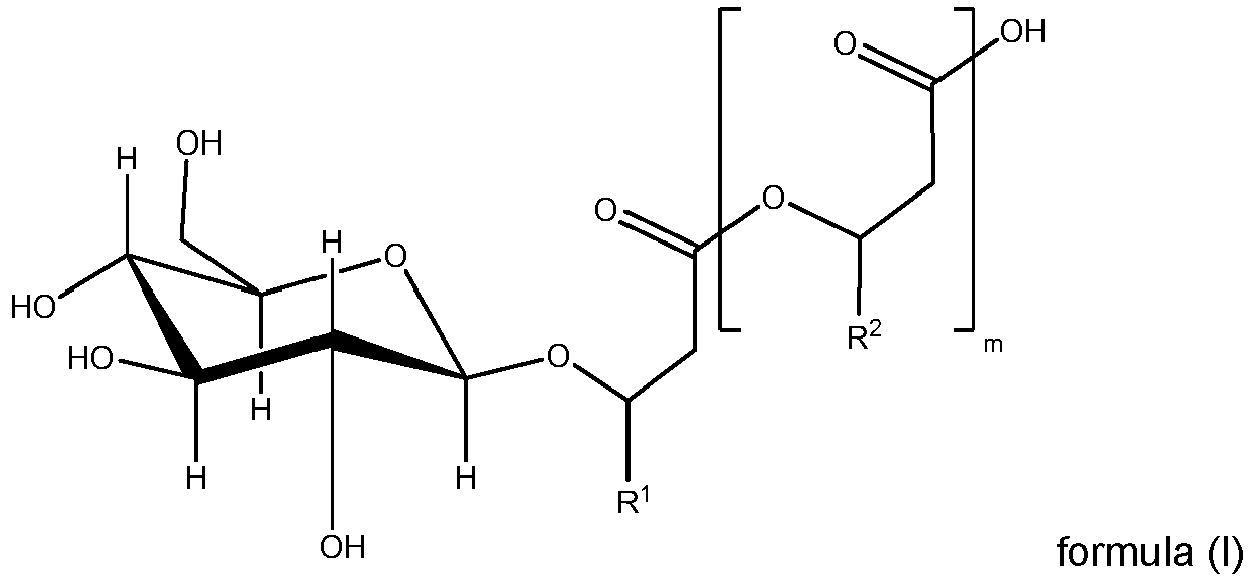 m = 1 or 0,R1 and R2 = independently of one another identical or different organic radical having 2 to 24 carbon atoms, in particular optionally branched, optionally substituted, in particular hydroxy-substituted, optionally unsaturated, in particular optionally mono-, di- or triunsaturated, alkyl radical, preferably one selected from the group consisting of pentenyl, heptenyl, nonenyl, undecenyl and tridecenyl and (CH2)o-CH3 where o = 1 to 23, preferably 4 to 12.
 - Composition according to claim1, characterized in that it comprises glucolipids of the general formula (I) or a salt thereof with m=1 and at least 51% by weight to preferably 98% by weight, preferably 60% by weight to 95% by weight, more preferably 70% by weight to 90% by weight, particularly preferably 75% by weight to 85% by weight, glucolipids GL-C10C10 of the general formula (I) with m=1 and R1 and R2 = (CH2)6-CH3,where the percentages by weight refer to the sum of all of the glucolipids of the general formula (I) present.
- Composition according to claim1 or 2, characterized in that the at least one enzyme is selected from the selected from the group consisting of protease, amylase, cellulase, mannanase, lipase, cutinase, pectate lyase, peroxidase, oxidase and laccase.
- Composition according to at least one of the preceding claims, characterized in that it comprises
C) at least one builder. - Composition according to at least one of the preceding claims, characterized in that it comprisesA) in an amount of from 0.2 wt.-% to 10 wt.-%, preferably from 1.0 wt.-% to 8.0 wt.-%, more preferably from 1.5 wt.-% to 6.0 wt.-%, and as may be the caseB) in an amount of from 1.0 wt.-% to 60 wt.-%, preferably from 3.0 wt.-% to 40 wt.-%, more preferably from 6.0 wt.-% to 35 wt.-%, even more preferably from 10.0 wt.-% to 30 wt.-%, and as may be the case,C) in an amount of from 1.0 wt.-% to 30 wt.-%, preferably from 2.0 wt.-% to 20 wt.-%, more preferably from 3.0 wt.-% to 10 wt.-%,where the percentages by weight refer to the total composition.
- Composition according to at least one of the preceding claims, characterized in that it comprises
at least one further surfactant, preferably selected from the group of non-glucolipid biosurfactants, anionic, cationic, non-ionic, semi-polar and zwitterionic surfactants. - Composition according to at least one of the preceding claims, characterized in that it is a detergent composition.
- Use of a composition according to at least one of the Claims 1 to 7 for cleaning a surface of an article, preferably a textile or a fabric.
- Use according to claim 8 characterized in that the surface of the article is cleaned from fat and/or oil.
- Use of a glucolipid of general formula (I) or a salt thereof,
 m = 1 or 0,R1 and R2 = independently of one another identical or different organic radical having 2 to 24 carbon atoms, in particular optionally branched, optionally substituted, in particular hydroxy-substituted, optionally unsaturated, in particular optionally mono-, di- or triunsaturated, alkyl radical, preferably one selected from the group consisting of pentenyl, heptenyl, nonenyl, undecenyl and tridecenyl and (CH2)o-CH3 where o = 1 to 23, preferably 4 to 12.for the stabilization and/or elevation of an enzymatic activity of an enzyme, preferably selected from the group consisting of protease, amylase, cellulase, mannanase, lipase, cutinase, pectate lyase, peroxidase, oxidase and laccase with protease, amylase, lipase and mannanase being especially preferred and lipase being the most preferred.
Priority Applications (1)
| Application Number | Priority Date | Filing Date | Title |
|---|---|---|---|
| EP22158412.1A EP4234664A1 (en) | 2022-02-24 | 2022-02-24 | Composition comprising glucolipids and enzymes |
Applications Claiming Priority (1)
| Application Number | Priority Date | Filing Date | Title |
|---|---|---|---|
| EP22158412.1A EP4234664A1 (en) | 2022-02-24 | 2022-02-24 | Composition comprising glucolipids and enzymes |
Publications (1)
| Publication Number | Publication Date |
|---|---|
| EP4234664A1 true EP4234664A1 (en) | 2023-08-30 |
Family
ID=80448968
Family Applications (1)
| Application Number | Title | Priority Date | Filing Date |
|---|---|---|---|
| EP22158412.1A Withdrawn EP4234664A1 (en) | 2022-02-24 | 2022-02-24 | Composition comprising glucolipids and enzymes |
Country Status (1)
| Country | Link |
|---|---|
| EP (1) | EP4234664A1 (en) |
Cited By (1)
| Publication number | Priority date | Publication date | Assignee | Title |
|---|---|---|---|---|
| US12448588B2 (en) | 2022-06-28 | 2025-10-21 | Evonik Operations Gmbh | Composition comprising biosurfactant and persicomycin (3-(3′hydroxy)hydroxy fatty acid) |
Citations (118)
| Publication number | Priority date | Publication date | Assignee | Title |
|---|---|---|---|---|
| GB1296839A (en) | 1969-05-29 | 1972-11-22 | ||
| GB1483591A (en) | 1973-07-23 | 1977-08-24 | Novo Industri As | Process for coating water soluble or water dispersible particles by means of the fluid bed technique |
| US4106991A (en) | 1976-07-07 | 1978-08-15 | Novo Industri A/S | Enzyme granulate composition and process for forming enzyme granulates |
| US4435307A (en) | 1980-04-30 | 1984-03-06 | Novo Industri A/S | Detergent cellulase |
| EP0218272A1 (en) | 1985-08-09 | 1987-04-15 | Gist-Brocades N.V. | Novel lipolytic enzymes and their use in detergent compositions |
| US4661452A (en) | 1984-05-29 | 1987-04-28 | Novo Industri A/S | Enzyme containing granulates useful as detergent additives |
| EP0238216A1 (en) | 1986-02-20 | 1987-09-23 | Albright & Wilson Limited | Protected enzyme systems |
| EP0258068A2 (en) | 1986-08-29 | 1988-03-02 | Novo Nordisk A/S | Enzymatic detergent additive |
| EP0305216A1 (en) | 1987-08-28 | 1989-03-01 | Novo Nordisk A/S | Recombinant Humicola lipase and process for the production of recombinant humicola lipases |
| WO1989006270A1 (en) | 1988-01-07 | 1989-07-13 | Novo-Nordisk A/S | Enzymatic detergent |
| WO1989006279A1 (en) | 1988-01-07 | 1989-07-13 | Novo-Nordisk A/S | Mutated subtilisin genes |
| EP0331376A2 (en) | 1988-02-28 | 1989-09-06 | Amano Pharmaceutical Co., Ltd. | Recombinant DNA, bacterium of the genus pseudomonas containing it, and process for preparing lipase by using it |
| WO1989009259A1 (en) | 1988-03-24 | 1989-10-05 | Novo-Nordisk A/S | A cellulase preparation |
| EP0407225A1 (en) | 1989-07-07 | 1991-01-09 | Unilever Plc | Enzymes and enzymatic detergent compositions |
| WO1992005249A1 (en) | 1990-09-13 | 1992-04-02 | Novo Nordisk A/S | Lipase variants |
| EP0495257A1 (en) | 1991-01-16 | 1992-07-22 | The Procter & Gamble Company | Compact detergent compositions with high activity cellulase |
| WO1992017517A1 (en) | 1991-04-02 | 1992-10-15 | Minnesota Mining And Manufacturing Company | Urea-aldehyde condensates and melamine derivatives comprising fluorochemical oligomers |
| US5156773A (en) | 1989-12-12 | 1992-10-20 | Novo Nordisk A/S | Stabilized enzymatic liquid detergent composition |
| WO1992019729A1 (en) | 1991-05-01 | 1992-11-12 | Novo Nordisk A/S | Stabilized enzymes and detergent compositions |
| WO1992021760A1 (en) | 1991-05-29 | 1992-12-10 | Cognis, Inc. | Mutant proteolytic enzymes from bacillus |
| EP0531372A1 (en) | 1990-05-09 | 1993-03-17 | Novo Nordisk As | PREPARATION OF CELLULASE COMPRISING AN ENDOGLUCANASE ENZYME. |
| EP0531315A1 (en) | 1990-05-09 | 1993-03-17 | Novo Nordisk As | ENZYME CAPABLE OF DEGRADING CELLULOSE OR HEMICELLULOSE. |
| EP0550276A1 (en) * | 1991-12-31 | 1993-07-07 | Unilever Plc | Compositions comprising anionic glycolipid surfactants |
| WO1993018140A1 (en) | 1992-03-04 | 1993-09-16 | Novo Nordisk A/S | Novel proteases |
| WO1993024618A1 (en) | 1992-06-01 | 1993-12-09 | Novo Nordisk A/S | Peroxidase variants with improved hydrogen peroxide stability |
| WO1994001541A1 (en) | 1992-07-06 | 1994-01-20 | Novo Nordisk A/S | C. antarctica lipase and lipase variants |
| WO1994002597A1 (en) | 1992-07-23 | 1994-02-03 | Novo Nordisk A/S | MUTANT α-AMYLASE, DETERGENT, DISH WASHING AGENT, AND LIQUEFACTION AGENT |
| WO1994007998A1 (en) | 1992-10-06 | 1994-04-14 | Novo Nordisk A/S | Cellulase variants |
| WO1994018314A1 (en) | 1993-02-11 | 1994-08-18 | Genencor International, Inc. | Oxidatively stable alpha-amylase |
| US5352604A (en) | 1989-08-25 | 1994-10-04 | Henkel Research Corporation | Alkaline proteolytic enzyme and method of production |
| WO1994025583A1 (en) | 1993-05-05 | 1994-11-10 | Novo Nordisk A/S | A recombinant trypsin-like protease |
| WO1994025578A1 (en) | 1993-04-27 | 1994-11-10 | Gist-Brocades N.V. | New lipase variants for use in detergent applications |
| US5389536A (en) | 1986-11-19 | 1995-02-14 | Genencor, Inc. | Lipase from Pseudomonas mendocina having cutinase activity |
| WO1995006720A1 (en) | 1993-08-30 | 1995-03-09 | Showa Denko K.K. | Novel lipase, microorganism producing the lipase, process for producing the lipase, and use of the lipase |
| WO1995010602A1 (en) | 1993-10-13 | 1995-04-20 | Novo Nordisk A/S | H2o2-stable peroxidase variants |
| WO1995010603A1 (en) | 1993-10-08 | 1995-04-20 | Novo Nordisk A/S | Amylase variants |
| WO1995014783A1 (en) | 1993-11-24 | 1995-06-01 | Showa Denko K.K. | Lipase gene and variant lipase |
| WO1995022615A1 (en) | 1994-02-22 | 1995-08-24 | Novo Nordisk A/S | A method of preparing a variant of a lipolytic enzyme |
| WO1995023221A1 (en) | 1994-02-24 | 1995-08-31 | Cognis, Inc. | Improved enzymes and detergents containing them |
| WO1995024471A1 (en) | 1994-03-08 | 1995-09-14 | Novo Nordisk A/S | Novel alkaline cellulases |
| WO1995030744A2 (en) | 1994-05-04 | 1995-11-16 | Genencor International Inc. | Lipases with improved surfactant resistance |
| WO1995035381A1 (en) | 1994-06-20 | 1995-12-28 | Unilever N.V. | Modified pseudomonas lipases and their use |
| WO1996000292A1 (en) | 1994-06-23 | 1996-01-04 | Unilever N.V. | Modified pseudomonas lipases and their use |
| WO1996011262A1 (en) | 1994-10-06 | 1996-04-18 | Novo Nordisk A/S | An enzyme and enzyme preparation with endoglucanase activity |
| WO1996012012A1 (en) | 1994-10-14 | 1996-04-25 | Solvay S.A. | Lipase, microorganism producing same, method for preparing said lipase and uses thereof |
| WO1996013580A1 (en) | 1994-10-26 | 1996-05-09 | Novo Nordisk A/S | An enzyme with lipolytic activity |
| WO1996023873A1 (en) | 1995-02-03 | 1996-08-08 | Novo Nordisk A/S | Amylase variants |
| WO1996027002A1 (en) | 1995-02-27 | 1996-09-06 | Novo Nordisk A/S | Novel lipase gene and process for the production of lipase with the use of the same |
| WO1996029397A1 (en) | 1995-03-17 | 1996-09-26 | Novo Nordisk A/S | Novel endoglucanases |
| WO1996034946A1 (en) | 1995-05-05 | 1996-11-07 | Novo Nordisk A/S | Protease variants and compositions |
| WO1997004079A1 (en) | 1995-07-14 | 1997-02-06 | Novo Nordisk A/S | A modified enzyme with lipolytic activity |
| WO1997007202A1 (en) | 1995-08-11 | 1997-02-27 | Novo Nordisk A/S | Novel lipolytic enzymes |
| US5648263A (en) | 1988-03-24 | 1997-07-15 | Novo Nordisk A/S | Methods for reducing the harshness of a cotton-containing fabric |
| WO1997043424A1 (en) | 1996-05-14 | 1997-11-20 | Genencor International, Inc. | MODIFIED α-AMYLASES HAVING ALTERED CALCIUM BINDING PROPERTIES |
| WO1998008940A1 (en) | 1996-08-26 | 1998-03-05 | Novo Nordisk A/S | A novel endoglucanase |
| WO1998012307A1 (en) | 1996-09-17 | 1998-03-26 | Novo Nordisk A/S | Cellulase variants |
| WO1998015257A1 (en) | 1996-10-08 | 1998-04-16 | Novo Nordisk A/S | Diaminobenzoic acid derivatives as dye precursors |
| WO1998020116A1 (en) | 1996-11-04 | 1998-05-14 | Novo Nordisk A/S | Subtilase variants and compositions |
| WO1998020115A1 (en) | 1996-11-04 | 1998-05-14 | Novo Nordisk A/S | Subtilase variants and compositions |
| WO1999011768A1 (en) | 1997-08-29 | 1999-03-11 | Novo Nordisk A/S | Protease variants and compositions |
| WO1999019467A1 (en) | 1997-10-13 | 1999-04-22 | Novo Nordisk A/S | α-AMYLASE MUTANTS |
| US5998344A (en) | 1993-05-04 | 1999-12-07 | Novo Nordisk A/S | Detergent composition comprising a glycolipid and anionic surfactant for cleaning hard surfaces |
| WO2000060063A1 (en) | 1999-03-31 | 2000-10-12 | Novozymes A/S | Lipase variant |
| WO2001044452A1 (en) | 1999-12-15 | 2001-06-21 | Novozymes A/S | Subtilase variants having an improved wash performance on egg stains |
| WO2001066712A2 (en) | 2000-03-08 | 2001-09-13 | Novozymes A/S | Variants with altered properties |
| WO2001092502A1 (en) | 2000-06-02 | 2001-12-06 | Novozymes A/S | Cutinase variants |
| WO2002010355A2 (en) | 2000-08-01 | 2002-02-07 | Novozymes A/S | Alpha-amylase mutants with altered stability |
| WO2002016547A2 (en) | 2000-08-21 | 2002-02-28 | Novozymes A/S | Subtilase enzymes |
| WO2002026024A1 (en) | 2000-08-05 | 2002-04-04 | Haiquan Li | An apparatus using recyclable resource |
| US6472364B1 (en) | 1998-10-13 | 2002-10-29 | The Procter & Gamble Company | Detergent compositions or components |
| WO2002099091A2 (en) | 2001-06-06 | 2002-12-12 | Novozymes A/S | Endo-beta-1,4-glucanase from bacillus |
| WO2003006602A2 (en) | 2001-07-12 | 2003-01-23 | Novozymes A/S | Subtilase variants |
| WO2004003186A2 (en) | 2002-06-26 | 2004-01-08 | Novozymes A/S | Subtilases and subtilase variants having altered immunogenicity |
| EP1382668A1 (en) | 2002-06-11 | 2004-01-21 | Unilever N.V. | Detergent tablets |
| WO2004041979A2 (en) | 2002-11-06 | 2004-05-21 | Novozymes A/S | Subtilase variants |
| WO2004074419A2 (en) | 2003-02-18 | 2004-09-02 | Novozymes A/S | Detergent compositions |
| WO2005040372A1 (en) | 2003-10-23 | 2005-05-06 | Novozymes A/S | Protease with improved stability in detergents |
| WO2005052146A2 (en) | 2003-11-19 | 2005-06-09 | Genencor International, Inc. | Serine proteases, nucleic acids encoding serine enzymes and vectors and host cells incorporating same |
| WO2005056782A2 (en) | 2003-12-03 | 2005-06-23 | Genencor International, Inc. | Perhydrolase |
| WO2006066594A2 (en) | 2004-12-23 | 2006-06-29 | Novozymes A/S | Alpha-amylase variants |
| EP1705241A1 (en) | 2005-03-23 | 2006-09-27 | Unilever N.V. | Detergent compositions in tablet form |
| WO2007001262A1 (en) | 2005-06-17 | 2007-01-04 | The Procter & Gamble Company | Organic catalyst with enhanced enzyme compatibility |
| WO2007006305A1 (en) | 2005-07-08 | 2007-01-18 | Novozymes A/S | Subtilase variants |
| WO2007044993A2 (en) | 2005-10-12 | 2007-04-19 | Genencor International, Inc. | Use and production of storage-stable neutral metalloprotease |
| WO2007087508A2 (en) | 2006-01-23 | 2007-08-02 | Novozymes A/S | Lipase variants |
| US7262042B2 (en) | 2001-12-20 | 2007-08-28 | Henkel Kommanditgesellschaft Auf Aktien (Henkel Kgaa) | Alkaline protease from Bacillus gibsonii (DSM 14393) and washing and cleaning products comprising said alkaline protease |
| DE102007005419A1 (en) | 2007-01-30 | 2008-07-31 | Henkel Ag & Co. Kgaa | Detergent composition useful for washing textiles comprises an enzyme and a nitrogen-containing surfactant |
| WO2008153815A2 (en) | 2007-05-30 | 2008-12-18 | Danisco Us, Inc., Genencor Division | Variants of an alpha-amylase with improved production levels in fermentation processes |
| US20090011970A1 (en) | 2007-07-02 | 2009-01-08 | Marc Francois Theophile Evers | Laundry multi-compartment pouch composition |
| WO2009021867A2 (en) | 2007-08-10 | 2009-02-19 | Henkel Ag & Co. Kgaa | Agents containing proteases |
| WO2009061380A2 (en) | 2007-11-05 | 2009-05-14 | Danisco Us Inc., Genencor Division | VARIANTS OF BACILLUS sp. TS-23 ALPHA-AMYLASE WITH ALTERED PROPERTIES |
| WO2009067279A1 (en) | 2007-11-21 | 2009-05-28 | E.I. Du Pont De Nemours And Company | Production of peracids using an enzyme having perhydrolysis activity |
| WO2009092699A1 (en) | 2008-01-24 | 2009-07-30 | Unilever Nv | Machine dishwash detergent compositions |
| WO2009102854A1 (en) | 2008-02-15 | 2009-08-20 | The Procter & Gamble Company | Cleaning compositions |
| WO2009109500A1 (en) | 2008-02-29 | 2009-09-11 | Novozymes A/S | Polypeptides having lipase activity and polynucleotides encoding same |
| WO2010016285A1 (en) | 2008-08-04 | 2010-02-11 | ズードケミー触媒株式会社 | Method of producing fatty acid ester and glycerol, biodiesel containing fatty acid ester, and solid catalyst to be used therefor |
| WO2010065455A2 (en) | 2008-12-01 | 2010-06-10 | Danisco Us Inc. | Enzymes with lipase activity |
| WO2010100028A2 (en) | 2009-03-06 | 2010-09-10 | Huntsman Advanced Materials (Switzerland) Gmbh | Enzymatic textile bleach-whitening methods |
| WO2010107560A2 (en) | 2009-03-18 | 2010-09-23 | Danisco Us Inc. | Fungal cutinase from magnaporthe grisea |
| WO2010111143A2 (en) | 2009-03-23 | 2010-09-30 | Danisco Us Inc. | Cal a-related acyltransferases and methods of use, thereof |
| WO2011036264A1 (en) | 2009-09-25 | 2011-03-31 | Novozymes A/S | Use of protease variants |
| WO2011036263A1 (en) | 2009-09-25 | 2011-03-31 | Novozymes A/S | Subtilase variants |
| WO2011084417A1 (en) | 2009-12-21 | 2011-07-14 | Danisco Us Inc. | Detergent compositions containing geobacillus stearothermophilus lipase and methods of use thereof |
| WO2011084599A1 (en) | 2009-12-21 | 2011-07-14 | Danisco Us Inc. | Detergent compositions containing bacillus subtilis lipase and methods of use thereof |
| WO2011084412A1 (en) | 2009-12-21 | 2011-07-14 | Danisco Us Inc. | Detergent compositions containing thermobifida fusca lipase and methods of use thereof |
| WO2011098531A1 (en) | 2010-02-10 | 2011-08-18 | Novozymes A/S | Variants and compositions comprising variants with high stability in presence of a chelating agent |
| WO2011150157A2 (en) | 2010-05-28 | 2011-12-01 | Danisco Us Inc. | Detergent compositions containing streptomyces griseus lipase and methods of use thereof |
| WO2012010407A1 (en) | 2010-07-22 | 2012-01-26 | Unilever Plc | Detergent compositions comprising biosurfactant and lipase |
| WO2012010406A1 (en) | 2010-07-22 | 2012-01-26 | Unilever Plc | Combinations of rhamnolipids and enzymes for improved cleaning |
| WO2012010405A1 (en) | 2010-07-22 | 2012-01-26 | Unilever Plc | Detergent compositions comprising biosurfactant and enzyme |
| WO2012137147A1 (en) | 2011-04-08 | 2012-10-11 | Danisco Us, Inc. | Compositions |
| WO2013001087A2 (en) | 2011-06-30 | 2013-01-03 | Novozymes A/S | Method for screening alpha-amylases |
| WO2013001078A1 (en) | 2011-06-30 | 2013-01-03 | Novozymes A/S | Alpha-amylase variants |
| CN104031899A (en) | 2013-03-05 | 2014-09-10 | 中国科学院天津工业生物技术研究所 | Lipase and application thereof |
| EP3023431A1 (en) | 2014-11-19 | 2016-05-25 | Evonik Degussa GmbH | Concentrated, low viscosity rhamnolipid compounds |
| WO2017036901A1 (en) | 2015-08-28 | 2017-03-09 | Unilever Plc | Improved wash compositions |
| US20180023040A1 (en) * | 2015-03-18 | 2018-01-25 | Evonik Degussa Gmbh | Composition containing peptidase and biosurfactant |
| WO2019154970A1 (en) | 2018-02-09 | 2019-08-15 | Evonik Degussa Gmbh | Mixture composition comprising glucolipids |
-
2022
- 2022-02-24 EP EP22158412.1A patent/EP4234664A1/en not_active Withdrawn
Patent Citations (126)
| Publication number | Priority date | Publication date | Assignee | Title |
|---|---|---|---|---|
| GB1296839A (en) | 1969-05-29 | 1972-11-22 | ||
| GB1483591A (en) | 1973-07-23 | 1977-08-24 | Novo Industri As | Process for coating water soluble or water dispersible particles by means of the fluid bed technique |
| US4106991A (en) | 1976-07-07 | 1978-08-15 | Novo Industri A/S | Enzyme granulate composition and process for forming enzyme granulates |
| US4435307A (en) | 1980-04-30 | 1984-03-06 | Novo Industri A/S | Detergent cellulase |
| US4661452A (en) | 1984-05-29 | 1987-04-28 | Novo Industri A/S | Enzyme containing granulates useful as detergent additives |
| EP0218272A1 (en) | 1985-08-09 | 1987-04-15 | Gist-Brocades N.V. | Novel lipolytic enzymes and their use in detergent compositions |
| EP0238216A1 (en) | 1986-02-20 | 1987-09-23 | Albright & Wilson Limited | Protected enzyme systems |
| EP0258068A2 (en) | 1986-08-29 | 1988-03-02 | Novo Nordisk A/S | Enzymatic detergent additive |
| US5389536A (en) | 1986-11-19 | 1995-02-14 | Genencor, Inc. | Lipase from Pseudomonas mendocina having cutinase activity |
| EP0305216A1 (en) | 1987-08-28 | 1989-03-01 | Novo Nordisk A/S | Recombinant Humicola lipase and process for the production of recombinant humicola lipases |
| WO1989006270A1 (en) | 1988-01-07 | 1989-07-13 | Novo-Nordisk A/S | Enzymatic detergent |
| WO1989006279A1 (en) | 1988-01-07 | 1989-07-13 | Novo-Nordisk A/S | Mutated subtilisin genes |
| EP0331376A2 (en) | 1988-02-28 | 1989-09-06 | Amano Pharmaceutical Co., Ltd. | Recombinant DNA, bacterium of the genus pseudomonas containing it, and process for preparing lipase by using it |
| US5691178A (en) | 1988-03-22 | 1997-11-25 | Novo Nordisk A/S | Fungal cellulase composition containing alkaline CMC-endoglucanase and essentially no cellobiohydrolase |
| US5776757A (en) | 1988-03-24 | 1998-07-07 | Novo Nordisk A/S | Fungal cellulase composition containing alkaline CMC-endoglucanase and essentially no cellobiohydrolase and method of making thereof |
| WO1989009259A1 (en) | 1988-03-24 | 1989-10-05 | Novo-Nordisk A/S | A cellulase preparation |
| US5648263A (en) | 1988-03-24 | 1997-07-15 | Novo Nordisk A/S | Methods for reducing the harshness of a cotton-containing fabric |
| EP0407225A1 (en) | 1989-07-07 | 1991-01-09 | Unilever Plc | Enzymes and enzymatic detergent compositions |
| US5352604A (en) | 1989-08-25 | 1994-10-04 | Henkel Research Corporation | Alkaline proteolytic enzyme and method of production |
| US5156773A (en) | 1989-12-12 | 1992-10-20 | Novo Nordisk A/S | Stabilized enzymatic liquid detergent composition |
| EP0531315A1 (en) | 1990-05-09 | 1993-03-17 | Novo Nordisk As | ENZYME CAPABLE OF DEGRADING CELLULOSE OR HEMICELLULOSE. |
| EP0531372A1 (en) | 1990-05-09 | 1993-03-17 | Novo Nordisk As | PREPARATION OF CELLULASE COMPRISING AN ENDOGLUCANASE ENZYME. |
| US5686593A (en) | 1990-05-09 | 1997-11-11 | Novo Nordisk A/S | Enzyme capable of degrading cellulose or hemicellulose |
| US5457046A (en) | 1990-05-09 | 1995-10-10 | Novo Nordisk A/S | Enzyme capable of degrading cellullose or hemicellulose |
| US5763254A (en) | 1990-05-09 | 1998-06-09 | Novo Nordisk A/S | Enzyme capable of degrading cellulose or hemicellulose |
| WO1992005249A1 (en) | 1990-09-13 | 1992-04-02 | Novo Nordisk A/S | Lipase variants |
| EP0495257A1 (en) | 1991-01-16 | 1992-07-22 | The Procter & Gamble Company | Compact detergent compositions with high activity cellulase |
| WO1992017517A1 (en) | 1991-04-02 | 1992-10-15 | Minnesota Mining And Manufacturing Company | Urea-aldehyde condensates and melamine derivatives comprising fluorochemical oligomers |
| WO1992019729A1 (en) | 1991-05-01 | 1992-11-12 | Novo Nordisk A/S | Stabilized enzymes and detergent compositions |
| WO1992021760A1 (en) | 1991-05-29 | 1992-12-10 | Cognis, Inc. | Mutant proteolytic enzymes from bacillus |
| EP0550276A1 (en) * | 1991-12-31 | 1993-07-07 | Unilever Plc | Compositions comprising anionic glycolipid surfactants |
| WO1993018140A1 (en) | 1992-03-04 | 1993-09-16 | Novo Nordisk A/S | Novel proteases |
| WO1993024618A1 (en) | 1992-06-01 | 1993-12-09 | Novo Nordisk A/S | Peroxidase variants with improved hydrogen peroxide stability |
| WO1994001541A1 (en) | 1992-07-06 | 1994-01-20 | Novo Nordisk A/S | C. antarctica lipase and lipase variants |
| WO1994002597A1 (en) | 1992-07-23 | 1994-02-03 | Novo Nordisk A/S | MUTANT α-AMYLASE, DETERGENT, DISH WASHING AGENT, AND LIQUEFACTION AGENT |
| WO1994007998A1 (en) | 1992-10-06 | 1994-04-14 | Novo Nordisk A/S | Cellulase variants |
| WO1994018314A1 (en) | 1993-02-11 | 1994-08-18 | Genencor International, Inc. | Oxidatively stable alpha-amylase |
| WO1994025578A1 (en) | 1993-04-27 | 1994-11-10 | Gist-Brocades N.V. | New lipase variants for use in detergent applications |
| US5998344A (en) | 1993-05-04 | 1999-12-07 | Novo Nordisk A/S | Detergent composition comprising a glycolipid and anionic surfactant for cleaning hard surfaces |
| WO1994025583A1 (en) | 1993-05-05 | 1994-11-10 | Novo Nordisk A/S | A recombinant trypsin-like protease |
| WO1995006720A1 (en) | 1993-08-30 | 1995-03-09 | Showa Denko K.K. | Novel lipase, microorganism producing the lipase, process for producing the lipase, and use of the lipase |
| WO1995010603A1 (en) | 1993-10-08 | 1995-04-20 | Novo Nordisk A/S | Amylase variants |
| WO1995010602A1 (en) | 1993-10-13 | 1995-04-20 | Novo Nordisk A/S | H2o2-stable peroxidase variants |
| WO1995014783A1 (en) | 1993-11-24 | 1995-06-01 | Showa Denko K.K. | Lipase gene and variant lipase |
| WO1995022615A1 (en) | 1994-02-22 | 1995-08-24 | Novo Nordisk A/S | A method of preparing a variant of a lipolytic enzyme |
| WO1995023221A1 (en) | 1994-02-24 | 1995-08-31 | Cognis, Inc. | Improved enzymes and detergents containing them |
| EP1921147A2 (en) | 1994-02-24 | 2008-05-14 | Henkel Kommanditgesellschaft auf Aktien | Improved enzymes and detergents containing them |
| EP1921148A2 (en) | 1994-02-24 | 2008-05-14 | Henkel Kommanditgesellschaft auf Aktien | Improved enzymes and detergents containing them |
| WO1995024471A1 (en) | 1994-03-08 | 1995-09-14 | Novo Nordisk A/S | Novel alkaline cellulases |
| WO1995030744A2 (en) | 1994-05-04 | 1995-11-16 | Genencor International Inc. | Lipases with improved surfactant resistance |
| WO1995035381A1 (en) | 1994-06-20 | 1995-12-28 | Unilever N.V. | Modified pseudomonas lipases and their use |
| WO1996000292A1 (en) | 1994-06-23 | 1996-01-04 | Unilever N.V. | Modified pseudomonas lipases and their use |
| WO1996011262A1 (en) | 1994-10-06 | 1996-04-18 | Novo Nordisk A/S | An enzyme and enzyme preparation with endoglucanase activity |
| WO1996012012A1 (en) | 1994-10-14 | 1996-04-25 | Solvay S.A. | Lipase, microorganism producing same, method for preparing said lipase and uses thereof |
| WO1996013580A1 (en) | 1994-10-26 | 1996-05-09 | Novo Nordisk A/S | An enzyme with lipolytic activity |
| WO1996023873A1 (en) | 1995-02-03 | 1996-08-08 | Novo Nordisk A/S | Amylase variants |
| WO1996027002A1 (en) | 1995-02-27 | 1996-09-06 | Novo Nordisk A/S | Novel lipase gene and process for the production of lipase with the use of the same |
| WO1996029397A1 (en) | 1995-03-17 | 1996-09-26 | Novo Nordisk A/S | Novel endoglucanases |
| WO1996034946A1 (en) | 1995-05-05 | 1996-11-07 | Novo Nordisk A/S | Protease variants and compositions |
| WO1997004079A1 (en) | 1995-07-14 | 1997-02-06 | Novo Nordisk A/S | A modified enzyme with lipolytic activity |
| WO1997007202A1 (en) | 1995-08-11 | 1997-02-27 | Novo Nordisk A/S | Novel lipolytic enzymes |
| WO1997043424A1 (en) | 1996-05-14 | 1997-11-20 | Genencor International, Inc. | MODIFIED α-AMYLASES HAVING ALTERED CALCIUM BINDING PROPERTIES |
| WO1998008940A1 (en) | 1996-08-26 | 1998-03-05 | Novo Nordisk A/S | A novel endoglucanase |
| WO1998012307A1 (en) | 1996-09-17 | 1998-03-26 | Novo Nordisk A/S | Cellulase variants |
| WO1998015257A1 (en) | 1996-10-08 | 1998-04-16 | Novo Nordisk A/S | Diaminobenzoic acid derivatives as dye precursors |
| WO1998020116A1 (en) | 1996-11-04 | 1998-05-14 | Novo Nordisk A/S | Subtilase variants and compositions |
| WO1998020115A1 (en) | 1996-11-04 | 1998-05-14 | Novo Nordisk A/S | Subtilase variants and compositions |
| WO1999011768A1 (en) | 1997-08-29 | 1999-03-11 | Novo Nordisk A/S | Protease variants and compositions |
| WO1999019467A1 (en) | 1997-10-13 | 1999-04-22 | Novo Nordisk A/S | α-AMYLASE MUTANTS |
| US6472364B1 (en) | 1998-10-13 | 2002-10-29 | The Procter & Gamble Company | Detergent compositions or components |
| WO2000060063A1 (en) | 1999-03-31 | 2000-10-12 | Novozymes A/S | Lipase variant |
| WO2001044452A1 (en) | 1999-12-15 | 2001-06-21 | Novozymes A/S | Subtilase variants having an improved wash performance on egg stains |
| WO2001066712A2 (en) | 2000-03-08 | 2001-09-13 | Novozymes A/S | Variants with altered properties |
| WO2001092502A1 (en) | 2000-06-02 | 2001-12-06 | Novozymes A/S | Cutinase variants |
| WO2002010355A2 (en) | 2000-08-01 | 2002-02-07 | Novozymes A/S | Alpha-amylase mutants with altered stability |
| WO2002026024A1 (en) | 2000-08-05 | 2002-04-04 | Haiquan Li | An apparatus using recyclable resource |
| WO2002016547A2 (en) | 2000-08-21 | 2002-02-28 | Novozymes A/S | Subtilase enzymes |
| WO2002099091A2 (en) | 2001-06-06 | 2002-12-12 | Novozymes A/S | Endo-beta-1,4-glucanase from bacillus |
| WO2003006602A2 (en) | 2001-07-12 | 2003-01-23 | Novozymes A/S | Subtilase variants |
| US7262042B2 (en) | 2001-12-20 | 2007-08-28 | Henkel Kommanditgesellschaft Auf Aktien (Henkel Kgaa) | Alkaline protease from Bacillus gibsonii (DSM 14393) and washing and cleaning products comprising said alkaline protease |
| EP1382668A1 (en) | 2002-06-11 | 2004-01-21 | Unilever N.V. | Detergent tablets |
| WO2004003186A2 (en) | 2002-06-26 | 2004-01-08 | Novozymes A/S | Subtilases and subtilase variants having altered immunogenicity |
| WO2004041979A2 (en) | 2002-11-06 | 2004-05-21 | Novozymes A/S | Subtilase variants |
| WO2004074419A2 (en) | 2003-02-18 | 2004-09-02 | Novozymes A/S | Detergent compositions |
| WO2005040372A1 (en) | 2003-10-23 | 2005-05-06 | Novozymes A/S | Protease with improved stability in detergents |
| WO2005052146A2 (en) | 2003-11-19 | 2005-06-09 | Genencor International, Inc. | Serine proteases, nucleic acids encoding serine enzymes and vectors and host cells incorporating same |
| WO2005052161A2 (en) | 2003-11-19 | 2005-06-09 | Genencor International, Inc. | Serine proteases, nucleic acids encoding serine enzymes and vectors and host cells incorporating same |
| WO2005056782A2 (en) | 2003-12-03 | 2005-06-23 | Genencor International, Inc. | Perhydrolase |
| WO2006066594A2 (en) | 2004-12-23 | 2006-06-29 | Novozymes A/S | Alpha-amylase variants |
| EP1705241A1 (en) | 2005-03-23 | 2006-09-27 | Unilever N.V. | Detergent compositions in tablet form |
| WO2007001262A1 (en) | 2005-06-17 | 2007-01-04 | The Procter & Gamble Company | Organic catalyst with enhanced enzyme compatibility |
| WO2007006305A1 (en) | 2005-07-08 | 2007-01-18 | Novozymes A/S | Subtilase variants |
| WO2007044993A2 (en) | 2005-10-12 | 2007-04-19 | Genencor International, Inc. | Use and production of storage-stable neutral metalloprotease |
| WO2007087508A2 (en) | 2006-01-23 | 2007-08-02 | Novozymes A/S | Lipase variants |
| DE102007005419A1 (en) | 2007-01-30 | 2008-07-31 | Henkel Ag & Co. Kgaa | Detergent composition useful for washing textiles comprises an enzyme and a nitrogen-containing surfactant |
| WO2008153815A2 (en) | 2007-05-30 | 2008-12-18 | Danisco Us, Inc., Genencor Division | Variants of an alpha-amylase with improved production levels in fermentation processes |
| US20090011970A1 (en) | 2007-07-02 | 2009-01-08 | Marc Francois Theophile Evers | Laundry multi-compartment pouch composition |
| WO2009021867A2 (en) | 2007-08-10 | 2009-02-19 | Henkel Ag & Co. Kgaa | Agents containing proteases |
| WO2009061380A2 (en) | 2007-11-05 | 2009-05-14 | Danisco Us Inc., Genencor Division | VARIANTS OF BACILLUS sp. TS-23 ALPHA-AMYLASE WITH ALTERED PROPERTIES |
| WO2009067279A1 (en) | 2007-11-21 | 2009-05-28 | E.I. Du Pont De Nemours And Company | Production of peracids using an enzyme having perhydrolysis activity |
| WO2009092699A1 (en) | 2008-01-24 | 2009-07-30 | Unilever Nv | Machine dishwash detergent compositions |
| WO2009102854A1 (en) | 2008-02-15 | 2009-08-20 | The Procter & Gamble Company | Cleaning compositions |
| WO2009109500A1 (en) | 2008-02-29 | 2009-09-11 | Novozymes A/S | Polypeptides having lipase activity and polynucleotides encoding same |
| WO2010016285A1 (en) | 2008-08-04 | 2010-02-11 | ズードケミー触媒株式会社 | Method of producing fatty acid ester and glycerol, biodiesel containing fatty acid ester, and solid catalyst to be used therefor |
| WO2010065455A2 (en) | 2008-12-01 | 2010-06-10 | Danisco Us Inc. | Enzymes with lipase activity |
| WO2010100028A2 (en) | 2009-03-06 | 2010-09-10 | Huntsman Advanced Materials (Switzerland) Gmbh | Enzymatic textile bleach-whitening methods |
| WO2010107560A2 (en) | 2009-03-18 | 2010-09-23 | Danisco Us Inc. | Fungal cutinase from magnaporthe grisea |
| WO2010111143A2 (en) | 2009-03-23 | 2010-09-30 | Danisco Us Inc. | Cal a-related acyltransferases and methods of use, thereof |
| WO2011036264A1 (en) | 2009-09-25 | 2011-03-31 | Novozymes A/S | Use of protease variants |
| WO2011036263A1 (en) | 2009-09-25 | 2011-03-31 | Novozymes A/S | Subtilase variants |
| WO2011084417A1 (en) | 2009-12-21 | 2011-07-14 | Danisco Us Inc. | Detergent compositions containing geobacillus stearothermophilus lipase and methods of use thereof |
| WO2011084599A1 (en) | 2009-12-21 | 2011-07-14 | Danisco Us Inc. | Detergent compositions containing bacillus subtilis lipase and methods of use thereof |
| WO2011084412A1 (en) | 2009-12-21 | 2011-07-14 | Danisco Us Inc. | Detergent compositions containing thermobifida fusca lipase and methods of use thereof |
| WO2011098531A1 (en) | 2010-02-10 | 2011-08-18 | Novozymes A/S | Variants and compositions comprising variants with high stability in presence of a chelating agent |
| WO2011150157A2 (en) | 2010-05-28 | 2011-12-01 | Danisco Us Inc. | Detergent compositions containing streptomyces griseus lipase and methods of use thereof |
| WO2012010407A1 (en) | 2010-07-22 | 2012-01-26 | Unilever Plc | Detergent compositions comprising biosurfactant and lipase |
| WO2012010406A1 (en) | 2010-07-22 | 2012-01-26 | Unilever Plc | Combinations of rhamnolipids and enzymes for improved cleaning |
| WO2012010405A1 (en) | 2010-07-22 | 2012-01-26 | Unilever Plc | Detergent compositions comprising biosurfactant and enzyme |
| WO2012137147A1 (en) | 2011-04-08 | 2012-10-11 | Danisco Us, Inc. | Compositions |
| WO2013001087A2 (en) | 2011-06-30 | 2013-01-03 | Novozymes A/S | Method for screening alpha-amylases |
| WO2013001078A1 (en) | 2011-06-30 | 2013-01-03 | Novozymes A/S | Alpha-amylase variants |
| CN104031899A (en) | 2013-03-05 | 2014-09-10 | 中国科学院天津工业生物技术研究所 | Lipase and application thereof |
| EP3023431A1 (en) | 2014-11-19 | 2016-05-25 | Evonik Degussa GmbH | Concentrated, low viscosity rhamnolipid compounds |
| US20180023040A1 (en) * | 2015-03-18 | 2018-01-25 | Evonik Degussa Gmbh | Composition containing peptidase and biosurfactant |
| WO2017036901A1 (en) | 2015-08-28 | 2017-03-09 | Unilever Plc | Improved wash compositions |
| WO2019154970A1 (en) | 2018-02-09 | 2019-08-15 | Evonik Degussa Gmbh | Mixture composition comprising glucolipids |
Non-Patent Citations (3)
| Title |
|---|
| BIOCHEMISTRY, vol. 56, no. 32, 2017, pages 4256 - 4 |
| SIEZEN ET AL., PROTEIN ENGNG, vol. 4, 1991, pages 719 - 737 |
| SIEZEN ET AL., PROTEIN SCIENCE, vol. 6, 1997, pages 501 - 523 |
Cited By (1)
| Publication number | Priority date | Publication date | Assignee | Title |
|---|---|---|---|---|
| US12448588B2 (en) | 2022-06-28 | 2025-10-21 | Evonik Operations Gmbh | Composition comprising biosurfactant and persicomycin (3-(3′hydroxy)hydroxy fatty acid) |
Similar Documents
| Publication | Publication Date | Title |
|---|---|---|
| EP3645692B1 (en) | ENZYME SLUDGE COMPOSITION | |
| ES2971871T3 (en) | Detergent compositions comprising bacterial mannanases | |
| US12258542B2 (en) | Detergent composition comprising protease and amylase variants | |
| ES2691080T3 (en) | Variants of the lanuginous humicella lipase stabilized in water-soluble films | |
| ES2763235T3 (en) | Detergent composition comprising subtilase variants | |
| ES2794837T3 (en) | Detergent Compositions Comprising Polypeptides Having Xanthan Degrading Activity | |
| EP3106508A1 (en) | Detergent composition comprising subtilase variants | |
| EP3080195B1 (en) | Use of enzyme particles in water-soluble films | |
| CN109996859A (en) | Particle containing spore | |
| US20240084226A1 (en) | Liquid enzyme composition with sulfite scavenger | |
| US20170121646A1 (en) | Improved Stabilization of Non-Protease Enzyme | |
| US20250084346A1 (en) | Encapsulated solid enzyme product | |
| US20220145220A1 (en) | Detergent Compositions Comprising Two Proteases | |
| CN113302295A (en) | Powder detergent composition | |
| EP4077617B1 (en) | Stabilized liquid boron-free enzyme compositions | |
| US20190218479A1 (en) | Stabilized Liquid Peroxide Compositions | |
| CN114364778A (en) | Enzymatic emulsion for detergents | |
| CN111542589A (en) | Low powdering particles | |
| US20230193162A1 (en) | Low dusting granules |
Legal Events
| Date | Code | Title | Description |
|---|---|---|---|
| PUAI | Public reference made under article 153(3) epc to a published international application that has entered the european phase |
Free format text: ORIGINAL CODE: 0009012 |
|
| STAA | Information on the status of an ep patent application or granted ep patent |
Free format text: STATUS: THE APPLICATION HAS BEEN PUBLISHED |
|
| AK | Designated contracting states |
Kind code of ref document: A1 Designated state(s): AL AT BE BG CH CY CZ DE DK EE ES FI FR GB GR HR HU IE IS IT LI LT LU LV MC MK MT NL NO PL PT RO RS SE SI SK SM TR |
|
| STAA | Information on the status of an ep patent application or granted ep patent |
Free format text: STATUS: THE APPLICATION IS DEEMED TO BE WITHDRAWN |
|
| 18D | Application deemed to be withdrawn |
Effective date: 20240301 |